Skip to content · ⁨본문 바로가기⁩

Claims, Evidence, and the Rhetorical Situation · ⁨주장, 증거 및 수사적 상황⁩

AP English Language and Composition · ⁨AP 영어 어법 및 작문⁩ · Topic 1 · ⁨주제 1⁩

Video lesson for this topic · ⁨이 주제용 영상 수업⁩ Open the video page · ⁨영상 페이지 열기⁩
6:20

단원 1: 주장, 증거, 및 수사적 상황

이 전체 수업에서 가장 흔한 약한 답안은 이것입니다. "작가는 수사적 질문을 사용합니다." 이 문장은何も 얻지 못하며, 이것이 대부분의…

English narration · English + 中文 subtitles burned in · ⁨영어 내레이션 · 영어 + 중국어 자막 burned-in⁩

1.1

The Rhetorical Situation · ⁨수사의 상황⁩

Syllabus
English

Enduring Understanding (RHS-1): Individuals write within a particular situation and make strategic writing choices based on that situation.

Learning Objective 1.A: Reading – Identify and describe components of the rhetorical situation: the exigence, audience, writer, purpose, context, and message.

  • RHS-1.A The rhetorical situation of a text collectively refers to the exigence, purpose, audience, writer, context, and message.
  • RHS-1.B The exigence is the part of a rhetorical situation that inspires, stimulates, provokes, or prompts writers to create a text.
  • RHS-1.C The purpose of a text is what the writer hopes to accomplish with it. Writers may have more than one purpose in a text.
  • RHS-1.D An audience of a text has shared as well as individual beliefs, values, needs, and backgrounds.
  • RHS-1.E Writers create texts within a particular context that includes the time, place, and occasion.
한국어

지속적 이해 (RHS-1): 개인들은 특정 situation within in writing within and make strategic choices based on that situation.

학습 목표 1.A: 독해 – rhetorical situation의 구성 요소를 식별하고 설명하시오: exigence, audience, writer, purpose, context, message.

  • RHS-1.A 텍스트의 rhetorical situation collectively refers to the exigence, purpose, audience, writer, context, and message.
  • RHS-1.B 필요성(Exigence)은 수사가 rhetorical situation의 일부로서, 작가로 하여금 텍스트를 창작하도록 영감を与거나 자극하며, 유발하거나 유도하는 요소이다.
  • RHS-1.C 텍스트의 목적은 작가가 이를 통해 달성하고자 하는 바이다. 작가는 하나의 텍스트에 여러 가지 목적을 담을 수 있다.
  • RHS-1.D 텍스트의 청중은 공유하는 신념, 가치관, 필요성 및 배경과 개개인의 신념, 가치관, 필요성 및 배경을 모두 가진다.
  • RHS-1.E 작가는 시간, 장소, 사건이 포함된 특정 맥락 내에서 텍스트를 창작한다.
Source: College Board AP Course and Exam Description · ⁨출처: College Board AP Course and Exam Description⁩

English

AP English Language is not a literature course. It is a course in how texts do work on readers, and Unit 1 installs the two ideas everything else is built on: the rhetorical situation and the claim-plus-evidence paragraph.

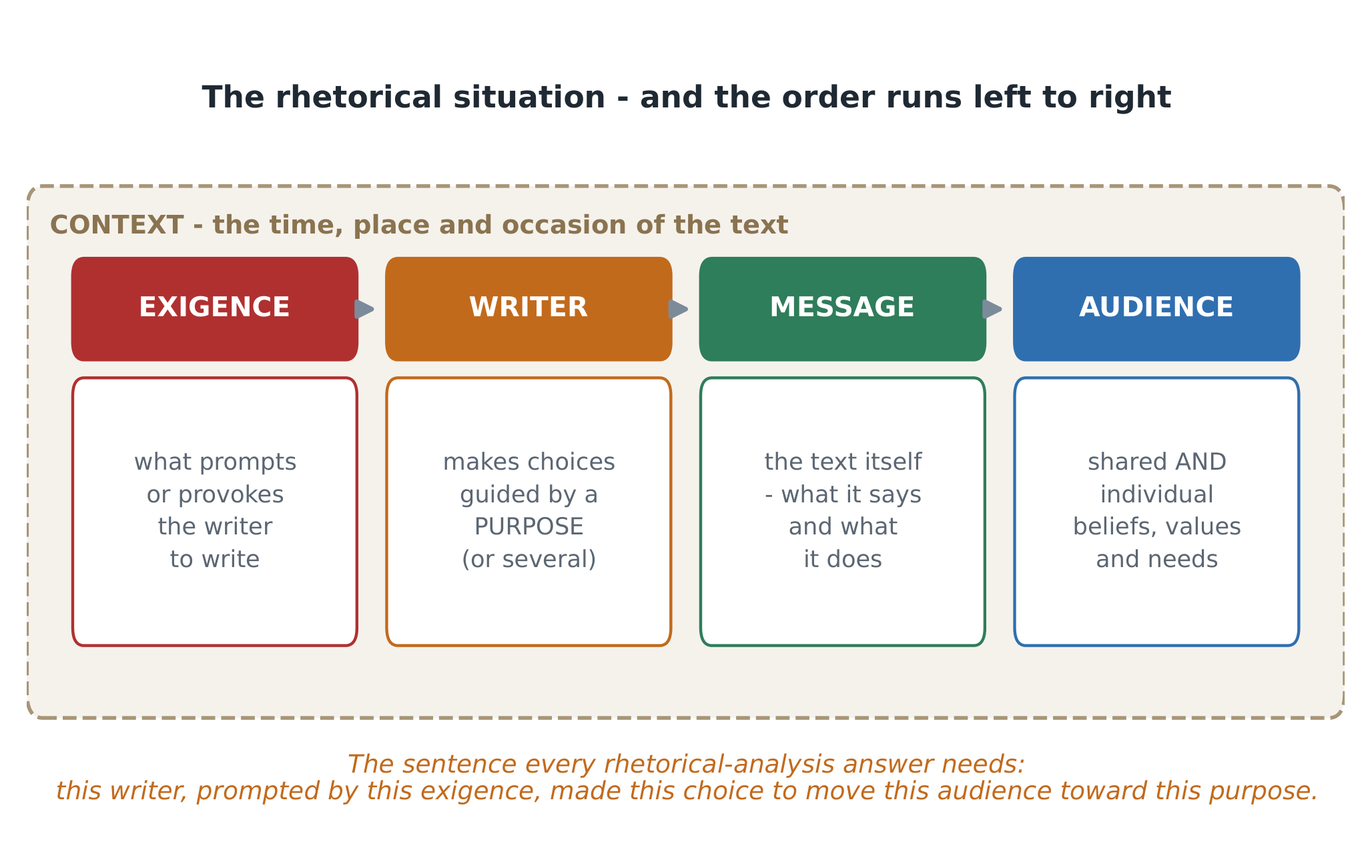
The CED defines the rhetorical situation 修辞情境 as the exigence, purpose, audience, writer, context, and message taken together. Each has a precise meaning, and using them precisely is what separates a strong answer from a vague one:

  • The exigence 促因 is the part of the situation that inspires, stimulates, provokes, or prompts a writer to create a text. It is the reason this text exists now.
  • The purpose 目的 is what the writer hopes to accomplish. A text may have more than one purpose.
  • The audience 受众 has shared as well as individual beliefs, values, needs, and backgrounds - so "the audience" is never a single uniform thing.
  • The context 语境 includes the time, place, and occasion in which the text was created.
  • The message is what the text actually says and does.

The most common weak answer in this course names a device and stops. The rhetorical situation is what turns a device into an argument: this writer, prompted by this exigence, made this choice to move this audience toward this purpose.

한국어

AP 영어 언어 과목은 문학 수업이 아닙니다. 텍스트가 독자에게 어떤 영향을 미치는지를 다루는 수업이며, 유닛 1에서는其余 everything을 위한 두 가지 핵심 개념을 설치합니다: 수사의 상황과 주장+증거 단락.

6개 구성 요소가 인과 순서를 알 수 있도록 배열됨 *촉因이 작가를 자극하고, 맥락이 모든 것을 둘러쌈 - 모든 "선택"에 대한 질문从这里从这里 answering됨

CED는 수사의 상황 修辞情境을 촉因, 목적, 청중, 작가, 맥락, 메시지가 결합된 것으로 정의함. 각 용어에는 정확한 의미가 있으며, 이를 정확히 사용하는 것이 강력한 답변과 모호한 답변을 가르는 차이임:

  • 촉因 促因은 상황의 일부로, 작가가 텍스트를 생성하도록 영감, 자극, 자극하거나 유도하는 부분임. 이 텍스트가 지금 존재하는 이유임.
  • 목적 目的是作자가 달성하고자 하는 것임. 하나의 텍스트가 하나 이상의 목적을 가질 수 있음.
  • 청중 受众은 공유된 개인적인 신념, 가치, 필요, 배경을 공유하므로, '청중'은 단일 일관된 대상이 절대 아님.
  • 맥락 语境는 텍스트가 창작된 시간, 장소, 사건을 포함함.
  • 메시지는 텍스트가 실제로 말하고 행하는 것입니다.

이 과목에서 가장 흔한 약한 답변은 장치를 언급하고 멈추는 것임. 수사적 상황이 장치를 논쟁으로 만드는 것임: 이 작가는 이 촉因에 의해 자극받아, 이 청중을 이 목적으로 이동시키기 위해 이 선택을 함.

Vocabulary · ⁨어휘⁩ Train · ⁨연습하기⁩
English 한국어
rhetorical situation/reˈtɒrɪkl ˌsɪtʃuːˈeɪʃn/ 수사 상황
1.2

Identifying Claims and Evidence · ⁨주장과 증거 식별⁩

Syllabus
English
Enduring UnderstandingLearning ObjectiveEssential Knowledge

CLE-1
Writers make claims about subjects, rely on evidence that supports the reasoning that justifies the claim, and often acknowledge or respond to other, possibly opposing, arguments.

3.A
Reading – Identify and explain claims and evidence within an argument.

  • CLE-1.A Writers convey their positions through one or more claims that require a defense.
  • CLE-1.B Writers defend their claims with evidence and/or reasoning.
  • CLE-1.C Types of evidence may include facts, anecdotes, analogies, statistics, examples, details, illustrations, expert opinions, personal observations, personal experiences, testimonies, or experiments.
  • CLE-1.D Effective claims provoke interest and require a defense, rather than simply stating an obvious, known fact that requires no defense or justification.
  • CLE-1.E Writers relate source material to their own argument by syntactically embedding particular quoted, paraphrased, or summarized information from one or more sources into their own ideas.
한국어
Enduring UnderstandingLearning ObjectiveEssential Knowledge

CLE-1
작가는 주제에 대한 주장을 내세우고, 주장을 정당화하는 추론을 뒷받침할 증거를 reliance하며, 때로는 다른, 대립될 수 있는 주장들을 인정하거나 반응하기도 한다.

3.A
독해 – 논증 내의 주장과 증거를 식별하고 설명한다.

  • CLE-1.A 작가는 방어를 요구하는 하나 이상의 주장을 통해 자신의 입장을 전달한다.
  • CLE-1.B 작가는 증거와/또는 추론을 사용하여 자신의 주장을 방어한다.
  • CLE-1.C 증거의 유형에는 사실, 일화, 유비, 통계, 예시, 디테일, 삽화, 전문가 의견, 개인적 관찰, 개인적 경험, 증언, 실험 등이 포함될 수 있다.
  • CLE-1.D 효과적인 주장은 단순히 방어나 정당화가 필요하지 않은 명백한 사실을陈述하는 것이 아니라, 흥미를 유발하고 방어를 요구하고야 한다.
  • CLE-1.E 작가는 문법적으로 특정 인용, 의역 또는 요약된 정보를 하나 이상의 출처에서 가져와 자신의 아이디어 속에 편입함으로써 원본 자료를 자신의 논증과 연결시킨다.

Source: College Board AP Course and Exam Description · ⁨출처: College Board AP Course and Exam Description⁩

English
  • Writers convey their positions through one or more claims 主张 that require a defence.
  • Writers defend their claims with evidence and/or reasoning 证据与推理.
  • Types of evidence include facts, anecdotes, analogies, statistics, examples, details, illustrations, expert opinions, and personal experience - a deliberately wide list, because recognising an anecdote or an analogy as evidence is itself a skill.
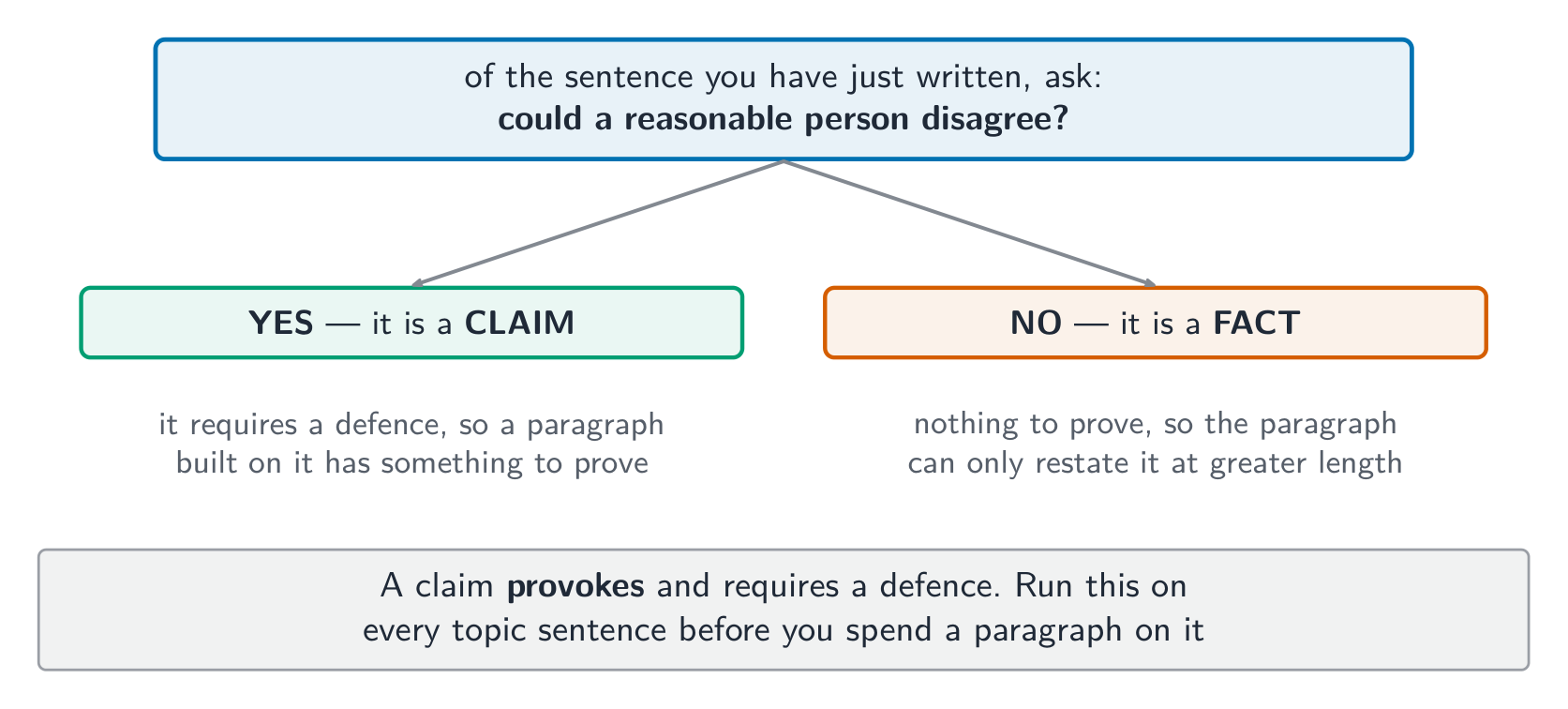
  • Effective claims provoke interest and require a defence, rather than stating an obvious, known fact that requires no proof.

That fourth point is the most useful test you have. Ask of any sentence: could a reasonable person disagree? If not, it is not a claim - it is a fact, and building a paragraph on it produces writing with nothing to prove.

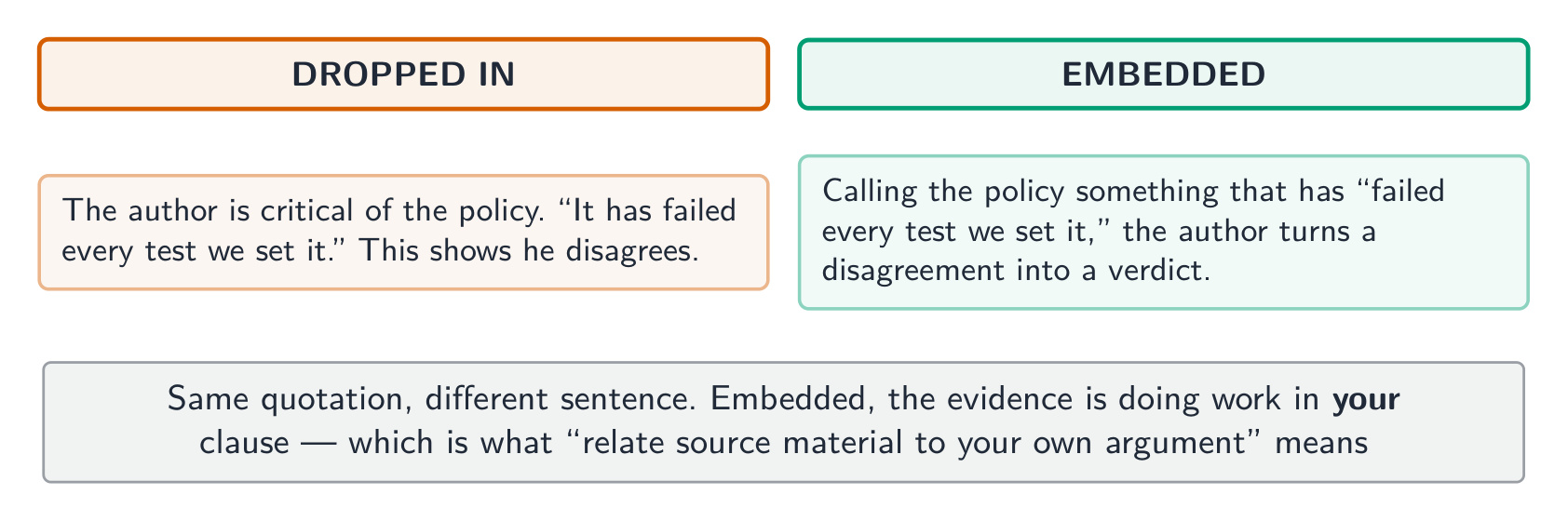
Finally, writers relate source material to their own argument by syntactically embedding quoted, paraphrased, or summarised material into their own sentences. The evidence is not dropped in beside your sentence; it is built into it.

한국어
  • 작가는 방어가 필요한 하나 이상의 주장 主张을 통해 자신의 입장을 전달함.
  • 작가는 증거와/또는 추론 证据与推理로 주장을 방어함.
  • 증거의 종류에는 사실, 에피소드, 유비, 통계, 예시, 디테일, 삽화, 전문가 의견, 그리고 개인 경험이 포함됨 — 의도적으로 넓은 목록으로, 에피소드나 유비를 증거로서 인식하는 것 자체가 một skill임.
  • 효과적인 주장은 관심을 유발하고 방어가 필요하며, 입증할 필요가 없는 명백하고 알려진 사실을陈述하는 것이 아님.

네 번째 점은 당신이 가진 가장 유용한 테스트임. 어떤 문장에 대해 물어보라: 합리적인 사람이 이의를 할 수 있었을까? 그렇지 않다면, 그것은 주장이 아니라 사실이며, 그에 기반하여 단락을 구성하면 증명할 것이 없는 글이 나옴.

마지막으로, 작가는 구문적으로 인용, 의역 또는 요약된 자료를 본인의 문장 안에 내재시켜 출처 자료를 본인의 논증과 연결함. 증거가 본인의 문장 옆에 던져지는 것이 아니라, 그 안에 구축됨.

주장과 사실을 가르는 유일한 테스트: 합리적인 사람이 이의를 할 수 있었을까?
같은 인용구가 separately dropped in되고 embedded되어 있음 - 둘 중 하나만이 본인의 문장에서 기능함
Explore · ⁨탐색하기⁩

Claim or fact? Run the test on each sentence · ⁨주장인지 사실인가? 각 문장에 대해 테스트를 수행해 보라.⁩

The test is one question: could a reasonable person disagree? If not, it is not a claim and a paragraph on it has nothing to prove. · ⁨테스트는 하나의 질문이다: 합리적인 사람이 반박할 수 있는가? 그렇지 않다면 주장이 아니며, 그에 대한 문단은 증명할 것이 없다.⁩

1.3

Developing a Paragraph with Claim and Evidence · ⁨주장과 증거를 포함한 단락 발전⁩

Syllabus
English
Enduring UnderstandingLearning ObjectiveEssential Knowledge

CLE-1
Writers make claims about subjects, rely on evidence that supports the reasoning that justifies the claim, and often acknowledge or respond to other, possibly opposing, arguments.

4.A
Writing – Develop a paragraph that includes a claim and evidence supporting the claim.

  • CLE-1.A Writers convey their positions through one or more claims that require a defense.
  • CLE-1.B Writers defend their claims with evidence and/or reasoning.
  • CLE-1.C Types of evidence may include facts, anecdotes, analogies, statistics, examples, details, illustrations, expert opinions, personal observations, personal experiences, testimonies, or experiments.
  • CLE-1.D Effective claims provoke interest and require a defense, rather than simply stating an obvious, known fact that requires no defense or justification.
  • CLE-1.E Writers relate source material to their own argument by syntactically embedding particular quoted, paraphrased, or summarized information from one or more sources into their own ideas.
한국어
Enduring UnderstandingLearning ObjectiveEssential Knowledge

CLE-1
작가는 주제에 대한 주장을 내세우고, 주장을 정당화하는 추론을 뒷받침할 증거를 reliance하며, 때로는 다른, 대립될 수 있는 주장들을 인정하거나 반응하기도 한다.

4.A
글쓰기 – 주장과 이를 지지하는 증거가 포함된 문단을 개발한다.

  • CLE-1.A 작가는 방어를 요구하는 하나 이상의 주장을 통해 자신의 입장을 전달한다.
  • CLE-1.B 작가는 증거와/또는 추론을 사용하여 자신의 주장을 방어한다.
  • CLE-1.C 증거의 유형에는 사실, 일화, 유비, 통계, 예시, 디테일, 삽화, 전문가 의견, 개인적 관찰, 개인적 경험, 증언, 실험 등이 포함될 수 있다.
  • CLE-1.D 효과적인 주장은 단순히 방어나 정당화가 필요하지 않은 명백한 사실을陈述하는 것이 아니라, 흥미를 유발하고 방어를 요구하고야 한다.
  • CLE-1.E 작가는 문법적으로 특정 인용, 의역 또는 요약된 정보를 하나 이상의 출처에서 가져와 자신의 아이디어 속에 편입함으로써 원본 자료를 자신의 논증과 연결시킨다.

Source: College Board AP Course and Exam Description · ⁨출처: College Board AP Course and Exam Description⁩

English

Unit 1's writing objective is deliberately small: write one paragraph containing a claim and evidence that supports it. Everything later in the course is an elaboration of this.

A working shape:

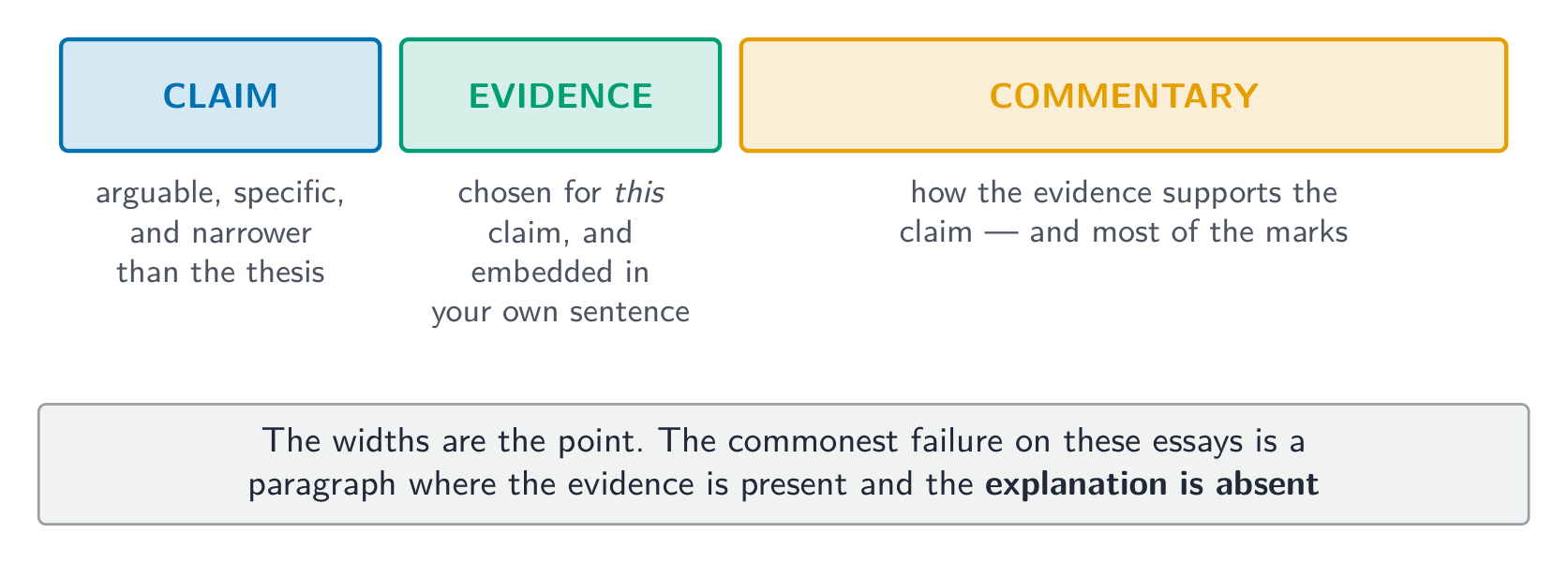
  1. A claim that requires defence - arguable, specific, and narrower than the whole thesis.
  2. Evidence chosen because it supports this claim, embedded syntactically rather than dropped in.
  3. Commentary explaining how the evidence supports the claim - the step students skip, and the one that carries most of the marks on the exam.

The single most common failure on the AP Language essays is a paragraph in which the evidence is present and the explanation is absent. The reader can see the quotation; what they cannot see is why you think it proves your point.

한국어

유닛 1의 쓰기 목표는 고의로 작게 설정됨: 주장과 이를 지지하는 증거가 포함된 단락을 하나 쓰세요. 이후 과정의 모든 내용은 이의 확장임.

작업 형식:

  1. 방어가 필요한 주장 - 논쟁 가능하고 구체적이며, 전체 가설보다 좁음.
  2. 증거 - 이 주장을 지지하기 위해 선택되었으며, 구문적으로 내재되어 separately dropped in되지 않음.
  3. 해설: 증거가 주장을 어떻게 지지하는지 설명하는 부분 - 학생들이 생략하기 쉬우며, 시험에서 가장 많은 점수를 차지하는 단계.

AP 언어 및 작문 서술형 문제에서 가장 흔한 실수는 Evidence(증거)는 있으나 Explanation(해설)이 없는 문단입니다. 독자는 인용구를 볼 수 있지만, 왜 그것이 당신의 주장을 증명한다고 생각하는지에 대해서는 알 수 없습니다.

문단이 가져야 할 비율로 그려진 그림 - 너비가 핵심입니다
Explore · ⁨탐색하기⁩

Build a paragraph in proportion · ⁨비례를 맞춰 단락을 구성함⁩

The commonest failure on these essays is a paragraph where the evidence is present and the explanation is absent. · ⁨이 에세이에서 가장 흔한 실수는 증거는 있으나 설명이 없는 단락이다.⁩

1.3

What the Exam Actually Asks · ⁨실제 시험에서 요구하는 것⁩

English

The free-response section has three questions, and they use the same skills in different arrangements:

  • Question 1, Synthesis 综合写作: you are given several sources and must build your own argument, using the sources as evidence rather than summarising them.
  • Question 2, Rhetorical Analysis 修辞分析: you are given one text and must explain the choices the writer makes and how those choices contribute to purpose - which is the rhetorical situation applied.
  • Question 3, Argument 论证写作: you are given a claim or a scenario and must argue a position, using evidence from your own knowledge and experience.

All three are marked on a six-point rubric with the same three rows: thesis (1 point), evidence and commentary (4 points), and sophistication (1 point). Knowing that shape from Unit 1 tells you where the marks are: four of the six come from evidence and the commentary on it, so a plan that produces evidence without explanation caps you at low marks no matter how good the writing sounds.

Worked example (a real AP exam task). A Rhetorical Analysis prompt asks you to "explain the writer's rhetorical choices" in a given passage. A row-scoring answer does not say "the writer uses a rhetorical question." It says: "Faced with an audience that already agrees on the problem but not on its urgency, the writer opens with a question rather than a statement, forcing readers to supply the answer themselves and so to feel the conclusion as their own rather than as one imposed on them." Notice what earns the points: the audience, the choice, and the effect on purpose - the rhetorical situation, used.

한국어

서술형 섹션에는 세 가지 문제가 있으며, 동일한 기술이 다른 구성으로 출제됩니다:

  • 문제 1, Synthesis (종합 작성): 여러 출처를 제공받으며, 이를 요약하는 것이 아니라 증거로 활용하여 당신의 own 논리를 구축해야 합니다.
  • 문제 2, Rhetorical Analysis (수사 분석): 하나의 텍스트를 제공받으며, 저자가 취한 선택 사항과 그 선택들이 목적에 어떻게 기여하는지를 설명해야 합니다. 이는 적용된 수사적 상황(rhetorical situation)에 해당합니다.
  • 문제 3, Argument (논증 작성): 주장이나 시나리오를 제공받으며, 자신의 지식과 경험을 근거로 입장을 논증해야 합니다.

모든 문제는 동일한 6점 채점 기준에 따라 평가되며, 세 가지 항목으로 구성됩니다: 주장(thesis, 1점), 증거와 해설(evidence and commentary, 4점), 그리고 심오함(sophistication, 1점). Unit 1에서 배운 이 구조를 알고 있다면 점수가 어디에 분포하는지 알 수 있습니다. 여섯 점 중 네 점은 증거 그리고 그에 대한 해설에서 나옵니다. 따라서 해설 없이 증거만 나열하는 계획은 글쓰기가 아무리 훌륭해도 낮은 점수밖에 받을 수 없음을 의미합니다.

작문 예시 (실제 AP 시험 문제). 수사 분석 문제에서 *“저자의 수사적 선택을 설명하라”*고 요청할 때, 행 단위로採점되는 답안은 *“저자가 의문문을 사용한다”*라고 말하지 않습니다. 대신 다음과 같이 말합니다: “독자들이 이미 문제의 존재에는 동의하지만 그 시급성에는 동의하지 않는 상황에서, 저자는 진술문 대신 질문으로 시작하여 독자들에게 답변을 스스로 도출하게 함으로써, 결론이 자신에게 강요된 것이 아니라 자신의 것으로 느껴지게 한다.” 여기서 점수를 받는 요소를 주목하십시오: 독자, 선택 사항, 그리고 목적에 미치는 영향 - 즉, 사용된 수사적 상황(rhetorical situation)입니다.

1.3

Exam tips · ⁨시험 팁⁩

English
  • Learn the six components by name and use the names. Precision here is directly rewarded.
  • Exigence is not the same as purpose. Exigence is what prompted the text; purpose is what the writer wants to achieve.
  • Test every claim with could a reasonable person disagree? If not, it is a fact, not a claim.
  • Embed evidence in your own sentence. Dropped quotations read as unprocessed.
  • Four of six points are evidence and commentary. Write the commentary; it is where most lost marks live.
  • Never name a device without saying what it does to the audience. A device with no effect earns nothing.
한국어
  • 여섯 가지 요소의 명칭을 기억하고 이를 정확히 사용하십시오.在这里的精确性会直接得到奖励。
  • Exigence(발생 원인)와 Purpose(목적)는 다릅니다. Exigence는 텍스트를的产生原因; Purpose는 저자가 달성하고자 하는 것입니다.
  • 모든 주장을 *“합리적인 사람이 반박할 수 있을까?”*로 테스트하십시오. 그렇지 않다면 그것은 주장이 아닌 사실입니다.
  • 증거를 본인의 문장에 내재시키십시오. 단순히 붙여넣기식 인용문은 처리되지 않은 상태처럼 읽힙니다.
  • 여섯 점 중 네 점은 증거와 해설입니다. 해설을 쓰십시오. 그곳에 가장 많은 점수가 놓여 있습니다.
  • 장치(device)를 언급할 때는 반드시 그것이 독자에게 어떤 영향을 미치는지 함께 명시하십시오. 효과가 없는 장치는 점수를 주지 못합니다.
Vocabulary · ⁨어휘⁩ Train · ⁨연습하기⁩
English 한국어
exigence/ˈeksɪdʒəns/ exigence(요청)
purpose/ˈpɜːpəs/ purpose(목적)
audience/ˈɔːdɪəns/ audience(독자)
context/ˈkɒntekst/ 맥락
claims/kleɪmz/ 주장
evidence and/or reasoning/ˈevɪdəns ænd ɔː ˈriːzənɪŋ/ 증거 및/또는 추론
Question 1, Synthesis/ˈkwestʃn wɒn ˈsɪnθəsɪs/ 문제 1, 통합
Question 2, Rhetorical Analysis/ˈkwestʃn tuː reˈtɒrɪkl əˈnæləsɪs/ 문제 2, 수사 분석
Question 3, Argument/ˈkwestʃn θriː ˈɑːɡjuːmənt/ 문제 3, 논증

Interactive lessons on this topic · ⁨이 주제에 대한 인터랙티브 수업⁩

Work through it step by step, with instant-check exercises. · ⁨즉시 체크 기능 exercises를 통해 단계별로 진행하세요.⁩

Past Papers · ⁨과거 시험지⁩

More topics in AP English Language and Composition · ⁨AP 영어 어법 및 작문⁩ · ⁨AP English Language and Composition · ⁨AP 영어 어법 및 작문⁩ 내 추가 주제⁩

Log in or create account · ⁨로그인 또는 계정 만들기⁩

IGCSE, A-Level & AP