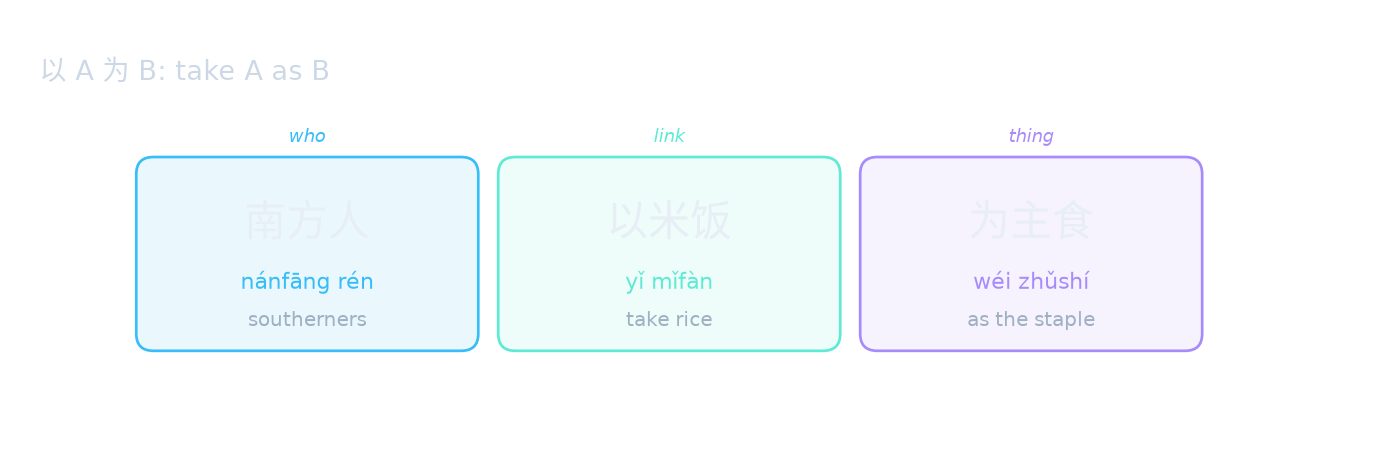
by means of以 A for / (wéi) to be为 B means "take A as B" or "treat A as B": by means of以student学生for / (wéi) to be为center中心 (with students at the centre). It is formal and appears in notices, reports and school rules. A is what you choose; B is the role you give it.
Sentence patterns — comparison
HSK 4 · Topic 11
 2:57
HSK 4 Grammar 11: Sentence Patterns — Comparison
The frame: take A as B. 以 A 为 B means "take or regard A as B" : your basis, standard or focus, in an elegant, formal frame. Semi-classical, written register.…
English explanations + Mandarin examples · captions follow the spoken text
11.1
以 A 为 B (take A as B)
Form: by means of以 A for / (wéi) to be为 B (written) · by means of以……to rely mainly on为主 / used in the construction…为例 / for / (wéi) to be为center中心 / for / (wéi) to be为goal目标
- 南方人by means of以cooked rice米饭to rely mainly on为主to feed (a person or animal)食。 Nánfāng rén yǐ mǐfàn wéi zhǔshí. – People in the south take rice as their staple food.
- by means of以Beijing北京used in the construction…为例,underground railway地铁line / route线路already已经to exceed超过二十条。 Yǐ Běijīng wéi lì, dìtiě xiànlù yǐjīng chāoguò èrshí tiáo. – Take Beijing as an example: it already has more than twenty metro lines.
- we / us我们(modifier / structural particle)的课以colloquial speech口语to rely mainly on为主。 Wǒmen de kè yǐ kǒuyǔ wéi zhǔ. – Our classes focus mainly on speaking.
- this这个city城市by means of以tourism industry旅游业for / (wéi) to be为center中心to develop; development发展economy经济。 Zhège chéngshì yǐ lǚyóuyè wéi zhōngxīn fāzhǎn jīngjì. – This city develops its economy around tourism.
- we / us我们by means of以to pass a university…考上university大学for / (wéi) to be为goal目标。 Wǒmen yǐ kǎoshàng dàxué wéi mùbiāo. – Our goal is to get into university.
- 这次activity; to exercise活动by means of以eco-friendly / environmental protection环保for / (wéi) to be为theme主题。 Zhè cì huódòng yǐ huánbǎo wéi zhǔtí. – The theme of this event is environmental protection.
How it works. by means of以 A for / (wéi) to be为 B means "take A as B, treat A as B". by means of以 introduces A; for / (wéi) to be为 links it to the role B (staple food主食, example例, center中心, goal目标, theme主题). It is written style: you meet it in reports, school notices, news and essays, and it lets one compact clause say what everyday speech needs a whole sentence for.
In this pattern for / (wéi) to be为 is read wéi ("as, to be"), not wèi ("for"). The most useful forms are fixed, so learn them as chunks.
| Fixed form | Meaning | Spoken equivalent |
|---|---|---|
| by means of以……to rely mainly on为主 | mainly …, … above all | main主要to be / is是…… |
| by means of以……used in the construction…为例 | take … as an example | for example比如…… |
| by means of以……for / (wéi) to be为center中心 | with … at the centre | to revolve around围绕…… |
| by means of以……for / (wéi) to be为goal目标 | with … as the goal | goal目标to be / is是…… |
| by means of以……为荣 | be proud of … | for / (wéi) to be为……to feel感到proud; pride骄傲 |
这家店以Sichuan or Szechuan cuisine川菜to rely mainly on为主 (written) = 这家shop店main主要to do; to make做Sichuan or Szechuan cuisine川菜 (spoken).
Watch out
- Keep both halves: wrong: by means of以cooked rice米饭staple food主食 → by means of以cooked rice米饭to rely mainly on为主to feed (a person or animal)食.
- Read for / (wéi) to be为 as wéi here. for / (wéi) to be为the people人民service / to serve服务 (wèi, "serve the people") is a different for / (wéi) to be为.
- In casual speech it sounds stiff: say we / us我们main主要to practice练colloquial speech口语, not we / us我们by means of以colloquial speech口语to rely mainly on为主 when chatting with a friend.
In a passage
we / us我们school学校(modifier / structural particle)的summer vacation time暑期course课程by means of以practice (putting into practice)实践to rely mainly on为主。by means of以科学课used in the construction…为例,student学生every week每周want / will / need要to do; to make做twice两次experiment实验,还要to write写实验报告。course课程by means of以to train; to develop培养student学生(modifier / structural particle)的to start; to hit (someone)动手ability能力for / (wéi) to be为goal目标,so / therefore所以teacher老师讲得少,student学生to do; to make做(degree marker)得many; much多。
Read and notice. Find three different by means of以……for / (wéi) to be为…… phrases. Say each one again in spoken Chinese.
Vocabulary
Train
| 汉字 | Pinyin | English |
|---|---|---|
| 以 | yǐ | by means of |
| 超过 | chāo guò | to exceed |
| 发展 | fā zhǎn | to develop; development |
| 经济 | jīng jì | economy |
| 活动 | huó dòng | activity; to exercise |
| 骄傲 | jiāo ào | proud; pride |
| 能力 | néng lì | ability |
11.2
Practice
Cover the teaching pages before you answer. The answers are at the end.
1. Complete (written): “Take Shanghai as an example.” …………Shanghai municipality…上海used in the construction…为例。
2. How is for / (wéi) to be为 read in by means of以cooked rice米饭to rely mainly on为主?
- A. wéi
- B. wěi
- C. wēi
- D. wèi
3. Build: “Our classes focus mainly on speaking.”
Put in order: by means of以colloquial speech口语 / to rely mainly on为主。 / we / us我们(modifier / structural particle)的lesson课
4. True or false? 这家shop店main主要to do; to make做Sichuan or Szechuan cuisine川菜 is a spoken way to say 这家店以Sichuan or Szechuan cuisine川菜to rely mainly on为主. If false, correct it.
5. You are describing food in different parts of China for a class presentation. Use by means of以 A for / (wéi) to be为 B. Write your answer in Chinese, then say it aloud.
11.3
Mixed practice
These questions mix the patterns and use new situations.
6. Which sentence is correct?
- A. we / us我们school学校by means of以student学生for / (wéi) to be为center中心。
- B. we / us我们school学校by means of以student学生to be / is是center中心。
- C. we / us我们school学校for / (wéi) to be为student学生by means of以center中心。
7. Say formally: "Our course focuses mainly on speaking." (by means of以……to rely mainly on为主)
8. Find and fix the problem. A classmate reads by means of以safe安全for / (wéi) to be为key point重点 as "use safety to make a point". What does it mean?
9. Use it yourself. Write a school rule: this check takes accuracy as its main goal.
11.4
Answers and explanations
Mark your work, then correct each mistake in your own words.
1. by means of以
by means of以 A used in the construction…为例 = take A as an example.
2. A. wéi
In by means of以 A for / (wéi) to be为 B (“take A as B”), for / (wéi) to be为 is read wéi: by means of以cooked rice米饭to rely mainly on为主 “mainly rice”. Read wèi, it means “for”, as in why?为什么.
3. we / us我们(modifier / structural particle)的课以colloquial speech口语to rely mainly on为主。
Topic + by means of以 A to rely mainly on为主.
4. True.
main主要 is the everyday equivalent of by means of以…to rely mainly on为主.
5. Model answer: 南方人by means of以cooked rice米饭to rely mainly on为主to feed (a person or animal)食。
Check your answer:
- In this pattern for / (wéi) to be为 is read wéi ("as, to be"), not wèi ("for").
- It is written style; in speech say main主要to be / is是… or for example比如….
Mixed practice
6. A. The pattern is by means of以 A for / (wéi) to be为 B: take A as B.
7. we / us我们(modifier / structural particle)的course课程by means of以colloquial speech口语to rely mainly on为主。by means of以……to rely mainly on为主 = mainly ….
8. by means of以 A for / (wéi) to be为 B means "take A as B": the main focus is safety.
9. Model answer. 这次to check检查by means of以accurate准确for / (wéi) to be为main主要goal目标。
Review later. Tomorrow, write one rule with by means of以……to rely mainly on为主 and one with by means of以……for / (wéi) to be为center中心.
Interactive lessons on this topic
Work through it step by step, with instant-check exercises.