Words that join ideas. Some give conditions (if如果, as long as只要, only (if) / only have只有), some choose between options (or或者, or / still还是), some add or exclude (not only不但……moreover而且, besides除了) and some give a purpose (in order to为了). Prepositions such as with / and跟, pertaining to关于 and towards向 tell you with whom, about what and in which direction. Most of these come in pairs, so learn the second half with the first.
Conjunctions, conditions & prepositions
HSK 3 · Topic 7
 6:06
HSK 3 Grammar 7: Conjunctions & Conditions
This topic covers conditions with 如果, 只要, 只有 and 才; the two ors, 或者 and 还是; adding and excluding with 不但 and 除了; purpose with 为了; and the prepositions 跟, 关于…
English explanations + Mandarin examples · captions follow the spoken text
7.1
At a glance
Conditions
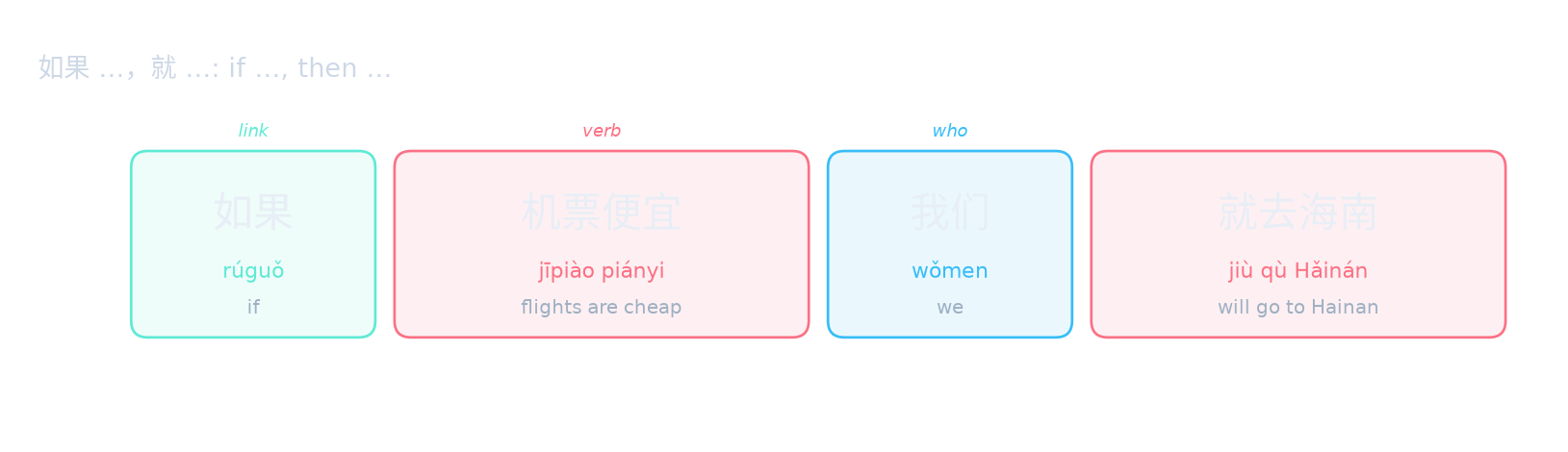
- 1. if如果 … ,then / just就 … – if …, then …: if如果air ticket机票cheap便宜,we / us我们then / just就to go去Hainan Province, in the…海南。
- 2. if如果 … if (coming after a…的话 – if …: if如果tomorrow明天to rain下雨if (coming after a…的话,we / us我们then / just就to be at home在家to look at; to watch; to read看film; movie电影。
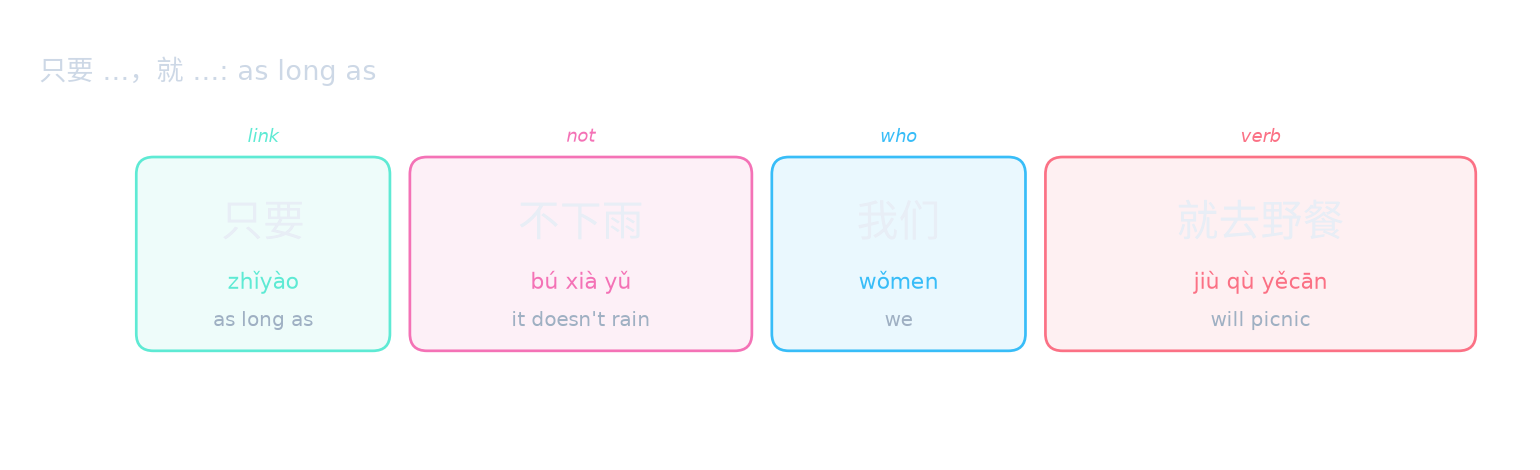
- 3. as long as只要 … ,then / just就 … – as long as: as long as只要不下雨,we / us我们then / just就to go去picnic野餐。
- 4. only (if) / only have只有 … ,only then / not until才 … – only if: only (if) / only have只有to know知道password密码,only then can / talent才能to go in进去。
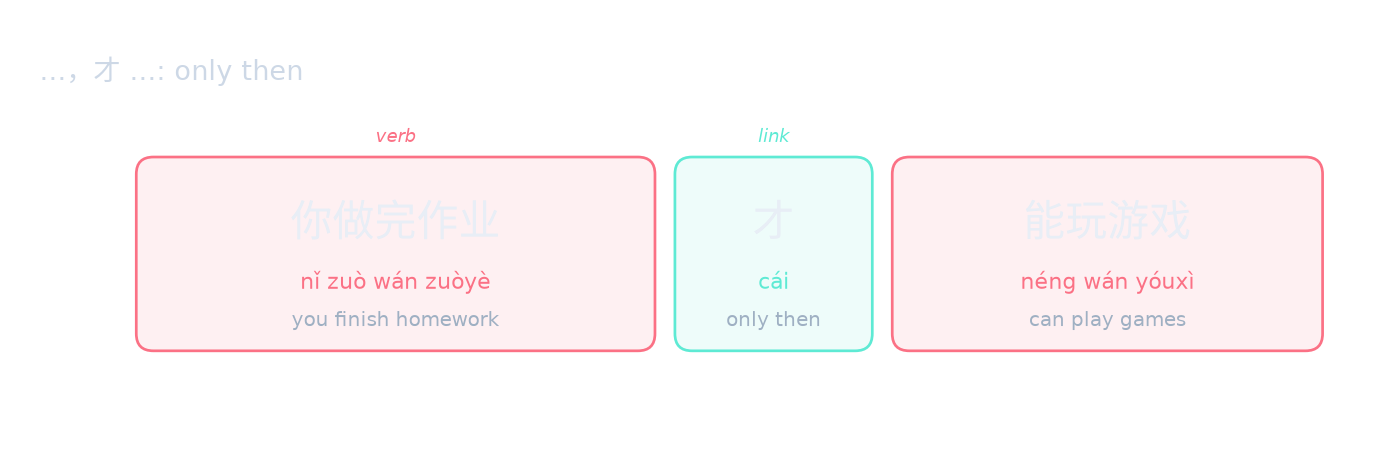
- 5. … ,only then / not until才 … – only then / only after: you你做完作业,only then can / talent才能玩游戏。
- 6. until直到 … ,… only then / not until才 … – all the way until: I / me我all along / straight一直to wait until等到十二点,she / her她only then / not until才给我发news; message消息。
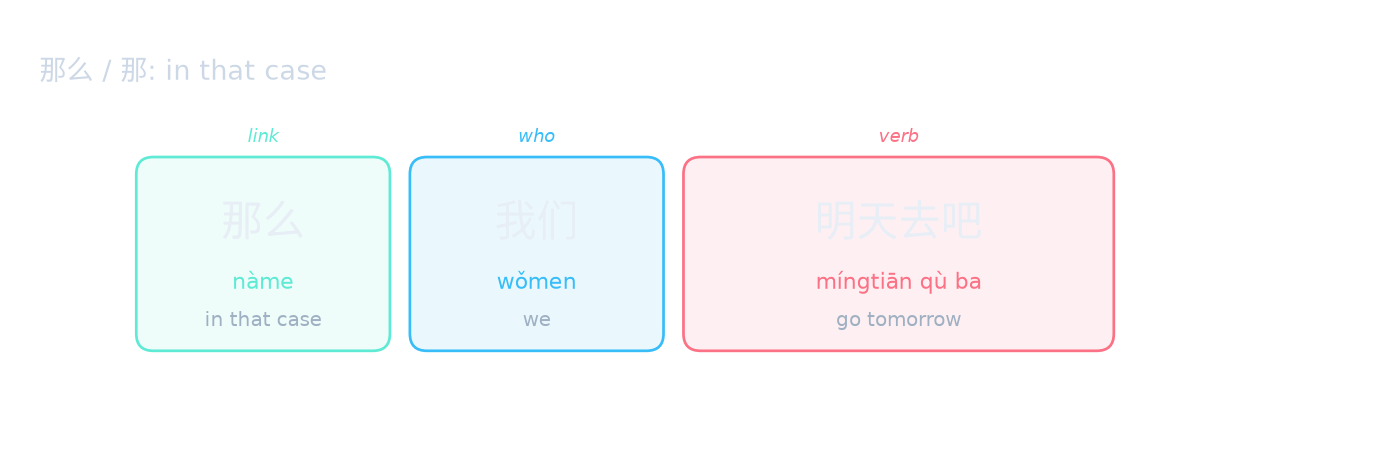
- 7. like that那么 … – then / in that case: like that那么,we / us我们tomorrow明天to go去(suggestion)吧。
Or
- 8. A or或者 B – or – in statements: Saturday星期六or或者Sunday星期天all / both都can / may可以。
- 9. A or / still还是 B? – or – in questions: you (polite)您to drink tea喝茶or / still还是喝咖啡?
- 10. or / still还是 vs or或者 – or: question vs statement: cooked rice米饭or / still还是noodles面条?
Adding, excluding and purpose
- 11. not only不但 … ,moreover而且 … – not only … but also: 这家restaurant饭馆not only不但cheap便宜,moreover而且degree / adjective linker很tasty好吃。
- 12. besides除了 … all / both都 / still / also / even还 – except / besides: besides除了I / me我,everyone大家all / both都to go去(completed / change)了。
- 13. in order to为了 – in order to / for the sake of: in order to为了to pass a university…考上good好university大学,she / her她every day每天五点to get up起床to study; to learn学习。
With, about and towards
- 14. with / and跟 + Person + Verb – with someone: I / me我with / and跟friend朋友together一起to go去Yunnan province in…云南。
- 15. pertaining to关于 + Topic – about / regarding: 这是一本pertaining to关于China中国history历史(modifier / structural particle)的book书。
- 16. towards向 + Direction / Person + Verb – towards: you你向前走,then / after然后towards向(bound form) right右to turn (a corner etc)拐。
7.2
1. 如果 … ,就 … (if …, then …)
Form: if如果 A,(subject +) then / just就 + B
- if如果air ticket机票cheap便宜,we / us我们then / just就to go去Hainan Province, in the…海南。 Rúguǒ jīpiào piányi, wǒmen jiù qù Hǎinán. – If the plane tickets are cheap, we'll go to Hainan.
- if如果you你not不hurry up / a bit faster快点儿,then / just就can / will会to arrive late迟到。 – If you don't hurry, you'll be late.
- if如果you你not不comfortable舒服,then / just就to go去to look at; to watch; to read看doctor医生(suggestion)吧。 – If you're not well, go and see a doctor.
How it works. then / just就 links the result to the condition: "if A, then B". It goes after the subject of the result clause: if如果you你to come来,I / me我then / just就to / for / give给you你to prepare a meal做饭. The pattern is used for plans, warnings and advice.
| if如果 | because因为 |
|---|---|
| a possibility | a fact that already holds |
| if如果to rain下雨,I / me我then / just就not不to go去。 | because因为to rain下雨,so / therefore所以I / me我not / haven't没to go去。 |
Watch out
- wrong: then / just就I / me我to go去 → I / me我then / just就to go去.
- wrong: if如果to rain下雨,so / therefore所以I / me我not不to go去 → if如果to rain下雨,I / me我then / just就not不to go去.
Vocabulary
Train
| 汉字 | Pinyin | English |
|---|---|---|
| 如果 | rú guǒ | if |
| 迟到 | chí dào | to arrive late |
| 舒服 | shū fu | comfortable |
7.3
2. 如果 … 的话 (if …)
Form: if如果 / if要是 + condition + (if (coming after a…的话),(then / just就) + result
- if如果tomorrow明天to rain下雨if (coming after a…的话,we / us我们then / just就to be at home在家to look at; to watch; to read看film; movie电影。 Rúguǒ míngtiān xià yǔ dehuà, wǒmen jiù zài jiā kàn diànyǐng. – If it rains tomorrow, we'll stay home and watch a film.
- you你to have / there is有question / problem问题if (coming after a…的话,can / may可以to ask问I / me我。 Nǐ yǒu wèntí dehuà, kěyǐ wèn wǒ. – If you have any questions, you can ask me.
- if要是you你not want to不想to go去if (coming after a…的话,then / just就别去了。 – If you don't want to go, don't.
How it works. if (coming after a…的话 dehuà closes the "if" clause. Either if如果 or if (coming after a…的话 can be dropped in speech: if如果to rain下雨, to rain下雨if (coming after a…的话 and if如果to rain下雨if (coming after a…的话 all mean "if it rains". if要是 yàoshi is a spoken "if" and works the same way.
The condition comes first, unlike English, where "if" can come second.
Watch out
- wrong: to come来to look for; to give change找I / me我if如果you你to have / there is有time时间 → if如果you你to have / there is有time时间,to come来to look for; to give change找I / me我.
- if (coming after a…的话 goes at the end of the condition, not after the result.

7.4
3. 只要 … ,就 … (as long as)
Form: as long as只要 + condition,(subject +) then / just就 + result
- as long as只要不下雨,we / us我们then / just就to go去picnic野餐。 Zhǐyào bú xià yǔ, wǒmen jiù qù yěcān. – As long as it doesn't rain, we'll go on the picnic.
- as long as只要every day每天to practice练习,you你(modifier / structural particle)的Chinese language中文then / just就can / will会more and more越来越good好。 – As long as you practise every day, your Chinese will keep improving.
- as long as只要to have / there is有time时间,I / me我then / just就to go去to look at; to watch; to read看you你。 – Whenever I have time, I'll come and see you.
How it works. as long as只要 zhǐyào says the condition is enough: if A happens, B follows. as long as只要 opens the first clause; then / just就 goes after the subject of the second clause.
| as long as只要 A,then / just就 B | only (if) / only have只有 A,only then / not until才 B |
|---|---|
| A is enough (easy) | A is the only way (necessary) |
| as long as只要rich有钱then / just就can / be able to能to buy买 | only (if) / only have只有to work hard / effort努力,only then can / talent才能to succeed; success成功 |
Watch out
- wrong: as long as只要you你to come来,then / just就I / me我degree / adjective linker很happy; glad高兴 → as long as只要you你to come来,I / me我then / just就degree / adjective linker很happy; glad高兴.
Vocabulary
Train
| 汉字 | Pinyin | English |
|---|---|---|
| 练习 | liàn xí | to practice |
| 才 | cái | only then |
| 努力 | nǔ lì | to make an effort |
7.5
4. 只有 … ,才 … (only if)
Form: only (if) / only have只有 + condition,(subject +) only then / not until才 + verb
- only (if) / only have只有to know知道password密码,only then can / talent才能to go in进去。 Zhǐyǒu zhīdào mìmǎ, cái néng jìnqu. – Only if you know the code can you get in.
- only (if) / only have只有坐飞机,only then can / talent才能today今天to / arrive / (result: get)到。 – Only by flying can we arrive today.
- only (if) / only have只有he / him他only then / not until才to know知道answer答案。 Zhǐyǒu tā cái zhīdào dá'àn. – Only he knows the answer.
How it works. only (if) / only have只有 zhǐyǒu A,only then / not until才 B says A is necessary: without A, no B. A can be a condition, a method or a person. only then / not until才 goes after the subject of the second clause, often with can / be able to能 or can / will会.
| only (if) / only have只有 A,only then / not until才 B | as long as只要 A,then / just就 B |
|---|---|
| A is the only way | A is enough |
| only (if) / only have只有to work hard / effort努力,only then can / talent才能to succeed; success成功 | as long as只要to have / there is有passport护照,then / just就can / be able to能to buy tickets买票 |
Watch out
- only (if) / only have只有 pairs with only then / not until才: wrong: only (if) / only have只有you你to go去,he / him他then / just就can / will会to go去 → only (if) / only have只有you你to go去,he / him他only then / not until才can / will会to go去.
- wrong: only then / not until才he / him他can / will会to go去 → he / him他only then / not until才can / will会to go去.

Vocabulary
Train
| 汉字 | Pinyin | English |
|---|---|---|
| 护照 | hù zhào | passport |
7.6
5. … ,才 … (only then / only after)
Form: condition / effort,subject + only then / not until才 (+ can / be able to能 / can / will会) + verb
- you你做完作业,only then can / talent才能玩游戏。 Nǐ zuòwán zuòyè, cái néng wán yóuxì. – You can only play games after you finish your homework.
- you你many; much多to speak说,only then can / talent才能to come to an agreement说好。 Nǐ duō shuō, cái néng shuōhǎo. – Only by speaking a lot will you speak well.
- I / me我to ask问(completed / change)了he / him他three times三次,he / him他only then / not until才to tell告诉I / me我。 – I asked him three times before he told me.
- I / me我to wait; and so on等(completed / change)了degree / adjective linker很for a long time久,he / him他only then / not until才to come来。 – I waited a long time before he came.
How it works. only then / not until才 in the second clause says B happens only after, or only if, A: the condition had to come first, or took a lot of effort. only then / not until才 goes after the subject of the second clause, often with can / be able to能 or can / will会. Adding only (if) / only have只有 at the start makes the condition explicitly necessary: only (if) / only have只有做完作业,only then can / talent才能玩游戏.
Watch out
- wrong: only then / not until才he / him他to tell告诉I / me我 → he / him他only then / not until才to tell告诉I / me我.
Vocabulary
Train
| 汉字 | Pinyin | English |
|---|---|---|
| 久 | jiǔ | for a long time |
7.7
6. 直到 … ,… 才 … (all the way until)
Form: until直到 + time / event,subject + only then / not until才 + verb · verb + to / arrive / (result: get)到 + time
- I / me我all along / straight一直to wait until等到十二点,she / her她only then / not until才给我发news; message消息。 Wǒ yìzhí děngdào shí'èr diǎn, tā cái gěi wǒ fā xiāoxi. – I waited right up until twelve before she messaged me.
- until直到yesterday昨天,I / me我only then / not until才to know知道这件matter事。 Zhídào zuótiān, wǒ cái zhīdào zhè jiàn shì. – It wasn't until yesterday that I found out.
- until直到to graduate毕业,he / him他only then / not until才to understand / clear明白teacher老师if (coming after a…的话。 – It wasn't until he graduated that he understood what the teacher meant.
- rain雨all along / straight一直down / next; to fall (rain), get off下to / arrive / (result: get)到evening晚上。 – The rain kept falling until the evening.
How it works. until直到 zhídào means "right up until". It stresses how long it took before something finally happened, so the result clause takes only then / not until才 (late). to / arrive / (result: get)到 after a verb simply gives the end point: we / us我们to play玩to / arrive / (result: get)到十点.
Watch out
- The delayed result takes only then / not until才, not then / just就: wrong: until直到十点he / him他then / just就to come来(completed / change)了 → until直到十点he / him他only then / not until才to come来.

Vocabulary
Train
| 汉字 | Pinyin | English |
|---|---|---|
| 一直 | yī zhí | straight |
| 明白 | míng bai | clear |
7.8
7. 那么 … (then / in that case)
Form: (A says something.) like that那么 / that那 + suggestion or question · if如果……,like that那么(then / just就)……
- like that那么,we / us我们tomorrow明天to go去(suggestion)吧。 Nàme, wǒmen míngtiān qù ba. – In that case, let's go tomorrow.
- A: I / me我not不too太hungry饿。 B: that那we / us我们喝杯咖啡吧。 – "I'm not very hungry." "Then let's just have a coffee."
- if如果you你not不to like喜欢,like that那么then / just就to exchange换一个(suggestion)吧。 – If you don't like it, then change it.
How it works. At the start of a reply, like that那么 (spoken: that那) means "then, in that case". It draws a conclusion from what was just said, and leads to a suggestion or a question: that那you你to plan打算what's to be done怎么办?
| like that那么 at the start | like that那么 before an adjective |
|---|---|
| then, in that case | so |
| like that那么we / us我们别去了 | 这件clothes衣服like that那么expensive贵 |
| like that那么 | so / therefore所以 |
|---|---|
| responds to what someone else said | gives the result of a cause |
| A: to rain下雨(completed / change)了。B: like that那么we / us我们别去了。 | to rain下雨(completed / change)了,so / therefore所以I / me我not / haven't没to go去。 |
Vocabulary
Train
| 汉字 | Pinyin | English |
|---|---|---|
| 饿 | è | hungry |
| 换 | huàn | to exchange |
| 打算 | dǎ suàn | to plan |
7.9
8. A 或者 B (or – in statements)
Form: A or或者 B (statements) · or或者 A,or或者 B
- Saturday星期六or或者Sunday星期天all / both都can / may可以。 Xīngqīliù huòzhě xīngqītiān dōu kěyǐ. – Saturday or Sunday are both fine.
- you你can / may可以付现金or或者to use a credit card (or…刷卡。 – You can pay in cash or by card.
- weekend周末I / me我often常常to read看书,or或者to go去park公园to go for a walk散步。 – At weekends I often read, or go for a walk in the park.
- or或者you你to come来,or或者I / me我to go去,都行。 – Either you come or I go; either is fine.
How it works. or或者 huòzhě is "or" in statements, offers and suggestions. It joins nouns, verbs or clauses. all / both都can / may可以 or also也can / may可以 often follows.
| or或者 | or / still还是 | and / with和 |
|---|---|---|
| "or" in a statement | "or" in a question | "and" |
| tea茶or或者coffee咖啡all / both都can / may可以 | you你want / will / need要tea茶or / still还是coffee咖啡? | I / me我to buy买(completed / change)了apple苹果and / with和banana香蕉 |
Watch out
- wrong: you你to drink tea喝茶or或者coffee咖啡? → you你to drink tea喝茶or / still还是coffee咖啡?

Vocabulary
Train
| 汉字 | Pinyin | English |
|---|---|---|
| 或者 | huò zhě | or |
| 周末 | zhōu mò | weekend |
| 公园 | gōng yuán | park |
| 还是 | hái shi | still |
| 香蕉 | xiāng jiāo | banana |
7.10
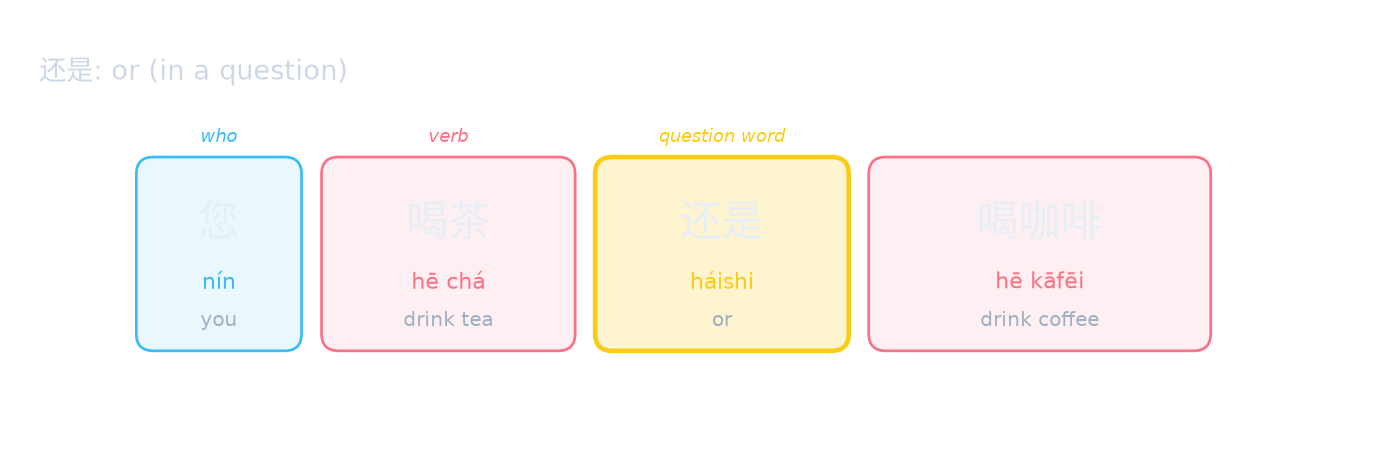
9. A 还是 B? (or – in questions)
Form: (to be / is是) A or / still还是 B? · not不to know知道 + A or / still还是 B
- you (polite)您to drink tea喝茶or / still还是喝咖啡? Nín hē chá háishi hē kāfēi? – Would you like tea or coffee?
- you你to be / is是teacher老师or / still还是student学生? Nǐ shì lǎoshī háishi xuésheng? – Are you a teacher or a student?
- we / us我们坐地铁or / still还是to take a taxi (in town)打车? – Shall we take the subway or a taxi?
- I / me我not不to know知道他来or / still还是not不to come来。 – I don't know whether he's coming or not.
How it works. A or / still还是 B? asks someone to choose. It joins nouns, verbs or whole clauses: you你today今天to go去or / still还是tomorrow明天to go去? After not不to know知道 or to decide / decision决定, it means "whether … or". or / still还是 on its own before a verb can also mean "had better": or / still还是to walk / to leave走(suggestion)吧 (we'd better go).
Watch out
- or / still还是 already makes the question: wrong: you你to drink tea喝茶or / still还是coffee咖啡(yes/no ?)吗? → no (yes/no ?)吗.
- In a statement, "or" is or或者: tea茶or或者coffee咖啡all / both都can / may可以.
Vocabulary
Train
| 汉字 | Pinyin | English |
|---|---|---|
| 决定 | jué dìng | to decide |
7.11
10. 还是 vs 或者 (or: question vs statement)
Form: A or / still还是 B?(choose) · A or或者 B (either) · or / still还是 + verb (had better)
- cooked rice米饭or / still还是noodles面条?——cooked rice米饭or或者noodles面条all / both都can / may可以。 Mǐfàn háishi miàntiáo? – Mǐfàn huòzhě miàntiáo dōu kěyǐ. – Rice or noodles? – Either is fine.
- I / me我still / also / even还not / haven't没to decide / decision决定to go去Beijing北京or / still还是to go去Shanghai municipality…上海。 – I haven't decided whether to go to Beijing or Shanghai.
- we / us我们can / may可以to sit / to take (a bus …)坐public transport vehicle公交车or或者to walk走路。 – We can take the bus or walk.
- 太晚(completed / change)了,we / us我们or / still还是回家吧。 – It's late; we'd better go home.
How it works. Is someone being asked to choose, even indirectly? Use or / still还是. Is a possibility being offered? Use or或者.
| or / still还是 | or或者 |
|---|---|
| a question: you你to go去or / still还是I / me我to go去? | a statement: you你to go去or或者I / me我to go去都行 |
| a hidden question after not不to know知道, to decide / decision决定: I / me我not不to know知道he / him他to be / is是teacher老师or / still还是student学生 | an offer or suggestion |
or / still还是 + verb with no choice means "had better".
Watch out
- Never add (yes/no ?)吗 to a or / still还是 question: wrong: you你to go去or / still还是不去(yes/no ?)吗?

Vocabulary
Train
| 汉字 | Pinyin | English |
|---|---|---|
| 面条 | miàn tiáo | noodles |
7.12
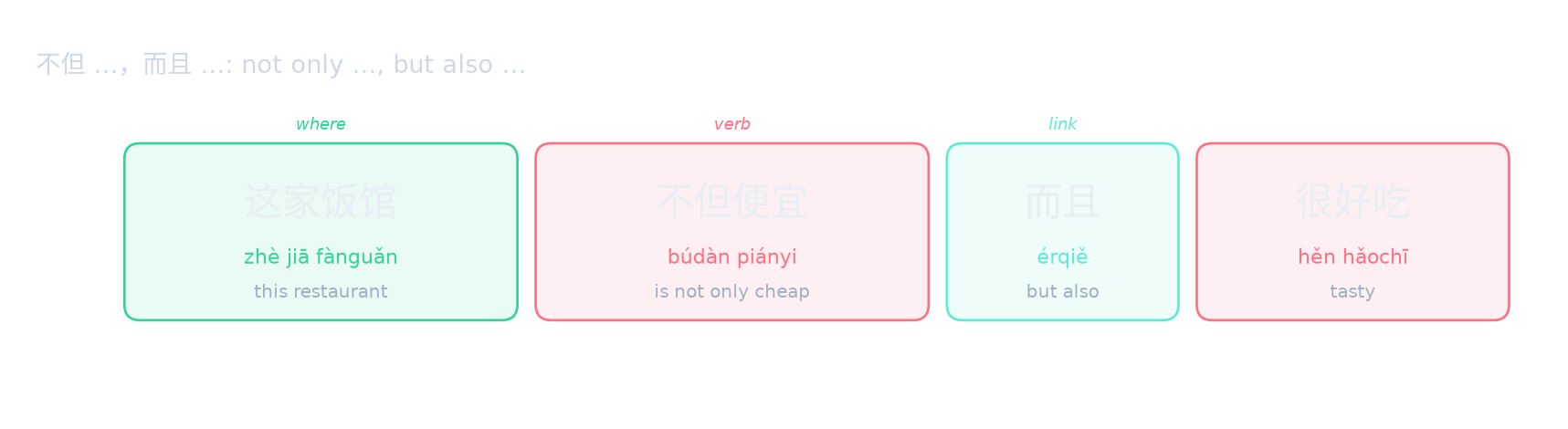
11. 不但 … ,而且 … (not only … but also)
Form: subject + not only不但 A,moreover而且 (still / also / even还 / also也) B · not only不但 subject₁ A,moreover而且 subject₂ also也 B
- 这家restaurant饭馆not only不但cheap便宜,moreover而且degree / adjective linker很tasty好吃。 Zhè jiā fànguǎn búdàn piányi, érqiě hěn hǎochī. – This restaurant isn't only cheap, it's delicious too.
- he / him他not only不但can / will会to speak说Chinese language中文,moreover而且can / will会to speak说French (language)法语。 – He speaks not only Chinese but also French.
- not only不但I / me我to like喜欢,moreover而且I / me我friend朋友also也to like喜欢。 – Not only do I like it, my friend does too.
How it works. not only不但……moreover而且…… adds a further, often stronger, point. still / also / even还 or also也 can follow moreover而且. moreover而且 can also stand alone to add a point: weather天气degree / adjective linker很cold冷,moreover而且to snow下雪(completed / change)了. not just不仅 is a more written word for not only不但.
Where does not only不但 go?
| One subject | Two subjects |
|---|---|
| after the subject | before the first subject |
| he / him他not only不但intelligent聪明,moreover而且degree / adjective linker很to work hard / effort努力 | not only不但I / me我to like喜欢,moreover而且he / him他also也to like喜欢 |
Watch out
- With one subject: wrong: not only不但he / him他intelligent聪明 → he / him他not only不但intelligent聪明.
Vocabulary
Train
| 汉字 | Pinyin | English |
|---|---|---|
| 而且 | ér qiě | but also |
| 聪明 | cōng ming | intelligent |
7.13
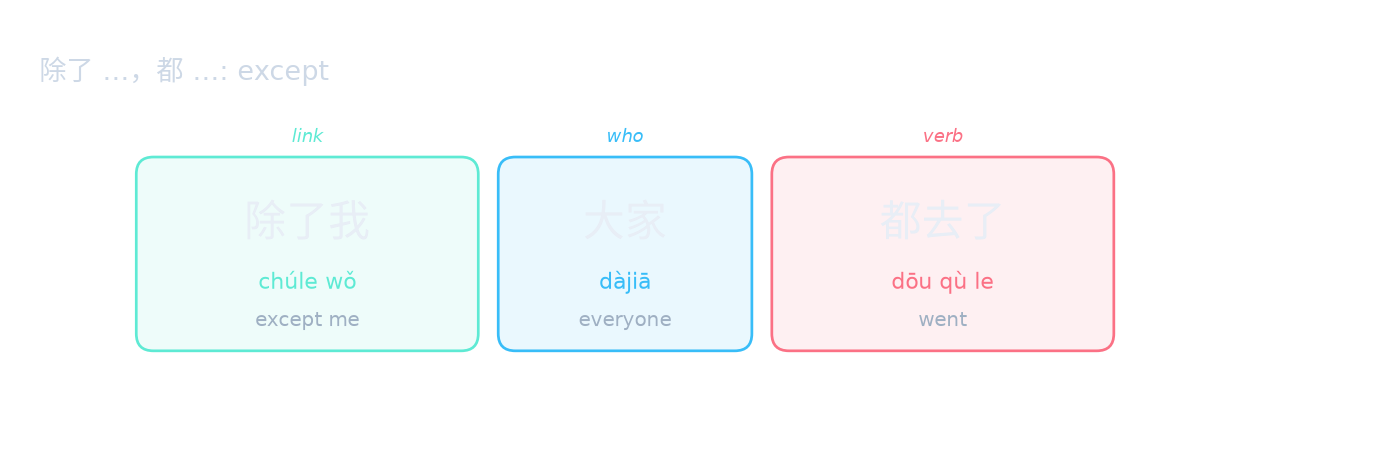
12. 除了 … 都 / 还 (except / besides)
Form: besides除了 A (apart from以外),B all / both都 … (except) · besides除了 A,subject + still / also / even还 / also也 … (besides)
- besides除了I / me我,everyone大家all / both都to go去(completed / change)了。 Chúle wǒ, dàjiā dōu qù le. – Everyone went except me.
- besides除了Sunday星期天,I / me我every day每天all / both都to go to work上班。 – I work every day except Sunday.
- besides除了Chinese language中文,he / him他still / also / even还can / will会to speak说Japanese language日语。 Chúle Zhōngwén, tā hái huì shuō Rìyǔ. – Besides Chinese, he can also speak Japanese.
- weekend周末besides除了to read看书,I / me我still / also / even还to like喜欢to run; to jog跑步。 – At weekends, besides reading, I also like running.
How it works. The word in the second clause decides the meaning.
| besides除了 A,……all / both都 | besides除了 A,……still / also / even还 / also也 |
|---|---|
| A is left out | A is included, more is added |
| besides除了I / me我,everyone大家all / both都to go去(completed / change)了 (I didn't go) | besides除了I / me我,small小Li (surname) / plum李also也to go去(completed / change)了 (we both went) |
apart from以外 after A is optional. besides除了 can also take an action: besides除了to read看书. he / him他besides除了to eat吃exactly就是to sleep睡 means "All he does is eat and sleep".
Watch out
- all / both都, still / also / even还 and also也 go after the subject: wrong: all / both都everyone大家to go去(completed / change)了 → everyone大家all / both都to go去(completed / change)了.
Vocabulary
Train
| 汉字 | Pinyin | English |
|---|---|---|
| 除了 | chú le | besides |
7.14
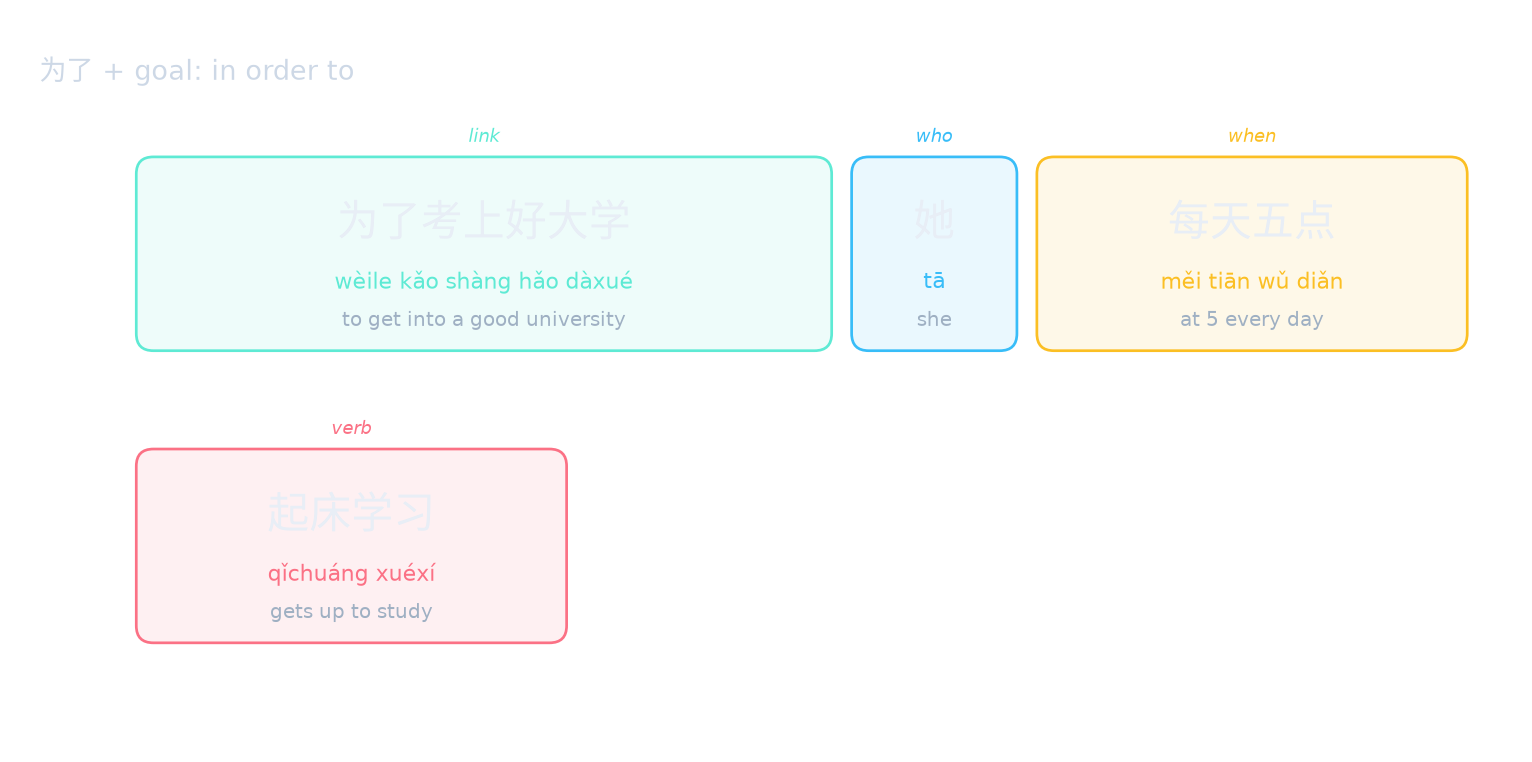
13. 为了 (in order to / for the sake of)
Form: in order to为了 + goal,action · action + to be / is是in order to为了 + goal
- in order to为了to pass a university…考上good好university大学,she / her她every day每天五点to get up起床to study; to learn学习。 Wèile kǎoshàng hǎo dàxué, tā měi tiān wǔ diǎn qǐchuáng xuéxí. – To get into a good university, she gets up at five every day to study.
- in order to为了to save money省钱,I / me我oneself自己to prepare a meal做饭。 Wèile shěng qián, wǒ zìjǐ zuò fàn. – To save money, I cook for myself.
- 我学Chinese language中文to be / is是in order to为了to go去China中国to work; job工作。 – I'm learning Chinese so that I can work in China.
How it works. in order to为了 wèile gives a goal: "in order to, for the sake of". It usually starts the sentence, and the action follows. The goal can be a verb phrase or a noun: in order to为了health健康, in order to为了child孩子. To explain the purpose after the action, use to be / is是in order to为了.
| in order to为了 | because因为 |
|---|---|
| looks forward to a goal | looks back at a cause |
| in order to为了to save money省钱,I / me我oneself自己to prepare a meal做饭 | because因为not / haven't没money钱,I / me我oneself自己to prepare a meal做饭 |
Watch out
- wrong: in order to为了to rain下雨,I / me我not / haven't没to go去 → because因为to rain下雨,I / me我not / haven't没to go去.
Vocabulary
Train
| 汉字 | Pinyin | English |
|---|---|---|
| 为了 | wèi le | for |
| 自己 | zì jǐ | oneself |
| 健康 | jiàn kāng | health |
7.15
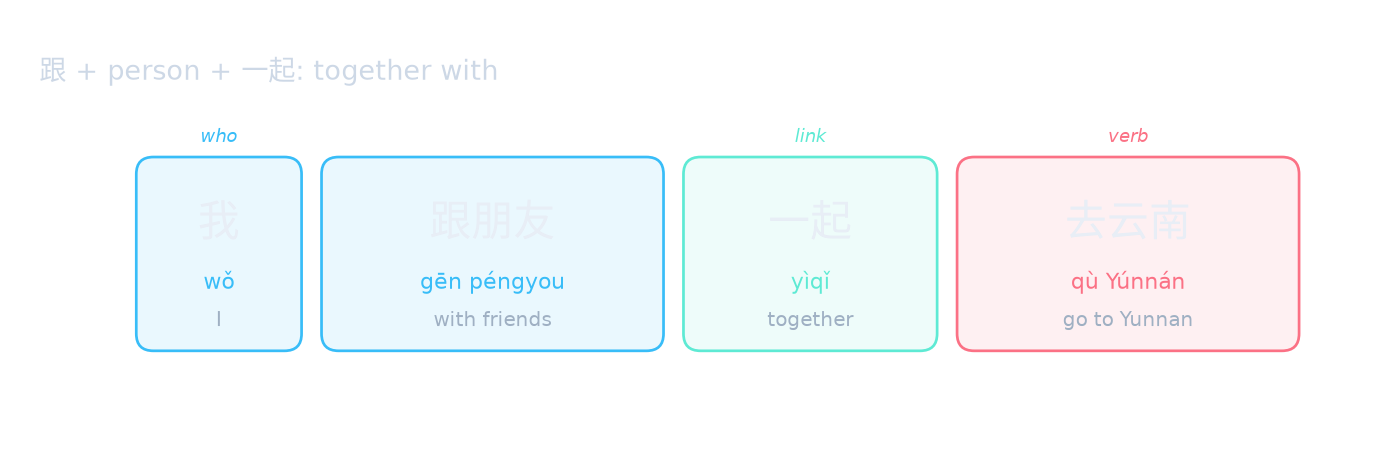
14. 跟 + Person + Verb (with someone)
Form: subject + with / and跟 / and / with和 + person + (together一起) + verb
- I / me我with / and跟friend朋友together一起to go去Yunnan province in…云南。 Wǒ gēn péngyou yìqǐ qù Yúnnán. – I'm going to Yunnan with friends.
- I / me我want / think / miss想with / and跟you你to speak说一件matter事。 Wǒ xiǎng gēn nǐ shuō yí jiàn shì. – I want to tell you something.
- you你with / and跟teacher老师to speak说(completed / change)了(yes/no ?)吗? – Have you told the teacher?
- I / me我with / and跟he / him他all / both都to be / is是student学生。 – He and I are both students.
How it works. with / and跟 + person goes before the verb and means "with". together一起 often follows: with / and跟he / him他together一起to have a meal吃饭. With to speak说, with / and跟 marks who you talk to. Between two nouns, with / and跟 simply means "and".
Negatives. not不 or not / haven't没 go before with / and跟.
| I / me我not不with / and跟he / him他to go去。 | I / me我with / and跟he / him他not不to go去。 |
|---|---|
| I won't go with him. | He and I are not going. |
Watch out
- wrong: to go去with / and跟friend朋友 → with / and跟friend朋友to go去.
Vocabulary
Train
| 汉字 | Pinyin | English |
|---|---|---|
| 跟 | gēn | with |
7.16
15. 关于 + Topic (about / regarding)
Form: pertaining to关于 + topic + (modifier / structural particle)的 + noun · pertaining to关于 + topic,comment
- 这是一本pertaining to关于China中国history历史(modifier / structural particle)的book书。 Zhè shì yì běn guānyú Zhōngguó lìshǐ de shū. – This is a book about Chinese history.
- I / me我to look at; to watch; to read看(completed / change)了一个pertaining to关于panda熊猫(modifier / structural particle)的program节目。 – I watched a programme about pandas.
- pertaining to关于this这个question / problem问题,we / us我们tomorrow明天again / then / (再…也) however再to discuss讨论。 – We'll discuss this question again tomorrow.
- pertaining to关于exam; to take an exam考试(modifier / structural particle)的time时间,teacher老师still / also / even还not / haven't没to speak说。 – The teacher hasn't said anything yet about the exam time.
How it works. pertaining to关于 guānyú means "about, regarding". Before a noun it takes (modifier / structural particle)的. At the start of a sentence, it introduces the topic before the subject.
| pertaining to关于 | to / towards / correct对 |
|---|---|
| the topic of a talk, book or text | the target of a feeling or attitude |
| pertaining to关于environment环境(modifier / structural particle)的article文章 | he / him他to / towards / correct对China中国culture文化很感兴趣 |
Watch out
- wrong: pertaining to关于China中国book书 → pertaining to关于China中国(modifier / structural particle)的book书.
- wrong: I / me我pertaining to关于这件matter事not不to know知道 → pertaining to关于这件matter事,I / me我not不to know知道.

Vocabulary
Train
| 汉字 | Pinyin | English |
|---|---|---|
| 关于 | guān yú | pertaining to |
| 历史 | lì shǐ | history |
| 熊猫 | xióng māo | panda |
| 节目 | jié mù | program |
| 环境 | huán jìng | environment |
| 文化 | wén huà | culture |
7.17
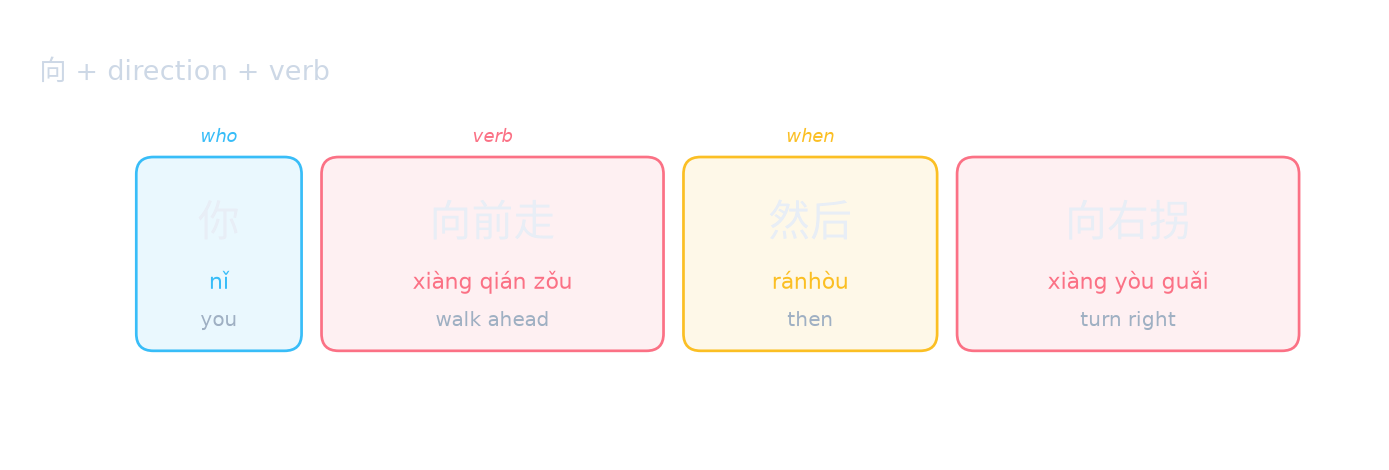
16. 向 + Direction / Person + Verb (towards)
Form: towards向 + direction + verb · towards向 + person + verb
- you你向前走,then / after然后towards向(bound form) right右to turn (a corner etc)拐。 Nǐ xiàng qián zǒu, ránhòu xiàng yòu guǎi. – Walk forward, then turn right.
- I / me我towards向he / him他to borrow借(completed / change)了one / a一本书。 Wǒ xiàng tā jièle yì běn shū. – I borrowed a book from him.
- we / us我们should应该towards向she / her她to study; to learn学习。 – We should learn from her.
- I / me我want / think / miss想towards向she / her她to apologize道歉。 – I want to apologise to her.
How it works. towards向 xiàng means "towards". It goes before the verb. With a direction it gives the way to move (向前走, towards向left左to turn (a corner etc)拐, 向东开); with a person it marks who the action is aimed at (towards向teacher老师to say hello to问好, towards向he / him他to borrow借, towards向she / her她to apologize道歉).
| towards往 | towards向 |
|---|---|
| towards (movement) | towards (movement) and to / from a person |
| 往前走 = 向前走 | towards向he / him他to apologize道歉 (wrong: towards往he / him他to apologize道歉) |
Watch out
- wrong: to turn (a corner etc)拐towards向(bound form) right右 → towards向(bound form) right右to turn (a corner etc)拐.
Vocabulary
Train
| 汉字 | Pinyin | English |
|---|---|---|
| 然后 | rán hòu | then |
| 借 | jiè | to borrow |
| 应该 | yīng gāi | ought to |
7.18
Practice
Cover the teaching pages before you answer. The answers are at the end.
1. if如果 … ,then / just就 … (if …, then …)
1. Complete: “If you come, I'll cook for you.” if如果you你to come来,I / me我…………to / for / give给you你to prepare a meal做饭。
2. Which sentence is correct?
- A. to rain下雨if如果,I / me我then / just就not不to go去。
- B. if如果to rain下雨,then / just就I / me我not不to go去。
- C. if如果to rain下雨,I / me我then / just就not不to go去。
- D. if如果to rain下雨,so / therefore所以I / me我not不to go去。
3. Build: “If you're not well, go and see a doctor.”
Put in order: , / to look at; to watch; to read看doctor医生(suggestion)吧。 / if如果you你not不comfortable舒服 / then / just就to go去
4. True or false? because因为to rain下雨 describes a possibility; if如果to rain下雨 describes a fact. If false, correct it.
5. You and a friend are checking flights for the holiday. Use if如果 … ,then / just就 …. Write your answer in Chinese, then say it aloud.
2. if如果 … if (coming after a…的话 (if …)
6. Complete: “If you have time, come to my place.” you你to have / there is有time时间…………,to come来我家(suggestion)吧。
7. Which sentence has natural Chinese word order?
- A. we / us我们to go去park公园,if如果tomorrow明天weather天气good好if (coming after a…的话。
- B. if如果tomorrow明天weather天气good好if (coming after a…的话,we / us我们to go去park公园。
- C. if (coming after a…的话tomorrow明天weather天气good好,we / us我们to go去park公园。
- D. we / us我们if如果to go去park公园if (coming after a…的话,tomorrow明天weather天气good好。
8. Build: “If you have any questions, you can ask me.”
Put in order: if (coming after a…的话 / to ask问I / me我。 / you你to have / there is有question / problem问题 / ,can / may可以
9. True or false? if要是 is a spoken word for “if”. If false, correct it.
10. You are planning a trip to the Great Wall but the forecast is uncertain. Use if如果 … if (coming after a…的话. Write your answer in Chinese, then say it aloud.
3. as long as只要 … ,then / just就 … (as long as)
11. Complete: “As long as you ask, he will help you.” as long as只要you你to ask问,he / him他…………can / will会to help帮you你。
12. Which pair fits “Only by taking a taxi can you get there in time”? ___to take a taxi (in town)打车,you你___to have enough time来得及。
- A. because因为 … so / therefore所以
- B. only (if) / only have只有 … only then / not until才
- C. although虽然 … but但是
- D. as long as只要 … then / just就
13. Build: “Whenever I have time, I'll come and see you.”
Put in order: as long as只要to have / there is有time时间 / to go去to look at; to watch; to read看you你。 / , / I / me我then / just就
14. True or false? as long as只要you你to come来,then / just就I / me我degree / adjective linker很happy; glad高兴 has the correct word order. If false, correct it.
15. A friend is worried about tomorrow's picnic. You only need one thing to go right. Use as long as只要 … ,then / just就 …. Write your answer in Chinese, then say it aloud.
4. only (if) / only have只有 … ,only then / not until才 … (only if)
16. Complete: “Only if you rest well will you get better quickly.” only (if) / only have只有well好好to rest休息,…………can / be able to能to do sth more quickly快点good好。
17. “All you need is a student card to get in for free.” Which pair fits? ___to have / there is有student identity card学生证,___can / be able to能free免费to go in进去。
- A. as long as只要 … then / just就
- B. only (if) / only have只有 … only then / not until才
- C. only (if) / only have只有 … then / just就
- D. as long as只要 … only then / not until才
18. Build: “Only he knows the answer.”
Put in order: only then / not until才 / to know知道 / only (if) / only have只有he / him他 / answer答案。
19. True or false? only (if) / only have只有you你to go去,he / him他then / just就can / will会to go去 is the standard pairing. If false, correct it.
20. The building door needs a code, and only residents know it. Use only (if) / only have只有 … ,only then / not until才 …. Write your answer in Chinese, then say it aloud.
5. … ,only then / not until才 … (only then / only after)
21. Complete: “You can only go out after you've eaten.” you你吃了饭,…………can / be able to能to go out出去。
22. Build: “I asked him three times before he told me.”
Put in order: he / him他 / I / me我to ask问(completed / change)了he / him他three times三次, / only then / not until才 / to tell告诉I / me我。
23. “We waited an hour before the bus came.” Which is correct?
- A. we / us我们to wait; and so on等(completed / change)了一个hour小时,车才to come来。
- B. we / us我们only then / not until才to wait; and so on等(completed / change)了一个hour小时,车来。
- C. we / us我们to wait; and so on等(completed / change)了一个hour小时,only then / not until才车来。
- D. we / us我们to wait; and so on等(completed / change)了一个hour小时,车才to come来(completed / change)了。
24. Match each sentence to its meaning.
-
(1) you你做完作业then / just就can / may可以to play玩。
-
(2) you你做完作业only then can / talent才能to play玩。
-
A. You can play only after your homework is done.
-
B. Once your homework is done you can play.
25. True or false? only then / not until才he / him他to tell告诉I / me我 is the right word order. If false, correct it.
26. Your parents have one rule about screen time on school nights. Use … ,only then / not until才 …. Write your answer in Chinese, then say it aloud.
6. until直到 … ,… only then / not until才 … (all the way until)
27. Complete: “It wasn't until yesterday that I knew.” until直到yesterday昨天,I / me我…………to know知道。
28. Which sentence is correct?
- A. until直到十一点,he / him他only then / not until才to sleep睡觉。
- B. he / him他only then / not until才until直到十一点to sleep睡觉。
- C. until直到十一点,he / him他then / just就to sleep睡觉(completed / change)了。
- D. until直到十一点,he / him他only then / not until才to sleep睡觉(completed / change)了。
29. Build: “The rain kept falling until the evening.”
Put in order: all along / straight一直 / evening晚上。 / down / next; to fall (rain), get off下to / arrive / (result: get)到 / rain雨
30. True or false? we / us我们to play玩to / arrive / (result: get)到十点 means “We played until ten.” If false, correct it.
31. You stayed up for your sister's flight to land; she only messaged you at midnight. Use until直到 … ,… only then / not until才 …. Write your answer in Chinese, then say it aloud.
7. like that那么 … (then / in that case)
32. A: “I'm not free today.” B: “Then let's meet tomorrow.” …………we / us我们tomorrow明天to see / meet见(suggestion)吧。
33. In 这件clothes衣服like that那么expensive贵, what does like that那么 mean?
- A. or
- B. because
- C. then
- D. so
34. Build: “If you don't like it, then change it.”
Put in order: then / just就to exchange换 / ,like that那么 / 一个(suggestion)吧。 / if如果you你not不to like喜欢
35. True or false? like that那么 at the start of a reply usually responds to what someone else has just said. If false, correct it.
36. A friend says the cinema is fully booked tonight. You quickly suggest another plan. Use like that那么 …. Write your answer in Chinese, then say it aloud.
8. A or或者 B (or – in statements)
37. Complete: “You can pay in cash or by card.” you你can / may可以付现金…………to use a credit card (or…刷卡。
38. Which asks “Do you want tea or coffee?”
- A. you你want / will / need要tea茶or或者coffee咖啡?
- B. you你want / will / need要tea茶and / with和coffee咖啡?
- C. you你want / will / need要tea茶or或者coffee咖啡(yes/no ?)吗or / still还是?
- D. you你want / will / need要tea茶or / still还是coffee咖啡?
39. Build: “Call me tomorrow or the day after.”
Put in order: to / for / give给I / me我 / tomorrow明天or或者the day after tomorrow后天 / you你 / to make a telephone call打电话(suggestion)吧。
40. True or false? I / me我to buy买(completed / change)了apple苹果or或者banana香蕉 means “I bought apples and bananas.” If false, correct it.
41. A friend wants to meet this weekend and asks which day suits you. Both are free. Use A or或者 B. Write your answer in Chinese, then say it aloud.
9. A or / still还是 B? (or – in questions)
42. Ask: “Are you going today or tomorrow?” you你today今天to go去…………tomorrow明天to go去?
43. Which question is correct?
- A. you你to be / is是China中国person人or或者South Korea (Republic of…韩国person人?
- B. you你to be / is是China中国person人or / still还是South Korea (Republic of…韩国person人?
- C. you你to be / is是China中国person人or / still还是South Korea (Republic of…韩国person人(yes/no ?)吗?
- D. you你to be / is是China中国person人(yes/no ?)吗or / still还是South Korea (Republic of…韩国person人?
44. Build: “Shall we take the subway or a taxi?”
Put in order: 坐地铁 / or / still还是 / to take a taxi (in town)打车? / we / us我们
45. True or false? I / me我not不to know知道他来or / still还是not不to come来 is correct. If false, correct it.
46. A waiter asks what you would like to drink. Use A or / still还是 B?. Write your answer in Chinese, then say it aloud.
10. or / still还是 vs or或者 (or: question vs statement)
47. Suggest: “We can take the bus or walk.” we / us我们can / may可以to sit / to take (a bus …)坐public transport vehicle公交车…………to walk走路。
48. Which fits? I / me我not不to know知道he / him他to be / is是teacher老师____student学生。
- A. and / with和
- B. moreover而且
- C. or / still还是
- D. or或者
49. Match each sentence to what or / still还是 / or或者 does.
-
(1) you你to go去or / still还是I / me我to go去?
-
(2) you你to go去or或者I / me我to go去都行。
-
(3) we / us我们or / still还是to walk / to leave走(suggestion)吧。
-
A. asks someone to choose
-
B. had better
-
C. offers either option
50. True or false? you你to go去or / still还是不去(yes/no ?)吗? is correct. If false, correct it.
51. A waiter asks, "Rice or noodles?" You answer, "Either is fine." Use or / still还是 or or或者. Write your answer in Chinese, then say it aloud.
11. not only不但 … ,moreover而且 … (not only … but also)
52. Complete: “He not only speaks Chinese, but also speaks French.” he / him他not only不但can / will会to speak说Chinese language中文,…………can / will会to speak说French (language)法语。
53. Which sentence is correct?
- A. he / him他not only不但degree / adjective linker很tall; high高,很帅moreover而且。
- B. he / him他degree / adjective linker很tall; high高not only不但,moreover而且很帅。
- C. not only不但he / him他degree / adjective linker很tall; high高,moreover而且很帅。
- D. he / him他not only不但degree / adjective linker很tall; high高,moreover而且很帅。
54. Build: “Not only do I like it, my friend does too.”
Put in order: , / moreover而且I / me我friend朋友 / also也to like喜欢。 / not only不但I / me我to like喜欢
55. True or false? moreover而且 can be used on its own to add a point. If false, correct it.
56. You are recommending a new restaurant to a friend who is hard to please. Use not only不但 … ,moreover而且 …. Write your answer in Chinese, then say it aloud.
12. besides除了 … all / both都 / still / also / even还 (except / besides)
57. Complete: “Besides tea, I also drink coffee.” besides除了tea茶,I / me我…………喝咖啡。
58. In besides除了小王,we / us我们all / both都to like喜欢to eat吃spicy辣(modifier / structural particle)的, does Xiao Wang like spicy food?
- A. Yes, and so do the others.
- B. Yes, he likes it most.
- C. The sentence does not say.
- D. No, he is the exception.
59. Build: “I work every day except Sunday.”
Put in order: besides除了Sunday星期天 / I / me我every day每天 / all / both都to go to work上班。 / ,
60. True or false? besides除了Chinese language中文,he / him他still / also / even还can / will会to speak说Japanese language日语 means he speaks both Chinese and Japanese. If false, correct it.
61. Your whole class went to the concert, but you were ill at home. Use besides除了 … all / both都 / still / also / even还. Write your answer in Chinese, then say it aloud.
13. in order to为了 (in order to / for the sake of)
62. Complete: “To save money, I cook myself.” …………to save money省钱,I / me我oneself自己to prepare a meal做饭。
63. Which word fits? “Because it rained, the match was cancelled.” ____to rain下雨,competition比赛to cancel取消(completed / change)了。
- A. so / therefore所以
- B. to be / is是in order to为了
- C. because因为
- D. in order to为了
64. Build: “I'm learning Chinese so that I can work in China.”
Put in order: to work; job工作。 / to go去China中国 / 我学Chinese language中文 / to be / is是in order to为了
65. True or false? in order to为了 looks forward to a goal, because因为 looks back at a cause. If false, correct it.
66. Your roommate gets up at five every morning during the exam season. Use in order to为了. Write your answer in Chinese, then say it aloud.
14. with / and跟 + Person + Verb (with someone)
67. Complete: “I play basketball with my brother.” I / me我…………older brother哥哥together一起to play basketball打篮球。
68. Which says “I won't go with him.”?
- A. I / me我with / and跟he / him他not不to go去。
- B. I / me我to go去not不with / and跟he / him他。
- C. I / me我not不with / and跟he / him他to go去。
- D. I / me我with / and跟not不he / him他to go去。
69. Build: “I want to tell you something.”
Put in order: I / me我want / think / miss想 / to speak说 / with / and跟you你 / 一件matter事。
70. True or false? In I / me我with / and跟he / him他all / both都to be / is是student学生, with / and跟 means “and”. If false, correct it.
71. Your mum asks about your plans for the holiday. Use with / and跟 + Person + Verb. Write your answer in Chinese, then say it aloud.
15. pertaining to关于 + Topic (about / regarding)
72. Complete: “I want to buy a book about cooking.” I / me我want / think / miss想to buy买一本…………to prepare a meal做饭(modifier / structural particle)的book书。
73. “She is very interested in music.” Which word fits? she / her她____music音乐很感兴趣。
- A. towards向
- B. to / towards / correct对
- C. with / and跟
- D. pertaining to关于
74. Build: “I watched a programme about pandas.”
Put in order: pertaining to关于panda熊猫(modifier / structural particle)的 / 一个 / program节目。 / I / me我to look at; to watch; to read看(completed / change)了
75. True or false? pertaining to关于China中国book书 is a correct phrase for “a book about China”. If false, correct it.
76. In the library you find a book that explains Chinese history for beginners. Use pertaining to关于 + Topic. Write your answer in Chinese, then say it aloud.
16. towards向 + Direction / Person + Verb (towards)
77. Complete: “Turn left at the crossroads.” to / arrive / (result: get)到(completed / change)了crossing路口…………左拐。
78. Which says “I want to apologise to her.”?
- A. I / me我want / think / miss想she / her她towards向to apologize道歉。
- B. I / me我want / think / miss想to apologize道歉towards向she / her她。
- C. I / me我want / think / miss想towards向she / her她to apologize道歉。
- D. I / me我want / think / miss想towards往she / her她to apologize道歉。
79. Build: “I borrowed a book from him.”
Put in order: to borrow借(completed / change)了 / I / me我 / one / a一本书。 / towards向he / him他
80. True or false? 往前走 and 向前走 both mean “walk forward”. If false, correct it.
81. You are lost in an old town, and a shopkeeper points down the street. Use towards向 + Direction / Person + Verb. Write your answer in Chinese, then say it aloud.
7.19
Mixed practice
These questions mix the patterns and use new situations.
82. Choose as long as只要 or only (if) / only have只有: …………不下雨,we / us我们then / just就to go去picnic野餐。 / …………to know知道password密码,only then can / talent才能to go in进去。
83. Choose or / still还是 or or或者: you你want / will / need要cooked rice米饭…………noodles面条? / Saturday星期六…………Sunday星期天all / both都can / may可以。
84. Say "Everyone went except me."
85. Say "To get into a good university, she gets up at five."
86. Find and fix the problem. You want a friend to choose between tea and coffee, but you ask you你to drink tea喝茶or或者coffee咖啡(yes/no ?)吗? What does that question really ask, and how do you fix it?
87. Use it yourself. Write one sentence where having time is enough, and one where a ticket is needed.
7.20
Answers and explanations
Mark your work, then correct each mistake in your own words.
1. if如果 … ,then / just就 … (if …, then …)
1. then / just就
if如果…,subject + then / just就….
2. C. if如果to rain下雨,I / me我then / just就not不to go去。
if如果 pairs with then / just就, placed after the subject.
3. if如果you你not不comfortable舒服,then / just就to go去to look at; to watch; to read看doctor医生(suggestion)吧。
if如果 + condition, then / just就 + advice.
4. False.
It is the other way round: because因为 = a fact, if如果 = a possibility.
5. Model answer: if如果air ticket机票cheap便宜,we / us我们then / just就to go去Hainan Province, in the…海南。
Check your answer:
- Subject first, then then / just就: I / me我then / just就to go去, not then / just就I / me我to go去.
- Do not use so / therefore所以 for "then" after if如果: if如果to rain下雨,I / me我then / just就not不to go去, not if如果to rain下雨,so / therefore所以I / me我not不to go去.
2. if如果 … if (coming after a…的话 (if …)
6. if (coming after a…的话
if (coming after a…的话 closes the condition.
7. B. if如果tomorrow明天weather天气good好if (coming after a…的话,we / us我们to go去park公园。
The condition comes first.
8. you你to have / there is有question / problem问题if (coming after a…的话,can / may可以to ask问I / me我。
Condition + if (coming after a…的话, then the result.
9. True.
if要是…(if (coming after a…的话) works like if如果.
10. Model answer: if如果tomorrow明天to rain下雨if (coming after a…的话,we / us我们then / just就to be at home在家to look at; to watch; to read看film; movie电影。
Check your answer:
- Put the if如果 clause before the result: if如果you你to have / there is有time时间,to come来to look for; to give change找I / me我, not to come来to look for; to give change找I / me我if如果you你to have / there is有time时间 (English order).
- if (coming after a…的话 goes at the end of the condition, not after the result.
3. as long as只要 … ,then / just就 … (as long as)
11. then / just就
as long as只要…,then / just就….
12. B. only (if) / only have只有 … only then / not until才
The only way is only (if) / only have只有…only then / not until才….
13. as long as只要to have / there is有time时间,I / me我then / just就to go去to look at; to watch; to read看you你。
as long as只要 + condition, subject + then / just就 + result.
14. False.
then / just就 follows the subject: I / me我then / just就degree / adjective linker很happy; glad高兴.
15. Model answer: as long as只要不下雨,we / us我们then / just就to go去picnic野餐。
Check your answer:
- Put then / just就 after the subject of the second clause: as long as只要you你to come来,I / me我then / just就happy; glad高兴, not then / just就I / me我happy; glad高兴.
- as long as只要 means the condition is enough; for "only if" (a necessary condition), use only (if) / only have只有…only then / not until才….
4. only (if) / only have只有 … ,only then / not until才 … (only if)
16. only then / not until才
only (if) / only have只有 pairs with only then / not until才.
17. A. as long as只要 … then / just就
A student card is enough, so as long as只要…then / just就….
18. only (if) / only have只有he / him他only then / not until才to know知道answer答案。
only (if) / only have只有 + person + only then / not until才 + verb.
19. False.
only (if) / only have只有 pairs with only then / not until才: he / him他only then / not until才can / will会to go去.
20. Model answer: only (if) / only have只有to know知道password密码,only then can / talent才能to go in进去。
Check your answer:
- Pair only (if) / only have只有 with only then / not until才: only (if) / only have只有you你to go去,he / him他only then / not until才can / will会to go去, not only (if) / only have只有you你to go去,he / him他then / just就can / will会to go去.
- Put only then / not until才 after the subject: he / him他only then / not until才can / will会to go去, not only then / not until才he / him他can / will会to go去.
5. … ,only then / not until才 … (only then / only after)
21. only then / not until才
Condition, then only then / not until才 + can / be able to能 + result.
22. I / me我to ask问(completed / change)了he / him他three times三次,he / him他only then / not until才to tell告诉I / me我。
Effort first, then subject + only then / not until才 + result.
23. A. we / us我们to wait; and so on等(completed / change)了一个hour小时,车才to come来。
Subject car车 + only then / not until才 + verb, with no (completed / change)了 at the end.
24. (1) B: you你做完作业then / just就can / may可以to play玩。 = Once your homework is done you can play.; (2) A: you你做完作业only then can / talent才能to play玩。 = You can play only after your homework is done.
then / just就 = then, easily; only then / not until才 = only then, not before.
25. False.
only then / not until才 goes after the subject: he / him他only then / not until才to tell告诉I / me我。
26. Model answer: you你做完作业,only then can / talent才能玩游戏。
Check your answer:
- I can explain that only then / not until才 means "only then, not before".
- only then / not until才 stands after the subject of the second clause, often with can / be able to能 or can / will会.
6. until直到 … ,… only then / not until才 … (all the way until)
27. only then / not until才
until直到 … only then / not until才 ….
28. A. until直到十一点,he / him他only then / not until才to sleep睡觉。
until直到十一点,he / him他only then / not until才to sleep睡觉 is right: until直到 … only then / not until才 means "not until", and this simple only then / not until才 pattern takes no final (completed / change)了. then / just就 would mean "as early as", which contradicts until直到.
29. rain雨all along / straight一直down / next; to fall (rain), get off下to / arrive / (result: get)到evening晚上。
all along / straight一直 + Verb + to / arrive / (result: get)到 + time.
30. True.
Verb + to / arrive / (result: get)到 + time gives the end point.
31. Model answer: I / me我all along / straight一直to wait until等到十二点,she / her她only then / not until才给我发news; message消息。
Check your answer:
- The result clause takes only then / not until才 (it was late): until直到十点he / him他only then / not until才to come来, not until直到十点he / him他then / just就to come来(completed / change)了.
- This short result model uses only then / not until才to know知道. Do not infer from it that (completed / change)了 is impossible in all other only then / not until才 constructions.
7. like that那么 … (then / in that case)
32. that那
that那(suffix, used to form…么) at the start of a reply = in that case.
33. D. so
Before an adjective, like that那么 = so.
34. if如果you你not不to like喜欢,like that那么then / just就to exchange换一个(suggestion)吧。
if如果…,like that那么then / just就….
35. True.
It draws a conclusion from the situation just described.
36. Model answer: like that那么,we / us我们tomorrow明天to go去(suggestion)吧。
Check your answer:
- At the start of a clause, like that那么 = "then, in that case".
- Before an adjective, like that那么 = "so": like that那么expensive贵. Check its position.
8. A or或者 B (or – in statements)
37. or或者
A statement offering alternatives uses or或者.
38. D. you你want / will / need要tea茶or / still还是coffee咖啡?
An “A or B?” question uses or / still还是.
39. you你tomorrow明天or或者the day after tomorrow后天to / for / give给I / me我to make a telephone call打电话(suggestion)吧。
Time A or或者 time B + verb phrase.
40. False.
or或者 is “or”; “and” is and / with和.
41. Model answer: Saturday星期六or或者Sunday星期天all / both都can / may可以。
Check your answer:
- To ask "A or B?", use or / still还是: you你to drink tea喝茶or / still还是coffee咖啡?, not you你to drink tea喝茶or或者coffee咖啡?
- or或者 does not mean "and": I / me我to buy买(completed / change)了apple苹果and / with和banana香蕉 (both), not apple苹果or或者banana香蕉.
9. A or / still还是 B? (or – in questions)
42. or / still还是
or / still还是 joins the choices in a question.
43. B. you你to be / is是China中国person人or / still还是South Korea (Republic of…韩国person人?
or / still还是 questions take no (yes/no ?)吗.
44. we / us我们坐地铁or / still还是to take a taxi (in town)打车?
A or / still还是 B?
45. True.
After not不to know知道, or / still还是 means “whether … or”.
46. Model answer: you (polite)您to drink tea喝茶or / still还是喝咖啡?
Check your answer:
- or / still还是 already makes a question: you你to drink tea喝茶or / still还是coffee咖啡?, not you你to drink tea喝茶or / still还是coffee咖啡(yes/no ?)吗?
- In a statement, "or" is or或者: tea茶or或者coffee咖啡all / both都can / may可以.
10. or / still还是 vs or或者 (or: question vs statement)
47. or或者
A statement offering options uses or或者.
48. C. or / still还是
After not不to know知道, the hidden question takes or / still还是.
49. (1) A: you你to go去or / still还是I / me我to go去? = asks someone to choose; (2) C: you你to go去or或者I / me我to go去都行。 = offers either option; (3) B: we / us我们or / still还是to walk / to leave走(suggestion)吧。 = had better
or / still还是 asks or recommends; or或者 states options.
50. False.
A or / still还是 question takes no (yes/no ?)吗.
51. Model answer: cooked rice米饭or / still还是noodles面条?——cooked rice米饭or或者noodles面条all / both都can / may可以。
Check your answer:
- Is someone being asked to choose (even indirectly)? Use or / still还是. Is a possibility being offered? Use or或者.
- Never add (yes/no ?)吗 to a or / still还是 question: you你to go去or / still还是不去?, not you你to go去or / still还是不去(yes/no ?)吗?
11. not only不但 … ,moreover而且 … (not only … but also)
52. moreover而且
not only不但 A,moreover而且 B.
53. D. he / him他not only不但degree / adjective linker很tall; high高,moreover而且很帅。
With one subject, not only不但 follows the subject.
54. not only不但I / me我to like喜欢,moreover而且I / me我friend朋友also也to like喜欢。
Two subjects: not only不但 before the first.
55. True.
weather天气degree / adjective linker很cold冷,moreover而且to snow下雪(completed / change)了.
56. Model answer: 这家restaurant饭馆not only不但cheap便宜,moreover而且degree / adjective linker很tasty好吃。
Check your answer:
- One subject: he / him他not only不但intelligent聪明, not not only不但he / him他intelligent聪明.
- Two subjects: not only不但I / me我to like喜欢,moreover而且he / him他also也to like喜欢 – not only不但 goes before the first subject.
12. besides除了 … all / both都 / still / also / even还 (except / besides)
57. still / also / even还
besides除了…still / also / even还… adds to A.
58. D. No, he is the exception.
besides除了…all / both都… leaves Xiao Wang out of the group.
59. besides除了Sunday星期天,I / me我every day每天all / both都to go to work上班。
besides除了 A,subject + all / both都 + verb.
60. True.
still / also / even还 adds to what besides除了 introduced.
61. Model answer: besides除了I / me我,everyone大家all / both都to go去(completed / change)了。
Check your answer:
- besides除了I / me我,everyone大家all / both都to go去(completed / change)了 = I did not go. besides除了I / me我,small小Li (surname) / plum李also也to go去(completed / change)了 = Xiao Li went as well as me.
- Put all / both都 / still / also / even还 / also也 after the subject of the second clause: everyone大家all / both都to go去(completed / change)了, not all / both都everyone大家to go去(completed / change)了.
13. in order to为了 (in order to / for the sake of)
62. in order to为了
in order to为了 + goal, then the action.
63. C. because因为
Rain is a cause, not a goal, so because因为.
64. 我学Chinese language中文to be / is是in order to为了to go去China中国to work; job工作。
Action + to be / is是in order to为了 + goal.
65. True.
That is the key difference.
66. Model answer: in order to为了to pass a university…考上good好university大学,she / her她every day每天五点to get up起床to study; to learn学习。
Check your answer:
- in order to为了 gives a goal; for a cause, use because因为: because因为to rain下雨,I / me我not / haven't没to go去, not in order to为了to rain下雨.
- In careful speech, put in order to为了 first or use to be / is是in order to为了 after the action: he / him他every day每天to run; to jog跑步to be / is是in order to为了health健康.
14. with / and跟 + Person + Verb (with someone)
67. with / and跟
with / and跟 + person + together一起 + verb.
68. C. I / me我not不with / and跟he / him他to go去。
The negative goes before with / and跟. I / me我with / and跟he / him他not不to go去 means “he and I are not going”, a different message.
69. I / me我want / think / miss想with / and跟you你to speak说一件matter事。
with / and跟 + person + to speak说.
70. True.
Between two nouns, with / and跟 joins them.
71. Model answer: I / me我with / and跟friend朋友together一起to go去Yunnan province in…云南。
Check your answer:
- "With friends" comes before the verb: with / and跟friend朋友to go去, not to go去with / and跟friend朋友 (unless with / and跟 means "and" between two nouns).
- Put not不 or not / haven't没 before with / and跟: I / me我not不with / and跟he / him他to go去 – "I won't go with him" – not I / me我with / and跟he / him他not不to go去, which means "he and I are not going".
15. pertaining to关于 + Topic (about / regarding)
72. pertaining to关于
pertaining to关于 + topic + (modifier / structural particle)的 + noun.
73. B. to / towards / correct对
to / towards / correct对…to be interested感兴趣 marks the target of interest.
74. I / me我to look at; to watch; to read看(completed / change)了一个pertaining to关于panda熊猫(modifier / structural particle)的program节目。
pertaining to关于 + topic + (modifier / structural particle)的 + noun.
75. False.
The pertaining to关于 phrase needs (modifier / structural particle)的 before the noun: pertaining to关于China中国(modifier / structural particle)的book书.
76. Model answer: 这是一本pertaining to关于China中国history历史(modifier / structural particle)的book书。
Check your answer:
- A pertaining to关于 phrase describing a noun needs (modifier / structural particle)的: pertaining to关于China中国(modifier / structural particle)的book书, not pertaining to关于China中国book书.
- As a topic, pertaining to关于… comes first, before the subject: pertaining to关于这件matter事,I / me我not不to know知道, not I / me我pertaining to关于这件matter事not不to know知道.
16. towards向 + Direction / Person + Verb (towards)
77. towards向
towards向/towards往 + direction + verb.
78. C. I / me我want / think / miss想towards向she / her她to apologize道歉。
With people, only towards向 works, before the verb.
79. I / me我towards向he / him他to borrow借(completed / change)了one / a一本书。
towards向 + person + to borrow借.
80. True.
In directions towards往 and towards向 are interchangeable.
81. Model answer: you你向前走,then / after然后towards向(bound form) right右to turn (a corner etc)拐。
Check your answer:
- Put towards向 + direction before the verb: towards向(bound form) right右to turn (a corner etc)拐, not to turn (a corner etc)拐towards向(bound form) right右 in everyday directions.
- "Borrow from someone" is towards向 + person + to borrow借, not 借向 + person.
Mixed practice
82. as long as只要不下雨,we / us我们then / just就to go去picnic野餐。only (if) / only have只有to know知道password密码,only then can / talent才能to go in进去。as long as只要 pairs with then / just就 (enough for); only (if) / only have只有 pairs with only then / not until才 (needed for).
83. you你want / will / need要cooked rice米饭or / still还是noodles面条?Saturday星期六or或者Sunday星期天all / both都can / may可以。or / still还是 in questions; or或者 in statements.
84. besides除了I / me我,everyone大家all / both都to go去(completed / change)了。besides除了 … all / both都 excludes; besides除了 … still / also / even还 adds.
85. in order to为了to pass a university…考上good好university大学,she / her她every day每天五点to get up起床。in order to为了 gives the purpose first.
86. With (yes/no ?)吗 it asks "Would you like tea or coffee (anything to drink)?" and expects yes or no. To make your friend choose, ask you你to drink tea喝茶or / still还是coffee咖啡?
87. Model answer. as long as只要to have / there is有time时间,I / me我then / just就to go去。only (if) / only have只有to have / there is有ticket票,only then can / talent才能to go in进去。as long as只要……then / just就 means enough for; only (if) / only have只有……only then / not until才 means needed for.
Review later. Tomorrow, explain to a partner why as long as只要 goes with then / just就 and only (if) / only have只有 goes with only then / not until才.
Interactive lessons on this topic
Work through it step by step, with instant-check exercises.
- A 或者 B (or — in statements)
- 那么 … (then / in that case)
- 跟 + Person + Verb (with someone)
- A 还是 B? (or — in questions)
- 关于 + Topic (about / regarding)
- 直到 … ,… 才 … (all the way until)
- 向 + Direction / Person + Verb (towards)
- 只要 … ,就 … (as long as)
- … ,才 … (only then / only after)
- 只有 … ,才 … (only if)
- 除了 … 都 / 还 (except / besides)
- 如果 … 的话 (if …)
- 如果 … ,就 … (if …, then …)
- 不但 … ,而且 … (not only … but also)
- 还是 vs 或者 (or: question vs statement)