Sentence patterns that change the usual word order. (把: marks the object)把 brings the object before the verb to show what happens to it; (passive: by)被 makes the sentence passive. Place + verb + (ongoing -ing)着 says what is somewhere. Question words such as what什么 and who谁 can also mean "every" (who谁all / both都), "whatever" (want / think / miss想to eat吃what什么then / just就to eat吃what什么) or "something" (you你want / will / need要买点儿what什么(yes/no ?)吗), and one / a一……also也not不 means "not even one".
Sentence patterns: 把, 被 & question words
HSK 3 · Topic 6
 4:00
HSK 3 Grammar 6: Sentence Patterns (把 & 被)
This topic starts with two famous constructions. 把 does something to a specific object; 被 reports what happened to it. Both need more than a bare verb. Then we…
English explanations + Mandarin examples · captions follow the spoken text
6.1
At a glance
(把: marks the object)把 and (passive: by)被
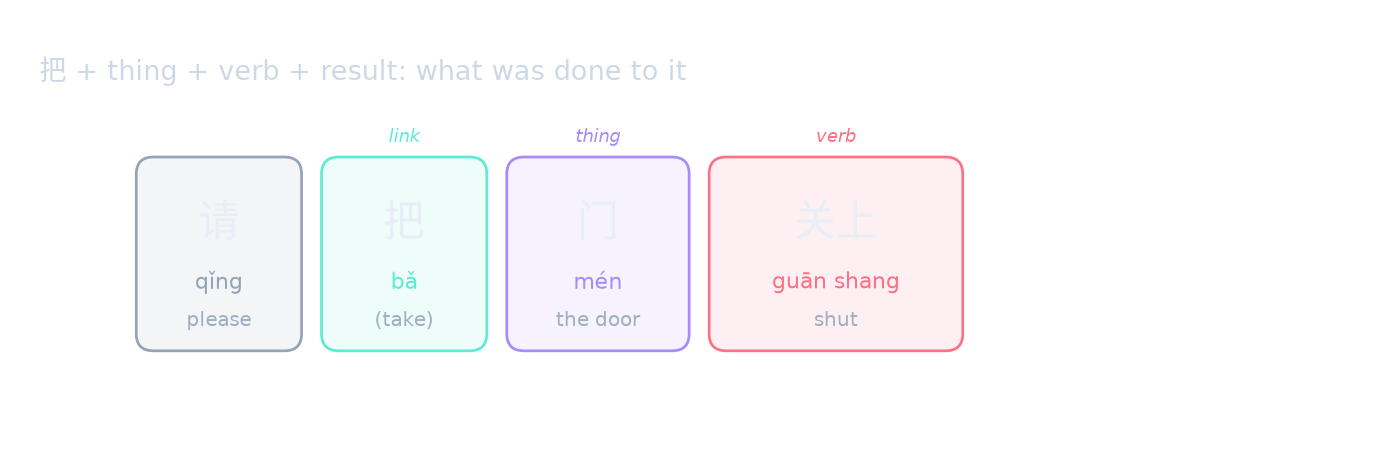
- 1. (把: marks the object)把 sentences – do something to the object: please; to invite请to stand as a goalkeeper把门to close (a door)关上。
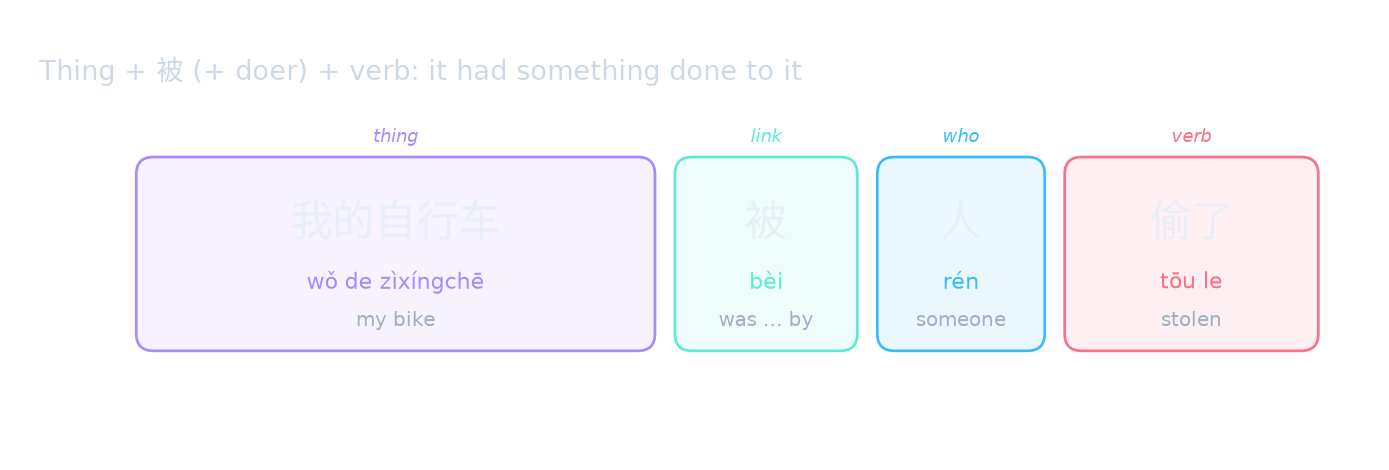
- 2. (passive: by)被 sentences – the passive: I / me我(modifier / structural particle)的bicycle自行车(passive: by)被person人to steal偷(completed / change)了!
- 3. Place + Verb + (ongoing -ing)着 + Noun – existential: 墙上to hang挂(ongoing -ing)着一张map地图。
Question words with new jobs
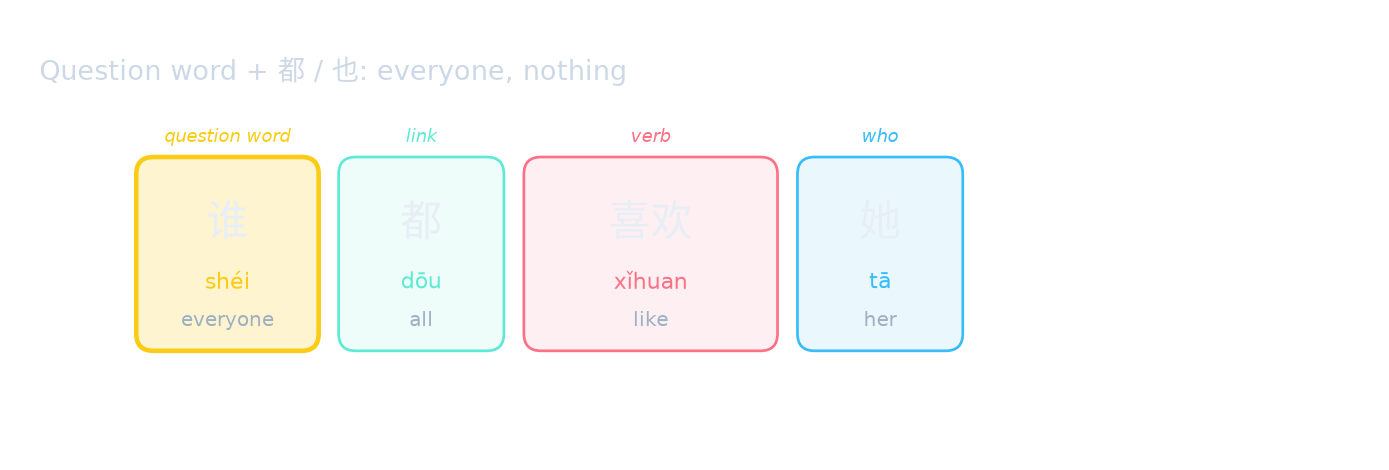
- 4. Question Word + all / both都 – every / all: who谁all / both都to like喜欢she / her她。
- 5. want / think / miss想 + QW + then / just就 + QW – whatever you like: you你want / think / miss想to eat吃what什么then / just就to eat吃what什么。
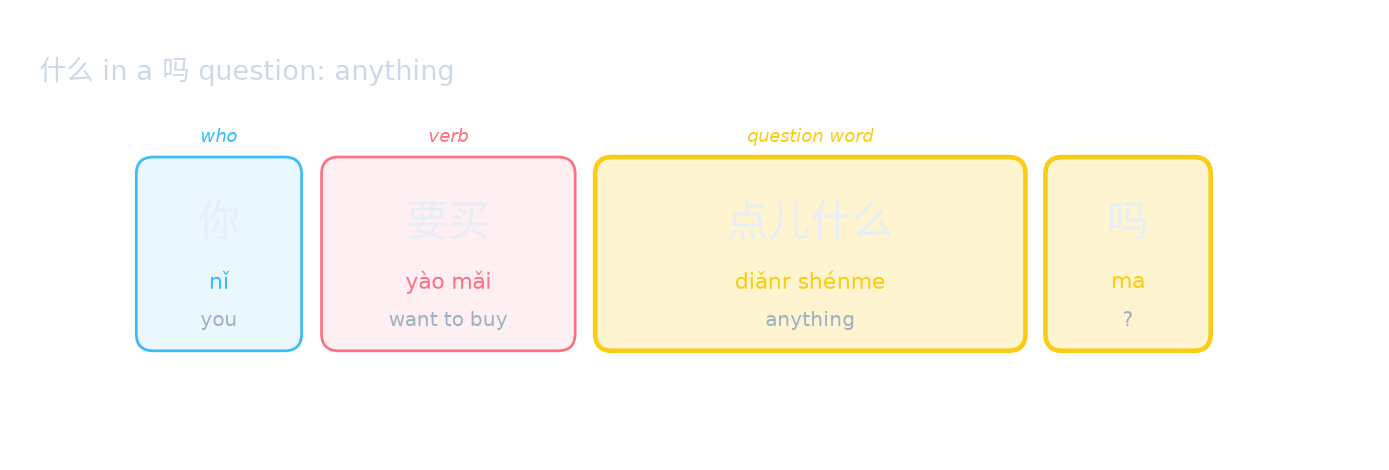
- 6. Question words as “some- / any-”: you你want / will / need要买点儿what什么(yes/no ?)吗?
Not even one
- 7. one / a一 … also也 / all / both都 … not不 / not / haven't没 – not even one: I / me我一块钱also也not have / haven't没有(completed / change)了。
6.2
1. 把 sentences (do something to the object)
Form: subject + (把: marks the object)把 + object + verb + result / direction / place / (completed / change)了
- please; to invite请to stand as a goalkeeper把门to close (a door)关上。 Qǐng bǎ mén guānshang. – Please shut the door.
- I / me我(把: marks the object)把school assignment作业to do; to make做to finish完(completed / change)了。 Wǒ bǎ zuòyè zuòwán le. – I've finished the homework.
- he / him他(把: marks the object)把book书放在table桌子up / on / last; to get on, attend上。 – He put the book on the table.
- I / me我(把: marks the object)把this这个sentence句子翻译成English (language)英文(completed / change)了。 – I translated this sentence into English.
How it works. (把: marks the object)把 bǎ brings the object forward, before the verb, to say what happens to it: it is moved, changed or finished. The object is usually something both speakers can identify (the door, the homework). The verb cannot stand alone: something must follow it.
| After the verb | Example |
|---|---|
| a result | (把: marks the object)把cooked rice饭to eat吃to finish完(completed / change)了 |
| a direction | (把: marks the object)把trash垃圾to take out拿出to go去 |
| a place | (把: marks the object)把book书放在table桌子up / on / last; to get on, attend上 |
| to become / into成 + new form | (把: marks the object)把sentence句子翻译成English (language)英文 |
Negatives and don't别. not / haven't没, not不 and don't别 go before (把: marks the object)把: I / me我not / haven't没(把: marks the object)把key钥匙to bring带来; don't别(把: marks the object)把mobile phone手机to forget忘at / in在home家里!
Watch out
- wrong: I / me我(把: marks the object)把cooked rice饭to eat吃 → I / me我(把: marks the object)把cooked rice饭to eat吃to finish完(completed / change)了.
- wrong: I / me我(把: marks the object)把key钥匙not / haven't没to bring带来 → I / me我not / haven't没(把: marks the object)把key钥匙to bring带来.
- Feeling and knowing verbs (to like喜欢, to know知道) do not take (把: marks the object)把.
Vocabulary
Train
| 汉字 | Pinyin | English |
|---|---|---|
| 把 | bǎ | object marker |
| 作业 | zuò yè | school assignment |
| 句子 | jù zi | sentence |
6.3
2. 被 sentences (the passive)
Form: receiver + (passive: by)被 (+ doer) + verb + result / (completed / change)了
- I / me我(modifier / structural particle)的bicycle自行车(passive: by)被person人to steal偷(completed / change)了! Wǒ de zìxíngchē bèi rén tōu le! – My bike has been stolen!
- he / him他(passive: by)被teacher老师to criticize批评(completed / change)了。 Tā bèi lǎoshī pīpíng le. – He was told off by the teacher.
- cake蛋糕(passive: by)被younger brother弟弟to eat吃to finish完(completed / change)了。 – The cake was eaten up by my little brother.
- I / me我(modifier / structural particle)的mobile phone手机not / haven't没(passive: by)被to take away拿走。 – My phone wasn't taken.
How it works. (passive: by)被 bèi makes a passive: the subject receives the action. The doer follows (passive: by)被 or is left out. As with (把: marks the object)把, the verb needs something after it. (passive: by)被 sentences often report something unwelcome.
| (把: marks the object)把 | (passive: by)被 |
|---|---|
| starts with the doer | starts with the receiver |
| younger brother弟弟(把: marks the object)把cake蛋糕to eat吃to finish完(completed / change)了。 | cake蛋糕(passive: by)被younger brother弟弟to eat吃to finish完(completed / change)了。 |
Watch out
- wrong: bicycle自行车(passive: by)被to steal偷 → bicycle自行车(passive: by)被to steal偷(completed / change)了.
- not / haven't没 goes before (passive: by)被: wrong: (passive: by)被not / haven't没to steal偷 → not / haven't没(passive: by)被to steal偷.
Vocabulary
Train
| 汉字 | Pinyin | English |
|---|---|---|
| 被 | bèi | passive marker |
| 蛋糕 | dàn gāo | cake |
6.4
3. Place + Verb + 着 + Noun (existential)
Form: place + verb + (ongoing -ing)着 + (number + measure word) + noun
- 墙上to hang挂(ongoing -ing)着一张map地图。 Qiáng shang guàzhe yì zhāng dìtú. – There's a map hanging on the wall.
- table桌子上放(ongoing -ing)着one / a一本书。 Zhuōzi shang fàngzhe yì běn shū. – There's a book lying on the table.
- doorway门口to stand站(ongoing -ing)着很多person人。 – There are lots of people standing at the door.
- 书上to write写(ongoing -ing)着he / him他(modifier / structural particle)的name名字。 – His name is written on the book.
How it works. This pattern describes what is in a place and how it is there: hanging (to hang挂), lying (to put / let go放, to lie down躺), standing (to stand站), sitting (to sit / to take (a bus …)坐), written (to write写). The place comes first, without at / in在. The thing is usually new to the listener: 一张, 很多.
| to have / there is有 | verb + (ongoing -ing)着 |
|---|---|
| only says it exists there | also shows how it is there |
| 墙上to have / there is有一张map地图 | 墙上to hang挂(ongoing -ing)着一张map地图 |
Watch out
- wrong: at / in在墙上to hang挂(ongoing -ing)着一张painting / to draw画 → 墙上to hang挂(ongoing -ing)着一张painting / to draw画.
- wrong: table桌子上放(ongoing -ing)着那本书 → table桌子上放(ongoing -ing)着one / a一本书 (that book is already known; say 那本书at / in在table桌子up / on / last; to get on, attend上).

Vocabulary
Train
| 汉字 | Pinyin | English |
|---|---|---|
| 地图 | dì tú | map |
| 站 | zhàn | to stand |
| 放 | fàng | to put |
| 画 | huà | to draw |
6.5
4. Question Word + 都 (every / all)
Form: question word + all / both都 / also也 + (not不 / not / haven't没) + verb · which哪 + measure word + noun + all / both都
- who谁all / both都to like喜欢she / her她。 Shéi dōu xǐhuan tā. – Everyone likes her.
- he / him他what什么also也not / haven't没to speak说。 Tā shénme yě méi shuō. – He didn't say anything.
- weekend周末I / me我where哪儿all / both都not want to不想to go去。 – I don't want to go anywhere this weekend.
- which哪个dish (of food); vegetable菜all / both都tasty好吃。 – Every dish is delicious.
How it works. A question word + all / both都 means "every-, any-"; with not不 or not / haven't没 it means "no-".
| Question word | + all / both都 + verb | + all / both都 / also也 + not不 / not / haven't没 |
|---|---|---|
| who谁 | everyone | nobody |
| what什么 | everything | nothing |
| where哪儿 | everywhere | nowhere |
| what什么time; when时候 | any time | never |
The question word moves before all / both都 and the verb. In the negative, also也 and all / both都 both work.
Watch out
- wrong: I / me我to eat吃what什么all / both都 → I / me我what什么all / both都to eat吃.
Vocabulary
Train
| 汉字 | Pinyin | English |
|---|---|---|
| 周末 | zhōu mò | weekend |
6.6
5. 想 + QW + 就 + QW (whatever you like)
Form: (subject) want / think / miss想 + verb + question word,then / just就 + verb + same question word
- you你want / think / miss想to eat吃what什么then / just就to eat吃what什么。 Nǐ xiǎng chī shénme jiù chī shénme. – Eat whatever you like.
- you你want / think / miss想to sit / to take (a bus …)坐where哪儿then / just就to sit / to take (a bus …)坐where哪儿。 – Sit wherever you like.
- you你what什么time; when时候to have time (to do sth)有空,then / just就what什么time; when时候to come来。 – Come whenever you're free.
- who谁want / think / miss想to go去who谁to go去。 – Whoever wants to go can go.
How it works. The same question word appears in both halves and refers to the same thing: whatever, wherever, whenever, whoever. The verb usually repeats too. It is a statement, not a question.
as you like; casual随便 says "as you like" on its own (A: to eat吃what什么? B: as you like; casual随便). The question-word pattern says exactly what is free: want / think / miss想to buy买how many / how much多少then / just就to buy买how many / how much多少 (buy as many as you want).
Watch out
- Use the same word twice: wrong: want / think / miss想to eat吃what什么then / just就to eat吃which哪个 → want / think / miss想to eat吃what什么then / just就to eat吃what什么.
- No (yes/no ?)吗 and no question mark.

6.7
6. Question words as “some- / any-”
Form: question word in a (yes/no ?)吗 question · not不 + verb + what什么 · to seem; as if好像 / maybe / possible可能 + what什么
- you你want / will / need要买点儿what什么(yes/no ?)吗? Nǐ yào mǎi diǎnr shénme ma? – Do you want to buy anything?
- to have / there is有谁给我to make a telephone call打电话(yes/no ?)吗? Yǒu shéi gěi wǒ dǎ diànhuà ma? – Did anyone call me?
- he / him他to seem; as if好像to have / there is有what什么matter事。 – He seems to have something on his mind.
- I / me我not want to不想to eat吃what什么。 – I don't feel like eating anything in particular.
How it works. In a (yes/no ?)吗 question, a question word stops asking and means "some-, any-": what什么 = anything, who谁 = anyone, where哪儿 = anywhere. The same happens after not不, to seem; as if好像 and maybe / possible可能.
| Question | Meaning |
|---|---|
| you你to go去where哪儿(completed / change)了? | Where did you go? |
| you你to go去where哪儿(completed / change)了(yes/no ?)吗? | Did you go anywhere? |
| not不 + verb + what什么 | what什么all / both都not不 + verb |
|---|---|
| not much, nothing in particular (soft) | nothing at all (total) |
| I / me我not want to不想to eat吃what什么 | I / me我what什么all / both都not want to不想to eat吃 |
6.8
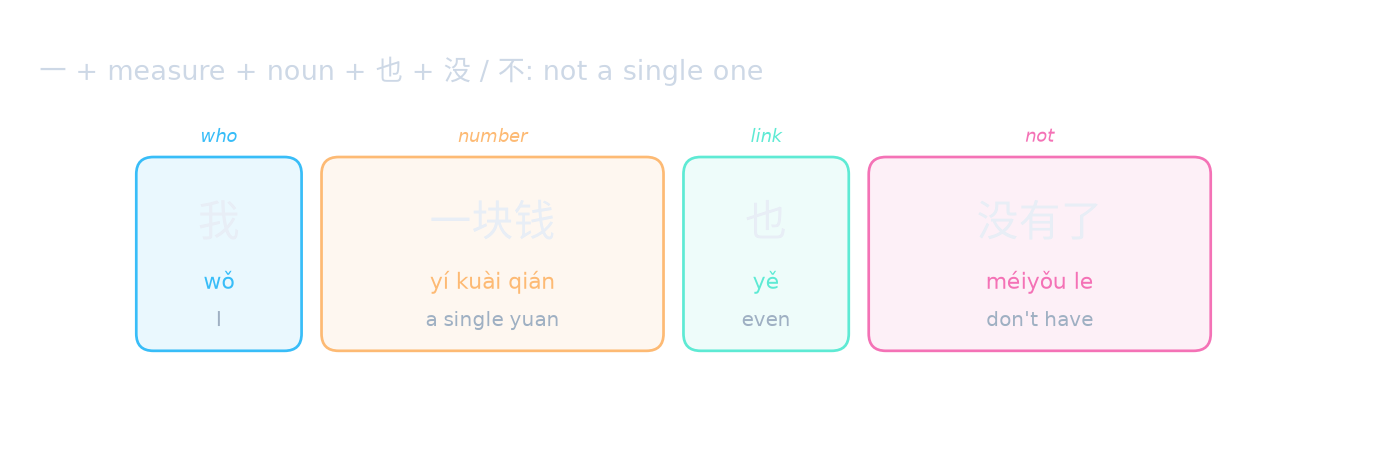
7. 一 … 也 / 都 … 不 / 没 (not even one)
Form: one / a一 + measure word + noun + also也 / all / both都 + not / haven't没 / not不 + verb · a little一点儿also也not不 + adjective
- I / me我一块钱also也not have / haven't没有(completed / change)了。 Wǒ yí kuài qián yě méiyǒu le. – I don't have a single yuan left.
- I / me我一个person人also也not不to know (a person); to recognise认识。 Wǒ yí ge rén yě bú rènshi. – I don't know a single person.
- he / him他today今天a mouthful一口cooked rice饭all / both都not / haven't没to eat吃。 – He hasn't eaten a single mouthful today.
- today今天a little一点儿also也not不cold冷。 – It isn't cold at all today.
How it works. This is a strong negative: "not even one". The "one" phrase moves before the verb, after the subject. also也 and all / both都 both work; also也 is slightly more common in speech.
| not / haven't没 | not不 |
|---|---|
| it did not happen | habits, wishes, refusals |
| I / me我one / a一本书also也not / haven't没to buy买 | I / me我a mouthful一口also也not want to不想to eat吃 |
With an adjective, use a little一点儿also也not不: a little一点儿also也not不tired累.
Watch out
- wrong: I / me我not / haven't没to buy买one / a一本书also也 → I / me我one / a一本书also也not / haven't没to buy买.
6.9
Practice
Cover the teaching pages before you answer. The answers are at the end.
1. (把: marks the object)把 sentences (do something to the object)
1. Complete: “I've finished the homework.” I / me我…………school assignment作业to do; to make做to finish完(completed / change)了。
2. Match each (把: marks the object)把 sentence to what comes after its verb.
-
(1) please; to invite请(把: marks the object)把trash垃圾to take out拿出to go去。
-
(2) he / him他(把: marks the object)把book书放在table桌子up / on / last; to get on, attend上(completed / change)了。
-
(3) please; to invite请(把: marks the object)把那本书to / for / give给I / me我。
-
(4) I / me我(把: marks the object)把这句words / speech话翻译成English (language)英文(completed / change)了。
-
A. a new form
-
B. a place
-
C. a direction
-
D. a person
3. Which sentence is complete and correct?
- A. I / me我(把: marks the object)把to have a meal吃饭to finish完(completed / change)了。
- B. I / me我(把: marks the object)把cooked rice饭to eat吃to finish完(completed / change)了。
- C. I / me我(把: marks the object)把cooked rice饭to eat吃。
- D. I / me我to eat吃(把: marks the object)把cooked rice饭to finish完(completed / change)了。
4. Which says “I parked the car at the door”?
- A. I / me我(把: marks the object)把doorway门口to pull up (stop one's…停车(completed / change)了。
- B. I / me我handlebar (of a bicycle)车把to stop停at / in在doorway门口(completed / change)了。
- C. I / me我(把: marks the object)把car车to stop停at / in在doorway门口(completed / change)了。
- D. I / me我to pull up (stop one's…停车at / in在doorway门口(completed / change)了。
5. Build: “Please move the chairs outside.”
Put in order: please; to invite请 / to move搬to / arrive / (result: get)到 / outside外面。 / (把: marks the object)把chair椅子
6. True or false? I / me我(把: marks the object)把key钥匙not / haven't没to bring带来 is the correct word order. If false, correct it.
7. Put should应该 in the right place: “You should finish your homework first.” you你…………first先(把: marks the object)把school assignment作业to write写to finish完。
8. Which sentence is wrong?
- A. don't别(把: marks the object)把mobile phone手机to forget忘at / in在home家里!
- B. please; to invite请to stand as a goalkeeper把门to close (a door)关上。
- C. I / me我(把: marks the object)把he / him他to like喜欢。
- D. I / me我(把: marks the object)把那本书to look at; to watch; to read看to finish完(completed / change)了。
9. It is cold, and your little brother has left the door wide open again. Use (把: marks the object)把 sentences. Write your answer in Chinese, then say it aloud.
2. (passive: by)被 sentences (the passive)
10. Complete: “My wallet was stolen.” I / me我(modifier / structural particle)的purse钱包…………to steal偷(completed / change)了。
11. Build: “The cake was eaten up by my little brother.”
Put in order: to eat吃to finish完 / (completed / change)了。 / (passive: by)被younger brother弟弟 / cake蛋糕
12. Turn into a (passive: by)被 sentence: pup小狗(把: marks the object)把I / me我(modifier / structural particle)的shoe鞋to bite咬bad坏(completed / change)了。 ("The puppy chewed up my shoe.")
- A. I / me我(modifier / structural particle)的shoe鞋(passive: by)被pup小狗咬坏(completed / change)了。
- B. I / me我(modifier / structural particle)的shoe鞋(把: marks the object)把pup小狗咬坏(completed / change)了。
- C. (passive: by)被pup小狗I / me我(modifier / structural particle)的shoe鞋to bite咬bad坏(completed / change)了。
- D. pup小狗(passive: by)被I / me我(modifier / structural particle)的shoe鞋to bite咬bad坏(completed / change)了。
13. True or false? younger brother弟弟(把: marks the object)把cake蛋糕to eat吃to finish完(completed / change)了 and cake蛋糕(passive: by)被younger brother弟弟to eat吃to finish完(completed / change)了 describe the same event. If false, correct it.
14. Your mum calls from the kitchen: “Dinner is ready!” Which is the natural Chinese?
- A. (passive: by)被cooked rice饭做好(completed / change)了!
- B. cooked rice饭(passive: by)被mum; mother妈妈做好(completed / change)了!
- C. cooked rice饭做好(completed / change)了!
- D. cooked rice饭(passive: by)被做好(completed / change)了!
15. Which says “My phone wasn't taken”?
- A. I / me我(modifier / structural particle)的mobile phone手机(passive: by)被to take away拿走not / haven't没。
- B. I / me我(modifier / structural particle)的mobile phone手机(passive: by)被not / haven't没to take away拿走。
- C. not / haven't没I / me我(modifier / structural particle)的mobile phone手机(passive: by)被to take away拿走。
- D. I / me我(modifier / structural particle)的mobile phone手机not / haven't没(passive: by)被to take away拿走。
16. True or false? I / me我(modifier / structural particle)的bicycle自行车(passive: by)被to steal偷。 is a complete sentence. If false, correct it.
17. You come out of the library and your bike is gone. Use (passive: by)被 sentences. Write your answer in Chinese, then say it aloud.
3. Place + Verb + (ongoing -ing)着 + Noun (existential)
18. Complete: “There's a cat lying on the bed.” 床上to lie down躺…………一只cat猫。
19. Which sentence is correct?
- A. 墙上to hang挂(ongoing -ing)着一张painting / to draw画。
- B. 墙上to hang挂一张painting / to draw画(ongoing -ing)着。
- C. 一张画挂(ongoing -ing)着墙上。
- D. at / in在墙上to hang挂(ongoing -ing)着一张painting / to draw画。
20. Build: “There are lots of people standing at the door.”
Put in order: 很多 / to stand站(ongoing -ing)着 / doorway门口 / person人。
21. True or false? 墙上to hang挂(ongoing -ing)着一张map地图 says how the map is there, not only that it exists. If false, correct it.
22. You are writing to a friend about your new flat and want to say what is in it. Use Place + Verb + (ongoing -ing)着 + Noun. Write your answer in Chinese, then say it aloud.
4. Question Word + all / both都 (every / all)
23. Complete: “Everyone knows him.” who谁…………to know (a person); to recognise认识he / him他。
24. Which says “I don't want to eat anything.”?
- A. what什么I / me我not want to不想all / both都to eat吃。
- B. I / me我not want to不想to eat吃what什么all / both都。
- C. I / me我all / both都what什么not want to不想to eat吃。
- D. I / me我what什么all / both都not want to不想to eat吃。
25. Build: “He didn't say anything.”
Put in order: to speak说。 / what什么 / also也not / haven't没 / he / him他
26. True or false? which哪个dish (of food); vegetable菜all / both都tasty好吃 means “every dish is delicious”. If false, correct it.
27. A new teacher has just started at your school, and every student is talking about her. Use Question Word + all / both都. Write your answer in Chinese, then say it aloud.
5. want / think / miss想 + QW + then / just就 + QW (whatever you like)
28. Complete: “Buy whatever you want.” you你want / think / miss想to buy买what什么then / just就to buy买…………。
29. Which says “Sit wherever you like.”?
- A. you你where哪儿want / think / miss想to sit / to take (a bus …)坐then / just就to sit / to take (a bus …)坐。
- B. you你want / think / miss想to sit / to take (a bus …)坐where哪儿then / just就to sit / to take (a bus …)坐what什么。
- C. you你want / think / miss想to sit / to take (a bus …)坐where哪儿then / just就to sit / to take (a bus …)坐where哪儿(yes/no ?)吗?
- D. you你want / think / miss想to sit / to take (a bus …)坐where哪儿then / just就to sit / to take (a bus …)坐where哪儿。
30. Build: “Whoever wants to go can go.”
Put in order: who谁 / to go去。 / who谁 / want / think / miss想to go去
31. True or false? want / think / miss想to buy买how many / how much多少then / just就to buy买how many / how much多少 means “buy as many as you want”. If false, correct it.
32. You take a visiting friend to dinner and want her to order anything she likes. Use want / think / miss想 + QW + then / just就 + QW. Write your answer in Chinese, then say it aloud.
6. Question words as “some- / any-”
33. What does you你weekend周末to go去where哪儿(completed / change)了(yes/no ?)吗? mean?
- A. Did you go anywhere at the weekend?
- B. You went everywhere at the weekend.
- C. Why didn't you go out at the weekend?
- D. Where did you go at the weekend?
34. Complete: “Did anyone call me?” to have / there is有…………to / for / give给I / me我to make a telephone call打电话(yes/no ?)吗?
35. Build: “Do you want to eat anything?”
Put in order: what什么 / want / think / miss想to eat吃 / you你 / (yes/no ?)吗?
36. True or false? I / me我not want to不想to eat吃what什么 is stronger than I / me我what什么all / both都not want to不想to eat吃. If false, correct it.
37. Match each sentence to its meaning.
-
(1) you你to go去where哪儿?
-
(2) you你to go去where哪儿(yes/no ?)吗?
-
(3) I / me我where哪儿all / both都to go去。
-
(4) I / me我where哪儿all / both都not不to go去。
-
A. Are you going anywhere?
-
B. I'll go anywhere.
-
C. Where are you going?
-
D. I'm not going anywhere.
38. Your friend is going to the shop and offers to bring something back for you. Write your answer in Chinese, then say it aloud.
7. one / a一 … also也 / all / both都 … not不 / not / haven't没 (not even one)
39. Complete: “I didn't buy a single book.” I / me我one / a一本书…………没买。
40. Turn I / me我not / haven't没to look at; to watch; to read看film; movie电影 into “I didn't watch a single film.”
Put in order: not / haven't没to look at; to watch; to read看。 / I / me我 / also也 / 一部film; movie电影
41. True or false? I / me我a mouthful一口also也not want to不想to eat吃 means “I don't want to eat a single bite.” If false, correct it.
42. Which sentence is correct?
- A. I / me我一杯water水also也not / haven't没to drink喝。
- B. I / me我not / haven't没喝一杯water水also也。
- C. 一杯water水I / me我to drink喝also也not / haven't没。
- D. I / me我一杯water水not / haven't没also也to drink喝。
43. Build: “It isn't cold at all today.”
Put in order: a little一点儿 / also也not不 / cold冷。 / today今天
44. At the end of the month your wallet is completely empty. Use one / a一 … also也 / all / both都 … not不 / not / haven't没. Write your answer in Chinese, then say it aloud.
6.10
Mixed practice
These questions mix the patterns and use new situations.
45. Which sentence is correct?
- A. I / me我(把: marks the object)把this这本书to like喜欢。
- B. I / me我(把: marks the object)把book书放在table桌子up / on / last; to get on, attend上(completed / change)了。
- C. I / me我(把: marks the object)把book书。
46. Turn into a (passive: by)被 sentence: someone有人to steal偷(completed / change)了I / me我(modifier / structural particle)的bicycle自行车。
47. Say "Everyone likes her" with a question word.
48. Say "I don't have a single yuan left."
49. Find and fix the problem. A classmate says I / me我(把: marks the object)把this这本书to like喜欢. Why does (把: marks the object)把 not work here?
50. Use it yourself. Say that he put the book on the table, then that later the book was taken away (you do not know by whom).
6.11
Answers and explanations
Mark your work, then correct each mistake in your own words.
1. (把: marks the object)把 sentences (do something to the object)
1. (把: marks the object)把
Subject + (把: marks the object)把 + thing + verb + result: I / me我(把: marks the object)把school assignment作业to do; to make做to finish完(completed / change)了。
2. (1) C: please; to invite请(把: marks the object)把trash垃圾to take out拿出to go去。 = a direction; (2) B: he / him他(把: marks the object)把book书放在table桌子up / on / last; to get on, attend上(completed / change)了。 = a place; (3) D: please; to invite请(把: marks the object)把那本书to / for / give给I / me我。 = a person; (4) A: I / me我(把: marks the object)把这句words / speech话翻译成English (language)英文(completed / change)了。 = a new form
to go out出去 is a direction, at / in在 + place a place, to / for / give给 + person a person, to become / into成 + English (language)英文 a new form.
3. B. I / me我(把: marks the object)把cooked rice饭to eat吃to finish完(completed / change)了。
The verb after (把: marks the object)把 needs something after it, here the result to finish完 and (completed / change)了.
4. C. I / me我(把: marks the object)把car车to stop停at / in在doorway门口(completed / change)了。
With at / in在 + place after the verb, the object moves in front with (把: marks the object)把: (把: marks the object)把car车to stop停at / in在doorway门口.
5. please; to invite请(把: marks the object)把chair椅子to move搬to / arrive / (result: get)到outside外面。
(把: marks the object)把 + thing + verb + to / arrive / (result: get)到 + place.
6. False.
not / haven't没 goes before (把: marks the object)把: I / me我not / haven't没(把: marks the object)把key钥匙to bring带来。
7. should应该
Words like should应该, want / think / miss想 and want / will / need要 come before (把: marks the object)把, just like not / haven't没 and don't别.
8. C. I / me我(把: marks the object)把he / him他to like喜欢。
to like喜欢 does nothing to the person, so it never takes (把: marks the object)把: I / me我to like喜欢he / him他。
9. Model answer: please; to invite请to stand as a goalkeeper把门to close (a door)关上。
Check your answer:
- My verb after (把: marks the object)把 has something after it: a result, a direction, a place, to / for / give给 + person or (completed / change)了.
- Any not / haven't没, don't别 or want / think / miss想 stands before (把: marks the object)把, not after it.
2. (passive: by)被 sentences (the passive)
10. (passive: by)被
Receiver + (passive: by)被 + verb + (completed / change)了.
11. cake蛋糕(passive: by)被younger brother弟弟to eat吃to finish完(completed / change)了。
Receiver + (passive: by)被 + doer + verb + result + (completed / change)了.
12. A. I / me我(modifier / structural particle)的shoe鞋(passive: by)被pup小狗咬坏(completed / change)了。
The receiver (I / me我(modifier / structural particle)的shoe鞋) comes first, then (passive: by)被 + the doer (pup小狗), then the verb and result.
13. True.
Both say the brother ate the cake; they start from different points.
14. C. cooked rice饭做好(completed / change)了!
Neutral “is done / is ready” needs no (passive: by)被. Just put the thing first: cooked rice饭做好(completed / change)了。
15. D. I / me我(modifier / structural particle)的mobile phone手机not / haven't没(passive: by)被to take away拿走。
not / haven't没 goes before (passive: by)被.
16. False.
The verb needs something after it: I / me我(modifier / structural particle)的bicycle自行车(passive: by)被to steal偷(completed / change)了。
17. Model answer: I / me我(modifier / structural particle)的bicycle自行车(passive: by)被person人to steal偷(completed / change)了!
Check your answer:
- My sentence starts with what was affected, then (passive: by)被 (+ who did it), then the verb with (completed / change)了 or a result.
- Any not / haven't没 or don't别 stands before (passive: by)被.
3. Place + Verb + (ongoing -ing)着 + Noun (existential)
18. (ongoing -ing)着
Place + Verb + (ongoing -ing)着 + noun.
19. A. 墙上to hang挂(ongoing -ing)着一张painting / to draw画。
The place starts the sentence, without at / in在.
20. doorway门口to stand站(ongoing -ing)着很多person人。
Place + Verb + (ongoing -ing)着 + noun.
21. True.
to hang挂(ongoing -ing)着 shows it is hanging; to have / there is有 would only say it exists.
22. Model answer: 墙上to hang挂(ongoing -ing)着一张map地图。
Check your answer:
- Do not start with at / in在: 墙上to hang挂(ongoing -ing)着一张painting / to draw画, not at / in在墙上to hang挂(ongoing -ing)着一张painting / to draw画.
- The noun is usually new and unspecific (一张, 很多): table桌子上放(ongoing -ing)着one / a一本书, not table桌子上放(ongoing -ing)着那本书.
4. Question Word + all / both都 (every / all)
23. all / both都
QW + all / both都 + verb = every-.
24. D. I / me我what什么all / both都not want to不想to eat吃。
QW + all / both都 + not不 + verb.
25. he / him他what什么also也not / haven't没to speak说。
Subject + QW + also也 + not / haven't没 + verb.
26. True.
which哪个 + noun + all / both都 = any/every one of them.
27. Model answer: who谁all / both都to like喜欢she / her她。
Check your answer:
- The QW moves before all / both都 / also也: I / me我what什么all / both都to eat吃, not I / me我to eat吃what什么all / both都.
- In the negative, also也 and all / both都 both work: what什么also也not want to不想to eat吃 / what什么all / both都not want to不想to eat吃.
5. want / think / miss想 + QW + then / just就 + QW (whatever you like)
28. what什么
The same question word repeats.
29. D. you你want / think / miss想to sit / to take (a bus …)坐where哪儿then / just就to sit / to take (a bus …)坐where哪儿。
want / think / miss想 + V + where哪儿,then / just就 + V + where哪儿, as a statement.
30. who谁want / think / miss想to go去who谁to go去。
QW + want / think / miss想 + V, QW + V.
31. True.
how many / how much多少 repeats: as much/many as you want.
32. Model answer: you你want / think / miss想to eat吃what什么then / just就to eat吃what什么。
Check your answer:
- Use the same question word in both halves: want / think / miss想to eat吃what什么then / just就to eat吃what什么, not want / think / miss想to eat吃what什么then / just就to eat吃which哪个.
- This is a statement, not a question: no (yes/no ?)吗 and no question mark.
6. Question words as “some- / any-”
33. A. Did you go anywhere at the weekend?
With (yes/no ?)吗, where哪儿 becomes “anywhere”.
34. who谁
In a (yes/no ?)吗 question, who谁 = anyone (someone有人 also works).
35. you你want / think / miss想to eat吃what什么(yes/no ?)吗?
QW + (yes/no ?)吗 = anything?
36. False.
what什么all / both都not不 is the total negative; not不…what什么 is softer.
37. (1) C: you你to go去where哪儿? = Where are you going?; (2) A: you你to go去where哪儿(yes/no ?)吗? = Are you going anywhere?; (3) B: I / me我where哪儿all / both都to go去。 = I'll go anywhere.; (4) D: I / me我where哪儿all / both都not不to go去。 = I'm not going anywhere.
(yes/no ?)吗 makes a yes / no question; all / both都 makes every- or (with not不) no-.
38. Model answer: you你want / will / need要买点儿what什么(yes/no ?)吗?
Check your answer:
- you你to buy买what什么? asks "What are you buying?"; you你to buy买what什么(yes/no ?)吗? asks "Are you buying anything?"
- not不 + Verb + what什么 is a mild "not much / nothing in particular", weaker than what什么all / both都not不.
7. one / a一 … also也 / all / both都 … not不 / not / haven't没 (not even one)
39. also也
one / a一 + MW + noun + also也/all / both都 + not / haven't没 + verb.
40. I / me我一部film; movie电影also也not / haven't没to look at; to watch; to read看。
one / a一 + measure word + noun moves before the verb, then also也 + not / haven't没.
41. True.
not want to不想 = don't want; the one / a一 phrase makes it total.
42. A. I / me我一杯water水also也not / haven't没to drink喝。
The “one” phrase goes before also也 + not / haven't没 + verb.
43. today今天a little一点儿also也not不cold冷。
a little一点儿also也not不 + adjective.
44. Model answer: I / me我一块钱also也not have / haven't没有(completed / change)了。
Check your answer:
- Move the "one" phrase before the verb: I / me我one / a一本书also也not / haven't没to buy买, not I / me我not / haven't没to buy买one / a一本书also也.
- Choose not / haven't没 for something that did not happen, not不 for a habit, wish or refusal: a mouthful一口also也not want to不想to eat吃.
Mixed practice
45. B. (把: marks the object)把 needs an action that does something to the object, with a result such as 放在table桌子up / on / last; to get on, attend上.
46. I / me我(modifier / structural particle)的bicycle自行车(passive: by)被(person人)to steal偷(completed / change)了。The person who did it may be left out.
47. who谁all / both都to like喜欢she / her她。Question word + all / both都 means "everyone / everything".
48. I / me我一块钱also也not have / haven't没有(completed / change)了。one / a一 + measure word + noun + also也/all / both都 + not / haven't没 means "not even one".
49. (把: marks the object)把 needs an action that does something to the object, with a result: (把: marks the object)把book书放在table桌子up / on / last; to get on, attend上. to like喜欢 is a feeling, so say I / me我to like喜欢this这本书.
50. Model answer. he / him他(把: marks the object)把那本书放在table桌子up / on / last; to get on, attend上(completed / change)了。later; afterwards后来,那本书(passive: by)被to take away拿走(completed / change)了。A (passive: by)被 sentence can leave out who did it.
Review later. Tomorrow, describe one thing you did with (把: marks the object)把 and one thing that happened to you with (passive: by)被.
Interactive lessons on this topic
Work through it step by step, with instant-check exercises.
- 越 … 越 … (the more …, the more …)
- 一 … 也 / 都 … 不 / 没 (not even one)
- 把 sentences (do something to the object)
- 被 sentences (the passive)
- Place + Verb + 着 + Noun (existential)
- 想 + QW + 就 + QW (whatever you like)
- Question Word + 都 (every / all)
- Question words as “some- / any-”
- 为了 (in order to / for the sake of)