Verbs that do more work. Some verbs make other people act (to let / make让, to call / be called / (animals) cry, bark叫, please; to invite请, to make使) or give advice (should应该). Some patterns say how long an action lasted (Verb + (completed / change)了 + time). The largest group are complements: short words after the verb that say where the action goes (to come来/to go去), whether you can do it ((degree marker)得/not不), whether it is finished (to finish完/good好/wrong; mistake错) and whether it continues (go down / (keep on)下去).
Verbs, ability & complements
HSK 3 · Topic 3
 4:29
HSK 3 Grammar 3: Verbs, Ability & Complements
This topic is about verbs. Getting others to act with 让, 请 and 应该. Judging how things seem with 看起来 and 难. And complements after the verb: did it work, can you…
English explanations + Mandarin examples · captions follow the spoken text
3.1
At a glance
Making, letting and advising
- 1. to let / make让 / to call / be called / (animals) cry, bark叫 / please; to invite请 / to make使 – make / let / ask someone do: mum; mother妈妈不让I / me我evening晚上to go out出去。
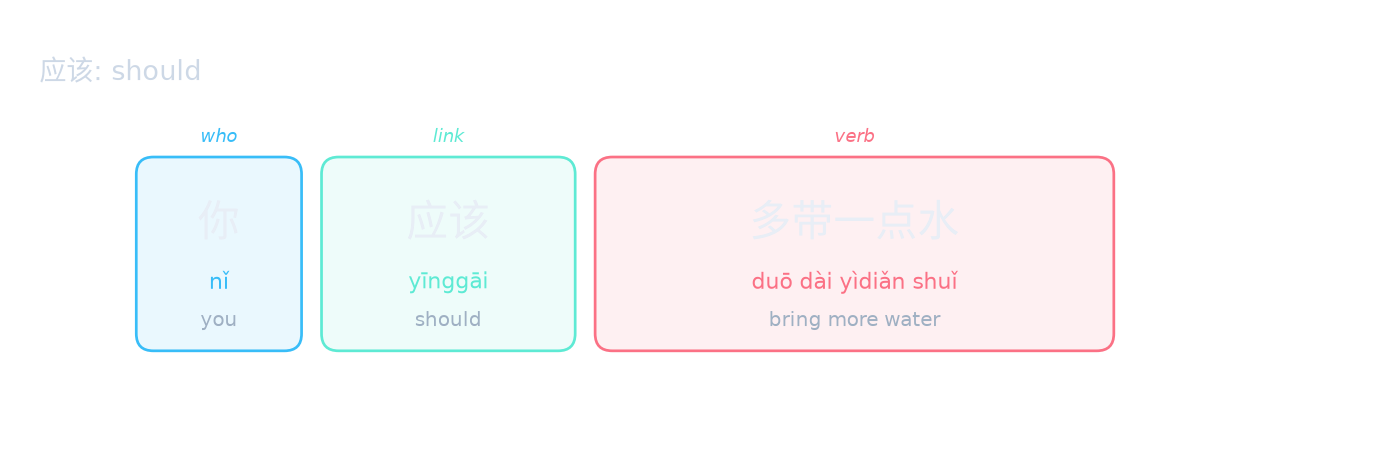
- 2. should应该 / should该 – should, ought to: you你should应该多带a bit一点water水。
- 3. not / haven't没means办法 + Verb – no way to / can't: shop商店all / both都to close (the door)关门(completed / change)了,I / me我not / haven't没means办法to buy买cake蛋糕。
Seeming, feeling and judging
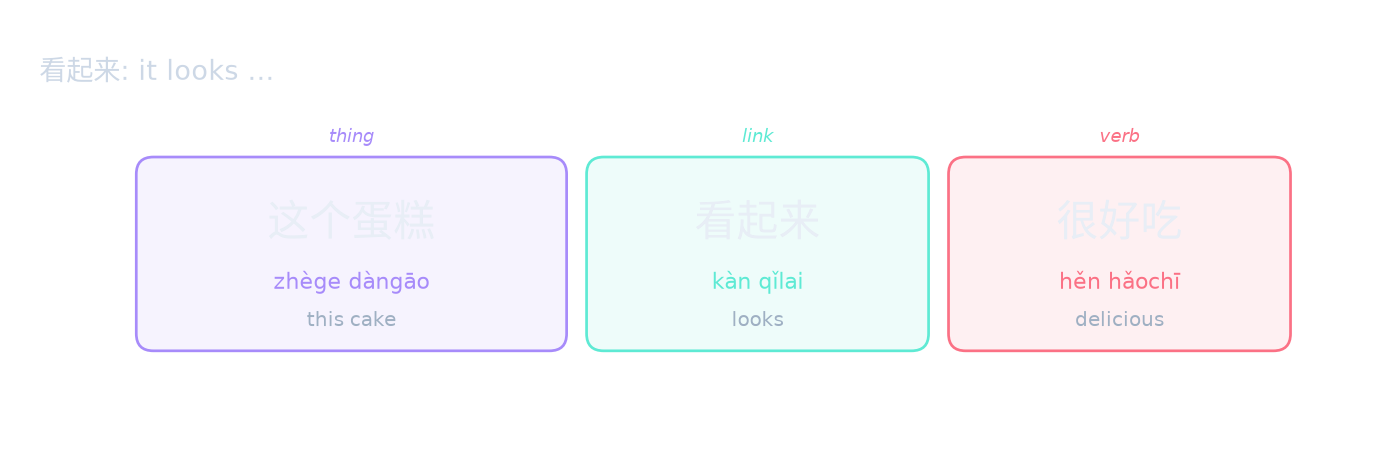
- 4. seemingly看起来 – looks / seems: this这个cake蛋糕seemingly看起来degree / adjective linker很tasty好吃。
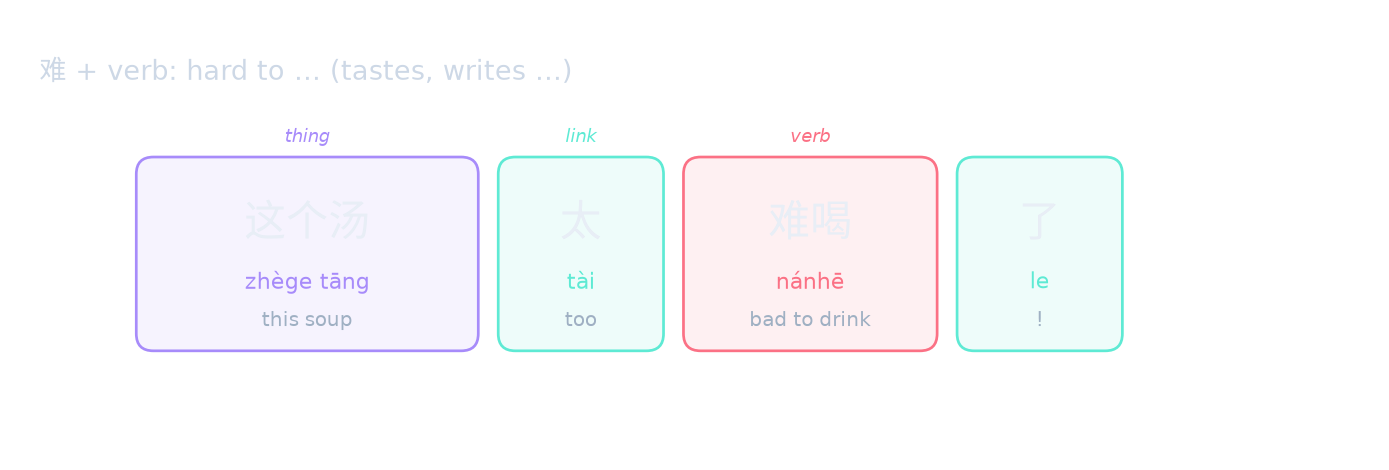
- 5. difficult / hard难 + Verb – unpleasant to …: this这个汤太难to drink喝(completed / change)了!
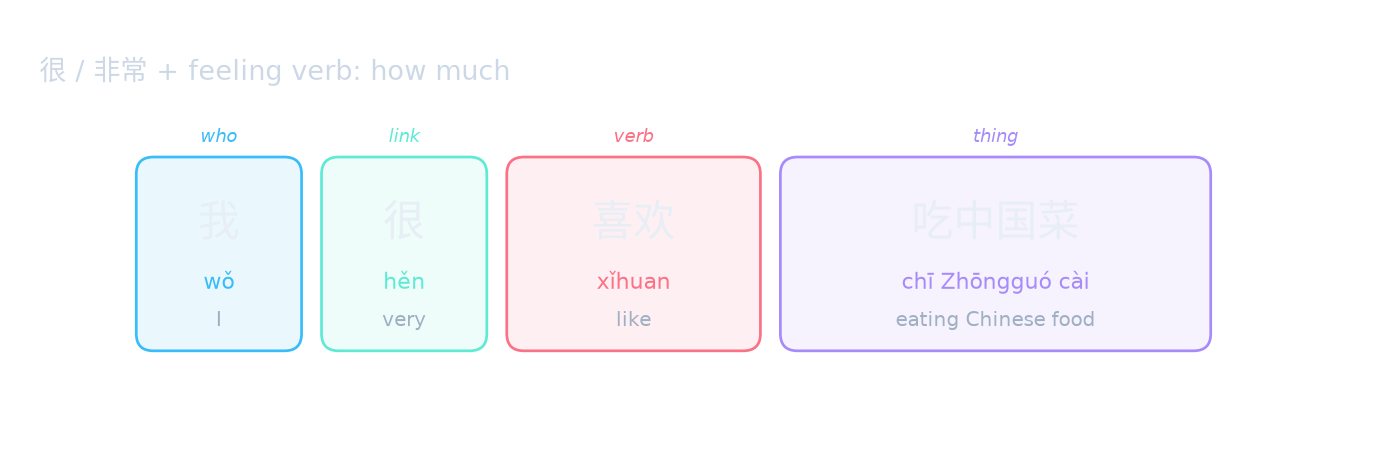
- 6. degree / adjective linker很 + Verb – feeling verbs with degree / adjective linker很: I / me我degree / adjective linker很to like喜欢to eat吃China中国dish (of food); vegetable菜。
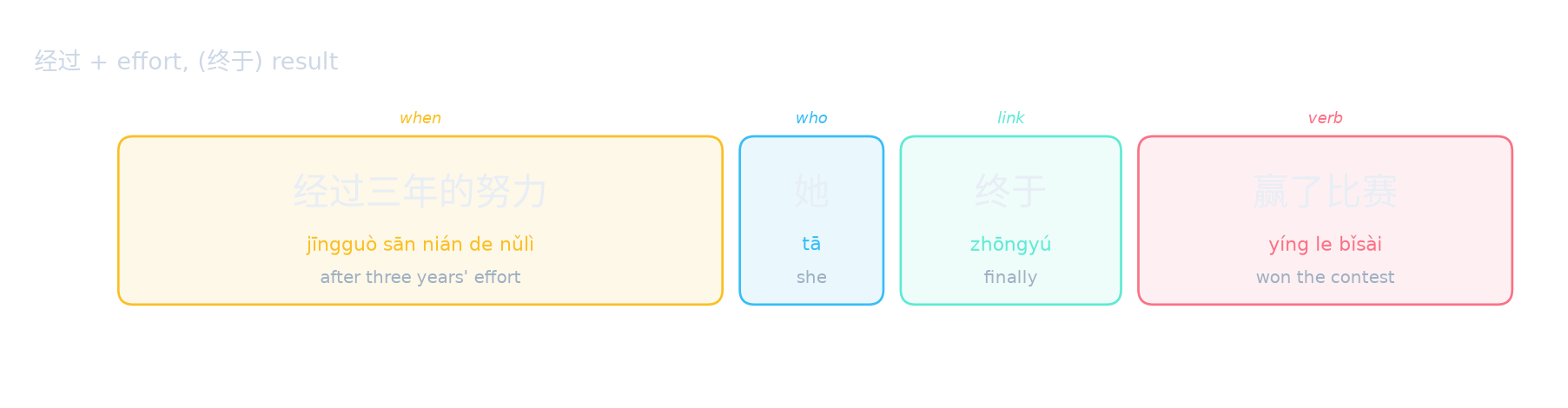
- 7. to pass / process经过 – after going through: to pass / process经过三年(modifier / structural particle)的to work hard / effort努力,she / her她finally终于to win赢(completed / change)了competition比赛。
How long, or just a little
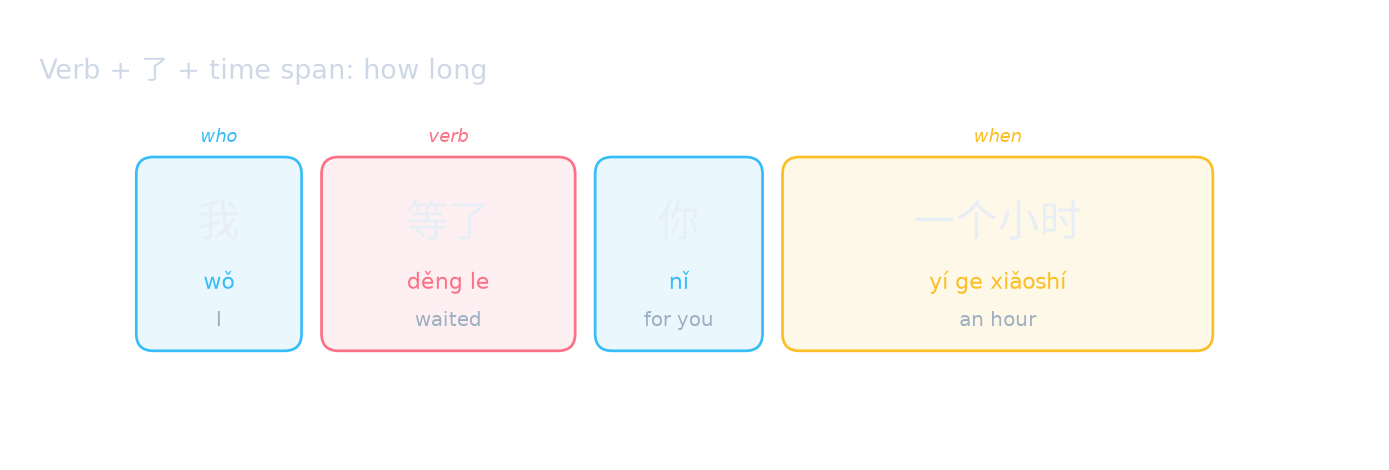
- 8. Verb + (completed / change)了 + Duration – did for a length of time: I / me我to wait; and so on等(completed / change)了you你一个hour小时!
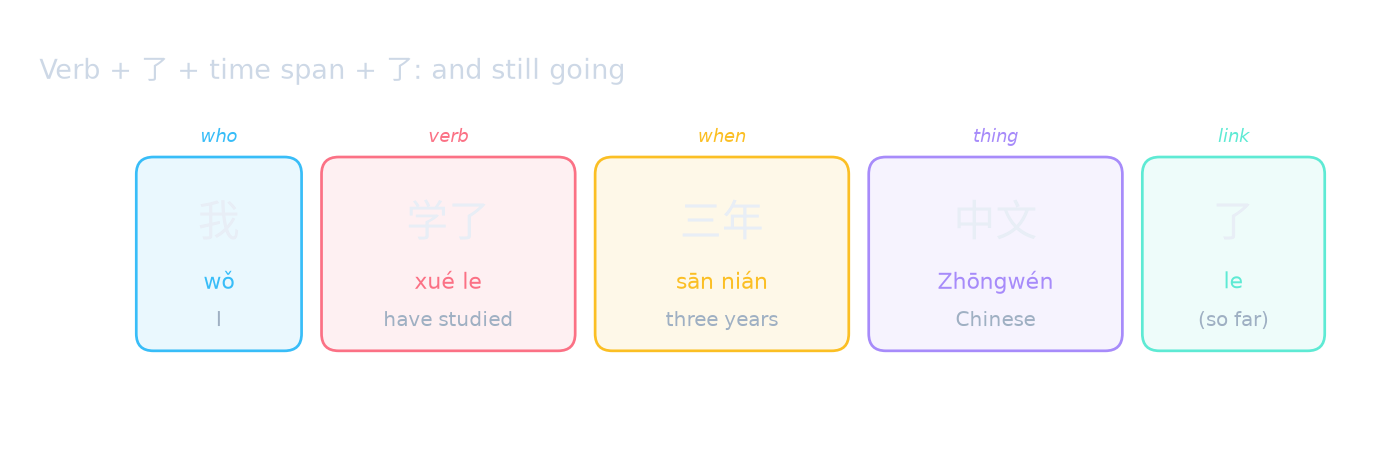
- 9. Verb + (completed / change)了 + Duration + (completed / change)了 – have been …-ing: I / me我to wait; and so on等(completed / change)了you你两个hour小时(completed / change)了!
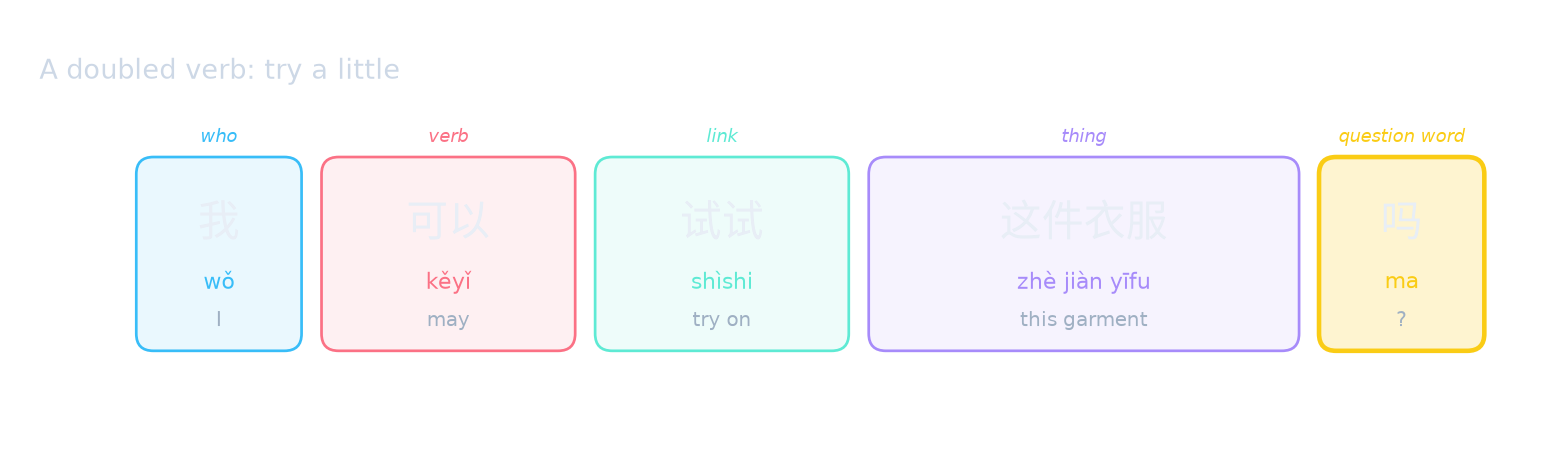
- 10. Verb reduplication – do a bit / give it a try: I / me我can / may可以试试这件clothes衣服(yes/no ?)吗?
Complements after the verb
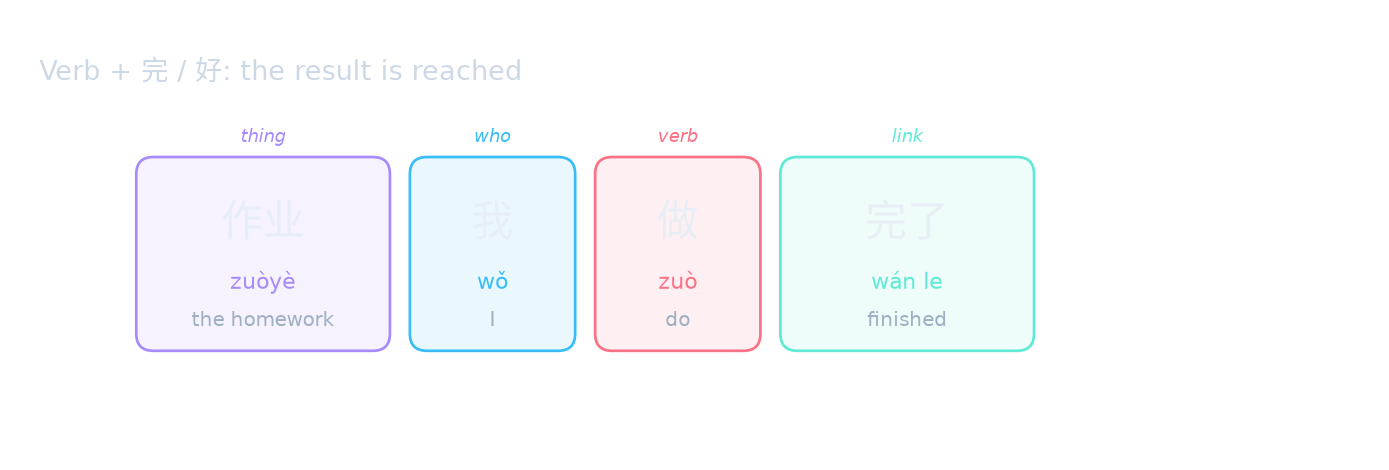
- 11. Result complements to finish完 / good好 / wrong; mistake错 / to see / meet见 / to understand懂 / to / arrive / (result: get)到 – how it turned out: school assignment作业I / me我to do; to make做to finish完(completed / change)了!
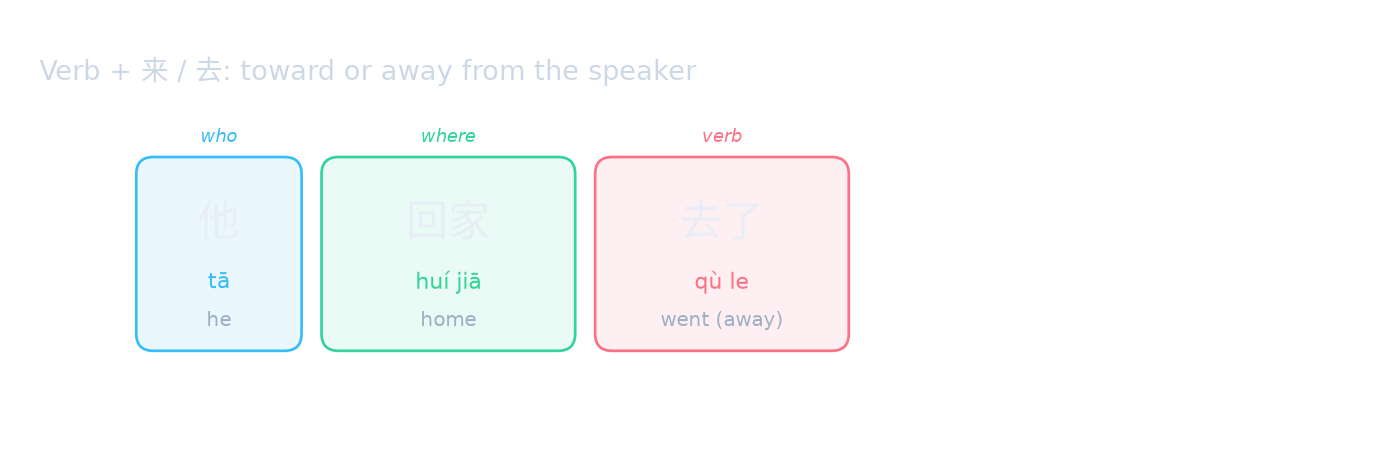
- 12. Direction complement to come来 / to go去 – toward / away: he / him他to go out出去(completed / change)了。
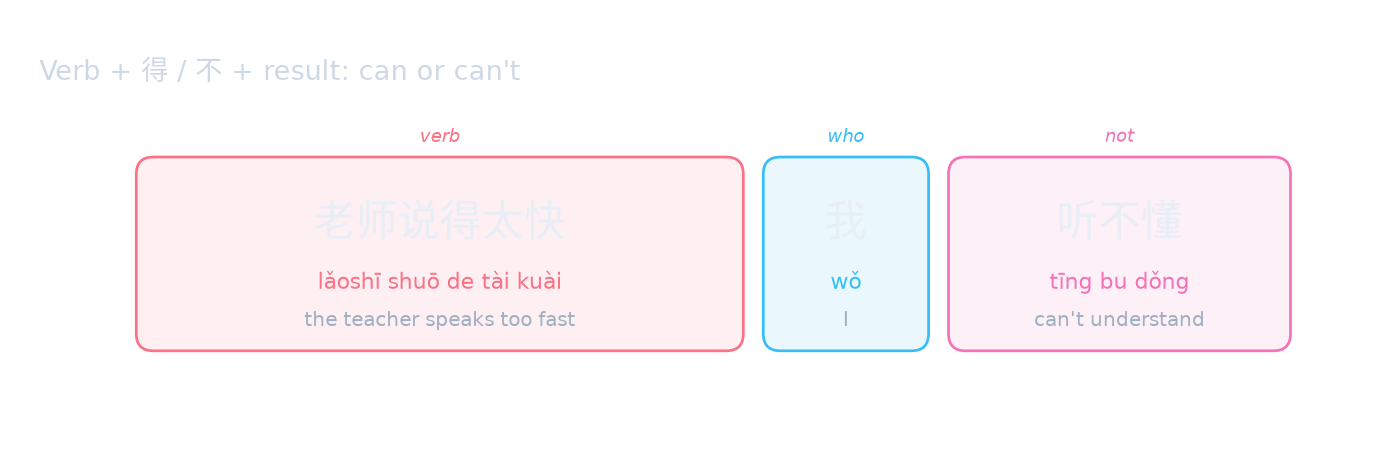
- 13. Potential complement (degree marker)得 / not不 – can / can't do it: teacher老师to speak说(degree marker)得太快,I / me我unable to make sense of…听不懂。
- 14. Verb + go down / (keep on)下去 – keep …-ing: to speak说go down / (keep on)下去,later; afterwards后来how about怎么样(completed / change)了?
3.2
1. 让 / 叫 / 请 / 使 (make / let / ask someone do)
Form: A + to let / make让 / to call / be called / (animals) cry, bark叫 / please; to invite请 / to make使 + B + verb
- mum; mother妈妈不让I / me我evening晚上to go out出去。 Māma bú ràng wǒ wǎnshang chūqu. – Mum won't let me go out in the evening.
- mum; mother妈妈to call / be called / (animals) cry, bark叫I / me我to go去买菜。 Māma jiào wǒ qù mǎi cài. – Mum told me to go and buy vegetables.
- I / me我want / think / miss想please; to invite请you你to have a meal吃饭。 Wǒ xiǎng qǐng nǐ chī fàn. – I'd like to treat you to a meal.
- this这个news; message消息to let / make让I / me我degree / adjective linker很happy; glad高兴。 – This news made me very happy.
How it works. In all four, B is the person who receives the first verb and does the second.
| Verb | Meaning | Example |
|---|---|---|
| to let / make让 | let, allow; make (a feeling) | 不让I / me我to go去, to let / make让I / me我degree / adjective linker很happy; glad高兴 |
| to call / be called / (animals) cry, bark叫 | tell (spoken) | to call / be called / (animals) cry, bark叫I / me我to go去买菜 |
| please; to invite请 | invite, ask politely; treat | please; to invite请teacher老师to have a meal吃饭 |
| to make使 | cause (formal, written) | sports / to exercise运动使人health健康 |
Watch out
- wrong: mum; mother妈妈to let / make让to go去I / me我 → mum; mother妈妈to let / make让I / me我to go去.
- The position of not不 changes the meaning: 不让I / me我to go去 = won't let me go; to let / make让I / me我not不to go去 = tells me not to go.

Vocabulary
Train
| 汉字 | Pinyin | English |
|---|---|---|
| 使 | shǐ | to make |
| 健康 | jiàn kāng | health |
3.3
2. 应该 / 该 (should, ought to)
Form: subject + (not不)should应该 / should该 + verb · should该 + verb + (completed / change)了 · should该 + person + (completed / change)了
- you你should应该多带a bit一点water水。 Nǐ yīnggāi duō dài yìdiǎn shuǐ. – You should take some more water.
- you你not不should应该这么晚to sleep睡觉。 – You shouldn't go to bed so late.
- 十二点(completed / change)了,I / me我should该to walk / to leave走(completed / change)了。 Shí'èr diǎn le, wǒ gāi zǒu le. – It's twelve; I should be going.
- should该you你(completed / change)了。 – Your turn.
How it works. should应该 yīnggāi gives advice or a duty: "should, ought to". should该 is the short spoken form. Both go after the subject, before the verb.
- should该 + verb + (completed / change)了: it's time to do it.
- should该 + person (+ (completed / change)了): it's someone's turn.
- A confident guess: he / him他should应该already已经to get home到家(completed / change)了 (he should be home by now). The context tells you whether it is advice or a guess.
Watch out
- wrong: should应该you你to rest休息 → you你should应该to rest休息.
- "Shouldn't" is not不should应该: wrong: you你should应该不去 → you你not不should应该to go去.
Vocabulary
Train
| 汉字 | Pinyin | English |
|---|---|---|
| 应该 | yīng gāi | ought to |
3.4
3. 没办法 + Verb (no way to / can't)
Form: subject + not / haven't没means办法 + verb · not / haven't没means办法。(reply)
- shop商店all / both都to close (the door)关门(completed / change)了,I / me我not / haven't没means办法to buy买cake蛋糕。 Shāngdiàn dōu guān mén le, wǒ méi bànfǎ mǎi dàngāo. – The shops are all shut; there's no way I can buy a cake.
- I'm sorry对不起,I / me我not / haven't没means办法to help帮you你。 – Sorry, there's no way I can help you.
- A: to rain下雨(completed / change)了,competition比赛to cancel取消(completed / change)了。 B: not / haven't没means办法。 – "It's raining, the match is off." "Nothing we can do."
- I / me我a little一点儿means办法all / both都not have / haven't没有。 – I'm completely out of ideas.
How it works. not / haven't没means办法 méi bànfǎ + verb means the situation stops you: "there's no way to …". On its own, it is a reply: "Oh well, nothing can be done."
| not / haven't没means办法 | won't / can't不会 | cannot不能 |
|---|---|---|
| the situation blocks you | you lack the skill | general "can't", not allowed |
| I / me我not / haven't没means办法to contact; connection联系he / him他 | I / me我won't / can't不会to swim游泳 | here这里cannot不能to smoke抽烟 |
Watch out
- Keep not / haven't没: wrong: not不means办法 → not / haven't没means办法.

Vocabulary
Train
| 汉字 | Pinyin | English |
|---|---|---|
| 办法 | bàn fǎ | means |
| 蛋糕 | dàn gāo | cake |
| 比赛 | bǐ sài | competition |
3.5
4. 看起来 (looks / seems)
Form: subject + seemingly看起来 / to listen to听get up / (start, become)起来 / to eat吃get up / (start, become)起来 / to use / with用get up / (start, become)起来 + description
- this这个cake蛋糕seemingly看起来degree / adjective linker很tasty好吃。 Zhège dàngāo kàn qǐlai hěn hǎochī. – This cake looks delicious.
- this这个idea; plan主意to listen to听get up / (start, become)起来not bad / pretty good不错。 Zhège zhǔyi tīng qǐlai búcuò. – That idea sounds good.
- this这个dish (of food); vegetable菜to eat吃get up / (start, become)起来a little有点spicy辣。 – This dish tastes a bit spicy.
- this这个mobile phone手机to use / with用get up / (start, become)起来degree / adjective linker很convenient方便。 – This phone is easy to use.
How it works. Sense verb + get up / (start, become)起来 gives an impression from that sense: to look at; to watch; to read看 (looks), to listen to听 (sounds), to eat吃 (tastes), to use / with用 (is … to use). It goes before the description, which is usually degree / adjective linker很 + adjective. It reports an impression, not a fact you have checked: a cake can look good and taste bad.
| seemingly看起来 / it would appear看上去 | to seem; as if好像 |
|---|---|
| from what you can see | a guess or a feeling, not from looks |
| she / her她it would appear看上去degree / adjective linker很young年轻 | he / him他to seem; as if好像to fall ill生病(completed / change)了 |
Watch out
- Pick the right sense: a plan on the phone to listen to听get up / (start, become)起来degree / adjective linker很interesting有意思; it does not seemingly看起来.
Vocabulary
Train
| 汉字 | Pinyin | English |
|---|---|---|
| 用 | yòng | to use |
| 方便 | fāng biàn | convenient |
| 年轻 | nián qīng | young |
3.6
5. 难 + Verb (unpleasant to …)
Form: difficult / hard难 + sense verb (unpleasant) · difficult / hard难 + other verb (hard to)
- this这个汤太难to drink喝(completed / change)了! Zhège tāng tài nánhē le! – This soup tastes awful!
- this这个color颜色degree / adjective linker很bad-looking; ugly难看。 Zhège yánsè hěn nánkàn. – This colour is ugly.
- this这个Chinese character字degree / adjective linker很difficult / hard难to write写。 – This character is hard to write.
- he / him他(modifier / structural particle)的question / problem问题很难to answer回答。 – His question is hard to answer.
How it works. With a sense verb, difficult / hard难 means "unpleasant to the senses". These words work like adjectives (degree / adjective linker很bad-looking; ugly难看, too太unpleasant to hear难听(completed / change)了), and each has an opposite with good好.
| difficult / hard难 word | Meaning | Opposite |
|---|---|---|
| unpalatable难吃 / difficult / hard难to drink喝 | tastes bad (food / drink) | tasty好吃 / tasty (drinks)好喝 |
| bad-looking; ugly难看 | ugly | good-looking好看 |
| unpleasant to hear难听 | sounds unpleasant | pleasant to hear好听 |
| unpleasant smell难闻 | smells bad | 好闻 |
With most other verbs, difficult / hard难 means "difficult to": 难写, difficult / hard难to answer回答. to feel unwell难受 is a feeling: unwell or upset.
not不tasty好吃 is milder ("not tasty") than unpalatable难吃 ("awful").
Watch out
- unpalatable难吃 means it tastes bad, not that it is hard to eat; bad-looking; ugly难看 means ugly, not hard to see.
Vocabulary
Train
| 汉字 | Pinyin | English |
|---|---|---|
| 难 | nán | difficult |
3.7
6. 很 + Verb (feeling verbs with 很)
Form: subject + degree / adjective linker很 / very非常 + feeling verb (+ object)
- I / me我degree / adjective linker很to like喜欢to eat吃China中国dish (of food); vegetable菜。 Wǒ hěn xǐhuan chī Zhōngguó cài. – I really like Chinese food.
- I / me我degree / adjective linker很homesick想家。 Wǒ hěn xiǎng jiā. – I miss home a lot.
- I / me我very非常anxious担心he / him他。 – I'm extremely worried about him.
- we / us我们all / both都degree / adjective linker很to hope希望you你can / be able to能to come来。 – We all very much hope you can come.
How it works. Verbs of feeling and wanting take degree words, just like adjectives: degree / adjective linker很to like喜欢, 很想, degree / adjective linker很anxious担心, degree / adjective linker很to hope希望, degree / adjective linker很to love爱. The degree word goes right before the verb.
- 很想 + verb: really want to: I / me我degree / adjective linker很want / think / miss想to go去to take a look at看看.
- 很会 + verb: be good at: he / him他很会to prepare a meal做饭.
Watch out
- Ordinary action verbs do not take degree / adjective linker很: wrong: degree / adjective linker很to eat吃, wrong: degree / adjective linker很to run跑. Say to eat吃(degree marker)得很多, to run跑(degree marker)得很快.
- wrong: to like喜欢degree / adjective linker很this这本书 → degree / adjective linker很to like喜欢this这本书.
Vocabulary
Train
| 汉字 | Pinyin | English |
|---|---|---|
| 担心 | dān xīn | anxious |
3.8
7. 经过 (after going through)
Form: to pass / process经过 + process,result · to pass / process经过 + place (pass through)
- to pass / process经过三年(modifier / structural particle)的to work hard / effort努力,she / her她finally终于to win赢(completed / change)了competition比赛。 Jīngguò sān nián de nǔlì, tā zhōngyú yíngle bǐsài. – After three years of hard work, she finally won the race.
- to pass / process经过to check检查,doctor医生to speak说nothing没什么big大question / problem问题。 – After the check-up, the doctor said it was nothing serious.
- I / me我every day每天to pass / process经过this这个park公园。 Wǒ měi tiān jīngguò zhège gōngyuán. – I pass this park every day.
- 这趟car车to pass / process经过Beijing北京(yes/no ?)吗? – Does this train go through Beijing?
How it works. to pass / process经过 + a process (effort, study, discussion, a check) comes first; the result follows in the second clause, often with finally终于. The process is usually a noun phrase: to pass / process经过一年(modifier / structural particle)的to study; to learn学习, to pass / process经过everyone大家(modifier / structural particle)的to discuss讨论. As a plain verb, to pass / process经过 means "pass by, go through" a place.
| to pass / process经过 | to pass; through; by means of通过 | after / from now on以后 |
|---|---|---|
| going through a process | the means used | simply "after" a time |
| to pass / process经过many times多次experiment试验 | to pass; through; by means of通过friend朋友,I / me我to find找到(completed / change)了to work; job工作 | to finish class下课after / from now on以后 |
Watch out
- wrong: to pass / process经过to finish class下课 → to finish class下课after / from now on以后: a class ending is not a process.
Vocabulary
Train
| 汉字 | Pinyin | English |
|---|---|---|
| 经过 | jīng guò | to pass |
| 努力 | nǔ lì | to make an effort |
| 终于 | zhōng yú | at last |
| 检查 | jiǎn chá | inspection |
| 公园 | gōng yuán | park |
| 以后 | yǐ hòu | after |
3.9
8. Verb + 了 + Duration (did for a length of time)
Form: verb + (completed / change)了 + length of time (+ object) · verb + object + verb + (completed / change)了 + length of time
- I / me我to wait; and so on等(completed / change)了you你一个hour小时! Wǒ děngle nǐ yí ge xiǎoshí! – I waited for you for an hour!
- I / me我yesterday昨天to sleep睡(completed / change)了十个hour小时。 – I slept for ten hours yesterday.
- 他学(completed / change)了三年Chinese language中文。 / 他学middle / in中literature文学(completed / change)了三年。 Tā xuéle sān nián Zhōngwén. – He studied Chinese for three years.
How it works. How long an action lasted comes after the verb, as in English. Verb + (completed / change)了 + duration with no final (completed / change)了 reports a period that is over: I / me我at / in在Beijing北京to live (somewhere)住(completed / change)了两年 (I lived there for two years, then left).
Where does the object go?
| Object | Pattern | Example |
|---|---|---|
| a noun | duration before it, or repeat the verb | 学了三年Chinese language中文 / 学中literature文学(completed / change)了三年 |
| a person (you你, he / him他) | before the duration | to wait; and so on等(completed / change)了you你一个hour小时 |
Watch out
- wrong: I / me我两年学了 → 我学(completed / change)了两年.
- wrong: 我学(completed / change)了Chinese language中文两年 → 我学(completed / change)了两年Chinese language中文.
- In the negative, the time moves to the front: 三天没吃肉(completed / change)了.
3.10
9. Verb + 了 + Duration + 了 (have been …-ing)
Form: (already已经) + verb + (completed / change)了 + length of time (+ object) + (completed / change)了
- I / me我to wait; and so on等(completed / change)了you你两个hour小时(completed / change)了! Wǒ děngle nǐ liǎng ge xiǎoshí le! – I've been waiting for you for two hours!
- he / him他at / in在here这儿to work; job工作(completed / change)了十年(completed / change)了。 Tā zài zhèr gōngzuòle shí nián le. – He has worked here for ten years (and still does).
- I / me我already已经to wait; and so on等(completed / change)了一个hour小时(completed / change)了。 – I've already been waiting an hour.
- you你学中literature文学(completed / change)了多长时间(completed / change)了? – How long have you been learning Chinese?
How it works. The final (completed / change)了 says the period lasts up to now and may go on.
| One (completed / change)了: finished | Two (completed / change)了: still going |
|---|---|
| I / me我at / in在here这儿to live (somewhere)住(completed / change)了五年。 | I / me我at / in在here这儿to live (somewhere)住(completed / change)了五年(completed / change)了。 |
| I lived here for five years. | I've lived here for five years. |
already已经 in front stresses how long it has been; it does not change the meaning.
Watch out
- The duration still follows the verb: wrong: 三年to learn学(completed / change)了(completed / change)了 → 学了三年(completed / change)了.
3.11
10. Verb reduplication (do a bit / give it a try)
Form: VV · Vone / a一V · ABAB · V(completed / change)了V (done)
- I / me我can / may可以试试这件clothes衣服(yes/no ?)吗? Wǒ kěyǐ shìshi zhè jiàn yīfu ma? – Could I try this jacket on?
- to let / make让I / me我to take a look at看看。 Ràng wǒ kànkan. – Let me have a look.
- we / us我们to discuss讨论to discuss讨论this这个question / problem问题(suggestion)吧。 – Let's talk this over a bit.
- he / him他to look at; to watch; to read看(completed / change)了to look at; to watch; to read看watch (timepiece)表,then / just就to walk / to leave走(completed / change)了。 – He glanced at his watch and left.
How it works. A doubled verb means "do it a little, give it a try". It sounds softer and friendlier: you你尝尝 is gentler than you你to taste尝. The second syllable is said lightly.
| Verb | Doubled | Done |
|---|---|---|
| one syllable: to look at; to watch; to read看 | to take a look at看看 / to have a look看一看 | to look at; to watch; to read看(completed / change)了to look at; to watch; to read看 |
| two syllables: to rest休息 | to rest休息to rest休息 | to rest休息(completed / change)了(used after a verb) give it…一下 |
Watch out
- Verbs double as ABAB, adjectives as AABB: wrong: to rest休to rest休息breath息 → to rest休息to rest休息.
- Doubling already means "a bit": wrong: to take a look at看看a moment一会儿 → to take a look at看看 or to look at; to watch; to read看a moment一会儿.
Vocabulary
Train
| 汉字 | Pinyin | English |
|---|---|---|
| 一会儿 | yī huì r | a moment |
3.12
11. Result complements 完 / 好 / 错 / 见 / 懂 / 到 (how it turned out)
Form: verb + good好 / to finish完 / wrong; mistake错 (+ (completed / change)了) · not / haven't没 + verb + result
- school assignment作业I / me我to do; to make做to finish完(completed / change)了! Zuòyè wǒ zuòwán le! – I've finished my homework!
- cooked rice饭做好(completed / change)了,fast; soon快to come来to eat吃(suggestion)吧! Fàn zuòhǎo le, kuài lái chī ba! – Dinner's ready, come and eat!
- I'm sorry对不起,I / me我to err打错telephone电话(completed / change)了。 – Sorry, I dialled the wrong number.
- this这本书I / me我still / also / even还not / haven't没to look at; to watch; to read看to finish完。 – I haven't finished reading this book yet.
How it works. A result word after the verb tells how the action ended. (completed / change)了 normally follows the pair.
| Result | Meaning | Example |
|---|---|---|
| to finish完 | finished, nothing left | to eat吃to finish完(completed / change)了 |
| good好 | done properly, ready | to prepare; to plan to准备好了吗? |
| wrong; mistake错 | done wrongly | 写错(completed / change)了, to misinterpret what one…看错(completed / change)了 |
to do; to make做to finish完 says the job is over (maybe badly); 做好 says it is done well and ready.
Watch out
- Negate with not / haven't没 and drop (completed / change)了: wrong: I / me我not不to do; to make做to finish完(completed / change)了 → I / me我still / also / even还not / haven't没to do; to make做to finish完.
- Nothing comes between the verb and its result: wrong: 做作业to finish完 → 做完作业.
Vocabulary
Train
| 汉字 | Pinyin | English |
|---|---|---|
| 作业 | zuò yè | school assignment |
3.13
12. Direction complement 来 / 去 (toward / away)
Form: verb + to come来 / to go去 · verb + place + to come来 / to go去
- 请进来! Qǐng jìnlai! – Please come in!
- he / him他to go out出去(completed / change)了。 Tā chūqu le. – He's gone out.
- fast-forward (media player)快进classroom教室to come来! – Come into the classroom, quick!
- please; to invite请(把: marks the object)把book书to bring拿来。 – Please bring the book here.
How it works. to come来 means movement towards the speaker; to go去 means away from the speaker. They combine with direction verbs.
| Towards the speaker | Away from the speaker |
|---|---|
| to come in进来, come out / (result: see, think up)出来, to come up上来, come down / (write down, stop)下来 | to go in进去, to go out出去, to go up上去, go down / (keep on)下去 |
| to return回来, to come over过来 | to return回去, past过去 |
The speaker's position decides. If you are upstairs, your friend to come up上来 (comes up). If you are downstairs, your friend to go up上去 (goes up).
Places and things. A place goes between the verb and to come来 / to go去: to return home回家to go去, to enter; to come in进classroom教室to come来. A thing can go after: to bring带来(completed / change)了one / a一本书 / to bring带(completed / change)了one / a一本书to come来.
Watch out
- wrong: to come in进来classroom教室 → to enter; to come in进classroom教室to come来.
Vocabulary
Train
| 汉字 | Pinyin | English |
|---|---|---|
| 把 | bǎ | object marker |
| 过去 | guò qù | past |
| 带 | dài | to bring |
3.14
13. Potential complement 得 / 不 (can / can't do it)
Form: verb + (degree marker)得 + result (can) · verb + not不 + result (can't)
- teacher老师to speak说(degree marker)得太快,I / me我unable to make sense of…听不懂。 Lǎoshī shuō de tài kuài, wǒ tīng bu dǒng. – The teacher talks too fast; I can't understand.
- Chinese character字太小(completed / change)了,I / me我看不清楚。 Zì tài xiǎo le, wǒ kàn bu qīngchu. – The writing is too small; I can't see it clearly.
- so much这么多菜,we / us我们吃不完。 – With this much food, we can't finish it.
- you你to understand (by hearing)听得懂(yes/no ?)吗? – Can you understand?
How it works. (degree marker)得 or not不 between a verb and its result says whether the result is possible. It is about ability or circumstances, not permission.
| Can | Can't | Meaning |
|---|---|---|
| to understand (by hearing)听得懂 | unable to make sense of…听不懂 | (can't) understand by listening |
| can see看得见 | cannot see看不见 | (can't) see |
| to buy买to get得到 | 买不到 | (can't) get hold of |
| 吃得完 | 吃不完 | (can't) finish eating |
| to have enough time来得及 | there's not enough time来不及 | there is (no) time |
Questions. you你to understand (by hearing)听得懂(yes/no ?)吗? or you你to understand (by hearing)听得懂unable to make sense of…听不懂?
Watch out
- wrong: not不to understand (on hearing)听懂 → unable to make sense of…听不懂: not不 goes between the verb and the result.
- unable to make sense of…听不懂 = can't understand (it is beyond me); not / haven't没to understand (on hearing)听懂 = didn't understand this time: I / me我not / haven't没to understand (on hearing)听懂,please; to invite请talk later / besides再说one time (all the way…一遍.
3.15
14. Verb + 下去 (keep …-ing)
Form: verb + go down / (keep on)下去 (keep going) · verb + not不go down / (keep on)下去 (can't go on)
- to speak说go down / (keep on)下去,later; afterwards后来how about怎么样(completed / change)了? Shuō xiaqu, hòulái zěnmeyàng le? – Keep going: what happened next?
- to learn学Chinese language中文not不easy容易,but但是you你want / will / need要to press on坚持下去。 – Learning Chinese isn't easy, but you must keep going.
- this way / so这样go down / (keep on)下去won't do不行。 Zhèyàng xiaqu bù xíng. – It can't go on like this.
- I / me我to listen to听not不go down / (keep on)下去(completed / change)了。 – I can't bear to listen any more.
How it works. After a verb, go down / (keep on)下去 means "continue from now on". It is not about moving down: to read (aloud); to study读go down / (keep on)下去 = keep reading. It often comes with to continue继续, want / will / need要, want / think / miss想 or can / be able to能: I / me我want / think / miss想at / in在here这儿to live (somewhere)住go down / (keep on)下去.
| go down / (keep on)下去 | get up / (start, become)起来 |
|---|---|
| continues something already going | starts something new |
| to sing唱go down / (keep on)下去 (keep singing) | 唱起来 (start singing) |
| to press on坚持下去 | everyone大家all / both都to laugh笑get up / (start, become)起来(completed / change)了 |
Watch out
- When everyone suddenly starts laughing, it is to laugh笑get up / (start, become)起来, not to laugh笑go down / (keep on)下去.

Vocabulary
Train
| 汉字 | Pinyin | English |
|---|---|---|
| 容易 | róng yì | easy |
3.16
Practice
Cover the teaching pages before you answer. The answers are at the end.
1. to let / make让 / to call / be called / (animals) cry, bark叫 / please; to invite请 / to make使 (make / let / ask someone do)
1. Complete: “My dad doesn't let me play games.” father爸爸not不…………I / me我玩游戏。
2. You invite your teacher to dinner. Which verb is most polite? I / me我want / think / miss想__teacher老师to have a meal吃饭。
- A. to call / be called / (animals) cry, bark叫
- B. to make使
- C. to let / make让
- D. please; to invite请
3. Match each sentence to its meaning.
-
(1) father爸爸to let / make让I / me我to use / with用he / him他(modifier / structural particle)的computer电脑。
-
(2) teacher老师to let / make让we / us我们again / then / (再…也) however再to read (aloud); to study读one time (all the way…一遍。
-
(3) to let / make让I / me我想想。
-
A. The teacher made us read it again.
-
B. Let me think.
-
C. Dad lets me use his computer.
4. Build: “This news made me very happy.”
Put in order: to let / make让 / I / me我 / degree / adjective linker很happy; glad高兴。 / this这个news; message消息
5. True or false? mum; mother妈妈不让I / me我to go去 and mum; mother妈妈to let / make让I / me我not不to go去 mean exactly the same. If false, correct it.
6. Your mum said: “Don't go!” How do you report it?
- A. mum; mother妈妈don't不要to let / make让to go去I / me我。
- B. mum; mother妈妈to let / make让I / me我don't不要to go去。
- C. mum; mother妈妈to let / make让not不I / me我to go去。
- D. mum; mother妈妈to let / make让to go去I / me我don't不要。
7. You want to go out tonight, but your parents have other ideas. Use to let / make让 / to call / be called / (animals) cry, bark叫 / please; to invite请 / to make使. Write your answer in Chinese, then say it aloud.
2. should应该 / should该 (should, ought to)
8. Advise: “You should see a doctor.” you你…………to go去to look at; to watch; to read看doctor医生。
9. What does should该you你(completed / change)了 mean?
- A. It's your turn.
- B. You should be careful.
- C. You've arrived.
- D. You're probably right.
10. Build: “It's twelve; I should be going.”
Put in order: , / to walk / to leave走(completed / change)了。 / 十二点(completed / change)了 / 我该
11. At the airport desk: without a passport you cannot fly. What does the worker say?
- A. you你should该to bring带passport护照(completed / change)了。
- B. you你to have to必须to bring带passport护照。
- C. you你had better; best最好to bring带passport护照。
- D. you你can / may可以to bring带passport护照。
12. True or false? you你should应该早点儿to tell告诉I / me我! can mean “You should have told me earlier!” If false, correct it.
13. True or false? In he / him他should应该already已经to get home到家(completed / change)了, should应该 is advice to him. If false, correct it.
14. Your friend is going hiking at noon in 35 degrees with one small bottle of water. Use should应该 / should该. Write your answer in Chinese, then say it aloud.
3. not / haven't没means办法 + Verb (no way to / can't)
15. Complete: “The phone has no signal; I can't call you.” mobile phone手机not have / haven't没有signal信号,I / me我…………to / for / give给you你to make a telephone call打电话。
16. Build: “Sorry, there's no way I can help you.”
Put in order: ,I / me我 / not / haven't没means办法 / I'm sorry对不起 / to help帮you你。
17. True or false? not / haven't没means办法 can be a complete reply meaning “nothing can be done”. If false, correct it.
18. Your friend lost the key to the classroom. You want to help. What do you say?
- A. not / haven't没means办法,you你回家吧。
- B. 别着急,we / us我们together一起want / think / miss想means办法。
- C. you你not / haven't没means办法want / think / miss想。
- D. I / me我won't / can't不会means办法。
19. Which says “I can't swim (I never learned).”?
- A. I / me我to swim游泳not / haven't没means办法。
- B. I / me我not不means办法to swim游泳。
- C. I / me我not / haven't没means办法to swim游泳。
- D. I / me我won't / can't不会to swim游泳。
20. Your friend asks you to buy a cake on the way home, but every bakery has closed for the holiday. Use not / haven't没means办法 + Verb. Write your answer in Chinese, then say it aloud.
4. seemingly看起来 (looks / seems)
21. Complete: “You look very happy today.” you你today今天…………degree / adjective linker很happy; glad高兴。
22. Your friend describes a plan on the phone. You say: “That sounds interesting.” Which fits?
- A. to listen to听get up / (start, become)起来degree / adjective linker很interesting有意思。
- B. to use / with用get up / (start, become)起来degree / adjective linker很interesting有意思。
- C. seemingly看起来degree / adjective linker很interesting有意思。
- D. to eat吃get up / (start, become)起来degree / adjective linker很interesting有意思。
23. Match each sense verb to its meaning.
-
(1) seemingly看起来
-
(2) to listen to听get up / (start, become)起来
-
(3) to eat吃get up / (start, become)起来
-
(4) to use / with用get up / (start, become)起来
-
A. tastes
-
B. sounds
-
C. is … to use
-
D. looks
24. Build: “This cake looks delicious.”
Put in order: degree / adjective linker很 / tasty好吃。 / this这个cake蛋糕 / seemingly看起来
25. A cake in the bakery window has thick cream and fresh strawberries. You haven't tasted it yet. Use seemingly看起来. Write your answer in Chinese, then say it aloud.
5. difficult / hard难 + Verb (unpleasant to …)
26. Complete: “This colour is ugly.” this这个color颜色degree / adjective linker很…………。
27. Match each word to its meaning.
-
(1) unpalatable难吃
-
(2) unpleasant to hear难听
-
(3) 难写
-
(4) to feel unwell难受
-
A. sounds unpleasant
-
B. hard to write
-
C. feel unwell
-
D. tastes bad
28. Build: “His question is hard to answer.”
Put in order: degree / adjective linker很 / to answer回答。 / he / him他(modifier / structural particle)的question / problem问题 / difficult / hard难
29. “His home is easy to find.” 他家degree / adjective linker很…………to look for; to give change找。
30. Your friend's mum asks how her soup is. It is too salty for you. What is the kindest answer?
- A. I / me我not不to drink喝difficult / hard难to drink喝(modifier / structural particle)的soup汤。
- B. degree / adjective linker很tasty (drinks)好喝,exactly就是slightly有点儿salty咸。
- C. this这个汤太难to drink喝(completed / change)了!
- D. this这个汤难to drink喝extremely极了。
31. Which is the mildest way to say the food is not good?
- A. not不tasty好吃。
- B. too太unpalatable难吃(completed / change)了。
- C. unpalatable难吃extremely极了。
- D. degree / adjective linker很unpalatable难吃。
32. You try the canteen's new soup. It is salty and cold. Use difficult / hard难 + Verb. Write your answer in Chinese, then say it aloud.
6. degree / adjective linker很 + Verb (feeling verbs with degree / adjective linker很)
33. Complete: “I miss my mum very much.” I / me我…………want / think / miss想I / me我mum; mother妈妈。
34. Build: “We all very much hope you can come.”
Put in order: degree / adjective linker很to hope希望 / you你 / can / be able to能to come来。 / we / us我们all / both都
35. Your host asks if you like spicy food. You don't, but you want to be polite. What do you say?
- A. I / me我a little一点儿also也not不to like喜欢。
- B. I / me我degree / adjective linker很不吃spicy辣(modifier / structural particle)的。
- C. I / me我not不too太to like喜欢to eat吃spicy辣(modifier / structural particle)的。
- D. I / me我most最to like喜欢to eat吃spicy辣(modifier / structural particle)的。
36. Which sentence is correct?
- A. he / him他degree / adjective linker很to like喜欢cooked rice米饭。
- B. he / him他degree / adjective linker很to eat吃cooked rice米饭。
- C. he / him他cooked rice米饭degree / adjective linker很to like喜欢to eat吃degree / adjective linker很。
- D. he / him他to like喜欢degree / adjective linker很cooked rice米饭。
37. True or false? he / him他很会to prepare a meal做饭 means “He is very good at cooking.” If false, correct it.
38. A new friend asks whether you like Chinese food. You really do. Use degree / adjective linker很 + Verb. Write your answer in Chinese, then say it aloud.
7. to pass / process经过 (after going through)
39. Complete: “After a check-up, the doctor said it was nothing serious.” …………to check检查,doctor医生to speak说nothing没什么big大question / problem问题。
40. Which word fits? “After class, let's play basketball.” to finish class下课____,we / us我们to go去to play basketball打篮球(suggestion)吧。
- A. finally终于
- B. to pass / process经过
- C. to pass; through; by means of通过
- D. after / from now on以后
41. Build: “I pass this park every day.”
Put in order: every day每天 / to pass / process经过 / this这个park公园。 / I / me我
42. True or false? to pass; through; by means of通过friend朋友,I / me我to find找到(completed / change)了to work; job工作 stresses the means (a friend) rather than a long process. If false, correct it.
43. Match each English phrase to the Chinese.
-
(1) after class
-
(2) after a year of study
-
(3) through a teacher's introduction
-
A. to pass; through; by means of通过teacher老师(modifier / structural particle)的to introduce介绍
-
B. to finish class下课after / from now on以后
-
C. to pass / process经过一年(modifier / structural particle)的to study; to learn学习
44. A runner who trained every morning for three years has just won her first marathon. Use to pass / process经过. Write your answer in Chinese, then say it aloud.
8. Verb + (completed / change)了 + Duration (did for a length of time)
45. Complete: “I slept for ten hours yesterday.” I / me我yesterday昨天to sleep睡…………十个hour小时。
46. “I studied for two hours at seven o'clock.” Which is correct?
- A. I / me我七点两个hour小时to study; to learn学习(completed / change)了。
- B. I / me我to study; to learn学习(completed / change)了七点两个hour小时。
- C. I / me我七点to study; to learn学习(completed / change)了两个hour小时。
- D. I / me我两个hour小时七点to study; to learn学习(completed / change)了。
47. Build: “I waited for you for an hour.”
Put in order: I / me我 / to wait; and so on等(completed / change)了 / 一个hour小时。 / you你
48. Which says “She studied piano for five years.”?
- A. 她学piano钢琴五年(completed / change)了to learn学。
- B. 她学(completed / change)了piano钢琴五年。
- C. she / her她五年学了piano钢琴。
- D. 她学(completed / change)了五年piano钢琴。
49. True or false? I / me我at / in在Beijing北京to live (somewhere)住(completed / change)了两年 can describe a stay that has ended. If false, correct it.
50. Your friend was very late for lunch, and now she asks how long you waited. Use Verb + (completed / change)了 + Duration. Write your answer in Chinese, then say it aloud.
9. Verb + (completed / change)了 + Duration + (completed / change)了 (have been …-ing)
51. You still live here: “I've lived here for five years.” I / me我at / in在here这儿to live (somewhere)住(completed / change)了五年…………。
52. Build: “I've already been waiting for an hour.”
Put in order: to wait; and so on等(completed / change)了 / 一个hour小时(completed / change)了。 / already已经 / I / me我
53. “I haven't played basketball for a month.” Which is correct?
- A. I / me我not / haven't没to play basketball打篮球一个月(completed / change)了。
- B. I / me我not / haven't没to hit / play / make (a call)打(completed / change)了一个月basketball篮球。
- C. I / me我一个月not / haven't没to play basketball打篮球(completed / change)了。
- D. I / me我to hit / play / make (a call)打(completed / change)了一个月basketball篮球(completed / change)了。
54. Build: “It is two years since my sister graduated.”
Put in order: (completed / change)了。 / 两年 / I / me我older sister姐姐 / to graduate毕业
55. Which sentence means the person still works at the bank?
- A. he / him他三年at / in在bank银行to work; job工作。
- B. he / him他at / in在bank银行to work; job工作(completed / change)了三年(completed / change)了。
- C. he / him他at / in在bank银行三年to work; job工作(completed / change)了。
- D. he / him他at / in在bank银行to work; job工作(completed / change)了三年。
56. True or false? 我学(completed / change)了三年Chinese language中文 and 我学(completed / change)了三年Chinese language中文(completed / change)了 mean exactly the same. If false, correct it.
57. Your friend phones to ask where you are. You are still in the café where you have been since two o'clock. Use Verb + (completed / change)了 + Duration + (completed / change)了. Write your answer in Chinese, then say it aloud.
10. Verb reduplication (do a bit / give it a try)
58. Double the verb to look at; to watch; to read看 to say “Let me have a look.” to let / make让I / me我…………。
59. True or false? you你尝尝 sounds softer than you你to taste尝. If false, correct it.
60. “Let's go for a little swim.” Which is correct?
- A. we / us我们to go去游一to swim游泳swimming泳(suggestion)吧。
- B. we / us我们去游to swim游泳(suggestion)吧。
- C. we / us我们to go去to swim游泳swimming泳(suggestion)吧。
- D. we / us我们to go去to swim游泳to swim游泳(suggestion)吧。
61. Which is the correct doubled form of to rest休息?
- A. to rest休息breath息
- B. to rest休to rest休息breath息
- C. to rest休息to rest休息
- D. to rest休to rest休息
62. Build: “He glanced at his watch and left.”
Put in order: ,then / just就 / to look at; to watch; to read看(completed / change)了to look at; to watch; to read看watch (timepiece)表 / he / him他 / to walk / to leave走(completed / change)了。
63. You see a jacket you like in a shop and want to try it before deciding. Write your answer in Chinese, then say it aloud.
11. Result complements to finish完 / good好 / wrong; mistake错 / to see / meet见 / to understand懂 / to / arrive / (result: get)到 (how it turned out)
64. True or false? I / me我to look for; to give change找(completed / change)了I / me我(modifier / structural particle)的key钥匙 tells you that I found my keys. If false, correct it.
65. Complete: “I've eaten up all the dumplings.” dumpling饺子I / me我all / both都to eat吃…………(completed / change)了。
66. Match each phrase to its meaning.
-
(1) to understand (on hearing)听懂(completed / change)了
-
(2) to see看见(completed / change)了
-
(3) to buy买to / arrive / (result: get)到(completed / change)了
-
(4) 写错(completed / change)了
-
A. understood it
-
B. wrote it wrongly
-
C. managed to buy it
-
D. saw it
67. Your essay is not perfect, but you have written the last sentence. Which fits best?
- A. I / me我(modifier / structural particle)的essay; to write an essay作文not / haven't没to write写to finish完。
- B. I / me我(modifier / structural particle)的essay; to write an essay作文to write写to finish完(completed / change)了,but但是not so good不太好。
- C. I / me我(modifier / structural particle)的essay; to write an essay作文写错(completed / change)了。
- D. I / me我(modifier / structural particle)的essay; to write an essay作文to write写good好(completed / change)了,can / may可以交了。
68. Which says “I haven't finished reading this book yet.”?
- A. this这本书I / me我still / also / even还not / haven't没to look at; to watch; to read看to finish完。
- B. this这本书I / me我still / also / even还to look at; to watch; to read看没完。
- C. this这本书I / me我still / also / even还not / haven't没to look at; to watch; to read看to finish完(completed / change)了。
- D. this这本书I / me我still / also / even还not不to look at; to watch; to read看to finish完(completed / change)了。
69. Build: “Are you ready?”
Put in order: to prepare; to plan to准备good好 / (completed / change)了 / (yes/no ?)吗? / you你
70. Which is correct?
- A. I / me我to finish完做作业(completed / change)了。
- B. I / me我做作业(completed / change)了to finish完。
- C. I / me我做作业to finish完(completed / change)了。
- D. I / me我做完作业(completed / change)了。
71. Your mum asks about your homework before you go out to play. Use Result complements to finish完 / good好 / wrong; mistake错 / to see / meet见 / to understand懂 / to / arrive / (result: get)到. Write your answer in Chinese, then say it aloud.
12. Direction complement to come来 / to go去 (toward / away)
72. You are inside the room and call to your friend at the door: “Come in!” to enter; to come in进…………!
73. Build: “Come into the classroom, quick!”
Put in order: fast; soon快 / to come来! / classroom教室 / to enter; to come in进
74. You are in the classroom. A student runs in. Which sentence fits?
- A. 一个student学生进跑to come来(completed / change)了。
- B. 一个student学生to run跑to come来to enter; to come in进(completed / change)了。
- C. 一个student学生to run跑to come in进来(completed / change)了。
- D. 一个student学生to run跑to go in进去(completed / change)了。
75. You are on the ground floor talking about your friend upstairs: “He went up.” Which fits?
- A. 他来up / on / last; to get on, attend上(completed / change)了。
- B. he / him他to go up上去(completed / change)了。
- C. he / him他to come up上来(completed / change)了。
- D. he / him他to go去up / on / last; to get on, attend上(completed / change)了。
76. True or false? he / him他to come in进来classroom教室(completed / change)了 is correct. If false, correct it.
77. A friend knocks at your door; later your little brother runs off to play outside. Use Direction complement to come来 / to go去. Write your answer in Chinese, then say it aloud.
13. Potential complement (degree marker)得 / not不 (can / can't do it)
78. The words on the board are too small: “I can't see clearly.” I / me我to look at; to watch; to read看…………distinct清楚。
79. Match each form to its meaning.
-
(1) to look for; to give change找not reach / less than不到
-
(2) to do; to make做(degree marker)得to finish完
-
(3) unable to make sense of…听不懂
-
(4) can see看得见
-
A. can't understand
-
B. can finish
-
C. can't find
-
D. can see
80. You forgot your key: “I can't get in.” 我进…………to go去。
81. The museum guard says photos are not allowed. Which fits?
- A. here这里cannot不能拍照片。
- B. here这里to pat; to take (a photo)拍to get得到photograph照片。
- C. here这里to pat; to take (a photo)拍not see / missing不见photograph照片。
- D. here这里not不to pat; to take (a photo)拍(degree marker)得photograph照片。
82. Build: “I can't understand what he says.”
Put in order: I / me我 / he / him他to speak说if (coming after a…的话。 / unable to make sense of…听不懂
83. You missed one word your friend just said. What do you say?
- A. I'm sorry对不起,I / me我unable to make sense of…听不懂,please; to invite请talk later / besides再说one time (all the way…一遍。
- B. I'm sorry对不起,I / me我to understand (on hearing)听懂not不,please; to invite请talk later / besides再说one time (all the way…一遍。
- C. I'm sorry对不起,I / me我not不to understand (on hearing)听懂,please; to invite请talk later / besides再说one time (all the way…一遍。
- D. I'm sorry对不起,I / me我not / haven't没to understand (on hearing)听懂,please; to invite请talk later / besides再说one time (all the way…一遍。
84. True or false? I / me我to listen to听he / him他if (coming after a…的话not不to understand懂 is correct. If false, correct it.
85. Your teacher speaks quickly at the start of a new course, and your friend wonders if you follow. Use Potential complement (degree marker)得 / not不. Write your answer in Chinese, then say it aloud.
14. Verb + go down / (keep on)下去 (keep …-ing)
86. Encourage: “Keep reading!” to read (aloud); to study读…………!
87. Everyone suddenly started laughing. Which fits? everyone大家all / both都to laugh笑____(completed / change)了。
- A. past过去
- B. go down / (keep on)下去
- C. to go up上去
- D. get up / (start, become)起来
88. Build: “It can't go on like this.”
Put in order: go down / (keep on)下去 / won't do不行。 / this way / so这样
89. True or false? In to speak说go down / (keep on)下去, go down / (keep on)下去 means the speaker walks downstairs. If false, correct it.
90. Match each sentence to its meaning.
-
(1) you你seemingly看起来很累。
-
(2) this这个idea; plan主意to listen to听get up / (start, become)起来degree / adjective linker很good好。
-
(3) I / me我want / think / miss想get up / (start, become)起来he / him他(modifier / structural particle)的name名字(completed / change)了。
-
(4) you你to speak说go down / (keep on)下去(suggestion)吧。
-
A. This idea sounds good.
-
B. I have remembered his name.
-
C. Go on, keep talking.
-
D. You look tired.
91. You are halfway through a story and your listener is hooked. Use Verb + go down / (keep on)下去. Write your answer in Chinese, then say it aloud.
3.17
Mixed practice
These questions mix the patterns and use new situations.
92. Choose: I / me我to wait; and so on等(completed / change)了you你一个hour小时 or I / me我to wait; and so on等(completed / change)了you你一个hour小时(completed / change)了. You are still waiting.
93. Which sentence is correct?
- A. I / me我做作业to finish完(completed / change)了。
- B. I / me我做完作业(completed / change)了。
- C. I / me我to finish完做作业(completed / change)了。
94. The teacher speaks too fast and you cannot understand. Say it with a potential complement.
95. Choose to let / make让 or should应该: Mum does not ………… me go out at night. / You ………… take more water.
96. Find and fix the problem. A student wants to say "I have finished the homework" and writes I / me我做作业to finish完(completed / change)了. Correct the sentence.
97. Use it yourself. Say you have studied Chinese for two years, that you can understand this sentence, but that yesterday you did not understand a letter.
3.18
Answers and explanations
Mark your work, then correct each mistake in your own words.
1. to let / make让 / to call / be called / (animals) cry, bark叫 / please; to invite请 / to make使 (make / let / ask someone do)
1. to let / make让
不让 + person + verb = not allow someone to do something.
2. D. please; to invite请
please; to invite请 is the polite “invite / treat”.
3. (1) C: father爸爸to let / make让I / me我to use / with用he / him他(modifier / structural particle)的computer电脑。 = Dad lets me use his computer.; (2) A: teacher老师to let / make让we / us我们again / then / (再…也) however再to read (aloud); to study读one time (all the way…一遍。 = The teacher made us read it again.; (3) B: to let / make让I / me我想想。 = Let me think.
to let / make让 can mean let or make; the situation decides.
4. this这个news; message消息to let / make让I / me我degree / adjective linker很happy; glad高兴。
Cause + to let / make让 + person + feeling.
5. False.
不让I / me我to go去 refuses permission; to let / make让I / me我not不to go去 tells me not to go. The focus differs.
6. B. mum; mother妈妈to let / make让I / me我don't不要to go去。
An instruction not to go: to let / make让 + person + don't不要 + verb.
7. Model answer: mum; mother妈妈不让I / me我evening晚上to go out出去。
Check your answer:
- Keep the order A + to let / make让 + B + Verb: mum; mother妈妈to let / make让I / me我to go去, not mum; mother妈妈to let / make让to go去I / me我.
- Negate the first verb to refuse permission: 不让I / me我to go去 = "won't let me go"; to let / make让I / me我not不to go去 changes the meaning to "tell me not to go".
2. should应该 / should该 (should, ought to)
8. should应该
should应该 + verb gives advice.
9. A. It's your turn.
should该 + person = it's that person's turn.
10. 十二点(completed / change)了,I / me我should该to walk / to leave走(completed / change)了。
should该 + verb + (completed / change)了 = it's time to.
11. B. you你to have to必须to bring带passport护照。
There is no choice, so to have to必须 (must). can / may可以 and had better; best最好 are only suggestions.
12. True.
Chinese uses the same should应该 for “should have”; the situation shows it is about the past.
13. False.
Here should应该 is a confident guess: “he should be home by now.”
14. Model answer: you你should应该多带a bit一点water水。
Check your answer:
- should应该 goes after the subject and before the verb: you你should应该to rest休息, not should应该you你to rest休息.
- Put not不 before should应该 to say "shouldn't": you你not不should应该to go去, not you你should应该不去.
3. not / haven't没means办法 + Verb (no way to / can't)
15. not / haven't没means办法
The situation blocks the call, so not / haven't没means办法 + verb.
16. I'm sorry对不起,I / me我not / haven't没means办法to help帮you你。
Subject + not / haven't没means办法 + verb phrase.
17. True.
It is a common short reply when a situation cannot be changed.
18. B. 别着急,we / us我们together一起want / think / miss想means办法。
want / think / miss想means办法 = think of a way; it offers help.
19. D. I / me我won't / can't不会to swim游泳。
A skill you have not learned takes won't / can't不会.
20. Model answer: shop商店all / both都to close (the door)关门(completed / change)了,I / me我not / haven't没means办法to buy买cake蛋糕。
Check your answer:
- not / haven't没means办法 means the situation blocks you; for a skill you lack, use won't / can't不会: I / me我won't / can't不会to swim游泳.
- Keep not / haven't没 (not not不): not / haven't没means办法, not not不means办法.
4. seemingly看起来 (looks / seems)
21. seemingly看起来
seemingly看起来 + Adj reports how someone looks.
22. A. to listen to听get up / (start, become)起来degree / adjective linker很interesting有意思。
You heard the plan, so to listen to听get up / (start, become)起来.
23. (1) D: seemingly看起来 = looks; (2) B: to listen to听get up / (start, become)起来 = sounds; (3) A: to eat吃get up / (start, become)起来 = tastes; (4) C: to use / with用get up / (start, become)起来 = is … to use
Sense verb + get up / (start, become)起来 = comes across as … to that sense.
24. this这个cake蛋糕seemingly看起来degree / adjective linker很tasty好吃。
Subject + seemingly看起来 + degree / adjective linker很 + Adj.
25. Model answer: this这个cake蛋糕seemingly看起来degree / adjective linker很tasty好吃。
Check your answer:
- seemingly看起来 gives what you see, so it does not prove the cake tastes good; tasting is to eat吃get up / (start, become)起来.
- For a guess that is not based on looks (he seems to have left), use to seem; as if好像: he / him他to seem; as if好像to walk / to leave走(completed / change)了.
5. difficult / hard难 + Verb (unpleasant to …)
26. bad-looking; ugly难看
bad-looking; ugly难看 = unpleasant to look at, ugly.
27. (1) D: unpalatable难吃 = tastes bad; (2) A: unpleasant to hear难听 = sounds unpleasant; (3) B: 难写 = hard to write; (4) C: to feel unwell难受 = feel unwell
With sense verbs difficult / hard难 means unpleasant; with other verbs it means hard to do; to feel unwell难受 is a feeling.
28. he / him他(modifier / structural particle)的question / problem问题很难to answer回答。
Topic + degree / adjective linker很 + difficult / hard难 + verb.
29. good好
With a verb that is not a sense, good好 + verb = easy to …: 好找.
30. B. degree / adjective linker很tasty (drinks)好喝,exactly就是slightly有点儿salty咸。
Start with the good side and soften the problem with slightly有点儿.
31. A. not不tasty好吃。
not不tasty好吃 is milder than unpalatable难吃.
32. Model answer: this这个汤太难to drink喝(completed / change)了!
Check your answer:
- unpalatable难吃 means it tastes bad, not that it is hard to eat; bad-looking; ugly难看 means ugly, not hard to see.
- to feel unwell难受 is a feeling: "feel unwell, upset": I / me我headache头疼,degree / adjective linker很to feel unwell难受.
6. degree / adjective linker很 + Verb (feeling verbs with degree / adjective linker很)
33. degree / adjective linker很
Feeling verbs such as want / think / miss想 take degree / adjective linker很.
34. we / us我们all / both都degree / adjective linker很to hope希望you你can / be able to能to come来。
all / both都 + degree / adjective linker很 + feeling verb + clause.
35. C. I / me我not不too太to like喜欢to eat吃spicy辣(modifier / structural particle)的。
不太to like喜欢 is a soft, polite no.
36. A. he / him他degree / adjective linker很to like喜欢cooked rice米饭。
degree / adjective linker很 + feeling verb is correct; an action verb such as to eat吃 does not take degree / adjective linker很.
37. True.
很会 + verb = be good at doing it.
38. Model answer: I / me我degree / adjective linker很to like喜欢to eat吃China中国dish (of food); vegetable菜。
Check your answer:
- Ordinary action verbs do not take degree / adjective linker很: degree / adjective linker很to eat吃, degree / adjective linker很to run跑, degree / adjective linker很to go去 are wrong. Say to eat吃(degree marker)得很多, to run跑(degree marker)得很快.
- Put degree / adjective linker很 before the verb, not the object: degree / adjective linker很to like喜欢this这本书, not to like喜欢degree / adjective linker很this这本书.
7. to pass / process经过 (after going through)
39. to pass / process经过
to pass / process经过 + process (the check-up), then the result.
40. D. after / from now on以后
A simple point in time takes after / from now on以后; to pass / process经过 needs a process.
41. I / me我every day每天to pass / process经过this这个park公园。
As a verb, to pass / process经过 takes the place as its object.
42. True.
to pass; through; by means of通过 = by means of; to pass / process经过 = after going through a process.
43. (1) B: after class = to finish class下课after / from now on以后; (2) C: after a year of study = to pass / process经过一年(modifier / structural particle)的to study; to learn学习; (3) A: through a teacher's introduction = to pass; through; by means of通过teacher老师(modifier / structural particle)的to introduce介绍
A plain time → after / from now on以后 (after the event); a long process → to pass / process经过; a helper or way → to pass; through; by means of通过.
44. Model answer: to pass / process经过三年(modifier / structural particle)的to work hard / effort努力,she / her她finally终于to win赢(completed / change)了competition比赛。
Check your answer:
- to pass / process经过 needs a process that leads somewhere; for a simple "after (a time)", use after / from now on以后: to finish class下课after / from now on以后, not to pass / process经过to finish class下课.
- Put to pass / process经过 + process first and the result second: to pass / process经过to check检查,doctor医生to speak说not / haven't没question / problem问题.
8. Verb + (completed / change)了 + Duration (did for a length of time)
45. (completed / change)了
Verb + (completed / change)了 + duration.
46. C. I / me我七点to study; to learn学习(completed / change)了两个hour小时。
The point in time (七点) goes before the verb; the length of time (两个hour小时) after it.
47. I / me我to wait; and so on等(completed / change)了you你一个hour小时。
A pronoun object comes before the duration.
48. D. 她学(completed / change)了五年piano钢琴。
The duration goes between (completed / change)了 and the noun object.
49. True.
With no final (completed / change)了, the period is reported as complete.
50. Model answer: I / me我to wait; and so on等(completed / change)了you你一个hour小时!
Check your answer:
- Duration after the verb: 我学(completed / change)了两年, not I / me我两年学了.
- With a noun object, do not put the duration last: 我学(completed / change)了两年Chinese language中文 or 我学middle / in中literature文学(completed / change)了两年, not 我学(completed / change)了Chinese language中文两年.
9. Verb + (completed / change)了 + Duration + (completed / change)了 (have been …-ing)
51. (completed / change)了
The final (completed / change)了 shows it continues up to now.
52. I / me我already已经to wait; and so on等(completed / change)了一个hour小时(completed / change)了。
already已经 + verb + (completed / change)了 + duration + (completed / change)了.
53. C. I / me我一个月not / haven't没to play basketball打篮球(completed / change)了。
For time without doing something, the time goes before not / haven't没: 一个月not / haven't没to play basketball打篮球(completed / change)了. to hit / play / make (a call)打(completed / change)了一个月basketball篮球(completed / change)了 means you have been playing for a month.
54. I / me我older sister姐姐to graduate毕业两年(completed / change)了。
With a one-off verb like to graduate毕业, the time goes after the verb: to graduate毕业两年(completed / change)了.
55. B. he / him他at / in在bank银行to work; job工作(completed / change)了三年(completed / change)了。
Two (completed / change)了 = still going.
56. False.
The first is a finished period; the second continues up to now.
57. Model answer: I / me我to wait; and so on等(completed / change)了you你两个hour小时(completed / change)了!
Check your answer:
- Two (completed / change)了 = still going: to live (somewhere)住(completed / change)了两年(completed / change)了 (I still live here). One (completed / change)了 = finished: to live (somewhere)住(completed / change)了两年 (I moved away).
- The duration still goes after the verb: 学了三年(completed / change)了, not 三年to learn学(completed / change)了(completed / change)了.
10. Verb reduplication (do a bit / give it a try)
58. to take a look at看看
VV or Vone / a一V makes it a light “have a look”.
59. True.
Doubling makes an invitation light and friendly.
60. B. we / us我们去游to swim游泳(suggestion)吧。
to swim游泳 is verb + object, so only the verb doubles: to swim / to travel游to swim游泳 (AAB).
61. C. to rest休息to rest休息
Two-syllable verbs repeat as ABAB.
62. he / him他to look at; to watch; to read看(completed / change)了to look at; to watch; to read看watch (timepiece)表,then / just就to walk / to leave走(completed / change)了。
V(completed / change)了V for a brief completed action.
63. Model answer: I / me我can / may可以试试这件clothes衣服(yes/no ?)吗?
Check your answer:
- Two-syllable verbs repeat as ABAB (to rest休息to rest休息), not AABB (to rest休to rest休息breath息); AABB is for adjectives (干干净净).
- Doubling adds "a bit", so do not add a duration as well: to take a look at看看, or to look at; to watch; to read看a moment一会儿, not to take a look at看看a moment一会儿.
11. Result complements to finish完 / good好 / wrong; mistake错 / to see / meet见 / to understand懂 / to / arrive / (result: get)到 (how it turned out)
64. False.
to look for; to give change找 is only the action (look for). Found = to find找到: I / me我to find找到(completed / change)了I / me我(modifier / structural particle)的key钥匙。
65. to finish完
to eat吃to finish完 = eaten up, finished.
66. (1) A: to understand (on hearing)听懂(completed / change)了 = understood it; (2) D: to see看见(completed / change)了 = saw it; (3) C: to buy买to / arrive / (result: get)到(completed / change)了 = managed to buy it; (4) B: 写错(completed / change)了 = wrote it wrongly
The result word tells how the action ended.
67. B. I / me我(modifier / structural particle)的essay; to write an essay作文to write写to finish完(completed / change)了,but但是not so good不太好。
to finish完 = finished, nothing left, even if it is not good. to write写good好 would mean done properly.
68. A. this这本书I / me我still / also / even还not / haven't没to look at; to watch; to read看to finish完。
not / haven't没 + verb + result, with no (completed / change)了.
69. you你to prepare; to plan to准备好了吗?
to prepare; to plan to准备 + good好 + (completed / change)了 + (yes/no ?)吗.
70. D. I / me我做完作业(completed / change)了。
The result follows the verb directly; the object comes after: 做完作业.
71. Model answer: school assignment作业I / me我to do; to make做to finish完(completed / change)了!
Check your answer:
- Negate with not / haven't没 and drop (completed / change)了: I / me我still / also / even还not / haven't没to do; to make做to finish完, not I / me我not不to do; to make做to finish完(completed / change)了.
- Nothing comes between the verb and its result: 做完作业, not 做作业to finish完.
12. Direction complement to come来 / to go去 (toward / away)
72. to come来
Movement towards the speaker takes to come来.
73. fast-forward (media player)快进classroom教室to come来!
Verb + place + to come来.
74. C. 一个student学生to run跑to come in进来(completed / change)了。
How (to run跑) + which way (to enter; to come in进) + to come来, because the student comes towards you.
75. B. he / him他to go up上去(completed / change)了。
He moved away from you (upwards), so to go up上去.
76. False.
The place goes before to come来: 他进classroom教室to come来(completed / change)了.
77. Model answer: 请进来!
Check your answer:
- Choose by where the speaker is: you are upstairs → to come up上来 (come up); you are downstairs → to go up上去 (go up).
- A place word never comes after to come来/to go去: to enter; to come in进classroom教室to come来, not to come in进来classroom教室.
13. Potential complement (degree marker)得 / not不 (can / can't do it)
78. not不
Verb + not不 + result = can't. 看不清楚 = can't see clearly.
79. (1) C: to look for; to give change找not reach / less than不到 = can't find; (2) B: to do; to make做(degree marker)得to finish完 = can finish; (3) A: unable to make sense of…听不懂 = can't understand; (4) D: can see看得见 = can see
Verb + (degree marker)得/not不 + result says whether the result is possible.
80. not不
to go in进去 → 进不去 = can't get in.
81. A. here这里cannot不能拍照片。
A rule (not allowed) → cannot不能 + verb. Vnot不R is for a result you can't reach.
82. I / me我unable to make sense of…听不懂he / him他to speak说if (coming after a…的话。
The object follows the whole phrase unable to make sense of…听不懂.
83. D. I'm sorry对不起,I / me我not / haven't没to understand (on hearing)听懂,please; to invite请talk later / besides再说one time (all the way…一遍。
This time only → not / haven't没to understand (on hearing)听懂. unable to make sense of…听不懂 would mean you can't understand them at all.
84. False.
The object comes after the whole phrase: I / me我unable to make sense of…听不懂he / him他if (coming after a…的话。
85. Model answer: teacher老师to speak说(degree marker)得太快,I / me我unable to make sense of…听不懂。
Check your answer:
- not不 goes between the verb and the result: unable to make sense of…听不懂, not not不to understand (on hearing)听懂.
- Ask with both forms: you你to understand (by hearing)听得懂unable to make sense of…听不懂? or you你to understand (by hearing)听得懂(yes/no ?)吗?
14. Verb + go down / (keep on)下去 (keep …-ing)
86. go down / (keep on)下去
Verb + go down / (keep on)下去 = continue doing it.
87. D. get up / (start, become)起来
Starting a new action takes get up / (start, become)起来; go down / (keep on)下去 continues an action already going.
88. this way / so这样go down / (keep on)下去won't do不行。
this way / so这样go down / (keep on)下去 + won't do不行.
89. False.
Here go down / (keep on)下去 means “continue”.
90. (1) D: you你seemingly看起来很累。 = You look tired.; (2) A: this这个idea; plan主意to listen to听get up / (start, become)起来degree / adjective linker很good好。 = This idea sounds good.; (3) B: I / me我want / think / miss想get up / (start, become)起来he / him他(modifier / structural particle)的name名字(completed / change)了。 = I have remembered his name.; (4) C: you你to speak说go down / (keep on)下去(suggestion)吧。 = Go on, keep talking.
seemingly看起来 = looks, to listen to听get up / (start, become)起来 = sounds, want / think / miss想get up / (start, become)起来 = remember, go down / (keep on)下去 = keep on.
91. Model answer: to speak说go down / (keep on)下去,later; afterwards后来how about怎么样(completed / change)了?
Check your answer:
- In this pattern go down / (keep on)下去 means "continue", not physical movement down: to read (aloud); to study读go down / (keep on)下去 = keep reading.
- With not不 for "can't go on": I / me我to listen to听not不go down / (keep on)下去(completed / change)了 – "I can't bear to listen any more."
Mixed practice
92. I / me我to wait; and so on等(completed / change)了you你一个hour小时(completed / change)了。The second (completed / change)了 says the waiting has lasted until now and is still going on.
93. B. The result to finish完 follows the verb directly, then comes the object.
94. teacher老师to speak说(degree marker)得太快,I / me我unable to make sense of…听不懂。unable to make sense of…听不懂 means "cannot understand by listening".
95. mum; mother妈妈不让I / me我evening晚上to go out出去。you你should应该多带a bit一点water水。to let / make让 lets or makes someone act; should应该 gives advice.
96. Write I / me我做完作业(completed / change)了. The result to finish完 comes straight after the verb to do; to make做, and the object follows. I / me我(把: marks the object)把school assignment作业to do; to make做to finish完(completed / change)了 is also correct.
97. Model answer. 我学(completed / change)了两年Chinese language中文。this这个sentence句子I / me我看得懂,but可是yesterday昨天that那封信I / me我not / haven't没to look at; to watch; to read看to understand懂。看得懂 says you are able to understand; not / haven't没to look at; to watch; to read看to understand懂 reports one time you did not.
Review later. Tomorrow, make one sentence with a potential complement ((degree marker)得/not不) and one with a result (to finish完/good好/wrong; mistake错).
Interactive lessons on this topic
Work through it step by step, with instant-check exercises.
- 看起来 (looks / seems)
- 让 / 叫 / 请 / 使 (make / let / ask someone do)
- 经过 (after going through)
- 应该 / 该 (should, ought to)
- 难 + Verb (unpleasant to …)
- Verb + 了 + Duration (did for a length of time)
- Verb + 了 + Duration + 了 (have been …-ing)
- 没办法 + Verb (no way to / can't)
- Verb reduplication (do a bit / give it a try)
- 很 + Verb (feeling verbs with 很)
- Direction complement 来 / 去 (toward / away)
- Potential complement 得 / 不 (can / can't do it)
- Verb + 下去 (keep …-ing)
- Result complements 完 / 好 / 错 / 见 / 懂 / 到 (how it turned out)