コンテンツへスキップ
科目

SAT · SAT · SAT

全語彙を練習する
  • 1

    RW.I · Information and Ideas

    学習プログラム 間もなく公開

    プリント

    English

    Scope and prerequisites

    Digital SAT framework; original paper practice is nonadaptive and gives no scaled-score prediction.

    • Identify central ideas and supporting details
    • Make inferences warranted by the text
    • Select textual evidence 证据 and interpret quantitative evidence

    Prerequisites: Identify a paragraph's subject; distinguish stated fact from inference 推断.

    Explain and choose the method

    A central idea 中心思想 includes the author’s main point, not just a vivid detail 细节. Summarise each sentence before choosing.

    An inference joins stated information without adding a new cause. Check every word of an answer against the passage.

    For evidence questions, identify the claim first. A result can be real but irrelevant to that claim.

    For a table or graph, read labels, units and groups before values. Compare the requested groups; never infer a trend outside the data.

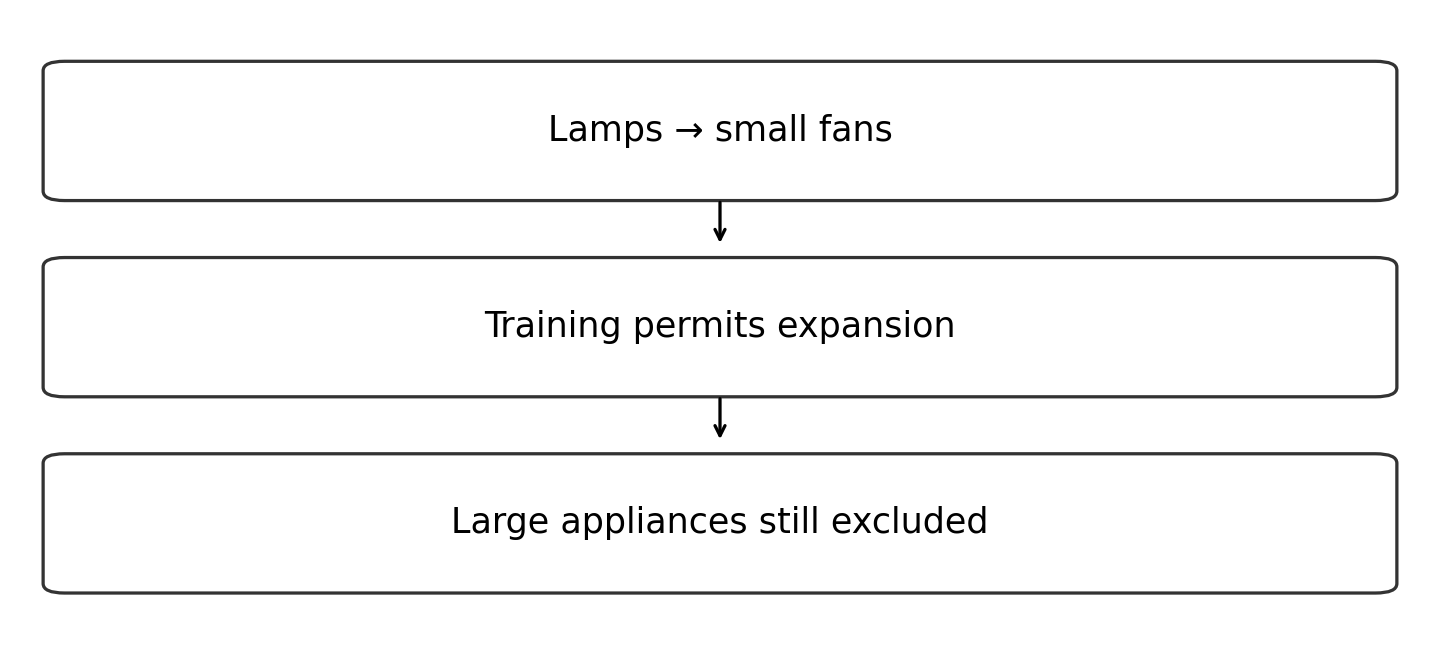
    The central idea is the relationship that holds the passage together. Read: “The repair café first accepted only lamps. It later added small fans after volunteers received training. Large appliances still went to specialist shops.” A sound summary is: the café expanded its repairs within limits. “It repaired everything” ignores the last sentence. “It repaired lamps” omits the change.
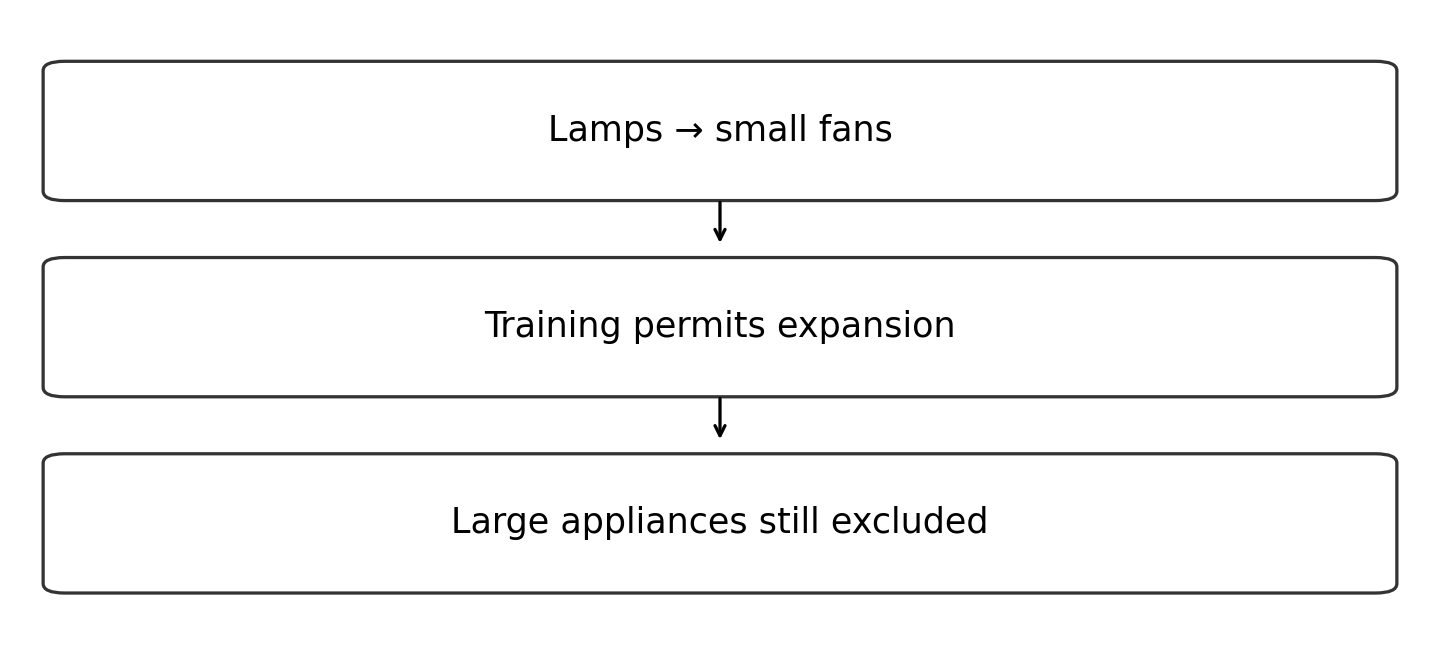
    Original diagram of the worked relationship; read the full wording and qualifications.
    Original diagram of the worked relationship; read the full wording and qualifications.

    Existing worked example: A study measured two streets at noon. The shaded street was 29°C; the unshaded street was 33°C. This supports a difference of 4°C at those sites and time. It cannot establish city-wide cooling or causation because the streets may differ in other ways.

    Complete original context

    Original passage: The city archive began a trial in which readers could search handwritten shipping registers using an online index. Volunteers entered names and dates, while staff checked entries that were difficult to read. The index often helped researchers locate a likely page before travelling to the archive. It did not replace the register images: two people with the same name could still be distinguished only by reading nearby entries. Staff therefore described the index as a route into the records rather than a final answer to every question. They also kept a public list of corrected entries so that researchers could see how the index changed.

    Independent practice and checked reasoning

    This overview is completed through the detailed skill sequence: 20, 21, 22. Work those references and sheets in order; this orientation does not replace them.

    Transfer 1

    State the central idea in one sentence, preserving both benefit and limit.

    Reasoning: The checked index helps researchers find relevant records, but consulting the underlying register remains necessary for some distinctions. This covers the search benefit and same-name limitation without claiming complete accuracy.

    Transfer 2

    Which detail explains why register images remain necessary? Distinguish that from the purpose of the corrections list.

    Reasoning: People with the same name may require nearby register entries to distinguish them. The corrections list instead makes revisions visible; it does not itself identify every person.

    Transfer 3

    Reject each proposed summary with specific evidence — A “Volunteers replaced staff”; B “The index made all archive visits unnecessary”; C “The archive hid changes to the index”.

    Reasoning: A contradicts staff checking difficult entries. B overstates “often” and the need to consult underlying records; the passage does not say every visit is replaced. C contradicts the public corrections list. None preserves the stated scope.

    Limits and next use

    An answer that sounds scientifically plausible may add information absent from the passage.

    All tasks here are public original practice with authored guidance. They are not official questions or fresh diagnostics. Existing protected tests and mocks remain separate.
    English 日本語
    central idea/ˈsentrəl aɪˈdɪə/ 中心思想
    inference/ˈɪnfərəns/ 推論
    evidence/ˈevɪdəns/ 証拠
    detail/ˈdiːteɪl/ 詳細
  • 2

    RW.C · Craft and Structure

    学習プログラム 間もなく公開

    プリント

    English

    Scope and prerequisites

    Digital SAT framework; original paper practice is nonadaptive and gives no scaled-score prediction.

    • Determine words in context
    • Analyse text structure and purpose
    • Compare related texts and viewpoints

    Prerequisites: Sentence meaning; contrast 对比 and explanation clues.

    Explain and choose the method

    Replace a tested word with your own plain phrase before viewing options. The sentence controls the meaning.

    Find what a sentence does: presents evidence 证据, qualifies a claim, explains a method or introduces a contrast.

    Separate the author’s view from a quoted view. Reporting a claim does not always endorse it.

    Cross-text questions ask about a relationship. Identify the exact point of agreement or disagreement, not the shared topic.

    A word in context 语境中的词义 must fit the relationship, not just a dictionary entry. In “The evidence is thin, so the conclusion remains provisional”, provisional means open to revision. It does not mean temporary employment or physical thinness. Paraphrase before choosing.

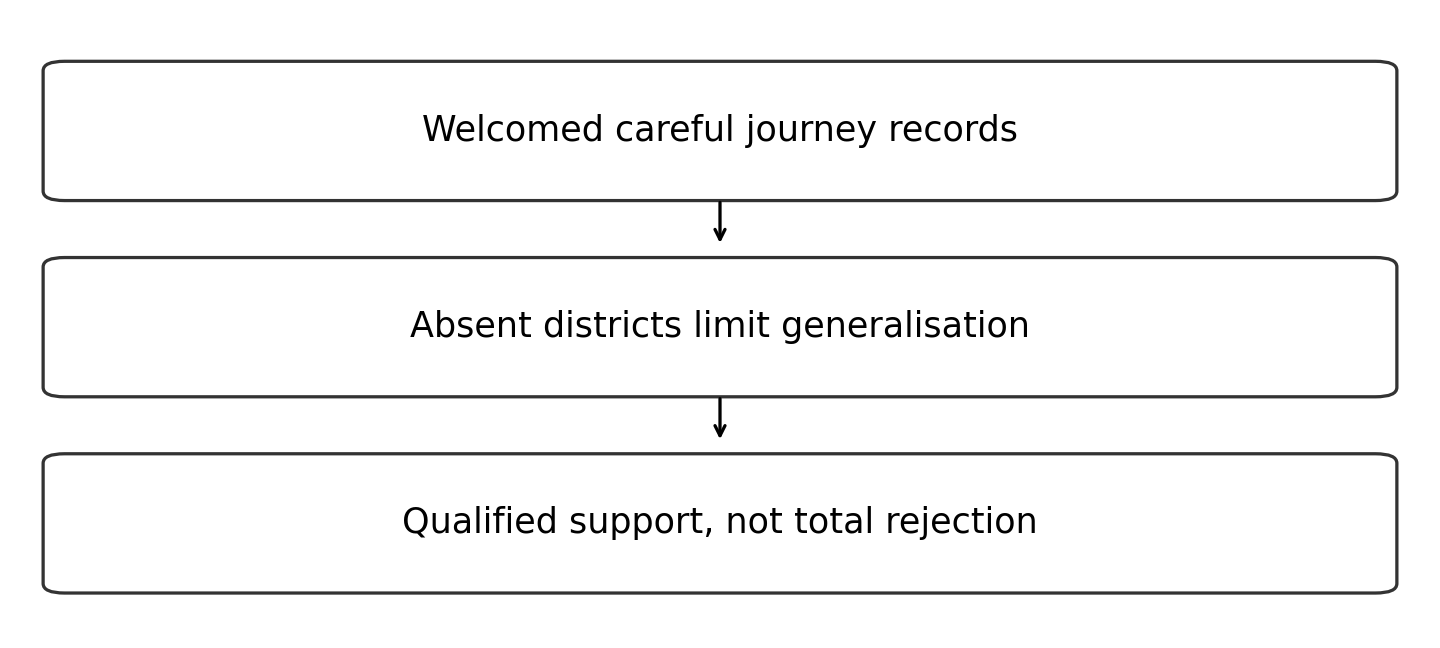
    Original diagram of the worked relationship; read the full wording and qualifications.
    Original diagram of the worked relationship; read the full wording and qualifications.

    Existing worked example: Text 1: A small trial suggests the filter could help. Text 2: The trial is too small to establish effectiveness. Both allow that the trial is limited. Text 2 is more cautious about the conclusion; it does not say the filter certainly fails.

    Complete original context

    Original passage: The reviewers welcomed the survey's careful record of individual journeys, but they gave its city-wide conclusions only qualified support. The routes had been chosen for convenience, and several districts were absent. One reviewer called the record illuminating: it made previously overlooked travel difficulties easier to understand. Another cautioned that extending the conclusions would require a broader sample. The authors accepted this reservation and proposed a second survey.

    Independent practice and checked reasoning

    This overview is completed through the detailed skill sequence: 23, 24, 25. Work those references and sheets in order; this orientation does not replace them.

    Transfer 1

    Explain qualified, illuminating and reservation in this passage. Quote a clue for each.

    Reasoning: Qualified means limited or conditional, supported by absent districts and a need for broader sampling. Illuminating means revealing or clarifying, supported by difficulties becoming easier to understand. Reservation means a concern or limitation, supported by caution about extending conclusions; it is not a booked seat.

    Transfer 2

    Compare “The reviewers dismissed the survey” with “The reviewers endorsed its conclusions without reservation”. Why does neither fit?

    Reasoning: Dismissed ignores their welcome for its careful records. Endorsed without reservation erases the sampling concern. The attitude combines appreciation of the records with limited support for broader conclusions.

    Transfer 3

    Replace illuminating with revealing, dazzling or visible. Which best preserves meaning and why do the others fail here?

    Reasoning: Revealing preserves the idea that the record makes difficulties understood. Dazzling introduces brilliance or admiration beyond the stated clarification. Visible describes perceptibility, not the survey's explanatory contribution. This is a contextual meaning decision, not a rule that those words are always wrong.

    Limits and next use

    The everyday meaning of a word may differ from its meaning in the supplied sentence.

    All tasks here are public original practice with authored guidance. They are not official questions or fresh diagnostics. Existing protected tests and mocks remain separate.
    English 日本語
    word in context 文脈における語義
    evidence/ˈevɪdəns/ 証拠
    contrast/ˈkɒntræst/ 対比
  • 3

    RW.E · Expression of Ideas

    学習プログラム 間もなく公開

    プリント

    English

    Scope and prerequisites

    Digital SAT framework; original paper practice is nonadaptive and gives no scaled-score prediction.

    • Select transitions expressing logical relationships
    • Synthesize notes for a stated rhetorical goal

    Prerequisites: Read a stated rhetorical goal; preserve names, units and relations.

    Explain and choose the method

    Classify the relationship before choosing a transition 衔接词: contrast, consequence, addition or example.

    Read both sides of a blank. A transition must link their meanings, not merely sound natural.

    For notes questions, underline the requested goal. Comparison, introduction and emphasis require different selections.

    Use only necessary notes. Keep names, dates and quantities attached to the correct object.

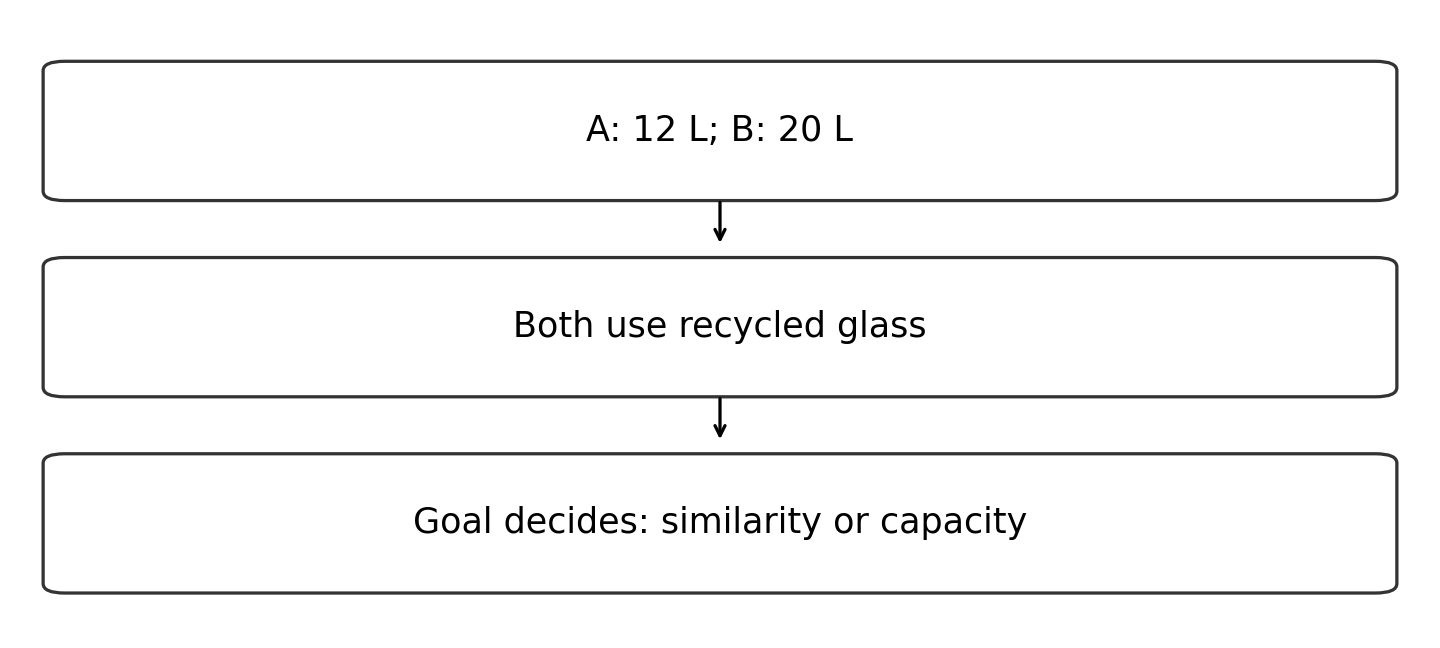
    Rhetorical synthesis 综合 修辞综合 selects facts for a purpose. Notes: A stores 12 litres; B stores 20; both use recycled glass. For a material similarity 相似: “Both containers use recycled glass.” For a capacity difference: “B stores 8 litres more than A.” The same notes support different sentences.

    Original diagram of the worked relationship; read the full wording and qualifications.
    Original diagram of the worked relationship; read the full wording and qualifications.

    Existing worked example: Notes: Route A is 8 km and has six stops. Route B is 8 km and has ten stops. Goal: emphasise a similarity. “Both routes are 8 km long” meets the goal. Discussing stops emphasises a difference instead.

    Complete original context

    Original research notes:

    • The Bay project restored 3 km of walking paths in 2024.
    • The Hill project restored 5 km of walking paths in 2024.
    • Both projects used volunteer teams.
    • Bay used local stone for boundary markers.
    • Hill used recycled timber for boundary markers.
    • The notes give no costs, visitor counts or durability measurements.

    Independent practice and checked reasoning

    This overview is completed through the detailed skill sequence: 26, 27. Work those references and sheets in order; this orientation does not replace them.

    Transfer 1

    Write one sentence emphasising a similarity in staffing and a second emphasising the difference in distance restored.

    Reasoning: “Both Bay and Hill used volunteer teams.” “Hill restored 5 km of paths, 2 km more than Bay.” These select staffing and distance respectively without adding a cause.

    Transfer 2

    A student writes “Hill restored more paths because recycled timber lasts longer.” Identify every unsupported relationship.

    Reasoning: The notes do not report why Hill restored a longer distance, nor any durability comparison. They report kilometres, not the number of separate paths. A valid sentence is “Hill restored a longer total distance and used recycled timber for its markers,” without a causal link.

    Transfer 3

    Goal — contrast marker 转折标记 materials without including irrelevant detail 细节. Write a sentence, then explain why the shared year can be omitted.

    Reasoning: “Bay used local stone for boundary markers, whereas Hill used recycled timber.” The shared year does not establish the requested material contrast. Omitting it meets this goal; a historical comparison could require it under a different goal.

    Limits and next use

    Do not include every note. Extra detail can distract from the requested rhetorical purpose.

    All tasks here are public original practice with authored guidance. They are not official questions or fresh diagnostics. Existing protected tests and mocks remain separate.
    English 日本語
    rhetorical synthesis 修辞的統合
    contrast marker/ˈkɒntræst ˈmɑːkə/ 対比マーカー
    similarity/ˌsɪmɪˈlærɪti/ 類似性
    transition/trænˈsɪʃn/ 接続詞
    synthesis/ˈsɪnθəsɪs/ 統合
    detail/ˈdiːteɪl/ 詳細
  • 4

    RW.S · Standard English Conventions

    学習プログラム 間もなく公開

    プリント

    対象範囲と前提条件

    デジタルSATの枠組み;オリジナルの紙ベース練習は非適応的であり、スケール得点の予測を与えない。

    • 文の区切りと标点符号(句読点)を用いる
    • 主語-動詞の一致を保ち、代名詞の明瞭さを確保する
    • 文脈に合う動詞の形と修飾語を選ぶ

    前提条件:主語と有限動詞;独立節/従属節。

    説明し、方法を選択する

    各節の有限動詞と主語を見つける。従属節だけでは完全な文として独立できない。

    2つの完全な節を、句点、セミコロン、またはコンマ+接続詞でつなぐ。

    コロンは完全な節の後に続く。セミコロンは完全な節をつなぐ。重要な修飾語は、それが説明する語句に付けたままにする。

    中心名詞の一致を確認する。「The list of measurements is long」:リスト(list)が主語であり、測定値(measurements)ではない。

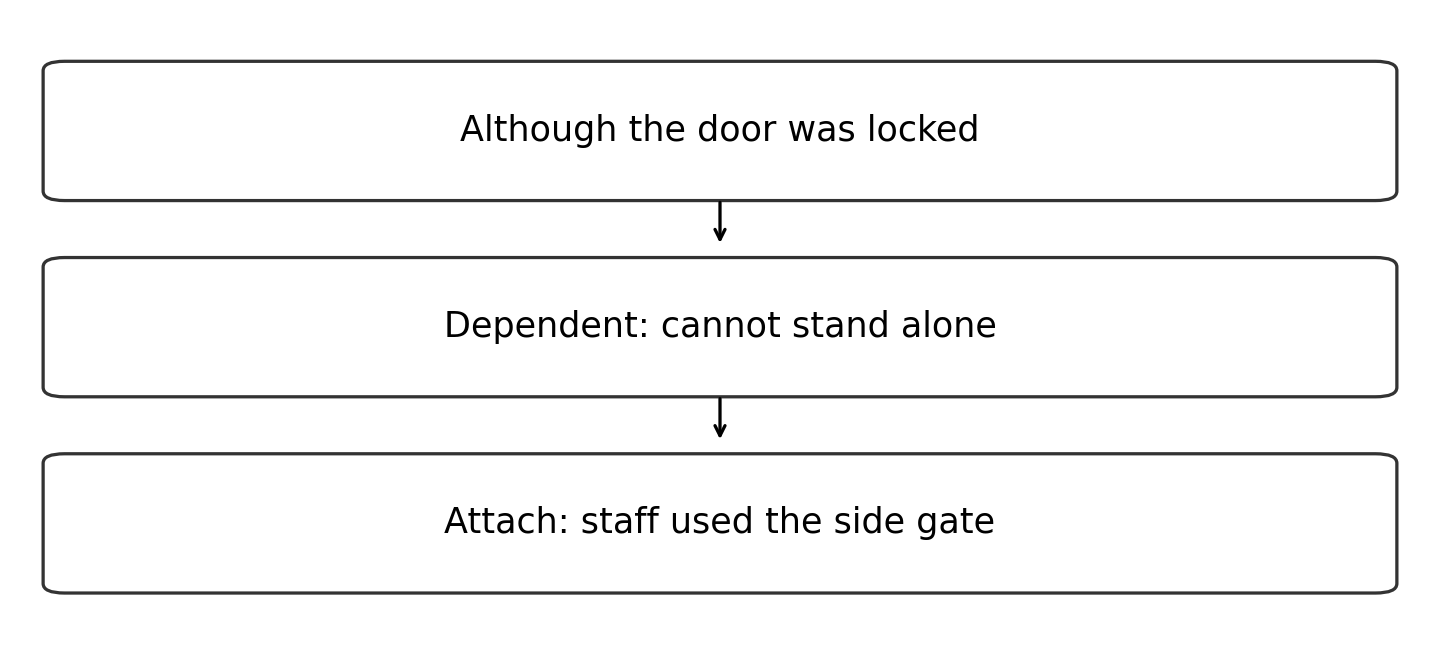
    文の区切りは節の構造に依存する。 「Although the door was locked」は従属節であるため、完全な節に接続する。 「Although the door was locked, staff could enter through the side gate.」 コロンは完全な導入節の後に続く:「Staff used one entrance: the side gate.」

     worked example の関係図(原文);完全な文章と限定事項をお読みください。
    worked example の関係図(原文);完全な文章と限定事項をお読みください。

    既存の解題例:センサーが故障しました;チームはそれを交換しました。両方とも主語と動詞があるため、セミコロンが適切です。「Because the sensor failed; the team replaced it」は誤りです:becauseにより第一部分が従属節になるためです。

    元の文脈を完成させる

    原文の校正文:古い駅は閉鎖されていた[1]、その時計はまだ動いていた。メカニズムは単純だった[2]しかし、針の修理には専門家が要した。部品の一つを交換する必要があった[3]文字盤の奥にある狭い軸である。この時計[4]入口の上に立っていた[5]は集まりの場となっていた。この練習問題では1つの時計があり、which節は不要な情報を追加する。

    Independent practice and checked reasoning

    この概要は、詳細なスキル手順を通じて完了される:28、29。これらの参照とシートを順に活用すること;このガイドラインはそれらを代替するものではない。

    Transfer 1

    [1]–[5]に标点符号(句読点)を記入せよ。[2]で少なくとも2つの有効な区切りを示し、節テストを説明せよ。

    推論:[1]コンマは導入部の従属節を接続する。[2]セミコロンまたは句点とする。なぜなら、メカニズム節と修理節は独立節だからである;句点の後はHoweverを大文字で始める。[3]コロンは完全な節「One part needed replacement」の後に続き、部品を紹介する。[4],[5]ペアのコンマは指定された不要節を囲む;対応するダッシュや括弧も使用可能である。

    Transfer 2

    「One part needed: a replacement」が本文の有効なコロン使用法と異なる理由を説明せよ。

    推論:neededは直接に目的語「a replacement」を必要とするため、そこにコロンを置くと文法的単位が断たれる。「One part needed replacement: the narrow axle」では、独立節が既に完了しており、その後に説明が続く形となる。

    Transfer 3

    「The clock, above the entrance, and the bell was restored」を修正し、修復された2つの対象を保持せよ。主語一致および任意の句読点について説明せよ。

    推論:「The clock above the entrance and the bell were restored.」複合主語にはwereを用いる。「above the entrance」の周囲にコンマを使うことは可能であるが、それが限定的か補足的かの文脈による選択であり、複合主語との一致には影響しない。

    Limits and next use

    長い名詞句が主語を隠してしまう。最も近い名詞に合わせるために動詞を選んではならない。

    All tasks here are public original practice with authored guidance. They are not official questions or fresh diagnostics. Existing protected tests and mocks remain separate.
    English 日本語
    sentence boundary 文の境界
    finite verb/ˈfaɪnaɪt vɜːb/ 有限動詞
    clause/klɔːz/ 節
    colon/ˈkəʊlən/ コロン
  • 5

    M.A · Algebra

    学習プログラム 間もなく公開

    プリント

    English

    Scope and prerequisites

    Digital SAT framework; original paper practice is nonadaptive and gives no scaled-score prediction.

    • Solve linear equations and inequalities in one variable
    • Represent and solve two-variable linear systems
    • Interpret linear functions and parameters in context

    Prerequisites: Collect like terms; substitute ordered pairs; signed arithmetic.

    Explain and choose the method

    Write a variable definition with units before an equation. The intercept 截距 represents an initial amount.

    A linear slope 斜率 is change in output divided by change in input. Keep both quantities in the right order.

    Solve systems by substitution or elimination. A solution must satisfy both equations.

    An inequality reverses direction when multiplied or divided by a negative number. Test a value to check the final region.

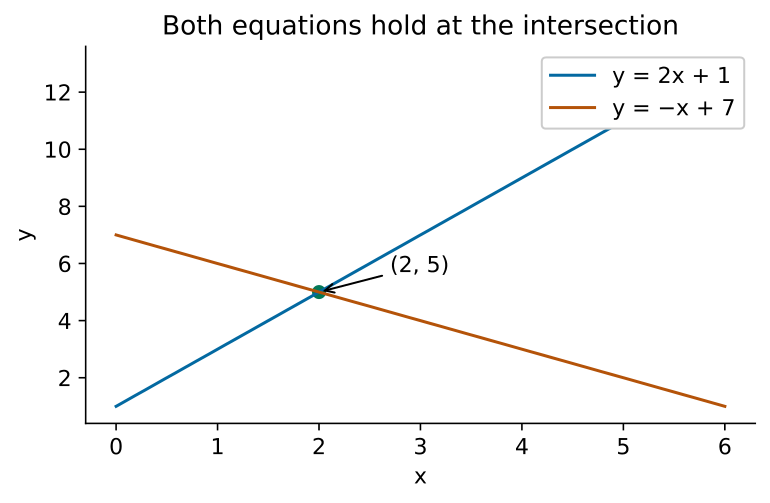
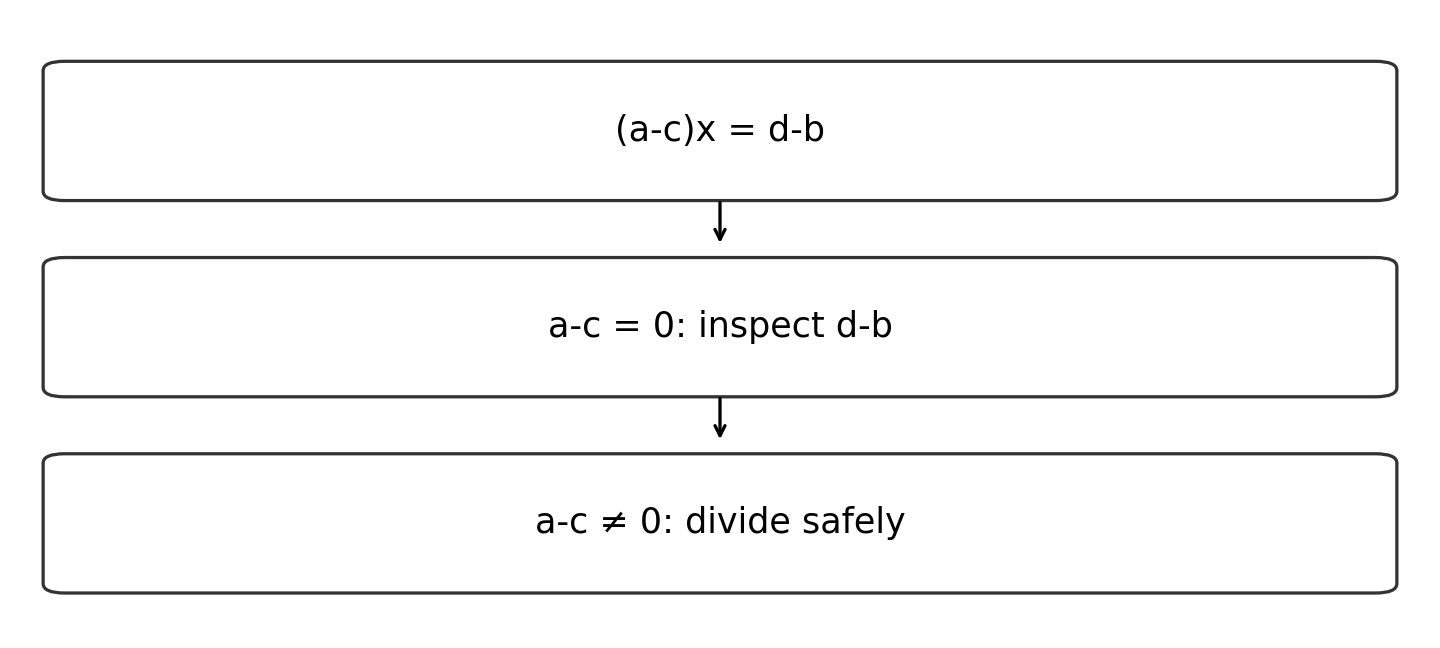
    An identity holds for every permitted input. Start with $ax+b=cx+d$. Collect terms: $(a-c)x=d-b$. Inspect $a-c$ before dividing. If $a=c$ and $b=d$, every real input works. If only $a=c$, no input works. Otherwise $x=(d-b)/(a-c)$ gives one solution.

    Original worked example from existing native teaching; transfer tasks use their own data.
    Original worked example from existing native teaching; transfer tasks use their own data.

    Existing worked example: Let f be the fixed fee and r the cost per kilometre. f+3r=11 and f+7r=19. Subtract the equations: 4r=8, so r=2. Then f=11−3(2)=5. Both journeys fit; the fixed fee is 5.

    Complete original context

    Every transfer question states all data it needs.

    Independent practice and checked reasoning

    This overview is completed through the detailed skill sequence: 9. Work those references and sheets in order; this orientation does not replace them.

    Transfer 1

    Classify the solutions of $(p-1)x+3=2x+p$ for every real $p$.

    Reasoning: Collect terms to get $(p-3)x=p-3$. At $p=3$, the equation is $0=0$, so every real $x$ works. At $p\ne3$, divide by $p-3$ to get $x=1$. There is no value of $p$ giving no solution. Substitution of $x=1$ gives $p+2$ on both sides.

    Transfer 2

    A hire charge $C$ yuan has a fixed fee $f$ yuan and rate 速率 $r$ yuan per hour. Three hours cost 31 yuan; seven hours cost 59 yuan. Find $f,r$ and the greatest affordable whole number of hours with 80 yuan.

    Reasoning: Use $C=f+rt$. The equations are $31=f+r(3\,\mathrm{h})$ and $59=f+r(7\,\mathrm{h})$. Subtract: $r=(59-31)\,\mathrm{yuan}/(7-3)\,\mathrm{h}=7\,\mathrm{yuan/h}$. Then $f=31\,\mathrm{yuan}-(7\,\mathrm{yuan/h})(3\,\mathrm{h})=10\,\mathrm{yuan}$. Budget: $10+7t\le80$, so $t\le10$ hours. Ten whole hours is affordable; eleven costs 87 yuan.

    Transfer 3

    Describe all points satisfying $y>2x-1$ and $y\le-x+5$. Is $(2,3)$ included? State the possible $x$-values.

    Reasoning: The first boundary is dashed and the second solid. The common region is above the first line and on or below the second. At $(2,3)$ the first condition is $3>3$, which fails. For the vertical interval to exist, $2x-1<-x+5$, hence $x<2$. The lines meet at $(2,3)$ but their meeting point is excluded.

    Limits and next use

    The intercept is not always the actual starting value if zero lies outside the model’s stated domain.

    All tasks here are public original practice with authored guidance. They are not official questions or fresh diagnostics. Existing protected tests and mocks remain separate.
    English 日本語
    intercept/ˌɪntəˈsept/ 切片
    slope/sləʊp/ 傾き
    rate/reɪt/ 速度
  • 6

    M.Q · Advanced Math

    学習プログラム 間もなく公開

    プリント

    English

    Scope and prerequisites

    Digital SAT framework; original paper practice is nonadaptive and gives no scaled-score prediction.

    • Transform equivalent polynomial and rational expressions
    • Solve nonlinear equations and systems
    • Interpret quadratic and exponential functions

    Prerequisites: Distributive law; difference of squares; real square roots.

    Explain and choose the method

    Factor a quadratic when possible. The zero-product rule applies to a product equal to zero.

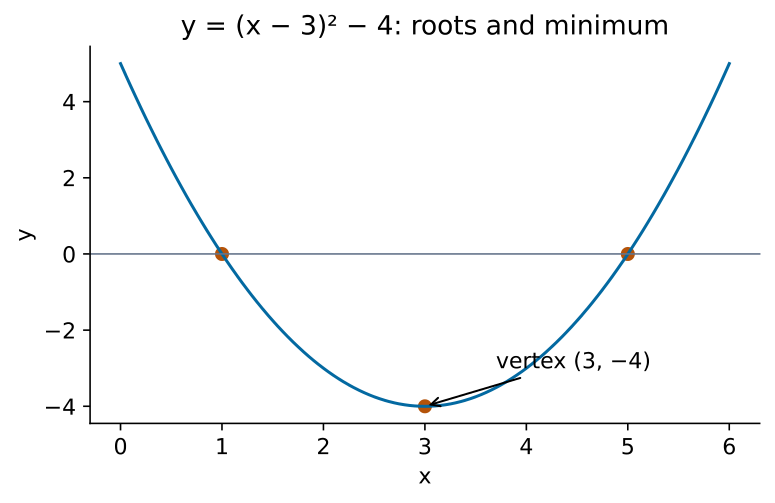
    Completing the square reveals a vertex: x²−6x+5=(x−3)²−4.

    For rational expressions, record excluded denominator values before cancelling factors.

    An exponential model multiplies by a fixed factor per interval. A 20% increase means multiply by 1.2, not add 0.2.

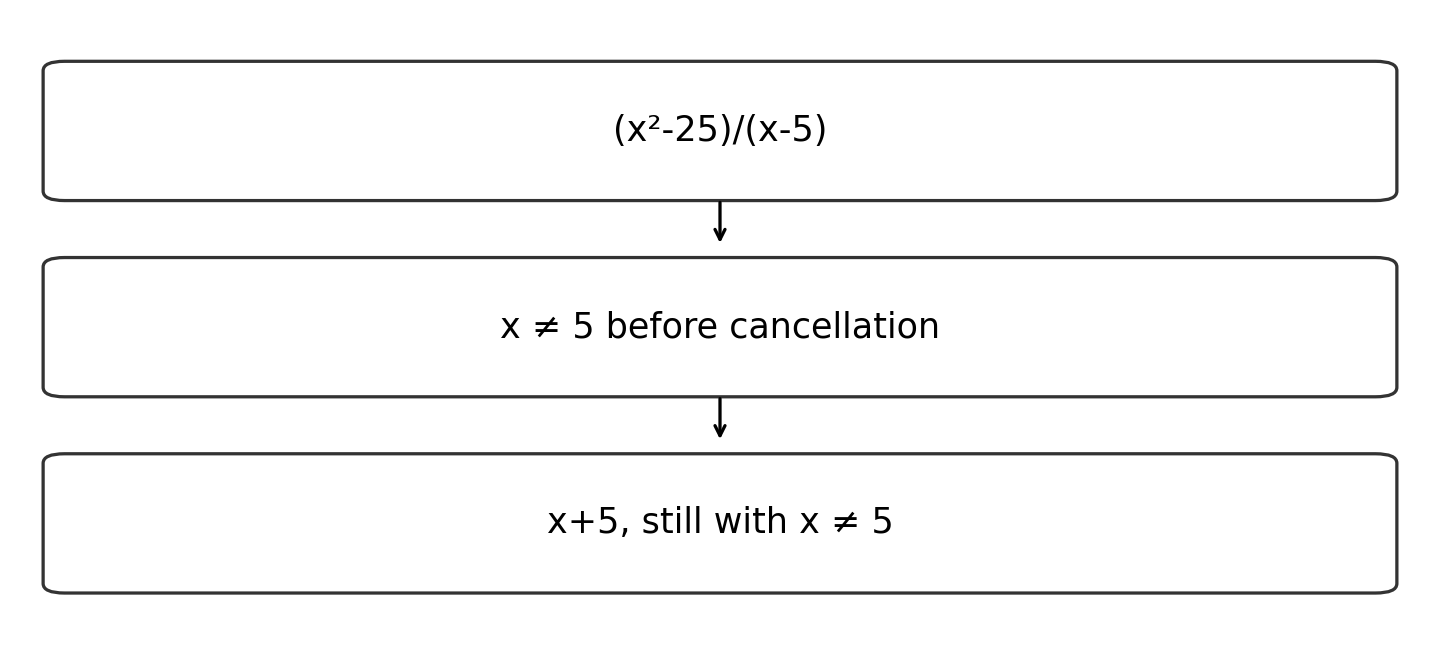
    Equivalent expressions 等价表达式 must agree on the stated domain 定义域 . $E(x)=(x^2-25)/(x-5)=(x+5)$ only for $x\ne5$. Cancellation removes a factor, but it cannot restore an excluded input. Also $\sqrt{x^2}=|x|$, because the principal square root 根 cannot be negative.

    Original worked example from existing native teaching; transfer tasks use their own data.
    Original worked example from existing native teaching; transfer tasks use their own data.

    Existing worked example: Solve x²−5x+6=0. Factor: (x−2)(x−3)=0. Thus x=2 or 3. If instead (x²−5x+6)/(x−2)=0, x=2 is excluded; only 3 remains.

    Complete original context

    Every transfer question states all data it needs.

    Independent practice and checked reasoning

    This overview is completed through the detailed skill sequence: 10, 11, 12. Work those references and sheets in order; this orientation does not replace them.

    Transfer 1

    Simplify $F(x)=(x^2-4x)/(x^2-16)$. State every original restriction and explain why $F$ is not identical to $x/(x+4)$ on that latter formula's whole domain.

    Reasoning: Factor numerator $x(x-4)$ and denominator $(x-4)(x+4)$. The original domain excludes $x=4,-4$. Cancellation gives $F(x)=x/(x+4)$ for $x\ne4,-4$. The latter formula alone permits $4$, where it gives $1/2$, while $F(4)$ is undefined.

    Transfer 2

    Find the coefficient of $x$ in $(3x-2)(x+5)$ and evaluate $\sqrt{(x-5)^2}$ when $x=1$.

    Reasoning: Expansion gives $3x^2+15x-2x-10=3x^2+13x-10$, so the coefficient is 13. The root is $|x-5|$; at $x=1$, it is $|-4|=4$, not $-4$ or 16.

    Transfer 3

    A student tests $x=2$ and concludes that $x^2$ and $2x$ are equivalent. Refute the conclusion and solve where they actually agree.

    Reasoning: At $x=3$ the outputs are 9 and 6, so one matching test is not proof. Solve $x^2=2x$ as $x(x-2)=0$, giving only $x=0,2$.

    Limits and next use

    Squaring an equation can add extraneous roots. Substitute into the original equation, not just the transformed one.

    All tasks here are public original practice with authored guidance. They are not official questions or fresh diagnostics. Existing protected tests and mocks remain separate.
    English 日本語
    equivalent expressions 等価表現
    domain/dəˈmeɪn/ 定義域
    root/ruːt/ 根
  • 7

    M.D · Problem-Solving and Data Analysis

    学習プログラム 間もなく公開

    プリント

    English

    Scope and prerequisites

    Digital SAT framework; original paper practice is nonadaptive and gives no scaled-score prediction.

    • Use ratios, rates and percentages
    • Interpret distributions and compare centre and spread
    • Calculate probabilities and assess sample claims

    Prerequisites: Fractions; unit conversion; percentage base.

    Explain and choose the method

    Percent change uses the original value as the denominator. Percentage points compare percentages directly.

    Convert units explicitly. A rate 速率 denominator describes the amount of time or distance used.

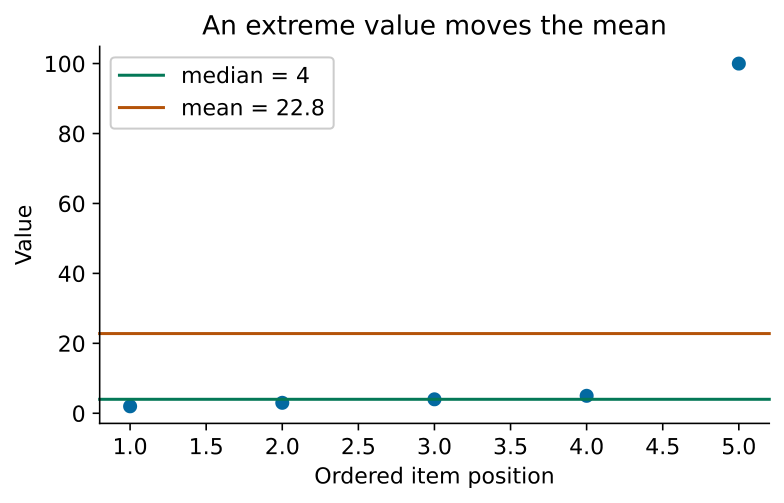
    The median 中位数 resists extreme values more than the mean. Spread describes variation, not the average.

    A random sample 随机样本 supports generalisation to its sampling population. Random assignment concerns causal comparison, a different issue.

    A rate compares quantities with their units. $v=d/t=(90\,\mathrm{km})/(1.5\,\mathrm{h})=60\,\mathrm{km/h}$. Convert using cancelling units: $v=(60\,\mathrm{km/h})(1000\,\mathrm{m/km})/(3600\,\mathrm{s/h})=50/3\,\mathrm{m/s}$. Do not convert only the numerator of a compound rate.

    Original worked example from existing native teaching; transfer tasks use their own data.
    Original worked example from existing native teaching; transfer tasks use their own data.

    Existing worked example: A price of 80 falls by 20%: 80×0.8=64. It then rises by 20%: 64×1.2=76.8. The final value is below 80 because the two percentage changes use different bases.

    Complete original context

    Every transfer question states all data it needs.

    Independent practice and checked reasoning

    This overview is completed through the detailed skill sequence: 13, 14, 15, 16, 17. Work those references and sheets in order; this orientation does not replace them.

    Transfer 1

    Mix red and blue paint in ratio 4:7 to make 33 litres. Find each amount. Red paint costs 18 yuan per litre and blue 12. Find total cost.

    Reasoning: There are 11 parts, so each is 3 L. Red volume $V_r=33(4/11)=12\,\mathrm{L}$; blue volume $V_b=33(7/11)=21\,\mathrm{L}$. Cost $C=p_rV_r+p_bV_b=(18\,\mathrm{yuan/L})(12\,\mathrm{L})+(12\,\mathrm{yuan/L})(21\,\mathrm{L})=468\,\mathrm{yuan}$.

    Transfer 2

    A 400-yuan item falls 15% then rises 10%. Find the final price and the single overall percentage change.

    Reasoning: Use successive multipliers. $P=P_0(1-0.15)(1+0.10)=(400\,\mathrm{yuan})(0.85)(1.10)=374\,\mathrm{yuan}$. Relative change $r=(P-P_0)/P_0=(374-400)/400=-0.065$, a 6.5% decrease.

    Transfer 3

    A pump supplies 0.15 litres per second. How long does 54 litres take? If a square has side 30 cm, give its area in square metres.

    Reasoning: $t=V/q=(54\,\mathrm{L})/(0.15\,\mathrm{L/s})=360\,\mathrm{s}=6\,\mathrm{min}$. Convert side before squaring: $A=s^2=(0.30\,\mathrm{m})^2=0.09\,\mathrm{m^2}$; the area conversion factor is 10000, not 100.

    Limits and next use

    A sample from volunteers is not automatically representative, even when it is large.

    All tasks here are public original practice with authored guidance. They are not official questions or fresh diagnostics. Existing protected tests and mocks remain separate.
    English 日本語
    random sample/ˈrændəm ˈsæmpl/ 無作為標本
    median/ˈmiːdiːən/ 中央値
    rate/reɪt/ 速度
  • 8

    M.G · Geometry and Trigonometry

    学習プログラム 間もなく公開

    プリント

    English

    Scope and prerequisites

    Digital SAT framework; original paper practice is nonadaptive and gives no scaled-score prediction.

    • Use area, volume and similarity 相似
    • Apply right-triangle ratios and the Pythagorean theorem
    • Use circle equations, arcs and angle relationships

    Prerequisites: Triangle sum; Pythagoras; length/area/volume units.

    Explain and choose the method

    Similarity preserves corresponding angles and length ratios. Areas scale by k² and volumes by k³.

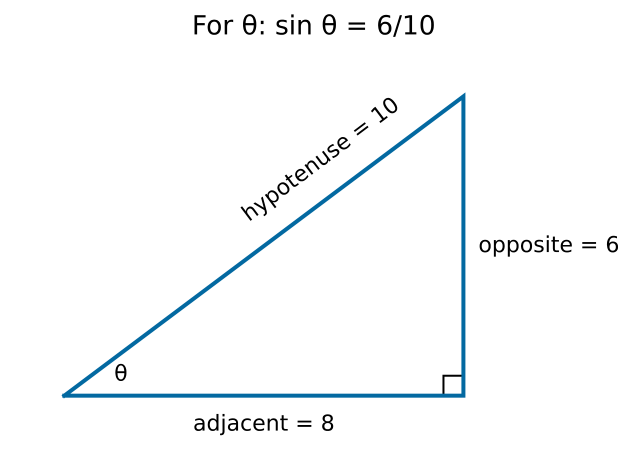
    For a right triangle, sin is opposite/hypotenuse, cos adjacent/hypotenuse, and tan opposite/adjacent.

    A circle with centre (h,k) and radius r has (x−h)²+(y−k)²=r².

    A full turn is 360° or 2π radians. Arc length 弧长 is rθ only when θ is in radians.

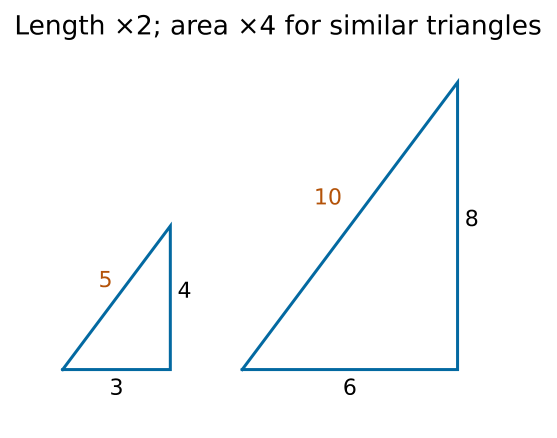
    A scale factor 比例因子 $k$ changes every corresponding length. $A_2=k^2A_1$ and $V_2=k^3V_1$ for similar shapes. If $k=3/2$ and $A_1=24\,\mathrm{cm^2}$, $A_2=(3/2)^2(24\,\mathrm{cm^2})=54\,\mathrm{cm^2}$. Changing only one dimension does not justify these similarity rules.

    Original worked example from existing native teaching; transfer tasks use their own data.
    Original worked example from existing native teaching; transfer tasks use their own data.

    Existing worked example: A right triangle has legs 6 and 8. c²=6²+8²=100, so c=10. For the angle opposite 6, sin θ=6/10=0.6. A similar triangle enlarged by factor 3 has area nine times the original.

    Complete original context

    Every transfer question states all data it needs.

    Independent practice and checked reasoning

    This overview is completed through the detailed skill sequence: 18, 19. Work those references and sheets in order; this orientation does not replace them.

    Transfer 1

    Similar containers have surface areas 96 and 216 square centimetres. The smaller volume is 160 cubic centimetres. Find the larger volume.

    Reasoning: $k=\sqrt{A_2/A_1}=\sqrt{216/96}=3/2$. Volume uses the cube: $V_2=k^3V_1=(3/2)^3(160\,\mathrm{cm^3})=540\,\mathrm{cm^3}$. Using area ratio directly would give the wrong volume.

    Transfer 2

    A right triangle has hypotenuse 13 cm and one leg 5 cm. Find the other leg, its area, and the sine of the angle opposite the 5 cm leg.

    Reasoning: $b=\sqrt{c^2-a^2}=\sqrt{(13\,\mathrm{cm})^2-(5\,\mathrm{cm})^2}=12\,\mathrm{cm}$. $A=ab/2=(5\,\mathrm{cm})(12\,\mathrm{cm})/2=30\,\mathrm{cm^2}$. $\sin\theta=a/c=(5\,\mathrm{cm})/(13\,\mathrm{cm})=5/13$.

    Transfer 3

    Two interior angles of a triangle are 42° and 73°. Find the third angle and its adjacent exterior angle. Would those angles alone determine all side lengths?

    Reasoning: Third angle is $180-42-73=65$ degrees. Its adjacent exterior angle is $180-65=115$ degrees, also $42+73$. Angles establish shape, not scale; similar triangles can have different side lengths.

    Transfer 4

    Two parallel lines are cut by a transversal. One corresponding angle is 68°. Find its matching corresponding angle and the adjacent angle on the second line. Explain which given condition justifies each step.

    Reasoning: Parallelism gives the matching corresponding angle 68°. The adjacent pair forms a straight angle, so the other is 180°−68°=112°. Equal corresponding angles require the stated parallel lines; the straight-angle sum uses adjacency on one line. A similar-looking sketch without parallelism would not justify the first equality.

    Limits and next use

    Radius and diameter differ by a factor of two. Using diameter in πr² makes the area four times too large.

    All tasks here are public original practice with authored guidance. They are not official questions or fresh diagnostics. Existing protected tests and mocks remain separate.
    English 日本語
    scale factor/skeɪl ˈfæktə/ スケール因子
    arc length/ɑːk leŋθ/ 弧長
    similarity/ˌsɪmɪˈlærɪti/ 類似性
  • 9

    ALG-parameters · Linear parameters, solution counts and inequalities

    学習プログラム 間もなく公開

    プリント

    English

    Scope and prerequisites

    Digital SAT framework; original paper practice is nonadaptive and gives no scaled-score prediction.

    • Solve and classify one-variable linear equations with parameters
    • Interpret two-variable linear equations as sets of ordered pairs
    • Interpret slope and intercept of a contextual linear function
    • Classify two-equation linear systems and check their intersections
    • Represent strict and inclusive inequalities in one or two variables

    Prerequisites: Collect like terms; substitute ordered pairs; signed arithmetic.

    Explain and choose the method

    Collect variable terms and constants separately. An equation ax+b=cx+d becomes (a-c)x=d-b. If a-c is nonzero there is one solution; if both sides reduce to zero there are infinitely many; if the variable coefficient is zero but the constant is nonzero there are none. Never divide by a parameter before checking whether it can be zero.

    A two-variable equation gives a set of ordered pairs. In y=mx+b, m is the change in y per unit x and b is y at x=0. For a contextual model, attach units to both: a taxi charge C=3t+5 has a 5-unit initial fee and 3 units per time unit. The intercept may be outside the practical domain even when it exists algebraically.

    For a system, compare both coefficients and constants. Multiplying one whole equation by a nonzero number produces the same line; matching variable coefficients with different constants gives parallel distinct lines. Otherwise an intersection supplies the pair satisfying both equations. Substitute the pair into both original equations to check it.

    Multiplying or dividing an inequality by a negative number reverses its direction. A strict inequality excludes the boundary, while ≤ or ≥ includes it. For two variables, draw the corresponding line and test a point away from it to identify the allowed half-plane. The diagram is a representation of all solutions, not a single preferred point.

    An identity 恒等式 holds for every permitted input. Start with $ax+b=cx+d$. Collect terms: $(a-c)x=d-b$. Inspect $a-c$ before dividing. If $a=c$ and $b=d$, every real input works. If only $a=c$, no input works. Otherwise $x=(d-b)/(a-c)$ gives one solution.

    Original diagram of the worked relationship; read the full wording and qualifications.
    Original diagram of the worked relationship; read the full wording and qualifications.

    Existing worked example: For kx+6=2x+6, k=2 gives 0=0 and infinitely many solutions; k≠2 gives x=0. For -2x+3<11, subtract 3 and divide by -2 to get x>-4. For y≤2x+1, (0,0) works and the solid boundary is included. The system 2x+4y=10 and x+2y=6 has no solution because doubling the second gives the same left side equal to 12, not 10.

    Complete original context

    Every transfer question states all data it needs.

    Independent practice and checked reasoning

    Transfer 1

    Classify the solutions of $(p-1)x+3=2x+p$ for every real $p$.

    Reasoning: Collect terms to get $(p-3)x=p-3$. At $p=3$, the equation is $0=0$, so every real $x$ works. At $p\ne3$, divide by $p-3$ to get $x=1$. There is no value of $p$ giving no solution. Substitution of $x=1$ gives $p+2$ on both sides.

    Transfer 2

    A hire charge $C$ yuan has a fixed fee $f$ yuan and rate 速率 $r$ yuan per hour. Three hours cost 31 yuan; seven hours cost 59 yuan. Find $f,r$ and the greatest affordable whole number of hours with 80 yuan.

    Reasoning: Use $C=f+rt$. The equations are $31=f+r(3\,\mathrm{h})$ and $59=f+r(7\,\mathrm{h})$. Subtract: $r=(59-31)\,\mathrm{yuan}/(7-3)\,\mathrm{h}=7\,\mathrm{yuan/h}$. Then $f=31\,\mathrm{yuan}-(7\,\mathrm{yuan/h})(3\,\mathrm{h})=10\,\mathrm{yuan}$. Budget: $10+7t\le80$, so $t\le10$ hours. Ten whole hours is affordable; eleven costs 87 yuan.

    Transfer 3

    Describe all points satisfying $y>2x-1$ and $y\le-x+5$. Is $(2,3)$ included? State the possible $x$-values.

    Reasoning: The first boundary is dashed and the second solid. The common region is above the first line and on or below the second. At $(2,3)$ the first condition is $3>3$, which fails. For the vertical interval to exist, $2x-1<-x+5$, hence $x<2$. The lines meet at $(2,3)$ but their meeting point is excluded.

    Limits and next use

    Do not confuse x=0 with a vanished variable coefficient, reverse only when multiplying/dividing by a negative, or shade a half-plane from the line’s slope alone.

    All tasks here are public original practice with authored guidance. They are not official questions or fresh diagnostics. Existing protected tests and mocks remain separate.
    English 日本語
    identity/aɪˈdentɪti/ 恒等式
    rate/reɪt/ 速度
  • 10

    AM-equivalence · Equivalent expressions and domain restrictions

    学習プログラム 間もなく公開

    プリント

    English

    Scope and prerequisites

    Digital SAT framework; original paper practice is nonadaptive and gives no scaled-score prediction.

    • Factor 因式 and expand expressions without changing their values
    • Simplify rational and radical expressions on the original domain
    • Use expression structure to identify zeros and coefficients

    Prerequisites: Distributive law; difference of squares; real square roots.

    Explain and choose the method

    Expansion distributes each factor across the others; factorisation reverses that process. x²-5x+6=(x-2)(x-3), so the product form exposes zeros while the expanded form exposes coefficients. Choose the form that serves the question rather than treating one representation as always preferable.

    Cancel factors, never terms in a sum. (x²-4)/(x-2) becomes x+2 only for x≠2, because the original expression is undefined at 2. A restriction may remain after every denominator disappears from the simplified formula. State it before cancelling, then carry it through comparisons or equation solving.

    Exponent rules depend on their setting: a^m a^n=a^(m+n) and (a^m)^n=a^(mn) in the permitted real domain. Negative exponents form reciprocals and require nonzero bases. With real square roots, √(x²)=|x|, because the principal square root is nonnegative; it is not x for every real x.

    To check equivalence, a numerical substitution can expose a mistake, but one matching value does not prove two expressions equal. A valid algebraic identity plus matching domain does. When the question requests a coefficient, expand only as far as needed and account for every contribution to that power.

    Equivalent expressions 等价表达式 must agree on the stated domain . $E(x)=(x^2-25)/(x-5)=(x+5)$ only for $x\ne5$. Cancellation removes a factor, but it cannot restore an excluded input. Also $\sqrt{x^2}=|x|$, because the principal square root cannot be negative.

    Original diagram of the worked relationship; read the full wording and qualifications.
    Original diagram of the worked relationship; read the full wording and qualifications.

    Existing worked example: (x²-9)/(x-3)=(x-3)(x+3)/(x-3)=x+3 for x≠3. At x=3 the original is undefined. For x=-5, √(x²)=5=|x|. In (2x+1)(x-4), the x coefficient is -8+1=-7 and the full expression is 2x²-7x-4.

    Complete original context

    Every transfer question states all data it needs.

    Independent practice and checked reasoning

    Transfer 1

    Simplify $F(x)=(x^2-4x)/(x^2-16)$. State every original restriction and explain why $F$ is not identical to $x/(x+4)$ on that latter formula's whole domain.

    Reasoning: Factor numerator $x(x-4)$ and denominator $(x-4)(x+4)$. The original domain excludes $x=4,-4$. Cancellation gives $F(x)=x/(x+4)$ for $x\ne4,-4$. The latter formula alone permits $4$, where it gives $1/2$, while $F(4)$ is undefined.

    Transfer 2

    Find the coefficient of $x$ in $(3x-2)(x+5)$ and evaluate $\sqrt{(x-5)^2}$ when $x=1$.

    Reasoning: Expansion gives $3x^2+15x-2x-10=3x^2+13x-10$, so the coefficient is 13. The root is $|x-5|$; at $x=1$, it is $|-4|=4$, not $-4$ or 16.

    Transfer 3

    A student tests $x=2$ and concludes that $x^2$ and $2x$ are equivalent. Refute the conclusion and solve where they actually agree.

    Reasoning: At $x=3$ the outputs are 9 and 6, so one matching test is not proof. Solve $x^2=2x$ as $x(x-2)=0$, giving only $x=0,2$.

    Limits and next use

    A simplified formula is not automatically an equivalent function on a larger domain; cancelling terms across addition is invalid.

    All tasks here are public original practice with authored guidance. They are not official questions or fresh diagnostics. Existing protected tests and mocks remain separate.
    English 日本語
    equivalent expressions 等価表現
    factor/ˈfæktə/ 因数
  • 11

    AM-equations · Nonlinear equations and mixed systems

    学習プログラム 間もなく公開

    プリント

    English

    Scope and prerequisites

    Digital SAT framework; original paper practice is nonadaptive and gives no scaled-score prediction.

    • Solve quadratic, absolute-value, rational and radical equations
    • Reject candidate roots violating the original equation or domain
    • Find intersections of a line and a nonlinear curve

    Prerequisites: Factorisation; substitution; domain restrictions.

    Explain and choose the method

    Use structure before expanding. A factored quadratic equals zero when at least one factor is zero. An absolute-value equation |u|=a has no real solution for a<0, one condition u=0 when a=0 and two conditions u=±a when a>0. Account for all allowed cases, not just the positive branch.

    For a rational equation, exclude denominator zeros before multiplying through. Multiplication may create a candidate at an excluded value. For a radical equation, note that a principal square root is nonnegative, isolate it and square carefully. Squaring is a one-way implication until every resulting candidate is checked in the original.

    To solve a line–parabola 抛物线 system, substitute the line expression into the quadratic. The real roots give x-values; use the line to recover each y. No real root means no real intersection 交点. A repeated quadratic root gives tangency, while two different real roots give two intersections.

    A graph or calculator can help locate candidates and check scale, but rounded intersections are not exact proof when the question asks an exact value or solution count. Relate graphical behaviour to the algebraic equation. A double root should not be counted twice as two different ordered pairs.

    A candidate root 候选根 must satisfy the original equation. In $\sqrt{x+6}=x$, the right side must be nonnegative. Squaring gives $x^2-x-6=0$, so candidates are $3,-2$. Only $3$ survives the original check: $\sqrt9=3$.

    Original worked example from existing native teaching; transfer tasks use their own data.
    Original worked example from existing native teaching; transfer tasks use their own data.

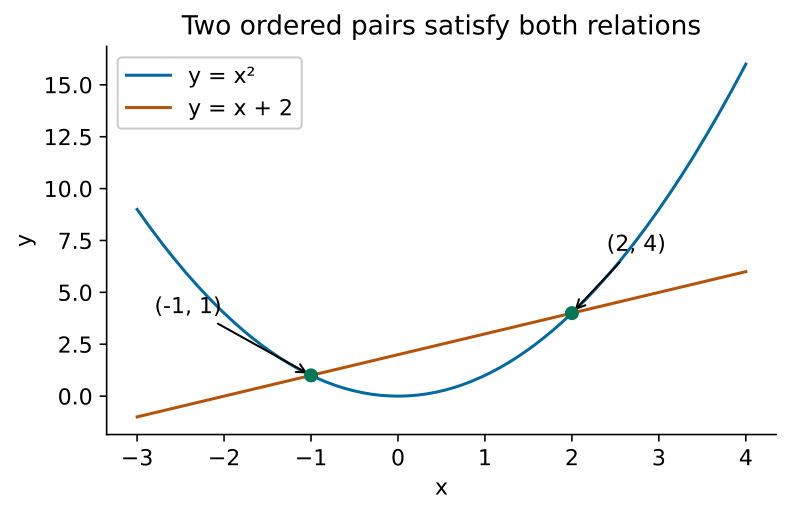
    Existing worked example: √(x+2)=x requires x≥0. Squaring yields x²-x-2=0, so x=2 or -1; only 2 works in the original. For y=x+2 and y=x², solve x²-x-2=0: x=2,-1, giving (2,4) and (-1,1). For |2x-1|=5, solve 2x-1=5 or -5 to obtain x=3 or -2.

    Complete original context

    Every transfer question states all data it needs.

    Independent practice and checked reasoning

    Transfer 1

    Solve $\sqrt{2x+3}=x$ over the real numbers, showing why any candidate is rejected.

    Reasoning: Require $x\ge0$. Squaring yields $x^2-2x-3=(x-3)(x+1)=0$. Candidates are 3 and -1. The original gives $\sqrt9=3$ at 3, but $\sqrt1=1\ne-1$ at -1. Only $x=3$ works.

    Transfer 2

    Solve simultaneously $y=x+2$ and $y=(x-1)^2$. Give exact ordered pairs and verify the number of intersections.

    Reasoning: Equate outputs to get $x+2=x^2-2x+1$, or $x^2-3x-1=0$. Thus $x=(3\pm\sqrt{13})/2$ and $y=(7\pm\sqrt{13})/2$ with matching signs. The discriminant 13 is positive, so there are two distinct real intersections; both expressions for $y$ agree by the derived equation.

    Transfer 3

    Solve $|3x+2|=7$ and $(x^2-9)/(x-3)=6$. Explain why these equations have different solution counts.

    Reasoning: The absolute value gives $3x+2=7$ or $-7$, hence $x=5/3$ or $-3$. The rational equation requires $x\ne3$ and simplifies to $x+3=6$, whose sole candidate 3 is excluded. It has no solution.

    Limits and next use

    Do not report every root of a transformed equation before checking the original restriction and branch.

    All tasks here are public original practice with authored guidance. They are not official questions or fresh diagnostics. Existing protected tests and mocks remain separate.
    English 日本語
    candidate root 候補根
    intersection/ˌɪntəˈsekʃn/ 交点
    parabola/pəˈræbələ/ 放物線
  • 12

    AM-functions · Nonlinear functions, transformations and growth

    学習プログラム 間もなく公開

    プリント

    English

    Scope and prerequisites

    Digital SAT framework; original paper practice is nonadaptive and gives no scaled-score prediction.

    • Interpret zeros, vertices and parameters from useful function forms
    • Distinguish additive linear change from multiplicative exponential change
    • Transform a graph while tracking its input and output

    Prerequisites: Function notation; squares; growth multipliers.

    Explain and choose the method

    Vertex form 顶点式 a(x-h)²+k identifies the vertex (h,k) and opening direction; factored form identifies zeros. The same function can have both forms. In context, determine which features are meaningful: a maximum height occurs at the vertex of a downward parabola 抛物线, while a zero can represent returning to ground level.

    For y=A b^t, A is the value at t=0 and b is the factor per unit time. A growth rate 速率 r gives b=1+r; decay gives b=1-r. Equal differences indicate a linear model, while equal ratios indicate an exponential model for equal input steps. Neither model should be extrapolated beyond a justified domain without a contextual reason.

    An output shift f(x)+k moves every point vertically by k. An input shift f(x-h) moves the graph right by h: the same old input is reached when the new x is larger. A multiplier outside scales output; a negative outside reflects across the x-axis. Determine the transformation 转化 algebraically instead of memorising a direction without checking a point.

    For an exponential factor given over several time units, distinguish that interval from one unit. Doubling every three hours means 2^(t/3), not 2^t. For a quadratic, use the requested representation to read an extremum or solve for an input. Keep initial values, growth factors and growth percentages separate.

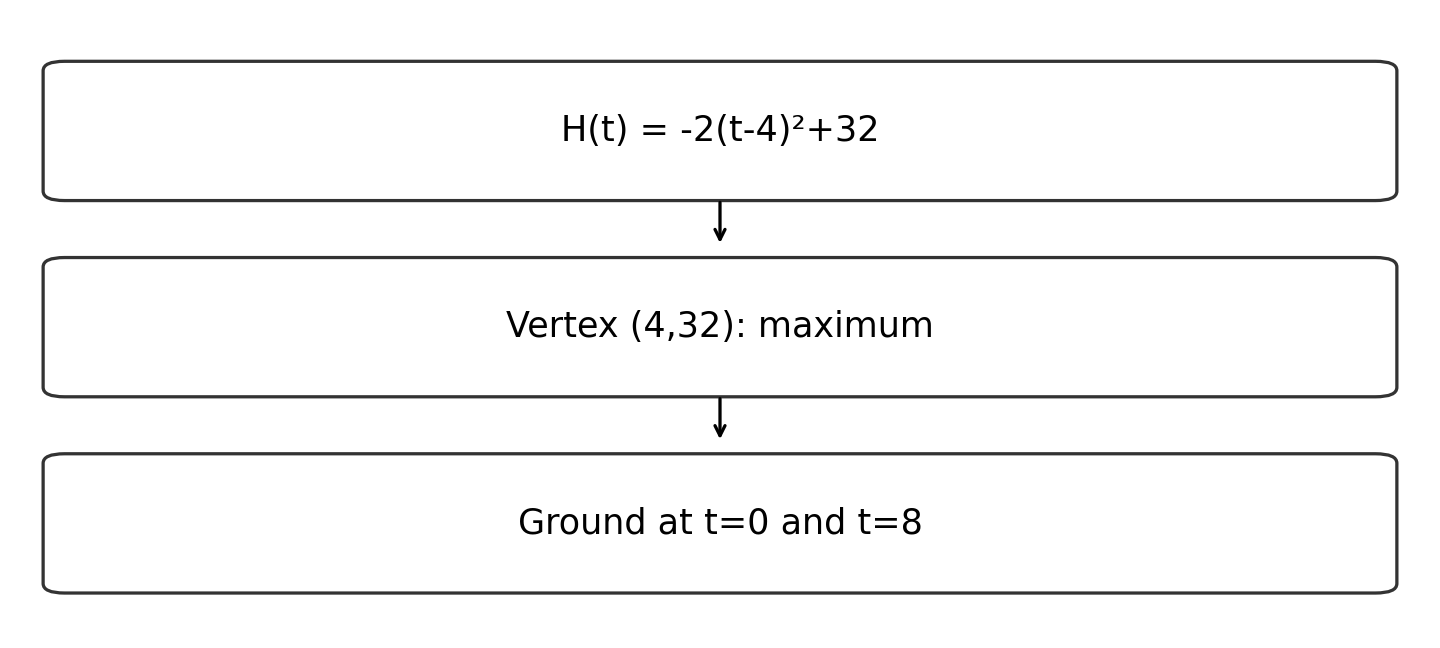
    Vertex form $a(x-h)^2+k$ reveals the turning point $(h,k)$. For $H(t)=-2(t-4)^2+32$, the maximum is 32 when $t=4$. Setting $H(t)=0$ gives $(t-4)^2=16$, hence $t=0,8$. Restrict time to the physical interval when the problem represents a flight.

    Original diagram of the worked relationship; read the full wording and qualifications.
    Original diagram of the worked relationship; read the full wording and qualifications.

    Existing worked example: h(t)=-4(t-3)²+36 has a maximum 36 at t=3, with zeros t=0 and 6. N(t)=80(1.25)^t starts at 80 and grows 25% per unit; N(2)=125. A quantity doubling every three hours is 80·2^(t/3), so after six hours it is 320. If f(x)=x², f(x-2)+5 has vertex (2,5).

    Complete original context

    Every transfer question states all data it needs.

    Independent practice and checked reasoning

    Transfer 1

    A model height is $H(t)=-3(t-2)^2+12$ metres, with $t$ seconds from launch until return to ground. Find the domain, greatest height, and time interval with height at least 9 metres.

    Reasoning: Ground means $H=0$, so $(t-2)^2=4$ and $t=0,4$. Domain is $0\le t\le4\,\mathrm{s}$. The negative square coefficient gives maximum $H(2)=12\,\mathrm{m}$. For $H\ge9\,\mathrm{m}$, $(t-2)^2\le1$, so $1\le t\le3\,\mathrm{s}$.

    Transfer 2

    A culture model starts with 120 cells and grows by a factor of 1.5 every two hours. Write $N(t)$ for hours $t$, find $N(4)$, and distinguish factor from percentage growth.

    Reasoning: $N(t)=120(1.5)^{t/2}$ cells. $N(4)=120(1.5)^2=270$ cells. The growth is 50% per two hours, not 150%; the four-hour factor is 2.25. The hourly factor would be $\sqrt{1.5}$.

    Transfer 3

    If $f(x)=(x+1)^2$, find the vertex of $g(x)=-2f(x-3)+5$ and its maximum or minimum.

    Reasoning: Substitute the input before interpreting signs. $g(x)=-2(x-2)^2+5$ has vertex $(2,5)$ and maximum 5. The old vertex at $-1$ moved three units right to 2.

    Limits and next use

    A 1.25 factor means 25% growth, not 125% growth; f(x-2) shifts right, and a repeated percentage uses the updated amount.

    All tasks here are public original practice with authored guidance. They are not official questions or fresh diagnostics. Existing protected tests and mocks remain separate.
    English 日本語
    transformation/trænsfɔːˈmeɪʃn/ 変換
    vertex form/ˈvɜːteks fɔːm/ 頂点式
    parabola/pəˈræbələ/ 放物線
    rate/reɪt/ 速度
  • 13

    PSDA-rates · Ratios, unit conversion and successive percentages

    学習プログラム 間もなく公開

    プリント

    English

    Scope and prerequisites

    Digital SAT framework; original paper practice is nonadaptive and gives no scaled-score prediction.

    • Use proportional relationships while preserving units
    • Convert rates and distinguish direct from inverse relationships
    • Calculate successive changes and percentage comparisons using the correct base

    Prerequisites: Fractions; unit conversion; percentage base.

    Explain and choose the method

    A ratio compares quantities in a chosen order. If red:blue=3:5 and the total is 64, the eight equal parts each contain eight, so red is 24 and blue 40. The ratio 3/5 describes red relative to blue; 3/8 describes red relative to the total. Read the requested denominator rather than using the first visible fraction.

    A unit rate 速率 单位率 divides quantity by its corresponding time, distance or count. Write conversion factors so unwanted units cancel: 72 km/hour times 1000 m/km divided by 3600 s/hour is 20 m/s. Area and volume conversions square and cube the length factor. A one-centimetre square is not one metre squared divided by one hundred.

    In direct proportion y=kx, doubling x doubles y; in inverse proportion xy=k, doubling x halves y. Constant work shared by identical workers gives an inverse time model only when productivity and conditions are fixed. A fixed initial fee added to a rate makes an affine linear model, not direct proportion through the origin.

    A percentage change divides the change by the original comparison base. Successive percentage changes multiply their factors: a 20% discount followed by 20% increase gives 0.8·1.2=0.96 of the original. Distinguish percentage points from relative percent: 30% to 36% is six points, but a 20% relative increase.

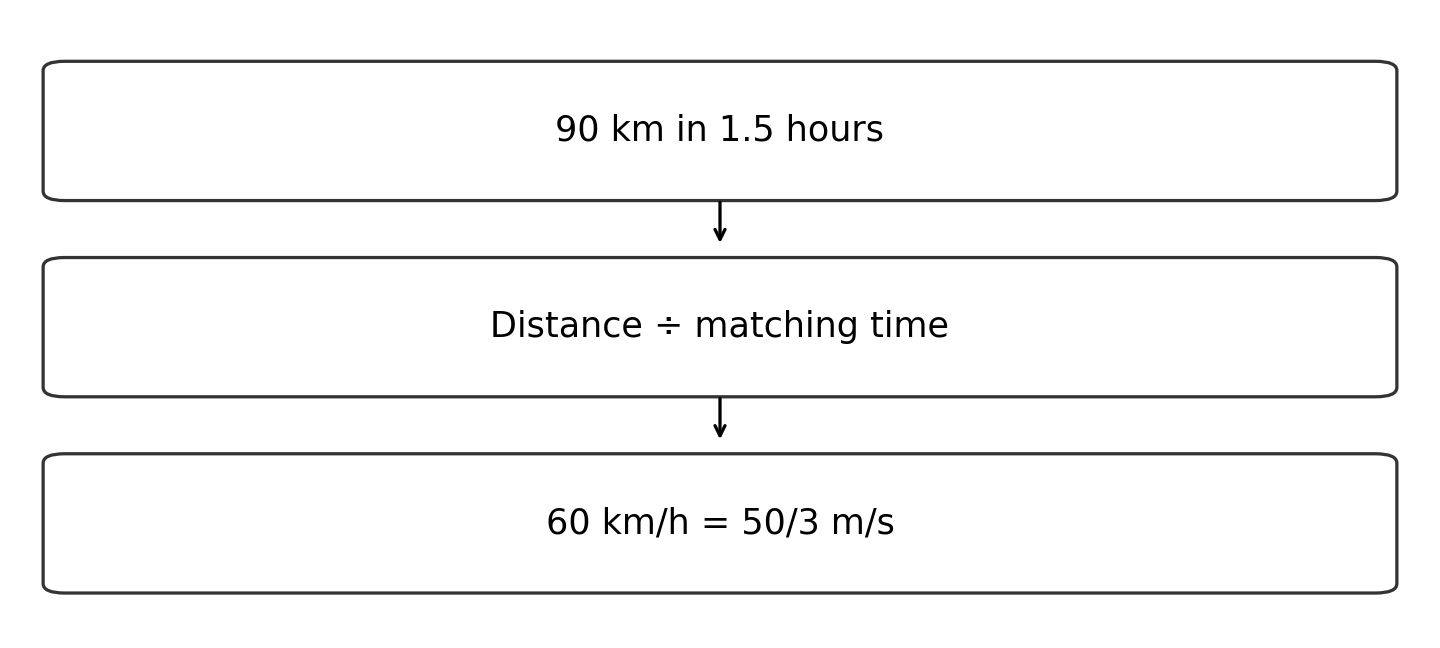
    A rate compares quantities with their units. $v=d/t=(90\,\mathrm{km})/(1.5\,\mathrm{h})=60\,\mathrm{km/h}$. Convert using cancelling units: $v=(60\,\mathrm{km/h})(1000\,\mathrm{m/km})/(3600\,\mathrm{s/h})=50/3\,\mathrm{m/s}$. Do not convert only the numerator of a compound rate.

    Original diagram of the worked relationship; read the full wording and qualifications.
    Original diagram of the worked relationship; read the full wording and qualifications.

    Existing worked example: A 250-unit price discounted 20% becomes 200; increasing that result 20% gives 240, four percent below 250. A pump delivers 18 litres in 3 minutes, so its rate is 6 L/min or 0.1 L/s. At a fixed rate, 45 litres takes 7.5 minutes. If a share rises from 40% to 50%, the rise is 10 percentage points and 25% relative to the old share.

    Complete original context

    Every transfer question states all data it needs.

    Independent practice and checked reasoning

    Transfer 1

    Mix red and blue paint in ratio 4:7 to make 33 litres. Find each amount. Red paint costs 18 yuan per litre and blue 12. Find total cost.

    Reasoning: There are 11 parts, so each is 3 L. Red volume $V_r=33(4/11)=12\,\mathrm{L}$; blue volume $V_b=33(7/11)=21\,\mathrm{L}$. Cost $C=p_rV_r+p_bV_b=(18\,\mathrm{yuan/L})(12\,\mathrm{L})+(12\,\mathrm{yuan/L})(21\,\mathrm{L})=468\,\mathrm{yuan}$.

    Transfer 2

    A 400-yuan item falls 15% then rises 10%. Find the final price and the single overall percentage change.

    Reasoning: Use successive multipliers. $P=P_0(1-0.15)(1+0.10)=(400\,\mathrm{yuan})(0.85)(1.10)=374\,\mathrm{yuan}$. Relative change $r=(P-P_0)/P_0=(374-400)/400=-0.065$, a 6.5% decrease.

    Transfer 3

    A pump supplies 0.15 litres per second. How long does 54 litres take? If a square has side 30 cm, give its area in square metres.

    Reasoning: $t=V/q=(54\,\mathrm{L})/(0.15\,\mathrm{L/s})=360\,\mathrm{s}=6\,\mathrm{min}$. Convert side before squaring: $A=s^2=(0.30\,\mathrm{m})^2=0.09\,\mathrm{m^2}$; the area conversion factor is 10000, not 100.

    Limits and next use

    State which amount is the percentage base and cancel units visibly. Equal positive and negative percentage changes use different bases.

    All tasks here are public original practice with authored guidance. They are not official questions or fresh diagnostics. Existing protected tests and mocks remain separate.
    English 日本語
    unit rate/ˈjuːnɪt reɪt/ 単位量あたりの値
    rate/reɪt/ 速度
  • 14

    PSDA-spread · Distributions, transformations and spread

    学習プログラム 間もなく公開

    プリント

    English

    Scope and prerequisites

    Digital SAT framework; original paper practice is nonadaptive and gives no scaled-score prediction.

    • Compare mean, median 中位数, range and standard deviation 标准差 qualitatively
    • Predict the effect of adding or multiplying every data value
    • Read frequency 频数 information without confusing values and counts

    Prerequisites: Ordered data; frequency; mean and median.

    Explain and choose the method

    The mean uses the sum of all observations divided by their count; the median is the middle of the ordered observations. Frequency means a value repeats: if 2 occurs three times and 8 once, the mean is (3·2+8)/4=3.5, not (2+8)/2. The horizontal positions on a display are values and the frequencies determine how many observations they represent.

    The range is maximum minus minimum; standard deviation describes typical distances from the mean. You need not memorise a full formula to compare simple equally centred distributions: data clustered close to the mean have smaller standard deviation than data moved further away symmetrically. An outlier can alter mean and spread substantially while leaving the median stable.

    Adding c to every observation raises both mean and median by c but leaves range and standard deviation unchanged, because pairwise distances do not change. Multiplying every observation by a positive k multiplies mean, median, range and standard deviation by k. More generally spread scales by |k|, while a negative multiplier reverses ordering.

    When comparing plots, inspect the scale and the number of observations before judging apparent width. A graph stretched horizontally can look more variable without representing different values. A claim about equality of standard deviations needs the actual distributions, not merely equal ranges or equal means.

    A frequency counts repeated observations. Values 1, 3, 7 with frequencies 2, 1, 1 represent four observations: 1, 1, 3, 7. $\bar x=\sum fx/\sum f=(2(1)+1(3)+1(7))/4=3$. The median is $(1+3)/2=2$; it need not equal the mean.

    Original worked example from existing native teaching; transfer tasks use their own data.
    Original worked example from existing native teaching; transfer tasks use their own data.

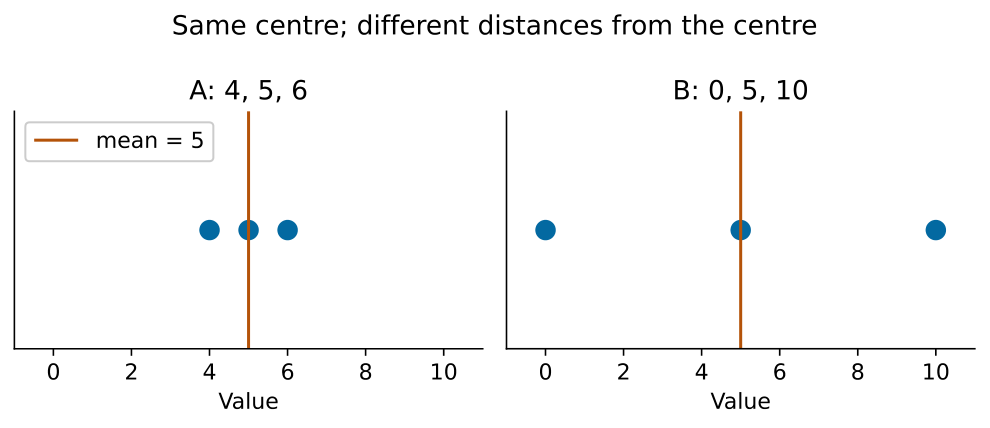
    Existing worked example: A={4,5,6} and B={0,5,10} both have mean and median 5, but B has greater spread. Adding 7 gives A+7={11,12,13}, mean 12 and the same standard deviation as A. Multiplying A by 2 gives {8,10,12}; its mean is 10 and its range and standard deviation double. Equal range alone does not guarantee equal standard deviation.

    Complete original context

    Every transfer question states all data it needs.

    Independent practice and checked reasoning

    Transfer 1

    Values 2, 5, 8 have frequencies 3, 2, 1. Find mean, median and range.

    Reasoning: Data are 2,2,2,5,5,8. $\bar x=(3(2)+2(5)+1(8))/6=4$. Median is the average of positions 3 and 4, $(2+5)/2=3.5$. Range $R=8-2=6$.

    Transfer 2

    Every observation above is changed by $z=3x-4$. Find the new mean, median and range. State how standard deviation changes without computing it.

    Reasoning: Mean $\bar z=3\bar x-4=3(4)-4=8$. Median is $3(3.5)-4=6.5$. Range is $3(6)=18$. Standard deviation triples; subtracting 4 changes no distance from the mean.

    Transfer 3

    Compare A = {0, 0, 10, 10} and B = {0, 5, 5, 10}. Both have range 10. Must their standard deviations agree? Justify.

    Reasoning: Both means are 5. Every A observation is 5 from its mean; B distances are 5,0,0,5. B therefore has smaller mean squared deviation and smaller standard deviation. Equal range alone is insufficient.

    Limits and next use

    Do not average distinct category labels when frequencies differ, or confuse a shifted distribution with a more spread-out one.

    All tasks here are public original practice with authored guidance. They are not official questions or fresh diagnostics. Existing protected tests and mocks remain separate.
    English 日本語
    standard deviation/ˈstændəd ˌdiːvɪˈeɪʃn/ 標準偏差
    frequency/ˈfriːkwənsi/ 頻度
    median/ˈmiːdiːən/ 中央値
  • 15

    PSDA-models · Scatterplots, model residuals and predictions

    学習プログラム 間もなく公開

    プリント

    English

    Scope and prerequisites

    Digital SAT framework; original paper practice is nonadaptive and gives no scaled-score prediction.

    • Interpret slope and intercept of a fitted model in context
    • Calculate a residual 残差 and distinguish interpolation from extrapolation 外推
    • Choose linear or exponential patterns from equal-step data

    Prerequisites: Linear functions; signed subtraction; scatterplot labels.

    Explain and choose the method

    A scatterplot pairs two quantitative variables, one point per paired observation. A fitted line summarises a trend rather than connecting each point. In a model y=a+bx, b predicts the change in y for one-unit increase in x; its units are y-units per x-unit. The intercept a predicts y when x=0, which may lie outside the data range.

    A residual is observed y minus predicted y. Positive means the observation lies above the model; negative means below. Substitute the observed x into the model before subtracting. A large residual marks a poor prediction for that point, not automatically an error in measurement or proof that the trend is absent.

    Interpolation predicts inside the observed x-range; extrapolation goes beyond it and needs stronger caution because the relationship may change. Use a model’s contextual domain as well as its algebraic form. A negative predicted travel time, for example, can reveal an unjustified extrapolation rather than a physically possible outcome.

    For equal input steps, nearly constant output differences suggest a linear model; nearly constant output ratios suggest an exponential model. Scatter can make either pattern approximate. Association does not identify a cause: both variables may reflect a third factor. A fitted trend is evidence 证据 about prediction, not by itself about intervention.

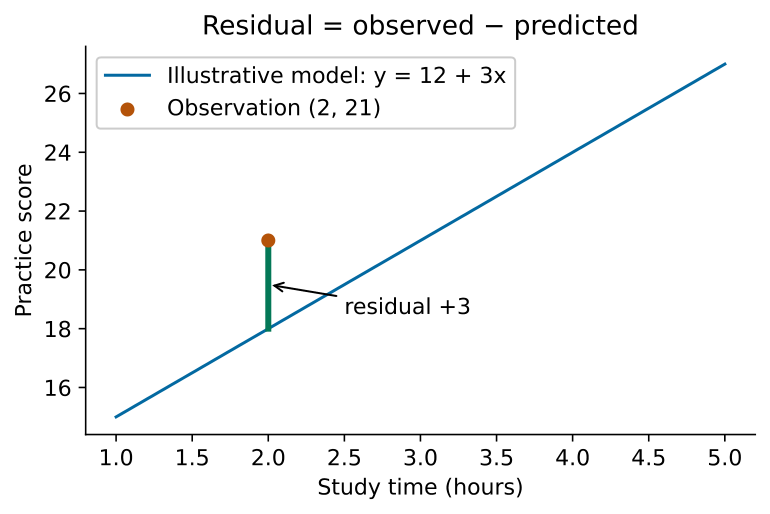
    A residual is observed minus predicted output. A journey model $T=5+2d$ uses minutes for $T$ and kilometres for $d$. $T(4)=5\,\mathrm{min}+(2\,\mathrm{min/km})(4\,\mathrm{km})=13\,\mathrm{min}$. For observed time 16 minutes, $e=T_{obs}-T_{pred}=16\,\mathrm{min}-13\,\mathrm{min}=3\,\mathrm{min}$.

    Original worked example from existing native teaching; transfer tasks use their own data.
    Original worked example from existing native teaching; transfer tasks use their own data.

    Existing worked example: For study time x hours and predicted practice score y=12+3x, the slope is 3 score points/hour. At x=2 the prediction is 18. If the observed score is 21, residual=21-18=3. With x-values observed from 1 to 5, predicting at x=3 interpolates and x=12 extrapolates. Outputs 5,10,20,40 at equal input steps suggest factor-two exponential growth.

    Complete original context

    Every transfer question states all data it needs.

    Independent practice and checked reasoning

    Transfer 1

    A fitted delivery model is $T=8+1.5d$ minutes for observed distances 2–10 km. Interpret both parameters. At 6 km the observed time is 15 minutes; find its residual.

    Reasoning: The intercept predicts 8 minutes at zero distance; zero lies outside the observed range, so this interpretation is extrapolated. The slope predicts an extra 1.5 minutes per kilometre. $T(6)=8\,\mathrm{min}+(1.5\,\mathrm{min/km})(6\,\mathrm{km})=17\,\mathrm{min}$. Residual $e=15\,\mathrm{min}-17\,\mathrm{min}=-2\,\mathrm{min}$, below the line.

    Transfer 2

    Predictions are requested at 7 km and 20 km. Classify each, and explain why a fitted slope does not prove distance alone causes all time variation.

    Reasoning: Seven is inside 2–10, so interpolation. Twenty is outside, so extrapolation with weaker support. Traffic, loading and other conditions can influence time; a fitted association does not isolate their effects.

    Transfer 3

    At equally spaced inputs 0,1,2,3, outputs are 6,18,54,162. Choose a simple linear or exponential rule and predict at 4, stating the assumption.

    Reasoning: Ratios are all 3, while differences vary. The exponential rule is $y=6(3)^x$. Under continued factor-three growth, $y(4)=6(3)^4=486$. This is a model-based extrapolation, not a guaranteed next observation.

    Limits and next use

    Keep observed minus predicted in that order. Do not turn a model slope into a causal treatment effect.

    All tasks here are public original practice with authored guidance. They are not official questions or fresh diagnostics. Existing protected tests and mocks remain separate.
    English 日本語
    extrapolation/ekˈstræpəleɪʃn/ 外挿
    residual/rɪˈsɪdʒuːəl/ 残差
    evidence/ˈevɪdəns/ 証拠
  • 16

    PSDA-conditional · Probability from a table and a restricted group

    学習プログラム 間もなく公開

    プリント

    English

    Scope and prerequisites

    Digital SAT framework; original paper practice is nonadaptive and gives no scaled-score prediction.

    • Calculate event and complement probabilities from counts
    • Use the conditioning group as the denominator
    • Distinguish independence from disjointness

    Prerequisites: Fractions; table totals; event and complement.

    Explain and choose the method

    A probability based on equally represented observations is favourable count divided by the relevant total. A two-way table has joint counts in cells, group totals on the margins and a grand total. Read whether the question asks about a joint event, either event or one event given another before choosing the denominator.

    For P(A given B), restrict attention to the B group and divide the A-and-B count by the B total. It is not generally equal to P(B given A), because the conditioning groups differ. A fraction with the correct numerator but the wrong population still answers the wrong question.

    The complement probability is 1-P(A). For either A or B, adding separate probabilities double-counts overlap, so subtract P(A and B). Disjoint events have no overlap; independent events 独立事件 satisfy P(A and B)=P(A)P(B). Two positive-probability disjoint events cannot be independent, since observing one rules out the other.

    For without-replacement draws, update both the remaining favourable count and total at each step. For independent repeated choices the probabilities multiply without that update. State the sampling assumptions before calculating. A table of observed relative frequencies supports empirical probabilities for that population, not a guarantee about every future draw.

    Conditional probability 条件概率 restricts the denominator. Of 40 club members, 12 cycle; 8 of those cyclists wear a helmet. $P(H\mid C)=n(H\cap C)/n(C)=8/12=2/3$. The group is cyclists, so 40 is not this denominator.

    Original worked example from existing native teaching; transfer tasks use their own data.
    Original worked example from existing native teaching; transfer tasks use their own data.

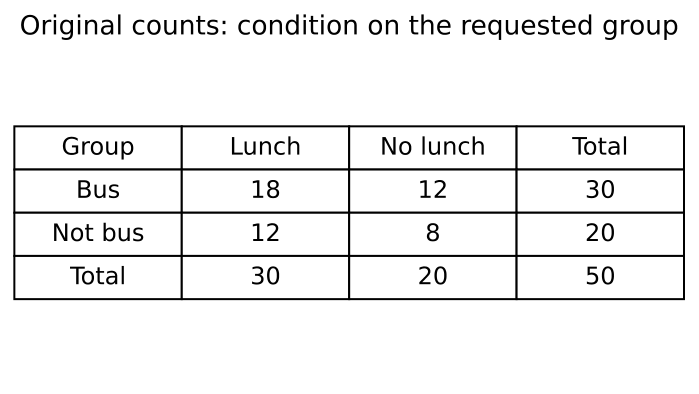
    Existing worked example: Original counts: bus users—18 carry a packed lunch, 12 do not; non-bus users—12 carry lunch, 8 do not. Total 50. P(lunch)=30/50=0.6; P(lunch given bus)=18/30=0.6; P(bus given lunch)=18/30=0.6 in this particular balanced table. Change one cell and these need not stay equal. P(bus and lunch)=18/50=0.36, equal here to 0.6·0.6, so the table shows independence of these categories.

    Complete original context

    Every transfer question states all data it needs.

    Independent practice and checked reasoning

    Transfer 1

    A survey records 12 tea drinkers and 8 non-tea drinkers among 20 cyclists; among 30 walkers it records 9 tea drinkers and 21 non-tea drinkers. Find $P(tea)$, $P(tea\mid cyclist)$ and $P(cyclist\mid tea)$.

    Reasoning: Total tea drinkers are 21 of 50, so $P(T)=21/50$. Within cyclists, $P(T\mid C)=12/20=3/5$. Within tea drinkers, $P(C\mid T)=12/21=4/7$. These different denominators make the conditional probabilities unequal.

    Transfer 2

    In the same survey, are tea drinking and cycling independent? Are they disjoint? Use numbers for both answers.

    Reasoning: They are not independent because $P(T\mid C)=3/5\ne21/50=P(T)$. They are not disjoint because 12 respondents do both: $P(T\cap C)=12/50>0$.

    Transfer 3

    One respondent is chosen uniformly. Find the probability of walking or drinking tea, including those who do both.

    Reasoning: Use inclusion–exclusion. $P(W\cup T)=(30+21-9)/50=42/50=21/25$. The 9 tea-drinking walkers must not be counted twice. Equivalently exclude the 8 cyclists who do not drink tea.

    Limits and next use

    Equal conditional answers in one table are coincidence or structure to check, not a universal rule. Condition first, then count.

    All tasks here are public original practice with authored guidance. They are not official questions or fresh diagnostics. Existing protected tests and mocks remain separate.
    English 日本語
    conditional probability/kənˈdɪʃənl ˌprɒbəˈbɪlɪti/ 条件付き確率
    independent events/ˌɪndɪˈpendənt ɪˈvents/ 独立事象
  • 17

    PSDA-inference · Sampling, margin of error and causal claims

    学習プログラム 間もなく公開

    プリント

    English

    Scope and prerequisites

    Digital SAT framework; original paper practice is nonadaptive and gives no scaled-score prediction.

    • Interpret a sample estimate and its stated margin of error 误差范围
    • Distinguish random sampling from random assignment 随机分组
    • Identify the population and causal scope supported by a study

    Prerequisites: Percentages; populations; random selection versus assignment.

    Explain and choose the method

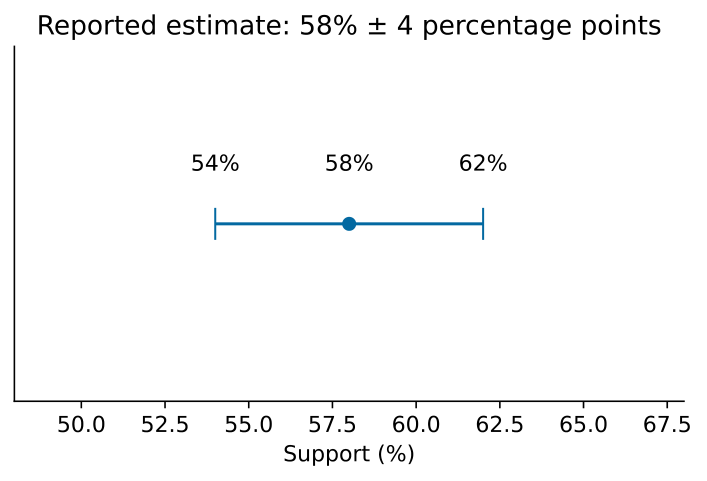
    A sample statistic estimates a population quantity. A reported estimate of 58% with margin of error 4 percentage points gives an interval from 54% to 62% under the stated procedure. It does not mean 58% of respondents answered with an error of four percent, nor does it guarantee that every individual sample contains the true value.

    A representative random sample helps generalise to the population from which it was drawn. Convenience or voluntary-response samples can be biased even when large. Increasing a well-designed sample generally reduces sampling variability and margin of error at the same confidence level, but cannot automatically cure a systematically excluded group.

    Random assignment distributes participants among treatment groups and supports causal inference 推断 by balancing competing factors on average. Random sampling selects who participates. A randomised experiment conducted only with volunteers may support a treatment effect for its participants without establishing that all people share the same effect.

    An observational study measures existing differences without assigning treatment; association can reflect confounding. A comparison of students who choose extra tutoring against those who do not may mix tutoring with motivation or prior attainment. To judge a claim, identify selection, assignment, comparison, measured outcome and the exact population before accepting causation or broad generalisation.

    A margin of error is added and subtracted in percentage points. Estimate 63% with margin 4 points gives 59%–67%. It is an interval from a procedure, not a guarantee that each person's response is near 63%. Random sampling supports population inference; random assignment addresses treatment comparisons.

    Original worked example from existing native teaching; transfer tasks use their own data.
    Original worked example from existing native teaching; transfer tasks use their own data.

    Existing worked example: A random sample of 400 school students yields 58% support ±4 percentage points: stated interval 54%–62%. This estimates the sampled school population, not all students worldwide. If volunteers are randomly assigned to two revision methods, a controlled outcome difference can support a causal comparison among participants; volunteer selection still limits wider generalisation.

    Complete original context

    Every transfer question states all data it needs.

    Independent practice and checked reasoning

    Transfer 1

    A random sample of 500 registered library members reports 62% support for a change, with stated margin 4 percentage points. State the interval and population. Does it establish support among every town resident?

    Reasoning: Interval is $62\%-4\%=58\%$ to $62\%+4\%=66\%$, where the subtraction denotes points. The population is registered members in the sampling frame. Nonmembers were not sampled, so the estimate does not establish all residents' support.

    Transfer 2

    Forty volunteers are randomly assigned to old or new instructions, with the same task and conditions. The new group finishes faster. What causal and population claims are reasonable?

    Reasoning: Random assignment supports a causal comparison of the instruction versions for these participants under the tested conditions, subject to variation. Volunteer selection limits population generalisation. It does not establish that every future user will finish faster.

    Transfer 3

    A poll of 10000 website volunteers has a narrow reported margin. Explain why size alone cannot repair selection bias, and propose a better recruitment method.

    Reasoning: People choosing to respond can differ systematically from those who do not. A margin for sampling variability does not remove that bias. Select randomly from the defined target population and follow up nonresponse; still report limitations.

    Limits and next use

    Sample size, random selection and random assignment are not interchangeable. A narrow margin does not remove selection bias.

    All tasks here are public original practice with authored guidance. They are not official questions or fresh diagnostics. Existing protected tests and mocks remain separate.
    English 日本語
    random assignment/ˈrændəm əˈsaɪnmənt/ 無作為割り当て
    margin of error/ˈmɑːdʒɪn ɒv ˈerə/ 誤差範囲
    inference/ˈɪnfərəns/ 推論
  • 18

    GT-scale · Scale factors, angle relationships and triangles

    学習プログラム 間もなく公開

    プリント

    English

    Scope and prerequisites

    Digital SAT framework; original paper practice is nonadaptive and gives no scaled-score prediction.

    • Apply length, area and volume scaling to similar figures
    • Use parallel-line angles and triangle sums to find unknowns
    • Distinguish similarity 相似 from congruence 全等 and adequate information

    Prerequisites: Triangle sum; Pythagoras; length/area/volume units.

    Explain and choose the method

    For similar figures with length scale k, corresponding lengths scale by k, areas by k² and volumes by k³. These laws apply when all corresponding dimensions change together. A cylinder with only radius doubled and fixed height has four times the volume, not eight times. State which dimensions are scaled before choosing the power.

    Use the correct geometric measure: triangle area is half base times perpendicular height 垂直高度; cylinder volume is base area times height. Surface area adds exposed faces, while volume measures enclosed space. A slant length is not automatically the perpendicular height required by an area formula. Attach square or cubic units to the result.

    Vertical angles are equal. For parallel lines cut by a transversal, corresponding and alternate interior angles are equal, and same-side interior angles sum to 180°. A triangle’s interior angles sum to 180°; its exterior angle equals the sum of the two remote interior angles. These rules depend on stated or marked parallelism, not the drawing’s appearance.

    Similar triangles share corresponding angles and proportional corresponding sides; congruent triangles also have equal corresponding lengths. Two angles establish similarity but not size equality. Maintain correspondence when writing a ratio. A side–side–angle arrangement does not universally guarantee congruence, whereas side–angle–side includes the angle between the two sides.

    A scale factor 比例因子 $k$ changes every corresponding length. $A_2=k^2A_1$ and $V_2=k^3V_1$ for similar shapes. If $k=3/2$ and $A_1=24\,\mathrm{cm^2}$, $A_2=(3/2)^2(24\,\mathrm{cm^2})=54\,\mathrm{cm^2}$. Changing only one dimension does not justify these similarity rules.

    Original worked example from existing native teaching; transfer tasks use their own data.
    Original worked example from existing native teaching; transfer tasks use their own data.

    Existing worked example: Two similar solids have edge ratio 2:3, so surface-area ratio is 4:9 and volume ratio 8:27. A triangular garden with base 12 m and perpendicular height 5 m has area 30 m². If a triangle has interior angles 48° and 67°, its third is 65° and the adjacent exterior angle is 115°=48°+67°.

    Complete original context

    Every transfer question states all data it needs.

    Independent practice and checked reasoning

    Transfer 1

    Similar containers have surface areas 96 and 216 square centimetres. The smaller volume is 160 cubic centimetres. Find the larger volume.

    Reasoning: $k=\sqrt{A_2/A_1}=\sqrt{216/96}=3/2$. Volume uses the cube: $V_2=k^3V_1=(3/2)^3(160\,\mathrm{cm^3})=540\,\mathrm{cm^3}$. Using area ratio directly would give the wrong volume.

    Transfer 2

    A right triangle has hypotenuse 13 cm and one leg 5 cm. Find the other leg, its area, and the sine of the angle opposite the 5 cm leg.

    Reasoning: $b=\sqrt{c^2-a^2}=\sqrt{(13\,\mathrm{cm})^2-(5\,\mathrm{cm})^2}=12\,\mathrm{cm}$. $A=ab/2=(5\,\mathrm{cm})(12\,\mathrm{cm})/2=30\,\mathrm{cm^2}$. $\sin\theta=a/c=(5\,\mathrm{cm})/(13\,\mathrm{cm})=5/13$.

    Transfer 3

    Two interior angles of a triangle are 42° and 73°. Find the third angle and its adjacent exterior angle. Would those angles alone determine all side lengths?

    Reasoning: Third angle is $180-42-73=65$ degrees. Its adjacent exterior angle is $180-65=115$ degrees, also $42+73$. Angles establish shape, not scale; similar triangles can have different side lengths.

    Transfer 4

    Two parallel lines are cut by a transversal. One corresponding angle is 68°. Find its matching corresponding angle and the adjacent angle on the second line. Explain which given condition justifies each step.

    Reasoning: Parallelism gives the matching corresponding angle 68°. The adjacent pair forms a straight angle, so the other is 180°−68°=112°. Equal corresponding angles require the stated parallel lines; the straight-angle sum uses adjacency on one line. A similar-looking sketch without parallelism would not justify the first equality.

    Limits and next use

    Use k² or k³ only when the entire shape is scaled; do not infer parallel lines or a perpendicular height from an unmarked sketch.

    All tasks here are public original practice with authored guidance. They are not official questions or fresh diagnostics. Existing protected tests and mocks remain separate.
    English 日本語
    perpendicular height/ˌpɜːpənˈdɪkjʊlə haɪt/ 垂直距離
    scale factor/skeɪl ˈfæktə/ スケール因子
    similarity/ˌsɪmɪˈlærɪti/ 類似性
    congruence/ˈkɒŋɡruːəns/ 合同
  • 19

    GT-circles · Circle equations, arcs and unit-circle trigonometry

    学習プログラム 間もなく公開

    プリント

    English

    Scope and prerequisites

    Digital SAT framework; original paper practice is nonadaptive and gives no scaled-score prediction.

    • Recover circle centre and radius by completing the square
    • Convert central angles and calculate arc length 弧长 and sector area
    • Use tangent 切线, inscribed-angle and unit-circle relationships

    Prerequisites: Complete the square; radius; radians; right-triangle ratios.

    Explain and choose the method

    A circle with centre (h,k) and radius r satisfies (x-h)²+(y-k)²=r². For an expanded equation, complete the square in x and y and add the balancing constants to the other side. The resulting right side must be positive for a real nondegenerate circle. Keep the radius distinct from its square.

    A central angle θ in radians gives arc length rθ and sector area r²θ/2. In degrees, use the fraction θ/360 of the full circumference or area. A full turn is 2π radians=360°. The formulas rθ and r²θ/2 require radians; inserting degrees without conversion gives a wrong scale.

    A tangent at a circle point is perpendicular to the radius there. An inscribed angle is half the central angle subtending the same arc; an angle subtending a diameter is a right angle. Identify the actual shared arc and centre before applying these statements. A chord is not a tangent and need not be perpendicular to a radius unless further conditions establish it.

    On the unit circle, a point at angle θ has coordinates (cos θ,sin θ), so cos²θ+sin²θ=1. Signs depend on quadrant. For acute complementary angles, sin θ=cos(90°-θ). Use special triangles for exact values: at 30° the sine is 1/2 and cosine √3/2; at 45° both are √2/2.

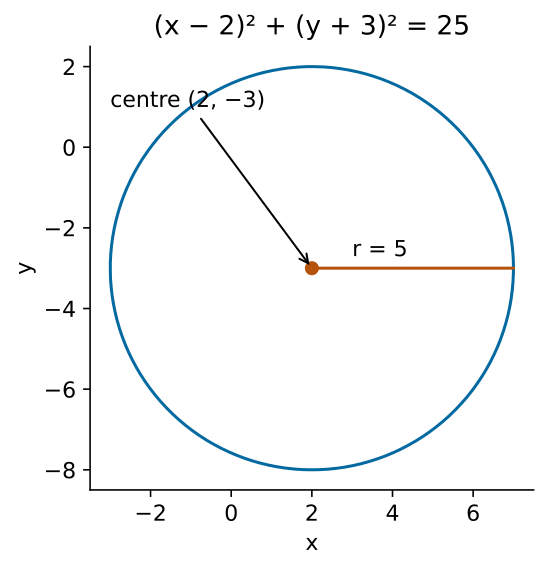
    Complete both squares in a circle equation 圆方程 . $x^2+y^2+6x-8y=0$ becomes $(x+3)^2+(y-4)^2=25$. The centre is $(-3,4)$ and radius is 5. Arc length is $s=r\theta$ only for radian 弧度 angle $\theta$.

    Original worked example from existing native teaching; transfer tasks use their own data.
    Original worked example from existing native teaching; transfer tasks use their own data.

    Existing worked example: x²+y²-4x+6y-12=0 becomes (x-2)²+(y+3)²=25, giving centre (2,-3), radius 5. For radius 6 and central angle π/3, arc length is 2π and sector area 6π. An inscribed angle on that same 60° arc is 30°. At 150°, cosine is -√3/2 and sine 1/2 because the point is in quadrant II.

    Complete original context

    Every transfer question states all data it needs.

    Independent practice and checked reasoning

    Transfer 1

    Find the centre and radius of $x^2+y^2-8x+2y+8=0$. Does $(7,-1)$ lie on it?

    Reasoning: Complete squares to get $(x-4)^2+(y+1)^2=9$. Centre $(4,-1)$, radius 3. Substitution of $(7,-1)$ gives $3^2+0^2=9$, so it is on the circle.

    Transfer 2

    A sector has radius 8 cm and angle 135°. Find its angle in radians, arc length and area. An inscribed angle elsewhere on the circle intercepts this same arc; find it.

    Reasoning: $\theta=135\pi/180=3\pi/4$ radians. $s=r\theta=(8\,\mathrm{cm})(3\pi/4)=6\pi\,\mathrm{cm}$. $A=r^2\theta/2=(8\,\mathrm{cm})^2(3\pi/4)/2=24\pi\,\mathrm{cm^2}$. The inscribed angle is half the central angle: 67.5 degrees.

    Transfer 3

    A unit-circle point is in quadrant III and has $y=-1/2$. Find its $x$-coordinate and one angle between 0° and 360°.

    Reasoning: $x^2+y^2=1$ gives $x^2=3/4$. Quadrant III requires $x<0$, so $x=-\sqrt3/2$. The point is at 210 degrees, with reference angle 30 degrees.

    Limits and next use

    Check degree/radian units, centre signs and whether an angle is central or inscribed before applying the formula.

    All tasks here are public original practice with authored guidance. They are not official questions or fresh diagnostics. Existing protected tests and mocks remain separate.
    English 日本語
    circle equation 円の方程式
    arc length/ɑːk leŋθ/ 弧長
    tangent/ˈtændʒənt/ 接線
    radian/ˈreɪdɪən/ ラジアン
  • 20

    RW-central · Central ideas, details and the scope of a claim

    学習プログラム 間もなく公開

    プリント

    対象範囲と前提条件

    デジタルSATの枠組み;オリジナルの紙ベース練習は非適応的であり、スケール得点の予測を与えない。

    • 本文の中心的主張とそれを裏付ける例を区別する
    • 明示された範囲を超えずに詳細を解釈する
    • 本文全体を網羅する正確な要約を選ぶ

    前提知識:段落の主題を特定する;明示された事実と推論を区別する。

    説明し、方法を選択する

    本文の支配的な関係性を読み取る:問題と反応、対比、説明、あるいは限定された主張。博物館所蔵品のようなトピックのラベルは主題を示すものの、著者がそれについて何を述べているかは示さない。選択肢を比較する前に、短い一文で主な点を述べる。

    裏付けの詳細はその主張を例示・説明・限定するものである。中心的な思想ではない尽管如此、記憶に残る場合がある。本文がアクセス改善の二つの例を提示する場合、単一の例についての要約では範囲が狭すぎる。一方のコレクションについて報告している場合、すべてのコレクションに関する結論では範囲が広すぎる。

    範囲と確実性を維持する。「Some(いくつか)」「may(かもしれない)」「in this study(本研究では)」は重要な制限条件である。正解は本文の用語を再利用できるが、主張を「可能」から「保証」へ変更することはできない。正解の主語、行動、および限定条件を、共有される単語の数だけでなく、本文に対して確認すること。

    質問が特定の詳細について問われている場合、中央の思想を習慣的に選ぶのではなく、その narrower なタスクに答える。関連する文を見つけて、周辺の文脈を読み、直接述べられていることと提案された理由を区別する。事前の知識は不要であり、欠けている証拠を提供してはならない。

    中心思想とは、本文全体を繋ぎ止めている関係のことである。 本文 reading:“修理カフェは当初ランプのみを受け付けていた。ボランティアが研修を受けた後、小型ファンも追加した。大型家電製品は専門店へ持ち込まれた。” 適切な要約は「カフェは制限的范围内で修理範囲を広げた」である。 「すべてを修理していた」は最後の文を無視している。「ランプを修理していた」は変化を省略している。

     worked example の関係図(原文);完全な文章と限定事項をお読みください。
    worked example の関係図(原文);完全な文章と限定事項をお読みください。

    既存の解例:原文「町立アーカイブは、最も頻繁に要求される地図から順にデジタル化した。研究者らは遠隔でそれらの地図を検査でき、脆弱な原本の繰り返し取り扱いを減らせた。スタッフは、まだスキャンされていない項目に対して監督付きのアクセスを提供し続けた。」 中心思想:限定的なデジタル化によりアクセスと保護が向上したが、物理的なアクセスは継続された。「すべての地図がオンラインで利用可能になった」は範囲を過大評価している;「アーカイブは訪問を終了した」は最終の文と矛盾する。

    元の文脈を完成させる

    原文:市史料館は、読者がオンライン索引を使って手書きの運送登録帳を検索できる試験を開始した。ボランティアが名前と日付を入力し、スタッフは読み取りにくい記入内容を確認した。索引はしばしば研究者が史料館を訪れる前に、妥当なページを特定する助けとなった。しかし、索引は登録帳の画像を完全に代替するものではなかった。同じ名前を持つ二人の人物を区別するには、周囲の記入内容を読む必要があったためである。そのため、スタッフは索引を「記録への入り口」として、すべての質問に対する最終的な答えではないと説明した。また、研究者が索引の変更内容を確認できるよう、修正された記入内容の公開リストも維持していた。

    Independent practice and checked reasoning

    Transfer 1

    中心思想を一文で述べよ。利益と限界の両方を保持すること。

    推論:確認済みの索引は研究者に関連する記録を見つけるのを助けるが、特定の区別を行うためには、元の登録帳を参照することが引き続き必要である。これにより、検索の利点と同名の制約をカバーしつつ、完全な正確性を主張しない。

    Transfer 2

    なぜ登録帳の画像が必要なのかを説明している詳細はどれか?修正リストの目的との区別を明確にせよ。

    推論:同じ名前を持つ人々は、登録帳の周辺の記入内容を用いて区別する必要がある。修正リストは変更点を可視化するものであり、個人を特定するものではない。

    Transfer 3

    具体的な証拠を用いて、提案された各要約を却下せ。「A ボランティアがスタッフを交代した」「B 索引により史料館訪問が不要になった」「C 史料館は索引の変更を隠した」。

    推論:A は staff が読み取りにくい記入内容を確認したという記述と矛盾する。B は「often(しばしば)」を過大評価しており、元の記録を参照する必要性を無視している。本文は全訪問が代替されることを示していない。C は公開された修正リストと矛盾する。いずれも明示された範囲を保持していない。

    Limits and next use

    正確な詳細でも、主たる結論の回答としては誤りであることがあります。本文がより限定的な主張をしている箇所で、「すべて」「常に」「唯一」などの表現に注意してください。

    All tasks here are public original practice with authored guidance. They are not official questions or fresh diagnostics. Existing protected tests and mocks remain separate.
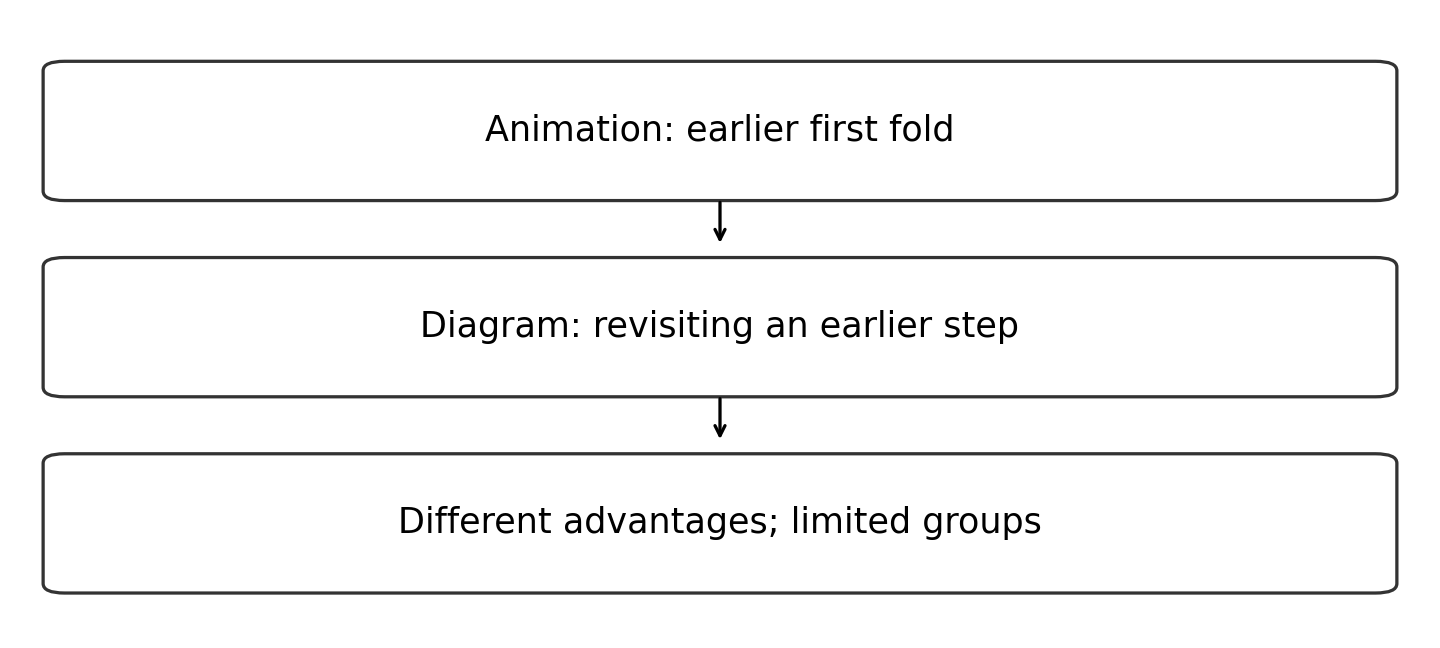
    English 日本語
    central idea/ˈsentrəl aɪˈdɪə/ 中心思想
    inference/ˈɪnfərəns/ 推論
    evidence/ˈevɪdəns/ 証拠
    detail/ˈdiːteɪl/ 詳細
    scope/skəʊp/ 範囲
  • 21

    RW-evidence · Choose evidence for a precise textual or numerical claim

    学習プログラム 間もなく公開

    プリント

    English

    Scope and prerequisites

    Digital SAT framework; original paper practice is nonadaptive and gives no scaled-score prediction.

    • Choose a detail 细节 that directly supports or challenges a stated claim
    • Use a table’s labels, quantities and comparison base 比较基准 correctly
    • Separate relevance 相关性 from evidence 证据 that discriminates between explanations

    Prerequisites: Read table headings; compare proportions and counts.

    Explain and choose the method

    First translate the target claim into an evidence requirement. A claim that repeated practice helps retention needs information about retention under differing practice conditions, not simply a statement that learners enjoyed the activity. An interesting related fact may fail to support the specific relationship asserted.

    For textual evidence, identify whose claim is being tested and whether the task asks for support, challenge or completion. A quotation with familiar nouns is not enough. Ask what would become more credible or less credible if that detail were true, while preserving the passage’s actual degree of certainty.

    For quantitative evidence, read title, axes or headers, units and groups before calculating. Use before/after differences when the claim concerns improvement, final values when it concerns outcomes and proportions when group sizes differ. A larger count can represent a smaller share in a larger group.

    A numerical pattern may support a descriptive comparison without proving why it occurred. If no random assignment or controlled causal evidence is stated, avoid a causal conclusion. The original table in this lesson is a hypothetical teaching dataset, not a published study; its purpose is to practise reading the relationship.

    Evidence must support the exact claim, including its comparison base. If 9 of 15 tasks succeed, $p=n_{success}/n_{total}=9/15=60\%$. A group with more successes may still have a lower success rate 速率. Before/after data describe changes; without controlled assignment they do not prove a cause.

    Original worked example from existing native teaching; transfer tasks use their own data.
    Original worked example from existing native teaching; transfer tasks use their own data.

    Existing worked example: Original hypothetical table: Group A has 20 learners, 12 correct before and 16 after; Group B has 40 learners, 24 correct before and 28 after. Both gain four correct responses, but A’s correct share rises from 60% to 80% (20 points), while B rises from 60% to 70% (10 points). This supports “A had the larger percentage-point improvement”, not “A had more correct final responses” or a causal claim about the method.

    Complete original context

    Original hypothetical study: Two groups used a revised catalogue for a second search session. No random assignment is reported. Group P had 30 users, with 12 successful searches before and 21 after. Group Q had 50 users, with 30 successful searches before and 35 after. Each user completed one search in each session. The researchers claimed that P showed the larger percentage-point improvement, while Q still had more successful searches in the second session. A separate comment said the revision must have caused every improvement.

    Independent practice and checked reasoning

    Transfer 1

    Give the before and after success percentages and percentage-point changes for both groups.

    Reasoning: $p_P=12/30=40\%$ before and $21/30=70\%$ after, a 30-point increase. $p_Q=30/50=60\%$ before and $35/50=70\%$ after, a 10-point increase. P has the larger change; both final rates are equal.

    Transfer 2

    Which claim is supported by 35 compared with 21, and which is supported by 30 points compared with 10 points?

    Reasoning: The final counts support Q having more second-session successes. The percentage-point changes support P improving more. Exchanging those pieces of evidence would confuse final outcome with change and counts with proportions.

    Transfer 3

    Explain why the causal comment is too strong. Give one additional observation that would help investigate an alternative explanation.

    Reasoning: Session order, practice or different tasks could contribute; no randomised comparison is described. A control group using the original catalogue in both sessions under otherwise matched conditions could estimate practice effects. It would help test causation, not automatically prove that every user's improvement has one cause.

    Limits and next use

    Use the quantity named by the claim. Raw counts, relative percentages and percentage-point changes answer different questions.

    All tasks here are public original practice with authored guidance. They are not official questions or fresh diagnostics. Existing protected tests and mocks remain separate.
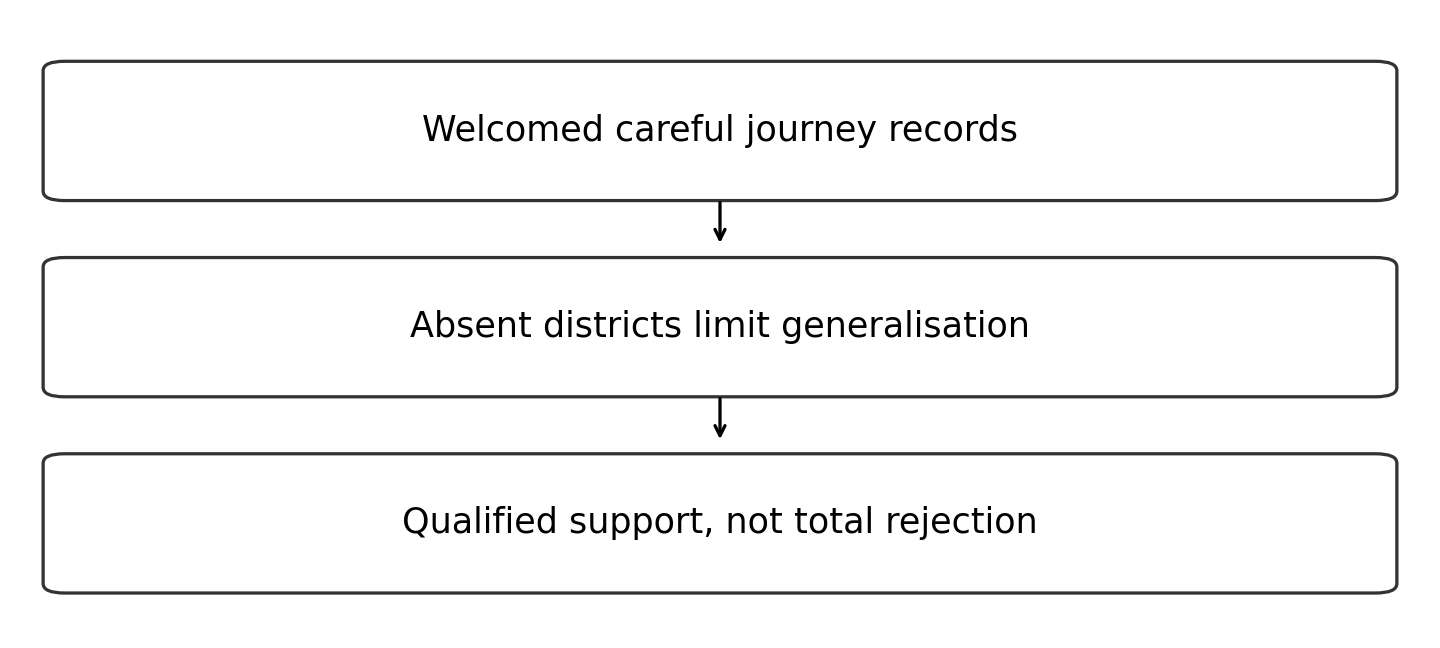
    English 日本語
    comparison base/kəmˈpærɪsn beɪs/ 比較基準
    relevance/ˈrelɪvəns/ 関連性
    evidence/ˈevɪdəns/ 証拠
    detail/ˈdiːteɪl/ 詳細
    rate/reɪt/ 速度
  • 22

    RW-inferences · Complete a passage with a warranted inference

    学習プログラム 間もなく公開

    プリント

    対象範囲と前提条件

    デジタルSATの枠組み;オリジナルの紙ベース練習は非適応的であり、スケール得点の予測を与えない。

    • 明記された事実を統合して、根拠のある結論を導き出す
    • 必要十分な支持と、妥当な外部の代替説明を区別する
    • 不確実性を保持し、因果関係の過大評価を避ける

    前提条件: contrasting(対比)を追跡する;不確実性と範囲を保持する。

    説明し、方法を選択する

    明記された事実と、そこから推論すべき接続部分を分離せよ。2つの観察が対比を形成している場合、結論はその対比を維持すべきである。選択肢を読む前に、証拠を繋ぐ短い橋渡し文を記す。これにより、魅力的だが関連のない説明を検出しやすくなる。

    推論は原文をそのまま写す必要はないが、各重要なステップには根拠が必要である。あるツールが別のツールでは見逃された特徴を検知するという記述は、検出における違いを裏付けるものであり、第一のツールがあらゆる目的において優れていることを意味しない。専門知識は、明記されていない要件を満たすことはできない。

    修飾語や代替説明を追跡する。パターンは可能性を示唆するものであり、確実性を確立するものではない。本文が複数の可能な原因を認めている場合、特定の1つの原因のみを独占的に非難する完成形は過度に強い。選択肢が新しい人物、場面、動機、または時期を導入していないか確認せよ。

    短い本文の末尾にある結論については、論理的転換を確認せよ。「therefore」は帰結を要求し、「however」は制限引入することが多い。文法的に滑らかな継続でも、論理的に unsupported(根拠がない)である可能性がある。最も unsupported な仮定を要しながらも、タスクを完全に回答できる選択肢を優先せよ。

    正当な推論は、提供された事実を結びつけ、そこに原因を割り当てることない。 "短いラベルは初心者に役立ち、専門家は詳細なラベルを好む"は、読者の経験度に応じた利点を裏付けている。 "短いラベルは常に最善である"や「専門家は博物館を嫌がる」という主張を裏付けない。

     worked example の関係図(原文);完全な文章と限定事項をお読みください。
    worked example の関係図(原文);完全な文章と限定事項をお読みください。

    既成の worked example: 原文:「2つのセンサーが同一の橋を監視した。センサーAはセンサーBが検出できなかった短時間の振動を記録したが、センサーBはAが記録を停止した低温期間中も正常に動作した。」 正当な結論:観測された条件下で、両センサーには相補的な強みがあった。いずれかが普遍的により正確である、あるいは温度が検出におけるすべての差の原因であったとは限らない。

    元の文脈を完成させる

    原文:あるワークショップでは、印刷図面と折りのプロセスのアニメーションデモを提供した。アニメーションを用いた参加者は平均して最初の折り始めが早かった。しかし、後にミス修正を依頼された際、図面を用いた参加者の方が的帮助なしに正しい初期段階に戻ることが多かった。グループは小さく、主催者は参加者の経験が均等であったかを報告していない。彼らは、教具の選択にはタスクのフェーズを考慮すべきだと結論づけた。

    Independent practice and checked reasoning

    Transfer 1

    2つの教具に関する正当な推論に基づいて結論を完成させよ。

    推論:アニメーションは開始を助ける可能被れ、図面は修正時に初期段階を振り返るのを助ける可能被れる。 evidence(証拠)は、小さく不均等だった可能性のあるグループによって限定された、異なる観察上の利点支持力度がある。

    Transfer 2

    "アニメーションはミスを防止する"および「図面は開始には役に立たない」がともに unsupported(根拠がない)である理由を説明せよ。

    推論:本研究はミスの欠如ではなく、修正の性能を報告している。アニメーションで開始が早いことは、図面利用者が開始できないことを意味しない。両方の主張は相対的な観察を絶対的な声明に置き換えている。

    Transfer 3

    既往の経験と同等の修正率を見出す新たな研究が存在する。最初の観察が捏造であったと主張することなく、これが以前の結論にどう影響するかを説明せよ。

    推論:図表による修正の優位性に関する一般的な主張を弱め、経験が初期の差異の可能な説明である可能性を指摘する。異なるサンプルや手法は異なる結果をもたらすことがあり、最初の観察自体を誤りとするものではない。

    Limits and next use

    観察された共起を唯一の原因と見なしたり、限定的な比較を普遍的な優位性と拡大してはいない。

    All tasks here are public original practice with authored guidance. They are not official questions or fresh diagnostics. Existing protected tests and mocks remain separate.
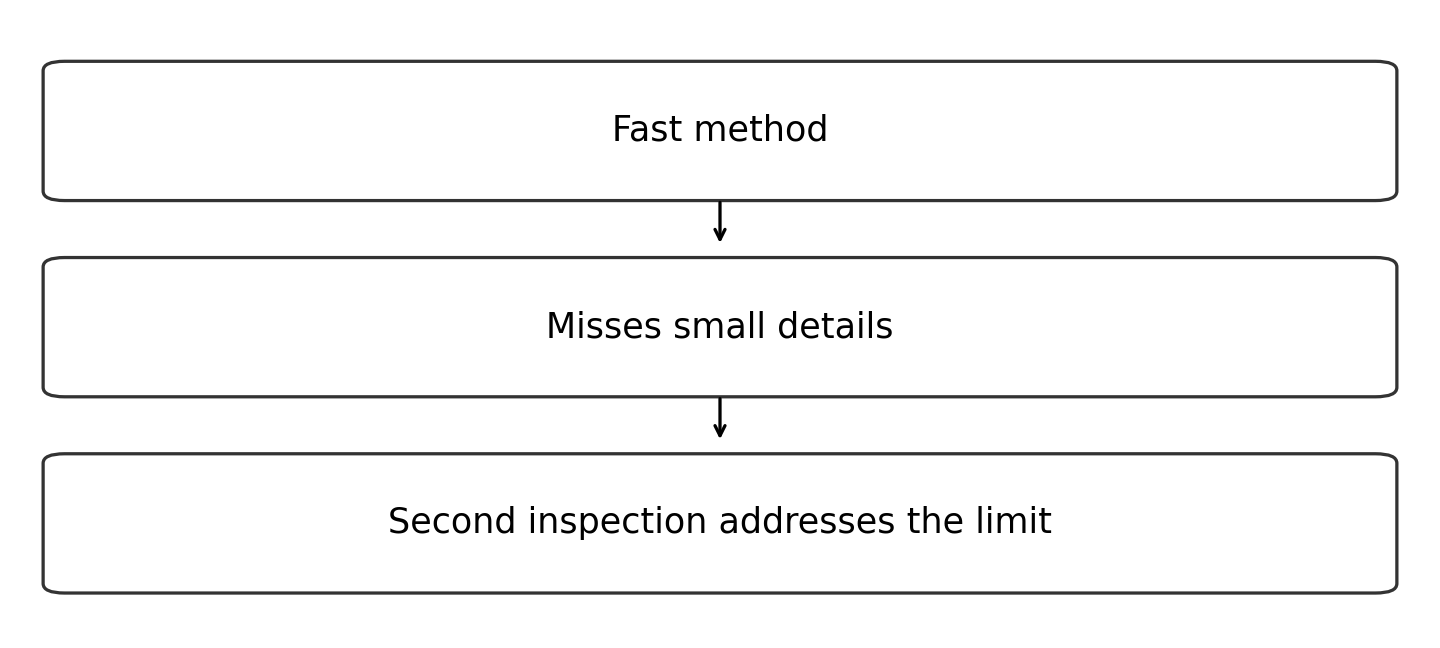
    English 日本語
    warranted inference/ˈwɒrəntɪd ˈɪnfərəns/ 妥当な推論
    transition/trænˈsɪʃn/ 接続詞
    inference/ˈɪnfərəns/ 推論
    evidence/ˈevɪdəns/ 証拠
  • 23

    RW-words · Words in context: meaning, polarity and collocation

    学習プログラム 間もなく公開

    プリント

    English

    Scope and prerequisites

    Digital SAT framework; original paper practice is nonadaptive and gives no scaled-score prediction.

    • Infer a word’s intended meaning from its sentence and nearby logic
    • Use contrast and explanation to determine a missing word
    • Choose a word fitting syntax 句法, degree and collocation 词语搭配

    Prerequisites: Sentence meaning; contrast and explanation clues.

    Explain and choose the method

    A familiar word may have several senses. Substitute a simple paraphrase into the sentence and test whether it preserves the relationship. Context, rather than the first dictionary meaning, determines whether check means inspect, restrain or mark a response.

    For a blank, decide the needed meaning and polarity before looking at choices. A contrast introduced by but may reverse an expectation; an explanation after because can narrow the intended sense. If the sentence says evidence 证据 is promising yet incomplete, a word meaning cautious or provisional is more plausible than certain.

    Check grammatical fit and collocation as well as meaning. A verb must work with its object and complement; an adjective must modify the intended noun. A near synonym can fail if it implies a stronger degree, a different subject or a relationship the passage does not establish.

    Avoid treating difficult vocabulary as a contest to choose the most impressive word. Use a neutral paraphrase, eliminate options of the wrong polarity and then compare remaining shades of meaning. Keep a record of words learned in their full phrase, because context and typical combinations help later retrieval.

    A word in context 语境中的词义 must fit the relationship, not just a dictionary entry. In “The evidence is thin, so the conclusion remains provisional”, provisional means open to revision. It does not mean temporary employment or physical thinness. Paraphrase before choosing.

    Original diagram of the worked relationship; read the full wording and qualifications.
    Original diagram of the worked relationship; read the full wording and qualifications.

    Existing worked example: Original sentence: “The committee gave the proposal 提案 qualified support: members approved its aim but requested a smaller trial before expansion.” Here qualified means limited or conditional, not certified or skilled. Original blank: “Because the observations were few, the author described the conclusion as ___ rather than definitive.” Provisional fits the explicit contrast with definitive.

    Complete original context

    Original passage: The reviewers welcomed the survey's careful record of individual journeys, but they gave its city-wide conclusions only qualified support. The routes had been chosen for convenience, and several districts were absent. One reviewer called the record illuminating: it made previously overlooked travel difficulties easier to understand. Another cautioned that extending the conclusions would require a broader sample. The authors accepted this reservation and proposed a second survey.

    Independent practice and checked reasoning

    Transfer 1

    Explain qualified, illuminating and reservation in this passage. Quote a clue for each.

    Reasoning: Qualified means limited or conditional, supported by absent districts and a need for broader sampling. Illuminating means revealing or clarifying, supported by difficulties becoming easier to understand. Reservation means a concern or limitation, supported by caution about extending conclusions; it is not a booked seat.

    Transfer 2

    Compare “The reviewers dismissed the survey” with “The reviewers endorsed its conclusions without reservation”. Why does neither fit?

    Reasoning: Dismissed ignores their welcome for its careful records. Endorsed without reservation erases the sampling concern. The attitude combines appreciation of the records with limited support for broader conclusions.

    Transfer 3

    Replace illuminating with revealing, dazzling or visible. Which best preserves meaning and why do the others fail here?

    Reasoning: Revealing preserves the idea that the record makes difficulties understood. Dazzling introduces brilliance or admiration beyond the stated clarification. Visible describes perceptibility, not the survey's explanatory contribution. This is a contextual meaning 语境义 decision, not a rule that those words are always wrong.

    Limits and next use

    A recognisable synonym may still carry the wrong strength or grammatical use. Do not ignore the explanation after the colon 冒号.

    All tasks here are public original practice with authored guidance. They are not official questions or fresh diagnostics. Existing protected tests and mocks remain separate.
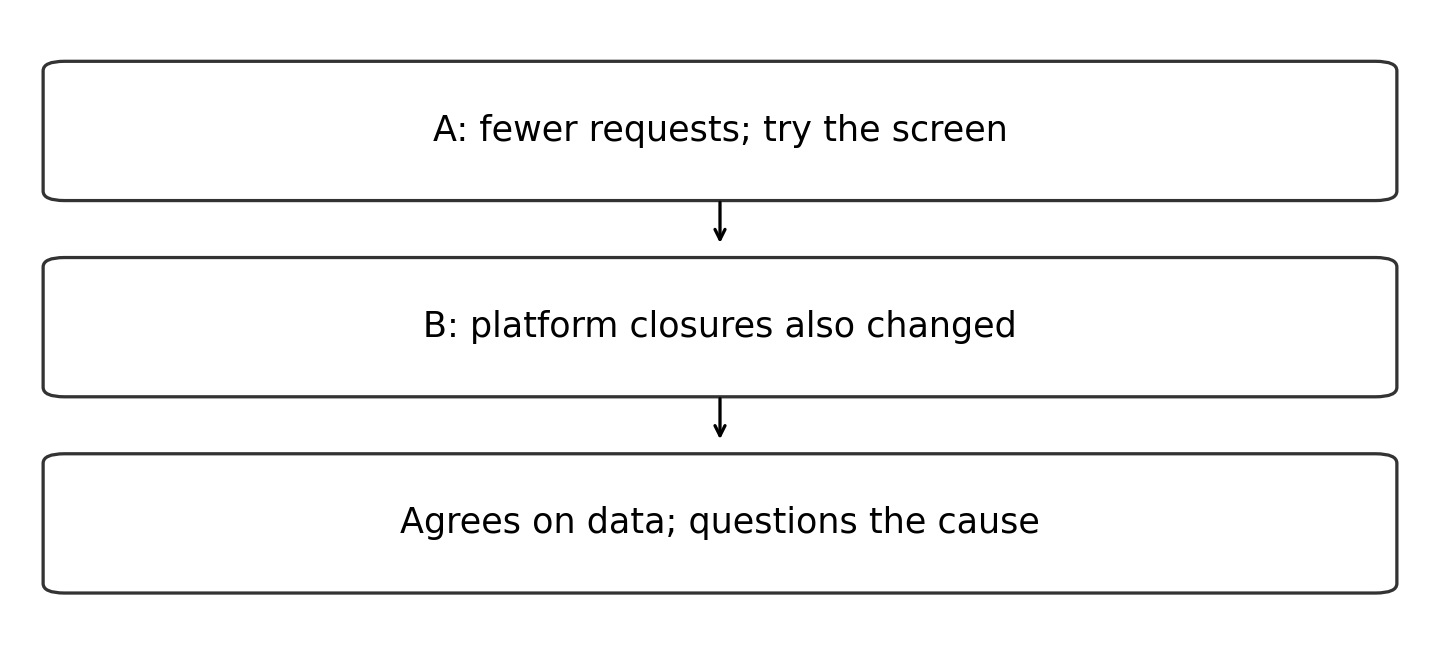
    English 日本語
    contextual meaning/kənˈtekstʃuːəl ˈmiːnɪŋ/ 文脈的意味
    word in context 文脈における語義
    collocation/ˌkɒləˈkeɪʃn/ 語の組み合わせ
    evidence/ˈevɪdəns/ 証拠
    proposal/prəˈpəʊzl/ 提案
    syntax/ˈsɪntæks/ 句法
    colon/ˈkəʊlən/ コロン
  • 24

    RW-structure · Text structure, sentence function and rhetorical purpose

    学習プログラム 間もなく公開

    プリント

    対象範囲と前提条件

    デジタルSATの枠組み;オリジナルの紙ベース練習は非適応的であり、スケール得点の予測を与えない。

    • 文章が中心的なポイントをどのように展開しているかを特定する
    • 文が大きな議論の中で果たす役割を説明する
    • テキストの目的と対象内容を区別する

    前提条件:問題–応答の流れに従う;報告された意見を区別する。

    説明し、方法を選択する

    各部分を動作で要約する:問題を提起する、アプローチを説明する、証拠を示す、あるいは限界を指摘する。順序付けられた動作は、単なる対象名词のリストよりも構造をより正確に記述する。背景から主張へ、あるいは主張から限定へへと著者が移動する転換点を探す。

    指定された文の機能については、その前後の内容を比較する。前の期待と矛盾し、次の文がその驚きを説明する場合、その役割は「予期せぬ結果を導入すること」である可能性がある。最後に位置するからといって、必ずしも著者の結論とは限らない。

    目的とは、著者が情報について何を行おうとしているかを示す:区別を説明する、仮定に挑戦する、方法を評価する、あるいは応答を記述する。単に対象を名指すオプションは不完全である。読者への行動を促すと述べるオプションは、実際の擁護が必要であり、単なる記述だけでは不十分である。

    著者が提示する異論と、著者が支持する意見とを区別する。報告された主張、例、仮想的な状況は、議論に寄与しても著者の最終立場となるわけではない。本文の用語や関係マーカーを使用して役割を割り当てること。好む論証構造を押し付けるのではなく。

    文の機能とは、文がその文脈の中で何を行うかを示す。 「この機械は速かった。薄板を破損させた。チームはより優しい設定を追加した。」 中央の文は利点を制限し、応答を促す。単に「薄板について」と呼ぶのは、対象を名指すだけであり、機能ではない。

     worked example の関係図(原文);完全な文章と限定事項をお読みください。
    worked example の関係図(原文);完全な文章と限定事項をお読みください。

    既存の演習例:原文:「 catalogs はかつて、これらの物体が作られた素材に基づいて分類していた。このアプローチでは、異なる用途を持つ道具を一緒に置いた。そのため、改訂版の catalogs には各エントリに機能ラベルを追加した。」構造:既存のアプローチを説明し、その限界を指摘し、対応策を説明する。中央の文は改訂を促す限界を提供しており、素材が重要でないとは主張していない。

    元の文脈を完成させる

    原文:「初期の歩行マップでは、すべてのルートに同じ実線が記されていた。これはマップをシンプルに保ったが、歩行者はルートに階段が含まれているかどうかを判断できなかった。一部のデザイナーは、すべての階段の隣に書き込みを追加することを提案した。しかし、試行では階段のないルートに固有の線のパターンを使用し、それを明確な凡例で説明した。試行中、歩行者はこれらのルートをより正確に識別できたが、一部の読者は凡例に気づくために助けを必要とした。デザイナーはパターンを維持し、凡例をより目立つようにした。

    Independent practice and checked reasoning

    Transfer 1

    行動を用いて全体構造を記述せよ(ToList形式ではなく)。

    推論:本文は、過去のデザインを紹介し、アクセスの問題を特定し、一つの提案と、異なる検証された対応策を報告し、試行の成功を限定し、改善点を記述している。

    Transfer 2

    「ただし、一部の読者は凡例に気づくために助けを必要とした」という部分はどのような役割を果たしているか?なぜこれが試行全体の失敗の証拠ではないのか?

    推論:残存する障壁を特定することで、精度の向上を限定している。試行は依然としてより正確な識別を報告しているため、「完全な失敗」と解釈することは明記された改善内容と矛盾する。

    Transfer 3

    筆者は、すべての階段の隣に書き込みを追加することを支持しているか?提案を報告することと、維持されたデザインを記述することの違いを説明せよ。

    推論:書き込みは報告された提案であり、検証・維持されたデザインではない。維持されたアプローチは、凡例をより目立つようにした線のパターンである。最終的な推奨事項として筆者に提案を帰属させることは、異なる段階を混同することになる。

    Limits and next use

    文が何を扱っているかと、文が何を行うかを混同したり、テキストの根拠なしに説明された方法を推奨事項に変換してはいけない。

    All tasks here are public original practice with authored guidance. They are not official questions or fresh diagnostics. Existing protected tests and mocks remain separate.
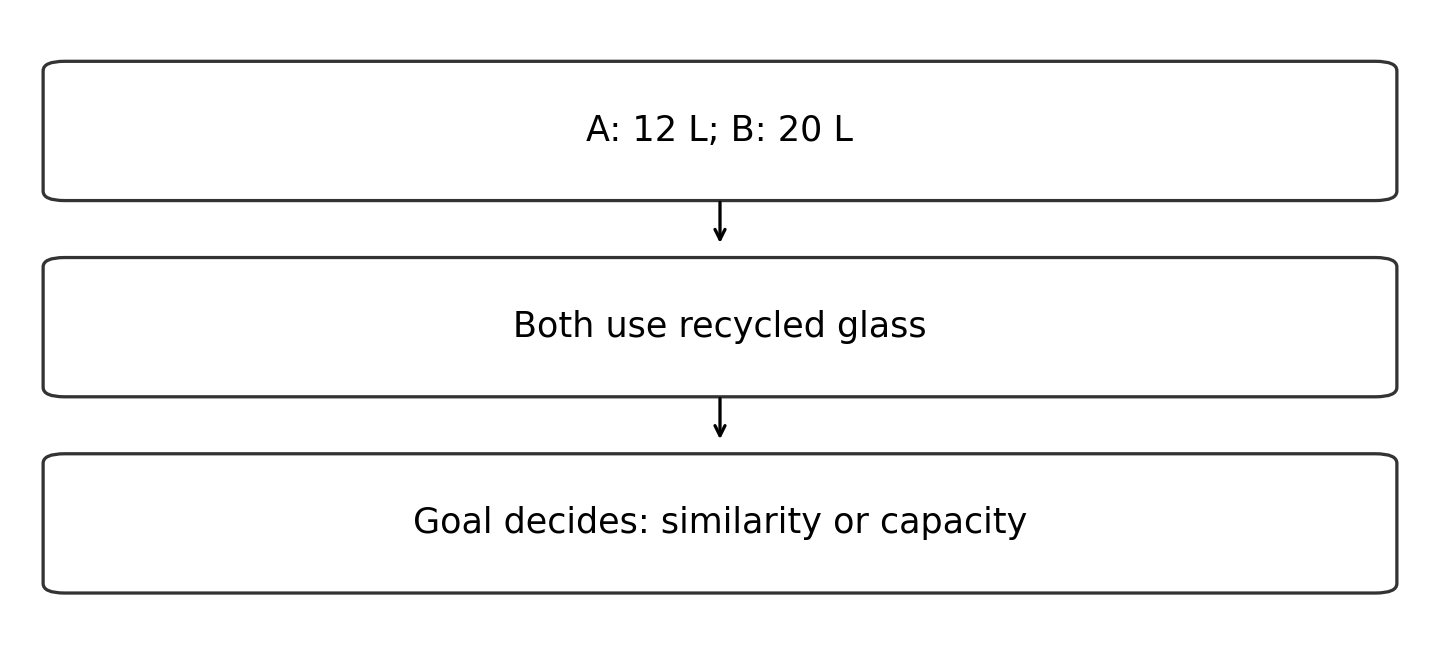
    English 日本語
    sentence function 文の機能
    qualification/ˌkwɒlɪfɪˈkeɪʃn/ 限定
    evidence/ˈevɪdəns/ 証拠
    argument/ˈɑːɡjuːmənt/ 論証
    proposal/prəˈpəʊzl/ 提案
  • 25

    RW-cross-text · Compare two texts without merging their claims

    学習プログラム 間もなく公開

    プリント

    English

    Scope and prerequisites

    Digital SAT framework; original paper practice is nonadaptive and gives no scaled-score prediction.

    • Identify each author’s claim and degree of certainty separately
    • Explain agreement, disagreement or qualification on the same issue
    • Predict one author’s response using their stated reasoning

    Prerequisites: Keep speakers separate; distinguish observation from explanation.

    Explain and choose the method

    Build a brief claim record for each text: topic, position, evidence 证据 and limit. Keep the speakers separate. If Text 1 reports a possibility and Text 2 reports a concern, a response that makes both certain has altered both positions.

    Compare claims about the same relationship, not just shared vocabulary. Agreement may concern a benefit while disagreement concerns generalisation. One text may supply evidence absent from the other rather than directly contradict it. Identify exactly which proposition is supported, challenged or narrowed.

    When asked how one author would respond, use that author’s reasoning and scope. Do not choose your preferred opinion or a compromise that neither text supports. A response can acknowledge the other text’s evidence while resisting its broad conclusion if that matches the stated limitation.

    Check every clause of the answer. A choice may describe Text 1 correctly and misrepresent Text 2, or identify a real disagreement then exaggerate its importance. Trace each assertion back to its source. The final choice must accurately connect both texts, not merely summarise one.

    Cross-text comparison 跨文本比较 connects claims about the same issue. “Signs reduced wrong turns” and “lighting also changed during the trial” can coexist. The second statement challenges a causal explanation, not necessarily the recorded reduction.

    Original diagram of the worked relationship; read the full wording and qualifications.
    Original diagram of the worked relationship; read the full wording and qualifications.

    Existing worked example: Original Text 1: “A trial in one gallery found that longer labels increased the time visitors spent at exhibits, suggesting that detailed labels can promote engagement.” Original Text 2: “Time spent reading does not necessarily indicate deeper engagement; visitors may be trying to understand unclear wording.” Text 2 would question whether time alone supports Text 1’s engagement inference 推断, not deny that the trial recorded more time.

    Complete original context

    Original Text A: During a two-week trial, a station displayed route information on a large screen. Requests for platform directions fell from 60 in the preceding fortnight to 36. The screen seems a promising way to help travellers find their platforms, and other stations should consider a trial.

    Original Text B: Fewer requests were recorded during the screen trial, but several platforms were closed for repairs at the same time. The remaining journeys may have been easier to navigate. Before treating the screen as the explanation, compare similar periods with the same platform arrangement. A further trial is reasonable if it separates these changes.

    Independent practice and checked reasoning

    Transfer 1

    Identify one agreement and the precise disagreement or qualification.

    Reasoning: Both accept that recorded requests fell and allow a further trial. B questions attributing the reduction to the screen because platform closures also changed navigation. B does not claim the screen certainly fails.

    Transfer 2

    How would B most likely respond to “The screen caused a 40% reduction at every station”? Check every part of the claim.

    Reasoning: The observed reduction is $(60-36)/60=40\%$ at one station, but B would reject the causal certainty and every-station scope. The simultaneous closures leave an alternative explanation and no observations at other stations are supplied.

    Transfer 3

    Propose evidence that would address B's concern, and explain why interviewing the screen's designer about its colour would not.

    Reasoning: Compare otherwise similar periods or randomised station trials with matched platform arrangements, recording requests and traveller numbers. This addresses confounding and rates. A colour preference interview does not isolate the screen's navigation effect.

    Limits and next use

    Disagreeing with an interpretation 解释 is different from denying the observation. Keep each author’s evidence and conclusion distinct.

    All tasks here are public original practice with authored guidance. They are not official questions or fresh diagnostics. Existing protected tests and mocks remain separate.
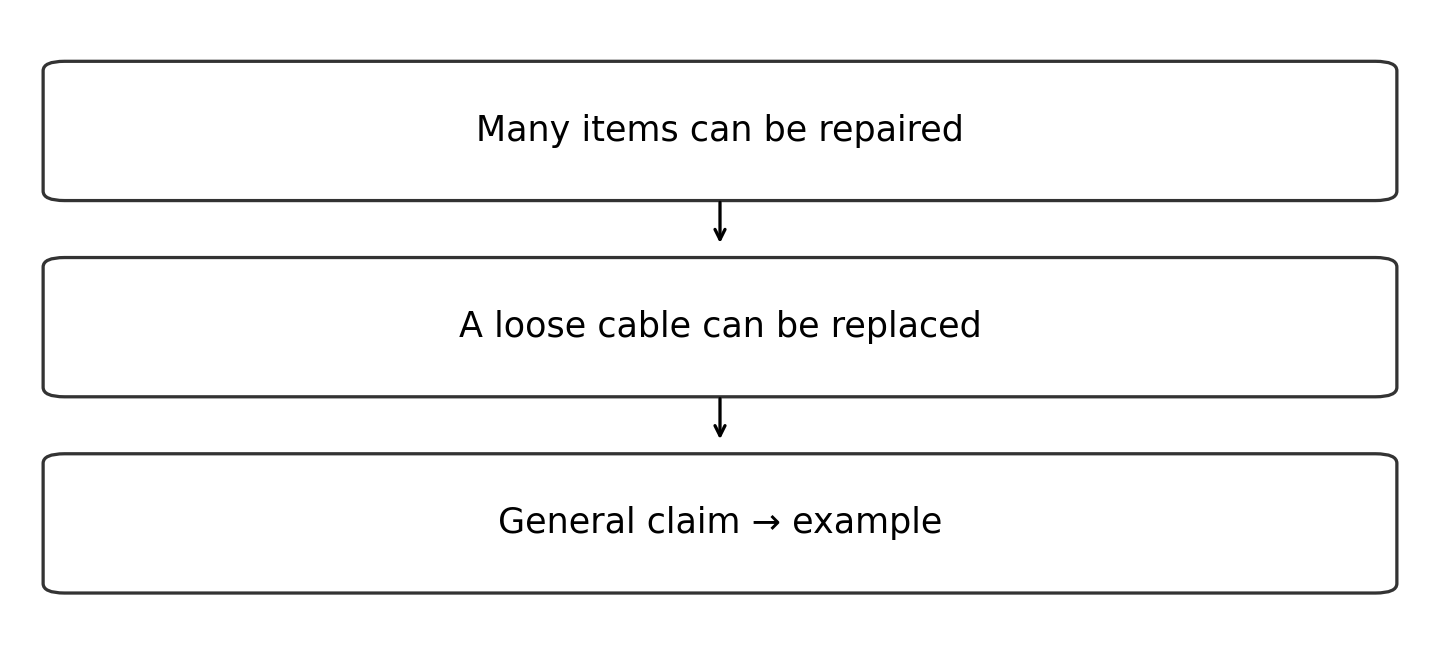
    English 日本語
    cross-text comparison テキスト間の比較
    inference/ˈɪnfərəns/ 推論
    evidence/ˈevɪdəns/ 証拠
    interpretation/ɪnˌtɜːprɪˈteɪʃn/ 解釈
  • 26

    RW-synthesis · Use research notes for the requested rhetorical goal

    学習プログラム 間もなく公開

    プリント

    English

    Scope and prerequisites

    Digital SAT framework; original paper practice is nonadaptive and gives no scaled-score prediction.

    • Translate a rhetorical goal 修辞目标 into a specific information requirement
    • Select relevant accurate details from notes
    • Combine notes without inventing a relationship or including irrelevant material

    Prerequisites: Read a stated rhetorical goal; preserve names, units and relations.

    Explain and choose the method

    Read the goal before the notes. Identify the action: introduce a subject, emphasise a similarity 相似, contrast two cases, give an example or explain significance. Turn it into a brief requirement such as mention both objects and their different materials. This determines which facts matter.

    Select details that carry out that action. Accurate but irrelevant information can still fail the question. For a contrast, both compared objects and the relevant difference should be present; for a similarity, a shared property should be explicit. Do not assume that including more notes makes a stronger sentence.

    Preserve relationships when combining facts. Notes saying a researcher visited a site and later published a book do not prove the visit caused the book. Avoid adding evaluative language such as revolutionary or superior unless the notes support it. Keep time, identity and numerical facts consistent.

    Compare answer choices against both goal and factual accuracy. A sentence can meet the goal while misreporting a detail 细节, or be fully accurate while answering a different goal. The correct choice must satisfy both conditions. Clear referents and concise structure help make the requested relationship explicit.

    Rhetorical synthesis 综合 修辞综合 selects facts for a purpose. Notes: A stores 12 litres; B stores 20; both use recycled glass. For a material similarity: “Both containers use recycled glass.” For a capacity difference: “B stores 8 litres more than A.” The same notes support different sentences.

    Original diagram of the worked relationship; read the full wording and qualifications.
    Original diagram of the worked relationship; read the full wording and qualifications.

    Existing worked example: Original notes: Project Alder used recycled wood; Project Birch used clay; both were temporary outdoor installations; Alder opened in May; Birch opened in June. Goal: emphasise a difference in materials. Suitable synthesis: “Although both were temporary outdoor installations, Alder used recycled wood whereas Birch used clay.” Opening months are accurate but unnecessary for this goal.

    Complete original context

    Original research notes:

    • The Bay project restored 3 km of walking paths in 2024.
    • The Hill project restored 5 km of walking paths in 2024.
    • Both projects used volunteer teams.
    • Bay used local stone for boundary markers.
    • Hill used recycled timber for boundary markers.
    • The notes give no costs, visitor counts or durability measurements.

    Independent practice and checked reasoning

    Transfer 1

    Write one sentence emphasising a similarity in staffing and a second emphasising the difference in distance restored.

    Reasoning: “Both Bay and Hill used volunteer teams.” “Hill restored 5 km of paths, 2 km more than Bay.” These select staffing and distance respectively without adding a cause.

    Transfer 2

    A student writes “Hill restored more paths because recycled timber lasts longer.” Identify every unsupported relationship.

    Reasoning: The notes do not report why Hill restored a longer distance, nor any durability comparison. They report kilometres, not the number of separate paths. A valid sentence is “Hill restored a longer total distance and used recycled timber for its markers,” without a causal link.

    Transfer 3

    Goal — contrast marker 转折标记 materials without including irrelevant detail. Write a sentence, then explain why the shared year can be omitted.

    Reasoning: “Bay used local stone for boundary markers, whereas Hill used recycled timber.” The shared year does not establish the requested material contrast. Omitting it meets this goal; a historical comparison could require it under a different goal.

    Limits and next use

    Do not mistake a factually accurate sentence for one that satisfies the rhetorical goal. Avoid unsupported causal or evaluative additions.

    All tasks here are public original practice with authored guidance. They are not official questions or fresh diagnostics. Existing protected tests and mocks remain separate.
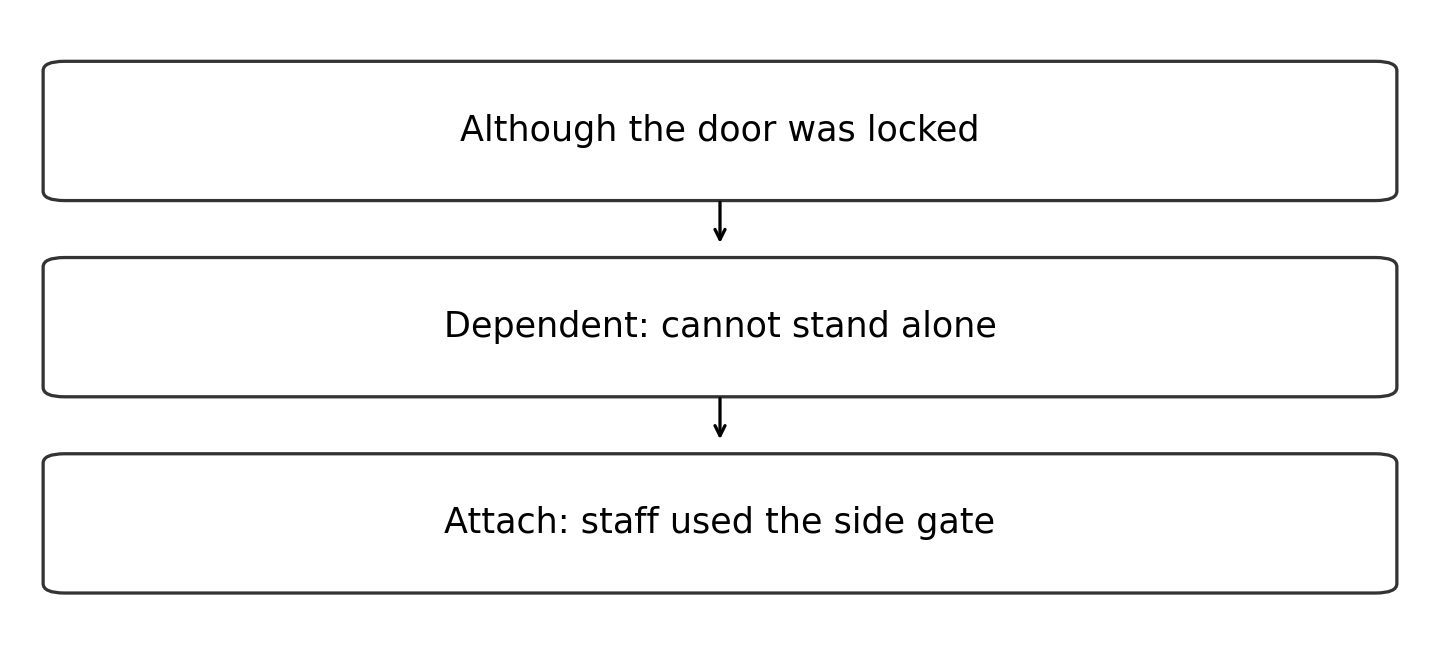
    English 日本語
    rhetorical synthesis 修辞的統合
    contrast marker/ˈkɒntræst ˈmɑːkə/ 対比マーカー
    rhetorical goal/reˈtɒrɪkl ɡəʊl/ 修辞的目標
    similarity/ˌsɪmɪˈlærɪti/ 類似性
    synthesis/ˈsɪnθəsɪs/ 統合
    detail/ˈdiːteɪl/ 詳細
  • 27

    RW-transitions · Transitions: choose the logical relationship first

    学習プログラム 間もなく公開

    プリント

    English

    Scope and prerequisites

    Digital SAT framework; original paper practice is nonadaptive and gives no scaled-score prediction.

    • Identify contrast, consequence 结果, example and continuation relationships
    • Choose a transition 衔接词 that preserves the argument 论证’s logic
    • Distinguish logical linking from punctuation requirements

    Prerequisites: Read both sides of a blank; distinguish logic from punctuation.

    Explain and choose the method

    Temporarily ignore the blank and state how the two ideas relate. Does the next sentence add another instance, give a result, present an example, correct an expectation or shift to a different topic? A short label such as contrast is more useful than choosing a familiar connective immediately.

    Consequential transitions such as therefore need a supported result. However and nevertheless introduce contrast or concession 让步, while for example introduces an instance of a broader claim. Similarly compares a matching relationship, not merely two sentences mentioning the same noun. Use the meaning of both sides, including negatives.

    A concession acknowledges a point while maintaining a different conclusion. “The route is shorter; nevertheless, it takes longer at rush hour” contrasts distance with travel time. In fact can strengthen or correct a statement; it is not a generic substitute for additionally. Test the chosen word by paraphrasing the relationship aloud.

    Logical correctness does not remove sentence-boundary rules. However is not a coordinating conjunction joining independent clauses with a comma alone. In a transition question, supplied punctuation may already be fixed; in an editing task, punctuation also needs checking. Keep these two decisions distinct.

    A transition names a logical relationship. “The line is shorter. However, it moves more slowly” contrasts size with the expected speed benefit. “Many items can be repaired. For example, a loose cable can be replaced” moves from general statement to instance. Neither relationship is caused merely by sharing a subject.

    Original diagram of the worked relationship; read the full wording and qualifications.
    Original diagram of the worked relationship; read the full wording and qualifications.

    Existing worked example: Original passage: “The new device is smaller than its predecessor. However, it requires more frequent charging.” The second sentence limits an expected benefit; therefore would incorrectly make frequent charging a logical result of small size without evidence 证据. “Several birds use tools. For example, one species uses twigs to retrieve food” moves from a general claim to an instance.

    Complete original context

    Original passage: The new catalogue can be searched from home. [1] Readers no longer need to travel merely to find a likely shelf number. It still omits several collections. [2] A reader looking for an unlisted item must contact staff. Some entries also use abbreviations. [3] “MS” identifies a manuscript rather than a printed book.

    Independent practice and checked reasoning

    Transfer 1

    Choose the best relationships at [1], [2], [3], then supply suitable transitions. Explain each link.

    Reasoning: [1] consequence: “Therefore,” links remote search to avoiding a search-only trip. [2] consequence: “Consequently,” links missing entries to contacting staff for those items. [3] example: “For example,” introduces one abbreviation. Equivalent transitions expressing those relations are acceptable.

    Transfer 2

    Rewrite the second pair with a contrast between remote access and incomplete coverage, using however and correct sentence boundaries.

    Reasoning: “The catalogue can be searched from home; however, it still omits several collections.” A full stop before “However,” also works. However expresses a limitation but cannot join two independent clauses with a comma alone.

    Transfer 3

    Why would similarly be weak at [3], and why would therefore be weak in “The guide is free. ___, it is only available on weekdays”?

    Reasoning: The abbreviation is an instance of a general category, not a second parallel comparison, so for example is clearer. Weekday-only availability limits an advantage; being free does not by itself cause that schedule. However can express that contrast.

    Limits and next use

    Shared subject matter does not decide the link. Do not choose therefore unless a consequence is actually supported.

    All tasks here are public original practice with authored guidance. They are not official questions or fresh diagnostics. Existing protected tests and mocks remain separate.
    English 日本語
    consequence/ˈkɒnsɪkwəns/ 結果
    transition/trænˈsɪʃn/ 接続詞
    concession/kənˈseʃn/ 譲歩
    evidence/ˈevɪdəns/ 証拠
    argument/ˈɑːɡjuːmənt/ 論証
  • 28

    RW-boundaries · Sentence boundaries, colons and nonessential information

    学習プログラム 間もなく公開

    プリント

    対象範囲と前提条件

    デジタルSATの枠組み;オリジナルの紙ベース練習は非適応的であり、スケール得点の予測を与えない。

    • 接続語を選ぶ前に、独立節と従属節を区別する
    • コンマスプライス(誤ったコンマ結合)なしで完全な節をつなぐ
    • 文構造に従ってコロンやペア状の記号を配置する

    前提条件:主語と有限動詞;独立節/従属節。

    説明し、方法を選択する

    独立節は主語と有限動詞谓语を持ち、単独で文として機能できます。although、because、whenなどで導入される従属節は、その役割で単独では機能しません。接続語を選ぶ前に節の構造を特定してください。長い節が必ずしも完全とは限らず、短い節であっても成立することがあります。

    独立した2つの節は、句点またはセミコロンで区切るか、コンマとandやbutなどの並立接続詞を併用して結びつける。コンマのみでは、文の連結が不十分となる(スプライス)。howeverのような接続副詞は並立接続詞に代わるものではない。「The test was brief; however, it was demanding.」のように使用する。

    コロンは、完全な独立節の後に説明、例示、またはリストを導くために用いる。動詞とその目的語の間、または前置詞とその目的語の直後には置かない。「The box contains three tools: a ruler, a compass and a square」は完全な導入節があるため適切である。「The tools include: a ruler…」のようにincludeの構造を中断するのは不適切である。

    補足情報(非限定修飾)は、対応するコンマ、ダッシュ、または括弧で囲む。一方、必須の識別情報はypesな方法で分離しない。補足情報を除去しても、核心の文は成立する。挿入部分の両端に注意し、主語が長いからといって、単に主語と主要動詞の間にコンマを置くことは避ける。

    文の区切りは節の構造に依存する。 「Although the door was locked」は従属節であるため、完全な節に接続する。 「Although the door was locked, staff could enter through the side gate.」 コロンは完全な導入節の後に続く:「Staff used one entrance: the side gate.」

     worked example の関係図(原文);完全な文章と限定事項をお読みください。
    worked example の関係図(原文);完全な文章と限定事項をお読みください。

    既出の解答例:原文「The catalogue was incomplete; however, the surviving entries were useful.」両節とも完全であり、セミコロンで区切り、howeverの後にコンマが続く。「The team chose one method: a supervised trial」は完全な節の後にコロンを用いる。「The catalogue, revised last year, includes new photographs」は削除可能な修飾語をコンマ2つで囲んでいる。

    元の文脈を完成させる

    原文の校正文:古い駅は閉鎖されていた[1]、その時計はまだ動いていた。メカニズムは単純だった[2]しかし、針の修理には専門家が要した。部品の一つを交換する必要があった[3]文字盤の奥にある狭い軸である。この時計[4]入口の上に立っていた[5]は集まりの場となっていた。この練習問題では1つの時計があり、which節は不要な情報を追加する。

    Independent practice and checked reasoning

    Transfer 1

    [1]–[5]に标点符号(句読点)を記入せよ。[2]で少なくとも2つの有効な区切りを示し、節テストを説明せよ。

    推論:[1]コンマは導入部の従属節を接続する。[2]セミコロンまたは句点とする。なぜなら、メカニズム節と修理節は独立節だからである;句点の後はHoweverを大文字で始める。[3]コロンは完全な節「One part needed replacement」の後に続き、部品を紹介する。[4],[5]ペアのコンマは指定された不要節を囲む;対応するダッシュや括弧も使用可能である。

    Transfer 2

    「One part needed: a replacement」が本文の有効なコロン使用法と異なる理由を説明せよ。

    推論:neededは直接に目的語「a replacement」を必要とするため、そこにコロンを置くと文法的単位が断たれる。「One part needed replacement: the narrow axle」では、独立節が既に完了しており、その後に説明が続く形となる。

    Transfer 3

    「The clock, above the entrance, and the bell was restored」を修正し、修復された2つの対象を保持せよ。主語一致および任意の句読点について説明せよ。

    推論:「The clock above the entrance and the bell were restored.」複合主語にはwereを用いる。「above the entrance」の周囲にコンマを使うことは可能であるが、それが限定的か補足的かの文脈による選択であり、複合主語との一致には影響しない。

    Limits and next use

    句読点は構造的に従い、読みながら想像される休符に従うものではない。howeverの前にあるコンマだけでは、独立した二つの節を正しく修復できない。

    All tasks here are public original practice with authored guidance. They are not official questions or fresh diagnostics. Existing protected tests and mocks remain separate.

    English 日本語
    independent clause/ˌɪndɪˈpendənt klɔːz/ 独立節
    sentence boundary 文の境界
    comma splice/ˈkɒmə splaɪs/ コンマスプライズ誤り
    modifier/ˈmɒdɪfaɪə/ 修飾語
    colon/ˈkəʊlən/ コロン
  • 29

    RW-form · Agreement, verb forms, modifiers and logical parallelism

    学習プログラム 間もなく公開

    プリント

    対象範囲と前提条件

    デジタルSATの枠組み;オリジナルの紙ベース練習は非適応的であり、スケール得点の予測を与えない。

    • 動詞と代名詞を、それらが指す実際の対象に一致させる
    • 本文の時間的な関係に基づき、時制と動詞の形を選択する
    • 修飾語と並列要素を配置し、論理的な主語が明確になるようにする

    前提条件:主語の中心語;動詞のタイムライン;分詞と不定詞。

    説明し、方法を選択する

    最近の名詞との一致ではなく、主語の中心語を見極める。集合名詞は singular と扱うため、その後のof句に複数形の名詞が含まれていてもisを使う。代名詞は先行詞と一致し、明確にそれを指さなければならない。2つの可能性のある先行詞により代名詞が曖昧になる場合、正確な名詞を用いて意図した参照を復元できる。

    孤立した単語ではなく、周囲のタイムラインと論理的关系に基づいて動詞の時制を選択する。指定された過去の時間に完了した出来事は通常、過去形で表す。完成形は、他の参照时间点より前に起きた出来事を示すことができる。不定詞や分詞は自動的に有限動詞とはならず、それだけでは主要な述語を構成できない。

    導入修飾語は適切な主語に接続されなければならない。「Walking through the gallery, Maya noticed the new labels」ではMayaが歩いている人物となる。「Walking through the gallery, the labels attracted Maya」はlabelsが歩いていることになり誤りである。導入部の動作を行う者を特定した後、主要な主語を確認する。

    並列構造は、同等の考え方を互換的な文法的形式に揃える。「to collect, to classify and to display」あるいは「collecting, classifying and displaying」のようにする。比較は同类同士で行う必要があり、ある博物館の営業時間を別の博物館の営業时间与え比較すべきであり、営業時間と博物館自体を比較してはならない。意味と構造は連動しており、文法的には正しい選択でも、論理的な参照の欠如を生むことがある。

    一致は、最近の名詞ではなく、主語の中心語に従う。 「The set of keys is missing」においてsetは単数である。 導入修飾語は正しい行為者を記述しなければならない。「Opening the drawer, Mina found the keys.」 「Opening the drawer, the keys appeared」はkeysが開け行為を行ったことになり誤りである。

     worked example の関係図(原文);完全な文章と限定事項をお読みください。
    worked example の関係図(原文);完全な文章と限定事項をお読みください。

    既出の解答例:元の一致修正:「The list of proposed changes includes a longer opening period.」listは単数なのでincludesが正解。修飾語の修正:「After examining the samples, the researchers revised their prediction.」researchersがサンプルを検査する。このバージョンは「After examining the samples, the prediction…」と始めると、修飾語がぶら下がる(ダンリング)。並列の修正:「The team aimed to record, analyse and publish the findings.」

    元の文脈を完成させる

    元の編集課題:The collection of donated tools [1: include/includes] three old drills. Examining the smallest drill, [2: a crack surprised Jo/Jo noticed a crack]. Yesterday Jo [3: repairs/repaired] the casing. The volunteer team plans to clean, [4: label/labelling], and display the tools. The museum's opening hours are longer than [5: the archive/the archive's opening hours].

    Independent practice and checked reasoning

    Transfer 1

    [1]–[5]における形を選択し、その文法的および論理的役割を説明せよ。

    推論:[1] includesはcollectionと一致する。[2] Jo noticed a crackはJoを検査者とする。[3] repairedはyesterdayと整合する。[4] labelはtoの後に続くcleanおよびdisplayと並列する。[5] the archive's opening hoursは、機関ではなく時間同士の比較である。

    Transfer 2

    「先週月曜日が開店する前、ジョーはドリルを確認していた。」という文において、had checked が表す関係について説明し。過去完了形は、過去の2つの出来事を扱うすべての文で必須であるか?

    推論:確認行為は過去の参照点である「開店」よりも前に完了していた。過去完了形は、この順序を明確に示すために用いられる。しかし、すべての2出来事に関する記述で必須とは限らない。「before」や「after」、あるいは文脈によって単純過去形の順が明らかな場合もある。普遍的な規則ではなく、実際の文に基づいて判断すべきである。

    Transfer 3

    「ジョーがミナに出会うとき、彼女は修理したドリルを見せた」という文を、ジョーが見せ、ミナが受け取る人物が明確になるように修正せよ。また、3つの可能な保守作業の並列リストを提示せよ。

    推論:「ジョーとミナが出会った際、ジョーは修理したドリルを見せた」。これにより、she/her の曖昧な参照を取り除くことができる。一つの並列リストとして、「ケーブルの確認、ネジの交換、取っ手の清掃」があり、いずれも-ing形を用いている。

    Limits and next use

    前置詞句内の名詞に対して同意を示したり、能動的行為 performed できない無生物な主語に導入部として行動を紐づけてはいけない。

    All tasks here are public original practice with authored guidance. They are not official questions or fresh diagnostics. Existing protected tests and mocks remain separate.

    English 日本語
    finite verb/ˈfaɪnaɪt vɜːb/ 有限動詞
    antecedent/ˌæntɪˈsiːdənt/ 先行詞
    modifier/ˈmɒdɪfaɪə/ 修飾語

ログインまたはアカウント作成

IGCSE, A-Level & AP