Skip to content · ⁨コンテンツへスキップ⁩
Subjects · ⁨科目⁩

IGCSE English · ⁨IGCSE 英語⁩

Tips · ⁨ヒント⁩

IGCSE英語第二言語 (0510) は、読解、作文、聴解、および会話の4つのスキルに基づいて評価されます。ここでは、作文のテーマが試験で求められるテキストの種類(非公式なメール、フォーマルな手紙、レポート、記事、レビュー、エッセイ)別に整理されており、それぞれ固有の形式・作法があり、それに基づいて採点されます。

第二言語受験生にとって、アイデアの不足で失点することは稀です。代わりに、レジスター(フォーマルな文体で書かれた非公式なメール)、構成(見出しや段落のない記事)、そして繰り返し使われるパターンにおける正確性(冠詞、時制、前置詞など)で点数が失われます。

自分の5つの頻出ミスを修正することが、新しい語彙を覚えることよりも得点は大きいです。

  • 1

    Reading skills · ⁨読解スキル⁩

    Watch lesson · ⁨レッスンを視聴⁩
    1.1

    Reading for specific information · ⁨特定情報の読解⁩

    Syllabus · ⁨シラバス⁩
    English
    1. skim a text quickly to get the general idea, then scan to locate specific facts, names, numbers, times and places
    2. answer short questions with a single word or short phrase, using the exact detail from the text
    3. predict what kind of information a question is asking for before reading the text closely
    日本語
    1. テキストを素早く読み全体像を把握し、その後スキャンして特定の事実、人名、数字、時間や場所を特定する
    2. テキストから正確な詳細情報を用いて、単語一つまたは短いフレーズで短問に答える
    3. テキストを精読する前に、問題がどのような情報を求めているかを予測する

    Source: Cambridge International syllabus · ⁨出典: Cambridge International シラバス⁩

    English

    In the exam you do not read every word slowly. You change your speed to fit your goal.

    Skim first, then scan

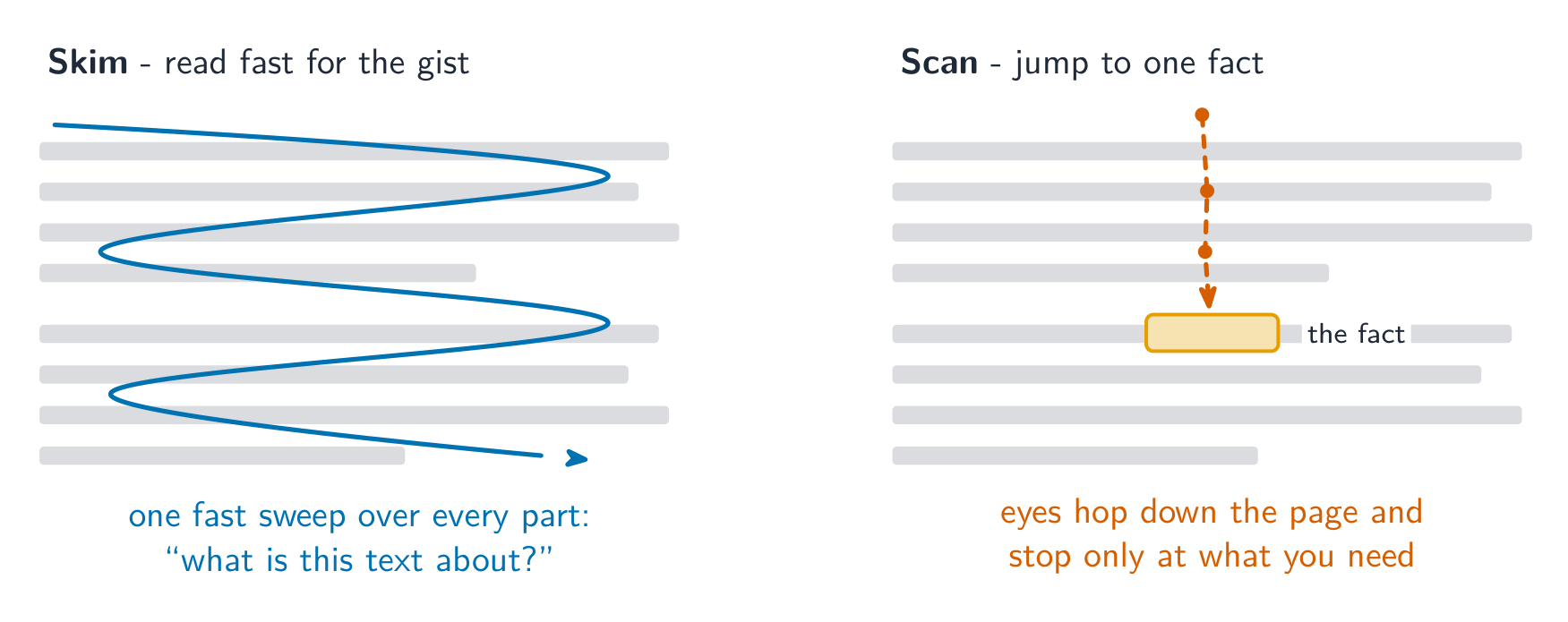
    • First skim 略读 the text. Read it fast to get the gist 大意 — the general idea. Look at the title, the first line of each paragraph 段落, and any pictures.
    • Then scan 扫读 to find one piece of information. Move your eyes quickly down the page. Do not read every word. Stop when you see what you need.
    • Use scanning for facts like names, numbers, dates, times and places.

    Match the question to the text

    • Read the question first. Decide what kind of answer it wants: a name? a number? a reason?
    • Predict 预测 the answer before you look. This helps your eyes find it faster.
    • Find the part of the text that talks about the same idea. The answer is usually there.

    Write short, exact answers

    • Here you write a single word or a short phrase 短语, not a full sentence.
    • Copy the exact word from the text when you can.
    • Answer only what the question asks. Extra words can lose the mark.
    日本語

    試験ではすべての単語をゆっくり読む必要はない。目標に応じて速度を変える。

    まず要約読み、次に精読

    • まず要約読みで本文を読む。素早く読んで大意(全体的な内容)を掴む。タイトル、各段落の冒頭文、図などを確認する。
    • 次に精読で特定の情報を一つ探す。ページを下へ素早く目を通す。すべての単語を読む必要はない。必要な情報が見つかったら止める。
    • 人名、数字、日付、時刻、場所などの事実情報には精読を使う。
    Two text blocks compared: skim is one fast sweep over every line for the gist, scan hops down the page and stops on one highlighted fact
    スキャミングは全体像を掴むためにすべてを素通りし、スキャンは特定の事実へ直接飛ぶ
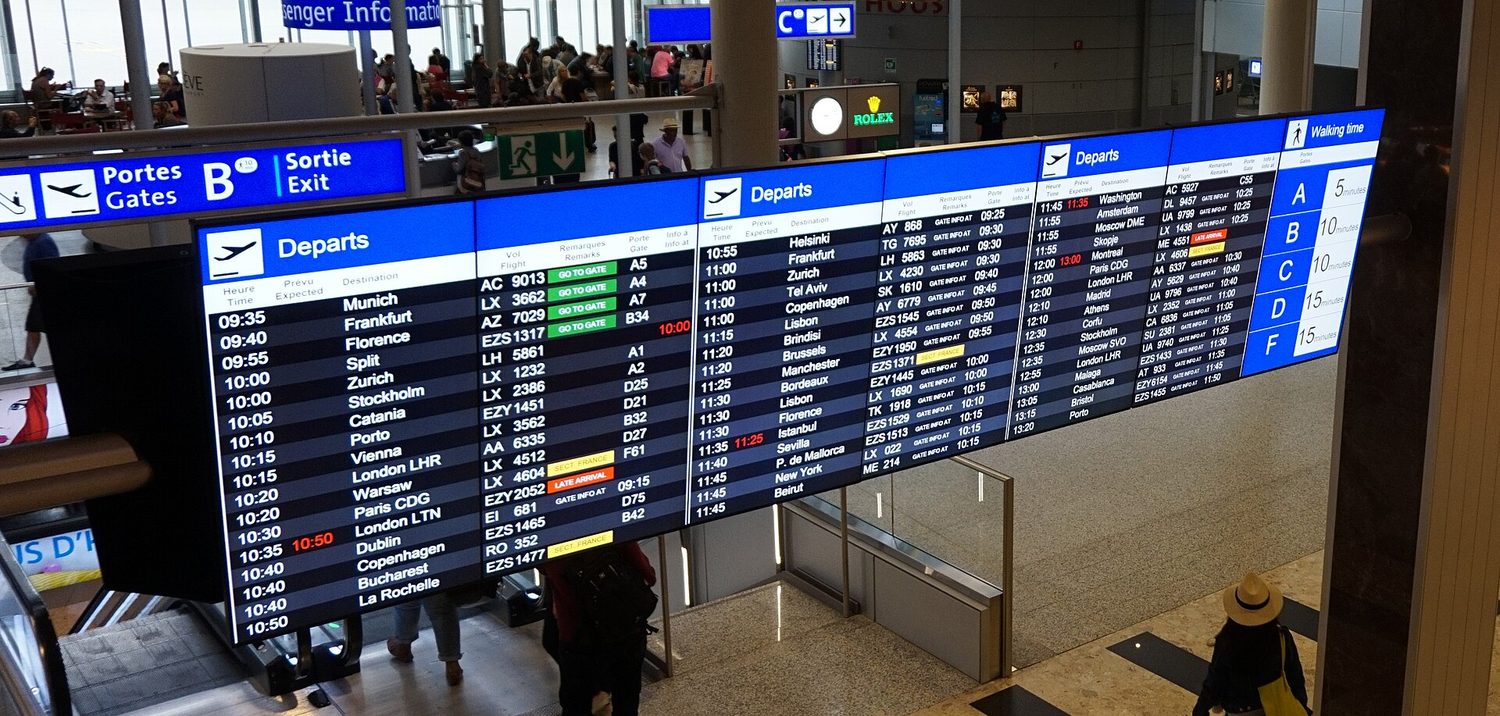
    A large airport departure board listing many flight times, destinations and gates
    発表板は精読の実際の例である:すべての行を読むのではなく、必要な飛行時間やゲート番号に直接飛ぶ

    質問と本文を合わせる

    • 質問を最初に読む。どのような回答が必要かを判断する:名前?数字?理由?
    • 見る前に予測しておく。これにより目が素早く見つけられる。
    • 同じ考えを扱っている本文の部分を探す。答えは通常そこに含まれている。

    短く正確な回答を書く

    • 単一語や短いフレーズを書き、完全な文は書かない。
    • 可能であれば、本文から正確な言葉をそのまま写す。
    • 質問で求められていることだけ答える。余計な言葉は失点の原因になる。
    Vocabulary · ⁨語彙⁩ Train · ⁨練習する⁩
    English 日本語
    skim/skɪm/ スクイムする
    gist/dʒɪst/ 要点
    paragraph/ˈpærəɡræf/ 段落
    scan/skæn/ スキャン
    predict/prɪˈdɪkt/ 予測
    phrase/freɪz/ フレーズ
    multiple matching/ˈmʌltɪpl ˈmætʃɪŋ/ 複数一致問題
    paraphrase/ˈpærəfreɪz/ 言い換え
    1.2

    Connecting ideas across a text · ⁨本文全体での関連性の理解⁩

    Syllabus · ⁨シラバス⁩
    English
    1. follow how ideas, opinions and attitudes in a text connect to one another
    2. match each question to the section or short text that contains the relevant idea (multiple matching)
    3. recognise words and phrases that signal time, cause and effect, addition and contrast
    日本語
    1. テキスト内の考え、意見、態度がどのように相互に関連しているかを追跡する
    2. 各問題を、関連する考えを含むセクションや短いテキストに割り当てる(マルチマッチング)
    3. 時間、因果関係、追加、対比を示す言葉やフレーズを識別する

    Source: Cambridge International syllabus · ⁨出典: Cambridge International シラバス⁩

    English

    A long text is not just a list of facts. The ideas link to each other, and you must follow how.

    Multiple matching

    • In a multiple matching 多项匹配 task you read several short texts, or several parts of one text.
    • Each question describes an idea. You choose the text or part that matches it.
    • The words in the question are usually different from the words in the text. Look for the same meaning, not the same words. This is called a paraphrase 改写.

    Signal words

    • Writers use small words to show how ideas connect. These are signal words 信号词.
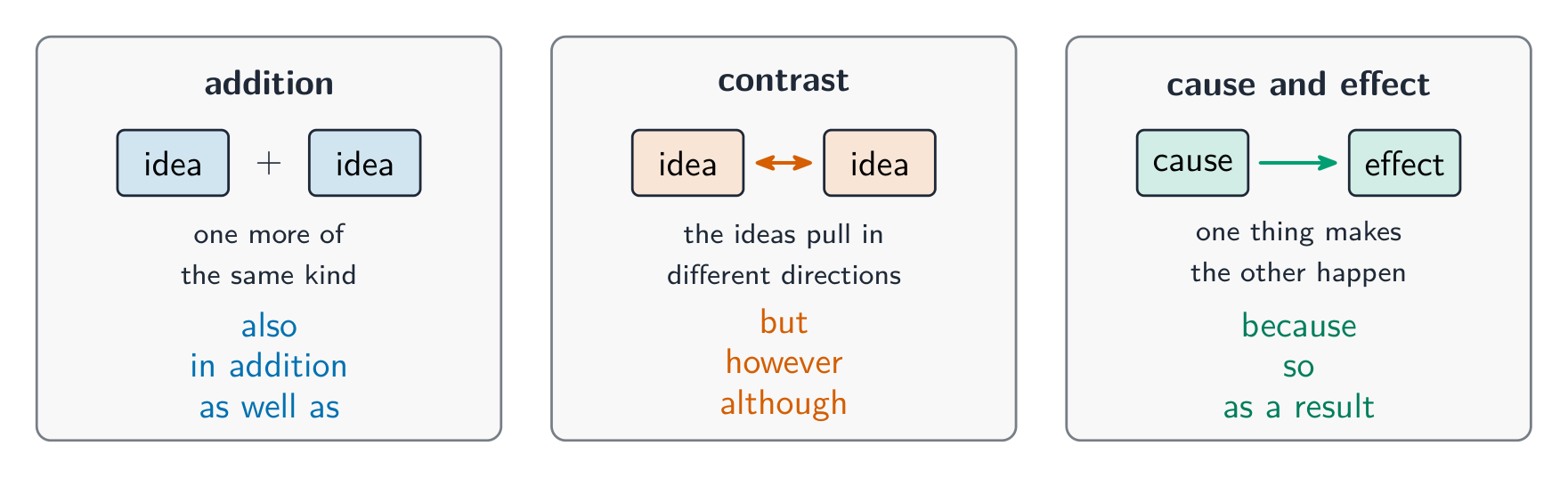
    • Some show addition 递进 (also, in addition, as well as). Some show contrast 对比 (but, however, although). Some show cause and effect 因果 (because, so, as a result).
    • When you notice these words, you can see how the writer's ideas fit together.
    日本語

    長い本文は単なる事実の羅列ではない。考え同士が結びついており、そのつながりを追う必要がある。

    多項選択問題

    • 多項選択問題では、複数の短い本文、あるいは一つの本文の複数の部分を読む。
    • 各質問は一つの考えを記述している。それに合う本文または部分を選ぶ。
    • 質問の言葉は本文の言葉と通常異なる。同じ言葉ではなく、同じ意味を見つける。これを言い換えという。

    信号語

    • 筆者は考えのつながりを示すために小さな言葉を使う。これらを信号語という。
    • 追加(also, in addition, as well as)を示すものもある。対比(but, however, although)を示すものもある。因果関係(because, so, as a result)を示すものもある。
    • これらの言葉に気づくと、筆者の考えがどのように組み合わさっているかがわかる。
    Three cards: addition words add one more idea of the same kind, contrast words pull two ideas in different directions, cause-and-effect words link a cause to its effect
    3つのシグナルワードファミリーと、それらが考えに与える影響
    Vocabulary · ⁨語彙⁩ Train · ⁨練習する⁩
    English 日本語
    signal words/ˈsɪɡnl wɜːdz/ シグナルワード
    addition/əˈdɪʃn/ 付加反応
    contrast/ˈkɒntræst/ 対比
    cause and effect/kɔːz ænd ɪˈfekt/ 因果関係
    note-making/nəʊt ˈmeɪkɪŋ/ メモ書き
    1.3

    Making notes and summaries · ⁨メモ取りと要約作成⁩

    Syllabus · ⁨シラバス⁩
    English
    1. select only the relevant points from a text for a given purpose
    2. complete a set of brief notes under headings, using short phrases rather than full sentences
    3. leave out examples and repetition, keeping just the key information
    日本語
    1. 特定の目的のために、テキストから必要なポイントのみを選択する
    2. 見出しの下に短いフレーズを用いて完全文ではなく簡潔なメモを作成する
    3. 例示や重複を省略し、主要な情報だけを残す

    Source: Cambridge International syllabus · ⁨出典: Cambridge International シラバス⁩

    English

    Sometimes you must take the main points out of a text and write them in a short form.

    Note-making

    • In a note-making 做笔记 task you complete notes under headings.
    • Write short notes, not full sentences. A word or a short phrase is enough.
    • Choose only the points that fit the heading. Leave out examples and extra detail.

    Summary skills

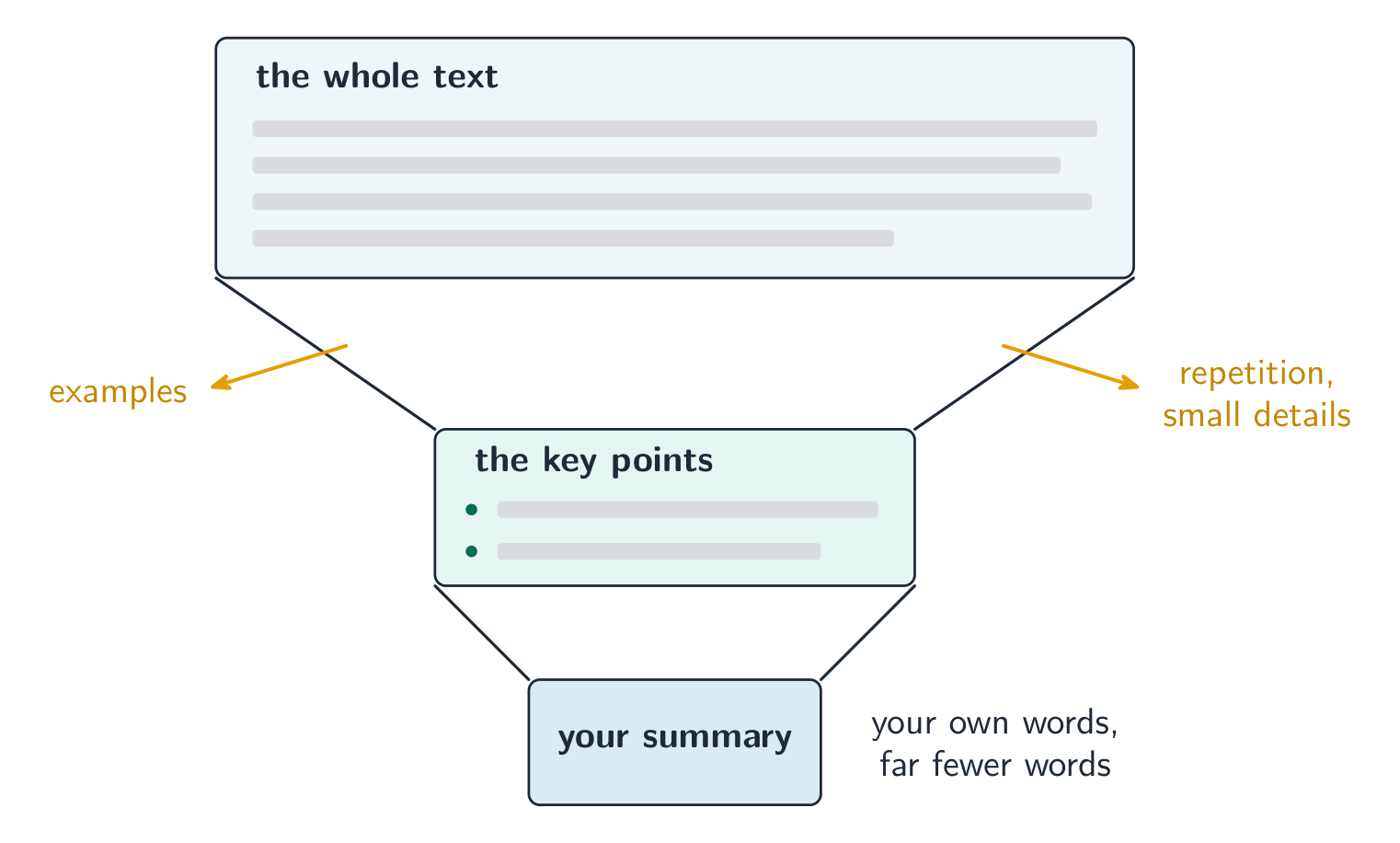
    • A summary 概括 gives only the most important ideas, in fewer words.
    • Find the key points. Ignore examples, repetition 重复 and small details.
    • Use your own words where you can. Do not copy whole sentences.
    日本語

    sometimes you must take the main points out of a text and write them in a short form.

    メモ取り

    • メモ取りタスクでは、見出しの下にメモを埋める。
    • 完全な文ではなく短いメモを書く。一つの単語や短いフレーズで十分。
    • 見出しに合うポイントのみ選ぶ。具体例や余計な詳細は省略する。

    要約技能

    • 要約は、より少ない言葉で最も重要な考えだけを伝える。
    • 主要ポイントを見つける。具体例、反復、細かい詳細は無視する。
    • 可能な限り自分の言葉で書く。完全な文をコピーしない。
    A funnel: the whole text goes in at the top, examples and repetition are squeezed out at the sides, the key points remain, and a short summary in your own words comes out at the bottom
    要約はあなたの言葉で主要なポイントのみを残す
    Vocabulary · ⁨語彙⁩ Train · ⁨練習する⁩
    English 日本語
    summary/ˈsʌməri/ 要約
    repetition/ˌrepəˈtɪʃn/ 反復
    1.4

    Reading between the lines · ⁨文中の隠された意味を読む⁩

    Syllabus · ⁨シラバス⁩
    English
    1. understand meaning that is implied but not directly stated
    2. work out a writer's opinion, attitude or feelings from the words and phrases they choose
    3. deduce the meaning of an unfamiliar word from the information around it
    4. answer multiple-choice questions about main ideas, details and attitudes
    日本語
    1. 明言されていないが暗示されている意味を理解する
    2. 著者が選んだ言葉やフレーズから、その意見、態度、感情を読み取る
    3. 前後の文脈情報から未知の言葉の意味を導き出す
    4. 主要な考え方、詳細、態度に関する選択肢から正解を選ぶ問題に答える

    Source: Cambridge International syllabus · ⁨出典: Cambridge International シラバス⁩

    English

    Some answers are not written directly in the text. You must work them out. This is called inference 推断.

    Implied meaning

    • Sometimes the writer implies 暗示 something without saying it openly. The meaning is there, but it is hidden.
    • Read the words around the idea. Ask: what does the writer want me to understand here?

    The writer's attitude

    • The writer's attitude 态度 is how they feel about the topic — for example, excited, worried, or unsure.
    • You find the attitude in the writer's word choice 用词. Strong or emotional words show feelings.
    • In a multiple-choice 选择题 question about attitude, read all the options. Choose the one that fits the whole text, not just one line.

    Unfamiliar words

    • You will meet words you do not know. Do not stop.
    • Use the context 语境 — the words around it — to guess the meaning of the new word.
    日本語
    A woman holding a stack of old books, reading one of them closely
    精読:推論の答えは、筆者の選び抜いた言葉から導かれるものであり、そのままコピーできる文からは得られない

    Some answers are not written directly in the text. You must work them out. This is called inference 推断.

    暗示される意味

    • 筆者が暗示すること有时没有明说。意味はあるが隠されている。
    • 考えの周囲の言葉を読む。筆者は何を理解させたいと思っているか考える。

    筆者の態度

    • 筆者の態度とは、テーマに対する感情である:例えば、興奮、不安、または不確実性など。
    • 態度は筆者の語彙の選択で見つける。強い言葉や感情的な言葉は感情を示す。
    • 態度に関する選択式問題では、すべての選択肢を読みなさい。1行だけ fitしているものではなく、全文に fitするものを選びなさい。

    見慣れない単語

    • 知らない単語に出会うことがある。そこで止まってはいけない。
    • 文脈 — その周囲にある言葉 — を用いて、新しい単語の意味を推測しなさい。
    Vocabulary · ⁨語彙⁩ Train · ⁨練習する⁩
    English 日本語
    inference/ˈɪnfərəns/ 推論
    implies/ɪmˈplaɪz/ imply(~を意味する)
    attitude/ˈætɪtjuːd/ 態度
    word choice/wɜːd tʃɔɪs/ 語彙の選択
    multiple-choice/ˈmʌltɪpl tʃɔɪs/ 選択式問題
    context/ˈkɒntekst/ コンテキスト
    1.4

    Exam tips · ⁨試験対策⁩

    English
    • Read the question before the text. Underline the key word: a name? a number? a reason?
    • Answers usually come in the same order as the text, so do not hunt backwards for question 1.
    • Copy the exact word from the text when you can; a changed word can lose the mark.
    • Check how many answers the question wants: "Give TWO reasons" needs two, not one.
    • In multiple matching, the text usually does not repeat the question's words. Hunt for the same idea said differently.
    • Never leave an empty line. A guess can win a mark; a blank never can.
    日本語
    • 本文より前に問題を読みなさい。キーワードに下線を引く:人名? 数字? 理由?
    • 答えは通常、本文の順に現れるため、問題1のために後方へ探さなくていい。
    • 可能であれば、本文から正確な言葉をそのままコピーしなさい。変えられた言葉は失点する可能性がある。
    • 問題が求める答えの数を確認しなさい。「2つの理由を列挙せよ」なら、1つではなく2つ必要だ。
    • マッチング問題では、本文は通常、問題の言葉を繰り返さない。同じ考えが異なる表現で語られている場所を探しなさい。
    • 必ず空欄を残さず、何かを書きなさい。推測した答えでも点数を得られるが、空白では絶対に得点できない。
  • 2

    Writing: purpose, audience and accuracy · ⁨作文:目的、対象および正確さ⁩

    Watch lesson · ⁨レッスンを視聴⁩
    2.1

    Purpose, audience and register · ⁨目的、読者、および文体⁩

    Syllabus · ⁨シラバス⁩
    English
    1. identify the purpose of a piece of writing: to inform, to argue or to discuss
    2. think about the audience and how formal or informal the language should be
    3. choose a register and style that suit the purpose and the reader
    日本語
    1. 文章の目的を特定する:情報提供、説得、議論
    2. 読者を考慮し、言語がどの程度形式的であるべきかを考える
    3. 目的と読者に適したレジスターとスタイルを選ぶ

    Source: Cambridge International syllabus · ⁨出典: Cambridge International シラバス⁩

    English

    Before you write, ask two questions: why am I writing, and who will read it?

    Know your purpose

    • Every writing task has a purpose 目的: to inform 告知, to argue 论证, or to discuss 讨论.
    • The purpose decides what you write and how you write it.
    • The task tells you the purpose. Read it carefully and underline it.

    Know your audience

    • The audience 读者 is the person who will read your writing — a friend, a teacher, or an event organiser.
    • Write in a way that suits them. You write to a friend in a different way from a teacher.

    Choose the right register

    • Register 语域 means how formal 正式 or informal 非正式 your language is.
    • Use informal language for a friend: short forms (I'm, don't) and friendly words.
    • Use formal language for a teacher or a report: full forms (I am, do not) and polite words. No slang 俚语.
    日本語

    書く前に、次の2つの質問を自問してください:なぜ書くのか、そして誰が読むのか。

    目的を理解する

    • すべての作文タスクには目的がある:情報を伝える、議論する、または議論・検討する。
    • 目的が、何を書くべきか、以及如何書くかを決定する。
    • タスクが目的を教えてくれる。注意深く読み、それを下線で示しなさい。

    読者を理解する

    • 読者とは、あなたの作文を読む人である:友人、教師、あるいはイベント主催者など。
    • 彼らに合う書き方をしなさい。友人に書く場合と、教師に書く場合は違う。

    適切な文体を選ぶ

    • 文体とは、自分の言語がどれほどフォーマル(正式)か、インフォーマル(非公式)かを指す。
    • 友人に対しては、インフォーマルの言葉を使う:省略形(I'm, don't)や親しい言葉。
    • 教師やレポートに対しては、フォーマルの言葉を使う:完全な形(I am, do not)や丁寧な言葉。スラングは使わない。
    フロー図:「なぜ書くのか」「誰が読むのか」という問いは目的と読者へ導き、それらが組み合わさることで、友人への非正式なトーンか、先生や報告書へのフォーマルなトーンかを決定する
    目的と読者が一体となって、あなたの書き物のフォーマルさを決定します
    デスクで書く様子:紙の上にアイデアを整理する前に、まず目的と読者を決定する
    デスクで書く様子:紙の上にアイデアを整理する前に、まず目的と読者を決定する
    Vocabulary · ⁨語彙⁩ Train · ⁨練習する⁩
    English 日本語
    purpose/ˈpɜːpəs/ 目的(purpose)
    inform/ɪnˈfɔːm/ 情報提供
    argue/ˈɑːɡjuː/ 主張する
    discuss/dɪˈskʌs/ 議論する
    audience/ˈɔːdɪəns/ 読者(audience)
    register/ˈredʒɪstə/ レジスタ
    formal/ˈfɔːml/ 公式
    informal/ɪnˈfɔːml/ 非公式
    slang/slæŋ/ スラング
    2.2

    Organising your ideas · ⁨アイデアの構成⁩

    Syllabus · ⁨シラバス⁩
    English
    1. plan what to include and the order in which to present it
    2. organise writing into clear paragraphs with a logical structure
    3. link ideas using devices for addition (in addition, moreover), contrast (however, although) and cause/effect (therefore, as a result)
    日本語
    1. 何を含めるか、また何をどの順序で提示するかを計画する
    2. 論理的な構造を持つ明確な段落に文章を整理する
    3. 接続表現を用いて考えをつなぐ(追加:in addition, moreover、対比:however, although、因果:therefore, as a resultなど)

    Source: Cambridge International syllabus · ⁨出典: Cambridge International シラバス⁩

    English

    Good writing is not just correct. It is also easy to follow.

    Plan before you write

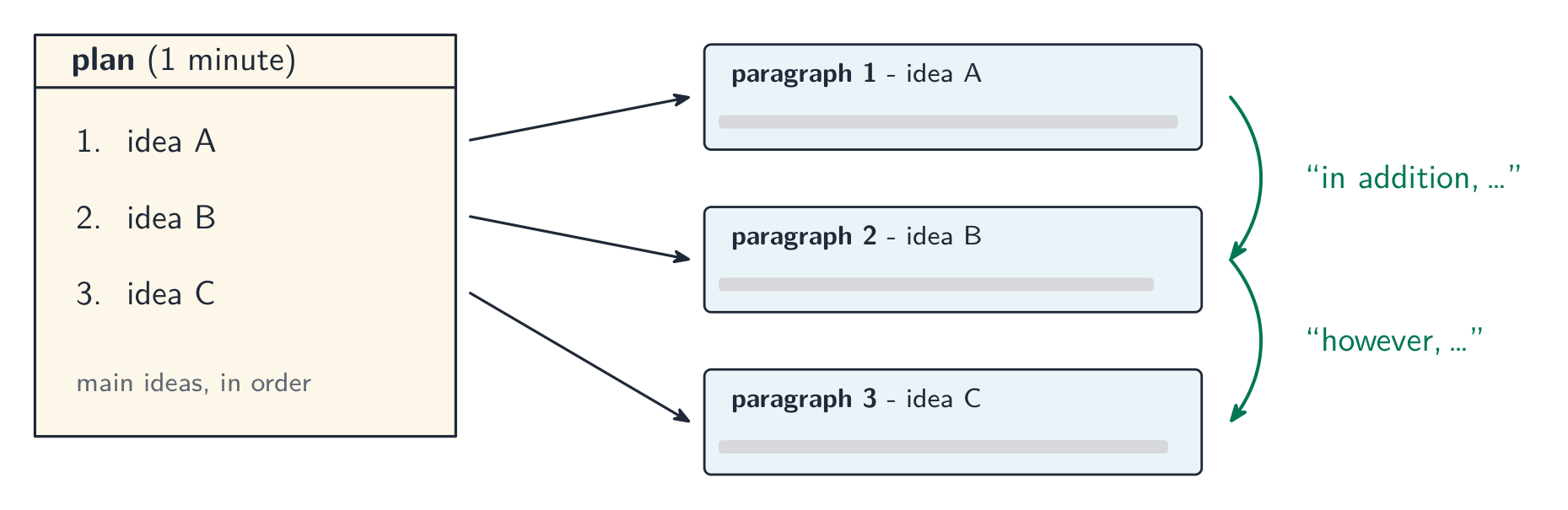
    • Spend one minute on a plan 计划. Write down your main ideas and put them in order.
    • A plan stops you from forgetting a point or repeating yourself.

    Use paragraphs

    • Put each main idea in its own paragraph 段落.
    • Start a new paragraph for a new idea. This makes your writing clear.

    Link your ideas

    • Use linking words 衔接词 to join your ideas smoothly.
    • For adding: in addition, also, as well as. For contrast: however, but, although. For results: so, therefore, as a result.
    日本語

    良い文章とは、単に誤りがないことだけでなく、読み手が理解しやすいことも含みます。

    書く前に計画を立てる

    • 計画に1分間費やす。主要なアイデアを書き出し、順序を整える。
    • 計画があれば、要点を見落としたり、同じことを繰り返し書いたりすることを防げる。
    3つの番号付きアイデアを含む1分間の計画が、in additionやhoweverといった接続詞を使って結ばれ、それぞれ1つのアイデアを持つ3段落に変化する
    一分間の構成案があなたの段落になります:各段落に一つのアイデア、接続詞でつなぐ

    段落を使う

    • 各主要なアイデアを独自の段落に入れる。
    • 新しいアイデアに対しては新しい段落を始め、これにより作文が明確になる。

    アイデアをつなぐ

    • 接続詞を用いて、アイデアをスムーズに結びつけなさい。
    • 追加の場合:in addition, also, as well as。対比の場合:however, but, although。結果の場合:so, therefore, as a result。
    Vocabulary · ⁨語彙⁩ Train · ⁨練習する⁩
    English 日本語
    plan/plæn/ 計画
    paragraph/ˈpærəɡræf/ 段落
    linking words/ˈlɪŋkɪŋ wɜːdz/ 接続詞
    Watch lesson · ⁨レッスンを視聴⁩
    2.3

    Accuracy: grammar, vocabulary and checking · ⁨正確性:文法、語彙、およびチェック⁩

    Syllabus · ⁨シラバス⁩
    English
    1. use a range of grammatical structures: different verb forms and tenses, conditionals and varied sentence types
    2. use a range of vocabulary, including set phrases, collocations and synonyms to avoid repetition
    3. check your writing for accuracy in grammar, spelling and punctuation
    日本語
    1. 多様な文法構造を使用する:異なる動詞形と時制、条件節、多様な文型
    2. 多様な語彙を使用し、決まったフレーズ、固い組み合わせ、同義語を用いて反復を避ける
    3. 文章の文法、綴り、句読点の正確性を確認する

    Source: Cambridge International syllabus · ⁨出典: Cambridge International シラバス⁩

    English

    Language marks come from range 多样性 and accuracy 准确性.

    Show a range

    • Use different tenses 时态 and sentence types. Do not write every sentence the same way.
    • Use a range of vocabulary 词汇. Choose a better word than the easy one, and use synonyms 同义词 to avoid repeating yourself.

    Be accurate

    • Check your grammar 语法, spelling 拼写 and punctuation 标点.
    • Common errors are subject–verb agreement, verb tenses, and missing capital letters.

    Check your work

    • Leave one or two minutes to read your work again.
    • Look for small mistakes you can fix quickly. Checking can save several marks.
    日本語

    言語の得点は、語彙の多様性(range) と 正確さ(accuracy) の両方から生まれます。

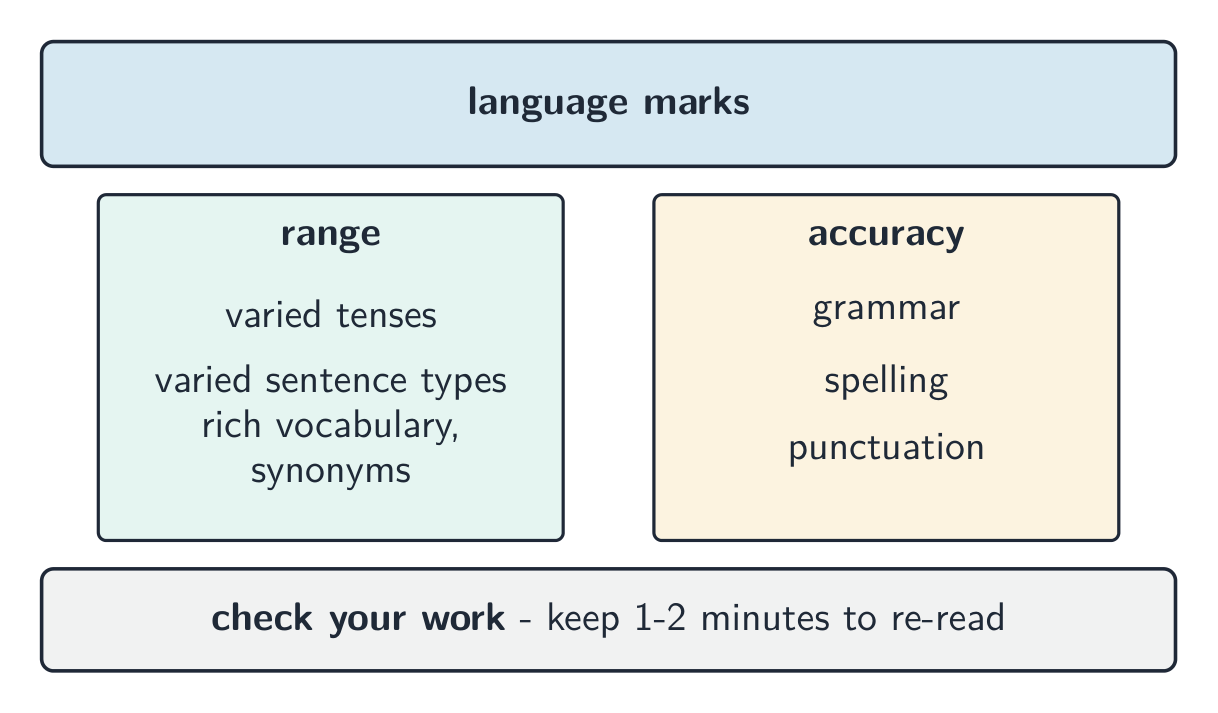
    多様性と正確性という2つの柱が、「言語の得点」と名付けられた屋根を支え、その土台には「作業をチェック」と書かれている
    言語得点は二つの柱に基づいています:バリエーションと正確性

    多様性を示す

    • 異なる時制や文型を使用しなさい。すべての文を同じ形式で書かないこと。
    • 幅広い語彙を使おう。簡単な言葉よりも良い言葉を選び、同義語を用いて重複を防ぎなさい。

    正確性を保つ

    • 文法、綴り、および記号を確認しなさい。
    • よくあるミスは、主語と動詞の一致、動詞の時制、大文字の欠落である。

    作業をチェックする

    • 作文を再度読むために1〜2分残しなさい。
    • すぐに修正できる小さなミスを找めよう。チェックすることで複数の得点を救えるかもしれない。
    Vocabulary · ⁨語彙⁩ Train · ⁨練習する⁩
    English 日本語
    range/reɪndʒ/ 値域
    accuracy/ˈækjʊrəsi/ 精度
    tenses/ˈtensɪz/ 時制
    vocabulary/vəʊˈkæbjʊləri/ 語彙
    synonyms/ˈsɪnənɪmz/ 同義語
    grammar/ˈɡræmə/ grammar
    spelling/ˈspelɪŋ/ 綴り
    punctuation/ˌpʌŋktʃuːˈeɪʃn/ 記号
    2.3

    Exam tips · ⁨試験対策⁩

    English
    • Before you write, say your job in one line: "an informal email to a friend, to invite him to a picnic".
    • Cover every content point in the task. Examiners tick each point; a missing one costs marks at once.
    • Learn what 120 to 160 words of your handwriting looks like, so you never count in the exam.
    • Save the last five minutes to check your usual errors: verb -s, past forms, a / an / the.
    • A short correct sentence beats a long broken one every time.
    日本語
    • 書く前に、自分の任務を1行で言う:「友人へのインフォーマルなメール、彼をピクニックに招待するため」。
    • タスクのすべての内容項目を網羅しなさい。採点者は各項目にチェックを入れる;1つ漏れると即座に失点する。
    • 自身の筆跡で120〜160文字がどのくらいか覚えておき、試験中に数えることがないようになれ。
    • 最後の5分は、自分がよく犯すミスのチェックに充てなさい:動詞の-s、過去形、a/an/the。
    • 常に、長い破損した文よりも短い正しい文の方が優れている。
  • 3

    Writing an informal email · ⁨カジュアルなメールの書き方⁩

    Watch lesson · ⁨レッスンを視聴⁩
    3.1

    Why and to whom you write · ⁨誰に、なぜ書くか⁩

    Syllabus · ⁨シラバス⁩
    English
    1. recognise that an informal email is written to a friend or relative
    2. respond to all of the prompts given in the task
    3. use a friendly, personal tone that suits the reader
    日本語
    1. 非公式なメールは友人や親族宛てに書かれていることを認識する
    2. タスクで与えられたすべてのプロンプトに応答する
    3. 読者に適した、親しみやすく個人的なトーンを使う

    Source: Cambridge International syllabus · ⁨出典: Cambridge International シラバス⁩

    English

    The first writing task asks you to write an informal email 非正式电子邮件 to a friend or a family member.

    Cover every prompt

    • The task gives you some prompts 提示 — short points you must write about.
    • You must cover every prompt. If you miss one, you lose content marks.
    • Tick each prompt as you write it, so you do not forget one.

    Use a friendly tone

    • An email to a friend is informal 非正式. Use a warm, friendly tone 语气.
    • Write as if you are talking to the person. Ask them questions too.
    日本語

    最初の作文課題では、友人や家族へ向けた 非正式なメール を書くことが求められます。

    全ての指示事項を網羅する

    • タスクにはいくつかの指示事項が与えられる:書くべき短いポイントである。
    • 全ての指示事項を網羅しなければならない。1つ見落とすと、内容の得点が失われる。
    • 書くたびに指示事項にチェックを入れ、1つ見落とさないようにする。

    親しみやすいトーンを使う

    • 友人へのメールはインフォーマルである。温かく親しみやすいトーンを使おう。
    • 直接相手に話しかけるように書こう。質問も加えよう。
    腕を組んで笑い合っている3人の学校の友人
    これはメールの受け手である:すでにあなたを知っている人なので、話しかけるような感じで書こう
    ラップトップ上で書く様子:インフォーマルなメールであっても、明確な目的、順序、そして親しみやすいトーンが必要である
    ラップトップ上で書く様子:インフォーマルなメールであっても、明確な目的、順序、そして親しみやすいトーンが必要である
    Vocabulary · ⁨語彙⁩ Train · ⁨練習する⁩
    English 日本語
    informal email/ɪnˈfɔːml ˈiːmeɪl/ 非公式なメール
    prompts/prɒmpts/ プロンプト
    informal/ɪnˈfɔːml/ 非公式
    tone/təʊn/ トーン
    greeting/ˈɡriːtɪŋ/ 挨拶
    closing/ˈkləʊzɪŋ/ 結びの言葉
    paragraphs/ˈpærəɡræfz/ 段落
    short forms/ʃɔːt fɔːmz/ 省略形
    developed/dɪˈveləpt/ 発展
    reason/ˈriːzn/ 理性
    example/eɡˈzæmpl/ 具体例
    detail/ˈdiːteɪl/ 細部
    3.2

    How to build your email · ⁨メールを構築する方法⁩

    Syllabus · ⁨シラバス⁩
    English
    1. open and close an informal email appropriately (for example: Hi … / Write back soon …)
    2. organise the email into short paragraphs, with one main idea per paragraph
    3. use informal language: contractions, friendly phrases and questions to the reader
    日本語
    1. 非公式なメールを適切に書き始め、締めくくる(例:Hi … / Write back soon …など)
    2. メールを短い段落に分け、各段落に一つの主要な考えを入れる
    3. 非公式な表現を使う:略語、親しいフレーズ、読者への質問

    Source: Cambridge International syllabus · ⁨出典: Cambridge International シラバス⁩

    English

    A good email has a clear shape.

    Greeting and ending

    • Start with a greeting 问候语: Hi Sam, or Dear Anna,
    • End with a friendly closing 结束语: Write back soon, or See you soon, then your name.

    Paragraphs

    • Use short paragraphs 段落. Put one main idea in each one.
    • Do not write one long block of text.

    Useful language

    • Informal language uses short forms 缩略形式: I'm, don't, can't.
    • Friendly phrases help: Guess what! / How are you? / I can't wait to…
    日本語

    良いメールには、明確な構成があります。

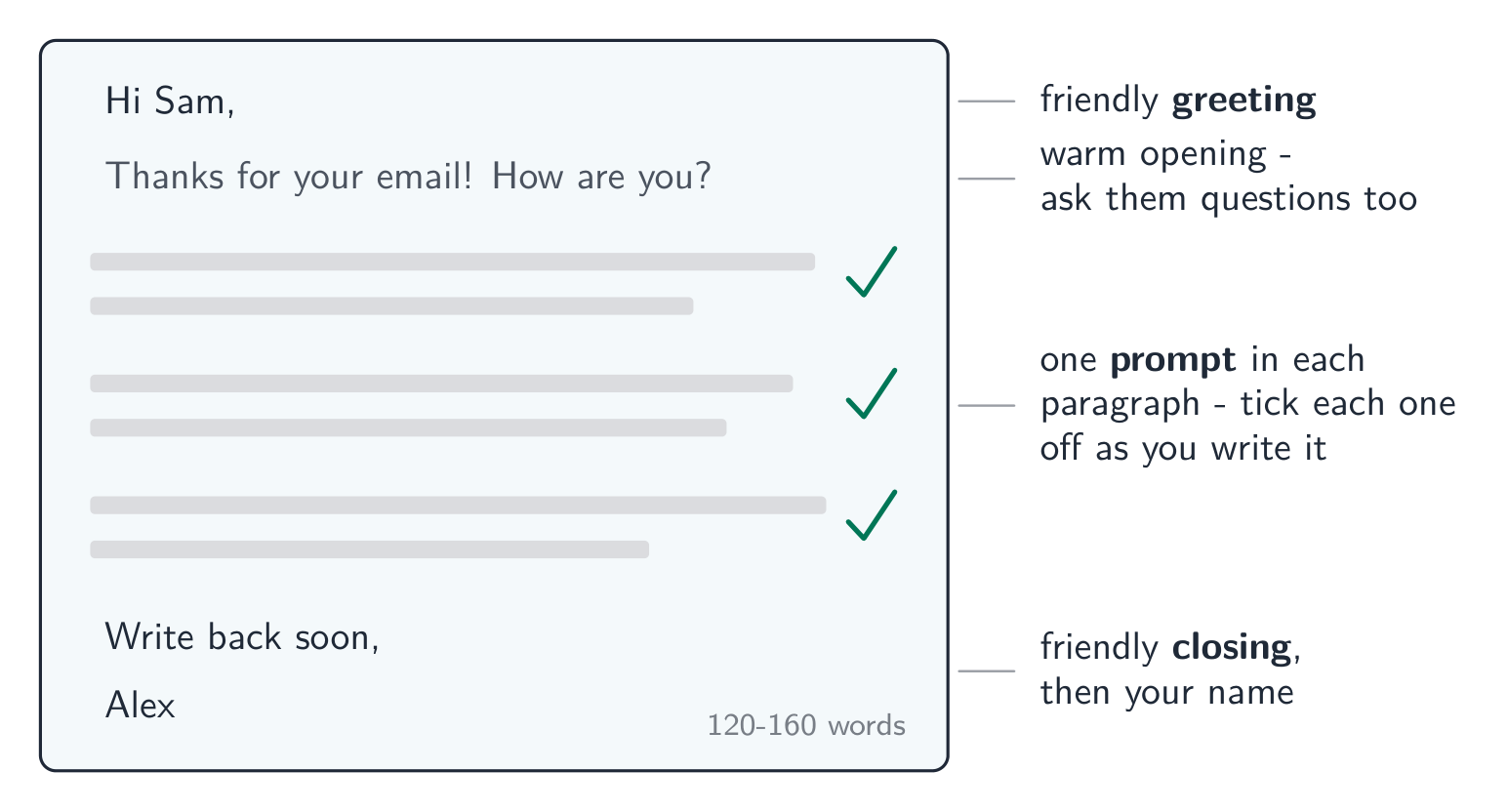
    ラベル付きのインフォーマルなメール:親しみやすい挨拶、温かい冒頭文、各指示事項に対するチェック入り段落、親しみのある締めくくり、署名、全120〜160文字程度
    良好なカジュアルメールの構成

    挨拶と結び

    • 挨拶 问候语で始めます: Hi Sam, または Dear Anna,
    • 親しみやすい結びの言葉 结束语で終わります: Write back soon, または See you soon, の後にあなたの名前を添えます。

    段落

    • 短い段落 段落を使用します。各段落に1つの主要なアイデアを一つだけ含めます。
    • 1つの長い文章塊(block)として書かないように注意してください。

    便利な表現

    • カジュアルな表現では短縮形 缩略形式を使います: I'm, don't, can't など。
    • 親しみやすいフレーズが役立ちます: Guess what! / How are you? / I can't wait to…
    3.3

    Making your email better · ⁨メールをより良くする⁩

    Syllabus · ⁨シラバス⁩
    English
    1. develop each idea with a reason, example or detail rather than just listing points
    2. vary your sentence openings and link ideas smoothly
    3. check the length (120–160 words), the tone and the accuracy before finishing
    日本語
    1. 単にポイントを列挙するのではなく、理由、具体例、詳細によって考えを展開する
    2. 文の开头を変え、考えをスムーズにつなぐ
    3. 完成前に長さ(120–160語)、トーン、正確性を確認する

    Source: Cambridge International syllabus · ⁨出典: Cambridge International シラバス⁩

    English

    Content marks reward developed 展开的 ideas, not a list.

    Develop your ideas

    • Do not just name an idea. Add a reason 原因, an example 例子, or a detail 细节.
    • "I loved the trip" is weak. "I loved the trip because we saw an old castle" is much better.

    Check before you finish

    • Count your words: aim for 120 to 160 words.
    • Check the tone is friendly, then fix small grammar and spelling mistakes.

    A model email

    See how the friendly tone and developed ideas work together.

    Hi Sam,

    Guess what — I finally visited the new science museum you told me about! I loved it, especially the space room, because you can sit in a real rocket seat and feel it shake. I went with my cousin, and we stayed until it closed.

    How about you? Have you been yet? We really should go together in the summer.

    Write back soon, Lin

    Notice the warm greeting, one developed idea with a reason, a question back to Sam, and a friendly closing. It reads like a real message to a friend — and it covers every prompt.

    日本語

    コンテンツ・マークは、単なるリストではなく、展開された 展开的アイデアに与えられます。

    考えを展開する

    • アイディアを名指しするだけでなく、理由 原因、例 例子、または詳細 细节を追加してください。
    • "I loved the trip" は弱いです。"I loved the trip because we saw an old castle" の方が遥かに良いです。
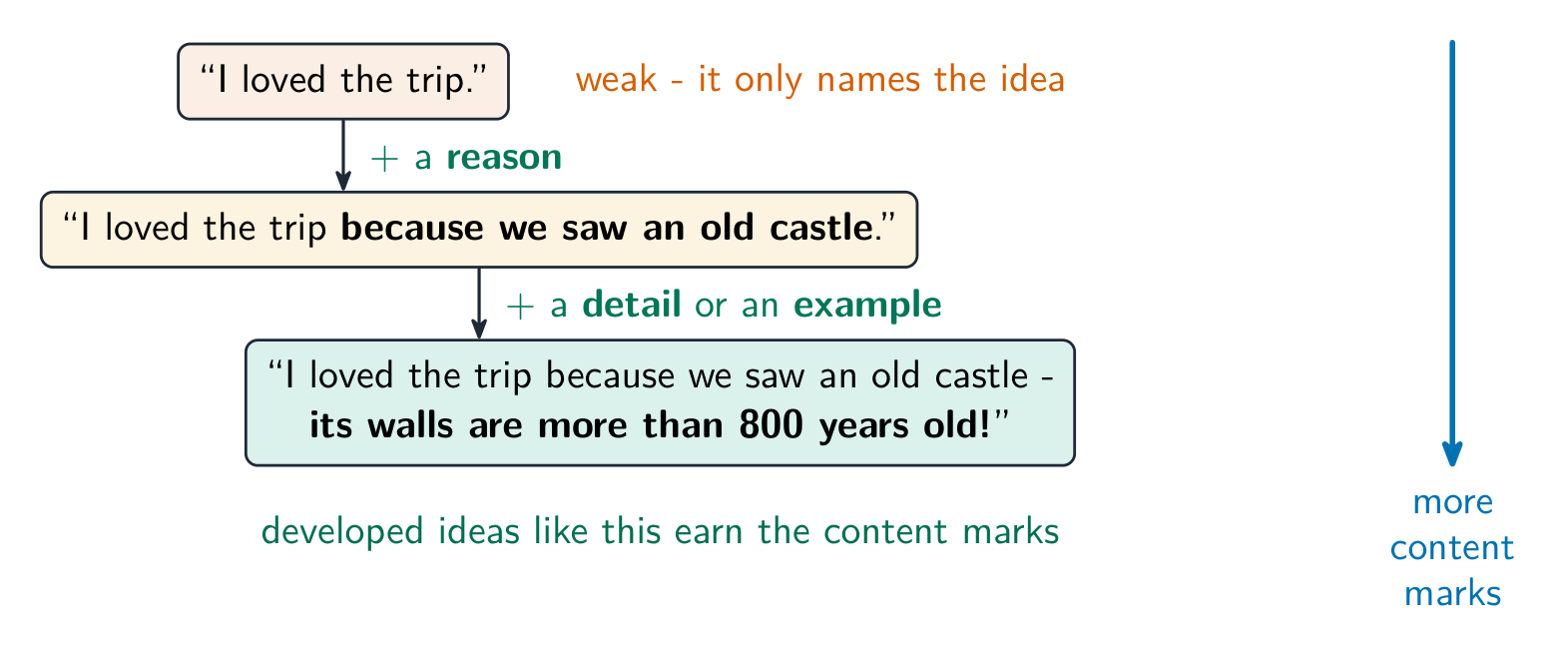
    弱い文が2段階で成長します:まず理由を追加し、次に詳細を追加することで、各段階でより多くのコンテンツ・マークを獲得します
    追加される理由や詳細が、アイデアをより強固にする

    提出前にチェックする

    • 文字数を数えてください:120〜160-wordを目安にしてください。
    • トーンが親しみやすいか確認し、小さな文法やスペルミスも修正してください。

    参考例メール

    親しみやすいトーンと展開されたアイデアがどのように機能するかを確認してください。

    Hi Sam,

    Guess what — I finally visited the new science museum you told me about! I loved it, especially the space room, because you can sit in a real rocket seat and feel it shake. I went with my cousin, and we stayed until it closed.

    How about you? Have you been yet? We really should go together in the summer.

    Write back soon, Lin

    温かい挨拶、理由付きの展開されたアイデア、Samへの質問、そして親しみやすい結びの言葉に注目してください。これは本当に友人へのメッセージのように読め、プロンプトのすべての要素を網羅しています。

    3.3

    Exam tips · ⁨試験対策⁩

    English
    • Open warmly: "Thanks for your email!" or "Great to hear from you!" sets the informal tone at once.
    • Use short forms (I'm, don't, can't). They are correct here and make you sound like a friend.
    • Give each prompt in the task its own short paragraph, and add one detail or reason to each.
    • Close like a friend: "Write back soon," plus your first name only, never a full name.
    • Keep the style informal from the first line to the last; one "Dear Sir" in the middle breaks the whole email.
    日本語
    • 暖かく開きます:"Thanks for your email!" や "Great to hear from you!" で即座にカジュアルなトーンを設定します。
    • 短縮形(I'm, don't, can't)を使用します。これらは正しく、あなたを友人のように見せます。
    • タスクの各プロンプトに対して独自の短い段落を作り、それぞれに1つの詳細や理由を追加してください。
    • 友人のように結びます:"Write back soon," とあなたのファーストネームのみを書き、フルネームは使わないでください。
    • 最初から最後までスタイルをカジュアルに保ちます。真ん中に "Dear Sir" が1つあるだけで、メール全体が台無しになります。
  • 4

    Writing a formal letter or email · ⁨フォーマルな手紙やメールの書き方⁩

    Watch lesson · ⁨レッスンを視聴⁩
    4.1

    When to write formally

    Syllabus · ⁨シラバス⁩
    English
    1. recognise when a task needs a formal or semi-formal response (for example, to a teacher or an event organiser)
    2. cover the purpose, format and audience information given in the task
    3. keep a polite, formal tone throughout
    日本語
    1. タスクが形式的または半形式的な回答を必要とする場合を認識する(例:教師やイベント主催者へ)
    2. タスクで与えられた目的、フォーマット、読者の情報を網羅する
    3. 全体的に丁寧で形式的なトーンを維持する

    Source: Cambridge International syllabus · ⁨出典: Cambridge International シラバス⁩

    English

    The second writing task sometimes asks for a formal 正式 or semi-formal 半正式 letter or email.

    Spot a formal task

    • A formal task is written to someone you do not know well — a head teacher 校长, a manager 经理, or an event organiser 活动组织者.
    • The task tells you the format 格式, the purpose 目的 and the reader. Use all three.

    Keep a polite tone

    • Be polite 礼貌 and respectful. Do not use slang 俚语 or jokes.
    • Do not use short forms. Write "I am", not "I'm".
    日本語

    The second writing task sometimes asks for a formal 正式 or semi-formal 半正式 letter or email.

    Spot a formal task

    • A formal task is written to someone you do not know well — a head teacher 校长, a manager 经理, or an event organiser 活动组织者.
    • The task tells you the format 格式, the purpose 目的 and the reader. Use all three.
    A tidy office desk with a computer, a plant and a wall calendar, nobody sitting at it
    A formal letter is read at a desk like this — by someone who does not know you, and who is busy

    Keep a polite tone

    • Be polite 礼貌 and respectful. Do not use slang 俚语 or jokes.
    • Do not use short forms. Write "I am", not "I'm".
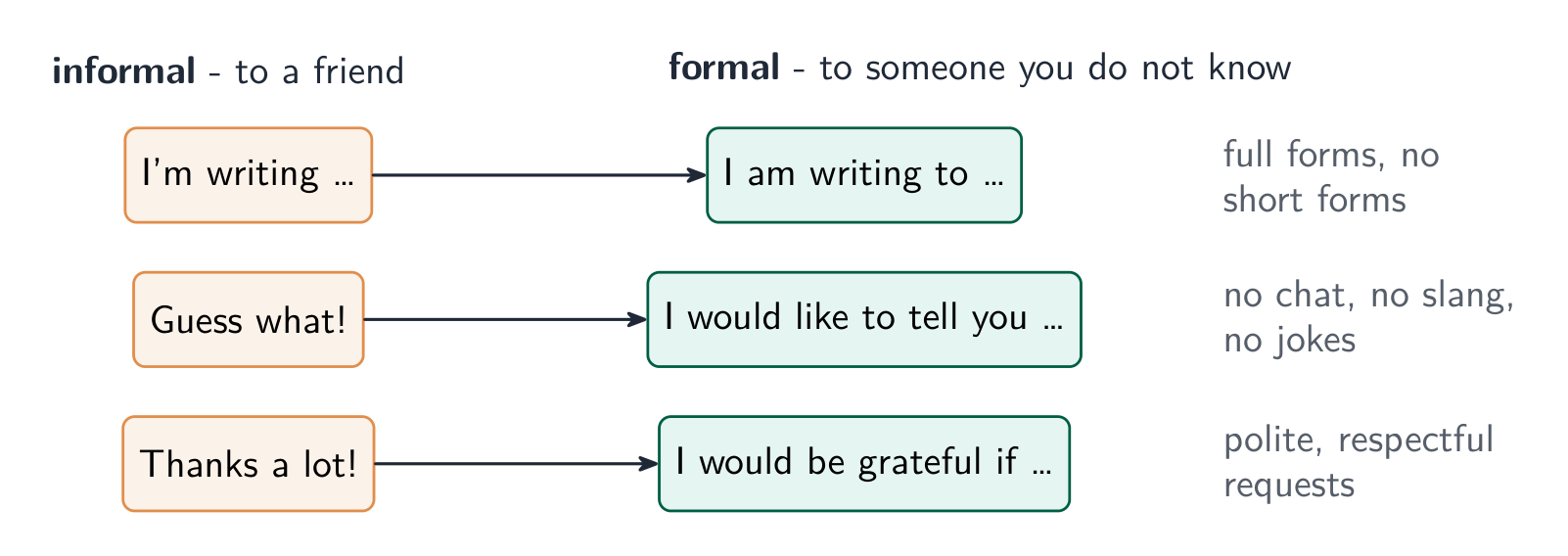
    Three informal phrases turn into formal ones: I'm writing becomes I am writing to, Guess what becomes I would like to tell you, Thanks a lot becomes I would be grateful if
    Turning friendly phrases into formal ones
    A formal letter: careful structure, polite register and a clear reason for writing
    A formal letter: careful structure, polite register and a clear reason for writing
    Vocabulary · ⁨語彙⁩ Train · ⁨練習する⁩
    English 日本語
    formal/ˈfɔːml/ 公式
    semi-formal/ˈsemi ˈfɔːml/ 半公式
    head teacher/hed ˈtiːtʃə/ 校長
    manager/ˈmænɪdʒə/ マネージャー
    event organiser/ɪˈvent ˈɔːɡənaɪzə/ イベント主催者
    format/ˈfɔːmæt/ フォーマット
    purpose/ˈpɜːpəs/ 目的(purpose)
    polite/pəˈlaɪt/ 丁寧
    slang/slæŋ/ スラング
    4.2

    Building a formal letter or email

    Syllabus · ⁨シラバス⁩
    English
    1. open and close a formal letter or email appropriately (for example: Dear … / Yours sincerely …)
    2. organise your points into clear paragraphs with a beginning, middle and end
    3. use formal language and avoid contractions and slang
    日本語
    1. 形式的な手紙やメールを適切に書き始め、締めくくる(例:Dear … / Yours sincerely …など)
    2. ポイントを明確な段落に組織し、導入、本題、結びの構成にする
    3. 形式的な表現を使い、略語やスラングを避ける

    Source: Cambridge International syllabus · ⁨出典: Cambridge International シラバス⁩

    English

    A formal letter follows a clear order.

    Opening and closing

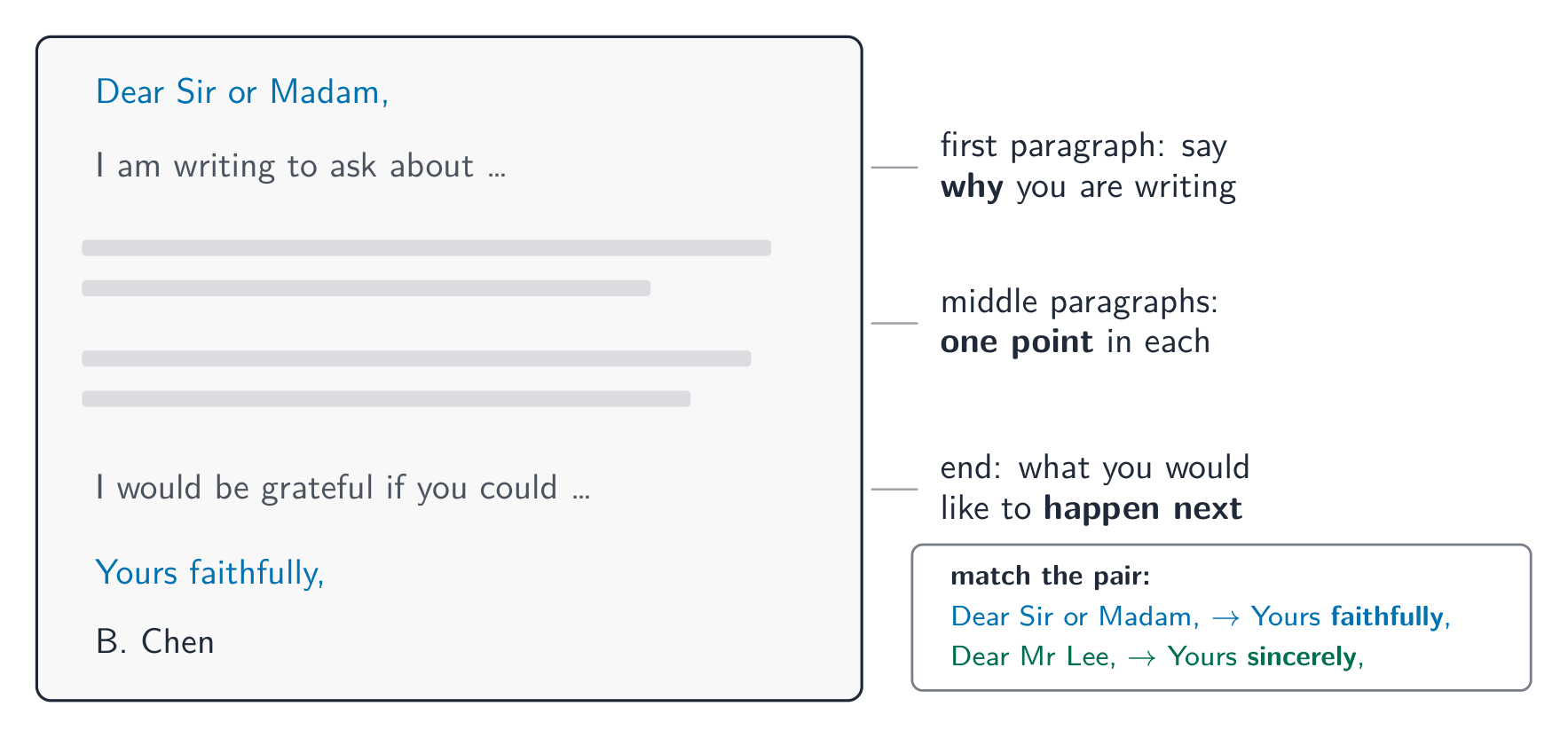
    • Open with Dear Sir/Madam, or Dear Mr Lee,
    • If you start with a name, close with Yours sincerely,. If you start with Sir/Madam, close with Yours faithfully,.

    Clear paragraphs

    • First paragraph: say why you are writing.
    • Middle paragraphs: give your points, one idea in each.
    • Last paragraph: say what you would like to happen next.

    Formal language

    • Use formal phrases: I would like to…, I am writing to…, I would be grateful 感激 if…
    • Keep sentences clear and complete. Check your grammar and spelling.

    A model formal letter

    See how a polite, complete opening sets the right tone.

    Dear Sir or Madam,

    I am writing to suggest an improvement to the town library. At present it closes at five o'clock, which is too early for students who finish school at four. I would be grateful if the council could consider opening it until seven in the evening on weekdays.

    Thank you for taking the time to read my letter.

    Yours faithfully, J. Chen

    Notice the Dear Sir or Madam / Yours faithfully pair, the clear first line stating the purpose, the polite request, and the complete sentences with no short forms.

    日本語

    A formal letter follows a clear order.

    A formal letter with labels: the first paragraph says why you are writing, middle paragraphs give one point each, the end says what you would like to happen, and a box shows that Dear Sir or Madam pairs with Yours faithfully while Dear Mr Lee pairs with Yours sincerely
    The shape of a formal letter - and the greeting decides the sign-off

    Opening and closing

    • Open with Dear Sir/Madam, or Dear Mr Lee,
    • If you start with a name, close with Yours sincerely,. If you start with Sir/Madam, close with Yours faithfully,.

    Clear paragraphs

    • First paragraph: say why you are writing.
    • Middle paragraphs: give your points, one idea in each.
    • Last paragraph: say what you would like to happen next.

    Formal language

    • Use formal phrases: I would like to…, I am writing to…, I would be grateful 感激 if…
    • Keep sentences clear and complete. Check your grammar and spelling.

    A model formal letter

    See how a polite, complete opening sets the right tone.

    Dear Sir or Madam,

    I am writing to suggest an improvement to the town library. At present it closes at five o'clock, which is too early for students who finish school at four. I would be grateful if the council could consider opening it until seven in the evening on weekdays.

    Thank you for taking the time to read my letter.

    Yours faithfully, J. Chen

    Notice the Dear Sir or Madam / Yours faithfully pair, the clear first line stating the purpose, the polite request, and the complete sentences with no short forms.

    Vocabulary · ⁨語彙⁩ Train · ⁨練習する⁩
    English 日本語
    grateful/ˈɡreɪtfl/ 感謝している
    4.2

    Exam tips

    • Match the greeting to the ending: Dear Mr Lee → Yours sincerely; Dear Sir or Madam → Yours faithfully.
    • Say why you are writing in the first line: "I am writing to apply for…" saves words and sounds formal.
    • Do not use short forms: write "I am" and "do not", never "I'm" or "don't".
    • One paragraph per point, and end by naming the action you hope for: "I would be grateful if…".
    • Stay polite even in a complaint: "I was disappointed to find…" wins marks; "This is terrible!" loses the tone.
  • 5

    Writing a report · ⁨レポート作成⁩

    Watch lesson · ⁨レッスンを視聴⁩
    5.1

    What a report is for · ⁨レポートの目的⁩

    Syllabus · ⁨シラバス⁩
    English
    1. recognise that a report is written for a superior or a group about an event, experience or situation
    2. give factual information clearly and add suggestions or recommendations
    3. use a neutral, factual tone
    日本語
    1. レポートは上位者や集団に対し、出来事、経験、状況について書かれることを認識する
    2. 事実情報を明確に伝え、提案や推奨事項を加える
    3. 中立的で事実的なトーンを使う

    Source: Cambridge International syllabus · ⁨出典: Cambridge International シラバス⁩

    English

    A report 报告 gives information to a person in charge — a teacher, a manager, or a club leader. They will act 行动 on what you write, so be clear and honest.

    Purpose and reader

    • A report describes an event 事件, an experience, or a situation 情况.
    • It gives facts 事实 clearly, then adds suggestions.
    • The reader wants useful information, not a story. Keep the tone factual 事实性的 and clear.

    Format

    • A report is usually semi-formal or formal.
    • A title at the top tells the reader what the report is about.
    日本語

    レポートは、担当者(教員、マネージャー、クラブ長など)に情報を伝える文書です。あなたが書いた内容に基づいて行動されることになるため、明確で誠実に記述しましょう。

    目的と読者

    • レポートは、イベントや経験、または状況を説明するものです。
    • 事実を明確に提示した上で、提案を加えます。
    • 読者は物語ではなく有用な情報を探しています。トーンは客観的かつ明確に保ちましょう。
    同じ出来事を2つの方法で描いた図:意見が溢れた物語の文章にはバツ印、明確な事実と数字を含む文章にはチェック印
    レポートは物語ではなく、読者が活用できる事実を提供する

    形式

    • レポートは通常、半フォーマルまたはフォーマルな文体で書かれます。
    • 上部のタイトルで、読者にレポートの内容を伝えます。
    フォーマルな議論の例:レポートは明確な事実を提供し、意思決定者がそれに基づいて行動できるようにする
    フォーマルな議論の例:レポートは明確な事実を提供し、意思決定者がそれに基づいて行動できるようにする
    レポートは、明確な目的と特定の読者を想定して事実を整理している
    レポートは、明確な目的と特定の読者を想定して事実を整理している
    Vocabulary · ⁨語彙⁩ Train · ⁨練習する⁩
    English 日本語
    report/rɪˈpɔːt/ レポート
    act/ækt/ 行為
    event/ɪˈvent/ イベント
    situation/ˌsɪtʃuːˈeɪʃn/ 位置
    facts/fækts/ 事実
    factual/ˈfæktʃuːəl/ 事実上の
    headings/ˈhedɪŋz/ 見出し
    opinion/əˈpɪnɪən/ 意見、 opinion
    recommendations/ˌrekəmenˈdeɪʃnz/ 推奨事項
    conclusion/kənˈkluːʒn/ 結論
    phrases/ˈfreɪzɪz/ 句
    5.2

    How to organise a report · ⁨レポートの構成方法⁩

    Syllabus · ⁨シラバス⁩
    English
    1. organise a report using short headings or clearly separated sections
    2. separate facts from your own opinions and recommendations
    3. end with a clear recommendation or conclusion
    日本語
    1. 短い見出しや明確に区切られたセクションを使ってレポートを構成する
    2. 事実と自身の意見や推奨事項を分離する
    3. 明確な推奨事項または結論で終わる

    Source: Cambridge International syllabus · ⁨出典: Cambridge International シラバス⁩

    English

    A clear shape helps the reader find information fast.

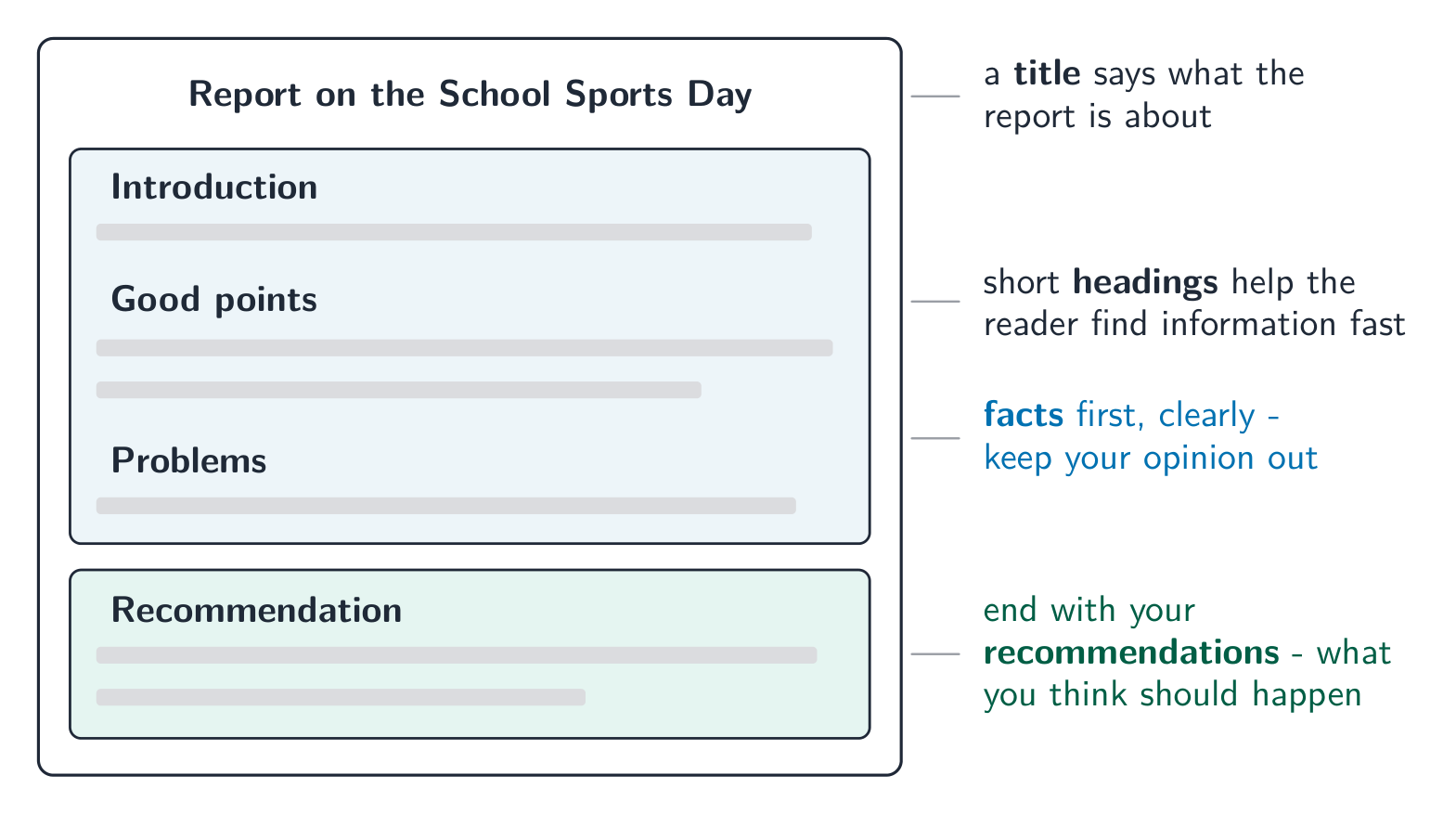
    Use headings

    • Break the report into sections with short headings 小标题.
    • For example: Introduction, Good points, Problems, Recommendation.

    Facts, then recommendations

    • First give the facts. Keep your opinion 观点 out of this part.
    • Then give your recommendations 建议 — what you think should happen.

    End clearly

    • Finish with a clear recommendation or conclusion 结论.
    • Make your advice easy to follow.

    Useful language

    Keep a few report phrases 短语 ready. They make your writing sound organised and grown-up.

    • To introduce: The aim 目的 of this report is to… / This report looks at…
    • To give facts: At present… / The main problem is… / Many students felt that…
    • To recommend: I recommend that… / It would help if… / The best solution 解决办法 is to…

    Notice these are calm and impersonal. A report avoids strong words like "amazing" or "terrible".

    A model report extract

    Read how facts and a recommendation sit under clear headings.

    Introduction This report looks at the school library and suggests ways to improve it.

    Good points The library is quiet, and it has a wide range of science books. It opens every day after school.

    Problems There are only two computers, and every table is full by four o'clock.

    Recommendation The school should add five computers and open a second study room in the evening.

    Each section is short. The first three give only facts; the last gives the advice. That split is what makes it a report, not a story.

    日本語

    明確な構造があれば、読者は情報を素早く見つけます。

    タイトルと「Introduction」「Good points」「Problems」「Recommendation」という見出しを持つレポート;最初の3つのセクションは事実のみ、最後のセクションはあなたの推奨事項を含んでいる
    レポートの構造:明確な見出しの下に事実、最後に提言

    見出しを使う

    • レポートを短い見出し付きのセクションに分けます。
    • 例:Introduction、Good points、Problems、Recommendation。

    事実から推奨事項へ

    • まず事実を述べます。この部分に意見は含めないでください。
    • その後、推奨事項(どうすべきだと考えるか)を述べます。

    結論を明確にする

    • 明確な推奨事項または結論で締めくくります。
    • アドバイスが守りやすいようにします。

    便利な表現

    いくつかのレポート用フレーズを用意しておくと、文章が整って成熟した印象になります。

    • 導入: The aim of this report is to… / This report looks at…(このレポートの目的は〜である/このレポートでは〜を取り上げる)
    • 事実の提示: At present… / The main problem is… / Many students felt that…(現在〜/主な問題は〜/多くの学生は〜と感じた)
    • 推奨: I recommend that… / It would help if… / The best solution is to…(私は〜を推奨する/〜すれば役立つだろう/最良の解決策は〜することだ)

    これらは冷静で感情的ではない点に注意してください。レポートでは「amazing(驚異的)」や「terrible(最悪の)」のような強い感情表現を避けます。

    レポートのモデル例抜粋

    事実と推奨事項が明確な見出しの下にどのように配置されているかを読んでみてください。

    Introduction このレポートでは学校図書館を取り上げ、改善方法を提案する。

    Good points 図書館は静かで、科学書の品揃えも豊富だ。放課後毎日開いている。

    Problems コンピュータは2台しかなく、午後4時にはすべての机が埋まっている。

    Recommendation 学校はコンピュータを5台追加し、夜間に第二学習室を開くべきである。

    各セクションは短く、最初の3つは事実のみ、最後はアドバイスを含んでいる。この区別こそが、これが物語ではなくレポートである理由である。

    Vocabulary · ⁨語彙⁩ Train · ⁨練習する⁩
    English 日本語
    aim/eɪm/ 目的
    solution/səˈluːʃn/ 溶液
    5.2

    Exam tips · ⁨試験対策⁩

    English
    • Start with To / From / Subject or a clear title. A report never opens with "Dear…".
    • Use the introduction to say what the report covers and why, in one or two lines.
    • Group the facts under short headings, and keep your opinion out of the findings.
    • Save opinions for the end: one clear recommendation, "I recommend…" plus one action.
    • Keep the style neutral and calm: no exclamation marks, no jokes, no chat.
    日本語
    • 「To / From / Subject」または明確なタイトルで始めます。「Dear…」からはじめないでください。
    • 冒頭でレポートの範囲と目的を1〜2行で説明します。
    • 見出しの下に事実をまとめ、発見の部分に意見を含まないでください。
    • 意見は最後に残します:明確な推奨事項「I recommend…」、そして具体的なアクション1つ。
    • 中立的で冷静なスタイルを保つ:感嘆符、ジョーク、チャット調は使わない。
  • 6

    Writing an article · ⁨記事作成⁩

    Watch lesson · ⁨レッスンを視聴⁩
    6.1

    What an article is for · ⁨アーティクルの役割⁩

    Syllabus · ⁨シラバス⁩
    English
    1. recognise that an article is written for a general audience to inform or entertain
    2. choose a title and an opening that catch the reader's interest
    3. keep the reader engaged with questions, examples and a clear point of view
    日本語
    1. 記事は一般読者向けに書かれ、情報提供や娯楽を目的としていることを認識する
    2. 読者の興味を惹きつけるタイトルと導入部を選ぶ
    3. 読者に関心を抱かせ続けるために、質問、具体例、明確な立場を使う

    Source: Cambridge International syllabus · ⁨出典: Cambridge International シラバス⁩

    English

    An article 文章 is written for a magazine, a newspaper, or a website. Many people read it.

    Purpose

    • An article informs 告知 or entertains 娱乐 a general reader.
    • You usually give your own view on a topic, with reasons.

    Engage the reader

    • You must engage 吸引 the reader — make them want to keep reading.
    • A good title 标题 and a strong first line catch their interest 兴趣.
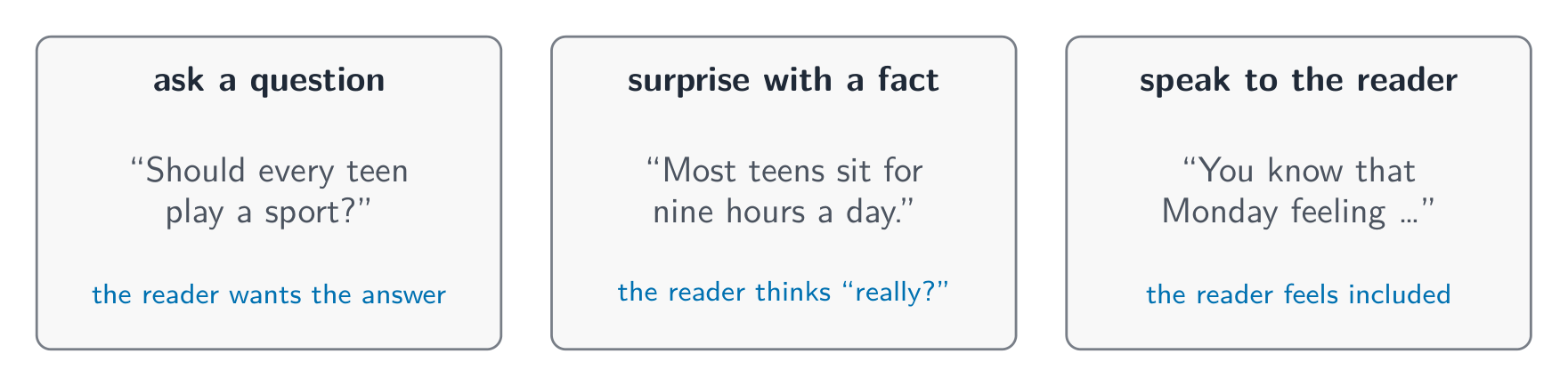
    • Ask the reader a question, or start with a surprising fact.
    日本語
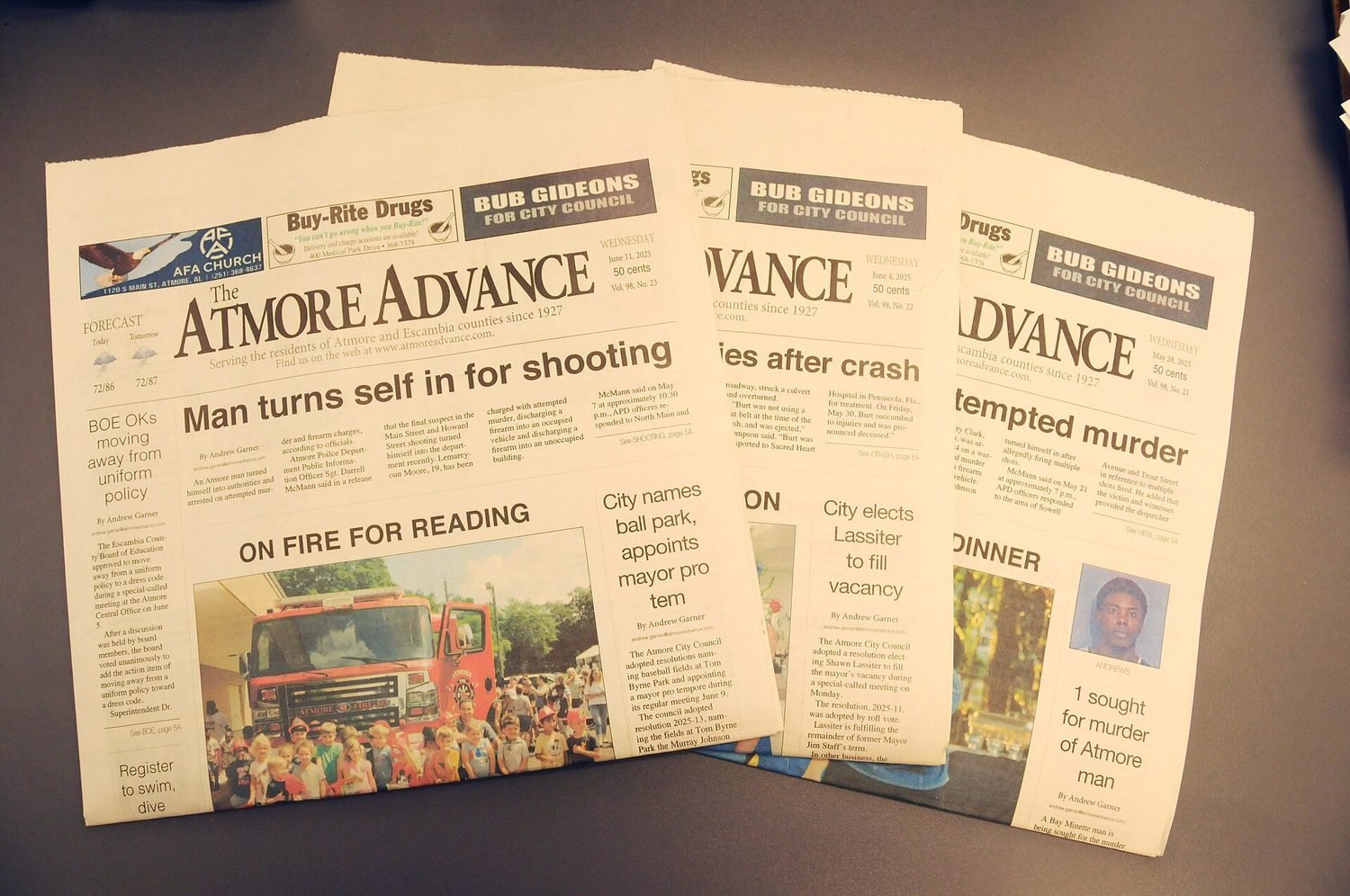
    新聞スタンドに並ぶ多様な新聞の表紙が外側を向いている写真
    新聞スタンド:これらのすべてが同じ読者を引きつけ合っているため、アーティクルはフックで読み手を惹きつける必要がある

    アーティクルは雑誌、新聞、またはウェブサイト向けに書かれます。多くの人に読まれます。

    目的

    • アーティクルは一般読者に対して情報提供やエンターテインメントを行う。
    • 通常、理由と共にテーマに対する自身の意見を示す。

    読者の関心を引く

    • 読者の関心を引くことが必要であり、読み進めたいと思わせるようにする。
    • 良いタイトルと魅力的な冒頭一文が関心を惹きつける。
    • 読者に質問を投げかけたり、驚きの事実で始めたりする。
    3つの導入手法と例:質問を投げる、事実で驚かせる、読者に直接語りかける
    最初の数行で読者の興味を惹きつける3つの方法
    新聞の表紙:記事は読者を惹きつけ、明確な視点で情報提供とエンターテインメントを行う
    新聞の表紙:記事は読者を惹きつけ、明確な視点で情報提供とエンターテインメントを行う
    Vocabulary · ⁨語彙⁩ Train · ⁨練習する⁩
    English 日本語
    article/ˈɑːtɪkl/ article
    informs/ɪnˈfɔːmz/ 通知する
    entertains/ˌentəˈteɪnz/ 娯楽する
    engage/enˈɡeɪdʒ/ 参加する / 関わる
    title/ˈtaɪtl/ タイトル
    interest/ˈɪntrest/ 利子
    introduction/ˌɪntrəˈdʌkʃn/ 導入期
    conclusion/kənˈkluːʒn/ 結論
    varied/ˈveərid/ 多様な
    phrases/ˈfreɪzɪz/ 句
    flat/flæt/ フラット型
    6.2

    Writing a lively article · ⁨生き生きとしたアーティクルを書く⁩

    Syllabus · ⁨シラバス⁩
    English
    1. organise the article into an introduction, development and conclusion
    2. use lively, varied language and a consistent tone
    3. address the reader directly where it suits the topic
    日本語
    1. 記事を序章、本論、結語の構成に整理する
    2. 生き生きとした多様な表現を使い、一貫したトーンを維持する
    3. トピックに適した箇所で読者に直接話しかける

    Source: Cambridge International syllabus · ⁨出典: Cambridge International シラバス⁩

    English

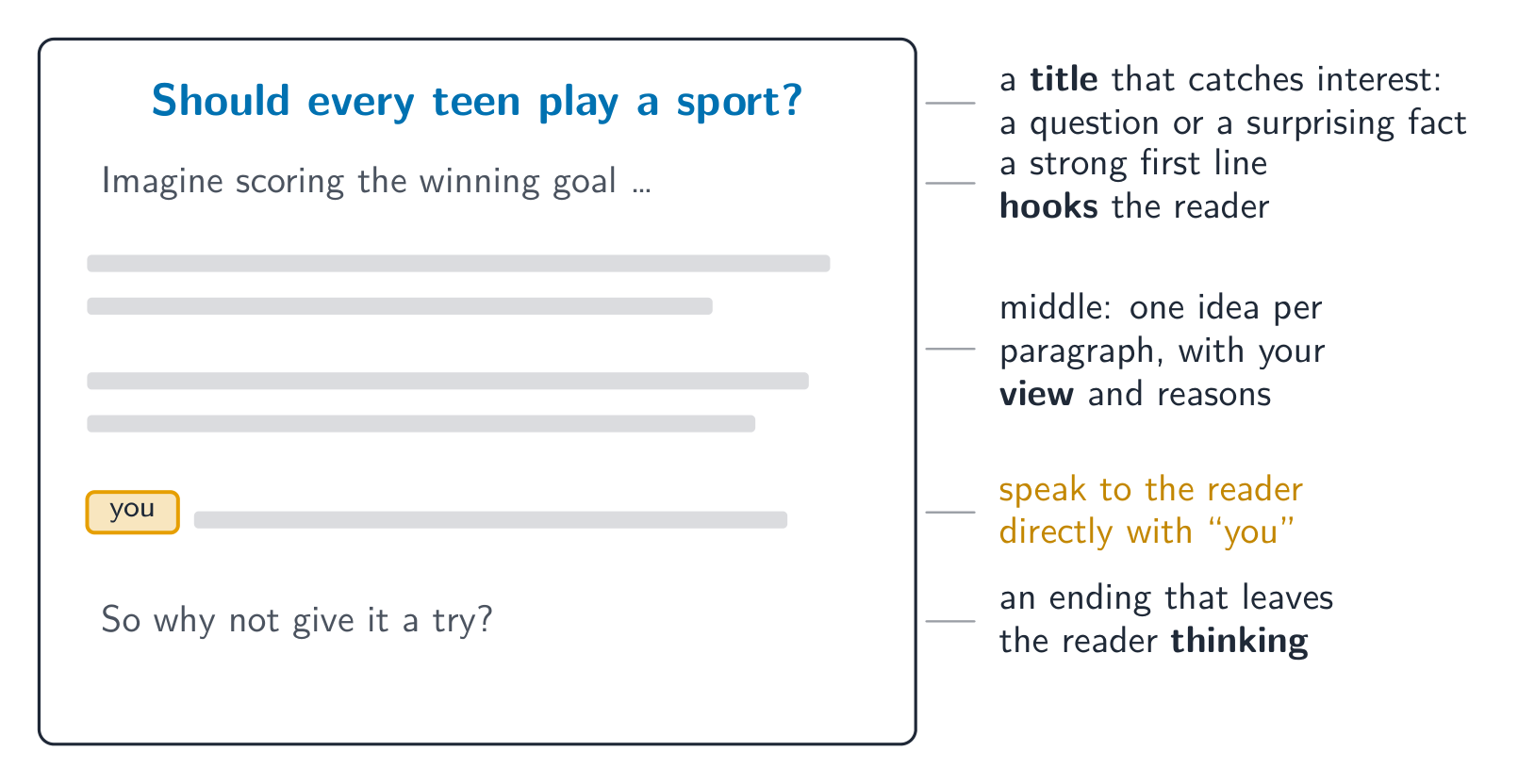
    An article should sound interesting, not flat.

    Structure

    • Begin with an introduction 引言 that names the topic.
    • Develop your points in the middle, one idea in each paragraph.
    • End with a short conclusion 结论 that leaves the reader thinking.

    Lively language

    • Use varied 多样的 words and sentence lengths to keep the energy up.
    • You can speak to the reader directly with "you".
    • Keep the tone friendly, but not too casual.

    Useful language

    A few flexible phrases 短语 let you hook the reader and glide between ideas.

    • To open with energy: Have you ever…? / Imagine you… / Last week, something odd happened to me.
    • To move between ideas: What's more… / On the other hand… / The truth is…
    • To speak to the reader: You might think… / We all know that… / Be honest —…
    • To end memorably: So next time you… / Perhaps the real question is…

    Vary how you open sentences. Ten sentences that all begin "I think" feel flat 平淡; mixing your openings keeps the reader awake.

    A model opening

    See how one opening hooks the reader, then points forward.

    Have you ever tried to sleep with a phone glowing beside your pillow? Most of us have — and most of us wake up tired. This article asks a simple question: could a good night's sleep be the cheapest way to feel happier?

    The question pulls the reader in, the honest detail keeps them, and the last line promises where the article is going. That is a lot of work for three sentences.

    日本語

    アーティクルは平坦ではなく、興味深い響きにするべきである。

    ラベル付きのアーティクル:タイトルに質問、読者を惹きつける強力な冒頭、読者に語りかける単一ideaの段落、読者に考えさせる結末
    生き生きとした記事の構造:読者を惹きつけ、留め、思索に導く

    構造

    • テーマ名を含む引言で始める。
    • 本文では、各段落に1つのアイデアを据えて、論点を展開してください。
    • 読者に考えさせる短い結論で終わる。

    生き生きとした言語

    • 多様な語彙や文の長さを使い、活気を出そう。
    • 「you」を使って読者に直接語りかけることもできる。
    • トーンは親しみやすく、しかし過度にカジュアルにしない。

    便利な表現

    いくつかの柔軟なフレーズで読者を惹きつけ、idea間の移動をスムーズに行える。

    • 活気ある導入: Have you ever…? / Imagine you… / Last week, something odd happened to me.(あなたは〜したことがありますか?/〜を想像してみてください/先週、不思議なことが私に起きた)
    • idea間の移動: What's more… / On the other hand… / The truth is…(さらに/一方/真実は〜だ)
    • 読者への呼びかけ: You might think… / We all know that… / Be honest —…(あなたは〜と思うかもしれない/私たちは皆〜を知っている/正直に言えば〜)
    • 印象に残る結び: 次の機会には… / 本当の問いは…

    文の始め方を工夫しよう。「I think」で始める10文は、すべて同じ調子になり、平淡な印象を与えます。始め方を変えると、読者は飽きません。

    見本となる導入部

    一つの導入部がどうして読者の興味を惹きつけ、次に続く文章へと導いているか見てみましょう。

    枕元で光るスマホに寝入ろうとしたことはありますか? 私たちの多くは経験があるでしょう——そして多くの人が、朝目覚めると疲れを感じます。この記事はシンプルな問いを投げかけます:良い眠りは、より幸せを感じるための最も安価な方法でしょうか?

    問いは読者を引き込み、率直な詳細が留め置き、最後の一文が記事の方向性を約束します。これらは三つの文でこなすには大きな作業です。

    6.2

    Exam tips · ⁨試験対策⁩

    English
    • Give the article a short, catchy title, then hook the reader with a question or surprise in the first lines.
    • Talk to the reader: "Have you ever…?" An article is the one formal task where personality wins marks.
    • One idea per paragraph, and make it real with a short example or a small story.
    • Numbers and small facts make an article feel true: "three out of five students…".
    • End with a line the reader remembers: a punchline, a question, or a call to act.
    日本語
    • 記事に短くキャッチーなタイトルをつけ、最初の数行で問いや驚きを使って読者の興味を引きます。
    • 読者に語りかける:「あなたは曾经…?」 記事作成は唯一、個性が点数につながるフォーマルなタスクです。
    • 段落ごとに一つのアイデアを持ち、短い例や小さなエピソードで具体化しましょう。
    • 数字や小さな事実は、記事に説得力を与えます:「5人の生徒のうち3人…」など。
    • 読者が記憶に残る一言で締めくくりましょう:ジョーク、問い、または行動を促す呼びかけ。
  • 7

    Writing a review · ⁨レビューを書く⁩

    Watch lesson · ⁨レッスンを視聴⁩
    7.1

    What a review does · ⁨リビューの役割⁩

    Syllabus · ⁨シラバス⁩
    English
    1. recognise that a review describes something you have experienced (a film, place or product) and gives your opinion
    2. balance description with personal opinion and reasons
    3. write for a general audience, for example of a magazine or website
    日本語
    1. リビューは自分が体験したもの(映画、場所、製品)を説明し、意見を述べるものであることを理解する
    2. 説明と個人的な意見およびその理由をバランスよく合わせる
    3. 雑誌やウェブサイトなどの一般読者向けに書く

    Source: Cambridge International syllabus · ⁨出典: Cambridge International シラバス⁩

    English

    A review 评论 tells readers about something you have tried — a film, a book, a restaurant, or a place. A good review helps the reader decide 决定 whether to try it too.

    Describe and judge

    • A review does two things: it describes 描述 the thing, and it gives your opinion 观点 of it.
    • Balance the two. Do not only describe, and do not only give opinions.
    • Describing answers "What is it like?" Judging answers "Is it any good?" Move between the two, sentence by sentence.

    Support your opinions

    • Give reasons for what you think. Say why it was good or bad.
    • Use examples 例子 from your experience to make your view believable 可信.
    • A weak review says "The food was nice." A strong review says "The soup was rich and warming, though the rice arrived cold." The detail is what convinces the reader.

    Useful language

    Learn a few phrases 短语 for each job. Then you never stare at a blank page.

    • To describe: It is set in… / The story follows… / The dish combines… / What stands out is…
    • To praise: The best part is… / I was impressed by… / It really succeeds in…
    • To criticise 批评 (gently): The one weakness is… / It could have been better if… / At times it feels slow.
    • To recommend: I would recommend it to… / It is well worth… / Don't miss…

    Mix praise and criticism so the review sounds fair 公正. A review that is all praise, or all complaint, is hard to trust.

    日本語

    レビュー(評論) は、あなたが試したあるものについて読者に伝えるものです——映画、本、レストラン、あるいは場所など。良いレビューは、読者が自分も試すべきかどうかを決定する手助けをします。

    説明と評価

    • レビューには二つの働きがあります:ものを説明し、それに対するあなたの意見を述べることです。
    • この二つをバランスよく組み合わせてください。説明だけにするのも、意見だけにするのも避けてください。
    • 「どんな感じだったか?」という問いには説明が答え、「良いか悪いか?」という問いには評価が答えます。文と文の間でこの二つを行き来しましょう。
    意見とは、脚が二本の椅子のように座っています。片方の脚は理由、もう片方の脚は例えです
    意見は理由と具体例の上に成り立つ

    意見を裏付ける

    • 自分がそう思う理由を述べましょう。何が良かっただけでなく、なぜ良かかったのか、あるいはなぜ悪かったのかを理由として示してください。
    • 自分の経験から得た例えを使って、自分の意見を信憑性のあるものにしましょう。
    • 弱いレビューは「料理は美味しかった」と言うだけです。強いレビューは「スープは濃厚で温かいが、ご飯は冷えて届いた」と言います。細部が読者を説得するのです。

    便利な表現

    業務ごとに数個の表現(短语)を暗記します。そうすれば、白紙の前で詰まることはありません。

    • 説明するために: It is set in… / The story follows… / The dish combines… / What stands out is…(〜を舞台にしています / ~が物語の軸になっています / 〜と組み合わせる / 特筆すべき点は…)
    • 称賛するために: The best part is… / I was impressed by… / It really succeeds in…(最大の魅力は… / 〜に感心しました / 〜において本当に成功している)
    • 批判するために(優しく): The one weakness is… / It could have been better if… / At times it feels slow.(唯一の弱点は… / 〜であればもっと良かったのに / 時折、テンポが遅いと感じる)
    • 推奨するために: I would recommend it to… / It is well worth… / Don't miss…(〜におすすめします / 〜は十分価値があります / 〜を見逃さないでください)

    賞賛と指摘を混ぜることで、評価が公正(公正)に聞こえるようにします。賞賛か非難のどちらか一辺倒な評価は、信頼しにくいです。

    劇場観客:レビューは見たものを説明し、明確な意見を述べ、それを証拠で裏付けます
    劇場観客:レビューは見たものを説明し、明確な意見を述べ、それを証拠で裏付けます
    Vocabulary · ⁨語彙⁩ Train · ⁨練習する⁩
    English 日本語
    review/rɪˈvjuː/ レビュー
    decide/dɪˈsaɪd/ 決定する
    describes/dɪˈskraɪbz/ 説明する
    opinion/əˈpɪnɪən/ 意見、 opinion
    examples/eɡˈzæmplz/ 具体例
    believable/bɪˈliːvəbl/ 信憑性のある
    phrases/ˈfreɪzɪz/ 句
    criticise/ˈkrɪtɪsaɪz/ 批判する
    fair/feə/ 公平
    evaluate/ɪˈvæljuːeɪt/ 評価する
    tone/təʊn/ トーン
    recommendation/ˌrekəmenˈdeɪʃn/ recommendation
    breathtaking/ˈbreθteɪkɪŋ/ 息を呑むような
    7.2

    How to build a review · ⁨リビューの構成方法⁩

    Syllabus · ⁨シラバス⁩
    English
    1. introduce what is being reviewed, then describe and evaluate it
    2. support your opinions with specific details and examples
    3. end with a clear recommendation to the reader
    日本語
    1. 評価対象を紹介し、その後説明して評価する
    2. 具体的な詳細や例を用いて意見を裏付ける
    3. 読者に対して明確な推奨で締めくくる

    Source: Cambridge International syllabus · ⁨出典: Cambridge International シラバス⁩

    English

    Readers want a clear, helpful review.

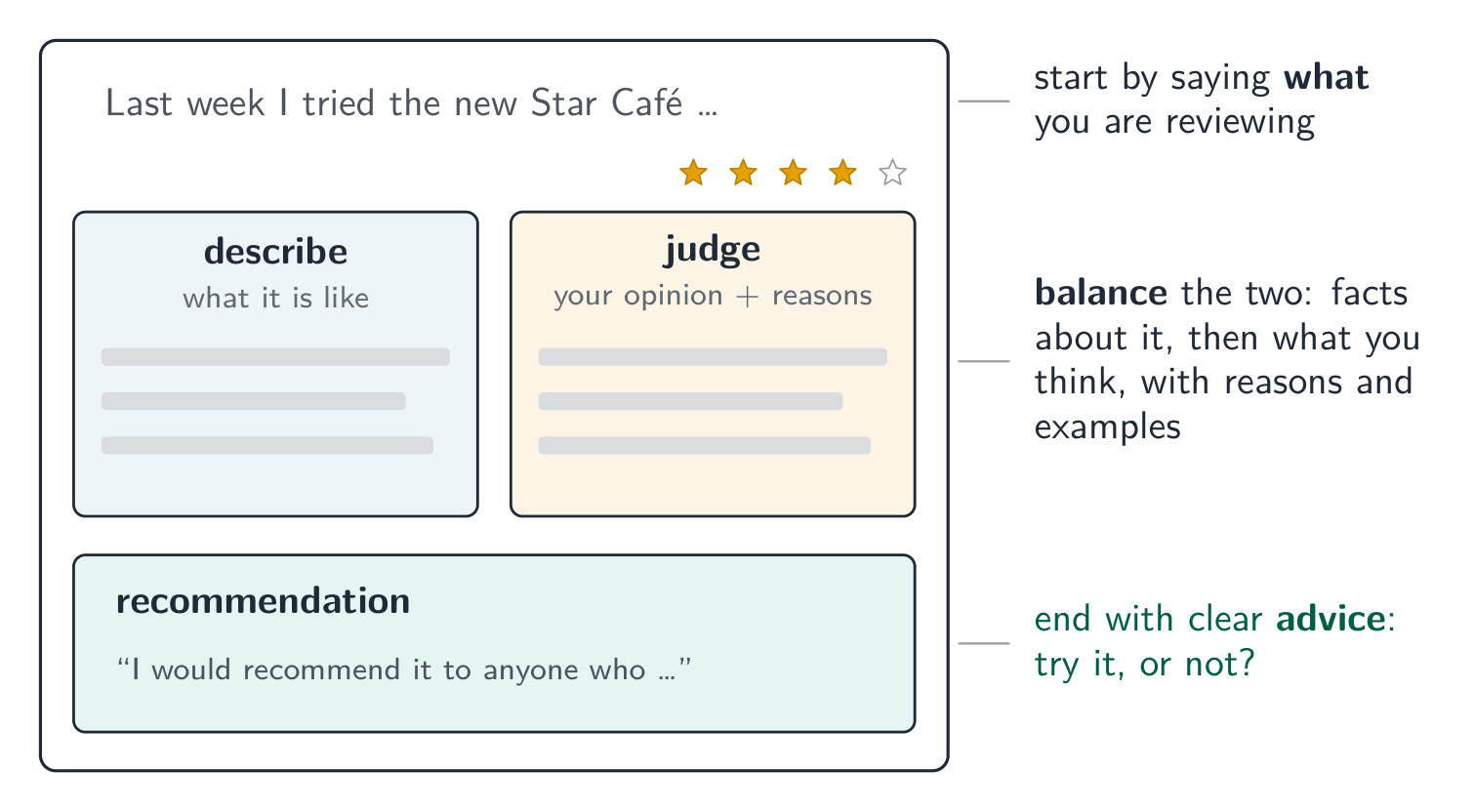
    Structure

    • Start by saying what you are reviewing, and give the reader the basic facts.
    • In the middle, describe it and evaluate 评价 it — the good points and the weak points.
    • Write for a general reader, in a friendly but clear tone 语气.

    End with a recommendation

    • Finish with a recommendation 建议: do you advise the reader to try it or not?
    • Make your advice clear, for example: "I would recommend this film to anyone who likes adventure."
    • You can add a condition: "…as long as you don't mind a slow start." This sounds honest and grown-up.

    A model review

    Read this short review of a film. Notice how each sentence either describes or judges.

    Skyward is an adventure film about a girl who builds her own aircraft. The story is simple, but the flying scenes are breathtaking 惊人 and the young lead acts with real warmth. The middle drags a little, and a few jokes fall flat. Even so, it left the whole cinema smiling. I would recommend Skyward to any family looking for a bright, hopeful evening — just be ready for a slow first ten minutes.

    Count the moves: it names the film, describes it, praises it, admits two faults, and ends with a clear, honest recommendation. That is a complete review in five sentences.

    日本語

    読者は、明確で役立つレビューを求めています。

    ラベル付きのレビュー:まず何をレビューしているかを伝え、次に説明と評価の二つのバランスの取れた列を設け、最後に推奨を添える
    リビューは説明・評価を行い、最後に明確なアドバイスで終わる

    構造

    • まず、何をレビューしているかを伝え、読者に基本情報を提供しましょう。
    • 真ん中では、説明して評価——良い点と悪い点を述べてください。
    • 一般的な読者に向けて、親しみやすいが明瞭なトーンで書いてください。

    推奨で締めくくる

    • 最後に推奨で締めくくりましょう:読者に試すべきか否かのアドバイス是在吗?
    • アドバイスを明確にしましょう。例えば:「冒険好きなら、この映画をおすすめします。」
    • 条件を追加することもできます:「…ただし、序盤が少し遅くても構わない場合に限ります。」 これは誠実で成熟した印象を与えます。

    見本となるレビュー

    この短い映画レビューを読んでみましょう。各文が説明か評価のどちらであるかに注目してください。

    Skyward は、少女が自身で飛行機を作る冒険映画です。ストーリーはシンプルですが、飛行シーンが息を呑むほど素晴らしいこと、主演の若い俳優が本物の温かみを持って演技していることが分かります。中間部が少し退屈で、いくつかのジョークは響きませんでした。それでも、上映館全体が笑顔を浮かべていました。私は、明るく希望に満ちた夜を楽しみたい家族の皆さんに Skyward をおすすめしますが、最初の10分がゆっくり進んでも耐えられる準備をしてください。

    構成要素を確認します:映画名を挙げ、説明し、称賛し、2つの欠点を認めた上で、明確で誠実な推奨で終わります。これは5文で完結する完全なレビューです。

    スマートなレストランの内装:低照明、ブース席、セットされたテーブル
    レストランの内装:何であるかを伝え、説明し、良い点と悪い点を評価し、最後に推奨する
    7.2

    Exam tips · ⁨試験対策⁩

    English
    • Name what you are reviewing and your overall feeling in the first paragraph; do not keep it secret.
    • Do both jobs: describe it (what it is) and judge it (what is strong, what is weak).
    • Strong adjectives are the fuel of a review: gripping, delicious, disappointing, unforgettable.
    • Mention one weakness even in a good review; pure praise sounds like an advert.
    • Finish with a clear recommendation: who should try it, who should not, and why.
    日本語
    • 最初の段落で、何をレビューしているかと、総合的な感想を伝えてください。隠さずに明記しましょう。
    • 二つのタスクを両方行いましょう:説明する(何であるか)ことと、評価する(何が強く、何が弱いか)ことです。
    • 強力な形容詞はレビューの燃料です: gripping, delicious, disappointing, unforgettable。(迫力がある、絶品、がっかりさせる、忘れない)
    • 良いレビューでも、一つの弱点に触れてください。純粋な称賛だけだと広告に見えます。
    • 明確な推奨で締めくくりましょう:誰が試すべきか、誰が避けるべきか、その理由を含めてください。
  • 8

    Writing an essay · ⁨エッセイを書く⁩

    Watch lesson · ⁨レッスンを視聴⁩
    8.1

    Two kinds of essay · ⁨エッセイの二つの種類⁩

    Syllabus · ⁨シラバス⁩
    English
    1. tell the difference between a discursive essay (balanced, both sides) and an argumentative essay (one main view)
    2. plan the main points and the reasons or evidence for each
    3. keep a formal, organised style
    日本語
    1. 考察論(両面をバランスよく扱う)と説得論(一つの主要な立場を持つ)の違いを理解する
    2. 主要なポイントと、それぞれの理由や証拠を計画する
    3. 形式的で整然としたスタイルを維持する

    Source: Cambridge International syllabus · ⁨出典: Cambridge International シラバス⁩

    English

    An essay 议论文 gives your ideas about a topic in an organised way.

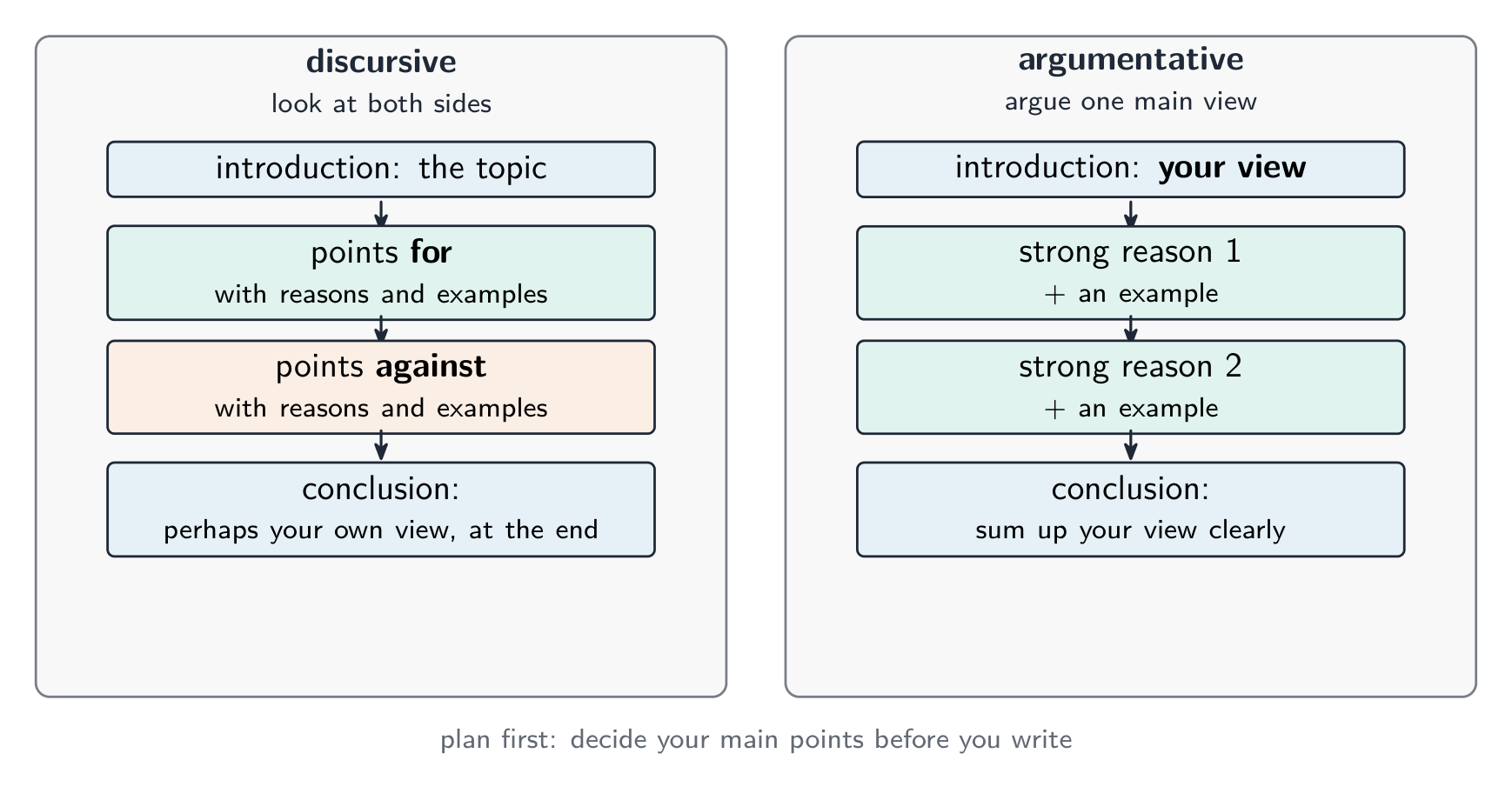
    Discursive essays

    • A discursive 论述的 essay looks at both sides of a topic.
    • You give the points for and against, and perhaps your own view at the end.

    Argumentative essays

    • An argumentative 议论的 essay argues for one main view.
    • You give strong reasons and examples to support your opinion.

    Plan first

    • Decide your main points and the reasons for each, before you write.
    • A short plan keeps your essay organised.
    日本語

    エッセイ(作文) は、テーマに関するあなたの考えを体系的に提示するものです。

    横並びの二つのエッセイ骨組み:論考型エッセイは導入から賛成・反対の論点を経て、自身の見解を含む結論に至ります;議論型エッセイは導入部で自身の見解を声明し、例付きの二つの有力な理由を提示し、結論部で自身の見解を総括します
    二つのエッセイの形:ディスカシブは両面を比較;アーギュメンテイブは一つの立場を主張

    议论性作文

    • 议论性 论述的 essay 会审视主题的双方观点。
    • 你列出支持与反对的理由,并在最后陈述自己的看法。

    论证性作文

    • 论证性 议论的 essay 旨在论证一个主要观点。
    • 你提供强有力的理由和例子来支持你的意见。

    先制定计划

    • 动笔前确定主要论点及每个论点的理由。
    • 简短的提纲能使你的文章条理清晰。
    摆满书籍的阅览室:议论文需要仔细阅读、周密的计划和结构严谨的论证
    摆满书籍的阅览室:议论文需要仔细阅读、周密的计划和结构严谨的论证
    Vocabulary · ⁨語彙⁩ Train · ⁨練習する⁩
    English 日本語
    essay/ˈeseɪ/ エッセイ
    discursive/dɪˈskɜːsɪv/ 記述的
    argumentative/ˌɑːɡjuːˈmentətɪv/ 論争的
    introduction/ˌɪntrəˈdʌkʃn/ 導入期
    8.2

    How to structure an essay · ⁨如何构建作文结构⁩

    Syllabus · ⁨シラバス⁩
    English
    1. introduce the topic and your approach in the introduction
    2. develop one main idea per paragraph in the body, with reasons and examples
    3. draw the ideas together in a clear conclusion
    日本語
    1. 導入部でトピックと自分のアプローチを紹介する
    2. 本論では段落ごとに一つの主要な考え方を展開し、理由と例を示す
    3. 結論で考え方を明確にまとめ、統合する

    Source: Cambridge International syllabus · ⁨出典: Cambridge International シラバス⁩

    English

    A clear shape makes your argument easy to follow.

    Introduction

    • The introduction 引言 names the topic and says how you will approach it.
    • Keep it short — two or three sentences.

    Body paragraphs

    • Put one main idea in each body 主体 paragraph.
    • Start the paragraph with the idea, then add reasons and examples.

    Conclusion

    • The conclusion 结论 brings your ideas together.
    • Do not add a new point here. Sum up your view clearly.

    Useful language

    Linking words 衔接词 signal your reader where the argument turns. They are the road signs of an essay.

    • To add a point: Firstly… / In addition… / Another reason is…
    • To show the other side: However… / On the other hand… / Some people argue that…
    • To give an example: For example… / For instance… / such as…
    • To conclude: In conclusion… / Overall… / Weighing both sides…

    Use them at the start of a sentence, and do not overuse one. Two or three well-placed links are enough for a paragraph.

    A model body paragraph

    Watch the three moves: idea, then reason, then example.

    Firstly, homework teaches students to work alone. In class, a teacher is always nearby to help. At home, a student must solve the problem by themselves — and that is where real learning happens. For example, a maths question that felt easy in the lesson can teach far more when you meet it again, alone, at your desk.

    The first sentence is the idea. The next two explain why. The last one makes it real with an example. Every body paragraph can follow this simple shape.

    日本語

    清晰的结构能让你的论证易于理解。

    引言

    • 引言 引言点明主题并说明你将如何展开论述。
    • 保持简洁——两到三句话即可。

    主体段落

    • 每个 主体 主体段落只包含一个核心观点。
    • 以该观点作为段首句,随后补充理由和例子。
    一个主体段落展开为三个层次:主观点作为主题句,接着是其背后的理由,最后是一个使其具体化的例子
    本文段落:考えを先に、次に理由、そして具体例

    结论

    • 结论 结论将你的观点整合起来。
    • 此处不要引入新观点。清晰总结你的立场。

    便利な表現

    衔接词 衔接词提示读者论证的转折点。它们是作文的路标。

    • 添加观点: Firstly… / In addition… / Another reason is…
    • 展示对立面: However… / On the other hand… / Some people argue that…
    • 举例说明: For example… / For instance… / such as…
    • 总结全文: In conclusion… / Overall… / Weighing both sides…

    将它们置于句首使用,且避免过度重复同一词汇。一个段落中恰当使用两三个连接词即可。

    范文主体段落

    观察这三个步骤:观点,然后是理由,最后是例子。

    Firstly, homework teaches students to work alone. In class, a teacher is always nearby to help. At home, a student must solve the problem by themselves — and that is where real learning happens. For example, a maths question that felt easy in the lesson can teach far more when you meet it again, alone, at your desk.

    第一句是观点。接下来的两句解释原因。最后一句通过例子使其具体化。每个主体段落均可遵循这一简单结构。

    先规划结构:清晰的要点、例子和坚定的结论
    先规划结构:清晰的要点、例子和坚定的结论
    Vocabulary · ⁨語彙⁩ Train · ⁨練習する⁩
    English 日本語
    body/ˈbɒdi/ 本体
    conclusion/kənˈkluːʒn/ 結論
    linking words/ˈlɪŋkɪŋ wɜːdz/ 接続詞
    Watch lesson · ⁨レッスンを視聴⁩
    8.2

    Exam tips · ⁨試験対策⁩

    English
    • Plan for three minutes before you write: your view, two reasons, one opposite view.
    • First paragraph introduces the question; each middle paragraph carries exactly one argument.
    • Signpost with linking words: First of all, However, On the other hand, In conclusion.
    • Give the other side one fair paragraph, then answer it. Balance shows thinking and earns marks.
    • The final paragraph states your opinion clearly. Do not sit on the fence.
    日本語
    • 动笔前三分钟进行构思:你的观点、两个理由和一个对立观点。
    • 第一段引出问题;每个中间段落仅承载一个论点。
    • 使用衔接词标示结构:First of all, However, On the other hand, In conclusion.
    • 给予对立面一段公正的论述,然后予以反驳。平衡的观点能体现思维深度并获得分数。
    • 最后一段明确陈述你的观点。不要模棱两可。
  • 9

    Listening skills · ⁨リスニングスキル⁩

    Watch lesson · ⁨レッスンを視聴⁩
    9.1

    Listening for facts

    Syllabus · ⁨シラバス⁩
    English
    1. listen for specific facts and details: places, names, times, dates and directions
    2. predict what kind of information you will hear before you listen
    3. select the correct multiple-choice option based on what the speaker says
    日本語
    1. 特定の事実や詳細を聞き取る:場所、名前、時間、日付、方向など
    2. 聞く前にどのような情報が聞かれるかを予測する
    3. スピーカーの発言に基づいて正しい選択肢を選択する
    Source: Cambridge International syllabus · ⁨出典: Cambridge International シラバス⁩

    English

    In the listening exam you hear each recording 录音 twice. Use both chances well.

    Predict before you listen

    • Read the question before the recording starts.
    • Predict 预测 what kind of answer you need: a place, a name, a number, a time?

    Catch the detail

    • Listen for specific 具体的 facts: places, names, dates, times and directions 方向.
    • The answers usually come in the same order as the questions.

    Use both playings

    • On the first listening, choose your answer.
    • On the second, check it. Do not change a right answer without a good reason.
    日本語

    In the listening exam you hear each recording 录音 twice. Use both chances well.

    Predict before you listen

    • Read the question before the recording starts.
    • Predict 预测 what kind of answer you need: a place, a name, a number, a time?

    Catch the detail

    • Listen for specific 具体的 facts: places, names, dates, times and directions 方向.
    • The answers usually come in the same order as the questions.

    Use both playings

    • On the first listening, choose your answer.
    • On the second, check it. Do not change a right answer without a good reason.
    A timeline: before the recording read the questions and predict the answer type, on the first playing choose your answers, on the second playing check and fill gaps; answers usually come in question order
    Use the two playings differently: answer first, then check
    A radio studio: listening exams ask you to catch facts, attitudes and implied meaning across two playings
    A radio studio: listening exams ask you to catch facts, attitudes and implied meaning across two playings
    Listening carefully: catch facts, attitudes, and what is only implied
    Listening carefully: catch facts, attitudes, and what is only implied
    Vocabulary · ⁨語彙⁩ Train · ⁨練習する⁩
    English 日本語
    recording/rɪˈkɔːdɪŋ/ 録音
    predict/prɪˈdɪkt/ 予測
    specific/spəˈsɪfɪk/ 特定の
    directions/daɪˈrekʃnz/ 指示
    9.2

    Hearing opinions and attitudes

    Syllabus · ⁨シラバス⁩
    English
    1. understand speakers' ideas, opinions, feelings and attitudes
    2. follow how ideas connect across a longer talk or conversation
    3. notice the language that speakers use to express how they feel
    日本語
    1. スピーカーの考え、意見、感情、態度を理解する
    2. 長い話し合いや会話を通じて考え方がどのように結びついているかを追跡する
    3. スピーカーが感情を表すために使う言語に注意する

    Source: Cambridge International syllabus · ⁨出典: Cambridge International シラバス⁩

    English

    Some questions ask how a speaker thinks or feels, not just what they say.

    Opinions and feelings

    • Listen for the speaker's opinion 观点 and feelings 感受.
    • Notice the words they choose. Strong words show strong feelings.

    Follow the connections

    • In a longer talk, ideas connect 连接. Follow how one point leads to the next.
    • Words like "but", "because" and "so" show how ideas link.
    日本語

    Some questions ask how a speaker thinks or feels, not just what they say.

    Opinions and feelings

    • Listen for the speaker's opinion 观点 and feelings 感受.
    • Notice the words they choose. Strong words show strong feelings.

    Follow the connections

    • In a longer talk, ideas connect 连接. Follow how one point leads to the next.
    • Words like "but", "because" and "so" show how ideas link.
    Vocabulary · ⁨語彙⁩ Train · ⁨練習する⁩
    English 日本語
    opinion/əˈpɪnɪən/ 意見、 opinion
    feelings/ˈfiːlɪŋz/ 感情
    connect/kəˈnekt/ 接続する
    9.3

    Listening between the lines

    Syllabus · ⁨シラバス⁩
    English
    1. understand what is implied but not directly stated
    2. work out a speaker's overall intention or attitude
    3. deduce the meaning of an unfamiliar word from the words around it
    日本語
    1. 明言されていないが示唆されている意味を理解する
    2. スピーカーの全体的な意図や態度を把握する
    3. 前後の文脈から unfamiliar word の意味を導き出す

    Source: Cambridge International syllabus · ⁨出典: Cambridge International シラバス⁩

    English

    Not every answer is said directly.

    Implied meaning

    • Sometimes a speaker suggests 暗示 something without saying it openly.
    • Think about what they really mean, not only the exact words.

    Watch the distractors

    • In multiple-choice 选择题 questions, the wrong options are called distractors 干扰项.
    • A speaker may mention an option, then change their mind. Listen to the whole idea before you choose.

    Words that signal the answer

    Trained ears listen for small words that point to the answer.

    • A correction is coming: actually… / sorry, I mean… / on second thought… — the words after these usually hold the real answer, not the ones before.
    • The key point: the main thing is… / what matters is… / above all…
    • A feeling or attitude 态度: to be honest… / the trouble is… / I'm delighted that…
    • Order of steps: first… next… finally… — these help you follow a sequence.

    Catching one signal word can win you a mark. Note them down as you hear them.

    日本語

    Not every answer is said directly.

    Implied meaning

    • Sometimes a speaker suggests 暗示 something without saying it openly.
    • Think about what they really mean, not only the exact words.

    Watch the distractors

    • In multiple-choice 选择题 questions, the wrong options are called distractors 干扰项.
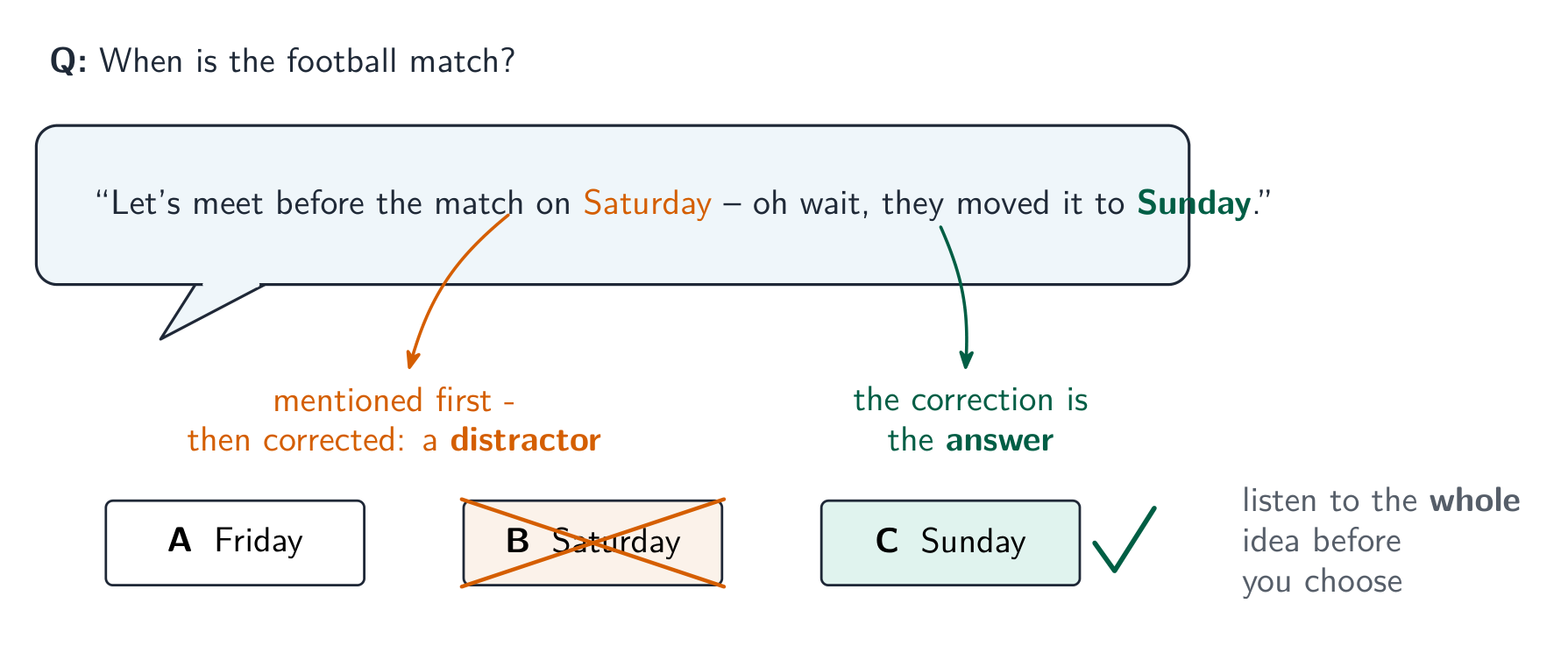
    • A speaker may mention an option, then change their mind. Listen to the whole idea before you choose.
    A speaker says the match is on Saturday, then corrects it to Sunday; Saturday is the distractor and is crossed out, the corrected day Sunday is the answer
    A distractor is mentioned first, then corrected - the correction is the answer

    Words that signal the answer

    Trained ears listen for small words that point to the answer.

    • A correction is coming: actually… / sorry, I mean… / on second thought… — the words after these usually hold the real answer, not the ones before.
    • The key point: the main thing is… / what matters is… / above all…
    • A feeling or attitude 态度: to be honest… / the trouble is… / I'm delighted that…
    • Order of steps: first… next… finally… — these help you follow a sequence.

    Catching one signal word can win you a mark. Note them down as you hear them.

    Vocabulary · ⁨語彙⁩ Train · ⁨練習する⁩
    English 日本語
    suggests/səˈdʒests/ 示唆する
    multiple-choice/ˈmʌltɪpl tʃɔɪs/ 選択式問題
    distractors/dɪˈstræktəz/ 誘導誤答
    attitude/ˈætɪtjuːd/ 態度
    9.3

    Exam tips

    • Read the questions before the audio starts and underline the key words in each one.
    • You hear everything twice: answer what you can in round one, check and fill gaps in round two.
    • Speakers often correct themselves with numbers, days and spellings. The last version is the answer.
    • Missed one? Let it go and follow the next question; return to the gap in the second play.
    • Write something for every question. There is no penalty for a wrong guess.
  • 10

    Speaking skills · ⁨スピーキングスキル⁩

    Watch lesson · ⁨レッスンを視聴⁩
    10.1

    Talking with the examiner

    Syllabus · ⁨シラバス⁩
    English
    1. take part in a conversation or interview, giving factual information and opinions
    2. respond to questions and develop your answers with reasons and examples
    3. use interactive skills: starting, responding, asking for clarification and taking turns
    日本語
    1. 会話やインタビューに参加し、事実や意見を述べる
    2. 質問に対して答え、理由や具体例を加えて発展させる
    3. 対話スキルを活用する:会話を始める、反応する、確認を求める、順番を守る

    Source: Cambridge International syllabus · ⁨出典: Cambridge International シラバス⁩

    English

    The speaking test is a friendly conversation 对话, not a test you fail by being nervous.

    Take part fully

    • Answer the question, then add more. A one-word answer is too short.
    • Give reasons and examples. Show what you can do with English.

    Interact well

    • Listen to the examiner and respond 回应 to what they say.
    • If you do not understand, it is fine to ask: "Sorry, could you repeat that?"
    • Take turns 轮流 naturally, as in a real conversation.
    日本語

    The speaking test is a friendly conversation 对话, not a test you fail by being nervous.

    Take part fully

    • Answer the question, then add more. A one-word answer is too short.
    • Give reasons and examples. Show what you can do with English.
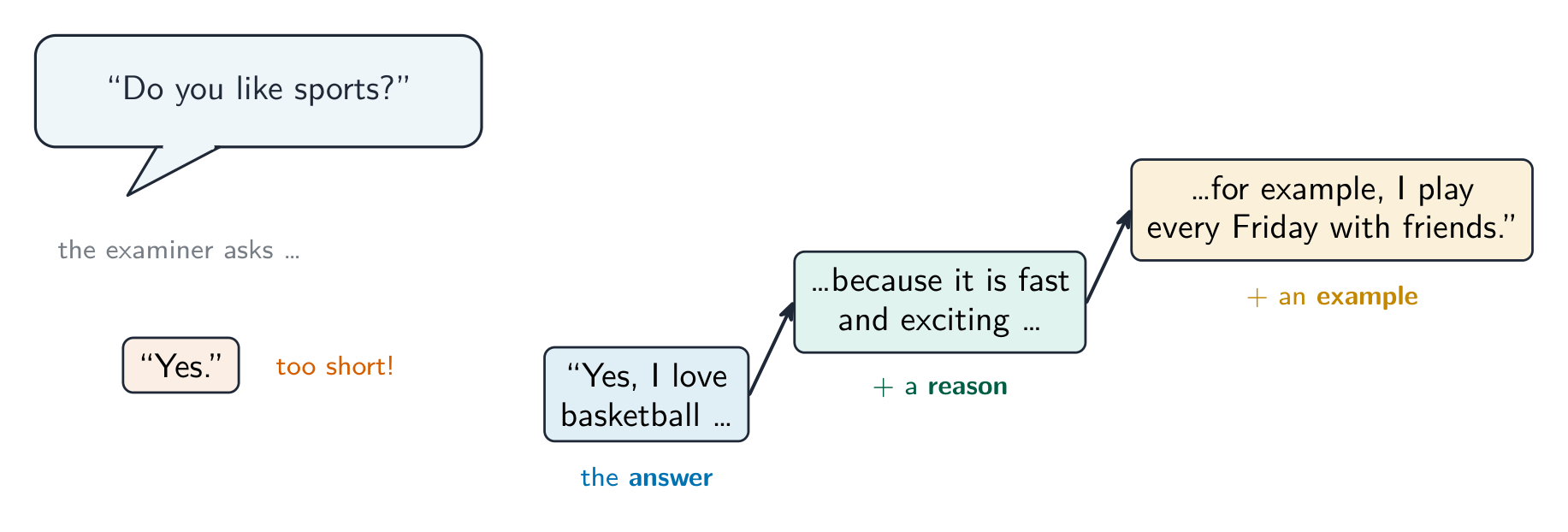
    The examiner asks Do you like sports; the answer Yes alone is too short, but answer plus a reason plus an example climbs like stairs to a full turn
    Answer, then add more: a reason and an example make a full turn

    Interact well

    • Listen to the examiner and respond 回应 to what they say.
    • If you do not understand, it is fine to ask: "Sorry, could you repeat that?"
    • Take turns 轮流 naturally, as in a real conversation.
    Develop answers in conversation: add reasons, examples, and a short opinion
    Develop answers in conversation: add reasons, examples, and a short opinion
    Vocabulary · ⁨語彙⁩ Train · ⁨練習する⁩
    English 日本語
    conversation/kɒnvəˈseɪʃn/ 会話
    respond/rɪˈspɒnd/ 応答する
    turns/tɜːnz/ 変化する
    10.2

    Giving a short talk

    Syllabus · ⁨シラバス⁩
    English
    1. give a short talk that describes an event or explains and justifies an opinion
    2. expand your answers by giving examples, justifying, comparing and speculating
    3. speak with control of vocabulary, grammar, pronunciation and intonation
    日本語
    1. 出来事を説明したり、意見を説明・正当化したりする短いスピーチを行う
    2. 具体例を挙げ、正当化し、比較し、考察することで答えを広げる
    3. 語彙、文法、発音、イントネーションを適切に制御して話す

    Source: Cambridge International syllabus · ⁨出典: Cambridge International シラバス⁩

    English

    You may be asked to talk about a topic for a short time.

    Develop your ideas

    • Do not just list points. Develop 展开 each one with a reason or an example.
    • Use phrases like "for example", "that is why" and "I suppose" to extend your answers.

    Speak clearly

    • Speak with good pronunciation 发音 and natural intonation 语调.
    • Do not rush. It is better to speak clearly than quickly.
    • If you forget a word, say it another way. This is called paraphrasing 释义.

    Useful language

    Memorise a few phrases 短语 for each move. They keep you talking when your mind goes blank.

    • To give an opinion: In my opinion… / I'd say… / For me,…
    • To add detail: for example… / that's why… / what I mean is…
    • To buy thinking time: That's a good question… / Well, let me think… / I suppose…
    • To agree or disagree politely 礼貌: That's true, but… / I see what you mean, though…

    A short pause with "Let me think…" sounds far better than silence. It shows control, not panic.

    A model turn

    See how one student turns a plain question into a full, natural answer.

    Examiner: Do you enjoy studying at home?

    Student: In my opinion, home is better for some subjects. For example, I revise 复习 maths well at home because it is quiet and nobody interrupts 打断 me. But I suppose group work is easier at school, where I can ask my friends straight away. So really, it depends on the task.

    The student gives an opinion, backs it with an example, admits the other side, and finishes with a neat conclusion. That is a top-mark turn — and anyone can build it with these phrases.

    日本語

    You may be asked to talk about a topic for a short time.

    Develop your ideas

    • Do not just list points. Develop 展开 each one with a reason or an example.
    • Use phrases like "for example", "that is why" and "I suppose" to extend your answers.

    Speak clearly

    • Speak with good pronunciation 发音 and natural intonation 语调.
    • Do not rush. It is better to speak clearly than quickly.
    • If you forget a word, say it another way. This is called paraphrasing 释义.

    Useful language

    Memorise a few phrases 短语 for each move. They keep you talking when your mind goes blank.

    • To give an opinion: In my opinion… / I'd say… / For me,…
    • To add detail: for example… / that's why… / what I mean is…
    • To buy thinking time: That's a good question… / Well, let me think… / I suppose…
    • To agree or disagree politely 礼貌: That's true, but… / I see what you mean, though…

    A short pause with "Let me think…" sounds far better than silence. It shows control, not panic.

    A model turn

    See how one student turns a plain question into a full, natural answer.

    Examiner: Do you enjoy studying at home?

    Student: In my opinion, home is better for some subjects. For example, I revise 复习 maths well at home because it is quiet and nobody interrupts 打断 me. But I suppose group work is easier at school, where I can ask my friends straight away. So really, it depends on the task.

    The student gives an opinion, backs it with an example, admits the other side, and finishes with a neat conclusion. That is a top-mark turn — and anyone can build it with these phrases.

    A short talk to a room: plan clear points, speak naturally, and answer follow-up questions
    A short talk to a room: plan clear points, speak naturally, and answer follow-up questions
    Vocabulary · ⁨語彙⁩ Train · ⁨練習する⁩
    English 日本語
    develop/dɪˈveləp/ 開発する
    pronunciation/prəˌnʌnsɪˈeɪʃn/ 発音
    intonation/ˌɪntəˈneɪʃn/ イントネーション
    paraphrasing/ˈpærəfreɪzɪŋ/ 要約( paraphrasing)
    phrases/ˈfreɪzɪz/ 句
    politely/pəˈlaɪtli/ 丁寧に
    revise/rɪˈvaɪz/ 修正
    interrupts/ˈɪntərʌpts/ 割り込み
    10.2

    Exam tips

    • The warm-up chat is not marked. Use it to relax and start talking, not to recite prepared lines.
    • Never say memorised speeches. The examiner stops them, and real conversation earns more.
    • Grow every answer: point, reason, example. "I like… because… for example…" fills a minute well.
    • If you miss a question, ask: "Could you say that again, please?" That is good English, not a fault.
    • Take each prompt on the card in order; every prompt can become a small topic of its own.
  • 11

    Vocabulary and text types · ⁨語彙とテキストタイプ⁩

    Watch lesson · ⁨レッスンを視聴⁩
    11.1

    Growing your vocabulary

    Syllabus · ⁨シラバス⁩
    English
    1. learn new words together with their meaning, spelling and how they sound
    2. group vocabulary by topic and by everyday situation
    3. use set phrases, phrasal verbs and collocations naturally
    日本語
    1. 意味、綴り、発音をセットで新しい言葉を学ぶ
    2. 語彙をトピック別や日常的な場面別にグループ化する
    3. 決まったフレーズ、複合動詞、固い組み合わせを自然に使う

    Source: Cambridge International syllabus · ⁨出典: Cambridge International シラバス⁩

    English

    A wide vocabulary 词汇 helps you in every part of the exam.

    Learn words well

    • Learn a new word with its meaning, its spelling, and how it sounds.
    • Keep a vocabulary notebook. Group words by topic, such as travel or health.

    Use natural phrases

    • Learn words that go together. These are called collocations 词语搭配, like "make a decision" or "heavy rain".
    • Learn set phrases 固定短语 and common phrasal verbs 短语动词, like "give up" or "look after".
    • Using natural phrases makes your English sound fluent 流利.
    日本語

    A wide vocabulary 词汇 helps you in every part of the exam.

    Learn words well

    • Learn a new word with its meaning, its spelling, and how it sounds.
    • Keep a vocabulary notebook. Group words by topic, such as travel or health.
    The word decision in the centre, connected to five things you learn about it: its meaning, its spelling and sound, its word family, its collocation make a decision, and the topic group it is filed under
    Knowing a word well means knowing all of this

    Use natural phrases

    • Learn words that go together. These are called collocations 词语搭配, like "make a decision" or "heavy rain".
    • Learn set phrases 固定短语 and common phrasal verbs 短语动词, like "give up" or "look after".
    • Using natural phrases makes your English sound fluent 流利.
    Growing vocabulary: notice useful words in every text type and practise them in your own writing
    Growing vocabulary: notice useful words in every text type and practise them in your own writing
    Vocabulary · ⁨語彙⁩ Train · ⁨練習する⁩
    English 日本語
    vocabulary/vəʊˈkæbjʊləri/ 語彙
    collocations/ˌkɒləʊˈkeɪʃnz/ 共修飾
    set phrases/set ˈfreɪzɪz/ 決まった表現
    phrasal verbs/ˈfreɪzl vɜːbz/ 複合動詞
    fluent/ˈfluːənt/ 流暢な
    11.2

    Knowing your text types

    Syllabus · ⁨シラバス⁩
    English
    1. recognise common text types: article, blog, email, essay, report, review, notice, leaflet and interview
    2. know the purpose and audience of each text type
    3. match the right style and format to each text type
    日本語
    1. 一般的なテキスト種類を識別する:記事、ブログ、メール、エッセイ、レポート、レビュー、公告、パンフレット、インタビュー
    2. 各テキスト種類の目的と読者層を知る
    3. 各テキスト種類に適したスタイルとフォーマットを組み合わせる

    Source: Cambridge International syllabus · ⁨出典: Cambridge International シラバス⁩

    English

    Each writing task is a text type 文本类型 with its own rules.

    Common text types

    • An email is a message to one person; an article 文章 is for many readers; a report 报告 gives facts to a person in charge.
    • A blog 博客 is a personal, informal online post – like an article but more personal and casual, so it sits near the informal end of the formality scale.
    • A review 评论 gives an opinion about something you tried; an essay 议论文 argues a point of view.
    • A notice 通知 and a leaflet 传单 give short, clear information.

    Match style to type

    • Each text type has its own purpose, reader and tone.
    • Before you write, ask: what is this text type, and what style does it need?

    A vocabulary routine

    Turn new words into words you truly own with four steps:

    1. Meet it — when you find a new word, write it down with one example sentence.
    2. File it — put it in your notebook under a topic group (travel, health, school).
    3. Test it — cover the meaning and try to recall it the next day, then again a week later. This spaced review 间隔复习 fixes words in your memory far better than reading a list once.
    4. Use it — put the word into your own writing or speaking within a few days, before you forget it.

    Five words learned this way each day is over a thousand a year.

    日本語

    Each writing task is a text type 文本类型 with its own rules.

    Common text types

    • An email is a message to one person; an article 文章 is for many readers; a report 报告 gives facts to a person in charge.
    • A blog 博客 is a personal, informal online post – like an article but more personal and casual, so it sits near the informal end of the formality scale.
    • A review 评论 gives an opinion about something you tried; an essay 议论文 argues a point of view.
    • A notice 通知 and a leaflet 传单 give short, clear information.

    Match style to type

    • Each text type has its own purpose, reader and tone.
    • Before you write, ask: what is this text type, and what style does it need?
    A line from informal to formal: an email to a friend sits at the informal end, articles and reviews in the middle, and reports, formal letters and essays at the formal end, each with its matching tone
    Every text type sits somewhere on the line from informal to formal

    A vocabulary routine

    Turn new words into words you truly own with four steps:

    1. Meet it — when you find a new word, write it down with one example sentence.
    2. File it — put it in your notebook under a topic group (travel, health, school).
    3. Test it — cover the meaning and try to recall it the next day, then again a week later. This spaced review 间隔复习 fixes words in your memory far better than reading a list once.
    4. Use it — put the word into your own writing or speaking within a few days, before you forget it.

    Five words learned this way each day is over a thousand a year.

    Vocabulary · ⁨語彙⁩ Train · ⁨練習する⁩
    English 日本語
    text type/tekst taɪp/ テキストタイプ
    article/ˈɑːtɪkl/ article
    report/rɪˈpɔːt/ レポート
    blog/blɒɡ/ ブログ
    review/rɪˈvjuː/ レビュー
    essay/ˈeseɪ/ エッセイ
    notice/ˈnəʊtɪs/ お知らせ
    leaflet/ˈliːflɪt/ リーフレット
    spaced review/speɪst rɪˈvjuː/ 間隔复习( spaced review)
    11.2

    Exam tips

    • Learn words in families, one family per text type: email openers, report verbs, review adjectives.
    • In the writing exam, put the text type's fixed parts down first: greeting, title or headings. They are the easiest marks on the paper.
    • Keep a personal word list. Five new words a day beats fifty words once a month.
    • When a new word appears in the reading paper, guess it from the context and keep moving; never freeze on one word.

Log in or create account · ⁨ログインまたはアカウント作成⁩

IGCSE, A-Level & AP