Skip to content · ⁨コンテンツへスキップ⁩

Coordination and response · ⁨調整と反応⁩

IGCSE Biology · ⁨IGCSE 生物⁩ · Topic 14 · ⁨トピック 14⁩

View Slides · ⁨查看幻灯片⁩ Train · ⁨練習する⁩
Video lesson for this topic · ⁨このトピックのビデオレッスン⁩ Open the video page · ⁨動画ページを開く⁩
18:13

調整と応答

熱いものに触れ、痛みを感じる前に手はすでに動いています。これが2つの制御システムのうち速い方、神経系です。もう一方の…

English narration · English + 中文 subtitles burned in · ⁨英語ナレーション・英語+中文字幕 burning-in⁩

14.1

The nervous system · ⁨神経系⁩

Syllabus · ⁨シラバス⁩
English
Core Supplement
1 State that electrical impulses travel along neurones
2 Describe the mammalian nervous system in terms of: (a) the central nervous system (CNS) consisting of the brain and the spinal cord (b) the peripheral nervous system (PNS) consisting of the nerves outside of the brain and spinal cord
3 Describe the role of the nervous system as coordination and regulation of body functions
4 Identify in diagrams and images sensory, relay and motor neurones
5 Describe a simple reflex arc in terms of: receptor, sensory neurone, relay neurone, motor neurone and effector
6 Describe a reflex action as a means of automatically and rapidly integrating and coordinating stimuli with the responses of effectors (muscles and glands)
7 Describe a synapse as a junction between two neurones 8 Describe the structure of a synapse, including the presence of vesicles containing neurotransmitter molecules, the synaptic gap and receptor proteins
9 Describe the events at a synapse as: (a) an impulse stimulates the release of neurotransmitter molecules from vesicles into the synaptic gap (b) the neurotransmitter molecules diffuse across the gap (c) neurotransmitter molecules bind with receptor proteins on the next neurone (d) an impulse is then stimulated in the next neurone
10 State that synapses ensure that impulses travel in one direction only
日本語
コア サプリメント
1 電気インパルスが神経線維上を伝わることを記述する
2 哺乳類の神経系を、次の点について記述する: (a) 脳と脊髄からなる中枢神経系(CNS) (b) 脳と脊髄の外側にある神経からなる末梢神経系(PNS)
3 神経系の役割を、体の機能の調整・制御であると記述する
4 図や写真において、感覚神経線維、結合神経線維、運動神経線維を識別する
5 簡単な反射弧を、受容器、感覚神経線維、結合神経線維、運動神経線維、効果器の観点から記述する
6 反射作用を、刺激と効果器(筋肉および腺)の反応を自動的にかつ迅速に統合・調整するための手段として記述する
7 シナプスを、2つの神経線維間の接合部として記述する 8 シナプスの構造を、神経伝達物質分子を含む小胞、シナプス間隙、受容体タンパク質の存在を含めて記述する
9 シナプスでの出来事を、次のように記述する: (a) インパルスが小胞からの神経伝達物質分子の放出を刺激する(シナプス間隙へ) (b) 神経伝達物質分子が间隙を拡散する (c) 神経伝達物質分子が次の神経線維上の受容体タンパク質に結合する (d) 結果として次の神経線維でインパルスが発生する
10 シナプスがインパルスの伝導を一方向に限定することを記述する

Source: Cambridge International syllabus · ⁨出典: Cambridge International シラバス⁩

English
The reflex arc

Your body must coordinate 协调 all its parts and react to changes. The nervous system 神经系统 does this using fast electrical impulses 电脉冲 that travel along neurones 神经元 (nerve cells). It has two parts:

  • the central nervous system 中枢神经系统 (CNS) — the brain 大脑 and the spinal cord 脊髓.
  • the peripheral nervous system 周围神经系统 (PNS) — all the nerves outside the brain and spinal cord.

The nervous system coordinates and regulates 调节 the body's functions.

日本語
反射弧
ヒトの脳のスキャン画像
脳は神経系を通じて身体を調整・統制する。

あなたの体は全身の器官を調整し、変化に反応する必要があります。神経系は、ニューロン(神経細胞)を伝わる速い電気インパルスを使ってこれを行います。2つの部分があります:

  • 中枢神経系 (CNS) — 脳と脊髄。
  • 末梢神経系 (PNS) — 脳と脊髄の外側にあるすべての神経。

神経系は体の機能を調整・制御します。

Vocabulary · ⁨語彙⁩ Train · ⁨練習する⁩
English 日本語
brain/breɪn/ 脳
spinal cord/ˈspaɪnl kɔːd/ 脊髄
peripheral nervous system/pəˈrɪfərəl ˈnɜːvəs ˈsɪstəm/ 末梢神経系
regulates/ˈreɡjʊleɪts/ 調節する
sensory neurones/ˈsensəri ˈnjuːrəʊnz/ 感覚ニューロン
relay neurones/ˈriːleɪ ˈnjuːrəʊnz/ 結合ニューロン
motor neurones/ˈməʊtə ˈnjuːrəʊnz/ 運動ニューロン
reflex/ˈriːfleks/ 反射
response/rɪˈspɒns/ 応答
stimulus/ˈstɪmjʊləs/ 刺激
reflex arc/ˈriːfleks ɑːk/ 反射弧
14.1

Neurones and the reflex arc · ⁨ニューロンと反射弧⁩

English

There are three kinds of neurone:

  • sensory neurones 感觉神经元 — carry impulses from receptors to the CNS.
  • relay neurones 中间神经元 — pass impulses on inside the CNS.
  • motor neurones 运动神经元 — carry impulses from the CNS to effectors.

A reflex 反射 action is a fast, automatic response 反应 to a stimulus 刺激 (a change). It follows a fixed path, the reflex arc 反射弧:

receptor 感受器 → sensory neurone → relay neurone → motor neurone → effector 效应器 (a muscle 肌肉 or gland 腺体)

日本語
ニューロンの顕微鏡写真
ニューロン(神経細胞)は電気インパルスを体中へ運びます。

ニューロンには3種類あります:

  • 感覚性ニューロン — 受容器から中枢神経系へインパルスを運びます。
  • 連絡性ニューロン — 中枢神経系内でインパルスを受け継ぎます。
  • 運動性ニューロン — 中枢神経系から効果器へインパルスを運びます。

反射行動とは、刺激(変化)に対する素早く自動的な反応です。固定された経路である反射弧に従います:

受容器 → 感覚性ニューロン → 連絡性ニューロン → 運動性ニューロン → 効果器(筋肉または腺)

反射弧:皮膚の受容器が刺激を検知し、インパルスが感覚性ニューロンを通り脊髄内の連絡性ニューロンへ、その後運動性ニューロンを経て効果器の筋肉へ至る過程
反射弧では、インパルスは受容器 → 感覚性 → 連絡性 → 運動性ニューロン → 効果器へと通過します。
Explore · ⁨探索⁩

The reflex arc · ⁨反射弧⁩

A reflex is a fast, automatic response — the signal takes a short cut through the spinal cord. · ⁨反射とは素早く自動的な反応であり、信号は脊髄を通って近道をする。⁩

14.1

Synapses (Supplement) · ⁨シナプス(補充教材)⁩

English

A synapse 突触 is a junction (a tiny gap) between two neurones. At the end of one neurone are vesicles 囊泡 holding neurotransmitter 神经递质 molecules. Across the synaptic gap 突触间隙, the next neurone has receptor proteins 受体蛋白.

Events at a synapse:

  1. an impulse arrives and makes the vesicles release neurotransmitter into the synaptic gap.
  2. the neurotransmitter molecules diffuse 扩散 across the gap.
  3. they bind to the receptor proteins on the next neurone.
  4. this starts a new impulse in the next neurone.

Synapses make impulses travel in one direction only.

日本語

シナプスとは、2つのニューロンの間の接点(微小な隙間)のことです。1つのニューロンの終端には、神経伝達物質分子を含む小胞があります。シナプス間隙を挟んで、次のニューロンには受容体タンパク質があります。

シナプスでの出来事:

  1. インパルスが到達し、小胞から神経伝達物質がシナプス間隙へ放出されます。
  2. 神経伝達物質分子が隙間を拡散して移動します。
  3. 它们 binds to the receptor proteins on the next neurone.
  4. これにより次のニューロンで新しいインパルスが発生する。

シナプスはインパルスの進行方向を一方向のみにします。

シナプス:最初のニューロン内の小胞から神経伝達物質が隙間に放出され、拡散して次のニューロンの受容体タンパク質に結合するため、インパルスは一方向にしか進めません
シナプスでは神経伝達物質が隙間を拡散して移動するため、信号は一方向のみに通る
Explore · ⁨探索⁩

Across the synapse · ⁨シナプス Across⁩

Neurons don't touch — the impulse crosses the tiny gap using a chemical messenger. · ⁨ニューロン同士は触れ合わず、化学伝達物質を用いて微小な隙間を越えてインパルスが移動する。⁩

Vocabulary · ⁨語彙⁩ Train · ⁨練習する⁩
English 日本語
receptor/rɪˈseptə/ レセプター
effector/ɪˈfektə/ 効果器
muscle/ˈmʌsl/ 筋肉
gland/ɡlænd/ 腺
synapse/ˈsɪnæps/ シナプス
vesicles/ˈvesɪklz/ 小胞体
neurotransmitter/ˈnjuːrətrænsmɪtə/ 神経伝達物質
synaptic gap/sɪˈnæptɪk ɡæp/ シナプス間隙
receptor proteins/rɪˈseptə ˈprəʊtiːnz/ 受容体タンパク質
diffuse/dɪˈfjuːz/ 拡散する
sense organs/sens ˈɔːɡənz/ 感覚器官
cornea/ˈkɔːnɪə/ 角膜
refracts/rɪˈfrækts/ 屈折する
iris/ˈaɪrɪs/ 硝子体
pupil/ˈpjuːpl/ 瞳孔
lens/lenz/ 水晶体
retina/ˈretɪnə/ 網膜
optic nerve/ˈɒptɪk nɜːv/ 視神経
blind spot/blaɪnd spɒt/ 盲点
antagonistic/ænˈtæɡənɪstɪk/ 拮抗する
circular muscles/ˈsɜːkjʊlə ˈmʌslz/ 円形筋
radial muscles/ˈreɪdɪəl ˈmʌslz/ 放射状筋
accommodation/əˌkɒməˈdeɪʃn/ 適応
ciliary muscles/ˈsɪlɪəri ˈmʌslz/ 毛様体筋
suspensory ligaments/səˈspensəri ˈlɪɡəmənts/ 支持靱帯
rods/rɒdz/ ロッド細胞
vision/ˈvɪʒn/ 視覚
cones/kəʊnz/ 錘状体
fovea/ˈfəʊvɪə/ 黄斑(フォベア)
14.2

Sense organs and the eye · ⁨感覚器官と眼⁩

Syllabus · ⁨シラバス⁩
English
Core Supplement
1 Describe sense organs as groups of receptor cells responding to specific stimuli: light, sound, touch, temperature and chemicals
2 Identify in diagrams and images the structures of the eye, limited to: cornea, iris, pupil, lens, retina, optic nerve and blind spot
3 Describe the function of each part of the eye, limited to: (a) cornea – refracts light (b) iris – controls how much light enters the pupil (c) lens – focuses light on to the retina (d) retina – contains light receptors, some sensitive to light of different colours (e) optic nerve – carries impulses to the brain
4 Explain the pupil reflex, limited to changes in light intensity and pupil diameter 5 Explain the pupil reflex in terms of the antagonistic action of circular and radial muscles in the iris
6 Explain accommodation to view near and distant objects in terms of the contraction and relaxation of the ciliary muscles, tension in the suspensory ligaments, shape of the lens and refraction of light
7 Describe the distribution of rods and cones in the retina of a human
8 Outline the function of rods and cones, limited to: (a) greater sensitivity of rods for night vision (b) three different kinds of cones, absorbing light of different colours, for colour vision
9 Identify in diagrams and images the position of the fovea and state its function
日本語
コア サプリメント
1 感覚器官を、特定の刺激(光、音、触覚、温度、化学物質)に反応する受容器細胞の集まりとして記述する
2 図や写真において、目の構造(角膜、虹彩、瞳孔、水晶体、網膜、視神経、盲点のみ)を識別する
3 目の各部分の機能について、次の範囲で記述する: (a) 角膜 – 光の屈折 (b) 虹彩 – 瞳孔に入る光の量を制御 (c) 水晶体 – 光を網膜上に焦点合わせる (d) 網膜 – 光受容器を有し、異なる色の光に感応するものがある (e) 視神経 – インパルスを脳へ運ぶ
4 瞳孔反射について、光強度の変化と瞳孔径の変化の観点から説明する 5 瞳孔反射について、虹彩の円筋と放射筋の拮抗作用の観点から説明する
6 遠近调节(調焦)について、睫状体の収縮・弛緩、懸垂靭帯の緊張、水晶体の形状、光の屈折の観点から説明する
7 人間の網膜におけるロッドとコーンの分布を記述する
8 ロッドとコーンの機能について、次の範囲で概説する: (a) 夜間視覚に対するロッドの高い感度 (b) 色覚のための3種類のコーン(異なる色の光を吸収する)
9 図や写真において黄斑の位置を識別し、その機能を記述する

Source: Cambridge International syllabus · ⁨出典: Cambridge International シラバス⁩

English

Sense organs 感觉器官 are groups of receptor cells that respond to one kind of stimulus — light, sound, touch, temperature or chemicals. The eye responds to light.

Parts of the eye

Part Function
cornea 角膜 refracts 折射 (bends) the light as it enters
iris 虹膜 controls how much light enters the pupil 瞳孔
lens 晶状体 focuses the light onto the retina
retina 视网膜 contains light receptors, some sensitive to different colours
optic nerve 视神经 carries the impulses to the brain
blind spot 盲点 where the optic nerve leaves the eye; it has no receptors

The pupil reflex

In bright light the pupil gets smaller, to protect the retina. In dim light it gets wider, to let more light in. (Supplement) This is done by two sets of antagonistic 拮抗 muscles in the iris: the circular muscles 环肌 and the radial muscles 辐射肌. In bright light the circular muscles contract and the pupil narrows; in dim light the radial muscles contract and the pupil widens.

Accommodation (Supplement)

Accommodation 视觉调节 is changing the shape of the lens to focus on near or far objects, using the ciliary muscles 睫状肌 and the suspensory ligaments 悬韧带:

  • near object: the ciliary muscles contract, the ligaments slacken, and the lens becomes fatter — more refraction.
  • far object: the ciliary muscles relax, the ligaments pull tight, and the lens becomes thinner — less refraction.

Rods and cones (Supplement)

The retina has two kinds of light receptor:

  • rods 视杆细胞 — very sensitive, good for vision 视觉 in dim light (night vision); they do not detect colour.
  • cones 视锥细胞 — three kinds, each absorbing a different colour, giving colour vision; they work best in bright light.

Cones are packed most densely at the fovea 中央凹, the part of the retina that gives the sharpest image.

日本語

感覚器官とは、特定の種類の刺激(光、音、触覚、温度、化学物質)に応答する受容器細胞の集団です。眼は光に応答します。

眼の構造

部分 機能
角膜 光が入射する際に屈折(曲げる)
虹彩 瞳孔に入る光の量を調節
水晶体 光を網膜上に焦点を合わせる
網膜 光受容器を含み、異なる色に感度を持つものがある
視神経 インパルスを脳へ運ぶ
盲点 視神経が眼を出る場所;受容器がない
眼の断面図:光は角膜から入り、虹彩の隙間である瞳孔を通り、水晶体によって後方の網膜上に焦点が合わせられ、インパルスは視神経を通って脳へ向かう
光は角膜と水晶体によって網膜上に焦点合わせられ、信号は視神経を通じて传出する
実際の人間の眼の macro 写真:黒い瞳孔、模様の入った色の虹彩、白い巩膜が見える
実際の眼の前面:黒い瞳孔は光を通す穴であり、その周囲の色のついた虹彩が瞳孔の開き具合を調節します。

瞳孔反射

明るい光では網膜を守るため瞳孔が小さくなり、暗い光ではより多くの光を取り込むため大きくなります。(補充教材)これは虹彩にある2組の拮抗筋によって行われます:円形筋と放射状筋です。明るい光では円形筋が収縮して瞳孔が細くなり、暗い光では放射状筋が収縮して瞳孔が大きくなります。

调节(補充教材)

調節とは、毛様体筋と懸垂靭帯を用いて、遠近の物体に焦点を合わせるために水晶体の形状を変えることです:

  • 近い物体:毛様体筋が収縮し、靭帯が緩み、水晶体が厚くなって屈折力が強まります。
  • 遠い物体:毛様体筋が弛緩し、靭帯が引き締まり、水晶体が薄くなって屈折力が弱まります。

ロッドとコーン(補充教材)

網膜には2種類の光受容器があります:

  • ロッド — 非常に感度が高く、暗所での視覚(夜間視力)に適しています;色を検知することはできません。
  • コーン — 3種類あり、それぞれ異なる色を吸収して色覚を提供します;明るい光で最も良く機能します。

コーンは最も高い密度で黄斑に詰まっており、これは網膜の中で最も鮮明な画像を与える部分です。

Explore · ⁨探索⁩

Explore the eye · ⁨眼を探検する⁩

Tap each part to follow light through the eye — from the cornea and lens that focus it to the retina that detects it. · ⁨各部分をクリックして光が眼を通る様子を追跡せよ — 屈折させる角膜とレンズから、それを検知する網膜まで。⁩

Explore · ⁨探索⁩

Accommodation — focusing the eye · ⁨調節 — 目の焦点合わせ⁩

The eye changes the shape of its lens to focus on near or far objects. · ⁨目は近くや遠くの物体に焦点を合わせるためにレンズの形状を変化させます。⁩

14.3

Hormones · ⁨ホルモン⁩

Syllabus · ⁨シラバス⁩
English
Core Supplement
1 Describe a hormone as a chemical substance, produced by a gland and carried by the blood, which alters the activity of one or more specific target organs
2 Identify in diagrams and images specific endocrine glands and state the hormones they secrete, limited to: (a) adrenal glands and adrenaline (b) pancreas and insulin (c) testes and testosterone (d) ovaries and oestrogen 5 State that glucagon is secreted by the pancreas
3 Describe adrenaline as the hormone secreted in ‘fight or flight’ situations and its effects, limited to: (a) increased breathing rate (b) increased heart rate (c) increased pupil diameter 6 Describe the role of adrenaline in the control of metabolic activity, limited to: (a) increasing the blood glucose concentration (b) increasing heart rate
4 Compare nervous and hormonal control, limited to speed of action and duration of effect
日本語
コア サプリメント
1 ホルモンを、腺によって産生され血液によって運ばれ、1つ以上の特定の標的器官の活動を変化させる化学物質として記述する
2 図や写真において特定の内分泌腺を識別し、それらが分泌するホルモンを、次の範囲で記述する: (a) 副腎とアドレナリン (b) 膵臓とインスリン (c) 精巣とテストステロン (d) 卵巣とエストロゲン 5 グルカゴンが膵臓から分泌されることを記述する
3 ‘戦うか逃げるか’の状況で分泌されるホルモンであるアドレナリンと、その影響を次の範囲に限定して説明せよ:(a) 呼吸数の増加 (b) 心拍数の増加 (c) 瞳孔径の拡大 6 アドレナリンが代謝活動の制御において果たす役割を次の範囲に限定して説明せよ:(a) 血糖濃度の上昇 (b) 心拍数の増加
4 神経系による制御とホルモンによる制御を、作用速度と効果持続時間の観点から比較せよ

Source: Cambridge International syllabus · ⁨出典: Cambridge International シラバス⁩

English

A hormone 激素 is a chemical, made by a gland and carried in the blood, that changes the activity of one or more target organs 靶器官. Hormones are made by endocrine glands 内分泌腺, which release them straight into the blood.

Gland Hormone Main effect
adrenal glands 肾上腺 adrenaline 肾上腺素 prepares the body for action
pancreas 胰腺 insulin 胰岛素 (and glucagon 胰高血糖素) control blood glucose 葡萄糖
testes 睾丸 testosterone 睾酮 male development
ovaries 卵巢 oestrogen 雌激素 female development

Adrenaline is released in 'fight or flight' situations, such as fear or danger. It increases the breathing rate, the heart rate 心率, the blood glucose concentration 浓度 and the pupil diameter, getting the body ready to act.

日本語

ホルモンとは、腺によって作られ血液を介して運ばれ、1つ以上の標的臓器の活動を changing する化学物質です。ホルモンは内分泌腺によって作られ、直接血液中に分泌されます。

腺 ホルモン 主な作用
副腎 アドレナリン 体を活動状態にする準備をする
膵臓 インスリン(およびグルカゴン) 血液中のブドウ糖を調節
精巣 テストステロン 男性としての発育
卵巣 エストロゲン 女性としての発育

アドレナリンは恐怖や危険といった『戦うか逃げるか』の状況で分泌されます。呼吸数、心拍数、血液中のブドウ糖濃度、瞳孔径を増加させ、体を行動-ready にします。

副腎からアドレナリンが血液に放出され、複数の標的臓器に作用します:心拍数が上がり、呼吸が深くなり、肝臓からブドウ糖が放出されることで、体が行動的准备になります
アドレナリンは複数の標的臓器に作用することで体を行動状態にします。
Explore · ⁨探索⁩

How hormones work · ⁨ホルモンの働き方⁩

Hormones are chemical messengers carried in the blood — slower than nerves, but longer-lasting. · ⁨ホルモンは血液中を運ばれる化学的信使であり、神経よりも遅いものの、持続時間が長い。⁩

Vocabulary · ⁨語彙⁩ Train · ⁨練習する⁩
English 日本語
adrenaline/əˈdrenəlɪn/ アドレナリン
14.3

Nervous control vs hormonal control · ⁨神経系による制御 vs ホルモンによる制御⁩

English
Nervous control Hormonal control
speed very fast slower
duration 持续时间 short-lived longer-lasting
how it travels electrical impulses along neurones chemicals in the blood
日本語
神経系による制御 ホルモン系による制御
速度 非常に速い やや遅い
持続時間 短い 長い
伝達経路 神経線維を伝わる電気信号 血液中の化学物質
Nervous control travels as electrical impulses along neurones, is very fast and short-lived; hormonal control travels as chemicals in the blood, is slower and longer-lasting
Nervous control is fast but brief; hormonal control is slower but longer-lasting
Vocabulary · ⁨語彙⁩ Train · ⁨練習する⁩
English 日本語
coordinate/kəʊˈɔːdɪnət/ 配位
nervous system/ˈnɜːvəs ˈsɪstəm/ 神経系
electrical impulses/ɪˈlektrɪkl ˈɪmpʌlsɪz/ 電気インパルス
neurones/ˈnjuːrəʊnz/ 神経細胞
central nervous system/ˈsentrəl ˈnɜːvəs ˈsɪstəm/ 中枢神経系
14.4

Homeostasis · ⁨恒常性(ホメオスタシス)⁩

Syllabus · ⁨シラバス⁩
English
Core Supplement
1 Describe homeostasis as the maintenance of a constant internal environment 3 Explain the concept of homeostatic control by negative feedback with reference to a set point
2 State that insulin decreases blood glucose concentration 4 Describe the control of blood glucose concentration by the liver and the roles of insulin and glucagon
5 Outline the treatment of Type 1 diabetes
6 Identify in diagrams and images of the skin: hairs, hair erector muscles, sweat glands, receptors, sensory neurones, blood vessels and fatty tissue
7 Describe the maintenance of a constant internal body temperature in mammals in terms of: insulation, sweating, shivering and the role of the brain
8 Describe the maintenance of a constant internal body temperature in mammals in terms of vasodilation and vasoconstriction of arterioles supplying skin surface capillaries
日本語
コア サプリメント
1 ホメオスタシスを一定の内環境を維持するプロセスとして説明せよ 3 目標値(セットポイント)を参照して、ネガティブフィードバックによるホメオスタシック制御の概念を説明せよ
2 インスリンが血糖濃度を低下させることを述べる 4 肝臓による血糖濃度の制御と、インスリンおよびグルカゴンの役割を説明せよ
5 1型糖尿病の治療法を概説せよ
6 皮膚の図や写真において、毛、立毛筋、汗腺、受容器、感覚ニューロン、血管、脂肪組織を識別せよ
7 哺乳類における一定の体内温度の維持について、断熱、発汗、震え、脳の影響の観点から説明せよ
8 皮膚表面の毛細血管へ血流を供給する動脈球の拡張と収縮の観点から、哺乳類における一定の体内温度の維持を説明せよ

Source: Cambridge International syllabus · ⁨出典: Cambridge International シラバス⁩

English
Negative feedback: blood glucose

Homeostasis 稳态 is keeping a constant internal environment 环境 inside the body — for example a steady temperature and a steady blood glucose level.

(Supplement) Homeostasis works by negative feedback 负反馈: when a value moves away from its set point 设定点, the body acts to bring it back. The change itself triggers the correction.

Controlling blood glucose

The liver 肝脏 and the pancreas keep blood glucose steady:

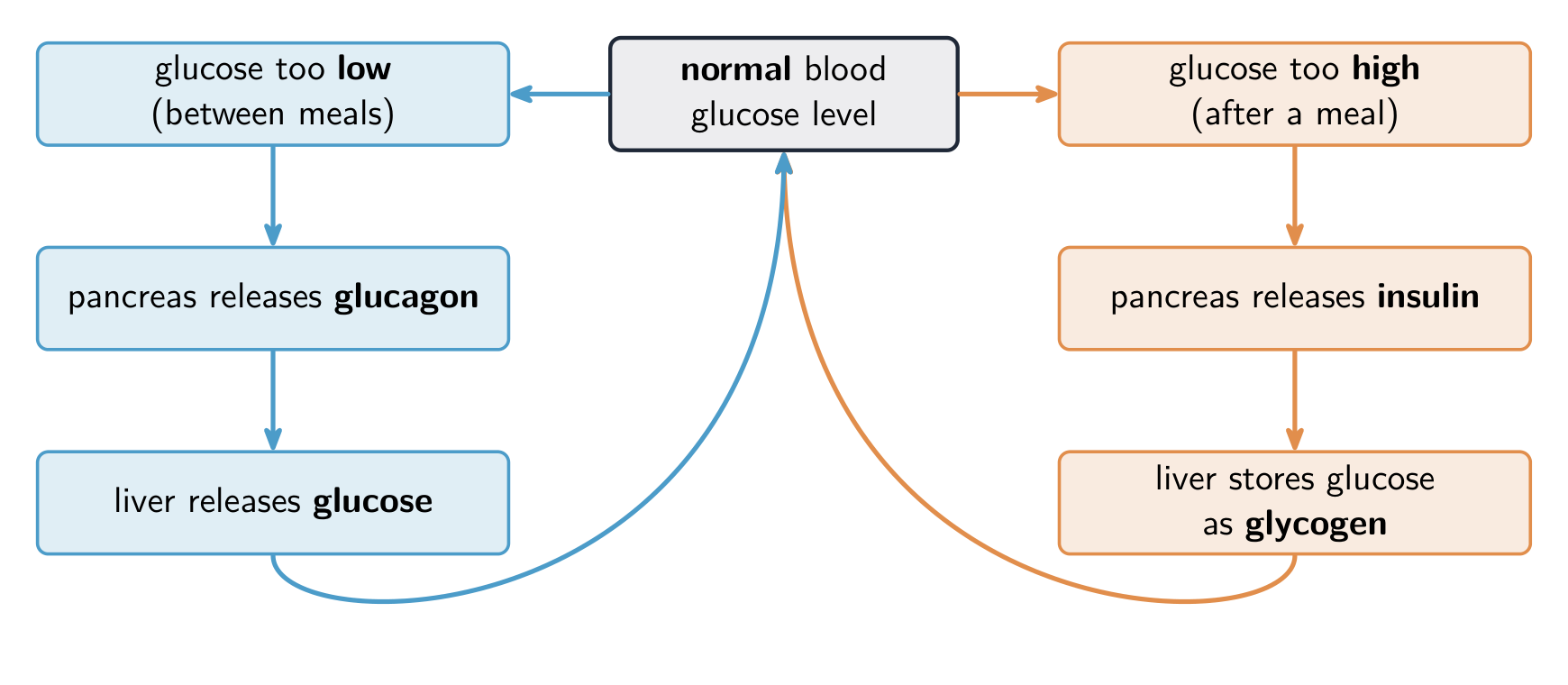
  • insulin lowers blood glucose after a meal — the liver stores the glucose as glycogen 糖原.
  • (Supplement) glucagon raises blood glucose between meals — the liver releases glucose.

In Type 1 diabetes 糖尿病 the pancreas cannot make insulin, so blood glucose rises too high. It is treated with insulin injections and a carefully planned diet.

Worked example. Blood glucose rises sharply after a meal, then falls back to normal over the next two hours. Name the organs and the hormone involved, and say what they do. The pancreas detects the rise and releases insulin. Insulin makes the liver take glucose out of the blood and store it as glycogen, so the level falls back to normal. Between meals the opposite loop runs: the pancreas releases glucagon and the liver releases glucose again. Keep the two words apart - insulin is the hormone, glycogen is the store. Swapping them is the classic error.

Controlling body temperature (Supplement)

The brain detects the body temperature 温度 and keeps it steady. The skin helps:

Structure Role
sweat glands 汗腺 make sweat; as it evaporates it cools the skin (sweating 出汗)
hair erector muscles 立毛肌 raise the hairs to trap a layer of air
blood vessels 血管 change how much blood flows near the skin surface
fatty tissue 脂肪组织 gives insulation 隔热 to reduce heat loss

When you are too hot: you sweat, and the arterioles 小动脉 widen (vasodilation 血管舒张) so more blood flows to the skin capillaries 毛细血管 and loses heat.

When you are too cold: you shiver 颤抖 (the muscles make heat), and the arterioles narrow (vasoconstriction 血管收缩) so less blood reaches the surface, keeping heat in.

日本語
負のフィードバック:血糖値

恒常性(ホメオスタシス)とは、体内の環境を一定に保つこと——例えば、一定の体温や一定の血糖値など。

(補足) 恒常性は負のフィードバックによって機能する:ある値が設定点から外れると、体はそれを元に戻そうとする。変化そのものが修正を引き起こす。

血糖値の制御

肝臓と膵臓が血糖値を一定に保つ:

  • インスリンは食事後の血糖値を下げる——肝臓はグルコースをグリコゲンとして貯蔵する。
  • (補足)グルカゴンは食事間の血糖値を上げる——肝臓はグルコースを放出する。
A feedback loop: if blood glucose is too high the pancreas releases insulin and the liver stores glucose as glycogen; if it is too low the pancreas releases glucagon and the liver releases glucose; both return it to normal
インスリンは血糖値を下げ、グルカゴンは上げることで正常レベルに保つ

1型糖尿病では膵臓がインスリンを作れず、血糖値が過度に上昇する。インスリン注射と厳密に計画された食事療法で治療される。

** worked example.** Blood glucose rises sharply after a meal, then falls back to normal over the next two hours. Name the organs and the hormone involved, and say what they do. The pancreas detects the rise and releases insulin. Insulin makes the liver take glucose out of the blood and store it as glycogen, so the level falls back to normal. Between meals the opposite loop runs: the pancreas releases glucagon and the liver releases glucose again. Keep the two words apart - insulin is the hormone, glycogen is the store. Swapping them is the classic error.

体温の制御(補足)

脳が体の体温を検知して一定に保つ。皮膚も役割を果たす:

構造 役割
汗腺 汗を作る;蒸発時に皮膚を冷やす(発汗)
立毛筋 毛を立てて空気層を閉じ込める
血管 皮膚表面付近を流れる血流量を変える
脂肪組織 断熱を与えて熱損失を減らす

体が暑すぎる場合:発汗し、細動脈が拡張(血管拡張)して皮膚の毛細血管へより多くの血流が行き、熱を失う。

体が寒すぎる場合:震える(筋肉が熱を作る)、細動脈が収縮(血管収縮)して表面への血流が減り、熱を保持する。

Too hot leads to sweating and vasodilation to lose heat; too cold leads to shivering and vasoconstriction to keep heat; both return the body to about 37 degrees
負のフィードバック:約37 °Cからの逸脱が反応を引き起こし、それを逆転させて体を通常の状態に戻す。
Explore · ⁨探索⁩

Negative feedback · ⁨ネガティブフィードバック⁩

Push body temperature away from its set point and watch negative feedback bring it back to normal. · ⁨体温を一定値から離れさせ、負のフィードバックが正常に戻す様子を見よ。⁩

Vocabulary · ⁨語彙⁩ Train · ⁨練習する⁩
English 日本語
hormone/ˈhɔːməʊn/ ホルモン
target organs/ˈtɑːɡɪt ˈɔːɡənz/ 標的臓器
endocrine glands/ˈendəʊkraɪn ɡlændz/ 内分泌腺
adrenal glands/əˈdriːnl ɡlændz/ 副腎
pancreas/ˈpæŋkrɪəs/ 膵臓
insulin/ˈɪnsjuːlɪn/ インスリン
glucagon/ˈɡluːkæɡən/ グルカゴン
glucose/ˈɡluːkəʊs/ ブドウ糖
testes/ˈtestiːz/ 精巣(テストス)
testosterone/teˈstɒstərəʊn/ テストステロン
ovaries/ˈəʊvəriz/ 卵巣(オーバリー)
oestrogen/ˈiːstrədʒn/ エストロゲン
heart rate/hɑːt reɪt/ 心拍数
concentration/ˌkɒnsənˈtreɪʃn/ 濃度
duration/djʊəˈreɪʃn/ 期間中
homeostasis/ˌhəʊmiːəˈstɑːsiz/ ホメオスタシー
environment/enˈvaɪrənmənt/ 環境
negative feedback/ˈneɡətɪv ˈfiːdbæk/ ネガティブ・フィードバック
set point/set pɔɪnt/ ホーム
liver/ˈlɪvə/ 肝臓
glycogen/ˈɡlaɪkədʒn/ グリコーゲン
diabetes/ˌdaɪəˈbiːtiːz/ 糖尿病
temperature/ˈtemprɪtʃə/ 温度
sweat glands/swet ɡlændz/ 汗腺
sweating/ˈswetɪŋ/ 発汗
hair erector muscles/heə ɪˈrektə ˈmʌslz/ 立毛筋
blood vessels/blʌd ˈveslz/ 血管
fatty tissue/ˈfæti ˈtɪʃuː/ 脂肪組織
insulation/ˌɪnsjuːˈleɪʃn/ 断熱材
arterioles/ɑːˈtɪəriəʊlz/ 細動脈
vasodilation/ˌvæsədɪˈleɪʃn/ 血管拡張
capillaries/ˈkæpɪləriz/ 毛細血管(capillaries)
shiver/ˈʃɪvə/ 震え
vasoconstriction/ˌvæsəkənˈstrɪkʃn/ 血管収縮
Watch lesson · ⁨レッスンを視聴⁩
14.5

Tropisms · ⁨向性運動⁩

Syllabus · ⁨シラバス⁩
English
Core Supplement
1 Describe gravitropism as a response in which parts of a plant grow towards or away from gravity 4 Explain phototropism and gravitropism of a shoot as examples of the chemical control of plant growth
2 Describe phototropism as a response in which parts of a plant grow towards or away from the direction of the light source 5 Explain the role of auxin in controlling shoot growth, limited to: (a) auxin is made in the shoot tip (b) auxin diffuses through the plant from the shoot tip (c) auxin is unequally distributed in response to light and gravity (d) auxin stimulates cell elongation
3 Investigate and describe gravitropism and phototropism in shoots and roots
日本語
コア サプリメント
1 重力屈性を、植物の一部が重力に対して近づくか遠ざかるように成長する反応として説明せよ 4 茎の光屈性と重力屈性を、植物成長の化学的制御の例として説明せよ
2 光屈性を、植物の一部が光源の方向に対して近づくか遠ざかるように成長する反応として説明せよ 5 茎の成長を制御するオーキシン(生长素)の役割を次の範囲に限定して説明せよ:(a) オーキシンは茎の先端で生成される (b) オーキシンは茎の先端から植物全体に拡散する (c) 光や重力に応じてオーキシンは不均等に分布する (d) オーキシンは細胞伸長を促進する
3 茎および根における重力屈性と光屈性を調査し、説明せよ

Source: Cambridge International syllabus · ⁨出典: Cambridge International シラバス⁩

English

A tropism 向性 is a plant's growth response to a direction:

  • gravitropism 向地性 — growth in response to gravity 重力 (roots grow down, shoots grow up).
  • phototropism 向光性 — growth in response to the direction of light (shoots grow towards the light).

(Supplement) These responses are controlled by a chemical called auxin 生长素:

  • auxin is made in the shoot 嫩枝 tip.
  • it diffuses down through the plant.
  • light or gravity makes the auxin spread unequally to one side.
  • auxin makes cells elongate 伸长 (grow longer). The side with more auxin grows faster, so the shoot bends.
日本語

向性運動とは、植物が特定の方向に対する成長反応のこと:

  • 重力向性 —— 重力に対する成長反応(根は下へ、茎は上へ)。
  • 光向性 —— 光の方向に対する成長反応(茎は光の方へ伸びる)。

(補足) これらの反応はオーキシンと呼ばれる化学物質によって制御される:

  • オーキシンは茎の先端で作られる。
  • 植物内を下方へ拡散する。
  • 光や重力により、オーキシンが片側に偏って分布する。
  • オーキシンは細胞を伸長(長くする)させる。オーキシンが多い側が速く成長するため、茎が曲がる。
A shoot lit from one side: auxin from the tip gathers on the shaded side, where the cells grow longer, so the shoot bends towards the light
オーキシンが陰側に集まり、その細胞を長く伸ばして茎を光の方向へ曲げる
Explore · ⁨探索⁩

Phototropism — bending to light · ⁨光向性 — 光への弯曲⁩

A shoot grows towards light because a hormone makes one side grow faster than the other. · ⁨茎が光に向かうのは、ある側が他側よりも早く成長するようにするホルモンがあるためである。⁩

Vocabulary · ⁨語彙⁩ Train · ⁨練習する⁩
English 日本語
tropism/ˈtrəʊpɪzəm/ 屈性 (tropism)
gravitropism/ˈɡrævɪtrəʊpɪzəm/ 重力屈性
gravity/ˈɡrævɪti/ 重力
phototropism/ˌfəʊtəʊˈtrəʊpɪzəm/ 光屈性
auxin/ˈɔːksɪn/ オーキシン
shoot/ʃuːt/ 芽
elongate/ˈiːlɒŋɡeɪt/ 伸長する
14.5

Exam tips · ⁨試験対策⁩

English
  • Nervous system: CNS (brain + spinal cord) and PNS (the nerves). Impulses travel along neurones.
  • Learn the reflex arc in order: receptor → sensory → relay → motor → effector.
  • At a synapse, neurotransmitter diffuses across the gap — this makes impulses go one way only.
  • Eye: cornea and lens refract light; the lens changes shape (accommodation); rods for dim light, cones for colour.
  • Hormones are slower but longer-lasting than nerves. Insulin lowers blood glucose; glucagon raises it.
  • Too hot → sweating and vasodilation; too cold → shivering and vasoconstriction.
  • Auxin from the shoot tip controls phototropism and gravitropism by making cells elongate.
日本語
  • 神経系:CNS(脳+脊髄)とPNS(神経)。冲动は神経線維を伝わる。
  • 反射弧の順序を覚える:受容器 → 感覚神経 → 連絡神経 → 運動神経 → 効果器。
  • シナプスでは、神経伝達物質が隙間を diffusion して移動し、これにより冲动が単方向に伝わる。
  • 眼:角膜とレンズが光を屈折させ、レンズは形状を変化させる(調節);ロッドは暗い光用、コーンは色覚用。
  • ホルモンは神経より遅いが、持続時間が長い。インスリンは血糖値を下げ、グルカゴンは上げる。
  • 暑すぎると発汗と血管拡張、寒すぎると震えと血管収縮。
  • 茎の先端からのオーキシンが細胞を伸長させることで光向性と重力向性を制御する。

Interactive lessons on this topic · ⁨このトピックのインタラクティブ授業⁩

Work through it step by step, with instant-check exercises. · ⁨一歩ずつ進め、即時チェック付きの問題で学習します。⁩

Past Papers · ⁨過去問⁩

More topics in IGCSE Biology · ⁨IGCSE 生物⁩ · ⁨IGCSE Biology · ⁨IGCSE 生物⁩ の他のトピック⁩

Log in or create account · ⁨ログインまたはアカウント作成⁩

IGCSE, A-Level & AP