Skip to content · ⁨コンテンツへスキップ⁩
Subjects · ⁨科目⁩

AP World History: Modern · ⁨AP 世界史:近代⁩

Tips · ⁨ヒント⁩

AP世界史:近代は、約1200年以降から現在までを、9つの単元で扱う。1200周辺の社会のグローバルな織り物、交換のネットワーク、陸上帝国、大洋を越えた交流、革命、工業化の影響、世界的紛争、冷戦と非植民地化、グローバル化などを涵盖する。

スケールは世界的であり、思考もグローバルな視点が必要である。単一の国についての質問は稀である。地域間の比較や、大陸にわたるネットワークの追跡、あるいは類似した圧力が異なる場所では異なる結果を生む理由の説明を求められる。

テーマが全コースを通じて貫かれている:統治、経済制度、文化的発展、社会的相互作用と組織、技術と革新、人間と環境。各トピックには所属するテーマが明記されており、これが遠隔に位置する単元之间のつながりを把握する最速の方法となる。

出来事だけでなくプロセスを学べ。貿易ネットワーク、国家形成、工業化、移民は、原因、メカニズム、影響を持つプロセスである。この構造こそが、記述式回答の骨格となる。

以下のノートはCollege Boardのフレームワークに従って単元ごとに整理されており、主要概念とフレームワーク自身が提示する具体例を含んでいる。

  • 1

    The Global Tapestry · ⁨グローバルな織物⁩

    Watch lesson · ⁨レッスンを視聴⁩
    1.1

    Reading the World in 1200 · ⁨1200年の世界を読む⁩

    Syllabus · ⁨シラバス⁩
    English

    1.1 Developments in East Asia from c. 1200 to c. 1450

    Thematic Focus (GOV): Governance — A variety of internal and external factors contribute to state formation, expansion, and decline. Governments maintain order through a variety of administrative institutions, policies, and procedures, and governments obtain, retain, and exercise power in different ways and for different purposes.

    Thematic Focus (CDI): Cultural Developments and Interactions — The development of ideas, beliefs, and religions illustrates how groups in society view themselves, and the interactions of societies and their beliefs often have political, social, and cultural implications.

    Learning Objective Unit 1.A: Explain the systems of government employed by Chinese dynasties and how they developed over time.

    • KC-3.2.I.A Empires and states in Afro-Eurasia and the Americas demonstrated continuity, innovation, and diversity in the 13th century. This included the Song Dynasty of China, which utilized traditional methods of Confucianism and an imperial bureaucracy to maintain and justify its rule.

    Learning Objective Unit 1.B: Explain the effects of Chinese cultural traditions on East Asia over time. THEMATIC FOCUS Economics Systems ECN As societies develop, they affect and are affected by the ways that they produce, exchange, and consume goods and services. LEARNING OBJECTIVE

    • KC-3.1.III.D.i Chinese cultural traditions continued, and they influenced neighboring regions.
    • KC-3.1.III.D.ii Buddhism and its core beliefs continued to shape societies in Asia and included a variety of branches, schools, and practices. HISTORICAL DEVELOPMENTS

    Learning Objective Unit 1.C: Explain the effects of innovation on the Chinese economy over time.

    • KC-3.3.III.A.i The economy of Song China became increasingly commercialized while continuing to depend on free peasant and artisanal labor.
    • KC-3.1.I.D The economy of Song China flourished as a result of increased productive capacity, expanding trade networks, and innovations in agriculture and manufacturing.

    Illustrative examples:

    • Cultural traditions:
      • Filial piety in East Asia
      • Influence of Neo-Confucianism and Buddhism in East Asia
      • Confucian traditions of both respect for and expected deference from women
      • Chinese literary and scholarly traditions and their spread to Heian Japan and Korea
    • Branches of Buddhism:
      • Theravada
      • Mahayana
      • Tibetan
    • Technological innovations:
      • Champa rice
      • Transportation innovations, like the Grand Canal expansion
      • Steel and iron production
      • Textiles and porcelains for export
    日本語

    1.1 東アジアにおける変化:c.1200年〜c.1450年

    テーマの焦点(GOV): 統治 — 多様な内外的要因が国家の形成、拡大、衰退に寄与する。政府は多様な行政機関、政策、手続きを通じて秩序を維持し、異なる方法・目的で権力を獲得・保持・行使する。

    テーマの焦点(CDI): 文化的発展と相互作用 — 思想、信仰、宗教の発展は、社会内の集団が自らをどのように認識しているかを示しており、社会やその信念の相互作用は政治的、社会的、文化的な影響を及ぼすことが往往ある。

    学習目標 Unit 1.A: 中国王朝が採用した統治制度を説明し、それが時代とともにどのように発展したかを述べる。

    • KC-3.2.I.A アフロユーラシア大陸および美洲の帝国と国家は、13世紀において継続性、革新性、多様性を示した。これには、伝統的な儒教と帝制官僚制を用いて支配を維持・正当化しようとした中国の宋王朝も含まれる。

    学習目標 Unit 1.B: 中国の文化伝統が長期的にわたって東アジアに与えた影響を説明する。 テーマの焦点 経済システム ECN 社会が発展するにつれて、商品やサービスの生産、交換、消費の方法に影響を与え、同時にそれらの方法の影響を受ける。 学習目標

    • KC-3.1.III.D.i 中国の文化伝統は継承され続け、近隣地域にも影響を与えた。
    • KC-3.1.III.D.ii ブッダ教とその核心的な信念は、アジアの社会に形作ることを続け、様々な宗派、学派、実践方法を含んでいた。 歴史的発展

    学習目標 Unit 1.C: 革新が長期的にわたって中国経済に与えた影響を説明する。

    • KC-3.3.III.A.i 宋の中国经济は商業化が進む一方で、自由農民および手工業者労働への依存を続けた。
    • KC-3.1.I.D 宋の中国经济は、生産能力の向上、貿易ネットワークの拡大、農業および製造技術の革新により繁栄した。

    具体例:

    • 文化伝統:
      • 東アジアにおける孝行
      • 東アジアにおける新儒教および仏教の影響
      • 女性に対する敬意と服従を求める儒教的伝統
      • 平安時代の日本および朝鮮へ広まった中国の文学および学問の伝統
    • ブッダ教の宗派:
      • 上座部
      • 大乗
      • チベット
    • 技術的革新:
      • チャンパ米
      • 交通革新(京杭大運河の拡張など)
      • 鉄鋼および鉄の生産
      • 輸出用の織物および磁器
    Source: College Board AP Course and Exam Description · ⁨出典: College Board AP コースおよび試験説明書⁩

    English

    Unit 1 surveys the major regions of the world around 1200 to 1450, just before the great connecting networks of Unit 2. Its purpose is comparison: by the end you should be able to say how any two of these societies were governed, what held them together, and how they made their living.

    Three questions apply everywhere, and answering them for each region is the whole unit:

    • How is the state organised? Who rules, through what officials, and paid for how?
    • What belief system shapes society? Religion supplies law, education, and legitimacy in every region here.
    • What is the economic base? Agriculture almost everywhere, but with very different labour systems and levels of trade.
    日本語

    第1単元は、第2単元の巨大な接続ネットワークが生まれる直前である1200年から1450年頃の世界の主要な地域を概観します。その目的は比較にあります:期末には、これらの社会のいかなる2つがどのように統治され、何によって結ばれ、いかにして生計を立てていたかを述べる能力を得ていてしかるべきです。

    すべての地域に適用される3つの問いがあり、各地域についてこれらに答えることが単元の全体です:

    • 国家はどのように組織されているか? 誰が、どのような官僚を通じて、そしていかにして資金を調達して支配しているか。
    • どのような信仰体系が社会を形作っているか。 宗教は、この地域のあらゆる所において、法、教育、正当性を提供している。
    • 経済の基盤は何か。 ほぼあらゆる所で農業だが、労働体制や貿易のレベルは非常に異なる。
    1.1

    East Asia · ⁨東アジア⁩

    Syllabus · ⁨シラバス⁩
    English

    1.1 Developments in East Asia from c. 1200 to c. 1450

    Thematic Focus (GOV): Governance — A variety of internal and external factors contribute to state formation, expansion, and decline. Governments maintain order through a variety of administrative institutions, policies, and procedures, and governments obtain, retain, and exercise power in different ways and for different purposes.

    Thematic Focus (CDI): Cultural Developments and Interactions — The development of ideas, beliefs, and religions illustrates how groups in society view themselves, and the interactions of societies and their beliefs often have political, social, and cultural implications.

    Learning Objective Unit 1.A: Explain the systems of government employed by Chinese dynasties and how they developed over time.

    • KC-3.2.I.A Empires and states in Afro-Eurasia and the Americas demonstrated continuity, innovation, and diversity in the 13th century. This included the Song Dynasty of China, which utilized traditional methods of Confucianism and an imperial bureaucracy to maintain and justify its rule.

    Learning Objective Unit 1.B: Explain the effects of Chinese cultural traditions on East Asia over time. THEMATIC FOCUS Economics Systems ECN As societies develop, they affect and are affected by the ways that they produce, exchange, and consume goods and services. LEARNING OBJECTIVE

    • KC-3.1.III.D.i Chinese cultural traditions continued, and they influenced neighboring regions.
    • KC-3.1.III.D.ii Buddhism and its core beliefs continued to shape societies in Asia and included a variety of branches, schools, and practices. HISTORICAL DEVELOPMENTS

    Learning Objective Unit 1.C: Explain the effects of innovation on the Chinese economy over time.

    • KC-3.3.III.A.i The economy of Song China became increasingly commercialized while continuing to depend on free peasant and artisanal labor.
    • KC-3.1.I.D The economy of Song China flourished as a result of increased productive capacity, expanding trade networks, and innovations in agriculture and manufacturing.

    Illustrative examples:

    • Cultural traditions:
      • Filial piety in East Asia
      • Influence of Neo-Confucianism and Buddhism in East Asia
      • Confucian traditions of both respect for and expected deference from women
      • Chinese literary and scholarly traditions and their spread to Heian Japan and Korea
    • Branches of Buddhism:
      • Theravada
      • Mahayana
      • Tibetan
    • Technological innovations:
      • Champa rice
      • Transportation innovations, like the Grand Canal expansion
      • Steel and iron production
      • Textiles and porcelains for export
    日本語

    1.1 東アジアにおける変化:c.1200年〜c.1450年

    テーマの焦点(GOV): 統治 — 多様な内外的要因が国家の形成、拡大、衰退に寄与する。政府は多様な行政機関、政策、手続きを通じて秩序を維持し、異なる方法・目的で権力を獲得・保持・行使する。

    テーマの焦点(CDI): 文化的発展と相互作用 — 思想、信仰、宗教の発展は、社会内の集団が自らをどのように認識しているかを示しており、社会やその信念の相互作用は政治的、社会的、文化的な影響を及ぼすことが往往ある。

    学習目標 Unit 1.A: 中国王朝が採用した統治制度を説明し、それが時代とともにどのように発展したかを述べる。

    • KC-3.2.I.A アフロユーラシア大陸および美洲の帝国と国家は、13世紀において継続性、革新性、多様性を示した。これには、伝統的な儒教と帝制官僚制を用いて支配を維持・正当化しようとした中国の宋王朝も含まれる。

    学習目標 Unit 1.B: 中国の文化伝統が長期的にわたって東アジアに与えた影響を説明する。 テーマの焦点 経済システム ECN 社会が発展するにつれて、商品やサービスの生産、交換、消費の方法に影響を与え、同時にそれらの方法の影響を受ける。 学習目標

    • KC-3.1.III.D.i 中国の文化伝統は継承され続け、近隣地域にも影響を与えた。
    • KC-3.1.III.D.ii ブッダ教とその核心的な信念は、アジアの社会に形作ることを続け、様々な宗派、学派、実践方法を含んでいた。 歴史的発展

    学習目標 Unit 1.C: 革新が長期的にわたって中国経済に与えた影響を説明する。

    • KC-3.3.III.A.i 宋の中国经济は商業化が進む一方で、自由農民および手工業者労働への依存を続けた。
    • KC-3.1.I.D 宋の中国经济は、生産能力の向上、貿易ネットワークの拡大、農業および製造技術の革新により繁栄した。

    具体例:

    • 文化伝統:
      • 東アジアにおける孝行
      • 東アジアにおける新儒教および仏教の影響
      • 女性に対する敬意と服従を求める儒教的伝統
      • 平安時代の日本および朝鮮へ広まった中国の文学および学問の伝統
    • ブッダ教の宗派:
      • 上座部
      • 大乗
      • チベット
    • 技術的革新:
      • チャンパ米
      • 交通革新(京杭大運河の拡張など)
      • 鉄鋼および鉄の生産
      • 輸出用の織物および磁器
    Source: College Board AP Course and Exam Description · ⁨出典: College Board AP コースおよび試験説明書⁩

    English

    Song China 宋朝中国 is the unit's benchmark state. Its economy became increasingly commercialized 商业化 while remaining largely agrarian 农业为主, supported by rising productive capacity - Champa rice 占城稻, iron and steel production, and transport improvements such as the expanded Grand Canal 大运河.

    Government ran through a bureaucracy 官僚体系 staffed by the civil service examination 科举制度, which recruited officials on merit and gave the state unusual administrative depth.

    Chinese cultural traditions continued and influenced neighbouring regions - Korea, Japan, and Vietnam adopted writing, bureaucratic models, and belief systems. Neo-Confucianism 新儒学 shaped society, including filial piety 孝道 and the expectation of women's deference. Buddhism 佛教 continued to shape Asian societies and spread further, in forms including Theravada 上座部佛教, Mahayana 大乘佛教, and Tibetan 藏传佛教 Buddhism.

    What Song China made, and why it matters later. The commercialised economy did not only feed itself: it produced textiles 纺织品, porcelains 瓷器 and iron for export, in workshops organised for volume rather than for a household's own use. Paper money and credit instruments circulated to pay for it. This is the supply side of the Indian Ocean trade you meet in the next unit — the demand for Chinese porcelain and silk is what put ships on those routes, so treat Song manufacturing as a cause of the trading world, not a detail about China.

    Confucian expectations cut both ways for women. Neo-Confucianism held that women were owed respect within the family and were morally central to it, while also expecting deference 顺从 to father, husband and son. Both halves are in the CED, and a question asking about continuity and change in women's status wants the tension between them rather than one side alone; the spread of foot binding 缠足 among elite families in this period is the usual evidence for the restrictive half.

    日本語

    宋中国は単元の基準となる国家である。その経済は商業化が進む一方で、依然として主に農耕中心であり、生産能力の向上によって支えられた—チャンパ米、鉄鋼生産、および拡大された京杭大運河のような輸送網の改善などだ。

    政府は文官試験によって構成された官僚制によって運営され、功績に基づいて官僚を登用し、国家に類例のない行政の深さを与えた。

    中国の文化的伝統は継承され、周辺地域に影響を与えた—韓国、日本、ベトナムは文字、官僚モデル、信仰体系を採用した。新儒教は社会を形作り、孝行や女性の従順への期待を含んでいた。仏教もアジアの社会に影響を与え続け、さらに広まり、上座部仏教、大乗仏教、チベット仏教などの形態で普及した。

    宋中国を一つの鎖として: 農業による利益が文官試験によって人員を賄う官僚制を支える

    宋中国が製造したもの、およびそれが後に重要になった理由。商業化された経済は自給だけでなく、量産を目的とした工場で織物、磁器、輸出用の鉄を製造した。紙幣や信用手段が流通し、それらの支払いに使われた。これは次単元で触れるインド洋貿易の供給側である—中国の磁器や絹への需要が、これらの航路に船を出発させたのである。したがって、宋の製造業を中国についての詳細ではなく、交易世界の原因として扱うべきである。

    儒教的な期待は女性に対して二面性を持っていた。新儒教は、女性が家庭内で敬意を受ける権利があり、道徳的に家庭の中心であると主張しつつも、父、夫、息子に対する従順を求めた。両方の側面はCEDに含まれており、女性の地位における継続と変化について問われる場合、片方だけではなく両者の間の緊張を答える必要がある;この時期の貴族家に見られた足包帯の普及は、制限的な側面を示す一般的な証拠である。

    Explore · ⁨探索⁩

    Build the Song engine · ⁨宋の動力系を構築せよ。⁩

    Champa rice, the canal and the examination are one chain: agricultural gains pay for a bureaucracy that merit staffs. · ⁨チャンパ米、運河、試験制度は一つの連鎖:農業生産性の向上が、能力主義で人員を補充する官僚制を財源とする。⁩

    1.2

    Dar al-Islam · ⁨イスラム世界⁩

    Syllabus · ⁨シラバス⁩
    English

    1.2 Developments in Dar al-Islam from c. 1200 to c. 1450

    Thematic Focus (CDI): Cultural Developments and Interactions — The development of ideas, beliefs, and religions illustrates how groups in society view themselves, and the interactions of societies and their beliefs often have political, social, and cultural implications.

    Learning Objective Unit 1.D: Explain how systems of belief and their practices affected society in the period from c. 1200 to c. 1450. THEMATIC FOCUS Governance GOV A variety of internal and external factors contribute to state formation, expansion, and decline. Governments maintain order through a variety of administrative institutions, policies, and procedures, and governments obtain, retain, and exercise power in different ways and for different purposes. LEARNING OBJECTIVE

    • KC-3.1.III.D.iii Islam, Judaism, Christianity, and the core beliefs and practices of these religions continued to shape societies in Africa and Asia. HISTORICAL DEVELOPMENTS

    Learning Objective Unit 1.E: Explain the causes and effects of the rise of Islamic states over time.

    • KC-3.2.I As the Abbasid Caliphate fragmented, new Islamic political entities emerged, most of which were dominated by Turkic peoples. These states demonstrated continuity, innovation, and diversity.
    • KC-3.1.III.A Muslim rule continued to expand to many parts of Afro-Eurasia due to military expansion, and Islam subsequently expanded through the activities of merchants, missionaries, and Sufis. HISTORICAL DEVELOPMENTS

    Learning Objective Unit 1.F: Explain the effects of intellectual innovation in Dar al-Islam.

    • KC-3.2.II.A.i Muslim states and empires encouraged significant intellectual innovations and transfers.

    Illustrative examples:

    • New Islamic political entities:
      • Seljuk Empire
      • Mamluk sultanate of Egypt
      • Delhi sultanates (CONT’D) Innovations:
      • Advances in mathematics (Nasir al-Din al-Tusi)
      • Advances in literature ('A'ishah al-Ba'uniyyah)
      • Advances in medicine Transfers:
      • Preservation and commentaries on Greek moral and natural philosophy
      • House of Wisdom in Abbasid Bagdad
      • Scholarly and cultural transfers in Muslim and Christian Spain
    日本語

    1.2 イスラム世界における変化:c.1200年〜c.1450年

    テーマの焦点(CDI): 文化的発展と相互作用 — 思想、信仰、宗教の発展は、社会内の集団が自らをどのように認識しているかを示しており、社会やその信念の相互作用は政治的、社会的、文化的な影響を及ぼすことが往往ある。

    学習目標 Unit 1.D: c.1200年からc.1450年の間に、信仰体系およびその実践が社会に与えた影響を説明する。 テーマの焦点 統治 GOV 多様な内外的要因が国家の形成、拡大、衰退に寄与する。政府は多様な行政機関、政策、手続きを通じて秩序を維持し、異なる方法・目的で権力を獲得・保持・行使する。 学習目標

    • KC-3.1.III.D.iii イスラム教、ユダヤ教、キリスト教、およびこれらの宗教の核心的な信念と実践は、アフリカおよびアジアの社会に形作り続ける。 歴史的発展

    学習目標 Unit 1.E: イスラム国家の台頭の原因および長期的な影響を説明する。

    • KC-3.2.I アッバース朝カリフ国が分裂するにつれて、新しいイスラム政治実体が出現したが、その多くはトルク系人種によって支配された。これらの国家は継続性、革新性、多様性を示した。
    • KC-3.1.III.A 軍事征服によるムスリム統治はアフロユーラシア大陆の多くの地域へと拡大し続け、イスラム教は後になって商人、宣教師、スーフィの活動を通じて広がった。 歴史的発展

    学習目標 Unit 1.F: イスラム世界における知的革新の影響を説明する。

    • KC-3.2.II.A.i ムスリムの国家と帝国は、重要な知的革新および知の移転を奨励した。

    具体例:

    • 新しいイスラム政治実体:
      • セルジューク朝帝国
      • エジプト・マムルーク・スルタン国
      • デリー・スルタン国(CONT’D) 革新:
      • 数学の進歩(ナーシール・アル・ディーン・アル・トゥーシー)
      • 文学の進歩(アィーシャ・アル・バウニヤ)
      • 医学の進歩 移転:
      • グレコローマンの倫理および自然哲学の保存および注釈
      • アッバース朝バグダードの知恵の家
      • ムスリムおよびキリスト教徒のスペインにおける学術的および文化的な交流

    Source: College Board AP Course and Exam Description · ⁨出典: College Board AP コースおよび試験説明書⁩

    English

    As the Abbasid Caliphate 阿拔斯哈里发国 fragmented, new Islamic political entities emerged, most of them Turkic 突厥人 in origin - among them the Seljuk Empire 塞尔柱帝国, the Mamluk sultanate of Egypt 埃及马穆鲁克苏丹国, and the Delhi Sultanate 德里苏丹国.

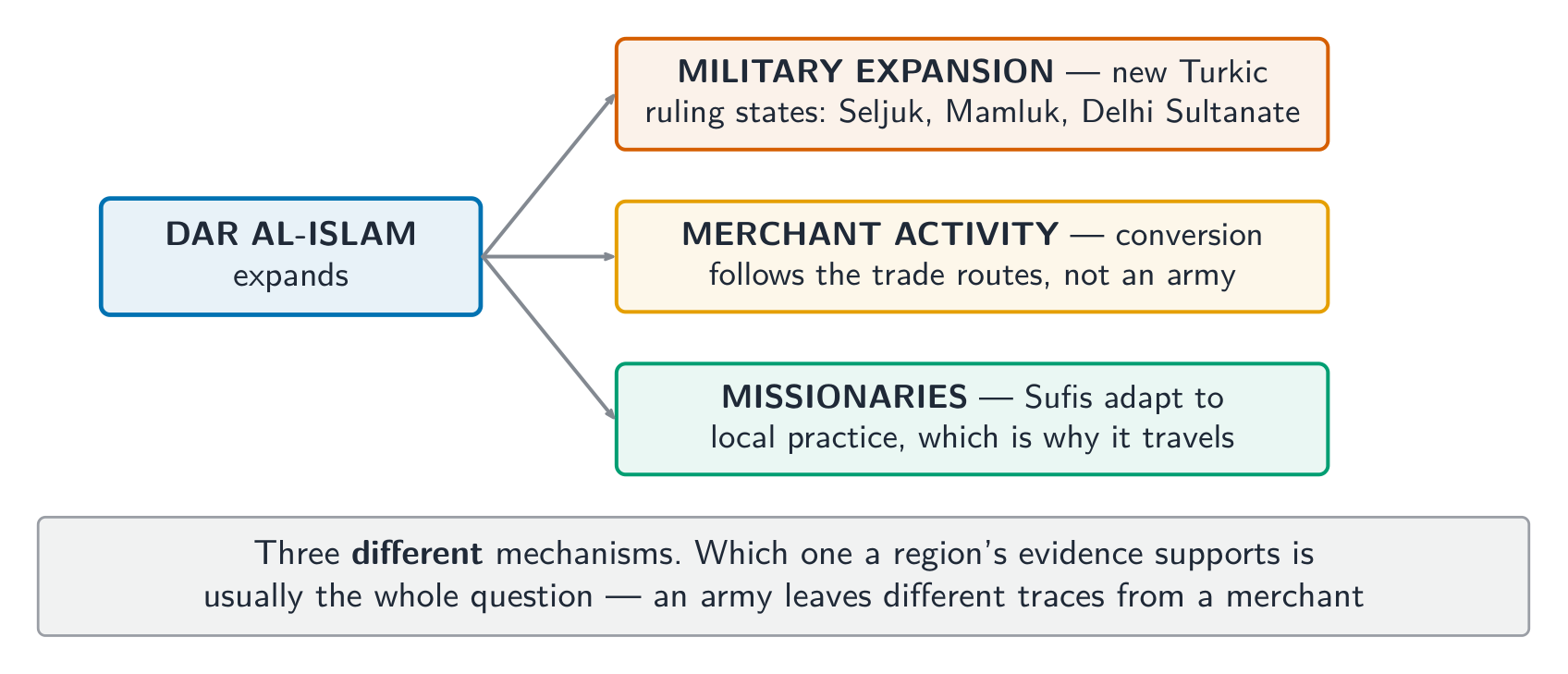
    Muslim rule continued to expand across Afro-Eurasia through military expansion, merchant activity 商人活动, and the work of missionaries 传教士, especially Sufis 苏非派, whose adaptable practice helped Islam spread.

    Muslim states encouraged significant intellectual innovations and transfers 智识创新与传播: advances in mathematics, medicine, and astronomy, gathered in the House of Wisdom 智慧宫 in Abbasid Baghdad, and the preservation and extension of Greek learning that later moved into Europe.

    日本語

    アッバース朝カリフ国が分裂する中、新しいイスラム政治実体が出現し、その多くはトルク系起源であった—其中包括セルジューク朝帝国、エジプトのマムルークス・スルタン国、デリー・スルタン国など。

    イスラムの統治は軍事的拡大、商人の活動、特に適応的な実践によりイスラムを広めたスーフィ派宣教師の働きを通じて、アフリカ・ユーラシア大陸全体に拡大し続けた。

    イスラム国家は重要な知的革新と伝播を促進した:アッバース朝バグダードの知恵の館に集められた数学、医学、天文学の進歩、および後からヨーロッパへ移ったギリシャ学問の保存と拡張。

    3つの異なる拡大メカニズム—どの根拠が支持するかは通常問われる点
    Explore · ⁨探索⁩

    Match each expansion to its mechanism · ⁨それぞれの拡張とそれが用いたメカニズムを対応させよ⁩

    Military expansion, merchant activity and Sufi missionaries leave different evidence — which one a region supports is usually the question. · ⁨軍事拡張、商人の活動、スーフィ宣教師は異なる痕跡を残す。ある地域がどの痕跡を支持しているかが問われるのが一般的だ。⁩

    1.3

    South and Southeast Asia · ⁨南アジアおよび東南アジア⁩

    Syllabus · ⁨シラバス⁩
    English

    1.3 Developments in South and Southeast Asia from c. 1200 to c. 1450

    Thematic Focus (CDI): Cultural Developments and Interactions — The development of ideas, beliefs, and religions illustrates how groups in society view themselves, and the interactions of societies and their beliefs often have political, social, and cultural implications.

    Learning Objective Unit 1.G: Explain how the various belief systems and practices of South and Southeast Asia affected society over time. THEMATIC FOCUS Governance GOV A variety of internal and external factors contribute to state formation, expansion, and decline. Governments maintain order through a variety of administrative institutions, policies, and procedures, and governments obtain, retain, and exercise power in different ways and for different purposes. LEARNING OBJECTIVE

    • KC-3.1.III.D.iv Hinduism, Islam, and Buddhism, and their core beliefs and practices, continued to shape societies in South and Southeast Asia. HISTORICAL DEVELOPMENTS

    Learning Objective Unit 1.H: Explain how and why various states of South and Southeast Asia developed and maintained power over time.

    • KC-3.2.I.B.i State formation and development demonstrated continuity, innovation, and diversity, including the new Hindu and Buddhist states that emerged in South and Southeast Asia.

    Illustrative examples:

    • Beliefs and practices:
      • Bhakti movement
      • Sufism
      • Buddhist monasticism
    • Hindu/Buddhist states:
      • Vijayanagara Empire
      • Srivijaya Empire
      • Rajput kingdoms
      • Khmer Empire
      • Majapahit
      • Sukhothai kingdom
      • Sinhala dynasties
    日本語

    1.3 南アジアおよび東南アジアにおける変化:c.1200年〜c.1450年

    テーマの焦点(CDI): 文化的発展と相互作用 — 思想、信仰、宗教の発展は、社会内の集団が自らをどのように認識しているかを示しており、社会やその信念の相互作用は政治的、社会的、文化的な影響を及ぼすことが往往ある。

    学習目標 Unit 1.G: 南アジアおよび東南アジアの多様な信仰体系と実践が、長期的にわたって社会に与えた影響を説明する。 テーマの焦点 統治 GOV 多様な内外的要因が国家の形成、拡大、衰退に寄与する。政府は多様な行政機関、政策、手続きを通じて秩序を維持し、異なる方法・目的で権力を獲得・保持・行使する。 学習目標

    • KC-3.1.III.D.iv ヒンドゥー教、イスラム教、仏教、およびそれらの核心的な信念と実践は、南アジアおよび東南アジアの社会に形作り続ける。 歴史的発展

    学習目標 Unit 1.H: 南アジアおよび東南アジアの多様な国家が、長期的にわたってどのようにそしてなぜ権力を獲得・維持したかを説明する。

    • KC-3.2.I.B.i 国家の形成と発展は、継続性、革新性、多様性を示し、南アジアおよび東南アジアに出現した新たなヒンドゥー教および仏教の国家も含まれる。

    具体例:

    • 信仰と実践:
      • バクティ運動
      • スーフィズム
      • 仏教僧侶制度
    • ヒンドゥー教/仏教の国家:
      • ビジャヤナガル帝国
      • スリヴィジャヤ帝国
      • ラジプート王国
      • クメール帝国
      • マジャパヒト
      • スコータイ王国
      • シンハラー朝

    Source: College Board AP Course and Exam Description · ⁨出典: College Board AP コースおよび試験説明書⁩

    English

    Hinduism 印度教, Islam, and Buddhism continued to shape the region, and their meeting produced new devotional forms - the bhakti movement 巴克提运动 in Hinduism and Sufism in Islam, both emphasising direct personal devotion.

    State formation showed the unit's theme of continuity and diversity: the Delhi Sultanate ruled much of the north, Vijayanagara 维查耶纳伽尔 arose in the south, and in Southeast Asia the sea-based Majapahit 满者伯夷 and the land-based Khmer Empire 高棉帝国 organised power in different ways.

    日本語

    ヒンドゥー教、イスラム教、仏教がこの地域に影響を与え続け、それらの出会いが新しい崇拝の形を生み出した—ヒンドゥー教のバクティ運動とイスラム教のスーフィズムは、どちらも直接的个人的崇拝を強調している。

    国家形成は単元のテーマである継続と多様性を示した:デリー・スルタン国が北の大部分を支配し、ヴィジャヤナガルが南部に台頭し、東南アジアでは海洋ベースのマジャパヒトと陸地ベースのクメール帝国が異なる形で権力を組織した。

    1.4 1.5

    The Americas and Africa · ⁨アメリカ大陸とアフリカ⁩

    Syllabus · ⁨シラバス⁩
    English

    1.4 State Building in the Americas

    Thematic Focus (GOV): Governance — A variety of internal and external factors contribute to state formation, expansion, and decline. Governments maintain order through a variety of administrative institutions, policies, and procedures, and governments obtain, retain, and exercise power in different ways and for different purposes.

    Learning Objective Unit 1.I: Explain how and why states in the Americas developed and changed over time.

    • KC-3.2.I.D.i In the Americas, as in Afro-Eurasia, state systems demonstrated continuity, innovation, and diversity, and expanded in scope and reach.

    Illustrative examples:

    • State systems in the Americas:
      • Maya city-states
      • Mexica
      • Inca
      • Chaco
      • Mesa Verde
      • Cahokia
    日本語

    1.4 アメリカにおける国家形成

    テーマの焦点(GOV): 統治 — 多様な内外的要因が国家の形成、拡大、衰退に寄与する。政府は多様な行政機関、政策、手続きを通じて秩序を維持し、異なる方法・目的で権力を獲得・保持・行使する。

    学習目標 Unit 1.I: アメリカの国家がどのようにして、またなぜ時間とともに発展・変化したかを説明せよ。

    • KC-3.2.I.D.i アメリカにおいて、アフリカ=ユーラシアと同様に、国家体制は継続性、革新性、多様性を示し、その範囲と影響力が拡大した。

    具体例:

    • アメリカにおける国家体制:
      • マヤの都市国家
      • メシカ
      • インカ
      • チャコ
      • メサ・ベルデ
      • カホキア
    English

    1.5 State Building in Africa

    Thematic Focus (GOV): Governance — A variety of internal and external factors contribute to state formation, expansion, and decline. Governments maintain order through a variety of administrative institutions, policies, and procedures, and governments obtain, retain, and exercise power in different ways and for different purposes.

    Learning Objective Unit 1.J: Explain how and why states in Africa developed and changed over time.

    • KC-3.2.I.D.ii In Africa, as in Eurasia and the Americas, state systems demonstrated continuity, innovation, and diversity and expanded in scope and reach.

    Illustrative examples:

    • State systems in Africa:
      • Great Zimbabwe
      • Ethiopia
      • Hausa kingdoms
    日本語

    1.5 アフリカにおける国家形成

    テーマの焦点(GOV): 統治 — 多様な内外的要因が国家の形成、拡大、衰退に寄与する。政府は多様な行政機関、政策、手続きを通じて秩序を維持し、異なる方法・目的で権力を獲得・保持・行使する。

    学習目標 Unit 1.J: アフリカの国家がどのようにして、またなぜ時間とともに発展・変化したかを説明せよ。

    • KC-3.2.I.D.ii アフリカにおいて、ユーラシアおよびアメリカと同様に、国家体制は継続性、革新性、多様性を示し、その範囲と影響力が拡大した。

    具体例:

    • アフリカにおける国家体制:
      • グレート・ジンバブエ
      • エチオピア
      • ハウサ王国

    Source: College Board AP Course and Exam Description · ⁨出典: College Board AP コースおよび試験説明書⁩

    English

    In the Americas, state systems showed continuity, innovation, and diversity: the Maya 玛雅 city-states, the Mexica 墨西加人 (Aztec) with tribute-based expansion, and the Inca 印加 with a centralised administration, labour obligation, and road system.

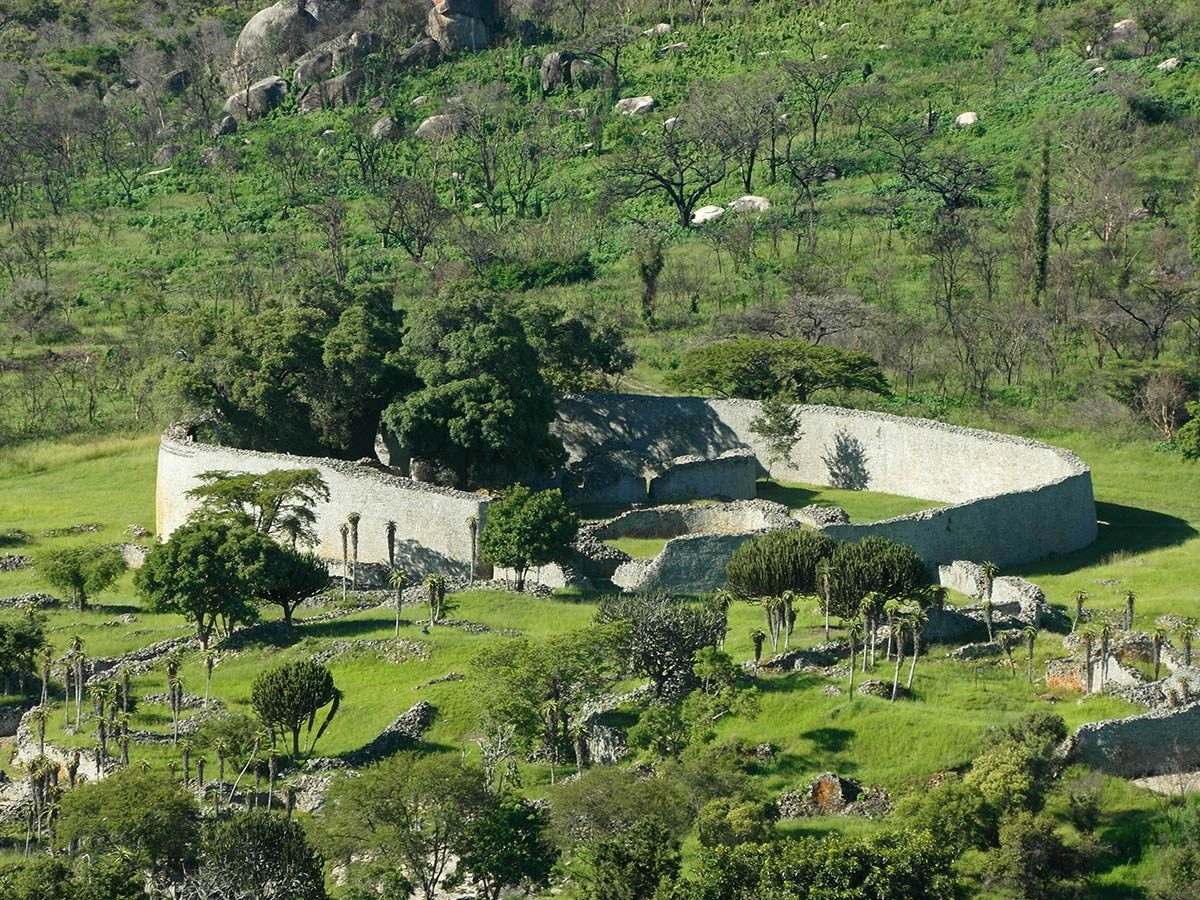
    In Africa, state systems likewise varied: Great Zimbabwe 大津巴布韦 grew on gold and cattle, Ethiopia 埃塞俄比亚 was a long-established Christian kingdom, and the Hausa Kingdoms 豪萨城邦 sat on trans-Saharan trade routes.

    日本語
    6つの地域に対する同じ3つの問い—単元が構築する比較の枠組み
    一つの枠組み、6つの地域:国家、信仰体系、経済基盤こそが比較問題が実際に問う内容である

    アメリカ大陸では、国家システムに継続、革新、多様性が見られた:マヤの都市国家、貢納に基づく拡大を行うメシカ(アステカ)、中央集権的な行政、奉公義務、道路網を持つインカ。

    アフリカでも国家システムは多様であった:グレート・ジンバブエは金と牛によって成長し、エチオピアは長年続くキリスト教王国であり、ハウサ王国群は横断サハラ貿易ルート上に位置していた。

    グレート・ジンバブエの外壁—乾積石造り、および黄金貿易によって築かれた国家
    Vocabulary · ⁨語彙⁩ Train · ⁨練習する⁩
    English 日本語
    Song China/sɒŋ ˈtʃaɪnə/ 宋王朝
    commercialized/kəˈmɜːʃəlaɪzd/ 商業化された
    agrarian/æˈɡreərɪən/ 農耕派
    Champa rice/ˈtʃæmpə raɪs/ チャンパ米
    Grand Canal/ɡrænd kəˈnæl/ 京杭大运河(大運河)
    bureaucracy/bjʊəˈrɒkrəsi/ 官僚制
    civil service examination/ˈsɪvl ˈsɜːvɪs eɡˌzæmɪˈneɪʃn/ 科挙
    Neo-Confucianism/ˈniːəʊ kənˈfjuːʃɪənɪzəm/ 新儒教
    filial piety/ˈfɪlɪəl ˈpaɪəti/ 孝行
    Buddhism/ˈbʊdɪzəm/ 仏教
    Theravada/ðəræˈvɑːdə/ 上座部仏教
    Mahayana/ˌmæheɪˈɑːnə/ 大乗仏教
    Tibetan/tɪˈbetn/ チベット仏教
    textiles/ˈtekstaɪlz/ 織物
    porcelains/ˈpɔːsɪlɪnz/ 磁器
    deference/ˈdefrəns/ 敬遠
    foot binding/fʊt ˈbaɪndɪŋ/ 纏足
    Abbasid Caliphate/ˈæbeɪsɪd ˈkælɪfeɪt/ アッバース朝カリフ国
    Turkic/ˈtɜːkɪk/ トルコ系
    Seljuk Empire/ˈseldʒʌk ˈempaɪə/ セルジューク朝
    Mamluk sultanate of Egypt/ˈmæmlʌk ˈsʌltəneɪt ɒv ˈiːdʒɪpt/ エジプトマムルークスルターン朝
    Delhi Sultanate/ˈdeli ˈsʌltəneɪt/ デリースルターン朝
    merchant activity/ˈmɜːtʃənt ækˈtɪvɪti/ 商人活動
    missionaries/ˈmɪʃənəriz/ 宣教師
    Sufis/ˈsjuːfiz/ スーフィー
    intellectual innovations and transfers/ˌɪntəˈlektʃuːəl ˌɪnəˈveɪʃnz ænd ˈtrænsfɜːz/ 知的革新と移動
    House of Wisdom/haʊs ɒv ˈwɪzdəm/ 知恵の家
    Hinduism/ˈhɪndjuːɪzəm/ ヒンドゥー教
    bhakti movement/ˈbʌkti ˈmuːvmənt/ ブクティ運動
    Vijayanagara/ˌvɪdʒeɪˌænəˈɡɑːrə/ ヴィジャヤナガル
    Majapahit/ˈmædʒəpæhɪt/ マジャパヒト
    Khmer Empire/kmɪə ˈempaɪə/ クメール帝国
    Maya/ˈmaɪə/ Maya
    Mexica/ˈmeksɪkə/ メシカ
    Inca/ˈɪŋkə/ インカ
    Great Zimbabwe/ɡreɪt zɪmˈbɑːbwi/ グレート・ジンバブエ
    Ethiopia/ˌiːθɪˈəʊpɪə/ エチオピア
    Hausa Kingdoms/ˈhɔːsə ˈkɪŋdəmz/ ハウサ王国
    politically fragmented/pəˈlɪtɪkli fræɡˈmentɪd/ 政治的に分裂している
    feudalism/ˈfjuːdəlɪzəm/ 封建制度
    Christianity/ˌkrɪstɪˈænɪti/ キリスト教
    Judaism/ˈdʒuːdeɪɪzəm/ ユダヤ教
    free and coerced labour/friː ænd ˌkəʊˈɜːst ˈleɪbə/ 自由労働と強制労働
    serfdom/ˈsɜːfdəm/ 隷農奴制
    comparison/kəmˈpærɪsn/ 比較
    1.6

    Europe · ⁨ヨーロッパ⁩

    Syllabus · ⁨シラバス⁩
    English

    1.6 Developments in Europe from c. 1200 to c. 1450

    Thematic Focus (CDI): Cultural Developments and Interactions — The development of ideas, beliefs, and religions illustrates how groups in society view themselves, and the interactions of societies and their beliefs often have political, social, and cultural implications.

    Thematic Focus (SIO): Social Interactions and Organization — The process by which societies group their members and the norms that govern the interactions between these groups and between individuals influence political, economic, and cultural institutions and organization.

    Learning Objective Unit 1.K: Explain how the beliefs and practices of the predominant religions in Europe affected European society. THEMATIC FOCUS Governance GOV A variety of internal and external factors contribute to state formation, expansion, and decline. Governments maintain order through a variety of administrative institutions, policies, and procedures, and governments obtain, retain, and exercise power in different ways and for different purposes. LEARNING OBJECTIVE

    • KC-3.1.III.D.v Christianity, Judaism, Islam, and the core beliefs and practices of these religions continued to shape societies in Europe. HISTORICAL DEVELOPMENTS

    Learning Objective Unit 1.L: Explain the causes and consequences of political decentralization in Europe from c. 1200 to c. 1450.

    • KC-3.2.I.B.ii Europe was politically fragmented and characterized by decentralized monarchies, feudalism, and the manorial system.

    Learning Objective Unit 1.M: Explain the effects of agriculture on social organization in Europe from c. 1200 to c. 1450.

    • KC-3.3.III.C Europe was largely an agricultural society dependent on free and coerced labor, including serfdom.
    日本語

    1.6 紀元1200年頃〜1450年頃のヨーロッパにおける変化

    テーマの焦点(CDI): 文化的発展と相互作用 — 思想、信仰、宗教の発展は、社会内の集団が自らをどのように認識しているかを示しており、社会やその信念の相互作用は政治的、社会的、文化的な影響を及ぼすことが往往ある。

    テーマ別焦点(SIO):社会的相互作用と組織化 — 社会が構成員をまとめ、これらの集団間および個人間の相互作用を支配する規範は、政治、経済、文化の制度や組織に影響を与える。

    学習目標 Unit 1.K: ヨーロッパの支配的な宗教の信仰と実践がヨーロッパ社会に与えた影響を説明せよ。 テーマ別焦点 統治 GOV 内部および外部の多様な要因が国家の形成、拡大、衰退に寄与する。政府は多様な行政機関、政策、手続を通じて秩序を維持し、異なる方法および目的で権力を獲得、保持、行使する。 学習目標

    • KC-3.1.III.D.v キリスト教、ユダヤ教、イスラム教、およびこれらの宗教の核心的な信仰と実践は、ヨーロッパの社会を引き続き形作った。 歴史的発展

    学習目標 Unit 1.L: 紀元1200年頃〜1450年頃のヨーロッパにおける政治的分権の原因および結果を説明せよ。

    • KC-3.2.I.B.ii ヨーロッパは政治上に分裂しており、分権的な君主制、封建制、領主制が特徴であった。

    学習目標 Unit 1.M: 紀元1200年頃〜1450年頃のヨーロッパにおける農業が社会組織に与えた影響を説明せよ。

    • KC-3.3.III.C ヨーロッパは主に自由労働および強制労働(農奴制を含む)に依存する農業社会であった。

    Source: College Board AP Course and Exam Description · ⁨出典: College Board AP コースおよび試験説明書⁩

    English

    Europe was politically fragmented 政治上分裂, characterised by decentralised monarchies and by feudalism 封建制度 - a system of land held in exchange for service. Monarchs slowly consolidated power, but nothing here approached the administrative reach of Song China.

    Christianity 基督教, Judaism 犹太教, and Islam all shaped European society, with the Church supplying law, learning, and legitimacy.

    Europe was largely agricultural, dependent on free and coerced labour 自由与强制劳动, including serfdom 农奴制.

    日本語

    ヨーロッパは政治上に分断されており、分散型君主制と封建制—サービス交換としての土地保有の体系で特徴づけられた。君主たちは徐々に権力を統合していったが、ここで宋中国のような行政の reach に匹敵するものはなかった。

    キリスト教、ユダヤ教、イスラム教はすべてヨーロッパ社会に影響を与え、教会は法、学問、正当性を提供した。

    ヨーロッパはほぼ農業中心であり、自由労働および強制労働に依存しており、其中包括農奴制。

    1.7

    Comparison in the Period · ⁨時代の比較⁩

    Syllabus · ⁨シラバス⁩
    English

    1.7 Comparison in the Period from c. 1200 to c. 1450

    Learning Objective Unit 1.N: Explain the similarities and differences in the processes of state formation from c. 1200 to c. 1450.

    • KC-3.2 State formation and development demonstrated continuity, innovation, and diversity in various regions.
      • KC-3.2.I As the Abbasid Caliphate fragmented, new Islamic political entities emerged, most of which were dominated by Turkic peoples. These states demonstrated continuity, innovation, and diversity.
      • KC-3.2.I.A Empires and states in Afro-Eurasia and the Americas demonstrated continuity, innovation, and diversity in the 13th century. This included the Song Dynasty of China, which utilized traditional methods of Confucianism and an imperial bureaucracy to maintain and justify its rule.
      • KC-3.2.I.B.i State formation and development demonstrated continuity, innovation, and diversity, including the new Hindu and Buddhist states that emerged in South and Southeast Asia.
      • KC-3.2.I.D.i In the Americas, as in Afro-Eurasia, state systems demonstrated continuity, innovation, and diversity, and expanded in scope and reach.
      • KC-3.2.I.D.ii In Africa, as in Eurasia and the Americas, state systems demonstrated continuity, innovation, and diversity, and expanded in scope and reach.
    日本語

    1.7 紀元1200年頃〜1450年頃における比較

    学習目標 Unit 1.N: 紀元1200年頃〜1450年頃における国家形成のプロセスにおける類似点と相違点を説明せよ。

    • KC-3.2 国家の形成と発展は、さまざまな地域において継続性、革新性、多様性を示した。
      • KC-3.2.I アッバース朝が分裂するにつれて、新たなイスラム政治実体が出現したが、その多くはトルク系の人々に支配された。これらの国家は継続性、革新性、多様性を示した。
      • KC-3.2.I.A アフリカ=ユーラシアおよびアメリカの帝国と国家は、13世紀に継続性、革新性、多様性を示した。これには、中国の宋王朝が含まれ、儒教の伝統的手法および帝皇官僚制を用いて統治を維持・正当化した。
      • KC-3.2.I.B.i 国家の形成と発展は、継続性、革新性、多様性を示し、南アジアおよび東南アジアに出現した新たなヒンドゥー教および仏教の国家も含まれる。
      • KC-3.2.I.D.i アメリカにおいて、アフリカ=ユーラシアと同様に、国家体制は継続性、革新性、多様性を示し、その範囲と影響力が拡大した。
      • KC-3.2.I.D.ii アフリカにおいて、ユーラシアおよびアメリカと同様に、国家体制は継続性、革新性、多様性を示し、その範囲と影響力が拡大した。

    Source: College Board AP Course and Exam Description · ⁨出典: College Board AP コースおよび試験説明書⁩

    English

    The unit's reasoning skill is comparison 比较. The productive comparisons are structural rather than evaluative:

    • Centralised administration (Song China, Inca) against fragmented or decentralised rule (Europe, post-Abbasid Islamic states).
    • Recruitment by examination against recruitment by birth.
    • States funded by tribute (Mexica) against states funded by taxation (Song China).

    Worked example (a real AP exam question). AP World short-answer questions regularly ask students to "Identify one similarity" or "Explain one difference" between two regions in a period. A full-mark answer for this unit names the feature and applies it to both: "Both Song China and the Inca Empire used a centralised bureaucracy to govern a large territory, but Song China recruited officials through a competitive examination system while the Inca staffed administration through hereditary elites and a labour obligation." Notice the shape: a comparison must be one feature, two societies. Describing each society in turn and leaving the reader to infer the comparison does not earn the point.

    日本語

    単元の推論スキルは比較である。生産的な比較は評価的ではなく構造的である:

    • 中央集権的行政(宋の中国、インカ)と、分断的かつ分散的な統治(ヨーロッパ、アッバース朝以降のイスラム国家)との対比。
    • 試験による採用と、血統による採用との対比。
    • 貢納で財源を得る国家(メシカ)と、租税で財源を得る国家(宋の中国)との対比。

    ** worked example (実際のAP試験問題)。** AP世界史の短答式問題は、ある時期における二つの地域間での「類似点の一つを特定せよ」あるいは「相違点の一つを説明せよ」という設問を頻繁に出題する。この単元における満点答案は、特徴を名指し、両方に応用する:「宋の中国とインカ帝国はどちらも広大な領土を支配するために中央集権的な官僚制を用いたが、宋の中国は競争的な試験制度を通じて官僚を採用したのに対し、インカは世襲エリートおよび労働義務によって行政スタッフを補充した。」この形式に注意されたい:比較では一つの特徴、二つの社会である必要がある。それぞれの社会を順に記述し、読者に比較を推論させるだけでは、得点にはならない。

    権威にとって何をしたかではなく、何を説いたかによって分類された信念体系
    1.7

    Exam tips · ⁨試験対策⁩

    English
    • Learn each region through the same three questions - state, belief system, economy - so any comparison question already has a structure.
    • Song China is the benchmark: examination-based bureaucracy, commercialised agriculture, and cultural influence on neighbours.
    • For Dar al-Islam, remember the pattern is fragmentation into new states plus continued expansion by trade and Sufi missionaries.
    • Give a named state for the Americas and Africa. Mexica tribute, Inca labour obligation, Mali and Great Zimbabwe gold are the reliable examples.
    • Europe's distinguishing features are fragmentation, feudalism, and coerced agricultural labour.
    • Write comparisons as one feature across two societies, never as two separate descriptions.
    日本語
    • どの地域も同じ三つの質問 - 国家、信念体系、経済 - を通して学び、これによりどの比較問題にもすでに構造があるようにする。
    • 宋の中国を基準とする:試験に基づく官僚制、商業化された農業、近隣への文化的影響。
    • ダル・アル=イスラームについては、パターンが新たな国家への分裂加上、交易とスーフィー宣教士による継続的な拡大であることを記憶に留めよ。
    • 南北アメリカとアフリカに対しては、具体的な国名を挙げる。メシカの貢納、インカの労働義務、** mali** および グレート・ジンバブエの金は信頼できる例である。
    • ヨーロッパの独自性は、分断、封建制、および強制労働による農業にある。
    • 比較は、二つの個別の記述としてではなく、二つの社会にまたがる一つの特徴として記述すること。
  • 2

    Networks of Exchange · ⁨交易ネットワーク⁩

    Watch lesson · ⁨レッスンを視聴⁩
    2.1

    What Made the Networks Grow · ⁨ネットワークが成長した理由⁩

    Syllabus · ⁨シラバス⁩
    English

    2.1 The Silk Roads

    Thematic Focus (ECN): Economics Systems — As societies develop, they affect and are affected by the ways that they produce, exchange, and consume goods and services.

    Learning Objective Unit 2.A: Explain the causes and effects of growth of networks of exchange after 1200.

    • KC-3.1.I.A.i Improved commercial practices led to an increased volume of trade and expanded the geographical range of existing trade routes— including the Silk Roads—promoting the growth of powerful new trading cities.
    • KC-3.1.I.C.i The growth of interregional trade in luxury goods was encouraged by innovations in previously existing transportation and commercial technologies, including the caravanserai, forms of credit, and the development of money economies.
    • KC-3.3.I.B Demand for luxury goods increased in Afro-Eurasia. Chinese, Persian, and Indian artisans and merchants expanded their production of textiles and porcelains for export; manufacture of iron and steel expanded in China.

    Illustrative examples:

    • Trading cities:
      • Kashgar
      • Samarkand
    • New forms of credit and money economies:
      • Bills of exchange
      • Banking houses
      • Use of paper money
    日本語

    2.1 シルクロード

    テーマ別焦点(ECN):経済システム — 社会が発展するにつれて、商品およびサービスの生産、交換、消費のあり方に影響を与え、かつそれらに影響される。

    学習目標 Unit 2.A: 1200年以降の交換ネットワークの拡大の原因および結果を説明せよ。

    • KC-3.1.I.A.i 商業慣行の向上は貿易量の増加をもたらし、既存の貿易ルート—including シルクロード—の地理的範囲を拡大させ、強力な新交易都市の成長を促進した。
    • KC-3.1.I.C.i 高級品の地域間貿易の拡大は、以前から存在していた輸送および商業技術の革新によって促進された。これにはカラヴァンセライ、信用形式、通貨経済の発展が含まれる。
    • KC-3.3.I.B アフリカ=ユーラシアにおける高級品への需要が増加した。中国、ペルシャ、インドの職人および商人は、輸出用の織物および陶器の生産を拡大し、中国では鉄および鋼の製造も拡大した。

    具体例:

    • 交易都市:
      • カシガル
      • サマルカンド
    • 新たな信用形式および通貨経済:
      • 為替手形
      • 銀行家
      • 紙幣の使用

    Source: College Board AP Course and Exam Description · ⁨出典: College Board AP コースおよび試験説明書⁩

    English

    Unit 2 covers the three great exchange networks of 1200 to 1450 - the Silk Roads, the Indian Ocean, and the trans-Saharan routes - and asks the same question of each: what made trade grow, and what did that growth change?

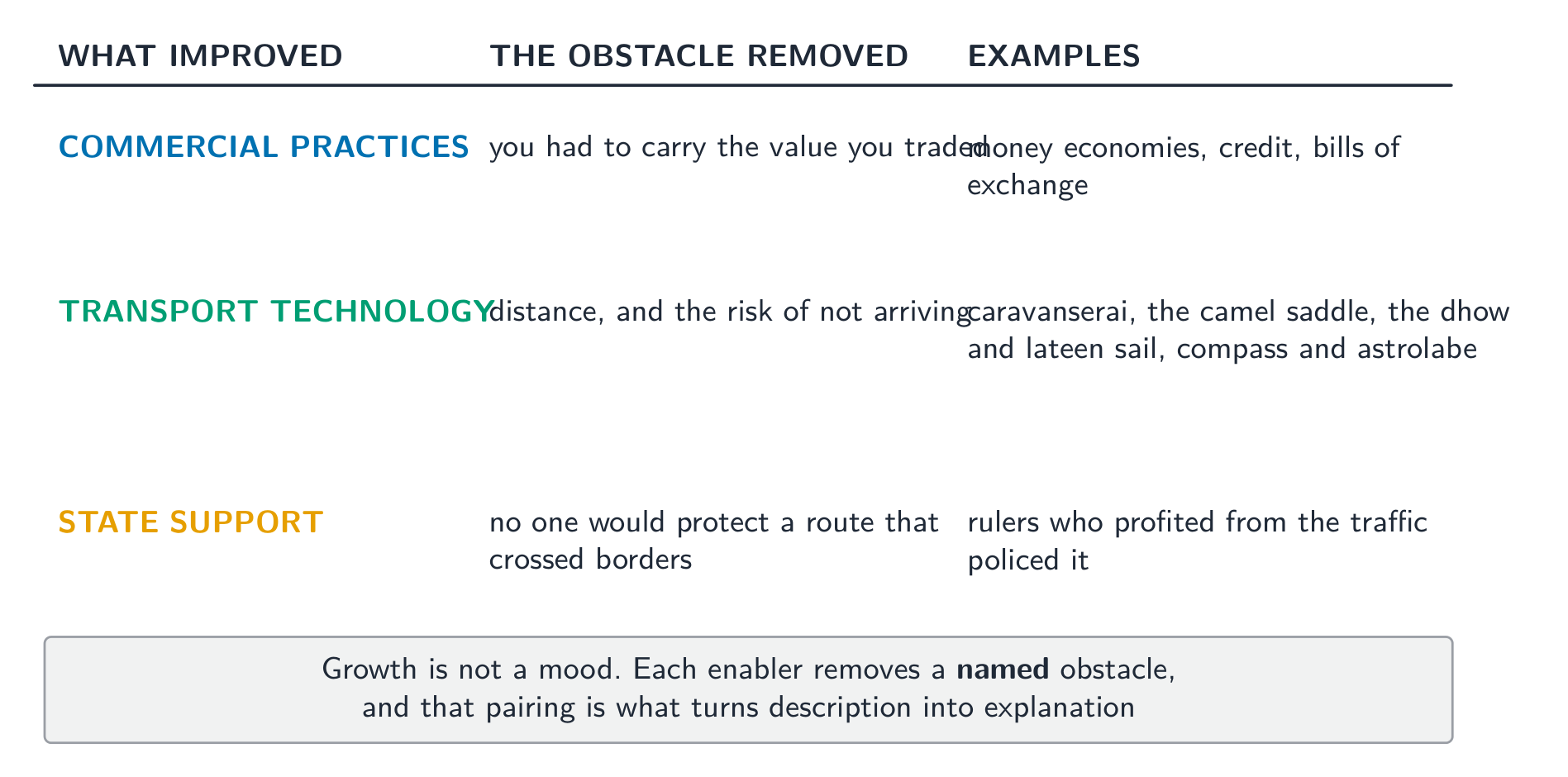
    Growth had three common causes, and naming them is worth more than listing goods:

    • Improved commercial practices 商业惯例的改进 - money economies 货币经济, credit 信贷, and forms of partnership that spread risk.
    • Improved transportation technologies 交通技术的改进 - better ships, saddles, and navigation.
    • State support 国家支持 - empires that secured routes and taxed the trade benefited from protecting it.

    Demand mattered too: luxury goods 奢侈品 from Chinese, Persian, and Indian artisans found expanding markets across Afro-Eurasia, and producers increased output to meet that demand.

    日本語

    単元2は、1200年から1450年の三大交換ネットワーク - シルクロード、インド洋、サハラ横断ルート - を取り上げ、それぞれについて同じ問いを投げかける:交易が成長したのはなぜであり、その成長は何を変えたのか?

    成長には三つの共通原因があり、それらを列挙するよりも名称を挙げることがより高い得点につながる:

    • 商業慣行の改善 - 貨幣経済、信用、リスクを分散させるためのパートナーシップの形態。
    • 輸送技術の改善 - より良い船、uncture(鞍)、および航海技術。
    • 国家の支援 - ルートを守り、交易に課税した帝国は、それを保護することから利益を得た。

    需要も重要だった:中国、ペルシャ、インドの職人による高級品はアフロユーラシア全域で expanding markets(拡大市場)を見つけ、生産者はその需要に応えるために生産量を増やした。

    各促進要因が特定の障壁を取り除いた - このペアリングこそが記述を説明に変える
    Explore · ⁨探索⁩

    Pair each enabler with the obstacle it removed

    Growth is not a mood: each enabler removes a named obstacle, and that pairing turns description into explanation.

    2.1

    The Silk Roads · ⁨シルクロード⁩

    Syllabus · ⁨シラバス⁩
    English

    2.1 The Silk Roads

    Thematic Focus (ECN): Economics Systems — As societies develop, they affect and are affected by the ways that they produce, exchange, and consume goods and services.

    Learning Objective Unit 2.A: Explain the causes and effects of growth of networks of exchange after 1200.

    • KC-3.1.I.A.i Improved commercial practices led to an increased volume of trade and expanded the geographical range of existing trade routes— including the Silk Roads—promoting the growth of powerful new trading cities.
    • KC-3.1.I.C.i The growth of interregional trade in luxury goods was encouraged by innovations in previously existing transportation and commercial technologies, including the caravanserai, forms of credit, and the development of money economies.
    • KC-3.3.I.B Demand for luxury goods increased in Afro-Eurasia. Chinese, Persian, and Indian artisans and merchants expanded their production of textiles and porcelains for export; manufacture of iron and steel expanded in China.

    Illustrative examples:

    • Trading cities:
      • Kashgar
      • Samarkand
    • New forms of credit and money economies:
      • Bills of exchange
      • Banking houses
      • Use of paper money
    日本語

    2.1 シルクロード

    テーマ別焦点(ECN):経済システム — 社会が発展するにつれて、商品およびサービスの生産、交換、消費のあり方に影響を与え、かつそれらに影響される。

    学習目標 Unit 2.A: 1200年以降の交換ネットワークの拡大の原因および結果を説明せよ。

    • KC-3.1.I.A.i 商業慣行の向上は貿易量の増加をもたらし、既存の貿易ルート—including シルクロード—の地理的範囲を拡大させ、強力な新交易都市の成長を促進した。
    • KC-3.1.I.C.i 高級品の地域間貿易の拡大は、以前から存在していた輸送および商業技術の革新によって促進された。これにはカラヴァンセライ、信用形式、通貨経済の発展が含まれる。
    • KC-3.3.I.B アフリカ=ユーラシアにおける高級品への需要が増加した。中国、ペルシャ、インドの職人および商人は、輸出用の織物および陶器の生産を拡大し、中国では鉄および鋼の製造も拡大した。

    具体例:

    • 交易都市:
      • カシガル
      • サマルカンド
    • 新たな信用形式および通貨経済:
      • 為替手形
      • 銀行家
      • 紙幣の使用

    Source: College Board AP Course and Exam Description · ⁨出典: College Board AP コースおよび試験説明書⁩

    English

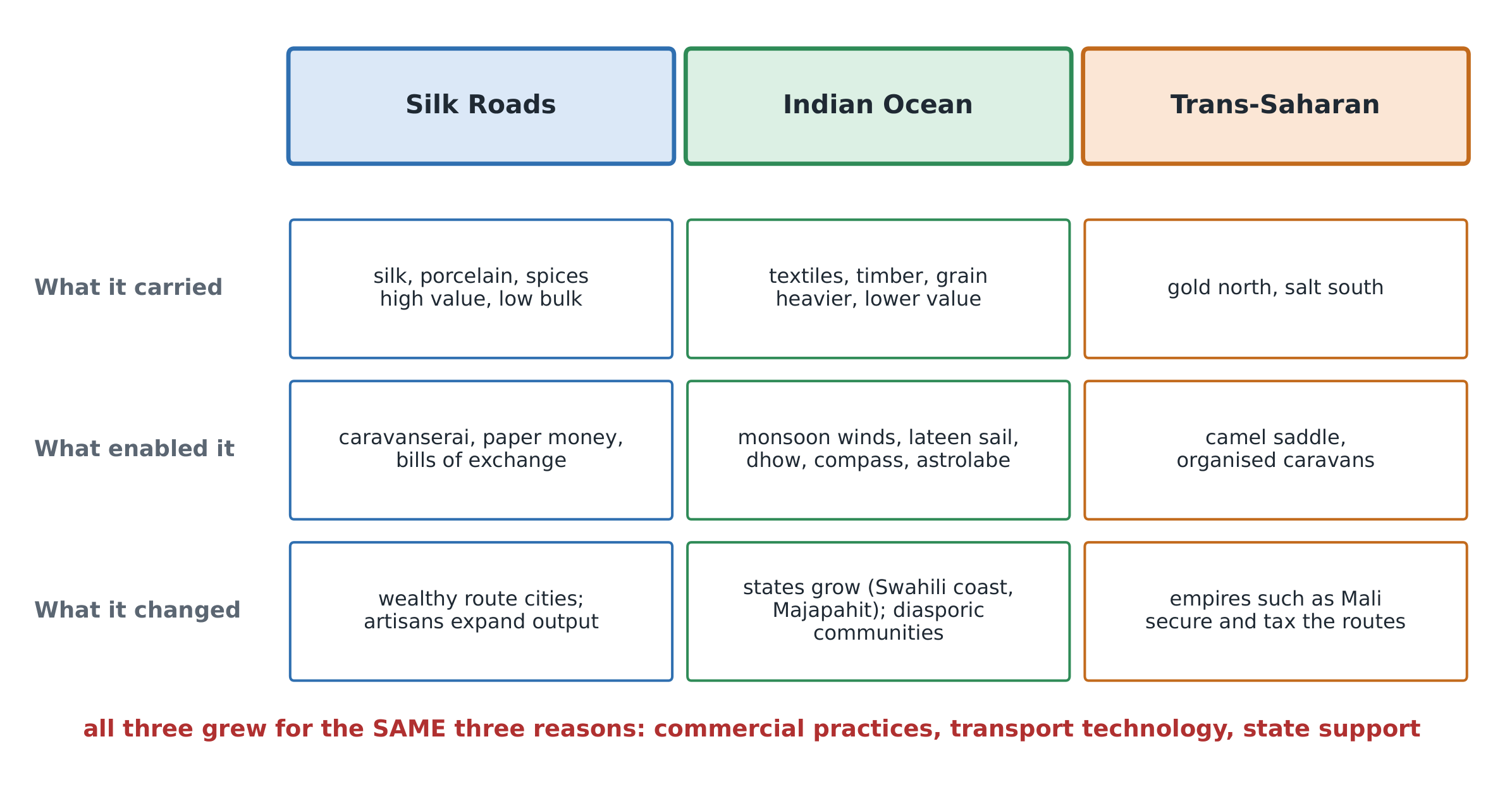
    The Silk Roads 丝绸之路 carried high-value, low-bulk goods overland across Eurasia: silk, porcelain, spices, and precious metals.

    Its enabling innovations were commercial as much as technical - caravanserai 商队旅馆 along the routes, the use of paper money 纸币 and bills of exchange 汇票 in China, and forms of credit that let merchants trade without carrying bullion.

    The consequence for producers: Chinese artisans expanded output, and cities along the routes grew wealthy on the traffic passing through.

    日本語

    シルクロードは、絹、陶器、香辛料、貴金属といった高価値かつ小規模な商品をユーラシア大陆を陸路で運んだ。

    その促進要因となる革新は技術的である以上に商業的なものであり、ルート沿いの caravanserai(カーヴァンセライ)、中国での 紙幣 および 為替手形 の使用、そして商人が貨金を携えずに取引できるようにする各种の信用形態があった。

    生産者に対する結果:中国の職人は生産量を増やし、ルート沿いの都市は通過する交通によって富んだ。

    Vocabulary · ⁨語彙⁩ Train · ⁨練習する⁩
    English 日本語
    Improved commercial practices/ɪmˈpruːvd kəˈmɜːʃl ˈpræktɪsɪz/ 商業慣行の向上
    money economies/ˈmʌni ɪˈkɒnəmiz/ 貨幣経済
    credit/ˈkredɪt/ クレジット
    Improved transportation technologies/ɪmˈpruːvd trænspɔːˈteɪʃn tekˈnɒlədʒiz/ 交通技術の発展
    State support/steɪt səˈpɔːt/ 国家の支援
    luxury goods/ˈlʌkʃəri ɡʊdz/ 高級品
    Silk Roads/sɪlk rəʊdz/ シルクロード
    caravanserai/ˈkærəvænsəraɪ/ カーヴァンセライ
    paper money/ˈpeɪpə ˈmʌni/ 紙幣
    bills of exchange/bɪlz ɒv eksˈtʃeɪndʒ/ 為替手形
    Mongol Empire/ˈmɒŋɡɒl ˈempaɪə/ モンゴル帝国
    caravans/ˈkærəvænz/ キャラバン
    salt/sɒlt/ 塩
    Mali/ˈmɑːli/ マリ
    2.2

    The Mongol Empire · ⁨モンゴル帝国⁩

    Syllabus · ⁨シラバス⁩
    English

    2.2 The Mongol Empire and the Making of the Modern World

    Thematic Focus (GOV): Governance — A variety of internal and external factors contribute to state formation, expansion, and decline. Governments maintain order through a variety of administrative institutions, policies, and procedures, and governments obtain, retain, and exercise power in different ways and for different purposes.

    Thematic Focus (CDI): Cultural Developments and Interactions — The development of ideas, beliefs, and religions illustrates how groups in society view themselves, and the interactions of societies and their beliefs often have political, social, and cultural implications.

    Learning Objective Unit 2.B: Explain the process of state building and decline in Eurasia over time. THEMATIC FOCUS Economics Systems ECN As societies develop, they affect and are affected by the ways that they produce, exchange, and consume goods and services. LEARNING OBJECTIVE

    • KC-3.2.I.B.iii Empires collapsed in different regions of the world and in some areas were replaced by new imperial states, including the Mongol khanates. HISTORICAL DEVELOPMENTS

    Learning Objective Unit 2.C: Explain how the expansion of empires influenced trade and communication over time.

    • KC-3.1.I.E.i The expansion of empires—including the Mongols—facilitated Afro-Eurasian trade and communication as new people were drawn into their conquerors’ economies and trade networks.

    Learning Objective Unit 2.D: Explain the significance of the Mongol Empire in larger patterns of continuity and change.

    • KC-3.2.II.A.ii Interregional contacts and conflicts between states and empires, including the Mongols, encouraged significant technological and cultural transfers.

    Illustrative examples:

    • Technological and cultural transfers:
      • Transfer of Greco– Islamic medical knowledge to western Europe
      • Transfer of numbering systems to Europe
      • Adoption of Uyghur script
    日本語

    2.2 モンゴル帝国と近世世界の形成

    テーマの焦点(GOV): 統治 — 多様な内外的要因が国家の形成、拡大、衰退に寄与する。政府は多様な行政機関、政策、手続きを通じて秩序を維持し、異なる方法・目的で権力を獲得・保持・行使する。

    テーマの焦点(CDI): 文化的発展と相互作用 — 思想、信仰、宗教の発展は、社会内の集団が自らをどのように認識しているかを示しており、社会やその信念の相互作用は政治的、社会的、文化的な影響を及ぼすことが往往ある。

    学習目標ユニット2.B: ユーラシアにおける国家形成と衰退の過程を説明する。テーマ的焦点:経済システム ECN 社会が発達するにつれて、商品およびサービスの生産、交換、消費の在り方によって影響を受け、同時にそれらにも影響を与える。学習目標

    • KC-3.2.I.B.iii 帝国は世界の異なる地域で崩壊し、モンゴル・ハン国を含む新たな帝国国家に置き換わったところもあった。歴史的発展

    学習目標ユニット2.C: 帝国の拡大が、時間経過に伴い貿易および通信に与えた影響を説明する。

    • KC-3.1.I.E.i モンゴル人を含む帝国の拡大は、新たな人々が征服国の経済および貿易網に取り込まれることで、アフリカ=ユーラシア間の貿易および通信を促進した。

    学習目標ユニット2.D: モンゴル帝国が、より大きな継続と変化のパターンにおいて持つ意義を説明する。

    • KC-3.2.II.A.ii 国家および帝国(モンゴルを含む)間の国際的な接触や対立は、重要な技術的および文化的移転を促した。

    具体例:

    • 技術的および文化的移転:
      • グレコ=イスラム医学知識の西ヨーロッパへの移転
      • 数字表記法のヨーロッパへの移転
      • ウイグル文字の採用

    Source: College Board AP Course and Exam Description · ⁨出典: College Board AP コースおよび試験説明書⁩

    English

    Empires collapsed and were reconstituted in this period, and the largest transformation came from the Mongol Empire 蒙古帝国.

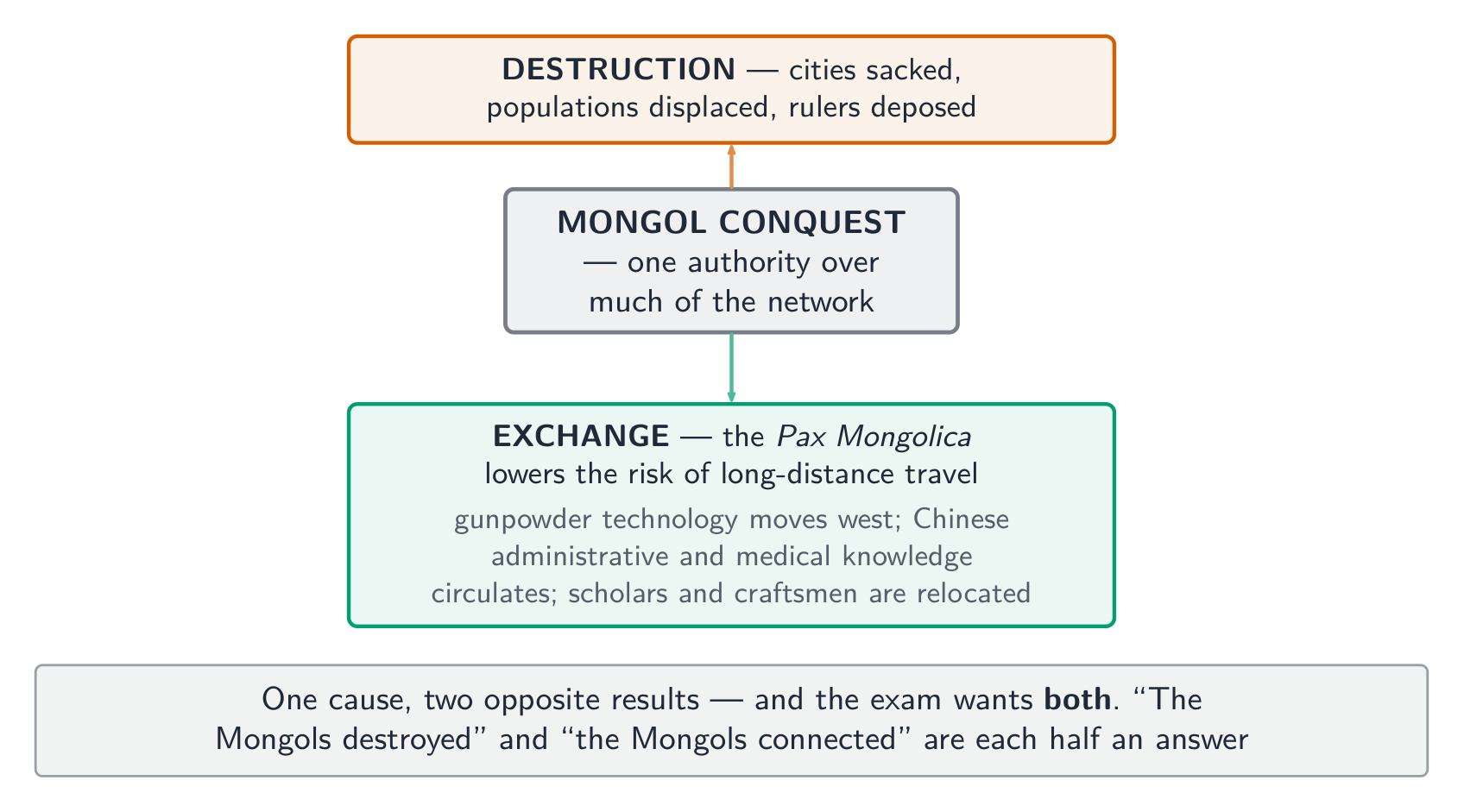
    Mongol expansion facilitated Afro-Eurasian trade and communication by bringing much of the network under a single authority, which lowered the risk of long-distance travel - a period often called the Pax Mongolica 蒙古和平.

    Interregional contacts and conflicts also encouraged technological and cultural transfers: gunpowder technology moved west, Chinese administrative and medical knowledge circulated, and scholars and craftsmen were relocated across the empire.

    The Mongols illustrate the unit's central irony: conquest and destruction produced the conditions for exchange.

    日本語

    この時期に帝国は崩壊し再編成され、最大の転換は モンゴル帝国 によって起こった。

    モンゴルの拡張は、ネットワークの大部分を一つの権威の下に置くことで長距離旅行のリスクを低減させ、アフロユーラシアの交易と交流を促進した。この時期はしばしば モンゴル平和(Pax Mongolica) と呼ばれる。

    州境を越えた接触および紛争もまた、技術的および文化的移転を促した:火薬技術は西へ移動し、中国の行政および医学知識が流通し、学者や職人が帝国内各地に異動した。

    モンゴル人は、この単元の中心的な皮肉を示している:征服と破壊が、交換のための条件を生み出したことだ。

    単元の中心的な皮肉:一つの原因、二つの反対の結果、そして試験ではその両方を求める
    Vocabulary · ⁨語彙⁩ Train · ⁨練習する⁩
    English 日本語
    Pax Mongolica/pæks mɒnˈɡɒlɪkə/ モンゴル平和(パクス・モンゴリカ)
    monsoon winds/mɒnˈsuːn wɪndz/ モンスーン風
    lateen sail/ˈlætiːn seɪl/ ラテン帆
    2.3

    The Indian Ocean · ⁨インド洋⁩

    Syllabus · ⁨シラバス⁩
    English

    2.3 Exchange in the Indian Ocean

    Thematic Focus (ECN): Economics Systems — As societies develop, they affect and are affected by the ways that they produce, exchange, and consume goods and services.

    Thematic Focus (CDI): Cultural Developments and Interactions — The development of ideas, beliefs, and religions illustrates how groups in society view themselves, and the interactions of societies and their beliefs often have political, social, and cultural implications.

    Learning Objective Unit 2.E: Explain the causes of the growth of networks of exchange after 1200.

    • KC-3.1.I.A.ii Improved transportation technologies and commercial practices led to an increased volume of trade and expanded the geographical range of existing trade routes, including the Indian Ocean, promoting the growth of powerful new trading cities.
    • KC-3.1.I.C.ii The growth of interregional trade in luxury goods was encouraged by significant innovations in previously existing transportation and commercial technologies, including the use of the compass, the astrolabe, and larger ship designs.
    • KC-3.1.I.A.iii The Indian Ocean trading network fostered the growth of states.

    Learning Objective Unit 2.F: Explain the effects of the growth of networks of exchange after 1200. THEMATIC FOCUS Humans and the Environments ENV The environment shapes human societies, and as populations grow and change, these populations in turn shape their environments. LEARNING OBJECTIVE

    • KC-3.1.III.B In key places along important trade routes, merchants set up diasporic communities where they introduced their own cultural traditions into the indigenous cultures and, in turn, indigenous cultures influenced merchant cultures.
    • KC-3.2.II.A.iii Interregional contacts and conflicts between states and empires encouraged significant technological and cultural transfers, including during Chinese maritime activity led by Ming Admiral Zheng He. HISTORICAL DEVELOPMENTS

    Learning Objective Unit 2.G: Explain the role of environmental factors in the development of networks of exchange in the period from c. 1200 to c. 1450.

    • KC-3.1.II.A.i The expansion and intensification of long-distance trade routes often depended on environmental knowledge, including advanced knowledge of the monsoon winds.

    Illustrative examples:

    • Growth of states:
      • City-states of the Swahili Coast
      • Gujarat
      • Sultanate of Malacca
    • (CONT’D) Diasporic communities:
      • Arab and Persian communities in East Africa
      • Chinese merchant communities in Southeast Asia
      • Malay communities in the Indian Ocean basin
    日本語

    2.3 インド洋での交換

    テーマ別焦点(ECN):経済システム — 社会が発展するにつれて、商品およびサービスの生産、交換、消費のあり方に影響を与え、かつそれらに影響される。

    テーマの焦点(CDI): 文化的発展と相互作用 — 思想、信仰、宗教の発展は、社会内の集団が自らをどのように認識しているかを示しており、社会やその信念の相互作用は政治的、社会的、文化的な影響を及ぼすことが往往ある。

    学習目標ユニット2.E: 1200年以降の交換ネットワークの成長の要因を説明する。

    • KC-3.1.I.A.ii 交通技術の向上と商業慣行の改善により、貿易量が増加し、インド洋を含む既存の貿易ルートが地理的に拡大され、強力な新興貿易都市の成長を促進した。
    • KC-3.1.I.C.ii 高級品の国際間貿易の成長は、磁気針、アストロラーベ、大型船の設計など、既存の交通および商業技術における重要な革新によって促進された。
    • KC-3.1.I.A.iii インド洋貿易ネットワークは国家の成長を後押しした。

    学習目標ユニット2.F: 1200年以降の交換ネットワークの成長がもたらした影響を説明する。テーマ的焦点:人間と環境 ENV 環境は人類社会を形作り、人口が成長・変化するにつれ、これらの人口が再び環境を形作る。学習目標

    • KC-3.1.III.B 重要な貿易ルート上の主要な拠点において、商人たちは散住コミュニティを設立し、自らの文化伝統を先住文化に持ち込み、さらに先住文化もまた商人の文化に影響を与えた。
    • KC-3.2.II.A.iii 国家および帝国間の国際的な接触や対立は、明の提督鄭和による中国の航海活動を含む重要な技術的および文化的移転を促した。歴史的発展

    学習目標ユニット2.G: 1200年から1450年頃にかけての交換ネットワークの発展における環境的要因の役割を説明する。

    • KC-3.1.II.A.i 遠距離貿易ルートの拡大と強化は、季风風に関する高度な知識を含む環境知識に依存することが多かった。

    具体例:

    • 国家の成長:
      • スワヒリ海岸の都市国家
      • ギャージラート
      • マラッカ・スルタン国
    • (続)散住コミュニティ:
      • 東アフリカのアラブおよびペルシャコミュニティ
      • 東南アジアの中国商人コミュニティ
      • インド洋盆地のマレーコミュニティ

    Source: College Board AP Course and Exam Description · ⁨出典: College Board AP コースおよび試験説明書⁩

    English

    The Indian Ocean network moved bulkier goods than the Silk Roads - textiles, timber, grain, and spices - because ships carry more than camels.

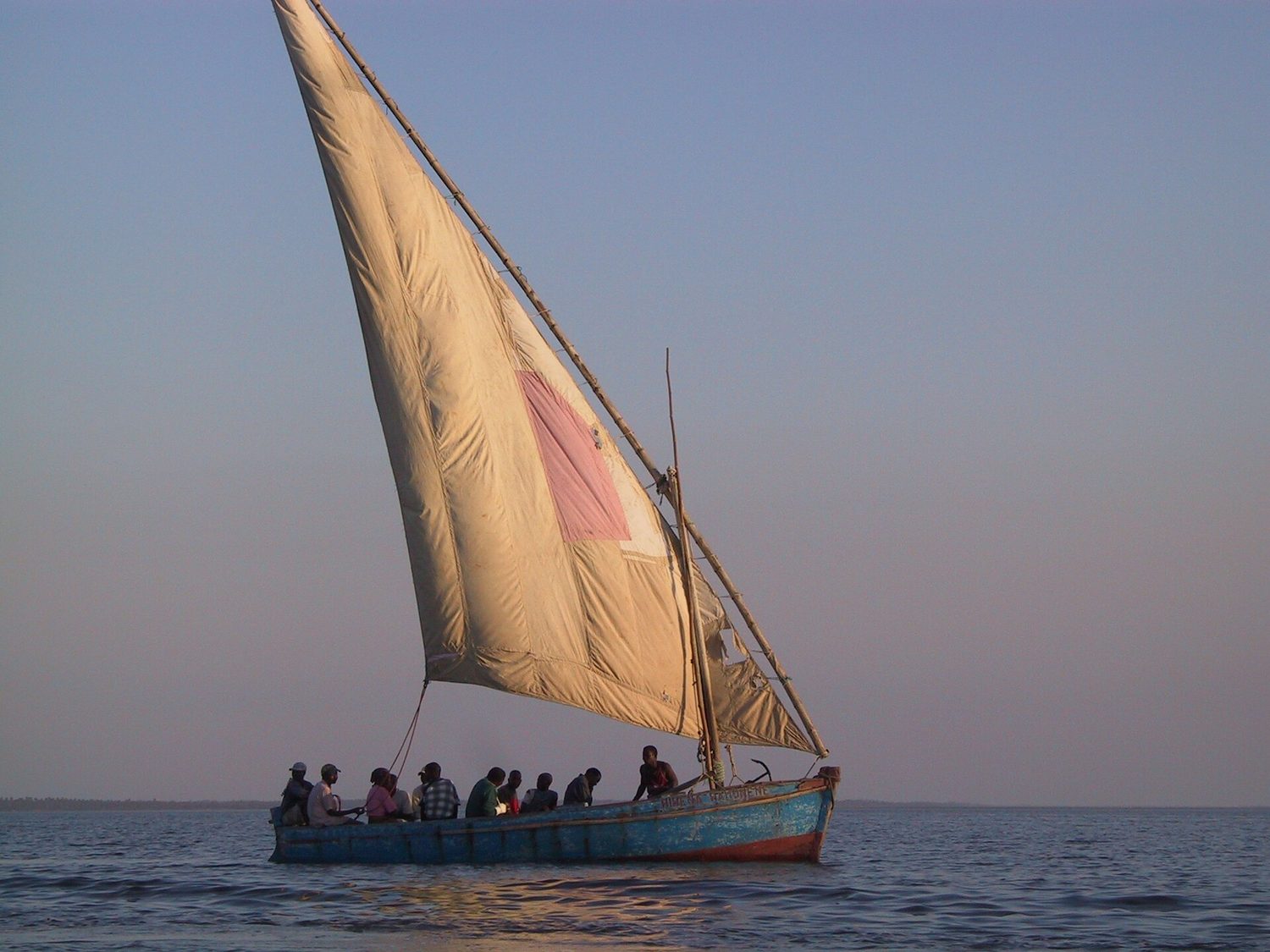
    Its enabling technologies were maritime: knowledge of the monsoon winds 季风, the lateen sail 三角帆, the dhow 单桅帆船, and navigational tools including the compass 罗盘 and astrolabe 星盘.

    Its consequences are the most examinable in the unit:

    • The network fostered the growth of states, such as the Swahili city-states on the East African coast and Srivijaya and Majapahit in Southeast Asia.
    • Merchants established diasporic communities 侨居社群 in key ports, introducing their own culture while adopting local ways.
    • Long-distance trade depended on and expanded coerced labour and on the movement of people as well as goods.
    日本語
    三大ネットワークを、運搬物、促進要因、変化したことに基づいて比較
    三つのネットワーク、一つの枠組み:商品、促進技術、成果とは、比較問題が求めるものである

    インド洋ネットワークは、シルクロードよりも大量の商品を輸送した。布地、木材、穀物、香辛料などである。船はラクダよりも多くの荷物を積めるからだ。

    その促進技術は海洋的なものであり、季风風の知識、ラテン帆、ドゥウ、および コンパス や アストロラーベ などの航海器具に関するものだった。

    その成果は、単元の中で最も出題可能性が高い:

    • このネットワークは、東アフリカ沿岸のスワヒリ都市国家や、東南アジアのスリビジャヤおよびマジャパヒトなど、国家の成長を後押しした。
    • 商人は重要な港湾において ** Diasporic communities(流亡共同体/散住コミュニティ)** を設立し、自らの文化を導入しつつ現地の风俗を適応させた。
    • 長距離貿易は、強制労働の依存と拡大、および人々および商品の移動に依存していた。
    ラテン帆を備えたドゥウ - 季风システムを越えて船を動かすための rigged( rigged = 帆装された/配置された)
    Vocabulary · ⁨語彙⁩ Train · ⁨練習する⁩
    English 日本語
    dhow/ˈdiːhaʊ/ ドゥー船
    compass/ˈkʌmpəs/ コンパス
    astrolabe/ˈæstrəleɪb/ アストロラーベ
    diasporic communities/ˌdaɪəˈspɒrɪk kəˈmjuːnɪtiz/ Diasporaコミュニティ(海外移住者共同体)
    camel saddle/ˈkæml ˈsædl/ ラクダ saddle
    2.4

    Trans-Saharan Trade · ⁨サハラ横断交易⁩

    Syllabus · ⁨シラバス⁩
    English

    2.4 Trans-Saharan Trade Routes

    Thematic Focus (TEC): Technology and Innovation — Human adaptation and innovation have resulted in increased efficiency, comfort, and security, and technological advances have shaped human development and interactions with both intended and unintended consequences.

    Thematic Focus (GOV): Governance — A variety of internal and external factors contribute to state formation, expansion, and decline. Governments maintain order through a variety of administrative institutions, policies, and procedures, and governments obtain, retain, and exercise power in different ways and for different purposes.

    Learning Objective Unit 2.H: Explain the causes and effects of the growth of trans-Saharan trade.

    • KC-3.1.II.A.ii The growth of interregional trade was encouraged by innovations in existing transportation technologies.
    • KC-3.1.I.A.iv Improved transportation technologies and commercial practices led to an increased volume of trade and expanded the geographical range of existing trade routes, including the trans-Saharan trade network.

    Learning Objective Unit 2.I: Explain how the expansion of empires influenced trade and communication over time.

    • KC-3.1.I.E.ii The expansion of empires—including Mali in West Africa–facilitated Afro-Eurasian trade and communication as new people were drawn into the economies and trade networks.

    Illustrative examples:

    • Technologies encouraging interregional trade:
      • Camel saddle
      • Caravans
    日本語

    2.4 サハラ砂漠越えの貿易ルート

    テーマ的焦点(TEC): 技術と革新 — 人間の適応と革新により、効率性、快適性、安全性が高まり、技術の進歩は意図的かつ意図しない結果をもたらしながら、人間の発展および相互作用を形作った。

    テーマの焦点(GOV): 統治 — 多様な内外的要因が国家の形成、拡大、衰退に寄与する。政府は多様な行政機関、政策、手続きを通じて秩序を維持し、異なる方法・目的で権力を獲得・保持・行使する。

    学習目標ユニット2.H: サハラ砂漠越えの貿易の成長の要因および影響を説明する。

    • KC-3.1.II.A.ii 既存の交通技術における革新により、国際間貿易の成長が促進された。
    • KC-3.1.I.A.iv 交通技術の向上と商業慣行の改善により、貿易量が増加し、サハラ砂漠越えの貿易ネットワークを含む既存の貿易ルートが地理的に拡大された。

    学習目標ユニット2.I: 帝国の拡大が、時間経過に伴い貿易および通信に与えた影響を説明する。

    • KC-3.1.I.E.ii マリを含む西アフリカの帝国の拡大は、新たな人々が経済および貿易網に取り込まれることで、アフリカ=ユーラシア間の貿易および通信を促進した。

    具体例:

    • 国際間貿易を促す技術:
      • ラクダ用uncture(鞍)
      • カババン(商隊)

    Source: College Board AP Course and Exam Description · ⁨出典: College Board AP コースおよび試験説明書⁩

    English

    The trans-Saharan routes crossed the desert on innovations in existing technology - above all the camel saddle 骆驼鞍 and organised caravans 商队.

    Gold from West Africa moved north and salt 盐 moved south. The expansion of empires, including Mali 马里帝国, facilitated Afro-Eurasian trade by securing the routes and taxing them - and Mali's wealth and its ruler's famous pilgrimage advertised the region across the Islamic world.

    日本語

    サハラ横断ルートは、既存の技術の革新的基础上、特筆すべきは ラクダのuncture(鞍) および組織的な カーヴァン に基づいて砂漠を越えた。

    西アフリカから産出した黄金は北へ、塩は南へと移動した。マリ帝国を含む帝国の拡大は、交易路を確保して課税することで、アフリカ・ユーラシア間の貿易を促進した。また、マリの富と君主による著名な巡礼は、イスラム世界全体にこの地域の名声を広めた。

    2.5 2.6

    Cultural and Environmental Consequences · ⁨文化的・環境的帰結⁩

    Syllabus · ⁨シラバス⁩
    English

    2.5 Cultural Consequences of Connectivity

    Thematic Focus (CDI): Cultural Developments and Interactions — The development of ideas, beliefs, and religions illustrates how groups in society view themselves, and the interactions of societies and their beliefs often have political, social, and cultural implications.

    Learning Objective Unit 2.J: Explain the intellectual and cultural effects of the various networks of exchange in Afro-Eurasia from c. 1200 to c. 1450.

    • KC-3.1.III.D Increased cross-cultural interactions resulted in the diffusion of literary, artistic, and cultural traditions, as well as scientific and technological innovations.
    • KC-3.3.II The fate of cities varied greatly, with periods of significant decline and periods of increased urbanization, buoyed by rising productivity and expanding trade networks.
    • KC-3.1.III.C As exchange networks intensified, an increasing number of travelers within Afro-Eurasia wrote about their travels.

    Illustrative examples:

    • Diffusion of cultural traditions:
      • The influence of Buddhism in East Asia
      • The spread of Hinduism and Buddhism into Southeast Asia
      • The spread of Islam in sub-Saharan Africa and Asia
    • Diffusion of scientific or technological innovations:
      • Gunpowder from China
      • Paper from China
    • Travelers:
      • Ibn Battuta
      • Margery Kempe
      • Marco Polo
    日本語

    2.5 接続性の文化的帰結

    テーマの焦点(CDI): 文化的発展と相互作用 — 思想、信仰、宗教の発展は、社会内の集団が自らをどのように認識しているかを示しており、社会やその信念の相互作用は政治的、社会的、文化的な影響を及ぼすことが往往ある。

    学習目標ユニット2.J: 1200年から1450年頃のアフリカ=ユーラシアにおける様々な交換ネットワークがもたらした知的および文化的影響を説明する。

    • KC-3.1.III.D 相互文化交流の増加は、文学、芸術、文化の伝統だけでなく、科学技術の革新の普及をもたらした。
    • KC-3.3.II 都市の運命は大きく異なり、生産性の向上と貿易ネットワークの拡大によって支えられた著しい衰退期と都市化の進展期が存在した。
    • KC-3.1.III.C 交換ネットワークが活発になるにつれ、アフリカ=ユーラシア内を旅する旅行者の数が増え、彼らは自身の旅行記を残すようになった。

    具体例:

    • 文化の伝統の普及:
      • 東アジアにおける仏教の影響
      • 南東アジアへのヒンドゥー教および仏教の伝播
      • サハラ以南アフリカおよびアジアにおけるイスラム教の伝播
    • 科学技術革新の普及:
      • 中国からの火薬
      • 中国からの紙
    • 旅行者:
      • イブン・バッタータ
      • マージェリー・ケームプ
      • マルコ・ポーロ
    English

    2.6 Environmental Consequences of Connectivity

    Thematic Focus (ENV): Humans and the Environments — The environment shapes human societies, and as populations grow and change, these populations in turn shape their environments.

    Learning Objective Unit 2.K: Explain the environmental effects of the various networks of exchange in Afro-Eurasia from c. 1200 to c. 1450.

    • KC-3.1.IV There was continued diffusion of crops and pathogens, with epidemic diseases, including the bubonic plague, along trade routes.

    Illustrative examples:

    • Diffusion of crops:
      • Bananas in Africa
      • New rice varieties in East Asia
      • Spread of citrus in the Mediterranean
    日本語

    2.6 接続性の環境影響

    テーマ別焦点(ENV): 人間と環境 — 環境は人類社会を形成し、人口が増加・変化すると、その人々もまた環境を形作る。

    学習目標 Unit 2.K: 1200年頃〜1450年頃のアフリカ・ユーラシアにおける多様な交換ネットワークの環境的影響について説明せよ。

    • KC-3.1.IV 作物や病原体の拡散が続き、交易路沿いでは結核性ペストを含む伝染病の流行が起こった。

    具体例:

    • 作物の拡散:
      • アフリカにおけるバナナ
      • 東アジアにおける新米品種
      • メジテラネア海地域での柑橘類の普及

    Source: College Board AP Course and Exam Description · ⁨出典: College Board AP コースおよび試験説明書⁩

    English

    Increased cross-cultural interaction produced diffusion 传播 of literary, artistic, scientific, and religious traditions - the spread of Islam along trade routes, Buddhist and Neo-Confucian influence in East Asia, and the movement of scientific and mathematical knowledge.

    An increasing number of travellers 旅行者 moved within and between regions, and their accounts are the period's key evidence.

    The fate of cities varied: some declined as routes shifted or invasions came, while others grew into major commercial centres.

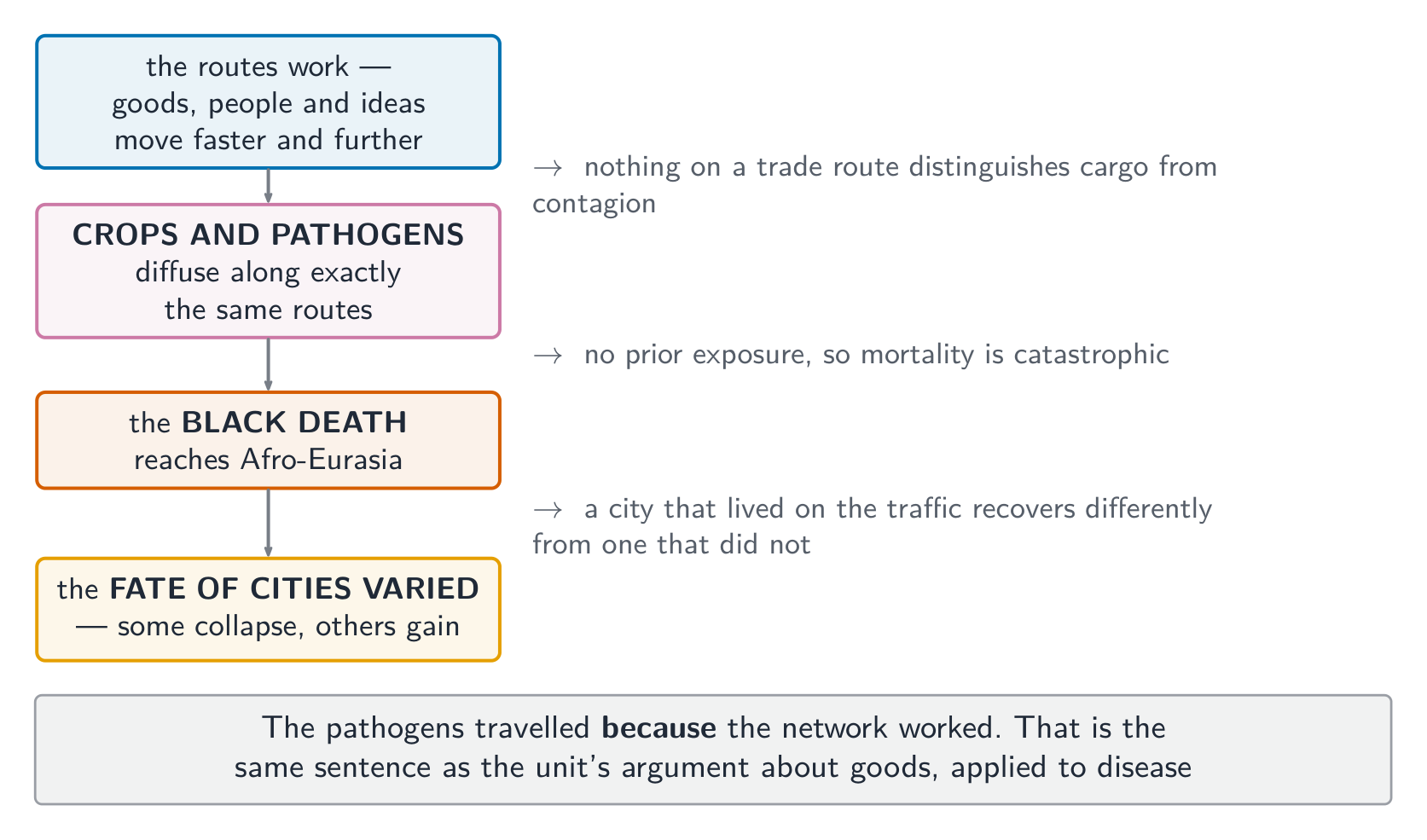
    The environmental consequences were as large as the cultural ones. There was continued diffusion of crops and pathogens, and epidemic disease travelled with trade - most catastrophically the Black Death 黑死病, which moved along the same routes that carried goods and killed a large share of the population of Afro-Eurasia.

    日本語

    文化交流の活発化により、文学、芸術、科学、宗教の伝統が**拡散(diffusion)**し、イスラム教の交易路に沿った普及、東アジアにおける仏教および新儒学の影響、そして科学・数学の知識の流通が生じた。

    旅行者の数が増加し、地域内や地域間を移動するようになり、彼らの記録がその時代の重要な証拠となっている。

    都市の運命は多様であった: 交通路の変化や侵略により衰退した都市もあれば、大規模な商業中心地へと成長した都市もあった。

    環境への影響も文化的影響と同様に大きかった。作物や病原体の継続的な拡散があり、疫病も交易とともに広まった。特に悲惨だったのが黒死病であり、これは商品が輸送された同じ経路をたどり、アフリカ・ユーラシアの人口の大部分を死亡させた。

    病原体が広がったのはネットワークが機能していたためである — この論理は疾病にも適用される
    Explore · ⁨探索⁩

    Follow the network's most consequential cargo

    The pathogens travelled because the network worked — the same argument the unit makes about goods, applied to disease.

    Vocabulary · ⁨語彙⁩ Train · ⁨練習する⁩
    English 日本語
    diffusion/dɪˈfjuːʒn/ 拡散
    travellers/ˈtræveləz/ 旅行者
    Black Death/blæk deθ/ 黒死病
    2.7

    Comparison of Economic Exchange · ⁨経済的交換の比較⁩

    Syllabus · ⁨シラバス⁩
    English

    2.7 Comparison of Economic Exchange

    Learning Objective Unit 2.L: Explain the similarities and differences among the various networks of exchange in the period from c. 1200 to c. 1450.

    • KC-3.1 A deepening and widening of networks of human interaction within and across regions contributed to cultural, technological, and biological diffusion within and between various societies.
      • KC-3.1.I.A.i Improved commercial practices led to an increased volume of trade and expanded the geographical range of existing trade routes—including the Silk Roads—promoting the growth of powerful new trading cities.
      • KC-3.1.I.C.i The growth of interregional trade in luxury goods was encouraged by innovations in previously existing transportation and commercial technologies, including the caravanserai, forms of credit, and the development of money economies.
    • KC-3.3 Changes in trade networks resulted from and stimulated increasing productive capacity, with important implications for social and gender structures and environmental processes.
      • KC-3.3.I.B Demand for luxury goods increased in Afro-Eurasia. Chinese, Persian, and Indian artisans and merchants expanded their production of textiles and porcelains for export; manufacture of iron and steel expanded in China.
    日本語

    2.7 経済的交換の比較

    学習目標 Unit 2.L: 1200年頃〜1450年頃の多様な交換ネットワーク間の類似点と相違点について説明せよ。

    • KC-3.1 地域内および地域間での人間相互作用のネットワークの深化と拡大は、多様な社会間および内部での文化的・技術的・生物学的な拡散に寄与した。
      • KC-3.1.I.A.i 商業慣行の改善により貿易量が増加し、既存の交易路—including Silk Roads—の地理的範囲が拡大し、強力な新興貿易都市の成長を促進した。
      • KC-3.1.I.C.i 高級品に対する地域間貿易の成長は、以前から存在する輸送および商業技術の革新によって促進された。これにはカーヴァンセライ、信用形式、および貨幣経済の発展が含まれる。
    • KC-3.3 貿易ネットワークの変化は生産能力の増加に起因し、同時にそれを刺激した。これは社会的・ジェンダー構造および環境プロセスに重要な意味を持つ。
      • KC-3.3.I.B アフリカ・ユーラシアにおける高級品への需要が増加した。中国、ペルシャ、インドの職人や商人は輸出用として織物や陶器の生産を拡大し、中国では鉄および鋼の製造も拡大した。

    Source: College Board AP Course and Exam Description · ⁨出典: College Board AP コースおよび試験説明書⁩

    English

    The unit's reasoning skill is comparison. Compare the networks on what they carried, what made them possible, and what they changed - not on which was "most important".

    Worked example (a real AP exam question). AP World short-answer questions frequently ask students to "Explain one similarity" or "Explain one difference" between two trade networks in this period. A full-mark answer names the feature and applies it to both, then explains: "Both the Silk Roads and the Indian Ocean network expanded because of improved commercial practices, but the Indian Ocean carried heavier, lower-value goods such as timber and grain because ships could transport far greater bulk than overland caravans." Notice the shape: the because clause is what turns a difference into an explanation, and without it the answer only describes.

    日本語

    単元の推論スキルは比較である。どちらが「最も重要か」ではなく、各ネットワークが何を運んだか、何によって可能になったか、何を変えたかを比較せよ。

    ** worked example (実際のAP試験問題) *。APワールド史の短答式問題は、この時期の2つの交易網間で「類似点1つを説明せよ」または「相違点1つを説明せよ」*と求めることが多くある。満点答案は特徴を挙げ、両方に適用した上で説明する: 「シルクロードとインド洋ネットワークは、商业慣行の改善により拡大したが、インド洋では船が陸路の商隊より遥かに大量の貨物を運べるため、木材や穀物など重量が大きく価値の低い商品を運ぶこととなった」。この形式に注意されたい:because節が相違点を説明に変える要素であり、これがなければ回答は単なる記述に留まる。

    2.7

    Exam tips · ⁨試験対策⁩

    English
    • Explain growth with the three causes - commercial practices, transport technology, state support - rather than listing trade goods.
    • Match cargo to carrier: overland routes move high-value, low-bulk goods; maritime routes move bulk.
    • Learn the enabling technologies by network: caravanserai and credit; monsoons, lateen sail and dhow; the camel saddle.
    • The Mongols' examinable role is facilitating exchange, not conquest for its own sake.
    • The Black Death is the environmental consequence to name, and it travelled on the trade network itself.
    • On difference questions, always add the because. A stated difference without a cause is only half an answer.
    日本語
    • 交易品目を列挙するのではなく、商业慣行、輸送技術、国家支援という3つの原因を用いて成長を説明すること。
    • 積荷と輸送手段を対応させる: 陸路は高価値・低容量の品物を、海路は大容量の品物を運ぶ。
    • ネットワーク別の可能化技術を学ぶ: カルヴァンセライと信用制度、モンスーンとラテン帆とドゥウ船、ラクダ用サドル。
    • モンゴル帝国の受験対象としての役割は、征服そのものではなく、交流の促進である。
    • 環境的帰結として名指すべきは黒死病であり、これは交易網そのものを介して広がった。
    • 相違点に関する問題では、常にbecauseを加える。原因を示さずに単に相違点を述べただけでは、回答の半分しか得られない。
  • 3

    Land-Based Empires · ⁨陸上帝国⁩

    Watch lesson · ⁨レッスンを視聴⁩
    3.1

    How the Land Empires Expanded · ⁨陸上帝国の拡大方法⁩

    Syllabus · ⁨シラバス⁩
    English

    3.1 Empires Expand

    Thematic Focus (GOV): Governance — A variety of internal and external factors contribute to state formation, expansion, and decline. Governments maintain order through a variety of administrative institutions, policies, and procedures, and governments obtain, retain, and exercise power in different ways and for different purposes.

    Learning Objective Unit 3.A: Explain how and why various land-based empires developed and expanded from 1450 to 1750.

    • KC-4.3.II Imperial expansion relied on the increased use of gunpowder, cannons, and armed trade to establish large empires in both hemispheres.
    • KC-4.3.II.B Land empires included the Manchu in Central and East Asia; the Mughal in South and Central Asia; the Ottoman in Southern Europe, the Middle East, and North Africa; and the Safavids in the Middle East.
    • KC-4.3.III.i Political and religious disputes led to rivalries and conflict between states.

    Illustrative examples:

    • State rivalries:
      • Safavid–Mughal conflict
      • Songhai Empire’s conflict with Morocco
    日本語

    3.1 帝国の拡大

    テーマの焦点(GOV): 統治 — 多様な内外的要因が国家の形成、拡大、衰退に寄与する。政府は多様な行政機関、政策、手続きを通じて秩序を維持し、異なる方法・目的で権力を獲得・保持・行使する。

    学習目標 Unit 3.A: 1450年〜1750年にかけて、多様な陸上帝国がどのようにして、なぜ発展・拡大したかについて説明せよ。

    • KC-4.3.II 帝国の拡大は、両半球で巨大な帝国を確立するために火薬、大砲、武装商船の多用に依存していた。
    • KC-4.3.II.B 陸上帝国には、中央および東アジアのマンchu朝、南および中央アジアのムガル朝、南ヨーロッパ・中東・北アフリカのオスマン朝、中東のサファヴィー朝が含まれた。
    • KC-4.3.III.i 政治的・宗教的な対立は、国家間の競合と衝突をもたらした。

    具体例:

    • 国家間の競合:
      • サファヴィー朝とムガル朝の衝突
      • ソンハイ帝国とモロッコの衝突

    Source: College Board AP Course and Exam Description · ⁨出典: College Board AP コースおよび試験説明書⁩

    English

    Unit 3 covers the great land-based empires 陆基帝国 of roughly 1450 to 1750. Four questions organise it: how they expanded, how they governed, how they paid for themselves, and how they used religion.

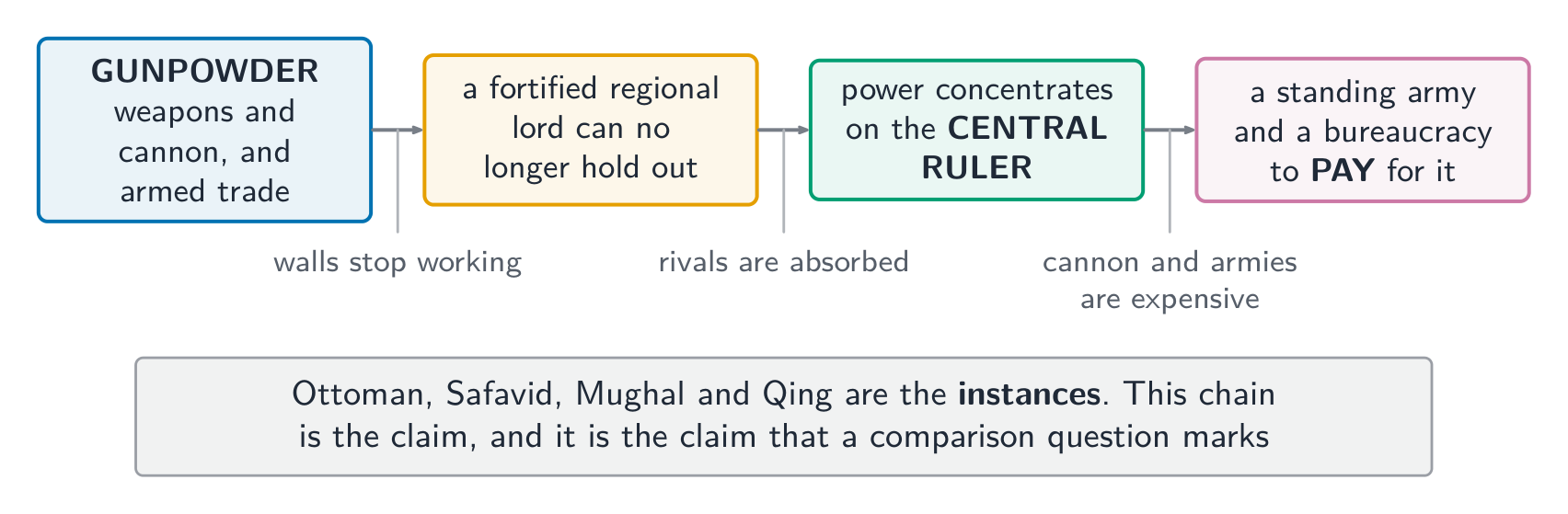
    Expansion relied on the increased use of gunpowder, cannons, and armed trade - which is why these are often called the gunpowder empires 火药帝国. Access to gunpowder weapons let a central ruler overpower regional rivals and fortified nobles, so military technology and political centralisation grew together.

    The empires to know:

    • The Manchu (Qing) 满清 in Central and East Asia.
    • The Mughal 莫卧儿 in South Asia.
    • The Ottoman 奥斯曼 in the eastern Mediterranean and beyond.
    • The Safavid 萨法维 in Persia.
    日本語

    単元3では、おおよそ1450年から1750年にかけての巨大な陸上帝国を取り上げる。4つの問いで構成される: どのように拡大したか、どのように統治したか、財政をどう賄ったか、以及如何に宗教を利用したか。

    拡大には、火薬、大砲、武装商取引の増大利用が基盤となっており、これらが火薬帝国と呼ばれる所以である。火薬兵器へのアクセスは中央権力が地方の対立勢力や要塞化された貴族に優位に立つことを可能にし、軍事技術と政治の中央集権化がともに発展した。

    知っておくべき帝国:

    • 中央および東アジアの満州(清)。
    • 南アジアのムガル。
    • 東地中海およびそれ以南のオスマン。
    • パースのサファヴィー。
    なぜ火薬帝国と呼ばれたのか: 軍事技術と中央集権化がともに発展した
    Explore · ⁨探索⁩

    Assemble the gunpowder-empire claim · ⁨火薬帝国の主張を構成する⁩

    Military technology and political centralisation grew together — and the mechanism is that a cannon ends a fortified lord's advantage. · ⁨軍事技術と政治的中央集権は共に発展した——メカニズムは、大砲が砦を持つ貴族の優位性を終えることだ。⁩

    Vocabulary · ⁨語彙⁩ Train · ⁨練習する⁩
    English 日本語
    land-based empires/lænd beɪst ˈempaɪəz/ 陸上帝国
    gunpowder empires/ˈɡʌnpaʊdə ˈempaɪəz/ 火薬帝国
    Manchu (Qing)/ˈmæntʃuː/ 満州(清)
    Mughal/ˈməʊɡl/ ムガル
    Ottoman/ˈɒtəmən/ オスマン
    Safavid/ˈsæfəvɪd/ サファヴィー朝
    Recruitment of bureaucratic elites/rɪˈkruːtmənt ɒv ˌbjʊərəʊˈkrætɪk ɪˈliːts/ 官僚エリート層の登用
    military professionals/ˈmɪlɪtəri prəˈfeʃənlz/ 軍事専門家
    devshirme/ˈdevʃɜːm/ デヴシルメ
    janissaries/ˈdʒænɪsəriz/ ヤニッサーリー
    ghulams/ˈɡjʊlæmz/ グルーム
    tribute collection/ˈtrɪbjuːt kəˈlekʃn/ 貢納徴収
    tax farming/tæks ˈfɑːmɪŋ/ 租税収取権の売却(タックスファーマー)
    zamindar/ˈzæmaɪndɑː/ ザミンドール
    hard currency/hɑːd ˈkʌrənsi/ 硬貨
    Protestant Reformation/ˈprɒtɪstənt rɪfɔːˈmeɪʃn/ プロテスタント改革
    Sunni-Shia split/ˈsʌni ʃɪə splɪt/ スンナ派とシーア派の分裂
    Sikhism/ˈsiːkɪzəm/ シク教
    3.2

    Administration · ⁨行政⁩

    Syllabus · ⁨シラバス⁩
    English

    3.2 Empires: Administration

    Thematic Focus (GOV): Governance — A variety of internal and external factors contribute to state formation, expansion, and decline. Governments maintain order through a variety of administrative institutions, policies, and procedures, and governments obtain, retain, and exercise power in different ways and for different purposes.

    Learning Objective Unit 3.B: Explain how rulers used a variety of methods to legitimize and consolidate their power in land-based empires from 1450 to 1750.

    • KC-4.3.I.C Recruitment and use of bureaucratic elites, as well as the development of military professionals, became more common among rulers who wanted to maintain centralized control over their populations and resources.
    • KC-4.3.I.A Rulers continued to use religious ideas, art, and monumental architecture to legitimize their rule.
    • KC-4.3.I.D Rulers used tribute collection, tax farming, and innovative tax-collection systems to generate revenue in order to forward state power and expansion.

    Illustrative examples:

    • Bureaucratic elites or military professionals:
      • Ottoman devshirme
      • Salaried samurai
    • Religious ideas:
      • Mexica practice of human sacrifice
      • European notions of divine right
      • Songhai promotion of Islam
    • Art and monumental architecture:
      • Qing imperial portraits
      • Incan sun temple of Cuzco
      • Mughal mausolea and mosques
      • European palaces, such as Versailles
    • Tax-collection systems:
      • Mughal zamindar tax collection
      • Ottoman tax farming
      • Mexica tribute lists
      • Ming practice of collecting taxes in hard currency
    日本語

    3.2 帝国:行政

    テーマの焦点(GOV): 統治 — 多様な内外的要因が国家の形成、拡大、衰退に寄与する。政府は多様な行政機関、政策、手続きを通じて秩序を維持し、異なる方法・目的で権力を獲得・保持・行使する。

    学習目標 Unit 3.B: 1450年〜1750年にかけて、支配者は陸上帝国においてどのような方法を用いて自らの権力を正当化し、強化したかについて説明せよ。

    • KC-4.3.I.C 官僚エリートの人材採用・活用、ならびに軍事専門家の育成は、人民および資源に対する中央集権的統制を維持したい支配者にとってより一般的になった。
    • KC-4.3.I.A 支配者は引き続き、宗教思想、芸術、そして巨塔建築を用いて自らの統治を正当化した。
    • KC-4.3.I.D 支配者は租税徴収、租税請負、革新的な租税徴収システムを用いて国家権力と扩张のための財源を調達した。

    具体例:

    • 官僚エリートまたは軍事専門家:
      • オスマン朝のデヴシルメ
      • 俸禄侍士(奉公侍士)
    • 宗教思想:
      • メキシカ人の生贄儀式
      • 欧州の神授王権説
      • ソンハイによるイスラム教の推進
    • 芸術と巨塔建築:
      • クリア朝の皇帝肖像画
      • インカ帝国のクスコ太陽神殿
      • ムガル朝の陵墓とモスク
      • ヴァルサイユ宮殿などの欧州宮廷建築
    • 租税徴収システム:
      • ムガル朝のザミンダー租税徴収
      • オスマン朝の租税請負
      • メキシカ人の貢納リスト
      • 明の現物課税(硬貨課税)の慣習

    Source: College Board AP Course and Exam Description · ⁨出典: College Board AP コースおよび試験説明書⁩

    English

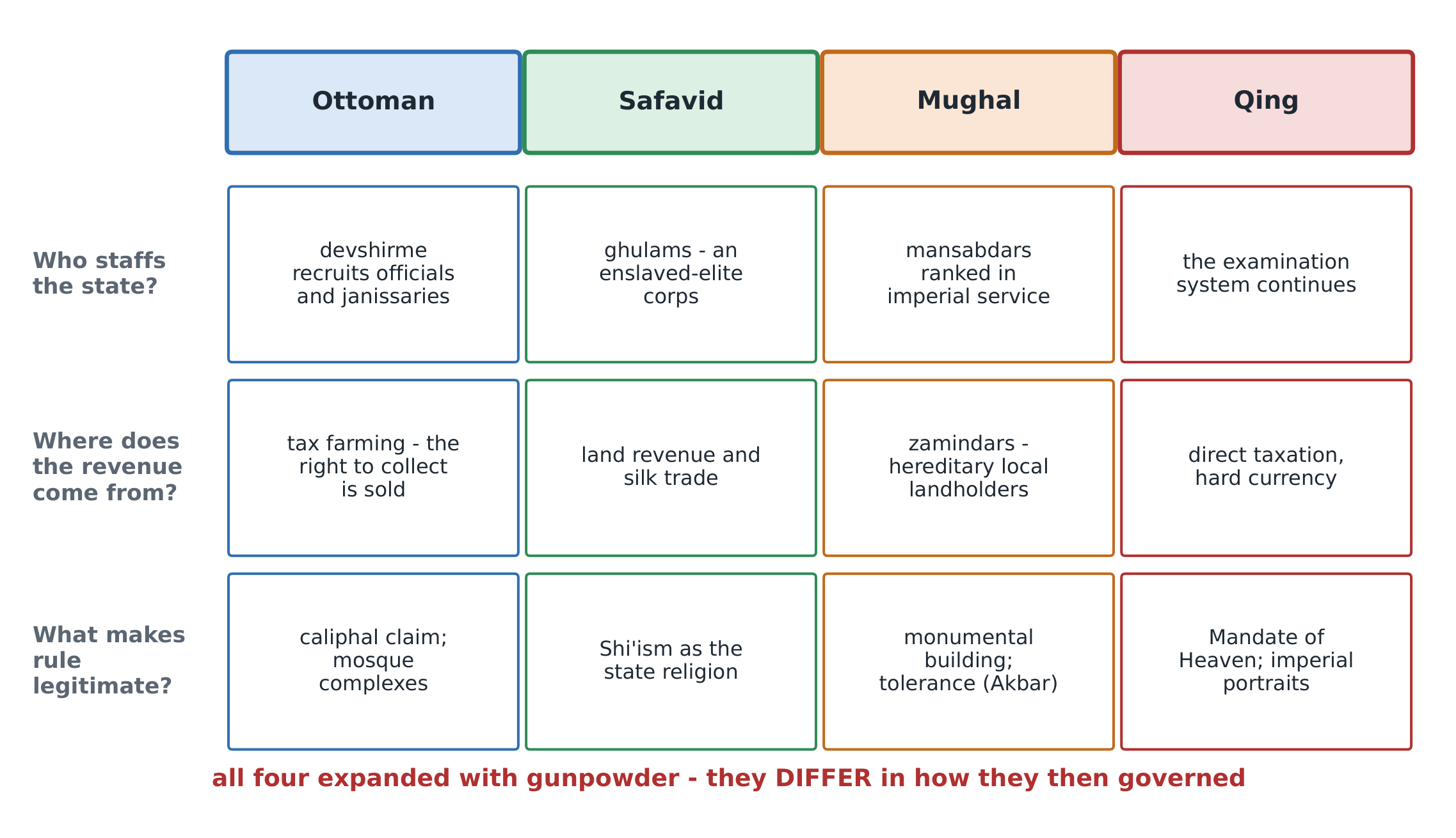
    Rulers faced the same problem: how to control territory far from the capital. The CED names the tools they used.

    Recruitment of bureaucratic elites 官僚精英的选任 and the development of military professionals 职业军人 gave rulers officials who owed their position to the state rather than to birth. The clearest case is the Ottoman devshirme 德夫希尔梅 system, which recruited and trained administrators and soldiers, including the janissaries 耶尼切里; the Manchu continued China's examination system; the Safavids used ghulams 古拉姆.

    Revenue came through tribute collection 纳贡, tax farming 包税制, and innovative tax-collection systems. The Mughal zamindar 柴明达尔 system and Ottoman tax farming are the standard examples, and the Ming practice of collecting taxes in hard currency 硬通货 is another.

    日本語
    4つの帝国、1セットの道具: 各帝国が官僚を如何に採用し、財源を調達し、正当性を主張したか
    同一の3つの問題 - 人材、財源、正当性 - を各帝国が異なる解決策で対処

    君主は同じ問題に直面した: 首都から遠い領土をいかに支配するか。CED(College Board)が提示するツールがある。

    官僚エリートへの採用および軍事専門家の育成により、君主は出身ではなく国家に対する忠誠心を有する官僚を得た。最も明確な例は、行政官および兵士、すなわちヤニッサーリーを含め採用・訓練を行ったオスマンのデヴシルメ制度である。満州は中国の科挙制度を継承し、サファヴィーはグールームを使用した。

    財源は朝貢の徴収、租税請負制、革新的な租税徴収システムによって得られた。ムガルのザミンダー制度とオスマンの租税請負制が標準的な例であり、明の硬貨での租税徴収もその一例である。

    3.3

    Legitimacy and Belief · ⁨正当性と信仰⁩

    Syllabus · ⁨シラバス⁩
    English

    3.3 Empires: Belief Systems

    Thematic Focus (CDI): Cultural Developments and Interactions — The development of ideas, beliefs, and religions illustrates how groups in society view themselves, and the interactions of societies and their beliefs often have political, social, and cultural implications.

    Learning Objective Unit 3.C: Explain continuity and change within the various belief systems during the period from 1450 to 1750.

    • KC-4.1.VI.i The Protestant Reformation marked a break with existing Christian traditions and both the Protestant and Catholic reformations contributed to the growth of Christianity.
    • KC-4.1.VI.ii Political rivalries between the Ottoman and Safavid empires intensified the split within Islam between Sunni and Shi’a.
    • KC-4.1.VI.iii Sikhism developed in South Asia in a context of interactions between Hinduism and Islam.
    日本語

    3.3 帝国:信仰体系

    テーマの焦点(CDI): 文化的発展と相互作用 — 思想、信仰、宗教の発展は、社会内の集団が自らをどのように認識しているかを示しており、社会やその信念の相互作用は政治的、社会的、文化的な影響を及ぼすことが往往ある。

    学習目標 Unit 3.C: 1450年〜1750年にかけて、多様な信仰体系における継続性と変容について説明せよ。

    • KC-4.1.VI.i プロテスタント改革は既存のキリスト教伝統との断絶を示し、プロテスタント改革とカトリック改革の双方がキリスト教の拡大に寄与した。
    • KC-4.1.VI.ii オスマン朝とサファヴィー朝の政治的対立は、イスラム教内のスンナ派とシーア派の分裂を激化させた。
    • KC-4.1.VI.iii シーク教はヒンドゥー教とイスラム教の相互作用という文脈の中で、南アジアで発生した。

    Source: College Board AP Course and Exam Description · ⁨出典: College Board AP コースおよび試験説明書⁩

    English

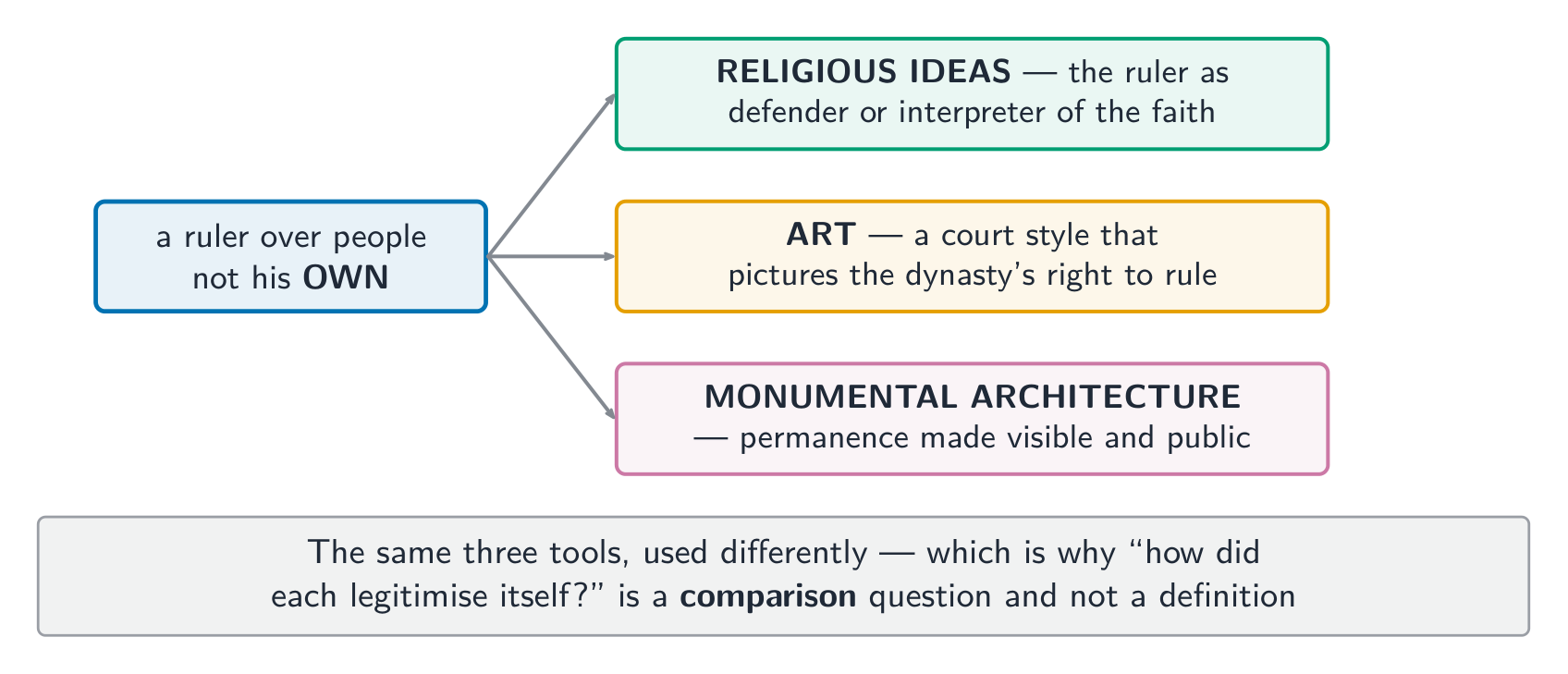
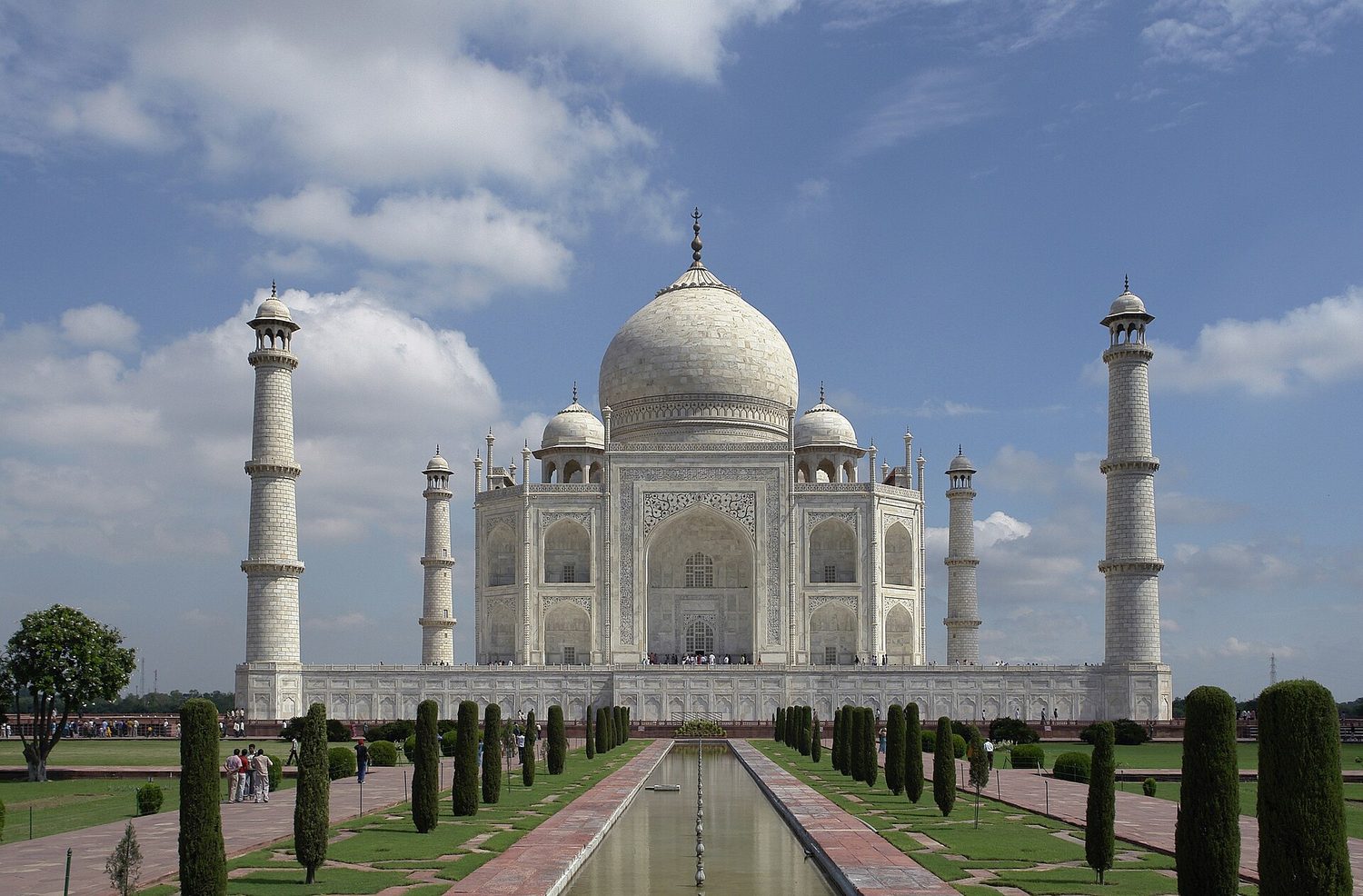
    Rulers continued to use religious ideas, art, and monumental architecture to legitimise their rule - Mughal mosques and mausolea, Ottoman mosque complexes, Qing imperial portraits, and European palaces such as Versailles all do the same work.

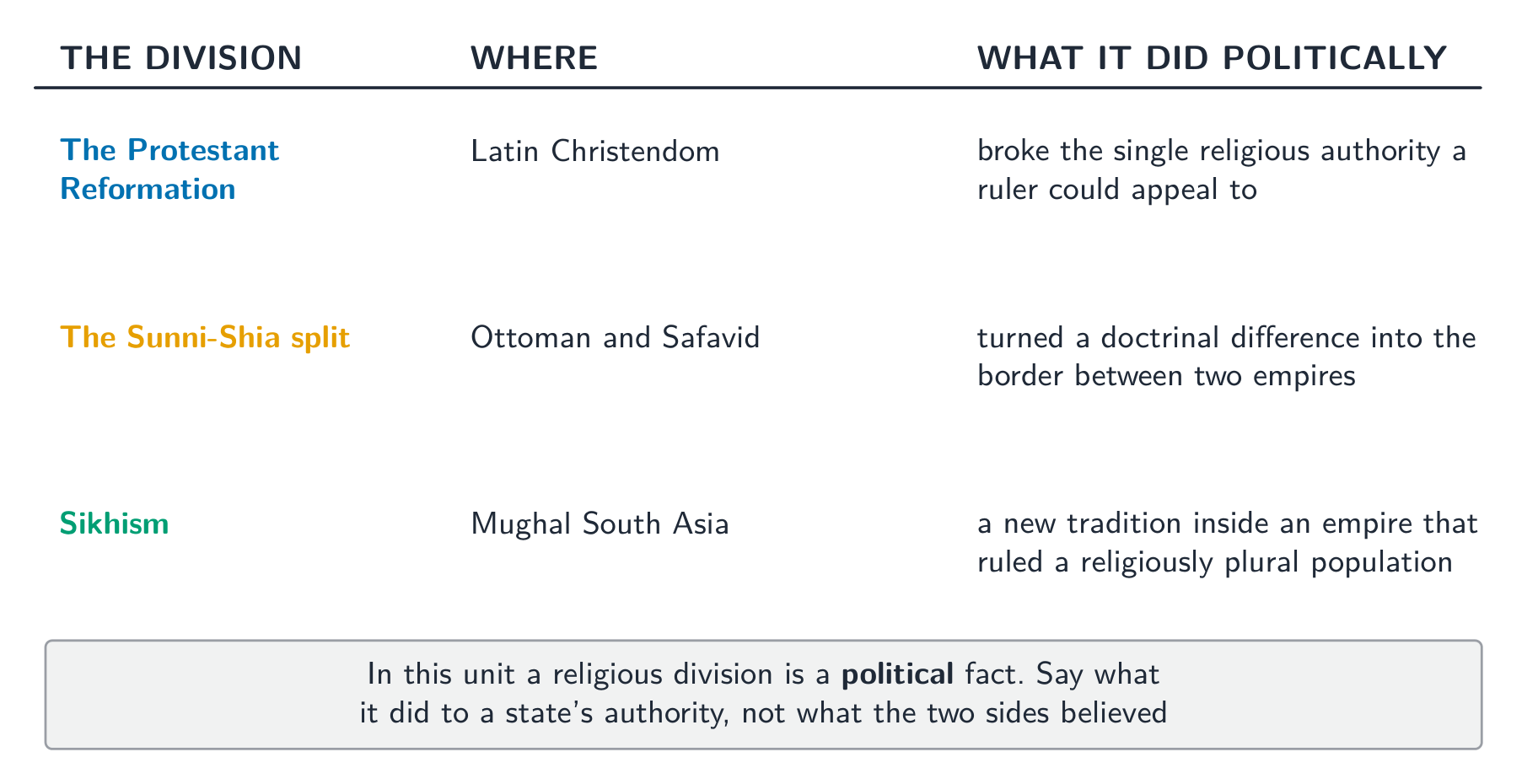
    Religious change also produced conflict:

    • The Protestant Reformation 新教改革 marked a break with existing Christian traditions and led to sustained religious and political conflict in Europe.
    • Political rivalry between the Ottoman and Safavid empires intensified the Sunni-Shia split 逊尼派与什叶派分裂, showing how state rivalry can deepen a religious division.
    • Sikhism 锡克教 developed in South Asia in a context of interaction between Hinduism and Islam.

    Political and religious disputes together produced rivalries and conflict between states across Eurasia.

    日本語

    君主は引き続き、宗教的アイデア、芸術、巨塔建築を用いて自らの統治の正当性を証明した。ムガルのモスクおよび陵墓、オスマンのモスク複合体、清の皇帝肖像画、ヴェルサイユ宮殿のようなヨーロッパの宮殿などが同様の機能を果たしている。

    宗教の変動は紛争も引き起こした:

    • プロテスタント改革は既存のキリスト教伝統との決別を意味し、ヨーロッパにおける持続的な宗教的・政治的紛争をもたらした。
    • オスマンとサファヴィー帝国間の政治的対立は、スンナ派とシーア派の分裂を激化させ、国家间的対立が宗教的分断を深めることを示した。
    • シク教はヒンドゥー教とイスラム教の相互作用という文脈の中で南アジアで誕生した。

    政治的および宗教的紛争は、ユーラシア全域において国家間の対立と紛争を生み出した。

    自分の人民ではない人々に対する君主の3つの手段 — 各帝国で異なった使われ方をした
    3つの宗教的分派、それぞれが国家の権威に対して何を行ったか
    スレイマニ耶モスク - 合法性を担保するための象徴的建築
    タージ・マハル - 同一の機能を持つ象徴的建築。宗教的多様性社会を支配したムガル君主によって用いられた
    Explore · ⁨探索⁩

    Sort each instrument of legitimacy · ⁨各正当性の手段を分類せよ⁩

    These rulers governed people who shared neither their language nor their faith, so legitimacy had to be manufactured. · ⁨これらの支配者は言語も信仰も共有しない人民を支配したため、正当性は意図的に製造されねばならなかった。⁩

    3.4

    Comparison in Land-Based Empires · ⁨陸上帝国における比較⁩

    Syllabus · ⁨シラバス⁩
    English

    3.4 Comparison in Land-Based Empires

    Learning Objective Unit 3.D: Compare the methods by which various empires increased their influence from 1450 to 1750.

    • KC-4.1 The interconnection of the Eastern and Western Hemispheres made possible by transoceanic voyaging, transformed trade and had a significant social impact on the world.
      • KC-4.1.VI In some cases, the increase and intensification of interactions between newly connected hemispheres expanded the reach and furthered development of existing religions, and contributed to religious conflicts and the development of syncretic belief systems and practices.
    • KC-4.3 Empires achieved increased scope and influence around the world, shaping and being shaped by the diverse populations they incorporated.
      • KC-4.3.II Imperial expansion relied on the increased use of gunpowder, cannons, and armed trade to establish large empires in both hemispheres.
      • KC-4.3.II.B Land empires included the Manchu in Central and East Asia; Mughal in South and Central Asia; Ottoman in Southern Europe, the Middle East, and North Africa; and the Safavids in the Middle East.
      • KC-4.3.III.i Political and religious disputes led to rivalries and conflict between states.
    日本語

    3.4 陸上帝国の比較

    学習目標 Unit 3.D: 1450年〜1750年にかけて、多様な帝国が影響力を増大させるための方法について比較せよ。

    • KC-4.1 越洋航海によって可能となった東半球と西半球の相互接続は、貿易を変革し、世界に対して大きな社会的影響を与えた。
      • KC-4.1.VI 一部のケースでは、新たに接続された半球間の相互作用の増大と激化が、既存の宗教の波及を拡大させ、発展を促すとともに、宗教紛争および折衷主義的信仰体系・実践の発展にも寄与した。
    • KC-4.3 帝国は世界各地でより広い範囲と影響力を獲得し、取り込んだ多様な人口によって形作られると同時に、それ自身もまた人口によって形作られた。
      • KC-4.3.II 帝国主義拡大は、両半球に大規模な帝国を確立するために、火薬、大砲、武装貿易の増加利用に依存していた。
      • KC-4.3.II.B 陸上帝国には、中央および東アジアのマンチュ朝、南および中央アジアのムガル朝、南ヨーロッパ・中東・北アフリカのオスマン朝、中東のサファヴィー朝が含まれた。
      • KC-4.3.III.i 政治的および宗教的な対立が、国家間の競合と衝突を生み出した。

    Source: College Board AP Course and Exam Description · ⁨出典: College Board AP コースおよび試験説明書⁩

    English

    The unit's reasoning skill is comparison, and the productive comparisons are about method, not size:

    • Recruiting officials by examination (Qing) against by enslaved-elite systems (Ottoman devshirme, Safavid ghulams).
    • Tax farming (Ottoman) against land-revenue intermediaries (Mughal zamindars) against direct taxation (Ming hard currency).
    • Legitimacy through religious identity (Safavid Shi'ism as state religion) against through tolerance of diversity (Mughal policy under Akbar).

    Worked example (a real AP exam question). AP World short-answer questions in this unit typically ask students to "Explain one similarity" or "Explain one difference in how land-based empires maintained power." A full-mark answer names the method for both and explains the effect: "Both the Ottoman and Mughal empires used intermediaries to collect revenue rather than salaried tax officials, but the Ottomans used tax farming, which sold the right to collect for a fixed payment, while the Mughals relied on zamindars, hereditary landholders whose local standing gave them a permanent interest in the countryside." Notice the shape: the comparison is one function (raising revenue), performed two ways, with the consequence stated.

    日本語

    この単元の論理的思考技能は比較であり、生産的な比較の対象は規模ではなく手法である:

    • 試験による官僚採用(清)対 奴隷エリート制度(オスマン・デヴシルメ、サファヴィー・グラムス)。
    • 租税請負制(オスマン)対 土地税仲介者(ムガル・ザミンダー)対 直接課税(明・硬貨)。
    • 宗教的アイデンティティによる正当性の確立(サファヴィー・シャア派を国教とする)対 多様性の容認によるもの(アクバー治世下のムガル政策)。

    ** worked example (実際のAP試験問題)。** この単元におけるAP世界史短答問題は、学生に「陸上帝国が権力を維持する際の一様な点」または「違い」を説明することを求めるのが一般的である。満点の回答では、両方の帝国についてその手法を挙げ、その影響を説明する必要がある。「オスマン帝国とムガル帝国の両方とも、給料制の税務官ではなく仲介者を通じて歳入を収集したが、オスマンは一定の金額で徴収権を売却する租税請負制を用いたのに対し、ムガルは地元の地位に基づき地方に恒久的な関心を持つ世襲的土地保有者であるザミンダーに依存していた。」というように記述される。この構成に注意されたい:比較は、2つの異なる方法で行われる一機能(歳入の調達)であり、その結果が明記されている。

    3.4

    Exam tips · ⁨試験対策⁩

    English
    • Say why gunpowder mattered: it let central rulers overpower regional rivals, so military change and centralisation go together.
    • Learn the four empires by their administrative method, not their territory - devshirme, examinations, zamindars, ghulams.
    • Tax farming sells the right to collect; a zamindar is a hereditary landholder. Questions turn on that difference.
    • Monumental architecture is evidence of legitimation, not decoration. Say what it was doing.
    • The Ottoman-Safavid rivalry is the example of political conflict deepening a religious divide.
    • Comparisons should be one function performed two ways, with the consequence stated.
    日本語
    • なぜ火薬が重要だったかを理由で説明せよ:中央政権が地域的反対勢力に優位に立つことを可能にし、軍事改革と中央集権化がセットで進行したためである。
    • 領土ではなく、行政手法によって4つの帝国を学ぶこと:デヴシルメ、試験、ザミンダー、グラムス。
    • 租税請負制は徴収権を売却するものであり、ザミンダーは世襲的土地保有者である。この違いが問われる。
    • 象徴的建築は装飾ではなく、合法性の証拠である。それがどのような役割を果たしていたかを述べよ。
    • オスマンとサファヴィーの対立は、政治的対立が宗教的対立を深めた例である。
    • 比較は、2つの異なる方法で行われる一機能であり、その結果が明記されているべきである。
  • 4

    Transoceanic Interconnections · ⁨越洋相互接続⁩

    Watch lesson · ⁨レッスンを視聴⁩
    4.1 4.2

    Why Europeans Sailed · ⁨ーロッパ人の航海の動機⁩

    Syllabus · ⁨シラバス⁩
    English

    4.1 Technological Innovations from1450 to 1750

    Thematic Focus (TEC): Technology and Innovation — Human adaptation and innovation have resulted in increased efficiency, comfort, and security, and technological advances have shaped human development and interactions with both intended and unintended consequences.

    Learning Objective Unit 4.A: Explain how cross-cultural interactions resulted in the diffusion of technology and facilitated changes in patterns of trade and travel from 1450 to 1750.

    • KC-4.1.II Knowledge, scientific learning, and technology from the Classical, Islamic, and Asian worlds spread, facilitating European technological developments and innovation.
    • KC-4.1.II.A The developments included the production of new tools, innovations in ship designs, and an improved understanding of regional wind and currents patterns—all of which made transoceanic travel and trade possible.

    Illustrative examples:

    • Innovations in ship design:
      • Caravel
      • Carrack
      • Fluyt
    • European technological developments influenced by cross-cultural interactions with the Classical, Islamic, and Asian worlds:
      • Lateen sail
      • Compass
      • Astronomical charts
    日本語

    4.1 1450 から 1750 までの技術革新

    テーマ的焦点(TEC): 技術と革新 — 人間の適応と革新により、効率性、快適性、安全性が高まり、技術の進歩は意図的かつ意図しない結果をもたらしながら、人間の発展および相互作用を形作った。

    学習目標 ユニット4.A: 1450年から1750年にかけて、異文化間相互作用が技術の拡散にもたらされ、交易や旅行のパターンの変化を促進した点を説明せよ。

    • KC-4.1.II 古典世界、イスラム世界、アジア世界の知識、科学的学び、技術が伝播し、ヨーロッパの技術的発展と革新を支援した。
    • KC-4.1.II.A これらの発展には、新しい道具の製造、船の設計における革新、地域ごとの風と海流パターンの理解の向上が含まれ、これらすべてが越洋旅行と貿易を可能にした。

    具体例:

    • 船の設計に関する革新:
      • カラヴェル
      • カラク
      • フルート
    • 古典世界、イスラム世界、アジア世界との異文化間相互作用によって影響を受けたヨーロッパの技術的発展:
      • ラテン帆
      • 磁石コンパス
      • 天体図
    English

    4.2 Exploration: Causes and Events from 1450 to 1750

    Thematic Focus (GOV): Governance — A variety of internal and external factors contribute to state formation, expansion, and decline. Governments maintain order through a variety of administrative institutions, policies, and procedures, and governments obtain, retain, and exercise power in different ways and for different purposes.

    Learning Objective Unit 4.B: Describe the role of states in the expansion of maritime exploration from 1450 to 1750. THEMATIC FOCUS Economics Systems ECN As societies develop, they affect and are affected by the ways that they produce, exchange, and consume goods and services. LEARNING OBJECTIVE

    • KC-4.1.III New state-supported transoceanic maritime exploration occurred in this period. HISTORICAL DEVELOPMENTS

    Learning Objective Unit 4.C: Explain the economic causes and effects of maritime exploration by the various European states.

    • KC-4.1.III.A Portuguese development of maritime technology and navigational skills led to increased travel to and trade with Africa and Asia and resulted in the construction of a global trading-post empire.
    • KC-4.1.III.B Spanish sponsorship of the voyages of Columbus and subsequent voyages across the Atlantic and Pacific dramatically increased European interest in transoceanic travel and trade.
    • KC-4.1.III.C Northern Atlantic crossings were undertaken under English, French, and Dutch sponsorship, often with the goal of finding alternative sailing routes to Asia.
    日本語

    4.2 1450 から 1750 までの探検:原因と出来事

    テーマの焦点(GOV): 統治 — 多様な内外的要因が国家の形成、拡大、衰退に寄与する。政府は多様な行政機関、政策、手続きを通じて秩序を維持し、異なる方法・目的で権力を獲得・保持・行使する。

    学習目標 ユニット4.B: 1450年から1750年にかけての海洋探検の拡大における国家の役割を記述せよ。テーマ焦点 経済システム ECN 社会が発展するにつれて、その生産、交換、消費の方法に影響を与え、同時にそれらの方法によっても影響を受ける。学習目標

    • KC-4.1.III この時期、新政府による越洋海洋探検が行われた。歴史的発展

    学習目標 ユニット4.C: various European states( various European states)による海洋探検の経済的要因と結果を説明せよ。

    • KC-4.1.III.A ポルトガルの海洋技術および航海技能の発展により、アフリカおよびアジアへの渡航および貿易が増加し、世界的な貿易拠点帝国の建設につながった。
    • KC-4.1.III.B クロスコの航海およびその後の大西洋および太平洋の航海に対するスペインの資金提供は、越洋旅行と貿易に対するヨーロッパの関心を劇的に高めた。
    • KC-4.1.III.C 北大西洋の横断は、イギリス、フランス、オランダの資金提供の下で行われ、しばしばアジアへの代替航行路の発見を目的とした。

    Source: College Board AP Course and Exam Description · ⁨出典: College Board AP コースおよび試験説明書⁩

    English

    Unit 4 covers 1450 to 1750 - the period in which the Eastern and Western Hemispheres are permanently joined, and the consequences of that joining.

    The voyages rested on borrowed knowledge. Learning and technology from the Classical, Islamic, and Asian worlds was gathered and applied in Europe: new tools, innovations in ship design 船舶设计, and better understanding of navigation 航海 - the caravel 卡拉维尔帆船, the astrolabe, the magnetic compass, and knowledge of wind patterns.

    State-supported maritime exploration 国家支持的海上探索 then followed:

    • Portuguese development of maritime technology and navigational skill led to the sea route around Africa to the Indian Ocean.
    • Spanish sponsorship of Columbus and subsequent voyages opened the Atlantic to the Americas.
    • English, French, and Dutch crossings of the northern Atlantic followed.

    Motives combined the search for wealth, competition between states, and religious mission.

    日本語

    第4単元は1450年から1750年までを扱っており、東半球と西半球が永続的に結びつき、その結果が生じた時代である。

    これらの航海は、借用された知識の上に成り立っていた。古典的世界、イスラーム世界、アジア世界から得られた学術や技術がヨーロッパで収集・応用された。新しい道具、船の設計における革新、および航海に関するより深い理解——カラヴェル、アストロラーベ、磁気羅針盤、そして風のパターンに関する知識などである。

    国家支援による海洋探検が続いた:

    • ポルトガルによる海洋技術および航海技術の開発により、アフリカ回りの海上ルートからインド洋への航路が開かれた。
    • スペインによるコロンブスの後援およびその後の航海により、大西洋がアメリカ大陸へと開かれた。
    • イギリス、フランス、オランダによる北大西洋の横断も続いた。

    動機は、富の追求、国家間の競争、および宗教的使命が組み合わさったものである。

    4つの必須条件、1つの動機ではない——知識と器具には依然として後援者が必要である
    カラヴェルの複製品——海洋航海を可能にした船のデザイン
    Explore · ⁨探索⁩

    Collect the four conditions for a voyage · ⁨航海のための四つの条件を収集せよ⁩

    Knowledge, ship design, navigation and a sponsor: any three without the fourth produces no voyage. · ⁨知識、船舶設計、航海術、後援者:これら四つの中でどれか一つ欠けていれば航海は成立しない。⁩

    Vocabulary · ⁨語彙⁩ Train · ⁨練習する⁩
    English 日本語
    ship design/ʃɪp dɪˈzaɪn/ 船舶設計
    navigation/ˌnævɪˈɡeɪʃn/ 航海法
    caravel/ˈkærævl/ カラヴェル
    State-supported maritime exploration/steɪt səˈpɔːtɪd ˈmærɪtaɪm eksplɔːˈreɪʃn/ 国家支援による海洋探検
    4.3

    The Columbian Exchange · ⁨コロンブス交換⁩

    Syllabus · ⁨シラバス⁩
    English

    4.3 Columbian Exchange

    Thematic Focus (ENV): Humans and the Environments — The environment shapes human societies, and as populations grow and change, these populations in turn shape their environments.

    Learning Objective Unit 4.D: Explain the causes of the Columbian Exchange and its effects on the Eastern and Western Hemispheres.

    • KC-4.1.V The new connections between the Eastern and Western Hemispheres resulted in the exchange of new plants, animals, and diseases, known as the Columbian Exchange.
    • KC-4.1.V.A European colonization of the Americas led to the unintentional transfer of disease vectors, including mosquitoes and rats, and the spread of diseases that were endemic in the Eastern Hemisphere, including smallpox, measles, and malaria. Some of these diseases substantially reduced the indigenous populations, with catastrophic effects in many areas.
    • KC-4.1.V.B American foods became staple crops in various parts of Europe, Asia, and Africa. Cash crops were grown primarily on plantations with coerced labor and were exported mostly to Europe and the Middle East.
    • KC-4.1.V.C Afro-Eurasian fruit trees, grains, sugar, and domesticated animals were brought by Europeans to the Americas, while other foods were brought by African enslaved persons.
    • KC-4.1.V.D Populations in Afro-Eurasia benefitted nutritionally from the increased diversity of American food crops.

    Illustrative examples:

    • Domesticated animals:
      • Horses
      • Pigs
      • Cattle
    • Foods brought by African enslaved persons:
      • Okra
      • Rice
    日本語

    4.3 クロンビアン・エクスチェンジ

    テーマ別焦点(ENV): 人間と環境 — 環境は人類社会を形成し、人口が増加・変化すると、その人々もまた環境を形作る。

    学習目標 ユニット4.D: クロンビアン・エクスチェンジの原因および東半球と西半球への影響を説明せよ。

    • KC-4.1.V 東半球と西半球の間の新たなつながりは、植物、動物、病気の交換をもたらした。これをクロンビアン・エクスチェンジという。
    • KC-4.1.V.A アメリカ洲へのヨーロッパ人の植民化は、蚊やネズミなどの病原体の媒介者の意図しない移送、および東半球で地方病となっていた疾病(痘瘡、麻疹、マラリアなど)の蔓延をもたらした。これらの疾病の一部は先住民の人口を大幅に減少させ、多くの地域で壊滅的な影響をもたらした。
    • KC-4.1.V.B アメリカの食料作物は、ヨーロッパ、アジア、アフリカの各地域で主作物となった。商業作物は強制労働を伴うplantation(プランテーション)で栽培され、主にヨーロッパおよび中東へ輸出された。
    • KC-4.1.V.C アフロユーラシアの果樹、穀物、砂糖、家畜はヨーロッパ人によってアメリカ洲にもたらされ、他の食料はアフリカ出身の奴隷によってもたらされた。
    • KC-4.1.V.D アフロユーラシアの人口は、アメリカの食料作物の多様性の増加により栄養面で利益を得た。

    具体例:

    • 家畜:
      • 馬
      • 豚
      • 牛
    • アフリカ出身の奴隷によってもたらされた食料:
      • オクラ
      • 米

    Source: College Board AP Course and Exam Description · ⁨出典: College Board AP コースおよび試験説明書⁩

    English

    New connections between the hemispheres produced the Columbian Exchange 哥伦布大交换, and the CED spells out four consequences.

    • European colonisation led to the unintentional transfer of disease 疾病的非蓄意传播 to the Americas, causing catastrophic population loss.
    • American foods 美洲作物 - maize, potatoes, cassava - became staple crops in parts of Europe, Asia, and Africa.
    • Afro-Eurasian fruit trees, grains, sugar, and domesticated animals 驯化动物 were brought to the Americas, reshaping its landscapes and economies.
    • Populations in Afro-Eurasia benefited nutritionally 营养状况改善 from a more diverse diet, contributing to population growth.

    The asymmetry is the examinable point: the same exchange raised population in Afro-Eurasia and destroyed it in the Americas.

    日本語
    双方向のコロンビア交換、大西洋奴隷貿易を駆動した人口学的后果を含む
    交換は双方向であったが、その結果は非対称であった

    半球間の新たなつながりはコロンビア交換を生み出し、CED(課程開発委員会)は4つの后果を指定している。

    • ヨーロッパ人の植民化は、美洲への意図しない疾病の移送をもたらし、壊滅的な人口減少を引き起こした。
    • 美洲の作物——トウモロコシ、ジャガイモ、ヤシ——は、ヨーロッパ、アジア、アフリカの一部で基幹作物となった。
    • アフロユーラシアの果樹、穀類、砂糖、および家畜が美洲にもたらされ、その景観と経済を変貌させた。
    • アフロユーラシアの人口は、栄養価の高い多様な食事に恩恵を受け、人口増加に寄与した。

    非対称性が受験ポイントである:同じ交換がアフロユーラシアでは人口を増やし、美洲では破壊した。

    Vocabulary · ⁨語彙⁩ Train · ⁨練習する⁩
    English 日本語
    Columbian Exchange/kəˈlʌmbɪən eksˈtʃeɪndʒ/ クリスチアン・エクスチェンジ
    unintentional transfer of disease/ˌʌnɪnˈtenʃənl ˈtrænsfɜː ɒv dɪˈziːz/ 意図しない疾病の伝播
    American foods/əˈmerɪkən fuːdz/ アメリカ由来の作物
    domesticated animals/dəˈmestɪkeɪtɪd ˈænɪmlz/ 家畜化された動物
    benefited nutritionally/ˈbenɪfɪtɪd njuːˈtrɪʃənəli/ 栄養面での利益を得た
    trading posts/ˈtreɪdɪŋ pəʊsts/ 貿易拠点
    rivalries/ˈraɪvəlriz/ 対立関係
    4.4

    Maritime Empires Established · ⁨海洋帝国の確立⁩

    Syllabus · ⁨シラバス⁩
    English

    4.4 Maritime Empires Established

    Thematic Focus (GOV): Governance — A variety of internal and external factors contribute to state formation, expansion, and decline. Governments maintain order through a variety of administrative institutions, policies, and procedures, and governments obtain, retain, and exercise power in different ways and for different purposes.

    Thematic Focus (ECN): Economics Systems — As societies develop, they affect and are affected by the ways that they produce, exchange, and consume goods and services.

    Learning Objective Unit 4.E: Explain the process of state building and expansion among various empires and states in the period from 1450 to 1750.

    • KC-4.3.II.A.i Europeans established new trading posts in Africa and Asia, which proved profitable for the rulers and merchants involved in new global trade networks. Some Asian states sought to limit the disruptive economic and cultural effects of European-dominated long-distance trade by adopting restrictive or isolationist trade policies.
    • KC-4.3.II.C Driven largely by political, religious, and economic rivalries, European states established new maritime empires, including the Portuguese, Spanish, Dutch, French, and British.
    • KC-4.3.II.A.ii The expansion of maritime trading networks fostered the growth of states in Africa, including the Asante and the Kingdom of the Kongo, whose participation in trading networks led to an increase in their influence.

    Learning Objective Unit 4.F: Explain the continuities and changes in economic systems and labor systems from 1450 to 1750. THEMATIC FOCUS Social Interactions and Organization SIO The process by which societies group their members and the norms that govern the interactions between these groups and between individuals influence political, economic, and cultural institutions and organization. LEARNING OBJECTIVE

    • KC-4.3.II.A.iii Despite some disruption and restructuring due to the arrival of Portuguese, Spanish, and Dutch merchants, existing trade networks in the Indian Ocean continued to flourish and included intra-Asian trade and Asian merchants.
    • KC-4.2.II.D Newly developed colonial economies in the Americas largely depended on agriculture, utilized existing labor systems, including the Incan mit’a, and introduced new labor systems including chattel slavery, indentured servitude, and encomienda and hacienda systems. HISTORICAL DEVELOPMENTS

    Learning Objective Unit 4.G: Explain changes and continuities in systems of slavery in the period from 1450 to 1750.

    • KC-4.2.II.B Enslavement in Africa continued in its traditional forms, including incorporation of enslaved persons into households and the export of enslaved persons to the Mediterranean and the Indian Ocean regions.
    • KC-4.2.II.C The growth of the plantation economy increased the demand for enslaved labor in the Americas, leading to significant demographic, social, and cultural changes.

    Illustrative examples:

    • Asian states that adopted restrictive or isolationist trade policies:
      • Ming China
      • Tokugawa Japan
    • (CONT’D) Indian Ocean Asian merchants:
      • Swahili Arabs
      • Omanis
      • Gujaratis
      • Javanese
    日本語

    4.4 海洋帝国の確立

    テーマの焦点(GOV): 統治 — 多様な内外的要因が国家の形成、拡大、衰退に寄与する。政府は多様な行政機関、政策、手続きを通じて秩序を維持し、異なる方法・目的で権力を獲得・保持・行使する。

    テーマ別焦点(ECN):経済システム — 社会が発展するにつれて、商品およびサービスの生産、交換、消費のあり方に影響を与え、かつそれらに影響される。

    学習目標 ユニット4.E: 1450年から1750年の期間において、 various empires and states( various empires and states)の国造りと拡大のプロセスを説明せよ。

    • KC-4.3.II.A.i ヨーロッパ人はアフリカおよびアジアに新たな貿易拠点を設立したが、これは新たな世界的貿易ネットワークに関与する支配者や商人にとって収益性があることが判明した。一部のアジアの国家は、ヨーロッパ主導の遠距離貿易による disruptive economic and cultural effects(disruptive economic and cultural effects)を制限するために、規制的または孤立主義的な貿易政策を採用しようとした。
    • KC-4.3.II.C 政治的、宗教的、経済的な競合を主な動機として、ヨーロッパの国家はポルトガル、スペイン、オランダ、フランス、イギリスを含む新たな海洋帝国を確立した。
    • KC-4.3.II.A.ii 海洋貿易ネットワークの拡大は、アフリカの国家の成長を促した。アシャンテやコンゴ王国などが該当し、これらは貿易ネットワークへの参加により影響力を増した。

    学習目標 ユニット4.F: 1450年から1750年にかけての経済システムおよび労働システムの継続性と変化を説明せよ。テーマ焦点 社会的相互作用と組織 SIO 社会が構成員をグループ化し、これらのグループ間および個人間の相互作用を規律する規範は、政治的、経済的、文化的な制度および組織に影響を与える。学習目標

    • KC-4.3.II.A.iii ポルトガル、スペイン、オランダの商人の到来に伴い一部で混乱と再編が生じたにもかかわらず、インド洋の既存の貿易ネットワークは依然として繁栄しており、アジア内部の貿易およびアジアの商人を含んでいた。
    • KC-4.2.II.D 新開発された美洲植民地経済は主に農業に依存し、インカ帝国のミタ(奴役労働)など既存の労働制度を利用するとともに、 chattel slavery(所有奴隷)、indentured servitude(契約奉公人)、encomiendaおよびhaciendaシステムといった新たな労働制度を導入した。歴史的発展

    学習目標 ユニット4.G: 1450年から1750年の期間における奴隷制のシステムの変化と継続性を説明せよ。

    • KC-4.2.II.B アフリカでの奴隷化は伝統的な形を維持し続け、奴隷が家庭に組み込まれたり、地中海地域やインド洋地域へ輸出されたりした。
    • KC-4.2.II.C 植物園経済の成長により、美洲における奴隷労働への需要が増大し、人口、社会、文化における大きな変化をもたらした。

    具体例:

    • 制限的または孤立主義的通商政策を採用したアジア国家:
      • 明中国
      • 徳川日本
    • (続)インド洋アジア商人:
      • スワヒリ・アラブ人
      • オマーン人
      • グジャラート人
      • ジャワ人

    Source: College Board AP Course and Exam Description · ⁨出典: College Board AP コースおよび試験説明書⁩

    English

    Europeans established trading posts 商站 in Africa and Asia, which proved profitable, and pursued colonisation in the Americas driven by political, religious, and economic rivalries 对抗.

    Where existing states were strong, Europeans traded rather than conquered: despite disruption caused by Portuguese arrival, existing trade networks in the Indian Ocean continued, and Asian states largely dictated the terms.

    In the Americas the pattern was different. Colonial economies depended on agriculture and on coerced labour 强制劳动:

    • Enslavement in Africa continued in its traditional forms, including incorporation into households.
    • The growth of the plantation economy 种植园经济 increased demand for enslaved labour, and the Atlantic slave trade expanded enormously to supply it.
    • Systems such as the encomienda and mita 米塔制 compelled Indigenous labour.
    日本語

    ヨーロッパ人はアフリカおよびアジアに利益をもたらす交易所を設立し、政治的、宗教的、経済的対立に駆られて美洲での植民化を進めた。

    既存の国家が強力な地域では、ヨーロッパ人は征服ではなく交易を選択した:ポルトガルの arrival による混乱にもかかわらず、インド洋の既存の交易ネットワークは継続し、アジア諸国がほぼすべての条件を決定した。

    美洲ではパターンが異なった。植民地経済は農業および強制労働に依存していた:

    • アフリカでの奴隷化は伝統的な形態を維持し、家庭への組み込みなどが含まれた。
    • プランテーション経済の発展により奴隷労働の需要が増加し、それを供給するために大西洋奴隷貿易が劇的に拡大した。
    • エンコミエンダやミタなどの制度が先住民労働を強要した。
    4つの強制労働システムは、各々が誰に、どこで、何を供給したかによって区別される
    プ託シのセロ・リコ——ミタ労働制度が組織して作業させようとした山
    Explore · ⁨探索⁩

    Tell the coerced-labour systems apart · ⁨強制労働システムを区別せよ⁩

    'Coerced labour' is a category, not an answer: name the system, its people and its purpose. · ⁨'強制労働'はカテゴリであり答えではない。システム名、対象者、目的を名指しせよ。⁩

    Vocabulary · ⁨語彙⁩ Train · ⁨練習する⁩
    English 日本語
    coerced labour/ˌkəʊˈɜːst ˈleɪbə/ 強制労働
    plantation economy/plænˈteɪʃn ɪˈkɒnəmi/ プランテーション経済
    mita/ˈmiːtə/ ミータ制度
    Mercantilist/ˈmɜːkæntɪlɪst/ 重商主義的
    Atlantic trading system/ətˈlæntɪk ˈtreɪdɪŋ ˈsɪstəm/ 大西洋貿易システム
    social hierarchies/ˈsəʊʃl ˈhaɪərɑːkiz/ 社会階層
    rebellion/rɪˈbelɪən/ 反乱
    maroon communities/məˈruːn kəˈmjuːnɪtiz/ マロオンコミュニティ(逃亡奴隷共同体)
    4.5 4.7

    Maritime Empires Maintained · ⁨海洋帝国の維持⁩

    Syllabus · ⁨シラバス⁩
    English

    4.5 Maritime Empires Maintained and Developed

    Thematic Focus (GOV): Governance — A variety of internal and external factors contribute to state formation, expansion, and decline. Governments maintain order through a variety of administrative institutions, policies, and procedures, and governments obtain, retain, and exercise power in different ways and for different purposes.

    Thematic Focus (ECN): Economics Systems — As societies develop, they affect and are affected by the ways that they produce, exchange, and consume goods and services.

    Thematic Focus (CDI): Cultural Developments and Interactions — The development of ideas, beliefs, and religions illustrates how groups in society view themselves, and the interactions of societies and their beliefs often have political, social, and cultural implications.

    Learning Objective Unit 4.H: Explain how rulers employed economic strategies to consolidate and maintain power throughout the period from 1450 to 1750.

    • KC-4.1.IV.C Mercantilist policies and practices were used by European rulers to expand and control their economies and claim overseas territories. Joint-stock companies, influenced by these mercantilist principles, were used by rulers and merchants to finance exploration and were used by rulers to compete against one another in global trade.
    • KC-4.3.III.ii Economic disputes led to rivalries and conflict between states.

    Learning Objective Unit 4.I: Explain the continuities and changes in networks of exchange from 1450 to 1750. THEMATIC FOCUS Social Interactions and Organization SIO The process by which societies group their members and the norms that govern the interactions between these groups and between individuals influence political, economic, and cultural institutions and organization. LEARNING OBJECTIVE

    • KC-4.1.IV.D.i The Atlantic trading system involved the movement of goods, wealth, and labor, including enslaved persons.
    • KC-4.1.IV The new global circulation of goods was facilitated by chartered European monopoly companies and the global flow of silver, especially from Spanish colonies in the Americas, which was used to purchase Asian goods for the Atlantic markets and satisfy Chinese demand for silver. Regional markets continued to flourish in Afro-Eurasia by using established commercial practices and new transoceanic and regional shipping services developed by European merchants.
    • KC-4.2.II.A Peasant and artisan labor continued and intensified in many regions as the demand for food and consumer goods increased. HISTORICAL DEVELOPMENTS

    Learning Objective Unit 4.J: Explain how political, economic, and cultural factors affected society from 1450 to 1750.

    • KC-4.2.III.C Some notable gender and family restructuring occurred, including demographic changes in Africa that resulted from the trade of enslaved persons.
    • KC-4.1.IV.D.ii The Atlantic trading system involved the movement of labor—including enslaved persons and the mixing of African, American, and European cultures and peoples, with all parties contributing to this cultural synthesis.

    Learning Objective Unit 4.K: Explain the similarities and differences in how various belief systems affected societies from 1450 to 1750.

    • KC-4.1.VI In some cases, the increase and intensification of interactions between newly connected hemispheres expanded the reach and furthered development of existing religions, and contributed to religious conflicts and the development of syncretic belief systems and practices.

    Illustrative examples:

    • Competition over trade routes:
      • Muslim–European rivalry in the Indian Ocean
      • Moroccan conflict with the Songhai Empire
    • (CONT’D) Increased peasant and artisan labor:
      • Western Europe— wool and linen
      • India—cotton
      • China—silk
    日本語

    4.5 海洋帝国の維持と発展

    テーマの焦点(GOV): 統治 — 多様な内外的要因が国家の形成、拡大、衰退に寄与する。政府は多様な行政機関、政策、手続きを通じて秩序を維持し、異なる方法・目的で権力を獲得・保持・行使する。

    テーマ別焦点(ECN):経済システム — 社会が発展するにつれて、商品およびサービスの生産、交換、消費のあり方に影響を与え、かつそれらに影響される。

    テーマの焦点(CDI): 文化的発展と相互作用 — 思想、信仰、宗教の発展は、社会内の集団が自らをどのように認識しているかを示しており、社会やその信念の相互作用は政治的、社会的、文化的な影響を及ぼすことが往往ある。

    学習目標 ユニット4.H: 1450年から1750年の期間を通じて、統治者が権力を強化・維持するために経済戦略をどのように活用したかを説明せよ。

    • KC-4.1.IV.C 重商主義政策および実践は、ヨーロッパの統治者によって経済の拡大と統制、海外領土の獲得のために用いられた。重商主義の原則に影響を受けた合資会社は、統治者や商人によって探検の資金調達に利用され、また統治者同士が世界的な貿易で競うために用いられた。
    • KC-4.3.III.ii 経済紛争は、国家間の対立と衝突を引き起こした。

    学習目標 ユニット4.I: 1450年から1750年の期間における交流ネットワークの変化と継続性を説明せよ。テーマ別焦点 社会的相互作用と組織 SIO 社会が構成員をどう集団化し、これらの集団間および個人間の相互作用を規律する規範が、政治、経済、文化的機構および組織に影響を与えるか。学習目標

    • KC-4.1.IV.D.i 大西洋通商システムには、商品、富、労働(奴隷を含む)の移動が含まれていた。
    • KC-4.1.IV 新たな世界的な商品の循環は、特許状を付与されたヨーロッパの独占企業および銀の世界的な流れによって促進された。特に美洲のスペイン植民地からの銀は、大西洋市場向けのアジア商品購入や中国の銀需要を満たすために使用された。アフロ・ユーラシアでは、確立された商業慣行およびヨーロッパの商人によって開発された新たな越洋・地域輸送サービスを活用して、地域市場は依然として繁栄を極めた。
    • KC-4.2.II.A 食料および消費財への需要増に伴い、多くの地域で農民および職人の労働は継続・強化された。歴史的発展

    学習目標 ユニット4.J: 1450年から1750年の期間において、政治、経済、文化的要因が社会にどのような影響を与えたかを説明せよ。

    • KC-4.2.III.C 性別および家族構造の変革が生じ、その中には奴隷取引によるアフリカの人口変動も含まれる。
    • KC-4.1.IV.D.ii 大西洋通商システムには、労働の移動(奴隷を含む)およびアフリカ、美洲、ヨーロッパの文化・民族の混合が含まれ、すべての当事者がこの文化的合成に寄与した。

    学習目標 ユニット4.K: 1450年から1750年の期間において、異なる信仰体系が社会に与えた影響の類似点と相違点を説明せよ。

    • KC-4.1.VI 場合によっては、 newly connected hemispheres(新たに結びついた半球)間の相互作用の増加と強化により、既存の宗教の波及範囲が拡大し発展が進み、宗教紛争の勃発や折衷的信仰体系および実践の発展にも寄与した。

    具体例:

    • 航路をめぐる競争:
      • インド洋におけるムスリムとヨーロッパの対立
      • モロッコとソンハイ帝国の紛争
    • (続)農民および職人の労働の増加:
      • 西ヨーロッパ—羊毛およびリネン
      • インド—綿
      • 中国—絹
    English

    4.7 Changing Social Hierarchies from1450 to 1750

    Thematic Focus (SIO): Social Interactions and Organization — The process by which societies group their members and the norms that govern the interactions between these groups and between individuals influence political, economic, and cultural institutions and organization.

    Learning Objective Unit 4.M: Explain how social categories, roles, and practices have been maintained or have changed over time.

    • KC-4.3.I.B Many states, such as the Mughal and Ottoman empires, adopted practices to accommodate the ethnic and religious diversity of their subjects or to utilize the economic, political, and military contributions of different ethnic or religious groups. In other cases, states suppressed diversity or limited certain groups’ roles in society, politics, or the economy.
    • KC-4.2.III.A Imperial conquests and widening global economic opportunities contributed to the formation of new political and economic elites, including in China with the transition to the Qing Dynasty and in the Americas with the rise of the Casta system.
    • KC-4.2.III.B The power of existing political and economic elites fluctuated as the elites confronted new challenges to their ability to affect the policies of the increasingly powerful monarchs and leaders.

    Illustrative examples:

    • Differential treatment of groups in society, politics, and the economy:
      • Expulsion of Jews from Spain and Portugal; the acceptance of Jews in the Ottoman Empire
      • Restrictive policies against Han Chinese in Qing China
      • Varying status of different classes of women within the Ottoman Empire
    • Existing elites:
      • Ottoman timars
      • Russian boyars
      • European nobility
    日本語

    4.7 1450年から1750年にかけての変化する社会的階層

    テーマ別焦点(SIO):社会的相互作用と組織化 — 社会が構成員をまとめ、これらの集団間および個人間の相互作用を支配する規範は、政治、経済、文化の制度や組織に影響を与える。

    学習目標 ユニット4.M: 社会的カテゴリー、役割、実践が時代を通じてどのように維持され、あるいは変化したかを説明せよ。

    • KC-4.3.I.B ムガル帝国やオスマン帝国などの多くの国家は、臣民の民族的・宗教的多様性に対応するための実践を採用したり、異なる民族や宗教グループの経済的、政治的、軍事的貢献を活用したりした。他方、国家は多様性を弾圧したり、特定のグループの社会、政治、経済における役割を制限したりすることもあった。
    • KC-4.2.III.A 帝国の征服とグローバルな経済機会の拡大は、新しい政治的・経済的エリート層の形成に寄与した。中国では清王朝への移行により、アメリカ大陸ではカスター制度の台頭によってである。
    • KC-4.2.III.B 既存の政治的・経済的エリート層の権力は変動した。彼らは、次第に権力を強めていく君主や指導者たちの政策に影響を与える能力に対する新たな挑戦に直面したからである。

    具体例:

    • 社会、政治、経済におけるグループごとの差別的处理:
      • スペインおよびポルトガルからのユダヤ人の追放;オスマン帝国におけるユダヤ人の受容
      • 清中国における漢民族に対する制限政策
      • オスマン帝国における女性階級ごとの異なる地位
    • 既存のエリート層:
      • オスマンのティマール制
      • ロシアのボヤール
      • 欧州の貴族

    Source: College Board AP Course and Exam Description · ⁨出典: College Board AP コースおよび試験説明書⁩

    English

    Mercantilist 重商主义 policies were used by European rulers to expand and control their economies: colonies existed to supply raw materials and buy finished goods, and trade was directed through the mother country.

    The Atlantic trading system 大西洋贸易体系 moved goods, wealth, and people between Europe, Africa, and the Americas - the pattern usually taught as triangular trade, though real routes were more complex.

    Economic disputes led to rivalries and conflict between states, and commercial competition became a standing cause of European war.

    Colonial societies developed new social hierarchies 社会等级, defined by ancestry and by place of birth - the Spanish casta system being the most formally codified.

    日本語

    重商主義政策は、ヨーロッパの支配者によって自国の経済を拡大・統制するために用いられました。植民地は原産物資の供給と完成品購買のため存在し、貿易は本土を通じて管理されました。

    大西洋交易システムは、ヨーロッパ、アフリカ、アメリカ間の物品、財、人々の移動を行いました。これは通常「三角貿易」として教えられますが、実際のルートはより複雑でした。

    経済紛争は国間での対立と衝突を引き起こし、商業競争はヨーロッパの戦争における恒常的な原因となりました。

    植民地社会では、系譜や出生地によって定義される新たな社会的階層が発達しました。スペインのカスタ制度が最も形式的に法典化されたものです。

    4.6

    Internal and External Challenges · ⁨内部および外部の課題⁩

    Syllabus · ⁨シラバス⁩
    English

    4.6 Internal and External Challenges to State Power from 1450 to 1750

    Thematic Focus (GOV): Governance — A variety of internal and external factors contribute to state formation, expansion, and decline. Governments maintain order through a variety of administrative institutions, policies, and procedures, and governments obtain, retain, and exercise power in different ways and for different purposes.

    Learning Objective Unit 4.L: Explain the effects of the development of state power from 1450 to 1750.

    • KC-4.3.III.iii State expansion and centralization led to resistance from an array of social, political, and economic groups on a local level.
    • KC-5.3.III.C Enslaved persons challenged existing authorities in the Americas through organized resistance.

    Illustrative examples:

    • Local resistance:
      • Pueblo Revolts
      • Fronde
      • Cossack revolts
      • Maratha conflict with Mughals
      • Ana Nzinga’s resistance (as ruler of Ndongo and Matamba)
      • Metacom’s War (King Philip’s War)
    • Resistance of enslaved persons:
      • The establishment of Maroon societies in the Caribbean and Brazil
      • Resistance of enslaved persons in North America
    日本語

    4.6 1450年から1750年にかけての国家権力に対する内外の挑戦

    テーマの焦点(GOV): 統治 — 多様な内外的要因が国家の形成、拡大、衰退に寄与する。政府は多様な行政機関、政策、手続きを通じて秩序を維持し、異なる方法・目的で権力を獲得・保持・行使する。

    学習目標 ユニット4.L: 1450年から1750年の期間における国家権力の発展がもたらした影響を説明せよ。

    • KC-4.3.III.iii 国家の拡張および集権化は、地域レベルにおいて多様な社会、政治、経済グループからの抵抗を引き起こした。
    • KC-5.3.III.C 奴隷たちは、組織的な抵抗を通じて美洲における既存の権威に挑戦した。

    具体例:

    • 地域の抵抗:
      • プエブロ蜂起
      • フロンデ
      • コサック蜂起
      • マラータとムガル帝国の紛争
      • アナ・ジンガの抵抗(アンゴラおよびマトambaの君主として)
      • メトコム戦争(キングフィリップ戦争)
    • 奴隷による抵抗:
      • カリブ海およびブラジルにおけるクイロンゴ(逃亡奴隷共同体)の成立
      • 北米における奴隷の抵抗

    Source: College Board AP Course and Exam Description · ⁨出典: College Board AP コースおよび試験説明書⁩

    English

    Rulers everywhere faced resistance. Enslaved people resisted through rebellion 起义 and maroon communities 逃奴社群; Indigenous peoples resisted colonial demands; peasants and religious groups challenged state power across Eurasia.

    日本語

    あらゆる場所の支配者は抵抗に直面しました。奴隷たちは反乱やマロオン共同体を通じて抵抗し、先住民は植民地の要求に抵抗しました。農民や宗教集団はユーラシア全域で国家権力に挑戦しました。

    反乱とマロナージュは、一方的な秩序に対する2つの異なる反応です
    4.8

    Continuity and Change from 1450 to 1750 · ⁨1450年から1750年までの継続と変化⁩

    Syllabus · ⁨シラバス⁩
    English

    4.8 Continuity and Change from 1450 to 1750

    Learning Objective Unit 4.N: Explain how economic developments from 1450 to 1750 affected social structures over time.

    • KC-4.1 The interconnection of the Eastern and Western Hemispheres, made possible by transoceanic voyaging, transformed trade and had a significant social impact on the world.
      • KC-4.1.II Knowledge, scientific learning, and technology from the Classical, Islamic, and Asian worlds spread, facilitating European technological developments and innovation.
      • KC-4.1.II.A The developments included the production of new tools, innovations in ship designs, and an improved understanding of regional wind and currents patterns—all of which made transoceanic travel and trade possible.
    • KC-4.2 Although the world’s productive systems continued to be heavily centered on agriculture, major changes occurred in agricultural labor, the systems and locations of manufacturing, gender and social structures, and environmental processes.
      • KC-4.2.II The demand for labor intensified as a result of the growing global demand for raw materials and finished products. Traditional peasant agriculture increased and changed in nature, plantations expanded, and the Atlantic slave trade developed and intensified.
    • KC-4.3 Empires achieved increased scope and influence around the world, shaping and being shaped by the diverse populations they incorporated.
      • KC-4.3.III.ii Economic disputes led to rivalries and conflict between states.
    日本語

    4.8 1450年から1750年の継続と変化

    学習目標 ユニット4.N: 1450年から1750年までの経済発展が、長期的に社会構造にどのように影響を与えたかを説明する。

    • KC-4.1 大西洋越洋航海によって可能になった東半球と西半球の相互接続は、貿易を変化させ、世界に対して重要な社会的影響をもたらした。
      • KC-4.1.II 古典期、イスラム世界、アジア世界からの知識、科学的学び、技術が広がり、ヨーロッパの技術的発展と革新を促進した。
      • KC-4.1.II.A これらの発展には、新しい道具の生産、船の設計における革新、地域的な風向や海流パターンに対する理解の向上が含まれており、これらすべてが大西洋越洋航行と貿易を可能にした。
    • KC-4.2 世界の生産システムが依然として農業に強く依存し続けていたにもかかわらず、農業労働、製造業のシステムと場所、性別と社会構造、環境プロセスにおいて主要な変化が生じた。
      • KC-4.2.II 原材料および完成品に対する世界的な需要の増加に伴い、労働力の需要が高まった。伝統的な農民の農業は増大し性質も変化した。プランテーションは拡大し、大西洋奴隷貿易は発展して激化した。
    • KC-4.3 帝国は世界各地でより広い範囲と影響力を獲得し、取り込んだ多様な人口によって形作られると同時に、それ自身もまた人口によって形作られた。
      • KC-4.3.III.ii 経済的対立が、国家間の競合と衝突を生み出した。

    Source: College Board AP Course and Exam Description · ⁨出典: College Board AP コースおよび試験説明書⁩

    English

    The unit's reasoning skill is continuity and change. The strongest answers hold both: connection between hemispheres was genuinely new, while the dominance of agriculture, coerced labour, and land empires continued.

    Worked example (a real AP exam question). AP World short-answer questions in this unit ask, for example, to "Explain one effect of the Columbian Exchange on the Americas" and "…on Afro-Eurasia." A full-mark pair states the effect and the mechanism for each: "In the Americas, transferred diseases such as smallpox caused a demographic collapse, which created the labour shortage that European colonisers met by expanding the Atlantic slave trade. In Afro-Eurasia, American crops such as the potato and maize improved nutrition and contributed to population growth." Notice the shape: effect questions want the consequence traced, and the two halves must not be the same answer twice.

    日本語

    この単元の推理スキルは継続と変化です。最良の回答は両方を含みます:半球間のつながりは本質的に新しいものでありながら、農業の優位性、強制労働、土地帝国の支配は継続しました。

    ** worked example (AP試験の実際の問題)。** この単元のAP世界史短答問題は、例えば「コロンブス交換がアメリカに与えた影響の1つを説明せよ」および「…アフロ・ユーラシアに与えた影響」を問うものです。満点のペアは、それぞれの影響とメカニズムを明記します:「アメリカでは、痘瘡などの移転疾病が人口崩壊を引き起こし、これが労働力不足を生み出しました。ヨーロッパの植民地統治者は、大西洋奴隷貿易の拡大によってこれを解決しました。アフロ・ユーラシアでは、ジャガイモやトウモロコシなどのアメリカ作物が栄養状態を改善し、人口増加に寄与しました。」形状に注意してください:効果に関する質問は結果を追跡することを求め、2つの半分は同じ答えを繰り返してはいけません。

    4.8

    Exam tips · ⁨試験対策⁩

    English
    • Explain the voyages with borrowed technology plus state support, not with individual explorers.
    • Keep the Columbian Exchange two-directional and asymmetrical: population fell in the Americas and rose in Afro-Eurasia.
    • Where Asian states were strong, Europeans traded; where disease had shattered societies, they conquered. That contrast answers many questions.
    • Mercantilism is the policy, the Atlantic system is the flow, and coerced labour is what made the plantation economy work.
    • Always include resistance - rebellion, maroon communities, Indigenous refusal - since it is examinable and often omitted.
    • On effect questions, trace the consequence. A named change with no mechanism is only half the mark.
    日本語
    • 個人の探検家ではなく、借用された技術+国家支援による航海を説明すること。
    • コロンブス交換を双方向的かつ非対称的に保つこと:人口はアメリカで減少し、アフロ・ユーラシアで増加した。
    • アジア諸国が強かった場所では、ヨーロッパ人は貿易を行い、病気が社会を破壊した場所では征服を行った。この対比が多くの問題への解答となる。
    • 重商主義は政策であり、大西洋システムは流れであり、強制労働がプランテーション経済を機能させたものである。
    • 常に抵抗を含むこと(反乱、マロオン共同体、先住民の拒否など)。これは出題対象であり、しばしば省略されがちである。
    • 効果に関する質問では、結果を追跡すること。メカニズムを伴わない名指しの変化のみでは、満点の半分しか得られない。
  • 5

    Revolutions · ⁨革命⁩

    Watch lesson · ⁨レッスンを視聴⁩
    5.1

    The Enlightenment · ⁨啓蒙思想⁩

    Syllabus · ⁨シラバス⁩
    English

    5.1 The Enlightenment

    Thematic Focus (CDI): Cultural Developments and Interactions — The development of ideas, beliefs, and religions illustrates how groups in society view themselves, and the interactions of societies and their beliefs often have political, social, and cultural implications.

    Thematic Focus (SIO): Social Interactions and Organization — The process by which societies group their members and the norms that govern the interactions between these groups and between individuals influence political, economic, and cultural institutions and organization.

    Learning Objective Unit 5.A: Explain the intellectual and ideological context in which revolutions swept the Atlantic world from 1750 to 1900.

    • KC-5.3.I.A Enlightenment philosophies applied new ways of understanding and empiricist approaches to both the natural world and human relationships; they also reexamined the role that religion played in public life and emphasized the importance of reason. Philosophers developed new political ideas about the individual, natural rights, and the social contract.
    • KC-5.3.I The rise and diffusion of Enlightenment thought that questioned established traditions in all areas of life often preceded revolutions and rebellions against existing governments.
    • KC-5.3.II.i Nationalism also became a major force shaping the historical development of states and empires.

    Learning Objective Unit 5.B: Explain how the Enlightenment affected societies over time.

    • KC-5.3.I.C Enlightenment ideas and religious ideals influenced various reform movements. These reform movements contributed to the expansion of rights, as seen in expanded suffrage, the abolition of slavery, and the end of serfdom.
    • KC-5.3.IV.B Demands for women’s suffrage and an emergent feminism challenged political and gender hierarchies.

    Illustrative examples:

    • Demands:
      • Mary Wollstonecraft’s A Vindication of the Rights of Woman
      • Olympe de Gouges’s Declaration of the Rights of Woman and of the Female Citizen
      • Seneca Falls Conference (1848) organized by Elizabeth Cady Stanton and Lucretia Mott
    日本語

    5.1 啓蒙思想

    テーマの焦点(CDI): 文化的発展と相互作用 — 思想、信仰、宗教の発展は、社会内の集団が自らをどのように認識しているかを示しており、社会やその信念の相互作用は政治的、社会的、文化的な影響を及ぼすことが往往ある。

    テーマ別焦点(SIO):社会的相互作用と組織化 — 社会が構成員をまとめ、これらの集団間および個人間の相互作用を支配する規範は、政治、経済、文化の制度や組織に影響を与える。

    学習目標 ユニット5.A: 1750年から1900年にかけて大西洋世界を席巻した革命の知的かつイデオロギー的文脈を説明する。

    • KC-5.3.I.A 啓蒙思想は、自然世界および人間関係に対する理解の新しい方法と経験主義的手法を適用した。また、宗教が公共生活で果たす役割を再検討し、理性の重要性を強調した。哲学者たちは、個人、自然権、社会契約に関する新しい政治的思想を開発した。
    • KC-5.3.I 生活のあらゆる分野における確立された伝統に疑問を呈する啓蒙思想の台頭と普及は、しばしば既存政府に対する革命や反乱に先立って occurred。
    • KC-5.3.II.i ナショナリズムもまた、国家と帝国の歴史的発展を形づける主要な力となった。

    学習目標 ユニット5.B: 啓蒙思想が長期的に社会にどのように影響を与えたかを説明する。

    • KC-5.3.I.C 啓蒙思想と宗教的理想は、さまざまな改革運動に影響を与えた。これらの改革運動は、選挙権の拡大、奴隷制の廃止、荘園制の終結など、権利の拡大に寄与した。
    • KC-5.3.IV.B 女性の選挙権要求と台頭してきたフェミニズムは、政治的・性別による階層に挑戦した。

    具体例:

    • 要求事項:
      • メアリー・ウォルストクラフト『女性の人権擁護論』
      • オリムプ・ド・ゴージュ『女性および女性市民の人権宣言』
      • エリザベス・ケディ・スタントンおよびクルクティア・モットが主催したセネカ・フォ尔斯会議(1848年)

    Source: College Board AP Course and Exam Description · ⁨出典: College Board AP コースおよび試験説明書⁩

    English

    Unit 5 covers 1750 to 1900, and it has two engines running at once: an intellectual revolution that changed how people justified political authority, and an industrial revolution that changed how societies produced and lived. Most questions ask you to connect them.

    Enlightenment 启蒙运动 philosophies applied new ways of understanding and empirical approaches 实证方法 to both the natural world and human relationships. From that came ideas that questioned established traditions:

    • Individualism 个人主义, natural rights 天赋权利, and the social contract 社会契约.
    • Calls for religious tolerance 宗教宽容 and limits on established authority.

    Those ideas influenced reform movements 改革运动: the expansion of suffrage, the abolition of slavery, and demands for women's suffrage 妇女选举权诉求 alongside an emergent feminism 女权主义 that challenged political and gender hierarchies.

    日本語

    単元5は1750年から1900年をカバーしており、同時に稼働する2つのエンジンを持っています。政治的権威の正当性を考える方法を変革した知的革命と、社会が生産・生活する様を変革した産業革命です。ほとんどの問題はこれらを結びつけることを求めています。

    啓蒙思想は、自然世界および人間関係に対する理解の新しい方法と実証的手法を適用しました。そこから確立された伝統に疑問を呈する理念が生まれました:

    • 個人主義、自然権、そして社会契約。
    • 宗教的寛容の要請と確立された権限の制限。

    これらの理念は改革運動に影響を与えました:選挙権の拡大、奴隷廃止、 emerging フェミニズム alongside 女性の選挙権を求める声は、政治的および性的階層に挑戦しました。

    理念、理性、運動 - 中央の列が採点ポイントです
    Explore · ⁨探索⁩

    Trace an idea to a movement · ⁨思想を運動まで遡れ⁩

    'Enlightenment ideas led to revolution' is the claim. The reason in the middle is the explanation. · ⁨'啓蒙思想が革命をもたらした'という主張がある。中間の理由は説明である。⁩

    Vocabulary · ⁨語彙⁩ Train · ⁨練習する⁩
    English 日本語
    Enlightenment/enˈlaɪtənmənt/ 啓蒙思想
    empirical approaches/emˈpɪrɪkl əˈprəʊtʃɪz/ 実証的アプローチ
    Individualism/ˌɪndɪˈvɪdʒuːəlɪzəm/ ⟦number⟧ Individualism ⟦number⟧ → ⟨個人主義⟩
    natural rights/ˈnætʃərəl raɪts/ 自然権
    social contract/ˈsəʊʃl ˈkɒntrækt/ 社会契約
    religious tolerance/rɪˈlɪdʒəs ˈtɒlərəns/ 宗教的寛容
    reform movements/rɪˈfɔːm ˈmuːvmənts/ 改革運動
    demands for women's suffrage/dɪˈmændz fɔː ˈwɪmɪnz ˈsʌfrɪdʒ/ 女性参政権要求
    feminism/ˈfemɪnɪzəm/ フェミニズム
    Nationalism/ˈnæʃənəlɪzəm/ 民族主義
    commonality/ˌkɒməˈnælɪti/ 共通点
    5.2

    Nationalism and Revolution · ⁨民族主義と革命⁩

    Syllabus · ⁨シラバス⁩
    English

    5.2 Nationalism and Revolutions in the Period from 1750 to 1900

    Thematic Focus (GOV): Governance — A variety of internal and external factors contribute to state formation, expansion, and decline. Governments maintain order through a variety of administrative institutions, policies, and procedures, and governments obtain, retain, and exercise power in different ways and for different purposes.

    Learning Objective Unit 5.C: Explain causes and effects of the various revolutions in the period from 1750 to 1900.

    • KC-5.3.II.ii People around the world developed a new sense of commonality based on language, religion, social customs, and territory. This was sometimes harnessed by governments to foster a sense of unity.
    • KC-5.3 The 18th century marked the beginning of an intense period of revolution and rebellion against existing governments, leading to the establishment of new nation-states around the world.
    • KC-5.3.IV.A.i Discontent with monarchist and imperial rule encouraged the development of systems of government and various ideologies, including democracy and 19th-century liberalism.
    • KC-5.3.III.B Colonial subjects in the Americas led a series of rebellions inspired by democratic ideals. The American Revolution, and its successful establishment of a republic, the United States of America, was a model and inspiration for a number of the revolutions that followed. The American Revolution, the Haitian Revolution, and the Latin American independence movements facilitated the emergence of independent states in the Americas.
    • KC-5.3.I.B The ideas of Enlightenment philosophers, as reflected in revolutionary documents— including the American Declaration of Independence during the American Revolution, the French “Declaration of the Rights of Man and of the Citizen” during the French Revolution, and Bolívar’s “Letter from Jamaica” on the eve of the Latin American revolutions— influenced resistance to existing political authority, often in pursuit of independence and democratic ideals.
    • KC-5.3.II.iii Newly imagined national communities often linked this new national identity with borders of the state, and in some cases, nationalists challenged boundaries or sought unification of fragmented regions.

    Illustrative examples:

    • Call for national unification or liberation:
      • Propaganda Movement in the Philippines
      • Maori nationalism and the New Zealand wars in New Zealand
      • Puerto Rico—writings of Lola Rodríguez de Tió
      • German and Italian unifications
      • Balkan nationalisms
      • Ottomanism
    日本語

    5.2 1750年から1900年のナショナリズムと革命

    テーマの焦点(GOV): 統治 — 多様な内外的要因が国家の形成、拡大、衰退に寄与する。政府は多様な行政機関、政策、手続きを通じて秩序を維持し、異なる方法・目的で権力を獲得・保持・行使する。

    学習目標 ニット5.C: 1750年から1900年にかけての様々な革命の原因と結果を説明する。

    • KC-5.3.II.ii 人々は言語、宗教、社会の慣習、領土に基づき、新たな共同意識を育んだ。政府はこれを用いて、統一感の醸成に努めた sometimes.
    • KC-5.3 18世紀は、既存政府に対する激しい革命と反乱の期間の始まりであり、世界中で新しい民族国家の樹立につながった。
    • KC-5.3.IV.A.i 君主制および帝国支配への不満は、民主主義や19世紀の自由主義など、諸政治体制や多様なイデオロギーの発展を促した。
    • KC-5.3.III.B アメリカ地域の植民地住民は、民主主義の理念に刺激されて一連の反乱を起こした。アメリカ独立戦争と、その結果として成立した共和国・アメリカ合衆国は、続く数々の革命にとってのモデルかつ刺激となった。アメリカ独立戦争、ハイチ革命、ラテンアメリカの独立運動は、美洲における独立国家の台頭を促進した。
    • KC-5.3.I.B 啓蒙思想家たちの思想は、革命文書に反映されており、アメリカ独立戦争中の「アメリカ独立宣言」、フランス革命中のフランスの「人権および市民権宣言」、ラテンアメリカ革命前夜のパウルの「ジャマイカからの手紙」などが含まれる。これらの文書は、既存の政治権力に対する抵抗に影響を与え、多くの場合、独立や民主主義の理念の実現を目指して行われた。
    • KC-5.3.II.iii 新たに構想された国民共同体は、この新しい国民アイデンティティを国家の境界と結びつけることが多く、一部のナショナリストは境界線に挑戦したり、断片化した地域統一を求めたりした。

    具体例:

    • 国民統合または解放を求める動き:
      • フィリピンのプロパガンダ運動
      • ニュージーランドのマオリ民族主義とニュージーランド紛争
      • プエルトリコ:ローラ・ロドリゲス・デ・ティオの著作
      • ドイツとイタリアの統一
      • バルカン半島の民族主義
      • オスマニズム

    Source: College Board AP Course and Exam Description · ⁨出典: College Board AP コースおよび試験説明書⁩

    English

    Nationalism 民族主义 became a major force shaping historical developments. People developed a new sense of commonality 共同体意识 based on language, religion, social customs, and territory, and these newly imagined national communities were often linked to state-building.

    Discontent with monarchist and imperial rule encouraged revolution 革命. Enlightenment ideas, as reflected in revolutionary documents, justified those movements, and colonial subjects in the Americas led a series of rebellions inspired by them - the examinable set being the American, French, Haitian, and Latin American revolutions.

    The pattern to hold: an idea (rights, consent, nation) plus a grievance (taxation, exclusion, slavery, colonial rule) produces a movement. Answers that give only the idea, or only the grievance, explain nothing.

    日本語

    民族主義は歴史的発展を形作る主要な勢力となりました。人々は言語、宗教、風俗、領土に基づく新たな共通性の感覚を育み、 newly imagined national communities were often linked to state-building. 想像された民族共同体は国家形成と結びつくことが多々ありました。

    君主制および帝国統治への不満は革命を促しました。啓蒙思想は革命文書に反映され、その運動を正当化しました。美洲の植民地被支配者らはこれらに触発され一連の反乱を指導しました。出題範囲は、米国革命、フランス革命、ハイチ革命、ラテンアメリカ革命です。

    維持すべきパターン:ある理念(権利、同意、民族)+ある不満(租税、排除、奴隷、植民地統治)が運動を生む。理念のみ、または不満のみを提示する回答は何も説明しない。

    5.3

    The Industrial Revolution Begins · ⁨産業革命の勃始⁩

    Syllabus · ⁨シラバス⁩
    English

    5.3 Industrial Revolution Begins

    Thematic Focus (ENV): Humans and the Environments — The environment shapes human societies, and as populations grow and change, these populations in turn shape their environments.

    Learning Objective Unit 5.D: Explain how environmental factors contributed to industrialization from 1750 to 1900.

    • KC-5.1.I.A A variety of factors contributed to the growth of industrial production and eventually resulted in the Industrial Revolution, including: Bullet Proximity to waterways; access to rivers and canals Bullet Geographical distribution of coal, iron, and timber Bullet Urbanization Bullet Improved agricultural productivity Bullet Legal protection of private property Bullet Access to foreign resources Bullet Accumulation of capital
    • KC-5.1.I.C The development of the factory system concentrated production in a single location and led to an increasing degree of specialization of labor.
    日本語

    5.3 産業革命の勃興

    テーマ別焦点(ENV): 人間と環境 — 環境は人類社会を形成し、人口が増加・変化すると、その人々もまた環境を形作る。

    学習目標 Unit 5.D: 環境要因が1750年から1900年の工業化にどう寄与したかを説明せよ。

    • KC-5.1.I.A 多様な要因が工業生産の成長に寄与し、最終的に産業革命をもたらした。主な要因には以下が含まれる:Bullet 水路への近接性;河川や運河へのアクセス Bullet 石炭、鉄、木材の地理的分布 Bullet 都市化 Bullet 農業生産性の向上 Bullet 私有財産の法的保護 Bullet 外国資源へのアクセス Bullet 資本の蓄積
    • KC-5.1.I.C 工場制度の確立により生産が単一の場所に集中し、労働の分業化が進んだ。

    Source: College Board AP Course and Exam Description · ⁨出典: College Board AP コースおよび試験説明書⁩

    English

    A variety of factors contributed to the growth of industrial production: access to coal 煤炭 and iron 铁, navigable rivers and canals, agricultural productivity 农业生产率 that freed labour, capital 资本 and legal protection for it, urbanisation, and access to raw materials and markets through overseas empire.

    The factory system 工厂制度 concentrated production in a single location under supervision, replacing dispersed household production. That change - as much organisational as technical - is what made the scale of output possible.

    日本語
    なぜイギリスが最初か:CEDが列挙する要因と、各々が提供したもの
    産業化には複数の条件が同時に必要だった——だからこそ、問題は常に「なぜここで、なぜこの時期か」となる

    多様な要因が工業生産の成長に寄与しました:石炭および鉄へのアクセス、航行可能な川や運河、労働力を解放した農業生産性、資本およびその法的保護、都市化、海外帝国を通じた原料および市場へのアクセスです。

    工場制度は、監督の下で生産を単一の場所に集中させ、分散した家庭内生産に代わりました。この変化は技術面だけでなく組織面でもあり、これが生産規模の拡大を可能にしたものです。

    ボルトン・ワット式蒸気機関 - 川、風、動物に依存しない動力
    Vocabulary · ⁨語彙⁩ Train · ⁨練習する⁩
    English 日本語
    steam engine/stiːm ˈendʒɪn/ 蒸気機関
    internal combustion engine/ɪnˈtɜːnl kəmˈbʌstʃn ˈendʒɪn/ 内燃機関
    second industrial revolution/ˈsekənd ɪnˈdʌstrɪəl ˌrevəˈluːʃn/ 第二次産業革命
    railroads/ˈreɪlrəʊdz/ 鉄道
    steamships/ˈstiːmʃɪps/ 蒸気船
    telegraph/ˈtelɪɡræf/ 電信
    states sponsored industrialisation/steɪts ˈspɒnsəd ɪnˌdʌstrɪəlaɪˈzeɪʃn/ 国家主導による産業化
    free trade/friː treɪd/ 自由貿易
    transnational businesses/trænˈsnæʃənl ˈbɪznəsɪz/ 越境企業
    labour unions/ˈleɪbə ˈjuːnɪənz/ 労働組合
    socialism/ˈsəʊʃəlɪzəm/ 社会主義
    communism/ˈkɒmjuːnɪzəm/ 共産主義
    anarchism/ˈænəkɪzəm/ 無政府主義
    reform legislation/rɪˈfɔːm ˌledʒɪˈsleɪʃn/ 改革法
    internal reform movements/ɪnˈtɜːnl rɪˈfɔːm ˈmuːvmənts/ 国内改革運動
    social classes/ˈsəʊʃl ˈklæsɪz/ 社会階級
    middle class/ˈmɪdl klæs/ 中产阶级
    industrial working class/ɪnˈdʌstrɪəl ˈwɜːkɪŋ klæs/ 産業労働者層
    urbanisation/ˌɜːbənaɪˈzeɪʃn/ 都市化
    family structure/ˈfæmɪli ˈstrʌktʃə/ 家族構造
    standards of living/ˈstændədz ɒv ˈlɪvɪŋ/ standards of living
    5.4 5.5

    Industrialisation Spreads · ⁨産業化の普及⁩

    Syllabus · ⁨シラバス⁩
    English

    5.4 Industrialization Spreads in the Period from 1750 to 1900

    Thematic Focus (TEC): Technology and Innovation — Human adaptation and innovation have resulted in increased efficiency, comfort, and security, and technological advances have shaped human development and interactions with both intended and unintended consequences.

    Learning Objective Unit 5.E: Explain how different modes and locations of production have developed and changed over time.

    • KC-5.1.II.B The rapid development of steam-powered industrial production in European countries and the U.S. contributed to the increase in these regions’ share of global manufacturing during the first Industrial Revolution. While Middle Eastern and Asian countries continued to produce manufactured goods, these regions’ share in global manufacturing declined.
    • KC-5.1.I.D As new methods of industrial production became more common in parts of northwestern Europe, they spread to other parts of Europe and the United States, Russia, and Japan.

    Illustrative examples:

    • Decline of Middle Eastern and Asian share in global manufacturing:
      • Shipbuilding in India and Southeast Asia
      • Iron works in India
      • Textile production in India and Egypt
    日本語

    5.4 1750年から1900年における産業化の拡大

    テーマ的焦点(TEC): 技術と革新 — 人間の適応と革新により、効率性、快適性、安全性が高まり、技術の進歩は意図的かつ意図しない結果をもたらしながら、人間の発展および相互作用を形作った。

    学習目標 Unit 5.E: 生産の異なる様式や場所が時代とともにどのように発展・変化したかを説明せよ。

    • KC-5.1.II.B ヨーロッパ各国および米国での蒸気動力による工業生産の急速な発展は、第一次産業革命期におけるこれらの地域の世界製造業シェアの増加に寄与した。中東およびアジアの国々は依然として製造品を生産し続けたものの、これらの地域の世界製造業におけるシェアは減少した。
    • KC-5.1.I.D 西北ヨーロッパの一部で新しい工業生産方法が一般的になるとともに、それらはヨーロッパ他の地域、米国、ロシア、日本へと広がった。

    具体例:

    • 世界製造業における中東およびアジアのシェアの減少:
      • インドおよび東南アジアの造船業
      • インドの製鉄所
      • インドおよびエジプトの紡績生産
    English

    5.5 Technology of the Industrial Age

    Thematic Focus (TEC): Technology and Innovation — Human adaptation and innovation have resulted in increased efficiency, comfort, and security, and technological advances have shaped human development and interactions with both intended and unintended consequences.

    Learning Objective Unit 5.F: Explain how technology shaped economic production over time.

    • KC-5.1.I.B The development of machines, including steam engines and the internal combustion engine, made it possible to take advantage of both existing and vast newly discovered resources of energy stored in fossil fuels, specifically coal and oil. The fossil fuels revolution greatly increased the energy available to human societies.
    • KC-5.1.I.E The “second industrial revolution” led to new methods in the production of steel, chemicals, electricity, and precision machinery during the second half of the 19th century.
    • KC-5.1.IV Railroads, steamships, and the telegraph made exploration, development, and communication possible in interior regions globally, which led to increased trade and migration.
    日本語

    5.5 産業時代の技術

    テーマ的焦点(TEC): 技術と革新 — 人間の適応と革新により、効率性、快適性、安全性が高まり、技術の進歩は意図的かつ意図しない結果をもたらしながら、人間の発展および相互作用を形作った。

    学習目標 Unit 5.F: 技術が時代を通じて経済生産にどう影響を与えたかを説明せよ。

    • KC-5.1.I.B 機械(蒸気機関車、内燃機関車を含む)の開発により、既存および新しく発見された化石燃料(特に石炭や石油)に貯蔵されたエネルギー資源を活用することが可能になった。化石燃料の革新は、人類社会可利用のエネルギーを大幅に増大させた。
    • KC-5.1.I.E 「第二次産業革命」により、19世紀後半に鉄、化学製品、電気、精密機械の生産において新しい手法が導入された。
    • KC-5.1.IV 鉄道、蒸気船、電信により、世界的な内陸部での探検、開発、通信が可能となり、貿易および移民が増加した。

    Source: College Board AP Course and Exam Description · ⁨出典: College Board AP コースおよび試験説明書⁩

    English

    The rapid development of steam-powered 蒸汽动力 industrial production in Europe spread to other regions, and as new methods became common, states that industrialised gained enormous advantages in wealth and military power over those that did not.

    Technology compounded the change: the steam engine 蒸汽机 and later the internal combustion engine 内燃机; the second industrial revolution 第二次工业革命 in steel, chemicals, and electricity; and railroads 铁路, steamships 蒸汽船, and the telegraph 电报, which made exploration, colonisation, and administration at a distance possible.

    日本語

    ヨーロッパでの蒸気動力による工業生産の急速な発展は他の地域にも広まり、新たな手法が一般的になるにつれ、産業化した国家は未産業化の国家に対して莫大な富と軍事力の優位性を得ました。

    技術が変化を加速させた:蒸気機関と後の内燃機関;鉄鋼、化学、電力における第二次産業革命;そして探検、植民、遠隔行政を可能にした鉄道、蒸気船、そして電信。

    第一次産業革命と第二次産業革命が区切られているので、証拠に年代をつけやすい
    Vocabulary · ⁨語彙⁩ Train · ⁨練習する⁩
    English 日本語
    revolution/ˌrevəˈluːʃn/ 革命
    coal/kəʊl/ 石炭
    iron/ˈaɪən/ 鉄
    agricultural productivity/ˌæɡrɪˈkʌltʃərəl ˌprɒdəkˈtɪvɪti/ 農業生産性
    capital/ˈkæpɪtl/ 資本
    factory system/ˈfæktəri ˈsɪstəm/ 工場制度
    steam-powered/stiːm ˈpaʊəd/ 蒸気動力
    5.6 5.7 5.8

    Government, Economy, and Reaction · ⁨政府、経済、および反応⁩

    Syllabus · ⁨シラバス⁩
    English

    5.6 Industrialization: Government’s Role from 1750 to 1900

    Thematic Focus (GOV): Governance — A variety of internal and external factors contribute to state formation, expansion, and decline. Governments maintain order through a variety of administrative institutions, policies, and procedures, and governments obtain, retain, and exercise power in different ways and for different purposes.

    Learning Objective Unit 5.G: Explain the causes and effects of economic strategies of different states and empires.

    • KC-5.1.V.C As the influence of the Industrial Revolution grew, a small number of states and governments promoted their own state-sponsored visions of industrialization.
    • KC-5.2.II.A The expansion of U.S. and European influence in Asia led to internal reform in Japan that supported industrialization and led to the growing regional power of Japan in the Meiji Era.

    Illustrative examples:

    • State-sponsored visions of industrialization:
      • Muhammad Ali’s development of a cotton textile industry in Egypt
    日本語

    5.6 産業化における政府の役割(1750年〜1900年)

    テーマの焦点(GOV): 統治 — 多様な内外的要因が国家の形成、拡大、衰退に寄与する。政府は多様な行政機関、政策、手続きを通じて秩序を維持し、異なる方法・目的で権力を獲得・保持・行使する。

    学習目標 Unit 5.G: 異なる国家および帝国の経済戦略の原因と効果について説明せよ。

    • KC-5.1.V.C 産業革命の影響が強まるにつれて、少数の国家や政府が自らの国家主導型工業化ビジョンを推進した。
    • KC-5.2.II.A 米欧のアジア進出は、日本の内部改革を促し、それが工業化を支えることになり、明治時代の日本という地域大国の台頭につながった。

    具体例:

    • 国家主導型工業化ビジョン:
      • エジプトのムハンマド・アリーの綿紡織産業の発展
    English

    5.7 Economic Developments and Innovations in the Industrial Age

    Thematic Focus (ECN): Economics Systems — As societies develop, they affect and are affected by the ways that they produce, exchange, and consume goods and services.

    Learning Objective Unit 5.H: Explain the development of economic systems, ideologies, and institutions and how they contributed to change in the period from 1750 to 1900.

    • KC-5.1.III.A Western European countries began abandoning mercantilism and adopting free trade policies, partly in response to the growing acceptance of Adam Smith’s theories of laissez-faire capitalism and free markets.
    • KC-5.1.III.B The global nature of trade and production contributed to the proliferation of large-scale transnational businesses that relied on new practices in banking and finance.
    • KC-5.1 The development of industrial capitalism led to increased standards of living for some, and to continued improvement in manufacturing methods that increased the availability, affordability, and variety of consumer goods.

    Illustrative examples:

    • Transnational businesses:
      • Hong Kong and Shanghai Banking Corporation (HSBC)
      • Unilever based in England and the Netherlands and operating in British West Africa and the Belgian Congo
    • Financial instruments:
      • Stock markets
      • Limited-liability corporations
    日本語

    5.7 産業時代の経済的発展と革新

    テーマ別焦点(ECN):経済システム — 社会が発展するにつれて、商品およびサービスの生産、交換、消費のあり方に影響を与え、かつそれらに影響される。

    学習目標 Unit 5.H: 経済体制、イデオロギー、制度が1750年から1900年の時代にどのように発展し、変化にも寄与したかを説明せよ。

    • KC-5.1.III.A 西ヨーロッパ諸国は重商主義を離脱し、自由貿易政策を採用し始めた。これは、アダム・スミスの自由放任資本主義および自由市場に関する理論が次第に受け入れられるようになったことに一部起因する。
    • KC-5.1.III.B 貿易と生産の世界的な性質は、銀行や金融における新しい実践に依存する大規模な越境企業(トランスナショナル・ビジネス)の普及に寄与した。
    • KC-5.1 産業資本主義の発展は、一部の層にとって生活水準を向上させ、製造方法の持続的な改善にもつながり、消費財の入手可能性、手頃な価格、多様性が増した。

    具体例:

    • 越境企業(トランスナショナル・ビジネス):
      • ハンガー・アンド・シャンハイ・バンキング・コーポレーション(HSBC)
      • イギリスとオランダに本拠を置き、イギリス西アフリカおよびベルギー領コンゴで事業を行うユニリーバ
    • 金融商品:
      • 株式市場
      • 有限責任会社
    English

    5.8 Reactions to the Industrial Economy from 1750 to 1900

    Thematic Focus (SIO): Social Interactions and Organization — The process by which societies group their members and the norms that govern the interactions between these groups and between individuals influence political, economic, and cultural institutions and organization.

    Learning Objective Unit 5.I: Explain the causes and effects of calls for changes in industrial societies from 1750 to 1900.

    • KC-5.1.V.D In response to the social and economic changes brought about by industrial capitalism, some governments, organizations, and individuals promoted various types of political, social, educational, and urban reforms.
    • KC-5.1.V.A In industrialized states, many workers organized themselves, often in labor unions, to improve working conditions, limit hours, and gain higher wages. Workers’ movements and political parties emerged in different areas, promoting alternative visions of society.
    • KC-5.3.IV.A.ii Discontent with established power structures encouraged the development of various ideologies, including those espoused by Karl Marx, and the ideas of socialism and communism.
    • KC-5.1.V.B In response to the expansion of industrializing states, some governments in Asia and Africa, including the Ottoman Empire and Qing China, sought to reform and modernize their economies and militaries. Reform efforts were often resisted by some members of government or established elite groups.
    日本語

    5.8 1750年から1900年までの工業経済への反応

    テーマ別焦点(SIO):社会的相互作用と組織化 — 社会が構成員をまとめ、これらの集団間および個人間の相互作用を支配する規範は、政治、経済、文化の制度や組織に影響を与える。

    学習目標 ユニット 5.I: 1750年から1900年にかけて、工業社会における変革を求める要請の原因と影響を説明せよ。

    • KC-5.1.V.D 産業資本主義による社会的・経済的変化への対応として、一部の政府、組織、個人は、政治的、社会的、教育的、都市的な改革など、さまざまな形態の改革を推進した。
    • KC-5.1.V.A 工業化が進んだ国々では、多くの労働者が労働組合などを通じて組織され、労働条件の改善、勤務時間の制限、賃金の向上を図った。労働者運動や政党が各地に出現し、社会に対する代替的なビジョンを提唱した。
    • KC-5.3.IV.A.ii 確立された権力構造への不満は、カル・マルクスが提唱した思想を含む、社会主义や共産主義などの多様なイデオロギーの発展を促した。
    • KC-5.1.V.B 工業化進行中の国家の拡大への対応として、オスマン帝国や清の中国など、アジアやアフリカの一部の政府は、経済や軍事の改革と近代化を目指した。改革の試みは、政府の一部の構成員や確立されたエリート層によって抵抗されることが多かった。

    Source: College Board AP Course and Exam Description · ⁨出典: College Board AP コースおよび試験説明書⁩

    English

    As industrial influence grew, a small number of states sponsored industrialisation 国家推动工业化 directly - the standard examples being Meiji Japan, Russia under state-led programmes, and Egypt under Muhammad Ali.

    Western European countries began abandoning mercantilism and adopting free trade 自由贸易 policies, and the global nature of trade and production contributed to the proliferation of transnational businesses 跨国企业 and new financial instruments.

    Reaction came from several directions:

    • Workers organised, often in labour unions 工会, and pressed for shorter hours, safety, and wages.
    • Alternative visions of society emerged - socialism 社会主义, communism 共产主义, and anarchism 无政府主义 - as critiques of industrial capitalism.
    • Some governments passed reform legislation 改革立法 on working conditions, child labour, and public health.
    • The expansion of industrialising states led to internal reform movements 内部改革运动 elsewhere in Asia, as states tried to respond to new pressure.
    日本語

    産業的影响が増大するにつれ、少数の国家が直接工業化を支援した(国家主導型)。標準的な事例としては、明治日本の近代化、国家主導計画によるロシア、ムハンマド・アリー治下のエジプトがある。

    西欧諸国は重商主義を離れ、自由貿易政策を採用し始めた。また、貿易と生産の世界的な性質は、越境企業の台頭と新たな金融商品の出現に寄与した。

    反発は複数の方向から生じた:

    • 労働者は組合(労働組合)を組織し、短時間労働、安全対策、賃金引き上げを求めた。
    • 産業資本主義への批判として、社会に代わる展望として、社会主義、共産主義、無政府主義が浮上した。
    • 一部の政府は労働条件、児童労働、公衆衛生に関する改革法案を制定した。
    • 工業化進行国の拡大は、アジア他の地域にも国内改革運動をもたらした。これらの国家は新たな圧力に対応しようとした。
    一つの問いに対する四つの応答:産業社会を正しく理解するか、それとも終結させるか
    Explore · ⁨探索⁩

    Sort each response by what it wants · ⁨それぞれの反応が求めているものを基準に分類せよ⁩

    Unions, socialism, communism, anarchism and reform legislation split on one question: correct industrial society, or end it? · ⁨工会、社会主義、共産主義、無政府主義、改革法案は一つの問いで分かれる:産業社会を正しくするか、それとも廃止するか?⁩

    5.9

    Society in the Industrial Age · ⁨産業時代の社会⁩

    Syllabus · ⁨シラバス⁩
    English

    5.9 Society and the Industrial Age

    Thematic Focus (SIO): Social Interactions and Organization — The process by which societies group their members and the norms that govern the interactions between these groups and between individuals influence political, economic, and cultural institutions and organization.

    Learning Objective Unit 5.J: Explain how industrialization caused change in existing social hierarchies and standards of living.

    • KC-5.1.VI.A New social classes, including the middle class and the industrial working class, developed.
    • KC-5.1.VI.B While women and often children in working class families typically held wage-earning jobs to supplement their families’ income, middle-class women who did not have the same economic demands to satisfy were increasingly limited to roles in the household or roles focused on child development.
    • KC-5.1.VI.C The rapid urbanization that accompanied global capitalism at times led to a variety of challenges, including pollution, poverty, increased crime, public health crises, housing shortages, and insufficient infrastructure to accommodate urban growth.
    日本語

    5.9 社会と工業時代

    テーマ別焦点(SIO):社会的相互作用と組織化 — 社会が構成員をまとめ、これらの集団間および個人間の相互作用を支配する規範は、政治、経済、文化の制度や組織に影響を与える。

    学習目標 ユニット 5.J: 工業化が既存の社会的階級構造と生活水準にどのような変化をもたらしたかを説明せよ。

    • KC-5.1.VI.A 中产阶级(ミドルクラス)や産業労働者阶级(インダストリアル・ワーキング・クラス)など、新たな社会階級が形成された。
    • KC-5.1.VI.B 労働者家庭の女性や子供たちは通常、家族の収入を補うために賃金労働に従事していたのに対し、同様の経済的負担がない中产阶级の女性は、家庭内での役割や児童発達に焦点を当てた役割に次第と限定されるようになっていった。
    • KC-5.1.VI.C 世界的資本主義に伴う急速な都市化は、時折、汚染、貧困、犯罪の増加、公衆衛生の危機、住宅不足、都市の成長に対応できるインフラの不十分さといった様々な課題を引き起こした。

    Source: College Board AP Course and Exam Description · ⁨出典: College Board AP コースおよび試験説明書⁩

    English

    New social classes 社会阶级 formed, including a middle class 中产阶级 and an industrial working class 工业工人阶级, each with its own culture and politics.

    Other changes are examinable: rapid urbanisation 城市化 with overcrowding and disease; changes in family structure 家庭结构 and in women's work as production left the home; and rising standards of living 生活水平 over the long run, unevenly distributed and reached only after decades of hardship.

    日本語

    新しい社会階級が形成された。中間階級と産業労働者階級などであり、それぞれ独自の文化と政治を持っていた。

    その他の受験可能な変化には、過密化と疾病を伴う急速な都市化、生産が家庭から外れることによる家族構造の変化と女性の労働の変化、長期にわたる生活水準の向上(分布は不均等であり、数十年の苦難を経て達成された)が含まれる。

    5.10

    Continuity and Change in the Industrial Age · ⁨産業時代における継続と変化⁩

    Syllabus · ⁨シラバス⁩
    English

    5.10 Continuity and Change in the Industrial Age

    Learning Objective Unit 5.K: Explain the extent to which industrialization brought change from 1750 to 1900.

    • KC-5.1 The development of industrial capitalism led to increased standards of living for some, and to continued improvement in manufacturing methods that increased the availability, affordability, and variety of consumer goods.
      • KC-5.1.IV Railroads, steamships, and the telegraph made exploration, development, and communication possible in interior regions globally, which led to increased trade and migration.
    • KC-5.3 The 18th century marked the beginning of an intense period of revolution and rebellion against existing governments, leading to the establishment of new nation-states around the world.
      • KC-5.3.I.A Enlightenment philosophies applied new ways of understanding and empiricist approaches to both the natural world and human relationships; they also reexamined the role that religion played in public life and emphasized the importance of reason. Philosophers developed new political ideas about the individual, natural rights, and the social contract.
      • KC-5.3.I The rise and diffusion of Enlightenment thought that questioned established traditions in all areas of life often preceded revolutions and rebellions against existing governments.
      • KC-5.3.II.i Nationalism also became a major force shaping the historical development of states and empires
    日本語

    5.10 工業化時代の継続と変化

    学習目標 ユニット5.K: 1750年から1900年にかけて、産業化がいかに程度まで変化をもたらしたかを説明する。

    • KC-5.1 産業資本主義の発展は、一部の層にとって生活水準を向上させ、製造方法の持続的な改善にもつながり、消費財の入手可能性、手頃な価格、多様性が増した。
      • KC-5.1.IV 鉄道、蒸気船、電信は、世界中の内地での探検、開発、通信を可能にし、結果として貿易と移民が増加した。
    • KC-5.3 18世紀は、既存政府に対する激しい革命と反乱の期間の始まりであり、世界中で新しい民族国家の樹立につながった。
      • KC-5.3.I.A 啓蒙思想は、自然世界および人間関係に対する理解の新しい方法と経験主義的手法を適用した。また、宗教が公共生活で果たす役割を再検討し、理性の重要性を強調した。哲学者たちは、個人、自然権、社会契約に関する新しい政治的思想を開発した。
      • KC-5.3.I 生活のあらゆる分野における確立された伝統に疑問を呈する啓蒙思想の台頭と普及は、しばしば既存政府に対する革命や反乱に先立って occurred。
      • KC-5.3.II.i ナショナリズムもまた、国家と帝国の歴史的発展を形づける主要な力となった

    Source: College Board AP Course and Exam Description · ⁨出典: College Board AP コースおよび試験説明書⁩

    English

    The unit's reasoning skill is continuity and change. Production and class structure changed fundamentally, while imperial competition, coerced labour in colonised regions, and inequality persisted in new forms.

    Worked example (a real AP exam question). AP World short-answer questions here ask, for example, to "Explain one way in which industrialisation changed social structures" between 1750 and 1900. A full-mark answer names the change and traces it: "Industrialisation created a large industrial working class, because the factory system concentrated production in single locations and drew rural labourers into cities to work for wages, replacing household production and the rural social order that depended on it." Notice the shape: explain requires the mechanism - factory system, urban migration, wage labour - not just the statement that new classes appeared.

    日本語

    この単元の推理スキルは「継続と変化」である。生産と階級構造は根本的に変化したものの、帝国間競争、植民地地域での強制労働、不平等は新たな形で持続した。

    ** worked example (AP試験実際の問題) ** AP世界史の記述式問題では、例えば「1750年から1900年の間に、産業化が社会構造を変えた方法の一つを説明せよ」と問われることがある。満点回答は変化を指摘し、その経緯を追う:「産業化は大きな産業労働者階級を生み出した。なぜなら、工場制度が生産を特定の場所に集中させ、農村の労働者を賃金労働のために都市へ移動させ、家庭内生産とそれに依存する農村の社会秩序を置き換えたからである」。形状に注意せよ:**explain(説明)**とは、単に新しい階級が現れたという声明だけでなく、工場制度、都市への移住、賃金労働といったメカニズムを要求する。

    5.10

    Exam tips · ⁨試験対策⁩

    English
    • Answer "why Britain first" with several factors at once - coal, capital, agriculture, empire - not one cause.
    • The factory system is an organisational change; say what it replaced.
    • For revolutions, pair an idea with a grievance. Either alone explains nothing.
    • State-sponsored industrialisation (Meiji Japan, Russia, Egypt) is the contrast to the British pattern.
    • Give the reactions as a set: unions, socialism and communism, and reform legislation.
    • Living standards rose eventually and unevenly. Saying so is what makes an answer an evaluation.
    日本語
    • 「なぜイギリスが最初か」に答える際は、石炭、資本、農業、帝国など、複数の要因を同時に挙げる。単一の原因ではない。
    • 工場制度は組織改革である。それが何を置いたかを述べよ。
    • 革命については、思想と不満の両方をセットで提示せよ。どちらかだけでは何も説明できない。
    • 国家主導による工業化(明治日本、ロシア、エジプト)はイギリスのパターンとの対比となる。
    • 反応をセットで提示せよ:組合、社会主義と共産主義、改革立法。
    • 生活水準は最終的かつ不均等に上昇した。そう述べることで、評価としての回答となる。
  • 6

    Consequences of Industrialization · ⁨産業化の影響⁩

    Watch lesson · ⁨レッスンを視聴⁩
    6.1

    Justifying Empire

    Syllabus · ⁨シラバス⁩
    English

    6.1 Rationales for Imperialism from1750 to 1900

    Thematic Focus (CDI): Cultural Developments and Interactions — The development of ideas, beliefs, and religions illustrates how groups in society view themselves, and the interactions of societies and their beliefs often have political, social, and cultural implications.

    Learning Objective Unit 6.A: Explain how ideologies contributed to the development of imperialism from 1750 to 1900.

    • KC-5.2.III A range of cultural, religious, and racial ideologies were used to justify imperialism, including Social Darwinism, nationalism, the concept of the civilizing mission, and the desire to religiously convert indigenous populations.
    日本語

    6.1 1750年から1900年までの帝国主義の根拠

    テーマの焦点(CDI): 文化的発展と相互作用 — 思想、信仰、宗教の発展は、社会内の集団が自らをどのように認識しているかを示しており、社会やその信念の相互作用は政治的、社会的、文化的な影響を及ぼすことが往往ある。

    学習目標 ユニット 6.A: 1750年から1900年にかけて、イデオロギーが帝国主義の発展にどのように寄与したかを説明せよ。

    • KC-5.2.III 文化的、宗教的、人種的なイデオロギーの一連が、帝国主義正当化のために用いられ、その中には社会ダーウィン主義、民族主義、文明化の使命という概念、先住民の宗教 conversion を求める欲望などが含まれた。

    Source: College Board AP Course and Exam Description · ⁨出典: College Board AP コースおよび試験説明書⁩

    English

    Unit 6 covers the consequences of industrialisation, 1750 to 1900: why industrial states expanded, how people resisted, how the world economy reorganised, and who moved.

    A range of cultural, religious, and racial ideologies were used to justify imperialism. The examinable ones are the civilising mission 文明教化使命, missionary activity, Social Darwinism 社会达尔文主义 applied to nations and peoples, and nationalism - the claim that colonies proved a state's greatness.

    These are justifications, not causes. Naming them as ideology, and separating them from the economic and strategic motives in the next sections, is what a strong answer does.

    日本語

    Unit 6 covers the consequences of industrialisation, 1750 to 1900: why industrial states expanded, how people resisted, how the world economy reorganised, and who moved.

    A range of cultural, religious, and racial ideologies were used to justify imperialism. The examinable ones are the civilising mission 文明教化使命, missionary activity, Social Darwinism 社会达尔文主义 applied to nations and peoples, and nationalism - the claim that colonies proved a state's greatness.

    These are justifications, not causes. Naming them as ideology, and separating them from the economic and strategic motives in the next sections, is what a strong answer does.

    Three justifications making three different claims: a duty, a law of nature, prestige
    Explore · ⁨探索⁩

    Match each justification to the claim it makes · ⁨各正当化根拠とそれが主張する内容を対応させよ⁩

    They are not one bundle of ideas: a duty, a law of nature and a matter of prestige are three different arguments. · ⁨これらは一つの理念の束ではない:義務、自然法、名誉の問題は三つの異なる論点である。⁩

    Vocabulary · ⁨語彙⁩ Train · ⁨練習する⁩
    English 日本語
    civilising mission/ˈsɪvəlaɪzɪŋ ˈmɪʃn/ 文明化の使命
    Social Darwinism/ˈsəʊʃl ˈdɑːwɪnɪzəm/ 社会ダーウィン主義
    6.2

    State Expansion

    Syllabus · ⁨シラバス⁩

    6.2 State Expansion from 1750 to 1900

    Thematic FocusLearning ObjectiveHistorical Developments

    GOV
    Governance — A variety of internal and external factors contribute to state formation, expansion, and decline. Governments maintain order through a variety of administrative institutions, policies, and procedures, and governments obtain, retain, and exercise power in different ways and for different purposes.

    Unit 6.B
    Compare processes by which state power shifted in various parts of the world from 1750 to 1900.

    • KC-5.2.I.A Some states with existing colonies strengthened their control over those colonies and in some cases assumed direct control over colonies previously held by non-state entities.
    • KC-5.2.I.B European states as well as the United States and Japan acquired territories throughout Asia and the Pacific, while Spanish and Portuguese influence declined.
    • KC-5.2.I.C Many European states used both warfare and diplomacy to expand their empires in Africa.
    • KC-5.2.I.D Europeans established settler colonies in some parts of their empires.
    • KC-5.2.II.B The United States, Russia, and Japan expanded their land holdings by conquering and settling neighboring territories.

    Illustrative examples:

    • Non-state to state colonial control:
      • Shift from the private ownership of the Congo by King Leopold II to the Belgium government
      • Shift from the Dutch East India Company to Dutch government control in Indonesia and Southeast Asia
    • European states that expanded empires in Africa:
      • Britain in West Africa
      • Belgium in the Congo
      • French in West Africa
    • Settler colonies established in empires:
      • New Zealand

    Source: College Board AP Course and Exam Description · ⁨出典: College Board AP コースおよび試験説明書⁩

    English

    Expansion took several forms, and the CED distinguishes them:

    • Some states strengthened control over existing colonies, converting trading relationships into direct rule.
    • European states, the United States, and Japan acquired new territory, showing that imperialism was not only European.
    • Many European states used both warfare and diplomacy 战争与外交 to expand - conquest, but also treaties, protectorates, and partition agreements made in Europe.
    • Europeans established settler colonies 定居殖民地 in some places, which displaced Indigenous populations far more thoroughly than administrative rule.
    • The United States, Russia, and Japan expanded by taking contiguous land rather than overseas territory.
    日本語

    Expansion took several forms, and the CED distinguishes them:

    • Some states strengthened control over existing colonies, converting trading relationships into direct rule.
    • European states, the United States, and Japan acquired new territory, showing that imperialism was not only European.
    • Many European states used both warfare and diplomacy 战争与外交 to expand - conquest, but also treaties, protectorates, and partition agreements made in Europe.
    • Europeans established settler colonies 定居殖民地 in some places, which displaced Indigenous populations far more thoroughly than administrative rule.
    • The United States, Russia, and Japan expanded by taking contiguous land rather than overseas territory.
    Vocabulary · ⁨語彙⁩ Train · ⁨練習する⁩
    English 日本語
    warfare and diplomacy/ˈwɔːfeə ænd dɪˈpləʊməsi/ 戦争と外交
    settler colonies/ˈsetlə ˈkɒləniz/ 入植地植民地
    6.3

    Resistance

    Syllabus · ⁨シラバス⁩

    6.3 Indigenous Responses to State Expansion from 1750 to 1900

    Thematic FocusLearning ObjectiveHistorical Developments

    GOV
    Governance — A variety of internal and external factors contribute to state formation, expansion, and decline. Governments maintain order through a variety of administrative institutions, policies, and procedures, and governments obtain, retain, and exercise power in different ways and for different purposes.

    Unit 6.C
    Explain how and why internal and external factors have influenced the process of state building from 1750 to 1900.

    • KC-5.3.III.D Increasing questions about political authority and growing nationalism contributed to anticolonial movements.
    • KC-5.2.II.C Anti-imperial resistance took various forms, including direct resistance within empires and the creation of new states on the peripheries.
    • KC-5.3.III.E Increasing discontent with imperial rule led to rebellions, some of which were influenced by religious ideas.

    Illustrative examples:

    • Direct resistance:
      • Túpac Amaru II’s rebellion in Peru
      • Samory Touré’s military battles in West Africa
      • Yaa Asantewaa War in West Africa
      • 1857 rebellion in India
    • New states:
      • Establishment of independent states in the Balkans
      • Sokoto Caliphate in modern-day Nigeria
      • Cherokee Nation
      • Zulu Kingdom
    • Rebellions:
      • Ghost Dance in the U.S.
      • Xhosa Cattle-Killing Movement in Southern Africa
      • Mahdist wars in Sudan

    Source: College Board AP Course and Exam Description · ⁨出典: College Board AP コースおよび試験説明書⁩

    English

    Anti-imperial resistance 抵抗 took various forms, and listing only armed revolt loses marks:

    • Direct resistance 直接抵抗 - armed rebellion against colonial authority.
    • Creation of new states 建立新国家 by leaders organising against imperial power.
    • Religious and cultural movements 宗教与文化运动 that reasserted local identity against colonial rule.

    Increasing questions about political authority and growing nationalism in colonised regions led to rebellions, some of which were sustained enough to change imperial policy. The important point: resistance is continuous throughout the period, not a late reaction.

    The examples the CED names, one per form

    An essay needs a case, not a category. These are the ones the CED lists, sorted by the form of resistance they illustrate:

    Case Where Form it illustrates
    Samory Touré's 萨莫里·杜尔 military campaigns West Africa direct armed resistance, sustained for years against the French
    Yaa Asantewaa War 雅阿·阿散蒂瓦战争 Asante, West Africa direct resistance led by a woman, in defence of a sacred symbol of sovereignty
    Sokoto Caliphate 索科托哈里发国 modern-day Nigeria the creation of a NEW state, founded in a religious reform movement

    The Congo shows how the argument about empire changed. The territory was first held as the private property of King Leopold II of Belgium rather than as a colony of Belgium at all; the atrocities of the rubber regime became an international scandal, and in 1908 ownership was transferred to the Belgian government. It is the clearest case in the unit of imperial practice being altered by publicity and criticism — useful evidence in any question about how empire was justified or challenged.

    日本語

    Anti-imperial resistance 抵抗 took various forms, and listing only armed revolt loses marks:

    • Direct resistance 直接抵抗 - armed rebellion against colonial authority.
    • Creation of new states 建立新国家 by leaders organising against imperial power.
    • Religious and cultural movements 宗教与文化运动 that reasserted local identity against colonial rule.

    Increasing questions about political authority and growing nationalism in colonised regions led to rebellions, some of which were sustained enough to change imperial policy. The important point: resistance is continuous throughout the period, not a late reaction.

    Resistance took three forms, with nationalism running through all of them

    The examples the CED names, one per form

    An essay needs a case, not a category. These are the ones the CED lists, sorted by the form of resistance they illustrate:

    Case Where Form it illustrates
    Samory Touré's 萨莫里·杜尔 military campaigns West Africa direct armed resistance, sustained for years against the French
    Yaa Asantewaa War 雅阿·阿散蒂瓦战争 Asante, West Africa direct resistance led by a woman, in defence of a sacred symbol of sovereignty
    Sokoto Caliphate 索科托哈里发国 modern-day Nigeria the creation of a NEW state, founded in a religious reform movement

    The Congo shows how the argument about empire changed. The territory was first held as the private property of King Leopold II of Belgium rather than as a colony of Belgium at all; the atrocities of the rubber regime became an international scandal, and in 1908 ownership was transferred to the Belgian government. It is the clearest case in the unit of imperial practice being altered by publicity and criticism — useful evidence in any question about how empire was justified or challenged.

    Vocabulary · ⁨語彙⁩ Train · ⁨練習する⁩
    English 日本語
    resistance/rɪˈzɪstəns/ 反対意见
    Direct resistance/daɪˈrekt rɪˈzɪstəns/ 直接的抵抗
    Creation of new states/kriːˈeɪʃn ɒv njuː steɪts/ 新国家の創設
    Religious and cultural movements/rɪˈlɪdʒəs ænd ˈkʌltʃərəl ˈmuːvmənts/ 宗教的・文化的運動
    Samory Touré's/ˈsæməri tʊəˈreɪz/ サモリー・トゥーレの
    Yaa Asantewaa War/jɑː əˈsæntjuːɑː wɔː/ ヤー・アサントワァ戦争
    Sokoto Caliphate/səˈkəʊtəʊ ˈkælɪfeɪt/ ソコト カリフ国
    6.4 6.5

    The Global Economy

    Syllabus · ⁨シラバス⁩
    English

    6.4 Global Economic Development from1750 to 1900

    Thematic Focus (ENV): Humans and the Environments — The environment shapes human societies, and as populations grow and change, these populations in turn shape their environments.

    Learning Objective Unit 6.D: Explain how various environmental factors contributed to the development of the global economy from 1750 to 1900.

    • KC-5.1.II.A The need for raw materials for factories and increased food supplies for the growing population in urban centers led to the growth of export economies around the world that specialized in commercial extraction of natural resources and the production of food and industrial crops. The profits from these raw materials were used to purchase finished goods.

    Illustrative examples:

    • Resource export economies:
      • Cotton production in Egypt
      • Rubber extraction in the Amazon and the Congo basin
      • The palm oil trade in West Africa
      • The guano industries in Peru and Chile
      • Meat from Argentina and Uruguay
      • Diamonds from Africa
    日本語

    6.4 1750年から1900年までの世界的経済発展

    テーマ別焦点(ENV): 人間と環境 — 環境は人類社会を形成し、人口が増加・変化すると、その人々もまた環境を形作る。

    学習目標 6.D: 1750年から1900年にかけて、多様な環境要因が世界経済の発展にどう寄与したかを説明せよ。

    • KC-5.1.II.A 工場への原料需要と都市部での増大する食料供給は、世界中で自然資源の商業的採掘および食品・工業作物の生産を専門とする輸出経済の成長を招いた。これらの原料から得られた利益は、完成品の購入に使われた。

    具体例:

    • 資源輸出経済:
      • エジプトにおける綿花生産
      • アマゾン川流域およびコンゴ盆地におけるラバー採集
      • 西アフリカにおけるパーム油貿易
      • ペルーおよびチリにおけるグアノ産業
      • アルゼンチンおよびウルグアイからの肉類
      • アフリカ産ダイヤモンド
    English

    6.5 Economic Imperialism from 1750 to 1900

    Thematic Focus (ECN): Economics Systems — As societies develop, they affect and are affected by the ways that they produce, exchange, and consume goods and services.

    Learning Objective Unit 6.E: Explain how various economic factors contributed to the development of the global economy from 1750 to 1900.

    • KC-5.2.I.E Industrialized states and businesses within those states practiced economic imperialism primarily in Asia and Latin America.
    • KC-5.1.II.C Trade in some commodities was organized in a way that gave merchants and companies based in Europe and the U.S. a distinct economic advantage.

    Illustrative examples:

    • Industrialized states practicing economic imperialism:
      • Britain and France expanding their influence in China through the Opium Wars
      • The construction of the Port of Buenos Aires with the support of British firms
    • Commodities that contributed to European and American economic advantage:
      • Opium produced in the Middle East or South Asia and exported to China
      • Cotton grown in South Asia and Egypt and exported to Great Britain and other European countries
      • Palm oil produced in sub-Saharan Africa and exported to European countries
      • Copper extracted in Chile
    日本語

    6.5 1750年から1900年の経済帝国主義

    テーマ別焦点(ECN):経済システム — 社会が発展するにつれて、商品およびサービスの生産、交換、消費のあり方に影響を与え、かつそれらに影響される。

    学習目標 6.E: 1750年から1900年にかけて、多様な経済要因が世界経済の発展にどう寄与したかを説明せよ。

    • KC-5.2.I.E 工业化国家およびその国内の企業は、主にアジアおよびラテンアメリカにおいて経済帝国主義を実践した。
    • KC-5.1.II.C 特定の商材の取引は、ヨーロッパおよび米国に拠点を置く商人や企業に明確な経済的優位性をもたらすように組織化された。

    具体例:

    • 経済帝国主義を実践していた工业化国家:
      • アヘン戦争を通じて中国への影響力を拡大したイギリスとフランス
      • イギリス企業の支援を受けて建設されたブエノスアイレス港
    • ヨーロッパおよびアメリカの経済的優位性を強化した商材:
      • 中東または南アジアで生産され、中国へ輸出されたアヘン
      • 南アジアおよびエジプトで栽培され、イギリスおよび他のヨーロッパ諸国へ輸出された綿花
      • サハラ以南アフリカで生産され、ヨーロッパ諸国へ輸出されたパーム油
      • チリで採掘された銅

    Source: College Board AP Course and Exam Description · ⁨出典: College Board AP コースおよび試験説明書⁩

    English

    The need for raw materials 原材料 for factories and increased food supplies 粮食供应 for growing urban populations reorganised production across the world. Colonies and dependent regions were pushed toward cash crops 经济作物 and extractive industries 采掘业, often at the cost of food production for local use.

    The commodities are worth knowing by name and origin, because a question usually supplies one and expects you to place it: cotton from Egypt and India, rubber from the Congo and the Amazon, palm oil from West Africa, sugar from the Caribbean, guano from Peru, and meat from Argentina and Uruguay — the last made possible by refrigerated shipping, which turned distant grassland into a supplier for European cities.

    Economic imperialism 经济帝国主义 is the examinable distinction. Industrialised states and their businesses exercised control through investment, loans, and trade dominance without necessarily taking political control - so a region could be economically dominated while remaining formally independent.

    Trade in some commodities was organised so that merchants and firms in industrialised states held disproportionate power 不成比例的权力 over producers, setting prices and terms.

    日本語
    Industrial states needed raw materials and markets; the colonies were reorganised to supply them
    Economic imperialism did not always require political control - which is why the two must be distinguished

    The need for raw materials 原材料 for factories and increased food supplies 粮食供应 for growing urban populations reorganised production across the world. Colonies and dependent regions were pushed toward cash crops 经济作物 and extractive industries 采掘业, often at the cost of food production for local use.

    The commodities are worth knowing by name and origin, because a question usually supplies one and expects you to place it: cotton from Egypt and India, rubber from the Congo and the Amazon, palm oil from West Africa, sugar from the Caribbean, guano from Peru, and meat from Argentina and Uruguay — the last made possible by refrigerated shipping, which turned distant grassland into a supplier for European cities.

    Economic imperialism 经济帝国主义 is the examinable distinction. Industrialised states and their businesses exercised control through investment, loans, and trade dominance without necessarily taking political control - so a region could be economically dominated while remaining formally independent.

    Trade in some commodities was organised so that merchants and firms in industrialised states held disproportionate power 不成比例的权力 over producers, setting prices and terms.

    Vocabulary · ⁨語彙⁩ Train · ⁨練習する⁩
    English 日本語
    raw materials/rɔː məˈtɪərɪəlz/ 原材料
    food supplies/fuːd səˈplaɪz/ 食料供給
    cash crops/kæʃ krɒps/ 現金作物
    extractive industries/ekˈstræktɪv ˈɪndʌstriz/ 採掘業
    Economic imperialism/ˌiːkəˈnɒmɪk ɪmˈpɪərɪəlɪzəm/ 経済帝国主義
    disproportionate power/ˌdɪsprəˈpɔːʃənət ˈpaʊə/ 不均衡な権力
    6.6

    Migration

    Syllabus · ⁨シラバス⁩
    English

    6.6 Causes of Migration in an Interconnected World

    Thematic Focus (ENV): Humans and the Environments — The environment shapes human societies, and as populations grow and change, these populations in turn shape their environments.

    Thematic Focus (ECN): Economics Systems — As societies develop, they affect and are affected by the ways that they produce, exchange, and consume goods and services.

    Learning Objective Unit 6.F: Explain how various environmental factors contributed to the development of varied patterns of migration from 1750 to 1900.

    • KC-5.4.I Migration in many cases was influenced by changes in demographics in both industrialized and unindustrialized societies that presented challenges to existing patterns of living.
    • KC-5.4.I.B Because of the nature of new modes of transportation, both internal and external migrants increasingly relocated to cities. This pattern contributed to the significant global urbanization of the 19th century. The new methods of transportation also allowed for many migrants to return, periodically or permanently, to their home societies.

    Learning Objective Unit 6.G: Explain how various economic factors contributed to the development of varied patterns of migration from 1750 to 1900.

    • KC-5.4.II.A Many individuals chose freely to relocate, often in search of work.
    • KC-5.4.II.B The new global capitalist economy continued to rely on coerced and semicoerced labor migration, including enslavement Chinese and Indian indentured servitude, and convict labor.

    Illustrative examples:

    • Return of migrants:
      • Japanese agricultural workers in the Pacific
      • Lebanese merchants in the Americas
      • Italian industrial workers in Argentina
    • (CONT’D) Migrants:
      • Irish to the United States
      • British engineers and geologists to South Asia and Africa
    日本語

    6.6 相互接続された世界における移住の原因

    テーマ別焦点(ENV): 人間と環境 — 環境は人類社会を形成し、人口が増加・変化すると、その人々もまた環境を形作る。

    テーマ別焦点(ECN):経済システム — 社会が発展するにつれて、商品およびサービスの生産、交換、消費のあり方に影響を与え、かつそれらに影響される。

    学習目標 6.F: 1750年から1900年にかけて、多様な環境要因が多様な移住パターンにどう寄与したかを説明せよ。

    • KC-5.4.I 多くの場合、移住は、工业化社会および非工业化社会の両方における人口動態の変化によって影響を受け、既存の生活様式に対する課題を提示した。
    • KC-5.4.I.B 新しい交通手段の性質上、国内外の移住者はますます都市部へ転居するようになった。この傾向は19世紀の世界的な都市化の進行に寄与した。新しい交通手段により、多くの移住者が定期的に、あるいは恒久的に故郷の社会へ帰還することも可能になった。

    学習目標 6.G: 1750年から1900年にかけて、多様な経済要因が多様な移住パターンにどう寄与したかを説明せよ。

    • KC-5.4.II.A 多くの個人は、しばしば求職のため、自由に移住を選択した。
    • KC-5.4.II.B 新たな世界的資本主義経済は、奴隷制、チャイニーズおよびインディアン契約労働者制度、刑務所労働などを含む強制および半強制労働による移住に引き続き依存し続けた。

    具体例:

    • 帰国移住者:
      • 太平洋地域における日本の農業労働者
      • 南北アメリカにおけるレバネシーの商人
      • アルゼンチンにおけるイタリアの工業労働者
    • (続)移住者:
      • アメリカ合衆国へのアイルランド人
      • 南アジアおよびアフリカへのイギリスの技師および地質学者

    Source: College Board AP Course and Exam Description · ⁨出典: College Board AP コースおよび試験説明書⁩

    English

    Migration in this period was shaped by demographic change in both sending and receiving societies, and by new modes of transportation 交通方式 - steamships and railways - which made long-distance and often temporary or seasonal 临时或季节性 movement possible for the first time.

    Two kinds must be distinguished:

    • Many people chose freely to relocate, usually in search of work.
    • The global capitalist economy continued to rely on coerced and semi-coerced labour 强制与半强制劳动, including indentured servitude 契约劳工 and convict labour, after the legal end of the slave trade.
    日本語

    Migration in this period was shaped by demographic change in both sending and receiving societies, and by new modes of transportation 交通方式 - steamships and railways - which made long-distance and often temporary or seasonal 临时或季节性 movement possible for the first time.

    Two kinds must be distinguished:

    • Many people chose freely to relocate, usually in search of work.
    • The global capitalist economy continued to rely on coerced and semi-coerced labour 强制与半强制劳动, including indentured servitude 契约劳工 and convict labour, after the legal end of the slave trade.
    Vocabulary · ⁨語彙⁩ Train · ⁨練習する⁩
    English 日本語
    modes of transportation/məʊdz ɒv trænspɔːˈteɪʃn/ 輸送手段
    temporary or seasonal/ˈtemprəri ɔː ˈsiːzənl/ 一時的または季節的な
    coerced and semi-coerced labour/ˌkəʊˈɜːst ænd ˈsemi ˌkəʊˈɜːst ˈleɪbə/ 強制および半強制労働
    indentured servitude/ˌɪnˈdentʃəd ˈsɜːvɪtjuːd/ Indentured Servitude(契約奉公奴隷制)
    6.7

    Effects of Migration

    Syllabus · ⁨シラバス⁩
    English

    6.7 Effects of Migration

    Thematic Focus (SIO): Social Interactions and Organization — The process by which societies group their members and the norms that govern the interactions between these groups and between individuals influence political, economic, and cultural institutions and organization.

    Learning Objective Unit 6.H: Explain how and why new patterns of migration affected society from 1750 to 1900.

    • KC-5.4.III.A Migrants tended to be male, leaving women to take on new roles in the home society that had been formerly occupied by men.
    • KC-5.4.III.B Migrants often created ethnic enclaves in different parts of the world that helped transplant their culture into new environments.
    • KC-5.4.III.C Receiving societies did not always embrace immigrants, as seen in the various degrees of ethnic and racial prejudice and the ways states attempted to regulate the increased flow of people across their borders.

    Illustrative examples:

    • Migrant ethnic enclaves:
      • Chinese in Southeast Asia, the Caribbean, South America, and North America
      • Indians in East and Southern Africa, the Caribbean, and Southeast Asia
      • Irish in North America
      • Italians in North and South America
    • Regulation of immigrants:
      • Chinese Exclusion Act
      • White Australia policy
    日本語

    6.7 移住の影響

    テーマ別焦点(SIO):社会的相互作用と組織化 — 社会が構成員をまとめ、これらの集団間および個人間の相互作用を支配する規範は、政治、経済、文化の制度や組織に影響を与える。

    学習目標 6.H: 1750年から1900年にかけて、新たな移住パターンが社会にどのようにそしてなぜ影響を与えたかを説明せよ。

    • KC-5.4.III.A 移住者は男性に偏っており、女性たちは男性が以前担っていた役割を故郷の社会で引き継ぐこととなった。
    • KC-5.4.III.B 移住者は世界各地で民族エンクレーブを形成し、自らの文化を新たな環境に移植する手助けをした。
    • KC-5.4.III.C 受容社会は必ずしも移民を歓迎したわけではなく、民族的・人種的な差別の程度の違いや、国家が自国境界を越える人の流れを増加させることを規制しようとした方法に見られる通りである。

    具体例:

    • 移住者の民族エンクレーブ:
      • 東南アジア、カリブ海、南米、北米の中国人
      • 東アフリカおよび南アフリカ、カリブ海、東南アジアのインド人
      • 北米のアイルランド人
      • 南北アメリカのイタリア人
    • 移民の規制:
      • 排華法
      • 白オーストラリア政策

    Source: College Board AP Course and Exam Description · ⁨出典: College Board AP コースおよび試験説明書⁩

    English

    Three effects are named directly in the CED:

    • Migrants tended to be male, leaving women to take on new roles in the home societies they left.
    • Migrants created ethnic enclaves 族裔聚居区 in destination societies, transplanting and adapting their cultures.
    • Receiving societies did not always embrace immigrants, and the examinable evidence is legal exclusion - most clearly the restriction of Chinese and other Asian migration in several countries.
    日本語

    Three effects are named directly in the CED:

    • Migrants tended to be male, leaving women to take on new roles in the home societies they left.
    • Migrants created ethnic enclaves 族裔聚居区 in destination societies, transplanting and adapting their cultures.
    • Receiving societies did not always embrace immigrants, and the examinable evidence is legal exclusion - most clearly the restriction of Chinese and other Asian migration in several countries.
    Two kinds of movement, one set of effects - they follow from the composition of the flow
    Explore · ⁨探索⁩

    Sort the two kinds of movement and their effects · ⁨2種類の移動とそれらの影響を分類せよ⁩

    The effects follow from the composition of the flow, not from whether it was voluntary — which is why they are the same on both sides. · ⁨これらの影響は、移動が自発的かどうかではなく、流れの構成から生じるため、両側で同じ結果となる。⁩

    Vocabulary · ⁨語彙⁩ Train · ⁨練習する⁩
    English 日本語
    ethnic enclaves/ˈeθnɪk ˈeŋkleɪvz/ 民族的エクリューブ
    6.8

    Causation in the Imperial Age

    Syllabus · ⁨シラバス⁩
    English

    6.8 Causation in the Imperial Age

    Learning Objective Unit 6.I: Explain the relative significance of the effects of imperialism from 1750 to 1900.

    • KC-5.1 The development of industrial capitalism led to increased standards of living for some, and to continued improvement in manufacturing methods that increased the availability, affordability, and variety of consumer goods.
    • KC-5.2 As states industrialized, they also expanded existing overseas empires and established new colonies and transoceanic relationships.
    • KC-5.3 The 18th century marked the beginning of an intense period of revolution and rebellion against existing governments, leading to the establishment of new nation-states around the world.
    • KC-5.4 As a result of the emergence of transoceanic empires and a global capitalist economy, migration patterns changed dramatically, and the numbers of migrants increased significantly.
    日本語

    6.8 帝国時代の因果関係

    学習目標 6.I: 1750年から1900年にかけての帝国主義の影響の相対的な重要性を説明せよ。

    • KC-5.1 産業資本主義の発展は、一部の層にとって生活水準を向上させ、製造方法の持続的な改善にもつながり、消費財の入手可能性、手頃な価格、多様性が増した。
    • KC-5.2 国家が工业化するにつれて、既存の海外帝国も拡大させ、新たな植民地および横断海洋関係も確立した。
    • KC-5.3 18世紀は、既存政府に対する激しい革命と反乱の期間の始まりであり、世界中で新しい民族国家の樹立につながった。
    • KC-5.4 横断海洋帝国および世界的資本主義経済の台頭の結果、移住パターンは劇的に変化し、移住者の数は大幅に増加した。

    Source: College Board AP Course and Exam Description · ⁨出典: College Board AP コースおよび試験説明書⁩

    The unit's reasoning skill is causation. The strongest chain: industrial production created demand for raw materials and markets, which drove expansion; expansion required justification, which ideology supplied; and both produced resistance and mass migration.

    Worked example (a real AP exam question). AP World short-answer questions here ask, for example, to "Explain one way in which industrialisation contributed to imperialism" between 1750 and 1900. A full-mark answer traces the mechanism: "Industrial factories required raw materials such as cotton and rubber that could not be produced in Europe, so industrial states took political or economic control of regions that could supply them, reorganising those economies around export crops." Notice the shape: the mark is for the link, not for asserting that industrialisation and imperialism are connected.

    6.8

    Exam tips

    • Separate justifications (civilising mission, Social Darwinism) from causes (raw materials, markets, strategy). Questions often ask for one and reward not confusing it with the other.
    • Economic imperialism works without political control; that distinction answers many questions on its own.
    • Give three kinds of resistance - direct, new states, religious and cultural movements.
    • Migration questions want the split between free and coerced or semi-coerced movement.
    • For effects, use the CED's own three: male migration changing home societies, ethnic enclaves, and exclusion laws.
    • Causation answers must trace a mechanism. Asserting a connection is not explaining one.
  • 7

    Global Conflict · ⁨世界的紛争⁩

    Watch lesson · ⁨レッスンを視聴⁩
    7.1

    Shifting Power After 1900

    Syllabus · ⁨シラバス⁩
    English

    7.1 Shifting Power After 1900

    Thematic Focus (GOV): Governance — A variety of internal and external factors contribute to state formation, expansion, and decline. Governments maintain order through a variety of administrative institutions, policies, and procedures, and governments obtain, retain, and exercise power in different ways and for different purposes.

    Learning Objective Unit 7.A: Explain how internal and external factors contributed to change in various states after 1900.

    • KC-6.2.I The West dominated the global political order at the beginning of the 20th century, but both land-based and maritime empires gave way to new states by the century’s end.
    • KC-6.2.I.A The older, land-based Ottoman, Russian, and Qing empires collapsed due to a combination of internal and external factors. These changes in Russia eventually led to communist revolution.
    • KC-6.2.II.D States around the world challenged the existing political and social order, including the Mexican Revolution that arose as a result of political crisis.
    日本語

    7.1 1900年以降の権力変動

    テーマの焦点(GOV): 統治 — 多様な内外的要因が国家の形成、拡大、衰退に寄与する。政府は多様な行政機関、政策、手続きを通じて秩序を維持し、異なる方法・目的で権力を獲得・保持・行使する。

    学習目標 7.A: 1900年以降、内外の要因が様々な国家の変革にどう寄与したかを説明せよ。

    • KC-6.2.I 西欧は20世紀初頭に世界的政治秩序を支配していたが、世紀末には陸上帝国および海上帝国が新しい国家に取って代わられた。
    • KC-6.2.I.A 古い陸上帝国であったオスマン帝国、ロシア帝国、清帝国は、内外の要因が複合的に作用して崩壊した。これらの変化はロシアで共産主義革命へと eventually つながった。
    • KC-6.2.II.D 世界中の国々が既存の政治的・社会的秩序に挑戦し、その一例として政治危機によって勃発したメキシコ革命がある。

    Source: College Board AP Course and Exam Description · ⁨出典: College Board AP コースおよび試験説明書⁩

    English

    Unit 7 covers global conflict from 1900, and its organising question is not "what happened in the wars" but why the political order that existed in 1900 collapsed, and what replaced it.

    At the start of the century the West dominated the global political order. Over the following decades both land-based and maritime empires gave way to new states, and the CED names the mechanism as a combination of internal and external factors 内外因素.

    • The older land-based Ottoman, Russian, and Qing empires collapsed under that combination - internal strain and pressure from outside at the same time.
    • States around the world challenged the existing political and social order, and the CED's named case is the Mexican Revolution 墨西哥革命, which arose from political and economic inequality.

    The examinable habit here is pairing. An answer that gives only internal weakness, or only external pressure, has given half the explanation.

    日本語

    Unit 7 covers global conflict from 1900, and its organising question is not "what happened in the wars" but why the political order that existed in 1900 collapsed, and what replaced it.

    At the start of the century the West dominated the global political order. Over the following decades both land-based and maritime empires gave way to new states, and the CED names the mechanism as a combination of internal and external factors 内外因素.

    • The older land-based Ottoman, Russian, and Qing empires collapsed under that combination - internal strain and pressure from outside at the same time.
    • States around the world challenged the existing political and social order, and the CED's named case is the Mexican Revolution 墨西哥革命, which arose from political and economic inequality.

    The examinable habit here is pairing. An answer that gives only internal weakness, or only external pressure, has given half the explanation.

    Vocabulary · ⁨語彙⁩ Train · ⁨練習する⁩
    English 日本語
    internal and external factors/ɪnˈtɜːnl ænd ekˈstɜːnl ˈfæktəz/ 内部要因と外部要因
    Mexican Revolution/ˈmeksɪkən ˌrevəˈluːʃn/ メキシコ革命
    7.2

    Causes of World War I

    Syllabus · ⁨シラバス⁩
    English

    7.2 Causes of World War I

    Thematic Focus (GOV): Governance — A variety of internal and external factors contribute to state formation, expansion, and decline. Governments maintain order through a variety of administrative institutions, policies, and procedures, and governments obtain, retain, and exercise power in different ways and for different purposes.

    Learning Objective Unit 7.B: Explain the causes and consequences of World War I.

    • KC-6.2.IV.B.i The causes of World War I included imperialist expansion and competition for resources. In addition, territorial and regional conflicts combined with a flawed alliance system and intense nationalism to escalate the tensions into global conflict.
    日本語

    7.2 第一次世界大戦の原因

    テーマの焦点(GOV): 統治 — 多様な内外的要因が国家の形成、拡大、衰退に寄与する。政府は多様な行政機関、政策、手続きを通じて秩序を維持し、異なる方法・目的で権力を獲得・保持・行使する。

    学習目標 単元7.B: 第一次世界大戦の原因と結果を説明する。

    • KC-6.2.IV.B.i 第一次世界大戦の原因には、帝国主義的な拡張や資源をめぐる競争が含まれた。さらに、領土および地域紛争が、欠陥のある同盟体系や激しい民族主義と相まって緊張を全球規模の衝突へと拡大させた。

    Source: College Board AP Course and Exam Description · ⁨出典: College Board AP コースおよび試験説明書⁩

    English

    The CED compresses the causes into one statement, and every element of it is worth marks:

    • Imperialist expansion 帝国主义扩张 and competition for resources 资源竞争.
    • Territorial and regional conflicts 领土与地区冲突.
    • A flawed alliance system 结盟体系 that turned a local conflict into a general one.
    • Intense nationalism 极端民族主义.

    Notice the shape of the claim: the first three supply the tension, and the alliance system supplies the escalation 升级. That distinction - between what made conflict likely and what made it global - is the single most useful thing to hold from this topic.

    日本語

    The CED compresses the causes into one statement, and every element of it is worth marks:

    • Imperialist expansion 帝国主义扩张 and competition for resources 资源竞争.
    • Territorial and regional conflicts 领土与地区冲突.
    • A flawed alliance system 结盟体系 that turned a local conflict into a general one.
    • Intense nationalism 极端民族主义.

    Notice the shape of the claim: the first three supply the tension, and the alliance system supplies the escalation 升级. That distinction - between what made conflict likely and what made it global - is the single most useful thing to hold from this topic.

    Four conditions converge - three explain tension, only the alliance system explains escalation
    Explore · ⁨探索⁩

    Assemble the causes, then find the escalator

    Three conditions explain tension; only the alliance system explains how a local conflict became a general one.

    Vocabulary · ⁨語彙⁩ Train · ⁨練習する⁩
    English 日本語
    Imperialist expansion/ɪmˈpɪərɪəlɪst ekˈspænʃn/ 帝国主義的拡張
    competition for resources/ˌkɒmpəˈtɪʃn fɔː rɪˈzɔːsɪz/ 資源をめぐる競争
    Territorial and regional conflicts/ˌterɪˈtɔːrɪəl ænd ˈriːdʒənl ˈkɒnflɪkts/ 領土・地域紛争
    flawed alliance system/flɔːd əˈlaɪəns ˈsɪstəm/ 欠陥のある連盟体制
    Intense nationalism/ɪnˈtens ˈnæʃənəlɪzəm/ 激しいナショナリズム
    escalation/ˌeskəˈleɪʃn/ 緊張の激化
    7.3

    Conducting World War I

    Syllabus · ⁨シラバス⁩
    English

    7.3 Conducting World War I

    Thematic Focus (TEC): Technology and Innovation — Human adaptation and innovation have resulted in increased efficiency, comfort, and security, and technological advances have shaped human development and interactions with both intended and unintended consequences.

    Learning Objective Unit 7.C: Explain how governments used a variety of methods to conduct war.

    • KC-6.2.IV.A.i World War I was the first total war. Governments used a variety of strategies, including political propaganda, art, media, and intensified forms of nationalism, to mobilize populations (both in the home countries and the colonies) for the purpose of waging war.
    • KC-6.1.III.C.i New military technology led to increased levels of wartime casualties.
    日本語

    7.3 第一次世界大戦の遂行

    テーマ的焦点(TEC): 技術と革新 — 人間の適応と革新により、効率性、快適性、安全性が高まり、技術の進歩は意図的かつ意図しない結果をもたらしながら、人間の発展および相互作用を形作った。

    学習目標 単元7.C: 政府がどのような方法を用いて戦争を遂行したかを説明する。

    • KC-6.2.IV.A.i 第一次世界大戦は最初の総力戦であった。政府は、政治的プロパガンダ、芸術、メディア、そして強化された民族主義など多様な戦略を用い、国内(本国および植民地)の国民を動員して戦争を行うことを目的とした。
    • KC-6.1.III.C.i 新たな軍事技術の登場により、戦時の犠牲者数が増加した。

    Source: College Board AP Course and Exam Description · ⁨出典: College Board AP コースおよび試験説明書⁩

    English

    World War I was the first total war 总体战. The CED lists the methods governments used, and they are not only military:

    • Political propaganda 政治宣传, art, and media to sustain public support.
    • Intensified forms of nationalism 强化的民族主义.
    • Mobilisation of economies and populations 经济与人口动员 - conscription, war production, and the direction of labour.
    • Recruitment and use of colonial subjects 殖民地臣民 as soldiers and labourers.

    Alongside this, new military technology led to increased levels of wartime casualties. The technological point and the mobilisation point are separate marks, so give both.

    日本語
    Total war: what a government must control once war stops being a matter for armies alone
    The same four instruments appear in both wars, which is why the comparison question is answerable

    World War I was the first total war 总体战. The CED lists the methods governments used, and they are not only military:

    • Political propaganda 政治宣传, art, and media to sustain public support.
    • Intensified forms of nationalism 强化的民族主义.
    • Mobilisation of economies and populations 经济与人口动员 - conscription, war production, and the direction of labour.
    • Recruitment and use of colonial subjects 殖民地臣民 as soldiers and labourers.

    Alongside this, new military technology led to increased levels of wartime casualties. The technological point and the mobilisation point are separate marks, so give both.

    Vocabulary · ⁨語彙⁩ Train · ⁨練習する⁩
    English 日本語
    first total war/fɜːst ˈtəʊtl wɔː/ 初の本格的総力戦
    Political propaganda/pəˈlɪtɪkl ˌprɒpəˈɡændə/ 政治的プロパガンダ
    Intensified forms of nationalism/ɪnˈtensɪfaɪd fɔːmz ɒv ˈnæʃənəlɪzəm/ 強化された形態の民族主義
    economies and populations/ɪˈkɒnəmiz ænd ˌpɒpjʊˈleɪʃnz/ 経済と人口
    colonial subjects/kəˈləʊnɪəl ˈsʌbdʒekts/ 植民地住民
    7.4

    Economy in the Interwar Period

    Syllabus · ⁨シラバス⁩
    English

    7.4 Economy in the Interwar Period

    Thematic Focus (ECN): Economics Systems — As societies develop, they affect and are affected by the ways that they produce, exchange, and consume goods and services.

    Learning Objective Unit 7.D: Explain how different governments responded to economic crisis after 1900.

    • KC-6.3.I.B Following World War I and the onset of the Great Depression, governments began to take a more active role in economic life.
    • KC-6.3.I.A.i In the Soviet Union, the government controlled the national economy through the Five Year Plans, often implementing repressive policies, with negative repercussions for the population.

    Illustrative examples:

    • Government intervention in the economy:
      • The New Deal
      • The fascist corporatist economy
      • Governments with strong popular support in Brazil and Mexico
    日本語

    7.4 戦間期の経済

    テーマ別焦点(ECN):経済システム — 社会が発展するにつれて、商品およびサービスの生産、交換、消費のあり方に影響を与え、かつそれらに影響される。

    学習目標 単元7.D: 1900年以降の経済危機に対して、異なる政府がどのように対応したかを説明する。

    • KC-6.3.I.B 第一次世界大戦と大恐慌の勃発後、政府は経済生活におけるより積極的な役割を果たすようになった。
    • KC-6.3.I.A.i ソビエト連邦では、政府が五年計画を通じて国民经济を管理したが、しばしば抑圧的な政策を実施し、国民に悪影響を与えた。

    具体例:

    • 経済への政府の介入:
      • ルーズベルト新政策
      • ファシスト協同主義経済
      • 強い民意の支持を受けたブラジルおよびメキシコの政府

    Source: College Board AP Course and Exam Description · ⁨出典: College Board AP コースおよび試験説明書⁩

    English

    Following World War I and the onset of the Great Depression 大萧条, governments began to take a more active role in economic life. That is the general claim; the CED then supplies contrasting cases of how far that role went.

    In the Soviet Union 苏联, the government controlled the national economy through the Five Year Plans 五年计划, implementing repressive policies at significant cost to the population 人口代价 while achieving rapid industrialisation.

    The general pattern that makes this comparable across cases: economic crisis increased the state's claim on the economy everywhere, but the extent 程度 differed enormously - from regulation and public works at one end to full state control at the other. Questions about the interwar economy almost always reward that spectrum.

    日本語

    Following World War I and the onset of the Great Depression 大萧条, governments began to take a more active role in economic life. That is the general claim; the CED then supplies contrasting cases of how far that role went.

    In the Soviet Union 苏联, the government controlled the national economy through the Five Year Plans 五年计划, implementing repressive policies at significant cost to the population 人口代价 while achieving rapid industrialisation.

    The general pattern that makes this comparable across cases: economic crisis increased the state's claim on the economy everywhere, but the extent 程度 differed enormously - from regulation and public works at one end to full state control at the other. Questions about the interwar economy almost always reward that spectrum.

    The Depression pushed very different states in one direction, to very different extents
    Vocabulary · ⁨語彙⁩ Train · ⁨練習する⁩
    English 日本語
    Great Depression/ɡreɪt dɪˈpreʃn/ 大恐慌
    Soviet Union/ˈsəʊvɪət ˈjuːnɪən/ ソビエト連邦
    Five Year Plans/faɪv jɪə plænz/ 五年計画
    cost to the population/kɒst tə ðə ˌpɒpjʊˈleɪʃn/ 国民への負担
    extent/ekˈstent/ 範囲
    7.5

    Unresolved Tensions After World War I

    Syllabus · ⁨シラバス⁩
    English

    7.5 Unresolved Tensions After World War I

    Thematic Focus (GOV): Governance — A variety of internal and external factors contribute to state formation, expansion, and decline. Governments maintain order through a variety of administrative institutions, policies, and procedures, and governments obtain, retain, and exercise power in different ways and for different purposes.

    Learning Objective Unit 7.E: Explain the continuities and changes in territorial holdings from 1900 to the present.

    • KC-6.2.I.B Between the two world wars, Western and Japanese imperial states predominantly maintained control over colonial holdings; in some cases, they gained additional territories through conquest or treaty settlement and in other cases faced anti-imperial resistance.

    Illustrative examples:

    • Territorial gains:
      • Transfer of former German colonies to Great Britain and France under the system of League of Nations mandates
      • Manchukuo/Greater East Asia Co-Prosperity Sphere
    • Anti-imperial resistance:
      • Indian National Congress
      • West African resistance (strikes/congresses) to French rule
    日本語

    7.5 第一次世界大戦後の解決されなかった緊張関係

    テーマの焦点(GOV): 統治 — 多様な内外的要因が国家の形成、拡大、衰退に寄与する。政府は多様な行政機関、政策、手続きを通じて秩序を維持し、異なる方法・目的で権力を獲得・保持・行使する。

    学習目標 単元7.E: 1900年から現在に至るまでの領有権の継続性と変化を説明する。

    • KC-6.2.I.B 二つの世界大戦の間、西洋諸国および日本による帝国主義国家は、植民地支配を維持することを主とした。場合によっては征服や条約調整を通じて追加の領土を獲得した一方、他の場合には反帝国主義抵抗に直面した。

    具体例:

    • 領土獲得:
      • 国際連盟委任統治制度の下での旧ドイツ植民地のイギリスおよびフランスへの移管
      • 満洲国/大東亜共栄圏
    • 反帝国主義抵抗:
      • インド国民会議党
      • フランス統治に対する西アフリカの抵抗(ストライキ/会議)

    Source: College Board AP Course and Exam Description · ⁨出典: College Board AP コースおよび試験説明書⁩

    English

    Between the two world wars, Western and Japanese imperial states predominantly maintained control over colonial holdings, and in some cases gained new territory. The hopes for self-determination 民族自决 raised by the peace settlement were largely not met for colonised peoples.

    This is the bridge topic: the tensions the settlement left unresolved feed directly into both the causes of the next war and the anti-imperial movements of Unit 8. Naming that link is what makes a continuity answer strong.

    日本語

    Between the two world wars, Western and Japanese imperial states predominantly maintained control over colonial holdings, and in some cases gained new territory. The hopes for self-determination 民族自决 raised by the peace settlement were largely not met for colonised peoples.

    This is the bridge topic: the tensions the settlement left unresolved feed directly into both the causes of the next war and the anti-imperial movements of Unit 8. Naming that link is what makes a continuity answer strong.

    Vocabulary · ⁨語彙⁩ Train · ⁨練習する⁩
    English 日本語
    self-determination/self dɪˌtɜːmɪˈneɪʃn/ 自己決定権 (self-determination)
    7.6

    Causes of World War II

    Syllabus · ⁨シラバス⁩
    English

    7.6 Causes of World War II

    Thematic Focus (GOV): Governance — A variety of internal and external factors contribute to state formation, expansion, and decline. Governments maintain order through a variety of administrative institutions, policies, and procedures, and governments obtain, retain, and exercise power in different ways and for different purposes.

    Learning Objective Unit 7.F: Explain the causes and consequences of World War II.

    • KC-6.2.IV.B.ii The causes of World War II included the unsustainable peace settlement after World War I, the global economic crisis engendered by the Great Depression, continued imperialist aspirations, and especially the rise to power of fascist and totalitarian regimes that resulted in the aggressive militarism of Nazi Germany under Adolf Hitler.
    日本語

    7.6 第二次世界大戦の原因

    テーマの焦点(GOV): 統治 — 多様な内外的要因が国家の形成、拡大、衰退に寄与する。政府は多様な行政機関、政策、手続きを通じて秩序を維持し、異なる方法・目的で権力を獲得・保持・行使する。

    学習目標 単元7.F: 第二次世界大戦の原因と結果を説明する。

    • KC-6.2.IV.B.ii 第二次世界大戦の原因には、第一次世界大戦後の持続不可能な平和条約、大恐慌によって引き起こされた世界的な経済危機、継続する帝国主義的な野心、そして特にナチス・ドイツのアドルフ・ヒトラーによる権力掌握に伴う侵略的な軍事的扩张が挙げられる。

    Source: College Board AP Course and Exam Description · ⁨出典: College Board AP コースおよび試験説明書⁩

    English

    The CED again gives a compound cause, and each element is examinable:

    • The unsustainable peace settlement 和约 after World War I.
    • The global economic crisis 全球经济危机 produced by the Great Depression.
    • Continued imperialist practices 帝国主义行径.
    • The rise of fascism and extreme nationalism.

    Compare this with the World War I list and a real pattern appears: economic pressure and nationalism are common to both, while the specific additions in 1939 are the failed settlement and the new ideological regimes. A comparison question wants exactly that structure - shared causes named, then the differences.

    日本語

    The CED again gives a compound cause, and each element is examinable:

    • The unsustainable peace settlement 和约 after World War I.
    • The global economic crisis 全球经济危机 produced by the Great Depression.
    • Continued imperialist practices 帝国主义行径.
    • The rise of fascism and extreme nationalism.

    Compare this with the World War I list and a real pattern appears: economic pressure and nationalism are common to both, while the specific additions in 1939 are the failed settlement and the new ideological regimes. A comparison question wants exactly that structure - shared causes named, then the differences.

    Vocabulary · ⁨語彙⁩ Train · ⁨練習する⁩
    English 日本語
    unsustainable peace settlement/ʌnsəˈsteɪnəbl piːs ˈsetəlmənt/ 持続不可能な和平条約
    global economic crisis/ˈɡləʊbl ˌiːkəˈnɒmɪk ˈkraɪsɪs/ 世界的経済危機
    Continued imperialist practices/kənˈtɪnjuːd ɪmˈpɪərɪəlɪst ˈpræktɪsɪz/ 帝国主義的慣行の継続
    7.7

    Conducting World War II

    Syllabus · ⁨シラバス⁩
    English

    7.7 Conducting World War II

    Thematic Focus (GOV): Governance — A variety of internal and external factors contribute to state formation, expansion, and decline. Governments maintain order through a variety of administrative institutions, policies, and procedures, and governments obtain, retain, and exercise power in different ways and for different purposes.

    Learning Objective Unit 7.G: Explain similarities and differences in how governments used a variety of methods to conduct war.

    • KC-6.2.IV.A.ii World War II was a total war. Governments used a variety of strategies, including political propaganda, art, media, and intensified forms of nationalism, to mobilize populations (both in the home countries and the colonies or former colonies) for the purpose of waging war. Governments used ideologies, including fascism and communism to mobilize all of their state’s resources for war and, in the case of totalitarian states, to repress basic freedoms and dominate many aspects of daily life during the course of the conflicts and beyond.
    • KC-6.1.III.C.ii New military technology and new tactics, including the atomic bomb, fire-bombing, and the waging of “total war” led to increased levels of wartime casualties.

    Illustrative examples:

    • Western democracies mobilizing for war:
      • Great Britain under Winston Churchill
      • United States under Franklin Roosevelt
    • Totalitarian states mobilizing for war:
      • Germany under Adolf Hitler
      • USSR under Joseph Stalin
    日本語

    7.7 第二次世界大戦の遂行

    テーマの焦点(GOV): 統治 — 多様な内外的要因が国家の形成、拡大、衰退に寄与する。政府は多様な行政機関、政策、手続きを通じて秩序を維持し、異なる方法・目的で権力を獲得・保持・行使する。

    学習目標 単元7.G: 政府が多様な方法来戦争を遂行した際の類似点と相違点を説明する。

    • KC-6.2.IV.A.ii 第二次世界大戦は総力戦であった。政府は、政治的プロパガンダ、芸術、メディア、強化された民族主義など多様な戦略を用い、国内(本国および植民地または前植民地)の国民を動員して戦争を行うことを目的とした。政府は、ファシズムや共産主義などのイデオロギーを用いて自国の国家資源を戦争のために動員し、独裁体制の場合には、紛争期間中およびそれ以降において基本的自由を弾圧し、日常生活の多くの側面を支配した。
    • KC-6.1.III.C.ii 新たな軍事技術および新戦術、原子爆弾、焼夷爆撃、「総力戦」の遂行などが、戦時の犠牲者数の増加をもたらした。

    具体例:

    • 戦争のための動員を行う西方民主主義国家:
      • ウィンストン・チャーチル率いるイギリス
      • フランクリン・ルーズベルト率いるアメリカ合衆国
    • 戦争のための動員を行う独裁体制国家:
      • アドルフ・ヒトラー率いるドイツ
      • ヨセフ・スターリン率いるソビエト連邦

    Source: College Board AP Course and Exam Description · ⁨出典: College Board AP コースおよび試験説明書⁩

    English

    World War II was also a total war, and governments used the same broad categories of method: propaganda, art and media, intensified nationalism, and the mobilisation of economies and populations including colonial subjects.

    What changed was the technology and its scale. New military technology and new tactics - including the atomic bomb 原子弹, fire-bombing, and the waging of total war - led to increased levels of casualties, including a far higher proportion of civilian 平民 deaths than in the previous conflict.

    The examinable comparison is therefore: methods largely similar, scale and technology different. An answer that says only "both were total wars" has not compared them; an answer that says only "the second was more destructive" has not explained why.

    日本語

    World War II was also a total war, and governments used the same broad categories of method: propaganda, art and media, intensified nationalism, and the mobilisation of economies and populations including colonial subjects.

    What changed was the technology and its scale. New military technology and new tactics - including the atomic bomb 原子弹, fire-bombing, and the waging of total war - led to increased levels of casualties, including a far higher proportion of civilian 平民 deaths than in the previous conflict.

    The examinable comparison is therefore: methods largely similar, scale and technology different. An answer that says only "both were total wars" has not compared them; an answer that says only "the second was more destructive" has not explained why.

    The two total wars: continuity above the rule, change below it
    Explore · ⁨探索⁩

    Sort each feature as continuity or change

    The CED's own verdict: methods largely similar, scale and technology different. That is a continuity-and-change judgement.

    Vocabulary · ⁨語彙⁩ Train · ⁨練習する⁩
    English 日本語
    atomic bomb/əˈtɒmɪk bɒm/ 原爆
    civilian/sɪˈvɪlɪən/ 民間人
    7.8

    Mass Atrocities After 1900

    Syllabus · ⁨シラバス⁩
    English

    7.8 Mass Atrocities After 1900

    Thematic Focus (SIO): Social Interactions and Organization — The process by which societies group their members and the norms that govern the interactions between these groups and between individuals influence political, economic, and cultural institutions and organization.

    Learning Objective Unit 7.H: Explain the various causes and consequences of mass atrocities in the period from 1900 to the present.

    • KC-6.2.III.C The rise of extremist groups in power led to the attempted destruction of specific populations, notably the Nazi killing of the Jews in the Holocaust during World War II, and to other atrocities, acts of genocide, or ethnic violence.

    Illustrative examples:

    • Genocide, ethnic violence, or attempted destruction of specific populations:
      • Armenians in the Ottoman Empire during and after World War I
      • Cambodia during the late 1970s
      • Tutsi in Rwanda in the 1990s
      • Ukraine in the Soviet Union in the 1920s and 1930s
    日本語

    7.8 1900年以降の大量虐殺

    テーマ別焦点(SIO):社会的相互作用と組織化 — 社会が構成員をまとめ、これらの集団間および個人間の相互作用を支配する規範は、政治、経済、文化の制度や組織に影響を与える。

    学習目標 単元7.H: 1900年から現在にかけての大量虐殺の様々な原因と結果を説明する。

    • KC-6.2.III.C 過激派グループの政権掌握は、特定の集団の破壊を試みることにつながった。具体的には、第二次世界大戦中のホロコーストにおけるナチスによるユダヤ人虐殺以及其他の暴行、ジェノサイド行為、あるいは民族間暴力などが含まれる。

    具体例:

    • ジェノサイド、民族間暴力、または特定の集団の破壊試み:
      • 第一次世界大戦前後のオスマン帝国におけるアルメニア人
      • 1970年代後半のカンボジア
      • 1990年代のルワンダのツチ族
      • 1920年代から1930年代のソビエト連邦におけるウクライナ人

    Source: College Board AP Course and Exam Description · ⁨出典: College Board AP コースおよび試験説明書⁩

    English

    This topic asks for causes and consequences of mass atrocities in the period from 1900 to the present. The CED's framing is that the rise of extremist groups in power 极端主义团体 led to the attempted destruction of specific populations, and it names the Holocaust 犹太人大屠杀 - the Nazi killing of Jewish people - as the principal case, alongside other twentieth-century genocides and mass killings.

    Handled as history, the examinable content is the pattern: an extremist regime takes state power, defines a population as outside the political community, and uses the machinery of the modern state - bureaucracy, transport, communication - to carry out destruction on a scale earlier regimes could not achieve. That last point connects this topic to the technology theme running through the whole unit.

    日本語

    This topic asks for causes and consequences of mass atrocities in the period from 1900 to the present. The CED's framing is that the rise of extremist groups in power 极端主义团体 led to the attempted destruction of specific populations, and it names the Holocaust 犹太人大屠杀 - the Nazi killing of Jewish people - as the principal case, alongside other twentieth-century genocides and mass killings.

    Handled as history, the examinable content is the pattern: an extremist regime takes state power, defines a population as outside the political community, and uses the machinery of the modern state - bureaucracy, transport, communication - to carry out destruction on a scale earlier regimes could not achieve. That last point connects this topic to the technology theme running through the whole unit.

    Vocabulary · ⁨語彙⁩ Train · ⁨練習する⁩
    English 日本語
    extremist groups in power/ekˈstriːmɪst ɡruːps ɪn ˈpaʊə/ 権力を握る過激派グループ
    Holocaust/ˈhɒləkɔːst/ ホロコースト(ユダヤ人大虐殺)
    7.9

    Causation in Global Conflict

    Syllabus · ⁨シラバス⁩

    7.9 Causation in Global Conflict

    Learning ObjectiveReview: Unit 7 Key Concepts

    Unit 7.I
    Explain the relative significance of the causes of global conflict in the period 1900 to the present.

    • KC-6.1 Rapid advances in science and technology altered the understanding of the universe and the natural world and led to advances in communication, transportation, industry, agriculture, and medicine.
    • KC-6.2 Peoples and states around the world challenged the existing political and social order in varying ways, leading to unprecedented worldwide conflicts.
      • KC-6.2.I The West dominated the global political order at the beginning of the 20th century, but both land-based and maritime empires gave way to new states by the century’s end.
      • KC-6.2.I.A The older, land-based Ottoman, Russian, and Qing empires collapsed due to a combination of internal and external factors. These changes in Russia eventually led to communist revolution.
      • KC-6.2.II.D States around the world challenged the existing political and social order, including the Mexican Revolution that arose as a result of political crisis.

    Source: College Board AP Course and Exam Description · ⁨出典: College Board AP コースおよび試験説明書⁩

    English

    The unit's reasoning skill is causation, and specifically the relative significance 相对重要性 of causes. That word "relative" is the whole task: you are not listing causes, you are ranking them and defending the ranking.

    Worked example (a real AP exam question). AP World short-answer questions in this unit ask, for example, to "Explain one similarity between the ways governments conducted World War I and World War II." A full-mark answer names the similarity and supports it with specifics from both: "Both wars were total wars in which governments mobilised entire economies and populations. In both, states used propaganda and media to sustain public support, directed industrial production toward war material, and recruited soldiers and labourers from their colonies." Notice the requirement: a similarity claim must be evidenced on both sides. Evidence from one war only cannot demonstrate a similarity.

    日本語

    The unit's reasoning skill is causation, and specifically the relative significance 相对重要性 of causes. That word "relative" is the whole task: you are not listing causes, you are ranking them and defending the ranking.

    Worked example (a real AP exam question). AP World short-answer questions in this unit ask, for example, to "Explain one similarity between the ways governments conducted World War I and World War II." A full-mark answer names the similarity and supports it with specifics from both: "Both wars were total wars in which governments mobilised entire economies and populations. In both, states used propaganda and media to sustain public support, directed industrial production toward war material, and recruited soldiers and labourers from their colonies." Notice the requirement: a similarity claim must be evidenced on both sides. Evidence from one war only cannot demonstrate a similarity.

    Vocabulary · ⁨語彙⁩ Train · ⁨練習する⁩
    English 日本語
    relative significance/ˈrelətɪv sɪɡˈnɪfɪkəns/ 相対的な重要性
    7.9

    Exam tips

    • For the collapse of the Ottoman, Russian, and Qing empires, always pair internal strain with external pressure. One alone is half an answer.
    • Separate what made World War I likely (imperial competition, nationalism, regional conflict) from what made it global (the alliance system).
    • Total war has a checklist: propaganda, nationalism, economic mobilisation, colonial recruitment. Use it for both wars and the comparison writes itself.
    • The interwar economy is a spectrum of state involvement, not a single policy. Say how far a state went, not just that it intervened.
    • Comparison questions need evidence on both sides. A detail about only one case cannot support a similarity or a difference.
    • "Relative significance" means rank and justify. A list of causes with no argument about which mattered most does not answer the question asked.
  • 8

    Cold War and Decolonization · ⁨冷戦と非植民地化⁩

    Watch lesson · ⁨レッスンを視聴⁩
    8.1

    Setting the Stage for the Cold War

    Syllabus · ⁨シラバス⁩
    English

    8.1 Setting the Stage for the Cold War and Decolonization

    Thematic Focus (GOV): Governance — A variety of internal and external factors contribute to state formation, expansion, and decline. Governments maintain order through a variety of administrative institutions, policies, and procedures, and governments obtain, retain, and exercise power in different ways and for different purposes.

    Learning Objective Unit 8.A: Explain the historical context of the Cold War after 1945.

    • KC-6.2.II Hopes for greater self-government were largely unfulfilled following World War I; however, in the years following World War II, increasing anti-imperialist sentiment contributed to the dissolution of empires and the restructuring of states.
    • KC-6.2.IV.C.i Technological and economic gains experienced during World War II by the victorious nations shifted the global balance of power.
    日本語

    8.1 冷戦と非植民地化の舞台

    テーマの焦点(GOV): 統治 — 多様な内外的要因が国家の形成、拡大、衰退に寄与する。政府は多様な行政機関、政策、手続きを通じて秩序を維持し、異なる方法・目的で権力を獲得・保持・行使する。

    学習目標 Unit 8.A: 1945年以降の冷戦の歴史的背景を説明する。

    • KC-6.2.II 第一次世界大戦後の自治拡大への期待はほとんど叶わなかったが、第二次世界大戦後の数年間で、反帝国主義の感情が高まり、帝国の解体と国家の再編成につながった。
    • KC-6.2.IV.C.i 第二次世界大戦中に勝利国が体験した技術的・経済的な成果は、世界の力関係を変化させた。

    Source: College Board AP Course and Exam Description · ⁨出典: College Board AP コースおよび試験説明書⁩

    English

    Unit 8 covers the period after 1945, and two processes run through it at once: a global ideological rivalry and the end of empire. Most of the unit's questions turn on how those two interacted.

    Hopes for greater self-government were largely unfulfilled after World War I. In the years following World War II, increasing anti-imperialist sentiment 反帝情绪 built momentum in colonised regions, and this time it produced independence rather than promises.

    At the same time, the technological and economic gains 技术与经济收益 made during World War II by the victorious nations shifted the global balance of power. This is the historical context the CED asks for: the war did not just destroy, it redistributed capability.

    日本語

    Unit 8 covers the period after 1945, and two processes run through it at once: a global ideological rivalry and the end of empire. Most of the unit's questions turn on how those two interacted.

    Hopes for greater self-government were largely unfulfilled after World War I. In the years following World War II, increasing anti-imperialist sentiment 反帝情绪 built momentum in colonised regions, and this time it produced independence rather than promises.

    At the same time, the technological and economic gains 技术与经济收益 made during World War II by the victorious nations shifted the global balance of power. This is the historical context the CED asks for: the war did not just destroy, it redistributed capability.

    Vocabulary · ⁨語彙⁩ Train · ⁨練習する⁩
    English 日本語
    increasing anti-imperialist sentiment/ɪnˈkriːsɪŋ ˈænti ɪmˈpɪərɪəlɪst ˈsentɪmənt/ 反帝国主義感情の増加
    technological and economic gains/ˌteknəˈlɒdʒɪkl ænd ˌiːkəˈnɒmɪk ɡeɪnz/ 技術的・経済的成果
    8.2

    The Cold War

    Syllabus · ⁨シラバス⁩
    English

    8.2 The Cold War

    Thematic Focus (CDI): Cultural Developments and Interactions — The development of ideas, beliefs, and religions illustrates how groups in society view themselves, and the interactions of societies and their beliefs often have political, social, and cultural implications.

    Learning Objective Unit 8.B: Explain the causes and effects of the ideological struggle of the Cold War.

    • KC-6.2.IV.C.ii The global balance of economic and political power shifted during and after World War II and rapidly evolved into the Cold War. The democracy of the United States and the authoritarian communist Soviet Union emerged as superpowers, which led to ideological conflict and a power struggle between capitalism and communism across the globe.
    • KC-6.2.V.B Groups and individuals, including the Non-Aligned Movement, opposed and promoted alternatives to the existing economic, political, and social orders.

    Illustrative examples:

    • Non-Aligned Movement:
      • Sukarno in Indonesia
      • Kwame Nkrumah in Ghana
    日本語

    8.2 冷戦

    テーマの焦点(CDI): 文化的発展と相互作用 — 思想、信仰、宗教の発展は、社会内の集団が自らをどのように認識しているかを示しており、社会やその信念の相互作用は政治的、社会的、文化的な影響を及ぼすことが往往ある。

    学習目標 Unit 8.B: 冷戦におけるイデオロギー闘争の原因と結果を説明する。

    • KC-6.2.IV.C.ii 第二次世界大戦中および戦後、世界的な経済・政治力のバランスは変化し、冷戦へと急速に変貌した。民主主義の米国と権威主義的な共産主義ソ連が超大国として台頭し、これにより資本主義と共産主義の間で全球的なイデオロギー対立と権力争いが生じた。
    • KC-6.2.V.B 非同盟運動を含むグループや個人は、既存の経済・政治・社会秩序に対して反対し、代替案を提唱した。

    具体例:

    • 非同盟運動:
      • インドネシアのスカルノ
      • ガーナのクワメ・クルマヒ

    Source: College Board AP Course and Exam Description · ⁨出典: College Board AP コースおよび試験説明書⁩

    English

    The shifted balance rapidly evolved into the Cold War - a rivalry between the democracies led by the United States and the communist states led by the Soviet Union, conducted as an ideological struggle 意识形态斗争 rather than direct war between the two principals.

    The CED insists that this was not a world of only two options. Groups and individuals - including the Non-Aligned Movement 不结盟运动 - opposed and promoted alternatives to the existing economic, political, and social order. Leaving the non-aligned states out of an answer describes a two-sided world that did not exist.

    日本語

    The shifted balance rapidly evolved into the Cold War - a rivalry between the democracies led by the United States and the communist states led by the Soviet Union, conducted as an ideological struggle 意识形态斗争 rather than direct war between the two principals.

    The CED insists that this was not a world of only two options. Groups and individuals - including the Non-Aligned Movement 不结盟运动 - opposed and promoted alternatives to the existing economic, political, and social order. Leaving the non-aligned states out of an answer describes a two-sided world that did not exist.

    Vocabulary · ⁨語彙⁩ Train · ⁨練習する⁩
    English 日本語
    ideological struggle/ˌaɪdɪəˈlɒdʒɪkl ˈstrʌɡl/ イデオロギー闘争
    Non-Aligned Movement/nɒn əˈlaɪnd ˈmuːvmənt/ 非同盟運動
    8.3

    Effects of the Cold War

    Syllabus · ⁨シラバス⁩
    English

    8.3 Effects of the Cold War

    Thematic Focus (GOV): Governance — A variety of internal and external factors contribute to state formation, expansion, and decline. Governments maintain order through a variety of administrative institutions, policies, and procedures, and governments obtain, retain, and exercise power in different ways and for different purposes.

    Learning Objective Unit 8.C: Compare the ways in which the United States and the Soviet Union sought to maintain influence over the course of the Cold War.

    • KC-6.2.IV.D The Cold War produced new military alliances, including NATO and the Warsaw Pact, and led to nuclear proliferation and proxy wars between and within postcolonial states in Latin America, Africa, and Asia.

    Illustrative examples:

    • Proxy wars:
      • Korean War
      • Angolan Civil War
      • Sandinista-Contras conflict in Nicaragua
    日本語

    8.3 冷戦の影響

    テーマの焦点(GOV): 統治 — 多様な内外的要因が国家の形成、拡大、衰退に寄与する。政府は多様な行政機関、政策、手続きを通じて秩序を維持し、異なる方法・目的で権力を獲得・保持・行使する。

    学習目標 Unit 8.C: 冷戦を通じて米国とソ連が影響力を維持しようとした方法の違いを比較する。

    • KC-6.2.IV.D 冷戦はNATOや華沙条約機構などの新たな軍事同盟を生み出し、ラテンアメリカ、アフリカ、アジアにおける植民地独立後の国家間・国内での代理戦争と核拡散をもたらした。

    具体例:

    • 代理戦争:
      • 朝鮮戦争
      • アンゴラ内戦
      • ニカラグアのサンディニスタとコントラの紛争

    Source: College Board AP Course and Exam Description · ⁨出典: College Board AP コースおよび試験説明書⁩

    English

    The rivalry produced concrete institutions and conflicts:

    • New military alliances 军事同盟 - NATO 北约 and the Warsaw Pact 华沙条约组织.
    • Nuclear proliferation 核扩散 - the spread of nuclear weapons to more states.
    • Proxy wars 代理人战争 between and within states, in which the two blocs supported opposing sides in conflicts elsewhere rather than fighting each other directly.

    The comparison this topic sets up is how each superpower maintained influence over other states - through alliances, aid, military support, and intervention. Both used all four, which is why the comparison question is answerable in both directions.

    日本語

    The rivalry produced concrete institutions and conflicts:

    • New military alliances 军事同盟 - NATO 北约 and the Warsaw Pact 华沙条约组织.
    • Nuclear proliferation 核扩散 - the spread of nuclear weapons to more states.
    • Proxy wars 代理人战争 between and within states, in which the two blocs supported opposing sides in conflicts elsewhere rather than fighting each other directly.

    The comparison this topic sets up is how each superpower maintained influence over other states - through alliances, aid, military support, and intervention. Both used all four, which is why the comparison question is answerable in both directions.

    A rivalry that built three things - and non-alignment was a response to all three
    Explore · ⁨探索⁩

    Follow the rivalry to what it built · ⁨対立関係が何を生み出したかを追跡せよ⁩

    A rivalry that never becomes a direct war produces alliances, proliferation and proxy wars instead — and non-alignment is a response to all three. · ⁨直接の戦争に至らない対立関係は、連合体制、拡散、代理戦争を生む——非同盟主義はこれら3つに対する反応である。⁩

    Vocabulary · ⁨語彙⁩ Train · ⁨練習する⁩
    English 日本語
    New military alliances/njuː ˈmɪlɪtəri əˈlaɪənsɪz/ 新たな軍事同盟
    NATO/ˈneɪtəʊ/ NATO
    Warsaw Pact/ˈwɔːsɔː pækt/ ワルシャワ条約機構
    Nuclear proliferation/ˈnjuːklɪə prəˌlɪfəˈreɪʃn/ 核拡散
    Proxy wars/ˈprɒksi wɔːz/ 代理戦争
    8.4

    Spread of Communism After 1900

    Syllabus · ⁨シラバス⁩
    English

    8.4 Spread of Communism After 1900

    Thematic Focus (ECN): Economics Systems — As societies develop, they affect and are affected by the ways that they produce, exchange, and consume goods and services.

    Learning Objective Unit 8.D: Explain the causes and consequences of China’s adoption of communism. THEMATIC FOCUS Social Interactions and Organization SIO The process by which societies group their members and the norms that govern the interactions between these groups and between individuals influence political, economic, and cultural institutions and organization. LEARNING OBJECTIVE

    • KC-6.2.I.i As a result of internal tension and Japanese aggression, Chinese communists seized power. These changes in China eventually led to communist revolution.
    • KC-6.3.I.A.ii In communist China, the government controlled the national economy through the Great Leap Forward, often implementing repressive policies, with negative repercussions for the population. HISTORICAL DEVELOPMENTS

    Learning Objective Unit 8.E: Explain the causes and effects of movements to redistribute economic resources.

    • KC-6.2.II.D.i Movements to redistribute land and resources developed within states in Africa, Asia, and Latin America, sometimes advocating communism or socialism.

    Illustrative examples:

    • Land and resource redistribution:
      • Communist Revolution for Vietnamese independence
      • Mengistu Haile Mariam in Ethiopia
      • Land reform in Kerala and other states within India
      • White Revolution in Iran
    日本語

    8.4 1900年以降の共産主義の普及

    テーマ別焦点(ECN):経済システム — 社会が発展するにつれて、商品およびサービスの生産、交換、消費のあり方に影響を与え、かつそれらに影響される。

    学習目標 Unit 8.D: 中国が共産主義を採用することになった原因と結果を説明する。テーマ別焦点:社会的相互作用と組織化 SIO 社会が構成員を集団化し、これらの集団間や個人間の相互作用を規律する規範が、政治・経済・文化の制度や組織に与える影響。学習目標

    • KC-6.2.I.i 内部的緊張と日本の侵略の結果、中国共産党は政権を掌握した。これらの変化は最終的に中国での共産主義革命につながった。
    • KC-6.3.I.A.ii 共産主義中国において、政府は大躍進を通じて国民経済を統制したが、しばしば抑圧的な政策を実施し、国民に悪影響を与えた。歴史的発展

    学習目標 Unit 8.E: 経済資源の再分配に向けた運動の原因と結果を説明する。

    • KC-6.2.II.D.i 土地・資源の再分配に向けた運動はアフリカ、アジア、ラテンアメリカの各国内で発生し、時折共産主義または社会主義を支持した。

    具体例:

    • 土地・資源の再分配:
      • ベトナム独立のための共産主義革命
      • エチオピアのメンギスト・ハイレ・マルヤム
      • ケララ州およびインド他の州における土地改革
      • イランの白の革命

    Source: College Board AP Course and Exam Description · ⁨出典: College Board AP コースおよび試験説明書⁩

    English

    Two examinable threads run here. First, China: as a result of internal tension 内部矛盾 and Japanese aggression 日本侵略, Chinese communists seized power, and the CED notes this eventually contributed to communist revolutions elsewhere.

    Second, state control of the economy. As in the Soviet Five Year Plans of Unit 7, the Chinese government controlled the national economy through the Great Leap Forward 大跃进, implementing repressive policies with significant costs to the population. The CED presents these as a matched pair, which is exactly how a comparison question will ask for them.

    Beyond these, movements to redistribute land and resources developed within states in Africa, Asia, and Latin America, some advocating communism or socialism and some not. That distinction matters: land reform is not the same claim as revolution, and the CED separates them.

    日本語

    Two examinable threads run here. First, China: as a result of internal tension 内部矛盾 and Japanese aggression 日本侵略, Chinese communists seized power, and the CED notes this eventually contributed to communist revolutions elsewhere.

    Second, state control of the economy. As in the Soviet Five Year Plans of Unit 7, the Chinese government controlled the national economy through the Great Leap Forward 大跃进, implementing repressive policies with significant costs to the population. The CED presents these as a matched pair, which is exactly how a comparison question will ask for them.

    Beyond these, movements to redistribute land and resources developed within states in Africa, Asia, and Latin America, some advocating communism or socialism and some not. That distinction matters: land reform is not the same claim as revolution, and the CED separates them.

    Vocabulary · ⁨語彙⁩ Train · ⁨練習する⁩
    English 日本語
    internal tension/ɪnˈtɜːnl ˈtenʃn/ 国内的緊張
    Japanese aggression/ˌdʒæpəˈniːz əˈɡreʃn/ 日本の侵略
    Great Leap Forward/ɡreɪt liːp ˈfɔːwəd/ 大躍進
    8.5

    Decolonization After 1900

    Syllabus · ⁨シラバス⁩
    English

    8.5 Decolonization After 1900

    Thematic Focus (GOV): Governance — A variety of internal and external factors contribute to state formation, expansion, and decline. Governments maintain order through a variety of administrative institutions, policies, and procedures, and governments obtain, retain, and exercise power in different ways and for different purposes.

    Learning Objective Unit 8.F: Compare the processes by which various peoples pursued independence after 1900.

    • KC-6.2.II.A Nationalist leaders and parties in Asia and Africa sought varying degrees of autonomy within or independence from imperial rule.
    • KC-6.2.I.C After the end of World War II, some colonies negotiated their independence, while others achieved independence through armed struggle.
    • KC-6.2.II.B Regional, religious, and ethnic movements challenged colonial rule and inherited imperial boundaries. Some of these movements advocated for autonomy.

    Illustrative examples:

    • Nationalist leaders and parties:
      • Indian National Congress
      • Ho Chi Minh in French Indochina (Vietnam)
      • Kwame Nkrumah in British Gold Coast (Ghana)
      • Gamal Abdel Nasser in Egypt
    • Negotiated independence:
      • India from the British Empire
      • The Gold Coast from the British Empire
      • French West Africa
    • Independence through armed struggle:
      • Algeria from the French empire
      • Angola from the Portuguese empire
      • Vietnam from the French empire
    • Regional, religious, and ethnic movements:
      • Muslim League in British India
      • Québécois separatist movement in Canada
      • Biafra secessionist movement in Nigeria
    日本語

    8.5 1900年以降の非植民地化

    テーマの焦点(GOV): 統治 — 多様な内外的要因が国家の形成、拡大、衰退に寄与する。政府は多様な行政機関、政策、手続きを通じて秩序を維持し、異なる方法・目的で権力を獲得・保持・行使する。

    学習目標 Unit 8.F: 1900年以降、様々な人々が独立を目指したプロセスを比較する。

    • KC-6.2.II.A アジアおよびアフリカの民族主義指導者や政党は、帝国統治下での一定の自治または独立を求めた。
    • KC-6.2.I.C 第二次世界大戦終結後、一部の植民地は交渉によって独立を達成した一方、他方では武装闘争によって独立を遂げた。
    • KC-6.2.II.B 地域的・宗教的・民族的運動は植民地統治に挑戦し、帝国の境界線を継承した。これらの運動の一部は自治を主張した。

    具体例:

    • 民族主義指導者や政党:
      • インド国民会議党
      • フランス領インドシナ(ベトナム)のホーチミン
      • ブリティッシュ・ゴールドコースト(ガーナ)のクワメ・クルマヒ
      • エジプトのガマール・アブドル・ナーサー
    • 交渉による独立:
      • イギリス帝国からのインド
      • イギリス帝国からのゴールドコースト
      • フランス領西アフリカ
    • 武装闘争による独立:
      • フランス帝国からのアルジェリア
      • ポルトガル帝国からのアンゴラ
      • フランス帝国からのベトナム
    • 地域的・宗教的・民族的運動:
      • ブリティッシュ・インディアのムスリムリーグ
      • カナダのケベック分離主義運動
      • ナイジェリアのビアフラ分離主義運動

    Source: College Board AP Course and Exam Description · ⁨出典: College Board AP コースおよび試験説明書⁩

    English

    Nationalist leaders and parties 民族主义领袖与政党 in Asia and Africa sought varying degrees of autonomy within, or independence from, imperial rule. The examinable set of examples includes the Indian National Congress, Ho Chi Minh in French Indochina, Kwame Nkrumah in the Gold Coast, and Gamal Abdel Nasser in Egypt.

    After World War II, some colonies negotiated their independence while others achieved it through armed struggle. India and the Gold Coast are the standard negotiated cases; Angola, Vietnam, and Algeria the standard armed ones.

    A third strand is easily missed: regional, religious, and ethnic movements challenged both colonial rule and the inherited imperial boundaries 沿袭的帝国边界 those empires left behind. Those boundaries are the reason so many post-independence conflicts were about borders rather than about the departing power.

    日本語
    The CED's own division: how a colony reached independence shaped what the new state inherited
    Both routes end in a new state - but they do not end in the same new state

    Nationalist leaders and parties 民族主义领袖与政党 in Asia and Africa sought varying degrees of autonomy within, or independence from, imperial rule. The examinable set of examples includes the Indian National Congress, Ho Chi Minh in French Indochina, Kwame Nkrumah in the Gold Coast, and Gamal Abdel Nasser in Egypt.

    After World War II, some colonies negotiated their independence while others achieved it through armed struggle. India and the Gold Coast are the standard negotiated cases; Angola, Vietnam, and Algeria the standard armed ones.

    A third strand is easily missed: regional, religious, and ethnic movements challenged both colonial rule and the inherited imperial boundaries 沿袭的帝国边界 those empires left behind. Those boundaries are the reason so many post-independence conflicts were about borders rather than about the departing power.

    Vocabulary · ⁨語彙⁩ Train · ⁨練習する⁩
    English 日本語
    Nationalist leaders and parties/ˈnæʃənəlɪst ˈliːdəz ænd ˈpɑːtiz/ 民族主義指導者・政党
    inherited imperial boundaries/ɪnˈherɪtɪd ɪmˈpɪərɪəl ˈbaʊndəriz/ 継承された帝国境界線
    8.6

    Newly Independent States

    Syllabus · ⁨シラバス⁩
    English

    8.6 Newly Independent States

    Thematic Focus (GOV): Governance — A variety of internal and external factors contribute to state formation, expansion, and decline. Governments maintain order through a variety of administrative institutions, policies, and procedures, and governments obtain, retain, and exercise power in different ways and for different purposes.

    Thematic Focus (ECN): Economics Systems — As societies develop, they affect and are affected by the ways that they produce, exchange, and consume goods and services.

    Learning Objective Unit 8.G: Explain how political changes in the period from c. 1900 to the present led to territorial, demographic, and nationalist developments.

    • KC-6.2.III.A.i The redrawing of political boundaries after the withdrawal of former colonial authorities led to the creation of new states.
    • KC-6.2.III.A.ii The redrawing of political boundaries in some cases led to conflict as well as population displacement and/or resettlements, including those related to the Partition of India and the creation of the state of Israel.

    Learning Objective Unit 8.H: Explain the economic changes and continuities resulting from the process of decolonization.

    • KC-6.3.I.C In newly independent states after World War II, governments often took on a strong role in guiding economic life to promote development.
    • KC-6.2.III.B The migration of former colonial subjects to imperial metropoles (the former colonizing country), usually in the major cities, maintained cultural and economic ties between the colony and the metropole even after the dissolution of empires.

    Illustrative examples:

    • States created by redrawing of political boundaries:
      • Israel
      • Cambodia
      • Pakistan
    • (CONT’D) Governments guiding economic life:
      • Gamal Abdel Nasser’s promotion of economic development in Egypt
      • Indira Gandhi's economic policies in India
      • Julius Nyerere’s modernization in Tanzania
      • Sirimavo Bandaranaike’s economic policies in Sri Lanka
    • Migrations:
      • South Asians to Britain
      • Algerians to France
      • Filipinos to the United States
    日本語

    8.6 新独立国

    テーマの焦点(GOV): 統治 — 多様な内外的要因が国家の形成、拡大、衰退に寄与する。政府は多様な行政機関、政策、手続きを通じて秩序を維持し、異なる方法・目的で権力を獲得・保持・行使する。

    テーマ別焦点(ECN):経済システム — 社会が発展するにつれて、商品およびサービスの生産、交換、消費のあり方に影響を与え、かつそれらに影響される。

    学習目標 Unit 8.G: c.1900年から現在にかけての政治的変化が、領土・人口・民族主義の発展にどう寄与したかを説明する。

    • KC-6.2.III.A.i 前植民地当局の撤退に伴う政治的境界線の再画定は、新国家の成立につながった。
    • KC-6.2.III.A.ii 政治的境界線の再画定は、場合によっては紛争や人口移動および/または移住を引き起こし、インド分割やイスラエル建国に関連するものも含まれた。

    学習目標 Unit 8.H: 非植民地化のプロセスに伴う経済的変化と継続性を説明する。

    • KC-6.3.I.C 第二次世界大戦後の新興独立国において、政府は開発を促進するため経済生活の指導に強い役割を果たすことが多かった。
    • KC-6.2.III.B 旧植民地住民が帝国の母国(かつての植民支配国)へ移住し、主に大都市において行われたこの移動は、帝国の解散後においても植民地と母国の間の文化的・経済的 ties を維持した。

    具体例:

    • 政治的境界線の変更によって設立された国家:
      • イスラエル
      • カンボジア
      • パキスタン
    • (続)経済生活の指導を行う政府:
      • エジプトにおけるガマール・アブドゥル・ナーサーによる経済発展の推進
      • インドにおけるインディラ・ガンディの経済政策
      • タンザニアにおけるジュリウス・ニャイレレの近代化
      • スリランカにおけるシリーマヴォ・バンダラーナイケの経済政策
    • 移民:
      • 南アジア人からイギリスへの移住
      • アルジェリア人からフランスへの移住
      • フィリピン人からアメリカ合衆国への移住

    Source: College Board AP Course and Exam Description · ⁨出典: College Board AP コースおよび試験説明書⁩

    The redrawing of political boundaries after colonial withdrawal led to the creation of new states, and in some cases to conflict, population displacement, and resettlement. The partition of British India is the standard case of all three at once.

    Economically, governments in newly independent states often took a strong role in guiding economic life to promote development - a continuity with the interwar pattern of Unit 7, arrived at from a completely different direction.

    There was also a reverse flow of people: the migration of former colonial subjects to imperial metropoles - usually to major cities - which maintained cultural and economic ties between the former colony and the former colonial power long after independence.

    Independence is where the problem starts: one inheritance, three consequences
    Explore · ⁨探索⁩

    Sort what a new state inherited from what it then did · ⁨新国家が受け継いだものと、その後行ったことの区別をせよ⁩

    Independence is where the examinable problem starts: a boundary the new state did not draw produces the rest. · ⁨試験対象となる問題の起点は独立にある:新国家が設定しない境界線が、残りのすべての要因を生む。⁩

    8.7

    Global Resistance to Established Power Structures

    Syllabus · ⁨シラバス⁩
    English

    8.7 Global Resistance to Established Power Structures After 1900

    Thematic Focus (CDI): Cultural Developments and Interactions — The development of ideas, beliefs, and religions illustrates how groups in society view themselves, and the interactions of societies and their beliefs often have political, social, and cultural implications.

    Learning Objective Unit 8.I: Explain various reactions to existing power structures in the period after 1900.

    • KC-6.2.V Although conflict dominated much of the 20th century, many individuals and groups— including states—opposed this trend. Some individuals and groups, however, intensified the conflicts.
    • KC-6.2.V.A Groups and individuals challenged the many wars of the century, and some, such as Mohandas Gandhi, Martin Luther King Jr., and Nelson Mandela, promoted the practice of nonviolence as a way to bring about political change.
    • KC-6.2.V.C Militaries and militarized states often responded to the proliferation of conflicts in ways that further intensified conflict.
    • KC-6.2.V.D Some movements used violence against civilians in an effort to achieve political aims.

    Illustrative examples:

    • Responses that intensified conflict:
      • Chile under Augusto Pinochet
      • Spain under Francisco Franco
      • Uganda under Idi Amin
      • The buildup of the military–industrial complex and weapons trading
    • Movements that used violence:
      • Shining Path
      • Al-Qaeda
    日本語

    8.7 1900年以降の確立された権力構造に対する世界的な抵抗

    テーマの焦点(CDI): 文化的発展と相互作用 — 思想、信仰、宗教の発展は、社会内の集団が自らをどのように認識しているかを示しており、社会やその信念の相互作用は政治的、社会的、文化的な影響を及ぼすことが往往ある。

    学習目標 単元8.I: 1900年以降の期間における既存の権力構造に対する様々な反応を説明せよ。

    • KC-6.2.V 20世紀の大部分は紛争で占められていたにもかかわらず、多くの個人や集団—国家を含む—がこの傾向に反対した。しかしながら、一部の個人や集団は紛争を激化させた。
    • KC-6.2.V.A 集団や個人は世纪の多様な戦争に挑戦し、モハン达斯・ガンディ、マーティン・ルター・キング・Jr、ネルソン・マンデラのような人物は、政治的変化をもたらす手段として非暴力の実践を推進した。
    • KC-6.2.V.C 軍や軍事的な国家は、紛争の拡大に対してしばしば対応したが、その対応が紛争をさらに激化させる結果となることがあった。
    • KC-6.2.V.D 政治的目的を達成しようとする試みとして、ある運動は民間人に対して暴力を用いた。

    具体例:

    • 紛争を激化させた反応:
      • アウグスト・ピノチェト下チリ
      • フランシスコ・フランコ下スペイン
      • イディ・アミン下ウガンダ
      • 軍事産業複合体の増強および兵器取引
    • 暴力を使用した運動:
      • シーニング・パス
      • アル=カーイダ

    Source: College Board AP Course and Exam Description · ⁨出典: College Board AP コースおよび試験説明書⁩

    English

    Although conflict dominated much of the twentieth century, many individuals and groups - including states - opposed that trend. The CED names three distinct patterns, and they should not be blurred:

    • Groups and individuals challenged the wars of the century, and some - Mohandas Gandhi 甘地, Martin Luther King Jr. 马丁·路德·金, and Nelson Mandela 曼德拉 - promoted non-violence 非暴力 as a method of change.
    • Militaries and militarised states often responded to the proliferation of conflicts in ways that further intensified them.
    • Some movements used violence against civilians in an effort to achieve political aims.

    Both the third and second points are examinable content, not asides. A question on "reactions to existing power structures" expects the full range, not only the non-violent one.

    日本語

    Although conflict dominated much of the twentieth century, many individuals and groups - including states - opposed that trend. The CED names three distinct patterns, and they should not be blurred:

    • Groups and individuals challenged the wars of the century, and some - Mohandas Gandhi 甘地, Martin Luther King Jr. 马丁·路德·金, and Nelson Mandela 曼德拉 - promoted non-violence 非暴力 as a method of change.
    • Militaries and militarised states often responded to the proliferation of conflicts in ways that further intensified them.
    • Some movements used violence against civilians in an effort to achieve political aims.

    Both the third and second points are examinable content, not asides. A question on "reactions to existing power structures" expects the full range, not only the non-violent one.

    Both are responses to established power - the century contains both at once
    Vocabulary · ⁨語彙⁩ Train · ⁨練習する⁩
    English 日本語
    Mohandas Gandhi/məʊˈhændəz ˈɡɑːndi/ モハンダス・ガンディー
    Martin Luther King Jr./ˈmɑːtɪn ˈluːðə kɪŋ ˌdʒeɪˈɑː/ マーティン・ルーター・キング・ジュニア
    Nelson Mandela/ˈnelsn mænˈdelə/ ネルソン・マンデラ
    promoted non-violence/prəˈməʊtɪd nɒn ˈvaɪələns/ 非暴力を促進した
    8.8

    End of the Cold War

    Syllabus · ⁨シラバス⁩
    English

    8.8 End of the Cold War

    Thematic Focus (GOV): Governance — A variety of internal and external factors contribute to state formation, expansion, and decline. Governments maintain order through a variety of administrative institutions, policies, and procedures, and governments obtain, retain, and exercise power in different ways and for different purposes.

    Learning Objective Unit 8.J: Explain the causes of the end of the Cold War.

    • KC-6.2.IV.E Advances in U.S. military and technological development, the Soviet Union’s costly and ultimately failed invasion of Afghanistan, and public discontent and economic weakness in communist countries led to the end of the Cold War and the collapse of the Soviet Union.
    日本語

    8.8 コールドウォーの終結

    テーマの焦点(GOV): 統治 — 多様な内外的要因が国家の形成、拡大、衰退に寄与する。政府は多様な行政機関、政策、手続きを通じて秩序を維持し、異なる方法・目的で権力を獲得・保持・行使する。

    学習目標 単元8.J: コールドウォーの終結の原因を説明せよ。

    • KC-6.2.IV.E アメリカの軍事および技術的発展の進歩、ソ連のアフガニスタン侵攻のコストと最終的な失敗、共産主義諸国における国民の不満と経済の弱体は、コールドウォーの終結とソ連の崩壊につながった。

    Source: College Board AP Course and Exam Description · ⁨出典: College Board AP コースおよび試験説明書⁩

    English

    The CED gives a compound cause here too: advances in United States military and technological development, the Soviet Union's costly and ultimately failed invasion of Afghanistan, public discontent 公众不满, and economic problems 经济困难 within the Soviet system.

    Notice that three of the four are internal to the Soviet Union. An answer that explains the end of the Cold War purely as external pressure has missed the CED's own weighting.

    日本語

    The CED gives a compound cause here too: advances in United States military and technological development, the Soviet Union's costly and ultimately failed invasion of Afghanistan, public discontent 公众不满, and economic problems 经济困难 within the Soviet system.

    Notice that three of the four are internal to the Soviet Union. An answer that explains the end of the Cold War purely as external pressure has missed the CED's own weighting.

    Vocabulary · ⁨語彙⁩ Train · ⁨練習する⁩
    English 日本語
    public discontent/ˈpʌblɪk dɪskənˈtent/ 公衆の不満
    economic problems/ˌiːkəˈnɒmɪk ˈprɒbləmz/ 経済問題
    8.9

    Causation in the Age of the Cold War

    Syllabus · ⁨シラバス⁩
    English

    8.9 Causation in the Age of the Cold War and Decolonization

    Learning Objective Unit 8.K: Explain the extent to which the effects of the Cold War were similar in the Eastern and Western Hemispheres.

    • KC-6.2 Peoples and states around the world challenged the existing political and social order in varying ways, leading to unprecedented worldwide conflicts.
      • KC-6.2.II Hopes for greater self-government were largely unfulfilled following the World War I; however, in the years following the World War II, increasing anti-imperialist sentiment contributed to the dissolution of empires and the restructuring of states.
      • KC-6.2.IV.C The Cold War conflict extended beyond its basic ideological origins to have profound effects on economic, political, social, and cultural aspects of global events.
    • KC-6.3 The role of the state in the domestic economy varied, and new institutions of global association emerged and continued to develop throughout the century.
      • KC-6.3.I States responded in a variety of ways to the economic challenges of the 20th century.
    日本語

    8.9 コールドウォー時代と脱植民化における因果関係

    学習目標 単元8.K: コールドウォーの影響が東半球と西半球でどの程度類似していたかを説明せよ。

    • KC-6.2 世界中の人々および国家が、多様な方法で既存の政治的・社会的秩序に挑戦し、 unprecedentedな世界的な紛争を引き起こした。
      • KC-6.2.II 第一次世界大戦後のより高い自治を求める希望はほぼ実現しなかったが、第二次世界大戦後の数年間で、反帝国主義感情の増加が帝国の解散と国家の再編成に寄与した。
      • KC-6.2.IV.C コールドウォーの紛争は基本的な思想的起源を超えて、世界的出来事の経済、政治、社会、文化的側面に深刻な影響を与えた。
    • KC-6.3 国内経済における国家の役割は様々であり、グローバルな協会の新しい機関が世紀を通じて形成され、継続的に発展した。
      • KC-6.3.I 国家は20世紀の経済課題に対し多様な方法で対応した。

    Source: College Board AP Course and Exam Description · ⁨出典: College Board AP コースおよび試験説明書⁩

    The unit's reasoning task is to explain the extent to which the effects of the Cold War were similar in the Eastern and Western Hemispheres. "Extent" is a comparison word: it asks for similarity and difference, with a judgement about which dominates.

    Worked example (a real AP exam question). AP World short-answer questions here ask, for example, to "Explain one difference between the processes of decolonisation in two different regions after 1945." A full-mark answer names both cases and the difference between them: "In the Gold Coast, independence was achieved largely through negotiation, as nationalist parties won elections and Britain transferred power without a war. In Algeria, independence came through a prolonged armed struggle against France, which left the new state with a military-led government and a devastated economy." Notice what earns the mark: the difference is stated in terms that apply to both cases, and each side carries its own evidence.

    8.9

    Exam tips

    • The Cold War was not two-sided. The Non-Aligned Movement is examinable content, and including it lifts an answer immediately.
    • Give the effects as the CED does: alliances, nuclear proliferation, proxy wars. Three named effects beat one described at length.
    • Negotiated versus armed independence is the highest-value comparison in the unit, because it explains what the new state inherited.
    • Inherited imperial boundaries explain post-independence conflict better than any other single factor. Use the phrase.
    • For resistance, give all three CED patterns - non-violence, militarised response, and violence against civilians.
    • The end of the Cold War was mostly internal to the Soviet system. Weight the causes that way and say why.
  • 9

    Globalization · ⁨グローバル化⁩

    Watch lesson · ⁨レッスンを視聴⁩
    9.1

    Advances in Technology and Exchange

    Syllabus · ⁨シラバス⁩
    English

    9.1 Advances in Technology and Exchange After 1900

    Thematic Focus (TEC): Technology and Innovation — Human adaptation and innovation have resulted in increased efficiency, comfort, and security, and technological advances have shaped human development and interactions with both intended and unintended consequences.

    Learning Objective Unit 9.A: Explain how the development of new technologies changed the world from 1900 to present.

    • KC-6.1.I.A New modes of communication—including radio communication, cellular communication, and the internet—as well as transportation, including air travel and shipping containers, reduced the problem of geographic distance.
    • KC-6.1.I.D Energy technologies, including the use of petroleum and nuclear power, raised productivity and increased the production of material goods.
    • KC-6.1.III.B More effective forms of birth control gave women greater control over fertility, transformed reproductive practices, and contributed to declining rates of fertility in much of the world.
    • KC-6.1.I.B The Green Revolution and commercial agriculture increased productivity and sustained the earth’s growing population as it spread chemically and genetically modified forms of agriculture.
    • KC-6.1.I.C Medical innovations, including vaccines and antibiotics, increased the ability of humans to survive and live longer lives.
    日本語

    9.1 1900年以降の技術と交換の進歩

    テーマ的焦点(TEC): 技術と革新 — 人間の適応と革新により、効率性、快適性、安全性が高まり、技術の進歩は意図的かつ意図しない結果をもたらしながら、人間の発展および相互作用を形作った。

    学習目標 単元9.A: 1900年から現在に至るまで、新たな技術の発展が世界を変えた方法を説明せよ。

    • KC-6.1.I.A ラジオ通信、携帯電話通信、インターネットなどの新しいコミュニケーション形態、および航空旅行やコンテナ輸送などの交通手段は、地理的な距離の問題を縮小した。
    • KC-6.1.I.D 石油や原子力発電の利用など、エネルギー技術の進歩は生産性を高め、物質財の生産量を増加させた。
    • KC-6.1.III.B より効果的な避妊法は、女性に生殖の控制权を与え、生殖行動を変革させ、世界の多くで出生率の低下に寄与した。
    • KC-6.1.I.B グリーン革命と商業農業は生産性を高め、化学的かつ遺伝子組み換え農業の普及に伴い地球の成長する人口を支えた。
    • KC-6.1.I.C 予防接種や抗生物質などの医療の革新は、人間の生存能力を高め、寿命を延ばすことを可能にした。

    Source: College Board AP Course and Exam Description · ⁨出典: College Board AP コースおよび試験説明書⁩

    English

    Unit 9 covers 1900 to the present, and its central move is evaluative rather than narrative: almost every development it names produced both a benefit and a cost, and questions reward answers that hold both.

    The CED names the advances directly:

    • New modes of communication 通信方式 - radio, cellular technology, and the internet.
    • Energy technologies 能源技术, including the use of petroleum 石油 and nuclear power 核能.
    • Medical innovations 医学创新, including vaccines 疫苗 and antibiotics 抗生素, which increased lifespans 寿命.
    • The Green Revolution 绿色革命 and commercial agriculture, which increased the global food supply.
    • More effective forms of birth control 节育, which gave women greater control over fertility 生育, transformed reproductive practices, and contributed to declining fertility rates in industrialised states.

    Note the last one carefully. It is a technological change with a demographic and a social consequence, which makes it unusually useful evidence in questions about the changing role of women.

    日本語

    Unit 9 covers 1900 to the present, and its central move is evaluative rather than narrative: almost every development it names produced both a benefit and a cost, and questions reward answers that hold both.

    The CED names the advances directly:

    • New modes of communication 通信方式 - radio, cellular technology, and the internet.
    • Energy technologies 能源技术, including the use of petroleum 石油 and nuclear power 核能.
    • Medical innovations 医学创新, including vaccines 疫苗 and antibiotics 抗生素, which increased lifespans 寿命.
    • The Green Revolution 绿色革命 and commercial agriculture, which increased the global food supply.
    • More effective forms of birth control 节育, which gave women greater control over fertility 生育, transformed reproductive practices, and contributed to declining fertility rates in industrialised states.

    Note the last one carefully. It is a technological change with a demographic and a social consequence, which makes it unusually useful evidence in questions about the changing role of women.

    Vocabulary · ⁨語彙⁩ Train · ⁨練習する⁩
    English 日本語
    New modes of communication/njuː məʊdz ɒv kəˌmjuːnɪˈkeɪʃn/ 新しいコミュニケーション手段
    Energy technologies/ˈenədʒi tekˈnɒlədʒiz/ エネルギー技術
    petroleum/pəˈtrəʊliːəm/ 石油
    nuclear power/ˈnjuːklɪə ˈpaʊə/ 原子力発電
    Medical innovations/ˈmedɪkl ˌɪnəˈveɪʃnz/ 医学的革新
    vaccines/vækˈsiːnz/ ワクチン
    antibiotics/ˌæntɪbaɪˈɒtɪks/ 抗生物質
    increased lifespans/ɪnˈkriːst ˈlaɪfspænz/ 寿命の延長
    Green Revolution/ɡriːn ˌrevəˈluːʃn/ グリーン革命
    birth control/bɜːθ kənˈtrəʊl/ 避妊
    fertility/fɜːˈtɪlɪti/ 出生率
    9.2

    Technological Advances and Limitations: Disease

    Syllabus · ⁨シラバス⁩
    English

    9.2 Technological Advances and Limitations After 1900: Disease

    Thematic Focus (ENV): Humans and the Environments — The environment shapes human societies, and as populations grow and change, these populations in turn shape their environments.

    Learning Objective Unit 9.B: Explain how environmental factors affected human populations over time.

    • KC-6.1.III Diseases, as well as medical and scientific developments, had significant effects on populations around the world.
    • KC-6.1.III.A Diseases associated with poverty persisted while other diseases emerged as new epidemics and threats to human populations, in some cases leading to social disruption. These outbreaks spurred technological and medical advances. Some diseases occurred at higher incidence merely because of increased longevity.

    Illustrative examples:

    • Diseases associated with poverty: § Malaria § Tuberculosis § Cholera Emergent epidemic diseases: § 1918 influenza pandemic § Ebola § HIV/AIDS Diseases associated with increased longevity: § Heart disease § Alzheimer’s disease
    日本語

    9.2 1900年以降の技術的進歩と限界:疾病

    テーマ別焦点(ENV): 人間と環境 — 環境は人類社会を形成し、人口が増加・変化すると、その人々もまた環境を形作る。

    学習目標 単元9.B: 環境要因が長期的に human populations にどのように影響したかを説明せよ。

    • KC-6.1.III 疾病、ならびに医学および科学の進歩は、世界中の人口に重大な影響を与えた。
    • KC-6.1.III.A 貧困に関連する疾病は持続したものの、他の疾病は新たな疫病や人類への脅威として出現し、場合によっては社会的混乱を引き起こした。これらの流行は技術的および医学的進歩を促した。一部の疾病は単に長寿化が進んだために発生頻度が高くなった。

    具体例:

    • 貧困関連の疾病:§ マラリア § 結核 § チョレオ 出現した疫病的疾病:§ 1918年インフルエンザ大流行 § エボラ § HIV/AIDS 長寿化関連の疾病:§ 心疾患 § アルツハイマー病

    Source: College Board AP Course and Exam Description · ⁨出典: College Board AP コースおよび試験説明書⁩

    Every advance in this unit carries a cost, and the exam rewards naming both
    This is why Unit 9 questions ask you to evaluate rather than to describe

    Diseases, as well as medical and scientific developments, had significant effects on populations across the century. The CED splits the effect in two:

    • Diseases associated with poverty persisted, while other diseases emerged as epidemics and pandemics.
    • Diseases associated with longer lifespans - conditions such as heart disease and neurological illnesses of old age - became more prominent precisely because medical advances extended life.

    That second point is the unit's logic in miniature: the success of one intervention produced the conditions for a different problem. It is not a contradiction, and saying so is what makes an answer analytical.

    9.3

    Debates About the Environment

    Syllabus · ⁨シラバス⁩
    English

    9.3 Technological Advances: Debates About the Environment After 1900

    Thematic Focus (ENV): Humans and the Environments — The environment shapes human societies, and as populations grow and change, these populations in turn shape their environments.

    Learning Objective Unit 9.C: Explain the causes and effects of environmental changes in the period from 1900 to present.

    • KC-6.1.II.A As human activity contributed to deforestation, desertification, a decline in air quality, and increased consumption of the world’s supply of fresh water, humans competed over these and other resources more intensely than ever before.
    • KC-6.1.II.B The release of greenhouse gases and pollutants into the atmosphere contributed to debates about the nature and causes of climate change.
    日本語

    9.3 技術的進歩:1900年以降の環境に関する議論

    テーマ別焦点(ENV): 人間と環境 — 環境は人類社会を形成し、人口が増加・変化すると、その人々もまた環境を形作る。

    学習目標 単元9.C: 1900年から現在に至る期間における環境変化の原因と影響を説明せよ。

    • KC-6.1.II.A 人間活動が森林破壊、砂漠化、大気質の低下、および世界の淡水供給の過剰消費に寄与したため、人類はこれら以及其他の資源をこれまで以上に激しく競合した。
    • KC-6.1.II.B 大気中への温室効果ガスおよび汚染物質の排出は、気候変動の本質と原因に関する議論に寄与した。

    Source: College Board AP Course and Exam Description · ⁨出典: College Board AP コースおよび試験説明書⁩

    English

    Human activity contributed to deforestation 森林砍伐, desertification 荒漠化, a decline in air quality 空气质量下降, and increased consumption of the world's supply of fresh water 淡水.

    The release of greenhouse gases 温室气体 and pollutants into the atmosphere provoked debates about climate change 气候变化. The CED's word is debates - the examinable content is that the science and its policy implications became a subject of international argument, not a settled instruction.

    日本語

    Human activity contributed to deforestation 森林砍伐, desertification 荒漠化, a decline in air quality 空气质量下降, and increased consumption of the world's supply of fresh water 淡水.

    The release of greenhouse gases 温室气体 and pollutants into the atmosphere provoked debates about climate change 气候变化. The CED's word is debates - the examinable content is that the science and its policy implications became a subject of international argument, not a settled instruction.

    The pressures are measured; the response is argued
    Explore · ⁨探索⁩

    Separate what is measured from what is argued · ⁨測定されるものと論じられるものを分離せよ⁩

    The pressures are measured; the response is argued. A question here is usually about the second and needs the first as evidence. · ⁨圧力は測定されるが、対応は論じられる。この設問は通常後者を問うものであり、前者を根拠とする必要がある。⁩

    Vocabulary · ⁨語彙⁩ Train · ⁨練習する⁩
    English 日本語
    deforestation/diːˌfɒrɪˈsteɪʃn/ 森林消失
    desertification/dɪˌzɜːtɪfɪˈkeɪʃn/ 砂漠化
    decline in air quality/dɪˈklaɪn ɪn eə ˈkwɒlɪti/ 空気品質の低下
    fresh water/freʃ ˈwɔːtə/ 淡水
    greenhouse gases/ˈɡriːnhaʊs ˈɡæsɪz/ 温室効果ガス
    debates about climate change/dɪˈbeɪts əˈbaʊt ˈklaɪmət tʃeɪndʒ/ 気候変動に関する議論
    9.4

    Economics in the Global Age

    Syllabus · ⁨シラバス⁩
    English

    9.4 Economics in the Global Age

    Thematic Focus (ECN): Economics Systems — As societies develop, they affect and are affected by the ways that they produce, exchange, and consume goods and services.

    Learning Objective Unit 9.D: Explain the continuities and changes in the global economy from 1900 to present.

    • KC-6.3.I.D In a trend accelerated by the end of the Cold War, many governments encouraged free-market economic policies and promoted economic liberalization in the late 20th century.
    • KC-6.3.I.E In the late 20th century, revolutions in information and communications technology led to the growth of knowledge economies in some regions, while industrial production and manufacturing were increasingly situated in Asia and Latin America.
    • KC-6.3.II.B Changing economic institutions, multinational corporations, and regional trade agreements reflected the spread of principles and practices associated with free-market economics throughout the world.

    Illustrative examples:

    • Governments’ increased encouragement of free-market policies: § The United States under Ronald Reagan § Britain under Margaret Thatcher § China under Deng Xiaoping § Chile under Augusto Pinochet Knowledge economies: § Finland § Japan § U.S. Asian production and manufacturing economies: § Vietnam
      • Bangladesh
    • Latin American production and manufacturing economies:
      • Mexico
      • Honduras
    • Economic institutions and regional trade agreements:
      • World Trade Organization (WTO)
      • North American Free Trade Agreement (NAFTA)
      • Association of Southeast Asian Nations (ASEAN)
    • Multinational corporations:
      • Nestlé
      • Nissan
      • Mahindra and Mahindra
    日本語

    9.4 世界時代における経済学

    テーマ別焦点(ECN):経済システム — 社会が発展するにつれて、商品およびサービスの生産、交換、消費のあり方に影響を与え、かつそれらに影響される。

    学習目標 単元9.D: 1900年から現在までの世界経済における継続性と変化を説明せよ。

    • KC-6.3.I.D 冷戦終結によって加速された傾向として、多くの政府が20世紀後半に自由市場経済政策を奨励し、経済的自由化を推進した。
    • KC-6.3.I.E 20世紀後半、情報および通信技術の革命により、一部の地域で知識経済が成長した一方で、産業生産および製造業はアジアおよびラテンアメリカにますます集中するようになった。
    • KC-6.3.II.B 経済制度の変化、多国籍企業、地域貿易協定は、自由市場経済に関連する原則や実践が世界中に広まったことを反映している。

    具体例:

    • 政府による自由市場政策の強化: § ロナルド・レーガン政権下のアメリカ § マーガレット・サッチャー政権下のイギリス § デン・シャオピン政権下の中国 § オグスト・ピノチェト政権下のチリ 知識経済: § フィンランド § 日本 § アメリカ 亚洲生产及制造业经济: § ベトナム
      • バングラデシュ
    • ラテンアメリカの生産および製造業経済:
      • メキシコ
      • ホンドラス
    • 経済制度および地域貿易協定:
      • 世界貿易機関(WTO)
      • 北米自由貿易協定(NAFTA)
      • 東南アジア諸国連合(ASEAN)
    • 多国籍企業:
      • ネスレ
      • ニッサン
      • マヒンダ・アンド・マヒンダ

    Source: College Board AP Course and Exam Description · ⁨出典: College Board AP コースおよび試験説明書⁩

    English

    Three developments define the period's economic history, and all three accelerated after 1990:

    • Many governments encouraged free-market economic policies 自由市场政策, a trend accelerated by the end of the Cold War.
    • Revolutions in information and communications technology led to the growth of knowledge economies 知识经济 in some regions, while other regions remained centred on agriculture or manufacturing.
    • Changing economic institutions, multinational corporations, and regional trade agreements 区域贸易协定 reshaped how production and trade were organised across borders.

    The continuity worth naming: this is the same story as Unit 6's economic imperialism, in new institutional form. Firms in wealthy states again hold disproportionate influence over the terms on which producers elsewhere participate.

    日本語

    Three developments define the period's economic history, and all three accelerated after 1990:

    • Many governments encouraged free-market economic policies 自由市场政策, a trend accelerated by the end of the Cold War.
    • Revolutions in information and communications technology led to the growth of knowledge economies 知识经济 in some regions, while other regions remained centred on agriculture or manufacturing.
    • Changing economic institutions, multinational corporations, and regional trade agreements 区域贸易协定 reshaped how production and trade were organised across borders.

    The continuity worth naming: this is the same story as Unit 6's economic imperialism, in new institutional form. Firms in wealthy states again hold disproportionate influence over the terms on which producers elsewhere participate.

    Vocabulary · ⁨語彙⁩ Train · ⁨練習する⁩
    English 日本語
    free-market economic policies/friː ˈmɑːkɪt ˌiːkəˈnɒmɪk ˈpɒlɪsiz/ 自由市場経済政策
    knowledge economies/ˈnɒlɪdʒ ɪˈkɒnəmiz/ 知識経済
    and regional trade agreements/ænd ˈriːdʒənl treɪd əˈɡriːmənts/ および地域貿易協定
    9.5

    Calls for Reform and Responses

    Syllabus · ⁨シラバス⁩
    English

    9.5 Calls for Reform and Responses After 1900

    Thematic Focus (SIO): Social Interactions and Organization — The process by which societies group their members and the norms that govern the interactions between these groups and between individuals influence political, economic, and cultural institutions and organization.

    Learning Objective Unit 9.E: Explain how social categories, roles, and practices have been maintained and challenged over time.

    • KC-6.3.III.i Rights-based discourses challenged old assumptions about race, class, gender, and religion.
    • KC-6.3.III.ii In much of the world, access to education as well as participation in new political and professional roles became more inclusive in terms of race, class, gender, and religion.
    • KC-6.3.II.C Movements throughout the world protested the inequality of the environmental and economic consequences of global integration.

    Illustrative examples:

    • Challenges to assumptions about race, class, gender, and religion:
      • The U.N. Universal Declaration of Human Rights, especially as it sought to protect the rights of children, women, and refugees
      • Global feminism movements
      • Negritude movement
      • Liberation theology in Latin America
    • Increased access to education and political and professional roles:
      • The right to vote and/ or to hold public office granted to women in the United States (1920), Brazil (1932), Turkey (1934), Japan (1945), India (1947), and Morocco (1963)
      • The rising rate of female literacy and the increasing numbers of women in higher education, in most parts of the world
      • The U.S. Civil Rights Act of 1965
      • The end of apartheid
      • Caste reservation in India
    • Environmental movements:
      • Greenpeace
      • Professor Wangari Maathai’s Green Belt Movement in Kenya
    • Economic movements:
      • World Fair Trade Organization
    日本語

    9.5 1900年以降の改革要請と対応

    テーマ別焦点(SIO):社会的相互作用と組織化 — 社会が構成員をまとめ、これらの集団間および個人間の相互作用を支配する規範は、政治、経済、文化の制度や組織に影響を与える。

    学習目標 単元9.E: 社会的カテゴリー、役割、実践が時間とともにどのように維持され、挑戦されてきたかを説明せよ。

    • KC-6.3.III.i 権利に基づく論調は、人種、階級、ジェンダー、宗教についての従来の仮定に挑戦した。
    • KC-6.3.III.ii 世界の大部分において、教育へのアクセスだけでなく、新たな政治的および専門職への参加も、人種、階級、ジェンダー、宗教についてより包括的なものとなった。
    • KC-6.3.II.C 世界中での運動は、世界的統合の環境的および経済的影響における不平等に抗議した。

    具体例:

    • 人種、階級、ジェンダー、宗教に関する仮定への挑戦:
      • 国連普遍人権宣言、特に子供、女性、難民の権利保護を目指した点
      • グローバルフェミニズム運動
      • ネグリューデ運動
      • ラテンアメリカの解放神学
    • 教育および政治的・専門職へのアクセスの拡大:
      • アメリカ(1920年)、ブラジル(1932年)、トルコ(1934年)、日本(1945年)、インド(1947年)、モロッコ(1963年)で女性に授けられた選挙権および/または公職就任権
      • 世界の大部分における女性の識字率の上昇および高等教育進学者数の増加
      • アメリカ公民権法(1965年)
      • アパルトヘイトの終結
      • インドのカースト留保制度
    • 環境運動:
      • グリーンピース
      • ケニアのワンガリ・マータイ教授によるグリーンベルト運動
    • 経済運動:
      • ワールド・フェアトレード・オーガナイゼーション

    Source: College Board AP Course and Exam Description · ⁨出典: College Board AP コースおよび試験説明書⁩

    English

    Rights-based discourses 权利话语 challenged old assumptions about race, class, gender, and religion. In much of the world, access to education 受教育机会 and participation in new political and professional roles became more inclusive - an uneven process, but a real one.

    At the same time, movements throughout the world protested the inequality of the environmental and economic consequences of global integration 全球一体化. Both halves are examinable: greater inclusion, and organised objection to how the benefits were distributed.

    日本語

    Rights-based discourses 权利话语 challenged old assumptions about race, class, gender, and religion. In much of the world, access to education 受教育机会 and participation in new political and professional roles became more inclusive - an uneven process, but a real one.

    At the same time, movements throughout the world protested the inequality of the environmental and economic consequences of global integration 全球一体化. Both halves are examinable: greater inclusion, and organised objection to how the benefits were distributed.

    One form of argument, made by very different groups
    Vocabulary · ⁨語彙⁩ Train · ⁨練習する⁩
    English 日本語
    Rights-based discourses/raɪts beɪst ˈdɪskɔːsɪz/ 権利に基づく議論
    access to education/ˈækses tʊ ˌedʒuːˈkeɪʃn/ 教育へのアクセス
    global integration/ˈɡləʊbl ˌɪntɪˈɡreɪʃn/ 世界的統合
    9.6

    Globalized Culture

    Syllabus · ⁨シラバス⁩
    English

    9.6 Globalized Culture After 1900

    Thematic Focus (CDI): Cultural Developments and Interactions — The development of ideas, beliefs, and religions illustrates how groups in society view themselves, and the interactions of societies and their beliefs often have political, social, and cultural implications.

    Learning Objective Unit 9.F: Explain how and why globalization changed culture over time.

    • KC-6.3.IV.i Political and social changes of the 20th century led to changes in the arts and in the second half of the century, popular and consumer culture became more global.
    • KC-6.3.IV.ii Arts, entertainment, and popular culture increasingly reflected the influence of a globalized society.
    • KC-6.3.IV.iii Consumer culture became globalized and transcended national borders.

    Illustrative examples:

    • Global culture:
      • Music: Reggae
      • Movies: Bollywood
      • Social media: Facebook, Twitter
      • Television: BBC
      • Sports: World Cup soccer, the Olympics
    • Global consumerism:
      • Online commerce: Alibaba, eBay
      • Global brands: Toyota, Coca-Cola
    日本語

    9.6 1900年以降の世界化された文化

    テーマの焦点(CDI): 文化的発展と相互作用 — 思想、信仰、宗教の発展は、社会内の集団が自らをどのように認識しているかを示しており、社会やその信念の相互作用は政治的、社会的、文化的な影響を及ぼすことが往往ある。

    学習目標 単元9.F: 世界化がどのようにしてなぜ文化的変容をもたらしたかを説明せよ。

    • KC-6.3.IV.i 20世紀の政治的・社会的変化は芸術に影響を与え、世紀後半にはポピュラーおよび消費者文化がよりグローバル化した。
    • KC-6.3.IV.ii 芸術、エンターテインメント、ポピュラー文化は、世界化された社会の影響をより強く反映するようになった。
    • KC-6.3.IV.iii 消費者文化は世界化され、国家の境界を越えた。

    具体例:

    • グローカル文化:
      • 音楽:レゲエ
      • 映画:ボリウッド
      • ソーシャルメディア:Facebook, Twitter
      • テレビ:BBC
      • スポーツ:ワールドカップサッカー、オリンピック
    • グローバルな消費主義:
      • オンライン商業:Alibaba, eBay
      • グローバルブランド:Toyota, Coca-Cola

    Source: College Board AP Course and Exam Description · ⁨出典: College Board AP コースおよび試験説明書⁩

    English

    The CED makes three separate claims about culture, and they are not the same claim:

    • Political and social changes of the twentieth century led to changes in the arts and other forms of cultural expression.
    • Arts, entertainment, and popular culture increasingly reflected global influence 全球影响 - forms borrowed, adapted, and recombined across regions.
    • Consumer culture 消费文化 became globalised and transcended national borders.

    The third is the strongest for essays because it is the most measurable: the same products, brands, and consumption patterns appearing across very different societies.

    日本語

    The CED makes three separate claims about culture, and they are not the same claim:

    • Political and social changes of the twentieth century led to changes in the arts and other forms of cultural expression.
    • Arts, entertainment, and popular culture increasingly reflected global influence 全球影响 - forms borrowed, adapted, and recombined across regions.
    • Consumer culture 消费文化 became globalised and transcended national borders.

    The third is the strongest for essays because it is the most measurable: the same products, brands, and consumption patterns appearing across very different societies.

    Vocabulary · ⁨語彙⁩ Train · ⁨練習する⁩
    English 日本語
    increasingly reflected global influence/ɪnˈkriːsɪŋli rɪˈflektɪd ˈɡləʊbl ˈɪnfluːəns/ 世界的影響力をより強く反映するようになった
    Consumer culture/kənˈsuːmə ˈkʌltʃə/ 消費文化
    9.7

    Resistance to Globalization

    Syllabus · ⁨シラバス⁩
    English

    9.7 Resistance to Globalization After 1900

    Thematic Focus (CDI): Cultural Developments and Interactions — The development of ideas, beliefs, and religions illustrates how groups in society view themselves, and the interactions of societies and their beliefs often have political, social, and cultural implications.

    Learning Objective Unit 9.G: Explain the various responses to increasing globalization from 1900 to present.

    • KC-6.3.IV.iv Responses to rising cultural and economic globalization took a variety of forms.

    Illustrative examples:

    • Responses to economic globalization:
      • Anti-IMF and anti-World Bank activism
      • Advent of locally developed social media (Weibo in China)
    日本語

    9.7 1900年以降の世界化に対する抵抗

    テーマの焦点(CDI): 文化的発展と相互作用 — 思想、信仰、宗教の発展は、社会内の集団が自らをどのように認識しているかを示しており、社会やその信念の相互作用は政治的、社会的、文化的な影響を及ぼすことが往往ある。

    学習目標 単元9.G: 1900年から現在まで増加する世界化に対する様々な反応を説明せよ。

    • KC-6.3.IV.iv 文化的および経済的世界化の上昇に対する反応は多様な形態をとった。

    具体例:

    • 経済的世界化に対する反応:
      • IMFおよび世界銀行に対する反対運動
      • 地盤開発型ソーシャルメディアの登場(中国のWeiboなど)

    Source: College Board AP Course and Exam Description · ⁨出典: College Board AP コースおよび試験説明書⁩

    English

    Responses to rising cultural and economic globalisation took a variety of forms. The CED deliberately leaves the category broad, and a good answer fills it with distinct kinds rather than repeating one:

    • Movements defending local or national cultural identity against homogenising influence.
    • Organised opposition to trade agreements and international financial institutions on economic grounds.
    • Religious and traditionalist movements 宗教与传统主义运动 rejecting the social changes that accompanied integration.
    日本語

    Responses to rising cultural and economic globalisation took a variety of forms. The CED deliberately leaves the category broad, and a good answer fills it with distinct kinds rather than repeating one:

    • Movements defending local or national cultural identity against homogenising influence.
    • Organised opposition to trade agreements and international financial institutions on economic grounds.
    • Religious and traditionalist movements 宗教与传统主义运动 rejecting the social changes that accompanied integration.
    Three refusals of three different things - 'anti-globalisation' collapses them into one word
    Explore · ⁨探索⁩

    Sort each refusal by what it defends · ⁨それぞれの拒絶が何を防衛しているかで分類せよ⁩

    'Anti-globalisation' collapses three refusals of three different things into one word. · ⁨「反グローバル化」という言葉は、3つの異なる事柄に対する3つの拒絶を一つに集約している。⁩

    Vocabulary · ⁨語彙⁩ Train · ⁨練習する⁩
    English 日本語
    Religious and traditionalist movements/rɪˈlɪdʒəs ænd trəˈdɪʃənəlɪst ˈmuːvmənts/ 宗教的・伝統主義運動
    9.8

    Institutions in a Globalized World

    Syllabus · ⁨シラバス⁩
    English

    9.8 Institutions Developing in a Globalized World

    Thematic Focus (GOV): Governance — A variety of internal and external factors contribute to state formation, expansion, and decline. Governments maintain order through a variety of administrative institutions, policies, and procedures, and governments obtain, retain, and exercise power in different ways and for different purposes.

    Learning Objective Unit 9.H: Explain how and why globalization changed international interactions among states.

    • KC-6.3.II.A New international organizations, including the United Nations, formed with the stated goal of maintaining world peace and facilitating international cooperation.
    日本語

    9.8 世界化の中で発展した機関

    テーマの焦点(GOV): 統治 — 多様な内外的要因が国家の形成、拡大、衰退に寄与する。政府は多様な行政機関、政策、手続きを通じて秩序を維持し、異なる方法・目的で権力を獲得・保持・行使する。

    学習目標 単元9.H: 世界化がどのようにしてなぜ国家間の国際交流を変化したかを説明せよ。

    • KC-6.3.II.A 新国際組織、国連を含む、世界平和の維持および国際協力の促進を明記した目的を持って結成された。

    Source: College Board AP Course and Exam Description · ⁨出典: College Board AP コースおよび試験説明書⁩

    English

    New international organisations 国际组织, including the United Nations 联合国, emerged to manage problems no single state could handle alone - security, health, refugees, trade, and the environment.

    This closes the arc of the course: Unit 7 opened with the collapse of an order and unprecedented conflict; Unit 9 ends with the institutions built in response, and with the argument - still unresolved - about how much authority they should hold.

    日本語

    New international organisations 国际组织, including the United Nations 联合国, emerged to manage problems no single state could handle alone - security, health, refugees, trade, and the environment.

    This closes the arc of the course: Unit 7 opened with the collapse of an order and unprecedented conflict; Unit 9 ends with the institutions built in response, and with the argument - still unresolved - about how much authority they should hold.

    Vocabulary · ⁨語彙⁩ Train · ⁨練習する⁩
    English 日本語
    New international organisations/njuː ˌɪntəˈnæʃənl ˌɔːɡənaɪˈzeɪʃnz/ 新国際機関
    United Nations/juːˈnaɪtɪd ˈneɪʃnz/ 国連
    9.9

    Continuity and Change in a Globalized World

    Syllabus · ⁨シラバス⁩

    9.9 Continuity and Change in a Globalized World

    Learning ObjectiveReview: Unit 9 Key Concepts

    Unit 9.I
    Explain the extent to which science and technology brought change in the period from 1900 to the present.

    • KC-6.1 Rapid advances in science and technology altered the understanding of the universe and the natural world and led to advances in communication, transportation, industry, agriculture, and medicine.
      • KC-6.1.I.A New modes of communication— including radio communication, cellular communication, and the internet—as well as transportation, including air travel and shipping containers, reduced the problem of geographic distance.
      • KC-6.1.I.D Energy technologies, including the use of petroleum and nuclear power, raised productivity and increased the production of material goods.
      • KC-6.1.III.B More effective forms of birth control gave women greater control over fertility, transformed reproductive practices, and contributed to declining rates of fertility in much of the world.
      • KC-6.1.I.B The Green Revolution and commercial agriculture increased productivity and sustained the earth’s growing population as it spread chemically and genetically modified forms of agriculture.
      • KC-6.1.I.C Medical innovations, including vaccines and antibiotics, increased the ability of humans to survive and live longer lives.
    • KC-6.3.I States responded in a variety of ways to the economic challenges of the 20th century.
    • KC-6.3.III.i Rights-based discourses challenged old assumptions about race, class, gender, and religion.
    • KC-6.3.III.ii In much of the world, access to education as well as participation in new political and professional roles became more inclusive in terms of race, class, gender, and religion.
    • KC-6.3.IV.i Political and social changes of the 20th century led to changes in the arts and in the second half of the century, popular and consumer culture became more global.
    • KC-6.3.IV.ii Arts, entertainment, and popular culture increasingly reflected the influence of a globalized society.
    • KC-6.3.IV.iii Consumer culture became globalized and transcended national borders.

    Source: College Board AP Course and Exam Description · ⁨出典: College Board AP コースおよび試験説明書⁩

    The unit's reasoning skill is continuity and change, applied across the whole modern period.

    Worked example (a real AP exam question). AP World short-answer questions here ask, for example, to "Explain one way in which technological developments after 1900 affected the world's population." A full-mark answer names the development and traces its effect: "Medical innovations such as vaccines and antibiotics reduced deaths from infectious disease, which increased average lifespans and contributed to rapid population growth, particularly in regions where these treatments were introduced faster than birth rates fell." Notice the mechanism: a reason the population changed, not the statement that it did.

    9.9

    Exam tips

    • Unit 9 questions are evaluative. For almost every advance, name the benefit and the cost. That single habit lifts most answers here.
    • Birth control is technological, demographic, and social evidence at once - unusually flexible in questions about women's changing roles.
    • The rise of diseases of longer life is caused by medical success. Say that explicitly; it demonstrates causal reasoning.
    • On climate, the CED's word is debates. Write about the argument, not a verdict.
    • Connect the global economy back to Unit 6: the same asymmetry, new institutions. Cross-period links score well on essays.
    • For resistance to globalisation, give distinct kinds - cultural, economic, religious - not one kind three times.

Log in or create account · ⁨ログインまたはアカウント作成⁩

IGCSE, A-Level & AP