Skip to content · ⁨コンテンツへスキップ⁩
Subjects · ⁨科目⁩

AP Physics C: Mechanics · ⁨AP物理学C:力学⁩

Tips · ⁨ヒント⁩

AP Physics C: Mechanics is the calculus-based version: kinematics, forces, work, energy and power, momentum, torque and rotation, and oscillations. It covers less ground than Physics 1 but goes much deeper, and calculus is not decoration — it is how the results are derived and how the exam expects them to be used.

In practice: integrate to get a total from a varying quantity, and differentiate from position to velocity to acceleration, comfortably and without being prompted.

Rotational dynamics is where time goes, because moments of inertia must be set up as integrals rather than recalled.

The notes take each unit in CED order with the calculus set out in full. Released past papers and scoring guidelines sit in the library. Because so many marks ride on the setup rather than the arithmetic, the worked examples deliberately show the integral being built before it is evaluated.

  • 1

    Kinematics · ⁨運動学⁩

    Watch lesson · ⁨レッスンを視聴⁩
    1.1

    Scalars and Vectors · ⁨スカラーとベクトル⁩

    Syllabus · ⁨シラバス⁩
    English

    Learning Objective 1.1.A: Describe a scalar or vector quantity using magnitude and direction, as appropriate.

    • 1.1.A.1 Scalars are quantities described by magnitude only; vectors are quantities described by both magnitude and direction.
    • 1.1.A.2 Vectors can be visually modeled as arrows with appropriate direction and lengths proportional to their magnitude.
    • 1.1.A.3 Distance and speed are examples of scalar quantities, while position, displacement, velocity, and acceleration are examples of vector quantities.
    • 1.1.A.4 Vectors can be expressed in unit vector notation or as a magnitude and a direction.
      • 1.1.A.4.i Unit vector notation can be used to represent vectors as the sum of their constituent components in the $x$-, $y$-, and $z$-directions, denoted by $\hat{i}$, $\hat{j}$, and $\hat{k}$, respectively.
        • Equation: $\vec{r} = \left( A\hat{i} + B\hat{j} + C\hat{k} \right)$
      • 1.1.A.4.ii The position vector of a point is given by $\vec{r}$, and the unit vector in the direction of the position vector is denoted $\hat{r}$.
      • 1.1.A.4.iii A resultant vector is the vector sum of the addend vectors' components.
        • Equation: $\vec{C} = \vec{A} + \vec{B}$
        • Equation: $\vec{C} = \left( A_x + B_x \right)\hat{i} + \left( A_y + B_y \right)\hat{j}$
    • 1.1.A.5 In a given one-dimensional coordinate system, opposite directions are denoted by opposite signs.
    日本語

    学習目標 1.1.A: 適切な場合、大きさおよび方向を用いてスカラーまたはベクトルの物理量を説明する。

    • 1.1.A.1 スカラーは大きさのみで記述される物理量であり、ベクトルは大きさと方向の両方で記述される物理量である。
    • 1.1.A.2 ベクトルは、適切な方向を持ち、長さが大きさに比例した矢印として視覚的にモデル化できる。
    • 1.1.A.3 距離と速さはスカラーの例であり、位置、変位、速度、加速度はベクトルの例である。
    • 1.1.A.4 ベクトルは単位ベクトル表記法、あるいは大きさ・方向として表現できる。
      • 1.1.A.4.i 単位ベクトル表記法は、ベクトルを $x$-, $y$-, $z$-方向への構成要素の和として表すのに使用でき、それぞれ $\hat{i}$, $\hat{j}$, $\hat{k}$ で表される。
        • 数式: $\vec{r} = \left( A\hat{i} + B\hat{j} + C\hat{k} \right)$
      • 1.1.A.4.ii 点の位置ベクトルは $\vec{r}$ で与えられ、位置ベクトルの方向の単位ベクトルは $\hat{r}$ で表される。
      • 1.1.A.4.iii 合成ベクトルは、加算ベクトルの成分の和である。
        • 数式: $\vec{C} = \vec{A} + \vec{B}$
        • 数式: $\vec{C} = \left( A_x + B_x \right)\hat{i} + \left( A_y + B_y \right)\hat{j}$
    • 1.1.A.5 与えられた一次元の座標系において、反対方向は反対符号で表される。
    Source: College Board AP Course and Exam Description · ⁨出典: College Board AP コースおよび試験説明書⁩

    English

    Kinematics 运动学 describes motion. Two kinds of quantity:

    • A scalar 标量 has only size (magnitude 大小): distance, speed, mass, time.
    • A vector 矢量 has magnitude and direction: displacement, velocity, acceleration, force.

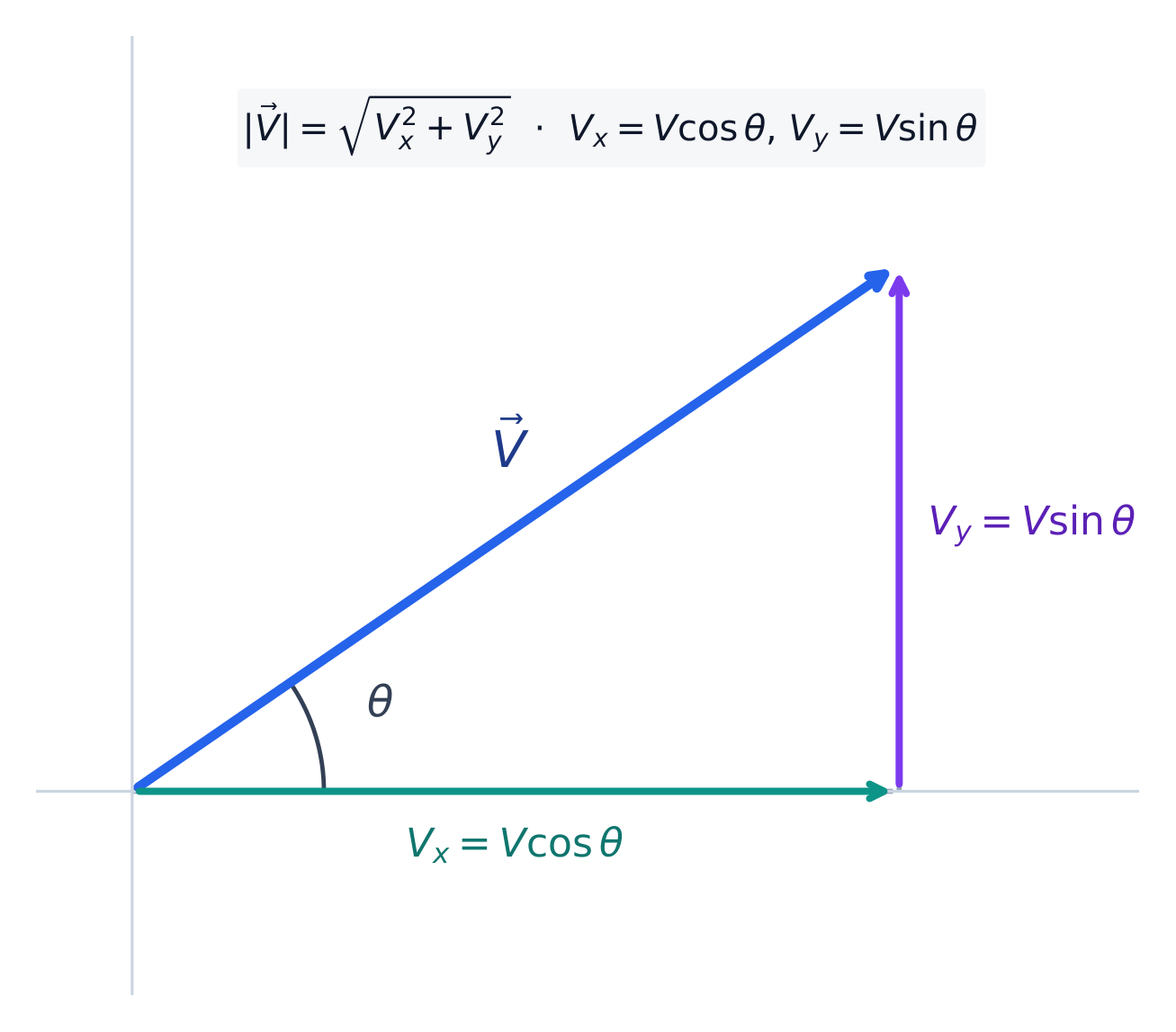
    In this calculus-based course you resolve vectors into components 分量 and add them component by component; a vector's magnitude is $\sqrt{v_x^2+v_y^2+\cdots}$. Physics C also writes vectors with unit vectors 单位矢量: $\vec{v}=v_x\hat{i}+v_y\hat{j}$, where $\hat{i}$ and $\hat{j}$ are directions of length one along $x$ and $y$ – handy because calculus can then act on each component separately.

    日本語

    運動学は運動を記述する。2種類の物理量がある:

    • スカラーは大きさのみ(絶対値)を持ち、距離、速さ、質量、時間が該当する。
    • ベクトルは大きさと方向を持つ:変位、速度、加速度、力。

    この微分積分を用いるコースでは、ベクトルを成分に分解し、成分ごとに足し算を行う;ベクトルの大きさ(magnitude)は $\sqrt{v_x^2+v_y^2+\cdots}$ である。Physics C ではまた、単位ベクトルを用いてベクトルを表す:$\vec{v}=v_x\hat{i}+v_y\hat{j}$ 、ここで $\hat{i}$ と $\hat{j}$ は ⟨$x$⟩ と ⟨$y$⟩ 方向の長さ1の方向を示す – これにより、微分積分を各成分に対して個別に行うことができるので便利である。

    ベクトルをx成分とy成分に分解する図
    ベクトルをx成分とy成分に分解する
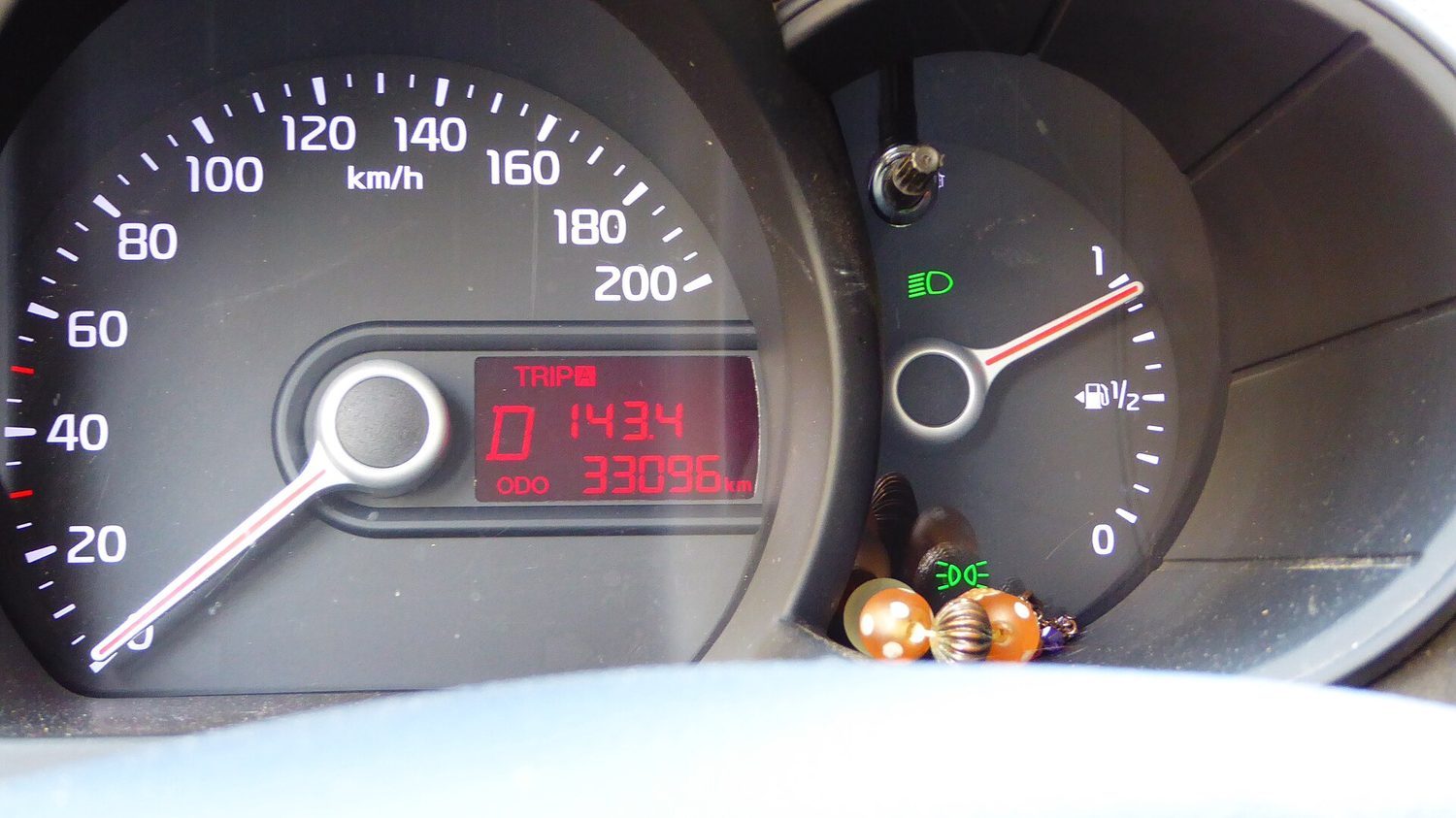
    自動車のスピードメーター:速さは速度の大きさ(スカラー)である — 運動のスカラー率
    自動車のスピードメーター:速さは速度の大きさ(スカラー)である — 運動のスカラー率
    Explore · ⁨探索⁩

    Explore the dot product · ⁨内積を調べる⁩

    Drag the components of $\vec{A}$ and $\vec{B}$. The dot product $\vec{A}\cdot\vec{B}=A_xB_x+A_yB_y$ reaches zero exactly when the two vectors are perpendicular — the geometry behind $\cos\theta$. · ⁨$\vec{A}$と$\vec{B}$の成分をドラッグする。内積$\vec{A}\cdot\vec{B}=A_xB_x+A_yB_y$が零になるのは、2つのベクトルが直交した時だけである。これが$\cos\theta$の幾何学的意味である。⁩

    Vocabulary · ⁨語彙⁩ Train · ⁨練習する⁩
    English 日本語
    magnitude/ˈmæɡnɪtjuːd/ 大きさ
    vector/ˈvektə/ ベクトル
    components/kəmˈpəʊnənts/ コンポーネント
    unit vectors/ˈjuːnɪt ˈvektəz/ 単位ベクトル
    derivatives/dɪˈrɪvətɪvz/ 導関数
    average velocity/ˈævrɪdʒ vəˈlɒsɪti/ 平均速度
    instantaneous velocity/ˌɪnstənˈteɪnɪəs vəˈlɒsɪti/ 瞬間速度
    free fall/friː fɔːl/ 自由落下
    reference frame/ˈrefrəns freɪm/ 座標系
    relative motion/ˈrelətɪv ˈməʊʃn/ 相対運動
    1.2

    Displacement, Velocity, and Acceleration · ⁨変位、速度、加速度⁩

    Syllabus · ⁨シラバス⁩
    English

    Learning Objective 1.2.A: Describe a change in an object's position.

    • 1.2.A.1 When using the object model, the size, shape, and internal configuration are ignored. The object may be treated as a single point with extensive properties such as mass and charge.
    • 1.2.A.2 Displacement is the change in an object's position.
      • Equation: $\Delta x = x - x_0$

    Learning Objective 1.2.B: Describe the average velocity and acceleration of an object.

    • 1.2.B.1 Averages of velocity and acceleration are calculated considering the initial and final states of an object over an interval of time.
    • 1.2.B.2 Average velocity is the displacement of an object divided by the interval of time in which that displacement occurs.
      • Equation: $\vec{v}_{\text{avg}} = \dfrac{\Delta \vec{x}}{\Delta t}$
    • 1.2.B.3 Average acceleration is the change in velocity divided by the interval of time in which that change in velocity occurs.
      • Equation: $\vec{a}_{\text{avg}} = \dfrac{\Delta \vec{v}}{\Delta t}$
    • 1.2.B.4 An object is accelerating if either the magnitude and/or direction of the object's velocity are changing.
    • 1.2.B.5 Calculating average velocity or average acceleration over a very small time interval yields a value that is very close to the instantaneous velocity or instantaneous acceleration.

    Learning Objective 1.2.C: Describe the instantaneous position, velocity, and acceleration of an object as a function of time.

    • 1.2.C.1 As the time interval used to calculate the average value of a quantity approaches zero, the average value of that quantity approaches the value of the quantity at that instant, called the instantaneous value.
      • 1.2.C.1.i Instantaneous velocity is the rate of change of the object's position, which is equal to the derivative of position with respect to time.
        • Equation: $\vec{v} = \dfrac{d\vec{r}}{dt}$
        • Equation: $v_x = \dfrac{dx}{dt}$
      • 1.2.C.1.ii Instantaneous acceleration is the rate of change of the object's velocity, which is equal to the derivative of velocity with respect to time.
        • Equation: $\vec{a} = \dfrac{d\vec{v}}{dt}$
        • Equation: $a_x = \dfrac{dv_x}{dt}$
    • 1.2.C.2 Time-dependent functions and instantaneous values of position, velocity, and acceleration can be determined using differentiation and integration.
    日本語

    学習目標 1.2.A: 物体の位置の変化を説明する。

    • 1.2.A.1 物体モデルを使用する場合、大きさ、形状、内部構成は無視される。物体は質量や電荷などの広延的な性質を持つ一点として扱うことができる。
    • 1.2.A.2 変位とは、物体の位置の変化のことである。
      • 式: $\Delta x = x - x_0$

    学習目標 1.2.B: 物体の平均速度および平均加速度を説明する。

    • 1.2.B.1 速度および加速度の平均値は、ある時間区間における物体の初期状態と最終状態を考慮して計算される。
    • 1.2.B.2 平均速度とは、物体の変位を、その変位が生じる時間区間で割ったものである。
      • 式: $\vec{v}_{\text{avg}} = \dfrac{\Delta \vec{x}}{\Delta t}$
    • 1.2.B.3 平均加速度とは、速度の変化量を、その速度変化が生じる時間区間で割ったものである。
      • 式: $\vec{a}_{\text{avg}} = \dfrac{\Delta \vec{v}}{\Delta t}$
    • 1.2.B.4 物体の速度の大きさと/または方向が変わっている場合、その物体は加速している。
    • 1.2.B.5 非常に短い時間区間における平均速度または平均加速度を計算すると、瞬間速度または瞬間加速度に非常に近い値が得られる。

    学習目標 1.2.C: 時間の関数としての物体の瞬間的な位置、速度、加速度を説明する。

    • 1.2.C.1 物理量の平均値を求める時間間隔がゼロに近づくにつれ、その物理量の平均値は、その瞬間の物理量の値である瞬間値に近づく。
      • 1.2.C.1.i 瞬間速度とは、物体の位置の変化率であり、位置を時間で微分したものに等しい。
        • 数式: $\vec{v} = \dfrac{d\vec{r}}{dt}$
        • 数式: $v_x = \dfrac{dx}{dt}$
      • 1.2.C.1.ii 瞬間加速度とは、物体の速度の変化率であり、速度を時間で微分したものに等しい。
        • 数式: $\vec{a} = \dfrac{d\vec{v}}{dt}$
        • 数式: $a_x = \dfrac{dv_x}{dt}$
    • 1.2.C.2 時間の関数としての位置、速度、加速度の瞬間値は、微分と積分を用いて求めることができる。

    Source: College Board AP Course and Exam Description · ⁨出典: College Board AP コースおよび試験説明書⁩

    English
    Projectile motion is two independent motions

    Because motion can change continuously, define the rates as derivatives 导数:

    $$v=\frac{dx}{dt},\qquad a=\frac{dv}{dt}=\frac{d^2x}{dt^2}.$$
    Reversing this, integrate to recover velocity and position:
    $$v(t)=v_0+\int_0^t a\,dt,\qquad x(t)=x_0+\int_0^t v\,dt.$$
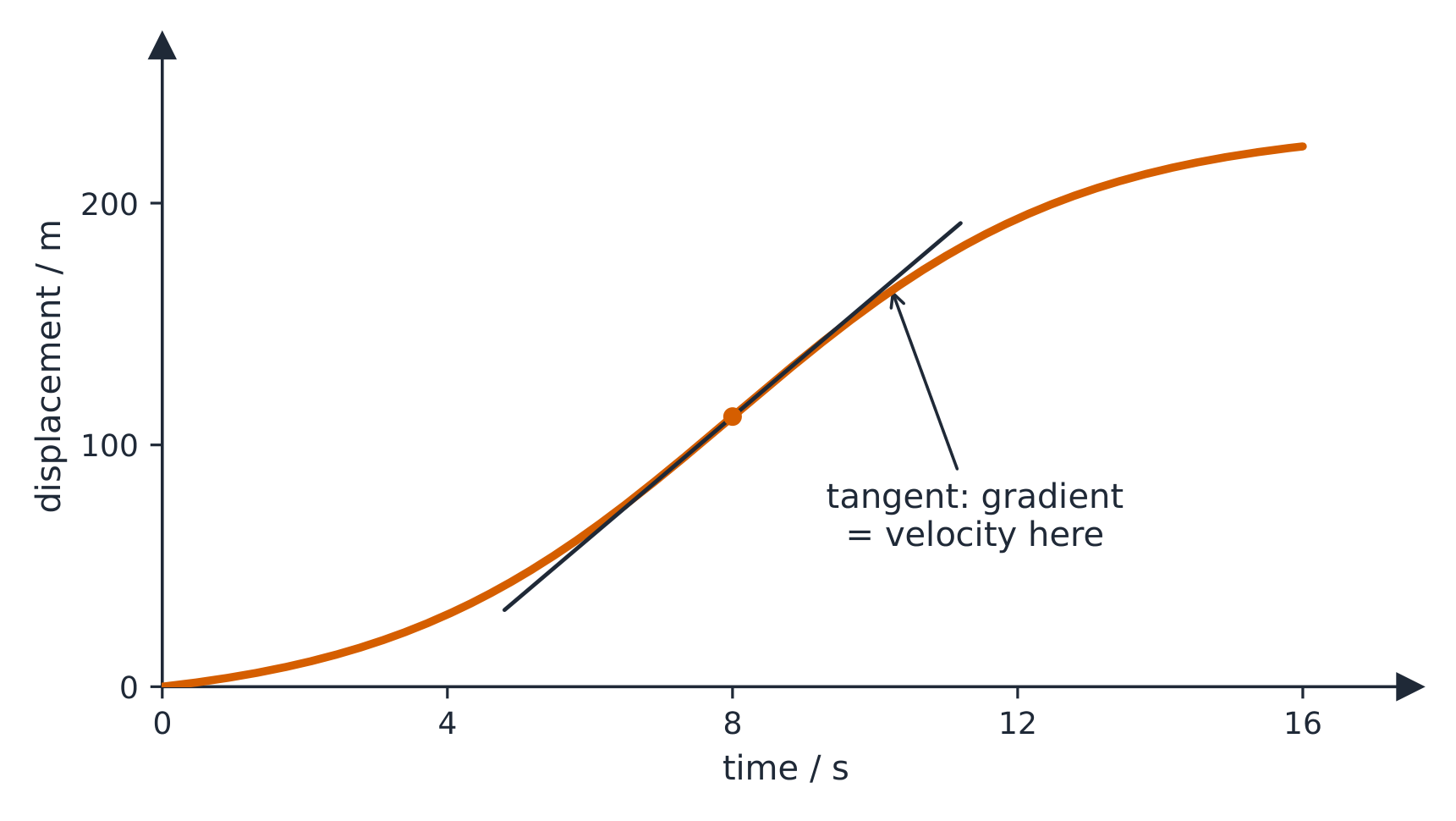
    Distinguish the average from the instantaneous: average velocity 平均速度 is $\Delta x/\Delta t$ over an interval, while instantaneous velocity 瞬时速度 is the derivative at one moment – the slope of the tangent line, and what a speedometer shows.

    For constant acceleration these give the familiar kinematic equations ($v=v_0+at$, $x=x_0+v_0t+\tfrac12at^2$, $v^2=v_0^2+2a\,\Delta x$). The most important constant-$a$ case is free fall 自由落体: near Earth's surface every object, heavy or light, accelerates downward at $g=9.8\ \text{m/s}^2$ once air resistance is negligible. When $a$ or $v$ varies with time, use the integrals directly.

    Worked example. A particle moves with $x(t)=2t^3-3t^2$ (metres). Differentiate for velocity and acceleration:

    $$v=\frac{dx}{dt}=6t^2-6t,\qquad a=\frac{dv}{dt}=12t-6.$$
    At $t=2\ \text{s}$, $v=24-12=12\ \text{m/s}$ and $a=24-6=18\ \text{m/s}^2$. This calculus link – not just the constant-$a$ formulas – is what distinguishes Physics C.

    Worked example. A particle starts from rest at the origin with $a(t)=6t$. Integrate: $v=\int 6t\,dt=3t^2$ and $x=\int 3t^2\,dt=t^3$. At $t=2\ \text{s}$, $v=12\ \text{m/s}$ and $x=8\ \text{m}$.

    日本語
    投射運動は2つの独立した運動である

    運動は連続的に変化するため、変化率を導関数として定義する:

    $$v=\frac{dx}{dt},\qquad a=\frac{dv}{dt}=\frac{d^2x}{dt^2}.$$
    これを逆操作すると、積分によって速度と位置が復元できる:
    $$v(t)=v_0+\int_0^t a\,dt,\qquad x(t)=x_0+\int_0^t v\,dt.$$
    平均と瞬間を区別する:平均速度は区間$\Delta x/\Delta t$における変化率であり、瞬間速度はある一点での導関数(接線の傾き、スピードメーターが表示する値)である。

    一定の加速度の場合、これらは一般的な運動学方程式($v=v_0+at$, $x=x_0+v_0t+\tfrac12at^2$, $v^2=v_0^2+2a\,\Delta x$)を与える。最も重要な一定$a$のケースは自由落下である。地球表面付近では空気抵抗が無視できる場合、重い物体も軽い物体もすべて下方へ$g=9.8\ \text{m/s}^2$の加速度で運動する。$a$または$v$が時間に依存して変化する場合、積分式をそのまま用いる。

    ** worked example.** 粒子が$x(t)=2t^3-3t^2$(メートル)で動く。微分して速度と加速度を求める:

    $$v=\frac{dx}{dt}=6t^2-6t,\qquad a=\frac{dv}{dt}=12t-6.$$
    $t=2\ \text{s}$において、$v=24-12=12\ \text{m/s}$および$a=24-6=18\ \text{m/s}^2$となる。この微積分との関連性——単なる一定$a$の公式だけでなく——がPhysics Cの特徴である。

    ** worked example.** 粒子が原点から静止状態で$a(t)=6t$で動き始める。積分して:$v=\int 6t\,dt=3t^2$および$x=\int 3t^2\,dt=t^3$。$t=2\ \text{s}$において、$v=12\ \text{m/s}$および$x=8\ \text{m}$となる。

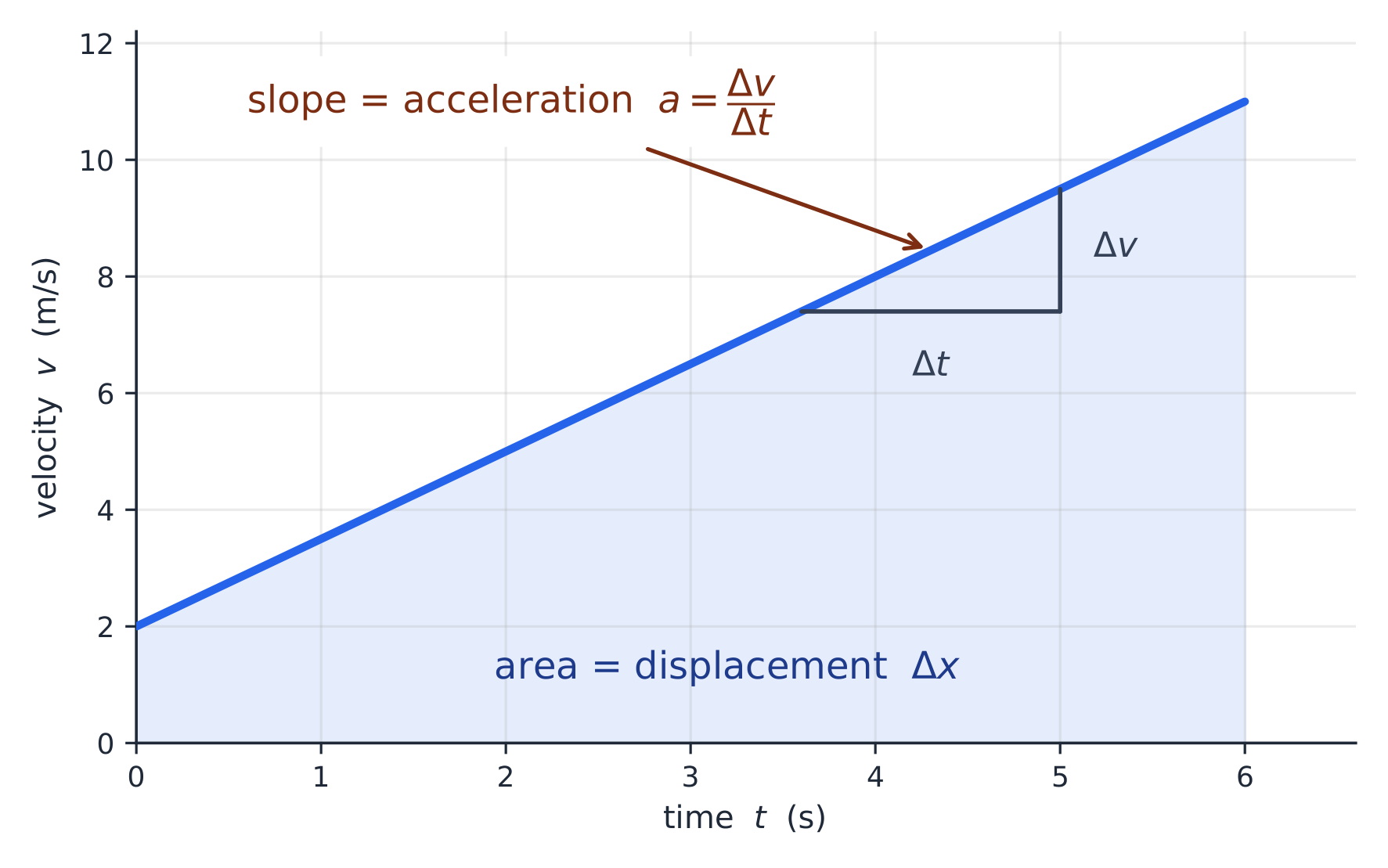
    速度-時間グラフにおいて、勾配は加速度、面積は変位を表す
    速度-時間グラフにおいて、勾配は加速度、面積は変位を表す
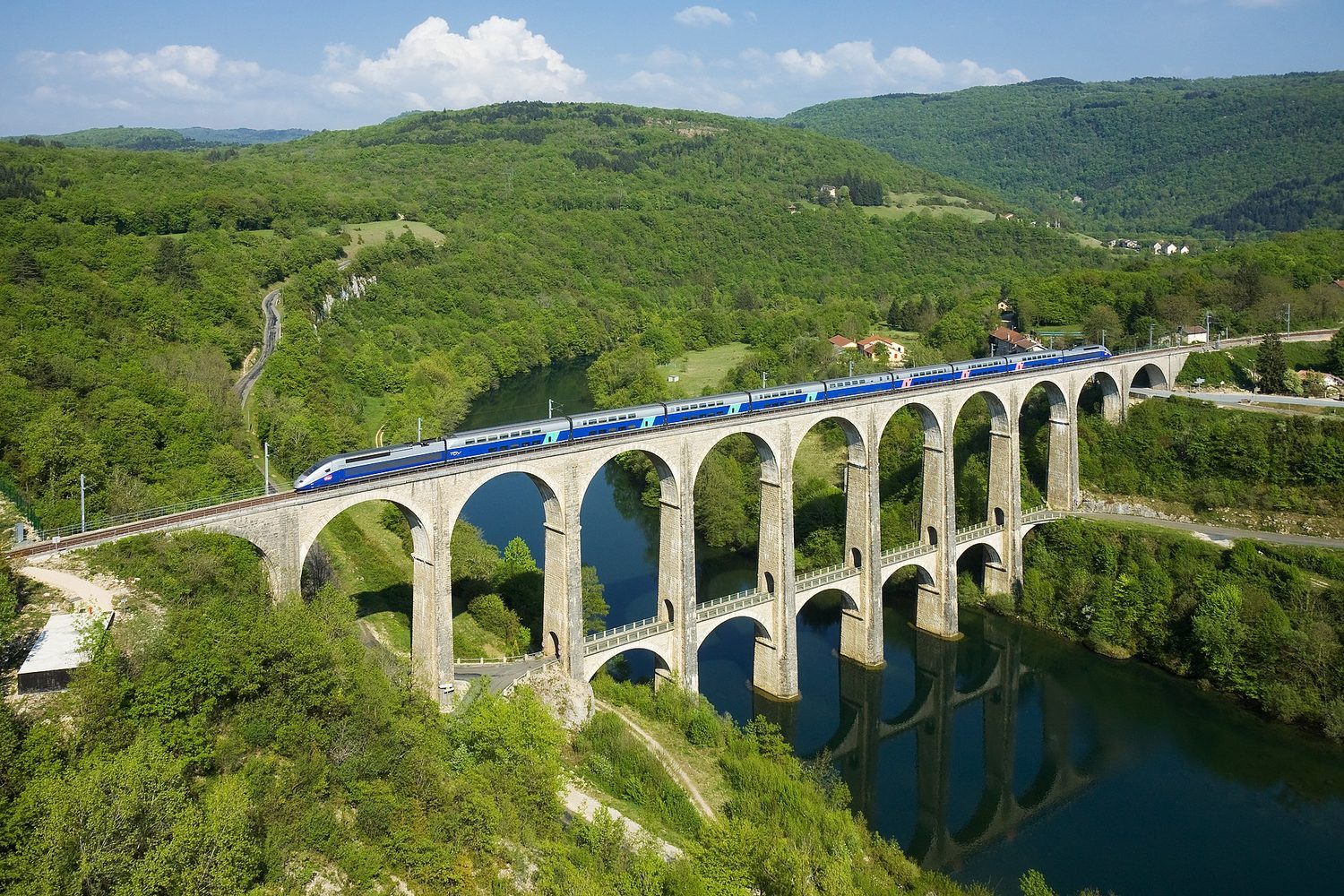
    高速鉄道:運動学は時間に対する変位、速度、加速度を記述する
    高速鉄道:運動学は時間に対する変位、速度、加速度を記述する
    Vocabulary · ⁨語彙⁩ Train · ⁨練習する⁩
    English 日本語
    Kinematics/ˌkɪnɪˈmætɪks/ 運動学
    scalar/ˈskeɪlə/ スカラー
    1.3

    Representing Motion · ⁨運動の表現⁩

    Syllabus · ⁨シラバス⁩
    English

    Learning Objective 1.3.A: Describe the position, velocity, and acceleration of an object using representations of that object's motion.

    • 1.3.A.1 Motion can be represented by motion diagrams, figures, graphs, equations, and narrative descriptions.
    • 1.3.A.2 For constant acceleration, three kinematic equations can be used to describe instantaneous linear motion in one dimension:
      • Equation: $v_x = v_{x0} + a_x t$
      • Equation: $x = x_0 + v_{x0} t + \dfrac{1}{2} a_x t^2$
      • Equation: $v_x^2 = v_{x0}^2 + 2a_x \left( x - x_0 \right)$
      • Note: The equations above are written to indicate motion in the $x$-direction, but these equations can be used in any single dimension as appropriate.
    • 1.3.A.3 Near the surface of Earth, the vertical acceleration caused by the force of gravity is downward, constant, and has a measured value approximately equal to
      • Equation: $a_g = g \approx 10 \ \text{m/s}^2$.
    • 1.3.A.4 Graphs of position, velocity, and acceleration as functions of time can be used to find the relationships between those quantities.
      • 1.3.A.4.i An object's instantaneous velocity is the rate of change of the object's position, which is equal to the slope of a line tangent to a point on a graph of the object's position as a function of time.
        • Equation: $v_x = \dfrac{dx}{dt}$
      • 1.3.A.4.ii An object's instantaneous acceleration is the rate of change of the object's velocity, which is equal to the slope of a line tangent to a point on a graph of the object's velocity as a function of time.
        • Equation: $a_x = \dfrac{dv_x}{dt}$
      • 1.3.A.4.iii The displacement of an object during a time interval is equal to the area under the curve of a graph of the object's velocity as a function of time (i.e., the area bounded by the function and the horizontal axis for the appropriate interval).
        • Equation: $\Delta x = \displaystyle\int_{t_1}^{t_2} v_x(t) \ dt$
      • 1.3.A.4.iv The change in velocity of an object during a time interval is equal to the area under the curve of a graph of the acceleration of the object as a function of time.
        • Equation: $\Delta v_x = \displaystyle\int_{t_1}^{t_2} a_x(t) \ dt$

    Boundary statement: AP Physics C: Mechanics and AP Physics C: Electricity and Magnetism expects that for all situations in which a numerical quantity is required for g, the value $g \approx 10 \ \text{m/s}^2$ will be used. However, students will not be penalized for correctly using the more precise commonly accepted values of $g = 9.81 \ \text{m/s}^2$ or $g = 9.8 \ \text{m/s}^2$.

    日本語

    学習目標 1.3.A: 物体の運動の表現を用いて、物体の位置、速度、加速度を説明する。

    • 1.3.A.1 運動は、運動図、図、グラフ、数式、および物語による記述で表現できる。
    • 1.3.A.2 一定加速度の場合、一次元の瞬間的な直線運動を記述するために3つの運動方程式可以使用する:
      • 式: $v_x = v_{x0} + a_x t$
      • 式: $x = x_0 + v_{x0} t + \dfrac{1}{2} a_x t^2$
      • 式: $v_x^2 = v_{x0}^2 + 2a_x \left( x - x_0 \right)$
      • 注記:上記の式は $x$ 方向への運動を示すために書かれているが、適切な単一次元での運動にも使用できる。
    • 1.3.A.3 地球表面付近では、重力による垂直方向の加速度は下向きであり一定で、測定値は約以下に等しい
      • 式: $a_g = g \approx 10 \ \text{m/s}^2$。
    • 1.3.A.4 位置、速度、加速度を時間の関数として表したグラフを用いて、それらの物理量の間の関係を見つけることができる。
      • 1.3.A.4.i 物体の瞬間速度とは、物体の位置の変化率であり、これは時刻を関数とする物体の位置のグラフ上の点に接する直線の傾きに等しい。
        • 数式: $v_x = \dfrac{dx}{dt}$
      • 1.3.A.4.ii 物体の瞬間加速度とは、物体の速度の変化率であり、これは時刻を関数とする物体の速度のグラフ上の点に接する直線の傾きに等しい。
        • 数式: $a_x = \dfrac{dv_x}{dt}$
      • 1.3.A.4.iii 時間区間における物体の変位は、時刻を関数とする物体の速度のグラフの曲线下の面積に等しい(すなわち、適正な区間における関数と水平軸で囲まれた面積)。
        • 数式: $\Delta x = \displaystyle\int_{t_1}^{t_2} v_x(t) \ dt$
      • 1.3.A.4.iv 時間区間における物体の速度の変化量は、時刻を関数とする物体の加速度のグラフの曲线下の面積に等しい。
        • 数式: $\Delta v_x = \displaystyle\int_{t_1}^{t_2} a_x(t) \ dt$

    境界文:AP Physics C: Mechanics および AP Physics C: Electricity and Magnetism では、g の数値量が必要なすべての状況において、値 $g \approx 10 \ \text{m/s}^2$ が用いられることを期待している。しかし、学生がより精密な一般的に受け入れられている値 $g = 9.81 \ \text{m/s}^2$ や $g = 9.8 \ \text{m/s}^2$ を正しく使用した場合には減点されない。

    Source: College Board AP Course and Exam Description · ⁨出典: College Board AP コースおよび試験説明書⁩

    English

    Move fluently between description, graph, table, and equation:

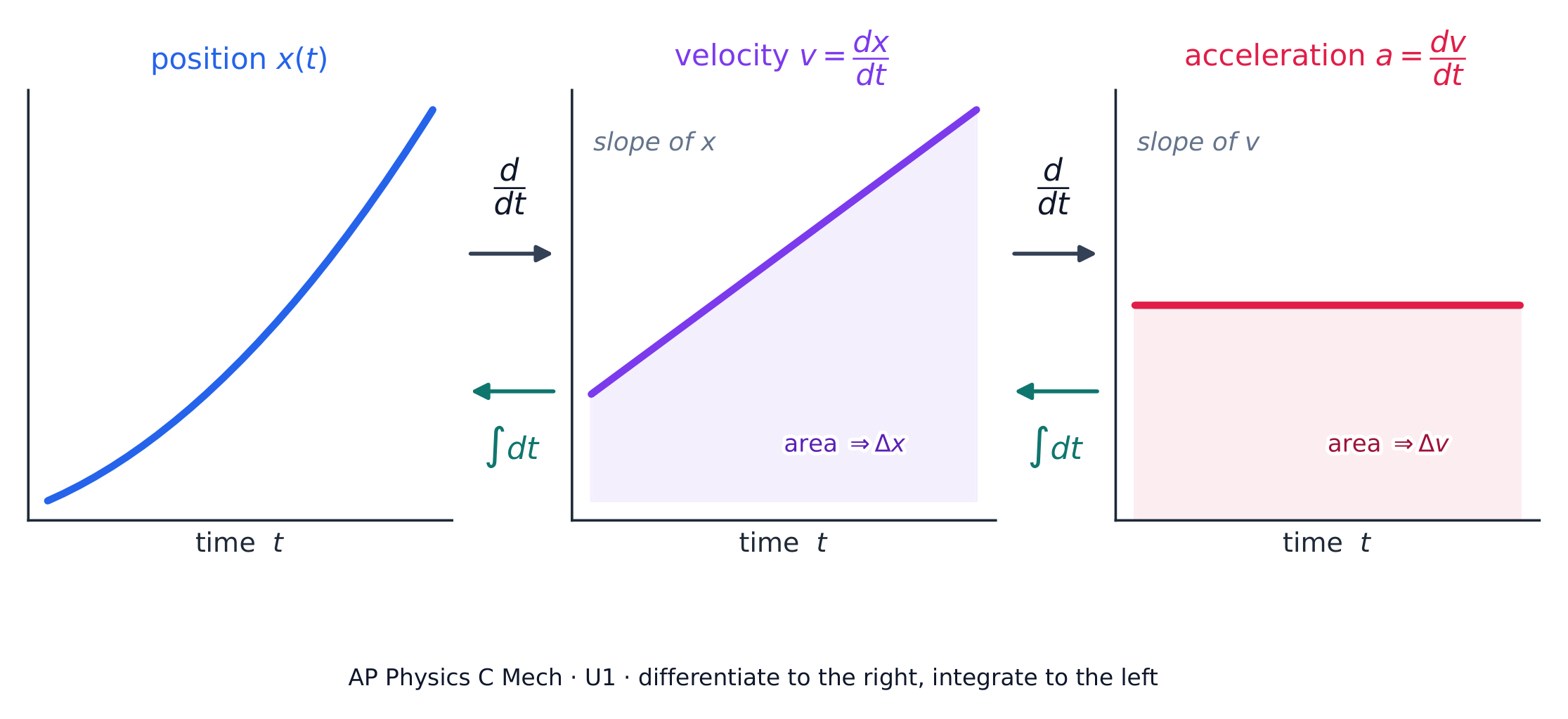
    • On a position–time graph, the slope ($dx/dt$) is velocity.
    • On a velocity–time graph, the slope is acceleration and the area ($\int v\,dt$) is displacement.
    • On an acceleration–time graph, the area ($\int a\,dt$) is the change in velocity.

    Slopes are derivatives; areas are integrals – the two are inverse operations here.

    日本語

    記述、グラフ、表、数式の間の円滑な切り替えができるようにする:

    変位-時間グラフ:任意の瞬間における傾きは速度である
    変位-時間グラフ:任意の瞬間における傾きは速度である
    • 位置-時間グラフにおいて、傾き($dx/dt$)は速度である。
    • 速度-時間グラフにおいて、傾きは加速度であり、面積($\int v\,dt$)は変位である。
    • 加速度-時間グラフにおいて、面積($\int a\,dt$)は速度の変化量である。

    傾きは導関数であり、面積は積分である——これらはここでは互いに逆演算の関係にある。

    位置、速度、加速度は微分によって結びついている
    位置、速度、加速度は微分によって結びついている
    Explore · ⁨探索⁩

    Explore the velocity–time graph · ⁨速度-時間グラフを探索する⁩

    Change the start velocity and acceleration. The slope of a $v$–$t$ line is the acceleration $a=\tfrac{dv}{dt}$, and the area underneath is the displacement $\Delta x=\int v\,dt$ — slope and area are the graphical faces of the derivative and the integral. · ⁨初期速度と加速度を変化させる。$v$–$t$グラフの傾きは加速度$a=\tfrac{dv}{dt}$を表し、曲線下の面積は変位$\Delta x=\int v\,dt$を表す。傾きと面積は微分と積分の図形的表現である。⁩

    1.4

    Reference Frames and Relative Motion · ⁨参照系と相対運動⁩

    Syllabus · ⁨シラバス⁩
    English

    Learning Objective 1.4.A: Describe the reference frame of a given observer.

    • 1.4.A.1 The choice of reference frame will determine the direction and magnitude of quantities measured by an observer in that reference frame.

    Learning Objective 1.4.B: Describe the motion of objects as measured by observers in different inertial reference frames.

    • 1.4.B.1 Measurements from a given reference frame may be converted to measurements from another reference frame.
    • 1.4.B.2 The observed velocity of an object results from the combination of the object's velocity and the velocity of the observer's reference frame.
      • 1.4.B.2.i Combining the motion of an object and the motion of an observer in a given reference frame involves the addition or subtraction of vectors.
      • 1.4.B.2.ii The acceleration of any object is the same as measured from all inertial reference frames.

    Boundary statement: Unless otherwise stated, the frame of reference of any problem may be assumed to be inertial.

    日本語

    学習目標 1.4.A: 特定の観測者の基準系を説明する。

    • 1.4.A.1 参照系を選択することで、その参照系に居る観測者によって測定される物理量の方向と大きさが決定される。

    学習目標 1.4.B: 異なる慣性参照系に居る観測者によって測定された物体の運動を説明する。

    • 1.4.B.1 特定の参照系からの測定値は、他の参照系からの測定値に変換できる。
    • 1.4.B.2 物体の観測速度は、物体自身の速度と観測者の参照系の速度との合成によって生じる。
      • 1.4.B.2.i 与えられた参照系における物体の運動と観測者の運動を合成するには、ベクトルの加算または減算を行う。
      • 1.4.B.2.ii いかなる物体の加速度も、すべての慣性参照系から測定すると同一である。

    境界声明: 別段の指定がない限り、いかなる問題の参照系も慣性系であると仮定してよい。

    Source: College Board AP Course and Exam Description · ⁨出典: College Board AP コースおよび試験説明書⁩

    English

    All motion is relative to a reference frame 参考系. Combine velocities by vector addition: $\vec{v}_{A/C}=\vec{v}_{A/B}+\vec{v}_{B/C}$. This handles boats crossing rivers and passengers on moving vehicles – relative motion 相对运动 problems. Read the subscripts as a chain: "A relative to B" plus "B relative to C" gives "A relative to C".

    Worked example. A boat that moves at $4.0\ \text{m/s}$ in still water heads straight across a river flowing at $3.0\ \text{m/s}$. Relative to the ground the boat moves at $\sqrt{4.0^2+3.0^2}=5.0\ \text{m/s}$, angled downstream. If the river is $80\ \text{m}$ wide, the crossing still takes $t=\dfrac{80}{4.0}=20\ \text{s}$ – only the across-stream component crosses the river; the current just carries the boat $60\ \text{m}$ downstream.

    日本語

    すべての運動は座標系に対して相対的である。速度の合成はベクトル加法で行う:$\vec{v}_{A/C}=\vec{v}_{A/B}+\vec{v}_{B/C}$。これは川を渡る船や移動中の乗り物に搭乗する乗客の——相対運動の問題に対応する。添字を鎖のように読む:“A relative to B” に “B relative to C” を加えると “A relative to C” となる。

    ** worked example.** 静水中で $4.0\ \text{m/s}$ の速度で動く船が、流速 $3.0\ \text{m/s}$ の川にまっすぐ向かっている。地面に対する船の速度は $\sqrt{4.0^2+3.0^2}=5.0\ \text{m/s}$ で、下流向きに傾いている。川幅が $80\ \text{m}$ の場合、渡河には依然として $t=\dfrac{80}{4.0}=20\ \text{s}$ かかる——横方向成分だけが川を渡るだけであり、流れは単に船を下流へ $60\ \text{m}$ 運ぶだけである。

    1.5

    Motion in Two or Three Dimensions · ⁨2次元または3次元における運動⁩

    Syllabus · ⁨シラバス⁩
    English

    Learning Objective 1.5.A: Describe the motion of an object moving in two or three dimensions.

    • 1.5.A.1 Motion in two or three dimensions can be analyzed using one-dimensional kinematic relationships if the motion is separated into components.
    • 1.5.A.2 Velocity and acceleration may be different in each dimension and may be nonuniform.
    • 1.5.A.3 Motion in one dimension may be changed without causing a change in a perpendicular dimension.
    • 1.5.A.4 Projectile motion is a special case of two-dimensional motion that has zero acceleration in one dimension and constant, nonzero acceleration in the second dimension.

    Boundary statement: AP Physics C: Mechanics only expects students to quantitatively analyze the motion of an object in two dimensions. AP Physics C: Electricity and Magnetism expects students to also qualitatively describe the motion of a particle in three dimensions.

    日本語

    学習目標 1.5.A: 二つまたは三つの次元で運動する物体の運動を説明する。

    • 1.5.A.1 運動を成分に分解できる場合、二つまたは三つの次元の運動は一次元の運動学的関係を用いて解析できる。
    • 1.5.A.2 各次元における速度や加速度は異なり、非一様である可能性がある。
    • 1.5.A.3 一次元の運動を変化させても、直交する次元には変化が生じない。
    • 1.5.A.4 投射運動は、ある次元で加速度がゼロであり、第二の次元で一定かつ非ゼロの加速度を持つ、二つの次元の運動の特殊ケースである。

    境界文:AP Physics C: Mechanics では、学生が二次元における物体の運動を定量的に解析することを期待するのみである。AP Physics C: Electricity and Magnetism では、学生が三次元における粒子の運動を定性的に説明することも期待する。

    Source: College Board AP Course and Exam Description · ⁨出典: College Board AP コースおよび試験説明書⁩

    English

    In two or three dimensions, position is a vector $\vec{r}(t)=\langle x(t),y(t),z(t)\rangle$, and velocity and acceleration are its successive derivatives – each component handled independently.

    Worked example. $\vec{r}(t)=\big(2t^2\big)\hat{i}+\big(4t-t^3\big)\hat{j}$ (metres). Differentiating each component: $\vec{v}=4t\,\hat{i}+(4-3t^2)\,\hat{j}$ and $\vec{a}=4\,\hat{i}-6t\,\hat{j}$. At $t=1\ \text{s}$: $\vec{v}=4\hat{i}+1\hat{j}$, so the speed is $\sqrt{17}\approx4.1\ \text{m/s}$ – no new physics, just one derivative per component.

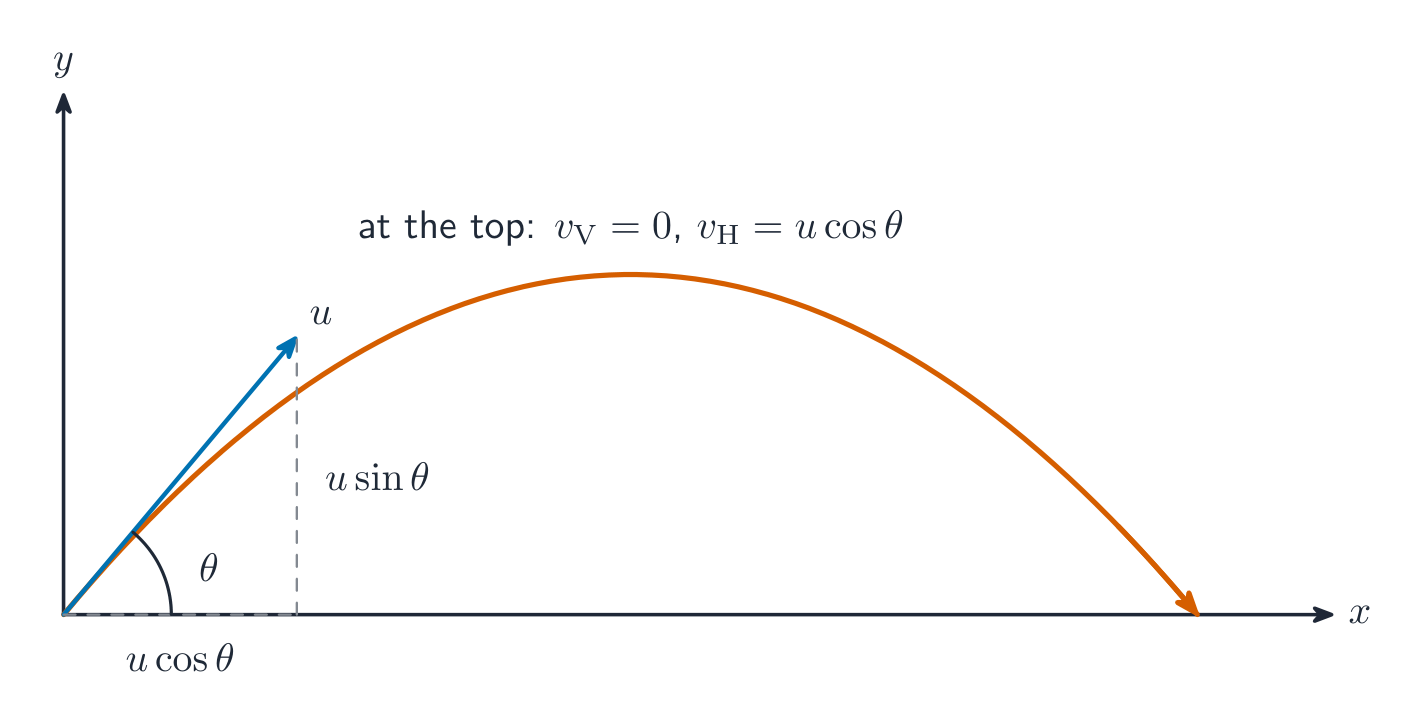
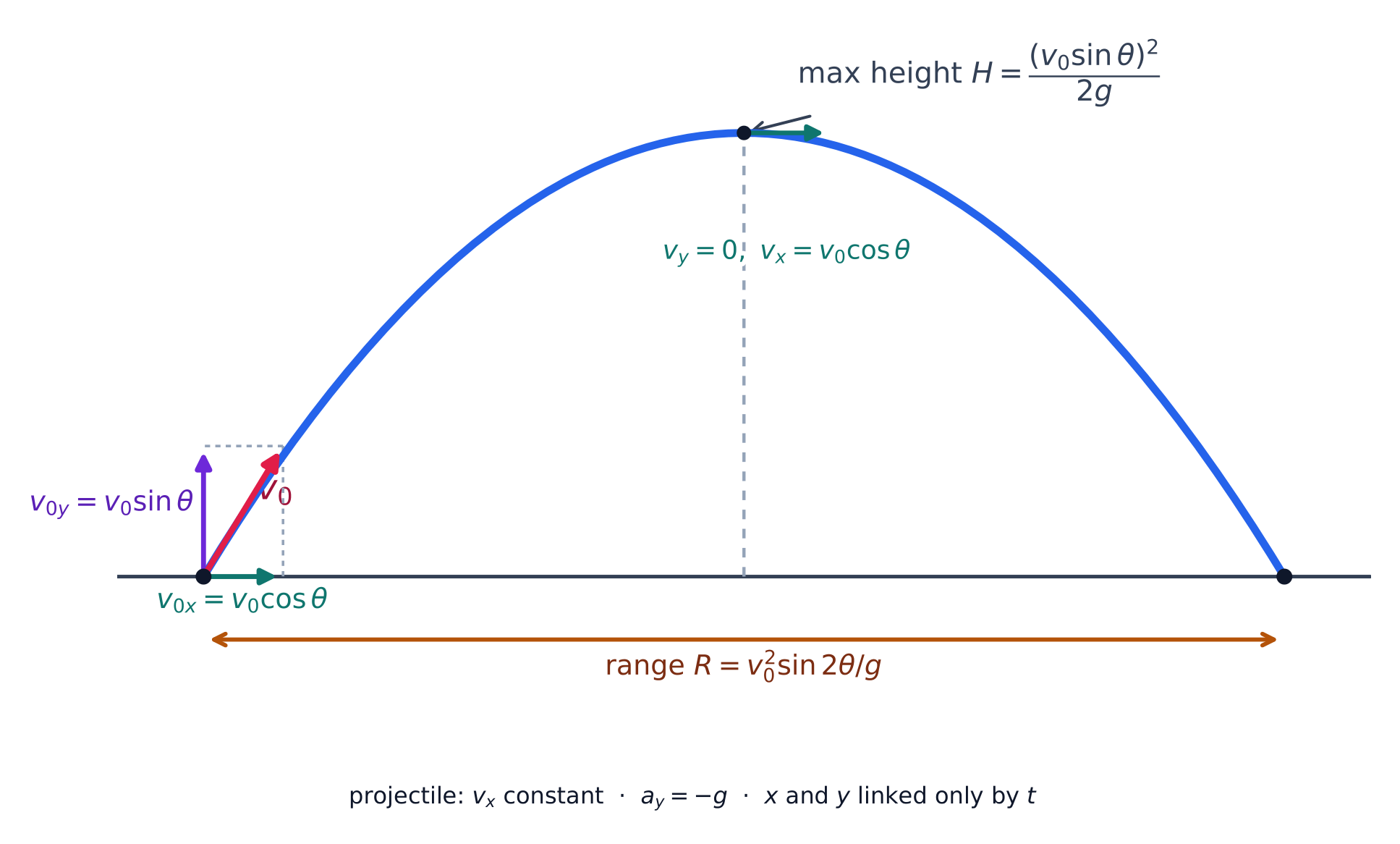
    For projectile motion 抛体运动, horizontal and vertical motions are independent, linked only by time $t$: horizontally $a_x=0$ (constant velocity), vertically $a_y=-g$. The path is a parabola. This component method extends to any two-dimensional motion where the accelerations along each axis are known.

    Worked example. A ball is launched at $20\ \text{m/s}$, $30^{\circ}$ above the horizontal ($g=9.8\ \text{m/s}^2$). The components are $v_{0x}=20\cos30^{\circ}=17.3\ \text{m/s}$ and $v_{0y}=20\sin30^{\circ}=10\ \text{m/s}$. The vertical motion sets the time: total flight $=\dfrac{2v_{0y}}{g}=\dfrac{20}{9.8}=2.0\ \text{s}$, maximum height $=\dfrac{v_{0y}^2}{2g}=5.1\ \text{m}$, and range $=v_{0x}\times2.0=35\ \text{m}$.

    日本語

    2次元または3次元では、位置はベクトラ ⟨$\vec{r}(t)=\langle x(t),y(t),z(t)\rangle$⟩ であり、速度と加速度はその逐次微分である——各成分は独立して扱う。

    ** worked example.** ⟨$\vec{r}(t)=\big(2t^2\big)\hat{i}+\big(4t-t^3\big)\hat{j}$⟩(メートル)。各成分を微分すると:$\vec{v}=4t\,\hat{i}+(4-3t^2)\,\hat{j}$ および $\vec{a}=4\,\hat{i}-6t\,\hat{j}$。$t=1\ \text{s}$ において:$\vec{v}=4\hat{i}+1\hat{j}$ であるため、速さは $\sqrt{17}\approx4.1\ \text{m/s}$ ——新しい物理法則ではなく、各成分ごとに1回の微分を行うだけである。

    斜めに発射された投射体:水平方向と垂直方向の運動は独立している
    斜めに発射された投射体:水平方向と垂直方向の運動は独立している

    ** projectile motion** においては、水平方向と垂直方向の運動は互いに独立しており、時間 $t$ によってのみ結びついている。水平方向では $a_x=0$ (一定速度)、垂直方向では $a_y=-g$ 。軌道は放物線を描く。この成分分解法は、各軸に沿った加速度が既知であるあらゆる2次元運動に拡張される。

    ** worked example.** 球を $20\ \text{m/s}$ の初速度で、水平面から $30^{\circ}$ の角度($g=9.8\ \text{m/s}^2$)で発射した。成分は $v_{0x}=20\cos30^{\circ}=17.3\ \text{m/s}$ と $v_{0y}=20\sin30^{\circ}=10\ \text{m/s}$ である。垂直方向の運動が時間を決定し、全飛行時間は $=\dfrac{2v_{0y}}{g}=\dfrac{20}{9.8}=2.0\ \text{s}$ 、最大高度は $=\dfrac{v_{0y}^2}{2g}=5.1\ \text{m}$ 、飛翔距離は $=v_{0x}\times2.0=35\ \text{m}$ となる。

    角度で発射された投射物の速度成分、最大高度、および飛翔距離
    角度で発射された投射物の速度成分、最大高度、および飛翔距離
    Explore · ⁨探索⁩

    Explore projectile motion · ⁨投射運動を探索する⁩

    Fire the projectile, then vary the angle and speed. The horizontal motion is steady while gravity acts only downward — together they trace a parabola. Find the angle that gives the greatest range (it peaks near $45^\circ$), and try the Moon. · ⁨投射体を発射し、角度と速度を変化させよ。水平運動は一定であり、重力は下向きにのみ働く。これらを合わせると放物線を描く。最大の射程を与える角度を見つけよ($45^\circ$付近で最大となる)、月面でも試してみよ。⁩

    Vocabulary · ⁨語彙⁩ Train · ⁨練習する⁩
    English 日本語
    projectile motion/prəˈdʒektaɪl ˈməʊʃn/ 投射運動
    1.5

    Exam tips · ⁨試験対策⁩

    English
    • Resolve every vector into components before adding — never add magnitudes at an angle directly.
    • On Physics C you are expected to use calculus: velocity is $\vec v=\tfrac{d\vec r}{dt}$ and acceleration $\vec a=\tfrac{d\vec v}{dt}$; reverse with integration.
    • Carry and check units and treat direction with signs (choose a positive axis and stick to it).
    • Use the dot product for work-type quantities and the cross product for torque and angular momentum.
    • Sketch the vectors — a diagram catches sign and direction errors the algebra hides.
    日本語
    • 加算する前に必ずベクトラを成分に分解し、角度で直接大きさを足さないこと。
    • Physics C では 微積分 を用いることが求められる:速度は $\vec v=\tfrac{d\vec r}{dt}$ 、加速度は $\vec a=\tfrac{d\vec v}{dt}$ であり、逆操作は積分による。
    • 単位を常に持ち運び確認し、方向は符号で扱う(正の軸を設定してそれに従う)。
    • 仕事のような量には内積を、トルクや角運動量には外積を用いる。
    • ベクトラを描く——図示すれば、代数計算では見逃されがちな符号や方向の誤りが見つかる。
  • 2

    Force and Translational Dynamics · ⁨力と並進運動の力学⁩

    Watch lesson · ⁨レッスンを視聴⁩
    2.1

    Systems and Center of Mass · ⁨系と重心⁩

    Syllabus · ⁨シラバス⁩
    English

    Learning Objective 2.1.A: Describe the properties and interactions of a system.

    • 2.1.A.1 System properties are determined by the interactions between objects within the system.
    • 2.1.A.2 If the properties or interactions of the constituent objects within a system are not important in modeling the behavior of the macroscopic system, the system can itself be treated as a single object.
    • 2.1.A.3 Systems may allow interactions between constituent parts of the system and the environment, which may result in the transfer of energy or mass.
    • 2.1.A.4 Individual objects within a chosen system may behave differently from each other as well as from the system as a whole.
    • 2.1.A.5 The internal structure of a system affects the analysis of that system.
    • 2.1.A.6 As variables external to a system are changed, the system's substructure may change.

    Learning Objective 2.1.B: Describe the location of a system's center of mass with respect to the system's constituent parts.

    • 2.1.B.1 For objects or systems with symmetrical mass distributions, the center of mass is located on lines of symmetry.
    • 2.1.B.2 The location of a system's center of mass along a given axis can be calculated using the equation
      • Equation: $\vec{x}_{\text{cm}} = \dfrac{\sum m_i \vec{x}_i}{\sum m_i}$
    • 2.1.B.3 For a nonuniform solid that can be considered as a collection of differential masses, $dm$, the solid's center of mass can be calculated using the equation
      • Equation: $\vec{r}_{\text{cm}} = \dfrac{\int \vec{r}\, dm}{\int dm}$
      • 2.1.B.3.i The linear mass density of a rod or other linear rigid body is the derivative of the rod's mass with respect to the position of the differential mass element on the rigid body.
        • Equation: $\lambda = \dfrac{d}{d\ell} m(\ell)$
      • 2.1.B.3.ii If a function of mass density is given for a solid, the total mass can be determined by integrating the mass density over the length (one dimension), area (two dimensions), or volume (three dimensions) of the solid. For example:
        • Equation: $M_{\text{total}} = \int \rho(r)\, dV$
    • 2.1.B.4 A system can be modeled as a singular object that is located at the system's center of mass.
    日本語

    学習目標 2.1.A: 系の性質および相互作用を説明する。

    • 2.1.A.1 系の性質は、系内の物体間の相互作用によって決定される。
    • 2.1.A.2 システムを構成する物体の性質や相互作用が、巨視的システムの振る舞いをモデル化する上で重要でない場合、システム自体を単一の物体として扱うことができる。
    • 2.1.A.3 システムは、システムを構成する部分と環境との間で相互作用を許容することがあり、その結果エネルギーまたは質量の移動が生じる可能性がある。
    • 2.1.A.4 選択されたシステム内の個々の物体は、互いに異なるだけでなく、システム全体としても異なる振る舞いを見せることがある。
    • 2.1.A.5 システムの内部構造は、そのシステムの分析に影響を与える。
    • 2.1.A.6 システムの外側にある変数が変化すると、システムのサブ構造も変化することがある。

    学習目標 2.1.B: システムの重心の位置を、システムを構成する部材に対して説明せよ。

    • 2.1.B.1 対称的な質量分布を持つ物体や系の場合、重心は対称軸上に位置する。
    • 2.1.B.2 システムの重心の位置を特定の軸に沿って計算するには、以下の式を用いる。
      • 式: $\vec{x}_{\text{cm}} = \dfrac{\sum m_i \vec{x}_i}{\sum m_i}$
    • 2.1.B.3 微分質量の集合と見なせる不均一な固体 $dm$ において、その重心は以下の式を用いて計算できる。
      • 式: $\vec{r}_{\text{cm}} = \dfrac{\int \vec{r}\, dm}{\int dm}$
      • 2.1.B.3.i ロッド或其他线性刚体的线质量密度是该刚体上微分质量元素的位置对刚体质量的导数。
        • 数式: $\lambda = \dfrac{d}{d\ell} m(\ell)$
      • 2.1.B.3.ii 固体の質量密度の関数が与えられた場合、固体の長さ(一次元)、面積(二次元)、または体積(三次元)に対して質量密度を積分することで総質量を求めることができる。例えば:
        • 数式: $M_{\text{total}} = \int \rho(r)\, dV$
    • 2.1.B.4 系は、系の重心に位置する単一の物体としてモデル化できる。

    Source: College Board AP Course and Exam Description · ⁨出典: College Board AP コースおよび試験説明書⁩

    English

    A system 系统 is the object or objects you analyze, treated as a point at its center of mass 质心. For a set of masses, $x_{\text{cm}}=\dfrac{\sum m_i x_i}{\sum m_i}$; for a continuous body, $x_{\text{cm}}=\dfrac{1}{M}\int x\,dm$. Only external forces move the center of mass.

    日本語

    システムとは解析対象となる物体または物体群であり、その重心を点として扱う。質量の集合に対しては ⟨$x_{\text{cm}}=\dfrac{\sum m_i x_i}{\sum m_i}$⟩ ;連続体に対しては ⟨$x_{\text{cm}}=\dfrac{1}{M}\int x\,dm$⟩ 。重心を動かすのは外力のみである。

    2.2

    Forces and Free-Body Diagrams · ⁨力と自由体図⁩

    Syllabus · ⁨シラバス⁩
    English

    Learning Objective 2.2.A: Describe a force as an interaction between two objects or systems

    • 2.2.A.1 Forces are vector quantities that describe the interactions between objects or systems.
      • 2.2.A.1.i A force exerted on an object or system is always due to the interaction of that object or system with another object or system.
      • 2.2.A.1.ii An object or system cannot exert a net force on itself.
    • 2.2.A.2 Contact forces describe the interaction of an object or system touching another object or system and are macroscopic effects of interatomic electric forces.

    Learning Objective 2.2.B: Describe the forces exerted on an object or system using a free-body diagram.

    • 2.2.B.1 Free-body diagrams are useful tools for visualizing forces being exerted on a single object or system and for determining the equations that represent a physical situation.
    • 2.2.B.2 The free-body diagram of an object or system shows each of the forces exerted on the object or system by the environment.
    • 2.2.B.3 Forces exerted on an object or system are represented as vectors originating from the representation of the center of mass, such as a dot. A system is treated as though all of its mass is located at the center of mass.
    • 2.2.B.4 A coordinate system with one axis parallel to the direction of acceleration of the object or system simplifies the translation from free-body diagram to algebraic representation. For example, in a free-body diagram of an object on an inclined plane, it is useful to set one axis parallel to the surface of the incline.

    Boundary statement: AP Physics C: Mechanics and AP Physics C: Electricity and Magnetism only expect students to depict the forces exerted on objects, not the force components on free-body diagrams. On the AP Physics exams, individual forces represented on a free-body diagram must be drawn as individual straight arrows, originating on the dot and pointing in the direction of the force. Individual forces that are in the same direction must be drawn side by side, not overlapping.

    日本語

    学習目標 2.2.A: 力を、2つの物体や系間の相互作用として説明する。

    • 2.2.A.1 力はベクトル量であり、物体間またはシステム間の相互作用を表す。
      • 2.2.A.1.i 物体や系に作用する力は、常にその物体や系と他の物体や系の相互作用によるものである。
      • 2.2.A.1.ii 物体またはシステムは、自分自身に合力を作用させることはできない。
    • 2.2.A.2 接触力は、物体またはシステムが他の物体またはシステムに触れることで生じる相互作用であり、原子間の電気力による巨視的な効果である。

    学習目標 2.2.B: 自由体図を用いて、物体またはシステムに作用する力を説明せよ。

    • 2.2.B.1 自由体図は、単一の物体またはシステムに作用する力を視覚化したり、物理的情況を表す方程式を決定したりするために有用なツールである。
    • 2.2.B.2 物体や系の自由体図は、環境によって物体や系に作用する各力を示す。
    • 2.2.B.3 物体またはシステムに作用する力は、重心(例:点)からの始点を持つベクトルとして表される。システムは、すべての質量が重心に集中しているかのように扱われる。
    • 2.2.B.4 物体または系の加速度方向に平行な軸を持つ座標系は、自由体図から代数的表現への転換を簡素化します。例えば、斜面にある物体の自由体図では、一方の軸を斜面に平行に設定するのが有用です。

    境界文: AP Physics C: Mechanics および AP Physics C: Electricity and Magnetism では、学生には自由体図上で力の成分ではなく、物体に作用する力のみを描くことを求めている。AP Physics試験において、自由体図上に描かれる個々の力は、点から始まり力の方向を向いた個別の直線矢印として描かなければならない。同じ方向にある個々の力は、重ならずに隣り合って描く。

    Source: College Board AP Course and Exam Description · ⁨出典: College Board AP コースおよび試験説明書⁩

    English

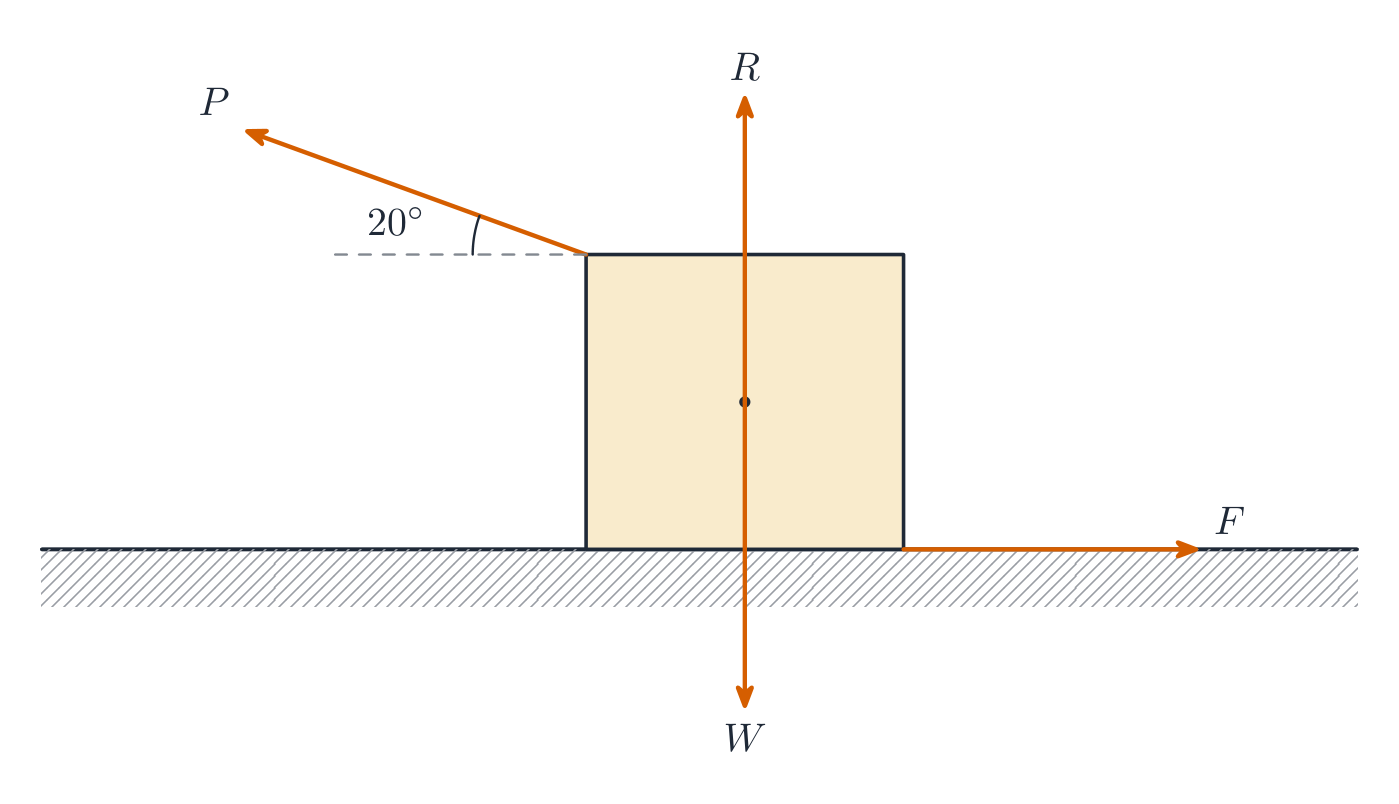
    A force 力 is a push or pull (a vector, in newtons). A free-body diagram 受力图 draws one object with an arrow for every force on it – weight, normal, tension, friction, applied, drag. Draw it first; it sets up every dynamics equation.

    日本語

    力とは押しまたは引き(ニュートン単位のベクトラ)。自由体図は、ある物体に対してすべての力(重力、抗力、張力、摩擦力、外力、空気抵抗など)について矢印で描いたものである。最初に描き、すべての運動方程式の基礎とする。

    自由体図は、ある物体に作用するすべての力を示す
    自由体図は、ある物体に作用するすべての力を示す
    Explore · ⁨探索⁩

    Balance the forces on a free-body diagram · ⁨自由体図上の力のつり合いを確認する⁩

    A free-body diagram shows every force on one object as an arrow. The object accelerates only if the forces don't cancel — the net force sets $a=F/m$. · ⁨自由体図は、ある物体に働くすべての力を矢印で示す。力が相殺されなければ物体は加速し、合力が $a=F/m$ を決定する。⁩

    Vocabulary · ⁨語彙⁩ Train · ⁨練習する⁩
    English 日本語
    free-body diagram/friː ˈbɒdi ˈdaɪəɡræm/ 自由体図
    Newton's third law/ˈnjuːtnz θɜːd lɔː/ ニュートンの第三法則
    inertia/ɪˈnɜːʃə/ 慣性
    net force/net fɔːs/ 合力
    translational equilibrium/trænˈsleɪʃənl ˌiːkwɪˈlɪbrɪəm/ 並進平衡
    differential equation/ˌdɪfəˈrenʃl ɪˈkweɪʒn/ 微分方程式
    incline/ɪnˈklaɪn/ 斜面
    tension/ˈtenʃn/ 張力
    Newton's law of gravitation/ˈnjuːtnz lɔː ɒv ˌɡrævɪˈteɪʃn/ 万有引力の法則
    Friction/ˈfrɪkʃn/ 摩擦力
    kinetic/kɪˈnetɪk/ 運動エネルギー
    static/ˈstætɪk/ 静的
    normal force/ˈnɔːml fɔːs/ 抗力(支持力)
    Hooke's law/hʊks lɔː/ フックの法則
    spring constant/sprɪŋ ˈkɒnstənt/ バネ定数
    resistive force/rɪˈzɪstɪv fɔːs/ 抵抗性力
    2.3

    Newton's Third Law · ⁨ニュートンの第三法則⁩

    Syllabus · ⁨シラバス⁩
    English

    Learning Objective 2.3.A: Describe the interaction of two objects or systems using Newton's third law and a representation of paired forces exerted on each object or system.

    • 2.3.A.1 Newton's third law describes the interaction of two objects or systems in terms of the paired forces that each exerts on the other.
      • Equation: $\vec{F}_{\text{A on B}} = -\vec{F}_{\text{B on A}}$
    • 2.3.A.2 Interactions between objects within a system (internal forces) do not influence the motion of a system's center of mass.
    • 2.3.A.3 Tension is the macroscopic net result of forces that infinitesimal segments of a string, cable, chain, or similar system exert on each other in response to an external force.
      • 2.3.A.3.i An ideal string has negligible mass and does not stretch when under tension.
      • 2.3.A.3.ii The tension in an ideal string is the same at all points within the string.
      • 2.3.A.3.iii In a string with nonnegligible mass, tension may not be the same at all points within the string.
      • 2.3.A.3.iv An ideal pulley is a pulley that has negligible mass and rotates about an axle through its center of mass with negligible friction.
    日本語

    学習目標 2.3.A: ニュートンの第三法則および各物体や系に作用する一対の力の表現を用いて、2つの物体や系の相互作用を説明する。

    • 2.3.A.1 ニュートンの第三法則は、互いに作用し合う一対の力を用いて、2つの物体や系の相互作用を記述する。
      • 式: $\vec{F}_{\text{A on B}} = -\vec{F}_{\text{B on A}}$
    • 2.3.A.2 システム内の物体間の相互作用(内部力)は、システム全体の重心の運動に影響を与えない。
    • 2.3.A.3 張力は、外部力に対する応答として、紐、ケーブル、鎖または類似したシステムの微小要素が互いに作用する力の巨視的な総和である。
      • 2.3.A.3.i 理想的な紐は質量が無視できるほど小さく、張力が加わっても伸びない。
      • 2.3.A.3.ii 理想的な紐における張力は、紐内のあらゆる点で等しい。
      • 2.3.A.3.iii 無視できない質量を持つ紐の場合、張力は紐内のあらゆる点で等しくない可能性がある。
      • 2.3.A.3.iv 理想的な滑車とは、質量が無視できるほど小さく、重心を通る軸周りに無視できる摩擦で回転する滑車のことを指す。

    Source: College Board AP Course and Exam Description · ⁨出典: College Board AP コースおよび試験説明書⁩

    English

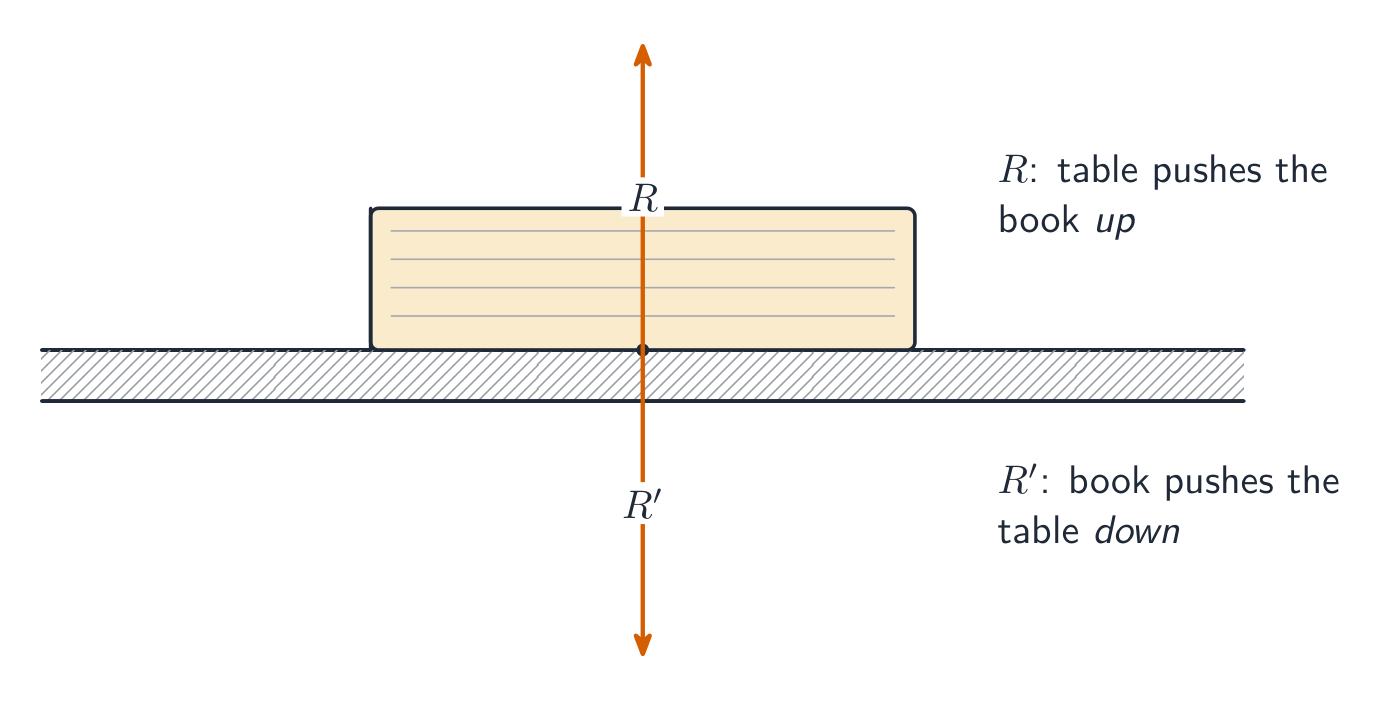
    Newton's third law 牛顿第三定律: A pushes B, B pushes back equally and oppositely. The pair acts on different objects, so it never cancels within one free-body diagram.

    日本語

    ニュートンの第三法則:AがBを押すと、Bも等しく反対方向に押す。ペアは異なる物体に作用するため、一つの自由体図内で打ち消し合うことはない。

    ニュートンの第三法則のペア:異なる2つの物体に作用する等しく逆向きの力
    ニュートンの第三法則のペア:異なる2つの物体に作用する等しく逆向きの力
    2.4

    Newton's First Law · ⁨ニュートンの第一法則⁩

    Syllabus · ⁨シラバス⁩
    English

    Learning Objective 2.4.A: Describe the conditions under which a system's velocity remains constant.

    • 2.4.A.1 The net force on a system is the vector sum of all forces exerted on the system.
    • 2.4.A.2 Translational equilibrium is the configuration of forces such that the net force exerted on a system is zero.
      • Derived equation: $\sum \vec{F}_i = 0$
    • 2.4.A.3 Newton's first law states that if the net force exerted on a system is zero, the velocity of that system will remain constant.
    • 2.4.A.4 Forces may be balanced in one dimension but unbalanced in another. The system's velocity will change only in the direction of the unbalanced force.
    • 2.4.A.5 An inertial reference frame is one from which an observer would verify Newton's first law of motion.
    日本語

    学習目標 2.4.A: システムの速度が一定である条件を説明する。

    • 2.4.A.1 システムに作用する正味の力は、システムに作用するすべての力のベクトル和である。
    • 2.4.A.2 並進平衡とは、系に作用する合力がゼロとなる力の配置のことである。
      • 導出された式: $\sum \vec{F}_i = 0$
    • 2.4.A.3 ニュートンの第一法則は、システムに作用する正味の力がゼロであれば、そのシステムの速度は一定であることを示している。
    • 2.4.A.4 力はある方向では釣り合っているが、別の方向では釣り合わないことがある。システムの速度は、釣り合わない力の方向にのみ変化する。
    • 2.4.A.5 慣性参照系とは、観測者がニュートンの運動の第一法則を検証できる参照系である。

    Source: College Board AP Course and Exam Description · ⁨出典: College Board AP コースおよび試験説明書⁩

    English

    Newton's first law (inertia 惯性): with zero net force 合力, velocity stays constant – the object is in translational equilibrium 平动平衡.

    日本語

    ニュートンの第一法則(慣性):合力がゼロであれば速度は一定に保たれ、物体は並進平衡状態にある。

    2.5

    Newton's Second Law · ⁨ニュートンの第二法則⁩

    Syllabus · ⁨シラバス⁩
    English

    Learning Objective 2.5.A: Describe the conditions under which a system's velocity changes.

    • 2.5.A.1 Unbalanced forces are a configuration of forces such that the net force exerted on a system is not equal to zero.
    • 2.5.A.2 Newton's second law of motion states that the acceleration of a system's center of mass has a magnitude proportional to the magnitude of the net force exerted on the system and is in the same direction as that net force.
      • Equation: $\vec{a}_{\text{sys}} = \dfrac{\sum \vec{F}}{m_{\text{sys}}} = \dfrac{\vec{F}_{\text{net}}}{m_{\text{sys}}}$
    • 2.5.A.3 The velocity of a system's center of mass will only change if a nonzero net external force is exerted on that system.
    日本語

    学習目標 2.5.A: システムの速度が変化する条件を説明する。

    • 2.5.A.1 釣り合わない力は、システムに作用する正味の力がゼロと等しくない力の配置である。
    • 2.5.A.2 ニュートンの運動の第二法則は、システムの重心の加速度の大きさは、システムに作用する正味の力の大きさに比例し、その正味の力の同じ方向にあることを示している。
      • 式: $\vec{a}_{\text{sys}} = \dfrac{\sum \vec{F}}{m_{\text{sys}}} = \dfrac{\vec{F}_{\text{net}}}{m_{\text{sys}}}$
    • 2.5.A.3 システムの重心の速度が変化するのは、そのシステムにゼロではない正味の外力が作用した場合に限られる。

    Source: College Board AP Course and Exam Description · ⁨出典: College Board AP コースおよび試験説明書⁩

    English

    The general form uses momentum:

    $$\sum\vec{F}=\frac{d\vec{p}}{dt}=m\vec{a}\ \ (\text{for constant mass}).$$
    Apply it one axis at a time. When forces depend on velocity or position, this becomes a differential equation 微分方程 to solve.

    Worked example. A $2.0\ \text{kg}$ block slides down a frictionless incline 斜面 at $30^{\circ}$. Only the along-ramp component of gravity drives it, so $a=g\sin30^{\circ}=9.8(0.5)=4.9\ \text{m/s}^2$, independent of the mass.

    Worked example (two bodies). A $6.0\ \text{kg}$ cart on a frictionless table is pulled by a string over a light pulley to a hanging $2.0\ \text{kg}$ mass. Treat the pair as one system: only the hanging weight drives it, so $a=\dfrac{2.0(9.8)}{8.0}=2.45\ \text{m/s}^2$. Then isolate the cart alone to find the string tension 张力: $T=6.0(2.45)\approx15\ \text{N}$. System first for $a$, single body for internal forces – that two-step is the standard pattern.

    日本語

    一般形は運動量を用いて表される:

    $$\sum\vec{F}=\frac{d\vec{p}}{dt}=m\vec{a}\ \ (\text{for constant mass}).$$
    軸ごとに適用する。力が速度や位置に依存する場合、これは解くべき微分方程式となる。

    演習例。 $2.0\ \text{kg}$ブロックが摩擦のない斜面を$30^{\circ}$の角度で滑り落ちます。傾斜方向の重力成分のみがこれを動かすので、$a=g\sin30^{\circ}=9.8(0.5)=4.9\ \text{m/s}^2$となり、質量には依存しません。

    ** worked example (two bodies).** 摩擦なしの卓上を $6.0\ \text{kg}$ のカートが、軽い滑轮を通る紐によって吊り下げられた $2.0\ \text{kg}$ の質量に引かれている。ペアを一つのシステムとして扱う:吊り下げられた重量のみが駆動力となるため、$a=\dfrac{2.0(9.8)}{8.0}=2.45\ \text{m/s}^2$ となる。次にカートを単独で分離して紐の張力を求める:$T=6.0(2.45)\approx15\ \text{N}$ 。システム全体で $a$ を求め、内部力については単一物体で扱う——この2ステップが標準的な手順である。

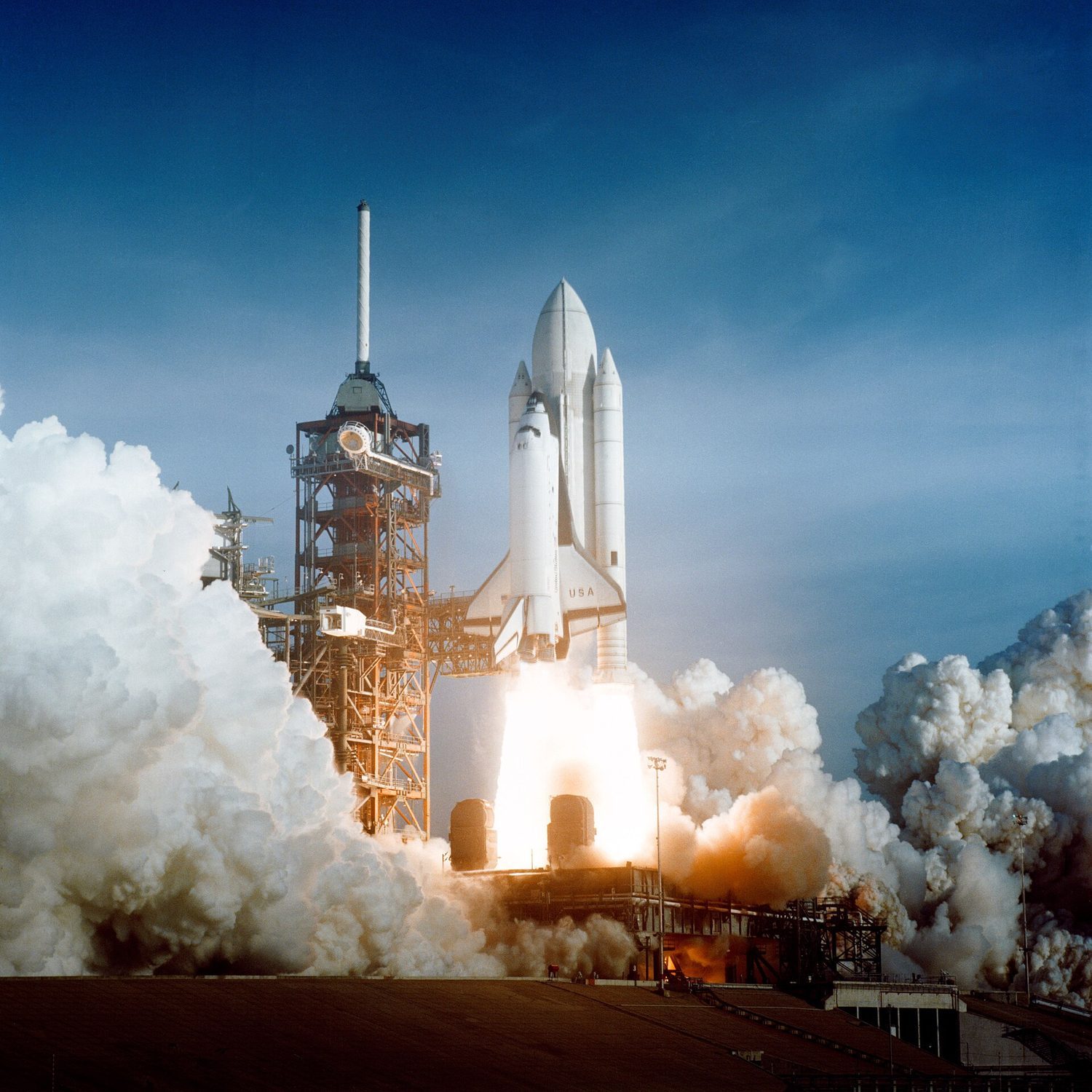
    ロケット発射:合力が運動量を変化させる — 並進力学における F_net = ma
    ロケット打ち上げ:合力が運動量を変化させる — 並進運動动力学における F_net = ma
    Vocabulary · ⁨語彙⁩ Train · ⁨練習する⁩
    English 日本語
    system/ˈsɪstəm/ 系
    center of mass/ˈsentə ɒv mæs/ 重心
    force/fɔːs/ 力
    2.6

    Gravitational Force · ⁨重力⁩

    Syllabus · ⁨シラバス⁩
    English

    Learning Objective 2.6.A: Describe the gravitational interaction between two objects or systems with mass.

    • 2.6.A.1 Newton's law of universal gravitation describes the gravitational force between two objects or systems as directly proportional to each of their masses and inversely proportional to the square of the distance between the systems' centers of mass.
      • Equation: $\left| \vec{F}_g \right| = G \dfrac{m_1 m_2}{r^2}$
      • 2.6.A.1.i The gravitational force is attractive.
      • 2.6.A.1.ii The gravitational force is always exerted along the line connecting the center of mass of the two interacting systems.
      • 2.6.A.1.iii The gravitational force on a system can be considered to be exerted on the system's center of mass.
    • 2.6.A.2 A field models the effects of a noncontact force exerted on an object at various positions in space.
      • 2.6.A.2.i The magnitude of the gravitational field created by a system of mass $M$ at a point in space is equal to the ratio of the gravitational force exerted by the system on a test object of mass $m$ to the mass of the test object.
        • Derived equation: $\left| \vec{g} \right| = \dfrac{\left| \vec{F}_g \right|}{m} = G \dfrac{M}{r^2}$
      • 2.6.A.2.ii If the gravitational force is the only force exerted on an object, the observed acceleration of the object (in $\text{m/s}^2$) is numerically equal to the magnitude of the gravitational field strength (in $\text{N/kg}$) at that location.
    • 2.6.A.3 The gravitational force exerted by an astronomical body on a relatively small nearby object is called weight.
      • Derived equation: $\text{Weight} = F_g = mg$

    Learning Objective 2.6.B: Describe situations in which the gravitational force can be considered constant.

    • 2.6.B.1 If the gravitational force between two systems' centers of mass has a negligible change as the relative position of the two systems changes, the gravitational force can be considered constant at all points between the initial and final positions of the systems.
    • 2.6.B.2 Near the surface of Earth, the strength of the gravitational field is
      • Equation: $g \approx 10\ \text{N/kg}$

    Learning Objective 2.6.C: Describe the conditions under which the magnitude of a system's apparent weight is different from the magnitude of the gravitational force exerted on that system.

    • 2.6.C.1 The magnitude of the apparent weight of a system is the magnitude of the normal force exerted on the system.
    • 2.6.C.2 If the system is accelerating, the apparent weight of the system is not equal to the magnitude of the gravitational force exerted on the system.
    • 2.6.C.3 A system appears weightless when there are no forces exerted on the system or when the force of gravity is the only force exerted on the system.
    • 2.6.C.4 The equivalence principle states that an observer in a noninertial reference frame is unable to distinguish between an object's apparent weight and the gravitational force exerted on the object by a gravitational field.

    Learning Objective 2.6.D: Describe inertial and gravitational mass.

    • 2.6.D.1 Objects have inertial mass, or inertia, a property that determines how much an object's motion resists changes when interacting with another object.
    • 2.6.D.2 Gravitational mass is related to the force of attraction between two systems with mass.
    • 2.6.D.3 Inertial mass and gravitational mass have been experimentally verified to be equivalent.

    Learning Objective 2.6.E: Describe the gravitational force exerted on an object by a uniform spherical distribution of mass.

    • 2.6.E.1 The net gravitational force exerted on an object by a uniform spherical distribution of mass is the sum of the individual forces from small differential masses that comprise the distribution.
    • 2.6.E.2 Newton's shell theorem describes the net gravitational force exerted on an object by a uniform spherical shell of mass.
      • 2.6.E.2.i The net gravitational force exerted on an object inside a thin spherical shell is zero.
      • 2.6.E.2.ii The net gravitational force exerted on an object outside a thin spherical shell can be determined by treating the shell as a single massive object located at the center of the shell.
      • 2.6.E.2.iii An object inside a sphere of uniform density experiences a net gravitational force from only a partial mass of the sphere.
      • 2.6.E.2.iv The partial mass of a sphere that contributes to the net gravitational force exerted on an object within that sphere is the portion of the sphere's mass located a distance less than or equal to the object's distance from the center of the sphere and can be calculated using the density of the sphere.
        • Derived equation: $m_{\text{partial}} = \rho \dfrac{4}{3} \pi \left( r_{\text{partial}} \right)^3$
    • 2.6.E.3 The gravitational force exerted on an object within a uniform sphere can be shown to be proportional to the object's distance from the sphere's center.
      • Derived equation: $F_{g,\text{partial}} = -k r_{\text{partial}}$

    Boundary statement: AP Physics C: Mechanics does not expect students to mathematically prove or derive Newton's shell theorem.

    日本語

    学習目標 2.6.A: 質量を持つ2つの物体やシステム間の重力の相互作用を説明する。

    • 2.6.A.1 ニュートンの万有引力の法則は、2つの物体やシステム間の重力が、それぞれの質量に比例し、かつシステム間の重心間の距離の二乗に反比例することを記述する。
      • 式: $\left| \vec{F}_g \right| = G \dfrac{m_1 m_2}{r^2}$
      • 2.6.A.1.i 重力は引力的である。
      • 2.6.A.1.ii 重力は常に、2つの相互作用する系の重心を結ぶ直線上に作用する。
      • 2.6.A.1.iii システムに作用する重力は、システムの重心に作用するとみなすことができる。
    • 2.6.A.2 場(フィールド)は、空間の異なる位置にある物体に作用する非接触力の効果をモデル化している。
      • 2.6.A.2.i 質量 $M$ のシステムによって生じる重力場の大きさ(空間の一点において)は、そのシステムが質量 $m$ の試験物体に作用する重力と試験物体の質量との比に等しい。
        • 導出された数式: $\left| \vec{g} \right| = \dfrac{\left| \vec{F}_g \right|}{m} = G \dfrac{M}{r^2}$
      • 2.6.A.2.ii 重力以外の力が物体に作用しない場合、その物体の観測される加速度(単位 $\text{m/s}^2$)の数値は、その地点における重力場の強さ(単位 $\text{N/kg}$)の大きさに等しい。
    • 2.6.A.3 天体が比較的小さい近接物体に作用する重力は、重さと呼ばれる。
      • 導出された式: $\text{Weight} = F_g = mg$

    学習目標 2.6.B: 重力が一定とみなせる状況について説明する。

    • 2.6.B.1 2つのシステムの重心間の重力が、2つのシステムの相対位置の変化に対して無視できるほど変化しない場合、システムの初期位置から最終位置までの間のあるいも点で重力は一定とみなせる。
    • 2.6.B.2 地球表面付近での重力場の強さは
      • 式: $g \approx 10\ \text{N/kg}$

    学習目標 2.6.C: システムの見かけの重さの大きさが、そのシステムに作用する重力の大きさとは異なる条件を説明する。

    • 2.6.C.1 システムの見かけの重さの大きさは、システムに作用する垂直抗力の大きさである。
    • 2.6.C.2 システムが加速している場合、そのシステムの見かけの重さは、システムに作用する重力の大きさと等しくない。
    • 2.6.C.3 システムに力が作用していないか、あるいは重力だけがシステムに作用している場合、システムは無重力状態に見える。
    • 2.6.C.4 等価原理とは、非慣性系に置かれた観測者は、物体の見かけの重さと重力場が物体に及ぼす重力との区別ができないというものである。

    学習目標 2.6.D: 慣性質量と重力質量を説明する。

    • 2.6.D.1 物体は慣性質量(または慣性)を持ち、これは他の物体との相互作用時にその運動が変化しようとする抵抗の程度を決める性質である。
    • 2.6.D.2 重力質量は、質量を持つ2つのシステム間の引力の大きさと関連している。
    • 2.6.D.3 慣性質量と重力質量は、実験的に等価であることが確認されている。

    学習目標 2.6.E: 均質球状質量分布による物体への重力の作用を説明する。

    • 2.6.E.1 均質球状質量分布による物体への合力は、その分布を構成する微小球体からの個別の力の総和である。
    • 2.6.E.2 ニュートンの殻定理は、均質球状殻による物体への合力を記述する。
      • 2.6.E.2.i 薄い球状殻内部にある物体への合力はゼロである。
      • 2.6.E.2.ii 薄い球状殻外部にある物体への合力は、殻を殻の中心に位置する単一の巨大物体として扱うことで求めることができる。
      • 2.6.E.2.iii 均質密度の球体内部にある物体は、球体の一部質量からのみ合力を受ける。
      • 2.6.E.2.iv 球体内部の物体への合力に関与する球体の部分質量は、球体の中心からの距離が物体の中心からの距離以下である質量の部分であり、球体の密度を用いて計算できる。
        • 導出された数式: $m_{\text{partial}} = \rho \dfrac{4}{3} \pi \left( r_{\text{partial}} \right)^3$
    • 2.6.E.3 均質球体内部の物体への重力は、物体の球心からの距離に比例することが示せる。
      • 導出された式: $F_{g,\text{partial}} = -k r_{\text{partial}}$

    境界文: AP Physics C: Mechanicsでは、学生にニュートンの殻定理を数学的に証明したり導出したりすることを求めているわけではない。

    Source: College Board AP Course and Exam Description · ⁨出典: College Board AP コースおよび試験説明書⁩

    English
    Orbital motion (Kepler's 2nd law)

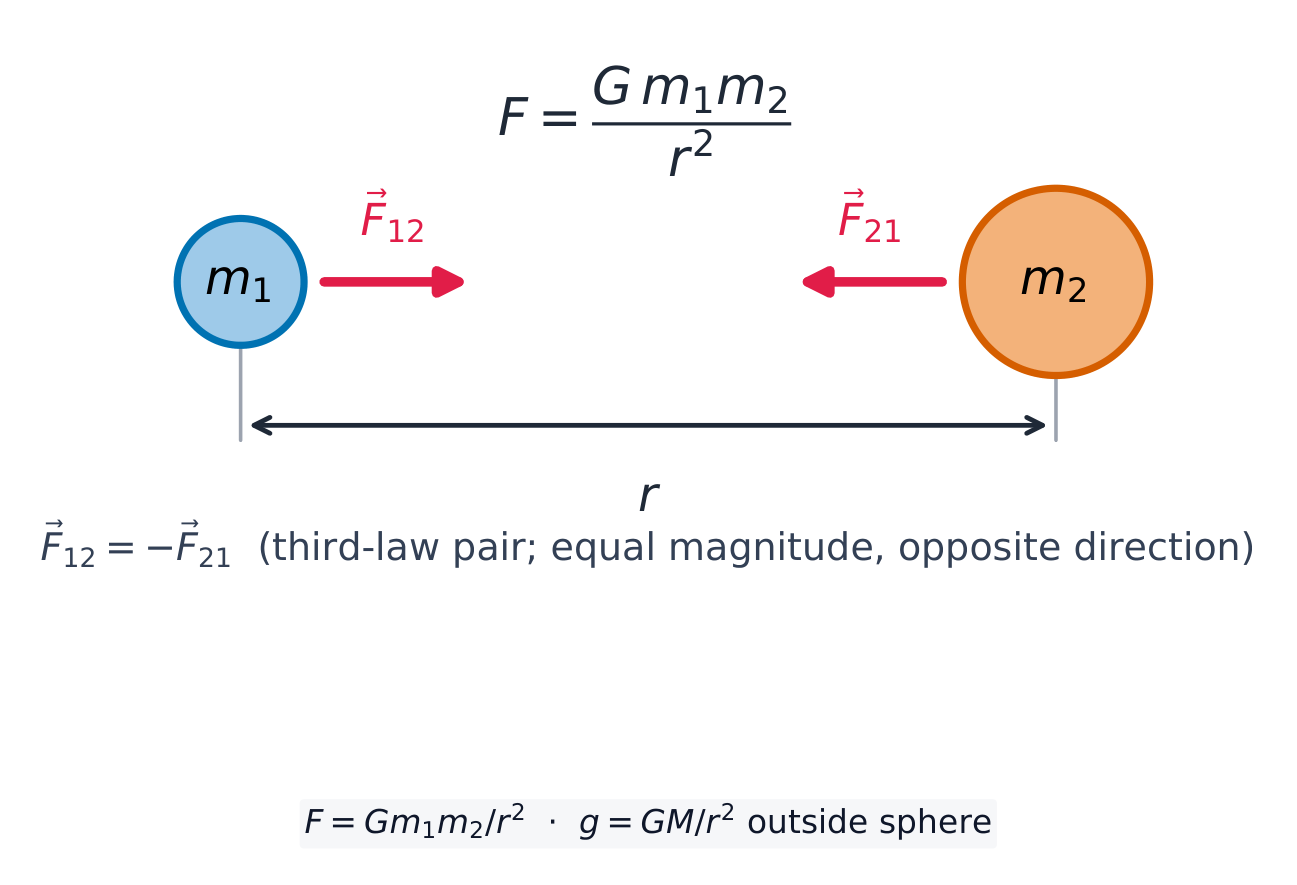
    Near a surface, weight is $F_g=mg$. In general, Newton's law of gravitation 万有引力定律:

    $$F_g=\frac{Gm_1m_2}{r^2},$$
    attractive and inverse-square. The gravitational field is $g=\dfrac{GM}{r^2}$.

    日本語
    軌道運動(ケプラーの第2法則)

    地表付近では重力は ⟨$F_g=mg$⟩ 。一般的に、ニュートンの万有引力の法則:

    $$F_g=\frac{Gm_1m_2}{r^2},$$
    引力であり平方反比則に従う。重力場は ⟨$g=\dfrac{GM}{r^2}$⟩ である。

    2つの質量が互いに等しく反対の逆二乗の力を及ぼして引き合う、両者を結ぶ直線に沿って
    2つの質量が互いに等しく反対の逆二乗の力を及ぼして引き合う、両者を結ぶ直線に沿って
    2.7

    Kinetic and Static Friction · ⁨動摩擦力と静摩擦力⁩

    Syllabus · ⁨シラバス⁩
    English

    Learning Objective 2.7.A: Describe kinetic friction between two surfaces.

    • 2.7.A.1 Kinetic friction occurs when two surfaces in contact move relative to each other.
      • 2.7.A.1.i The kinetic friction force is exerted in a direction opposite the motion of each surface relative to the other surface.
      • 2.7.A.1.ii The force of friction between two surfaces does not depend on the size of the surface area of contact.
    • 2.7.A.2 The magnitude of the kinetic friction force exerted on an object is the product of the normal force the surface exerts on the object and the coefficient of kinetic friction.
      • Equation: $\left| \vec{F}_{f,k} \right| = \left| \mu_k \vec{F}_N \right|$
      • 2.7.A.2.i The coefficient of kinetic friction depends on the material properties of the surfaces that are in contact.
      • 2.7.A.2.ii Normal force is the perpendicular component of the force exerted on an object by the surface with which it is in contact; it is directed away from the surface.

    Learning Objective 2.7.B: Describe static friction between two surfaces.

    • 2.7.B.1 Static friction may occur between the contacting surfaces of two objects that are not moving relative to each other.
    • 2.7.B.2 Static friction adopts the value and direction required to prevent an object from slipping or sliding on a surface.
      • Equation: $\left| \vec{F}_{f,s} \right| \leq \left| \mu_s \vec{F}_n \right|$
      • 2.7.B.2.i Slipping and sliding refer to situations in which two surfaces are moving relative to each other.
      • 2.7.B.2.ii There exists a maximum value for which static friction will prevent an object from slipping on a given surface.
        • Derived equation: $F_{f,s,\text{max}} = \mu_s F_N$
    • 2.7.B.3 The coefficient of static friction is typically greater than the coefficient of kinetic friction for a given pair of surfaces.
    日本語

    学習目標 2.7.A: 2つの表面間の動摩擦力を説明する。

    • 2.7.A.1 接触している2つの表面が互いに相対運動をするときに生じる摩擦力を動摩擦力という。
      • 2.7.A.1.i 動摩擦力は、各表面が他方に対して運動する方向と逆向きに作用する。
      • 2.7.A.1.ii 2つの表面間の摩擦力の大きさは、接触面積の大きさには依存しない。
    • 2.7.A.2 物体に作用する動摩擦力の大きさは、表面が物体に作用する垂直抗力と動摩擦係数の積で表される。
      • 式: $\left| \vec{F}_{f,k} \right| = \left| \mu_k \vec{F}_N \right|$
      • 2.7.A.2.i 動摩擦係数は、接触している表面の材料の性質に依存する。
      • 2.7.A.2.ii 垂直抗力は、接触している表面が物体に作用する力の垂直成分であり、表面から外向きに方向を持つ。

    学習目標 2.7.B: 2つの表面間の静摩擦力を説明する。

    • 2.7.B.1 静止摩擦力は、互いに相対運動していない2つの物体の接触面間に発生することがある。
    • 2.7.B.2 静摩擦力は、物体が表面上で滑ったりずり落ちたりしないようにするために必要な値と方向を取る。
      • 式: $\left| \vec{F}_{f,s} \right| \leq \left| \mu_s \vec{F}_n \right|$
      • 2.7.B.2.i 滑りやずれとは、2つの表面が互いに相対運動をしている状況を指す。
      • 2.7.B.2.ii 特定の表面上で物体が滑らないために、静摩擦力には最大値が存在する。
        • 導出された数式: $F_{f,s,\text{max}} = \mu_s F_N$
    • 2.7.B.3 特定の表面の組み合わせにおいて、静摩擦係数は通常、動摩擦係数よりも大きい。

    Source: College Board AP Course and Exam Description · ⁨出典: College Board AP コースおよび試験説明書⁩

    English

    Friction 摩擦力 opposes sliding along a surface: kinetic 动摩擦 $f_k=\mu_k N$ while sliding, and static 静摩擦 $f_s\le\mu_s N$ up to a maximum before sliding. $N$ is the normal force 法向力. Note the inequality: static friction is only as large as it needs to be, and $\mu_s N$ is its ceiling, not its value.

    Worked example. The same block on the same $30^{\circ}$ incline, now with $\mu_k=0.20$. Perpendicular to the ramp: $N=mg\cos30^{\circ}$. Along the ramp: $ma=mg\sin30^{\circ}-\mu_k mg\cos30^{\circ}$, so $a=g(\sin30^{\circ}-0.20\cos30^{\circ})=9.8(0.500-0.173)=3.2\ \text{m/s}^2$ – the mass cancels again.

    日本語

    摩擦力は表面に沿ったすべりに対抗する:動摩擦力 ⟨$f_k=\mu_k N$⟩ はすべりながら、静止摩擦力 ⟨$f_s\le\mu_s N$⟩ はすべり始める前まで最大値まで作用する。$N$ は**抗力(垂直抗力)**である。不等号に注意:静止摩擦力は必要な大きさだけであり、$\mu_s N$ はその上限であり、実際の値ではない。

    ** worked example.** 同じ $30^{\circ}$ の斜面の上にある同じブロックだが、今回は $\mu_k=0.20$ の摩擦がある。斜面に垂直な方向:$N=mg\cos30^{\circ}$ 。斜面に沿う方向:$ma=mg\sin30^{\circ}-\mu_k mg\cos30^{\circ}$ 因此 $a=g(\sin30^{\circ}-0.20\cos30^{\circ})=9.8(0.500-0.173)=3.2\ \text{m/s}^2$ ——質量は再び約分される。

    Explore · ⁨探索⁩

    Slide a block down a slope with friction · ⁨摩擦のある斜面の上をブロックを滑らせる⁩

    Friction opposes motion up to a maximum $\mu N$. Tilt the slope until gravity's pull along it beats static friction and the block starts to slide. · ⁨摩擦力は最大 $\mu N$ まで運動に逆らう。斜面の傾斜を変えて、重力の斜面方向の成分が静止摩擦力を上回り、ブロックが動き出す点を探せ。⁩

    2.8

    Spring Forces · ⁨スプリングの力⁩

    Syllabus · ⁨シラバス⁩
    English

    Learning Objective 2.8.A: Describe the force exerted on an object by an ideal spring.

    • 2.8.A.1 An ideal spring has negligible mass and exerts a force that is proportional to the change in its length as measured from its relaxed length. A nonideal spring either has nonnegligible mass or exerts a force that is not proportional to the change in its length as measured from its relaxed length.
    • 2.8.A.2 The magnitude of the force exerted by an ideal spring on an object is given by Hooke's law:
      • Equation: $\vec{F}_s = -k \Delta \vec{x}$
    • 2.8.A.3 The force exerted on an object by a spring is always directed toward the equilibrium position of the object–spring system.

    Learning Objective 2.8.B: Describe the equivalent spring constant of a combination of springs exerting forces on an object.

    • 2.8.B.1 A collection of springs that exert forces on an object may behave as though they were a single spring with an equivalent spring constant $k_{\text{eq}}$.
      • 2.8.B.1.i The inverse of the equivalent spring constant of a set of springs in series is equal to the sum of the inverses of the individual spring constants.
        • Derived equation: $\dfrac{1}{k_{\text{eq, series}}} = \sum_i \dfrac{1}{k_i} = \dfrac{1}{k_1} + \dfrac{1}{k_2} + \dots$
      • 2.8.B.1.ii The equivalent spring constant of a set of springs arranged in series is smaller than the smallest constituent spring constant.
      • 2.8.B.1.iii The equivalent spring constant of a set of springs arranged in parallel is the sum of the individual spring constants.
        • Derived equation: $k_{\text{eq, parallel}} = \sum_i k_i = k_1 + k_2 + \dots$

    Boundary statement: AP Physics C: Mechanics only expects students to find the effective spring constant of systems of springs that are arranged either in series or in parallel and does not expect students to find the effective spring constant of a system in which springs are arranged in both series and parallel.

    日本語

    学習目標 2.8.A: 理想的スプリングが物体に作用する力を説明する。

    • 2.8.A.1 理想的スプリングは質量が無視できるほど小さく、静止長からの長さの変化に比例する力を作用させる。非理想的スプリングは、無視できない質量を持つか、または静止長からの長さの変化に比例しない力を作用させる。
    • 2.8.A.2 理想スプリングが物体に作用する力の大きさはフークの法則で与えられる:
      • 式: $\vec{F}_s = -k \Delta \vec{x}$
    • 2.8.A.3 スプリングが物体に作用する力は、常に物体-スプリング系の平衡位置に向かう。

    学習目標 2.8.B: 物体に力を作用させる複数のスプリングの等価ばね定数を説明する。

    • 2.8.B.1 物体に力を作用させるスプリングの集合は、等価ばね定数 $k_{\text{eq}}$ を持つ単一のスプリングのように振る舞うことがある。
      • 2.8.B.1.i 直列に接続されたスプリングの等価ばね定数の逆数は、個別のばね定数の逆数の総和に等しい。
        • 導出された数式: $\dfrac{1}{k_{\text{eq, series}}} = \sum_i \dfrac{1}{k_i} = \dfrac{1}{k_1} + \dfrac{1}{k_2} + \dots$
      • 2.8.B.1.ii 直列に接続されたスプリングの等価ばね定数は、構成する最小のばね定数より小さい。
      • 2.8.B.1.iii 並列に接続されたスプリングの等価ばね定数は、個別のばね定数の総和である。
        • 導出された数式: $k_{\text{eq, parallel}} = \sum_i k_i = k_1 + k_2 + \dots$

    境界文: AP Physics C: Mechanicsでは、学生には直列または並列のいずれかの接続形式のみで構成されたスプリングシステムの有効ばね定数のみを求めることを期待しており、直列と並列の両方が混在するシステムの有効ばね定数を求めることは期待していない。

    Source: College Board AP Course and Exam Description · ⁨出典: College Board AP コースおよび試験説明書⁩

    English
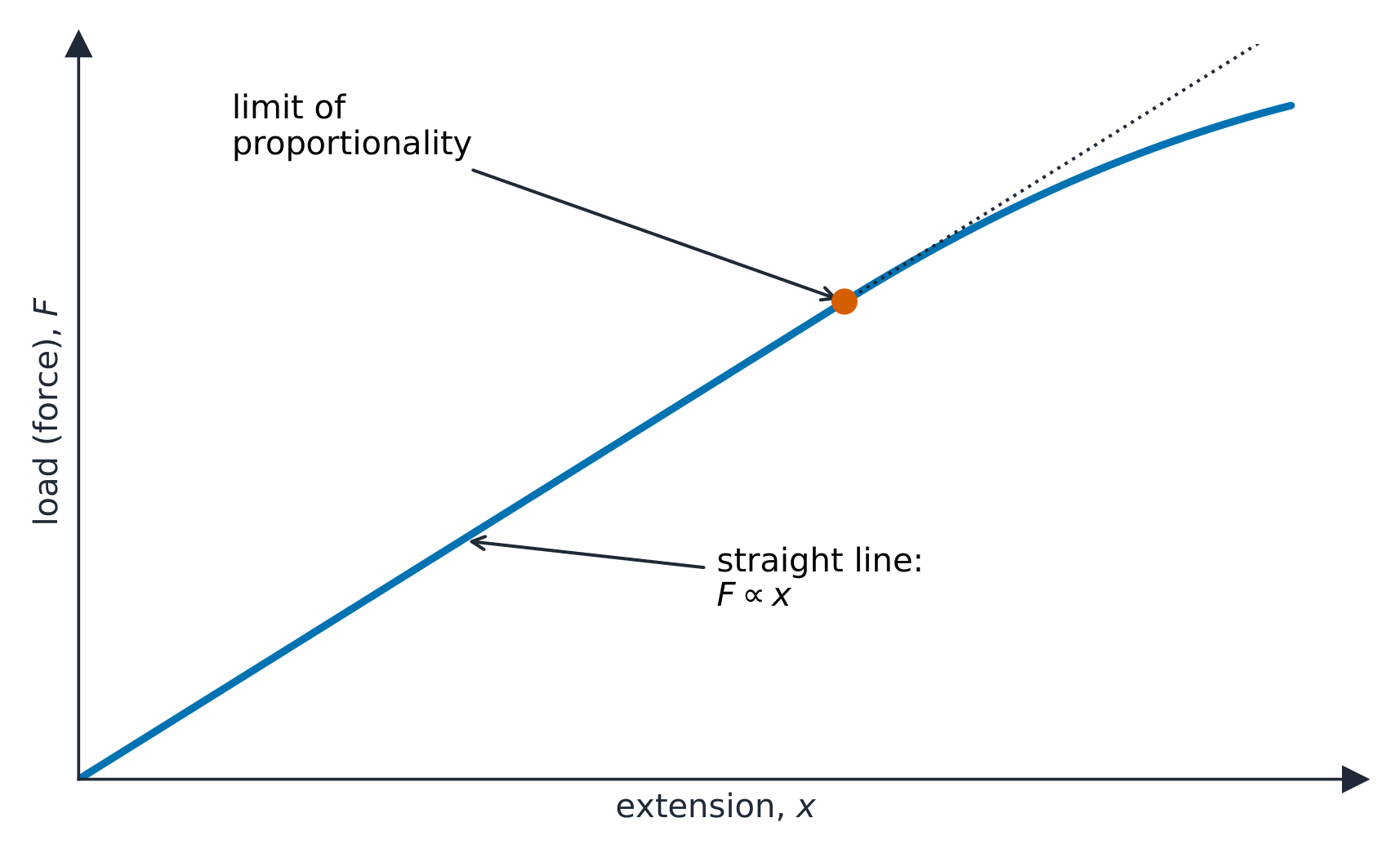
    Hooke's law & the elastic limit

    An ideal spring obeys Hooke's law 胡克定律 $F_s=-kx$, a restoring force set by the spring constant 弹簧劲度系数 $k$. Its stored energy is $U=\tfrac12 kx^2$.

    Combined springs act as one equivalent spring of constant $k_{\text{eq}}$. In parallel (side by side, sharing the load) the constants add, $k_{\text{eq}}=k_1+k_2$ – stiffer than either. In series (end to end) they combine as $\dfrac{1}{k_{\text{eq}}}=\dfrac{1}{k_1}+\dfrac{1}{k_2}$ – softer than the softest one. Two springs pulling a mass from opposite sides also act in parallel, giving a restoring constant $k_1+k_2$. Whichever you have, the SHM period uses $k_{\text{eq}}$: $T=2\pi\sqrt{m/k_{\text{eq}}}$.

    日本語
    フークの法則と弾性限度

    理想ばねはフークの法則 ⟨$F_s=-kx$⟩ に従い、ばね定数 ⟨$k$⟩ によって決まる復元力を生じる。蓄えられたエネルギーは ⟨$U=\tfrac12 kx^2$⟩ である。

    フックの法則:線形限界まで荷重と伸びは比例する
    フックの法則:線形限界まで荷重と伸びは比例する

    結合したばねは、定数 ⟨$k_{\text{eq}}$⟩ の一つの等価ばねとして振る舞う。並列(横並びで荷重を分担)では定数が加算され、$k_{\text{eq}}=k_1+k_2$ ——どちらよりも剛性が高い。直列(端同士をつなぐ)では ⟨$\dfrac{1}{k_{\text{eq}}}=\dfrac{1}{k_1}+\dfrac{1}{k_2}$⟩ のように組み合わせられ、最も柔らかいものよりも柔らかくなる。両側から質量を引っ張る2つのばねも並列として働き、復元定数は ⟨$k_1+k_2$⟩ となる。どのような場合でも、SHMの周期は ⟨$k_{\text{eq}}$⟩ :$T=2\pi\sqrt{m/k_{\text{eq}}}$ を用いる。

    Explore · ⁨探索⁩

    Stretch a spring (Hooke's law) · ⁨バネを伸ばす(フックの法則)⁩

    A spring's force is proportional to its extension, $F=kx$ (Hooke's law). Pull harder and the extension grows in step — until the spring's limit. · ⁨バネの力は伸びに比例し、$F=kx$ (フックの法則)。強く引っ張ると伸びも按比例に増加する——バネの限度に達するまで。⁩

    2.9

    Resistive Forces · ⁨抵抗力⁩

    Syllabus · ⁨シラバス⁩
    English

    Learning Objective 2.9.A: Describe the motion of an object subject to a resistive force.

    • 2.9.A.1 A resistive force is defined as a velocity-dependent force in the opposite direction of an object's velocity, for example:
      • Equation: $\vec{F}_r = -k\vec{v}$
    • 2.9.A.2 Applying Newton's second law to an object upon which a resistive force is exerted results in a differential equation for velocity.
      • 2.9.A.2.i Using the method of separation of variables, the velocity can be determined by integrating over the proper limits of integration.
      • 2.9.A.2.ii The acceleration or position of a moving object that is subject to a velocity-dependent force may be determined using initial conditions of the object and methods of calculus, once a function for velocity is determined.
      • 2.9.A.2.iii The position, velocity, and acceleration as functions of time of an object under the influence of a resistive force of the form $\vec{F}_r = -k\vec{v}$ are exponential and have asymptotes that are determined by the initial conditions of the object and the forces exerted on the object.
    • 2.9.A.3 Terminal velocity is defined as the maximum speed achieved by an object moving under the influence of a constant force and a resistive force that are exerted on the object in opposite directions. The terminal condition is reached when the net force exerted on the object is zero.
    日本語

    学習目標 2.9.A: 抵抗力を受ける物体の運動を説明する。

    • 2.9.A.1 抵抗力とは、物体の速度の方向と逆向きで速度に依存する力として定義され、例えば以下の通りである:
      • 式: $\vec{F}_r = -k\vec{v}$
    • 2.9.A.2 抵抗力が作用する物体にニュートンの第二法則を適用すると、速度に対する微分方程式が得られる。
      • 2.9.A.2.i 変数分離法を用いることで、適切な積分範囲に対して積分することで速度を求めることができる。
      • 2.9.A.2.ii 速度依存性の力に作用する運動物体の加速度や位置は、速度の関数が決定された後、初期条件と微積分の手法を用いて求めることができる。
      • 2.9.A.2.iii $\vec{F}_r = -k\vec{v}$という形の抵抗力の影響下にある物体の位置、速度、および時間の関数としての加速度は指数関数的であり、その漸近線は物体の初期条件および物体に作用する力によって決定される。
    • 2.9.A.3 終端速度とは、物体に逆向きに作用する一定の力と抵抗力の影響下で移動する物体が到達する最大速度として定義される。終端状態とは、物体に作用する合力がゼロになった状態である。

    Source: College Board AP Course and Exam Description · ⁨出典: College Board AP コースおよび試験説明書⁩

    English

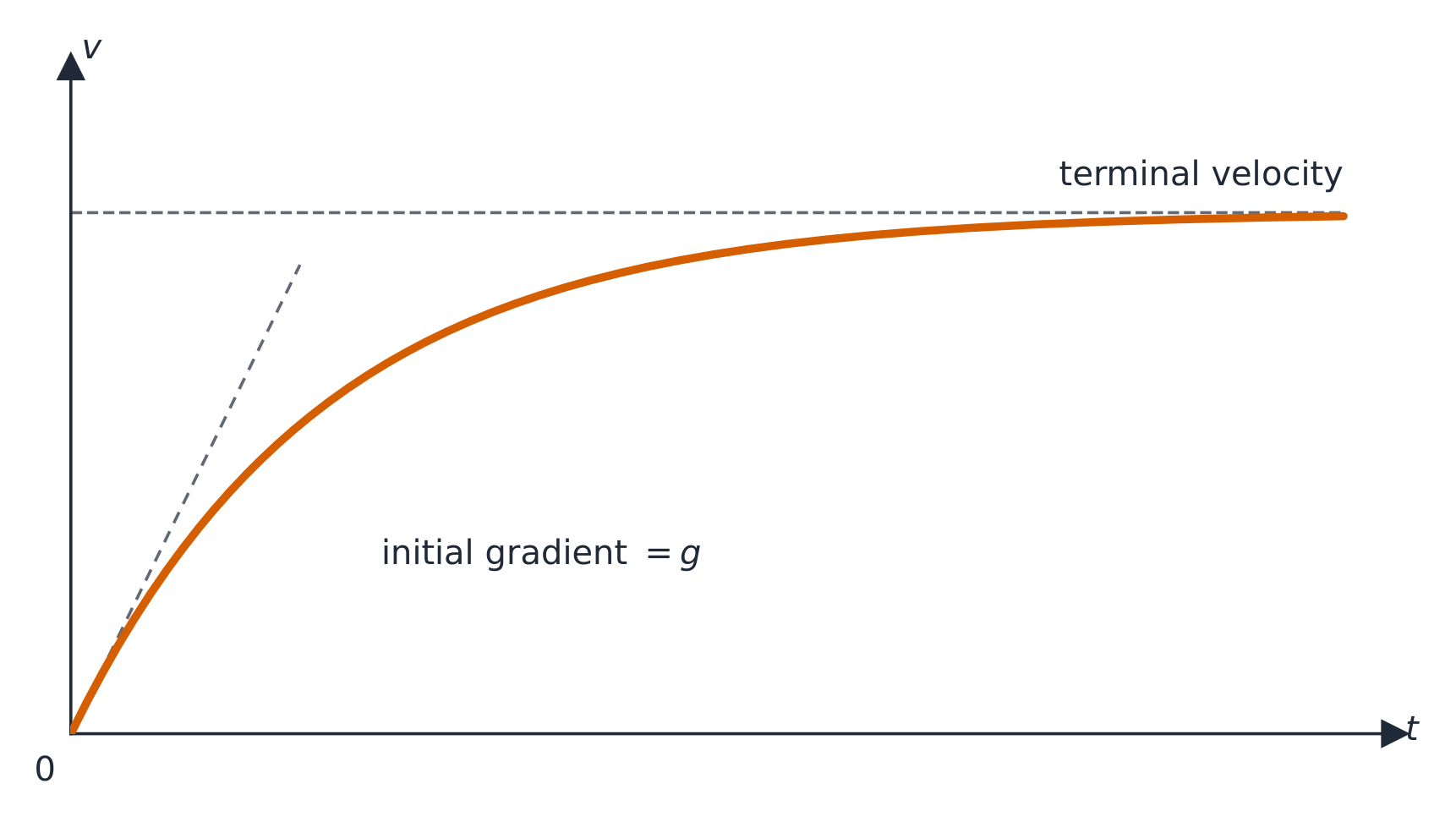
    A resistive force 阻力 (drag) opposes motion through a fluid and grows with speed, often modeled as $F=-bv$ or $F=-cv^2$. Newton's second law then gives a differential equation, e.g. $m\dfrac{dv}{dt}=mg-bv$ for a falling object. As speed rises, drag builds until it balances the driving force; the object then stops accelerating and moves at a constant terminal velocity 终极速度, found by setting the net force (and $dv/dt$) to zero.

    Worked example. For a falling object with $m\dfrac{dv}{dt}=mg-bv$, the terminal velocity is where $\dfrac{dv}{dt}=0$: $mg=bv_T$, so $v_T=\dfrac{mg}{b}$. With $m=0.10\ \text{kg}$ and $b=0.50\ \text{kg/s}$, $v_T=\dfrac{0.10(9.8)}{0.50}=2.0\ \text{m/s}$.

    To get the full motion $v(t)$, separate the variables 分离变量 and integrate from rest:

    $$\int_0^{v}\frac{dv'}{mg-bv'}=\int_0^{t}\frac{dt'}{m}\;\Rightarrow\;-\frac{1}{b}\ln\!\frac{mg-bv}{mg}=\frac{t}{m},$$
    which rearranges to $v(t)=v_T\left(1-e^{-bt/m}\right)$ – the speed rising exponentially toward $v_T$. Showing this integration is the calculus skill a Physics C free-response rewards, not just quoting the final formula.

    日本語

    抵抗力(抗力)は流体中での運動に対抗し、速度とともに増大する。多くの場合、$F=-bv$ または $F=-cv^2$ でモデル化される。これによりニュートンの第二法則は微分方程式となり、例えば落下物体に対しては ⟨$m\dfrac{dv}{dt}=mg-bv$⟩ となる。速度が上がると抗力は増加し、駆動力と釣り合うまで続く。その後、物体は加速を停止し、一定の終端速度で移動する。これは合力(および$dv/dt$ )をゼロとおいて求める。

    ** worked example.** 落下物体で ⟨$m\dfrac{dv}{dt}=mg-bv$⟩ の場合、終端速度は $\dfrac{dv}{dt}=0$ が成立する地点である:$mg=bv_T$ 因此 $v_T=\dfrac{mg}{b}$ 。$m=0.10\ \text{kg}$ と $b=0.50\ \text{kg/s}$ を用いると、$v_T=\dfrac{0.10(9.8)}{0.50}=2.0\ \text{m/s}$ となる。

    完全な運動 $v(t)$ を得るために、変数を分離して静止状態から積分する:

    $$\int_0^{v}\frac{dv'}{mg-bv'}=\int_0^{t}\frac{dt'}{m}\;\Rightarrow\;-\frac{1}{b}\ln\!\frac{mg-bv}{mg}=\frac{t}{m},$$
    これを整理すると $v(t)=v_T\left(1-e^{-bt/m}\right)$ – 速度は指数関数的に $v_T$ に漸近する。この積分過程を示すことは、Physics Cの自由回答問題が単に最終公式を引用するだけでなく、微積分のスキルを評価するためである。

    流体中を落下する物体は終端速度まで加速する
    流体中を落下する物体は終端速度まで加速する
    パラシュート跳降者の自由落下:抵抗は速度とともに増大し、終端速度で重力と釣り合う
    パラシュート跳降者の自由落下:抵抗は速度とともに増大し、終端速度で重力と釣り合う
    Vocabulary · ⁨語彙⁩ Train · ⁨練習する⁩
    English 日本語
    terminal velocity/ˈtɜːmɪnl vəˈlɒsɪti/ 終末速度
    separate the variables/ˈseprət ðə ˈveərɪəblz/ 変数分離
    centripetal acceleration/senˈtrɪpɪtl əkˌseləˈreɪʃn/ 向心加速度
    2.10

    Circular Motion · ⁨円運動⁩

    Syllabus · ⁨シラバス⁩
    English

    Learning Objective 2.10.A: Describe the motion of an object traveling in a circular path.

    • 2.10.A.1 Centripetal acceleration is the component of an object's acceleration directed toward the center of the object's circular path.
      • 2.10.A.1.i The magnitude of centripetal acceleration for an object moving in a circular path is the ratio of the object's tangential speed squared to the radius of the circular path.
        • Equation: $a_c = \dfrac{v^2}{r}$
      • 2.10.A.1.ii Centripetal acceleration is directed toward the center of an object's circular path.
    • 2.10.A.2 Centripetal acceleration can result from a single force, more than one force, or components of forces that are exerted on an object in circular motion.
      • 2.10.A.2.i At the top of a vertical, circular loop, an object requires a minimum speed to maintain circular motion. At this point, and with this minimum velocity, the gravitational force is the only force that causes the centripetal acceleration.
        • Derived equation: $v = \sqrt{gr}$
      • 2.10.A.2.ii Components of the static friction force and the normal force can contribute to the net force producing centripetal acceleration of an object traveling in a circle on a banked surface.
      • 2.10.A.2.iii A component of tension contributes to the net force producing centripetal acceleration experienced by a conical pendulum.
    • 2.10.A.3 Tangential acceleration is the rate at which an object's speed changes and is directed tangent to the object's circular path.
    • 2.10.A.4 The net acceleration of an object moving in a circle is the vector sum of the centripetal acceleration and tangential acceleration.
    • 2.10.A.5 The revolution of an object traveling in a circular path at a constant speed (uniform circular motion) can be described using period and frequency.
      • 2.10.A.5.i The time to complete one full circular path, one full rotation, or a full cycle of oscillatory motion is defined as period, $T$.
      • 2.10.A.5.ii The rate at which an object is completing revolutions is defined as frequency, $f$.
        • Equation: $T = \dfrac{1}{f}$
      • 2.10.A.5.iii For an object traveling at a constant speed in a circular path, the period is given by the derived equation
        • Derived equation: $T = \dfrac{2\pi r}{v}$

    Learning Objective 2.10.B: Describe circular orbits using Kepler's third law.

    • 2.10.B.1 For a satellite in circular orbit around a central body, the satellite's centripetal acceleration is caused only by gravitational attraction. The period and radius of the circular orbit are related to the mass of the central body.
      • Derived equation: $T^2 = \dfrac{4\pi^2}{GM} R^3$

    Boundary statement: AP Physics C: Mechanics does not expect students to know Kepler's first or second laws of planetary motion.

    日本語

    学習目標 2.10.A: 円軌道を進む物体の運動を説明する。

    • 2.10.A.1 向心加速度とは、物体の加速度のうち、円軌道の中心に向かう成分である。
      • 2.10.A.1.i 円軌道を進む物体の向心加速度の大きさは、物体の接線速度の二乗を円軌道の半径で割ったもの(比)である。
        • 数式: $a_c = \dfrac{v^2}{r}$
      • 2.10.A.1.ii 向心加速度は、物体の円軌道の中心に向かっている。
    • 2.10.A.2 向心加速度は、円運動中の物体に作用する単一の力、複数の力、または力の成分によって生じることがある。
      • 2.10.A.2.i 垂直な円ループの頂点において、物体は円運動を維持するために最小速度が必要である。この点において、この最小速度で、重力だけが向心加速度を生じる力となる。
        • 導出された数式: $v = \sqrt{gr}$
      • 2.10.A.2.ii 傾斜面上を円を描くように動く物体の向心加速度を生じる合力には、静摩擦力の成分と支持力の成分が寄与することがある。
      • 2.10.A.2.iii 張力の成分は、錘振り(コノイダルペンデュラム)が受ける向心加速度を生じる合力に寄与する。
    • 2.10.A.3 接線加速度とは、物体の速さが変化する速率であり、物体の円軌道に沿って接線方向にある。
    • 2.10.A.4 円を描く物体の合力加速度は、向心加速度と接線加速度のベクトル和である。
    • 2.10.A.5 一定の速さ(等速円運動)で円軌道を進む物体の回転は、周期と周波数を用いて記述できる。
      • 2.10.A.5.i 完全な円軌道を一つ完成させる、完全な回転を行う、または振動運動の完全なサイクルを完了させる時間を周期 $T$ と定義する。
      • 2.10.A.5.ii 物体が回転を完了する速率を周波数 $f$ と定義する。
        • 数式: $T = \dfrac{1}{f}$
      • 2.10.A.5.iii 一定の速さで円軌道を進む物体の周期は、導出された式で与えられる
        • 導出された数式: $T = \dfrac{2\pi r}{v}$

    学習目標 2.10.B: ケプラーの第三法則を用いて円軌道を説明する。

    • 2.10.B.1 中心天体の周りを円軌道で公転する衛星について、衛星の向心加速度は重力の引力のみによって生じる。円軌道の周期と半径は、中心天体の質量と関連している。
      • 導出された式: $T^2 = \dfrac{4\pi^2}{GM} R^3$

    境界文: AP Physics C: Mechanicsでは、学生にケプラーの惑星運動の第一法則および第二法則の知識を求めているわけではない。

    Source: College Board AP Course and Exam Description · ⁨出典: College Board AP コースおよび試験説明書⁩

    English
    Uniform circular motion

    Uniform circular motion has a centripetal acceleration 向心加速度 $a_c=\dfrac{v^2}{r}$ pointing to the center, requiring a net inward force $F_c=\dfrac{mv^2}{r}$ supplied by a real force (tension, gravity, friction, normal). There is no outward force. For vertical circles and banked curves, decompose the real forces to find which provides the centripetal requirement.

    Worked example. A $0.50\ \text{kg}$ ball is whirled on a $1.0\ \text{m}$ string in a horizontal circle at $3.0\ \text{m/s}$. The string tension supplies the whole centripetal force: $T=\dfrac{mv^2}{r}=\dfrac{0.50(3.0)^2}{1.0}=4.5\ \text{N}$.

    Worked example (vertical circle). At the top of a vertical loop of radius $r$, gravity and the normal force both point toward the center: $N+mg=\dfrac{mv^2}{r}$. The slowest possible speed at the top is where the track pushes with nothing at all ($N=0$): $v_{\min}=\sqrt{gr}$. For $r=2.5\ \text{m}$: $v_{\min}=\sqrt{9.8(2.5)}=4.9\ \text{m/s}$. Any slower and the cart leaves the track before the top.

    日本語
    等速円周運動

    等速円運動では、中心に向かう向心加速度 $a_c=\dfrac{v^2}{r}$ が存在し、これには内向きの合力 $F_c=\dfrac{mv^2}{r}$ が必要であり、これは張力、重力、摩擦力、抗力のいずれかの実力によって供給される。外向きの力は存在しない。垂直円軌道や傾斜曲線については、実力を分解してどの力が向心力の要件を満たすかを見極める。

    演習例。 $0.50\ \text{kg}$ のボールを $1.0\ \text{m}$ の紐で $3.0\ \text{m/s}$ の角速度で水平円運動させる。紐の張力が向心力全体を提供する: $T=\dfrac{mv^2}{r}=\dfrac{0.50(3.0)^2}{1.0}=4.5\ \text{N}$。

    演習例(垂直円). 半径 $r$ の垂直ループの頂点において、重力と反発力はどちらも中心向きである: $N+mg=\dfrac{mv^2}{r}$。頂点における最も低い速度は、軌道が一切押し出さない状態($N=0$)のときである: $v_{\min}=\sqrt{gr}$。 $r=2.5\ \text{m}$ の場合: $v_{\min}=\sqrt{9.8(2.5)}=4.9\ \text{m/s}$。これより遅ければ、カートは頂点に達する前に軌道から離れる。

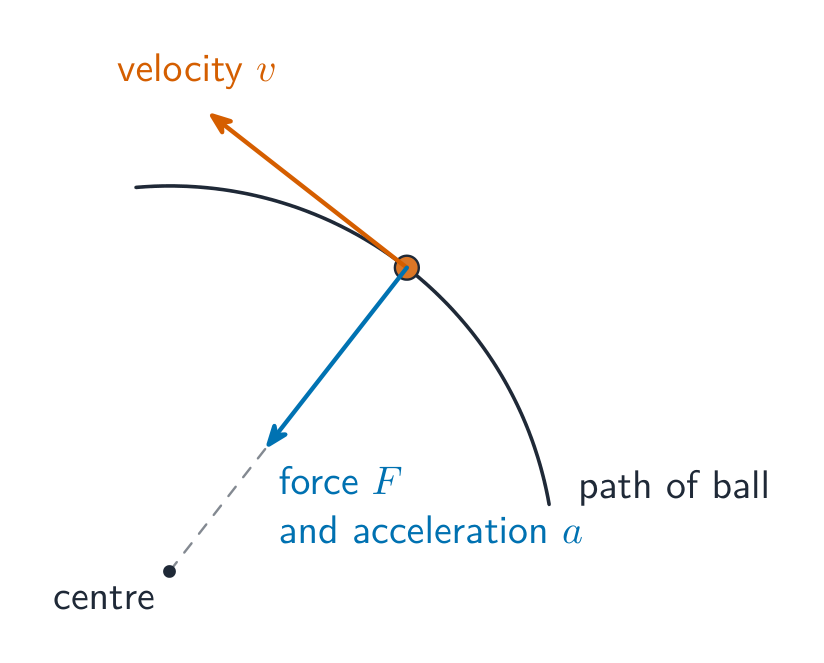
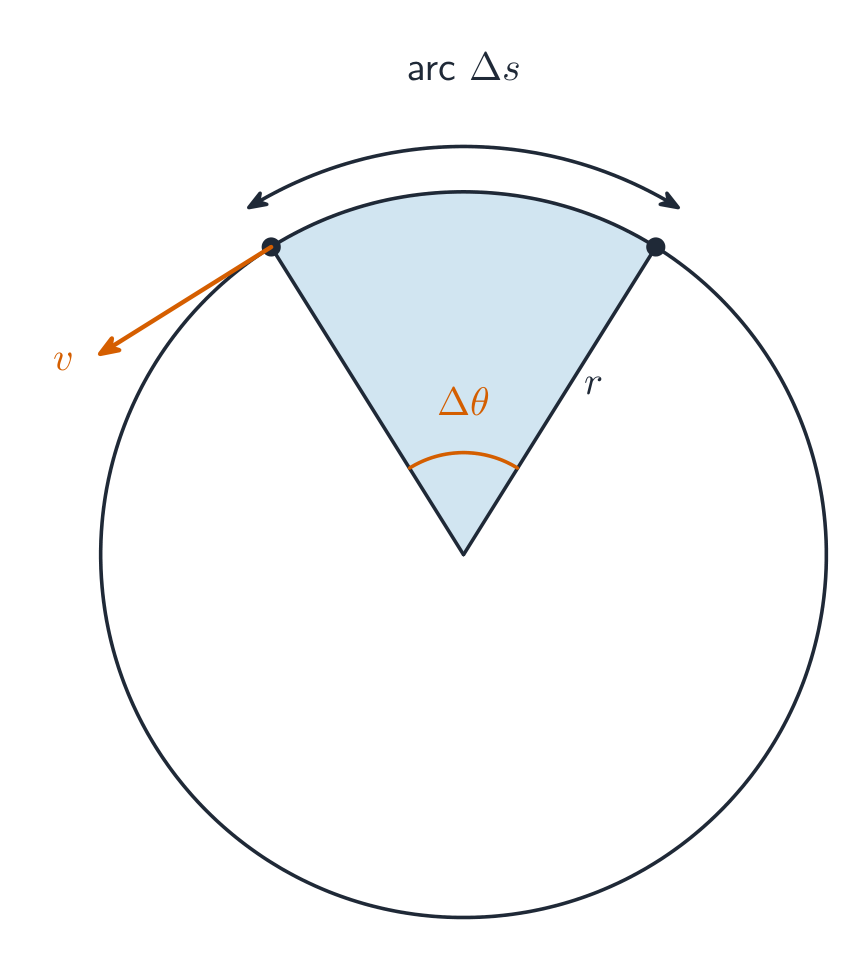
    速度は接線に沿って、向心力は中心に向かう
    速度は接線に沿って、向心力は中心に向かう
    2.10

    Exam tips · ⁨試験対策⁩

    English
    • Locate the center of mass with $x_{cm}=\tfrac{1}{M}\int x\,dm$ (or $\tfrac{\sum m_i x_i}{\sum m_i}$ for point masses) and use $\lambda,\sigma,\rho$ for the mass element.
    • The net external force moves the center of mass as if all mass sat there: $\vec F_{net}=M\vec a_{cm}$.
    • Define your system clearly — internal forces cancel, so only external forces change its momentum.
    • Exploit symmetry to shortcut a center-of-mass integral.
    • Distinguish center of mass from center of gravity (identical in a uniform field).
    日本語
    • 重心を $x_{cm}=\tfrac{1}{M}\int x\,dm$ (点質量の場合は $\tfrac{\sum m_i x_i}{\sum m_i}$ )で特定し、質量要素には $\lambda,\sigma,\rho$ を用いる。
    • 外力の合力は、全質量がその位置にあるかのように重心を動かす: $\vec F_{net}=M\vec a_{cm}$。
    • 系を明確に定義する – 内部力は互いに相殺するため、運動量を変化させるのは外部力のみである。
    • 重心の積分計算を簡略化するために対称性を利用する。
    • 重心と重心(重力の中心)を区別する(均一な場では一致する)。
  • 3

    Work, Energy, and Power · ⁨仕事、エネルギー、および電力⁩

    Watch lesson · ⁨レッスンを視聴⁩
    3.1

    Translational Kinetic Energy

    Syllabus · ⁨シラバス⁩
    English

    Learning Objective 3.1.A: Describe the translational kinetic energy of an object in terms of the object's mass and velocity.

    • 3.1.A.1 An object's translational kinetic energy is given by the equation
      • Equation: $K = \dfrac{1}{2}mv^2$
    • 3.1.A.2 Translational kinetic energy is a scalar quantity.
    • 3.1.A.3 Different observers may measure different values of the translational kinetic energy of an object, depending on the observer's frame of reference.
    日本語

    学習目標 3.1.A: 物体の質量および速度を用いて、物体の並進運動エネルギーを説明せよ。

    • 3.1.A.1 物体の並進運動エネルギーは次の式で与えられる。
      • 式: $K = \dfrac{1}{2}mv^2$
    • 3.1.A.2 並進運動エネルギーはスカラー量である。
    • 3.1.A.3 観測者の参照系により異なり、異なる観測者が同一の物体の並進運動エネルギーの値を測定することがある。

    Source: College Board AP Course and Exam Description · ⁨出典: College Board AP コースおよび試験説明書⁩

    English

    Kinetic energy 动能 is the energy of motion, a scalar 标量 measured in joules 焦耳 (J):

    $$K=\tfrac{1}{2}mv^2.$$

    It grows with the square of speed – doubling the speed quadruples $K$. One subtlety worth knowing: kinetic energy depends on the observer's reference frame 参考系. A passenger walking down a train has a small $K$ measured inside the train and a huge one measured from the ground – both observers are right, each in their own frame.

    日本語

    Kinetic energy 动能 is the energy of motion, a scalar 标量 measured in joules 焦耳 (J):

    $$K=\tfrac{1}{2}mv^2.$$

    It grows with the square of speed – doubling the speed quadruples $K$. One subtlety worth knowing: kinetic energy depends on the observer's reference frame 参考系. A passenger walking down a train has a small $K$ measured inside the train and a huge one measured from the ground – both observers are right, each in their own frame.

    Vocabulary · ⁨語彙⁩ Train · ⁨練習する⁩
    English 日本語
    Kinetic energy/kɪˈnetɪk ˈenədʒi/ 運動エネルギー
    scalar/ˈskeɪlə/ スカラー
    joules/dʒuːlz/ ジュール
    reference frame/ˈrefrəns freɪm/ 座標系
    3.2

    Work

    Syllabus · ⁨シラバス⁩
    Learning ObjectiveEssential Knowledge

    3.2.A
    Describe the work done on an object or system by a given force or collection of forces.

    • 3.2.A.1 Work is the amount of energy transferred into or out of a system by a force exerted on that system over a distance.
      • 3.2.A.1.i The work done by a conservative force exerted on a system is path-independent and only depends on the initial and final configurations of that system.
      • 3.2.A.1.ii The work done by a conservative force on a system—or the change in the potential energy of the system—will be zero if the system returns to its initial configuration.
      • 3.2.A.1.iii Potential energies are associated only with conservative forces.
      • 3.2.A.1.iv The work done by a nonconservative force is path-dependent.
      • 3.2.A.1.v The most common nonconservative forces are friction and air resistance.
    • 3.2.A.2 Work is a scalar quantity that may be positive, negative, or zero.
    • 3.2.A.3 The work done on an object by a variable force is calculated using
      • Equation: $W = \displaystyle\int_a^b \vec{F}(r) \cdot d\vec{r}$, where the integral is taken over the path from point $a$ to point $b$.
      • 3.2.A.3.i The dot product between two vectors, $\vec{A}$ and $\vec{B}$, results in a scalar quantity of magnitude $\vec{A} \cdot \vec{B} = AB\cos\theta$.
      • 3.2.A.3.ii Only the component of the force exerted on a system that is parallel to the displacement of the point of application of the force will change the system's total energy.
      • 3.2.A.3.iii If the component of the force exerted on a system that is parallel to the displacement is constant, the work done on the system by the force is given by the derived equation $W = F_{\parallel}d = Fd\cos\theta$.
      • 3.2.A.3.iv The component of the force exerted on a system perpendicular to the direction of the displacement of the system's center of mass can change the direction of the system's motion without changing the system's kinetic energy.
    • 3.2.A.4 The work–energy theorem states that the change in an object's kinetic energy is equal to the sum of the work (net work) being done by all forces exerted on the object.
      • Equation: $\Delta K = \displaystyle\sum W_i = \sum F_{\parallel,i}\, d_i$
      • 3.2.A.4.i An external force may change the configuration of a system. The component of the external force parallel to the displacement times the displacement of the point of application of the force gives the change in kinetic energy of the system.
      • 3.2.A.4.ii If the system's center of mass and the point of application of the force move the same distance when a force is exerted on a system, then the system may be modeled as an object, and only the system's kinetic energy can change.
      • 3.2.A.4.iii The energy dissipated by friction is typically equated to the force of friction times the length of the path over which the force is exerted.
        • Equation: $\Delta E_{\text{mech}} = F_f d\cos\theta$
      • 3.2.A.5 Work is equal to the area under the curve of a graph of $F_{\parallel}$ as a function of displacement.

    Boundary statement: AP Physics C: Mechanics only expects students to analyze the transfer of mechanical energy, although students should be aware that mechanical energy may be dissipated in the form of thermal energy or sound.

    Source: College Board AP Course and Exam Description · ⁨出典: College Board AP コースおよび試験説明書⁩

    English

    Work 功 is energy transferred into or out of a system by a force acting over a distance. For a variable force it is an integral 积分 along the path:

    $$W=\int_a^b \vec{F}\cdot d\vec{r}=\int F\cos\theta\,dr.$$

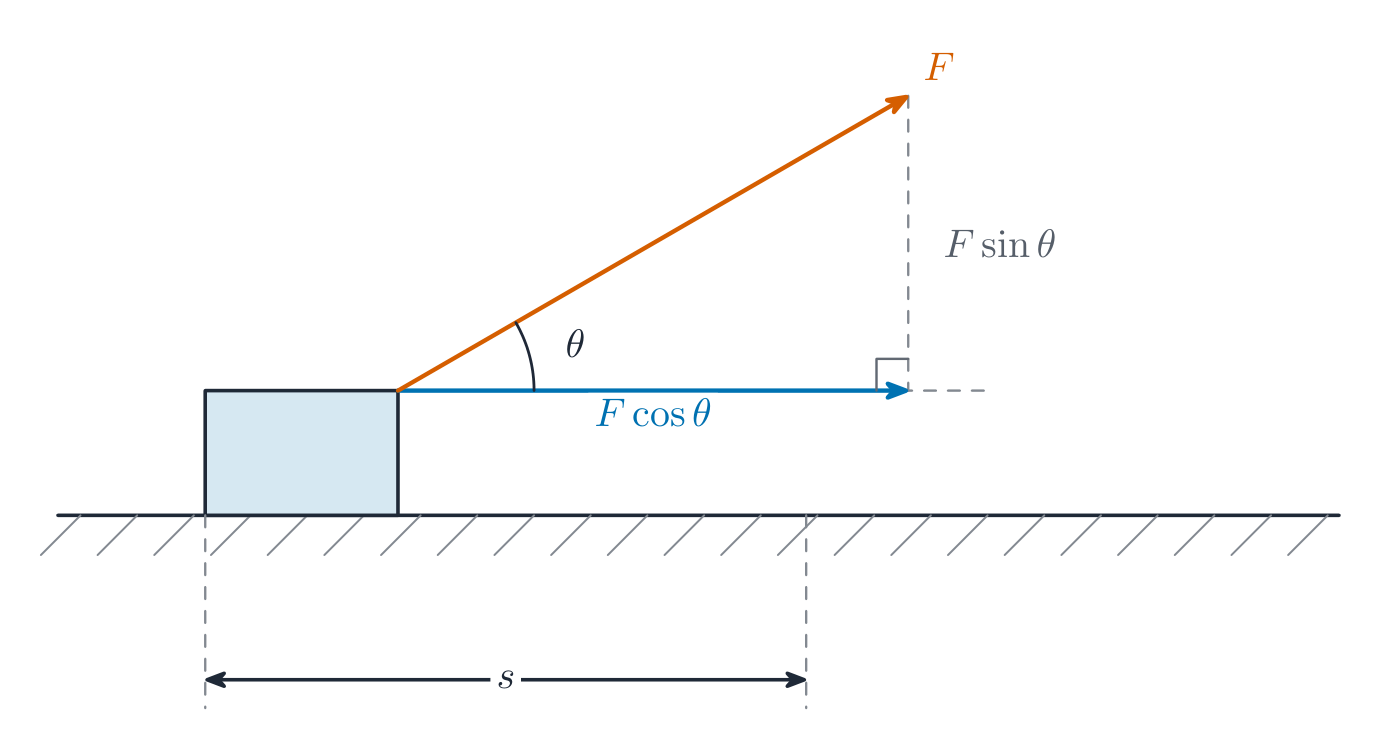
    For a constant force this reduces to $W=Fd\cos\theta$; on a force–position graph, work is the area under the curve. Work is a scalar with a sign, and the sign is physics, not bookkeeping:

    • Positive – force has a component along the motion (it speeds the object up).
    • Negative – force opposes the motion (friction 摩擦力 and air drag do negative work).
    • Zero – force perpendicular to the motion (the normal force 法向力 on a sliding block, gravity on a horizontal move, tension in a circular swing).

    The work–energy theorem 动能定理 collects every force's contribution: the net work equals the change in kinetic energy,

    $$W_{\text{net}}=\sum W_i=\Delta K.$$

    Worked example. A variable force $F(x)=3x^2\ \text{N}$ (along the motion) acts from $x=0$ to $x=2\ \text{m}$: $W=\displaystyle\int_0^2 3x^2\,dx=\big[x^3\big]_0^2=8\ \text{J}$. Acting alone on a body starting from rest, it would raise the kinetic energy to exactly $8\ \text{J}$.

    日本語

    Work 功 is energy transferred into or out of a system by a force acting over a distance. For a variable force it is an integral 积分 along the path:

    $$W=\int_a^b \vec{F}\cdot d\vec{r}=\int F\cos\theta\,dr.$$

    For a constant force this reduces to $W=Fd\cos\theta$; on a force–position graph, work is the area under the curve. Work is a scalar with a sign, and the sign is physics, not bookkeeping:

    • Positive – force has a component along the motion (it speeds the object up).
    • Negative – force opposes the motion (friction 摩擦力 and air drag do negative work).
    • Zero – force perpendicular to the motion (the normal force 法向力 on a sliding block, gravity on a horizontal move, tension in a circular swing).
    Only the force component along the displacement does work
    Only the force component along the displacement does work

    The work–energy theorem 动能定理 collects every force's contribution: the net work equals the change in kinetic energy,

    $$W_{\text{net}}=\sum W_i=\Delta K.$$

    Worked example. A variable force $F(x)=3x^2\ \text{N}$ (along the motion) acts from $x=0$ to $x=2\ \text{m}$: $W=\displaystyle\int_0^2 3x^2\,dx=\big[x^3\big]_0^2=8\ \text{J}$. Acting alone on a body starting from rest, it would raise the kinetic energy to exactly $8\ \text{J}$.

    Vocabulary · ⁨語彙⁩ Train · ⁨練習する⁩
    English 日本語
    Work/wɜːk/ 仕事
    integral/ˈɪntɪɡrəl/ 積分
    friction/ˈfrɪkʃn/ 摩擦力
    normal force/ˈnɔːml fɔːs/ 抗力(支持力)
    work–energy theorem/wɜːk ˈenədʒi ˈθɪərəm/ 仕事-エネルギーの定理
    3.3

    Potential Energy

    Syllabus · ⁨シラバス⁩
    Learning ObjectiveEssential Knowledge

    3.3.A
    Describe the potential energy of a system.

    • 3.3.A.1 A system composed of two or more objects has potential energy if the objects within that system only interact with each other through conservative forces.
    • 3.3.A.2 Potential energy is a scalar quantity associated with the position of objects within a system.
    • 3.3.A.3 The definition of zero potential energy for a given system is a decision made by the observer considering the situation to simplify or otherwise assist in analysis.
    • 3.3.A.4 The relationship between conservative forces exerted on a system and the system's potential energy is
      • Equation: $\Delta U = -\displaystyle\int_a^b \vec{F}_{cf}(r) \cdot d\vec{r}$
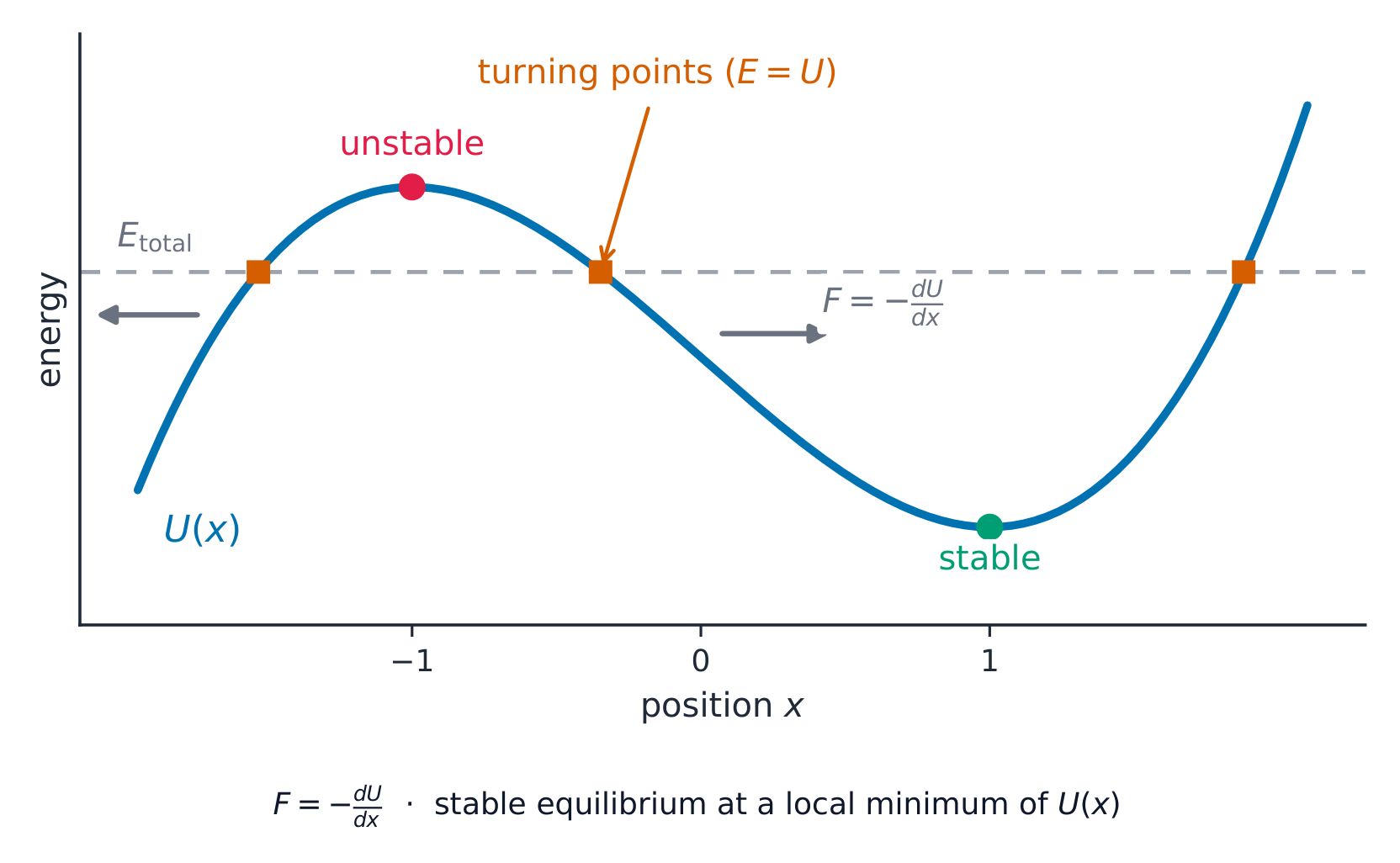
    • 3.3.A.5 The conservative forces exerted on a system in a single dimension can be determined using the slope of the system's potential energy with respect to position in that dimension; these forces point in the direction of decreasing potential energy.
      • Equation: $F_x = -\dfrac{dU(x)}{dx}$
    • 3.3.A.6 Graphs of a system's potential energy as a function of its position can be useful in determining physical properties of that system.
      • 3.3.A.6.i Stable equilibrium is a location at which a small displacement in an object's position results in a force exerted on the object opposite to the direction of the small displacement, accelerating the object back toward the equilibrium position.
      • 3.3.A.6.ii Unstable equilibrium is a location at which a small displacement in an object's position results in a force exerted on the object in the same direction as the small displacement, accelerating the object away from the equilibrium position.
      • 3.3.A.6.iii In a given dimension, stable equilibrium positions exist at locations where the potential energy as a function of position in that dimension has a local minimum.
      • 3.3.A.6.iv In a given dimension, unstable equilibrium positions occur at locations where the potential energy as a function of position in that dimension has a local maximum.
    • 3.3.A.7 The potential energy of common physical systems can be described using the physical properties of that system.
      • 3.3.A.7.i The elastic potential energy of an ideal spring is given by the following equation, where $\Delta x$ is the distance the spring has been stretched or compressed from its equilibrium length.
        • Equation: $U_s = \dfrac{1}{2}k(\Delta x)^2$
      • 3.3.A.7.ii The general form for the gravitational potential energy of a system consisting of two approximately spherical distributions of mass (e.g., moons, planets, or stars) is given by the equation
        • Equation: $U_g = -G\dfrac{m_1 m_2}{r}$
      • 3.3.A.7.iii Because the gravitational field near the surface of a planet is nearly constant, the change in gravitational potential energy in a system consisting of an object with mass $m$ and a planet with gravitational field of magnitude $g$ when the object is near the surface of the planet may be approximated by the equation
        • Equation: $\Delta U_g = mg\Delta y$
    • 3.3.A.8 The total potential energy of a system containing more than two objects is the sum of the potential energy of each pair of objects within the system.

    Source: College Board AP Course and Exam Description · ⁨出典: College Board AP コースおよび試験説明書⁩

    English

    Potential energy 势能 is energy a system stores by the positions of its parts – it exists only for conservative forces 保守力, whose work is path independent. It is defined through work:

    $$\Delta U=-\int_a^b\vec{F}\cdot d\vec{r},$$

    and you are free to choose where $U=0$ – only changes in $U$ matter, so pick the zero that makes the problem simplest. The standard results:

    • Gravity near a surface: $\Delta U_g=mg\,\Delta y$.
    • Gravity in general: $U_g=-\dfrac{Gm_1m_2}{r}$ (zero at infinite separation).
    • Spring: $U_s=\tfrac12k(\Delta x)^2$, with $\Delta x$ measured from natural length.

    For systems of several objects, add the potential energy of each pair. Turning the definition around, a conservative force is minus the derivative 导数 of its potential energy:

    $$F_x=-\frac{dU}{dx}.$$

    The force points "downhill" on the $U(x)$ curve. Equilibrium sits where the slope is zero: a minimum is a stable equilibrium 稳定平衡 (displaced, the force pushes back), a maximum is an unstable equilibrium 不稳定平衡 (displaced, the force pushes away).

    Worked example. Given $U(x)=2x^3-6x$ (joules), the force is $F=-\dfrac{dU}{dx}=6-6x^2$. Equilibria sit at $F=0$: $x=\pm1$. Since $\dfrac{d^2U}{dx^2}=12x$ is positive at $x=+1$ (a minimum – stable) and negative at $x=-1$ (a maximum – unstable), the two points behave oppositely.

    日本語

    Potential energy 势能 is energy a system stores by the positions of its parts – it exists only for conservative forces 保守力, whose work is path independent. It is defined through work:

    $$\Delta U=-\int_a^b\vec{F}\cdot d\vec{r},$$

    and you are free to choose where $U=0$ – only changes in $U$ matter, so pick the zero that makes the problem simplest. The standard results:

    • Gravity near a surface: $\Delta U_g=mg\,\Delta y$.
    • Gravity in general: $U_g=-\dfrac{Gm_1m_2}{r}$ (zero at infinite separation).
    • Spring: $U_s=\tfrac12k(\Delta x)^2$, with $\Delta x$ measured from natural length.

    For systems of several objects, add the potential energy of each pair. Turning the definition around, a conservative force is minus the derivative 导数 of its potential energy:

    $$F_x=-\frac{dU}{dx}.$$

    The force points "downhill" on the $U(x)$ curve. Equilibrium sits where the slope is zero: a minimum is a stable equilibrium 稳定平衡 (displaced, the force pushes back), a maximum is an unstable equilibrium 不稳定平衡 (displaced, the force pushes away).

    On a potential-energy curve the force points downhill and E = U marks the turning points
    On a potential-energy curve the force points downhill and E = U marks the turning points

    Worked example. Given $U(x)=2x^3-6x$ (joules), the force is $F=-\dfrac{dU}{dx}=6-6x^2$. Equilibria sit at $F=0$: $x=\pm1$. Since $\dfrac{d^2U}{dx^2}=12x$ is positive at $x=+1$ (a minimum – stable) and negative at $x=-1$ (a maximum – unstable), the two points behave oppositely.

    Explore · ⁨探索⁩

    Store elastic potential energy in a spring · ⁨バネに弾性位置エネルギーを蓄える⁩

    Stretching a spring stores elastic potential energy $\tfrac12 kx^2$ — the area under the force-extension line. Release it and that energy becomes kinetic. · ⁨スプリングを伸ばすと弾性ポテンシャルエネルギー $\tfrac12 kx^2$ — 力-伸長曲線下面的積 — が蓄えられます。解放するとそのエネルギーは運動エネルギーに変化します。⁩

    Vocabulary · ⁨語彙⁩ Train · ⁨練習する⁩
    English 日本語
    Potential energy/pəˈtenʃl ˈenədʒi/ 位置エネルギー
    conservative forces/kənˈsɜːvətɪv ˈfɔːsɪz/ 保存力
    derivative/dɪˈrɪvətɪv/ 導関数
    stable equilibrium/ˈsteɪbl ˌiːkwɪˈlɪbrɪəm/ 安定平衡
    unstable equilibrium/ʌnˈsteɪbl ˌiːkwɪˈlɪbrɪəm/ 不安定平衡
    3.4

    Conservation of Energy

    Syllabus · ⁨シラバス⁩
    English

    Learning Objective 3.4.A: Describe the energies present in a system.

    • 3.4.A.1 A system composed of only a single object can only have kinetic energy.
    • 3.4.A.2 A system that contains objects that interact via conservative forces or that can change its shape reversibly may have both kinetic and potential energies.

    Learning Objective 3.4.B: Describe the behavior of a system using conservation of mechanical energy principles.

    • 3.4.B.1 Mechanical energy is the sum of a system's kinetic and potential energies.
    • 3.4.B.2 Any change to a type of energy within a system must be balanced by an equivalent change of other types of energies within the system or by a transfer of energy between the system and its surroundings.
    • 3.4.B.3 A system may be selected so that the total energy of that system is constant.
    • 3.4.B.4 If the total energy of a system changes, that change will be equivalent to the energy transferred into or out of the system.

    Learning Objective 3.4.C: Describe how the selection of a system determines whether the energy of that system changes.

    • 3.4.C.1 Energy is conserved in all interactions.
    • 3.4.C.2 If the work done on a selected system is zero and there are no nonconservative interactions within the system, the total mechanical energy of the system is constant.
    • 3.4.C.3 If the work done on a selected system is nonzero, energy is transferred between the system and the environment.

    Boundary statement: AP Physics C: Mechanics expects students to know that mechanical energy can be dissipated as thermal energy or sound by nonconservative forces.

    日本語

    学習目標 3.4.A: 系に含まれるエネルギーを説明せよ。

    • 3.4.A.1 単一の物体のみからなる系は、運動エネルギーのみを持つことができる。
    • 3.4.A.2 保存力によって相互作用する物体を含む系、または形状を可逆的に変化させうる系は、運動エネルギーとポテンシャルエネルギーの両方を持つことがある。

    学習目標 3.4.B: 機械的エネルギー保存の原理を用いて、系の挙動を説明せよ。

    • 3.4.B.1 力学的エネルギーは、系の運動エネルギーとポテンシャルエネルギーの和である。
    • 3.4.B.2 系内のある種的能量の変化に対しては、その変化分が等しい他の種的能量の変化によって相殺されるか、または系と環境との間でエネルギーが移動する必要がある。
    • 3.4.B.3 系の全エネルギーが一定となるような系を選択することができる。
    • 3.4.B.4 系の全エネルギーに変化が生じた場合、その変化量は系へ入ったエネルギーまたは系から出たエネルギーに等しい。

    学習目標 3.4.C: 系を選択することが、その系のエネルギーを変化させるかどうかを決定する方法を説明せよ。

    • 3.4.C.1 相互作用においてエネルギーは常に保存される。
    • 3.4.C.2 選択した系に対する仕事量がゼロであり、かつ系内に非保存的相互作用が存在しない場合、系の全力学的エネルギーは一定である。
    • 3.4.C.3 選択した系に対する仕事量がゼロでない場合、系と環境の間でエネルギーが移動する。

    境界声明: AP Physics C: Mechanicsでは、学生は非保存力によって機械エネルギーが熱エネルギーまたは音として散逸することを知らなければならないと求めている。

    Source: College Board AP Course and Exam Description · ⁨出典: College Board AP コースおよび試験説明書⁩

    English
    Energy conservation: KE ⇄ PE

    Energy is conserved in all interactions – the question is only where it goes. Mechanical energy 机械能 is the sum $E=K+U$. If the external work on a system is zero and nothing inside it acts through nonconservative forces 非保守力, then

    $$K_1+U_1=K_2+U_2.$$

    When friction or drag act, they convert mechanical energy into thermal energy 热能 ($\Delta E_{\text{mech}}=-F_fd$), and the balance must include that term. If external work is done, the system's total energy changes by exactly the energy transferred: $W_{\text{ext}}=\Delta E_{\text{sys}}$. Choosing the system is choosing the bookkeeping – a single object can only have kinetic energy; include the Earth or the spring and the system can store potential energy too.

    A potential-energy graph is a complete motion map: the horizontal line at height $E$ is the total energy, the gap $E-U(x)$ is the kinetic energy at each $x$, and the crossings $E=U$ are the turning points 转折点 where the object momentarily stops and reverses.

    Worked example. A $2.0\ \text{kg}$ block slides down a ramp from rest at height $1.5\ \text{m}$, arriving at the bottom at $4.0\ \text{m/s}$. Energy accounting: $mgh=29.4\ \text{J}$ available; $\tfrac12mv^2=16\ \text{J}$ arrives as kinetic energy; so friction converted $29.4-16=13\ \text{J}$ into thermal energy along the way.

    日本語
    Energy conservation: KE ⇄ PE

    Energy is conserved in all interactions – the question is only where it goes. Mechanical energy 机械能 is the sum $E=K+U$. If the external work on a system is zero and nothing inside it acts through nonconservative forces 非保守力, then

    $$K_1+U_1=K_2+U_2.$$

    When friction or drag act, they convert mechanical energy into thermal energy 热能 ($\Delta E_{\text{mech}}=-F_fd$), and the balance must include that term. If external work is done, the system's total energy changes by exactly the energy transferred: $W_{\text{ext}}=\Delta E_{\text{sys}}$. Choosing the system is choosing the bookkeeping – a single object can only have kinetic energy; include the Earth or the spring and the system can store potential energy too.

    A pendulum trades gravitational potential energy for kinetic energy and back
    A pendulum trades gravitational potential energy for kinetic energy and back

    A potential-energy graph is a complete motion map: the horizontal line at height $E$ is the total energy, the gap $E-U(x)$ is the kinetic energy at each $x$, and the crossings $E=U$ are the turning points 转折点 where the object momentarily stops and reverses.

    Worked example. A $2.0\ \text{kg}$ block slides down a ramp from rest at height $1.5\ \text{m}$, arriving at the bottom at $4.0\ \text{m/s}$. Energy accounting: $mgh=29.4\ \text{J}$ available; $\tfrac12mv^2=16\ \text{J}$ arrives as kinetic energy; so friction converted $29.4-16=13\ \text{J}$ into thermal energy along the way.

    A roller coaster trades energy back and forth: highest (most PE) at the top, fastest (most KE) at the bottom
    A roller coaster trades energy back and forth: highest (most PE) at the top, fastest (most KE) at the bottom
    Explore · ⁨探索⁩

    Watch energy convert as an object falls · ⁨物体が落下する際のエネルギー変換を観察する⁩

    With no friction, mechanical energy is conserved: as an object falls, gravitational potential energy turns into kinetic energy while the total stays fixed. · ⁨摩擦がない場合、力学的エネルギーは保存される: 物体が落下する際、重力の位置エネルギーは運動エネルギーに変換され、合計は一定に保たれる。⁩

    Vocabulary · ⁨語彙⁩ Train · ⁨練習する⁩
    English 日本語
    Mechanical energy/mɪˈkænɪkl ˈenədʒi/ 機械的エネルギー
    nonconservative forces/ˌnɒŋkənˈsɜːvətɪv ˈfɔːsɪz/ 非保存力
    thermal energy/ˈθɜːml ˈenədʒi/ 熱エネルギーに変換する
    turning points/ˈtɜːnɪŋ pɔɪnts/ 反転点
    Watch lesson · ⁨レッスンを視聴⁩
    3.5

    Power

    Syllabus · ⁨シラバス⁩
    English

    Learning Objective 3.5.A: Describe the transfer of energy into, out of, or within a system in terms of power.

    • 3.5.A.1 Power is the rate at which energy changes with respect to time, either by transfer into or out of a system or by conversion from one type to another within a system.
    • 3.5.A.2 Average power is the amount of energy being transferred or converted, divided by the time it took for that transfer or conversion to occur.
      • Equation: $P_{\text{avg}} = \dfrac{\Delta E}{\Delta t}$
    • 3.5.A.3 Because work is the change in energy of an object or system due to a force, average power is the total work done, divided by the time during which that work was done.
      • Equation: $P_{\text{avg}} = \dfrac{W}{\Delta t}$
    • 3.5.A.4 The instantaneous power delivered to an object by a force is given by the equation
      • Equation: $P_{\text{inst}} = \dfrac{dW}{dt}$
    • 3.5.A.5 The instantaneous power delivered to an object by the component of a constant force parallel to the object's velocity can be described with the derived equation
      • Equation: $P_{\text{inst}} = F_{\parallel}v = Fv\cos\theta$
    日本語

    学習目標 3.5.A: パワーを用いて、系へのエネルギーの流入、流出、あるいは系内での移動を説明せよ。

    • 3.5.A.1 パワーとは、系へのエネルギーの流入・流出、あるいは系内でのエネルギーの変換に伴う時間あたりのエネルギーの変化率である。
    • 3.5.A.2 平均パワーとは、移動または変換されたエネルギーの量を、その移動または変換に要した時間で割った値である。
      • 式: $P_{\text{avg}} = \dfrac{\Delta E}{\Delta t}$
    • 3.5.A.3 力は物体や系のエネルギーの変化量であるため、平均パワーは行われた総仕事を、その仕事が行われた時間で割った値である。
      • 式: $P_{\text{avg}} = \dfrac{W}{\Delta t}$
    • 3.5.A.4 力が物体に与える瞬間的なacesは、次の式で与えられる。
      • 式: $P_{\text{inst}} = \dfrac{dW}{dt}$
    • 3.5.A.5 一定の力の中で物体の速度に平行な成分が物体に与える瞬間的なacesは、導出された式で記述できる。
      • 式: $P_{\text{inst}} = F_{\parallel}v = Fv\cos\theta$

    Source: College Board AP Course and Exam Description · ⁨出典: College Board AP コースおよび試験説明書⁩

    English

    Power 功率 is the rate of energy transfer, in watts 瓦特 (W):

    $$P_{\text{avg}}=\frac{\Delta E}{\Delta t}=\frac{W}{\Delta t},\qquad P_{\text{inst}}=\frac{dW}{dt}=\vec{F}\cdot\vec{v}.$$

    It measures how fast work is done, not how much. The dot product matters: only the force component along the velocity delivers power.

    Worked example. A block released from rest at the top of a frictionless $3.0\ \text{m}$-high ramp reaches the bottom at $v=\sqrt{2gh}=7.7\ \text{m/s}$ (from $mgh=\tfrac12mv^2$). A motor that then drives it at a steady $7.7\ \text{m/s}$ against a $20\ \text{N}$ resistance delivers $P=Fv=20(7.7)\approx150\ \text{W}$.

    Worked example. A $1200\ \text{kg}$ car climbs a hill that rises $1.0\ \text{m}$ for every $20\ \text{m}$ of road, at a steady $15\ \text{m/s}$. The engine must supply gravity's power drain: $P=mg\,v\sin\theta=1200(9.8)(15)\big(\tfrac{1}{20}\big)\approx8.8\ \text{kW}$ – before adding air resistance.

    Exam skill. Energy FRQs reward the accounting sentence: name your system, state which forces do work on it, and write the balance ($W_{\text{ext}}=\Delta K+\Delta U+\Delta E_{\text{thermal}}$) before plugging in numbers. "Friction is present, so mechanical energy is not conserved" is a scored statement.

    日本語

    Power 功率 is the rate of energy transfer, in watts 瓦特 (W):

    $$P_{\text{avg}}=\frac{\Delta E}{\Delta t}=\frac{W}{\Delta t},\qquad P_{\text{inst}}=\frac{dW}{dt}=\vec{F}\cdot\vec{v}.$$

    It measures how fast work is done, not how much. The dot product matters: only the force component along the velocity delivers power.

    Power is the slope of the work-time graph: the same work in less time means more power
    Power is the slope of the work-time graph: the same work in less time means more power

    Worked example. A block released from rest at the top of a frictionless $3.0\ \text{m}$-high ramp reaches the bottom at $v=\sqrt{2gh}=7.7\ \text{m/s}$ (from $mgh=\tfrac12mv^2$). A motor that then drives it at a steady $7.7\ \text{m/s}$ against a $20\ \text{N}$ resistance delivers $P=Fv=20(7.7)\approx150\ \text{W}$.

    Worked example. A $1200\ \text{kg}$ car climbs a hill that rises $1.0\ \text{m}$ for every $20\ \text{m}$ of road, at a steady $15\ \text{m/s}$. The engine must supply gravity's power drain: $P=mg\,v\sin\theta=1200(9.8)(15)\big(\tfrac{1}{20}\big)\approx8.8\ \text{kW}$ – before adding air resistance.

    Exam skill. Energy FRQs reward the accounting sentence: name your system, state which forces do work on it, and write the balance ($W_{\text{ext}}=\Delta K+\Delta U+\Delta E_{\text{thermal}}$) before plugging in numbers. "Friction is present, so mechanical energy is not conserved" is a scored statement.

    Vocabulary · ⁨語彙⁩ Train · ⁨練習する⁩
    English 日本語
    Power/ˈpaʊə/ power
    watts/wɒts/ ワット
    3.5

    Exam tips

    • Use the work–energy theorem $W_{net}=\Delta KE$ and compute work as $W=\int \vec F\cdot d\vec r$ for a variable force.
    • Read work off a force–position graph as the area under the curve.
    • Power is $P=\tfrac{dW}{dt}=\vec F\cdot\vec v$; watch instantaneous vs average.
    • Split forces into conservative (define a potential energy) and non-conservative (dissipate energy).
    • Choose energy methods over kinematics when the force varies or the path is complex.
  • 4

    Linear Momentum · ⁨線形運動量⁩

    Watch lesson · ⁨レッスンを視聴⁩
    4.1

    Linear Momentum

    Syllabus · ⁨シラバス⁩
    English

    Learning Objective 4.1.A: Describe the linear momentum of an object or system.

    • 4.1.A.1 Linear momentum is defined by the equation $\vec{p} = m\vec{v}$.
    • 4.1.A.2 Momentum is a vector quantity and has the same direction as the velocity.
    • 4.1.A.3 Momentum can be used to analyze collisions and explosions.
      • 4.1.A.3.i A collision is a model for an interaction where the forces exerted between the involved objects in the system are much larger than the net external force exerted on those objects during the interaction.
      • 4.1.A.3.ii As only the initial and final states of a collision are analyzed, the object model may be used to analyze collisions.
      • 4.1.A.3.iii An explosion is a model for an interaction in which forces internal to the system move objects within that system apart.
    日本語

    学習目標 4.1.A: 物体や系の線形運動量を説明せよ。

    • 4.1.A.1 線形運動量は方程式 $\vec{p} = m\vec{v}$ で定義される。
    • 4.1.A.2 運動量はベクトル量であり、速度と同じ方向を持つ。
    • 4.1.A.3 衝突や爆発の解析には運動量を使用できる。
      • 4.1.A.3.i 衝突とは、相互作用中に系内の対象物間に働く力が、その対象物に働く正味の外力よりもはるかに大きい相互作用のモデルである。
      • 4.1.A.3.ii 衝突の初期状態と最終状態のみを解析するため、質点モデルを用いて衝突を解析することができる。
      • 4.1.A.3.iii 爆発とは、系内部の力が系内の対象物を互いに離すように動かす相互作用のモデルである。

    Source: College Board AP Course and Exam Description · ⁨出典: College Board AP コースおよび試験説明書⁩

    English

    Linear momentum 动量 is mass times velocity:

    $$\vec{p}=m\vec{v}.$$

    It is a vector 矢量 pointing along the velocity, and it is the quantity for analysing collisions 碰撞 and explosions 爆炸. A collection of objects can be treated as one system moving with the velocity of its center of mass 质心:

    $$\vec{v}_{\text{cm}}=\frac{\sum m_i\vec{v}_i}{\sum m_i},$$

    so the system's total momentum is its total mass times $\vec{v}_{\text{cm}}$ – one object's worth of bookkeeping for any number of parts.

    日本語

    Linear momentum 动量 is mass times velocity:

    $$\vec{p}=m\vec{v}.$$

    It is a vector 矢量 pointing along the velocity, and it is the quantity for analysing collisions 碰撞 and explosions 爆炸. A collection of objects can be treated as one system moving with the velocity of its center of mass 质心:

    $$\vec{v}_{\text{cm}}=\frac{\sum m_i\vec{v}_i}{\sum m_i},$$

    so the system's total momentum is its total mass times $\vec{v}_{\text{cm}}$ – one object's worth of bookkeeping for any number of parts.

    Vocabulary · ⁨語彙⁩ Train · ⁨練習する⁩
    English 日本語
    Linear momentum/ˈlɪnɪə məʊˈmentəm/ 直線運動量
    vector/ˈvektə/ ベクトル
    collisions/kəˈlɪʒnz/ 衝突
    explosions/ekˈspləʊʒnz/ 爆発
    center of mass/ˈsentə ɒv mæs/ 重心
    4.2

    Change in Momentum and Impulse

    Syllabus · ⁨シラバス⁩
    English

    Learning Objective 4.2.A: Describe the impulse delivered to an object or system.

    • 4.2.A.1 The rate of change of a system's momentum is equal to the net external force exerted on that system.
      • Equation: $\vec{F}_{\text{net}} = \dfrac{d\vec{p}}{dt}$
    • 4.2.A.2 Impulse is defined as the integral of a force exerted on an object or system over a time interval.
      • Equation: $\vec{J} = \displaystyle\int_{t_1}^{t_2} \vec{F}_{\text{net}}(t)\,dt$
    • 4.2.A.3 Impulse is a vector quantity and has the same direction as the net force exerted on the system.
    • 4.2.A.4 The impulse delivered to a system by a net external force is equal to the area under the curve of a graph of the net external force exerted on the system as a function of time.
    • 4.2.A.5 The net external force exerted on a system is equal to the slope of a graph of the momentum of the system as a function of time.

    Learning Objective 4.2.B: Describe the relationship between the impulse exerted on an object or system and the change in momentum of the object or system.

    • 4.2.B.1 Change in momentum is the difference between a system's final momentum and its initial momentum.
      • Equation: $\Delta\vec{p} = \vec{p} - \vec{p}_0$
    • 4.2.B.2 The impulse–momentum theorem relates the impulse delivered to an object and the object's change in momentum.
      • 4.2.B.2.i The impulse exerted on an object is equal to the object's change in momentum.
        • Equation: $\vec{J} = \displaystyle\int_{t_1}^{t_2} \vec{F}_{\text{net}}(t)\,dt = \Delta\vec{p}$
      • 4.2.B.2.ii Newton's second law of motion is a direct result of the impulse–momentum theorem applied to systems with constant mass.
        • Equation: $\vec{F}_{\text{net}} = \dfrac{d\vec{p}}{dt} = m\dfrac{d\vec{v}}{dt} = m\vec{a}$
      • 4.2.B.2.iii The impulse–momentum theorem also describes the behavior of a system in which the velocity is constant but the mass changes with respect to time.
        • Equation: $\vec{F}_{\text{net}} = \dfrac{d\vec{p}}{dt} = \dfrac{dm}{dt}\vec{v}$
    日本語

    学習目標 4.2.A: 物体や系に与えられたインパルスを説明せよ。

    • 4.2.A.1 システムの運動量の変化率は、そのシステムに作用する正味の外力に等しい。
      • 式: $\vec{F}_{\text{net}} = \dfrac{d\vec{p}}{dt}$
    • 4.2.A.2 インパルスは、ある物体やシステムに一定時間間隔で作用する力の積分として定義される。
      • 式: $\vec{J} = \displaystyle\int_{t_1}^{t_2} \vec{F}_{\text{net}}(t)\,dt$
    • 4.2.A.3 インパルスはベクトル量であり、系に働く正味の力と同じ方向を持つ。
    • 4.2.A.4 正味の外力による系へのインパルスは、正味の外力を横軸、時間を縦軸としたグラフの曲线下の面積に等しい。
    • 4.2.A.5 系に働く正味の外力は、運動量を横軸、時間を縦軸としたグラフの傾きに等しい。

    学習目標 4.2.B: 物体やシステムに作用するインパルスと、その物体やシステムの運動量の変化との関係について説明する。

    • 4.2.B.1 運動量の変化とは、系の最終運動量から初期運動量を引いた差である。
      • 式: $\Delta\vec{p} = \vec{p} - \vec{p}_0$
    • 4.2.B.2 インパルス-運動量の定理は、物体に与えられたインパルスと物体の運動量の変化との関係を結ぶ。
      • 4.2.B.2.i 物体に作用するインパルスは、その物体の運動量の変化に等しい。
        • 数式: $\vec{J} = \displaystyle\int_{t_1}^{t_2} \vec{F}_{\text{net}}(t)\,dt = \Delta\vec{p}$
      • 4.2.B.2.ii ニュートンの運動の第二法則は、質量が一定のシステムにインパルス-運動量の定理を適用した結果である。
        • 数式: $\vec{F}_{\text{net}} = \dfrac{d\vec{p}}{dt} = m\dfrac{d\vec{v}}{dt} = m\vec{a}$
      • 4.2.B.2.iii インパルス-運動量の定理は、速度は一定だが質量が時間に依存して変化するシステムにおける振る舞いも記述する。
        • 数式: $\vec{F}_{\text{net}} = \dfrac{d\vec{p}}{dt} = \dfrac{dm}{dt}\vec{v}$

    Source: College Board AP Course and Exam Description · ⁨出典: College Board AP コースおよび試験説明書⁩

    English

    Newton's second law is really a statement about momentum:

    $$\vec{F}_{\text{net}}=\frac{d\vec{p}}{dt},$$

    which reduces to $m\vec{a}$ when the mass is constant – and handles a changing mass when it is not (the special case $\vec{F}=\dfrac{dm}{dt}\vec{v}$ holds only when the velocity is constant, e.g. a chain piling onto a scale or sand landing on a belt moving at fixed speed; a rocket does not fit, since it accelerates). The impulse 冲量 delivered by a force is its time integral, and the impulse–momentum theorem 冲量-动量定理 says it equals the change in momentum:

    $$\vec{J}=\int_{t_1}^{t_2}\vec{F}_{\text{net}}\,dt=\Delta\vec{p}.$$

    Impulse is a vector along the net force. Read it off graphs both ways:

    • On a force–time graph, impulse is the area under the curve.
    • On a momentum–time graph, the net force is the slope 斜率 at each instant.

    Spreading the same $\Delta p$ over a longer time lowers the force – that is why airbags, crumple zones, and soft landings work, and why you bend your knees when you land.

    Worked example. A time-varying force $F(t)=10t\ \text{N}$ acts on a $2.0\ \text{kg}$ object for $2.0\ \text{s}$. The impulse is $J=\displaystyle\int_0^2 10t\,dt=\big[5t^2\big]_0^2=20\ \text{N}\cdot\text{s}$, so the speed changes by $\Delta v=J/m=10\ \text{m/s}$.

    日本語

    Newton's second law is really a statement about momentum:

    $$\vec{F}_{\text{net}}=\frac{d\vec{p}}{dt},$$

    which reduces to $m\vec{a}$ when the mass is constant – and handles a changing mass when it is not (the special case $\vec{F}=\dfrac{dm}{dt}\vec{v}$ holds only when the velocity is constant, e.g. a chain piling onto a scale or sand landing on a belt moving at fixed speed; a rocket does not fit, since it accelerates). The impulse 冲量 delivered by a force is its time integral, and the impulse–momentum theorem 冲量-动量定理 says it equals the change in momentum:

    $$\vec{J}=\int_{t_1}^{t_2}\vec{F}_{\text{net}}\,dt=\Delta\vec{p}.$$

    Impulse is a vector along the net force. Read it off graphs both ways:

    • On a force–time graph, impulse is the area under the curve.
    • On a momentum–time graph, the net force is the slope 斜率 at each instant.
    Impulse is the area under the force-time curve, equal to the average force times the contact time
    Impulse is the area under the force-time curve, equal to the average force times the contact time

    Spreading the same $\Delta p$ over a longer time lowers the force – that is why airbags, crumple zones, and soft landings work, and why you bend your knees when you land.

    Worked example. A time-varying force $F(t)=10t\ \text{N}$ acts on a $2.0\ \text{kg}$ object for $2.0\ \text{s}$. The impulse is $J=\displaystyle\int_0^2 10t\,dt=\big[5t^2\big]_0^2=20\ \text{N}\cdot\text{s}$, so the speed changes by $\Delta v=J/m=10\ \text{m/s}$.

    Vocabulary · ⁨語彙⁩ Train · ⁨練習する⁩
    English 日本語
    impulse/ˈɪmpʌls/ lv ra
    impulse–momentum theorem/ˈɪmpʌls məʊˈmentəm ˈθɪərəm/ インパルス-運動量の定理
    slope/sləʊp/ 傾き
    4.3

    Conservation of Linear Momentum

    Syllabus · ⁨シラバス⁩
    English

    Learning Objective 4.3.A: Describe the behavior of a system using conservation of linear momentum.

    • 4.3.A.1 A collection of objects with individual momenta can be described as one system with one center-of-mass velocity.
      • 4.3.A.1.i For a collection of objects, the velocity of a system's center of mass can be calculated using the equation
        • Equation: $\vec{v}_{\text{cm}} = \dfrac{\sum \vec{p}_i}{\sum m_i} = \dfrac{\sum (m_i \vec{v}_i)}{\sum m_i}$
      • 4.3.A.1.ii The velocity of a system's center of mass is constant in the absence of a net external force.
    • 4.3.A.2 The total momentum of a system is the sum of the momenta of the system's constituent parts.
    • 4.3.A.3 In the absence of net external forces, any change to the momentum of an object within a system must be balanced by an equivalent and opposite change of momentum elsewhere within the system. Any change to the momentum of a system is due to a transfer of momentum between the system and its surroundings.
      • 4.3.A.3.i The impulse exerted by one object on a second object is equal and opposite to the impulse exerted by the second object on the first. This is a direct result of Newton's third law.
      • 4.3.A.3.ii A system may be selected so that the total momentum of that system is constant.
      • 4.3.A.3.iii If the total momentum of a system changes, that change will be equivalent to the impulse exerted on the system.
        • Equation: $\vec{J} = \Delta\vec{p}$
    • 4.3.A.4 Correct application of conservation of momentum can be used to determine the velocity of a system immediately before and immediately after collisions or explosions.

    Boundary statement: AP Physics C: Mechanics only expects students to quantitatively analyze collisions and interactions in one or two dimensions. Three-dimensional collisions may be analyzed qualitatively.

    Learning Objective 4.3.B: Describe how the selection of a system determines whether the momentum of that system changes.

    • 4.3.B.1 Momentum is conserved in all interactions.
    • 4.3.B.2 If the net external force on the selected system is zero, the total momentum of the system is constant.
    • 4.3.B.3 If the net external force on the selected system is nonzero, momentum is transferred between the system and the environment.
    日本語

    学習目標 4.3.A: 線形運動量の保存則を用いて、系の挙動を説明せよ。

    • 4.3.A.1 個別の運動量を持つ複数の対象物の集合体は、一つの系として、一つの重心速度で記述できる。
      • 4.3.A.1.i 物体の集合に対して、システムの重心の速度は以下の式を用いて計算できる
        • 数式: $\vec{v}_{\text{cm}} = \dfrac{\sum \vec{p}_i}{\sum m_i} = \dfrac{\sum (m_i \vec{v}_i)}{\sum m_i}$
      • 4.3.A.1.ii 正味の外力が存在しない場合、系の重心の速度は一定である。
    • 4.3.A.2 系の全運動量は、系を構成する各部分の運動量の和である。
    • 4.3.A.3 正味の外力が存在しない場合、系内の物体の運動量に変化が生じれば、それは系内の他箇所で等しく逆の運動量の変化によって相殺される。系の運動量の変化は、系と環境との間での運動量の移動によるものである。
      • 4.3.A.3.i 第一の物体が第二の物体に与えるインパルスは、第二の物体が第一の物体に与えるインパルスと大きさが等しく向きが逆向きである。これはニュートンの第三法則の直接的な結果である。
      • 4.3.A.3.ii 系の全運動量が一定となるような系を選択できる。
      • 4.3.A.3.iii 系の全運動量に変化が生じた場合、その変化量は系に作用した沖合と等しい。
        • 数式: $\vec{J} = \Delta\vec{p}$
    • 4.3.A.4 運動量の保存則の適切な適用により、衝突や爆発の直前および直後の系の速度を求めることができる。

    範囲の声明: AP Physics C: Mechanicsでは、学生には一または二つの次元での衝突や相互作用を定量的に解析することが期待されている。三次元の衝突については定性的な解析のみが対象となる。

    学習目標 4.3.B: 系の選択が、その系の運動量の変化の有無を決定する方法を説明する。

    • 4.3.B.1 運動量はあらゆる相互作用において保存される。
    • 4.3.B.2 選択した系に働く合力がゼロの場合、系の全運動量は一定である。
    • 4.3.B.3 選択した系に働く合力がゼロでない場合、運動量は系と環境の間でやり取りされる。

    Source: College Board AP Course and Exam Description · ⁨出典: College Board AP コースおよび試験説明書⁩

    English

    Internal forces come in Newton's-third-law pairs, so they cancel inside any system: they can shuffle momentum between parts but never change the total. Momentum only enters or leaves a system through a net external force ($\vec{J}=\Delta\vec{p}$). So, with zero net external force, total momentum is conserved 守恒:

    $$\sum\vec{p}_{\text{before}}=\sum\vec{p}_{\text{after}}.$$

    Momentum is conserved in every collision, however violent – choose the system large enough that the collision forces are internal. Apply conservation separately along each axis; AP asks for quantitative work in one or two dimensions.

    Worked example (explosion). A $6.0\ \text{kg}$ shell at rest splits into a $2.0\ \text{kg}$ piece moving at $9.0\ \text{m/s}$ east and a $4.0\ \text{kg}$ piece. Total momentum stays zero, so the heavy piece moves west at $v=\dfrac{2.0(9.0)}{4.0}=4.5\ \text{m/s}$. The kinetic energy came from stored (chemical or spring) energy – momentum conservation does not require kinetic-energy conservation.

    日本語

    Internal forces come in Newton's-third-law pairs, so they cancel inside any system: they can shuffle momentum between parts but never change the total. Momentum only enters or leaves a system through a net external force ($\vec{J}=\Delta\vec{p}$). So, with zero net external force, total momentum is conserved 守恒:

    $$\sum\vec{p}_{\text{before}}=\sum\vec{p}_{\text{after}}.$$

    Momentum is conserved in every collision, however violent – choose the system large enough that the collision forces are internal. Apply conservation separately along each axis; AP asks for quantitative work in one or two dimensions.

    A head-on collision: total momentum before equals total momentum after
    A head-on collision: total momentum before equals total momentum after

    Worked example (explosion). A $6.0\ \text{kg}$ shell at rest splits into a $2.0\ \text{kg}$ piece moving at $9.0\ \text{m/s}$ east and a $4.0\ \text{kg}$ piece. Total momentum stays zero, so the heavy piece moves west at $v=\dfrac{2.0(9.0)}{4.0}=4.5\ \text{m/s}$. The kinetic energy came from stored (chemical or spring) energy – momentum conservation does not require kinetic-energy conservation.

    Explore · ⁨探索⁩

    Collide two carts and conserve momentum · ⁨2台の cart を衝突させて運動量を保存する⁩

    In any collision the total momentum $\sum mv$ before equals the total after. Set the masses and speeds and check the momentum bookkeeping. · ⁨いかなる衝突でも、衝突前の総運動量 $\sum mv$ は衝突後のそれと等しい。質量と速度を設定して、運動量の計算を確認せよ。⁩

    Vocabulary · ⁨語彙⁩ Train · ⁨練習する⁩
    English 日本語
    conserved/kənˈsɜːvd/ 保存されている
    4.4

    Elastic and Inelastic Collisions

    Syllabus · ⁨シラバス⁩
    English

    Learning Objective 4.4.A: Describe whether an interaction between objects is elastic or inelastic.

    • 4.4.A.1 An elastic collision between objects is one in which the initial kinetic energy of the system is equal to the final kinetic energy of the system.
    • 4.4.A.2 In an elastic collision, the final kinetic energies of each of the objects within the system may be different from their initial kinetic energies.
    • 4.4.A.3 An inelastic collision between objects is one in which the total kinetic energy of the system decreases.
    • 4.4.A.4 In an inelastic collision, some of the initial kinetic energy is not restored to kinetic energy but is transformed by nonconservative forces into other forms of energy.
    • 4.4.A.5 In a perfectly inelastic collision, the objects stick together and move with the same velocity after the collision.
    日本語

    学習目標 4.4.A: 物体間の相互作用が弾性か非弾性かを説明する。

    • 4.4.A.1 弾性衝突とは、系の初期運動エネルギーが最終運動エネルギーと等しい衝突のことである。
    • 4.4.A.2 弾性衝突においては、系内の各物体の最終運動エネルギーは、初期運動エネルギーと異なることがある。
    • 4.4.A.3 非弾性衝突とは、系の全運動エネルギーが減少する衝突のことである。
    • 4.4.A.4 非弾性衝突では、初期運動エネルギーの一部が運動エネルギーとして戻されず、保存力以外の力によって他の形のエネルギーに変換される。
    • 4.4.A.5 完全に非弾性衝突では、衝突後に物体同士がくっついて同じ速度で動く。

    Source: College Board AP Course and Exam Description · ⁨出典: College Board AP コースおよび試験説明書⁩

    English
    Conservation of momentum in a collision

    All collisions conserve momentum; they differ in what happens to the kinetic energy 动能:

    type momentum kinetic energy
    elastic collision 弹性碰撞 conserved total conserved (individual shares may change)
    inelastic collision 非弹性碰撞 conserved decreases – some becomes heat, sound, deformation 形变
    perfectly inelastic collision 完全非弹性碰撞 conserved largest possible loss – the objects stick and share one velocity

    Strategy: always write momentum conservation first; add the kinetic-energy equation only when the problem says "elastic". Two useful elastic facts: equal masses in a 1D elastic collision simply exchange velocities, and in the center-of-mass frame each object just reverses its velocity.

    Worked example. A $1000\ \text{kg}$ car at $20\ \text{m/s}$ strikes a stationary $1500\ \text{kg}$ car and they lock together – perfectly inelastic. Momentum: $v=\dfrac{1000(20)}{2500}=8.0\ \text{m/s}$. Kinetic energy falls from $2.0\times10^5\ \text{J}$ to $\tfrac12(2500)(8.0)^2=8.0\times10^4\ \text{J}$: about $60\%$ is lost, even though momentum is exactly conserved.

    Worked example (2D). A puck moving east at $4.0\ \text{m/s}$ strikes an identical puck at rest; after the glancing hit, one moves at $2.0\ \text{m/s}$ at $60^\circ$ north of east. Conserve each axis: east–west, $m(4.0)=m(2.0)\cos60^\circ+mv_x$, so $v_x=3.0\ \text{m/s}$; north–south, $0=m(2.0)\sin60^\circ-mv_y$, so $v_y=1.7\ \text{m/s}$. The second puck moves at $\sqrt{3.0^2+1.7^2}=3.5\ \text{m/s}$, about $30^\circ$ south of east.

    Exam skill. On FRQs, justify with the condition, not the slogan: "the net external force on the two-puck system is zero during the collision, so its total momentum is constant." If asked whether the collision is elastic, compute the kinetic energy before and after and compare – never assume.

    日本語
    Conservation of momentum in a collision

    All collisions conserve momentum; they differ in what happens to the kinetic energy 动能:

    type momentum kinetic energy
    elastic collision 弹性碰撞 conserved total conserved (individual shares may change)
    inelastic collision 非弹性碰撞 conserved decreases – some becomes heat, sound, deformation 形变
    perfectly inelastic collision 完全非弹性碰撞 conserved largest possible loss – the objects stick and share one velocity

    Strategy: always write momentum conservation first; add the kinetic-energy equation only when the problem says "elastic". Two useful elastic facts: equal masses in a 1D elastic collision simply exchange velocities, and in the center-of-mass frame each object just reverses its velocity.

    Worked example. A $1000\ \text{kg}$ car at $20\ \text{m/s}$ strikes a stationary $1500\ \text{kg}$ car and they lock together – perfectly inelastic. Momentum: $v=\dfrac{1000(20)}{2500}=8.0\ \text{m/s}$. Kinetic energy falls from $2.0\times10^5\ \text{J}$ to $\tfrac12(2500)(8.0)^2=8.0\times10^4\ \text{J}$: about $60\%$ is lost, even though momentum is exactly conserved.

    Worked example (2D). A puck moving east at $4.0\ \text{m/s}$ strikes an identical puck at rest; after the glancing hit, one moves at $2.0\ \text{m/s}$ at $60^\circ$ north of east. Conserve each axis: east–west, $m(4.0)=m(2.0)\cos60^\circ+mv_x$, so $v_x=3.0\ \text{m/s}$; north–south, $0=m(2.0)\sin60^\circ-mv_y$, so $v_y=1.7\ \text{m/s}$. The second puck moves at $\sqrt{3.0^2+1.7^2}=3.5\ \text{m/s}$, about $30^\circ$ south of east.

    A glancing collision, resolved along two perpendicular axes
    A glancing collision, resolved along two perpendicular axes

    Exam skill. On FRQs, justify with the condition, not the slogan: "the net external force on the two-puck system is zero during the collision, so its total momentum is constant." If asked whether the collision is elastic, compute the kinetic energy before and after and compare – never assume.

    A Newton's cradle: five steel balls hanging in a row
    A Newton's cradle shows momentum and kinetic energy passing through a near-elastic collision
    Explore · ⁨探索⁩

    Compare elastic and inelastic collisions · ⁨弾性衝突と非弾性衝突を比較する⁩

    Momentum is always conserved, but kinetic energy is only conserved in an elastic collision. In an inelastic one the carts stick and some energy becomes heat. · ⁨運動量は常に保存されるが、運動エネルギー は 弾性衝突 のみで保存される。非弾性衝突 では cart がくっつき、一部のエネルギーが熱となる。⁩

    Vocabulary · ⁨語彙⁩ Train · ⁨練習する⁩
    English 日本語
    kinetic energy/kɪˈnetɪk ˈenədʒi/ 運動エネルギー
    elastic collision/ɪˈlæstɪk kəˈlɪʒn/ 弾性衝突
    inelastic collision/ɪnɪˈlæstɪk kəˈlɪʒn/ 非弾性衝突
    deformation/ˌdiːfɔːˈmeɪʃn/ 変形
    perfectly inelastic collision/ˈpɜːfektlɪ ɪnɪˈlæstɪk kəˈlɪʒn/ 完全非弾性衝突
    4.4

    Exam tips

    • Impulse equals the momentum change: $\vec J=\int \vec F\,dt=\Delta\vec p$, and it is the area under a force–time graph.
    • Momentum is conserved whenever the net external force is zero — always the go-to for collisions.
    • Distinguish elastic (kinetic energy conserved) from inelastic (kinetic energy decreases) collisions; in a perfectly inelastic collision the objects stick and move with one velocity.
    • Apply conservation to each component (x and y) separately in 2-D.
    • Connect to center of mass: total momentum $=M\vec v_{cm}$.
  • 5

    Torque and Rotational Dynamics · ⁨トルクと回転運動の力学⁩

    Watch lesson · ⁨レッスンを視聴⁩
    5.1

    Rotational Kinematics

    Syllabus · ⁨シラバス⁩
    English

    Learning Objective 5.1.A: Describe the rotation of a system with respect to time using angular displacement, angular velocity, and angular acceleration.

    • 5.1.A.1 Angular displacement is the measurement of the angle, in radians, through which a point on a rigid system rotates about a specified axis.
      • Equation: $\Delta\theta = \theta - \theta_0$
      • 5.1.A.1.i A rigid system is one that holds its shape but in which different points on the system move in different directions during rotation. A rigid system cannot be modeled as an object.
      • 5.1.A.1.ii One direction of angular displacement about an axis of rotation—clockwise or counterclockwise—is typically indicated as mathematically positive, with the other direction becoming mathematically negative.
      • 5.1.A.1.iii If the rotation of a system about an axis may be well described using the motion of the system's center of mass, the system may be treated as a single object. For example, the rotation of Earth about its axis may be considered negligible when considering the revolution of Earth about the center of mass of the Earth–Sun system.
    • 5.1.A.2 Angular velocity is the rate at which angular position changes with respect to time.
      • Equation: $\omega = \dfrac{d\theta}{dt}$
    • 5.1.A.3 Angular acceleration is the rate at which angular velocity changes with respect to time.
      • Equation: $\alpha = \dfrac{d\omega}{dt}$
    • 5.1.A.4 Angular displacement, angular velocity, and angular acceleration around one axis are analogous to linear displacement, velocity, and acceleration in one dimension and demonstrate the same mathematical relationships.
      • 5.1.A.4.i For constant angular acceleration, the mathematical relationships between angular displacement, angular velocity, and angular acceleration can be described with the following equations:
        • $\omega = \omega_0 + \alpha t$
        • $\theta = \theta_0 + \omega_0 t + \dfrac{1}{2}\alpha t^2$
        • $\omega^2 = \omega_0^2 + 2\alpha(\theta - \theta_0)$
      • 5.1.A.4.ii Graphs of angular displacement, angular velocity, and angular acceleration as functions of time can be used to find the relationships between those quantities.

    Boundary statement: AP Physics C: Mechanics expects students to be able to mathematically manipulate the magnitudes of angular displacement, angular velocity, and angular acceleration using vector conventions. However, the directions of said vectors will not be assessed on the exam.

    Descriptions of the directions of rotational kinematics quantities for a point or rigid body are limited to clockwise and counterclockwise with respect to a given axis of rotation.

    日本語

    学習目標 5.1.A: 角変位、角速度、角加速度を用いて、時間の経過に伴う系の回転を説明する。

    • 5.1.A.1 角変位とは、剛体系上の一点が特定の軸に対して回転する際の角度(ラジアン単位)の測定値である。
      • 式: $\Delta\theta = \theta - \theta_0$
      • 5.1.A.1.i 剛体系とは、形状を保ちつつも、回転中に系内の異なる点が異なる方向に動く系である。剛体系は単一の物体としてモデル化することはできない。
      • 5.1.A.1.ii 回転軸回りの角変位の一方の向き(時計回りまたは反時計回り)は通常数学的に正の符号で示され、もう一方の向きは数学的に負の符号となる。
      • 5.1.A.1.iii 系が軸周りに回転する様子が、その重心の運動を用いて十分に記述できる場合、系は単一の物体として扱える。例えば、地球-太陽系の重心周りの公転を考える際、地球の自転による運動は無視できるほど小さい。
    • 5.1.A.2 角速度とは、角位置が時間にどのように変化するかを表す rate(比率)である。
      • 式: $\omega = \dfrac{d\theta}{dt}$
    • 5.1.A.3 角加速度とは、角速度が時間にどのように変化するかを表す rate(比率)である。
      • 式: $\alpha = \dfrac{d\omega}{dt}$
    • 5.1.A.4 ある軸周りの角変位、角速度、角加速度は、一次元の線形変位、速度、加速度に対応するものであり、同様の数学的関係を示す。
      • 5.1.A.4.i 角加速度が一定の場合、角変位、角速度、角加速度の間の数学的関係は次の式で表される:
        • $\omega = \omega_0 + \alpha t$
        • $\theta = \theta_0 + \omega_0 t + \dfrac{1}{2}\alpha t^2$
        • $\omega^2 = \omega_0^2 + 2\alpha(\theta - \theta_0)$
      • 5.1.A.4.ii 角変位、角速度、角加速度を時間の関数としてプロットしたグラフを用いることで、これらの物理量の間の関係を求めることができる。

    範囲の声明: AP Physics C: Mechanicsでは、ベクトルの慣例を用いて角変位、角速度、および角加速度の大きさを数学的に操作できることが期待されている。しかし、これらのベクトルの方向は試験では評価されない。

    点または剛体に対する回転運動学量の方向の説明は、特定の回転軸に対して時計回りと反時計回りに限定される。

    Source: College Board AP Course and Exam Description · ⁨出典: College Board AP コースおよび試験説明書⁩

    English

    Rotation mirrors linear motion with angular quantities, defined as derivatives:

    $$\omega=\frac{d\theta}{dt},\qquad \alpha=\frac{d\omega}{dt}=\frac{d^2\theta}{dt^2}.$$

    Here $\theta$ is angular displacement 角位移 in radians 弧度, $\omega$ the angular velocity 角速度, and $\alpha$ the angular acceleration 角加速度. (AP works with their magnitudes and signs; the 3D vector directions are not assessed.) For constant $\alpha$, the kinematic equations are the linear ones re-lettered:

    $$\omega=\omega_0+\alpha t,\qquad \Delta\theta=\omega_0t+\tfrac12\alpha t^2,\qquad \omega^2=\omega_0^2+2\alpha\,\Delta\theta.$$

    Worked example. A fan blade slows from $30\ \text{rad/s}$ to rest with $\alpha=-6.0\ \text{rad/s}^2$: it takes $t=5.0\ \text{s}$ and turns through $\Delta\theta=\dfrac{0-30^2}{2(-6.0)}=75\ \text{rad}$ – about $12$ revolutions.

    日本語

    Rotation mirrors linear motion with angular quantities, defined as derivatives:

    $$\omega=\frac{d\theta}{dt},\qquad \alpha=\frac{d\omega}{dt}=\frac{d^2\theta}{dt^2}.$$

    Here $\theta$ is angular displacement 角位移 in radians 弧度, $\omega$ the angular velocity 角速度, and $\alpha$ the angular acceleration 角加速度. (AP works with their magnitudes and signs; the 3D vector directions are not assessed.) For constant $\alpha$, the kinematic equations are the linear ones re-lettered:

    $$\omega=\omega_0+\alpha t,\qquad \Delta\theta=\omega_0t+\tfrac12\alpha t^2,\qquad \omega^2=\omega_0^2+2\alpha\,\Delta\theta.$$
    One radian is the angle whose arc length equals the radius
    One radian is the angle whose arc length equals the radius

    Worked example. A fan blade slows from $30\ \text{rad/s}$ to rest with $\alpha=-6.0\ \text{rad/s}^2$: it takes $t=5.0\ \text{s}$ and turns through $\Delta\theta=\dfrac{0-30^2}{2(-6.0)}=75\ \text{rad}$ – about $12$ revolutions.

    Vocabulary · ⁨語彙⁩ Train · ⁨練習する⁩
    English 日本語
    angular displacement/ˈæŋɡjʊlə dɪˈspleɪsmənt/ 角変位の変化率である
    radians/ˈreɪdɪənz/ ラジアン
    angular velocity/ˈæŋɡjʊlə vəˈlɒsɪti/ 角速度の変化率である
    angular acceleration/ˈæŋɡjʊlə əkˌseləˈreɪʃn/ 角加速度
    5.2

    Connecting Linear and Rotational Motion

    Syllabus · ⁨シラバス⁩
    Learning ObjectiveEssential Knowledge

    5.2.A
    Describe the linear motion of a point on a rotating rigid system that corresponds to the rotational motion of that point, and vice versa.

    • 5.2.A.1 For a point at a distance $r$ from a fixed axis of rotation, the linear distance $s$ traveled by the point as the system rotates through an angle $\Delta\theta$ is given by the equation $\Delta s = r\Delta\theta$.
    • 5.2.A.2 Derived relationships of linear velocity and of the tangential component of acceleration to their respective angular quantities are given by the following equations:
      • $s = r\theta$
      • $v = r\omega$
      • $a_T = r\alpha$
    • 5.2.A.3 For a rigid system, all points within that system have the same angular velocity and angular acceleration.

    Boundary statement: AP Physics C: Mechanics expects students to be able to mathematically manipulate the magnitudes of angular displacement, angular velocity, and angular acceleration using vector conventions. However, the directions of the vectors will not be assessed on the exam.

    Descriptions of the directions of rotational kinematics quantities for a point or rigid body are limited to clockwise and counterclockwise with respect to a given axis of rotation.

    Source: College Board AP Course and Exam Description · ⁨出典: College Board AP コースおよび試験説明書⁩

    English

    A point at radius $r$ from the axis moves along its arc with

    $$s=r\theta,\qquad v=r\omega,\qquad a_t=r\alpha,$$

    so points farther out move faster. A rotating point generally has two acceleration components at once: the tangential acceleration 切向加速度 $a_t=r\alpha$ (speeding up along the arc) and the centripetal acceleration 向心加速度 $a_c=\dfrac{v^2}{r}=r\omega^2$ (turning, towards the axis). They are perpendicular, so $a=\sqrt{a_t^2+a_c^2}$.

    日本語

    A point at radius $r$ from the axis moves along its arc with

    $$s=r\theta,\qquad v=r\omega,\qquad a_t=r\alpha,$$

    so points farther out move faster. A rotating point generally has two acceleration components at once: the tangential acceleration 切向加速度 $a_t=r\alpha$ (speeding up along the arc) and the centripetal acceleration 向心加速度 $a_c=\dfrac{v^2}{r}=r\omega^2$ (turning, towards the axis). They are perpendicular, so $a=\sqrt{a_t^2+a_c^2}$.

    As the radius turns through an angle, a point moves along an arc at speed v
    As the radius turns through an angle, a point moves along an arc at speed v
    Vocabulary · ⁨語彙⁩ Train · ⁨練習する⁩
    English 日本語
    tangential acceleration/tænˈdʒenʃl əkˌseləˈreɪʃn/ 接線加速度を持つ
    centripetal acceleration/senˈtrɪpɪtl əkˌseləˈreɪʃn/ 向心加速度
    5.3

    Torque

    Syllabus · ⁨シラバス⁩
    English

    Learning Objective 5.3.A: Identify the torques exerted on a rigid system.

    • 5.3.A.1 Torque results only from the force component perpendicular to the position vector from the axis of rotation to the point of application of the force.
    • 5.3.A.2 The lever arm is the perpendicular distance from the axis of rotation to the line of action of the exerted force.

    Learning Objective 5.3.B: Describe the torques exerted on a rigid system.

    • 5.3.B.1 Torques can be described using force diagrams.
      • 5.3.B.1.i Force diagrams are similar to free-body diagrams and are used to analyze the torques exerted on a rigid system.
      • 5.3.B.1.ii Similar to free-body diagrams, force diagrams represent the relative magnitude and direction of the forces exerted on a rigid system. Force diagrams also depict the location at which those forces are exerted relative to the axis of rotation.
    • 5.3.B.2 The torque exerted on a rigid system about a chosen pivot point by a given force is described by $\vec{\tau} = \vec{r} \times \vec{F}$.
      • 5.3.B.2.i The cross-product between two vectors, $\vec{A}$ and $\vec{B}$, results in a vector quantity of magnitude $\vec{A} \times \vec{B} = AB\sin\theta$.
      • 5.3.B.2.ii The direction of the vector resulting from the cross-product of vectors $\vec{A}$ and $\vec{B}$ is perpendicular to both vectors $\vec{A}$ and $\vec{B}$ and therefore is normal to the plane defined by vectors $\vec{A}$ and $\vec{B}$.
      • 5.3.B.2.iii The direction of the vector resulting from the cross-product of vectors $\vec{A}$ and $\vec{B}$ can be qualitatively determined by applying the appropriate right-hand rule.
    日本語

    学習目標 5.3.A: 剛体系に働くトルクを特定する。

    • 5.3.A.1 トルクは、回転軸から力の作用点へ向かう位置ベクトルに垂直な力成分のみによって生じる。
    • 5.3.A.2 レバーアームとは、回転軸から力の作用線への垂直距離である。

    学習目標 5.3.B: 剛体系に作用するトルクを説明する。

    • 5.3.B.1 トルクは力図を用いて説明できる。
      • 5.3.B.1.i 力図は自由体図と類似しており、剛体系に作用するトルクの分析に用いられる。
      • 5.3.B.1.ii 自由体図と同様に、力図は剛体系に作用する力の相対的な大きさや方向を表す。また、力図には、回転軸に対する力が作用する位置も描かれる。
    • 5.3.B.2 選択した支点に対して、ある力が作用する剛体システムに働くトルクは $\vec{\tau} = \vec{r} \times \vec{F}$ で表される。
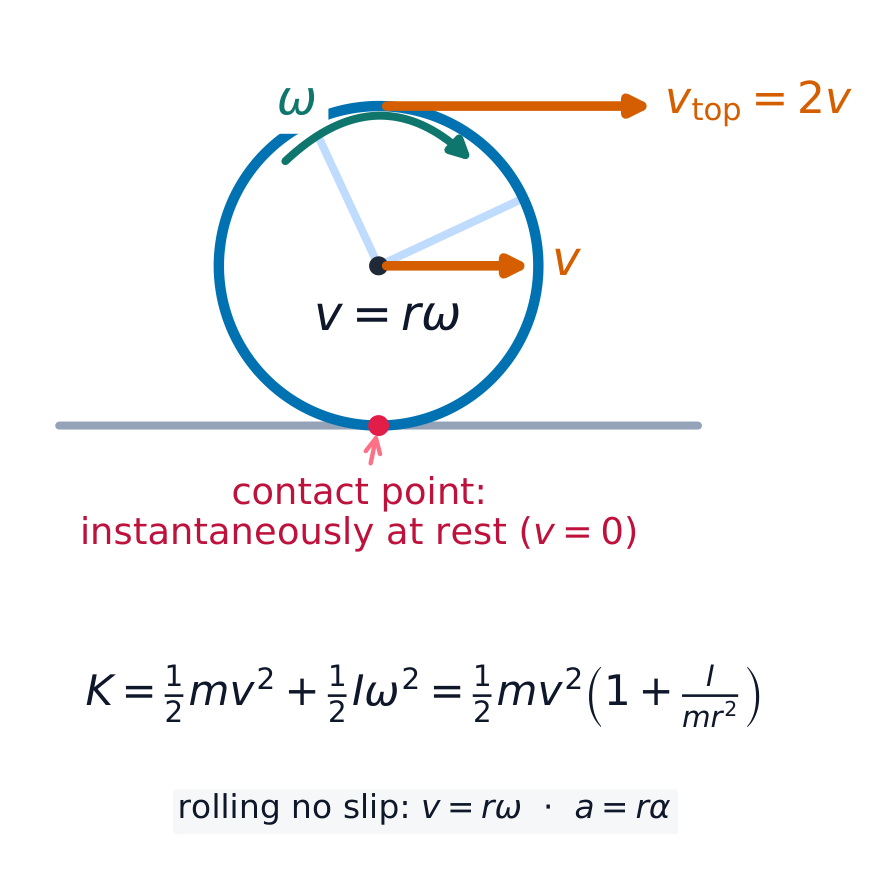
      • 5.3.B.2.i 二つのベクトル $\vec{A}$ と $\vec{B}$ の外積は、大きさ $\vec{A} \times \vec{B} = AB\sin\theta$ のベクトル quantity を生成する。
      • 5.3.B.2.ii ベクトル $\vec{A}$ と $\vec{B}$ の外積によって得られるベクトルの方向は、両方のベクトル $\vec{A}$ と $\vec{B}$ に垂直であり、したがってベクトル $\vec{A}$ と $\vec{B}$ が定義する平面に直交する。
      • 5.3.B.2.iii ベクトル $\vec{A}$ と $\vec{B}$ の外積によって得られるベクトルの方向は、適切な右手則を適用することで定性的に決定できる。

    Source: College Board AP Course and Exam Description · ⁨出典: College Board AP コースおよび試験説明書⁩

    English
    The principle of moments (torque)

    Torque 力矩 is the turning effect of a force – the rotational cause, as force is the translational cause. It is a vector product 矢量积:

    $$\vec{\tau}=\vec{r}\times\vec{F},\qquad \tau=rF\sin\theta=F\,r_\perp,$$

    where $r_\perp$, the moment arm 力臂, is the perpendicular distance from the axis to the force's line of action. More force, applied farther from the axis, more perpendicular: more torque. A force pointing straight at (or away from) the axis has zero torque. In a plane, give counterclockwise and clockwise torques opposite signs and add.

    As a vector product, $\vec\tau=\vec r\times\vec F$ points perpendicular to the plane of $\vec r$ and $\vec F$, with its direction fixed by the right-hand rule 右手定则: curl your right fingers from $\vec r$ toward $\vec F$ and your thumb points along $\vec\tau$ – out of the page for a counterclockwise turn, into it for a clockwise one. The same rule gives the direction of angular momentum $\vec L=\vec r\times\vec p$.

    日本語
    The principle of moments (torque)

    Torque 力矩 is the turning effect of a force – the rotational cause, as force is the translational cause. It is a vector product 矢量积:

    $$\vec{\tau}=\vec{r}\times\vec{F},\qquad \tau=rF\sin\theta=F\,r_\perp,$$

    where $r_\perp$, the moment arm 力臂, is the perpendicular distance from the axis to the force's line of action. More force, applied farther from the axis, more perpendicular: more torque. A force pointing straight at (or away from) the axis has zero torque. In a plane, give counterclockwise and clockwise torques opposite signs and add.

    As a vector product, $\vec\tau=\vec r\times\vec F$ points perpendicular to the plane of $\vec r$ and $\vec F$, with its direction fixed by the right-hand rule 右手定则: curl your right fingers from $\vec r$ toward $\vec F$ and your thumb points along $\vec\tau$ – out of the page for a counterclockwise turn, into it for a clockwise one. The same rule gives the direction of angular momentum $\vec L=\vec r\times\vec p$.

    The torque of a force depends on the perpendicular distance from the axis
    The torque of a force depends on the perpendicular distance from the axis
    A gear train: torques and rotational inertia couple through the gear ratio
    A gear train: torques and rotational inertia couple through the gear ratio
    Explore · ⁨探索⁩

    Balance torques on a beam · ⁨ビーム上のモーメントを釣り合わせる⁩

    Torque is force times perpendicular distance, $\tau=Fd$. The beam is in rotational equilibrium when the torques on each side are equal. · ⁨モーメント は力に垂直距離を掛けたもの、$\tau=Fd$。両側のモーメントが等しいとき、ビームは 回転平衡状態 にある。⁩

    Vocabulary · ⁨語彙⁩ Train · ⁨練習する⁩
    English 日本語
    Torque/tɔːk/ トルク
    vector product/ˈvektə ˈprɒdʌkt/ ベクトル積
    moment arm/ˈməʊmənt ɑːm/ モーメントアーム
    right-hand rule/raɪt hænd ruːl/ 右手の法則
    Watch lesson · ⁨レッスンを視聴⁩
    5.4

    Rotational Inertia

    Syllabus · ⁨シラバス⁩
    English

    Learning Objective 5.4.A: Describe the rotational inertia of a rigid system relative to a given axis of rotation.

    • 5.4.A.1 Rotational inertia measures a rigid system's resistance to changes in rotation and is related to the mass of the system and the distribution of that mass relative to the axis of rotation.
    • 5.4.A.2 The rotational inertia of an object rotating a perpendicular distance $r$ from an axis is described by the equation $I = mr^2$.
    • 5.4.A.3 The total rotational inertia of a collection of objects about an axis is the sum of the rotational inertias of each object about that axis.
      • Equation: $I_{\text{tot}} = \sum I_i = \sum m_i r_i^2$
    • 5.4.A.4 For a solid that can be considered as a collection of differential masses, $dm$, the solid's rotational inertia can be calculated using the equation $I = \int r^2\, dm$, where $r$ is the perpendicular distance from $dm$ to the axis of rotation.

    Learning Objective 5.4.B: Describe the rotational inertia of a rigid system rotating about an axis that does not pass through the system's center of mass.

    • 5.4.B.1 A rigid system's rotational inertia in a given plane is at a minimum when the rotational axis passes through the system's center of mass.
    • 5.4.B.2 The parallel axis theorem uses the following equation to relate the rotational inertia of a rigid system about any axis that is parallel to an axis through its center of mass:
      • Equation: $I' = I_{\text{cm}} + Md^2$

    Boundary statement: AP Physics C: Mechanics only expects students to use calculus in the derivations of the rotational inertia of thin rods of uniform or nonuniform density about an arbitrary axis perpendicular to the rod, as well as derivations of the rotational inertia of a thin cylindrical shell, disk, or rigid bodies that can be considered to be made up of coaxial rings or shells about an axis that passes through their centers (e.g., annular rings).

    Students should have a qualitative understanding of the factors that affect rotational inertia; for example, how rotational inertia is greater when mass is farther from the axis of rotation, which is why a hoop has more rotational inertia than a solid puck of the same mass and radius.

    日本語

    学習目標 5.4.A: 指定された回転軸に対して、剛体系の回転慣性を説明する。

    • 5.4.A.1 回転慣性は、剛体系の回転の変化に対する抵抗力を表し、その系の質量およびその質量の回転軸に対する分布に関連している。
    • 5.4.A.2 軸から垂直距離 $r$ で回転している物体の回転慣性は、以下の式 $I = mr^2$ で表される。
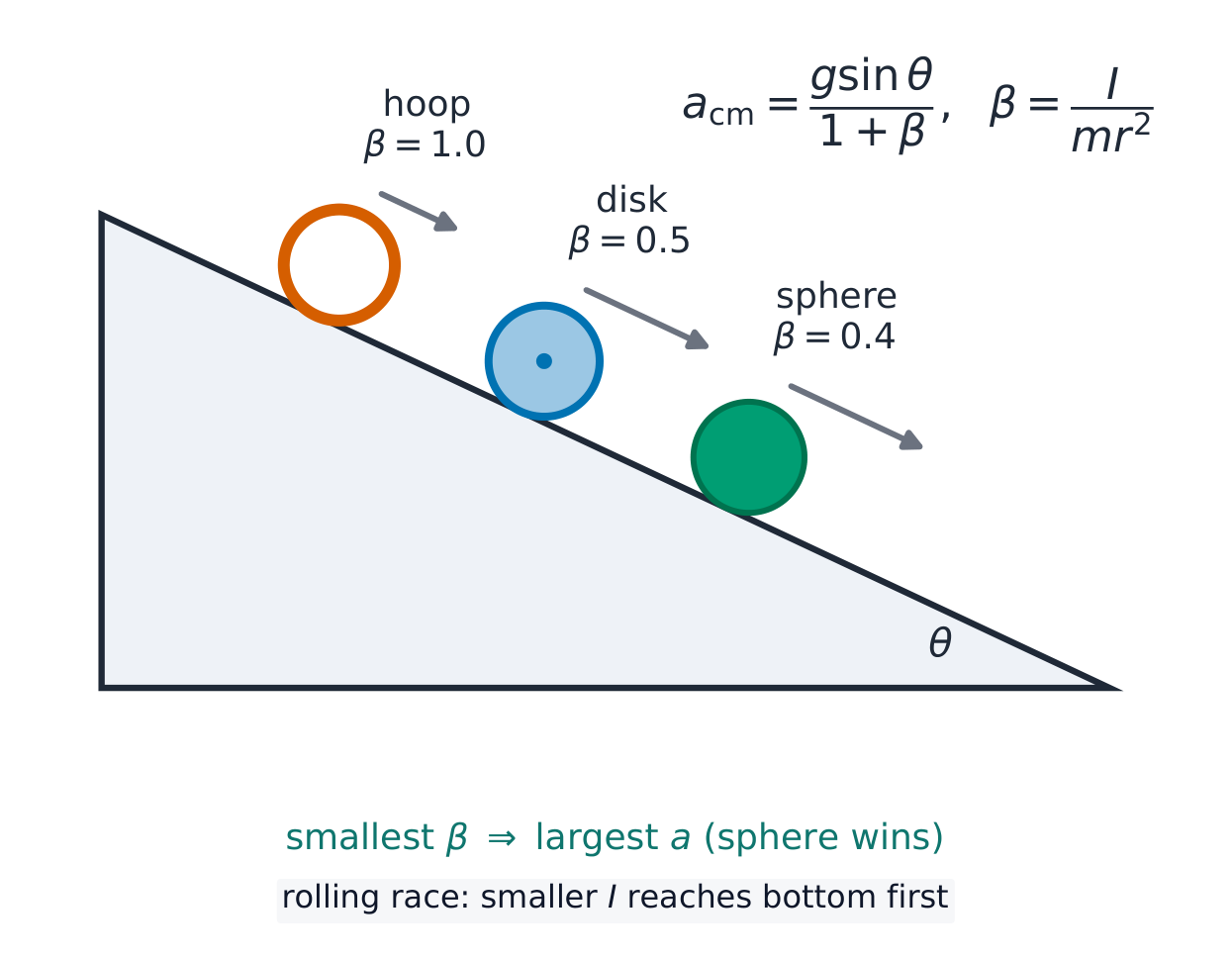
    • 5.4.A.3 軸に関する物体の集合の総回転慣性は、各物体のその軸に関する回転慣性の和である。
      • 式: $I_{\text{tot}} = \sum I_i = \sum m_i r_i^2$
    • 5.4.A.4 微分質量の集合と見なせる固体において、$dm$ は固体の回転慣性を以下の式 $I = \int r^2\, dm$ で計算でき、ここで $r$ は ⟨⟩ $dm$ から回転軸までの垂直距離である。

    学習目標 5.4.B: 重心を通らない軸について回転する剛体系の回転慣性を説明する。

    • 5.4.B.1 剛体系の特定の平面における回転慣性は、回転軸が重心を通る場合に最小となる。
    • 5.4.B.2 平行軸の定理は、重心を通る軸に平行な任意の軸に関する剛体系の回転慣性を関連付けるために、以下の式を用いる。
      • 式: $I' = I_{\text{cm}} + Md^2$

    範囲の声明: AP Physics C: Mechanicsでは、学生には均質または不均質密度の細い棒の任意の軸に垂直な回転慣性、および円筒形シェル、ディスク、または共軸リングまたはシェルから構成できると考えられる剛体の中心を通る軸に関する回転慣性の導出において微積分を使用することが期待されている。

    学生は、回転慣性に影響する要因を定性的に理解している必要がある。例えば、質量が回転軸から遠いほど回転慣性は大きくなるため、同じ質量と半径を持つ実心のピクルよりもホープの方が回転慣性が大きいことなど。

    Source: College Board AP Course and Exam Description · ⁨出典: College Board AP コースおよび試験説明書⁩

    English

    Rotational inertia 转动惯量 $I$ measures resistance to angular acceleration – the rotational analog of mass, but it depends on where the mass sits. For point masses, $I=\sum m_ir_i^2$; for a continuous body,

    $$I=\int r^2\,dm.$$

    Mass far from the axis dominates, because of the $r^2$.

    Worked example (rod). A uniform rod (mass $M$, length $L$) about its centre: with linear density 线密度 $\lambda=M/L$, $dm=\lambda\,dx$, so $I=\displaystyle\int_{-L/2}^{L/2}x^2\,\frac{M}{L}\,dx=\frac{1}{12}ML^2$. AP also expects nonuniform rods: if $\lambda(x)=cx$ on $[0,L]$, first find $M=\int_0^L cx\,dx=\tfrac12cL^2$, then $I=\int_0^L x^2(cx)\,dx=\tfrac14cL^4=\tfrac12ML^2$ about the light end.

    Worked example (disk from rings). A solid disk is a nest of rings: a ring at radius $r$ of width $dr$ has $dm=\dfrac{M}{\pi R^2}\,2\pi r\,dr$, so

    $$I=\int_0^R r^2\,dm=\frac{2M}{R^2}\int_0^R r^3\,dr=\tfrac12MR^2.$$

    The same coaxial-shell method handles cylindrical shells and annular rings.

    The parallel-axis theorem 平行轴定理 shifts any known $I$ to a parallel axis a distance $d$ away:

    $$I'=I_{\text{cm}}+Md^2.$$

    For the rod about one end: $I=\tfrac1{12}ML^2+M\big(\tfrac{L}{2}\big)^2=\tfrac13ML^2$.

    日本語

    Rotational inertia 转动惯量 $I$ measures resistance to angular acceleration – the rotational analog of mass, but it depends on where the mass sits. For point masses, $I=\sum m_ir_i^2$; for a continuous body,

    $$I=\int r^2\,dm.$$

    Mass far from the axis dominates, because of the $r^2$.

    Worked example (rod). A uniform rod (mass $M$, length $L$) about its centre: with linear density 线密度 $\lambda=M/L$, $dm=\lambda\,dx$, so $I=\displaystyle\int_{-L/2}^{L/2}x^2\,\frac{M}{L}\,dx=\frac{1}{12}ML^2$. AP also expects nonuniform rods: if $\lambda(x)=cx$ on $[0,L]$, first find $M=\int_0^L cx\,dx=\tfrac12cL^2$, then $I=\int_0^L x^2(cx)\,dx=\tfrac14cL^4=\tfrac12ML^2$ about the light end.

    Worked example (disk from rings). A solid disk is a nest of rings: a ring at radius $r$ of width $dr$ has $dm=\dfrac{M}{\pi R^2}\,2\pi r\,dr$, so

    $$I=\int_0^R r^2\,dm=\frac{2M}{R^2}\int_0^R r^3\,dr=\tfrac12MR^2.$$

    The same coaxial-shell method handles cylindrical shells and annular rings.

    The parallel-axis theorem 平行轴定理 shifts any known $I$ to a parallel axis a distance $d$ away:

    $$I'=I_{\text{cm}}+Md^2.$$

    For the rod about one end: $I=\tfrac1{12}ML^2+M\big(\tfrac{L}{2}\big)^2=\tfrac13ML^2$.

    Vocabulary · ⁨語彙⁩ Train · ⁨練習する⁩
    English 日本語
    Rotational inertia/rəʊˈteɪʃənl ɪˈnɜːʃə/ 回転慣性
    linear density/ˈlɪnɪə ˈdensɪti/ 線密度
    parallel-axis theorem/ˈpærəlel ˈæksɪs ˈθɪərəm/ 平行軸の定理
    5.5

    Rotational Equilibrium

    Syllabus · ⁨シラバス⁩
    English

    Learning Objective 5.5.A: Describe the conditions under which a system's angular velocity remains constant.

    • 5.5.A.1 A system may exhibit rotational equilibrium (constant angular velocity) without being in translational equilibrium, and vice versa.
      • 5.5.A.1.i Free-body and force diagrams describe the nature of the forces and torques exerted on an object or rigid system.
      • 5.5.A.1.ii Rotational equilibrium is a configuration of torques such that the net torque exerted on the system is zero.
        • Equation: $\sum \tau_i = 0$
      • 5.5.A.1.iii The rotational analog of Newton's first law is that a system will have a constant angular velocity only if the net torque exerted on the system is zero.
    • 5.5.A.2 A rotational corollary to Newton's second law states that if the torques exerted on a rigid system are not balanced, the system's angular velocity must be changing.

    Boundary statement: AP Physics C: Mechanics does not expect students to simultaneously analyze rotation in multiple planes.

    日本語

    学習目標 5.5.A: 系の角速度が一定に保たれる条件を説明する。

    • 5.5.A.1 系は並進平衡にない場合でも回転平衡(一定の角速度)を示すことができ、逆にその逆も成り立つ。
      • 5.5.A.1.i 自由体図および力図は、物体または剛体系に作用する力とトルクの性質を説明する。
      • 5.5.A.1.ii 回転平衡とは、系に作用する正味トルクがゼロとなるトルクの配置のことである。
        • 数式: $\sum \tau_i = 0$
      • 5.5.A.1.iii ニュートンの第一法則の回転における対応は、系に作用する正味トルクがゼロである場合にのみ、系は一定の角速度を維持することである。
    • 5.5.A.2 ニュートンの第二法則の回転における補題は、剛体系に作用するトルクが釣り合わない場合、その系の角速度は変化しなければならないというものである。

    範囲の声明: AP Physics C: Mechanicsでは、学生には複数の平面での回転を同時に解析することが期待されていない。

    Source: College Board AP Course and Exam Description · ⁨出典: College Board AP コースおよび試験説明書⁩

    English

    Newton's first law has a rotational form: with zero net torque, angular velocity is constant – an object in rotational equilibrium 转动平衡 either does not rotate or rotates steadily. Full static equilibrium 静平衡 needs both $\sum F=0$ and $\sum\tau=0$ (about any axis). The standard move for beams and ladders: put the axis at the point where an unknown force acts, so that force drops out of the torque equation.

    Worked example. A uniform $20\ \text{kg}$ beam, $4.0\ \text{m}$ long, is pivoted at its left end and held horizontal by a vertical rope at its right end. A $40\ \text{kg}$ child sits $1.0\ \text{m}$ from the pivot. Torques about the pivot: $T(4.0)=20g(2.0)+40g(1.0)$, so $T=\dfrac{392+392}{4.0}=196\ \text{N}$. Then vertical force balance gives the pivot's upward push: $F_p=(60)(9.8)-196=392\ \text{N}$. Choosing the pivot as the axis removed $F_p$ from the torque equation entirely.

    日本語

    Newton's first law has a rotational form: with zero net torque, angular velocity is constant – an object in rotational equilibrium 转动平衡 either does not rotate or rotates steadily. Full static equilibrium 静平衡 needs both $\sum F=0$ and $\sum\tau=0$ (about any axis). The standard move for beams and ladders: put the axis at the point where an unknown force acts, so that force drops out of the torque equation.

    At balance the clockwise and anticlockwise torques about the axis are equal
    At balance the clockwise and anticlockwise torques about the axis are equal

    Worked example. A uniform $20\ \text{kg}$ beam, $4.0\ \text{m}$ long, is pivoted at its left end and held horizontal by a vertical rope at its right end. A $40\ \text{kg}$ child sits $1.0\ \text{m}$ from the pivot. Torques about the pivot: $T(4.0)=20g(2.0)+40g(1.0)$, so $T=\dfrac{392+392}{4.0}=196\ \text{N}$. Then vertical force balance gives the pivot's upward push: $F_p=(60)(9.8)-196=392\ \text{N}$. Choosing the pivot as the axis removed $F_p$ from the torque equation entirely.

    A beam balance: rotational equilibrium when clockwise and anticlockwise torques match
    A beam balance: rotational equilibrium when clockwise and anticlockwise torques match
    Explore · ⁨探索⁩

    Find the balance point · ⁨釣り合う点を見つける⁩

    For rotational equilibrium the total clockwise torque equals the total anticlockwise torque. Move the forces and distances until the beam balances. · ⁨回転平衡状態 では、時計回りの総モーメントが反時計回りの総モーメントに等しい。力が釣り合うまで、力や距離を移動させろ。⁩

    Vocabulary · ⁨語彙⁩ Train · ⁨練習する⁩
    English 日本語
    rotational equilibrium/rəʊˈteɪʃənl ˌiːkwɪˈlɪbrɪəm/ 回転平衡
    static equilibrium/ˈstætɪk ˌiːkwɪˈlɪbrɪəm/ 静的平衡
    Watch lesson · ⁨レッスンを視聴⁩
    5.6

    Newton's Second Law in Rotational Form

    Syllabus · ⁨シラバス⁩
    English

    Learning Objective 5.6.A: Describe the conditions under which a system's angular velocity changes.

    • 5.6.A.1 Angular velocity changes when the net torque exerted on the object or system is not equal to zero.
    • 5.6.A.2 The rate at which the angular velocity of a rigid system changes is directly proportional to the net torque exerted on the rigid system and is in the same direction. The angular acceleration of the rigid system is inversely proportional to the rotational inertia of the rigid system.
      • Equation: $\alpha_{\text{sys}} = \dfrac{\Sigma\tau}{I_{\text{sys}}} = \dfrac{\tau_{\text{net}}}{I_{\text{sys}}}$
    • 5.6.A.3 To fully describe a rotating rigid system, linear and rotational analyses may need to be performed independently.
    日本語

    学習目標 5.6.A: 系の角速度が変化する条件を説明する。

    • 5.6.A.1 物体または系に作用する正味トルクがゼロでない場合、角速度は変化する。
    • 5.6.A.2 剛体系の角速度の変化率は、剛体系に作用する正味トルクに比例し、その正味トルクと同じ方向を持つ。剛体系の角加速度は、剛体系の回転慣性に反比例する。
      • 式: $\alpha_{\text{sys}} = \dfrac{\Sigma\tau}{I_{\text{sys}}} = \dfrac{\tau_{\text{net}}}{I_{\text{sys}}}$
    • 5.6.A.3 回転する剛体系を完全に記述するには、線形解析と回転解析を独立に行う必要がある場合がある。

    Source: College Board AP Course and Exam Description · ⁨出典: College Board AP コースおよび試験説明書⁩

    English

    A net torque produces angular acceleration in proportion to the rotational inertia:

    $$\alpha=\frac{\sum\tau}{I}\qquad\Big(\text{more generally }\sum\vec{\tau}=\frac{d\vec{L}}{dt}\Big).$$

    Solve rotational dynamics exactly like translational dynamics, with $\tau\leftrightarrow F$, $I\leftrightarrow m$, $\alpha\leftrightarrow a$ – free-body diagram, equations, solve.

    Worked example (massive pulley). Masses $m_1=4.0\ \text{kg}$ and $m_2=2.0\ \text{kg}$ hang from a rope over a pulley 滑轮 of rotational inertia $I=0.50\ \text{kg}\cdot\text{m}^2$ and radius $R=0.20\ \text{m}$. Three Newton's-law equations, one per body:

    $$m_1g-T_1=m_1a,\qquad T_2-m_2g=m_2a,\qquad (T_1-T_2)R=I\alpha=\frac{Ia}{R}.$$

    Adding them (with $I/R^2=12.5\ \text{kg}$): $a=\dfrac{(m_1-m_2)g}{m_1+m_2+I/R^2}=\dfrac{19.6}{18.5}=1.1\ \text{m/s}^2$. Then $T_1=m_1(g-a)=35\ \text{N}$ and $T_2=m_2(g+a)=22\ \text{N}$. The tensions must differ – otherwise nothing would spin the pulley. (If a problem says the pulley is light, then $I\approx0$ and the tensions become equal again.)

    Exam skill. Rotational FRQs score the setup: separate free-body diagrams for each mass and the pulley, the string constraint $a=R\alpha$ stated, and the sign convention consistent. The single most common error is assuming one tension throughout a rope that passes over a massive pulley.

    日本語

    A net torque produces angular acceleration in proportion to the rotational inertia:

    $$\alpha=\frac{\sum\tau}{I}\qquad\Big(\text{more generally }\sum\vec{\tau}=\frac{d\vec{L}}{dt}\Big).$$

    Solve rotational dynamics exactly like translational dynamics, with $\tau\leftrightarrow F$, $I\leftrightarrow m$, $\alpha\leftrightarrow a$ – free-body diagram, equations, solve.

    A massive pulley: the two tensions differ because the pulley needs net torque
    A massive pulley: the two tensions differ because the pulley needs net torque

    Worked example (massive pulley). Masses $m_1=4.0\ \text{kg}$ and $m_2=2.0\ \text{kg}$ hang from a rope over a pulley 滑轮 of rotational inertia $I=0.50\ \text{kg}\cdot\text{m}^2$ and radius $R=0.20\ \text{m}$. Three Newton's-law equations, one per body:

    $$m_1g-T_1=m_1a,\qquad T_2-m_2g=m_2a,\qquad (T_1-T_2)R=I\alpha=\frac{Ia}{R}.$$

    Adding them (with $I/R^2=12.5\ \text{kg}$): $a=\dfrac{(m_1-m_2)g}{m_1+m_2+I/R^2}=\dfrac{19.6}{18.5}=1.1\ \text{m/s}^2$. Then $T_1=m_1(g-a)=35\ \text{N}$ and $T_2=m_2(g+a)=22\ \text{N}$. The tensions must differ – otherwise nothing would spin the pulley. (If a problem says the pulley is light, then $I\approx0$ and the tensions become equal again.)

    Exam skill. Rotational FRQs score the setup: separate free-body diagrams for each mass and the pulley, the string constraint $a=R\alpha$ stated, and the sign convention consistent. The single most common error is assuming one tension throughout a rope that passes over a massive pulley.

    Vocabulary · ⁨語彙⁩ Train · ⁨練習する⁩
    English 日本語
    pulley/ˈpʊli/ 滑車
    5.6

    Exam tips

    • Use the rotational analogues: $\theta,\omega=\tfrac{d\theta}{dt},\alpha=\tfrac{d\omega}{dt}$, with the constant-$\alpha$ equations mirroring linear kinematics.
    • Convert between linear and angular with $v=r\omega$ and $a_t=r\alpha$ (plus centripetal $a_c=\tfrac{v^2}{r}=\omega^2 r$).
    • Keep radians throughout and fix a positive sense of rotation.
    • Relate torque to angular acceleration through $\tau=I\alpha$.
    • Draw the rotation axis — the moment arm is the perpendicular distance to it.
  • 6

    Energy and Momentum of Rotating Systems · ⁨回転系エネルギーと運動量⁩

    Watch lesson · ⁨レッスンを視聴⁩
    6.1

    Rotational Kinetic Energy

    Syllabus · ⁨シラバス⁩
    English

    Learning Objective 6.1.A: Describe the rotational kinetic energy of a rigid system in terms of the rotational inertia and angular velocity of that rigid system.

    • 6.1.A.1 The rotational kinetic energy of an object or rigid system is related to the rotational inertia and angular velocity of the rigid system and is given by the equation $K_{\text{rot}} = \dfrac{1}{2} I \omega^2$.
      • Equation: $K_{\text{rot}} = \dfrac{1}{2} I \omega^2$
      • 6.1.A.1.i The rotational inertia of an object about a fixed axis can be used to show that the rotational kinetic energy of that object is equivalent to its translational kinetic energy, which is its total kinetic energy.
      • 6.1.A.1.ii The total kinetic energy of a rigid system is the sum of its rotational kinetic energy due to its rotation about its center of mass and the translational kinetic energy due to the linear motion of its center of mass.
    • 6.1.A.2 A rigid system can have rotational kinetic energy while its center of mass is at rest due to the individual points within the rigid system having linear speed and, therefore, kinetic energy.
    • 6.1.A.3 Rotational kinetic energy is a scalar quantity.
    日本語

    学習目標 6.1.A: 回転慣性と角速度を用いて、剛体系の回転運動エネルギーを説明する。

    • 6.1.A.1 物体または剛体系の回転運動エネルギーは、剛体系の回転慣性と角速度に関連しており、以下の式で与えられる $K_{\text{rot}} = \dfrac{1}{2} I \omega^2$。
      • 式: $K_{\text{rot}} = \dfrac{1}{2} I \omega^2$
      • 6.1.A.1.i 固定軸に関する物体の回転慣性を用いることで、その物体の回転運動エネルギーが並進運動エネルギー(=全運動エネルギー)に等しいことを示せる。
      • 6.1.A.1.ii 剛体系の全運動エネルギーは、重心周りの回転による回転運動エネルギーと、重心の直線運動による並進運動エネルギーの和である。
    • 6.1.A.2 剛体系は重心が静止していても、内部の各点が線速度を持ち、したがって運動エネルギーを持つため、回転運動エネルギーを持つことができる。
    • 6.1.A.3 回転運動エネルギーはスカラー量である。

    Source: College Board AP Course and Exam Description · ⁨出典: College Board AP コースおよび試験説明書⁩

    English

    A spinning body has rotational kinetic energy 转动动能

    $$K_{\text{rot}}=\tfrac12 I\omega^2,$$

    the rotational twin of $\tfrac12mv^2$, with the rotational inertia 转动惯量 $I$ playing the role of mass. A body that both moves and spins carries both terms:

    $$K=\tfrac12 mv_{\text{cm}}^2+\tfrac12 I\omega^2.$$

    Worked example. A uniform cylinder ($I=\tfrac12mr^2$) rolls at speed $v$. Its kinetic energy is $K=\tfrac12mv^2+\tfrac12\big(\tfrac12mr^2\big)\big(\tfrac{v}{r}\big)^2=\tfrac34mv^2$ – one third of it is rotational. The same ball of energy bookkeeping decides every rolling problem.

    日本語

    A spinning body has rotational kinetic energy 转动动能

    $$K_{\text{rot}}=\tfrac12 I\omega^2,$$

    the rotational twin of $\tfrac12mv^2$, with the rotational inertia 转动惯量 $I$ playing the role of mass. A body that both moves and spins carries both terms:

    $$K=\tfrac12 mv_{\text{cm}}^2+\tfrac12 I\omega^2.$$

    Worked example. A uniform cylinder ($I=\tfrac12mr^2$) rolls at speed $v$. Its kinetic energy is $K=\tfrac12mv^2+\tfrac12\big(\tfrac12mr^2\big)\big(\tfrac{v}{r}\big)^2=\tfrac34mv^2$ – one third of it is rotational. The same ball of energy bookkeeping decides every rolling problem.

    Vocabulary · ⁨語彙⁩ Train · ⁨練習する⁩
    English 日本語
    rotational kinetic energy/rəʊˈteɪʃənl kɪˈnetɪk ˈenədʒi/ 回転運動エネルギー
    rotational inertia/rəʊˈteɪʃənl ɪˈnɜːʃə/ 回転慣性
    6.2

    Torque and Work

    Syllabus · ⁨シラバス⁩
    English

    Learning Objective 6.2.A: Describe the work done on a rigid system by a given torque or collection of torques.

    • 6.2.A.1 A torque can transfer energy into or out of an object or rigid system if the torque is exerted over an angular displacement.
    • 6.2.A.2 The amount of work done on a rigid system by a torque is related to the magnitude of that torque and the angular displacement through which the rigid system rotates during the interval in which that torque is exerted.
      • Equation: $W = \displaystyle\int_{\theta_1}^{\theta_2} \tau \, d\theta$
    • 6.2.A.3 Work done on a rigid system by a given torque can be found from the area under the curve of a graph of the torque as a function of angular position.
    日本語

    学習目標 6.2.A: 与えられたトルクまたはトルクの集合が剛体系に対して行う仕事について説明する。

    • 6.2.A.1 トルクが角変位にわたって加わる場合、そのトルクは物体や剛体系へエネルギーを伝達したり取り出したりすることができる。
    • 6.2.A.2 剛体系に対するトルクによる仕事量は、そのトルクの大きさおよび、そのトルクが加わる期間中に剛体系が回転する角変位と関連している。
      • 式: $W = \displaystyle\int_{\theta_1}^{\theta_2} \tau \, d\theta$
    • 6.2.A.3 選択されたトルクによって剛体システムに行われた仕事は、トルクを角位置の関数としたグラフの曲線下面積から求められる。
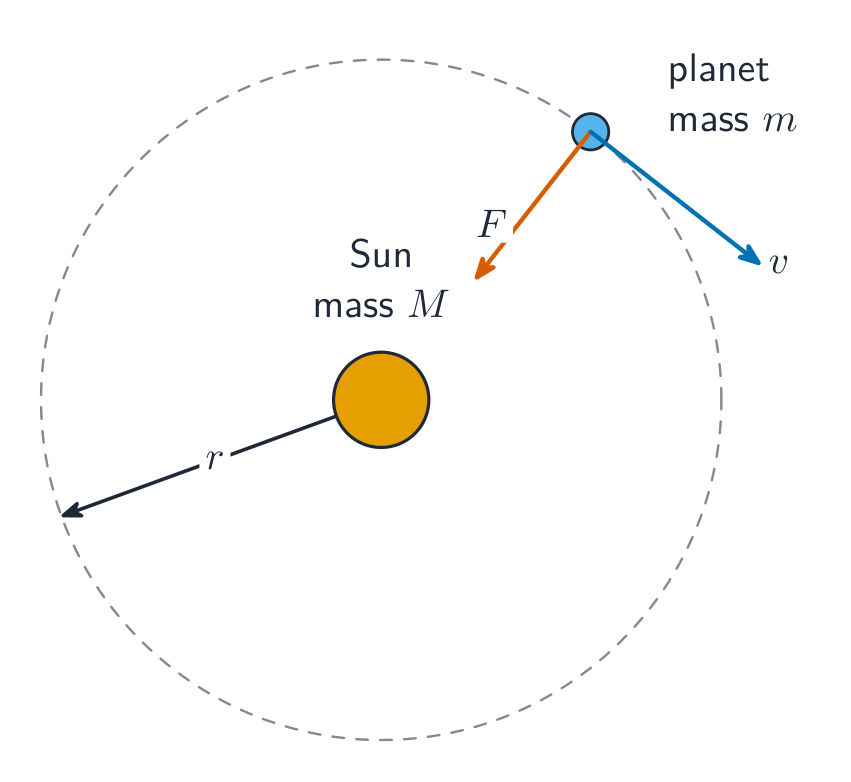
    Source: College Board AP Course and Exam Description · ⁨出典: College Board AP コースおよび試験説明書⁩

    English

    A torque 力矩 acting through an angular displacement 角位移 does work, and power is torque times angular velocity:

    $$W=\int_{\theta_1}^{\theta_2}\tau\,d\theta,\qquad P=\tau\omega.$$

    These are the rotational forms of $W=\int F\,dx$ and $P=Fv$ – the whole translational energy toolkit carries over with $F\to\tau$, $x\to\theta$, $v\to\omega$.

    Worked example. A motor applies a constant $8.0\ \text{N}\cdot\text{m}$ torque to a flywheel for $5.0$ full turns: $W=\tau\,\Delta\theta=8.0(5.0)(2\pi)=250\ \text{J}$, which appears as rotational kinetic energy if friction is negligible.

    日本語

    A torque 力矩 acting through an angular displacement 角位移 does work, and power is torque times angular velocity:

    $$W=\int_{\theta_1}^{\theta_2}\tau\,d\theta,\qquad P=\tau\omega.$$

    These are the rotational forms of $W=\int F\,dx$ and $P=Fv$ – the whole translational energy toolkit carries over with $F\to\tau$, $x\to\theta$, $v\to\omega$.

    Worked example. A motor applies a constant $8.0\ \text{N}\cdot\text{m}$ torque to a flywheel for $5.0$ full turns: $W=\tau\,\Delta\theta=8.0(5.0)(2\pi)=250\ \text{J}$, which appears as rotational kinetic energy if friction is negligible.

    Explore · ⁨探索⁩

    Balance torques on a beam · ⁨ビーム上のモーメントを釣り合わせる⁩

    Torque is force times perpendicular distance, $\tau=Fd$. Equal torques on each side keep the beam in rotational equilibrium. · ⁨モーメントは力とその垂直距離の積であり、$\tau=Fd$である。左右に等しいモーメントを与えると、ビームは回転平衡状態を保つ。⁩

    Vocabulary · ⁨語彙⁩ Train · ⁨練習する⁩
    English 日本語
    torque/tɔːk/ トルクの変化率である
    angular displacement/ˈæŋɡjʊlə dɪˈspleɪsmənt/ 角変位の変化率である
    6.3

    Angular Momentum and Angular Impulse

    Syllabus · ⁨シラバス⁩
    English

    Learning Objective 6.3.A: Describe the angular momentum of an object or rigid system.

    • 6.3.A.1 The magnitude of the angular momentum of a rigid system about a specific axis can be described with the equation $L = I\omega$.
      • Equation: $L = I\omega$
    • 6.3.A.2 The angular momentum of an object about a given point is $\vec{L} = \vec{r} \times \vec{p}$.
      • Equation: $\vec{L} = \vec{r} \times \vec{p}$
      • 6.3.A.2.i The selection of the axis about which an object is considered to rotate influences the determination of the angular momentum of that object.
      • 6.3.A.2.ii The measured angular momentum of an object traveling in a straight line depends on the distance between the reference point and the object, the mass of the object, the speed of the object, and the angle between the radial distance and the velocity of the object.

    Learning Objective 6.3.B: Describe the angular impulse delivered to an object or rigid system by a torque.

    • 6.3.B.1 Angular impulse is defined as the product of the torque exerted on an object or rigid system and the time interval during which the torque is exerted.
      • Equation: $\text{angular impulse} = \displaystyle\int \tau \, dt$
    • 6.3.B.2 Angular impulse has the same direction as the torque imparting it.
    • 6.3.B.3 The angular impulse delivered to an object or rigid system by a torque can be found from the area under the curve of a graph of the torque as a function of time.

    Learning Objective 6.3.C: Relate the change in angular momentum of an object or rigid system to the angular impulse given to that object or rigid system.

    • 6.3.C.1 The magnitude of the change in angular momentum can be described by comparing the magnitudes of the final and initial momenta of the object or rigid system.
      • Equation: $\Delta L = L - L_0$
    • 6.3.C.2 A rotational form of the impulse–momentum theorem relates the angular impulse delivered to an object or rigid system and the change in angular momentum of that object or rigid system.
      • 6.3.C.2.i The angular impulse exerted on an object or rigid system is equal to the change in angular momentum of that object or rigid system.
        • Equation: $\Delta L = \displaystyle\int_{t_1}^{t_2} \tau \, dt$
      • 6.3.C.2.ii The rotational form of the impulse–momentum theorem is a direct result of Newton's second law of motion for cases in which rotational inertia is constant.
        • Equation: $\tau_{\text{net}} = \dfrac{dL}{dt} = I\dfrac{d\omega}{dt} = I\alpha$
    • 6.3.C.3 The net torque exerted on an object or rigid system is equal to the slope of the graph of the angular momentum of an object as a function of time.
    • 6.3.C.4 The angular impulse delivered to an object or rigid system is equal to the area under the curve of a graph of the net external torque exerted on an object as a function of time.
    日本語

    学習目標 6.3.A: 物体や剛体系の角運動量について説明する。
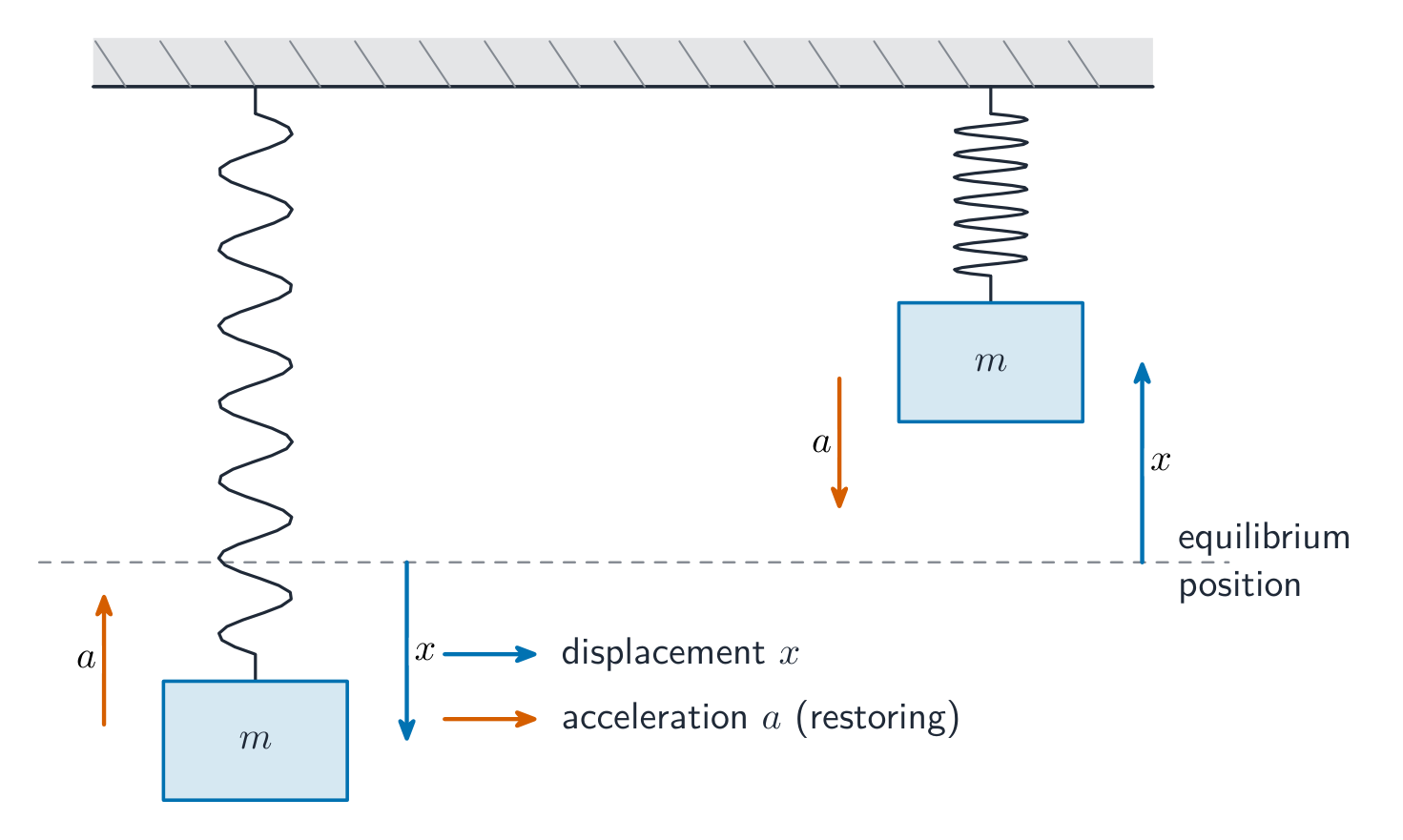
    • 6.3.A.1 特定の軸に関する剛体系の角運動量の大きさは、式 $L = I\omega$ で記述できる。
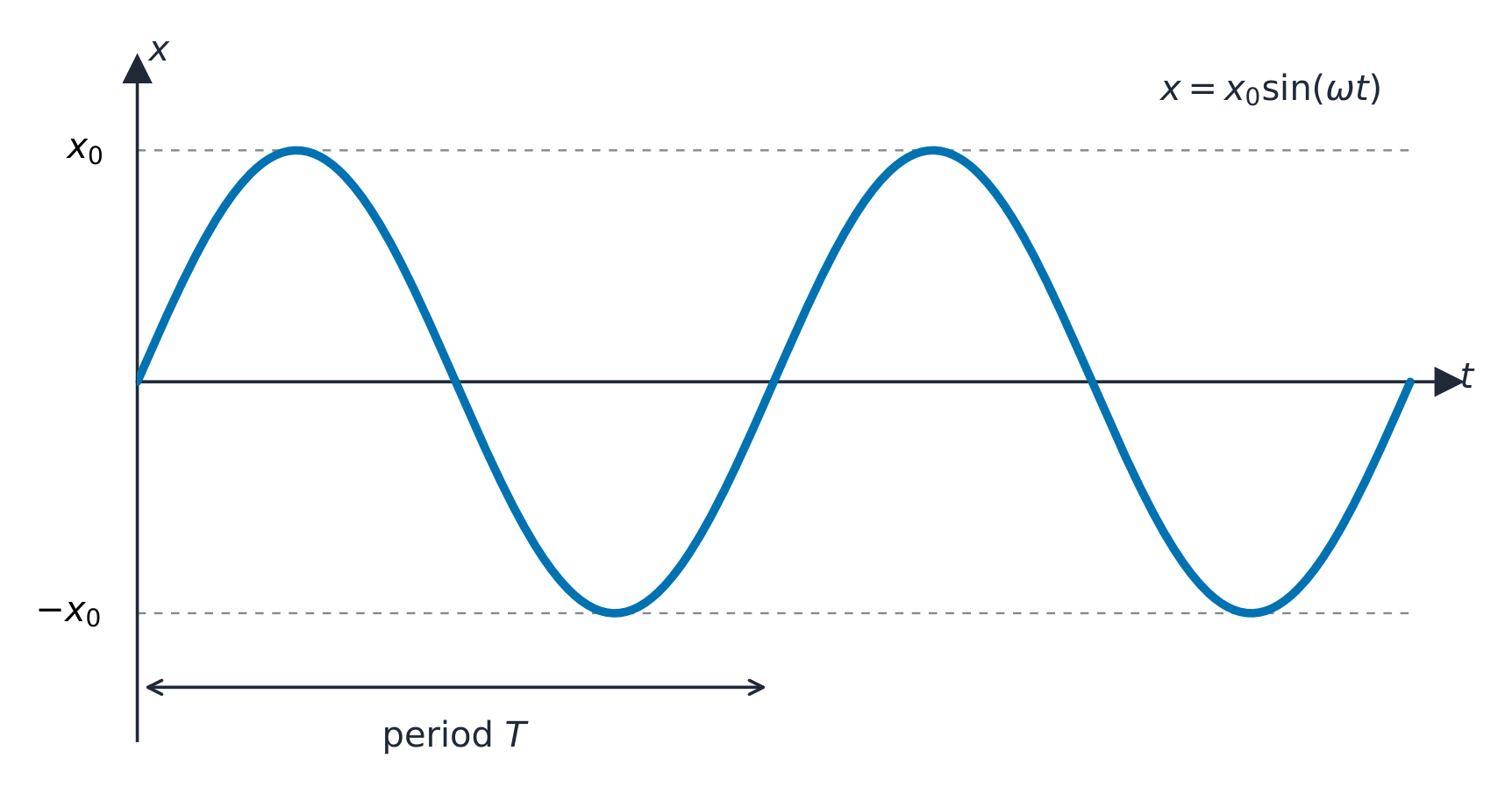
      • 式: $L = I\omega$
    • 6.3.A.2 特定の点に関する物体の角運動量は $\vec{L} = \vec{r} \times \vec{p}$ である。
      • 式: $\vec{L} = \vec{r} \times \vec{p}$
      • 6.3.A.2.i 物体が回転すると見なす軸の選択は、その物体の角運動量の決定に影響を与える。
      • 6.3.A.2.ii 直進運動をする物体の測定された角運動量は、参照点と物体との距離、物体の質量、物体の速さ、および半径ベクトルと物体の速度とのなす角に依存する。

    学習目標 6.3.B: トルクによって物体や剛体系に与えられる角インパルスについて説明する。

    • 6.3.B.1 角インパルスとは、物体や剛体系に加わるトルクと、そのトルクが加わる時間区間の積として定義される。
      • 式: $\text{angular impulse} = \displaystyle\int \tau \, dt$
    • 6.3.B.2 角インパルスの向きは、それを与えるトルクの向きと同じである。
    • 6.3.B.3 トルクによって物体や剛体系に与えられる角インパルスは、時間を横軸とするトルクのグラフの曲線下面積から求めることができる。

    学習目標 6.3.C: 物体や剛体系の角運動量の変化と、それらの物体や剛体系に与えられた角インパルスの関係を説明する。

    • 6.3.C.1 角運動量の変化の大きさは、物体または剛体システムの最終運動量と初期運動量の大きさを比較することで記述できる。
      • 式: $\Delta L = L - L_0$
    • 6.3.C.2 インパルス・モーメント定理の回転形は、物体や剛体系に与えられた角インパルスと、それらの物体や剛体系の角運動量の変化を関連づける。
      • 6.3.C.2.i 物体や剛体系に加えられた角インパルスは、それらの物体や剛体系の角運動量の変化に等しい。
        • 数式: $\Delta L = \displaystyle\int_{t_1}^{t_2} \tau \, dt$
      • 6.3.C.2.ii インパルス-運動量の定理の回転形は、回転慣性が一定の場合におけるニュートンの運動の第二法則の結果である。
        • 数式: $\tau_{\text{net}} = \dfrac{dL}{dt} = I\dfrac{d\omega}{dt} = I\alpha$
    • 6.3.C.3 物体または剛体システムに作用する正味トルクは、物体の角運動量を時間の関数としたグラフの傾きに等しい。
    • 6.3.C.4 物体または剛体システムに与えられた角インパルスは、物体に作用する正味外力トルクを時間の関数としたグラフの曲線下面積に等しい。

    Source: College Board AP Course and Exam Description · ⁨出典: College Board AP コースおよび試験説明書⁩

    English

    Angular momentum 角动量 for a particle is

    $$\vec{L}=\vec{r}\times\vec{p},\qquad |L|=mvr\sin\theta,$$

    so even a particle moving in a straight line has angular momentum about any point not on that line ($L=mv\,d$, with $d$ the perpendicular distance). For a rigid body spinning about a fixed axis, $L=I\omega$. Newton's second law in rotational form is

    $$\vec{\tau}_{\text{net}}=\frac{d\vec{L}}{dt}\quad(=I\alpha\ \text{when }I\text{ is constant}),$$

    and a net torque acting over time delivers an angular impulse 角冲量 $\int\tau\,dt=\Delta L$ – the rotational impulse–momentum theorem.

    日本語

    Angular momentum 角动量 for a particle is

    $$\vec{L}=\vec{r}\times\vec{p},\qquad |L|=mvr\sin\theta,$$

    so even a particle moving in a straight line has angular momentum about any point not on that line ($L=mv\,d$, with $d$ the perpendicular distance). For a rigid body spinning about a fixed axis, $L=I\omega$. Newton's second law in rotational form is

    $$\vec{\tau}_{\text{net}}=\frac{d\vec{L}}{dt}\quad(=I\alpha\ \text{when }I\text{ is constant}),$$

    and a net torque acting over time delivers an angular impulse 角冲量 $\int\tau\,dt=\Delta L$ – the rotational impulse–momentum theorem.

    Vocabulary · ⁨語彙⁩ Train · ⁨練習する⁩
    English 日本語
    Angular momentum/ˈæŋɡjʊlə məʊˈmentəm/ 角運動量
    angular impulse/ˈæŋɡjʊlə ˈɪmpʌls/ 角冲動
    6.4

    Conservation of Angular Momentum

    Syllabus · ⁨シラバス⁩
    Learning ObjectiveEssential Knowledge

    6.4.A
    Describe the behavior of a system using conservation of angular momentum.

    • 6.4.A.1 The total angular momentum of a system about a rotational axis is the sum of the angular momenta of the system's constituent parts about that rotational axis.
    • 6.4.A.2 Any change to a system's angular momentum must be due to an interaction between the system and its surroundings.
      • 6.4.A.2.i The angular impulse exerted by one object or system on a second object or system is equal and opposite to the angular impulse exerted by the second object or system on the first. This is a direct result of Newton's third law.
      • 6.4.A.2.ii A system may be selected so that the total angular momentum of that system is constant.
      • 6.4.A.2.iii The angular speed of a nonrigid system may change without the angular momentum of the system changing if the system changes shape by moving mass closer to or farther from the rotational axis.
      • 6.4.A.2.iv If the total angular momentum of a system changes, that change will be equivalent to the angular impulse exerted on the system.

    6.4.B
    Describe how the selection of a system determines whether the angular momentum of that system changes.

    • 6.4.B.1 Angular momentum is conserved in all interactions.
    • 6.4.B.2 If the net external torque exerted on a selected object or rigid system is zero, the total angular momentum of that system is constant.
    • 6.4.B.3 If the net external torque exerted on a selected object or rigid system is nonzero, angular momentum is transferred between the system and the environment.

    Source: College Board AP Course and Exam Description · ⁨出典: College Board AP コースおよび試験説明書⁩

    English
    Angular momentum: pull in, spin faster

    With zero net external torque, total angular momentum is conserved 守恒:

    $$L_{\text{before}}=L_{\text{after}},\qquad I_1\omega_1=I_2\omega_2\ \text{(one rigid body reshaping)}.$$

    If $I$ shrinks, $\omega$ grows – a spinning skater speeds up pulling her arms in. The rule survives collisions and shape changes, which is what makes it so useful: pick the axis so that every external force (gravity, the pivot force) exerts no torque about it.

    Worked example. A skater spins at $2.0\ \text{rev/s}$ with $I_1=4.0\ \text{kg}\cdot\text{m}^2$. Pulling in her arms drops it to $I_2=1.6\ \text{kg}\cdot\text{m}^2$: $\omega_2=\dfrac{4.0}{1.6}(2.0)=5.0\ \text{rev/s}$. Her kinetic energy rises – the extra energy is the work her muscles do pulling her arms inward.

    Worked example (rotational collision). A $0.020\ \text{kg}$ bullet at $300\ \text{m/s}$ strikes the tip of a uniform rod ($M=1.5\ \text{kg}$, length $l=0.60\ \text{m}$) hanging from a pivot, and embeds. About the pivot, gravity and the pivot force exert no torque during the strike, so $L$ is conserved: $L=mvl=0.020(300)(0.60)=3.6\ \text{kg}\cdot\text{m}^2/\text{s}$. Afterwards $I=\tfrac13Ml^2+ml^2=0.18+0.0072=0.187\ \text{kg}\cdot\text{m}^2$, so $\omega=\dfrac{3.6}{0.187}\approx19\ \text{rad/s}$. (Linear momentum is not conserved here – the pivot pushes on the rod – and kinetic energy certainly is not: check both before claiming them.)

    日本語
    Angular momentum: pull in, spin faster

    With zero net external torque, total angular momentum is conserved 守恒:

    $$L_{\text{before}}=L_{\text{after}},\qquad I_1\omega_1=I_2\omega_2\ \text{(one rigid body reshaping)}.$$

    If $I$ shrinks, $\omega$ grows – a spinning skater speeds up pulling her arms in. The rule survives collisions and shape changes, which is what makes it so useful: pick the axis so that every external force (gravity, the pivot force) exerts no torque about it.

    Worked example. A skater spins at $2.0\ \text{rev/s}$ with $I_1=4.0\ \text{kg}\cdot\text{m}^2$. Pulling in her arms drops it to $I_2=1.6\ \text{kg}\cdot\text{m}^2$: $\omega_2=\dfrac{4.0}{1.6}(2.0)=5.0\ \text{rev/s}$. Her kinetic energy rises – the extra energy is the work her muscles do pulling her arms inward.

    Pulling mass inward lowers I, so ω rises to conserve L = Iω
    Pulling mass inward lowers I, so ω rises to conserve L = Iω
    Angular momentum about the pivot is conserved as the bullet embeds in the rod
    Angular momentum about the pivot is conserved as the bullet embeds in the rod

    Worked example (rotational collision). A $0.020\ \text{kg}$ bullet at $300\ \text{m/s}$ strikes the tip of a uniform rod ($M=1.5\ \text{kg}$, length $l=0.60\ \text{m}$) hanging from a pivot, and embeds. About the pivot, gravity and the pivot force exert no torque during the strike, so $L$ is conserved: $L=mvl=0.020(300)(0.60)=3.6\ \text{kg}\cdot\text{m}^2/\text{s}$. Afterwards $I=\tfrac13Ml^2+ml^2=0.18+0.0072=0.187\ \text{kg}\cdot\text{m}^2$, so $\omega=\dfrac{3.6}{0.187}\approx19\ \text{rad/s}$. (Linear momentum is not conserved here – the pivot pushes on the rod – and kinetic energy certainly is not: check both before claiming them.)

    Figure skaters performing on the ice
    Figure skating and angular momentum: a skater who pulls their arms in during a spin lowers their rotational inertia, so they spin faster
    Vocabulary · ⁨語彙⁩ Train · ⁨練習する⁩
    English 日本語
    conserved/kənˈsɜːvd/ 保存されている
    6.5

    Rolling

    Syllabus · ⁨シラバス⁩
    English

    Learning Objective 6.5.A: Describe the kinetic energy of a system that has translational and rotational motion.

    • 6.5.A.1 The total kinetic energy of a system is the sum of the system's translational and rotational kinetic energies.
      • Equation: $K_{\text{tot}} = K_{\text{trans}} + K_{\text{rot}}$

    Learning Objective 6.5.B: Describe the motion of a system that is rolling without slipping.

    • 6.5.B.1 While rolling without slipping, the translational motion of a system's center of mass is related to the rotational motion of the system itself with the following equations:
      • Equation: $\Delta x_{\text{cm}} = r\Delta\theta$
      • Equation: $v_{\text{cm}} = r\omega$
      • Equation: $a_{\text{cm}} = r\alpha$
    • 6.5.B.2 For ideal cases, rolling without slipping implies that the frictional force does not dissipate any energy from the rolling system.

    Learning Objective 6.5.C: Describe the motion of a system that is rolling while slipping.

    • 6.5.C.1 When slipping, the motion of a system's center of mass and the system's rotational motion cannot be directly related.
    • 6.5.C.2 When a rotating system is slipping relative to another surface, the point of application of the force of kinetic friction exerted on the system moves with respect to the surface, so the force of kinetic friction will dissipate energy from the system.

    Boundary statement: Rolling friction is beyond the scope of AP Physics C: Mechanics.

    日本語

    学習目標 6.5.A: 並進運動と回転運動の両方を持つ系の運動エネルギーについて説明する。

    • 6.5.A.1 系の全運動エネルギーは、系の並進運動エネルギーと回転運動エネルギーの和である。
      • 式: $K_{\text{tot}} = K_{\text{trans}} + K_{\text{rot}}$

    学習目標 6.5.B: 滑りなく転がる系の運動について説明する。

    • 6.5.B.1 滑りなく転がる際、系の重心の並進運動と系自体の回転運動は以下の式で関連している:
      • 式: $\Delta x_{\text{cm}} = r\Delta\theta$
      • 式: $v_{\text{cm}} = r\omega$
      • 式: $a_{\text{cm}} = r\alpha$
    • 6.5.B.2 理想caseでは、滑りなく転動することは、摩擦力が転動系からエネルギーを散逸させないことを意味する。

    学習目標 6.5.C: 滑りながら転動する系の運動を説明せよ。

    • 6.5.C.1 滑りが生じている場合、系の重心の運動と系の回転運動は直接関連づけられない。
    • 6.5.C.2 回転している系が別の表面に対して滑り发生时、系に作用する動摩擦の力の作用点は表面に対して移動するため、動摩擦力は系からエネルギーを散逸させる。

    境界文: 転がり摩擦はAP Physics C: Mechanicsの範囲外である。

    Source: College Board AP Course and Exam Description · ⁨出典: College Board AP コースおよび試験説明書⁩

    English
    Rolling without slipping

    Rolling without slipping 无滑滚动 ties translation to rotation: the contact point is momentarily at rest, so

    $$\Delta x_{\text{cm}}=r\,\Delta\theta,\qquad v_{\text{cm}}=r\omega,\qquad a_{\text{cm}}=r\alpha.$$

    Static friction supplies the torque that keeps the spin matched to the motion, but at a point that is not sliding – so for pure rolling, friction does no work, and energy conservation is safe to use. (Rolling friction is beyond the AP course.)

    Racing shapes down an incline shows the energy split. With $I=\beta mr^2$, energy conservation gives

    $$a_{\text{cm}}=\frac{g\sin\theta}{1+\beta}:$$

    a sphere ($\beta=\tfrac25$) beats a disk 圆盘 ($\beta=\tfrac12$), which beats a hoop 圆环 ($\beta=1$) – mass and radius cancel completely. More of the hoop's energy is locked in rotation, so its center moves slower.

    Worked example. A solid sphere rolls from rest down a $30^\circ$ incline: $a=\dfrac{g\sin30^\circ}{1+\tfrac25}=\dfrac{9.8(0.50)}{1.4}=3.5\ \text{m/s}^2$, versus $4.9\ \text{m/s}^2$ for a frictionless slider – rolling objects always lose the race against sliding ones.

    日本語
    Rolling without slipping

    Rolling without slipping 无滑滚动 ties translation to rotation: the contact point is momentarily at rest, so

    $$\Delta x_{\text{cm}}=r\,\Delta\theta,\qquad v_{\text{cm}}=r\omega,\qquad a_{\text{cm}}=r\alpha.$$
    In rolling without slipping the contact point is at rest, so v = rω
    In rolling without slipping the contact point is at rest, so v = rω

    Static friction supplies the torque that keeps the spin matched to the motion, but at a point that is not sliding – so for pure rolling, friction does no work, and energy conservation is safe to use. (Rolling friction is beyond the AP course.)

    Racing shapes down an incline shows the energy split. With $I=\beta mr^2$, energy conservation gives

    $$a_{\text{cm}}=\frac{g\sin\theta}{1+\beta}:$$

    a sphere ($\beta=\tfrac25$) beats a disk 圆盘 ($\beta=\tfrac12$), which beats a hoop 圆环 ($\beta=1$) – mass and radius cancel completely. More of the hoop's energy is locked in rotation, so its center moves slower.

    Rolling race: the shape with the smallest I/mr² reaches the bottom first
    Rolling race: the shape with the smallest I/mr² reaches the bottom first

    Worked example. A solid sphere rolls from rest down a $30^\circ$ incline: $a=\dfrac{g\sin30^\circ}{1+\tfrac25}=\dfrac{9.8(0.50)}{1.4}=3.5\ \text{m/s}^2$, versus $4.9\ \text{m/s}^2$ for a frictionless slider – rolling objects always lose the race against sliding ones.

    Vocabulary · ⁨語彙⁩ Train · ⁨練習する⁩
    English 日本語
    Rolling without slipping/ˈrəʊlɪŋ wɪˈðaʊt ˈslɪpɪŋ/ 滑りなしの転がり
    disk/dɪsk/ ディスク
    hoop/huːp/ ホープ
    6.6

    Motion of Orbiting Satellites

    Syllabus · ⁨シラバス⁩
    English

    Learning Objective 6.6.A: Describe the motions of a system consisting of two objects or systems interacting only via gravitational forces.

    • 6.6.A.1 In a system consisting only of a massive central object and an orbiting satellite with mass that is negligible in comparison to the central object's mass, the motion of the central object itself is negligible.
    • 6.6.A.2 The motion of satellites in orbits is constrained by conservation laws.
      • 6.6.A.2.i In circular orbits, the system's total mechanical energy, the system's gravitational potential energy, and the satellite's angular momentum and kinetic energy are constant.
      • 6.6.A.2.ii In elliptical orbits, the system's total mechanical energy and the satellite's angular momentum are constant, but the system's gravitational potential energy and the satellite's kinetic energy can each change.
      • 6.6.A.2.iii The gravitational potential energy of a system consisting of a satellite and a massive central object is defined to be zero when the satellite is an infinite distance from the central object.
        • Equation: $U_g = -G\dfrac{m_1 m_2}{r}$
    • 6.6.A.3 The total energy of a system consisting of a satellite orbiting a central object in a circular path can be written in terms of the gravitational potential energy of that system or the kinetic energy of the satellite.
      • Equation: $K = -\dfrac{1}{2}U$
      • Equation: $E_{total} = \dfrac{1}{2}U = -\dfrac{GMm}{2r}$
    • 6.6.A.4 The escape velocity of a satellite is the satellite's velocity such that the mechanical energy of the satellite–central-object system is equal to zero.
      • 6.6.A.4.i When the only force exerted on a satellite is gravity from a central object, a satellite that reaches escape velocity will move away from the central body until its speed reaches zero at an infinite distance from the central body.
      • 6.6.A.4.ii The escape velocity of a satellite from a central body of mass $M$ can be derived using conservation of energy laws.
        • Equation: $v_{\text{esc}} = \sqrt{\dfrac{2GM}{r}}$
    日本語

    学習目標 6.6.A: 重力のみによって相互作用する2つの物体または系からなる系の運動を説明せよ。

    • 6.6.A.1 質量が中心物体に対して無視できるほど小さい卫星のみの系において、中心物体自身の運動は無視できる程度である。
    • 6.6.A.2 軌道における衛星の運動は保存則によって制約される。
      • 6.6.A.2.i 円軌道では、系の全機械的エネルギー、系の重力ポテンシャルエネルギー、衛星の角運動量および運動エネルギーは一定である。
      • 6.6.A.2.ii 楕円軌道では、系の全機械的エネルギーと衛星の角運動量は一定であるが、系の重力ポテンシャルエネルギーと衛星の運動エネルギーはそれぞれ変化しうる。
      • 6.6.A.2.iii 衛星と大質量中心物体からなる系の重力ポテンシャルエネルギーは、衛星が中心物体から無限遠にあるときゼロと定義される。
        • 数式: $U_g = -G\dfrac{m_1 m_2}{r}$
    • 6.6.A.3 中心天体の周りを円軌道で公転する衛星を含む系の全エネルギーは、その系の重力ポテンシャルエネルギーまたは衛星の運動エネルギーを用いて表せる。
      • 式: $K = -\dfrac{1}{2}U$
      • 式: $E_{total} = \dfrac{1}{2}U = -\dfrac{GMm}{2r}$
    • 6.6.A.4 衛星の脱出速度とは、衛星-中心天体系の力学的エネルギーがゼロになるように設定された衛星の速度のことである。
      • 6.6.A.4.i 衛星に働く力が中心天体からの重力のみである場合、脱出速度に達した衛星は中心天体から離れて移動し、無限の距離においてその速度がゼロになるまで続く。
      • 6.6.A.4.ii 質量 $M$ の中心天体からの衛星の脱出速度は、エネルギー保存則を用いて導出できる。
        • 数式: $v_{\text{esc}} = \sqrt{\dfrac{2GM}{r}}$

    Source: College Board AP Course and Exam Description · ⁨出典: College Board AP コースおよび試験説明書⁩

    English
    Orbital motion (Kepler's 2nd law)

    Gravity supplies the centripetal force 向心力 for a satellite 卫星 in a circular orbit:

    $$\frac{GMm}{r^2}=\frac{mv^2}{r}\quad\Rightarrow\quad v=\sqrt{\frac{GM}{r}}$$

    – larger orbits are slower. With gravitational potential energy 引力势能 $U_g=-\dfrac{GMm}{r}$, a circular orbit obeys $K=-\tfrac12U$, so the total mechanical energy 总机械能 is

    $$E=K+U=\frac{U}{2}=-\frac{GMm}{2r},$$

    negative because the satellite is bound. To escape from radius $r$, total energy must reach zero, giving the escape velocity 逃逸速度

    $$v_{\text{esc}}=\sqrt{\frac{2GM}{r}}.$$

    In an elliptical orbit 椭圆轨道, $E$ and $L$ are fixed: gravity points at the focus, so it exerts no torque about it. Conserved $L$ means the satellite sweeps equal areas in equal times – Kepler's second law 开普勒第二定律 – and therefore moves fastest at closest approach, slowest at the far point. Energy conservation connects speeds at the two ends.

    Worked example. For a satellite at $r=7.0\times10^{6}\ \text{m}$ around Earth ($GM=4.0\times10^{14}\ \text{m}^3/\text{s}^2$): orbital speed $v=\sqrt{GM/r}=7.6\times10^{3}\ \text{m/s}$, while escaping from that radius needs $v_{\text{esc}}=\sqrt{2GM/r}=1.1\times10^{4}\ \text{m/s}$ – exactly $\sqrt2$ times the circular speed.

    Exam skill. Orbit FRQs are energy-and-angular-momentum problems in disguise: write $E=\tfrac12mv^2-\dfrac{GMm}{r}$ and $L=mvr\sin\theta$ at the two points of interest and solve the pair – never assume the orbit formulae for circles apply to an ellipse.

    日本語
    Orbital motion (Kepler's 2nd law)

    Gravity supplies the centripetal force 向心力 for a satellite 卫星 in a circular orbit:

    $$\frac{GMm}{r^2}=\frac{mv^2}{r}\quad\Rightarrow\quad v=\sqrt{\frac{GM}{r}}$$

    – larger orbits are slower. With gravitational potential energy 引力势能 $U_g=-\dfrac{GMm}{r}$, a circular orbit obeys $K=-\tfrac12U$, so the total mechanical energy 总机械能 is

    $$E=K+U=\frac{U}{2}=-\frac{GMm}{2r},$$

    negative because the satellite is bound. To escape from radius $r$, total energy must reach zero, giving the escape velocity 逃逸速度

    $$v_{\text{esc}}=\sqrt{\frac{2GM}{r}}.$$
    Gravity provides the centripetal force that keeps a satellite in orbit
    Gravity provides the centripetal force that keeps a satellite in orbit

    In an elliptical orbit 椭圆轨道, $E$ and $L$ are fixed: gravity points at the focus, so it exerts no torque about it. Conserved $L$ means the satellite sweeps equal areas in equal times – Kepler's second law 开普勒第二定律 – and therefore moves fastest at closest approach, slowest at the far point. Energy conservation connects speeds at the two ends.

    Worked example. For a satellite at $r=7.0\times10^{6}\ \text{m}$ around Earth ($GM=4.0\times10^{14}\ \text{m}^3/\text{s}^2$): orbital speed $v=\sqrt{GM/r}=7.6\times10^{3}\ \text{m/s}$, while escaping from that radius needs $v_{\text{esc}}=\sqrt{2GM/r}=1.1\times10^{4}\ \text{m/s}$ – exactly $\sqrt2$ times the circular speed.

    Exam skill. Orbit FRQs are energy-and-angular-momentum problems in disguise: write $E=\tfrac12mv^2-\dfrac{GMm}{r}$ and $L=mvr\sin\theta$ at the two points of interest and solve the pair – never assume the orbit formulae for circles apply to an ellipse.

    Explore · ⁨探索⁩

    Compare orbits at different radii · ⁨異なる半径での軌道を比較する⁩

    An orbiting satellite is in free fall, gravity supplying the centripetal force. A larger orbit means a slower speed and longer period (Kepler's third law). · ⁨軌道中の衛星は自由落下にあり、重力が遠心力として働いている。軌道半径が大きいほど速度は遅く、周期は長くなる(ケプラーの第三法則)。⁩

    Vocabulary · ⁨語彙⁩ Train · ⁨練習する⁩
    English 日本語
    centripetal force/senˈtrɪpɪtl fɔːs/ 集束的文化力
    satellite/ˈsætəlaɪt/ 衛星
    gravitational potential energy/ˌɡrævɪˈteɪʃənl pəˈtenʃl ˈenədʒi/ 重力ポテンシャルエネルギー
    total mechanical energy/ˈtəʊtl mɪˈkænɪkl ˈenədʒi/ 全機械的エネルギー
    escape velocity/eˈskeɪp vəˈlɒsɪti/ 脱出速度
    elliptical orbit/ɪˈlɪptɪkl ˈɔːbɪt/ 楕円軌道
    Kepler's second law/ˈkepləz ˈsekənd lɔː/ ケプラーの第二法則
    6.6

    Exam tips

    • Compute the moment of inertia $I=\int r^2\,dm$ and shift axes with the parallel-axis theorem $I=I_{cm}+Md^2$.
    • Rotational kinetic energy is $\tfrac12 I\omega^2$; a rolling body has both translational and rotational KE.
    • Conserve angular momentum $L=I\omega$ when net external torque is zero (a spinning skater pulling in).
    • Use energy conservation for rolling-without-slipping problems ($v=r\omega$ ties the two motions).
    • Know standard $I$ values (hoop, disk, rod, sphere) and where the axis is.
  • 7

    Oscillations · ⁨振動⁩

    Watch lesson · ⁨レッスンを視聴⁩
    7.1

    Defining Simple Harmonic Motion

    Syllabus · ⁨シラバス⁩
    English

    Learning Objective 7.1.A: Describe simple harmonic motion.

    • 7.1.A.1 Simple harmonic motion is a special case of periodic motion.
    • 7.1.A.2 SHM results when the magnitude of the restoring force exerted on an object is proportional to that object's displacement from its equilibrium position.
      • Derived equation: $ma_x = -k\Delta x$
      • 7.1.A.2.i A restoring force is a force that is exerted in a direction opposite to the object's displacement from an equilibrium position.
      • 7.1.A.2.ii An equilibrium position is a location at which the net force exerted on an object or system is zero.
    日本語

    学習目標 7.1.A: 単純調和運動を説明せよ。

    • 7.1.A.1 単純調和運動は周期運動の特別なケースである。
    • 7.1.A.2 物体に作用する復元力の大きさが、その物体の平衡位置からの変位に比例する場合、SHMが生じる。
      • 導出された式: $ma_x = -k\Delta x$
      • 7.1.A.2.i 復元力とは、物体の平衡位置からの変位の方向と逆向きに作用する力のことである。
      • 7.1.A.2.ii 平衡位置とは、物体または系に作用する合力がゼロとなる位置である。

    Source: College Board AP Course and Exam Description · ⁨出典: College Board AP コースおよび試験説明書⁩

    English
    Simple harmonic motion

    Simple harmonic motion 简谐运动 (SHM) is a special case of periodic motion 周期运动. It appears whenever two things are true: there is an equilibrium 平衡位置 position where the net force is zero, and displacing the object produces a restoring force 回复力 – a force pointing back toward equilibrium – whose magnitude is proportional to the displacement:

    $$F=-k\,\Delta x.$$

    Newton's second law then gives the defining differential equation 微分方程:

    $$\frac{d^2x}{dt^2}=-\frac{k}{m}\,x=-\omega^2 x,\qquad \omega=\sqrt{\frac{k}{m}}.$$

    Its solution is sinusoidal, $x(t)=A\cos(\omega t+\phi)$. You do not need to prove this solution – you need to recognise the equation: any system whose motion obeys "$\ddot{x}=-\omega^2x$" is a simple harmonic oscillator, whatever it is made of. (A mass hanging on a vertical spring works the same way: gravity only shifts the equilibrium point; the oscillation about it is unchanged.)

    日本語
    Simple harmonic motion

    Simple harmonic motion 简谐运动 (SHM) is a special case of periodic motion 周期运动. It appears whenever two things are true: there is an equilibrium 平衡位置 position where the net force is zero, and displacing the object produces a restoring force 回复力 – a force pointing back toward equilibrium – whose magnitude is proportional to the displacement:

    $$F=-k\,\Delta x.$$

    Newton's second law then gives the defining differential equation 微分方程:

    $$\frac{d^2x}{dt^2}=-\frac{k}{m}\,x=-\omega^2 x,\qquad \omega=\sqrt{\frac{k}{m}}.$$

    Its solution is sinusoidal, $x(t)=A\cos(\omega t+\phi)$. You do not need to prove this solution – you need to recognise the equation: any system whose motion obeys "$\ddot{x}=-\omega^2x$" is a simple harmonic oscillator, whatever it is made of. (A mass hanging on a vertical spring works the same way: gravity only shifts the equilibrium point; the oscillation about it is unchanged.)

    In SHM the acceleration always points back towards equilibrium, opposite the displacement
    In SHM the acceleration always points back towards equilibrium, opposite the displacement
    Vocabulary · ⁨語彙⁩ Train · ⁨練習する⁩
    English 日本語
    Simple harmonic motion/ˈsɪmpl hɑːˈmɒnɪk ˈməʊʃn/ 単振動
    periodic motion/ˌpɪərɪˈɒdɪk ˈməʊʃn/ 周期運動
    equilibrium/ˌiːkwɪˈlɪbrɪəm/ 平衡
    restoring force/rɪˈstɔːrɪŋ fɔːs/ 復元力
    differential equation/ˌdɪfəˈrenʃl ɪˈkweɪʒn/ 微分方程式
    7.2

    Frequency and Period of SHM

    Syllabus · ⁨シラバス⁩
    English

    Learning Objective 7.2.A: Describe the frequency and period of an object exhibiting SHM.

    • 7.2.A.1 The period of SHM is related to the angular frequency, $\omega$, of the object's motion by the following equation:
      • Equation: $T = \dfrac{2\pi}{\omega} = \dfrac{1}{f}$
      • 7.2.A.1.i The period of an object–ideal-spring oscillator is given by the equation
        • Equation: $T_s = 2\pi\sqrt{\dfrac{m}{k}}.$
      • 7.2.A.1.ii The period of a simple pendulum displaced by a small angle is given by the equation
        • Equation: $T_p = 2\pi\sqrt{\dfrac{l}{g}}.$
    日本語

    学習目標 7.2.A: SHMを示す物体の振動数と周期を説明せよ。

    • 7.2.A.1 調和振動(SHM)の周期は、物体の運動の角振動数 $\omega$ と以下の式で関係している:
      • 式: $T = \dfrac{2\pi}{\omega} = \dfrac{1}{f}$
      • 7.2.A.1.i 物体-理想ばね振動子の周期は次の式で与えられる
        • 数式: $T_s = 2\pi\sqrt{\dfrac{m}{k}}.$
      • 7.2.A.1.ii 小角度でずれた単振り子の周期は次の式で与えられる
        • 数式: $T_p = 2\pi\sqrt{\dfrac{l}{g}}.$

    Source: College Board AP Course and Exam Description · ⁨出典: College Board AP コースおよび試験説明書⁩

    English

    The angular frequency 角频率 $\omega$ sets the period 周期 and frequency 频率:

    $$T=\frac{2\pi}{\omega}=\frac{1}{f}.$$

    For the two standard systems:

    $$T_{\text{spring}}=2\pi\sqrt{\frac{m}{k}},\qquad T_{\text{pendulum}}=2\pi\sqrt{\frac{\ell}{g}}.$$

    Two classic conceptual traps: the period of SHM never depends on the amplitude 振幅, and each system ignores one obvious variable – the pendulum's period does not involve its mass, and the spring's period does not involve $g$ (a spring–block oscillator keeps perfect time in orbit; a pendulum clock does not).

    日本語

    The angular frequency 角频率 $\omega$ sets the period 周期 and frequency 频率:

    $$T=\frac{2\pi}{\omega}=\frac{1}{f}.$$

    For the two standard systems:

    $$T_{\text{spring}}=2\pi\sqrt{\frac{m}{k}},\qquad T_{\text{pendulum}}=2\pi\sqrt{\frac{\ell}{g}}.$$

    Two classic conceptual traps: the period of SHM never depends on the amplitude 振幅, and each system ignores one obvious variable – the pendulum's period does not involve its mass, and the spring's period does not involve $g$ (a spring–block oscillator keeps perfect time in orbit; a pendulum clock does not).

    Explore · ⁨探索⁩

    Time a pendulum's swing · ⁨振り子の周期を計測する⁩

    A pendulum's period depends on its length and gravity, not its mass or (small) amplitude: $T=2\pi\sqrt{L/g}$. Lengthen it and each swing takes longer. · ⁨振り子の 周期 は長さや重力加速度に依存し、質量や(小さな)振幅には依存しない:$T=2\pi\sqrt{L/g}$。長くすると各振り子の時間も長くなる。⁩

    Vocabulary · ⁨語彙⁩ Train · ⁨練習する⁩
    English 日本語
    angular frequency/ˈæŋɡjʊlə ˈfriːkwənsi/ 角周波数
    period/ˈpɪərɪəd/ 周期の変化率である
    frequency/ˈfriːkwənsi/ 振動数
    amplitude/ˈæmplɪtjuːd/ 振幅
    7.3

    Representing and Analyzing SHM

    Syllabus · ⁨シラバス⁩
    English

    Learning Objective 7.3.A: Describe the displacement, velocity, and acceleration of an object exhibiting SHM.

    • 7.3.A.1 For an object exhibiting SHM, the displacement of that object measured from its equilibrium position can be represented by the equations $x = A\cos(2\pi ft)$ or $x = A\sin(2\pi ft)$.
      • 7.3.A.1.i Minima, maxima, and zeros of displacement, velocity, and acceleration are features of harmonic motion.
      • 7.3.A.1.ii Recognizing the positions or times at which the displacement, velocity, and acceleration for SHM have extrema or zeros can help in qualitatively describing the behavior of the motion.
    • 7.3.A.2 The position as a function of time for an object exhibiting SHM is a solution of the second-order differential equation derived from the application of Newton's second law.
      • Derived equation: $\dfrac{d^2 x}{dt^2} = -\omega^2 x$
    • 7.3.A.3 Characteristics of SHM, such as velocity and acceleration, can be determined by or derived from the equation $x = A\cos(\omega t + \phi).$
      • 7.3.A.3.i The acceleration of an object exhibiting SHM is related to the object's angular frequency and position.
        • Derived equation: $a = -\omega^2 x$
      • 7.3.A.3.ii It can be shown that the maximum velocity and acceleration of an object exhibiting SHM are related to the angular frequency of the object's motion.
        • Derived equations: $v_{\max} = A\omega$
        • $a_{\max} = A\omega^2$
    • 7.3.A.4 In the presence of a sinusoidal external force, a system may exhibit resonance.
      • 7.3.A.4.i Resonance occurs when an external force is exerted at the natural frequency of an oscillating system.
      • 7.3.A.4.ii Resonance increases the amplitude of oscillating motion.
      • 7.3.A.4.iii The natural frequency of a system is the frequency at which the system will oscillate when it is displaced from its equilibrium position.
    • 7.3.A.5 Changing the amplitude of a system exhibiting SHM will not change its period.
    • 7.3.A.6 Properties of SHM can be determined and analyzed using graphical representations.

    Boundary statement: AP Physics C: Mechanics only expects students to know the solution to the second-order differential equation that describes SHM, as well as be able to identify SHM. AP Physics C: Mechanics does not expect students to mathematically prove that the solution is correct.

    日本語

    学習目標 7.3.A: SHMを示す物体の変位、速度、加速度を説明せよ。

    • 7.3.A.1 SHMを示す物体の変位は、平衡位置からの距離として以下の式$x = A\cos(2\pi ft)$または$x = A\sin(2\pi ft)$で表せる。
      • 7.3.A.1.i 変位、速度、加速度の極小値、極大値、およびゼロ点は、調和運動の特徴である。
      • 7.3.A.1.ii SHMの変位、速度、加速度が極値またはゼロをとる位置や時刻を認識することは、運動の挙動を定性的に説明する手助けとなる。
    • 7.3.A.2 調和振動をする物体の位置の時間関数は、ニュートンの第二法則を適用して導かれた二階微分方程式の解である。
      • 導出された式: $\dfrac{d^2 x}{dt^2} = -\omega^2 x$
    • 7.3.A.3 速度や加速度などの調和振動の特徴は、式 $x = A\cos(\omega t + \phi).$ を用いて決定したり導出したりできる。
      • 7.3.A.3.i 調和振動をする物体の加速度は、その物体の角振動数および位置と関連している。
        • 導出された数式: $a = -\omega^2 x$
      • 7.3.A.3.ii 調和振動をする物体の最大速度および最大加速度は、その物体の運動の角振動数と関連していることが示せる。
        • 導出される式: $v_{\max} = A\omega$
        • $a_{\max} = A\omega^2$
    • 7.3.A.4 正弦波状の外乱力が作用する場合、系は共鳴を示すことがある。
      • 7.3.A.4.i 共鳴とは、外部力が振動する系の固有振動数で加わったときに生じる現象である。
      • 7.3.A.4.ii 共鳴は振動運動の振幅を増大させる。
      • 7.3.A.4.iii 系の固有振動数とは、系が平衡位置からずれた際に振動する周波数のことである。
    • 7.3.A.5 調和振動をする系の振幅を変更しても、その周期は変わらない。
    • 7.3.A.6 調和振動の性質は、グラフ表現を用いて決定・分析できる。

    境界文: AP Physics C: Mechanicsでは、学生には調和振動を表す二階微分方程式の解を知り、かつ調和振動を識別できることを期待するのみであり、その解が正しいことを数学的に証明することを要求しない。

    Source: College Board AP Course and Exam Description · ⁨出典: College Board AP コースおよび試験説明書⁩

    English

    Differentiate $x(t)=A\cos(\omega t+\phi)$ twice:

    $$v=-A\omega\sin(\omega t+\phi),\qquad a=-A\omega^2\cos(\omega t+\phi)=-\omega^2x.$$

    So at the ends of the swing ($x=\pm A$) the speed is zero and the acceleration is largest; passing through equilibrium ($x=0$) the acceleration is zero and the speed is largest, $v_{\max}=A\omega$. The amplitude $A$ and the phase constant 相位常数 $\phi$ come from the initial conditions: where the object starts and how fast it is moving. Eliminating $t$ (or using energy, below) gives speed as a function of position:

    $$v=\pm\,\omega\sqrt{A^2-x^2}.$$

    Worked example. A $0.50\ \text{kg}$ mass on a $k=200\ \text{N/m}$ spring: $\omega=\sqrt{k/m}=20\ \text{rad/s}$, $T=2\pi/\omega=0.31\ \text{s}$. With $A=0.10\ \text{m}$: $v_{\max}=A\omega=2.0\ \text{m/s}$ at equilibrium, and at $x=0.050\ \text{m}$ the speed is $v=\omega\sqrt{A^2-x^2}=20\sqrt{0.10^2-0.050^2}=1.7\ \text{m/s}$.

    日本語

    Differentiate $x(t)=A\cos(\omega t+\phi)$ twice:

    $$v=-A\omega\sin(\omega t+\phi),\qquad a=-A\omega^2\cos(\omega t+\phi)=-\omega^2x.$$

    So at the ends of the swing ($x=\pm A$) the speed is zero and the acceleration is largest; passing through equilibrium ($x=0$) the acceleration is zero and the speed is largest, $v_{\max}=A\omega$. The amplitude $A$ and the phase constant 相位常数 $\phi$ come from the initial conditions: where the object starts and how fast it is moving. Eliminating $t$ (or using energy, below) gives speed as a function of position:

    $$v=\pm\,\omega\sqrt{A^2-x^2}.$$
    Displacement varies sinusoidally with time in simple harmonic motion
    Displacement varies sinusoidally with time in simple harmonic motion

    Worked example. A $0.50\ \text{kg}$ mass on a $k=200\ \text{N/m}$ spring: $\omega=\sqrt{k/m}=20\ \text{rad/s}$, $T=2\pi/\omega=0.31\ \text{s}$. With $A=0.10\ \text{m}$: $v_{\max}=A\omega=2.0\ \text{m/s}$ at equilibrium, and at $x=0.050\ \text{m}$ the speed is $v=\omega\sqrt{A^2-x^2}=20\sqrt{0.10^2-0.050^2}=1.7\ \text{m/s}$.

    Vocabulary · ⁨語彙⁩ Train · ⁨練習する⁩
    English 日本語
    phase constant/feɪz ˈkɒnstənt/ 位相定数
    7.4

    Energy of Simple Harmonic Oscillators

    Syllabus · ⁨シラバス⁩
    English

    Learning Objective 7.4.A: Describe the mechanical energy of a system exhibiting SHM.

    • 7.4.A.1 The total energy of a system exhibiting SHM is the sum of the system's kinetic and potential energies.
      • Relevant equation: $E_{\text{total}} = U + K$
    • 7.4.A.2 Conservation of energy indicates that the total energy of a system exhibiting SHM is constant.
    • 7.4.A.3 The kinetic energy of a system exhibiting SHM is at a maximum when the system's potential energy is at a minimum.
    • 7.4.A.4 The potential energy of a system exhibiting SHM is at a maximum when the system's kinetic energy is at a minimum.
      • 7.4.A.4.i The minimum kinetic energy of a system exhibiting SHM is zero.
      • 7.4.A.4.ii Changing the amplitude of a system exhibiting SHM will change the maximum potential energy of the system and, therefore, the total energy of the system.
        • Relevant equation for a spring–object system: $E_{\text{total}} = \dfrac{1}{2}kA^2$
    日本語

    学習目標 7.4.A: SHMを示す系の機械的エネルギーを説明せよ。

    • 7.4.A.1 SHMを示す系の全エネルギーは、系の運動エネルギーとポテンシャルエネルギーの和である。
      • 関連する式: $E_{\text{total}} = U + K$
    • 7.4.A.2 エネルギー保存則は、SHMを示す系の全エネルギーが一定であることを示唆する。
    • 7.4.A.3 SHMを示す系の運動エネルギーは、系のポテンシャルエネルギーが最小のときに最大となる。
    • 7.4.A.4 SHMを示す系のポテンシャルエネルギーは、系の運動エネルギーが最小となる時に最大となる。
      • 7.4.A.4.i SHMを示す系の最小運動エネルギーはゼロである。
      • 7.4.A.4.ii SHMを示す系の振幅を変化させると、系の最大ポテンシャルエネルギーおよびしたがって系の全エネルギーも変化する。
        • ばね-物体系に関する式: $E_{\text{total}} = \dfrac{1}{2}kA^2$

    Source: College Board AP Course and Exam Description · ⁨出典: College Board AP コースおよび試験説明書⁩

    English

    The total energy of the oscillator is the sum $E=U+K$, and with no friction it is constant – energy just trades back and forth between the spring's potential energy and the mass's kinetic energy:

    $$E=\tfrac12kA^2=\tfrac12kx^2+\tfrac12mv^2.$$

    All potential at the ends (where $K=0$), all kinetic at equilibrium (where $U$ is minimum). Because $E\propto A^2$, doubling the amplitude quadruples the energy.

    Worked example. Where is the energy split evenly? Set $\tfrac12kx^2=\tfrac12E=\tfrac14kA^2$, so $x=A/\sqrt2\approx0.71A$ – much closer to the end than to the middle. For the system above ($A=0.10\ \text{m}$): $x=0.071\ \text{m}$.

    Left alone, a system oscillates at its own natural frequency 固有频率 (set by $k$ and $m$: $f_0=\frac{1}{2\pi}\sqrt{k/m}$). Drive it with a periodic force at that same frequency and the amplitude grows dramatically – resonance 共振. Each well-timed push adds energy faster than damping removes it, so the driven amplitude peaks sharply when the driving frequency matches $f_0$ (a swing pumped in time, a bridge shaken by wind).

    日本語

    The total energy of the oscillator is the sum $E=U+K$, and with no friction it is constant – energy just trades back and forth between the spring's potential energy and the mass's kinetic energy:

    $$E=\tfrac12kA^2=\tfrac12kx^2+\tfrac12mv^2.$$

    All potential at the ends (where $K=0$), all kinetic at equilibrium (where $U$ is minimum). Because $E\propto A^2$, doubling the amplitude quadruples the energy.

    Kinetic and potential energy swap over a cycle while the total energy stays constant
    Kinetic and potential energy swap over a cycle while the total energy stays constant

    Worked example. Where is the energy split evenly? Set $\tfrac12kx^2=\tfrac12E=\tfrac14kA^2$, so $x=A/\sqrt2\approx0.71A$ – much closer to the end than to the middle. For the system above ($A=0.10\ \text{m}$): $x=0.071\ \text{m}$.

    Left alone, a system oscillates at its own natural frequency 固有频率 (set by $k$ and $m$: $f_0=\frac{1}{2\pi}\sqrt{k/m}$). Drive it with a periodic force at that same frequency and the amplitude grows dramatically – resonance 共振. Each well-timed push adds energy faster than damping removes it, so the driven amplitude peaks sharply when the driving frequency matches $f_0$ (a swing pumped in time, a bridge shaken by wind).

    Explore · ⁨探索⁩

    Trade kinetic and potential energy in SHM · ⁨SHM で運動エネルギーとポテンシャルエネルギーを交換する⁩

    In simple harmonic motion, energy sloshes between kinetic (fastest at the centre) and potential (greatest at the extremes) while the total stays constant. · ⁨単振動 において、運動エネルギー(中心で最大)とポテンシャルエネルギー(端で最大)の間でエネルギーが往復し、総量は一定である。⁩

    Vocabulary · ⁨語彙⁩ Train · ⁨練習する⁩
    English 日本語
    natural frequency/ˈnætʃərəl ˈfriːkwənsi/ 固有振動数
    resonance/ˈrezənəns/ 共振
    7.5

    Simple and Physical Pendulums

    Syllabus · ⁨シラバス⁩
    English

    Learning Objective 7.5.A: Describe the properties of a physical pendulum.

    • 7.5.A.1 A physical pendulum is a rigid body that undergoes oscillation about a fixed axis.
    • 7.5.A.2 For small amplitudes of motion, the period of a physical pendulum is derived from the application of Newton's second law in rotational form.
      • Relevant equation: $T_{\text{phys}} = 2\pi\sqrt{\dfrac{I}{mgd}}$
      • 7.5.A.2.i When displaced from equilibrium, the gravitational force exerted on a physical pendulum's center of mass provides a restoring torque.
        • Derived equation: $\tau = -mgd\sin\theta$
      • 7.5.A.2.ii For small amplitudes of motion, the small-angle approximation can be applied to the restoring torque.
        • Derived equation: $\sin\theta \approx \theta$
        • $\tau = -mgd\theta = I\alpha$
      • 7.5.A.2.iii The small-angle approximation and Newton's second law in rotational form yield a second-order differential equation that describes SHM:
        • Equation: $\dfrac{d^2\theta}{dt^2} = -\omega^2\theta$
    • 7.5.A.3 A simple pendulum is a special case of physical pendulums in which the hanging object can be modeled as a point mass at a distance, $l$, from the pivot point.
      • Relevant equation: $T_p = 2\pi\sqrt{\dfrac{\ell}{g}}$
    • 7.5.A.4 A torsion pendulum is a case of SHM where the restoring torque is proportional to the angular displacement of a rotating system. For example, a horizontal disk that is suspended from a wire attached to its center of mass may undergo rotational oscillations about the wire in the horizontal plane.
      • Derived equation: $I\alpha = -k\Delta\theta$
    日本語

    学習目標 7.5.A: 物理振り子の性質を説明せよ。

    • 7.5.A.1 物理振り子とは、固定軸のまわりで振動する剛体である。
    • 7.5.A.2 小振幅の運動において、物理振り子の周期は回転形ニュートンの第二法則を適用することで導出される。
      • 関連する式: $T_{\text{phys}} = 2\pi\sqrt{\dfrac{I}{mgd}}$
      • 7.5.A.2.i 平衡位置からずれると、重力が物理振り子の重心に働くことで復元トルクが生じる。
        • 導出された数式: $\tau = -mgd\sin\theta$
      • 7.5.A.2.ii 小振幅の運動において、復元トルク对小角度近似适用可能である。
        • 導出された数式: $\sin\theta \approx \theta$
        • $\tau = -mgd\theta = I\alpha$
      • 7.5.A.2.iii 小角度近似および回転形ニュートンの第二法則は、調和振動を表す二階微分方程式を導く:
        • 数式: $\dfrac{d^2\theta}{dt^2} = -\omega^2\theta$
    • 7.5.A.3 単振り子は、吊り下げられた物体を支点からの距離 $l$ にある質点としてモデル化できるという、物理振り子の特別なケースである。
      • 関連する式: $T_p = 2\pi\sqrt{\dfrac{\ell}{g}}$
    • 7.5.A.4 ねじり振り子は、復元トルクが回転する系の角変位に比例する調和振動の一例である。例えば、重心に接続されたワイヤーで水平に吊り下げた円盤は、ワイヤーまわりの水平面内で回転振動を行うことがある。
      • 導出された式: $I\alpha = -k\Delta\theta$

    Source: College Board AP Course and Exam Description · ⁨出典: College Board AP コースおよび試験説明書⁩

    English
    Energy conservation: KE ⇄ PE

    A physical pendulum 物理摆 is any rigid body swinging about a fixed pivot. Displace it by an angle $\theta$ and gravity, acting at the center of mass a distance $d$ from the pivot, supplies a restoring torque

    $$\tau=-mgd\sin\theta.$$

    For small angles, apply the small-angle approximation 小角度近似 $\sin\theta\approx\theta$ and Newton's second law in rotational form ($\tau=I\alpha$):

    $$\frac{d^2\theta}{dt^2}=-\frac{mgd}{I}\,\theta=-\omega^2\theta\quad\Rightarrow\quad T_{\text{phys}}=2\pi\sqrt{\frac{I}{mgd}}.$$

    This is the same "$\ddot\theta=-\omega^2\theta$" pattern as before – recognising it is the derivation. A simple pendulum 单摆 is the special case of a point mass on a light string: $I=m\ell^2$ and $d=\ell$ give $T=2\pi\sqrt{\ell/g}$.

    Worked example. A uniform rod (mass $M$, length $L$) swings from one end: $I=\tfrac13ML^2$, $d=\tfrac{L}{2}$, so

    $$T=2\pi\sqrt{\frac{\tfrac13ML^2}{Mg\,\tfrac{L}{2}}}=2\pi\sqrt{\frac{2L}{3g}}$$

    – shorter than a simple pendulum of length $L$, because the rod's mass sits nearer the pivot.

    A torsion pendulum 扭摆 – a disk hanging from a wire that twists – is SHM one more time: the wire's restoring torque is proportional to the twist angle, $I\alpha=-\kappa\,\Delta\theta$, giving $T=2\pi\sqrt{I/\kappa}$.

    Exam skill. Every pendulum FRQ wants the same three steps: write the restoring torque about the pivot, apply the small-angle approximation, and match the result to $\ddot\theta=-\omega^2\theta$ to read off $\omega$. State the small-angle step explicitly – it is a scored point, and it is why large-amplitude swings are not simple harmonic.

    日本語
    Energy conservation: KE ⇄ PE

    A physical pendulum 物理摆 is any rigid body swinging about a fixed pivot. Displace it by an angle $\theta$ and gravity, acting at the center of mass a distance $d$ from the pivot, supplies a restoring torque

    $$\tau=-mgd\sin\theta.$$

    For small angles, apply the small-angle approximation 小角度近似 $\sin\theta\approx\theta$ and Newton's second law in rotational form ($\tau=I\alpha$):

    $$\frac{d^2\theta}{dt^2}=-\frac{mgd}{I}\,\theta=-\omega^2\theta\quad\Rightarrow\quad T_{\text{phys}}=2\pi\sqrt{\frac{I}{mgd}}.$$

    This is the same "$\ddot\theta=-\omega^2\theta$" pattern as before – recognising it is the derivation. A simple pendulum 单摆 is the special case of a point mass on a light string: $I=m\ell^2$ and $d=\ell$ give $T=2\pi\sqrt{\ell/g}$.

    Gravity acting at the center of mass provides a physical pendulum's restoring torque
    Gravity acting at the center of mass provides a physical pendulum's restoring torque

    Worked example. A uniform rod (mass $M$, length $L$) swings from one end: $I=\tfrac13ML^2$, $d=\tfrac{L}{2}$, so

    $$T=2\pi\sqrt{\frac{\tfrac13ML^2}{Mg\,\tfrac{L}{2}}}=2\pi\sqrt{\frac{2L}{3g}}$$

    – shorter than a simple pendulum of length $L$, because the rod's mass sits nearer the pivot.

    A torsion pendulum 扭摆 – a disk hanging from a wire that twists – is SHM one more time: the wire's restoring torque is proportional to the twist angle, $I\alpha=-\kappa\,\Delta\theta$, giving $T=2\pi\sqrt{I/\kappa}$.

    Exam skill. Every pendulum FRQ wants the same three steps: write the restoring torque about the pivot, apply the small-angle approximation, and match the result to $\ddot\theta=-\omega^2\theta$ to read off $\omega$. State the small-angle step explicitly – it is a scored point, and it is why large-amplitude swings are not simple harmonic.

    A large Foucault pendulum swinging over a marked floor
    A Foucault pendulum: a long, heavy pendulum whose slow swing reveals the Earth turning beneath it
    Vocabulary · ⁨語彙⁩ Train · ⁨練習する⁩
    English 日本語
    physical pendulum/ˈfɪzɪkl ˈpendjʊləm/ 物理振り子
    small-angle approximation/smɔːl ˈæŋɡl əˌprɒksɪˈmeɪʃn/ 小角近似
    simple pendulum/ˈsɪmpl ˈpendjʊləm/ 単振動の振り子
    torsion pendulum/ˈtɔːʃn ˈpendjʊləm/ ねじれ振動子
    7.5

    Exam tips

    • Identify SHM from a linear restoring force $F=-kx$, which gives $\tfrac{d^2x}{dt^2}=-\omega^2 x$ with $\omega=\sqrt{k/m}$.
    • Write the solution $x=A\cos(\omega t+\phi)$ and get $v,a$ by differentiating; period $T=\tfrac{2\pi}{\omega}$ is amplitude-independent.
    • Energy trades between $\tfrac12 kx^2$ and $\tfrac12 mv^2$, with total $\tfrac12 kA^2$.
    • For a pendulum, use the small-angle approximation $\sin\theta\approx\theta$ to reach SHM.
    • Match phase to the start: released from rest at maximum displacement uses cosine.

Log in or create account · ⁨ログインまたはアカウント作成⁩

IGCSE, A-Level & AP