English
Learning Objective 12.1.A: Describe the properties of a magnetic field.
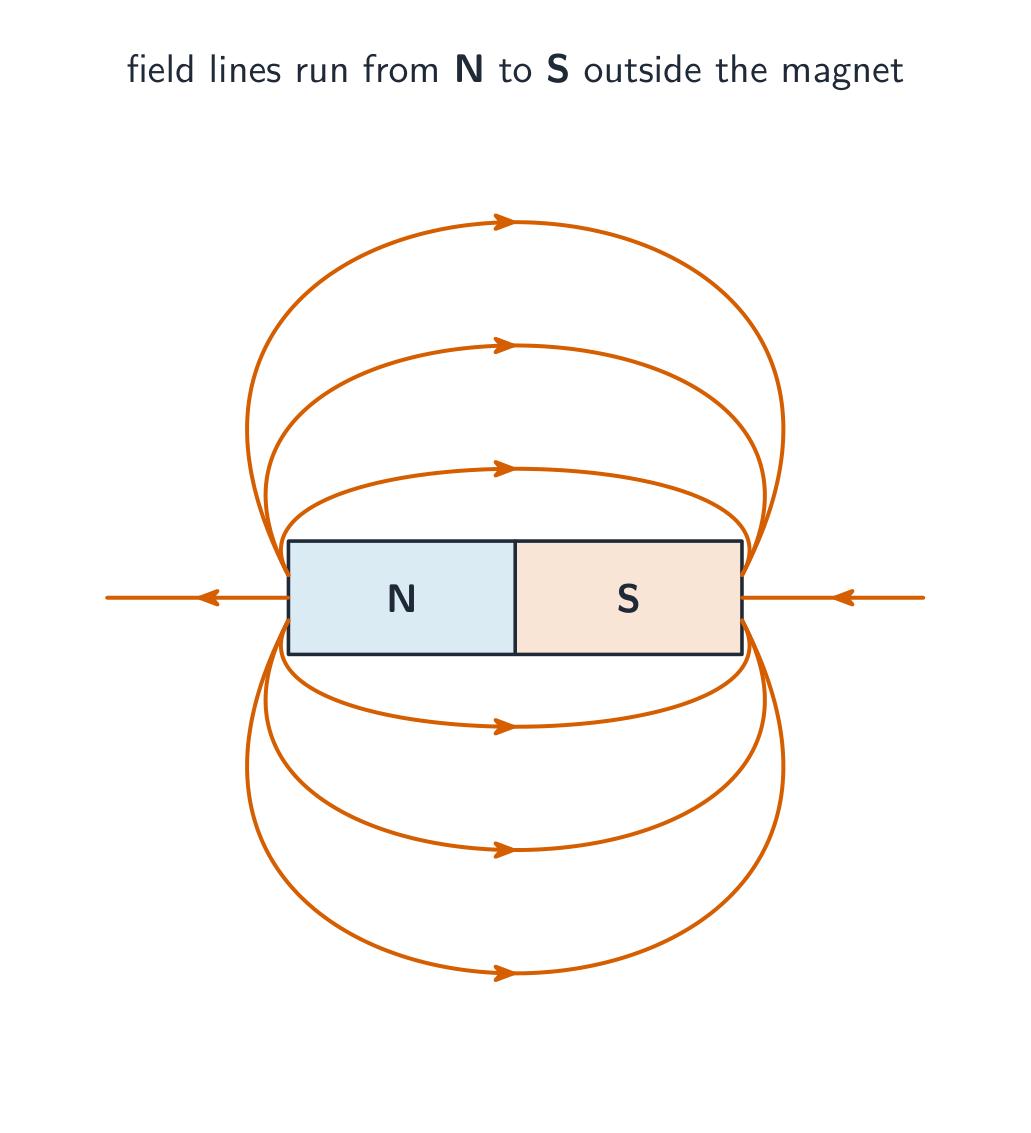
- 12.1.A.1 A magnetic field is a vector field that can be used to determine the magnetic force exerted on moving electric charges, electric currents, or magnetic materials.
- 12.1.A.1.i Magnetic fields can be produced by magnetic dipoles or combinations of dipoles, but never by monopoles.
- 12.1.A.1.ii Magnetic dipoles have north and south polarity.
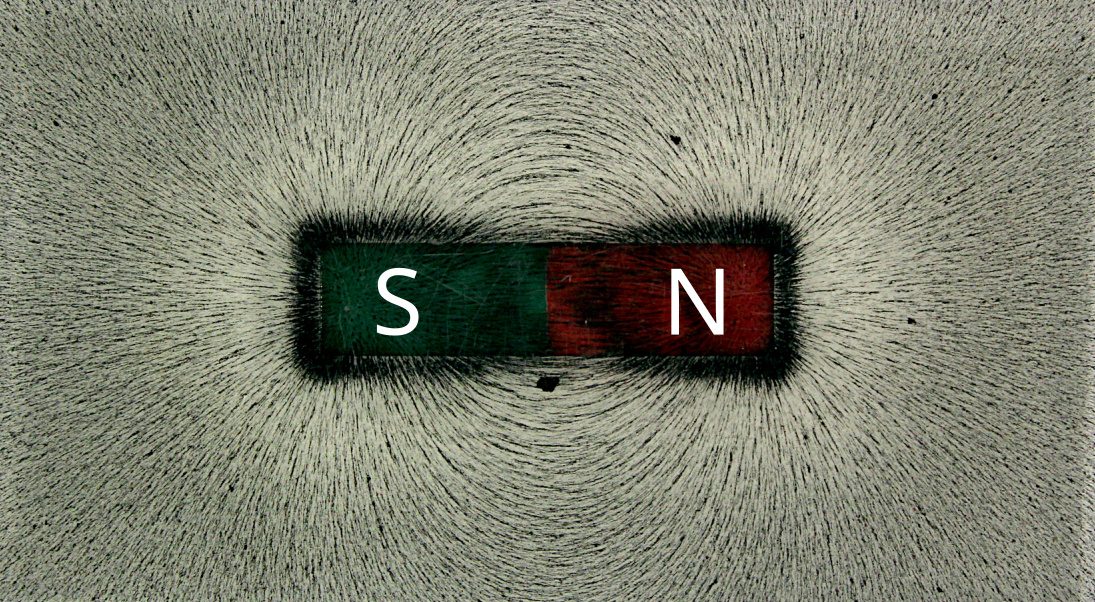
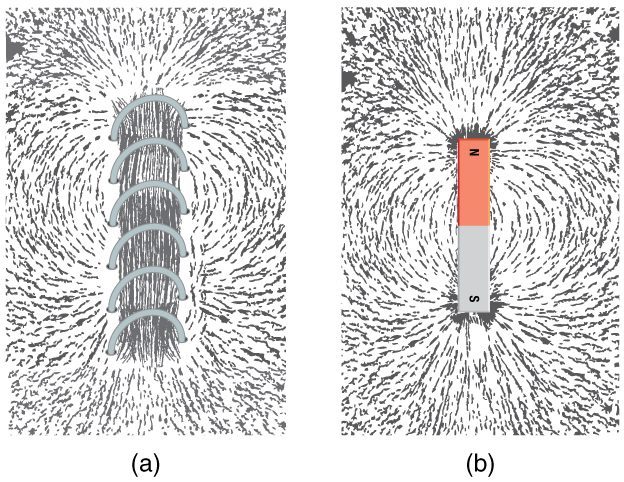
- 12.1.A.2 A magnetic field is a vector quantity and can be represented using vector field maps.
- 12.1.A.2.i Magnetic field lines form closed loops.
- 12.1.A.2.ii Magnetic fields in a bar magnet form closed loops, with the external magnetic field pointing away from one end (defined as the north pole) and returning to the other end (defined as the south pole).
Learning Objective 12.1.B: Describe the magnetic behavior of a material as a result of the configuration of magnetic dipoles in the material.
- 12.1.B.1 Magnetic dipoles result from the circular or rotational motion of electric charges. In magnetic materials, this can be the motion of electrons.
- 12.1.B.1.i Permanent magnetism and induced magnetism are system properties that both result from the alignment of magnetic dipoles within a system.
- 12.1.B.1.ii No magnetic north pole is ever found in isolation from a south pole. For example, if a bar magnet is broken in half, both halves are magnetic dipoles.
- 12.1.B.1.iii Magnetic poles of the same polarity will repel; magnetic poles of opposite polarity will attract.
- 12.1.B.1.iv The magnitude of the magnetic field from a magnetic dipole decreases with increasing distance from the dipole.
- 12.1.B.2 A magnetic dipole, such as a magnetic compass, placed in a magnetic field will tend to align with the magnetic field.
- 12.1.B.3 A material's composition influences its magnetic behavior in the presence of an external magnetic field.
- 12.1.B.3.i Ferromagnetic materials such as iron, nickel, and cobalt can be permanently magnetized by an external field that causes the alignment of magnetic domains or atomic magnetic dipoles.
- 12.1.B.3.ii Paramagnetic materials such as aluminum, titanium, and magnesium interact weakly with an external magnetic field, in that the magnetic dipoles of the material do not remain aligned after the external field is removed.
- 12.1.B.3.iii All materials have the property of diamagnetism, in that their electronic structure creates a usually weak alignment of the dipole moments of the material opposite the external magnetic field.
- 12.1.B4 Earth's magnetic field may be approximated as a magnetic dipole.
Learning Objective 12.1.C: Describe the magnetic permeability of a material.
- 12.1.C.1 Magnetic permeability is a measurement of the amount of magnetization in a material in response to an external magnetic field.
- 12.1.C.2 Free space has a constant value of magnetic permeability, known as the vacuum permeability $\mu_0$, that appears in equations representing physical relationships.
- 12.1.C.3 The permeability of matter has values different from that of free space and arises from the matter's composition and arrangement. It is not a constant for a material and varies based on many factors, including temperature, orientation, and strength of the external field.
日本語
学習目標 12.1.A: 磁場の性質を説明せよ。
- 12.1.A.1 磁場は、運動する電気荷重、電流、あるいは磁性体にかかる磁力を決定するために用いられるベクトル場である。
- 12.1.A.1.i 磁場は磁気双極子や双極子の組み合わせによって生じるが、単極子によって生じることはない。
- 12.1.A.1.ii 磁気双極子には北極と南極の偏性がある。
- 12.1.A.2 磁場はベクトル量であり、ベクトル線図を用いて表現できる。
- 12.1.A.2.i 磁場線は閉じたループを形成する。
- 12.1.A.2.ii 棒状磁石内の磁場は閉じたループを形成し、外部磁場は一方の端(北極と定義される)から外側へ向かい、もう一方の端(南極と定義される)に戻ってくる。
学習目標 12.1.B: 磁性体内部の磁気双極子の配置による磁性体の磁気的挙動を説明せよ。
- 12.1.B.1 磁気双極子は、電気荷重の円運動または回転運動によって生じる。磁性体においては、これは電子の運動であることがある。
- 12.1.B.1.i 永久磁気と誘起磁気は、どちらも系内の磁気双極子の配列によって生じる系の性質である。
- 12.1.B.1.ii 南極から孤立して北極が存在することはない。例えば、棒状磁石を半分に切断した場合、両方の断片はそれぞれ磁気双極子となる。
- 12.1.B.1.iii 同極性の磁極同士は反発し、異極性の磁極同士は吸引する。
- 12.1.B.1.iv 磁気双極子からの磁場の大きさは、双極子からの距離が増加するにつれて減少する。
- 12.1.B.2 磁気コンパスなどの磁気双極子を磁場内に置くと、その双極子は磁場方向に配列しようとする。
- 12.1.B.3 物質の組成は、外部磁場中存在する際の磁性体の磁気的挙動に影響を与える。
- 12.1.B.3.i 鉄、ニッケル、コバルトなどの強磁性体は、外部磁場によって磁気ドメインや原子レベルの磁気双極子が配列されることで、永久磁石として機能することがある。
- 12.1.B.3.ii アルミウム、チタン、マグネシウムなどの常磁性体は、外部磁場との相互作用が弱く、外部磁場を取り除いた後も材料の磁気双極子の配列が維持されない。
- 12.1.B.3.iii すべての物質は抗磁性という性質を持つ。すなわち、その電子構造により、通常は微弱な配列が生じ、その双極子モーメントの向きが外部磁場と逆向きになる。
- 12.1.B4 地球の磁場は、磁気双極子として近似できる。
学習目標 12.1.C: 磁性体の透磁率を説明せよ。
- 12.1.C.1 透磁率は、外部磁場に対して磁性体がどれだけ磁化されるかを示す指標である。
- 12.1.C.2 真空は物理的関係を表す式に現れる一定値である透磁率(真空透磁率)$\mu_0$を持つ。
- 12.1.C.3 物質の透磁率には真空中の値とは異なる値があり、これは物質の組成と配置に起因する。ある材料に対する一定値ではなく、温度、方向性、外部磁場の強さなどの多くの要因に基づいて変化する。