Skip to content · ⁨コンテンツへスキップ⁩

Factor Markets · ⁨要素市場⁩

AP Microeconomics · ⁨AP 経済学⁩ · Topic 5 · ⁨トピック 5⁩

View Slides · ⁨查看幻灯片⁩ Train · ⁨練習する⁩
Video lesson for this topic · ⁨このトピックのビデオレッスン⁩ Open the video page · ⁨動画ページを開く⁩
7:56

要素市場

二人の労働者。一人は衣類工場でシャツを縫う。もう一人は組み立てラインで車を作る。第二の人は遥かに多くの賃金を稼ぐ。なぜか?この単元において、企業は…である

English narration · English + 中文 subtitles burned in · ⁨英語ナレーション・英語+中文字幕 burning-in⁩

5.1

Introduction to Factor Markets · ⁨Factor Markets(要素市場)への導入⁩

Syllabus · ⁨シラバス⁩
English

Enduring Understanding (PRD-4): Factor prices provide incentives and convey information to firms and factors of production.

Learning Objective PRD-4.A: a. Define (using graphs where appropriate) key terms and concepts relating to factor markets. b. Explain (using graphs where appropriate) the relationship between factors of production, firms, and factor prices. c. Calculate (using data from a graph or table where appropriate) the marginal revenue product and marginal resource cost.

  • PRD-4.A.1 Factors of production (labor, capital, and land) respond to factor prices (wages, interest, and rent), and employers' (firms') decision to hire is based on the productivity of the factors, output price, and cost of the factor.
  • PRD-4.A.2 The quantity of labor demanded is negatively related to the wage rate, while the quantity of labor supplied is positively related to the wage rate in a given labor market, other things constant.
日本語

持続的認識(PRD-4): 要素価格は企業および生産要素に対してインセンティブを提供し、情報を伝達します。

学習目標 PRD-4.A: a. 要素市場に関連する主要な用語および概念を定義する(適切な場合、グラフを使用して)。 b. 生産要素、企業、要素価格の関係性を説明する(適切な場合、グラフを使用して)。 c. 限界収益産出量および限界資源コストを計算する(適切な場合、グラフまたは表のデータを使用して)。

  • PRD-4.A.1 生産要素(労働、資本、土地)は要素価格(賃金、利子、地代)に応じて反応し、雇用主(企業)の雇い入れ決定は、生産要素の生産性、輸出価格、要素コストに基づきます。
  • PRD-4.A.2 特定の労働市場において、他の条件は一定であるとして、労働需求量は賃金率と負の相関関係にあり、労働供給量は賃金率と正の相関関係にあります。
Source: College Board AP Course and Exam Description · ⁨出典: College Board AP コースおよび試験説明書⁩

English

A factor market 要素市场 is where firms buy the factors of production – labor, land, capital. The roles reverse: firms demand and households supply. The most-tested factor is labor.

Factor demand is a derived demand 派生需求 – firms want labor not for itself but for the output (and revenue) it produces. So the demand for workers depends on the demand for the product they make.

日本語
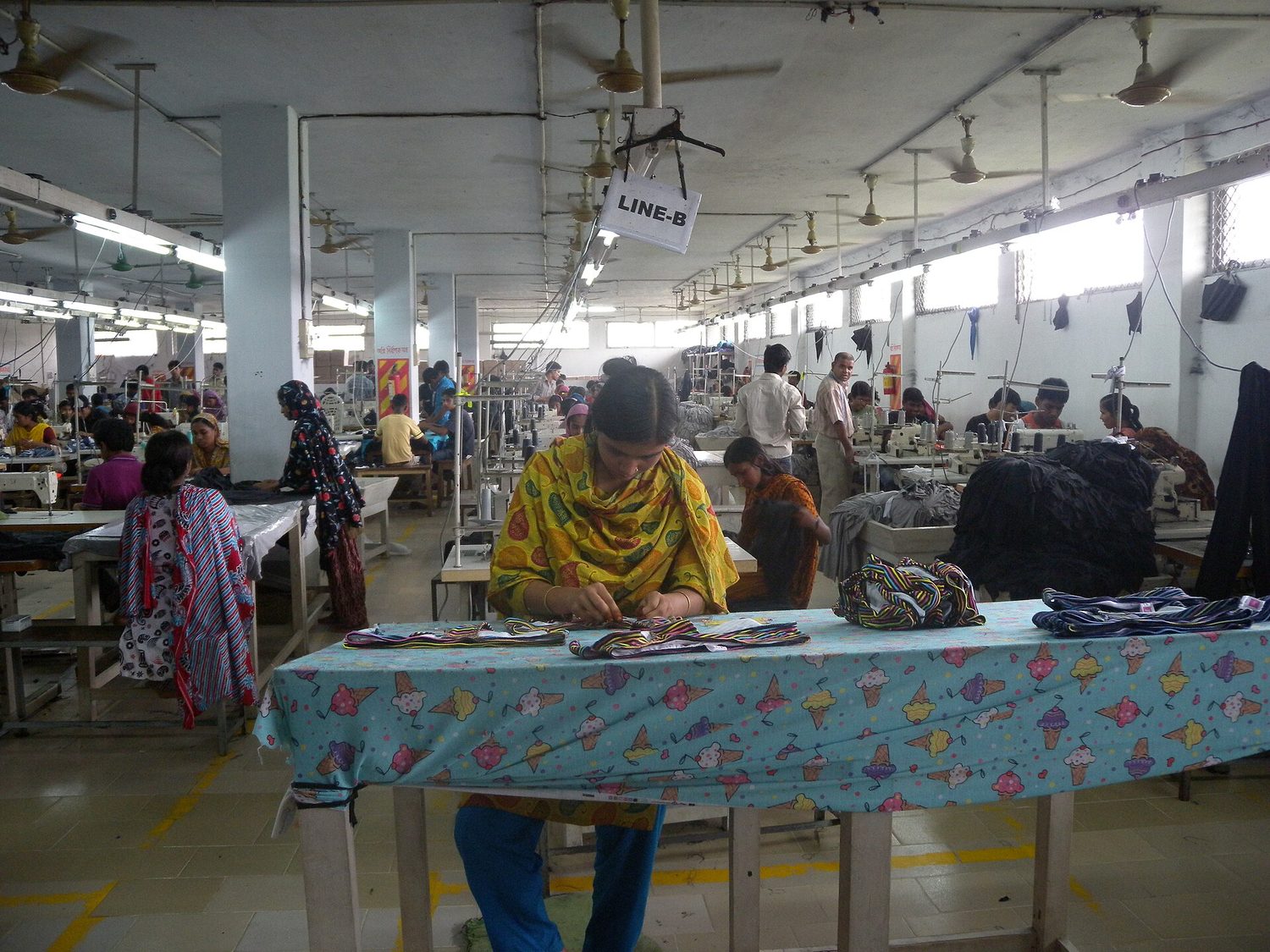
A garment factory: factor markets determine wages for labour and other inputs

Factor market(要素市場)とは、企業がfactors of production(生産要素)——労働、土地、資本——を購入する場所である。役割は逆転しており、**firms(企業)が demand(需要)**し、**households(世帯)が supply(供給)する。最も頻出する要素はlabor(労働)**である。

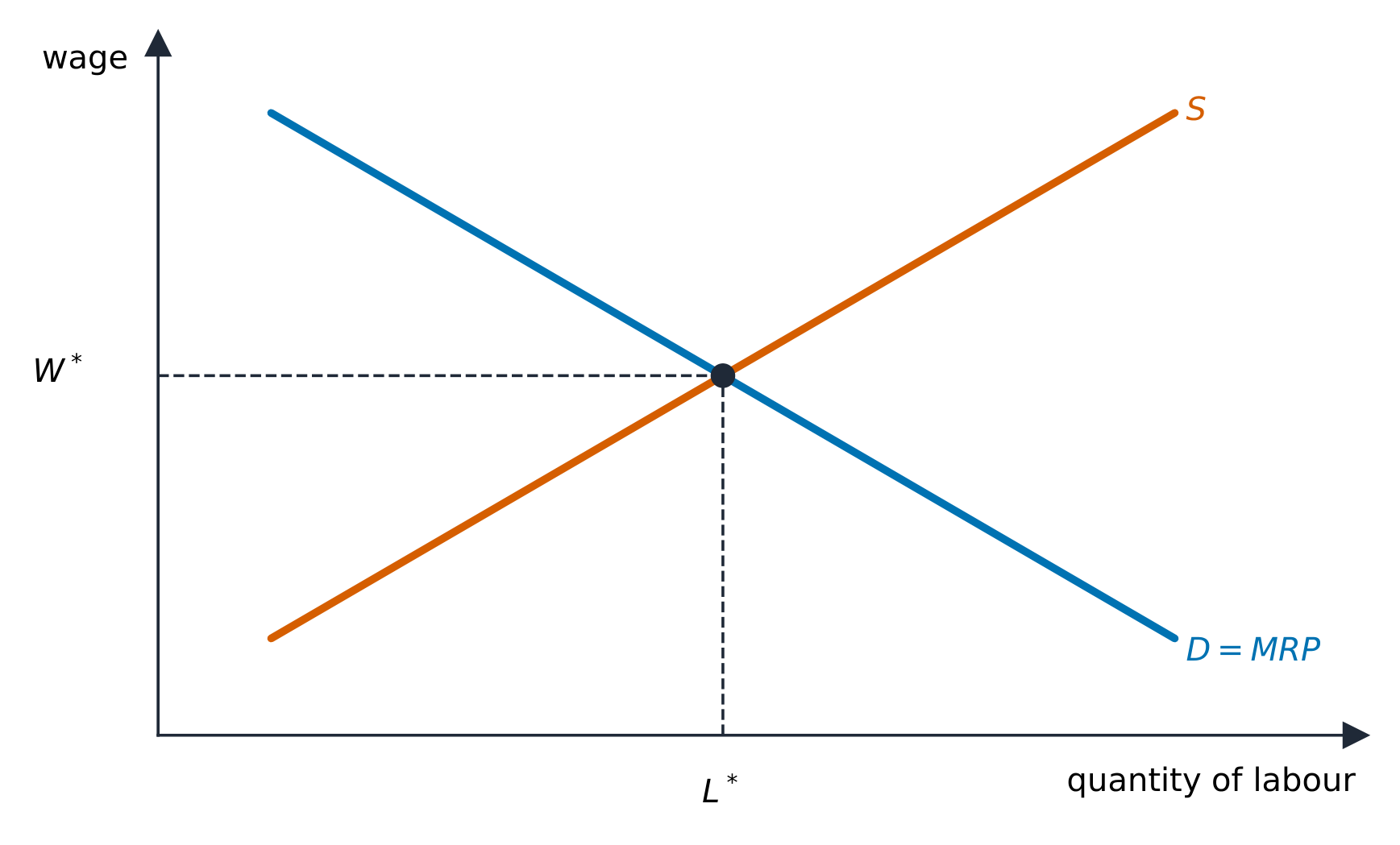
A competitive labour market sets the wage where labour demand meets labour supply

要素需要は**derived demand(派生需要)**であり、企業は労働そのものではなく、それが生み出す output(生産物)および revenue(収益)のために労働を欲する。したがって、労働者の需要は、その労働者が作る製品の需要に依存する。

Explore · ⁨探索⁩

A labour (factor) market · ⁨労働(要素)市場⁩

In a factor market firms demand labour and households supply it; the wage settles where demand meets supply. Shift either curve and watch the wage and employment move. · ⁨要素市場において、企業は労働力を需要し、家計はそれを供給します。賃金は需給が一致する地点で決定されます。どちらかの曲線がシフトすれば、賃金と雇用数がどのように動くか观察できます。⁩

Vocabulary · ⁨語彙⁩ Train · ⁨練習する⁩
English 日本語
factor market/ˈfæktə ˈmɑːkɪt/ 要素市場
derived demand/dɪˈraɪvd dɪˈmænd/ 派生需要
5.2

Changes in Factor Demand and Factor Supply · ⁨Changes in Factor Demand and Factor Supply(要素需要と要素供給の変化)⁩

Syllabus · ⁨シラバス⁩
English

Enduring Understanding (PRD-4): Factor prices provide incentives and convey information to firms and factors of production.

Learning Objective PRD-4.B: Explain (using graphs where appropriate) firms' and factors' responses to changes in incentives and constraints.

  • PRD-4.B.1 Changes in the determinants of labor demand, such as the output price and the productivity of the worker, cause the labor demand curve to shift.
  • PRD-4.B.2 Changes in the determinants of labor supply (such as immigration, education, working conditions, age distribution, availability of alternative options, preferences for leisure, and cultural expectations) cause the labor supply curve to shift.
日本語

持続的認識(PRD-4): 要素価格は企業および生産要素に対してインセンティブを提供し、情報を伝達します。

学習目標 PRD-4.B: 企業および生産要素がインセンティブおよび制約の変化に対してどのように反応するかを説明する(適切な場合、グラフを使用して)。

  • PRD-4.B.1 輸出価格や労働者の生産性といった労働需要の決定要因の変化は、労働需要曲線をシフトさせます。
  • PRD-4.B.2 移民、教育、労働環境、年齢構成、代替案の可用性、余暇に対する嗜好、文化的期待といった労働供給の決定要因の変化は、労働供給曲線をシフトさせます。

Source: College Board AP Course and Exam Description · ⁨出典: College Board AP コースおよび試験説明書⁩

English

Labor demand shifts when:

  • the product price or product demand changes (more valuable output $\Rightarrow$ more labor demanded),
  • worker productivity changes (better training or capital),
  • the price of other inputs changes (a substitute input like machines, or a complement).

Labor supply shifts with the number of qualified workers, immigration, workers' preferences (wages needed to attract them), and the wages available in other jobs. The market wage is set where labor demand meets labor supply.

日本語

**Labor demand(労働需要)**がシフトするのは以下の場合である:

  • **product price(製品価格)**や product demand(製品需要)が変わる場合(より価値の高い生産物 $\Rightarrow$ はより多くの労働者を demand(需要)する)、
  • **worker productivity(労働者の生産性)**が変わる場合(より良い training(研修)や capital(資本)による改善など)、
  • **price of other inputs(他の投入物の価格)**が変わる場合(substrate input(代替投入物)である機械など、または complement(補完投入物)など)。

**Labor supply(労働供給)は、number of qualified workers(資格を持つ労働者の数)、immigration(移民)、workers' preferences(労働者の選好=彼らを惹きつけるために必要な賃金)、そしてother jobs(他の職業)**での利用可能な賃金によってシフトする。市場賃金は労働需要と労働供給が一致する地点で決定される。

5.3

Profit-Maximizing Behavior in Perfectly Competitive Factor Markets · ⁨Profit-Maximizing Behavior in Perfectly Competitive Factor Markets(完全競争要素市場における利益最大化行動)⁩

Syllabus · ⁨シラバス⁩
Enduring UnderstandingLearning ObjectiveEssential Knowledge

PRD-4
Factor prices provide incentives and convey information to firms and factors of production.

PRD-4.C
a. Define (using graphs as appropriate) the characteristics of perfectly competitive factor markets.
b. Explain (using graphs where appropriate) the profit-maximizing behavior of firms buying labor (with other inputs fixed) in perfectly competitive markets.
c. Calculate (using data from a graph or table where appropriate) measures representing the profit-maximizing behavior of firms buying labor (with other inputs fixed) in perfectly competitive markets.

  • PRD-4.C.1 In a perfectly competitive labor market, the wage is set by the market and each firm hires the quantity of workers, where the marginal factor (resource) cost (wage) equals the marginal revenue product of labor. A typical firm may be a perfect competitor in the labor market even if it is an imperfect competitor in its output markets.
  • PRD-4.C.2 A typical firm hires labor in a perfectly competitive labor market as long as the marginal revenue product of labor is greater than the market wage.
  • PRD-4.C.3 To minimize costs or maximize profits, firms allocate inputs such that the last dollar spent on each input yields the same amount of marginal product.

Source: College Board AP Course and Exam Description · ⁨出典: College Board AP コースおよび試験説明書⁩

English

A firm decides how many workers to hire with the same marginal logic as everything else – compare the marginal benefit and marginal cost of one more worker.

  • The marginal benefit of a worker is the marginal revenue product 边际收益产品 (MRP): the extra revenue from one more worker, $MRP = MP \times$ product price (in a competitive product market, where $P=MR$). MRP falls as more workers are hired, because of diminishing marginal product.
  • The marginal cost of a worker is the wage (in a competitive labor market the firm is a wage taker, so marginal factor cost $=$ the wage).
  • Hiring rule: hire workers up to where $MRP = \text{wage}$ (more generally, $MRP = MFC$). The MRP curve is the firm's labor demand curve.

Worked example. A worker's marginal product is $8$ units and the firm sells each in a competitive market for $\$5$, so $MRP=8\times\$5=\$40$. If the wage is $\$30$, the firm hires this worker because $MRP>\text{wage}$. As more workers join, diminishing marginal product pulls MRP down; the firm keeps hiring until a worker whose $MP=6$ gives $MRP=6\times\$5=\$30$, exactly the wage – the profit-maximizing stopping point.

To choose the least-cost combination of two inputs, set the MP-per-dollar equal across inputs: $\dfrac{MP_L}{P_L}=\dfrac{MP_K}{P_K}$ – the same equal-bang-per-buck rule as consumer choice.

Exam skill: compute MRP from a table (marginal product $\times$ price) and find how many workers to hire at a given wage – a common free-response task.

日本語

企業が雇う労働者数を決定する際にも、他のすべての決定と同様に**marginal logic(限界論理)**を用いる——追加の労働者の marginal benefit(限界便益)と marginal cost(限界費用)を比較する。

  • 労働者の marginal benefit(限界便益)は marginal revenue product(限界収益産品)(MRP)である:追加の労働者1人あたり extra revenue(追加収益)であり、$MRP = MP \times$ product price(製品価格)(完全競争製品市場において $P=MR$)。追加の労働者を雇用するにつれて、**diminishing marginal product(限界生産性の逓減)**により MRP は低下する。
  • 労働者の marginal cost(限界費用)は **wage(賃金)**である(完全競争労働市場において企業は wage **taker(賃金の受取手)**であるため、marginal factor cost(限界要素費用)$=$ 賃金となる)。
  • Hiring rule(雇用ルール): $MRP = \text{wage}$ となるまで労働者を hire(雇用)する(より一般的には $MRP = MFC$)。MRP 曲線は企業の labor **demand(労働需要)**曲線である。

Worked example(演習例)。 労働者の marginal product(限界生産物)が $8$ 単位であり、企業がそれを完全競争市場で $\$5$, so $MRP=8\times\$5=\$40$. If the wage is $\$30$ で販売する場合、企業はこの労働者を hire(雇用)する。なぜなら $MRP>\text{wage}$ だからである。より多くの労働者が加わるにつれて、diminishing marginal product(限界生産性の逓減)が MRP を押し下げ、企業は继续 hiring(雇用を続ける)——undefined worker whose $MP=6$ が $MRP=6\times\$5=\$30$ となり、ちょうど wage(賃金)となる——profit-maximizing stopping point(利益最大化の停止点)まで。

2つの投入物の**least-cost combination(最低コスト組合せ)**を選ぶ際、投入物間で **MP-per-dollar equal(ドルあたりの限界生産物が等しい)**ように set(設定)する:$\dfrac{MP_L}{P_L}=\dfrac{MP_K}{P_K}$ ——これは consumer choice(消費者の選択)と同じ equal-bang-per-buck(おつりのない価値)ルールである。

Exam skill: table(表)から MRP を compute(計算)(marginal product(限界生産物)$\times$ price(価格))し、与えられた wage(賃金)で何人の労働者を hire(雇用)すべきかを見つける——よくある free-response task(自由記述問題)である。

A car assembly line: firms hire labour until the marginal revenue product equals the wage
Vocabulary · ⁨語彙⁩ Train · ⁨練習する⁩
English 日本語
marginal revenue product/ˈmɑːdʒɪnl ˈrevənjuː ˈprɒdʌkt/ 限界収益産出量
marginal factor cost/ˈmɑːdʒɪnl ˈfæktə kɒst/ 限界要素コスト
5.4

Monopsonistic Markets · ⁨Monopsonistic Markets( monopsony 市場)⁩

Syllabus · ⁨シラバス⁩
English

Enduring Understanding (PRD-4): Factor prices provide incentives and convey information to firms and factors of production.

Learning Objective PRD-4.D: a. Define (using graphs as appropriate) the characteristics of monopsonistic markets. b. Explain (using graphs where appropriate) the profit-maximizing behavior of firms buying labor (with other inputs fixed) in monopsonistic markets. c. Calculate (using data from a graph or table where appropriate) measures representing the profit-maximizing behavior of firms buying labor (with other inputs fixed) in monopsonistic markets.

  • PRD-4.D.1 In a monopsonistic labor market, a typical firm hires additional labor as long as the marginal revenue product is greater than the marginal factor (resource) cost (the wage of a new unit of labor plus the wage increase given to all existing labor).
  • PRD-4.D.2 When a typical firm hires additional workers in a monopsonistic labor market, the marginal factor (resource) cost is greater than the supply price of labor.
日本語

持続的認識(PRD-4): 要素価格は企業および生産要素に対してインセンティブを提供し、情報を伝達します。

学習目標 PRD-4.D: a. 買手独占市場の特徴を定義する(適切な場合、グラフを使用して)。 b. 買手独占市場において、他の投入財が固定された状態で労働を購入する企業の利益最大化行動を説明する(適切な場合、グラフを使用して)。 c. 買手独占市場において、他の投入財が固定された状態で労働を購入する企業の利益最大化行動を表す指標を計算する(適切な場合、グラフまたは表のデータを使用して)。

  • PRD-4.D.1 買手独占労働市場において、典型的な企業は、限界収益産出量が限界要素(資源)コスト(新規単位の労働の賃金および既存全労働者への賃金増額を含む)よりも大きい限り、追加の労働力を雇い入れます。
  • PRD-4.D.2 典型的な企業が買手独占労働市場で追加の労働者を雇い入れるとき、限界要素(資源)コストは労働の供給価格よりも高くなります。

Source: College Board AP Course and Exam Description · ⁨出典: College Board AP コースおよび試験説明書⁩

English

A monopsony 买方垄断 is a market with a single buyer of a factor – for example, the only large employer in a town.

  • Because it is the whole market, the monopsonist faces an upward-sloping labor supply curve: to hire more workers it must raise the wage for everyone.
  • So the marginal factor cost 边际要素成本 (MFC) is above the wage (like $MR for a monopoly, in reverse), and the MFC curve lies above the supply curve.
  • The monopsonist hires where $MRP = MFC$, then pays the lower wage the supply curve allows at that quantity.
  • Result: compared with a competitive labor market, a monopsony hires fewer workers at a lower wage – the mirror image of monopoly.

Exam skill: draw the monopsony graph (supply, MFC above it, MRP as demand), mark quantity at $MRP=MFC$ and the wage down on the supply curve, and contrast it with the competitive wage and quantity.

日本語

**Monopsony(単一買手)**とは、factor(要素)に対して single buyer(単一の買い手)のみが存在する市場であり、例えば town(町)内での唯一の large employer(大規模雇用主)などが該当する。

  • 它就是整个市场(it is the whole market)であるため、monopsonist(単一買手)は upward-sloping labor supply(右上がりの労働供給) facing する:より多くの労働者を hire(雇用)するには、everyone(全員)の wage(賃金)を raise(引き上げる)必要がある。
  • つまり、限界要素コスト(MFC)は賃金より高い(独占の逆で$MRのような場合)、MFC曲線は供給曲線の上側に位置する。
  • モノポソニーは$MRP = MFC$で労働を雇用し、その数量に対応する供給曲線上の低い賃金を支払う。
  • 結果として、完全競争労働市場と比較して、モノポソニーは少ない労働者を低い賃金で雇用する – これは独占の鏡像である。
モノポソニーはMFC = MRPとなる点で雇用し、完全競争市場よりも低い賃金を支払う

試験スキル: モノポソニーのグラフを描く(供給曲線、その上にあるMFC、需要としてのMRP)。$MRP=MFC$で数量を标记し、供給曲線上に賃金を下げてプロットし、完全競争における賃金と数量との対比を行う。

Vocabulary · ⁨語彙⁩ Train · ⁨練習する⁩
English 日本語
monopsony/ˈmɒnəʊpsəni/ 単一買い手
5.4

Exam tips · ⁨試験対策⁩

English
  • Factor demand is derived demand; hire labour up to where MRP = wage (MRP = marginal product × price).
  • MRP falls as more workers are hired (diminishing marginal product).
  • For least-cost input use, equalise the marginal product per dollar across inputs.
  • A monopsony faces an upward supply, so its marginal factor cost is above the wage; it hires fewer workers at a lower wage.
  • Draw the monopsony graph (supply, MFC above it, MRP as demand) and contrast with the competitive outcome.
日本語
  • 要素需要は派生需要であり、MRP = 賃金(MRP = 限界生産量 × 価格)となるまで労働を雇う。
  • 労働者を増やすにつれてMRPは減少する(限界生産量の逓減)。
  • 最小費用投入財の選択には、投入財間でドルあたりの限界生産量を等しくする。
  • モノポソニーは上昇する供給に直面するため、その限界要素コストは賃金より高い。少ない労働者を低い賃金で雇用する。
  • モノポソニーのグラフを描く(供給曲線、その上にあるMFC、需要としてのMRP)と、完全競争の結果との対比を行う。

Interactive lessons on this topic · ⁨このトピックのインタラクティブ授業⁩

Work through it step by step, with instant-check exercises. · ⁨一歩ずつ進め、即時チェック付きの問題で学習します。⁩

Past Papers · ⁨過去問⁩

More topics in AP Microeconomics · ⁨AP 経済学⁩ · ⁨AP Microeconomics · ⁨AP 経済学⁩ の他のトピック⁩

Log in or create account · ⁨ログインまたはアカウント作成⁩

IGCSE, A-Level & AP