Skip to content · ⁨コンテンツへスキップ⁩

Refining Qualified Arguments · ⁨限定された主張を洗練させる⁩

AP English Language and Composition · ⁨AP 英語言語と作文⁩ · Topic 9 · ⁨トピック 9⁩

View Slides · ⁨查看幻灯片⁩ Train · ⁨練習する⁩
Video lesson for this topic · ⁨このトピックのビデオレッスン⁩ Open the video page · ⁨動画ページを開く⁩
4:51

単元9: 条件付きの主張の精密化

単元9は短く、これがコースの最終ステップです:あなたの主張に反対する議論如何处理するかのことです。ここにあるすべての内容は試験で直接評価され、…します。

English narration · English + 中文 subtitles burned in · ⁨英語ナレーション・英語+中文字幕 burning-in⁩

9.1

How Claims Are Qualified · ⁨主張の限定方法⁩

Syllabus · ⁨シラバス⁩
English

Enduring Understanding (CLE-1): Writers make claims about subjects, rely on evidence that supports the reasoning that justifies the claim, and often acknowledge or respond to other, possibly opposing, arguments.

Learning Objective 3.C: Reading – Explain ways claims are qualified through modifiers, counterarguments, and alternative perspectives.

  • CLE-1.AA Writers enhance their credibility when they refute, rebut, or concede opposing arguments and contradictory evidence.
  • CLE-1.AB When writers concede, they accept all or a portion of a competing position or claim as correct, agree that the competing position or claim is correct under a different set of circumstances, or acknowledge the limitations of their own argument.
  • CLE-1.AC When writers rebut, they offer a contrasting perspective on an argument and its evidence or provide alternative evidence to propose that all or a portion of a competing position or claim is invalid.
  • CLE-1.AD When writers refute, they demonstrate, using evidence, that all or a portion of a competing position or claim is invalid.
  • CLE-1.AE Transitions may be used to introduce counterarguments.
  • CLE-1.AF Not all arguments explicitly address a counterargument.
  • CLE-1.Y Effectively entering into an ongoing conversation about a subject means engaging the positions that have already been considered and argued about.
  • CLE-1.Z Evidence and sources will either support, complement, or contradict a writer’s thesis.
日本語

持続的理解 (CLE-1): 作家は対象について主張を行い、その主張を正当化するための論理的推理を裏付ける根拠に依存し、また、他者による対立する可能性のある議論を認識したり、反論したりすることが多い。

学習目標 3.C: 読解 – 修飾語、反説、代替視点を通じて主張がどのように限定されるかを説明する。

  • CLE-1.AA 作家は、反対の主張や矛盾する証拠を反証、反論、または譲歩することで、信頼性を高める。
  • CLE-1.AB 作家が譲歩する場合、競合する立場や主張の全部または一部を正しいものとして受け入れ、異なる条件の下でそれが正しいことを認めるか、自身の主張の限界を認める。
  • CLE-1.AC 作家が反論する場合、主張とその証拠に対して対照的な視点を提供するか、あるいは競合する立場や主張の全部または一部が無効であると提案するために代替証拠を提供する。
  • CLE-1.AD 作家が反証する場合、証拠を用いて、競合する立場や主張の全部または一部が無効であることを示す。
  • CLE-1.AE 逆説的議論を導入するために接続詞を使用することができる。
  • CLE-1.AF すべての主張が逆説的議論を明示的に扱うわけではない。
  • CLE-1.Y あるテーマに関する継続的な対話に参加することは、すでに検討され議論されてきた立場に関与することを意味する。
  • CLE-1.Z 証拠と出典は、作家の thesis を支持し、補完する、あるいは contradict する。
Source: College Board AP Course and Exam Description · ⁨出典: College Board AP コースおよび試験説明書⁩

English

Unit 9 is short and it is the course's final move: how to handle the arguments that oppose yours. Everything here is directly rewarded on the exam, and the three key verbs are constantly confused.

The framing first:

  • Effectively entering an ongoing conversation about a subject means engaging the positions that have already been taken. An argument that ignores them is not participating in the discussion, only announcing into it.
  • Evidence and sources will either support, complement, or contradict 支持、补充或反驳 a writer's thesis. All three are usable - contradicting evidence is not a problem to be hidden but material to be handled.
  • Writers enhance their credibility when they refute, rebut, or concede opposing arguments and contradictory evidence.

The three moves, in the CED's own definitions:

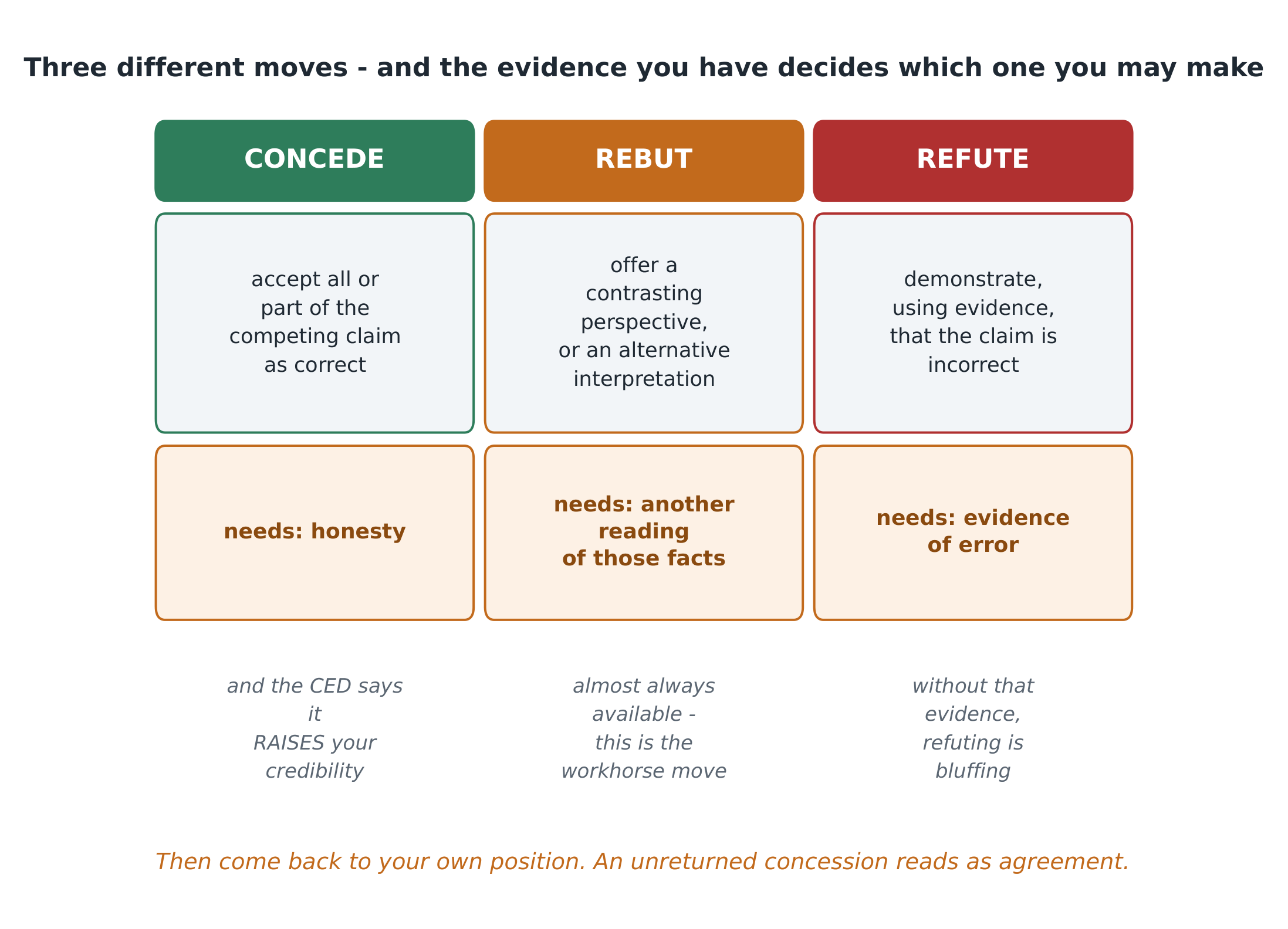
  • Concede 让步: writers accept all or a portion of a competing position or claim as correct, and agree that the opposing point has merit.
  • Rebut 反驳: writers offer a contrasting perspective on an argument and its evidence, or provide an alternative interpretation.
  • Refute 驳倒: writers demonstrate, using evidence, that all or a portion of a competing position or claim is incorrect.

The distinction is what your evidence lets you do. Refuting requires evidence of error; if you do not have it, refuting is bluffing and a reader will see it. Rebutting requires only an alternative reading of the same facts, which is far more often available. Conceding requires honesty, and it costs nothing - the CED says explicitly that it enhances credibility.

Two further points:

  • Transitions may be used to introduce counterarguments - and, as in Unit 5, the transition should signal the relationship. Critics argue announces one; the strongest objection to this is announces one and ranks it.
  • Not all arguments explicitly address a counterargument. True of texts you read, and worth noting when analysing - an argument that engages no opposition has told you something about its intended audience.
日本語

9単元は短く、このコースの最終的な目標です:あなたの主張に反対する議論如何处理するか。ここにあるすべては試験で直接評価され、3つの重要な動詞は常に混同されます。

枠組みをまず確認しましょう:

  • 特定のテーマに関する継続的な対話に効果的に参加するとは、すでに表明されている立場に関与することを意味します。それらを無視する議論は対話に参加しているわけではなく、ただ単に中へ宣言しているに過ぎません。
  • 証拠や出典は、著者の提唱する主張に対して支持し、補完するか、あるいは反証するかのいずれかになります。これら3つはすべて利用可能であり、反証する証拠は隠すべき問題ではなく、处理すべき素材です。
  • 著者は、反対する議論や矛盾する証拠を反証し、反論したり、譲歩したりすることで信頼性を高めます。
3つの異なるアプローチ、3つの異なる認め方 - 学生らはこれらを常に混同しています
Concede(譲歩)は受け入れること、Rebut(反論)は反撃すること、Refute(反証)は誤りであることを証明することです。あなたの証拠が実際に裏付けられるものを選んでください。

CED(College Board)の定義における3つのアプローチ:

  • Concede(让步):著者は競合する立場や主張の全部または一部を正しいと認め、反対の指摘にも妥当性があることを同意します。
  • Rebut(反論):著者は議論とその証拠に対して対照的な視点を提供するか、あるいは代替解釈を提示します。
  • Refute(反証):著者は証拠を用いて、競合する立場や主張の全部または一部が誤りであることを実証します。

これらの違いは、あなたの証拠で何ができるかに依存します。反証するには誤りの証拠が必要です。それがなければ、反証は虚勢であり、読者にはそれと分かります。反論するには同じ事実の代替解釈が必要ですが、こちらはより頻繁に利用可能です。譲歩には誠実さが必要ですが、コストはかかりません——CEDは明確に、それは信頼性を高めると述べています。

さらに2点:

  • 接続詞は対立する議論を紹介するために使用できます——5単元の例のように、接続詞はその関係性を示すべきです。Critics argue(批評家たちは主張する) は一つを示しますが、the strongest objection to this is(これに対する最も強い異論は) は一つを示し、かつそれを格付けします。
  • すべての議論が明確に対立する議論に言及しているわけではありません。 読むテキストでも同様であり、分析時に注記する価値があります。反対意見を提起しない議論は、その想定読者について何かを教えてくれます。
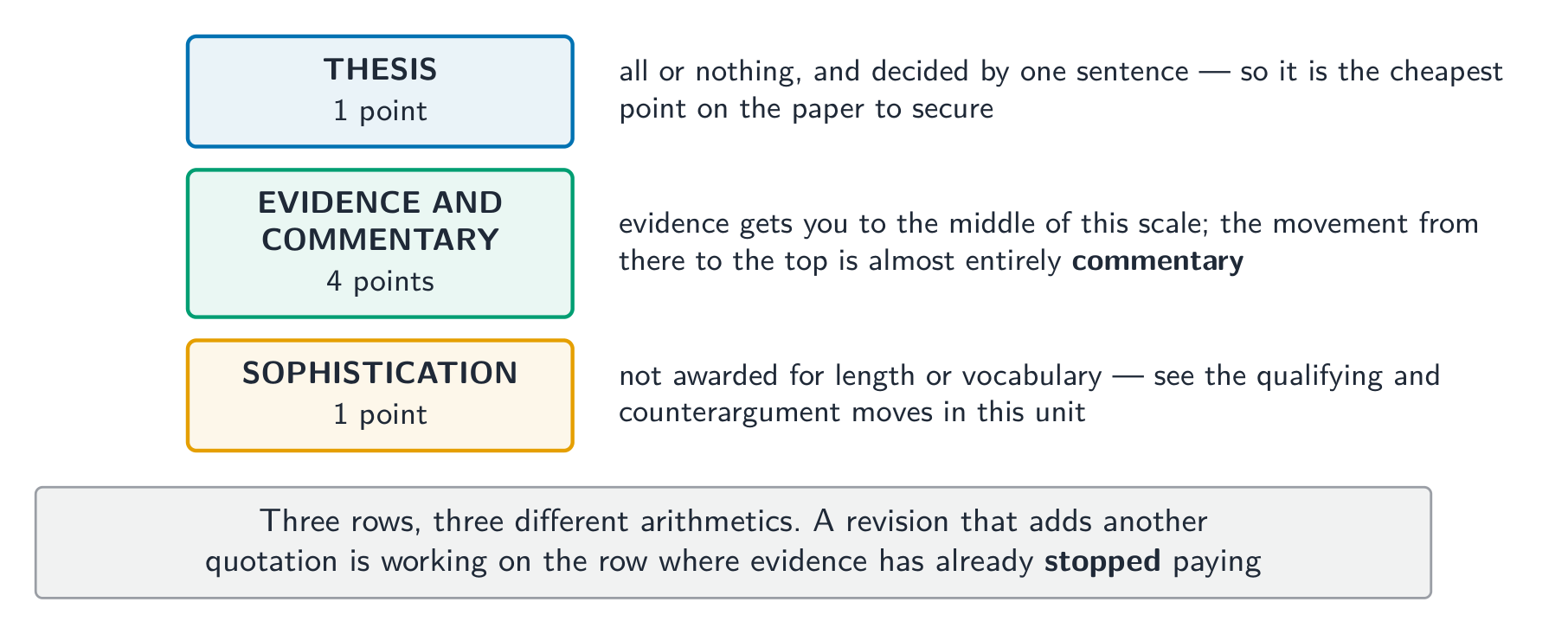
3つの行、3つの異なる計算法 - まだ支払っている方を復習してください
Explore · ⁨探索⁩

Place the counterargument, and say what it signals · ⁨反論を配置し、それが何を示唆するかを述べる⁩

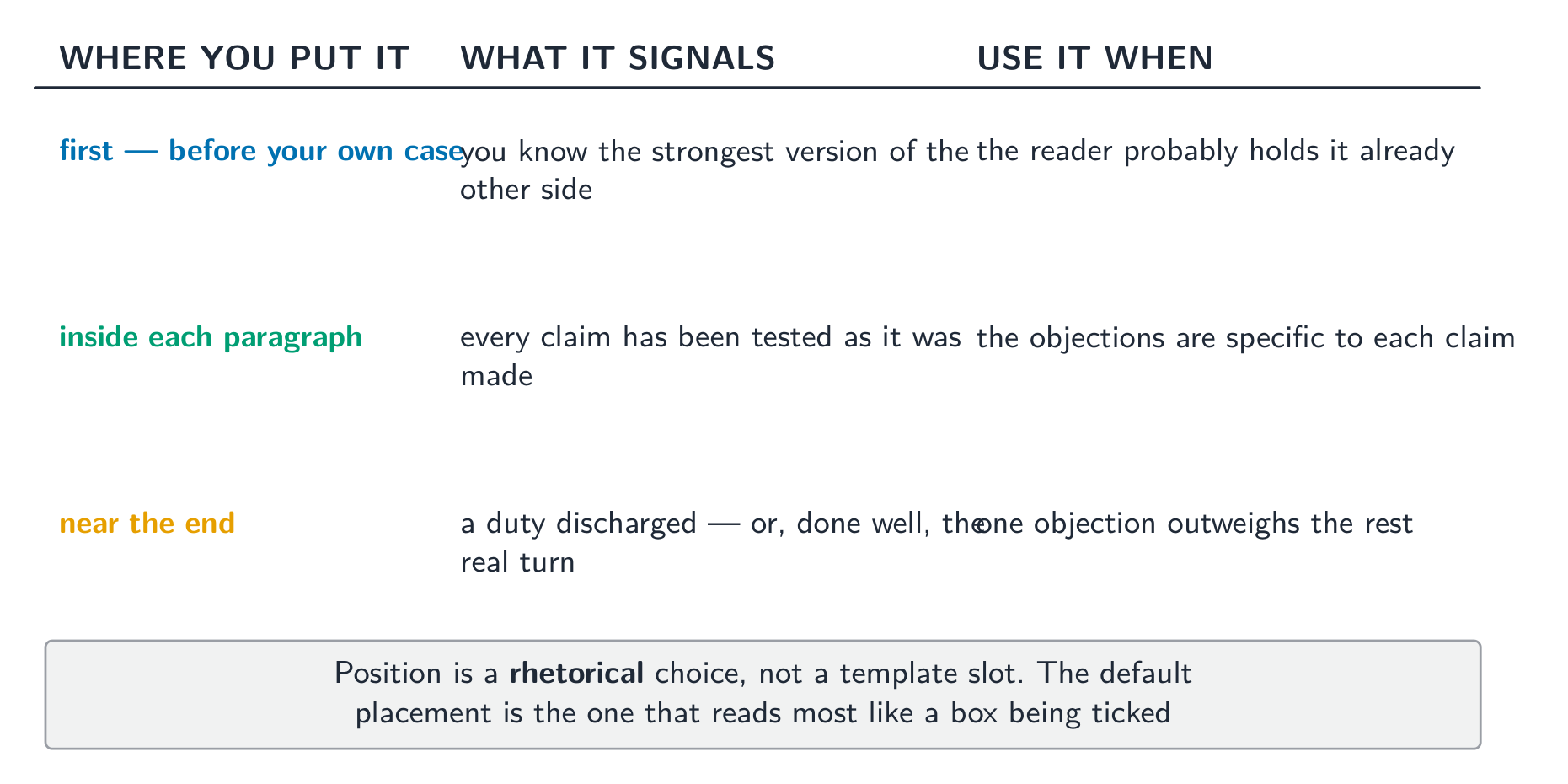
Position carries meaning: early it frames the essay, late it can read as a box being ticked. · ⁨位置には意味がある:前半ではエッセイの枠組みを形成し、後半では単なるチェックボックスとして読まれることがある。⁩

Vocabulary · ⁨語彙⁩ Train · ⁨練習する⁩
English 日本語
support, complement, or contradict/səˈpɔːt ˈkɒmplɪmənt ɔː ˌkɒntrəˈdɪkt/ 補完、支持、または否定する
Concede/kənˈsiːd/ 譲歩
Rebut/rɪˈbʌt/ 反論
Refute/rɪˈfjuːt/ 否定
9.2

Qualifying a Claim · ⁨主張の限定⁩

Syllabus · ⁨シラバス⁩
English

Enduring Understanding (CLE-1): Writers make claims about subjects, rely on evidence that supports the reasoning that justifies the claim, and often acknowledge or respond to other, possibly opposing, arguments.

Learning Objective 4.C: Writing – Qualify a claim using modifiers, counterarguments, or alternative perspectives.

  • CLE-1.AA Writers enhance their credibility when they refute, rebut, or concede opposing arguments and contradictory evidence.
  • CLE-1.AB When writers concede, they accept all or a portion of a competing position or claim as correct, agree that the competing position or claim is correct under a different set of circumstances, or acknowledge the limitations of their own argument.
  • CLE-1.AC When writers rebut, they offer a contrasting perspective on an argument and its evidence or provide alternative evidence to propose that all or a portion of a competing position or claim is invalid.
  • CLE-1.AD When writers refute, they demonstrate, using evidence, that all or a portion of a competing position or claim is invalid.
  • CLE-1.AE Transitions may be used to introduce counterarguments.
  • CLE-1.AF Not all arguments explicitly address a counterargument.
  • CLE-1.Y Effectively entering into an ongoing conversation about a subject means engaging the positions that have already been considered and argued about.
  • CLE-1.Z Evidence and sources will either support, complement, or contradict a writer’s thesis.
日本語

持続的理解 (CLE-1): 作家は対象について主張を行い、その主張を正当化するための論理的推理を裏付ける根拠に依存し、また、他者による対立する可能性のある議論を認識したり、反論したりすることが多い。

学習目標 4.C: 作文 – 修飾語、反説、または代替視点を用いて主張を限定する。

  • CLE-1.AA 作家は、反対の主張や矛盾する証拠を反証、反論、または譲歩することで、信頼性を高める。
  • CLE-1.AB 作家が譲歩する場合、競合する立場や主張の全部または一部を正しいものとして受け入れ、異なる条件の下でそれが正しいことを認めるか、自身の主張の限界を認める。
  • CLE-1.AC 作家が反論する場合、主張とその証拠に対して対照的な視点を提供するか、あるいは競合する立場や主張の全部または一部が無効であると提案するために代替証拠を提供する。
  • CLE-1.AD 作家が反証する場合、証拠を用いて、競合する立場や主張の全部または一部が無効であることを示す。
  • CLE-1.AE 逆説的議論を導入するために接続詞を使用することができる。
  • CLE-1.AF すべての主張が逆説的議論を明示的に扱うわけではない。
  • CLE-1.Y あるテーマに関する継続的な対話に参加することは、すでに検討され議論されてきた立場に関与することを意味する。
  • CLE-1.Z 証拠と出典は、作家の thesis を支持し、補完する、あるいは contradict する。
Source: College Board AP Course and Exam Description · ⁨出典: College Board AP コースおよび試験説明書⁩

English

For your own writing, the strongest and most reliable shape on Question 3 is:

  1. State your position, qualified to the ground your evidence covers.
  2. Concede the part of the opposing position that is genuinely correct.
  3. Rebut or refute the rest - rebut if you have an alternative reading, refute only if you have evidence of error.
  4. Show why your position survives the concession.

Step 4 is the one most students omit, and it is where the sophistication point lives. Conceding and then not returning to your own argument reads as having changed your mind.

Worked example (a real AP exam question). On a Question 3 argument prompt, compare two treatments of the same objection. Weak: "Some people disagree, but they are wrong." That names an opposing position without engaging it - it is neither concession, rebuttal, nor refutation. Strong: "The objection that the policy is too costly is correct as far as it goes: the direct expenditure is higher than any alternative considered. But cost is only decisive if the alternatives achieve the same result, and the same report shows they do not - so the comparison the objection depends on is not available." That paragraph concedes the cost, refutes the comparison with evidence, and returns to the writer's own position. Three moves, and every one of them is on the rubric.

日本語

自身の文章において、Question 3で最も強力で確実な形は以下の通りです:

  1. あなたの立場を述べるが、証拠で裏付けられる範囲まで限定する(qualified)。
  2. 反対の立場の中で本当に正しい部分を譲歩する。
  3. 残りの部分を反論または反証する——代替解釈があれば反論し、誤りの証拠があればのみ反証する。
  4. なぜあなたの立場が譲歩によって存続できるかを示す。

ステップ4は多くの学生が省略しがちな部分であり、ここで洗練された点が生まれます。譲歩した後に自分の議論に戻らないのは、心を変えたように読まれます。

** worked example(実際のAP試験問題).** Question 3の議論プロンプトにおいて、同じ異論に対する2つの処理方法を比較してください。弱い回答:「一部の人は異議を唱えるが、彼らは間違っている。」 これは反対の立場を名指しているだけで関与していません——これは譲歩でも反論でも反証でもありません。強い回答:「政策が高額すぎるという異論は、その範囲内では正しい:直接的な支出は検討されたどの代替案よりも高い。しかし、コストが決定要因となるのは、代替案が同じ結果を生み出す場合のみであり、同じ報告書は彼らがそうではないことを示している——したがって、異論が依存する比較自体が利用できない。」 この段落はコストを譲歩し、証拠によって比較を反証し、著者の立場に戻っています。3つのアプローチがあり、それぞれがルーブリックに記載されています。

立場は修辞的な選択であり、テンプレートのスロットではない
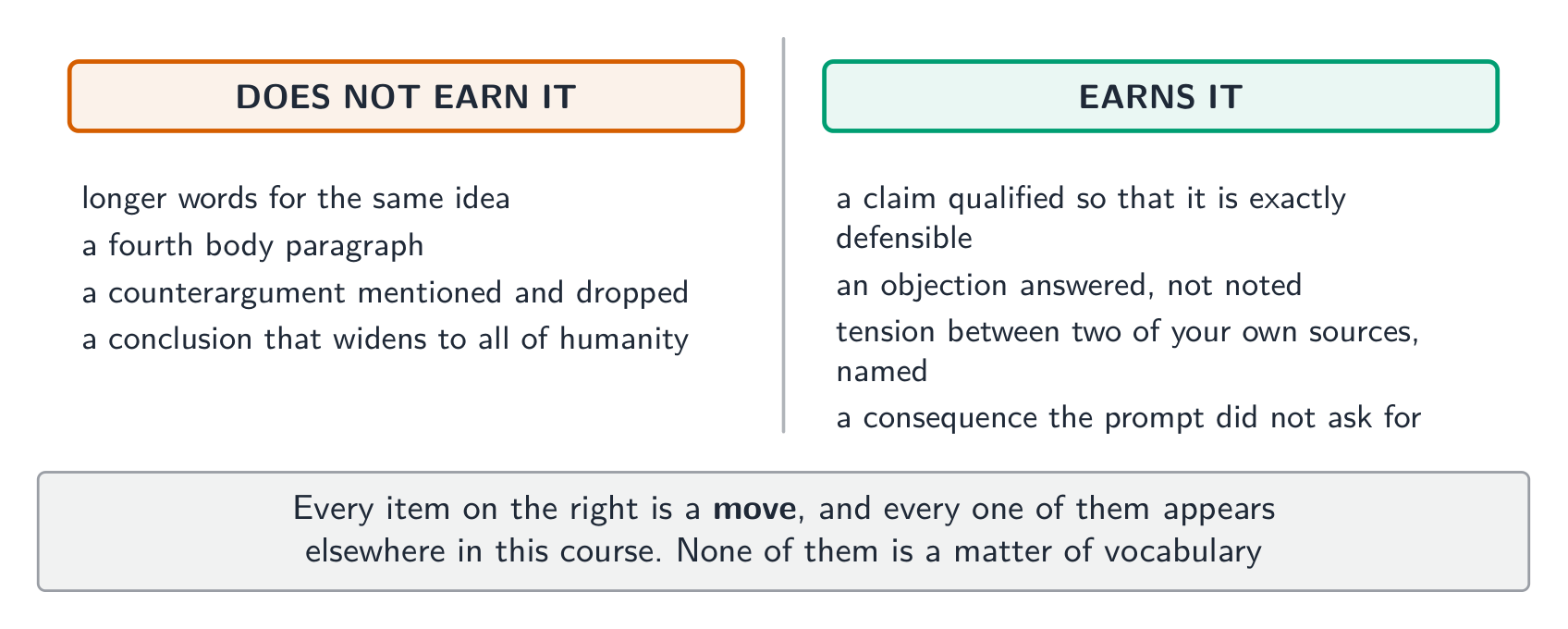
右側の項目はすべて、このコースの他の箇所でのべたアプローチである
Explore · ⁨探索⁩

Sort what earns the sophistication point · ⁨洗練度得点を獲得できる要素を整理する⁩

It rewards a specific set of moves, all taught elsewhere in this course. None of them is a matter of vocabulary. · ⁨これは特定の一連の手法に対して報いるものであり、すべてこのコースで他箇所で習うものである。いずれも語彙の問題ではない。⁩

9.2

Exam tips · ⁨試験対策⁩

English
  • Concede, rebut, refute are three different claims. Do not use the words interchangeably.
  • Refute only with evidence of error. Without it, rebut instead - an alternative interpretation is almost always available.
  • Conceding raises credibility, by the CED's own statement. It is not a weakness.
  • After conceding, come back. An unreturned concession reads as agreement with the other side.
  • Use a transition that ranks the counterargument: the strongest objection to this is beats some people say.
  • When analysing a text, notice when it addresses no counterargument. That absence tells you who it was written for.
日本語
  • Concede, rebut, refute は3つの異なる主張です。これらを interchangeable に使わないでください。
  • 誤りの証拠がない限り、Refute only(反証のみ)は避ける。それがなければ Rebut(反論)を選ぶ——代替解釈はほぼ常に利用可能です。
  • CED自身の声明によれば、Conceding(譲歩)は信頼性を高める。弱みではありません。
  • 譲歩した後、必ず戻る。戻らない譲歩は相手の立場との同意として読まれます。
  • 対立する意見の重要性を順位付けする転換表現を使用します。この議論に対する最も強い反論はが、ある人々は言うよりも優れています。
  • 文章を分析する際、対立意見に一切触れていない箇所があるか注意してください。その欠如は、その文章が誰のために書かれたかを教えてくれます。

Interactive lessons on this topic · ⁨このトピックのインタラクティブ授業⁩

Work through it step by step, with instant-check exercises. · ⁨一歩ずつ進め、即時チェック付きの問題で学習します。⁩

Past Papers · ⁨過去問⁩

More topics in AP English Language and Composition · ⁨AP 英語言語と作文⁩ · ⁨AP English Language and Composition · ⁨AP 英語言語と作文⁩ の他のトピック⁩

Log in or create account · ⁨ログインまたはアカウント作成⁩

IGCSE, A-Level & AP