Skip to content · ⁨Lompat ke konten⁩

Coordination and response · ⁨Koordinasi dan respons⁩

IGCSE Biology · ⁨Biologi IGCSE⁩ · Topic 14 · ⁨Topik 14⁩

Video lesson for this topic · ⁨Pelajaran video untuk topik ini⁩ Open the video page · ⁨Buka halaman video⁩
18:13

Koordinasi dan Respons

Sentuh sesuatu yang panas dan tangan Anda sudah bergerak sebelum Anda merasakan sakit. Itu adalah salah satu dari dua sistem kendali Anda — yang cepat, terdiri dari saraf. Yang lainnya…”

English narration · English + 中文 subtitles burned in · ⁨Narasi bahasa Inggris · Subtitle bahasa Inggris + 中文 disematkan langsung⁩

14.1

The nervous system · ⁨Sistem saraf⁩

Syllabus · ⁨Silabus⁩
English
Core Supplement
1 State that electrical impulses travel along neurones
2 Describe the mammalian nervous system in terms of: (a) the central nervous system (CNS) consisting of the brain and the spinal cord (b) the peripheral nervous system (PNS) consisting of the nerves outside of the brain and spinal cord
3 Describe the role of the nervous system as coordination and regulation of body functions
4 Identify in diagrams and images sensory, relay and motor neurones
5 Describe a simple reflex arc in terms of: receptor, sensory neurone, relay neurone, motor neurone and effector
6 Describe a reflex action as a means of automatically and rapidly integrating and coordinating stimuli with the responses of effectors (muscles and glands)
7 Describe a synapse as a junction between two neurones 8 Describe the structure of a synapse, including the presence of vesicles containing neurotransmitter molecules, the synaptic gap and receptor proteins
9 Describe the events at a synapse as: (a) an impulse stimulates the release of neurotransmitter molecules from vesicles into the synaptic gap (b) the neurotransmitter molecules diffuse across the gap (c) neurotransmitter molecules bind with receptor proteins on the next neurone (d) an impulse is then stimulated in the next neurone
10 State that synapses ensure that impulses travel in one direction only
Bahasa Indonesia
Inti Tambahan
1 Nyatakan bahwa impuls listrik merambat sepanjang neurona
2 Deskripsikan sistem saraf mamalia berdasarkan: (a) sistem saraf pusat (SSP) yang terdiri dari otak dan sumsum tulang belakang (b) sistem saraf tepi (SST) yang terdiri dari saraf-saraf di luar otak dan sumsum tulang belakang
3 Deskripsikan peran sistem saraf sebagai koordinasi dan regulasi fungsi tubuh
4 Identifikasi pada diagram dan gambar neurona sensorik, relai, dan motorik
5 Deskripsikan busur refleks sederhana berdasarkan: reseptor, neurona sensorik, neurona relai, neurona motorik, dan efektor
6 Deskripsikan tindakan refleks sebagai cara secara otomatis dan cepat mengintegrasikan dan mengoordinasikan stimulus dengan respons efektor (otot dan kelenjar)
7 Deskripsikan sinaps sebagai persambungan antara dua neurona 8 Deskripsikan struktur sinaps, termasuk keberadaan vesikel yang mengandung molekul neurotransmiter, celah sinaps, dan protein reseptor
9 Deskripsikan peristiwa di sinaps sebagai: (a) impuls merangsang pelepasan molekul neurotransmiter dari vesikel ke dalam celah sinaps (b) molekul neurotransmiter berdifusi melintasi celah (c) molekul neurotransmiter berikatan dengan protein reseptor pada neurona berikutnya (d) impuls kemudian dirangsang di neurona berikutnya
10 Nyatakan bahwa sinaps memastikan impuls hanya bergerak dalam satu arah

Source: Cambridge International syllabus · ⁨Sumber: Silabus Cambridge International⁩

English
The reflex arc

Your body must coordinate 协调 all its parts and react to changes. The nervous system 神经系统 does this using fast electrical impulses 电脉冲 that travel along neurones 神经元 (nerve cells). It has two parts:

  • the central nervous system 中枢神经系统 (CNS) — the brain 大脑 and the spinal cord 脊髓.
  • the peripheral nervous system 周围神经系统 (PNS) — all the nerves outside the brain and spinal cord.

The nervous system coordinates and regulates 调节 the body's functions.

Bahasa Indonesia
Busur refleks
Pemindaian otak manusia
Otak mengoordinasikan tubuh melalui sistem saraf.

Tubuh Anda harus mengkoordinasikan seluruh bagian dan bereaksi terhadap perubahan. Sistem saraf melakukan ini menggunakan impuls listrik cepat yang merambat sepanjang neurone (sel saraf). Sistem ini memiliki dua bagian:

  • sistem saraf pusat (SSP) — otak dan sumsum tulang belakang.
  • sistem saraf perifer (SSP) — semua saraf di luar otak dan sumsum tulang belakang.

Sistem saraf mengoordinasikan dan mengatur fungsi tubuh.

Vocabulary · ⁨Kosa kata⁩ Train · ⁨Latih⁩
English Bahasa Indonesia
coordinate/kəʊˈɔːdɪnət/ koordinat
nervous system/ˈnɜːvəs ˈsɪstəm/ sistem saraf
electrical impulses/ɪˈlektrɪkl ˈɪmpʌlsɪz/ impuls listrik
neurones/ˈnjuːrəʊnz/ neurone
central nervous system/ˈsentrəl ˈnɜːvəs ˈsɪstəm/ sistem saraf pusat
brain/breɪn/ otak
spinal cord/ˈspaɪnl kɔːd/ sumsum tulang belakang
peripheral nervous system/pəˈrɪfərəl ˈnɜːvəs ˈsɪstəm/ sistem saraf perifer
regulates/ˈreɡjʊleɪts/ mengatur
sensory neurones/ˈsensəri ˈnjuːrəʊnz/ neurone sensorik
relay neurones/ˈriːleɪ ˈnjuːrəʊnz/ neurone perantara
motor neurones/ˈməʊtə ˈnjuːrəʊnz/ neurone motorik
reflex/ˈriːfleks/ refleks
response/rɪˈspɒns/ respons
reflex arc/ˈriːfleks ɑːk/ busur refleks
receptor/rɪˈseptə/ reseptor
effector/ɪˈfektə/ efektor
muscle/ˈmʌsl/ otot
gland/ɡlænd/ kelenjar
14.1

Neurones and the reflex arc · ⁨Neurone dan busur refleks⁩

English

There are three kinds of neurone:

  • sensory neurones 感觉神经元 — carry impulses from receptors to the CNS.
  • relay neurones 中间神经元 — pass impulses on inside the CNS.
  • motor neurones 运动神经元 — carry impulses from the CNS to effectors.

A reflex 反射 action is a fast, automatic response 反应 to a stimulus 刺激 (a change). It follows a fixed path, the reflex arc 反射弧:

receptor 感受器 → sensory neurone → relay neurone → motor neurone → effector 效应器 (a muscle 肌肉 or gland 腺体)

Bahasa Indonesia
Gambar mikroskopis sebuah neurone
Sebuah neurone (sel saraf) membawa impuls listrik ke seluruh tubuh.

Ada tiga jenis neurone:

  • neurone sensorik — membawa impuls dari reseptor ke SSP.
  • neurone relay — meneruskan impuls di dalam SSP.
  • neurone motorik — membawa impuls dari SSP ke efektor.

Aksi refleks adalah respons cepat dan otomatis terhadap stimulus (perubahan). Aksi ini mengikuti jalur tetap, yaitu busur refleks:

reseptor → neurone sensorik → neurone relay → neurone motorik → efektor (otot atau kelenjar)

Busur refleks: stimulus dideteksi oleh reseptor di kulit; impuls merambat sepanjang neurone sensorik menuju neurone relay di sumsum tulang belakang, lalu sepanjang neurone motorik menuju otot efektor
Dalam busur refleks, impuls berpindah dari reseptor → sensorik → relay → motorik → efektor
Explore · ⁨Jelajahi⁩

The reflex arc · ⁨Busur refleks⁩

A reflex is a fast, automatic response — the signal takes a short cut through the spinal cord. · ⁨Refleks adalah respons cepat dan otomatis — sinyal mengambil jalan pintas melalui sumsum tulang belakang.⁩

Vocabulary · ⁨Kosa kata⁩ Train · ⁨Latih⁩
English Bahasa Indonesia
stimulus/ˈstɪmjʊləs/ rangsangan
14.1

Synapses (Supplement) · ⁨Sinapsis (Suplemen)⁩

English

A synapse 突触 is a junction (a tiny gap) between two neurones. At the end of one neurone are vesicles 囊泡 holding neurotransmitter 神经递质 molecules. Across the synaptic gap 突触间隙, the next neurone has receptor proteins 受体蛋白.

Events at a synapse:

  1. an impulse arrives and makes the vesicles release neurotransmitter into the synaptic gap.
  2. the neurotransmitter molecules diffuse 扩散 across the gap.
  3. they bind to the receptor proteins on the next neurone.
  4. this starts a new impulse in the next neurone.

Synapses make impulses travel in one direction only.

Bahasa Indonesia

Sinapsis adalah persambungan (celah kecil) antara dua neurone. Di ujung satu neurone terdapat vesikel yang memegang molekul neurotransmiter. Melintasi celah sinaptik, neurone berikutnya memiliki protein reseptor.

Peristiwa pada sinapsis:

  1. impuls tiba dan menyebabkan vesikel melepaskan neurotransmiter ke celah sinaptik.
  2. molekul neurotransmiter berdifusi melintasi celah tersebut.
  3. mereka berikatan dengan protein reseptor pada neurone berikutnya.
  4. ini memulai impuls baru pada neuron berikutnya.

Sinapsis membuat impuls berjalan ke satu arah saja.

Sinapsis: vesikel di neurone pertama melepaskan neurotransmiter ke celah, di mana difusi melintas dan berikatan dengan protein reseptor pada neurone berikutnya, sehingga impuls hanya dapat berjalan satu arah
Di sinaps, neurotransmitter berdifusi menyeberangi celah, sehingga impuls hanya berjalan satu arah
Explore · ⁨Jelajahi⁩

Across the synapse · ⁨Melintasi sinapsis⁩

Neurons don't touch — the impulse crosses the tiny gap using a chemical messenger. · ⁨Neuron tidak saling bersentuhan — impuls menyeberangi celah kecil menggunakan pembawa pesan kimia.⁩

Vocabulary · ⁨Kosa kata⁩ Train · ⁨Latih⁩
English Bahasa Indonesia
synapse/ˈsɪnæps/ sinaps
vesicles/ˈvesɪklz/ vesikel
neurotransmitter/ˈnjuːrətrænsmɪtə/ neurotransmiter
synaptic gap/sɪˈnæptɪk ɡæp/ celah sinaps
receptor proteins/rɪˈseptə ˈprəʊtiːnz/ protein reseptor
diffuse/dɪˈfjuːz/ difusi
sense organs/sens ˈɔːɡənz/ indera
cornea/ˈkɔːnɪə/ kornea
refracts/rɪˈfrækts/ membelokkan cahaya
14.2

Sense organs and the eye · ⁨Indra penginderaan dan mata⁩

Syllabus · ⁨Silabus⁩
English
Core Supplement
1 Describe sense organs as groups of receptor cells responding to specific stimuli: light, sound, touch, temperature and chemicals
2 Identify in diagrams and images the structures of the eye, limited to: cornea, iris, pupil, lens, retina, optic nerve and blind spot
3 Describe the function of each part of the eye, limited to: (a) cornea – refracts light (b) iris – controls how much light enters the pupil (c) lens – focuses light on to the retina (d) retina – contains light receptors, some sensitive to light of different colours (e) optic nerve – carries impulses to the brain
4 Explain the pupil reflex, limited to changes in light intensity and pupil diameter 5 Explain the pupil reflex in terms of the antagonistic action of circular and radial muscles in the iris
6 Explain accommodation to view near and distant objects in terms of the contraction and relaxation of the ciliary muscles, tension in the suspensory ligaments, shape of the lens and refraction of light
7 Describe the distribution of rods and cones in the retina of a human
8 Outline the function of rods and cones, limited to: (a) greater sensitivity of rods for night vision (b) three different kinds of cones, absorbing light of different colours, for colour vision
9 Identify in diagrams and images the position of the fovea and state its function
Bahasa Indonesia
Inti Tambahan
1 Deskripsikan organ indera sebagai kelompok sel reseptor yang merespons stimulus spesifik: cahaya, suara, sentuhan, suhu, dan bahan kimia
2 Identifikasi pada diagram dan gambar struktur mata, terbatas pada: kornea, iris, pupil, lensa, retina, saraf optik, dan bintik buta
3 Jelaskan fungsi setiap bagian mata, terbatas pada: (a) kornea – membiaskan cahaya (b) iris – mengatur berapa banyak cahaya masuk ke pupil (c) lensa – memfokuskan cahaya ke retina (d) retina – berisi reseptor cahaya, beberapa sensitif terhadap cahaya berwarna berbeda (e) saraf optik – membawa impuls ke otak
4 Jelaskan refleks pupil, terbatas pada perubahan intensitas cahaya dan diameter pupil 5 Jelaskan refleks pupil berdasarkan aksi antagonis otot sirkular dan radial pada iris
6 Jelaskan akomodasi untuk melihat objek dekat dan jauh berdasarkan kontraksi dan relaksasi otot siliar, ketegangan ligamen suspensor, bentuk lensa, dan pembiasan cahaya
7 Jelaskan distribusi batang dan kerucut pada retina manusia
8 Uraikan fungsi batang dan kerucut, terbatas pada: (a) sensitivitas lebih tinggi dari batang untuk penglihatan malam (b) tiga jenis kerucut yang menyerap cahaya berwarna berbeda, untuk penglihatan warna
9 Identifikasi pada diagram dan gambar posisi fovea dan nyatakan fungsinya

Source: Cambridge International syllabus · ⁨Sumber: Silabus Cambridge International⁩

English

Sense organs 感觉器官 are groups of receptor cells that respond to one kind of stimulus — light, sound, touch, temperature or chemicals. The eye responds to light.

Parts of the eye

Part Function
cornea 角膜 refracts 折射 (bends) the light as it enters
iris 虹膜 controls how much light enters the pupil 瞳孔
lens 晶状体 focuses the light onto the retina
retina 视网膜 contains light receptors, some sensitive to different colours
optic nerve 视神经 carries the impulses to the brain
blind spot 盲点 where the optic nerve leaves the eye; it has no receptors

The pupil reflex

In bright light the pupil gets smaller, to protect the retina. In dim light it gets wider, to let more light in. (Supplement) This is done by two sets of antagonistic 拮抗 muscles in the iris: the circular muscles 环肌 and the radial muscles 辐射肌. In bright light the circular muscles contract and the pupil narrows; in dim light the radial muscles contract and the pupil widens.

Accommodation (Supplement)

Accommodation 视觉调节 is changing the shape of the lens to focus on near or far objects, using the ciliary muscles 睫状肌 and the suspensory ligaments 悬韧带:

  • near object: the ciliary muscles contract, the ligaments slacken, and the lens becomes fatter — more refraction.
  • far object: the ciliary muscles relax, the ligaments pull tight, and the lens becomes thinner — less refraction.

Rods and cones (Supplement)

The retina has two kinds of light receptor:

  • rods 视杆细胞 — very sensitive, good for vision 视觉 in dim light (night vision); they do not detect colour.
  • cones 视锥细胞 — three kinds, each absorbing a different colour, giving colour vision; they work best in bright light.

Cones are packed most densely at the fovea 中央凹, the part of the retina that gives the sharpest image.

Bahasa Indonesia

Indra penginderaan adalah kelompok sel reseptor yang merespons satu jenis stimulus—cahaya, suara, sentuhan, suhu, atau bahan kimia. Mata merespons cahaya.

Bagian-bagian mata

Bagian Fungsi
kornea membiaskan (membengkokkan) cahaya saat masuk
iris mengatur berapa banyak cahaya yang masuk ke pupil
lensa memfokuskan cahaya ke retina
retina berisi reseptor cahaya, beberapa sensitif terhadap warna berbeda
saraf optik membawa impuls ke otak
titik buta tempat saraf optik meninggalkan mata; tidak memiliki reseptor
Mata secara melintang: cahaya masuk melalui kornea, melewati pupil (celah pada iris), difokuskan oleh lensa ke retina di bagian belakang, dan impuls keluar melalui saraf optik
Cahaya difokuskan oleh kornea dan lensa ke retina; impuls keluar melalui saraf optik
Foto makro mata manusia nyata yang menunjukkan pupil hitam, iris berwarna bermotif, dan sklera putih
Bagian depan mata nyata: pupil hitam adalah lubang yang memungkinkan cahaya masuk, dan iris berwarna di sekelilingnya mengatur seberapa lebar pupil terbuka

Refleks pupil

Di cahaya terang, pupil menjadi lebih kecil, untuk melindungi retina. Di cahaya redup, pupil menjadi lebih besar, untuk memasukkan lebih banyak cahaya. (Suplemen) Hal ini dilakukan oleh dua set otot antagonis pada iris: otot sirkular dan otot radial. Di cahaya terang, otot sirkular berkontraksi dan pupil menyempit; di cahaya redup, otot radial berkontraksi dan pupil melebar.

Akomodasi (Suplemen)

Akomodasi adalah mengubah bentuk lensa untuk memfokuskan objek dekat atau jauh, menggunakan otot silia dan ligamen suspensori:

  • objek dekat: otot silia berkontraksi, ligamen kendur, dan lensa menjadi lebih tebal — pembiasan lebih besar.
  • objek jauh: otot silia relaks, ligamen tertarik kencang, dan lensa menjadi lebih tipis — pembiasan lebih sedikit.

Batang dan kerucut (Suplemen)

Retina memiliki dua jenis reseptor cahaya:

  • batang — sangat sensitif, baik untuk penglihatan di cahaya redup (penglihatan malam); tidak mendeteksi warna.
  • kerucut — tiga jenis, masing-masing menyerap warna berbeda, memberikan penglihatan warna; bekerja paling baik di cahaya terang.

Kerucut paling padat di fovea, bagian retina yang menghasilkan gambar paling tajam.

Explore · ⁨Jelajahi⁩

Explore the eye · ⁨Jelajahi mata⁩

Tap each part to follow light through the eye — from the cornea and lens that focus it to the retina that detects it. · ⁨Ketuk setiap bagian untuk mengikuti cahaya melalui mata — dari kornea dan lensa yang memfokuskannya hingga retina yang mendeteksinya.⁩

Explore · ⁨Jelajahi⁩

Accommodation — focusing the eye · ⁨Akomodasi — memfokuskan mata⁩

The eye changes the shape of its lens to focus on near or far objects. · ⁨Mata mengubah bentuk lensanya untuk memfokuskan objek dekat atau jauh.⁩

Vocabulary · ⁨Kosa kata⁩ Train · ⁨Latih⁩
English Bahasa Indonesia
iris/ˈaɪrɪs/ iris
pupil/ˈpjuːpl/ pupil
lens/lenz/ lensa
retina/ˈretɪnə/ retina
optic nerve/ˈɒptɪk nɜːv/ saraf optik
blind spot/blaɪnd spɒt/ titik buta
antagonistic/ænˈtæɡənɪstɪk/ antagonis
circular muscles/ˈsɜːkjʊlə ˈmʌslz/ otot melingkar
radial muscles/ˈreɪdɪəl ˈmʌslz/ otot radial
accommodation/əˌkɒməˈdeɪʃn/ akomodasi
ciliary muscles/ˈsɪlɪəri ˈmʌslz/ otot siliaris
suspensory ligaments/səˈspensəri ˈlɪɡəmənts/ ligamen penyangga
rods/rɒdz/ batang
vision/ˈvɪʒn/ penglihatan
cones/kəʊnz/ kerucut
fovea/ˈfəʊvɪə/ fovea
hormone/ˈhɔːməʊn/ hormon
target organs/ˈtɑːɡɪt ˈɔːɡənz/ organ target
endocrine glands/ˈendəʊkraɪn ɡlændz/ kelenjar endokrin
adrenal glands/əˈdriːnl ɡlændz/ kelenjar adrenal
14.3

Hormones · ⁨Hormon⁩

Syllabus · ⁨Silabus⁩
English
Core Supplement
1 Describe a hormone as a chemical substance, produced by a gland and carried by the blood, which alters the activity of one or more specific target organs
2 Identify in diagrams and images specific endocrine glands and state the hormones they secrete, limited to: (a) adrenal glands and adrenaline (b) pancreas and insulin (c) testes and testosterone (d) ovaries and oestrogen 5 State that glucagon is secreted by the pancreas
3 Describe adrenaline as the hormone secreted in ‘fight or flight’ situations and its effects, limited to: (a) increased breathing rate (b) increased heart rate (c) increased pupil diameter 6 Describe the role of adrenaline in the control of metabolic activity, limited to: (a) increasing the blood glucose concentration (b) increasing heart rate
4 Compare nervous and hormonal control, limited to speed of action and duration of effect
Bahasa Indonesia
Inti Tambahan
1 Deskripsikan hormon sebagai zat kimia, diproduksi oleh kelenjar dan dibawa oleh darah, yang mengubah aktivitas satu atau lebih organ target tertentu
2 Identifikasi pada diagram dan gambar kelenjar endokrin spesifik dan nyatakan hormon yang disekresikannya, terbatas pada: (a) kelenjar adrenal dan adrenalin (b) pankreas dan insulin (c) testis dan testosteron (d) ovarium dan estrogen 5 Nyatakan bahwa glukagon disekresikan oleh pankreas
3 Jelaskan adrenalin sebagai hormon yang disekresikan dalam situasi 'fight or flight' dan efeknya, terbatas pada: (a) peningkatan laju pernapasan (b) peningkatan laju detak jantung (c) peningkatan diameter pupil 6 Jelaskan peran adrenalin dalam pengendalian aktivitas metabolik, terbatas pada: (a) meningkatkan konsentrasi glukosa darah (b) meningkatkan laju detak jantung
4 Bandingkan pengendalian saraf dan hormonal, terbatas pada kecepatan aksi dan durasi efek

Source: Cambridge International syllabus · ⁨Sumber: Silabus Cambridge International⁩

English

A hormone 激素 is a chemical, made by a gland and carried in the blood, that changes the activity of one or more target organs 靶器官. Hormones are made by endocrine glands 内分泌腺, which release them straight into the blood.

Gland Hormone Main effect
adrenal glands 肾上腺 adrenaline 肾上腺素 prepares the body for action
pancreas 胰腺 insulin 胰岛素 (and glucagon 胰高血糖素) control blood glucose 葡萄糖
testes 睾丸 testosterone 睾酮 male development
ovaries 卵巢 oestrogen 雌激素 female development

Adrenaline is released in 'fight or flight' situations, such as fear or danger. It increases the breathing rate, the heart rate 心率, the blood glucose concentration 浓度 and the pupil diameter, getting the body ready to act.

Bahasa Indonesia

Hormon adalah zat kimia, dibuat oleh kelenjar dan dibawa dalam darah, yang mengubah aktivitas satu atau lebih organ target. Hormon diproduksi oleh kelenjar endokrin, yang melepaskannya langsung ke dalam darah.

Kelenjar Hormon Efek utama
kelenjar adrenal adrenalin mempersiapkan tubuh untuk bertindak
pankreas insulin (dan glukagon) mengontrol glukosa darah
testes testosteron perkembangan pria
ovarium estrogen perkembangan wanita

Adrenalin dilepaskan dalam situasi 'lawan atau lari', seperti ketakutan atau bahaya. Ini meningkatkan laju napas, laju jantung, konsentrasi glukosa darah dan diameter pupil, mempersiapkan tubuh untuk bertindak.

Kelenjar adrenal melepaskan adrenalin ke dalam darah, yang bekerja pada beberapa organ target: jantung berdetak lebih cepat, napas makin dalam, dan hati melepaskan glukosa, semuanya mempersiapkan tubuh untuk bertindak
Adrenalin mempersiapkan tubuh untuk bertindak dengan bekerja pada beberapa organ target
Explore · ⁨Jelajahi⁩

How hormones work · ⁨Bagaimana hormon bekerja⁩

Hormones are chemical messengers carried in the blood — slower than nerves, but longer-lasting. · ⁨Hormon adalah pembawa pesan kimiawi yang dibawa dalam darah — lebih lambat daripada saraf, tetapi bertahan lebih lama.⁩

Vocabulary · ⁨Kosa kata⁩ Train · ⁨Latih⁩
English Bahasa Indonesia
adrenaline/əˈdrenəlɪn/ adrenalin
pancreas/ˈpæŋkrɪəs/ pankreas
insulin/ˈɪnsjuːlɪn/ insulin
glucagon/ˈɡluːkæɡən/ glukagon
glucose/ˈɡluːkəʊs/ glukosa
testes/ˈtestiːz/ testis
testosterone/teˈstɒstərəʊn/ testosteron
ovaries/ˈəʊvəriz/ ovarium
oestrogen/ˈiːstrədʒn/ estrogen
heart rate/hɑːt reɪt/ detak jantung
concentration/ˌkɒnsənˈtreɪʃn/ konsentrasi
duration/djʊəˈreɪʃn/ durasi
14.3

Nervous control vs hormonal control · ⁨Kontrol saraf vs kontrol hormonal⁩

English
Nervous control Hormonal control
speed very fast slower
duration 持续时间 short-lived longer-lasting
how it travels electrical impulses along neurones chemicals in the blood
Bahasa Indonesia
Kontrol saraf Kontrol hormonal
Kecepatan sangat cepat lebih lambat
durasi berjangka pendek lebih tahan lama
cara perpindahan impuls listrik sepanjang neurona zat kimia dalam darah
Kontrol saraf berpindah sebagai impuls listrik sepanjang neurona, sangat cepat dan berjangka pendek; kontrol hormonal berpindah sebagai zat kimia dalam darah, lebih lambat dan lebih tahan lama
Kontrol saraf cepat tetapi singkat; kontrol hormonal lebih lambat tetapi lebih tahan lama
14.4

Homeostasis

Syllabus · ⁨Silabus⁩
English
Core Supplement
1 Describe homeostasis as the maintenance of a constant internal environment 3 Explain the concept of homeostatic control by negative feedback with reference to a set point
2 State that insulin decreases blood glucose concentration 4 Describe the control of blood glucose concentration by the liver and the roles of insulin and glucagon
5 Outline the treatment of Type 1 diabetes
6 Identify in diagrams and images of the skin: hairs, hair erector muscles, sweat glands, receptors, sensory neurones, blood vessels and fatty tissue
7 Describe the maintenance of a constant internal body temperature in mammals in terms of: insulation, sweating, shivering and the role of the brain
8 Describe the maintenance of a constant internal body temperature in mammals in terms of vasodilation and vasoconstriction of arterioles supplying skin surface capillaries
Bahasa Indonesia
Inti Tambahan
1 Jelaskan homeostasis sebagai pemeliharaan lingkungan internal yang konstan 3 Jelaskan konsep kontrol homeostatik umpan balik negatif dengan merujuk pada titik setel
2 Nyatakan bahwa insulin menurunkan konsentrasi glukosa darah 4 Jelaskan pengendalian konsentrasi glukosa darah oleh hati dan peran insulin serta glukagon
5 Uraikan pengobatan diabetes Tipe 1
6 Identifikasi dalam diagram dan gambar kulit: rambut, otot erektor rambut, kelenjar keringat, reseptor, neurone sensorik, pembuluh darah, dan jaringan lemak
7 Jelaskan pemeliharaan suhu tubuh bagian dalam yang konstan pada mamalia dari segi: isolasi, berkeringat, menggigil, dan peran otak
8 Jelaskan pemeliharaan suhu tubuh bagian dalam yang konstan pada mamalia dari segi vasodilatasi dan vasokonstriksi arteriol yang menyuplai kapiler permukaan kulit

Source: Cambridge International syllabus · ⁨Sumber: Silabus Cambridge International⁩

English
Negative feedback: blood glucose

Homeostasis 稳态 is keeping a constant internal environment 环境 inside the body — for example a steady temperature and a steady blood glucose level.

(Supplement) Homeostasis works by negative feedback 负反馈: when a value moves away from its set point 设定点, the body acts to bring it back. The change itself triggers the correction.

Controlling blood glucose

The liver 肝脏 and the pancreas keep blood glucose steady:

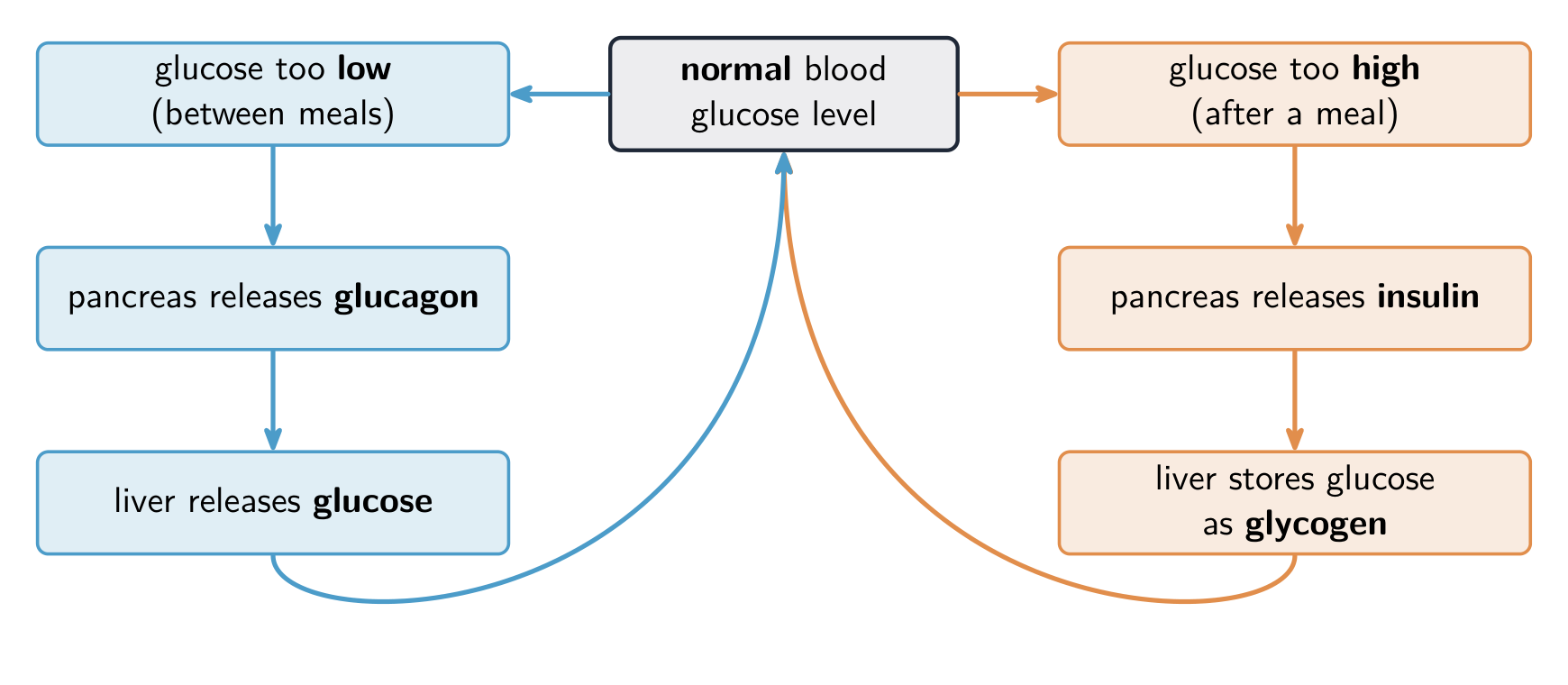
  • insulin lowers blood glucose after a meal — the liver stores the glucose as glycogen 糖原.
  • (Supplement) glucagon raises blood glucose between meals — the liver releases glucose.

In Type 1 diabetes 糖尿病 the pancreas cannot make insulin, so blood glucose rises too high. It is treated with insulin injections and a carefully planned diet.

Worked example. Blood glucose rises sharply after a meal, then falls back to normal over the next two hours. Name the organs and the hormone involved, and say what they do. The pancreas detects the rise and releases insulin. Insulin makes the liver take glucose out of the blood and store it as glycogen, so the level falls back to normal. Between meals the opposite loop runs: the pancreas releases glucagon and the liver releases glucose again. Keep the two words apart - insulin is the hormone, glycogen is the store. Swapping them is the classic error.

Controlling body temperature (Supplement)

The brain detects the body temperature 温度 and keeps it steady. The skin helps:

Structure Role
sweat glands 汗腺 make sweat; as it evaporates it cools the skin (sweating 出汗)
hair erector muscles 立毛肌 raise the hairs to trap a layer of air
blood vessels 血管 change how much blood flows near the skin surface
fatty tissue 脂肪组织 gives insulation 隔热 to reduce heat loss

When you are too hot: you sweat, and the arterioles 小动脉 widen (vasodilation 血管舒张) so more blood flows to the skin capillaries 毛细血管 and loses heat.

When you are too cold: you shiver 颤抖 (the muscles make heat), and the arterioles narrow (vasoconstriction 血管收缩) so less blood reaches the surface, keeping heat in.

Bahasa Indonesia
Umpan balik negatif: glukosa darah

Homeostasis adalah mempertahankan kondisi internal yang konstan di dalam tubuh — misalnya suhu yang stabil dan kadar glukosa darah yang stabil.

(Suplemen) Homeostasis bekerja melalui umpan balik negatif: ketika suatu nilai menyimpang dari titik setelnya, tubuh bertindak untuk mengembalikannya. Perubahan itu sendiri memicu koreksi.

Mengatur glukosa darah

Hati dan pankreas menjaga kestabilan glukosa darah:

  • insulin menurunkan glukosa darah setelah makan — hati menyimpan glukosa sebagai glikogen.
  • (Suplemen) glukagon meningkatkan glukosa darah di antara waktu makan — hati melepaskan glukosa.
Umpan balik: jika glukosa darah terlalu tinggi pankreas melepaskan insulin dan hati menyimpan glukosa sebagai glikogen; jika terlalu rendah pankreas melepaskan glukagon dan hati melepaskan glukosa; keduanya mengembalikannya ke kondisi normal
Insulin menurunkan glukosa darah dan glukagon meningkatkannya, menjaganya tetap mendekati level normal

Pada diabetes Tipe 1, pankreas tidak dapat memproduksi insulin, sehingga glukosa darah naik terlalu tinggi. Kondisi ini diobati dengan suntikan insulin dan diet yang terencana dengan cermat.

Contoh dikerjakan. Glukosa darah meningkat tajam setelah makan, lalu turun kembali ke tingkat normal selama dua jam berikutnya. Sebutkan organ dan hormon yang terlibat, serta jelaskan fungsinya. Pankreas mendeteksi peningkatan tersebut dan melepaskan insulin. Insulin membuat hati mengambil glukosa dari darah dan menyimpannya sebagai glikogen, sehingga kadarnya turun kembali ke normal. Di antara waktu makan, siklus sebaliknya terjadi: pankreas melepaskan glukagon dan hati kembali melepaskan glukosa. Jangan tertukar kedua kata ini - insulin adalah hormon, glikogen adalah cadangan. Menukar keduanya adalah kesalahan klasik.

Mengatur suhu tubuh (Suplemen)

Otak mendeteksi suhu tubuh dan menjaganya tetap stabil. Kulit membantu:

Struktur Peran
kelenjar keringat menghasilkan keringat; saat menguap, ia mendinginkan kulit (berkeringat)
otot erektor pili mengangkat rambut untuk menjebak lapisan udara
pembuluh darah mengubah jumlah aliran darah di dekat permukaan kulit
jaringan lemak memberikan isolasi untuk mengurangi kehilangan panas

Ketika Anda terlalu panas: Anda berkeringat, dan arteriol melebar (vasodilatasi) sehingga lebih banyak darah mengalir ke kapiler kulit dan kehilangan panas.

Ketika Anda terlalu dingin: Anda menggigil (otot menghasilkan panas), dan arteriol menyempit (vasokonstriksi) sehingga kurang darah mencapai permukaan, menjaga panas tetap di dalam.

Terlalu panas menyebabkan berkeringat dan vasodilatasi untuk kehilangan panas; terlalu dingin menyebabkan menggigil dan vasokonstriksi untuk menjaga panas; keduanya mengembalikan tubuh ke sekitar 37 derajat
Umpan balik negatif: perubahan menjauh dari sekitar 37 °C memicu respons yang membalikkannya, mengembalikan tubuh ke kondisi normal.
Explore · ⁨Jelajahi⁩

Negative feedback · ⁨Umpan balik negatif⁩

Push body temperature away from its set point and watch negative feedback bring it back to normal. · ⁨Dorong suhu tubuh menjauh dari titik tetapnya dan perhatikan umpan balik negatif mengembalikannya ke normal.⁩

Vocabulary · ⁨Kosa kata⁩ Train · ⁨Latih⁩
English Bahasa Indonesia
homeostasis/ˌhəʊmiːəˈstɑːsiz/ homeostasis
environment/enˈvaɪrənmənt/ lingkungan
negative feedback/ˈneɡətɪv ˈfiːdbæk/ umpan balik negatif
set point/set pɔɪnt/ titik setel
liver/ˈlɪvə/ hati
glycogen/ˈɡlaɪkədʒn/ glikogen
diabetes/ˌdaɪəˈbiːtiːz/ diabetes
temperature/ˈtemprɪtʃə/ suhu
sweat glands/swet ɡlændz/ kelenjar keringat
sweating/ˈswetɪŋ/ berkeringat
hair erector muscles/heə ɪˈrektə ˈmʌslz/ otot pengangkat bulu
blood vessels/blʌd ˈveslz/ pembuluh darah
fatty tissue/ˈfæti ˈtɪʃuː/ jaringan lemak
insulation/ˌɪnsjuːˈleɪʃn/ isolasi
arterioles/ɑːˈtɪəriəʊlz/ arteriol
vasodilation/ˌvæsədɪˈleɪʃn/ vasodilatasi
capillaries/ˈkæpɪləriz/ kapiler
shiver/ˈʃɪvə/ gugup
vasoconstriction/ˌvæsəkənˈstrɪkʃn/ vasokonstriksi
Watch lesson · ⁨Tonton pelajaran⁩
14.5

Tropisms · ⁨Tropisme⁩

Syllabus · ⁨Silabus⁩
English
Core Supplement
1 Describe gravitropism as a response in which parts of a plant grow towards or away from gravity 4 Explain phototropism and gravitropism of a shoot as examples of the chemical control of plant growth
2 Describe phototropism as a response in which parts of a plant grow towards or away from the direction of the light source 5 Explain the role of auxin in controlling shoot growth, limited to: (a) auxin is made in the shoot tip (b) auxin diffuses through the plant from the shoot tip (c) auxin is unequally distributed in response to light and gravity (d) auxin stimulates cell elongation
3 Investigate and describe gravitropism and phototropism in shoots and roots
Bahasa Indonesia
Inti Tambahan
1 Jelaskan gravitropisme sebagai respons di mana bagian tumbuhan tumbuh menuju atau menjauhi gravitasi 4 Jelaskan fototropisme dan gravitropisme tunas sebagai contoh kontrol kimiawi pertumbuhan tumbuhan
2 Jelaskan fototropisme sebagai respons di mana bagian tumbuhan tumbuh menuju atau menjauhi arah sumber cahaya 5 Jelaskan peran auksin dalam mengontrol pertumbuhan tunas, terbatas pada: (a) auksin dibuat di ujung tunas (b) auksin berdifusi melalui tumbuhan dari ujung tunas (c) auksin terdistribusi tidak merata sebagai respons terhadap cahaya dan gravitasi (d) auksin merangsang pemanjangan sel
3 Selidiki dan jelaskan gravitropisme dan fototropisme pada tunas dan akar

Source: Cambridge International syllabus · ⁨Sumber: Silabus Cambridge International⁩

English

A tropism 向性 is a plant's growth response to a direction:

  • gravitropism 向地性 — growth in response to gravity 重力 (roots grow down, shoots grow up).
  • phototropism 向光性 — growth in response to the direction of light (shoots grow towards the light).

(Supplement) These responses are controlled by a chemical called auxin 生长素:

  • auxin is made in the shoot 嫩枝 tip.
  • it diffuses down through the plant.
  • light or gravity makes the auxin spread unequally to one side.
  • auxin makes cells elongate 伸长 (grow longer). The side with more auxin grows faster, so the shoot bends.
Bahasa Indonesia

Tropisme adalah respons pertumbuhan tanaman terhadap arah tertentu:

  • gravitropisme — pertumbuhan sebagai respons terhadap gravitasi (akar tumbuh ke bawah, tunas tumbuh ke atas).
  • fototropisme — pertumbuhan sebagai respons terhadap arah cahaya (tunas tumbuh menuju cahaya).

(Suplemen) Respons ini dikendalikan oleh zat kimia bernama auksin:

  • auksin diproduksi di ujung tunas.
  • ia berdifusi turun melalui tanaman.
  • cahaya atau gravitasi membuat auksin menyebar tidak merata ke satu sisi.
  • auksin membuat sel-sel memanjang (tumbuh lebih panjang). Sisi dengan lebih banyak auksin tumbuh lebih cepat, sehingga tunas membengkok.
Tunas yang diterangi dari satu sisi: auksin dari ujung terkumpul di sisi teduh, tempat sel-sel tumbuh lebih panjang, sehingga tunas membengkok menuju cahaya
Aksin terkumpul di sisi teduh dan membuat sel-sel itu tumbuh lebih panjang, membengkokkan tunas ke arah cahaya
Explore · ⁨Jelajahi⁩

Phototropism — bending to light · ⁨Fototropisme — membengkok ke arah cahaya⁩

A shoot grows towards light because a hormone makes one side grow faster than the other. · ⁨Batang tumbuh ke arah cahaya karena hormon membuat satu sisi tumbuh lebih cepat dari sisi lain.⁩

Vocabulary · ⁨Kosa kata⁩ Train · ⁨Latih⁩
English Bahasa Indonesia
tropism/ˈtrəʊpɪzəm/ tropisme
gravitropism/ˈɡrævɪtrəʊpɪzəm/ gravitropisme
gravity/ˈɡrævɪti/ gravitasi
phototropism/ˌfəʊtəʊˈtrəʊpɪzəm/ fototropisme
auxin/ˈɔːksɪn/ auksin
shoot/ʃuːt/ tunas
elongate/ˈiːlɒŋɡeɪt/ memanjang
14.5

Exam tips · ⁨Tips ujian⁩

English
  • Nervous system: CNS (brain + spinal cord) and PNS (the nerves). Impulses travel along neurones.
  • Learn the reflex arc in order: receptor → sensory → relay → motor → effector.
  • At a synapse, neurotransmitter diffuses across the gap — this makes impulses go one way only.
  • Eye: cornea and lens refract light; the lens changes shape (accommodation); rods for dim light, cones for colour.
  • Hormones are slower but longer-lasting than nerves. Insulin lowers blood glucose; glucagon raises it.
  • Too hot → sweating and vasodilation; too cold → shivering and vasoconstriction.
  • Auxin from the shoot tip controls phototropism and gravitropism by making cells elongate.
Bahasa Indonesia
  • Sistem saraf: SSP (otak + sumsum tulang belakang) dan SPN (saraf-saraf). Impuls merambat sepanjang neurona.
  • Hafalkan busur refleks secara berurutan: reseptor → sensorik → relai → motorik → efektor.
  • Pada sinaps, neurotransmiter berdifusi melintasi celah — ini membuat impuls hanya bergerak satu arah.
  • Mata: kornea dan lensa membiaskan cahaya; lensa berubah bentuk (akomodasi); batang untuk cahaya redup, kerucut untuk warna.
  • Hormon lebih lambat namun lebih tahan lama daripada saraf. Insulin menurunkan glukosa darah; glukagon menaikkannya.
  • Terlalu panas → berkeringat dan vasodilatasi; terlalu dingin → menggigil dan vasokonstriksi.
  • Auksin dari ujung tunas mengendalikan fototropisme dan gravitropisme dengan membuat sel-sel memanjang.

Interactive lessons on this topic · ⁨Pelajaran interaktif untuk topik ini⁩

Work through it step by step, with instant-check exercises. · ⁨Kerjakan langkah demi langkah, dengan latihan pengecekan instan.⁩

Past Papers · ⁨Soal-Soil Masa Lalu⁩

More topics in IGCSE Biology · ⁨Biologi IGCSE⁩ · ⁨Topik lain dalam IGCSE Biology · ⁨Biologi IGCSE⁩⁩

Log in or create account · ⁨Masuk atau buat akun⁩

IGCSE, A-Level & AP