Skip to content · ⁨Lompat ke konten⁩

Functions Involving Parameters, Vectors, and Matrices · ⁨Fungsi yang Melibatkan Parameter, Vektor, dan Matriks⁩

AP Precalculus · ⁨AP Pra-Kalkulus⁩ · Topic 4 · ⁨Topik 4⁩

Video lesson for this topic · ⁨Pelajaran video untuk topik ini⁩ Open the video page · ⁨Buka halaman video⁩
8:04

Fungsi yang Melibatkan Parameter, Vektor, dan Matriks

Lihat roller coaster ini. Pada setiap momen kereta memiliki dua fakta: di mana ia berada, dan ke arah mana ia pergi. Satu persamaan tidak bisa memegang keduanya. Planet ini menjalankan…

English narration · English + 中文 subtitles burned in · ⁨Narasi bahasa Inggris · Subtitle bahasa Inggris + 中文 disematkan langsung⁩

4.1

Parametric Functions · ⁨Fungsi Parametrik⁩

Syllabus · ⁨Silabus⁩
English

Learning Objective 4.1.A: Construct a graph or table of values for a parametric function represented analytically.

  • 4.1.A.1 A parametric function in $\mathbb{R}^2$, the set of all ordered pairs of two real numbers, consists of a set of two parametric equations in which two dependent variables, $x$ and $y$, are dependent on a single independent variable, $t$, called the parameter.
  • 4.1.A.2 Because variables $x$ and $y$ are dependent on the independent variable, $t$, the coordinates $(x_i,\, y_i)$ at time $t_i$ can be written as functions of $t$ and can be expressed as the single parametric function $f(t) = (x(t),\, y(t))$, where in this case $x$ and $y$ are names of two functions.
  • 4.1.A.3 A numerical table of values can be generated for the parametric function $f(t) = (x(t),\, y(t))$ by evaluating $x_i$ and $y_i$ at several values of $t_i$ within the domain.
  • 4.1.A.4 A graph of a parametric function can be sketched by connecting several points from the numerical table of values in order of increasing value of $t$.
  • 4.1.A.5 The domain of the parametric function $f$ is often restricted, which results in start and end points on the graph of $f$.
Bahasa Indonesia

Tujuan Pembelajaran 4.1.A: Buat grafik atau tabel nilai untuk fungsi parametrik yang direpresentasikan secara analitis.

  • 4.1.A.1 Sebuah fungsi parametrik dalam $\mathbb{R}^2$, himpunan semua pasangan terurut dari dua bilangan real, terdiri dari satu set dua persamaan parametrik di mana dua variabel dependen, $x$ dan $y$, bergantung pada satu variabel independen, $t$, yang disebut parameter.
  • 4.1.A.2 Karena variabel $x$ dan $y$ bergantung pada variabel independen, $t$, koordinat $(x_i,\, y_i)$ pada waktu $t_i$ dapat ditulis sebagai fungsi dari $t$ dan dapat dinyatakan sebagai fungsi parametrik tunggal $f(t) = (x(t),\, y(t))$, di mana dalam kasus ini $x$ dan $y$ adalah nama-nama dari dua fungsi.
  • 4.1.A.3 Tabel nilai numerik dapat dihasilkan untuk fungsi parametrik $f(t) = (x(t),\, y(t))$ dengan mengevaluasi $x_i$ dan $y_i$ pada beberapa nilai $t_i$ dalam domain.
  • 4.1.A.4 Grafik dari fungsi parametrik dapat digambar dengan menghubungkan beberapa titik dari tabel nilai numerik berdasarkan urutan peningkatan nilai $t$.
  • 4.1.A.5 Domain dari fungsi parametrik $f$ sering dibatasi, yang menghasilkan titik awal dan akhir pada grafik $f$.
Source: College Board AP Course and Exam Description · ⁨Sumber: Deskripsi Kursus dan Ujian College Board AP⁩

English

Unit 4 is part of the course but is not assessed on the AP Precalculus Exam (which covers only Units 1–3); it builds tools used in later courses.

A parametric function 参数函数 describes a curve by giving both coordinates as functions of a third variable, the parameter 参数 $t$: $\big(x(t),\,y(t)\big)$. As $t$ runs through its domain, the point traces a path – and, unlike $y=f(x)$, the path may loop or cross itself.

Bahasa Indonesia
Permainan roller coaster: vektor dan gerakan parametrik mendeskripsikan jalur dan kecepatan bersama-sama

Unit 4 merupakan bagian dari kursus tetapi tidak dinilai dalam Ujian AP Pra-Kalkulus (yang hanya mencakup Unit 1–3); unit ini membangun alat yang digunakan dalam kursus selanjutnya.

Sebuah fungsi parametrik mendeskripsikan kurva dengan memberikan kedua koordinat sebagai fungsi dari variabel ketiga, parameter $t$: $\big(x(t),\,y(t)\big)$. Saat $t$ berjalan melalui domainnya, titik melacak jalur – dan, berbeda dengan $y=f(x)$, jalur tersebut mungkin berputar atau memotong dirinya sendiri.

Vocabulary · ⁨Kosa kata⁩ Train · ⁨Latih⁩
English Bahasa Indonesia
parametric function/ˌpærəˈmetrɪk ˈfʌŋkʃn/ fungsi parametrik
parameter/pəˈræmɪtə/ parameter
implicit/ɪmˈplɪsɪt/ implisit
vector/ˈvektə/ vektor
magnitude/ˈmæɡnɪtjuːd/ besarnya
vector-valued function/ˈvektə ˈvæljuːd ˈfʌŋkʃn/ fungsi bernilai vektor
4.2

Parametric Functions and Planar Motion · ⁨Fungsi Parametrik dan Gerakan Planar⁩

Syllabus · ⁨Silabus⁩
Learning ObjectiveEssential Knowledge

4.2.A
Identify key characteristics of a parametric planar motion function that are related to position.

  • 4.2.A.1 A parametric function given by $f(t) = (x(t),\, y(t))$ can be used to model particle motion in the plane. The graph of this function indicates the position of a particle at time $t$.
  • 4.2.A.2 The horizontal and vertical extrema of a particle's motion can be determined by identifying the maximum and minimum values of the functions $x(t)$ and $y(t)$, respectively.
  • 4.2.A.3 The real zeros of the function $x(t)$ correspond to $y$-intercepts, and the real zeros of $y(t)$ correspond to $x$-intercepts.

Source: College Board AP Course and Exam Description · ⁨Sumber: Deskripsi Kursus dan Ujian College Board AP⁩

English

Reading $t$ as time, a parametric function models motion in the plane. $x(t)$ and $y(t)$ give the horizontal and vertical position; the point's direction of travel is the order in which the curve is drawn as $t$ increases (mark it with arrows).

Bahasa Indonesia

Membaca $t$ sebagai waktu, fungsi parametrik memodelkan gerakan di bidang. $x(t)$ dan $y(t)$ memberikan posisi horizontal dan vertikal; arah titik bergerak adalah urutan kurva digambar saat $t$ bertambah (tandai dengan panah).

4.3

Parametric Functions and Rates of Change · ⁨Fungsi Parametrik dan Laju Perubahan⁩

Syllabus · ⁨Silabus⁩
Learning ObjectiveEssential Knowledge

4.3.A
Identify key characteristics of a parametric planar motion function that are related to direction and rate of change.

  • 4.3.A.1 As the parameter increases, the direction of planar motion of a particle can be analyzed in terms of $x$ and $y$ independently. If $x(t)$ is increasing or decreasing, the direction of motion is to the right or left, respectively. If $y(t)$ is increasing or decreasing, the direction of motion is up or down, respectively.
  • 4.3.A.2 At any given point in the plane, the direction of planar motion may be different for different values of $t$.
  • 4.3.A.3 The same curve in the plane can be parametrized in different ways and can be traversed in different directions with different parametric functions.
  • 4.3.A.4 Over a given interval $[t_1,\, t_2]$ within the domain, the average rate of change can be computed for $x(t)$ and $y(t)$ independently. The ratio of the average rate of change of $y$ to the average rate of change of $x$ gives the slope of the graph between the points on the curve corresponding to $t_1$ and $t_2$, so long as the average rate of change of $x(t) \neq 0$.

Source: College Board AP Course and Exam Description · ⁨Sumber: Deskripsi Kursus dan Ujian College Board AP⁩

English

Over an interval of $t$, the average rate of change of $x$ is $\dfrac{\Delta x}{\Delta t}$ and of $y$ is $\dfrac{\Delta y}{\Delta t}$. Their signs tell you which way the point moves (right/left, up/down); together they describe the motion's speed and direction along the path.

Bahasa Indonesia

Sepanjang interval $t$, laju perubahan rata-rata dari $x$ adalah $\dfrac{\Delta x}{\Delta t}$ dan dari $y$ adalah $\dfrac{\Delta y}{\Delta t}$. Tanda mereka memberi tahu ke mana titik bergerak (kiri/kanan, atas/bawah); bersama-sama mereka menggambarkan kecepatan dan arah gerakan sepanjang lintasan.

4.4

Parametrically Defined Circles and Lines · ⁨Lingkaran dan Garis yang Didefinisikan secara Parametrik⁩

Syllabus · ⁨Silabus⁩
Learning ObjectiveEssential Knowledge

4.4.A
Express motion around a circle or along a line segment parametrically.

  • 4.4.A.1 A complete counterclockwise revolution around the unit circle that starts and ends at $(1,\, 0)$ and is centered at the origin can be modeled by $(x(t),\, y(t)) = (\cos t,\, \sin t)$ with domain $0 \leq t \leq 2\pi$.
  • 4.4.A.2 Transformations of the parametric function $(x(t),\, y(t)) = (\cos t,\, \sin t)$ can model any circular path traversed in the plane.
  • 4.4.A.3 A linear path along the line segment from the point $(x_1,\, y_1)$ to the point $(x_2,\, y_2)$ can be parametrized many ways, including using an initial position $(x_1,\, y_1)$ and rates of change for $x$ with respect to $t$ and $y$ with respect to $t$.

Source: College Board AP Course and Exam Description · ⁨Sumber: Deskripsi Kursus dan Ujian College Board AP⁩

English

A circle of radius $R$ centered at $(h,k)$ is $x=h+R\cos t,\ y=k+R\sin t$. A line through $(x_0,y_0)$ with direction $(a,b)$ is $x=x_0+at,\ y=y_0+bt$. Adjusting the coefficients changes the start point, speed, and direction of tracing.

Bahasa Indonesia

Lingkaran berjari-jari $R$ berpusat di $(h,k)$ adalah $x=h+R\cos t,\ y=k+R\sin t$. Garis melalui $(x_0,y_0)$ dengan arah $(a,b)$ adalah $x=x_0+at,\ y=y_0+bt$. Menyesuaikan koefisien mengubah titik awal, kecepatan, dan arah pelacakan.

4.5

Implicitly Defined Functions · ⁨Fungsi yang Didefinisikan secara Implisit⁩

Syllabus · ⁨Silabus⁩
English

Learning Objective 4.5.A: Construct a graph of an equation involving two variables.

  • 4.5.A.1 An equation involving two variables can implicitly describe one or more functions.
  • 4.5.A.2 An equation involving two variables can be graphed by finding solutions to the equation.
  • 4.5.A.3 Solving for one of the variables in an equation involving two variables can define a function whose graph is part or all of the graph of the equation.

Learning Objective 4.5.B: Determine how the two quantities related in an implicitly defined function vary together.

  • 4.5.B.1 For ordered pairs on the graph of an implicitly defined function that are close together, if the ratio of the change in the two variables is positive, then the two variables simultaneously increase or both decrease; conversely, if the ratio is negative, then as one variable increases, the other decreases.
  • 4.5.B.2 The rate of change of $x$ with respect to $y$ or of $y$ with respect to $x$ can be zero, indicating vertical or horizontal intervals, respectively.
Bahasa Indonesia

Tujuan Pembelajaran 4.5.A: Membuat grafik persamaan yang melibatkan dua variabel.

  • 4.5.A.1 Persamaan yang melibatkan dua variabel dapat secara implisit mendeskripsikan satu atau lebih fungsi.
  • 4.5.A.2 Persamaan yang melibatkan dua variabel dapat digrafkan dengan mencari solusi dari persamaan tersebut.
  • 4.5.A.3 Menyelesaikan salah satu variabel dalam persamaan yang melibatkan dua variabel dapat mendefinisikan fungsi yang grafiknya merupakan bagian atau seluruh grafik dari persamaan tersebut.

Tujuan Pembelajaran 4.5.B: Menentukan bagaimana dua kuantitas yang terkait dalam fungsi terdefinisi implisit berubah bersama-sama.

  • 4.5.B.1 Untuk pasangan berurutan pada grafik fungsi yang terdefinisi implisit yang berada berdekatan, jika rasio perubahan kedua variabel adalah positif, maka kedua variabel tersebut secara bersamaan meningkat atau keduanya menurun; sebaliknya, jika rasionya negatif, maka ketika satu variabel meningkat, variabel lainnya menurun.
  • 4.5.B.2 Laju perubahan $x$ terhadap $y$ atau $y$ terhadap $x$ dapat bernilai nol, menunjukkan interval vertikal atau horizontal, masing-masing.

Source: College Board AP Course and Exam Description · ⁨Sumber: Deskripsi Kursus dan Ujian College Board AP⁩

English

An implicit 隐式 equation relates $x$ and $y$ without solving for either, such as $x^2+y^2=25$. Its graph may fail the vertical-line test (not a function), so it is often split into pieces or described parametrically.

Bahasa Indonesia

Persamaan implisit menghubungkan $x$ dan $y$ tanpa menyelesaikan salah satunya, seperti $x^2+y^2=25$. Grafiknya mungkin gagal uji garis vertikal (bukan fungsi), sehingga sering dibagi menjadi bagian-bagian atau dijelaskan secara parametrik.

4.6

Conic Sections · ⁨Seksi Kerucut⁩

Syllabus · ⁨Silabus⁩
English

Learning Objective 4.6.A: Represent conic sections with horizontal or vertical symmetry analytically.

  • 4.6.A.1 A parabola with vertex $(h,\, k)$ can, if $a \neq 0$, be represented analytically as $x - h = a(y - k)^2$ if it opens left or right, or as $y - k = a(x - h)^2$ if it opens up or down.
  • 4.6.A.2 An ellipse centered at $(h,\, k)$ with horizontal radius $a$ and vertical radius $b$ can be represented analytically as $\dfrac{(x - h)^2}{a^2} + \dfrac{(y - k)^2}{b^2} = 1$. A circle is a special case of an ellipse where $a = b$.
  • 4.6.A.3 A hyperbola centered at $(h,\, k)$ with vertical and horizonal lines of symmetry can be represented algebraically as $\dfrac{(x - h)^2}{a^2} - \dfrac{(y - k)^2}{b^2} = 1$ for a hyperbola opening left and right, or as $\dfrac{(y - k)^2}{b^2} - \dfrac{(x - h)^2}{a^2} = 1$ for a hyperbola opening up and down. The asymptotes are $y - k = \pm \dfrac{b}{a}(x - h)$.
Bahasa Indonesia

Tujuan Pembelajaran 4.6.A: Merepresentasikan konik dengan simetri horizontal atau vertikal secara analitik.

  • 4.6.A.1 Parabola dengan titik puncak $(h,\, k)$ dapat, jika $a \neq 0$, direpresentasikan secara analitik sebagai $x - h = a(y - k)^2$ jika terbuka ke kiri atau kanan, atau sebagai $y - k = a(x - h)^2$ jika terbuka ke atas atau bawah.
  • 4.6.A.2 Elips yang berpusat di $(h,\, k)$ dengan jari-jari horizontal $a$ dan jari-jari vertikal $b$ dapat direpresentasikan secara analitik sebagai $\dfrac{(x - h)^2}{a^2} + \dfrac{(y - k)^2}{b^2} = 1$. Lingkaran adalah kasus khusus elips di mana $a = b$.
  • 4.6.A.3 Hiperbola yang berpusat di $(h,\, k)$ dengan garis simetri vertikal dan horizontal dapat direpresentasikan secara aljabar sebagai $\dfrac{(x - h)^2}{a^2} - \dfrac{(y - k)^2}{b^2} = 1$ untuk hiperbola yang terbuka ke kiri dan kanan, atau sebagai $\dfrac{(y - k)^2}{b^2} - \dfrac{(x - h)^2}{a^2} = 1$ untuk hiperbola yang terbuka ke atas dan bawah. Asimtotnya adalah $y - k = \pm \dfrac{b}{a}(x - h)$.

Source: College Board AP Course and Exam Description · ⁨Sumber: Deskripsi Kursus dan Ujian College Board AP⁩

English
Conic sections: one cone, four curves

Conic sections 圆锥曲线 – circles, ellipses, parabolas, and hyperbolas – are the curves from slicing a cone, each given by a quadratic equation in $x$ and $y$. Their standard forms reveal centers, vertices, axes, and asymptotes.

Bahasa Indonesia
Seksi kerucut: satu kerucut, empat kurva

Seksi kerucut – lingkaran, elips, parabola, dan hiperbola – adalah kurva dari irisan kerucut, masing-masing diberikan oleh persamaan kuadrat dalam $x$ dan $y$. Bentuk standarnya mengungkap pusat, titik puncak, sumbu, dan asimtot.

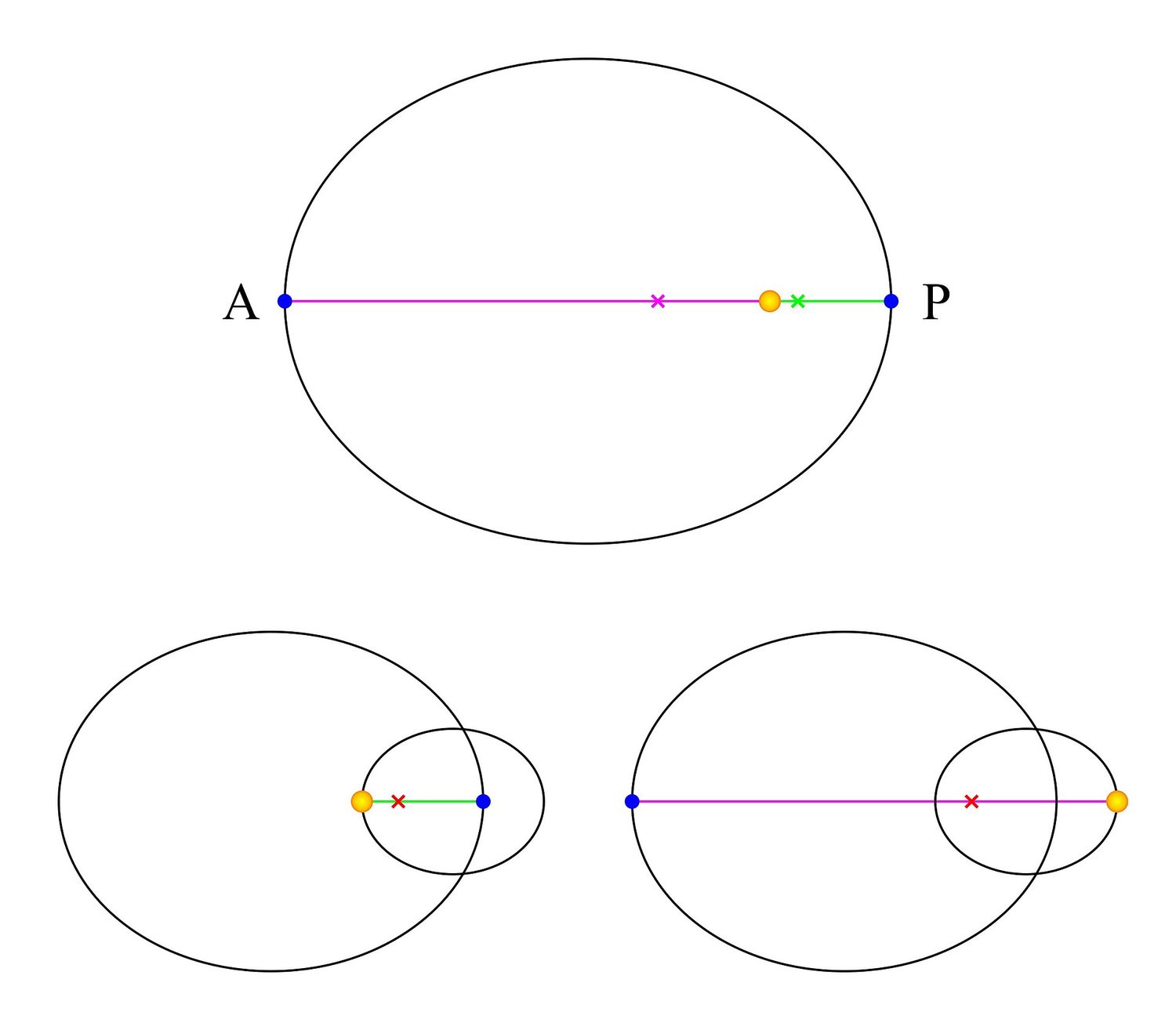
Orbit eliptis: seksi kerucut mendeskripsikan lintasan tertutup dengan dua fokus — model parametrik utama
Vocabulary · ⁨Kosa kata⁩ Train · ⁨Latih⁩
English Bahasa Indonesia
Conic sections/ˈkɒnɪk ˈsekʃnz/ Potongan kerucut
4.7

Parametrizing Implicit Curves · ⁨Memparametrisasi Kurva Implisit⁩

Syllabus · ⁨Silabus⁩
English

Learning Objective 4.7.A: Represent a curve in the plane parametrically.

  • 4.7.A.1 A parametrization $(x(t),\, y(t))$ for an implicitly defined function will, when $x(t)$ and $y(t)$ are substituted for $x$ and $y$, respectively, satisfy the corresponding equation for every value of $t$ in the domain.
  • 4.7.A.2 If $f$ is a function of $x$, then $y = f(x)$ can be parametrized as $(x(t),\, y(t)) = (t, f(t))$. If $f$ is invertible, its inverse can be parametrized as $(x(t),\, y(t)) = (f(t),\, t)$ for an appropriate interval of $t$.

Learning Objective 4.7.B: Represent conic sections parametrically.

  • 4.7.B.1 A parabola can be parametrized in the same way that any equation that can be solved for $x$ or $y$ can be parametrized. Equations that can be solved for $x$ can be parametrized as $(x(t),\, y(t)) = (f(t),\, t)$ by solving for $x$ and replacing $y$ with $t$. Equations that can be solved for $y$ can be parametrized as $(x(t),\, y(t)) = (t, f(t))$ by solving for $y$ and replacing $x$ with $t$.
  • 4.7.B.2 An ellipse can be parametrized using the trigonometric functions $x(t) = h + a\cos t$ and $y(t) = k + b\sin t$ for $0 \leq t \leq 2\pi$.
  • 4.7.B.3 A hyperbola can be parametrized using trigonometric functions. For a hyperbola that opens left and right, the functions are $x(t) = h + a\sec t$ and $y(t) = k + b\tan t$ for $0 \leq t \leq 2\pi$. For a hyperbola that opens up and down, the functions are $x(t) = h + a\tan t$ and $y(t) = k + b\sec t$ for $0 \leq t \leq 2\pi$.
Bahasa Indonesia

Tujuan Pembelajaran 4.7.A: Merepresentasikan kurva di bidang secara parametrik.

  • 4.7.A.1 Sebuah parametrisasi $(x(t),\, y(t))$ untuk fungsi yang terdefinisi implisit akan, ketika $x(t)$ dan $y(t)$ disubstitusikan untuk $x$ dan $y$, masing-masing, memenuhi persamaan yang sesuai untuk setiap nilai $t$ dalam domain.
  • 4.7.A.2 Jika $f$ adalah fungsi dari $x$, maka $y = f(x)$ dapat diparametrisasi sebagai $(x(t),\, y(t)) = (t, f(t))$. Jika $f$ invertibel, inversnya dapat diparametrisasi sebagai $(x(t),\, y(t)) = (f(t),\, t)$ untuk interval yang sesuai dari $t$.

Tujuan Pembelajaran 4.7.B: Merepresentasikan konik secara parametrik.

  • 4.7.B.1 Parabola dapat diparametrisasi dengan cara yang sama seperti persamaan apa pun yang dapat diselesaikan untuk $x$ atau $y$. Persamaan yang dapat diselesaikan untuk $x$ dapat diparametrisasi sebagai $(x(t),\, y(t)) = (f(t),\, t)$ dengan menyelesaikan untuk $x$ dan mengganti $y$ dengan $t$. Persamaan yang dapat diselesaikan untuk $y$ dapat diparametrisasi sebagai $(x(t),\, y(t)) = (t, f(t))$ dengan menyelesaikan untuk $y$ dan mengganti $x$ dengan $t$.
  • 4.7.B.2 Elips dapat diparametrisasi menggunakan fungsi trigonometri $x(t) = h + a\cos t$ dan $y(t) = k + b\sin t$ untuk $0 \leq t \leq 2\pi$.
  • 4.7.B.3 Hiperbola dapat diparametrisasi menggunakan fungsi trigonometri. Untuk hiperbola yang terbuka ke kiri dan kanan, fungsinya adalah $x(t) = h + a\sec t$ dan $y(t) = k + b\tan t$ untuk $0 \leq t \leq 2\pi$. Untuk hiperbola yang terbuka ke atas dan bawah, fungsinya adalah $x(t) = h + a\tan t$ dan $y(t) = k + b\sec t$ untuk $0 \leq t \leq 2\pi$.

Source: College Board AP Course and Exam Description · ⁨Sumber: Deskripsi Kursus dan Ujian College Board AP⁩

English

Many implicit curves can be parametrized – rewritten as $\big(x(t),y(t)\big)$ – which makes them easier to graph and to treat as motion. The circle above is the basic example; ellipses use $x=h+A\cos t,\ y=k+B\sin t$.

Bahasa Indonesia

Banyak kurva implisit dapat diparametrisasi – ditulis ulang sebagai $\big(x(t),y(t)\big)$ – yang membuatnya lebih mudah digambar dan diperlakukan sebagai gerakan. Lingkaran di atas adalah contoh dasar; elips menggunakan $x=h+A\cos t,\ y=k+B\sin t$.

4.8

Vectors · ⁨Vektor⁩

Syllabus · ⁨Silabus⁩
English

Learning Objective 4.8.A: Identify characteristics of a vector.

  • 4.8.A.1 A vector is a directed line segment. When a vector is placed in the plane, the point at the beginning of the line segment is called the tail, and the point at the end of the line segment is called the head. The length of the line segment is the magnitude of the vector.
  • 4.8.A.2 A vector $\overrightarrow{P_1 P_2}$ with two components can be plotted in the $xy$-plane from $P_1 = (x_1, y_1)$ to $P_2 = (x_2, y_2)$. The vector is identified by $a$ and $b$, where $a = x_2 - x_1$ and $b = y_2 - y_1$. The vector can be expressed as $\langle a,\, b \rangle$. A zero vector $\langle 0,\, 0 \rangle$ is the trivial case when $P_1 = P_2$.
  • 4.8.A.3 The direction of the vector is parallel to the line segment from the origin to the point with coordinates $(a,\, b)$. The magnitude of the vector is the square root of the sum of the squares of the components.
  • 4.8.A.4 For a vector represented geometrically in the plane, the components of the vector can be found using trigonometry.

Learning Objective 4.8.B: Determine sums and products involving vectors.

  • 4.8.B.1 The multiplication of a constant and a vector results in a new vector whose components are found by multiplying the constant by each of the components of the original vector. The new vector is parallel to the original vector.
  • 4.8.B.2 The sum of two vectors in $\mathbb{R}^2$ is a new vector whose components are found by adding the corresponding components of the original vectors. The new vector can be represented graphically as a vector whose tail corresponds to the tail of the first vector and whose head corresponds to the head of the second vector when the second vector's tail is located at the first vector's head.
  • 4.8.B.3 The dot product of two vectors is the sum of the products of their corresponding components. That is, $\langle a_1,\, b_1 \rangle \cdot \langle a_2,\, b_2 \rangle = a_1 a_2 + b_1 b_2$.

Learning Objective 4.8.C: Determine a unit vector for a given vector.

  • 4.8.C.1 A unit vector is a vector of magnitude $1$. A unit vector in the same direction as a given nonzero vector can be found by scalar multiplying the vector by the reciprocal of its magnitude.
  • 4.8.C.2 The vector $\langle a,\, b \rangle$ can be expressed as $a\vec{i} + b\vec{j}$ in $\mathbb{R}^2$, where $\vec{i}$ and $\vec{j}$ are unit vectors in the $x$ and $y$ directions, respectively. That is, $\vec{i} = \langle 1,\, 0 \rangle$ and $\vec{j} = \langle 0,\, 1 \rangle$.

Learning Objective 4.8.D: Determine angle measures between vectors and magnitudes of vectors involved in vector addition.

  • 4.8.D.1 The dot product is geometrically equivalent to the product of the magnitudes of the two vectors and the cosine of the angle between them. Therefore, if the dot product of two nonzero vectors is zero, then the vectors are perpendicular.
  • 4.8.D.2 The Law of Sines and Law of Cosines can be used to determine side lengths and angle measures of triangles formed by vector addition.
Bahasa Indonesia

Tujuan Pembelajaran 4.8.A: Mengidentifikasi karakteristik vektor.

  • 4.8.A.1 Vektor adalah segaris berarah. Ketika sebuah vektor ditempatkan di bidang, titik di awal segaris disebut ekor, dan titik di akhir segaris disebut kepala. Panjang segaris adalah besar (magnitudo) dari vektor tersebut.
  • 4.8.A.2 Vektor $\overrightarrow{P_1 P_2}$ dengan dua komponen dapat digambar di bidang $xy$ dari $P_1 = (x_1, y_1)$ ke $P_2 = (x_2, y_2)$. Vektor ini diidentifikasi oleh $a$ dan $b$, di mana $a = x_2 - x_1$ dan $b = y_2 - y_1$. Vektor dapat dinyatakan sebagai $\langle a,\, b \rangle$. Vektor nol $\langle 0,\, 0 \rangle$ adalah kasus trivial ketika $P_1 = P_2$.
  • 4.8.A.3 Arah vektor sejajar dengan segaris dari titik asal ke titik dengan koordinat $(a,\, b)$. Besar vektor adalah akar kuadrat dari jumlah kuadrat komponen-komponennya.
  • 4.8.A.4 Untuk vektor yang direpresentasikan secara geometris di bidang, komponen vektor dapat ditemukan menggunakan trigonometri.

Tujuan Pembelajaran 4.8.B: Menentukan penjumlahan dan perkalian yang melibatkan vektor.

  • 4.8.B.1 Perkalian konstanta dengan vektor menghasilkan vektor baru yang komponennya diperoleh dengan mengalikan konstanta tersebut dengan setiap komponen dari vektor asli. Vektor baru ini sejajar dengan vektor asli.
  • 4.8.B.2 Penjumlahan dua vektor di $\mathbb{R}^2$ adalah vektor baru yang komponennya diperoleh dengan menjumlahkan komponen yang sesuai dari vektor-vektor asli. Vektor baru dapat direpresentasikan secara grafis sebagai vektor yang ekornya sesuai dengan ekor vektor pertama dan kepalanya sesuai dengan kepala vektor kedua ketika ekor vektor kedua ditempatkan di kepala vektor pertama.
  • 4.8.B.3 Hasil kali titik dari dua vektor adalah jumlah dari perkalian komponen-komponen yang sesuai. Yaitu, $\langle a_1,\, b_1 \rangle \cdot \langle a_2,\, b_2 \rangle = a_1 a_2 + b_1 b_2$.

Tujuan Pembelajaran 4.8.C: Menentukan vektor satuan untuk vektor tertentu.

  • 4.8.C.1 Vektor satuan adalah vektor dengan magnitudo $1$. Vektor satuan dalam arah yang sama dengan vektor tak nol yang diberikan dapat ditemukan dengan mengalikan skalar vektor tersebut dengan resiprok dari magnitudonya.
  • 4.8.C.2 Vektor $\langle a,\, b \rangle$ dapat dinyatakan sebagai $a\vec{i} + b\vec{j}$ dalam $\mathbb{R}^2$, di mana $\vec{i}$ dan $\vec{j}$ adalah vektor satuan dalam arah $x$ dan $y$, masing-masing. Yaitu, $\vec{i} = \langle 1,\, 0 \rangle$ dan $\vec{j} = \langle 0,\, 1 \rangle$.

Tujuan Pembelajaran 4.8.D: Menentukan ukuran sudut antara vektor dan besar vektor yang terlibat dalam penjumlahan vektor.

  • 4.8.D.1 Hasil kali titik secara geometris ekuivalen dengan hasil kali besaran kedua vektor dan kosinus sudut di antara keduanya. Oleh karena itu, jika hasil kali titik dari dua vektor tak nol adalah nol, maka vektor-vektor tersebut saling tegak lurus.
  • 4.8.D.2 Hukum Sinus dan Hukum Kosinus dapat digunakan untuk menentukan panjang sisi dan besar sudut segitiga yang terbentuk oleh penjumlahan vektor.

Source: College Board AP Course and Exam Description · ⁨Sumber: Deskripsi Kursus dan Ujian College Board AP⁩

English
Resolving a vector into components

A vector 向量 has both magnitude 大小 (length) and direction. Write it by components $\langle a,b\rangle$. Add vectors component-by-component; scale by multiplying each component; the magnitude is $\sqrt{a^2+b^2}$. Vectors model displacements, velocities, and forces.

Bahasa Indonesia
Menguraikan vektor menjadi komponen-komponennya

Sebuah vektor memiliki besar (panjang) dan arah. Tulis dengan komponen $\langle a,b\rangle$. Tambahkan vektor komponen demi komponen; kalikan dengan mengalikan setiap komponen; besarannya adalah $\sqrt{a^2+b^2}$. Vektor memodelkan perpindahan, kecepatan, dan gaya.

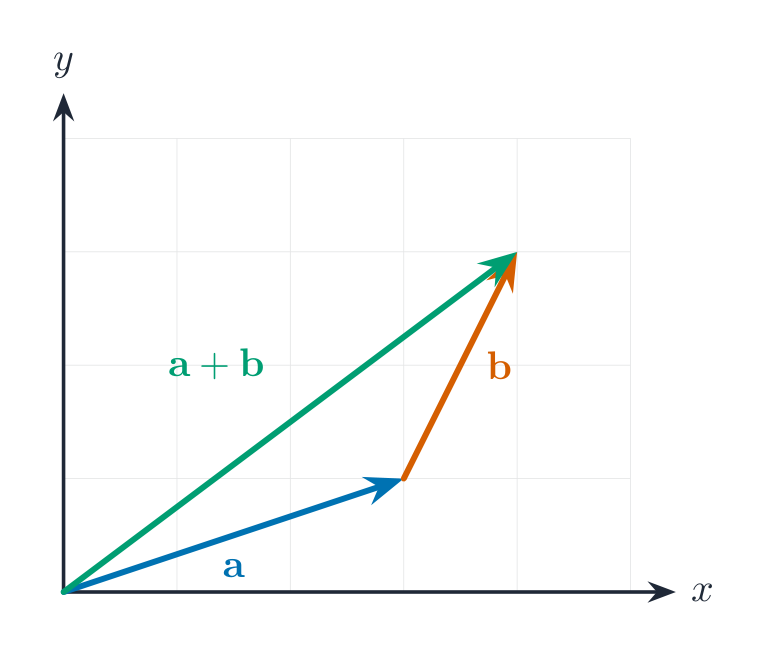
Menjumlahkan vektor dengan aturan segitiga
Explore · ⁨Jelajahi⁩

Add two vectors tip to tail · ⁨Tambahkan dua vektor ujung ke ekor⁩

A vector has magnitude and direction. Adding two vectors places them tip to tail; the resultant runs from the first tail to the last tip. Drag each to see the sum. · ⁨Vektor memiliki besaran dan arah. Menambahkan dua vektor menempatkannya ujung ke pangkal; vektor resultan berjalan dari pangkal pertama ke ujung terakhir. Seret masing-masing untuk melihat jumlah.⁩

4.9

Vector-Valued Functions · ⁨Fungsi Bernilai Vektor⁩

Syllabus · ⁨Silabus⁩
English

Learning Objective 4.9.A: Represent planar motion in terms of vector-valued functions.

  • 4.9.A.1 The position of a particle moving in a plane that is given by the parametric function $f(t) = (x(t),\, y(t))$ may be expressed as a vector-valued function, $p(t) = x(t)\vec{i} + y(t)\vec{j}$ or $p(t) = \langle x(t),\, y(t) \rangle$. The magnitude of the position vector at time $t$ gives the distance of the particle from the origin.
  • 4.9.A.2 The vector-valued function $v(t) = \langle x(t),\, y(t) \rangle$ can be used to express the velocity of a particle moving in a plane at different times, $t$. At time $t$, the sign of $x(t)$ indicates if the particle is moving right or left, and the sign of $y(t)$ indicates if the particle is moving up or down. The magnitude of the velocity vector at time $t$ gives the speed of the particle.
Bahasa Indonesia

Tujuan Pembelajaran 4.9.A: Merepresentasikan gerak planar dalam bentuk fungsi bernilai vektor.

  • 4.9.A.1 Posisi partikel yang bergerak dalam bidang yang diberikan oleh fungsi parametrik $f(t) = (x(t),\, y(t))$ dapat dinyatakan sebagai fungsi bernilai vektor, $p(t) = x(t)\vec{i} + y(t)\vec{j}$ atau $p(t) = \langle x(t),\, y(t) \rangle$. Besaran vektor posisi pada waktu $t$ memberikan jarak partikel dari titik asal.
  • 4.9.A.2 Fungsi bernilai vektor $v(t) = \langle x(t),\, y(t) \rangle$ dapat digunakan untuk menyatakan kecepatan partikel yang bergerak dalam bidang pada waktu-waktu yang berbeda, $t$. Pada waktu $t$, tanda dari $x(t)$ menunjukkan apakah partikel bergerak ke kanan atau ke kiri, dan tanda dari $y(t)$ menunjukkan apakah partikel bergerak naik atau turun. Besaran vektor kecepatan pada waktu $t$ memberikan kecepatan partikel.

Source: College Board AP Course and Exam Description · ⁨Sumber: Deskripsi Kursus dan Ujian College Board AP⁩

English

A vector-valued function 向量值函数 outputs a vector for each input, e.g. $\vec{r}(t)=\langle x(t),y(t)\rangle$ – the same information as a parametric function, packaged as a moving position vector.

Bahasa Indonesia

Sebuah fungsi bernilai vektor menghasilkan vektor untuk setiap input, mis. $\vec{r}(t)=\langle x(t),y(t)\rangle$ – informasi yang sama dengan fungsi parametrik, dikemas sebagai vektor posisi yang bergerak.

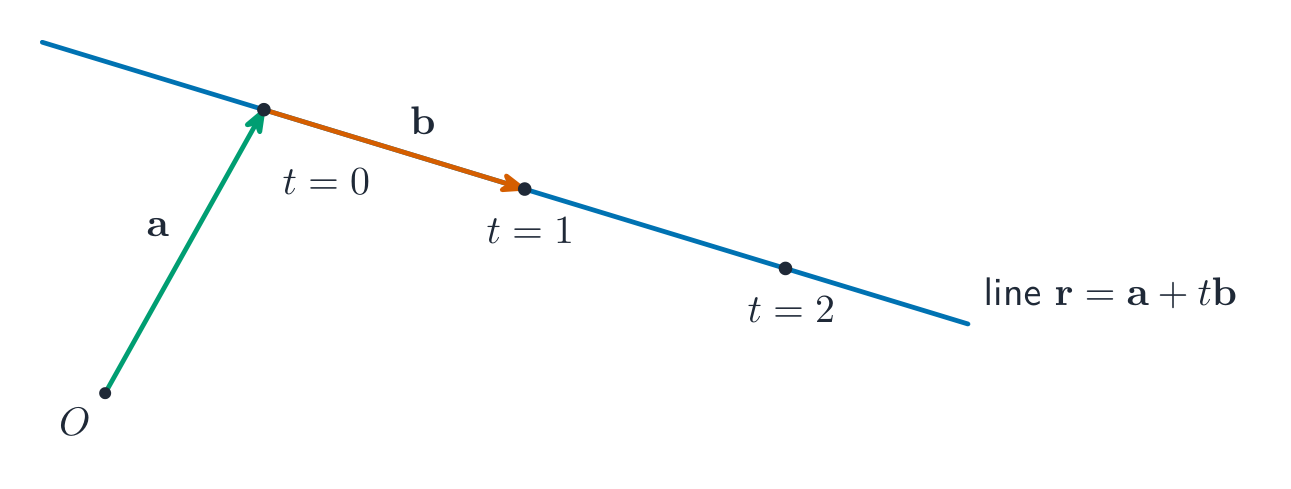
Garis bernilai vektor: mulai di a, lalu geser sejauh t dalam arah b
4.10

Matrices · ⁨Matriks⁩

Syllabus · ⁨Silabus⁩
English

Learning Objective 4.10.A: Determine the product of two matrices.

  • 4.10.A.1 An $n \times m$ matrix is an array consisting of $n$ rows and $m$ columns.
  • 4.10.A.2 Two matrices can be multiplied if the number of columns in the first matrix equals the number of rows in the second matrix. The product of the matrices is a new matrix in which the component in the $i$th row and $j$th column is the dot product of the $i$th row of the first matrix and the $j$th column of the second matrix.
Bahasa Indonesia

Tujuan Pembelajaran 4.10.A: Tentukan hasil kali dari dua matriks.

  • 4.10.A.1 Matriks $n \times m$ adalah susunan yang terdiri dari $n$ baris dan $m$ kolom.
  • 4.10.A.2 Dua matriks dapat dikalikan jika jumlah kolom pada matriks pertama sama dengan jumlah baris pada matriks kedua. Hasil kali dari matriks tersebut adalah matriks baru di mana komponen pada baris ke-$i$ dan kolom ke-$j$ adalah hasil kali titik dari baris ke-$i$ matriks pertama dan kolom ke-$j$ matriks kedua.

Source: College Board AP Course and Exam Description · ⁨Sumber: Deskripsi Kursus dan Ujian College Board AP⁩

English

A matrix 矩阵 is a rectangular array of numbers. Add matrices of the same size entry-by-entry; multiply a matrix by a compatible one by combining rows with columns. Matrices store and transform data compactly.

Bahasa Indonesia

Sebuah matriks adalah susunan persegi panjang angka. Tambahkan matriks dengan ukuran yang sama entri demi entri; kalikan matriks dengan matriks yang kompatibel dengan menggabungkan baris dengan kolom. Matriks menyimpan dan mentransformasikan data secara ringkas.

4.11

The Inverse and Determinant of a Matrix · ⁨Invers dan Determinan Matriks⁩

Syllabus · ⁨Silabus⁩
English

Learning Objective 4.11.A: Determine the inverse of a $2 \times 2$ matrix.

  • 4.11.A.1 The identity matrix, $I$, is a square matrix consisting of $1$s on the diagonal from the top left to bottom right and $0$s everywhere else.
  • 4.11.A.2 Multiplying a square matrix by its corresponding identity matrix results in the original square matrix.
  • 4.11.A.3 The product of a square matrix and its inverse, when it exists, is the identity matrix of the same size.
  • 4.11.A.4 The inverse of a $2 \times 2$ matrix, when it exists, can be calculated with or without technology.

Learning Objective 4.11.B: Apply the value of the determinant to invertibility and vectors.

  • 4.11.B.1 The determinant of the matrix $A = \begin{bmatrix} a & b \\ c & d \end{bmatrix}$ is $ad - bc$. The determinant can be calculated with or without technology and is denoted $\det(A)$.
  • 4.11.B.2 If a $2 \times 2$ matrix consists of two column or row vectors from $\mathbb{R}^2$, then the nonzero absolute value of the determinant of the matrix is the area of the parallelogram spanned by the vectors represented in the columns or rows of the matrix. If the determinant equals $0$, then the vectors are parallel.
  • 4.11.B.3 The square matrix $A$ has an inverse if and only if $\det(A) \neq 0$.
Bahasa Indonesia

Tujuan Pembelajaran 4.11.A: Tentukan invers dari matriks $2 \times 2$.

  • 4.11.A.1 Matriks identitas, $I$, adalah matriks persegi yang terdiri dari $1$s pada diagonal dari kiri atas ke kanan bawah dan $0$s di tempat lain.
  • 4.11.A.2 Mengalikan matriks persegi dengan matriks identitas yang bersesuaian akan menghasilkan matriks persegi asli.
  • 4.11.A.3 Hasil kali dari matriks persegi dan inversnya, jika ada, adalah matriks identitas dengan ukuran yang sama.
  • 4.11.A.4 Invers dari matriks $2 \times 2$, jika ada, dapat dihitung dengan atau tanpa teknologi.

Tujuan Pembelajaran 4.11.B: Terapkan nilai determinan untuk invertibilitas dan vektor.

  • 4.11.B.1 Determinan dari matriks $A = \begin{bmatrix} a & b \\ c & d \end{bmatrix}$ adalah $ad - bc$. Determinan dapat dihitung dengan atau tanpa teknologi dan dilambangkan dengan $\det(A)$.
  • 4.11.B.2 Jika matriks $2 \times 2$ terdiri dari dua vektor kolom atau baris dari $\mathbb{R}^2$, maka nilai mutlak nol dari determinan matriks tersebut adalah luas jajar genjang yang direntangkan oleh vektor-vektor yang direpresentasikan dalam kolom atau baris matriks. Jika determinan sama dengan $0$, maka vektor-vektor tersebut sejajar.
  • 4.11.B.3 Matriks persegi $A$ memiliki invers jika dan hanya jika $\det(A) \neq 0$.

Source: College Board AP Course and Exam Description · ⁨Sumber: Deskripsi Kursus dan Ujian College Board AP⁩

English

The determinant 行列式 of a $2\times 2$ matrix $\begin{bmatrix} a & b \\ c & d\end{bmatrix}$ is $ad-bc$. A matrix has an inverse 逆矩阵 exactly when its determinant is nonzero; the inverse undoes the matrix, and it solves matrix equations (like a reciprocal for numbers).

Worked example. For $A=\begin{bmatrix}3 & 1\\ 2 & 4\end{bmatrix}$, the determinant is $ad-bc=(3)(4)-(1)(2)=10$. Since it is nonzero, $A$ is invertible, and $A^{-1}=\dfrac{1}{10}\begin{bmatrix}4 & -1\\ -2 & 3\end{bmatrix}$ (swap the diagonal, negate the off-diagonal, divide by the determinant).

Bahasa Indonesia

Determinan dari matriks $2\times 2$ $\begin{bmatrix} a & b \\ c & d\end{bmatrix}$ adalah $ad-bc$. Sebuah matriks memiliki invers tepat ketika determinannya tidak nol; invers membatalkan matriks, dan memecahkan persamaan matriks (seperti resiprokal untuk angka).

Contoh terpecahkan. Untuk $A=\begin{bmatrix}3 & 1\\ 2 & 4\end{bmatrix}$, determinannya adalah $ad-bc=(3)(4)-(1)(2)=10$. Karena tidak nol, $A$ dapat dibalik, dan $A^{-1}=\dfrac{1}{10}\begin{bmatrix}4 & -1\\ -2 & 3\end{bmatrix}$ (tukar diagonal, negasikan off-diagonal, bagi dengan determinan).

Vocabulary · ⁨Kosa kata⁩ Train · ⁨Latih⁩
English Bahasa Indonesia
matrix/ˈmeɪtrɪks/ matriks
determinant/dɪˈtɜːmɪnənt/ determinan
inverse/ɪnˈvɜːs/ songsang
linear transformation/ˈlɪnɪə trænsfɔːˈmeɪʃn/ transformasi linear
4.12

Linear Transformations and Matrices · ⁨Transformasi Linear dan Matriks⁩

Syllabus · ⁨Silabus⁩
Learning ObjectiveEssential Knowledge

4.12.A
Determine the output vectors of a linear transformation using a $2 \times 2$ matrix.

  • 4.12.A.1 A linear transformation is a function that maps an input vector to an output vector such that each component of the output vector is the sum of constant multiples of the input vector components.
  • 4.12.A.2 A linear transformation will map the zero vector to the zero vector.
  • 4.12.A.3 A single vector in $\mathbb{R}^2$ can be expressed as a $2 \times 1$ matrix. A set of $n$ vectors in $\mathbb{R}^2$ can be expressed as a $2 \times n$ matrix.
  • 4.12.A.4 For a linear transformation, $L$, from $\mathbb{R}^2$ to $\mathbb{R}^2$, there is a unique $2 \times 2$ matrix, $A$, such that $L(\vec{v}) = A\vec{v}$ for vectors in $\mathbb{R}^2$. Conversely, for a given $2 \times 2$ matrix, $A$, the function $L(\vec{v}) = A\vec{v}$ is a linear transformation from $\mathbb{R}^2$ to $\mathbb{R}^2$.
  • 4.12.A.5 Multiplication of a $2 \times 2$ transformation matrix, $A$, and a $2 \times n$ matrix of $n$ input vectors gives a $2 \times n$ matrix of the $n$ output vectors for the linear transformation $L(\vec{v}) = A\vec{v}$.

Source: College Board AP Course and Exam Description · ⁨Sumber: Deskripsi Kursus dan Ujian College Board AP⁩

English
A matrix transforms the plane

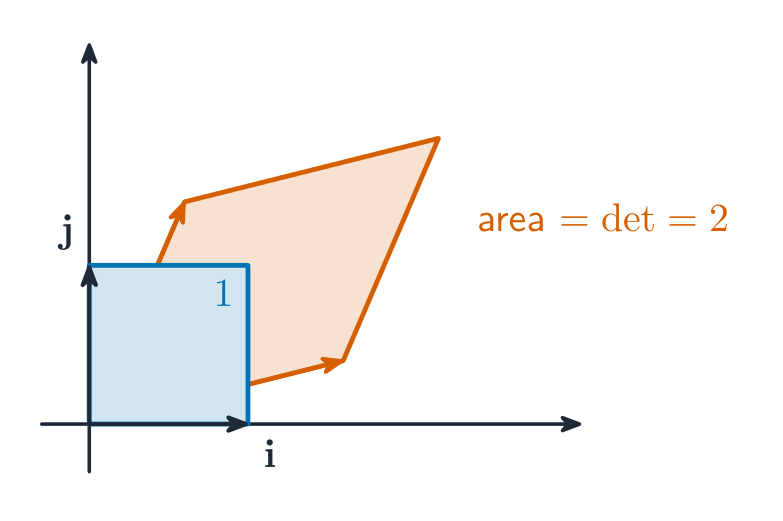
A $2\times 2$ matrix acts as a linear transformation 线性变换 of the plane – rotating, reflecting, stretching, or shearing points – by multiplying each position vector. The determinant measures how the transformation scales area (and its sign tells whether orientation flips).

Worked example. The matrix $\begin{bmatrix}2 & 0\\ 0 & 3\end{bmatrix}$ stretches the plane by $2$ horizontally and $3$ vertically, sending the vector $\begin{bmatrix}1\\1\end{bmatrix}$ to $\begin{bmatrix}2\\3\end{bmatrix}$. Its determinant $2\times3=6$ means every area is multiplied by $6$, so the unit square becomes a $2\times3$ rectangle.

Bahasa Indonesia
Matriks mentransformasi bidang

Sebuah matriks $2\times 2$ bertindak sebagai transformasi linear dari bidang – memutar, memantulkan, meregangkan, atau menggeser titik – dengan mengalikan setiap vektor posisi. Determinan mengukur bagaimana transformasi skala area (dan tandanya memberi tahu apakah orientasi berbalik).

Contoh terpecahkan. Matriks $\begin{bmatrix}2 & 0\\ 0 & 3\end{bmatrix}$ meregangkan bidang sebesar $2$ secara horizontal dan $3$ secara vertikal, mengirim vektor $\begin{bmatrix}1\\1\end{bmatrix}$ ke $\begin{bmatrix}2\\3\end{bmatrix}$. Determinannya $2\times3=6$ berarti setiap area dikalikan dengan $6$, sehingga persegi satuan menjadi persegi panjang $2\times3$.

Matriks 2x2 memetakan persegi satuan ke jajar genjang; determinan adalah skala luas
Explore · ⁨Jelajahi⁩

Transform the plane with a matrix · ⁨Transformasi bidang dengan matriks⁩

A $2\times2$ matrix maps every point to a new one, so it stretches, rotates or shears the whole grid. Change the entries and watch the unit square transform. · ⁨Sebuah $2\times2$ matriks memetakan setiap titik ke posisi baru, sehingga meregangkan, memutar, atau menggeser seluruh grid. Ubah entri dan lihat transformasi persegi satuan.⁩

4.13

Matrices as Functions · ⁨Matriks sebagai Fungsi⁩

Syllabus · ⁨Silabus⁩
English

Learning Objective 4.13.A: Determine the association between a linear transformation and a matrix.

  • 4.13.A.1 The linear transformation mapping $\langle x,\, y \rangle$ to $\langle a_{11} x + a_{12} y,\, a_{21} x + a_{22} y \rangle$ is associated with the matrix $\begin{bmatrix} a_{11} & a_{12} \\ a_{21} & a_{22} \end{bmatrix}$.
  • 4.13.A.2 The mapping of the unit vectors in a linear transformation provides valuable information for determining the associated matrix.
  • 4.13.A.3 The matrix $\begin{bmatrix} \cos\theta & -\sin\theta \\ \sin\theta & \cos\theta \end{bmatrix}$ is associated with a linear transformation of vectors that rotates every vector an angle $\theta$ counterclockwise about the origin.
  • 4.13.A.4 The absolute value of the determinant of a $2 \times 2$ transformation matrix gives the magnitude of the dilation of regions in $\mathbb{R}^2$ under the transformation.

Learning Objective 4.13.B: Determine the composition of two linear transformations.

  • 4.13.B.1 The composition of two linear transformations is a linear transformation.
  • 4.13.B.2 The matrix associated with the composition of two linear transformations is the product of the matrices associated with each linear transformation.

Learning Objective 4.13.C: Determine the inverse of a linear transformation.

  • 4.13.C.1 Two linear transformations are inverses if their composition maps any vector to itself.
  • 4.13.C.2 If a linear transformation, $L$, is given by $L(\vec{v}) = A\vec{v}$, then its inverse transformation is given by $L^{-1}(\vec{v}) = A^{-1}\vec{v}$, where $A^{-1}$ is the inverse of the matrix $A$.
Bahasa Indonesia

Tujuan Pembelajaran 4.13.A: Menentukan hubungan antara transformasi linear dan matriks.

  • 4.13.A.1 Transformasi linear yang memetakan $\langle x,\, y \rangle$ ke $\langle a_{11} x + a_{12} y,\, a_{21} x + a_{22} y \rangle$ dikaitkan dengan matriks $\begin{bmatrix} a_{11} & a_{12} \\ a_{21} & a_{22} \end{bmatrix}$.
  • 4.13.A.2 Pemetaan vektor satuan dalam transformasi linear memberikan informasi berharga untuk menentukan matriks yang terkait.
  • 4.13.A.3 Matriks $\begin{bmatrix} \cos\theta & -\sin\theta \\ \sin\theta & \cos\theta \end{bmatrix}$ dikaitkan dengan transformasi linear vektor yang memutar setiap vektor sebesar sudut $\theta$ berlawanan arah jarum jam terhadap titik asal.
  • 4.13.A.4 Nilai mutlak determinan dari matriks transformasi $2 \times 2$ memberikan besaran dilatasi daerah dalam $\mathbb{R}^2$ di bawah transformasi tersebut.

Tujuan Pembelajaran 4.13.B: Menentukan komposisi dua transformasi linear.

  • 4.13.B.1 Komposisi dari dua transformasi linear merupakan sebuah transformasi linear.
  • 4.13.B.2 Matriks yang dikaitkan dengan komposisi dua transformasi linear adalah hasil kali dari matriks-matriks yang dikaitkan dengan masing-masing transformasi linear.

Tujuan Pembelajaran 4.13.C: Menentukan invers dari transformasi linear.

  • 4.13.C.1 Dua transformasi linear adalah invers satu sama lain jika komposisinya memetakan setiap vektor ke dirinya sendiri.
  • 4.13.C.2 Jika transformasi linear, $L$, diberikan oleh $L(\vec{v}) = A\vec{v}$, maka transformasi inversnya diberikan oleh $L^{-1}(\vec{v}) = A^{-1}\vec{v}$, di mana $A^{-1}$ adalah invers dari matriks $A$.

Source: College Board AP Course and Exam Description · ⁨Sumber: Deskripsi Kursus dan Ujian College Board AP⁩

English

Because a matrix maps input vectors to output vectors, it is a function on the plane. Composing transformations corresponds to multiplying their matrices, and the inverse matrix reverses the mapping.

Bahasa Indonesia

Karena matriks memetakan vektor input ke vektor output, ia adalah fungsi pada bidang. Mengkomposisikan transformasi sesuai dengan mengalikan matriksnya, dan matriks invers membalikkan pemetaan.

4.14

Matrices Modeling Contexts · ⁨Matriks Memodelkan Konteks⁩

Syllabus · ⁨Silabus⁩
English

Learning Objective 4.14.A: Construct a model of a scenario involving transitions between two states using matrices.

  • 4.14.A.1 A contextual scenario can indicate the rate of transitions between states as percent changes. A matrix can be constructed based on these rates to model how states change over discrete intervals.

Learning Objective 4.14.B: Apply matrix models to predict future and past states for $n$ transition steps.

  • 4.14.B.1 The product of a matrix that models transitions between states and a corresponding state vector can predict future states.
  • 4.14.B.2 Repeated multiplication of a matrix that models the transitions between states and corresponding resultant state vectors can predict the steady state, a distribution between states that does not change from one step to the next.
  • 4.14.B.3 The product of the inverse of a matrix that models transitions between states and a corresponding state vector can predict past states.
Bahasa Indonesia

Tujuan Pembelajaran 4.14.A: Membangun model skenario yang melibatkan transisi antara dua keadaan menggunakan matriks.

  • 4.14.A.1 Skenario kontekstual dapat menunjukkan tingkat transisi antar keadaan sebagai persentase perubahan. Matriks dapat disusun berdasarkan tingkat-tingkat ini untuk memodelkan bagaimana keadaan berubah selama interval diskrit.

Tujuan Pembelajaran 4.14.B: Terapkan model matriks untuk memprediksi keadaan masa depan dan masa lalu untuk $n$ langkah transisi.

  • 4.14.B.1 Hasil kali matriks yang memodelkan transisi antar keadaan dan vektor keadaan yang sesuai dapat memprediksi keadaan masa depan.
  • 4.14.B.2 Perkalian berulang matriks yang memodelkan transisi antar keadaan dan vektor keadaan hasil yang sesuai dapat memprediksi keadaan stabil, yaitu distribusi antar keadaan yang tidak berubah dari satu langkah ke langkah berikutnya.
  • 4.14.B.3 Hasil kali invers dari matriks yang memodelkan transisi antar keadaan dan vektor keadaan yang sesuai dapat memprediksi keadaan masa lalu.

Source: College Board AP Course and Exam Description · ⁨Sumber: Deskripsi Kursus dan Ujian College Board AP⁩

English

Matrices model systems that step forward in stages – for example, populations moving between states each year. Repeated multiplication by a transition matrix advances the model one step at a time, so matrix powers predict long-run behavior.

Bahasa Indonesia

Matriks memodelkan sistem yang maju secara bertahap – misalnya, populasi berpindah antar keadaan setiap tahun. Perkalian berulang dengan matriks transisi memajukan model satu langkah sekaligus, sehingga pangkat matriks memprediksi perilaku jangka panjang.

4.14

Exam tips · ⁨Tips ujian⁩

English
  • A parametric function gives $x(t)$ and $y(t)$ separately — track the direction of motion as $t$ increases.
  • A vector has magnitude and direction; add component-by-component and find magnitude with $\sqrt{a^2+b^2}$.
  • The determinant of a $2\times2$ matrix is $ad-bc$ (mind the minus sign); it scales area under the transformation.
  • A $2\times2$ matrix transforms the plane (rotate, reflect, stretch); an inverse exists only when the determinant is non-zero.
  • Note this unit is not tested on the AP Precalculus Exam (Units 1–3 only), but it underpins later courses.
Bahasa Indonesia
  • Fungsi parametrik memberikan $x(t)$ dan $y(t)$ secara terpisah — lacak arah gerak saat $t$ bertambah.
  • Sebuah vektor memiliki besaran dan arah; tambahkan komponen demi komponen dan temukan besarannya dengan $\sqrt{a^2+b^2}$.
  • Determinan dari matriks $2\times2$ adalah $ad-bc$ (hati-hati dengan tanda minus); ini mengscale area di bawah transformasi.
  • Matriks $2\times2$ mentransformasi bidang (putar, pantulkan, regangkan); invers ada hanya jika determinannya bukan nol.
  • Perhatikan bahwa unit ini tidak diujikan dalam Ujian AP Pra-Kalkulus (Hanya Unit 1–3), tetapi mendasari kursus selanjutnya.

Interactive lessons on this topic · ⁨Pelajaran interaktif untuk topik ini⁩

Work through it step by step, with instant-check exercises. · ⁨Kerjakan langkah demi langkah, dengan latihan pengecekan instan.⁩

Past Papers · ⁨Soal-Soil Masa Lalu⁩

More topics in AP Precalculus · ⁨AP Pra-Kalkulus⁩ · ⁨Topik lain dalam AP Precalculus · ⁨AP Pra-Kalkulus⁩⁩

Log in or create account · ⁨Masuk atau buat akun⁩

IGCSE, A-Level & AP