Skip to content · ⁨Lompat ke konten⁩

Energy and Momentum of Rotating Systems · ⁨Energi dan Momentum Sistem Berputar⁩

AP Physics C: Mechanics · ⁨AP Fisika C: Mekanika⁩ · Topic 6 · ⁨Topik 6⁩

Video lesson for this topic · ⁨Pelajaran video untuk topik ini⁩ Open the video page · ⁨Buka halaman video⁩
8:12

Energi dan Momentum Sistem Berputar

Perhatikan penari es yang berputar. Lengan terbentang, ia berputar perlahan. Ia menarik lengannya masuk — dan tanpa mendorong apa pun, ia berputar jauh lebih cepat. Tiada siapa…

English narration · English + 中文 subtitles burned in · ⁨Narasi bahasa Inggris · Subtitle bahasa Inggris + 中文 disematkan langsung⁩

6.1

Rotational Kinetic Energy · ⁨Energi Kinetik Rotasi⁩

Syllabus · ⁨Silabus⁩
English

Learning Objective 6.1.A: Describe the rotational kinetic energy of a rigid system in terms of the rotational inertia and angular velocity of that rigid system.

  • 6.1.A.1 The rotational kinetic energy of an object or rigid system is related to the rotational inertia and angular velocity of the rigid system and is given by the equation $K_{\text{rot}} = \dfrac{1}{2} I \omega^2$.
    • Equation: $K_{\text{rot}} = \dfrac{1}{2} I \omega^2$
    • 6.1.A.1.i The rotational inertia of an object about a fixed axis can be used to show that the rotational kinetic energy of that object is equivalent to its translational kinetic energy, which is its total kinetic energy.
    • 6.1.A.1.ii The total kinetic energy of a rigid system is the sum of its rotational kinetic energy due to its rotation about its center of mass and the translational kinetic energy due to the linear motion of its center of mass.
  • 6.1.A.2 A rigid system can have rotational kinetic energy while its center of mass is at rest due to the individual points within the rigid system having linear speed and, therefore, kinetic energy.
  • 6.1.A.3 Rotational kinetic energy is a scalar quantity.
Bahasa Indonesia

Tujuan Pembelajaran 6.1.A: Jelaskan energi kinetik rotasi sistem kaku dalam istilah inersia rotasi dan kecepatan sudut sistem kaku tersebut.

  • 6.1.A.1 Energi kinetik rotasi dari suatu objek atau sistem kaku berkaitan dengan inersia rotasi dan kecepatan sudut sistem kaku tersebut dan diberikan oleh persamaan $K_{\text{rot}} = \dfrac{1}{2} I \omega^2$.
    • Persamaan: $K_{\text{rot}} = \dfrac{1}{2} I \omega^2$
    • 6.1.A.1.i Inersia rotasi dari suatu objek tentang sumbu tetap dapat digunakan untuk menunjukkan bahwa energi kinetik rotasi dari objek tersebut setara dengan energi kinetik translasinya, yaitu total energi kinetiknya.
    • 6.1.A.1.ii Total energi kinetik sistem kaku adalah jumlah dari energi kinetik rotasinya akibat rotasi tentang pusat massanya dan energi kinetik translasinya akibat gerak linear pusat massanya.
  • 6.1.A.2 Sistem kaku dapat memiliki energi kinetik rotasi meskipun pusat massanya diam karena titik-titik individu di dalam sistem kaku memiliki kecepatan linear dan, karenanya, energi kinetik.
  • 6.1.A.3 Energi kinetik rotasi adalah besaran skalar.
Source: College Board AP Course and Exam Description · ⁨Sumber: Deskripsi Kursus dan Ujian College Board AP⁩

English

A spinning body has rotational kinetic energy 转动动能

$$K_{\text{rot}}=\tfrac12 I\omega^2,$$

the rotational twin of $\tfrac12mv^2$, with the rotational inertia 转动惯量 $I$ playing the role of mass. A body that both moves and spins carries both terms:

$$K=\tfrac12 mv_{\text{cm}}^2+\tfrac12 I\omega^2.$$

Worked example. A uniform cylinder ($I=\tfrac12mr^2$) rolls at speed $v$. Its kinetic energy is $K=\tfrac12mv^2+\tfrac12\big(\tfrac12mr^2\big)\big(\tfrac{v}{r}\big)^2=\tfrac34mv^2$ – one third of it is rotational. The same ball of energy bookkeeping decides every rolling problem.

Bahasa Indonesia

Benda berputar memiliki energi kinetik rotasi

$$K_{\text{rot}}=\tfrac12 I\omega^2,$$

kembar rotasi dari $\tfrac12mv^2$, dengan momen inersia $I$ yang berperan sebagai massa. Benda yang bergerak sekaligus berputar membawa kedua suku tersebut:

$$K=\tfrac12 mv_{\text{cm}}^2+\tfrac12 I\omega^2.$$

Contoh terpecahkan. Silinder seragam ($I=\tfrac12mr^2$) menggelinding pada kecepatan $v$. Energinya adalah $K=\tfrac12mv^2+\tfrac12\big(\tfrac12mr^2\big)\big(\tfrac{v}{r}\big)^2=\tfrac34mv^2$ – sepertiganya adalah energi rotasi. Buku catatan energi yang sama memutuskan setiap masalah menggelinding.

6.2

Torque and Work · ⁨Torsi dan Usaha⁩

Syllabus · ⁨Silabus⁩
English

Learning Objective 6.2.A: Describe the work done on a rigid system by a given torque or collection of torques.

  • 6.2.A.1 A torque can transfer energy into or out of an object or rigid system if the torque is exerted over an angular displacement.
  • 6.2.A.2 The amount of work done on a rigid system by a torque is related to the magnitude of that torque and the angular displacement through which the rigid system rotates during the interval in which that torque is exerted.
    • Equation: $W = \displaystyle\int_{\theta_1}^{\theta_2} \tau \, d\theta$
  • 6.2.A.3 Work done on a rigid system by a given torque can be found from the area under the curve of a graph of the torque as a function of angular position.
Bahasa Indonesia

Tujuan Pembelajaran 6.2.A: Jelaskan usaha yang dilakukan pada sistem kaku oleh torsi tertentu atau kumpulan torsi.

  • 6.2.A.1 Torsi dapat mentransfer energi masuk ke dalam atau keluar dari suatu objek atau sistem kaku jika torsi tersebut diberikan selama perpindahan sudut.
  • 6.2.A.2 Besarnya usaha yang dilakukan pada sistem kaku oleh sebuah torsi berkaitan dengan besaran torsi tersebut dan perpindahan sudut yang dilalui sistem kaku saat berotasi selama selang waktu torsi diberikan.
    • Persamaan: $W = \displaystyle\int_{\theta_1}^{\theta_2} \tau \, d\theta$
  • 6.2.A.3 Usaha yang dilakukan pada sistem kaku oleh suatu torsi tertentu dapat ditemukan dari luas di bawah kurva grafik torsi sebagai fungsi posisi sudut.

Source: College Board AP Course and Exam Description · ⁨Sumber: Deskripsi Kursus dan Ujian College Board AP⁩

English

A torque 力矩 acting through an angular displacement 角位移 does work, and power is torque times angular velocity:

$$W=\int_{\theta_1}^{\theta_2}\tau\,d\theta,\qquad P=\tau\omega.$$

These are the rotational forms of $W=\int F\,dx$ and $P=Fv$ – the whole translational energy toolkit carries over with $F\to\tau$, $x\to\theta$, $v\to\omega$.

Worked example. A motor applies a constant $8.0\ \text{N}\cdot\text{m}$ torque to a flywheel for $5.0$ full turns: $W=\tau\,\Delta\theta=8.0(5.0)(2\pi)=250\ \text{J}$, which appears as rotational kinetic energy if friction is negligible.

Bahasa Indonesia

Torsi yang bekerja melalui pergeseran sudut melakukan usaha, dan daya adalah torsi dikali kecepatan sudut:

$$W=\int_{\theta_1}^{\theta_2}\tau\,d\theta,\qquad P=\tau\omega.$$

Ini adalah bentuk-bentuk rotasi dari $W=\int F\,dx$ dan $P=Fv$ – seluruh paket alat energi translasi dapat diterapkan dengan $F\to\tau$, $x\to\theta$, $v\to\omega$.

Contoh terpecahkan. Motor menerapkan torsi konstan $8.0\ \text{N}\cdot\text{m}$ pada roda gila selama $5.0$ putaran penuh: $W=\tau\,\Delta\theta=8.0(5.0)(2\pi)=250\ \text{J}$, yang muncul sebagai energi kinetik rotasi jika gesekan dapat diabaikan.

Explore · ⁨Jelajahi⁩

Balance torques on a beam · ⁨Seimbangkan torsi pada balok⁩

Torque is force times perpendicular distance, $\tau=Fd$. Equal torques on each side keep the beam in rotational equilibrium. · ⁨Torsi adalah gaya dikali jarak tegak lurus, $\tau=Fd$. Torsi yang sama di masing-masing sisi menjaga balok dalam kesetimbangan rotasi.⁩

6.3

Angular Momentum and Angular Impulse · ⁨Momentum Sudut dan Impuls Sudut⁩

Syllabus · ⁨Silabus⁩
English

Learning Objective 6.3.A: Describe the angular momentum of an object or rigid system.

  • 6.3.A.1 The magnitude of the angular momentum of a rigid system about a specific axis can be described with the equation $L = I\omega$.
    • Equation: $L = I\omega$
  • 6.3.A.2 The angular momentum of an object about a given point is $\vec{L} = \vec{r} \times \vec{p}$.
    • Equation: $\vec{L} = \vec{r} \times \vec{p}$
    • 6.3.A.2.i The selection of the axis about which an object is considered to rotate influences the determination of the angular momentum of that object.
    • 6.3.A.2.ii The measured angular momentum of an object traveling in a straight line depends on the distance between the reference point and the object, the mass of the object, the speed of the object, and the angle between the radial distance and the velocity of the object.

Learning Objective 6.3.B: Describe the angular impulse delivered to an object or rigid system by a torque.

  • 6.3.B.1 Angular impulse is defined as the product of the torque exerted on an object or rigid system and the time interval during which the torque is exerted.
    • Equation: $\text{angular impulse} = \displaystyle\int \tau \, dt$
  • 6.3.B.2 Angular impulse has the same direction as the torque imparting it.
  • 6.3.B.3 The angular impulse delivered to an object or rigid system by a torque can be found from the area under the curve of a graph of the torque as a function of time.

Learning Objective 6.3.C: Relate the change in angular momentum of an object or rigid system to the angular impulse given to that object or rigid system.

  • 6.3.C.1 The magnitude of the change in angular momentum can be described by comparing the magnitudes of the final and initial momenta of the object or rigid system.
    • Equation: $\Delta L = L - L_0$
  • 6.3.C.2 A rotational form of the impulse–momentum theorem relates the angular impulse delivered to an object or rigid system and the change in angular momentum of that object or rigid system.
    • 6.3.C.2.i The angular impulse exerted on an object or rigid system is equal to the change in angular momentum of that object or rigid system.
      • Equation: $\Delta L = \displaystyle\int_{t_1}^{t_2} \tau \, dt$
    • 6.3.C.2.ii The rotational form of the impulse–momentum theorem is a direct result of Newton's second law of motion for cases in which rotational inertia is constant.
      • Equation: $\tau_{\text{net}} = \dfrac{dL}{dt} = I\dfrac{d\omega}{dt} = I\alpha$
  • 6.3.C.3 The net torque exerted on an object or rigid system is equal to the slope of the graph of the angular momentum of an object as a function of time.
  • 6.3.C.4 The angular impulse delivered to an object or rigid system is equal to the area under the curve of a graph of the net external torque exerted on an object as a function of time.
Bahasa Indonesia

Tujuan Pembelajaran 6.3.A: Jelaskan momentum sudut dari sebuah objek atau sistem kaku.

  • 6.3.A.1 Besar momentum sudut dari sistem kaku terhadap sumbu tertentu dapat dijelaskan dengan persamaan $L = I\omega$.
    • Persamaan: $L = I\omega$
  • 6.3.A.2 Momentum sudut sebuah objek tentang titik tertentu adalah $\vec{L} = \vec{r} \times \vec{p}$.
    • Persamaan: $\vec{L} = \vec{r} \times \vec{p}$
    • 6.3.A.2.i Pemilihan sumbu tentang mana objek dianggap berotasi mempengaruhi penentuan momentum sudut objek tersebut.
    • 6.3.A.2.ii Momentum sudut terukur dari objek yang bergerak lurus bergantung pada jarak antara titik referensi dan objek, massa objek, kecepatan objek, serta sudut antara jarak radial dan kecepatan objek.

Tujuan Pembelajaran 6.3.B: Jelaskan impuls sudut yang diberikan kepada objek atau sistem kaku oleh torsi.

  • 6.3.B.1 Impuls sudut didefinisikan sebagai hasil kali torsi yang diberikan pada objek atau sistem kaku dengan selang waktu torsi tersebut diberikan.
    • Persamaan: $\text{angular impulse} = \displaystyle\int \tau \, dt$
  • 6.3.B.2 Impuls sudut memiliki arah yang sama dengan torsi yang memberikannya.
  • 6.3.B.3 Impuls sudut yang diberikan kepada objek atau sistem kaku oleh torsi dapat ditemukan dari luas di bawah kurva grafik torsi sebagai fungsi waktu.

Tujuan Pembelajaran 6.3.C: Hubungkan perubahan momentum sudut dari objek atau sistem kaku dengan impuls sudut yang diberikan kepada objek atau sistem kaku tersebut.

  • 6.3.C.1 Besaran perubahan momentum sudut dapat dijelaskan dengan membandingkan besaran momentum akhir dan awal objek atau sistem kaku tersebut.
    • Persamaan: $\Delta L = L - L_0$
  • 6.3.C.2 Bentuk rotasi dari teorem impuls-momentum menghubungkan impuls sudut yang diberikan kepada objek atau sistem kaku dengan perubahan momentum sudut dari objek atau sistem kaku tersebut.
    • 6.3.C.2.i Impuls sudut yang diberikan pada objek atau sistem kaku sama dengan perubahan momentum sudut dari objek atau sistem kaku tersebut.
      • Persamaan: $\Delta L = \displaystyle\int_{t_1}^{t_2} \tau \, dt$
    • 6.3.C.2.ii Bentuk rotasi dari teorema impuls-momentum merupakan hasil langsung dari hukum kedua Newton tentang gerak untuk kasus di mana inersia rotasi konstan.
      • Persamaan: $\tau_{\text{net}} = \dfrac{dL}{dt} = I\dfrac{d\omega}{dt} = I\alpha$
  • 6.3.C.3 Resultan torsi yang diberikan pada sebuah objek atau sistem kaku sama dengan kemiringan grafik momentum sudut objek sebagai fungsi waktu.
  • 6.3.C.4 Impuls sudut yang diberikan pada sebuah objek atau sistem kaku sama dengan luas di bawah kurva grafik resultan torsi eksternal yang diberikan pada objek sebagai fungsi waktu.

Source: College Board AP Course and Exam Description · ⁨Sumber: Deskripsi Kursus dan Ujian College Board AP⁩

English

Angular momentum 角动量 for a particle is

$$\vec{L}=\vec{r}\times\vec{p},\qquad |L|=mvr\sin\theta,$$

so even a particle moving in a straight line has angular momentum about any point not on that line ($L=mv\,d$, with $d$ the perpendicular distance). For a rigid body spinning about a fixed axis, $L=I\omega$. Newton's second law in rotational form is

$$\vec{\tau}_{\text{net}}=\frac{d\vec{L}}{dt}\quad(=I\alpha\ \text{when }I\text{ is constant}),$$

and a net torque acting over time delivers an angular impulse 角冲量 $\int\tau\,dt=\Delta L$ – the rotational impulse–momentum theorem.

Bahasa Indonesia

Momentum sudut untuk sebuah partikel adalah

$$\vec{L}=\vec{r}\times\vec{p},\qquad |L|=mvr\sin\theta,$$

sehingga bahkan partikel yang bergerak dalam garis lurus memiliki momentum sudut terhadap titik manapun yang tidak berada pada garis itu ($L=mv\,d$, dengan $d$ sebagai jarak tegak lurus). Untuk benda kaku yang berputar tentang sumbu tetap, $L=I\omega$. Hukum kedua Newton dalam bentuk rotasi adalah

$$\vec{\tau}_{\text{net}}=\frac{d\vec{L}}{dt}\quad(=I\alpha\ \text{when }I\text{ is constant}),$$

dan torsi bersih yang bekerja selama waktu memberikan impuls angular $\int\tau\,dt=\Delta L$ – teorema impuls-momentum rotasi.

6.4

Conservation of Angular Momentum · ⁨Kekekalan Momentum Sudut⁩

Syllabus · ⁨Silabus⁩
English

Learning Objective 6.4.A: Describe the behavior of a system using conservation of angular momentum.

  • 6.4.A.1 The total angular momentum of a system about a rotational axis is the sum of the angular momenta of the system's constituent parts about that rotational axis.
  • 6.4.A.2 Any change to a system's angular momentum must be due to an interaction between the system and its surroundings.
    • 6.4.A.2.i The angular impulse exerted by one object or system on a second object or system is equal and opposite to the angular impulse exerted by the second object or system on the first. This is a direct result of Newton's third law.
    • 6.4.A.2.ii A system may be selected so that the total angular momentum of that system is constant.
    • 6.4.A.2.iii The angular speed of a nonrigid system may change without the angular momentum of the system changing if the system changes shape by moving mass closer to or farther from the rotational axis.
    • 6.4.A.2.iv If the total angular momentum of a system changes, that change will be equivalent to the angular impulse exerted on the system.

Learning Objective 6.4.B: Describe how the selection of a system determines whether the angular momentum of that system changes.

  • 6.4.B.1 Angular momentum is conserved in all interactions.
  • 6.4.B.2 If the net external torque exerted on a selected object or rigid system is zero, the total angular momentum of that system is constant.
  • 6.4.B.3 If the net external torque exerted on a selected object or rigid system is nonzero, angular momentum is transferred between the system and the environment.
Bahasa Indonesia

Tujuan Pembelajaran 6.4.A: Jelaskan perilaku sistem menggunakan kekekalan momentum sudut.

  • 6.4.A.1 Total momentum sudut sistem tentang sumbu rotasi adalah jumlah dari momentum sudut bagian-bagian penyusun sistem tersebut tentang sumbu rotasi itu.
  • 6.4.A.2 Setiap perubahan pada momentum sudut sistem harus disebabkan oleh interaksi antara sistem dan lingkungannya.
    • 6.4.A.2.i Impuls sudut yang diberikan oleh satu objek atau sistem kepada objek atau sistem kedua sama besar dan berlawanan arah dengan impuls sudut yang diberikan oleh objek atau sistem kedua kepada yang pertama. Ini merupakan akibat langsung dari hukum ketiga Newton.
    • 6.4.A.2.ii Sistem dapat dipilih sedemikian rupa sehingga total momentum sudut sistem tersebut konstan.
    • 6.4.A.2.iii Kecepatan sudut sistem nonkaku dapat berubah tanpa perubahan momentum sudut sistem jika sistem mengubah bentuk dengan memindahkan massa lebih dekat atau lebih jauh dari sumbu rotasi.
    • 6.4.A.2.iv Jika total momentum sudut sistem berubah, perubahan tersebut akan setara dengan impuls sudut yang diberikan kepada sistem.

Tujuan Pembelajaran 6.4.B: Jelaskan bagaimana pemilihan sistem menentukan apakah momentum sudut dari sistem tersebut berubah.

  • 6.4.B.1 Momentum sudut kekal dalam semua interaksi.
  • 6.4.B.2 Jika torsi eksternal bersih yang diberikan pada objek atau sistem kaku yang dipilih adalah nol, total momentum sudut sistem tersebut konstan.
  • 6.4.B.3 Jika torsi eksternal bersih yang diberikan pada objek atau sistem kaku yang dipilih tidak nol, momentum sudut ditransfer antara sistem dan lingkungan.

Source: College Board AP Course and Exam Description · ⁨Sumber: Deskripsi Kursus dan Ujian College Board AP⁩

English
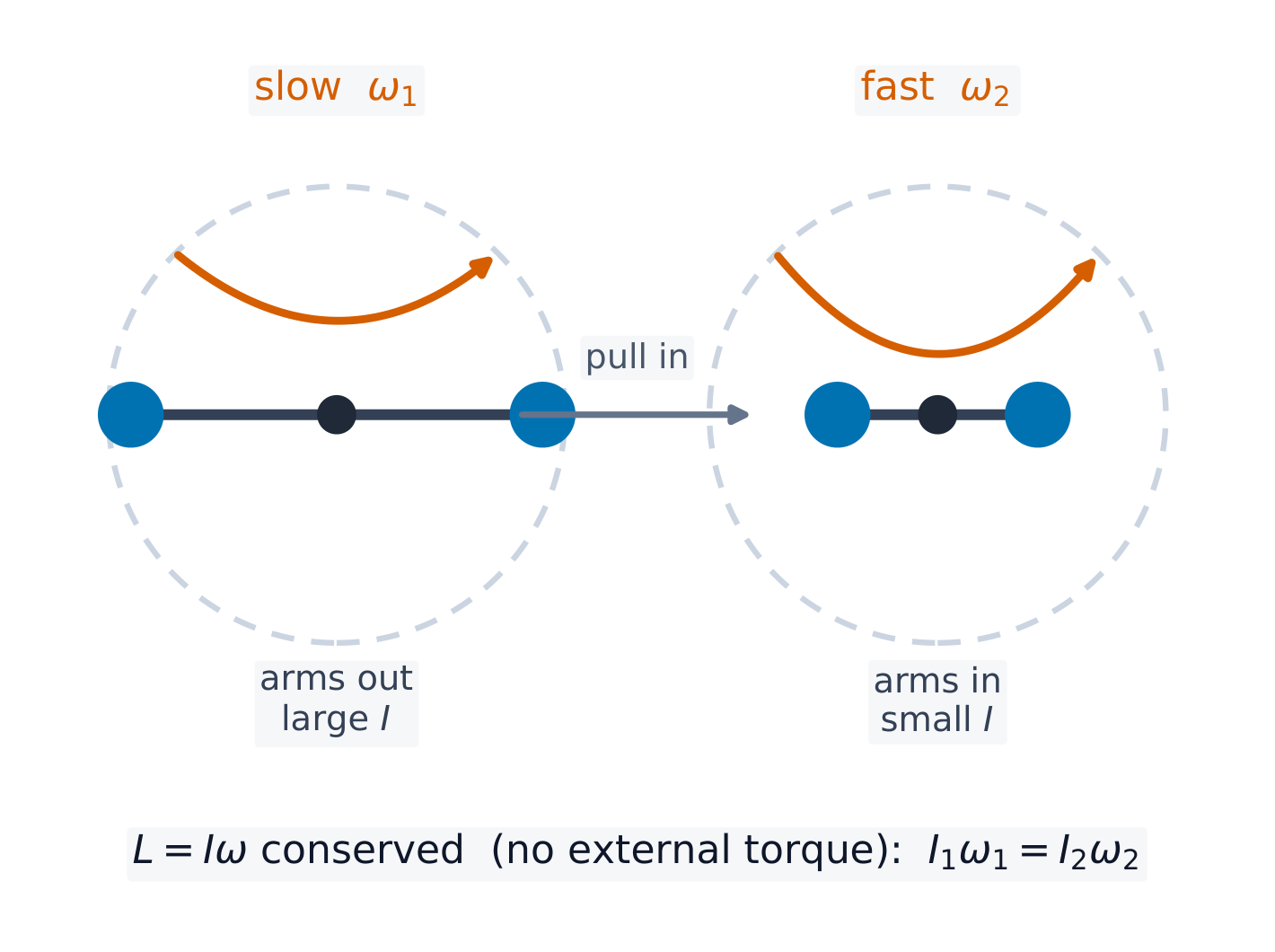
Angular momentum: pull in, spin faster

With zero net external torque, total angular momentum is conserved 守恒:

$$L_{\text{before}}=L_{\text{after}},\qquad I_1\omega_1=I_2\omega_2\ \text{(one rigid body reshaping)}.$$

If $I$ shrinks, $\omega$ grows – a spinning skater speeds up pulling her arms in. The rule survives collisions and shape changes, which is what makes it so useful: pick the axis so that every external force (gravity, the pivot force) exerts no torque about it.

Worked example. A skater spins at $2.0\ \text{rev/s}$ with $I_1=4.0\ \text{kg}\cdot\text{m}^2$. Pulling in her arms drops it to $I_2=1.6\ \text{kg}\cdot\text{m}^2$: $\omega_2=\dfrac{4.0}{1.6}(2.0)=5.0\ \text{rev/s}$. Her kinetic energy rises – the extra energy is the work her muscles do pulling her arms inward.

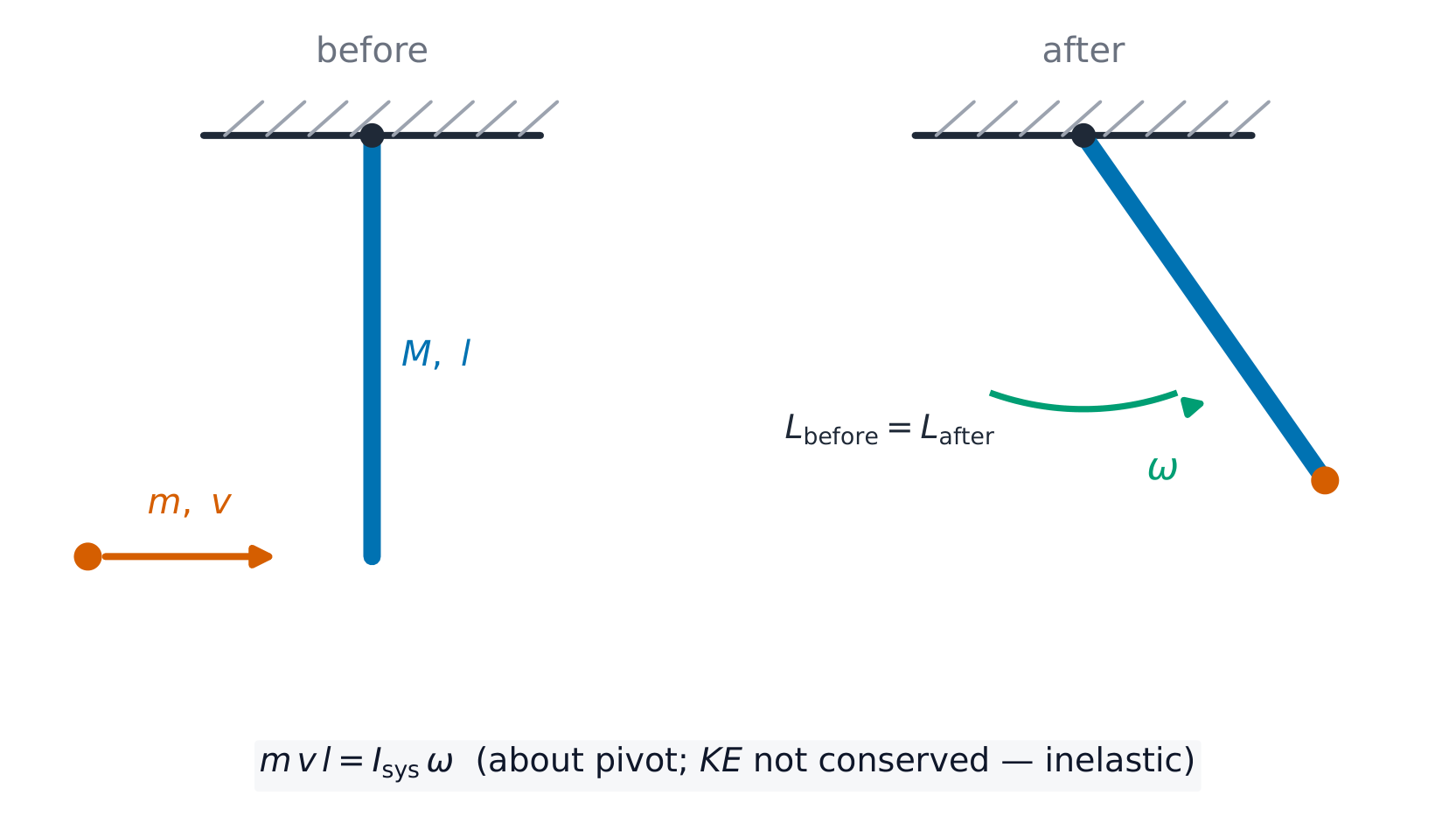
Worked example (rotational collision). A $0.020\ \text{kg}$ bullet at $300\ \text{m/s}$ strikes the tip of a uniform rod ($M=1.5\ \text{kg}$, length $l=0.60\ \text{m}$) hanging from a pivot, and embeds. About the pivot, gravity and the pivot force exert no torque during the strike, so $L$ is conserved: $L=mvl=0.020(300)(0.60)=3.6\ \text{kg}\cdot\text{m}^2/\text{s}$. Afterwards $I=\tfrac13Ml^2+ml^2=0.18+0.0072=0.187\ \text{kg}\cdot\text{m}^2$, so $\omega=\dfrac{3.6}{0.187}\approx19\ \text{rad/s}$. (Linear momentum is not conserved here – the pivot pushes on the rod – and kinetic energy certainly is not: check both before claiming them.)

Bahasa Indonesia
Momentum sudut: tarik masuk, putar lebih cepat

Dengan torsi eksternal bersih nol, total momentum sudut terjaga:

$$L_{\text{before}}=L_{\text{after}},\qquad I_1\omega_1=I_2\omega_2\ \text{(one rigid body reshaping)}.$$

Jika $I$ mengecil, $\omega$ meningkat – seorang peluncur es berputar semakin cepat saat menarik lengannya. Aturan ini bertahan pada tabrakan dan perubahan bentuk, yang menjadikannya sangat berguna: pilih sumbu sehingga setiap gaya eksternal (gravitasi, gaya engsel) tidak menghasilkan torsi terhadapnya.

Contoh terpecahkan. Seorang peluncur berputar pada $2.0\ \text{rev/s}$ dengan $I_1=4.0\ \text{kg}\cdot\text{m}^2$. Menarik lengannya menurunkannya menjadi $I_2=1.6\ \text{kg}\cdot\text{m}^2$: $\omega_2=\dfrac{4.0}{1.6}(2.0)=5.0\ \text{rev/s}$. Energi kinetiknya naik – energi tambahan adalah usaha yang dilakukan ototnya saat menarik lengannya ke dalam.

Menarik massa ke dalam menurunkan I, sehingga ω naik untuk mengkonservasi L = Iω
Momentum sudut terhadap titik tumpu kekal saat peluru tertanam dalam batang
Momentum sudut terhadap engsel terjaga saat peluru tertanam dalam batang

Contoh terpecahkan (tabrakan rotasi). Peluru $0.020\ \text{kg}$ pada $300\ \text{m/s}$ mengenai ujung batang seragam ($M=1.5\ \text{kg}$, panjang $l=0.60\ \text{m}$) yang digantung dari engsel, dan tertanam. Terhadap engsel, gravitasi dan gaya engsel tidak menghasilkan torsi selama benturan, jadi $L$ terjaga: $L=mvl=0.020(300)(0.60)=3.6\ \text{kg}\cdot\text{m}^2/\text{s}$. Setelahnya $I=\tfrac13Ml^2+ml^2=0.18+0.0072=0.187\ \text{kg}\cdot\text{m}^2$, sehingga $\omega=\dfrac{3.6}{0.187}\approx19\ \text{rad/s}$. (Momentum linear tidak dijaga di sini – engsel mendorong batang – dan energi kinetik certainly tidak dijaga: periksa keduanya sebelum mengklaim mereka dijaga.)

Skater yang sedang tampil di atas es
Seni meluncur dan momentum sudut: peluncur yang menarik lengannya saat berputar menurunkan momen inersianya, sehingga berputar lebih cepat
Vocabulary · ⁨Kosa kata⁩ Train · ⁨Latih⁩
English Bahasa Indonesia
rotational kinetic energy/rəʊˈteɪʃənl kɪˈnetɪk ˈenədʒi/ energi kinetik rotasi
rotational inertia/rəʊˈteɪʃənl ɪˈnɜːʃə/ inersia rotasi
torque/tɔːk/ tork
angular displacement/ˈæŋɡjʊlə dɪˈspleɪsmənt/ pencucupan sudut
Angular momentum/ˈæŋɡjʊlə məʊˈmentəm/ Momentum sudut
angular impulse/ˈæŋɡjʊlə ˈɪmpʌls/ impuls sudut
conserved/kənˈsɜːvd/ terjaga
6.5

Rolling · ⁨Pengguliran⁩

Syllabus · ⁨Silabus⁩
English

Learning Objective 6.5.A: Describe the kinetic energy of a system that has translational and rotational motion.

  • 6.5.A.1 The total kinetic energy of a system is the sum of the system's translational and rotational kinetic energies.
    • Equation: $K_{\text{tot}} = K_{\text{trans}} + K_{\text{rot}}$

Learning Objective 6.5.B: Describe the motion of a system that is rolling without slipping.

  • 6.5.B.1 While rolling without slipping, the translational motion of a system's center of mass is related to the rotational motion of the system itself with the following equations:
    • Equation: $\Delta x_{\text{cm}} = r\Delta\theta$
    • Equation: $v_{\text{cm}} = r\omega$
    • Equation: $a_{\text{cm}} = r\alpha$
  • 6.5.B.2 For ideal cases, rolling without slipping implies that the frictional force does not dissipate any energy from the rolling system.

Learning Objective 6.5.C: Describe the motion of a system that is rolling while slipping.

  • 6.5.C.1 When slipping, the motion of a system's center of mass and the system's rotational motion cannot be directly related.
  • 6.5.C.2 When a rotating system is slipping relative to another surface, the point of application of the force of kinetic friction exerted on the system moves with respect to the surface, so the force of kinetic friction will dissipate energy from the system.

Boundary statement: Rolling friction is beyond the scope of AP Physics C: Mechanics.

Bahasa Indonesia

Tujuan Pembelajaran 6.5.A: Jelaskan energi kinetik dari sistem yang memiliki gerak translasi dan rotasi.

  • 6.5.A.1 Total energi kinetik dari sistem adalah jumlah dari energi kinetik translasi dan rotasi sistem.
    • Persamaan: $K_{\text{tot}} = K_{\text{trans}} + K_{\text{rot}}$

Tujuan Pembelajaran 6.5.B: Jelaskan gerak sistem yang menggulung tanpa tergelincir.

  • 6.5.B.1 Saat menggelinding tanpa selip, gerak translasi pusat massa sistem berkaitan dengan gerak rotasi sistem itu sendiri melalui persamaan berikut:
    • Persamaan: $\Delta x_{\text{cm}} = r\Delta\theta$
    • Persamaan: $v_{\text{cm}} = r\omega$
    • Persamaan: $a_{\text{cm}} = r\alpha$
  • 6.5.B.2 Untuk kasus ideal, menggulir tanpa tergelincir berarti gaya gesek tidak meng dissipasi energi dari sistem yang menggulir.

Tujuan Pembelajaran 6.5.C: Jelaskan gerak sistem yang menggulir sambil tergelincir.

  • 6.5.C.1 Saat tergelincir, gerak pusat massa sistem dan gerak rotasi sistem tidak dapat dihubungkan secara langsung.
  • 6.5.C.2 Ketika sistem berputar tergelincir relatif terhadap permukaan lain, titik aplikasi gaya gesek kinetik yang bekerja pada sistem bergerak relatif terhadap permukaan, sehingga gaya gesek kinetik akan meng dissipasi energi dari sistem.

Pernyataan Batas: Gesekan rolling berada di luar cakupan AP Physics C: Mechanics.

Source: College Board AP Course and Exam Description · ⁨Sumber: Deskripsi Kursus dan Ujian College Board AP⁩

English
Rolling without slipping

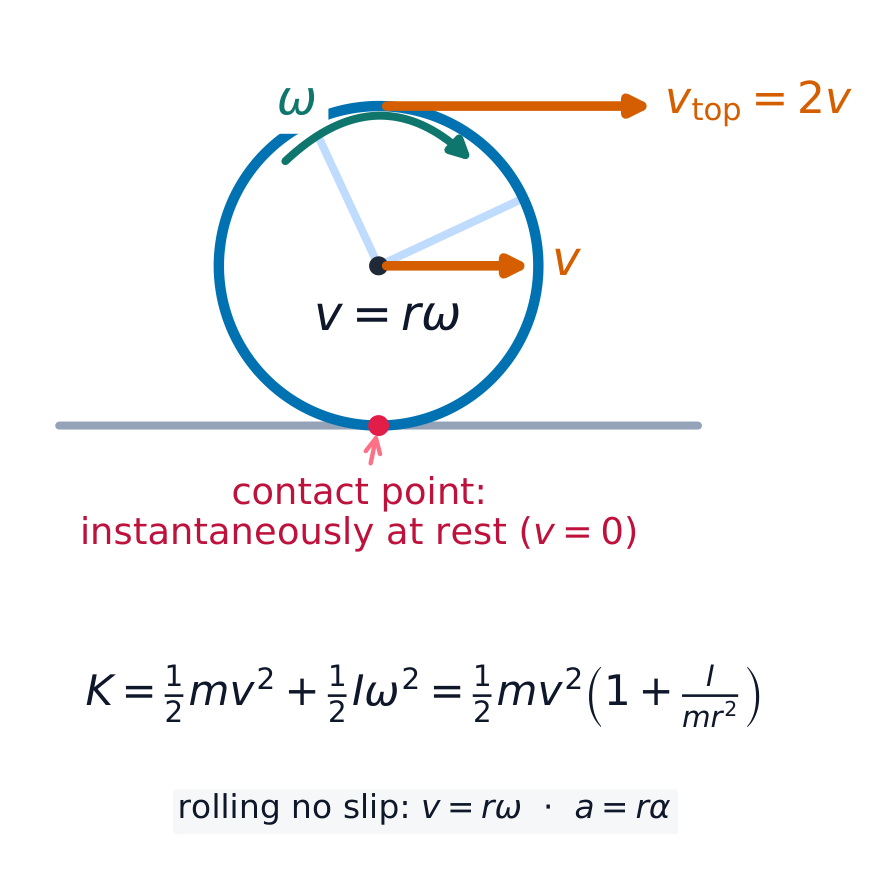
Rolling without slipping 无滑滚动 ties translation to rotation: the contact point is momentarily at rest, so

$$\Delta x_{\text{cm}}=r\,\Delta\theta,\qquad v_{\text{cm}}=r\omega,\qquad a_{\text{cm}}=r\alpha.$$

Static friction supplies the torque that keeps the spin matched to the motion, but at a point that is not sliding – so for pure rolling, friction does no work, and energy conservation is safe to use. (Rolling friction is beyond the AP course.)

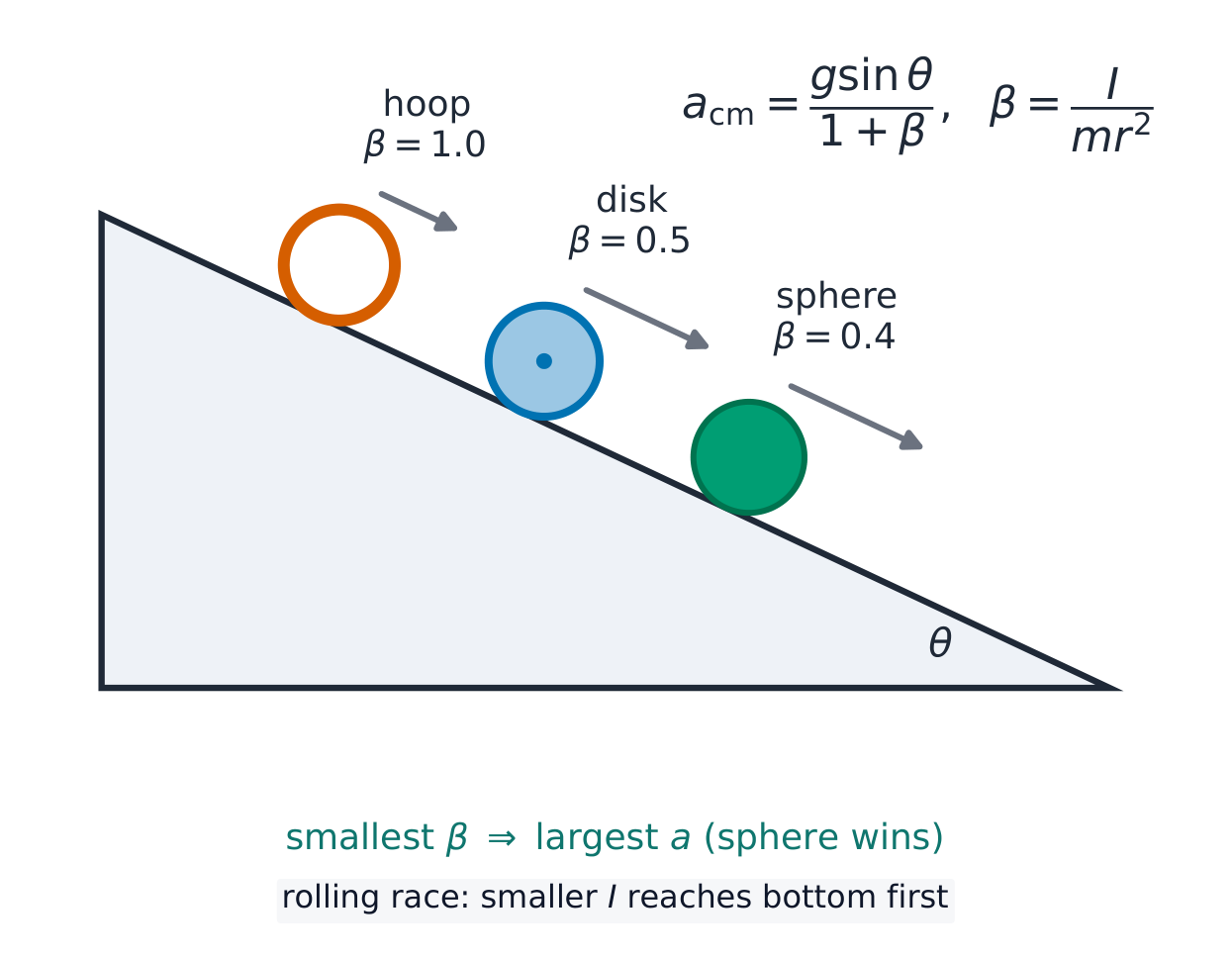
Racing shapes down an incline shows the energy split. With $I=\beta mr^2$, energy conservation gives

$$a_{\text{cm}}=\frac{g\sin\theta}{1+\beta}:$$

a sphere ($\beta=\tfrac25$) beats a disk 圆盘 ($\beta=\tfrac12$), which beats a hoop 圆环 ($\beta=1$) – mass and radius cancel completely. More of the hoop's energy is locked in rotation, so its center moves slower.

Worked example. A solid sphere rolls from rest down a $30^\circ$ incline: $a=\dfrac{g\sin30^\circ}{1+\tfrac25}=\dfrac{9.8(0.50)}{1.4}=3.5\ \text{m/s}^2$, versus $4.9\ \text{m/s}^2$ for a frictionless slider – rolling objects always lose the race against sliding ones.

Bahasa Indonesia
Menggelinding tanpa selip

Menggelinding tanpa selip menghubungkan translasi dengan rotasi: titik kontak berhenti sejenak, sehingga

$$\Delta x_{\text{cm}}=r\,\Delta\theta,\qquad v_{\text{cm}}=r\omega,\qquad a_{\text{cm}}=r\alpha.$$
Dalam pengguliran tanpa selip, titik kontak berada dalam keadaan diam, sehingga v = rω

Gesekan statis menyediakan torsi yang menjaga putaran sesuai dengan gerakan, tetapi pada titik yang tidak meluncur – sehingga untuk gelinding murni, gesekan tidak melakukan usaha, dan konservasi energi aman digunakan. (Gesekan gelinding berada di luar kurikulum AP.)

Balapan bentuk turun di bidang miring menunjukkan pembagian energi. Dengan $I=\beta mr^2$, konservasi energi memberikan

$$a_{\text{cm}}=\frac{g\sin\theta}{1+\beta}:$$

bola ($\beta=\tfrac25$) mengalahkan cakram ($\beta=\tfrac12$), yang mengalahkan cincin ($\beta=1$) – massa dan jari-jari saling menghilangkan sepenuhnya. Lebih banyak energi cincin terkunci dalam rotasi, sehingga pusatnya bergerak lebih lambat.

Balapan menggelinding: bentuk dengan I/mr terkecil ² mencapai dasar terlebih dahulu
Balapan gelinding: bentuk dengan I/mr² terkecil mencapai dasar pertama kali

Contoh terpecahkan. Bola pejal menggelinding dari keadaan diam di bidang miring $30^\circ$: $a=\dfrac{g\sin30^\circ}{1+\tfrac25}=\dfrac{9.8(0.50)}{1.4}=3.5\ \text{m/s}^2$, dibandingkan dengan $4.9\ \text{m/s}^2$ untuk penggeser tanpa gesekan – objek menggelinding selalu kalah balapan melawan objek yang meluncur.

Vocabulary · ⁨Kosa kata⁩ Train · ⁨Latih⁩
English Bahasa Indonesia
Rolling without slipping/ˈrəʊlɪŋ wɪˈðaʊt ˈslɪpɪŋ/ Bergulir tanpa selip
disk/dɪsk/ disk
hoop/huːp/ gelung
centripetal force/senˈtrɪpɪtl fɔːs/ kekuatan sentripetal
satellite/ˈsætəlaɪt/ satelit
gravitational potential energy/ˌɡrævɪˈteɪʃənl pəˈtenʃl ˈenədʒi/ energi potensial gravitasi
total mechanical energy/ˈtəʊtl mɪˈkænɪkl ˈenədʒi/ Energi mekanik total
escape velocity/eˈskeɪp vəˈlɒsɪti/ kecepatan lepas
elliptical orbit/ɪˈlɪptɪkl ˈɔːbɪt/ Orbit elips
Kepler's second law/ˈkepləz ˈsekənd lɔː/ Hukum kedua Kepler
6.6

Motion of Orbiting Satellites · ⁨Gerak Satelit Berorbit⁩

Syllabus · ⁨Silabus⁩
English

Learning Objective 6.6.A: Describe the motions of a system consisting of two objects or systems interacting only via gravitational forces.

  • 6.6.A.1 In a system consisting only of a massive central object and an orbiting satellite with mass that is negligible in comparison to the central object's mass, the motion of the central object itself is negligible.
  • 6.6.A.2 The motion of satellites in orbits is constrained by conservation laws.
    • 6.6.A.2.i In circular orbits, the system's total mechanical energy, the system's gravitational potential energy, and the satellite's angular momentum and kinetic energy are constant.
    • 6.6.A.2.ii In elliptical orbits, the system's total mechanical energy and the satellite's angular momentum are constant, but the system's gravitational potential energy and the satellite's kinetic energy can each change.
    • 6.6.A.2.iii The gravitational potential energy of a system consisting of a satellite and a massive central object is defined to be zero when the satellite is an infinite distance from the central object.
      • Equation: $U_g = -G\dfrac{m_1 m_2}{r}$
  • 6.6.A.3 The total energy of a system consisting of a satellite orbiting a central object in a circular path can be written in terms of the gravitational potential energy of that system or the kinetic energy of the satellite.
    • Equation: $K = -\dfrac{1}{2}U$
    • Equation: $E_{total} = \dfrac{1}{2}U = -\dfrac{GMm}{2r}$
  • 6.6.A.4 The escape velocity of a satellite is the satellite's velocity such that the mechanical energy of the satellite–central-object system is equal to zero.
    • 6.6.A.4.i When the only force exerted on a satellite is gravity from a central object, a satellite that reaches escape velocity will move away from the central body until its speed reaches zero at an infinite distance from the central body.
    • 6.6.A.4.ii The escape velocity of a satellite from a central body of mass $M$ can be derived using conservation of energy laws.
      • Equation: $v_{\text{esc}} = \sqrt{\dfrac{2GM}{r}}$
Bahasa Indonesia

Tujuan Pembelajaran 6.6.A: Deskripsikan gerak sistem yang terdiri dari dua objek atau sistem yang berinteraksi hanya melalui gaya gravitasi.

  • 6.6.A.1 Dalam sistem yang hanya terdiri dari objek pusat bermassa besar dan satelit pengelilingi yang massanya dapat diabaikan dibandingkan massa objek pusat, gerak objek pusat itu sendiri dapat diabaikan.
  • 6.6.A.2 Gerak satelit dalam orbit dibatasi oleh hukum-hukum kekekalan.
    • 6.6.A.2.i Dalam orbit lingkaran, energi mekanik total sistem, energi potensial gravitasi sistem, serta momentum sudut dan energi kinetik satelit adalah konstan.
    • 6.6.A.2.ii Dalam orbit elips, energi mekanik total sistem dan momentum sudut satelit adalah konstan, tetapi energi potensial gravitasi sistem dan energi kinetik satelit masing-masing dapat berubah.
    • 6.6.A.2.iii Energi potensial gravitasi sistem yang terdiri dari satelit dan objek pusat bermassa besar didefinisikan bernilai nol ketika satelit berada pada jarak tak hingga dari objek pusat.
      • Persamaan: $U_g = -G\dfrac{m_1 m_2}{r}$
  • 6.6.A.3 Energi total sistem yang terdiri dari satelit yang mengorbit benda sentral dalam lintasan lingkaran dapat dituliskan dalam bentuk energi potensial gravitasi sistem tersebut atau energi kinetik satelit.
    • Persamaan: $K = -\dfrac{1}{2}U$
    • Persamaan: $E_{total} = \dfrac{1}{2}U = -\dfrac{GMm}{2r}$
  • 6.6.A.4 Kecepatan lepas sebuah satelit adalah kecepatan satelit sedemikian rupa sehingga energi mekanik sistem satelit–benda sentral sama dengan nol.
    • 6.6.A.4.i Ketika satu-satunya gaya yang bekerja pada satelit adalah gravitasi dari benda sentral, satelit yang mencapai kecepatan lepas akan menjauhi benda sentral hingga kecepatannya mencapai nol pada jarak tak terhingga dari benda sentral.
    • 6.6.A.4.ii Kecepatan lepas satelit dari benda sentral bermassa $M$ dapat diturunkan menggunakan hukum kekekalan energi.
      • Persamaan: $v_{\text{esc}} = \sqrt{\dfrac{2GM}{r}}$

Source: College Board AP Course and Exam Description · ⁨Sumber: Deskripsi Kursus dan Ujian College Board AP⁩

English
Orbital motion (Kepler's 2nd law)

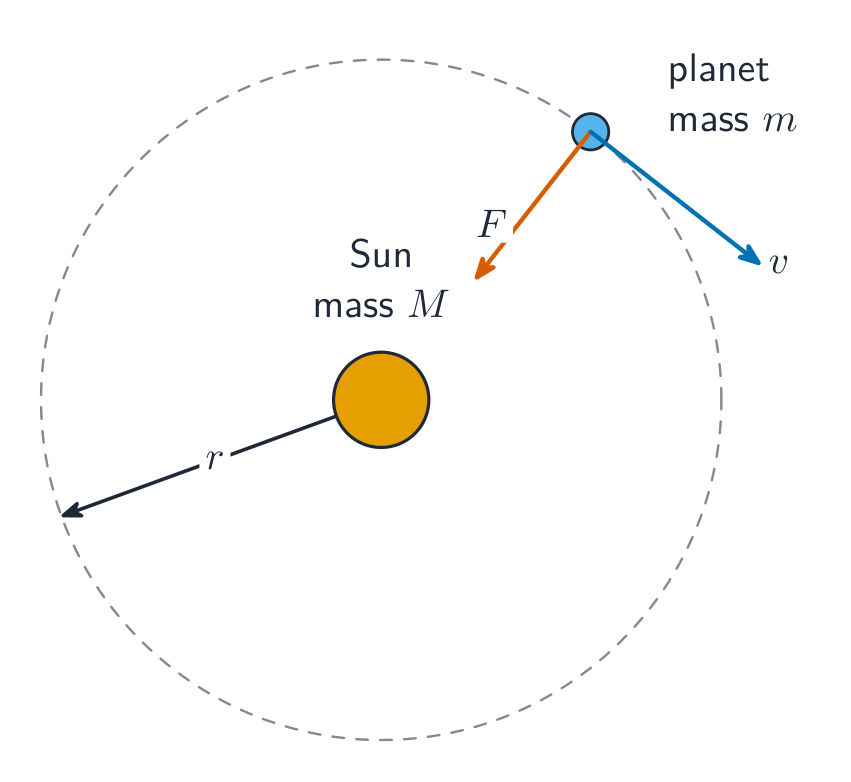
Gravity supplies the centripetal force 向心力 for a satellite 卫星 in a circular orbit:

$$\frac{GMm}{r^2}=\frac{mv^2}{r}\quad\Rightarrow\quad v=\sqrt{\frac{GM}{r}}$$

– larger orbits are slower. With gravitational potential energy 引力势能 $U_g=-\dfrac{GMm}{r}$, a circular orbit obeys $K=-\tfrac12U$, so the total mechanical energy 总机械能 is

$$E=K+U=\frac{U}{2}=-\frac{GMm}{2r},$$

negative because the satellite is bound. To escape from radius $r$, total energy must reach zero, giving the escape velocity 逃逸速度

$$v_{\text{esc}}=\sqrt{\frac{2GM}{r}}.$$

In an elliptical orbit 椭圆轨道, $E$ and $L$ are fixed: gravity points at the focus, so it exerts no torque about it. Conserved $L$ means the satellite sweeps equal areas in equal times – Kepler's second law 开普勒第二定律 – and therefore moves fastest at closest approach, slowest at the far point. Energy conservation connects speeds at the two ends.

Worked example. For a satellite at $r=7.0\times10^{6}\ \text{m}$ around Earth ($GM=4.0\times10^{14}\ \text{m}^3/\text{s}^2$): orbital speed $v=\sqrt{GM/r}=7.6\times10^{3}\ \text{m/s}$, while escaping from that radius needs $v_{\text{esc}}=\sqrt{2GM/r}=1.1\times10^{4}\ \text{m/s}$ – exactly $\sqrt2$ times the circular speed.

Exam skill. Orbit FRQs are energy-and-angular-momentum problems in disguise: write $E=\tfrac12mv^2-\dfrac{GMm}{r}$ and $L=mvr\sin\theta$ at the two points of interest and solve the pair – never assume the orbit formulae for circles apply to an ellipse.

Bahasa Indonesia
Gerak orbital (Hukum Kepler ke-2)

Gravitasi menyediakan gaya sentripetal untuk satelit dalam orbit lingkaran:

$$\frac{GMm}{r^2}=\frac{mv^2}{r}\quad\Rightarrow\quad v=\sqrt{\frac{GM}{r}}$$

– orbit yang lebih besar lebih lambat. Dengan energi potensial gravitasi $U_g=-\dfrac{GMm}{r}$, orbit lingkaran mematuhi $K=-\tfrac12U$, sehingga energi mekanik total adalah

$$E=K+U=\frac{U}{2}=-\frac{GMm}{2r},$$

negatif karena satelit terikat. Untuk lepas dari jari-jari $r$, energi total harus mencapai nol, memberikan kecepatan lepas

$$v_{\text{esc}}=\sqrt{\frac{2GM}{r}}.$$
Gravitasi menyediakan gaya sentripetal yang menjaga satelit tetap dalam orbit

Dalam orbit elips, $E$ dan $L$ tetap: gravitasi mengarah ke fokus, sehingga tidak menghasilkan torsi terhadapnya. Momentum sudut yang dijaga $L$ berarti satelit menyapu area yang sama dalam waktu yang sama – Hukum Kepler kedua – dan karenanya bergerak tercepat saat pendekatan terdekat, terlama di titik terjauh. Konservasi energi menghubungkan kecepatan di kedua ujung.

Contoh terpecahkan. Untuk satelit pada $r=7.0\times10^{6}\ \text{m}$ mengelilingi Bumi ($GM=4.0\times10^{14}\ \text{m}^3/\text{s}^2$): kecepatan orbit $v=\sqrt{GM/r}=7.6\times10^{3}\ \text{m/s}$, sementara lepas dari jari-jari tersebut membutuhkan $v_{\text{esc}}=\sqrt{2GM/r}=1.1\times10^{4}\ \text{m/s}$ – tepat $\sqrt2$ kali kecepatan lingkaran.

Keterampilan ujian. Soal FRQ orbit adalah masalah energi dan momentum sudut yang tersembunyi: tulis $E=\tfrac12mv^2-\dfrac{GMm}{r}$ dan $L=mvr\sin\theta$ pada dua titik yang relevan, lalu selesaikan sistem persamaan tersebut – jangan pernah mengasumsikan rumus orbit untuk lingkaran berlaku pada elips.

Explore · ⁨Jelajahi⁩

Compare orbits at different radii · ⁨Bandingkan orbit pada jari-jari berbeda⁩

An orbiting satellite is in free fall, gravity supplying the centripetal force. A larger orbit means a slower speed and longer period (Kepler's third law). · ⁨Satelit yang mengorbit berada dalam jatuh bebas, gravitasi menyediakan gaya sentripetal. Orbit yang lebih besar berarti kecepatan lebih lambat dan periode lebih panjang (hukum Kepler ketiga).⁩

6.6

Exam tips · ⁨Tips ujian⁩

English
  • Compute the moment of inertia $I=\int r^2\,dm$ and shift axes with the parallel-axis theorem $I=I_{cm}+Md^2$.
  • Rotational kinetic energy is $\tfrac12 I\omega^2$; a rolling body has both translational and rotational KE.
  • Conserve angular momentum $L=I\omega$ when net external torque is zero (a spinning skater pulling in).
  • Use energy conservation for rolling-without-slipping problems ($v=r\omega$ ties the two motions).
  • Know standard $I$ values (hoop, disk, rod, sphere) and where the axis is.
Bahasa Indonesia
  • Hitung momen inersia $I=\int r^2\,dm$ dan geser sumbu dengan menggunakan teorema sumbu sejajar $I=I_{cm}+Md^2$.
  • Energi kinetik rotasi adalah $\tfrac12 I\omega^2$; benda bergulir memiliki energi kinetik translasi maupun rotasi.
  • Konservasi momentum sudut $L=I\omega$ berlaku ketika torsi eksternal bersih bernilai nol (seperti penari es yang menarik lengannya ke dalam).
  • Gunakan kekekalan energi untuk masalah menggelinding tanpa selip ($v=r\omega$ menghubungkan kedua gerakan ini).
  • Hafalkan nilai standar $I$ (cincin, cakram, batang, bola) beserta posisi sumbunya.

Interactive lessons on this topic · ⁨Pelajaran interaktif untuk topik ini⁩

Work through it step by step, with instant-check exercises. · ⁨Kerjakan langkah demi langkah, dengan latihan pengecekan instan.⁩

Past Papers · ⁨Soal-Soil Masa Lalu⁩

More topics in AP Physics C: Mechanics · ⁨AP Fisika C: Mekanika⁩ · ⁨Topik lain dalam AP Physics C: Mechanics · ⁨AP Fisika C: Mekanika⁩⁩

Log in or create account · ⁨Masuk atau buat akun⁩

IGCSE, A-Level & AP