Skip to content · ⁨Lompat ke konten⁩

Electric Charges, Fields, and Gauss's Law · ⁨Muatan Listrik, Medan, dan Hukum Gauss⁩

AP Physics C: Electricity and Magnetism · ⁨AP Fisika C: Listrik dan Magnetisme⁩ · Topic 8 · ⁨Topik 8⁩

Video lesson for this topic · ⁨Pelajaran video untuk topik ini⁩ Open the video page · ⁨Buka halaman video⁩
9:52

Muatan Listrik, Medan, dan Hukum Gauss

Petir mengenai sebuah mobil. Di dalam, orang-orang tidak merasakan apa-apa. Mengapa? Cangkang logam di sekitar mereka adalah konduktor. Muatan berlari di permukaan luarnya…

English narration · English + 中文 subtitles burned in · ⁨Narasi bahasa Inggris · Subtitle bahasa Inggris + 中文 disematkan langsung⁩

8.1

Electric Charge and Electric Force · ⁨Muatan Listrik dan Gaya Listrik⁩

Syllabus · ⁨Silabus⁩
English

Learning Objective 8.1.A: Describe the electric force that results from the interactions between charged objects or systems.

  • 8.1.A.1 Charge is a fundamental property of all matter.
    • 8.1.A.1.i Charge is a scalar quantity and is described as positive or negative.
    • 8.1.A.1.ii The magnitude of the charge of a single electron or proton, the elementary charge $e$, can be considered to be the smallest indivisible amount of charge.
    • 8.1.A.1.iii The charge of an electron is $-e$ and the charge of a proton is $+e$, and a neutron has no electric charge.
    • 8.1.A.1.iv A point charge is a model in which the physical size of a charged object or system is negligible in the context of the situation being analyzed.
  • 8.1.A.2 Coulomb's law describes the electrostatic force between two charged objects as directly proportional to the magnitude of each of the charges and inversely proportional to the square of the distance between the objects.
    • Relevant equation: $\left| \vec{F}_E \right| = \dfrac{1}{4\pi\varepsilon_0} \dfrac{|q_1 q_2|}{r^2} = k \dfrac{|q_1 q_2|}{r^2}$
  • 8.1.A.3 The direction of the electrostatic force depends on the signs of the charges of the interacting objects and is along the line of separation between the objects.
    • 8.1.A.3.i Two objects with charges of the same sign exert repulsive forces on each other.
    • 8.1.A.3.ii Two objects with charges of opposite signs exert attractive forces on each other.
  • 8.1.A.4 Electric forces are responsible for some of the macroscopic properties of objects in everyday experiences. However, the large number of particle interactions that occur make it more convenient to treat everyday forces in terms of nonfundamental forces called contact forces, such as normal force, friction, and tension.

Learning Objective 8.1.B: Describe the electric and gravitational forces that result from interactions between charged objects with mass.

  • 8.1.B.1 Electrostatic forces can be attractive or repulsive, while gravitational forces are always attractive.
  • 8.1.B.2 For any two objects that have mass and electric charge, the magnitude of the gravitational force is usually much smaller than the magnitude of the electrostatic force.
  • 8.1.B.3 Gravitational forces dominate at larger scales even though they are weaker than electrostatic forces, because systems at large scales tend to be electrically neutral.

Learning Objective 8.1.C: Describe the electric permittivity of a material or medium.

  • 8.1.C.1 Electric permittivity is a measurement of the degree to which a material or medium is polarized in the presence of an electric field.
  • 8.1.C.2 Electric polarization can be modeled as the induced rearrangement of electrons by an external electric field, resulting in a separation of positive and negative charges within a material or medium.
  • 8.1.C.3 Free space has a constant value of electric permittivity, $\varepsilon_0$, that appears in physical relationships.
  • 8.1.C.4 The permittivity of matter has a value different from that of free space that arises from the matter's composition and arrangement.
    • 8.1.C.4.i In a given material, electric permittivity is determined by the ease with which electrons can change configurations within the material.
    • 8.1.C.4.ii Conductors are made from electrically conducting materials in which charge carriers move easily; insulators are made from electrically nonconducting materials in which charge carriers cannot move easily.

Boundary statement: AP Physics C: Electricity & Magnetism only expects students to make calculations of the electric force between four or fewer interacting charged objects or systems. The analysis of the resulting electric force from more charges is allowed in situations of high symmetry. Note that students are expected to calculate the electric fields of charge distributions, as described in Topics 8.4 and 8.6.

Bahasa Indonesia

Tujuan Pembelajaran 8.1.A: Jelaskan gaya listrik yang dihasilkan dari interaksi antara benda atau sistem yang bermuatan.

  • 8.1.A.1 Muatan adalah sifat fundamental dari semua materi.
    • 8.1.A.1.i Muatan adalah besaran skalar dan dijelaskan sebagai positif atau negatif.
    • 8.1.A.1.ii Besar muatan elektron tunggal atau proton, yaitu muatan elementer $e$, dapat dianggap sebagai jumlah muatan terkecil yang tak terbagi.
    • 8.1.A.1.iii Muatan elektron adalah $-e$ dan muatan proton adalah $+e$, sedangkan neutron tidak memiliki muatan listrik.
    • 8.1.A.1.iv Muatan titik adalah model di mana ukuran fisik benda atau sistem bermuatan diabaikan dalam konteks situasi yang sedang dianalisis.
  • 8.1.A.2 Hukum Coulomb mendeskripsikan gaya elektrostatik antara dua benda bermuatan yang sebanding langsung dengan besar masing-masing muatan dan berbanding terbalik dengan kuadrat jarak antar benda.
    • Persamaan relevan: $\left| \vec{F}_E \right| = \dfrac{1}{4\pi\varepsilon_0} \dfrac{|q_1 q_2|}{r^2} = k \dfrac{|q_1 q_2|}{r^2}$
  • 8.1.A.3 Arah gaya elektrostatik bergantung pada tanda muatan dari benda-benda yang berinteraksi dan berada sepanjang garis pemisah antara benda-benda tersebut.
    • 8.1.A.3.i Dua benda dengan muatan yang sama tanda saling memberikan gaya tolak-menolak.
    • 8.1.A.3.ii Dua benda dengan muatan yang berbeda tanda saling memberikan gaya tarik-menarik.
  • 8.1.A.4 Gaya listrik bertanggung jawab atas beberapa sifat makroskopis objek dalam pengalaman sehari-hari. Namun, karena banyaknya interaksi partikel yang terjadi, lebih nyaman untuk memperlakukan gaya-gaya sehari-hari dalam istilah gaya non-fundamental yang disebut gaya kontak, seperti gaya normal, gesekan, dan tegangan.

Tujuan Pembelajaran 8.1.B: Jelaskan gaya listrik dan gravitasi yang dihasilkan dari interaksi antara benda bermuatan dengan massa.

  • 8.1.B.1 Gaya elektrostatik bisa bersifat tarik-menarik atau tolak-menolak, sementara gaya gravitasi selalu tarik-menarik.
  • 8.1.B.2 Untuk setiap dua benda yang memiliki massa dan muatan listrik, besar gaya gravitasi biasanya jauh lebih kecil daripada besar gaya elektrostatik.
  • 8.1.B.3 Gaya gravitasi mendominasi pada skala yang lebih besar meskipun lebih lemah daripada gaya elektrostatik, karena sistem pada skala besar cenderung netral secara listrik.

Tujuan Pembelajaran 8.1.C: Jelaskan permitivitas listrik suatu material atau medium.

  • 8.1.C.1 Permitivitas listrik adalah pengukuran seberapa jauh suatu material atau medium terpolarisasi ketika berada dalam medan listrik.
  • 8.1.C.2 Polaritas listrik dapat dimodelkan sebagai penataan ulang elektron yang diinduksi oleh medan listrik eksternal, yang menghasilkan pemisahan muatan positif dan negatif di dalam material atau medium.
  • 8.1.C.3 Ruang hampa memiliki nilai konstan permitivitas listrik, $\varepsilon_0$, yang muncul dalam hubungan fisika.
  • 8.1.C.4 Permitivitas materi memiliki nilai berbeda dari ruang hampa yang timbul dari komposisi dan susunan materinya.
    • 8.1.C.4.i Dalam suatu material tertentu, permitivitas listrik ditentukan oleh kemudahan elektron mengubah konfigurasi di dalam material tersebut.
    • 8.1.C.4.ii Konduktor dibuat dari bahan yang menghantarkan listrik di mana pembawa muatan bergerak dengan mudah; isolator dibuat dari bahan yang tidak menghantarkan listrik di mana pembawa muatan tidak dapat bergerak dengan mudah.

Pernyataan batas: AP Physics C: Listrik & Magnetisme hanya mengharapkan siswa melakukan perhitungan gaya listrik antara empat atau kurang objek/sistem bermuatan yang berinteraksi. Analisis gaya listrik yang dihasilkan dari lebih banyak muatan diperbolehkan dalam situasi simetri tinggi. Perhatikan bahwa siswa diharapkan menghitung medan listrik dari distribusi muatan, sebagaimana dijelaskan dalam Topik 8.4 dan 8.6.
Source: College Board AP Course and Exam Description · ⁨Sumber: Deskripsi Kursus dan Ujian College Board AP⁩

English

Electric charge 电荷 comes in positive and negative; like charges repel, opposites attract. Charge is quantized 量子化 – every charge is a whole-number multiple of the elementary charge 基本电荷 $e=1.6\times10^{-19}\ \text{C}$ – and obeys conservation of charge 电荷守恒: charge is never created or destroyed, only moved. The force between two point charges 点电荷 is Coulomb's law 库仑定律:

$$\vec{F}=\frac{1}{4\pi\varepsilon_0}\frac{q_1 q_2}{r^2}\,\hat{r},$$

an inverse-square 平方反比 force along the line joining them, with $\dfrac{1}{4\pi\varepsilon_0}=k=9.0\times10^{9}\ \text{N}\cdot\text{m}^2/\text{C}^2$. For several charges (AP uses four or fewer, unless symmetry helps), add the force vectors on the charge you care about – superposition 叠加.

Charge is a fundamental property 基本属性 of matter, and a point charge is a model that ignores the size of a charged object. The constant $\varepsilon_0$ is the permittivity of free space 真空介电常数 – a material property of the vacuum. The permittivity of matter differs from $\varepsilon_0$, set by how easily the material polarizes, which is why a dielectric between charges weakens the force. Note too that although the electric force is far stronger than gravity, gravity dominates at astronomical scales because large bodies are nearly neutral.

Worked example. Two $+2.0\ \mu\text{C}$ charges sit $0.30\ \text{m}$ apart: $F=\dfrac{kq_1q_2}{r^2}=\dfrac{9.0\times10^{9}(2.0\times10^{-6})^2}{(0.30)^2}=0.40\ \text{N}$, repulsive.

Worked example (vectors). Charges $+3.0\ \mu\text{C}$ and $-3.0\ \mu\text{C}$ sit at two corners of a right angle, each $0.30\ \text{m}$ from a $+1.0\ \mu\text{C}$ charge at the corner. Each exerts $F=\dfrac{(9.0\times10^{9})(3.0\times10^{-6})(1.0\times10^{-6})}{0.09}=0.30\ \text{N}$ – one a push, one a pull, at right angles to each other. The net force is $F_{\text{net}}=\sqrt{0.30^2+0.30^2}=0.42\ \text{N}$, pointing between them. Never add magnitudes blindly: components first.

Bahasa Indonesia

Muatan listrik ada dalam bentuk positif dan negatif; muatan sejenis tolak-menolak, berlawanan tarik-menarik. Muatan bersifat terkuantisasi – setiap muatan adalah kelipatan bilangan bulat dari muatan elementer $e=1.6\times10^{-19}\ \text{C}$ – dan mematuhi kekekalan muatan: muatan tidak pernah tercipta atau musnah, hanya berpindah. Gaya antara dua muatan titik dijelaskan oleh hukum Coulomb:

$$\vec{F}=\frac{1}{4\pi\varepsilon_0}\frac{q_1 q_2}{r^2}\,\hat{r},$$

sebuah gaya kuadrat terbalik sepanjang garis yang menghubungkannya, dengan $\dfrac{1}{4\pi\varepsilon_0}=k=9.0\times10^{9}\ \text{N}\cdot\text{m}^2/\text{C}^2$. Untuk beberapa muatan (AP menggunakan empat atau kurang, kecuali simetri membantu), tambahkan vektor gaya pada muatan yang Anda perhatikan – superposisi.

Muatan merupakan sifat fundamental materi, dan muatan titik adalah model yang mengabaikan ukuran benda bermuatan. Konstanta $\varepsilon_0$ adalah permitivitas ruang hampa – sifat material dari vakum. Permitivitas materi berbeda dari $\varepsilon_0$, ditentukan oleh seberapa mudah bahan tersebut terpolarisasi, sehingga dielektrik di antara muatan melemahkan gaya. Perhatikan pula bahwa meskipun gaya listrik jauh lebih kuat daripada gravitasi, gravitasi mendominasi pada skala astronomis karena benda-benda besar hampir netral.

Contoh kerja. Dua $+2.0\ \mu\text{C}$ muatan terletak $0.30\ \text{m}$ terpisah: $F=\dfrac{kq_1q_2}{r^2}=\dfrac{9.0\times10^{9}(2.0\times10^{-6})^2}{(0.30)^2}=0.40\ \text{N}$, tolak-menolak.

Contoh kerja (vektor). Muatan $+3.0\ \mu\text{C}$ dan $-3.0\ \mu\text{C}$ terletak di dua sudut siku-siku, masing-masing $0.30\ \text{m}$ dari sebuah muatan $+1.0\ \mu\text{C}$ di sudut tersebut. Masing-masing memberikan gaya $F=\dfrac{(9.0\times10^{9})(3.0\times10^{-6})(1.0\times10^{-6})}{0.09}=0.30\ \text{N}$ – satu mendorong, satu menarik, tegak lurus satu sama lain. Resultan gayanya adalah $F_{\text{net}}=\sqrt{0.30^2+0.30^2}=0.42\ \text{N}$, mengarah di antara keduanya. Jangan pernah menjumlahkan besaran secara buta: hitung komponen dulu.

Explore · ⁨Jelajahi⁩

Explore the field of a source charge · ⁨Jelajahi medan dari muatan sumber⁩

Change the charge's sign and size. Lines point away from positive and toward negative, and their $1/r^2$ crowding near the charge mirrors why Coulomb's force $F = k\,|q_1 q_2|/r^2$ weakens with distance. · ⁨Ubah tanda dan besar muatan. Garis menunjukkan menjauhi positif dan menuju negatif, serta $1/r^2$ kerapatan dekat muatan mencerminkan mengapa gaya Coulomb $F = k\,|q_1 q_2|/r^2$ melemah seiring jarak.⁩

8.2

Electric Charge and the Process of Charging · ⁨Muatan Listrik dan Proses Pemuatan⁩

Syllabus · ⁨Silabus⁩
Learning ObjectiveEssential Knowledge

8.2.A
Describe the behavior of a system using conservation of charge.

  • 8.2.A.1 The net charge or charge distribution of a system can change in response to the presence of, or changes in, the net charge or charge distribution of other systems.
    • 8.2.A.1.i The net charge of a system can change due to friction or contact between systems.
    • 8.2.A.1.ii Induced charge separation occurs when the electrostatic force between two systems alters the distribution of charges within the systems, resulting in the polarization of one or both systems.
    • 8.2.A.1.iii Induced charge separation can occur in neutral systems.
  • 8.2.A.2 Any change to a system's net charge is due to a transfer of charge between the system and its surroundings.
    • 8.2.A.2.i The charging of a system typically involves the transfer of electrons to and from the system.
    • 8.2.A.2.ii The net charge of a system will be constant unless there is a transfer of charge to or from the system.
  • 8.2.A.3 Grounding involves electrically connecting a charged object to a much larger and approximately neutral system (e.g., Earth).

Source: College Board AP Course and Exam Description · ⁨Sumber: Deskripsi Kursus dan Ujian College Board AP⁩

English

A conductor 导体 lets charge move freely; an insulator 绝缘体 holds it in place. Objects gain net charge three ways:

  • Charging by friction 摩擦起电: rubbing transfers electrons from one surface to the other.
  • Charging by conduction 传导起电: touching a charged object shares charge of the same sign.
  • Charging by induction 感应起电: a nearby charge pushes the conductor's charge apart; ground 接地 the far side, remove the ground wire first, and the conductor is left with the opposite sign – all without contact.

An insulator cannot pass charge, but it can develop polarization 极化: its molecules stretch or turn so one face is slightly positive and the other slightly negative. That is why a charged comb picks up neutral paper scraps. An electroscope 验电器 shows net charge by its leaves repelling; on any isolated conductor the excess charge sits entirely on the outer surface.

Bahasa Indonesia

Konduktor memungkinkan muatan bergerak bebas; isolator menahan muatan di tempatnya. Benda memperoleh muatan bersih melalui tiga cara:

  • Pemuatan dengan gesekan: menggosok mentransfer elektron dari satu permukaan ke permukaan lainnya.
  • Pemuatan dengan konduksi: menyentuh benda bermuatan membagikan muatan dengan tanda yang sama.
  • Pemuatan dengan induksi: muatan terdekat mendorong muatan konduktor menjauh; bumikan sisi yang jauh, lepaskan kabel bumi pertama, dan konduktor akan tersisa dengan tanda berlawanan – semuanya tanpa kontak langsung.

Isolator tidak dapat mengalirkan muatan, tetapi dapat mengalami polarisasi: molekul-molekulnya meregang atau berputar sehingga satu sisi sedikit positif dan sisi lainnya sedikit negatif. Itulah mengapa sisir bermuatan dapat mengangkat serpihan kertas netral. Elektroskop menunjukkan muatan bersih melalui daun-daunnya yang tolak-menolak; pada konduktor terisolasi mana pun, kelebihan muatan berada sepenuhnya di permukaan luar.

Explore · ⁨Jelajahi⁩

Explore charging by rubbing · ⁨Jelajahi pengisian dengan menggosok⁩

Rubbing transfers electrons onto the object, leaving it negative. A charged object then attracts a neutral wall or hair (by polarization) but repels another like-charged object — the same electron transfer behind friction, conduction, and induction. · ⁨Menggosok mentransfer elektron ke objek, membuatnya bermuatan negatif. Objek bermuatan kemudian menarik dinding atau rambut netral (melalui polarisasi) tetapi menolak objek bermuatan sejenis lainnya — transfer elektron yang sama di balik gesekan, konduksi, dan induksi.⁩

8.3

Electric Fields · ⁨Medan Listrik⁩

Syllabus · ⁨Silabus⁩
English

Learning Objective 8.3.A: Describe the electric field produced by a charged object or configuration of point charges.

  • 8.3.A.1 Electric fields may originate from charged objects.
  • 8.3.A.2 The electric field at a given point is the ratio of the electric force exerted on a test charge at the point to the charge of the test charge.
    • Relevant equation: $\vec{E} = \dfrac{\vec{F}_E}{q}$
    • 8.3.A.2.i A test charge is a point charge of small enough magnitude such that its presence does not significantly affect an electric field in its vicinity.
    • 8.3.A.2.ii An electric field points away from isolated positive charges and toward isolated negative charges.
    • 8.3.A.2.iii The electric force exerted on a positive test charge by an electric field is in the same direction as the electric field.
  • 8.3.A.3 The electric field is a vector quantity and can be represented in space using vector field maps.
    • 8.3.A.3.i The net electric field at a given location is the vector sum of individual electric fields created by nearby charged objects.
    • 8.3.A.3.ii Electric field maps use vectors to depict the magnitude and direction of the electric field at many locations within a given region.
    • 8.3.A.3.iii Electric field line diagrams are simplified models of electric field maps and can be used to determine the relative magnitude and direction of the electric field at any position in the diagram.

Learning Objective 8.3.B: Describe the electric field generated by charged conductors or insulators.

  • 8.3.B.1 While in electrostatic equilibrium, the excess charge of a conductor is distributed on the surface of the conductor, and the electric field within the conductor is zero.
    • 8.3.B.1.i At the surface of a charged conductor, the electric field is perpendicular to the surface.
    • 8.3.B.1.ii The electric field outside an isolated sphere with spherically symmetric charge distribution is the same as the electric field due to a point charge with the same net charge as the sphere located at the center of the sphere.
  • 8.3.B.2 While in electrostatic equilibrium, the excess charge of an insulator is distributed throughout the interior of the insulator as well as at the surface, and the electric field within the insulator may have a nonzero value.
Bahasa Indonesia

Tujuan Pembelajaran 8.3.A: Jelaskan medan listrik yang dihasilkan oleh objek bermuatan atau konfigurasi muatan titik.

  • 8.3.A.1 Medan listrik dapat berasal dari objek-objek bermuatan.
  • 8.3.A.2 Medan listrik pada suatu titik adalah rasio gaya listrik yang diberikan pada muatan uji di titik tersebut terhadap muatan dari muatan uji itu sendiri.
    • Persamaan relevan: $\vec{E} = \dfrac{\vec{F}_E}{q}$
    • 8.3.A.2.i Muatan uji adalah muatan titik dengan besaran yang cukup kecil sehingga keberadaannya tidak secara signifikan mempengaruhi medan listrik di sekitarnya.
    • 8.3.A.2.ii Medan listrik mengarah menjauhi muatan positif terisolasi dan menuju muatan negatif terisolasi.
    • 8.3.A.2.iii Gaya listrik yang diberikan pada muatan uji positif oleh sebuah medan listrik berada dalam arah yang sama dengan medan listrik tersebut.
  • 8.3.A.3 Medan listrik adalah besaran vektor dan dapat direpresentasikan dalam ruang menggunakan peta medan vektor.
    • 8.3.A.3.i Medan listrik total pada suatu lokasi tertentu adalah hasil penjumlahan vektor dari medan-medan listrik individual yang diciptakan oleh objek-objek bermuatan di dekatnya.
    • 8.3.A.3.ii Peta medan listrik menggunakan vektor untuk menggambarkan besaran dan arah medan listrik di banyak lokasi dalam suatu wilayah tertentu.
    • 8.3.A.3.iii Diagram garis medan listrik adalah model sederhana dari peta medan listrik dan dapat digunakan untuk menentukan besaran relatif dan arah medan listrik pada posisi apa pun dalam diagram.

Tujuan Pembelajaran 8.3.B: Jelaskan medan listrik yang dihasilkan oleh konduktor atau isolator bermuatan.

  • 8.3.B.1 Saat berada dalam kesetimbangan elektrostatik, kelebihan muatan pada konduktor terdistribusi pada permukaan konduktor, dan medan listrik di dalam konduktor adalah nol.
    • 8.3.B.1.i Di permukaan konduktor bermuatan, medan listrik tegak lurus terhadap permukaan.
    • 8.3.B.1.ii Medan listrik di luar bola terisolasi dengan distribusi muatan simetri bola sama dengan medan listrik akibat muatan titik dengan muatan bersih yang sama dengan bola tersebut yang terletak di pusat bola.
  • 8.3.B.2 Saat berada dalam kesetimbangan elektrostatik, kelebihan muatan pada isolator terdistribusi di seluruh bagian dalam isolator serta di permukaannya, dan medan listrik di dalam isolator mungkin memiliki nilai tak nol.

Source: College Board AP Course and Exam Description · ⁨Sumber: Deskripsi Kursus dan Ujian College Board AP⁩

English
The electric field of a dipole

The electric field 电场 at a point is the force per unit charge that a small positive test charge 检验电荷 would feel there:

$$\vec{E}=\frac{\vec{F}}{q},\qquad \vec{E}=\frac{1}{4\pi\varepsilon_0}\frac{q}{r^2}\,\hat{r}\ \text{(point charge)}.$$

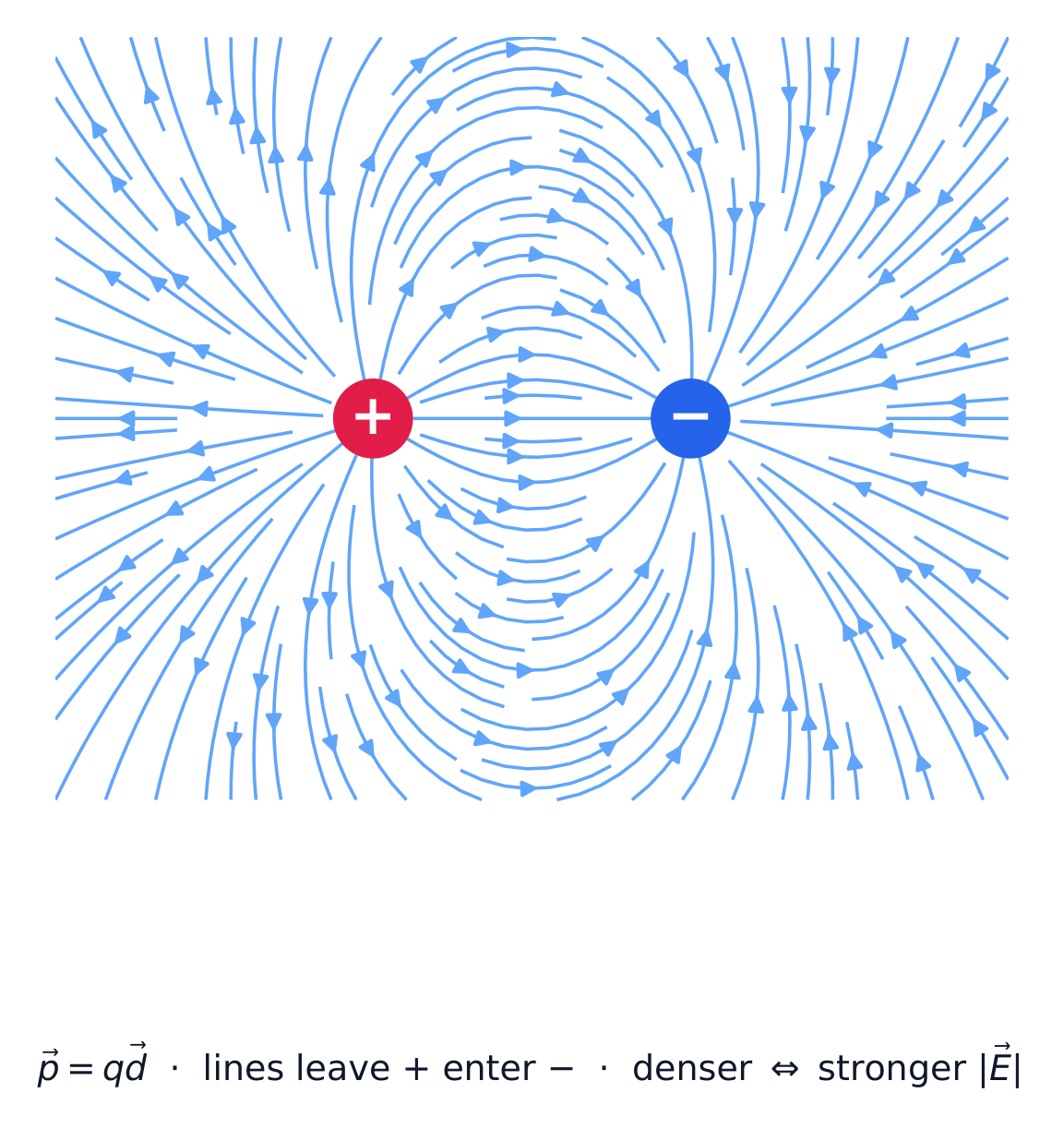
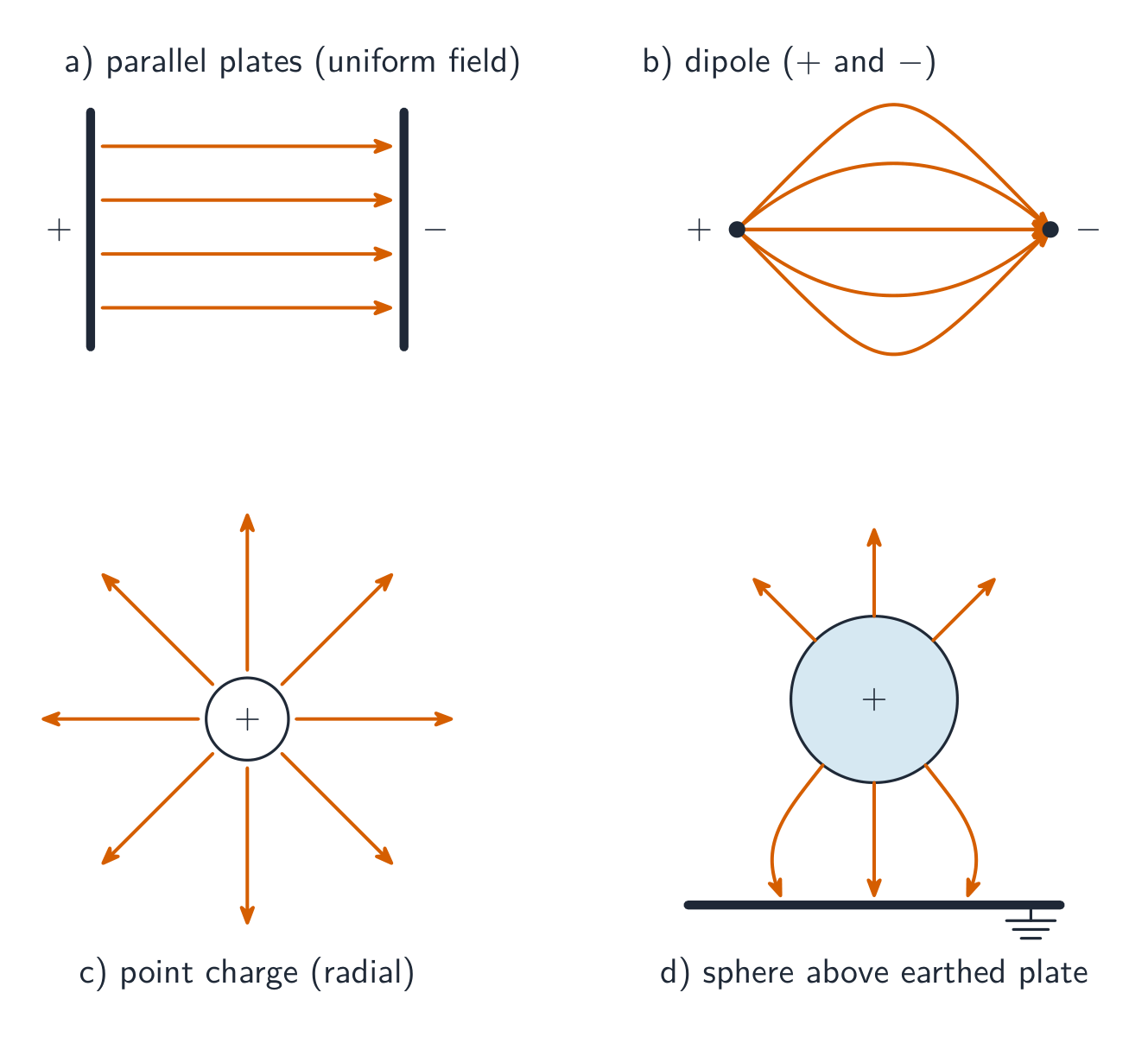
A charge placed in a field feels $\vec{F}=q\vec{E}$ – positive charges along the field, negative charges against it. Fields from several sources add as vectors (superposition again). Field lines 电场线 make the field visible: they point away from positive charge and toward negative, their density shows the strength, and they never cross.

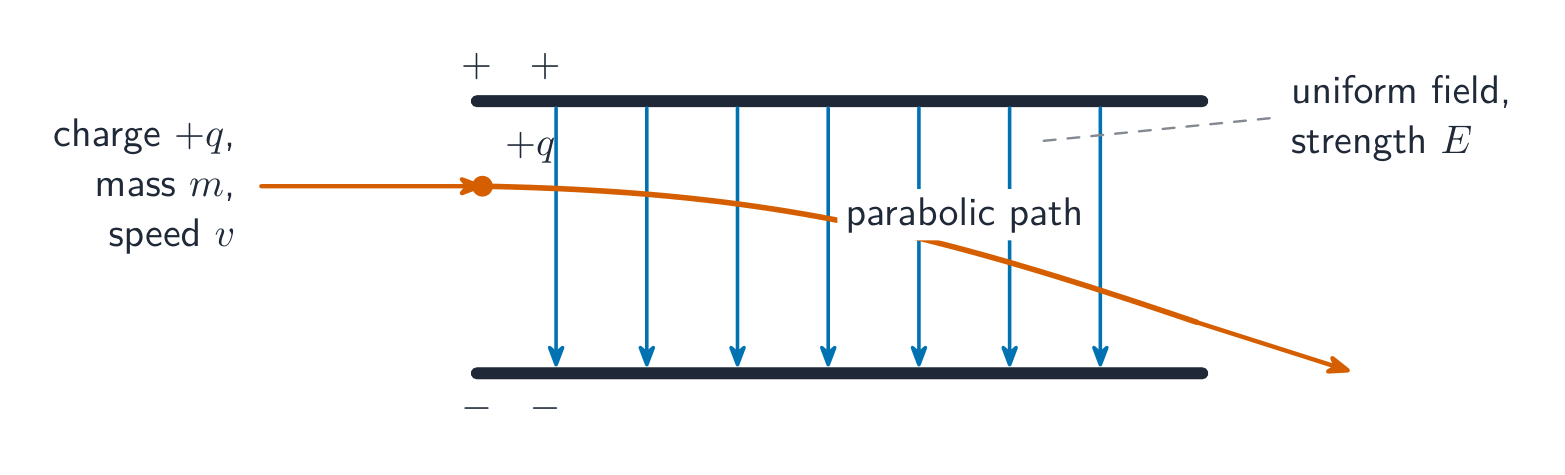
In a uniform 均匀 field a charge feels a constant force, so it accelerates uniformly – launched sideways, it follows a parabola, just like a projectile in gravity.

Bahasa Indonesia
Medan listrik dari sebuah dipol
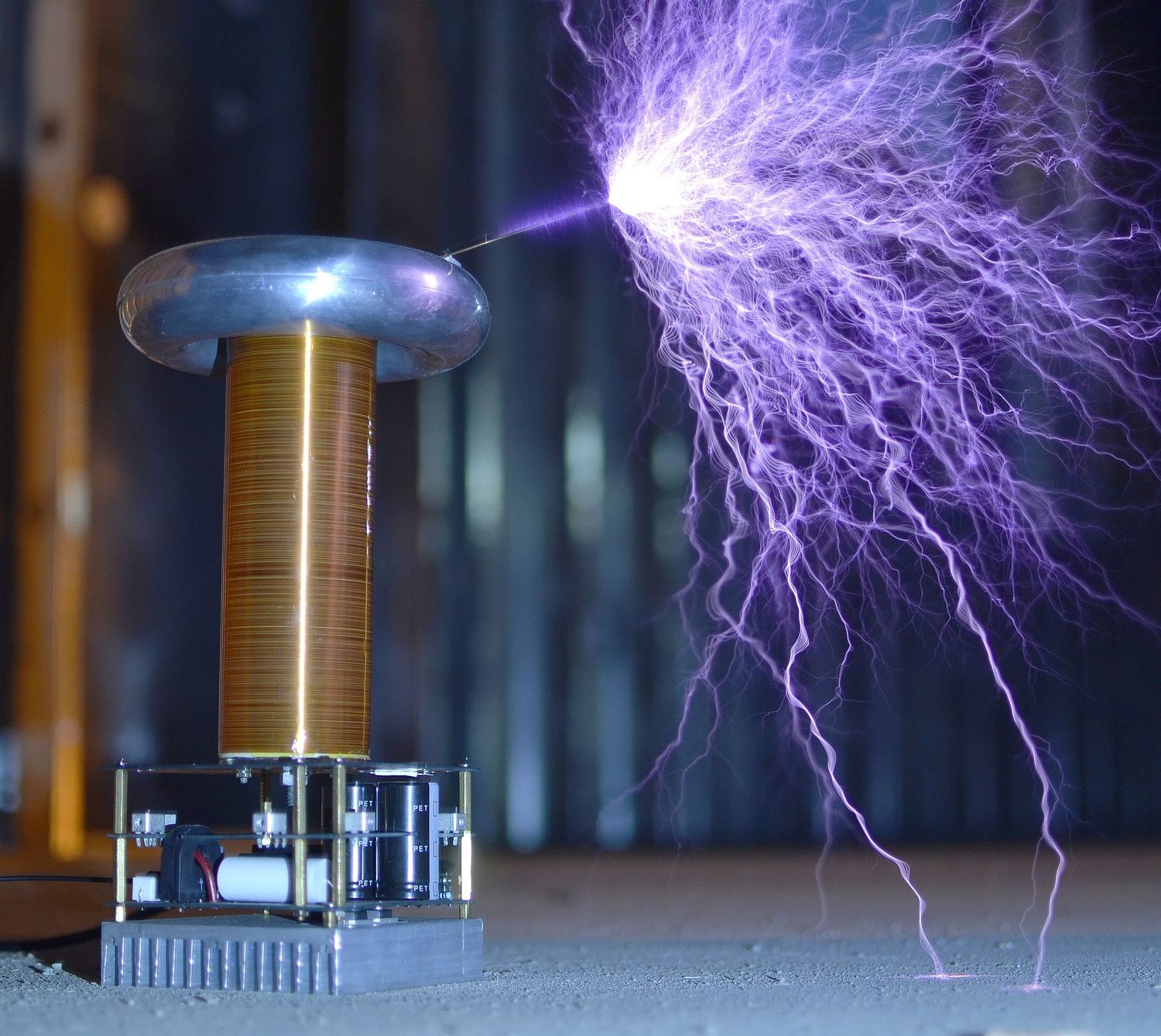
Kumpulan Tesla dengan cincin logam di atasnya, memancarkan percikan ungu panjang ke udara
Kumpulan Tesla memancarkan percikan: ia menaikkan tegangan sedemikian rupa sehingga medan listrik mengionisasi udara di sekitarnya, dan muatan melompat sebagai pelepasan terlihat

Medan listrik pada suatu titik adalah gaya per satuan muatan yang akan dirasakan oleh muatan uji positif kecil di sana:

$$\vec{E}=\frac{\vec{F}}{q},\qquad \vec{E}=\frac{1}{4\pi\varepsilon_0}\frac{q}{r^2}\,\hat{r}\ \text{(point charge)}.$$

Muatan yang ditempatkan dalam medan merasakan $\vec{F}=q\vec{E}$ – muatan positif searah medan, muatan negatif berlawanan arahnya. Medan dari beberapa sumber ditambahkan sebagai vektor (superposisi kembali). Garis-garis medan membuat medan terlihat: mereka mengarah menjauhi muatan positif dan menuju muatan negatif, kepadatannya menunjukkan kekuatan, dan mereka tidak pernah bersilangan.

Pola garis medan listrik untuk pelat sejajar, dipol, dan muatan titik
Garis-garis medan listrik dipol mengarah dari muatan positif ke muatan negatif

Dalam medan seragam, muatan merasakan gaya konstan, sehingga dipercepat secara seragam – diluncurkan menyamping, ia mengikuti lintasan parabola, sama seperti proyektil dalam gravitasi.

Muatan yang menyeberangi medan seragam mengikuti lintasan parabola
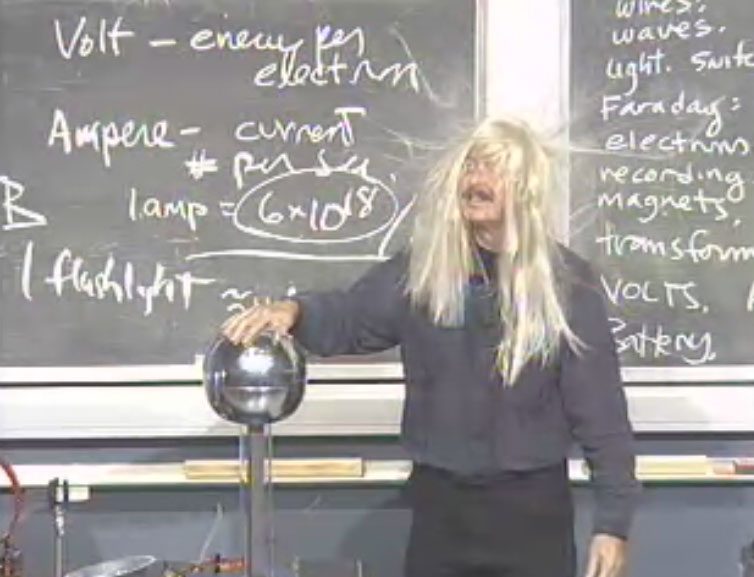
Seseorang menyentuh generator Van de Graaff dengan rambut berdiri tegak
Muatan menyebar di atas kubah dan ke rambut; muatan sejenis tolak-menolak, sehingga helai-helai saling mendorong
Explore · ⁨Jelajahi⁩

Explore field lines of a point charge · ⁨Jelajahi garis medan muatan titik⁩

Set the charge positive or negative. Field lines start on positive and end on negative charge, never cross, and crowd together where $\vec{E}$ is strongest — the line density is proportional to the field magnitude. · ⁨Atur muatan positif atau negatif. Garis medan dimulai pada positif dan berakhir pada negatif, tidak pernah bersilangan, dan mengkerat di tempat $\vec{E}$ terkuat — kepadatan garis sebanding dengan besaran medan.⁩

Vocabulary · ⁨Kosa kata⁩ Train · ⁨Latih⁩
English Bahasa Indonesia
Electric charge/ɪˈlektrɪk tʃɑːdʒ/ Muatan listrik
quantized/ˈkwɒntaɪzd/ terkuantisasi
elementary charge/ˌelɪˈmentəri tʃɑːdʒ/ muatan elementer
conservation of charge/ˌkɒnsəˈveɪʃn ɒv tʃɑːdʒ/ kekekalan muatan
point charges/pɔɪnt ˈtʃɑːdʒɪz/ Muatan titik
Coulomb's law/ˈkuːlɒmz lɔː/ Hukum Coulomb
inverse-square/ɪnˈvɜːs skweə/ kuadrat terbalik
superposition/ˌsuːpəpəˈzɪʃn/ superposisi
fundamental property/ˌfʌndəˈmentl ˈprɒpəti/ Sifat fundamental
permittivity of free space/ˌpɜːmɪˈtɪvəti ɒv friː speɪs/ permitivitas ruang hampa
conductor/kənˈdʌktə/ konduktor
insulator/ˈɪnsjuːleɪtə/ isolator
Charging by friction/ˈtʃɑːdʒɪŋ baɪ ˈfrɪkʃn/ Pengisian dengan gesekan
Charging by conduction/ˈtʃɑːdʒɪŋ baɪ kənˈdʌkʃn/ Pengisian dengan konduksi
Charging by induction/ˈtʃɑːdʒɪŋ baɪ ɪnˈdʌkʃn/ Pengisian dengan induksi
ground/ɡraʊnd/ landasan
polarization/ˌpəʊləraɪˈzeɪʃn/ Polarisasi
electroscope/ɪˌlektrəʊˈskəʊp/ Elektroskop
electric field/ɪˈlektrɪk fiːld/ medan listrik
test charge/test tʃɑːdʒ/ muatan uji
Field lines/fiːld laɪnz/ Garis medan
uniform/ˈjuːnɪfɔːm/ seragam
continuous charge distribution/kənˈtɪnjuːəs tʃɑːdʒ ˌdɪstrɪˈbjuːʃn/ Distribusi muatan kontinu
linear charge density/ˈlɪnɪə tʃɑːdʒ ˈdensɪti/ Kepadatan muatan linear
surface charge density/ˈsɜːfɪs tʃɑːdʒ ˈdensɪti/ densitas muatan permukaan
volume charge density/ˈvɒljuːm tʃɑːdʒ ˈdensɪti/ Kepadatan muatan volume
symmetry/ˈsɪmətri/ simetri
8.4

Electric Fields of Charge Distributions · ⁨Medan Listrik dari Distribusi Muatan⁩

Syllabus · ⁨Silabus⁩
English

Learning Objective 8.4.A: Describe the electric field resulting from a given charge distribution.

  • 8.4.A.1 Expressions for the electric field of specified charge distributions can be found using integration and the principle of superposition.
    • Relevant equation: $\vec{E} = \dfrac{1}{4\pi\varepsilon_0} \displaystyle\int \dfrac{dq}{r^2} \hat{r}$
  • 8.4.A.2 Symmetry considerations of certain charge distributions can simplify analysis of the electric field resulting from those charge distributions.

Boundary statement: AP Physics C: Electricity & Magnetism only expects students to use calculus to find the electric field resulting from the following charge distributions and locations: an infinitely long, uniformly charged wire or cylinder at a distance from its central axis, a thin ring of charge at a location along the axis of the ring, a semicircular arc or part of a semicircular arc at its center, and a finite wire or line charge at a point collinear with the line charge or at a location along its perpendicular bisector.

Bahasa Indonesia

Tujuan Pembelajaran 8.4.A: Jelaskan medan listrik yang timbul dari distribusi muatan tertentu.

  • 8.4.A.1 Ekspresi untuk medan listrik dari distribusi muatan tertentu dapat ditemukan menggunakan integrasi dan prinsip superposisi.
    • Persamaan relevan: $\vec{E} = \dfrac{1}{4\pi\varepsilon_0} \displaystyle\int \dfrac{dq}{r^2} \hat{r}$
  • 8.4.A.2 Pertimbangan simetri dari distribusi muatan tertentu dapat menyederhanakan analisis medan listrik yang timbul dari distribusi muatan tersebut.

Pernyataan Batas: AP Physics C: Listrik & Magnetisme hanya mengharapkan siswa menggunakan kalkulus untuk menemukan medan listrik yang timbul dari distribusi muatan dan lokasi berikut: kawat atau silinder bermuatan seragam yang sangat panjang pada jarak dari sumbu tengahnya, cincin tipis bermuatan pada lokasi sepanjang sumbu cincin, busur setengah lingkaran atau sebagian busur setengah lingkaran di pusatnya, dan kawat atau garis muatan terbatas pada titik yang segaris dengan garis muatan atau pada lokasi sepanjang garis bagi tegaknya.

Source: College Board AP Course and Exam Description · ⁨Sumber: Deskripsi Kursus dan Ujian College Board AP⁩

English

For a continuous charge distribution 连续电荷分布, cut the object into pieces $dq$ and integrate their point-charge fields:

$$\vec{E}=\frac{1}{4\pi\varepsilon_0}\int \frac{dq}{r^2}\,\hat{r}.$$

Write $dq$ using the right density: $\lambda\,dl$ with the linear charge density 线电荷密度 (a line or ring), $\sigma\,dA$ with the surface charge density 面电荷密度, or $\rho\,dV$ with the volume charge density 体电荷密度. Then use symmetry 对称性 to cancel components before integrating – that sentence is usually a scored step. AP's calculus cases: a finite line (collinear point or perpendicular bisector), an infinite wire or cylinder, a ring on its axis, and an arc at its centre.

Worked example (ring, on axis). A ring of radius $R$ carries charge $Q$. At a point $z$ along the axis, each element is a distance $\sqrt{R^2+z^2}$ away, and by symmetry the sideways components cancel, leaving only the axial part ($\cos\alpha=z/\sqrt{R^2+z^2}$):

$$E_z=\frac{1}{4\pi\varepsilon_0}\int\frac{dq}{R^2+z^2}\cdot\frac{z}{\sqrt{R^2+z^2}}=\frac{1}{4\pi\varepsilon_0}\frac{Qz}{(R^2+z^2)^{3/2}}.$$

Check the limits: $E=0$ at the centre ($z=0$), and far away ($z\gg R$) it becomes $kQ/z^2$ – a point charge, as it must.

Bahasa Indonesia

Untuk distribusi muatan kontinu, potong benda menjadi bagian-bagian $dq$ dan integralkan medan muatan titiknya:

$$\vec{E}=\frac{1}{4\pi\varepsilon_0}\int \frac{dq}{r^2}\,\hat{r}.$$

Tulis $dq$ menggunakan densitas yang tepat: $\lambda\,dl$ dengan densitas muatan linear (garis atau cincin), $\sigma\,dA$ dengan densitas muatan permukaan, atau $\rho\,dV$ dengan densitas muatan volume. Kemudian gunakan simetri untuk membatalkan komponen sebelum mengintegralkan – kalimat ini biasanya merupakan langkah bernilai skor. Kasus kalkulus AP: garis terbatas (titik segaris atau sumbu tegak lurus), kawat atau silinder tak hingga, cincin pada sumbunya, dan busur di pusatnya.

Contoh terpadu (cincin, pada sumbu). Sebuah cincin berjari-jari $R$ membawa muatan $Q$. Pada titik $z$ sepanjang sumbu, setiap elemen berada pada jarak $\sqrt{R^2+z^2}$, dan oleh karena simetri komponen menyampingnya saling meniadakan, hanya menyisakan komponen aksial ($\cos\alpha=z/\sqrt{R^2+z^2}$):

$$E_z=\frac{1}{4\pi\varepsilon_0}\int\frac{dq}{R^2+z^2}\cdot\frac{z}{\sqrt{R^2+z^2}}=\frac{1}{4\pi\varepsilon_0}\frac{Qz}{(R^2+z^2)^{3/2}}.$$

Periksa batasnya: $E=0$ di pusat ($z=0$), dan jauh di kejauhan ($z\gg R$) menjadi $kQ/z^2$ – sebuah muatan titik, sebagaimana mestinya.

8.5

Electric Flux · ⁨Fluks Listrik⁩

Syllabus · ⁨Silabus⁩
English

Learning Objective 8.5.A: Describe the electric flux through an arbitrary area or geometric shape.

  • 8.5.A.1 Flux describes the amount of a given quantity that passes through a given area.
  • 8.5.A.2 For an electric field $\vec{E}$ that is constant across an area $\vec{A}$, the electric flux through the area is defined as $\Phi_E = \vec{E} \bullet \vec{A}$.
    • 8.5.A.2.i The direction of the area vector is defined as perpendicular to the plane of the surface and outward from a closed surface.
    • 8.5.A.2.ii The sign of flux is given by the dot product of the electric field vector and the area vector.
  • 8.5.A.3 The total electric flux passing through a surface is defined by the surface integral of the electric field over the surface.
    • Relevant equation: $\Phi_E = \displaystyle\int \vec{E} \cdot d\vec{A}$
Bahasa Indonesia

Tujuan Pembelajaran 8.5.A: Jelaskan fluks listrik melalui area sembarang atau bentuk geometris.

  • 8.5.A.1 Fluks menggambarkan jumlah besaran tertentu yang melewati area tertentu.
  • 8.5.A.2 Untuk medan listrik $\vec{E}$ yang konstan melintasi area $\vec{A}$, fluks listrik melalui area didefinisikan sebagai $\Phi_E = \vec{E} \bullet \vec{A}$.
    • 8.5.A.2.i Arah vektor area didefinisikan sebagai tegak lurus terhadap bidang permukaan dan menjauhi permukaan tertutup.
    • 8.5.A.2.ii Tanda fluks ditentukan oleh perkalian titik (dot product) dari vektor medan listrik dan vektor area.
  • 8.5.A.3 Total fluks listrik yang melewati suatu permukaan didefinisikan oleh integral permukaan dari medan listrik di atas permukaan tersebut.
    • Persamaan relevan: $\Phi_E = \displaystyle\int \vec{E} \cdot d\vec{A}$

Source: College Board AP Course and Exam Description · ⁨Sumber: Deskripsi Kursus dan Ujian College Board AP⁩

English
Electric flux & Gauss's law

Electric flux 电通量 measures how much field passes through a surface:

$$\Phi_E=\int \vec{E}\cdot d\vec{A}.$$

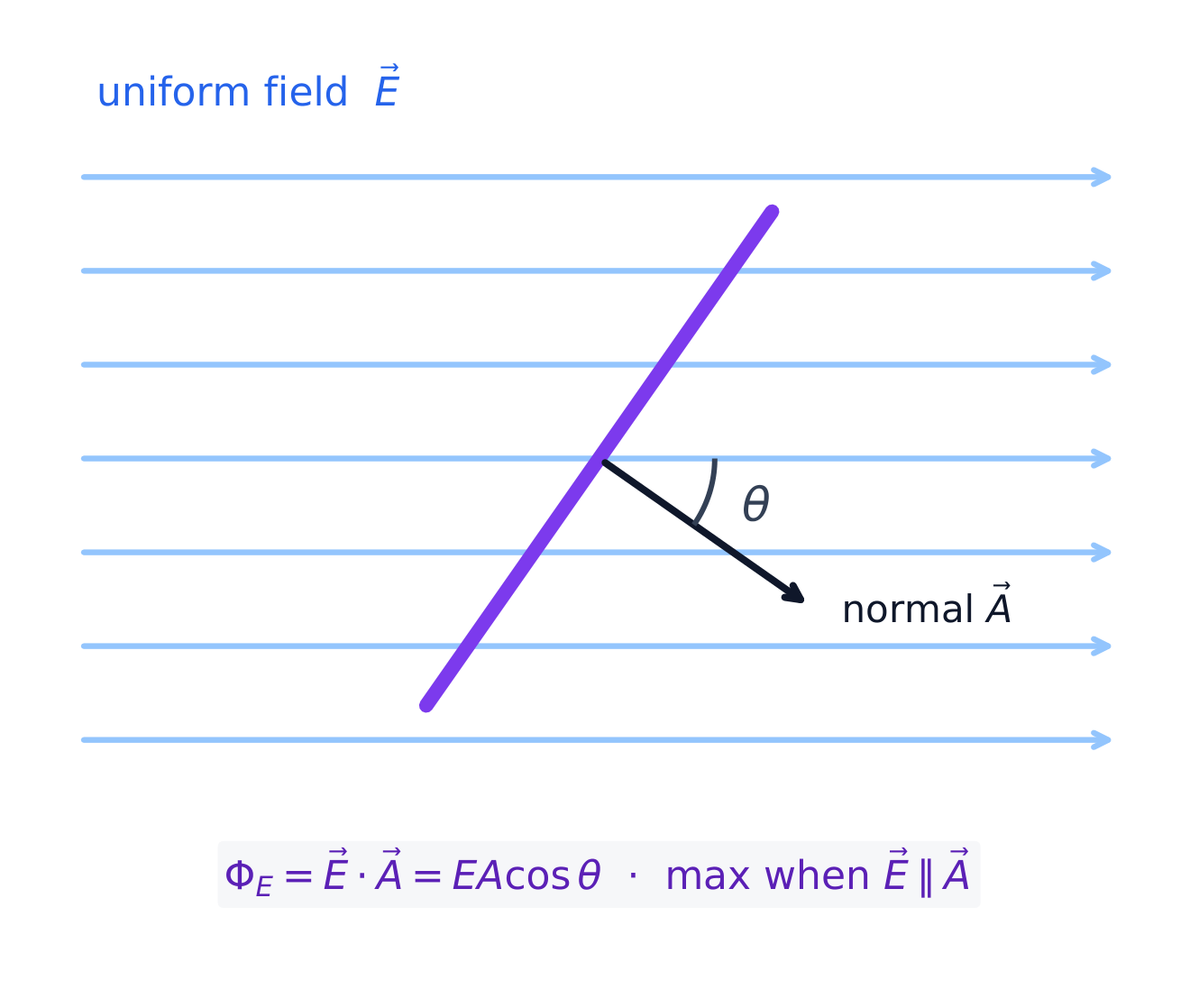
For a uniform field through a flat area, $\Phi_E=EA\cos\theta$, where the area vector 面积矢量 is perpendicular to the surface. Flux is positive where field lines exit a closed surface and negative where they enter – only the perpendicular component of $\vec{E}$ counts.

Bahasa Indonesia
Fluks listrik & Hukum Gauss

Fluks listrik mengukur berapa banyak medan yang menembus suatu permukaan:

$$\Phi_E=\int \vec{E}\cdot d\vec{A}.$$

Untuk medan seragam melalui area datar, $\Phi_E=EA\cos\theta$, di mana vektor luas tegak lurus terhadap permukaan. Fluks positif di mana garis medan keluar dari permukaan tertutup dan negatif di mana mereka masuk – hanya komponen tegak lurus dari $\vec{E}$ yang dihitung.

Fluks listrik melalui permukaan bergantung pada sudut antara medan dan normal permukaan
Vocabulary · ⁨Kosa kata⁩ Train · ⁨Latih⁩
English Bahasa Indonesia
Electric flux/ɪˈlektrɪk flʌks/ Fluks listrik
area vector/ˈeərɪə ˈvektə/ vektor luas
Gauss's law/ˈɡaʊsɪz lɔː/ Hukum Gauss
8.6

Gauss's Law · ⁨Hukum Gauss⁩

Syllabus · ⁨Silabus⁩
English

Learning Objective 8.6.A: Describe the properties of a charge distribution by applying Gauss's law.

  • 8.6.A.1 Gauss's law relates electric flux through a Gaussian surface to the charge enclosed by that surface.
    • Relevant equations: $\Phi_E = \dfrac{q_{\text{enc}}}{\varepsilon_0}$ and $\displaystyle\oint \vec{E} \cdot d\vec{A} = \dfrac{q_{\text{enc}}}{\varepsilon_0}$
  • 8.6.A.2 A Gaussian surface is a three-dimensional, closed surface.
  • 8.6.A.3 The total electric flux through a Gaussian surface is independent of the size of the Gaussian surface if the amount of enclosed charge remains constant.
  • 8.6.A.4 Gaussian surfaces are typically constructed such that the electric field generated by the enclosed charge is either perpendicular or parallel to different regions of the Gaussian surface, resulting in a simplified surface integral.
  • 8.6.A.5 If a function of charge density is given for a charge distribution, the total charge can be determined by integrating the charge density over the length (one dimension), area (two dimensions), or volume (three dimensions) of the charge distribution. For example: $Q_{\text{total}} = \displaystyle\int \rho(\vec{r})\, dV$
  • 8.6.A.6 Maxwell's equations are the collection of equations that fully describe electromagnetism. Gauss's law is Maxwell's first equation.
    • Relevant equation: $\displaystyle\oint \vec{E} \cdot d\vec{A} = \dfrac{q_{\text{enc}}}{\varepsilon_0}$

Boundary statement: AP Physics C: Electricity & Magnetism only expects students to quantitatively apply Gauss's law to point charges and charge distributions that have spherical, cylindrical, or planar symmetry.

Bahasa Indonesia

Tujuan Pembelajaran 8.6.A: Jelaskan sifat distribusi muatan dengan menerapkan hukum Gauss.

  • 8.6.A.1 Hukum Gauss menghubungkan fluks listrik melalui permukaan Gaussian dengan muatan yang terjebak di dalam permukaan tersebut.
    • Persamaan Relevan: $\Phi_E = \dfrac{q_{\text{enc}}}{\varepsilon_0}$ dan $\displaystyle\oint \vec{E} \cdot d\vec{A} = \dfrac{q_{\text{enc}}}{\varepsilon_0}$
  • 8.6.A.2 Permukaan Gaussian adalah permukaan tiga dimensi yang tertutup.
  • 8.6.A.3 Total fluks listrik melalui permukaan Gaussian tidak bergantung pada ukuran permukaan Gaussian jika jumlah muatan yang terjebak tetap konstan.
  • 8.6.A.4 Permukaan Gaussian biasanya dibangun sedemikian rupa sehingga medan listrik yang dihasilkan oleh muatan yang terjebakeither tegak lurus atau sejajar dengan berbagai region permukaan Gaussian, menghasilkan integral permukaan yang disederhanakan.
  • 8.6.A.5 Jika fungsi kerapatan muatan diberikan untuk distribusi muatan, total muatan dapat ditentukan dengan mengintegrasikan kerapatan muatan sepanjang panjang (satu dimensi), luas (dua dimensi), atau volume (tiga dimensi) dari distribusi muatan tersebut. Sebagai contoh: $Q_{\text{total}} = \displaystyle\int \rho(\vec{r})\, dV$
  • 8.6.A.6 Persamaan Maxwell adalah kumpulan persamaan yang secara lengkap mendeskripsikan elektromagnetisme. Hukum Gauss adalah persamaan pertama Maxwell.
    • Persamaan relevan: $\displaystyle\oint \vec{E} \cdot d\vec{A} = \dfrac{q_{\text{enc}}}{\varepsilon_0}$

Pernyataan Batasan: AP Physics C: Listrik & Magnetisme hanya mengharapkan siswa untuk menerapkan hukum Gauss secara kuantitatif terhadap muatan titik dan distribusi muatan yang memiliki simetri bola, silinder, atau planar.

Source: College Board AP Course and Exam Description · ⁨Sumber: Deskripsi Kursus dan Ujian College Board AP⁩

English

Gauss's law 高斯定律 – the first of Maxwell's equations – relates the flux through any closed surface to the charge inside it:

$$\oint \vec{E}\cdot d\vec{A}=\frac{Q_{\text{enc}}}{\varepsilon_0}.$$

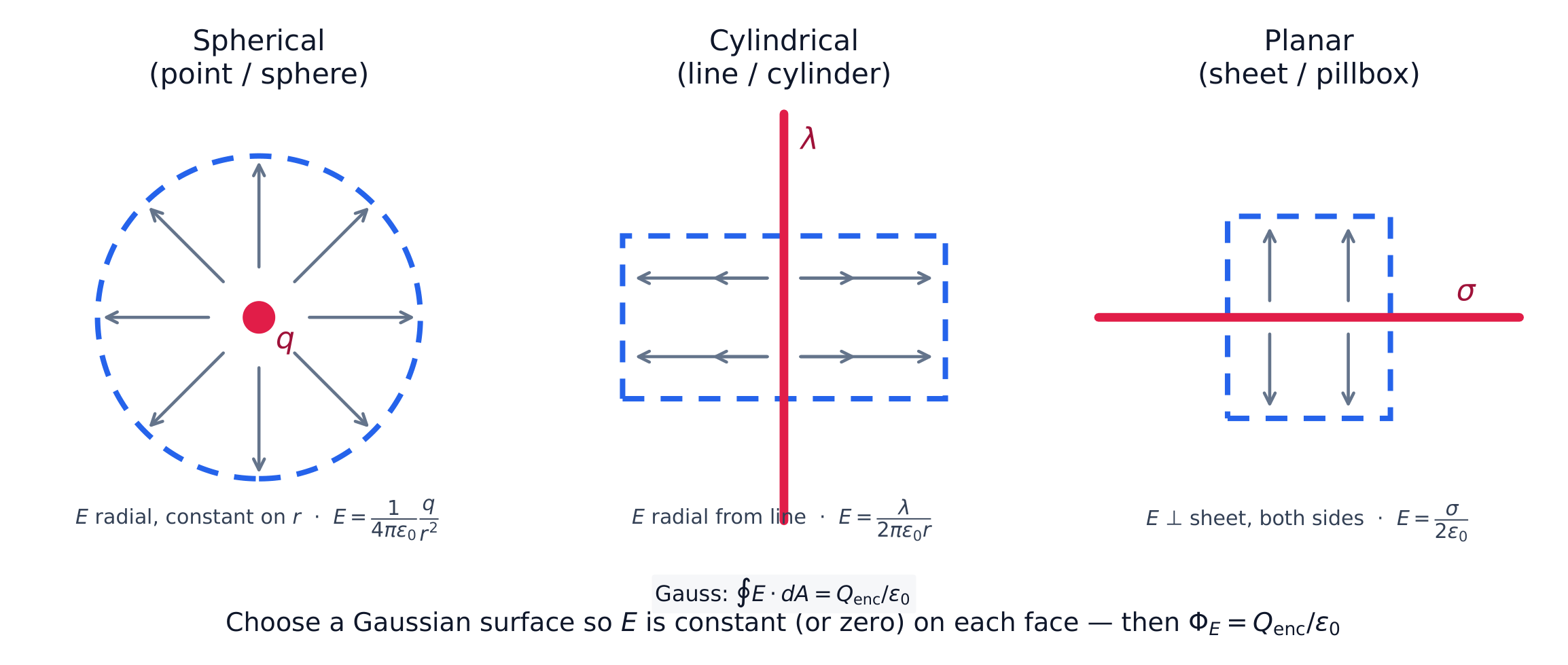
It is true for any closed surface, but it solves for $E$ only when symmetry lets you choose a Gaussian surface 高斯面 on which $E$ is constant and perpendicular (or parallel, contributing zero). The three symmetries AP tests: spherical symmetry 球对称 (concentric sphere), cylindrical symmetry 柱对称 (coaxial cylinder), and planar symmetry 平面对称 (a straddling "pillbox").

Worked example (sphere). Outside a sphere of total charge $Q$, a spherical Gaussian surface of radius $r$ gives $E(4\pi r^2)=Q/\varepsilon_0$, so $E=\dfrac{kQ}{r^2}$ – identical to a point charge at the centre. Inside a uniformly charged solid sphere of radius $R$, the surface encloses only $Q_{\text{enc}}=Q\,r^3/R^3$, so $E=\dfrac{kQr}{R^3}$: zero at the centre, growing linearly to the surface.

Worked example (wire). For an infinite wire with charge per length $\lambda$, take a coaxial cylinder of radius $r$ and length $L$. The ends contribute nothing ($\vec{E}\perp d\vec{A}$), so $E(2\pi rL)=\dfrac{\lambda L}{\varepsilon_0}$ and $E=\dfrac{\lambda}{2\pi\varepsilon_0 r}$. The same pillbox method gives an infinite sheet's field, $E=\dfrac{\sigma}{2\varepsilon_0}$, uniform on both sides.

Exam skill. A full-credit Gauss's-law answer has four parts: name the surface, state the symmetry argument (why $E$ is constant and perpendicular on it), count $Q_{\text{enc}}$, then solve. Skipping the symmetry sentence loses the reasoning point – and remember Gauss's law also explains why $E=0$ inside any conductor in equilibrium.

Bahasa Indonesia

Hukum Gauss – persamaan Maxwell pertama – menghubungkan fluks melalui permukaan tertutup apa pun dengan muatan di dalamnya:

$$\oint \vec{E}\cdot d\vec{A}=\frac{Q_{\text{enc}}}{\varepsilon_0}.$$

Hal ini berlaku untuk setiap permukaan tertutup, tetapi hanya menyelesaikan $E$ ketika simetri memungkinkan Anda memilih permukaan Gaussian di mana $E$ konstan dan tegak lurus (atau sejajar, berkontribusi nol). Tiga jenis simetri yang diuji AP: simetri bola (bola konsentris), simetri silinder (silinder seaksis), dan simetri planar ("kotak pil" yang melintasi bidang).

Permukaan Gaussian dipilih untuk sesuai dengan simetri muatan

Contoh terpecahkan (bola). Di luar bola dengan total muatan $Q$, permukaan Gaussian berbentuk bola dengan jari-jari $r$ menghasilkan $E(4\pi r^2)=Q/\varepsilon_0$, sehingga $E=\dfrac{kQ}{r^2}$ – identik dengan muatan titik di pusat. Di dalam bola pejal bermuatan seragam dengan jari-jari $R$, permukaan tersebut hanya membungkus $Q_{\text{enc}}=Q\,r^3/R^3$, sehingga $E=\dfrac{kQr}{R^3}$: nol di pusat, meningkat secara linear menuju permukaan.

Contoh terpecahkan (kawat). Untuk kawat tak hingga dengan muatan per panjang $\lambda$, ambil silinder seaksis dengan jari-jari $r$ dan panjang $L$. Bagian ujung tidak memberikan kontribusi ($\vec{E}\perp d\vec{A}$), sehingga $E(2\pi rL)=\dfrac{\lambda L}{\varepsilon_0}$ dan $E=\dfrac{\lambda}{2\pi\varepsilon_0 r}$. Metode kotak pil yang sama memberikan medan lembaran tak hingga, $E=\dfrac{\sigma}{2\varepsilon_0}$, seragam di kedua sisinya.

Keterampilan ujian. Jawaban hukum Gauss yang mendapat nilai penuh memiliki empat bagian: sebut nama permukaan, nyatakan argumen simetri (mengapa $E$ konstan dan tegak lurus padanya), hitung $Q_{\text{enc}}$, lalu selesaikan. Melewatkan kalimat simetri akan menghilangkan poin penalaran – dan ingat bahwa hukum Gauss juga menjelaskan mengapa $E=0$ di dalam konduktor apa pun dalam kesetimbangan.

Vocabulary · ⁨Kosa kata⁩ Train · ⁨Latih⁩
English Bahasa Indonesia
Gaussian surface/ˈɡaʊʃn ˈsɜːfɪs/ permukaan Gauss
spherical symmetry/sˈferɪkl ˈsɪmətri/ Simetri bola
cylindrical symmetry/sɪˈlɪndrɪkl ˈsɪmətri/ Simetri silinder
planar symmetry/ˈpleɪnə ˈsɪmətri/ Simetri planar
8.6

Exam tips · ⁨Tips ujian⁩

English
  • Use Coulomb's law $F=\tfrac{1}{4\pi\varepsilon_0}\tfrac{q_1 q_2}{r^2}$ and superpose forces as vectors (components, not magnitudes).
  • For a continuous charge, integrate $d\vec E$ over $dq=\lambda\,dl,\ \sigma\,dA,\ \rho\,dV$; use symmetry to cancel components.
  • The field points away from positive and toward negative charge; draw field lines correctly.
  • Distinguish the force on a charge ($\vec F=q\vec E$) from the field the charge creates.
  • Keep the constant $k=\tfrac{1}{4\pi\varepsilon_0}$ straight and check units.
Bahasa Indonesia
  • Gunakan hukum Coulomb $F=\tfrac{1}{4\pi\varepsilon_0}\tfrac{q_1 q_2}{r^2}$ dan jumlahkan gaya sebagai vektor (komponen, bukan besaran).
  • Untuk muatan kontinu, integralkan $d\vec E$ terhadap $dq=\lambda\,dl,\ \sigma\,dA,\ \rho\,dV$; gunakan simetri untuk membatalkan komponen.
  • Medan mengarah jauh dari muatan positif dan menuju muatan negatif; gambar garis medan dengan benar.
  • Bedakan gaya pada suatu muatan ($\vec F=q\vec E$) dari medan yang dihasilkan oleh muatan tersebut.
  • Pertahankan konstanta $k=\tfrac{1}{4\pi\varepsilon_0}$ tetap dan periksa satuan.

Interactive lessons on this topic · ⁨Pelajaran interaktif untuk topik ini⁩

Work through it step by step, with instant-check exercises. · ⁨Kerjakan langkah demi langkah, dengan latihan pengecekan instan.⁩

Past Papers · ⁨Soal-Soil Masa Lalu⁩

More topics in AP Physics C: Electricity and Magnetism · ⁨AP Fisika C: Listrik dan Magnetisme⁩ · ⁨Topik lain dalam AP Physics C: Electricity and Magnetism · ⁨AP Fisika C: Listrik dan Magnetisme⁩⁩

Log in or create account · ⁨Masuk atau buat akun⁩

IGCSE, A-Level & AP