Skip to content · ⁨Lompat ke konten⁩

Magnetic Fields and Electromagnetism · ⁨Medan Magnet dan Elektromagnetisme⁩

AP Physics C: Electricity and Magnetism · ⁨AP Fisika C: Listrik dan Magnetisme⁩ · Topic 12 · ⁨Topik 12⁩

Video lesson for this topic · ⁨Pelajaran video untuk topik ini⁩ Open the video page · ⁨Buka halaman video⁩
12:45

Medan Magnet dan Elektromagnetisme

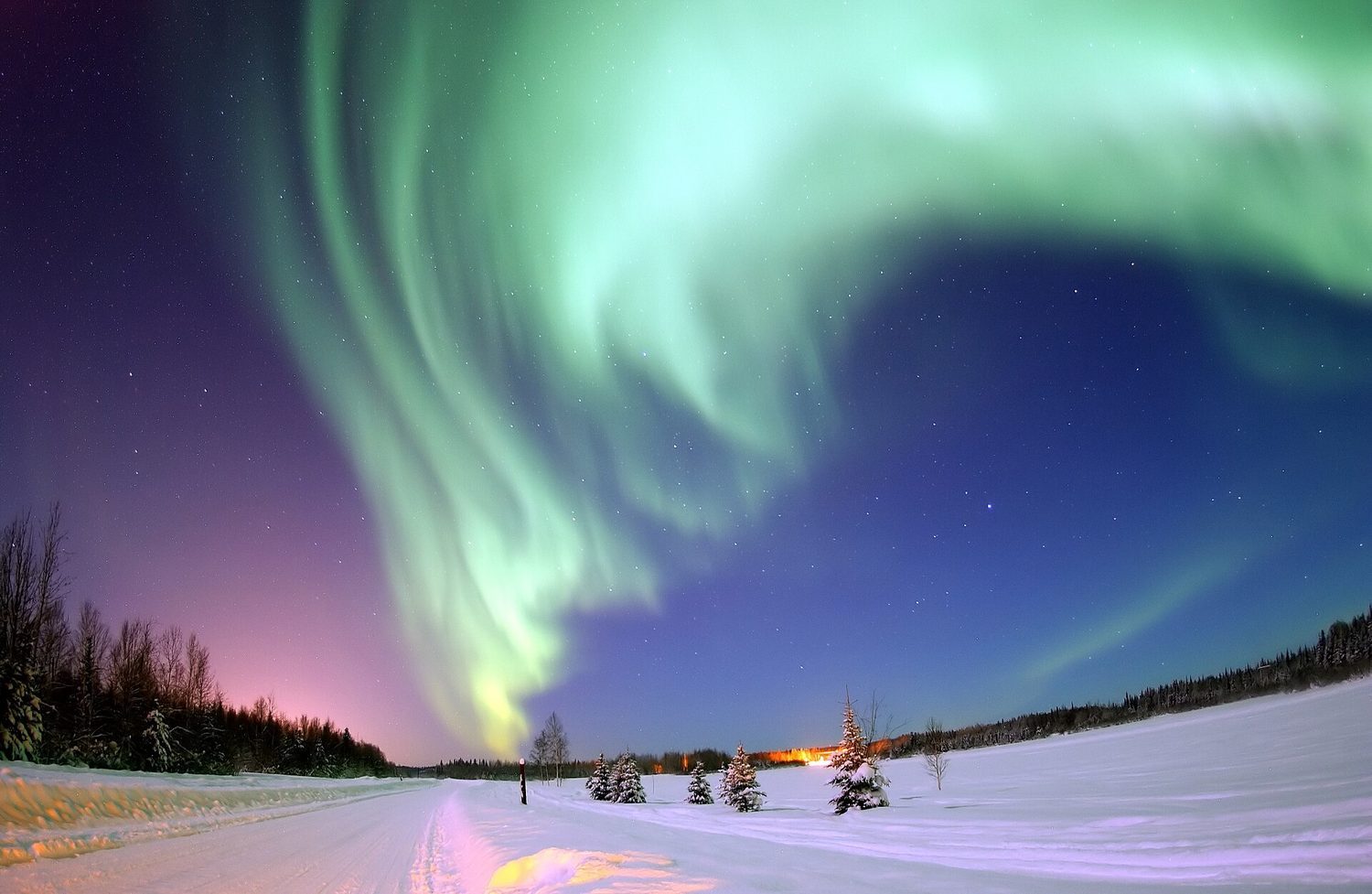
Lihat ke utara pada malam musim dingin yang cerah, cukup jauh ke utara, dan langit bersinar hijau. Cahaya-cahaya itu dinyalakan oleh medan magnet. Matahari memancarkan partikel bermuatan…

English narration · English + 中文 subtitles burned in · ⁨Narasi bahasa Inggris · Subtitle bahasa Inggris + 中文 disematkan langsung⁩

12.1

Magnetic Fields · ⁨Medan Magnet⁩

Syllabus · ⁨Silabus⁩
English

Learning Objective 12.1.A: Describe the properties of a magnetic field.

  • 12.1.A.1 A magnetic field is a vector field that can be used to determine the magnetic force exerted on moving electric charges, electric currents, or magnetic materials.
    • 12.1.A.1.i Magnetic fields can be produced by magnetic dipoles or combinations of dipoles, but never by monopoles.
    • 12.1.A.1.ii Magnetic dipoles have north and south polarity.
  • 12.1.A.2 A magnetic field is a vector quantity and can be represented using vector field maps.
  • 12.1.A.3 Magnetic field lines must form closed loops, as described by Gauss's law for magnetism.
    • 12.1.A.3.i Maxwell's equations are the collection of equations that fully describe electromagnetism. Gauss's law for magnetism is Maxwell's second equation.
      • Equation: $\oint \vec{B} \cdot d\vec{A} = 0$
    • 12.1.A.3.ii Magnetic fields in a bar magnet form closed loops, with the external magnetic field pointing away from one end (defined as the north pole) and returning to the other end (defined as the south pole).

Learning Objective 12.1.B: Describe the magnetic behavior of a material as a result of the configuration of magnetic dipoles in the material.

  • 12.1.B.1 Magnetic dipoles result from the circular or rotational motion of electric charges. In magnetic materials, this can be the motion of electrons.
    • 12.1.B.1.i Permanent magnetism and induced magnetism are system properties that both result from the alignment of magnetic dipoles within a system.
    • 12.1.B.1.ii No magnetic north pole is ever found in isolation from a south pole. For example, if a bar magnet is broken in half, both halves are magnetic dipoles.
    • 12.1.B.1.iii Magnetic poles of the same polarity will repel; magnetic poles of opposite polarity will attract.
    • 12.1.B.1.iv The magnitude of the magnetic field from a magnetic dipole decreases with increasing distance from the dipole.
  • 12.1.B.2 A magnetic dipole, such as a magnetic compass, placed in a magnetic field will tend to align with the magnetic field.
  • 12.1.B.3 A material's composition influences its magnetic behavior in the presence of an external magnetic field.
    • 12.1.B.3.i Ferromagnetic materials such as iron, nickel, and cobalt can be permanently magnetized by an external field that causes the alignment of magnetic domains or atomic magnetic dipoles.
    • 12.1.B.3.ii Paramagnetic materials such as aluminum, titanium, and magnesium interact weakly with an external magnetic field, in that the magnetic dipoles of the material do not remain aligned after the external field is removed.
    • 12.1.B.3.iii All materials have the property of diamagnetism, in that their electronic structure creates a usually weak alignment of the dipole moments of the material opposite the external magnetic field.
  • 12.1.B.4 Earth's magnetic field may be approximated as a magnetic dipole.

Learning Objective 12.1.C: Describe the magnetic permeability of a material.

  • 12.1.C.1 Magnetic permeability is a measurement of the amount of magnetization in a material in response to an external magnetic field.
  • 12.1.C.2 Free space has a constant value of magnetic permeability, known as the vacuum permeability $\mu_0$, that appears in equations representing physical relationships.
  • 12.1.C.3 The permeability of matter has values different from that of free space and arises from the matter's composition and arrangement. It is not a constant for a material and varies based on many factors, including temperature, orientation, and strength of the external field.
Bahasa Indonesia

Tujuan Pembelajaran 12.1.A: Jelaskan sifat-sifat medan magnet.

  • 12.1.A.1 Medan magnet adalah medan vektor yang dapat digunakan untuk menentukan gaya magnet yang bekerja pada muatan listrik bergerak, arus listrik, atau material magnet.
    • 12.1.A.1.i Medan magnet dapat dihasilkan oleh dipol magnet atau kombinasi dipol, tetapi tidak pernah oleh monopole.
    • 12.1.A.1.ii Dipol magnet memiliki kutub utara dan selatan.
  • 12.1.A.2 Medan magnet adalah besaran vektor dan dapat direpresentasikan menggunakan peta medan vektor.
  • 12.1.A.3 Garis-garis medan magnet harus membentuk loop tertutup, sebagaimana dijelaskan oleh hukum Gauss untuk magnetisme.
    • 12.1.A.3.i Persamaan Maxwell adalah kumpulan persamaan yang secara penuh mendeskripsikan elektromagnetisme. Hukum Gauss untuk magnetisme adalah persamaan kedua Maxwell.
      • Persamaan: $\oint \vec{B} \cdot d\vec{A} = 0$
    • 12.1.A.3.ii Medan magnet pada magnet batang membentuk loop tertutup, dengan medan magnet eksternal mengarah menjauhi salah satu ujung (didefinisikan sebagai kutub utara) dan kembali ke ujung lainnya (didefinisikan sebagai kutub selatan).

Tujuan Pembelajaran 12.1.B: Jelaskan perilaku magnetik suatu material akibat konfigurasi dipol magnet di dalamnya.

  • 12.1.B.1 Dipol magnet berasal dari gerakan melingkar atau rotasi muatan listrik. Dalam material magnetik, hal ini dapat berupa gerakan elektron.
    • 12.1.B.1.i Kemagnetan permanen dan kemagnetan induksi adalah sifat sistem yang keduanya berasal dari penyelarasan dipol magnet di dalam sistem.
    • 12.1.B.1.ii Tidak pernah ditemukan kutub utara magnet secara terpisah dari kutub selatan. Sebagai contoh, jika sebuah magnet batang dipatahkan menjadi dua bagian, kedua bagian tersebut tetap merupakan dipol magnet.
    • 12.1.B.1.iii Kutub magnet dengan polaritas yang sama akan tolak-menolak; kutub magnet dengan polaritas yang berlawanan akan tarik-menarik.
    • 12.1.B.1.iv Besar medan magnet dari sebuah dipol magnet berkurang seiring bertambahnya jarak dari dipol tersebut.
  • 12.1.B.2 Dipol magnet, seperti kompas magnet, yang diletakkan dalam medan magnet cenderung sejajar dengan medan magnet tersebut.
  • 12.1.B.3 Komposisi suatu material memengaruhi perilaku magnetiknya di hadapan medan magnet eksternal.
    • 12.1.B.3.i Material feromagnetik seperti besi, nikel, dan kobalt dapat dimagnetkan secara permanen oleh medan eksternal yang menyebabkan penyelarasan domain magnet atau dipol magnet atom.
    • 12.1.B.3.ii Material paramagnetik seperti aluminium, titanium, dan magnesium berinteraksi lemah dengan medan magnet eksternal, di mana dipol magnet material tersebut tidak tetap menyelaraskan diri setelah medan eksternal dihilangkan.
    • 12.1.B.3.iii Semua material memiliki sifat diamagnetisme, di mana struktur elektron mereka menciptakan penyelarasan momen dipol material yang biasanya lemah dan berlawanan arah dengan medan magnet eksternal.
  • 12.1.B.4 Medan magnet Bumi dapat didekati sebagai dipol magnet.

Tujuan Pembelajaran 12.1.C: Jelaskan permeabilitas magnetik suatu material.

  • 12.1.C.1 Permeabilitas magnetik adalah pengukuran jumlah magnetisasi dalam suatu material sebagai respons terhadap medan magnet eksternal.
  • 12.1.C.2 Ruang hampa memiliki nilai konstan permeabilitas magnetik, yang dikenal sebagai permeabilitas vakum $\mu_0$, yang muncul dalam persamaan yang merepresentasikan hubungan fisik.
  • 12.1.C.3 Permeabilitas materi memiliki nilai berbeda dari ruang bebas dan timbul dari komposisi serta susunan materinya. Nilai ini bukan konstanta untuk suatu material dan bervariasi berdasarkan banyak faktor, termasuk suhu, orientasi, dan kekuatan medan eksternal.
Source: College Board AP Course and Exam Description · ⁨Sumber: Deskripsi Kursus dan Ujian College Board AP⁩

English

A magnetic field 磁场 $\vec{B}$ is a vector field 矢量场 that surrounds magnets, moving charges, and currents; it determines the magnetic force on any moving charge placed in it. Magnetic field lines 磁感线 must form closed loops: they leave the north pole, return to the south pole, and continue through the magnet. Denser lines mean a stronger field.

Closed loops are the content of Gauss's law for magnetism, the second of Maxwell's equations 麦克斯韦方程组:

$$\oint \vec{B}\cdot d\vec{A}=0.$$

The net magnetic flux through any closed surface is zero – as many field lines leave as enter. That is exactly the statement that isolated magnetic monopoles 磁单极子 do not exist. Every source of magnetism is a magnetic dipole 磁偶极子 (a north–south pair), made by circulating charge – in materials, the motion of electrons. Break a bar magnet in half and you get two smaller dipoles, never a lone pole. Like poles repel, opposite poles attract, and a free dipole – a compass 指南针 – rotates to line up with the local field. Earth's own field is approximately a dipole, which is why a compass works. Dipole fields weaken with distance.

How a material responds to an external field depends on how its internal dipoles behave:

  • Ferromagnetic 铁磁性 (iron, nickel, cobalt): an external field aligns whole magnetic domains 磁畴, and the alignment survives after the field is removed – a permanent magnet.
  • Paramagnetic 顺磁性 (aluminum, titanium): dipoles align weakly with the field but relax when it is removed.
  • Diamagnetic 抗磁性 (all materials): the electronic structure produces a usually weak alignment opposite to the field.

The strength of a material's response is its magnetic permeability 磁导率. Free space has the constant value $\mu_0$ (the vacuum permeability); the permeability of matter differs from $\mu_0$ and is not even constant – it varies with temperature, orientation, and field strength.

Bahasa Indonesia

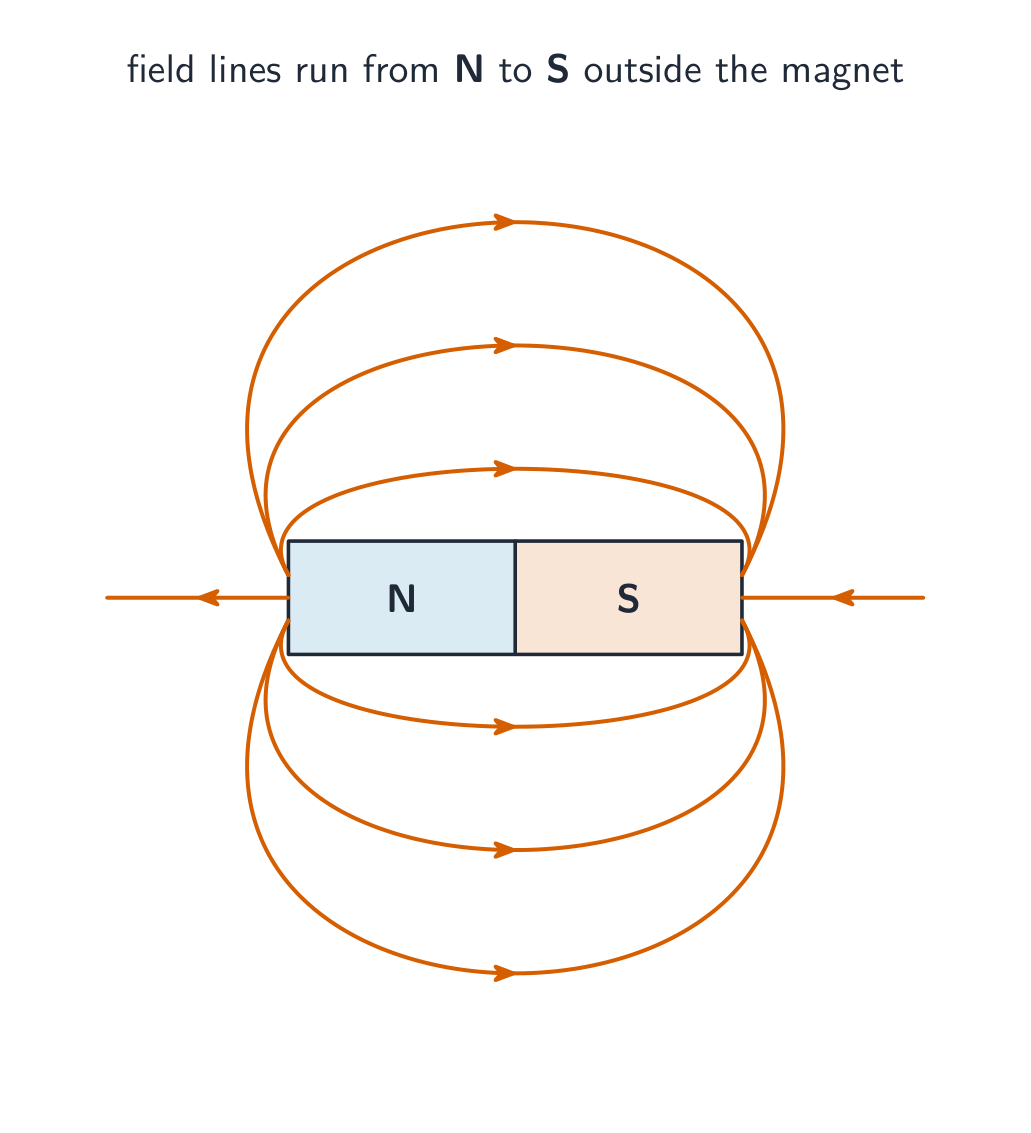
Medan magnetik $\vec{B}$ adalah medan vektor yang mengelilingi magnet, muatan bergerak, dan arus; medan ini menentukan gaya magnetik pada setiap muatan bergerak yang diletakkan di dalamnya. Garis-garis medan magnetik harus membentuk loop tertutup: keluar dari kutub utara, kembali ke kutub selatan, dan berlanjut melalui magnet. Garis yang lebih rapat berarti medan yang lebih kuat.

Garis medan berjalan dari N ke S di luar magnet batang

Loop tertutup adalah isi hukum Gauss untuk kemagnetan, yang kedua dari persamaan Maxwell:

$$\oint \vec{B}\cdot d\vec{A}=0.$$

Fluks magnetik bersih melalui permukaan tertutup apa pun adalah nol – sebanyak garis medan keluar sama dengan yang masuk. Itu tepat merupakan pernyataan bahwa monopole magnetik terisolasi tidak ada. Setiap sumber kemagnetan adalah dipol magnetik (pasangan utara-selatan), dibuat oleh muatan yang berputar – dalam material, gerakan elektron. Pecah magnet batang menjadi dua dan Anda akan mendapatkan dua dipol yang lebih kecil, bukan satu kutub tunggal. Kutup serupa tolak-menolak, kutup berlawanan tarik-menarik, dan dipol bebas – sebuah kompas – berotasi untuk sejajar dengan medan lokal. Medan Bumi sendiri kira-kira berupa dipol, itulah sebabnya kompas berfungsi. Medan dipol melemah seiring jarak.

Bagaimana suatu respons terhadap medan eksternal tergantung pada bagaimana dipol internalnya berperilaku:

  • Feromagnetik (besi, nikel, kobalt): medan eksternal menyelaraskan seluruh domin magnetik, dan penyelarasan bertahan setelah medan dihilangkan – magnet permanen.
  • Paramagnetik (aluminium, titanium): dipol menyelaraskan lemah dengan medan tetapi rileks saat medan dihilangkan.
  • Diamagnetik (semua material): struktur elektronik menghasilkan penyelarasan biasanya lemah berlawanan dengan medan.

Kekuatan respons material adalah permeabilitas magnetiknya. Ruang hampa memiliki nilai konstan $\mu_0$ (permeabilitas vakum); permeabilitas materi berbeda dari $\mu_0$ dan bahkan tidak konstan – itu bervariasi dengan suhu, orientasi, dan kekuatan medan.

Aurora: partikel bermuatan dari Matahari diarahkan oleh medan magnetik Bumi menuju kutub
Explore · ⁨Jelajahi⁩

See a magnet's field lines · ⁨Lihat garis medan magnet⁩

Magnetic field lines run from north to south outside a magnet; where they crowd together the field is strongest. · ⁨Garis medan magnet berjalan dari utara ke selatan di luar magnet; di mana mereka mengkerat, medannya paling kuat.⁩

Watch lesson · ⁨Tonton pelajaran⁩
12.2

Magnetism and Moving Charges · ⁨Kemagnetan dan Muatan Bergerak⁩

Syllabus · ⁨Silabus⁩
English

Learning Objective 12.2.A: Describe the magnetic field produced by moving charged objects.

  • 12.2.A.1 A single moving charged object produces a magnetic field.
    • 12.2.A.1.i The magnetic field at a particular point produced by a moving charged object depends on the object's velocity and the distance between the point and the object.
    • 12.2.A.1.ii At a point in space, the direction of the magnetic field produced by a moving charged object is perpendicular to both the velocity of the object and the position vector from the object to that point in space and can be determined using the right-hand rule.
    • 12.2.A.1.iii The magnitude of the magnetic field is a maximum when the velocity vector and the position vector from the object to that point in space are perpendicular.

Learning Objective 12.2.B: Describe the force exerted on moving charged objects by a magnetic field.

  • 12.2.B.1 A magnetic field will exert a force on a charged object moving within that field, with magnitude and direction that depend on the cross-product of the charge's velocity and the magnetic field.
    • Equation: $\vec{F}_B = q\left(\vec{v} \times \vec{B}\right)$
  • 12.2.B.2 In a region containing both a magnetic field and an electric field, a moving charged object will experience independent forces from each field.
  • 12.2.B.3 The Hall effect describes the potential difference created in a conductor by an external magnetic field that has a component perpendicular to the direction of charges moving in the conductor.
Bahasa Indonesia

Tujuan Pembelajaran 12.2.A: Deskripsikan medan magnet yang dihasilkan oleh objek bermuatan bergerak.

  • 12.2.A.1 Sebuah objek bermuatan tunggal yang bergerak menghasilkan medan magnet.
    • 12.2.A.1.i Medan magnet pada titik tertentu yang dihasilkan oleh objek bermuatan bergerak bergantung pada kecepatan objek dan jarak antara titik tersebut dengan objek.
    • 12.2.A.1.ii Pada suatu titik di ruang, arah medan magnet yang dihasilkan oleh objek bermuatan bergerak tegak lurus terhadap baik kecepatan objek maupun vektor posisi dari objek ke titik tersebut di ruang, dan dapat ditentukan menggunakan aturan tangan kanan.
    • 12.2.A.1.iii Besar medan magnet maksimum ketika vektor kecepatan dan vektor posisi dari objek ke titik tersebut di ruang saling tegak lurus.

Tujuan Pembelajaran 12.2.B: Deskripsikan gaya yang diberikan oleh medan magnet pada objek bermuatan bergerak.

  • 12.2.B.1 Medan magnet akan memberikan gaya pada benda bermuatan yang bergerak di dalam medan tersebut, dengan besaran dan arah yang bergantung pada hasil kali silang kecepatan muatan dan medan magnet.
    • Persamaan: $\vec{F}_B = q\left(\vec{v} \times \vec{B}\right)$
  • 12.2.B.2 Di daerah yang berisi medan magnet dan medan listrik, benda bermuatan yang bergerak akan mengalami gaya independen dari masing-masing medan.
  • 12.2.B.3 Efek Hall menggambarkan beda potensial yang tercipta dalam konduktor akibat medan magnet eksternal yang memiliki komponen tegak lurus terhadap arah pergerakan muatan dalam konduktor tersebut.

Source: College Board AP Course and Exam Description · ⁨Sumber: Deskripsi Kursus dan Ujian College Board AP⁩

English
A moving charge in a magnetic field

A moving charge does two things: it creates a magnetic field, and it feels a force in an external one. The field it creates at a point is perpendicular 垂直 to both its velocity and the position vector from charge to point (right-hand rule again), and is largest where those two are perpendicular – zero directly ahead of or behind the motion.

The force on a charge moving in a field $\vec{B}$ is the cross product

$$\vec{F}_B=q\,\vec{v}\times\vec{B},\qquad F=qvB\sin\theta,$$

perpendicular to both $\vec{v}$ and $\vec{B}$ – point the fingers of your right hand along $\vec{v}$, curl toward $\vec{B}$, and the thumb gives the force on a positive charge (reverse it for negative). Because $\vec{F}_B\perp\vec{v}$, the magnetic force does no work on the charge: it changes direction, never speed.

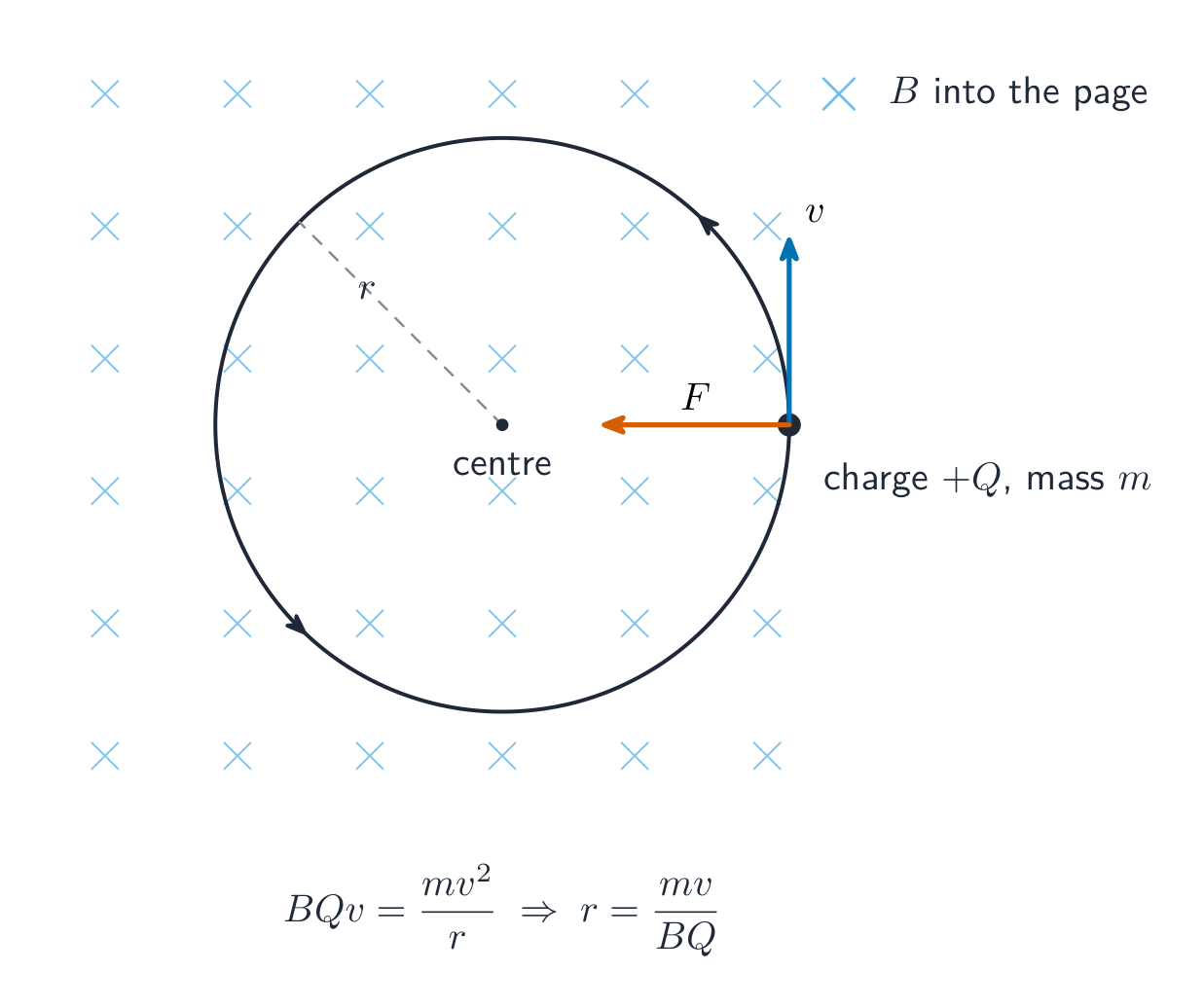
A charge moving perpendicular to a uniform field therefore travels in a circle, the magnetic force supplying the centripetal force 向心力:

$$qvB=\frac{mv^2}{r}\quad\Rightarrow\quad r=\frac{mv}{qB},\qquad T=\frac{2\pi m}{qB}.$$

Notice the period $T$ does not depend on the speed – faster particles ride larger circles in the same time.

Worked example. A proton ($q=1.6\times10^{-19}\ \text{C}$, $m=1.67\times10^{-27}\ \text{kg}$) enters a $0.50\ \text{T}$ field at $2.0\times10^{5}\ \text{m/s}$, perpendicular to it. The magnetic force $F=qvB=1.6\times10^{-14}\ \text{N}$ bends it into a circle of radius $r=\dfrac{mv}{qB}=\dfrac{1.67\times10^{-27}(2.0\times10^{5})}{1.6\times10^{-19}(0.50)}=4.2\times10^{-3}\ \text{m}$.

In a region with both an electric and a magnetic field, the two forces act independently and add as vectors. Balancing them makes a velocity selector 速度选择器: with $\vec{E}$ and $\vec{B}$ crossed, only charges with $qE=qvB$, i.e. $v=E/B$, pass straight through. The Hall effect 霍尔效应 is the same physics inside a conductor: a field with a component perpendicular to the current pushes the moving carriers sideways, charge builds up on one face, and a measurable potential difference appears across the conductor – its sign reveals whether the carriers are positive or negative.

Bahasa Indonesia
Muatan yang bergerak dalam medan magnet

Muatan bergerak melakukan dua hal: ia menciptakan medan magnetik, dan ia merasakan gaya dalam medan eksternal. Medan yang diciptakannya pada suatu titik adalah tegak lurus terhadap kecepatan dan vektor posisi dari muatan ke titik tersebut (aturan tangan kanan lagi), dan terbesar di mana keduanya tegak lurus – nol tepat di depan atau di belakang gerakan.

Gaya pada muatan yang bergerak dalam medan $\vec{B}$ adalah hasil kali silang

$$\vec{F}_B=q\,\vec{v}\times\vec{B},\qquad F=qvB\sin\theta,$$

tegak lurus terhadap baik $\vec{v}$ maupun $\vec{B}$ – arahkan jari tangan kanan Anda sepanjang $\vec{v}$, melengkung menuju $\vec{B}$, dan ibu jari memberikan gaya pada muatan positif (balikkan untuk negatif). Karena $\vec{F}_B\perp\vec{v}$, gaya magnetik tidak melakukan kerja pada muatan: mengubah arah, tidak pernah kecepatan.

Muatan yang bergerak tegak lurus terhadap medan seragam sehingga bergerak dalam lingkaran, gaya magnetik menyediakan gaya sentripetal:

$$qvB=\frac{mv^2}{r}\quad\Rightarrow\quad r=\frac{mv}{qB},\qquad T=\frac{2\pi m}{qB}.$$

Perhatikan periode $T$ tidak bergantung pada kecepatan – partikel lebih cepat menaiki lingkaran lebih besar dalam waktu yang sama.

Partikel bermuatan yang bergerak melintasi medan magnet mengikuti lintasan lingkaran

Contoh dikerjakan. Proton ($q=1.6\times10^{-19}\ \text{C}$, $m=1.67\times10^{-27}\ \text{kg}$) memasuki medan $0.50\ \text{T}$ pada $2.0\times10^{5}\ \text{m/s}$, tegak lurus dengannya. Gaya magnetik $F=qvB=1.6\times10^{-14}\ \text{N}$ membungkukkannya ke dalam lingkaran berjari-jari $r=\dfrac{mv}{qB}=\dfrac{1.67\times10^{-27}(2.0\times10^{5})}{1.6\times10^{-19}(0.50)}=4.2\times10^{-3}\ \text{m}$.

Di daerah dengan medan listrik dan magnetik, kedua gaya bekerja secara independen dan ditambahkan sebagai vektor. Menyeimbangkan mereka membuat selektor kecepatan: dengan $\vec{E}$ dan $\vec{B}$ bersilangan, hanya muatan dengan $qE=qvB$, yaitu $v=E/B$, yang melewati lurus. Efek Hall adalah fisika yang sama di dalam konduktor: medan dengan komponen tegak lurus terhadap arus mendorong pembawa yang bergerak menyamping, muatan menumpuk di satu sisi, dan perbedaan potensial yang dapat diukur muncul di seluruh konduktor – tandanya mengungkapkan apakah pembawanya positif atau negatif.

Explore · ⁨Jelajahi⁩

Force on a moving charge · ⁨Gaya pada muatan bergerak⁩

A charge moving through a magnetic field feels a force $F=qvB$ at right angles to both its velocity and the field — the basis of the motor effect. Reverse either and the force flips. · ⁨Muatan yang bergerak melalui medan magnet mengalami gaya $F=qvB$ tegak lurus terhadap kecepatan dan medannya — dasar efek motor. Balik salah satunya dan gayanya berbalik arah.⁩

Watch lesson · ⁨Tonton pelajaran⁩
12.3

Magnetic Fields of Current-Carrying Wires · ⁨Medan Magnetik Kawat Berarus⁩

Syllabus · ⁨Silabus⁩
English

Learning Objective 12.3.A: Describe the magnetic field produced by a current-carrying wire.

  • 12.3.A.1 The Biot-Savart law defines the magnitude and direction of a magnetic field created by an electrical current.
    • Equation: $d\vec{B} = \dfrac{\mu_0}{4\pi} \dfrac{I(d\vec{\ell} \times \hat{r})}{r^2}$
  • 12.3.A.2 The magnetic field vectors around a small segment of a current-carrying wire are tangent to concentric circles centered on that wire. The field has no component toward, away from, or parallel to the segment of the current-carrying wire.
  • 12.3.A.3 The Biot-Savart law can be used to derive the magnitudes and directions of magnetic fields around segments of current-carrying wires, for example at the center of a circular loop of wire.
    • Equation: $B_{\text{center of loop}} = \dfrac{\mu_0 I}{2R}$

Learning Objective 12.3.B: Describe the force exerted on current-carrying wires by a magnetic field.

  • 12.3.B.1 A magnetic field will exert a force on a current-carrying wire.
    • Equation: $\vec{F}_B = \int I\left(d\vec{\ell} \times \vec{B}\right)$

Boundary statement: AP Physics C: Electricity & Magnetism only expects students to perform quantitative analysis of certain cases of current-carrying conductors using the Biot-Savart law, such as at a location along the perpendicular bisector of a straight conductor, at a location along the central axis of a circular loop, or at the center of a segment of a circular loop.

Bahasa Indonesia

Tujuan Pembelajaran 12.3.A: Deskripsikan medan magnet yang dihasilkan oleh kawat pembawa arus.

  • 12.3.A.1 Hukum Biot-Savart mendefinisikan besaran dan arah medan magnet yang dihasilkan oleh arus listrik.
    • Persamaan: $d\vec{B} = \dfrac{\mu_0}{4\pi} \dfrac{I(d\vec{\ell} \times \hat{r})}{r^2}$
  • 12.3.A.2 Vektor-vektor medan magnet di sekitar segmen kecil kawat berarus menyinggung lingkaran konsentris yang berpusat pada kawat tersebut. Medan ini tidak memiliki komponen menuju, menjauhi, atau sejajar dengan segmen kawat berarus.
  • 12.3.A.3 Hukum Biot-Savart dapat digunakan untuk menurunkan besaran dan arah medan magnet di sekitar segmen kawat berarus, misalnya di pusat sebuah loop kawat melingkar.
    • Persamaan: $B_{\text{center of loop}} = \dfrac{\mu_0 I}{2R}$

Tujuan Pembelajaran 12.3.B: Deskripsikan gaya yang diberikan pada kawat berarus oleh medan magnet.

  • 12.3.B.1 Medan magnet akan memberikan gaya pada kawat berarus.
    • Persamaan: $\vec{F}_B = \int I\left(d\vec{\ell} \times \vec{B}\right)$

Pernyataan Batas: AP Physics C: Listrik & Magnetisme hanya mengharapkan siswa melakukan analisis kuantitatif atas kasus-kasus tertentu konduktor berarus menggunakan hukum Biot-Savart, seperti pada lokasi sepanjang garis bagi tegak lurus konduktor lurus, pada lokasi sepanjang sumbu pusat loop melingkar, atau di tengah segmen loop melingkar.

Source: College Board AP Course and Exam Description · ⁨Sumber: Deskripsi Kursus dan Ujian College Board AP⁩

English
The magnetic field around a current

A current is a stream of moving charges, so it creates a magnetic field. The Biot–Savart law 毕奥-萨伐尔定律 adds up the field of each current element:

$$d\vec{B}=\frac{\mu_0}{4\pi}\frac{I\,d\vec{l}\times\hat{r}}{r^2}.$$

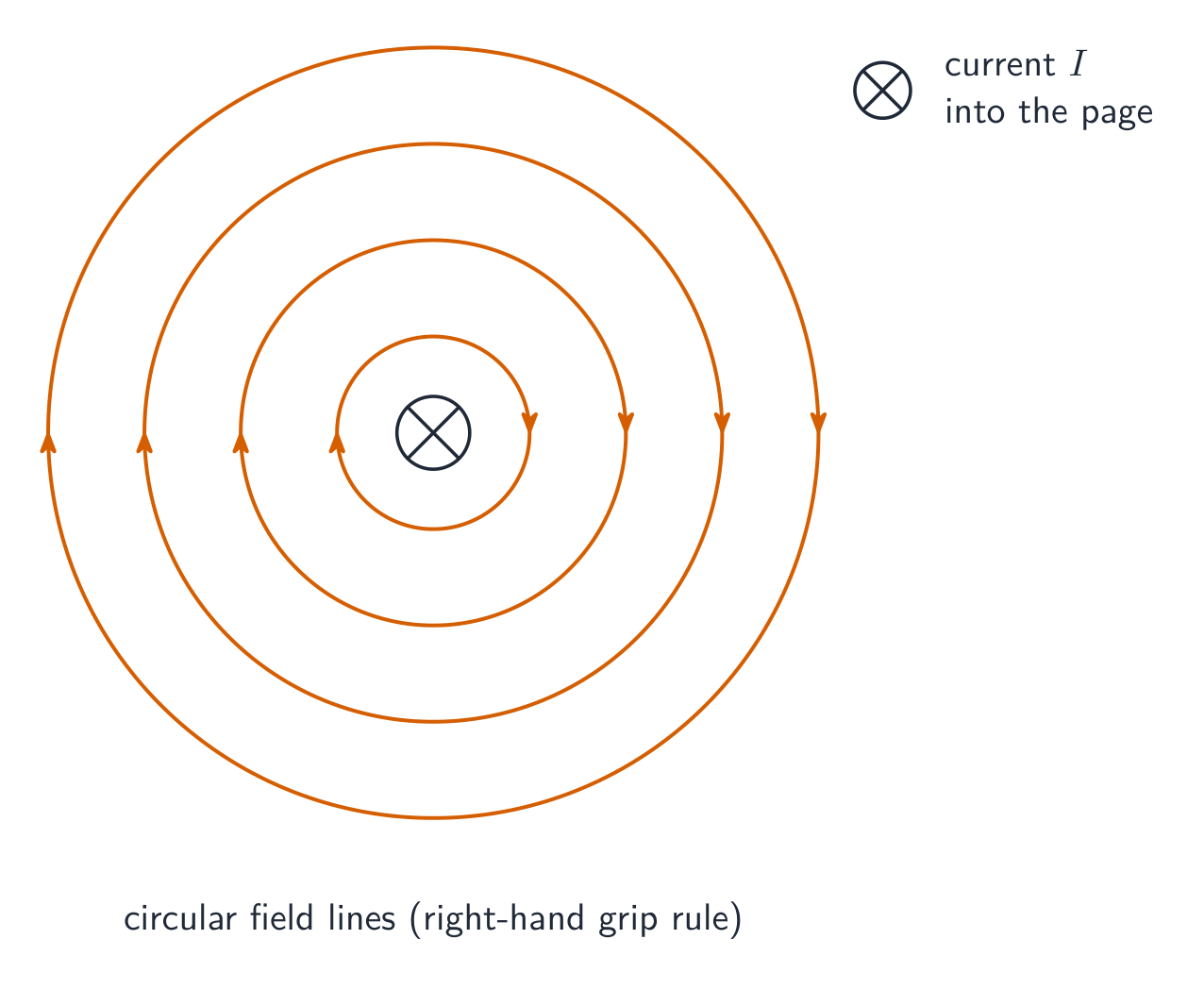
Around any straight segment the field vectors are tangent 相切 to concentric circles 同心圆 centred on the wire – no component toward, away from, or along the wire. Curl your right hand around the wire with the thumb along the current: your fingers give the field direction.

The Biot–Savart integrals AP expects: a long straight wire ($B=\dfrac{\mu_0 I}{2\pi r}$, or a point on the perpendicular bisector of a finite wire), and the centre of a circular loop,

$$B_{\text{centre of loop}}=\frac{\mu_0 I}{2R},$$

where every element $d\vec{l}$ is perpendicular to $\hat{r}$ and equally distant $R$ – say that in an FRQ derivation. An arc that is a fraction of a full circle contributes that same fraction of $\mu_0 I/2R$ at its centre.

A field also pushes on a current-carrying wire, element by element:

$$\vec{F}_B=\int I\,d\vec{l}\times\vec{B}\qquad(\vec{F}=I\vec{L}\times\vec{B}\ \text{for a straight wire in a uniform field}).$$

Worked example. Two long parallel wires a distance $d=0.10\ \text{m}$ apart each carry $5.0\ \text{A}$ in the same direction. Wire 1's field at wire 2 is $B=\dfrac{\mu_0 I}{2\pi d}=1.0\times10^{-5}\ \text{T}$, so wire 2 feels $\dfrac{F}{L}=I B=5.0\times10^{-5}\ \text{N/m}$, pulled toward wire 1. Same-direction currents attract; opposite currents repel.

Bahasa Indonesia
Medan magnet di sekitar arus listrik

Arus adalah aliran muatan bergerak, sehingga menciptakan medan magnetik. Hukum Biot–Savart menjumlahkan medan dari setiap elemen arus:

$$d\vec{B}=\frac{\mu_0}{4\pi}\frac{I\,d\vec{l}\times\hat{r}}{r^2}.$$

Di sekitar segmen lurus apa pun vektor medan adalah tangen terhadap lingkaran konsentris yang berpusat pada kawat – tidak ada komponen menuju, menjauhi, atau sepanjang kawat. Melingkari tangan kanan Anda di sekitar kawat dengan ibu jari sepanjang arus: jari Anda menunjukkan arah medan.

Garis-garis medan melingkar konsentris mengelilingi kawat pembawa arus lurus

Integral Biot–Savart yang diharapkan AP: kawat lurus panjang ($B=\dfrac{\mu_0 I}{2\pi r}$, atau titik pada garis bagi tegak lurus kawat terbatas), dan pusat lingkaran,

$$B_{\text{centre of loop}}=\frac{\mu_0 I}{2R},$$

di mana setiap elemen $d\vec{l}$ tegak lurus terhadap $\hat{r}$ dan berjarak sama $R$ – katakanlah dalam derivasi FRQ. Busur yang merupakan pecahan dari lingkaran penuh berkontribusi pecahan yang sama dari $\mu_0 I/2R$ di pusatnya.

Medan juga mendorong pada kawat berarus, elemen demi elemen:

$$\vec{F}_B=\int I\,d\vec{l}\times\vec{B}\qquad(\vec{F}=I\vec{L}\times\vec{B}\ \text{for a straight wire in a uniform field}).$$

Contoh dikerjakan. Dua kawat sejajar panjang berjarak $d=0.10\ \text{m}$ masing-masing membawa $5.0\ \text{A}$ dalam arah yang sama. Medan Wire 1 pada wire 2 adalah $B=\dfrac{\mu_0 I}{2\pi d}=1.0\times10^{-5}\ \text{T}$, jadi wire 2 merasakan $\dfrac{F}{L}=I B=5.0\times10^{-5}\ \text{N/m}$, ditarik menuju wire 1. Arus searah menarik; arus berlawanan menolak.

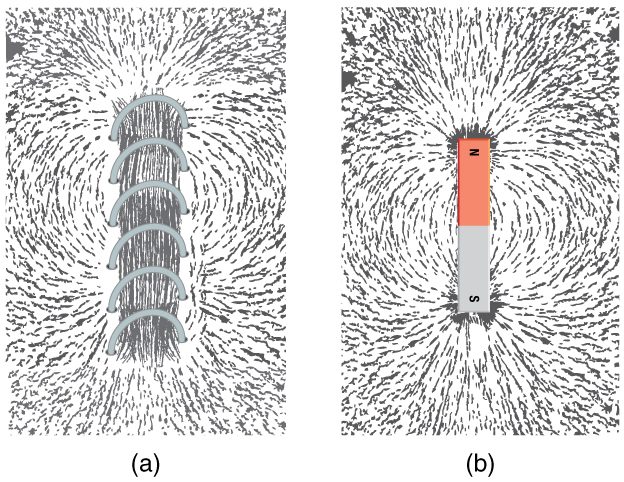
Serbuk besi di sekitar kumpalan berarus
Kumparan pembawa arus (solenoid) menghasilkan medan magnet berbentuk persis seperti batang magnet
Vocabulary · ⁨Kosa kata⁩ Train · ⁨Latih⁩
English Bahasa Indonesia
magnetic field/mæɡˈnetɪk fiːld/ medan magnet
vector field/ˈvektə fiːld/ Medan vektor
magnetic field lines/mæɡˈnetɪk fiːld laɪnz/ Garis medan magnetik
Maxwell's equations/ˈmækswelz ɪˈkweɪʒnz/ Persamaan Maxwell
magnetic monopoles/mæɡˈnetɪk ˈmɒnəʊpəʊlz/ Monopole magnetik
magnetic dipole/mæɡˈnetɪk ˈdaɪpəʊl/ Dipole magnetik
compass/ˈkʌmpəs/ kompas
Ferromagnetic/ˌferəməɡˈnetɪk/ Feromagnetik
magnetic domains/mæɡˈnetɪk dəˈmeɪnz/ Domain magnetik
Paramagnetic/ˌpærəməɡˈnetɪk/ Paramagnetik
Diamagnetic/ˌdaɪəməɡˈnetɪk/ Diamagnetik
magnetic permeability/mæɡˈnetɪk ˌpɜːməˈbɪlɪti/ Permeabilitas magnetik
perpendicular/ˌpɜːpənˈdɪkjʊlə/ tegak lurus
centripetal force/senˈtrɪpɪtl fɔːs/ kekuatan sentripetal
velocity selector/vəˈlɒsɪti sɪˈlektə/ selektor kecepatan
Hall effect/hɔːl ɪˈfekt/ efek Hall
Biot–Savart law/ˈbɪɒt ˈsævɑːt lɔː/ hukum Biot–Savart
tangent/ˈtændʒənt/ tangens
concentric circles/kənˈsentrɪk ˈsɜːklz/ Lingkaran konsentris
Ampère's law/ˈæmpeəz lɔː/ Hukum Ampère
Amperian loop/æmˈpɪərɪən luːp/ loop Amperian
current density/ˈkʌrənt ˈdensɪti/ Kepadatan arus
superposition/ˌsuːpəpəˈzɪʃn/ superposisi
solenoid/ˈsəʊlənɔɪd/ solenaoid
Watch lesson · ⁨Tonton pelajaran⁩
12.4

Ampère's Law · ⁨Hukum Ampère⁩

Syllabus · ⁨Silabus⁩
English

Learning Objective 12.4.A: Use Ampère's law to describe the magnetic field created by a moving charge carrier.

  • 12.4.A.1 Ampère's law relates the magnitude of the magnetic field to the current enclosed by a closed imaginary path called an Amperian loop.
    • Equation: $\oint \vec{B} \cdot d\vec{\ell} = \mu_0 I_{\text{enc}}$
    • 12.4.A.1.i Ampère's law can be used to determine the magnetic field near a long, straight current-carrying wire.
      • Equation: $B_{\text{wire}} = \dfrac{\mu_0}{2\pi} \dfrac{I}{r}$
    • 12.4.A.1.ii Unless otherwise stated, all solenoids are assumed to be very long, with uniform magnetic fields inside the solenoids and negligible magnetic fields outside the solenoids.
    • 12.4.A.1.iii Ampère's law can be used to determine the magnetic field inside of a long solenoid.
      • Equation: $B_{\text{sol}} = \mu_0 n I$
  • 12.4.A.2 An Amperian loop is a closed path around a current-carrying conductor.
  • 12.4.A.3 The principle of superposition can be used to determine the net magnetic field at a point in space created by various combinations of current-carrying conductors, or conducting loops, segments, or cylinders.
  • 12.4.A.4 Maxwell's equations are the collection of equations that fully describe electromagnetism. Maxwell's fourth equation is Ampère's law with Maxwell's addition; it states that magnetic fields can be generated by electric current (Ampère's law) and that a changing electric field creates a magnetic field, similar to the way a moving charge creates a magnetic field (Maxwell's addition).
    • Equation: $\oint \vec{B} \cdot d\vec{\ell} = \mu_0 I + \mu_0 \varepsilon_0 \dfrac{d\Phi_E}{dt}$

Boundary statement: AP Physics C: Electricity & Magnetism only expects quantitative application of Ampère's law limited to situations involving symmetrical magnetic fields. Long straight wires, long solenoids carrying currents, as well as conductive slabs or cylindrical conductors carrying a current density, are the types of shapes to which Ampère's law will be applied on the AP Physics C: Electricity & Magnetism Exam.

Boundary statement: AP Physics C: Electricity & Magnetism does not expect students to use Maxwell's fourth equation with a changing electric field. However, students should understand that a changing electric field generates a magnetic field.

Bahasa Indonesia

Tujuan Pembelajaran 12.4.A: Gunakan hukum Ampère untuk mendeskripsikan medan magnet yang dihasilkan oleh pembawa muatan yang bergerak.

  • 12.4.A.1 Hukum Ampère menghubungkan besaran medan magnet dengan arus yang dibatasi oleh lintasan imajiner tertutup yang disebut loop Amperian.
    • Persamaan: $\oint \vec{B} \cdot d\vec{\ell} = \mu_0 I_{\text{enc}}$
    • 12.4.A.1.i Hukum Ampère dapat digunakan untuk menentukan medan magnet di dekat kawat berarus lurus panjang.
      • Persamaan: $B_{\text{wire}} = \dfrac{\mu_0}{2\pi} \dfrac{I}{r}$
    • 12.4.A.1.ii Kecuali dinyatakan sebaliknya, semua solenoid diasumsikan sangat panjang, dengan medan magnet seragam di dalam solenoid dan medan magnet yang dapat diabaikan di luar solenoid.
    • 12.4.A.1.iii Hukum Ampère dapat digunakan untuk menentukan medan magnet di dalam solenoid panjang.
      • Persamaan: $B_{\text{sol}} = \mu_0 n I$
  • 12.4.A.2 Loop Amperian adalah lintasan tertutup di sekitar konduktor berarus.
  • 12.4.A.3 Prinsip superposisi dapat digunakan untuk menentukan medan magnet total pada suatu titik dalam ruang yang dihasilkan oleh berbagai kombinasi konduktor berarus, atau loop, segmen, atau silinder penghantar.
  • 12.4.A.4 Persamaan Maxwell adalah kumpulan persamaan yang secara penuh mendeskripsikan elektromagnetisme. Persamaan keempat Maxwell adalah hukum Ampère dengan penambahan Maxwell; persamaan ini menyatakan bahwa medan magnet dapat dihasilkan oleh arus listrik (hukum Ampère) dan bahwa medan listrik yang berubah menghasilkan medan magnet, serupa dengan cara muatan yang bergerak menghasilkan medan magnet (penambahan Maxwell).
    • Persamaan: $\oint \vec{B} \cdot d\vec{\ell} = \mu_0 I + \mu_0 \varepsilon_0 \dfrac{d\Phi_E}{dt}$

Pernyataan Batas: AP Physics C: Listrik & Magnetisme hanya mengharapkan aplikasi kuantitatif hukum Ampère yang terbatas pada situasi yang melibatkan medan magnet simetris. Kawat lurus panjang, solenoid panjang yang mengalirkan arus, serta pelat konduktif atau konduktor silinder yang mengalirkan kerapatan arus, adalah jenis bentuk-bentuk yang akan diterapkan hukum Ampère pada Ujian AP Physics C: Listrik & Magnetisme.

Pernyataan Batas: AP Physics C: Listrik & Magnetisme tidak mengharapkan siswa menggunakan persamaan keempat Maxwell dengan medan listrik yang berubah. Namun, siswa harus memahami bahwa medan listrik yang berubah menghasilkan medan magnet.

Source: College Board AP Course and Exam Description · ⁨Sumber: Deskripsi Kursus dan Ujian College Board AP⁩

English

For symmetric current distributions, Ampère's law 安培定律 finds the field far faster than Biot–Savart:

$$\oint \vec{B}\cdot d\vec{l}=\mu_0 I_{\text{enc}}.$$

Choose an Amperian loop 安培环路 that matches the symmetry, so that $B$ is constant along the loop (and parallel to it) and comes out of the integral. AP applies it to long straight wires, long solenoids, and conductors carrying a current density 电流密度 (slabs and cylinders); combinations are handled by superposition 叠加.

Worked example. Find the field $0.10\ \text{m}$ from a long wire carrying $5.0\ \text{A}$. A circular loop of radius $r$ shares the field's symmetry, so $B(2\pi r)=\mu_0 I$ and

$$B=\frac{\mu_0 I}{2\pi r}=\frac{(4\pi\times10^{-7})(5.0)}{2\pi(0.10)}=1.0\times10^{-5}\ \text{T}.$$

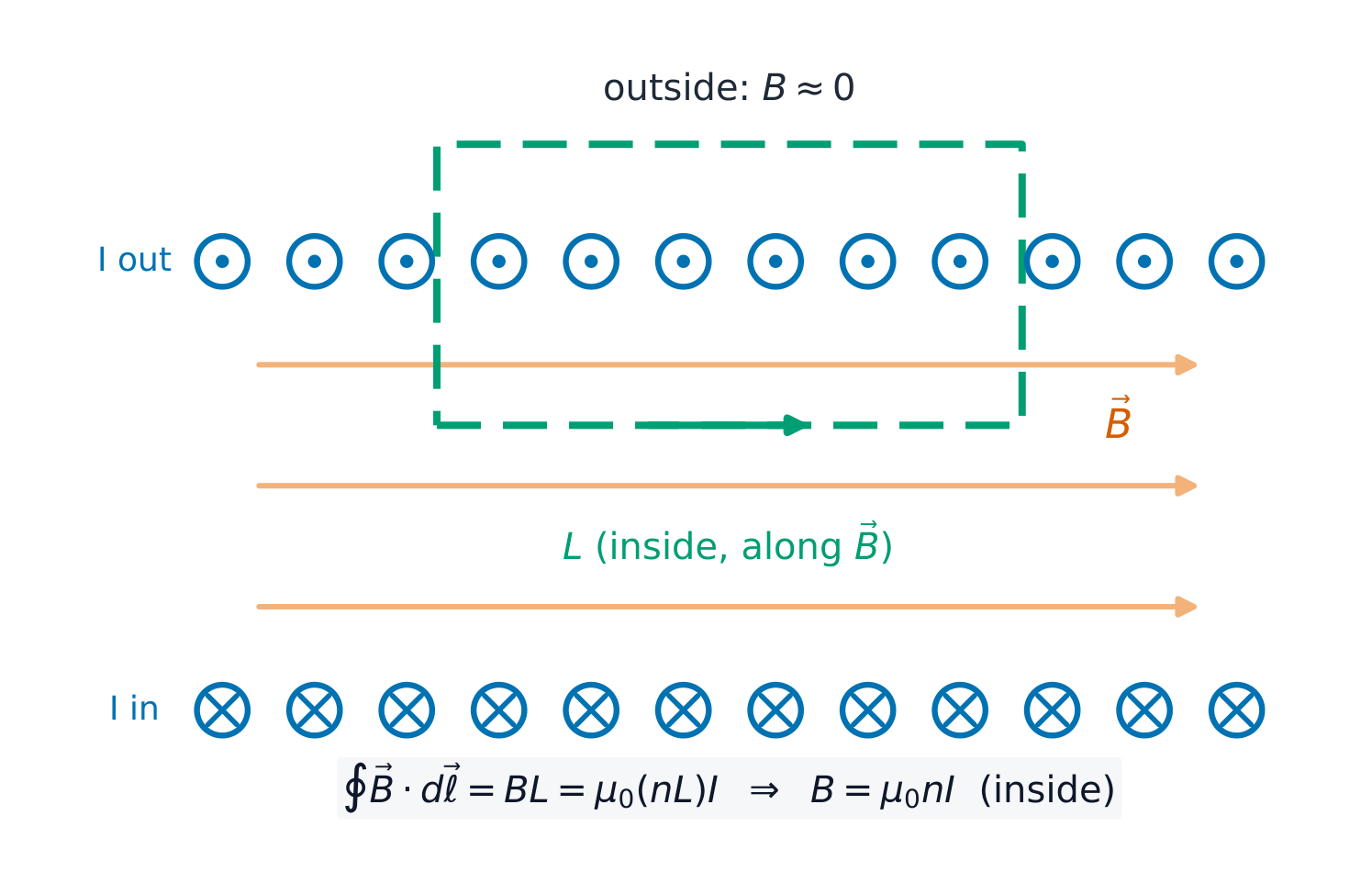
A long solenoid 螺线管 (assumed: uniform field inside, negligible field outside) is the other classic. Take a rectangular loop with one side of length $L$ inside, parallel to the axis: only that side contributes to the integral, so $BL=\mu_0 (nL) I$ and

$$B_{\text{sol}}=\mu_0 n I,$$

with $n$ the turns per metre.

Worked example (cylinder). A solid cylindrical conductor of radius $R$ carries current $I$ spread uniformly over its cross-section. Inside ($r), a circular loop encloses $I_{\text{enc}}=I\dfrac{r^2}{R^2}$, so $B=\dfrac{\mu_0 I r}{2\pi R^2}$ – the field grows linearly to the surface, then falls off as $1/r$ outside.

Exam skill. Every Ampère's-law answer earns its marks in the setup: name the loop, state why $B$ is constant and parallel to it (symmetry), and count $I_{\text{enc}}$ carefully before you solve. Maxwell's fourth equation adds one more idea you should know qualitatively: a changing electric field also creates a magnetic field – but AP will not ask you to compute with that term.

Bahasa Indonesia

Untuk distribusi arus simetris, hukum Ampère menemukan medan jauh lebih cepat daripada Biot–Savart:

$$\oint \vec{B}\cdot d\vec{l}=\mu_0 I_{\text{enc}}.$$

Pilih lingkaran Amperian yang sesuai dengan simetri, sehingga $B$ konstan sepanjang lingkaran (dan sejajar dengannya) serta dapat dikeluarkan dari integral. AP menerapkannya pada kawat lurus panjang, solenoida panjang, dan konduktor yang membawa kerapatan arus (pelat dan silinder); kombinasi ditangani melalui superposisi.

Contoh terpecahkan. Temukan medan $0.10\ \text{m}$ dari kawat panjang yang membawa $5.0\ \text{A}$. Lingkaran berdiameter $r$ memiliki simetri yang sama dengan medannya, sehingga $B(2\pi r)=\mu_0 I$ dan

$$B=\frac{\mu_0 I}{2\pi r}=\frac{(4\pi\times10^{-7})(5.0)}{2\pi(0.10)}=1.0\times10^{-5}\ \text{T}.$$

Solenoida panjang (diasumsikan: medan seragam di dalam, medan dapat diabaikan di luar) adalah contoh klasik lainnya. Ambil lingkaran persegi panjang dengan salah satu sisinya sepanjang $L$ di bagian dalam, sejajar dengan sumbu: hanya sisi tersebut yang berkontribusi terhadap integral, sehingga $BL=\mu_0 (nL) I$ dan

$$B_{\text{sol}}=\mu_0 n I,$$

dengan $n$ jumlah lilitan per meter.

Lingkaran Amperian persegi panjang menurunkan medan seragam di dalam solenoida

Contoh terpecahkan (silinder). Konduktor silinder pejal berjari-jari $R$ membawa arus $I$ yang tersebar merata di seluruh penampang lintangnya. Di dalam ($r), sebuah loop melingkupi $I_{\text{enc}}=I\dfrac{r^2}{R^2}$, sehingga $B=\dfrac{\mu_0 I r}{2\pi R^2}$ – medan tumbuh secara linear hingga permukaan, lalu menurun sebanding $1/r$ di luar.

Keterampilan ujian. Setiap jawaban hukum Ampère mendapatkan nilainya pada tahap penyusunan: sebutkan nama lingkarannya, jelaskan mengapa $B$ konstan dan sejajar dengannya (simetri), dan hitung $I_{\text{enc}}$ dengan teliti sebelum Anda menyelesaikan. Persamaan keempat Maxwell menambahkan satu ide lagi yang harus Anda ketahui secara kualitatif: medan listrik yang berubah juga menciptakan medan magnet – tetapi AP tidak akan meminta Anda menghitung dengan suku tersebut.

12.4

Exam tips · ⁨Tips ujian⁩

English
  • The magnetic force $\vec F=q\vec v\times\vec B$ is perpendicular to velocity — use the right-hand rule and note it does no work.
  • A charge in a uniform field moves in a circle with $r=\tfrac{mv}{qB}$.
  • Find the field of currents with Biot–Savart $d\vec B=\tfrac{\mu_0}{4\pi}\tfrac{I\,d\vec l\times\hat r}{r^2}$ or Ampère's law $\oint \vec B\cdot d\vec l=\mu_0 I_{enc}$ when there is symmetry.
  • Force on a wire is $\vec F=I\vec L\times\vec B$; keep the cross-product direction straight.
  • Distinguish the force on a charge from the field the current creates.
Bahasa Indonesia
  • Gaya magnetik $\vec F=q\vec v\times\vec B$ tegak lurus terhadap kecepatan – gunakan aturan tangan kanan dan perhatikan bahwa gaya ini tidak melakukan usaha.
  • Muatan dalam medan seragam bergerak dalam lingkaran dengan $r=\tfrac{mv}{qB}$.
  • Temukan medan arus dengan Biot–Savart $d\vec B=\tfrac{\mu_0}{4\pi}\tfrac{I\,d\vec l\times\hat r}{r^2}$ atau hukum Ampère $\oint \vec B\cdot d\vec l=\mu_0 I_{enc}$ ketika ada simetri.
  • Gaya pada kawat adalah $\vec F=I\vec L\times\vec B$; jaga arah perkalian silang tetap benar.
  • Bedakan gaya pada muatan dari medan yang dihasilkan arus ke muatan.

Interactive lessons on this topic · ⁨Pelajaran interaktif untuk topik ini⁩

Work through it step by step, with instant-check exercises. · ⁨Kerjakan langkah demi langkah, dengan latihan pengecekan instan.⁩

Past Papers · ⁨Soal-Soil Masa Lalu⁩

More topics in AP Physics C: Electricity and Magnetism · ⁨AP Fisika C: Listrik dan Magnetisme⁩ · ⁨Topik lain dalam AP Physics C: Electricity and Magnetism · ⁨AP Fisika C: Listrik dan Magnetisme⁩⁩

Log in or create account · ⁨Masuk atau buat akun⁩

IGCSE, A-Level & AP