Skip to content · ⁨Lompat ke konten⁩

Conductors and Capacitors · ⁨Konduktor dan Kapasitor⁩

AP Physics C: Electricity and Magnetism · ⁨AP Fisika C: Listrik dan Magnetisme⁩ · Topic 10 · ⁨Topik 10⁩

Video lesson for this topic · ⁨Pelajaran video untuk topik ini⁩ Open the video page · ⁨Buka halaman video⁩
8:28

Konduktor dan Kapasitor

Pesawat dipetir sekitar sekali setahun, dan orang-orang di dalamnya hampir tidak merasakan apa-apa. Mobil di tengah badai petir adalah salah satu tempat paling aman untuk duduk. Mengapa?…

English narration · English + 中文 subtitles burned in · ⁨Narasi bahasa Inggris · Subtitle bahasa Inggris + 中文 disematkan langsung⁩

10.1

Electrostatics with Conductors · ⁨Elektrostatis dengan Konduktor⁩

Syllabus · ⁨Silabus⁩
English

Learning Objective 10.1.A: Describe the charge distribution within a conductor.

  • 10.1.A.1 An ideal conductor is a material in which electrons are able to move freely.
  • 10.1.A.2 When a conductor is in electrostatic equilibrium, mutual repulsion of excess charge carriers results in those charge carriers residing entirely on the surface of the conductor.
    • 10.1.A.2.i In a conductor with a negative net charge, excess electrons reside on the surface of the conductor.
    • 10.1.A.2.ii In a conductor with a positive net charge, the surface becomes deficient in electrons, and can be modeled as if positive charge carriers reside on the surface of the conductor.
  • 10.1.A.3 Excess charges will move to the surface of a conductor to create a state of electrostatic equilibrium within the conductor.
    • 10.1.A.3.i The time interval over which charges reach electrostatic equilibrium within a conductor is so short as to be negligible.
    • 10.1.A.3.ii When a conductor reaches electrostatic equilibrium, all points on the surface of the conductor have the same electric potential, and the conductor becomes an equipotential surface.
    • 10.1.A.3.iii The charge density on the surface of a conductor will be greater where there are points or edges compared to planar areas.
  • 10.1.A.4 All excess charges reside on the surface of a conductor, which means there is no net charge in the interior of the conductor, and the electric field is zero within the conductor.
  • 10.1.A.5 The electric field is perpendicular to the outer surface of a conductor.
  • 10.1.A.6 A conductor can be polarized in the presence of an external electric field. This is a consequence of the conductor remaining an equipotential surface.
  • 10.1.A.7 Electrostatic shielding is the process of surrounding an area with a closed, conducting shell to create a region inside the conductor that is free from external electric fields.
Bahasa Indonesia

Tujuan Pembelajaran 10.1.A: Jelaskan distribusi muatan di dalam konduktor.

  • 10.1.A.1 Konduktor ideal adalah bahan di mana elektron dapat bergerak bebas.
  • 10.1.A.2 Ketika konduktor berada dalam kesetimbangan elektrostatis, tolak-menolak timbal balik pembawa muatan berlebih menyebabkan pembawa muatan tersebut menempati seluruh permukaan konduktor.
    • 10.1.A.2.i Pada konduktor dengan muatan bersih negatif, elektron berlebih menempati permukaan konduktor.
    • 10.1.A.2.ii Pada konduktor dengan muatan bersih positif, permukaannya kekurangan elektron, dan dapat dimodelkan seolah-olah pembawa muatan positif menempati permukaan konduktor.
  • 10.1.A.3 Muatan berlebih akan bergerak ke permukaan konduktor untuk menciptakan keadaan kesetimbangan elektrostatis di dalam konduktor.
    • 10.1.A.3.i Selang waktu di mana muatan mencapai kesetimbangan elektrostatik dalam sebuah konduktor sangat singkat sehingga dapat diabaikan.
    • 10.1.A.3.ii Ketika sebuah konduktor mencapai kesetimbangan elektrostatik, semua titik pada permukaan konduktor memiliki potensial listrik yang sama, dan konduktor tersebut menjadi permukaan ekuipotensial.
    • 10.1.A.3.iii Kepadatan muatan pada permukaan konduktor akan lebih besar di daerah yang memiliki titik atau tepi dibandingkan dengan area datar.
  • 10.1.A.4 Semua muatan berlebih berada pada permukaan konduktor, yang berarti tidak ada muatan bersih di bagian dalam konduktor, dan medan listriknya nol di dalam konduktor.
  • 10.1.A.5 Medan listrik tegak lurus terhadap permukaan luar konduktor.
  • 10.1.A.6 Konduktor dapat terpolarisasi di hadapan medan listrik eksternal. Ini merupakan akibat dari konduktor yang tetap mempertahankan status sebagai permukaan ekuipotensial.
  • 10.1.A.7 Peredaman elektrostatik adalah proses mengelilingi suatu area dengan kulit konduktor tertutup untuk menciptakan wilayah di dalam konduktor yang bebas dari medan listrik eksternal.
Source: College Board AP Course and Exam Description · ⁨Sumber: Deskripsi Kursus dan Ujian College Board AP⁩

English

In an ideal conductor 导体, electrons move freely. Put extra charge on one and the charges repel each other until, almost instantly, they settle into electrostatic equilibrium 静电平衡. In that state the conductor has four properties you must be able to state and use:

  • The electric field inside the conductor is zero. If it were not, free electrons would still be moving.
  • All excess charge sits on the surface. (Negative net charge = extra electrons on the surface; positive = a shortage of electrons there.)
  • The field just outside is perpendicular 垂直 to the surface, with magnitude $E=\sigma/\varepsilon_0$. Any parallel component would push charge sideways along the surface.
  • The whole conductor is one equipotential surface 等势面: every point, inside and on the surface, is at the same potential.

Charge density is largest where the surface curves sharply – at points and edges – so the outside field is strongest there. In an external field a conductor polarizes: charge shifts on its surface so that the interior stays field-free and the body stays an equipotential. Surrounding a region with a closed conducting shell keeps outside fields out entirely – electrostatic shielding 静电屏蔽, the idea behind the Faraday cage 法拉第笼.

Bahasa Indonesia

Dalam konduktor ideal, elektron bergerak bebas. Letakkan muatan berlebih di salah satu sisi dan muatan-muatan tersebut saling tolak hingga, hampir seketika, mereka menetap dalam keseimbangan elektrostatis. Dalam keadaan ini konduktor memiliki empat sifat yang harus Anda bisa nyatakan dan gunakan:

  • Medan listrik di dalam konduktor adalah nol. Jika tidak, elektron bebas masih akan bergerak.
  • Semua muatan berlebih berada di permukaan. (Muatan bersih negatif = elektron berlebih di permukaan; positif = kekurangan elektron di sana.)
  • Medan tepat di luar adalah tegak lurus terhadap permukaan, dengan besarannya $E=\sigma/\varepsilon_0$. Komponen sejajar apa pun akan mendorong muatan menyamping sepanjang permukaan.
  • Seluruh konduktor adalah satu permukaan ekuipotensial: setiap titik, di dalam dan di permukaan, berada pada potensial yang sama.

Kepadatan muatan terbesar di mana permukaan melengkung tajam – di titik dan tepi – sehingga medan di luarnya paling kuat di sana. Dalam medan eksternal, konduktor terpolarisasi: muatan bergeser di permukaannya sehingga bagian dalamnya tetap bebas medan dan badannya tetap ekuipotensial. Mengelilingi suatu wilayah dengan cangkang konduktor tertutup sepenuhnya menghalangi medan di luar – pelindung elektrostatis, ide di balik kandang Faraday.

10.2

Redistribution of Charge Between Conductors · ⁨Redistribusi Muatan Antara Konduktor⁩

Syllabus · ⁨Silabus⁩
English

Learning Objective 10.2.A: Describe the movement of charge and the resulting interactions when conductors physically contact each other.

  • 10.2.A.1 When conductors are in electrical contact, charges will be redistributed such that the surfaces of each conductor are at the same electric potential.
  • 10.2.A.2 Ground is an idealized reference point that has zero electric potential and can absorb or provide an infinite amount of charge without changing its electric potential.
  • 10.2.A.3 Charge can be induced on a conductor by grounding the conductor in the presence of an external electric field.
Bahasa Indonesia

Tujuan Pembelajaran 10.2.A: Jelaskan pergerakan muatan dan interaksi yang terjadi ketika konduktor bersentuhan secara fisik.

  • 10.2.A.1 Ketika konduktor terhubung secara listrik, muatan akan terdistribusi ulang sedemikian rupa sehingga permukaan setiap konduktor berada pada potensial listrik yang sama.
  • 10.2.A.2 Tanah (ground) adalah titik referensi ideal yang memiliki nol potensial listrik dan dapat menyerap atau menyediakan jumlah muatan tak terhingga tanpa mengubah potensial listriknya.
  • 10.2.A.3 Muatan dapat diinduksi pada konduktor dengan cara menghubungkan konduktor tersebut ke tanah (grounding) di hadapan medan listrik eksternal.

Source: College Board AP Course and Exam Description · ⁨Sumber: Deskripsi Kursus dan Ujian College Board AP⁩

English

When two conductors touch (or are wired together), charge flows between them until both surfaces reach the same potential – that is the stopping condition, not "equal charges". A larger sphere holds more charge at the same potential ($V=kQ/R$), so it takes the larger share.

Worked example. A small sphere of radius $R$ carrying $+6.0\ \mu\text{C}$ touches a distant sphere of radius $2R$, then they separate. Equal potentials require $\dfrac{kq_1}{R}=\dfrac{kq_2}{2R}$, so $q_2=2q_1$. With $q_1+q_2=6.0\ \mu\text{C}$: $q_1=2.0\ \mu\text{C}$ and $q_2=4.0\ \mu\text{C}$.

Ground 接地 is an idealized reference at zero potential that can absorb or supply any amount of charge. Grounding a conductor while an external charge is nearby leaves the conductor with a net induced charge 感应电荷: the external field pushes charge of one sign to ground, and cutting the ground wire before removing the external charge traps the rest.

Bahasa Indonesia

Ketika dua konduktor bersentuhan (atau dihubungkan dengan kawat), muatan mengalir di antara keduanya hingga kedua permukaan mencapai potensial yang sama – itulah kondisi berhenti, bukan "muatan yang sama". Bola yang lebih besar menyimpan lebih banyak muatan pada potensial yang sama ($V=kQ/R$), sehingga ia mengambil porsi yang lebih besar.

Contoh terpadu. Sebuah bola kecil berjari-jari $R$ membawa muatan $+6.0\ \mu\text{C}$ menyentuh bola jauh berjari-jari $2R$, kemudian keduanya terpisah. Potensial yang sama mensyaratkan $\dfrac{kq_1}{R}=\dfrac{kq_2}{2R}$, sehingga $q_2=2q_1$. Dengan $q_1+q_2=6.0\ \mu\text{C}$: $q_1=2.0\ \mu\text{C}$ dan $q_2=4.0\ \mu\text{C}$.

Tanah adalah referensi ideal pada nol potensial yang dapat menyerap atau menyediakan muatan dalam jumlah berapa pun. Menguatkan (grounding) konduktor sementara muatan eksternal berada di dekatnya meninggalkan konduktor dengan muatan induksi netto: medan eksternal mendorong muatan dari satu tanda ke tanah, dan memutus kawat tanah sebelum menghapus muatan eksternal menjebak sisanya.

Vocabulary · ⁨Kosa kata⁩ Train · ⁨Latih⁩
English Bahasa Indonesia
conductor/kənˈdʌktə/ konduktor
electrostatic equilibrium/ɪˌlektrəʊˈstætɪk ˌiːkwɪˈlɪbrɪəm/ kesetimbangan elektrostatik
perpendicular/ˌpɜːpənˈdɪkjʊlə/ tegak lurus
equipotential surface/ˌiːkwɪpəˈtenʃl ˈsɜːfɪs/ Permukaan ekuipotensial
electrostatic shielding/ɪˌlektrəʊˈstætɪk ˈʃiːldɪŋ/ Peredaman elektrostatik
Faraday cage/ˈfærədeɪ keɪdʒ/ sangkar Faraday
ground/ɡraʊnd/ landasan
induced charge/ɪnˈdjuːst tʃɑːdʒ/ Muatan terinduksi
10.3

Capacitors · ⁨Kapasitor⁩

Syllabus · ⁨Silabus⁩
English

Learning Objective 10.3.A: Describe the physical properties of a parallel-plate capacitor.

  • 10.3.A.1 A parallel-plate capacitor consists of two separated parallel conducting surfaces that can hold equal amounts of charge with opposite signs.
  • 10.3.A.2 Capacitance relates the magnitude of the charge stored on each plate to the electric potential difference created by the separation of those charges.
    • Equation: $C = \dfrac{Q}{\Delta V}$
    • 10.3.A.2.i The capacitance of a capacitor depends only on the physical properties of the capacitor, such as the capacitor's shape and the material used to separate the plates.
    • 10.3.A.2.ii The capacitance of a parallel-plate capacitor is proportional to the area of one of its plates and inversely proportional to the distance between its plates. The constant of proportionality is the product of the dielectric constant, $\kappa$, of the material between the plates and the electric permittivity of free space, $\varepsilon_0$.
      • Equation: $C = \dfrac{\kappa \varepsilon_0 A}{d}$
  • 10.3.A.3 The electric field between two charged parallel plates with uniformly distributed electric charge, such as in a parallel-plate capacitor, is constant in both magnitude and direction, except near the edges of the plates.
    • 10.3.A.3.i The magnitude of the electric field between two charged parallel plates, where the plate separation is much smaller than the dimensions of the plates, can be determined by applying Gauss's law and the principle of superposition.
      • Equation: $E = \dfrac{Q}{\varepsilon_0 A}$
    • 10.3.A.3.ii The electric field is proportional to the surface charge density on either plate of the capacitor.
    • 10.3.A.3.iii A charged particle between two oppositely charged parallel plates undergoes constant acceleration, and therefore its motion shares characteristics with the projectile motion of an object with mass in the gravitational field near Earth's surface.
  • 10.3.A.4 The electric potential energy stored in a capacitor is equal to the work done by an external force to separate that amount of charge on the capacitor.
  • 10.3.A.5 The electric potential energy stored in a capacitor is described by the equation $U_C = \dfrac{1}{2} Q \Delta V$.

Boundary statement: While other shapes are also able to separate charges, AP Physics C: Electricity & Magnetism only expects the quantitative analysis and description of parallel-plate capacitors, concentric spherical capacitors, and coaxial cylindrical capacitors.

Bahasa Indonesia

Tujuan Pembelajaran 10.3.A: Jelaskan sifat fisik kapasitor pelat sejajar.

  • 10.3.A.1 Kapasitor pelat sejajar terdiri dari dua permukaan konduktor sejajar yang terpisah dan mampu menampung muatan yang sama besar dengan tanda berlawanan.
  • 10.3.A.2 Kapasitas membandingkan besaran muatan yang tersimpan pada setiap pelat dengan beda potensial listrik yang dihasilkan oleh pemisahan muatan tersebut.
    • Persamaan: $C = \dfrac{Q}{\Delta V}$
    • 10.3.A.2.i Kapasitas kapasitor hanya bergantung pada sifat fisik kapasitor itu sendiri, seperti bentuk kapasitor dan bahan yang digunakan untuk memisahkan pelat-pelatnya.
    • 10.3.A.2.ii Kapasitas kapasitor pelat sejajar berbanding lurus dengan luas salah satu pelatnya dan berbanding terbalik dengan jarak antar pelatnya. Konstanta perbandingan ini adalah hasil kali konstanta dielektrik, $\kappa$, dari material di antara pelat dan permitivitas ruang hampa, $\varepsilon_0$.
      • Persamaan: $C = \dfrac{\kappa \varepsilon_0 A}{d}$
  • 10.3.A.3 Medan listrik di antara dua pelat sejajar bermuatan dengan distribusi muatan listrik yang seragam, seperti pada kapasitor pelat sejajar, bersifat konstan baik dalam besaran maupun arah, kecuali di dekat tepi pelat.
    • 10.3.A.3.i Besaran medan listrik di antara dua pelat sejajar bermuatan, di mana jarak antar pelat jauh lebih kecil daripada dimensi pelat, dapat ditentukan dengan menerapkan hukum Gauss dan prinsip superposisi.
      • Persamaan: $E = \dfrac{Q}{\varepsilon_0 A}$
    • 10.3.A.3.ii Medan listrik berbanding lurus dengan kepadatan muatan permukaan pada salah satu pelat kapasitor.
    • 10.3.A.3.iii Partikel bermuatan di antara dua pelat sejajar bermuatan berlawanan mengalami percepatan konstan, sehingga gerakannya memiliki karakteristik serupa dengan gerak peluru benda bermassa di dalam medan gravitasi dekat permukaan Bumi.
  • 10.3.A.4 Energi potensial listrik yang tersimpan dalam kapasitor sama dengan usaha yang dilakukan oleh gaya eksternal untuk memisahkan sejumlah muatan tersebut pada kapasitor.
  • 10.3.A.5 Energi potensial listrik yang tersimpan dalam kapasitor dijelaskan oleh persamaan $U_C = \dfrac{1}{2} Q \Delta V$.

Pernyataan Batasan: Meskipun bentuk lain juga mampu memisahkan muatan, AP Physics C: Listrik & Magnetisme hanya mengharapkan analisis kuantitatif dan deskripsi kapasitor pelat sejajar, kapasitor bola konsentris, dan kapasitor silinder koaksial.

Source: College Board AP Course and Exam Description · ⁨Sumber: Deskripsi Kursus dan Ujian College Board AP⁩

English
Charging a capacitor (RC)

A capacitor 电容器 stores charge on two conductors separated by a gap: $+Q$ on one plate, $-Q$ on the other. Its capacitance 电容 relates the stored charge to the potential difference between the plates:

$$C=\frac{Q}{\Delta V}.$$

Capacitance depends only on geometry and the material in the gap – never on $Q$ or $\Delta V$ themselves.

Worked derivation (parallel plates). For a parallel-plate capacitor 平行板电容器 with plate area $A$ and small gap $d$: Gauss's law plus superposition 叠加 gives a uniform 均匀 field between the plates, $E=\dfrac{\sigma}{\varepsilon_0}=\dfrac{Q}{\varepsilon_0 A}$ (each plate alone contributes $\sigma/2\varepsilon_0$; between the plates the two add, outside they cancel). A uniform field means $\Delta V=Ed=\dfrac{Qd}{\varepsilon_0 A}$, so

$$C=\frac{Q}{\Delta V}=\frac{\varepsilon_0 A}{d}.$$

This $E\to\Delta V\to C$ chain is a standard FRQ derivation – learn it as three steps, and quote each one. The same method handles the other two shapes AP expects: concentric spheres ($C=4\pi\varepsilon_0\dfrac{ab}{b-a}$) and a coaxial cylinder of length $L$, where $E=\dfrac{\lambda}{2\pi\varepsilon_0 r}$ gives $\Delta V=\dfrac{\lambda}{2\pi\varepsilon_0}\ln\dfrac{b}{a}$ and so $C=\dfrac{2\pi\varepsilon_0 L}{\ln(b/a)}$.

Worked example. Plates of area $A=0.020\ \text{m}^2$ and gap $d=1.0\ \text{mm}$: $C=\dfrac{8.85\times10^{-12}(0.020)}{1.0\times10^{-3}}=1.8\times10^{-10}\ \text{F}$. Charged to $100\ \text{V}$ it holds $Q=CV=1.8\times10^{-8}\ \text{C}$.

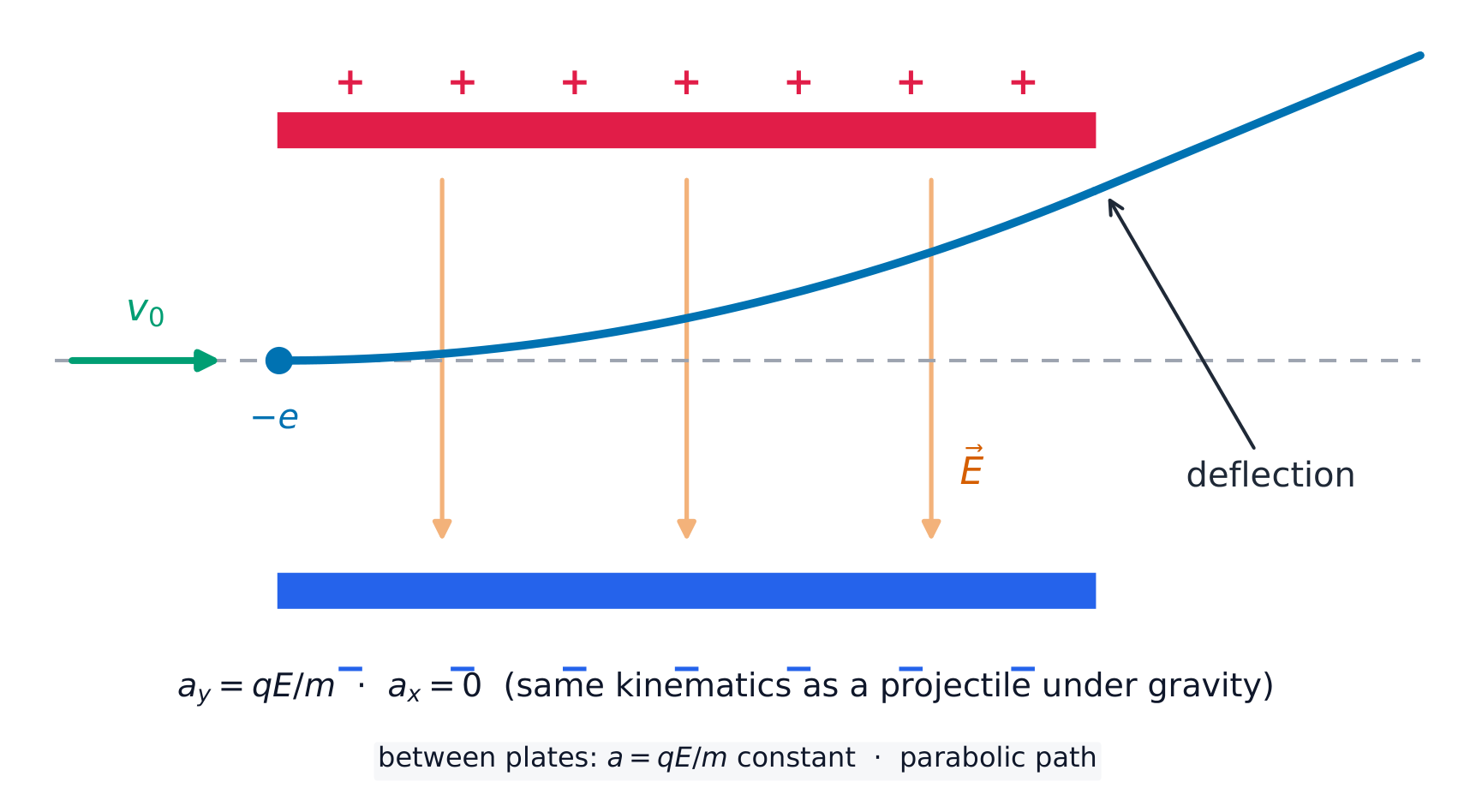
Because the field between the plates is uniform, a charged particle there feels a constant force, so it moves with constant acceleration – exactly like projectile motion 抛体运动 in gravity: constant speed across, uniform acceleration towards a plate.

Worked example. An electron enters midway between plates at $v_0=2.0\times10^{7}\ \text{m/s}$, parallel to them. The field is $E=1.0\times10^{3}\ \text{N/C}$ and the plates are $4.0\ \text{cm}$ long. Acceleration: $a=\dfrac{eE}{m}=\dfrac{(1.6\times10^{-19})(1.0\times10^{3})}{9.11\times10^{-31}}=1.8\times10^{14}\ \text{m/s}^2$. Time between the plates: $t=\dfrac{0.040}{2.0\times10^{7}}=2.0\times10^{-9}\ \text{s}$. Deflection: $y=\tfrac12at^{2}=\tfrac12(1.8\times10^{14})(2.0\times10^{-9})^{2}\approx3.5\times10^{-4}\ \text{m}$ – about $0.35\ \text{mm}$ towards the positive plate.

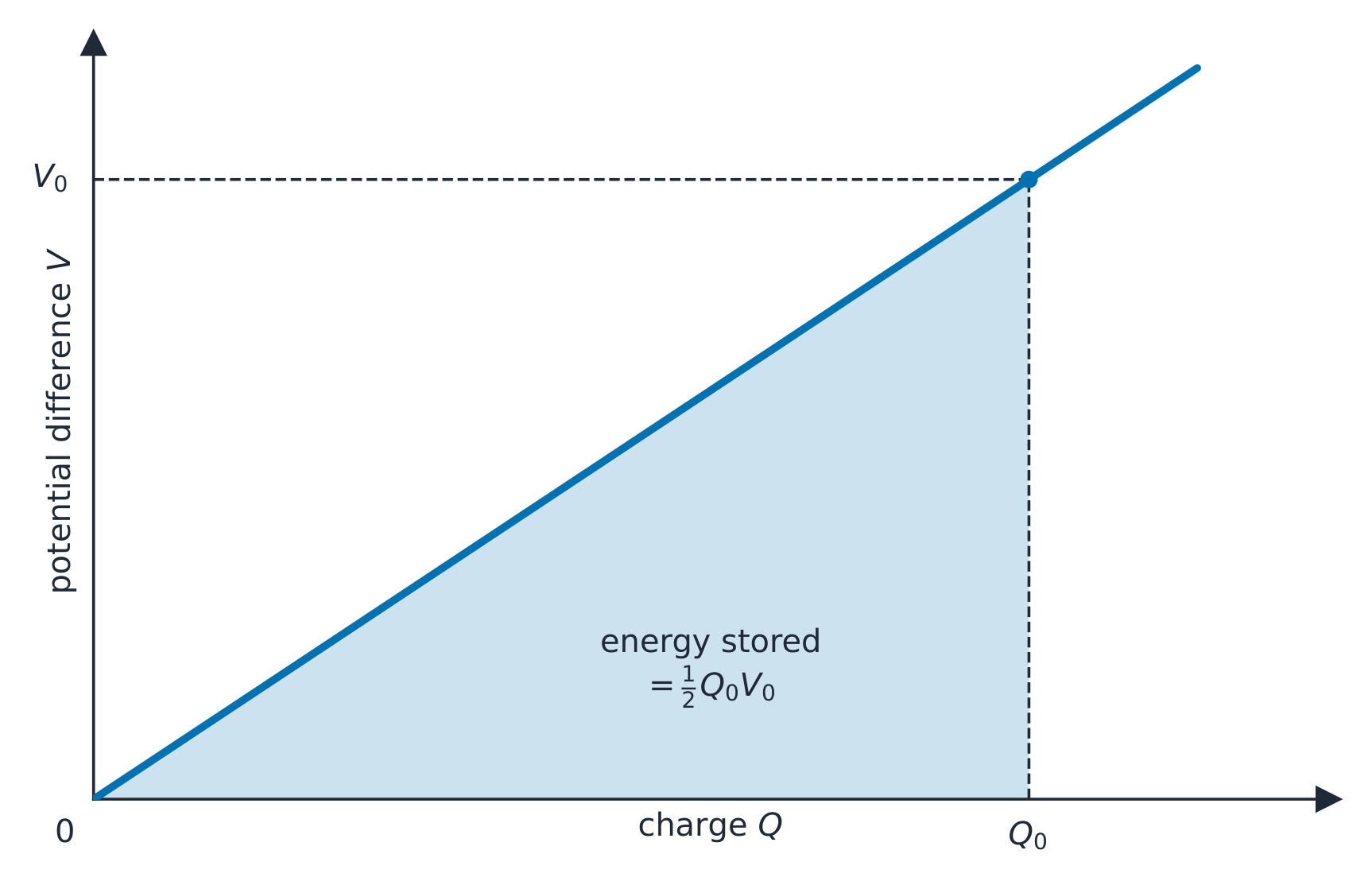
Storing charge takes work 功: an external force must move each bit of charge against the field of the charge already there. The total work ends up as stored potential energy,

$$U_C=\tfrac12\,Q\,\Delta V=\tfrac12 C(\Delta V)^2=\frac{Q^2}{2C}.$$

The factor $\tfrac12$ is the area of the triangle under the $Q$–$\Delta V$ line: the first charge moved across costs almost nothing, the last costs the full $\Delta V$.

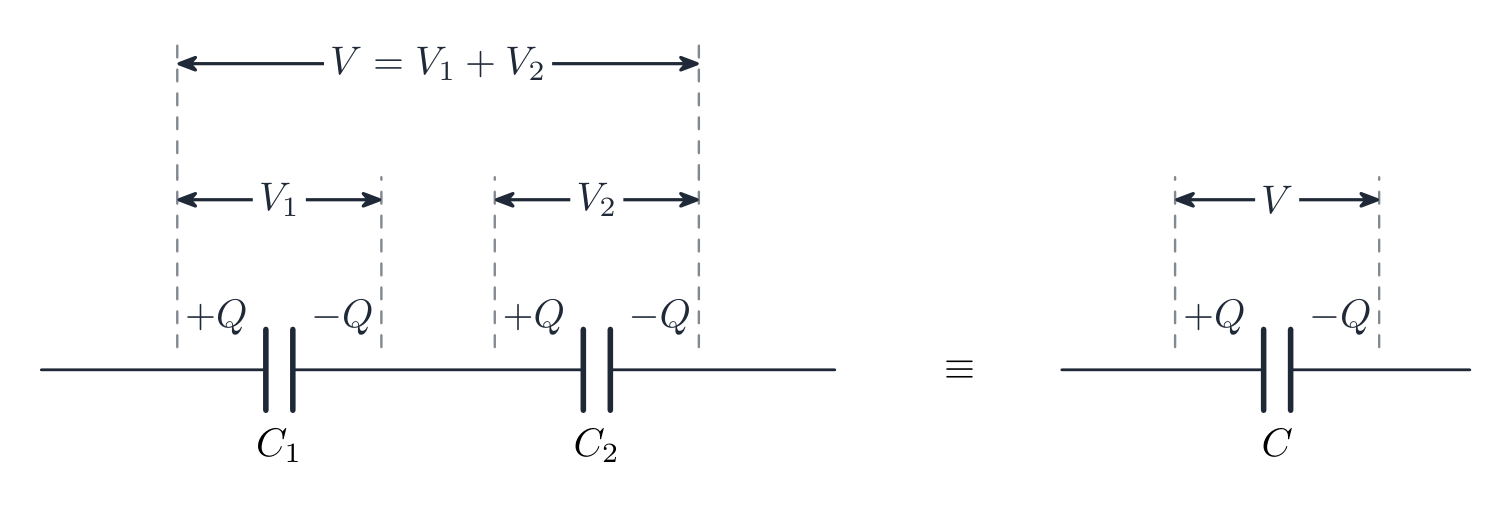
Capacitors combine oppositely to resistors: in parallel 并联 the capacitances add ($C_{\text{eq}}=C_1+C_2$, same $\Delta V$, charges add), while in series 串联 the reciprocals add ($\tfrac{1}{C_{\text{eq}}}=\tfrac{1}{C_1}+\tfrac{1}{C_2}$, same $Q$, voltages add).

Worked example. A $2\ \mu\text{F}$ and a $4\ \mu\text{F}$ capacitor in series: $\tfrac{1}{C}=\tfrac12+\tfrac14$, so $C=\tfrac43\ \mu\text{F}$. The same pair in parallel: $6\ \mu\text{F}$.

Bahasa Indonesia
Mengisi kapasitor (RC)

Sebuah kapasitor menyimpan muatan pada dua konduktor yang dipisahkan oleh celah: $+Q$ pada pelat satu, $-Q$ pada pelat lainnya. Kapasitansinya menghubungkan muatan yang tersimpan dengan beda potensial antar pelat:

$$C=\frac{Q}{\Delta V}.$$

Kapasitansi hanya bergantung pada geometri dan material di celah – tidak pernah pada $Q$ atau $\Delta V$ itu sendiri.

Turunan contoh terpecahkan (pelat paralel). Untuk kapasitor pelat paralel dengan luas pelat $A$ dan celah kecil $d$: Hukum Gauss ditambah superposisi menghasilkan medan seragam di antara pelat, $E=\dfrac{\sigma}{\varepsilon_0}=\dfrac{Q}{\varepsilon_0 A}$ (setiap pelat saja berkontribusi $\sigma/2\varepsilon_0$; di antara pelat keduanya menambah, di luar mereka saling menghilangkan). Medan seragam berarti $\Delta V=Ed=\dfrac{Qd}{\varepsilon_0 A}$, jadi

$$C=\frac{Q}{\Delta V}=\frac{\varepsilon_0 A}{d}.$$

Rantai $E\to\Delta V\to C$ ini adalah turunan FRQ standar – pelajari sebagai tiga langkah, dan kutipkan masing-masing. Metode yang sama menangani dua bentuk lain yang diharapkan AP: bola konsentris ($C=4\pi\varepsilon_0\dfrac{ab}{b-a}$) dan silinder koaksial sepanjang $L$, di mana $E=\dfrac{\lambda}{2\pi\varepsilon_0 r}$ menghasilkan $\Delta V=\dfrac{\lambda}{2\pi\varepsilon_0}\ln\dfrac{b}{a}$ dan seterusnya $C=\dfrac{2\pi\varepsilon_0 L}{\ln(b/a)}$.

Contoh terpecahkan. Pelat dengan luas $A=0.020\ \text{m}^2$ dan celah $d=1.0\ \text{mm}$: $C=\dfrac{8.85\times10^{-12}(0.020)}{1.0\times10^{-3}}=1.8\times10^{-10}\ \text{F}$. Dimuat hingga $100\ \text{V}$ menyimpan $Q=CV=1.8\times10^{-8}\ \text{C}$.

Karena medan antara pelat seragam, partikel bermuatan di sana merasakan gaya konstan, sehingga bergerak dengan percepatan konstan – persis seperti gerak proyektil dalam gravitasi: kecepatan tetap secara horizontal, percepatan seragam menuju pelat.

Partikel bermuatan di antara pelat mengikuti parabola, seperti proyektil *Partikel bermuatan di antara pelat mengikuti parabola, seperti proyektil

Contoh terpecahkan. Elektron memasuki di tengah antara pelat pada $v_0=2.0\times10^{7}\ \text{m/s}$, sejajar dengannya. Medan adalah $E=1.0\times10^{3}\ \text{N/C}$ dan pelat panjangnya $4.0\ \text{cm}$. Percepatan: $a=\dfrac{eE}{m}=\dfrac{(1.6\times10^{-19})(1.0\times10^{3})}{9.11\times10^{-31}}=1.8\times10^{14}\ \text{m/s}^2$. Waktu di antara pelat: $t=\dfrac{0.040}{2.0\times10^{7}}=2.0\times10^{-9}\ \text{s}$. Defleksi: $y=\tfrac12at^{2}=\tfrac12(1.8\times10^{14})(2.0\times10^{-9})^{2}\approx3.5\times10^{-4}\ \text{m}$ – sekitar $0.35\ \text{mm}$ menuju pelat positif.

Menyimpan muatan memerlukan usaha: gaya eksternal harus memindahkan setiap bagian muatan melawan medan dari muatan yang sudah ada. Total usaha berakhir sebagai energi potensial tersimpan,

$$U_C=\tfrac12\,Q\,\Delta V=\tfrac12 C(\Delta V)^2=\frac{Q^2}{2C}.$$

Energi tersimpan dalam kapasitor adalah area di bawah garis muatan-tegangannya *Energi tersimpan dalam kapasitor adalah area di bawah garis muatan-tegangannya
Faktor $\tfrac12$ adalah area segitiga di bawah garis $Q$–$\Delta V$: muatan pertama yang dipindahkan hampir tidak biaya, yang terakhir biaya penuh $\Delta V$.

Kapasitor digabungkan berlawanan dengan resistor: dalam paralel kapasitansinya bertambah ($C_{\text{eq}}=C_1+C_2$, tegangan $\Delta V$ sama, muatan bertambah), sedangkan dalam seri kebalikannya bertambah ($\tfrac{1}{C_{\text{eq}}}=\tfrac{1}{C_1}+\tfrac{1}{C_2}$, muatan $Q$ sama, tegangan bertambah).

Kapasitor dalam seri membawa muatan yang sama, dan beda potensialnya bertambah *Kapasitor dalam seri membawa muatan yang sama, dan beda potensialnya bertambah
Contoh terpecahkan. Kapasitor $2\ \mu\text{F}$ dan $4\ \mu\text{F}$ dalam seri: $\tfrac{1}{C}=\tfrac12+\tfrac14$, sehingga $C=\tfrac43\ \mu\text{F}$. Pasangan yang sama dalam paralel: $6\ \mu\text{F}$.

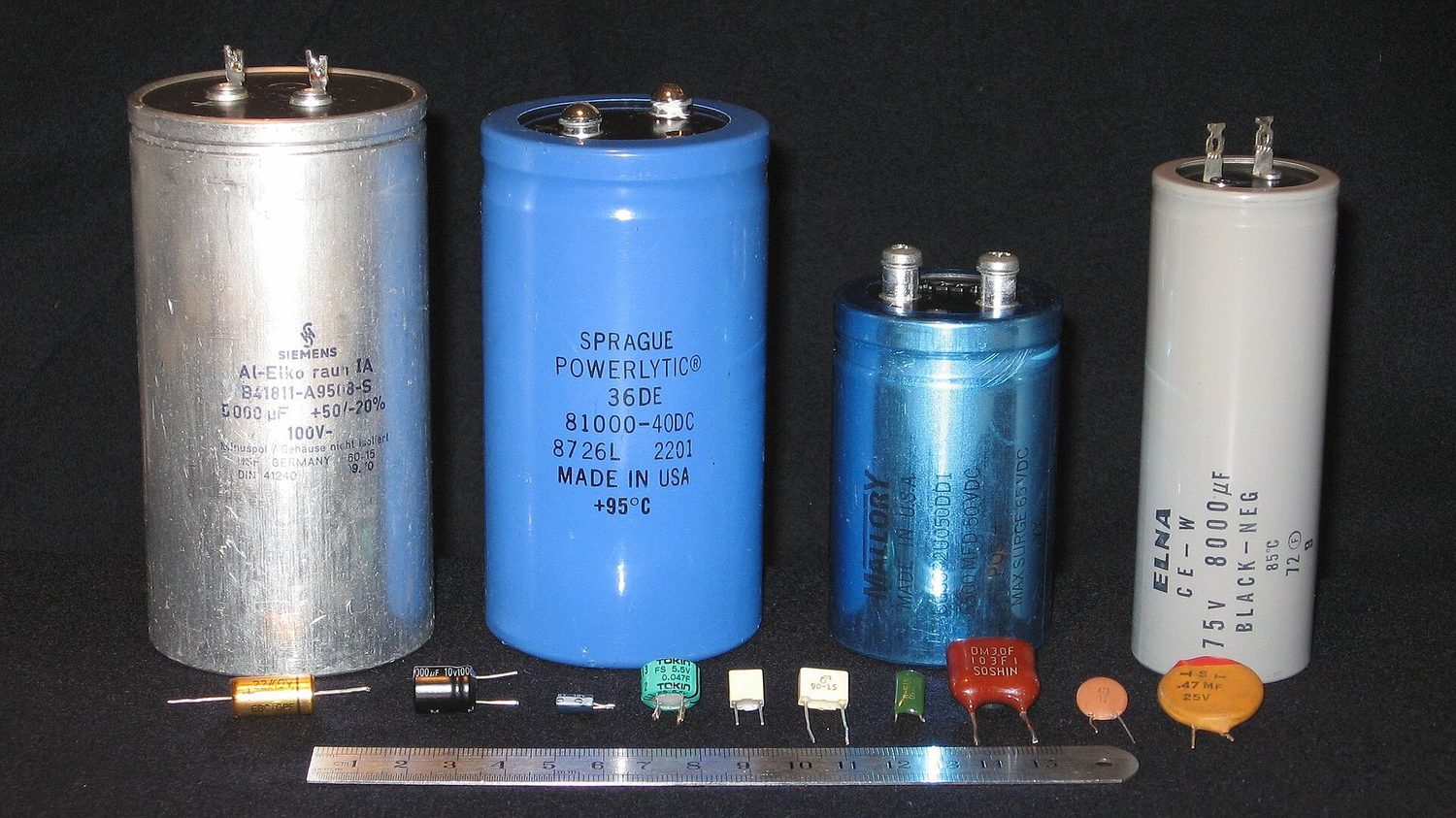
Berbagai kapasitor: perangkat yang menyimpan muatan dan energi dalam medan listrik antar konduktor *Berbagai kapasitor: perangkat yang menyimpan muatan dan energi dalam medan listrik antar konduktor
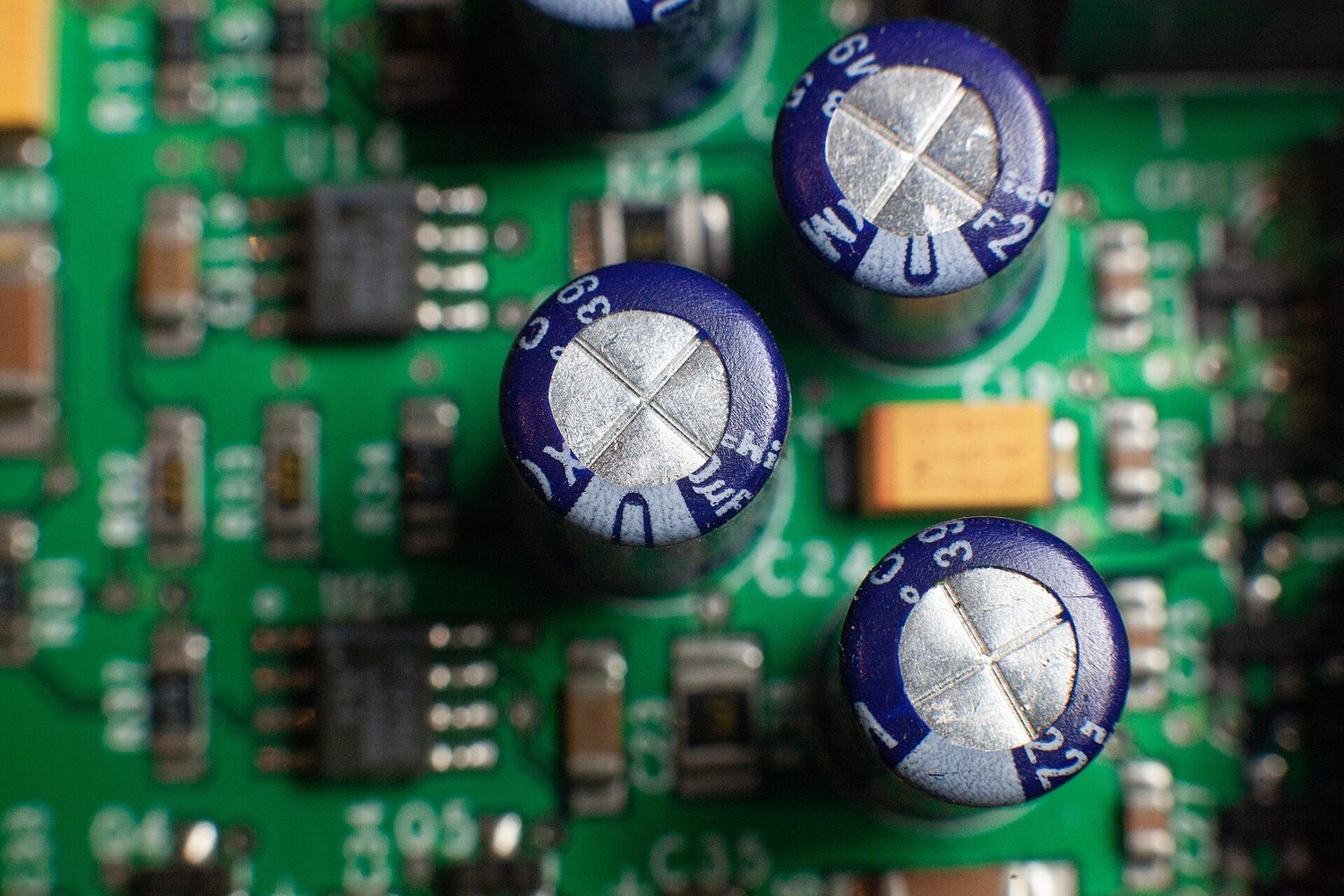
Kapasitor elektrolitik pada papan sirkuit: kapasitansi menyimpan energi sebagai U = ½CV² *Kapasitor elektrolitik pada papan sirkuit: kapasitansi menyimpan energi sebagai U = ½CV²

Explore · ⁨Jelajahi⁩

Charge and discharge a capacitor · ⁨Muati dan kosongkan kapasitor⁩

A capacitor stores charge on two plates, filling and emptying exponentially with time constant $\tau=RC$. Bigger $R$ or $C$ slows it down. · ⁨Kapasitor menyimpan muatan pada dua pelat, mengisi dan mengosongkan secara eksponensial dengan konstanta waktu $\tau=RC$. $R$ atau $C$ yang lebih besar memperlambatnya.⁩

Vocabulary · ⁨Kosa kata⁩ Train · ⁨Latih⁩
English Bahasa Indonesia
capacitor/kəˈpæsɪtə/ kapasitor
capacitance/kəˈpæsɪtəns/ kapasitansi
parallel-plate capacitor/ˈpærəlel pleɪt kəˈpæsɪtə/ Kapasitor pelat sejajar
superposition/ˌsuːpəpəˈzɪʃn/ superposisi
uniform/ˈjuːnɪfɔːm/ seragam
projectile motion/prəˈdʒektaɪl ˈməʊʃn/ gerak peluru
work/wɜːk/ usaha
series/ˈsɪəriːz/ seri
10.4

Dielectrics · ⁨Dielektrik⁩

Syllabus · ⁨Silabus⁩
English

Learning Objective 10.4.A: Describe how a dielectric inserted between the plates of a capacitor changes the properties of the capacitor.

  • 10.4.A.1 In a dielectric material, electric charges are not as free to move as they are in a conductor. Instead, the material becomes polarized in the presence of an external electric field.
  • 10.4.A.2 The dielectric constant of a material relates the electric permittivity of that material to the permittivity of free space.
    • Equation: $\kappa = \dfrac{\varepsilon}{\varepsilon_0}$
  • 10.4.A.3 The electric field created by a polarized dielectric is opposite in direction to the external field.
  • 10.4.A.4 The electric field between the plates of an isolated parallel-plate capacitor decreases when a dielectric is placed between the plates.
    • Equation: $\kappa = \dfrac{E_0}{E}$
  • 10.4.A.5 The insertion of a dielectric into a capacitor may change the capacitance of the capacitor.
    • Equation: $C = \kappa C_0$
Bahasa Indonesia

Tujuan Pembelajaran 10.4.A: Jelaskan bagaimana penyisipan dielektrik di antara pelat kapasitor mengubah sifat kapasitor.

  • 10.4.A.1 Dalam bahan dielektrik, muatan listrik tidak sebebas bergerak dibandingkan dengan konduktor. Sebaliknya, material tersebut terpolarisasi di hadapan medan listrik eksternal.
  • 10.4.A.2 Konstanta dielektrik dari suatu material membandingkan permitivitas material tersebut dengan permitivitas ruang hampa.
    • Persamaan: $\kappa = \dfrac{\varepsilon}{\varepsilon_0}$
  • 10.4.A.3 Medan listrik yang dihasilkan oleh dielektrik yang terpolarisasi berarah berlawanan dengan medan eksternal.
  • 10.4.A.4 Medan listrik di antara pelat kapasitor pelat sejajar terisolasi menurun ketika dielektrik diletakkan di antara pelat-pelatnya.
    • Persamaan: $\kappa = \dfrac{E_0}{E}$
  • 10.4.A.5 Penyisipan dielektrik ke dalam kapasitor dapat mengubah kapasitas kapasitor tersebut.
    • Persamaan: $C = \kappa C_0$

Source: College Board AP Course and Exam Description · ⁨Sumber: Deskripsi Kursus dan Ujian College Board AP⁩

English

A dielectric 电介质 is an insulating material. Its charges cannot travel, but in an external field each molecule stretches or turns slightly – the material becomes polarized 极化. The lined-up molecules create their own small field opposite to the applied one, so the net field inside the material drops:

$$E=\frac{E_0}{\kappa},\qquad \kappa=\frac{\varepsilon}{\varepsilon_0}\ \ (\kappa>1),$$

where $\kappa$ is the dielectric constant 介电常数, the ratio of the material's permittivity to the permittivity of free space 真空介电常数.

Filling a capacitor with dielectric multiplies its capacitance:

$$C=\kappa\,C_0\qquad\left(\text{parallel plates: } C=\frac{\kappa\varepsilon_0 A}{d}\right).$$

What happens next depends on what stays fixed – a favourite exam trap:

battery stays connected ($\Delta V$ fixed) battery removed first ($Q$ fixed)
charge $Q$ rises to $\kappa Q_0$ unchanged
voltage $\Delta V$ unchanged drops to $\Delta V_0/\kappa$
field $E$ unchanged drops to $E_0/\kappa$
energy $U$ rises to $\kappa U_0$ drops to $U_0/\kappa$

Worked example. A $100\ \text{pF}$ capacitor is charged to $12\ \text{V}$, disconnected, then filled with a $\kappa=3$ dielectric. $Q$ is trapped, so $\Delta V$ falls to $4\ \text{V}$ and the stored energy falls to one-third – the missing energy went into pulling the dielectric in. Reconnected to the $12\ \text{V}$ battery instead, the capacitor would hold three times the charge and three times the energy.

Exam skill. Always begin dielectric questions by writing down which quantity is held fixed ($Q$ or $\Delta V$), then let $C=\kappa C_0$ drive everything else through $Q=C\Delta V$ and $U=\tfrac12 C(\Delta V)^2$.

Bahasa Indonesia

Dielektrik adalah bahan isolator. Muatannya tidak dapat berpindah, tetapi dalam medan eksternal setiap molekul meregang atau berputar sedikit – material menjadi terpolarisasi. Molekul yang sejajar menciptakan medan kecil mereka sendiri berlawanan dengan medan yang diterapkan, sehingga medan total di dalam material menurun:

$$E=\frac{E_0}{\kappa},\qquad \kappa=\frac{\varepsilon}{\varepsilon_0}\ \ (\kappa>1),$$

di mana $\kappa$ adalah konstanta dielektrik, rasio permitivitas material terhadap permitivitas ruang hampa.

Dielektrik terpolarisasi menciptakan medan internal yang berlawanan dengan medan yang diterapkan *Dielektrik terpolarisasi menciptakan medan internal yang berlawanan dengan medan yang diterapkan

Mengisi kapasitor dengan dielektrik mengalikan kapasitansinya:

$$C=\kappa\,C_0\qquad\left(\text{parallel plates: } C=\frac{\kappa\varepsilon_0 A}{d}\right).$$

Apa yang terjadi selanjutnya tergantung pada apa yang tetap konstan – jebakan ujian favorit:

baterai tetap terhubung ($\Delta V$ tetap) baterai dilepas dulu ($Q$ tetap)
muatan $Q$ naik ke $\kappa Q_0$ tak berubah
tegangan $\Delta V$ tak berubah turun ke $\Delta V_0/\kappa$
medan $E$ tak berubah turun ke $E_0/\kappa$
energi $U$ naik ke $\kappa U_0$ turun ke $U_0/\kappa$

Contoh terpecahkan. Kapasitor $100\ \text{pF}$ dimuat hingga $12\ \text{V}$, dilepas, lalu diisi dengan dielektrik $\kappa=3$. $Q$ terperangkap, sehingga $\Delta V$ turun ke $4\ \text{V}$ dan energi tersimpan turun menjadi sepertiga – energi yang hilang masuk untuk menarik dielektrik ke dalam. Jika disambungkan kembali ke baterai $12\ \text{V}$, kapasitor akan menyimpan tiga kali lipat muatan dan tiga kali lipat energi.

Keterampilan ujian. Selalu mulai pertanyaan dielektrik dengan menulis besaran mana yang dijaga tetap ($Q$ atau $\Delta V$), lalu biarkan $C=\kappa C_0$ mendorong semua hal lainnya melalui $Q=C\Delta V$ dan $U=\tfrac12 C(\Delta V)^2$.

Explore · ⁨Jelajahi⁩

Add a dielectric · ⁨Tambahkan dielektrik⁩

A dielectric between the plates raises the capacitance, so the capacitor holds more charge at the same voltage. Watch the charge build faster. · ⁨Dielektrik di antara pelat meningkatkan kapasitansi, sehingga kapasitor menyimpan lebih banyak muatan pada tegangan yang sama. Saksikan muatan membangun lebih cepat.⁩

Vocabulary · ⁨Kosa kata⁩ Train · ⁨Latih⁩
English Bahasa Indonesia
parallel/ˈpærəlel/ paralel
dielectric/ˌdaɪɪˈlektrɪk/ dielektrik
polarized/ˈpəʊləraɪzd/ Terpolarisasi
dielectric constant/ˌdaɪɪˈlektrɪk ˈkɒnstənt/ konstanta dielektrik
permittivity of free space/ˌpɜːmɪˈtɪvəti ɒv friː speɪs/ permitivitas ruang hampa
10.4

Exam tips · ⁨Tips ujian⁩

English
  • In electrostatic equilibrium a conductor has $\vec E=0$ inside and all excess charge on the surface.
  • Apply Gauss's law $\oint \vec E\cdot d\vec A=\tfrac{q_{enc}}{\varepsilon_0}$ with a symmetry-matched Gaussian surface (sphere, cylinder, pillbox).
  • The whole conductor is one equipotential, and the surface field is perpendicular to it.
  • For a capacitor use $C=\tfrac{Q}{V}$, energy $U=\tfrac12 CV^2$, and how a dielectric raises $C$.
  • Pick the Gaussian surface so $\vec E$ is constant and parallel (or zero) on each part.
Bahasa Indonesia
  • Dalam kesetimbangan elektrostatik konduktor memiliki $\vec E=0$ di dalamnya dan semua kelebihan muatan di permukaan.
  • Terapkan hukum Gauss $\oint \vec E\cdot d\vec A=\tfrac{q_{enc}}{\varepsilon_0}$ dengan permukaan Gaussian yang sesuai simetrinya (bola, silinder, kotak pil).
  • Seluruh konduktor adalah satu equipotensial, dan medan permukaannya tegak lurus terhadapnya.
  • Untuk kapasitor gunakan $C=\tfrac{Q}{V}$, energi $U=\tfrac12 CV^2$, dan bagaimana dielektrik meningkatkan $C$.
  • Pilih permukaan Gaussian agar $\vec E$ konstan dan sejajar (atau nol) di setiap bagiannya.

Interactive lessons on this topic · ⁨Pelajaran interaktif untuk topik ini⁩

Work through it step by step, with instant-check exercises. · ⁨Kerjakan langkah demi langkah, dengan latihan pengecekan instan.⁩

Past Papers · ⁨Soal-Soil Masa Lalu⁩

More topics in AP Physics C: Electricity and Magnetism · ⁨AP Fisika C: Listrik dan Magnetisme⁩ · ⁨Topik lain dalam AP Physics C: Electricity and Magnetism · ⁨AP Fisika C: Listrik dan Magnetisme⁩⁩

Log in or create account · ⁨Masuk atau buat akun⁩

IGCSE, A-Level & AP