Skip to content · ⁨Lompat ke konten⁩

Magnetism and Electromagnetism · ⁨Magnetisme dan Elektromagnetisme⁩

AP Physics 2 · ⁨AP Fisika 2⁩ · Topic 12 · ⁨Topik 12⁩

Video lesson for this topic · ⁨Pelajaran video untuk topik ini⁩ Open the video page · ⁨Buka halaman video⁩
9:21

Magnetisme dan Elektromagnetisme

Di atas Arktik, langit malam bersinar hijau. Tirai cahaya ini bukan api. Ini adalah partikel bermuatan dari Matahari, tiba di satu juta…

English narration · English + 中文 subtitles burned in · ⁨Narasi bahasa Inggris · Subtitle bahasa Inggris + 中文 disematkan langsung⁩

12.1

Magnetic Fields · ⁨Medan Magnet⁩

Syllabus · ⁨Silabus⁩
English

Learning Objective 12.1.A: Describe the properties of a magnetic field.

  • 12.1.A.1 A magnetic field is a vector field that can be used to determine the magnetic force exerted on moving electric charges, electric currents, or magnetic materials.
    • 12.1.A.1.i Magnetic fields can be produced by magnetic dipoles or combinations of dipoles, but never by monopoles.
    • 12.1.A.1.ii Magnetic dipoles have north and south polarity.
  • 12.1.A.2 A magnetic field is a vector quantity and can be represented using vector field maps.
    • 12.1.A.2.i Magnetic field lines form closed loops.
    • 12.1.A.2.ii Magnetic fields in a bar magnet form closed loops, with the external magnetic field pointing away from one end (defined as the north pole) and returning to the other end (defined as the south pole).

Learning Objective 12.1.B: Describe the magnetic behavior of a material as a result of the configuration of magnetic dipoles in the material.

  • 12.1.B.1 Magnetic dipoles result from the circular or rotational motion of electric charges. In magnetic materials, this can be the motion of electrons.
    • 12.1.B.1.i Permanent magnetism and induced magnetism are system properties that both result from the alignment of magnetic dipoles within a system.
    • 12.1.B.1.ii No magnetic north pole is ever found in isolation from a south pole. For example, if a bar magnet is broken in half, both halves are magnetic dipoles.
    • 12.1.B.1.iii Magnetic poles of the same polarity will repel; magnetic poles of opposite polarity will attract.
    • 12.1.B.1.iv The magnitude of the magnetic field from a magnetic dipole decreases with increasing distance from the dipole.
  • 12.1.B.2 A magnetic dipole, such as a magnetic compass, placed in a magnetic field will tend to align with the magnetic field.
  • 12.1.B.3 A material's composition influences its magnetic behavior in the presence of an external magnetic field.
    • 12.1.B.3.i Ferromagnetic materials such as iron, nickel, and cobalt can be permanently magnetized by an external field that causes the alignment of magnetic domains or atomic magnetic dipoles.
    • 12.1.B.3.ii Paramagnetic materials such as aluminum, titanium, and magnesium interact weakly with an external magnetic field, in that the magnetic dipoles of the material do not remain aligned after the external field is removed.
    • 12.1.B.3.iii All materials have the property of diamagnetism, in that their electronic structure creates a usually weak alignment of the dipole moments of the material opposite the external magnetic field.
  • 12.1.B4 Earth's magnetic field may be approximated as a magnetic dipole.

Learning Objective 12.1.C: Describe the magnetic permeability of a material.

  • 12.1.C.1 Magnetic permeability is a measurement of the amount of magnetization in a material in response to an external magnetic field.
  • 12.1.C.2 Free space has a constant value of magnetic permeability, known as the vacuum permeability $\mu_0$, that appears in equations representing physical relationships.
  • 12.1.C.3 The permeability of matter has values different from that of free space and arises from the matter's composition and arrangement. It is not a constant for a material and varies based on many factors, including temperature, orientation, and strength of the external field.
Bahasa Indonesia

Tujuan Pembelajaran 12.1.A: Jelaskan sifat-sifat medan magnet.

  • 12.1.A.1 Medan magnet adalah medan vektor yang dapat digunakan untuk menentukan gaya magnet yang bekerja pada muatan listrik bergerak, arus listrik, atau material magnet.
    • 12.1.A.1.i Medan magnet dapat dihasilkan oleh dipol magnet atau kombinasi dipol, tetapi tidak pernah oleh monopole.
    • 12.1.A.1.ii Dipol magnet memiliki kutub utara dan selatan.
  • 12.1.A.2 Medan magnet adalah besaran vektor dan dapat direpresentasikan menggunakan peta medan vektor.
    • 12.1.A.2.i Garis-garis medan magnet membentuk lintasan tertutup.
    • 12.1.A.2.ii Medan magnet pada magnet batang membentuk lintasan tertutup, dengan medan magnet eksternal menunjuk menjauhi salah satu ujung (didefinisikan sebagai kutub utara) dan kembali ke ujung lainnya (didefinisikan sebagai kutub selatan).

Tujuan Pembelajaran 12.1.B: Jelaskan perilaku magnetik suatu material akibat konfigurasi dipol magnet di dalamnya.

  • 12.1.B.1 Dipol magnet berasal dari gerakan melingkar atau rotasi muatan listrik. Dalam material magnetik, hal ini dapat berupa gerakan elektron.
    • 12.1.B.1.i Kemagnetan permanen dan kemagnetan induksi adalah sifat sistem yang keduanya berasal dari penyelarasan dipol magnet di dalam sistem.
    • 12.1.B.1.ii Tidak pernah ditemukan kutub utara magnet secara terpisah dari kutub selatan. Sebagai contoh, jika sebuah magnet batang dipatahkan menjadi dua bagian, kedua bagian tersebut tetap merupakan dipol magnet.
    • 12.1.B.1.iii Kutub magnet dengan polaritas yang sama akan tolak-menolak; kutub magnet dengan polaritas yang berlawanan akan tarik-menarik.
    • 12.1.B.1.iv Besar medan magnet dari sebuah dipol magnet berkurang seiring bertambahnya jarak dari dipol tersebut.
  • 12.1.B.2 Dipol magnet, seperti kompas magnet, yang diletakkan dalam medan magnet cenderung sejajar dengan medan magnet tersebut.
  • 12.1.B.3 Komposisi suatu material memengaruhi perilaku magnetiknya di hadapan medan magnet eksternal.
    • 12.1.B.3.i Material feromagnetik seperti besi, nikel, dan kobalt dapat dimagnetkan secara permanen oleh medan eksternal yang menyebabkan penyelarasan domain magnet atau dipol magnet atom.
    • 12.1.B.3.ii Material paramagnetik seperti aluminium, titanium, dan magnesium berinteraksi lemah dengan medan magnet eksternal, di mana dipol magnet material tersebut tidak tetap menyelaraskan diri setelah medan eksternal dihilangkan.
    • 12.1.B.3.iii Semua material memiliki sifat diamagnetisme, di mana struktur elektron mereka menciptakan penyelarasan momen dipol material yang biasanya lemah dan berlawanan arah dengan medan magnet eksternal.
  • 12.1.B4 Medan magnet Bumi dapat didekati sebagai sebuah dipol magnet.

Tujuan Pembelajaran 12.1.C: Jelaskan permeabilitas magnetik suatu material.

  • 12.1.C.1 Permeabilitas magnetik adalah pengukuran jumlah magnetisasi dalam suatu material sebagai respons terhadap medan magnet eksternal.
  • 12.1.C.2 Ruang hampa memiliki nilai konstan permeabilitas magnetik, yang dikenal sebagai permeabilitas vakum $\mu_0$, yang muncul dalam persamaan yang merepresentasikan hubungan fisik.
  • 12.1.C.3 Permeabilitas materi memiliki nilai berbeda dari ruang bebas dan timbul dari komposisi serta susunan materinya. Nilai ini bukan konstanta untuk suatu material dan bervariasi berdasarkan banyak faktor, termasuk suhu, orientasi, dan kekuatan medan eksternal.
Source: College Board AP Course and Exam Description · ⁨Sumber: Deskripsi Kursus dan Ujian College Board AP⁩

English
The magnetic field around a current

Different materials respond very differently to a magnetic field, and the course names three. Ferromagnetic 铁磁性 materials (iron, nickel, cobalt) have dipoles that align strongly and stay aligned, so they can be permanent magnets. Paramagnetic 顺磁性 materials (aluminium, titanium) align only weakly and do not stay aligned. Diamagnetic 抗磁性 materials - in fact all materials have some diamagnetism - align weakly opposite the field. This behaviour comes from a material property, the permeability 磁导率: free space has a fixed permeability of free space $\mu_0$, while the permeability of matter differs from it and is not even constant for a given material.

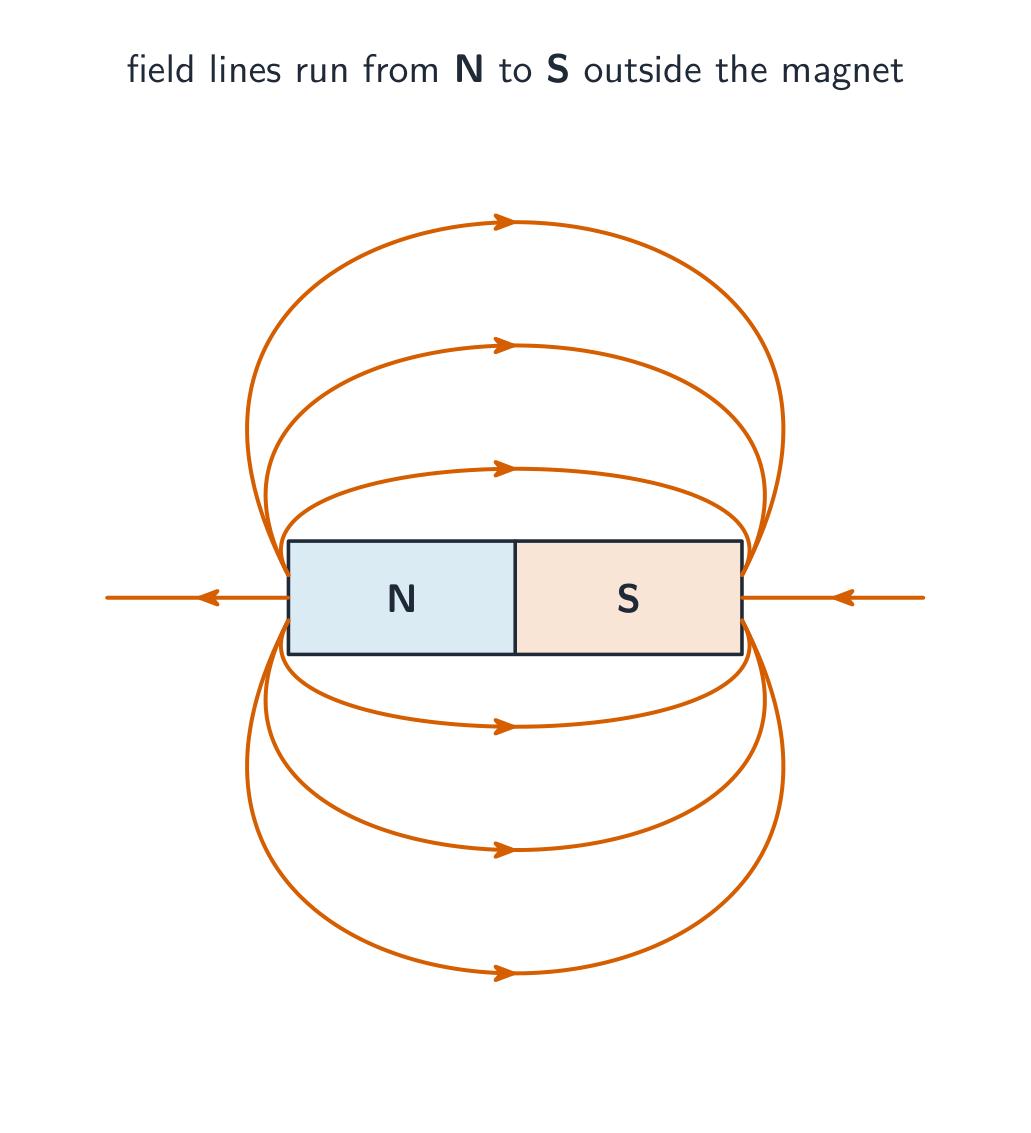
A magnetic field 磁场 $\vec{B}$ surrounds magnets and moving charges. Field lines run from a magnet's north pole to its south pole outside the magnet, and denser lines mean a stronger field. Magnetic poles always come in pairs – cutting a magnet in half makes two smaller magnets, never an isolated pole.

Bahasa Indonesia
Medan magnet di sekitar arus listrik
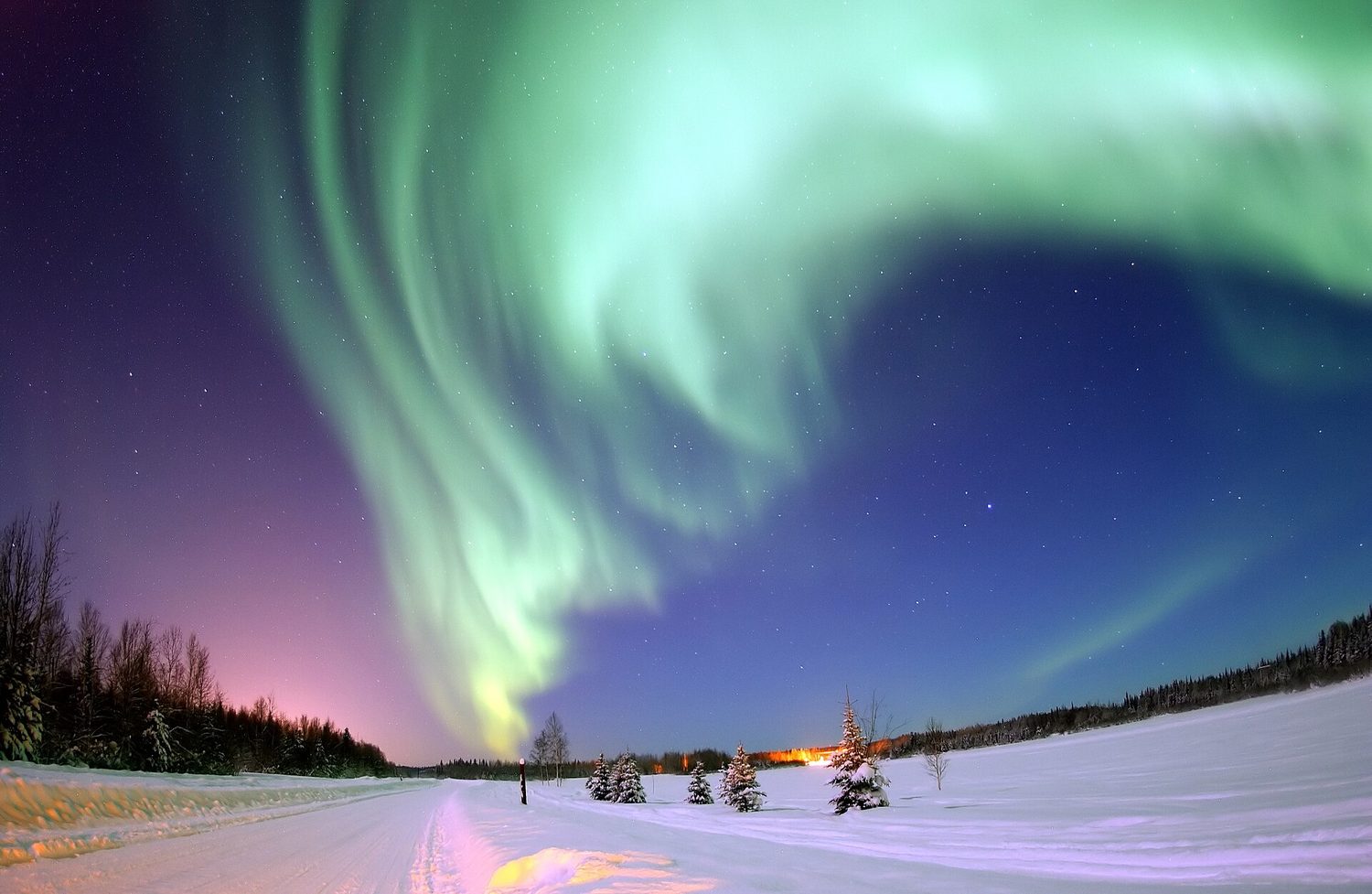
Tirai cahaya hijau berkilau di langit malam di atas lanskap bersalju
Aurora: partikel bermuatan dari Matahari diarahkan oleh medan magnet Bumi menuju kutub, di mana mereka menabrak udara dan membuatnya bercahaya

Bahan-bahan berbeda bereaksi sangat berbeda terhadap medan magnet, dan kursus ini menyebutkan tiga jenis. Bahan feromagnetik (besi, nikel, kobalt) memiliki dipol yang sejajar kuat dan tetap sejajar, sehingga dapat menjadi magnet permanen. Bahan paramagnetik (aluminium, titanium) hanya sejajar lemah dan tidak tetap sejajar. Bahan diamagnetik - sebenarnya semua bahan memiliki sedikit diamagnetisme - sejajar lemah berlawanan arah medan. Perilaku ini berasal dari sifat material, yaitu permeabilitas: ruang hampa memiliki permeabilitas ruang hampa tetap $\mu_0$, sementara permeabilitas materi berbeda darinya dan bahkan tidak konstan untuk suatu bahan tertentu.

Sebuah medan magnet $\vec{B}$ mengelilingi magnet dan muatan yang bergerak. Garis-garis medan berjalan dari kutub utara magnet ke kutub selatan di luar magnet, dan garis yang lebih rapat berarti medan yang lebih kuat. Kutub magnet selalu datang dalam pasangan – memotong magnet menjadi dua bagian menghasilkan dua magnet yang lebih kecil, bukan kutub tunggal.

Garis-garis medan berjalan dari K ke U di luar magnet batang, lebih rapat di mana medan lebih kuat
Garis-garis medan berjalan dari N ke S di luar magnet batang, lebih rapat di mana medan lebih kuat
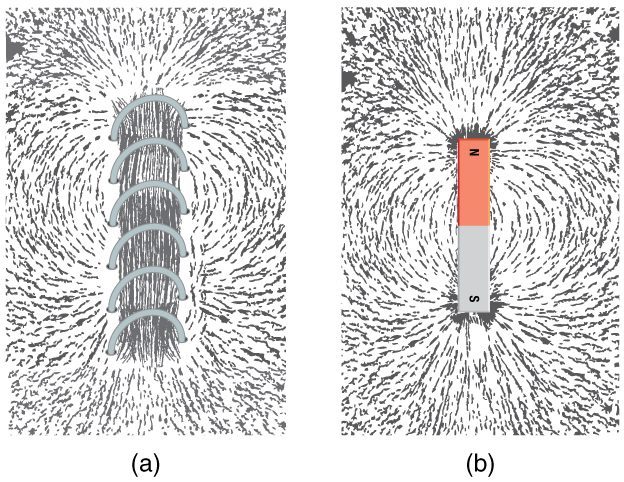
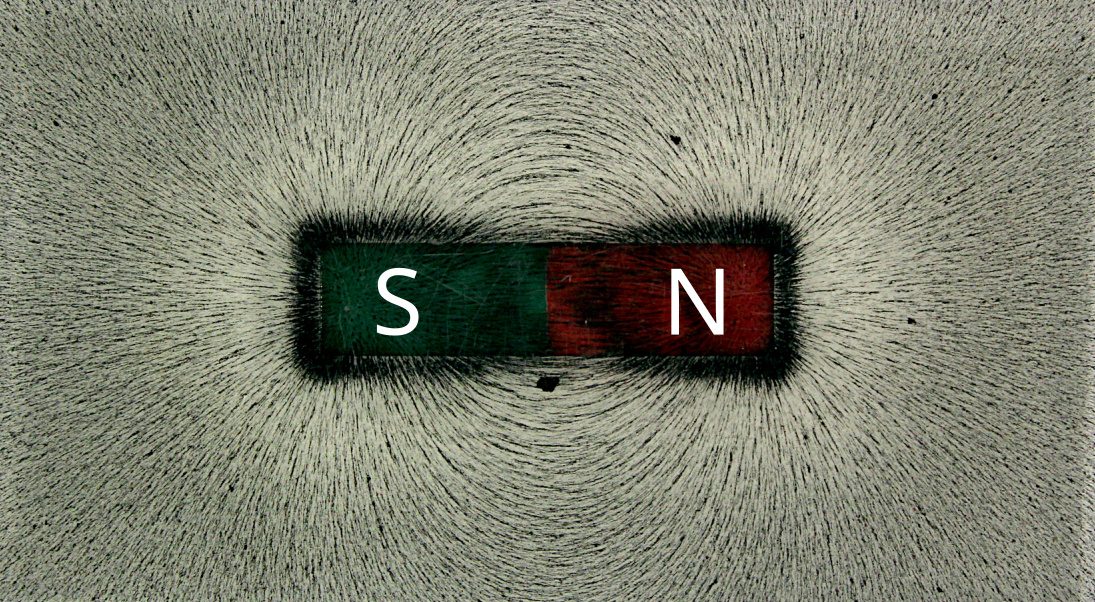
Serbuk besi membentuk garis melengkung di sekitar magnet batang
Serbuk besi berbaris sepanjang medan magnet, membuat garis-garis medan magnet magnet batang yang tak terlihat menjadi terlihat
Explore · ⁨Jelajahi⁩

See a magnet's field lines · ⁨Lihat garis medan magnet⁩

Magnetic field lines run from the north pole to the south pole outside the magnet. Where the lines crowd together the field is strongest. · ⁨Garis medan magnet berjalan dari kutub utara ke kutub selatan di luar magnet. Di mana garis-garis memadat, medan paling kuat.⁩

Vocabulary · ⁨Kosa kata⁩ Train · ⁨Latih⁩
English Bahasa Indonesia
Ferromagnetic/ˌferəməɡˈnetɪk/ Feromagnetik
Paramagnetic/ˌpærəməɡˈnetɪk/ Paramagnetik
Diamagnetic/ˌdaɪəməɡˈnetɪk/ Diamagnetik
permeability/ˌpɜːməˈbɪlɪti/ permeabilitas
magnetic field/mæɡˈnetɪk fiːld/ medan magnet
12.2

Magnetism and Moving Charges · ⁨Kemagnetan dan Muatan Bergerak⁩

Syllabus · ⁨Silabus⁩
English

Learning Objective 12.2.A: Describe the magnetic field produced by moving charged objects.

  • 12.2.A.1 A single moving charged object produces a magnetic field.
    • 12.2.A.1.i The magnetic field at a particular point produced by a moving charged object depends on the object's velocity and the distance between the point and the object.
    • 12.2.A.1.ii At a point in space, the direction of the magnetic field produced by a moving charged object is perpendicular to both the velocity of the object and the position vector from the object to that point in space and can be determined using the right-hand rule.
    • 12.2.A.1.iii The magnitude of the magnetic field is a maximum when the velocity vector and the position vector from the object to that point in space are perpendicular.

Learning Objective 12.2.B: Describe the force exerted on moving charged objects by a magnetic field.

  • 12.2.B.1 Magnetic forces describe interactions between moving charged objects.
  • 12.2.B.2 A magnetic field may exert a force on a charged object moving in that field.
    • 12.2.B.2.i The magnitude of the force exerted by a magnetic field on a moving charged object is proportional to the magnitude of the charge, the magnitude of the charged object's velocity, and the magnitude of the magnetic field and also depends on the angle between the velocity and magnetic field vectors.
      • Equation: $F_B = qvB\sin\theta$
    • 12.2.B.2.ii The direction of the force exerted by a magnetic field on a moving charged object is perpendicular to both the direction of the magnetic field and the velocity of the charge, as defined by the right-hand rule.
  • 12.2.B.3 In a region containing both a magnetic field and an electric field, a moving charged object will experience independent forces from each field.
  • 12.2.B.4 The Hall effect describes the potential difference created in a conductor by an external magnetic field that has a component perpendicular to the direction of charges moving in the conductor.

Boundary statement: Quantitative treatment of the magnitude of the magnetic force exerted by a magnetic field on a moving charge is limited to angles of 0, 90, and 180 degrees between the velocity and the magnetic field. Qualitative analysis of other angles is permitted.

Bahasa Indonesia

Tujuan Pembelajaran 12.2.A: Deskripsikan medan magnet yang dihasilkan oleh objek bermuatan bergerak.

  • 12.2.A.1 Sebuah objek bermuatan tunggal yang bergerak menghasilkan medan magnet.
    • 12.2.A.1.i Medan magnet pada titik tertentu yang dihasilkan oleh objek bermuatan bergerak bergantung pada kecepatan objek dan jarak antara titik tersebut dengan objek.
    • 12.2.A.1.ii Pada suatu titik di ruang, arah medan magnet yang dihasilkan oleh objek bermuatan bergerak tegak lurus terhadap baik kecepatan objek maupun vektor posisi dari objek ke titik tersebut di ruang, dan dapat ditentukan menggunakan aturan tangan kanan.
    • 12.2.A.1.iii Besar medan magnet maksimum ketika vektor kecepatan dan vektor posisi dari objek ke titik tersebut di ruang saling tegak lurus.

Tujuan Pembelajaran 12.2.B: Deskripsikan gaya yang diberikan oleh medan magnet pada objek bermuatan bergerak.

  • 12.2.B.1 Gaya magnet menggambarkan interaksi antar objek bermuatan bergerak.
  • 12.2.B.2 Medan magnet dapat memberikan gaya pada objek bermuatan yang bergerak di dalam medan tersebut.
    • 12.2.B.2.i Besar gaya yang diberikan oleh medan magnet pada objek bermuatan bergerak berbanding lurus dengan besar muatan, besar kecepatan objek bermuatan, dan besar medan magnet, serta juga bergantung pada sudut antara vektor kecepatan dan vektor medan magnet.
      • Persamaan: $F_B = qvB\sin\theta$
    • 12.2.B.2.ii Arah gaya yang diberikan oleh medan magnet pada objek bermuatan bergerak tegak lurus terhadap baik arah medan magnet maupun kecepatan muatan, sebagaimana didefinisikan oleh aturan tangan kanan.
  • 12.2.B.3 Di daerah yang memuat kedua medan magnet dan medan listrik, objek bermuatan bergerak akan mengalami gaya independen dari masing-masing medan.
  • 12.2.B.4 Efek Hall mendeskripsikan beda potensial yang tercipta dalam konduktor akibat medan magnet eksternal yang memiliki komponen tegak lurus terhadap arah muatan yang bergerak dalam konduktor tersebut.

Pernyataan Batas: Penanganan kuantitatif mengenai besar gaya magnet yang diberikan oleh medan magnet pada muatan bergerak dibatasi hanya pada sudut 0, 90, dan 180 derajat antara kecepatan dan medan magnet. Analisis kualitatif untuk sudut lainnya diperbolehkan.

Source: College Board AP Course and Exam Description · ⁨Sumber: Deskripsi Kursus dan Ujian College Board AP⁩

English
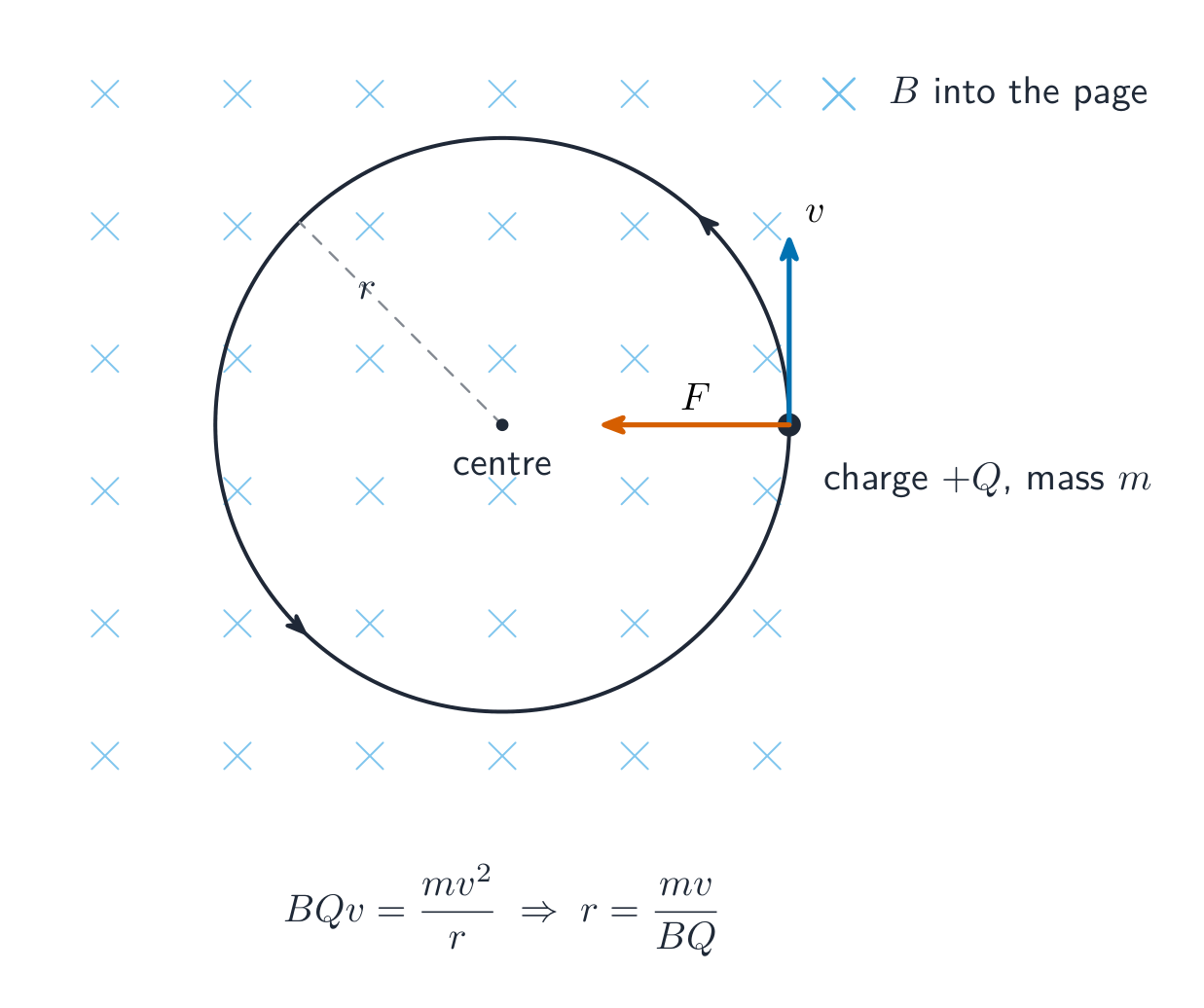
A moving charge in a magnetic field

A charge moving through a magnetic field feels a magnetic force 磁力:

$$F=qvB\sin\theta,$$
where $\theta$ is the angle between the velocity and the field. The force is perpendicular to both $\vec{v}$ and $\vec{B}$ (use the right-hand rule), so it changes direction but not speed – a charge moving perpendicular to a uniform field travels in a circle. A stationary charge, or one moving parallel to the field, feels no magnetic force.

Worked example. A proton ($q=1.6\times10^{-19}\ \text{C}$, $m=1.67\times10^{-27}\ \text{kg}$) enters a $0.50\ \text{T}$ field at $2.0\times10^{5}\ \text{m/s}$, at right angles to the field. The magnetic force is

$$F=qvB=1.6\times10^{-19}\times2.0\times10^{5}\times0.50=1.6\times10^{-14}\ \text{N}.$$
This force is the centripetal force, so it bends the proton into a circle of radius
$$r=\frac{mv}{qB}=\frac{1.67\times10^{-27}\times2.0\times10^{5}}{1.6\times10^{-19}\times0.50}=4.2\times10^{-3}\ \text{m}.$$
Setting $qvB=\dfrac{mv^2}{r}$ and cancelling gives that neat $r=mv/(qB)$ – the principle behind mass spectrometers.

Bahasa Indonesia
Muatan yang bergerak dalam medan magnet

Muatan yang bergerak melalui medan magnet mengalami gaya magnet:

$$F=qvB\sin\theta,$$
di mana $\theta$ adalah sudut antara kecepatan dan medan. Gaya tersebut tegak lurus terhadap kedua $\vec{v}$ dan $\vec{B}$ (gunakan aturan tangan kanan), sehingga mengubah arah tetapi tidak mengubah kecepatan – muatan yang bergerak tegak lurus terhadap medan seragam akan bergerak dalam lintasan lingkaran. Muatan diam, atau yang bergerak sejajar dengan medan, tidak mengalami gaya magnet.

Partikel bermuatan yang bergerak melintasi medan magnet mengikuti lintasan lingkaran

Contoh terpecahkan. Proton ($q=1.6\times10^{-19}\ \text{C}$, $m=1.67\times10^{-27}\ \text{kg}$) memasuki medan $0.50\ \text{T}$ pada $2.0\times10^{5}\ \text{m/s}$, tegak lurus terhadap medan. Gaya magnetnya adalah

$$F=qvB=1.6\times10^{-19}\times2.0\times10^{5}\times0.50=1.6\times10^{-14}\ \text{N}.$$
Gaya ini adalah gaya sentripetal, sehingga membengkokkan proton menjadi lingkaran dengan jari-jari
$$r=\frac{mv}{qB}=\frac{1.67\times10^{-27}\times2.0\times10^{5}}{1.6\times10^{-19}\times0.50}=4.2\times10^{-3}\ \text{m}.$$
Menetapkan $qvB=\dfrac{mv^2}{r}$ dan mencoret memberikan hasil $r=mv/(qB)$ yang rapi – prinsip di balik spektrometer massa.

Vocabulary · ⁨Kosa kata⁩ Train · ⁨Latih⁩
English Bahasa Indonesia
magnetic force/mæɡˈnetɪk fɔːs/ Gaya magnetik
12.3

Magnetism and Current-Carrying Wires · ⁨Magnetisme dan Kawat Pembawa Arus⁩

Syllabus · ⁨Silabus⁩
English

Learning Objective 12.3.A: Describe the magnetic field produced by a current-carrying wire.

  • 12.3.A.1 A current-carrying wire produces a magnetic field.
    • 12.3.A.1.i The magnetic field vectors around a long, straight, current-carrying wire are tangent to concentric circles centered on that wire. The field has no component toward, away from, or parallel to the long, straight, current-carrying wire.
    • 12.3.A.1.ii At a point in space, the magnitude of the magnetic field due to a long, straight, current-carrying wire is proportional to the magnitude of the current in the wire and inversely proportional to the perpendicular distance from the central axis of the wire to the point.
      • Equation: $B = \dfrac{\mu_0}{2\pi}\dfrac{I}{r}$
    • 12.3.A.1.iii The direction of the magnetic field created by a current-carrying wire is determined with the right-hand rule.
    • 12.3.A.1.iv The direction of the magnetic field at the center of a current-carrying loop is directed along the axis of the loop and can be found using the right-hand rule.
    • 12.3.A.1.v The magnetic field at a location near two or more current-carrying wires can be determined using vector addition principles.

Learning Objective 12.3.B: Describe the force exerted on a current-carrying wire by a magnetic field.

  • 12.3.B.1 A magnetic field may exert a force on a current-carrying wire.
    • 12.3.B.1.i The magnitude of the force exerted by a magnetic field on a current-carrying wire is proportional to the current, the length of the portion of the wire within the magnetic field, and the magnitude of the magnetic field, and also depends on the angle between the direction of the current in the wire and the direction of the magnetic field.
      • Equation: $F_B = I\ell B\sin\theta$
    • 12.3.B.1.ii The direction of the force exerted by the magnetic field on a current-carrying wire is determined by the right-hand rule.
Bahasa Indonesia

Tujuan Pembelajaran 12.3.A: Deskripsikan medan magnet yang dihasilkan oleh kawat pembawa arus.

  • 12.3.A.1 Kawat pembawa arus menghasilkan medan magnet.
    • 12.3.A.1.i Vektor-vektor medan magnet di sekitar kawat panjang, lurus, pembawa arus bersinggungan dengan lingkaran konsentris yang berpusat pada kawat tersebut. Medan tidak memiliki komponen menuju, menjauhi, atau sejajar dengan kawat panjang, lurus, pembawa arus.
    • 12.3.A.1.ii Pada suatu titik di ruang, besar medan magnet akibat kawat panjang, lurus, pembawa arus berbanding lurus dengan besar arus dalam kawat dan berbanding terbalik dengan jarak tegak lurus dari sumbu pusat kawat ke titik tersebut.
      • Persamaan: $B = \dfrac{\mu_0}{2\pi}\dfrac{I}{r}$
    • 12.3.A.1.iii Arah medan magnet yang dihasilkan oleh kawat pembawa arus ditentukan dengan aturan tangan kanan.
    • 12.3.A.1.iv Arah medan magnet di tengah sebuah loop pembawa arus mengarah sepanjang sumbu loop dan dapat ditemukan menggunakan aturan tangan kanan.
    • 12.3.A.1.v Medan magnet di lokasi dekat dua atau lebih kawat pembawa arus dapat ditentukan menggunakan prinsip penjumlahan vektor.

Tujuan Pembelajaran 12.3.B: Deskripsikan gaya yang diberikan oleh medan magnet pada kawat pembawa arus.

  • 12.3.B.1 Medan magnet dapat memberikan gaya pada kawat pembawa arus.
    • 12.3.B.1.i Besar gaya yang diberikan oleh medan magnet pada kawat pembawa arus berbanding lurus dengan arus, panjang bagian kawat di dalam medan magnet, dan besar medan magnet, serta juga bergantung pada sudut antara arah arus dalam kawat dan arah medan magnet.
      • Persamaan: $F_B = I\ell B\sin\theta$
    • 12.3.B.1.ii Arah gaya yang diberikan oleh medan magnet pada kawat pembawa arus ditentukan oleh aturan tangan kanan.

Source: College Board AP Course and Exam Description · ⁨Sumber: Deskripsi Kursus dan Ujian College Board AP⁩

English

Because a current is moving charge, a magnetic field pushes on a current-carrying wire:

$$F=BIL\sin\theta.$$
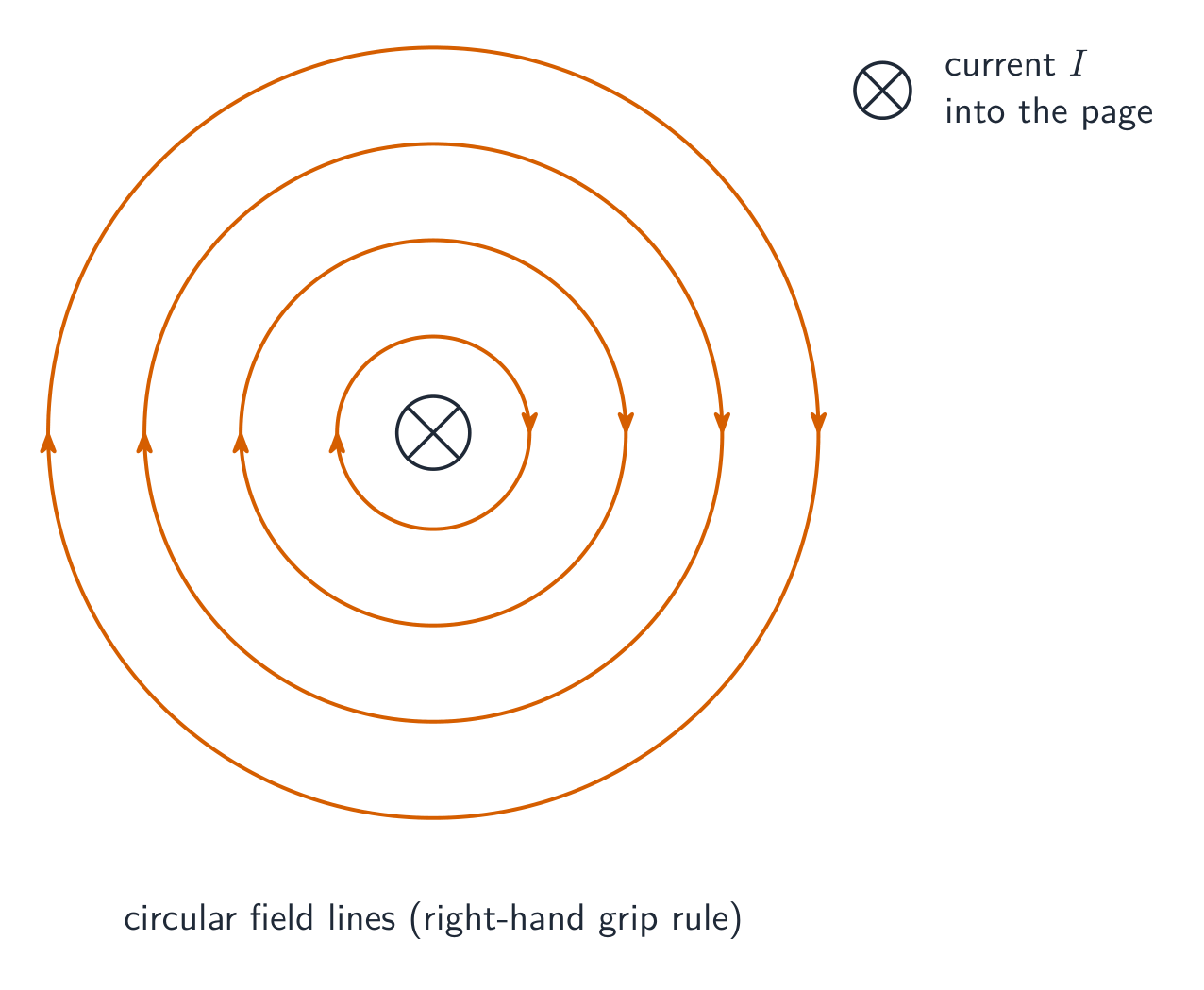
A current also creates its own magnetic field: circular field lines wrap around a straight wire (right-hand rule), and a coil (solenoid) makes a field like a bar magnet. This is how electromagnets and motors work.

Worked example. A $0.30\ \text{m}$ length of wire carries $4.0\ \text{A}$ at right angles to a $0.20\ \text{T}$ field. The force on it is $F=BIL=0.20\times4.0\times0.30=0.24\ \text{N}$ – the push that turns a motor's coil.

Bahasa Indonesia

Karena arus merupakan muatan yang bergerak, medan magnet mendorong kawat pembawa arus:

$$F=BIL\sin\theta.$$
Arus juga membentuk medannya sendiri: garis-garis medan melingkar membungkus kawat lurus (aturan tangan kanan), dan kumparan (solenoid) menghasilkan medan seperti batang magnet. Inilah cara kerja elektromagnet dan motor listrik.

Garis-garis medan melingkar konsentris mengelilingi kawat pembawa arus lurus

Contoh terpecahkan. Sebuah kawat sepanjang $0.30\ \text{m}$ dialiri arus $4.0\ \text{A}$ tegak lurus terhadap medan $0.20\ \text{T}$. Gaya yang bekerja padanya adalah $F=BIL=0.20\times4.0\times0.30=0.24\ \text{N}$ – dorongan yang memutar kumparan motor.

Kumparan pembawa arus (solenoid) menghasilkan medan magnet berbentuk persis seperti batang magnet
Explore · ⁨Jelajahi⁩

Find the force on a current in a field · ⁨Temukan gaya pada arus dalam medan⁩

A current in a magnetic field feels a force $F = BIL$, at right angles to both. Use the left-hand rule; reverse the current or field and the force flips. · ⁨Arus dalam medan magnet mengalami gaya $F = BIL$, tegak lurus terhadap keduanya. Gunakan aturan tangan kiri; balikkan arus atau medan dan gayanya berbalik.⁩

12.4

Electromagnetic Induction and Faraday's Law · ⁨Induksi Elektromagnetik dan Hukum Faraday⁩

Syllabus · ⁨Silabus⁩
English

Learning Objective 12.4.A: Describe the induced electric potential difference resulting from a change in magnetic flux.

  • 12.4.A.1 Magnetic flux is a description of the amount of the component of a magnetic field that is perpendicular to a cross-sectional area.
  • 12.4.A.2 Magnetic flux through a surface is proportional to the magnitude of the component of the magnetic field perpendicular to the surface and to the cross-sectional area of the surface.
    • Equation: $\Phi_B = BA\cos\theta$
    • 12.4.A.2.i The area vector is defined to be perpendicular to the plane of the surface and directed outward from a closed surface.
    • 12.4.A.2.ii The sign of the magnetic flux indicates whether the magnetic field is parallel to or antiparallel to the area vector.
  • 12.4.A.3 Faraday’s law describes the relationship between changing magnetic flux and the resulting induced emf in a system.
    • Equation: $|\mathcal{E}| = \left|\dfrac{\Delta\Phi_B}{\Delta t}\right|$
  • 12.4.A.4 Lenz’s law is used to determine the direction of an induced emf resulting from a changing magnetic flux.
    • Equation: $\mathcal{E} = -\dfrac{\Delta\Phi_B}{\Delta t} = -\dfrac{\Delta(BA\cos\theta)}{\Delta t}$
    • 12.4.A.4.i An induced emf generates a current that creates a magnetic field that opposes the change in magnetic flux.
    • 12.4.A.4.ii The right-hand rule is used to determine the relationships between current, emf, and magnetic flux.
  • 12.4.A.5 A common example of electromagnetic induction is a conducting rod on conducting rails in a region with a uniform magnetic field.
    • Derived equation: $\mathcal{E} = B\ell v$
Bahasa Indonesia

Tujuan Pembelajaran 12.4.A: Deskripsikan beda potensial induksi yang timbul dari perubahan fluks magnet.

  • 12.4.A.1 Fluks magnet adalah deskripsi dari jumlah komponen medan magnet yang tegak lurus terhadap suatu luas penampang.
  • 12.4.A.2 Fluks magnet melalui suatu permukaan berbanding lurus dengan besar komponen medan magnet yang tegak lurus terhadap permukaan dan luas penampang permukaan tersebut.
    • Persamaan: $\Phi_B = BA\cos\theta$
    • 12.4.A.2.i Vektor luas didefinisikan tegak lurus terhadap bidang permukaan dan mengarah keluar dari permukaan tertutup.
    • 12.4.A.2.ii Tanda fluks magnet menunjukkan apakah medan magnet sejajar atau berlawanan arah dengan vektor luas.
  • 12.4.A.3 Hukum Faraday mendeskripsikan hubungan antara perubahan fluks magnet dan emf induksi yang dihasilkan dalam suatu sistem.
    • Persamaan: $|\mathcal{E}| = \left|\dfrac{\Delta\Phi_B}{\Delta t}\right|$
  • 12.4.A.4 Hukum Lenz digunakan untuk menentukan arah emf induksi yang timbul dari perubahan fluks magnet.
    • Persamaan: $\mathcal{E} = -\dfrac{\Delta\Phi_B}{\Delta t} = -\dfrac{\Delta(BA\cos\theta)}{\Delta t}$
    • 12.4.A.4.i Emf induksi menghasilkan arus yang menciptakan medan magnet yang melawan perubahan fluks magnet.
    • 12.4.A.4.ii Aturan tangan kanan digunakan untuk menentukan hubungan antara arus, ggl, dan fluks magnetik.
  • 12.4.A.5 Contoh umum induksi elektromagnetik adalah batang konduktor pada rel konduktor di daerah dengan medan magnet seragam.
    • Persamaan Turunan: $\mathcal{E} = B\ell v$

Source: College Board AP Course and Exam Description · ⁨Sumber: Deskripsi Kursus dan Ujian College Board AP⁩

English
Electromagnetic induction

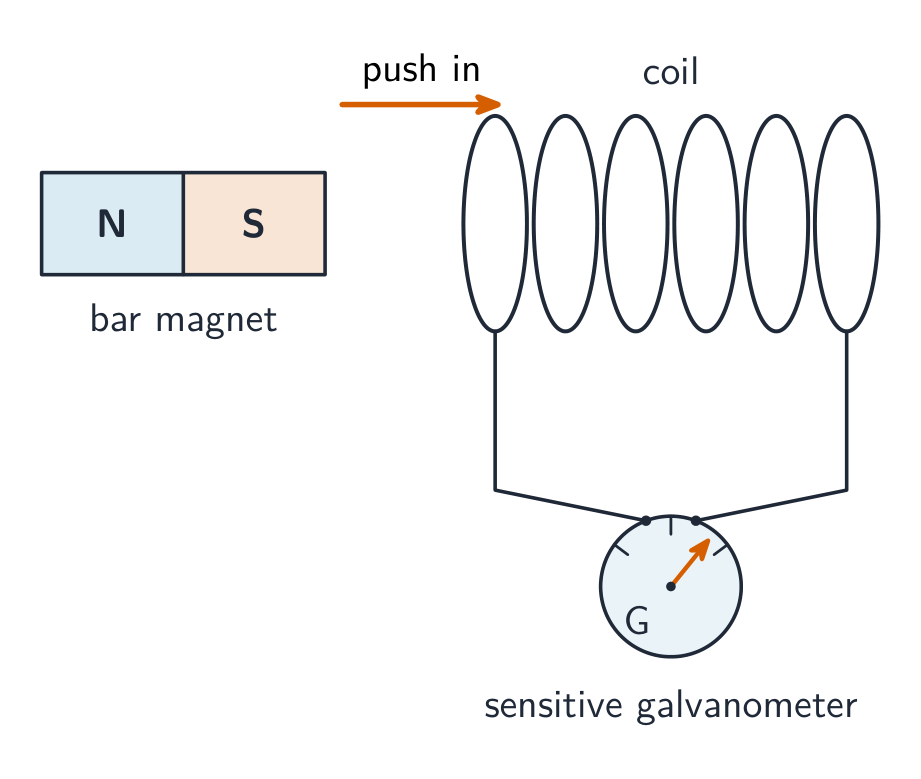
A changing magnetic field through a loop drives a current – electromagnetic induction 电磁感应. The magnetic flux 磁通量 $\Phi=BA\cos\theta$ measures how much field passes through the loop. Faraday's law 法拉第定律 gives the induced emf:

$$\varepsilon=-\frac{\Delta\Phi}{\Delta t}.$$
The flux changes if the field, the area, or the loop's orientation changes. Lenz's law 楞次定律 (the minus sign) says the induced current flows so as to oppose the change that caused it – the basis of generators.

Worked example. The magnetic flux through a single loop drops from $0.020\ \text{Wb}$ to $0.008\ \text{Wb}$ in $0.030\ \text{s}$. The average induced emf is

$$\varepsilon=\left|\frac{\Delta\Phi}{\Delta t}\right|=\frac{0.020-0.008}{0.030}=0.40\ \text{V}.$$
A coil of $N$ turns would give $N$ times this – which is why generators and transformers use many-turn coils.

Bahasa Indonesia
Induksi elektromagnetik

Medan magnet yang berubah melalui sebuah loop menginduksi arus – induksi elektromagnetik. Fluks magnet $\Phi=BA\cos\theta$ mengukur seberapa banyak medan yang menembus loop. Hukum Faraday memberikan emf yang diinduksi:

$$\varepsilon=-\frac{\Delta\Phi}{\Delta t}.$$
Fluks berubah jika medan, luas area, atau orientasi loop berubah. Hukum Lenz (tanda minus) menyatakan bahwa arus diinduksi mengalir sedemikian rupa untuk melawan perubahan yang menyebabkannya – dasar dari generator listrik.

Memindahkan magnet masuk ke dalam kumparan menginduksi g.g.b yang menggerakkan arus

Contoh terpecahkan. Fluks magnet melalui satu loop turun dari $0.020\ \text{Wb}$ menjadi $0.008\ \text{Wb}$ dalam waktu $0.030\ \text{s}$. Rata-rata emf yang diinduksi adalah

$$\varepsilon=\left|\frac{\Delta\Phi}{\Delta t}\right|=\frac{0.020-0.008}{0.030}=0.40\ \text{V}.$$
Kumparan dengan $N$ lilitan akan menghasilkan $N$ kali nilai ini – itulah sebabnya generator dan transformator menggunakan kumparan bertekanan tinggi.

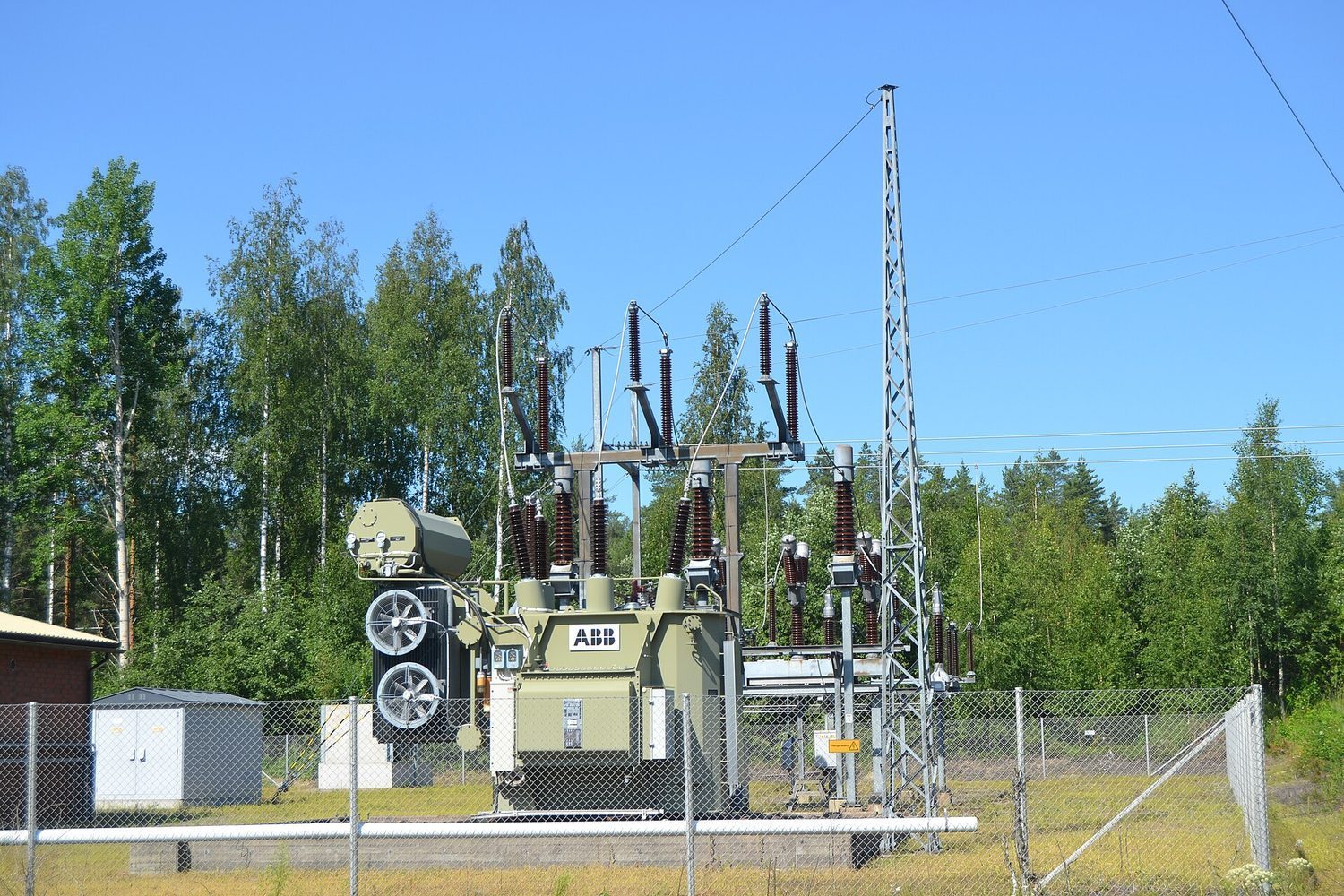
Transformator gardu listrik: perubahan fluks magnet dalam kumparan menginduksi tegangan yang menyalurkan listrik ke jaringan
Explore · ⁨Jelajahi⁩

Induce a voltage by moving a magnet · ⁨Induksi tegangan dengan menggerakkan magnet⁩

Faraday's law: a changing magnetic flux through a coil induces a voltage. Move the magnet faster and the induced EMF grows; Lenz's law sets its direction to oppose the change. · ⁨Hukum Faraday: fluks magnetik yang berubah melalui kumparan menginduksi tegangan. Gerakkan magnet lebih cepat dan GGL induksi bertambah; Hukum Lenz menentukan arahnya untuk melawan perubahan.⁩

Vocabulary · ⁨Kosa kata⁩ Train · ⁨Latih⁩
English Bahasa Indonesia
electromagnetic induction/ɪˌlektrəʊməɡˈnetɪk ɪnˈdʌkʃn/ induksi elektromagnetik
magnetic flux/mæɡˈnetɪk flʌks/ fluks magnetik
Faraday's law/ˈfærədeɪz lɔː/ Hukum Faraday
Lenz's law/ˈlentsɪz lɔː/ Hukum Lenz
12.4

Exam tips · ⁨Tips ujian⁩

English
  • The magnetic force $F=qvB\sin\theta$ is perpendicular to the velocity, so it changes direction (a circle) but not speed; a stationary charge or one moving along the field feels no force.
  • Use $F=BIL$ for the force on a current-carrying wire (the motor effect).
  • A current creates a magnetic field (circles around a wire; a solenoid acts like a bar magnet).
  • Induction needs a changing flux $\Phi=BA$ — a stationary magnet in a coil induces nothing.
  • Faraday: $\varepsilon=\Delta\Phi/\Delta t$ (times $N$ turns); Lenz: the induced current opposes the change (energy conservation).
Bahasa Indonesia
  • Gaya magnet $F=qvB\sin\theta$ bersifat tegak lurus terhadap kecepatan, sehingga mengubah arah (menjadi lingkaran) tetapi bukan kecepatan; muatan diam atau yang bergerak sejajar dengan medan tidak merasakan gaya.
  • Gunakan $F=BIL$ untuk gaya pada kawat pembawa arus (efek motor).
  • Arus membentuk medan magnet (lingkaran di sekitar kawat; solenoid bertindak seperti batang magnet).
  • Induksi memerlukan fluks berubah $\Phi=BA$ – magnet diam dalam kumparan tidak menginduksi apa pun.
  • Faraday: $\varepsilon=\Delta\Phi/\Delta t$ (dikalikan $N$ lilitan); Lenz: arus diinduksi melawan perubahan (kekekalan energi).

Interactive lessons on this topic · ⁨Pelajaran interaktif untuk topik ini⁩

Work through it step by step, with instant-check exercises. · ⁨Kerjakan langkah demi langkah, dengan latihan pengecekan instan.⁩

Past Papers · ⁨Soal-Soil Masa Lalu⁩

More topics in AP Physics 2 · ⁨AP Fisika 2⁩ · ⁨Topik lain dalam AP Physics 2 · ⁨AP Fisika 2⁩⁩

Log in or create account · ⁨Masuk atau buat akun⁩

IGCSE, A-Level & AP