Skip to content · ⁨Lompat ke konten⁩

Electric Force, Field, and Potential · ⁨Gaya Listrik, Medan, dan Potensial⁩

AP Physics 2 · ⁨AP Fisika 2⁩ · Topic 10 · ⁨Topik 10⁩

Video lesson for this topic · ⁨Pelajaran video untuk topik ini⁩ Open the video page · ⁨Buka halaman video⁩
8:05

Gaya Listrik, Medan, dan Potensial

Awan petir adalah pabrik muatan. Kristal es bertabrakan di dalamnya, dan elektron terkumpul di bagian bawah awan. Tanah di bawahnya menjadi positif. Tidak ada…

English narration · English + 中文 subtitles burned in · ⁨Narasi bahasa Inggris · Subtitle bahasa Inggris + 中文 disematkan langsung⁩

10.1

Electric Charge and Electric Force · ⁨Muatan Listrik dan Gaya Listrik⁩

Syllabus · ⁨Silabus⁩
English

Learning Objective 10.1.A: Describe the electric force that results from the interactions between charged objects or systems.

  • 10.1.A.1 Charge is a fundamental property of all matter.
    • 10.1.A.1.i Charge is described as positive or negative.
    • 10.1.A.1.ii The magnitude of the charge of a single electron or proton, the elementary charge $e$, can be considered to be the smallest indivisible amount of charge.
    • 10.1.A.1.iii The charge of an electron is $-e$, the charge of a proton is $+e$, and a neutron has no electric charge.
    • 10.1.A.1.iv A point charge is a model in which the physical size of a charged object or system is negligible in the context of the situation being analyzed.
  • 10.1.A.2 Coulomb's law describes the electrostatic force between two charged objects as directly proportional to the magnitude of each of the charges and inversely proportional to the square of the distance between the objects.
    • Equation: $\left|\vec{F}_E\right| = \dfrac{1}{4\pi\varepsilon_0}\dfrac{\left|q_1 q_2\right|}{r^2} = k\dfrac{\left|q_1 q_2\right|}{r^2}$
  • 10.1.A.3 The direction of the electrostatic force depends on the signs of the charges of the interacting objects and is parallel to the line of separation between the objects.
    • 10.1.A.3.i Two objects with charges of the same sign exert repulsive forces on each other.
    • 10.1.A.3.ii Two objects with charges of opposite signs exert attractive forces on each other.
  • 10.1.A.4 Electric forces are responsible for some of the macroscopic properties of objects in everyday experiences. However, the large number of particle interactions that occur make it more convenient to treat everyday forces in terms of nonfundamental forces called contact forces, such as normal force, friction, and tension.

Learning Objective 10.1.B: Describe the electric and gravitational forces that result from interactions between charged objects with mass.

  • 10.1.B.1 Electrostatic forces can be attractive or repulsive, while gravitational forces are always attractive.
  • 10.1.B.2 For any two objects that have mass and electric charge, the magnitude of the gravitational force is usually much smaller than the magnitude of the electrostatic force.
  • 10.1.B.3 Gravitational forces dominate at larger scales even though they are weaker than electrostatic forces, because systems at large scales tend to be electrically neutral.

Learning Objective 10.1.C: Describe the electric permittivity of a material or medium.

  • 10.1.C.1 Electric permittivity is a measurement of the degree to which a material or medium is polarized in the presence of an electric field.
  • 10.1.C.2 Electric polarization can be modeled as the induced rearrangement of electrons by an external electric field, resulting in a separation of positive and negative charges within a material or medium.
  • 10.1.C.3 Free space has a constant value of electric permittivity, $\varepsilon_0$, that appears in physical relationships.
  • 10.1.C.4 The permittivity of matter has a value different from that of free space that arises from the matter's composition and arrangement.
    • 10.1.C.4.i In a given material, electric permittivity is determined by the ease with which electrons can change configurations within the material.
    • 10.1.C.4.ii Conductors are made from electrically conducting materials in which charge carriers move easily; insulators are made from electrically nonconducting materials in which charge carriers cannot move easily.

Boundary statement: AP Physics 2 only expects students to make calculations of the electric force between four or fewer interacting charged objects or systems. The analysis of the resulting electric force from more charges is allowed in situations of high symmetry.

Bahasa Indonesia

Tujuan Pembelajaran 10.1.A: Jelaskan gaya listrik yang timbul dari interaksi antara benda atau sistem bermuatan.

  • 10.1.A.1 Muatan adalah sifat fundamental dari semua materi.
    • 10.1.A.1.i Muatan digambarkan sebagai positif atau negatif.
    • 10.1.A.1.ii Besar muatan satu elektron atau proton, yaitu muatan elementer $e$, dapat dianggap sebagai jumlah muatan terkecil yang tak terbagi.
    • 10.1.A.1.iii Muatan elektron adalah $-e$, muatan proton adalah $+e$, dan neutron tidak memiliki muatan listrik.
    • 10.1.A.1.iv Muatan titik adalah model di mana ukuran fisik objek atau sistem bermuatan dianggap sangat kecil dalam konteks situasi yang sedang dianalisis.
  • 10.1.A.2 Hukum Coulomb menggambarkan gaya elektrostatik antara dua benda bermuatan sebagai berbanding lurus dengan besar masing-masing muatan dan berbanding terbalik dengan kuadrat jarak antar benda.
    • Persamaan: $\left|\vec{F}_E\right| = \dfrac{1}{4\pi\varepsilon_0}\dfrac{\left|q_1 q_2\right|}{r^2} = k\dfrac{\left|q_1 q_2\right|}{r^2}$
  • 10.1.A.3 Arah gaya elektrostatik bergantung pada tanda-tanda muatan benda-benda yang berinteraksi dan sejajar dengan garis pemisah antara benda-benda tersebut.
    • 10.1.A.3.i Dua benda dengan muatan bertanda sama saling mendorong (gaya tolak-menolak).
    • 10.1.A.3.ii Dua benda dengan muatan bertanda berbeda saling menarik (gaya tarik-menarik).
  • 10.1.A.4 Gaya listrik bertanggung jawab atas beberapa sifat makroskopis objek dalam pengalaman sehari-hari. Namun, banyaknya interaksi partikel yang terjadi membuat lebih praktis untuk memperlakukan gaya-gaya sehari-hari dalam istilah gaya non-fundamental yang disebut gaya kontak, seperti gaya normal, gesekan, dan tegangan.

Tujuan Pembelajaran 10.1.B: Jelaskan gaya listrik dan gravitasi yang timbul dari interaksi antara benda bermuatan dengan massa.

  • 10.1.B.1 Gaya elektrostatik bisa bersifat tarik-menarik atau tolak-menolak, sementara gaya gravitasi selalu bersifat tarik-menarik.
  • 10.1.B.2 Untuk dua objek apa pun yang memiliki massa dan muatan listrik, besaran gaya gravitasi biasanya jauh lebih kecil daripada besaran gaya elektrostatik.
  • 10.1.B.3 Gaya gravitasi mendominasi pada skala yang lebih besar meskipun lebih lemah daripada gaya elektrostatik, karena sistem pada skala besar cenderung netral secara listrik.

Tujuan Pembelajaran 10.1.C: Jelaskan permitivitas listrik suatu bahan atau medium.

  • 10.1.C.1 Permitivitas listrik adalah ukuran sejauh mana suatu bahan atau medium terpolarisasi di hadapan medan listrik.
  • 10.1.C.2 Polarisasi listrik dapat dimodelkan sebagai pengaturan ulang elektron yang diinduksi oleh medan listrik eksternal, menghasilkan pemisahan muatan positif dan negatif di dalam suatu bahan atau medium.
  • 10.1.C.3 Ruang hampa memiliki nilai konstan permitivitas listrik, $\varepsilon_0$, yang muncul dalam hubungan fisik.
  • 10.1.C.4 Permitivitas materi memiliki nilai berbeda dari ruang hampa yang timbul dari komposisi dan susunan materinya.
    • 10.1.C.4.i Dalam suatu bahan tertentu, permitivitas listrik ditentukan oleh kemudahan elektron untuk mengubah konfigurasi di dalam bahan tersebut.
    • 10.1.C.4.ii Konduktor dibuat dari bahan penghantar listrik di mana pembawa muatan bergerak dengan mudah; isolator dibuat dari bahan non-penghantar listrik di mana pembawa muatan tidak dapat bergerak dengan mudah.

Pernyataan Batasan: AP Fisika 2 hanya mengharapkan siswa melakukan perhitungan gaya listrik antara empat objek bermuatan atau sistem berinteraksi atau kurang. Analisis gaya listrik yang dihasilkan dari lebih banyak muatan diperbolehkan dalam situasi simetri tinggi.

Source: College Board AP Course and Exam Description · ⁨Sumber: Deskripsi Kursus dan Ujian College Board AP⁩

English

Electric charge 电荷 is a fundamental property of matter, and it comes in two kinds, positive and negative; like charges repel and opposite charges attract. Charge is conserved and quantized (a multiple of the elementary charge $e$). The force between two point charges is Coulomb's law 库仑定律:

$$F=\frac{k q_1 q_2}{r^2},$$
directed along the line joining them – an inverse-square law like gravity, but it can push or pull.

The constant $k$ hides a property of the medium: the permittivity 介电常数. Free space has a fixed permittivity of free space $\varepsilon_0$ (with $k = 1/4\pi\varepsilon_0$), while the permittivity of matter differs from $\varepsilon_0$, depending on the material's composition and arrangement - which is why a material between two charges changes the force. Note also that although the electric force is vastly stronger than gravity, gravity dominates at large scales, because large objects are usually electrically neutral (equal + and −), leaving only gravity to act.

Worked example. Two point charges, $+3.0\ \mu\text{C}$ and $-2.0\ \mu\text{C}$, sit $0.10\ \text{m}$ apart ($k=9.0\times10^{9}$). The force between them is

$$F=\frac{k q_1 q_2}{r^2}=\frac{9.0\times10^{9}\times(3.0\times10^{-6})(2.0\times10^{-6})}{(0.10)^2}=5.4\ \text{N},$$
attractive, because the charges have opposite signs. (Use the magnitudes for the size and decide the direction from the signs.)

Bahasa Indonesia

Muatan listrik adalah sifat fundamental materi, dan tersedia dalam dua jenis, positif dan negatif; muatan sejenis tolak-menolak dan muatan berlawanan tarik-menarik. Muatan terjaga dan terkuantisasi (kelipatan dari muatan elementer $e$). Gaya antara dua muatan titik adalah hukum Coulomb:

$$F=\frac{k q_1 q_2}{r^2},$$
berarah sepanjang garis penghubung mereka – hukum kuadrat terbalik seperti gravitasi, tetapi bisa mendorong atau menarik.

Konstanta $k$ menyembunyikan sifat medium: permitivitas. Ruang hampa memiliki permitivitas ruang hampa tetap $\varepsilon_0$ (dengan $k = 1/4\pi\varepsilon_0$), sementara permitivitas materi berbeda dari $\varepsilon_0$, tergantung komposisi dan susunan material – itulah sebabnya material di antara dua muatan mengubah gaya. Perhatikan juga bahwa meskipun gaya listrik jauh lebih kuat daripada gravitasi, gravitasi mendominasi pada skala besar, karena objek besar biasanya netral secara elektrik (+ dan − setara), menyisakan hanya gravitasi yang bekerja.

Contoh terpecahkan. Dua muatan titik, $+3.0\ \mu\text{C}$ dan $-2.0\ \mu\text{C}$, terletak $0.10\ \text{m}$ jaraknya ($k=9.0\times10^{9}$). Gaya di antara keduanya adalah

$$F=\frac{k q_1 q_2}{r^2}=\frac{9.0\times10^{9}\times(3.0\times10^{-6})(2.0\times10^{-6})}{(0.10)^2}=5.4\ \text{N},$$
menarik, karena muatan memiliki tanda berlawanan. (Gunakan besaran untuk ukuran dan tentukan arah dari tanda.)

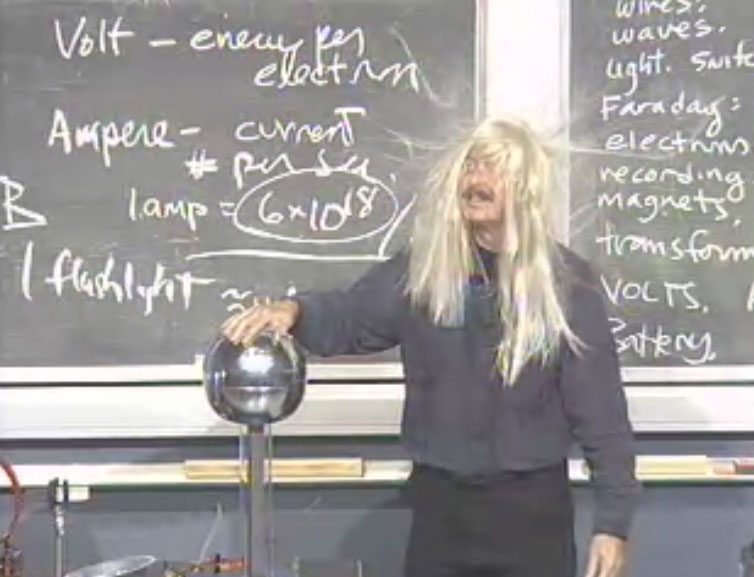
Seseorang menyentuh generator Van de Graaff dengan rambut berdiri tegak
Muatan sejenis tolak-menolak: setiap helai rambut membawa muatan yang sama dari generator Van de Graaff, sehingga saling mendorong
10.2

The Process of Charging · ⁨Proses Pengisian⁩

Syllabus · ⁨Silabus⁩
English

Learning Objective 10.2.A: Describe the behavior of a system using conservation of charge.

  • 10.2.A.1 The net charge or charge distribution of a system can change in response to the presence of, or changes in, the net charge or charge distribution of other systems.
    • 10.2.A.1.i The net charge of a system can change due to friction or contact between systems.
    • 10.2.A.1.ii Induced charge separation occurs when the electrostatic force between two systems alters the distribution of charges within the systems, resulting in the polarization of one or both systems.
    • 10.2.A.1.iii Induced charge separation can occur in neutral systems.
  • 10.2.A.2 Any change to a system's net charge is due to a transfer of charge between the system and its surroundings.
    • 10.2.A.2.i The charging of a system typically involves the transfer of electrons to and from the system.
    • 10.2.A.2.ii The net charge of a system will be constant unless there is a transfer of charge to or from the system.
  • 10.2.A.3 Grounding involves electrically connecting a charged system to a much larger and approximately neutral system (e.g., Earth).
Bahasa Indonesia

Tujuan Pembelajaran 10.2.A: Jelaskan perilaku sistem menggunakan kekekalan muatan.

  • 10.2.A.1 Muatan bersih atau distribusi muatan sistem dapat berubah sebagai respons terhadap keberadaan, atau perubahan, muatan bersih atau distribusi muatan sistem lain.
    • 10.2.A.1.i Muatan bersih sistem dapat berubah akibat gesekan atau kontak antar sistem.
    • 10.2.A.1.ii Pemisahan muatan terinduksi terjadi ketika gaya elektrostatik antara dua sistem mengubah distribusi muatan di dalam sistem, menghasilkan polarisasi satu atau kedua sistem.
    • 10.2.A.1.iii Pemisahan muatan terinduksi dapat terjadi pada sistem netral.
  • 10.2.A.2 Setiap perubahan pada muatan bersih suatu sistem disebabkan oleh perpindahan muatan antara sistem dan lingkungannya.
    • 10.2.A.2.i Pengisian sistem biasanya melibatkan perpindahan elektron masuk dan keluar dari sistem.
    • 10.2.A.2.ii Muatan bersih sistem akan tetap konstan kecuali ada perpindahan muatan masuk atau keluar dari sistem.
  • 10.2.A.3 Pembumian melibatkan koneksi listrik sistem bermuatan ke sistem yang jauh lebih besar dan hampir netral (misalnya, Bumi).

Source: College Board AP Course and Exam Description · ⁨Sumber: Deskripsi Kursus dan Ujian College Board AP⁩

English

Objects charge by moving electrons. A conductor 导体 lets charge move freely; an insulator 绝缘体 holds it in place. Three methods:

  • Friction: rubbing transfers electrons.
  • Conduction 接触起电: touching shares charge.
  • Induction 感应起电: a nearby charge rearranges charge in a neutral object, which can then be grounded to leave it charged.
Bahasa Indonesia

Objek bermuatan dengan memindahkan elektron. Konduktor membiarkan muatan bergerak bebas; isolator menahannya di tempat. Tiga metode:

  • Fricion (gesekan): gesekan memindahkan elektron.
  • Konduksi: sentuhan membagikan muatan.
  • Induksi: muatan dekat menyusun ulang muatan dalam objek netral, yang kemudian dapat dibumikan untuk menyisakan muatan padanya.
Explore · ⁨Jelajahi⁩

Charge an object by rubbing · ⁨Muati objek dengan menggosok⁩

Rubbing transfers electrons from one surface to another, leaving one positively and one negatively charged. Like charges repel, opposite charges attract. · ⁨Penggosokan mentransfer elektron dari satu permukaan ke permukaan lain, meninggalkan satu positif dan satu negatif bermuatan. Muatan sejenis tolak, muatan berlawanan tarik.⁩

10.3

Electric Fields · ⁨Medan Listrik⁩

Syllabus · ⁨Silabus⁩
English

Learning Objective 10.3.A: Describe the electric field produced by a charged object or configuration of point charges.

  • 10.3.A.1 Electric fields may originate from charged objects.
  • 10.3.A.2 The electric field at a given point is the ratio of the electric force exerted on a test charge at that point to the charge of the test charge.
    • Equation: $\vec{E} = \dfrac{\vec{F}_E}{q}$
    • 10.3.A.2.i A test charge is a point charge of small enough magnitude such that its presence does not significantly affect an electric field in its vicinity.
    • 10.3.A.2.ii An electric field points away from isolated positive charges and toward isolated negative charges.
    • 10.3.A.2.iii The electric force exerted on a positive test charge by an electric field is in the same direction as the electric field.
  • 10.3.A.3 The electric field is a vector quantity and can be represented in space using vector field maps.
    • 10.3.A.3.i The net electric field at a given location is the vector sum of individual electric fields created by nearby charged objects.
    • 10.3.A.3.ii Electric field maps use vectors to depict the magnitude and direction of the electric field at many locations within a given region.
    • 10.3.A.3.iii Electric field line diagrams are simplified models of electric field maps and can be used to determine the relative magnitude and direction of the electric field at any position in the diagram.

Learning Objective 10.3.B: Describe the electric field generated by charged conductors or insulators.

  • 10.3.B.1 While in electrostatic equilibrium, the excess charge of a solid conductor is distributed on the surface of the conductor, and the electric field within the conductor is zero.
    • 10.3.B.1.i At the surface of a charged conductor, the electric field is perpendicular to the surface.
    • 10.3.B.1.ii The electric field outside an isolated sphere with spherically symmetric charge distribution is the same as the electric field due to a point charge with the same net charge as the sphere located at the center of the sphere.
  • 10.3.B.2 While in electrostatic equilibrium, the excess charge of an insulator is distributed throughout the interior of the insulator as well as at the surface, and the electric field within the insulator may have a nonzero value.

Boundary statement: AP Physics 2 only expects students to make calculations of the electric field resulting from four or fewer charged objects or systems. Analysis of the electric field resulting from more charges is allowed in situations of high symmetry. Students will only be expected to perform qualitative analysis of electric fields within insulators.

Bahasa Indonesia

Tujuan Pembelajaran 10.3.A: Jelaskan medan listrik yang dihasilkan oleh benda bermuatan atau konfigurasi muatan titik.

  • 10.3.A.1 Medan listrik dapat berasal dari benda-benda bermuatan.
  • 10.3.A.2 Medan listrik pada suatu titik adalah rasio gaya listrik yang diberikan pada muatan uji di titik tersebut terhadap muatan muatan uji.
    • Persamaan: $\vec{E} = \dfrac{\vec{F}_E}{q}$
    • 10.3.A.2.i Muatan uji adalah muatan titik dengan besaran cukup kecil sehingga keberadaannya tidak secara signifikan memengaruhi medan listrik di sekitarnya.
    • 10.3.A.2.ii Medan listrik mengarah menjauhi muatan positif terisolasi dan menuju muatan negatif terisolasi.
    • 10.3.A.2.iii Gaya listrik yang diberikan pada muatan uji positif oleh medan listrik berada pada arah yang sama dengan medan listrik.
  • 10.3.A.3 Medan listrik adalah besaran vektor dan dapat direpresentasikan dalam ruang menggunakan peta medan vektor.
    • 10.3.A.3.i Medan listrik total pada lokasi tertentu adalah hasil penjumlahan vektor dari medan listrik individu yang diciptakan oleh objek-objek bermuatan di dekatnya.
    • 10.3.A.3.ii Peta medan listrik menggunakan vektor untuk menggambarkan besaran dan arah medan listrik di banyak lokasi dalam suatu daerah tertentu.
    • 10.3.A.3.iii Diagram garis medan listrik adalah model sederhana dari peta medan listrik dan dapat digunakan untuk menentukan besaran relatif dan arah medan listrik pada posisi mana pun dalam diagram.

Tujuan Pembelajaran 10.3.B: Jelaskan medan listrik yang dihasilkan oleh konduktor atau isolator bermuatan.

  • 10.3.B.1 Saat dalam kesetimbangan elektrostatik, kelebihan muatan konduktor solid terdistribusi pada permukaan konduktor, dan medan listrik di dalam konduktor adalah nol.
    • 10.3.B.1.i Di permukaan konduktor bermuatan, medan listrik tegak lurus terhadap permukaan.
    • 10.3.B.1.ii Medan listrik di luar bola terisolasi dengan distribusi muatan simetris bola adalah sama dengan medan listrik akibat muatan titik dengan jumlah muatan bersih yang sama dengan bola yang terletak di pusat bola.
  • 10.3.B.2 Saat dalam kesetimbangan elektrostatik, kelebihan muatan isolator terdistribusi di seluruh bagian dalam isolator serta di permukaannya, dan medan listrik di dalam isolator mungkin memiliki nilai tak nol.

Pernyataan Batasan: AP Fisika 2 hanya mengharapkan siswa melakukan perhitungan medan listrik yang dihasilkan dari empat objek bermuatan atau sistem atau kurang. Analisis medan listrik yang dihasilkan dari lebih banyak muatan diperbolehkan dalam situasi simetri tinggi. Siswa hanya diharapkan melakukan analisis kualitatif medan listrik di dalam isolator.
Source: College Board AP Course and Exam Description · ⁨Sumber: Deskripsi Kursus dan Ujian College Board AP⁩

English
The electric field of a dipole

An electric field 电场 $\vec{E}$ is the force per unit charge that a small positive test charge would feel:

$$\vec{E}=\frac{\vec{F}}{q},\qquad E=\frac{kQ}{r^2}\ \text{for a point charge}.$$
Field lines point away from positive charges and toward negative ones; where they are denser, the field is stronger. A charge in a field feels $\vec{F}=q\vec{E}$.

Worked example. Find the electric field $0.20\ \text{m}$ from a $+5.0\ \mu\text{C}$ point charge: $E=\dfrac{kQ}{r^2}=\dfrac{9.0\times10^{9}\times5.0\times10^{-6}}{(0.20)^2}=1.1\times10^{6}\ \text{N/C}$, pointing away from the charge. A $+2\ \text{nC}$ charge placed there would feel $F=qE=2\times10^{-9}\times1.1\times10^{6}=2.2\times10^{-3}\ \text{N}$.

Bahasa Indonesia
Medan listrik dari sebuah dipol
Beberapa petir bercabang terang menyambar dari langit mendung ke pelabuhan
Petir: muatan terkumpul hingga medan listrik antara awan dan tanah cukup kuat untuk melepaskan elektron dari molekul udara, dan arus besar mengalir

Medan listrik $\vec{E}$ adalah gaya per satuan muatan yang akan dirasakan oleh muatan uji positif kecil:

$$\vec{E}=\frac{\vec{F}}{q},\qquad E=\frac{kQ}{r^2}\ \text{for a point charge}.$$
Garis-garis medan mengarah menjauhi muatan positif dan menuju ke muatan negatif; di mana garis lebih padat, medan lebih kuat. Muatan dalam medan merasakan $\vec{F}=q\vec{E}$.

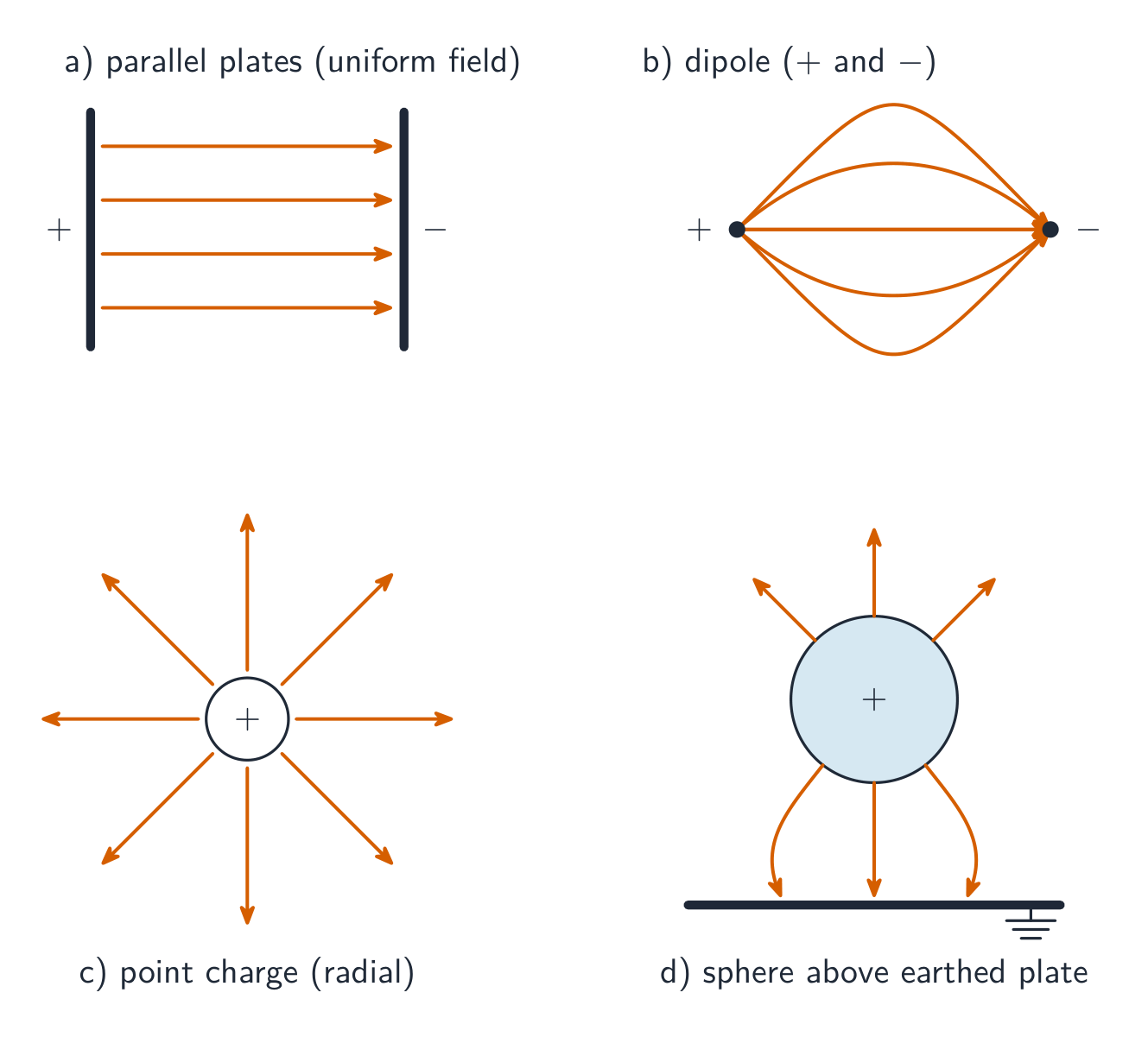
Pola garis medan listrik untuk pelat sejajar, dipol, dan muatan titik

Contoh terpecahkan. Temukan medan listrik $0.20\ \text{m}$ dari muatan titik $+5.0\ \mu\text{C}$: $E=\dfrac{kQ}{r^2}=\dfrac{9.0\times10^{9}\times5.0\times10^{-6}}{(0.20)^2}=1.1\times10^{6}\ \text{N/C}$, mengarah menjauhi muatan. Muatan $+2\ \text{nC}$ yang diletakkan di sana akan merasakan $F=qE=2\times10^{-9}\times1.1\times10^{6}=2.2\times10^{-3}\ \text{N}$.

Explore · ⁨Jelajahi⁩

Map the field around a charge · ⁨Peta medan di sekitar muatan⁩

An electric field points the way a positive test charge would be pushed: away from a positive charge, toward a negative one. Closer lines mean a stronger field. · ⁨Medan listrik menunjukkan arah dorongan terhadap muatan uji positif: menjauhi muatan positif, menuju muatan negatif. Garis yang lebih rapat berarti medan yang lebih kuat.⁩

Vocabulary · ⁨Kosa kata⁩ Train · ⁨Latih⁩
English Bahasa Indonesia
Electric charge/ɪˈlektrɪk tʃɑːdʒ/ Muatan listrik
Coulomb's law/ˈkuːlɒmz lɔː/ Hukum Coulomb
permittivity/ˌpɜːmɪˈtɪvəti/ permitivitas
conductor/kənˈdʌktə/ konduktor
insulator/ˈɪnsjuːleɪtə/ isolator
Conduction/kənˈdʌkʃn/ Konduksi
Induction/ɪnˈdʌkʃn/ Orientasi
electric field/ɪˈlektrɪk fiːld/ medan listrik
electric potential energy/ɪˈlektrɪk pəˈtenʃl ˈenədʒi/ energi potensial listrik
Electric potential/ɪˈlektrɪk pəˈtenʃl/ Potensi elektrik
10.4

Electric Potential Energy · ⁨Energi Potensial Listrik⁩

Syllabus · ⁨Silabus⁩
English

Learning Objective 10.4.A: Describe the electric potential energy of a system.

  • 10.4.A.1 The electric potential energy of a system of two point charges equals the amount of work required for an external force to bring the point charges to their current positions from infinitely far away.
  • 10.4.A.2 The general form for the electric potential energy of two charged objects is given by the equation
    • Equation: $U_E = \dfrac{1}{4\pi\varepsilon_0}\dfrac{q_1 q_2}{r} = k\dfrac{q_1 q_2}{r}$
  • 10.4.A.3 The total electric potential energy of a system can be determined by finding the sum of the electric potential energies of the individual interactions between each pair of charged objects in the system.

Boundary statement: As the methods to calculate the electric potential energy due to extended charge distributions exceed the scope of the course, AP Physics 2 only requires that students calculate the electric potential energy of configurations of four or fewer point charges.

Bahasa Indonesia

Tujuan Pembelajaran 10.4.A: Jelaskan energi potensial listrik dari suatu sistem.

  • 10.4.A.1 Energi potensial listrik dari sistem dua muatan titik sama dengan jumlah kerja yang diperlukan oleh gaya eksternal untuk membawa muatan titik tersebut ke posisi saat ini dari jarak tak hingga.
  • 10.4.A.2 Bentuk umum untuk energi potensial listrik dari dua benda bermuatan diberikan oleh persamaan
    • Persamaan: $U_E = \dfrac{1}{4\pi\varepsilon_0}\dfrac{q_1 q_2}{r} = k\dfrac{q_1 q_2}{r}$
  • 10.4.A.3 Total energi potensial listrik dari suatu sistem dapat ditentukan dengan mencari jumlah energi potensial listrik dari interaksi individual antara setiap pasangan benda bermuatan dalam sistem tersebut.

Pernyataan Batas: Karena metode untuk menghitung energi potensial listrik akibat distribusi muatan yang meluas melebihi jangkauan kurikulum, AP Physics 2 hanya mensyaratkan siswa untuk menghitung energi potensial listrik dari konfigurasi empat atau lebih sedikit muatan titik.

Source: College Board AP Course and Exam Description · ⁨Sumber: Deskripsi Kursus dan Ujian College Board AP⁩

English

Two charges have electric potential energy 电势能 stored in their arrangement:

$$U=\frac{k q_1 q_2}{r}.$$
Like charges pushed together store positive energy; opposite charges have negative energy (bound). Moving a charge changes $U$, and the electric force does work equal to $-\Delta U$.

Bahasa Indonesia

Dua muatan memiliki energi potensial listrik yang tersimpan dalam susunannya:

$$U=\frac{k q_1 q_2}{r}.$$
Muatan sejenis yang didorong bersama menyimpan energi positif; muatan berlawanan memiliki energi negatif (terikat). Memindahkan muatan mengubah $U$, dan gaya listrik melakukan usaha sama dengan $-\Delta U$.

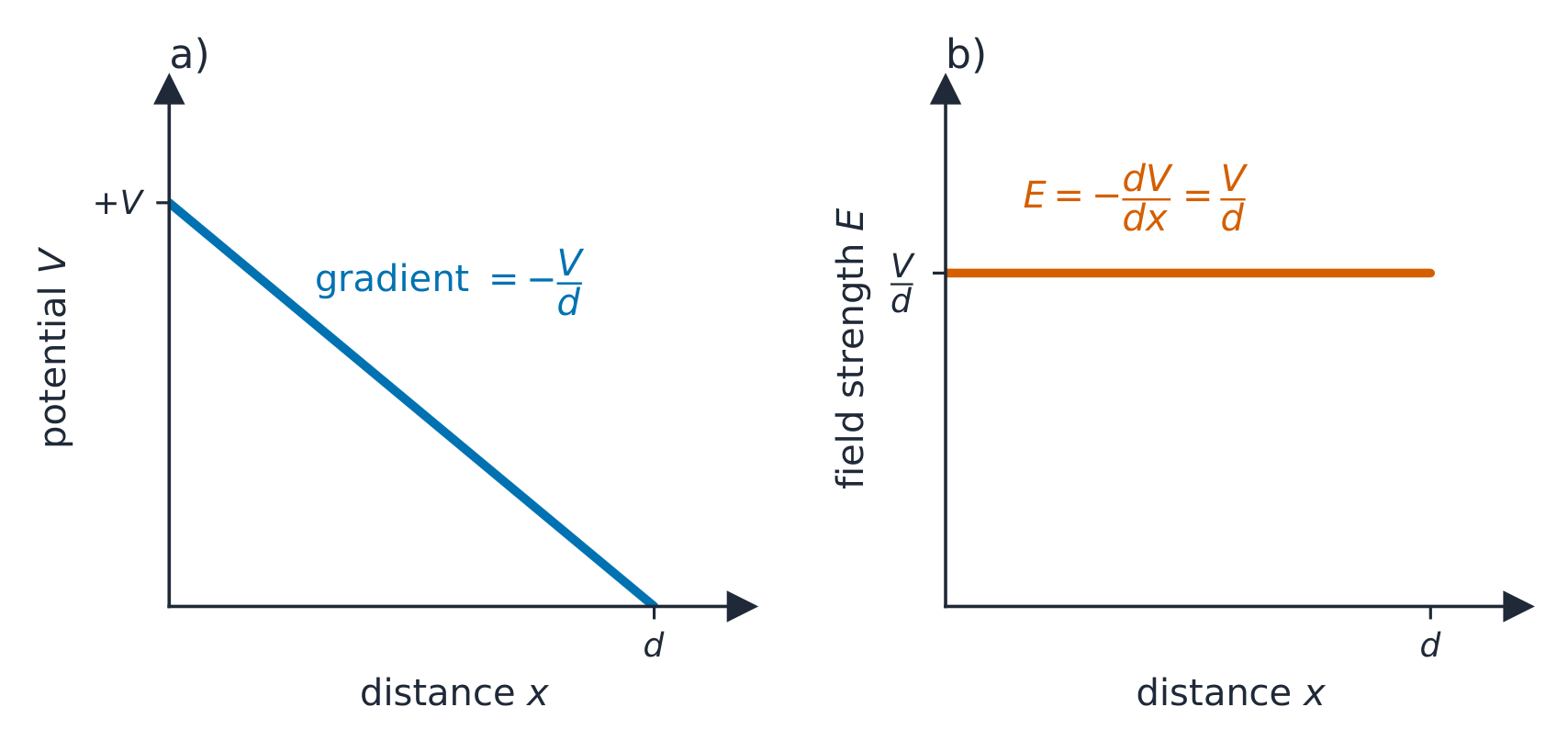
Dalam medan seragam, potensial menurun secara teratur seiring jarak, sehingga E berkaitan dengan V
10.5

Electric Potential · ⁨Potensial Listrik⁩

Syllabus · ⁨Silabus⁩
English

Learning Objective 10.5.A: Describe the electric potential due to a configuration of charged objects.

  • 10.5.A.1 Electric potential describes the electric potential energy per unit charge at a point in space.
  • 10.5.A.2 The electric potential due to multiple point charges can be determined by the principle of scalar superposition of the electric potential due to each of the point charges.
    • Equation: $V = \dfrac{1}{4\pi\varepsilon_0}\sum_{i}\dfrac{q_i}{r_i}$
  • 10.5.A.3 The electric potential difference between two points is the change in electric potential energy per unit charge when a test charge is moved between the two points.
    • Equation: $\Delta V = \dfrac{\Delta U_E}{q}$
    • 10.5.A.3.i Electric potential difference may also result from chemical processes that cause positive and negative charges to separate, such as in a battery.
  • 10.5.A.4 When conductors are in electrical contact, electrons will be redistributed such that the surfaces of the conductors are at the same electric potential.

Learning Objective 10.5.B: Describe the relationship between electric potential and electric field.

  • 10.5.B.1 The average electric field between two points in space is equal to the electric potential difference between the two points divided by the distance between the two points.
    • Equation: $\left|\vec{E}\right| = \left|\dfrac{\Delta V}{\Delta r}\right|$
  • 10.5.B.2 Electric field vector maps and equipotential lines are tools to describe the field produced by a charge or configuration of charges and can be used to predict the motion of charged objects in the field.
    • 10.5.B.2.i Equipotential lines represent lines of equal electric potential in space. These lines are also referred to as isolines of electric potential.
    • 10.5.B.2.ii Isolines are perpendicular to electric field vectors. An isoline map of electric potential can be constructed from an electric field vector map, and an electric field map may be constructed from an isoline map.
    • 10.5.B.2.iii An electric field vector points in the direction of decreasing potential.
    • 10.5.B.2.iv There is no component of an electric field along an isoline.

Boundary statement: As the methods to calculate the electric potential due to extended charges exceed the scope of the course, AP Physics 2 only expects that students calculate the electric potential of configurations of four or fewer particles (or more in situations of high symmetry).

Bahasa Indonesia

Tujuan Pembelajaran 10.5.A: Jelaskan potensial listrik akibat konfigurasi benda-benda bermuatan.

  • 10.5.A.1 Potensial listrik menggambarkan energi potensial listrik per satuan muatan pada suatu titik di ruang.
  • 10.5.A.2 Potensial listrik akibat beberapa muatan titik dapat ditentukan melalui prinsip superposisi skalar dari potensial listrik akibat masing-masing muatan titik.
    • Persamaan: $V = \dfrac{1}{4\pi\varepsilon_0}\sum_{i}\dfrac{q_i}{r_i}$
  • 10.5.A.3 Selisih potensial listrik antara dua titik adalah perubahan energi potensial listrik per satuan muatan ketika sebuah muatan uji dipindahkan di antara kedua titik tersebut.
    • Persamaan: $\Delta V = \dfrac{\Delta U_E}{q}$
    • 10.5.A.3.i Selisih potensial listrik juga dapat timbul dari proses kimia yang menyebabkan pemisahan muatan positif dan negatif, seperti dalam baterai.
  • 10.5.A.4 Ketika konduktor berada dalam kontak listrik, elektron akan terdistribusi ulang sehingga permukaan konduktor berada pada potensial listrik yang sama.

Tujuan Pembelajaran 10.5.B: Jelaskan hubungan antara potensial listrik dan medan listrik.

  • 10.5.B.1 Medan listrik rata-rata antara dua titik di ruang sama dengan selisih potensial listrik antara kedua titik tersebut dibagi dengan jarak antara kedua titik tersebut.
    • Persamaan: $\left|\vec{E}\right| = \left|\dfrac{\Delta V}{\Delta r}\right|$
  • 10.5.B.2 Peta vektor medan listrik dan garis-garis ekuipotensial adalah alat untuk menjelaskan medan yang dihasilkan oleh suatu muatan atau konfigurasi muatan dan dapat digunakan untuk memprediksi gerak benda bermuatan dalam medan tersebut.
    • 10.5.B.2.i Garis-garis ekuipotensial mewakili garis dengan potensial listrik yang sama di ruang. Garis-garis ini juga disebut sebagai isoline potensial listrik.
    • 10.5.B.2.ii Isolines tegak lurus terhadap vektor medan listrik. Peta isoline potensial listrik dapat dibuat dari peta vektor medan listrik, dan peta medan listrik dapat dibuat dari peta isoline.
    • 10.5.B.2.iii Vektor medan listrik mengarah ke arah penurunan potensial.
    • 10.5.B.2.iv Tidak ada komponen medan listrik sepanjang isoline.

Pernyataan Batas: Karena metode untuk menghitung potensial listrik akibat muatan yang meluas melebihi jangkauan kurikulum, AP Physics 2 hanya mengharapkan siswa untuk menghitung potensial listrik dari konfigurasi empat atau lebih sedikit partikel (atau lebih banyak dalam situasi simetri tinggi).

Source: College Board AP Course and Exam Description · ⁨Sumber: Deskripsi Kursus dan Ujian College Board AP⁩

English

Electric potential 电势 $V$ is the potential energy per unit charge – a scalar field, measured in volts:

$$V=\frac{U}{q}=\frac{kQ}{r}.$$
The potential difference (voltage) 电压 between two points is the work per unit charge to move between them: $\Delta V=\dfrac{\Delta U}{q}$, and $U=qV$. Positive charges move from high to low potential on their own. Because potential is a scalar, adding the potentials from several charges is much easier than adding field vectors.

Bahasa Indonesia

Potensial listrik $V$ adalah energi potensial per satuan muatan – sebuah bidang skalar, diukur dalam volt:

$$V=\frac{U}{q}=\frac{kQ}{r}.$$
Perbedaan potensial (tegangan) antara dua titik adalah usaha per satuan muatan untuk memindahkannya dari satu ke titik lain: $\Delta V=\dfrac{\Delta U}{q}$, dan $U=qV$. Muatan positif bergerak dari potensial tinggi ke rendah secara alami. Karena potensial adalah skalar, menjumlahkan potensial dari beberapa muatan jauh lebih mudah daripada menjumlahkan vektor medan.

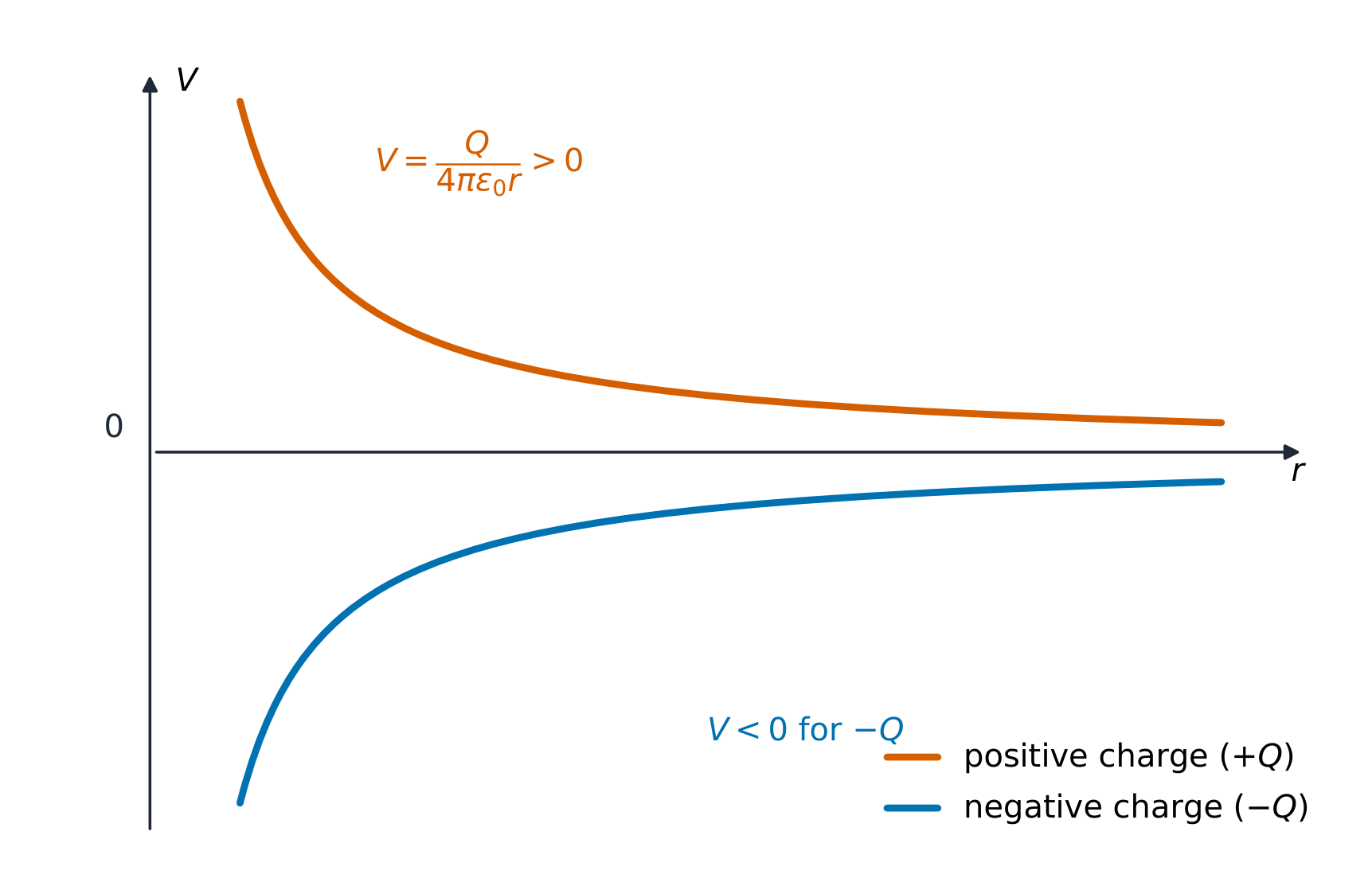
Potensial dekat muatan titik berubah sebanding dengan 1/r
Potensial dekat muatan titik bervariasi sebagai 1/r
10.6

Capacitors · ⁨Kapasitor⁩

Syllabus · ⁨Silabus⁩
English

Learning Objective 10.6.A: Describe the physical properties of a parallel-plate capacitor.

  • 10.6.A.1 A parallel-plate capacitor consists of two separated parallel conducting surfaces that can hold equal amounts of charge with opposite signs.
  • 10.6.A.2 Capacitance relates the magnitude of the charge stored on each plate to the electric potential difference created by the separation of those charges.
    • Equation: $C = \dfrac{Q}{\Delta V}$
    • 10.6.A.2.i The capacitance of a capacitor depends only on the physical properties of the capacitor, such as the capacitor's shape and the material used to separate the plates.
    • 10.6.A.2.ii The capacitance of a parallel-plate capacitor is proportional to the area of one of its plates and inversely proportional to the distance between its plates. The constant of proportionality is the product of the dielectric constant, $\kappa$, of the material between the plates and the electric permittivity of free space, $\varepsilon_0$.
      • Equation: $C = \kappa\varepsilon_0\dfrac{A}{d}$
  • 10.6.A.3 The electric field between two charged parallel plates with uniformly distributed electric charge, such as in a parallel-plate capacitor, is constant in both magnitude and direction, except near the edges of the plates.
    • 10.6.A.3.i The magnitude of the electric field between two charged parallel plates, where the plate separation is much smaller than the dimensions of the plates, can be described with the equation
      • Equation: $E_C = \dfrac{Q}{\kappa\varepsilon_0 A}$
    • 10.6.A.3.ii A charged particle between two oppositely charged parallel plates undergoes constant acceleration and therefore its motion shares characteristics with the projectile motion of an object with mass in the gravitational field near Earth's surface.
  • 10.6.A.4 The electric potential energy stored in a capacitor is equal to the work done by an external force to separate that amount of charge on the capacitor.
  • 10.6.A.5 The electric potential energy stored in a capacitor is described by the equation
    • Equation: $U_C = \dfrac{1}{2}Q\Delta V$
  • 10.6.A.6 Adding a dielectric between two plates of a capacitor changes the capacitance of the capacitor and induces an electric field in the dielectric in the opposite direction to the field between the plates.

Boundary statement: While other shapes are also able to separate charges, only the analysis and descriptions of parallel-plate capacitors are required for AP Physics 2. Edge effects will be ignored unless explicitly stated otherwise.

Bahasa Indonesia

Tujuan Pembelajaran 10.6.A: Jelaskan sifat fisik kapasitor pelat sejajar.

  • 10.6.A.1 Kapasitor pelat sejajar terdiri dari dua permukaan konduktor sejajar yang terpisah dan dapat menampung jumlah muatan yang sama dengan tanda berlawanan.
  • 10.6.A.2 Kapasitas menghubungkan besaran muatan yang tersimpan pada setiap pelat dengan selisih potensial listrik yang dihasilkan oleh pemisahan muatan tersebut.
    • Persamaan: $C = \dfrac{Q}{\Delta V}$
    • 10.6.A.2.i Kapasitas kapasitor hanya bergantung pada sifat fisik kapasitor, seperti bentuk kapasitor dan bahan yang digunakan untuk memisahkan pelat-pelatnya.
    • 10.6.A.2.ii Kapasitas kapasitor pelat sejajar sebanding dengan luas salah satu pelatnya dan berbanding terbalik dengan jarak antar pelatnya. Konstanta proporsionalitas adalah hasil kali konstanta dielektrik, $\kappa$, dari bahan di antara pelat dan permitivitas ruang hampa, $\varepsilon_0$.
      • Persamaan: $C = \kappa\varepsilon_0\dfrac{A}{d}$
  • 10.6.A.3 Medan listrik antara dua pelat sejajar bermuatan dengan distribusi muatan listrik seragam, seperti pada kapasitor pelat sejajar, konstan baik dalam besaran maupun arah, kecuali di dekat tepi pelat.
    • 10.6.A.3.i Besaran medan listrik antara dua pelat sejajar bermuatan, di mana jarak antar pelat jauh lebih kecil daripada dimensi pelat, dapat dijelaskan dengan persamaan
      • Persamaan: $E_C = \dfrac{Q}{\kappa\varepsilon_0 A}$
    • 10.6.A.3.ii Partikel bermuatan di antara dua pelat sejajar bermuatan berlawanan mengalami percepatan konstan, sehingga geraknya memiliki karakteristik yang mirip dengan gerak peluru benda bermassa dalam medan gravitasi di dekat permukaan Bumi.
  • 10.6.A.4 Energi potensial listrik yang tersimpan dalam kapasitor sama dengan kerja yang dilakukan oleh gaya eksternal untuk memisahkan jumlah muatan tersebut pada kapasitor.
  • 10.6.A.5 Energi potensial listrik yang tersimpan dalam kapasitor dijelaskan oleh persamaan
    • Persamaan: $U_C = \dfrac{1}{2}Q\Delta V$
  • 10.6.A.6 Menambahkan dielektrik di antara dua pelat kapasitor mengubah kapasitas kapasitor dan menginduksi medan listrik di dalam dielektrik yang berlawanan arah dengan medan di antara pelat-pelatnya.

Pernyataan Batas: Meskipun bentuk lain juga mampu memisahkan muatan, hanya analisis dan deskripsi kapasitor pelat sejajar yang disyaratkan untuk AP Physics 2. Efek tepi akan diabaikan kecuali dinyatakan secara eksplisit sebaliknya.

Source: College Board AP Course and Exam Description · ⁨Sumber: Deskripsi Kursus dan Ujian College Board AP⁩

English
Discharging a capacitor: τ = RC
Charging a capacitor (RC)

A capacitor 电容器 stores charge and energy on two conductors separated by a gap. Its capacitance 电容 relates charge to voltage:

$$C=\frac{Q}{V},$$
and the stored energy is $U=\tfrac{1}{2}CV^2$. Capacitance depends on the plates' geometry and the material between them, not on the charge placed on it.

Worked example. A $100\ \mu\text{F}$ capacitor is charged to $12\ \text{V}$. It holds $Q=CV=100\times10^{-6}\times12=1.2\times10^{-3}\ \text{C}$ of charge and stores $U=\tfrac12 CV^2=\tfrac12\times100\times10^{-6}\times12^2=7.2\times10^{-3}\ \text{J}$ of energy.

Bahasa Indonesia
Mengosongkan kapasitor: τ = RC
Mengisi kapasitor (RC)

Sebuah kapasitor menyimpan muatan dan energi pada dua konduktor yang dipisahkan oleh celah. Kapasitansinya menghubungkan muatan dengan tegangan:

$$C=\frac{Q}{V},$$
dan energi yang tersimpan adalah $U=\tfrac{1}{2}CV^2$. Kapasitas bergantung pada geometri pelat dan material di antaranya, bukan pada muatan yang diletakkan di atasnya.

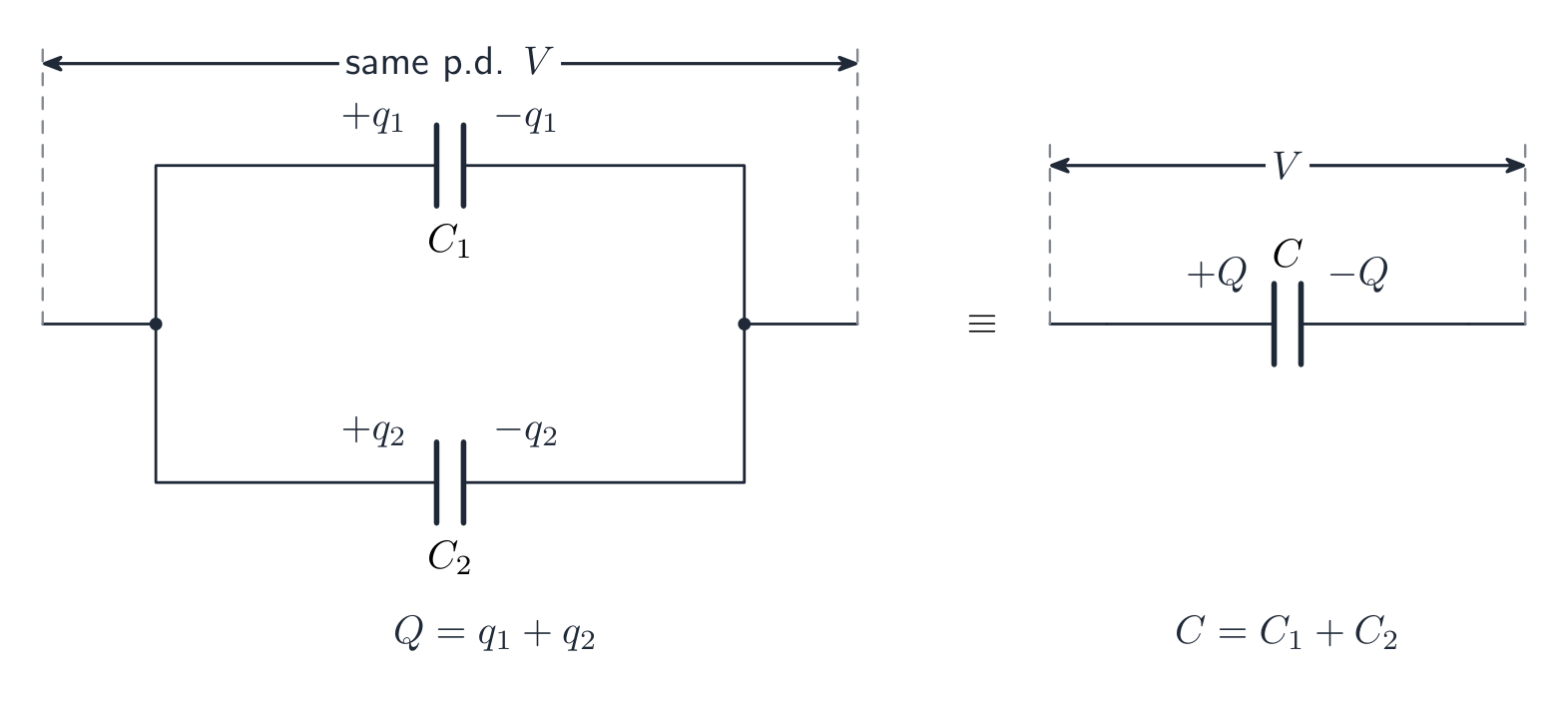
Kapasitor paralel memiliki beda potensial yang sama, dan muatannya bertambah
Kapasitor dalam seri berbagi p.d. yang sama, dan muatannya dijumlahkan

Contoh terpecahkan. Sebuah kapasitor $100\ \mu\text{F}$ diisi hingga $12\ \text{V}$. Ia menahan $Q=CV=100\times10^{-6}\times12=1.2\times10^{-3}\ \text{C}$ muatan dan menyimpan $U=\tfrac12 CV^2=\tfrac12\times100\times10^{-6}\times12^2=7.2\times10^{-3}\ \text{J}$ energi.

Explore · ⁨Jelajahi⁩

Charge and discharge a capacitor · ⁨Muati dan kosongkan kapasitor⁩

A capacitor stores charge on two plates. It fills and empties exponentially, set by the time constant $\tau = RC$ — bigger $R$ or $C$ means slower charging. · ⁨Kapasitor menyimpan muatan pada dua pelat. Ia terisi dan kosong secara eksponensial, ditentukan oleh konstanta waktu $\tau = RC$ — semakin besar $R$ atau $C$, semakin lambat pengisian.⁩

Vocabulary · ⁨Kosa kata⁩ Train · ⁨Latih⁩
English Bahasa Indonesia
capacitor/kəˈpæsɪtə/ kapasitor
capacitance/kəˈpæsɪtəns/ kapasitansi
10.7

Conservation of Electric Energy · ⁨Kekekalan Energi Listrik⁩

Syllabus · ⁨Silabus⁩
English

Learning Objective 10.7.A: Describe changes in energy in a system due to a difference in electric potential between two locations.

  • 10.7.A.1 When a charged object moves between two locations with different electric potentials, the resulting change in the electric potential energy of the object-field system is given by the following equation.
    • Equation: $\Delta U_E = q\Delta V$
  • 10.7.A.2 The movement of a charged object between two points with different electric potentials results in a change in kinetic energy of the object consistent with the conservation of energy.
Bahasa Indonesia

Tujuan Pembelajaran 10.7.A: Jelaskan perubahan energi dalam suatu sistem akibat perbedaan potensial listrik antara dua lokasi.

  • 10.7.A.1 Ketika benda bermuatan bergerak di antara dua lokasi dengan potensial listrik yang berbeda, perubahan energi potensial listrik dari sistem benda-medan diberikan oleh persamaan berikut.
    • Persamaan: $\Delta U_E = q\Delta V$
  • 10.7.A.2 Pergerakan benda bermuatan di antara dua titik dengan potensial listrik yang berbeda menghasilkan perubahan energi kinetik pada benda yang sesuai dengan hukum kekekalan energi.

Source: College Board AP Course and Exam Description · ⁨Sumber: Deskripsi Kursus dan Ujian College Board AP⁩

English

Energy is conserved for charges just as for masses. A charge released in a field converts electric potential energy into kinetic energy:

$$q\,\Delta V=\tfrac{1}{2}mv^2 \quad(\text{gaining speed as it "falls" through a potential difference}).$$

Worked example. An electron ($q=1.6\times10^{-19}\ \text{C}$, $m=9.1\times10^{-31}\ \text{kg}$) is accelerated from rest through a potential difference of $100\ \text{V}$. Its final speed is

$$v=\sqrt{\frac{2q\,\Delta V}{m}}=\sqrt{\frac{2\times1.6\times10^{-19}\times100}{9.1\times10^{-31}}}=5.9\times10^{6}\ \text{m/s}.$$
This is exactly how the electron gun in an old television or an electron microscope works.

Bahasa Indonesia

Energi kekal untuk muatan sama seperti untuk massa. Muatan yang dilepaskan dalam medan mengonversi energi potensial listrik menjadi energi kinetik:

$$q\,\Delta V=\tfrac{1}{2}mv^2 \quad(\text{gaining speed as it "falls" through a potential difference}).$$

Contoh terpecahkan. Sebuah elektron ($q=1.6\times10^{-19}\ \text{C}$, $m=9.1\times10^{-31}\ \text{kg}$) dipercepat dari keadaan diam melalui perbedaan potensial $100\ \text{V}$. Kecepatan akhirnya adalah

$$v=\sqrt{\frac{2q\,\Delta V}{m}}=\sqrt{\frac{2\times1.6\times10^{-19}\times100}{9.1\times10^{-31}}}=5.9\times10^{6}\ \text{m/s}.$$
Inilah cara kerja pistol elektron di televisi lama atau mikroskop elektron.

Vocabulary · ⁨Kosa kata⁩ Train · ⁨Latih⁩
English Bahasa Indonesia
potential difference/pəˈtenʃl ˈdɪfrəns/ beda potensial
10.7

Exam tips · ⁨Tips ujian⁩

English
  • Coulomb's law and the point-charge field are inverse-square — doubling the separation makes the force (or field) four times smaller.
  • Use magnitudes for the size of a force and decide direction from the signs; the field points the way a positive test charge would move.
  • Potential ($V$) is a scalar so potentials from several charges simply add; the field ($E$) is a vector and must be added by direction.
  • For a charge accelerated through a voltage use energy conservation $qV=\tfrac12 mv^2$.
  • Capacitor relations: $C=Q/V$ (capacitance is fixed by geometry) and energy $U=\tfrac12 CV^2$.
Bahasa Indonesia
  • Hukum Coulomb dan medan muatan titik bersifat kuadrat terbalik — menggandakan jarak pisahnya membuat gaya (atau medan) menjadi empat kali lebih kecil.
  • Gunakan besaran untuk ukuran gaya dan tentukan arah dari tanda; medan menunjuk ke arah di mana muatan uji positif akan bergerak.
  • Potensial ($V$) adalah skalar sehingga potensial dari beberapa muatan cukup dijumlahkan; medan ($E$) adalah vektor dan harus ditambahkan berdasarkan arah.
  • Untuk muatan yang dipercepat melalui tegangan gunakan kekekalan energi $qV=\tfrac12 mv^2$.
  • Hubungan kapasitor: $C=Q/V$ (kapasitas tetap ditentukan oleh geometri) dan energi $U=\tfrac12 CV^2$.

Interactive lessons on this topic · ⁨Pelajaran interaktif untuk topik ini⁩

Work through it step by step, with instant-check exercises. · ⁨Kerjakan langkah demi langkah, dengan latihan pengecekan instan.⁩

Past Papers · ⁨Soal-Soil Masa Lalu⁩

More topics in AP Physics 2 · ⁨AP Fisika 2⁩ · ⁨Topik lain dalam AP Physics 2 · ⁨AP Fisika 2⁩⁩

Log in or create account · ⁨Masuk atau buat akun⁩

IGCSE, A-Level & AP