Skip to content · ⁨Lompat ke konten⁩

Factor Markets · ⁨Pasar Faktor Produksi⁩

AP Microeconomics · ⁨AP Ekonomi Mikro⁩ · Topic 5 · ⁨Topik 5⁩

Video lesson for this topic · ⁨Pelajaran video untuk topik ini⁩ Open the video page · ⁨Buka halaman video⁩
7:56

Pasar Faktor Produksi

Dua pekerja. Satu menjahit kemeja di pabrik pakaian. Yang lain membangun mobil di jalur perakitan. Yang kedua mendapat gaji jauh lebih tinggi. Mengapa? Dalam unit ini perusahaan adalah…

English narration · English + 中文 subtitles burned in · ⁨Narasi bahasa Inggris · Subtitle bahasa Inggris + 中文 disematkan langsung⁩

5.1

Introduction to Factor Markets · ⁨Pengantar Pasar Faktor⁩

Syllabus · ⁨Silabus⁩
English

Enduring Understanding (PRD-4): Factor prices provide incentives and convey information to firms and factors of production.

Learning Objective PRD-4.A: a. Define (using graphs where appropriate) key terms and concepts relating to factor markets. b. Explain (using graphs where appropriate) the relationship between factors of production, firms, and factor prices. c. Calculate (using data from a graph or table where appropriate) the marginal revenue product and marginal resource cost.

  • PRD-4.A.1 Factors of production (labor, capital, and land) respond to factor prices (wages, interest, and rent), and employers' (firms') decision to hire is based on the productivity of the factors, output price, and cost of the factor.
  • PRD-4.A.2 The quantity of labor demanded is negatively related to the wage rate, while the quantity of labor supplied is positively related to the wage rate in a given labor market, other things constant.
Bahasa Indonesia

Pemahaman Berkelanjutan (PRD-4): Harga faktor memberikan insentif dan menyampaikan informasi kepada perusahaan dan faktor produksi.

Tujuan Pembelajaran PRD-4.A: a. Definisikan (menggunakan grafik jika sesuai) istilah dan konsep kunci yang berkaitan dengan pasar faktor. b. Jelaskan (menggunakan grafik jika sesuai) hubungan antara faktor produksi, perusahaan, dan harga faktor. c. Hitung (menggunakan data dari grafik atau tabel jika sesuai) produk pendapatan marjinal dan biaya sumber daya marjinal.

  • PRD-4.A.1 Faktor produksi (tenaga kerja, modal, dan tanah) merespons harga faktor (upah, bunga, dan sewa), dan keputusan pemberi kerja (perusahaan) untuk merekrut didasarkan pada produktivitas faktor, harga output, dan biaya faktor.
  • PRD-4.A.2 Kuantitas tenaga kerja yang diminta berbanding terbalik dengan tingkat upah, sementara kuantitas tenaga kerja yang ditawarkan berbanding lurus dengan tingkat upah dalam suatu pasar tenaga kerja tertentu, dengan asumsi lain tetap.

Source: College Board AP Course and Exam Description · ⁨Sumber: Deskripsi Kursus dan Ujian College Board AP⁩

English

A factor market 要素市场 is where firms buy the factors of production – labor, land, capital. The roles reverse: firms demand and households supply. The most-tested factor is labor.

Factor demand is a derived demand 派生需求 – firms want labor not for itself but for the output (and revenue) it produces. So the demand for workers depends on the demand for the product they make.

Bahasa Indonesia
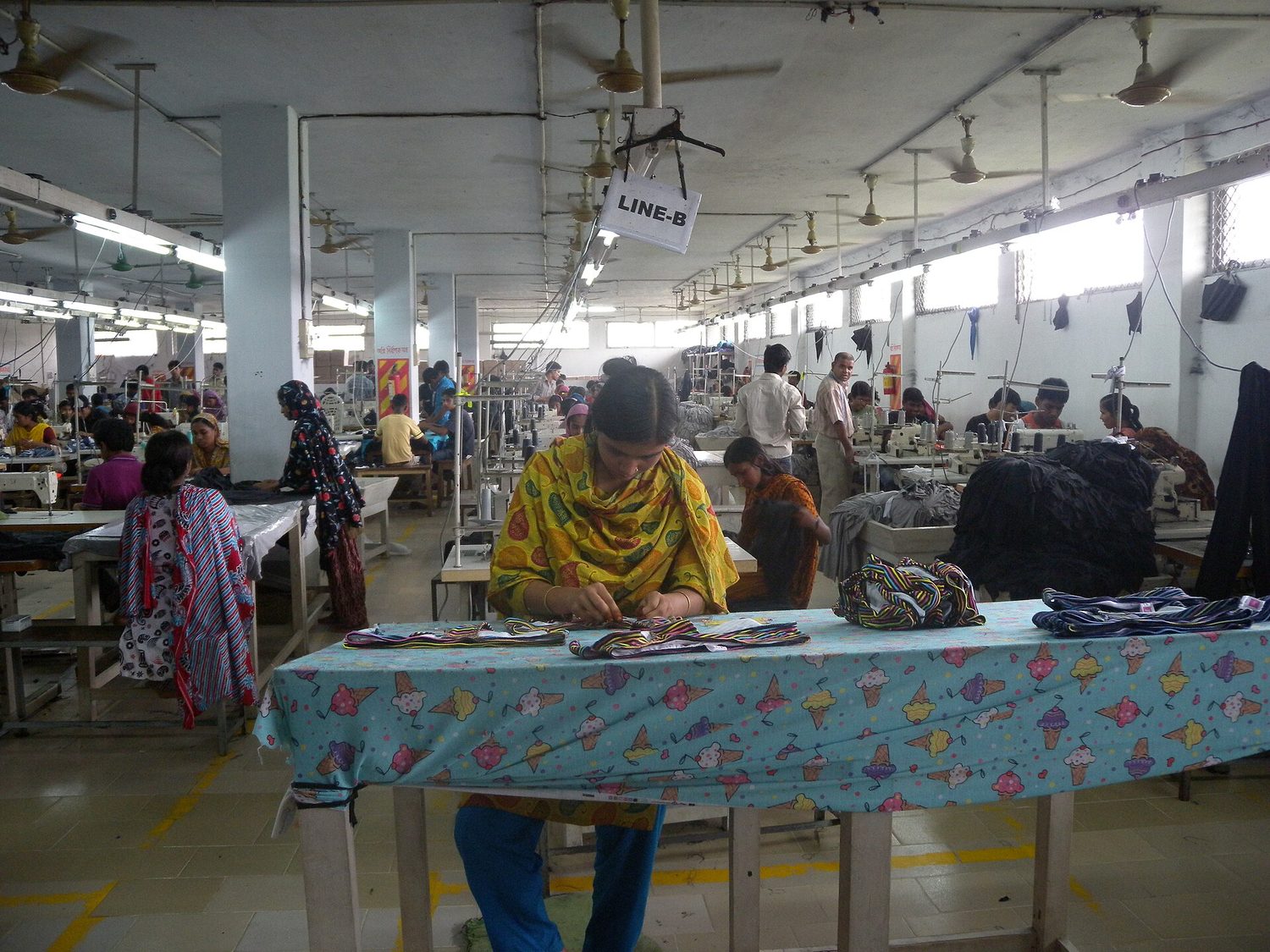
Pabrik pakaian: pasar faktor menentukan upah untuk tenaga kerja dan input lainnya

Sebuah pasar faktor adalah tempat perusahaan membeli faktor produksi – tenaga kerja, tanah, modal. Peran berbalik: perusahaan meminta dan rumah tangga menyediakan. Faktor yang paling sering diuji adalah tenaga kerja.

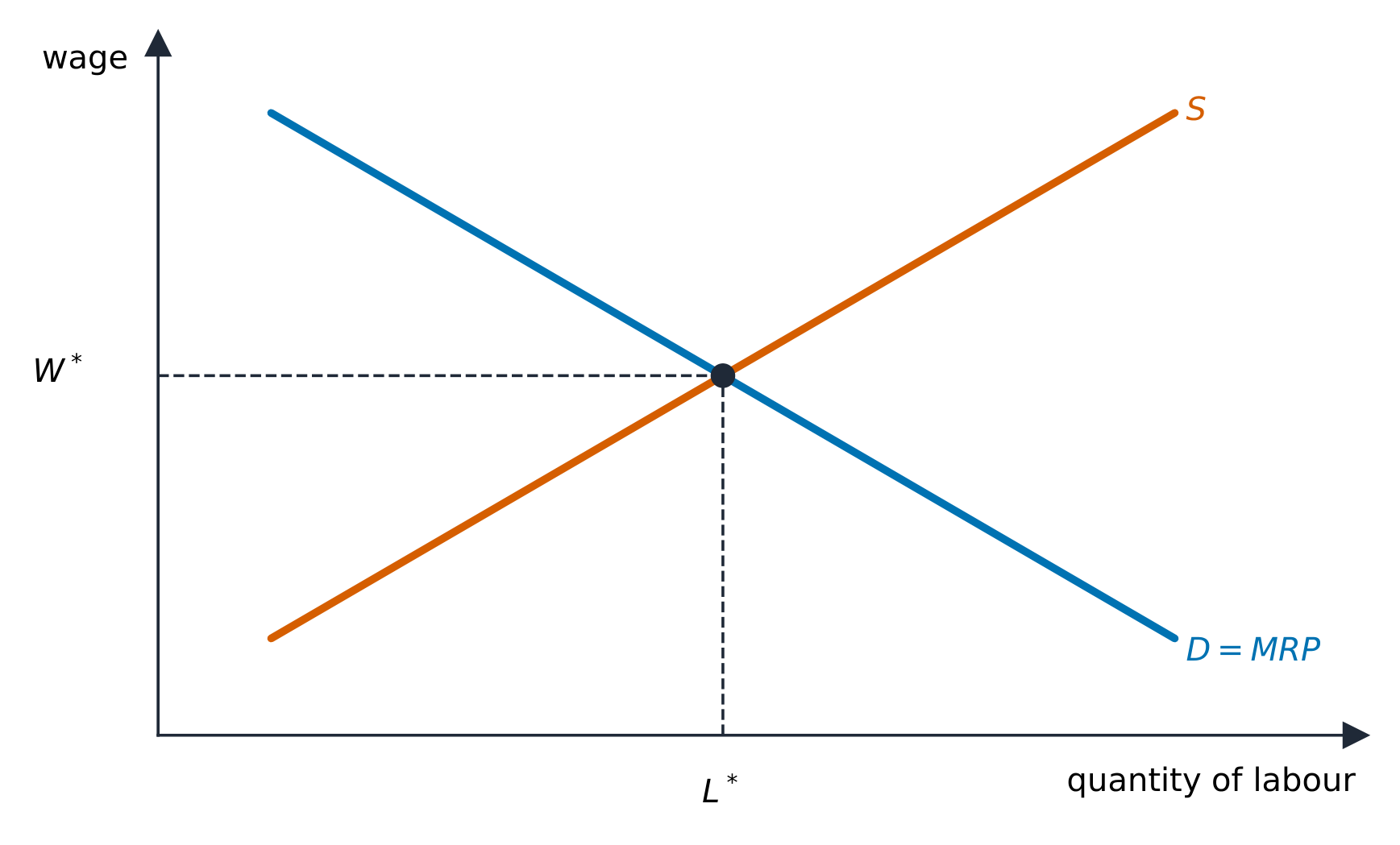
Pasar tenaga kerja kompetitif menetapkan upah di mana permintaan tenaga kerja bertemu penawaran tenaga kerja

Permintaan faktor adalah permintaan turunan – perusahaan menginginkan tenaga kerja bukan untuk dirinya sendiri melainkan untuk output (dan pendapatan) yang dihasilkannya. Jadi, permintaan terhadap pekerja bergantung pada permintaan terhadap produk yang mereka buat.

Explore · ⁨Jelajahi⁩

A labour (factor) market · ⁨Pasar tenaga kerja (faktor)⁩

In a factor market firms demand labour and households supply it; the wage settles where demand meets supply. Shift either curve and watch the wage and employment move. · ⁨Dalam pasar faktor, perusahaan meminta tenaga kerja dan rumah tangga menawarkannya; upah ditetapkan di titik pertemuan permintaan dan penawaran. Geser salah satu kurva dan amati pergerakan upah dan tingkat pekerjaan.⁩

5.2

Changes in Factor Demand and Factor Supply · ⁨Perubahan Permintaan dan Penawaran Faktor⁩

Syllabus · ⁨Silabus⁩
English

Enduring Understanding (PRD-4): Factor prices provide incentives and convey information to firms and factors of production.

Learning Objective PRD-4.B: Explain (using graphs where appropriate) firms' and factors' responses to changes in incentives and constraints.

  • PRD-4.B.1 Changes in the determinants of labor demand, such as the output price and the productivity of the worker, cause the labor demand curve to shift.
  • PRD-4.B.2 Changes in the determinants of labor supply (such as immigration, education, working conditions, age distribution, availability of alternative options, preferences for leisure, and cultural expectations) cause the labor supply curve to shift.
Bahasa Indonesia

Pemahaman Berkelanjutan (PRD-4): Harga faktor memberikan insentif dan menyampaikan informasi kepada perusahaan dan faktor produksi.

Tujuan Pembelajaran PRD-4.B: Jelaskan (menggunakan grafik jika sesuai) respons perusahaan dan faktor terhadap perubahan insentif dan kendala.

  • PRD-4.B.1 Perubahan dalam penentu permintaan tenaga kerja, seperti harga output dan produktivitas pekerja, menyebabkan kurva permintaan tenaga kerja bergeser.
  • PRD-4.B.2 Perubahan dalam penentu penawaran tenaga kerja (seperti imigrasi, pendidikan, kondisi kerja, distribusi usia, ketersediaan opsi alternatif, preferensi untuk waktu santai, dan ekspektasi budaya) menyebabkan kurva penawaran tenaga kerja bergeser.

Source: College Board AP Course and Exam Description · ⁨Sumber: Deskripsi Kursus dan Ujian College Board AP⁩

English

Labor demand shifts when:

  • the product price or product demand changes (more valuable output $\Rightarrow$ more labor demanded),
  • worker productivity changes (better training or capital),
  • the price of other inputs changes (a substitute input like machines, or a complement).

Labor supply shifts with the number of qualified workers, immigration, workers' preferences (wages needed to attract them), and the wages available in other jobs. The market wage is set where labor demand meets labor supply.

Bahasa Indonesia

Permintaan tenaga kerja bergeser ketika:

  • harga produk atau permintaan produk berubah (output lebih berharga $\Rightarrow$ lebih banyak tenaga kerja diminta),
  • produktivitas pekerja berubah (pelatihan lebih baik atau modal),
  • harga input lain berubah (input pengganti seperti mesin, atau pelengkap).

Penawaran tenaga kerja bergeser dengan jumlah pekerja berkualifikasi, imigrasi, preferensi pekerja (upah yang diperlukan untuk menarik mereka), dan upah yang tersedia di pekerjaan lain. Upah pasar ditetapkan di mana permintaan tenaga kerja bertemu penawaran tenaga kerja.

5.3

Profit-Maximizing Behavior in Perfectly Competitive Factor Markets · ⁨Perilaku Memaksimalkan Laba di Pasar Faktor Kompetitif Sempurna⁩

Syllabus · ⁨Silabus⁩
English

Enduring Understanding (PRD-4): Factor prices provide incentives and convey information to firms and factors of production.

Learning Objective PRD-4.C: a. Define (using graphs as appropriate) the characteristics of perfectly competitive factor markets. b. Explain (using graphs where appropriate) the profit-maximizing behavior of firms buying labor (with other inputs fixed) in perfectly competitive markets. c. Calculate (using data from a graph or table where appropriate) measures representing the profit-maximizing behavior of firms buying labor (with other inputs fixed) in perfectly competitive markets.

  • PRD-4.C.1 In a perfectly competitive labor market, the wage is set by the market and each firm hires the quantity of workers, where the marginal factor (resource) cost (wage) equals the marginal revenue product of labor. A typical firm may be a perfect competitor in the labor market even if it is an imperfect competitor in its output markets.
  • PRD-4.C.2 A typical firm hires labor in a perfectly competitive labor market as long as the marginal revenue product of labor is greater than the market wage.
  • PRD-4.C.3 To minimize costs or maximize profits, firms allocate inputs such that the last dollar spent on each input yields the same amount of marginal product.
Bahasa Indonesia

Pemahaman Berkelanjutan (PRD-4): Harga faktor memberikan insentif dan menyampaikan informasi kepada perusahaan dan faktor produksi.

Tujuan Pembelajaran PRD-4.C: a. Definisikan (menggunakan grafik jika sesuai) karakteristik pasar faktor kompetitif sempurna. b. Jelaskan (menggunakan grafik jika sesuai) perilaku maximization laba perusahaan yang membeli tenaga kerja (dengan input lain tetap) di pasar kompetitif sempurna. c. Hitung (menggunakan data dari grafik atau tabel jika sesuai) ukuran yang mewakili perilaku maximization laba perusahaan yang membeli tenaga kerja (dengan input lain tetap) di pasar kompetitif sempurna.

  • PRD-4.C.1 Di pasar tenaga kerja kompetitif sempurna, upah ditentukan oleh pasar dan setiap perusahaan merekrut jumlah pekerja di mana biaya faktor (sumber daya) marjinal (upah) sama dengan produk pendapatan marjinal tenaga kerja. Perusahaan biasa mungkin merupakan pesaing sempurna di pasar tenaga kerja meskipun ia adalah pesaing tidak sempurna di pasar outputnya.
  • PRD-4.C.2 Perusahaan biasa merekrut tenaga kerja di pasar tenaga kerja kompetitif sempurna selama produk pendapatan marjinal tenaga kerja lebih besar daripada upah pasar.
  • PRD-4.C.3 Untuk meminimalkan biaya atau memaksimalkan laba, perusahaan mengalokasikan input sedemikian rupa sehingga dollar terakhir yang dihabiskan untuk setiap input menghasilkan jumlah produk marjinal yang sama.

Source: College Board AP Course and Exam Description · ⁨Sumber: Deskripsi Kursus dan Ujian College Board AP⁩

English

A firm decides how many workers to hire with the same marginal logic as everything else – compare the marginal benefit and marginal cost of one more worker.

  • The marginal benefit of a worker is the marginal revenue product 边际收益产品 (MRP): the extra revenue from one more worker, $MRP = MP \times$ product price (in a competitive product market, where $P=MR$). MRP falls as more workers are hired, because of diminishing marginal product.
  • The marginal cost of a worker is the wage (in a competitive labor market the firm is a wage taker, so marginal factor cost $=$ the wage).
  • Hiring rule: hire workers up to where $MRP = \text{wage}$ (more generally, $MRP = MFC$). The MRP curve is the firm's labor demand curve.

Worked example. A worker's marginal product is $8$ units and the firm sells each in a competitive market for $\$5$, so $MRP=8\times\$5=\$40$. If the wage is $\$30$, the firm hires this worker because $MRP>\text{wage}$. As more workers join, diminishing marginal product pulls MRP down; the firm keeps hiring until a worker whose $MP=6$ gives $MRP=6\times\$5=\$30$, exactly the wage – the profit-maximizing stopping point.

To choose the least-cost combination of two inputs, set the MP-per-dollar equal across inputs: $\dfrac{MP_L}{P_L}=\dfrac{MP_K}{P_K}$ – the same equal-bang-per-buck rule as consumer choice.

Exam skill: compute MRP from a table (marginal product $\times$ price) and find how many workers to hire at a given wage – a common free-response task.

Bahasa Indonesia

Perusahaan memutuskan berapa banyak pekerja yang akan disewa dengan logika margin yang sama seperti segalanya – membandingkan manfaat marjinal dan biaya marjinal dari satu pekerja tambahan.

  • Manfaat marjinal seorang pekerja adalah produk pendapatan marjinal (MRP): pendapatan ekstra dari satu pekerja tambahan, $MRP = MP \times$ harga produk (di pasar produk kompetitif, di mana $P=MR$). MRP turun semakin banyak pekerja disewa, karena produk marjinal yang menurun.
  • Biaya marjinal seorang pekerja adalah upah (di pasar tenaga kerja kompetitif, perusahaan adalah penerima upah, sehingga biaya faktor marjinal $=$ upah).
  • Aturan menyewa: sewa pekerja hingga titik di mana $MRP = \text{wage}$ (secara umum, $MRP = MFC$). Kurva MRP adalah kurva permintaan tenaga kerja perusahaan.

Contoh kerja. Marginal produk seorang pekerja adalah $8$ unit dan perusahaan menjual setiap unit tersebut dalam pasar kompetitif seharga $\$5$, so $MRP=8\times\$5=\$40$. If the wage is $\$30$, perusahaan mempekerjakan pekerja ini karena $MRP>\text{wage}$. Semakin banyak pekerja yang bergabung, marginal produk yang semakin menurun menarik MRP ke bawah; perusahaan terus mempekerjakan hingga seorang pekerja whose $MP=6$ memberikan $MRP=6\times\$5=\$30$, tepat sebesar upah—titik berhenti yang memaksimumkan laba.

Untuk memilih kombinasi biaya terendah dari dua input, tetapkan MP per dolar setara di seluruh input: $\dfrac{MP_L}{P_L}=\dfrac{MP_K}{P_K}$ – aturan bang-per-buck yang sama seperti pemilihan konsumen.

Keterampilan ujian: hitung MRP dari tabel (produk marjinal $\times$ harga) dan temukan berapa banyak pekerja yang harus disewa pada upah tertentu – tugas respons bebas yang umum.

Jalur perakitan mobil: perusahaan menyewa tenaga kerja hingga produk pendapatan marjinal sama dengan upah
5.4

Monopsonistic Markets · ⁨Pasar Monopsonistik⁩

Syllabus · ⁨Silabus⁩
English

Enduring Understanding (PRD-4): Factor prices provide incentives and convey information to firms and factors of production.

Learning Objective PRD-4.D: a. Define (using graphs as appropriate) the characteristics of monopsonistic markets. b. Explain (using graphs where appropriate) the profit-maximizing behavior of firms buying labor (with other inputs fixed) in monopsonistic markets. c. Calculate (using data from a graph or table where appropriate) measures representing the profit-maximizing behavior of firms buying labor (with other inputs fixed) in monopsonistic markets.

  • PRD-4.D.1 In a monopsonistic labor market, a typical firm hires additional labor as long as the marginal revenue product is greater than the marginal factor (resource) cost (the wage of a new unit of labor plus the wage increase given to all existing labor).
  • PRD-4.D.2 When a typical firm hires additional workers in a monopsonistic labor market, the marginal factor (resource) cost is greater than the supply price of labor.
Bahasa Indonesia

Pemahaman Berkelanjutan (PRD-4): Harga faktor memberikan insentif dan menyampaikan informasi kepada perusahaan dan faktor produksi.

Tujuan Pembelajaran PRD-4.D: a. Definisikan (menggunakan grafik jika sesuai) karakteristik pasar monopsonistik. b. Jelaskan (menggunakan grafik jika sesuai) perilaku maximization laba perusahaan yang membeli tenaga kerja (dengan input lain tetap) di pasar monopsonistik. c. Hitung (menggunakan data dari grafik atau tabel jika sesuai) ukuran yang mewakili perilaku maximization laba perusahaan yang membeli tenaga kerja (dengan input lain tetap) di pasar monopsonistik.

  • PRD-4.D.1 Di pasar tenaga kerja monopsonistik, perusahaan biasa merekrut tenaga kerja tambahan selama produk pendapatan marjinal lebih besar daripada biaya faktor (sumber daya) marjinal (upah unit tenaga kerja baru ditambah kenaikan upah yang diberikan kepada semua tenaga kerja yang sudah ada).
  • PRD-4.D.2 Ketika perusahaan biasa merekrut pekerja tambahan di pasar tenaga kerja monopsonistik, biaya faktor (sumber daya) marjinal lebih besar daripada harga penawaran tenaga kerja.

Source: College Board AP Course and Exam Description · ⁨Sumber: Deskripsi Kursus dan Ujian College Board AP⁩

English

A monopsony 买方垄断 is a market with a single buyer of a factor – for example, the only large employer in a town.

  • Because it is the whole market, the monopsonist faces an upward-sloping labor supply curve: to hire more workers it must raise the wage for everyone.
  • So the marginal factor cost 边际要素成本 (MFC) is above the wage (like $MR for a monopoly, in reverse), and the MFC curve lies above the supply curve.
  • The monopsonist hires where $MRP = MFC$, then pays the lower wage the supply curve allows at that quantity.
  • Result: compared with a competitive labor market, a monopsony hires fewer workers at a lower wage – the mirror image of monopoly.

Exam skill: draw the monopsony graph (supply, MFC above it, MRP as demand), mark quantity at $MRP=MFC$ and the wage down on the supply curve, and contrast it with the competitive wage and quantity.

Bahasa Indonesia

Sebuah monopsony adalah pasar dengan satu pembeli faktor – misalnya, satu-satunya pemberi kerja besar di sebuah kota.

  • Karena merupakan keseluruhan pasar, monopsonis menghadapi kurva penawaran tenaga kerja menanjak: untuk merekrut lebih banyak pekerja, ia harus menaikkan upah untuk semua orang.
  • Jadi biaya faktor marjinal (MFC) berada di atas upah (seperti $MR untuk monopoli, terbalik), dan kurva MFC terletak di atas kurva penawaran.
  • Monopsonis merekrut tenaga kerja pada saat $MRP = MFC$, kemudian membayar upah yang lebih rendah yang diizinkan oleh kurva penawaran pada jumlah tersebut.
  • Hasil: dibandingkan dengan pasar tenaga kerja kompetitif, monopsoni merekrut lebih sedikit pekerja dengan upah yang lebih rendah – cerminan dari monopoli.
Monopsonis merekrut tenaga kerja di mana MFC = MRP dan membayar upah lebih rendah daripada pasar kompetitif

Keterampilan ujian: gambar grafik monopsoni (penawaran, MFC di atasnya, MRP sebagai permintaan), tandai kuantitas pada $MRP=MFC$ dan turunkan upah ke kurva penawaran, lalu bandingkan dengan upah dan kuantitas kompetitif.

Vocabulary · ⁨Kosa kata⁩ Train · ⁨Latih⁩
English Bahasa Indonesia
factor market/ˈfæktə ˈmɑːkɪt/ pasar faktor
derived demand/dɪˈraɪvd dɪˈmænd/ permintaan turunan
marginal revenue product/ˈmɑːdʒɪnl ˈrevənjuː ˈprɒdʌkt/ produk pendapatan marginal
monopsony/ˈmɒnəʊpsəni/ monopsony
marginal factor cost/ˈmɑːdʒɪnl ˈfæktə kɒst/ biaya faktor marginal
5.4

Exam tips · ⁨Tips ujian⁩

English
  • Factor demand is derived demand; hire labour up to where MRP = wage (MRP = marginal product × price).
  • MRP falls as more workers are hired (diminishing marginal product).
  • For least-cost input use, equalise the marginal product per dollar across inputs.
  • A monopsony faces an upward supply, so its marginal factor cost is above the wage; it hires fewer workers at a lower wage.
  • Draw the monopsony graph (supply, MFC above it, MRP as demand) and contrast with the competitive outcome.
Bahasa Indonesia
  • Permintaan faktor adalah permintaan turunan; rekrutlah tenaga kerja hingga titik di mana MRP = upah (MRP = produk marjinal × harga).
  • MRP menurun ketika semakin banyak pekerja direkrut (produk marjinal yang menurun).
  • Untuk penggunaan input biaya terendah, samakan produk marjinal per dolar di seluruh input.
  • Monopsoni menghadapi penawaran yang menanjak, sehingga biaya faktor marjinalnya di atas upah; ia merekrut lebih sedikit pekerja dengan upah yang lebih rendah.
  • Gambar grafik monopsoni (penawaran, MFC di atasnya, MRP sebagai permintaan) dan bandingkan dengan hasil kompetitif.

Interactive lessons on this topic · ⁨Pelajaran interaktif untuk topik ini⁩

Work through it step by step, with instant-check exercises. · ⁨Kerjakan langkah demi langkah, dengan latihan pengecekan instan.⁩

Past Papers · ⁨Soal-Soil Masa Lalu⁩

More topics in AP Microeconomics · ⁨AP Ekonomi Mikro⁩ · ⁨Topik lain dalam AP Microeconomics · ⁨AP Ekonomi Mikro⁩⁩

Log in or create account · ⁨Masuk atau buat akun⁩

IGCSE, A-Level & AP