Skip to content · ⁨Lompat ke konten⁩

Imperfect Competition · ⁨Persaingan Tidak Sempurna⁩

AP Microeconomics · ⁨AP Ekonomi Mikro⁩ · Topic 4 · ⁨Topik 4⁩

Video lesson for this topic · ⁨Pelajaran video untuk topik ini⁩ Open the video page · ⁨Buka halaman video⁩
8:32

Persaingan Tidak Sempurna

Lihatlah di luar buku teks. Perusahaan mobil menetapkan harganya sendiri. Kota Anda memiliki satu pemasok air, dan tidak ada pilihan kedua. Perusahaan-perusahaan ini tidak menerima harga…

English narration · English + 中文 subtitles burned in · ⁨Narasi bahasa Inggris · Subtitle bahasa Inggris + 中文 disematkan langsung⁩

4.1

Imperfect Competition and Market Power · ⁨Persaingan Tidak Sempurna dan Kekuatan Pasar⁩

Syllabus · ⁨Silabus⁩
English

Enduring Understanding (PRD-3): Even with a common goal of profit-maximization, market structure constrains and influences prices, output, and efficiency.

Learning Objective PRD-3.B: a. Define (using graphs where appropriate) the characteristics of imperfectly competitive markets and inefficiency.

  • PRD-3.B.1 Imperfectly competitive markets include monopoly, oligopoly, and monopolistic competition in product markets and monopsony in factor markets.
  • PRD-3.B.2 In imperfectly competitive output markets and assuming all else is constant, a firm must lower price to sell additional units.
  • PRD-3.B.3 In imperfectly competitive markets, consumers and producers respond to prices that are above the marginal costs of production and/or marginal benefits of consumption (i.e., price is greater than marginal cost in an inefficient market).
  • PRD-3.B.4 Incentives to enter an industry may be mitigated by barriers to entry. Barriers to entry—such as high fixed/start-up costs, legal barriers to entry, and exclusive ownership of key resources—can sustain imperfectly competitive market structures.
Bahasa Indonesia

Pemahaman Abadi (PRD-3): Bahkan dengan tujuan bersama untuk memaksimumkan laba, struktur pasar membatasi dan mempengaruhi harga, output, dan efisiensi.

Tujuan Pembelajaran PRD-3.B: a. Definisikan (menggunakan grafik jika sesuai) karakteristik pasar tidak kompetitif sempurna dan ketidakefisienan.

  • PRD-3.B.1 Pasar tidak kompetitif sempurna mencakup monopoli, oligopoli, dan persaingan monopolistik dalam pasar produk, serta monopsoni dalam pasar faktor.
  • PRD-3.B.2 Dalam pasar output tidak kompetitif sempurna dan dengan asumsi hal lain tetap, perusahaan harus menurunkan harga untuk menjual unit tambahan.
  • PRD-3.B.3 Dalam pasar tidak kompetitif sempurna, konsumen dan produsen merespons harga yang berada di atas biaya marjinal produksi dan/atau manfaat marjinal konsumsi (yaitu, harga lebih besar daripada biaya marjinal dalam pasar yang tidak efisien).
  • PRD-3.B.4 Insentif untuk memasuki industri dapat diredam oleh hambatan masuk. Hambatan masuk—seperti biaya tetap/mulai yang tinggi, hambatan hukum masuk, dan kepemilikan eksklusif sumber daya kunci—dapat mempertahankan struktur pasar tidak kompetitif sempurna.

Source: College Board AP Course and Exam Description · ⁨Sumber: Deskripsi Kursus dan Ujian College Board AP⁩

English

Most real markets are imperfectly competitive 不完全竞争: firms have some market power 市场势力 – the ability to set price rather than take it. The source of that power is a downward-sloping demand curve facing the firm, which means that to sell one more unit the firm must lower the price on all units.

Because of this, marginal revenue is below price ($MR) for every firm with market power. On a straight-line demand curve the MR curve has the same intercept but twice the slope, lying below demand. This one fact – $MR – separates every imperfect market from perfect competition and explains why they produce less and charge more.

Worked example. A firm with market power faces demand $P=100-Q$. Selling $1$ unit gives $P=\$99$ and total revenue $\$99$; selling a $2$nd forces the price down to $\$98$ on both units, so revenue rises to $2\times98=\$196$. The marginal revenue of that $2$nd unit is $196-99=\$97$ – below its $\$98$ price. In general $MR=100-2Q$, falling twice as fast as demand.

Bahasa Indonesia
Garis perakitan mobil: kekuatan pasar dan skala perusahaan berbeda di bawah persaingan tidak sempurna

Sebagian besar pasar nyata bersifat persaingan tidak sempurna: perusahaan memiliki beberapa kekuatan pasar – kemampuan untuk menetapkan harga alih-alih menerimanya. Sumber kekuatan tersebut adalah kurva permintaan yang miring ke bawah yang dihadapi perusahaan, yang berarti untuk menjual satu unit lagi, perusahaan harus menurunkan harga untuk semua unit.

Struktur pasar berkisar dari persaingan sempurna hingga monopoli

Oleh karena itu, pemasukan marjinal lebih rendah dari harga ($MR) untuk setiap perusahaan yang memiliki kekuatan pasar. Pada kurva permintaan garis lurus, kurva MR memiliki titik potong yang sama tetapi kemiringan dua kali lipat, berada di bawah kurva permintaan. Fakta tunggal ini – $MR – memisahkan setiap pasar tidak sempurna dari persaingan sempurna dan menjelaskan mengapa mereka memproduksi lebih sedikit dan memungut harga lebih tinggi.

Contoh terpecahkan. Sebuah perusahaan dengan kekuatan pasar menghadapi permintaan $P=100-Q$. Menjual $1$ unit menghasilkan $P=\$99$ and total revenue $\$99$; menjual unit ke-$2$ memaksa harga turun menjadi $\$98$ on both units, so revenue rises to $2\times98=\$196$. Pemasukan marjinal dari unit ke-$2$ tersebut adalah $196-99=\$97$ – below its $\$98$ harga. Secara umum $MR=100-2Q$, turun dua kali lebih cepat daripada kurva permintaan.

4.2

Monopoly · ⁨Monopoli⁩

Syllabus · ⁨Silabus⁩
English

Enduring Understanding (PRD-3): Even with a common goal of profit-maximization, market structure constrains and influences prices, output, and efficiency.

Learning Objective PRD-3.B: b. Explain (using graphs where appropriate) equilibrium, firm decision making, consumer surplus, producer surplus, profit (loss), and deadweight loss in imperfectly competitive markets and why prices in imperfectly competitive markets cannot be relied on to coordinate the actions of all possible market participants and can lead to inefficient outputs. c. Calculate (using data from a graph or table as appropriate) areas of consumer surplus, producer surplus, profit (loss), and deadweight loss in imperfectly competitive markets.

  • PRD-3.B.5 A monopoly exists because of barriers to entry.
  • PRD-3.B.6 In a monopoly, equilibrium (profit-maximizing) quantity is determined by equating marginal revenue (MR) to marginal cost (MC). The price charged is greater than the marginal cost.
    • Equation: $MR = MC$
  • PRD-3.B.7 In a natural monopoly, long-run economies of scale for a single firm exist throughout the entire effective demand of its product.
Bahasa Indonesia

Pemahaman Abadi (PRD-3): Bahkan dengan tujuan bersama untuk memaksimumkan laba, struktur pasar membatasi dan mempengaruhi harga, output, dan efisiensi.

Tujuan Pembelajaran PRD-3.B: b. Jelaskan (menggunakan grafik jika sesuai) keseimbangan, pengambilan keputusan perusahaan, surplus konsumen, surplus produsen, profit (rugi), dan hilangnya beban mati dalam pasar tidak kompetitif sempurna dan mengapa harga dalam pasar tidak kompetitif sempurna tidak dapat diandalkan untuk mengoordinasikan tindakan semua peserta pasar yang mungkin dan dapat mengarah pada output yang tidak efisien. c. Hitung (menggunakan data dari grafik atau tabel jika sesuai) area surplus konsumen, surplus produsen, profit (rugi), dan hilangnya beban mati dalam pasar tidak kompetitif sempurna.

  • PRD-3.B.5 Monopoli ada karena adanya hambatan masuk.
  • PRD-3.B.6 Dalam monopoli, kuantitas keseimbangan (memaksimalkan profit) ditentukan dengan menyamakan pendapatan marjinal (MR) dengan biaya marjinal (MC). Harga yang dikenakan lebih besar daripada biaya marjinal.
    • Persamaan: $MR = MC$
  • PRD-3.B.7 Dalam monopoli alami, penghematan skala jangka panjang untuk satu perusahaan terdapat di seluruh permintaan efektif produknya.

Source: College Board AP Course and Exam Description · ⁨Sumber: Deskripsi Kursus dan Ujian College Board AP⁩

English
Monopoly: MR = MC pricing

A monopoly 垄断 is a single seller of a product with no close substitutes, protected by barriers to entry 进入壁垒 (economies of scale – a natural monopoly 自然垄断 – control of a key resource, patents, or government license).

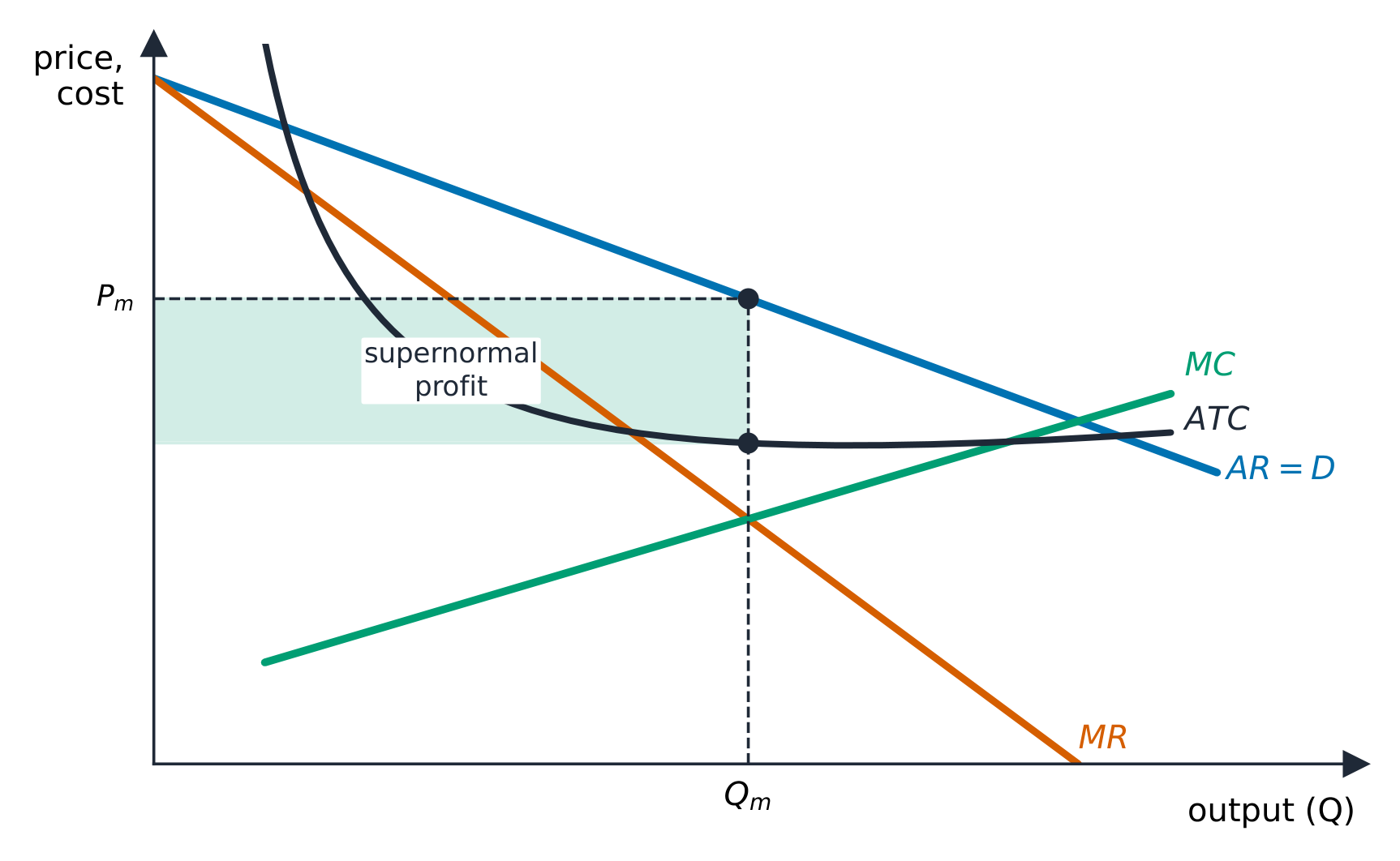
  • The monopolist maximizes profit at $MR=MC$, then charges the highest price the demand curve allows at that quantity (read price up to the demand curve, not the MR curve).
  • Compared with perfect competition it produces less and charges more, earning long-run economic profit because entry is blocked.
  • This under-production creates deadweight loss 无谓损失 – the monopoly is allocatively inefficient because $P>MC$: the last unit is worth more than it costs, yet is not made.

Governments may respond with antitrust 反垄断 law, or regulate a natural monopoly's price toward $P=MC$ (socially optimal, but may cause a loss) or $P=ATC$ (fair-return, break-even).

Exam skill: the monopoly graph is a staple – show quantity at $MR=MC$, price up on the demand curve, and shade profit (between $P$ and $ATC$) and deadweight loss (the triangle to the competitive quantity).

Bahasa Indonesia
Monopoli: Penetapan harga MR = MC

Sebuah monopoli adalah penjual tunggal produk tanpa pengganti dekat, dilindungi oleh hambatan masuk (skala ekonomi – monopoli alami – penguasaan sumber daya kunci, paten, atau lisensi pemerintah).

Monopoli memaksimalkan laba di mana MC = MR dan dapat memperoleh laba supernormal
  • Monopolis memaksimalkan laba pada $MR=MC$, kemudian menetapkan harga tertinggi yang memungkinkan oleh kurva permintaan pada kuantitas tersebut (baca harga naik ke kurva permintaan, bukan kurva MR).
  • Dibandingkan dengan persaingan sempurna, ia memproduksi lebih sedikit dan memungut harga lebih tinggi, memperoleh laba ekonomi jangka panjang karena masuk diblokir.
  • Produksi yang kurang ini menciptakan kerugian deadweight; monopoli bersifat inefisien alokatif karena $P>MC$: unit terakhir bernilai lebih tinggi daripada biayanya, namun tidak diproduksi.

Pemerintah mungkin merespons dengan hukum antitrust, atau mengatur harga monopoli alami menuju $P=MC$ (optimal secara sosial, tetapi dapat menyebabkan kerugian) atau $P=ATC$ (pengembalian adil, impas).

Keterampilan ujian: grafik monopoli adalah hal standar – tunjukkan kuantitas pada $MR=MC$, harga naik pada kurva permintaan, dan arsir area laba (antara $P$ dan $ATC$) serta kerugian mati (segitiga menuju kuantitas kompetitif).

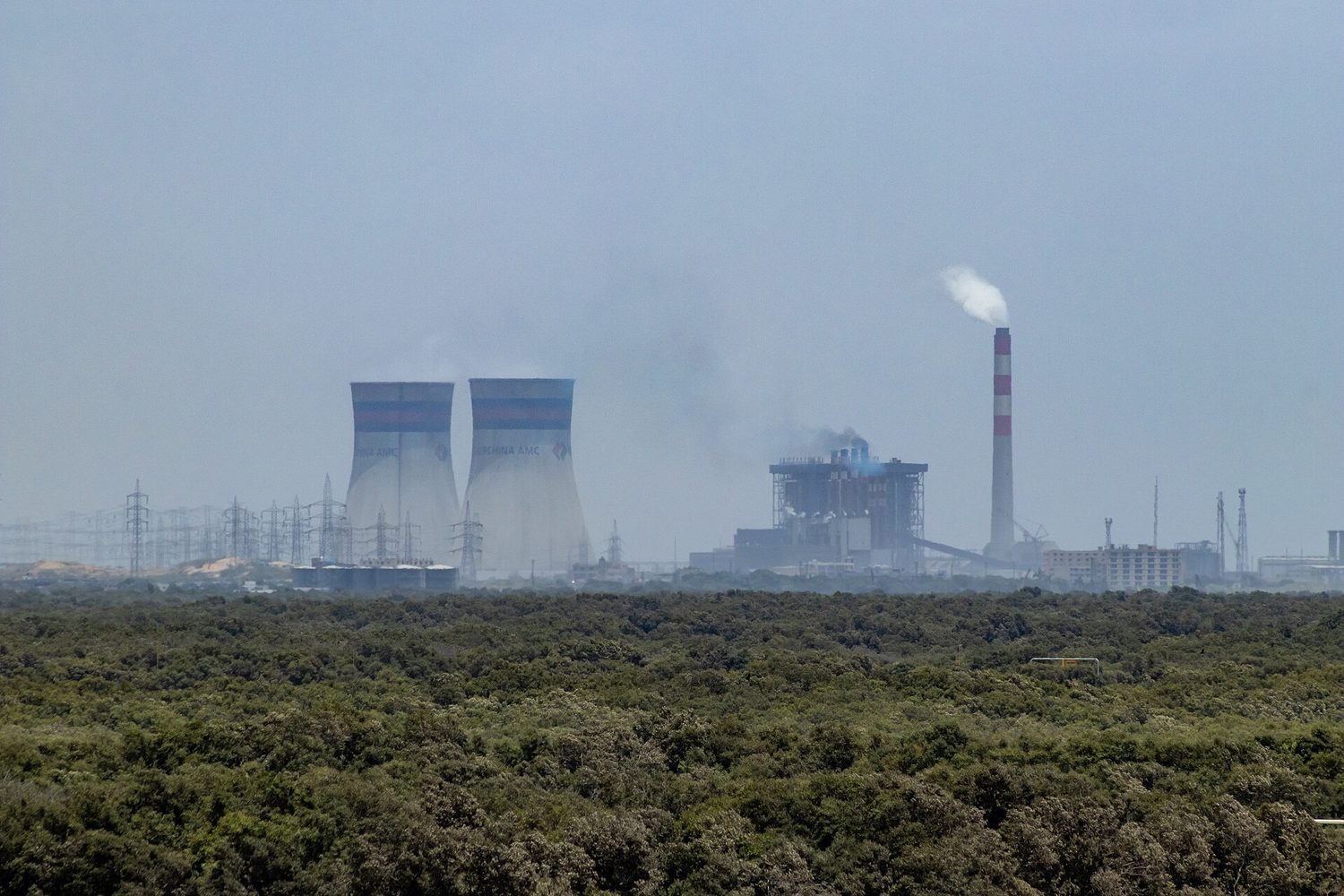
Pabrik utilitas besar: monopoli dan kekuatan pasar berarti satu perusahaan dapat menetapkan harga di atas biaya marjinal
Explore · ⁨Jelajahi⁩

A monopoly's cost curves · ⁨Kurva biaya monopoli⁩

A monopoly is the sole seller, so it faces the whole downward demand curve and its marginal revenue lies below price. It produces where MR = MC — less output, higher price than competition. · ⁨Monopoli adalah satu-satunya penjual, sehingga ia menghadapi seluruh kurva permintaan yang menurun dan pendapatan marginalnya berada di bawah harga. Ia memproduksi di mana MR = MC — output lebih sedikit, harga lebih tinggi dibanding persaingan.⁩

Vocabulary · ⁨Kosa kata⁩ Train · ⁨Latih⁩
English Bahasa Indonesia
imperfectly competitive/ɪmˈpɜːfektlɪ kəmˈpetɪtɪv/ Persaingan tidak sempurna
market power/ˈmɑːkɪt ˈpaʊə/ kekuatan pasar
monopoly/məˈnɒpəli/ monopoli
barriers to entry/ˈbærɪəz tʊ ˈentri/ hambatan masuk
natural monopoly/ˈnætʃərəl məˈnɒpəli/ monopoli alami
deadweight loss/ˈdedweɪt lɒs/ kerugian berat mati
antitrust/ˌæntɪˈtrʌst/ antitrust
Price discrimination/praɪs dɪˌskrɪmɪˈneɪʃn/ Diskriminasi harga
Monopolistic competition/məˈnɒpəlɪstɪk ˌkɒmpəˈtɪʃn/ Persaingan monopolistik
differentiated/ˌdɪfəˈrenʃɪeɪtɪd/ terdiferensiasi
excess capacity/ekˈses kəˈpæsɪti/ kapasitas berlebih
oligopoly/ˌɒlɪˈɡɒpəli/ oligopoli
interdependent/ˌɪntədɪˈpendənt/ Saling ketergantungan
game theory/ɡeɪm ˈθɪəri/ teori permainan
4.3

Price Discrimination · ⁨Diskriminasi Harga⁩

Syllabus · ⁨Silabus⁩
English

Enduring Understanding (PRD-3): Even with a common goal of profit-maximization, market structure constrains and influences prices, output, and efficiency.

Learning Objective PRD-3.B: b. Explain (using graphs where appropriate) equilibrium, firm decision making, consumer surplus, producer surplus, profit (loss), and deadweight loss in imperfectly competitive markets and why prices in imperfectly competitive markets cannot be relied on to coordinate the actions of all possible market participants and can lead to inefficient outputs. c. Calculate (using data from a graph or table as appropriate) areas of consumer surplus, producer surplus, profit (loss), and deadweight loss in imperfectly competitive markets.

  • PRD-3.B.8 A firm with market power can engage in price discrimination to increase its profits or capture additional consumer surplus under certain conditions.
  • PRD-3.B.9 With perfect price discrimination, a monopolist produces the quantity where price equals marginal cost (just as a competitive market would) but extracts all economic surplus associated with its product and eliminates all deadweight loss.
    • Equation: $P = MC$
Bahasa Indonesia

Pemahaman Abadi (PRD-3): Bahkan dengan tujuan bersama untuk memaksimumkan laba, struktur pasar membatasi dan mempengaruhi harga, output, dan efisiensi.

Tujuan Pembelajaran PRD-3.B: b. Jelaskan (menggunakan grafik jika sesuai) keseimbangan, pengambilan keputusan perusahaan, surplus konsumen, surplus produsen, profit (rugi), dan hilangnya beban mati dalam pasar tidak kompetitif sempurna dan mengapa harga dalam pasar tidak kompetitif sempurna tidak dapat diandalkan untuk mengoordinasikan tindakan semua peserta pasar yang mungkin dan dapat mengarah pada output yang tidak efisien. c. Hitung (menggunakan data dari grafik atau tabel jika sesuai) area surplus konsumen, surplus produsen, profit (rugi), dan hilangnya beban mati dalam pasar tidak kompetitif sempurna.

  • PRD-3.B.8 Perusahaan dengan kekuatan pasar dapat melakukan diskriminasi harga untuk meningkatkan profitnya atau menangkap surplus konsumen tambahan di bawah kondisi tertentu.
  • PRD-3.B.9 Dengan diskriminasi harga sempurna, seorang monopoli memproduksi kuantitas di mana harga sama dengan biaya marjinal (sama seperti pasar kompetitif) tetapi mengekstrak semua surplus ekonomi yang terkait dengan produknya dan menghilangkan semua hilangnya beban mati.
    • Persamaan: $P = MC$

Source: College Board AP Course and Exam Description · ⁨Sumber: Deskripsi Kursus dan Ujian College Board AP⁩

English

Price discrimination 价格歧视 is charging different buyers different prices for the same good. It requires market power, the ability to separate buyers by willingness to pay, and the ability to prevent resale.

Under perfect (first-degree) price discrimination, the firm charges each buyer their maximum price. The result: the firm produces the efficient quantity (where $P=MC$, no deadweight loss), but converts all consumer surplus into producer surplus (profit). Real examples – student discounts, airline fares, coupons – are partial versions.

Bahasa Indonesia

Diskriminasi harga adalah memungut harga berbeda dari pembeli yang berbeda untuk barang yang sama. Hal ini memerlukan kekuatan pasar, kemampuan untuk memisahkan pembeli berdasarkan kemauan membayar, dan kemampuan untuk mencegah penjualan kembali.

Di bawah diskriminasi harga sempurna (derajat pertama), perusahaan memungut harga maksimum dari setiap pembeli. Hasilnya: perusahaan memproduksi kuantitas efisien (di mana $P=MC$, tidak ada kerugian mati), tetapi mengubah seluruh surplus konsumen menjadi surplus produsen (laba). Contoh nyata – diskon mahasiswa, tarif penerbangan, kupon – adalah versi parsial.

Explore · ⁨Jelajahi⁩

Elasticity and price discrimination · ⁨Elastisitas dan pembedaan harga⁩

Price discrimination charges each group a different price by their elasticity: inelastic buyers (who won't switch) pay more, elastic buyers pay less. Stretch the curve to see why. · ⁨Pembedaan harga menagih kelompok berbeda harga berdasarkan elastisitas-nya: pembeli inelastis (yang tidak akan beralih) membayar lebih, pembeli elastis membayar lebih sedikit. Tarik kurva untuk melihat alasannya.⁩

4.4

Monopolistic Competition · ⁨Persaingan Monopolistik⁩

Syllabus · ⁨Silabus⁩
English

Enduring Understanding (PRD-3): Even with a common goal of profit-maximization, market structure constrains and influences prices, output, and efficiency.

Learning Objective PRD-3.B: b. Explain (using graphs where appropriate) equilibrium, firm decision making, consumer surplus, producer surplus, profit (loss), and deadweight loss in imperfectly competitive markets and why prices in imperfectly competitive markets cannot be relied on to coordinate the actions of all possible market participants and can lead to inefficient outputs. c. Calculate (using data from a graph or table as appropriate) areas of consumer surplus, producer surplus, profit (loss), and deadweight loss in imperfectly competitive markets.

  • PRD-3.B.10 In a market with monopolistic competition, firms producing differentiated products may earn positive, negative, or zero economic profit in the short run. Firms typically use advertising as a means of differentiating their product. Free entry and exit drive profits to zero in the long run. The output level, however, is smaller than the output level needed to minimize average total costs, creating excess capacity. The price is greater than marginal cost, creating allocative inefficiency.
Bahasa Indonesia

Pemahaman Abadi (PRD-3): Bahkan dengan tujuan bersama untuk memaksimumkan laba, struktur pasar membatasi dan mempengaruhi harga, output, dan efisiensi.

Tujuan Pembelajaran PRD-3.B: b. Jelaskan (menggunakan grafik jika sesuai) keseimbangan, pengambilan keputusan perusahaan, surplus konsumen, surplus produsen, profit (rugi), dan hilangnya beban mati dalam pasar tidak kompetitif sempurna dan mengapa harga dalam pasar tidak kompetitif sempurna tidak dapat diandalkan untuk mengoordinasikan tindakan semua peserta pasar yang mungkin dan dapat mengarah pada output yang tidak efisien. c. Hitung (menggunakan data dari grafik atau tabel jika sesuai) area surplus konsumen, surplus produsen, profit (rugi), dan hilangnya beban mati dalam pasar tidak kompetitif sempurna.

  • PRD-3.B.10 Dalam pasar dengan persaingan monopolistik, perusahaan yang memproduksi produk terdiferensiasi dapat memperoleh profit ekonomi positif, negatif, atau nol dalam jangka pendek. Perusahaan biasanya menggunakan iklan sebagai sarana untuk mendiferensiasikan produknya. Masuk dan keluar bebas mendorong profit menjadi nol dalam jangka panjang. Namun, tingkat output lebih kecil daripada tingkat output yang diperlukan untuk meminimalkan biaya rata-rata total, menciptakan kapasitas berlebih. Harga lebih besar daripada biaya marjinal, menciptakan inefisiensi alokasi.

Source: College Board AP Course and Exam Description · ⁨Sumber: Deskripsi Kursus dan Ujian College Board AP⁩

English

Monopolistic competition 垄断竞争 has many firms selling differentiated 差异化 products with easy entry and exit (restaurants, salons, clothing brands). Product differentiation gives each firm a downward-sloping demand curve and thus some price-setting power.

  • Short run: like a monopoly – produce at $MR=MC$, and profit or loss is possible.
  • Long run: easy entry competes away profit, so each firm earns zero economic profit, producing where demand is tangent to ATC.
  • Because it still charges $P>MC$ and does not produce at minimum ATC, it has excess capacity 过剩产能 and is neither allocatively nor productively efficient. The trade-off society accepts is product variety and choice.
Bahasa Indonesia

Persaingan monopolistik memiliki banyak perusahaan yang menjual produk terdiferensiasi dengan masuk dan keluar yang mudah (restoran, salon, merek pakaian). Diferensiasi produk memberikan setiap perusahaan kurva permintaan miring ke bawah dan karenanya beberapa kekuatan penetapan harga.

  • Jangka pendek: seperti monopoli – produksi pada $MR=MC$, dan laba atau rugi dimungkinkan.
  • Jangka panjang: masuk yang mudah bersaing menghilangkan laba, sehingga setiap perusahaan memperoleh laba ekonomi nol, memproduksi di mana kurva permintaan bersinggungan dengan ATC.
  • Karena masih memungut $P>MC$ dan tidak memproduksi pada ATC minimum, perusahaan memiliki kapasitas berlebih dan tidak efisien secara alokatif maupun produktif. Trade-off yang diterima masyarakat adalah variasi produk dan pilihan.
4.5

Oligopoly and Game Theory · ⁨Oligopoli dan Teori Permainan⁩

Syllabus · ⁨Silabus⁩
Enduring UnderstandingLearning ObjectiveEssential Knowledge

PRD-3
Even with a common goal of profit-maximization, market structure constrains and influences prices, output, and efficiency.

PRD-3.C
a. Define (using tables as appropriate) key terms, strategies, and concepts relating to oligopolies and simple games. b. Explain (using tables as appropriate) strategies and equilibria in simple games and the connections to theoretical behaviors in various oligopoly market and non-market settings. c. Calculate (using tables as appropriate) the incentive sufficient to alter a player's dominant strategy.

  • PRD-3.C.1 An oligopoly is an inefficient market structure with high barriers to entry, where there are few firms acting interdependently.
  • PRD-3.C.2 Firms in an oligopoly have an incentive to collude and form cartels.
  • PRD-3.C.3 A game is a situation in which a number of individuals take actions, and the payoff for each individual depends directly on both the individual's own choice and the choices of others.
  • PRD-3.C.4 A strategy is a complete plan of actions for playing a game; the normal form model of a game shows the payoffs that result from each collection of strategies (one for each player).
  • PRD-3.C.5 A player has a dominant strategy when the payoff to a particular action is always higher independent of the action taken by the other player.
  • PRD-3.C.6 A Nash equilibrium is a condition describing the set of actions in which no player can increase his or her payoff by unilaterally taking another action, given the other players' actions.
    • Exclusion statement: Dominant strategies and Nash equilibrium with more than two players or more than two actions per player, mixed-strategy equilibria, extensive form games, and normal form games with more than two players or more than two actions per player are beyond the scope of the course and the AP Exam.
  • PRD-3.C.7 Oligopolists have difficulty achieving the monopoly outcome for reasons similar to those that prevent players from achieving a cooperative outcome in the Prisoner's Dilemma; nevertheless, prices are generally higher and quantities lower with oligopoly (or duopoly) than with perfect competition.

Source: College Board AP Course and Exam Description · ⁨Sumber: Deskripsi Kursus dan Ujian College Board AP⁩

English

An oligopoly 寡头垄断 is a market with a few large, interdependent 相互依存 firms (cars, airlines, phones). Because each firm's best move depends on rivals' moves, we analyze them with game theory 博弈论.

  • A payoff matrix 收益矩阵 shows each firm's profit for every combination of choices.
  • A dominant strategy 优势策略 is a firm's best choice regardless of what the rival does.
  • A Nash equilibrium 纳什均衡 is an outcome where no firm can do better by unilaterally changing its choice.
  • The classic prisoners' dilemma 囚徒困境 shows why firms often fail to cooperate: both would gain by colluding 勾结 (acting like a monopoly), but each has an incentive to cheat, so they end up at the competitive-ish, lower-profit outcome. Collusion and cartels 卡特尔 are unstable for the same reason (and usually illegal).

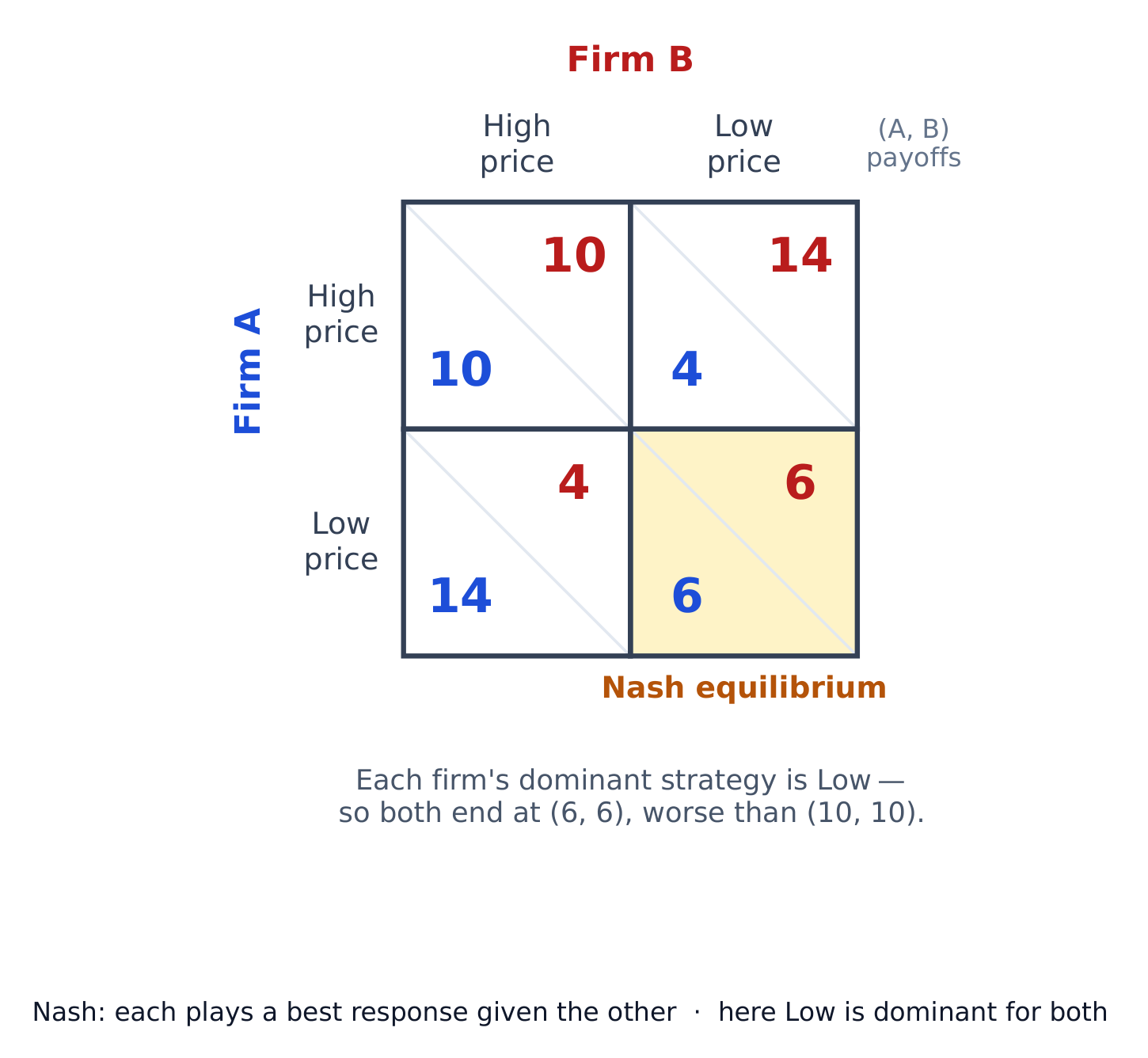
Worked example. Two firms each choose a High or Low price. Profits (A, B): both High $\to(10,10)$; A Low, B High $\to(14,4)$; A High, B Low $\to(4,14)$; both Low $\to(6,6)$. For A: if B plays High, Low ($14$) beats High ($10$); if B plays Low, Low ($6$) beats High ($4$) – so Low is A's dominant strategy, and by symmetry B's too. The Nash equilibrium is both Low $(6,6)$, worse for both than the cooperative $(10,10)$ – the prisoners' dilemma in action.

Exam skill: be able to find each firm's dominant strategy and the Nash equilibrium from a 2×2 payoff matrix, and explain why the cooperative outcome is hard to sustain.

Bahasa Indonesia

Sebuah oligopoli adalah pasar dengan sedikit perusahaan besar yang saling bergantung satu sama lain (mobil, maskapai penerbangan, ponsel). Karena keputusan terbaik setiap perusahaan bergantung pada langkah pesaingnya, kita menganalisisnya menggunakan teori permainan.

  • Sebuah matriks pembayaran menunjukkan keuntungan setiap perusahaan untuk setiap kombinasi pilihan.
  • Strategi dominan adalah pilihan terbaik perusahaan tanpa memandang apa yang dilakukan oleh pesaingnya.
  • Keseimbangan Nash adalah hasil di mana tidak ada perusahaan yang dapat melakukan lebih baik dengan mengubah pilihannya secara sepihak.
  • Dilema tahanan klasik menunjukkan mengapa perusahaan sering gagal berkolusi: keduanya akan untung dengan berkolusi (bertindak seperti monopoli), tetapi masing-masing memiliki insentif untuk curang, sehingga mereka berakhir pada hasil yang mirip persaingan dengan keuntungan lebih rendah. Kolusi dan kartel tidak stabil karena alasan yang sama (dan biasanya ilegal).

Contoh terpecahkan. Dua perusahaan masing-masing memilih harga Tinggi atau Rendah. Keuntungan (A, B): keduanya Tinggi $\to(10,10)$; A Rendah, B Tinggi $\to(14,4)$; A Tinggi, B Rendah $\to(4,14)$; keduanya Rendah $\to(6,6)$. Untuk A: jika B bermain Tinggi, Rendah ($14$) mengalahkan Tinggi ($10$); jika B bermain Rendah, Rendah ($6$) mengalahkan Tinggi ($4$) – jadi Rendah adalah strategi dominan A, dan secara simetris juga milik B. Keseimbangan Nash adalah keduanya Rendah $(6,6)$, yang lebih buruk bagi kedua belah pihak daripada hasil kooperatif $(10,10)$ – dilema tahanan dalam aksi.

Dilema tahanan: strategi dominan setiap perusahaan adalah Rendah, menghasilkan keseimbangan Nash

Keterampilan ujian: mampu menemukan strategi dominan setiap perusahaan dan keseimbangan Nash dari matriks pembayaran 2×2, serta menjelaskan mengapa hasil kooperatif sulit dipertahankan.

Vocabulary · ⁨Kosa kata⁩ Train · ⁨Latih⁩
English Bahasa Indonesia
payoff matrix/ˈpeɪɒf ˈmeɪtrɪks/ matriks payoff
dominant strategy/ˈdɒmɪnənt ˈstrætədʒi/ strategi dominan
Nash equilibrium/næʃ ˌiːkwɪˈlɪbrɪəm/ Ekuilibrium Nash
prisoners' dilemma/ˈprɪzənəz daɪˈlemə/ Dilema tahanan
colluding/kəˈluːdɪŋ/ Kolusi
cartels/kɑːˈtelz/ Kartel
4.5

Exam tips · ⁨Tips ujian⁩

English
  • A firm with market power faces a downward-sloping demand, so MR < P (MR has twice the slope).
  • A monopoly produces where MR = MC, then charges the price up on the demand curve; it makes deadweight loss because $P > MC$.
  • Under perfect price discrimination the firm produces the efficient quantity but captures all consumer surplus.
  • Monopolistic competition earns zero long-run profit with excess capacity (product variety is the trade-off).
  • In an oligopoly find the dominant strategy and Nash equilibrium from the payoff matrix; the cooperative outcome is hard to sustain.
Bahasa Indonesia
  • Perusahaan dengan kekuatan pasar menghadapi kurva permintaan menurun, sehingga MR < P (MR memiliki kemiringan dua kali lipatnya).
  • Monopoli memproduksi di mana MR = MC, kemudian menetapkan harga naik pada kurva permintaan; ia menciptakan hilangnya surplus masyarakat karena $P > MC$.
  • Di bawah pembedaan harga sempurna, perusahaan memproduksi jumlah efisien tetapi menguasai seluruh surplus konsumen.
  • Persaingan monopolistik menghasilkan nol laba jangka panjang dengan kapasitas berlebih (variasi produk adalah komprominya).
  • Dalam oligopoli, temukan strategi dominan dan keseimbangan Nash dari matriks pembayaran; hasil kooperatif sulit dipertahankan.

Interactive lessons on this topic · ⁨Pelajaran interaktif untuk topik ini⁩

Work through it step by step, with instant-check exercises. · ⁨Kerjakan langkah demi langkah, dengan latihan pengecekan instan.⁩

Past Papers · ⁨Soal-Soil Masa Lalu⁩

More topics in AP Microeconomics · ⁨AP Ekonomi Mikro⁩ · ⁨Topik lain dalam AP Microeconomics · ⁨AP Ekonomi Mikro⁩⁩

Log in or create account · ⁨Masuk atau buat akun⁩

IGCSE, A-Level & AP