Di dalam awan badai yang dalam, muatan sedang terkumpul. Muatan negatif berkumpul di dasar, muatan positif di tanah di bawahnya. Di antara keduanya, di udara yang kosong, sebuah…
English narration · English + 中文 subtitles burned in · Narasi bahasa Inggris · Subtitle bahasa Inggris + 中文 disematkan langsung
18.1
Electric fields · Medan listrik
Syllabus · Silabus
English
understand that an electric field is an example of a field of force and define electric field as force per unit positive charge
recall and use $F = qE$ for the force on a charge in an electric field
represent an electric field by means of field lines
Bahasa Indonesia
pahami bahwa medan listrik adalah contoh medan gaya dan definisikan medan listrik sebagai gaya per unit muatan positif
ingat dan gunakan $F = qE$ untuk gaya pada muatan dalam medan listrik
wakili medan listrik melalui garis-garis medan
Source: Cambridge International syllabus · Sumber: Silabus Cambridge International
English
An electric field 电场 is a region where a charge feels a force 力 from other charges. The electric field strength 电场强度$E$ at a point is the force per unit positive charge on a small positive test charge 检验电荷 placed there:
$$E = \frac{F}{q}.$$
Unit: $\text{N C}^{-1}$ (the same as $\text{V m}^{-1}$, as we will see). $E$ is a vector 矢量, pointing the way the force acts on a positive charge. The force on a charge $q$ is
$$F = qE,$$
opposite to the field if $q$ is negative.
The two-mark definition.Electric field strength at a point is the force per unit positive charge acting on a small (test) charge placed at that point. Three words carry the marks: force per unit charge (not "force on a charge"), positive (which fixes the direction), and small or test (so the charge does not disturb the field it is measuring). The multiple-choice version offers "force per unit charge acting on a small mass" and "force per unit mass" as distractors: a field is defined by a charge, never by a mass.
Worked example. A proton accelerates at $2.00\ \text{m s}^{-2}$ in an electric field, with no other force acting. Find the field strength. ($m_{\text{p}} = 1.67 \times 10^{-27}\ \text{kg}$, $e = 1.60 \times 10^{-19}\ \text{C}$.)
The same rearrangement the other way round gives the acceleration of an electron in a field of $1500\ \text{V m}^{-1}$: $a = eE/m_{\text{e}} = (1.60 \times 10^{-19})(1500)/(9.11 \times 10^{-31}) = 2.6 \times 10^{14}\ \text{m s}^{-2}$, enormous because the electron's mass is so small. Gravity ($9.81\ \text{m s}^{-2}$) is negligible beside it, which is why exam questions about electrons between plates ignore weight.
Field lines
field lines 场线 point the way the force acts on a positive test charge.
lines start on positive charges and end on negative charges (or go to infinity).
lines never cross; closer lines mean a stronger field.
every line carries an arrow; lines meet the surface of a conductor at right angles.
What a field line represents. Asked "state what is represented by an electric field line", give both halves: its direction shows the direction of the force on a positive charge placed there, and the spacing of the lines shows the strength of the field (closer lines, stronger field). A sketch is marked on exactly these points: arrows drawn, lines not crossing, even spacing where the field is uniform, and radial lines for a point charge or a sphere.
Examples: a positive point charge 点电荷 has radial lines pointing out; a negative one has lines pointing in; two opposite charges (a dipole 偶极子) have lines curving from + to −; two parallel charged plates give a uniform field 匀强场 of equally spaced parallel lines.
A charged conducting sphere
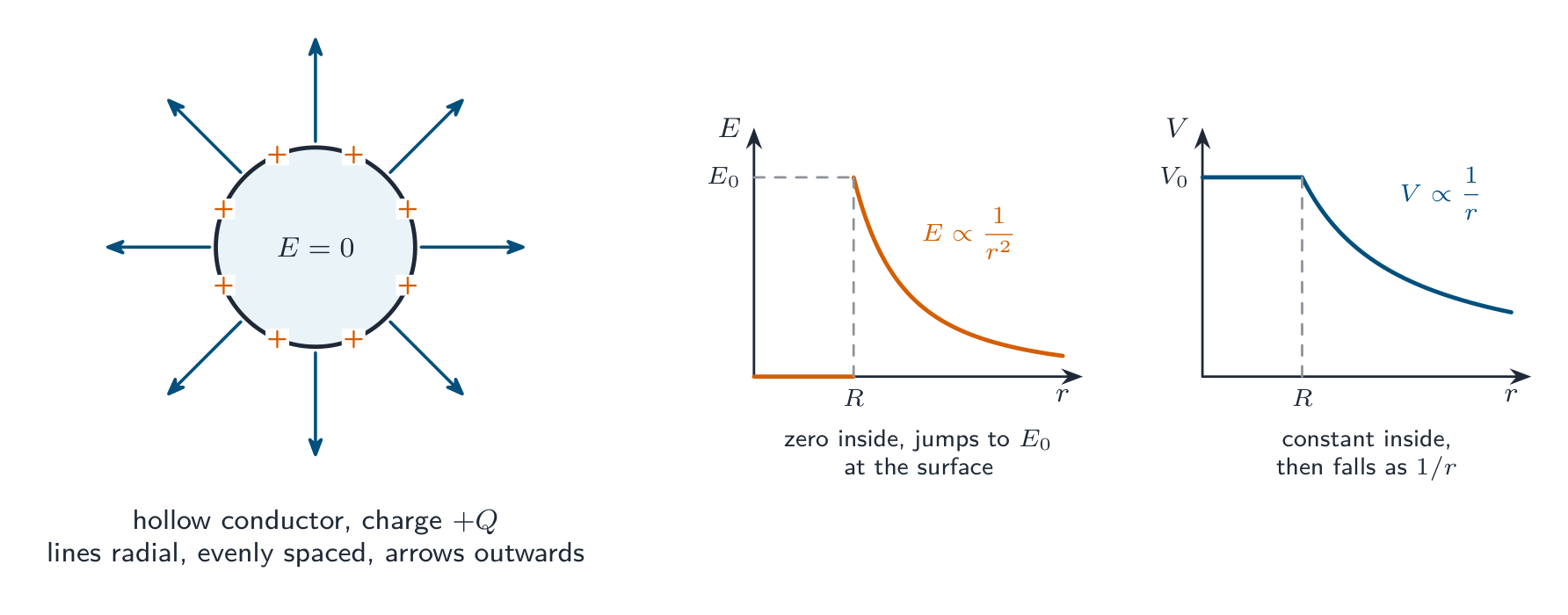
The charge on an isolated 孤立的conductor 导体 sits on its outer surface, spread evenly when the sphere is on its own. Outside the sphere the field lines are radial, evenly spaced and pointing outwards (for positive charge), exactly the pattern of a point charge at the centre. Inside a hollow (or solid) conductor the field is zero: the fields of all the surface charges cancel everywhere inside, so no field line enters. Two graphs follow, and both are exam favourites. The field strength $E$ is zero out to the radius $R$, jumps to its surface value $E_0$ and then falls as $1/r^{2}$; the potential $V$ is constant inside (a zero field means a zero potential gradient) and then falls as $1/r$.
Reading the graphs. Given an $E$–$x$ graph for a charged sphere, the radius is the distance at which $E$ jumps from zero, and the charge comes from any point on the curve: $Q = 4\pi\varepsilon_{0} r^{2} E$. Given "$E_0$ at the surface", the value at $2R$ is $E_0/4$ and at $3R$ is $E_0/9$: sketch the curve through those points, starting at $E_0$ on the surface line, never from the origin.
Bahasa Indonesia
Petir adalah percikan raksasa yang didorong oleh medan listrik yang sangat besar.
Sebuah medan listrik adalah wilayah di mana muatan merasakan gaya dari muatan lain. Kekuatan medan listrik$E$ pada suatu titik adalah gaya per satuan muatan positif pada sebuah muatan uji positif kecil yang ditempatkan di sana:
$$E = \frac{F}{q}.$$
Satuan: $\text{N C}^{-1}$ (sama dengan $\text{V m}^{-1}$, seperti yang akan kita lihat). $E$ adalah vektor, menunjukkan arah gaya bekerja pada muatan positif. Gaya pada muatan $q$ adalah
$$F = qE,$$
berlawanan dengan medan jika $q$ negatif.
Definisi bernilai dua poin.Kekuatan medan listrik pada suatu titik adalah gaya per satuan muatan positif yang bekerja pada muatan kecil (uji) yang ditempatkan di titik tersebut. Tiga kata membawa nilai: gaya per satuan muatan (bukan "gaya pada muatan"), positif (yang menentukan arah), dan kecil atau uji (agar muatan tidak mengganggu medan yang diukur). Versi pilihan ganda menawarkan "gaya per satuan muatan yang bekerja pada massa kecil" dan "gaya per satuan massa" sebagai pengecoh: medan didefinisikan oleh muatan, bukan oleh massa.
Contoh terpecahkan. Sebuah proton dipercepat pada $2.00\ \text{m s}^{-2}$ dalam medan listrik, tanpa gaya lain yang bekerja. Temukan kuat medan. ($m_{\text{p}} = 1.67 \times 10^{-27}\ \text{kg}$, $e = 1.60 \times 10^{-19}\ \text{C}$.)
Pengaturan ulang yang sama secara terbalik memberikan percepatan elektron dalam medan $1500\ \text{V m}^{-1}$: $a = eE/m_{\text{e}} = (1.60 \times 10^{-19})(1500)/(9.11 \times 10^{-31}) = 2.6 \times 10^{14}\ \text{m s}^{-2}$, sangat besar karena massa elektron sangat kecil. Gravitasi ($9.81\ \text{m s}^{-2}$) dapat diabaikan dibandingkan dengan itu, itulah sebabnya soal ujian tentang elektron antara pelat mengabaikan beratnya.
Garis medan
garis medan menunjukkan arah gaya yang bekerja pada muatan uji positif.
garis dimulai dari muatan positif dan berakhir pada muatan negatif (atau menuju tak hingga).
garis tidak pernah saling berpotongan; garis yang lebih rapat berarti medan yang lebih kuat.
setiap garis membawa panah; garis bertemu permukaan konduktor secara tegak lurus.
Apa yang diwakili oleh garis medan. Saat ditanya "nyatakan apa yang diwakili oleh garis medan listrik", berikan kedua bagian: arah-nya menunjukkan arah gaya pada muatan positif yang diletakkan di sana, dan jarak antar garis menunjukkan kekuatan medan (garis lebih rapat, medan lebih kuat). Sketsa diberi nilai tepat pada poin-poin ini: panah digambar, garis tidak bersilangan, jarak merata di mana medan seragam, dan garis radial untuk muatan titik atau bola.
Contoh: muatan titik positif memiliki garis radial mengarah keluar; yang negatif memiliki garis mengarah masuk; dua muatan berlawanan (dipol) memiliki garis melengkung dari + ke −; dua pelat bermuatan sejajar menghasilkan medan seragam berupa garis sejajar dengan jarak sama.
Pola garis medan untuk pelat sejajar, dipol, muatan titik, dan bola bermuatan di atas pelat bertanahKonduktor berongga bermuatan: medan di luar adalah seperti muatan titik di pusat; di dalam, medannya nol dan potensialnya konstan
Bola konduktor bermuatan
Muatan pada konduktor terisolasi berada di permukaan luarnya, tersebar merata ketika bola tersebut berdiri sendiri. Di luar bola, garis medannya radial, berjarak merata, dan mengarah keluar (untuk muatan positif), persis seperti pola muatan titik di pusat. Di dalam konduktor berongga (atau solid), medannya nol: medan dari semua muatan permukaan saling meniadakan di mana saja di dalam, sehingga tidak ada garis medan yang masuk. Dua grafik mengikuti, dan keduanya merupakan favorit soal ujian. Kuat medan $E$ adalah nol hingga jari-jari $R$, melompat ke nilai permukaannya $E_0$, dan kemudian turun sebagai $1/r^{2}$; potensial $V$ adalah konstan di dalam (medan nol berarti gradien potensial nol) dan kemudian turun sebagai $1/r$.
Membaca grafik. Diberikan grafik $E$–$x$ untuk bola bermuatan, jari-jari adalah jarak di mana $E$ melompat dari nol, dan muatan didapat dari titik manapun pada kurva: $Q = 4\pi\varepsilon_{0} r^{2} E$. Diberikan "$E_0$ di permukaan", nilai pada $2R$ adalah $E_0/4$ dan pada $3R$ adalah $E_0/9$: gambar kurva melalui titik-titik tersebut, dimulai dari $E_0$ pada garis permukaan, bukan dari titik asal.
Generator Van de Graaff menyimpan muatan statis besar pada kubah logamnya, menciptakan medan listrik yang kuat di sekitarnya
Explore · Jelajahi
Electric fields · Medan listrik
E ∝ Q / r²
A charge sets up a radial field — out for +, in for −, obeying the inverse-square law. · Muatan membentuk medan radial — keluar untuk +, masuk untuk −, mematuhi hukum kuadrat terbalik.
recall and use $E = \Delta V / \Delta d$ to calculate the field strength of the uniform field between charged parallel plates
describe the effect of a uniform electric field on the motion of charged particles
Bahasa Indonesia
ingat dan gunakan $E = \Delta V / \Delta d$ untuk menghitung kuat medan dari medan seragam antara pelat paralel bermuatan
deskripsikan efek medan listrik seragam terhadap gerak partikel bermuatan
Source: Cambridge International syllabus · Sumber: Silabus Cambridge International
English
Between two parallel plates a distance $d$ apart with potential difference 电势差$V$ between them, the field is uniform (apart from edge effects) with size
$$E = \frac{V}{d}.$$
It points from the higher-potential plate to the lower one. The unit $\text{V m}^{-1}$ comes straight from this and equals $\text{N C}^{-1}$.
Worked example. Two parallel plates $5.0\ \text{mm}$ apart have a p.d. of $200\ \text{V}$ between them. Find the field strength, and the force on an electron in the gap. ($e = 1.6 \times 10^{-19}\ \text{C}$.)
Which changes the field? Two things only: $E = V/d$ rises if the p.d. is increased or the plates are moved closer. A resistor in series with the supply changes nothing: no current flows once the plates are charged, so there is no p.d. across the resistor and the plates sit at the full supply voltage. Between plates at $+800\ \text{V}$ and $+1300\ \text{V}$ the field points from the higher potential to the lower; two positive potentials change nothing about the direction rule.
A charged particle in a uniform field
A charge $q$ in a uniform field feels a constant force$F = qE$, so a constant acceleration$a = qE/m$ — just like a mass in a uniform gravitational field.
released at rest, it speeds up along the field (positive charge) or against it (negative charge), gaining kinetic energy 动能.
entering at right angles to the field, it follows a parabolic 抛物线 path — like a projectile 抛体 in gravity. This is how a cathode-ray tube 阴极射线管 used to steer its beam.
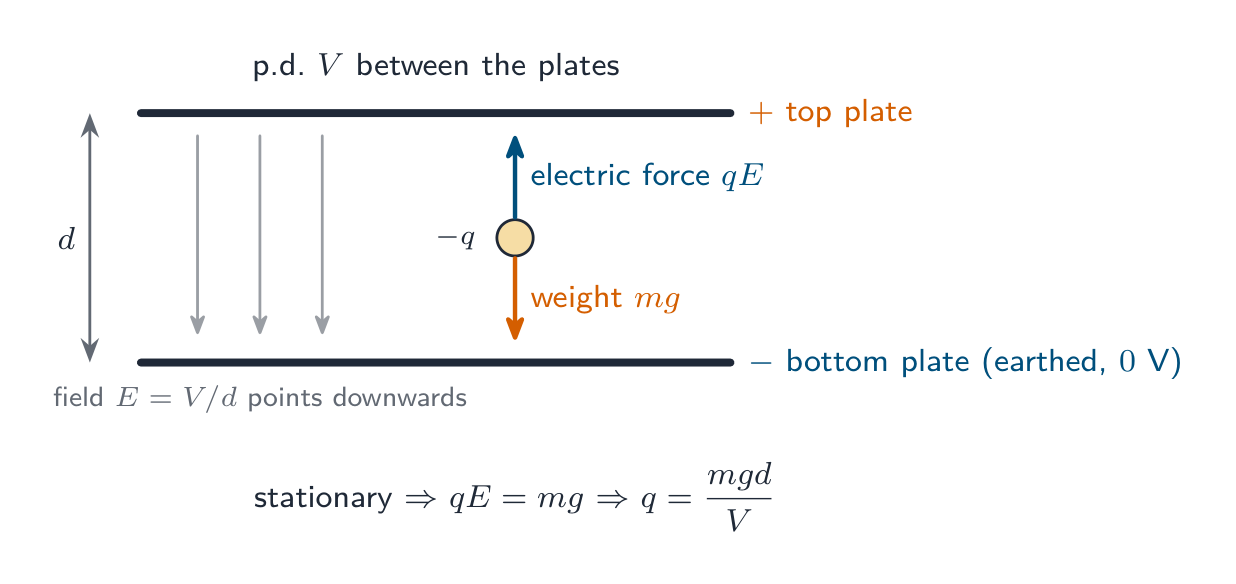
Two forces, not one. A charged oil drop "held stationary" between horizontal plates is the exam's favourite equilibrium 平衡: both an electric force and its weight act on it (the multiple-choice distractor is "electric force only"), and they are equal and opposite. For a negative drop the electric force is opposite to the field, so the top plate must be positive to hold it up.
Worked example. An oil drop of mass $2.6 \times 10^{-15}\ \text{kg}$ carries a charge of $-4.8 \times 10^{-19}\ \text{C}$ and is held stationary in a vacuum between horizontal plates $2.0\ \text{cm}$ apart. Find the p.d. between the plates, and say which plate is positive.
The drop is negative, so the force on it is against the field; for the force to be upwards the field must point down, so the top plate is positive. Notice that the charge is $3e$, three excess electrons, which is how Millikan showed that charge comes in multiples of $e$.
Worked example. Two parallel plates in a vacuum are $0.041\ \text{m}$ apart with a p.d. of $250\ \text{V}$ between them. An electron is released from rest at the negative plate. Find (a) the field strength, (b) the force on the electron and its acceleration, (c) the time it takes to reach the positive plate, (d) its kinetic energy on arrival. ($m_{\text{e}} = 9.11 \times 10^{-31}\ \text{kg}$.)
Worked example (deflection). An electron travelling horizontally at $2.0 \times 10^{7}\ \text{m s}^{-1}$ enters the field between two horizontal plates $18\ \text{mm}$ apart with a p.d. of $400\ \text{V}$. The plates are $30\ \text{mm}$ long. Find the deflection 偏转 of the electron by the time it leaves the field.
The horizontal motion is unaffected: time in the field $t = 0.030/(2.0 \times 10^{7}) = 1.5 \times 10^{-9}\ \text{s}$. Vertically, $a = eE/m_{\text{e}} = eV/(m_{\text{e}} d) = (1.60 \times 10^{-19})(400)/[(9.11 \times 10^{-31})(0.018)] = 3.9 \times 10^{15}\ \text{m s}^{-2}$, so the deflection is $y = \tfrac{1}{2} a t^{2} = \tfrac{1}{2}(3.9 \times 10^{15})(1.5 \times 10^{-9})^{2} = 4.4 \times 10^{-3}\ \text{m}$, less than the half-gap of $9\ \text{mm}$, so the electron does leave the field. Its vertical velocity on exit is $at = 5.9 \times 10^{6}\ \text{m s}^{-1}$, so it leaves at $\tan\theta = 5.9/20$, about $16°$; the path is a parabola, and after the plates (no field) it travels in a straight line in the direction it had on exit.
Bahasa Indonesia
Antara dua pelat sejajar berjarak $d$ dengan beda potensial$V$ di antaranya, medannya seragam (kecuali efek tepi) dengan ukuran
Antara pelat sejajar medannya seragam, E = V/d
$$E = \frac{V}{d}.$$
Garisnya mengarah dari pelat berpotensial tinggi ke pelat berpotensial rendah. Satuan $\text{V m}^{-1}$ berasal langsung dari hal ini dan setara dengan $\text{N C}^{-1}$.
Contoh terpecahkan. Dua pelat sejajar $5.0\ \text{mm}$ berjarak memiliki beda potensial $200\ \text{V}$ di antaranya. Temukan kuat medan, dan gaya pada elektron di celah. ($e = 1.6 \times 10^{-19}\ \text{C}$.)
Apa yang mengubah medan? Hanya dua hal: $E = V/d$ meningkat jika beda potensial ditingkatkan atau pelat digerakkan lebih dekat. Resistor seri dengan sumber tidak mengubah apa pun: tidak ada arus mengalir setelah pelat terisi, sehingga tidak ada beda potensial melintasi resistor dan pelat berada pada tegangan sumber penuh. Antara pelat pada $+800\ \text{V}$ dan $+1300\ \text{V}$, medan mengarah dari potensi lebih tinggi ke yang lebih rendah; dua potensi positif tidak mengubah aturan arah.
Partikel bermuatan dalam medan seragam
Muatan $q$ dalam medan seragam mengalami gaya konstan$F = qE$, sehingga percepatan konstan$a = qE/m$ — sama seperti massa dalam medan gravitasi seragam.
dilepaskan dari keadaan diam, partikel bertambah cepat searah medan (muatan positif) atau melawan arahnya (muatan negatif), mendapatkan energi kinetik.
masuk tegak lurus terhadap medan, partikel mengikuti lintasan parabolik — seperti proyektil dalam gravitasi. Inilah cara tabung sinar katoda memandu pancarannya.
Muatan yang masuk ke medan seragam tegak lurus mengikuti lintasan parabolik, seperti proyektilTetesan minyak bermuatan yang diam di antara pelat horizontal: gaya listrik menyeimbangkan berat, sehingga q = mgd/V
Dua gaya, bukan satu. Tetesan minyak "diam" di antara pelat horizontal adalah kesetimbangan favorit dalam ujian: kedua gaya listrik dan beratnya bekerja padanya (pilihan pengecoh pilihan ganda adalah "hanya gaya listrik"), dan keduanya sama besar serta berlawanan arah. Untuk tetesan negatif, gaya listrik berlawanan dengan medan, sehingga pelat atas harus positif untuk menahannya agar tetap di atas.
Contoh terarah. Sebuah tetesan minyak bermassa $2.6 \times 10^{-15}\ \text{kg}$ membawa muatan $-4.8 \times 10^{-19}\ \text{C}$ dan diam di ruang hampa di antara dua pelat horizontal $2.0\ \text{cm}$ jaraknya. Tentukan beda potensial antara pelat-pelat tersebut, dan sebutkan pelat mana yang positif.
Tetesan bermuatan negatif, sehingga gayanya berlawanan dengan medan; agar gayanya ke atas, medan harus mengarah ke bawah, sehingga pelat atas positif. Perhatikan bahwa muatannya $3e$, yaitu tiga elektron berlebih, inilah yang ditunjukkan Millikan bahwa muatan datang dalam kelipatan $e$.
Contoh terarah. Dua pelat sejajar dalam ruang hampa berjarak $0.041\ \text{m}$ dengan beda potensial $250\ \text{V}$ di antara keduanya. Sebuah elektron dilepaskan dari keadaan diam di pelat negatif. Tentukan (a) kuat medan, (b) gaya pada elektron dan percepatannya, (c) waktu yang dibutuhkan untuk mencapai pelat positif, (d) energi kinetiknya saat tiba. ($m_{\text{e}} = 9.11 \times 10^{-31}\ \text{kg}$.)
(a) $E = V/d = 250/0.041 = 6.1 \times 10^{3}\ \text{V m}^{-1}$.
(b) $F = eE = (1.60 \times 10^{-19})(6.1 \times 10^{3}) = 9.8 \times 10^{-16}\ \text{N}$; $a = F/m_{\text{e}} = 1.07 \times 10^{15}\ \text{m s}^{-2}$, menuju pelat positif.
(c) Dari keadaan diam dengan percepatan konstan, $d = \tfrac{1}{2} a t^{2}$, sehingga $t = \sqrt{2d/a} = \sqrt{2 \times 0.041 / (1.07 \times 10^{15})} = 8.8 \times 10^{-9}\ \text{s}$.
(d) Metode energi, tidak perlu kinematika: $E_{\text{k}} = qV = (1.60 \times 10^{-19})(250) = 4.0 \times 10^{-17}\ \text{J}$, sehingga $v = \sqrt{2E_{\text{k}}/m_{\text{e}}} = 9.4 \times 10^{6}\ \text{m s}^{-1}$. (Periksa: $v = at = (1.07 \times 10^{15})(8.8 \times 10^{-9}) = 9.4 \times 10^{6}\ \text{m s}^{-1}$.)
Contoh terarah (pembiasan). Sebuah elektron bergerak secara horizontal dengan kecepatan $2.0 \times 10^{7}\ \text{m s}^{-1}$ memasuki medan di antara dua pelat horizontal $18\ \text{mm}$ jaraknya dengan beda potensial $400\ \text{V}$. Pelat-pelat tersebut memiliki panjang $30\ \text{mm}$. Tentukan pembiasan elektron hingga ia meninggalkan medan tersebut.
Gerakan horizontal tidak terpengaruh: waktu di dalam medan $t = 0.030/(2.0 \times 10^{7}) = 1.5 \times 10^{-9}\ \text{s}$. Secara vertikal, $a = eE/m_{\text{e}} = eV/(m_{\text{e}} d) = (1.60 \times 10^{-19})(400)/[(9.11 \times 10^{-31})(0.018)] = 3.9 \times 10^{15}\ \text{m s}^{-2}$, sehingga pembiasannya adalah $y = \tfrac{1}{2} a t^{2} = \tfrac{1}{2}(3.9 \times 10^{15})(1.5 \times 10^{-9})^{2} = 4.4 \times 10^{-3}\ \text{m}$, kurang dari separuh celah $9\ \text{mm}$, sehingga elektron dapat meninggalkan medan. Kecepatan vertikalnya saat keluar adalah $at = 5.9 \times 10^{6}\ \text{m s}^{-1}$, sehingga ia keluar pada sudut $\tan\theta = 5.9/20$, sekitar $16°$; lintasannya berbentuk parabola, dan setelah melewati pelat (tanpa medan) ia bergerak lurus searah dengan arah saat keluar.
Explore · Jelajahi
Uniform electric field lab · Laboratorium medan listrik seragam
Follow how a charge behaves between parallel plates. · Ikuti perilaku muatan antara pelat sejajar.
18.3
Coulomb's law · Hukum Coulomb
Syllabus · Silabus
English
understand that, for a point outside a spherical conductor, the charge on the sphere may be considered to be a point charge at its centre
recall and use Coulomb’s law$F = Q_1Q_2 / (4\pi\varepsilon_0 r^2)$ for the force between two point charges in free space
Bahasa Indonesia
pahami bahwa, untuk titik di luar konduktor bola, muatan pada bola dapat dianggap sebagai muatan titik di pusatnya
ingat dan gunakan hukum Coulomb$F = Q_1Q_2 / (4\pi\varepsilon_0 r^2)$ untuk gaya antara dua muatan titik dalam ruang hampa
Source: Cambridge International syllabus · Sumber: Silabus Cambridge International
English
For two point charges $Q_{1}$ and $Q_{2}$ a distance $r$ apart in free space, each feels a force of size
This is Coulomb's law 库仑定律. Here $\varepsilon_{0} = 8.85 \times 10^{-12}\ \text{F m}^{-1}$ is the permittivity of free space 真空电容率, and $1/(4\pi\varepsilon_{0}) \approx 9.0 \times 10^{9}\ \text{N m}^{2}\ \text{C}^{-2}$. The force is along the line joining the charges: repulsive for like charges, attractive for opposite charges.
Stating the law in words. "State Coulomb's law" wants a sentence, not a formula: the (electric) force between two point charges is directly proportional to the product of the charges and inversely proportional to the square of their separation. Both proportionalities are needed, and the charges must be point charges (or spheres treated as point charges at their centres) in a vacuum.
Worked example. Find the electrostatic force between point charges of $+2.0\ \text{nC}$ and $+3.0\ \text{nC}$ placed $4.0\ \text{cm}$ apart. ($1/(4\pi\varepsilon_{0}) = 9.0 \times 10^{9}\ \text{N m}^{2}\ \text{C}^{-2}$.)
Worked example. In a hydrogen atom the proton and the electron may be treated as point charges $120\ \text{pm}$ apart. Find the electric force between them, and compare it with their gravitational attraction. ($m_{\text{p}} = 1.67 \times 10^{-27}\ \text{kg}$, $m_{\text{e}} = 9.11 \times 10^{-31}\ \text{kg}$, $G = 6.67 \times 10^{-11}\ \text{N m}^{2}\ \text{kg}^{-2}$.)
Gravity: $F_{\text{G}} = G m_{\text{p}} m_{\text{e}}/r^{2} = (6.67 \times 10^{-11})(1.67 \times 10^{-27})(9.11 \times 10^{-31})/(1.20 \times 10^{-10})^{2} = 7.0 \times 10^{-48}\ \text{N}$, about $10^{39}$ times smaller. Inside atoms, gravity is irrelevant.
Worked example. Two identical oil droplets in a vacuum have their centres $3.8 \times 10^{-6}\ \text{m}$ apart. Each carries the same charge, and they repel with a force of $1.0 \times 10^{-15}\ \text{N}$. Find the charge on each droplet, and the number of excess electrons it carries.
that is $1.3 \times 10^{-18}/1.60 \times 10^{-19} \approx 8$ electrons. Identical objects with the same sign of charge always repel; do not write "attract" for the direction.
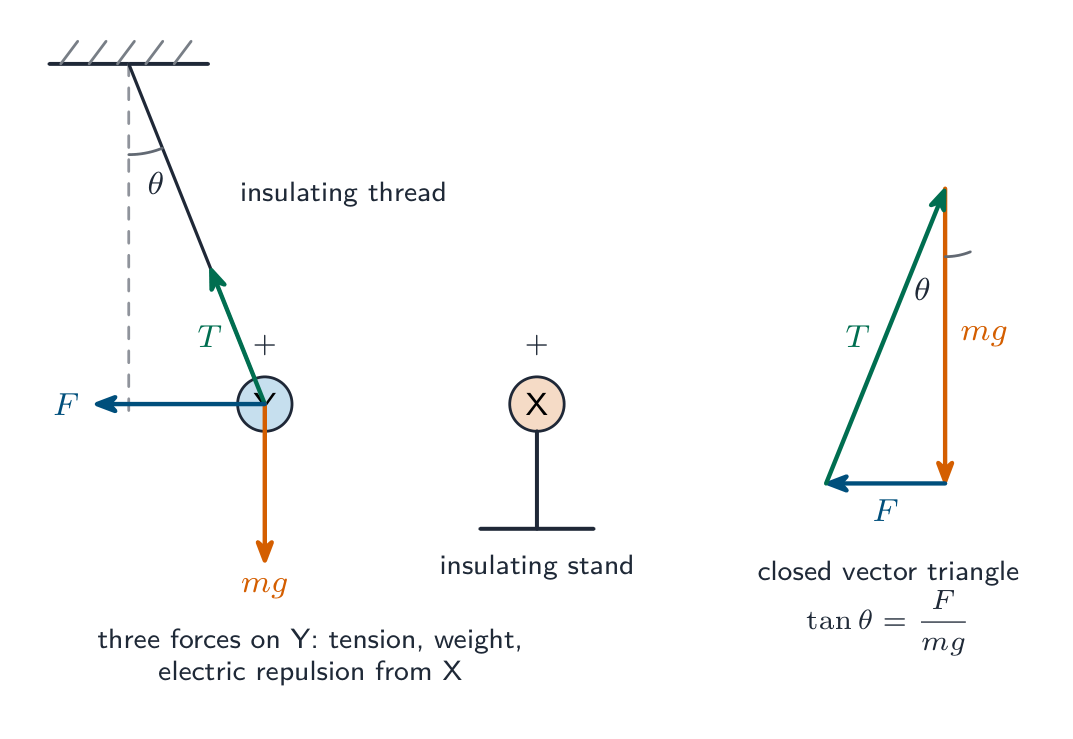
Worked example. A charged sphere X is fixed on an insulating stand. A second sphere Y, of mass $2.0\ \text{g}$, hangs beside it on an insulating thread and settles in equilibrium with the thread at $12°$ to the vertical, its centre $5.0\ \text{cm}$ from the centre of X on the same horizontal level. Find the electric force on Y and, if the spheres carry equal charges, the charge on each.
Three forces act on Y: its weight $mg$ (down), the tension 张力$T$ (along the thread) and the electric force $F$ (horizontal, away from X because like charges repel). Resolving, $T\cos\theta = mg$ and $T\sin\theta = F$, so
Then $F = Q^{2}/(4\pi\varepsilon_{0} r^{2})$ gives $Q = \sqrt{4\pi\varepsilon_{0} F r^{2}} = \sqrt{(4.2 \times 10^{-3})(0.050)^{2}/(8.99 \times 10^{9})} = 3.4 \times 10^{-8}\ \text{C}$. A closed vector triangle of the three forces is an equally good method; the exam accepts either, but it must show all three forces.
Worked example (helium). A helium atom may be modelled as a nucleus of charge $+2e$ with two electrons in diametrically opposite circular orbits of radius $170\ \text{pm}$. Find the resultant force 合力 on one electron, and hence its orbital speed.
Two forces act on the electron: attraction to the nucleus, at distance $r$, and repulsion from the other electron, at distance $2r$ on the far side:
towards the nucleus. This resultant is the centripetal force, $F = m_{\text{e}} v^{2}/r$, so $v = \sqrt{F r/m_{\text{e}}} = \sqrt{(1.4 \times 10^{-8})(1.70 \times 10^{-10})/(9.11 \times 10^{-31})} = 1.6 \times 10^{6}\ \text{m s}^{-1}$. The trap is to forget the second electron, or to put it at distance $r$ rather than $2r$.
Spheres treated as point charges
A spherical conductor with total charge $Q$ gives, at any point outside, the same field as a point charge $Q$ at its centre (measure $r$ from the centre). Inside a hollow charged conductor the field is zero, so the conductor is an equipotential 等势面.
Bahasa Indonesia
Untuk dua muatan titik $Q_{1}$ dan $Q_{2}$ yang berjarak $r$ di ruang bebas, masing-masing merasakan gaya sebesar
Ini adalah Hukum Coulomb. Di sini $\varepsilon_{0} = 8.85 \times 10^{-12}\ \text{F m}^{-1}$ adalah permitivitas ruang bebas, dan $1/(4\pi\varepsilon_{0}) \approx 9.0 \times 10^{9}\ \text{N m}^{2}\ \text{C}^{-2}$. Gaya ini sepanjang garis penghubung kedua muatan: tolak-menolak untuk muatan sejenis, tarik-menarik untuk muatan berbeda jenis.
Menyatakan hukum dengan kata-kata. "Nyatakan Hukum Coulomb" meminta sebuah kalimat, bukan rumus: gaya (listrik) antara dua muatan titik berbanding lurus dengan hasil kali muatan-muatan tersebut dan berbanding terbalik dengan kuadrat jarak pisahnya. Kedua perbandingan proporsionalitas diperlukan, dan muatan-muatannya harus berupa muatan titik (atau bola yang diperlakukan sebagai muatan titik di pusatnya) dalam ruang hampa.
Muatan sejenis tolak-menolak; muatan berbeda jenis tarik-menarik — gaya sepanjang garis penghubung mereka
Contoh terarah. Tentukan gaya elektrostatik antara dua muatan titik $+2.0\ \text{nC}$ dan $+3.0\ \text{nC}$ yang diletakkan berjarak $4.0\ \text{cm}$. ($1/(4\pi\varepsilon_{0}) = 9.0 \times 10^{9}\ \text{N m}^{2}\ \text{C}^{-2}$.)
Contoh terarah. Dalam atom hidrogen, proton dan elektron dapat diperlakukan sebagai muatan titik $120\ \text{pm}$ jaraknya. Tentukan gaya listrik di antara keduanya, dan bandingkan dengan tarikan gravitasinya. ($m_{\text{p}} = 1.67 \times 10^{-27}\ \text{kg}$, $m_{\text{e}} = 9.11 \times 10^{-31}\ \text{kg}$, $G = 6.67 \times 10^{-11}\ \text{N m}^{2}\ \text{kg}^{-2}$.)
Gravitasi: $F_{\text{G}} = G m_{\text{p}} m_{\text{e}}/r^{2} = (6.67 \times 10^{-11})(1.67 \times 10^{-27})(9.11 \times 10^{-31})/(1.20 \times 10^{-10})^{2} = 7.0 \times 10^{-48}\ \text{N}$, sekitar $10^{39}$ kali lebih kecil. Di dalam atom, gravitasi dapat diabaikan.
Contoh terarah. Dua tetesan minyak identik dalam ruang hampa berjarak $3.8 \times 10^{-6}\ \text{m}$ antar pusatnya. Masing-masing membawa muatan yang sama, dan mereka saling tolak dengan gaya $1.0 \times 10^{-15}\ \text{N}$. Tentukan muatan pada setiap tetesan, dan jumlah elektron berlebih yang dimilikinya.
yaitu $1.3 \times 10^{-18}/1.60 \times 10^{-19} \approx 8$ elektron. Benda identik dengan tanda muatan yang sama selalu tolak-menolak; jangan tulis "tarik-menarik" untuk arahnya.
Contoh terarah. Sebuah bola X bermuatan tetap di atas tiang isolator. Bola Y kedua, bermassa $2.0\ \text{g}$, tergantung di sampingnya pada benang isolator dan setimbang dengan benang membentuk sudut $12°$ terhadap vertikal, pusatnya $5.0\ \text{cm}$ dari pusat X pada ketinggian horizontal yang sama. Tentukan gaya listrik pada Y dan, jika bola-bola tersebut bermuatan sama, muatan pada masing-masing.
Bola bermuatan tergantung dekat bola bermuatan lain: tiga gaya seimbang, tegangan sepanjang benang, berat, dan tolakan listrik horizontal, sehingga tan θ = F/mg
Tiga gaya bekerja pada Y: beratnya $mg$ (ke bawah), tegangan$T$ (sepanjang benang) dan gaya listrik $F$ (horizontal, menjauhi X karena muatan sejenis tolak-menolak). Resolusi komponen, $T\cos\theta = mg$ dan $T\sin\theta = F$, sehingga
Kemudian $F = Q^{2}/(4\pi\varepsilon_{0} r^{2})$ menghasilkan $Q = \sqrt{4\pi\varepsilon_{0} F r^{2}} = \sqrt{(4.2 \times 10^{-3})(0.050)^{2}/(8.99 \times 10^{9})} = 3.4 \times 10^{-8}\ \text{C}$. Segitiga vektor tertutup dari ketiga gaya merupakan metode yang sama baiknya; ujian menerima keduanya, tetapi harus menampilkan semua tiga gaya.
Contoh terarah (helium). Atom helium dapat dimodelkan sebagai inti bermuatan $+2e$ dengan dua elektron dalam orbit melingkar berlawanan diameter berjari-jari $170\ \text{pm}$. Tentukan resultan gaya pada salah satu elektron, dan karenanya kecepatannya dalam orbit.
Dua gaya bekerja pada elektron: tarik-menarik ke inti, pada jarak $r$, dan tolak-menolak dari elektron lain, pada jarak $2r$ di sisi seberang:
menuju inti. Resultan ini adalah gaya sentripetal, $F = m_{\text{e}} v^{2}/r$, sehingga $v = \sqrt{F r/m_{\text{e}}} = \sqrt{(1.4 \times 10^{-8})(1.70 \times 10^{-10})/(9.11 \times 10^{-31})} = 1.6 \times 10^{6}\ \text{m s}^{-1}$. Jebakanannya adalah melupakan elektron kedua, atau meletakkannya pada jarak $r$ bukan $2r$.
Bola diperlakukan sebagai muatan titik
Konduktor bola dengan total muatan $Q$ memberikan, pada setiap titik di luar, medan yang sama dengan muatan titik $Q$ di pusatnya (ukur $r$ dari pusat). Di dalam konduktor berongga bermuatan, medannya nol, sehingga konduktor tersebut adalah equipotensial.
Explore · Jelajahi
Coulomb's law · Hukum Coulomb
F ∝ Qq / r²
Like charges repel, unlike attract — and the force follows 1/r². · Muatan sejenis tolak-menolak, muatan berlawanan tarik-menarik — dan gayanya mengikuti 1/r².
Electric field due to a point charge · Medan listrik akibat muatan titik
Syllabus · Silabus
English
recall and use $E = Q / (4\pi\varepsilon_0 r^2)$ for the electric field strength due to a point charge in free space
Bahasa Indonesia
ingat dan gunakan $E = Q / (4\pi\varepsilon_0 r^2)$ untuk kuat medan listrik akibat muatan titik dalam ruang hampa
Source: Cambridge International syllabus · Sumber: Silabus Cambridge International
English
Coulomb's law gives the force between two charges. Divide it by the test charge ($E = F/q$) and you are left with the field of the source charge $Q$alone. The field at distance $r$ from a point charge $Q$ is
$$E = \frac{Q}{4\pi\varepsilon_{0} r^{2}}.$$
It points out from a positive $Q$, in towards a negative $Q$, and falls as $1/r^{2}$ — just like gravitational field 重力场 strength, except gravity is always attractive. For several charges, add the fields as a vector sum 矢量和.
Worked example. The Earth may be treated as a uniform conducting sphere of radius $6.37 \times 10^{6}\ \text{m}$ carrying a total charge of $-4.80 \times 10^{5}\ \text{C}$ spread over its surface. Find the electric field strength at the surface, and compare it with the gravitational field strength there. ($M_{\text{E}} = 5.98 \times 10^{24}\ \text{kg}$.)
directed towards the centre (the charge is negative). Gravity: $g = GM/R^{2} = 9.83\ \text{N kg}^{-1}$, so $E/g \approx 11$; in symbols $E/g = Q/(4\pi\varepsilon_{0} G M)$, which shows that the ratio depends only on the charge-to-mass ratio of the sphere. A charged sphere of mass $m$ and charge $q$ would need $qE = mg$ to float in this field: $q/m = g/E = 0.093\ \text{C kg}^{-1}$.
Worked example. Point charges of $+4.0\ \text{nC}$ and $+1.0\ \text{nC}$ are $30\ \text{cm}$ apart. Where on the line joining them is the resultant field zero?
Between the charges the two fields point in opposite directions; call the distance from the $4.0\ \text{nC}$ charge $x$. Zero resultant needs equal magnitudes:
twice as far from the larger charge. For opposite charges the fields between them point the same way and never cancel: the zero lies outside, beyond the smaller charge.
Bahasa Indonesia
Hukum Coulomb memberikan gaya antara dua muatan. Bagi dengan muatan uji ($E = F/q$) dan Anda akan mendapatkan medan dari muatan sumber $Q$sendirian. Medan pada jarak $r$ dari muatan titik $Q$ adalah
$$E = \frac{Q}{4\pi\varepsilon_{0} r^{2}}.$$
Medan ini mengarah keluar dari muatan positif $Q$, masuk menuju muatan negatif $Q$, dan berkurang sebanding dengan $1/r^{2}$ — persis seperti kekuatan medan gravitasi, kecuali gravitasi selalu menarik. Untuk beberapa muatan, jumlahkan medan sebagai jumlah vektor.
Contoh terpecahkan. Bumi dapat diperlakukan sebagai bola konduktor seragam berjari-jari $6.37 \times 10^{6}\ \text{m}$ yang membawa total muatan $-4.80 \times 10^{5}\ \text{C}$ yang tersebar di permukaannya. Temukan kekuatan medan listrik di permukaan, dan bandingkan dengan kekuatan medan gravitasi di sana. ($M_{\text{E}} = 5.98 \times 10^{24}\ \text{kg}$.)
terarah menuju pusat (muatannya negatif). Gravitasi: $g = GM/R^{2} = 9.83\ \text{N kg}^{-1}$, sehingga $E/g \approx 11$; dalam simbol $E/g = Q/(4\pi\varepsilon_{0} G M)$, yang menunjukkan bahwa rasio hanya bergantung pada rasio muatan-terhadap-massa bola. Bola bermuatan dengan massa $m$ dan muatan $q$ akan membutuhkan $qE = mg$ untuk melayang di medan ini: $q/m = g/E = 0.093\ \text{C kg}^{-1}$.
Contoh terpecahkan. Muatan titik $+4.0\ \text{nC}$ dan $+1.0\ \text{nC}$ terpisah sejauh $30\ \text{cm}$. Di mana pada garis penghubung keduanya resultan medannya nol?
Antara kedua muatan, kedua medan mengarah berlawanan arah; sebut jarak dari muatan $4.0\ \text{nC}$ adalah $x$. Resultan nol memerlukan besar yang sama:
dua kali lebih jauh dari muatan yang lebih besar. Untuk muatan berlawanan tanda, medan di antara mereka mengarah sama dan tidak pernah saling meniadakan: titik nol berada di luar, melewati muatan yang lebih kecil.
Explore · Jelajahi
Field around a point charge · Medan di sekitar muatan titik
Change the charge. Field lines point away from positive and toward negative, and crowd together where the field is strongest. · Ubah muatannya. Garis-garis medan mengarah jauh dari positif dan menuju negatif, serta merapat di tempat medan paling kuat.
18.5
Electric potential · Potensial listrik
Syllabus · Silabus
English
define electric potential at a point as the work done per unit positive charge in bringing a small test charge from infinity to the point
recall and use the fact that the electric field at a point is equal to the negative of potential gradient at that point
use $V = Q / (4\pi\varepsilon_0 r)$ for the electric potential in the field due to a point charge
understand how the concept of electric potential leads to the electric potential energy of two point charges and use $E_P = Qq / (4\pi\varepsilon_0 r)$
Bahasa Indonesia
definisikan potensial listrik di suatu titik sebagai usaha per unit muatan positif dalam membawa muatan uji kecil dari tak hingga ke titik tersebut
ingat dan gunakan fakta bahwa medan listrik di suatu titik sama dengan negatif dari gradien potensial di titik tersebut
gunakan $V = Q / (4\pi\varepsilon_0 r)$ untuk potensial listrik dalam medan akibat muatan titik
pahami bagaimana konsep potensial listrik mengarah pada energi potensial listrik dari dua muatan titik dan gunakan $E_P = Qq / (4\pi\varepsilon_0 r)$
Source: Cambridge International syllabus · Sumber: Silabus Cambridge International
English
Electric potential 电势$V$ at a point is the work done per unit positive charge in bringing a small positive test charge from infinity 无穷远 to that point:
$$V = \frac{W}{q}.$$
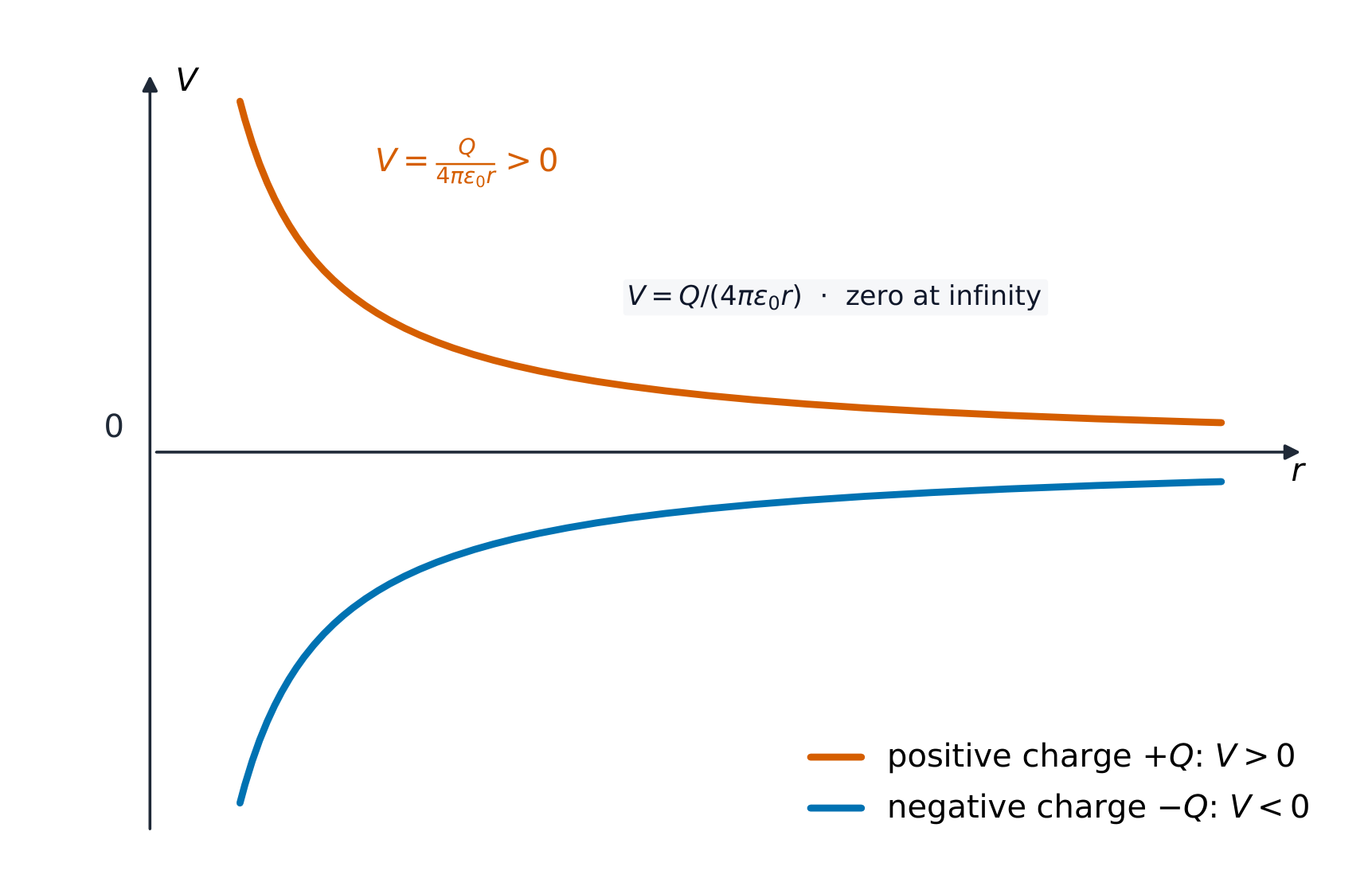
Unit: $\text{V}$. The potential is zero at infinity. For a positive source charge $V > 0$ everywhere outside; for a negative source charge $V < 0$.
The two-mark definition.Electric potential at a point is the work done per unit positive charge in bringing a small test charge from infinity to the point. The marks are for work done per unit (positive) charge and from infinity to the point. The potential of a positive charge is positive because work must be done on a positive test charge to push it in against the repulsion; near a negative charge the field does the work, so the potential is negative. "Explain why the potential near an isolated proton is positive" is answered in exactly those words.
Potential due to a point charge
$$V = \frac{Q}{4\pi\varepsilon_{0} r}.$$
Note the $1/r$ here (compared with $1/r^{2}$ for the field). $V$ is a scalar 标量; for several charges, add the potentials (with sign).
Worked example. Find the electric potential $4.0\ \text{cm}$ from a point charge of $+3.0\ \text{nC}$. ($1/(4\pi\varepsilon_{0}) = 9.0 \times 10^{9}\ \text{N m}^{2}\ \text{C}^{-2}$.)
Because potential is a scalar, the potential from several charges is simply their sum (each with its own sign) — no directions to resolve.
Two charged spheres on a line
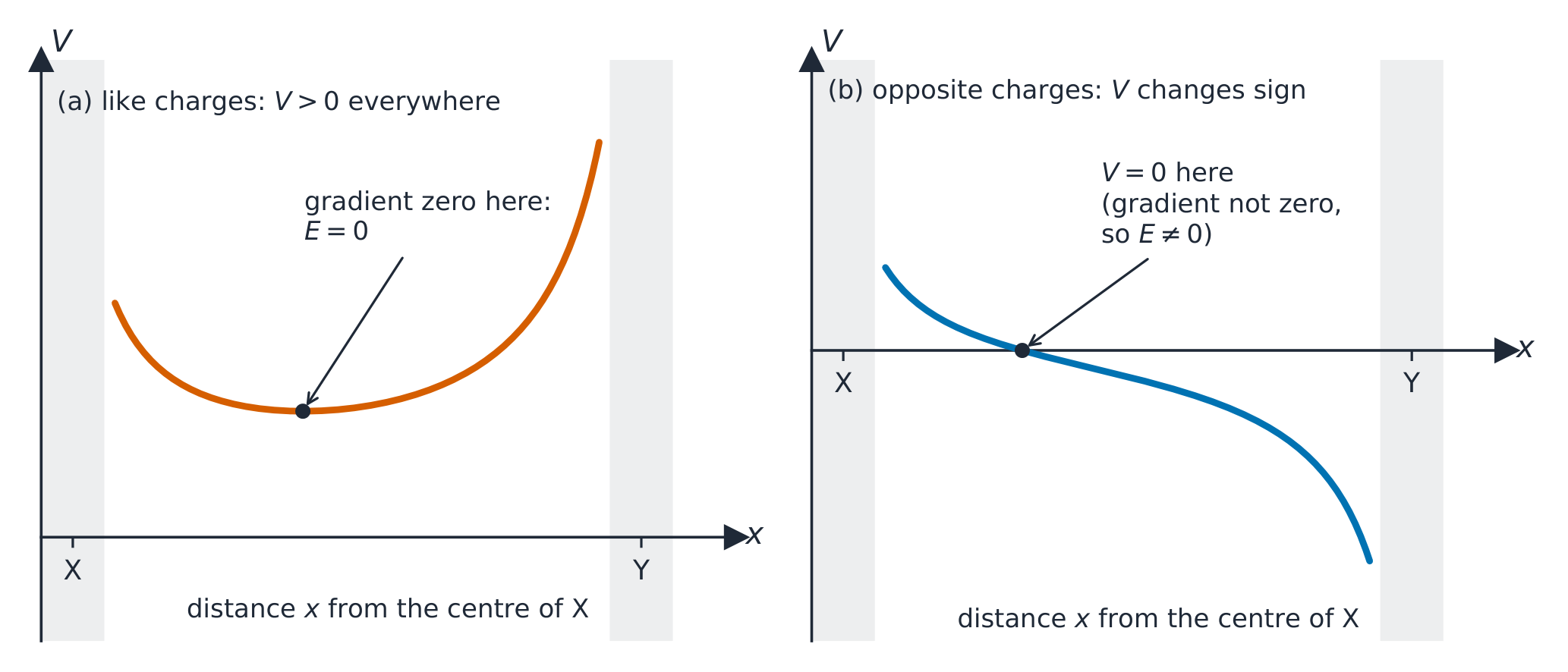
The exam's favourite structured question puts two charged spheres X and Y some distance apart and draws the potential $V$ along the line joining their centres (or asks you to reason from it). Everything follows from two facts: potential is a scalar that adds with sign, and the field is the negative gradient of the graph.
Sign of the charges. If $V$ is positive along the whole line, both charges are positive; if $V$ changes sign, the charges are opposite (positive near the positive sphere).
Where the field is zero. Where the curve has a minimum (gradient zero). For like charges this lies between them, closer to the smaller charge: $Q_{\text{X}}/x^{2} = Q_{\text{Y}}/(d - x)^{2}$. For opposite charges there is no such point between them: the curve crosses zero there, but its gradient is not zero, so the field is not.
Ratio of the charges. Where $V = 0$ between opposite charges, $Q_{\text{X}}/x = Q_{\text{Y}}/(d - x)$: the distances give the ratio directly. For like charges use the minimum instead (the square root of the field condition).
Force on a charge placed at P. Read the gradient at P by drawing a tangent 切线; then $E$ is minus the gradient, and $F = qE$.
Worked example. Two isolated charged metal spheres X and Y have their centres $1.2\ \text{m}$ apart in a vacuum. The potential along the line between them is positive everywhere and has a minimum at $x = 0.50\ \text{m}$ from the centre of X. State three conclusions, and then find the force on a proton held at $x = 0.60\ \text{m}$, where the gradient of the graph is $+180\ \text{V m}^{-1}$.
Conclusions: (1) both spheres are positively charged, because the potential is positive everywhere; (2) the electric field is zero at $x = 0.50\ \text{m}$, where the gradient is zero; (3) the charge on Y is larger, because the zero-field point lies closer to X; in fact $Q_{\text{Y}}/Q_{\text{X}} = (0.70/0.50)^{2} = 2.0$. At $x = 0.60\ \text{m}$: $E = -180\ \text{V m}^{-1}$ (pointing towards X, since $V$ rises towards Y), so $F = eE = (1.60 \times 10^{-19})(180) = 2.9 \times 10^{-17}\ \text{N}$ towards X. Released, the proton accelerates towards X, its acceleration increasing as the gradient steepens; it needs an external force to hold it still.
Describing the motion. "A positively charged particle is placed at P and released. Describe and explain its motion." The examiner wants: the direction (towards lower potential, down the slope of the $V$ graph); that the force, and so the acceleration, is not constant (it follows the gradient, which changes along the line); and that the particle speeds up throughout, since the force stays in the direction of motion. If P is the zero-field point the particle stays at rest, in unstable equilibrium: a nudge either way sends it off.
Link between field and potential
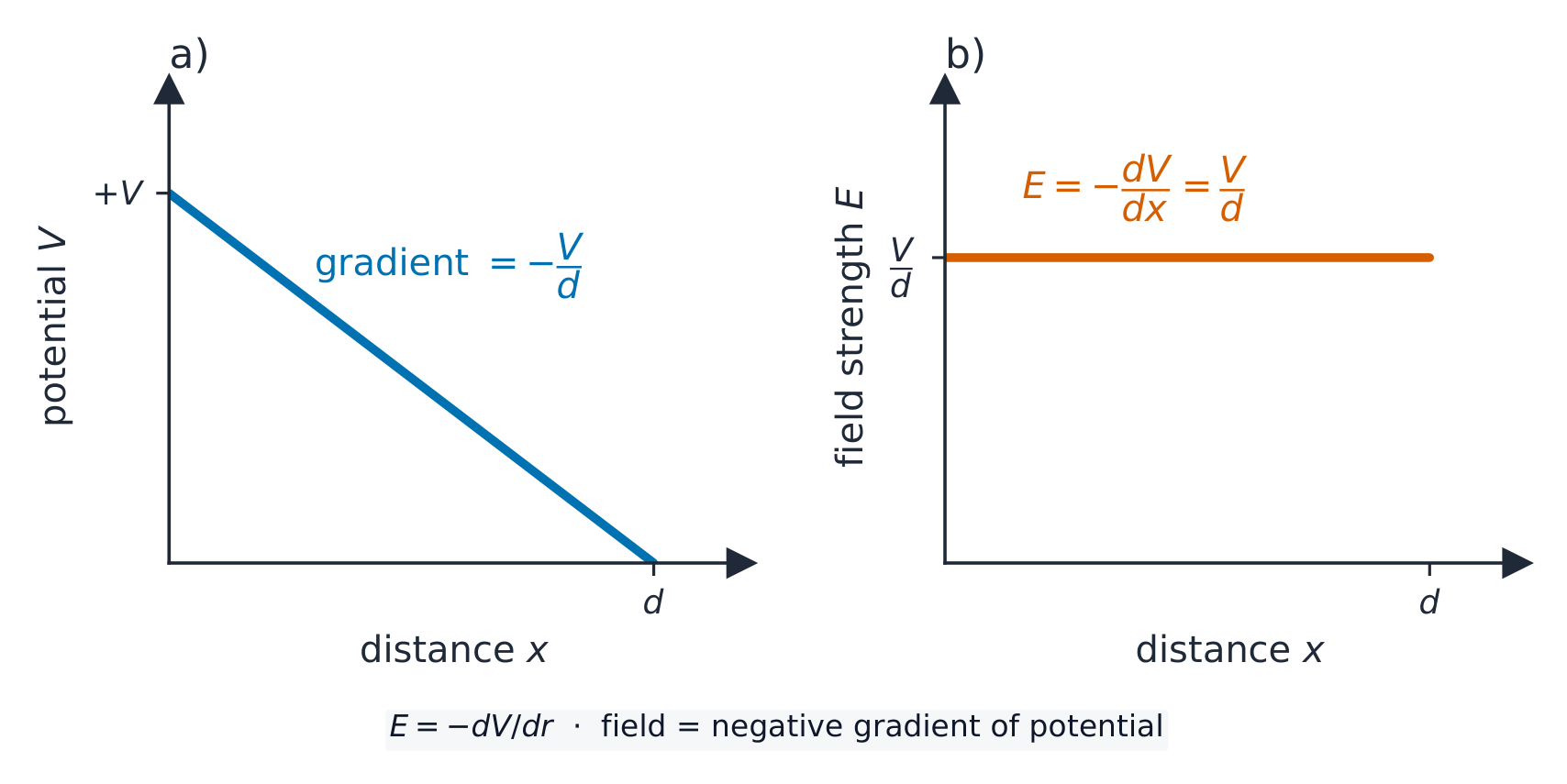
The field equals the negative potential gradient 电势梯度:
$$E = -\frac{dV}{dx}.$$
Between parallel plates $V$ changes evenly with position, giving $E = V/d$ as before. The minus sign means the field points towards lower potential. For a point charge, $-\dfrac{dV}{dr} = \dfrac{Q}{4\pi\varepsilon_{0} r^{2}} = E$.
The one-line relationship. "State the relationship between electric field and electric potential": the field strength is equal to the negative of the potential gradient, $E = -\Delta V/\Delta x$. On a $V$–$x$ graph $E$ is minus the gradient of a tangent; on a $V$–$r$ graph for a point charge the gradient is steepest close to the charge, where the field is strongest, and the sign of $E$ is fixed by "the field points towards lower potential". The uniform-field version $E = V/d$ is the same statement with a constant gradient.
Equipotentials. An equipotential surface joins points of equal potential; no work is done moving a charge along it, so the field is always at right angles to it. Around a point charge the equipotentials are concentric spheres, growing further apart as $V$ falls; between parallel plates they are planes parallel to the plates. The surface of a conductor is an equipotential, which is why field lines meet it at right angles.
Electric potential energy
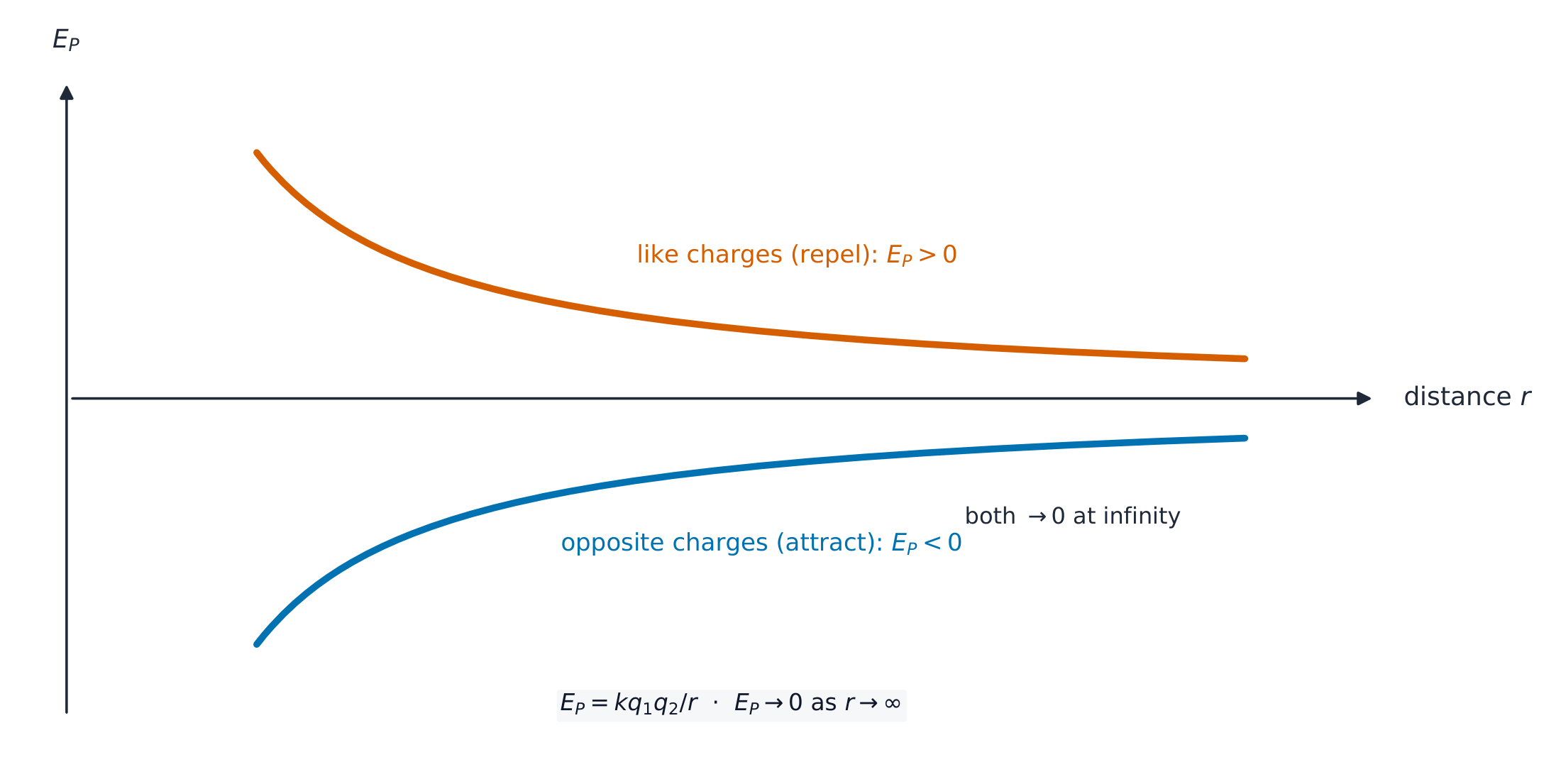
A charge $q$ at a point of potential $V$ has electric potential energy 电势能$E_{\text{P}} = qV$. For two point charges $Q$ and $q$ a distance $r$ apart:
like charges: $E_{\text{P}} > 0$ — stored energy that would be released if they flew apart.
opposite charges: $E_{\text{P}} < 0$ — a bound 束缚 system; energy must be supplied to separate them.
In both cases $E_{\text{P}} \to 0$ as $r \to \infty$.
Worked example. The proton and the electron in a hydrogen atom are $5.3 \times 10^{-11}\ \text{m}$ apart. Find the electric potential energy of the pair.
The negative sign is part of the answer: the charges are opposite, so energy ($4.3 \times 10^{-18}\ \text{J}$) must be supplied to pull them apart to infinity. (The electron also has kinetic energy of half that size, so the energy needed to ionise 电离 the atom is $13.6\ \text{eV}$; the "worked-example pattern" below shows why.)
Charge through a p.d. A charge $q$ moved through a potential difference $V$ changes its potential energy by $qV$, which is why an electron accelerated from rest through $250\ \text{V}$ arrives with $250\ \text{eV}$ of kinetic energy whatever the shape of the field. For an MCQ about "moving P a distance $x$ along the field lines", the work done is $qEx$, and its potential energy falls if it moves the way the force pushes it.
Worked-example pattern
An electron 电子 orbits a nucleus 原子核 of charge $+Ze$ at distance $r$. The Coulomb attraction provides the centripetal force 向心力:
The minus sign in the gravitational potential 引力势 reflects that gravity is always attractive; the electric potential takes the sign of the source charge.
Similarity and difference (a standard two-marker). Both potentials are proportional to $1/r$, both are zero at infinity, and both are scalars; but gravitational potential is always negative (the force is always attractive) whereas electric potential takes the sign of the charge and can be positive. For the fields: both obey an inverse-square law and both are drawn as radial lines around a point source, but gravitational field lines only ever point inwards (attraction), while electric field lines point outwards from a positive charge and inwards to a negative one.
Bahasa Indonesia
Potensial listrik$V$ di suatu titik adalah usaha per satuan muatan positif untuk memindahkan muatan uji positif kecil dari tak hingga ke titik tersebut:
$$V = \frac{W}{q}.$$
Unit: $\text{V}$. Potensial nol di tak hingga. Untuk muatan sumber positif $V > 0$ di mana pun di luar; untuk muatan sumber negatif $V < 0$.
Definisi dua poin.Potensial listrik di suatu titik adalah usaha per satuan muatan positif untuk memindahkan muatan uji kecil dari tak hingga ke titik tersebut. Poin diberikan untuk usaha per satuan (positif) muatan dan dari tak hingga ke titik. Potensial muatan positif bernilai positif karena usaha harus dilakukan pada muatan uji positif untuk mendorongnya masuk melawan tolakan; dekat muatan negatif, medan melakukan usaha, sehingga potensialnya negatif. "Jelaskan mengapa potensial di dekat proton terisolasi bernilai positif" dijawab tepat dengan kata-kata tersebut.
Potensial akibat muatan titik
$$V = \frac{Q}{4\pi\varepsilon_{0} r}.$$
Perhatikan $1/r$ di sini (dibandingkan dengan $1/r^{2}$ untuk medan). $V$ adalah skalar; untuk beberapa muatan, jumlahkan potensialnya (dengan tandanya).
Contoh terpecahkan. Temukan potensial listrik $4.0\ \text{cm}$ dari muatan titik $+3.0\ \text{nC}$. ($1/(4\pi\varepsilon_{0}) = 9.0 \times 10^{9}\ \text{N m}^{2}\ \text{C}^{-2}$.)
Karena potensial adalah skalar, potensial dari beberapa muatan hanyalah jumlah mereka (masing-masing dengan tandanya sendiri) — tidak ada komponen arah yang perlu diuraikan.
Potensial sepanjang garis antara dua bola bermuatan: muatan sejenis menghasilkan minimum (medan nol di sana); muatan berlawanan menghasilkan perpotongan nol
Dua bola bermuatan pada sebuah garis
Soal terstruktur favorit ujian menempatkan dua bola bermuatan X dan Y pada jarak tertentu dan menggambar potensial $V$ sepanjang garis penghubung pusatnya (atau meminta Anda menyimpulkannya). Semua hal mengikuti dari dua fakta: potensial adalah skalar yang dijumlahkan dengan tanda, dan medan adalah gradien negatif dari grafik.
Tanda muatan. Jika $V$ positif sepanjang seluruh garis, kedua muatan positif; jika $V$ berubah tanda, muatannya berlawanan (positif dekat bola positif).
Di mana medan nol. Di mana kurva memiliki minimum (gradien nol). Untuk muatan sejenis, titik ini terletak di antara keduanya, lebih dekat ke muatan yang lebih kecil: $Q_{\text{X}}/x^{2} = Q_{\text{Y}}/(d - x)^{2}$. Untuk muatan berlawanan, tidak ada titik semacam itu di antara mereka: kurva melintasi nol di sana, tetapi gradiennya tidak nol, sehingga medannya juga tidak nol.
Rasio muatan. Di mana $V = 0$ antara muatan berlawanan, $Q_{\text{X}}/x = Q_{\text{Y}}/(d - x)$: jarak memberikan rasio secara langsung. Untuk muatan sejenis gunakan minimum sebagai gantinya (akar kuadrat dari kondisi medan).
Gaya pada muatan yang diletakkan di P. Baca gradien di P dengan menggambar garis singgung; maka $E$ adalah negatif dari gradien, dan $F = qE$.
Contoh terpecahkan. Dua bola logam bermuatan terisolasi X dan Y berjarak $1.2\ \text{m}$ satu sama lain di ruang hampa. Potensial sepanjang garis di antara keduanya positif di mana saja dan memiliki minimum pada $x = 0.50\ \text{m}$ dari pusat X. Nyatakan tiga kesimpulan, lalu temukan gaya pada proton yang dijaga pada $x = 0.60\ \text{m}$, di mana gradien grafiknya adalah $+180\ \text{V m}^{-1}$.
Kesimpulan: (1) kedua bola bermuatan positif, karena potensial positif di mana-mana; (2) medan listrik nol pada $x = 0.50\ \text{m}$, di mana gradiennya nol; (3) muatan pada Y lebih besar, karena titik nol-medan berada lebih dekat ke X; sebenarnya $Q_{\text{Y}}/Q_{\text{X}} = (0.70/0.50)^{2} = 2.0$. Pada $x = 0.60\ \text{m}$: $E = -180\ \text{V m}^{-1}$ (mengarah ke X, karena $V$ naik menuju Y), sehingga $F = eE = (1.60 \times 10^{-19})(180) = 2.9 \times 10^{-17}\ \text{N}$ ke arah X. Jika dilepaskan, proton dipercepat ke arah X, percepatannya meningkat saat gradien semakin curam; diperlukan gaya eksternal untuk menahannya tetap diam.
Mendeskripsikan gerak. "Sebuah partikel bermuatan positif diletakkan di P dan dilepaskan. Jelaskan dan uraikan geraknya." Penilai menginginkan: arah (menuju potensial lebih rendah, menurun sepanjang grafik $V$); bahwa gaya, dan karenanya percepatan, tidak konstan (mengikuti gradien yang berubah sepanjang garis); dan bahwa partikel mempercepat sepanjang waktu, karena gaya tetap searah dengan gerak. Jika P adalah titik nol-medan, partikel tetap diam dalam kesetimbangan tidak stabil: dorongan kecil ke arah manapun akan menjauhkannya.
Potensial di sekitar muatan titik berbanding terbalik dengan 1/r — positif untuk muatan positif, negatif untuk muatan negatif
Hubungan antara medan dan potensial
Medan sama dengan negatif gradien potensial:
$$E = -\frac{dV}{dx}.$$
Di antara pelat sejajar $V$ berubah secara merata terhadap posisi, menghasilkan $E = V/d$ seperti sebelumnya. Tanda minus berarti medan mengarah ke potensial lebih rendah. Untuk muatan titik, $-\dfrac{dV}{dr} = \dfrac{Q}{4\pi\varepsilon_{0} r^{2}} = E$.
Hubungan satu baris. "Nyatakan hubungan antara medan listrik dan potensial listrik": kekuatan medan sama dengan negatif dari gradien potensial, $E = -\Delta V/\Delta x$. Pada grafik $V$–$x$$E$ adalah negatif dari gradien sebuah tangen; pada grafik $V$–$r$ untuk muatan titik, gradien paling curam dekat muatan, di mana medan terkuat, dan tanda $E$ ditentukan oleh "medan mengarah ke potensial lebih rendah". Versi medan seragam $E = V/d$ adalah pernyataan yang sama dengan gradien konstan.
Isipotensial. Permukaan isipotensial menghubungkan titik-titik dengan potensial yang sama; tidak ada usaha yang dilakukan memindahkan muatan di atasnya, sehingga medan selalu tegak lurus terhadapnya. Di sekitar muatan titik, isipotensial berupa bola-bola konsentris yang makin renggang saat $V$ turun; di antara pelat sejajar mereka berupa bidang paralel terhadap pelat. Permukaan konduktor adalah isipotensial, itulah sebabnya garis-garis medan meetinya secara tegak lurus.
Dalam medan seragam, potensial turun terus-menerus terhadap jarak, sehingga kuat medan $V/d$ adalah konstan
Energi potensial listrik
Muatan $q$ pada titik dengan potensial $V$ memiliki energi potensial listrik$E_{\text{P}} = qV$. Untuk dua muatan titik $Q$ dan $q$ yang berjarak $r$:
sama jenis muatan: $E_{\text{P}} > 0$ — energi tersimpan yang akan dilepaskan jika mereka terbang menjauh.
berlawanan jenis muatan: $E_{\text{P}} < 0$ — sistem terikat; energi harus disuplai untuk memisahkan mereka.
Dalam kedua kasus $E_{\text{P}} \to 0$ saat $r \to \infty$.
Contoh terpecahkan. Proton dan elektron dalam atom hidrogen berjarak $5.3 \times 10^{-11}\ \text{m}$. Hitung energi potensial listrik pasangan tersebut.
Tanda negatif merupakan bagian jawaban: muatan berlawanan, sehingga energi ($4.3 \times 10^{-18}\ \text{J}$) harus disuplai untuk menarik mereka hingga tak terhingga. (Elektron juga memiliki energi kinetik setengah besarnya, sehingga energi yang dibutuhkan untuk mengionisasi atom adalah $13.6\ \text{eV}$; pola "contoh terpecahkan" di bawah ini menunjukkan alasannya.)
Muatan melalui beda potensial. Muatan $q$ yang dipindahkan melalui beda potensial $V$ mengubah energi potensialnya sebesar $qV$, inilah mengapa elektron yang dipercepat dari keadaan diam melewati $250\ \text{V}$ tiba dengan $250\ \text{eV}$ energi kinetik apa pun bentuk medannya. Untuk soal pilihan ganda tentang "menggerakkan P sejauh $x$ sepanjang garis-garis medan", usaha yang dilakukan adalah $qEx$, dan energi potensialnya turun jika bergerak searah dorongan gaya.
PE Listrik dua muatan: positif untuk muatan sejenis, sumur negatif untuk muatan berlawanan
Pola contoh terpecahkan
Sebuah elektron mengorbit inti bermuatan $+Ze$ pada jarak $r$. Tarikan Coulomb menyediakan gaya sentripetal:
Tanda minus dalam potensial gravitasi mencerminkan bahwa gravitasi selalu menarik; potensial listrik mengambil tanda dari muatan sumber.
Kesamaan dan perbedaan (soal standar dua poin). Kedua potensial berbanding lurus dengan $1/r$, keduanya nol di tak terhingga, dan keduanya adalah besaran skalar; namun potensial gravitasi selalu negatif (gaya selalu menarik) sedangkan potensial listrik mengambil tanda muatan dan bisa bernilai positif. Untuk medan: keduanya mematuhi hukum kuadrat terbalik dan digambarkan sebagai garis radial di sekitar sumber titik, tetapi garis medan gravitasi hanya pernah mengarah ke dalam (tarikan), sementara garis medan listrik mengarah keluar dari muatan positif dan masuk ke muatan negatif.
Explore · Jelajahi
Electric potential · Potensi elektrik
V = kQ / r
Potential ∝ 1/r around a charge — steep near it, flattening out. · Potensi ∝ 1/r di sekeliling muatan — curam berhampiran itu, rata keluar.
electric potential energy/ɪˈlektrɪk pəˈtenʃl ˈenədʒi/
energi potensial listrik
bound/baʊnd/
terikat
ionise/ˈaɪənaɪz/
ionisasi
gravitational potential/ˌɡrævɪˈteɪʃənl pəˈtenʃl/
potensial gravitasi
18.5
Definitions the examiner accepts · Definisi yang diterima oleh penguji
English
A definition question is marked against fixed wording. Learn these exactly, and give one answer only.
Term
Definition
electric field
a region in which a charge experiences an (electric) force
electric field strength
the force per unit positive charge acting on a small (test) charge placed at the point
electric field line
a line whose direction shows the direction of the force on a positive charge; the spacing of the lines shows the field strength
Coulomb's law
the force between two point charges is directly proportional to the product of the charges and inversely proportional to the square of their separation
electric potential
the work done per unit positive charge in bringing a small test charge from infinity to the point
field and potential
the electric field strength is equal to the negative of the potential gradient: $E = -\Delta V/\Delta x$
electric potential energy (of two charges)
the work done in bringing the charges from infinity to their separation; $Qq/(4\pi\varepsilon_{0} r)$
equipotential
a surface (or line) on which every point has the same potential; the field is at right angles to it
uniform field
a field with the same strength and direction at every point, shown by parallel, evenly spaced field lines
Bahasa Indonesia
Soal definisi dinilai berdasarkan frasa tetap. Hafalkan ini persis, dan berikan hanya satu jawaban.
Istilah
Definisi
medan listrik
daerah di mana sebuah muatan mengalami gaya (listrik)
kuat medan listrik
gaya per satuan muatan positif yang bekerja pada suatu muatan kecil (uji) yang diletakkan pada titik tersebut
garis medan listrik
garis yang arahnya menunjukkan arah gaya pada muatan positif; kerapatan garis menunjukkan kekuatan medan
Hukum Coulomb
gaya antara dua muatan titik berbanding lurus dengan hasil kali muatan-muatan tersebut dan berbanding terbalik dengan kuadrat jarak pisahnya
potensial listrik
usaha yang dilakukan per satuan muatan positif untuk membawa muatan uji kecil dari tak terhingga ke titik tersebut
medan dan potensial
kuat medan listrik sama dengan negatifnya gradien potensial: $E = -\Delta V/\Delta x$
energi potensial listrik (dua muatan)
usaha yang dilakukan untuk membawa muatan-muatan tersebut dari tak terhingga hingga terpisah sejauh tertentu; $Qq/(4\pi\varepsilon_{0} r)$
ekuipotensial
permukaan (atau garis) di mana setiap titiknya memiliki potensial yang sama; medan tegak lurus terhadapnya
medan seragam
medan dengan kekuatan dan arah yang sama di setiap titik, ditunjukkan oleh garis-garis medan yang sejajar dan berjarak sama
18.5
Exam tips · Tips ujian
English
Four formulae, two with $r^{2}$ and two with $r$: $F = Q_1 Q_2 / 4\pi\varepsilon_0 r^{2}$ and $E = Q/4\pi\varepsilon_0 r^{2}$ (inverse square), $V = Q/4\pi\varepsilon_0 r$ and $E_{\text{P}} = Qq/4\pi\varepsilon_0 r$. Decide which one before you write.
Distinguish a uniform field ($E = V/d$, between plates) from a radial field ($E = Q/4\pi\varepsilon_0 r^{2}$, outside a point charge or a sphere); $r$ for a sphere is measured from the centre, not the surface.
The field points from high to low potential and $E$ is minus the potential gradient: draw a tangent on a $V$–$x$ graph to find it.
Field is a vector (add components, subtract opposing ones); potential is a scalar (add with sign). Between like charges there is a zero-field point; between opposite charges a zero-potential point.
A charged particle in a uniform field: $F = qE$, $a = qE/m$, $E_{\text{k}} = qV$; along the field it is the vertical half of projectile motion, and motion at right angles to the field is unaffected.
The data sheet gives both $\varepsilon_0 = 8.85 \times 10^{-12}\ \text{F m}^{-1}$ and $1/(4\pi\varepsilon_0) = 8.99 \times 10^{9}\ \text{m F}^{-1}$; either works, do not mix them up.
Common mistakes
Defining field strength as "the force on a charge" or "force per unit mass". It is the force per unit positive charge on a small positive charge.
Forgetting to square $r$ in Coulomb's law and in the field, or squaring it in the potential ($V \propto 1/r$).
Using the diameter, or the distance from the surface of a sphere, instead of the centre-to-centre distance.
Sketching $E$ for a sphere from the origin. It is zero inside and starts at $E_0$ on the surface; $V$ is constant inside, not zero.
Field lines without arrows, crossing, or unevenly spaced in a uniform field; lines not at right angles to a conductor.
Dropping the negative sign on the potential energy of opposite charges, or taking the direction of $E$ from the sign of $V$ instead of from its gradient.
Forgetting the second electron in the helium atom, or placing it at distance $r$ rather than $2r$.
Using $E = V/d$ for a point charge, or $E = Q/4\pi\varepsilon_0 r^{2}$ between plates.
Giving an electron weight, or using the proton's mass for an electron; in electrons-between-plates questions the weight is negligible.
Leaving out the weight in an "oil drop held stationary" question, or getting the polarity of the top plate backwards.
Bahasa Indonesia
Empat rumus, dua dengan $r^{2}$ dan dua dengan $r$: $F = Q_1 Q_2 / 4\pi\varepsilon_0 r^{2}$ dan $E = Q/4\pi\varepsilon_0 r^{2}$ (kuadrat terbalik), $V = Q/4\pi\varepsilon_0 r$ dan $E_{\text{P}} = Qq/4\pi\varepsilon_0 r$. Tentukan mana yang tepat sebelum menulis.
Membedakan medan seragam ($E = V/d$, antara pelat) dari medan radial ($E = Q/4\pi\varepsilon_0 r^{2}$, di luar muatan titik atau bola); $r$ untuk bola diukur dari pusat, bukan permukaannya.
Medan mengarah dari potensial tinggi ke rendah dan $E$ adalah negatif dari gradien potensial: gambarlah garis singgung pada grafik $V$–$x$ untuk menemukannya.
Medan adalah vektor (jumlahkan komponen, kurangkan yang berlawanan); potensial adalah skalar (jumlahkan dengan tandanya). Antara muatan sejenis terdapat titik dengan medan nol; antara muatan berlawanan terdapat titik dengan potensial nol.
Partikel bermuatan dalam medan seragam: $F = qE$, $a = qE/m$, $E_{\text{k}} = qV$; sepanjang medan merupakan setengah gerak parabola vertikal, dan gerak tegak lurus terhadap medan tidak terpengaruh.
Lembar data memberikan kedua $\varepsilon_0 = 8.85 \times 10^{-12}\ \text{F m}^{-1}$ dan $1/(4\pi\varepsilon_0) = 8.99 \times 10^{9}\ \text{m F}^{-1}$; keduanya bisa digunakan, jangan dicampur aduk.
Kesalahan umum
Mendefinisikan kuat medan sebagai "gaya pada suatu muatan" atau "gaya per satuan massa". Ini adalah gaya per satuan muatan positif pada muatan positif kecil.
Lupa mengkuadratkan $r$ dalam Hukum Coulomb dan dalam medan, atau menguadratkannya dalam potensial ($V \propto 1/r$).
Menggunakan diameter, atau jarak dari permukaan bola, alih-alih jarak pusat-ke-pusat.
Menggambar $E$ untuk bola dari titik asal. Nilainya nol di dalam dan dimulai dari $E_0$ pada permukaan; $V$ konstan di dalam, bukan nol.
Garis medan tanpa panah, saling berpotongan, atau berjarak tidak rata dalam medan seragam; garis tidak tegak lurus terhadap konduktor.
Melewatkan tanda negatif pada energi potensial muatan berlawanan, atau mengambil arah $E$ dari tanda $V$ alih-alih dari gradiennya.
Melupakan elektron kedua dalam atom helium, atau menempatkannya pada jarak $r$ alih-alih $2r$.
Menggunakan $E = V/d$ untuk muatan titik, atau $E = Q/4\pi\varepsilon_0 r^{2}$ antara pelat.
Memberikan berat pada elektron, atau menggunakan massa proton untuk elektron; dalam soal elektron antar pelat, beratnya dapat diabaikan.
Melewatkan berat dalam soal "tetesan minyak diam", atau keliru menentukan polaritas pelat atas.
Interactive lessons on this topic · Pelajaran interaktif untuk topik ini
Work through it step by step, with instant-check exercises. · Kerjakan langkah demi langkah, dengan latihan pengecekan instan.
Pick one and the site follows you — notes, papers, videos and practice all open on it. · Pilih satu dan situs mengikuti Anda — catatan, kertas, video, dan latihan semua terbuka di sana.
Type to search notes, lessons, code, vocabulary and past-paper questions across every subject. · Ketik untuk mencari catatan, pelajaran, kode, kosakata, dan pertanyaan soal lama di setiap mata pelajaran.