Electric potential
Introduced| English | Meaning |
|---|---|
| electric potential/ɪˈlektrɪk pəˈtenʃl/ | Electric potential energy per unit positive charge at a point, relative to a chosen reference. |
| scalar/ˈskeɪlə/ | A quantity described by magnitude alone, with no direction. |
| electric potential energy/ɪˈlektrɪk pəˈtenʃl ˈenədʒi/ | Energy associated with the position or arrangement of electric charges in an electric field. |
| infinity/ɪnˈfɪnɪti/ | An idealised limit at an unbounded distance, often used as a reference in field models. |
| potential gradient/pəˈtenʃl ˈɡreɪdɪənt/ | The rate of change of potential with position. |
| bound/baʊnd/ | Held within a system so that energy must be supplied to remove it. |
The graph that answers four questions at once
- A favourite exam question draws the electric potential along the line between two charged spheres and asks four things: the signs of the charges, where the field is zero, the ratio of the charges, and the force on a charge placed at a point.
- All four come from the same curve, because potential is a scalar that simply adds, and the field is the gradient of the graph.
- Learn to read that one picture and a whole class of questions becomes routine.
- This lesson is electric potential 电势, its link to the field, and electric potential energy 电势能.
Defining potential
- The electric potential at a point is the work done per unit positive charge in bringing a small test charge from infinity 无穷远 to that point:
- Both marks: work done per unit positive charge, and from infinity to the point. The potential is zero at infinity, which is what makes the definition well posed.
- For a positive source charge $V > 0$ everywhere outside it, because work must be done on a positive test charge to push it in against the repulsion. For a negative source charge $V < 0$.
Electric potential at a point is the work per unit charge to bring a positive charge from:
Difficulty 1/5 · 100 coins + a small bonus on first completion today
Like gravitational potential, it is measured from infinity, where the potential is taken as zero.
The two-mark definition of electric potential needs which elements? Select all that apply.
Difficulty 2/5 · 140 coins + a small bonus on first completion today
Per unit positive charge, and from infinity. The zero at infinity is what makes the definition well posed; stationarity is not part of it.
Potential of a point charge
- Note the $\dfrac{1}{r}$, where the field goes as $\dfrac{1}{r^2}$. That difference is the most-tested fact in the topic.
- $V$ is a scalar 标量. For several charges, add the potentials with their signs: no directions, no resolving, just a sum.
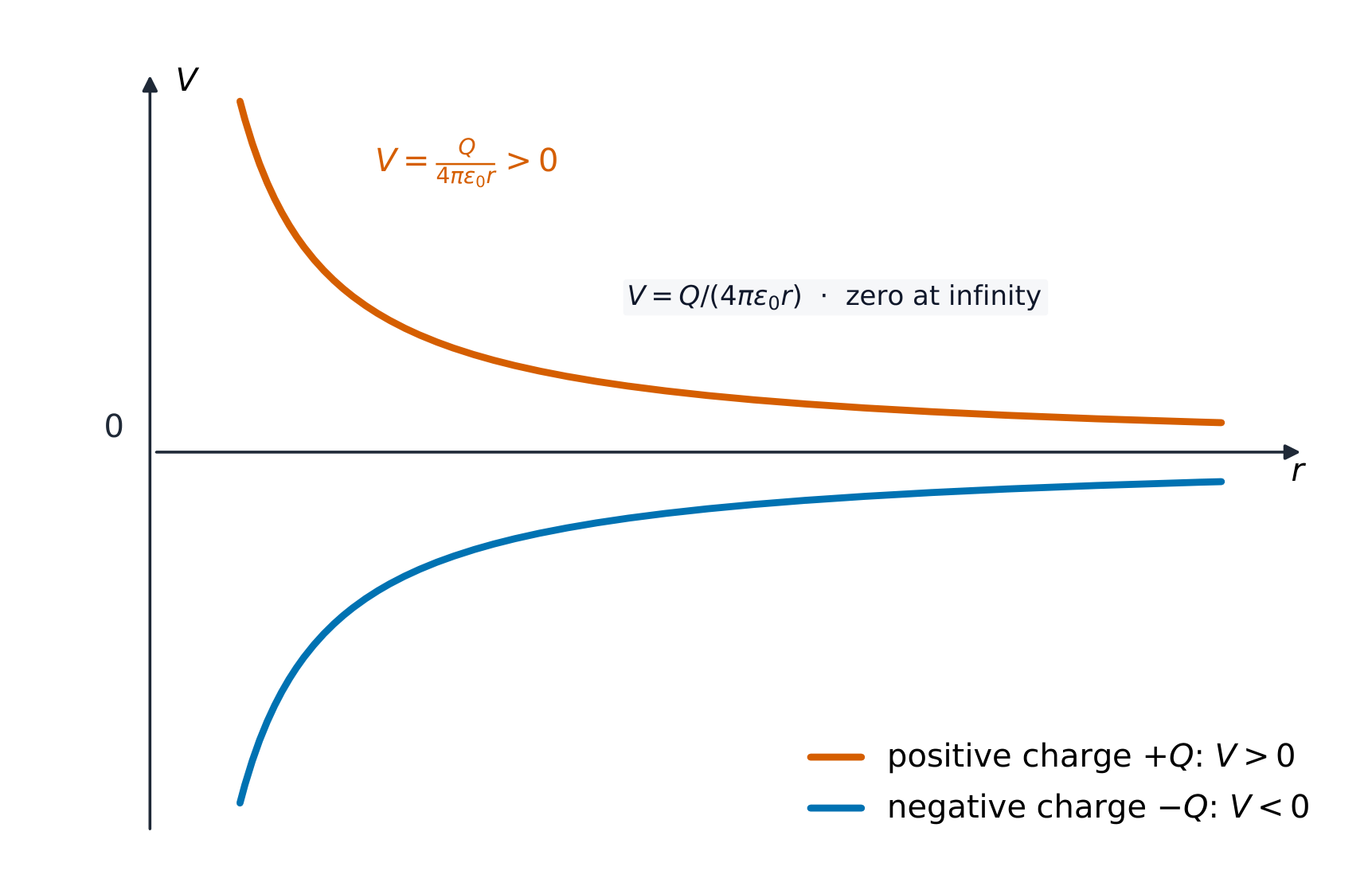
A curve above the axis, or below it, depending only on the sign of Q
Electric potential
V = kQ / r
Potential ∝ 1/r around a charge — steep near it, flattening out.
The electric potential near a point charge varies as $\dfrac{1}{r}$.
Difficulty 1/5 · 100 coins + a small bonus on first completion today
Yes — $V = \dfrac{Q}{4\pi\varepsilon_0 r}$ goes as $\dfrac{1}{r}$, while the field goes as $\dfrac{1}{r^{2}}$.
To find the potential at a point due to several charges, add the individual potentials with their signs.
Difficulty 1/5 · 100 coins + a small bonus on first completion today
Potential is a scalar, so there is nothing to resolve. Fields, by contrast, must be added as vectors with directions.
Field is the negative potential gradient
- The field at a point equals minus the potential gradient 电势梯度 there:
- The minus sign says the field points towards lower potential: a positive charge released in the field runs "downhill" in $V$.
- In a uniform field the potential falls steadily, so the gradient is constant and this reduces to $E = V/d$, which is the parallel-plate result from earlier.
- Practically: to get the field from a $V$ against $x$ graph, draw a tangent and take minus its gradient.
The electric field equals minus the potential ____ (E = −dV/dx).
Difficulty 1/5 · 100 coins + a small bonus on first completion today
The field points "downhill" in potential, toward lower V.
How is the electric field found from a graph of potential against distance?
Difficulty 1/5 · 100 coins + a small bonus on first completion today
E = -dV/dx. The minus sign says the field points towards lower potential, and in a uniform field the constant gradient gives E = V/d.
Worked example: reading the two-sphere graph
- The potential along the line between spheres X and Y, $1.2\ \text{m}$ apart, is positive everywhere and has a minimum at $0.50\ \text{m}$ from X. State three conclusions.
- Both charges are positive, because the potential is positive everywhere along the line.
- The field is zero at $x = 0.50\ \text{m}$, because the gradient is zero there and $E = -dV/dx$.
- Y carries the larger charge, because the zero-field point lies closer to X. Quantitatively $Q_{\text{Y}}/Q_{\text{X}} = (0.70/0.50)^2 = 2.0$.
- If instead the curve crossed zero, the charges would be opposite, and there the ratio comes from $Q_{\text{X}}/x = Q_{\text{Y}}/(d-x)$, without the square.
The potential between two spheres is positive everywhere with a minimum nearer sphere X. Which conclusions follow? Select all that apply.
Difficulty 2/5 · 140 coins + a small bonus on first completion today
A minimum in V is where the gradient, and so the field, is zero; it lies nearer the smaller charge. The potential there is a minimum, not zero, so qV is not zero either.
Electric potential energy
- A charge $q$ placed at a point of potential $V$ has electric potential energy $E_{\text{P}} = qV$. For two point charges:
- Like charges give positive potential energy: released, they fly apart. Opposite charges give negative energy, a bound 束缚 system, and work must be done to separate them to infinity.
- This is the same pattern as gravitational potential energy, which is always negative because gravity always attracts.

Above the axis they would fly apart; below it they are bound
The electric potential energy of a charge $q$ at a point of potential $V$ is:
Difficulty 1/5 · 100 coins + a small bonus on first completion today
$E_{\text{P}} = qV$; for two point charges this becomes $\dfrac{Qq}{4\pi\varepsilon_0 r}$.
Two opposite charges have a negative electric potential energy (a bound system).
Difficulty 1/5 · 100 coins + a small bonus on first completion today
Negative PE means energy must be supplied to pull them apart — they are bound, like an electron and a nucleus.
In a hydrogen atom the electron and proton are $5.3 \times 10^{-11}\ \text{m}$ apart. How much energy is needed to separate them to infinity? Give the answer as $N \times 10^{-18}\ \text{J}$ and enter $N$. ($e = 1.60 \times 10^{-19}\ \text{C}$, $\varepsilon_0 = 8.85 \times 10^{-12}\ \dfrac{\text{F}}{\text{m}}$)
Difficulty 2/5 · 140 coins + a small bonus on first completion today
$E_{\text{P}} = \dfrac{Qq}{4\pi\varepsilon_0 r} = \dfrac{(1.60 \times 10^{-19})(-1.60 \times 10^{-19})}{4\pi (8.85 \times 10^{-12})(5.3 \times 10^{-11})} = -4.3 \times 10^{-18}\ \text{J}$. Raising it to zero at infinity needs $4.3 \times 10^{-18}\ \text{J}$.
Electric and gravitational, side by side
| gravitational | electric | |
|---|---|---|
| force | $F = \dfrac{Gm_1m_2}{r^2}$ | $F = \dfrac{Q_1Q_2}{4\pi\varepsilon_0 r^2}$ |
| field | $g = \dfrac{GM}{r^2}$ | $E = \dfrac{Q}{4\pi\varepsilon_0 r^2}$ |
| potential | $\phi = -\dfrac{GM}{r}$ | $V = \dfrac{Q}{4\pi\varepsilon_0 r}$ |
- Identical shapes throughout. The one difference: mass has a single sign so gravity always attracts and $\phi$ is always negative, while charge has two signs so the electric quantities can be either.
Match each quantity to how it changes with distance from a point charge.
Difficulty 2/5 · 140 coins + a small bonus on first completion today
The field is inverse-square; the potential is inverse (one power of r gentler).
Worked example: describe the motion
- A positive charge is placed at a point P on the two-sphere line and released. Describe and explain its motion.
- It moves towards lower potential, that is, down the slope of the $V$ graph, because the field points that way and the force on a positive charge is along the field.
- The force, and so the acceleration, is not constant: it equals $-q\,dV/dx$, and the gradient changes along the line.
- It speeds up wherever it moves to lower potential, gaining kinetic energy equal to $q\Delta V$ lost in potential energy.
Marks that slip away
- Potential is $\dfrac{1}{r}$; field is $\dfrac{1}{r^2}$. Check which the question wants before substituting.
- The definition needs per unit positive charge and from infinity. Zero at infinity is what the definition rests on.
- Potentials add as scalars with signs; fields add as vectors. Never resolve potentials.
- Zero field is where the $V$ graph has zero gradient, not where $V$ itself is zero. Between opposite charges the curve crosses zero while its gradient is not zero.
You've got it
- electric potential is the work done per unit positive charge bringing a small test charge from infinity; it is zero at infinity, positive near a positive charge
- $V = \dfrac{Q}{4\pi\varepsilon_0 r}$ varies as $\dfrac{1}{r}$ and is a scalar, so several charges add with signs
- $E = -\dfrac{dV}{dx}$: the field is minus the potential gradient, so zero field means zero gradient, and in a uniform field this gives $E = V/d$
- electric potential energy $E_{\text{P}} = qV = \dfrac{Qq}{4\pi\varepsilon_0 r}$: positive for like charges, negative for opposite ones, which are bound