Isi ember dengan air, ayunkan dalam lingkaran cepat di atas kepala Anda — dan tidak ada tetes pun yang tumpah, bahkan saat ember benar-benar terbalik. Mengapa airnya tidak…
English narration · English + 中文 subtitles burned in · Narasi bahasa Inggris · Subtitle bahasa Inggris + 中文 disematkan langsung
12.1
Angles in radians · Sudut dalam radian
Syllabus · Silabus
English
define the radian and express angular displacement in radians
understand and use the concept of angular speed
recall and use $\omega = 2\pi / T$ and $v = r\omega$
Bahasa Indonesia
definisikan radian dan nyatakan perpindahan sudut dalam radian
pahami dan gunakan konsep kecepatan sudut
ingat dan gunakan $\omega = 2\pi / T$ dan $v = r\omega$
Source: Cambridge International syllabus · Sumber: Silabus Cambridge International
English
Uniform circular motion: velocity & acceleration
The radian 弧度 is the angle made at the centre of a circle by an arc 弧 whose length equals the radius. For an arc of length $s$ on a circle of radius $r$, the angle in radians is
$$\theta = \frac{s}{r}.$$
Radians have no unit (a ratio of lengths). A full circle has $s = 2\pi r$, so $\theta = 2\pi\ \text{rad}$. A half-circle is $\pi\ \text{rad}$; a quarter is $\pi/2\ \text{rad}$.
To convert: $1\ \text{rad} = 180°/\pi \approx 57.3°$. Set your calculator to radians for this topic; "degree" mode will give wrong answers.
The one-mark definition.The radian is the angle subtended at the centre of a circle by an arc equal in length to the radius of the circle. Give it in words — $\theta = s/r$ on its own is not a definition — and keep $s = r\theta$ ready for turning a distance along the arc into an angle, or back.
Bahasa Indonesia
Gerak melingkar seragam: kecepatan & percepatan
Radian adalah sudut yang terbentuk di pusat lingkaran oleh busur whose panjangnya sama dengan jari-jari. Untuk busur sepanjang $s$ pada lingkaran berjari-jari $r$, sudut dalam radian adalah
$$\theta = \frac{s}{r}.$$
Radian tidak memiliki satuan (rasio panjang). Satu lingkaran penuh memiliki $s = 2\pi r$, jadi $\theta = 2\pi\ \text{rad}$. Setengah lingkaran adalah $\pi\ \text{rad}$; seperempat adalah $\pi/2\ \text{rad}$.
Satu radian adalah sudut yang panjang busurnya sama dengan jari-jari
Untuk konversi: $1\ \text{rad} = 180°/\pi \approx 57.3°$. Atur kalkulator Anda ke mode radian untuk topik ini; mode "derajat" akan menghasilkan jawaban yang salah.
Definisi bernilai satu poin.Radian adalah sudut yang dibentuk di pusat lingkaran oleh busur yang panjangnya sama dengan jari-jari lingkaran. Berikan dalam kata-kata — $\theta = s/r$ sendiri bukan definisi — dan siap gunakan $s = r\theta$ untuk mengubah jarak sepanjang busur menjadi sudut, atau sebaliknya.
An object moves in a circle of radius $r$ at constant speed $v$. Define:
angular displacement 角位移$\theta$ — the angle (in radians) turned through by the radius from a chosen start line.
angular speed 角速度$\omega$ — the rate of change of angular displacement.
For uniform motion $\omega$ is constant and
$$\omega = \frac{\theta}{t}.$$
Unit: $\text{rad s}^{-1}$.
What stays constant and what varies. In uniform circular motion the speed, the angular speed, the period and the magnitude of the acceleration are constant; the velocity, the displacement from the centre and the acceleration all change continuously, because their direction changes. Asked to "state two quantities that vary", give two of velocity, acceleration, displacement and momentum — and say it is the direction that varies.
Period and frequency
If the object goes once round ($2\pi\ \text{rad}$, one revolution 圈) in time $T$ (the period 周期), then
$$\omega = \frac{2\pi}{T} = 2\pi f,$$
where $f = 1/T$ is the frequency 频率 of turning (Hz).
Linear and angular speed
In one period $T$ the object travels a distance $2\pi r$ (the circumference 周长) at constant speed, so
$$v = \frac{2\pi r}{T} = r \omega.$$
This links the linear (tangential 切向) speed $v$ with the angular speed $\omega$. At a larger radius (for the same angular speed) the linear speed is larger — a child on the edge of a merry-go-round moves faster than one near the centre, even though both go round once in the same time.
Worked example. A fairground ride of radius $4.0\ \text{m}$ completes one turn every $8.0\ \text{s}$. Find its angular speed and the linear speed of a rider on the edge.
Worked example. The minute hand of a clock turns once every hour. A piece of modelling clay on the hand moves a total distance of $0.44\ \text{m}$ in $1400\ \text{s}$. Find the angular speed of the hand, the angle the clay turns through in that time, and its distance from the centre of the clock.
$\omega = 2\pi/T = 2\pi/3600 = 1.75 \times 10^{-3}\ \text{rad s}^{-1}$. Angular displacement $\theta = \omega t = 1.75 \times 10^{-3} \times 1400 = 2.44\ \text{rad}$. Distance along the arc $s = r\theta$, so $r = s/\theta = 0.44/2.44 = 0.18\ \text{m}$. Check: $v = s/t = 3.1 \times 10^{-4}\ \text{m s}^{-1}$ and $r\omega = 0.18 \times 1.75 \times 10^{-3} = 3.1 \times 10^{-4}\ \text{m s}^{-1}$ — the same. A common trap in these questions is a radius measured from the rim: a lump $1.2\ \text{cm}$ in from the edge of a $9.3\ \text{cm}$ disc moves in a circle of radius $8.1\ \text{cm}$.
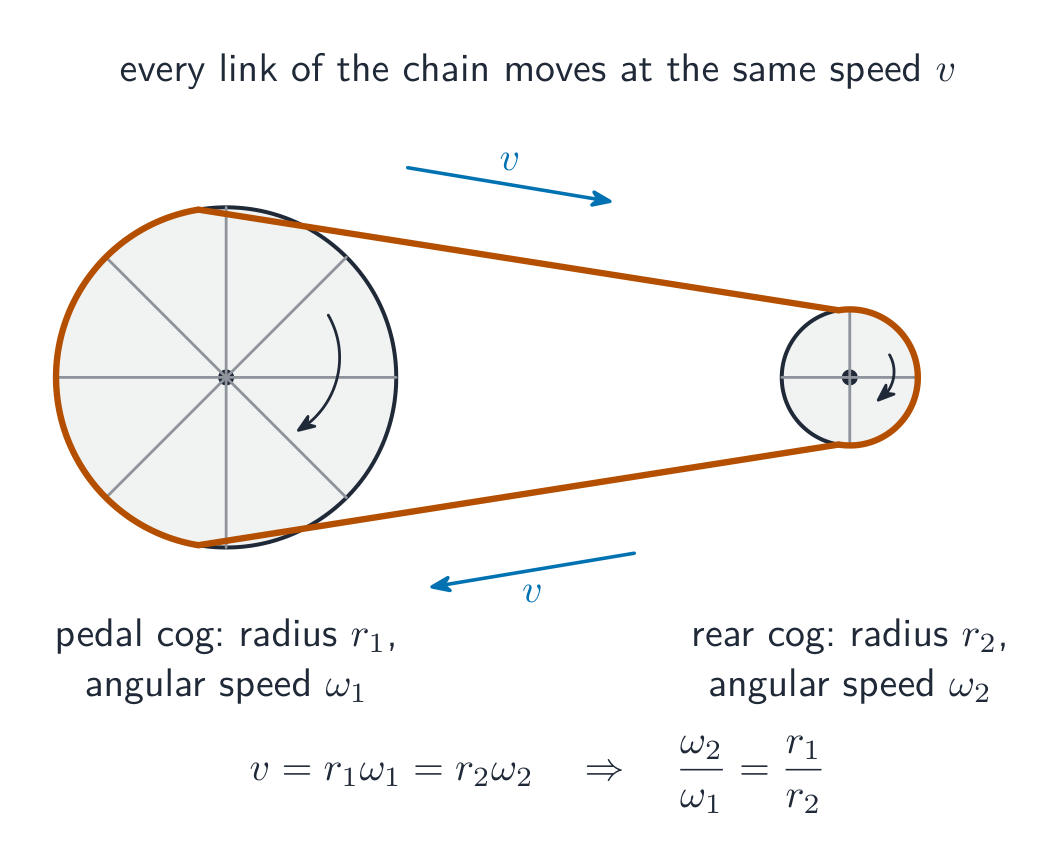
Worked example. A bicycle chain passes round a pedal cog of radius $0.095\ \text{m}$ and a rear-wheel cog of radius $0.038\ \text{m}$. The pedals turn at $1.2$ revolutions per second. Find the speed of the chain and the angular speed of the rear cog. The chain is then moved to a smaller rear cog while the bicycle's speed stays the same; explain, without calculation, what happens to the angular speed of the pedals.
Pedal angular speed $\omega_{1} = 2\pi \times 1.2 = 7.5\ \text{rad s}^{-1}$. Every link of the chain moves at the speed of the rim of the pedal cog: $v = r_{1}\omega_{1} = 0.095 \times 7.5 = 0.72\ \text{m s}^{-1}$. The rear cog's rim moves at the same speed, so $\omega_{2} = v/r_{2} = 0.72/0.038 = 19\ \text{rad s}^{-1}$. With the bicycle's speed unchanged, the rear wheel keeps the same angular speed; the smaller cog's rim therefore moves more slowly ($v = r\omega$ with a smaller $r$), so the chain moves more slowly, and the pedal cog, driven by the same chain, turns at a lower angular speed.
Bahasa Indonesia
*Kuda-kuda berputar: setiap penunggang berputar melalui sudut yang sama setiap detik.
Sebuah benda bergerak dalam lingkaran berjari-jari $r$ dengan kecepatan tetap $v$. Definisikan:
pergeseran sudut$\theta$ — sudut (dalam radian) yang ditempuh oleh jari-jari dari garis awal yang dipilih.
kecepatan sudut$\omega$ — laju perubahan pergeseran sudut.
Untuk gerak seragam, $\omega$ konstan dan
$$\omega = \frac{\theta}{t}.$$
Satuan: $\text{rad s}^{-1}$.
Apa yang tetap konstan dan apa yang berubah. Dalam gerak melingkar seragam, kecepatan, kecepatan sudut, periode, dan besar percepatan adalah konstan; vektornya, perpindahan dari pusat, dan percepatan semuanya berubah terus-menerus karena arah-nya berubah. Jika diminta "nyatakan dua besaran yang berubah", sebutkan dua dari vektor kecepatan, percepatan, perpindahan, dan momentum — dan jelaskan bahwa yang berubah adalah arahnya.
Periode dan frekuensi
Jika benda tersebut menempuh satu putaran penuh ($2\pi\ \text{rad}$, satu putaran) dalam waktu $T$ (periode), maka
$$\omega = \frac{2\pi}{T} = 2\pi f,$$
di mana $f = 1/T$ adalah frekuensi perputaran (Hz).
Kecepatan linear dan sudut
Dalam satu periode $T$, benda menempuh jarak $2\pi r$ (keliling) dengan kecepatan konstan, sehingga
$$v = \frac{2\pi r}{T} = r \omega.$$
Ini menghubungkan kecepatan linear (tangensial) $v$ dengan kecepatan sudut $\omega$. Pada jari-jari yang lebih besar (untuk kecepatan sudut yang sama), kecepatan linear lebih besar — seorang anak di tepi kincir berputar bergerak lebih cepat daripada yang dekat pusat, meskipun keduanya menyelesaikan satu putaran dalam waktu yang sama.
Kecepatan sudut yang sama, tetapi penunggang di jari-jari yang lebih besar memiliki kecepatan linear yang lebih besar ($v = r\omega$)
Contoh dikerjakan. Kuda-kuda berjari-jari $4.0\ \text{m}$ menyelesaikan satu putaran setiap $8.0\ \text{s}$. Temukan kecepatan sudutnya dan kecepatan linear penunggang di tepinya.
Contoh dikerjakan. Jarum menit jam berputar sekali setiap jam. Selembar tanah liat pada jarum tersebut bergerak sejauh total $0.44\ \text{m}$ dalam waktu $1400\ \text{s}$. Temukan kecepatan sudut jarum, sudut yang ditempuh tanah liat dalam waktu itu, dan jaraknya dari pusat jam.
$\omega = 2\pi/T = 2\pi/3600 = 1.75 \times 10^{-3}\ \text{rad s}^{-1}$. Pergeseran sudut $\theta = \omega t = 1.75 \times 10^{-3} \times 1400 = 2.44\ \text{rad}$. Jarak sepanjang busur $s = r\theta$, sehingga $r = s/\theta = 0.44/2.44 = 0.18\ \text{m}$. Cek: $v = s/t = 3.1 \times 10^{-4}\ \text{m s}^{-1}$ dan $r\omega = 0.18 \times 1.75 \times 10^{-3} = 3.1 \times 10^{-4}\ \text{m s}^{-1}$ — sama. jebakan umum dalam pertanyaan ini adalah jari-jari yang diukur dari tepi: gumpalan $1.2\ \text{cm}$ masuk dari tepi cakram $9.3\ \text{cm}$ bergerak dalam lingkaran berjari-jari $8.1\ \text{cm}$.
Dua gigi yang terhubung oleh rantai berbagi kecepatan rantai, bukan kecepatan sudutnya: $v = r_{1}\omega_{1} = r_{2}\omega_{2}$
Contoh terpecahkan. Rantai sepeda melingkari gigi pedal berjari-jari $0.095\ \text{m}$ dan gigi roda belakang berjari-jari $0.038\ \text{m}$. Pedal berputar dengan kecepatan $1.2$ revolusi per detik. Tentukan kecepatan rantai dan kecepatan sudut gigi roda belakang. Kemudian, rantai dipindahkan ke gigi roda belakang yang lebih kecil sementara kecepatan sepeda tetap sama; jelaskan, tanpa perhitungan, apa yang terjadi pada kecepatan sudut pedal.
Kecepatan sudut pedal $\omega_{1} = 2\pi \times 1.2 = 7.5\ \text{rad s}^{-1}$. Setiap mata rantai bergerak dengan kecepatan tepi gigi pedal: $v = r_{1}\omega_{1} = 0.095 \times 7.5 = 0.72\ \text{m s}^{-1}$. Tepi gigi roda belakang bergerak dengan kecepatan yang sama, sehingga $\omega_{2} = v/r_{2} = 0.72/0.038 = 19\ \text{rad s}^{-1}$. Dengan kecepatan sepeda yang tidak berubah, roda belakang mempertahankan kecepatan sudut yang sama; tepi gigi yang lebih kecil tersebut maka bergerak lebih lambat ($v = r\omega$ dengan $r$ yang lebih kecil), sehingga rantai bergerak lebih lambat, dan gigi pedal, yang digerakkan oleh rantai yang sama, berputar dengan kecepatan sudut yang lebih rendah.
Saat jari-jari berputar sejauh $\Delta\theta$, benda bergerak sepanjang busur $\Delta s$ dengan kecepatan $v$
Explore · Jelajahi
Angular speed · Kecepatan sudut
s = rθ
Angular speed turns angle per time; arc length s = rθ. · Kecepatan sudut mengubah sudut per waktu; panjang busur s = rθ.
understand that a force of constant magnitude that is always perpendicular to the direction of motion causes centripetal acceleration
understand that centripetal acceleration causes circular motion with a constant angular speed
recall and use $a = r\omega^2$ and $a = v^2 / r$
recall and use $F = mr\omega^2$ and $F = mv^2 / r$
Bahasa Indonesia
pahami bahwa gaya dengan besaran tetap yang selalu tegak lurus terhadap arah gerak menyebabkan percepatan sentripetal
pahami bahwa percepatan sentripetal menyebabkan gerak melingkar dengan kecepatan sudut konstan
ingat dan gunakan $a = r\omega^2$ dan $a = v^2 / r$
ingat dan gunakan $F = mr\omega^2$ dan $F = mv^2 / r$
Source: Cambridge International syllabus · Sumber: Silabus Cambridge International
English
An object moving in a circle at constant speed still has a changing velocity 速度 — its direction keeps changing, even though its size stays the same. A changing velocity needs an acceleration 加速度. This acceleration points towards the centre and is the centripetal acceleration 向心加速度.
The two-mark description.In uniform circular motion the speed is constant but the velocity is continuously changing, because its direction changes; the acceleration is constant in magnitude and is always directed towards the centre of the circle, perpendicular to the velocity. "State what is meant by centripetal acceleration": the acceleration of an object moving along a circular path, directed towards the centre of the circle.
Size
$$a = \frac{v^{2}}{r} = r\omega^{2}.$$
The two forms are equal because $v = r\omega$. Pick the one with the quantities you have.
The centripetal acceleration is perpendicular 垂直 to the velocity at every instant — never along the direction of motion. (If part of it were along the motion, the speed would change.) Unit: $\text{m s}^{-2}$.
Why the speed does not change. The centripetal force is perpendicular to the displacement at every instant, so it does no work on the object; its kinetic energy, and so its speed, stays constant. Only the direction of the velocity changes — which is exactly what an acceleration perpendicular to the velocity does.
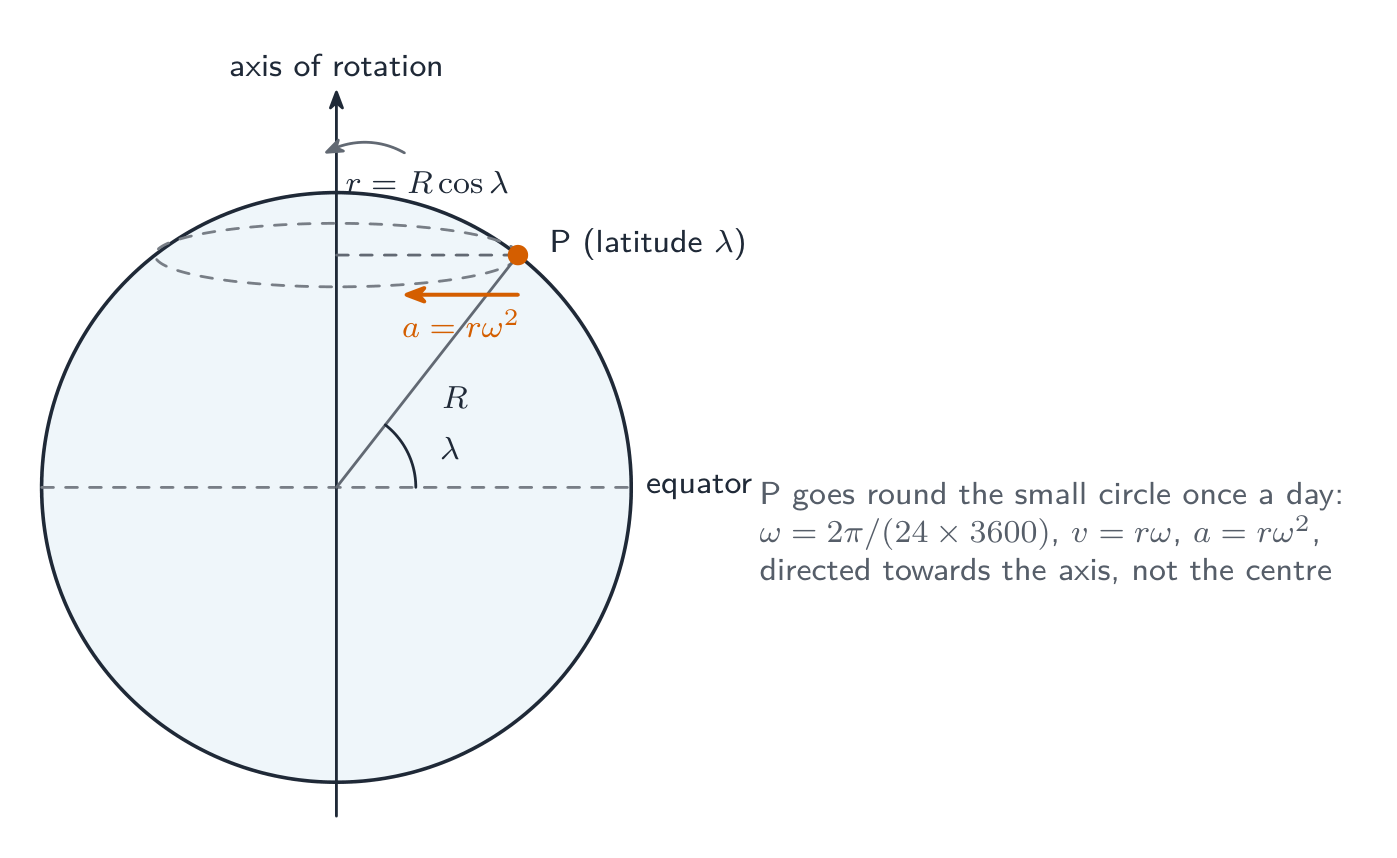
Worked example. The Earth is a sphere of radius $6.37 \times 10^{6}\ \text{m}$ rotating once in $24$ hours. Cambridge is at latitude 纬度$52.2°$ north. Find the radius of the circle in which Cambridge moves, its speed, and its centripetal acceleration. A student of mass $58.6\ \text{kg}$ stands on bathroom scales there; state and explain the effect of the rotation on the reading.
The circle is about the axis, so $r = R\cos\lambda = 6.37 \times 10^{6} \times \cos 52.2° = 3.90 \times 10^{6}\ \text{m}$. $\omega = 2\pi/(24 \times 3600) = 7.27 \times 10^{-5}\ \text{rad s}^{-1}$, so $v = r\omega = 284\ \text{m s}^{-1}$ and $a = r\omega^{2} = 3.90 \times 10^{6} \times (7.27 \times 10^{-5})^{2} = 2.1 \times 10^{-2}\ \text{m s}^{-2}$. The student needs a resultant force $ma = 1.2\ \text{N}$ towards the axis, which can only come from the weight exceeding the upward contact force; so the scales read less than the weight $mg = 575\ \text{N}$ — by about one newton (the acceleration has a component $a\cos\lambda = 0.013\ \text{m s}^{-2}$ along the vertical, i.e. $0.7\ \text{N}$ of the $1.2\ \text{N}$). Small, but the sign and the reason are the marks.
Bahasa Indonesia
Sebuah benda yang bergerak dalam lingkaran dengan kecepatan konstan tetap memiliki kecepatan yang berubah — arahnya terus berubah, meskipun besarnya tetap sama. Perubahan kecepatan memerlukan percepatan. Percepatan ini mengarah menuju pusat dan disebut percepatan sentripetal.
Deskripsi dua nilai.Dalam gerak melingkar beraturan, kecepatannya konstan tetapi kecepatannya terus-menerus berubah karena arahnya berubah; percepatannya konstan dalam besar dan selalu diarahkan menuju pusat lingkaran, tegak lurus terhadap kecepatan. "Nyatakan arti dari percepatan sentripetal": percepatan sebuah benda yang bergerak sepanjang lintasan melingkar, diarahkan menuju pusat lingkaran.
Besar
$$a = \frac{v^{2}}{r} = r\omega^{2}.$$
Kedua bentuk tersebut setara karena $v = r\omega$. Pilihlah salah satu yang memuat besaran yang Anda miliki.
Percepatan sentripetal adalah tegak lurus terhadap kecepatan pada setiap saat — tidak pernah searah dengan arah gerak. (Jika sebagian darinya berada sejajar dengan gerak, kecepatannya akan berubah.) Satuan: $\text{m s}^{-2}$.
Kelajuan menghala sepanjang tangen; daya dan pecutan menghala ke pusat
Mengapa kecepatan tidak berubah. Gaya sentripetal tegak lurus terhadap perpindahan pada setiap saat, sehingga gaya ini tidak melakukan usaha pada benda; energi kinetiknya, dan karenanya kecepatannya, tetap konstan. Hanya arah kecepatan yang berubah — yang merupakan persis apa yang dilakukan oleh percepatan yang tegak lurus terhadap kecepatan.
Titik pada Bumi yang berotasi bergerak dalam lingkaran tentang sumbu, berjari-jari $R\cos\lambda$, bukan tentang pusat Bumi
Contoh terpecahkan. Bumi adalah bola berjari-jari $6.37 \times 10^{6}\ \text{m}$ yang berotasi sekali dalam $24$ jam. Cambridge terletak pada lintang$52.2°$ utara. Tentukan jari-jari lingkaran tempat Cambridge bergerak, kecepatannya, dan percepatan sentripetalnya. Seorang siswa bermassa $58.6\ \text{kg}$ berdiri di atas timbangan mandi di sana; nyatakan dan jelaskan efek rotasi terhadap pembacaan timbangan.
Lingkaran tersebut berada tentang sumbu, sehingga $r = R\cos\lambda = 6.37 \times 10^{6} \times \cos 52.2° = 3.90 \times 10^{6}\ \text{m}$. $\omega = 2\pi/(24 \times 3600) = 7.27 \times 10^{-5}\ \text{rad s}^{-1}$, sehingga $v = r\omega = 284\ \text{m s}^{-1}$ dan $a = r\omega^{2} = 3.90 \times 10^{6} \times (7.27 \times 10^{-5})^{2} = 2.1 \times 10^{-2}\ \text{m s}^{-2}$. Siswa membutuhkan gaya resultan $ma = 1.2\ \text{N}$ menuju sumbu, yang hanya dapat berasal dari berat yang melebihi gaya kontak ke atas; sehingga timbangan menunjukkan lebih sedikit daripada berat $mg = 575\ \text{N}$ — sekitar satu newton (percepatan memiliki komponen $a\cos\lambda = 0.013\ \text{m s}^{-2}$ sepanjang vertikal, yaitu $0.7\ \text{N}$ dari $1.2\ \text{N}$). Kecil, tetapi tanda dan alasannya adalah poin penilaiannya.
By Newton's second law, the resultant force 力 on a body in circular motion at constant speed is
$$F = m a = \frac{m v^{2}}{r} = m r \omega^{2}.$$
This is the centripetal force 向心力. It always points towards the centre — perpendicular to the velocity.
The centripetal force is not a new kind of force — it is the net result of the real forces acting (tension, gravity, friction, electric attraction, normal contact force, …). In a problem, work out which real force(s) provide it.
Worked example. A $0.20\ \text{kg}$ ball on a string is whirled in a horizontal circle of radius $0.50\ \text{m}$ at $3.0\ \text{m s}^{-1}$. Find the centripetal force (the tension in the string).
Ball on a string in a horizontal circle: the tension 张力 in the string.
Car turning a flat corner: the friction 摩擦力 between tyres and road ($F = m v^{2}/r$). If the car goes too fast, friction is not enough and it skids outwards.
Banked corner 倾斜 (no friction): the horizontal part of the normal contact force 支持力; $\tan\theta = v^{2}/(rg)$ for the angle that needs no friction.
A planet or satellite 卫星 in orbit 轨道: the gravitational attraction 引力, $G M m / r^{2} = m v^{2}/r$.
Electron 电子 in a circular orbit (Bohr-style model): the electrostatic 静电 attraction between the electron and the positive nucleus 原子核:
where $k = 1/(4\pi\varepsilon_{0})$ and $Z$ is the nuclear charge. Solve for $v$ to get the orbital speed; then $T = 2\pi r/v$.
The tilted force: conical pendulum, cone and swing-ride
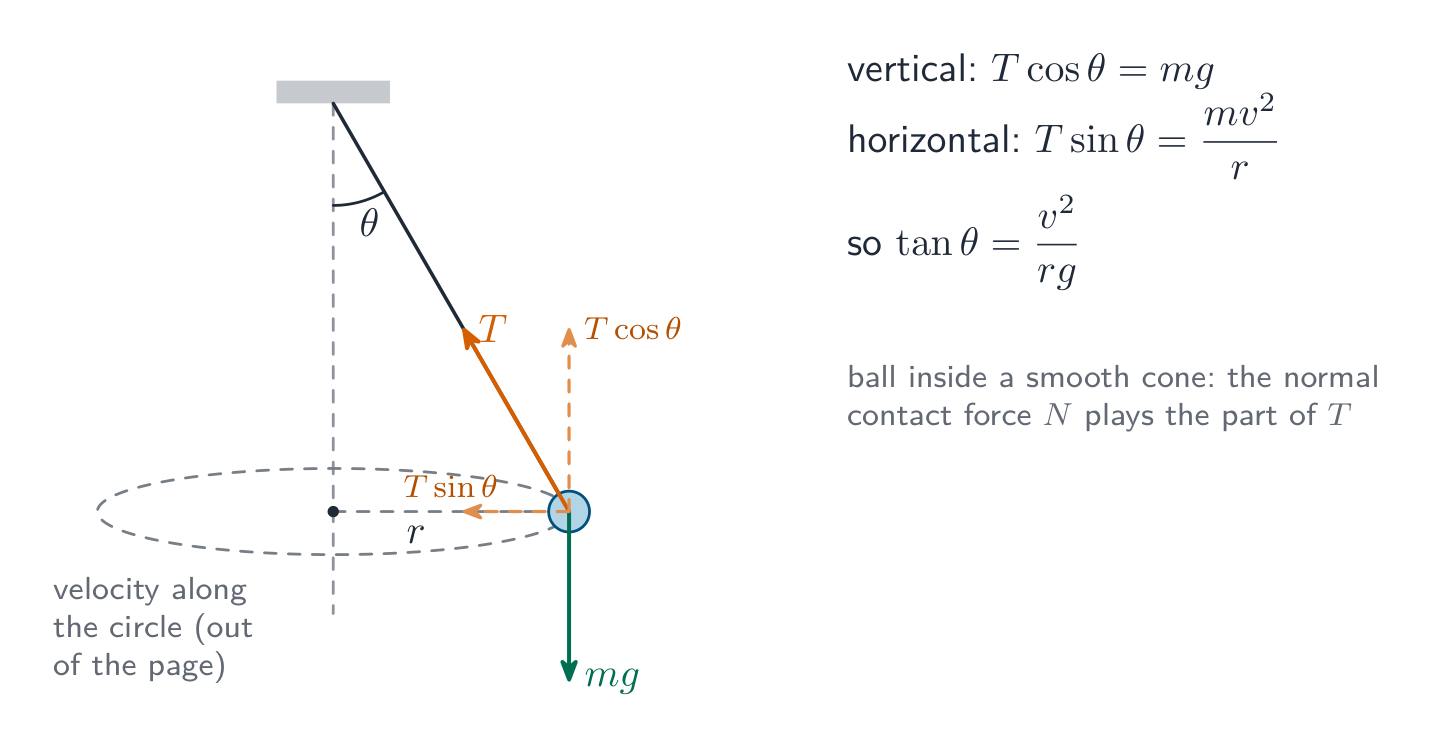
A ball on a string swung in a horizontal circle (a conical pendulum 圆锥摆), a ball rolling round the inside of a smooth cone, a chair on a fairground swing-ride and a car on a banked track are all the same problem: one force (the tension or the normal contact force) is tilted at an angle $\theta$ to the vertical. Resolve it. Its vertical component balances the weight; its horizontal component is the whole centripetal force:
Never add a separate "centripetal force" to the diagram: the two real forces are the weight and the tilted force, and their resultant is horizontal, towards the centre.
Worked example. A steel ball moves in a horizontal circle of radius $0.12\ \text{m}$ on the smooth inside surface of a cone whose surface makes $52°$ with the horizontal. Name the two forces on the ball, state the direction of their resultant, and find the speed of the ball and the period of its motion.
The forces are the weight (vertically down) and the normal contact force from the cone's surface (perpendicular to the surface, so at $52°$ to the vertical); their resultant is horizontal, towards the centre of the circle. Vertically $N\cos 52° = mg$; horizontally $N\sin 52° = mv^{2}/r$. Dividing: $v^{2} = rg\tan 52° = 0.12 \times 9.81 \times 1.28 = 1.51$, so $v = 1.2\ \text{m s}^{-1}$, and $T = 2\pi r/v = 2\pi \times 0.12/1.23 = 0.61\ \text{s}$. The mass cancels — the speed does not depend on it.
Worked example. A sphere of mass $0.29\ \text{kg}$ hangs from a spring of spring constant $40\ \text{N m}^{-1}$ and unstretched length $6.0\ \text{cm}$. It is set moving in a horizontal circle so that the spring makes $30°$ with the vertical. Find the tension, the radius of the circle and the speed.
Vertically $T\cos 30° = mg$, so $T = 0.29 \times 9.81/0.866 = 3.3\ \text{N}$. The extension is $x = T/k = 3.28/40 = 0.082\ \text{m}$, so the spring's length is $0.060 + 0.082 = 0.142\ \text{m}$ and $r = 0.142\sin 30° = 0.071\ \text{m}$. Horizontally $T\sin 30° = mv^{2}/r$: $v^{2} = 3.28 \times 0.5 \times 0.071/0.29 = 0.40$, $v = 0.63\ \text{m s}^{-1}$. Hooke's law supplies the length; the circle supplies the rest.
Vertical circles
When the circle is upright, the speed is not constant (gravity does work) — but at each instant the net force towards the centre still equals $m v^{2}/r$:
at the bottom of a loop: tension up, weight 重力 down, so $T - mg = m v^{2}/r$ — the tension is largest here.
at the top of a loop: tension and weight both point down (towards the centre), so $T + mg = m v^{2}/r$ — the tension is smallest. For the slowest speed at the top with the string just tight, set $T = 0$: $mg = m v_{\text{min}}^{2}/r$, giving $v_{\text{min}} = \sqrt{gr}$.
Worked example. A car goes round a vertical loop of radius $2.0\ \text{m}$. Find the minimum speed at the top for the car to keep contact with the track (take $g = 9.81\ \text{m s}^{-2}$).
At the slowest speed the track force is zero, so gravity alone provides the centripetal force: $mg = m v_{\text{min}}^{2}/r$, giving $v_{\text{min}} = \sqrt{gr}$:
The constant-speed result ($v = r\omega$, $\omega$ constant) holds for horizontal circles, or where the force only bends the path (orbits in gravity, charges in a magnetic field 磁场).
Circles in fields
Worked example. A helium atom is modelled as a nucleus of charge $+2e$ with two electrons in the same circular orbit of radius $170\ \text{pm}$, always on opposite sides of the nucleus. Find the resultant electric force on one electron and its speed.
Each electron is attracted by the nucleus, distance $r$ away, and repelled by the other electron, distance $2r$ away, along the same line: $F = \dfrac{1}{4\pi\varepsilon_{0}}\left(\dfrac{2e^{2}}{r^{2}} - \dfrac{e^{2}}{(2r)^{2}}\right) = \dfrac{e^{2}}{4\pi\varepsilon_{0}r^{2}} \times 1.75 = \dfrac{2.31 \times 10^{-28}}{(1.7 \times 10^{-10})^{2}} \times 1.75 = 1.4 \times 10^{-8}\ \text{N}$. This is the centripetal force: $v = \sqrt{Fr/m} = \sqrt{1.40 \times 10^{-8} \times 1.7 \times 10^{-10}/(9.11 \times 10^{-31})} = 1.6 \times 10^{6}\ \text{m s}^{-1}$.
Worked example. A proton (mass $1.67 \times 10^{-27}\ \text{kg}$) moving at $2.0 \times 10^{6}\ \text{m s}^{-1}$ enters a uniform magnetic field of flux density $0.50\ \text{T}$ at right angles to the field. Find the radius of its path and the time for one revolution.
The magnetic force $Bqv$ is always perpendicular to the velocity, so it is a centripetal force and the speed is constant: $Bqv = mv^{2}/r$ gives $r = \dfrac{mv}{Bq} = \dfrac{1.67 \times 10^{-27} \times 2.0 \times 10^{6}}{0.50 \times 1.60 \times 10^{-19}} = 4.2 \times 10^{-2}\ \text{m}$, and $T = \dfrac{2\pi r}{v} = \dfrac{2\pi m}{Bq} = 1.3 \times 10^{-7}\ \text{s}$ — independent of the speed, which is why a faster proton makes a larger circle in the same time. For a satellite the gravitational force plays the same part: $\dfrac{GMm}{r^{2}} = mr\omega^{2}$, and the orbital speed and period follow from $r$ alone.
Bahasa Indonesia
Roda gergaji: gaya sentripetal menuju pusat menjaga setiap kereta tetap bergerak dalam lingkaran.
Menurut hukum kedua Newton, gaya resultan pada benda dalam gerak melingkar dengan kecepatan konstan adalah
$$F = m a = \frac{m v^{2}}{r} = m r \omega^{2}.$$
Ini adalah gaya sentripetal. Ia selalu mengarah menuju pusat — tegak lurus terhadap kecepatan.
Gaya sentripetal bukanlah jenis gaya baru — ia adalah hasil gabungan dari gaya-gaya nyata yang bekerja (tegangan, gravitasi, gesekan, tarikan listrik, gaya kontak normal, ...). Dalam suatu soal, tentukan gaya nyata mana yang menyediakannya.
Contoh terpecahkan. Bola $0.20\ \text{kg}$ pada tali diputar dalam lingkaran horizontal berjari-jari $0.50\ \text{m}$ pada $3.0\ \text{m s}^{-1}$. Tentukan gaya sentripetal (tegangan pada tali).
Bola pada tali dalam lingkaran horizontal: tegangan pada tali.
Mobil berbelok di tikungan datar: gesekan antara ban dan jalan ($F = m v^{2}/r$). Jika mobil terlalu cepat, gesekan tidak cukup dan mobil tergelincir keluar.
Tikungan miring (tanpa gesekan): komponen horizontal dari gaya kontak normal; $\tan\theta = v^{2}/(rg)$ untuk sudut yang tidak memerlukan gesekan.
Planet atau satelit dalam orbit: tarikan gravitasi, $G M m / r^{2} = m v^{2}/r$.
Elektron dalam orbit melingkar (model gaya Bohr): tarikan elektrostatik antara elektron dan inti positif:
di mana $k = 1/(4\pi\varepsilon_{0})$ dan $Z$ adalah muatan inti. Selesaikan untuk $v$ untuk mendapatkan kecepatan orbit; lalu $T = 2\pi r/v$.
Di laluan condong, komponen mendatar daya jalan menyediakan daya ke pusat
Gaya miring: pendulum kerucut, kerucut, dan wahana ayun-putar
Bola pada tali yang diayunkan dalam lingkaran horizontal (a pendulum kerucut), bola yang berguling di bagian dalam kerucut halus, kursi di wahana ayunan taman hiburan dan mobil di lintasan miring semuanya merupakan masalah yang sama: satu gaya (tegangan atau gaya kontak normal) miring pada sudut $\theta$ terhadap vertikal. Resolusikan. Komponen vertikal-nya menyeimbangkan berat; komponen horizontal-nya adalah seluruh gaya sentripetal:
Jangan pernah menambahkan "gaya sentripetal" terpisah ke dalam diagram: dua gaya nyata adalah berat dan gaya miring, dan resultannya horizontal, menuju pusat.
Contoh terpecahkan. Sebuah bola baja bergerak dalam lingkaran horizontal berjari-jari $0.12\ \text{m}$ pada permukaan bagian dalam kerucut yang halus yang permukaannya membuat sudut $52°$ terhadap horizontal. Sebutkan dua gaya pada bola, nyatakan arah resultannya, dan temukan kecepatan bola serta periode geraknya.
Gaya-gaya tersebut adalah berat (ke bawah secara vertikal) dan gaya kontak normal dari permukaan kerucut (tegak lurus terhadap permukaan, sehingga pada $52°$ terhadap vertikal); resultannya horizontal, menuju pusat lingkaran. Vertikal $N\cos 52° = mg$; horizontal $N\sin 52° = mv^{2}/r$. Membagi: $v^{2} = rg\tan 52° = 0.12 \times 9.81 \times 1.28 = 1.51$, sehingga $v = 1.2\ \text{m s}^{-1}$, dan $T = 2\pi r/v = 2\pi \times 0.12/1.23 = 0.61\ \text{s}$. Massa saling menghilangkan — kecepatan tidak bergantung padanya.
Contoh terpecahkan. Sebuah bola bermassa $0.29\ \text{kg}$ tergantung pada pegas dengan konstanta pegas $40\ \text{N m}^{-1}$ dan panjang tak meregang $6.0\ \text{cm}$. Bola ini digerakkan dalam lingkaran horizontal sehingga pegas membuat sudut $30°$ dengan vertikal. Temukan tegangan, jari-jari lingkaran dan kecepatannya.
Vertikal $T\cos 30° = mg$, sehingga $T = 0.29 \times 9.81/0.866 = 3.3\ \text{N}$. Perpanjangan adalah $x = T/k = 3.28/40 = 0.082\ \text{m}$, sehingga panjang pegas adalah $0.060 + 0.082 = 0.142\ \text{m}$ dan $r = 0.142\sin 30° = 0.071\ \text{m}$. Horizontal $T\sin 30° = mv^{2}/r$: $v^{2} = 3.28 \times 0.5 \times 0.071/0.29 = 0.40$, $v = 0.63\ \text{m s}^{-1}$. Hukum Hooke menyediakan panjang; lingkaran menyediakan sisanya.
Lingkaran vertikal
Ketika lingkaran tegak, kecepatannya tidak konstan (gravitasi melakukan kerja) — tetapi pada setiap saat gaya total menuju pusat tetap sama dengan $m v^{2}/r$:
di bagian bawah lintasan: tegangan ke atas, berat ke bawah, sehingga $T - mg = m v^{2}/r$ — tegangan terbesar di sini.
di bagian atas lintasan: tegangan dan berat keduanya mengarah ke bawah (menuju pusat), sehingga $T + mg = m v^{2}/r$ — tegangan terkecil. Untuk kecepatan terendah di bagian atas dengan tali hanya kencang, tetapkan $T = 0$: $mg = m v_{\text{min}}^{2}/r$, memberikan $v_{\text{min}} = \sqrt{gr}$.
Gaya pada seseorang di bagian atas dan bawah lingkaran vertikal
Contoh terpecahkan. Sebuah mobil melintas di lintasan vertikal berjari-jari $2.0\ \text{m}$. Temukan kecepatan minimum di bagian atas agar mobil tetap bersentuhan dengan lintasan (ambil $g = 9.81\ \text{m s}^{-2}$).
Pada kecepatan terendah gaya lintasan adalah nol, sehingga gravitasi saja menyediakan gaya sentripetal: $mg = m v_{\text{min}}^{2}/r$, memberikan $v_{\text{min}} = \sqrt{gr}$:
Hasil kecepatan konstan ($v = r\omega$, $\omega$ konstan) berlaku untuk lingkaran horizontal, atau di mana gaya hanya membengkokkan lintasan (orbit dalam gravitasi, muatan dalam medan magnet).
Lingkaran dalam medan
Contoh terpecahkan. Atom helium dimodelkan sebagai inti bermuatan $+2e$ dengan dua elektron dalam orbit lingkaran yang sama berjari-jari $170\ \text{pm}$, selalu berada di sisi berlawanan dari inti. Temukan resultan gaya listrik pada satu elektron dan kecepatannya.
Setiap elektron ditarik oleh inti, jarak $r$ menjauh, dan ditolak oleh elektron lain, jarak $2r$ menjauh, sepanjang garis yang sama: $F = \dfrac{1}{4\pi\varepsilon_{0}}\left(\dfrac{2e^{2}}{r^{2}} - \dfrac{e^{2}}{(2r)^{2}}\right) = \dfrac{e^{2}}{4\pi\varepsilon_{0}r^{2}} \times 1.75 = \dfrac{2.31 \times 10^{-28}}{(1.7 \times 10^{-10})^{2}} \times 1.75 = 1.4 \times 10^{-8}\ \text{N}$. Ini adalah gaya sentripetal: $v = \sqrt{Fr/m} = \sqrt{1.40 \times 10^{-8} \times 1.7 \times 10^{-10}/(9.11 \times 10^{-31})} = 1.6 \times 10^{6}\ \text{m s}^{-1}$.
Contoh terpecahkan. Sebuah proton (massa $1.67 \times 10^{-27}\ \text{kg}$) bergerak pada $2.0 \times 10^{6}\ \text{m s}^{-1}$ memasuki medan magnet seragam dengan densitas fluks $0.50\ \text{T}$ secara tegak lurus terhadap medan. Temukan jari-jari lintasannya dan waktu untuk satu revolusi.
Gaya magnet $Bqv$ selalu tegak lurus terhadap kecepatan, sehingga itu adalah gaya sentripetal dan kecepatannya konstan: $Bqv = mv^{2}/r$ memberikan $r = \dfrac{mv}{Bq} = \dfrac{1.67 \times 10^{-27} \times 2.0 \times 10^{6}}{0.50 \times 1.60 \times 10^{-19}} = 4.2 \times 10^{-2}\ \text{m}$, dan $T = \dfrac{2\pi r}{v} = \dfrac{2\pi m}{Bq} = 1.3 \times 10^{-7}\ \text{s}$ — independen dari kecepatan, itulah sebabnya proton yang lebih cepat membuat lingkaran yang lebih besar dalam waktu yang sama. Untuk satelit, gaya gravitasi memainkan peran yang sama: $\dfrac{GMm}{r^{2}} = mr\omega^{2}$, dan kecepatan orbit dan periode mengikuti dari $r$ saja.
Explore · Jelajahi
Centripetal force and speed · Gaya sentripetal dan kecepatan
F = mv²/r
For circular motion the force needed grows with the square of the speed — double v, four times the force. · Untuk gerak melingkar, gaya yang dibutuhkan bertambah seiring dengan kuadrat kecepatan — ganda v, empat kali lipat gayanya.
How to structure a circular-motion answer · Cara menyusun jawaban gerak melingkar
English
Find the radius$r$ and choose $v$ or $\omega$. Use $v = r\omega$ to switch between them.
Find the centripetal acceleration with $a = v^{2}/r$ or $r\omega^{2}$.
List the real forces and write Newton's second law in the radial 径向 direction (towards the centre is positive). Set the net inward force equal to $m v^{2}/r$.
For period or frequency: use $\omega = 2\pi/T$, or $T = 2\pi r / v$.
Check the directions: centripetal force and acceleration point to the centre; the velocity is along the tangent.
Bahasa Indonesia
Temukan jari-jari$r$ dan pilih $v$ atau $\omega$. Gunakan $v = r\omega$ untuk beralih di antara keduanya.
Temukan percepatan sentripetal dengan $a = v^{2}/r$ atau $r\omega^{2}$.
Daftarkan gaya-gaya nyata dan tuliskan hukum kedua Newton dalam arah radial (menuju pusat adalah positif). Tetapkan gaya total inward sama dengan $m v^{2}/r$.
Untuk periode atau frekuensi: gunakan $\omega = 2\pi/T$, atau $T = 2\pi r / v$.
Periksa arah: gaya sentripetal dan percepatan mengarah ke pusat; kecepatan sepanjang garis singgung.
Definitions the examiner accepts · Definisi yang diterima oleh penguji
English
A definition question is marked against fixed wording. Learn these exactly, and give one answer only.
Term
Definition
radian
the angle subtended at the centre of a circle by an arc equal in length to the radius
angular displacement
the angle, in radians, through which the radius has turned from its starting position
angular speed
the angle swept out by the radius per unit time (the rate of change of angular displacement)
period
the time taken for one complete revolution
uniform circular motion
motion in a circle at constant speed, with a velocity that changes continuously in direction and an acceleration of constant magnitude directed towards the centre
centripetal acceleration
the acceleration of an object moving in a circular path, directed towards the centre of the circle and perpendicular to the velocity
centripetal force
the resultant force on an object in circular motion, directed towards the centre, of magnitude $mv^{2}/r$
Bahasa Indonesia
Soal definisi dinilai berdasarkan frasa tetap. Hafalkan ini persis, dan berikan hanya satu jawaban.
Istilah
Definisi
radian
sudut yang dibentuk di pusat lingkaran oleh busur yang panjangnya sama dengan jari-jari
perpindahan sudut
sudut, dalam radian, yang telah diputar oleh jari-jari dari posisi awalnya
kecepatan sudut
sudut yang disapu oleh jari-jari per satuan waktu (laju perubahan perpindahan sudut)
periode
waktu yang diperlukan untuk satu putaran lengkap
gerak melingkar seragam
gerak dalam lingkaran dengan kecepatan konstan, dengan kecepatan yang berubah terus-menerus dalam arah dan percepatan dengan besaran konstan yang mengarah ke pusat
percepatan sentripetal
percepatan suatu benda yang bergerak dalam lintasan melingkar, berarah menuju pusat lingkaran dan tegak lurus terhadap kecepatan
gaya sentripetal
resultan gaya pada benda dalam gerak melingkar, berarah menuju pusat, dengan besaran $mv^{2}/r$
12.2
Exam tips · Tips ujian
English
Work in radians; angular speed $\omega = 2\pi/T = v/r$, and arc length $s = r\theta$ turns a distance along the circle into an angle.
Centripetal acceleration $a = v^2/r = \omega^2 r$; the net force acts towards the centre — it is provided by tension/gravity/friction/a contact force, not an extra force.
Always state what provides the centripetal force in the situation given, and for a tilted force resolve it: vertical component $= mg$, horizontal component $= mv^{2}/r$.
Read the radius carefully: a point measured from the rim moves in a smaller circle; a point on the rotating Earth moves in a circle about the axis, radius $R\cos\lambda$.
Two cogs on one chain share the chain's speed; two points on one rigid wheel share its angular speed.
Common mistakes
Defining the radian as "$180/\pi$ degrees" or as $\theta = s/r$. The mark needs the arc equal in length to the radius.
Saying the velocity is constant in uniform circular motion. The speed is constant; the velocity changes direction, which is why there is an acceleration.
Drawing a "centripetal force" arrow as an extra force alongside the tension or contact force. It is their resultant, not a third force.
Using degrees in $\omega t$ or $v = r\omega$. Every formula in this topic assumes radians.
Forgetting that the force does no work: a force perpendicular to the motion changes direction, not speed, so kinetic energy is constant.
Taking $r$ as the Earth's radius for a point at latitude $\lambda$. The circle is about the axis, so $r = R\cos\lambda$.
Bahasa Indonesia
Kerja dalam radian; kecepatan sudut $\omega = 2\pi/T = v/r$, dan panjang busur $s = r\theta$ mengubah jarak sepanjang lingkaran menjadi sebuah sudut.
Percepatan sentripetal $a = v^2/r = \omega^2 r$; resultan gaya bekerja menuju pusat — gaya ini disediakan oleh tegangan/gravitasi/gesekan/gaya kontak, bukan merupakan gaya tambahan.
Selalu nyatakan apa yang menyediakan gaya sentripetal dalam situasi yang diberikan, dan untuk gaya miring uraikan: komponen vertikal $= mg$, komponen horizontal $= mv^{2}/r$.
Bacalah jari-jari dengan teliti: titik yang diukur dari tepi bergerak dalam lingkaran yang lebih kecil; titik di Bumi yang berputar bergerak dalam lingkaran tentang sumbu, jari-jari $R\cos\lambda$.
Dua roda gigi pada satu rantai berbagi kecepatan rantai; dua titik pada satu roda kaku berbagi kecepatan sudut-nya.
Kesalahan umum
Mendefinisikan radian sebagai "$180/\pi$ derajat" atau sebagai $\theta = s/r$. Nilai penuh memerlukan panjang busur sama dengan jari-jari.
Menyatakan bahwa kecepatan konstan dalam gerak melingkar seragam. Laju-nya konstan; kecepatannya berubah arah, itulah sebabnya terdapat percepatan.
Menggambar anak panah "gaya sentripetal" sebagai gaya tambahan bersama-sama dengan tegangan atau gaya kontak. Gaya tersebut adalah resultan mereka, bukan gaya ketiga.
Menggunakan derajat dalam $\omega t$ atau $v = r\omega$. Setiap rumus dalam topik ini mengasumsikan satuan radian.
Melupakan bahwa gaya tersebut tidak melakukan kerja: gaya yang tegak lurus terhadap gerakan hanya mengubah arah, bukan laju, sehingga energi kinetik tetap konstan.
Mengambil $r$ sebagai jari-jari Bumi untuk titik pada lintang $\lambda$. Lingkaran tersebut berada tentang sumbu, jadi $r = R\cos\lambda$.
Interactive lessons on this topic · Pelajaran interaktif untuk topik ini
Work through it step by step, with instant-check exercises. · Kerjakan langkah demi langkah, dengan latihan pengecekan instan.
Pick one and the site follows you — notes, papers, videos and practice all open on it. · Pilih satu dan situs mengikuti Anda — catatan, kertas, video, dan latihan semua terbuka di sana.
Type to search notes, lessons, code, vocabulary and past-paper questions across every subject. · Ketik untuk mencari catatan, pelajaran, kode, kosakata, dan pertanyaan soal lama di setiap mata pelajaran.