Skip to content · ⁨Lompat ke konten⁩

Hydroxy compounds · ⁨Senyawa hidroksil⁩

A-Level Chemistry · ⁨Kimia A-Level⁩ · Topic 16 · ⁨Topik 16⁩

Video lesson for this topic · ⁨Pelajaran video untuk topik ini⁩ Open the video page · ⁨Buka halaman video⁩
8:20

Senyawa hidroksil

Tekankan disinfektan tangan ke telapak tangan. Rasanya dingin, lalu hilang. Itu adalah etanol — alkohol yang membunuh mikroba. Etanol hanyalah alkohol pendek…

English narration · English + 中文 subtitles burned in · ⁨Narasi bahasa Inggris · Subtitle bahasa Inggris + 中文 disematkan langsung⁩

16.1

Alcohols · ⁨Alkohol⁩

Syllabus · ⁨Silabus⁩
English
  1. recall the reactions (reagents and conditions) by which alcohols can be produced: (a) electrophilic addition of steam to an alkene, $\text{H}_2\text{O(g)}$ and $\text{H}_3\text{PO}_4$ catalyst (b) reaction of alkenes with cold dilute acidified potassium manganate(VII) to form a diol (c) substitution of a halogenoalkane using $\text{NaOH(aq)}$ and heat (d) reduction of an aldehyde or ketone using $\text{NaBH}_4$ or $\text{LiAlH}_4$ (e) reduction of a carboxylic acid using $\text{LiAlH}_4$ (f) hydrolysis of an ester using dilute acid or dilute alkali and heat
  2. describe: (a) the reaction with oxygen (combustion) (b) substitution to form halogenoalkanes, e.g. by reaction with $\text{HX(g)}$; or with $\text{KCl}$ and concentrated $\text{H}_2\text{SO}_4$ or concentrated $\text{H}_3\text{PO}_4$; or with $\text{PCl}_3$ and heat; or with $\text{PCl}_5$; or with $\text{SOCl}_2$ (c) the reaction with $\text{Na(s)}$ (d) oxidation with acidified $\text{K}_2\text{Cr}_2\text{O}_7$ or acidified $\text{KMnO}_4$ to: (i) carbonyl compounds by distillation (ii) carboxylic acids by refluxing (primary alcohols give aldehydes which can be further oxidised to carboxylic acids, secondary alcohols give ketones, tertiary alcohols cannot be oxidised) (e) dehydration to an alkene, by using a heated catalyst, e.g. $\text{Al}_2\text{O}_3$ or a concentrated acid (f) formation of esters by reaction with carboxylic acids and concentrated $\text{H}_2\text{SO}_4$ as catalyst as exemplified by ethanol
  3. (a) classify alcohols as primary, secondary and tertiary alcohols, to include examples with more than one alcohol group (b) state characteristic distinguishing reactions, e.g. mild oxidation with acidified $\text{K}_2\text{Cr}_2\text{O}_7$, colour change from orange to green
  4. deduce the presence of a $\text{CH}_3\text{CH(OH)}-$ group in an alcohol, $\text{CH}_3\text{CH(OH)}-\text{R}$, from its reaction with alkaline $\text{I}_2\text{(aq)}$ to form a yellow precipitate of tri-iodomethane and an ion, $\text{RCO}_2^-$
  5. explain the acidity of alcohols compared with water
Bahasa Indonesia
  1. ingat kembali reaksi (reagen dan kondisi) melalui mana alkohol dapat diproduksi: (a) penambahan elektrofilik uap air pada alkena, $\text{H}_2\text{O(g)}$ dan katalis $\text{H}_3\text{PO}_4$ (b) reaksi alkena dengan kalium manganat(VII) encer dingin yang diasamkan untuk membentuk diol (c) substitusi halogenoalkana menggunakan $\text{NaOH(aq)}$ dan panas (d) reduksi aldehida atau keton menggunakan $\text{NaBH}_4$ atau $\text{LiAlH}_4$ (e) reduksi asam karboksilat menggunakan $\text{LiAlH}_4$ (f) hidrolisis ester menggunakan asam encer atau basa encer dan panas
  2. deskripsikan: (a) reaksi dengan oksigen (pembakaran) (b) substitusi untuk membentuk halogenoalkana, misalnya dengan reaksi terhadap $\text{HX(g)}$; atau dengan $\text{KCl}$ dan $\text{H}_2\text{SO}_4$ pekat atau $\text{H}_3\text{PO}_4$ pekat; atau dengan $\text{PCl}_3$ dan panas; atau dengan $\text{PCl}_5$; atau dengan $\text{SOCl}_2$ (c) reaksi dengan $\text{Na(s)}$ (d) oksidasi dengan $\text{K}_2\text{Cr}_2\text{O}_7$ yang diasamkan atau $\text{KMnO}_4$ yang diasamkan untuk: (i) senyawa karbonil dengan destilasi (ii) asam karboksilat dengan merefluks (alkohol primer menghasilkan aldehida yang dapat teroksidasi lebih lanjut menjadi asam karboksilat, alkohol sekunder menghasilkan keton, alkohol tersier tidak dapat teroksidasi) (e) dehidrasi menjadi alkena, dengan menggunakan katalis yang dipanaskan, mis. $\text{Al}_2\text{O}_3$ atau asam pekat (f) pembentukan ester dengan reaksi terhadap asam karboksilat dan $\text{H}_2\text{SO}_4$ pekat sebagai katalis seperti yang ditunjukkan oleh etanol
  3. (a) klasifikasikan alkohol sebagai alkohol primer, sekunder dan tersier, termasuk contoh dengan lebih dari satu gugus alkohol (b) nyatakan reaksi pembeda karakteristik, mis. oksidasi ringan dengan $\text{K}_2\text{Cr}_2\text{O}_7$ yang diasamkan, perubahan warna dari oranye menjadi hijau
  4. deduksikan keberadaan gugus $\text{CH}_3\text{CH(OH)}-$ dalam sebuah alkohol, $\text{CH}_3\text{CH(OH)}-\text{R}$, dari reaksinya dengan $\text{I}_2\text{(aq)}$ beralkali untuk menghasilkan endapan kuning triiodometana dan ion, $\text{RCO}_2^-$
  5. jelaskan keasaman alkohol dibandingkan dengan air
Source: Cambridge International syllabus · ⁨Sumber: Silabus Cambridge International⁩

English

An alcohol 醇 has the $\text{–OH}$ (hydroxyl) functional group.

Making alcohols

Method Reagents and conditions
addition of steam to an alkene $\text{H}_2\text{O(g)}$, $\text{H}_3\text{PO}_4$ catalyst (electrophilic addition 亲电加成)
an alkene 烯烃 with cold dilute $\text{KMnO}_4$ gives a diol 二醇 (two $\text{–OH}$ groups)
substitution of a halogenoalkane 卤代烷 $\text{NaOH(aq)}$, heat
reduction 还原 of an aldehyde 醛 or ketone 酮 $\text{NaBH}_4$ or $\text{LiAlH}_4$
reduction of a carboxylic acid 羧酸 $\text{LiAlH}_4$
hydrolysis 水解 of an ester 酯 dilute acid or alkali, heat

Reactions of alcohols

  • combustion: alcohols burn in oxygen to give carbon dioxide and water.
  • substitution to a halogenoalkane, for example with $\text{HX}$, $\text{PCl}_5$, $\text{PCl}_3$ and heat, or $\text{SOCl}_2$.
  • with sodium: alcohols react with sodium metal to give hydrogen and a sodium alkoxide — like water, but more slowly.
  • oxidation 氧化 with acidified $\text{K}_2\text{Cr}_2\text{O}_7$ (or $\text{KMnO}_4$). The product depends on the class of alcohol (see below).
  • dehydration 脱水 to an alkene, using a hot $\text{Al}_2\text{O}_3$ catalyst or concentrated acid.
  • ester formation: an alcohol reacts with a carboxylic acid (with concentrated $\text{H}_2\text{SO}_4$ catalyst) to make an ester.

Three classes and how oxidation tells them apart

An alcohol is primary 伯, secondary 仲 or tertiary 叔, depending on how many carbons are joined to the carbon holding the $\text{–OH}$. Some molecules have more than one $\text{–OH}$ group.

Class Oxidation product
primary aldehyde (by distillation 蒸馏), then carboxylic acid (by reflux 回流)
secondary a ketone
tertiary not oxidised

In a quick test, acidified $\text{K}_2\text{Cr}_2\text{O}_7$ turns from orange to green with a primary or secondary alcohol, but stays orange with a tertiary alcohol.

  • distillation removes the aldehyde as it forms, before it can be oxidised further.
  • reflux keeps boiling the mixture and returning the vapour, so the alcohol is fully oxidised to the carboxylic acid.

The iodoform test

If you warm an alcohol that contains the $\text{CH}_3\text{CH(OH)}-$ group with alkaline aqueous iodine, you get a pale yellow precipitate of tri-iodomethane 三碘甲烷 ($\text{CHI}_3$) and the ion $\text{RCO}_2^-$. This is a useful test for that group.

Acidity of alcohols

The $\text{–OH}$ group makes alcohols very weakly acidic: they can lose the $\text{H}^+$ to form an $\text{RO}^-$ ion. But their acidity 酸性 is lower than that of water. This is because the alkyl group pushes electron density onto the oxygen, which makes the $\text{RO}^-$ ion less stable, so the alcohol holds onto its $\text{H}^+$ more tightly.

Worked example. Three unlabelled bottles hold butan-1-ol, butan-2-ol and 2-methylpropan-2-ol. How does warming each with acidified $\text{K}_2\text{Cr}_2\text{O}_7$ tell them apart? What matters is how many hydrogens sit on the carbon carrying the $\text{OH}$. Butan-1-ol is primary (two such hydrogens): the orange dichromate turns green, and by distilling you collect an aldehyde (butanal), or by refluxing you get the carboxylic acid (butanoic acid). Butan-2-ol is secondary (one such hydrogen): also green, but the product is a ketone (butanone), which will not oxidise further. 2-methylpropan-2-ol is tertiary (no such hydrogen): there is nothing to remove, so the dichromate stays orange. The colour only separates the tertiary from the other two - to split primary from secondary you must identify the product (an aldehyde gives a silver mirror with Tollens', a ketone does not).

Bahasa Indonesia

Sebuah alkohol memiliki gugus fungsi $\text{–OH}$ (hidroksil).

Botol pembersih tangan
Etanol, alkohol dalam pembersih tangan, membunuh mikroba

Pembuatan alkohol

Metode Reagen dan kondisi
penambahan uap air ke alkena $\text{H}_2\text{O(g)}$, $\text{H}_3\text{PO}_4$ katalis (penambahan elektrofilik)
sebuah alkena dengan $\text{KMnO}_4$ dingin encer menghasilkan diol (dua gugus $\text{–OH}$)
substitusi halogenoalkana $\text{NaOH(aq)}$, panas
reduksi aldehida atau keton $\text{NaBH}_4$ atau $\text{LiAlH}_4$
reduksi asam karboksilat $\text{LiAlH}_4$
hidrolisis ester asam encer atau basa, panas
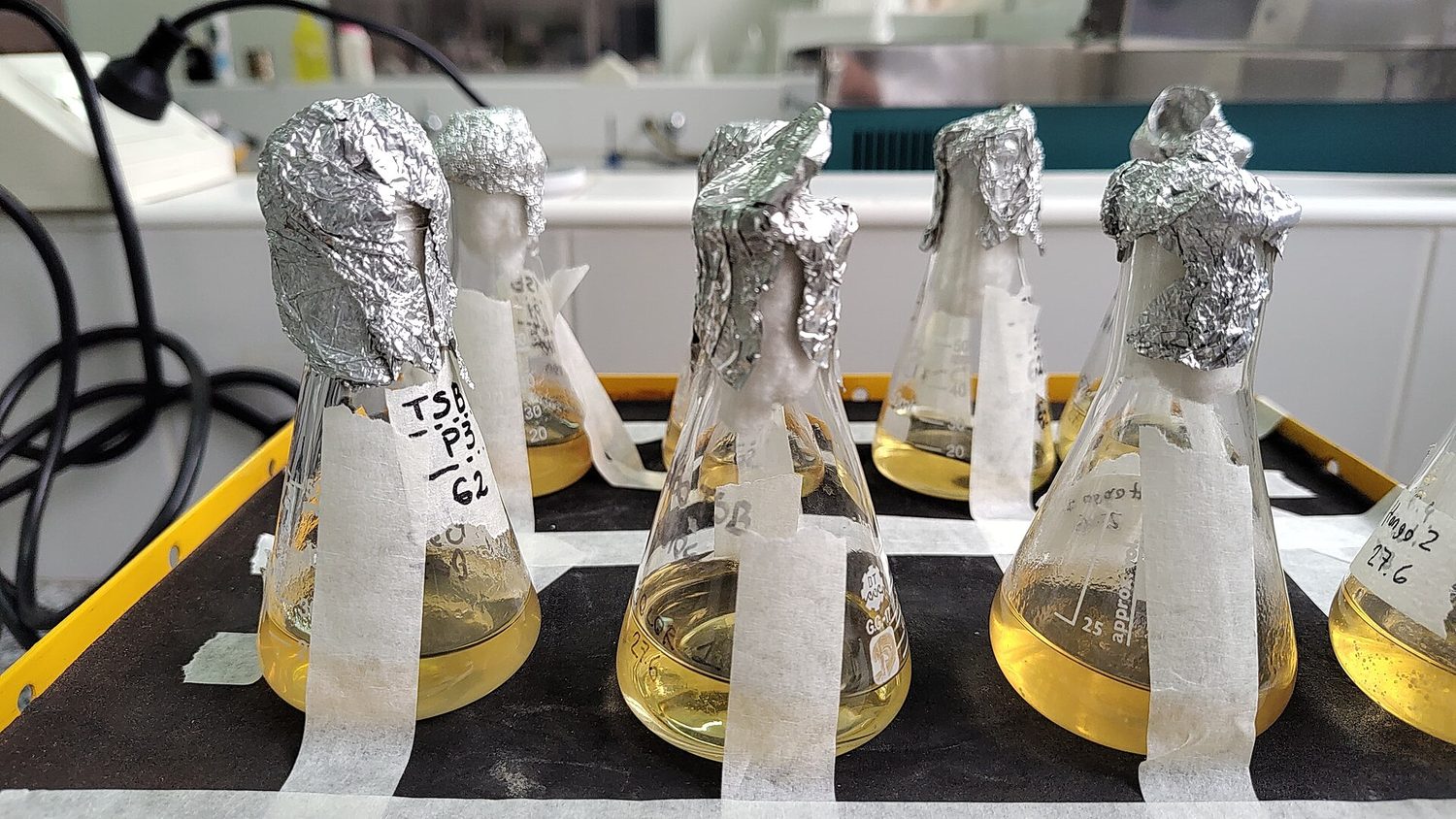
Labu erlenmeyer berisi cairan keruh yang ditutup aluminium foil, sedang berfermentasi di laboratorium
Secara industri, etanol juga dibuat dengan fermentasi gula; kemudian destilasi fraksional memisahkannya dari air

Reaksi alkohol

  • pembakaran: alkohol terbakar dalam oksigen menghasilkan karbon dioksida dan air.
  • substitusi menjadi halogenoalkana, misalnya dengan $\text{HX}$, $\text{PCl}_5$, $\text{PCl}_3$ dan panas, atau $\text{SOCl}_2$.
  • dengan natrium: alkohol bereaksi dengan logam natrium menghasilkan hidrogen dan alkoksida natrium — seperti air, tetapi lebih lambat.
  • oksidasi dengan $\text{K}_2\text{Cr}_2\text{O}_7$ yang diasamkan (atau $\text{KMnO}_4$). Produknya bergantung pada kelas alkohol (lihat di bawah).
  • dehidrasi menjadi alkena, menggunakan katalis $\text{Al}_2\text{O}_3$ panas atau asam pekat.
  • pembentukan ester: alkohol bereaksi dengan asam karboksilat (dengan katalis $\text{H}_2\text{SO}_4$ pekat) untuk membuat ester.
Alkohol bereaksi dengan empat cara: pembakaran, dehidrasi menjadi alkena, esterifikasi, dan oksidasi
Alkohol dapat terbakar, terdehidrasi, mengesterifikasi, atau teroksidasi

Tiga kelas dan bagaimana oksidasi membedakan mereka

Sebuah alkohol adalah primer, sekunder atau tersier, tergantung pada berapa banyak karbon yang terhubung ke karbon yang memegang $\text{–OH}$. Beberapa molekul memiliki lebih dari satu gugus $\text{–OH}$.

Tiga karbon pusat masing-masing memegang gugus OH: primer memiliki satu gugus R dan dua hidrogen, sekunder dua gugus R dan satu hidrogen, tersier tiga gugus R
Kelas ditentukan oleh karbon yang memegang –OH: satu gugus R membuatnya primer, dua sekunder, tiga tersier — yang menentukan bagaimana ia teroksidasi
Kelas Produk oksidasi
primer aldehida (oleh destilasi), lalu asam karboksilat (oleh refluks)
sekunder sebuah keton
tersier tidak teroksidasi
Skema: alkohol primer teroksidasi menjadi aldehida kemudian asam karboksilat, alkohol sekunder menjadi keton, dan alkohol tersier tidak teroksidasi
Oksidasi berdasarkan kelas: alkohol primer menghasilkan aldehida kemudian asam karboksilat, sekunder menghasilkan keton, tersier tidak teroksidasi

Dalam tes cepat, $\text{K}_2\text{Cr}_2\text{O}_7$ yang diasamkan berubah dari oranye menjadi hijau dengan alkohol primer atau sekunder, tetapi tetap oranye dengan alkohol tersier.

Dua tabung reaksi dikromat oranye: yang dengan alkohol primer atau sekunder telah berubah menjadi hijau, yang dengan alkohol tersier masih oranye
Dikromat yang diasamkan berubah oranye menjadi hijau dengan alkohol primer atau sekunder, tetapi tetap oranye dengan alkohol tersier
  • destilasi menghilangkan aldehida saat terbentuk, sebelum dapat teroksidasi lebih lanjut.
  • refluks terus merebus campuran dan mengembalikan uapnya, sehingga alkohol teroksidasi sepenuhnya menjadi asam karboksilat.
Dua set alat: refluks dengan kondensor vertikal yang mengembalikan uap ke labu, dan destilasi dengan kondensor miring yang mengarah ke labu penampung
Destilasi menghilangkan aldehida saat terbentuk; refluks terus merebus dan mengembalikan uap, mengoksidasi sepenuhnya menjadi asam
Kolom destilasi fraksional laboratorium dengan termometer dan kondensor air
Set-up destilasi nyata: uap mendidih, didinginkan dalam kondensor dan dikumpulkan — ide yang sama memisahkan etanol dari campuran yang difermentasi

Tes iodoform

Jika Anda memanaskan alkohol yang mengandung gugus $\text{CH}_3\text{CH(OH)}-$ dengan yodium akuatik beralkali, Anda akan mendapatkan endapan kuning pucat dari triiodometana ($\text{CHI}_3$) dan ion $\text{RCO}_2^-$. Ini adalah tes berguna untuk gugus tersebut.

Keasaman alkohol

Gugus $\text{–OH}$ membuat alkohol sangat lemah asam: mereka dapat melepaskan $\text{H}^+$ untuk membentuk ion $\text{RO}^-$. Namun keasaman mereka lebih rendah daripada air. Hal ini karena gugus alkil mendorong kerapatan elektron ke oksigen, yang membuat ion $\text{RO}^-$ kurang stabil, sehingga alkohol memegang $\text{H}^+$ lebih erat.

Contoh terpecahkan. Tiga botol tanpa label berisi butan-1-ol, butan-2-ol, dan 2-metilpropan-2-ol. Bagaimana cara memanaskan masing-masing dengan $\text{K}_2\text{Cr}_2\text{O}_7$ yang diasamkan untuk memisahkannya? Yang penting adalah berapa banyak hidrogen yang berada pada karbon yang membawa $\text{OH}$. Butan-1-ol bersifat primer (dua hidrogen seperti itu): dikromat oranye berubah menjadi hijau, dan melalui destilasi Anda mengumpulkan aldehid (butanal), atau melalui refluks Anda mendapatkan asam karboksilat (butanoat). Butan-2-ol bersifat sekunder (satu hidrogen seperti itu): juga hijau, tetapi produknya adalah keton (butanon), yang tidak akan teroksidasi lebih lanjut. 2-metilpropan-2-ol bersifat tersier (tidak ada hidrogen seperti itu): tidak ada yang dapat dilepas, sehingga dikromat tetap oranye. Perubahan warna hanya membedakan tersier dari dua lainnya - untuk membedakan primer dari sekunder Anda harus mengidentifikasi produk (aldehid memberikan cermin perak dengan pereaksi Tollens', keton tidak).

Explore · ⁨Jelajahi⁩

Alcohol reaction map · ⁨Peta reaksi alkohol⁩

Choose what happens to alcohols under different reagents. · ⁨Pilih apa yang terjadi pada alkohol di bawah berbagai pereaksi.⁩

Explore · ⁨Jelajahi⁩

Alcohol oxidation test lab · ⁨Lab uji oksidasi alkohol⁩

Classify alcohols by oxidation product and observation. · ⁨Klasifikasikan alkohol berdasarkan produk oksidasi dan pengamatan.⁩

Vocabulary · ⁨Kosa kata⁩ Train · ⁨Latih⁩
English Bahasa Indonesia
alcohol/ˈælkəhɒl/ alkohol
electrophilic addition/ɪˌlektrəʊˈfɪlɪk əˈdɪʃn/ penambahan elektrofilik
alkene/ˈælkiːn/ alkena
diol/dɪˈɒl/ diol
halogenoalkane/ˈheɪləʊdʒnəʊlkeɪn/ halogenoalkana
reduction/rɪˈdʌkʃn/ reduksi
aldehyde/ˈældɪhaɪd/ aldehida
ketone/ˈketəʊn/ keton
carboxylic acid/ˌkɑːbəkˈsɪlɪk ˈæsɪd/ asam karboksilat
hydrolysis/haɪˈdrɒləsɪs/ hidrolisis
ester/ˈestə/ ester
oxidation/ˌɒksɪˈdeɪʃn/ pengoksidaan
dehydration/ˌdiːhaɪˈdreɪʃn/ dehidrasi
primary/ˈpraɪməri/ primer
secondary/ˈsekəndəri/ sekunder
tertiary/ˈtɜːʃjəri/ tersier
distillation/dɪstɪˈleɪʃn/ distilasi
reflux/ˈriːflʌks/ refluks
tri-iodomethane/traɪ ˈaɪədəʊmθeɪn/ tri-iodometana
acidity/æˈsɪdɪti/ keasaman
16.1

Exam tips · ⁨Tips ujian⁩

English
  • Classify the alcohol as primary, secondary or tertiary first — it decides the oxidation product.
  • Oxidation with acidified $\text{K}_2\text{Cr}_2\text{O}_7$ (orange → green): primary → aldehyde (distil) → acid (reflux); secondary → ketone; tertiary → no reaction.
  • Distinguish the conditions for aldehyde vs acid from a primary alcohol (distillation vs reflux).
  • Name esters correctly (the acid part comes second, ending "-oate").
Bahasa Indonesia
  • Klasifikasikan alkohol sebagai primer, sekunder atau tersier terlebih dahulu — hal ini menentukan produk oksidasi.
  • Oksidasi dengan $\text{K}_2\text{Cr}_2\text{O}_7$ yang diasamkan (oranye → hijau): primer → aldehid (distilasi) → asam (refluks); sekunder → keton; tersier → tidak ada reaksi.
  • Bedakan kondisi untuk aldehid vs asam dari alkohol primer (distilasi vs refluks).
  • Sebutkan ester dengan benar (bagian asam berada di urutan kedua, berakhiran "-oat").

Interactive lessons on this topic · ⁨Pelajaran interaktif untuk topik ini⁩

Work through it step by step, with instant-check exercises. · ⁨Kerjakan langkah demi langkah, dengan latihan pengecekan instan.⁩

Past Papers · ⁨Soal-Soil Masa Lalu⁩

More topics in A-Level Chemistry · ⁨Kimia A-Level⁩ · ⁨Topik lain dalam A-Level Chemistry · ⁨Kimia A-Level⁩⁩

Log in or create account · ⁨Masuk atau buat akun⁩

IGCSE, A-Level & AP