דלג לתוכן
נושאים

SAT · SAT · SAT

תרגול כל המילים
  • 1

    RW.I · Information and Ideas

    תוכנית לימוד תגיע בקרוב

    חומר עזר

    היקף ותנאי מקדימים

    מסגרת Digital SAT; אימון נייר מקורי הוא לא אדפטיבי ואינו מספק תחזית לציון מוקנה.

    • זיהוי רעיונות מרכזיים ותמיכה בהם
    • ביצוע מסקנות המוצדקות על ידי הטקסט
    • בחירת עדות טקסטואלית ופרשנות של עדות כמותית

    תנאי קדם: זיהוי נושא הפרגراف; הבחנה בין עובדה נאמרת למסקנה.

    הסבר ובחירת השיטה

    רעיון מרכזי כולל את הנקודה העיקרית של המחבר, ולא רק פרט מרהיב. סיכום כל משפט לפני בחירה.

    מסקנה מחברת מידע נאמר ללא הוספת סיבה חדשה. בדוק כל מילה בתשובה מול הטקסט.

    שאלות עדות: זיהוי ההטענה תחילה. תוצאה יכולה להיות אמיתית אך לא רלוונטית להטענה זו.

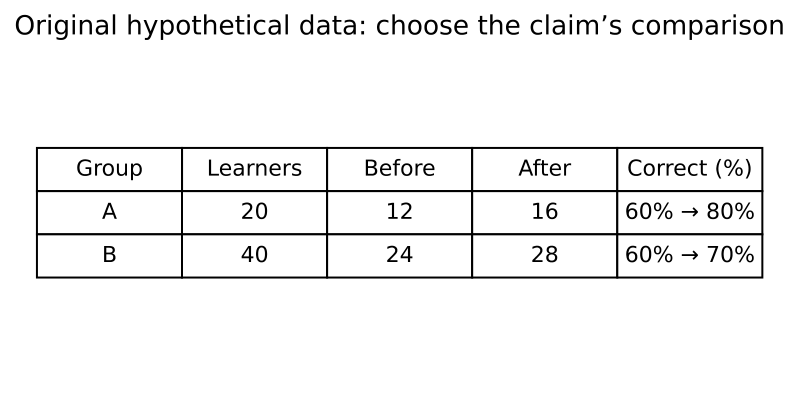
    לטבלה או גרף: קרא תוויות, יחידות ומסגרות לפני ערכים. השווה את המסגרות המבוקשות; לעולם אל תסיק מגמה מחוץ לנתונים.

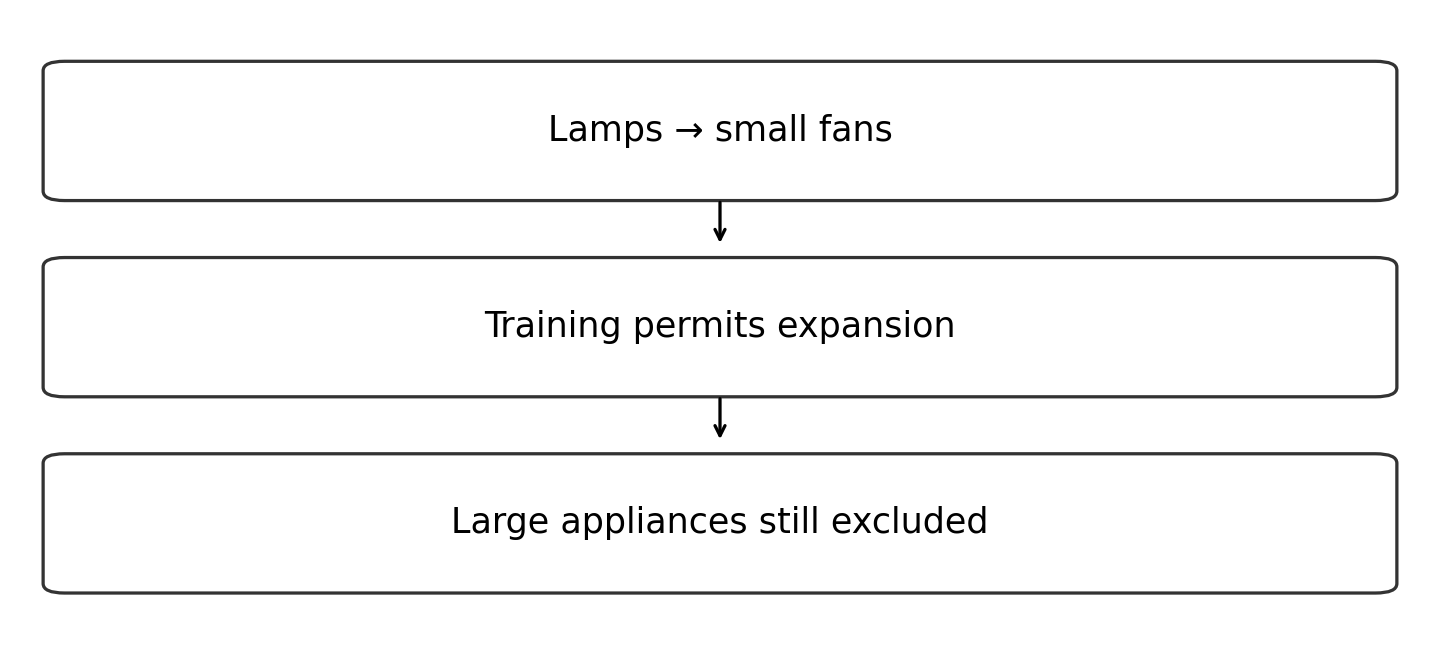
    הרעיון המרכזי הוא הקשר שמחבר את הטקסט יחד. קריאה: “הקפה לתיקון קיבלה תחילה רק מנורות. מאוחר יותר הוסיפה מאווררים קטנים לאחר שהמתנדבים קיבלו הכשרה. מכשירים גדולים עדיין הלכו לחנויות מומחות.” סיכום תקין הוא: הקפה הרחיב את התיקונים בתוך גבולות. “היא תיקנה הכל” מתעלם מהמשפט האחרון. “היא תיקנה מנורות” משליטה את השינוי.”
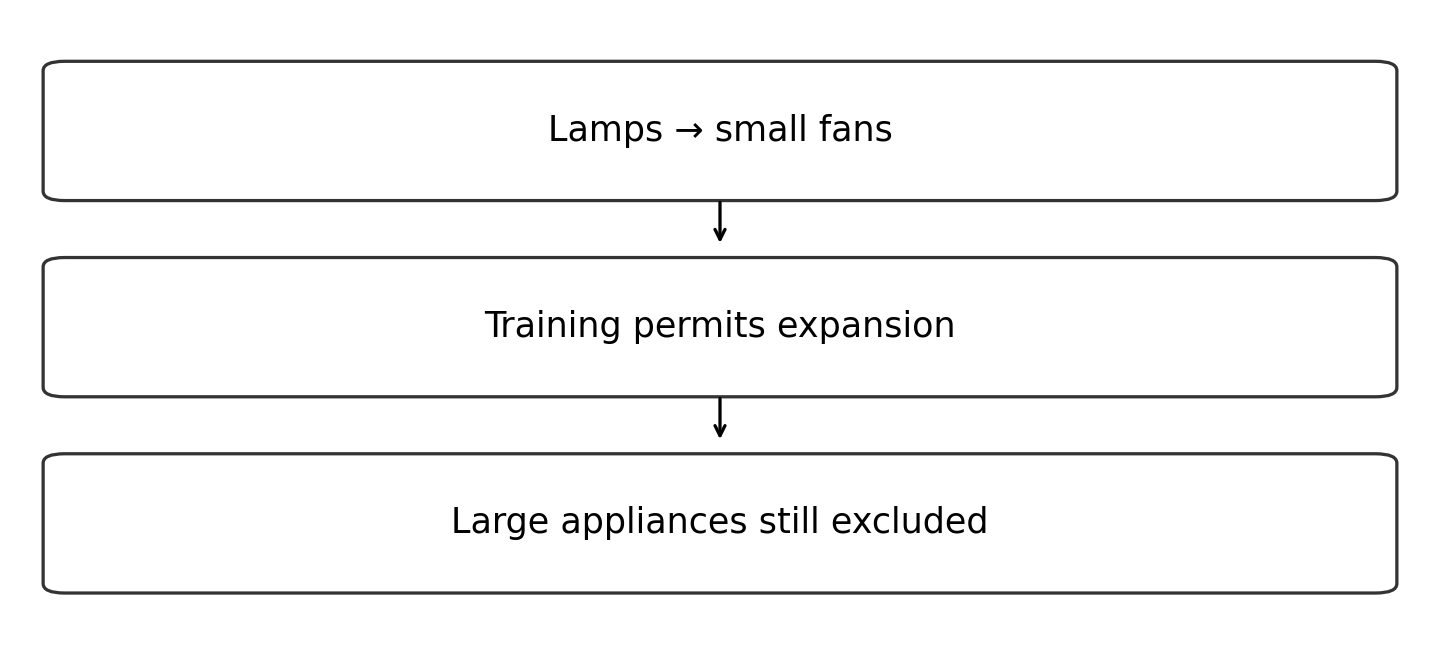
    תרשים מקורי של הקשר העבודה; קראו את כל הניסוח וההגבלות.
    תרשים מקורי של הקשר העבודה; קראו את כל הניסוח וההגבלות.

    דוגמה פתורה קיימת: מחקר מדד שני רחובות בצהריים. הרחוב המצל הוא 29°C; הרחוב שאינו בצל היה 33°C. זה תומך בהבדל של 4°C באותם אתרים ובאותו זמן. הוא אינו יכול לקבוע קירור בכל העיר או סיבתיות כי הרחובות עשויים להשתנות בדרכים אחרות.

    השלמת ההקשר המקורי

    טקסט מקורי: ארכיון העיר התחיל בניסוי בו קוראים יכלו לחפש רשומות משלוח כתובות יד באמצעות אינדקס מקוון. מתנדבים הזינו שמות ותאריכים, בעוד שעובדים בדקו רשומות שקשה לקרוא. האינדקס עזר לעיתים קרובות לחוקרים למצוא דף סביר לפני הנסיעה לארכיון. הוא לא החליף את תמונות הרשומות: שני אנשים עם אותו שם עדיין יכלו להיבדד רק בקריאת רשומות סמוכות. עובדים תיארו לכן את האינדקס כדרך לכניסה לרשומות ולא כתשובה סופית לכל שאלה. הם גם שמרו רשימה ציבורית של רשומות תוקנות כדי שהחוקרים יוכלו לראות איך האינדקס השתנה.

    אימון עצמאי וחשיבה מאומתת

    סקירה זו הושלמה באמצעות סדר מיומנויות מפורט: 20, 21, 22. עבודו על הרפרנסים והדפים הללו בסדר; סקירה זו אינה מחליפה אותם.

    העברה 1

    ציינו את הרעיון המרכזי במשפט אחד, בשמירה על היתרון והגבול.

    הסיקה: האינדקס המבדק עוזר לחוקרים למצוא רשומות רלוונטיות, אך שימוש ברשומה המקורית נותר חיוני עבור חלק מההבחנות. זה מכסה את יתרון החיפוש ואת הגבול של אותו שם ללא טענה לדיוק מלא.

    העברה 2

    איזה פרט מסביר מדוע תמונות הרשומות נותרות חיוניות? הבדילו זאת ממטרת רשימת התקונים.

    הסיקה: אנשים עם אותו שם עשויים להזדקק לרשומות רשומה סמוכות כדי להבחין ביניהם. רשימת התקונים לעומת זאת הופכת תיקונים לגלויים; היא אינה מזיכה עצמה בכל אדם.

    העברה 3

    דחו כל סיכום מוצע בעדות ספציפיות — A “מתנדבים החליפו עובדים”; B “האינדקס הפך כל ביקור בארכיון למיותר”; C “הארכיון הסתיר שינויים באינדקס”.

    הסבר: A סותר את בדיקת הכניסות הקשות על ידי הצוות. B מגזים ב"לעיתים קרובות" ובצורך להיוועץ ברשומות הבסיסיות; הטקסט אינו אומר שכל ביקור מחליף אחר. C סותר את רשימת התיקונים הציבורית. אף אחת לא שומרת על ההיקף המפורש.

    מגבלות ושימוש עתידי

    תשובה שנשמעת סבירה מדעית עשויה להוסיף מידע שאינו קיים בטקסט.

    כל המשימות כאן הן אימון מקורי ציבורי עם הדרכה שנכתבה. הן אינן שאלות רשמיות או אבחונים חדשים. מבחנים ומדמים מוגנים קיימים נשארים בנפרד.
    מילון מונחים
    English עברית
    central idea/ˈsentrəl aɪˈdɪə/ רעיון מרכזי
    inference/ˈɪnfərəns/ מסקנה
    evidence/ˈevɪdəns/ עדות
    detail/ˈdiːteɪl/ פרט
  • 2

    RW.C · Craft and Structure

    תוכנית לימוד תגיע בקרוב

    חומר עזר

    English

    Scope and prerequisites

    Digital SAT framework; original paper practice is nonadaptive and gives no scaled-score prediction.

    • Determine words in context
    • Analyse text structure and purpose
    • Compare related texts and viewpoints

    Prerequisites: Sentence meaning; contrast 对比 and explanation clues.

    Explain and choose the method

    Replace a tested word with your own plain phrase before viewing options. The sentence controls the meaning.

    Find what a sentence does: presents evidence 证据, qualifies a claim, explains a method or introduces a contrast.

    Separate the author’s view from a quoted view. Reporting a claim does not always endorse it.

    Cross-text questions ask about a relationship. Identify the exact point of agreement or disagreement, not the shared topic.

    A word in context 语境中的词义 must fit the relationship, not just a dictionary entry. In “The evidence is thin, so the conclusion remains provisional”, provisional means open to revision. It does not mean temporary employment or physical thinness. Paraphrase before choosing.

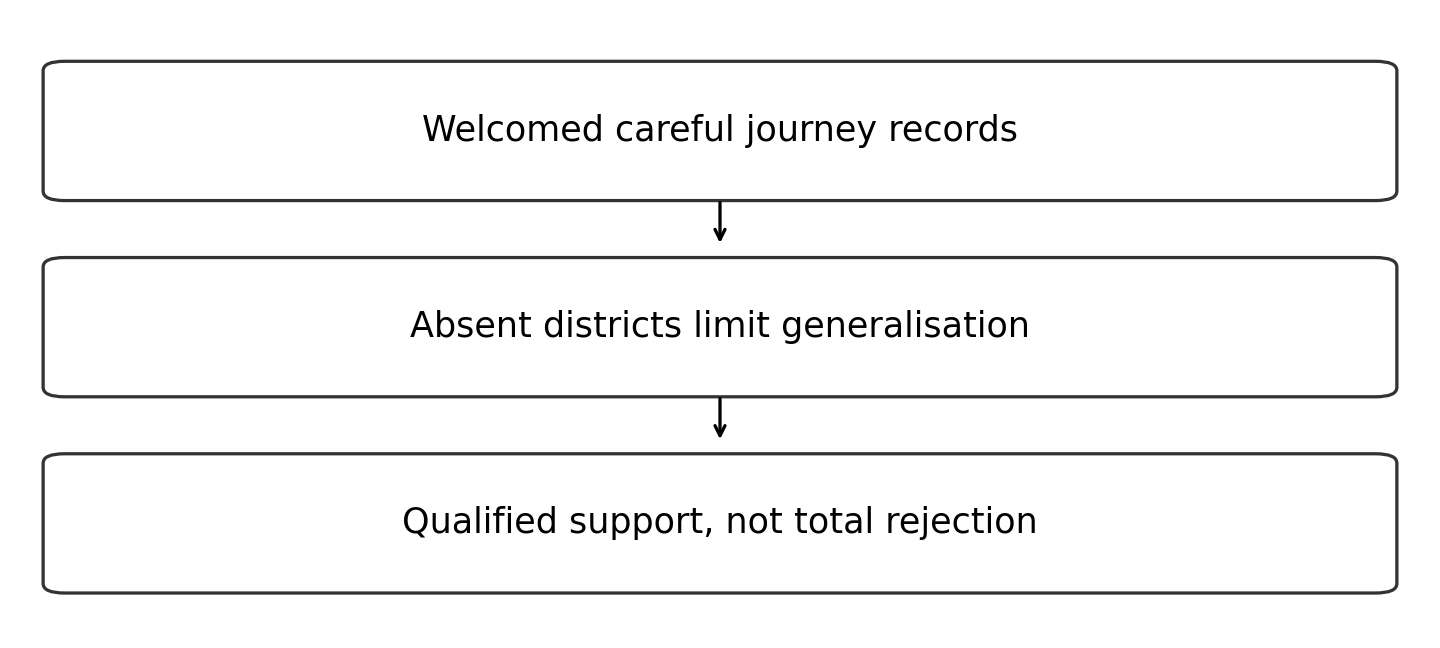
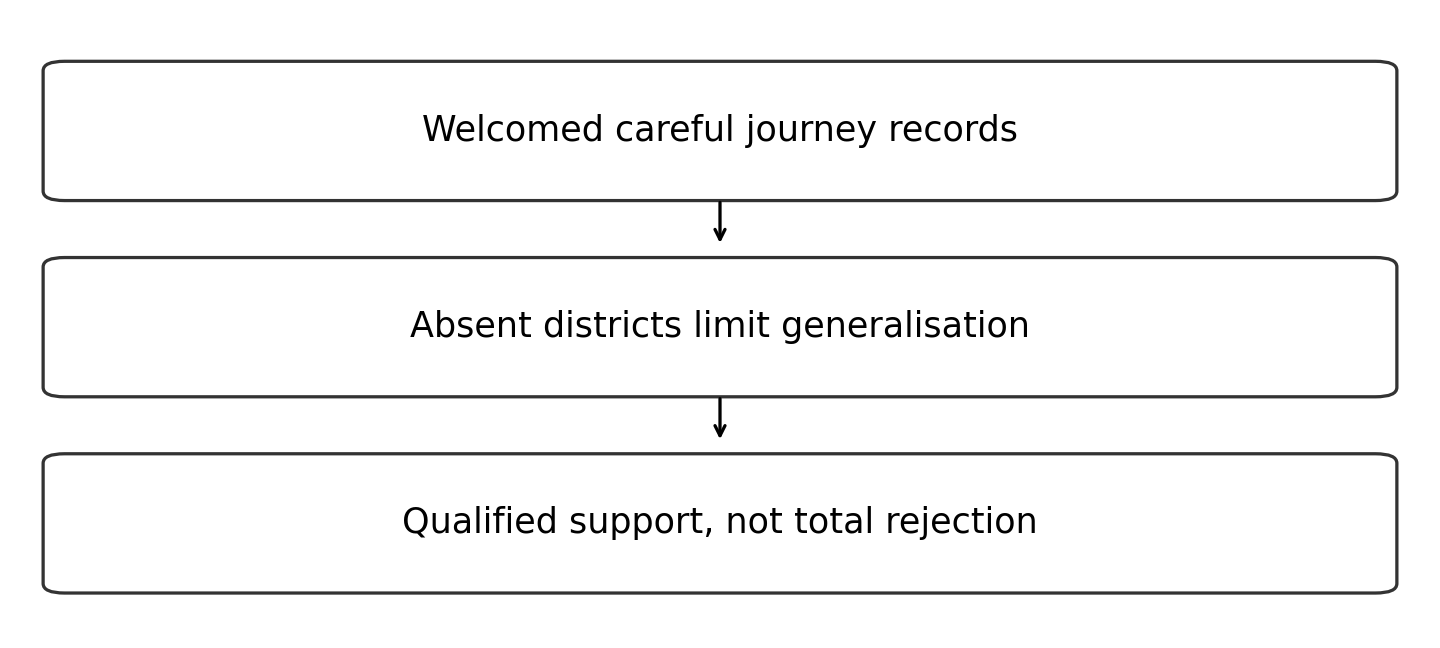
    Original diagram of the worked relationship; read the full wording and qualifications.
    Original diagram of the worked relationship; read the full wording and qualifications.

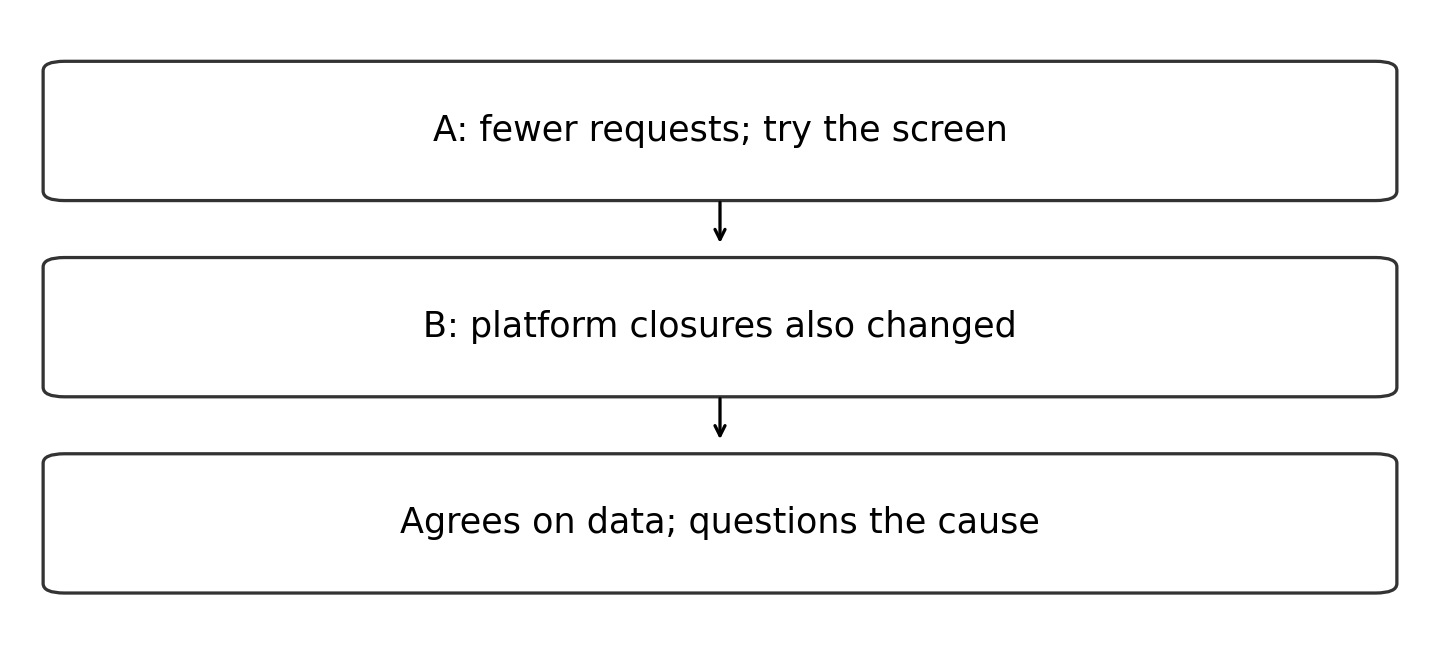
    Existing worked example: Text 1: A small trial suggests the filter could help. Text 2: The trial is too small to establish effectiveness. Both allow that the trial is limited. Text 2 is more cautious about the conclusion; it does not say the filter certainly fails.

    Complete original context

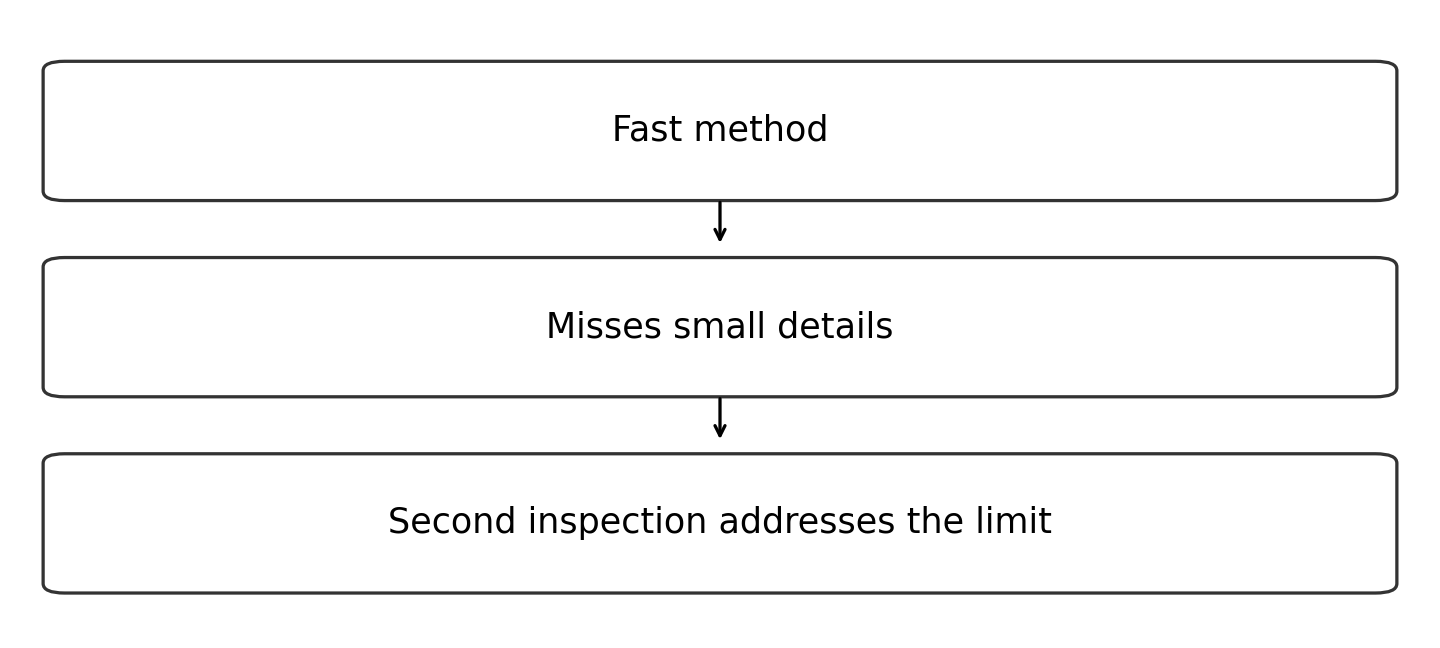
    Original passage: The reviewers welcomed the survey's careful record of individual journeys, but they gave its city-wide conclusions only qualified support. The routes had been chosen for convenience, and several districts were absent. One reviewer called the record illuminating: it made previously overlooked travel difficulties easier to understand. Another cautioned that extending the conclusions would require a broader sample. The authors accepted this reservation and proposed a second survey.

    Independent practice and checked reasoning

    This overview is completed through the detailed skill sequence: 23, 24, 25. Work those references and sheets in order; this orientation does not replace them.

    Transfer 1

    Explain qualified, illuminating and reservation in this passage. Quote a clue for each.

    Reasoning: Qualified means limited or conditional, supported by absent districts and a need for broader sampling. Illuminating means revealing or clarifying, supported by difficulties becoming easier to understand. Reservation means a concern or limitation, supported by caution about extending conclusions; it is not a booked seat.

    Transfer 2

    Compare “The reviewers dismissed the survey” with “The reviewers endorsed its conclusions without reservation”. Why does neither fit?

    Reasoning: Dismissed ignores their welcome for its careful records. Endorsed without reservation erases the sampling concern. The attitude combines appreciation of the records with limited support for broader conclusions.

    Transfer 3

    Replace illuminating with revealing, dazzling or visible. Which best preserves meaning and why do the others fail here?

    Reasoning: Revealing preserves the idea that the record makes difficulties understood. Dazzling introduces brilliance or admiration beyond the stated clarification. Visible describes perceptibility, not the survey's explanatory contribution. This is a contextual meaning decision, not a rule that those words are always wrong.

    Limits and next use

    The everyday meaning of a word may differ from its meaning in the supplied sentence.

    All tasks here are public original practice with authored guidance. They are not official questions or fresh diagnostics. Existing protected tests and mocks remain separate.

    מילון מונחים
    English עברית
    word in context משמעות המילה בהקשר
    evidence/ˈevɪdəns/ עדות
    contrast/ˈkɒntræst/ ניגוד
  • 3

    RW.E · Expression of Ideas

    תוכנית לימוד תגיע בקרוב

    חומר עזר

    English

    Scope and prerequisites

    Digital SAT framework; original paper practice is nonadaptive and gives no scaled-score prediction.

    • Select transitions expressing logical relationships
    • Synthesize notes for a stated rhetorical goal

    Prerequisites: Read a stated rhetorical goal; preserve names, units and relations.

    Explain and choose the method

    Classify the relationship before choosing a transition 衔接词: contrast, consequence, addition or example.

    Read both sides of a blank. A transition must link their meanings, not merely sound natural.

    For notes questions, underline the requested goal. Comparison, introduction and emphasis require different selections.

    Use only necessary notes. Keep names, dates and quantities attached to the correct object.

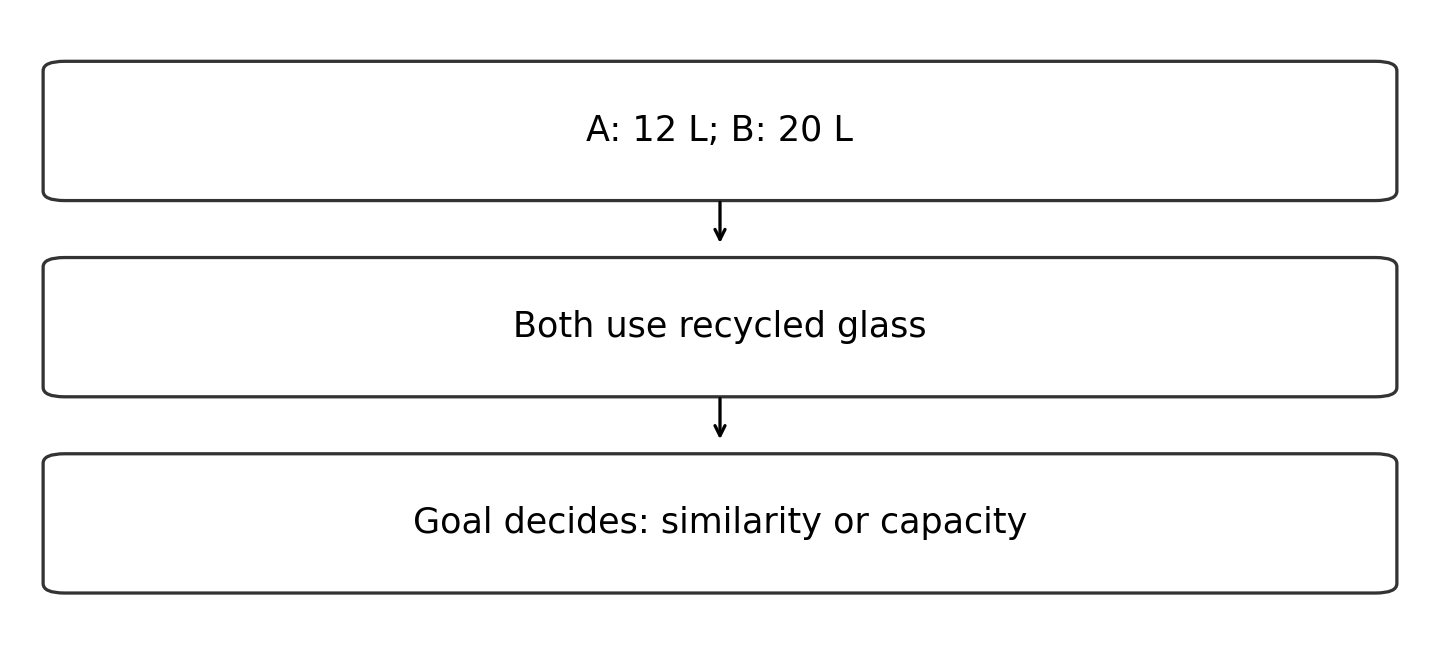
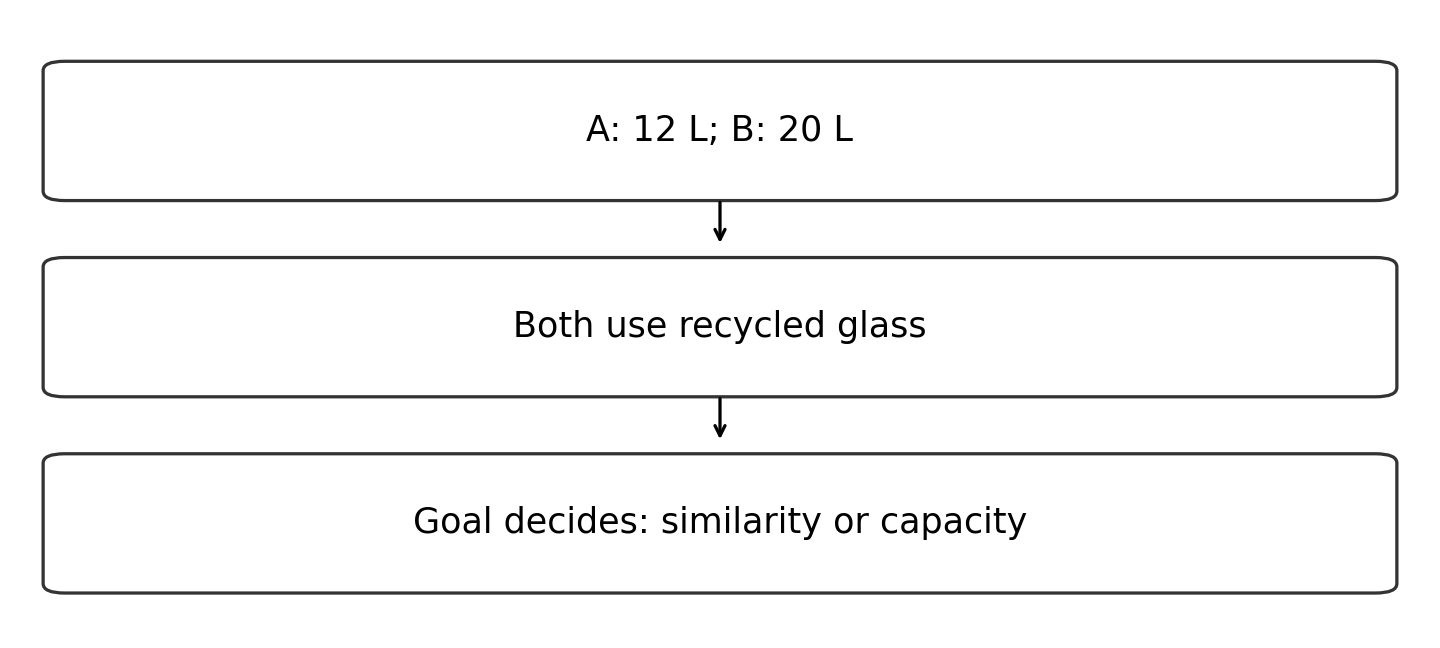
    Rhetorical synthesis 综合 修辞综合 selects facts for a purpose. Notes: A stores 12 litres; B stores 20; both use recycled glass. For a material similarity 相似: “Both containers use recycled glass.” For a capacity difference: “B stores 8 litres more than A.” The same notes support different sentences.

    Original diagram of the worked relationship; read the full wording and qualifications.
    Original diagram of the worked relationship; read the full wording and qualifications.

    Existing worked example: Notes: Route A is 8 km and has six stops. Route B is 8 km and has ten stops. Goal: emphasise a similarity. “Both routes are 8 km long” meets the goal. Discussing stops emphasises a difference instead.

    Complete original context

    Original research notes:

    • The Bay project restored 3 km of walking paths in 2024.
    • The Hill project restored 5 km of walking paths in 2024.
    • Both projects used volunteer teams.
    • Bay used local stone for boundary markers.
    • Hill used recycled timber for boundary markers.
    • The notes give no costs, visitor counts or durability measurements.

    Independent practice and checked reasoning

    This overview is completed through the detailed skill sequence: 26, 27. Work those references and sheets in order; this orientation does not replace them.

    Transfer 1

    Write one sentence emphasising a similarity in staffing and a second emphasising the difference in distance restored.

    Reasoning: “Both Bay and Hill used volunteer teams.” “Hill restored 5 km of paths, 2 km more than Bay.” These select staffing and distance respectively without adding a cause.

    Transfer 2

    A student writes “Hill restored more paths because recycled timber lasts longer.” Identify every unsupported relationship.

    Reasoning: The notes do not report why Hill restored a longer distance, nor any durability comparison. They report kilometres, not the number of separate paths. A valid sentence is “Hill restored a longer total distance and used recycled timber for its markers,” without a causal link.

    Transfer 3

    Goal — contrast marker 转折标记 materials without including irrelevant detail 细节. Write a sentence, then explain why the shared year can be omitted.

    Reasoning: “Bay used local stone for boundary markers, whereas Hill used recycled timber.” The shared year does not establish the requested material contrast. Omitting it meets this goal; a historical comparison could require it under a different goal.

    Limits and next use

    Do not include every note. Extra detail can distract from the requested rhetorical purpose.

    All tasks here are public original practice with authored guidance. They are not official questions or fresh diagnostics. Existing protected tests and mocks remain separate.

    מילון מונחים
    English עברית
    rhetorical synthesis שילוב רטורי
    contrast marker/ˈkɒntræst ˈmɑːkə/ סמן ניגוד
    similarity/ˌsɪmɪˈlærɪti/ דמיון
    transition/trænˈsɪʃn/ מילולי מעבר
    synthesis/ˈsɪnθəsɪs/ סינתזה
    detail/ˈdiːteɪl/ פרט
  • 4

    RW.S · Standard English Conventions

    תוכנית לימוד תגיע בקרוב

    חומר עזר

    היקף ותנאי מקדימים

    מסגרת Digital SAT; אימון נייר מקורי הוא לא אדפטיבי ואינו מספק תחזית לציון מוקנה.

    • השתמש בקצוות משפט ובסימני פיסוק
    • שמור על התאמת פעל-נושא ובהירות שימושים
    • בחר צורות פעלים ותארים המתאימים להקשר

    דרישות מוקדמות: נושאים ופעלים מוגבלים; משפט עצמאי/תלוי.

    הסבר ובחירת השיטה

    מצא את הפעל המוגבל והנושא בכל משפט. משפט תלוי אינו יכול לעמוד לבדו כמשפט מלא.

    חבר שני משפטים עצמאיים עם נקודה, נקודת-פסק או פסיק בתוך חיבור סביבתי.

    נקודת-תווך עוקבת אחרי משפט עצמאי. נקודת-פסק מחברת משפטים עצמאיים. שמור על תארים חיוניים מחוברים למה שהם מתארים.

    בדוק את השם המרכזי להתאמה. "רשידת המדידות היא ארוכה": רשימה, לא מדידות, קובעת is.

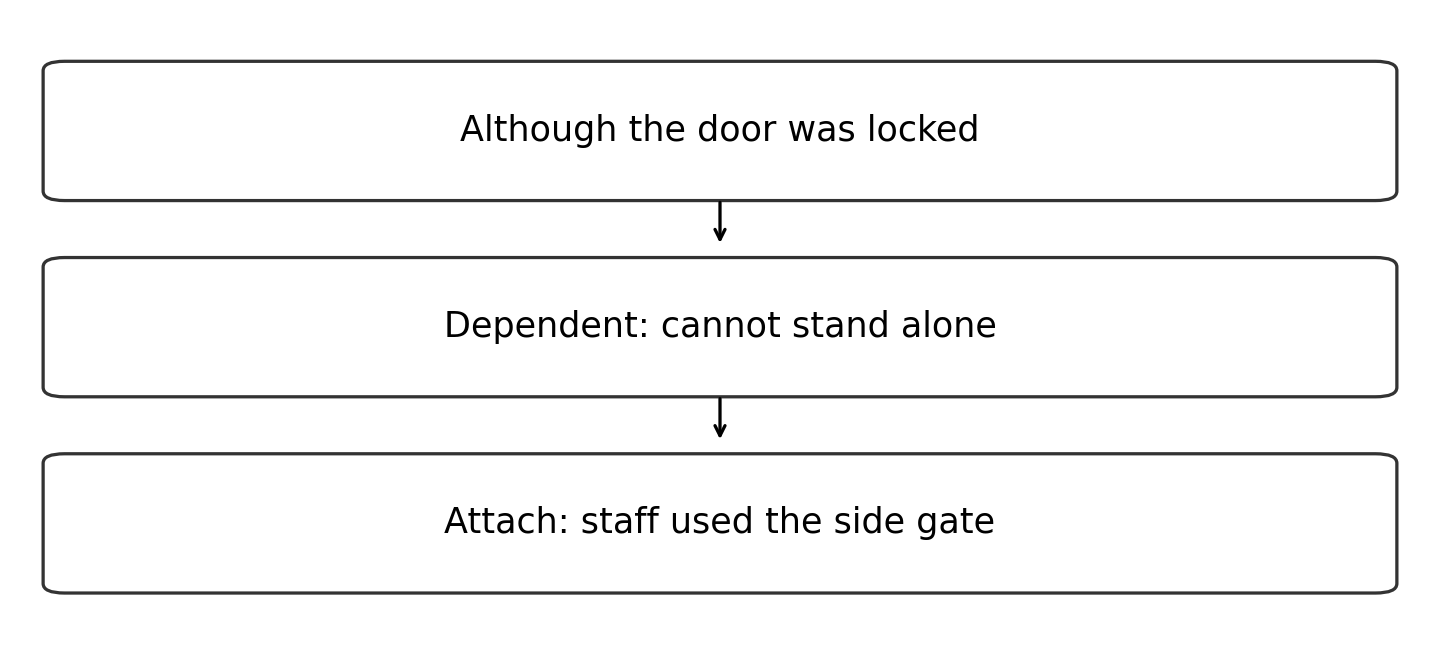
    קצוות משפט תלוי במבנה המשפט. "אלthough הדלת הייתה נעולה" הוא תלוי; חבר אותו למשפט עצמאי. "אלthough הדלת הייתה נעולה, העובדים יכלו להיכנס דרך שערי הצד." נקודת-תווך עוקבת אחרי משפט פתיחה עצמאי: "העובדים השתמשו בכניסה אחת: שערי הצד."

    תרשים מקורי של הקשר העבודה; קראו את כל הניסוח וההגבלות.
    תרשים מקורי של הקשר העבודה; קראו את כל הניסוח וההגבלות.

    דוגמה מעובדת קיימת: החיישן נכשל; הצוות החליף אותו. לכל צד יש נושא ופעל, ולכן נקודת-פסק מתאימה. "Because החיישן נכשל; הצוות החליף אותו" שגוי: because הופך את החלק הראשון לתלוי.

    השלמת ההקשר המקורי

    טקסט עריכה מקורי: אלthough התחנה הישנה נסגרה [1] השעון שלה עדיין עבד. המנגנון היה פשוט [2] עם זאת, תיקון המחוגים דרש מומחה. חלק אחד דרש החלפה [3] ציר הצר מאחורי לוח השעון. השעון [4] שעמד מעל הכניסה [5] הפך לנקודת מפגש. בתרגול זה יש שעון אחד, והמשפט with which מוסיף מידע שאינו חיוני.

    אימון עצמאי וחשיבה מאומתת

    סקירה זו משלימה את הרצף המיומנויות המפורט: 28, 29. עבדו על המקורות והעלים הללו בסדר; סקירה זו אינה מחליפה אותם.

    העברה 1

    ספקו פיסוק ב-[1]–[5]. תנו לפחות גבולות תקפים שניים ב-[2] והסבירו את מבחן המשפט.

    נימוק: [1] פסיק מחבר משפט תלוי מיישם. [2] נקודת-פסיק או נקודה, כי משפט המנגנון ומשפט התיקון הם עצמאיים; יש לכתוב However באות גדולה אחרי נקודה. [3] נקודת-מיין באה לאחר המשפט השלם “One part needed replacement” ומציגה את החלק. [4],[5] פסיקים זוגיים מסמנים את המשפט התוספתי הנדרש; קווי הפסקה זוגיים או סוגריים מתאימים גם כן.

    העברה 2

    הסבירו מדוע “One part needed: a replacement” שונה מהמשפט עם נקודת-מיין תקינה במקור.

    נימוק: Needed דורש ישירות את האובייקט שלה “a replacement”; הצבת נקודת-מיין שם מפריעה ליחידה הדקדוקית הזו. ב-“One part needed replacement: the narrow axle”, המשפט העצמאי הוא כבר שלם וההסבר בא אחריו.

    העברה 3

    תיקנו “The clock, above the entrance, and the bell was restored” תוך שמירה על שני האובייקטים שנתיקנו. הסבירו התאמה ופיסוק אופציונלי.

    נימוק: “The clock above the entrance and the bell were restored.” נושא מורכב לוקח were. פסיקים סביב “above the entrance” יכולים לשמש אם היא תוספתית ולא מזהה; בחירת ההקשר הזו אינה משנה את ההתאמה המורכבת.

    מגבלות ושימוש עתידי

    ביטויי שם ארוכים מחבאים את הנושא. אל תבחר מסר רק כדי להתאים לשם הקרוב ביותר.

    כל המשימות כאן הן אימון מקורי ציבורי עם הדרכה שנכתבה. הן אינן שאלות רשמיות או אבחונים חדשים. מבחנים ומדמים מוגנים קיימים נשארים בנפרד.
    מילון מונחים
    English עברית
    sentence boundary גבול משפט
    finite verb/ˈfaɪnaɪt vɜːb/ פעל מוגבל
    clause/klɔːz/ משפט חלקי
    colon/ˈkəʊlən/ נקודתיים
  • 5

    M.A · Algebra

    תוכנית לימוד תגיע בקרוב

    חומר עזר

    English

    Scope and prerequisites

    Digital SAT framework; original paper practice is nonadaptive and gives no scaled-score prediction.

    • Solve linear equations and inequalities in one variable
    • Represent and solve two-variable linear systems
    • Interpret linear functions and parameters in context

    Prerequisites: Collect like terms; substitute ordered pairs; signed arithmetic.

    Explain and choose the method

    Write a variable definition with units before an equation. The intercept 截距 represents an initial amount.

    A linear slope 斜率 is change in output divided by change in input. Keep both quantities in the right order.

    Solve systems by substitution or elimination. A solution must satisfy both equations.

    An inequality reverses direction when multiplied or divided by a negative number. Test a value to check the final region.

    An identity holds for every permitted input. Start with $ax+b=cx+d$. Collect terms: $(a-c)x=d-b$. Inspect $a-c$ before dividing. If $a=c$ and $b=d$, every real input works. If only $a=c$, no input works. Otherwise $x=(d-b)/(a-c)$ gives one solution.

    Original worked example from existing native teaching; transfer tasks use their own data.
    Original worked example from existing native teaching; transfer tasks use their own data.

    Existing worked example: Let f be the fixed fee and r the cost per kilometre. f+3r=11 and f+7r=19. Subtract the equations: 4r=8, so r=2. Then f=11−3(2)=5. Both journeys fit; the fixed fee is 5.

    Complete original context

    Every transfer question states all data it needs.

    Independent practice and checked reasoning

    This overview is completed through the detailed skill sequence: 9. Work those references and sheets in order; this orientation does not replace them.

    Transfer 1

    Classify the solutions of $(p-1)x+3=2x+p$ for every real $p$.

    Reasoning: Collect terms to get $(p-3)x=p-3$. At $p=3$, the equation is $0=0$, so every real $x$ works. At $p\ne3$, divide by $p-3$ to get $x=1$. There is no value of $p$ giving no solution. Substitution of $x=1$ gives $p+2$ on both sides.

    Transfer 2

    A hire charge $C$ yuan has a fixed fee $f$ yuan and rate 速率 $r$ yuan per hour. Three hours cost 31 yuan; seven hours cost 59 yuan. Find $f,r$ and the greatest affordable whole number of hours with 80 yuan.

    Reasoning: Use $C=f+rt$. The equations are $31=f+r(3\,\mathrm{h})$ and $59=f+r(7\,\mathrm{h})$. Subtract: $r=(59-31)\,\mathrm{yuan}/(7-3)\,\mathrm{h}=7\,\mathrm{yuan/h}$. Then $f=31\,\mathrm{yuan}-(7\,\mathrm{yuan/h})(3\,\mathrm{h})=10\,\mathrm{yuan}$. Budget: $10+7t\le80$, so $t\le10$ hours. Ten whole hours is affordable; eleven costs 87 yuan.

    Transfer 3

    Describe all points satisfying $y>2x-1$ and $y\le-x+5$. Is $(2,3)$ included? State the possible $x$-values.

    Reasoning: The first boundary is dashed and the second solid. The common region is above the first line and on or below the second. At $(2,3)$ the first condition is $3>3$, which fails. For the vertical interval to exist, $2x-1<-x+5$, hence $x<2$. The lines meet at $(2,3)$ but their meeting point is excluded.

    Limits and next use

    The intercept is not always the actual starting value if zero lies outside the model’s stated domain.

    All tasks here are public original practice with authored guidance. They are not official questions or fresh diagnostics. Existing protected tests and mocks remain separate.

    מילון מונחים
    English עברית
    intercept/ˌɪntəˈsept/ חיתוך
    slope/sləʊp/ שיפוע
    rate/reɪt/ קצב
  • 6

    M.Q · Advanced Math

    תוכנית לימוד תגיע בקרוב

    חומר עזר

    English

    Scope and prerequisites

    Digital SAT framework; original paper practice is nonadaptive and gives no scaled-score prediction.

    • Transform equivalent polynomial and rational expressions
    • Solve nonlinear equations and systems
    • Interpret quadratic and exponential functions

    Prerequisites: Distributive law; difference of squares; real square roots.

    Explain and choose the method

    Factor a quadratic when possible. The zero-product rule applies to a product equal to zero.

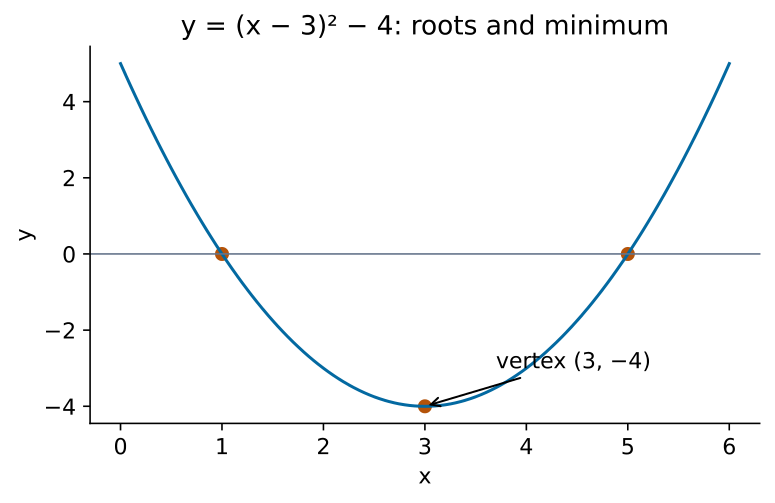
    Completing the square reveals a vertex: x²−6x+5=(x−3)²−4.

    For rational expressions, record excluded denominator values before cancelling factors.

    An exponential model multiplies by a fixed factor per interval. A 20% increase means multiply by 1.2, not add 0.2.

    Equivalent expressions 等价表达式 must agree on the stated domain 定义域 . $E(x)=(x^2-25)/(x-5)=(x+5)$ only for $x\ne5$. Cancellation removes a factor, but it cannot restore an excluded input. Also $\sqrt{x^2}=|x|$, because the principal square root 根 cannot be negative.

    Original worked example from existing native teaching; transfer tasks use their own data.
    Original worked example from existing native teaching; transfer tasks use their own data.

    Existing worked example: Solve x²−5x+6=0. Factor: (x−2)(x−3)=0. Thus x=2 or 3. If instead (x²−5x+6)/(x−2)=0, x=2 is excluded; only 3 remains.

    Complete original context

    Every transfer question states all data it needs.

    Independent practice and checked reasoning

    This overview is completed through the detailed skill sequence: 10, 11, 12. Work those references and sheets in order; this orientation does not replace them.

    Transfer 1

    Simplify $F(x)=(x^2-4x)/(x^2-16)$. State every original restriction and explain why $F$ is not identical to $x/(x+4)$ on that latter formula's whole domain.

    Reasoning: Factor numerator $x(x-4)$ and denominator $(x-4)(x+4)$. The original domain excludes $x=4,-4$. Cancellation gives $F(x)=x/(x+4)$ for $x\ne4,-4$. The latter formula alone permits $4$, where it gives $1/2$, while $F(4)$ is undefined.

    Transfer 2

    Find the coefficient of $x$ in $(3x-2)(x+5)$ and evaluate $\sqrt{(x-5)^2}$ when $x=1$.

    Reasoning: Expansion gives $3x^2+15x-2x-10=3x^2+13x-10$, so the coefficient is 13. The root is $|x-5|$; at $x=1$, it is $|-4|=4$, not $-4$ or 16.

    Transfer 3

    A student tests $x=2$ and concludes that $x^2$ and $2x$ are equivalent. Refute the conclusion and solve where they actually agree.

    Reasoning: At $x=3$ the outputs are 9 and 6, so one matching test is not proof. Solve $x^2=2x$ as $x(x-2)=0$, giving only $x=0,2$.

    Limits and next use

    Squaring an equation can add extraneous roots. Substitute into the original equation, not just the transformed one.

    All tasks here are public original practice with authored guidance. They are not official questions or fresh diagnostics. Existing protected tests and mocks remain separate.

    מילון מונחים
    English עברית
    equivalent expressions ביטויים שקולים
    domain/dəˈmeɪn/ תחום הגדרה
    root/ruːt/ שורש
  • 7

    M.D · Problem-Solving and Data Analysis

    תוכנית לימוד תגיע בקרוב

    חומר עזר

    English

    Scope and prerequisites

    Digital SAT framework; original paper practice is nonadaptive and gives no scaled-score prediction.

    • Use ratios, rates and percentages
    • Interpret distributions and compare centre and spread
    • Calculate probabilities and assess sample claims

    Prerequisites: Fractions; unit conversion; percentage base.

    Explain and choose the method

    Percent change uses the original value as the denominator. Percentage points compare percentages directly.

    Convert units explicitly. A rate 速率 denominator describes the amount of time or distance used.

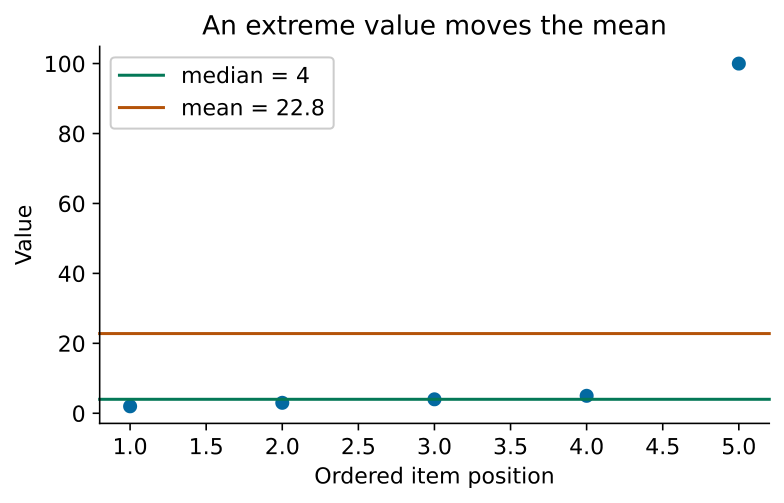
    The median 中位数 resists extreme values more than the mean. Spread describes variation, not the average.

    A random sample 随机样本 supports generalisation to its sampling population. Random assignment concerns causal comparison, a different issue.

    A rate compares quantities with their units. $v=d/t=(90\,\mathrm{km})/(1.5\,\mathrm{h})=60\,\mathrm{km/h}$. Convert using cancelling units: $v=(60\,\mathrm{km/h})(1000\,\mathrm{m/km})/(3600\,\mathrm{s/h})=50/3\,\mathrm{m/s}$. Do not convert only the numerator of a compound rate.

    Original worked example from existing native teaching; transfer tasks use their own data.
    Original worked example from existing native teaching; transfer tasks use their own data.

    Existing worked example: A price of 80 falls by 20%: 80×0.8=64. It then rises by 20%: 64×1.2=76.8. The final value is below 80 because the two percentage changes use different bases.

    Complete original context

    Every transfer question states all data it needs.

    Independent practice and checked reasoning

    This overview is completed through the detailed skill sequence: 13, 14, 15, 16, 17. Work those references and sheets in order; this orientation does not replace them.

    Transfer 1

    Mix red and blue paint in ratio 4:7 to make 33 litres. Find each amount. Red paint costs 18 yuan per litre and blue 12. Find total cost.

    Reasoning: There are 11 parts, so each is 3 L. Red volume $V_r=33(4/11)=12\,\mathrm{L}$; blue volume $V_b=33(7/11)=21\,\mathrm{L}$. Cost $C=p_rV_r+p_bV_b=(18\,\mathrm{yuan/L})(12\,\mathrm{L})+(12\,\mathrm{yuan/L})(21\,\mathrm{L})=468\,\mathrm{yuan}$.

    Transfer 2

    A 400-yuan item falls 15% then rises 10%. Find the final price and the single overall percentage change.

    Reasoning: Use successive multipliers. $P=P_0(1-0.15)(1+0.10)=(400\,\mathrm{yuan})(0.85)(1.10)=374\,\mathrm{yuan}$. Relative change $r=(P-P_0)/P_0=(374-400)/400=-0.065$, a 6.5% decrease.

    Transfer 3

    A pump supplies 0.15 litres per second. How long does 54 litres take? If a square has side 30 cm, give its area in square metres.

    Reasoning: $t=V/q=(54\,\mathrm{L})/(0.15\,\mathrm{L/s})=360\,\mathrm{s}=6\,\mathrm{min}$. Convert side before squaring: $A=s^2=(0.30\,\mathrm{m})^2=0.09\,\mathrm{m^2}$; the area conversion factor is 10000, not 100.

    Limits and next use

    A sample from volunteers is not automatically representative, even when it is large.

    All tasks here are public original practice with authored guidance. They are not official questions or fresh diagnostics. Existing protected tests and mocks remain separate.

    מילון מונחים
    English עברית
    random sample/ˈrændəm ˈsæmpl/ דוגמה אקראית
    median/ˈmiːdiːən/ חציון
    rate/reɪt/ קצב
  • 8

    M.G · Geometry and Trigonometry

    תוכנית לימוד תגיע בקרוב

    חומר עזר

    English

    Scope and prerequisites

    Digital SAT framework; original paper practice is nonadaptive and gives no scaled-score prediction.

    • Use area, volume and similarity 相似
    • Apply right-triangle ratios and the Pythagorean theorem
    • Use circle equations, arcs and angle relationships

    Prerequisites: Triangle sum; Pythagoras; length/area/volume units.

    Explain and choose the method

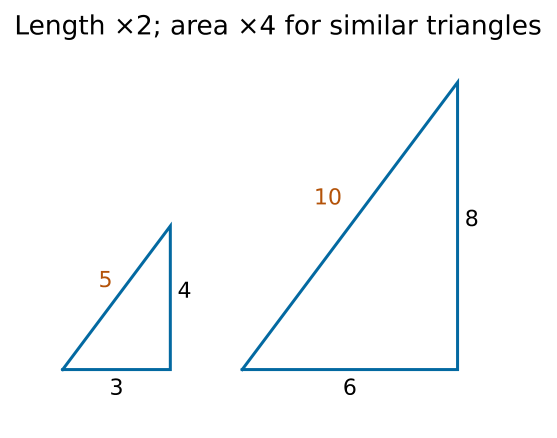
    Similarity preserves corresponding angles and length ratios. Areas scale by k² and volumes by k³.

    For a right triangle, sin is opposite/hypotenuse, cos adjacent/hypotenuse, and tan opposite/adjacent.

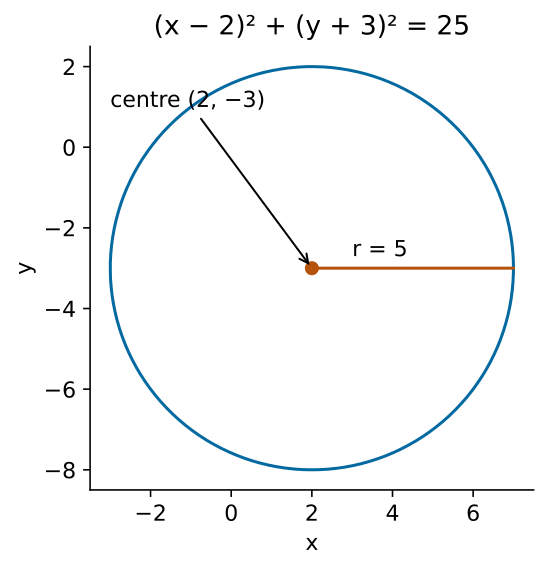
    A circle with centre (h,k) and radius r has (x−h)²+(y−k)²=r².

    A full turn is 360° or 2π radians. Arc length 弧长 is rθ only when θ is in radians.

    A scale factor 比例因子 $k$ changes every corresponding length. $A_2=k^2A_1$ and $V_2=k^3V_1$ for similar shapes. If $k=3/2$ and $A_1=24\,\mathrm{cm^2}$, $A_2=(3/2)^2(24\,\mathrm{cm^2})=54\,\mathrm{cm^2}$. Changing only one dimension does not justify these similarity rules.

    Original worked example from existing native teaching; transfer tasks use their own data.
    Original worked example from existing native teaching; transfer tasks use their own data.

    Existing worked example: A right triangle has legs 6 and 8. c²=6²+8²=100, so c=10. For the angle opposite 6, sin θ=6/10=0.6. A similar triangle enlarged by factor 3 has area nine times the original.

    Complete original context

    Every transfer question states all data it needs.

    Independent practice and checked reasoning

    This overview is completed through the detailed skill sequence: 18, 19. Work those references and sheets in order; this orientation does not replace them.

    Transfer 1

    Similar containers have surface areas 96 and 216 square centimetres. The smaller volume is 160 cubic centimetres. Find the larger volume.

    Reasoning: $k=\sqrt{A_2/A_1}=\sqrt{216/96}=3/2$. Volume uses the cube: $V_2=k^3V_1=(3/2)^3(160\,\mathrm{cm^3})=540\,\mathrm{cm^3}$. Using area ratio directly would give the wrong volume.

    Transfer 2

    A right triangle has hypotenuse 13 cm and one leg 5 cm. Find the other leg, its area, and the sine of the angle opposite the 5 cm leg.

    Reasoning: $b=\sqrt{c^2-a^2}=\sqrt{(13\,\mathrm{cm})^2-(5\,\mathrm{cm})^2}=12\,\mathrm{cm}$. $A=ab/2=(5\,\mathrm{cm})(12\,\mathrm{cm})/2=30\,\mathrm{cm^2}$. $\sin\theta=a/c=(5\,\mathrm{cm})/(13\,\mathrm{cm})=5/13$.

    Transfer 3

    Two interior angles of a triangle are 42° and 73°. Find the third angle and its adjacent exterior angle. Would those angles alone determine all side lengths?

    Reasoning: Third angle is $180-42-73=65$ degrees. Its adjacent exterior angle is $180-65=115$ degrees, also $42+73$. Angles establish shape, not scale; similar triangles can have different side lengths.

    Transfer 4

    Two parallel lines are cut by a transversal. One corresponding angle is 68°. Find its matching corresponding angle and the adjacent angle on the second line. Explain which given condition justifies each step.

    Reasoning: Parallelism gives the matching corresponding angle 68°. The adjacent pair forms a straight angle, so the other is 180°−68°=112°. Equal corresponding angles require the stated parallel lines; the straight-angle sum uses adjacency on one line. A similar-looking sketch without parallelism would not justify the first equality.

    Limits and next use

    Radius and diameter differ by a factor of two. Using diameter in πr² makes the area four times too large.

    All tasks here are public original practice with authored guidance. They are not official questions or fresh diagnostics. Existing protected tests and mocks remain separate.

    מילון מונחים
    English עברית
    scale factor/skeɪl ˈfæktə/ גורם קנה מידה
    arc length/ɑːk leŋθ/ אורך קשת
    similarity/ˌsɪmɪˈlærɪti/ דמיון
  • 9

    ALG-parameters · Linear parameters, solution counts and inequalities

    תוכנית לימוד תגיע בקרוב

    חומר עזר

    English

    Scope and prerequisites

    Digital SAT framework; original paper practice is nonadaptive and gives no scaled-score prediction.

    • Solve and classify one-variable linear equations with parameters
    • Interpret two-variable linear equations as sets of ordered pairs
    • Interpret slope and intercept of a contextual linear function
    • Classify two-equation linear systems and check their intersections
    • Represent strict and inclusive inequalities in one or two variables

    Prerequisites: Collect like terms; substitute ordered pairs; signed arithmetic.

    Explain and choose the method

    Collect variable terms and constants separately. An equation ax+b=cx+d becomes (a-c)x=d-b. If a-c is nonzero there is one solution; if both sides reduce to zero there are infinitely many; if the variable coefficient is zero but the constant is nonzero there are none. Never divide by a parameter before checking whether it can be zero.

    A two-variable equation gives a set of ordered pairs. In y=mx+b, m is the change in y per unit x and b is y at x=0. For a contextual model, attach units to both: a taxi charge C=3t+5 has a 5-unit initial fee and 3 units per time unit. The intercept may be outside the practical domain even when it exists algebraically.

    For a system, compare both coefficients and constants. Multiplying one whole equation by a nonzero number produces the same line; matching variable coefficients with different constants gives parallel distinct lines. Otherwise an intersection supplies the pair satisfying both equations. Substitute the pair into both original equations to check it.

    Multiplying or dividing an inequality by a negative number reverses its direction. A strict inequality excludes the boundary, while ≤ or ≥ includes it. For two variables, draw the corresponding line and test a point away from it to identify the allowed half-plane. The diagram is a representation of all solutions, not a single preferred point.

    An identity 恒等式 holds for every permitted input. Start with $ax+b=cx+d$. Collect terms: $(a-c)x=d-b$. Inspect $a-c$ before dividing. If $a=c$ and $b=d$, every real input works. If only $a=c$, no input works. Otherwise $x=(d-b)/(a-c)$ gives one solution.

    Original diagram of the worked relationship; read the full wording and qualifications.
    Original diagram of the worked relationship; read the full wording and qualifications.

    Existing worked example: For kx+6=2x+6, k=2 gives 0=0 and infinitely many solutions; k≠2 gives x=0. For -2x+3<11, subtract 3 and divide by -2 to get x>-4. For y≤2x+1, (0,0) works and the solid boundary is included. The system 2x+4y=10 and x+2y=6 has no solution because doubling the second gives the same left side equal to 12, not 10.

    Complete original context

    Every transfer question states all data it needs.

    Independent practice and checked reasoning

    Transfer 1

    Classify the solutions of $(p-1)x+3=2x+p$ for every real $p$.

    Reasoning: Collect terms to get $(p-3)x=p-3$. At $p=3$, the equation is $0=0$, so every real $x$ works. At $p\ne3$, divide by $p-3$ to get $x=1$. There is no value of $p$ giving no solution. Substitution of $x=1$ gives $p+2$ on both sides.

    Transfer 2

    A hire charge $C$ yuan has a fixed fee $f$ yuan and rate 速率 $r$ yuan per hour. Three hours cost 31 yuan; seven hours cost 59 yuan. Find $f,r$ and the greatest affordable whole number of hours with 80 yuan.

    Reasoning: Use $C=f+rt$. The equations are $31=f+r(3\,\mathrm{h})$ and $59=f+r(7\,\mathrm{h})$. Subtract: $r=(59-31)\,\mathrm{yuan}/(7-3)\,\mathrm{h}=7\,\mathrm{yuan/h}$. Then $f=31\,\mathrm{yuan}-(7\,\mathrm{yuan/h})(3\,\mathrm{h})=10\,\mathrm{yuan}$. Budget: $10+7t\le80$, so $t\le10$ hours. Ten whole hours is affordable; eleven costs 87 yuan.

    Transfer 3

    Describe all points satisfying $y>2x-1$ and $y\le-x+5$. Is $(2,3)$ included? State the possible $x$-values.

    Reasoning: The first boundary is dashed and the second solid. The common region is above the first line and on or below the second. At $(2,3)$ the first condition is $3>3$, which fails. For the vertical interval to exist, $2x-1<-x+5$, hence $x<2$. The lines meet at $(2,3)$ but their meeting point is excluded.

    Limits and next use

    Do not confuse x=0 with a vanished variable coefficient, reverse only when multiplying/dividing by a negative, or shade a half-plane from the line’s slope alone.

    All tasks here are public original practice with authored guidance. They are not official questions or fresh diagnostics. Existing protected tests and mocks remain separate.

    מילון מונחים
    English עברית
    identity/aɪˈdentɪti/ זהות
    rate/reɪt/ קצב
  • 10

    AM-equivalence · Equivalent expressions and domain restrictions

    תוכנית לימוד תגיע בקרוב

    חומר עזר

    English

    Scope and prerequisites

    Digital SAT framework; original paper practice is nonadaptive and gives no scaled-score prediction.

    • Factor 因式 and expand expressions without changing their values
    • Simplify rational and radical expressions on the original domain
    • Use expression structure to identify zeros and coefficients

    Prerequisites: Distributive law; difference of squares; real square roots.

    Explain and choose the method

    Expansion distributes each factor across the others; factorisation reverses that process. x²-5x+6=(x-2)(x-3), so the product form exposes zeros while the expanded form exposes coefficients. Choose the form that serves the question rather than treating one representation as always preferable.

    Cancel factors, never terms in a sum. (x²-4)/(x-2) becomes x+2 only for x≠2, because the original expression is undefined at 2. A restriction may remain after every denominator disappears from the simplified formula. State it before cancelling, then carry it through comparisons or equation solving.

    Exponent rules depend on their setting: a^m a^n=a^(m+n) and (a^m)^n=a^(mn) in the permitted real domain. Negative exponents form reciprocals and require nonzero bases. With real square roots, √(x²)=|x|, because the principal square root is nonnegative; it is not x for every real x.

    To check equivalence, a numerical substitution can expose a mistake, but one matching value does not prove two expressions equal. A valid algebraic identity plus matching domain does. When the question requests a coefficient, expand only as far as needed and account for every contribution to that power.

    Equivalent expressions 等价表达式 must agree on the stated domain . $E(x)=(x^2-25)/(x-5)=(x+5)$ only for $x\ne5$. Cancellation removes a factor, but it cannot restore an excluded input. Also $\sqrt{x^2}=|x|$, because the principal square root cannot be negative.

    Original diagram of the worked relationship; read the full wording and qualifications.
    Original diagram of the worked relationship; read the full wording and qualifications.

    Existing worked example: (x²-9)/(x-3)=(x-3)(x+3)/(x-3)=x+3 for x≠3. At x=3 the original is undefined. For x=-5, √(x²)=5=|x|. In (2x+1)(x-4), the x coefficient is -8+1=-7 and the full expression is 2x²-7x-4.

    Complete original context

    Every transfer question states all data it needs.

    Independent practice and checked reasoning

    Transfer 1

    Simplify $F(x)=(x^2-4x)/(x^2-16)$. State every original restriction and explain why $F$ is not identical to $x/(x+4)$ on that latter formula's whole domain.

    Reasoning: Factor numerator $x(x-4)$ and denominator $(x-4)(x+4)$. The original domain excludes $x=4,-4$. Cancellation gives $F(x)=x/(x+4)$ for $x\ne4,-4$. The latter formula alone permits $4$, where it gives $1/2$, while $F(4)$ is undefined.

    Transfer 2

    Find the coefficient of $x$ in $(3x-2)(x+5)$ and evaluate $\sqrt{(x-5)^2}$ when $x=1$.

    Reasoning: Expansion gives $3x^2+15x-2x-10=3x^2+13x-10$, so the coefficient is 13. The root is $|x-5|$; at $x=1$, it is $|-4|=4$, not $-4$ or 16.

    Transfer 3

    A student tests $x=2$ and concludes that $x^2$ and $2x$ are equivalent. Refute the conclusion and solve where they actually agree.

    Reasoning: At $x=3$ the outputs are 9 and 6, so one matching test is not proof. Solve $x^2=2x$ as $x(x-2)=0$, giving only $x=0,2$.

    Limits and next use

    A simplified formula is not automatically an equivalent function on a larger domain; cancelling terms across addition is invalid.

    All tasks here are public original practice with authored guidance. They are not official questions or fresh diagnostics. Existing protected tests and mocks remain separate.

    מילון מונחים
    English עברית
    equivalent expressions ביטויים שקולים
    factor/ˈfæktə/ גורם
  • 11

    AM-equations · Nonlinear equations and mixed systems

    תוכנית לימוד תגיע בקרוב

    חומר עזר

    היקף ותנאי מקדימים

    מסגרת Digital SAT; אימון נייר מקורי הוא לא אדפטיבי ואינו מספק תחזית לציון מוקנה.

    • Solve quadratic, absolute-value, rational and radical equations
    • Reject candidate roots violating the original equation or domain
    • Find intersections of a line and a nonlinear curve

    רקע נדרש: פקטוריזציה; הצבה; מגבלות תחום.

    הסבר ובחירת השיטה

    השתמשו במבנה לפני הפעלה. משוואה ריבועית מוכפלת שווה לאפס כאשר לפחות אחד מהגורמים שווה לאפס. משוואת ערך מוחלט |u|=a אינה פתירה בממשיים עבור a<0, one condition u=0 when a=0 and two conditions u=±a when a>0. חשבו את כל המקרים המותרים, ולא רק את הענף החיובי.

    עבור משוואה רציונלית,heitu אפסי מכנה לפני ההכפלה. הכפלה עשויה ליצור מועמד באפס שנheitu. עבור משוואה שורש, שימו לב ששורש ראשי הוא אי-שלילי,בודדו אותו והריעו בזהירות. הריעה היא השקה חד-כיוונית עד שכל המועמדים שנובעים נבדקים במקור.

    לפתרון מערכת ישר-פרבולה, הציעו את ביטוי הישר במשוואה הריבועית. השורשים הממשיים נותנים ערכי x; השתמשו בישר כדי לשחזר כל y. אין שורש ממשי פירושו אין צומת ממשי. שורש ריבועי כפול נותן מגע, בעוד שני שורשים ממשיים שונים נותנים שני צומתים.

    גרף או מחשבון יכולים לעזור למקם מועמדים ולבדוק סקאלה, אך צומתים מעוגלים אינם הוכחה מדויקת כאשר השאלה מבקשת ערך מדויק או ספירת פתרונות. קשרו התנהגות גרפית למשוואה אלגברית. שורש כפול לא יש לספור פעמיים כזוגות מסודרים שונים.

    מועמד לשורש חייב לספק את המשוואה המקורית. ב$\sqrt{x+6}=x$, צד ימון חייב להיות אי-שלילי. העלאה בריבוע נותנת $x^2-x-6=0$, ולכן המועמדים הם $3,-2$. רק $3$ עובר את הבדיקה המקורית: $\sqrt9=3$.

    דוגמה פתורה מקיימת הוראה מקומית; משימות העברה משתמשות בנתונים משלהן.
    דוגמה פתורה מקיימת הוראה מקומית; משימות העברה משתמשות בנתונים משלהן.

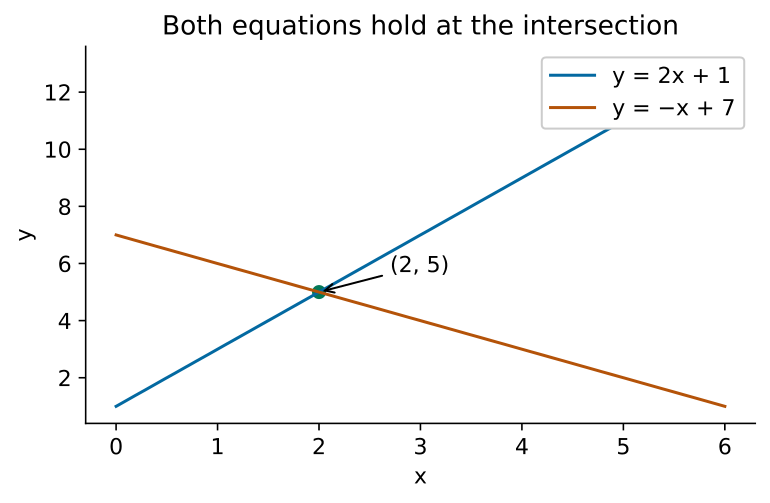
    דוגמה פתורה קיימת: √(x+2)=x דורש x≥0. העלאת ריבוע נותנת x²-x-2=0, ולכן x=2 או -1; רק 2 עובד במקור. עבור y=x+2 ו-y=x², פתרו x²-x-2=0: x=2,-1, מה שנותן (2,4) ו-(-1,1). עבור |2x-1|=5, פתרו 2x-1=5 או -5 כדי לקבל x=3 או -2.

    השלמת ההקשר המקורי

    כל שאלת העברה מציגה את כל הנתונים הנדרשים לה.

    אימון עצמאי וחשיבה מאומתת

    העברה 1

    פתרו $\sqrt{2x+3}=x$ במספרים הממשיים, והראו מדוע כל מועמד נדחה.

    הסבר: יש לדרוש $x\ge0$. העלאת ריבוע נותנת $x^2-2x-3=(x-3)(x+1)=0$. המועמדים הם 3 ו--1. המקור נותן $\sqrt9=3$ ב-3, אך $\sqrt1=1\ne-1$ ב--1. רק $x=3$ עובד.

    העברה 2

    פתרו בו-זמנית $y=x+2$ ו-$y=(x-1)^2$. תנו זוגות סדורים מדויקים ואמתו את מספר הנקודות החוצות.

    הסבר: השווו תוצאות כדי לקבל $x+2=x^2-2x+1$, או $x^2-3x-1=0$. כך $x=(3\pm\sqrt{13})/2$ ו-$y=(7\pm\sqrt{13})/2$ עם סימנים תואמים. הדיסקרימיננטה 13 היא חיובית, ולכן ישנן שתי נקודות חצייה ממשיים נפרדות; שתי הביטויים עבור $y$ מסכימות לפי המשוואה שנוגדה.

    העברה 3

    פתרו $|3x+2|=7$ ו-$(x^2-9)/(x-3)=6$. הסבר מדוע למשוואות אלו יש מספרי פתרונות שונים.

    הסבר: הערך המוחלט נותן $3x+2=7$ או $-7$, ולכן $x=5/3$ או $-3$. משוואת הרציונלית דורשת $x\ne3$ ומת简化 ל$x+3=6$, שמועמדה היחיד 3 הוא מופסל. אין לה פתרון.

    מגבלות ושימוש עתידי

    אל תדווח כל שורש של משוואה מ transformed לפני בדיקת ההגבלה המקורית והענף.

    כל המשימות כאן הן אימון מקורי ציבורי עם הדרכה שנכתבה. הן אינן שאלות רשמיות או אבחונים חדשים. מבחנים ומדמים מוגנים קיימים נשארים בנפרד.
    מילון מונחים
    English עברית
    candidate root שורש מועמד
    intersection/ˌɪntəˈsekʃn/ נקודת חיתוך
    parabola/pəˈræbələ/ פרבולה
  • 12

    AM-functions · Nonlinear functions, transformations and growth

    תוכנית לימוד תגיע בקרוב

    חומר עזר

    English

    Scope and prerequisites

    Digital SAT framework; original paper practice is nonadaptive and gives no scaled-score prediction.

    • Interpret zeros, vertices and parameters from useful function forms
    • Distinguish additive linear change from multiplicative exponential change
    • Transform a graph while tracking its input and output

    Prerequisites: Function notation; squares; growth multipliers.

    Explain and choose the method

    Vertex form 顶点式 a(x-h)²+k identifies the vertex (h,k) and opening direction; factored form identifies zeros. The same function can have both forms. In context, determine which features are meaningful: a maximum height occurs at the vertex of a downward parabola 抛物线, while a zero can represent returning to ground level.

    For y=A b^t, A is the value at t=0 and b is the factor per unit time. A growth rate 速率 r gives b=1+r; decay gives b=1-r. Equal differences indicate a linear model, while equal ratios indicate an exponential model for equal input steps. Neither model should be extrapolated beyond a justified domain without a contextual reason.

    An output shift f(x)+k moves every point vertically by k. An input shift f(x-h) moves the graph right by h: the same old input is reached when the new x is larger. A multiplier outside scales output; a negative outside reflects across the x-axis. Determine the transformation 转化 algebraically instead of memorising a direction without checking a point.

    For an exponential factor given over several time units, distinguish that interval from one unit. Doubling every three hours means 2^(t/3), not 2^t. For a quadratic, use the requested representation to read an extremum or solve for an input. Keep initial values, growth factors and growth percentages separate.

    Vertex form $a(x-h)^2+k$ reveals the turning point $(h,k)$. For $H(t)=-2(t-4)^2+32$, the maximum is 32 when $t=4$. Setting $H(t)=0$ gives $(t-4)^2=16$, hence $t=0,8$. Restrict time to the physical interval when the problem represents a flight.

    Original diagram of the worked relationship; read the full wording and qualifications.
    Original diagram of the worked relationship; read the full wording and qualifications.

    Existing worked example: h(t)=-4(t-3)²+36 has a maximum 36 at t=3, with zeros t=0 and 6. N(t)=80(1.25)^t starts at 80 and grows 25% per unit; N(2)=125. A quantity doubling every three hours is 80·2^(t/3), so after six hours it is 320. If f(x)=x², f(x-2)+5 has vertex (2,5).

    Complete original context

    Every transfer question states all data it needs.

    Independent practice and checked reasoning

    Transfer 1

    A model height is $H(t)=-3(t-2)^2+12$ metres, with $t$ seconds from launch until return to ground. Find the domain, greatest height, and time interval with height at least 9 metres.

    Reasoning: Ground means $H=0$, so $(t-2)^2=4$ and $t=0,4$. Domain is $0\le t\le4\,\mathrm{s}$. The negative square coefficient gives maximum $H(2)=12\,\mathrm{m}$. For $H\ge9\,\mathrm{m}$, $(t-2)^2\le1$, so $1\le t\le3\,\mathrm{s}$.

    Transfer 2

    A culture model starts with 120 cells and grows by a factor of 1.5 every two hours. Write $N(t)$ for hours $t$, find $N(4)$, and distinguish factor from percentage growth.

    Reasoning: $N(t)=120(1.5)^{t/2}$ cells. $N(4)=120(1.5)^2=270$ cells. The growth is 50% per two hours, not 150%; the four-hour factor is 2.25. The hourly factor would be $\sqrt{1.5}$.

    Transfer 3

    If $f(x)=(x+1)^2$, find the vertex of $g(x)=-2f(x-3)+5$ and its maximum or minimum.

    Reasoning: Substitute the input before interpreting signs. $g(x)=-2(x-2)^2+5$ has vertex $(2,5)$ and maximum 5. The old vertex at $-1$ moved three units right to 2.

    Limits and next use

    A 1.25 factor means 25% growth, not 125% growth; f(x-2) shifts right, and a repeated percentage uses the updated amount.

    All tasks here are public original practice with authored guidance. They are not official questions or fresh diagnostics. Existing protected tests and mocks remain separate.

    מילון מונחים
    English עברית
    transformation/trænsfɔːˈmeɪʃn/ המרה
    vertex form/ˈvɜːteks fɔːm/ צורה ורקטורית
    parabola/pəˈræbələ/ פרבולה
    rate/reɪt/ קצב
  • 13

    PSDA-rates · Ratios, unit conversion and successive percentages

    תוכנית לימוד תגיע בקרוב

    חומר עזר

    English

    Scope and prerequisites

    Digital SAT framework; original paper practice is nonadaptive and gives no scaled-score prediction.

    • Use proportional relationships while preserving units
    • Convert rates and distinguish direct from inverse relationships
    • Calculate successive changes and percentage comparisons using the correct base

    Prerequisites: Fractions; unit conversion; percentage base.

    Explain and choose the method

    A ratio compares quantities in a chosen order. If red:blue=3:5 and the total is 64, the eight equal parts each contain eight, so red is 24 and blue 40. The ratio 3/5 describes red relative to blue; 3/8 describes red relative to the total. Read the requested denominator rather than using the first visible fraction.

    A unit rate 速率 单位率 divides quantity by its corresponding time, distance or count. Write conversion factors so unwanted units cancel: 72 km/hour times 1000 m/km divided by 3600 s/hour is 20 m/s. Area and volume conversions square and cube the length factor. A one-centimetre square is not one metre squared divided by one hundred.

    In direct proportion y=kx, doubling x doubles y; in inverse proportion xy=k, doubling x halves y. Constant work shared by identical workers gives an inverse time model only when productivity and conditions are fixed. A fixed initial fee added to a rate makes an affine linear model, not direct proportion through the origin.

    A percentage change divides the change by the original comparison base. Successive percentage changes multiply their factors: a 20% discount followed by 20% increase gives 0.8·1.2=0.96 of the original. Distinguish percentage points from relative percent: 30% to 36% is six points, but a 20% relative increase.

    A rate compares quantities with their units. $v=d/t=(90\,\mathrm{km})/(1.5\,\mathrm{h})=60\,\mathrm{km/h}$. Convert using cancelling units: $v=(60\,\mathrm{km/h})(1000\,\mathrm{m/km})/(3600\,\mathrm{s/h})=50/3\,\mathrm{m/s}$. Do not convert only the numerator of a compound rate.

    Original diagram of the worked relationship; read the full wording and qualifications.
    Original diagram of the worked relationship; read the full wording and qualifications.

    Existing worked example: A 250-unit price discounted 20% becomes 200; increasing that result 20% gives 240, four percent below 250. A pump delivers 18 litres in 3 minutes, so its rate is 6 L/min or 0.1 L/s. At a fixed rate, 45 litres takes 7.5 minutes. If a share rises from 40% to 50%, the rise is 10 percentage points and 25% relative to the old share.

    Complete original context

    Every transfer question states all data it needs.

    Independent practice and checked reasoning

    Transfer 1

    Mix red and blue paint in ratio 4:7 to make 33 litres. Find each amount. Red paint costs 18 yuan per litre and blue 12. Find total cost.

    Reasoning: There are 11 parts, so each is 3 L. Red volume $V_r=33(4/11)=12\,\mathrm{L}$; blue volume $V_b=33(7/11)=21\,\mathrm{L}$. Cost $C=p_rV_r+p_bV_b=(18\,\mathrm{yuan/L})(12\,\mathrm{L})+(12\,\mathrm{yuan/L})(21\,\mathrm{L})=468\,\mathrm{yuan}$.

    Transfer 2

    A 400-yuan item falls 15% then rises 10%. Find the final price and the single overall percentage change.

    Reasoning: Use successive multipliers. $P=P_0(1-0.15)(1+0.10)=(400\,\mathrm{yuan})(0.85)(1.10)=374\,\mathrm{yuan}$. Relative change $r=(P-P_0)/P_0=(374-400)/400=-0.065$, a 6.5% decrease.

    Transfer 3

    A pump supplies 0.15 litres per second. How long does 54 litres take? If a square has side 30 cm, give its area in square metres.

    Reasoning: $t=V/q=(54\,\mathrm{L})/(0.15\,\mathrm{L/s})=360\,\mathrm{s}=6\,\mathrm{min}$. Convert side before squaring: $A=s^2=(0.30\,\mathrm{m})^2=0.09\,\mathrm{m^2}$; the area conversion factor is 10000, not 100.

    Limits and next use

    State which amount is the percentage base and cancel units visibly. Equal positive and negative percentage changes use different bases.

    All tasks here are public original practice with authored guidance. They are not official questions or fresh diagnostics. Existing protected tests and mocks remain separate.

    מילון מונחים
    English עברית
    unit rate/ˈjuːnɪt reɪt/ קצב יחידתי
    rate/reɪt/ קצב
  • 14

    PSDA-spread · Distributions, transformations and spread

    תוכנית לימוד תגיע בקרוב

    חומר עזר

    English

    Scope and prerequisites

    Digital SAT framework; original paper practice is nonadaptive and gives no scaled-score prediction.

    • Compare mean, median 中位数, range and standard deviation 标准差 qualitatively
    • Predict the effect of adding or multiplying every data value
    • Read frequency 频数 information without confusing values and counts

    Prerequisites: Ordered data; frequency; mean and median.

    Explain and choose the method

    The mean uses the sum of all observations divided by their count; the median is the middle of the ordered observations. Frequency means a value repeats: if 2 occurs three times and 8 once, the mean is (3·2+8)/4=3.5, not (2+8)/2. The horizontal positions on a display are values and the frequencies determine how many observations they represent.

    The range is maximum minus minimum; standard deviation describes typical distances from the mean. You need not memorise a full formula to compare simple equally centred distributions: data clustered close to the mean have smaller standard deviation than data moved further away symmetrically. An outlier can alter mean and spread substantially while leaving the median stable.

    Adding c to every observation raises both mean and median by c but leaves range and standard deviation unchanged, because pairwise distances do not change. Multiplying every observation by a positive k multiplies mean, median, range and standard deviation by k. More generally spread scales by |k|, while a negative multiplier reverses ordering.

    When comparing plots, inspect the scale and the number of observations before judging apparent width. A graph stretched horizontally can look more variable without representing different values. A claim about equality of standard deviations needs the actual distributions, not merely equal ranges or equal means.

    A frequency counts repeated observations. Values 1, 3, 7 with frequencies 2, 1, 1 represent four observations: 1, 1, 3, 7. $\bar x=\sum fx/\sum f=(2(1)+1(3)+1(7))/4=3$. The median is $(1+3)/2=2$; it need not equal the mean.

    Original worked example from existing native teaching; transfer tasks use their own data.
    Original worked example from existing native teaching; transfer tasks use their own data.

    Existing worked example: A={4,5,6} and B={0,5,10} both have mean and median 5, but B has greater spread. Adding 7 gives A+7={11,12,13}, mean 12 and the same standard deviation as A. Multiplying A by 2 gives {8,10,12}; its mean is 10 and its range and standard deviation double. Equal range alone does not guarantee equal standard deviation.

    Complete original context

    Every transfer question states all data it needs.

    Independent practice and checked reasoning

    Transfer 1

    Values 2, 5, 8 have frequencies 3, 2, 1. Find mean, median and range.

    Reasoning: Data are 2,2,2,5,5,8. $\bar x=(3(2)+2(5)+1(8))/6=4$. Median is the average of positions 3 and 4, $(2+5)/2=3.5$. Range $R=8-2=6$.

    Transfer 2

    Every observation above is changed by $z=3x-4$. Find the new mean, median and range. State how standard deviation changes without computing it.

    Reasoning: Mean $\bar z=3\bar x-4=3(4)-4=8$. Median is $3(3.5)-4=6.5$. Range is $3(6)=18$. Standard deviation triples; subtracting 4 changes no distance from the mean.

    Transfer 3

    Compare A = {0, 0, 10, 10} and B = {0, 5, 5, 10}. Both have range 10. Must their standard deviations agree? Justify.

    Reasoning: Both means are 5. Every A observation is 5 from its mean; B distances are 5,0,0,5. B therefore has smaller mean squared deviation and smaller standard deviation. Equal range alone is insufficient.

    Limits and next use

    Do not average distinct category labels when frequencies differ, or confuse a shifted distribution with a more spread-out one.

    All tasks here are public original practice with authored guidance. They are not official questions or fresh diagnostics. Existing protected tests and mocks remain separate.

    מילון מונחים
    English עברית
    standard deviation/ˈstændəd ˌdiːvɪˈeɪʃn/ סטיית תקן
    frequency/ˈfriːkwənsi/ תדירות
    median/ˈmiːdiːən/ חציון
  • 15

    PSDA-models · Scatterplots, model residuals and predictions

    תוכנית לימוד תגיע בקרוב

    חומר עזר

    English

    Scope and prerequisites

    Digital SAT framework; original paper practice is nonadaptive and gives no scaled-score prediction.

    • Interpret slope and intercept of a fitted model in context
    • Calculate a residual 残差 and distinguish interpolation from extrapolation 外推
    • Choose linear or exponential patterns from equal-step data

    Prerequisites: Linear functions; signed subtraction; scatterplot labels.

    Explain and choose the method

    A scatterplot pairs two quantitative variables, one point per paired observation. A fitted line summarises a trend rather than connecting each point. In a model y=a+bx, b predicts the change in y for one-unit increase in x; its units are y-units per x-unit. The intercept a predicts y when x=0, which may lie outside the data range.

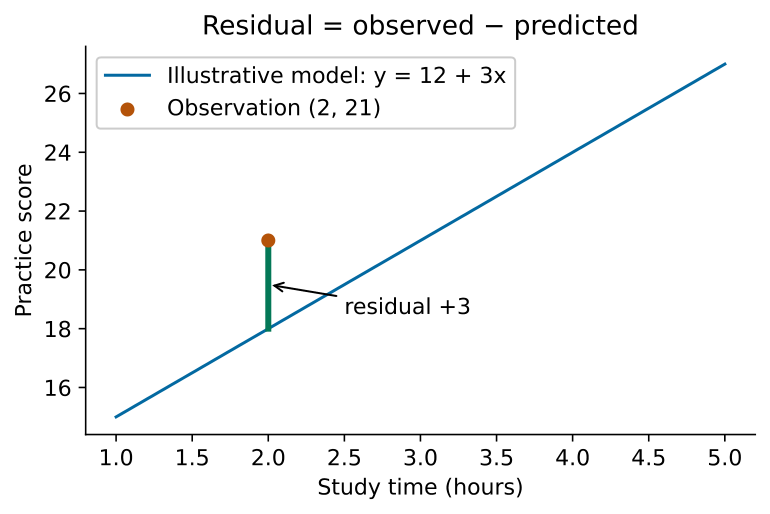
    A residual is observed y minus predicted y. Positive means the observation lies above the model; negative means below. Substitute the observed x into the model before subtracting. A large residual marks a poor prediction for that point, not automatically an error in measurement or proof that the trend is absent.

    Interpolation predicts inside the observed x-range; extrapolation goes beyond it and needs stronger caution because the relationship may change. Use a model’s contextual domain as well as its algebraic form. A negative predicted travel time, for example, can reveal an unjustified extrapolation rather than a physically possible outcome.

    For equal input steps, nearly constant output differences suggest a linear model; nearly constant output ratios suggest an exponential model. Scatter can make either pattern approximate. Association does not identify a cause: both variables may reflect a third factor. A fitted trend is evidence 证据 about prediction, not by itself about intervention.

    A residual is observed minus predicted output. A journey model $T=5+2d$ uses minutes for $T$ and kilometres for $d$. $T(4)=5\,\mathrm{min}+(2\,\mathrm{min/km})(4\,\mathrm{km})=13\,\mathrm{min}$. For observed time 16 minutes, $e=T_{obs}-T_{pred}=16\,\mathrm{min}-13\,\mathrm{min}=3\,\mathrm{min}$.

    Original worked example from existing native teaching; transfer tasks use their own data.
    Original worked example from existing native teaching; transfer tasks use their own data.

    Existing worked example: For study time x hours and predicted practice score y=12+3x, the slope is 3 score points/hour. At x=2 the prediction is 18. If the observed score is 21, residual=21-18=3. With x-values observed from 1 to 5, predicting at x=3 interpolates and x=12 extrapolates. Outputs 5,10,20,40 at equal input steps suggest factor-two exponential growth.

    Complete original context

    Every transfer question states all data it needs.

    Independent practice and checked reasoning

    Transfer 1

    A fitted delivery model is $T=8+1.5d$ minutes for observed distances 2–10 km. Interpret both parameters. At 6 km the observed time is 15 minutes; find its residual.

    Reasoning: The intercept predicts 8 minutes at zero distance; zero lies outside the observed range, so this interpretation is extrapolated. The slope predicts an extra 1.5 minutes per kilometre. $T(6)=8\,\mathrm{min}+(1.5\,\mathrm{min/km})(6\,\mathrm{km})=17\,\mathrm{min}$. Residual $e=15\,\mathrm{min}-17\,\mathrm{min}=-2\,\mathrm{min}$, below the line.

    Transfer 2

    Predictions are requested at 7 km and 20 km. Classify each, and explain why a fitted slope does not prove distance alone causes all time variation.

    Reasoning: Seven is inside 2–10, so interpolation. Twenty is outside, so extrapolation with weaker support. Traffic, loading and other conditions can influence time; a fitted association does not isolate their effects.

    Transfer 3

    At equally spaced inputs 0,1,2,3, outputs are 6,18,54,162. Choose a simple linear or exponential rule and predict at 4, stating the assumption.

    Reasoning: Ratios are all 3, while differences vary. The exponential rule is $y=6(3)^x$. Under continued factor-three growth, $y(4)=6(3)^4=486$. This is a model-based extrapolation, not a guaranteed next observation.

    Limits and next use

    Keep observed minus predicted in that order. Do not turn a model slope into a causal treatment effect.

    All tasks here are public original practice with authored guidance. They are not official questions or fresh diagnostics. Existing protected tests and mocks remain separate.

    מילון מונחים
    English עברית
    extrapolation/ekˈstræpəleɪʃn/ התאמה חיצונית
    residual/rɪˈsɪdʒuːəl/ שארית
    evidence/ˈevɪdəns/ עדות
  • 16

    PSDA-conditional · Probability from a table and a restricted group

    תוכנית לימוד תגיע בקרוב

    חומר עזר

    היקף ותנאי מקדימים

    מסגרת Digital SAT; אימון נייר מקורי הוא לא אדפטיבי ואינו מספק תחזית לציון מוקנה.

    • לחשב הסתברות לאירוע ולהשלמתו מתוך ספירות
    • להשתמש בקבוצת התנאי כמכנה
    • להבחין בין עצמאות לבין אי-התנגשות

    דרישות מקדימות: שברים; סכומי טבלה; אירוע והשלמה.

    הסבר ובחירת השיטה

    הסתברות המבוססת על תצפיות המיוצגות באופן שווה היא ספירת המקרים הנחוצים חלקי הכולל הרלוונטי. בטבלה דו-כיוונית ישנם ספירות משותפות בתאים, סכומי קבוצות בשוליים וסכום כולל. קראו האם השאלה עוסקת באירוע משותף, באחד מאירועים או באירוע נתון לאחר לפני בחירת המכנה.

    עבור P(A נתונה B), הגבילו את התשומת הלב לקבוצת B וחלקו את ספירת A ו-B בסכום B. זוהי לא שווה באופן כללי ל-P(B נתונה A), מכיוון שקבוצות התנאי שונות. שבר עם המונה הנכון אך אוכלוסייה שגויה עדיין עונה על השאלה הלא נכונה.

    ההסתברות המשלימה היא 1-P(A). עבור A או B, חיבור הסתברות נפרדות כופל כפול על חפיפה, ולכן יש להפחית את P(A ו-B). אירועים בלתי-תואמים אין להם חפיפה; אירועים עצמאיים מקיימים P(A ו-B)=P(A)P(B). שני אירועים בלתי-תואמים עם הסתברות חיובית אינם יכולים להיות עצמאיים, מכיוון שתצפית באחדheitly מכילה את השני.

    עבור משיכות ללא החזרה, עדכנו גם את ספירת המקרים הנותרים והכולל בכל שלב. עבור בחירות חוזרות עצמאיות, ההסתברות מכפילות ללא עדכון זה. ציינו את הנחות הדגימה לפני החישוב. טבלה של תדלויות יחסיות נצפות תומכת בהסתברויות אמפיריות לאוכלוסייה זו, אך אינה מבטיחה כל משיכה עתידית.

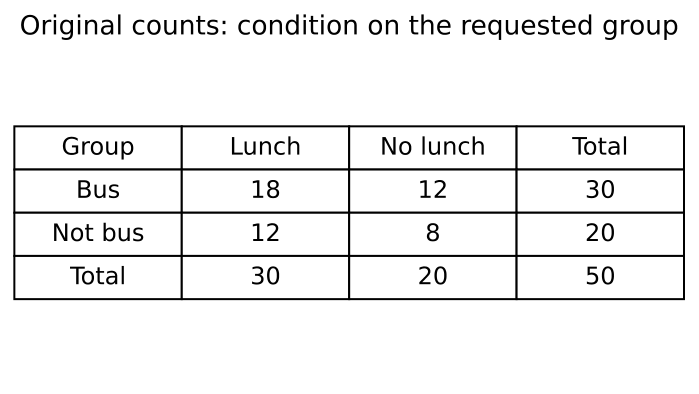
    ההסתברות המותנית מצמצמת את המכנה. מבין 40 חברי המועדון, 12 רוכבים אופניים; 8 מרוכבים אלו לובשים קסדה. $P(H\mid C)=n(H\cap C)/n(C)=8/12=2/3$. הקבוצה היא הרוכבים, ולכן 40 אינו המכנה הזה.

    דוגמה פתורה מקיימת הוראה מקומית; משימות העברה משתמשות בנתונים משלהן.
    דוגמה פתורה מקיימת הוראה מקומית; משימות העברה משתמשות בנתונים משלהן.

    דוגמא פתורה קיימת: ספורים מקוריים: משתמשי אוטובוס—18 נושאים ארוחת צהריים מובאת, 12 אינם; לא-משתמשי אוטובוס—12 נושאים ארוחה, 8 אינם. סך הכל 50. P(ארוחה)=30/50=0.6; P(ארוחה נתונה אוטובוס)=18/30=0.6; P(אוטובוס נתונה ארוחה)=18/30=0.6 בטבלה מאוזנת זו. שינוי תא אחד ואינם חייבים להישאר שווים. P(אוטובוס וארוחה)=18/50=0.36, שווה כאן ל-0.6·0.6, ולכן הטבלה מראה עצמאות של קטגוריות אלו.

    השלמת ההקשר המקורי

    כל שאלת העברה מציגה את כל הנתונים הנדרשים לה.

    אימון עצמאי וחשיבה מאומתת

    העברה 1

    סקירה מקליטה 12 שותי תה ו-8 לא-שותי תה מבין 20 רוכבי אופניים; מבין 30 הולכים, היא מקליטה 9 שותי תה ו-21 לא-שותי תה. מצאו $P(tea)$, $P(tea\mid cyclist)$ ו-$P(cyclist\mid tea)$.

    הסבר: סך שותי התה הם 21 מתוך 50, ולכן $P(T)=21/50$. בתוך רוכבי האופניים, $P(T\mid C)=12/20=3/5$. בתוך שותי התה, $P(C\mid T)=12/21=4/7$. מכנים שונים אלו גורמים להסתברויות המותניות לא להיות שוות.

    העברה 2

    באותה סקירה, האם שתיית תה ורכיבה על אופניים הם עצמאיים? האם הם בלתי-תואמים? השתמשו במספרים לשתי התשובות.

    הסבר: הם אינם עצמאיים כי $P(T\mid C)=3/5\ne21/50=P(T)$. הם אינם בלתי-תואמים כי 12 נבחרנים עושים שניהם: $P(T\cap C)=12/50>0$.

    העברה 3

    נבחר נשאל באופן אחיד. מצאו את הסיכוי להליכה או שתיית תה, כולל אלו שעושים שניהם.

    נימוק: השתמשו בעיקרון הכללה והכללה. $P(W\cup T)=(30+21-9)/50=42/50=21/25$. יש לא לספור את 9 הולכים ושותים התה פעמיים. באופן שקול, שלבו את 8 רוכבי האופניים שאינם שותים תה.

    מגבלות ושימוש עתידי

    תשובות תנאי שוות בטבלה אחת הן מקרה או מבנה לבדיקה, ולא חוק אוניברסלי. תנאו קודם, ואז ספרו.

    כל המשימות כאן הן אימון מקורי ציבורי עם הדרכה שנכתבה. הן אינן שאלות רשמיות או אבחונים חדשים. מבחנים ומדמים מוגנים קיימים נשארים בנפרד.
    מילון מונחים
    English עברית
    conditional probability/kənˈdɪʃənl ˌprɒbəˈbɪlɪti/ הסתברות תנודית
    independent events/ˌɪndɪˈpendənt ɪˈvents/ אירועים בלתי תלויים
  • 17

    PSDA-inference · Sampling, margin of error and causal claims

    תוכנית לימוד תגיע בקרוב

    חומר עזר

    היקף ותנאי מקדימים

    מסגרת Digital SAT; אימון נייר מקורי הוא לא אדפטיבי ואינו מספק תחזית לציון מוקנה.

    • פרש הערכת דוגמה ומרווח השגיאה המצוין
    • הבדל בין דגימת קבלה אקראית לבין הצבה אקראית
    • זיהוי האוכלוסייה והטווח הק ausal המעודף על ידי מחקר

    תנאי קדם: אחוזים; אוכלוסיות; בחירה אקראית מול הטלה אקראית.

    הסבר ובחירת השיטה

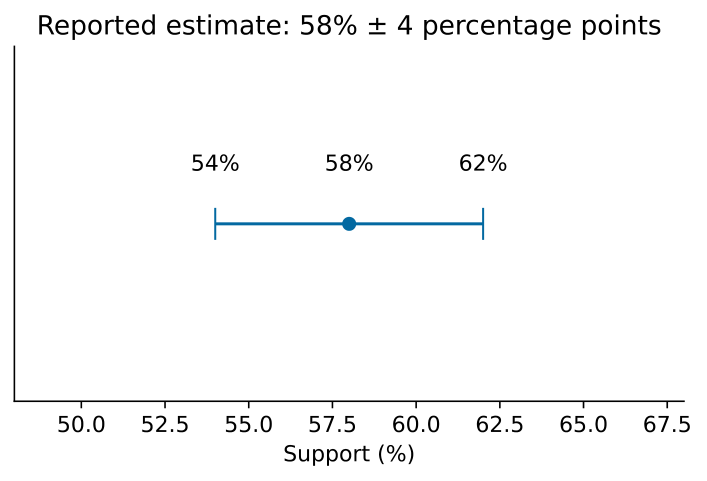
    סטטיסטיקת דוגמה מעריכה גודל באוכלוסייה. הערכה מדווחת של 58% עם מרווח שגיאה של 4 נקודות אחוז מספקת טווח מ-54% עד 62% לפי הנהגה המצוינת. הדבר אינו פירושו ש-58% מהנשאלים ענו בשגיאה של ארבע אחוזים, ואינו מבטיח שכל דגימה פרטית מכילה את הערך האמיתי.

    דגימת קבלה אקראית מייצגת עוזרת לגנרליזציה לאוכלוסייה ממנה נלקחה. דגימות נוחות או תגובה בהתנדבות יכולות להיות חקורות גם כשהן גדולות. הגדלת דוגמה מתוכננת היטב מפחיתה בדרך כלל משתנה דגימה ומרווח שגיאה באותה רמת סמך, אך אינה יכולה לתקן אוטומטית קבוצה שנשללה במאורגן.

    הצבה אקראית מחלק משתתפים בקבוצות טיפול ותומכת בהסקה ק ausal על ידי איזון גורמים מתחרים בממוצע. דגימת קבלה אקראית קובאת מי משתתף. ניסוי מקרי המבוצע רק בהתנדבים עשוי לתמוך באפקט טיפול עבור המשתתפים שלו ללא יצירת עובדה שכל האנשים חווים אותו אפקט.

    מחקר צפייה מודד הבדלים קיימים ללא הצבת טיפול; קשר יכול לשקף השפעה משתנית. השוואה בין סטודנטים הנבחרים לייעוץ נוסף לבין אלו שלא, עשויה לערבב ייעוץ עם מotivation או הישגים קודמים. כדי להעריך טענה, זהו בחירה, הצבה, השוואה, תוצאה נמדדת ואת האוכלוסייה המדויקת לפני קבלת הסקה ק ausal או גנרליזציה רחבה.

    שגיאת סטייה נוספת ומוחזרת באחוזים נקודתיים. הערכת 63% עם שגיאת 4 נקודות נותנת 59%–67%. זהו מרווח ממסלול, ולא הבטחה שתשובתו של כל אדם קרובה ל-63%. דגימה אקראית תומכת בהסקות לגבי אוכלוסייה; הקצה אקראי מטפל בהשוואות טיפול.

    דוגמה פתורה מקיימת הוראה מקומית; משימות העברה משתמשות בנתונים משלהן.
    דוגמה פתורה מקיימת הוראה מקומית; משימות העברה משתמשות בנתונים משלהן.

    דוגמה פתורה קיימת: דגימת קבלה אקראית של 400 תלמידים בתוך בית ספר מציגה 58% תמיכה ±4 נקודות אחוז: הטווח המצוין הוא 54%–62%. זה מעריך את אוכלוסיית בית הספר המדוגמת, ולא את כל התלמידים בעולם. אם מתנדבים מוצבים אקראית לשתי שיטות לימוד, הפרש תוצאות מבוקר יכול לתמוך בהשוואה ק ausal בין המשתתפים; בחירת מתנדבים עדיין מגבילה גנרליזציה רחבה יותר.

    השלמת ההקשר המקורי

    כל שאלת העברה מציגה את כל הנתונים הנדרשים לה.

    אימון עצמאי וחשיבה מאומתת

    העברה 1

    דגימה אקראית של 500 חברי ספרייה רשומים דוחה על תמיכה של 62% לשינוי, עם שגיאת סטייה מצוינת של 4 נקודות אחוז. ציין את המרווח והאוכלוסייה. האם זה מקיים תמיכה בכל תושב העיירה?

    הסבר: המרווח הוא $62\%-4\%=58\%$ עד $62\%+4\%=66\%$, כאשר החיסור מציין נקודות. האוכלוסייה היא חברי ספרייה רשומים במסגרת הדגימה. לא-חברים לא נדגמו, ולכן ההערכה לא מקיימת תמיכה של כל התושבים.

    העברה 2

    ארבעים מתנדבים הוקצו אקראית להנחיות ישנות או חדשות, עם אותה משימה ותנאים. קבוצת החדשים הסתיימה מהר יותר. אילו טענות סיבה ואוכלוסייה סבירות?

    הסבר: הקצה אקראי תומך בהשוואה סיבתית בין גרסאות ההנחיות עבור משתתפים אלו בתנאי המבחן, תחת משתנה. בחירת מתנדבים מגבילה הכללה לאוכלוסייה. זה לא מקיים שכל משתמש עתידי יסיים מהר יותר.

    העברה 3

    סקר של 10000 מתנדבי אתר יש לו שגיאת סטייה דוחה צרה. הסבר מדוע גודל לבדו לא יכול לתקן הטיית בחירה, והציע שיטת גיוס טובה יותר.

    הסיבה: אנשים הנבחרים לענות עשויים להשתנות באופן שיטתי מאלו שאינם עונים. גבול לשונות דגימה אינו מסיר את הטייה זו. יש לבחור אקראית מתוך אוכלוסיית היעד המוגדרת ולעקוב אחרי חוסר תגובה; יש לדווח על מגבלות.

    מגבלות ושימוש עתידי

    גודל דגימה, בחירה אקראית והקצהת אקראית אינם מתחלפים. מרווח צר אינו מסיר עיוות בחירה.

    כל המשימות כאן הן אימון מקורי ציבורי עם הדרכה שנכתבה. הן אינן שאלות רשמיות או אבחונים חדשים. מבחנים ומדמים מוגנים קיימים נשארים בנפרד.
    מילון מונחים
    English עברית
    random assignment/ˈrændəm əˈsaɪnmənt/ הקצאה אקראית
    margin of error/ˈmɑːdʒɪn ɒv ˈerə/ שגיאת המדידה
    inference/ˈɪnfərəns/ מסקנה
  • 18

    GT-scale · Scale factors, angle relationships and triangles

    תוכנית לימוד תגיע בקרוב

    חומר עזר

    English

    Scope and prerequisites

    Digital SAT framework; original paper practice is nonadaptive and gives no scaled-score prediction.

    • Apply length, area and volume scaling to similar figures
    • Use parallel-line angles and triangle sums to find unknowns
    • Distinguish similarity 相似 from congruence 全等 and adequate information

    Prerequisites: Triangle sum; Pythagoras; length/area/volume units.

    Explain and choose the method

    For similar figures with length scale k, corresponding lengths scale by k, areas by k² and volumes by k³. These laws apply when all corresponding dimensions change together. A cylinder with only radius doubled and fixed height has four times the volume, not eight times. State which dimensions are scaled before choosing the power.

    Use the correct geometric measure: triangle area is half base times perpendicular height 垂直高度; cylinder volume is base area times height. Surface area adds exposed faces, while volume measures enclosed space. A slant length is not automatically the perpendicular height required by an area formula. Attach square or cubic units to the result.

    Vertical angles are equal. For parallel lines cut by a transversal, corresponding and alternate interior angles are equal, and same-side interior angles sum to 180°. A triangle’s interior angles sum to 180°; its exterior angle equals the sum of the two remote interior angles. These rules depend on stated or marked parallelism, not the drawing’s appearance.

    Similar triangles share corresponding angles and proportional corresponding sides; congruent triangles also have equal corresponding lengths. Two angles establish similarity but not size equality. Maintain correspondence when writing a ratio. A side–side–angle arrangement does not universally guarantee congruence, whereas side–angle–side includes the angle between the two sides.

    A scale factor 比例因子 $k$ changes every corresponding length. $A_2=k^2A_1$ and $V_2=k^3V_1$ for similar shapes. If $k=3/2$ and $A_1=24\,\mathrm{cm^2}$, $A_2=(3/2)^2(24\,\mathrm{cm^2})=54\,\mathrm{cm^2}$. Changing only one dimension does not justify these similarity rules.

    Original worked example from existing native teaching; transfer tasks use their own data.
    Original worked example from existing native teaching; transfer tasks use their own data.

    Existing worked example: Two similar solids have edge ratio 2:3, so surface-area ratio is 4:9 and volume ratio 8:27. A triangular garden with base 12 m and perpendicular height 5 m has area 30 m². If a triangle has interior angles 48° and 67°, its third is 65° and the adjacent exterior angle is 115°=48°+67°.

    Complete original context

    Every transfer question states all data it needs.

    Independent practice and checked reasoning

    Transfer 1

    Similar containers have surface areas 96 and 216 square centimetres. The smaller volume is 160 cubic centimetres. Find the larger volume.

    Reasoning: $k=\sqrt{A_2/A_1}=\sqrt{216/96}=3/2$. Volume uses the cube: $V_2=k^3V_1=(3/2)^3(160\,\mathrm{cm^3})=540\,\mathrm{cm^3}$. Using area ratio directly would give the wrong volume.

    Transfer 2

    A right triangle has hypotenuse 13 cm and one leg 5 cm. Find the other leg, its area, and the sine of the angle opposite the 5 cm leg.

    Reasoning: $b=\sqrt{c^2-a^2}=\sqrt{(13\,\mathrm{cm})^2-(5\,\mathrm{cm})^2}=12\,\mathrm{cm}$. $A=ab/2=(5\,\mathrm{cm})(12\,\mathrm{cm})/2=30\,\mathrm{cm^2}$. $\sin\theta=a/c=(5\,\mathrm{cm})/(13\,\mathrm{cm})=5/13$.

    Transfer 3

    Two interior angles of a triangle are 42° and 73°. Find the third angle and its adjacent exterior angle. Would those angles alone determine all side lengths?

    Reasoning: Third angle is $180-42-73=65$ degrees. Its adjacent exterior angle is $180-65=115$ degrees, also $42+73$. Angles establish shape, not scale; similar triangles can have different side lengths.

    Transfer 4

    Two parallel lines are cut by a transversal. One corresponding angle is 68°. Find its matching corresponding angle and the adjacent angle on the second line. Explain which given condition justifies each step.

    Reasoning: Parallelism gives the matching corresponding angle 68°. The adjacent pair forms a straight angle, so the other is 180°−68°=112°. Equal corresponding angles require the stated parallel lines; the straight-angle sum uses adjacency on one line. A similar-looking sketch without parallelism would not justify the first equality.

    Limits and next use

    Use k² or k³ only when the entire shape is scaled; do not infer parallel lines or a perpendicular height from an unmarked sketch.

    All tasks here are public original practice with authored guidance. They are not official questions or fresh diagnostics. Existing protected tests and mocks remain separate.

    מילון מונחים
    English עברית
    perpendicular height/ˌpɜːpənˈdɪkjʊlə haɪt/ גובה אנכי
    scale factor/skeɪl ˈfæktə/ גורם קנה מידה
    similarity/ˌsɪmɪˈlærɪti/ דמיון
    congruence/ˈkɒŋɡruːəns/ חפיפה
  • 19

    GT-circles · Circle equations, arcs and unit-circle trigonometry

    תוכנית לימוד תגיע בקרוב

    חומר עזר

    English

    Scope and prerequisites

    Digital SAT framework; original paper practice is nonadaptive and gives no scaled-score prediction.

    • Recover circle centre and radius by completing the square
    • Convert central angles and calculate arc length 弧长 and sector area
    • Use tangent 切线, inscribed-angle and unit-circle relationships

    Prerequisites: Complete the square; radius; radians; right-triangle ratios.

    Explain and choose the method

    A circle with centre (h,k) and radius r satisfies (x-h)²+(y-k)²=r². For an expanded equation, complete the square in x and y and add the balancing constants to the other side. The resulting right side must be positive for a real nondegenerate circle. Keep the radius distinct from its square.

    A central angle θ in radians gives arc length rθ and sector area r²θ/2. In degrees, use the fraction θ/360 of the full circumference or area. A full turn is 2π radians=360°. The formulas rθ and r²θ/2 require radians; inserting degrees without conversion gives a wrong scale.

    A tangent at a circle point is perpendicular to the radius there. An inscribed angle is half the central angle subtending the same arc; an angle subtending a diameter is a right angle. Identify the actual shared arc and centre before applying these statements. A chord is not a tangent and need not be perpendicular to a radius unless further conditions establish it.

    On the unit circle, a point at angle θ has coordinates (cos θ,sin θ), so cos²θ+sin²θ=1. Signs depend on quadrant. For acute complementary angles, sin θ=cos(90°-θ). Use special triangles for exact values: at 30° the sine is 1/2 and cosine √3/2; at 45° both are √2/2.

    Complete both squares in a circle equation 圆方程 . $x^2+y^2+6x-8y=0$ becomes $(x+3)^2+(y-4)^2=25$. The centre is $(-3,4)$ and radius is 5. Arc length is $s=r\theta$ only for radian 弧度 angle $\theta$.

    Original worked example from existing native teaching; transfer tasks use their own data.
    Original worked example from existing native teaching; transfer tasks use their own data.

    Existing worked example: x²+y²-4x+6y-12=0 becomes (x-2)²+(y+3)²=25, giving centre (2,-3), radius 5. For radius 6 and central angle π/3, arc length is 2π and sector area 6π. An inscribed angle on that same 60° arc is 30°. At 150°, cosine is -√3/2 and sine 1/2 because the point is in quadrant II.

    Complete original context

    Every transfer question states all data it needs.

    Independent practice and checked reasoning

    Transfer 1

    Find the centre and radius of $x^2+y^2-8x+2y+8=0$. Does $(7,-1)$ lie on it?

    Reasoning: Complete squares to get $(x-4)^2+(y+1)^2=9$. Centre $(4,-1)$, radius 3. Substitution of $(7,-1)$ gives $3^2+0^2=9$, so it is on the circle.

    Transfer 2

    A sector has radius 8 cm and angle 135°. Find its angle in radians, arc length and area. An inscribed angle elsewhere on the circle intercepts this same arc; find it.

    Reasoning: $\theta=135\pi/180=3\pi/4$ radians. $s=r\theta=(8\,\mathrm{cm})(3\pi/4)=6\pi\,\mathrm{cm}$. $A=r^2\theta/2=(8\,\mathrm{cm})^2(3\pi/4)/2=24\pi\,\mathrm{cm^2}$. The inscribed angle is half the central angle: 67.5 degrees.

    Transfer 3

    A unit-circle point is in quadrant III and has $y=-1/2$. Find its $x$-coordinate and one angle between 0° and 360°.

    Reasoning: $x^2+y^2=1$ gives $x^2=3/4$. Quadrant III requires $x<0$, so $x=-\sqrt3/2$. The point is at 210 degrees, with reference angle 30 degrees.

    Limits and next use

    Check degree/radian units, centre signs and whether an angle is central or inscribed before applying the formula.

    All tasks here are public original practice with authored guidance. They are not official questions or fresh diagnostics. Existing protected tests and mocks remain separate.

    מילון מונחים
    English עברית
    circle equation משוואת עיגול
    arc length/ɑːk leŋθ/ אורך קשת
    tangent/ˈtændʒənt/ משיק
    radian/ˈreɪdɪən/ רדיאן
  • 20

    RW-central · Central ideas, details and the scope of a claim

    תוכנית לימוד תגיע בקרוב

    חומר עזר

    היקף ותנאי מקדימים

    מסגרת Digital SAT; אימון נייר מקורי הוא לא אדפטיבי ואינו מספק תחזית לציון מוקנה.

    • הבדל בין הטענה המרכזית של הטקסט לדוגמה התומכת בה
    • פרשן פרטים מבלי להרחיב את תחום הפעולה שלהם
    • בחר סיכום מדויק המכסה את כל הטקסט

    תנאי קדם: זיהוי נושא הפרגراف; הבחנה בין עובדה נאמרת למסקנה.

    הסבר ובחירת השיטה

    קראו כדי לזהות את הקשר המנחה במאמר: בעיה ותגובה, ניגוד, הסבר או טענה מוקפדת. תווית נושא כגון "אוספים במוזיאונים" מזוהה את הנושא אך לא את מה שאומר עליו המחבר. נסח את הנקודה המרכזית במשפט קצר לפני השוואת האפשרויות.

    פרט תומך ממחיש, מסביר או מקדל טענה זו. ייתכן שהוא יהיה זכיר גם אם אינו הרעיון המרכזי. אם המאמר מביא שני דוגמאות לגישה משופרת, סיכום על דוגמה אחת בלבד יהיה צר מדי. אם הוא מדווח על אוסף אחד, מסקנה על כל האוספים תהיה רחבה מדי.

    שמרו על היקף ובוטחות. ביטויים כמו "חלקם", "ייתכן" ו"במחקר זה" הם הגבלות משמעותיות. תשובה יכולה להשתמש בלשונית המקור תוך שינוי הטענה מאפשרות לבטח גמור. בדקו את העצם, הפעולה וההקפדה בתשובה מול המאמר, ולא רק את מספר המילים המשותפות.

    כששאלה עוסקת בפרט ספציפי, ענו על משימה הצרה הזו ולא בחרו את הרעיון המרכזי מתוך הרגל. מצאו את המשפט הרלוונטי, קראו את ההקשר הסמוך ובדילו בין מה שנאמר במפורש לבין סיבה שהוצעה. ידע קודם אינו נדרש ואינו אמור לספק ראיות חסרות.

    הרעיון המרכזי הוא הקשר שמחבר את הטקסט יחד. קריאה: “הקפה לתיקון קיבלה תחילה רק מנורות. מאוחר יותר הוסיפה מאווררים קטנים לאחר שהמתנדבים קיבלו הכשרה. מכשירים גדולים עדיין הלכו לחנויות מומחות.” סיכום תקין הוא: הקפה הרחיב את התיקונים בתוך גבולות. “היא תיקנה הכל” מתעלם מהמשפט האחרון. “היא תיקנה מנורות” משליטה את השינוי.”

    תרשים מקורי של הקשר העבודה; קראו את כל הניסוח וההגבלות.
    תרשים מקורי של הקשר העבודה; קראו את כל הניסוח וההגבלות.

    דוגמה פתורה קיימת: מאמר מקורי: "הארכיון העירוני דיגיטל תחילה את המפות המבוקשות ביותר. חוקרים יכלו לבדוק מפות אלו מרחוק, מה שמפחית טיפול חוזר במקורות שבירים. העובדים המשיכו להציע גישה מופקחת לפריטים שלא尚 לא סורקו." רעיון מרכזי: דיגיטליזציה מותאמת שיפרה גישה והגנה בעוד שהגישה הפיזית המשיכה. "כל המפות הפכו לזמינות אונליין" מגזים את ההיקף; "הארכיון ביטל ביקורים" סותר את המשפט האחרון.

    השלמת ההקשר המקורי

    טקסט מקורי: ארכיון העיר התחיל בניסוי בו קוראים יכלו לחפש רשומות משלוח כתובות יד באמצעות אינדקס מקוון. מתנדבים הזינו שמות ותאריכים, בעוד שעובדים בדקו רשומות שקשה לקרוא. האינדקס עזר לעיתים קרובות לחוקרים למצוא דף סביר לפני הנסיעה לארכיון. הוא לא החליף את תמונות הרשומות: שני אנשים עם אותו שם עדיין יכלו להיבדד רק בקריאת רשומות סמוכות. עובדים תיארו לכן את האינדקס כדרך לכניסה לרשומות ולא כתשובה סופית לכל שאלה. הם גם שמרו רשימה ציבורית של רשומות תוקנות כדי שהחוקרים יוכלו לראות איך האינדקס השתנה.

    אימון עצמאי וחשיבה מאומתת

    העברה 1

    ציינו את הרעיון המרכזי במשפט אחד, בשמירה על היתרון והגבול.

    הסיקה: האינדקס המבדק עוזר לחוקרים למצוא רשומות רלוונטיות, אך שימוש ברשומה המקורית נותר חיוני עבור חלק מההבחנות. זה מכסה את יתרון החיפוש ואת הגבול של אותו שם ללא טענה לדיוק מלא.

    העברה 2

    איזה פרט מסביר מדוע תמונות הרשומות נותרות חיוניות? הבדילו זאת ממטרת רשימת התקונים.

    הסיקה: אנשים עם אותו שם עשויים להזדקק לרשומות רשומה סמוכות כדי להבחין ביניהם. רשימת התקונים לעומת זאת הופכת תיקונים לגלויים; היא אינה מזיכה עצמה בכל אדם.

    העברה 3

    דחו כל סיכום מוצע בעדות ספציפיות — A “מתנדבים החליפו עובדים”; B “האינדקס הפך כל ביקור בארכיון למיותר”; C “הארכיון הסתיר שינויים באינדקס”.

    הסבר: A סותר את בדיקת הכניסות הקשות על ידי הצוות. B מגזים ב"לעיתים קרובות" ובצורך להיוועץ ברשומות הבסיסיות; הטקסט אינו אומר שכל ביקור מחליף אחר. C סותר את רשימת התיקונים הציבורית. אף אחת לא שומרת על ההיקף המפורש.

    מגבלות ושימוש עתידי

    פרט נכון עדיין יכול להיות תשובה שגויה לעיקר המצגת. שימו לב לביטויים כמו "כולם", "תמיד" ורק כאשר הטקסט מעלה טענה צרה יותר.

    כל המשימות כאן הן אימון מקורי ציבורי עם הדרכה שנכתבה. הן אינן שאלות רשמיות או אבחונים חדשים. מבחנים ומדמים מוגנים קיימים נשארים בנפרד.
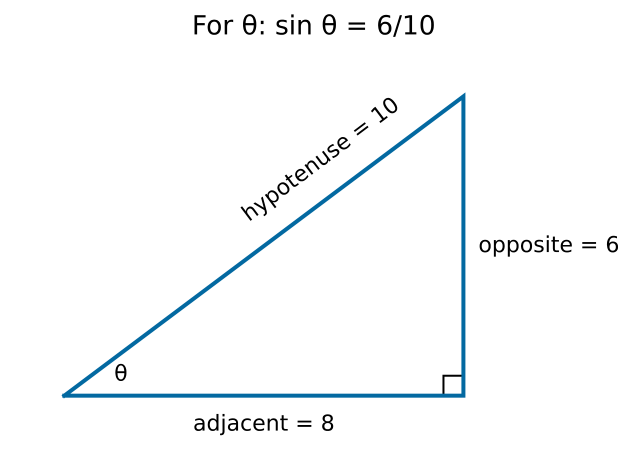
    מילון מונחים
    English עברית
    central idea/ˈsentrəl aɪˈdɪə/ רעיון מרכזי
    inference/ˈɪnfərəns/ מסקנה
    evidence/ˈevɪdəns/ עדות
    detail/ˈdiːteɪl/ פרט
    scope/skəʊp/ תחום פעילות
  • 21

    RW-evidence · Choose evidence for a precise textual or numerical claim

    תוכנית לימוד תגיע בקרוב

    חומר עזר

    English

    Scope and prerequisites

    Digital SAT framework; original paper practice is nonadaptive and gives no scaled-score prediction.

    • Choose a detail 细节 that directly supports or challenges a stated claim
    • Use a table’s labels, quantities and comparison base 比较基准 correctly
    • Separate relevance 相关性 from evidence 证据 that discriminates between explanations

    Prerequisites: Read table headings; compare proportions and counts.

    Explain and choose the method

    First translate the target claim into an evidence requirement. A claim that repeated practice helps retention needs information about retention under differing practice conditions, not simply a statement that learners enjoyed the activity. An interesting related fact may fail to support the specific relationship asserted.

    For textual evidence, identify whose claim is being tested and whether the task asks for support, challenge or completion. A quotation with familiar nouns is not enough. Ask what would become more credible or less credible if that detail were true, while preserving the passage’s actual degree of certainty.

    For quantitative evidence, read title, axes or headers, units and groups before calculating. Use before/after differences when the claim concerns improvement, final values when it concerns outcomes and proportions when group sizes differ. A larger count can represent a smaller share in a larger group.

    A numerical pattern may support a descriptive comparison without proving why it occurred. If no random assignment or controlled causal evidence is stated, avoid a causal conclusion. The original table in this lesson is a hypothetical teaching dataset, not a published study; its purpose is to practise reading the relationship.

    Evidence must support the exact claim, including its comparison base. If 9 of 15 tasks succeed, $p=n_{success}/n_{total}=9/15=60\%$. A group with more successes may still have a lower success rate 速率. Before/after data describe changes; without controlled assignment they do not prove a cause.

    Original worked example from existing native teaching; transfer tasks use their own data.
    Original worked example from existing native teaching; transfer tasks use their own data.

    Existing worked example: Original hypothetical table: Group A has 20 learners, 12 correct before and 16 after; Group B has 40 learners, 24 correct before and 28 after. Both gain four correct responses, but A’s correct share rises from 60% to 80% (20 points), while B rises from 60% to 70% (10 points). This supports “A had the larger percentage-point improvement”, not “A had more correct final responses” or a causal claim about the method.

    Complete original context

    Original hypothetical study: Two groups used a revised catalogue for a second search session. No random assignment is reported. Group P had 30 users, with 12 successful searches before and 21 after. Group Q had 50 users, with 30 successful searches before and 35 after. Each user completed one search in each session. The researchers claimed that P showed the larger percentage-point improvement, while Q still had more successful searches in the second session. A separate comment said the revision must have caused every improvement.

    Independent practice and checked reasoning

    Transfer 1

    Give the before and after success percentages and percentage-point changes for both groups.

    Reasoning: $p_P=12/30=40\%$ before and $21/30=70\%$ after, a 30-point increase. $p_Q=30/50=60\%$ before and $35/50=70\%$ after, a 10-point increase. P has the larger change; both final rates are equal.

    Transfer 2

    Which claim is supported by 35 compared with 21, and which is supported by 30 points compared with 10 points?

    Reasoning: The final counts support Q having more second-session successes. The percentage-point changes support P improving more. Exchanging those pieces of evidence would confuse final outcome with change and counts with proportions.

    Transfer 3

    Explain why the causal comment is too strong. Give one additional observation that would help investigate an alternative explanation.

    Reasoning: Session order, practice or different tasks could contribute; no randomised comparison is described. A control group using the original catalogue in both sessions under otherwise matched conditions could estimate practice effects. It would help test causation, not automatically prove that every user's improvement has one cause.

    Limits and next use

    Use the quantity named by the claim. Raw counts, relative percentages and percentage-point changes answer different questions.

    All tasks here are public original practice with authored guidance. They are not official questions or fresh diagnostics. Existing protected tests and mocks remain separate.

    מילון מונחים
    English עברית
    comparison base/kəmˈpærɪsn beɪs/ בסיס השוואה
    relevance/ˈrelɪvəns/ רלוונטיות
    evidence/ˈevɪdəns/ עדות
    detail/ˈdiːteɪl/ פרט
    rate/reɪt/ קצב
  • 22

    RW-inferences · Complete a passage with a warranted inference

    תוכנית לימוד תגיע בקרוב

    חומר עזר

    היקף ותנאי מקדימים

    מסגרת Digital SAT; אימון נייר מקורי הוא לא אדפטיבי ואינו מספק תחזית לציון מוקנה.

    • לשלב עובדות מצוין כדי להסיק מסקנה נתמכת
    • להבדיל בין תמיכה הכרחית לבין הסבר חיצוני סביר
    • לשמר חוסר ודאות ולהימנע מהערכה גורמית מוגזמת

    דרישות מקדימות: מעקב אחר ניגודים; שמירה על חוסר ודאות והיקף.

    הסבר ובחירת השיטה

    הפרד את העובדות המצוין מהקשר שאתה חייב להסיק. אם שתי תצפיות מייצרות ניגוד, המסקנה צריכה לשמר את הניגוד הזה. כתוב גשר קצר המקשר בין העדויות לפני קריאת האפשרויות; כך יהיה קל יותר לזהות הסבר מושך אך לא רלוונטי.

    הסקה אינה חובה להעתק משפט במילה אחת, אך כל שלב essential חייב להיות נתמך. טקסט הטוען כלי גלאי תכונה שלא נגלה על ידי אחר תומך בהבדל בגילוי, ולא בכך שהכלי הראשון טוב יותר לכל מטרה. ידע תחומי אינו יכול למלא דרישה שלא צוין.

    מעקב אחר קביעות וסברים חלופיים. דפוס עשוי להצביע על אפשרות ולא לקבוע ודאות. אם הטקסט מכיר מספר סיבות אפשריות, השלמה המשיימת סיבה אחת בלבד היא חזקה מדי. בדוק האם אפשרות מציגה אנשים, מקומות, מוטיבים או תקופות זמן חדשים.

    למסקנה בסוף טקסט קצר, בדוק את המעבר הלוגי: "לכן" דורש תוצאה, בעוד "אולם" עשוי להציג מגבלה. המשך קל语法י עשוי להיות לוגית לא נתמך. בחר באפשרות whose claims דורשים את מספר ההנחות הלא נתמכות הקטנות ביותר תוך מענה מלא למשימה.

    הסקה מוצדקת מחברת עובדות סופקות מבלי ליצור גורם. "תוויתות קצרות עזרו למתחילים; מומחים העדיפו תוויתות מפורטות" תומך יתרון התלוי בניסיון הקורא. הוא אינו תומך ב-"תוויתות קצרות הן תמיד הטובות ביותר" או ב-"מומטים שונאים מוזיאונים".

    תרשים מקורי של הקשר העבודה; קראו את כל הניסוח וההגבלות.
    תרשים מקורי של הקשר העבודה; קראו את כל הניסוח וההגבלות.

    דוגמה מפורטת קיימת: טקסט מקורי: "שני חיישנים ניטרו את אותו גשר. חיישן A רקב רעידות קצרות שאין חיישן B רשם, אך חיישן B פעל בהצלחה בתקופות קרות יותר כאשר A הפסיק לרקב." מסקנה מוצדקת: לחיישנים היו יתרונות משלימים בתנאים שנצפו. לא נובע מכך שאחד מהם מדויק יותר אוניברסלית או בטמפרטורה גרמה לכל ההבדלים בגילוי.

    השלמת ההקשר המקורי

    טקסט מקורי: סדנה הציעה דיאגרמה מודפסת והדמיה אנימציה של תהליך קיפול. משתתפים שהשתמשו באנימציה התחילו את הקיפול הראשון מוקדם יותר בממוצע. עם זאת, כאשר נשאלו לתקן טעות מאוחר יותר, משתתפים שהשתמשו בדיאגרמה חזרו לעיתים קרובות יותר לשלב הקודם הנכון ללא עזרה. הקבוצות היו קטנות, ומארגנים לא דיווחו האם למשתתפים היה ניסיון שווה. הם הגיעו למסקנה שבחירת עזר הוראה צריכה לקחת בחשבון את שלב המשימה.

    אימון עצמאי וחשיבה מאומתת

    העברה 1

    השלם את המסקנה עם הסקה מוצדקת לגבי שני העזרים.

    הסבר: האנימציה עשויה לעזור לאנשים להתחיל, בעוד הדיאגרמה עשויה לעזור להם לחזור לשלבים קודמים במהלך תיקון. העדויות תומכות ביתרונות נצפים שונים, המוגבלים על ידי קבוצות קטנות ועלולות לא שוות.

    העברה 2

    הסבר מדוע הטענות "אנימציות מונעות טעויות" ו"תרשימים חסרי ערך בהתחלה" אינן נתמכות.

    הסיבה: המחקד דוח על ביצועי תיקון, ולא על העדר טעויות. ההתחלה מוקדמת יותר באמצעות אנימציה אינה מצביעה על כך שאנשים המשתמשים בתרשימים לא יכולים להתחיל. שתי הטענות מחליפות התבוננויות יחסיות בטענות מוחלטות.

    העברה 3

    מחקר חדש מאזן ניסיון קודם ומגלה שיעורי תיקון שווים. הסבר כיצד הדבר משפיע על המסקנה הקודמת מבלי לטעון שהצפייה הראשונה הייתה מזויפת.

    הסיבה: הדבר מחלש את הטענה הכללית לעלות תרשימים בתיקון ומציג ניסיון כהסבר אפשרי להבדל הקודם. דגימות או שיטות שונות יכולות לייצר תוצאות שונות מבלי להופך את הצפייה הראשונה לשגויה.

    מגבלות ושימוש עתידי

    אל תמיר התנגשות מצויה לגורם יחיד או הרחב השוואה מוגבלת לעליון普遍性 (אוניברסלי).

    כל המשימות כאן הן אימון מקורי ציבורי עם הדרכה שנכתבה. הן אינן שאלות רשמיות או אבחונים חדשים. מבחנים ומדמים מוגנים קיימים נשארים בנפרד.
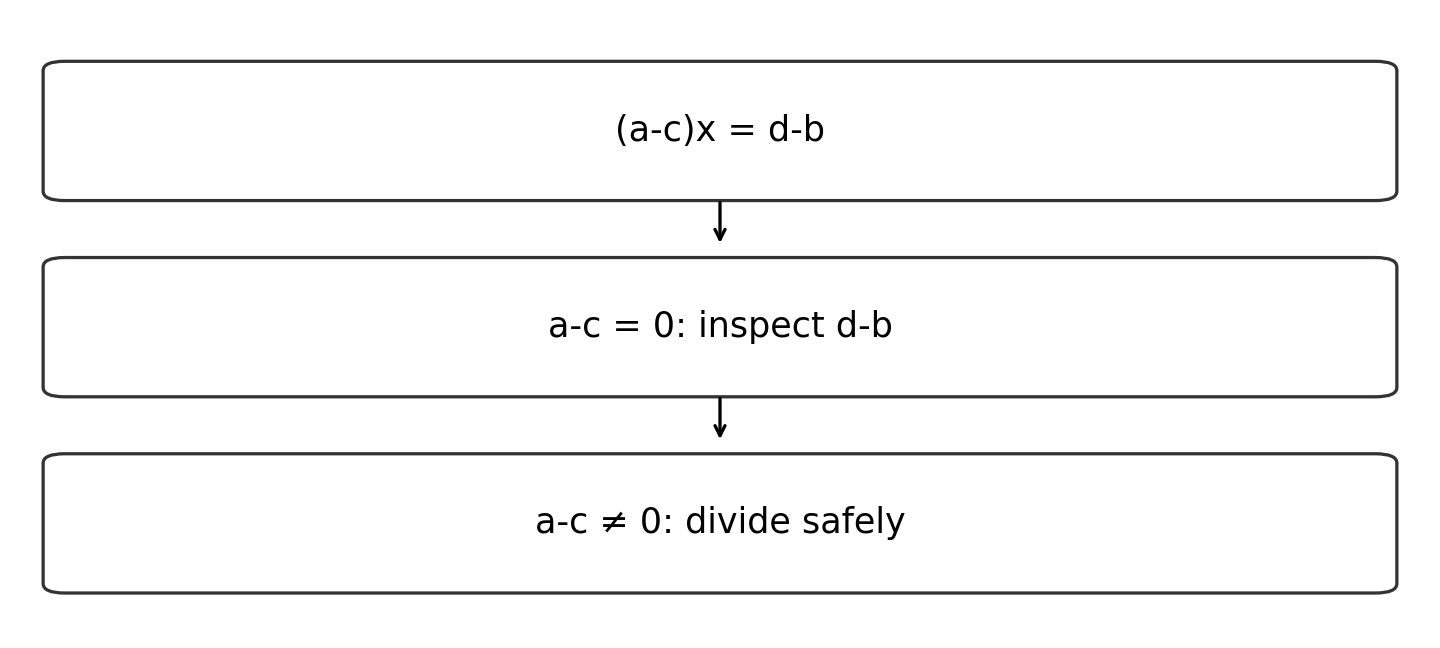
    מילון מונחים
    English עברית
    warranted inference/ˈwɒrəntɪd ˈɪnfərəns/ מסקנה מצדקת
    transition/trænˈsɪʃn/ מילולי מעבר
    inference/ˈɪnfərəns/ מסקנה
    evidence/ˈevɪdəns/ עדות
  • 23

    RW-words · Words in context: meaning, polarity and collocation

    תוכנית לימוד תגיע בקרוב

    חומר עזר

    היקף ותנאי מקדימים

    מסגרת Digital SAT; אימון נייר מקורי הוא לא אדפטיבי ואינו מספק תחזית לציון מוקנה.

    • להסיק את המשמעות הרצויה של מילה מתוך המשפט והלוגיקה הסמוכה
    • להשתמש בניגוד ובהסבר כדי לקבוע מילה חסרה
    • לבחור מילה המתאימה לדקדוק, רמת הדרשה ולקולוקציה

    תנאי מקדימים: משמעות המשפט; סימוני ניגוד והסבר.

    הסבר ובחירת השיטה

    למילה מוכרת עשויה להיות מספר משמעויות. החלף פרפרזה פשוטה במשפט ובדוק האם היא שומרת על הקשר. הקontext, ולא המשמעות הראשונה במילון, קובע האם "check" פירונו בדוק, להגביל או לסמן תשובה.

    לרווח ריק, קבע את המשמעות והקוטב הנדרשים לפני הצצה לבחירות. ניגוד המופיע עם "but" עשוי להפוך ציפייה; הסבר לאחר "because" יכול לצמצם את המשמעות הרצויה. אם המשפט אומר שהעדות מעודדת אך חסרה, מילה המשמעות זהירות או זמנית סבירה יותר מאשר ודאות.

    בדוק התאמה דקדוקית וקולוקציה לצד המשמעות. פעולה חייבת לעבוד עם האובייקט והמשלים שלה; תואר חייב לתאר את השם הנרדיף הרצוי. סינון נרדף עשוי לכשל אם הוא משמעות רמה חזקה יותר, נושא שונה או קשר שהמאמר לא מקיים.

    הימנע מהתייחסות למילים קשות כמבחן בחירת המילה המרשימה ביותר. השתמש בפרפרזה נייטרלית, סלק אפשרויות בקוטב שגוי ואז השוו בין גווני המשמעות הנותרים. שמור רשימת מילים שנלמדו בפראזות המלאות שלהן, מכיוון שקontext ושילובים נפוצים עוזרים בזכרון עתידי.

    משמעות של מילה בהקשרה חייבת להתאים לקשר, ולא רק למילון. במשפט "העדויות דלות, ולכן המסקנה נשארת זמנית", המילה "זמנית" (provisional) פירושה פתוחה לשינוי. זה לא מתייחס לתעסוקה זמנית או לצרות פיזית. ביצעו פראפרז לפני בחירה.

    תרשים מקורי של הקשר העבודה; קראו את כל הניסוח וההגבלות.
    תרשים מקורי של הקשר העבודה; קראו את כל הניסוח וההגבלות.

    דוגמה פתורה קיימת: משפט מקורי: "הוועדה נתנה לתוכנית תמיכה מוגבלת: חברי הוועדה אישרו את מטרתה אך ביקשו ניסוי קטן יותר לפני הרחבה." כאן qualified פירונו מוגבל או תנאי, לא מאומת או מומחה. רווח מקורי: "מכיוון שהצפייה היו מעטות, המחבר הגדיר את המסקנה כ___ במקום סופית." provisional מתאים לניגוד המפורש עם definitive.

    השלמת ההקשר המקורי

    הטקסט המקורי: בוחנים קבלו בחום את הרשום המוקפד של נסיעות פרטיות, אך נתנו תמיכה מוגבלת רק למסקנותיו על כל העיר. הנתיבים נבחרו לנוחות, וחלק ממחוזות העיר היו חסרים. בוחן אחד כינה את הרשום מאיר אור: הוא קלל הבנת קשיי נסיעה שנעלמו בעבר. אחר התריע שהרחבת המסקנות תדרוש דגימה רחבה יותר. הסופרים קיבלו הערה זו והציעו בדיקה נוספת.

    אימון עצמאי וחשיבה מאומתת

    העברה 1

    הסבירו מוגבל, מאיר אור והערה בטקסט זה. ציטו סימן לכל אחד.

    הסבר: מוגבל פירושו מוגבל או תנאי, נתמך בחוסר המחוזות ובצורך בדגימה רחבה יותר. מאיר אור פירושו חושף או מבהיר, נתמך בכך שקשיי הנסיעה הפכו להבנה קלה יותר. הערה פירושה חשש או הגבלה, נתמך בהתריעות לגבי הרחבת המסקנות; היא אינה מושב שמור.

    העברה 2

    השוו "הבוחנים דחו את הבדיקה" עם "הבוחנים אישרו את מסקנותיה ללא היסוס". מדוע אף אחת מהן מתאימה?

    הסבר: דחייה מתעלמת מקבלתם החמה של הרשומים המוקפדים. אישור ללא היסוס מחק את החשש מהדגימה. הגישה משלבת הערכה של הרשומים עם תמיכה מוגבלת במסקנות רחבות יותר.

    העברה 3

    החליפו מאיר אור ב-חושף, מדהים או גלוי. איזה משמר את המשמעות טוב ביותר ולמה האחרים נכשלים כאן?

    הסבר: חושף שומר על הרעיון שהרשום מבהיר את הקשיים. מדהם מציג ברק או התרשמות מעבר להבהרה המפורשת. גלוי מתאר קבלת תפיסה, לא את התרומה ההסברתית של הבדיקה. זהו החלטת משמעות בהקשר, לא חוק שאותן מילים תמיד שגויות.

    מגבלות ושימוש עתידי

    מילת חלופית המזוהה עשויה עדיין לשאת משקל או שימוש דקדוקי שגוי. אל תתעלמו מההסבר לאחר הנקודה-פסיק.

    כל המשימות כאן הן אימון מקורי ציבורי עם הדרכה שנכתבה. הן אינן שאלות רשמיות או אבחונים חדשים. מבחנים ומדמים מוגנים קיימים נשארים בנפרד.
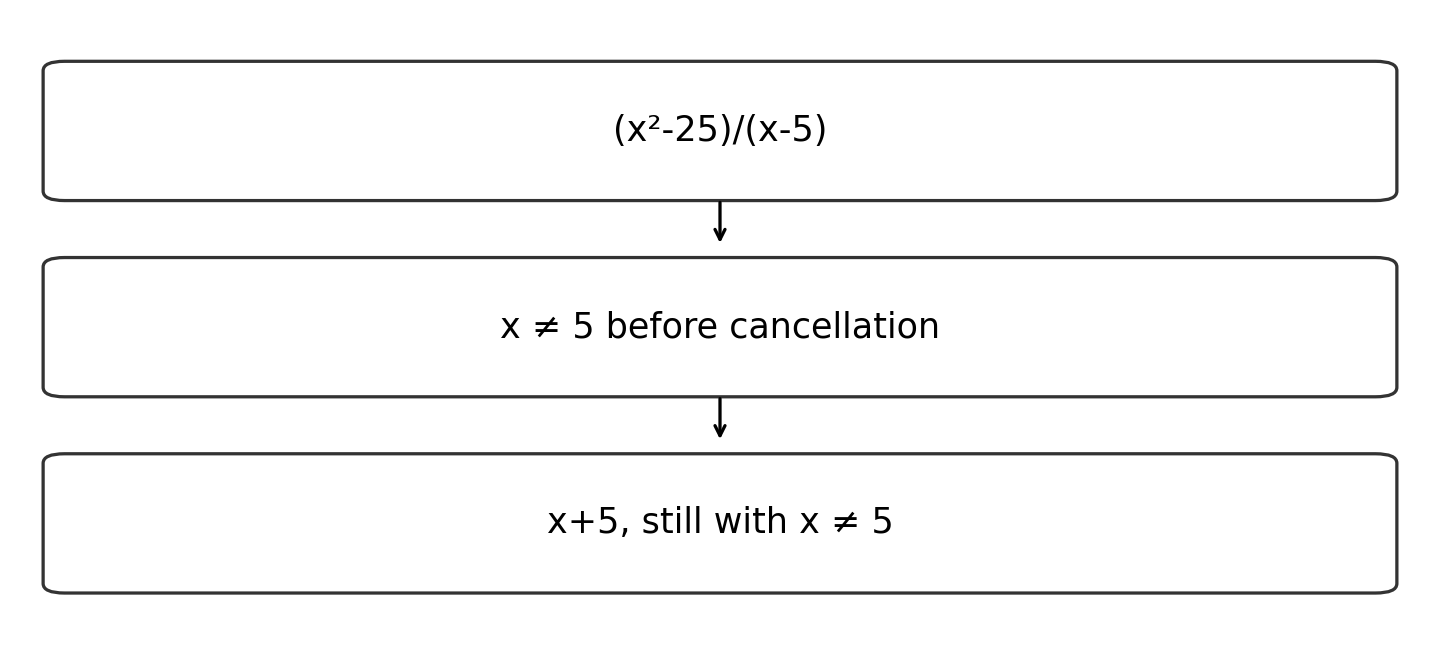
    מילון מונחים
    English עברית
    contextual meaning/kənˈtekstʃuːəl ˈmiːnɪŋ/ משמעות בהקשר
    word in context משמעות המילה בהקשר
    collocation/ˌkɒləˈkeɪʃn/ התאמת מילים
    evidence/ˈevɪdəns/ עדות
    proposal/prəˈpəʊzl/ הצעה
    syntax/ˈsɪntæks/ סינטקס
    colon/ˈkəʊlən/ נקודתיים
  • 24

    RW-structure · Text structure, sentence function and rhetorical purpose

    תוכנית לימוד תגיע בקרוב

    חומר עזר

    היקף ותנאי מקדימים

    מסגרת Digital SAT; אימון נייר מקורי הוא לא אדפטיבי ואינו מספק תחזית לציון מוקנה.

    • לזהות כיצד המאמר מפתח את הנקודה המרכזית שלו
    • להסביר את תפקידו של משפט בארגון הטיעון הגדול יותר
    • להבדיל בין המטרה של הטקסט לבין נושא העיסוק שלו

    דרישות מקדימות: לעקוב אחר רצף בעיה-תגובה; להבדיל בין דעות דיווחיות.

    הסבר ובחירת השיטה

    סכם כל חלק באמצעות פעולה: מציג בעיה, מתאר גישה, מציג עדות או מצין מגבלה. הפעולות הממוינות מתארות מבנה מדויק יותר מרשימת שמות נושאים. חפש מעבר שבו המחבר עובר רקע לטענה או מטענה לתיקון.

    לפונקציית משפט מסומן, השוו מה שמגיע לפניו ואחריו. אם הוא סותר ציפייה קודמת והמשפט הבא מסביר את ההפתעה, תפקידו עשוי להיות להציג תוצאה לא צפויה. הוא אינו בהכרח המסקנה של המחבר רק כי הוא מופיע בסוף.

    מטרה מציגה מה שהמחבר מנסה לעשות עם המידע: להסביר הבדל, לפקפק על הנחה, לנתח שיטה או לתאר תגובה. אפשרות שמציינת רק את הנושא היא חסרה. אפשרות שאומרת לשכנע קוראים לפעולה דורשת תמיכה אמיתית, ולא רק תיאור מידעתי.

    הבדל בין התנגדות שהמחבר מציג לבין דעה שהמחבר תומך בה. טענות דיווחיות, דוגמאות ומצבים הדמיים יכולים לשמש טיעון מבלי להפוך לעמדתו הסופית של המחבר. השתמש בלשון המאמר ובסימני הקשר כדי לה asign תפקידים ולא להכתיב מבנה טיעון מועדף.

    תפקיד המשפט מציין מהו התפקיד של משפט בהקשר נתון. “המכונה הייתה מהירה. היא פגעה בדפים דקים. הצוות הוסיף הגדרה עדינה יותר.” המשפט האמצעי מגביל יתרון ומניע תגובה. הכינויו כ“על דפים” שם נושא, אך לא תפקיד.

    תרשים מקורי של הקשר העבודה; קראו את כל הניסוח וההגבלות.
    תרשים מקורי של הקשר העבודה; קראו את כל הניסוח וההגבלות.

    דוגמה פתורה קיימת: טקסט מקורי: “קטלוגים בעבר קבצו חפצים אלו לפי החומר שהיו עשויים ממנו. גישה זו שימרה כלים בעלי שימושים שונים יחד. לכן, הקטלוג המשובח מוסיף תווית תפקוד לכל רשומה.” מבנה: לתאר גישה קיימת, לזהות את מגבלתה, ואז להסביר תגובה. המשפט האמצעי מספק את המגבלה המניעה את השינוי; הוא אינו טוען שהחומר אינו רלוונטי.

    השלמת ההקשר המקורי

    טקסט מקורי: מפות הליכה מוקדמות סימנו כל נתיב בקו מוצק זהה. הדבר שמר על פשטות המפה, אך הולכים לא יכולו לדעת האם נתיב כולל מעלות. מעצבים מסוימים הציעו להוסיף הערה כתובית צמודה לכל מדרגות. ניסוי במקום זאת השתמש בדפוס קו ייחודי עבור נתיבים ללא מעלות והסביר אותו בסמך ברור. לאחר מכן, הולכים זיהו נתיבים אלו בצורה מדויקת יותר בניסוי, למרות שחלק מהקוראים זקקו לעזרה כדי לשים לב לסמך. המעצבים שמרו על הדפוס והפכו לסמך בולט יותר.

    אימון עצמאי וחשיבה מאומתת

    העברה 1

    צין את המבנה הכללי באמצעות פעולות ולא רשימת נושאים.

    הסקת המסקנות: הטקסט מציג עיצוב קודם, מזהה בעיית נגישות, מדווח הצעה אחת ותגובה נבדקת אחרת, מכיל הסתייגות מצליחת הניסוי, ומתאר שיפור.

    העברה 2

    מה עושה הביטוי “למרות שחלק מהקוראים זקקו לעזרה כדי לשים לב לסמך”? מדוע זהו לא הוכחה לכשלון מלא של הניסוי?

    הסקת המסקנות: הוא מכיל הסתייגות מדויקות משופרת על ידי זיהוי מכשול שנותר. הניסוי עדיין מדווח זיהוי מדויק יותר, ולכן פרשנות של כשלון מוחלט סותרת את השיפור הנזכר.

    העברה 3

    האם המחבר תומך בהערות כתוביות צמודות לכל מדרגות? הסבר ההבדל בין דיווח על ההצעה לבין תיאור העיצוב שנשמר.

    הסקת המסקנות: ההערות הן הצעה מדווחת, ולא העיצוב שנבדק ונשמר. הגישה שנשמרת היא דפוס קו עם סמך בולט יותר. ייחס ההצעה למחבר כהמלצה סופית מאחד שלב שונים.

    מגבלות ושימוש עתידי

    אל תבלבל בין העניין של משפט לבין מה שהוא עושה, או הפוך שיטה מתוארת להמלצה ללא תמיכה בטקסט.

    כל המשימות כאן הן אימון מקורי ציבורי עם הדרכה שנכתבה. הן אינן שאלות רשמיות או אבחונים חדשים. מבחנים ומדמים מוגנים קיימים נשארים בנפרד.
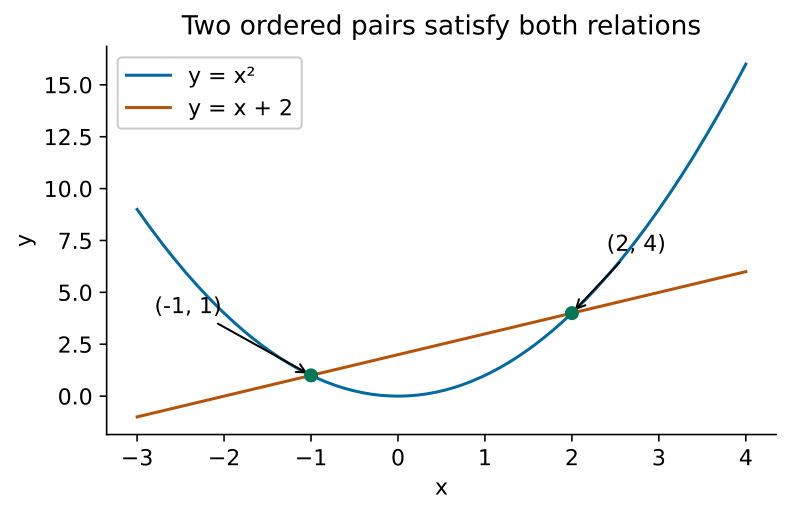
    מילון מונחים
    English עברית
    sentence function פונקציית משפט
    qualification/ˌkwɒlɪfɪˈkeɪʃn/ הגבלה
    evidence/ˈevɪdəns/ עדות
    argument/ˈɑːɡjuːmənt/ ארגומנט
    proposal/prəˈpəʊzl/ הצעה
  • 25

    RW-cross-text · Compare two texts without merging their claims

    תוכנית לימוד תגיע בקרוב

    חומר עזר

    היקף ותנאי מקדימים

    מסגרת Digital SAT; אימון נייר מקורי הוא לא אדפטיבי ואינו מספק תחזית לציון מוקנה.

    • זיהוי טענת כל מחבר ומידת ודאותה בנפרד
    • הסבר על הסכמה, אי-הסכמה או הסתייגות בנושא זהה
    • לחזות תגובה של אחד מהמחברים על פי הסיבה שציינו

    דרישות קדמיות: לשמור על הפרדת דיבורנים; להבחין בין תצפית להסבר.

    הסבר ובחירת השיטה

    לבנות רשומת טענה קצרה לכל טקסט: נושא, עמדה, עדות וגיבול. לשמור על הפרדת הדיבורנים. אם Text 1 מדווח על אפשרות ו-Text 2 מדווח על דאגה, תגובה הופכת את שניהם לוודאיים שישנה את שתי העמדות.

    להשוות טענות על אותה יחס, ולא רק על מילים משותפות. הסכמה עשויה להיקרא על יתרון בעוד אי-הסכמה נוגעת לגנרליזציה. טקסט אחד עשוי לספק עדות שאין בטקסט השני במקום להתנגד ישירות לו. לזהות בדיוק איזה proposition נתמך, נדחה או מצמצם.

    כאשר נשאל כיצד מחבר אחד יגיב, השתמש בסיבתו ובתחום הפעולה שלו. אל תבחר את观点 המועדף עליך או פשרה שתומך בה neither text. תגובה יכולה להכיר בעדות הטקסט השני תוך התנגדות למסקחת הרחבה שלו אם זה מתאים לגבול הנזכר.

    לבדוק כל משפט של התשובה. בחירה עשויה לתאר את Text 1 נכון ולהעמיס על Text 2, או לזהות אי-הסכמה אמיתית אך להגדיל את חשיבותה. לעקוב אחרי כל טענה למקור שלה. הבחירה הסופית צריכה לקשר accurately את שני הטקסטים, ולא רק לסכם אחד מהם.

    השוואה בין-טקסטית מחברת טענות על אותו נושא. "סימנים שצמצמו פניית דרכים שגויה" ו-"התאורה השתנתרה גם במהלך הניסוי" יכולים להתקיים יחד. הטענה השנייה מאתגרת הסבר סיבתי, ולא בהכרח את הצמצום המדוח.

    תרשים מקורי של הקשר העבודה; קראו את כל הניסוח וההגבלות.
    תרשים מקורי של הקשר העבודה; קראו את כל הניסוח וההגבלות.

    דוגמה מופיעה בעבר: טקסט מקורי 1: "ניסוי באחת מהגלריות מצא שתוויות ארוכות הגדילו את הזמן שהביקורים בילו בתערוכות, מה שמעיד כי תוויות מפורטות יכולות לקדם מעורבות." טקסט מקורי 2: "זמן הקריאה אינו מעיד בהכרח על מעורבות עמוקה; הביקורים עשויים לנסות להבין נוסח לא ברור." טקסט 2 ישער אם זמן לבד תומך במסקנת המעורבות של טקסט 1, ולא מכפיר בשומעת הניסוי על גידול בזמן.

    השלמת ההקשר המקורי

    טקסט מקורי א': במהלך ניסוי משני שבועות, תחנה הציגה מידע על מסלול על מסך גדול. הבקשות לכיוון רציפים ירדו מ-60 בשבועיים שקדמו ל-36. המסך נראה כדרך מבטיחה לעזור לנוסעים למצוא את רציפיהם, ועליהם לתחנות אחרות לשקול ביצוע ניסוי.

    טקסט מקורי ב': פחות בקשות צונו במהלך ניסוי המסך, אך כמה רציפים סגרו לשיפוטים בו-זמנית. הנסיעות שנותרו עשויות להיות קלות יותר לנווט. לפני היחסת הירידה למסך, יש להשוות תקופות דומות עם אותה סידור רציפים. ניסוי נוסף סביר אם הוא מפריד בין השינויים הללו.

    אימון עצמאי וחשיבה מאומתת

    העברה 1

    זהה הסכמה אחת והסכמה מדויקת או הסגה.

    הסבר: שניהם מקבלים שיורדו הבקשות המדוחות ומאפשרים ביצוע ניסוי נוסף. ב' שואלת החלוקת אשמה בירידה למסך כי סגירת רציפים שינתה גם את הניווט. ב' לא טוען שהמסך כשל בוודאות.

    העברה 2

    איך ב' יגיב בסבירות הגבוהה ביותר ל-"המסך גרם לצמצום של 40% בכל התחנות"? בדוק כל חלק מהטענה.

    הסבר: הירידה הנצפת היא $(60-36)/60=40\%$ בתחנה אחת, אך ב' דוחה את הוודאות הסיבתית ואת היקף "כל התחנות". הסגירות בו-זמנית משאירות הסבר חלופי ואין נתוני צפייה במתחנות אחרות.

    העברה 3

    הציע עדות שתטפל בחשש ב', והסבר מדוע ריאיון עם מעצב המסך לגבי הצבע שלו לא יעזור.

    הסבר: השווה תקופות דומות אחרת או ביצע ניסויים אקראיים בתחנות עם סידור רציפים תואם, וקלט בקשות ומספר נוסעים. הדבר מטפל במשתנים מערבבים ובקצבים. ריאיון על העדפת צבע אינו בודד את אפקט הניווט של המסך.

    מגבלות ושימוש עתידי

    להתנגד לפרשנות היא לא להכחיש את העובדה. שמור על עדות וקולטו של כל מחבר כנפרדים.

    כל המשימות כאן הן אימון מקורי ציבורי עם הדרכה שנכתבה. הן אינן שאלות רשמיות או אבחונים חדשים. מבחנים ומדמים מוגנים קיימים נשארים בנפרד.
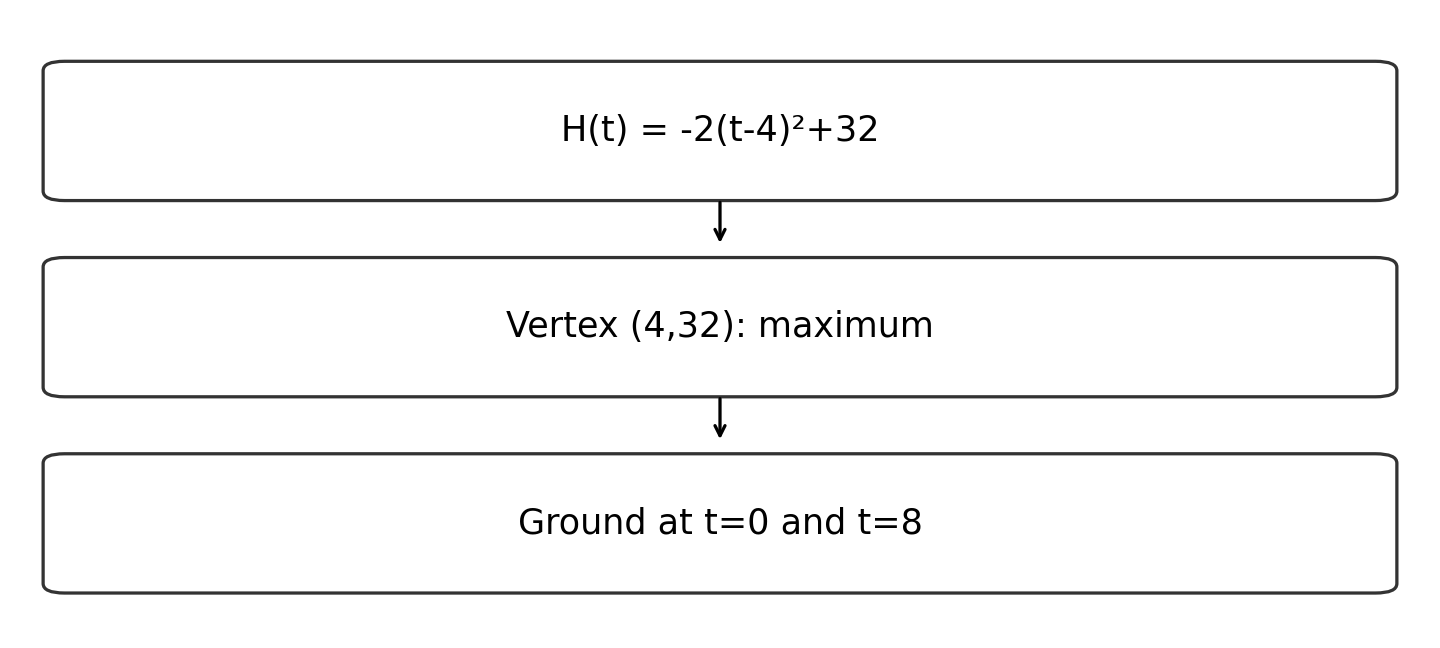
    מילון מונחים
    English עברית
    cross-text comparison השוואה בין-טקסטית
    inference/ˈɪnfərəns/ מסקנה
    evidence/ˈevɪdəns/ עדות
    interpretation/ɪnˌtɜːprɪˈteɪʃn/ פרשנות
  • 26

    RW-synthesis · Use research notes for the requested rhetorical goal

    תוכנית לימוד תגיע בקרוב

    חומר עזר

    English

    Scope and prerequisites

    Digital SAT framework; original paper practice is nonadaptive and gives no scaled-score prediction.

    • Translate a rhetorical goal 修辞目标 into a specific information requirement
    • Select relevant accurate details from notes
    • Combine notes without inventing a relationship or including irrelevant material

    Prerequisites: Read a stated rhetorical goal; preserve names, units and relations.

    Explain and choose the method

    Read the goal before the notes. Identify the action: introduce a subject, emphasise a similarity 相似, contrast two cases, give an example or explain significance. Turn it into a brief requirement such as mention both objects and their different materials. This determines which facts matter.

    Select details that carry out that action. Accurate but irrelevant information can still fail the question. For a contrast, both compared objects and the relevant difference should be present; for a similarity, a shared property should be explicit. Do not assume that including more notes makes a stronger sentence.

    Preserve relationships when combining facts. Notes saying a researcher visited a site and later published a book do not prove the visit caused the book. Avoid adding evaluative language such as revolutionary or superior unless the notes support it. Keep time, identity and numerical facts consistent.

    Compare answer choices against both goal and factual accuracy. A sentence can meet the goal while misreporting a detail 细节, or be fully accurate while answering a different goal. The correct choice must satisfy both conditions. Clear referents and concise structure help make the requested relationship explicit.

    Rhetorical synthesis 综合 修辞综合 selects facts for a purpose. Notes: A stores 12 litres; B stores 20; both use recycled glass. For a material similarity: “Both containers use recycled glass.” For a capacity difference: “B stores 8 litres more than A.” The same notes support different sentences.

    Original diagram of the worked relationship; read the full wording and qualifications.
    Original diagram of the worked relationship; read the full wording and qualifications.

    Existing worked example: Original notes: Project Alder used recycled wood; Project Birch used clay; both were temporary outdoor installations; Alder opened in May; Birch opened in June. Goal: emphasise a difference in materials. Suitable synthesis: “Although both were temporary outdoor installations, Alder used recycled wood whereas Birch used clay.” Opening months are accurate but unnecessary for this goal.

    Complete original context

    Original research notes:

    • The Bay project restored 3 km of walking paths in 2024.
    • The Hill project restored 5 km of walking paths in 2024.
    • Both projects used volunteer teams.
    • Bay used local stone for boundary markers.
    • Hill used recycled timber for boundary markers.
    • The notes give no costs, visitor counts or durability measurements.

    Independent practice and checked reasoning

    Transfer 1

    Write one sentence emphasising a similarity in staffing and a second emphasising the difference in distance restored.

    Reasoning: “Both Bay and Hill used volunteer teams.” “Hill restored 5 km of paths, 2 km more than Bay.” These select staffing and distance respectively without adding a cause.

    Transfer 2

    A student writes “Hill restored more paths because recycled timber lasts longer.” Identify every unsupported relationship.

    Reasoning: The notes do not report why Hill restored a longer distance, nor any durability comparison. They report kilometres, not the number of separate paths. A valid sentence is “Hill restored a longer total distance and used recycled timber for its markers,” without a causal link.

    Transfer 3

    Goal — contrast marker 转折标记 materials without including irrelevant detail. Write a sentence, then explain why the shared year can be omitted.

    Reasoning: “Bay used local stone for boundary markers, whereas Hill used recycled timber.” The shared year does not establish the requested material contrast. Omitting it meets this goal; a historical comparison could require it under a different goal.

    Limits and next use

    Do not mistake a factually accurate sentence for one that satisfies the rhetorical goal. Avoid unsupported causal or evaluative additions.

    All tasks here are public original practice with authored guidance. They are not official questions or fresh diagnostics. Existing protected tests and mocks remain separate.

    מילון מונחים
    English עברית
    rhetorical synthesis שילוב רטורי
    contrast marker/ˈkɒntræst ˈmɑːkə/ סמן ניגוד
    rhetorical goal/reˈtɒrɪkl ɡəʊl/ מטרה רטורית
    similarity/ˌsɪmɪˈlærɪti/ דמיון
    synthesis/ˈsɪnθəsɪs/ סינתזה
    detail/ˈdiːteɪl/ פרט
  • 27

    RW-transitions · Transitions: choose the logical relationship first

    תוכנית לימוד תגיע בקרוב

    חומר עזר

    English

    Scope and prerequisites

    Digital SAT framework; original paper practice is nonadaptive and gives no scaled-score prediction.

    • Identify contrast, consequence 结果, example and continuation relationships
    • Choose a transition 衔接词 that preserves the argument 论证’s logic
    • Distinguish logical linking from punctuation requirements

    Prerequisites: Read both sides of a blank; distinguish logic from punctuation.

    Explain and choose the method

    Temporarily ignore the blank and state how the two ideas relate. Does the next sentence add another instance, give a result, present an example, correct an expectation or shift to a different topic? A short label such as contrast is more useful than choosing a familiar connective immediately.

    Consequential transitions such as therefore need a supported result. However and nevertheless introduce contrast or concession 让步, while for example introduces an instance of a broader claim. Similarly compares a matching relationship, not merely two sentences mentioning the same noun. Use the meaning of both sides, including negatives.

    A concession acknowledges a point while maintaining a different conclusion. “The route is shorter; nevertheless, it takes longer at rush hour” contrasts distance with travel time. In fact can strengthen or correct a statement; it is not a generic substitute for additionally. Test the chosen word by paraphrasing the relationship aloud.

    Logical correctness does not remove sentence-boundary rules. However is not a coordinating conjunction joining independent clauses with a comma alone. In a transition question, supplied punctuation may already be fixed; in an editing task, punctuation also needs checking. Keep these two decisions distinct.

    A transition names a logical relationship. “The line is shorter. However, it moves more slowly” contrasts size with the expected speed benefit. “Many items can be repaired. For example, a loose cable can be replaced” moves from general statement to instance. Neither relationship is caused merely by sharing a subject.

    Original diagram of the worked relationship; read the full wording and qualifications.
    Original diagram of the worked relationship; read the full wording and qualifications.

    Existing worked example: Original passage: “The new device is smaller than its predecessor. However, it requires more frequent charging.” The second sentence limits an expected benefit; therefore would incorrectly make frequent charging a logical result of small size without evidence 证据. “Several birds use tools. For example, one species uses twigs to retrieve food” moves from a general claim to an instance.

    Complete original context

    Original passage: The new catalogue can be searched from home. [1] Readers no longer need to travel merely to find a likely shelf number. It still omits several collections. [2] A reader looking for an unlisted item must contact staff. Some entries also use abbreviations. [3] “MS” identifies a manuscript rather than a printed book.

    Independent practice and checked reasoning

    Transfer 1

    Choose the best relationships at [1], [2], [3], then supply suitable transitions. Explain each link.

    Reasoning: [1] consequence: “Therefore,” links remote search to avoiding a search-only trip. [2] consequence: “Consequently,” links missing entries to contacting staff for those items. [3] example: “For example,” introduces one abbreviation. Equivalent transitions expressing those relations are acceptable.

    Transfer 2

    Rewrite the second pair with a contrast between remote access and incomplete coverage, using however and correct sentence boundaries.

    Reasoning: “The catalogue can be searched from home; however, it still omits several collections.” A full stop before “However,” also works. However expresses a limitation but cannot join two independent clauses with a comma alone.

    Transfer 3

    Why would similarly be weak at [3], and why would therefore be weak in “The guide is free. ___, it is only available on weekdays”?

    Reasoning: The abbreviation is an instance of a general category, not a second parallel comparison, so for example is clearer. Weekday-only availability limits an advantage; being free does not by itself cause that schedule. However can express that contrast.

    Limits and next use

    Shared subject matter does not decide the link. Do not choose therefore unless a consequence is actually supported.

    All tasks here are public original practice with authored guidance. They are not official questions or fresh diagnostics. Existing protected tests and mocks remain separate.

    מילון מונחים
    English עברית
    consequence/ˈkɒnsɪkwəns/ תוצאה
    transition/trænˈsɪʃn/ מילולי מעבר
    concession/kənˈseʃn/ הכנה
    evidence/ˈevɪdəns/ עדות
    argument/ˈɑːɡjuːmənt/ ארגומנט
  • 28

    RW-boundaries · Sentence boundaries, colons and nonessential information

    תוכנית לימוד תגיע בקרוב

    חומר עזר

    היקף ותנאי מקדימים

    מסגרת Digital SAT; אימון נייר מקורי הוא לא אדפטיבי ואינו מספק תחזית לציון מוקנה.

    • הבדל בין משפטים עצמאיים ותלויים לפני בחירת פיסוק
    • חבר סעיפים שלמים ללא יצירת קטע תלוי (comma splice)
    • מיקם נקודתיים וסימני פיסוק זוגיים בהתאם למבנה המשפט

    דרישות מוקדמות: נושאים ופעלים מוגבלים; משפט עצמאי/תלוי.

    הסבר ובחירת השיטה

    סעיף עצמאי מכיל עניין ופועל מוגדר ועומד כמשפט. סעיף תלוי המופיע עם although, because או when אינו יכול לעמוד לבדו בתפקיד זה. זיהוי מבנה הסעיף לפני בחירת הפיסוק; סעיף ארוך אינו חובה להיות שלם וקצר עשוי להיות כזה.

    שני סעיפים עצמאיים ניתן להפריד בנקודה או בסימן נקודה-פסיק, או לחבר עם פסוק ומחבר הרכיבי כגון and או but. פסוק לבדו יוצר קטע תלוי. מחבר חיבורי כמו however אינו מחליף את המחבר הרכיבי: יש להשתמש ב"The test was brief; however, it was demanding.".

    נקודה זכרית יכולה להציג הסבר, דוגמה או רשימה לאחר סעיף עצמאי שלם. אין למקם אותה בין פועל לחפץ הישיר שלו או לאחר תנאי המציג את החפץ שלו. "The box contains three tools: a ruler, a compass and a square" מכיל סעיף פתיחה שלם; "The tools include: a ruler…" מפריע באופן לא תקין לבניית include.

    חומר לא הכרחי ניתן ל包裹 עם פסוקים, מקשים או סוגריים תואמים, בעוד שחומר זיהוי הכרחי לא צריך להיות מופרד בדרך זו. הסרת הזרקת לא הכרחית משאירה את ליבת המשפט שלמה. השקפ על שני הגבולות של ההזרקה והימנע מלהניח פסוק בין העניין לפועל הראשי רק בגלל שהעניין ארוך.

    קצוות משפט תלוי במבנה המשפט. "אלthough הדלת הייתה נעולה" הוא תלוי; חבר אותו למשפט עצמאי. "אלthough הדלת הייתה נעולה, העובדים יכלו להיכנס דרך שערי הצד." נקודת-תווך עוקבת אחרי משפט פתיחה עצמאי: "העובדים השתמשו בכניסה אחת: שערי הצד."

    תרשים מקורי של הקשר העבודה; קראו את כל הניסוח וההגבלות.
    תרשים מקורי של הקשר העבודה; קראו את כל הניסוח וההגבלות.

    דוגמה עבודה קיימת: מקורי: "The catalogue was incomplete; however, the surviving entries were useful." שני הסעיפים שלמים; הסימן נקודה-פסיק מפריד ביניהם וhowever מופרד בפסוק. "The team chose one method: a supervised trial" משתמש בנקודה זכרית לאחר סעיף שלם. "The catalogue, revised last year, includes new photographs" מקבל תוספת מסורת בשני פסוקים.

    השלמת ההקשר המקורי

    טקסט עריכה מקורי: אלthough התחנה הישנה נסגרה [1] השעון שלה עדיין עבד. המנגנון היה פשוט [2] עם זאת, תיקון המחוגים דרש מומחה. חלק אחד דרש החלפה [3] ציר הצר מאחורי לוח השעון. השעון [4] שעמד מעל הכניסה [5] הפך לנקודת מפגש. בתרגול זה יש שעון אחד, והמשפט with which מוסיף מידע שאינו חיוני.

    אימון עצמאי וחשיבה מאומתת

    העברה 1

    ספקו פיסוק ב-[1]–[5]. תנו לפחות גבולות תקפים שניים ב-[2] והסבירו את מבחן המשפט.

    נימוק: [1] פסיק מחבר משפט תלוי מיישם. [2] נקודת-פסיק או נקודה, כי משפט המנגנון ומשפט התיקון הם עצמאיים; יש לכתוב However באות גדולה אחרי נקודה. [3] נקודת-מיין באה לאחר המשפט השלם “One part needed replacement” ומציגה את החלק. [4],[5] פסיקים זוגיים מסמנים את המשפט התוספתי הנדרש; קווי הפסקה זוגיים או סוגריים מתאימים גם כן.

    העברה 2

    הסבירו מדוע “One part needed: a replacement” שונה מהמשפט עם נקודת-מיין תקינה במקור.

    נימוק: Needed דורש ישירות את האובייקט שלה “a replacement”; הצבת נקודת-מיין שם מפריעה ליחידה הדקדוקית הזו. ב-“One part needed replacement: the narrow axle”, המשפט העצמאי הוא כבר שלם וההסבר בא אחריו.

    העברה 3

    תיקנו “The clock, above the entrance, and the bell was restored” תוך שמירה על שני האובייקטים שנתיקנו. הסבירו התאמה ופיסוק אופציונלי.

    נימוק: “The clock above the entrance and the bell were restored.” נושא מורכב לוקח were. פסיקים סביב “above the entrance” יכולים לשמש אם היא תוספתית ולא מזהה; בחירת ההקשר הזו אינה משנה את ההתאמה המורכבת.

    מגבלות ושימוש עתידי

    ניקוד עוקב אחרי מבנה, ולא אחרי הפסקה מדומיינת בזמן קריאה. פסיק לפני however אינו מתקן בחלוטו חיבור של שני משפטים עצמאיים.

    כל המשימות כאן הן אימון מקורי ציבורי עם הדרכה שנכתבה. הן אינן שאלות רשמיות או אבחונים חדשים. מבחנים ומדמים מוגנים קיימים נשארים בנפרד.
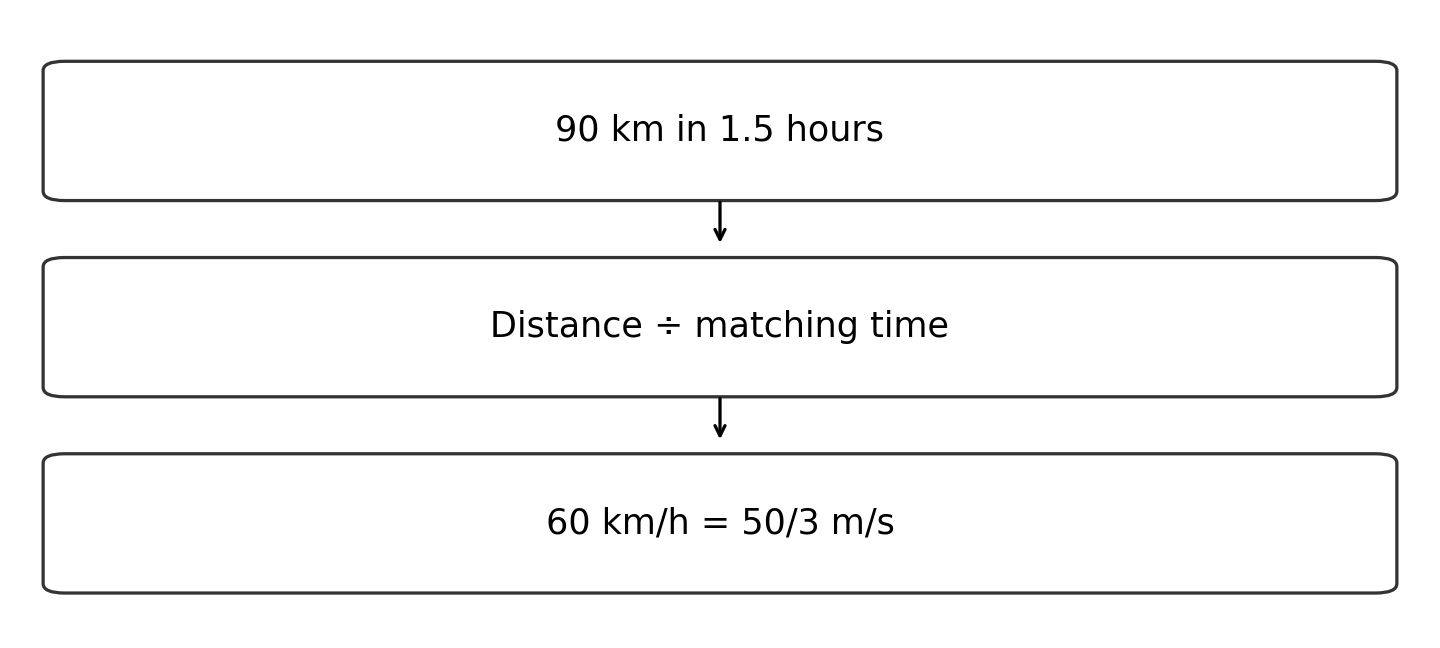
    מילון מונחים
    English עברית
    independent clause/ˌɪndɪˈpendənt klɔːz/ משפט עצמאי
    sentence boundary גבול משפט
    comma splice/ˈkɒmə splaɪs/ חיבור פסול עם פסיק
    modifier/ˈmɒdɪfaɪə/ מרכיב לשוני מתאר
    colon/ˈkəʊlən/ נקודתיים
  • 29

    RW-form · Agreement, verb forms, modifiers and logical parallelism

    תוכנית לימוד תגיע בקרוב

    חומר עזר

    היקף ותנאי מקדימים

    מסגרת Digital SAT; אימון נייר מקורי הוא לא אדפטיבי ואינו מספק תחזית לציון מוקנה.

    • התאם פועלים ופרונים לגורמים האמיתיים שלהם
    • בחר זמן וצורת פועל מהקשר הזמני של הטקסט
    • מיקם תוספות ואלמנטים מקבילים כך שהעניין הלוגי שלהם יהיה ברור

    דרישות מוקדמות: עניין ראשי; טיימליינים של פועלים; פרטיצ'יאלים ואינפיניטיבים.

    הסבר ובחירת השיטה

    מצא את עניין הראשי של העניין ולא התאים לשם הנרדה הקרובה ביותר. קבוצה יחידה לוקחת is גם כאשר phrase of הבאה מכילה שמות נרדה רבים. הפרון חייב להתאים ולהפנות בבירור לקודמו. אם שני קודמים אפשריים גורמים לפרון להיות מטושטש, שם נרדה מדויק יכול לשחזר את ההפניה הרצויה.

    בחר זמן פועל מהטיימליין הסובב והקשר הלוגי, לא ממילה מבודדת. אירוע הושלם בזמן עבר מצוין לוקח בדרך כלל צורה עבר. צורות perfect יכולות לסמן אירוע לפני זמן ייחוס אחר. אינפיניטיב או פרטיציאל אינם אוטומטית פועל מוגדר ואינם יכולים לבדם לספק את הפועל הראשי.

    תוספת פתיחה חייבת להיות מחוברת לעניין המתאים. "Walking through the gallery, Maya noticed the new labels" הופך את Maya למהלכת. "Walking through the gallery, the labels attracted Maya" שגוי כי הוא הופך את התוויות למהלכות. זיהוי המבצע של פעולת הפתיחה, ובדיקת העניין הראשי.

    מבנים מקבילים מציבים רעיונות דומים בצורות דקדוקיות תואמות: "to collect, to classify and to display" או "collecting, classifying and displaying". השוואה חייבת להשוות דברים דומים, כגון שעות של מוזיאון אחד עם שעות של מוזיאון אחר, לא שעות עם מוזיאון. משמעות ומבנה עובדים יחד; בחירה בעלת צורה דקדוקית עדיין יכולה ליצור הפניה לא לוגית.

    התאמה עוקבת אחר עניין הראשי, לא השם הנרדה הקרוב ביותר. "The set of keys is missing" מכילה set יחידה. תוספת פתיחה חייבת לתאר את השחקן הנכון: "Opening the drawer, Mina found the keys.". "Opening the drawer, the keys appeared" שגוי כי הוא הופך את המפתחות לפותחים.

    תרשים מקורי של הקשר העבודה; קראו את כל הניסוח וההגבלות.
    תרשים מקורי של הקשר העבודה; קראו את כל הניסוח וההגבלות.

    דוגמה עבודה קיימת: התאמה מקורית: "The list of proposed changes includes a longer opening period." List היא יחידה, לכן includes נכון. תיקון תוספת: "After examining the samples, the researchers revised their prediction." חוקרים בוחנים; גרסה שמתחילה "After examining the samples, the prediction…" תלויה. תיקון מקבילות: "The team aimed to record, analyse and publish the findings."

    השלמת ההקשר המקורי

    המקור המקורי: קבוצת הכלים המנופלים [1: כוללת] שלושה מקדחות ישנות. בעת בדיקת המקדחה הקטנה ביותר, [2: סדק הפתיע את ג'ו/ג'ו שמה לב לסדק]. אתמול ג'ו [3: תיקן/תיקנה] את המארז. צוות המתנדבים מתכנן לנקות, [4: לתווץ/בתיווך], ולהציג את הכלים. שעות הפתיחה של המוזיאון ארוכות מ[5: הארכיון/שעות הפתיחה של הארכיון].

    אימון עצמאי וחשיבה מאומתת

    העברה 1

    בחר צורות ב[1]–[5] והסבר תפקידם הדקדוקי והלוגי.

    נימוק: [1] כוללת תואמת לקבוצה. [2] ג'ו שמה לב לסדק הופכת את ג'ו לבוחנת. [3] תיקן תואם את אתמול. [4] לתווץ נמצא במקביל לנקות ולהציג לאחר to. [5] שעות הפתיחה של הארכיון משווה שעות לשעות, ולא שעות למוסד.

    העברה 2

    “לפני שהחנות נפתחה בשנייה האחרונה, ג'ו בדקה את המקדחות.” הסבר את הקשר הנשמע על ידי had checked. האם העבר ההולך (Past Perfect) נדרש בכל משפט על שני אירועים בעבר?

    נימוק: הבדיקה הושלמה לפני נקודת ההתייחסות בעבר, הפתיחה. העבר ההולך הופך סדר זה במפורש. אינו חובה בכל סיפור שני אירועים; before או after וקונטקסט יכולים לעיתים להבהיר סדר באמצעות עבר פשוט. השפוט על המשפט עצמו ולא על כלל אוניברסלי.

    העברה 3

    תקן “כשג'ו פגשה את מינה, היא הראתה לה את המקדחה שתוקנה” כך שג'ו תהיה בבירור זו שהצגה ומינה תקבל אותו. תן רשימה מקבילה של שלוש פעולות תחזוקה אפשריות.

    נימוק: “ג'ו הראתה למינה את המקדחה שתוקנה כשהן פגשו.” זה מסיר את החוסר בהירות בshe/her. רשימה מקבילה אחת היא “בדיקת כבלים, החלפת ברגים, וניקוי ידיות”; כל שלושתם משתמשים בצורת -ing.

    מגבלות ושימוש עתידי

    אל תתאימו עם שם בתוך ביטוי תוספה או אל תניחו לפעולה פתיחות להצמד לנושא לא-חי שאינו יכול לבצע אותה.

    כל המשימות כאן הן אימון מקורי ציבורי עם הדרכה שנכתבה. הן אינן שאלות רשמיות או אבחונים חדשים. מבחנים ומדמים מוגנים קיימים נשארים בנפרד.
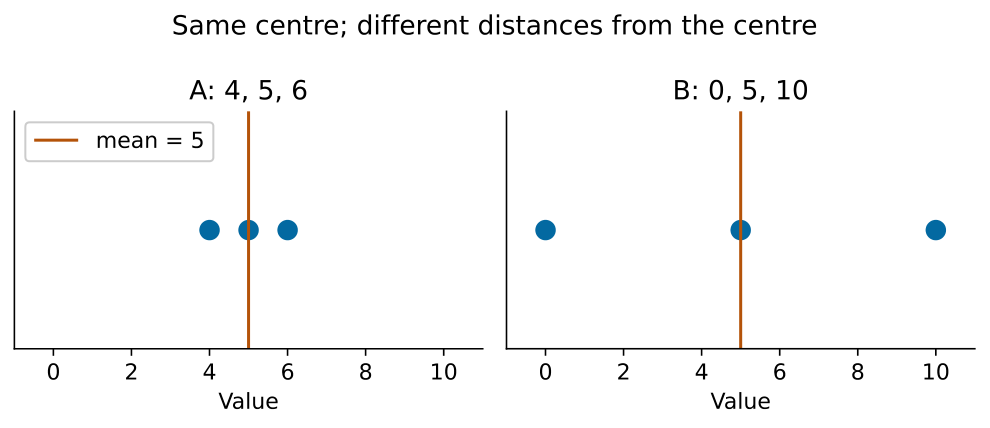
    מילון מונחים
    English עברית
    finite verb/ˈfaɪnaɪt vɜːb/ פעל מוגבל
    antecedent/ˌæntɪˈsiːdənt/ נרדף
    modifier/ˈmɒdɪfaɪə/ מרכיב לשוני מתאר

היכנס או צור חשבון

IGCSE, A-Level & AP