נגיעה במשהו חם והיד שלך כבר זזה לפני שתרגיש בכאב. זו אחת ממערכות הבקרה שלך — המהירה, העשויה מעצבי השדרה. השנייה…
English narration · English + 中文 subtitles burned in · קריאת קול באנגלית · תרגום אנגלי + סינית שרוף בתוך הסרטון
14.1
The nervous system · מערכת העצבים
Syllabus · סיילבוס
English
Core
Supplement
1 State that electrical impulses travel along neurones
2 Describe the mammalian nervous system in terms of: (a) the central nervous system (CNS) consisting of the brain and the spinal cord (b) the peripheral nervous system (PNS) consisting of the nerves outside of the brain and spinal cord
3 Describe the role of the nervous system as coordination and regulation of body functions
4 Identify in diagrams and images sensory, relay and motor neurones
5 Describe a simple reflex arc in terms of: receptor, sensory neurone, relay neurone, motor neurone and effector
6 Describe a reflex action as a means of automatically and rapidly integrating and coordinating stimuli with the responses of effectors (muscles and glands)
7 Describe a synapse as a junction between two neurones
8 Describe the structure of a synapse, including the presence of vesicles containing neurotransmitter molecules, the synaptic gap and receptor proteins
9 Describe the events at a synapse as: (a) an impulse stimulates the release of neurotransmitter molecules from vesicles into the synaptic gap (b) the neurotransmitter molecules diffuse across the gap (c) neurotransmitter molecules bind with receptor proteins on the next neurone (d) an impulse is then stimulated in the next neurone
10 State that synapses ensure that impulses travel in one direction only
עברית
ליבה
תוספת
1 ציין כי דחפים חשמליים עוברים לאורך נוירונים
2 תאר את מערכת העצבים ביונקים בהתאם ל: (א) מערכת העצבים המרכזית (CNS) הכוללת את המוח והחוט השדרתי (ב) מערכת העצבים הפריפרית (PNS) הכוללת את העצבים מחוץ למוח ולחוט השדרתי
3 תאר את התפקיד של מערכת העצבים כקואורדינציה וויסות של פונקציות הגוף
5 תאר קשת רפלקס פשוטה בהתאם ל: קולט, נוירון רגישי, נוירון מתווך, נוירון מוטורי ואפקטור
6 תאר תגובת רפלקס כתוונית לשילוב אוטומטי ומהיר של גירויים עם תגובות האפקטורים (שרירים ובלוטות)
7 תאר סינפסה כתחבורה בין שני נוירונים
8 תאר את מבנה הסינפסה, כולל נוכחות וזיקולים המכילים מולקולות נוירוטרנסמיטר, המרווח הסינפטי וחלבוני הקולטים
9 תאר את האירועים בסינפסה כ: (א) דחף מגרה את שחרור מולקולות הנוירוטרנסמיטר מהוזיקולים אל המרווח הסינפטי (ב) מולקולות הנוירוטרנסמיטר מתפשטות על פני המרווח (ג) מולקולות הנוירוטרנסמיטר נקשרות לחלבוני הקולטים בנוירון הבא (ד) דחף מוגר בנוירון הבא
10 ציין כי סינפסות מבטיחות שהדחפים יעברו רק בכיוון אחד
Source: Cambridge International syllabus · מקור: הסיילבוס הבינלאומי של קמבריד'ג'
English
The reflex arc
Your body must coordinate 协调 all its parts and react to changes. The nervous system 神经系统 does this using fast electrical impulses 电脉冲 that travel along neurones 神经元 (nerve cells). It has two parts:
the central nervous system 中枢神经系统 (CNS) — the brain 大脑 and the spinal cord 脊髓.
the peripheral nervous system 周围神经系统 (PNS) — all the nerves outside the brain and spinal cord.
The nervous system coordinates and regulates 调节 the body's functions.
עברית
קשת הרפלקסהמוח מתאם את הגוף באמצעות מערכת העצבים.
עליך להתאים את כל חלקי הגוף ולגייר לשינויים. מערכת העצבים עושה זאת באמצעות פעולות חשמליות מהירות הנעות לאורך נוירונים (תאי עצב). יש לה שני חלקים:
מערכת העצבים המרכזית (CNS) — המוח והחוט השדרתי.
מערכת העצבים הפריפרית (PNS) — כל העצבים מחוץ למוח ולחוט השדרתי.
Neurones and the reflex arc · נוירונים וקשת הרפלקס
English
There are three kinds of neurone:
sensory neurones 感觉神经元 — carry impulses from receptors to the CNS.
relay neurones 中间神经元 — pass impulses on inside the CNS.
motor neurones 运动神经元 — carry impulses from the CNS to effectors.
A reflex 反射 action is a fast, automatic response 反应 to a stimulus 刺激 (a change). It follows a fixed path, the reflex arc 反射弧:
receptor 感受器 → sensory neurone → relay neurone → motor neurone → effector 效应器 (a muscle 肌肉 or gland 腺体)
עברית
נוירון (תא עצב) מוביל פעולות חשמליות בכל הגוף.
ישנם שלושה סוגים של נוירונים:
נוירונים סנסוריים — מובילים פעולות חשמליות מקולטות אל מערכת העצבים המרכזית.
נוירונים מקשרים — ממשיכים פעולות חשמליות בתוך מערכת העצבים המרכזית.
נוירונים מוטוריים — מובילים פעולות חשמליות ממערכת העצבים המרכזית אל האפקטורים.
תגובה רפלקסית היא תגובה מהירה ואוטומטית למגרה (שינוי). היא עוברת מסלול קבוע הנקרא קשת רפלקס:
קולט → נוירון חושי → נוירון מעבר → נוירון מוטורי → אפקטור (שריר או בלוטה)
בקשת רפלקס האימפולס עובר מקולט → נוירון חושי → נוירון מעבר → נוירון מוטורי → אפקטור
Explore · חקור
The reflex arc · קשת הרפלקס
A reflex is a fast, automatic response — the signal takes a short cut through the spinal cord. · רפלקס הוא תגובה מהירה ואוטומטית — האות עובר קיצור דרך לעמוד השדרה.
14.1
Synapses (Supplement) · סינפסות (תוספת)
English
A synapse 突触 is a junction (a tiny gap) between two neurones. At the end of one neurone are vesicles 囊泡 holding neurotransmitter 神经递质 molecules. Across the synaptic gap 突触间隙, the next neurone has receptor proteins 受体蛋白.
Events at a synapse:
an impulse arrives and makes the vesicles release neurotransmitter into the synaptic gap.
the neurotransmitter molecules diffuse 扩散 across the gap.
they bind to the receptor proteins on the next neurone.
this starts a new impulse in the next neurone.
Synapses make impulses travel in one direction only.
עברית
סינפסה היא מחבר (רווח זעיר) בין שני נוירונים. בקצה אחד הנוירונים נמצאים ויזיקולים המכילים מולקולות של מוליך עצבי. מעבר לרווח הסינפטי, לנוירון הבא ישנם חלבוני קולט.
אירועים בסינפסה:
אימפולס מגיע וגורם לוויזיקולים לשחרר מוליך עצבי לתוך הרווח הסינפטי.
מולקולות המוליך העצבי מתפשטות מעבר לרווח.
הן נקשרות לחלבוני הקולט על הנוירון הבא.
תהליך זה מייצר פעולה חדשה בנוירון הבא.
הסינפסות מאפשרות לאימפולסים להעברת בכיוון יחיד בלבד.
בסינפסה, הנוירוטרנסמיטור מתפשט על פני החלל, ולכן הגירויים נעים רק בכיוון אחד
Explore · חקור
Across the synapse · חוצה את הסינפסה
Neurons don't touch — the impulse crosses the tiny gap using a chemical messenger. · נוירונים אינם נוגעים זה בזה — הפולס חוצה את החלל הקטן באמצעות משדר כימי.
1 Describe sense organs as groups of receptor cells responding to specific stimuli: light, sound, touch, temperature and chemicals
2 Identify in diagrams and images the structures of the eye, limited to: cornea, iris, pupil, lens, retina, optic nerve and blind spot
3 Describe the function of each part of the eye, limited to: (a) cornea – refracts light (b) iris – controls how much light enters the pupil (c) lens – focuses light on to the retina (d) retina – contains light receptors, some sensitive to light of different colours (e) optic nerve – carries impulses to the brain
4 Explain the pupil reflex, limited to changes in light intensity and pupil diameter
5 Explain the pupil reflex in terms of the antagonistic action of circular and radial muscles in the iris
6 Explain accommodation to view near and distant objects in terms of the contraction and relaxation of the ciliary muscles, tension in the suspensory ligaments, shape of the lens and refraction of light
7 Describe the distribution of rods and cones in the retina of a human
8 Outline the function of rods and cones, limited to: (a) greater sensitivity of rods for night vision (b) three different kinds of cones, absorbing light of different colours, for colour vision
9 Identify in diagrams and images the position of the fovea and state its function
עברית
ליבה
תוספת
1 תאר איברי חוש כקבוצות של תאי קולט המגיבים לגירויים ספציפיים: אור, קול, מגע, טמפרטורה וחומרים כימיים
2 זיהה בתרשימים ובתמונות את מבני העין, בהתמקדות ב: קרנית, איris, אישון, עדשה, רטינה, עצב האופטי ונקודה עיוורת
3 תאר את התפקיד של כל חלק בעין, בהתמקדות ב: (א) קרנית – שבירה של אור (ב) איris – שליטה בכמות האור הנכנסת לאישון (ג) עדשה – מיקוד אור על הרטינה (ד) רטינה – מכילה קולטני אור, חלקם רגישים לאור בצבעים שונים (ה) עצב האופטי – מעביר דחפים למוח
4 הסבר את רפלקס האישון, בהתמקדות בשינויים בעוצמת האור ובקוטר האישון
5 הסבר את רפלקס האישון בהתאם לפעולה אנטיגונית של שרירים מעגליים ורדיאליים באיris
6 הסבר התאמה להסתכלות על אובייקטים קרובים ורחוקים בהתאם להתכווצות והרפייה של שרירי הציליאר, מתח בגידים התלייה, צורת העדשה ושבירה של אור
7 לתאר את חלוקת המקלות והקונות ברטינה האנושית
8 לסכם את תפקיד המקלות והקונות, במגבלות: (א) רגישות גבוהה יותר של מקלות לראיית לילה (ב) שלושה סוגים שונים של קונות, סופגים אור בגוונים שונים, לראיית צבעים
⟦9 זיהוי בתרשימים ובתמונות את מיקום הפובאה ותיאור תפקודה
Source: Cambridge International syllabus · מקור: הסיילבוס הבינלאומי של קמבריד'ג'
English
Sense organs 感觉器官 are groups of receptor cells that respond to one kind of stimulus — light, sound, touch, temperature or chemicals. The eye responds to light.
Parts of the eye
Part
Function
cornea 角膜
refracts 折射 (bends) the light as it enters
iris 虹膜
controls how much light enters the pupil 瞳孔
lens 晶状体
focuses the light onto the retina
retina 视网膜
contains light receptors, some sensitive to different colours
optic nerve 视神经
carries the impulses to the brain
blind spot 盲点
where the optic nerve leaves the eye; it has no receptors
The pupil reflex
In bright light the pupil gets smaller, to protect the retina. In dim light it gets wider, to let more light in. (Supplement) This is done by two sets of antagonistic 拮抗 muscles in the iris: the circular muscles 环肌 and the radial muscles 辐射肌. In bright light the circular muscles contract and the pupil narrows; in dim light the radial muscles contract and the pupil widens.
Accommodation (Supplement)
Accommodation 视觉调节 is changing the shape of the lens to focus on near or far objects, using the ciliary muscles 睫状肌 and the suspensory ligaments 悬韧带:
near object: the ciliary muscles contract, the ligaments slacken, and the lens becomes fatter — more refraction.
far object: the ciliary muscles relax, the ligaments pull tight, and the lens becomes thinner — less refraction.
Rods and cones (Supplement)
The retina has two kinds of light receptor:
rods 视杆细胞 — very sensitive, good for vision 视觉 in dim light (night vision); they do not detect colour.
cones 视锥细胞 — three kinds, each absorbing a different colour, giving colour vision; they work best in bright light.
Cones are packed most densely at the fovea 中央凹, the part of the retina that gives the sharpest image.
עברית
איברי חוש הם קבוצות של תאי קולט המגיבים לסוג אחד של מגרה — אור, צליל, מגע, טמפרטורה או כימיקלים. העין מגיבה לאור.
חלקי העין
חלק
תפקיד
קרנית
שוברת (מעקמת) את האור כשהוא נכנס
איריס
שולטת בכמות האור הנכנס לב pupils
עדשה
ממקדת את האור על הרetinah
רטינה
מכילה קולטים לאור, חלקם רגישים לצבעים שונים
עצב视神
מעביר את האימפולסים למוח
נקודה עיוורת
המקום שבו העצב האופתי יוצא מהעין; אין בו קולטים
*האור מתמקד על ידי הקרנית והעדשה על הרטינה; הגירויים יוצאים דרך העצב האופתי
החלק הקדמי של עין אמיתית: האישון השחור הוא החריץ שמאפשר כניסת אור, והעדשה הצבעונית סביבו שולטת בכמות הפתיחה של האישון
רפלקס האישון
בתאורה חזקה האישון הופך לקטן יותר, כדי להגן על הרתina. בתאורה חלשה הוא הופך לרחב יותר, כדי לאפשר כניסת אור רבה יותר. (משלים) תהליך זה מבוצע על ידי שני סוגי שרירים אנטיגוניסטיים בעדשה: השרירים העגולים והשרירים הרדיאליים. בתאורה חזקה השרירים העגולים מתכווצים והאישון מצטמצם; בתאורה חלשה השרירים הרדיאליים מתכווצים והאישון מתרחב.
התאמה (משלים)
התאמה היא שינוי צורת העדשה כדי להתמקד על אובייקטים קרובים או רחוקים, באמצעות השרירים הסיסילריים והרצועות התומכות:
אובייקט קרוב: השרירים הסיסילריים מתכווצים, הרצועות משתחררות, והעדשה הופכת לעבה יותר — שבירה מוגברת.
אובייקט רחוק: השרירים הסיסילריים מתרפאים, הרצועות נמתחות ומשאילות את העדשה, והעדשה הופכת לדקה יותר — שבירה מופחתת.
מקלות וקונות (משלים)
לרètina יש שני סוגי קולטי אור:
מקלות — רגישים מאוד, טובים לראייה בתאורה חלשה (ראיית לילה); הם אינם זורעים צבע.
קונות — שלושה סוגים, כל אחד סופג צבע שונה, מה שמאפשר ראייה בצבע; הם עובדים הכי טוב בתאורה חזקה.
קונות צפופים ביותר בפובה, החלק ברètina שמספק את התמונה החדה ביותר.
Explore · חקור
Explore the eye · חקור את העין
Tap each part to follow light through the eye — from the cornea and lens that focus it to the retina that detects it. · לחץ על כל חלק כדי לעקוב אחר האור בעבר העין — מהקרנית והעדשה שממקדים אותו ועד לרטינה שמזהה אותו.
Explore · חקור
Accommodation — focusing the eye · הסתגלות — פוקוס העין
The eye changes the shape of its lens to focus on near or far objects. · העין משנה את צורת העדשה כדי להתמקד על אובייקטים קרובים או רחוקים.
1 Describe a hormone as a chemical substance, produced by a gland and carried by the blood, which alters the activity of one or more specific target organs
2 Identify in diagrams and images specific endocrine glands and state the hormones they secrete, limited to: (a) adrenal glands and adrenaline (b) pancreas and insulin (c) testes and testosterone (d) ovaries and oestrogen
5 State that glucagon is secreted by the pancreas
3 Describe adrenaline as the hormone secreted in ‘fight or flight’ situations and its effects, limited to: (a) increased breathing rate (b) increased heart rate (c) increased pupil diameter
6 Describe the role of adrenaline in the control of metabolic activity, limited to: (a) increasing the blood glucose concentration (b) increasing heart rate
4 Compare nervous and hormonal control, limited to speed of action and duration of effect
עברית
ליבה
תוספת
1 לתאר הורמון כחומר כימי, המיוצר על ידי בלוטה ומובהל על ידי הדם, המשנה את פעילות אבר מיקוד אחד או יותר
2 לזהות בתרשימים ובתמונות בלוטות אנדוקריניות ספציפיות ולפרט את ההורמונים שהן מפרשות, במגבלות: (א) בלוטות肾上腺 ואדרנלין (ב) pancreas ואינסולין (ג) testis וטסטוסטרון (ד) ovaries ואסטרוגן
5 לפרט שגלוקגון מופרש מהpancreas
3 תאר את האדרנלין כהורמון המופרש במצבי "קרב או בריחה" והשפעותיו, המוגבלות ל: (א) עליה בקצב הנשימה (ב) עליה בקצב הלב (ג) עליה בקוטר אישון
6 תאר את תפקיד האדרנלין בשליטה בפעילות המטבולית, המוגבלות ל: (א) עליה ברמת הגלוקוז בדם (ב) עליה בקצב הלב
4 להשוות בין שליטה עצבית וחומרית, במגבלות של מהירות פעולה ומשך השפעה
Source: Cambridge International syllabus · מקור: הסיילבוס הבינלאומי של קמבריד'ג'
English
A hormone 激素 is a chemical, made by a gland and carried in the blood, that changes the activity of one or more target organs 靶器官. Hormones are made by endocrine glands 内分泌腺, which release them straight into the blood.
Gland
Hormone
Main effect
adrenal glands 肾上腺
adrenaline 肾上腺素
prepares the body for action
pancreas 胰腺
insulin 胰岛素 (and glucagon 胰高血糖素)
control blood glucose 葡萄糖
testes 睾丸
testosterone 睾酮
male development
ovaries 卵巢
oestrogen 雌激素
female development
Adrenaline is released in 'fight or flight' situations, such as fear or danger. It increases the breathing rate, the heart rate 心率, the blood glucose concentration 浓度 and the pupil diameter, getting the body ready to act.
עברית
הורמון הוא חומר כימי, המיוצר על ידי בלוטה ומובהל בדם, המשנה את פעילותם של איברי יעד אחד או יותר. הורמונים מיוצרים על ידי בלוטות אנדוקריניות, המשחררות אותם ישירות לתוך הדם.
בלוטה
הורמון
השפעה ראשית
בלוטת הכליות
אדרנלין
מכין את הגוף לפעולה
לבלב
אינסולין (וגם גלוקגון)
שולטים ב-גלוקוז בדם
בדיקות
טסטוסטרון
התפתחות גברית
שחלות
אסטרוגן
התפתחות נשית
אדרנלין משתחרר במצבי 'קרב או בריחה', כגון פחד או סכנה. הוא מגדיל את קצב הנשימה, את קצב הלב, את הריכוז של גלוקוז בדם ואת קוטר אישון העין, ומכין את הגוף לפעולה.
אדרנלין מכין את הגוף לפעולה על ידי הפעלת מספר איברים יעד
Explore · חקור
How hormones work · כיצד הורמונים פועלים
Hormones are chemical messengers carried in the blood — slower than nerves, but longer-lasting. · הורמונים הם מסירים כימיים המושאים בדם – איטיים יותר מהעצבים, אך בעלי השפעה מתמשכת יותר.
Nervous control vs hormonal control · שליטה עצבית לעומת שליטה הורמונלית
English
Nervous control
Hormonal control
speed
very fast
slower
duration 持续时间
short-lived
longer-lasting
how it travels
electrical impulses along neurones
chemicals in the blood
עברית
שליטה עצבית
שליטה הורמונלית
מהירות
מאוד מהירה
איטית יותר
משך פעילות
קצר-לוח
מתמשך יותר
אופן ההעברה
דחימות חשמליות לאורך נוירונים
חומרים כימיים בזרם הדם
שליטה עצבית היא מהירה אך קצרה-לוח; שליטה הורמונלית היא איטית אך מתמשכת יותר
14.4
Homeostasis · הומיאוסטאזיס
Syllabus · סיילבוס
English
Core
Supplement
1 Describe homeostasis as the maintenance of a constant internal environment
3 Explain the concept of homeostatic control by negative feedback with reference to a set point
2 State that insulin decreases blood glucose concentration
4 Describe the control of blood glucose concentration by the liver and the roles of insulin and glucagon
5 Outline the treatment of Type 1 diabetes
6 Identify in diagrams and images of the skin: hairs, hair erector muscles, sweat glands, receptors, sensory neurones, blood vessels and fatty tissue
7 Describe the maintenance of a constant internal body temperature in mammals in terms of: insulation, sweating, shivering and the role of the brain
8 Describe the maintenance of a constant internal body temperature in mammals in terms of vasodilation and vasoconstriction of arterioles supplying skin surface capillaries
עברית
ליבה
תוספת
1 תאר את הביתוסטזיס כשמירה על סביבה פנימה קבועה
3 הסבר את מושל השליטה הביתוסטטית באמצעות משוב שלילי בהתייחס לנקודת ייחוס
2 ציין שאינסולין מפחית ריכוז גלוקוז בדם
4 תאר את השליטה בריכוז הגלוקוז בדם על ידי הכבד ותפקידי האינסולין והגלוקגון
5 סקור את הטיפול בסוכרת מסוג 1
6 זיהה בתרשימים ובתמונות של העור: שיער, שרירי הזקפת השיער, בלוטות הזיעה, קולטים, נוירונים חושי, כלי דם וארום
7 תאר שמירה על טמפרטורת גוף פנימה קבועה אצל יונקים במובן של: בידוד, הזעה, רעידות ומשתמש המוח
8⟧ תאר שמירה על טמפרטורת גוף פנימה קבועה בג'ידיים מבחינה של: וסודילטציה ווסוקונסקריקציה של ארטריולות המספקות קפילריות לפני שטח העור
Source: Cambridge International syllabus · מקור: הסיילבוס הבינלאומי של קמבריד'ג'
English
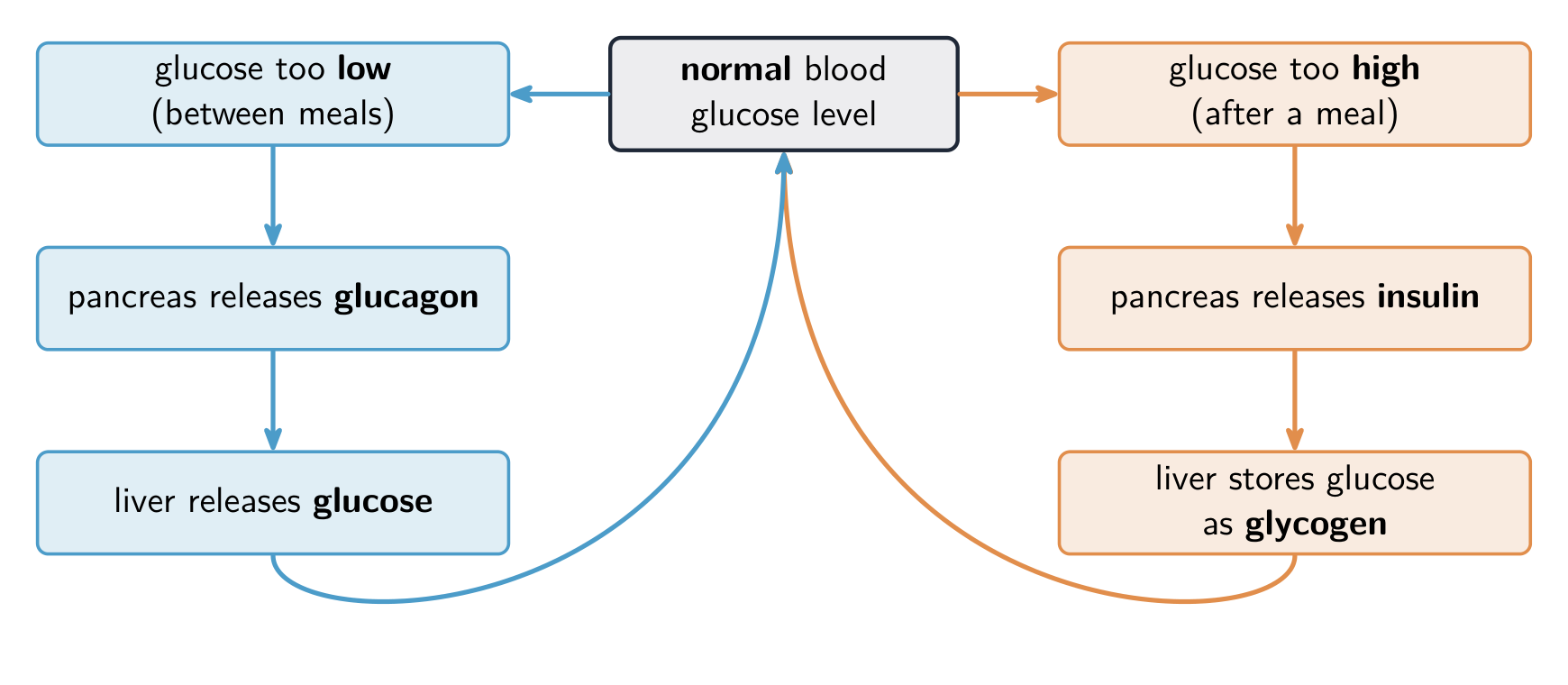
Negative feedback: blood glucose
Homeostasis 稳态 is keeping a constant internal environment 环境 inside the body — for example a steady temperature and a steady blood glucose level.
(Supplement) Homeostasis works by negative feedback 负反馈: when a value moves away from its set point 设定点, the body acts to bring it back. The change itself triggers the correction.
Controlling blood glucose
The liver 肝脏 and the pancreas keep blood glucose steady:
insulin lowers blood glucose after a meal — the liver stores the glucose as glycogen 糖原.
(Supplement) glucagon raises blood glucose between meals — the liver releases glucose.
In Type 1 diabetes 糖尿病 the pancreas cannot make insulin, so blood glucose rises too high. It is treated with insulin injections and a carefully planned diet.
Worked example. Blood glucose rises sharply after a meal, then falls back to normal over the next two hours. Name the organs and the hormone involved, and say what they do. The pancreas detects the rise and releases insulin. Insulin makes the liver take glucose out of the blood and store it as glycogen, so the level falls back to normal. Between meals the opposite loop runs: the pancreas releases glucagon and the liver releases glucose again. Keep the two words apart - insulin is the hormone, glycogen is the store. Swapping them is the classic error.
Controlling body temperature (Supplement)
The brain detects the body temperature 温度 and keeps it steady. The skin helps:
Structure
Role
sweat glands 汗腺
make sweat; as it evaporates it cools the skin (sweating 出汗)
hair erector muscles 立毛肌
raise the hairs to trap a layer of air
blood vessels 血管
change how much blood flows near the skin surface
fatty tissue 脂肪组织
gives insulation 隔热 to reduce heat loss
When you are too hot: you sweat, and the arterioles 小动脉 widen (vasodilation 血管舒张) so more blood flows to the skin capillaries 毛细血管 and loses heat.
When you are too cold: you shiver 颤抖 (the muscles make heat), and the arterioles narrow (vasoconstriction 血管收缩) so less blood reaches the surface, keeping heat in.
עברית
משוב שלילי: גלוקוז בדם
הומיאוסטאזיס הוא שמירה על סביבה פנימה קבועה בתוך הגוף – לדוגמה טמפרטורה יציבה ורמת גלוקוז בדם יציבה.
(תוסף) ההומיאוסטאזיס פועל באמצעות משוב שלילי: כאשר ערך רחוק מנקודת הגדרה שלו, הגוף פועל כדי להחזירו. השינוי עצמו מפעיל את התיקון.
שליטה ברמת גלוקוז בדם
הכבד והלבלב שומרים על יציבות רמת הגלוקוז בדם:
אינסולין מוריד את רמת הגלוקוז בדם לאחר ארוחה – הכבד מאחסן את הגלוקוז כ-גליקוגן.
(תוסף) גלוקאגון מעלה את רמת הגלוקוז בדם בין הארוחות – הכבד משחרר גלוקוז.
אינסולין מוריד את גלוקוז הדם וגלוקגון מרימה אותו, ושומר אותו קרוב לרמה תקינה
בסוכרת מס' 1 הלבלב אינו יכול לייצר אינסולין, ולכן רמת הגלוקוז בדם עולה לגובה מדי. היא מטופלת בהזרקות אינסולין ותזונה מתוכננת בקפידה.
דוגמה מפורטת. רמת הגלוקוז בדם עולה בחדות לאחר ארוחה, ואז חוזרת לנורמל בתוך שתי השעות הבאות. ציין את האיברים וההורמון המעורבים, וסבר מה הם עושים. הלבלב מזהה את העלייה ומשחרר אינסולין. האינסולין גורם לכבד להוציא גלוקוז מהדם לאחסן אותו כגליקוגן, כך שהרמה חוזרת לנורמל. בין הארוחות מתרחשת תהליך הפוך: הלבלב משחרר גלוקאגון והכבד משחרר שוב גלוקוז. שמור על הפרדה בין המילים – אינסולין הוא ההורמון, וגליקוגן הוא האחסון. החלפתן זו בזו היא הטעות הקלאסית.
בקרת טמפרטורת הגוף (תוסף)
המוח מזהה את טמפרטורת הגוף ושומר אותה יציבה. העור עוזר:
מבנה
תפקיד
בלוטות זיעה
מייצרות זיעה; בעת אידוי היא מקררת את העור (הזעה)
שרירי הזקפת שיער
מרימים את השיער כדי לתפוס שכבת אוויר
כלי דם
משנים את כמות הדם הנזרם סמוך לפני העור
רקמת שומן
מספקת בידוד להפחתת איבוד חום
כאשר אתה חם מדי: אתה מזיע, והarterioles הרחיבו (הרחבת כלי דם) כך שיותר דם נזרם אל נימי העור מאבד חום.
כאשר אתה קר מדי: אתה מרעד (השרירים מייצרים חום), והarterioles הצמצמו (הצרת כלי דם) כך שפחות דם מגיע לפני השטח, ושומר על החום בפנים.
משוב שלילי: שינוי הרחוק מ-37°C מעריץ את התגובה ההופכת אותו, ומחזירה את הגוף לנורמל.
Explore · חקור
Negative feedback · משוב שלילי
Push body temperature away from its set point and watch negative feedback bring it back to normal. · הרחק את טמפרטורת הגוף מהנקודה הנקובה ועודד משוב שלילי לחזרה למצב תקין.
1 Describe gravitropism as a response in which parts of a plant grow towards or away from gravity
4 Explain phototropism and gravitropism of a shoot as examples of the chemical control of plant growth
2 Describe phototropism as a response in which parts of a plant grow towards or away from the direction of the light source
5 Explain the role of auxin in controlling shoot growth, limited to: (a) auxin is made in the shoot tip (b) auxin diffuses through the plant from the shoot tip (c) auxin is unequally distributed in response to light and gravity (d) auxin stimulates cell elongation
3 Investigate and describe gravitropism and phototropism in shoots and roots
עברית
ליבה
תוספת
1 תאר גראוטרופיזם כתגובה שבה חלקים מהצומח גדלים לכיוון או הרחק מכיוון הכבידה
4 הסבר פוטוטרופיזם וגראוטרופיזם בצמץ כדוגמאות לשליטה כימית בגדילת צומח
2 תאר פוטוטרופיזם כתגובה שבה חלקים מהצומח גדלים לכיוון או הרחק מכיוון מקור האור
5 הסבר את תפקיד האוקסין בשליטה בגדילת צמץ, המוגבל ל: (א) אוקסין מיוצר בקצה הצמץ (ב) אוקסין מתפשט דרך הצומח מקצה הצמץ (ג) אוקסין מחולק לא-שווה בתגובה לאור ולכבידה (ד) אוקסין מגרה הארכה של תאים
Source: Cambridge International syllabus · מקור: הסיילבוס הבינלאומי של קמבריד'ג'
English
A tropism 向性 is a plant's growth response to a direction:
gravitropism 向地性 — growth in response to gravity 重力 (roots grow down, shoots grow up).
phototropism 向光性 — growth in response to the direction of light (shoots grow towards the light).
(Supplement) These responses are controlled by a chemical called auxin 生长素:
auxin is made in the shoot 嫩枝 tip.
it diffuses down through the plant.
light or gravity makes the auxin spread unequally to one side.
auxin makes cells elongate 伸长 (grow longer). The side with more auxin grows faster, so the shoot bends.
עברית
טרופיזם הוא תגובת גדילה של צמח לכיוון:
גרביטרופיזם – גדילה כתגובה לכוח הכבידה (שורשים גדלים כלפי מטה, גבעולים גדלים כלפי מעלה).
פוטוטרופיזם – גדילה כתגובה לכיוון האור (גבעולים גדלים לעבר האור).
(תוסף) תגובות אלו נשלטות על ידי חומר כימי הנקרא אוक्सין:
אוक्सין מיוצר בקצה הגבעול.
הוא מתפשט כלפי מטה דרך הצמח.
אור או כוח הכבידה גורמים להתפשטות האוक्सין באופן לא שווה לצד אחד.
האוקסין גורם לתאים להתאריך (לגדול באורך). הצד עם יותר אוקסין גדל מהר יותר, ולכן הגבעול מתכופף.
אוקסין מצטבר בצד המוצל ומאיץ את האורך של התאים האלו, מה שמכופף את הגלגול אל האור
Explore · חקור
Phototropism — bending to light · פוטטרופיזם — כיפוף כלפי אור
A shoot grows towards light because a hormone makes one side grow faster than the other. · הניצוץ גדל לעבר האור משום שחומצה ביולוגית גורמת לצד אחד לגדול מהר יותר מהשני.
Pick one and the site follows you — notes, papers, videos and practice all open on it. · בחרו נושא אחד והאתר יעקוב אחריו — הערות, מסמכים, וידאו ותרגולים פתוחים בו.
Type to search notes, lessons, code, vocabulary and past-paper questions across every subject. · הקלד כדי לחפש הערות, שיעורים, קוד, אוצר מילים ושאלות מבחנים בכל הנושאים.