Skip to content · ⁨דלג לתוכן⁩

Energy and Momentum of Rotating Systems · ⁨אנרגיה ותנע של מערכות מסתובבות⁩

AP Physics C: Mechanics · ⁨פיזיקה AP C: מכניקה⁩ · Topic 6 · ⁨נושא 6⁩

Video lesson for this topic · ⁨שיעור וידאו לנושא זה⁩ Open the video page · ⁨פתח את עמוד הוידאו⁩
8:12

אנרגיה ותנע של מערכות מסתובבות

צפה בגלגנית קרח מסתובבת. ידיה פרוסות, היא מסתובבת לאט. היא משיכה את ידיה פנימה — ובלי לדחוף בשום דבר, היא מסתובבת הרבה מהר יותר. אף אחד…

English narration · English + 中文 subtitles burned in · ⁨קריאת קול באנגלית · תרגום אנגלי + סינית שרוף בתוך הסרטון⁩

6.1

Rotational Kinetic Energy · ⁨אנרגיה קינטית סיבובית⁩

Syllabus · ⁨סיילבוס⁩
English

Learning Objective 6.1.A: Describe the rotational kinetic energy of a rigid system in terms of the rotational inertia and angular velocity of that rigid system.

  • 6.1.A.1 The rotational kinetic energy of an object or rigid system is related to the rotational inertia and angular velocity of the rigid system and is given by the equation $K_{\text{rot}} = \dfrac{1}{2} I \omega^2$.
    • Equation: $K_{\text{rot}} = \dfrac{1}{2} I \omega^2$
    • 6.1.A.1.i The rotational inertia of an object about a fixed axis can be used to show that the rotational kinetic energy of that object is equivalent to its translational kinetic energy, which is its total kinetic energy.
    • 6.1.A.1.ii The total kinetic energy of a rigid system is the sum of its rotational kinetic energy due to its rotation about its center of mass and the translational kinetic energy due to the linear motion of its center of mass.
  • 6.1.A.2 A rigid system can have rotational kinetic energy while its center of mass is at rest due to the individual points within the rigid system having linear speed and, therefore, kinetic energy.
  • 6.1.A.3 Rotational kinetic energy is a scalar quantity.
עברית

מטרת לימוד 6.1.A: לתאר את האנרגיה הקינטית הסיבובית של מערכת קשיחה בהתבסס על מומנט האינרציה הסיבובי והמהירות הזוויתית של מערכת זו.

  • 6.1.A.1 האנרגיה הקינטית הסיבובית של גוף או מערכת קשיחה קשורה למומנט האינרציה הסיבובי ולמהירות הזוויתית של המערכת הקשיחה, ונתונה על ידי המשוואה $K_{\text{rot}} = \dfrac{1}{2} I \omega^2$.
    • משוואה: $K_{\text{rot}} = \dfrac{1}{2} I \omega^2$
    • 6.1.A.1.i מומנט האינרציה של גוף סביב ציר קבוע יכול לשמש להראות שהאנרגיה הקינטית הסיבובית של הגוף שקולה לאנרגיה הקינטית התרגולית שלו, שהיא האנרגיה הקינטית הכוללת שלו.
    • 6.1.A.1.ii האנרגיה הקינטית הכוללת של מערכת קשיחה היא סכום האנרגיה הקינטית הסיבובית הנובעת מסביבתה סביב מרכז המסה והאנרגיה הקינטית התנועתית הנובעת מתנועה ליניארית של מרכז המסה.
  • 6.1.A.2 למערכת קשיחה יכולה להיות אנרגיה קינטית סיבובית גם כאשר מרכז המסה שלה נמצא במנוחה, בשל העובדה שנקודות יחידיות בתוך המערכת הקשיחה בעלות מהירות ליניארית ולכן אנרגיה קינטית.
  • 6.1.A.3 אנרגיה קינטית סיבובית היא גודל סקלרי.
Source: College Board AP Course and Exam Description · ⁨מקור: תיאור הקורס והמבחן של College Board AP⁩

English

A spinning body has rotational kinetic energy 转动动能

$$K_{\text{rot}}=\tfrac12 I\omega^2,$$

the rotational twin of $\tfrac12mv^2$, with the rotational inertia 转动惯量 $I$ playing the role of mass. A body that both moves and spins carries both terms:

$$K=\tfrac12 mv_{\text{cm}}^2+\tfrac12 I\omega^2.$$

Worked example. A uniform cylinder ($I=\tfrac12mr^2$) rolls at speed $v$. Its kinetic energy is $K=\tfrac12mv^2+\tfrac12\big(\tfrac12mr^2\big)\big(\tfrac{v}{r}\big)^2=\tfrac34mv^2$ – one third of it is rotational. The same ball of energy bookkeeping decides every rolling problem.

עברית

גוף מסתובב בעל אנרגיה קינטית סיבובית

$$K_{\text{rot}}=\tfrac12 I\omega^2,$$

התאום הסיבובי של $\tfrac12mv^2$, כאשר המסה האינרציה הסיבובית $I$ ממלאת את תפקיד המסה. גוף הנע ומסתובב בו-זמנית נושא שתי התרומות הללו:

$$K=\tfrac12 mv_{\text{cm}}^2+\tfrac12 I\omega^2.$$

הדגמה פתורה. צילינדר אחיד ($I=\tfrac12mr^2$) מתגלגל במהירות $v$. האנרגיה הקינטית שלו היא $K=\tfrac12mv^2+\tfrac12\big(\tfrac12mr^2\big)\big(\tfrac{v}{r}\big)^2=\tfrac34mv^2$ – שליש ממנה הוא סיבובי. אותו חשבון אנרגיה קובע כל שאלת גלילה.

6.2

Torque and Work · ⁨מומנט ועבודה⁩

Syllabus · ⁨סיילבוס⁩
English

Learning Objective 6.2.A: Describe the work done on a rigid system by a given torque or collection of torques.

  • 6.2.A.1 A torque can transfer energy into or out of an object or rigid system if the torque is exerted over an angular displacement.
  • 6.2.A.2 The amount of work done on a rigid system by a torque is related to the magnitude of that torque and the angular displacement through which the rigid system rotates during the interval in which that torque is exerted.
    • Equation: $W = \displaystyle\int_{\theta_1}^{\theta_2} \tau \, d\theta$
  • 6.2.A.3 Work done on a rigid system by a given torque can be found from the area under the curve of a graph of the torque as a function of angular position.
עברית

מטרות למידה 6.2.A: לתאר את העבודה שנעשתה על מערכת קשיחה על ידי מומנט נתון או קבוצת מומנטים.

  • 6.2.A.1 מומנט יכול להעביר אנרגיה אל תוך אובייקט או מערכת קשיחה או מחוץ אליה אם המומנט מופעל לאורך הסטה זוויתית.
  • 6.2.A.2 כמות העבודה שנעשתה על מערכת קשיחה על ידי מומנת קשורה לגודלו של המומנט הזה ול ההסתה הזוויתית דרכה מסתובבת המערכת הקשיחה במהלך הפרק בזמן בו המומנט מופעל.
    • משוואה: $W = \displaystyle\int_{\theta_1}^{\theta_2} \tau \, d\theta$
  • 6.2.A.3 העבודה שנעשתה על מערכת קשיחה על ידי מומנט נתון יכולה להתקבל מאזור מתחת לעקומה בגרף של המומנט כפונקציה של המיקום הזוויתי.

Source: College Board AP Course and Exam Description · ⁨מקור: תיאור הקורס והמבחן של College Board AP⁩

English

A torque 力矩 acting through an angular displacement 角位移 does work, and power is torque times angular velocity:

$$W=\int_{\theta_1}^{\theta_2}\tau\,d\theta,\qquad P=\tau\omega.$$

These are the rotational forms of $W=\int F\,dx$ and $P=Fv$ – the whole translational energy toolkit carries over with $F\to\tau$, $x\to\theta$, $v\to\omega$.

Worked example. A motor applies a constant $8.0\ \text{N}\cdot\text{m}$ torque to a flywheel for $5.0$ full turns: $W=\tau\,\Delta\theta=8.0(5.0)(2\pi)=250\ \text{J}$, which appears as rotational kinetic energy if friction is negligible.

עברית

מומנט הפועל דרך הזזה זוויתית מבצע עבודה, וההספק הוא מומנט כפול מהמהירות הזוויתית:

$$W=\int_{\theta_1}^{\theta_2}\tau\,d\theta,\qquad P=\tau\omega.$$

אלו הן צורות הסיבוב של $W=\int F\,dx$ ו$P=Fv$ – כל ערכת הכלים האנרגטית התנועתית כוללת גם את $F\to\tau$, $x\to\theta$, $v\to\omega$.

דוגמה פתורה. מנוע מפעיל מומנט קבוע של $8.0\ \text{N}\cdot\text{m}$ על גלגל משקל (פלייוויל) במשך $5.0$ סיבובים מלאים: $W=\tau\,\Delta\theta=8.0(5.0)(2\pi)=250\ \text{J}$, שמופיע כאנרגיה קינטית סיבובית אם חיכוך הוא זניח.

Explore · ⁨חקור⁩

Balance torques on a beam · ⁨איזון מומנטים בקורה⁩

Torque is force times perpendicular distance, $\tau=Fd$. Equal torques on each side keep the beam in rotational equilibrium. · ⁨מומנט כוח הוא כוח כפול במרחק אנכי, $\tau=Fd$. מומנטים שווים בשני הצדדים שומרים על קורה באיזון סיבובי.⁩

6.3

Angular Momentum and Angular Impulse · ⁨תנע זוויתי ותנע זוויתי⁩

Syllabus · ⁨סיילבוס⁩
English

Learning Objective 6.3.A: Describe the angular momentum of an object or rigid system.

  • 6.3.A.1 The magnitude of the angular momentum of a rigid system about a specific axis can be described with the equation $L = I\omega$.
    • Equation: $L = I\omega$
  • 6.3.A.2 The angular momentum of an object about a given point is $\vec{L} = \vec{r} \times \vec{p}$.
    • Equation: $\vec{L} = \vec{r} \times \vec{p}$
    • 6.3.A.2.i The selection of the axis about which an object is considered to rotate influences the determination of the angular momentum of that object.
    • 6.3.A.2.ii The measured angular momentum of an object traveling in a straight line depends on the distance between the reference point and the object, the mass of the object, the speed of the object, and the angle between the radial distance and the velocity of the object.

Learning Objective 6.3.B: Describe the angular impulse delivered to an object or rigid system by a torque.

  • 6.3.B.1 Angular impulse is defined as the product of the torque exerted on an object or rigid system and the time interval during which the torque is exerted.
    • Equation: $\text{angular impulse} = \displaystyle\int \tau \, dt$
  • 6.3.B.2 Angular impulse has the same direction as the torque imparting it.
  • 6.3.B.3 The angular impulse delivered to an object or rigid system by a torque can be found from the area under the curve of a graph of the torque as a function of time.

Learning Objective 6.3.C: Relate the change in angular momentum of an object or rigid system to the angular impulse given to that object or rigid system.

  • 6.3.C.1 The magnitude of the change in angular momentum can be described by comparing the magnitudes of the final and initial momenta of the object or rigid system.
    • Equation: $\Delta L = L - L_0$
  • 6.3.C.2 A rotational form of the impulse–momentum theorem relates the angular impulse delivered to an object or rigid system and the change in angular momentum of that object or rigid system.
    • 6.3.C.2.i The angular impulse exerted on an object or rigid system is equal to the change in angular momentum of that object or rigid system.
      • Equation: $\Delta L = \displaystyle\int_{t_1}^{t_2} \tau \, dt$
    • 6.3.C.2.ii The rotational form of the impulse–momentum theorem is a direct result of Newton's second law of motion for cases in which rotational inertia is constant.
      • Equation: $\tau_{\text{net}} = \dfrac{dL}{dt} = I\dfrac{d\omega}{dt} = I\alpha$
  • 6.3.C.3 The net torque exerted on an object or rigid system is equal to the slope of the graph of the angular momentum of an object as a function of time.
  • 6.3.C.4 The angular impulse delivered to an object or rigid system is equal to the area under the curve of a graph of the net external torque exerted on an object as a function of time.
עברית

מטרות למידה 6.3.A: לתאר את התנע הזוויתי של אובייקט או מערכת קשיחה.

  • 6.3.A.1 הגודל של התנע הזוויתי של מערכת קשיחה סביב ציר ספציפי ניתן לתאר באמצעות המשוואה $L = I\omega$.
    • משוואה: $L = I\omega$
  • 6.3.A.2 התנע הזוויתי של גוף סביב נקודה נתונה הוא $\vec{L} = \vec{r} \times \vec{p}$.
    • משוואה: $\vec{L} = \vec{r} \times \vec{p}$
    • 6.3.A.2.i בחירת הציר סביב אובייקט נחשב מסתובב משפיעה על קביעת התנע הזוויתי של אובייקט זה.
    • 6.3.A.2.ii התנע הזוויתי הנמדד של אובייקט הנע בקו ישר תלוי במרחק בין נקודת הייחס לבין האובייקט, במסת האובייקט, במהירות האובייקט ובזווית בין המרחק הרדיאלי לבין וקטור המהירות של האובייקט.

מטרות למידה 6.3.B: לתאר את תנע הזוויתי (האימפולס הזוויתי) שהועבר לאובייקט או מערכת קשיחה על ידי מומנט.

  • 6.3.B.1 תנע זוויתי מוגדר כמכפלת המומנט המופעל על אובייקט או מערכת קשיחה ופרק הזמן שבו המומנט מופעל.
    • משוואה: $\text{angular impulse} = \displaystyle\int \tau \, dt$
  • 6.3.B.2 ההדחיפה הזוויתית היא בעלת אותו כיוון כמו המומנט שמעניק אותה.
  • 6.3.B.3 תנע זוויתי שהועבר לאובייקט או מערכת קשיחה על ידי מומנט ניתן לחשב באמצעות השטח מתחת לעקומה של גרף של המומנט כפונקציה של זמן.

מטרות למידה 6.3.C: לקשר את השינוי בתנע הזוויתי של אובייקט או מערכת קשיחה לתנע הזוויתי (האימפולס הזוויתי) שהועבר לאובייקט או למערכת הקשיחה.

  • 6.3.C.1 הגודל של השינוי בתנע הזוויתי יכול להתואר על ידי השוואת הגדלים של התנעים הסופיים והתחלתיים של הגוף או המערכת הקשיחה.
    • משוואה: $\Delta L = L - L_0$
  • 6.3.C.2 צורה סיבובית של משפט ההשפעה-תנע מקשרת בין ההשפעה הזוויתית המופעלת על גוף או מערכת קשיחה לבין השינוי בתנע הזוויתי של הגוף או המערכת הקשיחה.
    • 6.3.C.2.i ההשפעה הזוויתית המופעלת על גוף או מערכת קשיחה שווה לשינוי בתנע הזוויתי של גוף או המערכת הקשיחה.
      • משוואה: $\Delta L = \displaystyle\int_{t_1}^{t_2} \tau \, dt$
    • 6.3.C.2.ii הצורה הסיבובית של משפט ההדחיפה-התנע היא תוצאה ישירה של חוק התנועה השני של ניוטון במקרים שבהם המומנט העצמי קבוע.
      • משוואה: $\tau_{\text{net}} = \dfrac{dL}{dt} = I\dfrac{d\omega}{dt} = I\alpha$
  • 6.3.C.3 המומנט הנטו הפועל על גוף או מערכת קשיחה שווה לשיפוע הגרף של התנע הזוויתי של גוף כפונקציה של זמן.
  • 6.3.C.4 ההדחיפה הזוויתית שסופקה לגוף או מערכת קשיחה שווה לאזור מתחת לעקומה בגרף של המומנט החיצוני הנטו הפועל על גוף כפונקציה של זמן.

Source: College Board AP Course and Exam Description · ⁨מקור: תיאור הקורס והמבחן של College Board AP⁩

English

Angular momentum 角动量 for a particle is

$$\vec{L}=\vec{r}\times\vec{p},\qquad |L|=mvr\sin\theta,$$

so even a particle moving in a straight line has angular momentum about any point not on that line ($L=mv\,d$, with $d$ the perpendicular distance). For a rigid body spinning about a fixed axis, $L=I\omega$. Newton's second law in rotational form is

$$\vec{\tau}_{\text{net}}=\frac{d\vec{L}}{dt}\quad(=I\alpha\ \text{when }I\text{ is constant}),$$

and a net torque acting over time delivers an angular impulse 角冲量 $\int\tau\,dt=\Delta L$ – the rotational impulse–momentum theorem.

עברית

תנע זוויתי עבור חלקיק נתון הוא

$$\vec{L}=\vec{r}\times\vec{p},\qquad |L|=mvr\sin\theta,$$

ולכן גם חלקיק הנע בקו ישר יש לו תנע זוויתי סביב כל נקודה שאינה על הקו הזה ($L=mv\,d$, כאשר $d$ היא המרחק האנכי). לגוף קשיח מסתובב סביב ציר קבוע, $L=I\omega$. החוק השני של ניוטון בצורת הסיבוב הוא

$$\vec{\tau}_{\text{net}}=\frac{d\vec{L}}{dt}\quad(=I\alpha\ \text{when }I\text{ is constant}),$$

ומומנט נטו הפועל לאורך זמן מספק אימפולס זוויתי $\int\tau\,dt=\Delta L$ – משפט האימפולס-תנע הסיבובי.

6.4

Conservation of Angular Momentum · ⁨שימור תנע זוויתי⁩

Syllabus · ⁨סיילבוס⁩
English

Learning Objective 6.4.A: Describe the behavior of a system using conservation of angular momentum.

  • 6.4.A.1 The total angular momentum of a system about a rotational axis is the sum of the angular momenta of the system's constituent parts about that rotational axis.
  • 6.4.A.2 Any change to a system's angular momentum must be due to an interaction between the system and its surroundings.
    • 6.4.A.2.i The angular impulse exerted by one object or system on a second object or system is equal and opposite to the angular impulse exerted by the second object or system on the first. This is a direct result of Newton's third law.
    • 6.4.A.2.ii A system may be selected so that the total angular momentum of that system is constant.
    • 6.4.A.2.iii The angular speed of a nonrigid system may change without the angular momentum of the system changing if the system changes shape by moving mass closer to or farther from the rotational axis.
    • 6.4.A.2.iv If the total angular momentum of a system changes, that change will be equivalent to the angular impulse exerted on the system.

Learning Objective 6.4.B: Describe how the selection of a system determines whether the angular momentum of that system changes.

  • 6.4.B.1 Angular momentum is conserved in all interactions.
  • 6.4.B.2 If the net external torque exerted on a selected object or rigid system is zero, the total angular momentum of that system is constant.
  • 6.4.B.3 If the net external torque exerted on a selected object or rigid system is nonzero, angular momentum is transferred between the system and the environment.
עברית

מטרות למידה 6.4.A: לתאר את התנהגות מערכת באמצעות שימור תנע זוויתי.

  • 6.4.A.1 התנע הזוויתי הכולל של מערכת סביב ציר סיבוב הוא סכום התנעים הזוויתיים של חלקי המערכת המרכיבים אותה סביב ציר הסיבוב הזה.
  • 6.4.A.2 כל שינוי בתנע הזוויתי של מערכת חייב להיות תוצאה של אינטראקציה בין המערכת לסביבתה.
    • 6.4.A.2.i ההשפעה הזוויתית המופעלת על ידי גוף או מערכת על גוף או מערכת שנייה שווה בכמותה אך הפוכה בכיוונה להשפעה הזוויתית המופעלת על ידי הגוף או המערכת השנייה על הראשונה. זוהי תוצאה ישירה של חוק השלישי של ניוטון.
    • 6.4.A.2.ii ניתן לבחור מערכת כך שאתר תנע הזוויתי הכולל שלה יהיה קבוע.
    • 6.4.A.2.iii המהירות הזוויתית של מערכת לא-קשיחה עשויה להשתנות ללא שינוי בתנע הזוויתי של המערכת אם המערכת משנה את צורתה על ידי הזזת מססה קרובה יותר או רחוק יותר מציר הסיבוב.
    • 6.4.A.2.iv אם תנע הזוויתי הכולל של מערכת משתנה, השינוי הזה יהיה שקול להשפעה הזוויתית המופעלת על המערכת.

מטרות למידה 6.4.B: לתאר כיצד בחירת המערכת קובעת האם תנע הזוויתי שלה משתנה.

  • 6.4.B.1 תנע זוויתי שמר בכל האינטראקציות.
  • 6.4.B.2 אם המומנט החיצוני הכולל המופעל על גוף או מערכת קשיחה שנבחרה הוא אפס, תנע הזוויתי הכולל של מערכת זו יהיה קבוע.
  • 6.4.B.3 אם המומנט החיצוני הכולל המופעל על גוף או מערכת קשיחה שנבחרה אינו אפס, תנע זוויתי מועבר בין המערכת לסביבה.

Source: College Board AP Course and Exam Description · ⁨מקור: תיאור הקורס והמבחן של College Board AP⁩

English
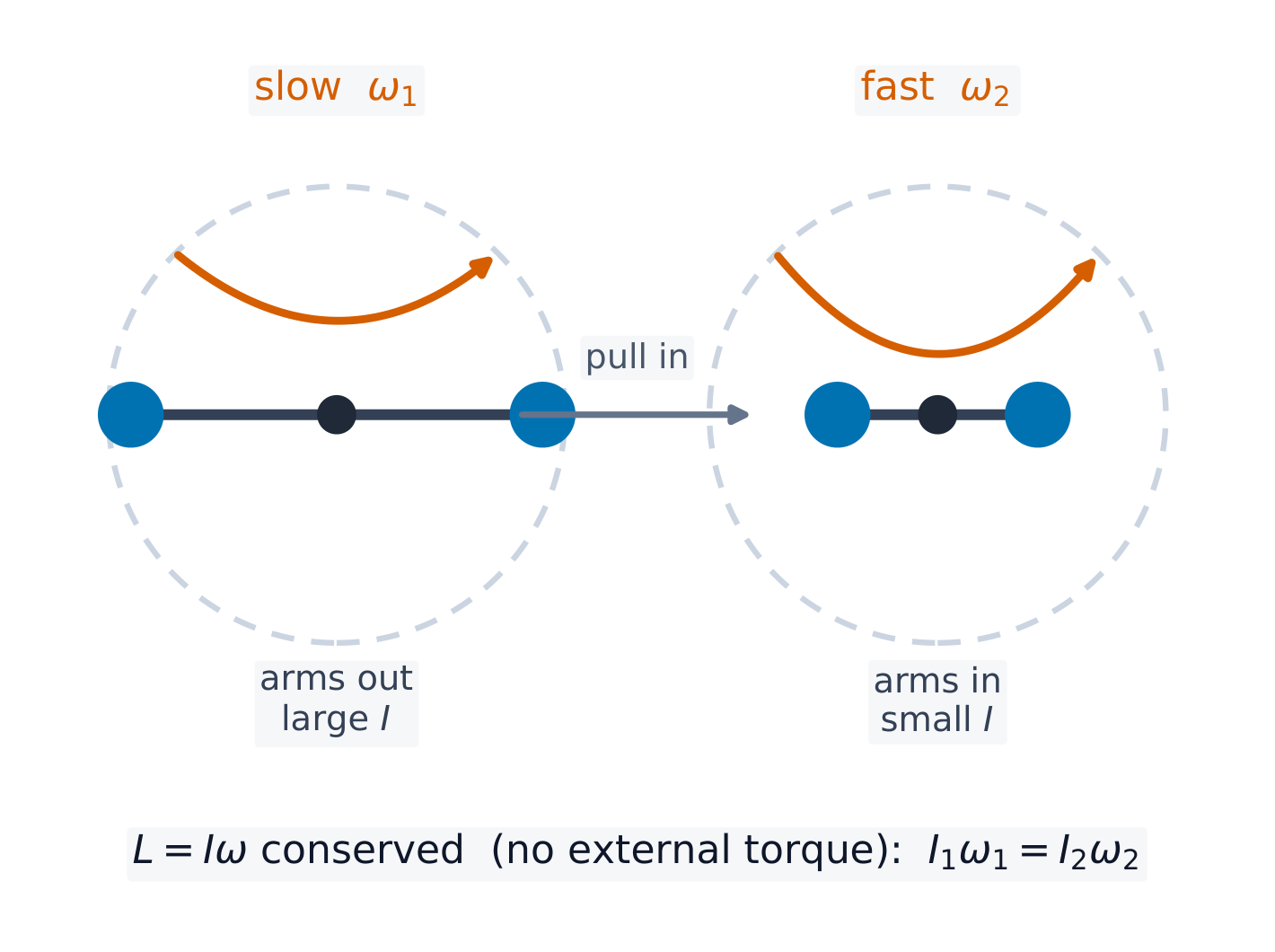
Angular momentum: pull in, spin faster

With zero net external torque, total angular momentum is conserved 守恒:

$$L_{\text{before}}=L_{\text{after}},\qquad I_1\omega_1=I_2\omega_2\ \text{(one rigid body reshaping)}.$$

If $I$ shrinks, $\omega$ grows – a spinning skater speeds up pulling her arms in. The rule survives collisions and shape changes, which is what makes it so useful: pick the axis so that every external force (gravity, the pivot force) exerts no torque about it.

Worked example. A skater spins at $2.0\ \text{rev/s}$ with $I_1=4.0\ \text{kg}\cdot\text{m}^2$. Pulling in her arms drops it to $I_2=1.6\ \text{kg}\cdot\text{m}^2$: $\omega_2=\dfrac{4.0}{1.6}(2.0)=5.0\ \text{rev/s}$. Her kinetic energy rises – the extra energy is the work her muscles do pulling her arms inward.

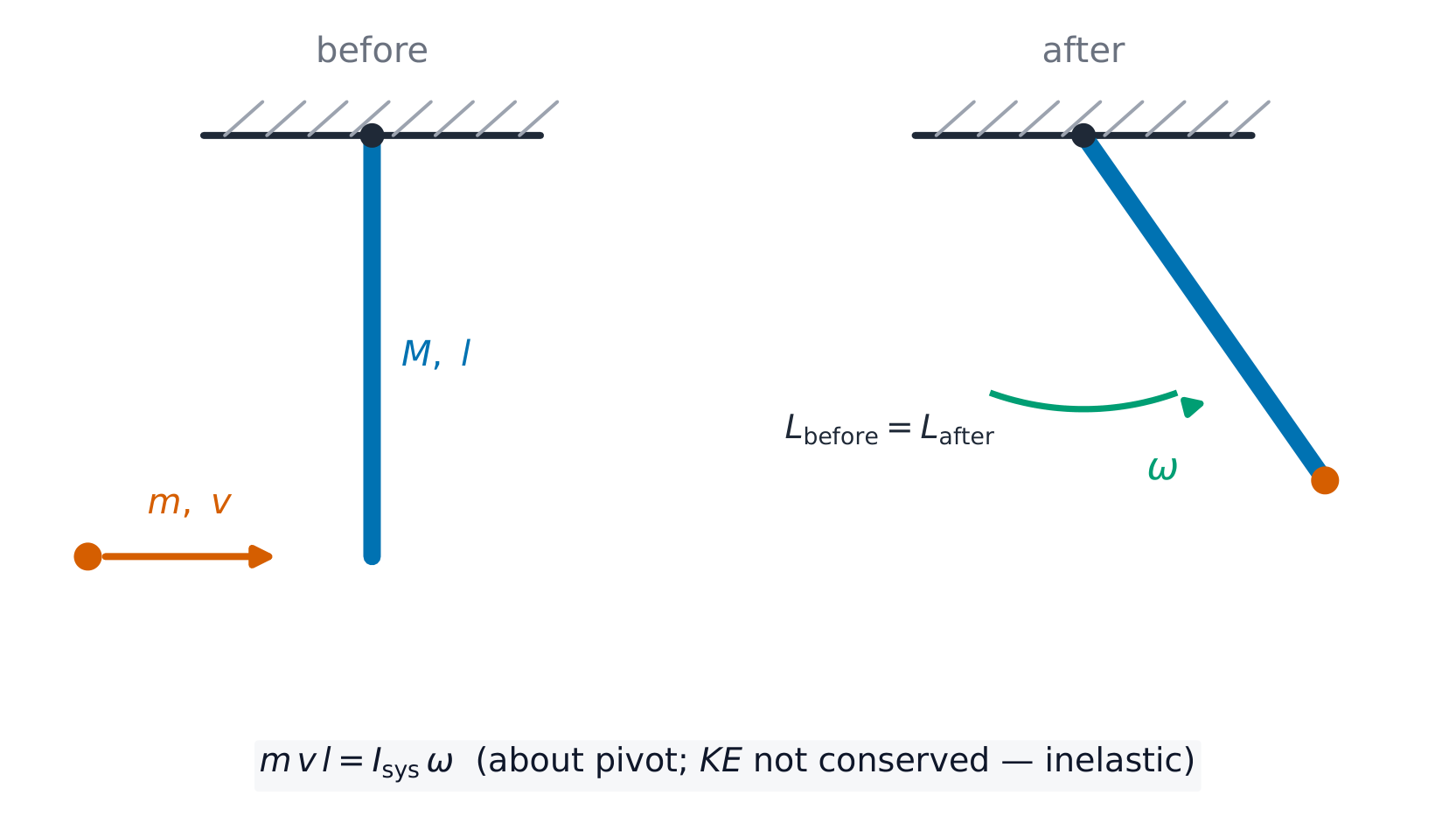
Worked example (rotational collision). A $0.020\ \text{kg}$ bullet at $300\ \text{m/s}$ strikes the tip of a uniform rod ($M=1.5\ \text{kg}$, length $l=0.60\ \text{m}$) hanging from a pivot, and embeds. About the pivot, gravity and the pivot force exert no torque during the strike, so $L$ is conserved: $L=mvl=0.020(300)(0.60)=3.6\ \text{kg}\cdot\text{m}^2/\text{s}$. Afterwards $I=\tfrac13Ml^2+ml^2=0.18+0.0072=0.187\ \text{kg}\cdot\text{m}^2$, so $\omega=\dfrac{3.6}{0.187}\approx19\ \text{rad/s}$. (Linear momentum is not conserved here – the pivot pushes on the rod – and kinetic energy certainly is not: check both before claiming them.)

עברית
תנע זוויתי: כיווץ, סיבוב מהיר יותר

עם מומנט חיצוני נטו אפס, תנע זוויתי כולל נשמר:

$$L_{\text{before}}=L_{\text{after}},\qquad I_1\omega_1=I_2\omega_2\ \text{(one rigid body reshaping)}.$$

אם $I$ מתקטן, $\omega$ גדל – מחליקה המסתובבת מאיטה כשהיא מכניסה את זרעותיה. הכלל עובר התנגשויות ושנויי צורה, דבר שמעניק לו כך רבות שימושיות: בחרו ציר כך שכל כוח חיצוני (כובד, כוח הציר) לא יפעיל מומנט סביבו.

דוגמה פתורה. מחליקה מסתובבת ב$2.0\ \text{rev/s}$ עם $I_1=4.0\ \text{kg}\cdot\text{m}^2$. הכנסת זרעותיה מורידה אותה ל$I_2=1.6\ \text{kg}\cdot\text{m}^2$: $\omega_2=\dfrac{4.0}{1.6}(2.0)=5.0\ \text{rev/s}$. האנרגיה הקינטית שלה עולה – האנרגיה הנוספת היא העבודה שהשרירים שלה מבצעים בהכנסת הזרעות פנימה.

משיכת מסה פנימה מפחיתה את I, ולכן ω עולה כדי לשמור על L = Iω
תנע זוויתי סביב הציר נשמר כשכדור הפותל נטמע במוט

דוגמה פתורה (התנגשות סיבובית). כדור פותל בגודל $0.020\ \text{kg}$ במהירות $300\ \text{m/s}$ פוגע בקצה של מוט אחיד (מסה $M=1.5\ \text{kg}$, אורך $l=0.60\ \text{m}$) התלוי מציר, ונטמע בו. סביב הציר, כובד וכוח הציר אינם מפעילים מומנט במהלך ההתנגשות, ולכן $L$ נשמר: $L=mvl=0.020(300)(0.60)=3.6\ \text{kg}\cdot\text{m}^2/\text{s}$. לאחר מכן $I=\tfrac13Ml^2+ml^2=0.18+0.0072=0.187\ \text{kg}\cdot\text{m}^2$, ולכן $\omega=\dfrac{3.6}{0.187}\approx19\ \text{rad/s}$. (תנע ליניארי אינו נשמר כאן – הציר דוחק במוט – ואנרגיה קינטית בוודאי לא נשמרת: בדקו זאת לפני שאתם טוענים לכך).

מחליקות אמנות מבצעות על הקרח
מחלקת אמנות ותנע זוויתי: מחליקה שמכניסה את זרעותיה בזמן סיבוב מצמצמת את תנע המהירות הסיבובי שלה, ולכן מסתובבת מהיר יותר
Vocabulary · ⁨מילון מונחים⁩ Train · ⁨אימון⁩
English עברית
rotational kinetic energy/rəʊˈteɪʃənl kɪˈnetɪk ˈenədʒi/ אנרגיה קינטית סיבובית
rotational inertia/rəʊˈteɪʃənl ɪˈnɜːʃə/ אינרציה סיבובית
torque/tɔːk/ מומנט
angular displacement/ˈæŋɡjʊlə dɪˈspleɪsmənt/ הזזה זוויתית
Angular momentum/ˈæŋɡjʊlə məʊˈmentəm/ תנע זוויתי
angular impulse/ˈæŋɡjʊlə ˈɪmpʌls/ אימפולס זוויתי
conserved/kənˈsɜːvd/ שמור על ערכו
6.5

Rolling · ⁨גלילה⁩

Syllabus · ⁨סיילבוס⁩
English

Learning Objective 6.5.A: Describe the kinetic energy of a system that has translational and rotational motion.

  • 6.5.A.1 The total kinetic energy of a system is the sum of the system's translational and rotational kinetic energies.
    • Equation: $K_{\text{tot}} = K_{\text{trans}} + K_{\text{rot}}$

Learning Objective 6.5.B: Describe the motion of a system that is rolling without slipping.

  • 6.5.B.1 While rolling without slipping, the translational motion of a system's center of mass is related to the rotational motion of the system itself with the following equations:
    • Equation: $\Delta x_{\text{cm}} = r\Delta\theta$
    • Equation: $v_{\text{cm}} = r\omega$
    • Equation: $a_{\text{cm}} = r\alpha$
  • 6.5.B.2 For ideal cases, rolling without slipping implies that the frictional force does not dissipate any energy from the rolling system.

Learning Objective 6.5.C: Describe the motion of a system that is rolling while slipping.

  • 6.5.C.1 When slipping, the motion of a system's center of mass and the system's rotational motion cannot be directly related.
  • 6.5.C.2 When a rotating system is slipping relative to another surface, the point of application of the force of kinetic friction exerted on the system moves with respect to the surface, so the force of kinetic friction will dissipate energy from the system.

Boundary statement: Rolling friction is beyond the scope of AP Physics C: Mechanics.

עברית

מטרות למידה 6.5.A: לתאר את האנרגיה הקינטית של מערכת שיש לה תנועה תרגומית וסיבובית.

  • 6.5.A.1 האנרגיה הקינטית הכוללת של מערכת היא סכום האנרגיה הקינטית התנועתית והאנרגיה הקינטית הסיבובית של המערכת.
    • משוואה: $K_{\text{tot}} = K_{\text{trans}} + K_{\text{rot}}$

מטרת למידה 6.5.B: לתאר את תנועת מערכת הנעה ללא החלקה.

  • 6.5.B.1 בזמן גלילה ללא החלקה, התנועה התרגומית של מרכז המסה של מערכת קשורה לתנועה הסיבובית של המערכת עצמה באמצעות המשוואות הבאות:
    • משוואה: $\Delta x_{\text{cm}} = r\Delta\theta$
    • משוואה: $v_{\text{cm}} = r\omega$
    • משוואה: $a_{\text{cm}} = r\alpha$
  • 6.5.B.2 במקרים אידיאליים, הנעה ללא החלקה מציינת כי כוח החיכוך אינו מפזר אנרגיה מהמערכת הנעה.

מטרת למידה 6.5.C: לתאר את תנועת מערכת הנעה עם החלקה.

  • 6.5.C.1 כאשר ישנה החלקה, לא ניתן לקשר ישירות בין תנועת מרכז הכובד של המערכת לבין התנועה הסיבובית שלה.
  • 6.5.C.2 כאשר מערכת מסתובבת ומחליקה ביחס למשטח אחר, נקודת ההשפעה של כוח החיכוך הקינטי הפועל על המערכת נעה ביחס למשטח, ולכן כוח החיכוך הקינטי יפזר אנרגיה מהמערכת.

הצהרת גבול: חיכוך גלילה אינו נכלל בתחום הלימודים של AP Physics C: מכניקה.

Source: College Board AP Course and Exam Description · ⁨מקור: תיאור הקורס והמבחן של College Board AP⁩

English
Rolling without slipping

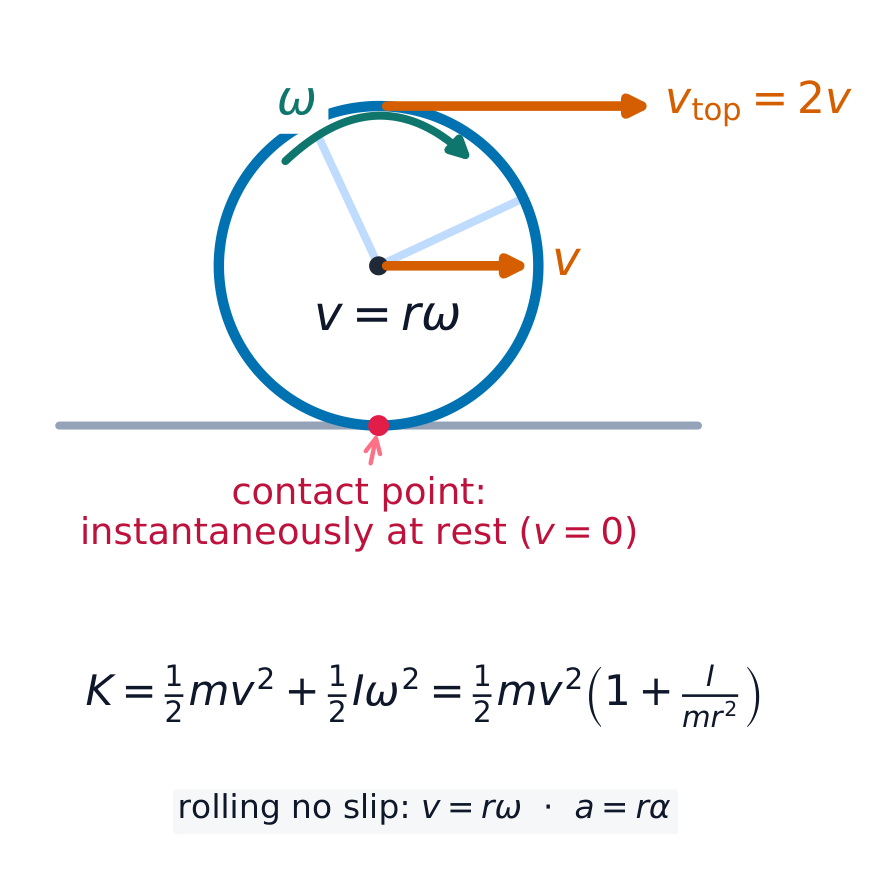
Rolling without slipping 无滑滚动 ties translation to rotation: the contact point is momentarily at rest, so

$$\Delta x_{\text{cm}}=r\,\Delta\theta,\qquad v_{\text{cm}}=r\omega,\qquad a_{\text{cm}}=r\alpha.$$

Static friction supplies the torque that keeps the spin matched to the motion, but at a point that is not sliding – so for pure rolling, friction does no work, and energy conservation is safe to use. (Rolling friction is beyond the AP course.)

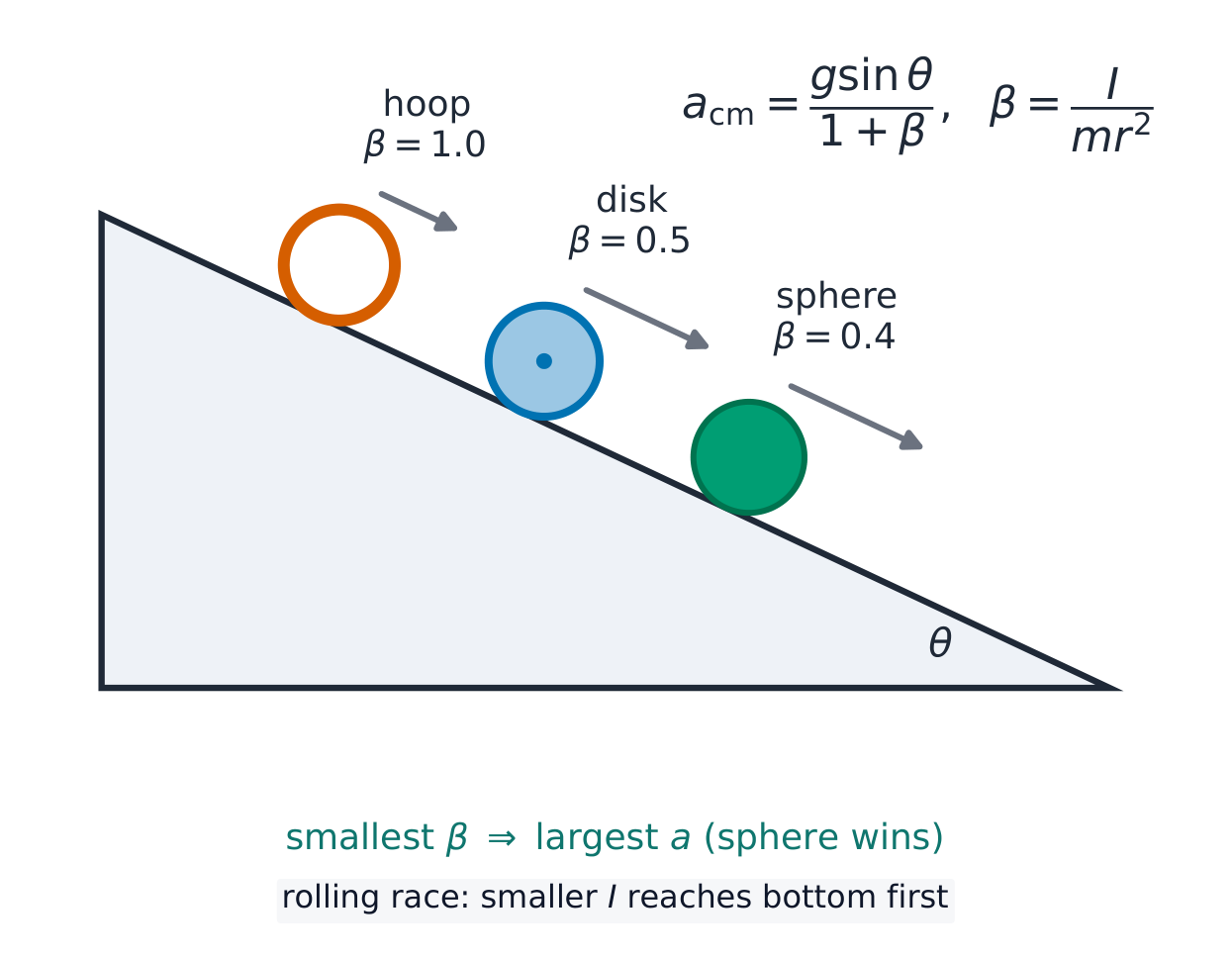
Racing shapes down an incline shows the energy split. With $I=\beta mr^2$, energy conservation gives

$$a_{\text{cm}}=\frac{g\sin\theta}{1+\beta}:$$

a sphere ($\beta=\tfrac25$) beats a disk 圆盘 ($\beta=\tfrac12$), which beats a hoop 圆环 ($\beta=1$) – mass and radius cancel completely. More of the hoop's energy is locked in rotation, so its center moves slower.

Worked example. A solid sphere rolls from rest down a $30^\circ$ incline: $a=\dfrac{g\sin30^\circ}{1+\tfrac25}=\dfrac{9.8(0.50)}{1.4}=3.5\ \text{m/s}^2$, versus $4.9\ \text{m/s}^2$ for a frictionless slider – rolling objects always lose the race against sliding ones.

עברית
גלגל ללא החלקה

גלגל ללא החלקה מקשר תנועה תנועתית לסיבוב: נקודת המגע נמצאת רגעית במנוחה, ולכן

$$\Delta x_{\text{cm}}=r\,\Delta\theta,\qquad v_{\text{cm}}=r\omega,\qquad a_{\text{cm}}=r\alpha.$$
בגלילה ללא החלקה נקודת המגע במנוחה, ולכן v = rω

חיכוך סטטי מספק את המומנט שמחזיר את הסיבוב באיזון עם התנועה, אך בנקודה שאינה מחליקה – ולכן עבור גלגול טהור, חיכוך אינו מבצע עבודה, ושמירת אנרגיה יכולה לשמש בביטחון. (חיכוך גלגול אינו נדרש בקורס AP).

מרוץ צורות מגלגלות למטה על מדרון מדגים את חלוקת האנרגיה. עם $I=\beta mr^2$, שמירת אנרגיה נותנת

$$a_{\text{cm}}=\frac{g\sin\theta}{1+\beta}:$$

כדור ($\beta=\tfrac25$) מנצח דיסק ($\beta=\tfrac12$), שמנצח טבעת ($\beta=1$) – המסה והרדיוס מתבטלים לחלוטין. כמות גדולה יותר מאנרגיית הסיבוב של הטבעת נעוצה בסיבוב, ולכן מרכז המסה שלה נע לאט יותר.

מירוץ גלילה: הצורה עם ה-I/mr² הקטן ביותר מגיעה לראשונה לתחתית

דוגמה מופת. כדור מלא גולל ממנוחה למטה על משטח משופע $30^\circ$: $a=\dfrac{g\sin30^\circ}{1+\tfrac25}=\dfrac{9.8(0.50)}{1.4}=3.5\ \text{m/s}^2$, לעומת $4.9\ \text{m/s}^2$ עבור מחליק ללא חיכוך – גופים גוללים תמיד מפסידים במירוץ מול גופים החלקים.

Vocabulary · ⁨מילון מונחים⁩ Train · ⁨אימון⁩
English עברית
Rolling without slipping/ˈrəʊlɪŋ wɪˈðaʊt ˈslɪpɪŋ/ גלילה ללא החלקה
disk/dɪsk/ דיסק
hoop/huːp/ טבעת
centripetal force/senˈtrɪpɪtl fɔːs/ כוח צנטריפטלי
satellite/ˈsætəlaɪt/ לוויין
gravitational potential energy/ˌɡrævɪˈteɪʃənl pəˈtenʃl ˈenədʒi/ אנרגיה פוטנציאלית כבידתית
total mechanical energy/ˈtəʊtl mɪˈkænɪkl ˈenədʒi/ אנרגיה מכנית כוללת
escape velocity/eˈskeɪp vəˈlɒsɪti/ מהירות מנוסה
elliptical orbit/ɪˈlɪptɪkl ˈɔːbɪt/ מסלול אלפטי
Kepler's second law/ˈkepləz ˈsekənd lɔː/ חוק השני של קפלר
6.6

Motion of Orbiting Satellites · ⁨תנועת לוויינים במסלול⁩

Syllabus · ⁨סיילבוס⁩
English

Learning Objective 6.6.A: Describe the motions of a system consisting of two objects or systems interacting only via gravitational forces.

  • 6.6.A.1 In a system consisting only of a massive central object and an orbiting satellite with mass that is negligible in comparison to the central object's mass, the motion of the central object itself is negligible.
  • 6.6.A.2 The motion of satellites in orbits is constrained by conservation laws.
    • 6.6.A.2.i In circular orbits, the system's total mechanical energy, the system's gravitational potential energy, and the satellite's angular momentum and kinetic energy are constant.
    • 6.6.A.2.ii In elliptical orbits, the system's total mechanical energy and the satellite's angular momentum are constant, but the system's gravitational potential energy and the satellite's kinetic energy can each change.
    • 6.6.A.2.iii The gravitational potential energy of a system consisting of a satellite and a massive central object is defined to be zero when the satellite is an infinite distance from the central object.
      • Equation: $U_g = -G\dfrac{m_1 m_2}{r}$
  • 6.6.A.3 The total energy of a system consisting of a satellite orbiting a central object in a circular path can be written in terms of the gravitational potential energy of that system or the kinetic energy of the satellite.
    • Equation: $K = -\dfrac{1}{2}U$
    • Equation: $E_{total} = \dfrac{1}{2}U = -\dfrac{GMm}{2r}$
  • 6.6.A.4 The escape velocity of a satellite is the satellite's velocity such that the mechanical energy of the satellite–central-object system is equal to zero.
    • 6.6.A.4.i When the only force exerted on a satellite is gravity from a central object, a satellite that reaches escape velocity will move away from the central body until its speed reaches zero at an infinite distance from the central body.
    • 6.6.A.4.ii The escape velocity of a satellite from a central body of mass $M$ can be derived using conservation of energy laws.
      • Equation: $v_{\text{esc}} = \sqrt{\dfrac{2GM}{r}}$
עברית

מטרות למידה 6.6.A: תאר את התנועה של מערכת המורכבת משני אובייקטים או מערכות המתאימות זו לזו רק באמצעות כוחות כבידה.

  • 6.6.A.1 במערכת המורכבת רק מגוף מרכזי בעל מסה וגוף לוויני שמסתו זניחה לעומת מסת הגוף המרכזי, התנועה של הגוף המרכזי עצמו היא זניחה.
  • 6.6.A.2 תנועת לווינים במסלולים מוגבלת על ידי חוקי שימור.
    • 6.6.A.2.i במסלולים מעגליים, האנרגיה המכנית הכוללת של המערכת, האנרגיה הפוטנציאלית הכבידתית של המערכת, המומנט הזוויתי והאנרגיה הקינטית של הלווינה הם קבועים.
    • 6.6.A.2.ii במסלולים אלפסיוئידים, האנרגיה המכנית הכוללת של המערכת והמומנט הזוויתי של הלווינה הם קבועים, אך האנרגיה הפוטנציאלית הכבידתית של המערכת והאנרגיה הקינטית של הלווינה עשויות להשתנות כל אחת בנפרד.
    • 6.6.A.2.iii האנרגיה הפוטנציאלית הכבידתית של מערכת המורכבת מלווינה וגוף מרכזי בעל מסה מוגדרת כאפס כאשר הלווינה נמצאת במרחק אינסופי מהגוף המרכזי.
      • משוואה: $U_g = -G\dfrac{m_1 m_2}{r}$
  • 6.6.A.3 האנרגיה הכוללת של מערכת המורכבת מלוויין המקיף גוף מרכזי במסלול עגולנית ניתן לבטא באמצעות אנרגיה פוטנציאלית כבידתית של המערכת או באמצעות אנרגיה קינטית של הלוויין.
    • משוואה: $K = -\dfrac{1}{2}U$
    • משוואה: $E_{total} = \dfrac{1}{2}U = -\dfrac{GMm}{2r}$
  • 6.6.A.4 מהירות הבריחה של לוויין היא המהירות שבה האנרגיה המכנית של מערכת הלוויין-הגוף המרכזי שווה לאפס.
    • 6.6.A.4.i כאשר הכוח היחיד הפועל על לוויין הוא כוח הכבידה מגוף מרכזי, לוויין שיגיע למהירות הבריחה יתרחק מהגוף המרכזי עד שהמהירות שלו תגיע לאפס במרחק אינסופי מהגוף המרכזי.
    • 6.6.A.4.ii את מהירות הבריחה של לוויין ממסה $M$ ניתן להסיק באמצעות חוקי השימור באנרגיה.
      • משוואה: $v_{\text{esc}} = \sqrt{\dfrac{2GM}{r}}$

Source: College Board AP Course and Exam Description · ⁨מקור: תיאור הקורס והמבחן של College Board AP⁩

English
Orbital motion (Kepler's 2nd law)

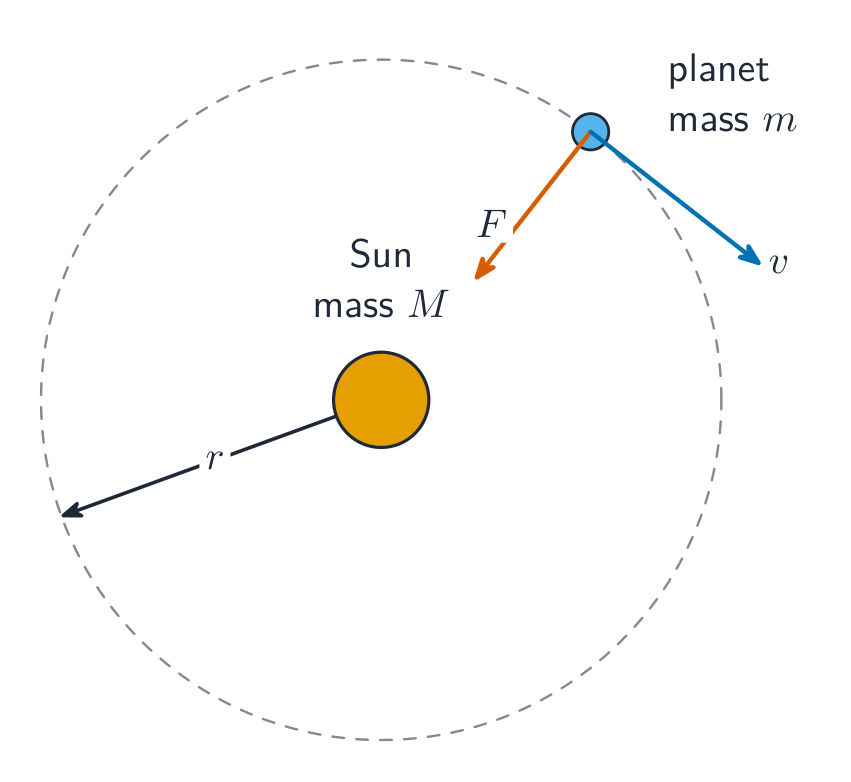
Gravity supplies the centripetal force 向心力 for a satellite 卫星 in a circular orbit:

$$\frac{GMm}{r^2}=\frac{mv^2}{r}\quad\Rightarrow\quad v=\sqrt{\frac{GM}{r}}$$

– larger orbits are slower. With gravitational potential energy 引力势能 $U_g=-\dfrac{GMm}{r}$, a circular orbit obeys $K=-\tfrac12U$, so the total mechanical energy 总机械能 is

$$E=K+U=\frac{U}{2}=-\frac{GMm}{2r},$$

negative because the satellite is bound. To escape from radius $r$, total energy must reach zero, giving the escape velocity 逃逸速度

$$v_{\text{esc}}=\sqrt{\frac{2GM}{r}}.$$

In an elliptical orbit 椭圆轨道, $E$ and $L$ are fixed: gravity points at the focus, so it exerts no torque about it. Conserved $L$ means the satellite sweeps equal areas in equal times – Kepler's second law 开普勒第二定律 – and therefore moves fastest at closest approach, slowest at the far point. Energy conservation connects speeds at the two ends.

Worked example. For a satellite at $r=7.0\times10^{6}\ \text{m}$ around Earth ($GM=4.0\times10^{14}\ \text{m}^3/\text{s}^2$): orbital speed $v=\sqrt{GM/r}=7.6\times10^{3}\ \text{m/s}$, while escaping from that radius needs $v_{\text{esc}}=\sqrt{2GM/r}=1.1\times10^{4}\ \text{m/s}$ – exactly $\sqrt2$ times the circular speed.

Exam skill. Orbit FRQs are energy-and-angular-momentum problems in disguise: write $E=\tfrac12mv^2-\dfrac{GMm}{r}$ and $L=mvr\sin\theta$ at the two points of interest and solve the pair – never assume the orbit formulae for circles apply to an ellipse.

עברית
תנועה אורביטלית (החוק ה-2 של קפלר)

כוח הכבידה מספק את כוח המרכז עבור ** לוויין** במסלול מעגלי:

$$\frac{GMm}{r^2}=\frac{mv^2}{r}\quad\Rightarrow\quad v=\sqrt{\frac{GM}{r}}$$

– מסילות גדולות יותר הן איטיות יותר. עם אנרגיה פוטנציאלית כבידתית $U_g=-\dfrac{GMm}{r}$, מסלול מעגלי עומד ב-$K=-\tfrac12U$, ולכן האנרגיה המכנית הכוללת היא

$$E=K+U=\frac{U}{2}=-\frac{GMm}{2r},$$

שלילית מכיוון שהלוויין קשור. כדי להימלט ממרחק $r$, האנרגיה הכוללת חייבת להגיע לאפס, מה שנותן את מהירות ההימלט

$$v_{\text{esc}}=\sqrt{\frac{2GM}{r}}.$$
כוח הכבידה מספק את כוח המרכז שמחזיק את הלוויין במסלול

במסלול אליפטי, ⟨$E$⟩ ו$L$ הם קבועים: הכבידה מצביעה אל המיקוד, ולכן היא אינה מפעילה תרמו סביבו. שימור ⟨$L$⟩ משמעו שהלוויין סורק שטחים שווים בזמנים שווים – חוק השני של קפלר – ולכן נע מהר ביותר בקרבתו, האיטי ביותר בנקודה הרחוקה. שימור אנרגיה מקשר בין המהירויות בשני הקצוות.

דוגמה מופת. עבור לוויין ב-$r=7.0\times10^{6}\ \text{m}$ סביב כדור הארץ ($GM=4.0\times10^{14}\ \text{m}^3/\text{s}^2$): מהירות מסלולית $v=\sqrt{GM/r}=7.6\times10^{3}\ \text{m/s}$, בעוד שהימלט ממרחק זה דורש $v_{\text{esc}}=\sqrt{2GM/r}=1.1\times10^{4}\ \text{m/s}$ – בדיוק $\sqrt2$ פעמים מהירות מעגלית.

מיומנות לבחינה. שאלות FRQ על מסלולים הן למעשה בעיות אנרגיה ומומנט זוויתי: כתבו $E=\tfrac12mv^2-\dfrac{GMm}{r}$ ו-$L=mvr\sin\theta$ בשתי הנקודות הרלוונטיות ופתרו את המערכת – לעולם אל תניחו that מס jailed formulae for circles apply to an ellipse.

Explore · ⁨חקור⁩

Compare orbits at different radii · ⁨השווה מסלולים בקרני רדיוס שונות⁩

An orbiting satellite is in free fall, gravity supplying the centripetal force. A larger orbit means a slower speed and longer period (Kepler's third law). · ⁨לוויין במסלול נמצא במערכות חופשיות, וכובד מספק את הכוח המרכזי. מסלול גדול יותר אומר מהירות נמוכה יותר ותקופה ארוכה יותר (חוק השלישי של קפלר).⁩

6.6

Exam tips · ⁨טיפים לבחינות⁩

English
  • Compute the moment of inertia $I=\int r^2\,dm$ and shift axes with the parallel-axis theorem $I=I_{cm}+Md^2$.
  • Rotational kinetic energy is $\tfrac12 I\omega^2$; a rolling body has both translational and rotational KE.
  • Conserve angular momentum $L=I\omega$ when net external torque is zero (a spinning skater pulling in).
  • Use energy conservation for rolling-without-slipping problems ($v=r\omega$ ties the two motions).
  • Know standard $I$ values (hoop, disk, rod, sphere) and where the axis is.
עברית
  • חשבו את מומנט האינרציה $I=\int r^2\,dm$ והזיזו צירים באמצעות משפט הציר המקביל $I=I_{cm}+Md^2$.
  • אנרגיה קינטית סיבובית היא $\tfrac12 I\omega^2$; גוף גולל יש לו גם אנרגיה קינטית תרגולית וגם אנרגיה קינטית סיבובית.
  • שמרו על מומנט זוויתי $L=I\omega$ כאשר המומנט החיצוני הכולל הוא אפס (מחליק מסתובב המכנס את ידיו).
  • השתמשו בשימור אנרגיה לבעיות גלילה ללא החלקה ($v=r\omega$ מקשר בין שתי התנועות).
  • הכירו ערכים סטנדרטיים ל-$I$ (טבעת, דיסק, מוט, כדור) ואين המוקד נמצא.

Interactive lessons on this topic · ⁨שיעורים אינטראקטיביים בנושא זה⁩

Work through it step by step, with instant-check exercises. · ⁨לעבור על הדברים צעד אחר צעד, עם תרגילים לבדיקה מיידית.⁩

Past Papers · ⁨מבחני עבר⁩

More topics in AP Physics C: Mechanics · ⁨פיזיקה AP C: מכניקה⁩ · ⁨נושאים נוספים בAP Physics C: Mechanics · ⁨פיזיקה AP C: מכניקה⁩⁩

Log in or create account · ⁨היכנס או צור חשבון⁩

IGCSE, A-Level & AP