| Learning Objective | Essential Knowledge |
|---|---|
8.1.A |
|
8.1.B |
|
8.1.C |
Boundary statement: AP Physics C: Electricity & Magnetism only expects students to make calculations of the electric force between four or fewer interacting charged objects or systems. The analysis of the resulting electric force from more charges is allowed in situations of high symmetry. Note that students are expected to calculate the electric fields of charge distributions, as described in Topics 8.4 and 8.6. |
מטענים חשמליים, שדות חשמלי וחוק גאוס
פיזיקה AP C: חשמל ומגנטיות · נושא 8
 9:52
9:52
מטענים חשמליים, שדות חשמלי וחוק גאוס
ברק פוגע ברכב. בתוך הרכב, האנשים לא מרגישים כלום. מדוע? מעטפת המתכת סביבתם היא מוליך. המטען רץ על פני השטח החיצוניים שלו…
קריאת קול באנגלית · תרגום אנגלי + סינית שרוף בתוך הסרטון
8.1
מטען חשמלי וכוח חשמלי
סיילבוס
מקור: תיאור הקורס והמבחן של College Board AP
מטען חשמלי מגיע בחיובי ושלילי; מטענים זהים דוחים, מנוגדים מושכים. המטען מוכמת – כל מטען הוא כפולה שלמה של מטען יסודי $e=1.6\times10^{-19}\ \text{C}$ – ועומד בשימור המטען: מטען לעולם אינו נוצר או נהרס, אלא רק מועבר. הכוח בין שני מטעני נקודה נתון על ידי חוק קולון:
$$\vec{F}=\frac{1}{4\pi\varepsilon_0}\frac{q_1 q_2}{r^2}\,\hat{r},$$
כוח הפוך-ריבועי לאורך הישר המחבר ביניהם, עם $\dfrac{1}{4\pi\varepsilon_0}=k=9.0\times10^{9}\ \text{N}\cdot\text{m}^2/\text{C}^2$. עבור מספר מטענים (AP משתמש בארבעה או פחות, אלא אם כן סימטריה עוזרת), הוסף את ווקטורי הכוח על המטען שמעניין אותך – סופרפוזיציה.
מטען הוא תכונה בסיסית של חומר, ומטען נקודה הוא מודל שמתעלם מגודל של גוף טעון. הקבוע $\varepsilon_0$ הוא הפרמיטיביות של ריק – תכונה חומרית של הוואקום. הפרמיטיביות של חומר שונה מ$\varepsilon_0$, נקבעת על פי כמה החומר מקוטב בקלות, ולכן דיאלקטרית בין מטענים מחלישה את הכוח. שימו לב גם שכאשר הכוח החשמלי הרבה חזק מכבידה, כבידה שולטת בקנה מידה אסטרונומי כי גופים גדולים הם כמעט ניטרליים.
דוגמה מפורשת. שני מטענים $+2.0\ \mu\text{C}$ יושבים במרחק $0.30\ \text{m}$: $F=\dfrac{kq_1q_2}{r^2}=\dfrac{9.0\times10^{9}(2.0\times10^{-6})^2}{(0.30)^2}=0.40\ \text{N}$, דחייתי.
דוגמה מפורשת (ווקטורים). מטענים $+3.0\ \mu\text{C}$ ו$-3.0\ \mu\text{C}$ יושבים בשתי פינות של זווית ישרה, כל אחד במרחק $0.30\ \text{m}$ ממטען $+1.0\ \mu\text{C}$ בפינה. כל אחד מפעיל כוח $F=\dfrac{(9.0\times10^{9})(3.0\times10^{-6})(1.0\times10^{-6})}{0.09}=0.30\ \text{N}$ – אחד דוחה, אחד מושך, בזווית ישרה זה לזה. הכוח הכולל הוא $F_{\text{net}}=\sqrt{0.30^2+0.30^2}=0.42\ \text{N}$, מצביע ביניהם. לעולם אל תחבר גודלים blindly: רכיבים קודם.
חקור
חקרו שדה של מטען מקור
שנו את ה-סימן והגודל של המטען. הקווים מצביעים למרחק ממטען חיובי ולכיוון מטען שלילי, והעיסוק שלהם ב-$1/r^2$ ליד המטען מדמה מדוע כוח קולון $F = k\,|q_1 q_2|/r^2$ חולש עם המרחק.
8.2
מטען חשמלי ותהליך הטענה
סיילבוס
מטרות למידה 8.2.A: לתאר את התנהגות מערכת באמצעות שימור המטען.
- 8.2.A.1 המטען הכולל או חלוקת המטען של מערכת יכולים להשתנות כתוצאה מהנוכחות, או משנויים, במטען הכולל או בחלוקת המטען של מערכות אחרות.
- 8.2.A.1.i המטען הכולל של מערכת יכול להשתנות בשל חיכוך או מגע בין מערכות.
- 8.2.A.1.ii הפרדת מטען מושרית מתרחשת כאשר הכוח האלקטרוסטטי בין שתי מערכות משנה את חלוקת המטענים בתוך המערכות, ומוביל לקיטוב אחת או שתי המערכות.
- 8.2.A.1.iii הפרדת מטען מושרית יכולה להתרחש במערכות ניטרליות.
- 8.2.A.2 כל שינוי במטען הכולל של מערכת נובע ממעבר מטען בין המערכת לסביבתה.
- 8.2.A.2.i טעינת מערכת כוללת בדרך כלל מעבר אלקטרונים אל תוך המערכת ומהמערכת.
- 8.2.A.2.ii המטען הכולל של מערכת יישאר קבוע אלא אם כן ישנן מעברי מטען אל תוכה או ממנה.
- 8.2.A.3 חיבור לאדמה (Grounding) כולל חיבור חשמלי של גוף טעון למערכת גדולה בהרבה ובסביבות הניטרלית (למשל, כדור הארץ).
מקור: תיאור הקורס והמבחן של College Board AP
מוליך מאפשר למטען לנוע בחופשיות; מבודד מחזיק אותו במקומו. עצמים רוכשים מטען נטו בשלושה דרכים:
- הטנה על ידי חיכוך: שפשוף מעביר אלקטרונים מפני שטח אחד לשני.
- הטנה על ידי הולכה: מגע עם גוף טעון משתף מטען של אותו סימן.
- הטנה על ידי אינדוקציה: מטען קרוב דוחה את המטען של המוליך; חבר לאדמה את הצד הרחוק, הסר את חוט האדמה תחילה, והמוליך נשאר עם הסימן המנוגד – הכל ללא מגע.
מבודד אינו מעביר מטען, אך יכול לפתח קיטוב: המולקלות שלו נמתחות או מסתובבות כך שצד אחד יהיה מעט חיובי והצד השני מעט שלילי. לכן סרק טעון מושך גזרי נייר ניטרליים. אלקטרוסקופ מראה מטען נקי על ידי דחיית העלים שלו; בכל מוליד מבודד המטען העודף יושב כולו על המשטח החיצוני.
חקור
חקרו טעינה בשחיקה
שחיקה מעבירה אלקטרונים למצופה, משאירה אותו טעון שלילית. אובייקט טעון אז מושך קיר ניטרלי או שיער (באמצעות קיטוב) אך דוחה אובייקט אחר עם מטען דומה — אותה העברת אלקטרונים עומדת מאחורי חיכוך, הולכה ואינדוקציה.
8.3
שדות חשמליים
סיילבוס
| Learning Objective | Essential Knowledge |
|---|---|
8.3.A |
|
8.3.B |
|
מקור: תיאור הקורס והמבחן של College Board AP
השדה החשמלי בנקודה הוא הכוח ליחידת מטען שמטען בדיקה חיובי קטן יחוש שם:
$$\vec{E}=\frac{\vec{F}}{q},\qquad \vec{E}=\frac{1}{4\pi\varepsilon_0}\frac{q}{r^2}\,\hat{r}\ \text{(point charge)}.$$
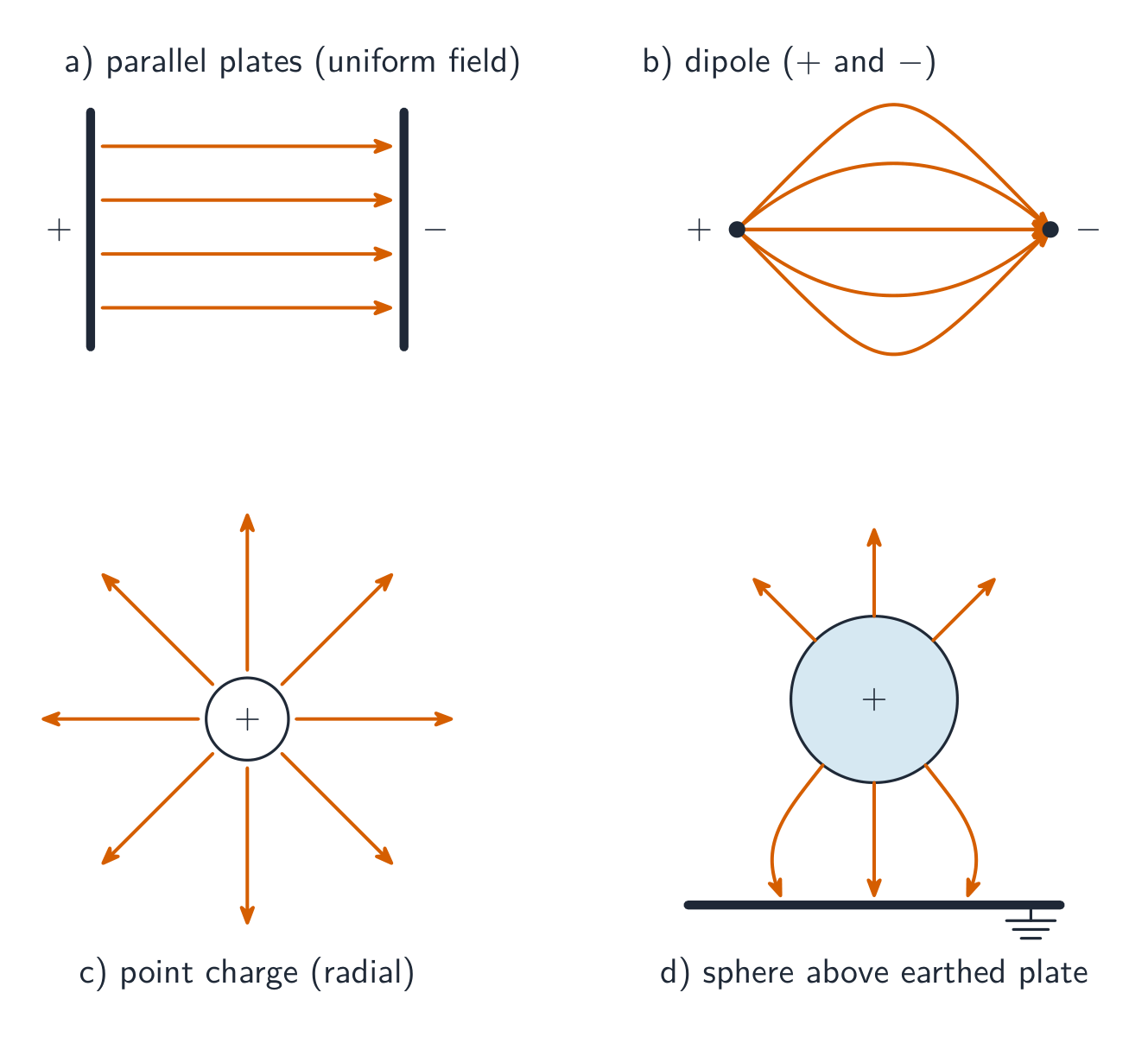
מטען הנמצא בשדה חש $\vec{F}=q\vec{E}$ – מטענים חיוביים לאורך השדה, מטענים שליליים נגדו. שדות ממקורות מרובים נוספים וקטורית (שוב עקרון הסופרפוזיציה). קווי שדה הופכים את השדה לנראה לעין: הם מצביעים הרחק ממטען חיובי ועבר מטען שלילי, הצפיפות שלהם מציגה את העוצמה, והם לעולם אינם נחתכים.
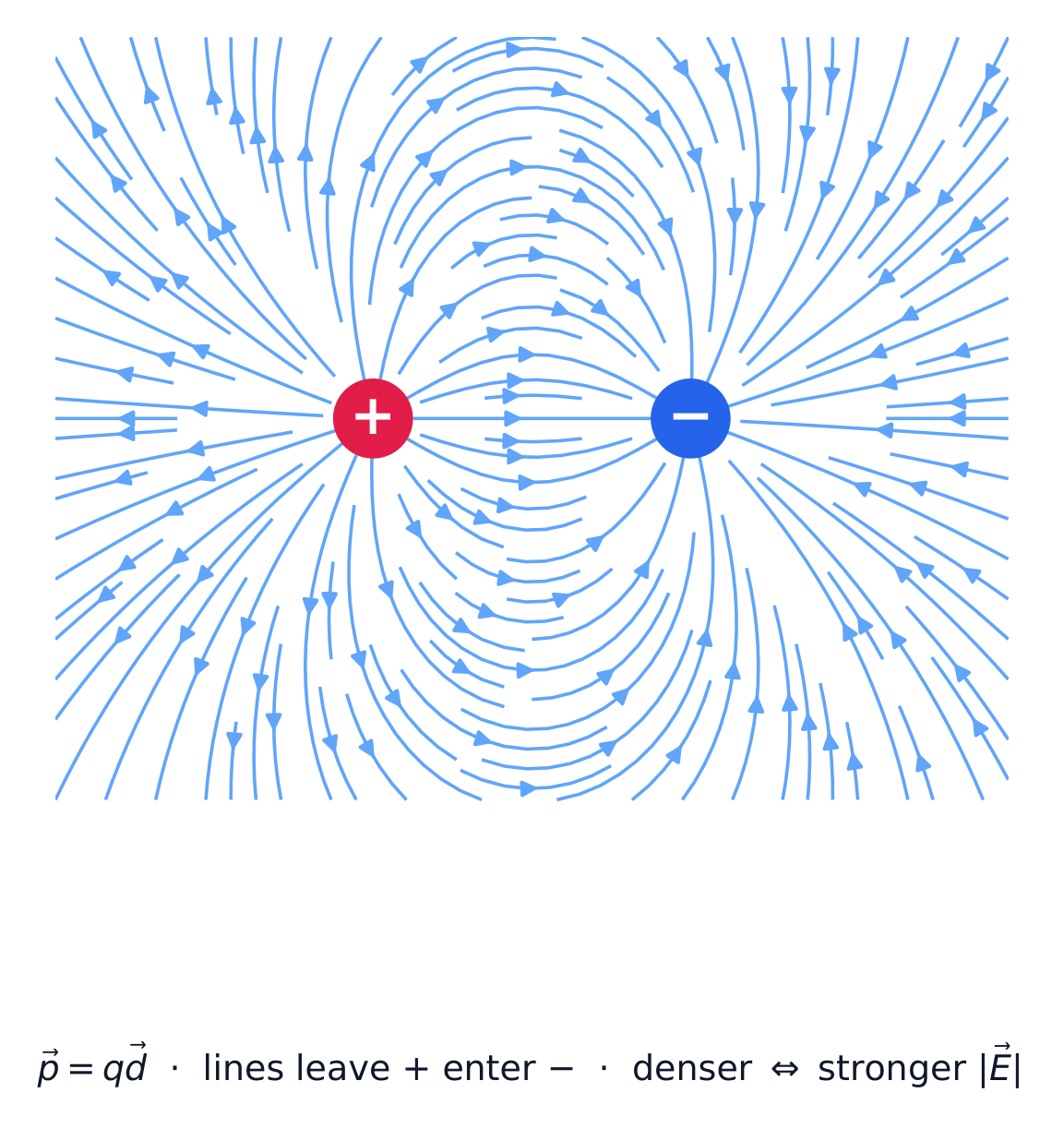 *קווי שדה חשמלי של דיפול מצביעים מהמטען החיובי למטען השלילי
בשדה אחיד מטען חש כוח קבוע, ולכן הוא מאיץ באופן אחיד – אם משוגע צדדית, הוא עוקב אחרי פרבולה, בדיוק כמו גוף שנורה בכבידה.
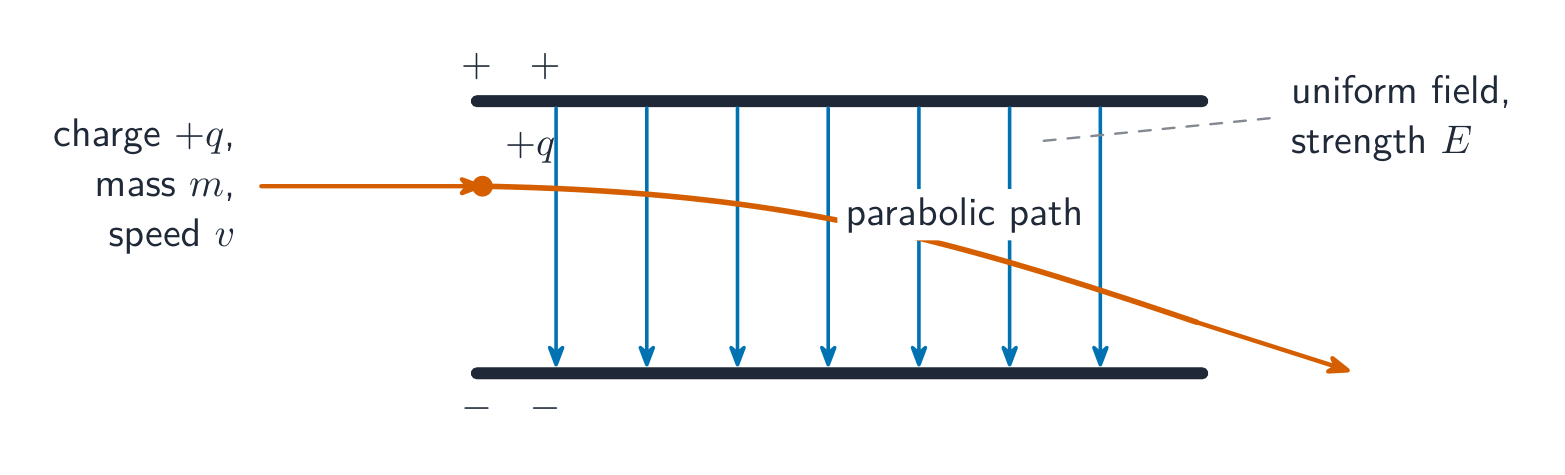 *מטען שעובר בשדה אחיד עוקב אחרי מסלול פרבולי
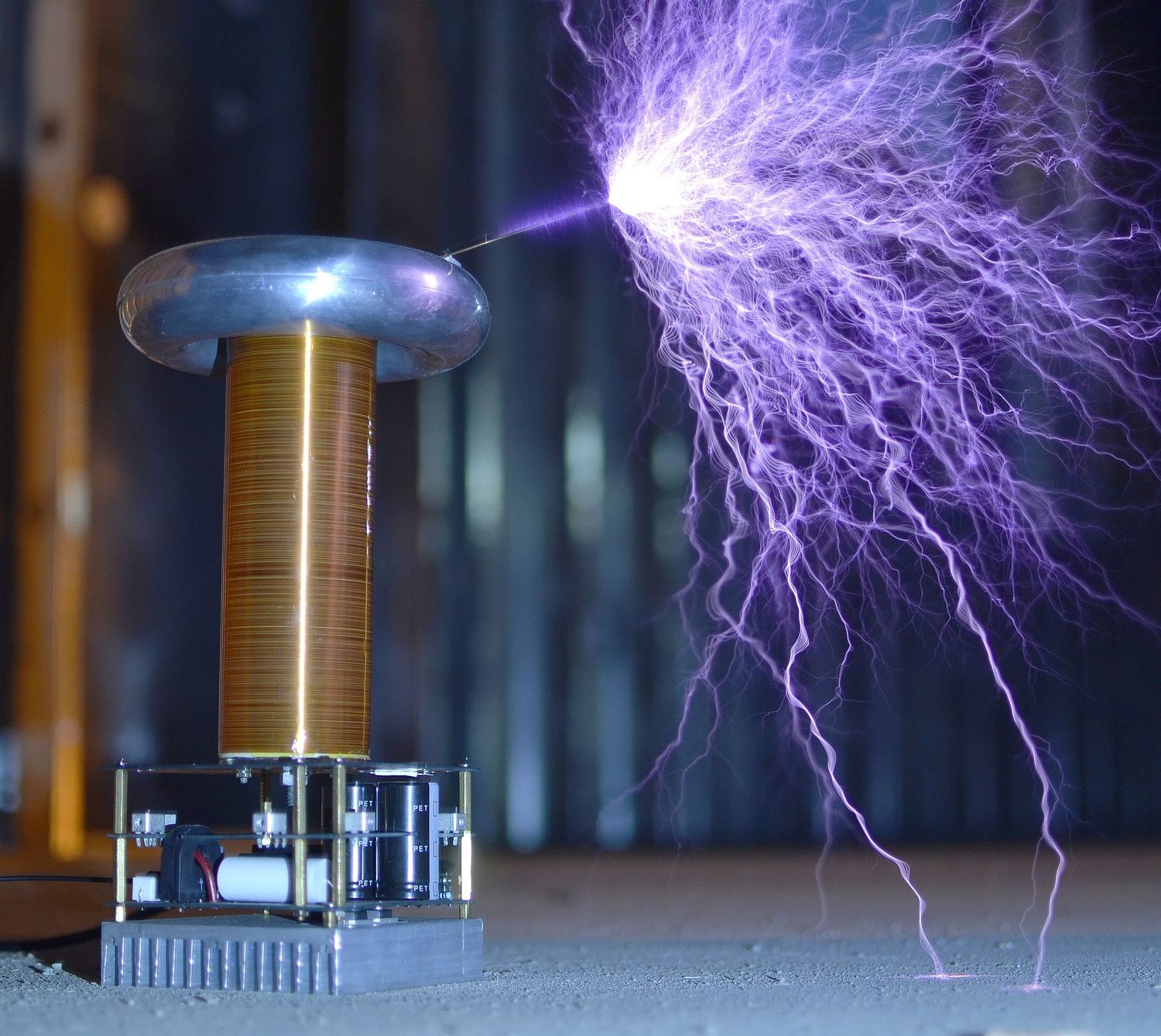
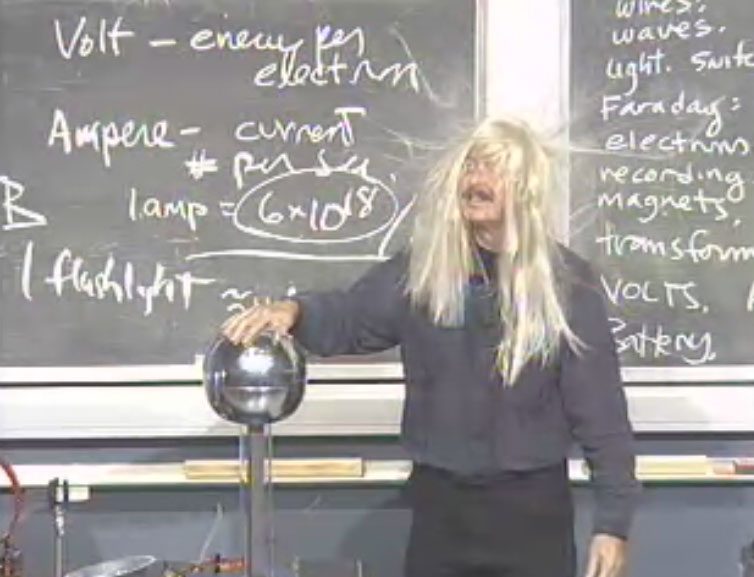 *המטען מתפשט על הגומחה ועל השיער; מטענים זהים נדחים, ולכן הגישה הדוחות זו את זו
חקור
חקרו קווי שדה של מטען נקודתי
הגדירו את המטען כחיובי או שלילי. קווי השדה מתחילים על מטען חיובי ומסתיימים על מטען שלילי, לעולם אינם נחתכים, ומצטופפים שם שבהם $\vec{E}$ הוא החזק ביותר — הצפיפות בקווים פרופורציונלית לגודל השדה.
מילון מונחים
אימון
| English | עברית |
|---|---|
| Electric charge/ɪˈlektrɪk tʃɑːdʒ/ | מטען חשמלי |
| quantized/ˈkwɒntaɪzd/ | כמותי |
| elementary charge/ˌelɪˈmentəri tʃɑːdʒ/ | מטען יסודי |
| conservation of charge/ˌkɒnsəˈveɪʃn ɒv tʃɑːdʒ/ | שימור מטען |
| point charges/pɔɪnt ˈtʃɑːdʒɪz/ | טענות נקודתיות |
| Coulomb's law/ˈkuːlɒmz lɔː/ | חוק קולון |
| inverse-square/ɪnˈvɜːs skweə/ | הפוך-ריבועי |
| superposition/ˌsuːpəpəˈzɪʃn/ | הפרעה (סופרפוזיציה) |
| fundamental property/ˌfʌndəˈmentl ˈprɒpəti/ | תכונה יסודית |
| permittivity of free space/ˌpɜːmɪˈtɪvəti ɒv friː speɪs/ | הפרמיטיביות של ריק |
| conductor/kənˈdʌktə/ | מו Interructor |
| insulator/ˈɪnsjuːleɪtə/ | בודד חשמלי |
| Charging by friction/ˈtʃɑːdʒɪŋ baɪ ˈfrɪkʃn/ | טעינה בשחיקה |
| Charging by conduction/ˈtʃɑːdʒɪŋ baɪ kənˈdʌkʃn/ | טעינה בהולכה |
| Charging by induction/ˈtʃɑːdʒɪŋ baɪ ɪnˈdʌkʃn/ | טעינה באינדוקציה |
| ground/ɡraʊnd/ | הארקה |
| polarization/ˌpəʊləraɪˈzeɪʃn/ | קיטוב |
| electroscope/ɪˌlektrəʊˈskəʊp/ | אלקטרוסקופ |
| electric field/ɪˈlektrɪk fiːld/ | שדה חשמלי |
| test charge/test tʃɑːdʒ/ | מטען בדיקה |
| Field lines/fiːld laɪnz/ | קווי שדה |
| uniform/ˈjuːnɪfɔːm/ | אחיד |
| continuous charge distribution/kənˈtɪnjuːəs tʃɑːdʒ ˌdɪstrɪˈbjuːʃn/ | חלוקת טענה רציפה |
| linear charge density/ˈlɪnɪə tʃɑːdʒ ˈdensɪti/ | צפיפות טענה ליניארית |
| surface charge density/ˈsɜːfɪs tʃɑːdʒ ˈdensɪti/ | צפיפות מטען פני שטח |
| volume charge density/ˈvɒljuːm tʃɑːdʒ ˈdensɪti/ | צפיפות טענה נפחית |
| symmetry/ˈsɪmətri/ | סימטריה |
8.4
שדות חשמליים של חלוקת מטען
סיילבוס
| Learning Objective | Essential Knowledge |
|---|---|
8.4.A |
Boundary statement: AP Physics C: Electricity & Magnetism only expects students to use calculus to find the electric field resulting from the following charge distributions and locations: an infinitely long, uniformly charged wire or cylinder at a distance from its central axis, a thin ring of charge at a location along the axis of the ring, a semicircular arc or part of a semicircular arc at its center, and a finite wire or line charge at a point collinear with the line charge or at a location along its perpendicular bisector. |
מקור: תיאור הקורס והמבחן של College Board AP
עבור חלוקת מטען רציפה, חתוך את הגוף לחלקים ⟨$dq$⟩ ואסוף את שדות מטעני הנקודה שלהם:
$$\vec{E}=\frac{1}{4\pi\varepsilon_0}\int \frac{dq}{r^2}\,\hat{r}.$$
כתוב ⟨$dq$⟩ בעזרת צפיפות מתאימה: ⟨$\lambda\,dl$⟩ עם צפיפות המטען הקויתית (קו או טבע), ⟨$\sigma\,dA$⟩ עם צפיפות המטען השטחית, או ⟨$\rho\,dV$⟩ עם צפיפות המטען הנפחית. לאחר מכן השתמש בסימטריה כדי לבטל רכיבים לפני האינטגרציה – משפט זה הוא לרוב שלב הממונה בחישוב. מקרים של ק্যালקולוס באפר: קו סופי (נקודה מקבילה או אנכית למחצית), תיל אינסופי או צילינדר, טבע על צירו, וקשת במרכזו.
דוגמה מפורטת (טבע, על הציר). טבע ברדיוס ⟨$R$⟩ נושא מטען ⟨$Q$⟩. בנקודה ⟨$z$⟩ לאורך הציר, כל אלמנט נמצא במרחק ⟨$\sqrt{R^2+z^2}$⟩, ובזכות הסימטריה הרכיבים הצדדיים מבטלים זה את זה, ומתאים רק הרכב הצירי ($\cos\alpha=z/\sqrt{R^2+z^2}$):
$$E_z=\frac{1}{4\pi\varepsilon_0}\int\frac{dq}{R^2+z^2}\cdot\frac{z}{\sqrt{R^2+z^2}}=\frac{1}{4\pi\varepsilon_0}\frac{Qz}{(R^2+z^2)^{3/2}}.$$
בדוק את הגבולות: ⟨$E=0$⟩ במרכז ($z=0$), והרחוק ($z\gg R$) הוא הופך ל$kQ/z^2$ – מטען נקודה, כפי שחייב להיות.
8.5
זרימה חשמלית
סיילבוס
| Learning Objective | Essential Knowledge |
|---|---|
8.5.A |
|
מקור: תיאור הקורס והמבחן של College Board AP
*זרימה חשמלית וחוק גאוס
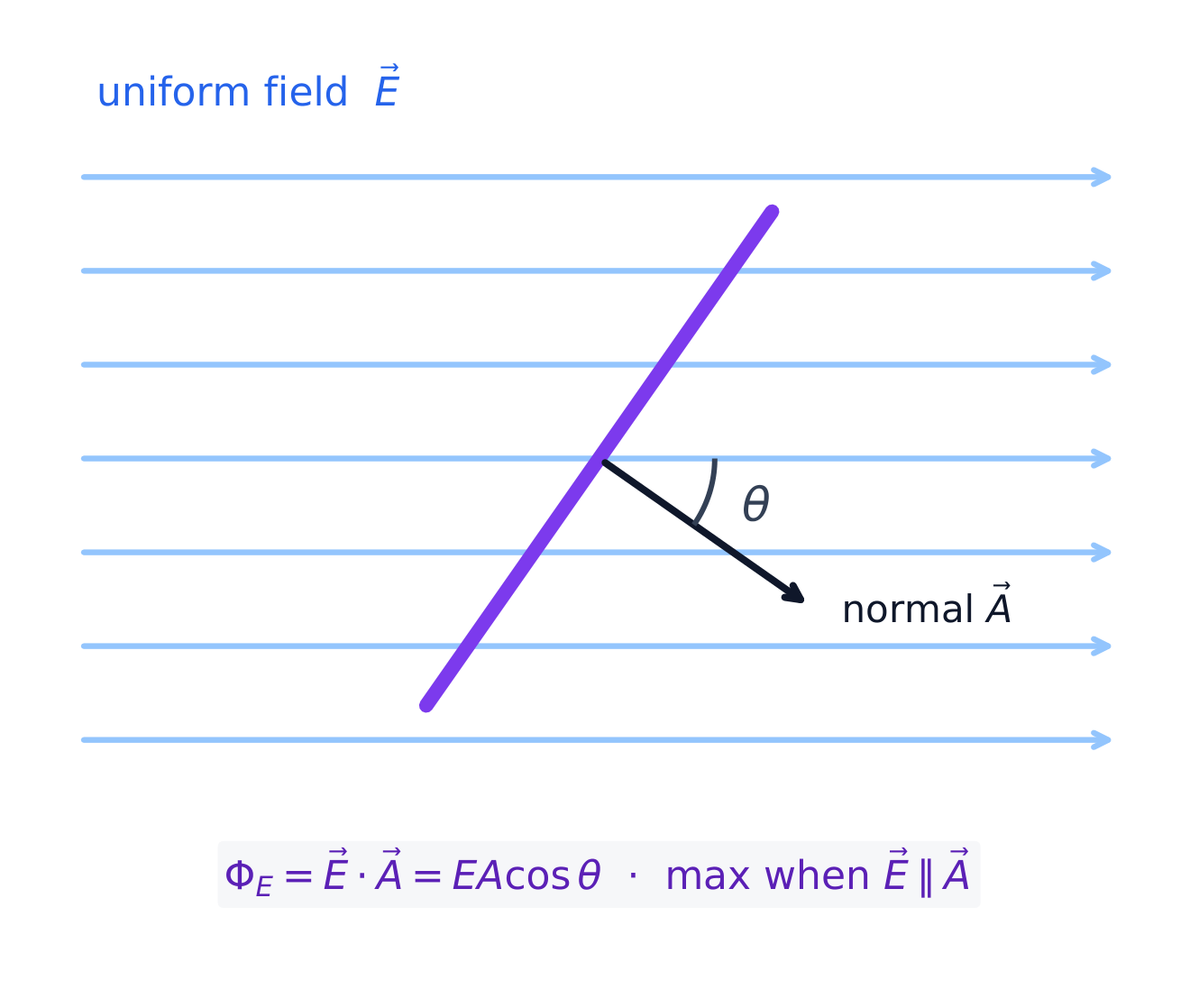
זרימה חשמלית מודדת כמה שדה עובר דרך משטח:
$$\Phi_E=\int \vec{E}\cdot d\vec{A}.$$
שדה אחיד דרך משטח שטוח, $\Phi_E=EA\cos\theta$, כאשר וקטור השטח מאונך למשטח. הפלוקס חיובי כשהקווי שדה יוצאים מפני סגור ושלילי כשהם נכנסים – רק הרכב המאונך של $\vec{E}$ נחשב.
מילון מונחים
אימון
| English | עברית |
|---|---|
| Electric flux/ɪˈlektrɪk flʌks/ | זרם חשמלי |
| area vector/ˈeərɪə ˈvektə/ | ווקטור שטח |
| Gauss's law/ˈɡaʊsɪz lɔː/ | חוק גאוס |
8.6
חוק גאוס
סיילבוס
| Learning Objective | Essential Knowledge |
|---|---|
8.6.A |
Boundary statement: AP Physics C: Electricity & Magnetism only expects students to quantitatively apply Gauss's law to point charges and charge distributions that have spherical, cylindrical, or planar symmetry. |
מקור: תיאור הקורס והמבחן של College Board AP
חוק גאוס – המשוואה הראשונה במשוואות מקסוול – מקשר את הרדיאנס דרך כל משטח סגור למטען הכלוא בתוכו:
$$\oint \vec{E}\cdot d\vec{A}=\frac{Q_{\text{enc}}}{\varepsilon_0}.$$
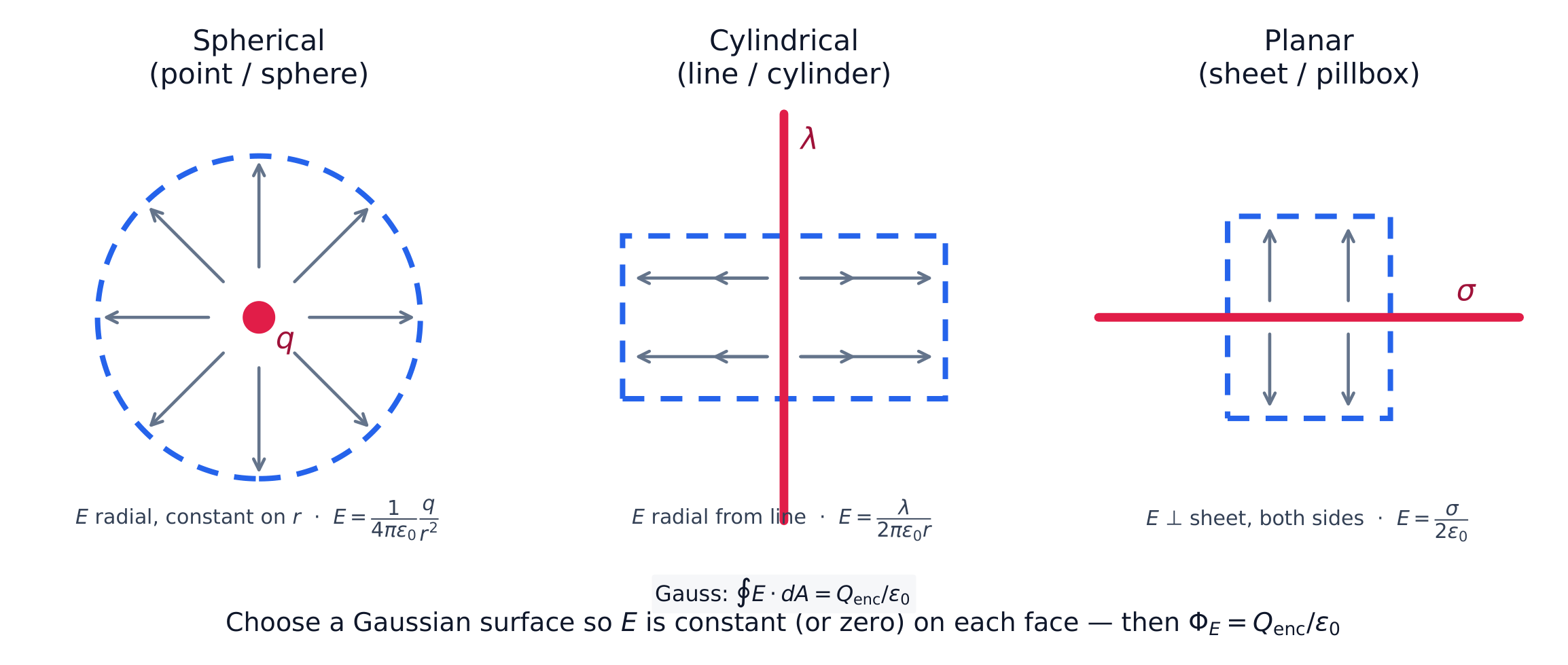
זו מתאים לכל פני סגור, אך זה פתרן עבור $E$ רק כשהסימטריה מאפשרת לבחור פני גאוס שעליהם $E$ הוא קבוע ומאונך (או מקביל, תורמת אפס). שלושת הסימטריות שנבדקות במבחני AP: סימטריה כדורית (כדור מרוכז), סימטריה צילינדרית (צילינדר חופקני) וסימטריה מישורית ("קופסת טabliya" שמעבר למישור).
דוגמה מודגמת (כדור). מחוץ לכדור מטען כולל $Q$, פני גאוס כדוריים ברדיוס $r$ נותנים $E(4\pi r^2)=Q/\varepsilon_0$, ולכן $E=\dfrac{kQ}{r^2}$ – זהה למטען נקודתי במרכז. בתוך כדור מוצק טעון באופן אחיד ברדיוס $R$, הפני מכילים רק $Q_{\text{enc}}=Q\,r^3/R^3$, ולכן $E=\dfrac{kQr}{R^3}$: אפס במרכז, עולה ליניארית עד לפני הכדור.
דוגמה מופרדת (כדור). מחוץ לכדור עם מטען כולל $\lambda$, פני גאוס כדוריים ברדיוס $r$ נותנים $L$, ולכן $\vec{E}\perp d\vec{A}$ – זהה למטען נקודתי במרכז. בתוך כדור מלא טעון באופן אחיד ברדיוס $E(2\pi rL)=\dfrac{\lambda L}{\varepsilon_0}$, הפני כוללים רק $E=\dfrac{\lambda}{2\pi\varepsilon_0 r}$, ולכן $E=\dfrac{\sigma}{2\varepsilon_0}$: אפס במרכז, עולה ליניארית לעבר המשטח.
מיומנות מבחן. תשובה מלאה על חוק גאוס כוללת ארבעה חלקים: שם את הפני, נסח את הארגומנט הסימטריה (מדוע $E$ קבוע ומאונך עליה), ספור את $Q_{\text{enc}}$, ואז פתר. דילוג על המשפט הסימטריה מאבד את נקודת ההסבר – וזכור שחוק גאוס מסביר גם מדוע $E=0$ בתוך כל מוליך בשיווי משקל.
מילון מונחים
אימון
| English | עברית |
|---|---|
| Gaussian surface/ˈɡaʊʃn ˈsɜːfɪs/ | פני גאוס |
| spherical symmetry/sˈferɪkl ˈsɪmətri/ | סימטריה כדורית |
| cylindrical symmetry/sɪˈlɪndrɪkl ˈsɪmətri/ | סימטריה צילינדרית |
| planar symmetry/ˈpleɪnə ˈsɪmətri/ | סימטריה מישורית |
8.6
טיפים לבחינות
- השתמש בחוק קולון $F=\tfrac{1}{4\pi\varepsilon_0}\tfrac{q_1 q_2}{r^2}$ ובסכום כוחות כוקטורים (רכיבים, לא גדלים).
- למטען רציף, משלבים $d\vec E$ על פני $dq=\lambda\,dl,\ \sigma\,dA,\ \rho\,dV$; משתמשים בסימטריה כדי לבטל רכיבים.
- השדה מצביע רחוק מטען חיובי ולעבר מטען שלילי; שרטטו קווי שדה נכון.
- הבדל בין הכוח על מטען ($\vec F=q\vec E$) לבין השדה שהמטען יוצר.
- הבדל בין הכוח על מטען ($k=\tfrac{1}{4\pi\varepsilon_0}$) לבין השדה שהמטען יוצר.
שיעורים אינטראקטיביים בנושא זה
לעבור על הדברים צעד אחר צעד, עם תרגילים לבדיקה מיידית.