Skip to content · ⁨דלג לתוכן⁩

Magnetic Fields and Electromagnetism · ⁨שדות מגנטיים וחשמל-מגנטיות⁩

AP Physics C: Electricity and Magnetism · ⁨פיזיקה AP C: חשמל ומגנטיות⁩ · Topic 12 · ⁨נושא 12⁩

Video lesson for this topic · ⁨שיעור וידאו לנושא זה⁩ Open the video page · ⁨פתח את עמוד הוידאו⁩
12:45

שדות מגנטיים וחשמל-מגנטיות

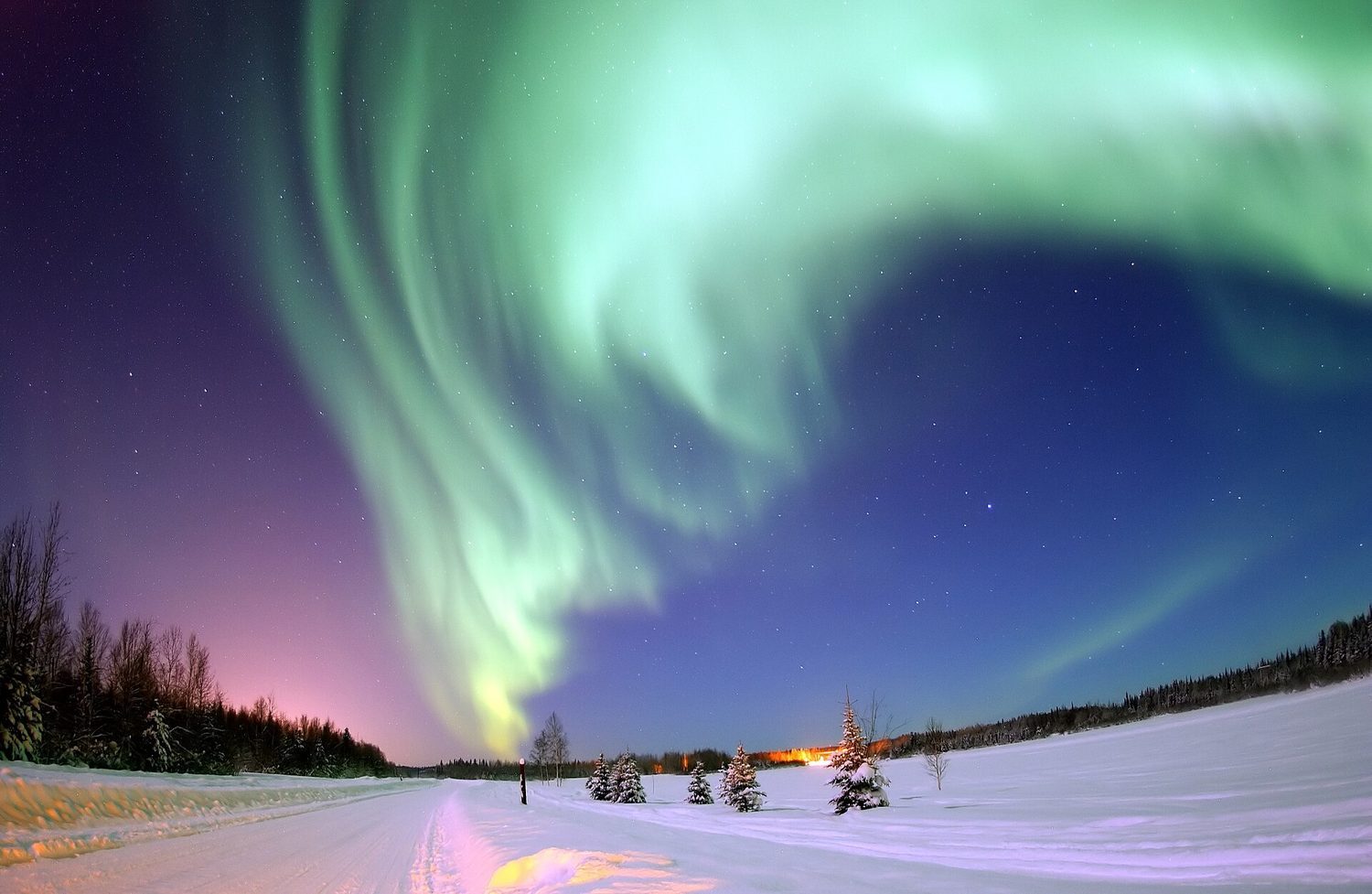
הסתכל צפונה בלילה חורפי בהיר, מספיק צפונה, והשמיים זוהרים בירוק. האורות הללו מופעלים על ידי שדה מגנטי. השמש משלחת מטענים…

English narration · English + 中文 subtitles burned in · ⁨קריאת קול באנגלית · תרגום אנגלי + סינית שרוף בתוך הסרטון⁩

12.1

Magnetic Fields · ⁨שדות מגנטיים⁩

Syllabus · ⁨סיילבוס⁩
English

Learning Objective 12.1.A: Describe the properties of a magnetic field.

  • 12.1.A.1 A magnetic field is a vector field that can be used to determine the magnetic force exerted on moving electric charges, electric currents, or magnetic materials.
    • 12.1.A.1.i Magnetic fields can be produced by magnetic dipoles or combinations of dipoles, but never by monopoles.
    • 12.1.A.1.ii Magnetic dipoles have north and south polarity.
  • 12.1.A.2 A magnetic field is a vector quantity and can be represented using vector field maps.
  • 12.1.A.3 Magnetic field lines must form closed loops, as described by Gauss's law for magnetism.
    • 12.1.A.3.i Maxwell's equations are the collection of equations that fully describe electromagnetism. Gauss's law for magnetism is Maxwell's second equation.
      • Equation: $\oint \vec{B} \cdot d\vec{A} = 0$
    • 12.1.A.3.ii Magnetic fields in a bar magnet form closed loops, with the external magnetic field pointing away from one end (defined as the north pole) and returning to the other end (defined as the south pole).

Learning Objective 12.1.B: Describe the magnetic behavior of a material as a result of the configuration of magnetic dipoles in the material.

  • 12.1.B.1 Magnetic dipoles result from the circular or rotational motion of electric charges. In magnetic materials, this can be the motion of electrons.
    • 12.1.B.1.i Permanent magnetism and induced magnetism are system properties that both result from the alignment of magnetic dipoles within a system.
    • 12.1.B.1.ii No magnetic north pole is ever found in isolation from a south pole. For example, if a bar magnet is broken in half, both halves are magnetic dipoles.
    • 12.1.B.1.iii Magnetic poles of the same polarity will repel; magnetic poles of opposite polarity will attract.
    • 12.1.B.1.iv The magnitude of the magnetic field from a magnetic dipole decreases with increasing distance from the dipole.
  • 12.1.B.2 A magnetic dipole, such as a magnetic compass, placed in a magnetic field will tend to align with the magnetic field.
  • 12.1.B.3 A material's composition influences its magnetic behavior in the presence of an external magnetic field.
    • 12.1.B.3.i Ferromagnetic materials such as iron, nickel, and cobalt can be permanently magnetized by an external field that causes the alignment of magnetic domains or atomic magnetic dipoles.
    • 12.1.B.3.ii Paramagnetic materials such as aluminum, titanium, and magnesium interact weakly with an external magnetic field, in that the magnetic dipoles of the material do not remain aligned after the external field is removed.
    • 12.1.B.3.iii All materials have the property of diamagnetism, in that their electronic structure creates a usually weak alignment of the dipole moments of the material opposite the external magnetic field.
  • 12.1.B.4 Earth's magnetic field may be approximated as a magnetic dipole.

Learning Objective 12.1.C: Describe the magnetic permeability of a material.

  • 12.1.C.1 Magnetic permeability is a measurement of the amount of magnetization in a material in response to an external magnetic field.
  • 12.1.C.2 Free space has a constant value of magnetic permeability, known as the vacuum permeability $\mu_0$, that appears in equations representing physical relationships.
  • 12.1.C.3 The permeability of matter has values different from that of free space and arises from the matter's composition and arrangement. It is not a constant for a material and varies based on many factors, including temperature, orientation, and strength of the external field.
עברית

מטרות למידה 12.1.A: תאר את מאפייני השדה המגנטי.

  • 12.1.A.1 שדה מגנטי הוא שדה וקטורי שיכול לשמש לקביעת הכוח המגנטי הפועל על מטענים חשמליים נעים, זרמים חשמליים או חומרים מגנטיים.
    • 12.1.A.1.i שדות מגנטיים יכולים להיות מופקים ממגנטים דו-קוטביים (דיפולים) או משילובים של דיפולים, אך לעולם לא ממגנטים חד-קוטביים (מונופולים).
    • 12.1.A.1.ii למגנטים דו-קוטביים יש קוטביות צפונית ודרומית.
  • 12.1.A.2 שדה מגנטי הוא גודל וקטורי ואפשר להציג אותו באמצעות מפות שדה וקטוריות.
  • 12.1.A.3 קווי השדה המגנטי חייבים ליצור לולאות סגורות, כפי שמתואר בחוק גאוס למגנטיות.
    • 12.1.A.3.i משוואות מקסוול הן קבוצת המשוואות המתארת במלואה את האלקטרומגנטיות. חוק גאוס למגנטיות הוא המשוואה השנייה של מקסוול.
      • משוואה: $\oint \vec{B} \cdot d\vec{A} = 0$
    • 12.1.A.3.ii שדות מגנטיים בסוגר מבר יוצרים לולאות סגורות, כאשר השדה המגנטי החיצוני מכוון הרחק מאחד הקצה (שהוגדר כקוטב צפוני) וחוזר לקצה השני (שהוגדר כקוטב דרומי).

מטרות למידה 12.1.B: תאר את ההתנהגות המגנטית של חומר כתוצאה מהקונפיגורציה של הדיפולים המגנטיים בתוכו.

  • 12.1.B.1 דיפולים מגנטיים נובעים מתנועה מעגלית או סיבובית של מטענים חשמליים. בחומרים מגנטיים, זה עשוי להיות תנועת אלקטרונים.
    • 12.1.B.1.i מגנטיות קבועה ומגנטיות מושרדת הן מאפייני מערכת הנובעים משנייהם מהסדרת הדיפולים המגנטיים בתוך המערכת.
    • 12.1.B.1.ii לעולם לא נמצא קוטב צפוני בודד ללא קוטב דרומי. לדוגמה, אם מקלט בר נשבר לחצי, כל מחצית היא דיפול מגנטי.
    • 12.1.B.1.iii קוטבים מגנטיים בעלי אותה קוטביות ידחו זה את זה; קוטבים מגנטיים בעלי קוטביות הפוכה יתארו זה עם זה.
    • 12.1.B.1.iv הגודל של השדה המגנטי מדיפול מגנטי יור随着 העלייה במרחק מהדיפול.
  • 12.1.B.2 דיפול מגנטי, כמו מצפן מגנטי, הממוקם בשדה מגנטי י tende להתארגן בהתאם לשדה המגנטי.
  • 12.1.B.3 הרכב החומר משפיע על התנהגותו המגנטית בנוכחות שדה מגנטי חיצוני.
    • 12.1.B.3.i חומרים פרומגנטיים כמו ברזל, ניקל וקובלט יכולים להיות מוגנטיים באופן קבוע על ידי שדה חיצוני הגורם לסדרת הדומיינים המגנטיים או הדיפולים האטומיים המגנטיים.
    • 12.1.B.3.ii חומרים פאראמגנטיים כמו אלומיניום, טיטניום ומגנזיום מתאימים בצורה חלשה לשדה מגנטי חיצוני, שכן הדיפולים המגנטיים של החומר אינם נשארים מסודרים לאחר הסרת השדה החיצוני.
    • 12.1.B.3.iii לכל החומרים יש את התכונה של דיאמגנטיות, שבה המבנה האלקטרוני שלהם יוצר סדרת דיפולים בדרך כלל חלשה בכיוון הפוך לשדה המגנטי החיצוני.
  • 12.1.B.4 השדה המגנטי של כדור הארץ ניתן לקירוב כדיפול מגנטי.

מטרה לימודית 12.1.C: לתאר את הנפגעות המגנטית של חומר.

  • 12.1.C.1 נפגעות מגנטית היא מידה לכמות ההתמגנות בחומר כתגובה לשדה מגנטי חיצוני.
  • 12.1.C.2 לחלל הפנוי יש ערך קבוע של נפגעות מגנטית, המכונה נפגעות וקום $\mu_0$, הופיע במשוואות המייצגות קשרים פיזיקליים.
  • 12.1.C.3 לנפגעות החומר יש ערכים שונים מזה של החלל הפנוי והיא נובעת מההרכב והסידור של החומר. היא אינה קבועה עבור חומר מסוים ומשתנה בהתאם לגורמים רבים, כולל טמפרטורה, כיוון וחוזק השדה החיצוני.
Source: College Board AP Course and Exam Description · ⁨מקור: תיאור הקורס והמבחן של College Board AP⁩

English

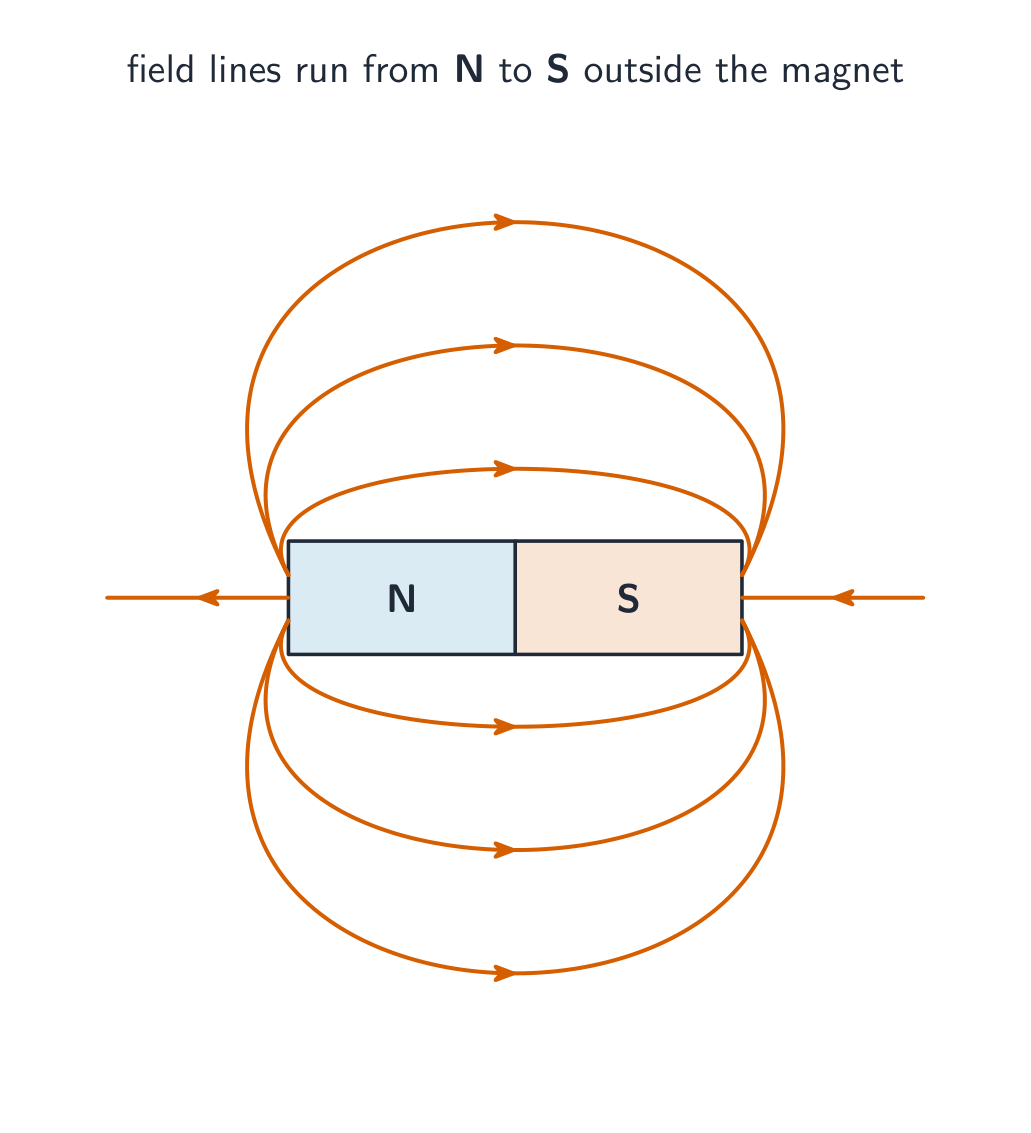
A magnetic field 磁场 $\vec{B}$ is a vector field 矢量场 that surrounds magnets, moving charges, and currents; it determines the magnetic force on any moving charge placed in it. Magnetic field lines 磁感线 must form closed loops: they leave the north pole, return to the south pole, and continue through the magnet. Denser lines mean a stronger field.

Closed loops are the content of Gauss's law for magnetism, the second of Maxwell's equations 麦克斯韦方程组:

$$\oint \vec{B}\cdot d\vec{A}=0.$$

The net magnetic flux through any closed surface is zero – as many field lines leave as enter. That is exactly the statement that isolated magnetic monopoles 磁单极子 do not exist. Every source of magnetism is a magnetic dipole 磁偶极子 (a north–south pair), made by circulating charge – in materials, the motion of electrons. Break a bar magnet in half and you get two smaller dipoles, never a lone pole. Like poles repel, opposite poles attract, and a free dipole – a compass 指南针 – rotates to line up with the local field. Earth's own field is approximately a dipole, which is why a compass works. Dipole fields weaken with distance.

How a material responds to an external field depends on how its internal dipoles behave:

  • Ferromagnetic 铁磁性 (iron, nickel, cobalt): an external field aligns whole magnetic domains 磁畴, and the alignment survives after the field is removed – a permanent magnet.
  • Paramagnetic 顺磁性 (aluminum, titanium): dipoles align weakly with the field but relax when it is removed.
  • Diamagnetic 抗磁性 (all materials): the electronic structure produces a usually weak alignment opposite to the field.

The strength of a material's response is its magnetic permeability 磁导率. Free space has the constant value $\mu_0$ (the vacuum permeability); the permeability of matter differs from $\mu_0$ and is not even constant – it varies with temperature, orientation, and field strength.

עברית

שדה מגנטי $\vec{B}$ הוא שדה וקטורי המקיף מגנטים, מטענים זזים וזרמים; הוא קובע את הכוח המגנטי על כל מטען זז המופקם בו. קווי שדה מגנטי חייבים ליצור לולאות סגורות: הם יוצאים מקוטב הצפון, חוזרים לקוטב הדרום, וממשיכים דרך המגנט. קווים צפופים יותר מעידים על שדה חזק יותר.

קווי שדה עוברים מ-N ל-S מחוץ למגנט מוט

לולאות סגורות הן תוכן חוק גאוס למגנטיות, השני במשוואות מקסוול:

$$\oint \vec{B}\cdot d\vec{A}=0.$$

השטף המגנטי הכולל דרך כל פני שטח סגורים הוא אפילו – אותו מספר קווי שדה יוצא כמו שנכנס. זה בדיוק הביע לכך שאין מונופולים מגנטיים מבודדים. כל מקור של מגנטיות הוא דו-קוטב מגנטי (זוג צפון-דרום), שנוצר על ידי מטען מסתובב – בחומרים, זה תנועת אלקטרונים. שביתו מגנט מוט לשניים ותקבלו שני דו-קוטבים קטנים יותר, לעולם לא קוטב בודד. קוטבים זהים דוחים, קוטבים מנוגדים מושכים, ודו-קוטב חופשי – מצפן – מסתובב כדי להסתדר עם השדה המקומי. השדה של כדור הארץ הוא בקירוב דו-קוטב, ולכן מצפן עובד. שדות דו-קוטבים חולשים עם המרחק.

התגובה של חומר לשדה חיצוני תלויה בהתנהגות המונופולים הפנימיים שלו:

  • פרומגנטי (ברזל, ניקל, קובלט): שדה חיצוני מיישר את כל הדומיינים המגנטיים, והיישור נשמר לאחר הסרת השדה – מגנט קבוע.
  • פאראמגנטי (אלומיניום, טיטניום): המונופולים מתיישבים בחולשה עם השדה אך מתרופפים כאשר הוא מוסר.
  • דיאמגנטי (כל החומרים): המבנה האלקטרוני יוצר לרוב יישור חלש נגד כיוון השדה.

עוצמת התגובה של החומר היא החדירות המגנטית. לחלל ריק יש ערך קבוע $\mu_0$ (חדירות הוואקום); חדירות החומר שונה מ-$\mu_0$ ואף אינה קבועה – היא משתנה לפי טמפרטורה, כיוון ועוצמת השדה.

אורורה: חלקיקים טעונים מהשמש מכוונים על ידי השדה המגנטי של כדור הארץ לכיוון הקוטבים
Explore · ⁨חקור⁩

See a magnet's field lines · ⁨ראה קווי שדה מגנטי⁩

Magnetic field lines run from north to south outside a magnet; where they crowd together the field is strongest. · ⁨קווי שדה מגנטי עוברים מצפון לדרום מחוץ למגנט; כשהם צפופים יחד השדה חזק ביותר.⁩

Watch lesson · ⁨צפה בשיעור⁩
12.2

Magnetism and Moving Charges · ⁨מגנטיות ומטענים זזים⁩

Syllabus · ⁨סיילבוס⁩
English

Learning Objective 12.2.A: Describe the magnetic field produced by moving charged objects.

  • 12.2.A.1 A single moving charged object produces a magnetic field.
    • 12.2.A.1.i The magnetic field at a particular point produced by a moving charged object depends on the object's velocity and the distance between the point and the object.
    • 12.2.A.1.ii At a point in space, the direction of the magnetic field produced by a moving charged object is perpendicular to both the velocity of the object and the position vector from the object to that point in space and can be determined using the right-hand rule.
    • 12.2.A.1.iii The magnitude of the magnetic field is a maximum when the velocity vector and the position vector from the object to that point in space are perpendicular.

Learning Objective 12.2.B: Describe the force exerted on moving charged objects by a magnetic field.

  • 12.2.B.1 A magnetic field will exert a force on a charged object moving within that field, with magnitude and direction that depend on the cross-product of the charge's velocity and the magnetic field.
    • Equation: $\vec{F}_B = q\left(\vec{v} \times \vec{B}\right)$
  • 12.2.B.2 In a region containing both a magnetic field and an electric field, a moving charged object will experience independent forces from each field.
  • 12.2.B.3 The Hall effect describes the potential difference created in a conductor by an external magnetic field that has a component perpendicular to the direction of charges moving in the conductor.
עברית

מטרה לימודית 12.2.A: לתאר את השדה המגנטי הנוצר על ידי אובייקטים טעונים הזזים.

  • 12.2.A.1 אובייקט טעון זז יחיד מייצר שדה מגנטי.
    • 12.2.A.1.i השדה המגנטי בנקודה ספציפית הנוצר על ידי אובייקט טעון זז תלוי במהירות האובייקט ובמרחק בין הנקודה לבין האובייקט.
    • 12.2.A.1.ii בנקודה במרחב, הכיוון של השדה המגנטי הנוצר על ידי אובייקט טעון זז מאונך גם למהירות האובייקט וגם לווקטור המיקום מהאובייקט לנקודה זו במרחב,并可确定使用右手定则。 (Note: The original text had a mix of English and Chinese here; translating the full concept: ) ניתן לקבוע זאת באמצעות כלל היד הימנית.
    • 12.2.A.1.iii הגודל של השדה המגנטי הוא מקסימלי כאשר וקטור המהירות ווקטור המיקום מהאובייקט לנקודה זו במרחב מאונכים זה לזה.

מטרה לימודית 12.2.B: לתאר את הכוח הפועל על אובייקטים טעונים זזים על ידי שדה מגנטי.

  • 12.2.B.1 שדה מגנטי יפעיל כוח על אובייקט טעון הנע בתוך השדה, עם גודל וכיוון התלויים בכפל וקטורי של מהירות הטעינה והשדה המגנטי.
    • משוואה: $\vec{F}_B = q\left(\vec{v} \times \vec{B}\right)$
  • 12.2.B.2 באזור המכיל גם שדה מגנטי וגם שדה חשמלי, אובייקט טעון הנע יחווה כוחות עצמאיים מכל שדה.
  • 12.2.B.3 אפקט הול מתאר הפרש פוטנציאל הנוצר במוליך על ידי שדה מגנטי חיצוני בעל רכיב אנכי לכיוון תנועת הטעונים במוליך.

Source: College Board AP Course and Exam Description · ⁨מקור: תיאור הקורס והמבחן של College Board AP⁩

English
A moving charge in a magnetic field

A moving charge does two things: it creates a magnetic field, and it feels a force in an external one. The field it creates at a point is perpendicular 垂直 to both its velocity and the position vector from charge to point (right-hand rule again), and is largest where those two are perpendicular – zero directly ahead of or behind the motion.

The force on a charge moving in a field $\vec{B}$ is the cross product

$$\vec{F}_B=q\,\vec{v}\times\vec{B},\qquad F=qvB\sin\theta,$$

perpendicular to both $\vec{v}$ and $\vec{B}$ – point the fingers of your right hand along $\vec{v}$, curl toward $\vec{B}$, and the thumb gives the force on a positive charge (reverse it for negative). Because $\vec{F}_B\perp\vec{v}$, the magnetic force does no work on the charge: it changes direction, never speed.

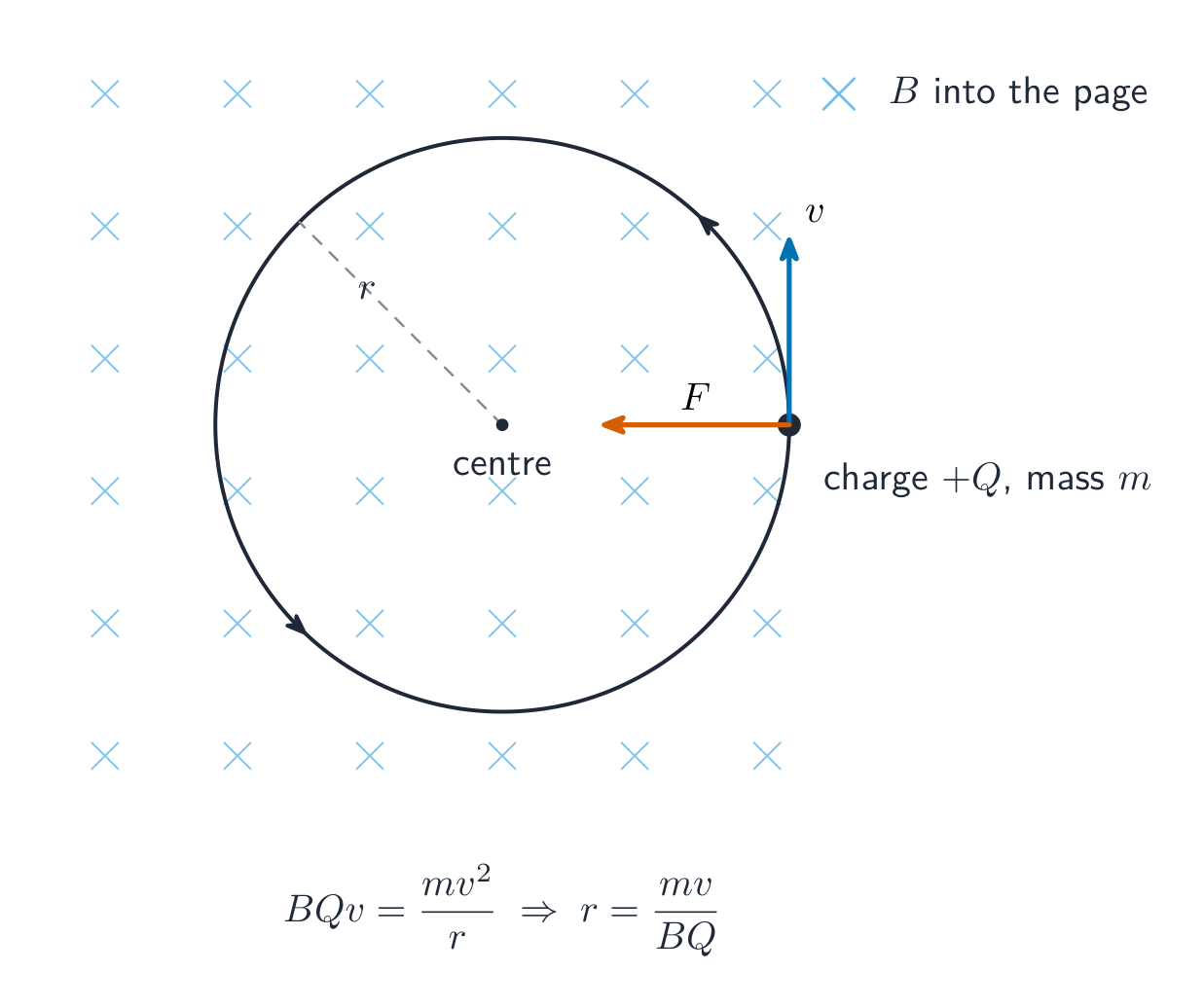
A charge moving perpendicular to a uniform field therefore travels in a circle, the magnetic force supplying the centripetal force 向心力:

$$qvB=\frac{mv^2}{r}\quad\Rightarrow\quad r=\frac{mv}{qB},\qquad T=\frac{2\pi m}{qB}.$$

Notice the period $T$ does not depend on the speed – faster particles ride larger circles in the same time.

Worked example. A proton ($q=1.6\times10^{-19}\ \text{C}$, $m=1.67\times10^{-27}\ \text{kg}$) enters a $0.50\ \text{T}$ field at $2.0\times10^{5}\ \text{m/s}$, perpendicular to it. The magnetic force $F=qvB=1.6\times10^{-14}\ \text{N}$ bends it into a circle of radius $r=\dfrac{mv}{qB}=\dfrac{1.67\times10^{-27}(2.0\times10^{5})}{1.6\times10^{-19}(0.50)}=4.2\times10^{-3}\ \text{m}$.

In a region with both an electric and a magnetic field, the two forces act independently and add as vectors. Balancing them makes a velocity selector 速度选择器: with $\vec{E}$ and $\vec{B}$ crossed, only charges with $qE=qvB$, i.e. $v=E/B$, pass straight through. The Hall effect 霍尔效应 is the same physics inside a conductor: a field with a component perpendicular to the current pushes the moving carriers sideways, charge builds up on one face, and a measurable potential difference appears across the conductor – its sign reveals whether the carriers are positive or negative.

עברית
מטען נע בשדה מגנטי

מטען הנע לבצע שתי פעולות: הוא יוצר שדה מגנטי, וזה חש בכוח בשדה חיצוני. השדה שהוא יוצר בנקודה נתונה הוא ניצב לגבי גם מהירותו וגם וקטור המיקום ממטען לנקודה (שוב כלל היד הימנית), והוא מקסימלי שם ששניהם ניצבים זה לזה – אפס בדיוק קדימה או אחורה לתנועה.

הכוח על מטען הנע בשדה $\vec{B}$ הוא מכפלה וקטורית

$$\vec{F}_B=q\,\vec{v}\times\vec{B},\qquad F=qvB\sin\theta,$$

ניצבה לשני $\vec{v}$ ול-$\vec{B}$ – נקודו אצבעות היד הימנית לאורך $\vec{v}$, כיפפו לעבר $\vec{B}$, והאגודל מצביע על הכוח על מטען חיובי (הפכו עבור מטען שלילי). מכיוון ש-$\vec{F}_B\perp\vec{v}$, הכוח המגנטי אינו מבצע עבודה על המטען: הוא משנה כיוון, לעולם אינו משנה מהירות.

מטען הנע בניצב לשדה אחיד לכן נע במעגל, כאשר הכוח המגנטי מספק את הכוח המרכזי:

$$qvB=\frac{mv^2}{r}\quad\Rightarrow\quad r=\frac{mv}{qB},\qquad T=\frac{2\pi m}{qB}.$$

שימו לב שהתקופה $T$ אינה תלויה במהירות – חלקיקים מהירים יותר רוכבים על מעגלים גדולים יותר באותו זמן.

חלקיק טעון הנע אופקית לשדה מגנטי עוקף מסלול מעגלי

דוגמה פתורה. פרוטון ($q=1.6\times10^{-19}\ \text{C}$, $m=1.67\times10^{-27}\ \text{kg}$) נכנס לשדה $0.50\ \text{T}$ במהירות $2.0\times10^{5}\ \text{m/s}$, בניצב אליו. הכוח המגנטי $F=qvB=1.6\times10^{-14}\ \text{N}$ מכופף אותו למעגל ברדיוס $r=\dfrac{mv}{qB}=\dfrac{1.67\times10^{-27}(2.0\times10^{5})}{1.6\times10^{-19}(0.50)}=4.2\times10^{-3}\ \text{m}$.

באזור בו ישנם גם שדה חשמלי וגם שדה מגנטי, שני הכוחות פועלים באופן עצמאי ומת加ים כוקטורים. איזון ביניהם יוצר מסנן מהירות: עם $\vec{E}$ ו-$\vec{B}$ ניצבים זה לזה, רק מטענים בעלי $qE=qvB$, כלומר $v=E/B$, עוברים ישר דרכו. אפקט הול הוא אותה פיזיקה בתוך מוליך: שדה עם רכיב ניצב לזרם דוחף את נושאי המטען הנעים צדדים, מטען מצטבר על צד אחד, ומתקבל הפרש פוטנציאל מדיד בין צדדים – סימונו חושף האם נושאי המטען הם חיוביים או שליליים.

Explore · ⁨חקור⁩

Force on a moving charge · ⁨כוח על מטען הנע⁩

A charge moving through a magnetic field feels a force $F=qvB$ at right angles to both its velocity and the field — the basis of the motor effect. Reverse either and the force flips. · ⁨מטען הנע דרך שדה מגנטי מרגיש כוח $F=qvB$ המאונך גם לכיוון מהירותו וגם לשדה — בסיס אפקט המנוע. הפיכת אחד מהם הופכת את הכוח.⁩

Watch lesson · ⁨צפה בשיעור⁩
12.3

Magnetic Fields of Current-Carrying Wires · ⁨שדות מגנטיים של חוטים המוליכים זרם⁩

Syllabus · ⁨סיילבוס⁩
English

Learning Objective 12.3.A: Describe the magnetic field produced by a current-carrying wire.

  • 12.3.A.1 The Biot-Savart law defines the magnitude and direction of a magnetic field created by an electrical current.
    • Equation: $d\vec{B} = \dfrac{\mu_0}{4\pi} \dfrac{I(d\vec{\ell} \times \hat{r})}{r^2}$
  • 12.3.A.2 The magnetic field vectors around a small segment of a current-carrying wire are tangent to concentric circles centered on that wire. The field has no component toward, away from, or parallel to the segment of the current-carrying wire.
  • 12.3.A.3 The Biot-Savart law can be used to derive the magnitudes and directions of magnetic fields around segments of current-carrying wires, for example at the center of a circular loop of wire.
    • Equation: $B_{\text{center of loop}} = \dfrac{\mu_0 I}{2R}$

Learning Objective 12.3.B: Describe the force exerted on current-carrying wires by a magnetic field.

  • 12.3.B.1 A magnetic field will exert a force on a current-carrying wire.
    • Equation: $\vec{F}_B = \int I\left(d\vec{\ell} \times \vec{B}\right)$

Boundary statement: AP Physics C: Electricity & Magnetism only expects students to perform quantitative analysis of certain cases of current-carrying conductors using the Biot-Savart law, such as at a location along the perpendicular bisector of a straight conductor, at a location along the central axis of a circular loop, or at the center of a segment of a circular loop.

עברית

מטרה לימודית 12.3.A: לתאר את השדה המגנטי הנוצר על ידי חוט המעביר זרם.

  • 12.3.A.1 חוק ביאו-סבאר מגדיר את הגודל והכיוון של שדה מגנטי הנוצר על ידי זרם חשמלי.
    • משוואה: $d\vec{B} = \dfrac{\mu_0}{4\pi} \dfrac{I(d\vec{\ell} \times \hat{r})}{r^2}$
  • 12.3.A.2 וקטורי השדה המגנטי סביב קטע קטן של חוט נושא זרם הם מגעים לעיגולים ממוקדים הממוקמים על אותו חוט. לשדה אין רכיב כלפי, מרחק או מקביל לקטע החוט נושא הזרם.
  • 12.3.A.3 ניתן להשתמש בחוק ביאו-סבאר כדי לגזור את הגדלים והכיוונים של שדות מגנטיים סביב קטעים של חוטים נושאי זרם, לדוגמה במרכז לולאת חוט מעגלית.
    • משוואה: $B_{\text{center of loop}} = \dfrac{\mu_0 I}{2R}$

מטרת הלמידה 12.3.B: לתאר את הכוח הפועל על חוטים נושאי זרם על ידי שדה מגנטי.

  • 12.3.B.1 שדה מגנטי יפעיל כוח על חוט נושא זרם.
    • משוואה: $\vec{F}_B = \int I\left(d\vec{\ell} \times \vec{B}\right)$

הצהרת גבול: AP Physics C: חשמל ומגנטיות מצפה רק מבחינת הסטודנטים לבצע ניתוח כמותי של מקרים מסוימים של מוליכים נושאי זרם באמצעות חוק ביאו-סבאר, כמו במיקום לאורך האנך האמצעי של מוליך ישר, במיקום לאורך הציר המרכזי של לולאה מעגלית, או במרכז קטע של לולאה מעגלית.

Source: College Board AP Course and Exam Description · ⁨מקור: תיאור הקורס והמבחן של College Board AP⁩

English
The magnetic field around a current

A current is a stream of moving charges, so it creates a magnetic field. The Biot–Savart law 毕奥-萨伐尔定律 adds up the field of each current element:

$$d\vec{B}=\frac{\mu_0}{4\pi}\frac{I\,d\vec{l}\times\hat{r}}{r^2}.$$

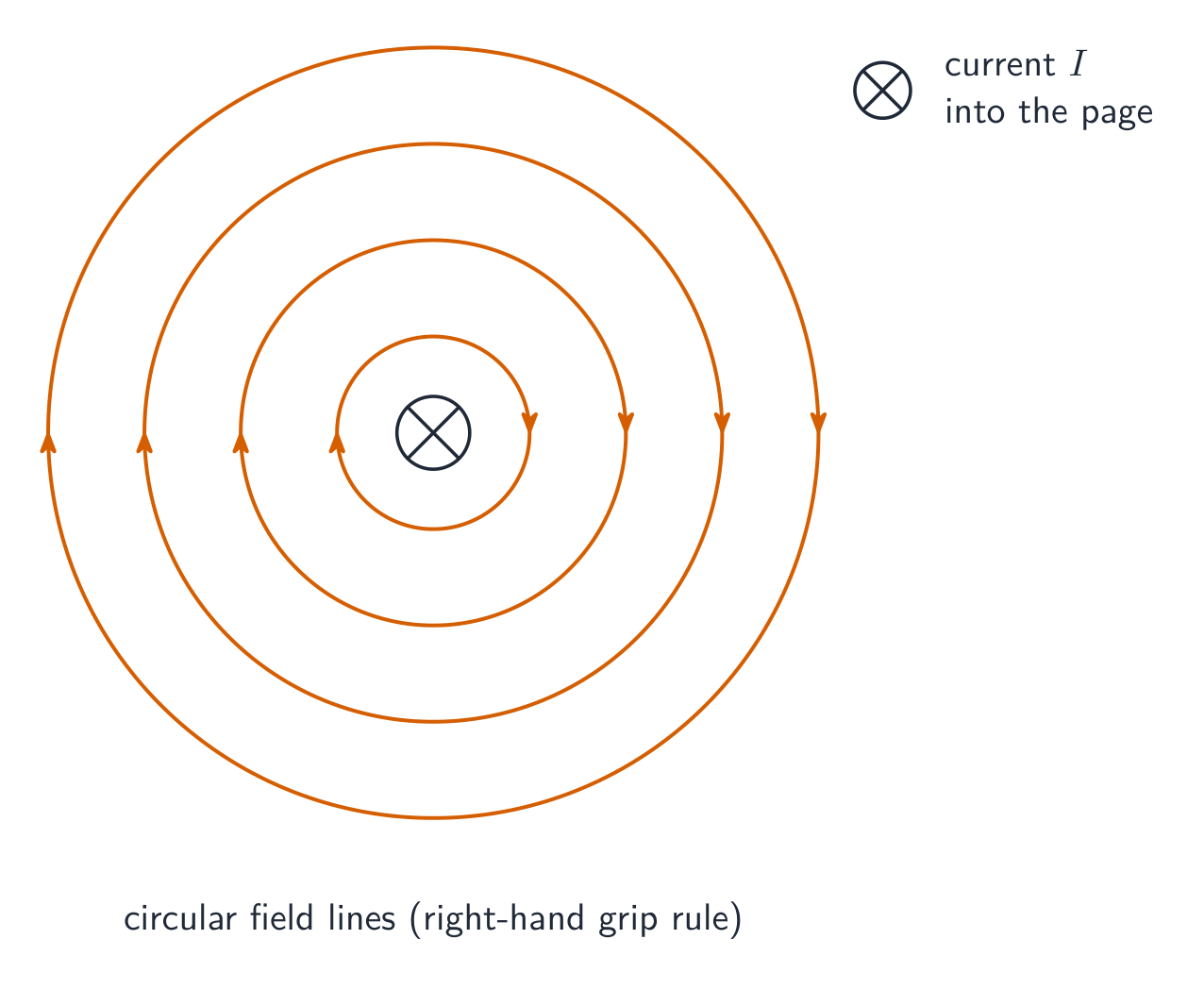
Around any straight segment the field vectors are tangent 相切 to concentric circles 同心圆 centred on the wire – no component toward, away from, or along the wire. Curl your right hand around the wire with the thumb along the current: your fingers give the field direction.

The Biot–Savart integrals AP expects: a long straight wire ($B=\dfrac{\mu_0 I}{2\pi r}$, or a point on the perpendicular bisector of a finite wire), and the centre of a circular loop,

$$B_{\text{centre of loop}}=\frac{\mu_0 I}{2R},$$

where every element $d\vec{l}$ is perpendicular to $\hat{r}$ and equally distant $R$ – say that in an FRQ derivation. An arc that is a fraction of a full circle contributes that same fraction of $\mu_0 I/2R$ at its centre.

A field also pushes on a current-carrying wire, element by element:

$$\vec{F}_B=\int I\,d\vec{l}\times\vec{B}\qquad(\vec{F}=I\vec{L}\times\vec{B}\ \text{for a straight wire in a uniform field}).$$

Worked example. Two long parallel wires a distance $d=0.10\ \text{m}$ apart each carry $5.0\ \text{A}$ in the same direction. Wire 1's field at wire 2 is $B=\dfrac{\mu_0 I}{2\pi d}=1.0\times10^{-5}\ \text{T}$, so wire 2 feels $\dfrac{F}{L}=I B=5.0\times10^{-5}\ \text{N/m}$, pulled toward wire 1. Same-direction currents attract; opposite currents repel.

עברית
השדה המגנטי סביב זרם

זרם הוא זרימה של מטענים נעים, ולכן הוא יוצר שדה מגנטי. חוק ביאו-סבאר- סוכך את השדה של כל אלמנט זרם:

$$d\vec{B}=\frac{\mu_0}{4\pi}\frac{I\,d\vec{l}\times\hat{r}}{r^2}.$$

סביב כל קטע ישר, וקטורי השדה הם משיקים ל-מעגלים מרוכזים שמרכזם בחוט – אין רכיב כלפי פנים, מחוצה או לאורך החוט. כופפו את יד הימנית סביב החוט כאשר האגודל מצביע לאורך הזרם: אצבעותיכם מראות את כיוון השדה.

קווי שדה מעגליים קונצנטריים מקיפים חוט ישר המעביר זרם
קווי שדה מעגליים קונצנטריים עוטפים חוט ישר המוליך זרם

אינטגרלי הביאו-סבאר ש-AP מצפה להם: חוט ישר ארוך ($B=\dfrac{\mu_0 I}{2\pi r}$, או נקודה על האנך המאונך למחצית חוט מוגבל), ומרכז של לולאה מעגלית,

$$B_{\text{centre of loop}}=\frac{\mu_0 I}{2R},$$

כאשר כל אלמנט $d\vec{l}$ ניצב ל-$\hat{r}$ ונמצא באותה מרחק $R$ – אמרו זאת בנגזיר FRQ. קשת שהיא שבר של מעגל שלם תתרם אותו שבר של $\mu_0 I/2R$ במרכז שלה.

שדה מגנטי גם דוחף על חוט המוליך זרם, אלמנט אלמנט:

$$\vec{F}_B=\int I\,d\vec{l}\times\vec{B}\qquad(\vec{F}=I\vec{L}\times\vec{B}\ \text{for a straight wire in a uniform field}).$$

דוגמה מפורטת. שני חוטים ארוכים ומקבילים במרחק $d=0.10\ \text{m}$ זה מזה נושאים כל אחד זרם $5.0\ \text{A}$ באותה כיוון. השדה של חוט 1 בחוט 2 הוא $B=\dfrac{\mu_0 I}{2\pi d}=1.0\times10^{-5}\ \text{T}$, ולכן חוט 2 מרגיש כוח $\dfrac{F}{L}=I B=5.0\times10^{-5}\ \text{N/m}$, הנמשך לכיוון חוט 1. זרמים באותה כיוון נמשכים; זרמים בכיוונים הפוכים נדחים.

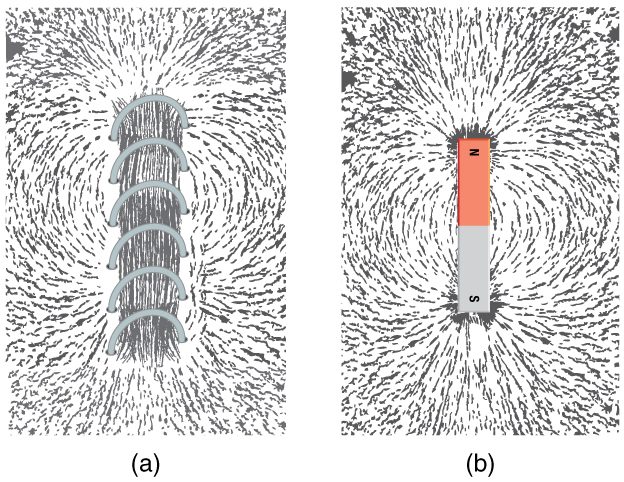
גרידת ברזל סביב סליל המעביר זרם
סליל המעביר זרם (סולנואיד) יוצר שדה מגנטי דומה בדיוק לשדה של מקטב מוטרב
Vocabulary · ⁨מילון מונחים⁩ Train · ⁨אימון⁩
English עברית
magnetic field/mæɡˈnetɪk fiːld/ שדה מגנטי
vector field/ˈvektə fiːld/ שדה וקטורי
magnetic field lines/mæɡˈnetɪk fiːld laɪnz/ קווי שדה מגנטי
Maxwell's equations/ˈmækswelz ɪˈkweɪʒnz/ משוואות מקסוול
magnetic monopoles/mæɡˈnetɪk ˈmɒnəʊpəʊlz/ מונופולים מגנטיים
magnetic dipole/mæɡˈnetɪk ˈdaɪpəʊl/ דו-קוטב מגנטי
compass/ˈkʌmpəs/ מצפן
Ferromagnetic/ˌferəməɡˈnetɪk/ פרומגנטי
magnetic domains/mæɡˈnetɪk dəˈmeɪnz/ תחומים מגנטיים
Paramagnetic/ˌpærəməɡˈnetɪk/ פראמגנטי
Diamagnetic/ˌdaɪəməɡˈnetɪk/ דיאמגנטי
magnetic permeability/mæɡˈnetɪk ˌpɜːməˈbɪlɪti/ חדירות מגנטית
perpendicular/ˌpɜːpənˈdɪkjʊlə/ ניצב
centripetal force/senˈtrɪpɪtl fɔːs/ כוח צנטריפטלי
velocity selector/vəˈlɒsɪti sɪˈlektə/ בוחן מהירות
Hall effect/hɔːl ɪˈfekt/ אפקט הול
Biot–Savart law/ˈbɪɒt ˈsævɑːt lɔː/ חוק ביו-סבאר
tangent/ˈtændʒənt/ טנגנס
concentric circles/kənˈsentrɪk ˈsɜːklz/ מעגלים קונצנטריים
Ampère's law/ˈæmpeəz lɔː/ חוק אמפיר
Amperian loop/æmˈpɪərɪən luːp/ לולאת אמפיר
current density/ˈkʌrənt ˈdensɪti/ צפיפות זרם
superposition/ˌsuːpəpəˈzɪʃn/ הפרעה (סופרפוזיציה)
solenoid/ˈsəʊlənɔɪd/ סולנואיד
Watch lesson · ⁨צפה בשיעור⁩
12.4

Ampère's Law · ⁨חוק אמפère⁩

Syllabus · ⁨סיילבוס⁩
English

Learning Objective 12.4.A: Use Ampère's law to describe the magnetic field created by a moving charge carrier.

  • 12.4.A.1 Ampère's law relates the magnitude of the magnetic field to the current enclosed by a closed imaginary path called an Amperian loop.
    • Equation: $\oint \vec{B} \cdot d\vec{\ell} = \mu_0 I_{\text{enc}}$
    • 12.4.A.1.i Ampère's law can be used to determine the magnetic field near a long, straight current-carrying wire.
      • Equation: $B_{\text{wire}} = \dfrac{\mu_0}{2\pi} \dfrac{I}{r}$
    • 12.4.A.1.ii Unless otherwise stated, all solenoids are assumed to be very long, with uniform magnetic fields inside the solenoids and negligible magnetic fields outside the solenoids.
    • 12.4.A.1.iii Ampère's law can be used to determine the magnetic field inside of a long solenoid.
      • Equation: $B_{\text{sol}} = \mu_0 n I$
  • 12.4.A.2 An Amperian loop is a closed path around a current-carrying conductor.
  • 12.4.A.3 The principle of superposition can be used to determine the net magnetic field at a point in space created by various combinations of current-carrying conductors, or conducting loops, segments, or cylinders.
  • 12.4.A.4 Maxwell's equations are the collection of equations that fully describe electromagnetism. Maxwell's fourth equation is Ampère's law with Maxwell's addition; it states that magnetic fields can be generated by electric current (Ampère's law) and that a changing electric field creates a magnetic field, similar to the way a moving charge creates a magnetic field (Maxwell's addition).
    • Equation: $\oint \vec{B} \cdot d\vec{\ell} = \mu_0 I + \mu_0 \varepsilon_0 \dfrac{d\Phi_E}{dt}$

Boundary statement: AP Physics C: Electricity & Magnetism only expects quantitative application of Ampère's law limited to situations involving symmetrical magnetic fields. Long straight wires, long solenoids carrying currents, as well as conductive slabs or cylindrical conductors carrying a current density, are the types of shapes to which Ampère's law will be applied on the AP Physics C: Electricity & Magnetism Exam.

Boundary statement: AP Physics C: Electricity & Magnetism does not expect students to use Maxwell's fourth equation with a changing electric field. However, students should understand that a changing electric field generates a magnetic field.

עברית

מטרת הלמידה 12.4.A: להשתמש בחוק אמפר כדי לתאר את השדה המגנטי הנוצר על ידי נשיא מטען נע.

  • 12.4.A.1 חוק אמפר מקשר בין גודל השדה המגנטי לבין הזרם הכלוא בתוך לולאה מדומית סגורה הנקראת לולאת אמפר.
    • משוואה: $\oint \vec{B} \cdot d\vec{\ell} = \mu_0 I_{\text{enc}}$
    • 12.4.A.1.i ניתן להשתמש בחוק אמפר כדי לקבוע את השדה המגנטי סביב חוט ישר וארוך נושא זרם.
      • משוואה: $B_{\text{wire}} = \dfrac{\mu_0}{2\pi} \dfrac{I}{r}$
    • 12.4.A.1.ii אלא אם כן צוין אחרת, כל הסולנוידים נחשבים לארוכים מאוד, עם שדות מגנטיים אחידים בתוך הסולנוידים ושדות מגנטיים זניחים מחוץ לסולנוידים.
    • 12.4.A.1.iii ניתן להשתמש בחוק אמפר כדי לקבוע את השדה המגנטי בתוך סולנויד ארוך.
      • משוואה: $B_{\text{sol}} = \mu_0 n I$
  • 12.4.A.2 לולעת אמפר היא מסלול סגור סביב מוליך העובר בו זרם חשמלי.
  • 12.4.A.3 ניתן להשתמש בעקרון הסופרפוזיציה כדי לקבוע את השדה המגנטי הכולל בנקודה כלשהי במרחב שנוצר על ידי שילובים שונים של מוליכים העוברים בהם זרמים, או לולאות הולכה, קטעים או צילינדרים.
  • 12.4.A.4 משוואות מקסוול הן קבוצת המשוואות המתארת במלואה את האלקטרומגנטיות. משוואת מקסוול הרביעית היא חוק אמפר עם התוספת של מקסוול; היא קובעת כי שדות מגנטיים יכולים להיות נוצרים על ידי זרם חשמלי (חוק אמפר) וכי שדה חשמלי משתנה יוצר שדה מגנטי, בדומה לכך שטעינה נעה יוצרת שדה מגנטי (התוספת של מקסוול).
    • משוואה: $\oint \vec{B} \cdot d\vec{\ell} = \mu_0 I + \mu_0 \varepsilon_0 \dfrac{d\Phi_E}{dt}$

הצהרת גבול: AP Physics C: חשמל ומגנטיות מצפה רק ליישום כמותי של חוק אמפר המוגבל למצבים המעורבים בשדות מגנטיים סימטריים. חוטים ישרים ארוכים, סולנוידים ארוכים העוברים בהם זרמים, כמו גם לוחות מוליכים או מוליכים צילינדריים העוברים בהם צפיפות זרם, הם סוגי הצורות אליהן ייושם חוק אמפר בבחינת AP Physics C: חשמל ומגנטיות.

הצהרת גבול: AP Physics C: חשמל ומגנטיות אינו מצפה מתלמידים להשתמש במשוואת מקסוול הרביעית עם שדה חשמלי משתנה. עם זאת, התלמידים צריכים להבין ששדה חשמלי משתנה מייצר שדה מגנטי.

Source: College Board AP Course and Exam Description · ⁨מקור: תיאור הקורס והמבחן של College Board AP⁩

English

For symmetric current distributions, Ampère's law 安培定律 finds the field far faster than Biot–Savart:

$$\oint \vec{B}\cdot d\vec{l}=\mu_0 I_{\text{enc}}.$$

Choose an Amperian loop 安培环路 that matches the symmetry, so that $B$ is constant along the loop (and parallel to it) and comes out of the integral. AP applies it to long straight wires, long solenoids, and conductors carrying a current density 电流密度 (slabs and cylinders); combinations are handled by superposition 叠加.

Worked example. Find the field $0.10\ \text{m}$ from a long wire carrying $5.0\ \text{A}$. A circular loop of radius $r$ shares the field's symmetry, so $B(2\pi r)=\mu_0 I$ and

$$B=\frac{\mu_0 I}{2\pi r}=\frac{(4\pi\times10^{-7})(5.0)}{2\pi(0.10)}=1.0\times10^{-5}\ \text{T}.$$

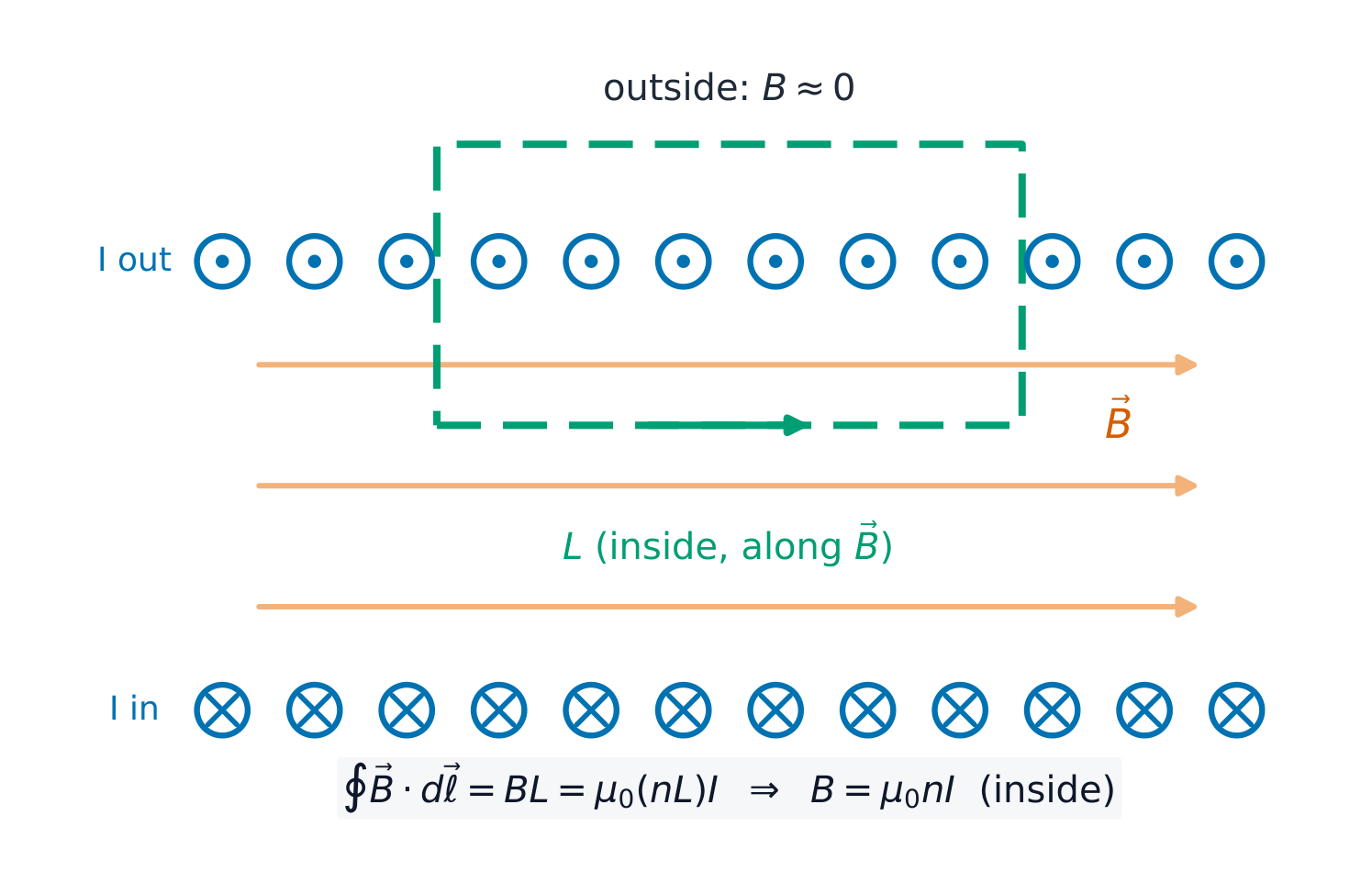
A long solenoid 螺线管 (assumed: uniform field inside, negligible field outside) is the other classic. Take a rectangular loop with one side of length $L$ inside, parallel to the axis: only that side contributes to the integral, so $BL=\mu_0 (nL) I$ and

$$B_{\text{sol}}=\mu_0 n I,$$

with $n$ the turns per metre.

Worked example (cylinder). A solid cylindrical conductor of radius $R$ carries current $I$ spread uniformly over its cross-section. Inside ($r), a circular loop encloses $I_{\text{enc}}=I\dfrac{r^2}{R^2}$, so $B=\dfrac{\mu_0 I r}{2\pi R^2}$ – the field grows linearly to the surface, then falls off as $1/r$ outside.

Exam skill. Every Ampère's-law answer earns its marks in the setup: name the loop, state why $B$ is constant and parallel to it (symmetry), and count $I_{\text{enc}}$ carefully before you solve. Maxwell's fourth equation adds one more idea you should know qualitatively: a changing electric field also creates a magnetic field – but AP will not ask you to compute with that term.

עברית

לחלוקות זרם סימטריות, חוק אמפère מוצא את השדה הרבה מהר יותר מאשר ביוט-סבר:

$$\oint \vec{B}\cdot d\vec{l}=\mu_0 I_{\text{enc}}.$$

בחרו מעגל אמפרי התואם את הסימטריה, כך ש$B$ יהיה קבוע לאורך המעגל (וחלקי ממנו) ויציא מהאינטגרל. AP משתמש בכך עבור חוטים ישרים ארוכים, סולנוידים ארוכים ומוליכים עם צפיפות זרם (לוחות וגלילים); שילובים טיפולים על ידי סופרפוזיציה.

דוגמה מופתרת. מצאו את השדה $0.10\ \text{m}$ מאורך חוט ארוך העובר בו $5.0\ \text{A}$. מעגל עגול ברדיוס $r$ משתף סימטריה זו של השדה, ולכן $B(2\pi r)=\mu_0 I$ ו

$$B=\frac{\mu_0 I}{2\pi r}=\frac{(4\pi\times10^{-7})(5.0)}{2\pi(0.10)}=1.0\times10^{-5}\ \text{T}.$$

סליל ארוך (סולנויד) הוא הקלאסי השני (בהנחה: שדה אחיד בתוך, שדה זניח מחוץ). לקח לולאה מלבנית עם צד אחד באורך $L$ בתוך, מקביל לציר: רק צד זה תורם לאינטגרל, ולכן $BL=\mu_0 (nL) I$ ו

$$B_{\text{sol}}=\mu_0 n I,$$

כאשר $n$ הוא מספר ההליכות למטר.

לולאת אמפère מלבנית גוזרת את השדה האחיד בתוך סליל

דוגמה מפורטת (צילינדר). מוליך צילינדרי מוצק בעל רדיוס $R$ ועובר בו זרם $I$ המפוזר באופן אחיד על פני חתכו. בתוך ($r), לולאה מעגלית כוללת $I_{\text{enc}}=I\dfrac{r^2}{R^2}$, ולכן $B=\dfrac{\mu_0 I r}{2\pi R^2}$ – השדה גדל לינארית עד לפני השטח, ואז יורד לפי $1/r$ מחוץ לצילינדר.

מיומנות לבחינה. לכל תשובה בחוק אמפère יש להרוויח את נקודותיה בהגדרה: קרא את שם הלולאה, ציין למה $B$ קבוע ונאנך לה (סימטריה), וחשב בזהירות את $I_{\text{enc}}$ לפני שהפתרת. משוואת רביעית של מקסוול מוסיפה רעיון נוסף שחייבת לדעת באופן איכותי: שדה חשמלי משתנה גם הוא יוצר שדה מגנטי – אך AP לא יבקש ממך לחשב עם האיבר הזה.

12.4

Exam tips · ⁨טיפים לבחינות⁩

English
  • The magnetic force $\vec F=q\vec v\times\vec B$ is perpendicular to velocity — use the right-hand rule and note it does no work.
  • A charge in a uniform field moves in a circle with $r=\tfrac{mv}{qB}$.
  • Find the field of currents with Biot–Savart $d\vec B=\tfrac{\mu_0}{4\pi}\tfrac{I\,d\vec l\times\hat r}{r^2}$ or Ampère's law $\oint \vec B\cdot d\vec l=\mu_0 I_{enc}$ when there is symmetry.
  • Force on a wire is $\vec F=I\vec L\times\vec B$; keep the cross-product direction straight.
  • Distinguish the force on a charge from the field the current creates.
עברית
  • הכוח המגנטי $\vec F=q\vec v\times\vec B$ הוא ניצב למהירות — השתמש בכלל היד הימנית והערה שהוא לא מבצע עבודה.
  • מטען בשדה אחיד נע במסלול עגול עם $r=\tfrac{mv}{qB}$.
  • מצא את שדה הזרמים עם ביוט-סבר $d\vec B=\tfrac{\mu_0}{4\pi}\tfrac{I\,d\vec l\times\hat r}{r^2}$ או חוק אמפère $\oint \vec B\cdot d\vec l=\mu_0 I_{enc}$ כאשר יש סימטריה.
  • כוח על חוט הוא $\vec F=I\vec L\times\vec B$; שמור על כיוון מכפלת הצלב נכון.
  • הבדל בין הכוח על מטען לבין השדה שהזרם יוצר.

Interactive lessons on this topic · ⁨שיעורים אינטראקטיביים בנושא זה⁩

Work through it step by step, with instant-check exercises. · ⁨לעבור על הדברים צעד אחר צעד, עם תרגילים לבדיקה מיידית.⁩

Past Papers · ⁨מבחני עבר⁩

More topics in AP Physics C: Electricity and Magnetism · ⁨פיזיקה AP C: חשמל ומגנטיות⁩ · ⁨נושאים נוספים בAP Physics C: Electricity and Magnetism · ⁨פיזיקה AP C: חשמל ומגנטיות⁩⁩

Log in or create account · ⁨היכנס או צור חשבון⁩

IGCSE, A-Level & AP