| Learning Objective | Essential Knowledge |
|---|---|
10.1.A |
|
Conductors and Capacitors · מוליכים ומכבידים
AP Physics C: Electricity and Magnetism · פיזיקה AP C: חשמל ומגנטיות · Topic 10 · נושא 10
 8:28
8:28
מוליכים ומכבידים
מטוס נפגע בברק פעם אחת בשנה בערך, והאנשים בתוכו מרגישים כמעט כלום. רכב בסופת ברקים הוא אחד המקומות הבטוחים ביותר לשבת. מדוע?…
English narration · English + 中文 subtitles burned in · קריאת קול באנגלית · תרגום אנגלי + סינית שרוף בתוך הסרטון
10.1
Electrostatics with Conductors · אלקטרוסטטיקה עם מוליכים
Syllabus · סיילבוס
Source: College Board AP Course and Exam Description · מקור: תיאור הקורס והמבחן של College Board AP
English
In an ideal conductor 导体, electrons move freely. Put extra charge on one and the charges repel each other until, almost instantly, they settle into electrostatic equilibrium 静电平衡. In that state the conductor has four properties you must be able to state and use:
- The electric field inside the conductor is zero. If it were not, free electrons would still be moving.
- All excess charge sits on the surface. (Negative net charge = extra electrons on the surface; positive = a shortage of electrons there.)
- The field just outside is perpendicular 垂直 to the surface, with magnitude $E=\sigma/\varepsilon_0$. Any parallel component would push charge sideways along the surface.
- The whole conductor is one equipotential surface 等势面: every point, inside and on the surface, is at the same potential.
Charge density is largest where the surface curves sharply – at points and edges – so the outside field is strongest there. In an external field a conductor polarizes: charge shifts on its surface so that the interior stays field-free and the body stays an equipotential. Surrounding a region with a closed conducting shell keeps outside fields out entirely – electrostatic shielding 静电屏蔽, the idea behind the Faraday cage 法拉第笼.
עברית
במוליך אידיאלי, אלקטרונים נעים בחופשיות. אם מוסיפים מטען עודף למוליך, המטענים דוחים זה את זה עד שחולף זמן קצר מאוד והם מתקיים איזון אלקטרוסטטי. במצב זה למוליך יש ארבעה מאפיינים שאתה חייב לדעת להגיד ולהשתמש בהם:
- השדה החשמלי בתוך המוליך הוא אפס. אם לא היה כזה, האלקטרונים החופשיים עדיין היו נעים.
- כל המטען העודף יושב על הפני השטח. (מטען נקי שלילי = אלקטרונים נוספים על הפני השטח; חיובי = מחסור באלקטרונים שם.)
- השדה מיד מחוץ לפני השטח הוא ניצב לפני השטח, בעוצמה $E=\sigma/\varepsilon_0$. כל רכיב מקביל לדחיפת מטען בצד לאורך הפני השטח.
- כל המוליך הוא פני פוטנציאל אחיד: כל נקודה, בתוך ובפני השטח, נמצאת באותו פוטנציאל.
צפיפות המטען הגבוהה ביותר היא במקומות שבהם הפני שטח מתכופפים בחריפות – בנקודות ובקצוות – ולכן השדה החיצוני חזק שם ביותר. בשדה חיצוני, מוליך מתקוטב: המטען משתנה בפני השטח כך שהפנים נותר ללא שדה והגוף נשאר פני פוטנציאל אחיד. סביבת אזור עם מעטפת מוליכת סגורה שומרת על שדות חיצוניים מחוץ לחלוטין – הגנה אלקטרוסטטית, הרעיון שעומד מאחורי כלוב פאראדיי.
10.2
Redistribution of Charge Between Conductors · חלוקת מטען בין מוליכים
Syllabus · סיילבוס
English
Learning Objective 10.2.A: Describe the movement of charge and the resulting interactions when conductors physically contact each other.
- 10.2.A.1 When conductors are in electrical contact, charges will be redistributed such that the surfaces of each conductor are at the same electric potential.
- 10.2.A.2 Ground is an idealized reference point that has zero electric potential and can absorb or provide an infinite amount of charge without changing its electric potential.
- 10.2.A.3 Charge can be induced on a conductor by grounding the conductor in the presence of an external electric field.
עברית
מטרת הלמידה 10.2.A: לתאר את תנועת המטען והאינטראקציות הנובעות מכך כאשר מוליכים נוגעים זה בזה פיזית.
- 10.2.A.1 כאשר מוליכים במגע חשמלי, מטענים יופצו מחדש כך שפני השטח של כל מוליך יהיו באותו פוטנציאל חשמלי.
- 10.2.A.2 האדמה היא נקודת ייחוס אידיאלית בעלת פוטנציאל חשמלי אפס ויכולה לספוג או לספק כמות אינסופית של מטען ללא שינוי בפוטנציאל החשמלי שלה.
- 10.2.A.3 מטען יכול להיות מושפע (ינדוקציה) על מוליך על ידי חיבורו לאדמה בנוכחות שדה חשמלי חיצוני.
Source: College Board AP Course and Exam Description · מקור: תיאור הקורס והמבחן של College Board AP
English
When two conductors touch (or are wired together), charge flows between them until both surfaces reach the same potential – that is the stopping condition, not "equal charges". A larger sphere holds more charge at the same potential ($V=kQ/R$), so it takes the larger share.
Worked example. A small sphere of radius $R$ carrying $+6.0\ \mu\text{C}$ touches a distant sphere of radius $2R$, then they separate. Equal potentials require $\dfrac{kq_1}{R}=\dfrac{kq_2}{2R}$, so $q_2=2q_1$. With $q_1+q_2=6.0\ \mu\text{C}$: $q_1=2.0\ \mu\text{C}$ and $q_2=4.0\ \mu\text{C}$.
Ground 接地 is an idealized reference at zero potential that can absorb or supply any amount of charge. Grounding a conductor while an external charge is nearby leaves the conductor with a net induced charge 感应电荷: the external field pushes charge of one sign to ground, and cutting the ground wire before removing the external charge traps the rest.
עברית
כששני מוליכים נוגעים זה בזה (או מחוברים בלולאה), מטען זורם ביניהם עד ששני הפני השטח מגיעים ל-אותו פוטנציאל – זה תנאי עצירת הזרימה, ולא "מטענים שווים". כדור גדול יותר מכיל יותר מטען באותו פוטנציאל ($V=kQ/R$), ולכן הוא לוקח את החלק הגדול יותר.
דוגמה מפורטת. כדור קטן ברדיוס $R$ נושא מטען $+6.0\ \mu\text{C}$ נוגע בכדור רחוק ברדיוס $2R$, ואז הם נפרדים. פוטנציאלים שווים דורשים $\dfrac{kq_1}{R}=\dfrac{kq_2}{2R}$, ולכן $q_2=2q_1$. עם $q_1+q_2=6.0\ \mu\text{C}$: $q_1=2.0\ \mu\text{C}$ ו$q_2=4.0\ \mu\text{C}$.
הארקה היא ייחוס אידיאלי באפס פוטנציאל שיכול לספוג או לספק כל כמות של מטען. הארקת מוליך כאשר מטען חיצוני נמצא בקרבתו משאירה את המוליך עם מטען מושרה נטו: השדה החיצוני דוחה מטען של סימן אחד להארקה, וחיתוך חוט ההארקה לפני הסרת המטען החיצוני לוכד את שאר המטען.
10.3
Capacitors · קבלים
Syllabus · סיילבוס
English
Learning Objective 10.3.A: Describe the physical properties of a parallel-plate capacitor.
- 10.3.A.1 A parallel-plate capacitor consists of two separated parallel conducting surfaces that can hold equal amounts of charge with opposite signs.
- 10.3.A.2 Capacitance relates the magnitude of the charge stored on each plate to the electric potential difference created by the separation of those charges.
- Equation: $C = \dfrac{Q}{\Delta V}$
- 10.3.A.2.i The capacitance of a capacitor depends only on the physical properties of the capacitor, such as the capacitor's shape and the material used to separate the plates.
- 10.3.A.2.ii The capacitance of a parallel-plate capacitor is proportional to the area of one of its plates and inversely proportional to the distance between its plates. The constant of proportionality is the product of the dielectric constant, $\kappa$, of the material between the plates and the electric permittivity of free space, $\varepsilon_0$.
- Equation: $C = \dfrac{\kappa \varepsilon_0 A}{d}$
- 10.3.A.3 The electric field between two charged parallel plates with uniformly distributed electric charge, such as in a parallel-plate capacitor, is constant in both magnitude and direction, except near the edges of the plates.
- 10.3.A.3.i The magnitude of the electric field between two charged parallel plates, where the plate separation is much smaller than the dimensions of the plates, can be determined by applying Gauss's law and the principle of superposition.
- Equation: $E = \dfrac{Q}{\varepsilon_0 A}$
- 10.3.A.3.ii The electric field is proportional to the surface charge density on either plate of the capacitor.
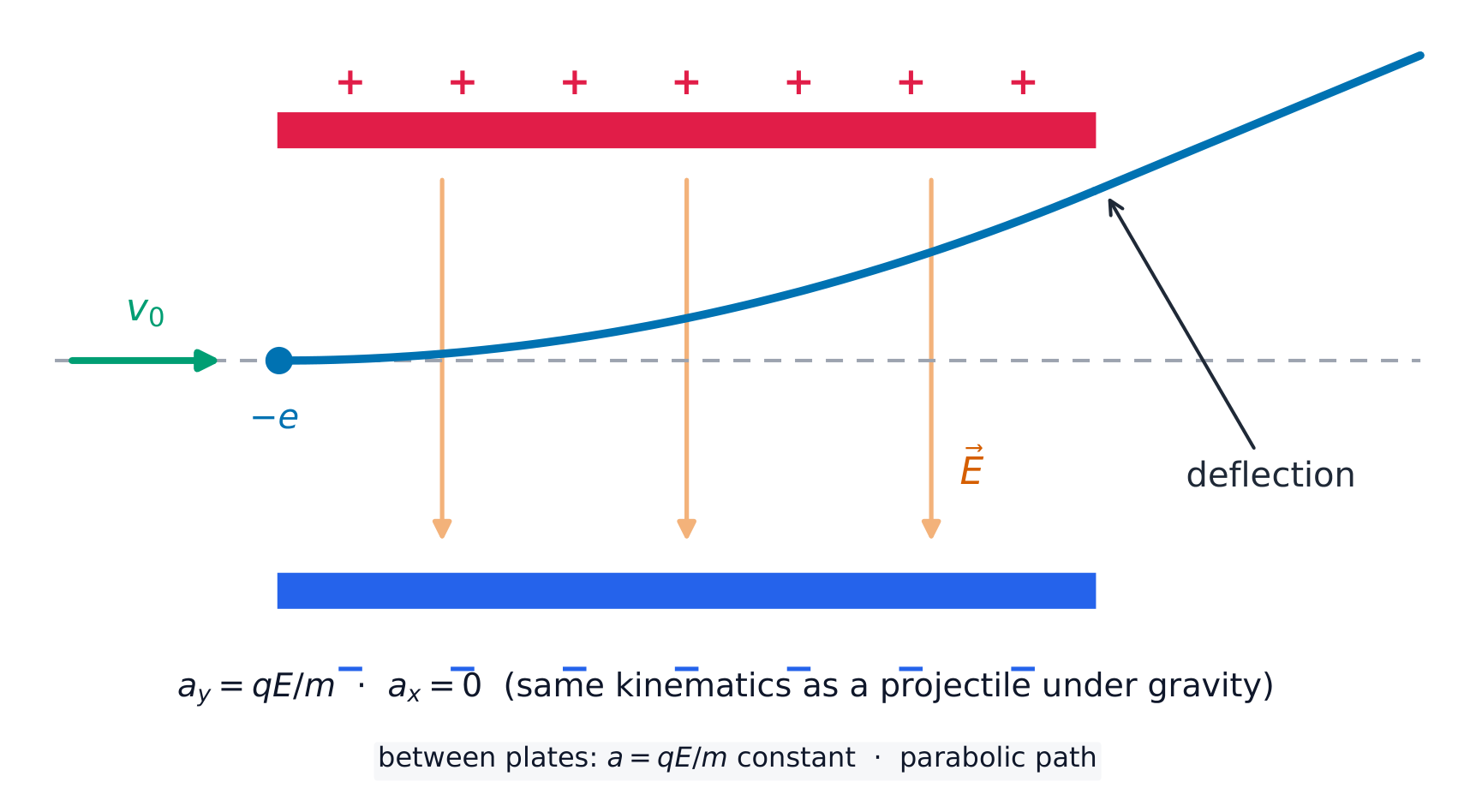
- 10.3.A.3.iii A charged particle between two oppositely charged parallel plates undergoes constant acceleration, and therefore its motion shares characteristics with the projectile motion of an object with mass in the gravitational field near Earth's surface.
- 10.3.A.3.i The magnitude of the electric field between two charged parallel plates, where the plate separation is much smaller than the dimensions of the plates, can be determined by applying Gauss's law and the principle of superposition.
- 10.3.A.4 The electric potential energy stored in a capacitor is equal to the work done by an external force to separate that amount of charge on the capacitor.
- 10.3.A.5 The electric potential energy stored in a capacitor is described by the equation $U_C = \dfrac{1}{2} Q \Delta V$.
Boundary statement: While other shapes are also able to separate charges, AP Physics C: Electricity & Magnetism only expects the quantitative analysis and description of parallel-plate capacitors, concentric spherical capacitors, and coaxial cylindrical capacitors.
עברית
מטרת הלמידה 10.3.A: לתאר את התכונות הפיזיקליות של קבל לוחות מקבילים.
- 10.3.A.1 קבל לוחות מקבילים מורכב משתי משטחים מוליכים מקבילים ומרוחקים שמסוגלים להכיל כמויות שוות של מטען עם סימנים מנוגדים.
- 10.3.A.2 הקיבול קובע את הקשר בין גודל המטען המאוחסן בכל לוח לבין הפרש הפוטנציאל החשמלי הנוצר על ידי ההפרדה בין מטענים אלו.
- משוואה: $C = \dfrac{Q}{\Delta V}$
- 10.3.A.2.i הקיבול של קבל תלוי רק בתכונות הפיזיקליות שלו, כגון צורת הקבל והחומר המשמש להפרידה בין הלוחות.
- 10.3.A.2.ii הקיבול של קבל לוחות מקבילים פרופורציונלי לשטח אחד מהלוחות והופך לפרופורציונלי הפוך למרחק בין הלוחות. קבוע הפרופורציונליות הוא מכפלת קבוע הדיאלקטרי, $\kappa$, של החומר שבין הלוחות והאפריטיביות החשמלית של ריק, $\varepsilon_0$.
- משוואה: $C = \dfrac{\kappa \varepsilon_0 A}{d}$
- 10.3.A.3 השדה החשמלי בין שני לוחות מקבילים טעונים עם מטען חשמלי המפוזר באופן אחיד, כגון בקבל לוחות מקבילים, הוא קבוע גם בגודלו וגם בכיוונו, למעט בקרבת קצוות הלוחות.
- 10.3.A.3.i גודל השדה החשמלי בין שני לוחות מקבילים טעונים, כאשר מרחק הלוחות קטן משמעותית מממדי הלוחות, ניתן לחשב באמצעות חוק גאוס ועקרון הסופרפוזיציה.
- משוואה: $E = \dfrac{Q}{\varepsilon_0 A}$
- 10.3.A.3.ii השדה החשמלי פרופורציונלי לצפיפות המטען השטחית על כל לוח מהקבל.
- 10.3.A.3.iii חלקיק טעון בין שני לוחות מקבילים עם מטענים מנוגדים עובר בתאוצה קבועה, ולכן התנועה שלו משתפת מאפיינים עם תנועת הפרציל של גוף בעל מסה בשדה הכבידה בקרבת פני כדור הארץ.
- 10.3.A.3.i גודל השדה החשמלי בין שני לוחות מקבילים טעונים, כאשר מרחק הלוחות קטן משמעותית מממדי הלוחות, ניתן לחשב באמצעות חוק גאוס ועקרון הסופרפוזיציה.
- 10.3.A.4 האנרגיה הפוטנציאלית החשמלית המאוחסנת בקבל שווה לעבודה שנעשתה על ידי כוח חיצוני כדי להפריד כמות זו של מטען על הקבל.
- 10.3.A.5 האנרגיה הפוטנציאלית החשמלית המאוחסנת בקבל מתוארת על ידי המשוואה $U_C = \dfrac{1}{2} Q \Delta V$.
הצהרת גבול: בעוד שצורות אחרות יכולות גם הן להפריד מטענים, AP Physics C: חשמל ומגנטיות דורשת רק ניתוח כמותי ותיאור של קבלים לוחות מקבילים, קבלים כדוריים ממוקדים וקבלים צילינדרים קואקסיאליים.
Source: College Board AP Course and Exam Description · מקור: תיאור הקורס והמבחן של College Board AP
English
A capacitor 电容器 stores charge on two conductors separated by a gap: $+Q$ on one plate, $-Q$ on the other. Its capacitance 电容 relates the stored charge to the potential difference between the plates:
$$C=\frac{Q}{\Delta V}.$$
Capacitance depends only on geometry and the material in the gap – never on $Q$ or $\Delta V$ themselves.
Worked derivation (parallel plates). For a parallel-plate capacitor 平行板电容器 with plate area $A$ and small gap $d$: Gauss's law plus superposition 叠加 gives a uniform 均匀 field between the plates, $E=\dfrac{\sigma}{\varepsilon_0}=\dfrac{Q}{\varepsilon_0 A}$ (each plate alone contributes $\sigma/2\varepsilon_0$; between the plates the two add, outside they cancel). A uniform field means $\Delta V=Ed=\dfrac{Qd}{\varepsilon_0 A}$, so
$$C=\frac{Q}{\Delta V}=\frac{\varepsilon_0 A}{d}.$$
This $E\to\Delta V\to C$ chain is a standard FRQ derivation – learn it as three steps, and quote each one. The same method handles the other two shapes AP expects: concentric spheres ($C=4\pi\varepsilon_0\dfrac{ab}{b-a}$) and a coaxial cylinder of length $L$, where $E=\dfrac{\lambda}{2\pi\varepsilon_0 r}$ gives $\Delta V=\dfrac{\lambda}{2\pi\varepsilon_0}\ln\dfrac{b}{a}$ and so $C=\dfrac{2\pi\varepsilon_0 L}{\ln(b/a)}$.
Worked example. Plates of area $A=0.020\ \text{m}^2$ and gap $d=1.0\ \text{mm}$: $C=\dfrac{8.85\times10^{-12}(0.020)}{1.0\times10^{-3}}=1.8\times10^{-10}\ \text{F}$. Charged to $100\ \text{V}$ it holds $Q=CV=1.8\times10^{-8}\ \text{C}$.
Because the field between the plates is uniform, a charged particle there feels a constant force, so it moves with constant acceleration – exactly like projectile motion 抛体运动 in gravity: constant speed across, uniform acceleration towards a plate.
Worked example. An electron enters midway between plates at $v_0=2.0\times10^{7}\ \text{m/s}$, parallel to them. The field is $E=1.0\times10^{3}\ \text{N/C}$ and the plates are $4.0\ \text{cm}$ long. Acceleration: $a=\dfrac{eE}{m}=\dfrac{(1.6\times10^{-19})(1.0\times10^{3})}{9.11\times10^{-31}}=1.8\times10^{14}\ \text{m/s}^2$. Time between the plates: $t=\dfrac{0.040}{2.0\times10^{7}}=2.0\times10^{-9}\ \text{s}$. Deflection: $y=\tfrac12at^{2}=\tfrac12(1.8\times10^{14})(2.0\times10^{-9})^{2}\approx3.5\times10^{-4}\ \text{m}$ – about $0.35\ \text{mm}$ towards the positive plate.
Storing charge takes work 功: an external force must move each bit of charge against the field of the charge already there. The total work ends up as stored potential energy,
$$U_C=\tfrac12\,Q\,\Delta V=\tfrac12 C(\Delta V)^2=\frac{Q^2}{2C}.$$
The factor $\tfrac12$ is the area of the triangle under the $Q$–$\Delta V$ line: the first charge moved across costs almost nothing, the last costs the full $\Delta V$.
Capacitors combine oppositely to resistors: in parallel 并联 the capacitances add ($C_{\text{eq}}=C_1+C_2$, same $\Delta V$, charges add), while in series 串联 the reciprocals add ($\tfrac{1}{C_{\text{eq}}}=\tfrac{1}{C_1}+\tfrac{1}{C_2}$, same $Q$, voltages add).
Worked example. A $2\ \mu\text{F}$ and a $4\ \mu\text{F}$ capacitor in series: $\tfrac{1}{C}=\tfrac12+\tfrac14$, so $C=\tfrac43\ \mu\text{F}$. The same pair in parallel: $6\ \mu\text{F}$.
עברית
קבל מאחסן מטען על שני מוליכים המופרדים על ידי רווח: $+Q$ על פלט אחת, $-Q$ על הפלט השנייה. ה-קיבול שלו מקשר את המטען המאוחסן להפרש הפוטנציאל בין הפלטים:
$$C=\frac{Q}{\Delta V}.$$
הקיבול תלוי רק בגיאומטריה ובחומר שבמרווח – לעולם לא ב$Q$ או ב$\Delta V$ עצמם.
מסקרת מפורטת (צלעות מקבילות). עבור קבל צלעות מקבילות עם שטח צלעות $A$ ומרווח קטן $d$: חוק גאוס יחד עם סופרפוזיציה נותנו שדה אחיד בין הצלעות, $E=\dfrac{\sigma}{\varepsilon_0}=\dfrac{Q}{\varepsilon_0 A}$ (כל צלע לבדה תורמת $\sigma/2\varepsilon_0$; בין הצלעות שתי התרומות נוספות, מחוץ לצלעות הן מבטלות זו את זו). שדה אחיד פירושו $\Delta V=Ed=\dfrac{Qd}{\varepsilon_0 A}$, ולכן
$$C=\frac{Q}{\Delta V}=\frac{\varepsilon_0 A}{d}.$$
שרשרת זו של $E\to\Delta V\to C$ היא מסקרת FRQ סטנדרטית – למד אותה כשלושה שלבים, והסתמך עליהם. אותו שיטה טיפול בשתי הצורות האחרות AP מצפה להן: כדורים ממוקדים ($C=4\pi\varepsilon_0\dfrac{ab}{b-a}$) וצילינדר קואקסיאלי באורך $L$, שבו $E=\dfrac{\lambda}{2\pi\varepsilon_0 r}$ נותן $\Delta V=\dfrac{\lambda}{2\pi\varepsilon_0}\ln\dfrac{b}{a}$ וכך גם $C=\dfrac{2\pi\varepsilon_0 L}{\ln(b/a)}$.
דוגמה מפורטת. צלעות בשטח $A=0.020\ \text{m}^2$ ומרווח $d=1.0\ \text{mm}$: $C=\dfrac{8.85\times10^{-12}(0.020)}{1.0\times10^{-3}}=1.8\times10^{-10}\ \text{F}$. מטעון ל$100\ \text{V}$ הוא מאחסן $Q=CV=1.8\times10^{-8}\ \text{C}$.
מכיוון שהשדה בין הצלעות הוא אחיד, חלקיק טעון שם מרגיש כוח קבוע, ולכן הוא נע עם תאוצה קבועה – בדיוק כמו תנועת פרוגטייל בכבידה: מהירות קבועה אופקית, תאוצה אחידה לכיוון צלע.
דוגמה פתורה. אלקטרון נכנס במרכז בין לוחות ב$v_0=2.0\times10^{7}\ \text{m/s}$, מקביל אליהם. השדה הוא $E=1.0\times10^{3}\ \text{N/C}$ והלוחות הם $4.0\ \text{cm}$ באורך. האצטות: $a=\dfrac{eE}{m}=\dfrac{(1.6\times10^{-19})(1.0\times10^{3})}{9.11\times10^{-31}}=1.8\times10^{14}\ \text{m/s}^2$. הזמן שבין הלוחות: $t=\dfrac{0.040}{2.0\times10^{7}}=2.0\times10^{-9}\ \text{s}$. הסטייה: $y=\tfrac12at^{2}=\tfrac12(1.8\times10^{14})(2.0\times10^{-9})^{2}\approx3.5\times10^{-4}\ \text{m}$ – כמעט $0.35\ \text{mm}$ כלפי הלוח החיובי.
אחסון מטען דורש עבודה: כוח חיצוני צריך להזיז כל יחידת מטען נגד שדה המטען הקיים. העבודה הכוללת מסתיימת כאנרגיה פוטנציאלית מאוחסנת,
$$U_C=\tfrac12\,Q\,\Delta V=\tfrac12 C(\Delta V)^2=\frac{Q^2}{2C}.$$
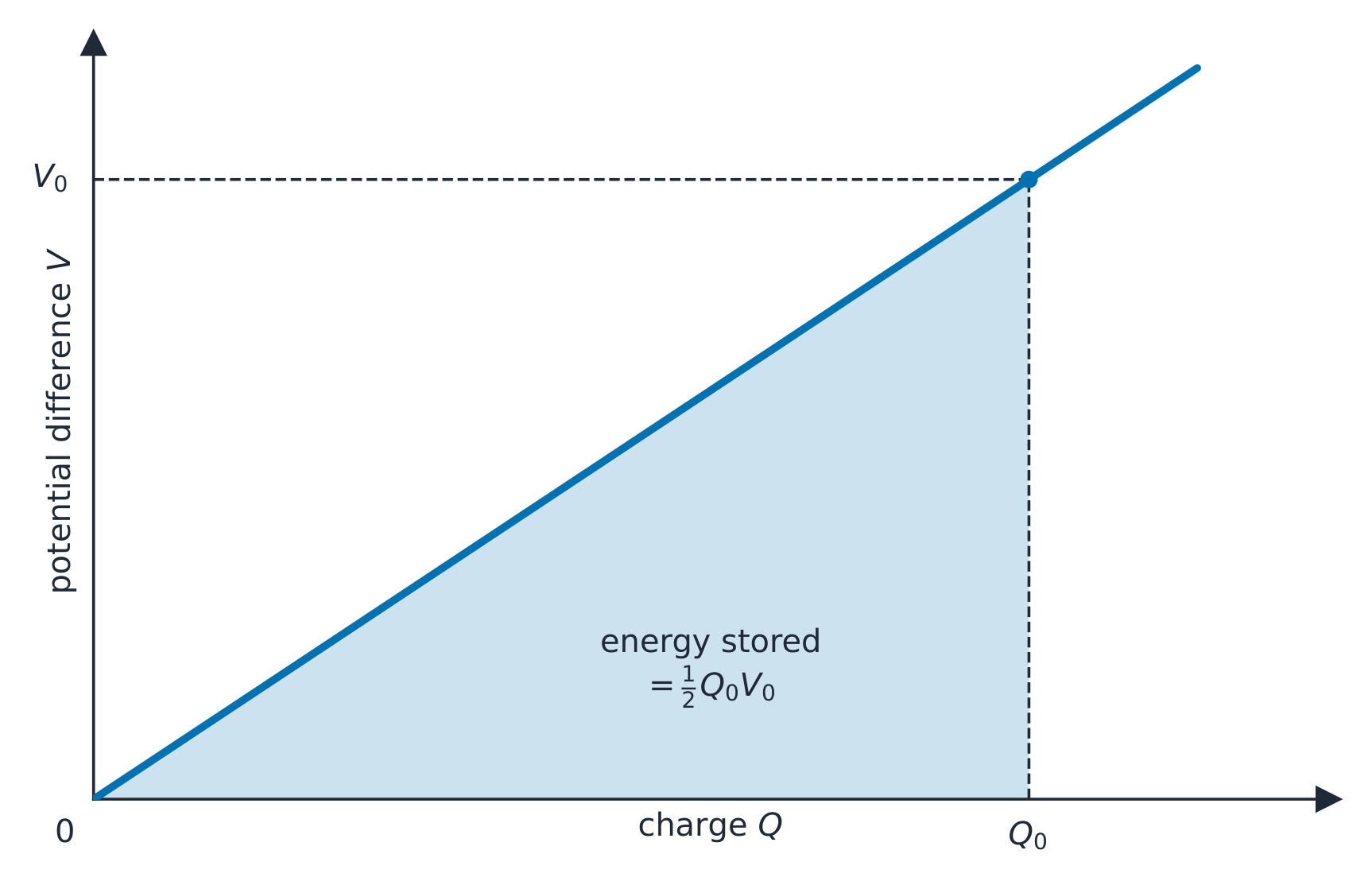
הגורם $\tfrac12$ הוא שטח המשולש מתחת לקו $Q$–$\Delta V$: המטען הראשון שנעבר עלה בעלות זניחה, והאחרון עלה בעלות מלאה של $\Delta V$.
קבלים מחוברים הפוך למנגנונים: במקביל הקבלויות מתחברות ($C_{\text{eq}}=C_1+C_2$, אותו $\Delta V$, המטענים מתחברים), ואילו בסדרה ההפוכים מתחברים ($\tfrac{1}{C_{\text{eq}}}=\tfrac{1}{C_1}+\tfrac{1}{C_2}$, אותו $Q$, המתחים מתחברים).
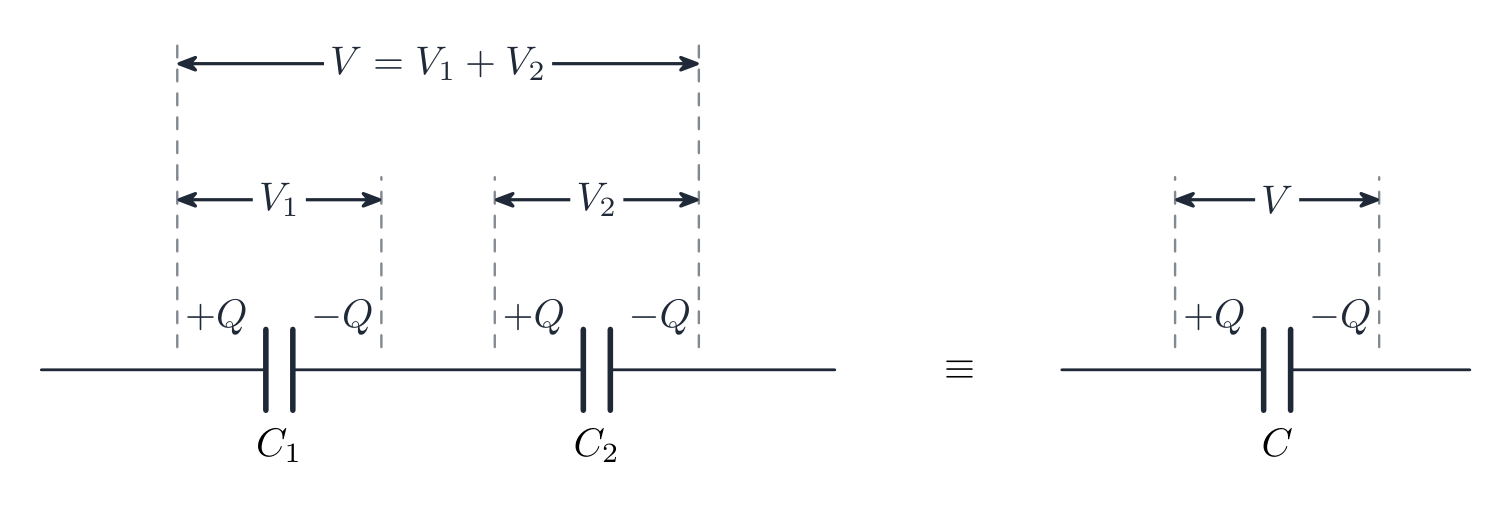
דוגמה פתורה. קבל $2\ \mu\text{F}$ וקבל $4\ \mu\text{F}$ בסדרה: $\tfrac{1}{C}=\tfrac12+\tfrac14$, ולכן $C=\tfrac43\ \mu\text{F}$. אותה זוגיות במקביל: $6\ \mu\text{F}$.
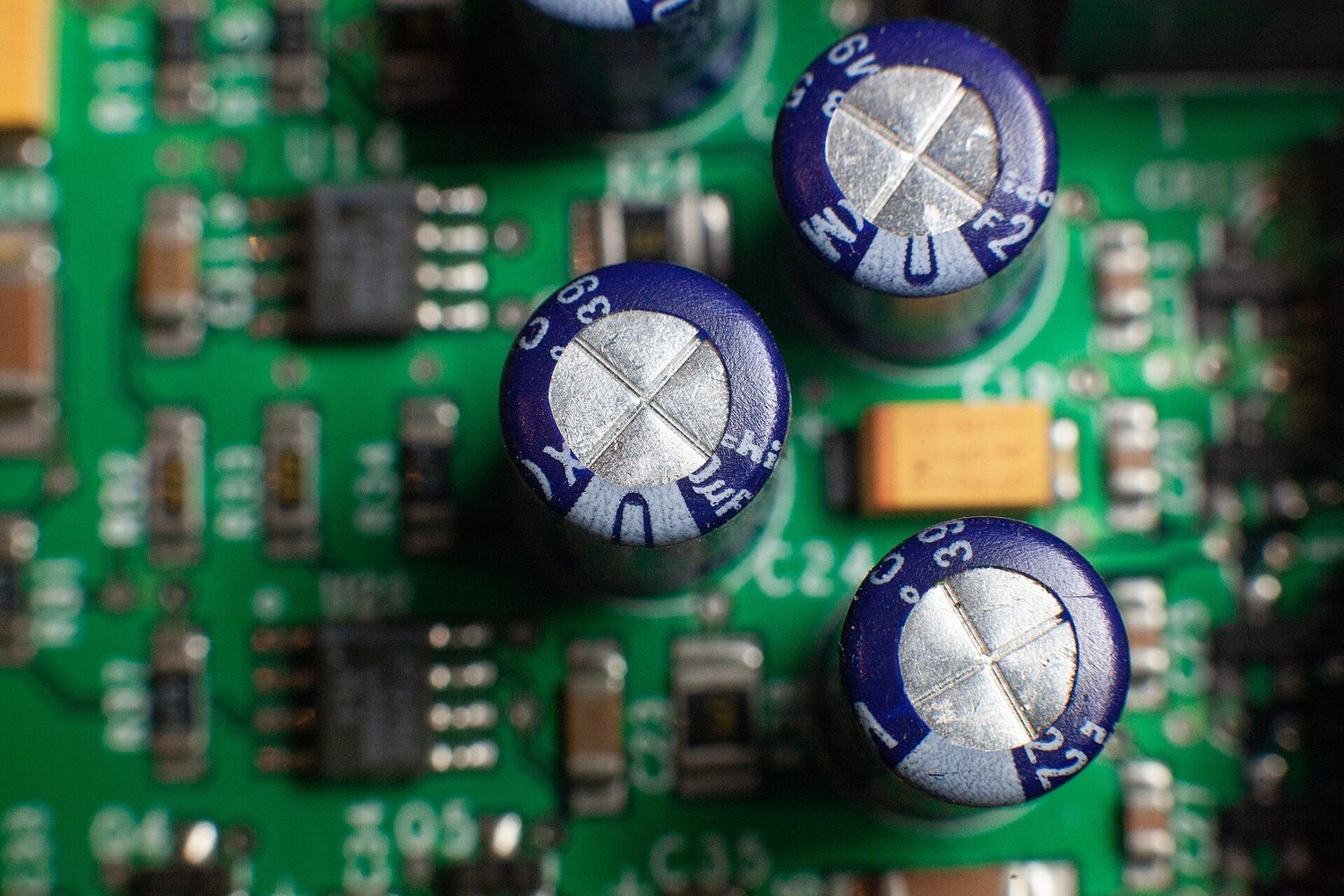
Explore · חקור
Charge and discharge a capacitor · טעינה ופריקת קבל
A capacitor stores charge on two plates, filling and emptying exponentially with time constant $\tau=RC$. Bigger $R$ or $C$ slows it down. · קבל מאחסן מטען על שני פלאטים, נטען ומתפרק אקספוננציאלית עם זמן-קבוע $\tau=RC$. ערך גדול יותר של $R$ או $C$ מאט את התהליך.
Vocabulary · מילון מונחים
Train · אימון
| English | עברית |
|---|---|
| conductor/kənˈdʌktə/ | מו Interructor |
| electrostatic equilibrium/ɪˌlektrəʊˈstætɪk ˌiːkwɪˈlɪbrɪəm/ | איזון אלקטרוסטטי |
| perpendicular/ˌpɜːpənˈdɪkjʊlə/ | ניצב |
| equipotential surface/ˌiːkwɪpəˈtenʃl ˈsɜːfɪs/ | פני שווה-פוטנציאל |
| electrostatic shielding/ɪˌlektrəʊˈstætɪk ˈʃiːldɪŋ/ | הגנה אלקסטטית |
| Faraday cage/ˈfærədeɪ keɪdʒ/ | כלוב פאראדיי |
| ground/ɡraʊnd/ | הארקה |
| induced charge/ɪnˈdjuːst tʃɑːdʒ/ | מטען מושרה |
| capacitor/kəˈpæsɪtə/ | קבל |
| capacitance/kəˈpæsɪtəns/ | קיבול |
| parallel-plate capacitor/ˈpærəlel pleɪt kəˈpæsɪtə/ | קבל לוחות מקבילים |
| superposition/ˌsuːpəpəˈzɪʃn/ | הפרעה (סופרפוזיציה) |
| uniform/ˈjuːnɪfɔːm/ | אחיד |
| projectile motion/prəˈdʒektaɪl ˈməʊʃn/ | תנועת פרויקטייל |
| work/wɜːk/ | עבודה |
| series/ˈsɪəriːz/ | סדרתי |
10.4
Dielectrics · דיאלקטרקים

Syllabus · סיילבוס
English
Learning Objective 10.4.A: Describe how a dielectric inserted between the plates of a capacitor changes the properties of the capacitor.
- 10.4.A.1 In a dielectric material, electric charges are not as free to move as they are in a conductor. Instead, the material becomes polarized in the presence of an external electric field.
- 10.4.A.2 The dielectric constant of a material relates the electric permittivity of that material to the permittivity of free space.
- Equation: $\kappa = \dfrac{\varepsilon}{\varepsilon_0}$
- 10.4.A.3 The electric field created by a polarized dielectric is opposite in direction to the external field.
- 10.4.A.4 The electric field between the plates of an isolated parallel-plate capacitor decreases when a dielectric is placed between the plates.
- Equation: $\kappa = \dfrac{E_0}{E}$
- 10.4.A.5 The insertion of a dielectric into a capacitor may change the capacitance of the capacitor.
- Equation: $C = \kappa C_0$
עברית
מטרת הלמידה 10.4.A: לתאר כיצד הכנסת דיאלקטריקה בין לוחות הקבל משנה את תכונות הקבל.
- 10.4.A.1 בחומר דיאלקטרי, מטענים חשמליים אינם חופשיים לנוע כמו שהם במוליך. במקום זאת, החומר הופך לפולריזציה בנוכחות שדה חשמלי חיצוני.
- 10.4.A.2 הקבוע הדיאלקטרי של חומר מקשר את הקיבולת החשמלית (האפסיילון) של החומר לקיבולת החשמלית של הרווח.
- משוואה: $\kappa = \dfrac{\varepsilon}{\varepsilon_0}$
- 10.4.A.3 השדה החשמלי שנוצר על ידי דיאלקטרי פולריזציה הוא נגד לכיוון השדה החיצוני.
- 10.4.A.4 השדה החשמלי בין לוחות קבל-מטען מקביל מבודד מצטמצם כאשר מוחדר ביניהם דיאלקטרי.
- משוואה: $\kappa = \dfrac{E_0}{E}$
- 10.4.A.5 הכנסת דיאלקטרי לתוך קבל עשויה לשנות את הקיבולת שלו.
- משוואה: $C = \kappa C_0$
Source: College Board AP Course and Exam Description · מקור: תיאור הקורס והמבחן של College Board AP
English
A dielectric 电介质 is an insulating material. Its charges cannot travel, but in an external field each molecule stretches or turns slightly – the material becomes polarized 极化. The lined-up molecules create their own small field opposite to the applied one, so the net field inside the material drops:
$$E=\frac{E_0}{\kappa},\qquad \kappa=\frac{\varepsilon}{\varepsilon_0}\ \ (\kappa>1),$$
where $\kappa$ is the dielectric constant 介电常数, the ratio of the material's permittivity to the permittivity of free space 真空介电常数.
Filling a capacitor with dielectric multiplies its capacitance:
$$C=\kappa\,C_0\qquad\left(\text{parallel plates: } C=\frac{\kappa\varepsilon_0 A}{d}\right).$$
What happens next depends on what stays fixed – a favourite exam trap:
| battery stays connected ($\Delta V$ fixed) | battery removed first ($Q$ fixed) | |
|---|---|---|
| charge $Q$ | rises to $\kappa Q_0$ | unchanged |
| voltage $\Delta V$ | unchanged | drops to $\Delta V_0/\kappa$ |
| field $E$ | unchanged | drops to $E_0/\kappa$ |
| energy $U$ | rises to $\kappa U_0$ | drops to $U_0/\kappa$ |
Worked example. A $100\ \text{pF}$ capacitor is charged to $12\ \text{V}$, disconnected, then filled with a $\kappa=3$ dielectric. $Q$ is trapped, so $\Delta V$ falls to $4\ \text{V}$ and the stored energy falls to one-third – the missing energy went into pulling the dielectric in. Reconnected to the $12\ \text{V}$ battery instead, the capacitor would hold three times the charge and three times the energy.
Exam skill. Always begin dielectric questions by writing down which quantity is held fixed ($Q$ or $\Delta V$), then let $C=\kappa C_0$ drive everything else through $Q=C\Delta V$ and $U=\tfrac12 C(\Delta V)^2$.
עברית
דיאלקטרק הוא חומר מבודד. המטענים בו אינם יכולים לנוע, אך בשדה חיצוני כל מולקולה נמתחת או מסתובבת מעט – החומר הופך למקוטב. המולקולות המיושרות יוצרות שדה קטן משלהן נגד השדה המופעל, כך שהשדה הנקי בתוך החומר יורד:
$$E=\frac{E_0}{\kappa},\qquad \kappa=\frac{\varepsilon}{\varepsilon_0}\ \ (\kappa>1),$$
כאשר $\kappa$ הוא קבוע הדיאלקטרק, היחס בין קבוע הדיאלקטרק של החומר לבין קבוע הדיאלקטרק של ריק.
מילוי קבל בדיאלקטרק מכפיל את הקבלות שלו:
$$C=\kappa\,C_0\qquad\left(\text{parallel plates: } C=\frac{\kappa\varepsilon_0 A}{d}\right).$$
מה שקורה בהמשך תלוי ב מה שנשאר קבוע – כמעצר ב Exam נפוץ:
| הסוללה מחוברת ($\Delta V$ קבוע) | הסוללה מופרדת תחילה ($Q$ קבוע) | |
|---|---|---|
| מטען $Q$ | עולה ל$\kappa Q_0$ | אינו משתנה |
| מתח $\Delta V$ | אינו משתנה | יורד ל$\Delta V_0/\kappa$ |
| שדה $E$ | אינו משתנה | יורד ל$E_0/\kappa$ |
| אנרגיה $U$ | עולה ל$\kappa U_0$ | יורדת ל$U_0/\kappa$ |
דוגמה מודגמת. קבלן $100\ \text{pF}$ נטען ל$12\ \text{V}$, נתקע, ואז מלא בדיאלקטריק $\kappa=3$. $Q$ נכלא, ולכן $\Delta V$ יורד ל$4\ \text{V}$ והאנרגיה האגורה יורד לשליש – האנרגיה החסרה הלכה למשיכת הדיאלקטריק פנימה. מחובר מחדש לסוללה $12\ \text{V}$ במקום זאת, הקבלן יכיל שלוש פעמים יותר מטען ושלוש פעמים יותר אנרגיה.
מיומנות מבחן. תמיד התחל שאלות דיאלקטריק בכתיבה מהכמות הנשמרת קבועה ($Q$ או $\Delta V$), ואז תן ל$C=\kappa C_0$ להניע הכל שאר דרך $Q=C\Delta V$ ו$U=\tfrac12 C(\Delta V)^2$.
Explore · חקור
Add a dielectric · הוסף דיאלקטרי
A dielectric between the plates raises the capacitance, so the capacitor holds more charge at the same voltage. Watch the charge build faster. · דיאלקטרית בין הפלאטים מגבירה את הקיבול, כך שהקבל שומר יותר מטען באותו מתח. שימו לב למטען שנצבר מהר יותר.
Vocabulary · מילון מונחים
Train · אימון
| English | עברית |
|---|---|
| parallel/ˈpærəlel/ | מקביל |
| dielectric/ˌdaɪɪˈlektrɪk/ | דיאלקטרית |
| polarized/ˈpəʊləraɪzd/ | ממוסל |
| dielectric constant/ˌdaɪɪˈlektrɪk ˈkɒnstənt/ | קבוע דיאלקטרי |
| permittivity of free space/ˌpɜːmɪˈtɪvəti ɒv friː speɪs/ | הפרמיטיביות של ריק |
10.4
Exam tips · טיפים לבחינות
English
- In electrostatic equilibrium a conductor has $\vec E=0$ inside and all excess charge on the surface.
- Apply Gauss's law $\oint \vec E\cdot d\vec A=\tfrac{q_{enc}}{\varepsilon_0}$ with a symmetry-matched Gaussian surface (sphere, cylinder, pillbox).
- The whole conductor is one equipotential, and the surface field is perpendicular to it.
- For a capacitor use $C=\tfrac{Q}{V}$, energy $U=\tfrac12 CV^2$, and how a dielectric raises $C$.
- Pick the Gaussian surface so $\vec E$ is constant and parallel (or zero) on each part.
עברית
- בשיווי משקל אלקטרוסטטי למוליך יש $\vec E=0$ בתוך וכל המטען העודף על הפני.
- יישם אתחוק גאוס $\oint \vec E\cdot d\vec A=\tfrac{q_{enc}}{\varepsilon_0}$ עם פני גאוס המתאימים לסימטריה (כדור, צילינדר, קופסת טabliya).
- כל המוליך הוא איזו-פוטנציאל אחד, ושדה המשטח מאונך אליו.
- עבור קבלן השתמש ב$C=\tfrac{Q}{V}$, אנרגיה $U=\tfrac12 CV^2$, וכיצה דיאלקטריק מעלה $C$.
- בחר את פני גאוס כך ש$\vec E$ יהיה קבוע ומקביל (או אפס) בכל חלק.
Interactive lessons on this topic · שיעורים אינטראקטיביים בנושא זה
Work through it step by step, with instant-check exercises. · לעבור על הדברים צעד אחר צעד, עם תרגילים לבדיקה מיידית.