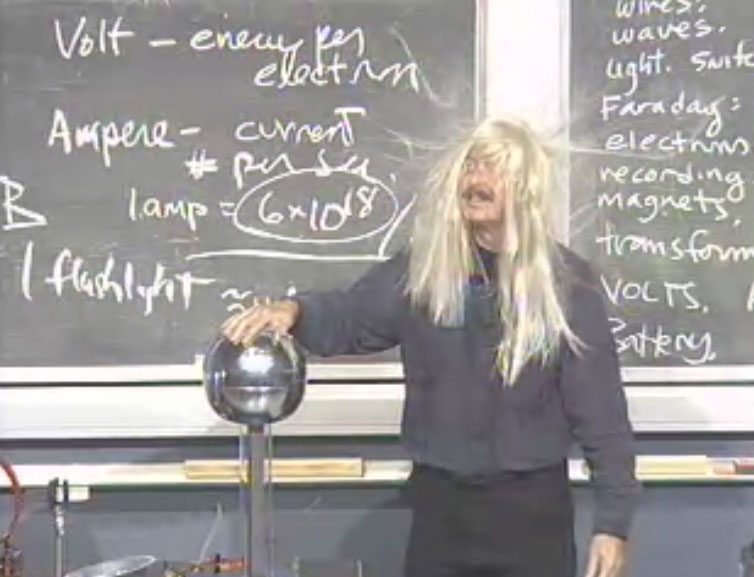
Learning Objective 10.1.A: Describe the electric force that results from the interactions between charged objects or systems.
- 10.1.A.1 Charge is a fundamental property of all matter.
- 10.1.A.1.i Charge is described as positive or negative.
- 10.1.A.1.ii The magnitude of the charge of a single electron or proton, the elementary charge $e$, can be considered to be the smallest indivisible amount of charge.
- 10.1.A.1.iii The charge of an electron is $-e$, the charge of a proton is $+e$, and a neutron has no electric charge.
- 10.1.A.1.iv A point charge is a model in which the physical size of a charged object or system is negligible in the context of the situation being analyzed.
- 10.1.A.2 Coulomb's law describes the electrostatic force between two charged objects as directly proportional to the magnitude of each of the charges and inversely proportional to the square of the distance between the objects.
- Equation: $\left|\vec{F}_E\right| = \dfrac{1}{4\pi\varepsilon_0}\dfrac{\left|q_1 q_2\right|}{r^2} = k\dfrac{\left|q_1 q_2\right|}{r^2}$
- 10.1.A.3 The direction of the electrostatic force depends on the signs of the charges of the interacting objects and is parallel to the line of separation between the objects.
- 10.1.A.3.i Two objects with charges of the same sign exert repulsive forces on each other.
- 10.1.A.3.ii Two objects with charges of opposite signs exert attractive forces on each other.
- 10.1.A.4 Electric forces are responsible for some of the macroscopic properties of objects in everyday experiences. However, the large number of particle interactions that occur make it more convenient to treat everyday forces in terms of nonfundamental forces called contact forces, such as normal force, friction, and tension.
Learning Objective 10.1.B: Describe the electric and gravitational forces that result from interactions between charged objects with mass.
- 10.1.B.1 Electrostatic forces can be attractive or repulsive, while gravitational forces are always attractive.
- 10.1.B.2 For any two objects that have mass and electric charge, the magnitude of the gravitational force is usually much smaller than the magnitude of the electrostatic force.
- 10.1.B.3 Gravitational forces dominate at larger scales even though they are weaker than electrostatic forces, because systems at large scales tend to be electrically neutral.
Learning Objective 10.1.C: Describe the electric permittivity of a material or medium.
- 10.1.C.1 Electric permittivity is a measurement of the degree to which a material or medium is polarized in the presence of an electric field.
- 10.1.C.2 Electric polarization can be modeled as the induced rearrangement of electrons by an external electric field, resulting in a separation of positive and negative charges within a material or medium.
- 10.1.C.3 Free space has a constant value of electric permittivity, $\varepsilon_0$, that appears in physical relationships.
- 10.1.C.4 The permittivity of matter has a value different from that of free space that arises from the matter's composition and arrangement.
- 10.1.C.4.i In a given material, electric permittivity is determined by the ease with which electrons can change configurations within the material.
- 10.1.C.4.ii Conductors are made from electrically conducting materials in which charge carriers move easily; insulators are made from electrically nonconducting materials in which charge carriers cannot move easily.
Boundary statement: AP Physics 2 only expects students to make calculations of the electric force between four or fewer interacting charged objects or systems. The analysis of the resulting electric force from more charges is allowed in situations of high symmetry.
מטרת הלמידה 10.1.A: לתאר את הכוח החשמלי הנובע מאינטראקציות בין אובייקטים טוענים או מערכות.
- 10.1.A.1 מטען הוא תכונה יסודית של כל החומר.
- 10.1.A.1.i מטען מתואר כחיובי או שלילי.
- 10.1.A.1.ii גודל המטען של אלקטרון או פרוטון בודד, המטען היסודי $e$, יכול להיחשב לכמות המטען הקטנה ביותר שאין לחלקה.
- 10.1.A.1.iii המטען של אלקטרון הוא $-e$, המטען של פרוטון הוא $+e$, ונוטרון אין לו מטען חשמלי.
- 10.1.A.1.iv מטען נקודתי הוא דגם שבו הגודל הפיזיקלי של חפץ או מערכת מטענת זניח בהקשר הניתוח המתבצע.
- 10.1.A.2 חוק קולון מתאר את הכוח האלקטרוסטטי בין שני חפצים מטענים כפרופורציונלי ישיר לגודל המטען של כל אחד מהם, והופך ביחס הפוך לריבוע המרחק בין החפצים.
- משוואה: $\left|\vec{F}_E\right| = \dfrac{1}{4\pi\varepsilon_0}\dfrac{\left|q_1 q_2\right|}{r^2} = k\dfrac{\left|q_1 q_2\right|}{r^2}$
- 10.1.A.3 הכיוון של הכוח האלקטרוסטטי תלוי במיניות המטענים של החפצים המגיבים, והוא מקביל לקו ההפרדה בין החפצים.
- 10.1.A.3.i שני חפצים בעלי מטענים מאותה מיניות מפעילים כוחות דחייה זה על זה.
- 10.1.A.3.ii שני חפצים בעלי מטענים במיניות הפוכות מפעילים כוחות משיכה זה על זה.
- 10.1.A.4 כוחות חשמליים אחראים לחלק מהמאפיינים המקרוסקופיים של חפצים בחוויות היומיום. עם זאת, מספרם הגדול של אינטראקציות חלקיקים שהתרחשות עושה נוח יותר לטפל בכוחות יומיומיים באמצעות כוחות לא-יסודיים הנקראים כוחות מגע, כמו כוח נורמלי, חיכוך ומתיחה.
מטרת למידה 10.1.B: לתאר את הכוחות החשמליים והכבישתיים הנובעים ממינימום בין חפצים מטענים בעלי מסה.
- 10.1.B.1 כוחות אלקטרוסטטיים יכולים להיות משיכתיים או דוחים, בעוד שכוחות כבישתיים הם תמיד משיכתיים.
- 10.1.B.2 עבור כל שני חפצים בעלי מסה ומטען חשמלי, גודל הכוח הכבישתי הוא בדרך כלל הרבה קטן מגודל הכוח האלקטרוסטטי.
- 10.1.B.3 כוחות כבישתיים שולטים בקנה מידה גדול גם אם הם חלשים מכוחות אלקטרוסטטיים, משום שמערכות בקנה מידה גדול נוטות להיות ניטרליות חשמלית.
מטרת למידה 10.1.C: לתאר את הדיאלקטריקה (הpermittivity החשמלי) של חומר או תווך.
- 10.1.C.1 דיאלקטריקה היא מדידה של רמת הקיטוב של חומר או תווך בנוכחות שדה חשמלי.
- 10.1.C.2 קיטוב חשמלי ניתן לדגם כמערעור המיוצר של אלקטרונים על ידי שדה חשמלי חיצוני, resulting in הפרדת מטענים חיוביים ושליליים בתוך חומר או תווך.
- 10.1.C.3 לריק יש ערך קבוע של דיאלקטריקה, $\varepsilon_0$, המופיע בקשרים פיזיקליים.
- 10.1.C.4 לדיאלקטריקה של חומר יש ערך השונה מזה של הריק, הנובע מההרכב והסידור של החומר.
- 10.1.C.4.i בחומר נתון, הדיאלקטריקה נקבעת לפי קלות שינוי המצבים של אלקטרונים בתוך החומר.
- 10.1.C.4.ii מוליכים עשויים מחומרים מוליכי חשמל בהם נשאי מטען נעים בקלות; בדידים עשויים מחומרים לא-מוליכי חשמל בהם נשאי מטען אינם נעים בקלות.
הצהרת גבול: AP Physics 2 מצפה רק מתלמידים לבצע חישובים של הכוח החשמלי בין ארבעה או פחות אובייקטים טעונים המופעלים זה על זה או מערכות. ניתוח הכוח החשמלי הנגרם מאחוזי מטען נוספים מותר במצבים בעלי סימטריה גבוהה.