Skip to content · ⁨דלג לתוכן⁩

Imperfect Competition

AP Microeconomics · ⁨מיקרוכלכלואה - AP⁩ · Topic 4 · ⁨נושא 4⁩

Video lesson for this topic · ⁨שיעור וידאו לנושא זה⁩ Open the video page · ⁨פתח את עמוד הוידאו⁩
8:32

תחרות אי-מושלמת

תסתכל מחוץ לספר. חברת רכב קובעת את המחיר שלה בעצמה. בעיר שלך יש ספק מים אחד, ואין שני להם לבחור. חברות אלו אינן מקבלות את המחיר…

English narration · English + 中文 subtitles burned in · ⁨קריאת קול באנגלית · תרגום אנגלי + סינית שרוף בתוך הסרטון⁩

4.1

Imperfect Competition and Market Power · ⁨תחרות אי-מושלמת וכוח שוק⁩

Syllabus · ⁨סיילבוס⁩
English

Enduring Understanding (PRD-3): Even with a common goal of profit-maximization, market structure constrains and influences prices, output, and efficiency.

Learning Objective PRD-3.B: a. Define (using graphs where appropriate) the characteristics of imperfectly competitive markets and inefficiency.

  • PRD-3.B.1 Imperfectly competitive markets include monopoly, oligopoly, and monopolistic competition in product markets and monopsony in factor markets.
  • PRD-3.B.2 In imperfectly competitive output markets and assuming all else is constant, a firm must lower price to sell additional units.
  • PRD-3.B.3 In imperfectly competitive markets, consumers and producers respond to prices that are above the marginal costs of production and/or marginal benefits of consumption (i.e., price is greater than marginal cost in an inefficient market).
  • PRD-3.B.4 Incentives to enter an industry may be mitigated by barriers to entry. Barriers to entry—such as high fixed/start-up costs, legal barriers to entry, and exclusive ownership of key resources—can sustain imperfectly competitive market structures.
עברית

הבנה מתמשכת (PRD-3): גם כאשר יש מטרות משותפות למקסום הרווח, המבנה השוקי מגביל ומשפיע על מחירים, תוצרת ויעילות.

מטרת למידה PRD-3.B: א. הגדר (באמצעות גרפים כאשר מתאים) את מאפייני שווקים בעלי תחרות לא מושלמת ואי-יעילות.

  • PRD-3.B.1 שווקים בעלי תחרות לא מושלמת כוללים מונופול, אוליגופולית ותחרות מונופוליסטית בשווקי מוצרים ומונופסון בשווקי גורמים.
  • PRD-3.B.2 בשווקי ביצועים בעלי תחרות לא מושלמת, בהנחה שכל שאר הדברים קבועים, על חברה להוריד מחיר כדי למכור יחידות נוספות.
  • PRD-3.B.3 בשווקים בעלי תחרות לא מושלמת, צרכנים ויצרנים מגיבים למחירים העומדים מעל עלויות השוליים של הייצור ו/או תועלת השוליים של הצריכה (כלומר, המחיר גדול מעלות השוליים בשוק לא יעיל).
  • PRD-3.B.4 האפשרות לכנס לתעשייה עשויה להיות מופחתת על ידי מחסומי כניסה. מחסומי כניסה—כגון עלויות קבועות/הקמה גבוהות, מחסומים משפטיים לכניסה וחזקה בלעדית במקורות מפתח—יכולים לשמור על מבני שוק בעלי תחרות לא מושלמת.

Source: College Board AP Course and Exam Description · ⁨מקור: תיאור הקורס והמבחן של College Board AP⁩

English

Most real markets are imperfectly competitive 不完全竞争: firms have some market power 市场势力 – the ability to set price rather than take it. The source of that power is a downward-sloping demand curve facing the firm, which means that to sell one more unit the firm must lower the price on all units.

Because of this, marginal revenue is below price ($MR) for every firm with market power. On a straight-line demand curve the MR curve has the same intercept but twice the slope, lying below demand. This one fact – $MR – separates every imperfect market from perfect competition and explains why they produce less and charge more.

Worked example. A firm with market power faces demand $P=100-Q$. Selling $1$ unit gives $P=\$99$ and total revenue $\$99$; selling a $2$nd forces the price down to $\$98$ on both units, so revenue rises to $2\times98=\$196$. The marginal revenue of that $2$nd unit is $196-99=\$97$ – below its $\$98$ price. In general $MR=100-2Q$, falling twice as fast as demand.

עברית
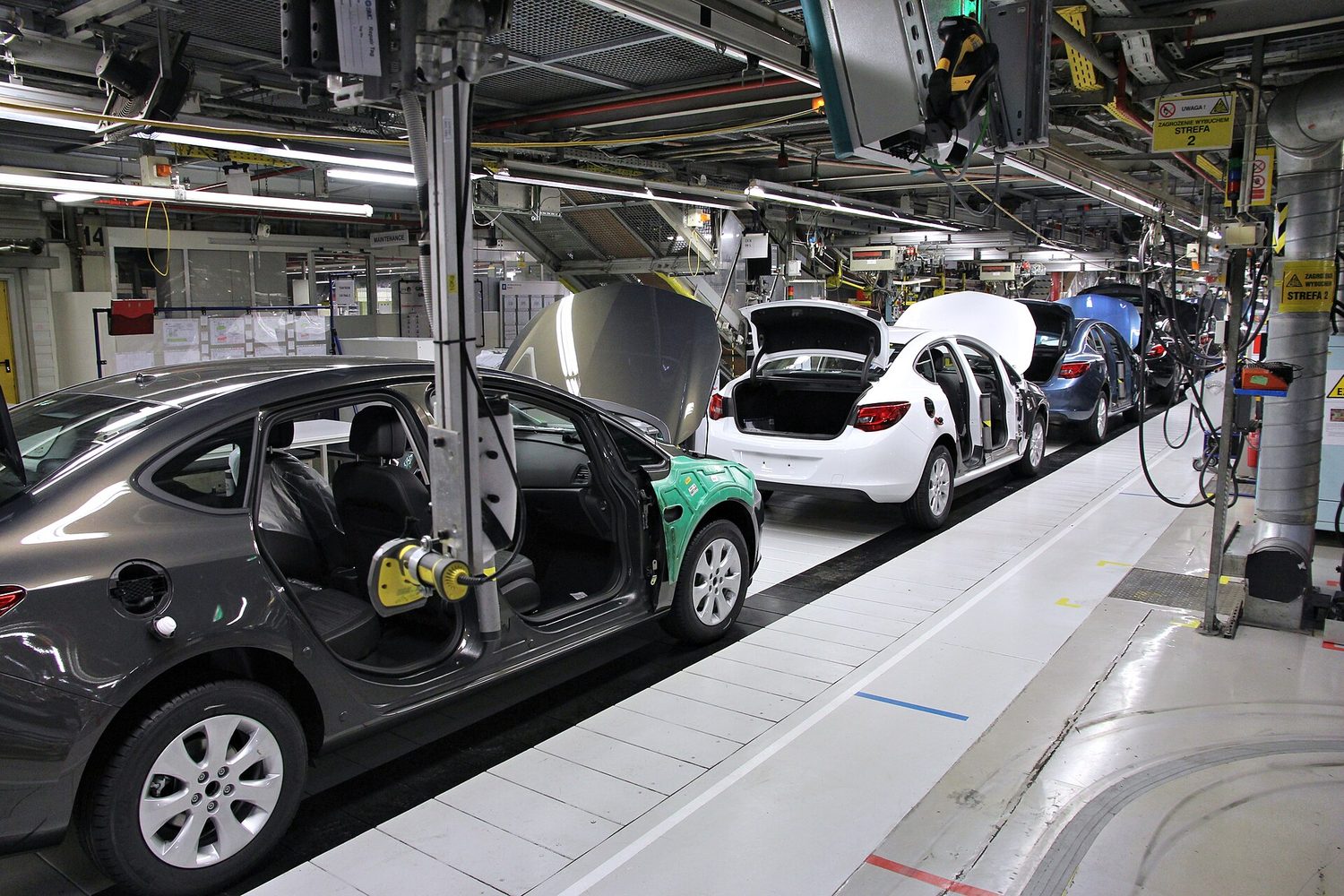
קו הרכבה: כוח שוק ומידת החברה משתנים בתחרות לא מושלמת
קו הרכבה: כוח שוק וגודל חברה שונים בתחרות אי-מושלמת

רוב השוקים בפועל הם תחרותיים באופן אי-מושלם: לחברות יש מעט כוח שוק – היכולת לקבוע מחיר במקום לקבל אותו. המקור לכוח הזה הוא עקום ביקוש יורד המופנה אל החברה, מה שמעיד שכדי למכור יחידה נוספת החברה חייבת להוריד את המחיר על כל היחידות.

מבני שוק משתנים מתחרות מושלמת ועד למונופול
מבני שוק נעים מתחרות מושלמת ועד למונופול

בגלל זאת, ההכנסה המרז'ינלית נמוכה מהמחיר ($MR) לכל חברה עם כוח שוק. על עקום ביקוש ישר, לעקום MR אותה חיתוך אך שיפוע כפול, והוא שוכח מתחת לביקוש. עובדה אחת זו – $MR – מפרידה כל שוק אי-מושלם מתחרות מושלמת ומסבירה מדוע הן מייצרות פחות וגובות יותר.

דוגמה פותרת. לחברה עם כוח שוק יש ביקוש $P=100-Q$. מכירה של $1$ יחידה מביאה $P=\$99$ and total revenue $\$99$; מכירה של $2$nd מחייבת הורדת מחיר ל$\$98$ on both units, so revenue rises to $2\times98=\$196$. ההכנסה השולית של $2$nd היחידה הזו היא $196-99=\$97$ – below its $\$98$ מחיר. באופן כללי $MR=100-2Q$, צמודה פי שניים מהביקוש.

4.2

Monopoly · ⁨מונופול⁩

Syllabus · ⁨סיילבוס⁩
English

Enduring Understanding (PRD-3): Even with a common goal of profit-maximization, market structure constrains and influences prices, output, and efficiency.

Learning Objective PRD-3.B: b. Explain (using graphs where appropriate) equilibrium, firm decision making, consumer surplus, producer surplus, profit (loss), and deadweight loss in imperfectly competitive markets and why prices in imperfectly competitive markets cannot be relied on to coordinate the actions of all possible market participants and can lead to inefficient outputs. c. Calculate (using data from a graph or table as appropriate) areas of consumer surplus, producer surplus, profit (loss), and deadweight loss in imperfectly competitive markets.

  • PRD-3.B.5 A monopoly exists because of barriers to entry.
  • PRD-3.B.6 In a monopoly, equilibrium (profit-maximizing) quantity is determined by equating marginal revenue (MR) to marginal cost (MC). The price charged is greater than the marginal cost.
    • Equation: $MR = MC$
  • PRD-3.B.7 In a natural monopoly, long-run economies of scale for a single firm exist throughout the entire effective demand of its product.
עברית

הבנה מתמשכת (PRD-3): גם כאשר יש מטרות משותפות למקסום הרווח, המבנה השוקי מגביל ומשפיע על מחירים, תוצרת ויעילות.

מטרת למידה PRD-3.B: ב. הסבר (באמצעות גרפים כאשר מתאים) איזון, קבלת החלטות על ידי חברה, עודף צרכן, עודף יצרן, רווח (הפסד) ועודף הרווחה באובדן בשווקים בעלי תחרות לא מושלמת ולמה מחירים בשווקים אלו לא יכולים לספק סמך לקואורדינציה של פעולות כל המשתתפים האפשריים בשוק ולכן עלולים להוביל לביצועים לא יעילים. ג. חשב (באמצעות נתונים מגרף או טבלה כאשר מתאים) את שטחי עודף צרכן, עודף יצרן, רווח (הפסד) ועודף הרווחה באובדן בשווקים בעלי תחרות לא מושלמת.

  • PRD-3.B.5 מונופול קיים בשל מחסומי כניסה.
  • PRD-3.B.6 במונופול, כמות האיזון (המקסימלית ברווח) נקבעת על ידי השוויון בין הכנסה השולית (MR) לעלות השולית (MC). המחיר הנגבה הוא גדול מהעלות השולית.
    • משוואה: $MR = MC$
  • PRD-3.B.7 במונופול טבעי, קיימות כלכלות היקף לטווח ארוך לחברה אחת לאורך כלל דרישה יעילה של המוצר שלה.

Source: College Board AP Course and Exam Description · ⁨מקור: תיאור הקורס והמבחן של College Board AP⁩

English
Monopoly: MR = MC pricing

A monopoly 垄断 is a single seller of a product with no close substitutes, protected by barriers to entry 进入壁垒 (economies of scale – a natural monopoly 自然垄断 – control of a key resource, patents, or government license).

  • The monopolist maximizes profit at $MR=MC$, then charges the highest price the demand curve allows at that quantity (read price up to the demand curve, not the MR curve).
  • Compared with perfect competition it produces less and charges more, earning long-run economic profit because entry is blocked.
  • This under-production creates deadweight loss 无谓损失 – the monopoly is allocatively inefficient because $P>MC$: the last unit is worth more than it costs, yet is not made.

Governments may respond with antitrust 反垄断 law, or regulate a natural monopoly's price toward $P=MC$ (socially optimal, but may cause a loss) or $P=ATC$ (fair-return, break-even).

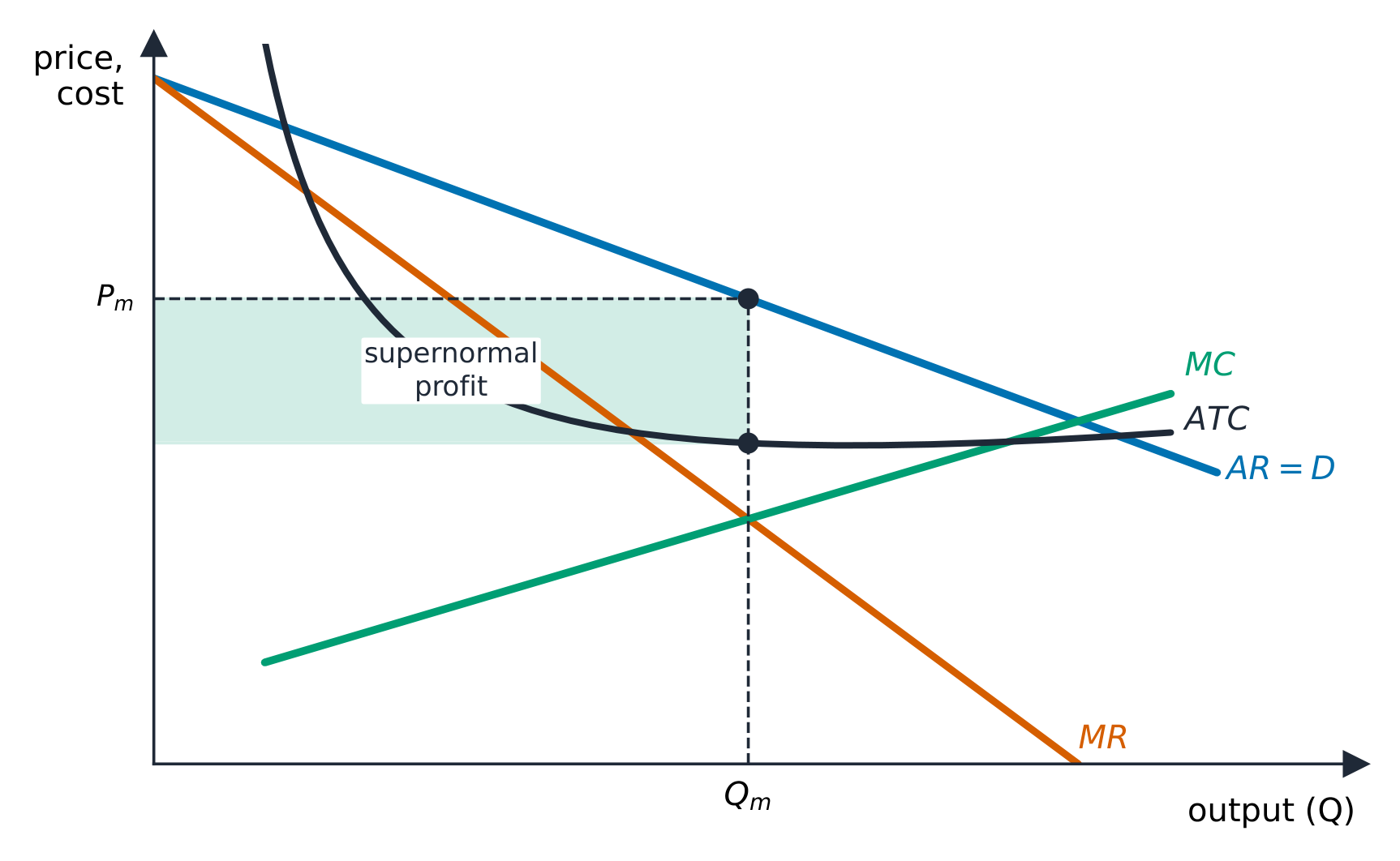
Exam skill: the monopoly graph is a staple – show quantity at $MR=MC$, price up on the demand curve, and shade profit (between $P$ and $ATC$) and deadweight loss (the triangle to the competitive quantity).

עברית
מונופול: מחירי MR = MC

מונופול הוא מוכר יחיד של מוצר שאין לו תחליפים קרובים, מוגן על ידי מחסומי כניסה (תמורות סקאלה – מונופול טבעי – שליטה במקור עיקרי, פטנטים או רישיון ממשלתי).

מונופול מקסימיזציה רווח כאשר MC = MR ויכול להרוויח רווח מעל-רגיל
  • המונופוליסט מקסימיזציה רווח ב$MR=MC$, ואז מגדיר את המחיר הגבוה ביותר שהעקומה דורשת מאפשרת בכמות זו (קוראים מחיר כלפי מעלה לעקומת הביקוש, לא לעקומת ה-MR).
  • בהשוואה לתחרות מושלמת, המונופול מייצר פחות ומגדיר יותר, ומרוויח רווח כלכלי לטווח ארוך משום הכניסה חסומה.
  • הייצור הנמוך מדי יוצר אובדן שוקף – המונופול הוא לא יעיל באלוואציה משום $P>MC$: היחידה האחרונה שווה יותר מהעלות שלה, אך אינה מיוצרת.

הממשלות עשויות להגיב עם חוק אנטי-תחרותי, או לכוון את המחיר של מונופול טבעי לכיוון $P=MC$ (אופטימלי חברתי, אך עשוי לגרום להפסד) או $P=ATC$ (תשואה הוגנת, איזון).

מיומנות במבחן: הגרף של המונופול הוא בסיסי – הראש כמות ב$MR=MC$, מחיר למעלה על עקומת הביקוש, וסמן רווח (בין $P$ ל$ATC$) והפסד עיוור (המשולש לכמות התחרותית).

מפעל תשתיות גדול: מונופול וכוח שוק משמעו שחברה אחת יכולה לקבוע מחיר מעל העלות השולית
Explore · ⁨חקור⁩

A monopoly's cost curves · ⁨עקומות העלות של מונופול⁩

A monopoly is the sole seller, so it faces the whole downward demand curve and its marginal revenue lies below price. It produces where MR = MC — less output, higher price than competition. · ⁨מונופול הוא המוכר היחיד, ולכן הוא מתמודד עם כל עקום הביקוש היורד וההכנסה השולית שלו נמצאת מתחת למחיר. הוא מייצר שבו ההכנסה השולית שווה לעלות השולית (MR = MC) — פחות תפוקה, מחיר גבוה יותר מאשר בתחרות.⁩

Vocabulary · ⁨מילון מונחים⁩ Train · ⁨אימון⁩
English עברית
imperfectly competitive/ɪmˈpɜːfektlɪ kəmˈpetɪtɪv/ תחרות לא מושלמת
market power/ˈmɑːkɪt ˈpaʊə/ כוח שוק
monopoly/məˈnɒpəli/ מונופול
barriers to entry/ˈbærɪəz tʊ ˈentri/ מחסומי כניסה
natural monopoly/ˈnætʃərəl məˈnɒpəli/ מונופול טבעי
deadweight loss/ˈdedweɪt lɒs/ נזק מוסר
antitrust/ˌæntɪˈtrʌst/ חוקי מונופול (אנטי-תחרותיים)
Price discrimination/praɪs dɪˌskrɪmɪˈneɪʃn/ הבחנת מחירים
Monopolistic competition/məˈnɒpəlɪstɪk ˌkɒmpəˈtɪʃn/ תחרות מונופוליסטית
differentiated/ˌdɪfəˈrenʃɪeɪtɪd/ מובדל
excess capacity/ekˈses kəˈpæsɪti/ קיבולת עודפת
oligopoly/ˌɒlɪˈɡɒpəli/ אוליגופול
interdependent/ˌɪntədɪˈpendənt/ תלוי הדדית
game theory/ɡeɪm ˈθɪəri/ תיאוריית משחקים
4.3

Price Discrimination · ⁨אפיוס מחירים⁩

Syllabus · ⁨סיילבוס⁩
English

Enduring Understanding (PRD-3): Even with a common goal of profit-maximization, market structure constrains and influences prices, output, and efficiency.

Learning Objective PRD-3.B: b. Explain (using graphs where appropriate) equilibrium, firm decision making, consumer surplus, producer surplus, profit (loss), and deadweight loss in imperfectly competitive markets and why prices in imperfectly competitive markets cannot be relied on to coordinate the actions of all possible market participants and can lead to inefficient outputs. c. Calculate (using data from a graph or table as appropriate) areas of consumer surplus, producer surplus, profit (loss), and deadweight loss in imperfectly competitive markets.

  • PRD-3.B.8 A firm with market power can engage in price discrimination to increase its profits or capture additional consumer surplus under certain conditions.
  • PRD-3.B.9 With perfect price discrimination, a monopolist produces the quantity where price equals marginal cost (just as a competitive market would) but extracts all economic surplus associated with its product and eliminates all deadweight loss.
    • Equation: $P = MC$
עברית

הבנה מתמשכת (PRD-3): גם כאשר יש מטרות משותפות למקסום הרווח, המבנה השוקי מגביל ומשפיע על מחירים, תוצרת ויעילות.

מטרת למידה PRD-3.B: ב. הסבר (באמצעות גרפים כאשר מתאים) איזון, קבלת החלטות על ידי חברה, עודף צרכן, עודף יצרן, רווח (הפסד) ועודף הרווחה באובדן בשווקים בעלי תחרות לא מושלמת ולמה מחירים בשווקים אלו לא יכולים לספק סמך לקואורדינציה של פעולות כל המשתתפים האפשריים בשוק ולכן עלולים להוביל לביצועים לא יעילים. ג. חשב (באמצעות נתונים מגרף או טבלה כאשר מתאים) את שטחי עודף צרכן, עודף יצרן, רווח (הפסד) ועודף הרווחה באובדן בשווקים בעלי תחרות לא מושלמת.

  • PRD-3.B.8 חברה עם כוח שוק יכולה לבצע אבחנת מחירים כדי להגדיל את הרווחים שלה או לתפוס עודף צרכן נוסף בתנאים מסוימים.
  • PRD-3.B.9 באבחנת מחירים מושלמת, מונופוליסט מייצר את הכמות שבה המחיר שווה לעלות השולית (כמו בשוק תחרותי), אך פונה את כל עודף הכלכלי הקשור למוצר שלו ומבטל את כל עודף הרווחה באובדן.
    • משוואה: $P = MC$

Source: College Board AP Course and Exam Description · ⁨מקור: תיאור הקורס והמבחן של College Board AP⁩

English

Price discrimination 价格歧视 is charging different buyers different prices for the same good. It requires market power, the ability to separate buyers by willingness to pay, and the ability to prevent resale.

Under perfect (first-degree) price discrimination, the firm charges each buyer their maximum price. The result: the firm produces the efficient quantity (where $P=MC$, no deadweight loss), but converts all consumer surplus into producer surplus (profit). Real examples – student discounts, airline fares, coupons – are partial versions.

עברית

אפיוס מחירים הוא גביית מחירים שונים ממרכשים שונים עבור אותו מוצר. הדבר דורש כוח שוק, יכולת להפרדה בין קונים לפי נכונותם לשלם, ויכולת למנוע מכירה חוזרת.

תחת אפיוס מחירים מושלם (דרגה ראשונה), החברה מגדירה לכל קונה את המחיר המקסימלי שלו. התוצאה: החברה מייצרת את הכמות יעילה (כאשר $P=MC$, אין אובדן שוקף), אך ממירה את כל עודף הצרכן לעודף המייצר (רווח). דוגמאות אמיתיות – הנחות לסטודנטים, מחירי טיסות, קופונים – הן גרסאות חלקיות.

Explore · ⁨חקור⁩

Elasticity and price discrimination · ⁨אלסטיות ואפליית מחירים⁩

Price discrimination charges each group a different price by their elasticity: inelastic buyers (who won't switch) pay more, elastic buyers pay less. Stretch the curve to see why. · ⁨אפליית מחירים גובה מחיר שונה לכל קבוצה בהתאם ל-אלסטיות שלה: קונים אלסטיים (שלא יעברו לקבוצה אחרת) משלמים יותר, וקונים אלסטיים משלמים פחות. מתיחו את העקום כדי לראות מדוע.⁩

4.4

Monopolistic Competition · ⁨תחרות מונופוליסטית⁩

Syllabus · ⁨סיילבוס⁩
English

Enduring Understanding (PRD-3): Even with a common goal of profit-maximization, market structure constrains and influences prices, output, and efficiency.

Learning Objective PRD-3.B: b. Explain (using graphs where appropriate) equilibrium, firm decision making, consumer surplus, producer surplus, profit (loss), and deadweight loss in imperfectly competitive markets and why prices in imperfectly competitive markets cannot be relied on to coordinate the actions of all possible market participants and can lead to inefficient outputs. c. Calculate (using data from a graph or table as appropriate) areas of consumer surplus, producer surplus, profit (loss), and deadweight loss in imperfectly competitive markets.

  • PRD-3.B.10 In a market with monopolistic competition, firms producing differentiated products may earn positive, negative, or zero economic profit in the short run. Firms typically use advertising as a means of differentiating their product. Free entry and exit drive profits to zero in the long run. The output level, however, is smaller than the output level needed to minimize average total costs, creating excess capacity. The price is greater than marginal cost, creating allocative inefficiency.
עברית

הבנה מתמשכת (PRD-3): גם כאשר יש מטרות משותפות למקסום הרווח, המבנה השוקי מגביל ומשפיע על מחירים, תוצרת ויעילות.

מטרת למידה PRD-3.B: ב. הסבר (באמצעות גרפים כאשר מתאים) איזון, קבלת החלטות על ידי חברה, עודף צרכן, עודף יצרן, רווח (הפסד) ועודף הרווחה באובדן בשווקים בעלי תחרות לא מושלמת ולמה מחירים בשווקים אלו לא יכולים לספק סמך לקואורדינציה של פעולות כל המשתתפים האפשריים בשוק ולכן עלולים להוביל לביצועים לא יעילים. ג. חשב (באמצעות נתונים מגרף או טבלה כאשר מתאים) את שטחי עודף צרכן, עודף יצרן, רווח (הפסד) ועודף הרווחה באובדן בשווקים בעלי תחרות לא מושלמת.

  • PRD-3.B.10 בשוק עם תחרות מונופוליסטית, חברות המייצרות מוצרים מובדלים עשויות להרוויח רווח כלכלי חיובי, שלילי או אפס בטווח הקצר. חברות משתמשות בדרך כלל במדיה קמעונאיות ככלי להבדלת המוצר שלהן. כניסה ויציאה חופשיות מובילות לרווחים של אפס בטווח הארוך. רמת הביצועים, עם זאת, היא קטנה מרמת הביצועים הנדרשת כדי למינימיזם את העלויות הכוללות הממוצעות, מה שמייצר קיבולת עודפת. המחיר הוא גדול מהעלות השולית, מה שמייצר אי-יעילות הקצאה.

Source: College Board AP Course and Exam Description · ⁨מקור: תיאור הקורס והמבחן של College Board AP⁩

English

Monopolistic competition 垄断竞争 has many firms selling differentiated 差异化 products with easy entry and exit (restaurants, salons, clothing brands). Product differentiation gives each firm a downward-sloping demand curve and thus some price-setting power.

  • Short run: like a monopoly – produce at $MR=MC$, and profit or loss is possible.
  • Long run: easy entry competes away profit, so each firm earns zero economic profit, producing where demand is tangent to ATC.
  • Because it still charges $P>MC$ and does not produce at minimum ATC, it has excess capacity 过剩产能 and is neither allocatively nor productively efficient. The trade-off society accepts is product variety and choice.
עברית

תחרות מונופוליסטית היא רבים של חברות המוכרות מוצרים מובדלים עם כניסה ויציאה קלה (מסעדות, סלונים, מותגים לבגדים). הבדלת מוצרים מעניקה לחברה כלשהי עקומת ביקוש יורדת ולכן כוח קביעת מחירים מסוים.

  • טווח קצר: כמו במונופול – מייצרים ב$MR=MC$, ויתכן רווח או הפסד.
  • טווח ארוך: כניסה קלה מתחרה על הרווחים, כך שכל חברה מרוויחה רווח כלכלי אפס, ומייצרת כאשר הביקוש הוא משיק ל-ATC.
  • משום שהיא עדיין מגדירה $P>MC$ ואינה מייצרת במינימום ATC, יש לה קיבוע יתר והיא neither allocatively nor productively efficient. ההתפשרות שמקבלת החברה היא מגוון מוצרים ובחירה.
4.5

Oligopoly and Game Theory · ⁨אוליגופוליה ותורת המשחקים⁩

Syllabus · ⁨סיילבוס⁩
English

Enduring Understanding (PRD-3): Even with a common goal of profit-maximization, market structure constrains and influences prices, output, and efficiency.

Learning Objective PRD-3.C: a. Define (using tables as appropriate) key terms, strategies, and concepts relating to oligopolies and simple games. b. Explain (using tables as appropriate) strategies and equilibria in simple games and the connections to theoretical behaviors in various oligopoly market and non-market settings. c. Calculate (using tables as appropriate) the incentive sufficient to alter a player's dominant strategy.

  • PRD-3.C.1 An oligopoly is an inefficient market structure with high barriers to entry, where there are few firms acting interdependently.
  • PRD-3.C.2 Firms in an oligopoly have an incentive to collude and form cartels.
  • PRD-3.C.3 A game is a situation in which a number of individuals take actions, and the payoff for each individual depends directly on both the individual's own choice and the choices of others.
  • PRD-3.C.4 A strategy is a complete plan of actions for playing a game; the normal form model of a game shows the payoffs that result from each collection of strategies (one for each player).
  • PRD-3.C.5 A player has a dominant strategy when the payoff to a particular action is always higher independent of the action taken by the other player.
  • PRD-3.C.6 A Nash equilibrium is a condition describing the set of actions in which no player can increase his or her payoff by unilaterally taking another action, given the other players' actions.
    • Exclusion statement: Dominant strategies and Nash equilibrium with more than two players or more than two actions per player, mixed-strategy equilibria, extensive form games, and normal form games with more than two players or more than two actions per player are beyond the scope of the course and the AP Exam.
  • PRD-3.C.7 Oligopolists have difficulty achieving the monopoly outcome for reasons similar to those that prevent players from achieving a cooperative outcome in the Prisoner's Dilemma; nevertheless, prices are generally higher and quantities lower with oligopoly (or duopoly) than with perfect competition.
עברית

הבנה מתמשכת (PRD-3): גם כאשר יש מטרות משותפות למקסום הרווח, המבנה השוקי מגביל ומשפיע על מחירים, תוצרת ויעילות.

מטרת למידה PRD-3.C: א. הגדר (באמצעות טבלאות כאשר מתאים) מונחים, אסטרטגיות ומושגים מרכזיים הקשורים לאוליגופוליות ומשחקים פשוטים. ב. הסבר (באמצעות טבלאות כאשר מתאים) אסטרטגיות ואיזונים במשחקים פשוטים והקשרים להתנהגויות תיאורטיות בשווקי אוליגופוליות ובסביבות לא-שווקיות שונות. ג. חשב (באמצעות טבלאות כאשר מתאים) את התמורה המספקת שישנה את האסטרטגיה הדומיננטית של שחקן.

  • PRD-3.C.1 אוליגופולית היא מבנה שוק לא יעיל עם מחסומי כניסה גבוהים, בו קיימות מספר מעט של חברות הפועלות באופן תלוי-הדדית.
  • PRD-3.C.2 לחברות באוליגופולית יש תמורה לפעול קולוזיון ולהקים קרטלים.
  • PRD-3.C.3 משחק הוא מצב שבו מספר אנשים נוהגים, והתמורה לכל אחד מהם תלויה ישירות גם בבחירה שלו וגם בבחירותיהם של אחרים.
  • PRD-3.C.4 אסטרטגיה היא תוכנית פעולה מלאה למשחק; דגם הצורה הנורמלית של משחק מציג את התוצאות הנובעות מכל קובץ אסטרטגיות (אחת לכל שחקן).
  • PRD-3.C.5 לשחקן ישנה אסטרטגיה דומיננטית כאשר התוצאה לפעולה מסוימת גבוהה תמיד, ללא תלות בפעולה שנבחרת על ידי השחקן האחר.
  • PRD-3.C.6 איזון נאש הוא מצב המתאר קובץ פעולות שבו אין לשחקן כלשהו אפשרות להגדיל את תוצאתו על ידי שינוי חד-צדדי של פעולתו, בהינתן הפעולות של שאר השחקנים.
    • הצהרת בידוד: אסטרטגיות דומיננטיות ואיזון נאש עם יותר משני שחקנים או יותר משתי פעולות לשחקן, איזונים באסטרטגיות מעורבות, משחקים בצורה הרחבה, ומשחקים בצורה נורמלית עם יותר משני שחקנים או יותר משתי פעולות לשחקן הם מחוץ לתחום הקורס ובחינת AP.
  • PRD-3.C.7 לאוליגופוליסטים יש קושי להגיע לתוצאה המונופולית ממסיבות הדומות למניעת השחקנים מלהגיע לתוצאה שיתופית במשבר האסיר; עם זאת, בממוצע המחירים גבוהים והכמות נמוכה יותר באוליגופוליה (או דואופוליה) מאשר בתחרות מושלמת.

Source: College Board AP Course and Exam Description · ⁨מקור: תיאור הקורס והמבחן של College Board AP⁩

English

An oligopoly 寡头垄断 is a market with a few large, interdependent 相互依存 firms (cars, airlines, phones). Because each firm's best move depends on rivals' moves, we analyze them with game theory 博弈论.

  • A payoff matrix 收益矩阵 shows each firm's profit for every combination of choices.
  • A dominant strategy 优势策略 is a firm's best choice regardless of what the rival does.
  • A Nash equilibrium 纳什均衡 is an outcome where no firm can do better by unilaterally changing its choice.
  • The classic prisoners' dilemma 囚徒困境 shows why firms often fail to cooperate: both would gain by colluding 勾结 (acting like a monopoly), but each has an incentive to cheat, so they end up at the competitive-ish, lower-profit outcome. Collusion and cartels 卡特尔 are unstable for the same reason (and usually illegal).

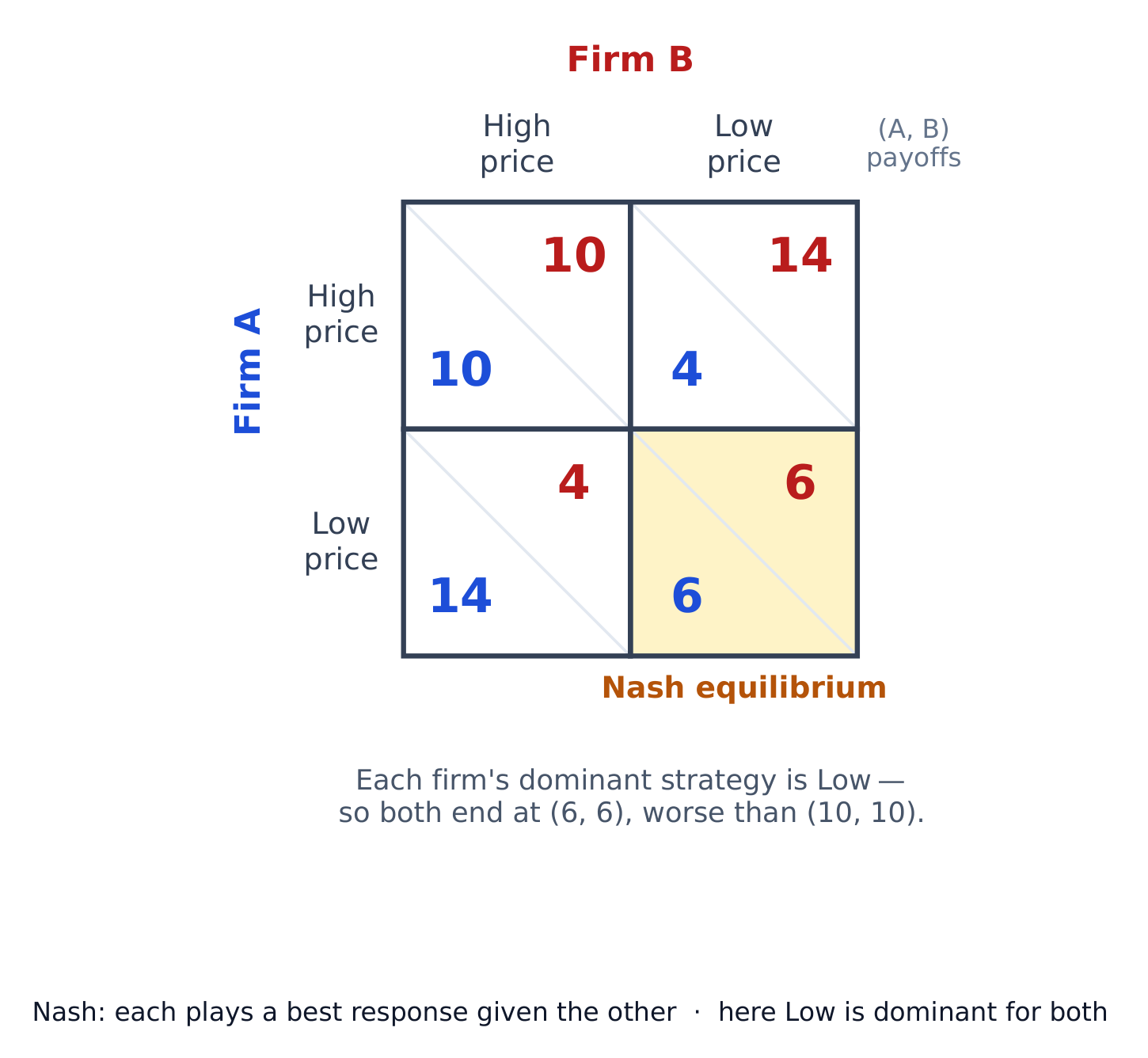
Worked example. Two firms each choose a High or Low price. Profits (A, B): both High $\to(10,10)$; A Low, B High $\to(14,4)$; A High, B Low $\to(4,14)$; both Low $\to(6,6)$. For A: if B plays High, Low ($14$) beats High ($10$); if B plays Low, Low ($6$) beats High ($4$) – so Low is A's dominant strategy, and by symmetry B's too. The Nash equilibrium is both Low $(6,6)$, worse for both than the cooperative $(10,10)$ – the prisoners' dilemma in action.

Exam skill: be able to find each firm's dominant strategy and the Nash equilibrium from a 2×2 payoff matrix, and explain why the cooperative outcome is hard to sustain.

עברית

אוליגופול הוא שוק עם מספר מעט של חברות גדולות ותלויות זו בזו (רכבים, חברות תעופה, טלפונים). מכיוון שהתנועה הטובה ביותר של כל חברה תלויה בתנועות המתחרות, אנו מנתחים אותן באמצעות תיאוריית משחקים.

  • מטרית תשלום מציגת את הרווח של כל חברה עבור כל שילוב אפשרי של בחירות.
  • אסטרטגיה דומיננטית היא הבחירה הטובה ביותר של חברה בכל מקרה, ללא קשר לפעולת המתחרה.
  • איזון נאש הוא תוצאה שבה אף חברה אינה יכולה לשפר את מצבה על ידי שינוי חד-צדדי בבחירתה.
  • הדילמה של האסירים המודל הקלאסי מדגיש מדוע חברות לעיתים קרובות כושלות בשיתוף פעולה: שתי החברות היו נהנות יותר בשיתוף (פעולה כמו מונופול), אך לכל אחת מהן יש תמריץ להסתיר, ולכן הן מגיעות לתוצאה דמוי-תחרותית עם רווח נמוך יותר. שיתוף וקרTEL (קרטלים) הם לא יציבים מאותה סיבה (וגם בדרך כלל לא חוקיים).

דוגמה מפורטת. שתי חברות בוחרות מחיר גבוה או נמוך. הרווחים (A, B): שניהם גבוהים $\to(10,10)$; A נמוך, B גבוה $\to(14,4)$; A גבוה, B נמוך $\to(4,14)$; שניהם נמוכים $\to(6,6)$. עבור A: אם B מתממש בגבוה, נמוך ($14$) עדיף על גבוה ($10$); אם B מתממש בנמוך, נמוך ($6$) עדיף על גבוה ($4$) – לכן נמוך היא האסטרטגיה הדומיננטית של A, ובסימטריה גם של B. איזון נאש הוא שניהם נמוכים $(6,6)$, גרוע יותר לשתי החברות מאשר התוצאה השיתופית $(10,10)$ – הדילמה של האסירים בפועל.

דילמת האסירים: האסטרטגיה הדומיננטית של כל חברה היא נמוכה, מה שמוביל לאיזון נאש

מיומנות לבחינה: יכולת למצוא את האסטרטגיה הדומיננטית של כל חברה ואת איזון נאש ממטרית תשלום 2×2, ולהסביר מדוע קשה לשמר תוצאה שיתופית.

Vocabulary · ⁨מילון מונחים⁩ Train · ⁨אימון⁩
English עברית
payoff matrix/ˈpeɪɒf ˈmeɪtrɪks/ מטריצת תשלומים
dominant strategy/ˈdɒmɪnənt ˈstrætədʒi/ אסטרטגיה דומיננטית
Nash equilibrium/næʃ ˌiːkwɪˈlɪbrɪəm/ איזון נאש
prisoners' dilemma/ˈprɪzənəz daɪˈlemə/ פרדיקס של האסירים
colluding/kəˈluːdɪŋ/ שיתוף פעולה (קליזיה)
cartels/kɑːˈtelz/ קרטלים
4.5

Exam tips · ⁨טיפים לבחינות⁩

English
  • A firm with market power faces a downward-sloping demand, so MR < P (MR has twice the slope).
  • A monopoly produces where MR = MC, then charges the price up on the demand curve; it makes deadweight loss because $P > MC$.
  • Under perfect price discrimination the firm produces the efficient quantity but captures all consumer surplus.
  • Monopolistic competition earns zero long-run profit with excess capacity (product variety is the trade-off).
  • In an oligopoly find the dominant strategy and Nash equilibrium from the payoff matrix; the cooperative outcome is hard to sustain.
עברית
  • לחברה בעלת כוח בשוק יש פונקציית ביקוש יורדת, ולכן MR < P (שיפוע MR הוא פי שניים משיפוע הביקוש).
  • מונופול מייצר כאשר MR = MC, ולאחר מכן גובה את המחיר מעלה על עקומת הביקוש; הוא יוצר אובדן משקל מתוך הסיבה ש$P > MC$.
  • תחת אפיון מחירים מושלם, החברה מייצרת את הכמות היעילה אך תופסת את כל עודף הצרכן.
  • תחרות מונופוליסטית מניבה רווח אפס בטווח הארוך עם קיבולת עודפת (מגוון המוצרים הוא הפיצוי).
  • באוליגופול מצאים את האסטרטגיה הדומיננטית ואת איזון נאש ממטרית התשלום; קשה לשמור על תוצאה שיתופית.

Interactive lessons on this topic · ⁨שיעורים אינטראקטיביים בנושא זה⁩

Work through it step by step, with instant-check exercises. · ⁨לעבור על הדברים צעד אחר צעד, עם תרגילים לבדיקה מיידית.⁩

Past Papers · ⁨מבחני עבר⁩

More topics in AP Microeconomics · ⁨מיקרוכלכלואה - AP⁩ · ⁨נושאים נוספים בAP Microeconomics · ⁨מיקרוכלכלואה - AP⁩⁩

Log in or create account · ⁨היכנס או צור חשבון⁩

IGCSE, A-Level & AP