עמוק בתוך ענן סוער, מטענים נוצרים. מטען שלילי מצטבר בבסיס, מטען חיובי על הקרקע שמטה. ביניהם, באוויר הפנוי, קיים…
English narration · English + 中文 subtitles burned in · קריאת קול באנגלית · תרגום אנגלי + סינית שרוף בתוך הסרטון
18.1
Electric fields · שדות חשמליים
Syllabus · סיילבוס
English
understand that an electric field is an example of a field of force and define electric field as force per unit positive charge
recall and use $F = qE$ for the force on a charge in an electric field
represent an electric field by means of field lines
עברית
להבין ששדה חשמלי הוא דוגמה לשדה כוח ולהגדיר את השדה החשמלי ככוח ליחידת מטען חיובי
להיזכר ולשת $F = qE$ לכוח על מטען בשדה חשמלי
לייצג שדה חשמלי באמצעות קווי שדה
Source: Cambridge International syllabus · מקור: הסיילבוס הבינלאומי של קמבריד'ג'
English
An electric field 电场 is a region where a charge feels a force 力 from other charges. The electric field strength 电场强度$E$ at a point is the force per unit positive charge on a small positive test charge 检验电荷 placed there:
$$E = \frac{F}{q}.$$
Unit: $\text{N C}^{-1}$ (the same as $\text{V m}^{-1}$, as we will see). $E$ is a vector 矢量, pointing the way the force acts on a positive charge. The force on a charge $q$ is
$$F = qE,$$
opposite to the field if $q$ is negative.
The two-mark definition.Electric field strength at a point is the force per unit positive charge acting on a small (test) charge placed at that point. Three words carry the marks: force per unit charge (not "force on a charge"), positive (which fixes the direction), and small or test (so the charge does not disturb the field it is measuring). The multiple-choice version offers "force per unit charge acting on a small mass" and "force per unit mass" as distractors: a field is defined by a charge, never by a mass.
Worked example. A proton accelerates at $2.00\ \text{m s}^{-2}$ in an electric field, with no other force acting. Find the field strength. ($m_{\text{p}} = 1.67 \times 10^{-27}\ \text{kg}$, $e = 1.60 \times 10^{-19}\ \text{C}$.)
The same rearrangement the other way round gives the acceleration of an electron in a field of $1500\ \text{V m}^{-1}$: $a = eE/m_{\text{e}} = (1.60 \times 10^{-19})(1500)/(9.11 \times 10^{-31}) = 2.6 \times 10^{14}\ \text{m s}^{-2}$, enormous because the electron's mass is so small. Gravity ($9.81\ \text{m s}^{-2}$) is negligible beside it, which is why exam questions about electrons between plates ignore weight.
Field lines
field lines 场线 point the way the force acts on a positive test charge.
lines start on positive charges and end on negative charges (or go to infinity).
lines never cross; closer lines mean a stronger field.
every line carries an arrow; lines meet the surface of a conductor at right angles.
What a field line represents. Asked "state what is represented by an electric field line", give both halves: its direction shows the direction of the force on a positive charge placed there, and the spacing of the lines shows the strength of the field (closer lines, stronger field). A sketch is marked on exactly these points: arrows drawn, lines not crossing, even spacing where the field is uniform, and radial lines for a point charge or a sphere.
Examples: a positive point charge 点电荷 has radial lines pointing out; a negative one has lines pointing in; two opposite charges (a dipole 偶极子) have lines curving from + to −; two parallel charged plates give a uniform field 匀强场 of equally spaced parallel lines.
A charged conducting sphere
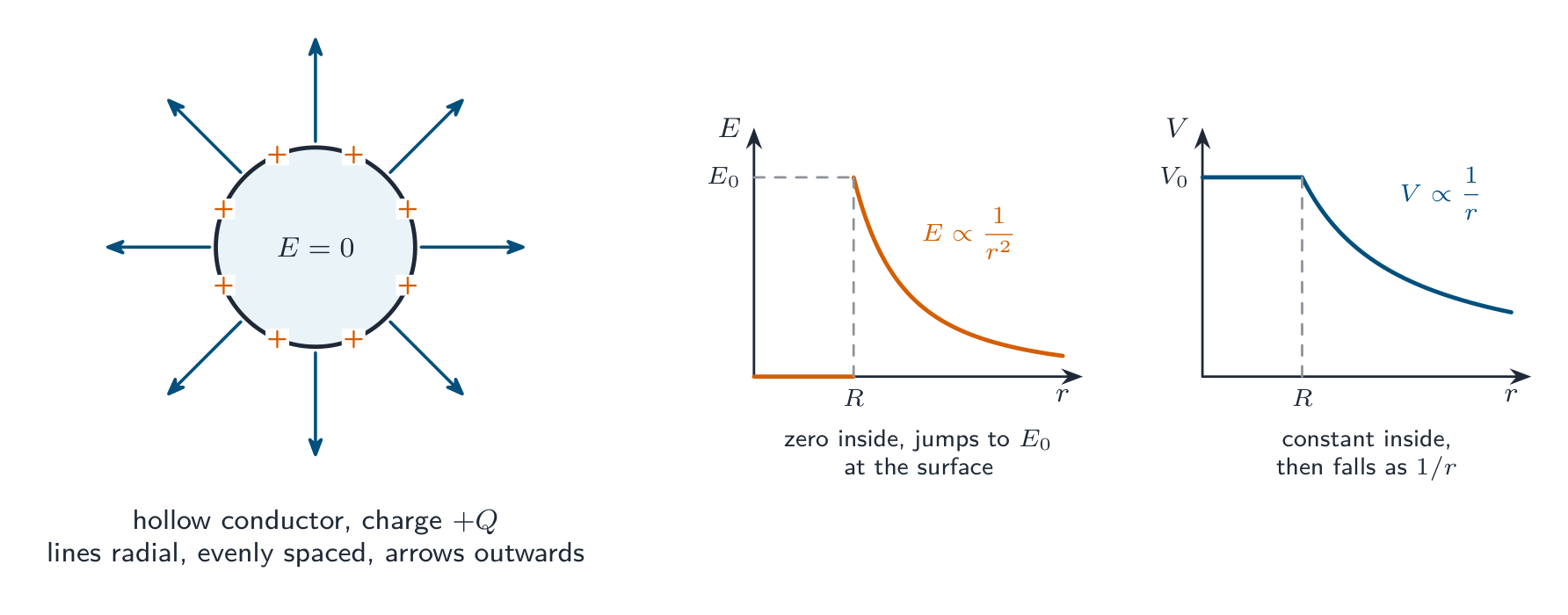
The charge on an isolated 孤立的conductor 导体 sits on its outer surface, spread evenly when the sphere is on its own. Outside the sphere the field lines are radial, evenly spaced and pointing outwards (for positive charge), exactly the pattern of a point charge at the centre. Inside a hollow (or solid) conductor the field is zero: the fields of all the surface charges cancel everywhere inside, so no field line enters. Two graphs follow, and both are exam favourites. The field strength $E$ is zero out to the radius $R$, jumps to its surface value $E_0$ and then falls as $1/r^{2}$; the potential $V$ is constant inside (a zero field means a zero potential gradient) and then falls as $1/r$.
Reading the graphs. Given an $E$–$x$ graph for a charged sphere, the radius is the distance at which $E$ jumps from zero, and the charge comes from any point on the curve: $Q = 4\pi\varepsilon_{0} r^{2} E$. Given "$E_0$ at the surface", the value at $2R$ is $E_0/4$ and at $3R$ is $E_0/9$: sketch the curve through those points, starting at $E_0$ on the surface line, never from the origin.
עברית
ברק הוא ניצוץ ענק המונע על ידי שדה חשמלי עצום.
שדה חשמלי הוא אזור בו מטען חושש כוח ממטענים אחרים. חוזק השדה החשמלי$E$ בנקודה נתונה הוא הכוח ליחידת מטען חיובי על מטען בדיקה חיובי קטן הממוקם שם:
$$E = \frac{F}{q}.$$
יחידה: $\text{N C}^{-1}$ (אותה כמו $\text{V m}^{-1}$, כפי שנראה). $E$ הוא וקטורי, מופנה לכיוון הפעולה של הכוח על מטען חיובי. הכוח על מטען $q$ הוא
$$F = qE,$$
ניגוד לשדה אם $q$ שלילי.
ההגדרה בעלת שתי הנקודות.חוזק השדה החשמלי בנקודה הוא הכוח ליחידת מטען חיובי הפועל על מטען בדיקה קטן הממוקם בנקודה זו. שלושה מילים נושאות את הנקודות: כוח ליחידת מטען (לא "כוח על מטען"), חיובי (שהוא קובע את הכיוון), ו-קטן או בדיקה (כדי שהמטען לא יהרוש את השדה שהואמד). בגרסת הבחירה הרב-בחירית מוצעים "כוח ליחידת מטען הפועל על מסה קטנה" ו"כוח ליחידת מסה" כמפגרים: שדה מוגדר על ידי מטען, לעולם לא על ידי מסה.
דוגמה מפורטת. פרוטון מאיץ ב-$2.00\ \text{m s}^{-2}$ בשדה חשמלי, ללא כוח אחר הפועל עליו. מצאו את חוזק השדה. ($m_{\text{p}} = 1.67 \times 10^{-27}\ \text{kg}$, $e = 1.60 \times 10^{-19}\ \text{C}$.)
אותה סידור מחדש הפוך נותן את התאוצה של אלקטרון בשדה של $1500\ \text{V m}^{-1}$: $a = eE/m_{\text{e}} = (1.60 \times 10^{-19})(1500)/(9.11 \times 10^{-31}) = 2.6 \times 10^{14}\ \text{m s}^{-2}$, עצום מכיוון שמסת האלקטרון כל כך קטנה. כבידה ($9.81\ \text{m s}^{-2}$) זניחה מולה, ולכן שאלות מבחן על אלקטרונים בין לוחות מתעלמות משקלו.
קווי שדה
קווי שדה מופנים לכיוון הפעולה של הכוח על מטען בדיקה חיובי.
קווים מתחילים על מטענים חיוביים ונגמרים על מטענים שליליים (או הולכים לאינסוף).
קווים לעולם אינם נחתכים; קווים קרובים יותר מצביעים על שדה חזק יותר.
כל קו נושא חץ; קווים פוגשים את פני המוליך בזווית ישרה.
מה שמייצג קו שדה. בעת שנתון "פרט מה שמייצג קו שדה חשמלי", יש לתת את שתי החלקים: ה-כיוון שלו מראה את כיוון הכוח על מטען חיובי שהונח שם, וה-רווח בין הקווים מראה את עוצמת השדה (קווים קרובים יותר, שדה חזק יותר). סקיצה מסומנת בדיוק בנקודות אלו: חצים מצוירים, קווים לא נחתכים, רווח אחיד לשדה אחיד, וקווים רדיאליים למטען נקודתי או לכדור.
דוגמאות: מטען נקודתי חיובי בעל קווים רדיאליים הפונים החוצה; מטען שלילי בעל קווים הפונים פנים; שני מטענים מנוגדים (דפול) בעל קווים המתעקמים מ-+ ל-−; שני פלטות מטעונות מקבילות נותנות שדה אחיד של קווים מקבילים ומרווחים באופן שווה.
דפוסי קווי שדה לפלטות מקבילות, דפול, מטען נקודתי וכדור מטעון מעל פלטה מאדמהמוליך חלול מטעון: השדה בחוץ הוא כמו של מטען נקודתי במרכז; בפנים, השדה הוא אפס והפוטנציאל הוא קבוע
כדור מוליך מטעון
המטען על מוליך מבודד יושב על משטחו החיצוני, מפוזר באופן שווה כאשר הכדור לבדו. מחוץ לכדור קווי השדה הם רדיאליים, מרווחים באופן שווה ופונים החוצה (למטען חיובי), בדיוק הדפוס של מטען נקודתי במרכז. בתוך מוליך חלול (או מוצק) השדה הוא אפס: השדות של כל מטעני המשטח מבטלים זה את זה בכל מקום בתוך המוליך, כך שאין קו שדה הנכנס. שני גרפים נמצאים לאחר מכן, ושניהם אהובים בבחינות. עוצמת השדה $E$ היא אפס עד הרדיוס $R$, זוקפת לערכה במשטח $E_0$ ולאחר מכן יורדת כ$1/r^{2}$; הפוטנציאל $V$ הוא קבוע בפנים (שדה אפס פירושו שיפוע פוטנציאל אפס) ולאחר מכן יורד כ$1/r$.
קריאת הגרפים. נתון גרף $E$–$x$ לכדור מטעון, ה-רדיוס הוא המרחק שבו $E$ זוקפת מאפס, וה-מטען נובע מכל נקודה על העקומה: $Q = 4\pi\varepsilon_{0} r^{2} E$. נתון "$E_0$ במשטח", הערך ב-$2R$ הוא $E_0/4$ וב-$3R$ הוא $E_0/9$: סקיצו את העקומה דרך נקודות אלו, מתחיל ב-$E_0$ על קו המשטח, לעולם לא מהראשית.
גנרטור ואן דה גראף מאחסן מטען סטטי גדול בכיפת המתכת שלו, ויוצר שדה חשמלי חזק סביבו
Explore · חקור
Electric fields · שדות חשמליים
E ∝ Q / r²
A charge sets up a radial field — out for +, in for −, obeying the inverse-square law. · מטען יוצר שדה רדיאלי — כלפי החוץ עבור +, כלפי הפנים עבור −, לפי חוק הריבוע ההפוך.
recall and use $E = \Delta V / \Delta d$ to calculate the field strength of the uniform field between charged parallel plates
describe the effect of a uniform electric field on the motion of charged particles
עברית
זכור והשתמש ב-$E = \Delta V / \Delta d$ כדי לחשב את עוצמת השדה בשדה אחיד בין פלטות מטענות מקבילות
לתאר את השפעת שדה חשמלי אחיד על תנועת חלקיקים טעונים
Source: Cambridge International syllabus · מקור: הסיילבוס הבינלאומי של קמבריד'ג'
English
Between two parallel plates a distance $d$ apart with potential difference 电势差$V$ between them, the field is uniform (apart from edge effects) with size
$$E = \frac{V}{d}.$$
It points from the higher-potential plate to the lower one. The unit $\text{V m}^{-1}$ comes straight from this and equals $\text{N C}^{-1}$.
Worked example. Two parallel plates $5.0\ \text{mm}$ apart have a p.d. of $200\ \text{V}$ between them. Find the field strength, and the force on an electron in the gap. ($e = 1.6 \times 10^{-19}\ \text{C}$.)
Which changes the field? Two things only: $E = V/d$ rises if the p.d. is increased or the plates are moved closer. A resistor in series with the supply changes nothing: no current flows once the plates are charged, so there is no p.d. across the resistor and the plates sit at the full supply voltage. Between plates at $+800\ \text{V}$ and $+1300\ \text{V}$ the field points from the higher potential to the lower; two positive potentials change nothing about the direction rule.
A charged particle in a uniform field
A charge $q$ in a uniform field feels a constant force$F = qE$, so a constant acceleration$a = qE/m$ — just like a mass in a uniform gravitational field.
released at rest, it speeds up along the field (positive charge) or against it (negative charge), gaining kinetic energy 动能.
entering at right angles to the field, it follows a parabolic 抛物线 path — like a projectile 抛体 in gravity. This is how a cathode-ray tube 阴极射线管 used to steer its beam.
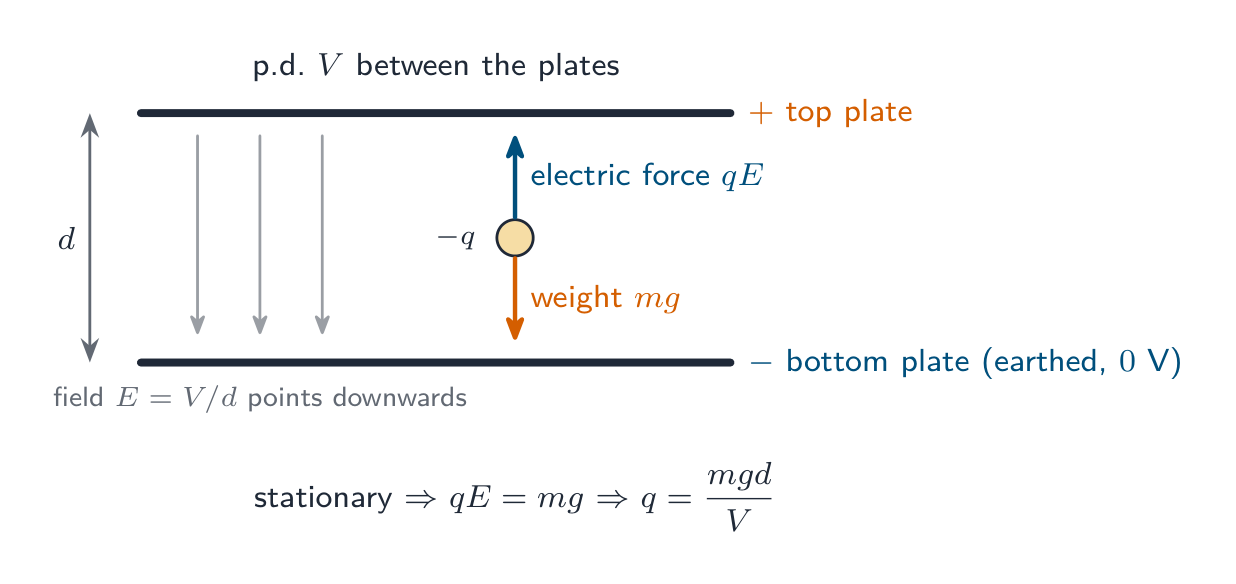
Two forces, not one. A charged oil drop "held stationary" between horizontal plates is the exam's favourite equilibrium 平衡: both an electric force and its weight act on it (the multiple-choice distractor is "electric force only"), and they are equal and opposite. For a negative drop the electric force is opposite to the field, so the top plate must be positive to hold it up.
Worked example. An oil drop of mass $2.6 \times 10^{-15}\ \text{kg}$ carries a charge of $-4.8 \times 10^{-19}\ \text{C}$ and is held stationary in a vacuum between horizontal plates $2.0\ \text{cm}$ apart. Find the p.d. between the plates, and say which plate is positive.
The drop is negative, so the force on it is against the field; for the force to be upwards the field must point down, so the top plate is positive. Notice that the charge is $3e$, three excess electrons, which is how Millikan showed that charge comes in multiples of $e$.
Worked example. Two parallel plates in a vacuum are $0.041\ \text{m}$ apart with a p.d. of $250\ \text{V}$ between them. An electron is released from rest at the negative plate. Find (a) the field strength, (b) the force on the electron and its acceleration, (c) the time it takes to reach the positive plate, (d) its kinetic energy on arrival. ($m_{\text{e}} = 9.11 \times 10^{-31}\ \text{kg}$.)
Worked example (deflection). An electron travelling horizontally at $2.0 \times 10^{7}\ \text{m s}^{-1}$ enters the field between two horizontal plates $18\ \text{mm}$ apart with a p.d. of $400\ \text{V}$. The plates are $30\ \text{mm}$ long. Find the deflection 偏转 of the electron by the time it leaves the field.
The horizontal motion is unaffected: time in the field $t = 0.030/(2.0 \times 10^{7}) = 1.5 \times 10^{-9}\ \text{s}$. Vertically, $a = eE/m_{\text{e}} = eV/(m_{\text{e}} d) = (1.60 \times 10^{-19})(400)/[(9.11 \times 10^{-31})(0.018)] = 3.9 \times 10^{15}\ \text{m s}^{-2}$, so the deflection is $y = \tfrac{1}{2} a t^{2} = \tfrac{1}{2}(3.9 \times 10^{15})(1.5 \times 10^{-9})^{2} = 4.4 \times 10^{-3}\ \text{m}$, less than the half-gap of $9\ \text{mm}$, so the electron does leave the field. Its vertical velocity on exit is $at = 5.9 \times 10^{6}\ \text{m s}^{-1}$, so it leaves at $\tan\theta = 5.9/20$, about $16°$; the path is a parabola, and after the plates (no field) it travels in a straight line in the direction it had on exit.
עברית
בין שתי פלטות מקבילות במרחק $d$ זה מזה עם הפרש פוטנציאלים$V$ ביניהן, השדה הוא אחיד (מעבר להשפעות קצה) בגודל
בין פלטות מקבילות השדה הוא אחיד, E = V/d
$$E = \frac{V}{d}.$$
היא מצביעה מהפלט עם הפוטנציאל הגבוה יותר אל הפלט עם הפוטנציאל הנמוך יותר. היחידה $\text{V m}^{-1}$ נובעת ישירות מכך וערכה הוא $\text{N C}^{-1}$.
דוגמא מופת. שני פלטים מקבילים $5.0\ \text{mm}$ זה מזה, והפרש הפוטנציאלים ביניהם הוא $200\ \text{V}$. חשב את עוצמת השדה ואת הכוח על אלקטרון ברווח. ($e = 1.6 \times 10^{-19}\ \text{C}$.)
מה משנה את השדה? רק שתי דברים: $E = V/d$ עולה אם הפרש הפוטנציאלים גדל או אם הפלטים מוזזים קרוב יותר זה לזה. נגן בסדרה עם המקור אינו משנה דבר: זרם לא זורם לאחר שהפלטים טעונים, ולכן אין הפרש פוטנציאלים על הנגן והפלטות נמצאות במלוא מתח המקור. בין פלטים ב$+800\ \text{V}$ וב$+1300\ \text{V}$ השדה מצביע מפוטנציאל גבוה לנמוך; שני פוטנציאלים חיוביים אינם משנים את כלל הכיוון.
חלק טעון בשדה אחיד
מטען $q$ בשדה אחיד מרגיש בכוח קבוע$F = qE$, ולכן יש לו תאוצה קבועה$a = qE/m$ — בדיוק כמו מסה בשדה כבידה אחיד.
כאשר משוחרר ממצב רגיע, הוא מאיץ לאורך השדה (מטען חיובי) או נגדו (מטען שלילי), תוך רכישת אנרגיה קינטית.
כאשר נכנס בזווית ישרה לשדה, הוא עוקף מסלול פרבולי — כמו פרסציל בכבידה. כך פעלה צינור קרני הקתודה בעבר כדי לכוון את הקרן שלו.
מטען הנכנס לשדה אחיד בזווית ישרה עוקף מסלול פרבולי, כמו פרסצילטיפת שמן טעונה המוחזקת במצב רגוע בין פלטות אופקיות: הכוח החשמלי מאזן את המשקל, ולכן q = mgd/V
שני כוחות, ולא אחד. טיפת שמן טעונה "המוחזקת במצב רגוע" בין פלטות אופקיות היא איזון מועדף בבחינות: שני כוחות פועלים עליה — כוח חשמלי ומשקלה (המפנה לבחירה מרובה הוא "רק כוח חשמלי"), והם שווים ונגדיים. עבור טיפה שלילית, הכוח החשמלי נגד לשדה, ולכן הפלטה העליונה חייבת להיות חיובית כדי להחזיק אותה למעלה.
דוגמה פותרת. טיפת שמן המסה שלה $2.6 \times 10^{-15}\ \text{kg}$ נושאת מטען של $-4.8 \times 10^{-19}\ \text{C}$ והיא מוחזקת במצב רגוע בוואקום בין פלטות אופקיות המרוחקות $2.0\ \text{cm}$. מצאו את ההפרש הפוטנציאלים בין הפלטות, ואמרו איזו פלטה חיובית.
הירידה שלילית, ולכן הכוח עליה נגד השדה; כדי שהכוח יהיה כלפי מעלה השדה חייב להצביע למטה, ולכן הפלט העליון הוא חיובי. שימו לב שהמטען הוא $3e$, שלושה אלקטרונים עודפים, וזוהי הדרך שבה מיליקן הראה שמטען מגיע בכפילויות של $e$.
דוגמה פותרת. שתי פלטות מקבילות בוואקום מרוחקות $0.041\ \text{m}$ זה מזה עם הפרש פוטנציאלים של $250\ \text{V}$ ביניהן. אלקטרון משוחרר ממצב רגיע בפלטה השלילית. מצאו (א) את עוצמת השדה, (ב) את הכוח על האלקטרון ואת התאוצה שלו, (ג) את הזמן שדרוש לו כדי להגיע לפלטה החיובית, (ד) את אנרגייתו הקינטית בעת הגעתו. ($m_{\text{e}} = 9.11 \times 10^{-31}\ \text{kg}$.)
דוגמה פותרת (הטיה). אלקטרון הנעים אופקית במהירות $2.0 \times 10^{7}\ \text{m s}^{-1}$ נכנס לשדה בין שתי פלטות אופקיות המרוחקות $18\ \text{mm}$ זה מזה עם הפרש פוטנציאלים של $400\ \text{V}$. הפלטות הן $30\ \text{mm}$ באורך. מצאו את ההטיה של האלקטרון עד לשעת יציאתו מהשדה.
התנועה האופקית אינה מושפעת: הזמן בשדה $t = 0.030/(2.0 \times 10^{7}) = 1.5 \times 10^{-9}\ \text{s}$. בציר אנכי, $a = eE/m_{\text{e}} = eV/(m_{\text{e}} d) = (1.60 \times 10^{-19})(400)/[(9.11 \times 10^{-31})(0.018)] = 3.9 \times 10^{15}\ \text{m s}^{-2}$, ולכן ההטיה היא $y = \tfrac{1}{2} a t^{2} = \tfrac{1}{2}(3.9 \times 10^{15})(1.5 \times 10^{-9})^{2} = 4.4 \times 10^{-3}\ \text{m}$, קטנה מחצי המרווח של $9\ \text{mm}$, ולכן האלקטרון אכן יוצא מהשדה. מהירותו האנכית ביציאה היא $at = 5.9 \times 10^{6}\ \text{m s}^{-1}$, ולכן הוא יוצא בזווית $\tan\theta = 5.9/20$, בערך $16°$; המסלול הוא פרבולה, ובלאחר הפלטות (ללא שדה) הוא ממשיך בקו ישר לכיוון שייצר ביציאה.
Explore · חקור
Uniform electric field lab · מעבדה לשדה חשמלי אחיד
Follow how a charge behaves between parallel plates. · עקוב אחר התנהגות מטען בין לוחות מקבילים.
18.3
Coulomb's law · חוק קולומב
Syllabus · סיילבוס
English
understand that, for a point outside a spherical conductor, the charge on the sphere may be considered to be a point charge at its centre
recall and use Coulomb’s law$F = Q_1Q_2 / (4\pi\varepsilon_0 r^2)$ for the force between two point charges in free space
עברית
להבין כי עבור נקודה מחוץ למוליך כדורי, ניתן להסתכל על המטען בכדור כאילו הוא מטען נקודתי במרכזו
זכור והשתמש ב-חוק קולון$F = Q_1Q_2 / (4\pi\varepsilon_0 r^2)$ לכוח בין שני מטענים נקודתיים במרחב פנוי
Source: Cambridge International syllabus · מקור: הסיילבוס הבינלאומי של קמבריד'ג'
English
For two point charges $Q_{1}$ and $Q_{2}$ a distance $r$ apart in free space, each feels a force of size
This is Coulomb's law 库仑定律. Here $\varepsilon_{0} = 8.85 \times 10^{-12}\ \text{F m}^{-1}$ is the permittivity of free space 真空电容率, and $1/(4\pi\varepsilon_{0}) \approx 9.0 \times 10^{9}\ \text{N m}^{2}\ \text{C}^{-2}$. The force is along the line joining the charges: repulsive for like charges, attractive for opposite charges.
Stating the law in words. "State Coulomb's law" wants a sentence, not a formula: the (electric) force between two point charges is directly proportional to the product of the charges and inversely proportional to the square of their separation. Both proportionalities are needed, and the charges must be point charges (or spheres treated as point charges at their centres) in a vacuum.
Worked example. Find the electrostatic force between point charges of $+2.0\ \text{nC}$ and $+3.0\ \text{nC}$ placed $4.0\ \text{cm}$ apart. ($1/(4\pi\varepsilon_{0}) = 9.0 \times 10^{9}\ \text{N m}^{2}\ \text{C}^{-2}$.)
Worked example. In a hydrogen atom the proton and the electron may be treated as point charges $120\ \text{pm}$ apart. Find the electric force between them, and compare it with their gravitational attraction. ($m_{\text{p}} = 1.67 \times 10^{-27}\ \text{kg}$, $m_{\text{e}} = 9.11 \times 10^{-31}\ \text{kg}$, $G = 6.67 \times 10^{-11}\ \text{N m}^{2}\ \text{kg}^{-2}$.)
Gravity: $F_{\text{G}} = G m_{\text{p}} m_{\text{e}}/r^{2} = (6.67 \times 10^{-11})(1.67 \times 10^{-27})(9.11 \times 10^{-31})/(1.20 \times 10^{-10})^{2} = 7.0 \times 10^{-48}\ \text{N}$, about $10^{39}$ times smaller. Inside atoms, gravity is irrelevant.
Worked example. Two identical oil droplets in a vacuum have their centres $3.8 \times 10^{-6}\ \text{m}$ apart. Each carries the same charge, and they repel with a force of $1.0 \times 10^{-15}\ \text{N}$. Find the charge on each droplet, and the number of excess electrons it carries.
that is $1.3 \times 10^{-18}/1.60 \times 10^{-19} \approx 8$ electrons. Identical objects with the same sign of charge always repel; do not write "attract" for the direction.
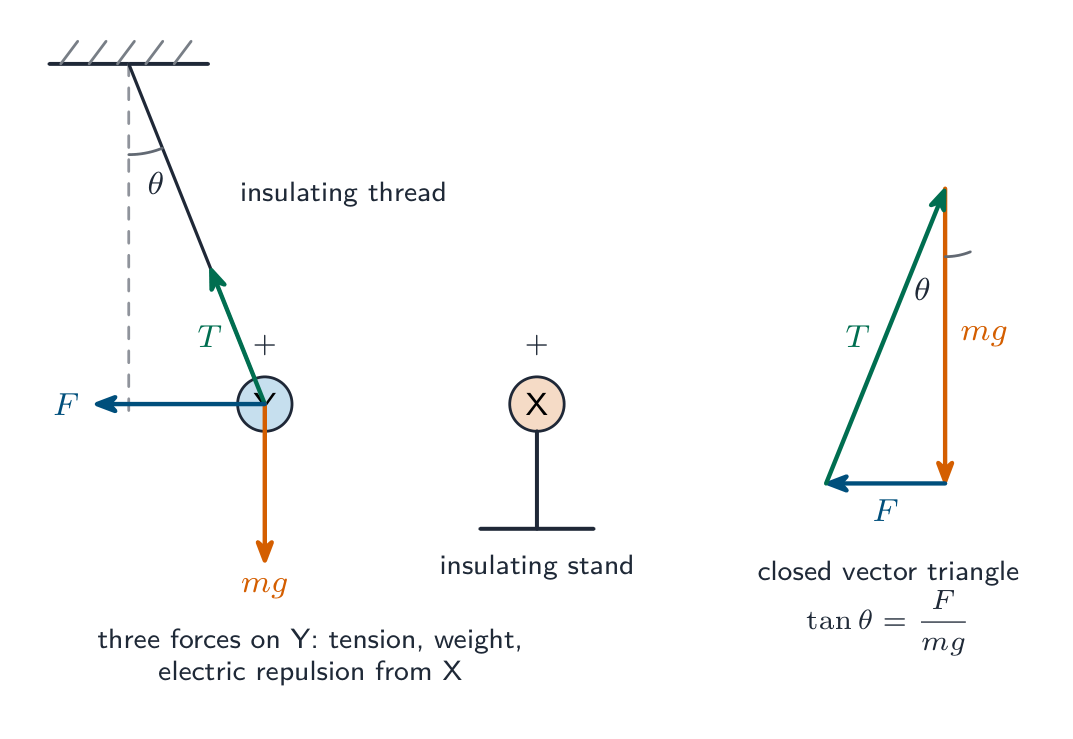
Worked example. A charged sphere X is fixed on an insulating stand. A second sphere Y, of mass $2.0\ \text{g}$, hangs beside it on an insulating thread and settles in equilibrium with the thread at $12°$ to the vertical, its centre $5.0\ \text{cm}$ from the centre of X on the same horizontal level. Find the electric force on Y and, if the spheres carry equal charges, the charge on each.
Three forces act on Y: its weight $mg$ (down), the tension 张力$T$ (along the thread) and the electric force $F$ (horizontal, away from X because like charges repel). Resolving, $T\cos\theta = mg$ and $T\sin\theta = F$, so
Then $F = Q^{2}/(4\pi\varepsilon_{0} r^{2})$ gives $Q = \sqrt{4\pi\varepsilon_{0} F r^{2}} = \sqrt{(4.2 \times 10^{-3})(0.050)^{2}/(8.99 \times 10^{9})} = 3.4 \times 10^{-8}\ \text{C}$. A closed vector triangle of the three forces is an equally good method; the exam accepts either, but it must show all three forces.
Worked example (helium). A helium atom may be modelled as a nucleus of charge $+2e$ with two electrons in diametrically opposite circular orbits of radius $170\ \text{pm}$. Find the resultant force 合力 on one electron, and hence its orbital speed.
Two forces act on the electron: attraction to the nucleus, at distance $r$, and repulsion from the other electron, at distance $2r$ on the far side:
towards the nucleus. This resultant is the centripetal force, $F = m_{\text{e}} v^{2}/r$, so $v = \sqrt{F r/m_{\text{e}}} = \sqrt{(1.4 \times 10^{-8})(1.70 \times 10^{-10})/(9.11 \times 10^{-31})} = 1.6 \times 10^{6}\ \text{m s}^{-1}$. The trap is to forget the second electron, or to put it at distance $r$ rather than $2r$.
Spheres treated as point charges
A spherical conductor with total charge $Q$ gives, at any point outside, the same field as a point charge $Q$ at its centre (measure $r$ from the centre). Inside a hollow charged conductor the field is zero, so the conductor is an equipotential 等势面.
עברית
לשני מטעני נקודה $Q_{1}$ ו$Q_{2}$ המרוחקים מרחק $r$ בחלל ריק, כל אחד מרגיש בכוח בגודל
זהו חוק קולון. כאן $\varepsilon_{0} = 8.85 \times 10^{-12}\ \text{F m}^{-1}$ הוא המתאמת של הרווח, ו$1/(4\pi\varepsilon_{0}) \approx 9.0 \times 10^{9}\ \text{N m}^{2}\ \text{C}^{-2}$. הכוח פועל לאורך הקו המחבר את המטענים: דוחה עבור מטענים זהים, מושך עבור מטענים מנוגדים.
ניסוח החוק במילים. "הבא את חוק קולון" דורש משפט, ולא נוסחה: הכוח (החשמלי) בין שני מטענים נקודתיים פרופורציונלי ישירות למכפלת המטענים והופך לריבוע המרחק ביניהם. שתי הפרופורציונליות נדרשות, והמטענים חייבים להיות נקודתיים (או כדורים שמטופלים כמטענים נקודתיים במרכזיהם) בוואקום.
מטענים זהים דוחים; מטענים מנוגדים מושכים — הכוח פועל לאורך הקו המחבר אותם
דוגמה מפורטת. מצאו את הכוח האלקטרוסטטי בין מטענים נקודתיים של $+2.0\ \text{nC}$ ו$+3.0\ \text{nC}$ הנמצאים במרחק $4.0\ \text{cm}$ זה מזה. ($1/(4\pi\varepsilon_{0}) = 9.0 \times 10^{9}\ \text{N m}^{2}\ \text{C}^{-2}$.)
דוגמה מפורטת. באטום מימן ניתן להתייחס לגרעין ולאלקטרון כמטענים נקודתיים במרחק $120\ \text{pm}$ זה מזה. מצאו את הכוח החשמלי ביניהם, והשוו אותו למשיכה הכבידתית שלהם. ($m_{\text{p}} = 1.67 \times 10^{-27}\ \text{kg}$, $m_{\text{e}} = 9.11 \times 10^{-31}\ \text{kg}$, $G = 6.67 \times 10^{-11}\ \text{N m}^{2}\ \text{kg}^{-2}$.)
כבידה: $F_{\text{G}} = G m_{\text{p}} m_{\text{e}}/r^{2} = (6.67 \times 10^{-11})(1.67 \times 10^{-27})(9.11 \times 10^{-31})/(1.20 \times 10^{-10})^{2} = 7.0 \times 10^{-48}\ \text{N}$, כ-$10^{39}$ פעמים קטנה יותר. בתוך אטומים, הכבידה היא לא רלוונטית.
דוגמה מפורטת. שני טיפות שמן זהות בוואקום מרוחקות מרכזיהם $3.8 \times 10^{-6}\ \text{m}$ זה מזה. כל טיפה נושאת מטען זהה, והן דוחות זו את זו בכוח של $1.0 \times 10^{-15}\ \text{N}$. מצאו את המטען על כל טיפה, ואת מספר האלקטרונים העודפים שהיא נושאת.
כלומר $1.3 \times 10^{-18}/1.60 \times 10^{-19} \approx 8$ אלקטרונים. עצמים זהים עם אותה סימת מטען תמיד דוחים; אל תכתבו "מושכים" לכיוון.
דוגמה מפורטת. כדור טעון X מוצב על מעמד מבודד. כדור שני Y, בעל מסת $2.0\ \text{g}$, תלוי לידו על חוט מבודד ושקוע באיזון כאשר החוט יוצר זווית של $12°$ אנכי, ומרכזו נמצא במרחק $5.0\ \text{cm}$ ממרכז X באותו גובה אופקי. מצאו את הכוח החשמלי הפועל על Y, ואם לשני הכדורים מטען שווה, מצאו את המטען על כל כדור.
כדור טעון תלוי ליד כדור טעון: שלושה כוחות מאוזנים, המתח לאורך החוט, המשקל והדחייה החשמלית האופקית, כך ש-tan θ = F/mg
שלושה כוחות פועלים על Y: משקלו $mg$ (למטה), המתח$T$ (לאורך החוט) והכוח החשמלי $F$ (אופקי, הרחוק מ-X כי מטענים זהים דוחים). בפירוק, $T\cos\theta = mg$ ו$T\sin\theta = F$, ולכן
אז $F = Q^{2}/(4\pi\varepsilon_{0} r^{2})$ נותן $Q = \sqrt{4\pi\varepsilon_{0} F r^{2}} = \sqrt{(4.2 \times 10^{-3})(0.050)^{2}/(8.99 \times 10^{9})} = 3.4 \times 10^{-8}\ \text{C}$. משולש וקטורי סגור של שלושת הכוחות הוא שיטה טובה באותה מידה; הבחינה מקבלת שניהם, אך יש להראות את כל שלושת הכוחות.
דוגמה מפורטת (הליום). ניתן לדגמן אטום הליום כגרעין עם מטען $+2e$ ושני אלקטרונים במסלולים עגוליים מוליים בקוטר של $170\ \text{pm}$. מצאו את הכוח השקול הפועל על אלקטרון אחד, ומכאן את מהירותו במסלול.
שני כוחות פועלים על האלקטרון: משיכה לגרעין, במרחק $r$, ודחייה מהאלקטרון השני, במרחק $2r$ בצד הרחוק:
לעבר הגרעין. שוקול זה הוא הכוח המרכזי, $F = m_{\text{e}} v^{2}/r$, ולכן $v = \sqrt{F r/m_{\text{e}}} = \sqrt{(1.4 \times 10^{-8})(1.70 \times 10^{-10})/(9.11 \times 10^{-31})} = 1.6 \times 10^{6}\ \text{m s}^{-1}$. הפח הוא לשכוח את האלקטרון השני, או להניח שהוא במרחק $r$ במקום $2r$.
כדורים המטופלים כמטענים נקודתיים
מוליך כדורי עם מטען כולל $Q$ נותן, בכל נקודה חוץ, אותו שדה כמו מטען נקודתי $Q$ במרכזו (מדדו $r$ ממרכז). בתוך מוליך מחוספס טעון השדה הוא אפס, ולכן המוליך הוא איזו-פוטנציאל.
Explore · חקור
Coulomb's law · חוק קולון
F ∝ Qq / r²
Like charges repel, unlike attract — and the force follows 1/r². · מטענים זהים דוחים, מטענים שונים נמשכים – והכוח נסחר ב-1/r².
Electric field due to a point charge · שדה חשמלי הנוצר ממטען נקודתי
Syllabus · סיילבוס
English
recall and use $E = Q / (4\pi\varepsilon_0 r^2)$ for the electric field strength due to a point charge in free space
עברית
זכור והשתמש ב-$E = Q / (4\pi\varepsilon_0 r^2)$ עבור עוצמת השדה החשמלי הנובעת ממטען נקודתי במרחב פנוי
Source: Cambridge International syllabus · מקור: הסיילבוס הבינלאומי של קמבריד'ג'
English
Coulomb's law gives the force between two charges. Divide it by the test charge ($E = F/q$) and you are left with the field of the source charge $Q$alone. The field at distance $r$ from a point charge $Q$ is
$$E = \frac{Q}{4\pi\varepsilon_{0} r^{2}}.$$
It points out from a positive $Q$, in towards a negative $Q$, and falls as $1/r^{2}$ — just like gravitational field 重力场 strength, except gravity is always attractive. For several charges, add the fields as a vector sum 矢量和.
Worked example. The Earth may be treated as a uniform conducting sphere of radius $6.37 \times 10^{6}\ \text{m}$ carrying a total charge of $-4.80 \times 10^{5}\ \text{C}$ spread over its surface. Find the electric field strength at the surface, and compare it with the gravitational field strength there. ($M_{\text{E}} = 5.98 \times 10^{24}\ \text{kg}$.)
directed towards the centre (the charge is negative). Gravity: $g = GM/R^{2} = 9.83\ \text{N kg}^{-1}$, so $E/g \approx 11$; in symbols $E/g = Q/(4\pi\varepsilon_{0} G M)$, which shows that the ratio depends only on the charge-to-mass ratio of the sphere. A charged sphere of mass $m$ and charge $q$ would need $qE = mg$ to float in this field: $q/m = g/E = 0.093\ \text{C kg}^{-1}$.
Worked example. Point charges of $+4.0\ \text{nC}$ and $+1.0\ \text{nC}$ are $30\ \text{cm}$ apart. Where on the line joining them is the resultant field zero?
Between the charges the two fields point in opposite directions; call the distance from the $4.0\ \text{nC}$ charge $x$. Zero resultant needs equal magnitudes:
twice as far from the larger charge. For opposite charges the fields between them point the same way and never cancel: the zero lies outside, beyond the smaller charge.
עברית
חוק קולומן נותן את הכוח בין שני מטענים. חלקו במטען המבחנה ($E = F/q$) ויתר לך שדה של מטען המקור $Q$לבד. השדה במרחק $r$ ממטען נקודתי $Q$ הוא
$$E = \frac{Q}{4\pi\varepsilon_{0} r^{2}}.$$
הוא מצביע החוצה ממטען חיובי $Q$, פנימה למטען שלילי $Q$, ומתמתם כ$1/r^{2}$ — בדיוק כמו גודל שדה כבידה, למעט שהכבידה תמיד מושכת. עבור מספר מטענים, סכמו את השדות כסכום וקטורי.
דוגמא פותרת. כדור הארץ ניתן להתייחס אליו ככדור מוליך אחיד ברדיוס $6.37 \times 10^{6}\ \text{m}$ נושא מטען כולל של $-4.80 \times 10^{5}\ \text{C}$ המפוזר על פני שטחו. מצאו את גודל השדה החשמלי על הפני השטח, והשוו אותו לגודל שדה הכבידה שם. ($M_{\text{E}} = 5.98 \times 10^{24}\ \text{kg}$.)
מכוון פנימה למרכז (המטען שלילי). כבידה: $g = GM/R^{2} = 9.83\ \text{N kg}^{-1}$, ולכן $E/g \approx 11$; בסימון $E/g = Q/(4\pi\varepsilon_{0} G M)$, מה שמראה שהיחס תלוי רק ביחס המטען-מסה של הכדור. כדור טעון במסה $m$ ומטען $q$ יזדקק ל$qE = mg$ כדי לצוף בשדה זה: $q/m = g/E = 0.093\ \text{C kg}^{-1}$.
דוגמא פותרת. מטענים נקודתיים של $+4.0\ \text{nC}$ ו$+1.0\ \text{nC}$ נמצאים במרחק $30\ \text{cm}$ זה מזה. היכן בקו המחבר ביניהם השדה הנתון הוא אפס?
בין המטענים שני השדות מצביעים בכיוונים מנוגדים; נתבונן במרחק מהמטען $4.0\ \text{nC}$ כ$x$. שדה נתון אפס דורש גודלים שווים:
פי שני המרחק מהמטען הגדול יותר. עבור מטענים נגדיים, השדות ביניהם מצביעים באותו כיוון לעולם לא מבטלים זה את זה: הנקודה שבה השדה אפס נמצאת חוצה, מעבר למטען הקטן יותר.
Explore · חקור
Field around a point charge · שדה סביב מטען נקודתי
Change the charge. Field lines point away from positive and toward negative, and crowd together where the field is strongest. · שנה את המטען. קווי השדה מצביעים לחוץ ממטען חיובי ופנים אל מטען שלילי, והצטופפים במקום בו השדה חזק ביותר.
18.5
Electric potential · פוטנציאל חשמלי
Syllabus · סיילבוס
English
define electric potential at a point as the work done per unit positive charge in bringing a small test charge from infinity to the point
recall and use the fact that the electric field at a point is equal to the negative of potential gradient at that point
use $V = Q / (4\pi\varepsilon_0 r)$ for the electric potential in the field due to a point charge
understand how the concept of electric potential leads to the electric potential energy of two point charges and use $E_P = Qq / (4\pi\varepsilon_0 r)$
עברית
להגדיר פוטנציאל חשמלי בנקודה כעבודה ליחידת מטען חיובי בהקנת מטען מבחנה קטן מאינסוף לנקודה זו
להיזכר ולשת העובדה כי השדה החשמלי בנקודה שווה למינוס שיפוע הפוטנציאל בנקודה זו
השתמש ב-$V = Q / (4\pi\varepsilon_0 r)$ לפוטנציאל חשמלי בשדה הנובע ממטען נקודתי
הבן כיצד מושג הפוטנציאל החשמלי מוביל ל-אנרגיה פוטנציאלית חשמלית של שני מטענים נקודתיים והשתמש ב-$E_P = Qq / (4\pi\varepsilon_0 r)$
Source: Cambridge International syllabus · מקור: הסיילבוס הבינלאומי של קמבריד'ג'
English
Electric potential 电势$V$ at a point is the work done per unit positive charge in bringing a small positive test charge from infinity 无穷远 to that point:
$$V = \frac{W}{q}.$$
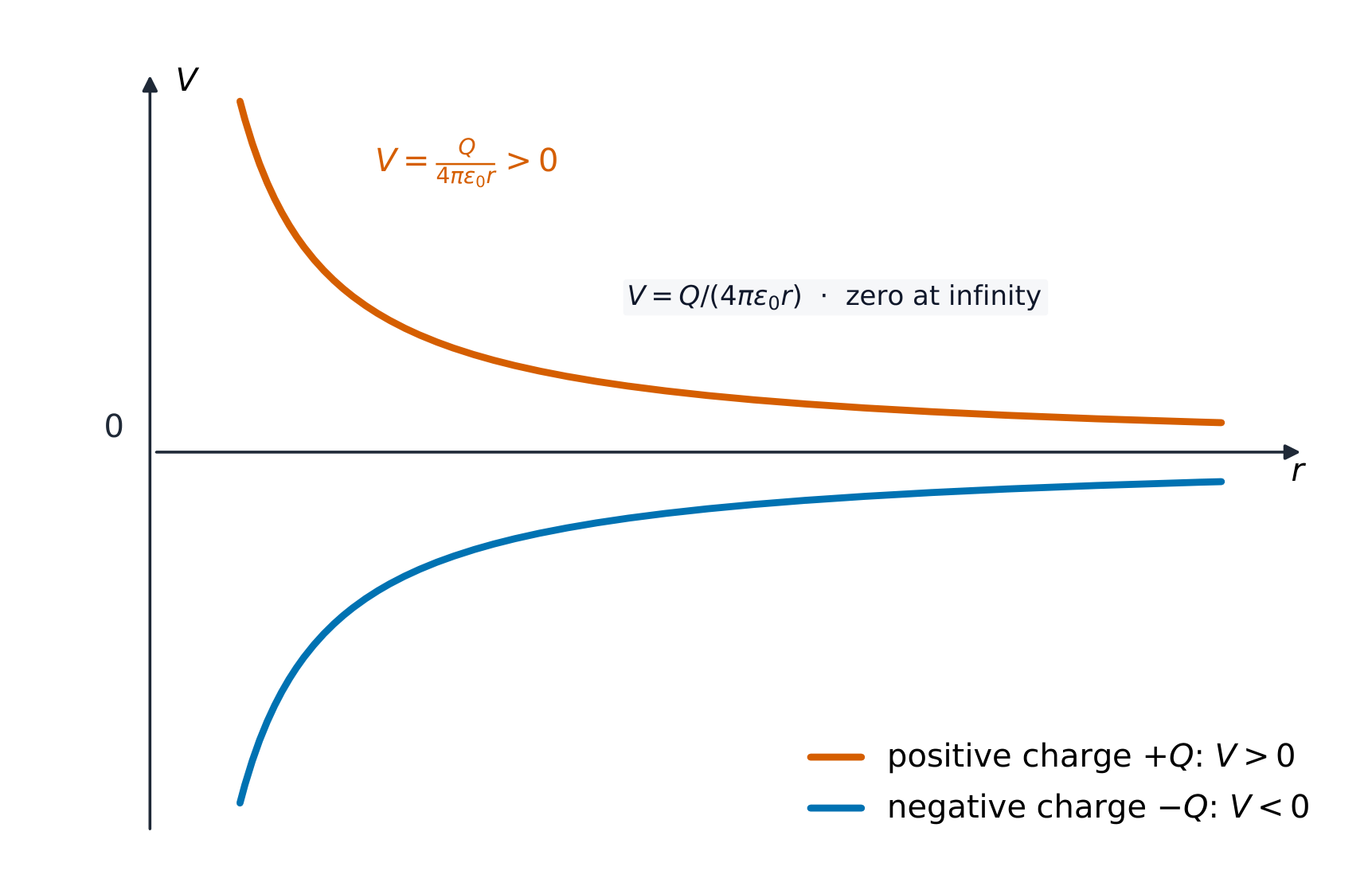
Unit: $\text{V}$. The potential is zero at infinity. For a positive source charge $V > 0$ everywhere outside; for a negative source charge $V < 0$.
The two-mark definition.Electric potential at a point is the work done per unit positive charge in bringing a small test charge from infinity to the point. The marks are for work done per unit (positive) charge and from infinity to the point. The potential of a positive charge is positive because work must be done on a positive test charge to push it in against the repulsion; near a negative charge the field does the work, so the potential is negative. "Explain why the potential near an isolated proton is positive" is answered in exactly those words.
Potential due to a point charge
$$V = \frac{Q}{4\pi\varepsilon_{0} r}.$$
Note the $1/r$ here (compared with $1/r^{2}$ for the field). $V$ is a scalar 标量; for several charges, add the potentials (with sign).
Worked example. Find the electric potential $4.0\ \text{cm}$ from a point charge of $+3.0\ \text{nC}$. ($1/(4\pi\varepsilon_{0}) = 9.0 \times 10^{9}\ \text{N m}^{2}\ \text{C}^{-2}$.)
Because potential is a scalar, the potential from several charges is simply their sum (each with its own sign) — no directions to resolve.
Two charged spheres on a line
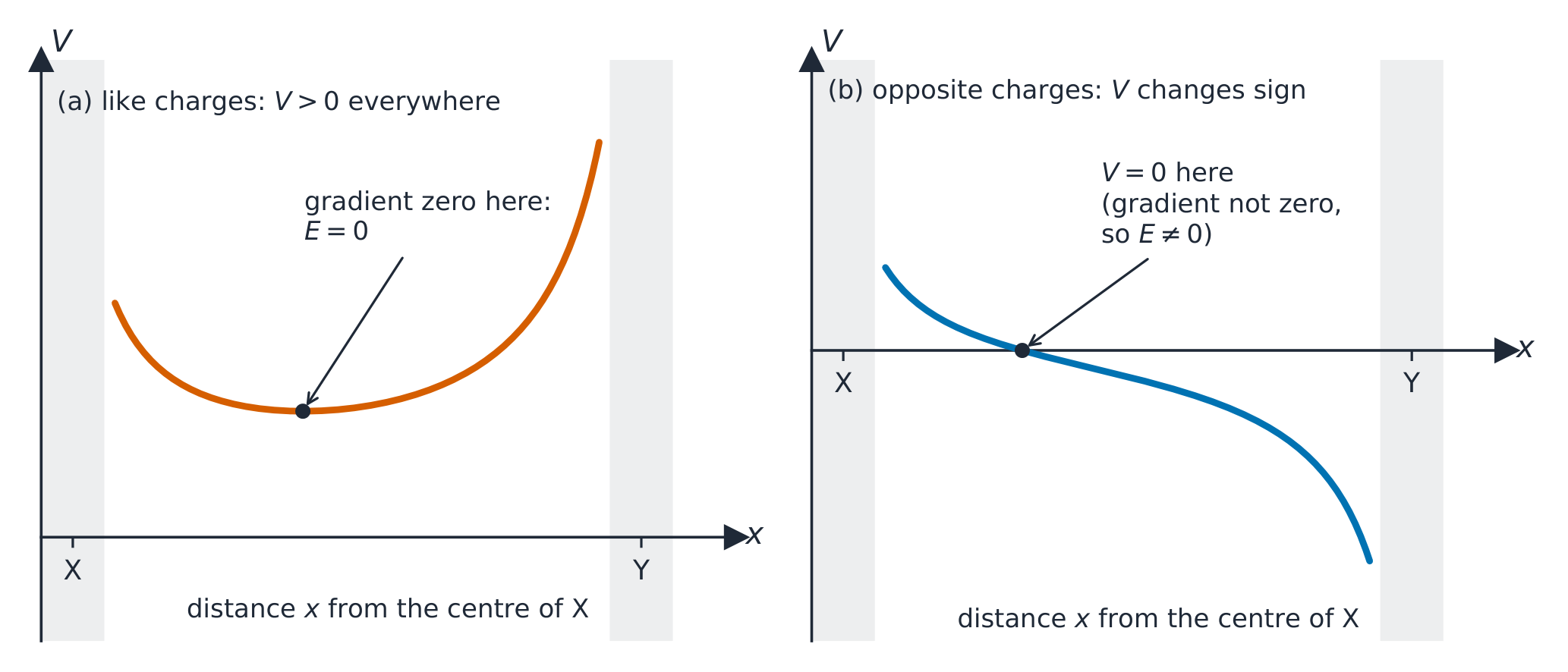
The exam's favourite structured question puts two charged spheres X and Y some distance apart and draws the potential $V$ along the line joining their centres (or asks you to reason from it). Everything follows from two facts: potential is a scalar that adds with sign, and the field is the negative gradient of the graph.
Sign of the charges. If $V$ is positive along the whole line, both charges are positive; if $V$ changes sign, the charges are opposite (positive near the positive sphere).
Where the field is zero. Where the curve has a minimum (gradient zero). For like charges this lies between them, closer to the smaller charge: $Q_{\text{X}}/x^{2} = Q_{\text{Y}}/(d - x)^{2}$. For opposite charges there is no such point between them: the curve crosses zero there, but its gradient is not zero, so the field is not.
Ratio of the charges. Where $V = 0$ between opposite charges, $Q_{\text{X}}/x = Q_{\text{Y}}/(d - x)$: the distances give the ratio directly. For like charges use the minimum instead (the square root of the field condition).
Force on a charge placed at P. Read the gradient at P by drawing a tangent 切线; then $E$ is minus the gradient, and $F = qE$.
Worked example. Two isolated charged metal spheres X and Y have their centres $1.2\ \text{m}$ apart in a vacuum. The potential along the line between them is positive everywhere and has a minimum at $x = 0.50\ \text{m}$ from the centre of X. State three conclusions, and then find the force on a proton held at $x = 0.60\ \text{m}$, where the gradient of the graph is $+180\ \text{V m}^{-1}$.
Conclusions: (1) both spheres are positively charged, because the potential is positive everywhere; (2) the electric field is zero at $x = 0.50\ \text{m}$, where the gradient is zero; (3) the charge on Y is larger, because the zero-field point lies closer to X; in fact $Q_{\text{Y}}/Q_{\text{X}} = (0.70/0.50)^{2} = 2.0$. At $x = 0.60\ \text{m}$: $E = -180\ \text{V m}^{-1}$ (pointing towards X, since $V$ rises towards Y), so $F = eE = (1.60 \times 10^{-19})(180) = 2.9 \times 10^{-17}\ \text{N}$ towards X. Released, the proton accelerates towards X, its acceleration increasing as the gradient steepens; it needs an external force to hold it still.
Describing the motion. "A positively charged particle is placed at P and released. Describe and explain its motion." The examiner wants: the direction (towards lower potential, down the slope of the $V$ graph); that the force, and so the acceleration, is not constant (it follows the gradient, which changes along the line); and that the particle speeds up throughout, since the force stays in the direction of motion. If P is the zero-field point the particle stays at rest, in unstable equilibrium: a nudge either way sends it off.
Link between field and potential
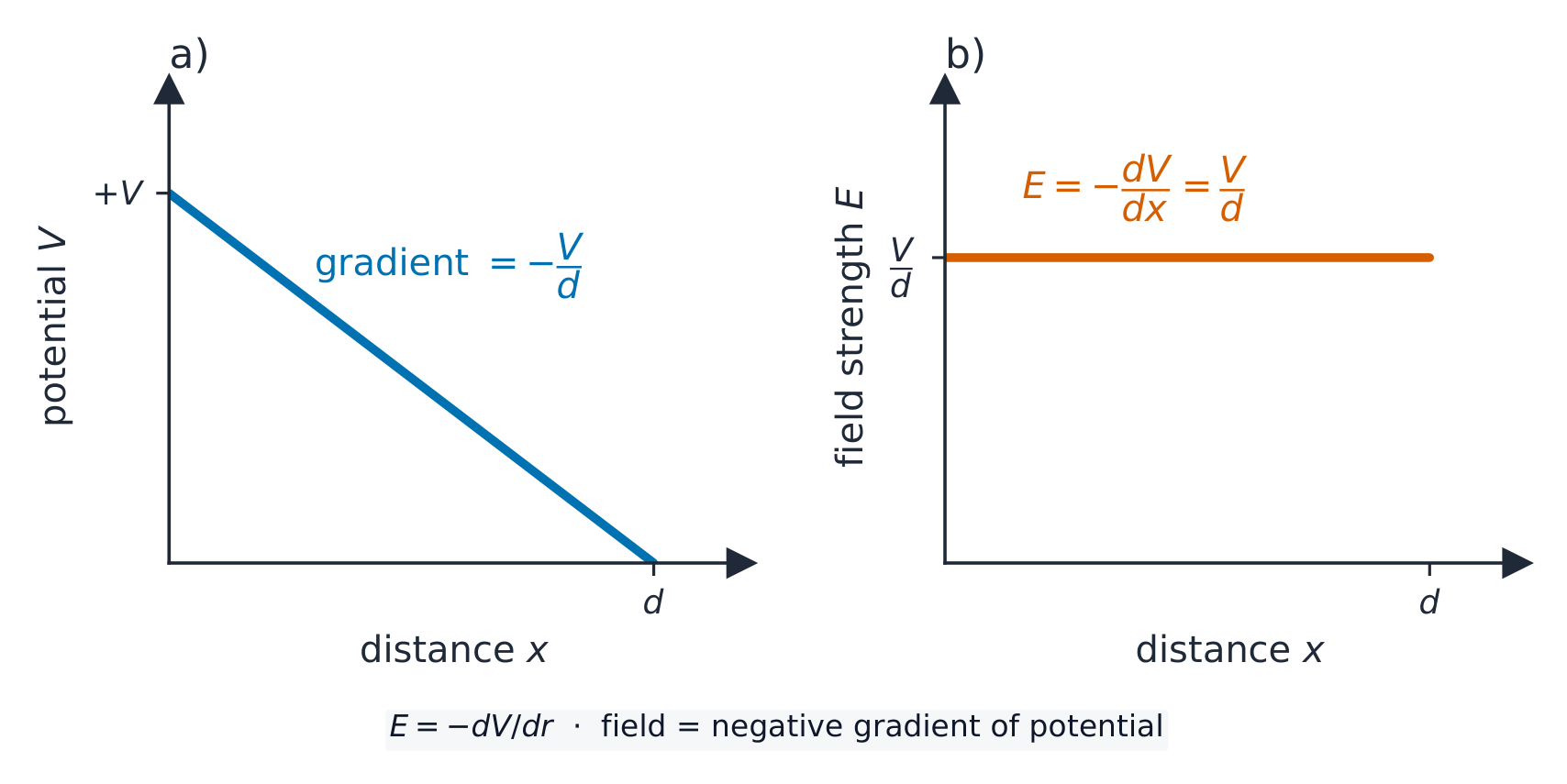
The field equals the negative potential gradient 电势梯度:
$$E = -\frac{dV}{dx}.$$
Between parallel plates $V$ changes evenly with position, giving $E = V/d$ as before. The minus sign means the field points towards lower potential. For a point charge, $-\dfrac{dV}{dr} = \dfrac{Q}{4\pi\varepsilon_{0} r^{2}} = E$.
The one-line relationship. "State the relationship between electric field and electric potential": the field strength is equal to the negative of the potential gradient, $E = -\Delta V/\Delta x$. On a $V$–$x$ graph $E$ is minus the gradient of a tangent; on a $V$–$r$ graph for a point charge the gradient is steepest close to the charge, where the field is strongest, and the sign of $E$ is fixed by "the field points towards lower potential". The uniform-field version $E = V/d$ is the same statement with a constant gradient.
Equipotentials. An equipotential surface joins points of equal potential; no work is done moving a charge along it, so the field is always at right angles to it. Around a point charge the equipotentials are concentric spheres, growing further apart as $V$ falls; between parallel plates they are planes parallel to the plates. The surface of a conductor is an equipotential, which is why field lines meet it at right angles.
Electric potential energy
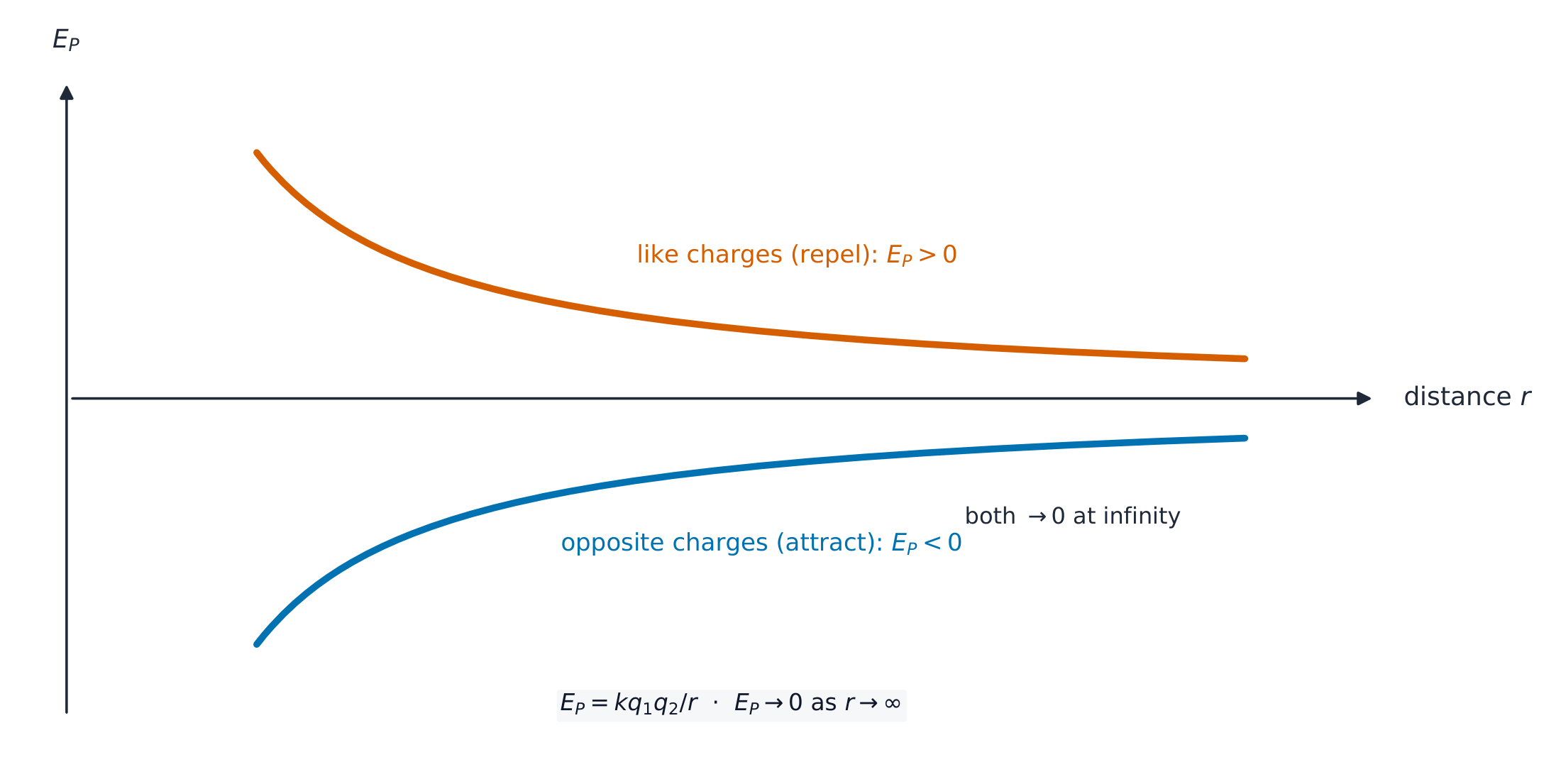
A charge $q$ at a point of potential $V$ has electric potential energy 电势能$E_{\text{P}} = qV$. For two point charges $Q$ and $q$ a distance $r$ apart:
like charges: $E_{\text{P}} > 0$ — stored energy that would be released if they flew apart.
opposite charges: $E_{\text{P}} < 0$ — a bound 束缚 system; energy must be supplied to separate them.
In both cases $E_{\text{P}} \to 0$ as $r \to \infty$.
Worked example. The proton and the electron in a hydrogen atom are $5.3 \times 10^{-11}\ \text{m}$ apart. Find the electric potential energy of the pair.
The negative sign is part of the answer: the charges are opposite, so energy ($4.3 \times 10^{-18}\ \text{J}$) must be supplied to pull them apart to infinity. (The electron also has kinetic energy of half that size, so the energy needed to ionise 电离 the atom is $13.6\ \text{eV}$; the "worked-example pattern" below shows why.)
Charge through a p.d. A charge $q$ moved through a potential difference $V$ changes its potential energy by $qV$, which is why an electron accelerated from rest through $250\ \text{V}$ arrives with $250\ \text{eV}$ of kinetic energy whatever the shape of the field. For an MCQ about "moving P a distance $x$ along the field lines", the work done is $qEx$, and its potential energy falls if it moves the way the force pushes it.
Worked-example pattern
An electron 电子 orbits a nucleus 原子核 of charge $+Ze$ at distance $r$. The Coulomb attraction provides the centripetal force 向心力:
The minus sign in the gravitational potential 引力势 reflects that gravity is always attractive; the electric potential takes the sign of the source charge.
Similarity and difference (a standard two-marker). Both potentials are proportional to $1/r$, both are zero at infinity, and both are scalars; but gravitational potential is always negative (the force is always attractive) whereas electric potential takes the sign of the charge and can be positive. For the fields: both obey an inverse-square law and both are drawn as radial lines around a point source, but gravitational field lines only ever point inwards (attraction), while electric field lines point outwards from a positive charge and inwards to a negative one.
עברית
פוטנציאל חשמלי$V$ בנקודה כלשהי הוא העבודה שנעשתה ליחידת מטען חיובי בהכנסת מטען מבחנה חיובי קטן מאינסוף לנקודה זו:
$$V = \frac{W}{q}.$$
יחידה: $\text{V}$. הפוטנציאל הוא אפס באינסוף. עבור מטען מקור חיובי $V > 0$ בכל מקום מחוץ לו; עבור מטען מקור שלילי $V < 0$.
ההגדרה לשתי נקודות.פוטנציאל חשמלי בנקודה היא העבודה שנעשתה ליחידת מטען חיובי בהכנסת מטען מבחנה קטן מאינסוף לנקודה. הנקודות הן עבור עבודה ליחידת (חיובי) מטען ועבור מאינסוף לנקודה. הפוטנציאל של מטען חיובי הוא חיובי כי יש לבצע עבודה על מטען מבחנה חיובי כדי לדחוף אותו פנימה נגד הדחייה; קרוב למטען שלילי השדה עושה את העבודה, ולכן הפוטנציאל הוא שלילי. "הסבר מדוע הפוטנציאל קרוב לפרוטון בודד הוא חיובי" עונה בדיוק במילים אלו.
פוטנציאל ממטען נקודתי
$$V = \frac{Q}{4\pi\varepsilon_{0} r}.$$
שים לב ל$1/r$ כאן (לעומת $1/r^{2}$ בשדה). $V$ הוא סקלארי; עבור מספר מטענים, סכמו את הפוטנציאלים (עם הסימן).
דוגמא פותרת. מצאו את הפוטנציאל החשמלי $4.0\ \text{cm}$ ממטען נקודתי של $+3.0\ \text{nC}$. ($1/(4\pi\varepsilon_{0}) = 9.0 \times 10^{9}\ \text{N m}^{2}\ \text{C}^{-2}$.)
מכיוון שפוטנציאל הוא סקלארי, הפוטנציאל ממספר מטענים הוא פשוט הסכמתם (כל אחד עם הסימן שלו) – אין צורך לפרק כיוונים.
פוטנציאל לאורך הקו בין שני כדורים טעונים: מטענים זהים נותנים מינימום (שם השדה אפס); מטענים נגדים נותנים מעבר באפס
שני כדורים טעונים על קו
השאלה המבנית האהובה במבחן מציבה שני כדורים טעונים X ו-Y במרחק מסוים זה מזה ומשרטטת את הפוטנציאל $V$ לאורך הקו המחבר בין מרכזיהם (או דורשת ממך לנתח אותו). כל המסקנות נובעות משתי עובדות: הפוטנציאל הוא סכום סקלרי עם סימן, והשדה הוא ה-גרדיאנט השלילי של הגרף.
סימן הטעונים. אם $V$ חיובי לאורך כל הקו, שני הטעונים חיוביים; אם $V$ משנה סימן, הטעונים נגודיים (חיובי קרוב לכדור החיובי).
איפה השדה אפס. איפה לעקומה יש מינימום (גרדיאנט אפס). עבור טעונים זהים הנקודה נמצאת ביניהם, קרובה יותר לטעון הקטן: $Q_{\text{X}}/x^{2} = Q_{\text{Y}}/(d - x)^{2}$. עבור טעונים נגודיים אין נקודה כזו ביניהם: העקומה חוצה אפס שם, אך הגרדיאנט אינו אפס, ולכן השדה אינו אפס.
יחס הטעונים. איפה $V = 0$ בין טעונים נגודיים, $Q_{\text{X}}/x = Q_{\text{Y}}/(d - x)$: המרחקים נותנים את היחס ישירות. עבור טעונים זהים השתמש במינימום במקום זאת (שורש תנאי השדה).
כוח על טעון שהונח ב-P. קרא את ה-גרדיאנט ב-P על ידי ציור משיק; אז $E$ הוא מינוס הגרדיאנט, ו-$F = qE$.
דוגמה מפורטת. שני כדורי מתכת טעונים מבודדים X ו-Y מרוחקים $1.2\ \text{m}$ זה מזה במרכזיהם בוואקום. הפוטנציאל לאורך הקו ביניהם חיובי בכל מקום ויש לו מינימום ב-$x = 0.50\ \text{m}$ ממרכז X. נסח שלושה מסקנות, ולאחר מכן מצא את הכוח על פרוטון שמוחזק ב-$x = 0.60\ \text{m}$, שבו גרדיאנט הגרף הוא $+180\ \text{V m}^{-1}$.
מסקנות: (1) לשני הכדורים מטען חיובי, כי הפוטנציאל חיובי בכל מקום; (2) השדה החשמלי אינו קיים (אפס) ב$x = 0.50\ \text{m}$, שם הנטייה היא אפס; (3) המטען על Y גדול יותר, כי נקודת השדה האפס נמצאת קרוב יותר ל-X; למעשה $Q_{\text{Y}}/Q_{\text{X}} = (0.70/0.50)^{2} = 2.0$. ב$x = 0.60\ \text{m}$: $E = -180\ \text{V m}^{-1}$ (מצביע לכיוון X, מכיוון ש$V$ עולה לכיוון Y), ולכן $F = eE = (1.60 \times 10^{-19})(180) = 2.9 \times 10^{-17}\ \text{N}$ לכיוון X. כאשר משחררים אותו, הפרוטון מאיץ לעבר X, והאיצה שלו גדלה ככל שהנטייה הופכת לתלולה יותר; נדרש כוח חיצוני כדי להחזיק אותו במקום.
תיאור התנועה. "חלקיק טעון בחיוב מונח בנקודה P ומשוחרר. תאר והסבר את תנועתו." המבוקש מהבוחן: הכיוון (לכיוון פוטנציאל נמוך, מטה על השיפוע של גרף ה$V$); כך שהכוח, ולכן גם האיצה, אינם קבועים (הם עוקבים אחרי הנטייה, שנשתנה לאורך הקו); וכך שהחלקיק מאיץ לאורך כל העת, שכן הכוח נשאר בכיוון התנועה. אם P היא נקודת השדה האפס החלקיק נשאר במקום, באיזון לא יציב: הדחפה קלה כלפי צד אחד תשלח אותו.
הפוטנציאל סמוך לטעון נקודתי משתנה כ-1/r — חיובי עבור טעון חיובי, שלילי עבור טעון שלילי
קשר בין שדה לפוטנציאל
השדה שווה ל-גרדיאנט הפוטנציאל השלילי:
$$E = -\frac{dV}{dx}.$$
בין לוחות מקבילים $V$ משתנה באופן אחיד עם המיקום, ונותן $E = V/d$ כמו לפני כן. הסימן השלילי אומר שהשדה מצביע לכיוון פוטנציאל נמוך. עבור טעון נקודתי, $-\dfrac{dV}{dr} = \dfrac{Q}{4\pi\varepsilon_{0} r^{2}} = E$.
היחס בקו אחד. "נסח את הקשר בין השדה החשמלי לפוטנציאל החשמלי": גודל השדה שווה למינוס גרדיאנט הפוטנציאל, $E = -\Delta V/\Delta x$. בגרף $V$–$x$$E$ הוא מינוס ה-גרדיאנט של משיק; בגרף $V$–$r$ עבור טעון נקודתי הגרדיאנט הוא התלול ביותר בסמוך לטעון, שם השדה חזק ביותר, וסימן ה-$E$ קבוע על ידי "השדה מצביע לכיוון פוטנציאל נמוך". הגרסה לשדה אחיד $E = V/d$ היא אותה אמירה עם גרדיאנט קבוע.
משטחים שווה פוטנציאל. משטח שווה פוטנציאל מחבר נקודות בעלות פוטנציאל שווה; אין עבודה המבוצעת בהזזת טעון לאורכו, ולכן השדה תמיד ניצב ב-זווית ישרה אליו. סביב טעון נקודתי המשטחים שווה פוטנציאל הם כדורים מרוכזים, המתרחקים זה מזה ככל ש-$V$ יורד; בין לוחות מקבילים הם מישורים מקבילים ללוחות. פני המוליך הם משטח שווה פוטנציאל, ולכן קווי השדה נפגשים איתם בזווית ישרה.
בשדה אחיד הפוטנציאל יורד באופן רציח עם המרחק, ולכן גודל השדה $V/d$ הוא קבוע
אנרגיה פוטנציאלית חשמלית
לטעון $q$ בנקודה בעלת פוטנציאל $V$ יש אנרגיה פוטנציאלית חשמלית$E_{\text{P}} = qV$. עבור שני טעונים נקודתיים $Q$ ו-$q$ המרוחקים $r$ זה מזה:
הסימן השלילי הוא חלק מהתשובה: המטענים נגדים, ולכן יש לספק אנרגיה ($4.3 \times 10^{-18}\ \text{J}$) כדי למשוך אותם למרחק אינסופי. (לאלקטרון יש גם אנרגיה קינטית בגודל מחצית, ולכן האנרגיה הנדרשת ליון האטום היא $13.6\ \text{eV}$; הדוגמה המופיעה למטה מדגימה מדוע.)
מטען דרך פ.ח. מטען $q$ שנע דרך פ.ח. $V$ משנה את אנרגית הפוטנציאל שלו ב-$qV$, ומכאן שאלקטרון שהוצעל מנקודת הרוגע דרך $250\ \text{V}$ יגיע עם $250\ \text{eV}$ של אנרגיה קינטית, ללא תלות בצורת השדה. בשאלת בחירה רב-ברירה על "הזזת P במרחק $x$ לאורך קווי השדה", העבודה המבוצעת היא $qEx$, ואנרגיית הפוטנציאל שלו יורדת אם הוא זז בכיוון שבו הכוח דוחף אותו.
אנרגיית PE חשמלית לשני מטענים: חיובית עבור מטענים זהים, באר שלילית עבור מטענים נגדים
דוגמת דוגמה מופיעה
אלקטרון מקיף גרעין בטעון $+Ze$ במרחק $r$. המשיכה הקולונית מספקת את כוח המרכז:
הסימן המינוס בפוטנציאל כבידתי משקף את העובדה שכוח הכבידה הוא תמיד מושך; הפוטנציאל החשמלי לוקח את הסימן של המטען המקור.
דמיון והבדל (שאלת ערכים סטנדרטית). לשני הפוטנציאלים ישנה פרופורציונליות ל-$1/r$, לשניהם הערך אפס באינסוף, ושניהם גדלים סקלריים; אך הפוטנציאל הכבידתי הוא תמיד שלילי (כיוון שהכוח תמיד מושך), בעוד שהפוטנציאל החשמלי לוקח את הסימן של המטען ועשוי להיות חיובי. לגבי השדות: שניהם חייבים בחוק הריבוע ההפוך ושניהם מתוארים בקווי שדה רדיאליים סביב מקור נקודתי, אך קווי השדה הכבידתיים מצביעים תמיד פנימה (מושך), בעוד שקווי השדה החשמליים מצביעים החוצה ממטען חיובי ופנימה למטען שלילי.
Explore · חקור
Electric potential · פוטנציאל חשמלי
V = kQ / r
Potential ∝ 1/r around a charge — steep near it, flattening out. · פוטנציאל ∝ 1/r סביב מטען — תלול בסמוך אליו, ומתחלק.
electric potential energy/ɪˈlektrɪk pəˈtenʃl ˈenədʒi/
אנרגיה פוטנציאלית חשמלית
bound/baʊnd/
קשור
ionise/ˈaɪənaɪz/
יון
gravitational potential/ˌɡrævɪˈteɪʃənl pəˈtenʃl/
פוטנציאל כבידתי
18.5
Definitions the examiner accepts · הגדרות מקובלות בקורס
English
A definition question is marked against fixed wording. Learn these exactly, and give one answer only.
Term
Definition
electric field
a region in which a charge experiences an (electric) force
electric field strength
the force per unit positive charge acting on a small (test) charge placed at the point
electric field line
a line whose direction shows the direction of the force on a positive charge; the spacing of the lines shows the field strength
Coulomb's law
the force between two point charges is directly proportional to the product of the charges and inversely proportional to the square of their separation
electric potential
the work done per unit positive charge in bringing a small test charge from infinity to the point
field and potential
the electric field strength is equal to the negative of the potential gradient: $E = -\Delta V/\Delta x$
electric potential energy (of two charges)
the work done in bringing the charges from infinity to their separation; $Qq/(4\pi\varepsilon_{0} r)$
equipotential
a surface (or line) on which every point has the same potential; the field is at right angles to it
uniform field
a field with the same strength and direction at every point, shown by parallel, evenly spaced field lines
עברית
שאלת הגדרה מוקדמת לפי טקסט קבוע. לימודן במדויק, ותן תשובה אחת בלבד.
מונח
הגדרה
שדה חשמלי
אזור בו מטען חווה כוח (חשמלי)
עוצמת שדה חשמלי
הכוח ליחידת מטען חיובי הפועל על מטען מבחן קטן הנמצא בנקודה זו
קו שדה חשמלי
קו שמכונו מייצג את כיוון הכוח על מטען חיובי; רווח הקווים מייצג את עוצמת השדה
חוק קולון
הכוח בין שני מטענים נקודתיים פרופורציונלי ישירות למכפלת המטענים והפוך לריבוע המרחק ביניהם
פוטנציאל חשמלי
העבודה שנעשתה ליחידת מטען חיובי בהקרבת מטען מבחן קטן מאינסוף לנקודה זו
שדה ופוטנציאל
עוצמת השדה החשמלי שווה לערך המוחלט של משימת הפוטנציאל: $E = -\Delta V/\Delta x$
אנרגיה פוטנציאלית חשמלית (של שני מטענים)
העבודה שנעשתה בהקרבת המטענים מאינסוף למרחק זה; $Qq/(4\pi\varepsilon_{0} r)$
איזופוטנציאל
פני שטח (או קו) שעל כל נקודה עליה הפוטנציאל זהה; השדה מאונך אליו
שדה אחיד
שדה בעל אותה עוצמה וכיוון בכל נקודה, המתואר בקווי שדה מקבילים ומרווחים באופן שווה
18.5
Exam tips · טיפים לבחינות
English
Four formulae, two with $r^{2}$ and two with $r$: $F = Q_1 Q_2 / 4\pi\varepsilon_0 r^{2}$ and $E = Q/4\pi\varepsilon_0 r^{2}$ (inverse square), $V = Q/4\pi\varepsilon_0 r$ and $E_{\text{P}} = Qq/4\pi\varepsilon_0 r$. Decide which one before you write.
Distinguish a uniform field ($E = V/d$, between plates) from a radial field ($E = Q/4\pi\varepsilon_0 r^{2}$, outside a point charge or a sphere); $r$ for a sphere is measured from the centre, not the surface.
The field points from high to low potential and $E$ is minus the potential gradient: draw a tangent on a $V$–$x$ graph to find it.
Field is a vector (add components, subtract opposing ones); potential is a scalar (add with sign). Between like charges there is a zero-field point; between opposite charges a zero-potential point.
A charged particle in a uniform field: $F = qE$, $a = qE/m$, $E_{\text{k}} = qV$; along the field it is the vertical half of projectile motion, and motion at right angles to the field is unaffected.
The data sheet gives both $\varepsilon_0 = 8.85 \times 10^{-12}\ \text{F m}^{-1}$ and $1/(4\pi\varepsilon_0) = 8.99 \times 10^{9}\ \text{m F}^{-1}$; either works, do not mix them up.
Common mistakes
Defining field strength as "the force on a charge" or "force per unit mass". It is the force per unit positive charge on a small positive charge.
Forgetting to square $r$ in Coulomb's law and in the field, or squaring it in the potential ($V \propto 1/r$).
Using the diameter, or the distance from the surface of a sphere, instead of the centre-to-centre distance.
Sketching $E$ for a sphere from the origin. It is zero inside and starts at $E_0$ on the surface; $V$ is constant inside, not zero.
Field lines without arrows, crossing, or unevenly spaced in a uniform field; lines not at right angles to a conductor.
Dropping the negative sign on the potential energy of opposite charges, or taking the direction of $E$ from the sign of $V$ instead of from its gradient.
Forgetting the second electron in the helium atom, or placing it at distance $r$ rather than $2r$.
Using $E = V/d$ for a point charge, or $E = Q/4\pi\varepsilon_0 r^{2}$ between plates.
Giving an electron weight, or using the proton's mass for an electron; in electrons-between-plates questions the weight is negligible.
Leaving out the weight in an "oil drop held stationary" question, or getting the polarity of the top plate backwards.
עברית
ארבעה נוסחאות, שתי מהן עם $r^{2}$ ושתי מהן עם $r$: $F = Q_1 Q_2 / 4\pi\varepsilon_0 r^{2}$ ו-$E = Q/4\pi\varepsilon_0 r^{2}$ (ריבוע הפוך), $V = Q/4\pi\varepsilon_0 r$ ו-$E_{\text{P}} = Qq/4\pi\varepsilon_0 r$. יש לקבוע איזה מהן מתאים לפני הכתיבה.
להבחין בין שדה אחיד ($E = V/d$, בין פלטות) לבין שדה רדיאלי ($E = Q/4\pi\varepsilon_0 r^{2}$, מחוץ למטען נקודתי או לכדור); עבור כדור, $r$ נמדד מהמרכז, לא מפני השטח.
השדה מצביע מפוטנציאל גבוה לנמוך ו$E$ הוא המינוס של מדרגת הפוטנציאל: צייר מגע בגרף $V$–$x$ כדי למצוא אותו.
השדה הוא וקטורי (מכפלים רכיבים, חוסמים נגדיים); הפוטנציאל הוא סקלרי (מכפלים עם סימן). בין מטענים זהים יש נקודת שדה אפס; בין מטענים נגדיים יש נקודת פוטנציאל אפס.
חלקיק טעון בשדה אחיד: $F = qE$, $a = qE/m$, $E_{\text{k}} = qV$; לאורך השדה מדובר בחצי האנכי של תנועת פרוג'קטייל, ותנועה מאונכת לשדה אינה מושפעת.
הדף הטכני מציין גם $\varepsilon_0 = 8.85 \times 10^{-12}\ \text{F m}^{-1}$ וגם $1/(4\pi\varepsilon_0) = 8.99 \times 10^{9}\ \text{m F}^{-1}$; ניתן להשתמש באחד מהם, אך אל תערבבו ביניהם.
טעויות נפוצות
הגדרת עוצמת השדה כ"הכוח על מטען" או "כוח ליחידת מסה". מדובר בכוח ליחידת מטען חיובי הפועל על מטען חיובי קטן.
שוכחים לעלות לריבוע את $r$ בחוק קולון ובשדה החשמלי, או מעלים לריבוע אותו בפוטנציאל ($V \propto 1/r$).
שימוש בקוטר, או במרחק מפני כדור, במקום במרחק מרכז-למרכז.
ציור $E$ לכדור מהראשית. הוא אפס בתוך הכדור ומתחיל בערך $E_0$ על פני השטח; ה$V$ הוא קבוע בתוך הכדור ולא אפס.
קווי שדה ללא חצים, נחתכים, או מרווחים לא באופן אחיד בשדה אחיד; קווים שאינם מאונכים למוליך.
מחיקת הסימן השלילי באנרגיה הפוטנציאלית של מטענים נגודיים, או קביעת כיוון ה$E$ מתוך סימן ה$V$ במקום מתוך הנטייה שלו.
שוכחים את האלקטרון השני באתום הליום, או ממוקמים אותו במרחק $r$ במקום במרחק $2r$.
שימוש ב$E = V/d$ עבור מטען נקודתי, או ב$E = Q/4\pi\varepsilon_0 r^{2}$ בין לוחות.
הענקת משקל לאלקטרון, או שימוש במסת הפרוטון עבור אלקטרון; בשאלות אלקטרונים בין לוחות המשקל זניח.
השארת משקל מחוץ לשאלה "טיפת שמן נתונה במנוחה", או סירוס הקוטבות של הלוח העליון.
Interactive lessons on this topic · שיעורים אינטראקטיביים בנושא זה
Work through it step by step, with instant-check exercises. · לעבור על הדברים צעד אחר צעד, עם תרגילים לבדיקה מיידית.
Pick one and the site follows you — notes, papers, videos and practice all open on it. · בחרו נושא אחד והאתר יעקוב אחריו — הערות, מסמכים, וידאו ותרגולים פתוחים בו.
Type to search notes, lessons, code, vocabulary and past-paper questions across every subject. · הקלד כדי לחפש הערות, שיעורים, קוד, אוצר מילים ושאלות מבחנים בכל הנושאים.