Skip to content · ⁨דלג לתוכן⁩

Further Mechanics · ⁨מכניקה נוספת⁩

A-Level Further Mathematics · ⁨מתמטיקה מתקדמת A-Level⁩ · Topic 3 · ⁨נושא 3⁩

Video lesson for this topic · ⁨שיעור וידאו לנושא זה⁩ Open the video page · ⁨פתח את עמוד הוידאו⁩
8:04

מכניקה נוספת

זרק כדור, שחרר זרם מים, או שיגר כל חפץ לאוויר — וכל אחד מהם יעבור על אותו עקום אלגנטי: פרבולה. הסוד הוא לפרק את התנועה לשני רכיבים…

English narration · English + 中文 subtitles burned in · ⁨קריאת קול באנגלית · תרגום אנגלי + סינית שרוף בתוך הסרטון⁩

English

This handout covers Topic 3: Further Mechanics 进阶力学. It extends mechanics to projectiles, rigid bodies, circular motion, elastic strings, variable forces and collisions. Take $g = 10\ \text{m s}^{-2}$.

עברית

עמוד זה עוסק בנושא 3: מכניקה נוספת. הוא הרחיב את המכניקה לירי רב-כיווני, גוף קשיח, תנועה מעגלית, חוטים אלסטיים, כוחות משתנים והתנגשויות. לקחת $g = 10\ \text{m s}^{-2}$.

3.1

Motion of a projectile · ⁨תנועת ירי רב-כיווני⁩

Syllabus · ⁨סיילבוס⁩
English
Candidates should be able to: Notes and examples
• model the motion of a projectile as a particle moving with constant acceleration and understand any limitations of the model Vector methods are not required
• use horizontal and vertical equations of motion to solve problems on the motion of projectiles, including finding the magnitude and direction of the velocity at a given time or position, the range on a horizontal plane and the greatest height reached
• derive and use the Cartesian equation of the trajectory of a projectile, including problems in which the initial speed and/or angle of projection may be unknown. Knowledge of the 'bounding parabola' for accessible points is not included.
עברית
המועמדים אמורים להיות מסוגלים: הערות לדוגמאות
• לדגם את תנועת גוף טס כחלקיק הנע באיץ קבוע ולהבין כל הגבלות הדגם שיטות וקטוריות אינן נדרשות
• להשתמש במשוואות התנועה האופקיות והאנכיות לפתרון בעיות הקשורות בתנועת גופי טוס, כולל מציאת הגודל והכיוון של המהירות בזמן או מיקום נתונים, הטווח במישור אופקי וגובהו המקסימלי של הגוף
• להסיק ולהשתמש במשוואה הקרטזית של מסלול הגוף הטס, כולל בעיות שבהן המהירות ההתחלתית ו/או זווית השיגור עשויות להיות לא ידועות. ידע ב'פרבולת החסם' עבור נקודות נגישות אינו כלול.

Source: Cambridge International syllabus · ⁨מקור: הסיילבוס הבינלאומי של קמבריד'ג'⁩

English
Dropped vs thrown: falling together

A projectile 抛射体 moves freely under gravity, so it has constant acceleration 匀加速 $g$ downwards and no horizontal acceleration. Treat the horizontal and vertical motions separately. If it is launched at speed $u$ and angle $\alpha$:

$$\text{horizontal: } x = u\cos\alpha\,\cdot t, \qquad \text{vertical: } y = u\sin\alpha\,\cdot t - \tfrac12 g t^2.$$
Eliminating $t$ gives the Cartesian equation 直角坐标方程 of the trajectory 轨迹 (the path), which is a parabola. For a fixed launch speed, all the trajectories lie under a bounding parabola 包络抛物线 (the envelope of reachable points). The range on level ground is $\dfrac{u^2\sin 2\alpha}{g}$ and the greatest height is $\dfrac{u^2\sin^2\alpha}{2g}$.

Worked example. A ball is thrown at $u = 20\ \text{m s}^{-1}$ at $30^\circ$ to the horizontal. Find the range and greatest height.

$$\text{range} = \frac{20^2\sin 60^\circ}{10} = 40\times 0.866 = 34.6\ \text{m}, \qquad \text{height} = \frac{20^2\sin^2 30^\circ}{2\times 10} = \frac{400\times 0.25}{20} = 5\ \text{m}.$$

עברית
נפילה מול זריקה: נופלים יחד
זרימות מים קשתיות במזרקת מים גדולה
זרמי המים עוקבים אחר מסלולים פרבוליים — ירי רב-כיווני קלאסי תחת כבידה.

ירי רב-כיווני מתרחש בחופשיות תחת הכבידה, ולכן יש לו תאוצה קבועה $g$ כלפי מטה ואין לו תאוצה אופקית. יש לבדוק את התנועה האופקית והאנכית בנפרד. אם הירי מתבצע במהירות $u$ ובזווית $\alpha$:

$$\text{horizontal: } x = u\cos\alpha\,\cdot t, \qquad \text{vertical: } y = u\sin\alpha\,\cdot t - \tfrac12 g t^2.$$
הוצאת $t$ נותנת את המשוואה הקרטוזית של המסלול (הדרך), שהוא פרבולה. עבור מהירות ירי קבועה, כל המסלולים נמצאים מתחת לפרבולה מגבלתית (המעטפת של הנקודות הניתנות להשגה). הטווח על קרקע שטוחה הוא $\dfrac{u^2\sin 2\alpha}{g}$ והגובה המקסימלי הוא $\dfrac{u^2\sin^2\alpha}{2g}$.

מסלול פרבולי עם פיצול מהירות היציאה לחלקים אופקי ואנכי
המסלול הוא פרבולה; מהירות היציאה $u$ מתפצלת לחלק אופקי יציב וחלק אנכי שנחלש על ידי הכבידה.

דוגמה מפורטת. כדור זרקו ב$u = 20\ \text{m s}^{-1}$ בזווית $30^\circ$ לאופק. מצאו את הטווח ואת הגובה המקסימלי.

$$\text{range} = \frac{20^2\sin 60^\circ}{10} = 40\times 0.866 = 34.6\ \text{m}, \qquad \text{height} = \frac{20^2\sin^2 30^\circ}{2\times 10} = \frac{400\times 0.25}{20} = 5\ \text{m}.$$

Explore · ⁨חקור⁩

Launch a projectile · ⁨שחרור פרוגטייל⁩

Fire the ball, then change the angle and speed. The horizontal motion is steady while gravity pulls it down — together they trace a parabola. Find the angle for the longest range, and try the Moon. · ⁨שחרר הכדור, ולאחר מכן שינוי הזווית והמהירות. התנועה האופקית היא אחידה בעוד שהכבידה מושכת אותו למטה — יחד הם מתאר们 פרבולה. מצאו את הזווית לקליטת טווח מקסימלית, ונסו את הירח.⁩

Vocabulary · ⁨מילון מונחים⁩ Train · ⁨אימון⁩
English עברית
Further Mechanics/ˈfɜːðə mɪˈkænɪks/ מכניקה נוספת
projectile/prəˈdʒektaɪl/ גוף זורק
constant acceleration/ˈkɒnstənt əkˌseləˈreɪʃn/ תאוצה קבועה
Cartesian equation/kɑːˈtiːzɪən ɪˈkweɪʒn/ משוואה קרטזית
trajectory/trəˈdʒektəri/ מסלול
3.2

Equilibrium of a rigid body · ⁨איזון גוף קשיח⁩

Syllabus · ⁨סיילבוס⁩
English
Candidates should be able to: Notes and examples
• calculate the moment of a force about a point For questions involving coplanar forces only; understanding of the vector nature of moments is not required.
• use the result that the effect of gravity on a rigid body is equivalent to a single force acting at the centre of mass of the body, and identify the position of the centre of mass of a uniform body using considerations of symmetry
• use given information about the position of the centre of mass of a triangular lamina and other simple shapes Proofs of results given in the MF19 List of formulae are not required.
• determine the position of the centre of mass of a composite body by considering an equivalent system of particles Simple cases only, e.g. a uniform L-shaped lamina, or a uniform cone joined at its base to a uniform hemisphere of the same radius.
• use the principle that if a rigid body is in equilibrium under the action of coplanar forces then the vector sum of the forces is zero and the sum of the moments of the forces about any point is zero, and the converse of this
• solve problems involving the equilibrium of a single rigid body under the action of coplanar forces, including those involving toppling or sliding.
עברית
המועמדים אמורים להיות מסוגלים: הערות לדוגמאות
• לחשב את מומנט של כוח סביב נקודה בשאלות הכוללות רק כוחות מצומט-מישורי; הבנת האופי הוקטורי של מומנטים אינה נדרשת.
• להשתמש בתוצאה כי השפעת הכובד על גוף קשיח שקולה לכוח יחיד הפועל במרכז המסה של הגוף, ולזהות את מיקום מרכז המסה של גוף אחיד באמצעות considerations של סימטריה
• להשתמש במידע נתון על מיקום מרכז המסה של צלחת משולשת וצורות פשוטות אחרות הוכחות לתוצאות המפורטות ברשימת הנוסחאות MF19 אינן נדרשות.
• לקבוע את מיקום מרכז המסה של גוף מורכב על ידי בחינת מערכת שקולה של חלקיקים מקרים פשוטים בלבד, לדוגמה: צלחת L-צורה אחידה, או חרוט אחיד מחובר בבסיסו לגולגולת אחידה באותו רדיוס.
• להשת基本原则 in העקרון כי אם גוף קשיח נמצא באיזון תחת השפעת כוחות מצומט-מישורים אז הסכום הוקטורי של הכוחות הוא אפס והסכום המומנטים של הכוחות סביב כל נקודה הוא אפס, וההפך מאותו עיקרון
• לפתור בעיות הקשורות לאיזון גוף קשיח יחיד תחת השפעת כוחות מצומט-מישורים, כוללthose הכוללים התהפכות או החלקה.

Source: Cambridge International syllabus · ⁨מקור: הסיילבוס הבינלאומי של קמבריד'ג'⁩

English

The moment 力矩 of a force about a point is force $\times$ perpendicular distance; it measures turning effect. The weight of a body acts at its centre of mass 质心, which you can find using symmetry 对称 for a uniform flat shape (a lamina 薄片), or by treating a composite body as a set of particles.

A rigid body under coplanar forces 共面力 is in equilibrium 平衡 when two conditions both hold: the vector sum of the forces is zero, and the sum of the moments about any point is zero. A body may also be on the edge of toppling 翻倒 (turning over) or sliding 滑动 (slipping).

Worked example. A uniform beam $AB$ of length $4\ \text{m}$ and weight $100\ \text{N}$ rests on a pivot at $A$. A vertical force $F$ at $B$ keeps it horizontal. Find $F$.

Take moments about $A$ (the weight acts at the centre, $2\ \text{m}$ from $A$):

$$F\times 4 = 100\times 2 \;\Rightarrow\; F = 50\ \text{N}.$$

עברית

המומנט של כוח סביב נקודה הוא כוח $\times$ מרחק אנכי; הוא מדד להשפעת סיבוב. משקל הגוף פועל במרכז המסה שלו, שניתן למצוא באמצעות סימטריה עבור צורה שטוחה אחידה (למינה), או על ידי התייחסות לגוף מורכב כסדרה של חלקיקים.

גוף קשיח תחת כוחות בשטח נמצא באיזון כאשר שתי התנאים מתקיימים גם יחד: הסכום הווקטורי של הכוחות הוא אפס, והסכום המומנטים סביב כל נקודה הוא אפס. גוף עשוי גם להיות בקצה התהפכות (התהפכות) או החלקה (החלקה).

קורה על ציר סיבוב עם משקל במרכזה מאוזן על ידי כוח בקצה הרחוק
הוצאת מומנטים סביב ציר הסיבוב $A$ מאזנת את השפעות הסיבוב: $F\times4 = 100\times2$.

דוגמא פותרת. קורה אחיד $AB$ באורך $4\ \text{m}$ ובמשקל $100\ \text{N}$ מונח על ציר סיבוב בנקודה $A$. כוח אנכי $F$ בנקודה $B$ משמרת אותו אופקי. מצאו את $F$.

לקחת מומנטים ביחס לנקודה $A$ (המשקל פועל במרכז, במרחק $2\ \text{m}$ מהנקודה $A$):

$$F\times 4 = 100\times 2 \;\Rightarrow\; F = 50\ \text{N}.$$

Explore · ⁨חקור⁩

Equilibrium of forces · ⁨איזון כוחות⁩

resultant = 0 · ⁨כוח רוטט = 0⁩

A body is in equilibrium when the forces add tip-to-tail back to zero. · ⁨גוף נמצא באיזון כאשר הכוחות מתחברים קצה-לקצה חוזרים לאפס.⁩

Vocabulary · ⁨מילון מונחים⁩ Train · ⁨אימון⁩
English עברית
moment/ˈməʊmənt/ מומנט
centre of mass/ˈsentə ɒv mæs/ מרכז מסה
symmetry/ˈsɪmətri/ סימטריה
equilibrium/ˌiːkwɪˈlɪbrɪəm/ איזון
toppling/ˈtɒplɪŋ/ התהפכות
sliding/ˈslaɪdɪŋ/ החלקה
angular speed/ˈæŋɡjʊlə spiːd/ מהירות זוויתית
centripetal acceleration/senˈtrɪpɪtl əkˌseləˈreɪʃn/ תאוצה צנטריפטלית
horizontal circle/ˌhɒrɪˈzɒntl ˈsɜːkl/ מעגל אופקי
vertical circle/ˈvɜːtɪkl ˈsɜːkl/ מעגל אנכי
Hooke's law/hʊks lɔː/ חוק הוק
modulus of elasticity/ˈmɒdjʊləs ɒv ɪlæˈstɪsɪti/ מודול אלסטיות
elastic potential energy/ɪˈlæstɪk pəˈtenʃl ˈenədʒi/ אנרגיה פוטנציאלית אלסטית
differential equation/ˌdɪfəˈrenʃl ɪˈkweɪʒn/ משוואה דיפרנציאלית
3.3

Circular motion · ⁨תנועה מעגלית⁩

Syllabus · ⁨סיילבוס⁩
English
Candidates should be able to: Notes and examples
understand the concept of angular speed for a particle moving in a circle, and use the relation $v = r\omega$
understand that the acceleration of a particle moving in a circle with constant speed is directed towards the centre of the circle, and use the formulae $r\omega^2$ and $\frac{v^2}{r}$. Proof of the acceleration formulae is not required.
solve problems which can be modelled by the motion of a particle moving in a horizontal circle with constant speed
solve problems which can be modelled by the motion of a particle in a vertical circle without loss of energy. Including finding a normal contact force or the tension in a string, locating points at which these are zero, and conditions for complete circular motion.
עברית
המועמדים אמורים להיות מסוגלים: הערות לדוגמאות
הבנת מושג מהירות זוויתית של חלקיק הנע במעגל, ושימוש בקשר $v = r\omega$
להבין כי האיץ של חלקיק הנע במעגל במהירות קבועה מכוון אל מרכז המעגל, ולהשתמש בנוסחאות $r\omega^2$ ו$\frac{v^2}{r}$. הוכחה לנוסחאות האיץ אינה נדרשת.
לפתור בעיות שתוכלו לדגם על ידי תנועת חלקיק הנע במעגל אופקי במהירות קבועה
לפתור בעיות שיכולות להיות מודללות על ידי תנועת חלקיק במעגל אנכי ללא איבוד אנרגיה. כולל מציאת כוח נורמלי או מתח במיתר, מיקום נקודות שבהם כוחות אלו מתאפסים, ותנאים לתנועה מעגלית מלאה.

Source: Cambridge International syllabus · ⁨מקור: הסיילבוס הבינלאומי של קמבריד'ג'⁩

English

For a particle moving in a circle of radius $r$, the angular speed 角速度 $\omega$ links to the speed by $v = r\omega$. The acceleration points towards the centre — the centripetal acceleration 向心加速度 — with size

$$a = r\omega^2 = \frac{v^2}{r}.$$

In a horizontal circle 水平圆 the speed is constant — as in a conical pendulum 圆锥摆 (a mass swung on a string). In a vertical circle 竖直圆 use energy conservation, because the speed changes with height; the normal contact force 法向接触力 or string tension provides the centripetal force.

Worked example. A particle moves in a horizontal circle of radius $2\ \text{m}$ with angular speed $3\ \text{rad s}^{-1}$. Find its speed and acceleration.

$$v = r\omega = 2\times 3 = 6\ \text{m s}^{-1}, \qquad a = r\omega^2 = 2\times 3^2 = 18\ \text{m s}^{-2}.$$

עברית

לחלקיק הנע במסלול מעגלי ברדיוס $r$, המהירות הזוויתית $\omega$ מקושרת למהירות הקונית לפי $v = r\omega$. ההאצה מכוונת כלפי המרכז — ההאצה המרכזית — בגודל

$$a = r\omega^2 = \frac{v^2}{r}.$$

חלקיק על עיגול עם וקטור מהירות לאורך המשיק והאצה כלפי המרכז
המהירות מכוונת לאורך המשיק; התאוצה מכוונת פנימה אל המרכז.
אתלט מסתובב ומנפץ פטיש חשמל על חוט מתוח לצד אחד, הכדור מטושטש עקב מהירותו
המנפח הוא דיאגרמה נעת של דף זה. החוט המתוח מושך את הכדור אל המרכז — משיכה פנימה זו היא הכוח המרכזי — בעוד שהמהירות של הכדור מכוונת לאורך המשיק. אם משחררים את החוט, וללא כוח פנימי שנותר, הכדור יעוף ישר לאורך המשיק.

בעיגון אופקי המהירות קבועה — כמו במנדולי קוני (מסה המונפת על חוט). בעיגון אנכי יש להשתמש בשמירת אנרגיה, מכיוון שהמהירות משתנה בהתאם לגובה; כוח המגע או מתח החוט מספקים את הכוח המרכזי.

דוגמא פותרת. חלקיק נע במעגל אופקי ברדיוס $2\ \text{m}$ עם מהירות זוויתית $3\ \text{rad s}^{-1}$. מצאו את מהירותו והאצתו.

$$v = r\omega = 2\times 3 = 6\ \text{m s}^{-1}, \qquad a = r\omega^2 = 2\times 3^2 = 18\ \text{m s}^{-2}.$$

Explore · ⁨חקור⁩

Angle in radians · ⁨זווית ברדיאנים⁩

Circular motion is measured in radians: drag the angle θ and radius r to see the arc swept — angular speed ω turns this into v = rω. · ⁨תנועה מעגלית נמדדת ברדיאנים: גרור את הזווית θ ואת הרדיוס r כדי לראות את הקשת הנעברת — מהירות זוויתית ω הופכת זאת ל-v = rω.⁩

3.4

Hooke's law · ⁨חוק הוק⁩

Syllabus · ⁨סיילבוס⁩
English
Candidates should be able to: Notes and examples
use Hooke’s law as a model relating the force in an elastic string or spring to the extension or compression, and understand the term modulus of elasticity
use the formula for the elastic potential energy stored in a string or spring Proof of the formula is not required.
solve problems involving forces due to elastic strings or springs, including those where considerations of work and energy are needed. e.g. a particle moving horizontally or vertically or on an inclined plane while attached to one or more strings or springs, or a particle attached to an elastic string acting as a 'conical pendulum'.
עברית
המועמדים אמורים להיות מסוגלים: הערות לדוגמאות
להשתמש ב-חוק הוק כמודל המקשר בין הכוח במיתר אלסטי או בקפיץ לבין הארכה או הדחיסה, ולהבין את המונח מודול גמישות
להשתמש בנוסחה ל-אנרגיה פוטנציאלית אלסטית מאוגרת במיתר או בקפיץ הוכחת הנוסחה אינה נדרשת.
לפתור בעיות הקשורות לכוחות של מיתרים אלסטיים או קפיצים, כולל מקרים בהם נדרשים עיכובי עבודה ואנרגיה. לדוגמה: חלקיק הנע באופן אופקי, אנכי או על מישור משופע ומחובר למיתר או לקפיץ אחד או יותר, או חלקיק המחובר למיתר אלסטי הפועל כ-'דודון-צונית'.

Source: Cambridge International syllabus · ⁨מקור: הסיילבוס הבינלאומי של קמבריד'ג'⁩

English

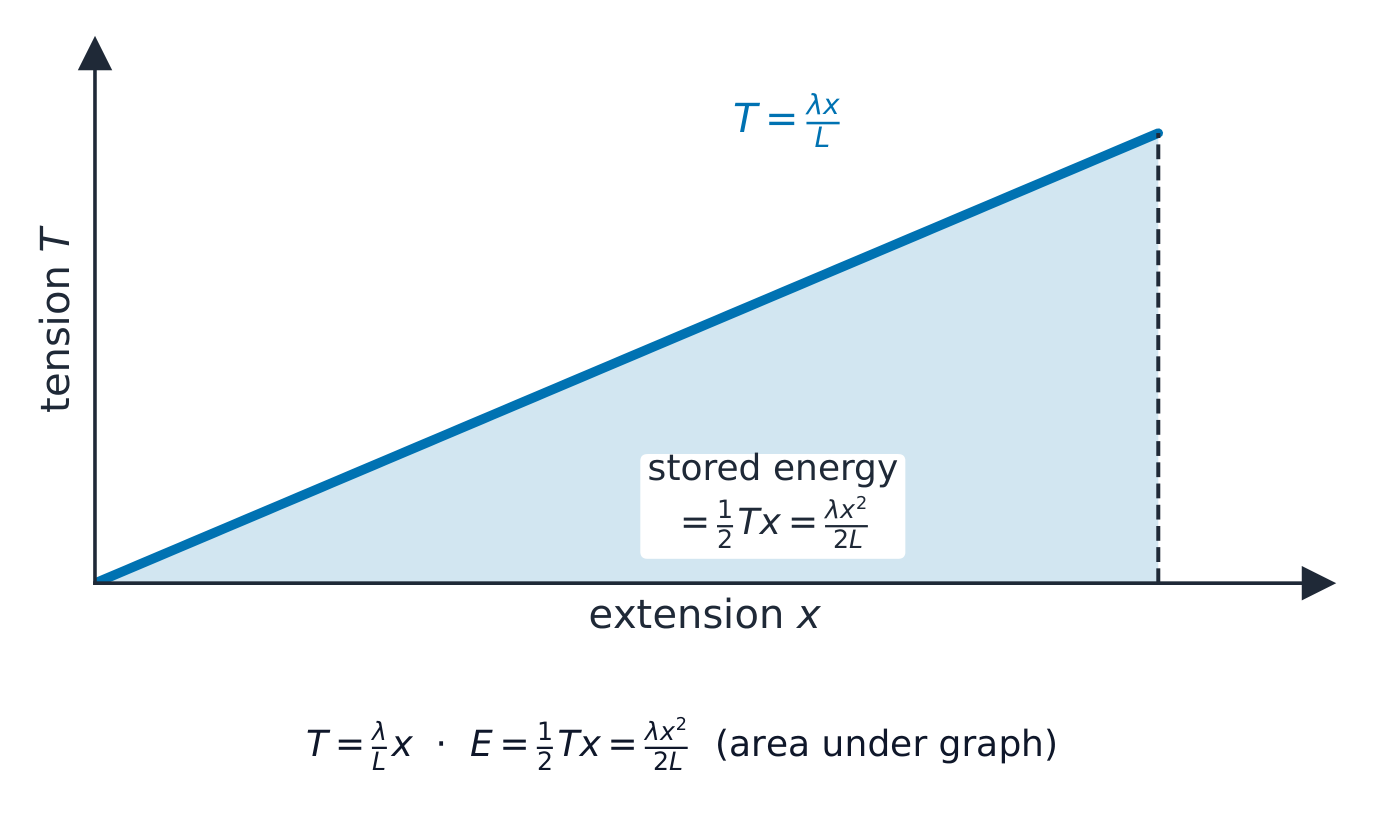
Hooke's law 胡克定律 says the tension in an elastic string or spring is proportional to its extension $x$:

$$T = \frac{\lambda x}{L},$$
where $L$ is the natural length and $\lambda$ is the modulus of elasticity 弹性模量. Stretching stores elastic potential energy 弹性势能:
$$E = \frac{\lambda x^2}{2L}.$$

Worked example. An elastic string of natural length $2\ \text{m}$ and modulus $50\ \text{N}$ is stretched by $0.5\ \text{m}$. Find the tension and the stored energy.

$$T = \frac{50\times 0.5}{2} = 12.5\ \text{N}, \qquad E = \frac{50\times 0.5^2}{2\times 2} = 3.125\ \text{J}.$$

עברית

חוק הוק קובע שהמתיחה במיתר אלסטי או בקפיץ פרופורציונלית להארכה שלו $x$:

$$T = \frac{\lambda x}{L},$$
כאן $L$ הוא האורך הטבעי ו$\lambda$ הוא מודול האלסטיות. מתיחה מאחסנת אנרגיה פוטנציאלית אלסטית:
$$E = \frac{\lambda x^2}{2L}.$$

קו ישר של מתיחה-הארכה עם המשולש מתחתיו מצופה כאנרגיה
המתח עולה ביחס ההתאמה להארכה; המשולש הצלול מייצג את האנרגיה האלסטית המאוחסנת.

דוגמא פותרת. מיתר אלסטי באורך טבעי $2\ \text{m}$ ומודול $50\ \text{N}$ מתיחה ב$0.5\ \text{m}$. מצאו את המתיחה והאנרגיה המאוחסנת.

$$T = \frac{50\times 0.5}{2} = 12.5\ \text{N}, \qquad E = \frac{50\times 0.5^2}{2\times 2} = 3.125\ \text{J}.$$

Explore · ⁨חקור⁩

Hooke's law · ⁨חוק הוק⁩

F = k·x

Force is proportional to extension — the gradient is the stiffness k. · ⁨כוח פרופורציונלי לארכיפה — השיפוע הוא הקשיחות k.⁩

3.5

Linear motion under a variable force · ⁨תנועה קווית תחת כוח משתנה⁩

Syllabus · ⁨סיילבוס⁩
English
Candidates should be able to: Notes and examples
solve problems which can be modelled as the linear motion of a particle under the action of a variable force, by setting up and solving an appropriate differential equation. Including use of $v \frac{\mathrm{d}v}{\mathrm{d}x}$ for acceleration, where appropriate. Calculus required is restricted to content from Pure Mathematics 3 in Cambridge International A Level Mathematics (9709). Only differential equations in which the variables are separable are included.
עברית
המועמדים אמורים להיות מסוגלים: הערות לדוגמאות
לפתור בעיות שיכולות להיות מודללות כתנועה ליניארית של חלקיק תחת השפעת כוח משתנה, על ידי הצבת ופתרון משוואה דיפרנציאלית מתאימה. כולל שימוש ב$v \frac{\mathrm{d}v}{\mathrm{d}x}$ לתאוצה, כאשר יש צורך בכך. החשבונות הנדרשים מוגבלים לחומר מן המתמטיקה הטהורה 3 במסגרת Cambridge International A Level Mathematics (9709). כלולות רק משוואות דיפרנציאליות שהמשתנים בהן ניתנים להפרדה.

Source: Cambridge International syllabus · ⁨מקור: הסיילבוס הבינלאומי של קמבריד'ג'⁩

English

When the force depends on position $x$, use acceleration in the form $a = v\dfrac{dv}{dx}$, which turns Newton's law into a differential equation 微分方程 relating $v$ and $x$.

Worked example. A particle of mass $8\ \text{kg}$ moves along a line under a variable force 变力 of size $(x^3 + 4x)\ \text{N}$ acting in the direction of motion. When $x = 0$, $v = 1$. Find $v$ in terms of $x$.

Newton's law gives $8v\dfrac{dv}{dx} = x^3 + 4x$. Separating and integrating:

$$\int 8v\,dv = \int (x^3 + 4x)\,dx \;\Rightarrow\; 4v^2 = \tfrac14 x^4 + 2x^2 + C.$$
At $x = 0$, $v = 1$ gives $C = 4$, so $4v^2 = \tfrac14 x^4 + 2x^2 + 4 = 4\left(\tfrac{x^2}{4} + 1\right)^2$. Hence $v = \tfrac14 x^2 + 1$.

עברית

כאשר הכוח תלוי במיקום $x$, השתמשו בהאצה בצורה $a = v\dfrac{dv}{dx}$, מה שהופך את חוק ניוטון למשוואה דיפרנציאלית המקשרת בין $v$ ל$x$.

בחירת צורת ההאצה: השתמשו ב-dv/dt כאשר הכוח תלוי בזמן, וב-v*dv/dx כאשר הכוח תלוי במיקום
השתמשו ב-dv/dt כאשר הכוח תלוי בזמן, וב-v·dv/dx כאשר הוא תלוי במיקום

דוגמא פתורה. חלקיק המסה $8\ \text{kg}$ נע לאורך קו תחת כוח משתנה בגודל $(x^3 + 4x)\ \text{N}$ הפועל בכיוון התנועה. כאשר $x = 0$, $v = 1$. מצאו את $v$ באמצעות $x$.

חוק ניוטן נותן $8v\dfrac{dv}{dx} = x^3 + 4x$. בידוד משתנים ואינטגרציה:

$$\int 8v\,dv = \int (x^3 + 4x)\,dx \;\Rightarrow\; 4v^2 = \tfrac14 x^4 + 2x^2 + C.$$
בזמן $x = 0$, $v = 1$ נותן $C = 4$, ולכן $4v^2 = \tfrac14 x^4 + 2x^2 + 4 = 4\left(\tfrac{x^2}{4} + 1\right)^2$. מכאן $v = \tfrac14 x^2 + 1$.

הדוגמא הפתורה כתרשים זרימה: חוק ניוטן הופך למשוואה דיפרנציאלית, בידוד משתנים ואינטגרציה, ולאחר מכן יישום תנאי ההתחלה כדי למצוא את v כפונקציה של x
כוח תלוי במיקום הופך למשוואה דיפרנציאלית ב-v וב-x
Explore · ⁨חקור⁩

Work from a variable force · ⁨עבודה מכוח משתנה⁩

W = ∫ F dx

When the force changes, the work done is the area under the force–distance graph. · ⁨כאשר הכוח משתנה, העבודה המבוצעת היא השטח תחת גרף הכוח–מרחק.⁩

Vocabulary · ⁨מילון מונחים⁩ Train · ⁨אימון⁩
English עברית
variable force/ˈveərɪəbl fɔːs/ כוח משתנה
conservation of momentum/ˌkɒnsəˈveɪʃn ɒv məʊˈmentəm/ שימור תנע
Newton's experimental law/ˈnjuːtnz ekˌsperɪˈmentl lɔː/ חוק ניוטון הניסויי
coefficient of restitution/ˌkəʊɪˈfɪʃənt ɒv rɪstɪˈtjuːʃn/ מקדם החזרה
bounding parabola/ˈbaʊndɪŋ pəˈræbələ/ פרבולה חוסמת
lamina/ˈlæmɪnə/ למינה (מלבד דו-ממדי)
coplanar forces/ˌkəʊˈpleɪnə ˈfɔːsɪz/ כוחות מצטבים
conical pendulum/ˈkɒnɪkl ˈpendjʊləm/ פנדול קוני
normal contact force/ˈnɔːml ˈkɒntækt fɔːs/ כוח מגע אנכי
oblique impact/əˈbliːk ˈɪmpækt/ התנגשות אלכסונית
3.6

Momentum · ⁨תנע⁩

Syllabus · ⁨סיילבוס⁩
English
Candidates should be able to: Notes and examples
recall Newton’s experimental law and the definition of the coefficient of restitution, the property $0 \leqslant e \leqslant 1$, and the meaning of the terms ‘perfectly elastic’ ($e = 1$) and ‘inelastic’ ($e = 0$)
use conservation of linear momentum and/or Newton’s experimental law to solve problems that may be modelled as the direct or oblique impact of two smooth spheres, or the direct or oblique impact of a smooth sphere with a fixed surface.
עברית
המועמדים אמורים להיות מסוגלים: הערות לדוגמאות
לזכור את חוק ניוסטון הניסויי והגדרת מקדם ההתאוששות, התכונה $0 \leqslant e \leqslant 1$, והמשמעות של המונחים 'אלסטי מושלם' ($e = 1$) ו'לא-אלסטי' ($e = 0$)
להשתמש בשימור תנע ליניארי וב/או בחוק ניוסטון הניסויי כדי לפתור בעיות שיכולות להיות מודללות כהתנגשות ישירה או אלכסונית של שני כדורים חלקים, או התנגשות ישירה או אלכסונית של כדור חלק עם משטח קבוע.

Source: Cambridge International syllabus · ⁨מקור: הסיילבוס הבינלאומי של קמבריד'ג'⁩

English

In a collision, total linear momentum is conserved — the conservation of linear momentum 动量守恒. The bounciness is measured by Newton's experimental law 牛顿实验定律, which defines the coefficient of restitution 恢复系数 $e$:

$$e = \frac{\text{speed of separation}}{\text{speed of approach}}, \qquad 0 \leqslant e \leqslant 1.$$
Here $e = 1$ is perfectly elastic (no energy lost) and $e = 0$ is inelastic (the bodies stay together). In an oblique impact 斜碰撞, resolve the velocities along and perpendicular to the line of impact, applying restitution along it.

Worked example. A sphere $A$ of mass $2\ \text{kg}$ moving at $5\ \text{m s}^{-1}$ hits a stationary sphere $B$ of mass $3\ \text{kg}$, with $e = 0.5$. Find the speeds afterwards.

Momentum: $2(5) = 2v_A + 3v_B$, so $2v_A + 3v_B = 10$. Restitution: $v_B - v_A = 0.5(5) = 2.5$. Solving together gives $v_A = 0.5\ \text{m s}^{-1}$ and $v_B = 3.0\ \text{m s}^{-1}$.

עברית
סדרת ניווט עם חמישה כדורי פלדה
סדרת ניווט מדגימה שימור תנע בהתנגשויות.

בתהליך התנגשות, תנע ליני כולו שמר — שימור התנע הליני. גמישות התהליך נמדדת לפי חוק ניסויי של ניוטון, המגדיר את מקדם ההתאוששות $e$:

$$e = \frac{\text{speed of separation}}{\text{speed of approach}}, \qquad 0 \leqslant e \leqslant 1.$$
כאן $e = 1$ היא אלסטית לחלוטין (אין אובדן אנרגיה) ו-$e = 0$ היא אי-אלסטית (גוף נשאר מחובר). בהתנגשות אלכסונית, פירקים את המהירויות לאורך ו perpendicular לקו ההתנגשות, ומיישמים את מקדם החזרה לאורך זה.

שני כדורים לפני ואחרי התנגשות, הנעים במהירויות שונות
מקדם החזרה $e$ משווה את מהירות ההפרדה בין הגופים למהירות הקרבתם.

דוגמא פתורה. כדור $A$ בעל מסה $2\ \text{kg}$ הנע במהירות $5\ \text{m s}^{-1}$ פוגע בכדור עומד $B$ בעל מסה $3\ \text{kg}$, כאשר $e = 0.5$. מצאו את המהירויות לאחר מכן.

תנע: $2(5) = 2v_A + 3v_B$, ולכן $2v_A + 3v_B = 10$. חזרה: $v_B - v_A = 0.5(5) = 2.5$. פתרון יחד נותן $v_A = 0.5\ \text{m s}^{-1}$ ו-$v_B = 3.0\ \text{m s}^{-1}$.

Explore · ⁨חקור⁩

A collision · ⁨פגישה⁩

Set each mass and speed, then collide them. Total momentum is conserved — see how the velocities come out. · ⁨קבעו כל מסה ומהירות, ואז התנגשו ביניהן. תנע כולל נשמר — ראו כיצד מהירויות הפליטה מתקבלות.⁩

3.6

Exam tips · ⁨טיפים לבחינות⁩

English
  • For projectiles, resolve into horizontal (constant velocity) and vertical ($a = g$) motion, linked by the same time.
  • For a rigid body in equilibrium, take moments about a point that removes an unknown force.
  • For circular motion, use $F = mv^2/r = m\omega^2 r$ towards the centre; in a vertical circle check the minimum speed at the top.
  • With a variable force, use $a = v\,\frac{dv}{dx}$ and integrate; elastic PE $= \frac{\lambda x^2}{2L}$.
עברית
  • עבור גופי זריקה, פירוק לתנועה אופקית (מהירות קבועה) ואנכית ($a = g$), הקשורות על ידי אותו זמן.
  • עבור גוף מוצק בשיווי משקל, לוקחים מומנטים סביב נקודה שמבטלת כוח לא ידוע.
  • עבור תנועה מעגלית, משתמשים ב-$F = mv^2/r = m\omega^2 r$ לכיוון המרכז; במעגל אנכי בודקים את המהירות המינימלית בראש.
  • עם כוח משתנה, משתמשים ב-$a = v\,\frac{dv}{dx}$ ואינטגרלים; אנרגיה פוטנציאלית אלסטית $= \frac{\lambda x^2}{2L}$.

Interactive lessons on this topic · ⁨שיעורים אינטראקטיביים בנושא זה⁩

Work through it step by step, with instant-check exercises. · ⁨לעבור על הדברים צעד אחר צעד, עם תרגילים לבדיקה מיידית.⁩

Past Papers · ⁨מבחני עבר⁩

More topics in A-Level Further Mathematics · ⁨מתמטיקה מתקדמת A-Level⁩ · ⁨נושאים נוספים בA-Level Further Mathematics · ⁨מתמטיקה מתקדמת A-Level⁩⁩

Log in or create account · ⁨היכנס או צור חשבון⁩

IGCSE, A-Level & AP