Skip to content · ⁨Saltar al contenido⁩
Subjects · ⁨Temas⁩

English Grammar · A2 · ⁨Gramática Inglesa · A2⁩

  • 1 Present simple · ⁨Presente simple⁩
    1.1

    Hábitos y hechos (Habits & facts)

    English

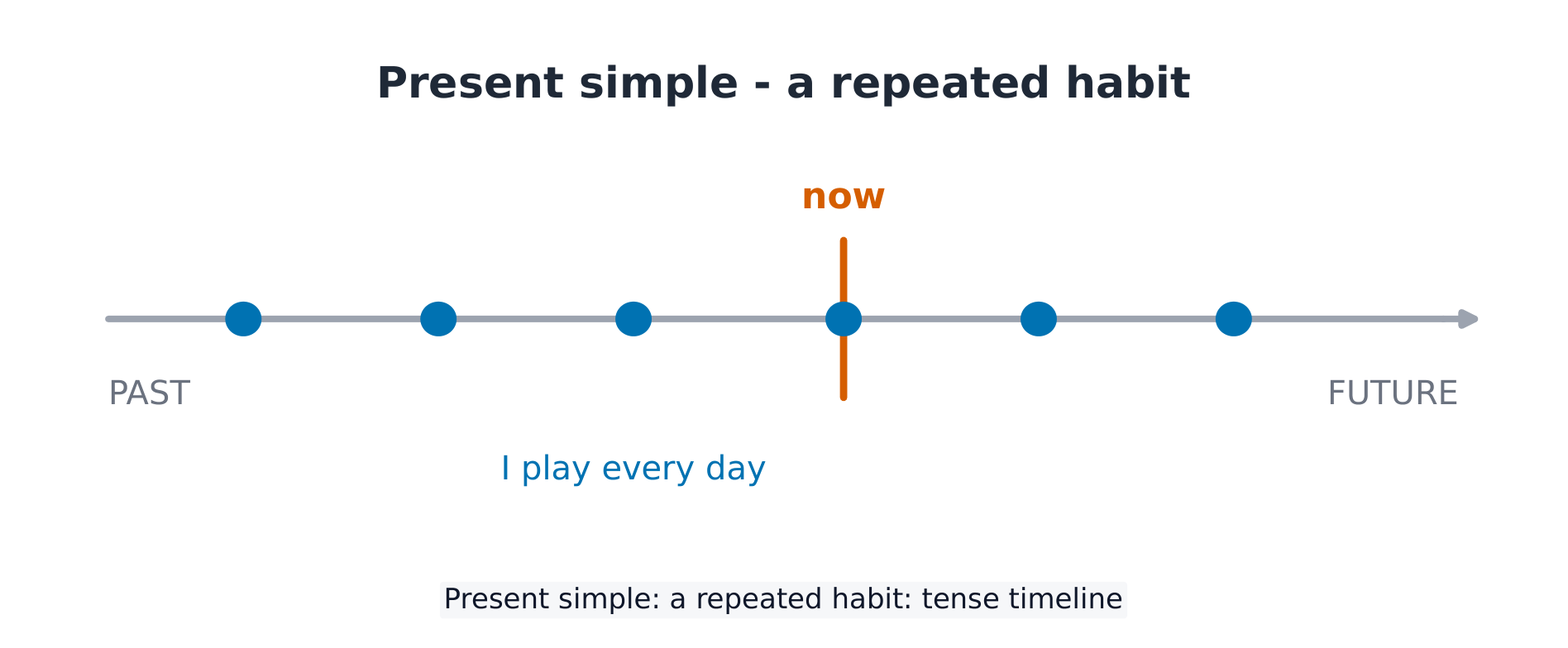
    The present simple tense is used to talk about things that happen regularly and facts that are always true: daily habits, schedules, scientific facts.

    Structure: 主语 + 动词原形

    我I 喝drink 咖啡coffee 每every 早上morning.

    I drink coffee every morning.

    我们We 住live 在in 上海Shanghai.

    We live in Shanghai.

    Scientific facts also use the present simple:

    水Water 沸腾boils 在at 一one 百hundred 度degrees.

    Water boils at one hundred degrees Celsius.

    It is often used with adverbs of frequency: always, usually, often, sometimes, never.

    她She 总是always 乘坐takes (冠词)the 公交车bus.

    She always takes the bus.

    Note

    • When talking about current habits, do not add a be verb: ~~I am drink coffee~~ ✗ → I drink coffee ✓.
    • Adverbs of frequency usually go before the main verb, but after the be verb: She is often late.
    Español
    一般现在时:反复的习惯

    El presente simple se utiliza para hablar de cosas que ocurren con frecuencia y de hechos que siempre son verdaderos: hábitos diarios, horarios y conocimientos científicos.

    结构: 主语 + 动词原形

    我I 喝drink 咖啡coffee 每every 早上morning.

    我每天早上喝咖啡。

    我们We 住live 在in 上海Shanghai.

    我们住在上海。

    科学事实也用一般现在时:

    水Water 沸腾boils 在at 一one 百hundred 度degrees.

    水在一百度时沸腾。

    Se usa frecuentemente con adverbios de frecuencia: always(siempre), usually(casi siempre), often(muchas veces), sometimes(a veces), never(nunca).

    她She 总是always 乘坐takes (冠词)the 公交车bus.

    她总是乘公交车。

    注意

    • Al hablar de hábitos actuales, no uses el verbo to be: ~~I am drink coffee~~ ✗ → I drink coffee ✓.
    • Los adverbios de frecuencia van generalmente antes del verbo principal, pero después del verbo to be: She is often late.(Ella suele llegar tarde.)
    1.2

    Tercera persona del singular -s (Third person -s)

    English

    When the subject is he / she / it (third person singular), the verb takes -s or -es.

    Structure: He / She / It + 动词 + -s

    他He 工作works 在in 一家a 银行bank.

    He works at a bank.

    我的My 姐姐sister 喜欢likes 音乐music.

    My sister likes music.

    Spelling rules:

    • Generally add -s directly: work → works, play → plays.
    • Ends in -s / -sh / -ch / -x / -o, add -es: watch → watches, go → goes.
    • Consonant letter + -y ending, change y to i and add -es: study → studies, fly → flies.

    她She 看watches 电视TV 在at 晚上night.

    She watches TV at night.

    Note

    • Only he / she / it takes -s; I / you / we / they do not take it: ~~They likes~~ ✗ → They like ✓.
    • have is special: he / she / it uses has (not ~~haves~~).
    Español

    Cuando el sujeto es he / she / it(tercera persona del singular), el verbo añade -s o -es.

    结构: He / She / It + 动词 + -s

    他He 工作works 在in 一家a 银行bank.

    他在一家银行工作。

    我的My 姐姐sister 喜欢likes 音乐music.

    我姐姐喜欢音乐。

    拼写规则:

    • Generalmente se añade directamente -s: work → works, play → plays.
    • Si termina en -s / -sh / -ch / -x / -o, se añade -es: watch → watches, go → goes.
    • Si termina en consonante + -y, cambia la y por i y añade -es: study → studies, fly → flies.

    她She 看watches 电视TV 在at 晚上night.

    她晚上看电视。

    注意

    • Solo he / she / it añaden -s; I / you / we / they no lo hacen: ~~They likes~~ ✗ → They like ✓.
    • Have es especial: he / she / it usa has(no ~~haves~~).
    1.3

    Negativos e interrogativos (Negatives & questions)

    English

    For negative and interrogative forms in the Present Simple, use the auxiliary verb do / does. Use does for he / she / it, and do for other subjects.

    Negative structure: 主语 + don't / doesn't + 动词原形

    我I 不don't 吃eat 肉meat.

    I don't eat meat.

    他He 不doesn't 喜欢like 咖啡coffee.

    He doesn't like coffee.

    Interrogative structure: Do / Does + 主语 + 动词原形 ?

    (助动词)Do 你you 说speak 英语English?

    Do you speak English?

    (助动词)Does 她she 工作work 这里here?

    Does she work here?

    Short answers: Yes, I do. / No, he doesn't.

    Note

    • After using do / does, the verb returns to its base form (no longer adds -s): ~~He doesn't likes~~ ✗ → He doesn't like ✓.
    • Don't forget the auxiliary verb: in formal contexts say Do you…?, not just ~~You speak English?~~.

    Common Errors

    • ❌ ~~She don't like it.~~ → ✓ She doesn't like it. — For third-person singular negatives, use doesn't, not don't.
    • ❌ ~~Does he has a car?~~ → ✓ Does he have a car? — When using does, even has reverts to the base form have.
    • ❌ ~~Everyone know the answer.~~ → ✓ Everyone knows the answer. — everyone / everybody / nobody are treated as singular, so add -s to the verb.
    • ❌ ~~I am usually going to school by bike.~~ → ✓ I usually go to school by bike. — Repeated habits use the Present Simple, not the continuous tense.
    Español

    Para los negativos e interrogativos en presente simple, se necesita el auxiliar do / does. Para he / she / it se usa does, y para otros sujetos se usa do.

    否定结构: 主语 + don't / doesn't + 动词原形

    我I 不don't 吃eat 肉meat.

    我不吃肉。

    他He 不doesn't 喜欢like 咖啡coffee.

    他不喜欢咖啡。

    疑问结构: Do / Does + 主语 + 动词原形 ?

    (助动词)Do 你you 说speak 英语English?

    你会说英语吗?

    (助动词)Does 她she 工作work 这里here?

    她在这里工作吗?

    Respuestas cortas: Yes, I do. / No, he doesn't.

    注意

    • Después de usar do / does, el verbo vuelve a su forma base(ya no añade -s): ~~He doesn't likes~~ ✗ → He doesn't like ✓.
    • No olvides el auxiliar: en contextos formales debes decir Do you…?, no solo ~~You speak English?~~

    常见错误

    • ❌ ~~She don't like it.~~ → ✓ She doesn't like it. — El negativo de tercera persona del singular usa doesn't, no don't.
    • ❌ ~~Does he has a car?~~ → ✓ Does he have a car? — Al usar does, have también debe volver a su forma base have.
    • ❌ ~~Everyone know the answer.~~ → ✓ Everyone knows the answer. — everyone / everybody / nobody se tratan como singular, el verbo añade -s.
    • ❌ ~~I am usually going to school by bike.~~ → ✓ I usually go to school by bike. — Para hábitos repetidos se usa presente simple, no continuo.
  • 2 Present continuous · ⁨Presente continuo⁩
    2.1

    Estructura (be + V-ing)

    English

    The Present Continuous tense describes actions that are happening right now.

    Structure: 主语 + am / is / are + 动词-ing(I → am; he / she / it → is; you / we / they → are)

    我I 正在am 读reading 一本a 书book.

    I am reading a book.

    他们They 正在are 踢playing 足球football.

    They are playing football.

    Spelling of -ing:

    • Generally add -ing directly: read → reading.
    • End in silent -e, drop e and add -ing: make → making, write → writing.
    • Stressed closed syllable (consonant + vowel + consonant), double the final consonant: run → running, sit → sitting.

    她She 正在is 写writing 一封an 电子邮件email.

    She is writing an email.

    Note

    • Don't forget the be verb: ~~I reading~~ ✗ → I am reading ✓.
    • State verbs (like, know, want, have = possess) generally do not use the continuous tense: ~~I am knowing~~ ✗ → I know ✓.
    Español
    She is reading a book — an action happening right now.

    El presente continuo indica una acción que se está realizando en este momento.

    Estructura: 主语 + am / is / are + 动词-ing (I → am; he / she / it → is; you / we / they → are)

    我I 正在am 读reading 一本a 书book.

    我正在读一本书。

    他们They 正在are 踢playing 足球football.

    他们正在踢足球。

    Ortografía del -ing:

    • Se añade directamente -ing: read → reading.
    • Si termina en -e muda, se elimina la -e y se añade -ing: make → making, write → writing.
    • En sílabas cerradas tónicas (consonante + vocal + consonante), se duplica la última consonante: run → running, sit → sitting.

    她She 正在is 写writing 一封an 电子邮件email.

    她正在写一封电子邮件。

    注意

    • No olvides el verbo be: ~~I reading~~ ✗ → I am reading ✓.
    • Los verbos de estado (like, know, want, have = tener/poseer) generalmente no se usan en tiempo continuo: ~~I am knowing~~ ✗ → I know ✓.
    2.2

    Presente continuo vs. Presente simple

    English

    Both tenses relate to "now," but their meanings differ:

    • Present Simple: Habits or repeated actions.
    • Present Continuous: Actions happening at this very moment.

    他He 通常usually 步行walks 去to 上班work.

    He usually walks to work. (Habit → Present Simple)

    今天Today 他he 正在is 乘坐taking (冠词)the 公交车bus.

    He is taking the bus today. (Right now → Present Continuous)

    Time expressions help distinguish them:

    • Present Simple: every day, usually, often, always.
    • Present Continuous: now, right now, at the moment, today.

    Note

    • Temporary situations use the continuous tense: She is living with her aunt this month. (She is temporarily staying with her aunt this month.)
    • Long-term facts use the Present Simple: She lives in Beijing. (She lives in Beijing.)

    Common Errors

    • ❌ ~~They are play football now.~~ → ✓ They are playing football now. — With be, the verb must also take -ing; both elements are required.
    • ❌ ~~She is cooking every day.~~ → ✓ She cooks every day. — every day signals a habit, so use the Present Simple.
    • ❌ ~~Where is Tom? — He plays football.~~ → ✓ He is playing football. — To answer "what is he doing right now?", use the continuous tense.
    • ❌ ~~He is writeing a letter.~~ → ✓ He is writing a letter. — Verbs ending in a silent -e drop the e before adding -ing.
    Español

    两个时态都和"现在"有关,但意思不同:

    • 一般现在时:习惯、反复发生的事。
    • 现在进行时:此刻正在做的事。

    他He 通常usually 步行walks 去to 上班work.

    他通常步行上班。(习惯 → 一般现在时)

    今天Today 他he 正在is 乘坐taking (冠词)the 公交车bus.

    今天他在坐公交车。(此刻 → 现在进行时)

    时间词帮你判断:

    • Presente simple: every day (todos los días), usually (normalmente), often (a menudo), always (siempre).
    • Presente continuo: now (ahora), right now (justo ahora), at the moment (en este momento), today (hoy).

    注意

    • Situaciones temporales usan el continuo: She is living with her aunt this month. (Este mes vive temporalmente con su tía.)
    • Hechos a largo plazo usan el presente simple: She lives in Beijing. (Vive en Pekín.)

    常见错误

    • ❌ ~~They are play football now.~~ → ✓ They are playing football now. — Con el verbo be, el verbo principal debe llevar -ing; ambos son necesarios.
    • ❌ ~~She is cooking every day.~~ → ✓ She cooks every day. — Every day es una señal de hábito, por lo que se usa el presente simple.
    • ❌ ~~Where is Tom? — He plays football.~~ → ✓ He is playing football. — Para responder "¿qué está haciendo en este momento?", se debe usar el tiempo continuo.
    • ❌ ~~He is writeing a letter.~~ → ✓ He is writing a letter. — Los verbos que terminan en -e muda deben perder la -e antes de añadir -ing.
  • 3 Past simple · ⁨Pasado simple⁩
    3.1

    Verbos Regulares (-ed)

    English

    The Past Simple tense describes actions or states that were completed in the past. Regular verbs add -ed to the end.

    Structure: 主语 + 动词-ed(same for all persons)

    我I 看watched 一部a 电影film 昨天yesterday.

    I watched a movie yesterday.

    我们We 打played 篮球basketball 上last 周week.

    We played basketball last week.

    Spelling of -ed:

    • Generally add -ed directly: work → worked, play → played.
    • End in -e, only add -d: like → liked, live → lived.
    • Consonant + -y ending, change y to i and add -ed: study → studied, try → tried.
    • Stressed closed syllable, double the final consonant: stop → stopped, plan → planned.

    Note

    • The past tense form does not change based on person: I worked, she worked (no -s).
    • Often used with past time markers: yesterday, last week, in 2019, two days ago.
    Español
    Pasado simple: acciones finalizadas

    El pasado simple (past simple) indica acciones o estados que se han completado en el pasado. Los verbos regulares se forman añadiendo -ed al final del verbo.

    Estructura: 主语 + 动词-ed(igual para todas las personas)

    我I 看watched 一部a 电影film 昨天yesterday.

    Jugamos baloncesto la semana pasada.

    我们We 打played 篮球basketball 上last 周week.

    Nota

    Ortografía de -ed:

    • Se añade directamente -ed: work → worked, play → played.
    • Si termina en -e, solo se añade -d: like → liked, live → lived.
    • Si termina en consonante + -y, se cambia la y por i y se añade -ed: study → studied, try → tried.
    • Silaba cerrada tónica: se duplica la consonante final: stop → stopped, plan → planned.

    Nota

    • La forma del verbo en pasado no cambia según la persona: I worked, she worked (sin -s).
    • Usado frecuentemente con expresiones de tiempo pasado: yesterday, last week, in 2019, two days ago.
    3.2

    Verbos irregulares

    English

    Many common verbs are irregular; their past forms must be memorized individually without adding -ed.

    我I 去went (介词)to 北京Beijing 上last 月month.

    I went to Beijing last month.

    她She 看见saw 她的her 朋友friends.

    She met her friend.

    High-frequency irregular verbs you must memorize:

    • go → went, have → had, do → did, make → made.
    • see → saw, come → came, get → got, take → took.
    • eat → ate, buy → bought, think → thought, say → said.

    我们We (吃了)had 一顿a 丰盛的big 晚餐dinner.

    We had a big dinner.

    Note these follow no pattern; practice reading and memorizing them frequently.

    Español

    Muchos verbos comunes son irregulares; su forma en pasado debe memorizarse individualmente y no se forma con -ed.

    我I 去went (介词)to 北京Beijing 上last 月month.

    Ella vio a su amiga.

    她She 看见saw 她的her 朋友friends.

    Verbos irregulares de alta frecuencia obligatorios para memorizar:

    Comimos una cena abundante.

    • go → went, have → had, do → did, make → made.
    • see → saw, come → came, get → got, take → took.
    • eat → ate, buy → bought, think → thought, say → said.

    我们We (吃了)had 一顿a 丰盛的big 晚餐dinner.

    Nota Estos no tienen regla, solo se pueden aprender leyendo mucho.

    Nota Estos no tienen regla, solo se pueden aprender leyendo y memorizando más.

    3.3

    Negación e Interrogativa (did)

    English

    For negative and interrogative forms in the Past Simple, use the auxiliary did (past form). The following verb returns to its base form.

    Negative structure: 主语 + didn't + 动词原形

    我I 没有didn't 去go (介词)to 上学school.

    I didn't go to school.

    Interrogative structure: Did + 主语 + 动词原形 ?

    (助动词)Did 你you 看见see (冠词)the 电影film?

    Did you see that movie?

    Short answers: Yes, I did. / No, I didn't.

    Note

    • After using did / didn't, the verb must be in the base form: ~~I didn't went~~ ✗ → I didn't go ✓.
    • The past tense of the be verb (was / were) does not use did: Were you tired? (Were you tired?)

    Common Errors

    • ❌ ~~I go to Beijing last month.~~ → ✓ I went to Beijing last month. — Chinese verbs do not change form, but in English, once a past time marker is present, you must switch to the past tense. This is the most common error.
    • ❌ ~~She buyed a new phone.~~ → ✓ She bought a new phone. — Irregular verbs cannot simply add -ed.
    • ❌ ~~I didn't was hungry.~~ → ✓ I wasn't hungry. — For negative sentences with the verb 'be', use wasn't / weren't directly, not didn't.
    • ❌ ~~yesterday night~~ → ✓ last night — Fixed expression: 'last night' is used for last evening, not 'yesterday night' (though 'yesterday morning/afternoon' is correct).
    Español

    Para formar negaciones e interrogativas en pasado, se utiliza el auxiliar did. El verbo principal vuelve a su forma base.

    Estructura negativa: 主语 + didn't + 动词原形

    我I 没有didn't 去go (介词)to 上学school.

    No fui a la escuela.

    Estructura interrogativa: Did + 主语 + 动词原形 ?

    (助动词)Did 你you 看见see (冠词)the 电影film?

    Errores comunes

    Respuestas cortas: Yes, I did. / No, I didn't.

    Nota

    • Al usar did / didn't, el verbo debe ir obligatoriamente en forma base: ~~I didn't went~~ ✗ → I didn't go ✓.
    • El verbo be (was / were) en pasado no usa did: Were you tired? (¿Estabas cansado?)

    Te llamaré esta noche.

    • ❌ ~~I go to Beijing last month.~~ → ✓ I went to Beijing last month. — En chino los verbos no cambian de forma, pero en inglés, al haber un tiempo pasado, es obligatorio cambiar a pasado simple; este es el error más frecuente.
    • ❌ ~~She buyed a new phone.~~ → ✓ She bought a new phone. — Los verbos irregulares no pueden llevar -ed añadido artificialmente.
    • ❌ ~~I didn't was hungry.~~ → ✓ I wasn't hungry. — La negación del verbo be se hace directamente con wasn't / weren't, sin usar didn't.
    • ❌ ~~yesterday night~~ → ✓ last night — Expresión fija: anoche se dice last night, no yesterday night (pero yesterday morning / afternoon sí es correcto).
  • 4 Past continuous · ⁨Pasado continuo⁩
    4.1

    Estructura (was / were + V-ing)

    English

    The past continuous tense describes an action in progress at a specific moment in the past.

    Structure: 主语 + was / were + 动词-ing(I / he / she / it → was; you / we / they → were)

    在At 八点eight 我I (过去进行)was 做饭cooking.

    I was cooking at eight o'clock.

    他们They (过去进行)were 看watching 电视TV.

    They were watching TV at that time.

    Note

    • Don't mix up was and were: Use was for I / he / she / it; use were for you / we / they.
    • Negative: wasn't / weren't + V-ing. Question: Was / Were + subject + V-ing?
    Español
    Pasado continuo: was / were + V-ing

    El pasado continuo (past continuous) se utiliza para expresar una acción que estaba en curso en un momento específico del pasado.

    Estructura: 主语 + was / were + 动词-ing (I / he / she / it → was; you / we / they → were)

    在At 八点eight 我I (过去进行)was 做饭cooking.

    八点的时候我正在做饭。

    他们They (过去进行)were 看watching 电视TV.

    他们当时正在看电视。

    注意

    • No confunda was y were: use was con I / he / she / it; use were con you / we / they.
    • Negativo: wasn't / weren't + V-ing. Interrogativo: Was / Were + sujeto + V-ing?
    4.2

    when y while

    English

    The past continuous is often used with the simple past to describe "an ongoing action interrupted by another event".

    • while + past continuous (the longer background action).
    • when + simple past (the sudden, short action).

    当...时While 我I (过去进行)was 睡觉sleeping (冠词), the 电话phone 响了rang.

    The phone rang while I was sleeping.

    她She (过去进行)was 做饭cooking 当...时when 我I 到达arrived.

    When I arrived, she was cooking.

    Compare the two tenses:

    • The ongoing background action → Past continuous (was cooking).
    • The short action that interrupts it → Simple past (arrived).

    Note

    • Two long actions happening simultaneously both use the past continuous: While I was reading, she was writing (I was reading, and she was writing).
    • 'when' can also be followed by the past continuous, but the meaning changes. Beginners should first memorize the common collocations mentioned above.

    Common Errors

    • ❌ ~~I was watch TV when he called.~~ → ✓ I was watching TV when he called. — After was / were, you must use the -ing form.
    • ❌ ~~They was playing games.~~ → ✓ They were playing games. — Use were for you / we / they.
    • ❌ ~~When I was arriving, she was cooking.~~ → ✓ When I arrived, she was cooking. — Arriving is a brief, instantaneous action, so use the simple past; only the longer background action uses the continuous form.
    • ❌ ~~I was knowing the answer.~~ → ✓ I knew the answer. — Stative verbs (know, like, want) are also generally not used in the continuous form in the past tense.
    Español

    过去进行时常和一般过去时一起用,描述"一件事发生时,另一件正在进行"。

    • while + pasado continuo (acción de fondo más larga).
    • when + pasado simple (acción corta e inesperada).

    当...时While 我I (过去进行)was 睡觉sleeping (冠词), the 电话phone 响了rang.

    我睡觉的时候,电话响了。

    她She (过去进行)was 做饭cooking 当...时when 我I 到达arrived.

    我到的时候她正在做饭。

    对比两个时态:

    • Acción de fondo en curso → pasado continuo (was cooking).
    • Acción corta que interrumpe → pasado simple (arrived).

    注意

    • Si hay dos acciones largas que ocurren simultáneamente, utilice el pasado continuo para ambas: While I was reading, she was writing. (Yo estaba leyendo mientras ella estaba escribiendo).
    • When también puede ir seguido de pasado continuo, pero el significado cambia. Para principiantes, es suficiente memorizar la combinación habitual mencionada arriba.

    常见错误

    • ❌ ~~I was watch TV when he called.~~ → ✓ I was watching TV when he called. — Después de was / were debe ir la forma en -ing.
    • ❌ ~~They was playing games.~~ → ✓ They were playing games. — Con you / we / they se usa were.
    • ❌ ~~When I was arriving, she was cooking.~~ → ✓ When I arrived, she was cooking. — Llegar es una acción corta e instantánea; se usa pasado simple. Solo la acción de fondo larga utiliza el continuo.
    • ❌ ~~I was knowing the answer.~~ → ✓ I knew the answer. — Los verbos de estado (como know, like, want) no se usan en formas continuas ni siquiera en pasado.
  • 5 Present perfect · ⁨Presente perfecto⁩
    5.1

    Estructura (have / has + participio pasado)

    English

    The present perfect tense connects the past and the present: a past action has an effect on the present now, or it refers to life experience.

    Structure: 主语 + have / has + 过去分词(he / she / it → has)

    我I (完成时)have 完成finished 我的my 作业homework.

    I have finished my homework. (So I am free now)

    她She (完成时)has 丢失lost 她的her 钥匙keys.

    She has lost her keys. (She hasn't found them yet)

    Past Participle:

    • Regular verbs = -ed: work → worked, finish → finished.
    • Irregular verbs must be memorized: go → gone, see → seen, do → done, be → been, eat → eaten.

    Note: Present perfect usually does not specify exact times. If you mention a specific past time (yesterday, in 2019), use the simple past instead.

    Español
    现在完成时:连接过去与现在

    El present perfect (presente perfecto) conecta el pasado con el presente: algo hecho en el pasado que tiene influencia en el presente, o una experiencia.

    Estructura: 主语 + have / has + 过去分词 (he / she / it → has)

    我I (完成时)have 完成finished 我的my 作业homework.

    我已经做完作业了。(所以现在我有空)

    她She (完成时)has 丢失lost 她的her 钥匙keys.

    她把钥匙弄丢了。(现在还没找到)

    Participio pasado (past participle):

    • Verbos regulares = -ed: work → worked, finish → finished.
    • Verbos irregulares hay que memorizarlos: go → gone, see → seen, do → done, be → been, eat → eaten.

    Nota: En el perfecto generalmente no se menciona un tiempo específico; si se debe indicar un tiempo pasado concreto (yesterday、in 2019), se usa el simple pasado.

    5.2

    ever / never / just / already / yet

    English

    These words are frequently used with the present perfect tense:

    • ever: Used in questions to mean "at any time." never: "not ever."
    • just: "just now." already: "already." yet: Used at the end of negative or interrogative sentences to mean "not yet."

    (完成时)Have 你you 曾经ever 去过been (介词)to 伦敦London?

    Have you ever been to London?

    我I (完成时)have 刚刚just 吃过eaten 午饭lunch.

    I have just had lunch.

    他He 还没hasn't 完成finished (句末"还没")yet.

    He hasn't finished yet.

    Español

    这几个词常和现在完成时连用:

    • ever: en oraciones interrogativas significa "alguna vez". never: "nunca".
    • just: "acabar de". already: "ya". yet: se coloca al final de oraciones negativas e interrogativas, significa "todavía (no)".

    (完成时)Have 你you 曾经ever 去过been (介词)to 伦敦London?

    你去过伦敦吗?

    我I (完成时)have 刚刚just 吃过eaten 午饭lunch.

    我刚吃过午饭。

    他He 还没hasn't 完成finished (句末"还没")yet.

    他还没做完。

    5.3

    for y since

    English

    To say how long something has "continued," use for or since:

    • for + a period of time: for three years, for a week.
    • since + starting point: since 2020 (from the year 2020), since Monday (from Monday).

    我I (完成时)have 住lived 这里here (持续)for 五five 年years.

    I have lived here for five years. (And I still live here)

    我们We (完成时)have 认识known 彼此each other 自从since 2018年2018.

    We have known each other since 2018.

    Note: Use 'for' with duration and 'since' with a starting point; don't mix them up: ~~for 2018~~ ✗ → since 2018 ✓.

    Common Errors

    • ❌ ~~I have seen him yesterday.~~ → ✓ I saw him yesterday. — Once a specific past time is mentioned (yesterday, last week, in 2019), switch to the simple past.
    • ❌ ~~I live here for ten years.~~ → ✓ I have lived here for ten years. — "Lived here for ten years and still live here" requires the present perfect. Chinese lacks this distinction, making it easy to overlook.
    • ❌ ~~She has go home.~~ → ✓ She has gone home. — After have / has, use the past participle, not the base form.
    • ❌ ~~Have you ever went to Beijing?~~ → ✓ Have you ever been to Beijing? — Use have been to for "visited a place."
    • Distinguish gone and been: He has gone to Beijing. (He went there and hasn't returned yet) vs He has been to Beijing. (He visited there and has come back).
    Español

    Para expresar cuánto tiempo "ha durado" una acción, se usa for o since:

    • for + periodo de tiempo: for three years (tres años), for a week (una semana).
    • since + punto de partida: since 2020 (desde 2020), since Monday (desde el lunes).

    我I (完成时)have 住lived 这里here (持续)for 五five 年years.

    我在这里住了五年了。(现在还住着)

    我们We (完成时)have 认识known 彼此each other 自从since 2018年2018.

    我们从 2018 年就认识了。

    Nota: for indica "cuánto", since indica "desde cuándo"; no se deben mezclar: ~~for 2018~~ ✗ → since 2018 ✓.

    常见错误

    • ❌ ~~I have seen him yesterday.~~ → ✓ I saw him yesterday. — Al mencionar un tiempo pasado específico (yesterday、last week、in 2019), se cambia al simple pasado.
    • ❌ ~~I live here for ten years.~~ → ✓ I have lived here for ten years. — Para decir "vivo aquí desde hace diez años y aún sigo viviendo" se requiere el present perfect; como en chino no existe esta distinción, es fácil omitirlo.
    • ❌ ~~She has go home.~~ → ✓ She has gone home. — Después de have / has va el participio pasado, no la forma base.
    • ❌ ~~Have you ever went to Beijing?~~ → ✓ Have you ever been to Beijing? — Para decir "haber visitado un lugar" se usa have been to.
    • Diferencia entre gone y been: He has gone to Beijing. (Se fue, la persona aún no ha regresado) vs He has been to Beijing. (Ha visitado, la persona ya ha regresado).
  • 6 Talking about the future · ⁨Hablando sobre el futuro⁩
    6.1

    will

    English

    will is used to talk about the future, especially spontaneous decisions, predictions, and promises.

    Structure: 主语 + will + 动词原形(Same for all persons; will not = won't)

    我I 将will 打电话call (给你)you 今晚tonight.

    I will call you tonight.

    (天气it)It 将will 下雨rain 明天tomorrow.

    It will rain tomorrow.

    Note

    • Use the base form of the verb after will: ~~will to go~~ ✗ → will go ✓.
    • Negative uses won't: I won't be late. (I will not be late.)
    Español
    将来:will / going to

    will se usa para hablar del futuro, especialmente en decisiones espontáneas, predicciones y compromisos.

    Estructura: 主语 + will + 动词原形 (igual para todas las personas; will not = won't)

    我I 将will 打电话call (给你)you 今晚tonight.

    Mañana lloverá.

    (天气it)It 将will 下雨rain 明天tomorrow.

    Mañana lloverá.

    Nota

    • Después de will se usa el verbo en infinitivo: ~~will to go~~ ✗ → will go ✓.
    • La forma negativa es won't: I won't be late. (No llegaré tarde).
    6.2

    be going to

    English

    be going to is used to talk about plans and predictions based on current evidence.

    Structure: 主语 + am / is / are + going to + 动词原形

    我们We (be)are 打算going to 拜访visit 我们的our 奶奶grandma.

    We are going to visit Grandma. (A plan already made)

    看Look (介词)at (冠词)the 云clouds (天气it)! It (be)is 将要going to 下雨rain.

    Look at those clouds! It's going to rain. (Based on current signs)

    will or going to?

    • Spontaneous decision → will: The phone is ringing. I'll get it. (Phone rings, I decide now to answer.)
    • Pre-planned intention → going to: I'm going to study tonight. (I have planned to study tonight.)
    Español

    be going to se usa para hablar de planes y predicciones basadas en la situación actual.

    Estructura: 主语 + am / is / are + going to + 动词原形

    我们We (be)are 打算going to 拜访visit 我们的our 奶奶grandma.

    ¡Mira esas nubes! Va a llover. (Basado en situación actual)

    看Look (介词)at (冠词)the 云clouds (天气it)! It (be)is 将要going to 下雨rain.

    ¡Mira esas nubes! Va a llover. (Basado en evidencia actual)

    ¿will o going to?

    • Decisión espontánea → will: The phone is ringing. I'll get it. (Suena el teléfono. Lo contesto.)
    • Plan ya establecido → going to: I'm going to study tonight. (Voy a estudiar esta noche).
    6.3

    Presente continuo para planes futuros

    English

    The present continuous can also express scheduled future events (especially when there is a definite time or place).

    Structure: 主语 + am / is / are + 动词-ing + 将来时间

    我I (be)am 见面meeting 汤姆Tom 明天tomorrow.

    I am meeting Tom tomorrow. (An appointment has been set)

    我们We (be)are 飞flying 去to 东京Tokyo 在on 周五Friday.

    We are flying to Tokyo on Friday. (Tickets are booked)

    Note: This usage emphasizes that something is "already arranged," which is similar to 'be going to'; the key factor is having a definite future time.

    Common Errors

    • ❌ ~~I go to Shanghai tomorrow.~~ → ✓ I am going to Shanghai tomorrow. / I will go… — The Chinese "I go to Shanghai tomorrow" lacks a future marker; English requires adding (will / going to / present continuous).
    • ❌ ~~We will going to visit grandma.~~ → ✓ We are going to visit… / We will visit… — will and be going to are separate structures and cannot be combined.
    • ❌ ~~She will comes tomorrow.~~ → ✓ She will come tomorrow. — After will, use the base form of the verb; no -s is added for any person.
    • Exception: Timetables (trains, flights, classes) can use the simple present to express the future: The train leaves at 9. (The train leaves at nine o'clock.)
    Español

    Voy a ver a Tom mañana. (Cita arreglada)

    Estructura: 主语 + am / is / are + 动词-ing + 将来时间

    我I (be)am 见面meeting 汤姆Tom 明天tomorrow.

    Volamos a Tokio el viernes. (Boletos reservados)

    我们We (be)are 飞flying 去to 东京Tokyo 在on 周五Friday.

    Ambos tiempos hablan del pasado, la diferencia radica en si se menciona una hora específica, si está relacionado con el presente:

    Nota Este uso enfatiza que está "ya organizado", siendo muy similar a be going to; la clave es tener una hora futura determinada.

    Te llamaré esta noche.

    • ❌ ~~I go to Shanghai tomorrow.~~ → ✓ Yo am going a Shanghái mañana. / Yo will go… — En chino "Mañana voy a Shanghái" no tiene marcador de futuro, pero en inglés debe añadirse (will / going to / presente continuo).
    • ❌ ~~We will going to visit grandma.~~ → ✓ Nosotros are going to visitar… / Nosotros will visitar… — will y be going to son estructuras distintas, no deben usarse juntas.
    • ❌ ~~She will comes tomorrow.~~ → ✓ Ella will come mañana. — Después de will se usa el infinitivo, sin añadir -s para ninguna persona.
    • Excepción: los horarios (trenes, vuelos, clases) pueden usar el presente simple para expresar futuro: The train leaves at 9.
  • 7 Comparatives and superlatives · ⁨Comparativos y superlativos⁩
    7.1

    比较级 (Comparatives)

    English

    Comparatives are used to compare two things, often used with than (compared to).

    Short adjectives + -er; long adjectives use more + adjective.

    我的My 包bag 是is 更大bigger 比than 你的yours.

    My bag is bigger than yours.

    这This 书book 是is 更more 有趣interesting 比than 那本that one.

    This book is more interesting than that one.

    Formation Rules:

    • Monosyllabic: add -er → tall → taller, fast → faster.
    • Ending in consonant + y: change y to i and add -er → happy → happier, easy → easier.
    • Two or more syllables: use more → expensive → more expensive.
    • Irregular: good → better, bad → worse, far → further.

    Note: Avoid "double comparison": ~~more bigger~~ ✗ → bigger ✓.

    Español
    比较级 → 最高级

    比较级用来比较两样东西,常和 than(比)连用。

    短形容词 + -er;长形容词 用 more + 形容词。

    我的My 包bag 是is 更大bigger 比than 你的yours.

    我的包比你的大。

    这This 书book 是is 更more 有趣interesting 比than 那本that one.

    这本书比那本有趣。

    构成规则:

    • 单音节:加 -er → tall → taller,fast → faster。
    • 以辅音 + y 结尾:y 变 i 加 -er → happy → happier,easy → easier。
    • 两个及以上音节:用 more → expensive → more expensive。
    • 不规则:good → better,bad → worse,far → further。

    注意 不要"双重比较":~~more bigger~~ ✗ → bigger ✓。

    7.2

    最高级 (Superlatives)

    English

    Superlatives indicate "the most …" (three or more), preceded by the.

    Short adjectives + -est; long adjectives use the most + adjective.

    他He 是is (冠词)the 最高tallest 在in (冠词)the 班级class.

    He is the tallest in the class.

    这This 是is (冠词)the 最most 贵expensive 手机phone.

    This is the most expensive phone.

    Formation Rules:

    • Monosyllabic: the + -est → fast → the fastest.
    • Long adjectives: the most → the most beautiful.
    • Irregular: good → the best, bad → the worst.

    Note: Do not forget the before superlatives: ~~he is tallest~~ → he is the tallest.

    Español

    最高级表示"最……"(三者或以上),前面加 the。

    短形容词 + -est;长形容词 用 the most + 形容词。

    他He 是is (冠词)the 最高tallest 在in (冠词)the 班级class.

    他是班里最高的。

    这This 是is (冠词)the 最most 贵expensive 手机phone.

    这是最贵的手机。

    构成规则:

    • 单音节:the + -est → fast → the fastest。
    • 长形容词:the most → the most beautiful。
    • 不规则:good → the best,bad → the worst。

    注意 最高级前别忘了 the:~~he is tallest~~ → he is the tallest。

    7.3

    as ... as

    English

    as + adjective + as means "as … as …".

    她She 是is 和as 高tall 一样as 她her 妈妈mother.

    She is as tall as her mother.

    Negative not as ... as means "not as … as …":

    今天Today (是)is 不not 像as 热hot 一样as 昨天yesterday.

    It is not as hot today as yesterday.

    Note: Place the base form of the adjective (not the comparative) in the middle: ~~as taller as~~ ✗ → as tall as ✓.

    Common Errors

    • ❌ ~~It is more cheap.~~ → ✓ It is cheaper. — Use -er for monosyllabic adjectives, not more.
    • ❌ ~~He is taller than me a lot.~~ → ✓ He is much taller than me. — "A lot" translates to much, which goes before the comparative.
    • ❌ ~~My bag is bigger than your.~~ → ✓ …bigger than yours. — Use yours / mine / hers (nominal possessive pronouns) after than.
    • ❌ ~~Beijing is bigger than any city in China.~~ → ✓ …than any other city in China. — Do not forget other, otherwise it implies comparing itself to itself.
    Español

    as + 形容词 + as 表示"和……一样……"。

    她She 是is 和as 高tall 一样as 她her 妈妈mother.

    她和她妈妈一样高。

    否定 not as ... as 表示"不如……":

    今天Today (是)is 不not 像as 热hot 一样as 昨天yesterday.

    今天没有昨天热。

    注意 中间放形容词原级(不是比较级):~~as taller as~~ ✗ → as tall as ✓。

    常见错误

    • ❌ ~~It is more cheap.~~ → ✓ It is cheaper. — 单音节形容词用 -er,不用 more。
    • ❌ ~~He is taller than me a lot.~~ → ✓ He is much taller than me. — "高很多"的"很多"是 much,放在比较级前面。
    • ❌ ~~My bag is bigger than your.~~ → ✓ …bigger than yours. — than 后面用 yours / mine / hers(名词性物主代词)。
    • ❌ ~~Beijing is bigger than any city in China.~~ → ✓ …than any other city in China. — 别忘 other,否则就变成"和自己比"了。
  • 8 Articles · ⁨Artículos⁩
    8.1

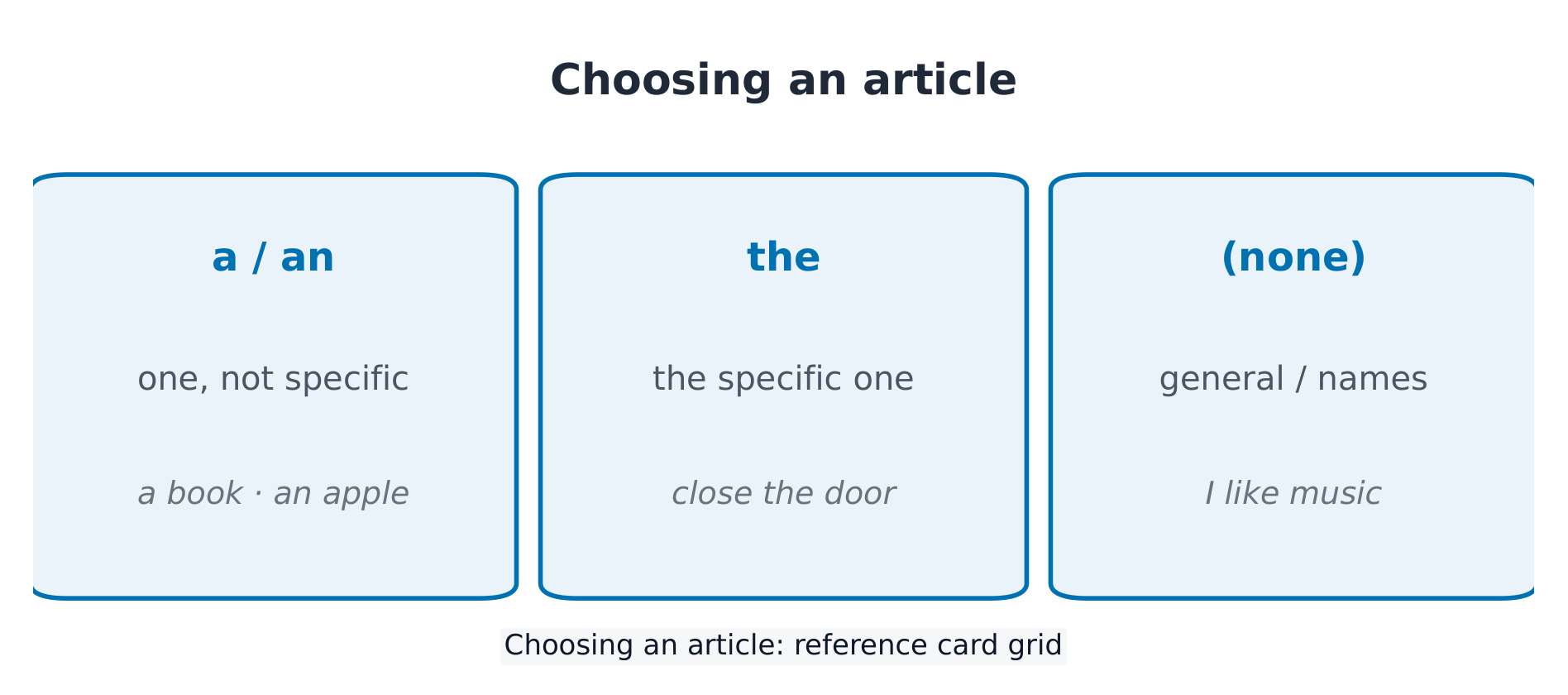
    a / an

    English

    a and an are indefinite articles, used before singular countable nouns to mean "one (non-specific)".

    • a is used before consonant sounds: a book, a car, a university (pronounced /j/ sound).
    • an is used before vowel sounds: an apple, an hour (h is silent).

    我I 有have 一个a 问题question.

    I have a question.

    她She 是is 一名an 工程师engineer.

    She is an engineer.

    Note: Look at the pronunciation, not the letter: an hour (h is silent → an), a university (pronounced /j/ → a).

    Español
    Seleccionar artículo: a/an · the · artículo cero

    a y an son artículos indefinidos que se usan delante de sustantivos contables en singular para indicar "uno (no específico)".

    • a se usa antes de sonido consonántico: a book, a car, a university (pronunciación /j/).
    • an se usa antes de sonido vocálico: an apple, an hour (la h no se pronuncia).

    我I 有have 一个a 问题question.

    我有一个问题。

    她She 是is 一名an 工程师engineer.

    她是一名工程师。

    Nota: Fíjate en la pronunciación, no en la letra: an hour (la h no suena → an), a university (suena /j/ → a).

    8.2

    the

    English

    the is the definite article, indicating specificity — both speaker and listener know exactly which one.

    请Please 关close (这扇)the 门door.

    Please close (this) door.

    Common uses of the:

    • When mentioned previously or referred to again: I saw a cat. The cat was black. (I saw a cat. That cat was black.)
    • For unique things in the world: the sun, the moon.
    • Before superlatives: the best, the tallest.

    (那个)The 太阳sun 是is 非常very 明亮bright 今天today.

    The sun is very bright today.

    Español

    the es el artículo definido e indica especificidad: algo que tanto el hablante como el oyente conocen o identifican.

    请Please 关close (这扇)the 门door.

    请关上(这扇)门。

    Situaciones comunes con the:

    • Mencionado anteriormente o mencionado de nuevo: I saw a cat. The cat was black. (Vi un gato. El gato era negro.)
    • Cosas únicas en el mundo: the sun (el sol), the moon (la luna).
    • Delante de superlativos: the best (el mejor), the tallest (el más alto).

    (那个)The 太阳sun 是is 非常very 明亮bright 今天today.

    今天太阳很亮。

    8.3

    Artículo cero (Zero article)

    English

    Sometimes no article (zero article) is placed before a noun:

    • Plural / uncountable nouns expressing generalization: I like music. (I like music.) Cats are cute. (Cats are cute.)
    • Proper nouns: names, most countries, cities: China, Tom, Beijing.
    • Some fixed phrases: go to school / bed / work (indicating purpose, without the).

    我I 去go (介词)to 上学school 乘by 自行车bike.

    I go to school by bike.

    水Water 是is 重要important.

    Water is important.

    Note: Do not use the when plural / uncountable nouns express generalization: ~~I like the music~~ (general sense) ✗ → I like music ✓.

    Common Errors

    • ❌ ~~I want to be teacher.~~ → ✓ I want to be a teacher. — Add a / an before professions; direct translation of Chinese "to be a teacher" often omits this.
    • ❌ ~~I went to home.~~ → ✓ I went home. — home is used as an adverb here: go home, get home; do not use to or the before it.
    • ❌ ~~He plays the football.~~ → ✓ He plays football. — No the before sports; but add the for instruments: play the piano / violin.
    • Distinguish: go to school (attend school, purpose) vs go to the school (go to the school building, e.g., parents attending a meeting). Same logic applies to bed / hospital / work.
    Español

    有时名词前不加冠词(零冠词):

    • Sustantivos plurales / incontables para referencia general: I like music. (Me gusta la música.) Cats are cute. (Los gatos son adorables.)
    • Nombres propios: nombres de personas, la mayoría de países y ciudades: China, Tom, Beijing.
    • Algunas expresiones fijas: go to school / bed / work (cuando indican propósito, sin the).

    我I 去go (介词)to 上学school 乘by 自行车bike.

    我骑自行车上学。

    水Water 是is 重要important.

    水很重要。

    Nota: Al referirse de forma general a plurales o incontables, no se usa the: ~~I like the music~~ (referencia general) ✗ → I like music ✓.

    常见错误

    • ❌ ~~I want to be teacher.~~ → ✓ I want to be a teacher. — Se debe usar a/an antes de profesiones; es fácil olvidarlo al traducir literalmente del chino "ser profesor".
    • ❌ ~~I went to home.~~ → ✓ I went home. — home funciona como adverbio: go home, get home; no lleva to ni the.
    • ❌ ~~He plays the football.~~ → ✓ He plays football. — No se usa the con deportes; pero sí con instrumentos musicales: play the piano / violin.
    • Diferenciación: go to school (ir a estudiar, por propósito) vs. go to the school (ir al edificio de la escuela, por ejemplo, para una reunión de padres). Lo mismo aplica con bed, hospital y work.
  • 9 Countable and uncountable nouns · ⁨Sustantivos contables e incontables⁩
    9.1

    Contables e incontables (Countable vs uncountable)

    English

    English nouns are divided into two categories:

    • Countable nouns: can be counted, have singular and plural forms. a book → two books.
    • Uncountable nouns: cannot be directly counted, have no plural form. water, music, money, information.

    我I 买了bought 三three 苹果apples.

    I bought three apples. (Countable)

    我I 需要need 一些some 水water.

    I need some water. (Uncountable, no ~~waters~~)

    Note

    • Uncountable nouns take a singular verb: The news is good. (The news is good.)
    • To count uncountable nouns, use measure words: a glass of water, a piece of information.
    Español
    Contables vs incontables

    英语名词分两类:

    • Sustantivos contables (countable): Se pueden contar, tienen singular y plural. a book → two books.
    • Sustantivos incontables (uncountable): No se pueden contar directamente, no tienen plural. water, music, money, information.

    我I 买了bought 三three 苹果apples.

    我买了三个苹果。(可数)

    我I 需要need 一些some 水water.

    Necesito un poco de agua. (incontable, no ~~waters~~)

    注意

    • Los sustantivos incontables utilizan verbos en singular: The news is good. (Las noticias son buenas).
    • Si deseas contar un sustantivo incontable, debes usar una unidad de medida: un glass of water (vaso de), a piece of information (pieza de).
    9.2

    Some y any

    English

    some and any mean "some", used before plurals or uncountable nouns:

    • some: used in affirmative sentences (also used in polite requests / invitations).
    • any: used in negative sentences and interrogative sentences.

    (有)There 有are 一些some 鸡蛋eggs 在in (冠词)the 冰箱里fridge.

    There are some eggs in the fridge.

    (有)There 没有isn't 任何any 牛奶milk.

    There is no milk left.

    (助动词)Do 你you 有have 任何any 问题questions?

    Do you have any questions?

    Note: When offering drinks to others, some is commonly used to sound polite: Would you like some tea?

    Español
    可数名词:水果可以一个一个地数。

    some y any significan "algo/algunos" y se usan antes de sustantivos plurales o incontables:

    • some: Se utiliza en oraciones afirmativas (también en peticiones / invitaciones educadas).
    • any: Se utiliza en oraciones negativas y preguntas.

    (有)There 有are 一些some 鸡蛋eggs 在in (冠词)the 冰箱里fridge.

    冰箱里有一些鸡蛋。

    (有)There 没有isn't 任何any 牛奶milk.

    没有牛奶了。

    (助动词)Do 你you 有have 任何any 问题questions?

    你有什么问题吗?

    Nota Al ofrecer algo de beber a alguien, es habitual usar some para ser cortés: Would you like some tea? (¿Te apetece un poco de té?).

    9.3

    Much / many / a lot of

    English

    Used to express "a lot":

    • many + countable plural: many books.
    • much + uncountable: much water (mostly used in negative sentences / questions).
    • a lot of + both types (most common in positive sentences).

    (有)There 有are 许多many 人people 这里here.

    There are many people here.

    我们We 没有don't 有have 多少much 时间time.

    We don't have much time left.

    她She 有has 许多a lot of 朋友friends.

    She has a lot of friends.

    Note: In positive sentences, much is rarely used; instead use a lot of: ~~I have much money~~ → I have a lot of money.

    Common Errors

    • ❌ ~~informations / advices / homeworks / furnitures~~ → ✓ information / advice / homework / furniture — These words are uncountable in English (although Chinese can say "several pieces of advice" or "pieces of furniture"). They never take a plural form.
    • ❌ ~~a bread / a paper~~ → ✓ a piece of bread / a piece of paper — Uncountable nouns require measure words to be counted.
    • ❌ ~~How much apples do you want?~~ → ✓ How many apples…? — Use many for countable plurals and much only for uncountable nouns.
    • ❌ ~~There aren't some eggs.~~ → ✓ There aren't any eggs — Replace some with any in negative sentences.
    Español

    表示"很多":

    • many + plural contable: many books.
    • much + incontable: much water (se usa más en oraciones negativas / preguntas).
    • a lot of + ambos (especialmente común en oraciones afirmativas).

    (有)There 有are 许多many 人people 这里here.

    这里有很多人。

    我们We 没有don't 有have 多少much 时间time.

    我们没多少时间了。

    她She 有has 许多a lot of 朋友friends.

    她有很多朋友。

    Nota En oraciones afirmativas se usa menos much, prefiriéndose a lot of: ~~I have much money~~ → I have a lot of money.

    常见错误

    • ❌ ~~informations / advices / homeworks / furnitures~~ → ✓ information / advice / homework / furniture — Estas palabras son incontables en inglés (aunque en chino se pueda decir "varias sugerencias", "varios muebles"), nunca tienen plural.
    • ❌ ~~a bread / a paper~~ → ✓ a piece of bread / a piece of paper — Para contar sustantivos incontables se necesita usar unidades de medida.
    • ❌ ~~How much apples do you want?~~ → ✓ How many apples…? — Con plurales contables se usa many; con incontables se usa much.
    • ❌ ~~There aren't some eggs.~~ → ✓ There aren't any eggs. — En oraciones negativas, some cambia a any.
  • 10 Modal verbs · ⁨Verbos modales⁩
    10.1

    can y could (habilidad, petición)

    English

    can expresses ability or possibility; could is the past tense of can, and is also used for more polite requests. All modal verbs are followed by the base form of the verb.

    我I 会can 游泳swim.

    I can swim.

    她She 会could 读read 在at 四岁four.

    She could read at the age of four. (Past ability)

    能Could 你you 帮help 我me 请, please?

    Could you please help me? (Polite request)

    Note

    • After a modal verb, use the base form: ~~can to swim~~ ✗ → can swim ✓.
    • Negative: cannot / can't, could not / couldn't.
    Español
    情态动词:能力/建议/义务

    can indica habilidad o posibilidad; could es el pasado de can y también se usa para peticiones más corteses. Después de los verbos modales siempre va el verbo en infinitivo sin "to".

    我I 会can 游泳swim.

    我会游泳。

    她She 会could 读read 在at 四岁four.

    她四岁就会读书了。(过去的能力)

    能Could 你you 帮help 我me 请, please?

    请问你能帮我一下吗?(客气请求)

    注意

    • Después del verbo modal va el infinitivo: ~~can to swim~~ ✗ → can swim ✓.
    • Negativo: cannot / can't, could not / couldn't.
    10.2

    should (sugerencia)

    English

    should expresses advice or "should".

    你You 应该should 看see 一位a 医生doctor.

    You should see a doctor.

    我们We 不应该shouldn't 浪费waste 水water.

    We shouldn't waste water.

    Note: should gives advice and is less forceful than must; it is also followed by the base form of the verb.

    Español

    should indica una sugerencia o lo que se "debería" hacer.

    你You 应该should 看see 一位a 医生doctor.

    你应该去看医生。

    我们We 不应该shouldn't 浪费waste 水water.

    我们不该浪费水。

    Nota: should da sugerencias; su tono es más suave que el de must; después sigue el verbo en infinitivo sin "to".

    10.3

    must y have to (obligación)

    English

    Both express "must":

    • must: Often indicates something the speaker considers important, or a rule.
    • have to: Often indicates an external requirement (regulation, objective necessity).

    你You 必须must 系wear (冠词)a 安全带seatbelt.

    You must wear a seatbelt.

    我I 不得不have to 起床get up 早early.

    I have to get up early.

    Note

    • mustn't = "prohibited": You mustn't smoke here. (Smoking is prohibited here.)
    • don't have to = "not necessary": You don't have to come. (You don't need to come.)
    • Note that their meanings are completely different: one means "forbidden," the other means "not necessary."

    Common Errors

    • ❌ ~~You must to wear a helmet.~~ → ✓ You must wear a helmet — All modal verbs (can / could / should / must) are followed directly by the base form and never take to.
    • ❌ ~~She musts study harder.~~ → ✓ She must study harder — Modal verbs do not take a third-person singular -s.
    • ❌ Wanting to say "you don't need to come" but saying ~~You mustn't come.~~ → ✓ You don't have to come — mustn't means "forbidden," while don't have to means "not necessary." Their meanings are exactly opposite.
    • ❌ ~~Yesterday I must work late.~~ → ✓ Yesterday I had to work late — must has no past tense; use had to for past obligations.
    Español

    两者都表示"必须":

    • must: suele expresar la opinión del hablante sobre algo importante o una regla general.
    • have to: suele expresar una obligación externa (una norma, una necesidad objetiva).

    你You 必须must 系wear (冠词)a 安全带seatbelt.

    你必须系安全带。

    我I 不得不have to 起床get up 早early.

    我得早起。

    注意

    • mustn't = "prohibición": You mustn't smoke here. (Prohíben fumar aquí.)
    • don't have to = "no tener que" (no es necesario): You don't have to come. (No hace falta que vengas.)
    • 注意两者意思完全不同:一个是"禁止",一个是"不必"。

    常见错误

    • ❌ ~~You must to wear a helmet.~~ → ✓ You must wear a helmet. — Todos los verbos modales (can / could / should / must) van seguidos directamente del infinitivo, nunca con to.
    • ❌ ~~She musts study harder.~~ → ✓ She must study harder. — Los verbos modales no tienen terminación -s en tercera persona.
    • ❌ Querer decir "no tienes que venir" pero decir ~~You mustn't come.~~ → ✓ You don't have to come. — Mustn't significa "prohibido", mientras que don't have to significa "no es necesario"; son lo contrario.
    • ❌ ~~Yesterday I must work late.~~ → ✓ Yesterday I had to work late. — Must no tiene forma de pasado; para hablar de obligaciones pasadas se usa had to.
  • 11 Prepositions · ⁨Preposiciones⁩
    11.1

    Preposiciones de tiempo (at / in / on)

    English

    When indicating time, at / in / on each have specific uses:

    • at + specific time / point: at 7 o'clock, at night, at the weekend.
    • on + specific day / date: on Monday, on May 1st, on my birthday.
    • in + longer period: in the morning, in July, in 2020, in winter.

    (冠词)The 课class 开始starts 在at 九点nine.

    This class starts at nine o'clock.

    我们We 见面met 在on 周五Friday.

    We met on Friday.

    我的My 生日birthday 在is 在in 五月May.

    My birthday is in May.

    Note: The scope increases from small to large: at (point) → on (day) → in (month / year / period).

    Español
    Preposiciones de tiempo: at / on / in

    Al indicar tiempo, at / in / on tienen funciones distintas:

    • at + hora específica / momento: at 7 o'clock, at night, at the weekend.
    • on + día específico / fecha: on Monday, on May 1st, on my birthday.
    • in + período de tiempo más largo: in the morning, in July, in 2020, in winter.

    (冠词)The 课class 开始starts 在at 九点nine.

    这节课九点开始。

    我们We 见面met 在on 周五Friday.

    我们周五见的面。

    我的My 生日birthday 在is 在in 五月May.

    我的生日在五月。

    Nota El orden va de menor a mayor alcance: at(punto) → on(día) → in(mes / año / período).

    11.2

    Preposiciones de lugar (at / in / on)

    English

    When indicating location:

    • at + a specific point / place: at the bus stop, at home, at school.
    • in + interior space: in the room, in China, in a box.
    • on + surface / line: on the table, on the wall, on the second floor.

    她She 在is (在)at 家home.

    She is at home.

    (冠词)The 书book 在is 在on (冠词)the 桌子上table.

    The book is on the table.

    (有)There 有are 鱼fish 在in (冠词)the 河里river.

    There are fish in the river.

    Español

    表示地点时:

    • at + un punto específico / lugar: at the bus stop, at home, at school.
    • in + espacio interior: in the room, in China, in a box.
    • on + superficie / línea: on the table, on the wall, on the second floor.

    她She 在is (在)at 家home.

    她在家。

    (冠词)The 书book 在is 在on (冠词)the 桌子上table.

    书在桌子上。

    (有)There 有are 鱼fish 在in (冠词)the 河里river.

    河里有鱼。

    11.3

    Preposiciones de movimiento (Prepositions of movement)

    English

    Indicating direction / movement:

    • to: Towards a place. into: Entering inside. out of: Coming out from inside.
    • up (upward) / down (downward) / across (cross over) / through (pass through the interior).

    我I 去go 去to 上班work 乘by 公交车bus.

    I go to work by bus.

    (冠词)The 猫cat 跳jumped 进入into (冠词)the 箱子box.

    The cat jumped into the box.

    Note: to indicates "going somewhere," so do not confuse it with at (being somewhere): go to school (go to school) vs be at school (be at school).

    Common Errors

    • ❌ ~~in Monday~~ → ✓ on Monday; ❌ ~~at July~~ → ✓ in July — Use on for specific days and in for months / years.
    • ❌ ~~in the morning of Monday~~ → ✓ on Monday morning — When referring to the morning / evening of a specific day, the preposition upgrades to on.
    • ❌ ~~I arrived to Beijing.~~ → ✓ I arrived in Beijing. / I arrived at the station — arrive does not take to; use in for large places and at for small locations.
    • ❌ ~~listen music / look the picture / wait him~~ → ✓ listen to music / look at the picture / wait for him — Although these verbs may not take prepositions in Chinese, the corresponding prepositions in English cannot be omitted.
    Español

    表示方向 / 移动:

    • to: hacia un lugar. into: dentro de. out of: fuera de.
    • up(hacia arriba) / down(hacia abajo) / across(cruzando) / through(atravesando por dentro).

    我I 去go 去to 上班work 乘by 公交车bus.

    我坐公交车上班。

    (冠词)The 猫cat 跳jumped 进入into (冠词)the 箱子box.

    猫跳进了箱子里。

    Nota to indica "ir a un lugar", no confundirlo con at ("estar en un lugar"): go to school(ir a la escuela) vs be at school(estar en la escuela).

    常见错误

    • ❌ ~~in Monday~~ → ✓ on Monday; ❌ ~~at July~~ → ✓ in July — para días específicos se usa on, para meses y años se usa in.
    • ❌ ~~in the morning of Monday~~ → ✓ on Monday morning — cuando se habla de la mañana o noche de un día específico, la preposición cambia a on.
    • ❌ ~~I arrived to Beijing.~~ → ✓ I arrived in Beijing. / I arrived at the station. — arrive no se acompaña de to; para lugares grandes se usa in y para puntos pequeños at.
    • ❌ ~~listen music / look the picture / wait him~~ → ✓ listen to music / look at the picture / wait for him — estos verbos en chino no llevan preposición, pero en inglés no se pueden omitir.
  • 12 Connecting ideas · ⁨Conectar ideas⁩
    12.1

    and / but / or / so / because

    English

    Conjunctions link two ideas together:

    • and (and): Parallel, additive. but (but): Contrast, opposite.
    • or (or): Choice. so (so): Result. because (because): Reason.

    我I (过去)was 累tired 所以, so 我I 去went (介词)to 睡觉bed.

    I was tired, so I went to bed.

    她She 留在stayed 家home 因为because (天气it)it (过去)was 下雨raining.

    She stayed at home because it was raining.

    Note: so introduces a result, while because introduces a reason; do not mix them up: Tired → so go to sleep; Slept → because tired.

    Español
    连接词:连接想法

    连词把两个想法连起来:

    • and (y): adición. but (pero): contraste, opposición.
    • or (o): elección. so (así que, por lo tanto): resultado. because (porque): causa.

    我I (过去)was 累tired 所以, so 我I 去went (介词)to 睡觉bed.

    我累了,所以去睡觉了。

    她She 留在stayed 家home 因为because (天气it)it (过去)was 下雨raining.

    她待在家里,因为在下雨。

    Nota: so introduce el resultado, because introduce la causa; no los uses al revés: cansado → so ir a dormir; dormido → because cansado.

    12.2

    零条件句与第一条件句

    English

    Conditional sentences express "if... then...":

    • Zero Conditional (universal facts): If + 一般现在时, 一般现在时.
    • First Conditional (future possibilities): If + 一般现在时, will + 动词原形.

    如果If 你you 加热heat 冰ice (它), it 融化melts.

    If you heat ice, it melts. (Universal fact → Zero Conditional)

    如果If (天气it)it 下雨rains 我们, we 将will 留stay 家home.

    If it rains, we will stay at home. (Future possibility → First Conditional)

    Note: In clauses introduced by if, use the present simple even when referring to the future: ~~If it will rain~~ ✗ → If it rains ✓.

    Español

    条件句讲"如果……就……":

    • 零条件句(普遍事实):If + 一般现在时, 一般现在时。
    • 第一条件句(将来可能):If + 一般现在时, will + 动词原形。

    如果If 你you 加热heat 冰ice (它), it 融化melts.

    如果你加热冰,它就会化。(普遍事实 → 零条件句)

    如果If (天气it)it 下雨rains 我们, we 将will 留stay 家home.

    如果下雨,我们就待在家。(将来可能 → 第一条件句)

    Nota: En las oraciones con if se usa el presente simple, incluso para hablar del futuro: ~~If it will rain~~ ✗ → If it rains ✓.

    12.3

    Adverbios de frecuencia

    English

    Adverbs of frequency indicate "how often": always (100%) > usually > often > sometimes > rarely > never (0%).

    Position Rules:

    • Place them before the main verb.
    • But place them after the be verb.

    我I 总是always 刷brush 我的my 牙teeth.

    I always brush my teeth. (Before a lexical verb)

    他He (be)is 从不never 迟到late.

    He is never late. (After a be verb)

    Note: Adverbs of frequency go before lexical verbs and after be verbs: I often read; She is often busy.

    Common Errors

    • ❌ ~~Because it was raining, so we stayed home.~~ → ✓ Because it was raining, we stayed home. / It was raining, so we stayed home. — In Chinese, "because... so..." appears as a pair, but in English, you can only keep one of because or so.
    • ❌ ~~Although he is rich, but he is not happy.~~ → ✓ Although he is rich, he is not happy. — Similarly, in the Chinese structure "although... but...", you can only choose one of although or but.
    • ❌ ~~I like apples and I like bananas and I like oranges.~~ → ✓ I like apples, bananas and oranges. — When listing multiple items, separate them with commas and use and only before the final item.
    • ❌ ~~I play sometimes football.~~ → ✓ I sometimes play football. / I play football sometimes. — An adverb cannot be placed between a verb and its object.
    Español

    Los adverbios de frecuencia indican "con qué frecuencia": always (100%) > usually > often > sometimes > rarely > never (0%).

    位置规则:

    • 放在主要动词前面。
    • Pero se colocan después del verbo ser/estar (be).

    我I 总是always 刷brush 我的my 牙teeth.

    我总是刷牙。(实义动词前)

    他He (be)is 从不never 迟到late.

    Nunca llega tarde. (Después del verbo be)

    Nota: Los adverbios de frecuencia van antes del verbo principal y después del verbo be: I often read; She is often busy.

    常见错误

    • ❌ ~~Because it was raining, so we stayed home.~~ → ✓ Because it was raining, we stayed home. / It was raining, so we stayed home. — En chino "porque... así que..." aparece en pares; en inglés solo se puede usar uno entre because y so.
    • ❌ ~~Although he is rich, but he is not happy.~~ → ✓ Although he is rich, he is not happy. — Del mismo modo, en "aunque... pero...", solo se puede elegir uno entre although y but.
    • ❌ ~~I like apples and I like bananas and I like oranges.~~ → ✓ I like apples, bananas and oranges. — Para enumerar varios elementos se usan comas, y solo se coloca and antes del último.
    • ❌ ~~I play sometimes football.~~ → ✓ I sometimes play football. / I play football sometimes. — El adverbio no puede interponerse entre el verbo y su objeto.

Log in or create account · ⁨Iniciar sesión o crear cuenta⁩

IGCSE, A-Level & AP