AP Psychology covers five units: the biological bases of behaviour, cognition, development and learning, social psychology and personality, and mental and physical health. Together they move from the neuron outwards to the person, the group and the clinic.
Definitions are precise here, and the precision is examinable. Sensation is not perception; negative reinforcement is not punishment; correlation is not causation. Most lost marks come from terms used loosely rather than from material never studied.
Every unit is also a research-methods unit. You are expected to identify the design a study used, read data and graphs, and say what a result does and does not support - so the science practices are assessed alongside the content.
Apply concepts to scenarios. Questions typically describe a situation and ask which concept explains it, which is a different task from reciting the definition.
The framework marks its own boundaries. Exclusion statements say explicitly what is outside the exam's scope; they are kept in the notes below so you can see where to stop.
The notes follow the College Board framework topic by topic, with the essential knowledge behind each learning objective.
Learning Objective 1.1.A: Explain the relationship between heredity and environment in shaping behavior and mental processes.
1.1.A.1 Heredity and environmental factors interact to shape behavior and mental processes.
1.1.A.1.i Heredity, or “nature,” refers to genetic or predisposed characteristics that influence physical, behavioral, and mental traits and processes.
1.1.A.1.ii Environmental factors, or “nurture,” refers to the external factors that one experiences, such as family interactions or education.
Exclusion Statement: Specific information about genetics (genotype, phenotype, DNA, chromosomes, and recessive and dominant gene expression) is beyond the scope of the AP Psychology Exam.
1.1.A.2 The evolutionary perspective explores how natural selection affects the expression of behavior and mental processes to increase survival and reproductive success. Some theorists have sought to apply principles of the evolutionary perspective in ways that discriminate against others (eugenics).
1.1.A.3 Research on the effects of genes on individual behavior and mental processes is often conducted using twin studies, family studies, and adoption studies.
العربية
الهدف التعليمي 1.1.A: شرح العلاقة بين الوراثة والبيئة في تشكيل السلوك والعمليات العقلية.
1.1.A.1 تتفاعل عوامل الوراثة والعوامل البيئية لتشكيل السلوك والعمليات العقلية.
1.1.A.1.i تشير الوراثة، أو "الطبيعة"، إلى السمات الوراثية أو الموروثة التي تؤثر على الخصائص الجسدية والسلوكية والعقلية والعمليات.
1.1.A.1.ii تشير العوامل البيئية، أو "التربية"، إلى العوامل الخارجية التي يتعرض لها الفرد، مثل تفاعلات الأسرة أو التعليم.
بيان الاستبعاد: المعلومات المحددة حول علم الوراثة (النمط الجيني، النمط الظاهري، الحمض النووي، الكروموسومات، والتعبير الجيني المتنحي والمهيمن) تقع خارج نطاق امتحان علم النفس AP.
1.1.A.2 يستكشف المنظور التطوري كيف يؤثر الاختيار الطبيعي على التعبير عن السلوك والعمليات العقلية لزيادة البقاء والنجاح الإنجابي. سعى بعض النظراء لتطبيق مبادئ المنظور التطوري بطرق تمييز ضد الآخرين (علم تحسين النسل).
1.1.A.3 تُجرى غالباً أبحاث تأثير الجينات على سلوك الفرد والعمليات العقلية باستخدام دراسات التوائم ودراسات العائلة ودراسات التبني.
Source: College Board AP Course and Exam Description · المصدر: وصف دورة وامتحان College Board AP
English
Psychology studies behavior 行为 (what a person does) and mental processes 心理过程 (what a person thinks and feels). Unit 1 asks where these come from in the body.
Every trait grows from two sources working together. Heredity 遗传 is what a person inherits from their parents. Environment 环境 is everything that happens around them. Neither one acts alone.
Nature and nurture 先天与后天 always interact. Height is inherited, but poor nutrition lowers it.
The evolutionary perspective 进化论视角 explains behavior that helped ancestors survive and reproduce. Fear of snakes is easy to learn because it once kept people alive.
Twin and adoption studies 双生子与收养研究 separate the two sources. If identical twins raised apart are still similar, heredity matters for that trait.
Note: the exam does not ask about genes, DNA, or chromosomes. It asks how heredity and environment together shape behavior.
العربية
يدرس علم النفس السلوك (ما يقوم به الشخص) والعمليات العقلية (ماذا يفكر ويشعر به). يطرح الوحدة 1 من أين تنبثق هذه things في الجسم.
كل سمة تنمو من مصدرين يعملين معًا. الوراثة هي ما يرثه الشخص من آبائه. البيئة هي كل ما يحدث حوله. لا يعمل أي منهما وحده.
الطبيعة والتربية يتفاعلان دائمًا. الطول يُورث، لكن سوء التغذية يقلله.
يشرح المنظور التطوري السلوك الذي ساعد الأجداد على البقاء والتكاثر. الخوف من الثعالب سهل التعلم لأنه كان يحافظ على حياة الناس قديماً.
دراسات التوائم والاعتماد تفصل بين المصدرين. إذا كانت التوائم المتطابقة المرباة في بيئات منفصلة لا تزال متشابهة، فإن الوراثة تلعب دوراً في تلك السمة.
ملاحظة: لا يطرح الامتحان أسئلة حول الجينات أو الحمض النووي (DNA) أو الكروموسومات. بل يسأل عن كيفية تشكيل الوراثة والبيئة معاً للسلوك.
Learning Objective 1.2.A: Differentiate among the subsystems of the human nervous system and their functions.
1.2.A.1 The central nervous system includes the brain and the spinal cord and interacts with all processes in the body.
1.2.A.2 The peripheral nervous system relays messages from the central nervous system to the rest of the body and includes the autonomic and somatic nervous systems.
1.2.A.2.i The autonomic nervous system governs processes that are involuntary and includes the parasympathetic and sympathetic nervous systems.
1.2.A.2.ii The somatic nervous system governs processes that are voluntary.
العربية
الهدف التعليمي 1.2.A: التمييز بين الأنظمة الفرعية للجهاز العصبي البشري ووظائفها.
1.2.A.1 يشمل الجهاز العصبي المركزي الدماغ والحبل الشوكي ويتفاعل مع جميع العمليات في الجسم.
1.2.A.2 ينقل الجهاز العصبي المحيطي الرسائل من الجهاز العصبي المركزي إلى بقية الجسم ويشمل الجهاز العصبي الذاتي والجهاز العصبي الجسدي.
1.2.A.2.i يحكم الجهاز العصبي الذاتي عمليات لا إرادية ويشمل الجهاز العصبي اللاودي والجهاز العصبي الودي.
1.2.A.2.ii يحكم الجهاز العصبي الجسدي عمليات إرادية.
Source: College Board AP Course and Exam Description · المصدر: وصف دورة وامتحان College Board AP
English
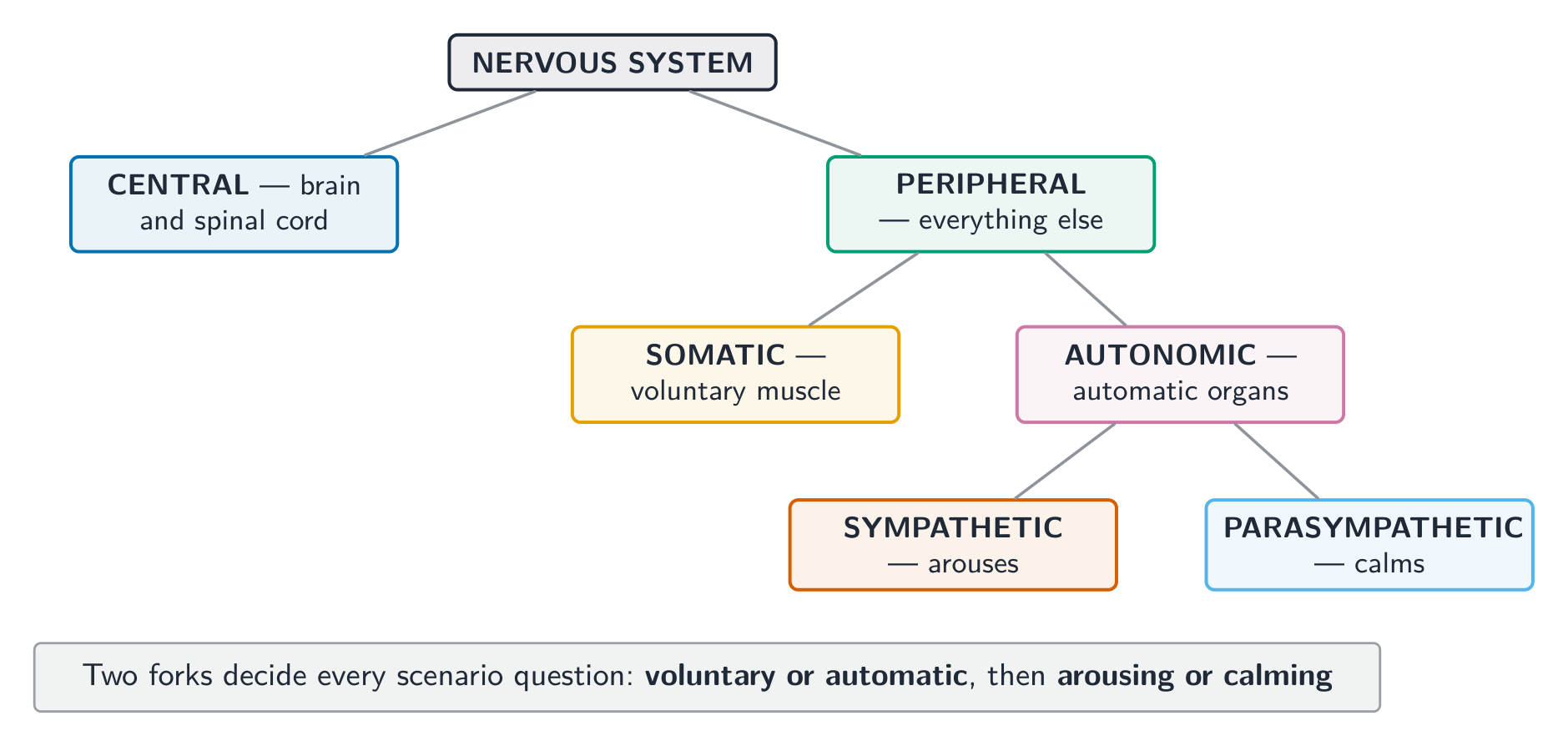
The nervous system 神经系统 carries information around the body. It has two main parts.
The central nervous system (CNS) 中枢神经系统 is the brain and the spinal cord 脊髓. It interacts with every process in the body.
The peripheral nervous system (PNS) 周围神经系统 relays messages between the CNS and the rest of the body. It divides again:
The somatic nervous system 躯体神经系统 controls voluntary 随意的 movement, such as raising your hand.
The autonomic nervous system 自主神经系统 controls involuntary 不随意的 processes, such as heartbeat and digestion. It has two branches that work against each other: the sympathetic nervous system 交感神经系统 prepares the body for action (the "fight or flight" response), and the parasympathetic nervous system 副交感神经系统 calms the body down afterwards.
العربية
يقوم الجهاز العصبي بنقل المعلومات في أنحاء الجسم. يتكون من جزأين رئيسيين.
يتكون الجهاز العصبي المركزي (CNS) من الدماغ والحبل الشوكي. ويتفاعل مع كل عملية في الجسم.
يقوم الجهاز العصبي المحيطي (PNS) بتوصيل الرسائل بين الجهاز العصبي المركزي وباقي أجزاء الجسم. وينقسم بدوره إلى:
يتحكم الجهاز العصبي الجسدي في الحركات الإرادية، مثل رفع يدك.
يتحكم الجهاز العصبي اللاإرادي في العمليات غير الإرادية، مثل ضربات القلب والهضم. وله فرعان يعملان ضد بعضهما: الجهاز العصبي السمبثاوي يُجهّز الجسم للعمل (استجابة "القتال أو الهروب")، والجهاز العصبي نظير السمبثاوي يُهدئ الجسم بعد ذلك.
Explore · استكشف
Place each function on the nervous-system tree · ضع كل دالة في شجرة الجهاز العصبي
Two forks decide every scenario question: voluntary or automatic, then arousing or calming. · فرعان يقرران كل سيناريو: إرادي أو تلقائي، ثم مثير أو مهدئ.
Neurons and How They Fire · الخلايا العصبية وكيفية عملها
Syllabus · المنهج
English
Learning Objective 1.3.A: Explain how the structures and functions of typical neurons in the central nervous system affect behavior and mental processes.
1.3.A.1 Two common types of neural cells in the brain are neurons (neural cells that transmit information) and glial cells (cells that provide structure, insulation, communication, and waste transport). These types of cells form the basis of the nervous system and are the building blocks of all behavior and mental processes.
1.3.A.2 In the spinal cord, the reflex arc demonstrates how neurons within the central and peripheral nervous systems work together to respond to stimuli. Three types of neurons work together in the spinal cord to create a reflex arc: sensory neurons, motor neurons, and interneurons.
Learning Objective 1.3.B: Explain how the basic process of neural transmission is related to behavior and mental processes.
1.3.B.1 The process of neural transmission most commonly occurs in an orderly, systematic way and involves the all-or-none principle, depolarization, refractory period, resting potential, reuptake, and threshold. Disruptions to this process could lead to disorders such as multiple sclerosis or myasthenia gravis.
Exclusion Statement: The sodium-potassium pump is outside the scope of the AP Psychology Exam.
1.3.B.2 Each neurotransmitter has specific function(s) related to behavior and mental processes, which may depend on the neurotransmitter’s location in the nervous system. Neurotransmitters generally communicate either excitatory (making an action potential more likely) or inhibitory (making an action potential less likely) messages. Neurotransmitters related to behavior and mental processes for study in AP Psychology are limited to dopamine, serotonin, norepinephrine, glutamate, GABA, endorphins, substance p, and acetylcholine.
Exclusion Statement: The AP Psychology Exam will only address the listed neurotransmitters in EK 1.3.B.2.
1.3.B.3 Outside of the nervous system, hormones perform actions similar to neurotransmitters. Hormones related to behavior and mental processes for study in AP Psychology are limited to adrenaline, leptin, ghrelin, melatonin, and oxytocin.
Exclusion Statement: The AP Psychology Exam will only address the listed hormones in EK 1.3.B.3.
Exclusion Statement: Specific information about the glands of the endocrine system (with the exception of the pituitary gland as referenced in EK 1.4.A.4) is outside the scope of the AP Psychology Exam.
Learning Objective 1.3.C: Explain how psychoactive drugs affect behavior and mental processes.
1.3.C.1 Psychoactive drugs can influence neurotransmitter function in various ways throughout the neural communication process. Some act as agonists which encourage neural firing. Some act as antagonists which discourage neural firing. Some act as reuptake inhibitors which block the reabsorption of neurotransmitters back into the cell.
1.3.C.2 Psychoactive drugs have psychological and physiological effects.
1.3.C.2.i Stimulants, such as caffeine and cocaine, typically cause increased neural activity.
1.3.C.2.ii Depressants, such as alcohol, typically cause decreased neural activity.
1.3.C.2.iii Hallucinogens, such as marijuana, typically cause distortions in perception and/or cognition.
1.3.C.2.iv Opioids, such as heroin, typically act as pain relievers.
1.3.C.3 Psychoactive drug use can lead to tolerance and/or addiction. Addiction can create significant withdrawal symptoms if the psychoactive drugs are no longer consumed.
العربية
الهدف التعليمي 1.3.A: شرح كيف تؤثر بنية ووظائف الخلايا العصبية النموذجية في الجهاز العصبي المركزي على السلوك والعمليات العقلية.
1.3.A.1 نوعان شائعان من الخلايا العصبية في الدماغ هما الخلايا العصبية (خلايا عصبية تنقل المعلومات) والخلايا الدبقية (خلايا توفر البنية والعزل والاتصال ونقل الفضلات). تشكل هذه الأنواع من الخلايا أساس الجهاز العصبي وهي اللبنات الأساسية لجميع السلوك والعمليات العقلية.
1.3.A.2 في الحبل الشوكي، يظهر القوس الانعكاسي كيف تعمل الخلايا العصبية داخل الجهاز العصبي المركزي والمحيطي معاً للاستجابة للمحفزات. ثلاثة أنواع من الخلايا العصبية تعمل معاً في الحبل الشوكي لإنشاء قوس انعكاسي: الخلايا العصبية الحسية، الخلايا العصبية الحركية، والخلايا العصبية الوسيطة.
الهدف التعليمي 1.3.B: شرح كيف يرتبط العملية الأساسية للإرسال العصبي بالسلوك والعمليات العقلية.
1.3.B.1 تحدث عملية الإرسال العصبي عادة بطريقة منظمة ومنهجية وتتضمن مبدأ الكل أو شيء واحد، والاستقطاب، والفترة الانكماشية، والجهد الساكن، وإعادة الامتصاص، والعتبة. قد تؤدي الاضطرابات في هذه العملية إلى اضطرابات مثل التصلب المتعدد أو الوهن العضلي الوبيل.
بيان الاستبعاد: مضخة الصوديوم-البوتاسيوم تقع خارج نطاق امتحان علم النفس AP.
1.3.B.2 لكل ناقل عصبي وظائف محددة تتعلق بالسلوك والعمليات العقلية، والتي قد تعتمد على موقع الناقل العصبي في الجهاز العصبي. تتواصل الناقلات العصبية بشكل عام إما برسائل مثيرة (تجعل جهد الفعل أكثر احتمالاً) أو مثبطة (تجعل جهد الفعل أقل احتمالاً). تقتصر الناقلات العصبية المتعلقة بالسلوك والعمليات العقلية للدراسة في علم النفس AP على الدوبامين، السيروتونين، نورإبينفرين، الجلوتامات، GABA، الإندورفين، المادة بي، والأسيتيل كولين.
بيان الاستبعاد: سيغطي امتحان علم النفس AP فقط الناقلات العصبية المدرجة في EK 1.3.B.2.
1.3.B.3 خارج الجهاز العصبي، تقوم الهرمونات بأفعال مشابهة للناقلات العصبية. تقتصر الهرمونات المتعلقة بالسلوك والعمليات العقلية للدراسة في علم النفس AP على الأدرينالين، اللبتين، الغريلين، الميلاتونين، والأوكسيتوسين.
بيان الاستبعاد: سيغطي امتحان علم النفس AP فقط الهرمونات المدرجة في EK 1.3.B.3.
بيان الاستبعاد: المعلومات المحددة عن غدد الجهاز الصماوي (باستثناء الغدة النخامية كما هو مرجع في EK 1.4.A.4) تقع خارج نطاق امتحان علم النفس AP.
هدف التعلم 1.3.C: اشرح كيف تؤثر العقاقير المحفزة نفسانيًا على السلوك والعمليات العقلية.
1.3.C.1 يمكن للعقاقير المحفزة نفسانيًا أن تؤثر على وظيفة النواقل العصبية بطرق مختلفة خلال عملية التواصل العصبي. بعضها يعمل كمنشطات تشجع على إطلاق الأعصاب. وبعضها يعمل كمضادات تثبط إطلاق الأعصاب. وبعضها يعمل كمثبطات لإعادة الامتصاص وتمنع إعادة امتصاص النواقل العصبية إلى الخلية.
1.3.C.2 للعقاقير المحفزة نفسانيًا آثار نفسية وفسيولوجية.
1.3.C.2.i المنشطات، مثل الكافيين والكوكايين، تسبب عادةً زيادة في النشاط العصبي.
1.3.C.2.ii المهدئات، مثل الكحول، تسبب عادةً انخفاضًا في النشاط العصبي.
1.3.C.2.iii المسببات للهلوسة، مثل الماريجوانا، تسبب عادةً تشوهات في الإدراك و/أو الإدراك المعرفي.
1.3.C.2.iv الأفيونات، مثل الهيروين، تعمل عادةً كمسكنات للألم.
1.3.C.3 يمكن أن يؤدي استخدام العقاقير المحفزة نفسانيًا إلى التحمل و/أو الإدمان. يمكن للإدمان أن يسبب أعراض انسحاب كبيرة إذا لم يعد يتم تناول العقاقير المحفزة نفسانيًا.
Source: College Board AP Course and Exam Description · المصدر: وصف دورة وامتحان College Board AP
English
Two kinds of cell do the work. Neurons 神经元 transmit information. Glial cells 神经胶质细胞 provide structure, insulation, communication, and waste transport. Together they are the building blocks of all behavior and mental processes.
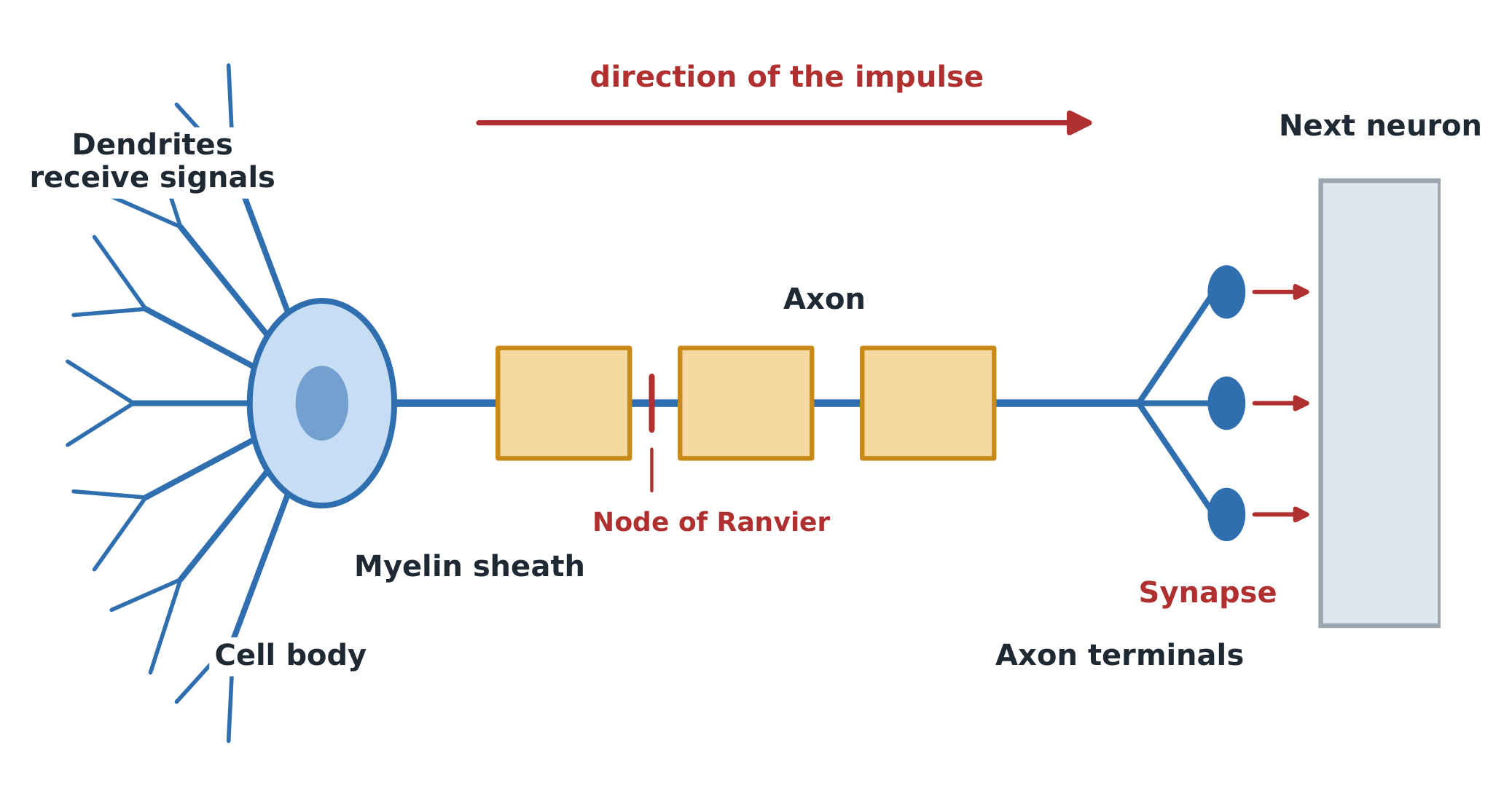
A neuron has dendrites 树突 that receive signals, a cell body 细胞体, and an axon 轴突 that carries the signal away. Many axons are wrapped in a myelin sheath 髓鞘, which speeds the signal up.
Neural transmission follows a set order:
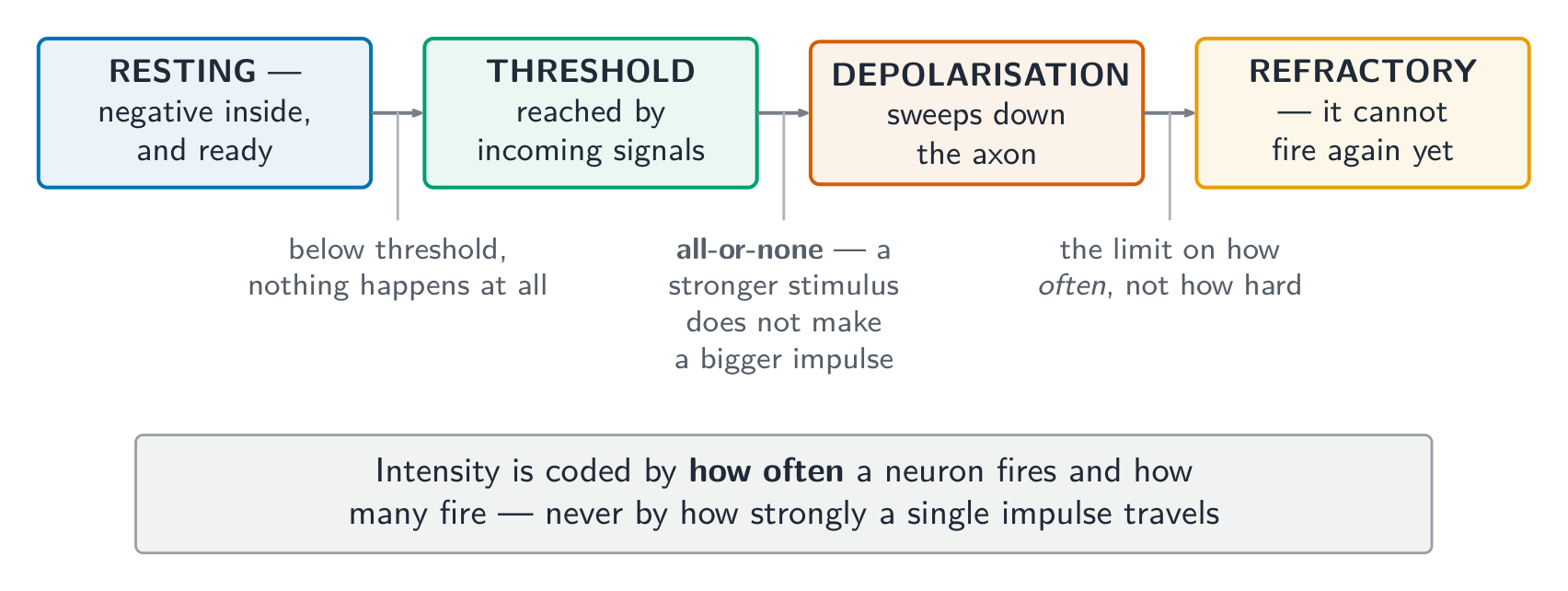
At rest the neuron holds a resting potential 静息电位, ready but not firing.
If incoming signals pass the threshold 阈限, the neuron depolarizes 去极化 and fires.
Firing follows the all-or-none principle 全或无原则: the neuron fires at full strength or not at all. A stronger stimulus makes it fire more often, not harder.
Straight after firing there is a refractory period 不应期 when the neuron cannot fire again.
At the synapse 突触, the gap between neurons, chemicals cross to the next cell. Leftover chemicals are taken back in a process called reuptake 再摄取.
Damage to this process can cause disorders such as multiple sclerosis 多发性硬化 or myasthenia gravis 重症肌无力.
In the spinal cord, the reflex arc 反射弧 shows the system working as a unit. Sensory neurons 感觉神经元 carry information in, interneurons 中间神经元 connect inside the cord, and motor neurons 运动神经元 carry the command out - all before the brain is involved.
العربية
تستقبل الخلية العصبية الإشارات عبر الدندریتات، وتنطلق السيالة عبر المحور، وتنقل الرسالة عبر المشابك
نوعان من الخلايا يؤديان هذا العمل. الخلايا العصبية تنقل المعلومات. أما الخلايا الداعمة (Glial cells) فتوفر الهيكل والعزل والاتصال ونقل الفضلات. معاً هما اللبنات الأساسية لكل سلوك وعمل ذهني.
الخلية العصبية لها أشواك شجرية تستقبل الإشارات، وجسم خلوي، ومحور عصبي ينقل الإشارة بعيدًا.许多轴突被髓鞘包裹,这能加速信号传输。
تتبع نقل السيالة العصبية ترتيباً محدداً:
في حالة الراحة، تحتفظ الخلية العصبية بـجهد راحة، تكون مستعدة لكنها لا تنطلق.
إذا تجاوزت الإشارات الواردة العتبة، تقوم الخلية العصبية بـاستقطاب وتنطلق.
تتبع الانطلاق مبدأ الكل أو لا شيء: تنطلق الخلية العصبية بقوتها الكاملة أو لا تنطلق أصلاً. المحفز الأقوى يجعلها تنطلق بشكل متكرر وليس بقوة أكبر.
مباشرة بعد الانطلاق يوجد فترة عدم الاستجابة التي لا تستطيع فيها الخلية العصبية الانطلاق مجدداً.
عند المشبك، وهو الفاصل بين الخلايا العصبية، تتقاطع المواد الكيميائية مع الخلية التالية. يتم إعادة امتصاص المواد الكيميائية الفائضة في عملية تُسمى إعادة الامتصاص.
يمكن أن يؤدي تلف هذه العملية إلى اضطرابات مثل التصلب المتعدد أو الشلل الوعائي العضلي (Myasthenia Gravis).
في الحبل الشوكي، يُظهر قوس الانعكاس عمل النظام كوحدة واحدة. تنقل الخلايا العصبية الحسية المعلومات إلى الداخل، وتربط الخلايا العصبية الوصلية (Interneurons) داخل الحبل، وتنقل الخلايا العصبية الحركية الأمر إلى الخارج - وذلك قبل involvement الدماغ.
Explore · استكشف
Fire a neuron, step by step · أطلق عصبونًا، خطوة بخطوة
All-or-none: a stronger stimulus does not make a bigger impulse. Intensity is coded by how often, and by how many. · القاعدة الكلي أو اللاشيء: المحفز الأقوى لا يجعل النبضة أكبر. الشدة تُشفَّر بالتواتر وعدد عدد.
Neurotransmitters, Hormones, and Drugs · النواقل العصبية، الهرمونات، والمخدرات
Syllabus · المنهج
English
Learning Objective 1.3.A: Explain how the structures and functions of typical neurons in the central nervous system affect behavior and mental processes.
1.3.A.1 Two common types of neural cells in the brain are neurons (neural cells that transmit information) and glial cells (cells that provide structure, insulation, communication, and waste transport). These types of cells form the basis of the nervous system and are the building blocks of all behavior and mental processes.
1.3.A.2 In the spinal cord, the reflex arc demonstrates how neurons within the central and peripheral nervous systems work together to respond to stimuli. Three types of neurons work together in the spinal cord to create a reflex arc: sensory neurons, motor neurons, and interneurons.
Learning Objective 1.3.B: Explain how the basic process of neural transmission is related to behavior and mental processes.
1.3.B.1 The process of neural transmission most commonly occurs in an orderly, systematic way and involves the all-or-none principle, depolarization, refractory period, resting potential, reuptake, and threshold. Disruptions to this process could lead to disorders such as multiple sclerosis or myasthenia gravis.
Exclusion Statement: The sodium-potassium pump is outside the scope of the AP Psychology Exam.
1.3.B.2 Each neurotransmitter has specific function(s) related to behavior and mental processes, which may depend on the neurotransmitter’s location in the nervous system. Neurotransmitters generally communicate either excitatory (making an action potential more likely) or inhibitory (making an action potential less likely) messages. Neurotransmitters related to behavior and mental processes for study in AP Psychology are limited to dopamine, serotonin, norepinephrine, glutamate, GABA, endorphins, substance p, and acetylcholine.
Exclusion Statement: The AP Psychology Exam will only address the listed neurotransmitters in EK 1.3.B.2.
1.3.B.3 Outside of the nervous system, hormones perform actions similar to neurotransmitters. Hormones related to behavior and mental processes for study in AP Psychology are limited to adrenaline, leptin, ghrelin, melatonin, and oxytocin.
Exclusion Statement: The AP Psychology Exam will only address the listed hormones in EK 1.3.B.3.
Exclusion Statement: Specific information about the glands of the endocrine system (with the exception of the pituitary gland as referenced in EK 1.4.A.4) is outside the scope of the AP Psychology Exam.
Learning Objective 1.3.C: Explain how psychoactive drugs affect behavior and mental processes.
1.3.C.1 Psychoactive drugs can influence neurotransmitter function in various ways throughout the neural communication process. Some act as agonists which encourage neural firing. Some act as antagonists which discourage neural firing. Some act as reuptake inhibitors which block the reabsorption of neurotransmitters back into the cell.
1.3.C.2 Psychoactive drugs have psychological and physiological effects.
1.3.C.2.i Stimulants, such as caffeine and cocaine, typically cause increased neural activity.
1.3.C.2.ii Depressants, such as alcohol, typically cause decreased neural activity.
1.3.C.2.iii Hallucinogens, such as marijuana, typically cause distortions in perception and/or cognition.
1.3.C.2.iv Opioids, such as heroin, typically act as pain relievers.
1.3.C.3 Psychoactive drug use can lead to tolerance and/or addiction. Addiction can create significant withdrawal symptoms if the psychoactive drugs are no longer consumed.
العربية
الهدف التعليمي 1.3.A: شرح كيف تؤثر بنية ووظائف الخلايا العصبية النموذجية في الجهاز العصبي المركزي على السلوك والعمليات العقلية.
1.3.A.1 نوعان شائعان من الخلايا العصبية في الدماغ هما الخلايا العصبية (خلايا عصبية تنقل المعلومات) والخلايا الدبقية (خلايا توفر البنية والعزل والاتصال ونقل الفضلات). تشكل هذه الأنواع من الخلايا أساس الجهاز العصبي وهي اللبنات الأساسية لجميع السلوك والعمليات العقلية.
1.3.A.2 في الحبل الشوكي، يظهر القوس الانعكاسي كيف تعمل الخلايا العصبية داخل الجهاز العصبي المركزي والمحيطي معاً للاستجابة للمحفزات. ثلاثة أنواع من الخلايا العصبية تعمل معاً في الحبل الشوكي لإنشاء قوس انعكاسي: الخلايا العصبية الحسية، الخلايا العصبية الحركية، والخلايا العصبية الوسيطة.
الهدف التعليمي 1.3.B: شرح كيف يرتبط العملية الأساسية للإرسال العصبي بالسلوك والعمليات العقلية.
1.3.B.1 تحدث عملية الإرسال العصبي عادة بطريقة منظمة ومنهجية وتتضمن مبدأ الكل أو شيء واحد، والاستقطاب، والفترة الانكماشية، والجهد الساكن، وإعادة الامتصاص، والعتبة. قد تؤدي الاضطرابات في هذه العملية إلى اضطرابات مثل التصلب المتعدد أو الوهن العضلي الوبيل.
بيان الاستبعاد: مضخة الصوديوم-البوتاسيوم تقع خارج نطاق امتحان علم النفس AP.
1.3.B.2 لكل ناقل عصبي وظائف محددة تتعلق بالسلوك والعمليات العقلية، والتي قد تعتمد على موقع الناقل العصبي في الجهاز العصبي. تتواصل الناقلات العصبية بشكل عام إما برسائل مثيرة (تجعل جهد الفعل أكثر احتمالاً) أو مثبطة (تجعل جهد الفعل أقل احتمالاً). تقتصر الناقلات العصبية المتعلقة بالسلوك والعمليات العقلية للدراسة في علم النفس AP على الدوبامين، السيروتونين، نورإبينفرين، الجلوتامات، GABA، الإندورفين، المادة بي، والأسيتيل كولين.
بيان الاستبعاد: سيغطي امتحان علم النفس AP فقط الناقلات العصبية المدرجة في EK 1.3.B.2.
1.3.B.3 خارج الجهاز العصبي، تقوم الهرمونات بأفعال مشابهة للناقلات العصبية. تقتصر الهرمونات المتعلقة بالسلوك والعمليات العقلية للدراسة في علم النفس AP على الأدرينالين، اللبتين، الغريلين، الميلاتونين، والأوكسيتوسين.
بيان الاستبعاد: سيغطي امتحان علم النفس AP فقط الهرمونات المدرجة في EK 1.3.B.3.
بيان الاستبعاد: المعلومات المحددة عن غدد الجهاز الصماوي (باستثناء الغدة النخامية كما هو مرجع في EK 1.4.A.4) تقع خارج نطاق امتحان علم النفس AP.
هدف التعلم 1.3.C: اشرح كيف تؤثر العقاقير المحفزة نفسانيًا على السلوك والعمليات العقلية.
1.3.C.1 يمكن للعقاقير المحفزة نفسانيًا أن تؤثر على وظيفة النواقل العصبية بطرق مختلفة خلال عملية التواصل العصبي. بعضها يعمل كمنشطات تشجع على إطلاق الأعصاب. وبعضها يعمل كمضادات تثبط إطلاق الأعصاب. وبعضها يعمل كمثبطات لإعادة الامتصاص وتمنع إعادة امتصاص النواقل العصبية إلى الخلية.
1.3.C.2 للعقاقير المحفزة نفسانيًا آثار نفسية وفسيولوجية.
1.3.C.2.i المنشطات، مثل الكافيين والكوكايين، تسبب عادةً زيادة في النشاط العصبي.
1.3.C.2.ii المهدئات، مثل الكحول، تسبب عادةً انخفاضًا في النشاط العصبي.
1.3.C.2.iii المسببات للهلوسة، مثل الماريجوانا، تسبب عادةً تشوهات في الإدراك و/أو الإدراك المعرفي.
1.3.C.2.iv الأفيونات، مثل الهيروين، تعمل عادةً كمسكنات للألم.
1.3.C.3 يمكن أن يؤدي استخدام العقاقير المحفزة نفسانيًا إلى التحمل و/أو الإدمان. يمكن للإدمان أن يسبب أعراض انسحاب كبيرة إذا لم يعد يتم تناول العقاقير المحفزة نفسانيًا.
Source: College Board AP Course and Exam Description · المصدر: وصف دورة وامتحان College Board AP
English
Neurotransmitters 神经递质 are the chemicals that cross the synapse. Each has its own job, and the effect can depend on where in the nervous system it acts. A message is either excitatory 兴奋性的 (making firing more likely) or inhibitory 抑制性的 (making firing less likely).
Only these are examinable: dopamine 多巴胺 (reward and movement), serotonin 血清素 (mood and sleep), norepinephrine 去甲肾上腺素 (alertness), glutamate 谷氨酸 (the main excitatory transmitter), GABA γ-氨基丁酸 (the main inhibitory transmitter), endorphins 内啡肽 (pain relief), substance P P物质 (pain signalling), and acetylcholine 乙酰胆碱 (muscle movement and memory).
Hormones 激素 act outside the nervous system but do a similar job, travelling more slowly through the blood. Again only five are examinable: adrenaline 肾上腺素, leptin 瘦素 (reduces hunger), ghrelin 胃饥饿素 (increases hunger), melatonin 褪黑素 (sleep), and oxytocin 催产素 (bonding).
Psychoactive drugs 精神药物 change behavior by acting on neurotransmission in three ways:
An agonist 激动剂 encourages neural firing.
An antagonist 拮抗剂 discourages it.
A reuptake inhibitor 再摄取抑制剂 blocks reabsorption, leaving more transmitter in the synapse.
Drug categories: stimulants 兴奋剂 (caffeine, cocaine) increase neural activity; depressants 抑制剂 (alcohol) decrease it; hallucinogens 致幻剂 (marijuana) distort perception; opioids 阿片类药物 (heroin) relieve pain. Repeated use can lead to tolerance 耐受性, where more is needed for the same effect, and to addiction 成瘾, with withdrawal 戒断反应 symptoms when use stops.
العربية
النواقل العصبية هي المواد الكيميائية التي تعبر المشابك. لكل منها وظيفة خاصة، وقد يعتمد تأثيرها على موقعها في الجهاز العصبي. الرسالة إما مثيرة (تزيد احتمالية الانطلاق) أو مُثبطة (تقلل احتمالية الانطلاق).
فقط هذه هي القابلة للاختبار: الدوبامين (المكافأة والحركة)، السيروتونين (المزاج والنوم)، النورإبينفرين (اليقظة)، الجلوتامات (النقل الرئيسي المثير)، GABA (النقل الرئيسي المثبط)، الإندورفينات (تسكين الألم)، المادة P (إشارة الألم)، وأسيتيل كولين (حركة العضلات والذاكرة).
تعمل الهرمونات خارج الجهاز العصبي ولكن بأداء مهمة مماثلة، حيث تسافر ببطء أكبر عبر الدم. مرة أخرى، فقط خمسة منها قابلة للاختبار: الأدرينالين، الليبتين (يقلل الشهية)، الجريلين (يزيد الشهية)، الميلاتونين (النوم)، والأوكسيتوسين (الترابط الاجتماعي).
المخدرات النفسية تغير السلوك عن طريق التأثير على النقل العصبي بثلاث طرق:
المناشِط (Agonist) يشجع الانطلاق العصبي.
المضاد (Antagonist) يعيقه.
مثبط إعادة الامتصاص (Reuptake inhibitor) يمنع إعادة الامتصاص، مما يترك المزيد من الناقل في المشبك.
فئات المخدرات: المُنشِّطات (الكافيين، الكوكايين) تزيد النشاط العصبي؛ المُهدِّئات (الكحول) تقلله؛ المُهلوسات (الماريجوانا) تشوه الإدراك؛ الأفيونات (الهروين) تخفف الألم. الاستخدام المتكرر قد يؤدي إلى التسامح، حيث تصبح الجرعة الأعلى مطلوبة لتحقيق نفس التأثير، وإلى الإدمان، مع أعراض انسحاب عند التوقف عن الاستخدام.
Learning Objective 1.4.A: Explain how the structures and functions of the brain apply to behavior and mental processes.
1.4.A.1 The brain stem (including the medulla) generally controls basic functioning such as breathing and heart rate.
1.4.A.2 The reticular activating system and the brain’s reward center generally control alertness, some voluntary movement, eye movement, and some types of learning, cognition, and emotion.
1.4.A.3 The cerebellum generally controls coordination of muscle movement, balance, and some forms of procedural learning.
1.4.A.4 The cerebral cortex is divided into two hemispheres and includes the limbic system (thalamus, hypothalamus, pituitary gland, hippocampus, amygdala), corpus callosum, and the lobes of the cortex.
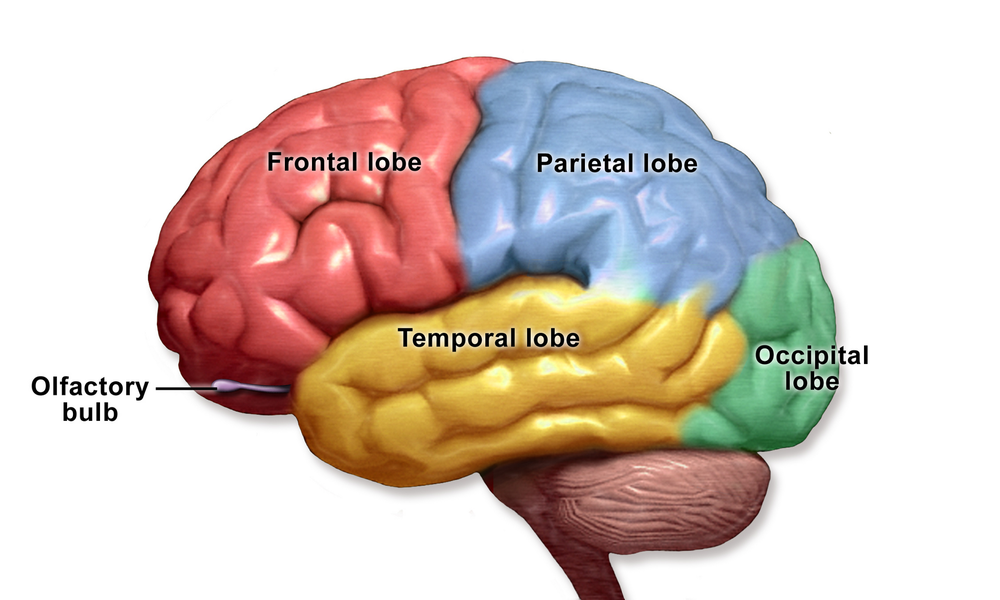
1.4.A.4.i The occipital lobes generally control visual information processing and are located in the rear of the brain.
1.4.A.4.ii The temporal lobes generally control auditory and linguistic processing and are located on the sides of the brain.
1.4.A.4.iii The parietal lobes generally control association areas, which process and organize information, and the somatosensory cortex, which processes touch sensitivity. These lobes are located near the back crown of the brain.
1.4.A.4.iv The frontal lobes, located just behind the forehead, generally control linguistic processing, higher-order thinking, and executive functioning, especially in the prefrontal cortex. The motor cortex is located at the rear of the frontal lobes and controls most types of skeletal movement.
1.4.A.5 Split brain research, achieved by severing the corpus callosum (often a treatment for severe epilepsy), reveals that the right and left hemispheres of the brain may specialize in different activities and functions.
1.4.A.5.i Areas of the brain that affect language are typically located in the left hemisphere and include Broca’s area (responsible for speech production) and Wernicke’s area (responsible for speech comprehension). Damage to these parts of the brain can lead to aphasia.
1.4.A.5.ii Researchers test for cortex specialization with split-brain patients by showing information in each visual field, taking advantage of the brain’s contralateral hemispheric organization.
1.4.A.6 Brain plasticity is the ability of the brain to rewire itself or modify or create new connections throughout development and generally allows for the function of a damaged part of the brain to be assumed by a different part of the brain.
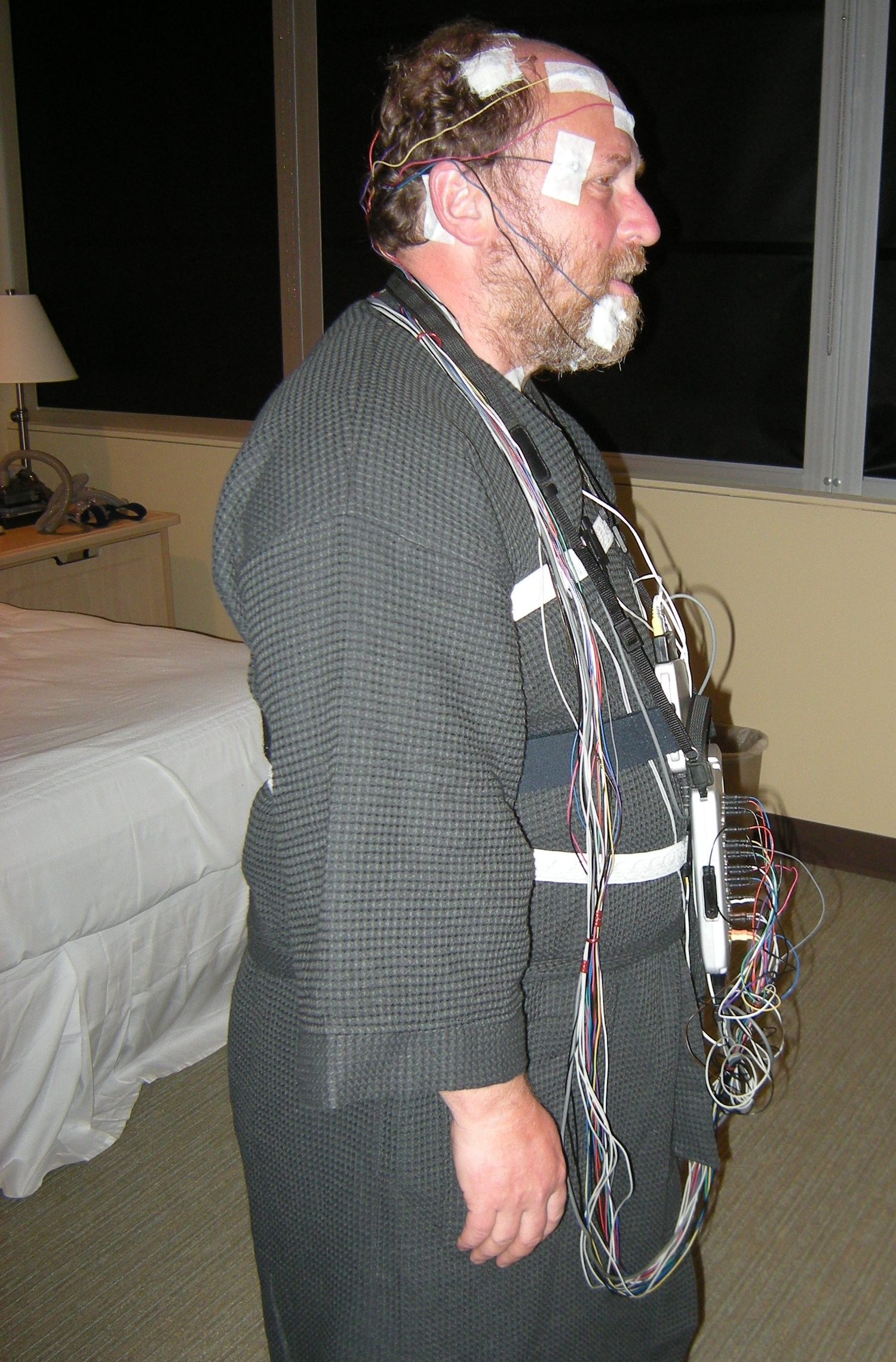
1.4.A.7 Research on the brain is done using scans (including EEG and fMRI), case studies, and surgical procedures (such as lesioning) to promote understanding of how the different structures of the brain work and how the brain functions together as a whole.
العربية
هدف التعلم 1.4.A: اشرح كيف تنطبق هياكل ووظائف الدماغ على السلوك والعمليات العقلية.
1.4.A.1 جذع الدماغ (بما في ذلك النخاع المستطيل) يدير بشكل عام الوظائف الأساسية مثل التنفس ومعدل ضربات القلب.
1.4.A.2 النظام الشبكي المنشط والمركز المكافئ للدماغ يديران بشكل عام اليقظة، وبعض الحركات الإرادية، وحركة العين، وأنواع معينة من التعلم والإدراك والعاطفة.
1.4.A.3 المخيخ يدير بشكل عام تنسيق حركة العضلات والتوازن وبعض أشكال التعلم الإجرائي.
1.4.A.4 القشرة المخية مقسمة إلى نصفين وتضم الجهاز الوتدي (المهاد، تحت المهاد، الغدة النخامية، الحصين، اللوزة)، الجسم الثفني، والفصوص القشرية.
1.4.A.4.i الفصوص القذالية تدير بشكل عام معالجة المعلومات البصرية وتقع في الجزء الخلفي من الدماغ.
1.4.A.4.ii الفصوص الصدغية تدير بشكل عام المعالجة السمعية واللغوية وتقع على جانبي الدماغ.
1.4.A.4.iii الفصوص الجدارية تدير بشكل عام مناطق الارتباط، التي تعالج وتنظم المعلومات، والقشرة الحسية الجسدية، التي تعالج حس اللمس. تقع هذه الفصوص بالقرب من تاج الدماغ الخلفي.
1.4.A.4.iv الفصوص الجبهية، الواقعة خلف الجبهة مباشرةً، تدير بشكل عام المعالجة اللغوية والتفكير عالي المستوى والوظائف التنفيذية، خاصة في القشرة الجبهية الأمامية. القشرة الحركية تقع في الجزء الخلفي من الفصوص الجبهية وتدير معظم أنواع الحركات الهيكلية.
1.4.A.5 تكشف أبحاث الدماغ المقسوم، التي تم تحقيقها عن طريق قطع الجسم الثفني (وهو علاج غالبًا لصرع التشنجات الشديد)، أن النصفي الأيمن والأيسر من الدماغ قد يتخصصان في أنشطة ووظائف مختلفة.
1.4.A.5.i مناطق الدماغ المؤثرة على اللغة تقع عادةً في نصف الكرة الأيسر وتشمل منطقة بروكا (المسؤولة عن إنتاج الكلام) ومنطقة فرنيك (المسؤولة عن فهم الكلام). يمكن أن يؤدي تلف هذه الأجزاء من الدماغ إلى العمى اللغوي.
1.4.A.5.ii يختبر الباحثون تخصص القشرة عند مرضى الدماغ المقسوم بعرض معلومات في كل مجال بصري، مستثمرين组织能力 التنظيم النصفي المتقابل للدماغ.
1.4.A.6 المرونة العصبية هي قدرة الدماغ على إعادة توصيل نفسه أو تعديل أو إنشاء اتصالات جديدة طوال فترة التطور، وتسمح بشكل عام بتولي parte أخرى من الدماغ وظيفة جزء تالف منه.
1.4.A.7 تُجرى أبحاث الدماغ باستخدام المسح الضوئي (بما في ذلك تخطيط كهربية الدماغ ووظائفه) والدراسات الحالة والإجراءات الجراحية (مثل استئصال الأنسجة) لتعزيز فهم كيفية عمل الهياكل المختلفة للدماغ وكيفية عمل الدماغ معًا كنظام متكامل.
Source: College Board AP Course and Exam Description · المصدر: وصف دورة وامتحان College Board AP
English
The brain is studied from the bottom up, because the lower structures handle the most basic jobs.
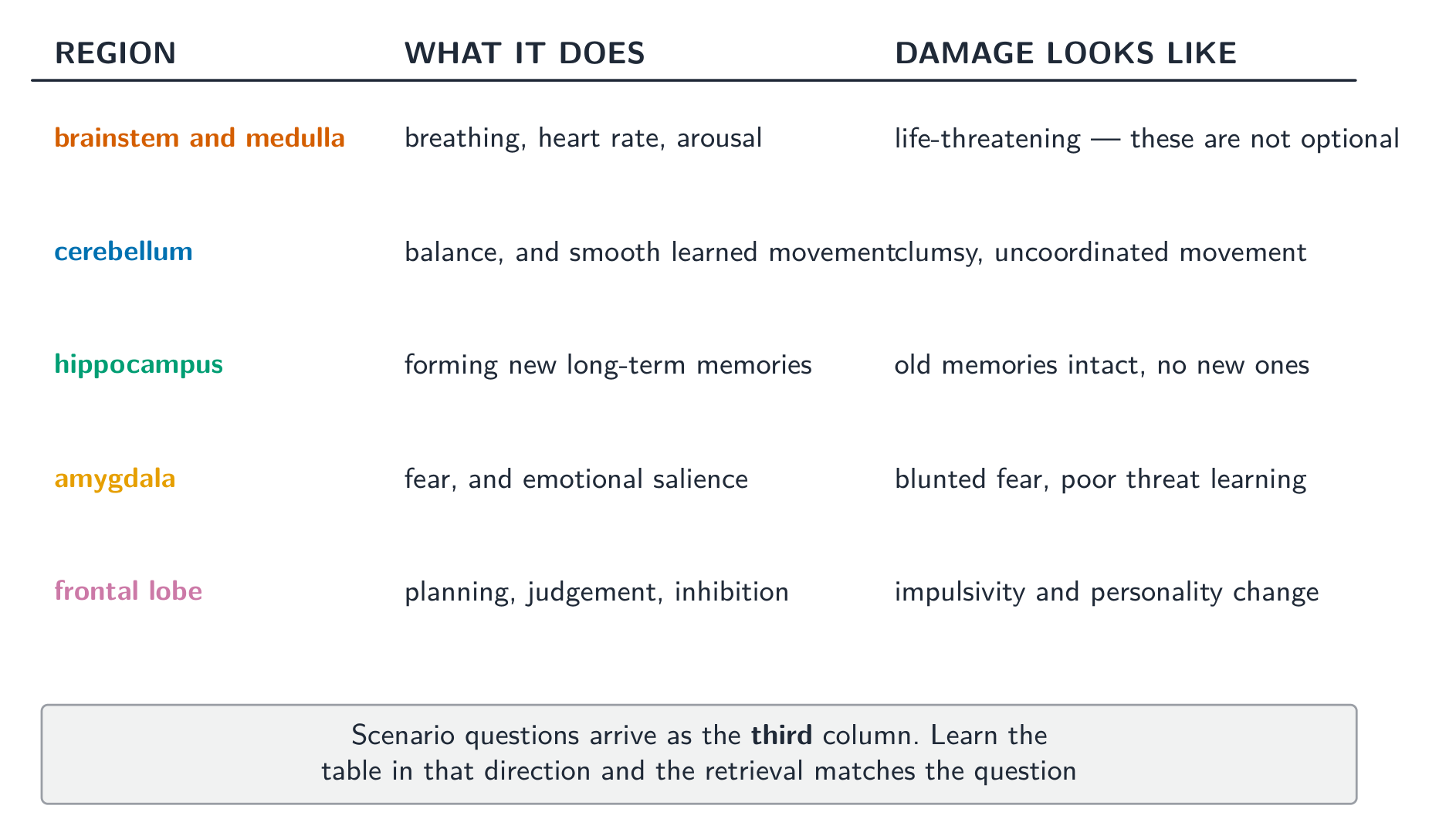
The brain stem 脑干, including the medulla 延髓, controls breathing and heart rate.
The reticular activating system 网状激活系统 controls alertness and arousal.
The cerebellum 小脑 controls coordination, balance, and some procedural learning 程序性学习.
The limbic system 边缘系统 sits inside the cerebral cortex and includes the thalamus 丘脑 (a relay station for the senses), the hypothalamus 下丘脑 (hunger, thirst, temperature), the pituitary gland 脑垂体, the hippocampus 海马体 (forming new memories), and the amygdala 杏仁核 (fear and emotion).
The cerebral cortex 大脑皮层 is divided into two hemispheres 半球 and four lobes: the occipital lobes 枕叶 process vision at the rear; the temporal lobes 颞叶 process hearing and language at the sides; the parietal lobes 顶叶 hold the somatosensory cortex 体感皮层 for touch; and the frontal lobes 额叶 handle higher-order thinking and executive function 执行功能.
Language sits mainly in the left hemisphere: Broca's area 布罗卡区 for speech production and Wernicke's area 韦尼克区 for comprehension.
Split-brain research 裂脑研究, done on patients whose corpus callosum 胼胝体 was cut to treat severe epilepsy, shows the two hemispheres can work independently. Researchers present information to one visual field 视野 at a time, because each field is processed by the opposite hemisphere.
Brain plasticity 大脑可塑性 is the brain's ability to rewire itself and form new connections, which supports recovery after damage. Research methods include EEG 脑电图 and fMRI 功能性磁共振成像 scans, case studies, and lesioning 损毁法.
العربية
يُدرس الدماغ من الأسفل إلى الأعلى، لأن الهياكل السفلية تتولى المهام الأكثر أساسية.
جذع الدماغ، بما في ذلك النخاع المستطيل، يتحكم في التنفس ومعدل ضربات القلب.
الجهاز الشبكي المنشط يتحكم في اليقظة والاستثارة.
المخيخ يتحكم في التنسيق والتوازن وبعض التعلم الإجرائي.
يقع الجهاز الحليمي داخل القشرة المخية ويشمل المهاد (محطة إعادة توجيه للحواس)، وتحت المهاد (الشهية والعطش ودرجة الحرارة)، والغدة النخامية، وال hippocampus (تشكيل ذكريات جديدة)، واللوزة (Amygdala) (الخوف والمشاعر).
تنقسم القشرة المخية إلى نصفين نصف كرة دماغية وأربعة فصوص: تعالج الفصوص القذالية الرؤية في الخلف؛ وتعالج الفصوص الصدغية السمع واللغة في الجانبين؛ وتحمل الفصوص الجداريةالقشرة الحسية الجسدية للمس؛ وتتعامل الفصوص الأمامية مع التفكير عالي المستوى والوظائف التنفيذية.
تتركز اللغة بشكل رئيسي في نصف الكرة المخي الأيسر: منطقة بروكا لإنتاج الكلام ومنطقة فرنيك للفهم.
أبحاث الفص المزدوج، التي أجريت على مرضى تم قطع الجسر الكالوسي لديهم لعلاج الصرع الشديد، تُظهر أن نصفي الكرة المخية يمكن أن يعملا بشكل مستقل. يقدم الباحثون المعلومات إلى مجال بصري واحد في كل مرة، لأن كل مجال يتم معالجته بواسطة نصف الكرة المخي المقابل.
المرونة العصبية هي قدرة الدماغ على إعادة توصيل نفسه وتشكيل روابط جديدة، مما يدعم التعافي بعد الإصابة. تشمل طرق البحث مسحات EEG وfMRI، والدراسات الحالة، وإحداث الآفات (Lesioning).
Explore · استكشف
Match each deficit to the region · طابق كل عجز مع المنطقة
Scenario questions arrive as a deficit, so learn the table in that direction. · تأتي أسئلة السيناريوهات كعجز، فاحفظ الجدول في هذا الاتجاه.
Learning Objective 1.5.A: Explain how the sleep/wake cycle affects behavior and mental processes throughout the day and night.
1.5.A.1 Consciousness has varying levels of awareness of thoughts, feelings, behavior, and events in individuals’ internal and external worlds. Sleep and wakefulness are two types of consciousness.
1.5.A.2 The sleep/wake cycle is a circadian rhythm, which in humans is about a 24-hour cycle. Jet lag and shift work are disruptions of the circadian rhythm.
1.5.A.3 The stages of sleep are identified by their specific EEG patterns.
1.5.A.3 .i NREM sleep occurs in Stages 1 through 3 and decreases in duration throughout the cycle. Hypnagogic sensations occur as one enters Initial Stage 1 sleep.
1.5.A.3 .ii REM sleep is considered paradoxical because it produces waves similar to wakefulness, but the body is at its most relaxed. Dreaming typically occurs in REM sleep. The frequency of REM sleep typically increases as the cycle progresses. When deprived of REM sleep, REM rebound can occur.
1.5.A.4 Theories regarding the structure and function of dreams include activation-synthesis and consolidation theory.
Exclusion Statement: The psychoanalytic theory of dreams is outside of the scope of the AP Psychology Exam.
1.5.A.5 Memory consolidation and restoration are current theories about why sleep occurs. These theories suggest that sleep is useful for organizing and consolidating memories or restoring depleted resources used throughout a given day.
1.5.A.6 Many disorders interrupt healthy sleep, and their effects on waking behavior and health vary. Sleep disruptions can affect physical and cognitive performance during wakefulness. Treating sleep disorders and following regular schedules for sleeping can improve waking performance and overall well-being. Disorders commonly studied in introductory psychology include insomnia, narcolepsy, REM sleep behavior disorder, sleep apnea, and somnambulism.
Exclusion Statement: The AP Psychology Exam will only address the listed disorders in EK 1.5.A.6.
العربية
هدف التعلم 1.5.A: اشرح كيف يؤثر دورة النوم والاستيقاظ على السلوك والعمليات العقلية طوال اليوم والليل.
1.5.A.1 الوعي له مستويات متفاوتة من إدراك الأفكار والمشاعر والسلوك والأحداث في العوالم الداخلية والخارجية للأفراد. النوم والاستيقاظ هما نوعان من أنواع الوعي.
1.5.A.2 دورة النوم والاستيقاظ هي إيقاع يومي، وهو في البشر حوالي دورة مدتها 24 ساعة. ضربة الوقت وعمل الورديات هي اضطرابات في الإيقاع اليومي.
1.5.A.3 تُعرف مراحل النوم بأنماط تخطيط كهربية الدماغ الخاصة بها.
1.5.A.3 .i يحدث نوم غير REM في المراحل 1 إلى 3 ويقل طوله خلال الدورة. تحدث الإحساسات الهيبناغوجية أثناء الدخول في المرحلة 1 الأولية للنوم.
1.5.A.3 .ii يُعتبر نوم REM متناقضًا لأنه ينتج موجات مشابهة للاستيقاظ، لكن الجسم يكون في حالة استرخاء قصوى. يحدث الحلم عادةً في نوم REM. تزداد تكرارية نوم REM عادةً كلما تقدمت الدورة. عند الحرمان من نوم REM، يمكن حدوث ارتداد نوم REM.
1.5.A.4 تشمل النظريات المتعلقة بهيكل ووظيفة الأحلام نظرية تنشيط-تركيب ونظرية التماسك.
بيان الاستبعاد: النظرية التحليلية لأحلام خارج نطاق امتحان علم النفس AP.
1.5.A.5 التماسك الاسترجاعي والاستعادة هي نظريات حالية حول سبب حدوث النوم. تشير هذه النظريات إلى أن النوم مفيد لتنظيم وتثبيت الذكريات أو استعادة الموارد المنهكة المستخدمة خلال يوم معين.
Source: College Board AP Course and Exam Description · المصدر: وصف دورة وامتحان College Board AP
English
Consciousness 意识 is awareness of internal and external events, and it varies in level.
The sleep/wake cycle is a circadian rhythm 昼夜节律 of about 24 hours. Jet lag 时差反应 and shift work disrupt it.
Sleep stages are identified by EEG patterns. NREM sleep 非快速眼动睡眠 covers stages 1 to 3; hypnagogic sensations 入睡幻觉 occur as you fall asleep. REM sleep 快速眼动睡眠 is called paradoxical sleep 异相睡眠 because the brain looks awake while the body is most relaxed, and most dreaming happens here.
Two examinable theories explain dreams: activation-synthesis theory 激活-综合理论 (the brain interprets random activity) and consolidation theory 巩固理论 (dreams reflect memory processing). Sleep itself is explained by memory consolidation 记忆巩固 and restoration 恢复 theories.
Note: the psychoanalytic theory of dreams is outside the exam's scope.
Sleep disorders disrupt waking behavior and health: insomnia 失眠, narcolepsy 发作性睡病, sleep apnea 睡眠呼吸暂停, somnambulism 梦游 (sleepwalking), and REM sleep behavior disorder 快速眼动睡眠行为障碍.
العربية
الوعي هو إدراك الأحداث الداخلية والخارجية، ويتفاوت مستواه.
دورة النوم والاستيقاظ هي إيقاع يومي مدته حوالي 24 ساعة. يُخلّ بالهذه الدورة بسبب اضطراب التوقيت الزمني (Jet lag) والعمل بنظام الورديات.
تُحدد مراحل النوم من خلال أنماط EEG. يغطي النوم غير Rapid Eye Movement (NREM) المراحل من 1 إلى 3؛ وتحدث الإحساسات الهيبناغوجية أثناء السقوط في النوم. يُسمى نوم Rapid Eye Movement (REM) بـالنوم المتناقض لأن الدماغ يبدو مستيقظاً بينما يكون الجسم في أقصى درجات الاسترخاء، ويحدث معظم الأحلام هنا.
نظريتان قابلتان للامتحان تشرحان الأحلام: نظرية التنشيط-التكوين (يدرس الدماغ نشاطاً عشوائياً) ونظرية التثبيت (تعكس الأحلام معالجة الذاكرة). أما النوم نفسه فيفسره نظريتا تثبيت الذاكرة والاستعادة.
ملاحظة: النظرية التحليلية للنواقل لا تندرج ضمن نطاق الامتحان.
اضطرابات النوم تعطل السلوك الصحي عند الاستيقاظ: الأرق، النعاس الغثائي (narcolepsy)، انقطاع التنفس أثناء النوم، المشي أثناء النوم (somnambulism)، واضطراب سلوك نوم REM.
Learning Objective 1.6.A: Explain how the process of sensation is related to behavior and mental processes.
1.6.A.1 Sensation is the process of detecting information from the environment that meets a certain threshold and transducing stimuli into neurochemical messages for processing (perception) in the brain. The absolute threshold occurs when a stimulus can be detected at least 50% of the time.
1.6.A.2 Detection of change in stimuli or diminished sensitivity to stimuli can be explained by the just-noticeable difference and sensory adaptation. Weber’s law describes the degree to which stimuli need to be different for the difference to be detected.
1.6.A.3 The sensory systems constantly work together in a process called sensory interaction. Synesthesia is an experience of sensation in which one system of sensation is experienced through another.
Learning Objective 1.6.B: Explain how the structures and functions of the visual sensory system relate to behavior and mental processes.
1.6.B.1 The retina is the photosensitive surface at the back of the eye. Cells in the retina capture visual information that is transduced to the brain for processing. Evidence of incomplete images captured by the retina is demonstrated by the presence of the blind spot, where the visual nerve exits the eye. The brain fills in the gaps in the incomplete retinal images to perceive a relatively complete picture of the world.
1.6.B.2 Visual stimuli are focused onto the retina by the lens via a process called accommodation. When this process is altered, nearsightedness or farsightedness can result.
1.6.B.3 Cells that lie in the periphery of the eye and detect shapes and movement, but not color, are called rods. These cells are mainly activated in low-light environments. These cells play a role in light and dark adaptation.
1.6.B.4 Color vision is explained by both the trichromatic theory and the opponent-process theory.
1.6.B.4.i Photoreceptor cells located in the fovea of the eye that process color and detail are called cones. Researchers have identified blue (detecting short wavelengths), green (detecting medium wavelengths) and red (detecting long wavelengths) cones in the retina.
1.6.B.4.ii Afterimages result when certain ganglion cells in the retina are activated while others are not. The ganglion cells involved in this opponent process are red/green, blue/ yellow/ and black/white.
1.6.B.4.iii Color vision deficiency involves damage or irregularities to one or more cones or ganglion cells (red/green, blue/ yellow). Color vision deficiency includes dichromatism or monochromatism.
1.6.B.5 Damage to parts of the brain responsible for vision (mainly the occipital lobes) can result in disorders such as prosopagnosia (face blindness) and blindsight.
Learning Objective 1.6.C: Explain how the structures and functions of the auditory sensory system relate to behavior and mental processes.
1.6.C.1 Sound occurs through the movement of air molecules at different wavelengths (called pitch) and amplitudes (called loudness).
1.6.C.2 Theories that help explain pitch perception include place theory, volley theory, and frequency theory.
1.6.C.3 Sound localization describes how we identify where sounds in our environment are coming from.
1.6.C.4 Hearing difficulties can result from aging and various kinds of damage to auditory structures. Types of hearing loss include conduction deafness and sensorineural deafness.
Learning Objective 1.6.D: Explain how the structures and functions of the chemical sensory systems relate to behavior and mental processes.
1.6.D.1 Structures in the nose and brain process and/ or transduce olfactory stimuli. Smell is the only sense not processed first in the thalamus of the brain. Pheromones produce chemical messages for the olfactory system.
1.6.D.2 Gustation is the sense of taste, and types of tastes include sweet, sour, salty, bitter, umami, and oleogustus.
1.6.D.3 Structures in the tongue, mouth, and brain process and/or transduce basic tastes. The number of taste receptors on the tongue is related to how sensitive people are to tastes, classifying them as supertasters, medium tasters, or nontasters.
1.6.D.4 The chemical senses interact to create the sensation of taste. Without the sense of smell, taste sensations are either muted or not experienced.
Learning Objective 1.6.E: Explain how the structures and functions of the touch sensory system relate to behavior and mental processes.
1.6.E.1 Structures within the skin and brain process and/or transduce touch stimuli. The sensation of “hot” is produced by the activation of warm and cold receptors in the skin.
Learning Objective 1.6.F: Explain how the structures and functions of the pain sensory system relate to behavior and mental processes.
1.6.F.1 Pain is processed both in the body and in the brain. Gate control theory is one attempt to describe the complexities of pain. Phantom limb sensation occurs when people who have lost limbs report sensation or pain where the limb used to be.
Learning Objective 1.6.G: Explain how the structures and functions that maintain balance (vestibular) and body movement (kinesthetic) relate to behavior and mental processes.
1.6.G.1 The vestibular sense controls balance and is primarily detected by the semicircular canals and structures in the brain.
1.6.G.2 Kinesthesis the sense of one’s body movement. Kinesthesis allows the body to move in coordinated ways without having to look at the various parts of the body as it moves.
1.6.F.1 تُعالج الآلام في كل من الجسم والدماغ. تُعد نظرية بوابة التحكم في الألم محاولة لوصف تعقيدات الألم. تحدث إحساس الطرف الوهمي عندما يُبلّغ الأشخاص الذين فقدوا أطرافهم بإحساس أو ألم في المكان الذي كان يوجد فيه الطرف سابقًا.
الهدف التعليمي 1.6.G: اشرح كيف ترتبط الهياكل والوظائف التي تحافظ على التوازن (الدهليزي) وحركة الجسم (الحركية الحسية) بالسلوك والعمليات العقلية.
1.6.G.1 يتحكم الإحساس الدهليزي بالتوازن ويتم الكشف عنه بشكل أساسي عبر القنوات شبه الدائرية والهياكل الموجودة في الدماغ.
1.6.G.2 الحركة الحسية هي إحساس بحركة جسمك. تُمكّن الحركة الحسية الجسم من التحرك بطريقة متناسقة دون الحاجة إلى النظر إلى أجزاء الجسم المختلفة أثناء حركته.
Source: College Board AP Course and Exam Description · المصدر: وصف دورة وامتحان College Board AP
English
Sensation 感觉 is detecting information from the environment and transducing 转导 it into neural signals the brain can use. Detection needs a certain absolute threshold 绝对阈限.
The just-noticeable difference 最小可觉差 is the smallest change a person can detect.
Sensory adaptation 感觉适应 is reduced sensitivity to an unchanging stimulus - you stop noticing a smell.
Sensory interaction 感觉相互作用 means the senses work together. Synesthesia 联觉 is when one sense triggers another.
Vision. Light is focused onto the retina 视网膜 by the lens 晶状体 changing shape, a process called visual accommodation 视觉调节; when this fails the result is nearsightedness 近视 or farsightedness 远视. Rods 视杆细胞 lie in the periphery and detect shape and movement in low light. Cones 视锥细胞 sit in the fovea 中央凹 and detect colour and detail. Colour vision needs two theories: trichromatic theory 三色理论 (blue, green and red cones) and opponent-process theory 对立过程理论, which explains afterimages 后像. Damage to the occipital lobes can cause prosopagnosia 面孔失认症, or face blindness.
Hearing. Sound is air movement; wavelength gives pitch 音高 and amplitude gives loudness 响度. Pitch perception is explained by place theory 位置理论, volley theory 齐射理论, and frequency theory 频率理论. Sound localization 声源定位 tells us where a sound comes from. Hearing loss may be conduction deafness 传导性耳聋 or sensorineural deafness 感音神经性耳聋.
The chemical senses.Olfaction 嗅觉 is the only sense not relayed first through the thalamus. Gustation 味觉 covers sweet, sour, salty, bitter, umami 鲜味, and oleogustus 脂味. The two interact: without smell, taste is muted.
Touch, pain, and body position. Skin receptors transduce touch; "hot" comes from warm and cold receptors firing together. Pain is processed in body and brain, and gate control theory 闸门控制理论 explains why attention changes how much it hurts; phantom limb 幻肢 sensations show the brain's role. The vestibular sense 前庭觉 controls balance through the semicircular canals 半规管, and kinesthesis 动觉 is the sense of body movement.
Worked example (a real AP exam question). The 2025 Article Analysis Question asked students to "Identify the research method used in the study" and then to "Explain the extent to which the research findings may or may not be generalizable using specific and relevant evidence from the study." A full-mark answer to the second part names the limitation and ties it to evidence: "The findings may not generalize widely because participants were undergraduate students at one university, so the sample was not representative of the general population." Notice the shape: Explain needs a claim plus the evidence behind it. Naming the method alone answers part A, not part E.
العربية
الإحساس هو اكتشاف معلومات من البيئة وتحويلها (transducing) إلى إشارات عصبية يستطيع الدماغ استخدامها. يتطلب الاكتشاف وجود عتبة مطلقة معينة.
الفرق الأدنى الملاحظ (just-noticeable difference) هو أصغر تغيير يمكن للشخص اكتشافه.
التكيف الحسي هو انخفاض الحساسية تجاه محفز ثابت - تتوقف عن ملاحظة رائحة ما.
التفاعل الحسي يعني عمل الحواس معاً. الترافذ (Synesthesia) يحدث عندما يحفز حس واحد حساً آخر.
البصر. يتم تركيز الضوء على الشبكية بواسطة العدسة التي تتغير شكلها، وهي عملية تسمى التكيف البصري (visual accommodation)؛ عند فشل هذه العملية تكون النتيجة قصر النظر أو طول النظر. تقع العصي (Rods) في المحيط وتكتشف الشكل والحركة في الإضاءة المنخفضة. توجد الأconi (Cones) في البقعة الصفراء (fovea) وتكتشف اللون والتفاصيل. يتطلب البصر اللوني نظريتين: النظرية ثلاثية الألوان (أconi زرقاء وخضراء وحمراء) ونظرية المعالجة المتعارضة (opponent-process theory)، التي تفسر الصور المتبقية (afterimages). قد يؤدي تلف الفصوص القذالية إلى عمى الوجوه (prosopagnosia).
السمع. الصوت هو حركة الهواء؛ يعطي الطول الموجي التردد (pitch) والسعة الضجيج (loudness). يُفسر إدراك التردد عبر نظرية المكان (place theory)، ونظرية الرزم (volley theory)، ونظرية التردد (frequency theory). تحديد مصدر الصوت (Sound localization) يخبرنا بمكان صدور الصوت. قد يكون فقدان السمع صمم نقل (conduction deafness) أو صمم عصبي حسي (sensorineural deafness).
الحواس الكيميائية.الشم (Olfaction) هو الحس الوحيد الذي لا يُرسل أولاً عبر النخاع المستطيل. التذوق (Gustation) يشمل الحلو والمالح والمُر واللاذع والأومامي (umami) والدهني (oleogustus). يتفاعل هذان الحسان: بدون الشم، يكون التذوق مكتوماً.
اللمس والألم وموضع الجسم. تقوم مستقبلات الجلد بتحويل اللمس؛ يأتي شعور "الحر" من اشتعال المستقبلات الدافئة والباردة معاً. يُعالج الألم في الجسم والدماغ، وتفسر نظرية بوابة التحكم (gate control theory) لماذا يغير الانتباه مقدار الألم؛ وتُظهر إحساسات الطرف الوهمي (phantom limb) دور الدماغ. يتحكم الحس الدهليزي (vestibular sense) في التوازن عبر القنوات شبه الدائرية، والإحساس الحركي (kinesthesis) هو حرك جسم الحركة.
مثال محلول (سؤال حقيقي من امتحان AP). سأل سؤال تحليل المقال لعام 2025 الطلاب "تحديد طريقة البحث المستخدمة في الدراسة" ثم "شرح مدى قابلية نتائج البحث للتعميم أو عدم قابليتها باستخدام أدلة محددة ذات صلة من الدراسة.". الإجابة الكاملة الدرجة للجزء الثاني تذكر القيود وترابطها بالأدلة: "قد لا تتعمم النتائج على نطاق واسع لأن المشاركين كانوا طلاب جامعيين في جامعة واحدة، لذا لم يكن العينة ممثلة للسكان العامين." لاحظ البنية: شرح (Explain) يتطلب ادعاءً بالإضافة إلى الأدلة التي تدعمه. ذكر الطريقة فقط يجيب عن الجزء A، وليس الجزء E.
Learn only the listed neurotransmitters and hormones; the exam will not ask about others, and the endocrine glands are out of scope apart from the pituitary.
Keep sensation separate from perception: sensation is detecting and transducing, perception is interpreting (Unit 2).
The all-or-none principle means intensity is coded by how often a neuron fires, never by how strongly.
Match structure to job before you write: hippocampus forms memories, amygdala handles fear, cerebellum coordinates movement.
Sympathetic arouses, parasympathetic calms. If a question describes a racing heart, name the sympathetic branch.
Say what a scan can and cannot show. fMRI shows activity over time; EEG shows electrical patterns and identifies sleep stages.
العربية
احفظ فقط الناقلات العصبية (neurotransmitters) والهرمونات (hormones) المدرجة؛ لن يسأل الامتحان عن غيرها، والغدد الصماء خارج النطاق باستثناء الغدة النخامية.
افصل بين الإحساس (sensation) والإدراك: الإحساس هو الكشف والتحويل، والإدراك هو التفسير (الوحدة 2).
مبدأ الكل أو اللا شيء (all-or-none principle) يعني أن الشدة تُرمز عبر مدى تكرار إطلاق العصبون، ولا أبداً حسب شدة الإطلاق.
طابق البنية بالوظيفة قبل الكتابة: الحصين يكوّن الذكريات، واللوزة تعالج الخوف، والمخيخ ينسق الحركة.
السمبثاوي (Sympathetic) يثير، والباراسمبثاوي (parasympathetic) يطمئن. إذا وصف سؤال ضربات قلب سريعة، فسمِّ الفرع السمبثاوي.
قل ما يمكن وما لا يمكن للمسح أن يظهره. تُظهر fMRI النشاط بمرور الوقت؛ وتُظهر EEG الأنماط الكهربائية وتحدد مراحل النوم.
Learning Objective 2.1.A: Explain how internal and external factors influence perception.
2.1.A.1 Perception is influenced by whether one primarily relies on external sensory information (bottom-up processing) or internal prior expectations (top-down processing).
2.1.A.2 Schemas and perceptual sets are internal factors that filter perceptions of the world.
2.1.A.3 Contexts, experiences, and cultural experiences and expectations are external factors that filter perceptions of the world.
2.1.A.4 Perceptual principles proposed by Gestalt psychology (closure, figure and ground, proximity, and similarity) help explain how humans organize their perceptual world.
2.1.A.5 Attention is an interaction of sensation and perception that is affected by internal and external processes.
2.1.A.5.i Some experiences of attention can be selective, such as with the cocktail party effect, where people attend to mentions of their names or specific topics in loud or distracting environments.
2.1.A.5.ii Inattention can lead to a type of “blindness” to aspects of the environment. Change blindness occurs when changes to the environment are not perceived due to inattention.
Learning Objective 2.1.B: Explain how visual perceptual processes produce correct or incorrect interpretations of stimuli.
2.1.B.1 Binocular depth cues of retinal disparity (the difference between the images projecting onto the retina) and convergence (the merging of the retinal images by the brain) utilize images from each eye to provide perception of depth.
2.1.B.2 Monocular depth cues (relative clarity, relative size, texture gradient, linear perspective, and interposition) give the illusion of depth on flat or two-dimensional surfaces.
Exclusion Statement: The AP Psychology Exam will only address the listed monocular depth cues in EK 2.1.B.2.
2.1.B.3 Visual perceptual constancies maintain the perception of an object even when the images of the object in the visual field change.
2.1.B.4 Apparent movement can be visually perceived even when objects are not actually moving.
العربية
الهدف التعليمي 2.1.A: اشرح كيف تؤثر العوامل الداخلية والخارجية على الإدراك.
2.1.A.1 يتأثر الإدراك بما إذا كان الشخص يعتمد أساسًا على المعلومات الحسية الخارجية (المعالجة من الأسفل للأعلى) أو التوقعات السابقة الداخلية (المعالجة من الأعلى للأسفل).
2.1.A.2 النماذج الذهنية ومجموعات الإدراك هي عوامل داخلية تصفي إدراك العالم.
2.1.A.3 السياقات والتجارب والتجارب الثقافية والتوقعات هي عوامل خارجية تصفي إدراك العالم.
2.1.A.4 تساعد مبادئ الإدراك المقترحة من قبل علم النفس الجسالت (الإغلاق، الشكل والخلفية، القرب، والتشابه) في شرح كيفية تنظيم البشر لعالمهم الإدراكي.
2.1.A.5 الانتباه هو تفاعل بين الإحساس والإدراك يتأثر بالعمليات الداخلية والخارجية.
2.1.A.5.i يمكن أن تكون بعض تجارب الانتباه انتقائية، مثل تأثير حفلة الكوكتيل، حيث يركز الأشخاص على ذكر أسمائهم أو مواضيع محددة في بيئات صاخبة أو مشتتة للأنظار.
2.1.A.5.ii يمكن أن يؤدي عدم الانتباه إلى نوع من "العمى" تجاه جوانب البيئة. يحدث العمى للتغيير عندما لا تُدرَك التغييرات في البيئة بسبب عدم الانتباه.
الهدف التعليمي 2.1.B: اشرح كيف تنتج العمليات الإدراكية البصرية تفسيرات صحيحة أو خاطئة للمثيرات.
2.1.B.1 إشارات عمق ثنائية العينين، وهي التباين الشبكي (الفرق بين الصور الممشطة على الشبكية) والتقارب (اندماج الصور الشبكية بواسطة الدماغ)، تستخدم صورًا من كل عين لتقديم إدراك للعمق.
2.1.B.2 إشارات عمق أحادية العين (الوضوح النسبي، الحجم النسبي، تدرج الملمس، المنظور الخطي، والتداخل) تعطي وهمًا بالعمق على الأسطح المسطحة أو ثنائية الأبعاد.
عبارة الاستبعاد: لن يتناول امتحان علم النفس AP سوى إشارات عمق أحادية العين المدرجة في EK 2.1.B.2.
2.1.B.3 ثوابت الإدراك البصري تحافظ على إدراك الجسم حتى عندما تتغير صور الجسم في المجال البصري.
2.1.B.4 يمكن إدراك الحركة الظاهرية بصريًا حتى عندما لا تتحرك الأجسام فعليًا.
Source: College Board AP Course and Exam Description · المصدر: وصف دورة وامتحان College Board AP
English
Unit 1 ended with sensation, the detection of a stimulus. Perception 知觉 is what the brain does next: it organises and interprets that information. The same signal can be perceived in more than one way.
Two directions of processing work together:
Bottom-up processing 自下而上加工 starts from the raw sensory information and builds upwards.
Top-down processing 自上而下加工 starts from what you already expect and know.
Internal filters shape perception. A schema 图式 is a mental framework built from past experience. A perceptual set 知觉定势 is a readiness to see something in a particular way. External filters matter too: context 情境 and cultural expectations change what people report seeing.
Gestalt psychology 格式塔心理学 described how the brain groups parts into wholes: closure 闭合 (filling in gaps), figure and ground 图形与背景 (separating an object from its background), proximity 邻近性 (grouping things that are close), and similarity 相似性 (grouping things that look alike).
Attention 注意 sits between sensation and perception. It is limited, so some information is lost:
Selective attention 选择性注意 focuses on one input. The cocktail party effect 鸡尾酒会效应 is hearing your own name across a noisy room.
Inattentional blindness 无意视盲 is failing to see something visible because attention was elsewhere; change blindness 变化盲视 is failing to notice that something has changed.
العربية
انتهت الوحدة 1 بـالإحساس (sensation)، وهو كشف المحفز. الإدراك (Perception) هو ما يفعله الدماغ بعد ذلك: فهو ينظم تلك المعلومات ويترجمها. يمكن إدراك نفس الإشارة بطرق متعددة.
اتجاهان من المعالجة يعملان معاً:
المعالجة من الأسفل إلى الأعلى تبدأ من المعلومات الحسية الخام وتبني للأعلى.
المعالجة من الأعلى إلى الأسفل تبدأ مما تتوقعه وتعرفه مسبقًا.
الفلاتر الداخلية تشكل الإدراك. المخطط الذهني (Schema) هو إطار ذهني مبني من الخبرة السابقة. الاستعداد الإدراكي (Perceptual set) هو الاستعداد لرؤية شيء بطريقة معينة. الفلاتر الخارجية مهمة أيضًا: السياق والتوقعات الثقافية تغير ما يقرره الناس رؤيته.
علم النفس الجستالت وصف كيف يجمع الدماغ الأجزاء في كلٍ واحد: الإغلاق (Closure) (ملء الفراغات)، الشكل والخلفية (Figure and ground) (فصل الجسم عن الخلفية)، القرب (Proximity) (تجميع الأشياء القريبة)، والتشابه (Similarity) (تجميع الأشياء المتشابهة).
الانتباه يقع بين الإحساس والإدراك. وهو محدود، لذا تُفقَد بعض المعلومات:
الانتباه الانتقائي يركز على مدخل واحد. تأثير حفلة الكوكتيل هو سماع اسمك عبر غرفة صاخبة.
عمى عدم الانتباه (Inattentional blindness) هو فشل رؤية شيء مرئي لأن الانتباه كان في مكان آخر؛ عمى التغير (Change blindness) هو فشل ملاحظة أن شيئًا ما قد تغير.
Depth, Constancy, and Movement · العمق، الثبات، والحركة
Syllabus · المنهج
English
Learning Objective 2.1.A: Explain how internal and external factors influence perception.
2.1.A.1 Perception is influenced by whether one primarily relies on external sensory information (bottom-up processing) or internal prior expectations (top-down processing).
2.1.A.2 Schemas and perceptual sets are internal factors that filter perceptions of the world.
2.1.A.3 Contexts, experiences, and cultural experiences and expectations are external factors that filter perceptions of the world.
2.1.A.4 Perceptual principles proposed by Gestalt psychology (closure, figure and ground, proximity, and similarity) help explain how humans organize their perceptual world.
2.1.A.5 Attention is an interaction of sensation and perception that is affected by internal and external processes.
2.1.A.5.i Some experiences of attention can be selective, such as with the cocktail party effect, where people attend to mentions of their names or specific topics in loud or distracting environments.
2.1.A.5.ii Inattention can lead to a type of “blindness” to aspects of the environment. Change blindness occurs when changes to the environment are not perceived due to inattention.
Learning Objective 2.1.B: Explain how visual perceptual processes produce correct or incorrect interpretations of stimuli.
2.1.B.1 Binocular depth cues of retinal disparity (the difference between the images projecting onto the retina) and convergence (the merging of the retinal images by the brain) utilize images from each eye to provide perception of depth.
2.1.B.2 Monocular depth cues (relative clarity, relative size, texture gradient, linear perspective, and interposition) give the illusion of depth on flat or two-dimensional surfaces.
Exclusion Statement: The AP Psychology Exam will only address the listed monocular depth cues in EK 2.1.B.2.
2.1.B.3 Visual perceptual constancies maintain the perception of an object even when the images of the object in the visual field change.
2.1.B.4 Apparent movement can be visually perceived even when objects are not actually moving.
العربية
الهدف التعليمي 2.1.A: اشرح كيف تؤثر العوامل الداخلية والخارجية على الإدراك.
2.1.A.1 يتأثر الإدراك بما إذا كان الشخص يعتمد أساسًا على المعلومات الحسية الخارجية (المعالجة من الأسفل للأعلى) أو التوقعات السابقة الداخلية (المعالجة من الأعلى للأسفل).
2.1.A.2 النماذج الذهنية ومجموعات الإدراك هي عوامل داخلية تصفي إدراك العالم.
2.1.A.3 السياقات والتجارب والتجارب الثقافية والتوقعات هي عوامل خارجية تصفي إدراك العالم.
2.1.A.4 تساعد مبادئ الإدراك المقترحة من قبل علم النفس الجسالت (الإغلاق، الشكل والخلفية، القرب، والتشابه) في شرح كيفية تنظيم البشر لعالمهم الإدراكي.
2.1.A.5 الانتباه هو تفاعل بين الإحساس والإدراك يتأثر بالعمليات الداخلية والخارجية.
2.1.A.5.i يمكن أن تكون بعض تجارب الانتباه انتقائية، مثل تأثير حفلة الكوكتيل، حيث يركز الأشخاص على ذكر أسمائهم أو مواضيع محددة في بيئات صاخبة أو مشتتة للأنظار.
2.1.A.5.ii يمكن أن يؤدي عدم الانتباه إلى نوع من "العمى" تجاه جوانب البيئة. يحدث العمى للتغيير عندما لا تُدرَك التغييرات في البيئة بسبب عدم الانتباه.
الهدف التعليمي 2.1.B: اشرح كيف تنتج العمليات الإدراكية البصرية تفسيرات صحيحة أو خاطئة للمثيرات.
2.1.B.1 إشارات عمق ثنائية العينين، وهي التباين الشبكي (الفرق بين الصور الممشطة على الشبكية) والتقارب (اندماج الصور الشبكية بواسطة الدماغ)، تستخدم صورًا من كل عين لتقديم إدراك للعمق.
2.1.B.2 إشارات عمق أحادية العين (الوضوح النسبي، الحجم النسبي، تدرج الملمس، المنظور الخطي، والتداخل) تعطي وهمًا بالعمق على الأسطح المسطحة أو ثنائية الأبعاد.
عبارة الاستبعاد: لن يتناول امتحان علم النفس AP سوى إشارات عمق أحادية العين المدرجة في EK 2.1.B.2.
2.1.B.3 ثوابت الإدراك البصري تحافظ على إدراك الجسم حتى عندما تتغير صور الجسم في المجال البصري.
2.1.B.4 يمكن إدراك الحركة الظاهرية بصريًا حتى عندما لا تتحرك الأجسام فعليًا.
Source: College Board AP Course and Exam Description · المصدر: وصف دورة وامتحان College Board AP
English
To perceive a three-dimensional world from a flat retinal image, the brain uses depth cues 深度线索.
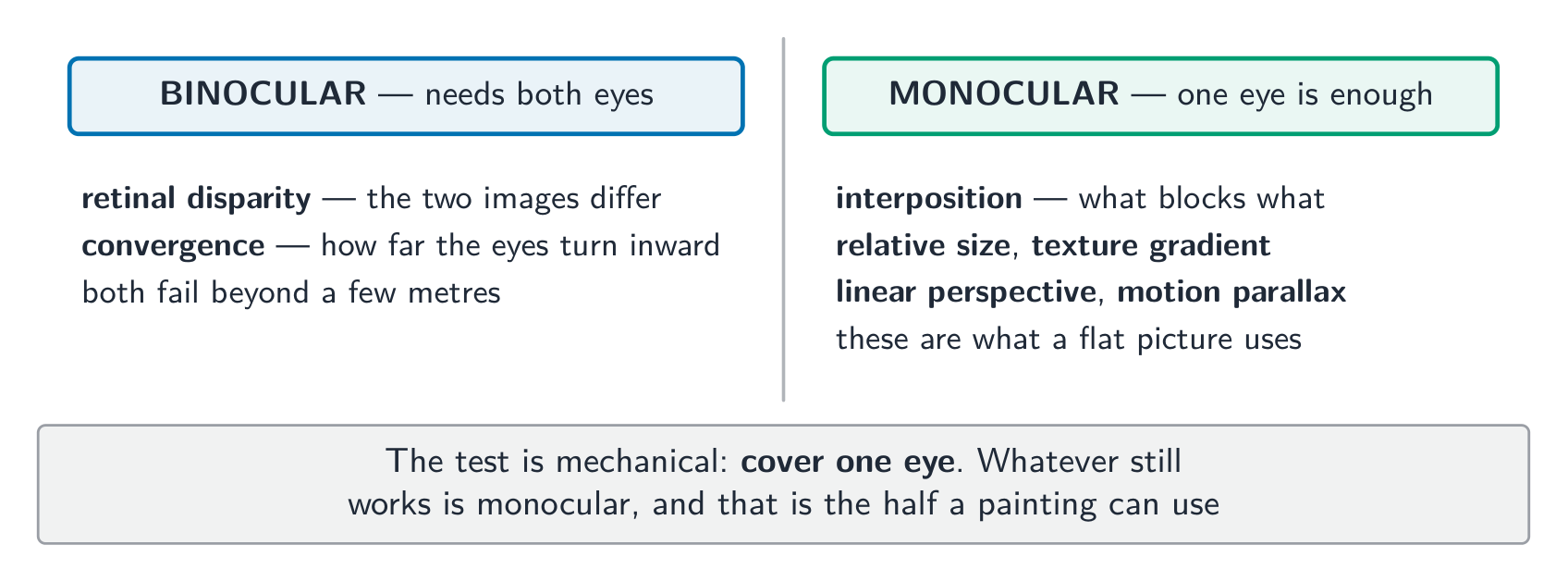
Binocular cues 双眼线索 need both eyes. Retinal disparity 视网膜像差 is the small difference between the two images; the greater the difference, the closer the object. Convergence 辐辏 is the inward turn of the eyes for near objects.
Monocular cues 单眼线索 work with one eye: relative clarity 相对清晰度, relative size 相对大小, texture gradient 纹理梯度, linear perspective 线条透视, and interposition 遮挡 (a nearer object blocks a further one).
Perceptual constancy 知觉恒常性 keeps an object looking the same even when its retinal image changes - a door stays rectangular as it swings open. The brain can also perceive apparent movement 似动 when nothing actually moves, which is why a series of still frames looks like a film.
العربية
لإدراك عالم ثلاثي الأبعاد من صورة شبكية مسطحة، يستخدم الدماغ مؤشرات العمق (Depth cues).
مؤشرات العيون المزدوجة تتطلب كلا العينين. الاختلاف الشبكي (Retinal disparity) هو الفرق الصغير بين الصورتين؛ كلما زاد الفرق، كان الجسم أقرب. التقارب (Convergence) هو الانعطاف الداخلي للعينين للأجسام القريبة.
مؤشرات العين الواحدة تعمل بعين واحدة: الوضوح النسبي، الحجم النسبي، تدرج الملمس، المنظور الخطي، والتداخل (Interposition) (جسم قريب يحجب جسماً أبعد).
الثبات الإدراكي (Perceptual constancy) يحافظ على بقاء الجسم يبدو كما هو حتى عندما تتغير صورته الشبكية - تظل الباب مستطيلًا أثناء فتحه. يمكن للدماغ أيضًا إدراك الحركة الظاهرية عندما لا يتحرك شيء فعليًا، ولهذا السبب تبدو سلسلة من اللقطات الساكنة كفيلم.
Thinking and Problem-Solving · التفكير وحل المشكلات
Syllabus · المنهج
English
Learning Objective 2.2.A: Explain how psychological concepts and theories account for thinking, problem-solving, judgment, and decision-making.
2.2.A.1 Concepts form the basis of thought. Prototypes are the ideal example for any given concept.
2.2.A.2 People form and modify schemas, or frameworks for thinking, through assimilation (taking in new information but not changing the schema in light of it) and accommodation (taking in new information and changing the schema to incorporate the new information).
2.2.A.3 Algorithms address problems by attempting all possible solutions until the correct one is found.
2.2.A.4 Heuristics address problems by using mental shortcuts to make judgments. Using heuristics can lead to errors in judgment when decisions are made according to prior expectations or stereotypes (representativeness heuristic) or recalling the first or most vivid example that comes to mind (availability heuristic).
2.2.A.5 Decision making can be influenced by prior experiences that were successful (mental set) or circumstances surrounding a decision (priming and framing).
2.2.A.6 Cognitive processes such as gambler’s fallacy and sunk-cost fallacy can hinder people from making good decisions.
2.2.A.7 Executive functions are cognitive processes that allow individuals to generate, organize, plan, and carry out goal-directed behaviors and experience critical thinking.
2.2.A.8 Creativity is a way of thinking that includes generating novel ideas and engaging in divergent (versus convergent) thinking. Creative thinking is hindered by functional fixedness.
العربية
الهدف التعليمي 2.2.A: اشرح كيف تفسر المفاهيم والنظريات النفسية التفكير، وحل المشكلات، والأحكام، واتخاذ القرارات.
2.2.A.1 تشكل المفاهيم أساس التفكير. النماذج الأولية هي المثال المثالي لأي مفهوم محدد.
2.2.A.2 يشكل الناس ويعدلون النماذج الذهنية، أو أطر التفكير، من خلال الامتصاص (استيعاب معلومات جديدة دون تغيير النموذج الذهني بناءً عليها) والاستيعاب (استيعاب معلومات جديدة وتغيير النموذج الذهني لاستيعاب المعلومات الجديدة).
2.2.A.3 الخوارزميات تعالج المشاكل بمحاولة جميع الحلول الممكنة حتى يتم العثور على الحل الصحيح.
2.2.A.4 المؤهلات تعالج المشاكل باستخدام اختصارات عقلية لإصدار الأحكام. يمكن أن يؤدي استخدام المؤهلات إلى أخطاء في الحكم عند اتخاذ القرارات وفقًا للتوقعات السابقة أو التنميطات (مؤهل التمثيلية) أو استرجاع المثال الأول أو الأكثر وضوحًا الذي يتبادر إلى الذهن (مؤهل الإتاحة).
2.2.A.5 يمكن أن تتأخذ القرارات بتجارب سابقة ناجحة (إعداد ذهني) أو الظروف المحيطة بالقرار (التنشيط والإطار).
2.2.A.6 يمكن للعمليات المعرفية مثل خطأ القمار وخطء التكلفة الغارقة أن تعيق الأشخاص عن اتخاذ قرارات جيدة.
2.2.A.7 الوظائف التنفيذية هي عمليات معرفية تسمح للأفراد بتوليد وتنظيم وتخطيط وتنفيذ سلوكيات موجهة نحو الأهداف وتجربة التفكير النقدي.
2.2.A.8 الإبداع هو طريقة تفكير تتضمن توليد أفكار جديدة والمشاركة في التفكير المتباعد (عكس التفكير المتقارب). يعيق التفكير الإبداعي الثبات الوظيفي.
Source: College Board AP Course and Exam Description · المصدر: وصف دورة وامتحان College Board AP
English
Concepts 概念 are the basis of thought, and a prototype 原型 is the best example of a concept. People build and change schemas through assimilation 同化 (fitting new information into an existing schema) and accommodation 顺应 (changing the schema to fit new information).
Two ways to solve a problem:
An algorithm 算法 tries every possible solution and is guaranteed to work, but is slow.
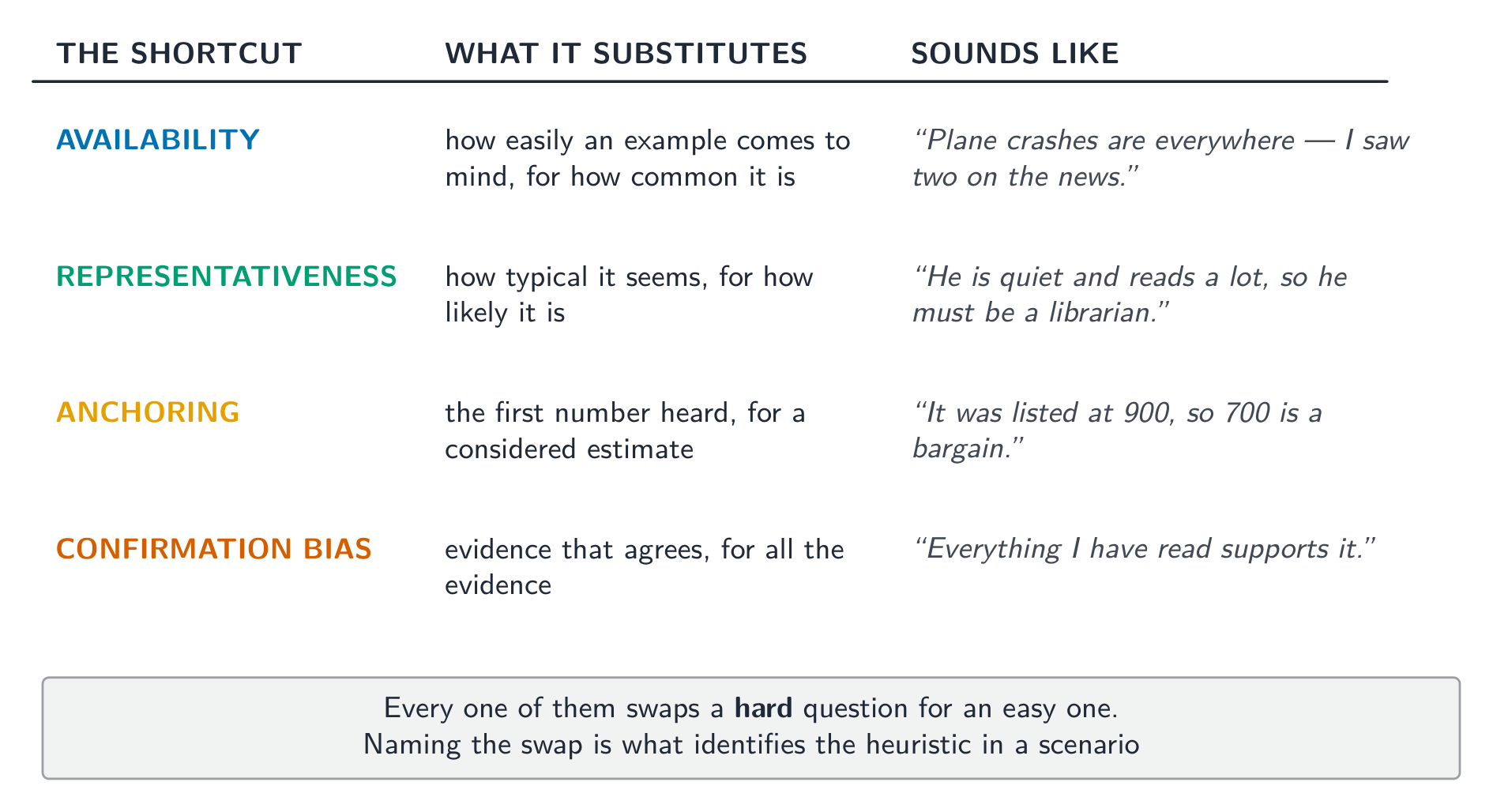
A heuristic 启发式 is a mental shortcut. It is fast but can lead to error - the representativeness heuristic 代表性启发式 judges by how well something matches a prototype, and the availability heuristic 可得性启发式 judges by how easily examples come to mind.
Thinking can also get stuck. A mental set 心向 is the tendency to repeat a solution that worked before. Functional fixedness 功能固着 is seeing an object only in its usual use. The gambler's fallacy 赌徒谬误 (believing a run must end) and the sunk-cost fallacy 沉没成本谬误 (continuing because of what is already spent) both hinder good decisions.
Executive functions 执行功能 let people generate, organise, plan, and carry out goals. Creativity 创造力 involves divergent thinking 发散思维 (generating many ideas) rather than convergent thinking 聚合思维 (narrowing to one answer).
العربية
المفاهيم (Concepts) هي أساس الفكر، والنموذج الأولي (Prototype) هو أفضل مثال على المفهوم. يبني الناس ويغيرون المخططات الذهنية من خلال الامتصاص (Assimilation) (دمج معلومات جديدة في مخطط ذهني موجود) والتكيف (Accommodation) (تغيير المخطط الذهني ليناسب المعلومات الجديدة).
طريقتان لحل مشكلة:
الخوارزمية (Algorithm) تجرب كل حل ممكن ومضمونة عملها، لكنها بطيئة.
الاستدعاء الذهني (Heuristic) هو اختصار ذهني. إنه سريع لكن قد يؤدي إلى خطأ - استدعاء التمثيلية (Representativeness heuristic) يحكم بناءً على مدى تطابق الشيء مع النموذج الأولي، واستدعاء التوفر (Availability heuristic) يحكم بناءً على سهولة ظهور الأمثلة في الذهن.
يمكن أن يتعطل التفكير أيضًا. الإعداد الذهني (Mental set) هو الميل لتكرار حل نجح سابقًا. التصلب الوظيفي (Functional fixedness) هو رؤية الجسم فقط في استخدامه المعتاد. وهم القمار (Gambler's fallacy) (اعتقاد أن السلسلة يجب أن تنتهي) ووهم التكلفة الغارقة (Sunk-cost fallacy) (الاستمرار بسبب ما تم إنفاقه بالفعل) يعيقان اتخاذ قرارات جيدة.
الوظائف التنفيذية (Executive functions) تسمح للناس بتوليد وتنظيم وتخطيط وتنفيذ الأهداف. الإبداع يتضمن التفكير المتفرع (Divergent thinking) (توليد العديد من الأفكار) بدلاً من التفكير المتصاعد/المتقارب (Convergent thinking) (الضيق نحو إجابة واحدة).
Explore · استكشف
Name the shortcut in each scenario · سمِّ القالب المختصر في كل سيناريو
Every heuristic swaps a hard question for an easy one — and naming the swap is what identifies it. · كل قالب مختصر يستبدل سؤالاً صعباً بآخر سهل — وتسمية الاستبدال هي ما يحدده.
Learning Objective 2.3.A: Explain how the types, structures, and processes of memory work.
2.3.A.1 Memories for learned knowledge, events, and experiences are differentiated by how they are processed by, stored in, and retrieved by the brain.
2.3.A.1.i Explicit memory is a type of memory that is more easily described or explained to others. Types of explicit memory include episodic and semantic.
2.3.A.1.ii Implicit memory is more challenging to describe or explain to others. Procedural memory is a type of implicit memory for procedures and processes.
2.3.A.1.iii Prospective memory is a type of memory related to future actions.
2.3.A.2 Long-term potentiation, a process by which synaptic connections between neurons become stronger with frequent activation, is a biological process for memory.
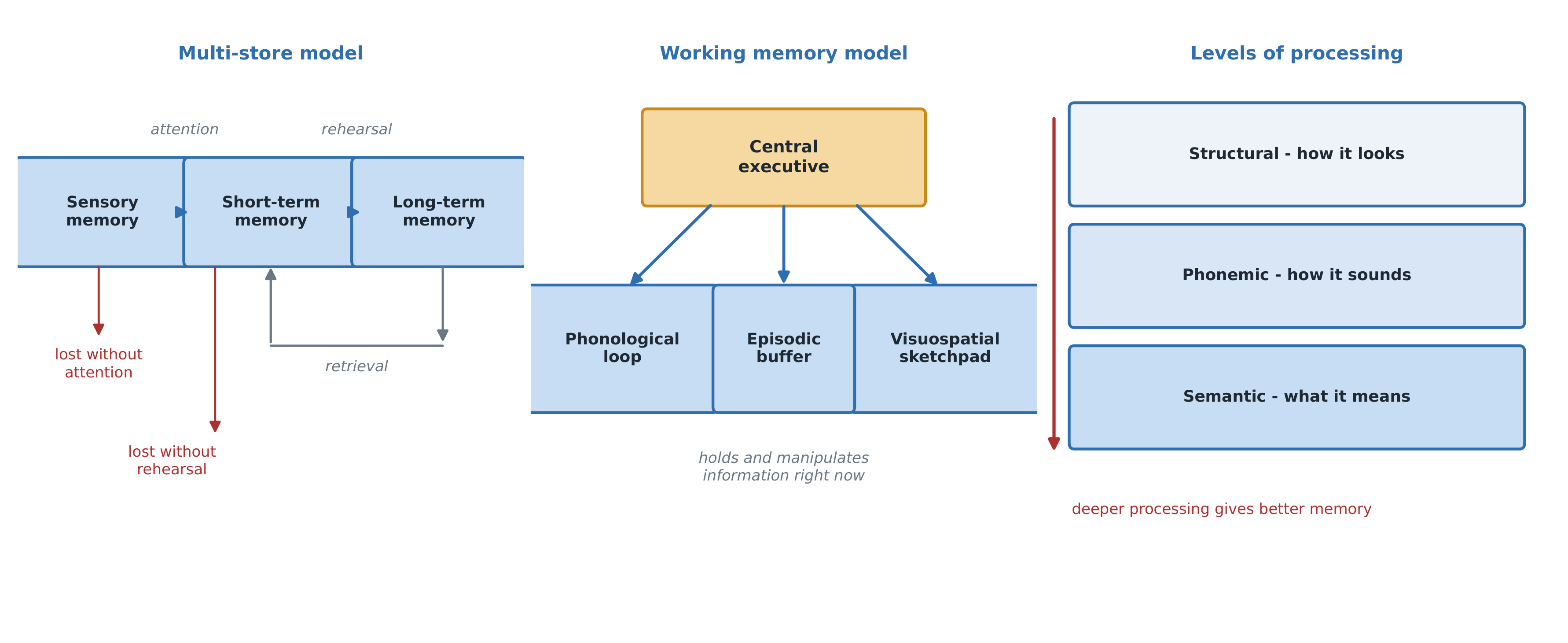
2.3.A.3 The working memory model examines how our primary memory system—working memory— engages in a dynamic interaction with several components, namely the central executive, phonological loop, and visuospatial sketchpad, to process information into long-term memory.
2.3.A.4 The multi-store model proposes three interacting systems (sensory memory [including iconic and echoic memory], short-term memory, and long-term memory) that information must pass through to be remembered. This model focuses on the impact of automatic and effortful processing on memory encoding, storage, and retrieval.
2.3.A.5 The levels of processing model proposes that memory is encoded on three levels from shallowest to deepest: structural, phonemic, and semantic.
العربية
الهدف التعليمي 2.3.A: اشرح كيف تعمل أنواع وهياكل وعملات الذاكرة.
2.3.A.1 تُصنف ذكريات المعرفة المكتسبة والأحداث والتجارب حسب كيفية معالجتها وتخزينها واسترجاعها بواسطة الدماغ.
2.3.A.1.i الذاكرة الصريحة هي نوع من الذاكرة أسهل في الوصف أو الشرح للآخرين. تشمل أنواع الذاكرة الصريحة الذاكرة السردية والذكرة الدلالية.
2.3.A.1.ii الذاكرة الضمنية أكثر صعوبة في الوصف أو الشرح للآخرين. الذاكرة الإجرائية هي نوع من الذاكرة الضمنية للإجراءات والعمليات.
2.3.A.1.iii الذاكرة المستقبلية هي نوع من الذاكرة يتعلق بالأفعال المستقبلية.
2.3.A.2 التقوية طويلة الأمد، وهي عملية تصبح فيها الاتصالات المشبكية بين الخلايا العصبية أقوى مع التنشيط المتكرر، هي عملية بيولوجية للذاكرة.
2.3.A.3 ي فحص نموذج الذاكرة العاملة كيف يتفاعل نظامنا الأساسي للذاكرة—الذاكرة العاملة—ديناميكيًا مع عدة مكونات، وهي المدير المركزي، والدائرة الصوتية، والمخطط البصري-المكاني، لمعالجة المعلومات ونقلها إلى الذاكرة طويلة المدى.
2.3.A.4 يقترح النموذج متعدد المخازن ثلاثة أنظمة متفاعلة (الذاكرة الحسية [بما في ذلك الذاكرة الأيقونية والذاكرة الصدى]، والذاكرة قصيرة المدى، والذاكرة طويلة المدى) التي يجب أن تمر خلالها المعلومات لتتم تذكرها. يركز هذا النموذج على تأثير المعالجة التلقائية والمثابرة على ترميز المعلومات وتخزينها واسترجاعها.
2.3.A.5 يقترح نموذج مستويات المعالجة أن الذاكرة يتم ترميزها على ثلاثة مستويات من الأسطح إلى الأعماق: هيكلي، صوتي، ودلالي.
Source: College Board AP Course and Exam Description · المصدر: وصف دورة وامتحان College Board AP
English
Memory is divided by how information is processed.
Explicit memory 外显记忆 can be described to others. It splits into episodic memory 情景记忆 (personal events) and semantic memory 语义记忆 (facts). Implicit memory 内隐记忆 is harder to describe, and includes procedural memory 程序性记忆 (skills such as riding a bike). Prospective memory 前瞻记忆 is remembering to do something later.
Long-term potentiation 长时程增强 is the biological basis: synaptic connections grow stronger with repeated use.
Three models are examinable:
The multi-store model 多重存储模型 proposes sensory memory 感觉记忆 (including iconic 图像记忆 and echoic 声像记忆 stores), short-term memory 短时记忆, and long-term memory 长时记忆.
The working memory model 工作记忆模型 treats the middle stage as active, not a waiting room. It has a phonological loop 语音回路, a visuospatial sketchpad 视空间模板, and a central executive 中央执行系统.
The levels of processing model 加工水平模型 says deeper processing gives better memory: shallow processing of appearance, then sound, then deep processing of meaning.
العربية
النماذج الثلاثة للذاكرة التي يتم اختبارها: تتدفق المعلومات عبر المتاجر، وتُحتفظ بها بنشاط في الذاكرة العاملة، ويتم تذكرها بشكل أفضل عند معالجتها بعمق
تنقسم الذاكرة حسب كيفية معالجة المعلومات.
الذاكرة الصريحة (Explicit memory) يمكن وصفها للآخرين. تنقسم إلى الذاكرة السردية (Episodic memory) (الأحداث الشخصية) والذاكرة الدلالية (Semantic memory) (الحقائق). الذاكرة الضمنية (Implicit memory) أصعب في الوصف، وتشمل الذاكرة الإجرائية (Procedural memory) (المهارات مثل ركوب الدراجة). الذاكرة المستقبلية (Prospective memory) هي التذكر للقيام بشيء لاحقًا.
التعزيز الطويل الأمد (Long-term potentiation) هو الأساس البيولوجي: تتحول الروابط المشبكية أقوى مع الاستخدام المتكرر.
ثلاثة نماذج قابلة للاختبار:
النموذج متعدد المتاجر (Multi-store model) يقترح الذاكرة الحسية (بما فيها المتاجر الأيقونية (Iconic) والصوتية (Echoic))، والذاكرة قصيرة المدى، والذاكرة طويلة المدى.
نموذج الذاكرة العاملة (Working memory model) يعامل المرحلة الوسطى بأنها نشطة، وليست غرفة انتظار. يحتوي على الحلقة الصوتية (Phonological loop)، والمسودة البصرية-المكانية (Visuospatial sketchpad)، والمدير المركزي (Central executive).
نموذج مستويات المعالجة (Levels of processing model) يقول إن المعالجة العميقة تعطي ذاكرة أفضل: المعالجة السطحية (Shallow processing) للمظهر، ثم الصوت، ثم المعالجة العميقة (Deep processing) للمعنى.
levels of processing model/ˈlevlz ɒv ˈprəʊsesɪŋ ˈmɒdl/
نموذج مستويات المعالجة
2.4 2.5
Encoding and Storing · الترميز والتخزين
Syllabus · المنهج
English
Learning Objective 2.4.A: Explain how different encoding processes work to get information into memory.
2.4.A.1 Encoding involves processes and strategies to get information into memory. How information is encoded can determine how effectively information is stored and retrieved.
2.4.A.2 Mnemonic devices, such as method of loci, are processes that aid in encoding information into working and long-term memory.
2.4.A.3 Encoding can be improved by the process of grouping information together into meaningful chunks (“chunking”), categories, or hierarchies.
2.4.A.4 The spacing effect is a process that can cause significant differences in encoding and memory consolidation depending on whether the information is encoded all at once (massed practice) or distributed over time (distributed practice).
2.4.A.5 Encoding processes can be affected by the order of how the information is presented, called the serial position effect. The serial position effect predicts that information presented at the beginning of a list (primacy effect) or the end of a list (recency effect) will be more memorable than information presented in the middle of a list.
العربية
هدف التعلم 2.4.A: اشرح كيف تعمل عمليات الترميز المختلفة لإدخال المعلومات إلى الذاكرة.
2.4.A.1 يتضمن الترميز عمليات واستراتيجيات لإدخال المعلومات إلى الذاكرة. يمكن أن يحدد طريقة ترميز المعلومات مدى فعالية تخزينها واسترجاعها.
2.4.A.2 الأجهزة السنية، مثل طريقة المواقع، هي عمليات تساعد في ترميز المعلومات في الذاكرة العاملة وطويلة المدى.
2.4.A.3 يمكن تحسين الترميز من خلال عملية تجميع المعلومات معًا في كتل ذات معنى ("التقطيع")، أو فئات، أو تسلسلات هرمية.
2.4.A.4 تأثير التباعد هو عملية قد تسبب اختلافات كبيرة في الترميز وتثبيت الذاكرة اعتمادًا على ما إذا كانت المعلومات يتم ترميزها دفعة واحدة (التدريب المكثف) أم موزعة عبر الوقت (التدريب الموزع).
2.4.A.5 يمكن أن تتأثر عمليات الترميز بترتيب تقديم المعلومات، وهو ما يسمى بتأثير الموقع التسلسلي. يتنبأ تأثير الموقع التسلسلي بأن المعلومات المقدمة في بداية القائمة (تأثير الأولوية) أو في نهايتها (تأثير الحداثة) ستكون أكثر قابلية للتذكر من المعلومات المقدمة في وسط القائمة.
English
Learning Objective 2.5.A: Explain how memory storage processes retain information in memory.
2.5.A.1 Sensory memory, short-term memory, working memory, and long-term memory are processes that differ in storage duration, capacity, and content.
2.5.A.2 Storage may be prolonged by rehearsing information over time (maintenance rehearsal). Rehearsing information over time in ways that promote meaning (elaborative rehearsal) helps with memory retention.
2.5.A.3 Some people demonstrate highly superior autobiographical memory which may indicate that there are biological processes for superior memory storage. Autobiographical memory may also explain why memories connected to our own lives or selves are more memorable.
2.5.A.4 Storage processes may be negatively affected by physical impairment and developmental limitations, such as amnesia (retrograde and anterograde), Alzheimer’s disease, and infantile amnesia.
العربية
هدف التعلم 2.5.A: اشرح كيف تحافظ عمليات تخزين الذاكرة على المعلومات في الذاكرة.
2.5.A.1 الذاكرة الحسية، والذاكرة قصيرة المدى، والذاكرة العاملة، والذاكرة طويلة المدى هي عمليات تختلف في مدة التخزين والسعة والمحتوى.
2.5.A.2 قد يتم تمديد التخزين عن طريق تكرار المعلومات على مدى الوقت (التكرار التحفظي). يساعد تكرار المعلومات على مدى الوقت بطريقة تعزز المعنى (التكرار الموسع) على الحفاظ على الذاكرة.
2.5.A.3 يظهر بعض الأشخاص ذاكرة سيرة ذاتية فائقة بشكل ملحوظ، مما قد يشير إلى وجود عمليات بيولوجية لتخزين الذاكرة الفائق. قد تفسر الذاكرة السيرة الذاتية أيضًا لماذا تكون الذكريات المرتبطة بحياةنا أو بأنفسنا أكثر قابلية للتذكر.
2.5.A.4 قد تتأثر عمليات التخزين سلبًا بالاضطراب الجسدي والقيود التنموية، مثل العمى (الرجعي والأمامي)، ومرض الزهايمر، وعمى الرضع.
Source: College Board AP Course and Exam Description · المصدر: وصف دورة وامتحان College Board AP
English
Encoding 编码 gets information into memory, and how you encode changes how well you remember.
Mnemonic devices 记忆术 such as the method of loci 位置法 aid encoding.
Chunking 组块 groups items into meaningful units, which raises how much short-term memory can hold.
The spacing effect 间隔效应 shows that spreading study over time beats massed practice 集中练习 (cramming).
The serial position effect 系列位置效应 means items at the start (primacy 首因效应) and end (recency 近因效应) of a list are remembered best.
Storage differs by system. Maintenance rehearsal 保持性复述 repeats information to hold it; elaborative rehearsal 精细复述 links it to what you already know and works better.
A few people show highly superior autobiographical memory 超常自传体记忆, which suggests biological differences. Storage can also be impaired: Alzheimer's disease 阿尔茨海默病 and infantile amnesia 婴儿期遗忘 both limit what can be stored or recovered.
العربية
الترميز (Encoding) إدخال المعلومات في الذاكرة، وكيف تقوم بالترميز يغير مدى قدرتك على التذكر.
الأدوات الإشارية (Mnemonic devices) مثل طريقة المواقع (Method of loci) تساعد في الترميز.
التجميع (Chunking) يجمع العناصر في وحدات ذات معنى، مما يرفع الكمية التي يمكن للذاكرة قصيرة المدى حملها.
تأثير التباعد (Spacing effect) يظهر أن توزيع الدراسة عبر الوقت يتفوق على الممارسة المكثفة (Massed practice) (الحشو).
تأثير الموقع التسلسلي (Serial position effect) يعني أن العناصر في البداية (الأولوية Primacy) والنهاية (الحداثة Recency) من القائمة تُتذكر بشكل أفضل.
يختلف التخزين حسب النظام. التكرار التحفظي (Maintenance rehearsal) يعيد المعلومات لإبقائها؛ التكرار التفصيلي (Elaborative rehearsal) يربطها بما تعرفه مسبقًا ويعمل بشكل أفضل.
بعض الأشخاص يُظهرون ذاكرة حيوية فائقة (Highly superior autobiographical memory)، مما يشير إلى اختلافات بيولوجية. يمكن أيضًا أن تتضرر الذاكرة: مرض آلزهايمر ونسيان الرضع (Infantile amnesia) يحدان من ما يمكن تخزينه أو استرجاعه.
highly superior autobiographical memory/ˈhaɪli suːˈpɪərɪə ˌɔːtəʊˌbaɪəˈɡræfɪkl ˈmeməri/
ذاكرة السيرة الذاتية فائقة التميز
Alzheimer's disease/ˈæltsaɪməz dɪˈziːz/
مرض آلزهايمر
infantile amnesia/ˈɪnfəntaɪl æmˈniːzɪə/
نسيان الرضع
2.6 2.7
Retrieving and Forgetting · الاسترجاع والنسيان
Syllabus · المنهج
English
Learning Objective 2.6.A: Explain how memory retrieval processes get information out of memory.
2.6.A.1 The process of memory retrieval occurs through recall (remembering without cues) or recognition (which relies on retrieval cues).
2.6.A.2 The process of memory retrieval can be enhanced when people are in the same environmental space (context-dependent memory), mood (mood-congruent memory), or physical state (state-dependent memory) as they were when they encoded the information to be retrieved.
2.6.A.3 Successful retrieval is more likely when using retrieval practice processes, including testing effect and metacognition.
العربية
هدف التعلم 2.6.A: اشرح كيف تحصل عمليات استرجاع الذاكرة على المعلومات من الذاكرة.
2.6.A.1 يحدث عملية استرجاع الذاكرة من خلال الاسترجاع (التذكر بدون مؤشرات) أو التعرف (والذي يعتمد على مؤشرات الاسترجاع).
2.6.A.2 يمكن تعزيز عملية استرجاع الذاكرة عندما يكون الناس في نفس الفضاء البيئي (ذاكرة تعتمد على السياق)، أو الحالة المزاجية (ذاكرة متناسقة مع المزاج)، أو الحالة الجسدية (ذاكرة تعتمد على الحالة) التي كانوا عليها عند ترميز المعلومات المراد استرجاعها.
2.6.A.3 يكون الاسترجاع الناجح أكثر احتمالًا عند استخدام عمليات التدريب على الاسترجاع، بما في ذلك تأثير الاختبار والتأمل المعرفي.
English
Learning Objective 2.7.A: Explain possible reasons why memory failure or errors may occur.
2.7.A.1 The forgetting curve shows that time is a significant factor in forgetting. Forgetting occurs rapidly after initial learning and levels off over time.
2.7.A.2 Many memories are difficult to retrieve due to encoding failure, interference (proactive or retroactive), or inadequate retrieval (i.e., tip-of-the-tongue phenomenon).
2.7.A.3 Psychodynamic theorists believe that information or memories can be forgotten to defend the ego from distress (repression).
2.7.A.4 The accuracy of memories may be affected by the misinformation effect, source amnesia, or constructive memory (via memory consolidation and imagination inflation).
العربية
هدف التعلم 2.7.A: اشرح الأسباب المحتملة لحدوث فشل الذاكرة أو الأخطاء.
2.7.A.1 يُظهر منحنى النسيان أن الوقت عامل مهم في النسيان. يحدث النسيان بسرعة بعد التعلم الأولي ثم يستقر بمرور الوقت.
2.7.A.2 يصعب استرجاع الكثير من الذكريات بسبب فشل الترميز، أو التداخل (الإيجابي أو السلبي)، أو عدم كفاءة الاسترجاع (أي ظاهرة طرف اللسان).
2.7.A.3 يعتقد المنظرون الديناميكيون النفسيون أن المعلومات أو الذكريات يمكن نسيانها للدفاع عن الذات عن طريق الإجهاد (الكبت).
2.7.A.4 قد تتأثر دقة الذكريات بتأثير المعلومات المضللة، أو عمى المصدر، أو الذاكرة البنائية (من خلال تثبيت الذاكرة وانفجار الخيال).
Source: College Board AP Course and Exam Description · المصدر: وصف دورة وامتحان College Board AP
English
Retrieval takes two forms: recall 回忆 (producing information without cues) and recognition 再认 (identifying it among options). Recognition is easier, which is why a multiple-choice question feels easier than an essay.
Retrieval improves with matching conditions. Context-dependent memory 情境依存记忆 works better in the same place; state-dependent memory 状态依存记忆 works better in the same physical state; mood-congruent memory 心境一致性记忆 recalls material matching your current mood. Practising retrieval helps too - the testing effect 测试效应 shows that testing yourself beats rereading.
Forgetting has several causes. The forgetting curve 遗忘曲线 shows loss is fastest right after learning. Encoding failure 编码失败 means it never got in. Interference 干扰 can be proactive 前摄干扰 (old learning blocks new) or retroactive 倒摄干扰 (new blocks old). Retrieval failure 提取失败 includes the tip-of-the-tongue phenomenon 舌尖现象.
Memory is also reconstructive 重构的, not a recording. The misinformation effect 错误信息效应 occurs when later information changes what a person remembers. Source amnesia 来源遗忘 is remembering the information but not where it came from.
Worked example (a real AP exam question). The 2025 Article Analysis Question presented a study in which participants read a summary containing 20%, 50% or 80% misleading sentences, then answered questions about a video. Correct responses fell from 74% (low misinformation) to 63% (high). One part asked students to "Explain how at least one of the research findings supports or refutes the misinformation effect." A full-mark answer states the finding and connects it to the concept: "Participants in the high misinformation condition answered 63% correctly compared with 74% in the low condition. Because exposure to more misleading detail lowered accuracy, the finding supports the misinformation effect, in which information received after an event changes the memory of it." Notice the shape: quote the data, then name the concept the data supports. A restated definition with no number does not answer Explain.
العربية
الاسترجاع يأخذ شكلين: الاستذكار (Recall) (إنتاج معلومات بدون مؤشرات) والتعرف (Recognition) (تحديدها ضمن خيارات). التعرف أسهل، ولهذا يبدو امتحان الاختيار من متعدد أسهل من المقال.
يتحسن الاسترجاع مع تطابق الظروف. يعمل الذاكرة المعتمدة على السياق بشكل أفضل في نفس المكان؛ وتعمل الذاكرة المعتمدة على الحالة بشكل أفضل في نفس الحالة الجسدية؛ بينما تستذكر الذاكرة المتوافقة مع المزاج مواد تتوافق مع مزاجك الحالي. والممارسة للاسترجاع مفيدة أيضًا - حيث يُظهر تأثير الاختبار أن اختبار نفسك يتفوق على إعادة القراءة.
للا forgetting (النسيان) أسباب متعددة. تُظهر منحنى النسيان أن الفقد يحدث بسرعة أكبر مباشرة بعد التعلم. تعني فشل التشفير أنه لم يدخل أصلاً إلى الذاكرة. يمكن أن تكون التداخلاتاستباقية (يُحجب التعلم القديم الجديد) أو ارتجاعية (الجديد يُحجب القديم). تشمل فشل الاسترجاعظاهرة حافة اللسان.
الذاكرة أيضًا إعادة بناء، وليست تسجيلًا. يحدث تأثير المعلومات المضللة عندما تقوم معلومات لاحقة بتغيير ما يتذكره الشخص. نسيان المصدر هو تذكر المعلومات دون تذكر مصدرها.
مثال محلول (سؤال حقيقي من امتحان AP). طرحت سؤال تحليل المقال لعام 2025 دراسة قرأ فيها المشاركين ملخصًا يحتوي على جمل مضللة بنسبة 20% أو 50% أو 80%, ثم أجابوا عن أسئلة حول فيديو. انخفضت الإجابات الصحيحة من 74% (ضدض information مضللة منخفضة) إلى 63% (عالية). طلبت إحدى الأجزاء من الطلاب "شرح كيف يدعم أحد نتائج البحث أو ينكر تأثير المعلومات المضللة." إجابة الدرجة الكاملة توضح النتيجة وتربطها بالمفهوم: "أجاب المشاركون في حالة المعلومات المضللة العالية 63% مقارنة بـ 74% في الحالة المنخفضة. وبما أن التعرض لمزيد من التفاصيل المضللة قلل الدقة، فإن النتيجة تدعم تأثير المعلومات المضللة، الذي يتم فيه تغيير الذاكرة بسبب معلومات تم تلقيها بعد الحدث." لاحظ البنية: اقتبس البيانات، ثم سمِّ المفهوم الذي تدعمه البيانات. التعريف المعاد صياغته بدون رقم لا يجيب على سؤال اشرح.
Explore · استكشف
Diagnose which stage the memory failed at · اشخص في أي مرحلة فشل الذاكرة
Four different failures are all reported as forgetting. The tell is what happens when a cue is given. · أربعة أنواع مختلفة من الفشل تُبلَّغ جميعاً نسياناً. الدليل هو ما يحدث عند تقديم محفز.
Learning Objective 2.8.A: Explain how modern and historical theories describe intelligence.
2.8.A.1 Throughout history, consensus about how to define and measure intelligence continues to be elusive and can be subject to bias. Researchers debate whether intelligence is a general ability (called g) or is comprised of multiple abilities.
Learning Objective 2.8.B: Explain how intelligence is measured.
2.8.B.1 Early formal intelligence tests yielded an intelligence quotient (IQ), which divided mental age by chronological age. In modern times, IQ scores are often used to identify students for educational services.
Exclusion Statement: Labeling or describing cognitive abilities and disabilities are outside the scope of the AP Psychology Exam.
2.8.B.2 All psychological assessments, including intelligence tests, should adhere to sound psychometric principles to be considered useful.
2.8.B.2.i A test is said to be standardized when it is administered using consistent procedures and environments.
2.8.B.2.ii A test is considered valid if it measures what it is designed to measure. Types of validity include construct and predictive.
2.8.B.2.iii A test is considered reliable if it yields similar results each time it is administered. Types of reliability include test-retest and split-half.
2.8.B.3 Researchers strive to develop assessments of intelligence that are socio-culturally responsive to reduce stereotype threat and potential inequity that may occur due to stereotype lift.
Learning Objective 2.8.C: Explain how systemic issues relate to the quantitative and qualitative uses of intelligence assessments.
2.8.C.1 IQ scores across much of the world have generally increased over time (Flynn Effect) due to societal factors, such as higher socioeconomic status and access to better health care and better nutrition.
2.8.C.2 IQ scores tend to vary more within a group than between groups. Personal and sociocultural biases can impact the interpretation of individual IQ scores and the score’s relationship with other outcomes. Poverty, discrimination, and educational inequities can negatively influence intelligence scores of individuals and societal groups around the world.
2.8.C.3 Scores from intelligence tests have been used to limit access to jobs, military ranks, educational institutions, and immigration to the US.
Learning Objective 2.8.D: Explain how academic achievement is measured and experienced as compared to intelligence.
2.8.D.1 Some academic tests attempt to measure what someone knows (achievement tests) or predict how someone will perform in the future (aptitude tests).
2.8.D.2 People’s beliefs about whether intelligence is fixed from birth (fixed mindset) or malleable due to experience (growth mindset) can affect academic achievement.
العربية
هدف التعلم 2.8.A: اشرح كيف تصف النظريات الحديثة والتاريخية الذكاء.
2.8.A.1 على مر التاريخ، لا يزال الإجماع حول كيفية تعريف القياس الذكاء صعب الوصول إليه ويمكن أن يخضع للتحيز. يناقش الباحثون ما إذا كان الذكاء قدرة عامة (تسمى g) أم يتكون من قدرات متعددة.
هدف التعلم 2.8.B: اشرح كيف يتم قياس الذكاء.
2.8.B.1 أنتجت الاختبارات الرسمية المبكرة لمعايير الذكاء نسبة ذكاء (IQ)، والتي قُسمت فيها العمر العقلي على العمر الزمني. في العصر الحديث، تُستخدم غالبًا درجات IQ لتحديد الطلاب الذين يحتاجون إلى خدمات تعليمية.
بيان الاستبعاد: تصنيف أو وصف القدرات والإعاقات المعرفية خارج نطاق امتحان علم النفس AP.
2.8.B.2 يجب أن تمتثل جميع التقييمات النفسية، بما في ذلك اختبارات الذكاء، لمبادئ نفسومترية سليمة لتكون مفيدة.
2.8.B.2.i يُقال إن الاختبار موحد عندما يتم تطبيقه باستخدام إجراءات وبيئات متسقة.
2.8.B.2.ii يُعتبر الاختبار صالحًا إذا كان يقيس ما صُمم لقياسه. تشمل أنواع الصلاحية الصلاحية الإنشائية والتنبؤية.
2.8.B.2.iii يُعتبر الاختبار موثوقًا إذا أعطى نتائج مماثلة في كل مرة يتم فيها إجراؤه. تشمل أنواع الموثوقية اختبار إعادة الاختبار والنصفين.
2.8.B.3 يسعى الباحثون إلى تطوير اختبارات ذكاء تكون حساسة للسياق الاجتماعي-الثقافي لتقليل تهديد التمييز النمطي وعدم المساواة المحتملة التي قد تنتج عن الرفع النمطي.
هدف التعلم 2.8.C: اشرح كيف ترتبط القضايا النظامية بالاستخدامات الكمية والنوعية لاختبارات الذكاء.
2.8.C.1 ارتفعت درجات الذكاء (مؤشر فلوين) بشكل عام عبر معظم أنحاء العالم مع مرور الوقت بسبب عوامل اجتماعية، مثل ارتفاع المستوى socioeconomic والوصول إلى رعاية صحية أفضل وتغذية أفضل.
2.8.C.2 تميل درجات الذكاء إلى التباين أكثر داخل المجموعة منها بين المجموعات. يمكن أن تؤثر التحيزات الشخصية والاجتماعية-الثقافية على تفسير درجات الذكاء الفردية وعلاقتها بنتائج أخرى. يمكن للفقر والتمييز وعدم المساواة التعليمية أن يؤثر سلبًا على درجات الذكاء للأفراد والمجموعات المجتمعية حول العالم.
2.8.C.3 استُخدمت نتائج اختبارات الذكاء لتقييد الوصول إلى الوظائف، الرتب العسكرية، المؤسسات التعليمية، والهجرة إلى الولايات المتحدة.
هدف التعلم 2.8.D: اشرح كيف يتم قياس الإنجاز الأكاديمي وتجربته مقارنة بالذكاء.
2.8.D.1 تحاول بعض الاختبارات الأكاديمية قياس ما يعرفه الشخص (اختبارات الإنجاز) أو التنبؤ بكيفية أداء الشخص مستقبلاً (اختبارات القدرات).
2.8.D.2 يمكن أن تؤثر معتقدات الأشخاص حول ما إذا كان الذكاء ثابتاً منذ الولادة (عقلية ثابتة) أم قابلاً للتغير بسبب الخبرة (عقلية النمو) على الإنجاز الأكاديمي.
Source: College Board AP Course and Exam Description · المصدر: وصف دورة وامتحان College Board AP
English
Psychologists still disagree about how to define intelligence 智力. Spearman's g 一般智力因素 proposes one general ability; other theories propose several, including fluid intelligence 流体智力 (reasoning with novel problems, which declines with age) and crystallised intelligence 晶体智力 (accumulated knowledge, which does not).
Early tests produced an intelligence quotient (IQ) 智商 by dividing mental age by chronological age. Modern scores are compared with a normal curve 正态曲线 of the population.
Any psychological assessment must meet psychometric principles 心理测量学原则:
Standardization 标准化 - the test is given under consistent procedures and scored against a comparison group.
Validity 效度 - it measures what it claims to. Construct validity 构念效度 and predictive validity 预测效度 are both examinable.
Reliability 信度 - it gives similar results each time, checked by test-retest reliability 重测信度 and split-half reliability 分半信度.
IQ scores have risen worldwide over generations (the Flynn effect 弗林效应), which points to societal rather than biological causes. Scores vary more within groups than between them, and stereotype threat 刻板印象威胁 can lower performance when a person fears confirming a negative stereotype about their group.
العربية
لا يزال علماء النفس يختلفون حول كيفية تعريف الذكاء. يقترح g لـ Spearman قدرة عامة واحدة؛ تقترح نظريات أخرى قدرات متعددة، بما في ذلك الذكاء السائل (الاستدلال على مشاكل جديدة، والذي يتناقص مع العمر) والذكاء المتصلب (المعرفة المتراكمة، التي لا تتناقص).
أنتجت الاختبارات المبكرة مؤشر ذكاء (IQ) بقسمة العمر العقلي على العمر الزمني. تُقارن الدرجات الحديثة بـ منحنى طبيعي للسكان.
يجب أن يلبي أي تقييم نفسي مبادئ القياس النفسي:
التوحيد القياسي - يتم إعطاء الاختبار تحت إجراءات متسقة ويتم تصحيحه مقابل مجموعة مقارنة.
الصحة (الصلاحية) - يقيس ما يدعي قياسه. صحة البناء وصحة التنبؤ كلاهما مدرج في الامتحانات.
الثبات - يعطي نتائج مماثلة في كل مرة، ويتم التحقق منه بواسطة ثبات إعادة الاختبار وثبات الشق-نصف. (split-half reliability)
ارتفعت درجات الذكاء (IQ) في جميع أنحاء العالم عبر الأجيال (تأثير فلين)، مما يشير إلى أسباب اجتماعية بدلاً من بيولوجية. تتفاوت الدرجات أكثر داخل المجموعات منها بينها، ويمكن أن يؤدي تهديد النمط الذهني إلى انخفاض الأداء عندما يخشى الشخص تأكيد نمط ذهني سلبي حول مجموعته.
Learning Objective 3.1.A: Explain how enduring themes inform developmental psychology.
3.1.A.1 Developmental psychology is concerned with both chronological order of development and/ or thematic issues in development across the lifespan. Thematic issues of interest to developmental psychologists include stability and change, nature and nurture, and continuous and discontinuous stages of development.
Learning Objective 3.1.B: Describe ways cross-sectional and longitudinal research design methods used in developmental psychology inform understanding about behavior and mental processes.
العربية
هدف التعلم 3.1.A: اشرح كيف ترسم الموضوعات الدائمة إطار عمل علم النفس التنموي.
3.1.A.1 يهتم علم النفس التنموي بكل من الترتيب الزمني للنمو و/أو القضايا الموضوعية في النمو طوال دورة الحياة. تشمل القضايا الموضوعية التي تهم علماء نفس التنمية: الثبات والتغير، الطبيعة والتنشئة، والمراحل المستمرة وغير المستمرة للنمو.
هدف التعلم 3.1.B: صف الطرق التي تستخدم بها طرق تصميم البحث المقطعي والطويل الأمد في علم النفس التنموي لفهم السلوك والعمليات العقلية.
Source: College Board AP Course and Exam Description · المصدر: وصف دورة وامتحان College Board AP
English
Developmental psychology 发展心理学 studies how people change across the lifespan. Two questions run through the whole unit.
Is change continuous 连续的 (gradual and smooth) or discontinuous 不连续的 (in stages)?
Is a trait stable 稳定的 across life, or does it change?
Researchers answer these with two designs. A cross-sectional study 横断研究 compares different age groups at one time - fast, but differences may come from the groups' different generations. A longitudinal study 纵向研究 follows the same people over years - slower, but it shows real change within a person.
العربية
علم النفس التطوري يدرس كيف يتغير الناس عبر عمرهم. تسود سؤالان طوال الوحدة.
هل التغيير متصل (تدريجي وناعم) أم منفصل (في مراحل)?
هل الصفة ثابتة طوال الحياة، أم أنها تتغير؟
يجيب الباحثون عن هذه الأسئلة بتصميمين. الدراسة المقطعية تقارن مجموعات عمرية مختلفة في وقت واحد - سريعة، لكن قد تكون الفروقات ناتجة عن أجيال مختلفة للمجموعات. الدراسة الطولية تتبع نفس الأشخاص على مدى سنوات - أبطأ، لكنها تظهر تغييراً حقيقياً داخل الفرد.
Learning Objective 3.2.A: Explain how physical development before birth applies to behavior and mental processes.
3.2.A.1 Teratogens, maternal illness, genetic mutations, hormonal, and environmental factors can influence the major physical and psychological milestones that occur during prenatal development.
Exclusion Statement: The stages of prenatal development (zygote, embryo, and fetus) are outside the scope of the AP Psychology Exam.
Learning Objective 3.2.B: Explain how physical development in infancy and childhood apply to behavior and mental processes.
3.2.B.1 Physical development in infancy and childhood happens in generally the same order, but the timing of the development can vary. The development of fine and gross motor coordination is among the major physical and psychological milestones that define infancy and childhood. These physical skills develop as children mature, allowing children to develop critical skills needed to become more independent.
3.2.B.2 Infants possess reflexes, like the rooting reflex, that indicate on-track physical and psychological milestone development.
3.2.B.3 Research using the visual cliff apparatus demonstrates an early ability in infants to perceive depth and an innovative way to assess infant responses.
3.2.B.4 Research suggests that critical or sensitive periods in infancy and childhood have strong developmental effects, especially for skills such as language. Some non-human animals will imprint on the first object they encounter as a means of survival.
Learning Objective 3.2.C: Explain how physical development in adolescence applies to behavior and mental processes.
3.2.C.1 The main physical and psychological milestones that occur in adolescence are the adolescent growth spurt and puberty, in which reproductive ability develops. Adolescents develop primary and secondary sex characteristics during this time, such as menarche and spermarche.
Learning Objective 3.2.D: Explain how physical development in adulthood applies to behavior and mental processes.
3.2.D.1 Adulthood spans most of the lifespan and is characterized by a general leveling off and then a varying decline in reproductive ability (i.e., menopause), mobility, flexibility, reaction time, and visual and auditory sensory acuity.
العربية
هدف التعلم 3.2.A: اشرح كيف ينطبق التطور الجسدي قبل الولادة على السلوك والعمليات العقلية.
3.2.A.1 يمكن للمواد المسببة للتشوهات الخلقية، وأمراض الأم، الطفرات الجينية، والعوامل الهرمونية والبيئية أن تؤثر على المحاور الجسدية والنفسية الرئيسية التي تحدث أثناء التطور الجنيني.
بيان الاستبعاد: مراحل التطور الجنيني (الزيجوت، الجنين، والجنين) خارج نطاق امتحان علم النفس AP.
هدف التعلم 3.2.B: اشرح كيف ينطبق التطور الجسدي في مرحلة الرضاعة والطفولة على السلوك والعمليات العقلية.
3.2.B.1 يحدث التطور الجسدي في مرحلة الرضاعة والطفولة بشكل عام بنفس الترتيب، لكن توقيت النمو قد يختلف. يعد تطور التنسيق الحركي الدقيق والخشن من بين المحاور الجسدية والنفسية الرئيسية التي تحدد الرضاعة والطفولة. تتطور هذه المهارات الجسدية عندما يتقدم الأطفال في السن، مما يسمح لهم بتطوير المهارات الحاسمة اللازمة لتصبح أكثر استقلالية.
3.2.B.2 يمتلك الرضع ردود فعل غريزية، مثل رد الفعل الجذري، والتي تشير إلى تطور سليم للمحاور الجسدية والنفسية.
3.2.B.3 تُظهر أبحاث استخدام جهاز المنحدر البصري قدرة مبكرة لدى الرضع على إدراك العمق وطريقة مبتعة لتقييم استجاباتهم.
3.2.B.4 تشير الأبحاث إلى أن الفترات الحرجة أو الحساسة في مرحلة الرضاعة والطفولة لها تأثيرات تنموية قوية، خاصة على مهارات مثل اللغة. بعض الحيوانات غير البشرية ستقوم بالتثبيت على أول كائن تصادفه كوسيلة للبقاء على قيد الحياة.
هدف التعلم 3.2.C: اشرح كيف ينطبق التطور الجسدي في المراهقة على السلوك والعمليات العقلية.
3.2.C.1 المحاور الجسدية والنفسية الرئيسية التي تحدث في المراهقة هي طفرة النمو المراهقة والبلوغ، حيث تتطور القدرة الإنجابية. طور المراهقون خصائص جنسية أولية وثانوية خلال هذه الفترة، مثل الطمث وبداية إنتاج الحيوانات المنوية.
هدف التعلم 3.2.D: اشرح كيف ينطبق التطور الجسدي في مرحلة البلوغ على السلوك والعمليات العقلية.
3.2.D.1 تمتد مرحلة البلوغ معظم دورة الحياة وتتميز بانخفاض عام ثم تراجع متفاوت في القدرة الإنجابية (أي انقطاع الطمث)، والحركة، والمرونة، وزمن الاستجابة، والدقة الحسية البصرية والسمعية.
Source: College Board AP Course and Exam Description · المصدر: وصف دورة وامتحان College Board AP
English
Development before birth can be disrupted by teratogens 致畸物 (harmful agents such as alcohol), maternal illness, genetic mutations, and hormonal or environmental factors.
Infant physical development follows the same general order everywhere, though the rate varies. Newborns show reflexes 反射 that indicate healthy development, such as the rooting reflex 觅食反射 (turning towards a touch on the cheek). The visual cliff 视崖 experiment shows that infants perceive depth early.
A critical period 关键期 is a window in which a particular experience has an unusually strong effect; a sensitive period 敏感期 is a softer version of the same idea.
Adolescence 青春期 brings the adolescent growth spurt 青春期发育突增 and puberty 青春发育期, including primary sex characteristics 第一性征 and secondary sex characteristics 第二性征. Adulthood spans most of life and is marked by a gradual levelling off, then decline - including menopause 更年期 in women.
العربية
يمكن أن يُعيق النمو قبل الولادة العوامل المؤثرة على الجنين (عوامل ضارة مثل الكحول)، وأمراض الأم، الطفرات الجينية، والعوامل الهرمونية أو البيئية.
يتبع النمو الجسدي للرضع نفس الترتيب العام في كل مكان، رغم اختلاف المعدل. تُظهر حديثو الولادة منعكسات تدل على نمو سليم، مثل منعكس البحث (التوجه نحو لمسة على الخد). يُظهر تجربة المنحدر المرئي أن الرضع يدركون العمق مبكراً.
الفترة الحرجة هي نافذة يكون فيها لتجربة معينة تأثير قوي بشكل غير عادي؛ الفترة الحساسة هي نسخة ألطف من نفس الفكرة.
المراهقة تجلب قفزة النمو المراهقة والبلوغ، بما في ذلك الخصائص الجنسية الأولية والخصائص الجنسية الثانوية. تمتد مرحلة البلوغ معظم الحياة وتتميز بانحدار تدريجي، ثم تراجع - بما في ذلك انقطاع الطمث عند النساء.
Gender and Sexual Orientation · الجنس والتوجه الجنسي
Syllabus · المنهج
English
Learning Objective 3.3.A: Describe how sex and gender influence socialization and other aspects of development.
العربية
هدف التعلم 3.3.A: صف كيف يؤثر الجنس والجندر على التنشئة الاجتماعية وجوانب أخرى من النمو.
Source: College Board AP Course and Exam Description · المصدر: وصف دورة وامتحان College Board AP
English
Sex 生理性别 refers to biological characteristics, while gender 社会性别 refers to the roles and expectations a society attaches to them. Gender roles 性别角色 are learned through socialization 社会化: family, school, peers, and media all teach what behaviour is expected. Sexual orientation 性取向 describes a person's enduring pattern of attraction. The exam asks how sex and gender influence socialization and development, not for any evaluation of individuals.
العربية
الجنس يشير إلى الخصائص البيولوجية، بينما النوع الاجتماعي يشير إلى الأدوار والتوقعات التي تربطها بها المجتمع. أدوار النوع الاجتماعي تُكتسب من خلال التنشئة الاجتماعية: العائلة والمدرسة والأقراب والوسائط جميعها تعلم ما هو السلوك المتوقع. الاتجاه الجنسي يصف النمط الدائم للجذب لدى الشخص. يطرح الامتحان كيف يؤثر الجنس والنوع الاجتماعي على التنشئة والتنمية، وليس لإجراء أي تقييم للأفراد.
Learning Objective 3.4.A: Explain how theories of cognitive development apply to behavior and mental processes.
3.4.A.1 According to Piaget, children develop schemas via continuous and discontinuous processes such as assimilation and accommodation.
3.4.A.1.i The sensorimotor stage occurs from infancy through toddlerhood. Object permanence develops during this stage.
3.4.A.1.ii The preoperational stage occurs from toddlerhood through early childhood. Children become proficient in using mental symbols and engage in pretend play. The preoperational stage is identified more by cognitive tasks children cannot perform such as conservation and reversibility, or by those they exhibit, such as animism and egocentrism. Children begin to develop a theory of mind during this stage.
3.4.A.1.iii The concrete operational stage occurs from early through late childhood. Children in this stage can generally correct the cognitive errors made in the preoperational stage and understand the world in logical, realistic, and straightforward ways, but struggle to think systematically.
3.4.A.1.iv The formal operational stage occurs from late childhood through adulthood. People in this stage gain the ability to think abstractly and hypothetically. Piaget proposed that not all people achieve formal operational thinking.
3.4.A.2 According to Vygotsky, children are social learners who learn through interacting with and scaffolding by other people within sociocultural contexts. Ideally, learning occurs while the person is in their zone of proximal development.
3.4.A.3 Adults experience changes in cognitive capabilities as they progress through the lifespan. Crystallized intelligence remains relatively stable through adulthood while fluid intelligence tends to wane as people age. Cognitive disorders that affect adults include dementia.
العربية
هدف التعلم 3.4.A: اشرح كيف تطبق نظريات التطور المعرفي على السلوك والعمليات العقلية.
3.4.A.1 وفقاً لبياجيه، ينمي الأطفال مخططات معرفية عبر عمليات مستمرة وغير مستمرة مثل الاستيعاب والتكيف.
3.4.A.1.i يحدث المرحلة الحسية الحركية من مرحلة الرضاعة حتى سن الصغر. يتطور إدراك ثبات الأجسام خلال هذه المرحلة.
3.4.A.1.ii تحدث المرحلة ما قبل العمليات من مرحلة الطفولة المبكرة حتى أواخرها. يصبح الأطفال ماهرين في استخدام الرموز الذهنية ويشاركون في اللعب التخيلي. تُعرف المرحلة ما قبل العمليات أكثر بالمهام المعرفية التي لا يستطيع الأطفال أدائها مثل الحفظ والعكوسية، أو تلك التي يظهرونها مثل حيوية الأشياء وأنانية الذات. يبدأ الأطفال في تطوير نظرية العقل خلال هذه المرحلة.
3.4.A.1.iii تحدث المرحلة العملياتية المجردة من أواخر الطفولة المبكرة حتى أواخرها. يمكن للأطفال في هذه المرحلة عادةً تصحيح الأخطاء المعرفية التي ارتكبوها في المرحلة ما قبل العمليات وفهم العالم بطرق منطقية وواقعية وبسيطة، لكنهم يواجهون صعوبة في التفكير المنهجي.
3.4.A.1.iv تحدث المرحلة العملية الشكلية من أواخر الطفولة وحتى البلوغ. يكتسب الأفراد في هذه المرحلة القدرة على التفكير المجرد والافتراضي. اقترح بايجيه أن ليس جميع الناس يحققون التفكير العملي الشكلي.
3.4.A.2 وفقاً لفيغوتسكي، الأطفال متعلمون اجتماعيون يتعلمون من خلال التفاعل مع الآخرين والتدعيم المقدم منهم داخل السياقات الاجتماعية والثقافية. مثالياً، يحدث التعلم بينما يكون الشخص في منطقة التطور القريب.
3.4.A.3 يمر البالغون بتغيرات في القدرات المعرفية مع تقدمهم عبر عمر الحياة. يبقى الذكاء المتبلور مستقراً نسبياً طوال مرحلة البلوغ بينما يميل الذكاء السائل إلى التراجع مع تقدم العمر. تشمل الاضطرابات المعرفية التي تؤثر على البالغين الخرف.
Source: College Board AP Course and Exam Description · المصدر: وصف دورة وامتحان College Board AP
English
Piaget 皮亚杰 proposed that children build schemas and pass through four stages:
Sensorimotor stage 感知运动阶段 (infancy to toddlerhood): the child learns through senses and action, and develops object permanence 客体永久性 - knowing an object still exists when hidden.
Preoperational stage 前运算阶段 (toddlerhood to early childhood): the child uses symbols and pretend play but shows egocentrism 自我中心 (difficulty taking another view) and lacks conservation 守恒 (knowing quantity stays the same when shape changes).
Concrete operational stage 具体运算阶段 (early to late childhood): the child reasons logically about concrete things and gains conservation.
Vygotsky 维果茨基 saw children as social learners. The zone of proximal development 最近发展区 is the gap between what a child can do alone and what they can do with help; scaffolding 支架 is the support that closes it.
Adult cognition changes too, and here the fluid/crystallised split from Unit 2 returns: reasoning speed declines while accumulated knowledge does not. Dementia 痴呆 is a decline beyond normal ageing.
العربية
المراحل الأربع لبياجيه، كل منها يُعرّف بما يستطيع الطفل فعله حديثاً
اقترح بياجيه أن يبني الأطفال مخططات معرفية (schemas) ويمررون بأربع مراحل:
مرحلة الحسية الحركية (الرضاعة حتى مرحلة الطفولة المبكرة): يتعلم الطفل من خلال الحواس والحركة، وي developing ثبات الكائن - معرفة أن الكائن لا يزال موجوداً عندما يختفي عن النظر.
مرحلة ما قبل العمليات (مرحلة الطفولة المبكرة حتى أواخر الطفولة): يستخدم الطفل الرموز واللعب التمثيلي لكن يظهر الأنانية الذاتية (صعوبة تبني وجهة نظر أخرى) ويفتقر إلى الحفظ (معرفة أن الكمية تظل ثابتة عند تغير الشكل).
مرحلة العمليات الملموسة (من أواخر الطفولة المبكرة إلى أواخر الطفولة): يستنتج الطفل منطقياً حول الأشياء الملموسة ويكتسب الحفظ.
مرحلة العمليات المجردة (من أواخر الطفولة فما بعد): يصبح الاستنتاج المجرد والافتراضي ممكناً.
رايفسكي رأى الأطفال كمتعلمين اجتماعيين. حيز التطور القريب هو الفجوة بين ما يمكن للطفل فعله بمفرده وما يمكنه فعله بمساعدة الآخرين؛ الإسناد السقفي هو الدعم الذي يسد هذه الفجوة.
يتغير الإدراك البشري أيضاً، وهنا يعود التقسيم بين السائل والمترسب من الوحدة 2: تنخفض سرعة الاستنتاج بينما لا يتناقص المعرفة المتراكمة. الخرف هو انخفاض يتجاوز الشيخوخة الطبيعية.
Learning Objective 3.5.A: Explain how key components of language and communication apply to behavior and mental processes.
3.5.A.1 Language is a shared (mutually agreed upon) system of arbitrary symbols (often expressed as and combined into phonemes, morphemes, and semantics) that are rule-governed (via grammar and syntax) and generative to produce an infinity of ideas.
Exclusion Statement: Pragmatics of language are outside the scope of the AP Psychology Exam.
Learning Objective 3.5.B: Explain how language develops in humans.
3.5.B.1 In language development across all cultures, people use nonverbal manual gestures (e.g., pointing) to communicate and develop formal language through specific stages (cooing, babbling, one-word stage, and telegraphic speech). People learning a language often make errors such as overgeneralization of language rules as they learn.
العربية
هدف التعلم 3.5.A: اشرح كيف تنطبق المكونات الرئيسية للغة والتواصل على السلوك والعمليات العقلية.
3.5.A.1 اللغة هي نظام مشترك (متفق عليه) من الرموز التعسفية (تُعبر عنها غالباً وتُجمع لتكوين مقاطع صوتية، ومورفيمات، ودلالات) تخضع لقواعد (من خلال القواعد النحوية والتراكيب) وقادرة على الإنتاج لإنتاج عدد لا نهائي من الأفكار.
عبارة الاستبعاد: البراغماتية اللغوية تقع خارج نطاق امتحان علم النفس AP.
هدف التعلم 3.5.B: اشرح كيف تتطور اللغة عند البشر.
3.5.B.1 في تطور اللغة عبر جميع الثقافات، يستخدم البشر إشارات يدوية غير لفظية (مثل الإشارة بالإصبع) للتواصل ويطورون اللغة الرسمية من خلال مراحل محددة (التنغيم، البهلعة، مرحلة كلمة واحدة، والكلام البرقي). غالباً ما يرتكب الأشخاص الذين يتعلمون لغة ما أخطاء مثل تعميم قواعد اللغة excessively أثناء التعلم.
Source: College Board AP Course and Exam Description · المصدر: وصف دورة وامتحان College Board AP
English
Language 语言 is a shared system of arbitrary symbols used to communicate. Development follows a common sequence: nonverbal gestures 手势, then cooing 咕咕声, babbling 咿呀语, the one-word stage 单词阶段, and telegraphic speech 电报式语言 (two-word combinations).
Children generalise rules before they master exceptions, which produces overgeneralization 过度规则化 - saying "goed" instead of "went". This is evidence that they are learning rules, not just copying.
العربية
اللغة هي نظام مشترك من الرموز التعسفية المستخدمة للتواصل. يتبع التطور تسلسلاً شائعاً: الإشارات غير اللفظية، ثم التنغيم، والثرثرة، ومرحلة الكلمة الواحدة، والكلام البرقي (تركيبات مكونة من كلمتين).
يعمم الأطفال القواعد قبل إتباعهم للاستثناءات، مما ينتج عنه الإفراط في التعميم - مثل قول "goed" بدلاً من "went". هذا دليل على أنهم يتعلمون القواعد وليس مجرد التقليد.
Social and Emotional Development · التطور الاجتماعي والعاطفي
Syllabus · المنهج
English
Learning Objective 3.6.A: Explain how social development relates to behavior and mental processes.
3.6.A.1 The ecological systems theory explores how the social environment influences development. The five systems in this theory are as follows: Bullet Microsystem (groups that have direct contact with the individual) Bullet Mesosystem (the relationships between groups in the microsystem) Bullet Exosystem (indirect factors in an individual’s life) Bullet Macrosystem (cultural events that affect the individuals and others around them) Bullet Chronosystem (the individual’s current stage of life).
3.6.A.2 Research has identified different parenting styles of caregivers, including authoritarian, authoritative, and permissive. Cultural differences exist in the ways these parenting styles affect outcomes in caregivers and children.
3.6.A.3 Research has identified different attachment styles demonstrated by infants and children, which vary by culture. The types of attachment infants and children display include secure and insecure (avoidant, anxious, and disorganized). Temperament is related to how children attach to caregivers.
3.6.A.3.i Separation anxiety occurs when children express heightened anxiety or fear when away from a caregiver or in the presence of a stranger.
3.6.A.3.ii Studies with monkeys demonstrate the importance of comfort over food in attachment.
3.6.A.4 Developmental psychologists study how peer relationships develop over time.
3.6.A.4.i Children engage with peers via play (parallel and pretend).
3.6.A.4.ii Adolescents gradually rely more on peer relationships as they age. As adolescents interact with peers, they demonstrate a type of egocentrism that is often demonstrated via the imaginary audience and the personal fable.
3.6.A.5 Developmental psychologists study how adults develop socially over time.
3.6.A.5.i Culture plays a role in determining when adulthood begins and when major life events occur (social clock). Some cultures allow for a time of emerging adulthood as a transition from adolescence to adulthood.
3.6.A.5.ii Relationships with other adults result in adults forming families or family-like relationships that should provide mutual support and care. Childhood attachment styles can affect how adults form attachments to other adults.
3.6.A.6 The stage theory of psychosocial development, which was a reconceptualization of the psychosexual theory, proposes that people must resolve psychosocial conflicts at each stage of the lifespan. The stages are as follows: Bullet Trust and mistrust Bullet Autonomy and shame and doubt Bullet Initiative and guilt Bullet Industry and inferiority Bullet Identity and role confusion Bullet Intimacy and isolation Bullet Generativity and stagnation Bullet Integrity and despair
Exclusion Statement: The psychosexual stage theory of development is outside of the scope of the AP Psychology Exam.
3.6.A.7 The experience of adverse childhood experiences (ACEs) has effects on relationships people form throughout the lifespan. Sociocultural differences exist in what is considered an ACE and how ACEs affect outcomes people may experience.
3.6.A.8 Adolescents develop a sense of identity for who they will be as an adult through the processes of achievement, diffusion, foreclosure, and moratorium. Identity development also includes processes for developing identities such as racial/ethnic identity, gender identity, sexual orientation, religious identity, occupational identity, and familial identity, often through considering possible selves.
العربية
هدف التعلم 3.6.A: اشرح كيف يرتبط التطور الاجتماعي بالسلوك والعمليات العقلية.
3.6.A.1 تستكشف النظرية البيئية الأنظمة كيفية تأثير البيئة الاجتماعية على التطور. الأنظمة الخمسة في هذه النظرية هي كما يلي: نقطة فرعية النظام الدقيق (المجموعات التي تتواصل مباشرة مع الفرد) نقطة فرعية النظام المتوسط (العلاقات بين المجموعات في النظام الدقيق) نقطة فرعية النظام الخارجي (عوامل غير مباشرة في حياة الفرد) نقطة فرعية النظام الكلي (الأحداث الثقافية التي تؤثر على الأفراد والآخرين حولهم) نقطة فرعية النظام الزمني (المرحلة الحالية للفرد في الحياة).
3.6.A.2 حددت البحث أساليب تربية مختلفة من قبل مقدمي الرعاية، بما في ذلك الأسلوب الاستبدادي، والأسلوب السلطوي، والأسلوب المتساهل. توجد اختلافات ثقافية في الطرق التي تؤثر بها هذه الأساليب على نتائج مقدمي الرعاية والأطفال.
3.6.A.3 حددت البحث أنماط ترابط مختلفة تظهرها الرضع والأطفال، والتي تختلف حسب الثقافة. تشمل أنواع الترابط التي يعرضها الرضع والأطفال الترابط الآمن وغير الآمن (التجنب، القلق، والفوضوي). يرتبط الطابع بالتعلق الذي يظهره الأطفال لمقدمي الرعاية.
3.6.A.3.i يحدث القلق الانفصالي عندما يعبر الأطفال عن قلق أو خوف متزايد عند الابتعاد عن مقدم الرعاية أو في وجود غريب.
3.6.A.3.ii تُظهر الدراسات التي أجريت على القرود أهمية الراحة على الطعام في الترابط.
3.6.A.4 يدرس علماء النفس التطوري كيف تتطور علاقات الأقراب عبر الزمن.
3.6.A.4.i يتفاعل الأطفال مع الأقران عبر اللعب (التوازيي والمحاكاة).
3.6.A.4.ii يعتمد المراهقون تدريجيًا أكثر على علاقات الأقران كلما تقدموا في العمر. أثناء تفاعل المراهقين مع الأقران، فإنهم يُظهرون نوعًا من الأنانية ذاتية التي تظهر غالبًا من خلال الجمهور الوهمي والقصة الشخصية.
3.6.A.5 يدرس علماء النفس التطوري كيف يتطور البالغون اجتماعياً عبر الزمن.
3.6.A.5.i تلعب الثقافة دورًا في تحديد متى تبدأ مرحلة البلوغ ومتى تحدث الأحداث الرئيسية في الحياة (الساعة الاجتماعية). تسمح بعض الثقافات بفترة من «البلوغ الناشئ» كمرحلة انتقالية من المراهقة إلى البلوغ.
3.6.A.5.ii تؤدي العلاقات مع البالغين الآخرين إلى تكوين البالغين للعائلات أو علاقات شبيهة بالعائلة والتي يجب أن توفر الدعم المتبادل والعناية. يمكن أن تؤثر أنماط الترابط في الطفولة على كيفية قيام البالغين بتكوين ترابط مع بالغين آخرين.
3.6.A.6 تقترح نظرية المراحل للتطور النفسي الاجتماعي، وهي إعادة مفاهيمية للنظرية النفسية الجنسية، أنه يجب على-breaking حل النزاعات النفسية الاجتماعية في كل مرحلة من مراحل عمر الحياة. المراحل هي كما يلي: نقطة فرعية الثقة والشك نقطة فرعية الاستقلالية والخجل والشك نقطة فرعية المبادرة والإحساس بالذنب نقطة فرعية الصناعة والدونية نقطة فرعية الهوية والارتباك في الأدوار نقطة فرعية التقارب والعزلة نقطة فرعية الإبداع والركود نقطة فرعية التكامل واليأس
عبارة الاستبعاد: نظرية المراحل الجنسية النفسية للتطور تقع خارج نطاق امتحان علم النفس AP.
3.6.A.7 تجارب الطفولة السلبية (ACEs) لها تأثير على العلاقات التي يكوّنونها عبر عمر الحياة. توجد اختلافات اجتماعية وثقافية فيما يُعتبر تجربة سلبية في الطفولة وكيف تؤثر هذه التجارب على النتائج التي قد يختبرها الأفراد.
3.6.A.8 يطور المراهقون شعوراً بالهوية لمن سيصبحون عليه ككبار من خلال عمليات التحصيل، والانتشار، والتسرع، والانتظار. تشمل عملية تطوير الهوية أيضاً عمليات لتطوير هويات مثل الهوية العرقية/الإثنية، والهوية الجندرية، وتوجهات التوجه الجنسي، والهوية الدينية، والهوية المهنية، والهوية الأسرية، وغالباً ما يتم ذلك من خلال النظر في «الأنفس الممكنة».
Source: College Board AP Course and Exam Description · المصدر: وصف دورة وامتحان College Board AP
English
Ecological systems theory 生态系统理论 describes development as nested environments, from the immediate family outwards to culture.
Research identifies parenting styles 教养方式: authoritarian 专制型 (high demands, low warmth), authoritative 权威型 (high demands, high warmth), and permissive 放任型 (low demands, high warmth).
Attachment 依恋 is the emotional bond between infant and caregiver, studied with the strange situation 陌生情境 procedure. Styles include secure attachment 安全型依恋 and insecure forms (avoidant 回避型, anxious 焦虑型, disorganized 混乱型). Separation anxiety 分离焦虑 is heightened distress when away from a caregiver. Studies with monkeys showed that infants prefer contact comfort 接触安慰 over food, which changed how attachment was understood.
Peer relationships develop through parallel play 平行游戏 and pretend play 假装游戏 in childhood, and adolescents rely on peers more as they age.
Erikson 埃里克森 proposed a stage theory of psychosocial development 心理社会发展, in which each stage poses a conflict to resolve - the adolescent stage being identity versus role confusion 同一性与角色混乱. Adverse childhood experiences (ACEs) 童年不良经历 affect later relationships and health.
العربية
نظرية الأنظمة البيئية تصف التطور بيئات متداخلة، من العائلة المباشرة إلى الخارج نحو الثقافة.
تحديد البحث أساليب التربية: سلطوي (متطلبات عالية، دفء منخفض)، سلطوي ديمقراطي (متطلبات عالية، دفء عالي)، وتساهلي (متطلبات منخفضة، دفء عالي).
الترابط العاطفي هو الرابطة العاطفية بين الرضيع ومقدم الرعاية، يتم دراستها باستخدام إجراء الموقف الغريب. تشمل الأساليب الترابط الآمن والأشكال غير الآمنة (تجنب، قلق، اضطراب تنظيمي). القلق الانفصالي هو اضطراب متزايد عند الابتعاد عن مقدم الرعاية. أظهرت الدراسات مع القرود أن الرضع يفضلون راحة الاتصال الجسدي على الطعام، مما غيّر فهم الترابط العاطفي.
تنشأ علاقات الأقران من خلال اللعب المتوازي واللعب التمثيلي في الطفولة، ويعتمد المراهقون أكثر على الأقران كلما تقدموا في العمر.
إريكسون اقترح نظرية مراحل لـالتطور النفسي الاجتماعي، حيث تطرح كل مرحلة صراعاً للحل - مرحلة المراهقة وهي الهوية مقابل ارتباك الأدوار. التجارب السلبية في الطفولة (ACEs) تؤثر على العلاقات والصحة لاحقاً.
Learning Objective 3.7.A: Explain how classical conditioning applies to behavior and mental processes.
3.7.A.1 The behavioral perspective evolved from theories about learning via conditioning. Behaviorists have traditionally focused on observable behavior to the exclusion of mental processes.
3.7.A.2 Classical conditioning focuses on the association of one stimulus with another stimulus to elicit a response. Learning the association (also known as acquisition) involves a series of steps that demonstrate principles of associative learning.
3.7.A.2.i The unconditioned stimulus (UCS) elicits an unconditioned response (UCR). This response becomes the conditioned response (CR) when it is performed in response to the conditioned stimulus (CS).
3.7.A.2.ii The order of presentation of the CS with the UCS is important to successful acquisition.
3.7.A.2.iii A CR can become extinct when the CS is no longer paired with the UCS. A formerly extinct CR can be spontaneously recovered when the CS is again presented after extinction.
3.7.A.2.iv Stimulus discrimination and generalization have been demonstrated in studies of classical conditioning.
3.7.A.2.v A CS can be used as a UCS in higher-order conditioning.
Exclusion Statement: Delayed conditioning, trace conditioning, simultaneous conditioning, and backward conditioning are outside the scope of the AP Psychology Exam.
3.7.A.3 Research has demonstrated that emotional responses can be classically conditioned. These findings form the basis of therapeutic interventions for many mental disorders, such as counterconditioning.
Exclusion Statement: The expectancy theory is outside the scope of the AP Psychology Exam.
3.7.A.4 Research on taste aversions, which are acquired through classical conditioning, demonstrates one-trial conditioning and biological preparedness. One-trial learning occurs when the association is acquired through one pairing of the stimulus and response and is not strengthened by further pairings. Biological preparedness refers to how animals are biologically predisposed to learning certain stimulus-response pairings more quickly than others.
3.7.A.5 Habituation occurs when organisms grow accustomed to and exhibit a diminished response to a repeated or enduring stimulus.
العربية
هدف التعلم 3.7.A: اشرح كيف ينطبق الشرط الكلاسيكي على السلوك والعمليات العقلية.
3.7.A.1 تطورت المنظور السلوكي من نظريات حول التعلم عبر الشرط. ركز السلوكيون تقليدياً على السلوك المرئي باستبعاد العمليات العقلية.
3.7.A.2 يركز الشرط الكلاسيكي على ارتباط محفز بآخر لإثارة استجابة. يتضمن تعلم هذا الارتباط (المعروف أيضاً بالاكتساب) سلسلة من الخطوات التي توضح مبادئ التعلم الترابطي.
3.7.A.2.i المحفز غير المشروط (UCS) يُثير استجابة غير مشروطة (UCR). تصبح هذه الاستجابة هي الاستجابة المشروطة (CR) عندما تُنفذ استجابة للمحفز المشروط (CS).
3.7.A.2.ii ترتيب تقديم CS مع UCS مهم لاكتساب ناجح.
3.7.A.2.iii يمكن أن تنقرض CR عندما لم يعد CS مقترناً مع UCS. يمكن استعادة CR التي انقرضت سابقاً بشكل تلقائي عند تقديم CS مرة أخرى بعد الانقراض.
3.7.A.2.iv تم إثبات التمييز المحفزي والتعميم في دراسات الشرط الكلاسيكي.
3.7.A.2.v يمكن استخدام CS كمحفز غير مشروط في الشرط من الرتبة الأعلى.
عبارة الاستبعاد: الشرط المتأخر، والشرط التتبعي، والشرط المتزامن، والشرط العكسي خارج نطاق امتحان علم النفس AP.
3.7.A.3 أثبت البحث أن الاستجابات العاطفية يمكن شرطها كلاسيكياً. تشكل هذه النتائج أساس التدخلات العلاجية للعديد من الاضطرابات النفسية، مثل الشرط المعاكس.
عبارة الاستبعاد: نظرية التوقع خارج نطاق امتحان علم النفس AP.
3.7.A.4 يظهر بحث عن سُموم الذوق (التي تُكتسب عبر الشرط الكلاسيكي) شرط单次 (one-trial conditioning) والاستعداد البيولوجي. يحدث التعلم مرة واحدة عندما يُكتسب الارتباط عبر اقتران واحد بين المحفز والاستجابة ولا يت strengthened بواسطة الاقترانات اللاحقة. يشير الاستعداد البيولوجي إلى كيفية استعداد الحيوانات بيولوجياً لتعلم بعض الاقترانات المحفز-استجابة بشكل أسرع من غيرها.
3.7.A.5 يحدث التعود عندما تعتاد الكائنات الحية على محفز متكرر أو دائم وتُظهر استجابة مُخفَّضة تجاهه.
Source: College Board AP Course and Exam Description · المصدر: وصف دورة وامتحان College Board AP
English
The behavioral perspective 行为主义视角 explains behaviour through learning rather than thought.
Classical conditioning 经典条件作用 associates one stimulus with another:
An unconditioned stimulus (UCS) 无条件刺激 naturally produces an unconditioned response (UCR) 无条件反应 - food causes salivation.
A neutral stimulus 中性刺激 paired with the UCS becomes a conditioned stimulus (CS) 条件刺激, producing a conditioned response (CR) 条件反应.
Acquisition 习得 depends on the order and timing of the pairing.
Extinction 消退 occurs when the CS is no longer paired with the UCS; spontaneous recovery 自发恢复 is the reappearance of an extinguished CR.
Generalization 泛化 is responding to similar stimuli; stimulus discrimination 刺激辨别 is responding only to the exact CS.
In higher-order conditioning 高级条件作用 an established CS acts as a UCS for a new one.
Emotional responses can be conditioned, and taste aversion 味觉厌恶 shows that some associations are learned in a single trial because they aided survival. Habituation 习惯化 is a diminished response to a repeated stimulus.
العربية
المنظور السلوكي يفسر السلوك من خلال التعلم بدلاً من التفكير.
الشرط الكلاسيكي يربط محفزاً واحداً بآخر:
المحفز غير المشروط (UCS) ينتج بشكل طبيعي استجابة غير مشروطة (UCR) - الطعام يسبب إفراز اللعاب.
المحفز المحايد المرتبط مع UCS يصبح محفزاً مشروطاً (CS)، مما ينتج استجابة مشروطة (CR).
الاكتساب يعتمد على ترتيب وتوقيت الربط.
الانطفاء يحدث عندما لم يعد CS مرتبطاً بـ UCS؛ الانتعاش التلقائي هو إعادة ظهور استجابة مشروطة منطفأة.
التعميم هو الاستجابة للمحفزات المشابهة؛ تمييز المحفز هو الاستجابة فقط لـ CS الدقيق.
في الشرط من الرتبة الأعلى يعمل CS مثبت مسبقاً كمحفز غير مشروط لمحفز جديد.
يمكن شرط الاستجابات العاطفية، ويوضح تجنب الطعم أن بعض الروابط تُكتسب في تجربة واحدة لأنها ساعدت على البقاء. التعود هو انخفاض الاستجابة لمحفز مكرر.
Explore · استكشف
Condition a response in three stages · شرط استجابة في ثلاث مراحل
NS and CS are the same stimulus at different times, and so are UR and CR. Identify the US first and the rest follows. · NS وCS هما نفس المحفز في أوقات مختلفة، وكذلك UR وCR. حدد US أولاً وسيكون الباقي تلقائياً.
Learning Objective 3.8.A: Explain how operant conditioning applies to behavior and mental processes.
3.8.A.1 Operant conditioning focuses on associating consequences (reinforcement and punishment) with behaviors. The Law of Effect states that behaviors with reinforcing consequences are more likely to be repeated while behaviors with punishing consequences are not as likely to be repeated.
3.8.A.2 Reinforcement and punishment can be positive or negative. Reinforcers can be primary or secondary. Reinforcement discrimination and generalization have been demonstrated in studies of operant conditioning.
3.8.A.3 Reinforcement can be used to shape behavior (“shaping”) gradually through rewarding successive approximations of the desired behavior. Research with animals shows that only certain behaviors can be shaped through reinforcement (known as instinctive drift).
3.8.A.4 Superstitious behavior occurs when consequences reinforce unrelated behaviors. Learned helplessness occurs when organisms learn that they have no control over their experience of aversive consequences in a given situation.
3.8.A.5 The schedule with which reinforcement is delivered can determine the strength of the association between the consequence and the response. The two main types of reinforcement schedules are continuous and partial. Each type of reinforcement behavior can be graphed, resulting in a distinctive pattern on the graph (e.g., fixed-interval schedule produces a scalloped graph).
3.8.A.5.i Continuous reinforcement schedules deliver reinforcement for each and every correct behavior.
3.8.A.5.ii The partial reinforcement schedules focus on whether reinforcement is delivered on a time-based schedule (fixed- or variable-interval) or for the number of behaviors performed (fixed- or variable-ratio).
العربية
هدف التعلم 3.8.A: اشرح كيف ينطبق الشرط الأوبرالي على السلوك والعمليات العقلية.
3.8.A.1 يركز الشرط الأوبرالي على ربط العواقب (التعزيز والعقاب) بالسلوكات. تنص قانون النتيجة على أن السلوكات ذات العواقب المعززة أكثر احتمالاً للتكرار بينما السلوكات ذات العواقب العقابية أقل احتمالاً للتكرار.
3.8.A.2 يمكن أن يكون التعزيز والعقاب إيجابيين أو سلبيين. يمكن أن تكون المعززات أولية أو ثانوية. تم إثبات تمييز التعزيز والتعميم في دراسات الشرط الأوبرالي.
3.8.A.3 يمكن استخدام التعزيز لتشكيل السلوك («تشكيل») تدريجياً من خلال مكافأة التقريبات المتتالية للسلوك المطلوب. أظهرت الأبحاث على الحيوانات أنه يمكن تشكيل سلوكات معينة فقط من خلال التعزيز (ما يُعرف بانحراف الغرائز).
3.8.A.4 يحدث السلوك الخرافي عندما تعزز العواقب سلوكات غير ذات صلة. يحدث اليأس المتعلم عندما تتعلم الكائنات الحية أنها لا تملك سيطرة على تجربتها لعواقب مؤلمة في موقف معين.
3.8.A.5 يمكن أن يحدد الجدول الذي يُقدَّم فيه التعزيز قوة الارتباط بين العاقبة والاستجابة. النوعان الرئيسيان لجدولات التعزيز هما المستمر والجزئي. يمكن رسم كل نوع من سلوكيات التعزيز بيانياً، مما ينتج نمطاً مميزاً على الرسم البياني (على سبيل المثال، ينتج جدول الفاصل الثابت رسماً موجياً).
3.8.A.5.i تقدم جدالات التعزيز المستمر تعزيزاً لكل سلوك صحيح على حدة.
3.8.A.5.ii تركز جدالات التعزيز الجزئي على ما إذا كان التعزيز يُقدَّم بناءً على جدول زمني (فاصل ثابت أو متغير) أم لعدد السلوكات المنفذة (نسبة ثابتة أو متغيرة).
Source: College Board AP Course and Exam Description · المصدر: وصف دورة وامتحان College Board AP
English
Operant conditioning 操作性条件作用 associates a behaviour with its consequence.
Reinforcement 强化 increases a behaviour; punishment 惩罚 decreases it.
Positive 正 means something is added; negative 负 means something is removed. So negative reinforcement 负强化 increases behaviour by removing something unpleasant - it is not punishment.
A primary reinforcer 原级强化物 satisfies a biological need; a secondary reinforcer 次级强化物 (money) is learned.
Shaping 塑造 rewards successive approximations 逐步接近 of a target behaviour.
Reinforcement schedules 强化程式 change how strong and persistent learning is. Continuous reinforcement 连续强化 rewards every response and produces fast learning but fast extinction. Partial reinforcement 部分强化 comes in four kinds - fixed-ratio 固定比率, variable-ratio 变动比率, fixed-interval 固定时距, and variable-interval 变动时距 - and variable-ratio produces the highest, most extinction-resistant rate.
Superstitious behavior 迷信行为 arises when a consequence reinforces an unrelated action. Learned helplessness 习得性无助 develops when an organism repeatedly cannot escape an aversive event and stops trying.
العربية
الشرط الأوبرانت يربط سلوكاً بعاقبته.
التعزيز يزيد السلوك؛ والعقاب يقلله.
الإيجابي يعني إضافة شيء ما؛ السالب يعني إزالة شيء ما. لذا التعزيز السلبي يزيد السلوك عن طريق إزالة شيء غير مريح - إنه ليس عقاباً.
المُزز الأولي يلبي حاجة بيولوجية؛ المُزز الثانوي (النقود) يُكتسب.
التشكيل يكافئ التقاربات المتتالية لسلوك مستهدف.
جداول التعزيز تغير مدى قوة واستمرارية التعلم. التعزيز المستمر يكافئ كل استجابة وينتج تعلماً سريعاً لكنه انطفاء سريع. التعزيز الجزئي يأتي بأربعة أنواع - نسبة ثابتة، نسبة متغيرة، فترة زمنية ثابتة، وفترة زمنية متغيرة - ونسبة متغيرة تنتج أعلى معدل وأكثر مقاومة للانطفاء.
السلوك الخرافي ينشأ عندما يعزز نتيجة سلوكاً غير مرتبط به. العجز المتعلم يتطور عندما لا يستطيع الكائن الحي الهروب من حدث مؤلم بشكل متكرر ويتوقف عن المحاولة.
Explore · استكشف
Place each scenario in the operant grid · ضع كل سيناريو في شبكة السلوك الآلي
Negative means removal, never unpleasant. Answer two questions separately: add or remove, and does the behaviour go up or down? · السالب يعني الإزالة، ليس المزعج. أجب عن سؤالين منفصلين: إضافة أو إزالة، وهل يتصرف السلوك صعوداً أم هبوطاً؟
Observational and Cognitive Learning · التعلم الرصدي والمعرفي
Syllabus · المنهج
English
Learning Objective 3.9.A: Explain how social learning applies to behavior and mental processes.
3.9.A.1 Social learning theory proposes that learning can occur by observation and does not have to involve personal experience with a consequence (vicarious conditioning). Learning can occur by copying the behavior of models. The more similar a model is, the more likely the behavior is to be learned.
Learning Objective 3.9.B: Explain how cognitive factors in learning apply to behavior and mental processes.
3.9.B.1 Insight learning occurs when the solution to a problem occurs without any association, consequence, or model being present.
3.9.B.2 Latent learning occurs when information is learned without reinforcement but is not immediately evident. Latent learning is often demonstrated by cognitive maps.
العربية
هدف التعلم 3.9.A: اشرح كيف ينطبق التعلم الاجتماعي على السلوك والعمليات العقلية.
3.9.A.1 تقترح نظرية التعلم الاجتماعي أن التعلم يمكن أن يحدث بالملاحظة ولا يتطلب بالضرورة تجربة شخصية بعاقبة (شرط بديل). يمكن أن يحدث التعلم بنسخ سلوك النماذج. كلما كانت النموذج مشابهة أكثر، كان السلوك أكثر احتمالا أن يُتعلم.
هدف التعلم 3.9.B: اشرح كيف تنطبق العوامل المعرفية في التعلم على السلوك والعمليات العقلية.
3.9.B.1 يحدث التعلم بالإدراك عندما تحدث حل لمشكلة دون وجود أي ارتباط أو عاقبة أو نموذج.
3.9.B.2 يحدث التعلم الكامن عندما تُتعلم المعلومات بدون تعزيز ولكن لا تظهر فوراً. غالباً ما يُستعرض التعلم الكامن من خلال الخرائط المعرفية.
Source: College Board AP Course and Exam Description · المصدر: وصف دورة وامتحان College Board AP
English
Not all learning needs direct experience. Social learning theory 社会学习理论 shows that behaviour can be learned by observation 观察 and modeling 榜样示范 - the basis of the Bobo doll findings on imitated aggression.
Insight learning 顿悟学习 is a sudden solution with no gradual conditioning. Latent learning 潜伏学习 is learning that occurs without reinforcement and stays hidden until there is a reason to show it, demonstrated by rats forming a cognitive map 认知地图 of a maze.
Worked example (a real AP exam question). The 2024 exam described Gavin, a preschooler at a science museum: he grabbed a large glass marble and tried to bounce it, he was briefly separated from his parents, and the next day he told his grandmother about a picture he had drawn. Students had to "Explain how Jean Piaget's concept of assimilation could relate to Gavin's experience with the glass marble" and "Explain how egocentrism could relate to how Gavin interacted with his grandmother in the car". A full-mark answer defines the term and ties it to the specific detail: "Gavin already had a schema for balls, which bounce. He assimilated the marble into that schema by treating it as a ball and trying to bounce it." Notice the shape: the definition alone earns nothing, and so does retelling the story. The mark is for the join between them.
العربية
ليس كل التعلم يحتاج إلى خبرة مباشرة. تُظهر نظرية التعلم الاجتماعي أن السلوك يمكن تعلمه عبر الملاحظة والنمذجة - وهو أساس نتائج دمية بوبو حول العدوان المقلد.
التعلم بالإبصار هو حل مفاجئ دون تكييف تدريجي. التعلم الكامن هو تعلم يحدث بدون تعزيز ويبقى خفياً حتى يكون هناك سبب لإظهاره، مما تم إثباته من خلال تشكل الفئران لـخريطة معرفية للمتاهة.
مثال محلول (سؤال حقيقي في امتحان AP). وصف امتحان عام 2024 غافين، طفل روضة في متحف علوم: أمسك بكرة زجاجية كبيرة وحاول قذفها، انفصل عن والديه لفترة وجيزة، وفي اليوم التالي أخبر جده بصورته التي رسمها. كان على الطلاب "شرح كيف يمكن لمفهوم الاندماج عند جان بياجيه أن يرتبط بتجربة غافين مع الكرة الزجاجية" و "شرح كيف يمكن مركزية الذات أن ترتبط بكيفية تفاعل غافين مع جده في السيارة". الإجابة الكاملة الدرجة تعني تعريف المصطلح و ربطه بالتفاصيل المحددة: "كان لدى غافين بالفعل مخطط للأقلامات التي تقفز. قام باندماج الكرة الزجاجية في ذلك المخطط من خلال معاملتها ككرة ومحاولة قذفها." لاحظ الشكل: التعريف وحده لا يكتسب أي درجة، وكذلك سرد القصة. الدرجة هي لربطهما ببعضهما البعض.
Learning Objective 4.1.A: Explain how attribution theory applies to behavior and mental processes.
4.1.A.1 Attributions are how people explain behavior and mental processes of themselves and others. Dispositional attributions relate to internal qualities of others (such as intelligence or personality) while situational attributions relate to external circumstances that are experienced.
4.1.A.2 People demonstrate a predictable pattern of attributions called explanatory style. Explanatory style is how people explain good and bad events in their lives and in the lives of others. Explanatory style can be optimistic or pessimistic.
4.1.A.3 People are subject to biases in their attributions. Those biases include actor/ observer bias, fundamental attribution error, and self-serving bias, all of which can affect behavior and mental processes.
Learning Objective 4.1.B: Explain how locus of control (internal and external) applies to behavior and mental processes.
Learning Objective 4.1.C: Explain how person perception applies to behavior and mental processes.
4.1.C.1 People’s perception of how much they like something can be influenced by the mere exposure effect. The mere exposure effect occurs when people are exposed to a stimulus repeatedly over time, which causes them to like the stimulus more.
4.1.C.2 People can behave in ways that elicit behaviors from others that confirm their beliefs or perceptions about themselves or others (self-fulfilling prophecy).
4.1.C.3 Social comparison is a type of person perception that occurs when people evaluate themselves based on comparisons to other members of society or social circles. Social comparison can be upward or downward. People often judge their own sense of deprivation relative to others (relative deprivation).
العربية
هدف التعلم 4.1.A: اشرح كيف تنطبق نظرية النسب على السلوك والعمليات العقلية.
4.1.A.1 الإسنادات هي الطريقة التي يفسر بها الناس سلوكهم وعملهم العقلي، بالإضافة إلى تفسير سلوك الآخرين وعملهم العقلي. تتعلق الإسنادات التكوينية بالسمات الداخلية للآخرين (مثل الذكاء أو الشخصية)، بينما تتعلق الإسنادات الموقفية بالظروف الخارجية التي يتم experienced.
4.1.A.2 يُظهر الناس نمطًا تنبؤيًا من الإسنادات يُسمى النمط التفسيري. النمط التفسيري هو كيفية تفسير الناس للأحداث الجيدة والسيئة في حياتهم وحياة الآخرين. يمكن أن يكون النمط التفسيري متفائلًا أو متشائمًا.
4.1.A.3 يخضع الناس لتحيزات في إسناداتهم. تشمل هذه التحيزات تحيز الفاعل/المراقب، وخطأ الإسناد الأساسي، والتحيز المفيد ذاتيًا، وكلها يمكن أن تؤثر على السلوك والعمل العقلي.
هدف التعلم 4.1.B: اشرح كيف ينطبق مركز التحكم (الداخلي والخارجي) على السلوك والعمل العقلي.
هدف التعلم 4.1.C: اشرح كيف ينطبق إدراك الشخص على السلوك والعمل العقلي.
4.1.C.1 يمكن أن يتأثر إدراك الأشخاص لمدى إعجابهم بشيء ما بتأثير التعرض البسيط. يحدث تأثير التعرض البسيط عندما يتعرض الناس لمحفز بشكل متكرر بمرور الوقت، مما يجعلهم يعجبون بالمحفز أكثر.
4.1.C.2 يمكن للناس التصرف بطريقة تستدعي سلوكيات من الآخرين تؤكد معتقداتهم أو إدراكاتهم حول أنفسهم أو حول الآخرين (التنبؤ المحقق ذاتيًا).
4.1.C.3 المقارنة الاجتماعية هي نوع من إدراك الشخص يحدث عندما يقوم الناس بتقييم أنفسهم بناءً على مقارنتهم بأعضاء آخرين من المجتمع أو الدوائر الاجتماعية. يمكن أن تكون المقارنة الاجتماعية صاعدة أو هابطة. غالبًا ما يحكم الناس على شعورهم بالحرمان نسبيًا مقارنة بالآخرين (الحرمان النسبي).
Source: College Board AP Course and Exam Description · المصدر: وصف دورة وامتحان College Board AP
English
Social psychology 社会心理学 studies how people think about, influence, and relate to others. It begins with attribution 归因 - how we explain behaviour.
An explanation is either dispositional 内归因 (about the person's personality) or situational 外归因 (about the circumstances). People are not even-handed about which they choose:
The fundamental attribution error 基本归因错误 is over-using dispositional explanations for other people's behaviour.
The actor-observer bias 行动者-观察者偏差 is explaining your own behaviour situationally while explaining others' dispositionally.
The self-serving bias 自利偏差 credits success to yourself and blames failure on the situation.
The just-world phenomenon 公正世界现象 is the belief that people get what they deserve.
A person's explanatory style 解释风格 can be optimistic 乐观的 or pessimistic 悲观的, and this shapes how they respond to setbacks.
Person perception has its own effects. The mere exposure effect 单纯曝光效应 means repeated contact increases liking. A self-fulfilling prophecy 自我实现预言 occurs when expectations cause the behaviour that confirms them. Social comparison 社会比较 is judging yourself against others, either upward 向上比较 or downward 向下比较.
العربية
علم النفس الاجتماعي يدرس كيف يفكر الناس ويؤثرون ويرتبطون بالآخرين. يبدأ بـ التعزيز - كيف نشرح السلوك.
التفسير إما طائقي (عن شخصية الشخص) أو وضعي (عن الظروف). الناس ليسوا متساوين في اختيارهم لأي منهما:
خطأ التعزيز الأساسي هو الإفراط في استخدام التفسيرات الطاقية لسلوك الآخرين.
تحيز الممثل-المراقب: تفسير سلوكك شخصياً بينما تفسر سلوك الآخرين طاقياً.
تحيز خدمة الذات يحسب النجاح لنفسه ويَلوم الفشل على الوضع.
ظاهرة العالم العادل هي الاعتقاد بأن الناس يحصلون على ما يستحقونه.
أسلوب التفسير الشخصي يمكن أن يكون متفائلًا أو متشائمًا، وهذا يشكل كيفية استجابته للصعوبات.
إدراك الشخصية له تأثيراته الخاصة. تأثير التعرض المجرد يعني أن الاتصال المتكرر يزيد المحبة. التنبؤ ذاتي التحقق يحدث عندما تسبب التوقعات السلوك الذي يؤكدها. المقارنة الاجتماعية هي الحكم على نفسك مقابل الآخرين، سواء كانت صاعدة أو هابطة.
Explore · استكشف
Sort each explanation as dispositional or situational · صنّف كل تفسير كسمة شخصية أو موقفية
Nothing about the behaviour changes — only who is explaining it. That asymmetry is the error. · لا يوجد تغيير في السلوك — فقط من يفسره. هذه عدم التناظر هو الخطأ.
Attitudes and Attitude Change · المواقف وتغيير المواقف
Syllabus · المنهج
English
Learning Objective 4.2.A: Explain how stereotypes and implicit attitudes contribute to the behaviors and mental processes of prejudice and discrimination.
4.2.A.1 A stereotype is a generalized concept about a group. Stereotypes can help reduce cognitive load when making decisions or judgments. Stereotypes can be the cause and/or result of biased perceptions and experiences and are frequently the basis of prejudiced attitudes and discriminatory behaviors.
4.2.A.2 Implicit attitudes are those that individuals hold but may be unaware of or may not acknowledge. Research has focused on how implicit attitudes reflect negative evaluations of others, as demonstrated by the just-world phenomenon, out-group homogeneity bias, in-group bias, or ethnocentrism.
Learning Objective 4.2.B: Explain how belief perseverance and cognitive dissonance apply to attitude formation and change.
4.2.B.1 Belief perseverance occurs when a belief persists even if evidence suggests it is not accurate. People experiencing belief perseverance may engage in confirmation bias, thereby clinging to an attitude or belief regardless of the evidence for or against it.
4.2.B.2 Cognitive dissonance refers to the mental discomfort that occurs when actions or attitudes are in conflict. People are motivated to reduce the discomfort by changing either actions or attitudes to be more in line with each other.
العربية
هدف التعلم 4.2.A: اشرح كيف تساهم الصور النمطية والمواقف الضمنية في سلوكيات ومعالجات عقلية التحيز والتمييز.
4.2.A.1 الصورة النمطية هي مفهوم عام عن مجموعة معينة. يمكن أن تساعد الصور النمطية في تقليل الحمل المعرفي عند اتخاذ القرارات أو الأحكام. يمكن أن تكون الصور النمطية سببًا و/أو نتيجة للإدراكات والتجارب المتحيزة، وغالبًا ما تكون أساسًا للمواقف المتحيزة والسلوكيات التمييزية.
4.2.A.2 المواقف الضمنية هي تلك التي يحملها الأفراد لكنهم قد لا يكونون مدركين لها أو لا يعترفون بها. ركزت الأبحاث على كيفية انعكاس المواقف الضمنية لتقييمات سلبية للآخرين، كما هو موضح في ظاهرة العالم العادل، وتحيز تجانس المجموعة الأخرى، وتحيز المجموعة الداخلية، أو العنصرية.
هدف التعلم 4.2.B: اشرح كيف ينطبق استمرارية الاعتقاد والتعارض المعرفي على تكوين态度 وتغييرها.
4.2.B.1 تحدث استمرارية الاعتقاد عندما يبقى اعتقاد ثابتًا حتى إذا أشارت الأدلة إلى أنه غير دقيق. قد يشارك الأشخاص الذين يعانون من استمرارية الاعتقاد في تحيز التأكد، مما يجعلهم متمسكين بموقف أو اعتقاد بغض النظر عن الأدلة الداعمة له أو ضده.
4.2.B.2 يشير التعارض المعرفي إلى الانزعاج العقلي الذي يحدث عندما تكون الأفعال أو المواقف في تعارض. يكون الناس محفزين لتقليل هذا الانزعاج عن طريق تغيير الأفعال أو المواقف لتكون أكثر انسجامًا مع بعضها البعض.
Source: College Board AP Course and Exam Description · المصدر: وصف دورة وامتحان College Board AP
English
A stereotype 刻板印象 is a generalised idea about a group; it reduces mental effort but can be inaccurate and harmful. Prejudice 偏见 is an attitude, and discrimination 歧视 is the behaviour. Implicit attitudes 内隐态度 are held without full awareness.
Attitudes resist change. Belief perseverance 信念固着 keeps a belief alive even after the evidence for it is discredited. Confirmation bias 确认偏差 is seeking evidence that fits what you already believe.
Cognitive dissonance 认知失调 is the discomfort felt when actions and attitudes conflict. Because the action has already happened, people often resolve it by changing the attitude - which is why doing something can change what a person believes.
العربية
النمطي هو فكرة عامة عن مجموعة؛ يقلل الجهد الذهني ولكنه قد يكون غير دقيق وضار. التحيز هو موقف، و التمييز هو السلوك. المواقف الضمنية تُحتفظ بها دون وعي كامل.
المواقف تقاوم التغيير. استمرارية الاعتقاد تحافظ على اعتقاد حي حتى بعد تشويه الأدلة الداعمة له. تحيز التأكد هو البحث عن أدلة تتناسب مع ما تؤمن به بالفعل.
التناقض المعرفي هو الإزعاج الذي يشعر به الأشخاص عندما تتعارض الأفعال والمواقف. نظرًا لأن الفعل قد حدث بالفعل، غالبًا ما يحل الأشخاص الأمر بتغيير الموقف - وهو السبب في أن فعل شيء ما يمكن أن يغير ما يؤمن به الشخص.
Learning Objective 4.3.A: Explain how the social situation affects behavior and mental processes.
4.3.A.1 Social norms define expectations and roles a society may have for its members in individual and social situations.
4.3.A.2 Social influence theory proposes that social pressure to behave or think in certain ways can be normative or informational.
4.3.A.3 Persuasion refers to the techniques applied to convince the self or others of particular ideas, actions, or beliefs.
4.3.A.3.i Persuasion can depend on the route to persuasion. The elaboration likelihood model outlines two main routes to persuasion: central and peripheral. The halo effect is an example of a peripheral route to persuasion.
4.3.A.3.ii Persuasion can depend on how information is presented, as demonstrated by the foot-in-the-door and the door-in-the-face techniques.
4.3.A.4 Research on conformity clarifies the conditions that strengthen the likelihood of people adhering to unspoken rules, norms, or expectations.
4.3.A.5 Research on obedience clarifies the conditions that strengthen the likelihood of people complying with the directives of an authority figure.
Learning Objective 4.3.B: Explain how being in a group can affect an individual’s behavior and mental processes.
4.3.B.1 Cultural phenomena such as individualism, collectivism, and multiculturalism can influence how one perceives and behaves towards oneself and others.
4.3.B.2 Being a member of a group can influence how one behaves or experiences mental processes via group polarization, groupthink, diffusion of responsibility, social loafing, and deindividuation.
4.3.B.3 Performing a mental or physical behavior in front of a group can lead to social facilitation.
4.3.B.4 People often overestimate the levels to which others agree with them, known as the false consensus effect.
4.3.B.5 Superordinate goals serve to unite disparate groups under a common goal and help reduce negative affect and stereotyping among groups. Social traps occur when individuals do not unite and act in their own self-interest to the detriment of the group.
4.3.B.6 Industrial-organizational (I/O) psychologists study how people perform in the workplace. I/O psychologists study best practices in management of work, relationships among people working together or for a common company or program, and how people feel about work (burnout).
Learning Objective 4.3.C: Explain how prosocial behavior affects behavior and mental processes.
4.3.C.1 Altruism refers to selfless behavior, but some researchers suggest that people act in prosocial ways due to incurring social debt. The social reciprocity norm and the social responsibility norm explain this type of behavior.
4.3.C.2 The bystander effect demonstrates that situational and attentional variables predict whether someone is likely to help another person.
العربية
هدف التعلم 4.3.A: اشرح كيف يؤثر الموقف الاجتماعي على السلوك والعمل العقلي.
4.3.A.1 تحدد الأعراف الاجتماعية التوقعات والأدوار التي قد تكون لديها المجتمع لأفراده في المواقف الفردية والاجتماعية.
4.3.A.2 تقترح نظرية التأثير الاجتماعي أن الضغط الاجتماعي للتصرف أو التفكير بطرق معينة يمكن أن يكون تنظيميًا أو معلوماتيًا.
4.3.A.3 الإقناع يشير إلى التقنيات المطبقة لإقناع النفس أو الآخرين بأفكار أو أفعال أو معتقدات معينة.
4.3.A.3.i يمكن أن يعتمد الإقناع على المسار نحو الإقناع. يرسم نموذج احتمالية التعميق مسارين رئيسيين للإقناع: المركزي وال peripheral. تأثير الهالة هو مثال على مسار peripheral للإقناع.
4.3.A.3.ii يمكن أن يعتمد الإقناع على كيفية تقديم المعلومات، كما هو موضح بتقنية "القدم في الباب" وتقنية "الباب في الوجه".
4.3.A.4 يوضح البحث حول الانطباق الظروف التي تعزز احتمال التزام الناس بالقواعد أو الأعراف أو التوقعات غير المكتوبة.
4.3.A.5 يوضح البحث عن الطاعة الظروف التي تعزز احتمال امتثال الناس لتوجيهات شخص ذي سلطة.
هدف التعلم 4.3.B: اشرح كيف يمكن أن يؤثر وجود الفرد ضمن مجموعة على سلوكه وعملانه العقلي.
4.3.B.1 يمكن أن تؤثر الظواهر الثقافية مثل الفرديية والجماعية والتنوع الثقافي على كيفية إدراك الفرد لنفسه وكيفية تصرفه تجاه نفسه والآخرين.
4.3.B.2 يمكن أن يكون العضوية في مجموعة عاملاً مؤثراً في كيفية تصرف الفرد أو تجربه للعمل العقلي عبر الاستقطاب الجماعي، وفكر الجماعة، وانتشار المسؤولية، والكسل الاجتماعي، وانعدام الذات.
4.3.B.3 أداء سلوك عقلي أو جسدي أمام مجموعة يمكن أن يؤدي إلى التحفيز الاجتماعي.
4.3.B.4 غالبًا ما يبالغ الناس في تقدير المستويات التي يتفق معها الآخرون معهم، وهو ما يُعرف بتأثير الإجماع الكاذب.
4.3.B.5 الأهداف الفوقية تخدم في توحيد المجموعات المتباينة تحت هدف مشترك وتساعد في تقليل المشاعر السلبية والتصوير النمطي بين المجموعات. تحدث الفخاخ الاجتماعية عندما لا تتحد الأفراد وتتصرف لصالح مصالحهم الذاتية على حساب المجموعة.
4.3.B.6 يدرس علماء النفس الصناعيين-تنظيميين (I/O) كيفية أداء الناس في مكان العمل. يدرسون أفضل الممارسات في إدارة العمل، والعلاقات بين الأشخاص الذين يعملون معًا أو لشركة أو برنامج مشترك، وكيفية شعور الناس بالعمل (الإرهاق الوظيفي).
الهدف التعليمي 4.3.C: اشرح كيف يؤثر السلوك الاجتماعي الإيجابي على السلوك والعمليات العقلية.
4.3.C.1 يشير النفور إلى السلوك غير الأناني، لكن بعض الباحثين يقترحون أن الناس يتصرفون与社会 ways بسبب تحمل ديون اجتماعية. يفسر معيار التبادل الاجتماعي ومعيار المسؤولية الاجتماعية هذا النوع من السلوك.
4.3.C.2 يُظهر تأثير الشاهد العيان أن المتغيرات الموضعية والمتغيرات الانتباهية تتنبأ بما إذا كان الشخص سيمنح المساعدة لشخص آخر.
Source: College Board AP Course and Exam Description · المصدر: وصف دورة وامتحان College Board AP
English
Social norms 社会规范 define the behaviour a group expects. Behaviour changes when others are present:
Conformity 从众 is adjusting behaviour to match a group. It rises with group size (up to a point), unanimity, and ambiguity, and falls when even one other person dissents.
Obedience 服从 is following an instruction from an authority. It rises with the authority's perceived legitimacy and closeness, and falls when the victim is close or the authority is distant.
Normative social influence 规范性社会影响 is conforming to be accepted; informational social influence 信息性社会影响 is conforming because you think others know better.
Persuasion 说服 has two routes in the elaboration likelihood model 精细加工可能性模型: the central route 中心路径 uses the strength of the argument, and the peripheral route 边缘路径 uses cues such as attractiveness. Sequential techniques matter too: the foot-in-the-door 登门槛效应 technique starts with a small request, while the door-in-the-face 留面子效应 technique starts with an unreasonable one.
Group settings change behaviour further. Social facilitation 社会助长 improves performance on simple or well-practised tasks when others watch, but harms performance on difficult ones. Social loafing 社会惰化 is reduced individual effort in a group. Deindividuation 去个体化 is loss of self-awareness in a crowd. Group polarization 群体极化 pushes a group's average view further in its original direction, and groupthink 群体思维 is the suppression of dissent to keep harmony.
Individualism 个人主义 and collectivism 集体主义 shape all of these, and multiculturalism 多元文化主义 describes societies holding several traditions together. The false consensus effect 虚假一致效应 is overestimating how many people agree with you. Superordinate goals 超级目标 - shared aims that need cooperation - reduce hostility between groups.
Altruism 利他行为 is selfless helping, though prosocial behavior 亲社会行为 may also bring benefit to the helper. The bystander effect 旁观者效应 shows people are less likely to help as the number of onlookers rises, because of diffusion of responsibility 责任分散.
Worked example (a real AP exam question). The 2025 Evidence-Based Question asked students to "develop and justify an argument about whether the presence of others improves performance", then to "Explain how the evidence from Part B (i) supports your claim using a psychological perspective, theory, concept, or research finding learned in AP Psychology." A full-mark answer supplies a course concept, not just a restatement of the source: "The participants performed better on the simple task when observed (Source 1). This supports my claim because social facilitation predicts that an audience improves performance on tasks that are simple or well practised, while impairing performance on difficult ones." Notice the shape: cite the source, then name the concept and state what it predicts. Re-describing the study alone does not earn the explanation point.
العربية
المعايير الاجتماعية تحدد السلوك الذي تتوقعه المجموعة. يتغير السلوك عندما يكون الآخرون موجودين:
الامتثال هو تعديل السلوك ليتوافق مع المجموعة. يرتفع مع حجم المجموعة (حتى نقطة معينة)، والاتفاق العام، والغموض، وينخفض عندما يعترض شخص واحد على الأقل.
الطاعة هي اتباع تعليمات من سلطة. يرتفع مع شرعية السلطة المُدركة وقربها، وينخفض عندما يكون الضحية قريبًا أو السلطة بعيدة.
التأثير الاجتماعي المعياري هو الامتثال ليتم قبوله؛ التأثير الاجتماعي المعلوماتي هو الامتثال لأنك تعتقد أن الآخرين يعرفون أكثر.
الإقناع له مساران في نموذج احتمالية الت elaboration: المسار المركزي يستخدم قوة الحجة، و المسار المحيطي يستخدم إشارات مثل الجمال. التقنيات التسلسلية مهمة أيضًا: تقنية الدخول بالقدم تبدأ بطلب صغير، بينما تقنية الدخول بالوجه تبدأ بطلب غير معقول.
تُغير إعدادات المجموعة السلوك بشكل أكبر. التسهيل الاجتماعي يحسن الأداء في المهام البسيطة أو المحسنة جيداً عند مراقبة الآخرين، لكنه يضر بالأداء في المهام الصعبة. كسل اجتماعي هو تقليل الجهد الفردي داخل المجموعة. فقدان الهوية الفردية هو فقدان الوعي بالذات في الحشد. الاستقطاب الجماعي يدفع الرأي المتوسط للمجموعة إلى الأمام في اتجاهها الأصلي، بينما التفكير الجماعي هو كتم المعارضة للحفاظ على التماسك.
الفردية والجماعية تشكل كل هذه العوامل، والتعددية الثقافية تصف مجتمعات تحتضن عدة تقاليد معاً. تأثير الإجماع الكاذب هو المبالغة في تقدير عدد الأشخاص الذين يتفقون معك. الأهداف الفوقية - وهي أهداف مشتركة تتطلب التعاون - تقلل من العداء بين المجموعات.
العاطفة altruism هي المساعدة بلا أنانية، على الرغم من أن السلوك المجتمعي قد يجلب أيضاً منفعة للمساعد. تأثير المشاهد العابر يظهر أن الناس أقل احتمالاً للمساعدة كلما زاد عدد المشاهدين، وذلك بسبب انتشار المسؤولية.
مثال محلل (سؤال حقيقي في امتحان AP). طُلب من الطلاب في سؤال الاستناد إلى الأدلة 2025 أن "يطوروا ويبرهنوا على حجة حول ما إذا كان وجود الآخرين يحسن الأداء"، ثم "شرح كيف يدعم الدليل من الجزء B (i) ادعاءهم باستخدام منظور نفسي، نظرية، مفهوم، أو نتيجة بحثية تم دراستها في علم النفس AP.". الإجابة الكاملة التي تحصل على الدرجة الكاملة تقدم مفهوماً من المقرر، وليس مجرد إعادة صياغة للمصدر: " performed better on the simple task when observed (Source 1). This supports my claim because social facilitation predicts that an audience improves performance on tasks that are simple or well practised, while impairing performance on difficult ones." لاحظ الشكل: استشهد بالمصدر، ثم سمِّ المفهوم واذكر ما يتنبأ به. إعادة وصف الدراسة وحدها لا تمنح نقطة الشرح.
Personality: Psychodynamic and Humanistic · الشخصية: الديناميكية النفسية والإنسانية
Syllabus · المنهج
English
Learning Objective 4.4.A: Explain how the psychodynamic theory of personality defines and assesses personality.
4.4.A.1 According to the psychodynamic theory of personality, unconscious processes drive personality.
Exclusion Statement: The stage theory of psychosexual development is out of scope for the AP Psychology Exam.
4.4.A.2 Ego defense mechanisms (denial, displacement, projection, rationalization, reaction formation, regression, repression, and sublimation) serve to protect the ego unconsciously from threats.
4.4.A.3 Psychodynamic personality psychologists assess personality using projective tests that are designed to probe the preconscious and unconscious mind.
Learning Objective 4.4.B: Explain how the humanistic theory of personality defines and assesses personality.
4.4.B.1 According to humanistic psychology, personality focuses on unconditional regard and the self-actualizing tendency as primary motivating factors.
Exclusion Statement: Maslow’s hierarchy of needs is outside the scope of the AP Psychology Exam.
العربية
الهدف التعليمي 4.4.A: اشرح كيف تُعرّف النظرية النفسية الحركية للشخصية وتقيس الشخصية.
4.4.A.1 وفقاً للنظرية النفسية الحركية للشخصية، فإن العمليات اللاواعية هي المحرك الأساسي للشخصية.
عبارة الاستبعاد: نظرية المراحل للتطور النفسي الجنسي خارج نطاق امتحان علم النفس AP.
4.4.A.2 تعمل آليات دفاع ego (النكران، الإزاحة، الإسقاط، التبرير، تكوين رد الفعل، الانسحاب، الكبت، والتحويل) على حماية ego بشكل لا واعي من التهديدات.
4.4.A.3 يقيس علماء نفس الشخصية النفسية الحركية الشخصية باستخدام الاختبارات المشروطة التي صُممت لاستكشاف العقل ما قبل الواعي واللاوعي.
الهدف التعليمي 4.4.B: اشرح كيف تُعرّف النظرية الإنسانية للشخصية وتقيس الشخصية.
4.4.B.1 وفقاً لعلم النفس الإنساني، تركز الشخصية على الاحترام اللامشروط والميل نحو تحقيق الذات كعوامل دافع رئيسية.
عبارة الاستبعاد: هرمية احتياجات ماسلو خارج نطاق امتحان علم النفس AP.
Source: College Board AP Course and Exam Description · المصدر: وصف دورة وامتحان College Board AP
English
Personality 人格 is a person's characteristic pattern of thinking, feeling, and behaving. Four approaches are examinable.
The psychodynamic 精神动力学 approach holds that unconscious 无意识 processes drive personality. Ego defense mechanisms 自我防御机制 protect the person from anxiety, and the examinable set is denial 否认, displacement 转移, projection 投射, rationalization 合理化, reaction formation 反向形成, regression 退行, repression 压抑, and sublimation 升华. It assesses personality with projective tests 投射测验, which present an ambiguous stimulus; these have weak reliability and validity.
The humanistic 人本主义 approach focuses on growth. It emphasises unconditional positive regard 无条件积极关注 and self-actualization 自我实现 - becoming the fullest version of oneself.
العربية
أربع منهجيات للشخصية، لكل منها دافع مختلف وطريقة مختلفة لقياسها
الشخصية هي النمط المميز للفرد في التفكير والشعور والتصرف. هناك أربعة منهجيات يمكن اختبارها.
يعتقد المنهج الديناميكي النفسي أن العمليات اللاواعية تحرك الشخصية. آليات الدفاع عن الأن ego تحمي الشخص من القلق، والمجموعة القابلة للاختبار هي النفي، الإزاحة، الإسقاط، التبرير، تشكيل رد الفعل، التراجع، الكبت، والترقية. تُقيّم الشخصية باستخدام الاختبارات الإسقاطية، التي تقدم محرّكاً غامضاً؛ وتتميز هذه الاختبارات بضعف الموثوقية والصحة.
يركز المنهج الإنساني على النمو. ويؤكد على الرؤية الإيجابية غير المشروطة وتحقيق الذات - حيث يصبح الفرد أرقى نسخة ممكنة من نفسه.
Personality: Social-Cognitive and Trait · الشخصية: الاجتماعية المعرفية والسمات
Syllabus · المنهج
English
Learning Objective 4.5.A: Explain how the social-cognitive theory of personality defines and assesses personality.
4.5.A.1 According to social-cognitive theory, reciprocal determinism shapes personality. Reciprocal determinism explores self-concept (how one views themselves and in relation to others) and how self-efficacy and self-esteem both contribute to self-concept.
Learning Objective 4.5.B: Explain how trait theories of personality define and assess personality.
4.5.B.1 Trait theories of personality conclude that personality involves a set of enduring characteristics that lead to typical responses to stimuli.
4.5.B.2 The Big Five theory of personality proposes that traits of agreeableness, openness to experience, extraversion, conscientiousness, and emotional stability make up one’s personality. These traits are measured by specialized personality inventories that use factor analysis to organize item responses.
العربية
الهدف التعليمي 4.5.A: اشرح كيف تُعرّف النظرية المعرفية الاجتماعية للشخصية وتقيس الشخصية.
4.5.A.1 وفقاً للنظرية المعرفية الاجتماعية، يشكل التحديد المتبادل الشخصية. يستكشف التحديد المتبادل مفهوم الذات (كيف يرى الفرد نفسه وفي علاقته بالآخرين) وكيف يساهم كل من الكفاءة الذاتية وتقدير الذات في مفهوم الذات.
الهدف التعليمي 4.5.B: اشرح كيف تُعرّف نظريات سمة الشخصية وتقيس الشخصية.
4.5.B.1 تستنتج نظريات سمة الشخصية أن الشخصية تتضمن مجموعة من الخصائص الدائمة التي تؤدي إلى استجابات نموذجية للمؤثرات.
4.5.B.2 تقترح نظرية "الكبير خمسة" للشخصية أن سمات القبول، والانفتاح على التجربة، والانطواء، ضابطة النفس، والاستقرار العاطفي تشكل شخصية الفرد. يتم قياس هذه السمات باستخدام استمارات شخصية متخصصة تستخدم تحليل العوامل لتنظيم استجابات البنود.
Source: College Board AP Course and Exam Description · المصدر: وصف دورة وامتحان College Board AP
English
The social-cognitive 社会认知 approach explains personality through reciprocal determinism 交互决定论: the person, their behaviour, and the environment each influence the other two. Self-efficacy 自我效能感 - belief in one's own ability to succeed at a task - is central, as is locus of control 控制点, which is internal 内控 or external 外控.
Trait theories 特质理论 describe personality as enduring characteristics. The Big Five 大五人格 traits are openness to experience 开放性, conscientiousness 尽责性, extraversion 外向性, agreeableness 宜人性, and neuroticism 神经质. Traits are measured with self-report inventories, which are more reliable than projective tests.
العربية
يشرح المنهج الاجتماعي المعرفي الشخصية من خلال التحدد المتبادل: فالشخص، وسلوكه، والبيئة يؤثر كل منهما في الاثنين الآخرين. يُعد الكفاءة الذاتية - أي الإيمان بقدرة الفرد على النجاح في مهمة ما - عاملاً محورياً، وكذلك مركز السيطرة الذي يكون داخلياً أو خارجياً.
نظريات السمات تصف الشخصية بصفات دائمة. تشمل سمات الخمس الكبرى: الانفتاح على التجربة، الضمير، الانبساط، التوافق، والعصبة العصبية. تُقاس السمات باستخدام استمارات تقرير الذات، وهي أكثر موثوقية من الاختبارات الإسقاطية.
Learning Objective 4.6.A: Explain how theories about motivation apply to behavior and mental processes.
4.6.A.1 Some theories about motivation focus on behavior and mental processes that seek to address physical needs and desires such as drive-reduction theory and arousal theory. Drive-reduction theory addresses how certain behaviors help maintain homeostasis while arousal theory addresses how people seek an optimal level of arousal when they behave (as demonstrated by the Yerkes-Dodson Law).
4.6.A.2 Self-determination theory proposes that people are motivated by intrinsic (internal) or extrinsic (external) motivations. Incentive theory explores the role of rewards (an extrinsic motivation) in motivating behavior.
4.6.A.3 Many non-human animals are motivated by instincts (innate, typically fixed patterns of behavior in animals in response to certain stimuli). Humans do not seem to demonstrate instinctual behavior or mental processes.
4.6.A.4 Lewin’s motivational conflicts theory proposes that choices create conflicts one must resolve as the basis of motivation. The type of conflicts faced include approach-approach, approach-avoidance, and avoidance-avoidance.
4.6.A.5 Sensation-seeking theory proposes that one’s level of need for varied or novel experiences is the basis of motivation. The types of sensation seeking are experience seeking, thrill or adventure seeking, disinhibition, and boredom susceptibility.
Learning Objective 4.6.B: Explain how eating and belongingness motivate behavior and mental processes.
4.6.B.1 Eating is a complex motivated behavior that demonstrates how physical and mental processes interact.
4.6.B.1.i Hormones, such as ghrelin and leptin (regulated by the hypothalamus via the pituitary gland), regulate feelings of hunger and satiety.
4.6.B.1.ii External factors like the presence of food, time of day, or social gatherings around meals also influence the behavior of eating.
العربية
الهدف التعليمي 4.6.A: اشرح كيف تنطبق النظريات حول الدافع على السلوك والعمليات العقلية.
4.6.A.1 تركز بعض النظريات حول الدافع على السلوك والعمليات العقلية التي تسعى لتلبية الاحتياجات والرغبات الجسدية مثل نظرية تقليل الدافع ونظرية التنبيه. تعالج نظرية تقليل الدافع كيفية مساعدة بعض السلوكيات في الحفاظ على التوازن الداخلي، بينما تعالج نظرية التنبيه كيفية سعي الناس لتحقيق مستوى مثالي من التنبيه عند تصرفهم (كما يوضح قانون يوركس-دودسون).
4.6.A.2 تقترح نظرية تحديد الذات أن الأفراد محفزون بدوافع داخلية (ذاتية) أو خارجية (مشتقة). تستكشف نظرية الحوافز دور المكافآت (وهو دافع خارجي) في تحفيز السلوك.
4.6.A.3 العديد من الحيوانات غير البشرية محفزة بالغرائز (أنماط سلوكية فطرية، وعادة ما تكون ثابتة، تظهر في الحيوانات استجابة لمؤثرات معينة). يبدو أن البشر لا يعرضون سلوكاً غريزياً أو عمليات عقلية غريزية.
4.6.A.4 تقترح نظرية الصراعات التحفيزية لويين أن الخيارات تنشأ صراعات يجب حلها كأساس للدافع. تشمل أنواع الصراعات المواجهة: approaching-approach، approach-avoidance، و avoidance-avoidance.
4.6.A.5 تقترح نظرية البحث عن الإثارة أن مستوى الحاجة إلى تجارب متنوعة أو جديدة هو أساس الدافع. تشمل أنواع البحث عن الإثارة: البحث عن التجارب، والبحث عن المغامرة أو الإثارة، وإزالة التثبيط، وقابلية الملل.
الهدف التعليمي 4.6.B: اشرح كيف يحفز الأكل والانتماء السلوك والعمليات العقلية.
4.6.B.1 يعد الأكل سلوكاً محفزاً معقداً يظهر التفاعل بين العمليات الجسدية والعقلية.
4.6.B.1.i الهرمونات، مثل الغريلين والليبتين (يتم تنظيمها بواسطة تحت المهاد عبر الغدة النخامية)، تنظم مشاعر الجوع والشبع.
4.6.B.1.ii تؤثر العوامل الخارجية مثل وجود الطعام، ووقت اليوم، أو التجمعات الاجتماعية حول الوجبات أيضاً على سلوك الأكل.
Source: College Board AP Course and Exam Description · المصدر: وصف دورة وامتحان College Board AP
English
Several theories explain what drives behaviour:
Drive-reduction theory 驱力减少理论 says behaviour reduces a physical need to restore homeostasis 内稳态.
Arousal theory 唤醒理论 says people seek an optimal level of arousal; the Yerkes-Dodson law 耶克斯-多德森定律 states that moderate arousal gives the best performance on most tasks.
Self-determination theory 自我决定理论 separates intrinsic motivation 内在动机 (from within) from extrinsic motivation 外在动机 (from reward), and incentive theory 诱因理论 focuses on the pull of rewards.
Instincts 本能 are innate fixed patterns, seen in non-human animals rather than in human behaviour.
Sensation-seeking theory 感觉寻求理论 explains differences in the need for novelty.
Eating shows physical and mental processes interacting. Ghrelin and leptin, regulated by the hypothalamus, control hunger and fullness, while external factors - the sight of food, the time of day, a shared meal - change how much people eat.
العربية
تشرح عدة نظريات ما يحرك السلوك:
تقول نظرية تقليل الدافع إن السلوك يقلل الحاجة الجسدية لاستعادة الاتزان الداخلي.
تنص نظرية الاستثارة على أن الأفراد يبحثون عن مستوى مثالي من الاستثارة؛ وتُنص قانون ييركس-دودسون على أن الاستثارة المعتدلة تعطي أفضل أداء في معظم المهام.
تفصل نظرية التحديد الذاتي بين الدافع الداخلي (من الداخل) والدافع الخارجي (من المكافأة)، وتركز نظرية الحوافز على جذب المكافآت.
** الغرائز** هي أنماط فطرية ثابتة، تظهر في الحيوانات غير البشرية بدلاً من السلوك البشري.
تسمية الصراعات الدافعة لدى لوين ثلاثة أنواع: الاقتراب-الاقتراب، الاقتراب-التجنب، والتجنب-التجنب.
تفسر نظرية البحث عن الإثارة الفروق في الحاجة إلى التجديد.
يظهر الأكل تفاعلاً بين العمليات الجسدية والعقلية. ينظم هرمون الغريلين وهرمون اللبتين، اللذان يتحكم بهما تحت المهاد، الشهية والشبع، بينما تغير العوامل الخارجية - مثل رؤية الطعام، ووقت اليوم، أو تناول وجبة مشتركة - كمية الطعام التي يتناولها الناس.
Learning Objective 4.7.A: Explain how theories of emotion apply to behavior and mental processes.
4.7.A.1 Emotion, or affect, is a complex psychological process that is distinguished from reasoning or knowledge. Emotions reflect internal and external factors affecting an individual. Early 20th century psychological theories of emotion parsed the distinction between the physiological and cognitive experiences of emotion. Some theories proposed that the physiological and cognitive experiences occurred in succession while others proposed that they occurred simultaneously. Other theories emphasize that the cognitive label is required to experience an emotion. The facial-feedback hypothesis suggests that the experience of emotion is influenced by facial expressions, which supports theories that propose the physiological experience of emotion precedes the cognitive appraisal, and research testing this hypothesis has produced mixed results.
Exclusion Statement: Specific names of theories of emotion are outside the scope of the AP Psychology Exam.
4.7.A.2 The broaden-and-build theory of emotion proposes that positive emotional experiences tend to broaden awareness and encourage new actions and thoughts. Negative emotions tend to reduce awareness and narrow thinking and action.
Learning Objective 4.7.B: Explain how social norms and experiences influence the expression of emotions.
4.7.B.1 Research has explored whether the expression of emotions is universally common. Some emotions that may be commonly experienced across cultures include anger, disgust, sadness, happiness, surprise, and fear. Research on the universality of emotions shows mixed results.
4.7.B.2 Display rules and elicitors for emotional expression can differ among cultures. Display rules and elicitors may regulate how people from different genders, ages, or socioeconomic classes within a culture can display and interpret emotions.
العربية
الهدف التعليمي 4.7.A: اشرح كيف تنطبق نظريات العاطفة على السلوك والعمليات العقلية.
4.7.B.1 العاطفة، أو التأثير، هي عملية نفسية معقدة تتميز عن التفكير المنطقي أو المعرفة. تعكس العواطف العوامل الداخلية والخارجية المؤثرة على الفرد. قسّمت النظريات النفسية المبكرة للعاقل في القرن 20 التمييز بين التجارب الفسيولوجية والمعرفية للعاطفة. اقترحت بعض النظريات أن التجارب الفسيولوجية والمعرفية تحدث بالتتابع بينما افترضت أخرى أنها تحدث في وقت واحد. تؤكد نظريات أخرى أن التسمية المعرفية مطلوبة لتجربة عاطفة. تقترح فرضية تغذية الرجع الوجهية أن تجربة العاطفة تتأثر بالتعابير الوجهية، مما يدعم النظريات التي تفترض أن التجربة الفسيولوجية للعاطفة تسبق التقييم المعرفي، وقد أنتجت الأبحاث التي تختبر هذه الفرضية نتائج مختلطة.
عبارة الاستبعاد: الأسماء المحددة لنظريات العاطفة تقع خارج نطاق امتحان علم النفس AP.
4.7.A.2 تقترح نظرية التوسيع والبناء أن التجارب العاطفية الإيجابية تميل إلى توسيع الوعي وتشجيع أفعال وأفكار جديدة. أما المشاعر السلبية فتميل إلى تقليل الوعي وتضييق التفكير والفعل.
هدف التعلم 4.7.B: اشرح كيف تؤثر المعايير الاجتماعية والتجارب على التعبير عن المشاعر.
4.7.B.1 استكشف البحث ما إذا كان التعبير عن المشاعر شائعًا عالميًا. تشمل بعض المشاعر التي قد تكون شائعة عبر الثقافات الغضب، والكراهية، والحزن، والسعادة، والدهشة، والخوف. تُظهر أبحاث حول عالمية المشاعر نتائج مختلطة.
4.7.B.2 يمكن أن تختلف قواعد العرض والمثيرات للتعبير العاطفي بين الثقافات. قد تنظم قواعد العرض والمثيرات كيفية عرض وتفسير الأشخاص من الجنسين أو الأعمار أو الطبقات الاجتماعية المختلفة داخل ثقافة معينة للمشاعر.
Source: College Board AP Course and Exam Description · المصدر: وصف دورة وامتحان College Board AP
English
Emotion 情绪, also called affect 情感, combines physical arousal, expressive behaviour, and conscious experience. Examinable theories are the James-Lange theory 詹姆斯-兰格理论 (the body responds first, and emotion is the reading of that response), the Cannon-Bard theory 坎农-巴德理论 (arousal and emotion occur at once), and the Schachter-Singer two-factor theory 沙赫特-辛格两因素理论 (arousal plus a cognitive label 认知标签). Broaden-and-build theory 拓展-建构理论 proposes that positive emotions widen thinking and build lasting resources.
Some facial expressions are recognised across cultures, but display rules 表达规则 - a culture's norms for showing emotion - and the events that trigger emotion both vary.
العربية
العاطفة، المعروفة أيضاً بـالتأثر، تجمع بين الاستثارة الجسدية والسلوك التعبيري والتجربة الواعية. النظريات القابلة للاختبار هي نظرية جيمس-لانج (يتجاوب الجسم أولاً، والعاطفة هي قراءة هذا الاستجابة)، ونظرية كانون-بارد (تحدث الاستثارة والعاطفة في نفس الوقت)، ونظرية شاختر-سنجر ثنائية العامل (الاستثارة بالإضافة إلى تسمية معرفية). تقترح نظرية التوسيع والبناء أن العواطف الإيجابية توسع نطاق التفكير وتبني موارد دائمة.
بعض تعابير الوجه تُعرف عبر الثقافات، لكن قواعد العرض - وهي معايير الثقافة لإظهار العاطفة - والأحداث التي تحفز العاطفة تتفاوت جميعها.
Explore · استكشف
Order the three events for each theory · رتب الأحداث الثلاثة لكل نظرية
The three theories are three orderings of the same three events — and only Schachter-Singer adds a cognitive label. · النظريات الثلاث هي ثلاث ترتيبات للأحداث الثلاثة نفسها — ويضيف Schachter-Singer فقط تسمية معرفية.
Health Psychology and Stress · علم نفس الصحة والإجهاد
Syllabus · المنهج
English
Learning Objective 5.1.A: Explain how health psychology addresses issues of physical health and wellness as they apply to behavior and mental processes.
Learning Objective 5.1.B: Explain how stress applies to behavior and mental processes.
5.1.B.1 Stress is a factor in heightened susceptibility to disorders and disease. Stress has been linked to physiological issues such as hypertension, headaches, and immune suppression.
5.1.B.2 Stressors can be viewed as motivating (eustress) or debilitating (distress). Stressors can be experienced as traumatic or as daily hassles that can build up over time. Adverse childhood experiences (ACEs) are sources of stress that can affect a person throughout the lifespan.
Learning Objective 5.1.C: Explain how reactions to stress apply to behavior and mental processes.
5.1.C.1 The general adaptation syndrome (GAS) describes the process of experiencing stress. Initially, alarm reaction occurs when the stress is encountered (via a fight-flight-freeze response). Then, a resistance phase occurs as the stress is confronted. Finally, an exhaustion phase occurs when the stress subsides, or resources are spent. The greatest susceptibility to illness occurs during the exhaustion phase.
5.1.C.2 The tend-and-befriend theory proposes that some people react to stress by tending to their own needs and/or the needs of others and seeking connection with others. This phenomenon seems to occur mostly in women.
Learning Objective 5.1.D: Explain how the ways that people cope with stress applies to behavior and mental processes.
5.1.D.1 Problem-focused coping involves seeing stress as a problem to be solved and working solutions until a solution is found.
5.1.D.2 Emotion-focused coping involves managing emotional reactions to stress as a means of coping. Strategies that are emotion-focused may include deep breathing, meditation, or taking medication aimed at reducing stressful emotional responses.
العربية
هدف التعلم 5.1.A: اشرح كيف يعالج علم نفس الصحة قضايا الصحة البدنية والرفاهية فيما يتعلق بالسلوك والعمليات العقلية.
هدف التعلم 5.1.B: اشرح كيف يؤثر التوتر على السلوك والعمليات العقلية.
5.1.B.1 يُعد التوتر عاملاً في زيادة قابلية الإصابة بالاضطرابات والأمراض. ارتبط التوتر بمشاكل فسيولوجية مثل ارتفاع ضغط الدم، والصداع، وكبت المناعة.
5.1.B.2 يمكن النظر إلى المثيرات التوترية على أنها محفزة (توتر إيجابي) أو معيقة (توتر سلبي). يمكن تجربة المثيرات التوترية كصدمات أو كمتاعب يومية تتراكم بمرور الوقت. تعد تجارب الطفولة السلبية (ACEs) مصادر للتوتر يمكن أن تؤثر على الشخص طوال حياته.
هدف التعلم 5.1.C: اشرح كيف تنطبق ردود الفعل تجاه التوتر على السلوك والعمليات العقلية.
5.1.C.1 تصف متلازمة التكيف العام (GAS) عملية التعرض للتوتر. في البداية، تحدث استجابة الإنذار عند مواجهة التوتر (عبر استجابة الكفاح أو الهروب أو التجميد). ثم يحدث مرحلة المقاومة عند مواجهة التوتر. وأخيرًا، تحدث مرحلة الإرهاق عندما يتراجع التوتر أو تُستهلك الموارد. تحدث أعلى قابلية للإصابة بالمرض خلال مرحلة الإرهاق.
5.1.C.2 تقترح نظرية العناية والترابط أن بعض الناس يستجيبون للتوتر بالعناية باحتياجاتهم الخاصة و/أو احتياجات الآخرين والبحث عن الاتصال بالآخرين. يبدو أن هذه الظاهرة تحدث بشكل رئيسي لدى النساء.
هدف التعلم 5.1.D: اشرح كيف تنطبق طرق تعامل الناس مع التوتر على السلوك والعمليات العقلية.
5.1.D.1 يتضمن التعامل المتمركز حول المشكلة اعتبار التوتر مشكلة يجب حلها والعمل على الحلول حتى يتم العثور على حل.
5.1.D.2 يتضمن التعامل المتمركز حول العواطف إدارة الاستجابات العاطفية للتوتر كوسيلة للتعامل معه. قد تتضمن الاستراتيجيات المتمركزة حول العواصف التنفس العميق، والتأمل، أو تناول الأدوية الموجهة لتقليل الاستجابات العاطفية المجهدة.
Source: College Board AP Course and Exam Description · المصدر: وصف دورة وامتحان College Board AP
English
Health psychology 健康心理学 studies how psychological factors affect physical health.
Stress 压力 is the process by which people appraise and respond to demands. A stressor 应激源 is the demand itself. Stress raises susceptibility to illness and is linked to poorer immune functioning and to heart disease.
Stressors are not all alike:
Eustress 良性压力 is motivating; distress 消极压力 is debilitating.
Stressors range from daily hassles 日常烦扰 to significant life changes 重大生活变化 and catastrophes 灾难性事件.
The general adaptation syndrome (GAS) 一般适应综合征 describes the body's response in three stages: alarm 警觉期 (the sympathetic system mobilises), resistance 抵抗期 (the body copes at a high but sustainable level), and exhaustion 衰竭期 (resources run down and vulnerability to illness rises).
Not everyone responds by fighting or fleeing. Tend-and-befriend theory 照料-结盟理论 proposes that some people respond to stress by caring for others and seeking social support.
Coping takes two broad forms. Problem-focused coping 问题聚焦应对 treats the stressor as a problem to be solved and works on the cause; it suits situations a person can control. Emotion-focused coping 情绪聚焦应对 manages the emotional reaction instead, which suits situations that cannot be changed.
العربية
علم نفس الصحة يدرس كيف تؤثر العوامل النفسية على الصحة الجسدية.
الإجهاد هو العملية التي يُقيّم بها الأفراد ويستجيبون للضغوط. المُجهِّد هو الضغط نفسه. يزيد الإجهاد من قابلية الإصابة بالأمراض ويرتبط بضعف عمل الجهاز المناعي وأمراض القلب.
المُجهِّدات ليست جميعها متشابهة:
الضغط الإيجابي (Eustress) محفز؛ الضغط السلبي (Distress) مُضعف.
تتراوح المُجهِّدات بين إزعاجات الحياة اليومية إلى تغييرات الحياة الكبيرة و الكوارث.
متلازمة الاستجابة العامة (GAS) تصف استجابة الجسم في ثلاث مراحل: الإنذار (نشاط الجهاز السمبي)، المقاومة (تكيف الجسم بمستوى عالٍ لكن مستدام)، و الإرهاق (نفاد الموارد وارتفاع القابلية للإصابة بالمرض).
ليس الجميع يستجيب بالمواجهة أو الهروب. تقترح نظرية الرعاية والصدقة- أن بعض الناس يستجيبون للإجهاد بالعناية بالآخرين والبحث عن الدعم الاجتماعي.
يتخذ التكيف شكلين رئيسيين. التكيف الموجه للمشكلة يعالج المُجهِّد كمشكلة يجب حلها ويعمل على السبب؛ ويناسب situations يمكن للشخص التحكم فيها. التكيف الموجه للعاطفة يتعامل مع رد الفعل العاطفي بدلاً من ذلك، مما يناسب المواقف التي لا يمكن تغييرها.
Learning Objective 5.2.A: Explain how positive psychology approaches the study of behavior and mental processes.
5.2.A.1 Positive psychology seeks to identify factors that lead to well-being, resilience, positive emotions, and psychological health.
Learning Objective 5.2.B: Explain how positive subjective experiences apply to behavior and mental processes.
5.2.B.1 Expressing gratitude, a positive subjective experience, increases subjective well-being.
5.2.B.2 People who exercise their signature strengths or virtues report higher levels of positive objective experiences such as happiness and subjective well-being. A classification of character strengths has been developed around 6 categories of virtues: wisdom, courage, humanity, justice, temperance, and transcendence.
5.2.B.3 Posttraumatic growth, a positive subjective experience, may result after the experience of trauma or stress.
العربية
هدف التعلم 5.2.A: اشرح كيف ينظر علم النفس الإيجابي إلى دراسة السلوك والعمليات العقلية.
5.2.A.1 يسعى علم النفس الإيجابي إلى تحديد العوامل التي تؤدي إلى الرفاهية، والمرونة، والمشاعر الإيجابية، والصحة النفسية.
هدف التعلم 5.2.B: اشرح كيف تنطبق التجارب الذاتية الإيجابية على السلوك والعمليات العقلية.
5.2.B.1 تعبير الامتنان، وهو تجربة ذاتية إيجابية، يزيد من الرفاهية الذاتية.
5.2.B.2 أفرد الذين يمارسون نقاط قوتهم أو فضائلهم المميزة يبلغون مستويات أعلى من التجارب الموضوعية الإيجابية مثل السعادة والرفاهية الذاتية. تم تطوير تصنيف لنقاط قوة الشخصية حول 6 فئات من الفضائل: الحكمة، والشجاعة، والإنسانية، والعدل، والتوسط، والتجاوز.
5.2.B.3 النمو بعد الصدمة، وهو تجربة ذاتية إيجابية، قد ينتج عن التعرض للصدمة أو التوتر.
Source: College Board AP Course and Exam Description · المصدر: وصف دورة وامتحان College Board AP
English
Positive psychology 积极心理学 studies what makes life go well rather than what goes wrong. It looks for the factors behind well-being 幸福感 and resilience 心理韧性.
Explaining and Classifying Disorders · شرح وتصنيف الاضطرابات
Syllabus · المنهج
English
Learning Objective 5.3.A: Describe the approaches used to define behaviors and mental processes as psychological disorders.
5.3.A.1 Level of dysfunction, perception of distress, and deviation from the social norm are all factors used to identify psychological disorders.
5.3.A.2 Diagnosing or classifying psychological disorders has positive and negative consequences depending on the nature of the disorder, the individual being diagnosed, and the presence of cultural/societal norms, stigma, racism, sexism, ageism, and discrimination.
5.3.A.3 Diagnosing psychological disorders requires specialized training and the use of evidence-based diagnostic tools. The American Psychiatric Association developed the Diagnostic and Statistical Manual (DSM) of Mental Disorders to classify mental disorders. The World Health Organization developed the International Classification of Mental Disorders (ICD) to classify mental disorders. These classification systems are updated regularly to be responsive to new research and practice advances.
Learning Objective 5.3.B: Explain how psychological perspectives define psychological disorders.
5.3.B.1 Most psychologists employ an eclectic approach (using more than one psychological perspective) when diagnosing and treating clients.
5.3.B.2 The behavioral perspective proposes that the causes of mental disorders focus on maladaptive learned associations between or among responses to stimuli.
5.3.B.3 The psychodynamic perspective proposes that the causes of mental disorders focus on unconscious thoughts and experiences, often developed during childhood.
5.3.B.4 The humanistic perspective proposes that the causes of mental disorders focus on a lack of social support and being unable to fulfill one’s potential.
5.3.B.5 The cognitive perspective proposes that the causes of mental disorders focus on maladaptive thoughts, beliefs, attitudes, or emotions.
5.3.B.6 The evolutionary perspective proposes that the causes of mental disorders focus on behaviors and mental processes that reduce the likelihood of survival.
5.3.B.7 The sociocultural perspective proposes that the causes of mental disorders focus on maladaptive social and cultural relationships and dynamics.
5.3.B.8 The biological perspective proposes that the causes of mental disorders focus on physiological or genetic issues.
Learning Objective 5.3.C: Explain how interaction models define psychological disorders.
5.3.C.1 The biopsychosocial model assumes that any psychological problem potentially involves a combination of biological, psychological, and sociocultural factors.
5.3.C.2 The diathesis-stress model assumes that psychological disorders develop due to a genetic vulnerability (diathesis) in combination with stressful life experiences (stress).
العربية
هدف التعلم 5.3.A: صف الأساليب المستخدمة لتعريف السلوك والعمليات العقلية باعتبارها اضطرابات نفسية.
5.3.A.1 مستوى الخلل، وإدراك المعاناة، والانحراف عن المعيار الاجتماعي هي جميعًا عوامل تستخدم لتحديد الاضطرابات النفسية.
5.3.A.2 التشخيص أو تصنيف الاضطرابات النفسية له عواقب إيجابية وسلبية اعتمادًا على طبيعة الاضطراب، والفرد الذي يتم تشخيصه، ووجود المعايير الثقافية/الاجتماعية، والوصم، والعنصرية، والجنس، والتقدم في السن، والتمييز.
5.3.A.3 يتطلب تشخيص الاضطرابات النفسية تدريبًا متخصصًا واستخدام أدوات تشخيص قائمة على الأدلة. طورت الجمعية الأمريكية للطب النفسي الدليل التشخيصي والإحصائي (DSM) للاضطرابات النفسية لتصنيف الاضطرابات العقلية. طورت منظمة الصحة العالمية التصنيف الدولي للاضطرابات النفسية (ICD) لتصنيف الاضطرابات العقلية. يتم تحديث هذه الأنظمة التصنيفية بانتظام لتكون مستجيبة للتطورات الجديدة في البحث والممارسة.
هدف التعلم 5.3.B: اشرح كيف تحدد المنظرات النفسية الاضطرابات النفسية.
5.3.B.1 يستخدم معظم علماء النفس نهجًا تكامليًا (باستخدام أكثر من منظور نفسي واحد) عند تشخيص وعلاج المرضى.
5.3.B.2 يقترح المنظور السلوكي أن أسباب الاضطرابات العقلية تركز على الارتباطات المتعلمة غير التكيفية بين أو بين استجابات للمؤثرات.
5.3.B.3 يقترح المنظور الديناميكي النفسي أن أسباب الاضطرابات العقلية تركز على الأفكار والتجارب اللاواعية، والتي غالبًا ما تتطور أثناء الطفولة.
5.3.B.4 منظور إنساني يقترح أن أسباب الاضطرابات النفسية تركز على نقص الدعم الاجتماعي وعدم القدرة على تحقيق الإمكانات الذاتية.
5.3.B.5 منظور معرفي يقترح أن أسباب الاضطرابات النفسية تركز على الأفكار والمعتقدات والمواقف أو المشاعر غير التكيفية.
5.3.B.6 منظور تطوري يقترح أن أسباب الاضطرابات النفسية تركز على السلوكيات والعمليات العقلية التي تقلل من احتمالية البقاء على قيد الحياة.
5.3.B.7 منظور اجتماعي وثقافي يقترح أن أسباب الاضطرابات النفسية تركز على العلاقات والديناميكيات الاجتماعية والثقافية غير التكيفية.
5.3.B.8 منظور بيولوجي يقترح أن أسباب الاضطرابات النفسية تركز على القضايا الفسيولوجية أو الوراثية.
الهدف التعليمي 5.3.C: اشرح كيف تحدد نماذج التفاعل الاضطرابات النفسية.
5.3.C.1 يفترض النموذج البيولوجي النفسي الاجتماعي أن أي مشكلة نفسية قد تتضمن مزيجًا من العوامل البيولوجية والنفسية والاجتماعية-الثقافية.
5.3.C.2 يفترض نموذج الاستعداد للضغط أن الاضطرابات النفسية تتطور بسبب ضعف وراثي (استعداد) إلى جانب تجارب حياتية مرهقة (ضغط).
Source: College Board AP Course and Exam Description · المصدر: وصف دورة وامتحان College Board AP
English
Deciding that behaviour is disordered involves three considerations: the level of dysfunction 功能失调, the person's personal distress 个人痛苦, and deviation from social norms 偏离社会规范. Because norms differ between cultures and change over time, this judgement is not purely objective.
Classifying a disorder has both benefits and costs. A diagnosis guides treatment and gives access to support, but a label can also carry stigma 污名 and change how a person is treated. Diagnosis requires specialised training and evidence-based criteria.
Most psychologists take an eclectic approach 折衷取向, drawing on more than one perspective:
Behavioral 行为主义: disorders come from maladaptive learned associations.
Psychodynamic 精神动力学: from unconscious conflict.
Humanistic 人本主义: from a lack of acceptance and support.
Cognitive 认知: from maladaptive thought patterns.
Evolutionary 进化: from behaviours that were once adaptive.
Sociocultural 社会文化: from the person's social and cultural setting.
Biological 生物学: from physiological and genetic factors.
Two integrating models are examinable. The biopsychosocial model 生物心理社会模型 assumes any psychological problem may combine biological, psychological, and social causes. The diathesis-stress model 素质-压力模型 proposes that a disorder appears when an underlying vulnerability meets sufficient stress - which explains why two people with the same vulnerability may have different outcomes.
العربية
تحديد أن السلوك مضطرب يتضمن ثلاثة اعتبارات: مستوى خلل الوظيفة، ألم الشخص الشخصي، و انحرافه عن الأعراف الاجتماعية. نظرًا لأن الأعراف تختلف بين الثقافات وتتغير مع الوقت، فإن هذا الحكم ليس موضوعيًا خالصًا.
للتصنيف دوافع ومخاطر. التوجيه الطبي يحدد العلاج ويوفر الوصول إلى الدعم، لكن الوصف أيضًا يحمل وصمة عار ويغير كيفية تعامل الناس معه. يتطلب التشخيص تدريبًا متخصصًا ومعايير قائمة على الأدلة.
يتبنى معظم علماء النفس نهجًا انتقائيًا، مستعينين بأكثر من منظور:
السلوكي: الاضطرابات ناتجة عن ترابطات متعلمة غير متكيفة.
الديناميكي النفسي: من صراع غير واعٍ.
البشري: من نقص القبول والدعم.
المعرفي: من أنماط التفكير غير المتكيفة.
التطوري: من سلوكيات كانت ذات مرة متكيفة.
الاجتماعي الثقافي: من البيئة الاجتماعية والثقافية للشخص.
البيولوجي: من العوامل الفسيولوجية والجينية.
نموجان متكاملان قابلان للاختبار. يفترض النموذج البيولوجي النفسي الاجتماعي أن أي مشكلة نفسية قد تجمع أسبابًا بيولوجية ونفسية واجتماعية. يقترح نموذج الاستعداد والإجهاد- ظهور الاضطراب عندما يلتقي ضعف داخلي بإجهاد كافٍ - مما يفسر لماذا قد يكون لشخصين بنفس الضعف نتائج مختلفة.
Learning Objective 5.4.A: Describe the symptoms and possible causes of selected neurodevelopmental disorders.
5.4.A.1 Neurodevelopmental disorders are a group of disorders with onset occurring during the developmental period. Symptoms of neurodevelopmental disorders focus on whether the person is exhibiting behaviors appropriate for their age or maturity range. Selected disorders in scope for AP Psychology in this category are attention-deficit/ hyperactivity disorder (ADHD) and autism spectrum disorder (ASD).
5.4.A.2 Possible causes of neurodevelopmental disorders may be environmental, physiological, or genetic in nature.
Learning Objective 5.4.B: Describe the symptoms and possible causes of selected schizophrenic spectrum disorders.
5.4.B.1 Schizophrenic spectrum disorders are characterized by issues in one or more of these five areas: delusions, hallucinations, disorganized thinking or speech, disorganized motor behavior, and negative symptoms. Schizophrenia can be experienced as an acute or chronic condition.
5.4.B.1.i Delusions (false beliefs) are positive symptoms and may manifest in ways such as delusions of persecution or grandeur.
5.4.B.1.ii Hallucinations (false perceptions) are positive symptoms and may involve one or more of the senses.
5.4.B.1.iii Disorganized thinking or speech is a positive symptom and may manifest as speaking in ways such as speaking in a word salad (stringing together words in nonsensical ways).
5.4.B.1.iv Disorganized motor behavior may manifest as catatonia. Catatonia, or disordered movement, may be experienced as excitement (a positive symptom manifestation) or stupor (a negative symptom manifestation).
5.4.B.1.v Negative symptoms present as the lack of a typical behavior, such as the lack of emotional expression (flat affect) or lack of movement (catatonic stupor).
5.4.B.2 Possible causes of schizophrenia suggest a genetic or biological link, such as prenatal virus exposure or imbalances with certain neurotransmitters (dopamine hypothesis).
Learning Objective 5.4.C: Describe the symptoms and possible causes of selected depressive disorders.
5.4.C.1 Depressive disorders are characterized by the presence of sad, empty, or irritable mood along with physical and cognitive changes that affect a person’s ability to function. Selected disorders in scope for AP Psychology in this category are major depressive disorder and persistent depressive disorder.
5.4.C.2 Possible causes of depressive disorders focus on biological, genetic, social, cultural, behavioral, or cognitive sources.
Learning Objective 5.4.D: Describe the symptoms and possible causes of selected bipolar disorders.
5.4.D.1 Bipolar disorders are characterized by periods of mania and periods of depression. Bipolar cycling involves experiencing periods of depression and mania in alternating periods that can last various amounts of time. Selected disorders in scope for AP Psychology in this category are Bipolar I disorder and Bipolar II disorder.
5.4.D.2 Possible causes of bipolar disorders focus on biological, genetic, social, cultural, behavioral, or cognitive sources.
Learning Objective 5.4.E: Describe the symptoms and possible causes of selected anxiety disorders.
5.4.E.1 Anxiety disorders are characterized by excessive fear and/or anxiety with related disturbances to behavior. Selected disorders in scope for AP Psychology in this category are specific phobia, agoraphobia, panic disorder, social anxiety disorder, and generalized anxiety disorder.
5.4.E.1.i Specific phobia involves fear or anxiety toward a specific object or situation, such as acrophobia (heights) or arachnophobia (spiders).
5.4.E.1.ii Agoraphobia is intense fear of specific social situations, including using public transportation, being in open spaces, being in enclosed spaces (e.g., shops, theaters, etc.), standing in line or being in a crowd, or being outside of the home alone.
5.4.E.1.iii Panic disorder involves the experience of panic attacks (unanticipated and overwhelming biological, cognitive, and emotional experiences of fear/anxiety). Panic disorder can manifest as a culture-bound anxiety disorder such as ataque de nervios (experienced mainly by people of e Caribbean or Iberian descent).
5.4.E.1.iv Social anxiety disorder involves the intense fear of being judged or watched by others. Social anxiety disorder is distinct from but may include agoraphobia. Taijin kyofusho is a culture-bound anxiety disorder experienced mainly by Japanese people in which people fear others are judging their bodies as undesirable, offensive, or unpleasing.
5.4.E.1.v Generalized anxiety disorder (GAD) involves prolonged experiences of nonspecific anxiety or fear.
5.4.E.2 Possible causes of anxiety disorders focus on learned associations between and among stimuli, maladaptive thinking or emotional responses, and biological or genetic sources.
Learning Objective 5.4.F: Describe the symptoms and possible causes of selected obsessive-compulsive disorders and related disorders.
5.4.F.1 Obsessive-compulsive and related disorders are characterized by the presence of obsessions (intrusive thoughts) and compulsions (intrusive, often repetitive, behaviors intended to address obsessions). Selected disorders in scope for AP Psychology in this category are obsessive-compulsive disorder and hoarding disorder.
5.4.F.2 Possible causes of obsessive-compulsive disorders involve learned associations between and among stimuli, maladaptive thinking or emotional responses, and biological or genetic sources.
Learning Objective 5.4.G: Describe the symptoms and possible causes of selected dissociative disorders.
5.4.G.1 Dissociative disorders are characterized by dissociations from consciousness, memory, identity, emotion, perception, body representation, motor control, and behavior. Selected disorders in scope for AP Psychology in this category are dissociative amnesia (with and without fugue) and dissociative identity disorder.
5.4.G.2 Possible causes of dissociative disorders involve the experience of trauma or stress.
Learning Objective 5.4.H: Describe the symptoms and possible causes of selected trauma and stressor-related disorders.
5.4.H.1 Trauma and stressor-related disorders are characterized by exposure to a traumatic or stressful event with subsequent psychological distress. Symptoms of trauma and stressor-related disorders may involve hypervigilance, severe anxiety, flashbacks to traumatic or stressful experiences, insomnia, emotional detachment, and hostility. The selected disorder in scope for AP Psychology in this category is posttraumatic stress disorder.
5.4.H.2 Possible causes of trauma and stressor-related disorders involve the experience of trauma or stress.
Learning Objective 5.4.I: Describe the symptoms and possible causes of selected feeding and eating disorders.
5.4.I.1 Feeding and eating disorders are characterized by altered consumption or absorption of food that impairs health or psychological functioning. Selected disorders in scope for AP Psychology in this category are anorexia nervosa and bulimia nervosa.
5.4.I.2 Possible causes of feeding and eating disorders focus on biological, genetic, social, cultural, behavioral, or cognitive sources.
Learning Objective 5.4.J: Describe the symptoms and possible causes of selected personality disorders.
5.4.J.1 Personality disorders (which fall into three clusters) are characterized by enduring patterns of internal experience and behavior that is deviant from one’s culture; is pervasive and inflexible; begins in adolescence or early adulthood; is stable over time; and leads to personal distress or impairment.
5.4.J.1.i Cluster A is the odd or eccentric cluster and includes paranoid, schizoid, and schizotypal personality disorders.
5.4.J.1.ii Cluster B is the dramatic, emotional, or erratic cluster and includes antisocial, histrionic, narcissistic, and borderline personality disorders.
5.4.J.1.iii Cluster C is the anxious or fearful cluster and includes avoidant, dependent, and obsessive-compulsive personality disorders.
5.4.J.2 Possible causes of personality disorders focus on biological, genetic, social, cultural, behavioral, or cognitive sources.
العربية
الهدف التعليمي 5.4.A: صف أعراض وأسباب محتملة لاضطرابات التطور العصبي المختارة.
5.4.A.1 اضطرابات التطور العصبي هي مجموعة من الاضطرابات يظهر فيها onset خلال فترة التطور. تركز أعراض اضطرابات التطور العصبي على ما إذا كان الشخص يعرض سلوكيات مناسبة لعمره أو نطاق نضجه. الاضطرابات المختارة في النطاق لاختبار علم النفس AP في هذه الفئة هي اضطراب فرط الحركة ونقص الانتباه (ADHD) واضطراب طيف التوحد (ASD).
5.4.A.2 قد تكون أسباب اضطرابات التطور العصبي بيئية أو فسيولوجية أو وراثية الطابع.
5.4.B.1 تتميز اضطرابات طيف الفصام بمشاكل في واحد أو أكثر من المجالات الخمسة التالية: الهوس، الأوهام، التفكير أو الكلام المنظم، السلوك الحركي المنظم، والأعراض السلبية. يمكن تجربة الفصام كحالة حادة أو مزمنة.
5.4.B.1.i الهوس (معتقدات خاطئة) هي أعراض إيجابية وقد تظهر بطرق مثل هوس الاضطهاد أو العظمة.
5.4.B.1.ii الأوهام (إدراكات خاطئة) هي أعراض إيجابية وقد تشمل أحد أو أكثر من الحواس.
5.4.B.1.iii التفكير أو الكلام المنظم هو عرض إيجابي وقد يظهر بالتحدث بطرق مثل التحدث في "سلطة الكلمات" (ربط الكلمات معًا بطرق لا معنى لها).
5.4.B.1.iv السلوك الحركي المنظم قد يظهر كالكاتاونيا. الكاتاونيا، أو الحركة المضطربة، قد تُتجلى كتحمس (تجسيد عرض إيجابي) أو خمول (تجسيد عرض سلبي).
5.4.B.1.v الأعراض السلبية تتجلى في غياب سلوك نمطي، مثل غياب التعبير العاطفي (تأثر مسطح) أو غياب الحركة (خمول كاتاتوني).
5.4.B.2 تشير الأسباب المحتملة للفصام إلى ارتباط وراثي أو بيولوجي، مثل التعرض لفيروس قبل الولادة أو عدم التوازن مع بعض الناقلات العصبية (فرضية الدوبامين).
الهدف التعليمي 5.4.C: صف أعراض وأسباب محتملة لاضطرابات الاكتئاب المختارة.
5.4.C.1 تتميز اضطرابات الاكتئاب بوجود مزاج حزين، فارغ، أو مستفز جنبًا إلى جنب مع تغييرات جسدية وإدراكية تؤثر على قدرة الشخص على الأداء. الاضطرابات المختارة في النطاق لاختبار علم النفس AP في هذه الفئة هي اضطراب الاكتئاب الرئيسي واضطراب الاكتئاب المستمر.
5.4.C.2 تركز الأسباب المحتملة لاضطرابات الاكتئاب على مصادر بيولوجية، وراثية، اجتماعية، ثقافية، سلوكية، أو معرفية.
5.4.D.1 تتميز اضطرابات ثنائية القطب بفترات من الهوس وفترات من الاكتئاب. يتضمن الدوران ثنائي القطب تجربة فترات من الاكتئاب والهوس في فترات متناوبة قد تستمر لفترات زمنية مختلفة. الاضطرابات المختارة في النطاق لاختبار علم النفس AP في هذه الفئة هي اضطراب ثنائي القطب النوع الأول واضطراب ثنائي القطب النوع الثاني.
5.4.D.2 تركز الأسباب المحتملة لاضطرابات ثنائية القطب على مصادر بيولوجية، وراثية، اجتماعية، ثقافية، سلوكية، أو معرفية.
الهدف التعليمي 5.4.E: صف أعراض وأسباب محتملة لاضطرابات القلق المختارة.
5.4.E.1 تتميز اضطرابات القلق بالخوف المفرط و/أو القلق مع اضطرابات مرتبطة بالسلوك. الاضطرابات المختارة في النطاق لاختبار علم النفس AP في هذه الفئة هي الرهاب المحدد، الخوف من الأماكن المفتوحة، اضطراب الهلع، اضطراب القلق الاجتماعي، واضطراب القلق العام.
5.4.E.1.i الرهاب المحدد يتضمن خوفًا أو قلقًا تجاه عنصر أو موقف معين، مثل رهاب الارتفاعات أو رهاب العنكبوتيات.
5.4.E.1.ii الخوف من الأماكن المفتوحة هو خوف شديد من مواقف اجتماعية محددة، بما في ذلك استخدام وسائل النقل العام، التواجد في المساحات المفتوحة، التواجد في مساحات مغلقة (مثل المتاجر، theaters، إلخ)، الوقوف في طابور أو التواجد في حشد، أو الخروج خارج المنزل وحيدًا.
5.4.E.1.iii اضطراب الهلع يتضمن تجربة نوبات الهلع (تجارب بيولوجية وإدراكية وعاطفية للخوف/القلق غير المتوقعة والمذهلة). يمكن أن يتجلى اضطراب الهلع كاضطراب قلق محدد بالثقافة مثل ataques de nervios (يُتجلى بشكل رئيسي لدى أشخاص ذوي أصل بحري أو أيبيري).
5.4.E.1.iv واضطراب القلق الاجتماعي يتضمن الخوف الشديد من الحكم عليه أو مراقبته من قِبل الآخرين. اضطراب القلق الاجتماعي مختلف عن الرعب (agoraphobia) ولكنه قد يشملها. تايجين كوفوشو هو اضطراب قلق محدد بالثقافة يُعاني منه اليابانيون بشكل رئيسي، حيث يخشى الأفراد أن يحكم عليهم الآخرون على أجسادهم باعتبارها غير مرغوبة أو مسيئة أو غير سارة.
5.4.E.1.v اضطراب القلق العام (GAD) يتضمن تجارب مطولة من القلق أو الخوف غير المحدد.
5.4.E.2 الأسباب المحتملة لاضطرابات القلق تركز على الروابط المتعلمة بين المحفزات وفيما بينها، والتفكير غير التكيفي أو الاستجابات العاطفية، والمصادر البيولوجية أو الجينية.
الهدف التعليمي 5.4.F: وصف أعراض والأسباب المحتملة لاضطرابات الوسواس القهري واضطرابات ذات الصلة المختارة.
5.4.F.1 تتميز اضطرابات الوسواس القهري واضطرابات ذات الصلة بوجود الوهميات (أفكار اختراقية) والإكراهيات (سلوكيات اختراقية، غالباً متكررة، تهدف إلى التعامل مع الوهميات). الاضطرابات المختارة في نطاق علم النفس AP ضمن هذه الفئة هي اضطراب الوسواس القهري واضطراب التجميع (hoarding disorder).
5.4.F.2 الأسباب المحتملة لاضطرابات الوسواس القهري تتضمن الروابط المتعلمة بين المحفزات وفيما بينها، والتفكير غير التكيفي أو الاستجابات العاطفية، والمصادر البيولوجية أو الجينية.
الهدف التعليمي 5.4.G: وصف أعراض والأسباب المحتملة لاضطرابات الانفصال المعرفي المختارة.
5.4.G.1 تتميز اضطرابات الانفصال المعرفي بانفصال عن الوعي والذاكرة والهوية والعواطف والإدراك وتمثيل الجسم والتحكم الحركي والسلوك. الاضطرابات المختارة في نطاق علم النفس AP ضمن هذه الفئة هي النسيان الانفصالي (مع ودون الهروب) واضطراب الهوية الانفصالي.
الهدف التعليمي 5.4.H: وصف أعراض والأسباب المحتملة لاضطرابات الصدمة والمتحرضات المختارة.
5.4.H.1 تتميز اضطرابات الصدمة والمتحرضات بالتعرض لحدث صادم أو مستحث للتوتر مع وجود انضغاط نفسي لاحق. قد تشمل أعراض اضطرابات الصدمة والمتحرضات فرط اليقظة، والقلق الشديد، واسترجاع الذكريات (flashbacks) لتجارب صادمة أو مستحثة للتوتر، والأرق، والانفصال العاطفي، والاستياء. الاضطراب المختار في نطاق علم النفس AP ضمن هذه الفئة هو اضطراب ما بعد الصدمة.
الهدف التعليمي 5.4.I: وصف أعراض والأسباب المحتملة لاضطرابات التغذية والأكل المختارة.
5.4.I.1 تتميز اضطرابات التغذية والأكل بتغير في استهلاك أو امتصاص الطعام مما يعيق الصحة أو الأداء النفسي. الاضطرابات المختارة في نطاق علم النفس AP ضمن هذه الفئة هي فقدان الشهية العصبي ونهم الطعام العصبي.
5.4.I.2 أسباب اضطرابات التغذية والأكل المحتملة تركز على المصادر البيولوجية والجينية والاجتماعية والثقافية والسلوكية أو المعرفية.
الهدف التعليمي 5.4.J: وصف أعراض والأسباب المحتملة لاضطرابات الشخصية المختارة.
5.4.J.1 اضطرابات الشخصية (والتي تندرج تحت ثلاث مجموعات) تتميز بنمط دائم من التجربة الداخلية والسلوك الذي ينحرف عن ثقافة الفرد؛ وهو شامل وغير مرن؛ يبدأ في المراهقة أو أواخر الشباب؛ ثابت بمرور الوقت؛ ويؤدي إلى ضيق شخصي أو إعاقة.
5.4.J.1.i المجموعة A هي المجموعة الغريبة أو الشاذة وتشمل اضطرابات الشخصية بارانوية وشيزويدية وشيزوتيبالية.
5.4.J.1.ii المجموعة B هي المجموعة الدرامية أو العاطفية أو المتقلبة وتشمل اضطرابات الشخصية مضادة للمجتمع والنهمية والنرجسية والحدية.
5.4.J.1.iii المجموعة C هي المجموعة القلقة أو الخائفة وتشمل اضطرابات الشخصية تجنبية وتعتمدية ووسواسية-قهرية.
5.4.J.2 أسباب اضطرابات الشخصية المحتملة تركز على المصادر البيولوجية والجينية والاجتماعية والثقافية والسلوكية أو المعرفية.
Source: College Board AP Course and Exam Description · المصدر: وصف دورة وامتحان College Board AP
English
The CED names a limited set of categories, each with its own features and possible causes.
Neurodevelopmental disorders 神经发育障碍 begin during the developmental period, and causes may be environmental, physiological, or genetic.
Schizophrenic spectrum disorders 精神分裂症谱系障碍 involve positive symptoms 阳性症状 - delusions 妄想 (false beliefs), hallucinations 幻觉 (false perceptions), disorganized thinking 思维紊乱, and catatonia 紧张症 - and negative symptoms 阴性症状, the absence of typical behaviour such as flat affect 情感淡漠.
Depressive disorders 抑郁障碍 involve sad, empty, or irritable mood with related changes in body and thinking.
Bipolar disorders 双相障碍 involve periods of mania 躁狂 alternating with periods of depression.
Anxiety disorders 焦虑障碍 involve excessive fear or anxiety: specific phobia 特定恐惧症, agoraphobia 广场恐惧症, panic disorder 惊恐障碍 with panic attacks 惊恐发作, social anxiety disorder 社交焦虑障碍, and generalized anxiety disorder (GAD) 广泛性焦虑障碍.
Obsessive-compulsive and related disorders 强迫及相关障碍 involve obsessions 强迫思维 (intrusive thoughts) and compulsions 强迫行为 (repeated actions).
Dissociative disorders 分离障碍 involve dissociation from consciousness, memory, or identity, and are associated with trauma or stress.
Trauma and stressor-related disorders 创伤及应激相关障碍 follow exposure to a traumatic event; posttraumatic stress disorder (PTSD) 创伤后应激障碍 is the main example.
Feeding and eating disorders 进食障碍 involve altered consumption or absorption of food.
Personality disorders 人格障碍 are enduring patterns and fall into three clusters: Cluster A the odd or eccentric, Cluster B the dramatic or erratic, and Cluster C the anxious or fearful.
For every category, the exam expects the same two-part shape: the defining features, and the possible causes - biological, genetic, social, cultural, behavioral, and cognitive.
العربية
الضعف وحده أو الإجهاد وحده قد لا ينتج اضطرابًا؛ يتوقع النموذج بداية المرض حيث يتواجد كلاهما
يحدد الدليل (CED) مجموعة محدودة من الفئات، لكل منها خصائص وأسباب محتملة خاصة بها.
اضطرابات التطور العصبي تبدأ خلال فترة التطوير، وقد تكون الأسباب بيئية أو فسيولوجية أو جينية.
اضطرابات طيف الفصام تتضمن أعراضًا إيجابية - أوهام (معتقدات خاطئة)، هلوسة (إدراكات خاطئة)، تفكير مشتت، و الجمود - و أعراضًا سلبية، وهي غياب السلوك المعتاد مثل انعدام التعابير العاطفية.
اضطرابات الاكتئاب تتضمن مزاجًا حزينًا أو فارغًا أو مهيجًا مع تغييرات مرتبطة بالجسم والتفكير.
اضطرابات ثنائية القطب تتضمن فترات من الهوس تتناوب مع فترات من الاكتئاب.
اضطرابات القلق تتضمن خوفًا أو قلقًا مفرطًا: الرهاب المحدد، رعب المساحات المفتوحة، اضطراب الهلع مع نوبات الهلع، اضطراب القلق الاجتماعي، و اضطراب القلق العام (GAD).
اضطرابات الوسواس القهري وما يرتبط به تتضمن وسواس (أفكار غاشمة) و إكراهات (أفعال متكررة).
اضطرابات التفكك تتضمن انفصالًا عن الوعي أو الذاكرة أو الهوية، وترتبط بالصدمات أو الإجهاد.
اضطرابات ما بعد الصدمة والمُجهِّدات تتبع التعرض لحادث مؤلم؛ اضطراب ما بعد الصدمة (PTSD) هو المثال الرئيسي.
اضطرابات التغذية والأكل تتضمن تغييرًا في تناول أو امتصاص الطعام.
اضطرابات الشخصية هي أنماط دائمة وتندرج تحت ثلاث مجموعات: المجموعة أ الغريبة أو الشاذة، المجموعة ب الدرامية أو العشوائية، و المجموعة ج القلقة أو الخائفة.
لكل فئة، يتوقع الامتحان نفس الشكل المكون من جزأين: السمات المميزة، والأسباب المحتملة - البيولوجية، والوراثية، والاجتماعية، والثقافية، والسلوكية، والمعرفية.
Learning Objective 5.5.A: Describe research and trends in the treatment of psychological disorders.
5.5.A.1 Many researchers who have conducted meta-analytic studies of psychotherapy conclude that psychotherapies are generally effective. Many psychologists use evidence-based interventions to develop treatment plans. Therapists should exhibit cultural humility and establish a therapeutic alliance with the client to deliver therapy successfully.
Learning Objective 5.5.B: Describe research and trends in the treatment of psychological disorders.
5.5.B.1 Due to the increased use and effectiveness of psychotropic medication therapy, hospitals and asylums deinstitutionalized massive numbers of people in the late 20th century. Therapists now prefer to treat in decentralized ways, often with a combination of medication and psychological therapies.
Learning Objective 5.5.C: Describe ethical principles in the treatment of psychological disorders.
5.5.C.1 Psychologists in clinical or therapeutic situations must follow certain ethical principles as established by the APA, including nonmaleficence, fidelity, integrity, and respect for people’s rights and dignity.
Learning Objective 5.5.D: Describe techniques used with psychological therapies.
5.5.D.1 Psychodynamic therapies employ free association and dream interpretation to uncover the unconscious mind.
5.5.D.2 Cognitive therapies may employ cognitive restructuring or fear hierarchies to combat maladaptive thinking. Cognitive therapy proposes that people should focus on the cognitive triad—negative thoughts about oneself, the world, and the future.
5.5.D.3 Applied behavior analysis involves applying principles of conditioning to address mental disorders and developmental disabilities. Exposure therapies (such as systematic desensitization), aversion therapies, and token economies all employ principles of applied behavior analysis. Biofeedback uses principles of conditioning to help clients regulate body systems (such as the sympathetic and parasympathetic nervous systems) that contribute to feelings of anxiety or depression.
5.5.D.4 Cognitive-behavioral therapies, such as dialectical behavior therapy and rational-emotive behavior therapy, combine techniques from the cognitive and behavioral perspectives to treat mental and behavioral disorders.
5.5.D.5 Therapy from the humanistic perspective, commonly referred to as person-centered therapy, employs active listening and unconditional positive regard.
Learning Objective 5.5.E: Explain how group therapy is different from individual therapy.
Learning Objective 5.5.F: Describe effective uses of hypnosis.
5.5.F.1 Hypnosis has shown effectiveness in treating pain and anxiety. Research does not support the use of hypnosis to retrieve accurate memories or regress in age.
Learning Objective 5.5.G: Describe interventions derived from the biological perspective.
5.5.G.1 Psychoactive medications, such as antidepressants, antianxiety drugs, lithium, or antipsychotic medications, interact with specific neurotransmitters in the central nervous system to address possible biochemical causes of mental disorders. Psychoactive medications can have side effects such as tardive dyskinesia (a movement disorder related to the regulation of dopamine in the nervous system).
5.5.G.2 Surgical or invasive interventions include psychosurgery (which may involve lesioning), TMS (transcranial magnetic stimulation), or electroconvulsive therapy. The lobotomy is a form of psychosurgery that was popular in the mid-20th century but is rarely, if ever, performed today.
العربية
الهدف التعليمي 5.5.A: وصف البحث والاتجاهات في علاج الاضطرابات النفسية.
5.5.A.1خلص العديد من الباحثين الذين أجرى دراسات تحليلية مجتمعة للعلاج النفسي إلى أن العلاجات النفسية فعالة بشكل عام. يستخدم العديد من علماء النفس التدخلات القائمة على الأدلة لتطوير خطط العلاج. يجب أن يُظهر المعالجون تواضعاً ثقافياً ويقيموا تحالفاً علاجياً مع العميل لتقديم العلاج بنجاح.
الهدف التعليمي 5.5.B: وصف البحث والاتجاهات في علاج الاضطرابات النفسية.
5.5.B.1 بسبب الاستخدام المتزايد وفعالية العلاج بالأدوية النفسيّة، خضعت المستشفيات والملاجئ لإزالة الحجز لمئات الآلاف من الأشخاص في أواخر القرن 20. يفضل المعالجون الآن علاج الحالات بأساليب لامركزية، وغالبًا ما يكون ذلك بمزيج من الأدوية والعلاجات النفسية.
الهدف التعليمي 5.5.C: وصف المبادئ الأخلاقية في علاج الاضطرابات النفسية.
5.5.C.1 يجب على علماء النفس في المواقف السريرية أو العلاجية اتباع مبادئ أخلاقية معينة كما حددها APA، بما في ذلك عدم الإضرار، والوفاء، والنزاهة، واحترام حقوق الإنسان وكرامتهم.
الهدف التعليمي 5.5.D: وصف التقنيات المستخدمة في العلاجات النفسية.
5.5.D.2 قد تستخدم العلاجات المعرفية إعادة الهيكلة المعرفية أو التسلسل الهرمي للخوف لمواجهة التفكير غير التكيفي. تقترح العلاج المعرفي أن يجب على الناس التركيز على المثلث المعرفي - وهو الأفكار السلبية حول الذات والعالم والمستقبل.
5.5.D.3 يتضمن التحليل السلوكي التطبيقي تطبيق مبادئ التنشئة للتعامل مع الاضطرابات العقلية والإعاقات التنموية. تعتمد علاجات التعرض (مثل الاسترخاء المنهجي)، وعلاجات الكراهية، والاقتصادات الرمزية جميعها مبادئ التحليل السلوكي التطبيقي. يستخدم التغذية الراجعة البيولوجية مبادئ التنشئة لمساعدة العملاء على تنظيم أنظمة الجسم (مثل الجهاز العصبي السمبي والباراسمبي) التي تساهم في مشاعر القلق أو الاكتئاب.
5.5.D.4 تجمع العلاجات المعرفية-السلوكية، مثل العلاج السلوكي الديالكتيكي والعلاج السلوكي الإدراكي العقلاني، بين التقنيات من المنظورين المعرفي والسلوكي لعلاج الاضطرابات العقلية والسلوكية.
5.5.D.5 يعتمد العلاج من المنظور الإنساني، المعروف عادةً بالعلاج المتمحور حول الشخص، على الاستماع النشط والاحترام الإيجابي غير المشروط.
هدف التعلم 5.5.E: اشرح كيف يختلف العلاج الجماعي عن العلاج الفردي.
هدف التعلم 5.5.F: صف الاستخدامات الفعالة للإيحاء.
5.5.F.1 أظهر الإيحاء فعاليته في علاج الألم والقلق. لا تدعم الأبحاث استخدام الإيحاء لاسترجاع الذكريات الدقيقة أو التراجع في العمر.
هدف التعلم 5.5.G: صف التدخلات المستمدة من المنظور البيولوجي.
5.5.G.1 تتفاعل الأدوية المؤثرة نفسياً، مثل مضادات الاكتئاب، وأدوية القلق، والليثيوم، أو الأدوية المضادة للذهان، مع نواقل عصبية محددة في الجهاز العصبي المركزي للتعامل مع الأسباب الكيميائية الحيوية المحتملة للاضطرابات العقلية. يمكن أن يكون للأدوية المؤثرة نفسياً آثار جانبية مثل خلل الحركة المتأخر (وهو اضطراب حركي يتعلق بتنظيم الدوبامين في الجهاز العصبي).
5.5.G.2 تشمل التدخلات الجراحية أو الغازية الجراحة النفسية (التي قد تتضمن إحداث آفات)، التحفيز المغناطيسي عبر الجمجمة TMS، أو العلاج بالصدمات الكهربائية. الفص الجبهي هو شكل من أشكال الجراحة النفسية كان شائعًا في منتصف القرن 20 لكنه نادرًا ما يُجرى اليوم إن وجد.
Source: College Board AP Course and Exam Description · المصدر: وصف دورة وامتحان College Board AP
English
Meta-analyses 元分析 of psychotherapy conclude that therapy is effective. The rise of effective psychotropic medication 精神药物治疗 also changed care, reducing long hospital stays in favour of community treatment.
Clinicians must follow ethical principles, including informed consent 知情同意, confidentiality 保密, and working within their competence.
Therapies follow the perspectives above:
Psychodynamic therapies 精神动力学治疗 use free association 自由联想 and dream interpretation to uncover unconscious material.
Cognitive therapies 认知疗法 use cognitive restructuring 认知重构 and fear hierarchies 恐惧等级表 to change maladaptive thinking.
Applied behavior analysis 应用行为分析 applies conditioning principles, including systematic desensitization 系统脱敏 and token economies 代币制.
Cognitive-behavioral therapies 认知行为疗法, such as dialectical behavior therapy 辩证行为疗法 and rational-emotive behavior therapy 理性情绪行为疗法, combine both.
Person-centered therapy 以人为中心疗法, from the humanistic perspective, uses active listening 积极倾听 and unconditional positive regard.
Hypnosis 催眠 is effective for pain and anxiety, but research does not support its use to recover memories. Medications include antidepressants 抗抑郁药, antianxiety drugs 抗焦虑药, lithium 锂盐, and antipsychotics 抗精神病药. More invasive options include psychosurgery 精神外科手术, transcranial magnetic stimulation (TMS) 经颅磁刺激, and electroconvulsive therapy (ECT) 电休克治疗.
Worked example (a real AP exam question). The 2025 Article Analysis Question asked, as one of its six parts, to "Identify at least one ethical guideline applied by the researchers." This is an Identify part, so it wants a named guideline pointed to in the study, not an essay: "The researchers obtained informed consent from participants before the study began." Notice the shape: Identify parts are answered in one accurate sentence, and adding explanation earns nothing extra. Save the writing for the Explain parts, where a claim must be supported with evidence.
العربية
تُخلص التحليلات التجميعية للعلاج النفسي إلى أن العلاج فعال. كما غيّر ظهور الأدوية النفسية الفعالة أيضًا الرعاية الصحية، حيث قلّت فترات الإقامة الطويلة في المستشفيات لصالح العلاج المجتمعي.
يجب على المتخصصين اتباع المبادئ الأخلاقية، بما في ذلك الموافقة المستنيرة، والسرية، والعمل ضمن حدود كفاءتهم.
تتبع العلاجات المنظورات المذكورة أعلاه:
تستخدم العلاجات الديناميكية النفسيةالترابط الحر وتفسير الأحلام لكشف المواد اللاواعية.
تستخدم العلاجات المعرفيةإعادة الهيكلة المعرفية وهرميات الخوف لتغيير التفكير غير التكيفي.
تطبق تحليل السلوك التطبيقي مبادئ التنشئة، بما في ذلك التنمية المنهجية وأنظمة العملات الرمزية.
تجمع العلاجات المعرفية-السلوكية، مثل علاج السلوك الديالكتيكي وعلاج السلوك العقلاني العاطفي، بين كلا المنظورين.
يستخدم العلاج المتمحور حول الشخص، من المنظور الإنسانيي، الاستماع النشط والرعاية الإيجابية غير المشروطة.
الخدر فعال ضد الألم والقلق، لكن الأبحاث لا تدعم استخدامه لاسترجاع الذكريات. تشمل الأدوية مضادات الاكتئاب، ومضادات القلق، والليثيوم، ومضادات الذهان. وتشمل الخيارات الأكثر تدخلاً الجراحة النفسية، والتحفيز المغناطيسي عبر الجمجمة (TMS)، والعلاج بالصدمة الكهربائية (ECT).
مثال محلول (سؤال حقيقي من امتحان AP). طابعت سؤال تحليل المقال لعام 2025، كأحد أجزائه الستة، ما يلي: "حدد دليلًا أخلاقيًا واحدًا على الأقل تم تطبيقه من قبل الباحثين." هذا جزء من نوع تحديد، لذا فهو يتطلب اسم دليل مُشار إليه في الدراسة، وليس مقالاً: "حصل الباحثون على موافقة مستنيرة من المشاركين قبل بدء الدراسة." لاحظ الشكل: تُجاب عن أجزاء التحديد بجملة واحدة دقيقة، ولا يُمنح أي نقاط إضافية عند إضافة شرح. احفظ الكتابة لأجزاء الشرح، حيث يجب دعم ادعاء بدليل.
Explore · استكشف
Match each therapy to what it thinks the problem is · طابق كل علاج بما يعتبره مشكلة
Each approach treats what it believes causes the disorder, so the middle column predicts the method. · كل نهج يعالج ما يعتقد أنه يسبب الاضطراب، لذا العمود الأوسط يتنبأ بالطريقة.
Pick one and the site follows you — notes, papers, videos and practice all open on it. · اختر واحدًا وسيتبعك الموقع — الملاحظات، الأوراق، الفيديوهات والتدريب جميعها تفتح عليه.
Type to search notes, lessons, code, vocabulary and past-paper questions across every subject. · اكتب للبحث عن ملاحظات، دروس، أكواد، مفردات وأسئلة امتحانات سابقة عبر جميع المواد.