| Learning Objective | Essential Knowledge |
|---|---|
5.1.A | |
5.1.B |
|
5.1.C |
|
5.1.D |
|
Mental and Physical Health
AP Psychology · Topic 5
 9:17
9:17
Mental and Physical Health
One person collects bus tickets and can name every route in the city. Another cannot leave the house to go to work. Only one of those is a disorder, and it is…
English narration · English + 中文 subtitles burned in
5.1
Health Psychology and Stress
Syllabus
Source: College Board AP Course and Exam Description
Health psychology 健康心理学 studies how psychological factors affect physical health.
Stress 压力 is the process by which people appraise and respond to demands. A stressor 应激源 is the demand itself. Prolonged stress can affect health and immune regulation. This does not mean every stress response causes illness or that stress is the only cause of a disease.
Stressors are not all alike:
- Eustress 良性压力 is motivating; distress 消极压力 is debilitating.
- Stressors range from daily hassles 日常烦扰 to significant life changes 重大生活变化 and catastrophes 灾难性事件.
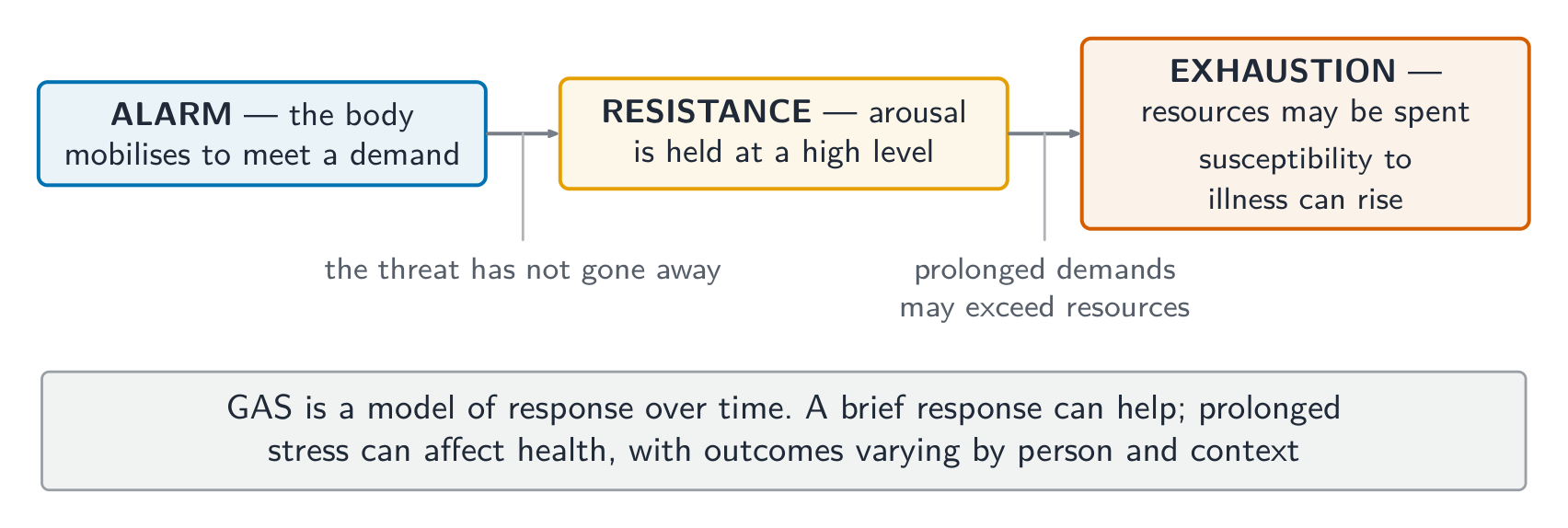
The general adaptation syndrome (GAS) 一般适应综合征 describes the body's response in three stages: alarm 警觉期 (the sympathetic system mobilises), resistance 抵抗期 (the body continues responding to a demand), and exhaustion 衰竭期 (resources are spent and vulnerability to illness can rise).
Not everyone responds by fighting or fleeing. Tend-and-befriend theory 照料-结盟理论 proposes that some people respond to stress by caring for others and seeking social support.
Coping takes two broad forms. Problem-focused coping 问题聚焦应对 treats the stressor as a problem to be solved and works on the cause; it suits situations a person can control. Emotion-focused coping 情绪聚焦应对 manages the emotional reaction instead, which suits situations that cannot be changed.
Vocabulary
Train
| English |
|---|
| Health psychology/helθ saɪˈkɒlədʒi/ |
| Stress/stres/ |
| stressor/ˈstresə/ |
| Eustress/ˈjuːstrəs/ |
| distress/dɪˈstres/ |
| daily hassles/ˈdeɪli ˈhæslz/ |
| significant life changes/sɪɡˈnɪfɪkənt laɪf ˈtʃeɪndʒɪz/ |
| catastrophes/kəˈtæstrəfiz/ |
| general adaptation syndrome (GAS)/ˈdʒenərəl ˌædæpˈteɪʃn ˈsɪndrəʊm/ |
| alarm/əˈlɑːm/ |
| resistance/rɪˈzɪstəns/ |
| exhaustion/eɡˈzɔːstʃn/ |
| Tend-and-befriend theory/tend ænd bɪˈfrend ˈθɪəri/ |
| Problem-focused coping/ˈprɒbləm ˈfəʊkəst ˈkəʊpɪŋ/ |
| Emotion-focused coping/ɪˈməʊʃn ˈfəʊkəst ˈkəʊpɪŋ/ |
5.2
Positive Psychology
Syllabus
| Learning Objective | Essential Knowledge |
|---|---|
5.2.A |
|
5.2.B |
|
Source: College Board AP Course and Exam Description
Positive psychology 积极心理学 studies what makes life go well rather than what goes wrong. It looks for the factors behind well-being 幸福感 and resilience 心理韧性.
Three findings are examinable:
- Expressing gratitude 感恩 can support subjective well-being 主观幸福感. Assess the design and outcome measure before interpreting a study.
- People who use their signature strengths 标志性优势 report greater happiness and well-being. A self-report remains a subjective measure; an association alone does not prove causation. The CED groups character strengths around six virtues: wisdom, courage, humanity, justice, temperance and transcendence.
- Posttraumatic growth 创伤后成长 is positive psychological change that can follow a struggle with trauma. It is not inevitable and does not mean the trauma was beneficial or distress has ended.
Vocabulary
Train
| English |
|---|
| Positive psychology/ˈpɒzɪtɪv saɪˈkɒlədʒi/ |
| well-being/wel ˈbiːɪŋ/ |
| resilience/rɪˈsɪlɪəns/ |
| gratitude/ˈɡrætɪtjuːd/ |
| subjective well-being/sʌbˈdʒektɪv wel ˈbiːɪŋ/ |
| signature strengths/ˈsɪɡnɪtʃə streŋθs/ |
| Posttraumatic growth/ˌpəʊstrəˈmætɪk ɡrəʊθ/ |
5.3
Explaining and Classifying Disorders
Syllabus
| Learning Objective | Essential Knowledge |
|---|---|
5.3.A |
|
5.3.B |
|
5.3.C |
|
Source: College Board AP Course and Exam Description
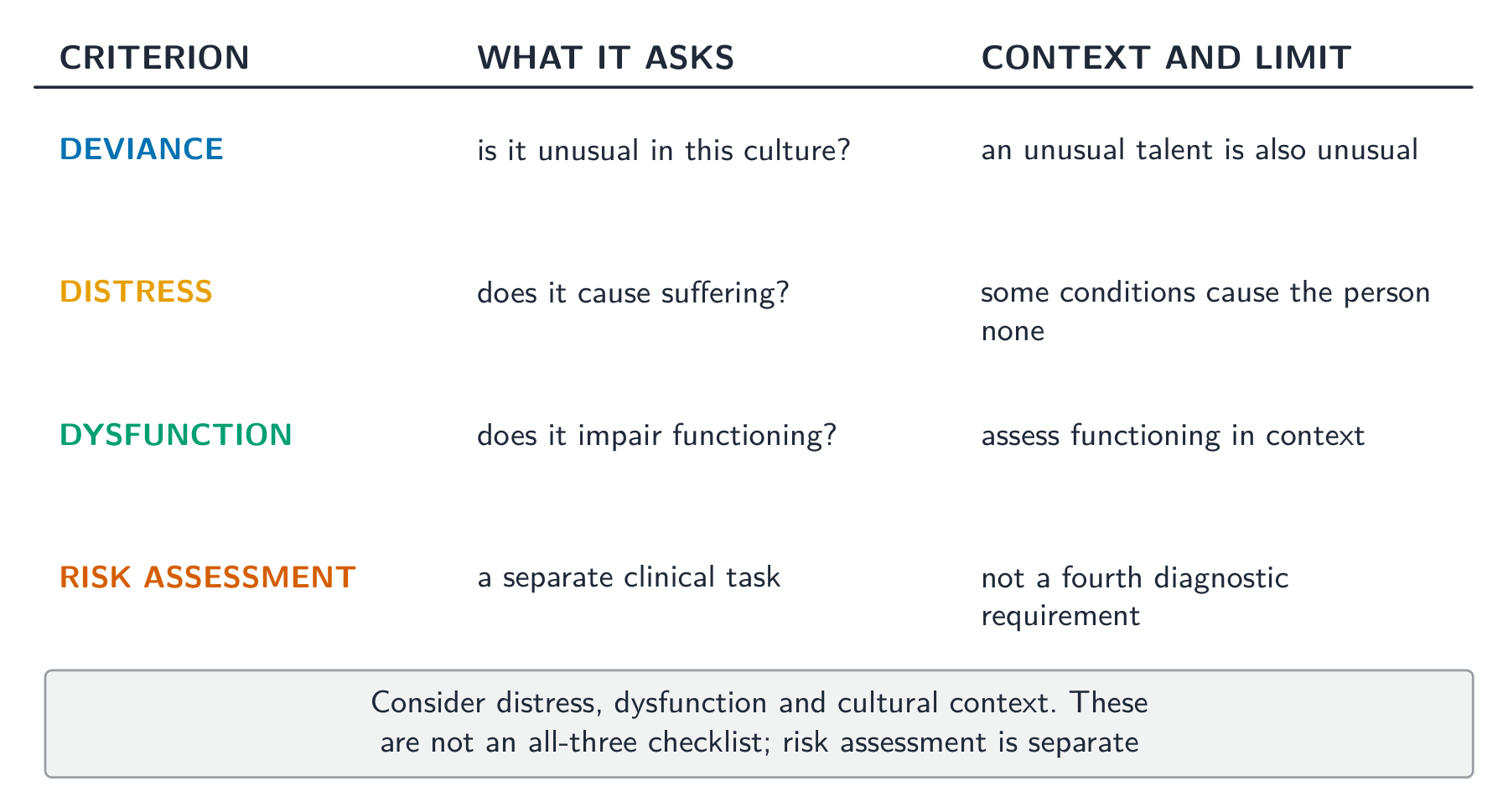
The course uses three considerations when discussing disordered behaviour: the level of dysfunction 功能失调, the person's personal distress 个人痛苦, and deviation from social norms 偏离社会规范. Because norms differ between cultures and change over time, context matters. These considerations are not a checklist requiring all three, and being unusual alone is not a diagnosis.
Classifying a disorder has both benefits and costs. A diagnosis guides treatment and gives access to support, but a label can also carry stigma 污名 and change how a person is treated. Diagnosis requires specialised training and evidence-based criteria. The DSM 精神障碍诊断与统计手册 and ICD 国际疾病分类 provide classification frameworks; they do not by themselves establish why a particular person developed a disorder.
Most psychologists take an eclectic approach 折衷取向, drawing on more than one perspective:
- Behavioral 行为主义: disorders come from maladaptive learned associations.
- Psychodynamic 精神动力学: from unconscious conflict.
- Humanistic 人本主义: from a lack of acceptance and support.
- Cognitive 认知: from maladaptive thought patterns.
- Evolutionary 进化: considers behavior and mental processes in relation to adaptation and survival; an evolutionary proposal is not proof of a particular disorder’s cause.
- Sociocultural 社会文化: from the person's social and cultural setting.
- Biological 生物学: from physiological and genetic factors.
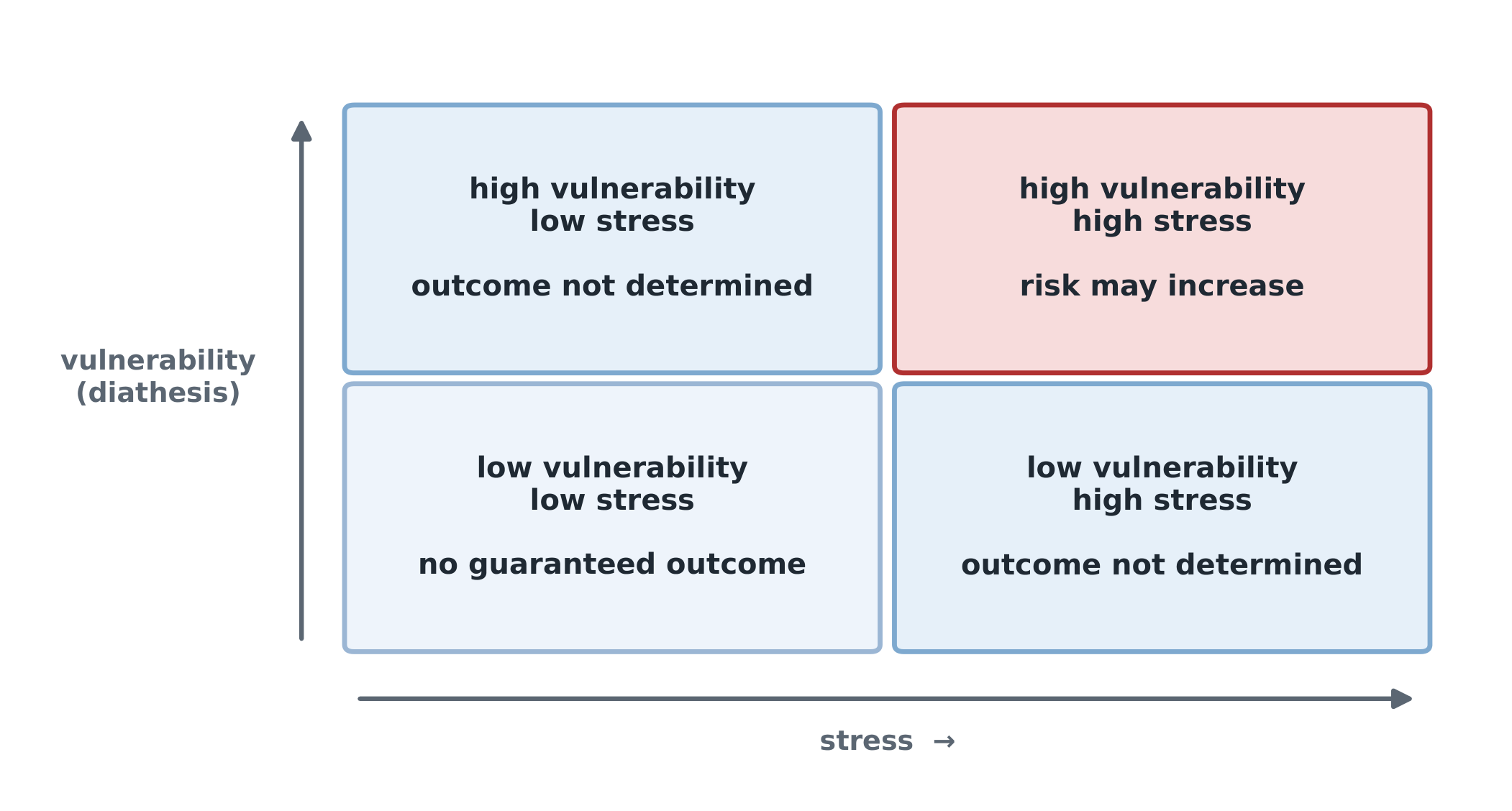
Two integrating models are examinable. The biopsychosocial model 生物心理社会模型 assumes any psychological problem may combine biological, psychological, and social causes. The diathesis-stress model 素质-压力模型 proposes an interaction between underlying vulnerability and stressful life experience. The CED emphasises genetic vulnerability. It is a model of risk, not a diagnostic formula or a guarantee that a person with both inputs develops a disorder.
Vocabulary
Train
| English |
|---|
| dysfunction/dɪsˈfʌŋkʃn/ |
| personal distress/ˈpɜːsənl dɪˈstres/ |
| deviation from social norms/ˌdiːvɪˈeɪʃn frɒm ˈsəʊʃl nɔːmz/ |
| stigma/ˈstɪɡmə/ |
| eclectic approach/ɪˈklektɪk əˈprəʊtʃ/ |
| Behavioral/bɪˈheɪvjərəl/ |
| Psychodynamic/ˌsaɪkəʊdaɪˈnæmɪk/ |
| Humanistic/ˌhjuːməˈnɪstɪk/ |
| Cognitive/ˈkɒɡnɪtɪv/ |
| Evolutionary/ɪvəˈluːʃənəri/ |
| Sociocultural/ˌsəʊsɪəˈkʌltʃərəl/ |
| Biological/ˌbaɪəˈlɒdʒɪkl/ |
| biopsychosocial model/baɪˈɒsaɪkəʊsəʊʃl ˈmɒdl/ |
| diathesis-stress model/ˈdaɪəθəsɪs stres ˈmɒdl/ |
| DSM/ˌdiː es ˈem/ |
| ICD/ˌaɪ siː ˈdiː/ |
5.4
Categories of Disorders
Syllabus
| Learning Objective | Essential Knowledge |
|---|---|
5.4.A |
|
5.4.B |
|
5.4.C |
|
5.4.D |
|
5.4.E |
|
5.4.F |
|
5.4.G |
|
5.4.H |
|
5.4.I |
|
5.4.J |
|
Source: College Board AP Course and Exam Description
The CED names a limited set of categories, each with its own features and possible causes.
- Neurodevelopmental disorders 神经发育障碍 begin during the developmental period. The CED selects ADHD (attention-deficit/hyperactivity disorder) and ASD (autism spectrum disorder); causes may involve environmental, physiological and genetic factors.
- Schizophrenic spectrum disorders 精神分裂症谱系障碍 involve positive symptoms 阳性症状 - delusions 妄想 (false beliefs), hallucinations 幻觉 (false perceptions), disorganized thinking 思维紊乱 - and negative symptoms 阴性症状, reductions in typical functioning such as flat affect 情感淡漠. Catatonia 紧张症 concerns movement and responsiveness; do not classify every manifestation as a positive symptom.
- Depressive disorders 抑郁障碍 involve sad, empty, or irritable mood with related changes in body and thinking that impair functioning. The CED selects major depressive disorder and persistent depressive disorder; a brief sad mood alone is insufficient.
- Bipolar disorders 双相障碍 involve episodes of marked mood and activity change. Bipolar I includes mania 躁狂; depressive episodes may occur but are not required for its definition. Bipolar II involves hypomanic and depressive episodes. Episodes need not follow a fixed alternating schedule (NIMH).
- Anxiety disorders 焦虑障碍 involve excessive fear or anxiety: specific phobia 特定恐惧症, agoraphobia 广场恐惧症, panic disorder 惊恐障碍 with panic attacks 惊恐发作, social anxiety disorder 社交焦虑障碍, and generalized anxiety disorder (GAD) 广泛性焦虑障碍.
- Obsessive-compulsive and related disorders 强迫及相关障碍 include OCD and hoarding disorder. In OCD, obsessions 强迫思维 are intrusive unwanted thoughts, urges or images, and compulsions 强迫行为 are repetitive behaviors or mental acts. They are not interchangeable, and related disorders do not all have an identical symptom pattern.
- Dissociative disorders 分离障碍 involve dissociation from consciousness, memory, or identity, and can be associated with trauma or stress. The CED selects dissociative amnesia (with or without fugue) and dissociative identity disorder.
- Trauma and stressor-related disorders 创伤及应激相关障碍 follow exposure to a traumatic event; posttraumatic stress disorder (PTSD) 创伤后应激障碍 is the main example.
- Feeding and eating disorders 进食障碍 involve altered consumption or absorption of food that impairs health or psychological functioning. The CED selects anorexia nervosa and bulimia nervosa.
- Personality disorders 人格障碍 are enduring patterns and fall into three clusters: Cluster A the odd or eccentric, Cluster B the dramatic or erratic, and Cluster C the anxious or fearful.
The learning objectives ask for features and possible causes of the selected disorders. Explain the factor relevant to a question instead of attaching the same list to every category. Genetic or physiological vulnerability, learned associations, thinking patterns and social conditions can interact; a brief classroom vignette cannot establish a clinical diagnosis.
Vocabulary
Train
| English |
|---|
| Neurodevelopmental disorders/ˌnjuːrəʊdˈveləpmentl dɪˈsɔːdəz/ |
| Schizophrenic spectrum disorders/ˌskɪtsəˈfrenɪk ˈspektrəm dɪˈsɔːdəz/ |
| positive symptoms/ˈpɒzɪtɪv ˈsɪmptəmz/ |
| delusions/dɪˈluːʒnz/ |
| hallucinations/həˌluːsɪˈneɪʃnz/ |
| disorganized thinking/dɪˈsɔːɡənaɪzd ˈθɪŋkɪŋ/ |
| catatonia/ˌkætəˈtəʊnɪə/ |
| negative symptoms/ˈneɡətɪv ˈsɪmptəmz/ |
| flat affect/flæt əˈfekt/ |
| Depressive disorders/dɪˈpresɪv dɪˈsɔːdəz/ |
| Bipolar disorders/baɪˈpəʊlə dɪˈsɔːdəz/ |
| mania/ˈmeɪnɪə/ |
| Anxiety disorders/æŋˈzaɪəti dɪˈsɔːdəz/ |
| specific phobia/spəˈsɪfɪk ˈfəʊbɪə/ |
| agoraphobia/ˌæɡɔːrəˈfəʊbɪə/ |
| panic disorder/ˈpænɪk dɪˈsɔːdə/ |
| panic attacks/ˈpænɪk əˈtæks/ |
| social anxiety disorder/ˈsəʊʃl æŋˈzaɪəti dɪˈsɔːdə/ |
| generalized anxiety disorder (GAD)/ˈdʒenərəlaɪzd æŋˈzaɪəti dɪˈsɔːdə/ |
| Obsessive-compulsive and related disorders/ɒbˈsesɪv kəmˈpʌlsɪv ænd rɪˈleɪtɪd dɪˈsɔːdəz/ |
| obsessions/ɒbˈseʃnz/ |
| compulsions/kəmˈpʌlʃnz/ |
| Dissociative disorders/dɪˈsəʊsɪətɪv dɪˈsɔːdəz/ |
| Trauma and stressor-related disorders/ˈtrɔːmə ænd ˈstresə rɪˈleɪtɪd dɪˈsɔːdəz/ |
| posttraumatic stress disorder (PTSD)/ˌpəʊstrəˈmætɪk stres dɪˈsɔːdə/ |
| Feeding and eating disorders/ˈfiːdɪŋ ænd ˈiːtɪŋ dɪˈsɔːdəz/ |
| Personality disorders/ˌpɜːsəˈnælɪti dɪˈsɔːdəz/ |
5.5
Treatment
Syllabus
| Learning Objective | Essential Knowledge |
|---|---|
5.5.A |
|
5.5.B |
|
5.5.C |
|
5.5.D |
|
5.5.E | |
5.5.F |
|
5.5.G |
|
Source: College Board AP Course and Exam Description
Meta-analyses 元分析 generally find psychotherapy effective, but outcomes vary with the intervention, condition, person and study. Evidence-based planning, cultural humility and a therapeutic alliance matter. The rise of effective psychotropic medication 精神药物治疗 also changed care, reducing long hospital stays in favour of community treatment.
Clinicians must follow ethical principles such as avoiding harm, integrity and respect for rights and dignity, including informed consent 知情同意, confidentiality 保密, and working within their competence.
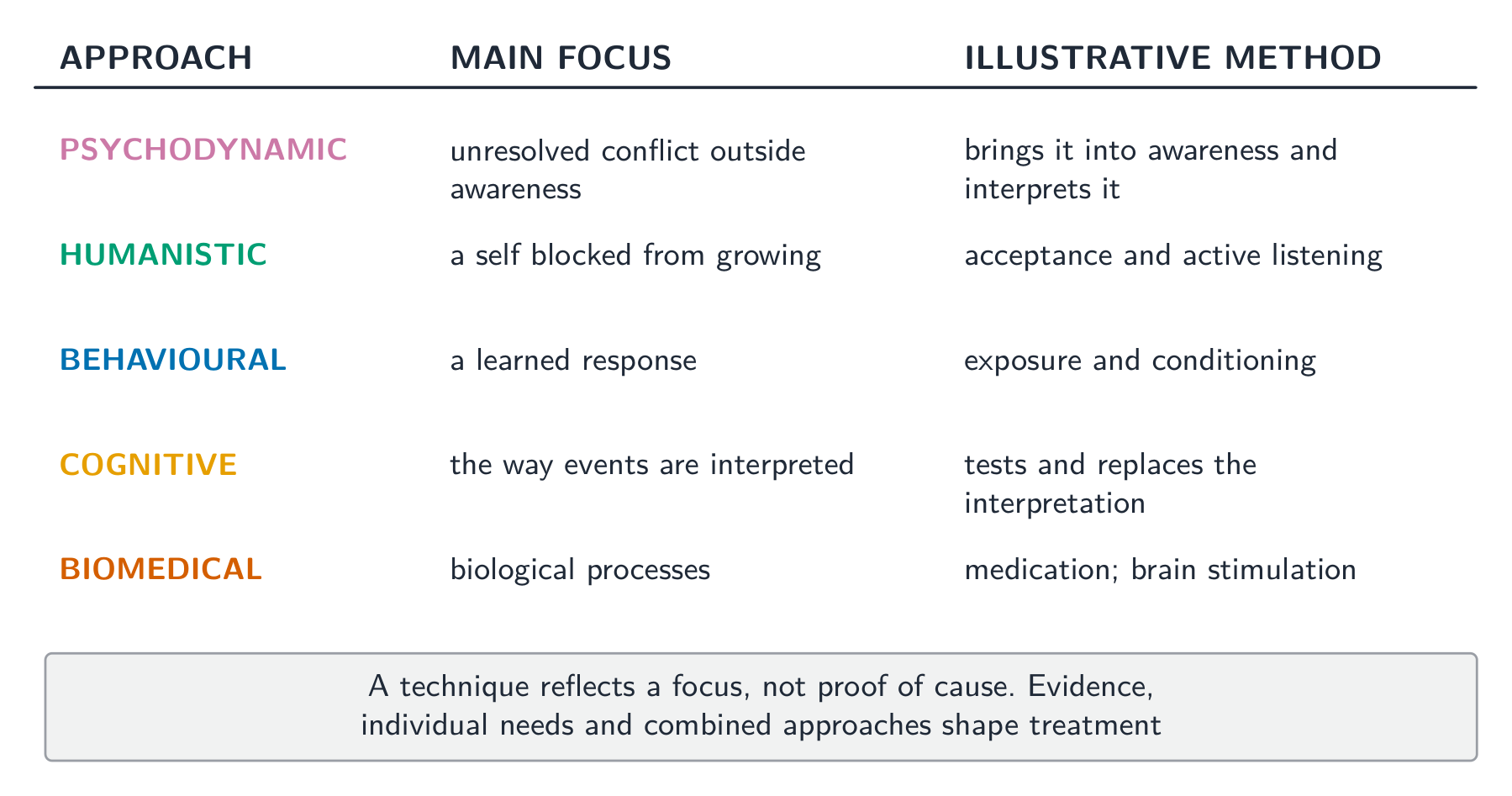
Therapies follow the perspectives above:
- Psychodynamic therapies 精神动力学治疗 use free association 自由联想 and dream interpretation to uncover unconscious material.
- Cognitive therapies 认知疗法 use cognitive restructuring 认知重构 to examine maladaptive interpretations. Fear hierarchies 恐惧等级表 organise feared situations by intensity and can support graduated exposure; the hierarchy alone does not identify a purely cognitive method.
- Applied behavior analysis 应用行为分析 applies conditioning principles, including systematic desensitization 系统脱敏 and token economies 代币制.
- Cognitive-behavioral therapies 认知行为疗法, such as dialectical behavior therapy 辩证行为疗法 and rational-emotive behavior therapy 理性情绪行为疗法, combine both.
- Person-centered therapy 以人为中心疗法, from the humanistic perspective, uses active listening 积极倾听 and unconditional positive regard.
Hypnosis 催眠 is effective for pain and anxiety, but research does not support its use to recover memories. Medications include antidepressants 抗抑郁药, antianxiety drugs 抗焦虑药, lithium 锂盐, and antipsychotics 抗精神病药. Biological interventions also include psychosurgery 精神外科手术 and brain stimulation. Transcranial magnetic stimulation (TMS) 经颅磁刺激 is noninvasive magnetic stimulation; electroconvulsive therapy (ECT) 电休克治疗 induces controlled seizure activity under anaesthesia. ECT can be considered when other treatments fail or a rapid response is needed; it is not restricted to an absolute last resort (NIMH). Drug and procedure mechanisms, benefits and risks differ; medication response does not by itself prove a disorder’s cause.
Complete original research practice
This is a fictional teaching study and dataset, not a published experiment or a past-paper extract. Eighty adult volunteers consented to a seven-day writing study. Researchers randomly assigned them to write either gratitude reflections or neutral daily descriptions for ten minutes each day. Participants were told they could withdraw, and reports used participant codes. On a 0–10 self-report well-being scale, the mean change was +0.8 in the gratitude group and +0.2 in the neutral group. No variability, significance test or follow-up data are supplied.
Attempt: Identify an ethical procedure using the study evidence. Calculate the difference in mean change. Explain what random assignment supports and one limit on the conclusion.
Worked check: Informed consent is evidenced by volunteers consenting before participation; withdrawal rights and coded reporting are also supplied procedures. The difference in mean change is 0.8 − 0.2 = 0.6 scale points. Random assignment supports comparing the effect of the writing conditions within this study, but the supplied means alone do not establish statistical significance. Volunteer sampling, self-report and a short follow-up limit wider claims. Do not invent a procedure the paragraph does not report.
Applying concepts to scenarios
Coping task: A student has two demands: a revision timetable they can reorganise and a delayed result they cannot speed up. Propose one problem-focused and one emotion-focused response, explaining the target of each.
Worked check: Reorganising the timetable acts on a controllable source of pressure. Managing the emotional reaction while waiting, for example with a calming routine, targets distress. Both kinds of coping can be used together; control is a useful consideration, not a rule that determines one universally best response.
Model task: Two fictional people have similar underlying vulnerability but different stressful experiences and support. Use diathesis-stress and biopsychosocial models to explain why different outcomes are possible.
Worked check: Diathesis-stress considers vulnerability interacting with stress; biopsychosocial reasoning also considers psychological interpretation and social support. These models suggest factors to investigate rather than proving which person will develop a disorder.
Therapy task: In one fictional session, a client tests the prediction “one mistake means everyone rejects me”. In another, a clinician uses planned gradual contact with a feared situation. Identify the main technique in each, and explain why a real treatment plan may combine techniques.
Worked check: Testing an interpretation illustrates cognitive restructuring. Planned contact illustrates exposure and behavioral learning; a fear hierarchy can organise its steps. CBT can combine these approaches. Neither vignette establishes one cause of the client’s difficulties or a guaranteed treatment outcome.
Group and individual therapy: Individual therapy centres on one client and therapist. Group therapy involves multiple clients and can support shared learning and interaction; confidentiality, participation and individual needs still require attention.
Explore
Match a technique to its main focus
Distinguish technique mechanisms without treating a preferred technique as proof of the disorder’s cause.
Vocabulary
Train
| English |
|---|
| Meta-analyses/ˈmetə ˈænəlaɪzɪz/ |
| psychotropic medication/ˌsaɪkəʊˈtrɒpɪk ˌmedɪˈkeɪʃn/ |
| informed consent/ɪnˈfɔːmd kənˈsent/ |
| confidentiality/ˌkɒnfɪˌdenʃiˈæləti/ |
| Psychodynamic therapies/ˌsaɪkəʊdaɪˈnæmɪk ˈθerəpiz/ |
| free association/friː əˌsəʊsɪˈeɪʃn/ |
| Cognitive therapies/ˈkɒɡnɪtɪv ˈθerəpiz/ |
| cognitive restructuring/ˈkɒɡnɪtɪv rɪˈstrʌktʃərɪŋ/ |
| fear hierarchies/fɪə ˈhaɪərɑːkiz/ |
| Applied behavior analysis/əˈplaɪd bɪˈheɪvjə əˈnæləsɪs/ |
| systematic desensitization/ˌsɪstəˈmætɪk diːˌsensɪtaɪˈzeɪʃn/ |
| token economies/ˈtəʊkən ɪˈkɒnəmiz/ |
| Cognitive-behavioral therapies/ˈkɒɡnɪtɪv bɪˈheɪvjərəl ˈθerəpiz/ |
| dialectical behavior therapy/daɪəˈlektɪkl bɪˈheɪvjə ˈθerəpi/ |
| rational-emotive behavior therapy/ˈræʃənl ɪˈməʊtɪv bɪˈheɪvjə ˈθerəpi/ |
| Person-centered therapy/ˈpɜːsn ˈsentəd ˈθerəpi/ |
| active listening/ˈæktɪv ˈlɪsənɪŋ/ |
| Hypnosis/hɪpˈnəʊsɪs/ |
| antidepressants/ˌæntɪdɪˈpresənts/ |
| antianxiety drugs/ˌæntɪæŋˈzaɪəti drʌɡz/ |
| lithium/ˈlɪθɪəm/ |
| antipsychotics/ˌæntɪsaɪˈkɒtɪks/ |
| psychosurgery/ˈsaɪkəʊsɜːdʒəri/ |
| transcranial magnetic stimulation (TMS)/trænˈskreɪnɪəl mæɡˈnetɪk ˌstɪmjʊˈleɪʃn/ |
| electroconvulsive therapy (ECT)/ɪˌlektrəʊˈkɒnvəlsɪv ˈθerəpi/ |
5.5
Exam tips
- Use the three considerations together - dysfunction, distress, deviation - when a question asks what makes behaviour disordered.
- For diathesis-stress, explain interaction and uncertainty. The model does not diagnose or guarantee an outcome.
- Keep positive and negative symptoms straight: positive means something added (hallucinations), negative means something missing (flat affect).
- Match therapy to perspective. Free association is psychodynamic; cognitive restructuring is cognitive; systematic desensitization is behavioral.
- Obsessions are intrusive thoughts, urges or images; compulsions can be repetitive behaviors or mental acts.
- Read the task verb. Identify wants a name, Describe wants detail, Explain wants a reason with evidence.
5.5
Sources for this lesson
The course scope is College Board’s AP Psychology Course and Exam Description, Unit 5, PDF pages 121–134 (syllabi/ap/ap_psychology_CED.pdf). Clinical qualifications use APA: stress effects on the body, NIMH: bipolar disorder, NIMH: psychotherapies, NIMH: brain stimulation therapies, and APA: OCD fact sheet. Practice material is explicitly fictional and carries no official scoring claim.
Interactive lessons on this topic
Work through it step by step, with instant-check exercises.