| Learning Objective | Essential Knowledge |
|---|---|
2.1.A |
|
2.1.B |
|
Cognition
AP Psychology · Topic 2
 17:54
17:54
Cognition
Look at a sentence with a letter missing and you read it anyway. Nobody had to tell you what the letter was. Your brain supplied it, instantly, without asking…
English narration · English + 中文 subtitles burned in
2.1
Perception
Syllabus
Source: College Board AP Course and Exam Description
Unit 1 ended with sensation, the detection of a stimulus. Perception 知觉 is what the brain does next: it organises and interprets that information. The same signal can be perceived in more than one way.
Two directions of processing work together:
- Bottom-up processing 自下而上加工 starts from the raw sensory information and builds upwards.
- Top-down processing 自上而下加工 starts from what you already expect and know.
Internal filters shape perception. A schema 图式 is a mental framework built from past experience. A perceptual set 知觉定势 is a readiness to see something in a particular way. External filters matter too: context 情境 and cultural expectations change what people report seeing.
Gestalt psychology 格式塔心理学 described how the brain groups parts into wholes: closure 闭合 (filling in gaps), figure and ground 图形与背景 (separating an object from its background), proximity 邻近性 (grouping things that are close), and similarity 相似性 (grouping things that look alike).
Attention 注意 sits between sensation and perception. It is limited, so some information is lost:
- Selective attention 选择性注意 focuses on one input. The cocktail party effect 鸡尾酒会效应 is hearing your own name across a noisy room.
- Inattentional blindness 无意视盲 is failing to see something visible because attention was elsewhere; change blindness 变化盲视 is failing to notice that something has changed.
Vocabulary
Train
| English |
|---|
| Perception/pəˈsepʃn/ |
| Bottom-up processing/ˈbɒtəm ʌp ˈprəʊsesɪŋ/ |
| Top-down processing/tɒp daʊn ˈprəʊsesɪŋ/ |
| schema/ˈskiːmə/ |
| perceptual set/pəˈseptʃuːəl set/ |
| context/ˈkɒntekst/ |
| Gestalt psychology/ɡəʃˈtɑːlt saɪˈkɒlədʒi/ |
| closure/ˈkləʊʒə/ |
| figure and ground/ˈfɪɡə ænd ɡraʊnd/ |
| proximity/prɒkˈsɪmɪti/ |
| similarity/ˌsɪmɪˈlærɪti/ |
| Attention/əˈtenʃn/ |
| Selective attention/sɪˈlektɪv əˈtenʃn/ |
| cocktail party effect/ˈkɒkteɪl ˈpɑːti ɪˈfekt/ |
| Inattentional blindness/ɪnəˈtenʃənl ˈblaɪndnəs/ |
| change blindness/tʃeɪndʒ ˈblaɪndnəs/ |
2.1
Depth, Constancy, and Movement
Syllabus
| Learning Objective | Essential Knowledge |
|---|---|
2.1.A |
|
2.1.B |
|
Source: College Board AP Course and Exam Description
To perceive a three-dimensional world from a flat retinal image, the brain uses depth cues 深度线索.
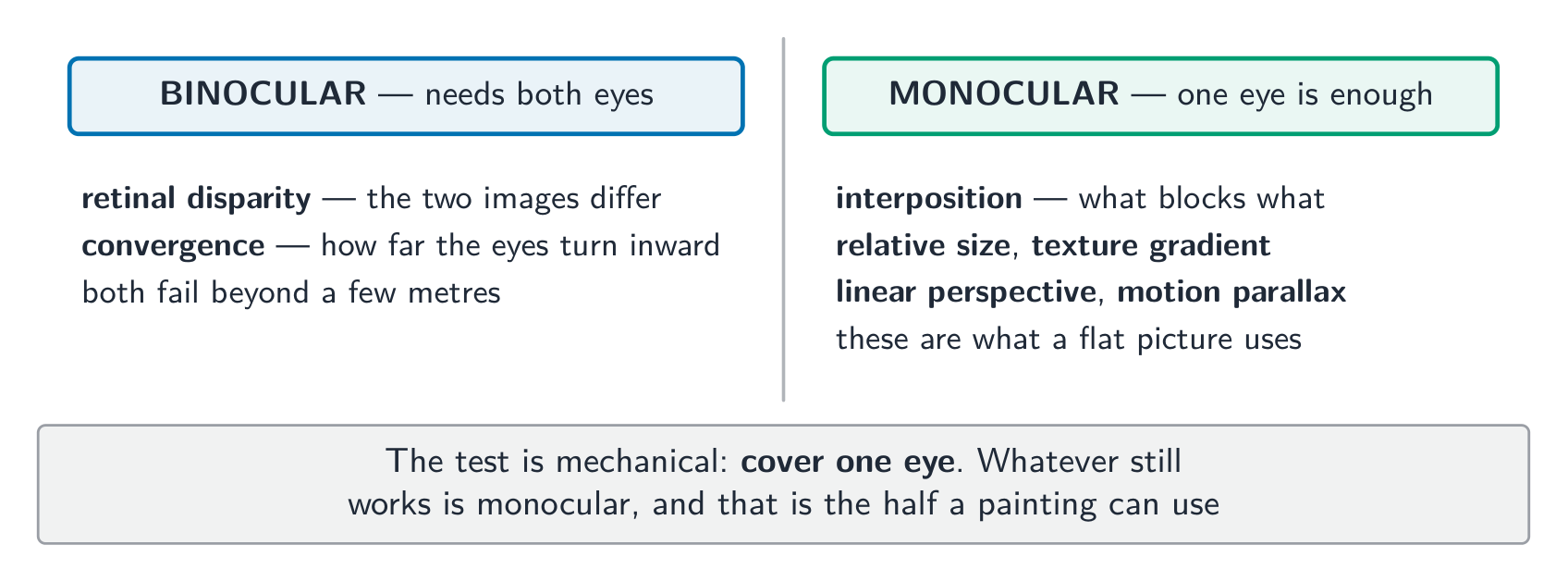
Binocular cues 双眼线索 need both eyes. Retinal disparity 视网膜像差 is the small difference between the two images; the greater the difference, the closer the object. Convergence 辐辏 is the inward turn of the eyes for near objects.
Monocular cues 单眼线索 work with one eye: relative clarity 相对清晰度, relative size 相对大小, texture gradient 纹理梯度, linear perspective 线条透视, and interposition 遮挡 (a nearer object blocks a further one).
Perceptual constancy 知觉恒常性 keeps an object looking the same even when its retinal image changes - a door stays rectangular as it swings open. The brain can also perceive apparent movement 似动 when nothing actually moves, which is why a series of still frames looks like a film.
Vocabulary
Train
| English |
|---|
| depth cues/depθ kjuːz/ |
| Binocular cues/bɪˈnɒkjʊlə kjuːz/ |
| Retinal disparity/ˈretɪnl dɪˈspærɪti/ |
| Convergence/kənˈvɜːdʒəns/ |
| Monocular cues/mɒˈnəʊkjʊlə kjuːz/ |
| relative clarity/ˈrelətɪv ˈklærɪti/ |
| relative size/ˈrelətɪv saɪz/ |
| texture gradient/ˈtekstʃə ˈɡreɪdɪənt/ |
| linear perspective/ˈlɪnɪə pəˈspektɪv/ |
| interposition/ˌɪntəpəˈzɪʃn/ |
| Perceptual constancy/pəˈseptʃuːəl ˈkɒnstənsi/ |
| apparent movement/əˈpærənt ˈmuːvmənt/ |
2.2
Thinking and Problem-Solving
Syllabus
| Learning Objective | Essential Knowledge |
|---|---|
2.2.A |
|
Source: College Board AP Course and Exam Description
Concepts 概念 are the basis of thought, and a prototype 原型 is the best example of a concept. People build and change schemas through assimilation 同化 (fitting new information into an existing schema) and accommodation 顺应 (changing the schema to fit new information).
Two ways to solve a problem:
- An algorithm 算法 is a systematic procedure. The course contrasts searching possible solutions until a correct one is found with using a shortcut. Exhaustive search succeeds when the possibilities can all be checked, a solution exists within them, and the checker works. Algorithms are not always exhaustive or slow.
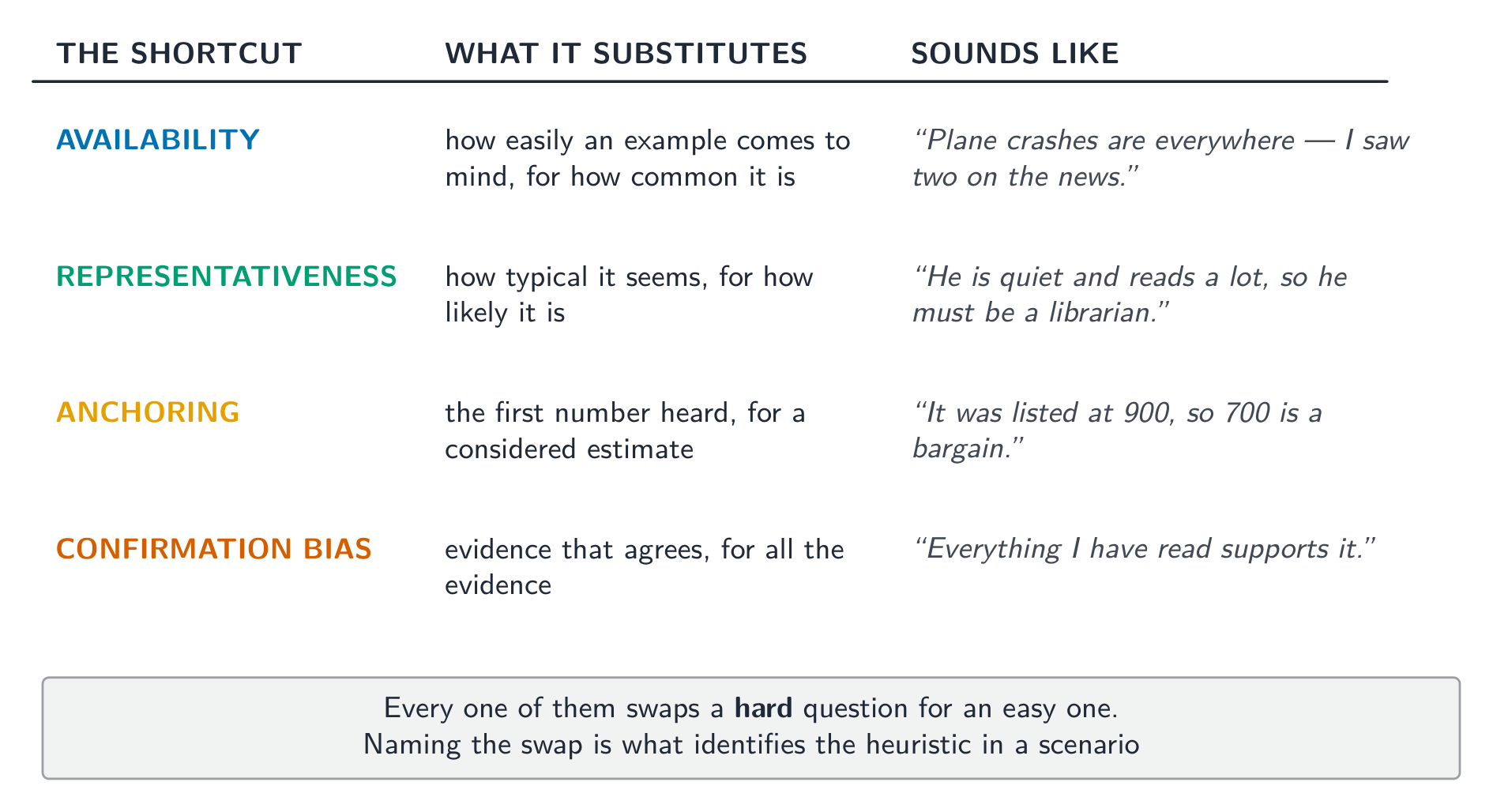
- A heuristic 启发式 is a mental shortcut. It is fast but can lead to error - the representativeness heuristic 代表性启发式 judges by how well something matches a prototype, and the availability heuristic 可得性启发式 judges by how easily examples come to mind.
Worked search comparison. A classroom puzzle has eight possible answers, A–H, exactly one correct answer and a reliable checker. Testing A, then B and continuing in order systematically covers the possibilities. Starting with D because similar puzzles used D is a heuristic: it may save time but may mislead. The guarantee of the systematic search depends on the finite set, the included solution and the checker.
Worked judgement comparison. Judging cycling accidents to be common because vivid crash reports come easily to mind illustrates availability: ease of recall alone does not establish frequency. Assuming a quiet person who likes books must be a librarian illustrates representativeness: resemblance to a prototype replaces consideration of other relevant information. Identify the cue used, rather than assuming every shortcut gives a wrong answer.
Thinking can also get stuck. A mental set 心向 is the tendency to repeat a solution that worked before. Functional fixedness 功能固着 is seeing an object only in its usual use. The gambler's fallacy 赌徒谬误 (believing a run must end) and the sunk-cost fallacy 沉没成本谬误 (continuing because of what is already spent) both hinder good decisions.
Executive functions 执行功能 let people generate, organise, plan, and carry out goals. Creativity 创造力 involves divergent thinking 发散思维 (generating many ideas) rather than convergent thinking 聚合思维 (narrowing to one answer).
Explore
Name the shortcut in each scenario
Every heuristic swaps a hard question for an easy one — and naming the swap is what identifies it.
Vocabulary
Train
| English |
|---|
| Concepts/ˈkɒnsepts/ |
| prototype/ˈprəʊtəʊtaɪp/ |
| assimilation/əˌsɪmɪˈleɪʃn/ |
| accommodation/əˌkɒməˈdeɪʃn/ |
| algorithm/ˈælɡərɪθəm/ |
| heuristic/hjuːˈrɪstɪk/ |
| representativeness heuristic/ˌreprɪˈzentətɪvnəs hjuːˈrɪstɪk/ |
| availability heuristic/əˌveɪləˈbɪlɪti hjuːˈrɪstɪk/ |
| mental set/ˈmentl set/ |
| Functional fixedness/ˈfʌŋkʃənl ˈfɪkstnəs/ |
| gambler's fallacy/ˈɡæmbləz ˈfæləsi/ |
| sunk-cost fallacy/sʌŋk kɒst ˈfæləsi/ |
| Executive functions/eɡˈzekjuːtɪv ˈfʌŋkʃnz/ |
| Creativity/kriːˌeɪˈtɪvɪti/ |
| divergent thinking/daɪˈvɜːdʒənt ˈθɪŋkɪŋ/ |
| convergent thinking/kənˈvɜːdʒənt ˈθɪŋkɪŋ/ |
2.3
Memory Systems
Syllabus
| Learning Objective | Essential Knowledge |
|---|---|
2.3.A |
|
Source: College Board AP Course and Exam Description
Memory is divided by how information is processed.
Explicit memory 外显记忆 can be described to others. It splits into episodic memory 情景记忆 (personal events) and semantic memory 语义记忆 (facts). Implicit memory 内隐记忆 is harder to describe, and includes procedural memory 程序性记忆 (skills such as riding a bike). Prospective memory 前瞻记忆 is remembering to do something later.
Long-term potentiation 长时程增强 is the biological basis: synaptic connections grow stronger with repeated use.
Three models are examinable:
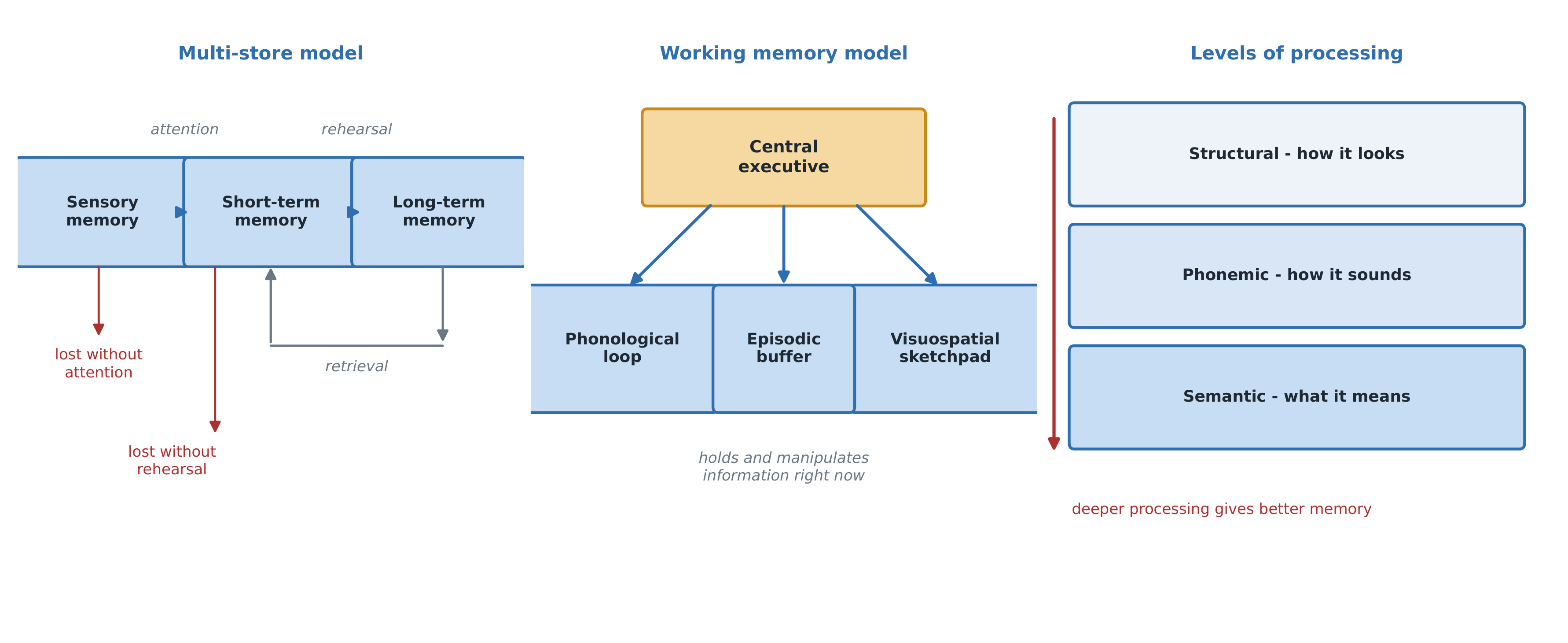
- The multi-store model 多重存储模型 proposes sensory memory 感觉记忆 (including iconic 图像记忆 and echoic 声像记忆 stores), short-term memory 短时记忆, and long-term memory 长时记忆.
- The working memory model 工作记忆模型 treats the middle stage as active, not a waiting room. It has a phonological loop 语音回路, a visuospatial sketchpad 视空间模板, and a central executive 中央执行系统.
- The levels of processing model 加工水平模型 says deeper processing gives better memory: shallow processing of appearance, then sound, then deep processing of meaning.
Worked model comparison. Noor briefly sees route directions, repeats the street names while planning turns, and recalls the route the next day. The multi-store model helps distinguish sensory, short-term and long-term demands. The working memory model explains active processing: the phonological loop supports the names, the visuospatial sketchpad supports the mental route, and the central executive coordinates attention. The levels of processing model predicts a benefit from connecting a street name's meaning to a familiar place, compared with only noticing its shape or sound. These are model applications, not proof that a memory moves through literal boxes.
Vocabulary
Train
| English |
|---|
| Explicit memory/ekˈsplɪsɪt ˈmeməri/ |
| episodic memory/ˌepɪˈsɒdɪk ˈmeməri/ |
| semantic memory/səˈmæntɪk ˈmeməri/ |
| Implicit memory/ɪmˈplɪsɪt ˈmeməri/ |
| procedural memory/prəˈsiːdʒərəl ˈmeməri/ |
| Prospective memory/prəˈspektɪv ˈmeməri/ |
| Long-term potentiation/lɒŋ tɜːm pəˌtenʃɪˈeɪʃn/ |
| multi-store model/ˈmʌlti stɔː ˈmɒdl/ |
| sensory memory/ˈsensəri ˈmeməri/ |
| iconic/aɪˈkɒnɪk/ |
| echoic/eˈkəʊɪk/ |
| short-term memory/ʃɔːt tɜːm ˈmeməri/ |
| long-term memory/lɒŋ tɜːm ˈmeməri/ |
| working memory model/ˈwɜːkɪŋ ˈmeməri ˈmɒdl/ |
| phonological loop/ˌfɒnəˈlɒdʒɪkl luːp/ |
| visuospatial sketchpad/ˌvɪsjuːəˈspeɪʃl ˈsketʃpæd/ |
| central executive/ˈsentrəl eɡˈzekjuːtɪv/ |
| levels of processing model/ˈlevlz ɒv ˈprəʊsesɪŋ ˈmɒdl/ |
2.4 2.5
Encoding and Storing
Syllabus
| Learning Objective | Essential Knowledge |
|---|---|
2.4.A |
|
| Learning Objective | Essential Knowledge |
|---|---|
2.5.A |
|
Source: College Board AP Course and Exam Description
Encoding 编码 gets information into memory, and how you encode changes how well you remember.
- Mnemonic devices 记忆术 such as the method of loci 位置法 aid encoding.
- Chunking 组块 groups items into meaningful units, which raises how much short-term memory can hold.
- The spacing effect 间隔效应 shows that spreading study over time beats massed practice 集中练习 (cramming).
- The serial position effect 系列位置效应 means items at the start (primacy 首因效应) and end (recency 近因效应) of a list are remembered best.
Storage differs by system. Maintenance rehearsal 保持性复述 repeats information to hold it; elaborative rehearsal 精细复述 links it to what you already know and works better.
A few people show highly superior autobiographical memory 超常自传体记忆, which suggests biological differences. Storage can also be impaired: Alzheimer's disease 阿尔茨海默病 and infantile amnesia 婴儿期遗忘 both limit what can be stored or recovered.
Vocabulary
Train
| English |
|---|
| Encoding/enˈkəʊdɪŋ/ |
| Mnemonic devices/nɪˈmɒnɪk dɪˈvaɪsɪz/ |
| method of loci/ˈmeθəd ɒv ˈləʊsaɪ/ |
| Chunking/ˈtʃʌŋkɪŋ/ |
| spacing effect/ˈspeɪsɪŋ ɪˈfekt/ |
| massed practice/mæst ˈpræktɪs/ |
| serial position effect/ˈsɪərɪəl pəˈzɪʃn ɪˈfekt/ |
| primacy/ˈpraɪməsi/ |
| recency/rɪˈsensi/ |
| Maintenance rehearsal/ˈmeɪntənəns rɪˈhɜːsl/ |
| elaborative rehearsal/ɪˈlæbrətɪv rɪˈhɜːsl/ |
| highly superior autobiographical memory/ˈhaɪli suːˈpɪərɪə ˌɔːtəʊˌbaɪəˈɡræfɪkl ˈmeməri/ |
| Alzheimer's disease/ˈæltsaɪməz dɪˈziːz/ |
| infantile amnesia/ˈɪnfəntaɪl æmˈniːzɪə/ |
2.6 2.7
Retrieving and Forgetting
Syllabus
| Learning Objective | Essential Knowledge |
|---|---|
2.6.A |
|
| Learning Objective | Essential Knowledge |
|---|---|
2.7.A |
|
Source: College Board AP Course and Exam Description
Retrieval takes two forms: recall 回忆 (producing information without cues) and recognition 再认 (identifying it among options). Recognition is easier, which is why a multiple-choice question feels easier than an essay.
Retrieval improves with matching conditions. Context-dependent memory 情境依存记忆 works better in the same place; state-dependent memory 状态依存记忆 works better in the same physical state; mood-congruent memory 心境一致性记忆 recalls material matching your current mood. Practising retrieval helps too - the testing effect 测试效应 shows that testing yourself beats rereading.
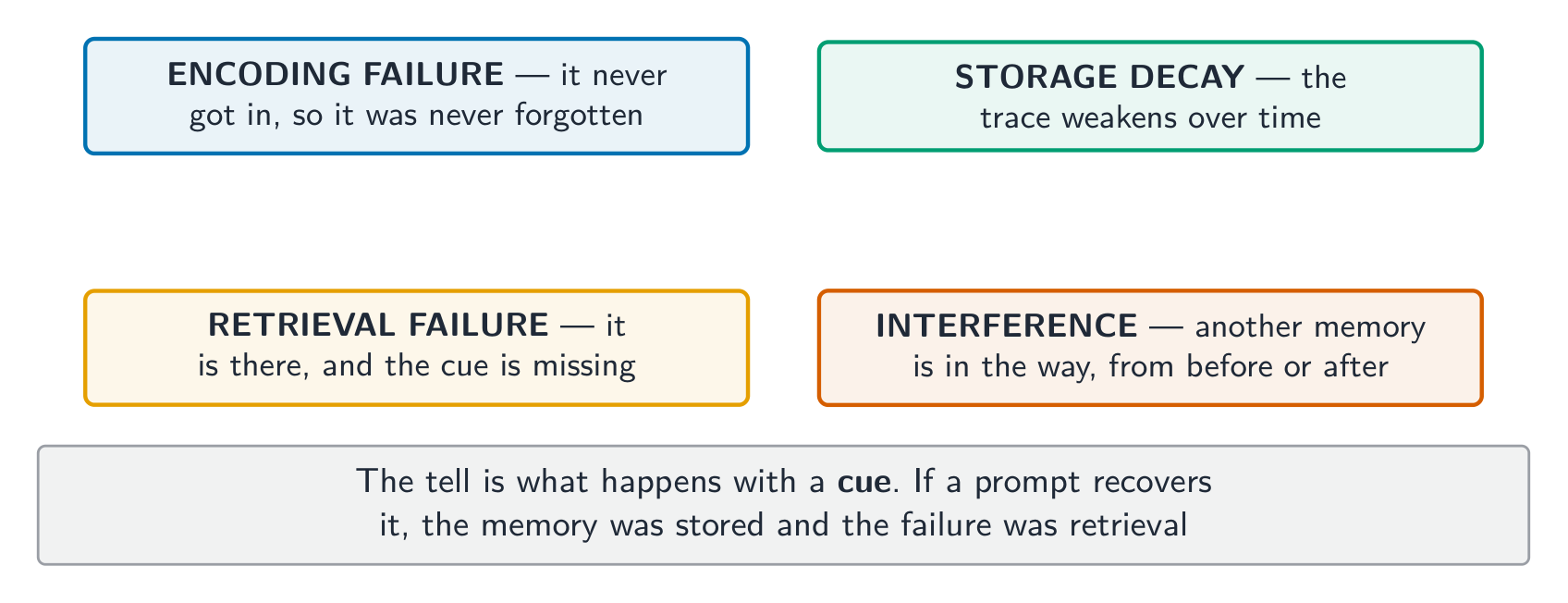
Forgetting has several causes. The forgetting curve 遗忘曲线 shows loss is fastest right after learning. Encoding failure 编码失败 means it never got in. Interference 干扰 can be proactive 前摄干扰 (old learning blocks new) or retroactive 倒摄干扰 (new blocks old). Retrieval failure 提取失败 includes the tip-of-the-tongue phenomenon 舌尖现象.
Memory is also reconstructive 重构的, not a recording. The misinformation effect 错误信息效应 occurs when later information changes what a person remembers. Source amnesia 来源遗忘 is remembering the information but not where it came from.
Worked example: 2025 Article Analysis Question, Part F. After viewing a video, participants received summaries with different amounts of misinformation. Mean correct responses were 74% in the low-misinformation group and 63% in the high group; mean misled responses were 19% and 30%, respectively. An original worked response is: "Participants in the high-misinformation group chose misleading answers on 30% of responses, compared with 19% in the low group. This supports the misinformation effect because more later misleading detail was reflected in participants' reports of the earlier video." The difference is 11 percentage points. The misled category specifically identifies answers matching the later false details. The official criterion requires an accurately interpreted specific finding linked to the concept; a definition alone or an unexplained number is insufficient for both points. A relevant qualitative finding can also supply evidence.
Explore
Diagnose which stage the memory failed at
Four different failures are all reported as forgetting. The tell is what happens when a cue is given.
Vocabulary
Train
| English |
|---|
| recall/ˈriːkɔːl/ |
| recognition/ˌrekəɡˈnɪʃn/ |
| Context-dependent memory/ˈkɒntekst dɪˈpendənt ˈmeməri/ |
| state-dependent memory/steɪt dɪˈpendənt ˈmeməri/ |
| mood-congruent memory/muːd ˈkɒŋɡruːənt ˈmeməri/ |
| testing effect/ˈtestɪŋ ɪˈfekt/ |
| forgetting curve/fəˈɡetɪŋ kɜːv/ |
| Encoding failure/enˈkəʊdɪŋ ˈfeɪlɪə/ |
| Interference/ˌɪntəˈfɪərəns/ |
| proactive/prəʊˈæktɪv/ |
| retroactive/ˌretrəʊˈæktɪv/ |
| Retrieval failure/rɪˈtriːvl ˈfeɪlɪə/ |
| tip-of-the-tongue phenomenon/tɪp ɒvðə tʌŋ fɪˈnɒmɪnən/ |
| reconstructive/ˌriːkənˈstrʌktɪv/ |
| misinformation effect/ˌmɪsɪnfəˈmeɪʃn ɪˈfekt/ |
| Source amnesia/sɔːs æmˈniːzɪə/ |
2.8
Intelligence and Testing
Syllabus
| Learning Objective | Essential Knowledge |
|---|---|
2.8.A |
|
2.8.B |
|
2.8.C |
|
2.8.D |
|
Source: College Board AP Course and Exam Description
Psychologists still disagree about how to define intelligence 智力. Spearman's g 一般智力因素 proposes one general ability; other theories propose several, including fluid intelligence 流体智力 (reasoning with novel problems, which declines with age) and crystallised intelligence 晶体智力 (accumulated knowledge, which does not).
Early tests produced an intelligence quotient (IQ) 智商 by dividing mental age by chronological age. Modern scores are compared with a normal curve 正态曲线 of the population.
Any psychological assessment must meet psychometric principles 心理测量学原则:
- Standardization 标准化 - the test is administered and scored using consistent procedures and conditions. Norm-based interpretation additionally uses an appropriate comparison group.
- Validity 效度 - it measures what it claims to. Construct validity 构念效度 and predictive validity 预测效度 are both examinable.
- Reliability 信度 - it gives similar results each time, checked by test-retest reliability 重测信度 and split-half reliability 分半信度.
Worked testing comparison. A proposed spatial-reasoning test uses the same instructions, time and conditions for everyone: this supports standardization. Similar results across occasions support test-retest reliability; agreement between comparable halves supports split-half reliability. If its items mainly measure vocabulary, it has a construct-validity problem for spatial reasoning despite consistent scores. To assess predictive validity for later spatial-design course performance, compare scores with an appropriate, independently measured course outcome. Repeating the test tomorrow does not answer that prediction question. Judge validity for the stated construct or use.
The course describes general increases in IQ scores over time across much of the world (the Flynn effect 弗林效应), linked to societal factors such as nutrition, health care and socioeconomic conditions. Scores vary more within groups than between them, and stereotype threat 刻板印象威胁 can lower performance when a person fears confirming a negative stereotype about their group.
Vocabulary
Train
| English |
|---|
| intelligence/ɪnˈtelɪdʒəns/ |
| Spearman's g/ˈspɪəmənz dʒiː/ |
| fluid intelligence/ˈfluːɪd ɪnˈtelɪdʒəns/ |
| crystallised intelligence/ˈkrɪstəlaɪzd ɪnˈtelɪdʒəns/ |
| intelligence quotient (IQ)/ɪnˈtelɪdʒəns ˈkwəʊʃənt/ |
| normal curve/ˈnɔːml kɜːv/ |
| psychometric principles/ˌsaɪkəʊˈmetrɪk ˈprɪnsɪplz/ |
| Standardization/ˌstændədaɪˈzeɪʃn/ |
| Validity/væˈlɪdɪti/ |
| Construct validity/ˈkɒnstrʌkt væˈlɪdɪti/ |
| predictive validity/prɪˈdɪktɪv væˈlɪdɪti/ |
| Reliability/rɪˌlaɪəˈbɪlɪti/ |
| test-retest reliability/test rɪˈtest rɪˌlaɪəˈbɪlɪti/ |
| split-half reliability/splɪt hɑːf rɪˌlaɪəˈbɪlɪti/ |
| Flynn effect/flɪn ɪˈfekt/ |
| stereotype threat/ˈsterɪəʊtaɪp θret/ |
2.8
Exam tips
- Keep sensation and perception apart: detecting is sensation, interpreting is perception.
- Bottom-up starts with the stimulus; top-down starts with expectation. Say which the scenario shows.
- Learn the interference pair by direction: proactive means old material acts forward onto new.
- For encoding questions, name a specific strategy - chunking, spacing, elaborative rehearsal - not "studying harder".
- On testing questions, separate reliability from validity. A test can be reliable and still measure the wrong thing.
- Use a specific finding and explain how it supports or refutes the concept. A relevant qualitative result can also supply evidence.
Interactive lessons on this topic
Work through it step by step, with instant-check exercises.