| Learning Objective | Essential Knowledge |
|---|---|
3.1.A |
|
3.1.B |
Development and Learning
AP Psychology · Topic 3
 12:18
12:18
Development and Learning
A four-year-old picks up a heavy glass marble and tries to bounce it on the floor. He is not being silly. He had a rule for round things: round things bounce.…
English narration · English + 中文 subtitles burned in
3.1
Studying Development
Syllabus
Source: College Board AP Course and Exam Description
Developmental psychology 发展心理学 studies how people change across the lifespan. Ask how change happens, how stable a feature is, and how inherited characteristics interact with experience (nature and nurture 先天与后天).
- Is change continuous 连续的 (gradual and smooth) or discontinuous 不连续的 (in stages)?
- Is a trait stable 稳定的 across life, or does it change?
Researchers answer these with two designs. A cross-sectional study 横断研究 compares different age groups at one time - fast, but differences may come from the groups' different generations. A longitudinal study 纵向研究 follows the same people over years - slower, and can show change within people. A cohort effect 同辈群体效应 is a difference linked to a generation’s experiences rather than age alone. Longitudinal research can be affected by participant dropout and repeated testing; following people does not by itself prove what caused a change.
Vocabulary
Train
| English |
|---|
| Developmental psychology/dɪˈveləpmentl saɪˈkɒlədʒi/ |
| continuous/kənˈtɪnjuːəs/ |
| discontinuous/dɪskənˈtɪnjuːəs/ |
| stable/ˈsteɪbl/ |
| cross-sectional study/krɒs ˈsekʃənl ˈstʌdi/ |
| longitudinal study/ˌlɒŋɡɪˈtjuːdɪnl ˈstʌdi/ |
| nature and nurture/ˈneɪtʃə ænd ˈnɜːtʃə/ |
| cohort effect/ˈkəʊhɔːt ɪˈfekt/ |
3.2
Physical Development
Syllabus
| Learning Objective | Essential Knowledge |
|---|---|
3.2.A |
|
3.2.B |
|
3.2.C |
|
3.2.D |
|
Source: College Board AP Course and Exam Description
Development before birth can be disrupted by teratogens 致畸物 (harmful agents such as alcohol), maternal illness, genetic mutations, and hormonal or environmental factors.
Infant physical development often follows a similar general order, but timing varies. Gross motor skills 大肌肉动作技能 use large muscle groups, as in walking; fine motor skills 精细动作技能 use smaller coordinated movements, as in grasping a pencil. Newborns show reflexes 反射 that provide evidence about development, such as the rooting reflex 觅食反射 (turning towards a touch on the cheek). The visual cliff 视崖 apparatus provides evidence about early depth perception. Avoidance of its apparent drop is not proof that fear of heights is entirely innate; experience and the task also matter.
A critical period 关键期 is a limited window when particular input is necessary for typical development of a function; a sensitive period 敏感期 is a time of heightened responsiveness in which later learning can still occur. Some animals show imprinting 印刻, an early attachment-like following response during a limited developmental window. Do not equate it with every human attachment.
Adolescence 青春期 brings the adolescent growth spurt 青春期发育突增 and puberty 青春发育期, including primary sex characteristics 第一性征 (reproductive organs and their development) and secondary sex characteristics 第二性征 (such as voice changes and body hair). Menarche 初潮 is the first menstrual period; spermarche 首次遗精 refers to the first ejaculation. Adulthood spans most of life. Mobility, flexibility, reaction time and sensory acuity can change at different rates; decline is not identical for every person or ability. Menopause 更年期 marks the end of menstrual cycling and reproductive change, not the end of learning or social development.
Vocabulary
Train
| English |
|---|
| teratogens/ˈterətədʒnz/ |
| reflexes/ˈriːfleksɪz/ |
| rooting reflex/ˈruːtɪŋ ˈriːfleks/ |
| visual cliff/ˈvɪʒuːəl klɪf/ |
| critical period/ˈkrɪtɪkl ˈpɪərɪəd/ |
| sensitive period/ˈsensɪtɪv ˈpɪərɪəd/ |
| Adolescence/ˌædəˈlesəns/ |
| adolescent growth spurt/ˌædəˈlesənt ɡrəʊθ spɜːt/ |
| puberty/ˈpjuːbəti/ |
| primary sex characteristics/ˈpraɪməri seks ˌkærɪktəˈrɪstɪks/ |
| secondary sex characteristics/ˈsekəndəri seks ˌkærɪktəˈrɪstɪks/ |
| menopause/ˈmenəpɔːz/ |
| Gross motor skills/ɡrəʊs ˈməʊtə skɪlz/ |
| fine motor skills/faɪn ˈməʊtə skɪlz/ |
| imprinting/ɪmˈprɪntɪŋ/ |
| Menarche/ˈmenɑːtʃ/ |
| spermarche/ˈspɜːmɑːtʃ/ |
3.3
Gender and Sexual Orientation
Syllabus
| Learning Objective | Essential Knowledge |
|---|---|
3.3.A |
Source: College Board AP Course and Exam Description
Sex 生理性别 refers to biological characteristics, while gender 社会性别 includes social roles and expectations as well as identity. Sex, gender identity, gender roles and sexual orientation are distinct concepts. Gender roles 性别角色 are learned through socialization 社会化: family, school, peers, and media all teach what behaviour is expected. Sexual orientation 性取向 describes a person's enduring pattern of attraction. For example, different encouragement from adults can shape opportunities to practise a skill. A group difference alone does not establish a biological cause. Do not infer a person’s identity or orientation from clothing, toys or one behaviour.
Vocabulary
Train
| English |
|---|
| Sex/seks/ |
| gender/ˈdʒendə/ |
| Gender roles/ˈdʒendə rəʊlz/ |
| socialization/ˌsəʊʃəlaɪˈzeɪʃn/ |
| Sexual orientation/ˈsekʃuːəl ˌɔːrɪənˈteɪʃn/ |
3.4
Cognitive Development
Syllabus
| Learning Objective | Essential Knowledge |
|---|---|
3.4.A |
|
Source: College Board AP Course and Exam Description
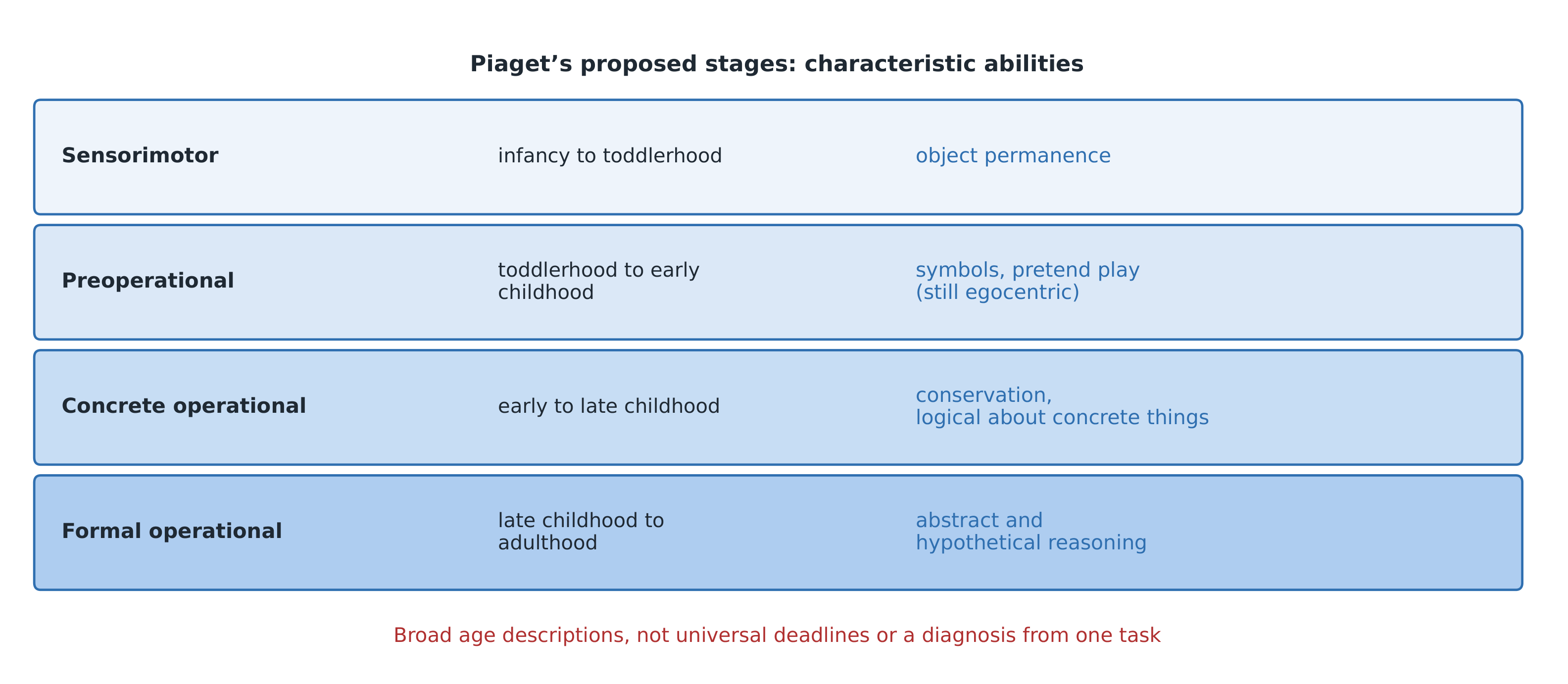
Piaget 皮亚杰 proposed that children build schemas 图式, mental frameworks for organising experience. Assimilation 同化 fits new experience into an existing schema; accommodation 顺应 changes the schema when it does not fit. His theory includes four stages; their broad age descriptions are not precise deadlines for every child:
- Sensorimotor stage 感知运动阶段 (infancy to toddlerhood): the child learns through senses and action, and develops object permanence 客体永久性 - knowing an object still exists when hidden.
- Preoperational stage 前运算阶段 (toddlerhood to early childhood): the child uses symbols and pretend play but shows egocentrism 自我中心 (difficulty taking another view) and has difficulty with conservation 守恒 (quantity staying the same when shape changes) and reversibility 可逆性 (mentally reversing an action). Animism 泛灵论 attributes life-like qualities to objects. Theory of mind 心智理论, understanding that other people can have different beliefs and knowledge, begins developing during this period. Egocentrism describes difficulty taking another perspective, not simply selfishness.
- Concrete operational stage 具体运算阶段 (early to late childhood): the child reasons logically about concrete things and gains conservation.
- Formal operational stage 形式运算阶段 (late childhood onward): abstract and hypothetical reasoning becomes possible. Piaget did not propose that every person achieves it in all situations.
Vygotsky 维果茨基 saw children as social learners. The zone of proximal development 最近发展区 is the gap between what a child can do alone and what they can do with help; scaffolding 支架 is temporary, adjusted support that helps the learner perform a task and is reduced as independence grows. Piaget also recognised experience, and Vygotsky’s account does not say solitary learning is impossible.
Adult cognition changes too, and here the fluid/crystallised split from Unit 2 returns: fluid reasoning tends to decline on average while crystallised knowledge is relatively stable through much of adulthood. Individual trajectories vary. Dementia 痴呆 involves cognitive impairment beyond typical ageing; a classroom vignette or one forgotten item cannot establish a diagnosis.
Vocabulary
Train
| English |
|---|
| Piaget/ˈpaɪəɡɪt/ |
| Sensorimotor stage/ˈsensɔːrɪməʊtə steɪdʒ/ |
| object permanence/ˈɒbdʒekt ˈpɜːmənəns/ |
| Preoperational stage/prɪəʊˈpreɪʃənl steɪdʒ/ |
| egocentrism/ˈiːɡəʊsentrɪzəm/ |
| conservation/ˌkɒnsəˈveɪʃn/ |
| Concrete operational stage/ˈkɒŋkriːt ˌɒpəˈreɪʃənl steɪdʒ/ |
| Formal operational stage/ˈfɔːml ˌɒpəˈreɪʃənl steɪdʒ/ |
| Vygotsky/vaɪˈɡɒtski/ |
| zone of proximal development/zəʊn ɒv ˈprɒksɪml dɪˈveləpmənt/ |
| scaffolding/ˈskæfəʊldɪŋ/ |
| Dementia/dɪˈmenʃə/ |
| schemas/ˈskiːməz/ |
| Assimilation/əˌsɪmɪˈleɪʃn/ |
| accommodation/əˌkɒməˈdeɪʃn/ |
| reversibility/rɪˌvɜːsəˈbɪlɪti/ |
| Animism/ˈænɪmɪzəm/ |
| Theory of mind/ˈθɪəri ɒv maɪnd/ |
3.5
Language Development
Syllabus
| Learning Objective | Essential Knowledge |
|---|---|
3.5.A |
|
3.5.B |
|
Source: College Board AP Course and Exam Description
Language 语言 is a shared system of arbitrary symbols used to communicate. Phonemes 音素 are distinctive sound units; morphemes 语素 are the smallest meaningful units, such as a word or a meaningful ending. Semantics 语义 concerns meaning; syntax 句法 concerns word order, within grammar 语法. Rule-governed combinations let people generate new messages. Development includes: nonverbal gestures 手势, then cooing 咕咕声, babbling 咿呀语, the one-word stage 单词阶段, and telegraphic speech 电报式语言 (short combinations that often omit function words). Timing varies, and gestures continue alongside speech; they are not abandoned when speaking starts.
Children generalise rules before they master exceptions, which produces overgeneralization 过度规则化 - saying "goed" instead of "went". This is evidence that they are learning rules, not just copying.
Vocabulary
Train
| English |
|---|
| Language/ˈlæŋɡwɪdʒ/ |
| gestures/ˈdʒestʃəz/ |
| cooing/ˈkuːɪŋ/ |
| babbling/ˈbæblɪŋ/ |
| one-word stage/wʌn wɜːd steɪdʒ/ |
| telegraphic speech/ˌtelɪˈɡræfɪk spiːtʃ/ |
| overgeneralization/ˌəʊvəˌdʒenərəlaɪˈzeɪʃn/ |
| Phonemes/ˈfəʊniːmz/ |
| morphemes/ˈmɔːfiːmz/ |
| Semantics/səˈmæntɪks/ |
| syntax/ˈsɪntæks/ |
| grammar/ˈɡræmə/ |
3.6
Social and Emotional Development
Syllabus
| Learning Objective | Essential Knowledge |
|---|---|
3.6.A |
|
Source: College Board AP Course and Exam Description
Ecological systems theory 生态系统理论 describes development as interacting environments over time. The microsystem 微系统 involves direct contacts; the mesosystem 中间系统 involves links between them, such as parent–teacher cooperation. The exosystem 外系统 includes indirect influences, such as a caregiver’s workplace. The macrosystem 宏系统 involves broader cultural conditions; the chronosystem 时间系统 concerns time, life transitions and changing circumstances.
Research identifies parenting styles 教养方式: authoritarian 专制型 (high demands, low warmth), authoritative 权威型 (high demands, high warmth), and permissive 放任型 (low demands, high warmth). Cultural context affects how practices relate to outcomes; these categories do not make a single parenting choice determine a child’s future.
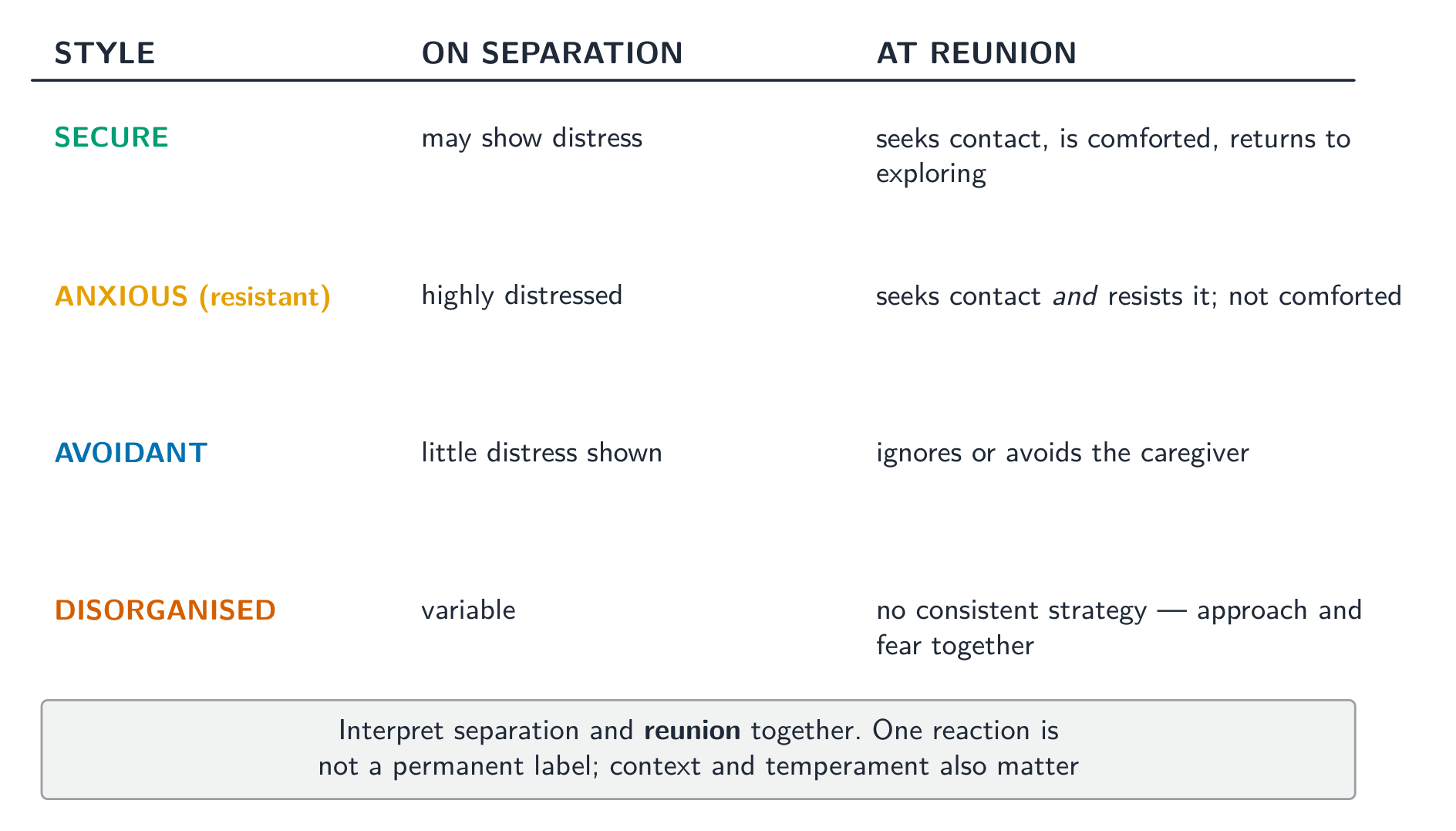
Attachment 依恋 is the emotional bond between infant and caregiver, studied with the strange situation 陌生情境 procedure. Patterns across separation and reunion inform classification; one isolated reaction does not establish a permanent label. Temperament 气质, relatively characteristic emotional reactivity, also relates to attachment. Styles include secure attachment 安全型依恋 and insecure forms (avoidant 回避型, anxious 焦虑型, disorganized 混乱型). Separation anxiety 分离焦虑 is heightened distress when away from a caregiver. Monkey studies highlighted contact comfort 接触安慰 when infants preferred a soft surrogate while feeding from another. This challenged food-only explanations of attachment; it did not show food is unnecessary or that animal results transfer without limits to humans.
Peer relationships develop through parallel play 平行游戏 and pretend play 假装游戏 in childhood, and adolescents often rely more on peers as they age. An imaginary audience 假想观众 is a belief that others are especially focused on oneself; a personal fable 个人神话 is a belief in the uniqueness of one’s experience, sometimes including invulnerability. These are distinct from early-childhood perspective-taking errors.
Erikson 埃里克森 proposed a stage theory of psychosocial development 心理社会发展, in which each stage poses a conflict to resolve - the adolescent stage being identity versus role confusion 同一性与角色混乱. Across Erikson’s theory, conflicts concern trust versus mistrust; autonomy versus shame and doubt; initiative versus guilt; industry versus inferiority; identity versus role confusion; intimacy versus isolation; generativity versus stagnation; integrity versus despair. These are theoretical developmental tasks, not diagnoses or a guarantee of one fixed outcome. A social clock 社会时钟 describes culturally shaped expectations about life-event timing; emerging adulthood 成年初显期 is a transition recognised in some social contexts. Supportive adult relationships can develop in families and other close networks. Adverse childhood experiences (ACEs) 童年不良经历 can influence later relationships and health, with context and support affecting outcomes; they do not make a future outcome inevitable. Identity formation can involve exploration and commitment: achievement 同一性达成 follows exploration and commitment; moratorium 同一性延缓 involves exploration without commitment; foreclosure 同一性早闭 involves commitment without exploration; diffusion 同一性弥散 involves little of either. These processes can concern occupational, religious, racial/ethnic, gender, sexual and family identities.
Vocabulary
Train
| English |
|---|
| Ecological systems theory/ˌekəˈlɒdʒɪkl ˈsɪstəmz ˈθɪəri/ |
| parenting styles/ˈpeərəntɪŋ staɪlz/ |
| authoritarian/ˌɔːθɔːrɪˈteərɪən/ |
| authoritative/ɔːˈθɒrɪtətɪv/ |
| permissive/pəˈmɪsɪv/ |
| Attachment/əˈtætʃmənt/ |
| strange situation/streɪndʒ ˌsɪtʃuːˈeɪʃn/ |
| secure attachment/sɪˈkjʊə əˈtætʃmənt/ |
| avoidant/əˈvɔɪdənt/ |
| anxious/ˈæŋʃəs/ |
| disorganized/dɪˈsɔːɡənaɪzd/ |
| Separation anxiety/ˌsepəˈreɪʃn æŋˈzaɪəti/ |
| contact comfort/ˈkɒntækt ˈkʌmfət/ |
| parallel play/ˈpærəlel pleɪ/ |
| pretend play/prɪˈtend pleɪ/ |
| Erikson/ˈerɪksn/ |
| psychosocial development/ˈsaɪkəʊsəʊʃl dɪˈveləpmənt/ |
| identity versus role confusion/aɪˈdentɪti ˈvɜːsɪz rəʊl kənˈfjuːʒn/ |
| Adverse childhood experiences (ACEs)/ædˈvɜːs ˈtʃaɪldhʊd ekˈspɪərɪənsɪz/ |
| microsystem/ˈmaɪkrəʊsɪstəm/ |
| mesosystem/ˈmesəsɪstəm/ |
| exosystem/ˈeksəʊsɪstəm/ |
| macrosystem/ˈmækrəsɪstəm/ |
| chronosystem/ˈkrɒnəsɪstəm/ |
| Temperament/ˈtemprəmənt/ |
| imaginary audience/ɪˈmædʒɪnəri ˈɔːdɪəns/ |
| personal fable/ˈpɜːsənl ˈfeɪbl/ |
| social clock/ˈsəʊʃl klɒk/ |
| emerging adulthood/ɪˈmɜːdʒɪŋ əˈdʌlthʊd/ |
| achievement/əˈtʃiːvmənt/ |
| moratorium/ˌmɔːrəˈtɔːrɪəm/ |
| foreclosure/fɔːˈkləʊʒə/ |
| diffusion/dɪˈfjuːʒn/ |
3.7
Classical Conditioning
Syllabus
| Learning Objective | Essential Knowledge |
|---|---|
3.7.A |
|
Source: College Board AP Course and Exam Description
The behavioral perspective 行为主义视角 traditionally emphasised observable behaviour and conditioning, often excluding mental processes from its explanations. Later learning accounts also consider cognition.
Classical conditioning 经典条件作用 associates one stimulus with another:
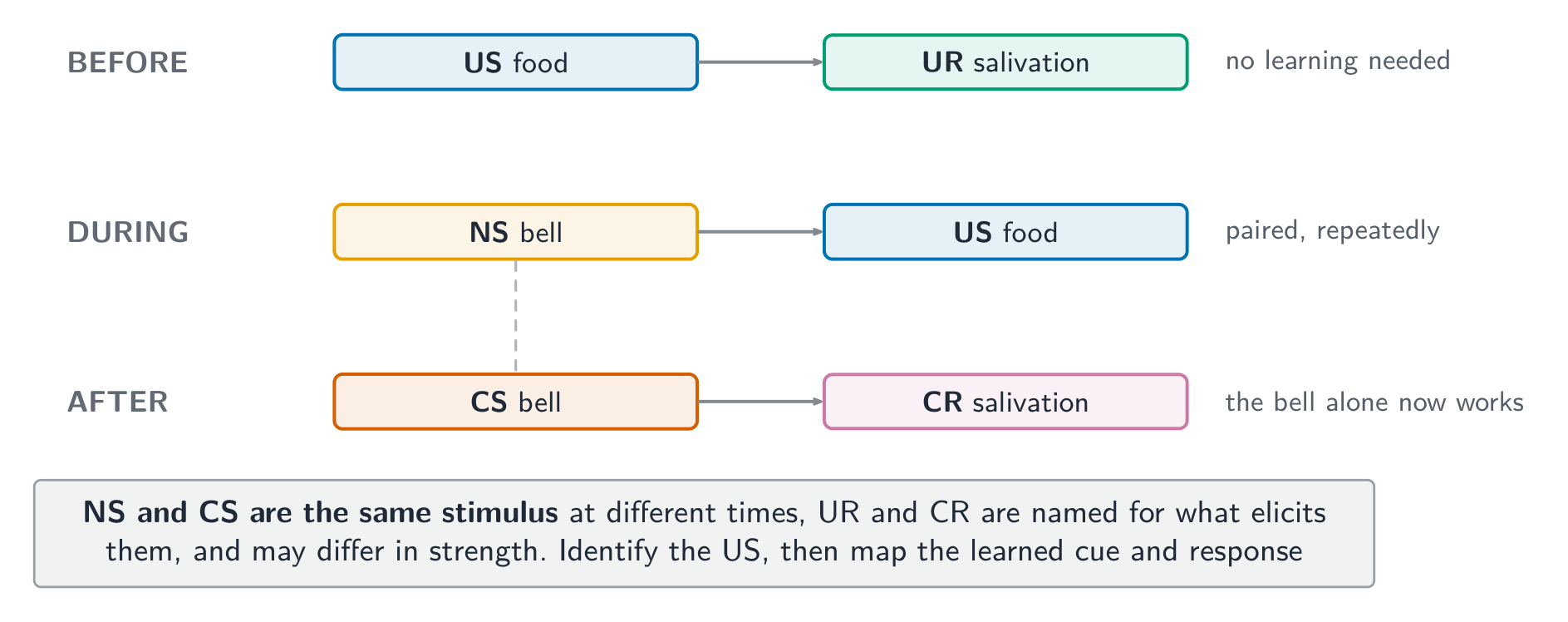
- An unconditioned stimulus (UCS) 无条件刺激 naturally produces an unconditioned response (UCR) 无条件反应 - food causes salivation.
- A neutral stimulus 中性刺激 paired with the UCS becomes a conditioned stimulus (CS) 条件刺激, producing a conditioned response (CR) 条件反应.
- Acquisition 习得 depends on the order and timing of the pairing.
- Extinction 消退 occurs when the CS is no longer paired with the UCS; spontaneous recovery 自发恢复 is the return of a reduced or extinguished CR after a rest interval when the CS is presented again, without a new UCS pairing. Extinction is not necessarily erasure of all prior learning.
- Generalization 泛化 is responding to similar stimuli; stimulus discrimination 刺激辨别 is learning to respond differently to relevant stimuli, rather than requiring a stimulus to be physically identical every time.
- In higher-order conditioning 高级条件作用 a learned CS can support conditioning to another cue without directly pairing that new cue with the original UCS; it is not thereby an originally unlearned stimulus.
Emotional responses can be conditioned, and taste aversion 味觉厌恶 shows that some associations are learned in a single trial and illustrates biological preparedness 生物准备性: some associations are more readily learned than others. Counterconditioning 对抗条件作用 pairs a cue with a response incompatible with the previously learned response; this is a learning principle, not a classroom treatment instruction. Habituation 习惯化 is a diminished response to a repeated stimulus.
Explore
Condition a response in three stages
Map the naturally eliciting stimulus and learned cue to their responses without assuming identical response strength.
Vocabulary
Train
| English |
|---|
| behavioral perspective/bɪˈheɪvjərəl pəˈspektɪv/ |
| Classical conditioning/ˈklæsɪkl kənˈdɪʃənɪŋ/ |
| unconditioned stimulus (UCS)/ʌŋkənˈdɪʃnd ˈstɪmjʊləs/ |
| unconditioned response (UCR)/ʌŋkənˈdɪʃnd rɪˈspɒns/ |
| neutral stimulus/ˈnjuːtrəl ˈstɪmjʊləs/ |
| conditioned stimulus (CS)/kənˈdɪʃnd ˈstɪmjʊləs/ |
| conditioned response (CR)/kənˈdɪʃnd rɪˈspɒns/ |
| Acquisition/əkwɪˈsɪʃn/ |
| Extinction/ekˈstɪŋkʃn/ |
| spontaneous recovery/spɒnˈteɪnɪəs rɪˈkʌvəri/ |
| Generalization/ˌdʒenərəlaɪˈzeɪʃn/ |
| stimulus discrimination/ˈstɪmjʊləs dɪˌskrɪmɪˈneɪʃn/ |
| higher-order conditioning/ˈhaɪə ˈɔːdə kənˈdɪʃənɪŋ/ |
| taste aversion/teɪst əˈvɜːʃn/ |
| Habituation/ˌhæbɪtʃuːˈeɪʃn/ |
| biological preparedness/ˌbaɪəˈlɒdʒɪkl prɪˈpeədnəs/ |
| Counterconditioning/ˈkaʊntəkəndɪʃənɪŋ/ |
3.8
Operant Conditioning
Syllabus
| Learning Objective | Essential Knowledge |
|---|---|
3.8.A |
|
Source: College Board AP Course and Exam Description
Operant conditioning 操作性条件作用 associates a behaviour with its consequence.
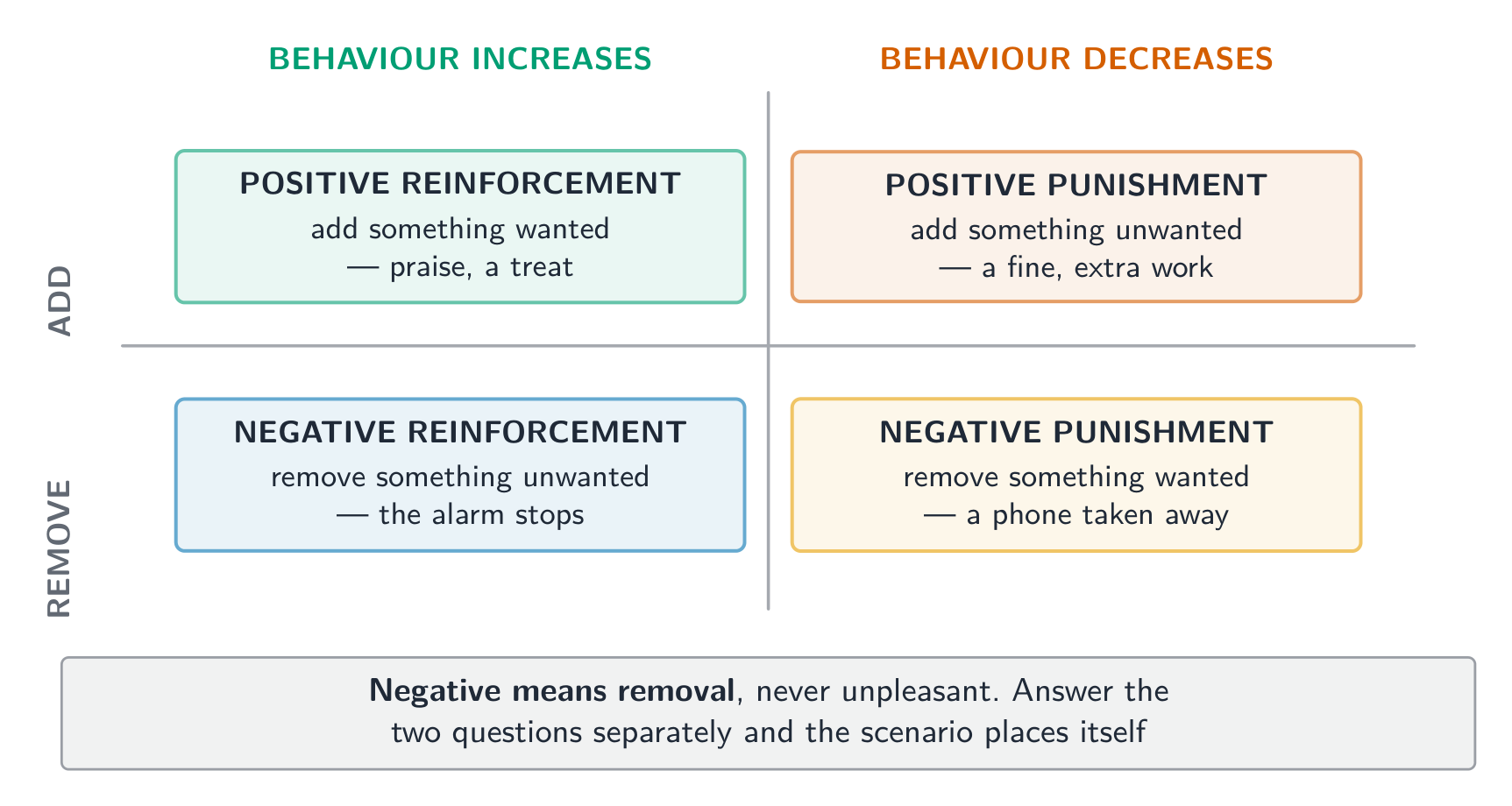
- Reinforcement 强化 increases a behaviour; punishment 惩罚 decreases it.
- Positive 正 means something is added; negative 负 means something is removed. So negative reinforcement 负强化 increases behaviour by removing something unpleasant - it is not punishment.
- A primary reinforcer 原级强化物 satisfies a biological need; a secondary reinforcer 次级强化物 (money) is learned.
- Shaping 塑造 rewards successive approximations 逐步接近 of a target behaviour.
Reinforcement schedules 强化程式 change how strong and persistent learning is. Continuous reinforcement 连续强化 rewards every response and produces fast learning but fast extinction. Partial reinforcement 部分强化 comes in four kinds - fixed-ratio 固定比率, variable-ratio 变动比率, fixed-interval 固定时距, and variable-interval 变动时距 - Ratio schedules depend on response counts; interval schedules reinforce the first qualifying response after time has elapsed. Fixed means predictable, variable means changing. Variable-ratio schedules commonly produce high, steady responding and resistance to extinction; this is not a universal ranking independent of the procedure and values used.
The law of effect 效果律 relates consequences to the future likelihood of behaviour. Reinforcers and punishers are identified by their observed effect, not the adult’s intention. Instinctive drift 本能漂移 occurs when species-typical behaviour interferes with a trained response. Operant discrimination and generalisation concern responding differently, or similarly, across situations.
Superstitious behavior 迷信行为 arises when a consequence reinforces an unrelated action. Learned helplessness 习得性无助 develops when an organism repeatedly cannot escape an aversive event and stops trying.
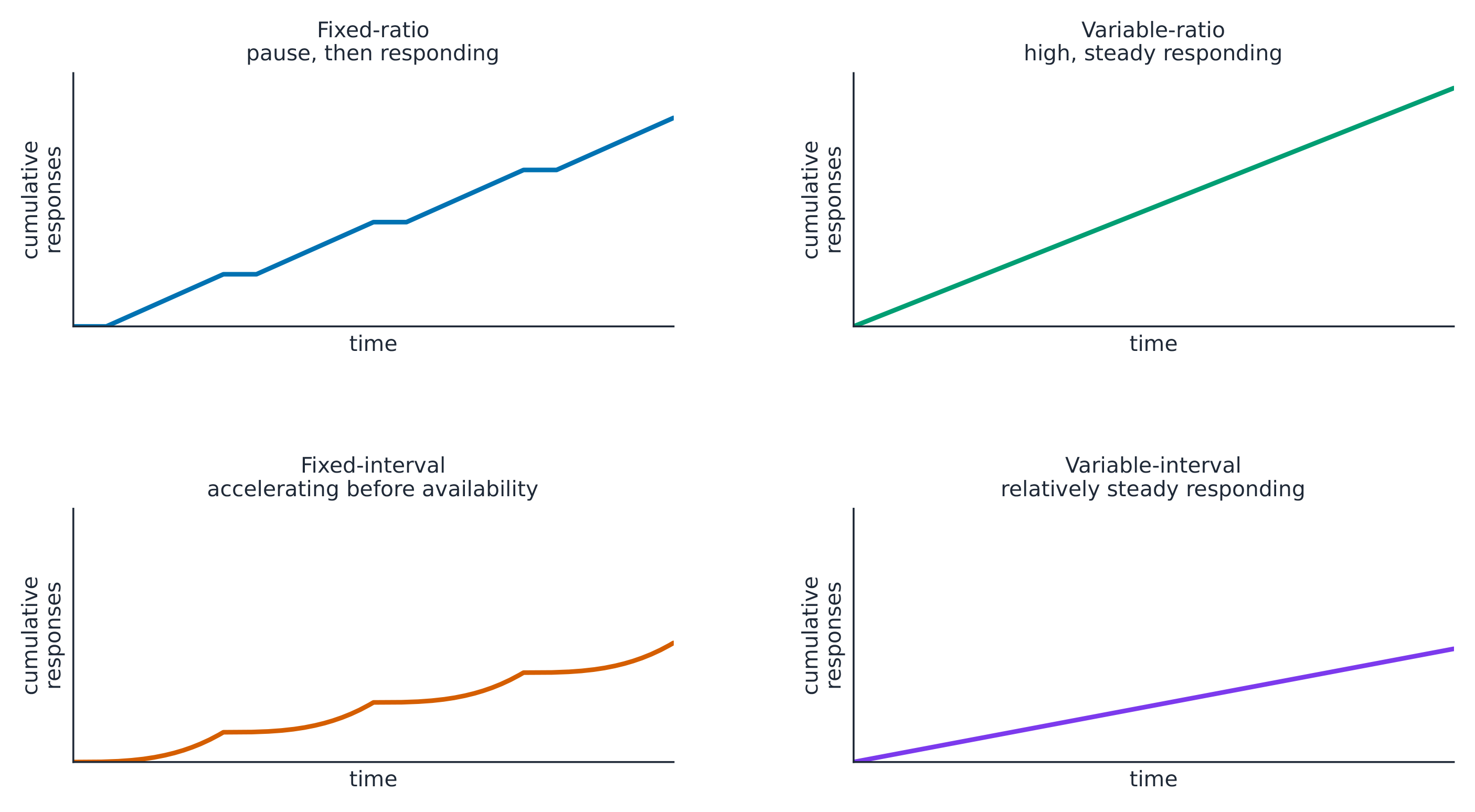
Explore
Place each scenario in the operant grid
Classify addition/removal and the observed increase/decrease in behaviour.
Vocabulary
Train
| English |
|---|
| Operant conditioning/ˈɒpərənt kənˈdɪʃənɪŋ/ |
| Reinforcement/ˌriːɪnˈfɔːsmənt/ |
| punishment/ˈpʌnɪʃmənt/ |
| Positive/ˈpɒzɪtɪv/ |
| negative/ˈneɡətɪv/ |
| negative reinforcement/ˈneɡətɪv ˌriːɪnˈfɔːsmənt/ |
| primary reinforcer/ˈpraɪməri ˌriːɪnˈfɔːsə/ |
| secondary reinforcer/ˈsekəndəri ˌriːɪnˈfɔːsə/ |
| Shaping/ˈʃeɪpɪŋ/ |
| successive approximations/səkˈsesɪv əˌprɒksɪˈmeɪʃnz/ |
| Reinforcement schedules/ˌriːɪnˈfɔːsmənt ˈʃedjuːlz/ |
| Continuous reinforcement/kənˈtɪnjuːəs ˌriːɪnˈfɔːsmənt/ |
| Partial reinforcement/ˈpɑːʃl ˌriːɪnˈfɔːsmənt/ |
| fixed-ratio/fɪkst ˈreɪʃɪəʊ/ |
| variable-ratio/ˈveərɪəbl ˈreɪʃɪəʊ/ |
| fixed-interval/fɪkst ˈɪntəvl/ |
| variable-interval/ˈveərɪəbl ˈɪntəvl/ |
| Superstitious behavior/ˌsuːpəˈstɪʃəs bɪˈheɪvjə/ |
| Learned helplessness/lɜːnd ˈhelpləsnəs/ |
| law of effect/lɔː ɒv ɪˈfekt/ |
| Instinctive drift/ɪnˈstɪŋktɪv drɪft/ |
3.9
Observational and Cognitive Learning
Syllabus
| Learning Objective | Essential Knowledge |
|---|---|
3.9.A |
|
3.9.B |
|
Source: College Board AP Course and Exam Description
Not all learning needs direct experience. Social learning theory 社会学习理论 shows that behaviour can be learned by observation 观察 and modeling 榜样示范 - the basis of the Bobo doll findings on imitated aggression.
Insight learning 顿悟学习 is a sudden solution rather than an overt sequence of rewarded approximations; it need not imply no previous experience of any kind. Latent learning 潜伏学习 is learning that occurs without reinforcement and stays hidden until there is a reason to show it, demonstrated by rats forming a cognitive map 认知地图 of a maze.
Vocabulary
Train
| English |
|---|
| Social learning theory/ˈsəʊʃl ˈlɜːnɪŋ ˈθɪəri/ |
| observation/ɒbzəˈveɪʃn/ |
| modeling/ˈmɒdəlɪŋ/ |
| Insight learning/ˈɪnsaɪt ˈlɜːnɪŋ/ |
| Latent learning/ˈleɪtənt ˈlɜːnɪŋ/ |
| cognitive map/ˈkɒɡnɪtɪv mæp/ |
3.9
Worked practice
All following tasks are original. Attempt before reading each worked check.
Developmental design. Researchers test 20-, 40- and 60-year-olds once on an unfamiliar digital task. Older groups score lower. Identify the design and explain why the result alone does not establish within-person cognitive decline.
Check. This is cross-sectional: different ages are compared at one time. Differences in technology experience across cohorts could contribute. Following the same people would reveal within-person change, but attrition and practice effects would still need attention.
Schemas and perspective. Mei expects all round play objects to bounce. She tries bouncing a wooden bead, then changes her category to distinguish beads from rubber balls. Later she holds up a picture facing herself and assumes her friend can see it. Explain assimilation, accommodation and egocentrism using separate details.
Check. Treating the bead as a familiar bouncing object fits an existing schema: assimilation. Revising the category is accommodation. Assuming the friend sees her own view demonstrates difficulty taking another perspective, not proof of selfish intent.
Classical conditioning. A harmless tone repeatedly precedes a puff of air that naturally causes blinking. Later the tone alone causes blinking. Identify UCS, UCR, CS and CR. Repeated tones without air reduce blinking; after a rest, the tone again elicits some blinking. Explain these two changes.
Check. Air puff is UCS, blinking to air is UCR, the learned tone is CS, and blinking to the tone is CR. Reduced responding without air is extinction; return after rest without renewed air pairing is spontaneous recovery. UCR and CR share a response category but need not have identical strength or timing. This is a hypothetical learning example, not an instruction for an experiment on classmates.
Operant consequences. In a fictional case, fastening a seatbelt stops a buzzer and future prompt fastening increases. Separately, a learner loses game time after interrupting and future interruption decreases. Classify both using the event added/removed and observed change in behaviour.
Check. Stopping the buzzer is removal plus increased fastening: negative reinforcement. Removing game time with decreased interruption is negative punishment. If behaviour did not change, the intended label would not be established by the consequence alone.
Schedule comparison. A reward follows every fifth correct response in A; the first correct response after five minutes in B; and a changing number of correct responses averaging five in C. Identify schedules and explain why persistent responding alone would not establish C.
Check. A is fixed-ratio, B fixed-interval and C variable-ratio. The programmed contingency determines the label. Persistence without information about response count, time and predictability is insufficient.
Evidence and discrimination. Fictional task data: after training that rewards a response to a blue signal but not a yellow signal, mean responses in equal 60-second test periods are 8 for blue and 2 for yellow. Explain how the result supports discrimination and give a limit.
Check. More responding to the rewarded cue than the other cue is consistent with learned discrimination. The difference in means is 6 responses, but these means alone do not establish statistical significance, prove every individual discriminated or exclude every alternative explanation. This is not actual study data.
3.9
Exam tips
Use the scenario’s relevant detail and explain the concept–detail connection. A definition alone does not demonstrate application; follow the specific question rather than relying on a universal mark formula. For evidence questions, use a specific result and explain why it supports or qualifies the claim. Distinguish age from cohort, participation from formal labels, learning from its visible performance, and intended consequences from observed changes in behaviour. Identify a reinforcement schedule from its contingency, not a gambling-like mood or persistence alone.
3.9
Sources and demand grounding
Scope: local AP Psychology CED topics 3.1–3.9, PDF pages 81–95, with College Board’s October 2025 clarifications, including spontaneous recovery. Excluded prenatal stage names, psychosexual stage theory, language pragmatics and named timing subtypes of conditioning are not added.
The local 2024 set 1 Q1 and official guidelines were read to verify the older Gavin scenario’s concept-application demands. This is a legacy-format example, not the current exam format. Local 2025 set 2 AAQ and its official guidelines were spot-checked for operational definitions, data interpretation, generalisability and evidence-based explanation of stimulus discrimination. Original practice targets these skills without reproducing a whole exam. College Board’s released-exam page notes that older materials do not completely align with the revised exam. Historical papers, bank entries and syllabus files were not changed.
Interactive lessons on this topic
Work through it step by step, with instant-check exercises.