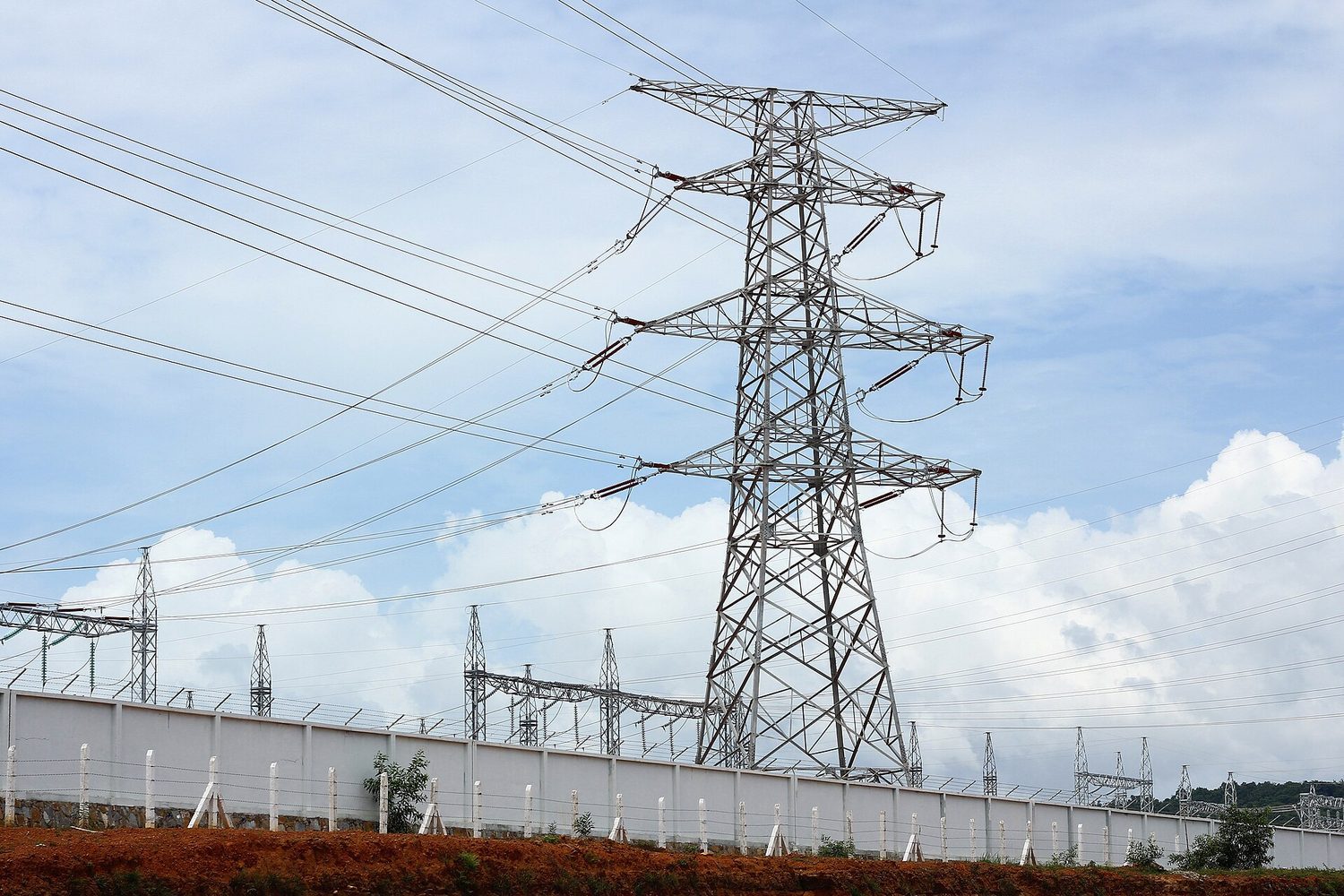
انظر إلى هذه الأرقام. بطارية صغيرة تقول ١.٥ فولت. بطارية سيارة تقول ١٢. خط نقل عالي الجهد يحمل ٤٠٠ ألف. A…
English narration · English + 中文 subtitles burned in · سرد باللغة الإنجليزية · ترجمة مدمجة بالإنجليزية + الصينية
9.1
Electric Potential Energy · الطاقة الكامنة الكهربائية
Syllabus · المنهج
English
Learning Objective 9.1.A: Describe the electric potential energy of a system.
9.1.A.1 The electric potential energy of a system of two point charges equals the amount of work required for an external force to bring the point charges to their current positions from infinitely far away.
9.1.A.2 The general form for the electric potential energy between two charged objects is given by the equation
9.1.A.3 The total electric potential energy of a system can be determined by finding the sum of the electric potential energies of the individual interactions between each pair of charged objects in the system.
العربية
الهدف التعليمي 9.1.A: وصف الطاقة الكامنة الكهربائية لنظام ما.
9.1.A.1 الطاقة الكامنة الكهربائية لنظام شحنتين نقطيتين تساوي مقدار الشغل المطلوب لقوة خارجية لإحضار الشحنات النقطية إلى مواقعها الحالية من مسافة لا نهائية.
9.1.A.2 الصيغة العامة للطاقة الكامنة الكهربائية بين جسمين مشحونين معطاة بالمعادلة
$U_E$ is defined as the work an external force must do to bring the charges from infinitely far away to a distance $r$ apart. The signs carry the physics:
Like charges:$U_E>0$. An outside push was needed to bring them together. If released, they fly apart, and the stored energy becomes kinetic energy 动能.
Opposite charges:$U_E<0$. The pair is bound. You must supply $|U_E|$ of work to pull them apart to infinity.
The electric force is a conservative force 保守力: the work it does depends only on the start and end points, not the path, and equals $-\Delta U_E$.
For a system 系统 of several charges, add the potential energy of every distinct pair:
Worked example. Three $+2.0\ \mu\text{C}$ charges sit at the corners of an equilateral triangle with sides $0.30\ \text{m}$. Each pair stores $U=\dfrac{kq^2}{r}=\dfrac{(9.0\times10^{9})(2.0\times10^{-6})^2}{0.30}=0.12\ \text{J}$. There are three pairs, so $U_{\text{total}}=3\times0.12\ \text{J}=0.36\ \text{J}$. This is the work needed to assemble the triangle from infinity – and the kinetic energy the charges would share if all three were released.
العربية
عندما تدفع شحنتين متماثلتين نحو بعضهما البعض، فإنك تبذل شغلاً ضد القوة الكهربائية. يُخزن هذا الشغل من قبل الزوج على شكل طاقة كامنة كهربائية:
مثال محلول. ثلاث شحنات $+2.0\ \mu\text{C}$ تقع في زوايا مثلث متساوي الأضلاع أطوال أضلاعه $0.30\ \text{m}$. كل زوج يخزن $U=\dfrac{kq^2}{r}=\dfrac{(9.0\times10^{9})(2.0\times10^{-6})^2}{0.30}=0.12\ \text{J}$. هناك ثلاثة أزواج، لذا $U_{\text{total}}=3\times0.12\ \text{J}=0.36\ \text{J}$. هذا هو الشغل اللازم لتجميع المثلث من ما لا نهاية – والطاقة الحركية التي ستشاركها الشحنات إذا تم إطلاق الثلاثة جميعاً.
9.2
Electric Potential · الجهد الكهربائي
Syllabus · المنهج
English
Learning Objective 9.2.A: Describe the electric potential due to a configuration of charged objects.
9.2.A.1 Electric potential describes the electric potential energy per unit charge at a point in space.
9.2.A.2 Expressions for the electric potential of charge distributions can be found using integration and the principle of superposition.
9.2.A.2.i The electric potential for single point charge is
Equation:$V = \dfrac{q}{4\pi\varepsilon_0 r}$.
9.2.A.2.ii The electric potential due to multiple point charges can be determined by the principle of scalar superposition of the electric potential due to each of the point charges.
9.2.A.3 The electric potential difference between two points is the change in electric potential energy per unit charge when a test charge is moved between the two points.
Equation:$\Delta V = \dfrac{\Delta U_E}{q}$
9.2.A.4 Electric potential difference may also result from chemical processes that cause positive and negative charges to separate, such as in a battery.
Boundary statement: AP Physics C: Electricity & Magnetism only expects students to use calculus to find the electric potential resulting from the following charge distributions and locations: an infinitely long, uniformly charged wire or cylinder at a distance from its central axis, a thin ring of charge at a location along the axis of the ring, a semicircular arc or part of a semicircular arc at its center, and a finite wire or line charge at a point collinear with the line charge or at a location along its perpendicular bisector.
Learning Objective 9.2.B: Describe the relationship between electric potential and electric field.
9.2.B.1 The value of an electric field component in any direction at a given location is equal to the negative of the spatial rate of change in electric potential at that location.
Equation:$E_x = -\dfrac{dV}{dx}$
9.2.B.2 The change in electric potential between two points can be determined by integrating the dot product of the electric field and the displacement along the path connecting the points.
Equation:$\Delta V = V_b - V_a = -\displaystyle\int_a^b \vec{E}\cdot d\vec{r}$
9.2.B.3 Electric field vector maps and equipotential lines are tools to describe the field produced by a charge or configuration of charges and can be used to predict the motion of charged objects in the field.
9.2.B.3.i Equipotential lines represent lines of equal electric potential. These lines are also referred to as isolines of electric potential.
9.2.B.3.ii Isolines are perpendicular to electric field vectors. An isoline map of electric potential can be constructed from an electric field vector map, and an electric field map may be constructed from an isoline map.
9.2.B.3.iii An electric field vector points in the direction of decreasing potential.
9.2.B.3.iv There is no component of an electric field along an isoline.
العربية
الهدف التعليمي 9.2.A: وصف الجهد الكهربائي الناتج عن ترتيب لأجسام مشحونة.
9.2.A.1 يصف الجهد الكهربائي الطاقة الكامنة الكهربائية لكل وحدة شحنة عند نقطة في الفضاء.
9.2.A.2 يمكن إيجاد تعبيرات للجهد الكهربائي لتوزيعات الشحنات باستخدام التكامل ومبدأ التراكب.
9.2.A.3 فرق الجهد الكهربائي بين نقطتين هو التغير في الطاقة الكامنة الكهربائية لكل وحدة شحنة عندما يتم تحريك شحنة اختبار بين النقطتين.
المعادلة:$\Delta V = \dfrac{\Delta U_E}{q}$
9.2.A.4 قد ينتج فرق الجهد الكهربائي أيضًا عن عمليات كيميائية تسبب فصل الشحنات الموجبة والسالبة، كما يحدث في البطارية.
عبارة الحدود: في امتحان الفيزياء AP C: الكهرباء والمغناطيسية، يُتوقع من الطلاب استخدام التفاضل والتكامل لإيجاد الجهد الكهربائي الناتج عن توزيعات الشحنات والمواقع التالية: سلك أو أسطوانة مشحونة بانتظام وبطول لا نهائي على بُعد من محورها المركزي، حلقة رقيقة مشحونة على طول محور الحلقة، قوس نصف دائري أو جزء منه عند مركزه، وسلك محدود أو شحنة خطية عند نقطة تقع على امتداد الخط أو عند موقع على طول نصفه العمودي.
الهدف التعليمي 9.2.B: وصف العلاقة بين الجهد الكهربائي والمجال الكهربائي.
9.2.B.1 قيمة مركبة المجال الكهربائي في أي اتجاه عند موقع معين تساوي سالب المعدل المكاني للتغير في الجهد الكهربائي عند ذلك الموقع.
المعادلة:$E_x = -\dfrac{dV}{dx}$
9.2.B.2 يمكن تحديد التغير في الجهد الكهربائي بين نقطتين عن طريق تكامل الضرب القياسي للمجال الكهربائي والإزاحة على طول المسار الذي يربط النقطتين.
المعادلة:$\Delta V = V_b - V_a = -\displaystyle\int_a^b \vec{E}\cdot d\vec{r}$
9.2.B.3 خرائط متجهات المجال الكهربائي والخطوط المتساوية الجهد هي أدوات لوصف المجال الناتج عن شحنة أو ترتيب شحنات ويمكن استخدامها للتنبؤ بحركة الأجسام المشحونة في المجال.
9.2.B.3.i الخطوط المتساوية الجهد تمثل خطوطًا ذات جهد كهربائي متساوٍ. تُشار إلى هذه الخطوط أيضًا باسم خطوط العزل للجهد الكهربائي.
9.2.B.3.ii خطوط العزل عمودية على متجهات المجال الكهربائي. يمكن إنشاء خريطة للخطوط المتساوية الجهد من خريطة متجهات المجال الكهربائي، ويمكن إنشاء خريطة للمجال الكهربائي من خريطة خطوط العزل.
9.2.B.3.iii يشير متجه المجال الكهربائي في اتجاه تناقص الجهد.
9.2.B.3.iv لا توجد مركبة للمجال الكهربائي على طول خط العزل.
Source: College Board AP Course and Exam Description · المصدر: وصف دورة وامتحان College Board AP
English
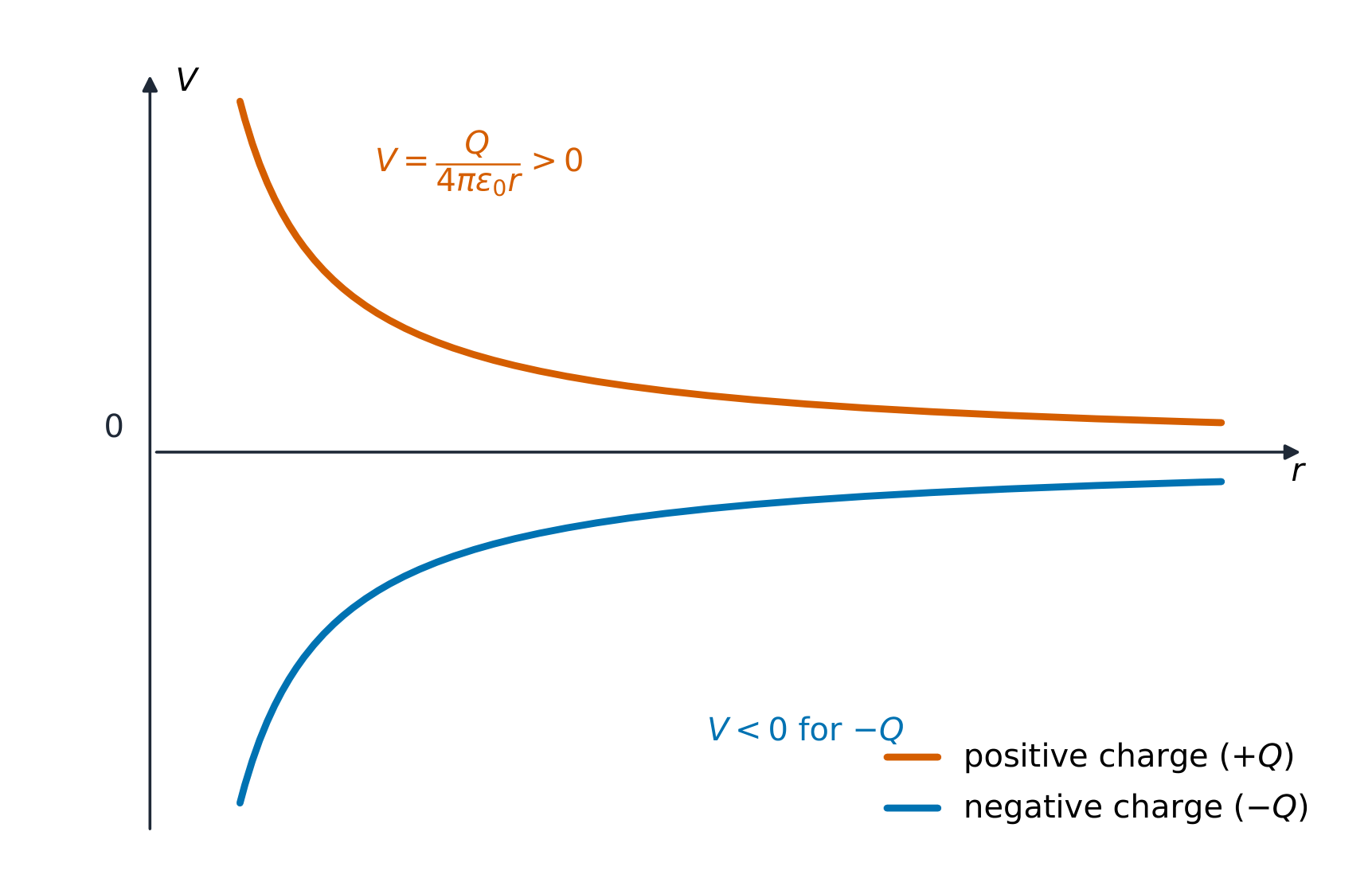
Electric potential 电势 is electric potential energy per unit charge at a point in space. It is measured in volts ($1\ \text{V}=1\ \text{J/C}$):
Potential is a scalar 标量: it has a sign but no direction. This makes $V$ far easier to work with than the field $\vec{E}$. For several point charges 点电荷, use scalar superposition 叠加 – add the potentials with their signs:
Worked example. The potential $0.10\ \text{m}$ from a $+3.0\ \text{nC}$ point charge is $V=\dfrac{kq}{r}=\dfrac{9.0\times10^{9}(3.0\times10^{-9})}{0.10}=270\ \text{V}$. Now add a $-3.0\ \text{nC}$ charge $0.30\ \text{m}$ from the same point: it contributes $\dfrac{9.0\times10^{9}(-3.0\times10^{-9})}{0.30}=-90\ \text{V}$, so the total is $270-90=180\ \text{V}$. Just a signed sum – no vector components to resolve.
Continuous charge distributions
For a continuous charge distribution 连续电荷分布, cut it into small pieces $dq$, treat each piece as a point charge, and integrate 积分:
This is a scalar integral, so it is usually much easier than the field integral. AP expects you to handle four shapes with calculus: a thin ring (at a point on its axis), an arc (at its centre), a finite line or wire (collinear, or on its perpendicular bisector), and an infinitely long wire or cylinder (at a distance from its axis).
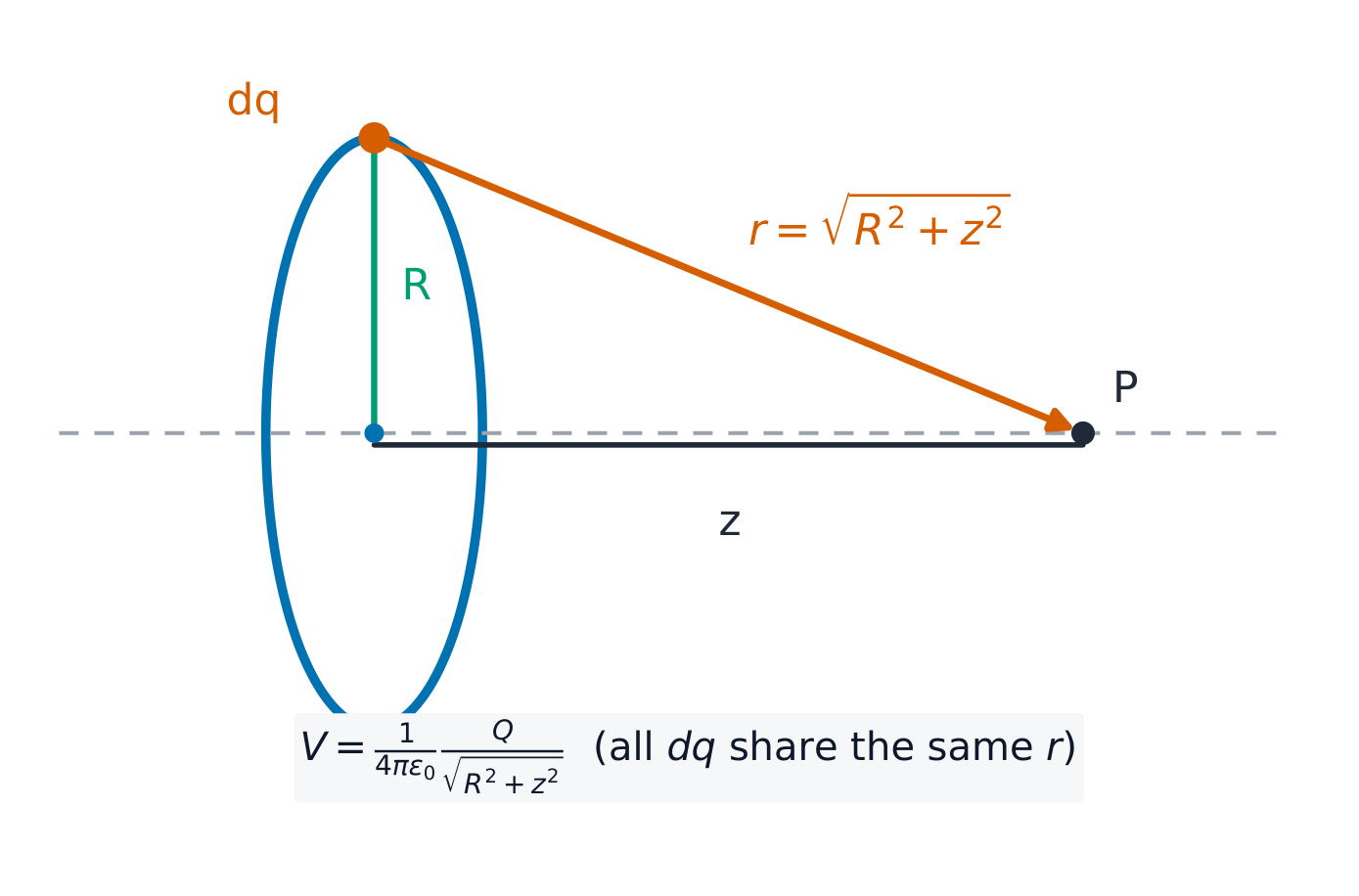
Worked example (ring of charge). A thin ring of radius $R$ carries total charge $Q$. For a point $P$ on the axis a distance $z$ from the centre, every element $dq$ sits at the same distance $r=\sqrt{R^2+z^2}$ from $P$. The distance is constant, so it comes out of the integral:
On an FRQ, say that $r$ is the same for every element – that statement is the marked step. The same idea gives $V=kQ/R$ at the centre of any arc, whatever its angle.
From potential to field
Potential and field contain the same information, linked by a derivative in each direction and by a path integral:
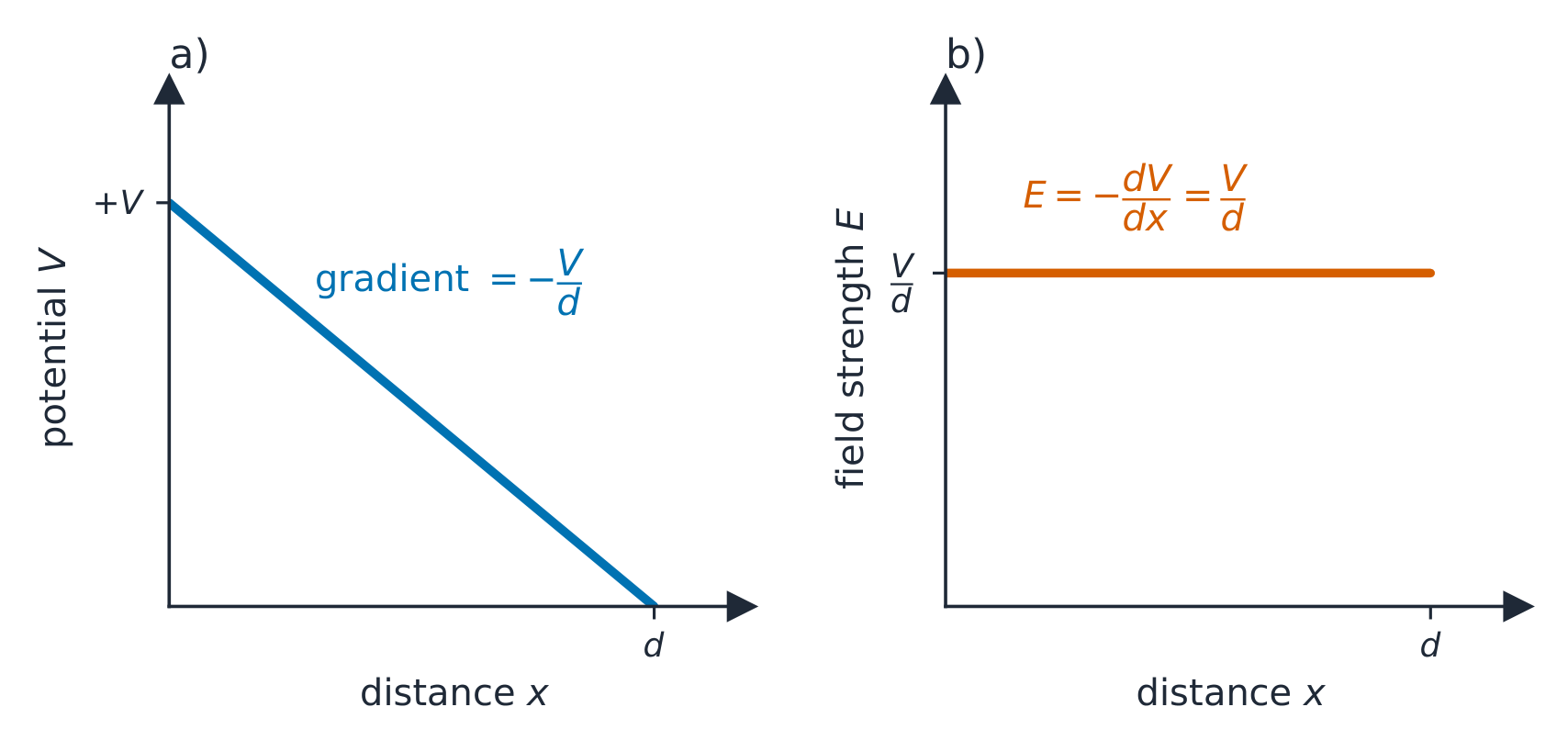
The field is the negative gradient 梯度 of the potential: $\vec{E}$ points from high potential to low potential, "downhill". Where $V$ changes quickly, the field is strong.
Worked example. Along the $x$-axis, $V(x)=3x^{2}-2x$ (volts, with $x$ in metres). Then $E_x=-\dfrac{dV}{dx}=2-6x\ \text{V/m}$. At $x=0.50\ \text{m}$, $E_x=-1.0\ \text{V/m}$: the field there points in the $-x$ direction.
The potential difference 电势差 between two points is the change in potential energy per unit charge moved between them: $\Delta V=\Delta U_E/q$. A battery makes a potential difference chemically: reactions inside separate positive from negative charge and hold the terminals a fixed $\Delta V$ apart.
Equipotential maps
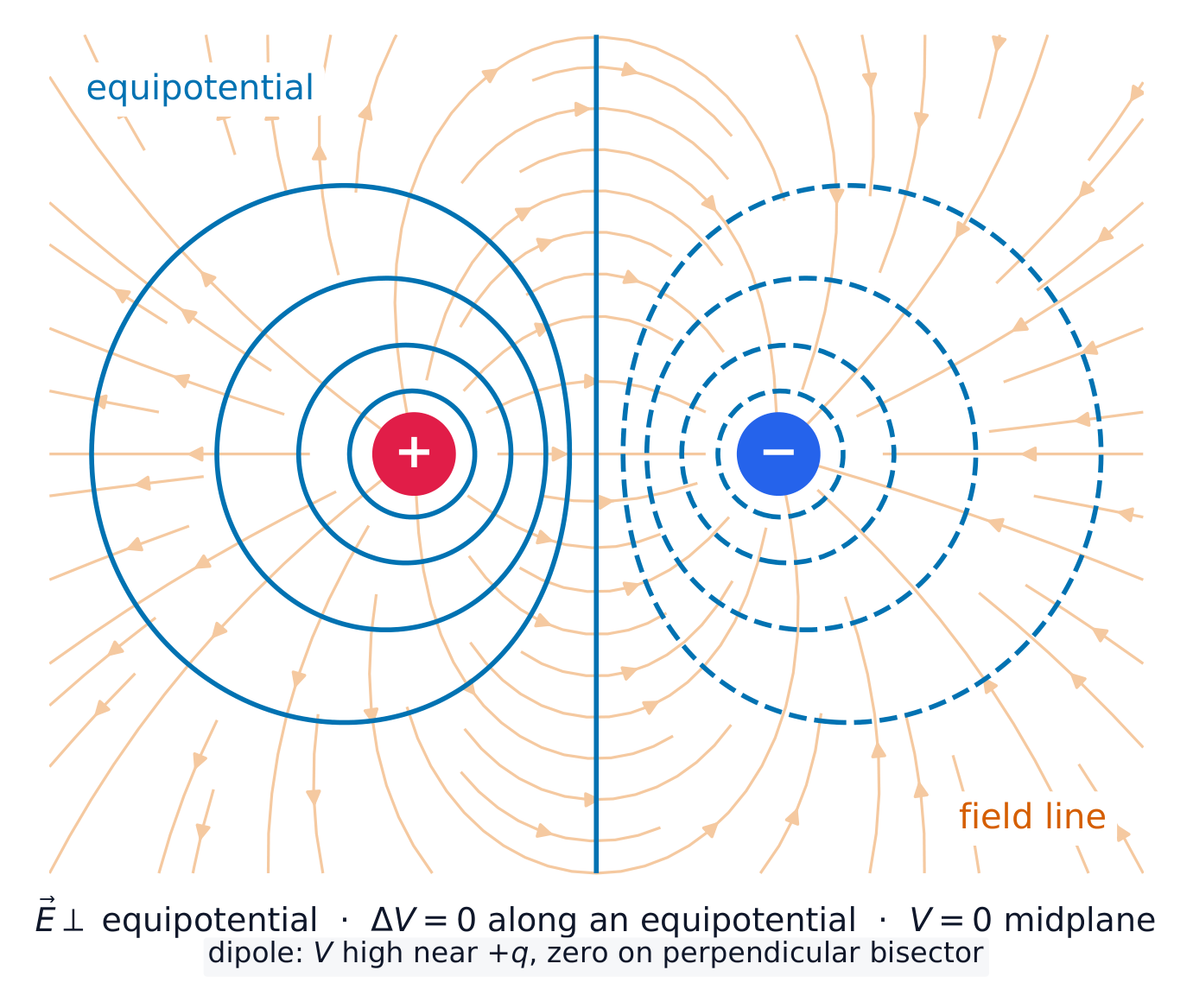
An equipotential 等势面 line (also called an isoline 等值线) joins points that share the same potential. Four rules let you read any map:
Isolines are perpendicular 垂直 to field lines 电场线 everywhere they cross.
$\vec{E}$ points from high $V$ to low $V$ – never along an isoline. Moving a charge along an isoline takes no work.
Closely spaced isolines mean a strong field: $E\approx-\Delta V/\Delta x$.
You can sketch the field map from an isoline map, and the isoline map from a field map.
Exam skill. Given a map with isolines every $10\ \text{V}$ spaced about $2\ \text{cm}$ apart, estimate $E\approx\dfrac{10}{0.02}=500\ \text{V/m}$, pointing from the higher-value line to the lower one. The work an external agent does moving a charge $q$ slowly from $A$ to $B$ is $W=q(V_B-V_A)$ – the path taken does not matter.
العربية
الجهد الكهربائي هو الطاقة الكامنة الكهربائية لكل وحدة شحنة عند نقطة في الفضاء. يُقاس بالفولت ($1\ \text{V}=1\ \text{J/C}$):
الجهد كمية قياسية: له إشارة ولكن ليس له اتجاه. هذا يجعل $V$ أسهل بكثير في التعامل معه من المجال $\vec{E}$. بالنسبة لعدة شحنات نقطية، استخدم الجمع القياسي – اجمع الجهود مع إشاراتها:
مثال محلول. الجهد $0.10\ \text{m}$ الناتج عن شحنة نقطية $+3.0\ \text{nC}$ هو $V=\dfrac{kq}{r}=\dfrac{9.0\times10^{9}(3.0\times10^{-9})}{0.10}=270\ \text{V}$. الآن أضف شحنة $-3.0\ \text{nC}$ بمسافة $0.30\ \text{m}$ من نفس النقطة: تساهم بـ $\dfrac{9.0\times10^{9}(-3.0\times10^{-9})}{0.30}=-90\ \text{V}$، لذا المجموع الكلي هو $270-90=180\ \text{V}$. مجرد مجموع موجه بإشاراته – لا توجد مكونات متجهة تحتاج إلى تحليل.
توزيعات الشحنة المستمرة
بالنسبة لتوزيع شحنة مستمرة، قسّمه إلى قطع صغيرة $dq$، واعتبر كل قطعة كشحنة نقطية، وقم بـتكامل:
هذا تكامل قياسي، لذا فهو عادةً أسهل بكثير من تكامل المجال. يتوقع امتحان AP منك التعامل مع أربعة أشكال باستخدام التفاضل والتكامل: حلقة رقيقة (عند نقطة على محورها)، وقوس (في مركزه)، وخط أو سلك محدود (على استقامته، أو على عمود منصفه)، وسلك أو أسطوانة لا نهائية (على مسافة من محورها).
حلقة من الشحنة: كل عنصر dq على نفس المسافة من نقطة المحور
مثال محلول (حلقة الشحنة). حلقة رقيقة نصف قطرها $R$ تحمل شحنة كلية $Q$. بالنسبة لنقطة $P$ على المحور على مسافة $z$ من المركز، يقع كل عنصر $dq$ على نفس المسافة $r=\sqrt{R^2+z^2}$ من $P$. المسافة ثابتة، لذا تخرج من التكامل:
المجال هو التدرج السلبي للجهد: $\vec{E}$ يشير من جهد عالٍ إلى جهد منخفض، "للأسفل". حيث يتغير $V$ بسرعة، يكون المجال قوياً.
مثال محلول. على طول محور $x$، الجهد $V(x)=3x^{2}-2x$ (فولت، مع $x$ بالمتر). إذن $E_x=-\dfrac{dV}{dx}=2-6x\ \text{V/m}$. عند $x=0.50\ \text{m}$، $E_x=-1.0\ \text{V/m}$: المجال عند ذلك النقطة يشير في اتجاه $-x$.
في مجال منتظم ينخفض الجهد تدريجياً مع المسافة
فرق الجهد بين نقطتين هو التغير في الطاقة الكامنة لكل وحدة شحنة مُنقلة بينهما: $\Delta V=\Delta U_E/q$. البطارية تصنع فرق جهد كيميائياً: التفاعلات الداخلية تفصل الشحنة الموجبة عن السالبة وتحافظ على الأقطاب على مسافة ثابتة $\Delta V$.
الجهد بالقرب من شحنة نقطية يتغير بالنسبة لـ 1/r
خرائط الجهد المتساوي
خط الجهد المتساوي (يُسمى أيضًا خطوط العزل) يربط نقاطًا تتشارك في نفس الجهد. أربع قواعد تُمكّنك من قراءة أي خريطة:
خطوط العزل تكون عمودية على خطوط الحقل في كل مكان تقاطعها.
$\vec{E}$ يتجه من $V$ مرتفع إلى $V$ منخفض – لا يمشي أبدًا على طول خط عزل. نقل شحنة على طول خط عزل لا يتطلب عملًا.
خطوط العزل المتقاربة تعني حقلًا قويًا: $E\approx-\Delta V/\Delta x$.
يمكنك رسم خريطة الحقل من خريطة خطوط العزل، ورسم خريطة خطوط العزل من خريطة الحقل.
خطوط الجهد المتساوي حول ثنائي القطب تتقاطع مع خطوط الحقل بزاوية قائمة
مهارة الامتحان. عند إعطائك خريطة بخطوط تساوي كل $10\ \text{V}$ متباعدة بمقدار $2\ \text{cm}$ تقريباً، قدر $E\approx\dfrac{10}{0.02}=500\ \text{V/m}$، وهو اتجاه ينطلق من الخط ذي القيمة الأعلى نحو الخط ذي القيمة الأقل. الشغل الذي يقوم به عامل خارجي لنقل شحنة $q$ ببطء من $A$ إلى $B$ هو $W=q(V_B-V_A)$ – حيث لا يهم المسار المتبع.
أسلاك الكهرباء ذات الجهد العالي: الطاقة الكامنة الكهربائية تتحول وتُنقل كتيار بجهد عالٍ
Explore · استكشف
Field lines and the potential around a charge · خطوط الحقل والجهد الكهربائي حول شحنة
Electric potential is the energy per unit charge. It falls off with distance from a positive charge; the field lines point from high potential to low. · الجهد الكهربائي هو الطاقة لكل وحدة شحنة. ينخفض مع المسافة عن شحنة موجبة؛ وتتشعب خطوط الحقل من الجهد العالي إلى المنخفض.
Conservation of Electric Energy · حفظ الطاقة الكهربائية
Syllabus · المنهج
English
Learning Objective 9.3.A: Describe changes in a system due to a difference in electric potential between two locations.
9.3.A.1 When a charged object moves between two locations with different electric potentials, the resulting change in the electric potential energy of the object-field system is given by the following equation.
Equation:$\Delta U_E = q\Delta V$
9.3.A.2 The movement of a charged object between two points with different electric potentials results in a change in kinetic energy of the object consistent with the conservation of energy.
العربية
الهدف التعليمي 9.3.A: وصف التغيرات في نظام ما بسبب فرق الجهد الكهربائي بين موقعين.
9.3.A.1 عندما يتحرك جسم مشحون بين موقعين مختلفين في الجهد الكهربائي، يكون التغير الناتج في الطاقة الكامنة الكهربائية لنظام الجسم-المجال معطى بالمعادلة التالية.
المعادلة:$\Delta U_E = q\Delta V$
9.3.A.2 يؤدي حركة جسم مشحون بين نقطتين مختلفتين في الجهد الكهربائي إلى تغير في الطاقة الحركية للجسم يتوافق مع مبدأ حفظ الطاقة.
Source: College Board AP Course and Exam Description · المصدر: وصف دورة وامتحان College Board AP
English
When a charge $q$ moves between two points that differ in potential by $\Delta V$, the potential energy of the charge–field system changes by
$$\Delta U_E=q\,\Delta V.$$
If only the electric force acts, total energy is conserved, so the kinetic energy changes by the opposite amount:
$$\Delta K=-\Delta U_E=-q\,\Delta V.$$
Watch the two signs together: a positive charge speeds up when it moves to lower potential, while a negative charge speeds up when it moves to higher potential. Both are just the system trading potential energy for kinetic energy. This is how particle accelerators give charged particles their energy, and it underlies energy analysis in circuits.
Worked example. A proton ($q=1.6\times10^{-19}\ \text{C}$, $m=1.67\times10^{-27}\ \text{kg}$) starts at rest and is accelerated through a potential drop of $500\ \text{V}$ (it moves to lower potential, so $\Delta V=-500\ \text{V}$ and $\Delta K=-q\,\Delta V=+8.0\times10^{-17}\ \text{J}$). Setting $\Delta K=\tfrac12 mv^2$:
Exam skill. Choose energy methods, not kinematics, whenever the field is non-uniform or the path curves: only the end-point potentials matter. A typical FRQ chain is $q\,\Delta V \to \Delta K \to v$, with one line of justification: "the electric force is conservative, so energy is conserved."
العربية
عندما تنتقل شحنة $q$ بين نقطتين differ في الجهد بمقدار $\Delta V$، تتغير طاقة الجهد لنظام الشحنة-الحقل بمقدار
$$\Delta U_E=q\,\Delta V.$$
إذا كان القوة الكهربائية فقط هي المؤثرة، فإن الطاقة الكلية محفوظة، لذا تتغير الطاقة الحركية بمقدار معاكس:
$$\Delta K=-\Delta U_E=-q\,\Delta V.$$
راقب الإشارتين معًا: الشحنة الموجبة تسرع عندما تنتقل إلى جهد أدنى، بينما الشحنة السالبة تسرع عندما تنتقل إلى جهد أعلى. كلاهما مجرد تبادل للنظام للطاقة الكامنة بالطاقة الحركية. هكذا تمنج مسرعات الجسيمات جسيماتها المشحونة طاقتها، وهذا يكمن تحت تحليل الطاقة في الدوائر.
مثال محلول. بروتون ($q=1.6\times10^{-19}\ \text{C}$، $m=1.67\times10^{-27}\ \text{kg}$) يبدأ من السكون ويتسارع عبر انخفاض جهد قدره $500\ \text{V}$ (يتحرك نحو جهد أقل، لذا $\Delta V=-500\ \text{V}$ و $\Delta K=-q\,\Delta V=+8.0\times10^{-17}\ \text{J}$). وضع $\Delta K=\tfrac12 mv^2$:
مهارة الامتحان. اختر طرق الطاقة، وليس الديناميكيات، كلما كان الحقل غير منتظم أو المسار منحنيًا: فقط جهود النقاط النهائية مهمة. سلسلة الأسئلة المفتوحة النموذجية هي $q\,\Delta V \to \Delta K \to v$، مع سطر واحد من التبرير: "القوة الكهربائية محتفظة، لذا الطاقة محفوظة."
9.3
Exam tips · نصائح للامتحان
English
Relate field and potential by $V=-\int \vec E\cdot d\vec l$ and $\vec E=-\nabla V$ (in 1-D, $E_x=-\tfrac{dV}{dx}$).
Potential is a scalar — add contributions with signs, no vector components needed.
Potential energy of a pair is $U=\tfrac{1}{4\pi\varepsilon_0}\tfrac{q_1 q_2}{r}$; use energy conservation for a charge's speed.
Know that no work is done moving along an equipotential, which is perpendicular to $\vec E$.
Choose the zero of potential (usually infinity) and state it.
العربية
اربط المجال بالجهد باستخدام $V=-\int \vec E\cdot d\vec l$ و $\vec E=-\nabla V$ (في 1-D، $E_x=-\tfrac{dV}{dx}$).
الجهد كمية قياسية — اجمع المساهمات بالإشارات، دون الحاجة لمكونات متجهة.
طاقة الجهد للزوج هي $U=\tfrac{1}{4\pi\varepsilon_0}\tfrac{q_1 q_2}{r}$؛ استخدم حفظ الطاقة لحسر سرعة الشحنة.
اعرف أنه لا يُبذل عمل عند التحرك على طول سطح الجهد المتساوي، وهو عمودي على $\vec E$.
اختر صفر الجهد (عادةً ما لا نهاية) وأذكره.
Interactive lessons on this topic · دروس تفاعلية حول هذا الموضوع
Work through it step by step, with instant-check exercises. · ا-working عليه خطوة بخطوة، مع تمارين تحقق فوري.
More topics in AP Physics C: Electricity and Magnetism · AP الفيزياء C: الكهرباء والمغناطيسية · المزيد من المواضيع في AP Physics C: Electricity and Magnetism · AP الفيزياء C: الكهرباء والمغناطيسية
Pick one and the site follows you — notes, papers, videos and practice all open on it. · اختر واحدًا وسيتبعك الموقع — الملاحظات، الأوراق، الفيديوهات والتدريب جميعها تفتح عليه.
Type to search notes, lessons, code, vocabulary and past-paper questions across every subject. · اكتب للبحث عن ملاحظات، دروس، أكواد، مفردات وأسئلة امتحانات سابقة عبر جميع المواد.