| Learning Objective | Essential Knowledge |
|---|---|
12.1.A |
|
12.1.B |
|
12.1.C |
|
Magnetic Fields and Electromagnetism · المجالات المغناطيسية والكهرومغناطيسية
AP Physics C: Electricity and Magnetism · AP الفيزياء C: الكهرباء والمغناطيسية · Topic 12 · الموضوع 12
 12:45
12:45
المجالات المغناطيسية والكهرومغناطيسية
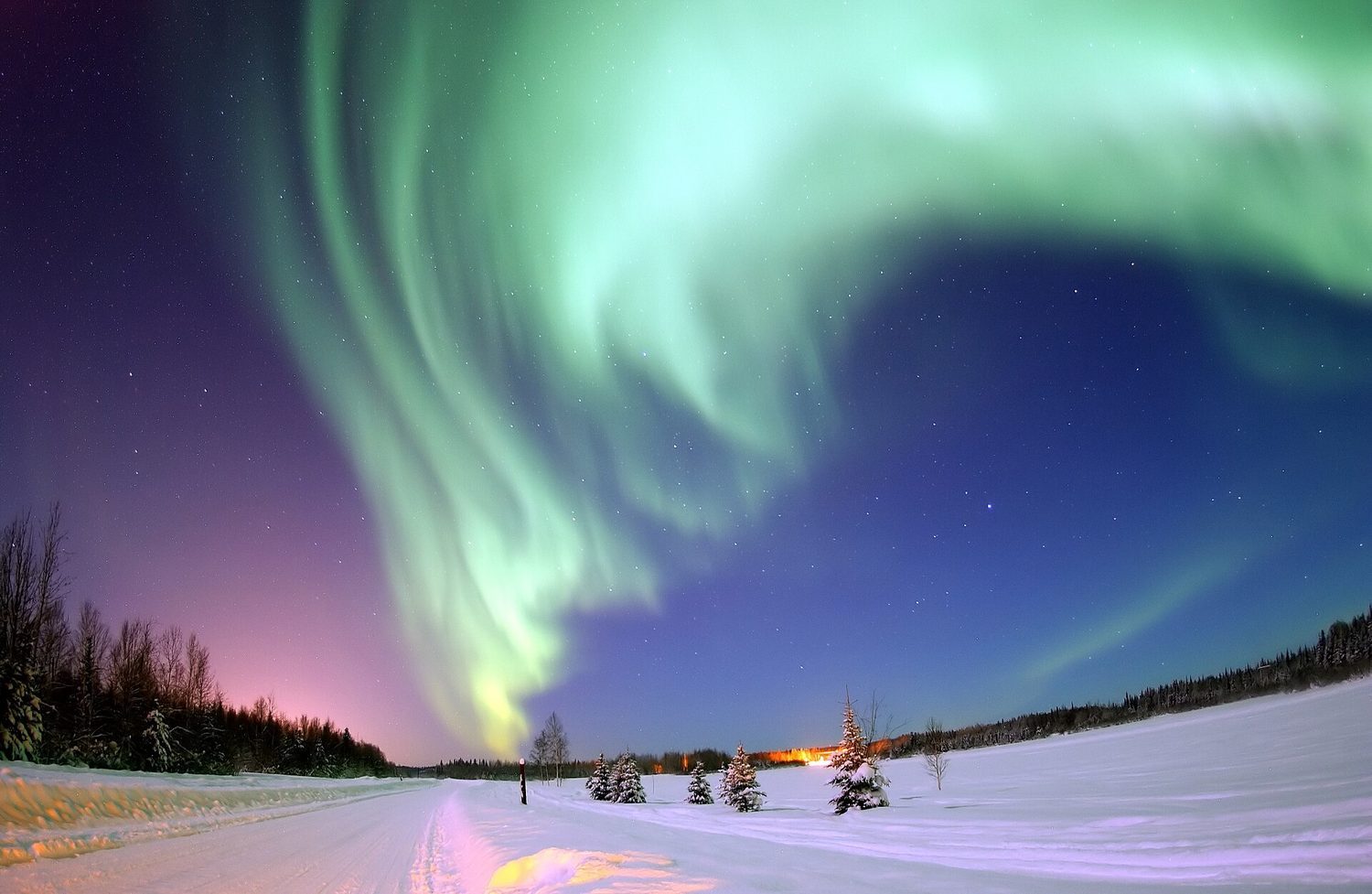
انظر إلى الشمال في ليلة شتائية صافية، شمالاً بما يكفي، ويضيء السماء بلون أخضر. تلك الأضواء تُشغلها مجال مغناطيسي. يرمي الشمس شحنات…
English narration · English + 中文 subtitles burned in · سرد باللغة الإنجليزية · ترجمة مدمجة بالإنجليزية + الصينية
12.1
Magnetic Fields · المجالات المغناطيسية
Syllabus · المنهج
Source: College Board AP Course and Exam Description · المصدر: وصف دورة وامتحان College Board AP
English
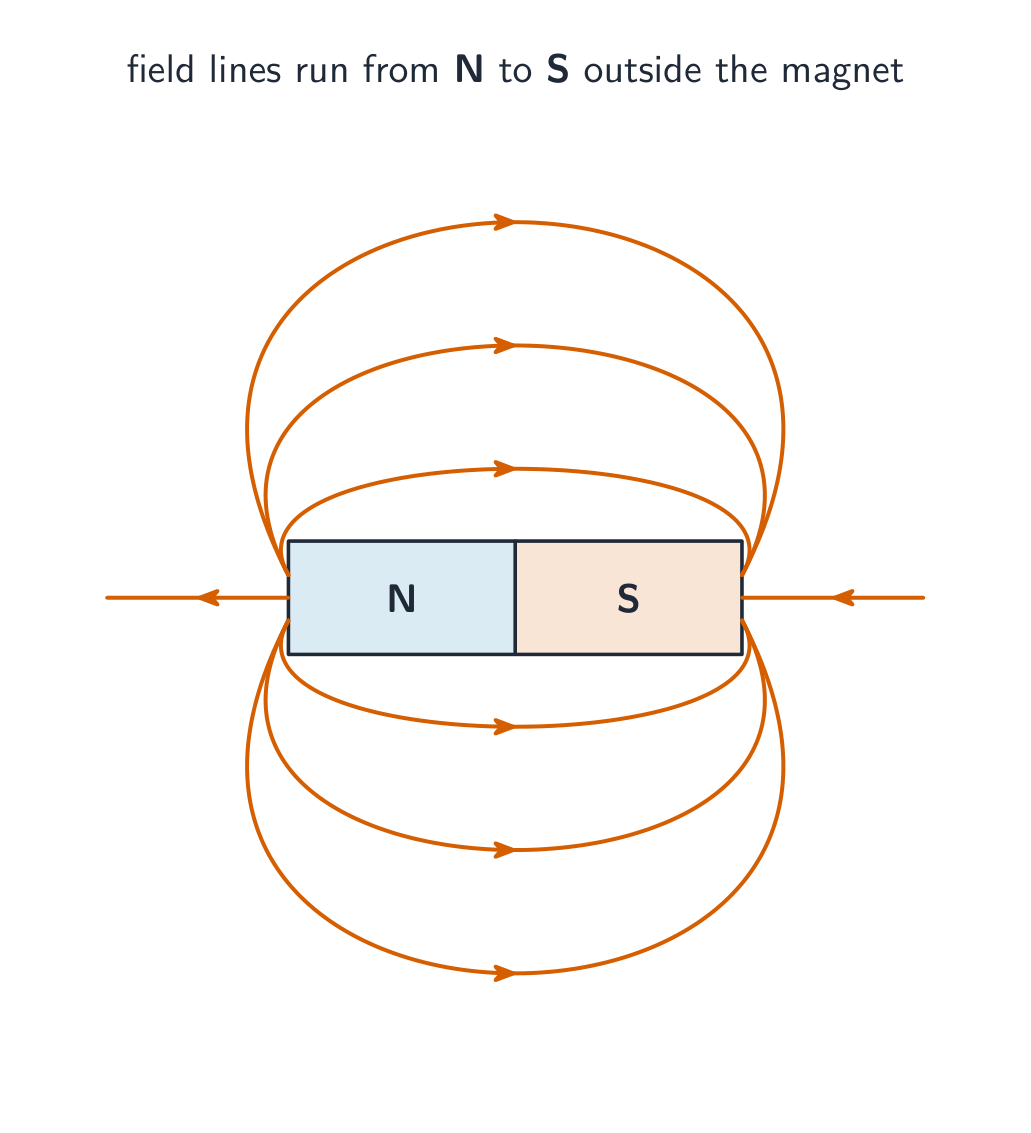
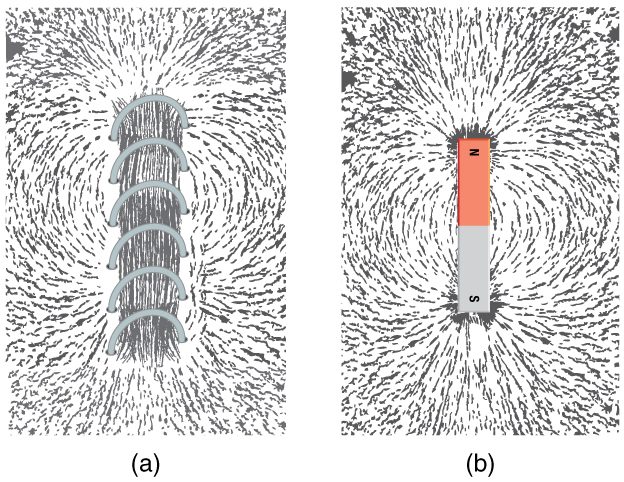
A magnetic field 磁场 $\vec{B}$ is a vector field 矢量场 that surrounds magnets, moving charges, and currents; it determines the magnetic force on any moving charge placed in it. Magnetic field lines 磁感线 must form closed loops: they leave the north pole, return to the south pole, and continue through the magnet. Denser lines mean a stronger field.
Closed loops are the content of Gauss's law for magnetism, the second of Maxwell's equations 麦克斯韦方程组:
$$\oint \vec{B}\cdot d\vec{A}=0.$$
The net magnetic flux through any closed surface is zero – as many field lines leave as enter. That is exactly the statement that isolated magnetic monopoles 磁单极子 do not exist. Every source of magnetism is a magnetic dipole 磁偶极子 (a north–south pair), made by circulating charge – in materials, the motion of electrons. Break a bar magnet in half and you get two smaller dipoles, never a lone pole. Like poles repel, opposite poles attract, and a free dipole – a compass 指南针 – rotates to line up with the local field. Earth's own field is approximately a dipole, which is why a compass works. Dipole fields weaken with distance.
How a material responds to an external field depends on how its internal dipoles behave:
- Ferromagnetic 铁磁性 (iron, nickel, cobalt): an external field aligns whole magnetic domains 磁畴, and the alignment survives after the field is removed – a permanent magnet.
- Paramagnetic 顺磁性 (aluminum, titanium): dipoles align weakly with the field but relax when it is removed.
- Diamagnetic 抗磁性 (all materials): the electronic structure produces a usually weak alignment opposite to the field.
The strength of a material's response is its magnetic permeability 磁导率. Free space has the constant value $\mu_0$ (the vacuum permeability); the permeability of matter differs from $\mu_0$ and is not even constant – it varies with temperature, orientation, and field strength.
العربية
المجال المغناطيسي $\vec{B}$ هو حقل متجهي يحيط بالمغناطيسات والشحنات المتحركة والتيارات؛ ويحدد القوة المغناطيسية على أي شحنة متحركة تُوضع فيه. خطوط المجال المغناطيسي يجب أن تشكل حلقات مغلقة: تغادر القطب الشمالي، وتعود إلى القطب الجنوبي، وتستمر عبر المغناطيس. الخطوط الأكثر كثافة تعني مجالاً أقوى.
الحلقات المغلقة هي محتوى قانون غاوس للمغناطيسية، وهو الثاني من معادلات ماكسويل:
$$\oint \vec{B}\cdot d\vec{A}=0.$$
ال التدفق المغناطيسي الصافي عبر أي سطح مغلق يساوي صفراً – عدد خطوط المجال الخارجة يساوي الداخل. هذا بالضبط يعني عدم وجود أقطاب مغناطيسية منفردة معزولة. كل مصدر للمغناطيسية هو مغناطيس ثنائي القطب (زوج شمال-جنوب)، ناتج عن شحنة دوّارة – في المواد، حركة الإلكترونات. قم بكسر مغناطيس قضيبي لنصفين لتحصل على قطبين ثنائيين أصغر، ولا تحصل أبداً على قطب مفرد. الأقطاب المتماثلة تتنافر، والمختلفة تتجاذب، والقطب الثنائي الحر – البوصلة – يدور ليحاذا مع المجال المحلي. مجال الأرض نفسه تقريباً ثنائي القطب، ولهذا تعمل البوصلة. حقول ثنائية القطب تضعف مع المسافة.
استجابة المادة لمجال خارجي تعتمد على سلوك أقطابها الداخلية:
- فيرومغناطيسية (حديد، نيكل، كوبالت): مجال خارجي يوازي مناطق مغناطيسية كاملة، ويستمر التوازي بعد إزالة المجال – مغناطيس دائم.
- بارامغناطيسية (ألومنيوم، تيتانيوم): تتوازن الأقطاب ضعيفاً مع المجال لكنها ترتخي عند إزالته.
- ديامغناطيسية (جميع المواد): البنية الإلكترونية تنتج موازاة عادة ما تكون عكسية مع المجال.
قوة استجابة المادة هي النفاذية المغناطيسية. الفراغ له قيمة ثابتة $\mu_0$ (نفاذية الفراغ)؛ نفاذية المادة تختلف عن $\mu_0$ وليست حتى ثابتة – تتغير مع درجة الحرارة والتوجه وقوة المجال.
Explore · استكشف
See a magnet's field lines · رؤية خطوط مجال المغناطيس
Magnetic field lines run from north to south outside a magnet; where they crowd together the field is strongest. · تمتد خطوط الحقل المغناطيسي من الشمال إلى الجنوب خارج المغناطيس؛ حيث تتكدس تكون القوة الأقوى.
12.2
Magnetism and Moving Charges · المغناطيسية والشحنات المتحركة
Syllabus · المنهج
English
Learning Objective 12.2.A: Describe the magnetic field produced by moving charged objects.
- 12.2.A.1 A single moving charged object produces a magnetic field.
- 12.2.A.1.i The magnetic field at a particular point produced by a moving charged object depends on the object's velocity and the distance between the point and the object.
- 12.2.A.1.ii At a point in space, the direction of the magnetic field produced by a moving charged object is perpendicular to both the velocity of the object and the position vector from the object to that point in space and can be determined using the right-hand rule.
- 12.2.A.1.iii The magnitude of the magnetic field is a maximum when the velocity vector and the position vector from the object to that point in space are perpendicular.
Learning Objective 12.2.B: Describe the force exerted on moving charged objects by a magnetic field.
- 12.2.B.1 A magnetic field will exert a force on a charged object moving within that field, with magnitude and direction that depend on the cross-product of the charge's velocity and the magnetic field.
- Equation: $\vec{F}_B = q\left(\vec{v} \times \vec{B}\right)$
- 12.2.B.2 In a region containing both a magnetic field and an electric field, a moving charged object will experience independent forces from each field.
- 12.2.B.3 The Hall effect describes the potential difference created in a conductor by an external magnetic field that has a component perpendicular to the direction of charges moving in the conductor.
العربية
الهدف التعليمي 12.2.A: وصف المجال المغناطيسي الناتج عن الأجسام المشحونة المتحركة.
- 12.2.A.1 الجسيم المشحون المتحرك الواحد يُنتج مجالاً مغناطيسياً.
- 12.2.A.1.i يعتمد المجال المغناطيسي عند نقطة معينة ناتج عن جسم مشحون متحرك على سرعة الجسم والمسافة بين تلك النقطة والجسم.
- 12.2.A.1.ii عند نقطة في الفضاء، يكون اتجاه المجال المغناطيسي الناتج عن جسم مشحون متحرك عمودياً على كل من سرعة الجسم ومتجه الموضع من الجسم إلى تلك النقطة في الفضاء، ويمكن تحديده باستخدام قاعدة اليد اليمنى.
- 12.2.A.1.iii تكون قيمة المجال المغناطيسي في أقصى حد عندما يكون متجه السرعة ومتجه الموضع من الجسم إلى تلك النقطة في الفضاء عموديين على بعضهما البعض.
الهدف التعليمي 12.2.B: وصف القوة المؤثرة على الأجسام المشحونة المتحركة بواسطة مجال مغناطيسي.
- 12.2.B.1 سيمارس مجال مغناطيسي قوة على جسم مشحون يتحرك داخل ذلك المجال، وتكون قيمة واتجاه هذه القوة اعتماداً على الضرب الاتجاهي لسرعة الشحنة والمجال المغناطيسي.
- المعادلة: $\vec{F}_B = q\left(\vec{v} \times \vec{B}\right)$
- 12.2.B.2 في منطقة تحتوي على كل من مجال مغناطيسي ومجال كهربائي، سيعرض جسم مشحون متحرك لقوى مستقلة ناتجة عن كل مجال على حدة.
- 12.2.B.3 يصف تأثير هال فرق الجهد الناشئ في موصل بسبب مجال مغناطيسي خارجي له مركبة عمودية على اتجاه حركة الشحنات داخل الموصل.
Source: College Board AP Course and Exam Description · المصدر: وصف دورة وامتحان College Board AP
English
A moving charge does two things: it creates a magnetic field, and it feels a force in an external one. The field it creates at a point is perpendicular 垂直 to both its velocity and the position vector from charge to point (right-hand rule again), and is largest where those two are perpendicular – zero directly ahead of or behind the motion.
The force on a charge moving in a field $\vec{B}$ is the cross product
$$\vec{F}_B=q\,\vec{v}\times\vec{B},\qquad F=qvB\sin\theta,$$
perpendicular to both $\vec{v}$ and $\vec{B}$ – point the fingers of your right hand along $\vec{v}$, curl toward $\vec{B}$, and the thumb gives the force on a positive charge (reverse it for negative). Because $\vec{F}_B\perp\vec{v}$, the magnetic force does no work on the charge: it changes direction, never speed.
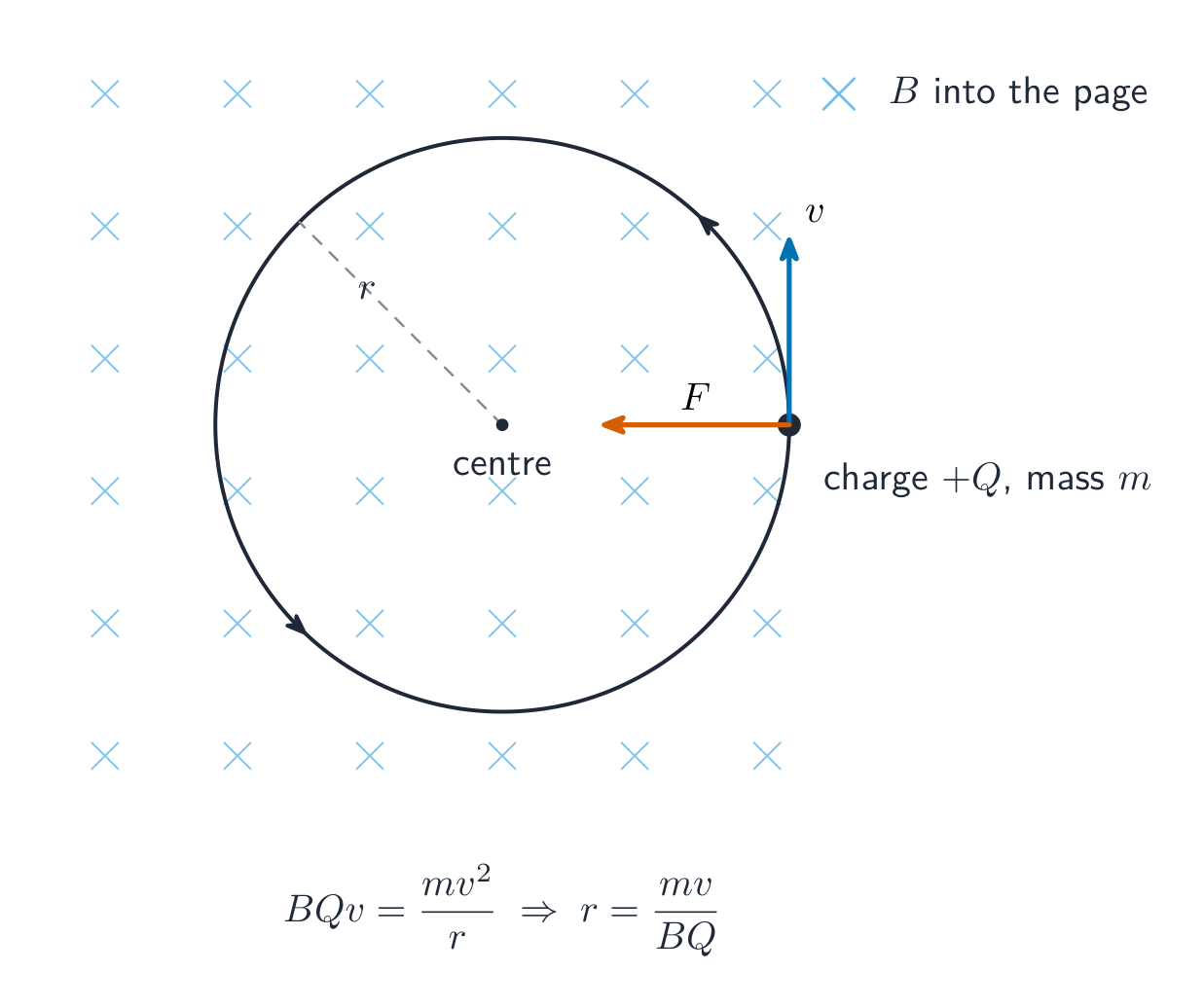
A charge moving perpendicular to a uniform field therefore travels in a circle, the magnetic force supplying the centripetal force 向心力:
$$qvB=\frac{mv^2}{r}\quad\Rightarrow\quad r=\frac{mv}{qB},\qquad T=\frac{2\pi m}{qB}.$$
Notice the period $T$ does not depend on the speed – faster particles ride larger circles in the same time.
Worked example. A proton ($q=1.6\times10^{-19}\ \text{C}$, $m=1.67\times10^{-27}\ \text{kg}$) enters a $0.50\ \text{T}$ field at $2.0\times10^{5}\ \text{m/s}$, perpendicular to it. The magnetic force $F=qvB=1.6\times10^{-14}\ \text{N}$ bends it into a circle of radius $r=\dfrac{mv}{qB}=\dfrac{1.67\times10^{-27}(2.0\times10^{5})}{1.6\times10^{-19}(0.50)}=4.2\times10^{-3}\ \text{m}$.
In a region with both an electric and a magnetic field, the two forces act independently and add as vectors. Balancing them makes a velocity selector 速度选择器: with $\vec{E}$ and $\vec{B}$ crossed, only charges with $qE=qvB$, i.e. $v=E/B$, pass straight through. The Hall effect 霍尔效应 is the same physics inside a conductor: a field with a component perpendicular to the current pushes the moving carriers sideways, charge builds up on one face, and a measurable potential difference appears across the conductor – its sign reveals whether the carriers are positive or negative.
العربية
الشحنة المتحركة تفعل شيئين: تنتج مجالاً مغناطيسياً، وتشعر بقوة في مجال خارجي. المجال الذي ينتجه عند نقطة ما يكون عمودياً على كل من سرعتها ومتجه الموقع من الشحنة للنقطة (قاعدة اليد اليمنى مجدداً)، ويكون الأكبر حيث هذان العموديان – صفراً مباشرة أمام أو خلف الحركة.
القوة على شحنة تتحرك في مجال $\vec{B}$ هي الضرب الاتجاهي
$$\vec{F}_B=q\,\vec{v}\times\vec{B},\qquad F=qvB\sin\theta,$$
عمودي على كل من $\vec{v}$ و$\vec{B}$ – وجه أصابع يدك اليمنى على طول $\vec{v}$، ولف نحو $\vec{B}$، وسيعطيك الإبهام القوة على شحنة موجبة (عكسها للسالبة). وبسبب $\vec{F}_B\perp\vec{v}$، لا تبذل القوة المغناطيسية شغلاً على الشحنة: تغير الاتجاه، لكن ليس السرعة.
شحنة تتحرك عمودياً على مجال منتظم تسير بدائرة، والقوة المغناطيسية توفر القوة المركزية:
$$qvB=\frac{mv^2}{r}\quad\Rightarrow\quad r=\frac{mv}{qB},\qquad T=\frac{2\pi m}{qB}.$$
لاحظ أن الدور $T$ لا يعتمد على السرعة – الجسيمات الأسرع تقود دوائر أكبر في نفس الوقت.
مثال محلول. بروتون ($q=1.6\times10^{-19}\ \text{C}$، $m=1.67\times10^{-27}\ \text{kg}$) يدخل في مجال $0.50\ \text{T}$ بسرعة $2.0\times10^{5}\ \text{m/s}$، عمودياً عليه. القوة المغناطيسية $F=qvB=1.6\times10^{-14}\ \text{N}$ تنحنيه لمسار دائري نصف قطره $r=\dfrac{mv}{qB}=\dfrac{1.67\times10^{-27}(2.0\times10^{5})}{1.6\times10^{-19}(0.50)}=4.2\times10^{-3}\ \text{m}$.
في منطقة يوجد فيها مجال كهربائي ومجال مغناطيسي، تؤثر القوتان بشكل مستقل وتُجمَع كمتجهات. موازنتهما تُكوّن اختيار السرعة: مع $\vec{E}$ و$\vec{B}$ متعامدين، فقط الشحنات التي possesses $qE=qvB$، أي $v=E/B$، تمر مستقيمة. تأثير هول هو نفس الفيزياء داخل موصل: مجال به مركبة عمودية على التيار يدفع حاملات الشحنة جانباً، تتراكم الشحنة على وجه واحد، ويظهر فرق جهد قابل للقياس عبر الموصل – علامته يكشف ما إذا كانت الحمولات موجبة أم سالبة.
Explore · استكشف
Force on a moving charge · القوة المؤثرة على شحنة متحركة
A charge moving through a magnetic field feels a force $F=qvB$ at right angles to both its velocity and the field — the basis of the motor effect. Reverse either and the force flips. · تتعرض شحنة متحركة في مجال مغناطيسي لقوة $F=qvB$ عمودية على كل من سرعتها والمجال — وهو أساس تأثير المحرك. إذا عكست أحدهما، تنعكس القوة.
12.3
Magnetic Fields of Current-Carrying Wires · حقول المغناطيسية للأسلاك المارة بها تيارات
Syllabus · المنهج
English
Learning Objective 12.3.A: Describe the magnetic field produced by a current-carrying wire.
- 12.3.A.1 The Biot-Savart law defines the magnitude and direction of a magnetic field created by an electrical current.
- Equation: $d\vec{B} = \dfrac{\mu_0}{4\pi} \dfrac{I(d\vec{\ell} \times \hat{r})}{r^2}$
- 12.3.A.2 The magnetic field vectors around a small segment of a current-carrying wire are tangent to concentric circles centered on that wire. The field has no component toward, away from, or parallel to the segment of the current-carrying wire.
- 12.3.A.3 The Biot-Savart law can be used to derive the magnitudes and directions of magnetic fields around segments of current-carrying wires, for example at the center of a circular loop of wire.
- Equation: $B_{\text{center of loop}} = \dfrac{\mu_0 I}{2R}$
Learning Objective 12.3.B: Describe the force exerted on current-carrying wires by a magnetic field.
- 12.3.B.1 A magnetic field will exert a force on a current-carrying wire.
- Equation: $\vec{F}_B = \int I\left(d\vec{\ell} \times \vec{B}\right)$
Boundary statement: AP Physics C: Electricity & Magnetism only expects students to perform quantitative analysis of certain cases of current-carrying conductors using the Biot-Savart law, such as at a location along the perpendicular bisector of a straight conductor, at a location along the central axis of a circular loop, or at the center of a segment of a circular loop.
العربية
الهدف التعليمي 12.3.A: وصف المجال المغناطيسي الناتج عن سلك حامل للتيار.
- 12.3.A.1 يُعرّف قانون بيو-ساڤار مقدار واتجاه المجال المغناطيسي الناتج عن تيار كهربائي.
- المعادلة: $d\vec{B} = \dfrac{\mu_0}{4\pi} \dfrac{I(d\vec{\ell} \times \hat{r})}{r^2}$
- 12.3.A.2 متجهات المجال المغناطيسي حول جزء صغير من سلك مارة به تيارات تكون مماسة لدوائر متحدة المركز مركزها هذا السلك. لا يوجد للمجال أي مركبات نحو أو بعيداً أو موازية لجزء السلك المار فيه التيار.
- 12.3.A.3 يمكن استخدام قانون بيو-ساڤار لاستنتاج مقادير واتجاهات المجالات المغناطيسية حول أجزاء من الأسلاك المارة بها تيارات، على سبيل المثال عند مركز حلقة دائرية من الأسلاك.
- المعادلة: $B_{\text{center of loop}} = \dfrac{\mu_0 I}{2R}$
هدف التعلم 12.3.B: وصف القوة المؤثرة على أسلاك مارة بها تيارات بفعل مجال مغناطيسي.
- 12.3.B.1 سيمارس مجال مغناطيسي قوة على سلك مارة به تيارات.
- المعادلة: $\vec{F}_B = \int I\left(d\vec{\ell} \times \vec{B}\right)$
بيان الحدود: اختبار AP Physics C: الكهرباء والمغناطيسية يتوقع من الطلاب فقط إجراء تحليل كمي لحالات معينة من الموصلات المارة بها تيارات باستخدام قانون بيو-ساڤار، مثل موقع على طول المنصف العمودي لموصل مستقيم، أو موقع على طول المحور المركزي لحلقة دائرية، أو في مركز جزء من حلقة دائرية.
Source: College Board AP Course and Exam Description · المصدر: وصف دورة وامتحان College Board AP
English
A current is a stream of moving charges, so it creates a magnetic field. The Biot–Savart law 毕奥-萨伐尔定律 adds up the field of each current element:
$$d\vec{B}=\frac{\mu_0}{4\pi}\frac{I\,d\vec{l}\times\hat{r}}{r^2}.$$
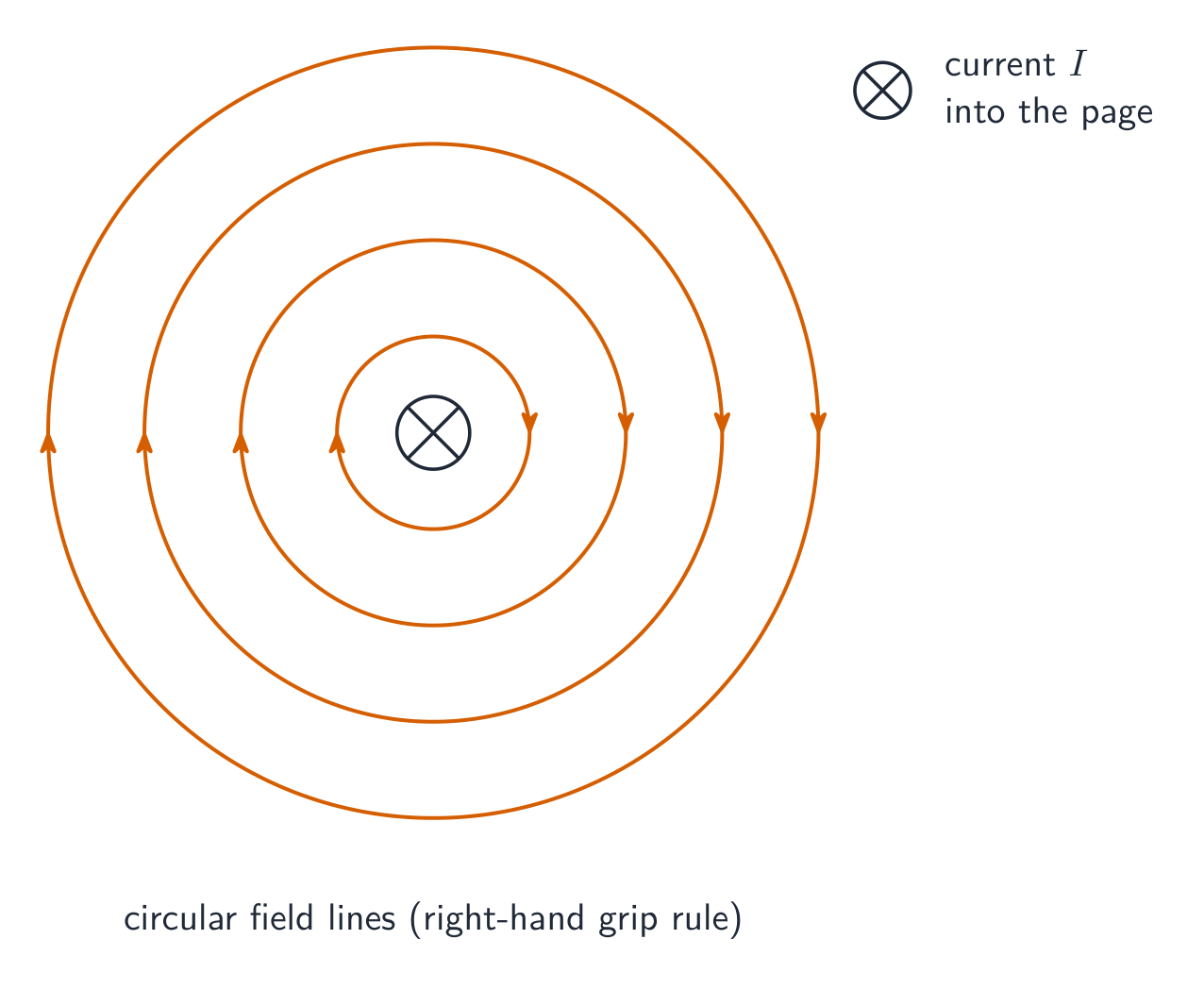
Around any straight segment the field vectors are tangent 相切 to concentric circles 同心圆 centred on the wire – no component toward, away from, or along the wire. Curl your right hand around the wire with the thumb along the current: your fingers give the field direction.
The Biot–Savart integrals AP expects: a long straight wire ($B=\dfrac{\mu_0 I}{2\pi r}$, or a point on the perpendicular bisector of a finite wire), and the centre of a circular loop,
$$B_{\text{centre of loop}}=\frac{\mu_0 I}{2R},$$
where every element $d\vec{l}$ is perpendicular to $\hat{r}$ and equally distant $R$ – say that in an FRQ derivation. An arc that is a fraction of a full circle contributes that same fraction of $\mu_0 I/2R$ at its centre.
A field also pushes on a current-carrying wire, element by element:
$$\vec{F}_B=\int I\,d\vec{l}\times\vec{B}\qquad(\vec{F}=I\vec{L}\times\vec{B}\ \text{for a straight wire in a uniform field}).$$
Worked example. Two long parallel wires a distance $d=0.10\ \text{m}$ apart each carry $5.0\ \text{A}$ in the same direction. Wire 1's field at wire 2 is $B=\dfrac{\mu_0 I}{2\pi d}=1.0\times10^{-5}\ \text{T}$, so wire 2 feels $\dfrac{F}{L}=I B=5.0\times10^{-5}\ \text{N/m}$, pulled toward wire 1. Same-direction currents attract; opposite currents repel.
العربية
التيار هو تدفق لشحنات متحركة، لذا ينتج مجالاً مغناطيسياً. قانون بيوت-ساڤار - يجمع حقل كل عنصر تيار:
$$d\vec{B}=\frac{\mu_0}{4\pi}\frac{I\,d\vec{l}\times\hat{r}}{r^2}.$$
حول أي قطعة مستقيمة، متجهات الحقل تكون مماسية لـ دوائر متحدة المركز مركزها السلك – لا توجد مركبة نحو، بعيداً، أو على طول السلك. لف يدك اليمنى حول السلك والإبهام على طول التيار: أصابعك تعطي اتجاه الحقل.
تكاملات بيوت-ساڤار التي يتوقعها AP: سلك مستقيم طويل ($B=\dfrac{\mu_0 I}{2\pi r}$، أو نقطة على المنصف العمودي لسلك محدود)، ومركز حلقة دائرية،
$$B_{\text{centre of loop}}=\frac{\mu_0 I}{2R},$$
حيث كل عنصر $d\vec{l}$ عمودي على $\hat{r}$ وعلى مسافة $R$ متساوية – قل ذلك في اشتقاق FRQ. قوس يمثل كسراً من دائرة كاملة يساهم بنفس الكسر من $\mu_0 I/2R$ عند مركزه.
حقل أيضاً يدفع على سلك مارة به تيار، عنصراً بعنصر:
$$\vec{F}_B=\int I\,d\vec{l}\times\vec{B}\qquad(\vec{F}=I\vec{L}\times\vec{B}\ \text{for a straight wire in a uniform field}).$$
مثال محلول. سلكان طويلا متوازيان على مسافة $d=0.10\ \text{m}$ بينهما يحملان كل منهما تيار $5.0\ \text{A}$ في نفس الاتجاه. حقل السلك 1 عند السلك 2 هو $B=\dfrac{\mu_0 I}{2\pi d}=1.0\times10^{-5}\ \text{T}$، لذا يشعر السلك 2 بقوة $\dfrac{F}{L}=I B=5.0\times10^{-5}\ \text{N/m}$، يُسحب نحو السلك 1. التيارات في نفس الاتجاه تتجاذب؛ التيارات المعاكسة تتنافر.
Vocabulary · مفردات
Train · تدريب
| English | العربية |
|---|---|
| magnetic field/mæɡˈnetɪk fiːld/ | المجال المغناطيسي |
| vector field/ˈvektə fiːld/ | مجال شعاعي |
| magnetic field lines/mæɡˈnetɪk fiːld laɪnz/ | خطوط المجال المغناطيسي |
| Maxwell's equations/ˈmækswelz ɪˈkweɪʒnz/ | معادلات ماكسويل |
| magnetic monopoles/mæɡˈnetɪk ˈmɒnəʊpəʊlz/ | أقطاب مغناطيسية فردية |
| magnetic dipole/mæɡˈnetɪk ˈdaɪpəʊl/ | ثنائي قطب مغناطيسي |
| compass/ˈkʌmpəs/ | البوصلة |
| Ferromagnetic/ˌferəməɡˈnetɪk/ | فائق المغناطيسية |
| magnetic domains/mæɡˈnetɪk dəˈmeɪnz/ | مناطق مغناطيسية |
| Paramagnetic/ˌpærəməɡˈnetɪk/ | شبه مغناطيسي |
| Diamagnetic/ˌdaɪəməɡˈnetɪk/ | مضاد للمغناطيسية |
| magnetic permeability/mæɡˈnetɪk ˌpɜːməˈbɪlɪti/ | النفاذية المغناطيسية |
| perpendicular/ˌpɜːpənˈdɪkjʊlə/ | عمودية |
| centripetal force/senˈtrɪpɪtl fɔːs/ | قوة مركزية |
| velocity selector/vəˈlɒsɪti sɪˈlektə/ | محدد السرعة |
| Hall effect/hɔːl ɪˈfekt/ | تأثير هول |
| Biot–Savart law/ˈbɪɒt ˈsævɑːt lɔː/ | قانون بيوت-سافار |
| tangent/ˈtændʒənt/ | القطري |
| concentric circles/kənˈsentrɪk ˈsɜːklz/ | دوائر متحدة المركز |
| Ampère's law/ˈæmpeəz lɔː/ | قانون أمبير |
| Amperian loop/æmˈpɪərɪən luːp/ | حلقة أمبير |
| current density/ˈkʌrənt ˈdensɪti/ | كثافة التيار |
| superposition/ˌsuːpəpəˈzɪʃn/ | التراكب |
| solenoid/ˈsəʊlənɔɪd/ | ملف لولبي |
12.4
Ampère's Law · قانون أمبير
Syllabus · المنهج
English
Learning Objective 12.4.A: Use Ampère's law to describe the magnetic field created by a moving charge carrier.
- 12.4.A.1 Ampère's law relates the magnitude of the magnetic field to the current enclosed by a closed imaginary path called an Amperian loop.
- Equation: $\oint \vec{B} \cdot d\vec{\ell} = \mu_0 I_{\text{enc}}$
- 12.4.A.1.i Ampère's law can be used to determine the magnetic field near a long, straight current-carrying wire.
- Equation: $B_{\text{wire}} = \dfrac{\mu_0}{2\pi} \dfrac{I}{r}$
- 12.4.A.1.ii Unless otherwise stated, all solenoids are assumed to be very long, with uniform magnetic fields inside the solenoids and negligible magnetic fields outside the solenoids.
- 12.4.A.1.iii Ampère's law can be used to determine the magnetic field inside of a long solenoid.
- Equation: $B_{\text{sol}} = \mu_0 n I$
- 12.4.A.2 An Amperian loop is a closed path around a current-carrying conductor.
- 12.4.A.3 The principle of superposition can be used to determine the net magnetic field at a point in space created by various combinations of current-carrying conductors, or conducting loops, segments, or cylinders.
- 12.4.A.4 Maxwell's equations are the collection of equations that fully describe electromagnetism. Maxwell's fourth equation is Ampère's law with Maxwell's addition; it states that magnetic fields can be generated by electric current (Ampère's law) and that a changing electric field creates a magnetic field, similar to the way a moving charge creates a magnetic field (Maxwell's addition).
- Equation: $\oint \vec{B} \cdot d\vec{\ell} = \mu_0 I + \mu_0 \varepsilon_0 \dfrac{d\Phi_E}{dt}$
Boundary statement: AP Physics C: Electricity & Magnetism only expects quantitative application of Ampère's law limited to situations involving symmetrical magnetic fields. Long straight wires, long solenoids carrying currents, as well as conductive slabs or cylindrical conductors carrying a current density, are the types of shapes to which Ampère's law will be applied on the AP Physics C: Electricity & Magnetism Exam.
Boundary statement: AP Physics C: Electricity & Magnetism does not expect students to use Maxwell's fourth equation with a changing electric field. However, students should understand that a changing electric field generates a magnetic field.
العربية
هدف التعلم 12.4.A: استخدام قانون أمبير لوصف المجال المغناطيسي الناتج عن حامل شحنة متحرك.
- 12.4.A.1 يرتبط قانون أمبير مقدار المجال المغناطيسي بالتيار المحصور داخل مسار وهمي مغلق يسمى الحلقة الأمبيرية.
- المعادلة: $\oint \vec{B} \cdot d\vec{\ell} = \mu_0 I_{\text{enc}}$
- 12.4.A.1.i يمكن استخدام قانون أمبير لتحديد المجال المغناطيسي بالقرب من سلك مستقيم طويل مارة به تيارات.
- معادلة: $B_{\text{wire}} = \dfrac{\mu_0}{2\pi} \dfrac{I}{r}$
- 12.4.A.1.ii ما لم يُذكر خلاف ذلك، يُفترض أن جميع الملفات الكهرومغناطيسية طويلة جداً، مع وجود مجالات مغناطيسية موحدة داخلها ومجالات مغناطيسية مهملة خارجها.
- 12.4.A.1.iii يمكن استخدام قانون أمبير لتحديد المجال المغناطيسي داخل ملف كهرومغناطيسي طويل.
- معادلة: $B_{\text{sol}} = \mu_0 n I$
- 12.4.A.2 الحلقة الأمبيرية هي مسار مغلق حول موصل مارة به تيارات.
- 12.4.A.3 يمكن استخدام مبدأ التراكب لتحديد المجال المغناطيسي الصافي عند نقطة في الفضاء الناتج عن مختلف تركيبات الموصلات المارة بها تيارات، أو الحلقات، أو الأجزاء، أو الأسطوانات الموصلة.
- 12.4.A.4 معادلات ماكسويل هي مجموعة المعادلات التي تصف الكهرومغناطيسية بشكل كامل. المعادلة الرابعة لماكسويل هي قانون أمبير مع إضافة ماكسويل؛ تنص على أن المجالات المغناطيسية يمكن توليدها بواسطة تيار كهربائي (قانون أمبير) وأن المجال الكهربائي المتغير يولد مجالاً مغناطيسياً، تماماً كما يفعل الشحنة المتحركة (إضافة ماكسويل).
- المعادلة: $\oint \vec{B} \cdot d\vec{\ell} = \mu_0 I + \mu_0 \varepsilon_0 \dfrac{d\Phi_E}{dt}$
بيان الحدود: اختبار AP Physics C: الكهرباء والمغناطيسية يقتصر التطبيق الكمي لقانون أمبير على الحالات التي تتضمن مجالات مغناطيسية متماثلة. الأسلاك المستقيمة الطويلة، والملفات الكهرومغناطيسية الطويلة المارة بها تيارات، بالإضافة إلى الرقائق أو الموصلات الأسطوانية المارة بها كثافة تيار، هي الأنواع الهندسية التي سيتم تطبيق قانون أمبير عليها في اختبار AP Physics C: الكهرباء والمغناطيسية.
بيان الحدود: اختبار AP Physics C: الكهرباء والمغناطيسية لا يتوقع من الطلاب استخدام المعادلة الرابعة لماكسويل مع مجال كهربائي متغير. ومع ذلك، يجب على الطلاب فهم أن المجال الكهربائي المتغير يولد مجالاً مغناطيسياً.
Source: College Board AP Course and Exam Description · المصدر: وصف دورة وامتحان College Board AP
English
For symmetric current distributions, Ampère's law 安培定律 finds the field far faster than Biot–Savart:
$$\oint \vec{B}\cdot d\vec{l}=\mu_0 I_{\text{enc}}.$$
Choose an Amperian loop 安培环路 that matches the symmetry, so that $B$ is constant along the loop (and parallel to it) and comes out of the integral. AP applies it to long straight wires, long solenoids, and conductors carrying a current density 电流密度 (slabs and cylinders); combinations are handled by superposition 叠加.
Worked example. Find the field $0.10\ \text{m}$ from a long wire carrying $5.0\ \text{A}$. A circular loop of radius $r$ shares the field's symmetry, so $B(2\pi r)=\mu_0 I$ and
$$B=\frac{\mu_0 I}{2\pi r}=\frac{(4\pi\times10^{-7})(5.0)}{2\pi(0.10)}=1.0\times10^{-5}\ \text{T}.$$
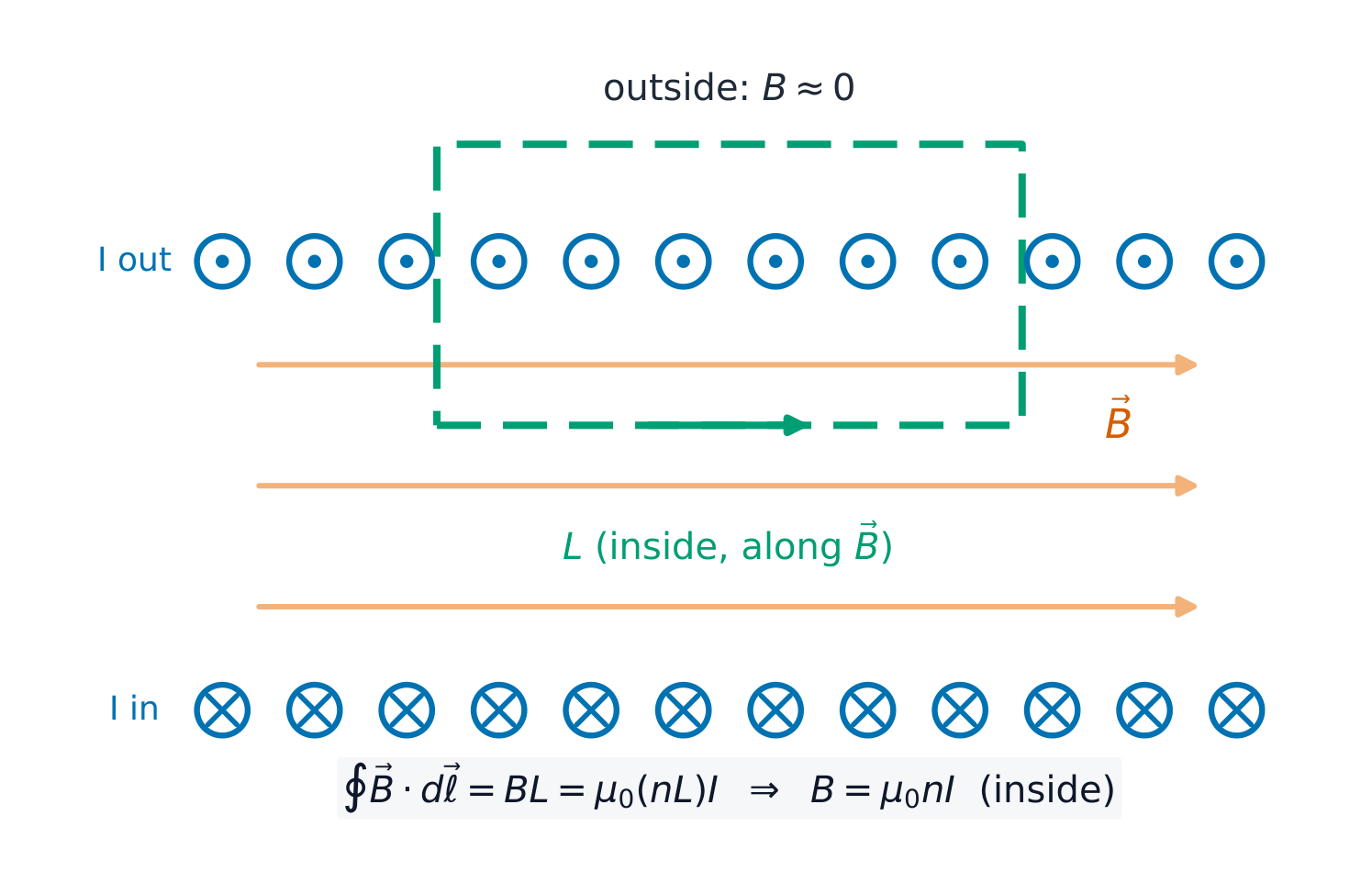
A long solenoid 螺线管 (assumed: uniform field inside, negligible field outside) is the other classic. Take a rectangular loop with one side of length $L$ inside, parallel to the axis: only that side contributes to the integral, so $BL=\mu_0 (nL) I$ and
$$B_{\text{sol}}=\mu_0 n I,$$
with $n$ the turns per metre.
Worked example (cylinder). A solid cylindrical conductor of radius $R$ carries current $I$ spread uniformly over its cross-section. Inside ($r
Exam skill. Every Ampère's-law answer earns its marks in the setup: name the loop, state why $B$ is constant and parallel to it (symmetry), and count $I_{\text{enc}}$ carefully before you solve. Maxwell's fourth equation adds one more idea you should know qualitatively: a changing electric field also creates a magnetic field – but AP will not ask you to compute with that term.
العربية
لتوزيعات تيار متناظرة، قانون أمبير يجد الحقل أسرع بكثير من بيوت-ساڤار:
$$\oint \vec{B}\cdot d\vec{l}=\mu_0 I_{\text{enc}}.$$
اختر حلقة أمبير تتوافق مع التماثل، بحيث يكون $B$ ثابتًا على طول الحلقة (ومتوازيًا معها) ويخرج من التكامل. يطبق AP هذا على الأسلاك المستقيمة الطويلة، والملفات الطويلة، والموصلات التي تحمل كثافة تيار (صفائح وأسطوانات)؛ وتُعالج التراكيب باستخدام التراكب.
مثال محلول. أوجد المجال $0.10\ \text{m}$ الناتج عن سلك طويل يحمل تيار $5.0\ \text{A}$. حلقة دائرية نصف قطرها $r$ تتشارك في تماثل المجال، لذا فإن $B(2\pi r)=\mu_0 I$ و
$$B=\frac{\mu_0 I}{2\pi r}=\frac{(4\pi\times10^{-7})(5.0)}{2\pi(0.10)}=1.0\times10^{-5}\ \text{T}.$$
الملف الطويل (solenoid) (بافتراض: مجال منتظم داخله، ومجال مهمل خارجه) هو المثال الكلاسيكي الآخر. خذ حلقة مستطيلة تكون أحد أضلاعها بطول $L$ داخل الملف ومتوازية مع المحور: فقط ذلك الضلع يساهم في التكامل، لذا $BL=\mu_0 (nL) I$ و
$$B_{\text{sol}}=\mu_0 n I,$$
حيث $n$ هو عدد اللفات لكل متر.
مثال محلول (أسطوانة). موصل أسطواني صلب نصف قطره $R$ يمر فيه تيار $I$ موزع بانتظام على مقطعه العرضي. داخل المنطقة ($r
مهارة الامتحان. كل إجابة لقانون أمبير تحصل على درجاتها في مرحلة الإعداد: سمِّ الحلقة، واذكر لماذا $B$ ثابت ومتوازي معها (بسبب التماثل)، وعدّ $I_{\text{enc}}$ بعناية قبل البدء في الحل. تضيف المعادلة الرابعة لماكسوف فكرة أخرى يجب أن تعرفها بشكل نوعي: فإن المجال الكهربائي المتغير يولد أيضًا مجالًا مغناطيسيًا – لكن AP لن يطلب منك إجراء حسابات باستخدام هذا الحد.
12.4
Exam tips · نصائح للامتحان
English
- The magnetic force $\vec F=q\vec v\times\vec B$ is perpendicular to velocity — use the right-hand rule and note it does no work.
- A charge in a uniform field moves in a circle with $r=\tfrac{mv}{qB}$.
- Find the field of currents with Biot–Savart $d\vec B=\tfrac{\mu_0}{4\pi}\tfrac{I\,d\vec l\times\hat r}{r^2}$ or Ampère's law $\oint \vec B\cdot d\vec l=\mu_0 I_{enc}$ when there is symmetry.
- Force on a wire is $\vec F=I\vec L\times\vec B$; keep the cross-product direction straight.
- Distinguish the force on a charge from the field the current creates.
العربية
- القوة المغناطيسية $\vec F=q\vec v\times\vec B$ عمودية على السرعة — استخدم قاعدة اليد اليمنى ولاحظ أنها لا تقوم بأي شغل.
- الشحنة في مجال منتظم تتحرك في دائرة بسرعة $r=\tfrac{mv}{qB}$.
- أوجد مجال التيارات باستخدام بيوت-سافار $d\vec B=\tfrac{\mu_0}{4\pi}\tfrac{I\,d\vec l\times\hat r}{r^2}$ أو قانون أمبير $\oint \vec B\cdot d\vec l=\mu_0 I_{enc}$ عندما يكون هناك تماثل.
- القوة المؤثرة على سلك هي $\vec F=I\vec L\times\vec B$؛ حافظ على اتجاه الضرب الاتجاهي صحيحًا.
- افرق بين القوة على شحنة والمجال الذي ينشئه التيار.
Interactive lessons on this topic · دروس تفاعلية حول هذا الموضوع
Work through it step by step, with instant-check exercises. · ا-working عليه خطوة بخطوة، مع تمارين تحقق فوري.
Past Papers · أوراق الامتحانات السابقة