| Learning Objective | Essential Knowledge |
|---|---|
10.1.A |
|
Conductors and Capacitors · الموصلات والمكثفات
AP Physics C: Electricity and Magnetism · AP الفيزياء C: الكهرباء والمغناطيسية · Topic 10 · الموضوع 10
 8:28
8:28
الموصلات والمكثفات
تُصطدم طائرة بالبرق مرة واحدة تقريباً في السنة، ويشعر الأشخاص بداخلها بشيء ضئيل جداً. سيارة في عاصفة رعدية هي واحدة من أكثر الأماكن أماناً للجلوس. لماذا؟…
English narration · English + 中文 subtitles burned in · سرد باللغة الإنجليزية · ترجمة مدمجة بالإنجليزية + الصينية
10.1
Electrostatics with Conductors · الكهروستاتيكا مع الموصلات
Syllabus · المنهج
Source: College Board AP Course and Exam Description · المصدر: وصف دورة وامتحان College Board AP
English
In an ideal conductor 导体, electrons move freely. Put extra charge on one and the charges repel each other until, almost instantly, they settle into electrostatic equilibrium 静电平衡. In that state the conductor has four properties you must be able to state and use:
- The electric field inside the conductor is zero. If it were not, free electrons would still be moving.
- All excess charge sits on the surface. (Negative net charge = extra electrons on the surface; positive = a shortage of electrons there.)
- The field just outside is perpendicular 垂直 to the surface, with magnitude $E=\sigma/\varepsilon_0$. Any parallel component would push charge sideways along the surface.
- The whole conductor is one equipotential surface 等势面: every point, inside and on the surface, is at the same potential.
Charge density is largest where the surface curves sharply – at points and edges – so the outside field is strongest there. In an external field a conductor polarizes: charge shifts on its surface so that the interior stays field-free and the body stays an equipotential. Surrounding a region with a closed conducting shell keeps outside fields out entirely – electrostatic shielding 静电屏蔽, the idea behind the Faraday cage 法拉第笼.
العربية
في موصل مثالي، تتحرك الإلكترونات بحرية. ضع شحنة زائدة على طرف منه وتتنافر الشحنات مع بعضها البعض حتى تستقر، شبه فوريًا، في توازن كهروستاتيكي. في تلك الحالة للموصل أربعة خصائص يجب أن تكون قادرًا على ذكرها واستخدامها:
- الحقل الكهربائي داخل الموصل يساوي الصفر. لو لم يكن كذلك، لا تزال الإلكترونات الحرة ستتحرك.
- كل الشحنة الزائدة تقع على السطح. (شحنة سالبة صافية = إلكترونات زائدة على السطح؛ موجبة = نقص في الإلكترونات هناك.)
- الحقل مباشرةً خارجاً هو عمودي على السطح، ومقداره $E=\sigma/\varepsilon_0$. أي مكون موازي سيدفع الشحنة جانبياً على طول السطح.
- الموصل بأكمله هو سطح جهد متساوي: كل نقطة، داخله وعلى سطحه، تكون عند نفس الجهد.
الكثافة الشحنية تكون أكبر حيث ينحني السطح بشدة – عند النقاط والحواف – لذا يكون الحقل الخارجي الأقوى هناك. في حقل خارجي، يتقطب الموصل: تنزاح الشحنات على سطحه بحيث يبقى الداخل خالياً من الحقل ويبقى الجسم سطح جهد متساوي. إحاطة منطقة بغلاف موصل مغلق يحفظ الحقول الخارجية خارجًا تمامًا – الحجب الكهروستاتيكي، الفكرة وراء قفص فاراداي.
10.2
Redistribution of Charge Between Conductors · إعادة توزيع الشحنة بين الموصلات
Syllabus · المنهج
English
Learning Objective 10.2.A: Describe the movement of charge and the resulting interactions when conductors physically contact each other.
- 10.2.A.1 When conductors are in electrical contact, charges will be redistributed such that the surfaces of each conductor are at the same electric potential.
- 10.2.A.2 Ground is an idealized reference point that has zero electric potential and can absorb or provide an infinite amount of charge without changing its electric potential.
- 10.2.A.3 Charge can be induced on a conductor by grounding the conductor in the presence of an external electric field.
العربية
هدف التعلم 10.2.A: وصف حركة الشحنة والتفاعلات الناتجة عندما تتلامس الموصلات جسديًا مع بعضها البعض.
- 10.2.A.1 عندما تكون الموصلات في تلامس كهربائي، سيتم إعادة توزيع الشحنات بحيث تكون أسطح كل موصل عند نفس الجهد الكهربائي.
- 10.2.A.2 الأرض (Ground) نقطة مرجعية مثالية ذات جهد كهربائي صفر ويمكنها امتصاص أو توفير كمية لا نهائية من الشحنة دون تغيير جهدها الكهربائي.
- 10.2.A.3 يمكن تحريض شحنة على موصل عن طريق توصيل الموصل بالأرض في وجود مجال كهربائي خارجي.
Source: College Board AP Course and Exam Description · المصدر: وصف دورة وامتحان College Board AP
English
When two conductors touch (or are wired together), charge flows between them until both surfaces reach the same potential – that is the stopping condition, not "equal charges". A larger sphere holds more charge at the same potential ($V=kQ/R$), so it takes the larger share.
Worked example. A small sphere of radius $R$ carrying $+6.0\ \mu\text{C}$ touches a distant sphere of radius $2R$, then they separate. Equal potentials require $\dfrac{kq_1}{R}=\dfrac{kq_2}{2R}$, so $q_2=2q_1$. With $q_1+q_2=6.0\ \mu\text{C}$: $q_1=2.0\ \mu\text{C}$ and $q_2=4.0\ \mu\text{C}$.
Ground 接地 is an idealized reference at zero potential that can absorb or supply any amount of charge. Grounding a conductor while an external charge is nearby leaves the conductor with a net induced charge 感应电荷: the external field pushes charge of one sign to ground, and cutting the ground wire before removing the external charge traps the rest.
العربية
عند تلامس موصلين (أو توصيلهما بسلك)، تتدفق الشحنة بينهما حتى يصل كلا السطحين إلى نفس الجهد – هذا هو شرط التوقف، وليس "الشحنات المتساوية". كرة أكبر تحمل شحنة أكثر عند نفس الجهد ($V=kQ/R$)، لذا تأخذ الحصة الأكبر.
مثال محلول. كرة صغيرة نصف قطرها $R$ تحمل شحنة $+6.0\ \mu\text{C}$ تلمس كرة بعيدة نصف قطرها $2R$، ثم تنفصل. تتطلب تساوي الجهود $\dfrac{kq_1}{R}=\dfrac{kq_2}{2R}$، لذا $q_2=2q_1$. مع $q_1+q_2=6.0\ \mu\text{C}$: $q_1=2.0\ \mu\text{C}$ و $q_2=4.0\ \mu\text{C}$.
الأرض مرجع مثالي عند جهد صفر يمكنه امتصاص أو تزويد أي كمية من الشحنة. توصيل موصل بالأرض أثناء وجود شحنة خارجية قريبة يترك الموصل بشحنة مستحثة صافية: يدفع الحقل الخارجي شحنات من علامة معينة إلى الأرض، وقطع سلك الأرض قبل إزالة الشحنة الخارجية يحبس الباقي.
10.3
Capacitors · المكثفات
Syllabus · المنهج
English
Learning Objective 10.3.A: Describe the physical properties of a parallel-plate capacitor.
- 10.3.A.1 A parallel-plate capacitor consists of two separated parallel conducting surfaces that can hold equal amounts of charge with opposite signs.
- 10.3.A.2 Capacitance relates the magnitude of the charge stored on each plate to the electric potential difference created by the separation of those charges.
- Equation: $C = \dfrac{Q}{\Delta V}$
- 10.3.A.2.i The capacitance of a capacitor depends only on the physical properties of the capacitor, such as the capacitor's shape and the material used to separate the plates.
- 10.3.A.2.ii The capacitance of a parallel-plate capacitor is proportional to the area of one of its plates and inversely proportional to the distance between its plates. The constant of proportionality is the product of the dielectric constant, $\kappa$, of the material between the plates and the electric permittivity of free space, $\varepsilon_0$.
- Equation: $C = \dfrac{\kappa \varepsilon_0 A}{d}$
- 10.3.A.3 The electric field between two charged parallel plates with uniformly distributed electric charge, such as in a parallel-plate capacitor, is constant in both magnitude and direction, except near the edges of the plates.
- 10.3.A.3.i The magnitude of the electric field between two charged parallel plates, where the plate separation is much smaller than the dimensions of the plates, can be determined by applying Gauss's law and the principle of superposition.
- Equation: $E = \dfrac{Q}{\varepsilon_0 A}$
- 10.3.A.3.ii The electric field is proportional to the surface charge density on either plate of the capacitor.
- 10.3.A.3.iii A charged particle between two oppositely charged parallel plates undergoes constant acceleration, and therefore its motion shares characteristics with the projectile motion of an object with mass in the gravitational field near Earth's surface.
- 10.3.A.3.i The magnitude of the electric field between two charged parallel plates, where the plate separation is much smaller than the dimensions of the plates, can be determined by applying Gauss's law and the principle of superposition.
- 10.3.A.4 The electric potential energy stored in a capacitor is equal to the work done by an external force to separate that amount of charge on the capacitor.
- 10.3.A.5 The electric potential energy stored in a capacitor is described by the equation $U_C = \dfrac{1}{2} Q \Delta V$.
Boundary statement: While other shapes are also able to separate charges, AP Physics C: Electricity & Magnetism only expects the quantitative analysis and description of parallel-plate capacitors, concentric spherical capacitors, and coaxial cylindrical capacitors.
العربية
هدف التعلم 10.3.A: وصف الخصائص الفيزيائية لمكثف الصفائح المتوازية.
- 10.3.A.1 يتكون مكثف الصفائح المتوازية من سطحين موصلين متوازيين ومنفصلين يمكنهما حمل كميات متساوية من الشحنة بإشارات مختلفة.
- 10.3.A.2 ترتبط السعة Electrical Capacitance بمقدار الشحنة المخزنة على كل صفيحة بالفارق في الجهد الكهربائي الذي تسببه فصل تلك الشحنات.
- المعادلة: $C = \dfrac{Q}{\Delta V}$
- 10.3.A.2.i تعتمد سعة المكثف فقط على الخصائص الفيزيائية للمكثف، مثل شكل المكثف والمادة المستخدمة لفصل الصفحات.
- 10.3.A.2.ii تتناسب سعة مكثف الصفائح المتوازية طرديًا مع مساحة إحدى صفيحتها وعكسيًا مع المسافة بينهما. ثابت التناسب هو حاصل ضرب ثابت العزل $\kappa$ للمادة الموجودة بين الصفائح والسمحية الكهربائية للفراغ $\varepsilon_0$.
- معادلة: $C = \dfrac{\kappa \varepsilon_0 A}{d}$
- 10.3.A.3 المجال الكهربائي بين صفحتين متوازيتين مشحونتين بشحنة كهربائية موزعة بانتظام، كما في مكثف الصفائح المتوازية، ثابت في كل من المقدار والاتجاه، باستثناء بالقرب من حواف الصفائح.
- 10.3.A.3.i يمكن تحديد مقدار المجال الكهربائي بين صفحتين متوازيتين مشحونتين، حيث تكون مسافة الفصل بين الصفائح أصغر بكثير من أبعاد الصفائح، بتطبيق قانون غاوس ومبدأ التراكب.
- معادلة: $E = \dfrac{Q}{\varepsilon_0 A}$
- 10.3.A.3.ii يتناسب المجال الكهربائي طرديًا مع كثافة الشحنة السطحية على أي صفيحة من صفيحتي المكثف.
- 10.3.A.3.iii تخضع جسيم مشحون موجود بين صفحتين متوازيتين مشحونتين بإشارتين متعاكسين لتسارع ثابت، وبالتالي تشترك حركته في خصائص حركة المقذوفات لجسم له كتلة في مجال الجاذبية بالقرب من سطح الأرض.
- 10.3.A.3.i يمكن تحديد مقدار المجال الكهربائي بين صفحتين متوازيتين مشحونتين، حيث تكون مسافة الفصل بين الصفائح أصغر بكثير من أبعاد الصفائح، بتطبيق قانون غاوس ومبدأ التراكب.
- 10.3.A.4 الطاقة الكامنة الكهربائية المخزنة في مكثف تساوي الشغل المبذول بواسطة قوة خارجية لفصل هذه الكمية من الشحنة على المكثف.
- 10.3.A.5 تُوصف الطاقة الكامنة الكهربائية المخزنة في مكثف بالمعادلة $U_C = \dfrac{1}{2} Q \Delta V$.
عبارة الحدود: بينما يمكن لأشكال أخرى أيضًا فصل الشحنات، فإن منهج AP Physics C: الكهرباء والمغناطيسية يتطلب فقط التحليل الكمي ووصف مكثفات الصفائح المتوازية، والمكثفات الكروية المتمركزة، والمكثفات الأسطوانية المحورية.
Source: College Board AP Course and Exam Description · المصدر: وصف دورة وامتحان College Board AP
English
A capacitor 电容器 stores charge on two conductors separated by a gap: $+Q$ on one plate, $-Q$ on the other. Its capacitance 电容 relates the stored charge to the potential difference between the plates:
$$C=\frac{Q}{\Delta V}.$$
Capacitance depends only on geometry and the material in the gap – never on $Q$ or $\Delta V$ themselves.
Worked derivation (parallel plates). For a parallel-plate capacitor 平行板电容器 with plate area $A$ and small gap $d$: Gauss's law plus superposition 叠加 gives a uniform 均匀 field between the plates, $E=\dfrac{\sigma}{\varepsilon_0}=\dfrac{Q}{\varepsilon_0 A}$ (each plate alone contributes $\sigma/2\varepsilon_0$; between the plates the two add, outside they cancel). A uniform field means $\Delta V=Ed=\dfrac{Qd}{\varepsilon_0 A}$, so
$$C=\frac{Q}{\Delta V}=\frac{\varepsilon_0 A}{d}.$$
This $E\to\Delta V\to C$ chain is a standard FRQ derivation – learn it as three steps, and quote each one. The same method handles the other two shapes AP expects: concentric spheres ($C=4\pi\varepsilon_0\dfrac{ab}{b-a}$) and a coaxial cylinder of length $L$, where $E=\dfrac{\lambda}{2\pi\varepsilon_0 r}$ gives $\Delta V=\dfrac{\lambda}{2\pi\varepsilon_0}\ln\dfrac{b}{a}$ and so $C=\dfrac{2\pi\varepsilon_0 L}{\ln(b/a)}$.
Worked example. Plates of area $A=0.020\ \text{m}^2$ and gap $d=1.0\ \text{mm}$: $C=\dfrac{8.85\times10^{-12}(0.020)}{1.0\times10^{-3}}=1.8\times10^{-10}\ \text{F}$. Charged to $100\ \text{V}$ it holds $Q=CV=1.8\times10^{-8}\ \text{C}$.
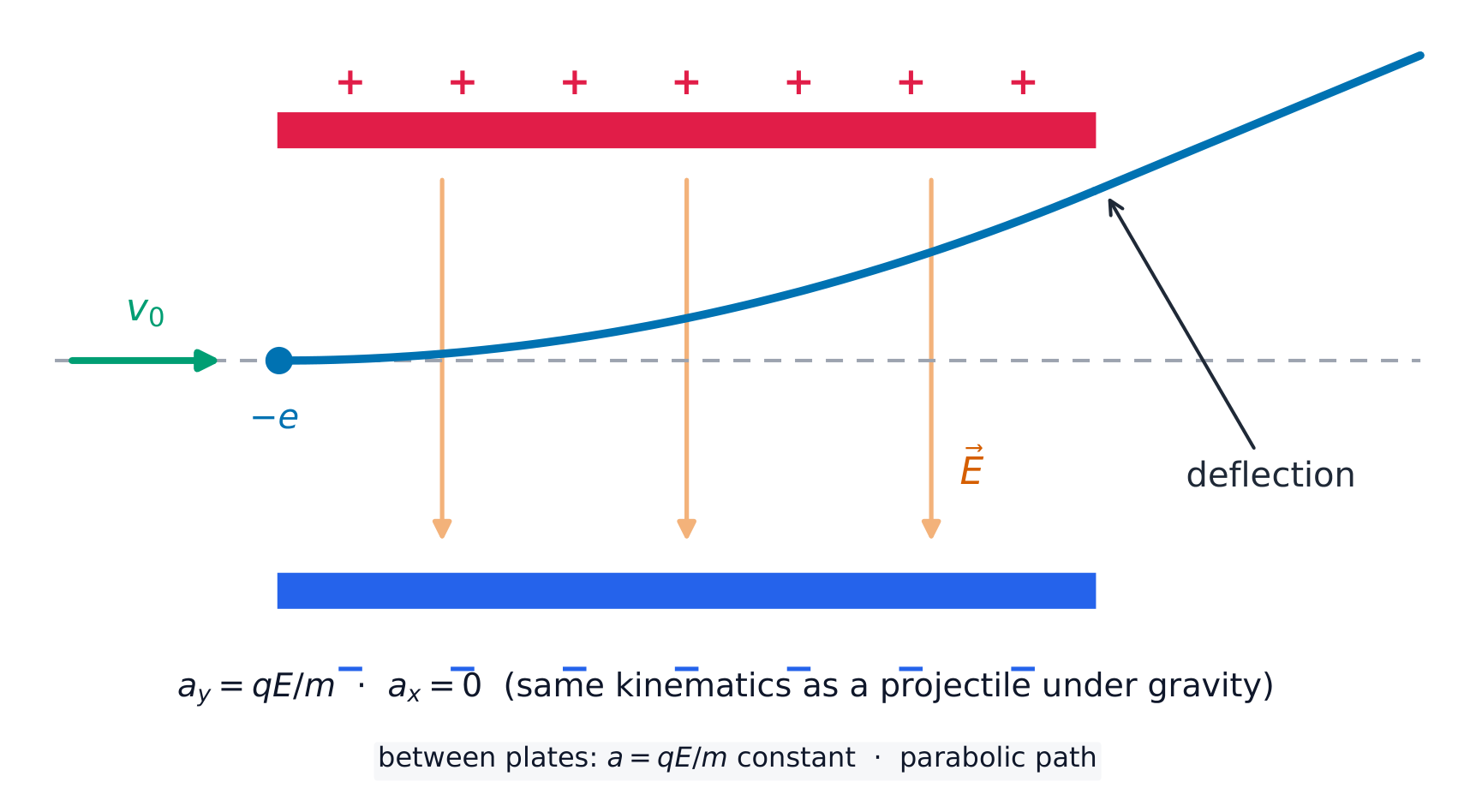
Because the field between the plates is uniform, a charged particle there feels a constant force, so it moves with constant acceleration – exactly like projectile motion 抛体运动 in gravity: constant speed across, uniform acceleration towards a plate.
Worked example. An electron enters midway between plates at $v_0=2.0\times10^{7}\ \text{m/s}$, parallel to them. The field is $E=1.0\times10^{3}\ \text{N/C}$ and the plates are $4.0\ \text{cm}$ long. Acceleration: $a=\dfrac{eE}{m}=\dfrac{(1.6\times10^{-19})(1.0\times10^{3})}{9.11\times10^{-31}}=1.8\times10^{14}\ \text{m/s}^2$. Time between the plates: $t=\dfrac{0.040}{2.0\times10^{7}}=2.0\times10^{-9}\ \text{s}$. Deflection: $y=\tfrac12at^{2}=\tfrac12(1.8\times10^{14})(2.0\times10^{-9})^{2}\approx3.5\times10^{-4}\ \text{m}$ – about $0.35\ \text{mm}$ towards the positive plate.
Storing charge takes work 功: an external force must move each bit of charge against the field of the charge already there. The total work ends up as stored potential energy,
$$U_C=\tfrac12\,Q\,\Delta V=\tfrac12 C(\Delta V)^2=\frac{Q^2}{2C}.$$
The factor $\tfrac12$ is the area of the triangle under the $Q$–$\Delta V$ line: the first charge moved across costs almost nothing, the last costs the full $\Delta V$.
Capacitors combine oppositely to resistors: in parallel 并联 the capacitances add ($C_{\text{eq}}=C_1+C_2$, same $\Delta V$, charges add), while in series 串联 the reciprocals add ($\tfrac{1}{C_{\text{eq}}}=\tfrac{1}{C_1}+\tfrac{1}{C_2}$, same $Q$, voltages add).
Worked example. A $2\ \mu\text{F}$ and a $4\ \mu\text{F}$ capacitor in series: $\tfrac{1}{C}=\tfrac12+\tfrac14$, so $C=\tfrac43\ \mu\text{F}$. The same pair in parallel: $6\ \mu\text{F}$.
العربية
المكثف يخزن شحنة على موصلين مفصولين بفراغ: $+Q$ على لوح واحد، $-Q$ على الآخر. سعته تربط الشحنة المخزنة بالفرق في الجهد بين اللوحين:
$$C=\frac{Q}{\Delta V}.$$
يعتمد السعة فقط على الهندسة والمادة الموجودة في الفراغ – ولا يعتمد أبدًا على $Q$ أو $\Delta V$ نفسيهما.
استنتاج محلول (لوحان متوازيان). بالنسبة لـ مكثف ذو لوحين متوازيين بمساحة لوح $A$ وفراغ صغير $d$: قانون غاوس بالإضافة إلى التراكب يعطي حقلاً منتظماً بين اللوحين، $E=\dfrac{\sigma}{\varepsilon_0}=\dfrac{Q}{\varepsilon_0 A}$ (يساهم كل لوح بمفرده بـ $\sigma/2\varepsilon_0$؛ بين اللوحين يتجمع الاثنان، خارجهما يلغي بعضهما). الحقل المنتظم يعني $\Delta V=Ed=\dfrac{Qd}{\varepsilon_0 A}$، لذا
$$C=\frac{Q}{\Delta V}=\frac{\varepsilon_0 A}{d}.$$
هذه السلسلة $E\to\Delta V\to C$ هي اشتقاق قياسي لموضوع FRQ – ادرسها على شكل ثلاث خطوات، واستشهد بكل منها. نفس الطريقة تُطبق على الشكلين الآخرين المتوقعين في امتحان AP: الكرات المتشابهة المركز ($C=4\pi\varepsilon_0\dfrac{ab}{b-a}$) والأسطوانة المحورية بطول $L$، حيث $E=\dfrac{\lambda}{2\pi\varepsilon_0 r}$ تعطي $\Delta V=\dfrac{\lambda}{2\pi\varepsilon_0}\ln\dfrac{b}{a}$ وهكذا $C=\dfrac{2\pi\varepsilon_0 L}{\ln(b/a)}$.
مثال محلول. ألواح مساحة $A=0.020\ \text{m}^2$ وفاصل $d=1.0\ \text{mm}$: $C=\dfrac{8.85\times10^{-12}(0.020)}{1.0\times10^{-3}}=1.8\times10^{-10}\ \text{F}$. شُحنت بـ $100\ \text{V}$ فاحتفظت بـ $Q=CV=1.8\times10^{-8}\ \text{C}$.
لأن المجال بين الألواح منتظم، فإن جسيم مشحون هناك يتعرض لقوة ثابتة، لذا يتحرك بتسارع ثابت – تماماً مثل حركة المقذوفات تحت الجاذبية: سرعة أفقية ثابتة وتسارع موحد نحو أحد الألواح.
مثال محلول. إلكترون يدخل في منتصف المسافة بين الألواح بسرعة $v_0=2.0\times10^{7}\ \text{m/s}$، موازٍ لها. المجال هو $E=1.0\times10^{3}\ \text{N/C}$ والألواح طولها $4.0\ \text{cm}$. التسارع: $a=\dfrac{eE}{m}=\dfrac{(1.6\times10^{-19})(1.0\times10^{3})}{9.11\times10^{-31}}=1.8\times10^{14}\ \text{m/s}^2$. الزمن بين الألواح: $t=\dfrac{0.040}{2.0\times10^{7}}=2.0\times10^{-9}\ \text{s}$. الانحراف: $y=\tfrac12at^{2}=\tfrac12(1.8\times10^{14})(2.0\times10^{-9})^{2}\approx3.5\times10^{-4}\ \text{m}$ – أي تقريباً $0.35\ \text{mm}$ نحو اللوح الموجب.
تخزين الشحنة يتطلب عملاً: يجب أن تحرك قوة خارجية كل جزء من الشحنة ضد مجال الشحنة الموجودة بالفعل. ينتهي العمل الكلي كطاقة كامنة مخزنة،
$$U_C=\tfrac12\,Q\,\Delta V=\tfrac12 C(\Delta V)^2=\frac{Q^2}{2C}.$$
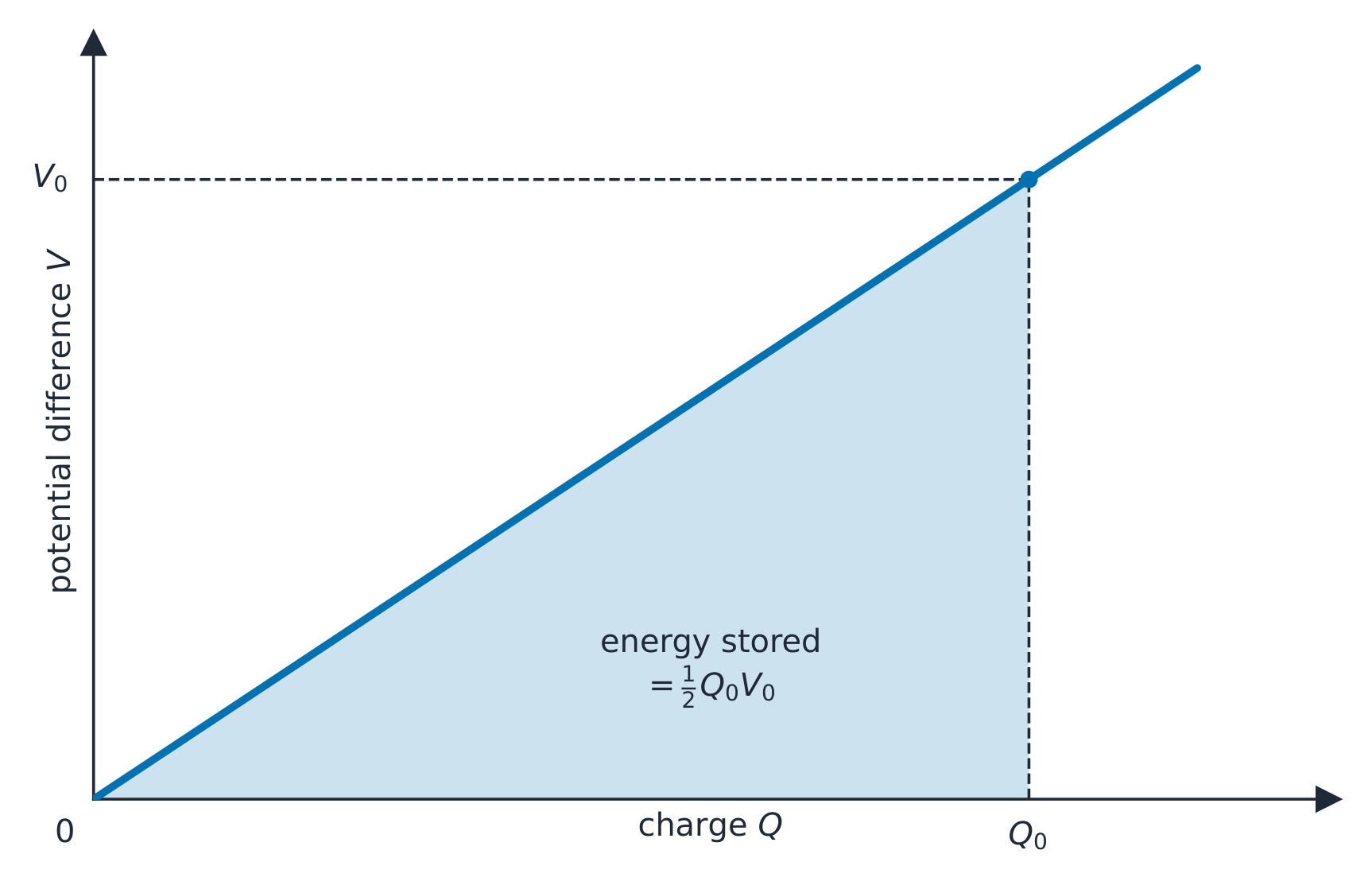
العامل $\tfrac12$ هو مساحة المثلث تحت الخط $Q$–$\Delta V$: أول شحنة نُقلت تكلف شبه لا شيء، وأخرى تكلف كامل $\Delta V$.
المكثفات تتجمع بعكس المقاومات: في التوازي تضاف السعات ($C_{\text{eq}}=C_1+C_2$، نفس $\Delta V$، تضاف الشحنات)، بينما في التوالي تضاف المقلوبات ($\tfrac{1}{C_{\text{eq}}}=\tfrac{1}{C_1}+\tfrac{1}{C_2}$، نفس $Q$، تضاف الجهود).
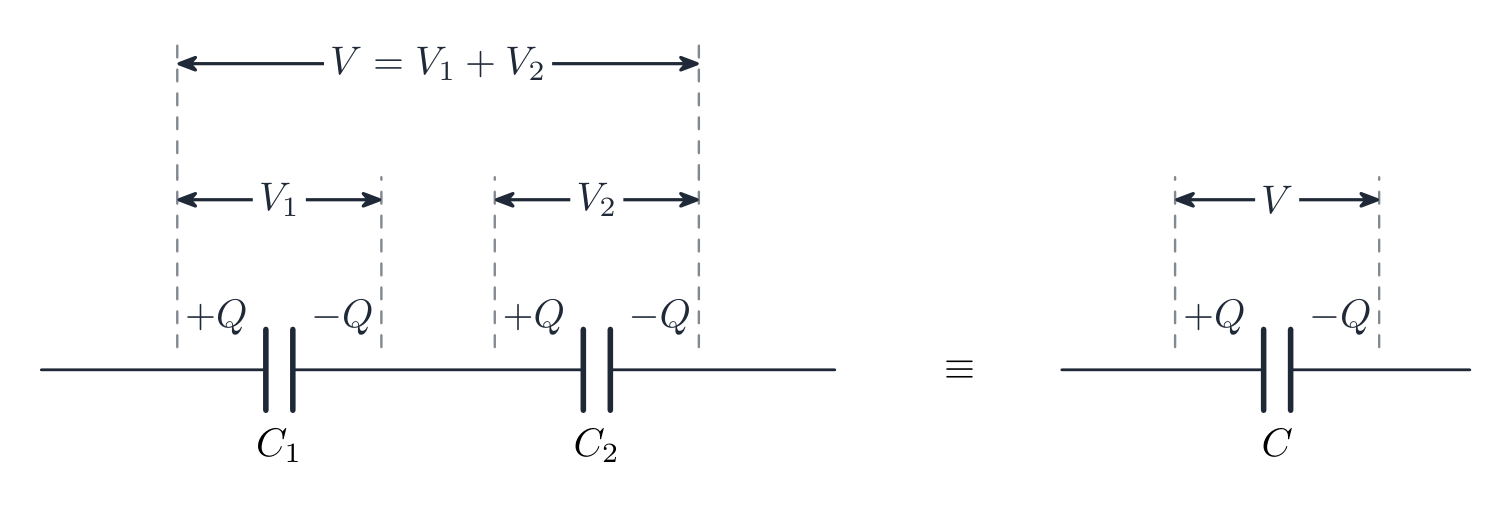
مثال محلول. مكثف $2\ \mu\text{F}$ ومكثف $4\ \mu\text{F}$ متصلان على التوالي: $\tfrac{1}{C}=\tfrac12+\tfrac14$، إذن $C=\tfrac43\ \mu\text{F}$. نفس الزوج موصلاً على التوازي: $6\ \mu\text{F}$.
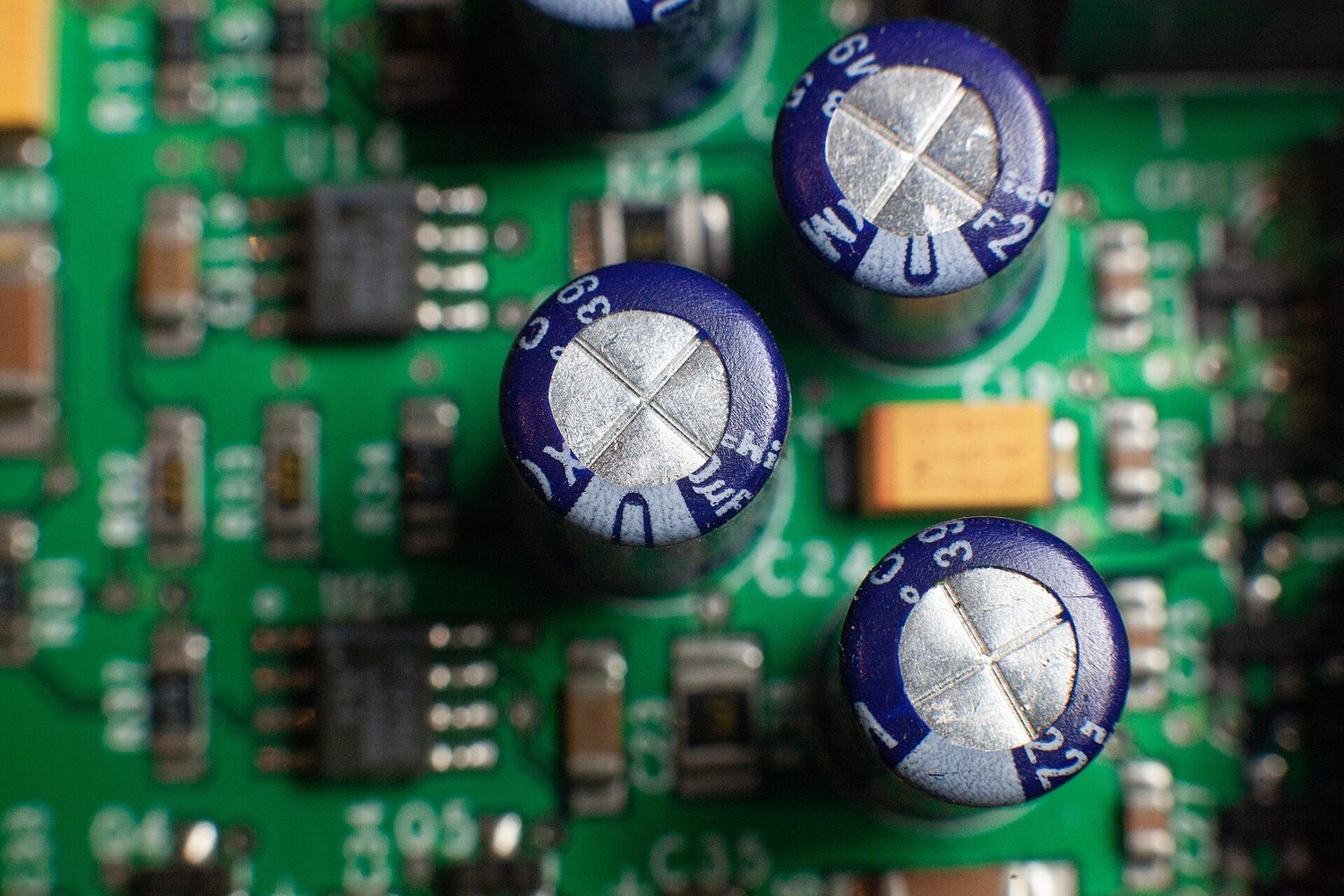
Explore · استكشف
Charge and discharge a capacitor · شحّن وفك شحن مكثف
A capacitor stores charge on two plates, filling and emptying exponentially with time constant $\tau=RC$. Bigger $R$ or $C$ slows it down. · يخزن المكثف شحنة على صفيحتين، ويتشحن ويفرغ بشكل أسي مع ثابت زمن $\tau=RC$. كلما كان $R$ أو $C$ أكبر، كان الانخفاض أبطأ.
Vocabulary · مفردات
Train · تدريب
| English | العربية |
|---|---|
| conductor/kənˈdʌktə/ | موصل |
| electrostatic equilibrium/ɪˌlektrəʊˈstætɪk ˌiːkwɪˈlɪbrɪəm/ | التوازن الكهروستاتيكي |
| perpendicular/ˌpɜːpənˈdɪkjʊlə/ | عمودية |
| equipotential surface/ˌiːkwɪpəˈtenʃl ˈsɜːfɪs/ | سطح مساوٍ للجهد |
| electrostatic shielding/ɪˌlektrəʊˈstætɪk ˈʃiːldɪŋ/ | درع كهروستاتيكي |
| Faraday cage/ˈfærədeɪ keɪdʒ/ | قفاة فاراداي |
| ground/ɡraʊnd/ | الأرضية |
| induced charge/ɪnˈdjuːst tʃɑːdʒ/ | الشحنة المستحاث |
| capacitor/kəˈpæsɪtə/ | مكثف |
| capacitance/kəˈpæsɪtəns/ | السعة |
| parallel-plate capacitor/ˈpærəlel pleɪt kəˈpæsɪtə/ | مكثف الصفائح المتوازية |
| superposition/ˌsuːpəpəˈzɪʃn/ | التراكب |
| uniform/ˈjuːnɪfɔːm/ | موحد |
| projectile motion/prəˈdʒektaɪl ˈməʊʃn/ | حركة المقذوفات |
| work/wɜːk/ | شغل |
| series/ˈsɪəriːz/ | التوالي |
10.4
Dielectrics · العوازل الكهربائية

Syllabus · المنهج
English
Learning Objective 10.4.A: Describe how a dielectric inserted between the plates of a capacitor changes the properties of the capacitor.
- 10.4.A.1 In a dielectric material, electric charges are not as free to move as they are in a conductor. Instead, the material becomes polarized in the presence of an external electric field.
- 10.4.A.2 The dielectric constant of a material relates the electric permittivity of that material to the permittivity of free space.
- Equation: $\kappa = \dfrac{\varepsilon}{\varepsilon_0}$
- 10.4.A.3 The electric field created by a polarized dielectric is opposite in direction to the external field.
- 10.4.A.4 The electric field between the plates of an isolated parallel-plate capacitor decreases when a dielectric is placed between the plates.
- Equation: $\kappa = \dfrac{E_0}{E}$
- 10.4.A.5 The insertion of a dielectric into a capacitor may change the capacitance of the capacitor.
- Equation: $C = \kappa C_0$
العربية
هدف التعلم 10.4.A: وصف كيفية تغيير إدخال عازل بين صفيحتي المكثف لخصائص المكثف.
- 10.4.A.1 في المادة العازلة، لا تكون الشحنات الكهربائية حرة الحركة بنفس القدر كما في الموصل. بدلاً من ذلك، تصبح المادة قطبية في وجود مجال كهربائي خارجي.
- 10.4.A.2 يرتبط ثابت العزل للمادة بالسمحية الكهربائية لتلك المادة بالسمحية الكهربائية للفراغ.
- المعادلة: $\kappa = \dfrac{\varepsilon}{\varepsilon_0}$
- 10.4.A.3 المجال الكهربائي الذي يولده العازل المقطب يكون معاكسًا في الاتجاه للمجال الخارجي.
- 10.4.A.4 يقل المجال الكهربائي بين صفيحتي مكثف متوازي معزول عند وضع عازل بين الصفائح.
- المعادلة: $\kappa = \dfrac{E_0}{E}$
- 10.4.A.5 قد يؤدي إدخال عازل إلى مكثف إلى تغيير سعة المكثف.
- المعادلة: $C = \kappa C_0$
Source: College Board AP Course and Exam Description · المصدر: وصف دورة وامتحان College Board AP
English
A dielectric 电介质 is an insulating material. Its charges cannot travel, but in an external field each molecule stretches or turns slightly – the material becomes polarized 极化. The lined-up molecules create their own small field opposite to the applied one, so the net field inside the material drops:
$$E=\frac{E_0}{\kappa},\qquad \kappa=\frac{\varepsilon}{\varepsilon_0}\ \ (\kappa>1),$$
where $\kappa$ is the dielectric constant 介电常数, the ratio of the material's permittivity to the permittivity of free space 真空介电常数.
Filling a capacitor with dielectric multiplies its capacitance:
$$C=\kappa\,C_0\qquad\left(\text{parallel plates: } C=\frac{\kappa\varepsilon_0 A}{d}\right).$$
What happens next depends on what stays fixed – a favourite exam trap:
| battery stays connected ($\Delta V$ fixed) | battery removed first ($Q$ fixed) | |
|---|---|---|
| charge $Q$ | rises to $\kappa Q_0$ | unchanged |
| voltage $\Delta V$ | unchanged | drops to $\Delta V_0/\kappa$ |
| field $E$ | unchanged | drops to $E_0/\kappa$ |
| energy $U$ | rises to $\kappa U_0$ | drops to $U_0/\kappa$ |
Worked example. A $100\ \text{pF}$ capacitor is charged to $12\ \text{V}$, disconnected, then filled with a $\kappa=3$ dielectric. $Q$ is trapped, so $\Delta V$ falls to $4\ \text{V}$ and the stored energy falls to one-third – the missing energy went into pulling the dielectric in. Reconnected to the $12\ \text{V}$ battery instead, the capacitor would hold three times the charge and three times the energy.
Exam skill. Always begin dielectric questions by writing down which quantity is held fixed ($Q$ or $\Delta V$), then let $C=\kappa C_0$ drive everything else through $Q=C\Delta V$ and $U=\tfrac12 C(\Delta V)^2$.
العربية
العازل الكهربائي هو مادة عازلة. شحناته لا يمكنها الحركة، لكن في مجال خارجي يمتد كل جزيء أو يدور قليلاً – فتصبح المادة مقطبة. الجزيئات المصطفة تنشئ مجلداً صغيراً خاصاً بها عكس المجال المطبق، مما يُنقص المجال الصافي داخل المادة:
$$E=\frac{E_0}{\kappa},\qquad \kappa=\frac{\varepsilon}{\varepsilon_0}\ \ (\kappa>1),$$
حيث $\kappa$ هو ثابت العازل، وهو نسبة سماحية المادة إلى سماحية الفراغ.
ملء المكثف بالعازل يضاعف سعته:
$$C=\kappa\,C_0\qquad\left(\text{parallel plates: } C=\frac{\kappa\varepsilon_0 A}{d}\right).$$
ما يحدث بعد ذلك يعتمد على ما يبقى ثابتاً – فخ trap امتحاني مفضل:
| البطارية متصلة ($\Delta V$ ثابت) | أزيلت البطارية أولاً ($Q$ ثابت) | |
|---|---|---|
| الشحنة $Q$ | ترتفع لتصل لـ $\kappa Q_0$ | غير متغيرة |
| الجهد $\Delta V$ | غير متغير | ينخفض ليصل لـ $\Delta V_0/\kappa$ |
| المجال $E$ | غير متغير | ينخفض ليصل لـ $E_0/\kappa$ |
| الطاقة $U$ | ترتفع لتصل لـ $\kappa U_0$ | تنخفض لتصل لـ $U_0/\kappa$ |
مثال محلول. مكثف $100\ \text{pF}$ شُحّن إلى $12\ \text{V}$، ثم فُصل عن المصدر، وعبّر بمادة عازلة $\kappa=3$. $Q$ يُحتفظ بها، لذا ينخفض $\Delta V$ إلى $4\ \text{V}$ وتنخفض الطاقة المخزنة إلى الثلث – حيث ذهبت الطاقة المفقودة في سحب المادة العازلة للداخل. عند توصيلها مرة أخرى ببطارية $12\ \text{V}$ بدلاً من ذلك، سيحمل المكثف ثلاثة أضعاف الشحنة وثلاثة أضعاف الطاقة.
مهارة امتحانية. ابدأ دائماً أسئلة العوازل بكتابة الكمية المثبتة ($Q$ أو $\Delta V$)، ثم دع $C=\kappa C_0$ تقود كل شيء آخر عبر $Q=C\Delta V$ و$U=\tfrac12 C(\Delta V)^2$.
Explore · استكشف
Add a dielectric · أضف عازلاً كهربائياً
A dielectric between the plates raises the capacitance, so the capacitor holds more charge at the same voltage. Watch the charge build faster. · يعزز العازل بين الصفيحتين السعة الكهربائية، فيحتفظ المكثف بشحنة أكبر عند نفس الجهد. راقب بناء الشحنة بسرعة أكبر.
Vocabulary · مفردات
Train · تدريب
| English | العربية |
|---|---|
| parallel/ˈpærəlel/ | التوازي |
| dielectric/ˌdaɪɪˈlektrɪk/ | عازل / عازل كهربائي |
| polarized/ˈpəʊləraɪzd/ | مستقطب |
| dielectric constant/ˌdaɪɪˈlektrɪk ˈkɒnstənt/ | ثابت العازل |
| permittivity of free space/ˌpɜːmɪˈtɪvəti ɒv friː speɪs/ | سماحية الفراغ |
10.4
Exam tips · نصائح للامتحان
English
- In electrostatic equilibrium a conductor has $\vec E=0$ inside and all excess charge on the surface.
- Apply Gauss's law $\oint \vec E\cdot d\vec A=\tfrac{q_{enc}}{\varepsilon_0}$ with a symmetry-matched Gaussian surface (sphere, cylinder, pillbox).
- The whole conductor is one equipotential, and the surface field is perpendicular to it.
- For a capacitor use $C=\tfrac{Q}{V}$, energy $U=\tfrac12 CV^2$, and how a dielectric raises $C$.
- Pick the Gaussian surface so $\vec E$ is constant and parallel (or zero) on each part.
العربية
- في الاتزان الكهروستاتيكي يكون للموصل $\vec E=0$ داخله وكل الشحنة الزائدة على السطح.
- طبق قانون غاوس $\oint \vec E\cdot d\vec A=\tfrac{q_{enc}}{\varepsilon_0}$ مع سطح غاوسي متناسق التماثل (كرة، أسطوانة، صندوق حبوب).
- الموصل بأكمله مستوى جهد واحد، والمجال على السطح عمودي عليه.
- بالنسبة للمكثف استخدم $C=\tfrac{Q}{V}$، وطاقة $U=\tfrac12 CV^2$، وكيفية رفع العازل لـ $C$.
- اختر السطح الغاوسي بحيث يكون $\vec E$ ثابتاً وموازياً (أو صفراً) على كل جزء.
Interactive lessons on this topic · دروس تفاعلية حول هذا الموضوع
Work through it step by step, with instant-check exercises. · ا-working عليه خطوة بخطوة، مع تمارين تحقق فوري.
Past Papers · أوراق الامتحانات السابقة