| Learning Objective | Essential Knowledge |
|---|---|
12.1.A |
|
12.1.B |
|
12.1.C |
|
Magnetism and Electromagnetism · المغناطيسية والكهرومغناطيسية
AP Physics 2 · AP الفيزياء 2 · Topic 12 · الموضوع 12
 9:21
9:21
المغناطيسية والكهرومغناطيسية
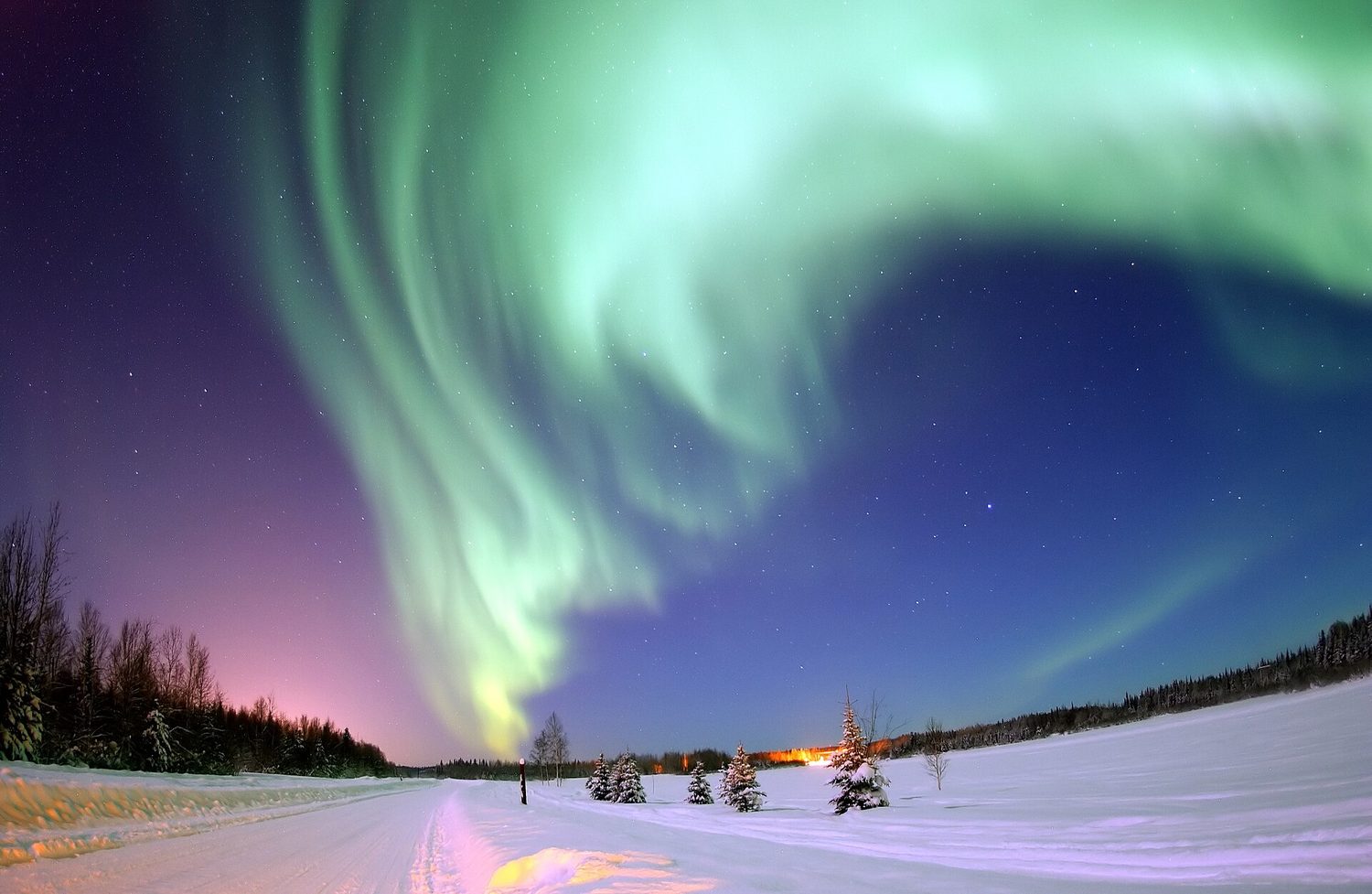
مرتفعاً جداً فوق القطب الشمالي، يضيء السماء الليلية باللون الأخضر. هذه الستائر الضوئية ليست ناراً. إنها جسيمات مشحونة من الشمس، تصل عند مليون…
English narration · English + 中文 subtitles burned in · سرد باللغة الإنجليزية · ترجمة مدمجة بالإنجليزية + الصينية
12.1
Magnetic Fields · المجالات المغناطيسية
Syllabus · المنهج
Source: College Board AP Course and Exam Description · المصدر: وصف دورة وامتحان College Board AP
English
Different materials respond very differently to a magnetic field, and the course names three. Ferromagnetic 铁磁性 materials (iron, nickel, cobalt) have dipoles that align strongly and stay aligned, so they can be permanent magnets. Paramagnetic 顺磁性 materials (aluminium, titanium) align only weakly and do not stay aligned. Diamagnetic 抗磁性 materials - in fact all materials have some diamagnetism - align weakly opposite the field. This behaviour comes from a material property, the permeability 磁导率: free space has a fixed permeability of free space $\mu_0$, while the permeability of matter differs from it and is not even constant for a given material.
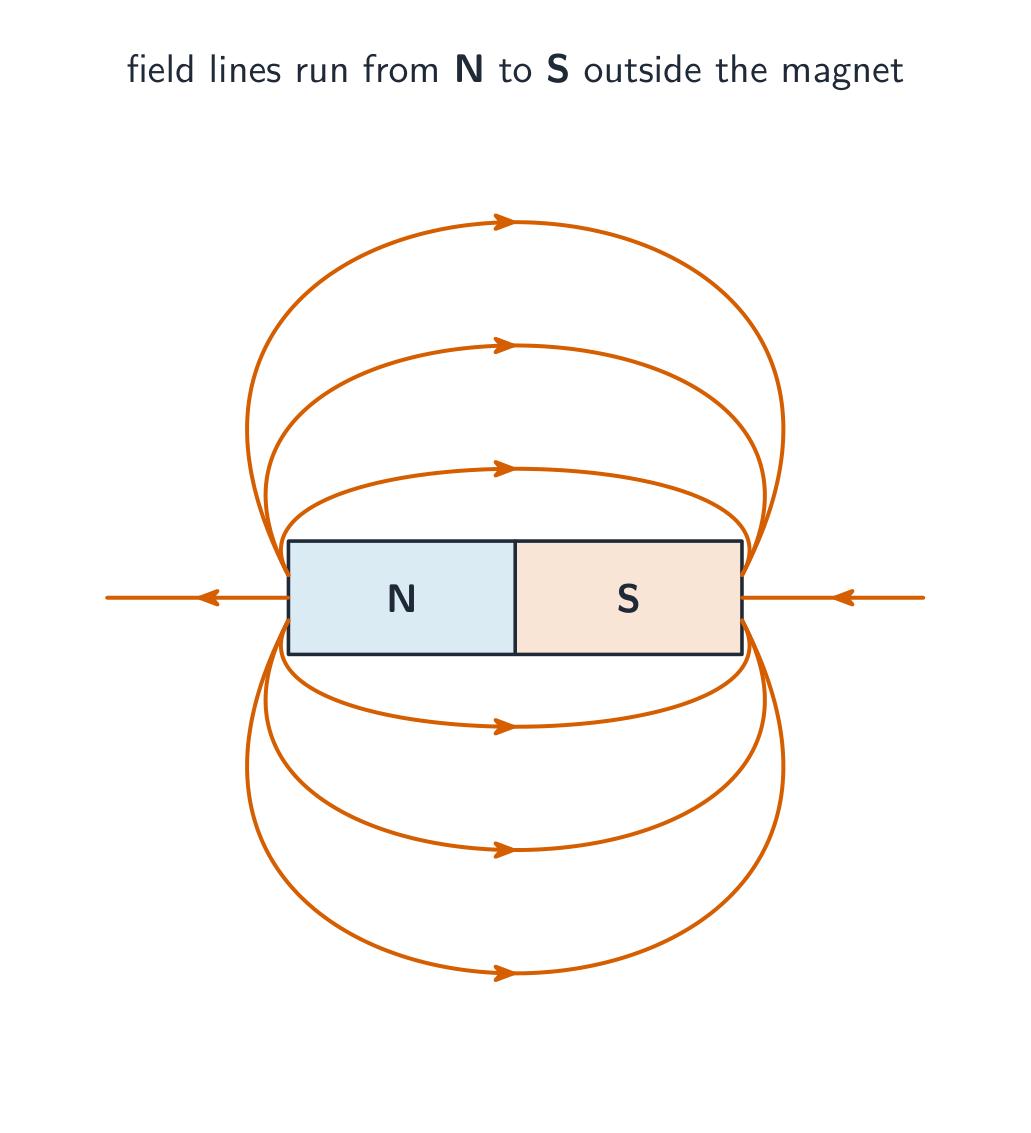
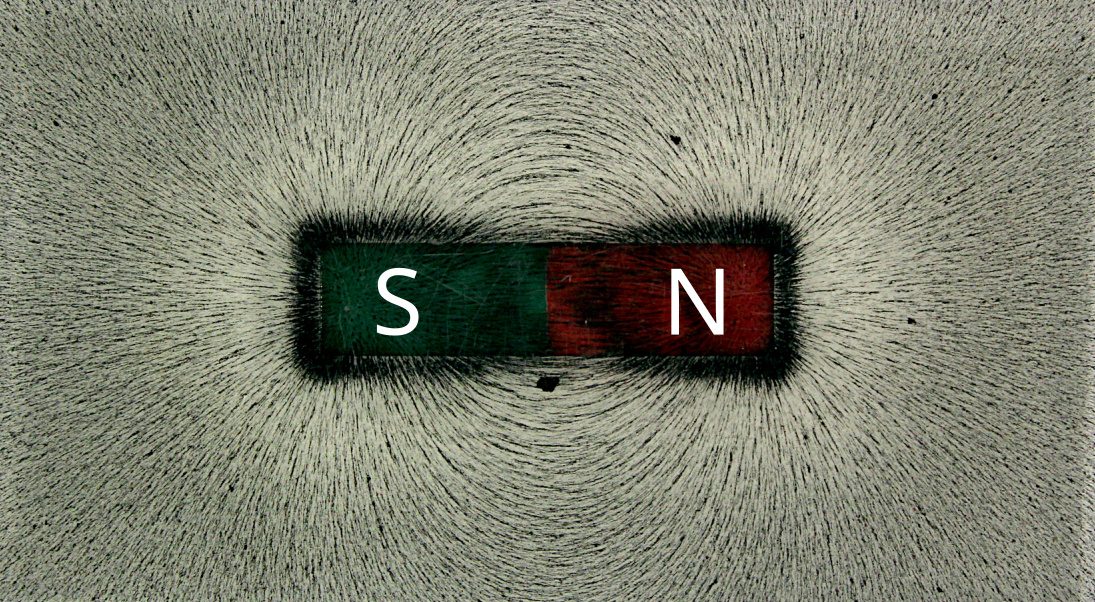
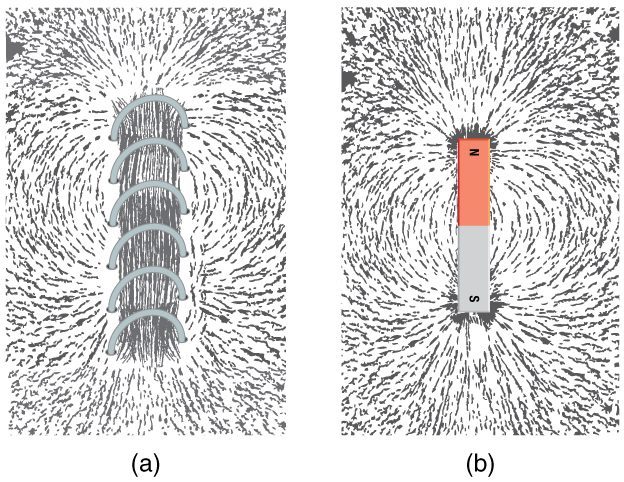
A magnetic field 磁场 $\vec{B}$ surrounds magnets and moving charges. Field lines run from a magnet's north pole to its south pole outside the magnet, and denser lines mean a stronger field. Magnetic poles always come in pairs – cutting a magnet in half makes two smaller magnets, never an isolated pole.
العربية
استجابة المواد المختلفة للمجال المغناطيسي تختلف كثيراً، واسم الدورة ثلاثة أنواع. المواد الفيرومغناطيسية (الحديد، النيكل، الكوبالت) لها أقطاب ثنائية تتمايز بقوة وتبقى متصاوغة، لذا يمكن أن تكون مغناطيسية دائمة. المواد البارامغناطيسية (الألمنيوم، التيتانيوم) تتمايز بشكل ضعيف ولا تبقى متصاوغة. المواد الديامغناطيسية - في الواقع جميع المواد لديها بعض الديامغناطيسية - تتمايز بشكل ضعيف عكس اتجاه المجال. يأتي هذا السلوك من خاصية مادة، وهي النفاذية: الفراغ الحر له نفاذية ثابتة $\mu_0$، بينما نفاذية المادة تختلف عنها وليست حتى ثابتة لمادة معينة.
المجال المغناطيسي $\vec{B}$ يحيط بالمغناطيسات والشحنات المتحركة. تمتد خطوط المجال من قطب شمال المغناطيس إلى قطب جنوبه خارج المغناطيس، والخطوط الأكثر كثافة تعني مجالاً أقوى. تأتي الأقطاب المغناطيسية دائماً في ازواج – قطع مغناطيس إلى نصفين ينتج مغناطيسين أصغر، وليس قطباً معزولاً.
Explore · استكشف
See a magnet's field lines · رؤية خطوط مجال المغناطيس
Magnetic field lines run from the north pole to the south pole outside the magnet. Where the lines crowd together the field is strongest. · خطوط المجال المغناطيسي تمتد من القطب الشمالي إلى الجنوبي خارج المغناطيس. حيث تتكدس الخطوط يكون المجال أقوى.
Vocabulary · مفردات
Train · تدريب
| English | العربية |
|---|---|
| Ferromagnetic/ˌferəməɡˈnetɪk/ | فائق المغناطيسية |
| Paramagnetic/ˌpærəməɡˈnetɪk/ | شبه مغناطيسي |
| Diamagnetic/ˌdaɪəməɡˈnetɪk/ | مضاد للمغناطيسية |
| permeability/ˌpɜːməˈbɪlɪti/ | النفاذية |
| magnetic field/mæɡˈnetɪk fiːld/ | المجال المغناطيسي |
12.2
Magnetism and Moving Charges · المغناطيسية والشحنات المتحركة
Syllabus · المنهج
English
Learning Objective 12.2.A: Describe the magnetic field produced by moving charged objects.
- 12.2.A.1 A single moving charged object produces a magnetic field.
- 12.2.A.1.i The magnetic field at a particular point produced by a moving charged object depends on the object's velocity and the distance between the point and the object.
- 12.2.A.1.ii At a point in space, the direction of the magnetic field produced by a moving charged object is perpendicular to both the velocity of the object and the position vector from the object to that point in space and can be determined using the right-hand rule.
- 12.2.A.1.iii The magnitude of the magnetic field is a maximum when the velocity vector and the position vector from the object to that point in space are perpendicular.
Learning Objective 12.2.B: Describe the force exerted on moving charged objects by a magnetic field.
- 12.2.B.1 Magnetic forces describe interactions between moving charged objects.
- 12.2.B.2 A magnetic field may exert a force on a charged object moving in that field.
- 12.2.B.2.i The magnitude of the force exerted by a magnetic field on a moving charged object is proportional to the magnitude of the charge, the magnitude of the charged object's velocity, and the magnitude of the magnetic field and also depends on the angle between the velocity and magnetic field vectors.
- Equation: $F_B = qvB\sin\theta$
- 12.2.B.2.ii The direction of the force exerted by a magnetic field on a moving charged object is perpendicular to both the direction of the magnetic field and the velocity of the charge, as defined by the right-hand rule.
- 12.2.B.2.i The magnitude of the force exerted by a magnetic field on a moving charged object is proportional to the magnitude of the charge, the magnitude of the charged object's velocity, and the magnitude of the magnetic field and also depends on the angle between the velocity and magnetic field vectors.
- 12.2.B.3 In a region containing both a magnetic field and an electric field, a moving charged object will experience independent forces from each field.
- 12.2.B.4 The Hall effect describes the potential difference created in a conductor by an external magnetic field that has a component perpendicular to the direction of charges moving in the conductor.
Boundary statement: Quantitative treatment of the magnitude of the magnetic force exerted by a magnetic field on a moving charge is limited to angles of 0, 90, and 180 degrees between the velocity and the magnetic field. Qualitative analysis of other angles is permitted.
العربية
الهدف التعليمي 12.2.A: وصف المجال المغناطيسي الناتج عن الأجسام المشحونة المتحركة.
- 12.2.A.1 الجسيم المشحون المتحرك الواحد يُنتج مجالاً مغناطيسياً.
- 12.2.A.1.i يعتمد المجال المغناطيسي عند نقطة معينة ناتج عن جسم مشحون متحرك على سرعة الجسم والمسافة بين تلك النقطة والجسم.
- 12.2.A.1.ii عند نقطة في الفضاء، يكون اتجاه المجال المغناطيسي الناتج عن جسم مشحون متحرك عمودياً على كل من سرعة الجسم ومتجه الموضع من الجسم إلى تلك النقطة في الفضاء، ويمكن تحديده باستخدام قاعدة اليد اليمنى.
- 12.2.A.1.iii تكون قيمة المجال المغناطيسي في أقصى حد عندما يكون متجه السرعة ومتجه الموضع من الجسم إلى تلك النقطة في الفضاء عموديين على بعضهما البعض.
الهدف التعليمي 12.2.B: وصف القوة المؤثرة على الأجسام المشحونة المتحركة بواسطة مجال مغناطيسي.
- 12.2.B.1 القوى المغناطيسية تصف التفاعلات بين الأجسام المشحونة المتحركة.
- 12.2.B.2 قد يمارس مجال مغناطيسي قوة على جسم مشحون يتحرك داخل هذا المجال.
- 12.2.B.2.i تتناسب قيمة القوة التي يمارسها مجال مغناطيسي على جسم مشحون متحرك طردياً مع قيمة الشحنة، وقيمة سرعة الجسم المشحون، وقيمة المجال المغناطيسي، كما تعتمد أيضاً على الزاوية بين متجه السرعة ومتجه المجال المغناطيسي.
- معادلة: $F_B = qvB\sin\theta$
- 12.2.B.2.ii يكون اتجاه القوة التي يمارسها مجال مغناطيسي على جسم مشحون متحرك عمودياً على كل من اتجاه المجال المغناطيسي وسرعة الشحنة، كما هو محدد بقاعدة اليد اليمنى.
- 12.2.B.2.i تتناسب قيمة القوة التي يمارسها مجال مغناطيسي على جسم مشحون متحرك طردياً مع قيمة الشحنة، وقيمة سرعة الجسم المشحون، وقيمة المجال المغناطيسي، كما تعتمد أيضاً على الزاوية بين متجه السرعة ومتجه المجال المغناطيسي.
- 12.2.B.3 في منطقة تحتوي على كل من مجال مغناطيسي ومجال كهربائي، سيخضع الجسم المشحون المتحرك لقوى مستقلة من كل مجال.
- 12.2.B.4 يُعرف تأثير هيل بفرق الجهد الذي ينشأ في موصل بفعل مجال مغناطيسي خارجي له مركبة عمودية على اتجاه حركة الشحنات داخل الموصل.
عبارة الحدود: يقتصر المعالجة الكمية لقيمة القوة المغناطيسية التي يمارسها مجال مغناطيسي على شحنة متحركة على زوايا قدرها 0 و90 و180 درجة بين السرعة والمجال المغناطيسي. يُسمح بالتحليل النوعي للزوايا الأخرى.
Source: College Board AP Course and Exam Description · المصدر: وصف دورة وامتحان College Board AP
English
A charge moving through a magnetic field feels a magnetic force 磁力:
$$F=qvB\sin\theta,$$
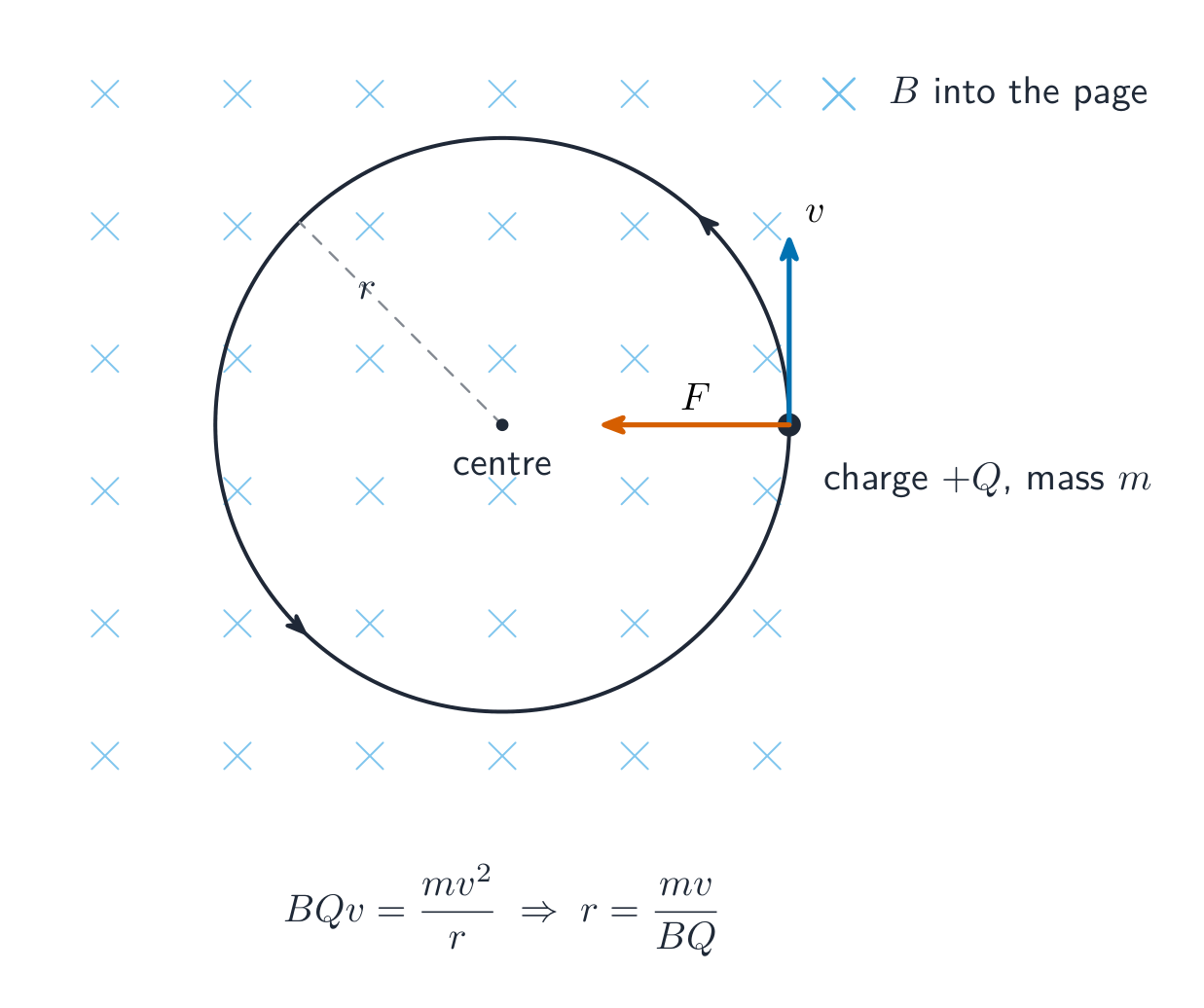
where $\theta$ is the angle between the velocity and the field. The force is perpendicular to both $\vec{v}$ and $\vec{B}$ (use the right-hand rule), so it changes direction but not speed – a charge moving perpendicular to a uniform field travels in a circle. A stationary charge, or one moving parallel to the field, feels no magnetic force.
Worked example. A proton ($q=1.6\times10^{-19}\ \text{C}$, $m=1.67\times10^{-27}\ \text{kg}$) enters a $0.50\ \text{T}$ field at $2.0\times10^{5}\ \text{m/s}$, at right angles to the field. The magnetic force is
$$F=qvB=1.6\times10^{-19}\times2.0\times10^{5}\times0.50=1.6\times10^{-14}\ \text{N}.$$
This force is the centripetal force, so it bends the proton into a circle of radius
$$r=\frac{mv}{qB}=\frac{1.67\times10^{-27}\times2.0\times10^{5}}{1.6\times10^{-19}\times0.50}=4.2\times10^{-3}\ \text{m}.$$
Setting $qvB=\dfrac{mv^2}{r}$ and cancelling gives that neat $r=mv/(qB)$ – the principle behind mass spectrometers.
العربية
الشحنة المتحركة عبر مجال مغناطيسي تتعرض لقوة مغناطيسية:
$$F=qvB\sin\theta,$$
حيث $\theta$ هي الزاوية بين السرعة والمجال. القوة عمودية على كل من $\vec{v}$ و$\vec{B}$ (باستخدام قاعدة اليد اليمنى)، لذا فهي تغير الاتجاه لكن لا تغير السرعة – الشحنة المتحركة عمودياً على مجال منتظم تسير في مسار دائري. الشحنة الساكنة، أو تلك التي تتحرك موازية للمجال، لا تشعر بأي قوة مغناطيسية.
مثال محلول. بروتون ($q=1.6\times10^{-19}\ \text{C}$، $m=1.67\times10^{-27}\ \text{kg}$) يدخل مجالاً $0.50\ \text{T}$ بسرعة $2.0\times10^{5}\ \text{m/s}$، عمودياً على المجال. القوة المغناطيسية هي
$$F=qvB=1.6\times10^{-19}\times2.0\times10^{5}\times0.50=1.6\times10^{-14}\ \text{N}.$$
هذه القوة هي القوة المركزية، لذا فإنها تنحني البروتون في دائرة نصف قطرها
$$r=\frac{mv}{qB}=\frac{1.67\times10^{-27}\times2.0\times10^{5}}{1.6\times10^{-19}\times0.50}=4.2\times10^{-3}\ \text{m}.$$
بوضع $qvB=\dfrac{mv^2}{r}$ واختصار الحدود نحصل على العلاقة البسيطة $r=mv/(qB)$ – وهي المبدأ خلف مطياف الكتلة.
Vocabulary · مفردات
Train · تدريب
| English | العربية |
|---|---|
| magnetic force/mæɡˈnetɪk fɔːs/ | القوة المغناطيسية |
12.3
Magnetism and Current-Carrying Wires · المغناطيسية والأسلاك الحاملة للتيار
Syllabus · المنهج
English
Learning Objective 12.3.A: Describe the magnetic field produced by a current-carrying wire.
- 12.3.A.1 A current-carrying wire produces a magnetic field.
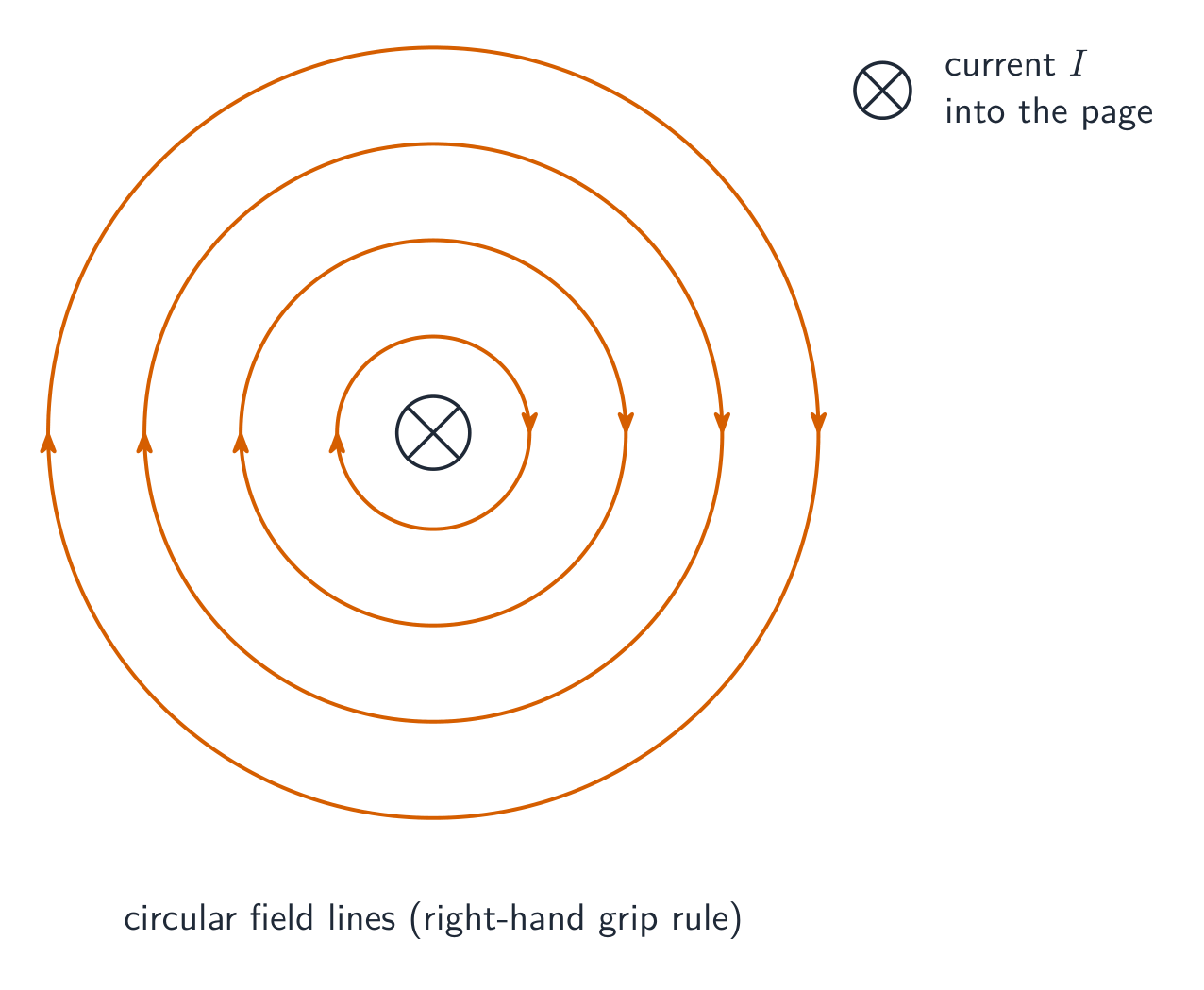
- 12.3.A.1.i The magnetic field vectors around a long, straight, current-carrying wire are tangent to concentric circles centered on that wire. The field has no component toward, away from, or parallel to the long, straight, current-carrying wire.
- 12.3.A.1.ii At a point in space, the magnitude of the magnetic field due to a long, straight, current-carrying wire is proportional to the magnitude of the current in the wire and inversely proportional to the perpendicular distance from the central axis of the wire to the point.
- Equation: $B = \dfrac{\mu_0}{2\pi}\dfrac{I}{r}$
- 12.3.A.1.iii The direction of the magnetic field created by a current-carrying wire is determined with the right-hand rule.
- 12.3.A.1.iv The direction of the magnetic field at the center of a current-carrying loop is directed along the axis of the loop and can be found using the right-hand rule.
- 12.3.A.1.v The magnetic field at a location near two or more current-carrying wires can be determined using vector addition principles.
Learning Objective 12.3.B: Describe the force exerted on a current-carrying wire by a magnetic field.
- 12.3.B.1 A magnetic field may exert a force on a current-carrying wire.
- 12.3.B.1.i The magnitude of the force exerted by a magnetic field on a current-carrying wire is proportional to the current, the length of the portion of the wire within the magnetic field, and the magnitude of the magnetic field, and also depends on the angle between the direction of the current in the wire and the direction of the magnetic field.
- Equation: $F_B = I\ell B\sin\theta$
- 12.3.B.1.ii The direction of the force exerted by the magnetic field on a current-carrying wire is determined by the right-hand rule.
- 12.3.B.1.i The magnitude of the force exerted by a magnetic field on a current-carrying wire is proportional to the current, the length of the portion of the wire within the magnetic field, and the magnitude of the magnetic field, and also depends on the angle between the direction of the current in the wire and the direction of the magnetic field.
العربية
الهدف التعليمي 12.3.A: وصف المجال المغناطيسي الناتج عن سلك حامل للتيار.
- 12.3.A.1 السلك الحامل للتيار يُنتج مجالاً مغناطيسياً.
- 12.3.A.1.i متجهات المجال المغناطيسي حول سلك طويل ومستقيم حامل للتيار تكون مماسة لدوائر متحدة المركز مركزها ذلك السلك. ولا يحتوي المجال على أي مركبات نحو أو بعيداً أو موازية للسلك الطويل والمستقيم الحامل للتيار.
- 12.3.A.1.ii عند نقطة في الفضاء، تتناسب قيمة المجال المغناطيسي بسبب سلك طويل ومستقيم حامل للتيار طردياً مع قيمة التيار في السلك وعكسياً مع المسافة العمودية من المحور المركزي للسلك إلى النقطة.
- معادلة: $B = \dfrac{\mu_0}{2\pi}\dfrac{I}{r}$
- 12.3.A.1.iii يتم تحديد اتجاه المجال المغناطيسي الناتج عن سلك حامل للتيار باستخدام قاعدة اليد اليمنى.
- 12.3.A.1.iv يكون اتجاه المجال المغناطيسي في مركز حلقة حاملة للتيار موجهاً على طول محور الحلقة ويمكن إيجاده باستخدام قاعدة اليد اليمنى.
- 12.3.A.1.v يمكن تحديد المجال المغناطيسي عند موقع قريب من سلكين أو أكثر حاملي للتيار باستخدام مبادئ الجمع المتجهي.
الهدف التعليمي 12.3.B: وصف القوة المؤثرة على سلك حامل للتيار بواسطة مجال مغناطيسي.
- 12.3.B.1 قد يمارس مجال مغناطيسي قوة على سلك حامل للتيار.
- 12.3.B.1.i تتناسب قيمة القوة التي يمارسها مجال مغناطيسي على سلك حامل للتيار طردياً مع التيار، وطول الجزء من السلك الموجود داخل المجال المغناطيسي، وقيمة المجال المغناطيسي، كما تعتمد أيضاً على الزاوية بين اتجاه التيار في السلك واتجاه المجال المغناطيسي.
- معادلة: $F_B = I\ell B\sin\theta$
- 12.3.B.1.ii يُحدد اتجاه القوة التي يمارسها المجال المغناطيسي على سلك حامل للتيار باستخدام قاعدة اليد اليمنى.
- 12.3.B.1.i تتناسب قيمة القوة التي يمارسها مجال مغناطيسي على سلك حامل للتيار طردياً مع التيار، وطول الجزء من السلك الموجود داخل المجال المغناطيسي، وقيمة المجال المغناطيسي، كما تعتمد أيضاً على الزاوية بين اتجاه التيار في السلك واتجاه المجال المغناطيسي.
Source: College Board AP Course and Exam Description · المصدر: وصف دورة وامتحان College Board AP
English
Because a current is moving charge, a magnetic field pushes on a current-carrying wire:
$$F=BIL\sin\theta.$$
A current also creates its own magnetic field: circular field lines wrap around a straight wire (right-hand rule), and a coil (solenoid) makes a field like a bar magnet. This is how electromagnets and motors work.
Worked example. A $0.30\ \text{m}$ length of wire carries $4.0\ \text{A}$ at right angles to a $0.20\ \text{T}$ field. The force on it is $F=BIL=0.20\times4.0\times0.30=0.24\ \text{N}$ – the push that turns a motor's coil.
العربية
لأن التيار هو شحنة متحركة، فإن المجال المغناطيسي يدفع على سلك حامل للتيار:
$$F=BIL\sin\theta.$$
التيار أيضاً يولد مجاله المغناطيسي الخاص: خطوط المجال الدائرية تحيط بسلك مستقيم (قاعدة اليد اليمنى)، وال ملف (السولينويد) يولد مجالا يشبه مغناطيس القضيب. هذا هو مبدأ عمل الكهرومغناطيسات والمحركات.
مثال محلول. سلك طوله $0.30\ \text{m}$ يمر به تيار $4.0\ \text{A}$ عمودياً على مجال $0.20\ \text{T}$. القوة المؤثرة عليه هي $F=BIL=0.20\times4.0\times0.30=0.24\ \text{N}$ – وهي الدفع الذي يحرك ملف المحرك.
Explore · استكشف
Find the force on a current in a field · إيجاد القوة المؤثرة على تيار في مجال
A current in a magnetic field feels a force $F = BIL$, at right angles to both. Use the left-hand rule; reverse the current or field and the force flips. · يتعرض تيار في مجال مغناطيسي لقوة $F = BIL$، عمودية على كليهما. استخدم قاعدة اليد اليسرى؛ اعكس التيار أو المجال وتنقلب القوة.
12.4
Electromagnetic Induction and Faraday's Law · الحث الكهرومغناطيسي وقانون فاراداي
Syllabus · المنهج
| Learning Objective | Essential Knowledge |
|---|---|
12.4.A |
|
Source: College Board AP Course and Exam Description · المصدر: وصف دورة وامتحان College Board AP
English
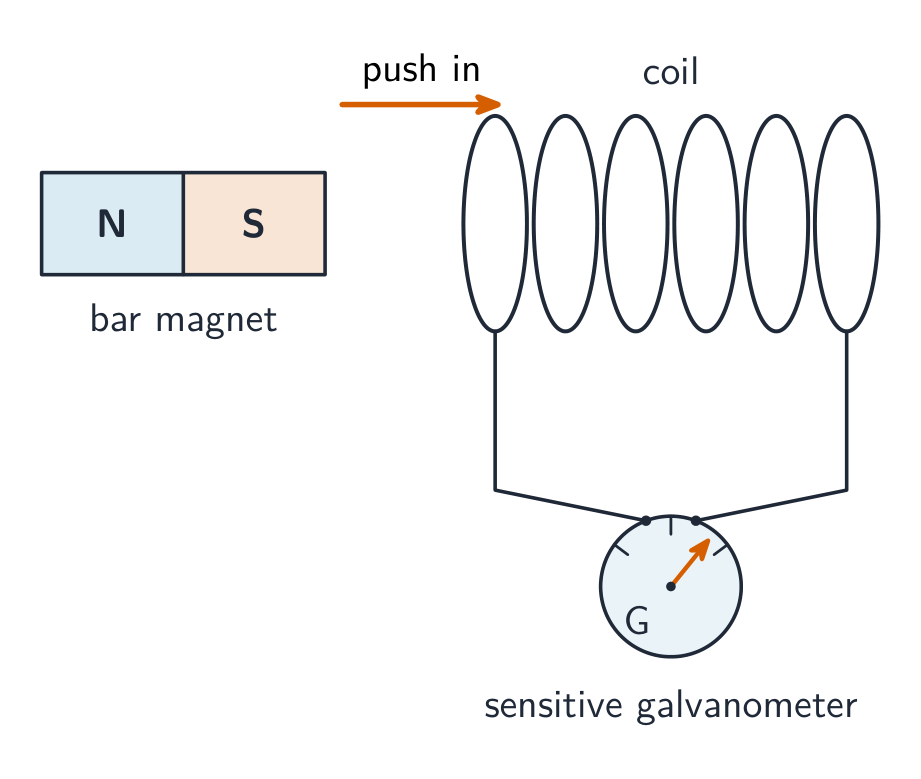
A changing magnetic field through a loop drives a current – electromagnetic induction 电磁感应. The magnetic flux 磁通量 $\Phi=BA\cos\theta$ measures how much field passes through the loop. Faraday's law 法拉第定律 gives the induced emf:
$$\varepsilon=-\frac{\Delta\Phi}{\Delta t}.$$
The flux changes if the field, the area, or the loop's orientation changes. Lenz's law 楞次定律 (the minus sign) says the induced current flows so as to oppose the change that caused it – the basis of generators.
Worked example. The magnetic flux through a single loop drops from $0.020\ \text{Wb}$ to $0.008\ \text{Wb}$ in $0.030\ \text{s}$. The average induced emf is
$$\varepsilon=\left|\frac{\Delta\Phi}{\Delta t}\right|=\frac{0.020-0.008}{0.030}=0.40\ \text{V}.$$
A coil of $N$ turns would give $N$ times this – which is why generators and transformers use many-turn coils.
العربية
المجال المغناطيسي المتغير خلال حلقة يُحدث تياراً – الحث الكهرومغناطيسي. التدفق المغناطيسي $\Phi=BA\cos\theta$ يقيس مقدار المجال المار عبر الحلقة. يعطي قانون فاراداي القوة الدافعة الكهربائية المستحثة:
$$\varepsilon=-\frac{\Delta\Phi}{\Delta t}.$$
يتغير التدفق إذا تغير المجال، أو المساحة، أو اتجاه الحلقة. ينص قانون لنز (الإشارة السالبة) على أن التيار المستحث يسري بحيث يعارض التغيير الذي تسببه – وهو أساس المولدات.
مثال محلول. انخفض التدفق المغناطيسي خلال حلقة واحدة من $0.020\ \text{Wb}$ إلى $0.008\ \text{Wb}$ في زمن $0.030\ \text{s}$. متوسط القوة الدافعة الكهربائية المستحثة هو
$$\varepsilon=\left|\frac{\Delta\Phi}{\Delta t}\right|=\frac{0.020-0.008}{0.030}=0.40\ \text{V}.$$
ملف مكون من $N$ لفات سيُنتج $N$ مرة هذه القيمة – ولهذا السبب تستخدم المولدات والمحولات ملفات متعددة اللفات.
Explore · استكشف
Induce a voltage by moving a magnet · استحث جهدًا بحركة مغناطيس
Faraday's law: a changing magnetic flux through a coil induces a voltage. Move the magnet faster and the induced EMF grows; Lenz's law sets its direction to oppose the change. · قانون فاراداي: التدفق المغناطيسي المتغير عبر ملف يحث جهدًا. حرك المغناطيس بسرعة أكبر وتتزايد القوة الدافعة الكهربائية المستحثة؛ قانون لنتز يحدد اتجاهها لمعارضة التغيير.
Vocabulary · مفردات
Train · تدريب
| English | العربية |
|---|---|
| electromagnetic induction/ɪˌlektrəʊməɡˈnetɪk ɪnˈdʌkʃn/ | الحث الكهرومغناطيسي |
| magnetic flux/mæɡˈnetɪk flʌks/ | التدفق المغناطيسي |
| Faraday's law/ˈfærədeɪz lɔː/ | قانون فاراداي |
| Lenz's law/ˈlentsɪz lɔː/ | قانون لنز |
12.4
Exam tips · نصائح للامتحان
English
- The magnetic force $F=qvB\sin\theta$ is perpendicular to the velocity, so it changes direction (a circle) but not speed; a stationary charge or one moving along the field feels no force.
- Use $F=BIL$ for the force on a current-carrying wire (the motor effect).
- A current creates a magnetic field (circles around a wire; a solenoid acts like a bar magnet).
- Induction needs a changing flux $\Phi=BA$ — a stationary magnet in a coil induces nothing.
- Faraday: $\varepsilon=\Delta\Phi/\Delta t$ (times $N$ turns); Lenz: the induced current opposes the change (energy conservation).
العربية
- القوة المغناطيسية $F=qvB\sin\theta$ عمودية على السرعة، لذا فهي تغير الاتجاه (دائرة) لكن لا تغير السرعة؛ الشحنة الساكنة أو التي تتحرك على طول المجال لا تشعر بأي قوة.
- استخدم $F=BIL$ لحساب القوة على سلك حامل للتيار (تأثير المحرك).
- التيار يولد مجالاً مغناطيسياً (دوائر حول سلك؛ السولينويد يعمل كمغناطيس قضيب).
- الحث الكهرومغناطيسي يتطلب تدفقًا متغيرًا $\Phi=BA$ — والمغناطيس الساكن داخل ملف لا يُحدث أي تيار محث.
- فاراداي: $\varepsilon=\Delta\Phi/\Delta t$ (مضروباً في $N$ لفة)؛ lenz: التيار المستحث يعارض التغيير (حفظ الطاقة).
Interactive lessons on this topic · دروس تفاعلية حول هذا الموضوع
Work through it step by step, with instant-check exercises. · ا-working عليه خطوة بخطوة، مع تمارين تحقق فوري.
Past Papers · أوراق الامتحانات السابقة