Skip to content · ⁨الانتقال إلى المحتوى⁩

Electric Force, Field, and Potential · ⁨القوة الكهربائية والمجال والجهد الكهربائي⁩

AP Physics 2 · ⁨AP الفيزياء 2⁩ · Topic 10 · ⁨الموضوع 10⁩

Video lesson for this topic · ⁨درس فيديو لهذا الموضوع⁩ Open the video page · ⁨افتح صفحة الفيديو⁩
8:05

القوة الكهربائية والمجال والجهد الكهربائي

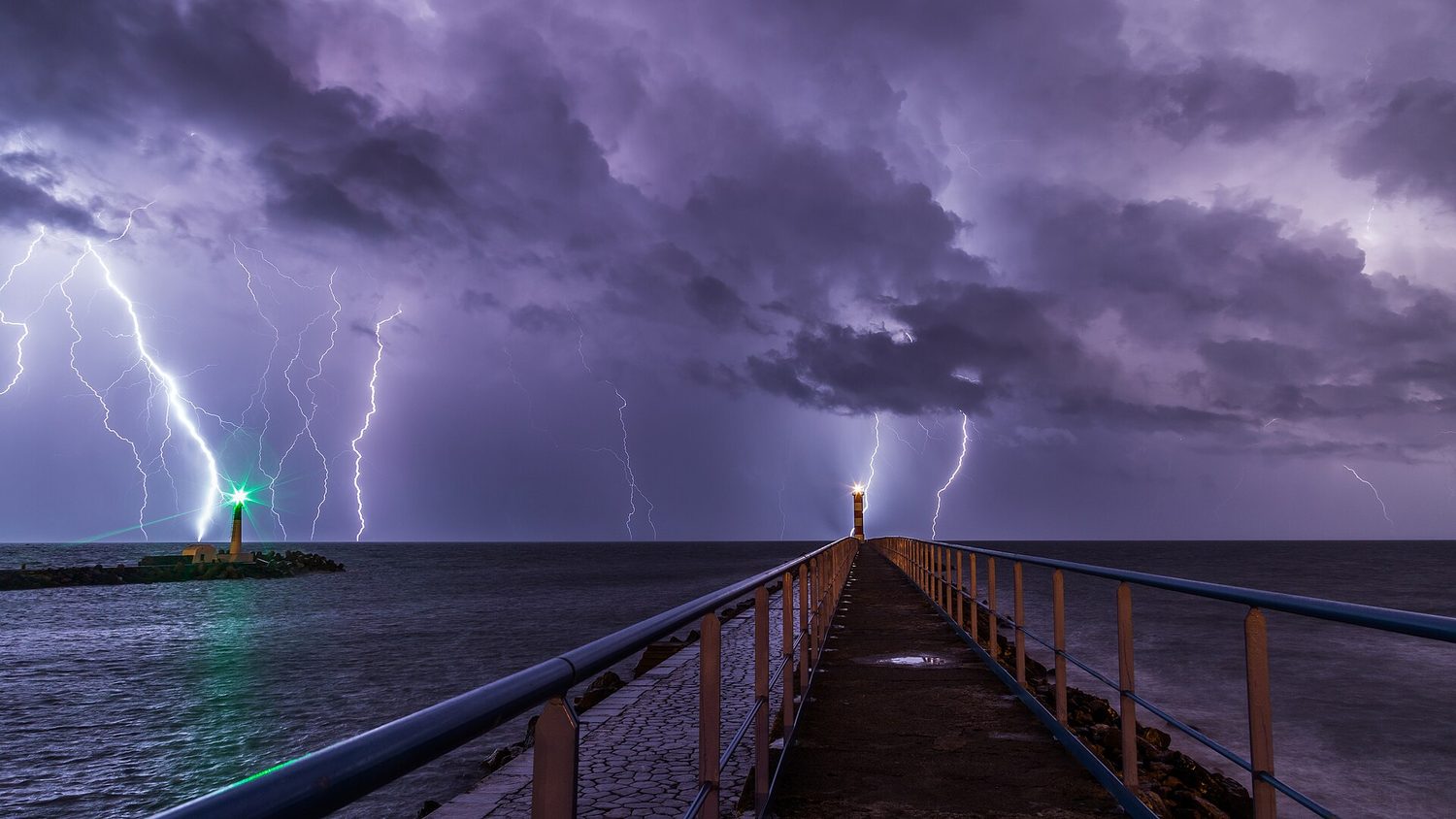
سحابة الرعد هي مصنع للشحنة. بلورات الثلج تتصادم بداخلها، وتتجمع الإلكترونات في أسفل السحابة. الأرض أدناه تصبح موجبة. لا شيء…

English narration · English + 中文 subtitles burned in · ⁨سرد باللغة الإنجليزية · ترجمة مدمجة بالإنجليزية + الصينية⁩

10.1

Electric Charge and Electric Force · ⁨الشحنة الكهربائية والقوة الكهربائية⁩

Syllabus · ⁨المنهج⁩
English

Learning Objective 10.1.A: Describe the electric force that results from the interactions between charged objects or systems.

  • 10.1.A.1 Charge is a fundamental property of all matter.
    • 10.1.A.1.i Charge is described as positive or negative.
    • 10.1.A.1.ii The magnitude of the charge of a single electron or proton, the elementary charge $e$, can be considered to be the smallest indivisible amount of charge.
    • 10.1.A.1.iii The charge of an electron is $-e$, the charge of a proton is $+e$, and a neutron has no electric charge.
    • 10.1.A.1.iv A point charge is a model in which the physical size of a charged object or system is negligible in the context of the situation being analyzed.
  • 10.1.A.2 Coulomb's law describes the electrostatic force between two charged objects as directly proportional to the magnitude of each of the charges and inversely proportional to the square of the distance between the objects.
    • Equation: $\left|\vec{F}_E\right| = \dfrac{1}{4\pi\varepsilon_0}\dfrac{\left|q_1 q_2\right|}{r^2} = k\dfrac{\left|q_1 q_2\right|}{r^2}$
  • 10.1.A.3 The direction of the electrostatic force depends on the signs of the charges of the interacting objects and is parallel to the line of separation between the objects.
    • 10.1.A.3.i Two objects with charges of the same sign exert repulsive forces on each other.
    • 10.1.A.3.ii Two objects with charges of opposite signs exert attractive forces on each other.
  • 10.1.A.4 Electric forces are responsible for some of the macroscopic properties of objects in everyday experiences. However, the large number of particle interactions that occur make it more convenient to treat everyday forces in terms of nonfundamental forces called contact forces, such as normal force, friction, and tension.

Learning Objective 10.1.B: Describe the electric and gravitational forces that result from interactions between charged objects with mass.

  • 10.1.B.1 Electrostatic forces can be attractive or repulsive, while gravitational forces are always attractive.
  • 10.1.B.2 For any two objects that have mass and electric charge, the magnitude of the gravitational force is usually much smaller than the magnitude of the electrostatic force.
  • 10.1.B.3 Gravitational forces dominate at larger scales even though they are weaker than electrostatic forces, because systems at large scales tend to be electrically neutral.

Learning Objective 10.1.C: Describe the electric permittivity of a material or medium.

  • 10.1.C.1 Electric permittivity is a measurement of the degree to which a material or medium is polarized in the presence of an electric field.
  • 10.1.C.2 Electric polarization can be modeled as the induced rearrangement of electrons by an external electric field, resulting in a separation of positive and negative charges within a material or medium.
  • 10.1.C.3 Free space has a constant value of electric permittivity, $\varepsilon_0$, that appears in physical relationships.
  • 10.1.C.4 The permittivity of matter has a value different from that of free space that arises from the matter's composition and arrangement.
    • 10.1.C.4.i In a given material, electric permittivity is determined by the ease with which electrons can change configurations within the material.
    • 10.1.C.4.ii Conductors are made from electrically conducting materials in which charge carriers move easily; insulators are made from electrically nonconducting materials in which charge carriers cannot move easily.

Boundary statement: AP Physics 2 only expects students to make calculations of the electric force between four or fewer interacting charged objects or systems. The analysis of the resulting electric force from more charges is allowed in situations of high symmetry.

العربية

الهدف التعليمي 10.1.A: وصف القوة الكهربائية الناتجة عن التفاعلات بين الأجسام أو الأنظمة المشحونة.

  • 10.1.A.1 الشحنة خاصية أساسية لجميع المواد.
    • 10.1.A.1.i تُوصف الشحنة بأنها موجبة أو سالبة.
    • 10.1.A.1.ii يمكن اعتبار مقدار شحنة الإلكترون الواحد أو البروتون، وهي الشحنة الأولية $e$، أصغر كمية لا تقبل القسمة من الشحنة.
    • 10.1.A.1.iii شحنة الإلكترون هي $-e$، وشحنة البروتون هي $+e$، ولا possesses للنيوترون أي شحنة كهربائية.
    • 10.1.A.1.iv الشحنة النقطية هي نموذج يكون فيه الحجم الفعلي لجسم أو نظام مشحون مهملاً في سياق الموقف قيد التحليل.
  • 10.1.A.2 تصف قانون كولوم القوة الكهروستاتيكية بين جسمين مشحونين بأنها تتناسب طردياً مع مقدار كل منهما من الشحنات وتتناسب عكسياً مع مربع المسافة بينهما.
    • المعادلة: $\left|\vec{F}_E\right| = \dfrac{1}{4\pi\varepsilon_0}\dfrac{\left|q_1 q_2\right|}{r^2} = k\dfrac{\left|q_1 q_2\right|}{r^2}$
  • 10.1.A.3 يعتمد اتجاه القوة الكهروستاتيكية على إشارات شحنات الأجسام المتفاعلة ويكون موازياً للخط الواصل بينهما.
    • 10.1.A.3.i جسمان يحملان شحنات من نفس الإشارة يُمارسان قوى تنافر على بعضهما البعض.
    • 10.1.A.3.ii جسمان يحملان شحنات من إشارات متعاكسة يُمارسان قوى تجاذب على بعضهما البعض.
  • 10.1.A.4 القوى الكهربائية مسؤولة عن بعض الخصائص المجهرية للأجسام في التجارب اليومية. ومع ذلك، فإن العدد الكبير من تفاعلات الجسيمات يجعل من الملائم التعامل مع القوى اليومية بدلالة قوى غير أساسية تُسمى قوى التلامس، مثل القوة العمودية، الاحتكاك، والتوتر.

الهدف التعليمي 10.1.B: وصف القوى الكهربائية والجاذبية الناتجة عن التفاعلات بين الأجسام المشحونة ذات الكتلة.

  • 10.1.B.1 يمكن أن تكون القوى الكهروستاتيكية تجاذبية أو تنافرية، بينما تكون القوى الجاذبية دائماً تجاذبية.
  • 10.1.B.2 لأي جسمين لهما كتلة وشحنة كهربائية، تكون قيمة القوة الجاذبية عادةً أصغر بكثير من قيمة القوة الكهروستاتيكية.
  • 10.1.B.3 تهيمن القوى الجاذبية على المستويات الكبيرة على الرغم من أنها أضعف من القوى الكهروستاتيكية، لأن الأنظمة ذات المقاييس الكبيرة تميل إلى أن تكون متعادلة كهربائياً.

الهدف التعليمي 10.1.C: وصف السماحية الكهربائية لمادة أو وسط ما.

  • 10.1.C.1 السماحية الكهربائية هي مقياس لدرجة استقطاب مادة أو وسط في وجود مجال كهربائي.
  • 10.1.C.2 يمكن نمذجة الاستقطاب الكهربائي على أنه إعادة ترتيب مستحثة للإلكترونات بواسطة مجال كهربائي خارجي، مما يؤدي إلى فصل الشحنات الموجبة والسالبة داخل مادة أو وسط.
  • 10.1.C.3 الفراغ له قيمة ثابتة للسماحية الكهربائية، $\varepsilon_0$، تظهر في العلاقات الفيزيائية.
  • 10.1.C.4 سماحية المادة لها قيمة مختلفة عن تلك الخاصة بالفراغ وتنتج عن تركيب وترتيب المادة.
    • 10.1.C.4.i في مادة معينة، تحدد السماحية الكهربائية مدى سهولة تغيير الإلكترونات لتكويناتها داخل المادة.
    • 10.1.C.4.ii الموصلات مصنوعة من مواد موصلة للكهرباء تتحرك فيها ناقلات الشحنة بسهولة؛ والعوازل مصنوعة من مواد غير موصلة للكهرباء لا يمكن فيها لناقلات الشحنة التحرك بسهولة.

عبارة الحدود: لا يتوقع امتحان AP Physics 2 من الطلاب سوى إجراء حسابات لقوة الكهرباء بين أربعة أجسام مشحونة أو أنظمة متفاعلة أو أقل. يُسمح بتحليل قوة الكهرباء الناتجة عن شحنات أكثر في حالات التناظر العالي.
Source: College Board AP Course and Exam Description · ⁨المصدر: وصف دورة وامتحان College Board AP⁩

English

Electric charge 电荷 is a fundamental property of matter, and it comes in two kinds, positive and negative; like charges repel and opposite charges attract. Charge is conserved and quantized (a multiple of the elementary charge $e$). The force between two point charges is Coulomb's law 库仑定律:

$$F=\frac{k q_1 q_2}{r^2},$$
directed along the line joining them – an inverse-square law like gravity, but it can push or pull.

The constant $k$ hides a property of the medium: the permittivity 介电常数. Free space has a fixed permittivity of free space $\varepsilon_0$ (with $k = 1/4\pi\varepsilon_0$), while the permittivity of matter differs from $\varepsilon_0$, depending on the material's composition and arrangement - which is why a material between two charges changes the force. Note also that although the electric force is vastly stronger than gravity, gravity dominates at large scales, because large objects are usually electrically neutral (equal + and −), leaving only gravity to act.

Worked example. Two point charges, $+3.0\ \mu\text{C}$ and $-2.0\ \mu\text{C}$, sit $0.10\ \text{m}$ apart ($k=9.0\times10^{9}$). The force between them is

$$F=\frac{k q_1 q_2}{r^2}=\frac{9.0\times10^{9}\times(3.0\times10^{-6})(2.0\times10^{-6})}{(0.10)^2}=5.4\ \text{N},$$
attractive, because the charges have opposite signs. (Use the magnitudes for the size and decide the direction from the signs.)

العربية

الشحنة الكهربائية هي خاصية أساسية للمادة، وتأتي في نوعين، موجبة وسالبة؛ تتنافر الشحنات المتشابهة وتتجاذب الشحنات المختلفة. الشحنة محفوظة وكمّية (مضاعف للشحنة الأولية $e$). القوة بين شحنتين نقطيتين تُعطى بـ قانون كولوم:

$$F=\frac{k q_1 q_2}{r^2},$$
في اتجاه الخط الواصل بينهما – وهي قانون تربيع عكسي كالجاذبية، لكنها قد تدفع أو تسحب.

الثابت $k$ يخفي خاصية للوسط: السماحية. الفراغ له سماحية ثابتة للفراغ $\varepsilon_0$ (مع $k = 1/4\pi\varepsilon_0$)، بينما تختلف سماحية المادة عن $\varepsilon_0$، اعتمادًا على تركيب المادة وترتيبها - وهو السبب في أن وجود مادة بين شحنتين يغير القوة. لاحظ أيضًا أنه رغم أن القوة الكهربائية أقوى بكثير من الجاذبية، إلا أن الجاذبية تهيمن على النطاقات الكبيرة، لأن الأجسام الضخمة عادة ما تكون متعادلة كهربائيًا (+ و − متساوية)، مما يترك الجاذبية لتعمل وحدها.

مثال محلول. شحنتان نقطيتان، $+3.0\ \mu\text{C}$ و$-2.0\ \mu\text{C}$، تقعان على بُعد $0.10\ \text{m}$ ($k=9.0\times10^{9}$). القوة بينهما هي

$$F=\frac{k q_1 q_2}{r^2}=\frac{9.0\times10^{9}\times(3.0\times10^{-6})(2.0\times10^{-6})}{(0.10)^2}=5.4\ \text{N},$$
تجاذبية، لأن الشحنات ذات إشارات مختلفة. (استخدم القيم المطلقة للحجم وحدد الاتجاه بناءً على الإشارات.)

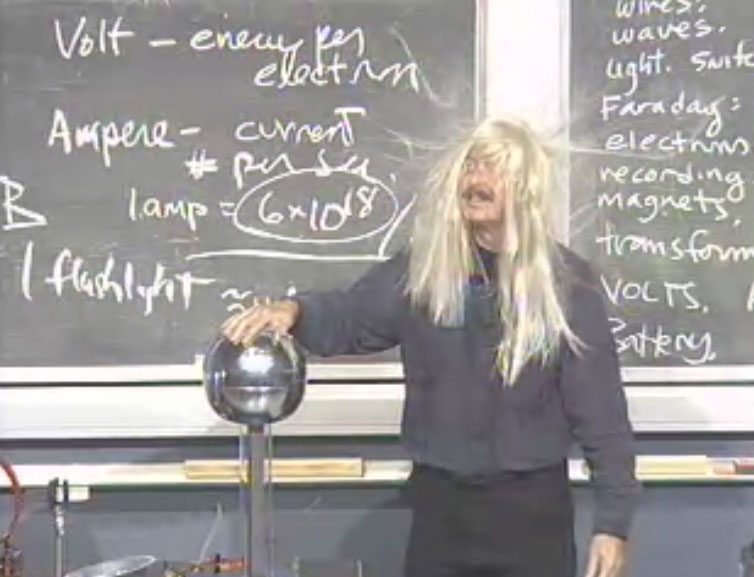
شخص يلمس مولد فان دي غراف بشعره واقفًا عموديًا
الشحنات المتشابهة تتنافر: يحمل كل شعر نفس الشحنة من مولد فان دي غراف، لذا يتنافرون
10.2

The Process of Charging · ⁨عملية الشحن الكهربائي⁩

Syllabus · ⁨المنهج⁩
English

Learning Objective 10.2.A: Describe the behavior of a system using conservation of charge.

  • 10.2.A.1 The net charge or charge distribution of a system can change in response to the presence of, or changes in, the net charge or charge distribution of other systems.
    • 10.2.A.1.i The net charge of a system can change due to friction or contact between systems.
    • 10.2.A.1.ii Induced charge separation occurs when the electrostatic force between two systems alters the distribution of charges within the systems, resulting in the polarization of one or both systems.
    • 10.2.A.1.iii Induced charge separation can occur in neutral systems.
  • 10.2.A.2 Any change to a system's net charge is due to a transfer of charge between the system and its surroundings.
    • 10.2.A.2.i The charging of a system typically involves the transfer of electrons to and from the system.
    • 10.2.A.2.ii The net charge of a system will be constant unless there is a transfer of charge to or from the system.
  • 10.2.A.3 Grounding involves electrically connecting a charged system to a much larger and approximately neutral system (e.g., Earth).
العربية

الهدف التعليمي 10.2.A: وصف سلوك نظام باستخدام حفظ الشحنة.

  • 10.2.A.1 يمكن أن تتغير الشحنة الصافية أو توزيع الشحنة لنظام استجابةً لوجود شحنة صافية أو توزيع شحنة لأجهزة أخرى أو تغيراتها.
    • 10.2.A.1.i يمكن أن تتغير الشحنة الصافية لنظام بسبب الاحتكاك أو التلامس بين الأنظمة.
    • 10.2.A.1.ii يحدث فصل الشحنة المستحث عندما يغير力 الكهروستاتيكي بين نظامين توزيع الشحنات داخلها، مما يؤدي إلى استقطاب واحد أو كلا النظامين.
    • 10.2.A.1.iii يمكن أن يحدث فصل الشحنة المستحث في الأنظمة المتعادلة.
  • 10.2.A.2 أي تغيير في الشحنة الصافية لنظام يعود إلى انتقال الشحنة بين النظام ومحيطه.
    • 10.2.A.2.i يتضمن شحن النظام عادةً نقل الإلكترونات إلى النظام ومنه.
    • 10.2.A.2.ii ستكون الشحنة الصافية لنظام ثابتة إلا إذا كان هناك نقل للشحنة إلى النظام أو منه.
  • 10.2.A.3 التأريض يتضمن توصيل نظام مشحون كهربائياً بنظام أكبر بكثير ومتعادل تقريباً (مثل الأرض).

Source: College Board AP Course and Exam Description · ⁨المصدر: وصف دورة وامتحان College Board AP⁩

English

Objects charge by moving electrons. A conductor 导体 lets charge move freely; an insulator 绝缘体 holds it in place. Three methods:

  • Friction: rubbing transfers electrons.
  • Conduction 接触起电: touching shares charge.
  • Induction 感应起电: a nearby charge rearranges charge in a neutral object, which can then be grounded to leave it charged.
العربية

تتشحن الأجسام عن طريق نقل الإلكترونات. الموصل يسمح بحركة الشحنة بحرية؛ العازل يثبتها في مكانها. ثلاث طرق:

  • الاحتكاك: الفرك ينقل الإلكترونات.
  • التوصيل: اللماس يشارك الشحنة.
  • الاستثارة: شحنة قريبة تعيد ترتيب الشحنة في جسم متعادل، والذي يمكن بعد ذلك توصيله بالأرض ليصبح مشحونًا.
Explore · ⁨استكشف⁩

Charge an object by rubbing · ⁨شحّن جسمًا بالفرك⁩

Rubbing transfers electrons from one surface to another, leaving one positively and one negatively charged. Like charges repel, opposite charges attract. · ⁨الفرك ينقل الإلكترونات من سطح إلى آخر، مما يجعل أحدهما موجبًا والآخر سالبًا. الشحنات المتشابهة تتنافر، والشحنات المختلفة تتجاذب.⁩

10.3

Electric Fields · ⁨المجالات الكهربائية⁩

Syllabus · ⁨المنهج⁩
English

Learning Objective 10.3.A: Describe the electric field produced by a charged object or configuration of point charges.

  • 10.3.A.1 Electric fields may originate from charged objects.
  • 10.3.A.2 The electric field at a given point is the ratio of the electric force exerted on a test charge at that point to the charge of the test charge.
    • Equation: $\vec{E} = \dfrac{\vec{F}_E}{q}$
    • 10.3.A.2.i A test charge is a point charge of small enough magnitude such that its presence does not significantly affect an electric field in its vicinity.
    • 10.3.A.2.ii An electric field points away from isolated positive charges and toward isolated negative charges.
    • 10.3.A.2.iii The electric force exerted on a positive test charge by an electric field is in the same direction as the electric field.
  • 10.3.A.3 The electric field is a vector quantity and can be represented in space using vector field maps.
    • 10.3.A.3.i The net electric field at a given location is the vector sum of individual electric fields created by nearby charged objects.
    • 10.3.A.3.ii Electric field maps use vectors to depict the magnitude and direction of the electric field at many locations within a given region.
    • 10.3.A.3.iii Electric field line diagrams are simplified models of electric field maps and can be used to determine the relative magnitude and direction of the electric field at any position in the diagram.

Learning Objective 10.3.B: Describe the electric field generated by charged conductors or insulators.

  • 10.3.B.1 While in electrostatic equilibrium, the excess charge of a solid conductor is distributed on the surface of the conductor, and the electric field within the conductor is zero.
    • 10.3.B.1.i At the surface of a charged conductor, the electric field is perpendicular to the surface.
    • 10.3.B.1.ii The electric field outside an isolated sphere with spherically symmetric charge distribution is the same as the electric field due to a point charge with the same net charge as the sphere located at the center of the sphere.
  • 10.3.B.2 While in electrostatic equilibrium, the excess charge of an insulator is distributed throughout the interior of the insulator as well as at the surface, and the electric field within the insulator may have a nonzero value.

Boundary statement: AP Physics 2 only expects students to make calculations of the electric field resulting from four or fewer charged objects or systems. Analysis of the electric field resulting from more charges is allowed in situations of high symmetry. Students will only be expected to perform qualitative analysis of electric fields within insulators.

العربية

الهدف التعليمي 10.3.A: وصف المجال الكهربائي الناتج عن جسم مشحون أو تكوين لشحنات نقطية.

  • 10.3.A.1 قد تنشأ المجالات الكهربائية من أجسام مشحونة.
  • 10.3.A.2 المجال الكهربائي عند نقطة معينة هو نسبة القوة الكهربائية المؤثرة على شحنة اختبار عند تلك النقطة إلى شحنة شحنة الاختبار.
    • المعادلة: $\vec{E} = \dfrac{\vec{F}_E}{q}$
    • 10.3.A.2.i شحنة الاختبار هي شحنة نقطية صغيرة بما يكفي بحيث لا يؤثر وجودها بشكل كبير على المجال الكهربائي في محيطها.
    • 10.3.A.2.ii يشير المجال الكهربائي بعيداً عن الشحنات الموجبة المعزولة ونحو الشحنات السالبة المعزولة.
    • 10.3.A.2.iii القوة الكهربائية المؤثرة على شحنة اختبار موجبة بواسطة مجال كهربائي تكون في نفس اتجاه المجال الكهربائي.
  • 10.3.A.3 المجال الكهربائي كمية متجهة ويمكن تمثيله في الفضاء باستخدام خرائط الحقول المتجهة.
    • 10.3.A.3.i المجال الكهربائي الصافي عند موقع معين هو المجموع المتجهي للحقول الكهربائية الفردية التي تنشئها الأجسام المشحونة القريبة.
    • 10.3.A.3.ii تستخدم خرائط المجال الكهربائي المتجهات لتمثيل مقدار واتجاه المجال الكهربائي في مواقع عديدة داخل منطقة معينة.
    • 10.3.A.3.iii مخططات خطوط المجال الكهربائي نماذج مبسطة لخرائط المجال الكهربائي ويمكن استخدامها لتحديد المقدار النسبي واتجاه المجال الكهربائي عند أي موضع في المخطط.

الهدف التعليمي 10.3.B: وصف المجال الكهربائي الناتج عن موصلات مشحونة أو عوازل.

  • 10.3.B.1 أثناء التوازن الكهروستاتيكي، تنتشر الشحنة الزائدة للموصل الصلب على سطحه، ويكون المجال الكهربائي داخله صفراً.
    • 10.3.B.1.i عند سطح موصل مشحون، يكون المجال الكهربائي عمودياً على السطح.
    • 10.3.B.1.ii المجال الكهربائي خارج كرة معزولة بتوزيع شحنة كروي التماثل هو نفسه المجال الكهربائي الناتج عن شحنة نقطية بنفس الشحنة الصافية للكرة وموضوعة في مركز الكرة.
  • 10.3.B.2 أثناء التوازن الكهروستاتيكي، تنتشر الشحنة الزائدة للعازل عبر داخليته بالإضافة إلى السطح، وقد يكون المجال الكهربائي داخل العازل له قيمة غير صفرية.

عبارة الحدود: لا يتوقع امتحان AP Physics 2 من الطلاب سوى إجراء حسابات للمجال الكهربائي الناتج عن أربعة أجسام مشحونة أو أنظمة أو أقل. يُسمح بتحليل المجال الكهربائي الناتج عن شحنات أكثر في حالات التناظر العالي. سيُتوقع من الطلاب فقط إجراء تحليل نوعي للمجالات الكهربائية داخل العوازل.

Source: College Board AP Course and Exam Description · ⁨المصدر: وصف دورة وامتحان College Board AP⁩

English
The electric field of a dipole

An electric field 电场 $\vec{E}$ is the force per unit charge that a small positive test charge would feel:

$$\vec{E}=\frac{\vec{F}}{q},\qquad E=\frac{kQ}{r^2}\ \text{for a point charge}.$$
Field lines point away from positive charges and toward negative ones; where they are denser, the field is stronger. A charge in a field feels $\vec{F}=q\vec{E}$.

Worked example. Find the electric field $0.20\ \text{m}$ from a $+5.0\ \mu\text{C}$ point charge: $E=\dfrac{kQ}{r^2}=\dfrac{9.0\times10^{9}\times5.0\times10^{-6}}{(0.20)^2}=1.1\times10^{6}\ \text{N/C}$, pointing away from the charge. A $+2\ \text{nC}$ charge placed there would feel $F=qE=2\times10^{-9}\times1.1\times10^{6}=2.2\times10^{-3}\ \text{N}$.

العربية
الحقل الكهربائي لثنائي قطب

عدة أضلاع برقية ساطعة متفرعة تهبط من سماء عاصفة فوق ميناء *البرق: تتراكم الشحنة حتى تصبح المجال الكهربائي بين السحاب والأرض قويًا بما يكفي لنزع إلكترونات من جزيئات الهواء، ويتدفق تيار هائل

المجال الكهربائي $\vec{E}$ هو القوة لكل وحدة شحنة التي سيشتعر بها اختبار شحنة موجبة صغيرة:

$$\vec{E}=\frac{\vec{F}}{q},\qquad E=\frac{kQ}{r^2}\ \text{for a point charge}.$$
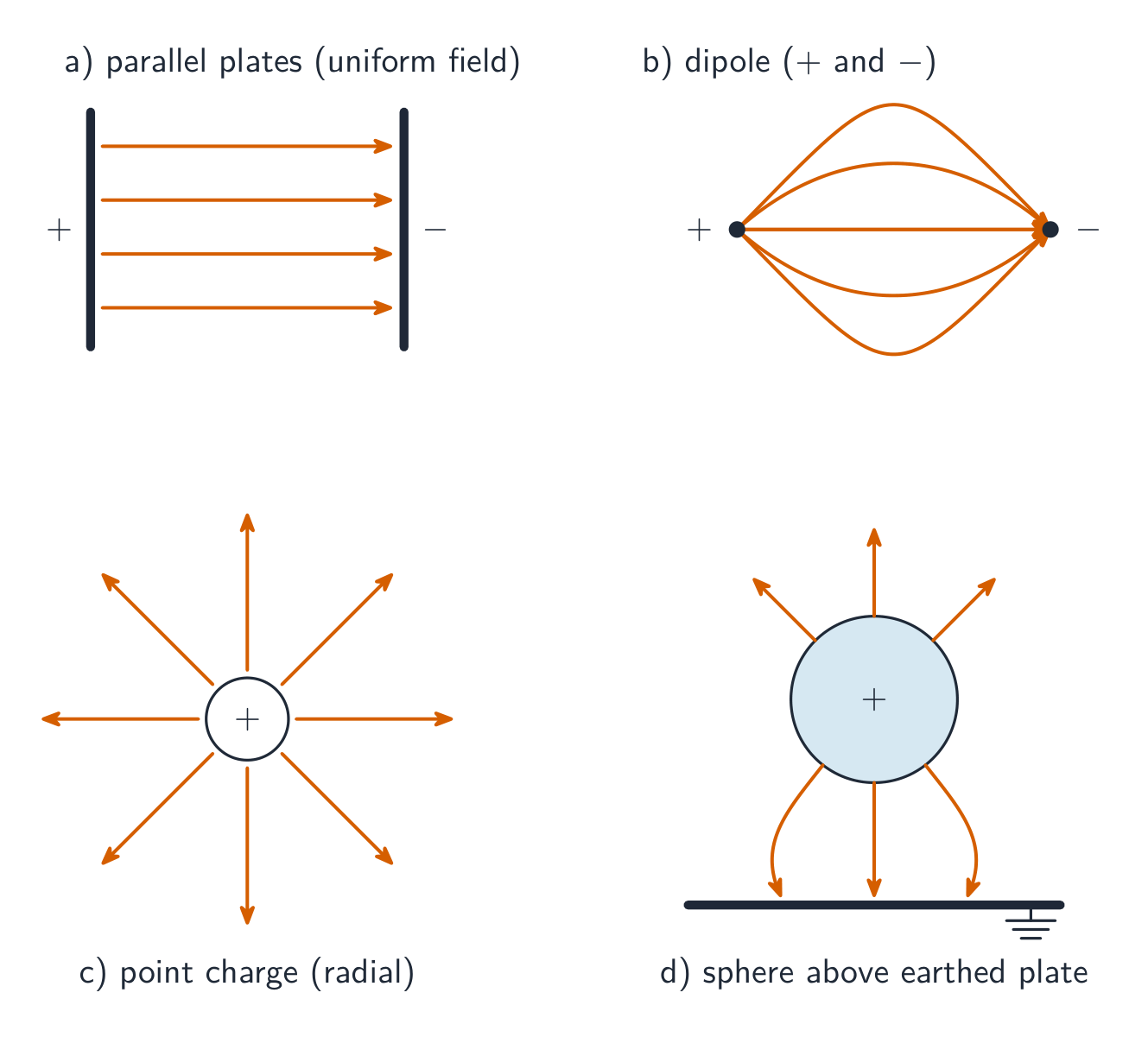
خطوط المجال تتجه مبتعدة عن الشحنات الموجبة ومبتعية نحو السالبة؛ حيث تكون أكثر كثافة، يكون المجال أقوى. الشحنة داخل المجال تشعر بـ $\vec{F}=q\vec{E}$.

أنماط خطوط المجال الكهربائي للألواح المتوازية، والثنائي القطب، وشحنة نقطية *أنماط خطوط المجال الكهربائي للألواح المتوازية، والثنائي، والشحنة النقطية
مثال محلول. أوجد المجال الكهربائي $0.20\ \text{m}$ الناتج عن شحنة نقطية مقدارها $+5.0\ \mu\text{C}$: $E=\dfrac{kQ}{r^2}=\dfrac{9.0\times10^{9}\times5.0\times10^{-6}}{(0.20)^2}=1.1\times10^{6}\ \text{N/C}$، متجهًا مبتعدًا عن الشحنة. ستشعر شحنة مقدارها $+2\ \text{nC}$ موضوعة هناك بقوة مقدارها $F=qE=2\times10^{-9}\times1.1\times10^{6}=2.2\times10^{-3}\ \text{N}$.

Explore · ⁨استكشف⁩

Map the field around a charge · ⁨خريطة المجال حول شحنة⁩

An electric field points the way a positive test charge would be pushed: away from a positive charge, toward a negative one. Closer lines mean a stronger field. · ⁨المجال الكهربائي يشير إلى اتجاه دفع شحنة اختبار موجبة: مبتعدًا عن الشحنة الموجبة، ومتجهًا نحو الشحنة السالبة. الخطوط الأقرب تعني مجالًا أقوى.⁩

Vocabulary · ⁨مفردات⁩ Train · ⁨تدريب⁩
English العربية
Electric charge/ɪˈlektrɪk tʃɑːdʒ/ الشحنة الكهربائية
Coulomb's law/ˈkuːlɒmz lɔː/ قانون كولوم
permittivity/ˌpɜːmɪˈtɪvəti/ السماحية
conductor/kənˈdʌktə/ موصل
insulator/ˈɪnsjuːleɪtə/ عازل
Conduction/kənˈdʌkʃn/ التوصيل
Induction/ɪnˈdʌkʃn/ التوجيه الوظيفي
electric field/ɪˈlektrɪk fiːld/ مجال كهربائي
electric potential energy/ɪˈlektrɪk pəˈtenʃl ˈenədʒi/ طاقة الجهد الكهربائي
Electric potential/ɪˈlektrɪk pəˈtenʃl/ الجهد الكهربائي
10.4

Electric Potential Energy · ⁨الطاقة الكامنة الكهربائية⁩

Syllabus · ⁨المنهج⁩
English

Learning Objective 10.4.A: Describe the electric potential energy of a system.

  • 10.4.A.1 The electric potential energy of a system of two point charges equals the amount of work required for an external force to bring the point charges to their current positions from infinitely far away.
  • 10.4.A.2 The general form for the electric potential energy of two charged objects is given by the equation
    • Equation: $U_E = \dfrac{1}{4\pi\varepsilon_0}\dfrac{q_1 q_2}{r} = k\dfrac{q_1 q_2}{r}$
  • 10.4.A.3 The total electric potential energy of a system can be determined by finding the sum of the electric potential energies of the individual interactions between each pair of charged objects in the system.

Boundary statement: As the methods to calculate the electric potential energy due to extended charge distributions exceed the scope of the course, AP Physics 2 only requires that students calculate the electric potential energy of configurations of four or fewer point charges.

العربية

هدف التعلم 10.4.A: وصف الطاقة الكامنة الكهربائية لنظام ما.

  • 10.4.A.1 تساوي الطاقة الكامنة الكهربائية لنظام شحنتين نقطيتين مقدار الشغل اللازم لقوة خارجية لإحضار الشحنتين النقطيتين إلى موضعهما الحالي من مسافة لا نهائية.
  • 10.4.A.2 الصيغة العامة للطاقة الكامنة الكهربائية لجسمين مشحونين معطاة بالمعادلة
    • المعادلة: $U_E = \dfrac{1}{4\pi\varepsilon_0}\dfrac{q_1 q_2}{r} = k\dfrac{q_1 q_2}{r}$
  • 10.4.A.3 يمكن تحديد إجمالي الطاقة الكامنة الكهربائية للنظام عن طريق إيجاد مجموع طاقات التفاعل الكهربائي بين كل زوج من الأجسام المشحونة في النظام.

عبارة الحدود: بما أن طرق حساب الجهد الكهربائي الناتج عن توزيعات الشحن الممتدة تتجاوز نطاق المقرر، فإن امتحان الفيزياء AP 2 يتطلب فقط من الطلاب حساب الجهد الكهربائي لتكوينات تتكون من أربع شحنات نقطية أو أقل.

Source: College Board AP Course and Exam Description · ⁨المصدر: وصف دورة وامتحان College Board AP⁩

English

Two charges have electric potential energy 电势能 stored in their arrangement:

$$U=\frac{k q_1 q_2}{r}.$$
Like charges pushed together store positive energy; opposite charges have negative energy (bound). Moving a charge changes $U$, and the electric force does work equal to $-\Delta U$.

العربية

يوجد طاقة كامنة كهربائية مخزنة في ترتيب شحنتين:

$$U=\frac{k q_1 q_2}{r}.$$
الشحنات المتشابهة عند دفعها معًا تخزن طاقة موجبة؛ بينما الشحنة المعاكسة لها طاقة سالبة (مربوطة). تحريك شحنة يغير $U$، وتقوم القوة الكهربائية بعملية مساوية لـ $-\Delta U$.

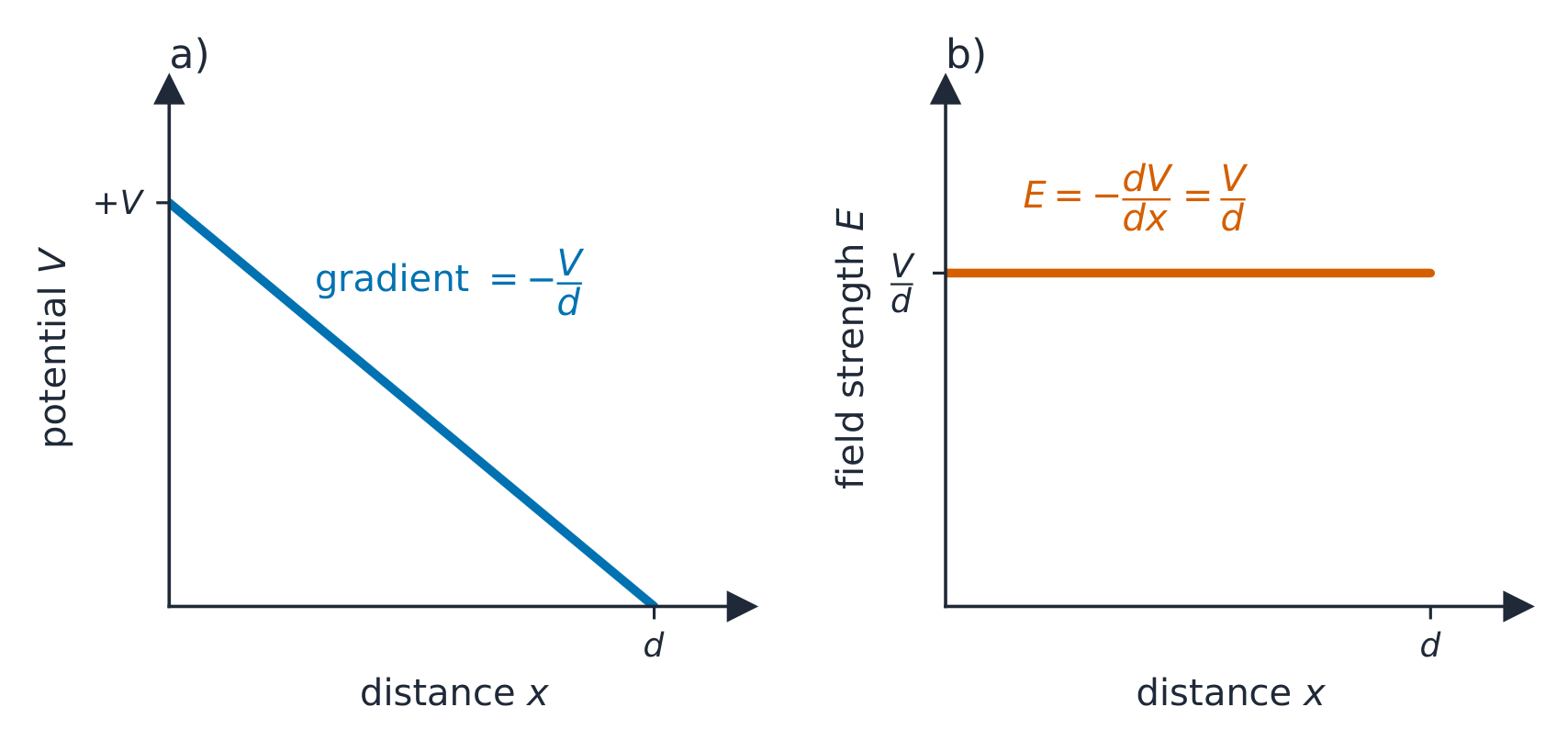
في المجال المنتظم ينخفض الجهد بانتظام مع المسافة، لذا يرتبط E بـ V
10.5

Electric Potential · ⁨الجهد الكهربائي⁩

Syllabus · ⁨المنهج⁩
English

Learning Objective 10.5.A: Describe the electric potential due to a configuration of charged objects.

  • 10.5.A.1 Electric potential describes the electric potential energy per unit charge at a point in space.
  • 10.5.A.2 The electric potential due to multiple point charges can be determined by the principle of scalar superposition of the electric potential due to each of the point charges.
    • Equation: $V = \dfrac{1}{4\pi\varepsilon_0}\sum_{i}\dfrac{q_i}{r_i}$
  • 10.5.A.3 The electric potential difference between two points is the change in electric potential energy per unit charge when a test charge is moved between the two points.
    • Equation: $\Delta V = \dfrac{\Delta U_E}{q}$
    • 10.5.A.3.i Electric potential difference may also result from chemical processes that cause positive and negative charges to separate, such as in a battery.
  • 10.5.A.4 When conductors are in electrical contact, electrons will be redistributed such that the surfaces of the conductors are at the same electric potential.

Learning Objective 10.5.B: Describe the relationship between electric potential and electric field.

  • 10.5.B.1 The average electric field between two points in space is equal to the electric potential difference between the two points divided by the distance between the two points.
    • Equation: $\left|\vec{E}\right| = \left|\dfrac{\Delta V}{\Delta r}\right|$
  • 10.5.B.2 Electric field vector maps and equipotential lines are tools to describe the field produced by a charge or configuration of charges and can be used to predict the motion of charged objects in the field.
    • 10.5.B.2.i Equipotential lines represent lines of equal electric potential in space. These lines are also referred to as isolines of electric potential.
    • 10.5.B.2.ii Isolines are perpendicular to electric field vectors. An isoline map of electric potential can be constructed from an electric field vector map, and an electric field map may be constructed from an isoline map.
    • 10.5.B.2.iii An electric field vector points in the direction of decreasing potential.
    • 10.5.B.2.iv There is no component of an electric field along an isoline.

Boundary statement: As the methods to calculate the electric potential due to extended charges exceed the scope of the course, AP Physics 2 only expects that students calculate the electric potential of configurations of four or fewer particles (or more in situations of high symmetry).

العربية

هدف التعلم 10.5.A: وصف الجهد الكهربائي الناتج عن تكوين من الأجسام المشحونة.

  • 10.5.A.1 يصف الجهد الكهربائي الطاقة الكامنة الكهربائية لكل وحدة شحنة عند نقطة في الفضاء.
  • 10.5.A.2 يمكن تحديد الجهد الكهربائي الناتج عن عدة شحنات نقطية بمبدأ التراكبScalar للجهد الكهربائي الناتج عن كل شحنة نقطية على حدة.
    • المعادلة: $V = \dfrac{1}{4\pi\varepsilon_0}\sum_{i}\dfrac{q_i}{r_i}$
  • 10.5.A.3 فرق الجهد الكهربائي بين نقطتين هو التغير في الطاقة الكامنة الكهربائية لكل وحدة شحنة عند نقل شحنة اختبار بين النقطتين.
    • المعادلة: $\Delta V = \dfrac{\Delta U_E}{q}$
    • 10.5.A.3.i قد ينتج فرق الجهد الكهربائي أيضًا عن عمليات كيميائية تؤدي إلى فصل الشحنات الموجبة والسالبة، كما في البطارية.
  • 10.5.A.4 عندما تكون الموصلات متصلة كهربائيًا، ستتم إعادة توزيع الإلكترونات بحيث تكون أسطح الموصلات عند نفس الجهد الكهربائي.

هدف التعلم 10.5.B: وصف العلاقة بين الجهد الكهربائي والمجال الكهربائي.

  • 10.5.B.1 يساوي المجال الكهربائي المتوسط بين نقطتين في الفضاء فرق الجهد الكهربائي بين النقطتين مقسومًا على المسافة بينهما.
    • المعادلة: $\left|\vec{E}\right| = \left|\dfrac{\Delta V}{\Delta r}\right|$
  • 10.5.B.2 خرائط متجهات المجال الكهربائي والخطوط المتساوية الجهد هي أدوات لوصف المجال الناتج عن شحنة أو تكوين من الشحنات ويمكن استخدامها للتنبؤ بحركة الأجسام المشحونة في المجال.
    • 10.5.B.2.i تمثل الخطوط المتساوية الجهد خطوطًا ذات جهد كهربائي متساوٍ في الفضاء. تُشار إلى هذه الخطوط أيضًا باسم خطوط العزل للجهد الكهربائي.
    • 10.5.B.2.ii خطوط العزل عمودية على متجهات المجال الكهربائي. يمكن بناء خريطة للخطوط المتساوية الجهد من خريطة متجهات المجال الكهربائي، ويمكن بناء خريطة للمجال الكهربائي من خريطة خطوط العزل.
    • 10.5.B.2.iii يشير متجه المجال الكهربائي في اتجاه تناقص الجهد.
    • 10.5.B.2.iv لا يوجد مكون للمجال الكهربائي على طول خط العزل.

عبارة الحدود: بما أن طرق حساب الجهد الكهربائي الناتج عن الشحنات الممتدة تتجاوز نطاق المقرر، فإن امتحان الفيزياء AP 2 يتوقع فقط من الطلاب حساب الجهد الكهربائي لتكوينات تتكون من أربع جسيمات أو fewer (أو أكثر في حالات التناظر العالي).

Source: College Board AP Course and Exam Description · ⁨المصدر: وصف دورة وامتحان College Board AP⁩

English

Electric potential 电势 $V$ is the potential energy per unit charge – a scalar field, measured in volts:

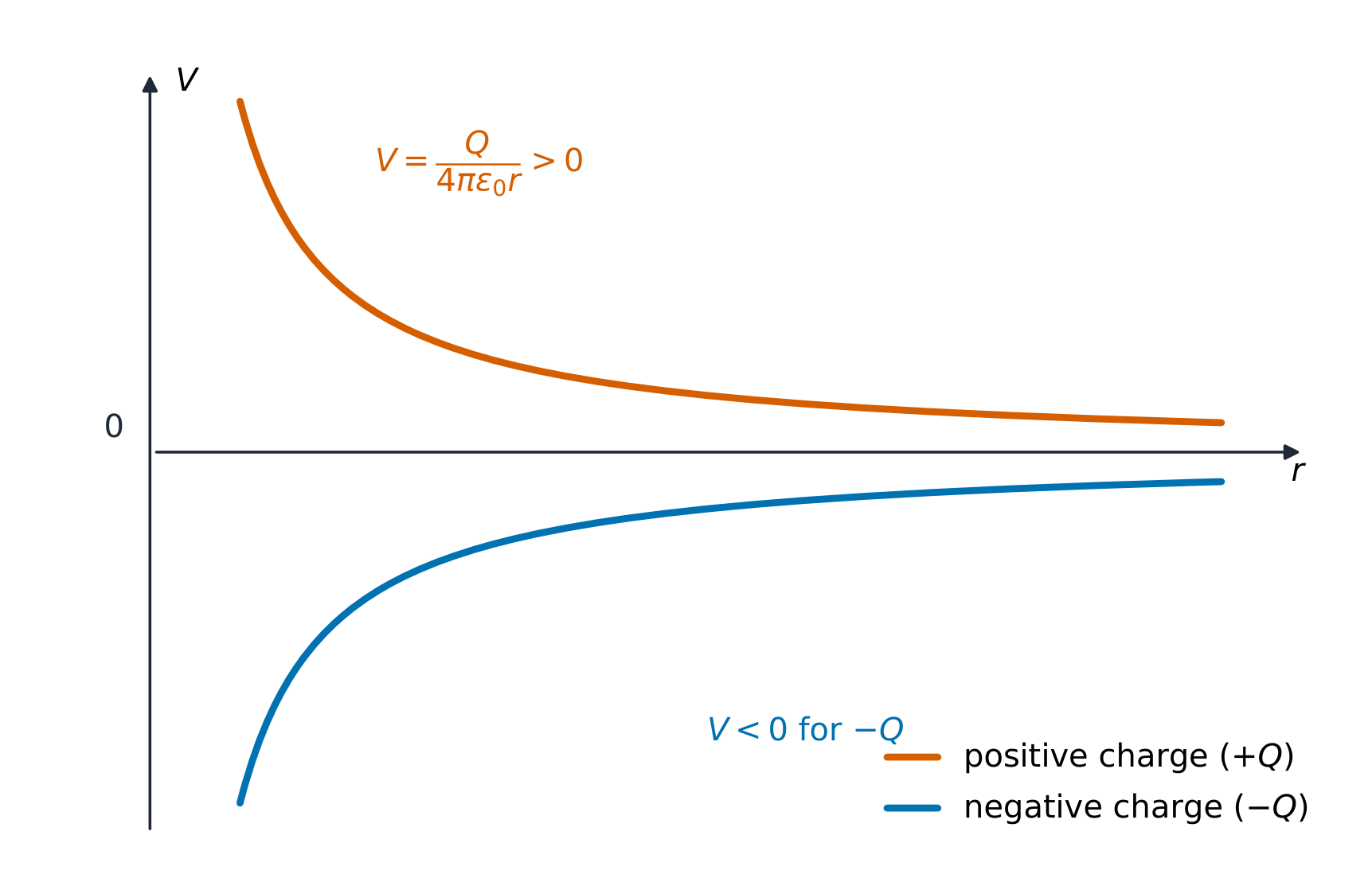
$$V=\frac{U}{q}=\frac{kQ}{r}.$$
The potential difference (voltage) 电压 between two points is the work per unit charge to move between them: $\Delta V=\dfrac{\Delta U}{q}$, and $U=qV$. Positive charges move from high to low potential on their own. Because potential is a scalar, adding the potentials from several charges is much easier than adding field vectors.

العربية

الجهد الكهربائي $V$ هو الطاقة الكامنة لكل وحدة شحنة – وهو حقل قياسي، يُقاس بالفولت:

$$V=\frac{U}{q}=\frac{kQ}{r}.$$
فرق الجهد (الفولتية) بين نقطتين هو الشغل لكل وحدة شحنة لنقلها بينهما: $\Delta V=\dfrac{\Delta U}{q}$، و$U=qV$. تتحرك الشحنات الموجبة تلقائيًا من جهد أعلى إلى جهد أقل. وبما أن الجهد كمية قياسية، فإن جمع الجهود الناتجة عن عدة شحنات أسهل بكثير من جمع متجهات المجال.

الجهد بالقرب من شحنة نقطية يتغير بالنسبة لـ 1/r
10.6

Capacitors · ⁨المكثفات⁩

Syllabus · ⁨المنهج⁩
English

Learning Objective 10.6.A: Describe the physical properties of a parallel-plate capacitor.

  • 10.6.A.1 A parallel-plate capacitor consists of two separated parallel conducting surfaces that can hold equal amounts of charge with opposite signs.
  • 10.6.A.2 Capacitance relates the magnitude of the charge stored on each plate to the electric potential difference created by the separation of those charges.
    • Equation: $C = \dfrac{Q}{\Delta V}$
    • 10.6.A.2.i The capacitance of a capacitor depends only on the physical properties of the capacitor, such as the capacitor's shape and the material used to separate the plates.
    • 10.6.A.2.ii The capacitance of a parallel-plate capacitor is proportional to the area of one of its plates and inversely proportional to the distance between its plates. The constant of proportionality is the product of the dielectric constant, $\kappa$, of the material between the plates and the electric permittivity of free space, $\varepsilon_0$.
      • Equation: $C = \kappa\varepsilon_0\dfrac{A}{d}$
  • 10.6.A.3 The electric field between two charged parallel plates with uniformly distributed electric charge, such as in a parallel-plate capacitor, is constant in both magnitude and direction, except near the edges of the plates.
    • 10.6.A.3.i The magnitude of the electric field between two charged parallel plates, where the plate separation is much smaller than the dimensions of the plates, can be described with the equation
      • Equation: $E_C = \dfrac{Q}{\kappa\varepsilon_0 A}$
    • 10.6.A.3.ii A charged particle between two oppositely charged parallel plates undergoes constant acceleration and therefore its motion shares characteristics with the projectile motion of an object with mass in the gravitational field near Earth's surface.
  • 10.6.A.4 The electric potential energy stored in a capacitor is equal to the work done by an external force to separate that amount of charge on the capacitor.
  • 10.6.A.5 The electric potential energy stored in a capacitor is described by the equation
    • Equation: $U_C = \dfrac{1}{2}Q\Delta V$
  • 10.6.A.6 Adding a dielectric between two plates of a capacitor changes the capacitance of the capacitor and induces an electric field in the dielectric in the opposite direction to the field between the plates.

Boundary statement: While other shapes are also able to separate charges, only the analysis and descriptions of parallel-plate capacitors are required for AP Physics 2. Edge effects will be ignored unless explicitly stated otherwise.

العربية

هدف التعلم 10.6.A: وصف الخصائص الفيزيائية لمكثف الصفائح المتوازية.

  • 10.6.A.1 يتكون مكثف الصفائح المتوازية من سطحين موصلين متوازيين مفصولين يمكنهما حمل كميات متساوية من الشحنة بإشارات متعاكسة.
  • 10.6.A.2 ترتبط السعة بمقدار الشحنة المخزنة على كل صفيحة وفرق الجهد الكهربائي الذي تسببه انفصال تلك الشحنات.
    • المعادلة: $C = \dfrac{Q}{\Delta V}$
    • 10.6.A.2.i تعتمد سعة المكثف فقط على الخصائص الفيزيائية للمكثف، مثل شكله والمادة المستخدمة لفصل الصفحات.
    • 10.6.A.2.ii تتناسب سعة مكثف الصفائح المتوازية طرديًا مع مساحة إحدى صفيحتيه وعكسيًا مع المسافة بين صفيحتيه. ثابت التناسب هو حاصل ضرب ثابت العازل $\kappa$ للمادة الموجودة بين الصفائح والنفاذية الكهربائية للفراغ $\varepsilon_0$.
      • معادلة: $C = \kappa\varepsilon_0\dfrac{A}{d}$
  • 10.6.A.3 يكون المجال الكهربائي بين صفحتين متوازيتين مشحونتين بتوزيع شحنة كهربائية منتظم، كما في مكثف الصفائح المتوازية، ثابتًا في كلا من المقدار والاتجاه، باستثناء بالقرب من حواف الصفائح.
    • 10.6.A.3.i يمكن وصف مقدار المجال الكهربائي بين صفحتين متوازيتين مشحونتين، حيث يكون تباعد الصفائح أصغر بكثير من أبعادها، بالمعادلة
      • معادلة: $E_C = \dfrac{Q}{\kappa\varepsilon_0 A}$
    • 10.6.A.3.ii تخضع جسيم مشحون بين صفحتين متوازيتين مشحونتين بشحنتين متعاكستين لتسارع ثابت وبالتالي فإن حركته تشترك في خصائص مع حركة المقذوفات لجسم له كتلة في مجال الجاذبية بالقرب من سطح الأرض.
  • 10.6.A.4 تساوي الطاقة الكامنة الكهربائية المخزنة في مكثف الشغل المنجز بواسطة قوة خارجية لفصل هذا المقدار من الشحنة على المكثف.
  • 10.6.A.5 يُوصف الجهد الكهربائي المخزن في مكثف بالمعادلة
    • المعادلة: $U_C = \dfrac{1}{2}Q\Delta V$
  • 10.6.A.6 إضافة عازل بين صفيحتي مكثف يغير سعة المكثف ويحفز مجالًا كهربائيًا في العازل في الاتجاه المعاكس للمجال بين الصفائح.

عبارة الحدود: بينما يمكن للأشكال الأخرى أيضًا فصل الشحنات، فإن التحليل والوصف الخاص بمكثفات الصفائح المتوازية فقط مطلوب لامتحان الفيزياء AP 2. سيتم تجاهل تأثيرات الحواف إلا إذا تم ذكر ذلك صراحة.

Source: College Board AP Course and Exam Description · ⁨المصدر: وصف دورة وامتحان College Board AP⁩

English
Discharging a capacitor: τ = RC
Charging a capacitor (RC)

A capacitor 电容器 stores charge and energy on two conductors separated by a gap. Its capacitance 电容 relates charge to voltage:

$$C=\frac{Q}{V},$$
and the stored energy is $U=\tfrac{1}{2}CV^2$. Capacitance depends on the plates' geometry and the material between them, not on the charge placed on it.

Worked example. A $100\ \mu\text{F}$ capacitor is charged to $12\ \text{V}$. It holds $Q=CV=100\times10^{-6}\times12=1.2\times10^{-3}\ \text{C}$ of charge and stores $U=\tfrac12 CV^2=\tfrac12\times100\times10^{-6}\times12^2=7.2\times10^{-3}\ \text{J}$ of energy.

العربية
تفريغ مكثف: τ = RC
شحن مكثف (RC)

يخزن المكثف الشحنة والطاقة على موصلين مفصولين بمسافة. ترتبط سعته الشحنة بالجهد:

$$C=\frac{Q}{V},$$
وتكون الطاقة المخزنة هي $U=\tfrac{1}{2}CV^2$. تعتمد السعة على هندسة الصفائح والمادة الموجودة بينهما، وليس على الشحنة الموضوعة عليه.

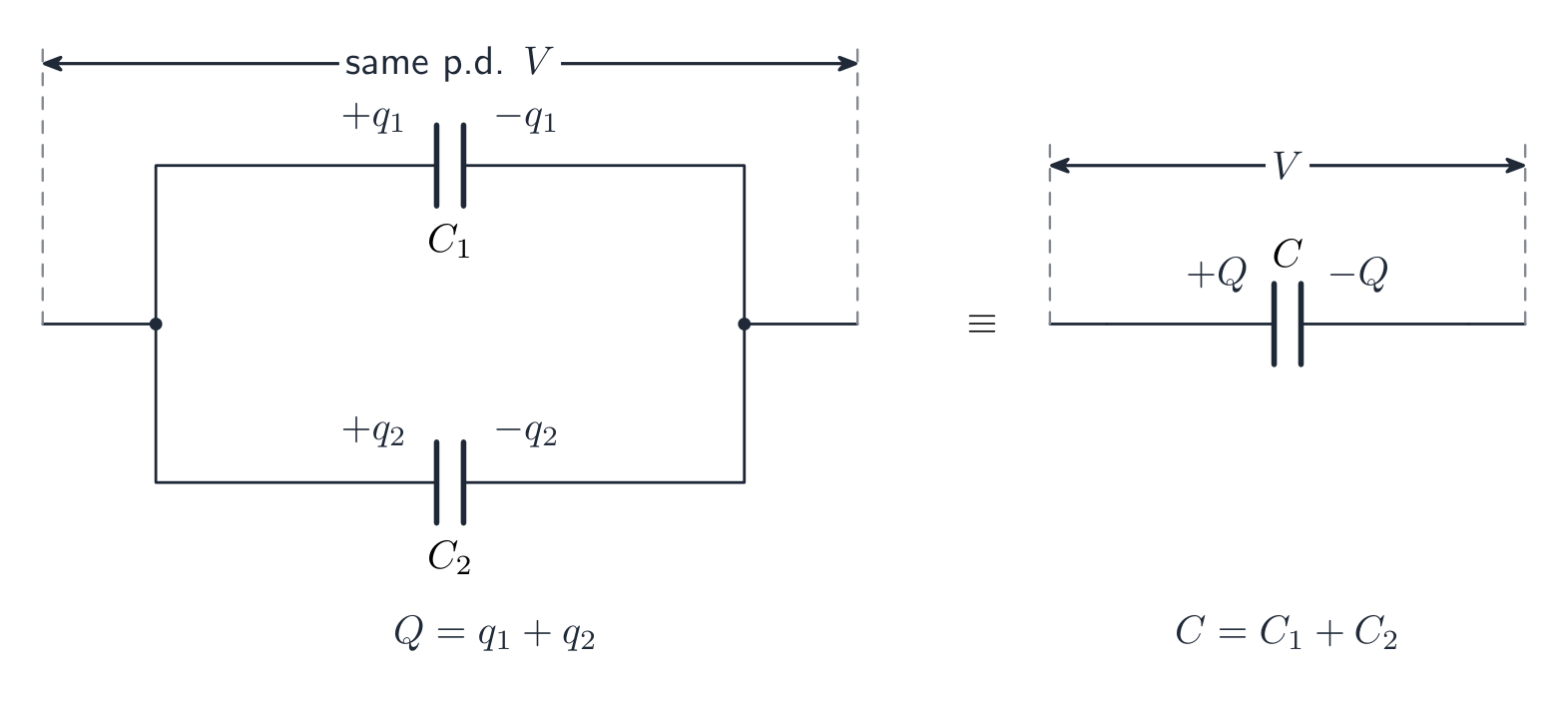
المكثفات المتصلة على التوازي تشارك نفس فرق الجهد، وتتجمع شحناتها

مثال محلول. تم شحن مكثف سعته $100\ \mu\text{F}$ حتى وصل لجهد $12\ \text{V}$. يحمل هذا المكثف شحنة مقدارها $Q=CV=100\times10^{-6}\times12=1.2\times10^{-3}\ \text{C}$ ويخزن طاقة قدرها $U=\tfrac12 CV^2=\tfrac12\times100\times10^{-6}\times12^2=7.2\times10^{-3}\ \text{J}$.

Explore · ⁨استكشف⁩

Charge and discharge a capacitor · ⁨شحّن وفك شحن مكثف⁩

A capacitor stores charge on two plates. It fills and empties exponentially, set by the time constant $\tau = RC$ — bigger $R$ or $C$ means slower charging. · ⁨المكثف يخزن الشحنة على صفيحتين. يمتلئ ويفرغ بشكل أسّي، محددًا بـ ثابت الزمن $\tau = RC$ — كلما كان $R$ أو $C$ أكبر، كان الشحن أبطأ.⁩

Vocabulary · ⁨مفردات⁩ Train · ⁨تدريب⁩
English العربية
capacitor/kəˈpæsɪtə/ مكثف
capacitance/kəˈpæsɪtəns/ السعة
10.7

Conservation of Electric Energy · ⁨حفظ الطاقة الكهربائية⁩

Syllabus · ⁨المنهج⁩
English

Learning Objective 10.7.A: Describe changes in energy in a system due to a difference in electric potential between two locations.

  • 10.7.A.1 When a charged object moves between two locations with different electric potentials, the resulting change in the electric potential energy of the object-field system is given by the following equation.
    • Equation: $\Delta U_E = q\Delta V$
  • 10.7.A.2 The movement of a charged object between two points with different electric potentials results in a change in kinetic energy of the object consistent with the conservation of energy.
العربية

الهدف التعليمي 10.7.A: وصف التغيرات في الطاقة في نظام نتيجة لفرق الجهد الكهربائي بين مكانين.

  • 10.7.A.1 عندما يتحرك جسم مشحون بين مكانين مختلفين في الجهد الكهربائي، يكون التغير الناتج في طاقة الجهد الكهربائي لنظام الجسم-المجال معطى بالمعادلة التالية.
    • المعادلة: $\Delta U_E = q\Delta V$
  • 10.7.A.2 يؤدي حركة جسم مشحون بين نقطتين مختلفتين في الجهد الكهربائي إلى تغير في الطاقة الحركية للجسم يتوافق مع قانون حفظ الطاقة.

Source: College Board AP Course and Exam Description · ⁨المصدر: وصف دورة وامتحان College Board AP⁩

English

Energy is conserved for charges just as for masses. A charge released in a field converts electric potential energy into kinetic energy:

$$q\,\Delta V=\tfrac{1}{2}mv^2 \quad(\text{gaining speed as it "falls" through a potential difference}).$$

Worked example. An electron ($q=1.6\times10^{-19}\ \text{C}$, $m=9.1\times10^{-31}\ \text{kg}$) is accelerated from rest through a potential difference of $100\ \text{V}$. Its final speed is

$$v=\sqrt{\frac{2q\,\Delta V}{m}}=\sqrt{\frac{2\times1.6\times10^{-19}\times100}{9.1\times10^{-31}}}=5.9\times10^{6}\ \text{m/s}.$$
This is exactly how the electron gun in an old television or an electron microscope works.

العربية

تُحفظ الطاقة للشحنات تمامًا كما تُحفظ للكتل. الشحنة المحررة في مجال تحويل طاقتها الكامنة الكهربائية إلى طاقة حركية:

$$q\,\Delta V=\tfrac{1}{2}mv^2 \quad(\text{gaining speed as it "falls" through a potential difference}).$$

مثال محلول. إلكترون (شحمته $q=1.6\times10^{-19}\ \text{C}$، كتلته $m=9.1\times10^{-31}\ \text{kg}$) يُسرّع من السكون عبر فرق جهد مقداره $100\ \text{V}$. سرعته النهائية هي

$$v=\sqrt{\frac{2q\,\Delta V}{m}}=\sqrt{\frac{2\times1.6\times10^{-19}\times100}{9.1\times10^{-31}}}=5.9\times10^{6}\ \text{m/s}.$$
هذا بالضبط كيف تعمل البندقية الإلكترونية في تلفزيون قديم أو مجهر إلكتروني.

Vocabulary · ⁨مفردات⁩ Train · ⁨تدريب⁩
English العربية
potential difference/pəˈtenʃl ˈdɪfrəns/ فرق الجهد
10.7

Exam tips · ⁨نصائح للامتحان⁩

English
  • Coulomb's law and the point-charge field are inverse-square — doubling the separation makes the force (or field) four times smaller.
  • Use magnitudes for the size of a force and decide direction from the signs; the field points the way a positive test charge would move.
  • Potential ($V$) is a scalar so potentials from several charges simply add; the field ($E$) is a vector and must be added by direction.
  • For a charge accelerated through a voltage use energy conservation $qV=\tfrac12 mv^2$.
  • Capacitor relations: $C=Q/V$ (capacitance is fixed by geometry) and energy $U=\tfrac12 CV^2$.
العربية
  • قانون كولوم ومجال الشحنة النقطية هما عكسيان للمربع – مضاعفة المسافة تجعل القوة (أو المجال) أصغر بأربعة أضعاف.
  • استخدم القيم المطلقة لحجم القوة وحدد الاتجاه بناءً على الإشارات؛ يشير المجال نحو اتجاه حركة شحنة اختبار موجبة.
  • الجهد ($V$) كمية قياسية لذا يمكن جمع الجهود الناتجة عن عدة شحنات ببساطة؛ أما المجال ($E$) فهو متجه ويجب جمعه باستخدام الاتجاهات.
  • لشحنة تُسرّع عبر جهد، استخدم حفظ الطاقة $qV=\tfrac12 mv^2$.
  • علاقات المكثف: $C=Q/V$ (السعة ثابتة حسب الهندسة) والطاقة $U=\tfrac12 CV^2$.

Interactive lessons on this topic · ⁨دروس تفاعلية حول هذا الموضوع⁩

Work through it step by step, with instant-check exercises. · ⁨ا-working عليه خطوة بخطوة، مع تمارين تحقق فوري.⁩

Past Papers · ⁨أوراق الامتحانات السابقة⁩

More topics in AP Physics 2 · ⁨AP الفيزياء 2⁩ · ⁨المزيد من المواضيع في AP Physics 2 · ⁨AP الفيزياء 2⁩⁩

Log in or create account · ⁨تسجيل الدخول أو إنشاء حساب⁩

IGCSE, A-Level & AP