Skip to content · ⁨الانتقال إلى المحتوى⁩

Basic Economic Concepts · ⁨المفاهيم الاقتصادية الأساسية⁩

AP Microeconomics · ⁨الاقتصاد الجزئي (AP)⁩ · Topic 1 · ⁨الموضوع 1⁩

Video lesson for this topic · ⁨درس فيديو لهذا الموضوع⁩ Open the video page · ⁨افتح صفحة الفيديو⁩
8:34

المفاهيم الاقتصادية الأساسية

اليومedByfour فقط. فكر فيما تريد وضعه في واحدة: النوم، المدرسة، الواجب المنزلي، الرياضة، الوقت مع الأصدقاء. اجمعها بصدق وستصل إلى…

English narration · English + 中文 subtitles burned in · ⁨سرد باللغة الإنجليزية · ترجمة مدمجة بالإنجليزية + الصينية⁩

1.1

Scarcity · ⁨الندرة⁩

Syllabus · ⁨المنهج⁩
English

Enduring Understanding (MKT-1): Most resources are scarce, and in most cases the use of resources involves constraints and trade-offs.

Learning Objective MKT-1.A: Define resources and the cause(s) of their scarcity.

  • MKT-1.A.1 Economic trade-offs arise from the lack of sufficient resources (scarcity) to meet society's wants and needs.
  • MKT-1.A.2 Most factors of production (such as land, labor, and capital) are scarce, but some factors of production (such as established knowledge) may not be scarce due to their non-rival nature.
العربية

الفهم الدائم (MKT-1): معظم الموارد نادرة، وفي معظم الحالات يتضمن استخدام الموارد قيوداً ومفاضلات.

هدف التعلم MKT-1.A: عرّف الموارد وسبب(أو أسباب) ندرتها.

  • MKT-1.A.1 تنشأ المفاضلات الاقتصادية من عدم كفاية الموارد (الندرة) لتلبية رغبات واحتياجات المجتمع.
  • MKT-1.A.2 معظم عوامل الإنتاج (مثل الأرض والعمل والرأس المال) نادرة، لكن بعض عوامل الإنتاج (مثل المعرفة الراسخة) قد لا تكون نادرة بسبب طبيعتها غير التنافسية.
Source: College Board AP Course and Exam Description · ⁨المصدر: وصف دورة وامتحان College Board AP⁩

English

Economics 经济学 begins with one stubborn fact: people's wants are effectively unlimited, but the resources 资源 to satisfy them are limited. This gap is scarcity 稀缺性, and it is why economics exists – if everything were free and endless, there would be nothing to decide.

The resources (the factors of production 生产要素) are land (natural resources), labor 劳动 (human effort), capital 资本 (tools, machines, buildings), and entrepreneurship 企业家才能 (organizing the other three and taking risks). Because these are scarce, every economy must answer three questions: what to produce, how to produce it, and for whom to produce.

Scarcity forces choice, and every choice has an opportunity cost 机会成本 – the value of the next-best alternative you give up. This single idea runs through the whole course: the true cost of anything is what you sacrifice to get it, not just the money you pay.

العربية
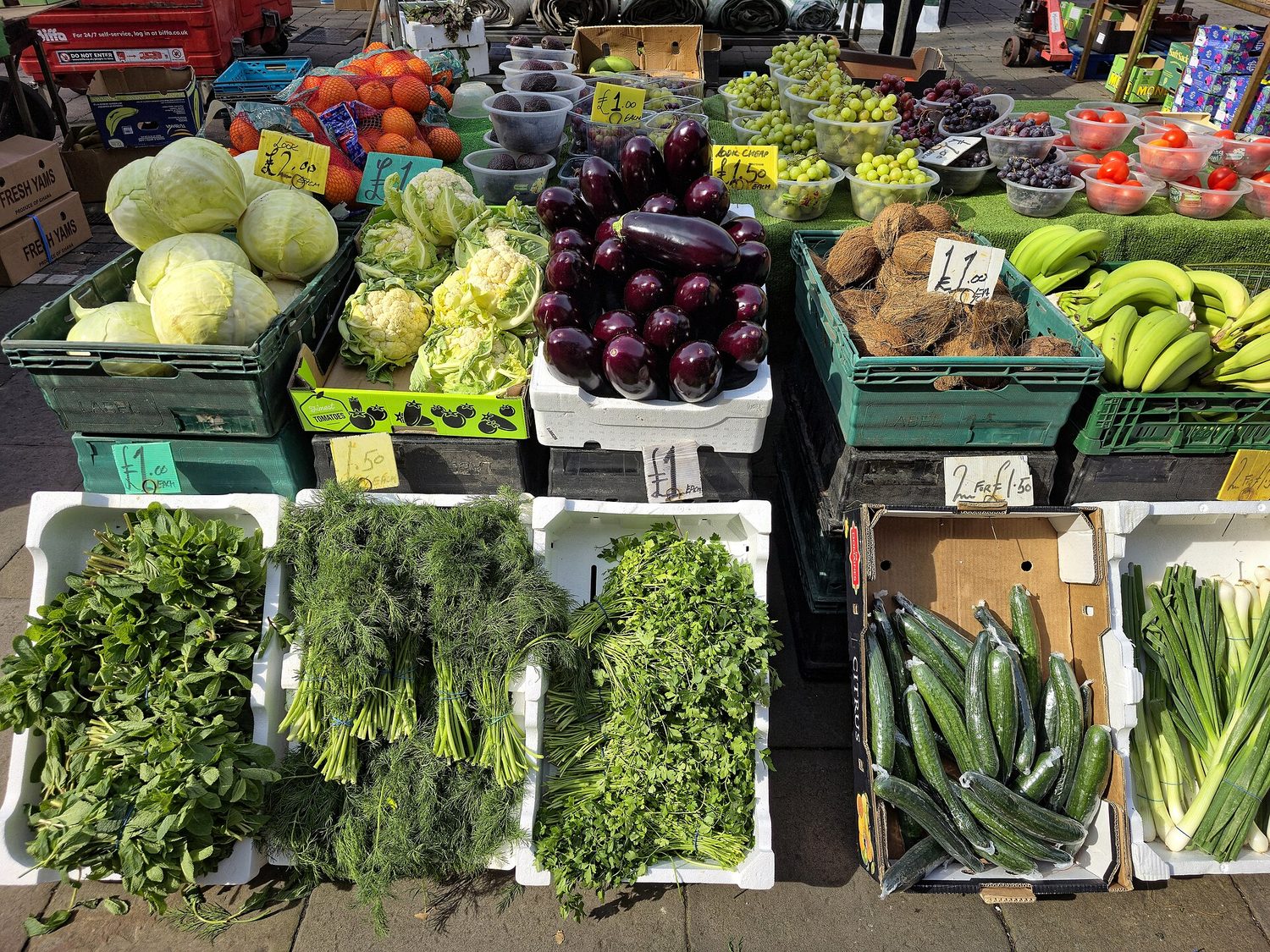
سوق خارجي: تخصيص الأسواق للموارد النادرة بين الاستخدامات المتنافسة

الاقتصاد يبدأ بحقيقة ثابتة: رغبات الناس غير محدودة تقريبًا، لكن الموارد لإشباعها محدودة. هذا الفجوة هو الندرة، ولهذا يوجد الاقتصاد – لو كان كل شيء مجانيًا وغير محدود، لما كان هناك ما ليُقرَّر عليه.

الموارد (عوامل الإنتاج) هي الأرض (الموارد الطبيعية)، العمل (الجهد البشري)، رأس المال (الأدوات، الآلات، المباني)، والريادة (تنظيم الثلاثة الأخرى وتحمل المخاطر). ونظرًا لأن هذه الموارد نادرة، يجب على كل اقتصاد الإجابة عن ثلاثة أسئلة: ماذا ننتج، كيف ننتجه، ولـمن ننتجه.

يفرض الندرة الاختيار، ولكل اختيار تكلفة بديلة – وهي قيمة أفضل بديل تضحى به. يتكرر هذا المفهوم في كل المقرر: التكلفة الحقيقية لأي شيء هي ما تضحيه للحصول عليه، وليس فقط المال الذي تدفعه.

Vocabulary · ⁨مفردات⁩ Train · ⁨تدريب⁩
English العربية
Economics/ˌiːkəˈnɒmɪks/ الاقتصاد
resources/rɪˈzɔːsɪz/ الموارد
scarcity/ˈskeəsɪti/ الندرة
factors of production/ˈfæktəz ɒv prəˈdʌkʃn/ عوامل الإنتاج
labor/ˈleɪbə/ العمل
capital/ˈkæpɪtl/ رأس المال
entrepreneurship/ˌɒntrɪprəˈnjʊəʃɪp/ ريادة الأعمال
opportunity cost/ɒpəˈtjuːnɪti kɒst/ التكلفة البديلة
1.2

Resource Allocation and Economic Systems · ⁨تخصيص الموارد والأنظمة الاقتصادية⁩

Syllabus · ⁨المنهج⁩
English

Enduring Understanding (MKT-1): Most resources are scarce, and in most cases the use of resources involves constraints and trade-offs.

Learning Objective MKT-1.B: Define how resource allocation is influenced by the economic system adopted by society.

  • MKT-1.B.1 Resource allocation involves answering three basic questions: What goods and services to produce? How to produce those goods and services? And who consumes those goods and services?
  • MKT-1.B.2 Resource allocation is significantly influenced by the economic system adopted by society, such as command economy, market economy, or mixed economy. Each system involves a particular set of institutional arrangements and a coordinating mechanism for allocating scarce resources and distributing output.
العربية

الفهم الدائم (MKT-1): معظم الموارد نادرة، وفي معظم الحالات يتضمن استخدام الموارد قيوداً ومفاضلات.

هدف التعلم MKT-1.B: عرّف كيف يؤثر النظام الاقتصادي الذي تتبنيه المجتمع على تخصيص الموارد.

  • MKT-1.B.1 يتضمن تخصيص الإجابة على ثلاث أسئلة أساسية: ما هي البضائع والخدمات التي يجب إنتاجها؟ وكيف يتم إنتاج تلك البضائع والخدمات؟ ومن يستهلك تلك البضائع والخدمات؟
  • MKT-1.B.2 تتأثر تخصيص الموارد بشكل كبير بالنظام الاقتصادي الذي تتبناه المجتمع، مثل الاقتصاد الموجه (المرتكز على التخطيط)، والاقتصاد السوقي، أو الاقتصاد المختلط. يتضمن كل نظام مجموعة معينة من الترتيبات المؤسسية وآلية تنسيق لتوزيع الموارد النادرة وتوزيع الإنتاج.

Source: College Board AP Course and Exam Description · ⁨المصدر: وصف دورة وامتحان College Board AP⁩

English

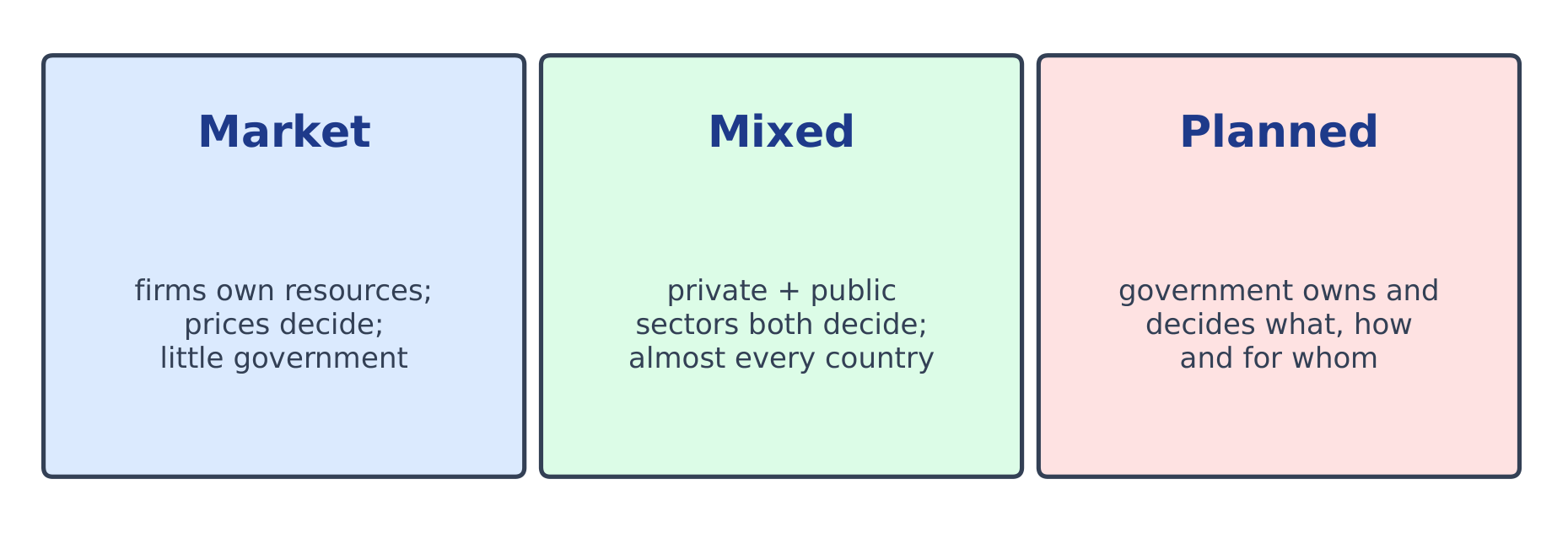
An economic system 经济体制 is a society's way of answering the three questions.

  • In a market economy 市场经济, private buyers and sellers decide through prices; self-interest and competition coordinate them (the "invisible hand").
  • In a command economy 计划经济, the government owns resources and plans production.
  • Real economies are mixed 混合经济 – mostly markets, with government providing some goods and correcting problems.

The key advantage of markets is that prices carry information and incentives 激励 automatically, with no central planner needed.

العربية

النظام الاقتصادي هو الطريقة التي تجيب بها المجتمع عن الأسئلة الثلاثة.

أنظمة اقتصادية تشكل طيفاً من السوق الحرة إلى التخطيط الحكومي الكامل
  • في الاقتصاد السوقي، يحدد المشترون والبائعون الأفراد من خلال الأسعار؛ تتناغم المصلحة الذاتية والمنافسة بينهم (ما يُسمى "اليد الخفية").
  • في اقتصاد التوجيه، تملك الحكومة الموارد وتخطط للإنتاج.
  • الاقتصادات الحقيقية هي مختلطة – يغلب عليها السوق، مع قيام الحكومة بتوفير بعض السلع وتصحيح المشكلات.

الميزة الرئيسية للأسواق هي أن الأسعار تحمل معلومات وحوافز تلقائيًا، دون الحاجة لمخطط مركزي.

Explore · ⁨استكشف⁩

Explore how prices coordinate a market · ⁨استكشف كيف تنسق الأسعار السوق⁩

In a market economy no one is in charge, yet the price finds the level where quantity supplied meets quantity demanded. Drag the demand and supply lines and watch the equilibrium price act as a signal and an incentive. · ⁨في الاقتصاد السوقي لا أحد يدير الأمر، لكن السعر يحدد المستوى الذي تتساوى فيه الكمية المعروضة والمطلوبة. اسحب خطوط الطلب والعرض وشاهد كيف يعمل سعر التوازن كـإشارة وحافز.⁩

Vocabulary · ⁨مفردات⁩ Train · ⁨تدريب⁩
English العربية
economic system/ˌiːkəˈnɒmɪk ˈsɪstəm/ النظام الاقتصادي
market economy/ˈmɑːkɪt ɪˈkɒnəmi/ اقتصاد سوقي
command economy/kəˈmænd ɪˈkɒnəmi/ اقتصاد موجه
mixed/mɪkst/ شغل الأجيال
incentives/ɪnˈsentɪvz/ الحوافز
production possibilities curve (PPC)/prəˈdʌkʃn ˌpɒsəˈbɪlɪtiz kɜːv/ منحنى إمكانيات الإنتاج (PPC)
efficient/ɪˈfɪʃənt/ كفء
unattainable/ʌnəˈteɪnəbl/ غير قابلة للتحقيق
Economic growth/ˌiːkəˈnɒmɪk ɡrəʊθ/ النمو الاقتصادي
specializing/ˈspeʃəlaɪzɪŋ/ التخصص
absolute advantage/ˈæbsəluːt ədˈvæntɪdʒ/ الميزة المطلقة
1.3

The Production Possibilities Curve · ⁨منحنى إمكانيات الإنتاج⁩

Syllabus · ⁨المنهج⁩
English

Enduring Understanding (MKT-1): Most resources are scarce, and in most cases the use of resources involves constraints and trade-offs.

Learning Objective MKT-1.C: a. Define (using graphs as appropriate) the production possibilities curve (PPC) and related terms. b. Explain (using graphs as appropriate) how the production possibilities curve (PPC) illustrates opportunity costs, trade-offs, inefficiency, efficiency, and economic growth or contraction under various conditions. c. Calculate (using data from PPCs or tables as appropriate) opportunity cost.

  • MKT-1.C.1 The PPC is a model used to show the trade-offs associated with allocating resources.
  • MKT-1.C.2 The PPC can be used to illustrate the concepts of scarcity, opportunity cost, efficiency, underutilized resources, and economic growth or contraction.
  • MKT-1.C.3 The shape of the PPC depends on whether opportunity costs are constant, increasing, or decreasing.
  • MKT-1.C.4 The PPC can shift due to changes in factors of production as well as changes in productivity/technology.
  • MKT-1.C.5 Economic growth results in an outward shift of the PPC.
العربية

الفهم الدائم (MKT-1): معظم الموارد نادرة، وفي معظم الحالات يتضمن استخدام الموارد قيوداً ومفاضلات.

هدف التعلم MKT-1.C: أ. عرّف (باستخدام الرسوم البيانية عند الاقتضاء) منحنى إمكانيات الإنتاج (PPC) والمصطلحات ذات الصلة. ب. اشرح (باستخدام الرسوم البيانية عند الاقتضاء) كيف يوضح منحنى إمكانيات الإنتاج (PPC) تكاليف الفرصة البديلة، والمفاضلات، وعدم الكفاءة، والكفاءة، والنمو الاقتصادي أو الانكماش تحت ظروف مختلفة. ج. حساب (باستخدام بيانات من منحنيات إمكانيات الإنتاج أو الجداول عند الحاجة) تكلفة الفرصة البديلة.

  • MKT-1.C.1 منحنى إمكانيات الإنتاج هو نموذج يُستخدم لإظهار المفاضلات المرتبطة بتخصيص الموارد.
  • MKT-1.C.2 يمكن استخدام منحنى إمكانيات الإنتاج لتوضيح مفاهيم الندرة، وتكاليف الفرصة البديلة، والكفاءة، والموارد غير المستغلة بالكامل، والنمو الاقتصادي أو الانكماش.
  • MKT-1.C.3 يعتمد شكل منحنى إمكانيات الإنتاج على ما إذا كانت تكاليف الفرصة البديلة ثابتة، أم متزايدة، أم متناقصة.
  • MKT-1.C.4 يمكن أن ينزاح منحنى إمكانيات الإنتاج نتيجة لتغيرات في عوامل الإنتاج وكذلك تغيرات في الإنتاجية/التكنولوجيا.
  • MKT-1.C.5 يؤدي النمو الاقتصادي إلى انزياح منحنى إمكانيات الإنتاج نحو الخارج.

Source: College Board AP Course and Exam Description · ⁨المصدر: وصف دورة وامتحان College Board AP⁩

English
The production possibility frontier

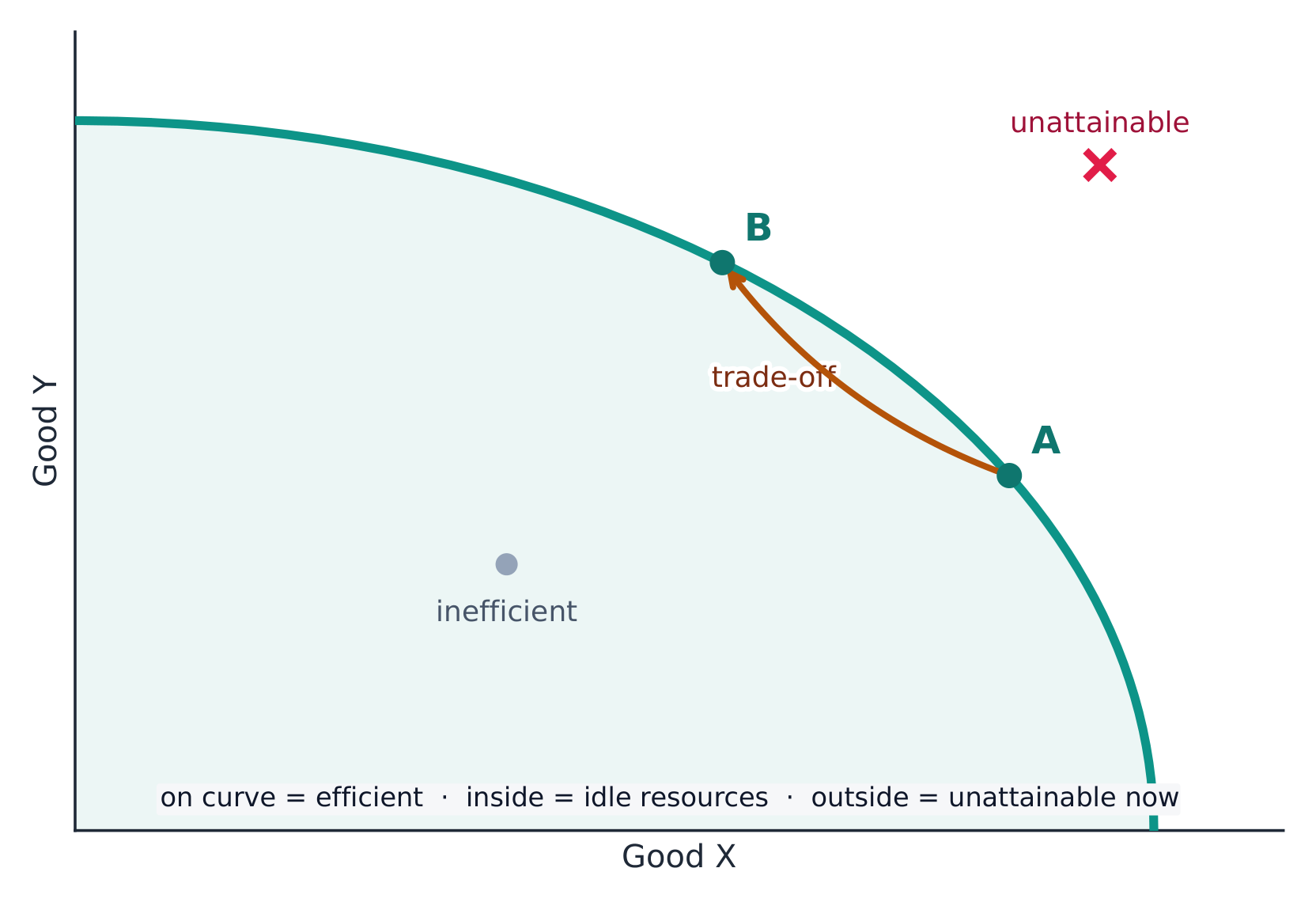
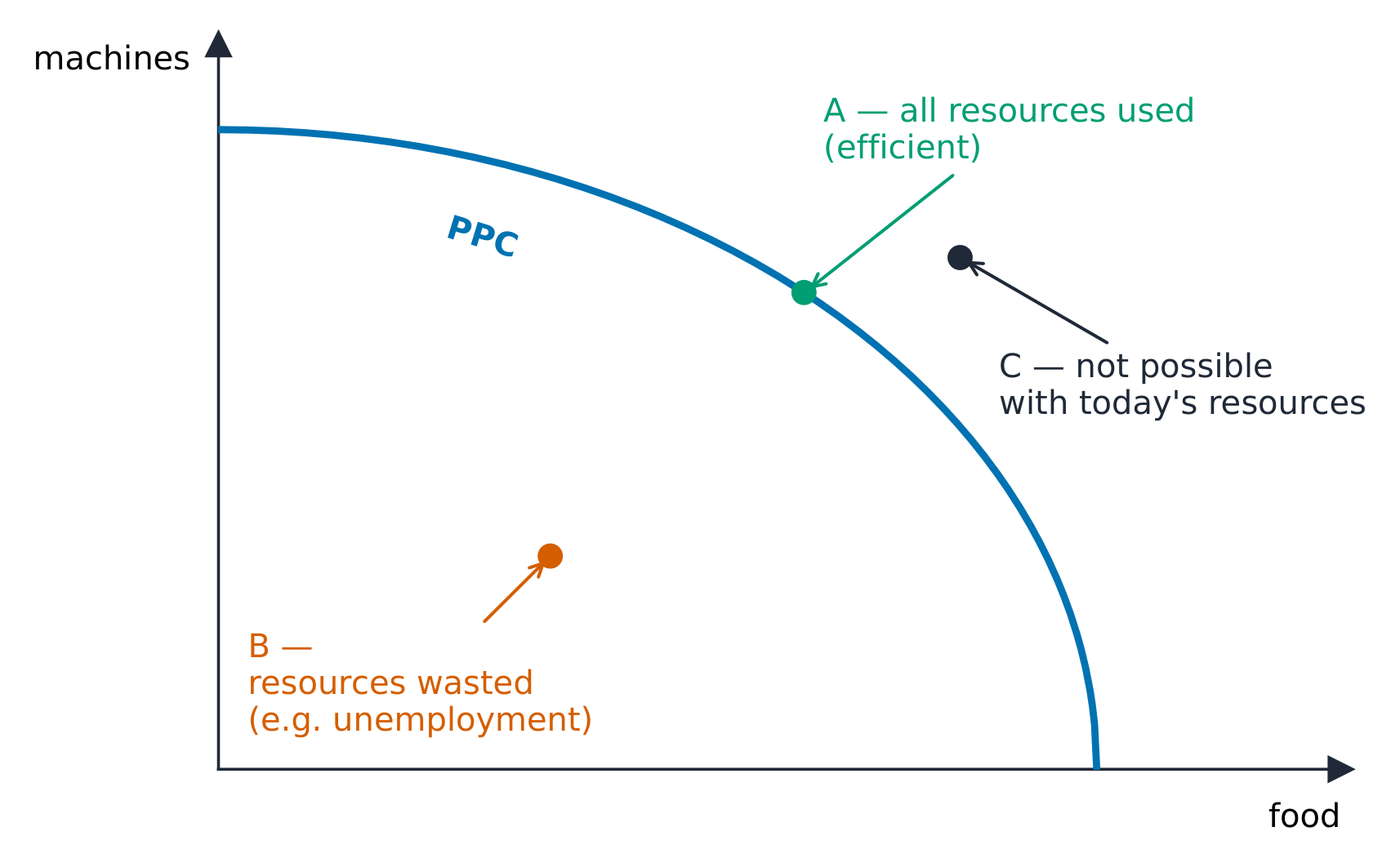
The production possibilities curve (PPC) 生产可能性曲线 shows the maximum combinations of two goods an economy can produce with its resources and technology fully and efficiently used.

  • Points on the curve are efficient 有效率; points inside are inefficient (wasted or unemployed resources); points outside are currently unattainable 无法实现.
  • The PPC's downward slope shows opportunity cost: making more of one good means making less of the other. The slope at a point is the opportunity cost of the good on the horizontal axis.
  • A bowed-out (concave) PPC shows increasing opportunity cost – resources are not equally suited to both goods, so making more of one costs ever more of the other. A straight-line PPC means constant opportunity cost.
  • Economic growth 经济增长 (more resources, better technology) shifts the whole curve outward.

Exam skill: be ready to read opportunity cost off a PPC, decide if a point is efficient/inefficient/unattainable, and explain what shifts the curve.

العربية
frontier الإمكانيات الإنتاجية

منحنى إمكانيات الإنتاج (PPC) يوضح الحد الأقصى للمزيجين من سلعتين يمكن لاقتصاد إنتاجهما باستخدام موارد تكنولوجيا كاملة وكفاءة.

نقاط على أو داخل أو خارج منحنى إمكانيات الإنتاج
  • النقاط على المنحنى كفء؛ النقاط داخله غير كفءة (موارد مهدرة أو بطالة)؛ النقاط خارجه غير قابلة للتحقيق حاليًا.
  • ميل منحنى PPC إلى الأسفل يشير إلى تكلفة بديلة: زيادة إنتاج سلعة واحدة تعني تقليل إنتاج الأخرى. الميل عند نقطة ما هو تكلفة البديل السلعة الموجودة على المحور الأفقي.
  • منحنى PPC المنحني للخارج (المقعر) يشير إلى تزايد التكلفة البديلة – الموارد ليست متساوية الكفاءة لإنتاج كلا السلعتين، لذا فإن زيادة إنتاج أحدهما تكلف increasingly المزيد من الآخر. منحنى PPC المستقيم يعني تكلفة بديلة ثابتة.
  • النمو الاقتصادي (زيادة الموارد، تحسين التكنولوجيا) يحرك المنحنى بأكمله إلى الخارج.

مهارة الامتحان: كن مستعدًا لقراءة التكلفة البديلة من منحنى PPC، وتحديد ما إذا كانت النقطة كفاءة/عدم كفاءة/غير قابلة للتحقيق، وشرح ما يحرك المنحنى.

منحنى إمكانيات الإنتاج: نقاط كفاءة، عدم كفاءة، وغير قابلة للتحقيق
Explore · ⁨استكشف⁩

Explore the production possibilities curve · ⁨استكشف منحنى إمكانيات الإنتاج⁩

Making more of one good means giving up some of the other — that trade-off is the opportunity cost, and the bowed shape shows the law of increasing opportunity cost. Drag along the curve, then grow the economy to push the whole frontier out. · ⁨إنتاج المزيد من سلعة واحدة يعني التخلي عن جزء من الأخرى — هذا التنازل هو تكلفة الفرصة البديلة، ويشير الشكل المقوس إلى قانون زيادة تكلفة الفرصة البديلة. اسحب المنحنى ثم توسيع الاقتصاد لدفع الحدود بالكامل للخارج.⁩

1.4

Comparative Advantage and Gains from Trade · ⁨الميزة النسبية والمكاسب من التجارة⁩

Syllabus · ⁨المنهج⁩
English

Enduring Understanding (MKT-2): The consequences of scarcity can be mitigated through specialization in production and by exchange.

Learning Objective MKT-2.A: a. Define absolute advantage and comparative advantage. b. Determine (using data from PPCs or tables as appropriate) absolute and comparative advantage.

  • MKT-2.A.1 Absolute advantage describes a situation in which an individual, business, or country can produce more of a good or service than any other producer with the same quantity of resources.
  • MKT-2.A.2 Comparative advantage describes a situation in which an individual, business, or country can produce a good or service at a lower opportunity cost than another producer.

Learning Objective MKT-2.B: a. Explain (using data from PPCs or tables as appropriate) how specialization according to comparative advantage with appropriate terms of trade can lead to gains from trade. b. Calculate (using data from PPCs or tables as appropriate) mutually beneficial terms of trade.

  • MKT-2.B.1 Production specialization according to comparative advantage, not absolute advantage, results in exchange opportunities that lead to consumption possibilities beyond the PPC.
  • MKT-2.B.2 Comparative advantage and opportunity costs determine the terms of trade for exchange under which mutually beneficial trade can occur.
العربية

الفهم الدائم (MKT-2): يمكن التخفيف من آثار الندرة من خلال التخصص في الإنتاج والتبادل.

هدف التعلم MKT-2.A: أ. تعريف الميزة المطلقة والميزة النسبية. ب. تحديد (باستخدام بيانات من منحنيات إمكانيات الإنتاج أو الجداول عند الحاجة) الميزة المطلقة والنسبية.

  • MKT-2.A.1 الميزة المطلقة تصف الحالة التي يمكن فيها للفرد أو الشركة أو البلد إنتاج كمية أكبر من سلعة أو خدمة مقارنة بأي منتج آخر باستخدام نفس الكمية من الموارد.
  • MKT-2.A.2 الميزة النسبية تصف الحالة التي يمكن فيها للفرد أو الشركة أو البلد إنتاج سلعة أو خدمة بتكلفة فرصة بديلة أقل من منتج آخر.

هدف التعلم MKT-2.B: أ. شرح (باستخدام بيانات من منحنيات إمكانيات الإنتاج أو الجداول عند الحاجة) كيف يمكن أن يؤدي التخصص وفقاً للميزة النسبية مع شروط تجارة مناسبة إلى تحقيق فوائد من التجارة. ب. حساب (باستخدام بيانات من منحنيات إمكانيات الإنتاج أو الجداول عند الحاجة) شروط تجارة مفيدة للطرفين.

  • MKT-2.B.1 يؤدي التخصص في الإنتاج وفقاً للميزة النسبية، وليس الميزة المطلقة، إلى فرص تبادل تؤدي إلى إمكانية استهلاك تتجاوز منحنى إمكانيات الإنتاج.
  • MKT-2.B.2 تحدد الميزة النسبية وتكاليف الفرصة البديلة شروط التبادل التي يمكن بموجبها حدوث تجارة مفيدة للطرفين.

Source: College Board AP Course and Exam Description · ⁨المصدر: وصف دورة وامتحان College Board AP⁩

English

Two producers can both gain from trade by specializing 专业化.

  • A producer has an absolute advantage 绝对优势 in a good if it can make more of it with the same resources.
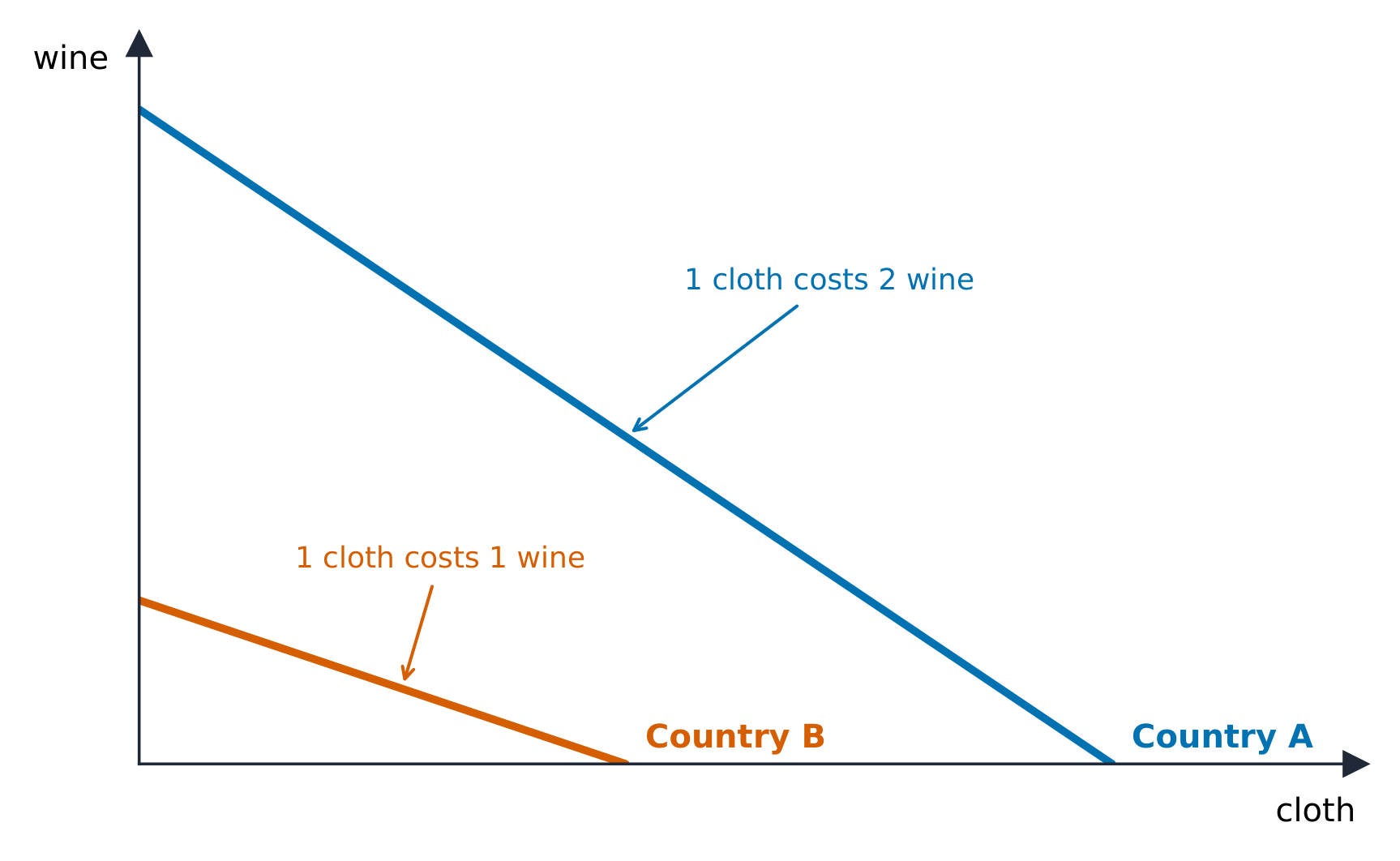
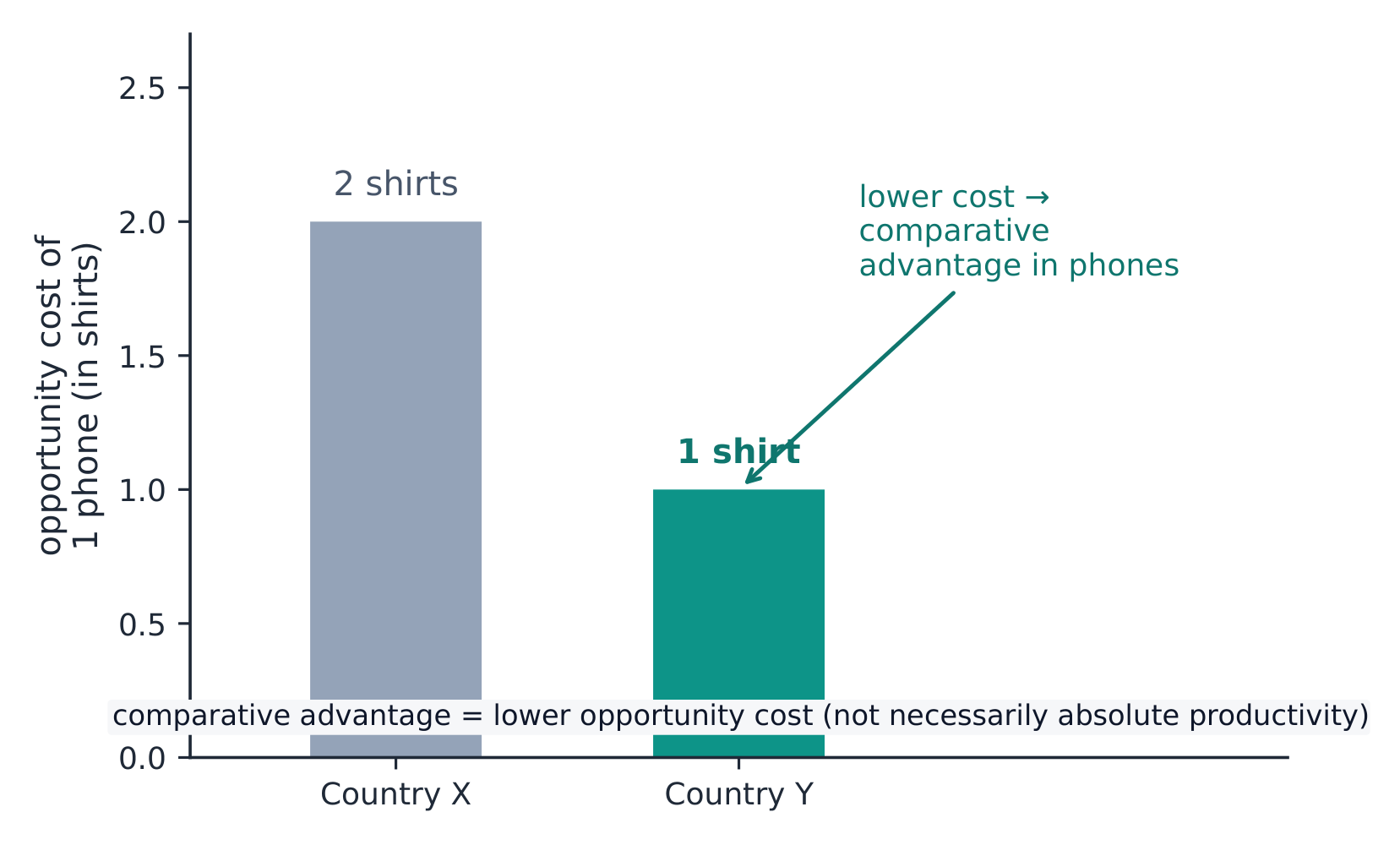
  • A producer has a comparative advantage 比较优势 if it has the lower opportunity cost for that good. Comparative advantage – not absolute – determines who should specialize.
  • Compute opportunity cost from output data: for each producer, one unit of good X costs (units of Y) $\div$ (units of X). The producer who gives up less Y should make X.
  • Both sides gain if they trade at a rate between their two opportunity costs – the terms of trade 贸易条件. Specializing by comparative advantage lets total output exceed what either could make alone, so consumption can lie outside each producer's own PPC.

Worked example. Anna can make $20$ shirts or $10$ tables a day; Ben can make $12$ shirts or $12$ tables. For Anna one table costs $\tfrac{20}{10}=2$ shirts; for Ben it costs $\tfrac{12}{12}=1$ shirt. Ben gives up fewer shirts, so Ben specializes in tables and Anna in shirts. Any terms of trade between $1$ and $2$ shirts per table – say $1.5$ – leaves both better off than producing alone.

Exam skill: these calculations appear almost every year – practice finding comparative advantage from both output tables and input tables, and stating a valid terms-of-trade range.

العربية

يمكن لكلا المنتجين الاستفادة من التجارة من خلال التخصص.

تأتِ الميزة النسبية من منحنيات إمكانيات الإنتاج ذات الميل المختلف
تأتي الميزة النسبية من منحنيات إمكانيات الإنتاج ذات الميل المختلف
  • يمتلك المنتج ميزة مطلقة في سلعة معينة إذا كان بإمكانه إنتاج كميات أكبر منها بنفس الموارد.
  • يمتلك المنتج ميزة نسبية إذا كانت لديه تكلفة بديلة أقل لتلك السلعة. الميزة النسبية -وليس المطلقة- تحدد من يجب أن يتخصص.
  • احسب التكلفة البديلة من بيانات الإنتاج: لكل منتج، وحدة واحدة من السلعة X تكلف (وحدات Y) $\div$ (وحدات X). المنتج الذي يضحي بـ Y أقل هو من يصنع X.
  • كلا الجانبين يفيدان إذا تداولوا بمعدل بين تكلفتيهما البديلتين – وهو شروط التبادل. التخصص بالميزة النسبية يسمح بإجمالي الإنتاج بتجاوز ما يمكن لأي منهما إنتاجه وحده، بحيث يمكن أن يكون الاستهلاك خارج منحنى إمكانيات الإنتاج الخاص بكل منتج.

مثال محلول. يمكن لآنا صنع $20$ قمصان أو $10$ طاولات يوميًا؛ يمكن لبن制作 $12$ قمصان أو $12$ طاولات. بالنسبة لآنا، طاولة واحدة تكلف $\tfrac{20}{10}=2$ قمصان؛ بالنسبة لبن، تكلف $\tfrac{12}{12}=1$ قمصان. يبني ضحية قمصان أقل، لذا يتخصص بن في الطاولات وآنا في القمصان. أي شروط تبادل بين $1$ و$2$ قمصان لكل طاولة – مثلاً $1.5$ – تجعل كلا الطرفين أفضل حالاً من الإنتاج الفردي.

مهارة الامتحان: تظهر هذه الحسابات تقريبًا كل عام – تدرب على إيجاد الميزة النسبية من جداول الإنتاج وجداول المدخلات، وإصدار نطاق صالح لشروط التبادل.

الميزة_pow comparative_ تذهب إلى المنتج صاحب فرصتك المنخفضة
الميزة النسبية تعود للمنتج صاحب التكلفة البديلة الأقل
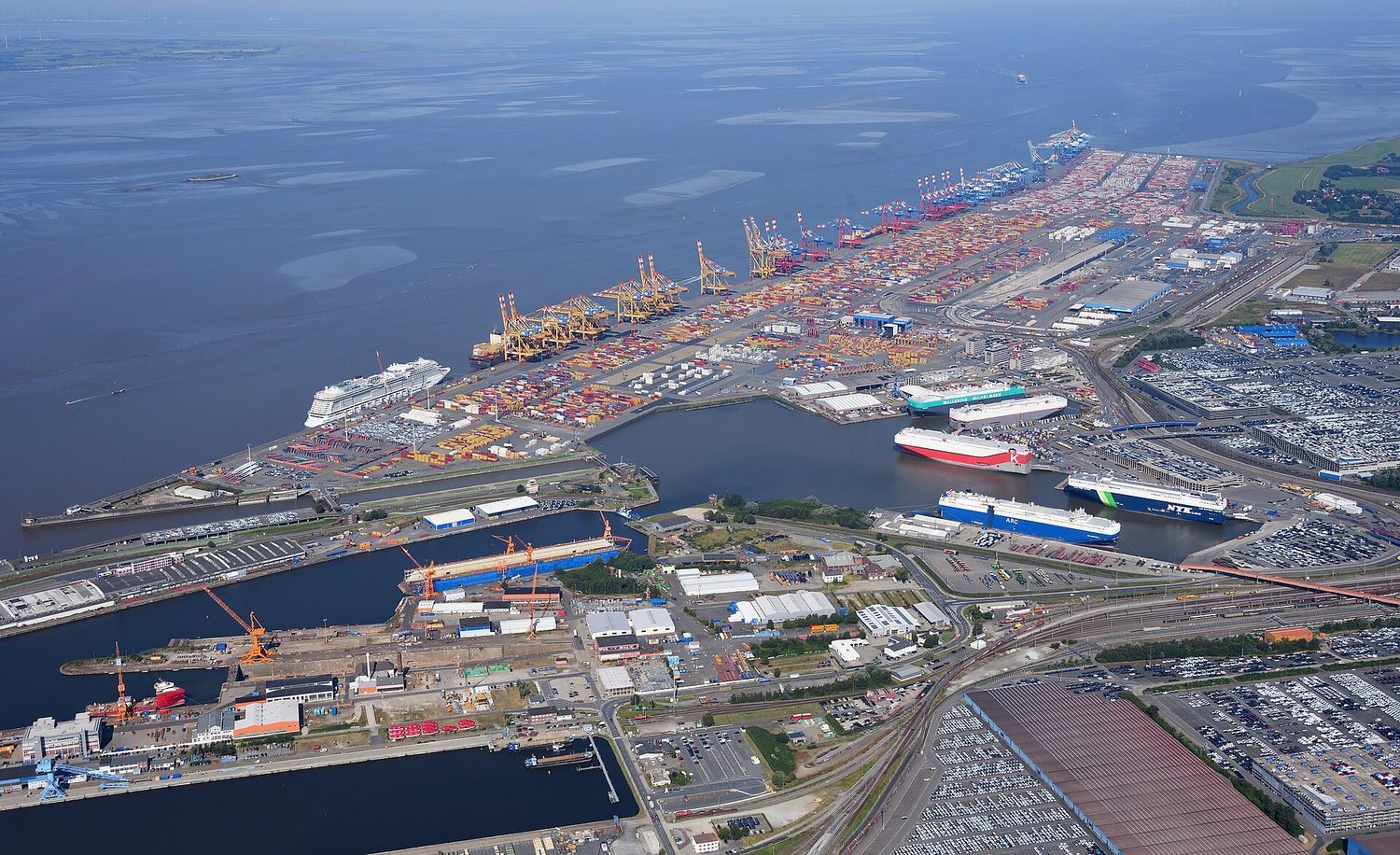
الشحن بالحاويات: الميزة النسبية والتجارة تسمح للدول بالتخصص وتحقيق المكاسب
الشحن بالحاويات: الميزة النسبية والتجارة تمكنت الدول من التخصص والربح
Explore · ⁨استكشف⁩

See why trade lets you consume beyond the frontier · ⁨رأِ لماذا يسمح لك التجارة بالاستهلاك خارج الحدود⁩

A producer should specialize where its opportunity cost is lowest, then trade for the rest. Because the terms of trade lie between the two producers' costs, trade lets a country consume outside its own production frontier. · ⁨يجب أن يتخصص المنتج في مجال تكون فيه تكلفته الفرصة البديلة أقل، ثم يتبادل باقي احتياجاته. وبما أن شروط التداول تقع بين تكاليف المنتجين، فإن التجارة تسمح للدولة بالاستهلاك خارج حدود إنتاجها الخاصة.⁩

Vocabulary · ⁨مفردات⁩ Train · ⁨تدريب⁩
English العربية
comparative advantage/kəmˈpærətɪv ədˈvæntɪdʒ/ الميزة النسبية
terms of trade/tɜːmz ɒv treɪd/ شروط التجارة
sunk cost/sʌŋk kɒst/ التكلفة الغارقة
Marginal analysis/ˈmɑːdʒɪnl əˈnæləsɪs/ التحليل الهامشي
marginal benefit/ˈmɑːdʒɪnl ˈbenɪfɪt/ الفائدة الحدية
marginal cost/ˈmɑːdʒɪnl kɒst/ التكلفة الحدية
1.5

Cost-Benefit Analysis · ⁨تحليل التكلفة والعائد⁩

Syllabus · ⁨المنهج⁩
English

Enduring Understanding (CBA-1): Rational economic decisions require the evaluation of costs and benefits.

Learning Objective CBA-1.A: a. Define opportunity cost. b. Explain the opportunity costs associated with choices. c. Calculate the opportunity costs associated with choices.

  • CBA-1.A.1 Rational agents consider opportunity costs, whether implicit or explicit, when calculating the total economic costs of any decision.
  • CBA-1.A.2 Total benefits form the metric "utility" for consumers and total revenue for firms.

Learning Objective CBA-1.B: a. Explain a decision by comparing total benefits and total costs (using a table or a graph when appropriate). b. Calculate total benefits and total costs (using a table or graph where appropriate).

  • CBA-1.B.1 Total net benefits, the difference between total benefits and total costs, are maximized at the optimal choice.
  • CBA-1.B.2 Some decisions permit rational agents to look at only marginal benefit and marginal cost. Other decisions cannot be broken down into increments in this way and must be evaluated by looking at total benefits and total costs.
العربية

الفهم الدائم (CBA-1): تتطلب القرارات الاقتصادية العقلانية تقييم التكاليف والمنافع.

هدف التعلم CBA-1.A: أ. عرّف تكلفة الفرصة البديلة. ب. اشرح تكاليف الفرصة البديلة المرتبطة بالاختيارات. ج. احسب تكاليف الفرصة البديلة المرتبطة بالاختيارات.

  • CBA-1.A.1 يأخذ الوكلاء العقلانيون في الاعتبار تكاليف الفرصة البديلة، سواء كانت ضمنية أو صريحة، عند حساب التكاليف الاقتصادية الإجمالية لأي قرار.
  • CBA-1.A.2 تشكل المنافع الإجمالية مقياس "المنفعة" للمستهلكين والإيرادات الإجمالية للشركات.

هدف التعلم CBA-1.B: أ. اشرح قراراً بمقارنة المنافع الإجمالية والتكاليف الإجمالية (باستخدام جدول أو رسم بياني عند الاقتضاء). ب. احسب المنافع الإجمالية والتكاليف الإجمالية (باستخدام جدول أو رسم بياني عند الاقتضاء).

  • CBA-1.B.1 تُعظم المنافع الصافية الإجمالية، وهي الفرق بين المنافع الإجمالية والتكاليف الإجمالية، عند الاختيار الأمثل.
  • CBA-1.B.2 بعض القرارات تسمح للوكلاء العقلانيين بالنظر فقط إلى المنفعة الحدية والتكلفة الحدية. بينما لا يمكن تقسيم قرارات أخرى إلى زيادات بهذه الطريقة ويجب تقييمها من خلال النظر إلى المنافع الإجمالية والتكاليف الإجمالية.

Source: College Board AP Course and Exam Description · ⁨المصدر: وصف دورة وامتحان College Board AP⁩

English

Rational decision-makers weigh benefits against costs. An action is worthwhile only when its benefit is at least as large as its cost – including the opportunity cost. Money already spent and unrecoverable is a sunk cost 沉没成本 and should be ignored in decisions: only future costs and benefits matter.

العربية

اتخاذ القرار العقلاني يزن العوائد مقابل التكاليف. الفعل يستحق فقط عندما تكون عائدته على الأقل مساوية لتكلفته – بما في ذلك التكلفة البديلة. الأموال التي تم إنفاقها بالفعل ولا يمكن استردادها هي تكلفة غارقة ويجب تجاهلها في القرارات: فقط التكاليف والفوائد المستقبلية هي التي تهم.

Explore · ⁨استكشف⁩

Weigh total benefit against total cost · ⁨زن الفائدة الكلية مقابل التكلفة الكلية⁩

A choice is worth it only while the benefit of one more unit beats its cost. Where total revenue meets total cost is the break-even point; past it, extra activity adds more cost than value. · ⁨لا يكون الخيار مجدياً إلا طالما أن الفائدة للوحدة الإضافية تفوق تكلفتها. حيث يلتقي الإيراد الكلي بالتكلفة الكلية يوجد نقطة التعادل؛ وما وراءها، تضيف النشاط الإضافي تكلفة أكبر من القيمة.⁩

1.6

Marginal Analysis and Consumer Choice · ⁨التحليل الحدي واختيار المستهلك⁩

Syllabus · ⁨المنهج⁩
English

Enduring Understanding (CBA-2): To determine the optimal level at which to pursue an activity whose total benefits exceed total cost, rational economic agents compare marginal benefits and marginal costs.

Learning Objective CBA-2.A: a. Define the key assumptions of consumer choice theory. b. Explain (using a table or graph as appropriate) how a rational consumer's decision making involves the use of marginal benefits and marginal costs. c. Calculate (using a table or a graph when appropriate) how a rational consumer's decision making involves the use of marginal benefits and marginal costs.

  • CBA-2.A.1 Consumers face constraints and have to make optimal decisions accounting for these constraints.
  • CBA-2.A.2 In a model of rational consumer choice, consumers are assumed to make choices so as to maximize their total utility.
  • CBA-2.A.3 Consumers experience diminishing marginal utility in the consumption of goods and services.
  • CBA-2.A.4 Consumers allocate their limited income to purchase the combination of goods that maximizes their utility by equating/comparing the marginal utility of the last dollar spent on each good.
    • Exclusion statement: Indifference curves are beyond the scope of the course and the AP Exam, but equating the ratios of marginal utility to price is within the scope.

Learning Objective CBA-2.B: a. Define marginal analysis and related terms. b. Explain a decision using marginal analysis (using a table or a graph when appropriate).

  • CBA-2.B.1 Marginal analysis involves comparing the additional benefit of increasing a given activity with the additional cost. Comparing marginal benefit (MB) with marginal cost (MC) helps individuals (firms) decide whether to increase, decrease, or maintain their consumption (production) levels.
  • CBA-2.B.2 The optimal quantity at any point in time does not depend on fixed costs (sunk costs) or fixed benefits that have already been determined by past choices.
  • CBA-2.B.3 The optimal quantity is achieved when marginal benefit is equal to marginal cost or where total benefit is maximized.
العربية

الفهم الدائم (CBA-2): لتحديد المستوى الأمثل لممارسة نشاط تتجاوز فيه المنافع الإجمالية التكاليف الإجمالية، يقارن الوكلاء العقلانيون المنافع الحدية بالتكاليف الحدية.

هدف التعلم CBA-2.A: أ. عرّف الافتراضات الأساسية لنظرية اختيار المستهلك. ب. اشرح (باستخدام جدول أو رسم بياني عند الاقتضاء) كيف تتضمن عملية اتخاذ القرار للمستهلك العقلاني استخدام المنافع الحدية والتكاليف الحدية. ج. احسب (باستخدام جدول أو رسم بياني عند الاقتضاء) كيف تتضمن عملية اتخاذ القرار للمستهلك العقلاني استخدام المنافع الحدية والتكاليف الحدية.

  • CBA-2.A.1 يواجه المستهلكون قيوداً ويتعين عليهم اتخاذ قرارات مثلى مع مراعاة هذه القيود.
  • CBA-2.A.2 في نموذج اختيار المستهلك العقلاني، يُفترض أن المستهلكين يتخذون اختيارات بهدف تعظيم منفعته الكلية.
  • CBA-2.A.3 يعاني المستهلكون من تناقص المنفعة الحدية في استهلاك السلع والخدمات.
  • CBA-2.A.4 يخصص المستهلكون دخلهم المحدد لشراء مزيج من السلع يعظم منفعته عن طريق مساواة/مقارنة المنفعة الحدية للدولار الأخير المنفق على كل سلعة.
    • عبارة الاستثناء: منحنيات التعادل خارج نطاق المنهج وامتحان AP، لكن مساواة نسب المنفعة الحدية إلى السعر ضمن النطاق.

هدف التعلم CBA-2.B: أ. عرّف التحليل الحدي والمصطلحات ذات الصلة. ب. اشرح قراراً باستخدام التحليل الحدي (باستخدام جدول أو رسم بياني عند الاقتضاء).

  • CBA-2.B.1 يتضمن التحليل الحدي مقارنة الفائدة الإضافية لزيادة نشاط معين مع التكلفة الإضافية. يساعد المقارنة بين المنفعة الحدية (MB) والتكلفة الحدية (MC) الأفراد (الشركات) على تحديد ما إذا كانوا يجب أن يزيدوا أو يقللوا أو يحافظوا على مستويات استهلاكهم (إنتاجهم).
  • CBA-2.B.2 الكمية المثلى في أي نقطة زمنية لا تعتمد على التكاليف الثابتة (التكاليف الغارقة) أو المنافع الثابتة التي تم تحديدها بالفعل من قبل الخيارات السابقة.
  • CBA-2.B.3 يتم تحقيق الكمية المثلى عندما تتساوى المنفعة الحدية مع التكلفة الحدية أو حيث تكون المنفعة الإجمالية في أعلى مستوى لها.

Source: College Board AP Course and Exam Description · ⁨المصدر: وصف دورة وامتحان College Board AP⁩

English

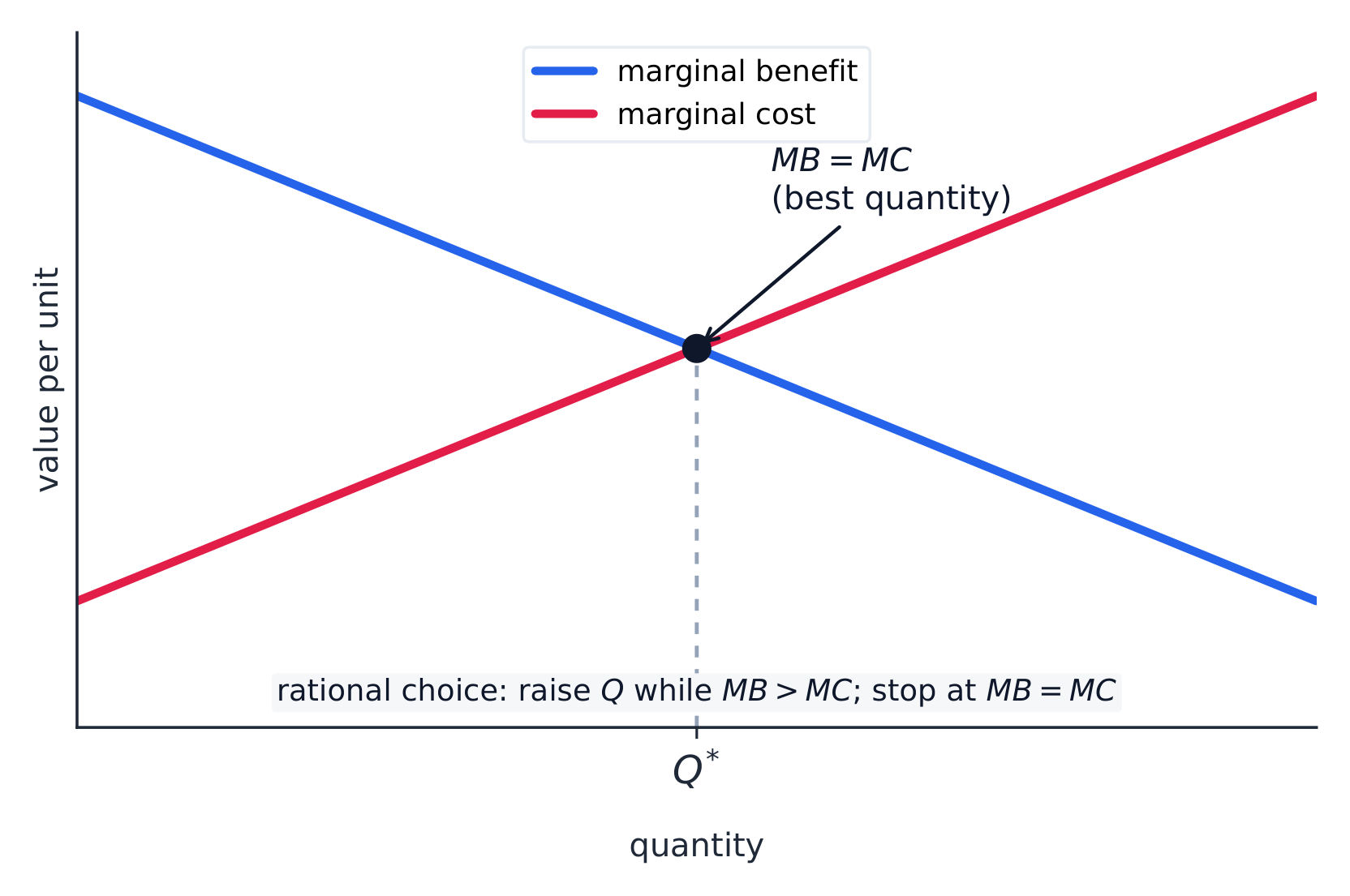
Most real decisions are not "all or nothing" but "a little more or a little less." Marginal analysis 边际分析 compares the marginal benefit 边际收益 (the benefit of one more unit) with the marginal cost 边际成本 (the cost of one more unit).

  • Decision rule: keep doing the activity while marginal benefit $>$ marginal cost; stop where MB $=$ MC. That point maximizes net benefit (total benefit minus total cost).
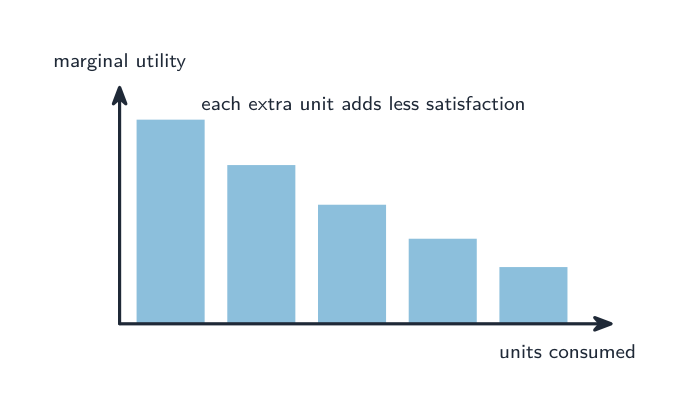
  • Consumers get utility 效用 (satisfaction) from goods, but each extra unit usually gives less added satisfaction – the law of diminishing marginal utility 边际效用递减法则.
  • A consumer maximizes total utility by the utility-maximizing rule: spend so that the marginal utility per dollar is equal across all goods, $\dfrac{MU_x}{P_x}=\dfrac{MU_y}{P_y}$, using up the whole budget. If one good gives more utility per dollar, buy more of it until the ratios equalize.

Worked example. A consumer is choosing between good X ($MU_x=20$, $P_x=\$2$) and good Y ($MU_y=15$, $P_y=\$1$). The utility per dollar is $\tfrac{20}{2}=10$ for X but $\tfrac{15}{1}=15$ for Y. Y delivers more satisfaction per dollar, so the consumer should buy more Y and less X; as they do, $MU_y$ falls and $MU_x$ rises until $\tfrac{MU_x}{2}=\tfrac{MU_y}{1}$ and the budget is spent.

Exam skill: the "MB = MC" logic and the "equal MU-per-dollar" rule are tested repeatedly – be able to find the optimal quantity from a table and explain why it is optimal.

العربية

معظم القرارات الحقيقية ليست "كل شيء أو لا شيء" بل "أكثر قليلاً أو أقل قليلاً." التحليل الحدي يقارن الفائدة الحدية (فائدة وحدة إضافية) مع التكلفة الحدية (تكلفة وحدة إضافية).

كل وحدة إضافية مستهلكة تعطي راضية إضافية أقل (تناقص الرضا الحدي)
  • قاعدة القرار: استمر في القيام بالأنشطة طالما الفائدة الحدية $>$ التكلفة الحدية؛ توقف حيث MB $=$ MC. هذه النقطة تعظم الصافي (إجمالي العائد ناقص إجمالي التكلفة).
  • يحصل المستهلكون على رضا (راضية) من السلع، لكن كل وحدة إضافية عادةً ما تعطي رضا إضافياً أقل – قانون تناقص الرضا الحدي.
  • يعظم المستهلك إجمالي الرضا عبر قاعدة تعظيم الرضا: الإنفاق بحيث يكون الرضا الحدي للدولار متساويًا عبر جميع السلع، $\dfrac{MU_x}{P_x}=\dfrac{MU_y}{P_y}$، باستنفاد الميزانية entirely. إذا أعطى سلعة ما رضا أكثر للدولار، اشترِ المزيد منها حتى تتساوى النسب.

مثال محلول. يختار المستهلك بين سلعة X ($MU_x=20$، $P_x=\$2$) and good Y ($MU_y=15$, $P_y=\$1$). الرضا للدولار هو $\tfrac{20}{2}=10$ لـ X لكن $\tfrac{15}{1}=15$ لـ Y. يقدم Y رضا أكثر للدولار، لذا يجب على المستهلك شراء المزيد من Y والأقل من X؛ أثناء فعله، ينخفض $MU_y$ ويرتفع $MU_x$ حتى $\tfrac{MU_x}{2}=\tfrac{MU_y}{1}$ وتُنفد الميزانية.

مهارة الامتحان: منطق "MB = MC" وقاعدة "تساوي RLU للدولار" يتم اختبارها مرارًا – كن قادرًا على إيجاد الكمية المثلى من جدول وشرح لماذا هي مثالية.

الاختيار العقلاني: استمر طالما أن المنفعة الحدية تتجاوز التكلفة الحدية، وتوقف عندما يتساويا
Vocabulary · ⁨مفردات⁩ Train · ⁨تدريب⁩
English العربية
utility/juːˈtɪlɪti/ أداة مساعدة
law of diminishing marginal utility/lɔː ɒv dɪˈmɪnɪʃɪŋ ˈmɑːdʒɪnl juːˈtɪlɪti/ قانون تناقص المنفعة الحدية
1.6

Exam tips · ⁨نصائح للامتحان⁩

English
  • Opportunity cost is the next-best alternative given up; ignore sunk costs in any decision.
  • Comparative advantage (lower opportunity cost) determines specialisation and the gains from trade.
  • Apply marginal analysis: keep doing an activity while MB > MC, stopping where MB = MC.
  • Maximise utility by equalising the marginal utility per dollar across goods.
  • Read opportunity cost off the PPC slope; a bowed curve shows increasing cost.
العربية
  • تكلفة الفرصة البديلة هي الخيار الأفضل التالي الذي تم التخلي عنه؛ تجاهل التكاليف الغارقة في أي قرار.
  • الميزة النسبية (انخفاض تكلفة الفرصة البديلة) تحدد التخصص والفوائد من التجارة.
  • طبق التحليل الحدي: استمر في نشاط ما طالما MB > MC، وتوقف عندما MB = MC.
  • قم بتعظيم المنفعة عن طريق مساواة المنفعة الحدية لكل دولار عبر السلع.
  • اقرأ تكلفة الفرصة البديلة من ميل منحنى فرص الإنتاج (PPC)؛ المنحنى المقعر يشير إلى تكاليف متزايدة.

Interactive lessons on this topic · ⁨دروس تفاعلية حول هذا الموضوع⁩

Work through it step by step, with instant-check exercises. · ⁨ا-working عليه خطوة بخطوة، مع تمارين تحقق فوري.⁩

Past Papers · ⁨أوراق الامتحانات السابقة⁩

More topics in AP Microeconomics · ⁨الاقتصاد الجزئي (AP)⁩ · ⁨المزيد من المواضيع في AP Microeconomics · ⁨الاقتصاد الجزئي (AP)⁩⁩

Log in or create account · ⁨تسجيل الدخول أو إنشاء حساب⁩

IGCSE, A-Level & AP