Skip to content · ⁨الانتقال إلى المحتوى⁩
Subjects · ⁨المواد⁩

AP Microeconomics · ⁨الاقتصاد الجزئي (AP)⁩

Tips

AP Microeconomics covers scarcity and opportunity cost, supply and demand, elasticity, production and costs, the four market structures, factor markets, and market failure with government intervention. It is a small syllabus studied deeply.

The graph is the answer. Most free-response marks are awarded for a correctly labelled diagram — axes named, curves labelled, the new equilibrium marked and the direction of the shift shown. A written explanation of a shift you did not draw earns very little.

Practise drawing them quickly and correctly by hand, especially the cost curves and perfect competition versus monopoly, which appear constantly.

Notes cover all six units with the cost curves and market diagrams drawn rather than described. Past FRQs with scoring guidelines are in the library. Micro's marks frequently go to showing the shift and its consequence, so the worked answers keep the graph at the centre.

  • 1

    Basic Economic Concepts · ⁨المفاهيم الاقتصادية الأساسية⁩

    Watch lesson · ⁨شاهد الدرس⁩
    1.1

    Scarcity · ⁨الندرة⁩

    Syllabus · ⁨المنهج⁩
    English

    Enduring Understanding (MKT-1): Most resources are scarce, and in most cases the use of resources involves constraints and trade-offs.

    Learning Objective MKT-1.A: Define resources and the cause(s) of their scarcity.

    • MKT-1.A.1 Economic trade-offs arise from the lack of sufficient resources (scarcity) to meet society's wants and needs.
    • MKT-1.A.2 Most factors of production (such as land, labor, and capital) are scarce, but some factors of production (such as established knowledge) may not be scarce due to their non-rival nature.
    العربية

    الفهم الدائم (MKT-1): معظم الموارد نادرة، وفي معظم الحالات يتضمن استخدام الموارد قيوداً ومفاضلات.

    هدف التعلم MKT-1.A: عرّف الموارد وسبب(أو أسباب) ندرتها.

    • MKT-1.A.1 تنشأ المفاضلات الاقتصادية من عدم كفاية الموارد (الندرة) لتلبية رغبات واحتياجات المجتمع.
    • MKT-1.A.2 معظم عوامل الإنتاج (مثل الأرض والعمل والرأس المال) نادرة، لكن بعض عوامل الإنتاج (مثل المعرفة الراسخة) قد لا تكون نادرة بسبب طبيعتها غير التنافسية.
    Source: College Board AP Course and Exam Description · ⁨المصدر: وصف دورة وامتحان College Board AP⁩

    English

    Economics 经济学 begins with one stubborn fact: people's wants are effectively unlimited, but the resources 资源 to satisfy them are limited. This gap is scarcity 稀缺性, and it is why economics exists – if everything were free and endless, there would be nothing to decide.

    The resources (the factors of production 生产要素) are land (natural resources), labor 劳动 (human effort), capital 资本 (tools, machines, buildings), and entrepreneurship 企业家才能 (organizing the other three and taking risks). Because these are scarce, every economy must answer three questions: what to produce, how to produce it, and for whom to produce.

    Scarcity forces choice, and every choice has an opportunity cost 机会成本 – the value of the next-best alternative you give up. This single idea runs through the whole course: the true cost of anything is what you sacrifice to get it, not just the money you pay.

    العربية
    سوق خارجي: تخصيص الأسواق للموارد النادرة بين الاستخدامات المتنافسة
    سوق خارجي: تخصيص الأسواق للموارد النادرة بين الاستخدامات المتنافسة

    الاقتصاد يبدأ بحقيقة ثابتة: رغبات الناس غير محدودة تقريبًا، لكن الموارد لإشباعها محدودة. هذا الفجوة هو الندرة، ولهذا يوجد الاقتصاد – لو كان كل شيء مجانيًا وغير محدود، لما كان هناك ما ليُقرَّر عليه.

    الموارد (عوامل الإنتاج) هي الأرض (الموارد الطبيعية)، العمل (الجهد البشري)، رأس المال (الأدوات، الآلات، المباني)، والريادة (تنظيم الثلاثة الأخرى وتحمل المخاطر). ونظرًا لأن هذه الموارد نادرة، يجب على كل اقتصاد الإجابة عن ثلاثة أسئلة: ماذا ننتج، كيف ننتجه، ولـمن ننتجه.

    يفرض الندرة الاختيار، ولكل اختيار تكلفة بديلة – وهي قيمة أفضل بديل تضحى به. يتكرر هذا المفهوم في كل المقرر: التكلفة الحقيقية لأي شيء هي ما تضحيه للحصول عليه، وليس فقط المال الذي تدفعه.

    Vocabulary · ⁨مفردات⁩ Train · ⁨تدريب⁩
    English العربية
    Economics/ˌiːkəˈnɒmɪks/ الاقتصاد
    resources/rɪˈzɔːsɪz/ الموارد
    scarcity/ˈskeəsɪti/ الندرة
    factors of production/ˈfæktəz ɒv prəˈdʌkʃn/ عوامل الإنتاج
    labor/ˈleɪbə/ العمل
    capital/ˈkæpɪtl/ رأس المال
    entrepreneurship/ˌɒntrɪprəˈnjʊəʃɪp/ ريادة الأعمال
    opportunity cost/ɒpəˈtjuːnɪti kɒst/ التكلفة البديلة
    1.2

    Resource Allocation and Economic Systems · ⁨تخصيص الموارد والأنظمة الاقتصادية⁩

    Syllabus · ⁨المنهج⁩
    English

    Enduring Understanding (MKT-1): Most resources are scarce, and in most cases the use of resources involves constraints and trade-offs.

    Learning Objective MKT-1.B: Define how resource allocation is influenced by the economic system adopted by society.

    • MKT-1.B.1 Resource allocation involves answering three basic questions: What goods and services to produce? How to produce those goods and services? And who consumes those goods and services?
    • MKT-1.B.2 Resource allocation is significantly influenced by the economic system adopted by society, such as command economy, market economy, or mixed economy. Each system involves a particular set of institutional arrangements and a coordinating mechanism for allocating scarce resources and distributing output.
    العربية

    الفهم الدائم (MKT-1): معظم الموارد نادرة، وفي معظم الحالات يتضمن استخدام الموارد قيوداً ومفاضلات.

    هدف التعلم MKT-1.B: عرّف كيف يؤثر النظام الاقتصادي الذي تتبنيه المجتمع على تخصيص الموارد.

    • MKT-1.B.1 يتضمن تخصيص الإجابة على ثلاث أسئلة أساسية: ما هي البضائع والخدمات التي يجب إنتاجها؟ وكيف يتم إنتاج تلك البضائع والخدمات؟ ومن يستهلك تلك البضائع والخدمات؟
    • MKT-1.B.2 تتأثر تخصيص الموارد بشكل كبير بالنظام الاقتصادي الذي تتبناه المجتمع، مثل الاقتصاد الموجه (المرتكز على التخطيط)، والاقتصاد السوقي، أو الاقتصاد المختلط. يتضمن كل نظام مجموعة معينة من الترتيبات المؤسسية وآلية تنسيق لتوزيع الموارد النادرة وتوزيع الإنتاج.

    Source: College Board AP Course and Exam Description · ⁨المصدر: وصف دورة وامتحان College Board AP⁩

    English

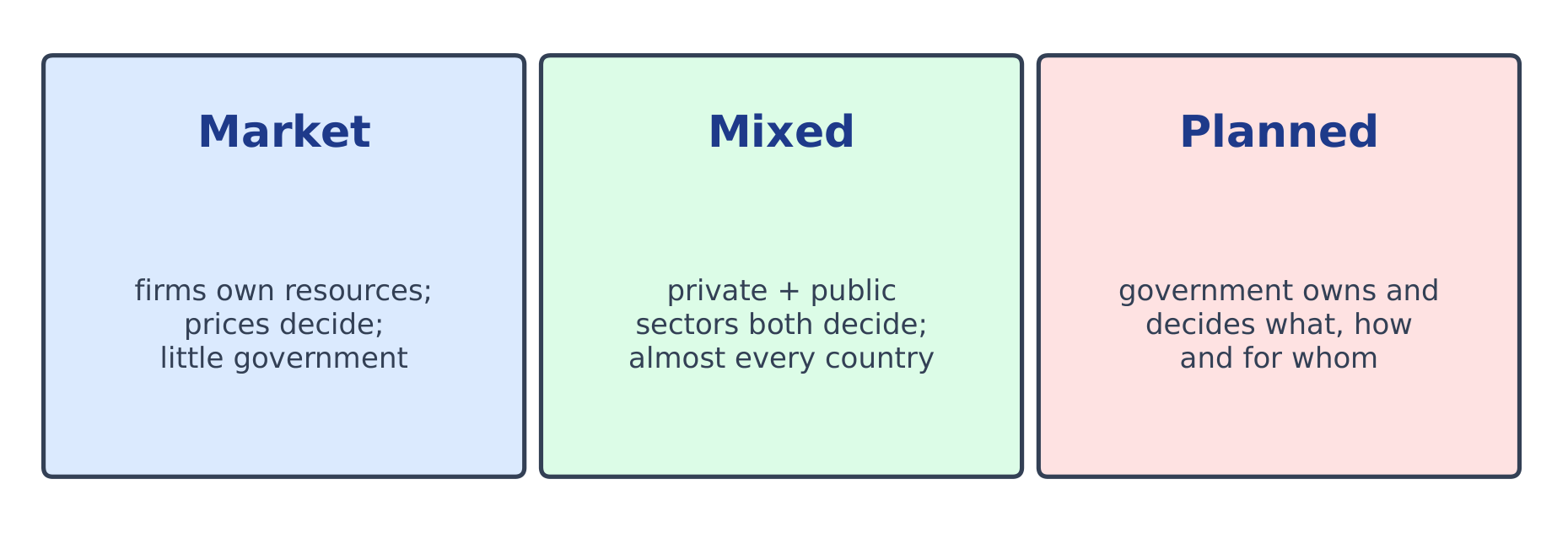
    An economic system 经济体制 is a society's way of answering the three questions.

    • In a market economy 市场经济, private buyers and sellers decide through prices; self-interest and competition coordinate them (the "invisible hand").
    • In a command economy 计划经济, the government owns resources and plans production.
    • Real economies are mixed 混合经济 – mostly markets, with government providing some goods and correcting problems.

    The key advantage of markets is that prices carry information and incentives 激励 automatically, with no central planner needed.

    العربية

    النظام الاقتصادي هو الطريقة التي تجيب بها المجتمع عن الأسئلة الثلاثة.

    أنظمة اقتصادية تشكل طيفاً من السوق الحرة إلى التخطيط الحكومي الكامل
    أنظمة اقتصادية تشكل طيفاً من السوق الحرة إلى التخطيط الحكومي الكامل
    • في الاقتصاد السوقي، يحدد المشترون والبائعون الأفراد من خلال الأسعار؛ تتناغم المصلحة الذاتية والمنافسة بينهم (ما يُسمى "اليد الخفية").
    • في اقتصاد التوجيه، تملك الحكومة الموارد وتخطط للإنتاج.
    • الاقتصادات الحقيقية هي مختلطة – يغلب عليها السوق، مع قيام الحكومة بتوفير بعض السلع وتصحيح المشكلات.

    الميزة الرئيسية للأسواق هي أن الأسعار تحمل معلومات وحوافز تلقائيًا، دون الحاجة لمخطط مركزي.

    Explore · ⁨استكشف⁩

    Explore how prices coordinate a market · ⁨استكشف كيف تنسق الأسعار السوق⁩

    In a market economy no one is in charge, yet the price finds the level where quantity supplied meets quantity demanded. Drag the demand and supply lines and watch the equilibrium price act as a signal and an incentive. · ⁨في الاقتصاد السوقي لا أحد يدير الأمر، لكن السعر يحدد المستوى الذي تتساوى فيه الكمية المعروضة والمطلوبة. اسحب خطوط الطلب والعرض وشاهد كيف يعمل سعر التوازن كـإشارة وحافز.⁩

    Vocabulary · ⁨مفردات⁩ Train · ⁨تدريب⁩
    English العربية
    economic system/ˌiːkəˈnɒmɪk ˈsɪstəm/ النظام الاقتصادي
    market economy/ˈmɑːkɪt ɪˈkɒnəmi/ اقتصاد سوقي
    command economy/kəˈmænd ɪˈkɒnəmi/ اقتصاد موجه
    mixed/mɪkst/ شغل الأجيال
    incentives/ɪnˈsentɪvz/ الحوافز
    production possibilities curve (PPC)/prəˈdʌkʃn ˌpɒsəˈbɪlɪtiz kɜːv/ منحنى إمكانيات الإنتاج (PPC)
    efficient/ɪˈfɪʃənt/ كفء
    unattainable/ʌnəˈteɪnəbl/ غير قابلة للتحقيق
    Economic growth/ˌiːkəˈnɒmɪk ɡrəʊθ/ النمو الاقتصادي
    specializing/ˈspeʃəlaɪzɪŋ/ التخصص
    absolute advantage/ˈæbsəluːt ədˈvæntɪdʒ/ الميزة المطلقة
    1.3

    The Production Possibilities Curve · ⁨منحنى إمكانيات الإنتاج⁩

    Syllabus · ⁨المنهج⁩
    English

    Enduring Understanding (MKT-1): Most resources are scarce, and in most cases the use of resources involves constraints and trade-offs.

    Learning Objective MKT-1.C: a. Define (using graphs as appropriate) the production possibilities curve (PPC) and related terms. b. Explain (using graphs as appropriate) how the production possibilities curve (PPC) illustrates opportunity costs, trade-offs, inefficiency, efficiency, and economic growth or contraction under various conditions. c. Calculate (using data from PPCs or tables as appropriate) opportunity cost.

    • MKT-1.C.1 The PPC is a model used to show the trade-offs associated with allocating resources.
    • MKT-1.C.2 The PPC can be used to illustrate the concepts of scarcity, opportunity cost, efficiency, underutilized resources, and economic growth or contraction.
    • MKT-1.C.3 The shape of the PPC depends on whether opportunity costs are constant, increasing, or decreasing.
    • MKT-1.C.4 The PPC can shift due to changes in factors of production as well as changes in productivity/technology.
    • MKT-1.C.5 Economic growth results in an outward shift of the PPC.
    العربية

    الفهم الدائم (MKT-1): معظم الموارد نادرة، وفي معظم الحالات يتضمن استخدام الموارد قيوداً ومفاضلات.

    هدف التعلم MKT-1.C: أ. عرّف (باستخدام الرسوم البيانية عند الاقتضاء) منحنى إمكانيات الإنتاج (PPC) والمصطلحات ذات الصلة. ب. اشرح (باستخدام الرسوم البيانية عند الاقتضاء) كيف يوضح منحنى إمكانيات الإنتاج (PPC) تكاليف الفرصة البديلة، والمفاضلات، وعدم الكفاءة، والكفاءة، والنمو الاقتصادي أو الانكماش تحت ظروف مختلفة. ج. حساب (باستخدام بيانات من منحنيات إمكانيات الإنتاج أو الجداول عند الحاجة) تكلفة الفرصة البديلة.

    • MKT-1.C.1 منحنى إمكانيات الإنتاج هو نموذج يُستخدم لإظهار المفاضلات المرتبطة بتخصيص الموارد.
    • MKT-1.C.2 يمكن استخدام منحنى إمكانيات الإنتاج لتوضيح مفاهيم الندرة، وتكاليف الفرصة البديلة، والكفاءة، والموارد غير المستغلة بالكامل، والنمو الاقتصادي أو الانكماش.
    • MKT-1.C.3 يعتمد شكل منحنى إمكانيات الإنتاج على ما إذا كانت تكاليف الفرصة البديلة ثابتة، أم متزايدة، أم متناقصة.
    • MKT-1.C.4 يمكن أن ينزاح منحنى إمكانيات الإنتاج نتيجة لتغيرات في عوامل الإنتاج وكذلك تغيرات في الإنتاجية/التكنولوجيا.
    • MKT-1.C.5 يؤدي النمو الاقتصادي إلى انزياح منحنى إمكانيات الإنتاج نحو الخارج.

    Source: College Board AP Course and Exam Description · ⁨المصدر: وصف دورة وامتحان College Board AP⁩

    English
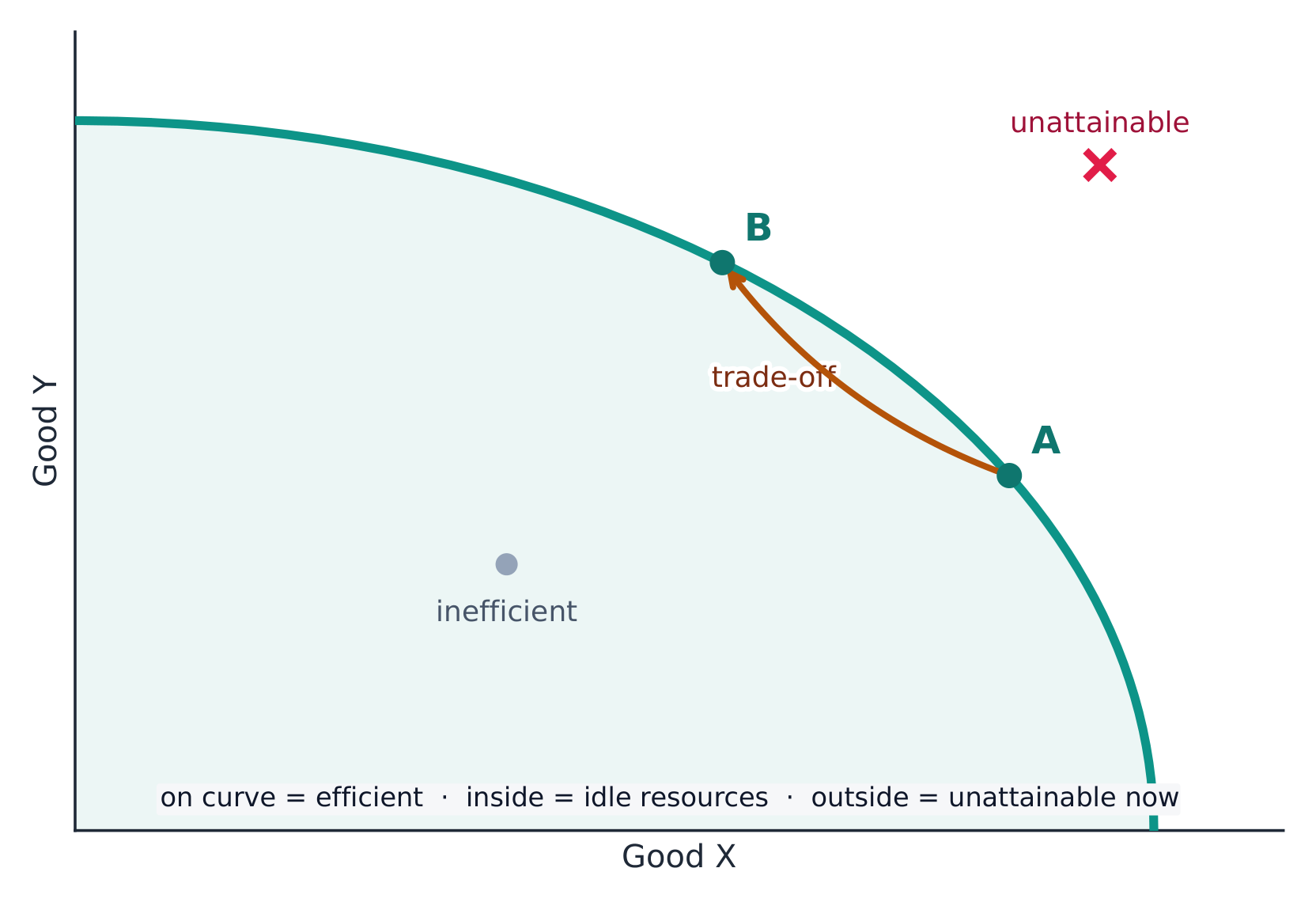
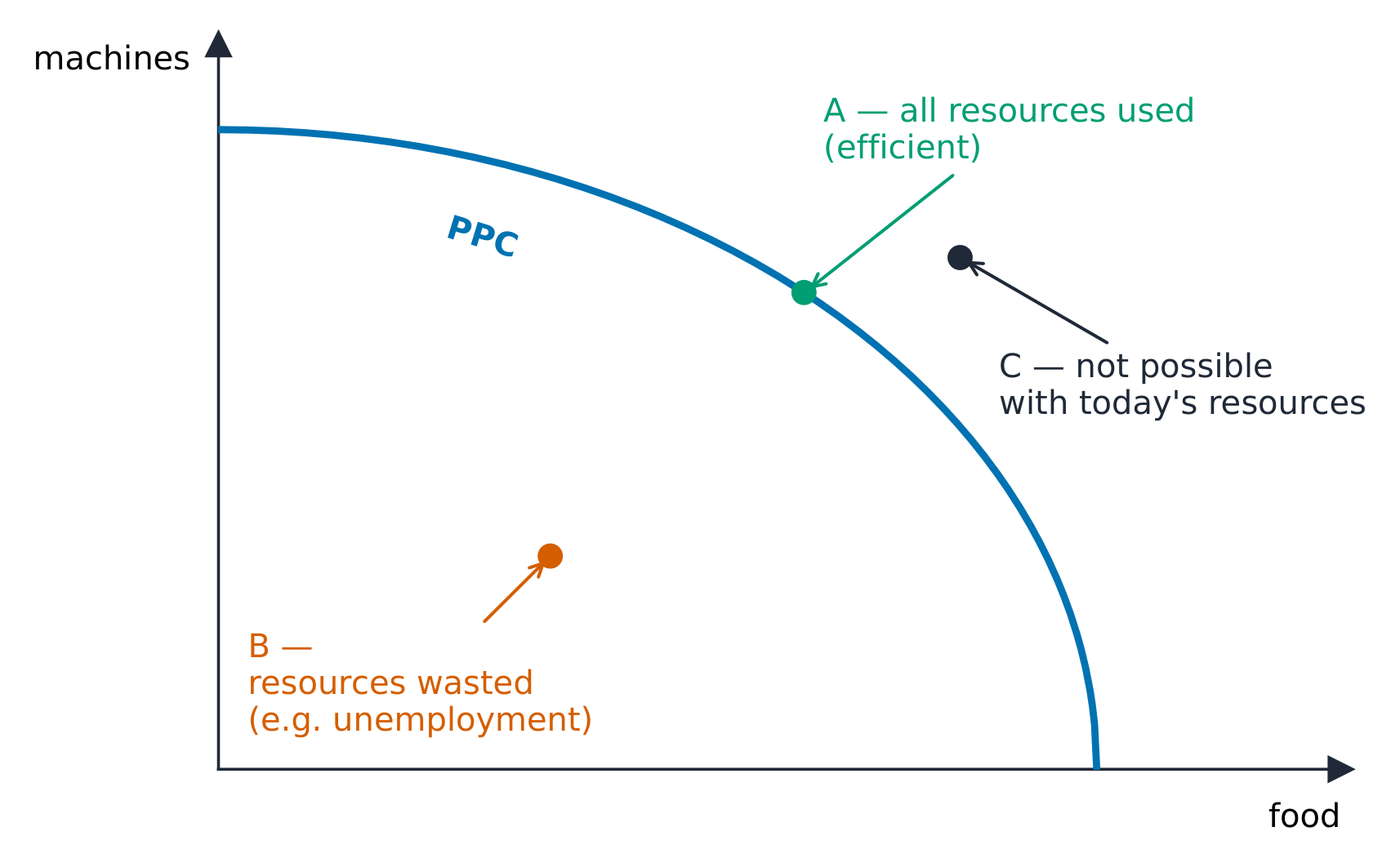
    The production possibility frontier

    The production possibilities curve (PPC) 生产可能性曲线 shows the maximum combinations of two goods an economy can produce with its resources and technology fully and efficiently used.

    • Points on the curve are efficient 有效率; points inside are inefficient (wasted or unemployed resources); points outside are currently unattainable 无法实现.
    • The PPC's downward slope shows opportunity cost: making more of one good means making less of the other. The slope at a point is the opportunity cost of the good on the horizontal axis.
    • A bowed-out (concave) PPC shows increasing opportunity cost – resources are not equally suited to both goods, so making more of one costs ever more of the other. A straight-line PPC means constant opportunity cost.
    • Economic growth 经济增长 (more resources, better technology) shifts the whole curve outward.

    Exam skill: be ready to read opportunity cost off a PPC, decide if a point is efficient/inefficient/unattainable, and explain what shifts the curve.

    العربية
    frontier الإمكانيات الإنتاجية

    منحنى إمكانيات الإنتاج (PPC) يوضح الحد الأقصى للمزيجين من سلعتين يمكن لاقتصاد إنتاجهما باستخدام موارد تكنولوجيا كاملة وكفاءة.

    نقاط على أو داخل أو خارج منحنى إمكانيات الإنتاج
    نقاط على أو داخل أو خارج منحنى إمكانيات الإنتاج
    • النقاط على المنحنى كفء؛ النقاط داخله غير كفءة (موارد مهدرة أو بطالة)؛ النقاط خارجه غير قابلة للتحقيق حاليًا.
    • ميل منحنى PPC إلى الأسفل يشير إلى تكلفة بديلة: زيادة إنتاج سلعة واحدة تعني تقليل إنتاج الأخرى. الميل عند نقطة ما هو تكلفة البديل السلعة الموجودة على المحور الأفقي.
    • منحنى PPC المنحني للخارج (المقعر) يشير إلى تزايد التكلفة البديلة – الموارد ليست متساوية الكفاءة لإنتاج كلا السلعتين، لذا فإن زيادة إنتاج أحدهما تكلف increasingly المزيد من الآخر. منحنى PPC المستقيم يعني تكلفة بديلة ثابتة.
    • النمو الاقتصادي (زيادة الموارد، تحسين التكنولوجيا) يحرك المنحنى بأكمله إلى الخارج.

    مهارة الامتحان: كن مستعدًا لقراءة التكلفة البديلة من منحنى PPC، وتحديد ما إذا كانت النقطة كفاءة/عدم كفاءة/غير قابلة للتحقيق، وشرح ما يحرك المنحنى.

    منحنى إمكانيات الإنتاج: نقاط كفاءة، عدم كفاءة، وغير قابلة للتحقيق
    منحنى إمكانيات الإنتاج: نقاط كفاءة، عدم كفاءة، وغير قابلة للتحقيق
    Explore · ⁨استكشف⁩

    Explore the production possibilities curve · ⁨استكشف منحنى إمكانيات الإنتاج⁩

    Making more of one good means giving up some of the other — that trade-off is the opportunity cost, and the bowed shape shows the law of increasing opportunity cost. Drag along the curve, then grow the economy to push the whole frontier out. · ⁨إنتاج المزيد من سلعة واحدة يعني التخلي عن جزء من الأخرى — هذا التنازل هو تكلفة الفرصة البديلة، ويشير الشكل المقوس إلى قانون زيادة تكلفة الفرصة البديلة. اسحب المنحنى ثم توسيع الاقتصاد لدفع الحدود بالكامل للخارج.⁩

    1.4

    Comparative Advantage and Gains from Trade · ⁨الميزة النسبية والمكاسب من التجارة⁩

    Syllabus · ⁨المنهج⁩
    English

    Enduring Understanding (MKT-2): The consequences of scarcity can be mitigated through specialization in production and by exchange.

    Learning Objective MKT-2.A: a. Define absolute advantage and comparative advantage. b. Determine (using data from PPCs or tables as appropriate) absolute and comparative advantage.

    • MKT-2.A.1 Absolute advantage describes a situation in which an individual, business, or country can produce more of a good or service than any other producer with the same quantity of resources.
    • MKT-2.A.2 Comparative advantage describes a situation in which an individual, business, or country can produce a good or service at a lower opportunity cost than another producer.

    Learning Objective MKT-2.B: a. Explain (using data from PPCs or tables as appropriate) how specialization according to comparative advantage with appropriate terms of trade can lead to gains from trade. b. Calculate (using data from PPCs or tables as appropriate) mutually beneficial terms of trade.

    • MKT-2.B.1 Production specialization according to comparative advantage, not absolute advantage, results in exchange opportunities that lead to consumption possibilities beyond the PPC.
    • MKT-2.B.2 Comparative advantage and opportunity costs determine the terms of trade for exchange under which mutually beneficial trade can occur.
    العربية

    الفهم الدائم (MKT-2): يمكن التخفيف من آثار الندرة من خلال التخصص في الإنتاج والتبادل.

    هدف التعلم MKT-2.A: أ. تعريف الميزة المطلقة والميزة النسبية. ب. تحديد (باستخدام بيانات من منحنيات إمكانيات الإنتاج أو الجداول عند الحاجة) الميزة المطلقة والنسبية.

    • MKT-2.A.1 الميزة المطلقة تصف الحالة التي يمكن فيها للفرد أو الشركة أو البلد إنتاج كمية أكبر من سلعة أو خدمة مقارنة بأي منتج آخر باستخدام نفس الكمية من الموارد.
    • MKT-2.A.2 الميزة النسبية تصف الحالة التي يمكن فيها للفرد أو الشركة أو البلد إنتاج سلعة أو خدمة بتكلفة فرصة بديلة أقل من منتج آخر.

    هدف التعلم MKT-2.B: أ. شرح (باستخدام بيانات من منحنيات إمكانيات الإنتاج أو الجداول عند الحاجة) كيف يمكن أن يؤدي التخصص وفقاً للميزة النسبية مع شروط تجارة مناسبة إلى تحقيق فوائد من التجارة. ب. حساب (باستخدام بيانات من منحنيات إمكانيات الإنتاج أو الجداول عند الحاجة) شروط تجارة مفيدة للطرفين.

    • MKT-2.B.1 يؤدي التخصص في الإنتاج وفقاً للميزة النسبية، وليس الميزة المطلقة، إلى فرص تبادل تؤدي إلى إمكانية استهلاك تتجاوز منحنى إمكانيات الإنتاج.
    • MKT-2.B.2 تحدد الميزة النسبية وتكاليف الفرصة البديلة شروط التبادل التي يمكن بموجبها حدوث تجارة مفيدة للطرفين.

    Source: College Board AP Course and Exam Description · ⁨المصدر: وصف دورة وامتحان College Board AP⁩

    English

    Two producers can both gain from trade by specializing 专业化.

    • A producer has an absolute advantage 绝对优势 in a good if it can make more of it with the same resources.
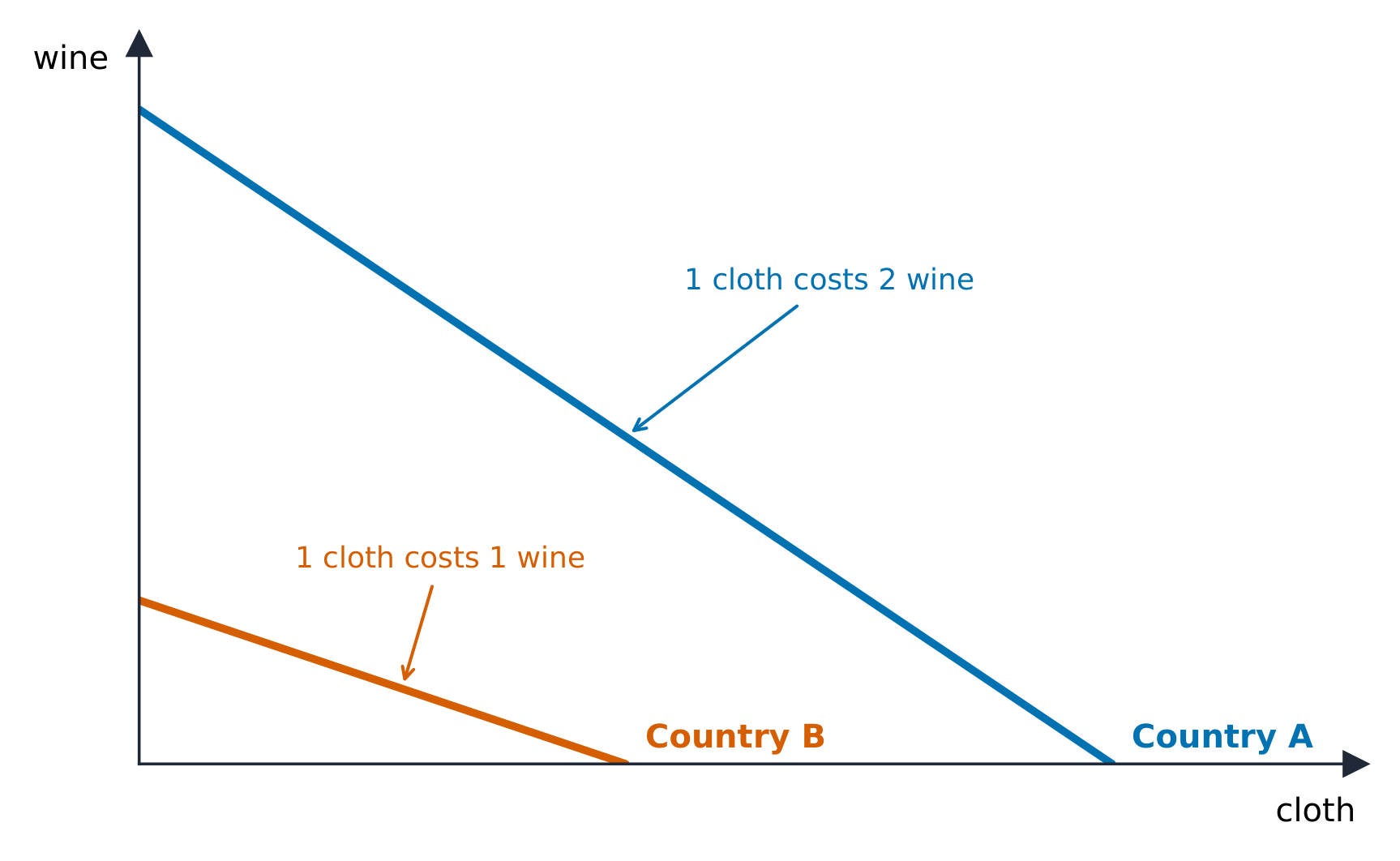
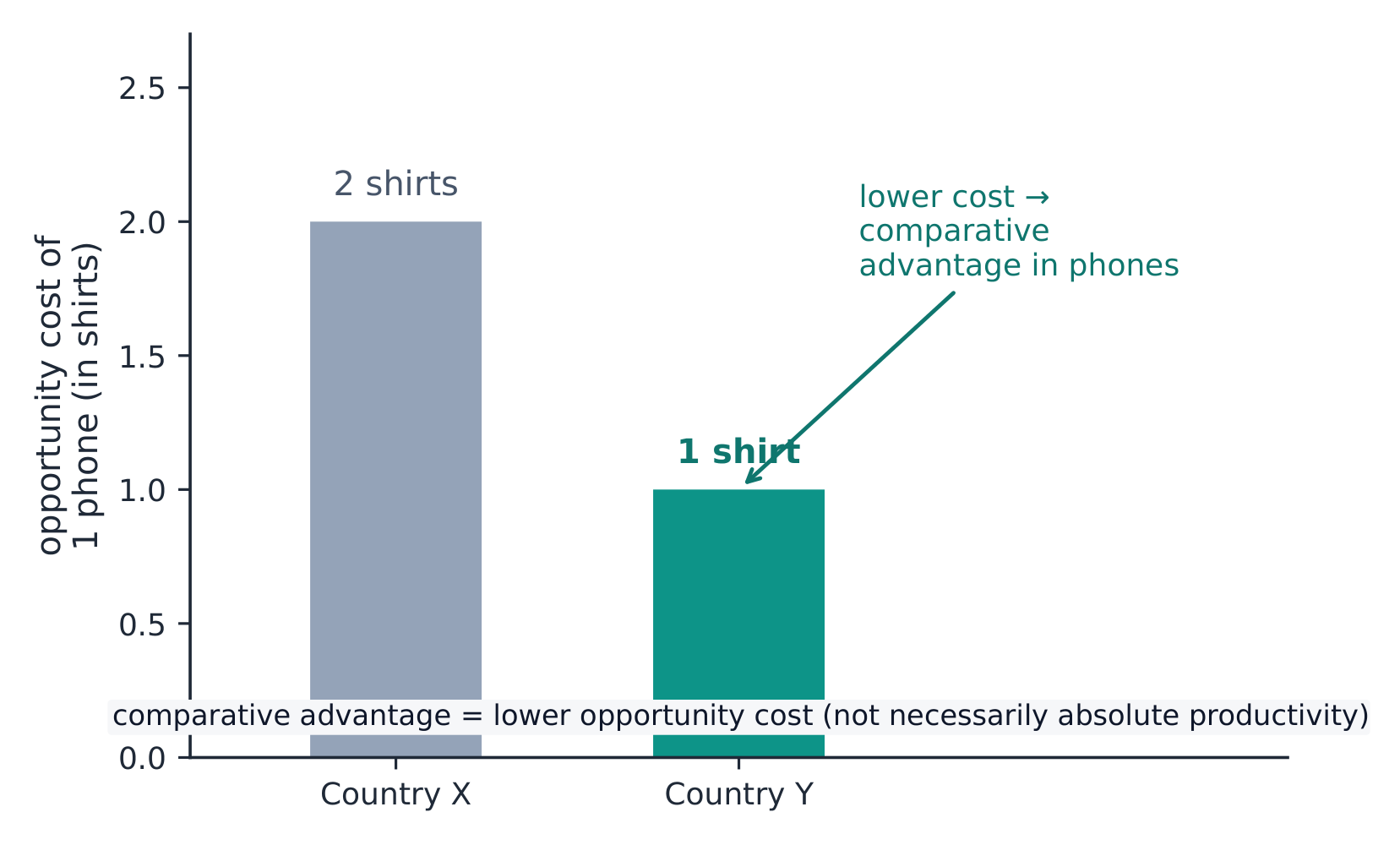
    • A producer has a comparative advantage 比较优势 if it has the lower opportunity cost for that good. Comparative advantage – not absolute – determines who should specialize.
    • Compute opportunity cost from output data: for each producer, one unit of good X costs (units of Y) $\div$ (units of X). The producer who gives up less Y should make X.
    • Both sides gain if they trade at a rate between their two opportunity costs – the terms of trade 贸易条件. Specializing by comparative advantage lets total output exceed what either could make alone, so consumption can lie outside each producer's own PPC.

    Worked example. Anna can make $20$ shirts or $10$ tables a day; Ben can make $12$ shirts or $12$ tables. For Anna one table costs $\tfrac{20}{10}=2$ shirts; for Ben it costs $\tfrac{12}{12}=1$ shirt. Ben gives up fewer shirts, so Ben specializes in tables and Anna in shirts. Any terms of trade between $1$ and $2$ shirts per table – say $1.5$ – leaves both better off than producing alone.

    Exam skill: these calculations appear almost every year – practice finding comparative advantage from both output tables and input tables, and stating a valid terms-of-trade range.

    العربية

    يمكن لكلا المنتجين الاستفادة من التجارة من خلال التخصص.

    تأتِ الميزة النسبية من منحنيات إمكانيات الإنتاج ذات الميل المختلف
    تأتي الميزة النسبية من منحنيات إمكانيات الإنتاج ذات الميل المختلف
    • يمتلك المنتج ميزة مطلقة في سلعة معينة إذا كان بإمكانه إنتاج كميات أكبر منها بنفس الموارد.
    • يمتلك المنتج ميزة نسبية إذا كانت لديه تكلفة بديلة أقل لتلك السلعة. الميزة النسبية -وليس المطلقة- تحدد من يجب أن يتخصص.
    • احسب التكلفة البديلة من بيانات الإنتاج: لكل منتج، وحدة واحدة من السلعة X تكلف (وحدات Y) $\div$ (وحدات X). المنتج الذي يضحي بـ Y أقل هو من يصنع X.
    • كلا الجانبين يفيدان إذا تداولوا بمعدل بين تكلفتيهما البديلتين – وهو شروط التبادل. التخصص بالميزة النسبية يسمح بإجمالي الإنتاج بتجاوز ما يمكن لأي منهما إنتاجه وحده، بحيث يمكن أن يكون الاستهلاك خارج منحنى إمكانيات الإنتاج الخاص بكل منتج.

    مثال محلول. يمكن لآنا صنع $20$ قمصان أو $10$ طاولات يوميًا؛ يمكن لبن制作 $12$ قمصان أو $12$ طاولات. بالنسبة لآنا، طاولة واحدة تكلف $\tfrac{20}{10}=2$ قمصان؛ بالنسبة لبن، تكلف $\tfrac{12}{12}=1$ قمصان. يبني ضحية قمصان أقل، لذا يتخصص بن في الطاولات وآنا في القمصان. أي شروط تبادل بين $1$ و$2$ قمصان لكل طاولة – مثلاً $1.5$ – تجعل كلا الطرفين أفضل حالاً من الإنتاج الفردي.

    مهارة الامتحان: تظهر هذه الحسابات تقريبًا كل عام – تدرب على إيجاد الميزة النسبية من جداول الإنتاج وجداول المدخلات، وإصدار نطاق صالح لشروط التبادل.

    الميزة_pow comparative_ تذهب إلى المنتج صاحب فرصتك المنخفضة
    الميزة النسبية تعود للمنتج صاحب التكلفة البديلة الأقل
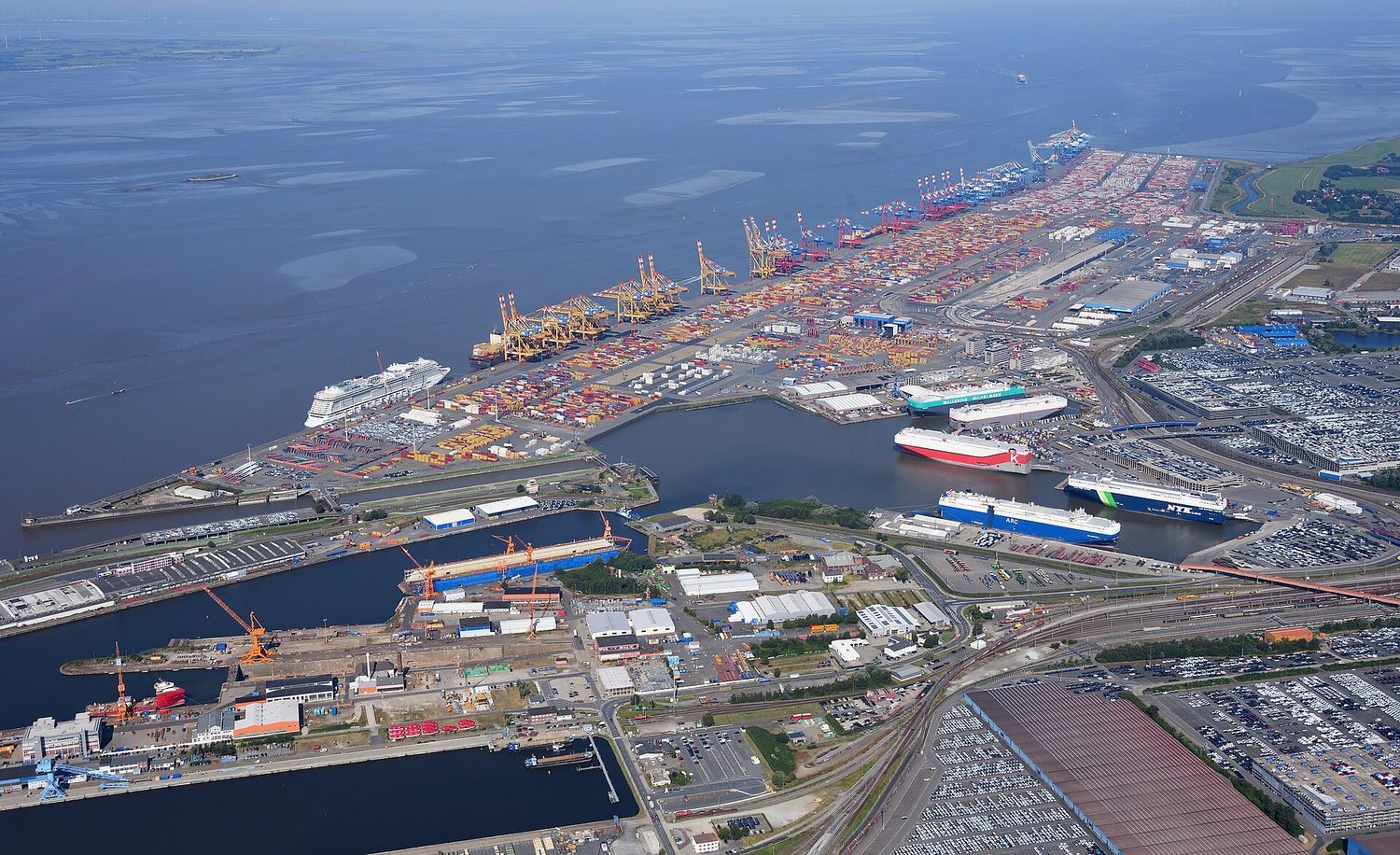
    الشحن بالحاويات: الميزة النسبية والتجارة تسمح للدول بالتخصص وتحقيق المكاسب
    الشحن بالحاويات: الميزة النسبية والتجارة تمكنت الدول من التخصص والربح
    Explore · ⁨استكشف⁩

    See why trade lets you consume beyond the frontier · ⁨رأِ لماذا يسمح لك التجارة بالاستهلاك خارج الحدود⁩

    A producer should specialize where its opportunity cost is lowest, then trade for the rest. Because the terms of trade lie between the two producers' costs, trade lets a country consume outside its own production frontier. · ⁨يجب أن يتخصص المنتج في مجال تكون فيه تكلفته الفرصة البديلة أقل، ثم يتبادل باقي احتياجاته. وبما أن شروط التداول تقع بين تكاليف المنتجين، فإن التجارة تسمح للدولة بالاستهلاك خارج حدود إنتاجها الخاصة.⁩

    Vocabulary · ⁨مفردات⁩ Train · ⁨تدريب⁩
    English العربية
    comparative advantage/kəmˈpærətɪv ədˈvæntɪdʒ/ الميزة النسبية
    terms of trade/tɜːmz ɒv treɪd/ شروط التجارة
    sunk cost/sʌŋk kɒst/ التكلفة الغارقة
    Marginal analysis/ˈmɑːdʒɪnl əˈnæləsɪs/ التحليل الهامشي
    marginal benefit/ˈmɑːdʒɪnl ˈbenɪfɪt/ الفائدة الحدية
    marginal cost/ˈmɑːdʒɪnl kɒst/ التكلفة الحدية
    1.5

    Cost-Benefit Analysis · ⁨تحليل التكلفة والعائد⁩

    Syllabus · ⁨المنهج⁩
    English

    Enduring Understanding (CBA-1): Rational economic decisions require the evaluation of costs and benefits.

    Learning Objective CBA-1.A: a. Define opportunity cost. b. Explain the opportunity costs associated with choices. c. Calculate the opportunity costs associated with choices.

    • CBA-1.A.1 Rational agents consider opportunity costs, whether implicit or explicit, when calculating the total economic costs of any decision.
    • CBA-1.A.2 Total benefits form the metric "utility" for consumers and total revenue for firms.

    Learning Objective CBA-1.B: a. Explain a decision by comparing total benefits and total costs (using a table or a graph when appropriate). b. Calculate total benefits and total costs (using a table or graph where appropriate).

    • CBA-1.B.1 Total net benefits, the difference between total benefits and total costs, are maximized at the optimal choice.
    • CBA-1.B.2 Some decisions permit rational agents to look at only marginal benefit and marginal cost. Other decisions cannot be broken down into increments in this way and must be evaluated by looking at total benefits and total costs.
    العربية

    الفهم الدائم (CBA-1): تتطلب القرارات الاقتصادية العقلانية تقييم التكاليف والمنافع.

    هدف التعلم CBA-1.A: أ. عرّف تكلفة الفرصة البديلة. ب. اشرح تكاليف الفرصة البديلة المرتبطة بالاختيارات. ج. احسب تكاليف الفرصة البديلة المرتبطة بالاختيارات.

    • CBA-1.A.1 يأخذ الوكلاء العقلانيون في الاعتبار تكاليف الفرصة البديلة، سواء كانت ضمنية أو صريحة، عند حساب التكاليف الاقتصادية الإجمالية لأي قرار.
    • CBA-1.A.2 تشكل المنافع الإجمالية مقياس "المنفعة" للمستهلكين والإيرادات الإجمالية للشركات.

    هدف التعلم CBA-1.B: أ. اشرح قراراً بمقارنة المنافع الإجمالية والتكاليف الإجمالية (باستخدام جدول أو رسم بياني عند الاقتضاء). ب. احسب المنافع الإجمالية والتكاليف الإجمالية (باستخدام جدول أو رسم بياني عند الاقتضاء).

    • CBA-1.B.1 تُعظم المنافع الصافية الإجمالية، وهي الفرق بين المنافع الإجمالية والتكاليف الإجمالية، عند الاختيار الأمثل.
    • CBA-1.B.2 بعض القرارات تسمح للوكلاء العقلانيين بالنظر فقط إلى المنفعة الحدية والتكلفة الحدية. بينما لا يمكن تقسيم قرارات أخرى إلى زيادات بهذه الطريقة ويجب تقييمها من خلال النظر إلى المنافع الإجمالية والتكاليف الإجمالية.

    Source: College Board AP Course and Exam Description · ⁨المصدر: وصف دورة وامتحان College Board AP⁩

    English

    Rational decision-makers weigh benefits against costs. An action is worthwhile only when its benefit is at least as large as its cost – including the opportunity cost. Money already spent and unrecoverable is a sunk cost 沉没成本 and should be ignored in decisions: only future costs and benefits matter.

    العربية

    اتخاذ القرار العقلاني يزن العوائد مقابل التكاليف. الفعل يستحق فقط عندما تكون عائدته على الأقل مساوية لتكلفته – بما في ذلك التكلفة البديلة. الأموال التي تم إنفاقها بالفعل ولا يمكن استردادها هي تكلفة غارقة ويجب تجاهلها في القرارات: فقط التكاليف والفوائد المستقبلية هي التي تهم.

    Explore · ⁨استكشف⁩

    Weigh total benefit against total cost · ⁨زن الفائدة الكلية مقابل التكلفة الكلية⁩

    A choice is worth it only while the benefit of one more unit beats its cost. Where total revenue meets total cost is the break-even point; past it, extra activity adds more cost than value. · ⁨لا يكون الخيار مجدياً إلا طالما أن الفائدة للوحدة الإضافية تفوق تكلفتها. حيث يلتقي الإيراد الكلي بالتكلفة الكلية يوجد نقطة التعادل؛ وما وراءها، تضيف النشاط الإضافي تكلفة أكبر من القيمة.⁩

    1.6

    Marginal Analysis and Consumer Choice · ⁨التحليل الحدي واختيار المستهلك⁩

    Syllabus · ⁨المنهج⁩
    English

    Enduring Understanding (CBA-2): To determine the optimal level at which to pursue an activity whose total benefits exceed total cost, rational economic agents compare marginal benefits and marginal costs.

    Learning Objective CBA-2.A: a. Define the key assumptions of consumer choice theory. b. Explain (using a table or graph as appropriate) how a rational consumer's decision making involves the use of marginal benefits and marginal costs. c. Calculate (using a table or a graph when appropriate) how a rational consumer's decision making involves the use of marginal benefits and marginal costs.

    • CBA-2.A.1 Consumers face constraints and have to make optimal decisions accounting for these constraints.
    • CBA-2.A.2 In a model of rational consumer choice, consumers are assumed to make choices so as to maximize their total utility.
    • CBA-2.A.3 Consumers experience diminishing marginal utility in the consumption of goods and services.
    • CBA-2.A.4 Consumers allocate their limited income to purchase the combination of goods that maximizes their utility by equating/comparing the marginal utility of the last dollar spent on each good.
      • Exclusion statement: Indifference curves are beyond the scope of the course and the AP Exam, but equating the ratios of marginal utility to price is within the scope.

    Learning Objective CBA-2.B: a. Define marginal analysis and related terms. b. Explain a decision using marginal analysis (using a table or a graph when appropriate).

    • CBA-2.B.1 Marginal analysis involves comparing the additional benefit of increasing a given activity with the additional cost. Comparing marginal benefit (MB) with marginal cost (MC) helps individuals (firms) decide whether to increase, decrease, or maintain their consumption (production) levels.
    • CBA-2.B.2 The optimal quantity at any point in time does not depend on fixed costs (sunk costs) or fixed benefits that have already been determined by past choices.
    • CBA-2.B.3 The optimal quantity is achieved when marginal benefit is equal to marginal cost or where total benefit is maximized.
    العربية

    الفهم الدائم (CBA-2): لتحديد المستوى الأمثل لممارسة نشاط تتجاوز فيه المنافع الإجمالية التكاليف الإجمالية، يقارن الوكلاء العقلانيون المنافع الحدية بالتكاليف الحدية.

    هدف التعلم CBA-2.A: أ. عرّف الافتراضات الأساسية لنظرية اختيار المستهلك. ب. اشرح (باستخدام جدول أو رسم بياني عند الاقتضاء) كيف تتضمن عملية اتخاذ القرار للمستهلك العقلاني استخدام المنافع الحدية والتكاليف الحدية. ج. احسب (باستخدام جدول أو رسم بياني عند الاقتضاء) كيف تتضمن عملية اتخاذ القرار للمستهلك العقلاني استخدام المنافع الحدية والتكاليف الحدية.

    • CBA-2.A.1 يواجه المستهلكون قيوداً ويتعين عليهم اتخاذ قرارات مثلى مع مراعاة هذه القيود.
    • CBA-2.A.2 في نموذج اختيار المستهلك العقلاني، يُفترض أن المستهلكين يتخذون اختيارات بهدف تعظيم منفعته الكلية.
    • CBA-2.A.3 يعاني المستهلكون من تناقص المنفعة الحدية في استهلاك السلع والخدمات.
    • CBA-2.A.4 يخصص المستهلكون دخلهم المحدد لشراء مزيج من السلع يعظم منفعته عن طريق مساواة/مقارنة المنفعة الحدية للدولار الأخير المنفق على كل سلعة.
      • عبارة الاستثناء: منحنيات التعادل خارج نطاق المنهج وامتحان AP، لكن مساواة نسب المنفعة الحدية إلى السعر ضمن النطاق.

    هدف التعلم CBA-2.B: أ. عرّف التحليل الحدي والمصطلحات ذات الصلة. ب. اشرح قراراً باستخدام التحليل الحدي (باستخدام جدول أو رسم بياني عند الاقتضاء).

    • CBA-2.B.1 يتضمن التحليل الحدي مقارنة الفائدة الإضافية لزيادة نشاط معين مع التكلفة الإضافية. يساعد المقارنة بين المنفعة الحدية (MB) والتكلفة الحدية (MC) الأفراد (الشركات) على تحديد ما إذا كانوا يجب أن يزيدوا أو يقللوا أو يحافظوا على مستويات استهلاكهم (إنتاجهم).
    • CBA-2.B.2 الكمية المثلى في أي نقطة زمنية لا تعتمد على التكاليف الثابتة (التكاليف الغارقة) أو المنافع الثابتة التي تم تحديدها بالفعل من قبل الخيارات السابقة.
    • CBA-2.B.3 يتم تحقيق الكمية المثلى عندما تتساوى المنفعة الحدية مع التكلفة الحدية أو حيث تكون المنفعة الإجمالية في أعلى مستوى لها.

    Source: College Board AP Course and Exam Description · ⁨المصدر: وصف دورة وامتحان College Board AP⁩

    English

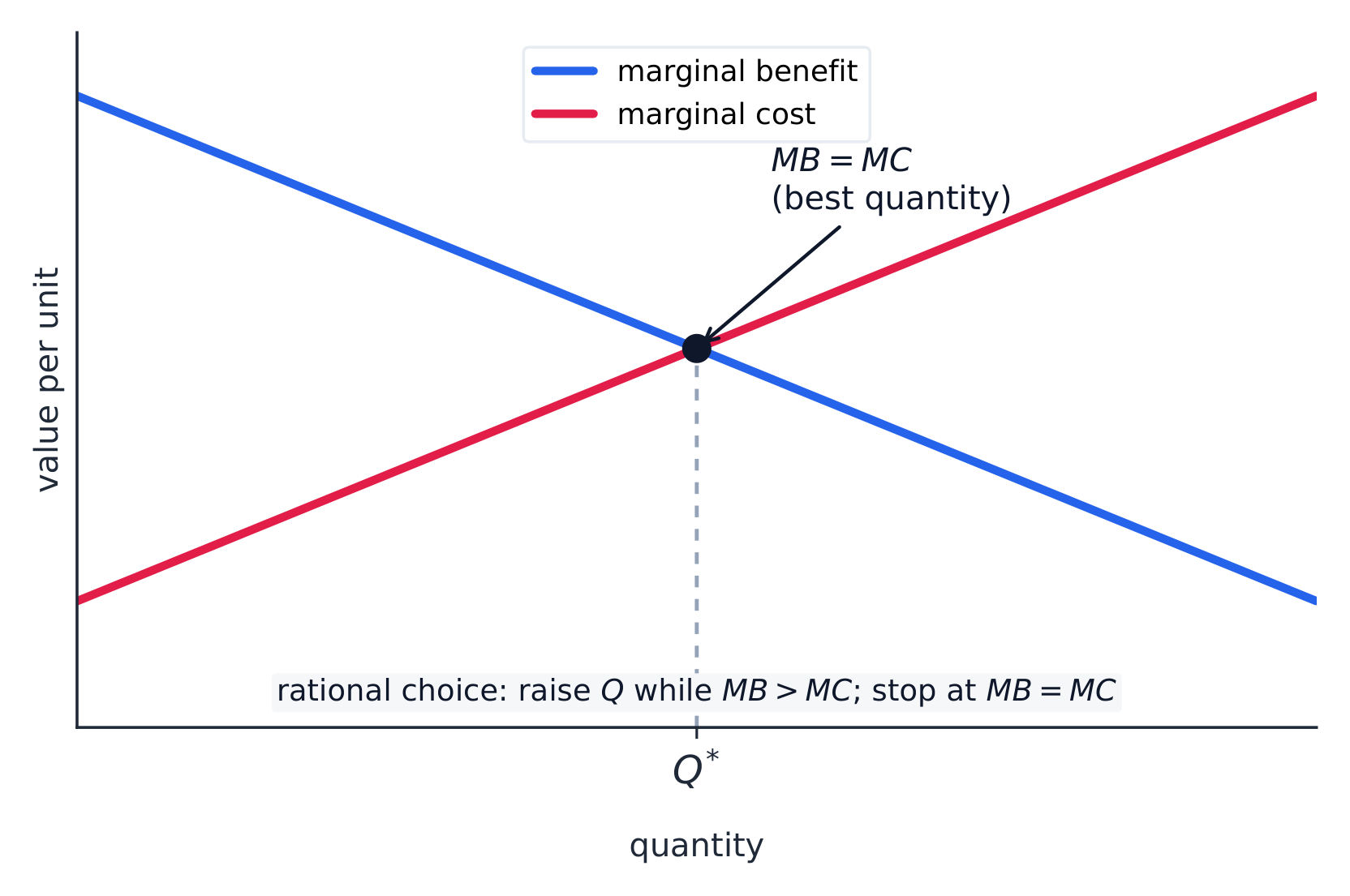
    Most real decisions are not "all or nothing" but "a little more or a little less." Marginal analysis 边际分析 compares the marginal benefit 边际收益 (the benefit of one more unit) with the marginal cost 边际成本 (the cost of one more unit).

    • Decision rule: keep doing the activity while marginal benefit $>$ marginal cost; stop where MB $=$ MC. That point maximizes net benefit (total benefit minus total cost).
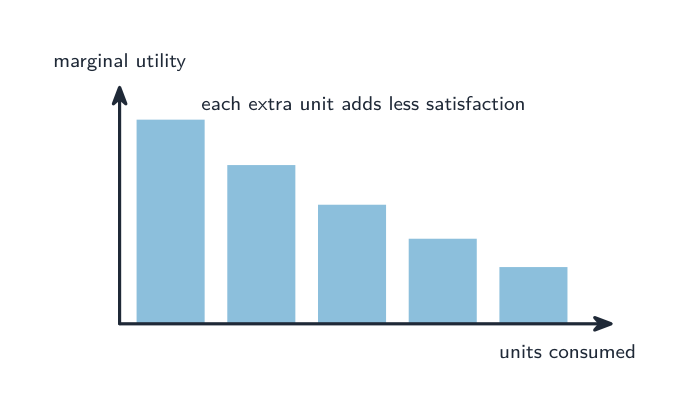
    • Consumers get utility 效用 (satisfaction) from goods, but each extra unit usually gives less added satisfaction – the law of diminishing marginal utility 边际效用递减法则.
    • A consumer maximizes total utility by the utility-maximizing rule: spend so that the marginal utility per dollar is equal across all goods, $\dfrac{MU_x}{P_x}=\dfrac{MU_y}{P_y}$, using up the whole budget. If one good gives more utility per dollar, buy more of it until the ratios equalize.

    Worked example. A consumer is choosing between good X ($MU_x=20$, $P_x=\$2$) and good Y ($MU_y=15$, $P_y=\$1$). The utility per dollar is $\tfrac{20}{2}=10$ for X but $\tfrac{15}{1}=15$ for Y. Y delivers more satisfaction per dollar, so the consumer should buy more Y and less X; as they do, $MU_y$ falls and $MU_x$ rises until $\tfrac{MU_x}{2}=\tfrac{MU_y}{1}$ and the budget is spent.

    Exam skill: the "MB = MC" logic and the "equal MU-per-dollar" rule are tested repeatedly – be able to find the optimal quantity from a table and explain why it is optimal.

    العربية

    معظم القرارات الحقيقية ليست "كل شيء أو لا شيء" بل "أكثر قليلاً أو أقل قليلاً." التحليل الحدي يقارن الفائدة الحدية (فائدة وحدة إضافية) مع التكلفة الحدية (تكلفة وحدة إضافية).

    كل وحدة إضافية مستهلكة تعطي راضية إضافية أقل (تناقص الرضا الحدي)
    كل وحدة إضافية مستهلكة تعطي راضية إضافية أقل (تناقص الرضا الحدي)
    • قاعدة القرار: استمر في القيام بالأنشطة طالما الفائدة الحدية $>$ التكلفة الحدية؛ توقف حيث MB $=$ MC. هذه النقطة تعظم الصافي (إجمالي العائد ناقص إجمالي التكلفة).
    • يحصل المستهلكون على رضا (راضية) من السلع، لكن كل وحدة إضافية عادةً ما تعطي رضا إضافياً أقل – قانون تناقص الرضا الحدي.
    • يعظم المستهلك إجمالي الرضا عبر قاعدة تعظيم الرضا: الإنفاق بحيث يكون الرضا الحدي للدولار متساويًا عبر جميع السلع، $\dfrac{MU_x}{P_x}=\dfrac{MU_y}{P_y}$، باستنفاد الميزانية entirely. إذا أعطى سلعة ما رضا أكثر للدولار، اشترِ المزيد منها حتى تتساوى النسب.

    مثال محلول. يختار المستهلك بين سلعة X ($MU_x=20$، $P_x=\$2$) and good Y ($MU_y=15$, $P_y=\$1$). الرضا للدولار هو $\tfrac{20}{2}=10$ لـ X لكن $\tfrac{15}{1}=15$ لـ Y. يقدم Y رضا أكثر للدولار، لذا يجب على المستهلك شراء المزيد من Y والأقل من X؛ أثناء فعله، ينخفض $MU_y$ ويرتفع $MU_x$ حتى $\tfrac{MU_x}{2}=\tfrac{MU_y}{1}$ وتُنفد الميزانية.

    مهارة الامتحان: منطق "MB = MC" وقاعدة "تساوي RLU للدولار" يتم اختبارها مرارًا – كن قادرًا على إيجاد الكمية المثلى من جدول وشرح لماذا هي مثالية.

    الاختيار العقلاني: استمر طالما أن المنفعة الحدية تتجاوز التكلفة الحدية، وتوقف عندما يتساويا
    الاختيار العقلاني: استمر طالما أن المنفعة الحدية تتجاوز التكلفة الحدية، وتوقف عندما يتساويا
    Vocabulary · ⁨مفردات⁩ Train · ⁨تدريب⁩
    English العربية
    utility/juːˈtɪlɪti/ أداة مساعدة
    law of diminishing marginal utility/lɔː ɒv dɪˈmɪnɪʃɪŋ ˈmɑːdʒɪnl juːˈtɪlɪti/ قانون تناقص المنفعة الحدية
    1.6

    Exam tips · ⁨نصائح للامتحان⁩

    English
    • Opportunity cost is the next-best alternative given up; ignore sunk costs in any decision.
    • Comparative advantage (lower opportunity cost) determines specialisation and the gains from trade.
    • Apply marginal analysis: keep doing an activity while MB > MC, stopping where MB = MC.
    • Maximise utility by equalising the marginal utility per dollar across goods.
    • Read opportunity cost off the PPC slope; a bowed curve shows increasing cost.
    العربية
    • تكلفة الفرصة البديلة هي الخيار الأفضل التالي الذي تم التخلي عنه؛ تجاهل التكاليف الغارقة في أي قرار.
    • الميزة النسبية (انخفاض تكلفة الفرصة البديلة) تحدد التخصص والفوائد من التجارة.
    • طبق التحليل الحدي: استمر في نشاط ما طالما MB > MC، وتوقف عندما MB = MC.
    • قم بتعظيم المنفعة عن طريق مساواة المنفعة الحدية لكل دولار عبر السلع.
    • اقرأ تكلفة الفرصة البديلة من ميل منحنى فرص الإنتاج (PPC)؛ المنحنى المقعر يشير إلى تكاليف متزايدة.
  • 2

    Supply and Demand · ⁨العرض والطلب⁩

    Watch lesson · ⁨شاهد الدرس⁩
    2.1

    Demand

    Syllabus · ⁨المنهج⁩
    English

    Enduring Understanding (MKT-3): Individuals and firms respond to incentives and face constraints.

    Learning Objective MKT-3.A: a. Define (using graphs as appropriate) key terms and factors related to consumer decision making and the law of demand. b. Explain (using graphs as appropriate) the relationship between price and quantity demanded and how buyers respond to incentives and constraints.

    • MKT-3.A.1 A well-defined system of property rights is necessary for the market system to function well.
    • MKT-3.A.2 Economic agents respond to incentives.
    • MKT-3.A.3 Individuals often respond to incentives, such as those presented by prices, but also face constraints, such as income, time, and legal and regulatory frameworks.
    • MKT-3.A.4 The law of demand suggests that a change in the own-price causes a change in quantity demanded in the opposite direction and a movement along a demand (marginal benefit) curve.
    • MKT-3.A.5 The conceptual relationship between price and quantity stated by the law of demand leads to downward-sloping demand curves explained by the income effect and substitution effect and/or by diminishing marginal utility.
    • MKT-3.A.6 The market demand curve (schedule) is derived from the summation of individual demand curves (schedules).

    Learning Objective MKT-3.B: Explain (using graphs as appropriate) buyers' responses to changes in incentives and constraints.

    • MKT-3.B.1 Changes in the determinants of consumer demand can cause the demand curve to shift.
    العربية

    الفهم الدائم (MKT-3): الأفراد والشركات يستجيبون للحوافز ويواجهون قيوداً.

    هدف التعلم MKT-3.A: أ. عرّف (باستخدام الرسوم البيانية عند الحاجة) المصطلحات والعوامل الرئيسية المتعلقة باتخاذ قرار المستهلك وقانون الطلب. ب. اشرح (باستخدام الرسوم البيانية عند الحاجة) العلاقة بين السعر والكمية المطلوبة وكيف يستجيب المشترين للحوافز والقيود.

    • MKT-3.A.1 نظام محدد بوضوح لحقوق الملكية ضروري لعمل نظام السوق بكفاءة.
    • MKT-3.A.2 العوامل الاقتصادية تستجيب للحوافز.
    • MKT-3.A.3 غالباً ما يستجيب الأفراد للحوافز، مثل تلك المقدمة من الأسعار، لكنهم يواجهون أيضاً قيوداً، مثل الدخل، والوقت، والإطارات القانونية والتنظيمية.
    • MKT-3.A.4 يشير قانون الطلب إلى أن التغير في السعر الخاص يسبب تغيراً في الكمية المطلوبة في الاتجاه المعاكس وحركة على طول منحنى الطلب (المنفعة الحدية).
    • MKT-3.A.5 العلاقة المفاهيمية بين السعر والكمية المنصوص عليها في قانون الطلب تؤدي إلى منحنيات طلب ذات ميل سالب تفسرها تأثير الدخل وتأثير البديل و/أو المنفعة الحدية المتناقصة.
    • MKT-3.A.6 يتم اشتقاق منحنى (جدول) الطلب السوقي من مجموع منحنيات (جداول) الطلب الفردية.

    هدف التعلم MKT-3.B: اشرح (باستخدام الرسوم البيانية عند الحاجة) استجابات المشترين للتغيرات في الحوافز والقيود.

    • MKT-3.B.1 التغيرات في محددات الطلب للمستهلك يمكن أن تسبب انزياح منحنى الطلب.

    Source: College Board AP Course and Exam Description · ⁨المصدر: وصف دورة وامتحان College Board AP⁩

    Shoppers in a market: demand shows how quantity demanded responds to price
    Shoppers in a market: demand shows how quantity demanded responds to price
    Supply & demand: a shift raises P and Q

    A market works only where property rights 产权 are well defined – owners can use, exclude others from, and trade their resources; without them, prices cannot coordinate exchange. Within that framework, the two forces are demand and supply.

    Demand 需求 is the relationship between the price of a good and the quantity buyers are willing and able to buy. The law of demand 需求定律 says price and quantity demanded move in opposite directions, so the demand curve slopes downward. Two reasons: the substitution effect 替代效应 (when a good gets pricier, buyers switch to alternatives) and the income effect 收入效应 (a higher price shrinks real purchasing power).

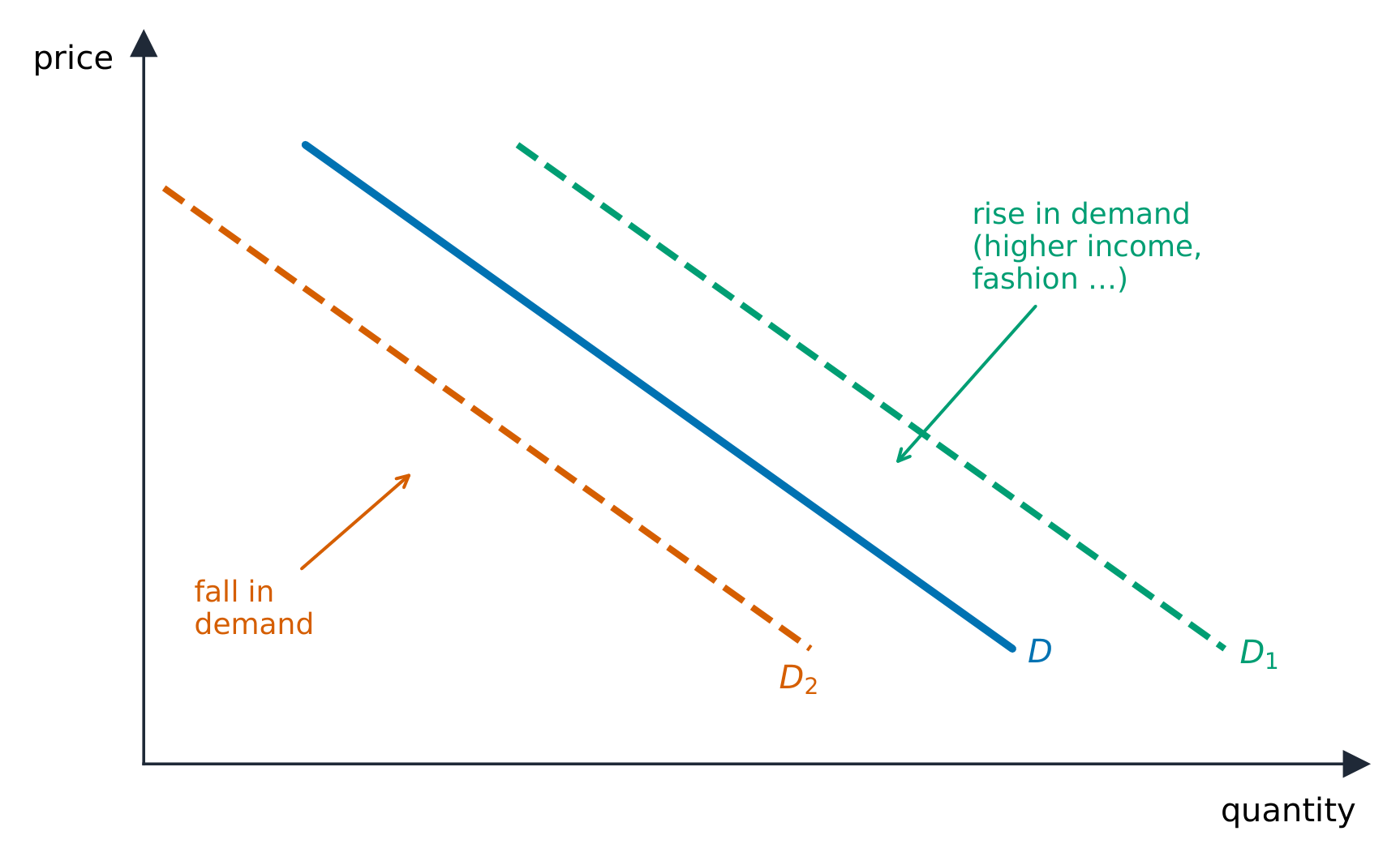
    The demand curve slopes down; income, tastes, and related prices shift it
    The demand curve slopes down; income, tastes, and related prices shift it

    Distinguish a change in quantity demanded (a move along the curve, caused only by the good's own price) from a change in demand (a shift of the whole curve). Demand shifts with the determinants 决定因素, remembered as TRIBE:

    • Tastes/preferences,
    • Related goods – a rise in the price of a substitute 替代品 raises demand; a rise in the price of a complement 互补品 lowers it,
    • Income – for a normal good 正常商品 more income raises demand; for an inferior good 低档商品 it lowers it,
    • Buyers (number of consumers),
    • Expectations of future price or income.

    The market demand curve is the horizontal summation 水平相加 of every individual buyer's demand curve – at each price, add up the quantities all buyers want. That is why more buyers (the B above) shifts the whole market curve to the right.

    Explore · ⁨استكشف⁩

    Shift demand and watch price and quantity · ⁨زيِّد الطلب وشاهد السعر والكمية⁩

    The demand curve slopes down: lower price, more wanted. A change in income, tastes or related-good prices shifts the whole curve, moving the equilibrium. · ⁨منحنى الطلب ينحدر للأسفل: انخفاض السعر يعني زيادة الطلب. أي تغيير في الدخل أو التفضيلات أو أسعار السلع ذات الصلة يُزيّد المنحنى بأكمله، مما يحرك نقطة التوازن.⁩

    Vocabulary · ⁨مفردات⁩ Train · ⁨تدريب⁩
    English العربية
    property rights/ˈprɒpəti raɪts/ حقوق الملكية
    Demand/dɪˈmænd/ الطلب
    law of demand/lɔː ɒv dɪˈmænd/ قانون الطلب
    substitution effect/ˌsʌbstɪˈtjuːʃn ɪˈfekt/ تأثير الإحلال
    income effect/ˈɪŋkʌm ɪˈfekt/ تأثير الدخل
    determinants/dɪˈtɜːmɪnənts/ المحددات
    substitute/ˈsʌbstɪtjuːt/ استبدال
    complement/ˈkɒmplɪmənt/ مكمّل
    normal good/ˈnɔːml ɡʊd/ سلعة عادية
    inferior good/ɪnˈfɪərɪə ɡʊd/ سلعة رديئة
    horizontal summation/ˌhɒrɪˈzɒntl sʌˈmeɪʃn/ الجمع الأفقي
    2.2

    Supply

    Syllabus · ⁨المنهج⁩
    English

    Enduring Understanding (MKT-3): Individuals and firms respond to incentives and face constraints.

    Learning Objective MKT-3.C: a. Define (using graphs as appropriate) the law of supply. b. Explain (using graphs as appropriate) the relationship between price and quantity supplied.

    • MKT-3.C.1 A change in own-price causes a change in quantity supplied in the same direction and a movement along a supply curve.
    • MKT-3.C.2 The market supply curve (schedule) is derived from the summation of individual supply curves (schedules). The market supply curve is upward-sloping.

    Learning Objective MKT-3.D: Explain (using graphs as appropriate) producers' (sellers') responses to changes in incentives and technology.

    • MKT-3.D.1 Changes in the determinants of supply can cause the supply curve to shift.
    العربية

    الفهم الدائم (MKT-3): الأفراد والشركات يستجيبون للحوافز ويواجهون قيوداً.

    هدف التعلم MKT-3.C: أ. تعريف (باستخدام الرسوم البيانية عند الحاجة) قانون العرض. ب. اشرح (باستخدام الرسوم البيانية عند الحاجة) العلاقة بين السعر والكمية المعروضة.

    • MKT-3.C.1 التغير في السعر الخاص يسبب تغيراً في الكمية المعروضة في نفس الاتجاه وحركة على طول منحنى العرض.
    • MKT-3.C.2 يتم اشتقاق منحنى (جدول) العرض السوقي من مجموع منحنيات (جداول) العرض الفردية. منحنى العرض السوقي له ميل صاعد.

    هدف التعلم MKT-3.D: اشرح (باستخدام الرسوم البيانية عند الحاجة) استجابات المنتجين (البائعين) للتغيرات في الحوافز والتكنولوجيا.

    • MKT-3.D.1 التغيرات في محددات العرض يمكن أن تسبب انزياح منحنى العرض.

    Source: College Board AP Course and Exam Description · ⁨المصدر: وصف دورة وامتحان College Board AP⁩

    A shift in supply

    Supply 供给 is the relationship between price and the quantity sellers will offer. The law of supply 供给定律: price and quantity supplied move in the same direction, so the supply curve slopes upward (higher prices cover higher marginal costs and reward more output).

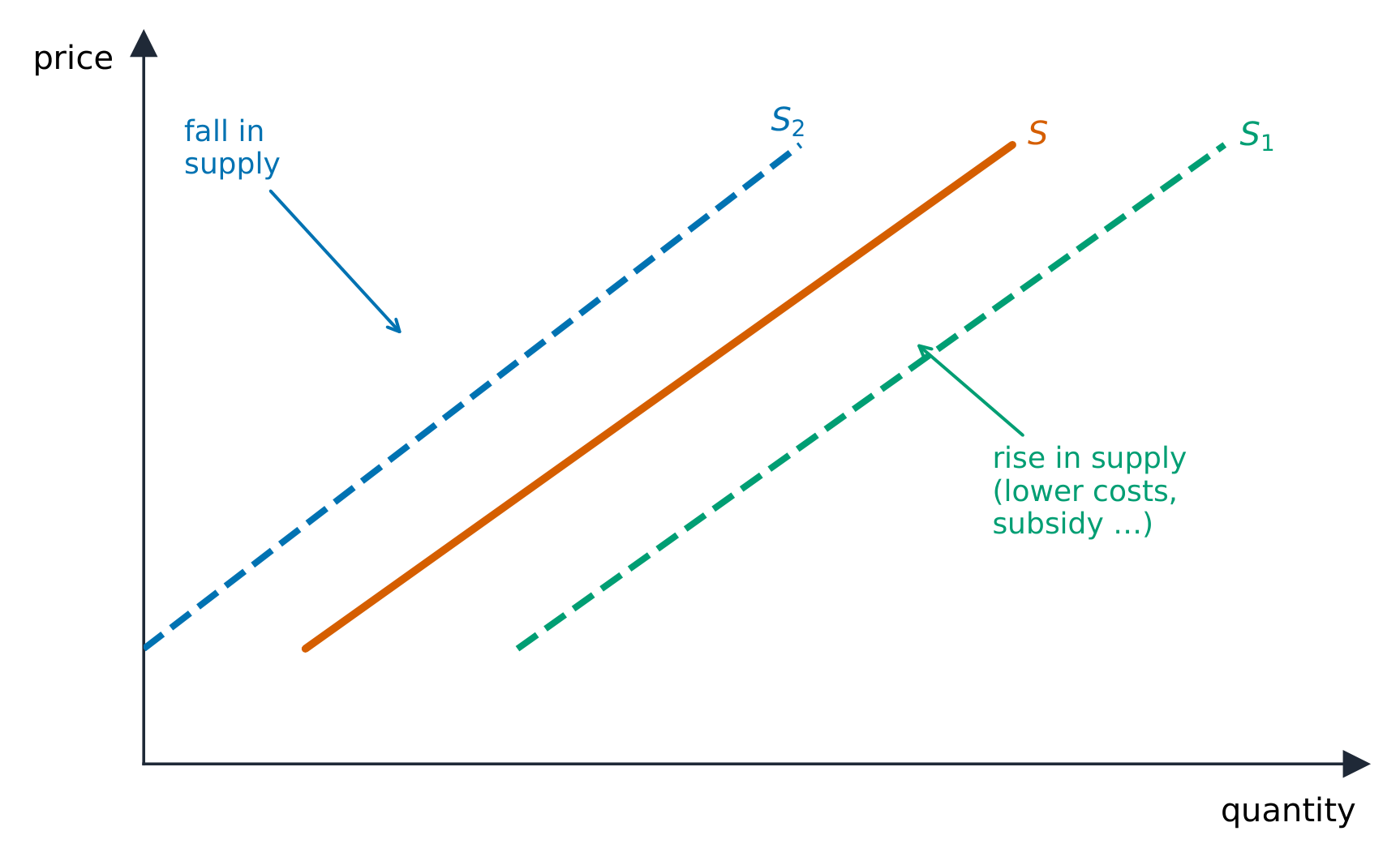
    The supply curve slopes up; costs, technology, tax, and subsidy shift it
    The supply curve slopes up; costs, technology, tax, and subsidy shift it

    Again separate a change in quantity supplied (movement along the curve, from the good's own price) from a change in supply (a shift). Supply shifts with input prices, technology, taxes and subsidies 补贴, prices of other goods a firm could make, number of sellers, and expectations. Just like demand, the market supply curve is the horizontal sum of individual firms' supply curves – add the quantities all firms offer at each price – so more sellers shifts market supply to the right.

    Exam skill: on the free-response section you must draw correctly labeled supply-and-demand graphs and shift the right curve in the right direction – decide first whether the event changes an "own price" (move along) or a determinant (shift).

    Vocabulary · ⁨مفردات⁩ Train · ⁨تدريب⁩
    English العربية
    Supply/səˈplaɪ/ العرض
    law of supply/lɔː ɒv səˈplaɪ/ قانون العرض
    subsidies/ˈsʌbsɪdiz/ إعانات
    2.3

    Price Elasticity of Demand

    Syllabus · ⁨المنهج⁩
    English

    Enduring Understanding (MKT-3): Individuals and firms respond to incentives and face constraints.

    Learning Objective MKT-3.E: a. Define measures of elasticity. b. Explain (using graphs where appropriate) measures of elasticity and the impact of a given price change on total revenue or total expenditure. c. Calculate (using data from a graph or a table as appropriate) measures of elasticity.

    • MKT-3.E.1 Economists use the concept of elasticity to measure the magnitude of percentage changes in quantity owing to any given changes in the own-price, income, and prices of related goods.
    • MKT-3.E.2 Price elasticity of demand is measured by the percentage change in quantity demanded divided by the percentage change in price or the responsiveness of the quantity demanded to changes in price. Elasticity varies along a linear demand curve, meaning slope is not elasticity.
    • MKT-3.E.3 Ranges of values of elasticity of demand are described as elastic or inelastic with the separating benchmark being a magnitude of 1, where the change in the price and the change in the quantity demanded are proportional.
      • a. When the magnitude of the value of elasticity is greater than 1, the demand is described as being elastic with respect to that price in the range of the given change.
      • b. When the magnitude of the value of elasticity is less than 1, the demand is described as being inelastic with respect to that price in the range of the given change.
      • c. When the magnitude of the value of elasticity is equal to 1, the demand is described as being unit elastic with respect to that price in the range of the given change.
    • MKT-3.E.4 The price elasticity of demand depends on certain factors such as the availability of substitutes.
    • MKT-3.E.5 The impact of a given price change on total revenue or total expenditure will depend on whether demand is elastic, inelastic, or unit elastic.
    العربية

    الفهم الدائم (MKT-3): الأفراد والشركات يستجيبون للحوافز ويواجهون قيوداً.

    هدف التعلم MKT-3.E: أ. عرّف مقاييس المرونة. ب. اشرح (باستخدام الرسوم البيانية عند الحاجة) مقاييس المرونة وأثر تغير معين في السعر على الإيراد الكلي أو الإنفاق الكلي. ج. احسب (باستخدام بيانات من رسم بياني أو جدول عند الحاجة) مقاييس المرونة.

    • MKT-3.E.1 يستخدم الاقتصاديون مفهوم المرونة لقياس مقدار التغيرات النسبية في الكمية نتيجة لأي تغيرات معينة في السعر الخاص، والدخل، وأسعار السلع ذات الصلة.
    • MKT-3.E.2 تُقاس مرونة الطلب السعرية بالتغير النسبي في الكمية المطلوبة مقسوماً على التغير النسبي في السعر أو باستجابة الكمية المطلوبة للتغيرات في السعر. تتفاوت المرونة على طول منحنى طلب خطي، مما يعني أن الميل ليس هو المرونة.
    • MKT-3.E.3 تُوصف نطاقات قيم مرونة الطلب بأنها مرنة أو غير مرنة، مع اعتبار القيمة 1 كحد فاصل، حيث يكون التغير في السعر والتغير في الكمية المطلوبة متناسبين.
      • أ. عندما تكون قيمة المرونة أكبر من 1، يُوصف الطلب بأنه مرن بالنسبة لذلك السعر في نطاق التغير المحدد.
      • ب. عندما تكون قيمة المرونة أقل من 1، يُوصف الطلب بأنه غير مرن بالنسبة لذلك السعر في نطاق التغير المحدد.
      • ج. عندما تكون قيمة المرونة تساوي 1، يُوصف الطلب بأنه مرن بوحدة واحدة بالنسبة لذلك السعر في نطاق التغير المحدد.
    • MKT-3.E.4 تعتمد مرونة الطلب السعرية على عوامل معينة مثل توفر البديلات.
    • MKT-3.E.5 يعتمد تأثير تغير معين في السعر على الإيراد الكلي أو الإنفاق الكلي على ما إذا كان الطلب مرناً، أو غير مرن، أو مرن بوحدة واحدة.

    Source: College Board AP Course and Exam Description · ⁨المصدر: وصف دورة وامتحان College Board AP⁩

    Price elasticity of demand

    Price elasticity of demand 需求价格弹性 measures how responsive quantity demanded is to a price change:

    $$E_d=\left|\frac{\%\ \Delta\ \text{quantity demanded}}{\%\ \Delta\ \text{price}}\right|.$$

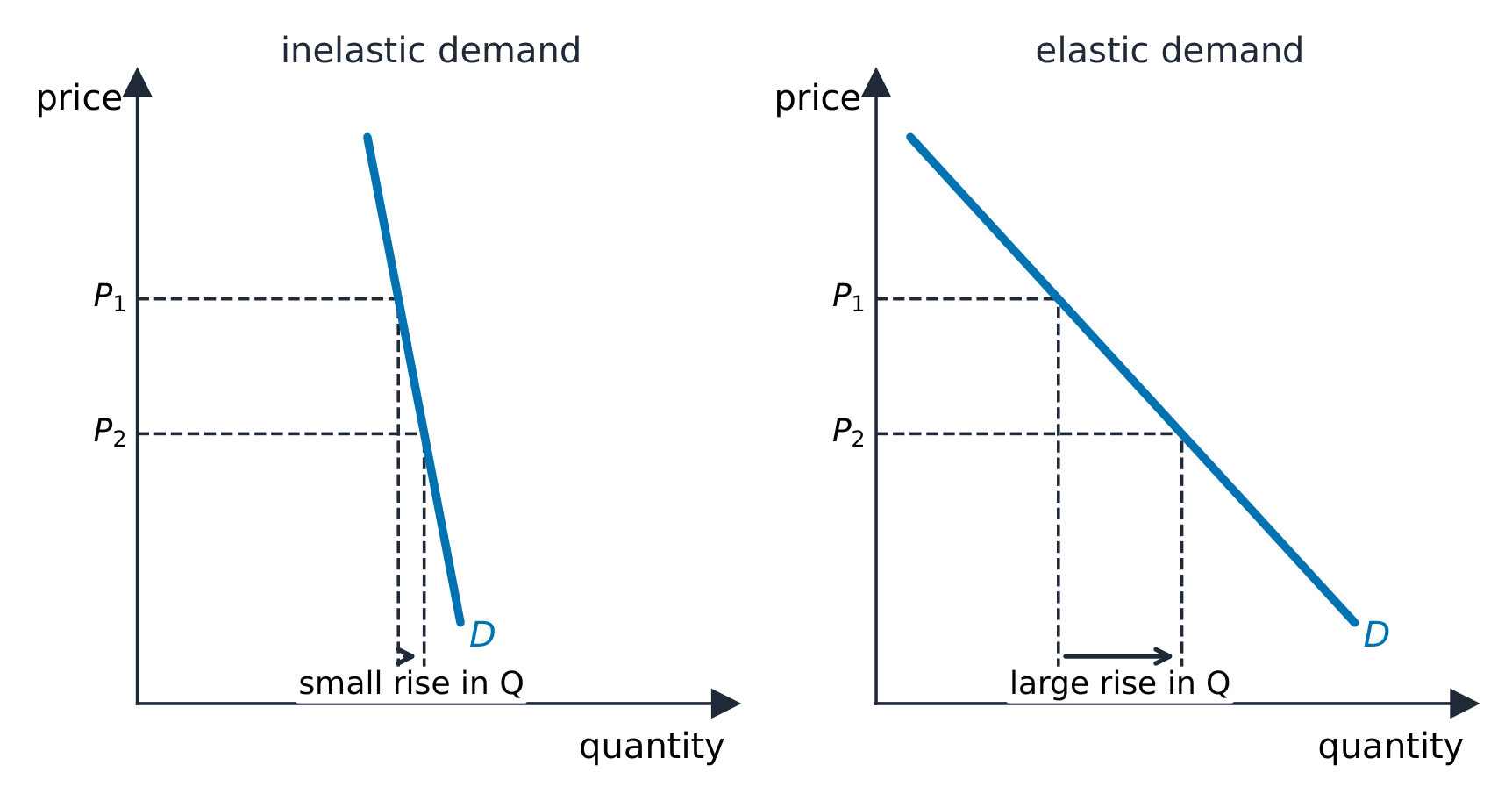
    Inelastic versus elastic demand: a small versus large response to a price change
    Inelastic versus elastic demand: a small versus large response to a price change
    • $E_d>1$: elastic 富有弹性 (quantity responds strongly);
    • $E_d<1$: inelastic 缺乏弹性 (quantity barely responds);
    • $E_d=1$: unit elastic.

    Demand is more elastic when there are more substitutes, the good is a luxury, it takes a large share of income, or buyers have more time to adjust. Elasticity links to total revenue 总收入 ($P\times Q$): if demand is elastic, a price cut raises revenue; if inelastic, a price cut lowers it. Along a straight-line demand curve, elasticity falls as you move down (elastic on top, inelastic at the bottom).

    Worked example. A price rise from $\$10$ to $\$12$ (a $+20\%$ change) cuts quantity demanded from $100$ to $85$ (a $-15\%$ change). Then $E_d=\left|\dfrac{-15\%}{20\%}\right|=0.75<1$, so demand is inelastic. Because it is inelastic, the price rise raises total revenue: from $\$10\times100=\$1000$ to $\$12\times85=\$1020$.

    Explore · ⁨استكشف⁩

    Stretch price and measure elasticity · ⁨شدّ السعر وقِس المرونة⁩

    Price elasticity of demand is how strongly quantity responds to price. A steep curve is inelastic (small response); a shallow one is elastic (large response). · ⁨مرونة الطلب السعرية هي مدى استجابة الكمية للسعر. المنحنى الحاد غير مرن (استجابة صغيرة)؛ والمنحنى المسطح مرن (استجابة كبيرة).⁩

    Vocabulary · ⁨مفردات⁩ Train · ⁨تدريب⁩
    English العربية
    Price elasticity of demand/praɪs ɪlæˈstɪsɪti ɒv dɪˈmænd/ مرنوية الطلب السعرية
    elastic/ɪˈlæstɪk/ مرن
    inelastic/ɪnɪˈlæstɪk/ غير مرن
    total revenue/ˈtəʊtl ˈrevənjuː/ إجمالي الإيرادات
    2.4

    Price Elasticity of Supply

    Syllabus · ⁨المنهج⁩
    English

    Enduring Understanding (MKT-3): Individuals and firms respond to incentives and face constraints.

    Learning Objective MKT-3.E: a. Define measures of elasticity. b. Explain (using graphs where appropriate) measures of elasticity and the impact of a given price change on total revenue or total expenditure. c. Calculate (using data from a graph or a table as appropriate) measures of elasticity.

    • MKT-3.E.6 Price elasticity of supply is measured by the percentage change in quantity supplied divided by the percentage change in price, or the responsiveness of the quantity supplied to changes in price.
    • MKT-3.E.7 Ranges of values of elasticity of supply are described as elastic or inelastic with the separating benchmark being a magnitude of 1, where the change in the price and the change in the quantity supplied are proportional.
      • a. When the magnitude of the value of elasticity is greater than 1, the supply is described as being elastic with respect to that price in the range of the given change.
      • b. When the magnitude of the value of elasticity is less than 1, the supply is described as being inelastic with respect to that price in the range of the given change.
      • c. When the magnitude of the value of elasticity is equal to 1, the supply is described as being unit elastic with respect to that price in the range of the given change.
    • MKT-3.E.8 The price elasticity of supply depends on certain factors such as the price of alternative inputs.
    العربية

    الفهم الدائم (MKT-3): الأفراد والشركات يستجيبون للحوافز ويواجهون قيوداً.

    هدف التعلم MKT-3.E: أ. عرّف مقاييس المرونة. ب. اشرح (باستخدام الرسوم البيانية عند الحاجة) مقاييس المرونة وأثر تغير معين في السعر على الإيراد الكلي أو الإنفاق الكلي. ج. احسب (باستخدام بيانات من رسم بياني أو جدول عند الحاجة) مقاييس المرونة.

    • MKT-3.E.6 تُقاس مرونة العرض السعرية بالتغير النسبي في الكمية المعروضة مقسوماً على التغير النسبي في السعر، أو باستجابة الكمية المعروضة للتغيرات في السعر.
    • MKT-3.E.7 تُوصف نطاقات قيم مرونة العرض بأنها مرنة أو غير مرنة، مع اعتبار القيمة 1 كحد فاصل، حيث يكون التغير في السعر والتغير في الكمية المعروضة متناسبين.
      • أ. عندما تكون قيمة المرونة أكبر من 1، يُوصف العرض بأنه مرن بالنسبة لذلك السعر في نطاق التغير المحدد.
      • ب. عندما تكون قيمة المرونة أقل من 1، يُوصف العرض بأنه غير مرن بالنسبة لذلك السعر في نطاق التغير المحدد.
      • ج. عندما تكون قيمة المرونة تساوي 1، يُوصف العرض بأنه مرن بوحدة واحدة بالنسبة لذلك السعر في نطاق التغير المحدد.
    • MKT-3.E.8 تعتمد مرونة العرض السعرية على عوامل معينة مثل سعر المدخلات البديلة.

    Source: College Board AP Course and Exam Description · ⁨المصدر: وصف دورة وامتحان College Board AP⁩

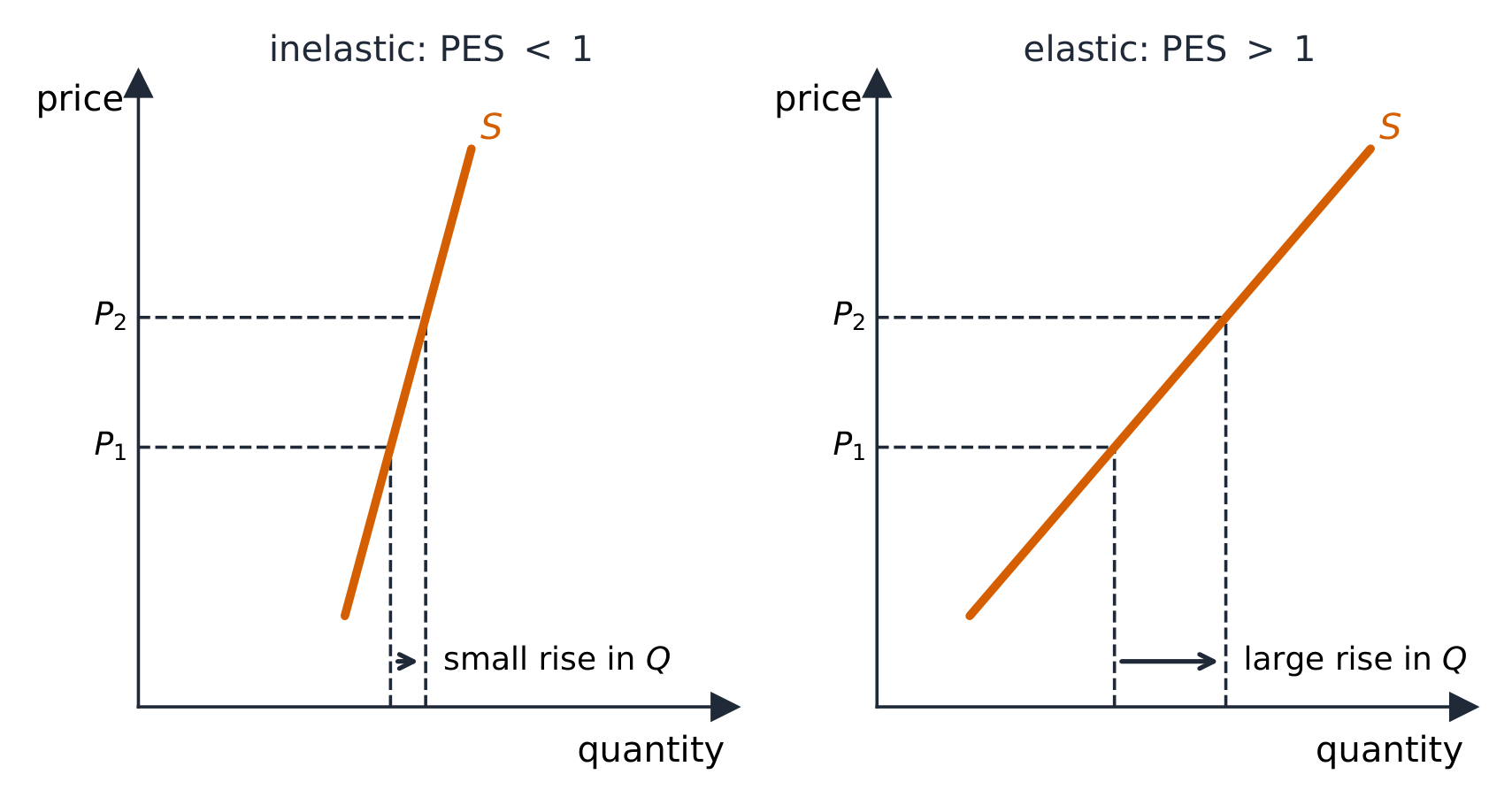
    Price elasticity of supply 供给价格弹性, $E_s=\dfrac{\%\ \Delta\ Q_s}{\%\ \Delta\ P}$, measures how responsive sellers are. Supply is more elastic when firms can adjust output easily – spare capacity, storable goods, and above all more time (supply is more elastic in the long run than the short run).

    The same price rise gives a small supply response when PES is below 1, a large one above 1
    The same price rise gives a small supply response when PES is below 1, a large one above 1
    Vocabulary · ⁨مفردات⁩ Train · ⁨تدريب⁩
    English العربية
    Price elasticity of supply/praɪs ɪlæˈstɪsɪti ɒv səˈplaɪ/ مرنوية العرض السعرية
    2.5

    Other Elasticities

    Syllabus · ⁨المنهج⁩
    English

    Enduring Understanding (MKT-3): Individuals and firms respond to incentives and face constraints.

    Learning Objective MKT-3.E: a. Define measures of elasticity. b. Explain (using graphs where appropriate) measures of elasticity and the impact of a given price change on total revenue or total expenditure. c. Calculate (using data from a graph or a table as appropriate) measures of elasticity.

    • MKT-3.E.9 Elasticity can be measured for any determinant of demand or supply, not just the price.
    • MKT-3.E.10 Income elasticity of demand is measured by the percentage change in the quantity demanded divided by the percentage change in consumers' income. Economists use the income elasticity of demand to determine whether a good is normal or inferior.
    • MKT-3.E.11 Cross-price elasticity of demand is measured by the percentage change in the quantity demanded of one good divided by the percentage change in the price of another good. Economists use the cross-price elasticity of demand to determine whether goods are substitutes, complements, or not related.
    العربية

    الفهم الدائم (MKT-3): الأفراد والشركات يستجيبون للحوافز ويواجهون قيوداً.

    هدف التعلم MKT-3.E: أ. عرّف مقاييس المرونة. ب. اشرح (باستخدام الرسوم البيانية عند الحاجة) مقاييس المرونة وأثر تغير معين في السعر على الإيراد الكلي أو الإنفاق الكلي. ج. احسب (باستخدام بيانات من رسم بياني أو جدول عند الحاجة) مقاييس المرونة.

    • MKT-3.E.9 يمكن قياس المرونة لأي محدد للطلب أو العرض، وليس فقط السعر.
    • MKT-3.E.10 تُقاس مرونة الطلب الدخلية بالتغير النسبي في الكمية المطلوبة مقسوماً على التغير النسبي في دخل المستهلكين. يستخدم الاقتصاديون مرونة الطلب الدخلية لتحديد ما إذا كانت السلعة عادية أم رديئة.
    • MKT-3.E.11 مرونة الطلب المتبادلة تقاس بنسبة التغير في الكمية المطلوبة لسلعة ما مقسومة على نسبة التغير في سعر سلعة أخرى. يستخدم الاقتصاديون المرونة المتبادلة لتحديد ما إذا كانت السلع بديلة، مكملة، أو غير مرتبطة.

    Source: College Board AP Course and Exam Description · ⁨المصدر: وصف دورة وامتحان College Board AP⁩

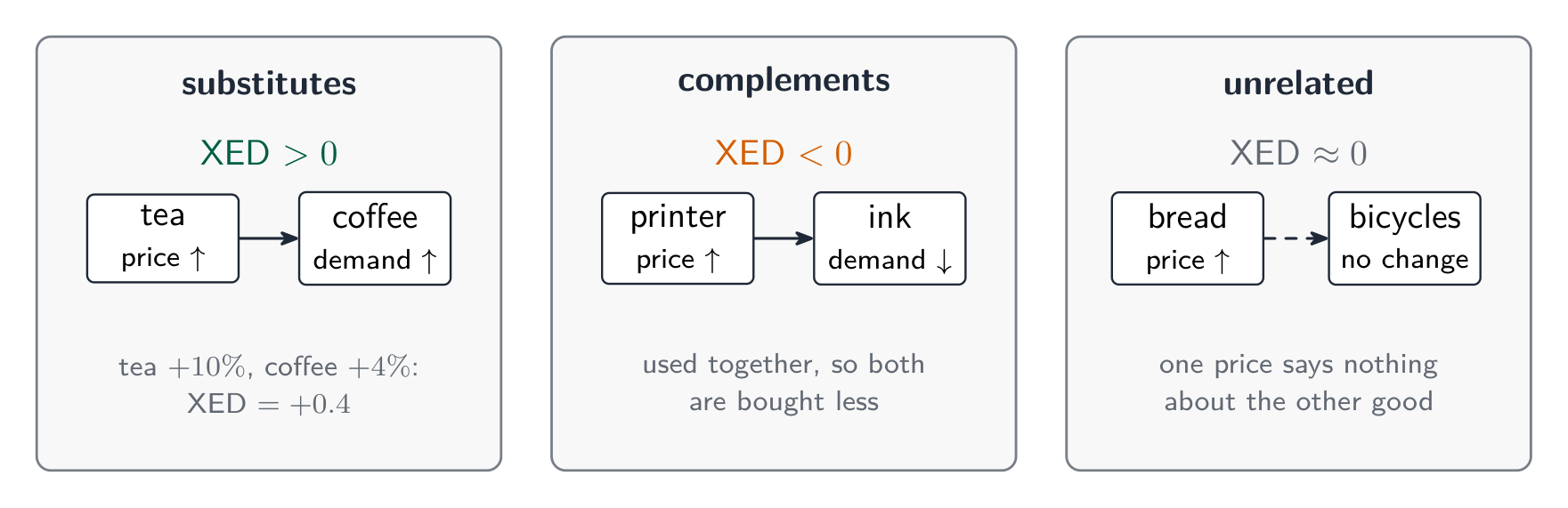
    • Cross-price elasticity 交叉价格弹性 $=\dfrac{\%\ \Delta\ Q_x}{\%\ \Delta\ P_y}$: positive for substitutes, negative for complements – the sign tells you the relationship.
    • Income elasticity 收入弹性 $=\dfrac{\%\ \Delta\ Q}{\%\ \Delta\ \text{income}}$: positive for normal goods (and $>1$ for luxuries), negative for inferior goods.

    Worked example. When the price of coffee rises $10\%$, the quantity of tea demanded rises $6\%$: cross-price elasticity $=\dfrac{+6\%}{+10\%}=+0.6$. The positive sign confirms coffee and tea are substitutes. If instead a $5\%$ rise in incomes raised restaurant-meal demand $10\%$, income elasticity $=\dfrac{10\%}{5\%}=+2$ – a normal good, and a luxury since it exceeds $1$.

    Cross elasticity: positive for substitutes, negative for complements
    Cross elasticity: positive for substitutes, negative for complements

    Exam skill: you are expected to compute an elasticity, classify it, and read a sign as evidence of substitute/complement or normal/inferior.

    Vocabulary · ⁨مفردات⁩ Train · ⁨تدريب⁩
    English العربية
    Cross-price elasticity/krɒs praɪs ɪlæˈstɪsɪti/ المرونة السعرية البينية
    Income elasticity/ˈɪŋkʌm ɪlæˈstɪsɪti/ مرونة الدخل
    2.6

    Market Equilibrium, Consumer Surplus, and Producer Surplus

    Syllabus · ⁨المنهج⁩
    English

    Enduring Understanding (MKT-4): Although equilibria are stable, an economy can move from one equilibrium to another if market conditions change.

    Learning Objective MKT-4.A: a. Define (using graphs as appropriate) market equilibrium, consumer surplus, and producer surplus. b. Explain (using graphs as appropriate) how equilibrium price, quantity, consumer surplus, and producer surplus for a good or service are determined. c. Calculate (using data from a graph or table as appropriate) areas of consumer surplus and producer surplus at equilibrium.

    • MKT-4.A.1 The supply-demand model is a tool for understanding what factors influence prices and quantities and why prices and quantities might differ across markets or change over time.
    • MKT-4.A.2 In a perfectly competitive market, equilibrium is achieved (and markets clear with no shortages or surpluses) when the price of a good or service brings the quantity supplied and quantity demanded into balance, in the sense that buyers wish to purchase the same quantity that sellers wish to provide.
    • MKT-4.A.3 Equilibrium price provides information to economic decision-makers to guide resource allocation.
    • MKT-4.A.4 Economists use consumer surplus and producer surplus to measure the benefits markets create to buyers and sellers and understand market efficiency.
    • MKT-4.A.5 Market equilibrium maximizes total economic surplus in the absence of market failures, meaning that perfectly competitive markets are efficient.
    العربية

    فهم دائم (MKT-4): على الرغم من أن التوازنات مستقرة، يمكن للاقتصاد الانتقال من توازن إلى آخر إذا تغيرت ظروف السوق.

    هدف التعلم MKT-4.A: أ. عرّف (باستخدام الرسوم البيانية عند الحاجة) توازن السوق، وفائض المستهلك، وفائض المنتج. ب. اشرح (باستخدام الرسوم البيانية عند الحاجة) كيفية تحديد سعر التوازن والكمية وفائض المستهلك وفائض المنتج لأي سلعة أو خدمة. ج. احسب (باستخدام بيانات من رسم بياني أو جدول عند الحاجة) مساحات فائض المستهلك وفائض المنتج عند التوازن.

    • MKT-4.A.1 نموذج العرض والطلب هو أداة لفهم العوامل المؤثرة على الأسعار والكميات ولماذا قد تختلف الأسعار والكميات عبر الأسواق أو تتغير مع مرور الوقت.
    • MKT-4.A.2 في سوق المنافسة الكاملة، يتحقق التوازن (وتتخلص الأسواق من أي نقص أو فائض) عندما يجمع سعر السلعة أو الخدمة بين الكمية المعروضة والكمية المطلوبة، بمعنى أن المشترين يرغبون في شراء نفس الكمية التي يرغب البائعون في توفيرها.
    • MKT-4.A.3 يوفر سعر التوازن معلومات لصناع القرار الاقتصاديين لتوجيه تخصيص الموارد.
    • MKT-4.A.4 يستخدم الاقتصاديون فائض المستهلك وفائض المنتج لقياس الفوائد التي تخلقها الأسواق للمشتريين والبائعين وفهم كفاءة السوق.
    • MKT-4.A.5 ي maximizing التوازن في السوق إجمالي الفائض الاقتصادي في غياب أخطاء السوق، مما يعني أن أسواق المنافسة الكاملة هي أسواق فعالة.

    Source: College Board AP Course and Exam Description · ⁨المصدر: وصف دورة وامتحان College Board AP⁩

    Consumer & producer surplus

    Equilibrium 均衡 is where supply meets demand: the equilibrium price clears the market, so quantity demanded equals quantity supplied and there is no shortage or surplus.

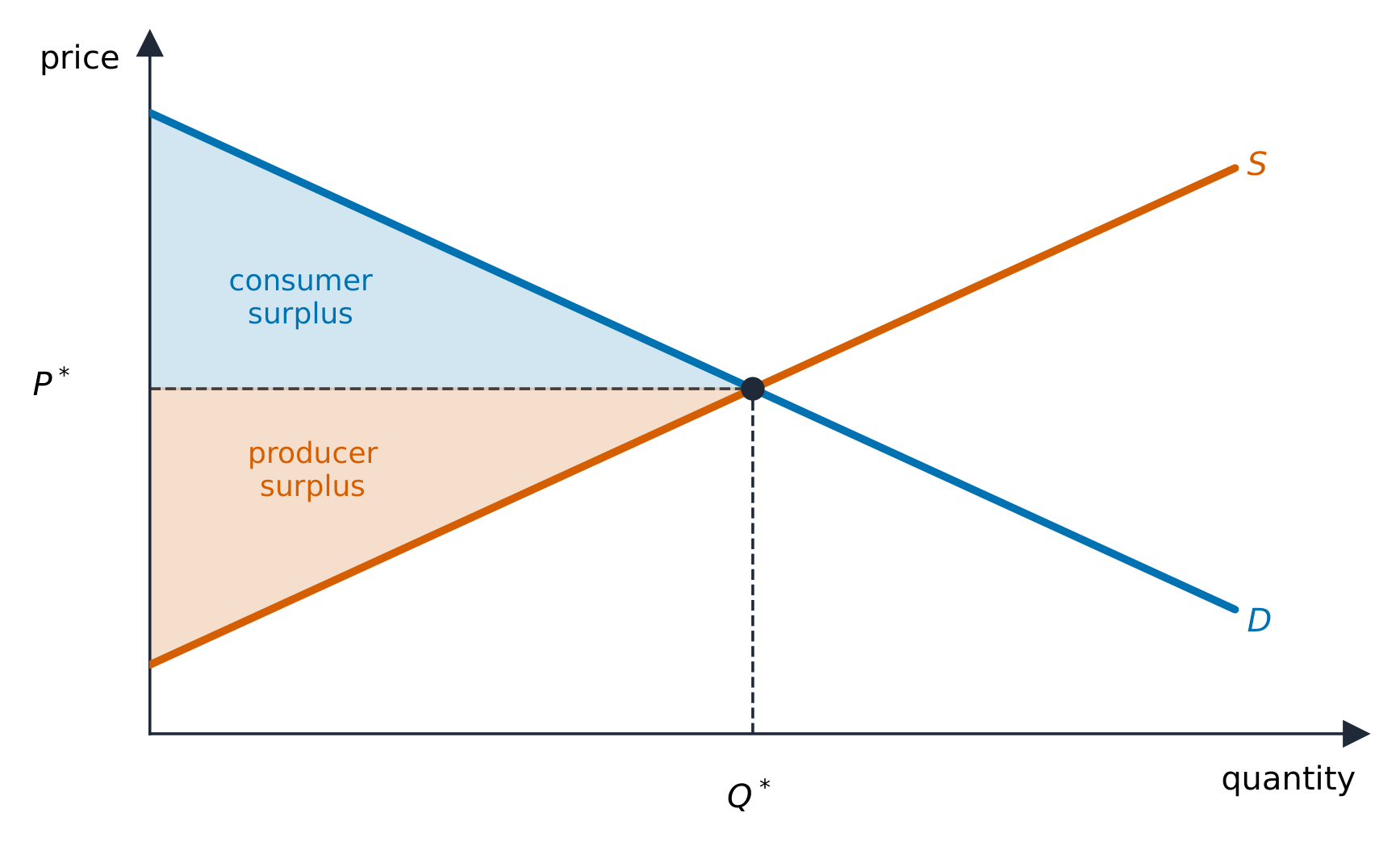
    Consumer surplus and producer surplus at the market equilibrium
    Consumer surplus and producer surplus at the market equilibrium
    • Consumer surplus 消费者剩余 is the area below the demand curve and above the price – the gap between what buyers would pay and what they do pay.
    • Producer surplus 生产者剩余 is the area above the supply curve and below the price – the gap between the price and sellers' minimum acceptable price.
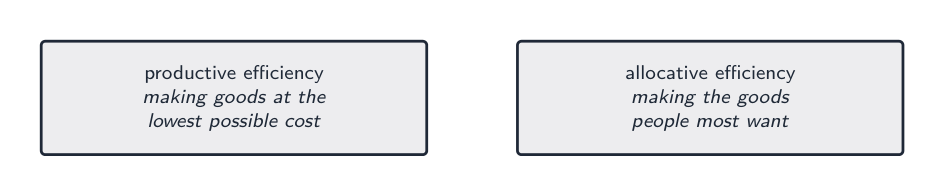
    • Their sum is total surplus 总剩余, and the competitive equilibrium maximizes it – this is why free markets are called allocatively efficient 配置有效率.
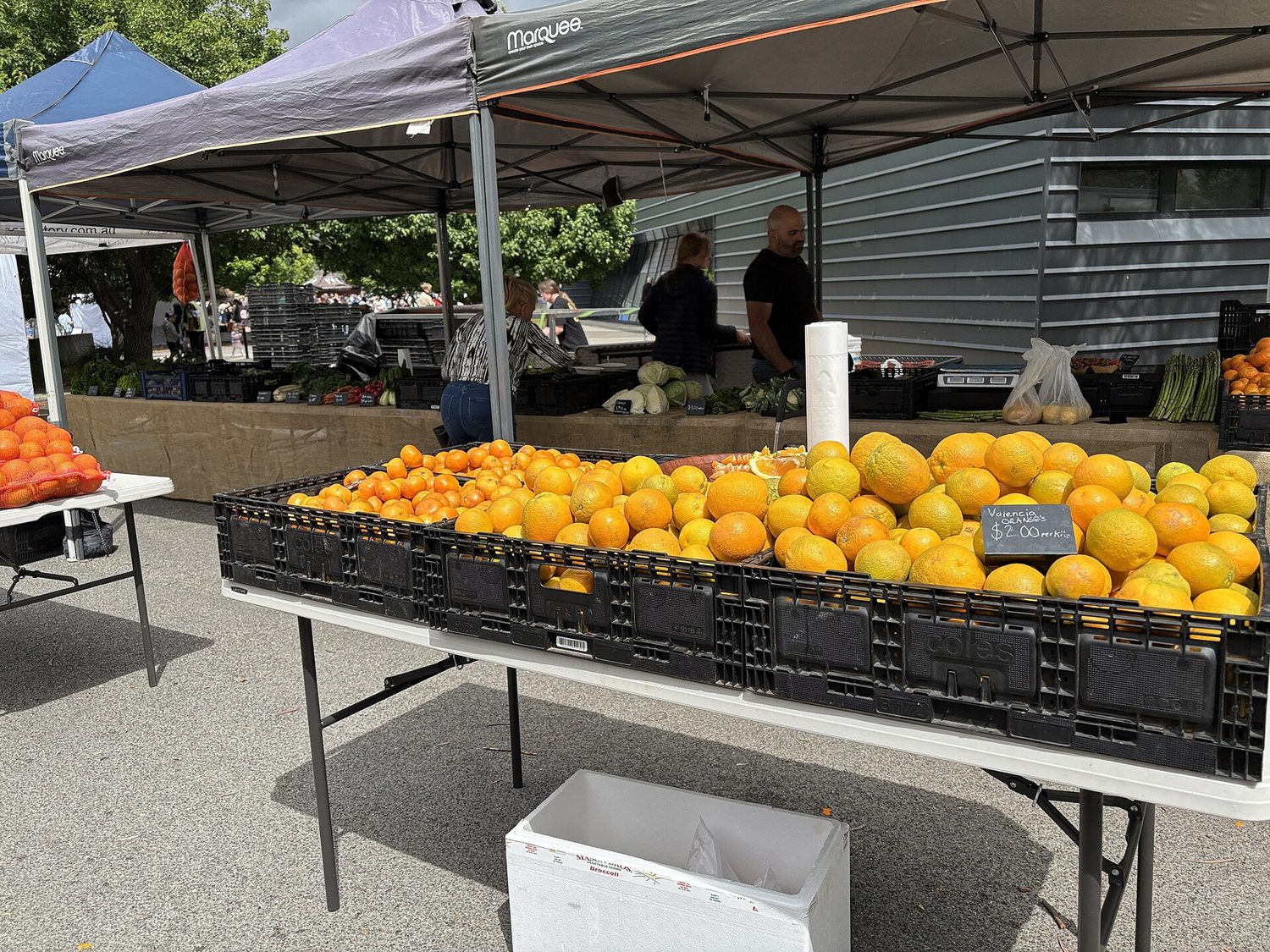
    A market stall selling fruit and vegetables
    A real market: many buyers and sellers meet, and price settles where the quantity wanted equals the quantity offered
    Explore · ⁨استكشف⁩

    See consumer and producer surplus · ⁨رأِ فائض المستهلك وفائض المنتج⁩

    At equilibrium the market clears. The gap between what buyers would pay and the price is consumer surplus; the gap above sellers' costs is producer surplus. · ⁨عند التوازن يتصفّى السوق. الفارق بين ما سيُدفعه المشترون والسعر هو فائض المستهلك؛ والفوق فوق تكاليف البائعين هو فائض المنتج.⁩

    Vocabulary · ⁨مفردات⁩ Train · ⁨تدريب⁩
    English العربية
    Equilibrium/ˌiːkwɪˈlɪbrɪəm/ التوازن
    Consumer surplus/kənˈsuːmə ˈsɜːpləs/ فائض المستهلك
    Producer surplus/prəˈdjuːsə ˈsɜːpləs/ فائض المنتج
    total surplus/ˈtəʊtl ˈsɜːpləs/ الفائض الكلي
    allocatively efficient/ˈæləkətɪvli ɪˈfɪʃənt/ فعالي تخصيصياً
    2.7

    Market Disequilibrium and Changes in Equilibrium

    Syllabus · ⁨المنهج⁩
    English

    Enduring Understanding (MKT-4): Although equilibria are stable, an economy can move from one equilibrium to another if market conditions change.

    Learning Objective MKT-4.B: a. Define a surplus and shortage. b. Explain (using graphs where appropriate) how changes in underlying conditions and shocks to a competitive market can alter price, quantity, consumer surplus, and producer surplus. c. Calculate (using data from a graph or table as appropriate) changes in price, quantity, consumer surplus, and producer surplus in response to changes in market conditions or market disequilibrium.

    • MKT-4.B.1 Whenever markets experience imbalances—creating disequilibrium prices and quantities, surpluses, and shortages—market forces drive price and quantity toward equilibrium.
    • MKT-4.B.2 Factors that shift the market demand and market supply curves cause price, quantity, consumer surplus, producer surplus, and total economic surplus (within that market) to change. The impact of the change depends on the price elasticities of demand and supply.
    العربية

    فهم دائم (MKT-4): على الرغم من أن التوازنات مستقرة، يمكن للاقتصاد الانتقال من توازن إلى آخر إذا تغيرت ظروف السوق.

    هدف التعلم MKT-4.B: أ. تعريف الفائض والندرة. ب. اشرح (باستخدام الرسوم البيانية عند الحاجة) كيف تؤدي التغيرات في الظروف الأساسية والضربات إلى سوق تنافسي إلى تغيير السعر والكمية وفائض المستهلك وفائض المنتج. ج. احسب (باستخدام بيانات من رسم بياني أو جدول عند الحاجة) التغيرات في السعر والكمية وفائض المستهلك وفائض المنتج استجابةً للتغيرات في ظروف السوق أو عدم التوازن في السوق.

    • MKT-4.B.1 كلما تعرضت الأسواق لعدم اتزان -مما يولد أسعاراً وكمياتاً غير متوازنة وفوائض ونقص- فإن قوى السوق تدفع السعر والكمية نحو التوازن.
    • MKT-4.B.2 العوامل التي تحرك منحنيات طلب السوق وعرض السوق تسبب تغييراً في السعر والكمية وفائض المستهلك وفائض المنتج وإجمالي الفائض الاقتصادي (داخل ذلك السوق). يعتمد تأثير التغيير على مرونة الطلب ومرونة العرض.

    Source: College Board AP Course and Exam Description · ⁨المصدر: وصف دورة وامتحان College Board AP⁩

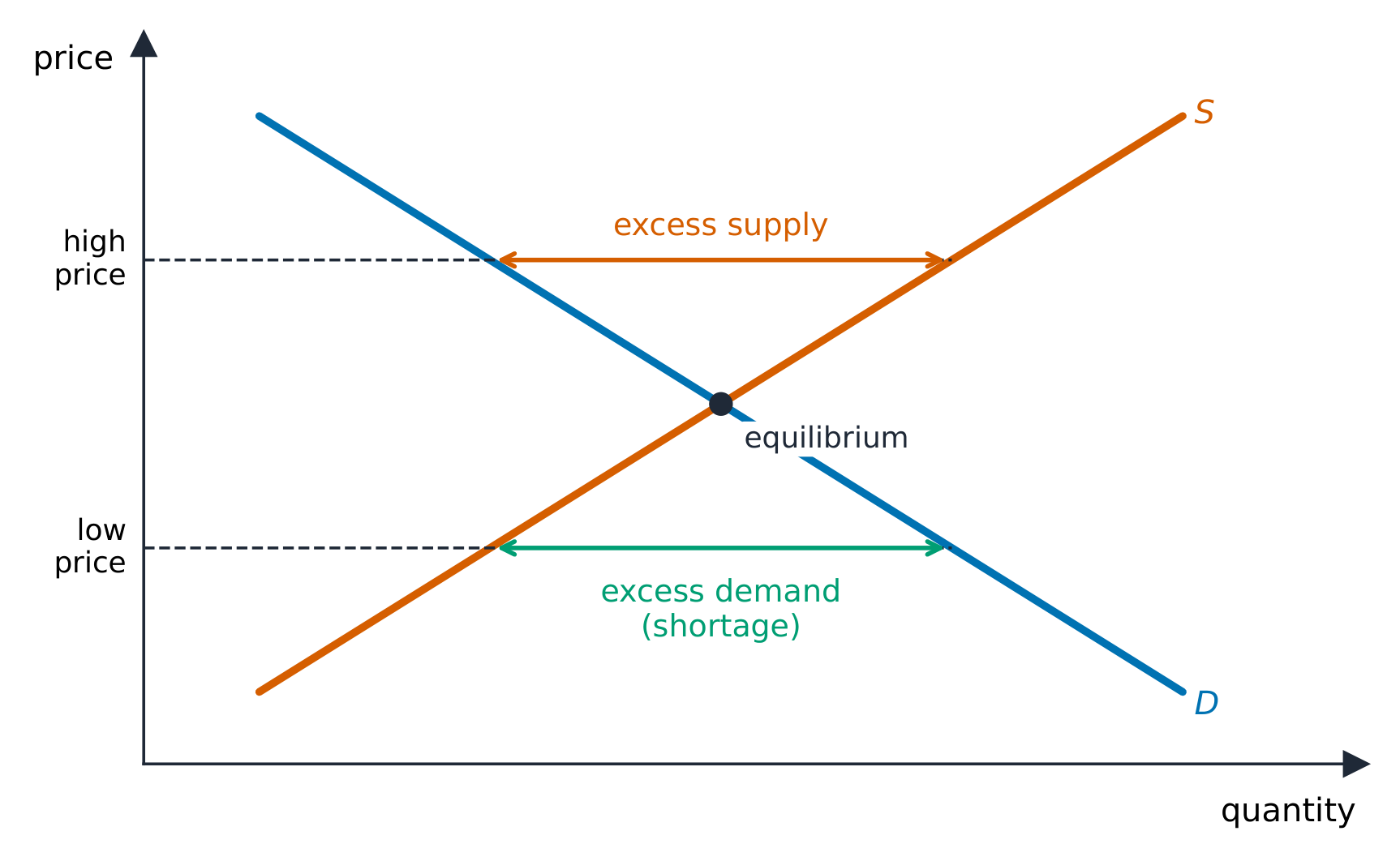
    Away from equilibrium the market self-corrects: above the equilibrium price there is a surplus 过剩 (excess supply) that pushes price down; below it a shortage 短缺 (excess demand) that pushes price up.

    Above equilibrium there is excess supply; below it, excess demand
    Above equilibrium there is excess supply; below it, excess demand

    When a determinant shifts a curve, the equilibrium moves predictably. A single shift gives a definite result for both price and quantity. When both curves shift, one of price or quantity is indeterminate (depends on the relative sizes of the shifts) – a favorite exam trap. Work these out by drawing the shifts.

    Vocabulary · ⁨مفردات⁩ Train · ⁨تدريب⁩
    English العربية
    surplus/ˈsɜːpləs/ فائضاً
    shortage/ˈʃɔːtɪdʒ/ عجزاً
    2.8

    The Effects of Government Intervention in Markets

    Syllabus · ⁨المنهج⁩
    English

    Enduring Understanding (POL-1): Government policies influence consumer and producer behavior and therefore affect market outcomes.

    Learning Objective POL-1.A: a. Define forms of government price and quantity intervention. b. Explain (using graphs where appropriate) how government policies alter consumer and producer behaviors that influence incentives and therefore affect outcomes. c. Calculate (using data from a graph or table where appropriate) changes in market outcomes resulting from government policies.

    • POL-1.A.1 Some government policies, such as price floors, price ceilings, and other forms of price and quantity regulation, affect incentives and outcomes in all market structures.
    • POL-1.A.2 Governments use taxes and subsidies to change incentives in ways that influence consumer and producer behavior, shifting the supply and demand curves accordingly.
    • POL-1.A.3 Taxes and subsidies affect government revenues or costs.
    • POL-1.A.4 Government intervention in a market producing the efficient quantity through taxes, subsidies, price controls, or quantity controls can only decrease allocative efficiency.
    • POL-1.A.5 Deadweight loss represents the losses to buyers and sellers as a result of government intervention in an efficient market.
    • POL-1.A.6 The incidence of taxes and subsidies imposed on goods traded in perfectly competitive markets depends on the elasticity of supply and demand.
    العربية

    فهم دائم (POL-1): تؤثر سياسات الحكومة على سلوك المستهلك والمنتج وبالتالي تؤثر على نتائج السوق.

    هدف التعلم POL-1.A: أ. عرّف أشكال تدخل الحكومة في الأسعار والكميات. ب. اشرح (باستخدام الرسوم البيانية عند الحاجة) كيف تعدل السياسات الحكومية سلوك المستهلك والمنتج الذي يؤثر على الحوافز وبالتالي يؤثر على النتائج. ج. احسب (باستخدام بيانات من رسم بياني أو جدول عند الحاجة) التغيرات في نتائج السوق الناتجة عن السياسات الحكومية.

    • POL-1.A.1 بعض السياسات الحكومية، مثل السقوف السعرية والسقف السعري وأنواع أخرى من تنظيم الأسعار والكميات، تؤثر على الحوافز والنتائج في جميع هياكل السوق.
    • POL-1.A.2 تستخدم الحكومات الضرائب والإعانات لتغيير الحوافز بطرق تؤثر على سلوك المستهلك والمنتج، مما يؤدي إلى إزاحة منحنيي العرض والطلب accordingly.
    • POL-1.A.3 تؤثر الضرائب والإعانات على إيرادات الحكومة أو تكاليفها.
    • POL-1.A.4 التدخل الحكومي في سوق ينتج الكمية المثلى من خلال الضرائب والإعانات أو التحكم في الأسعار أو الكميات لا يمكن إلا أن يقلل من الكفاءة التخصيصية.
    • POL-1.A.5 يمثل الخسارة العاجزة (Deadweight loss) الخسائر التي يتكبدها المشترون والبائعون نتيجة التدخل الحكومي في سوق فعال.
    • POL-1.A.6 يعتمد ثقل فرض الضرائب والإعانات على السلع المباعة في أسواق المنافسة الكاملة على مرونة العرض والطلب.

    Source: College Board AP Course and Exam Description · ⁨المصدر: وصف دورة وامتحان College Board AP⁩

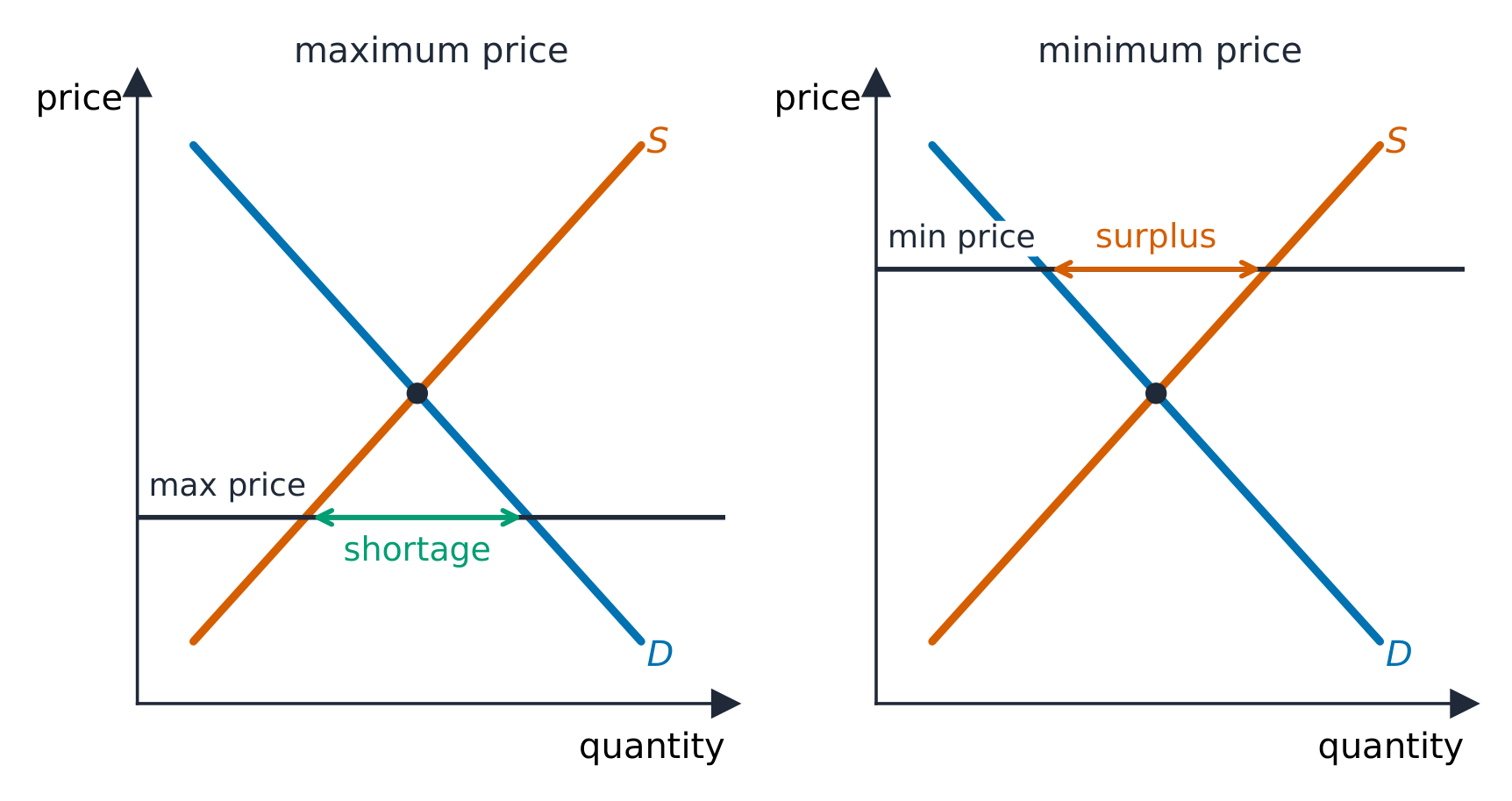
    A price ceiling causes a shortage
    A tax and the deadweight loss

    Governments intervene, usually reducing total surplus:

    A price ceiling causes a shortage; a price floor causes a surplus
    A price ceiling causes a shortage; a price floor causes a surplus
    • A price ceiling 价格上限 (a legal maximum, like rent control) below equilibrium causes a persistent shortage.
    • A price floor 价格下限 (a legal minimum, like a minimum wage) above equilibrium causes a persistent surplus.
    • An excise tax 消费税 shifts supply up by the tax; the burden (tax incidence 税收归宿) falls more heavily on whichever side is more inelastic.
    • A subsidy shifts supply down, raising quantity.

    Each of these creates deadweight loss 无谓损失 – mutually beneficial trades that no longer happen, shown as a triangle between the curves at the new quantity.

    Exam skill: on a graph, be able to shade consumer surplus, producer surplus, government revenue from a tax, and deadweight loss, and say who bears the tax and why.

    Explore · ⁨استكشف⁩

    Add a tax or price control · ⁨أضف ضريبة أو رقابة على الأسعار⁩

    A price ceiling below equilibrium causes shortages; a tax drives a wedge between what buyers pay and sellers get, shrinking the quantity traded. · ⁨يسبب السقف السعري أسفل التوازن نقصاً؛ بينما يُحدث الضريبة فجوة بين ما يدفعه المشترون وما يحصل عليه البائعون، مما يقلل الكمية المتداولة.⁩

    Vocabulary · ⁨مفردات⁩ Train · ⁨تدريب⁩
    English العربية
    price ceiling/praɪs ˈsiːlɪŋ/ سقف سعري
    price floor/praɪs flɔː/ سعر أدنى
    excise tax/ekˈsaɪz tæks/ ضريبة الاستهلاك
    tax incidence/tæks ˈɪnsɪdəns/ عبء الضريبة
    deadweight loss/ˈdedweɪt lɒs/ خسارة في العجز
    2.9

    International Trade and Public Policy

    Syllabus · ⁨المنهج⁩
    English

    Enduring Understanding (POL-1): Government policies influence consumer and producer behavior and therefore affect market outcomes.

    Learning Objective POL-1.B: a. Define tariffs and quotas. b. Explain (using graphs where appropriate) how markets are affected by public policy related to international trade. c. Calculate (using data from a graph or table as appropriate) changes in market outcomes resulting from public policy related to international trade.

    • POL-1.B.1 Equilibria in competitive markets may be altered by the decision to open an economy to trade with other countries; equilibrium price can be higher or lower than under autarky, and the gap between domestic supply and demand is filled by trade. Opening an economy to trade with other countries affects consumer surplus, producer surplus, and total economic surplus.
    • POL-1.B.2 Tariffs, which governments sometimes use to influence international trade, affect domestic price, quantity, government revenue, and consumer surplus and total economic surplus.
    • POL-1.B.3 Quotas can be used to alter quantities produced and therefore affect price, consumer surplus, and total economic surplus.
      • Exclusion statement: The graphing of quotas is beyond the scope of the course and the AP Exam, but understanding how quotas affect quantities produced is within the scope.
    العربية

    فهم دائم (POL-1): تؤثر سياسات الحكومة على سلوك المستهلك والمنتج وبالتالي تؤثر على نتائج السوق.

    هدف التعلم POL-1.B: أ. عرّف الجمارك والحصص. ب. اشرح (باستخدام الرسوم البيانية عند الحاجة) كيف تتأثر الأسواق بالسياسة العامة المتعلقة بالتجارة الدولية. ج. احسب (باستخدام بيانات من رسم بياني أو جدول عند الحاجة) التغيرات في نتائج السوق الناتجة عن السياسة العامة المتعلقة بالتجارة الدولية.

    • POL-1.B.1 قد تُعدّل توازنات الأسواق التنافسية بقرار فتح الاقتصاد للتجارة مع دول أخرى؛ يمكن أن يكون سعر التوازن أعلى أو أقل مما عليه في حالة الانغلاق الذاتي، وتُ سد الفجوة بين العرض والطلب المحليين من خلال التجارة. إن فتح الاقتصاد للتجارة مع دول أخرى يؤثر على فائض المستهلك وفائض المنتج وإجمالي الفائض الاقتصادي.
    • POL-1.B.2 الجمارك، التي تستخدمها الحكومات أحياناً للتأثير على التجارة الدولية، تؤثر على السعر المحلي والكمية وإيرادات الحكومة وفائض المستهلك وإجمالي الفائض الاقتصادي.
    • POL-1.B.3 يمكن استخدام الحصص لتغيير الكميات المنتجة وبالتالي التأثير على السعر وفائض المستهلك وإجمالي الفائض الاقتصادي.
      • عبارة الاستبعاد: تمثيل حصص الرسم البياني خارج نطاق المنهج والامتحان AP، لكن فهم كيفية تأثير الحصص على الكميات المنتجة يقع ضمن النطاق.

    Source: College Board AP Course and Exam Description · ⁨المصدر: وصف دورة وامتحان College Board AP⁩

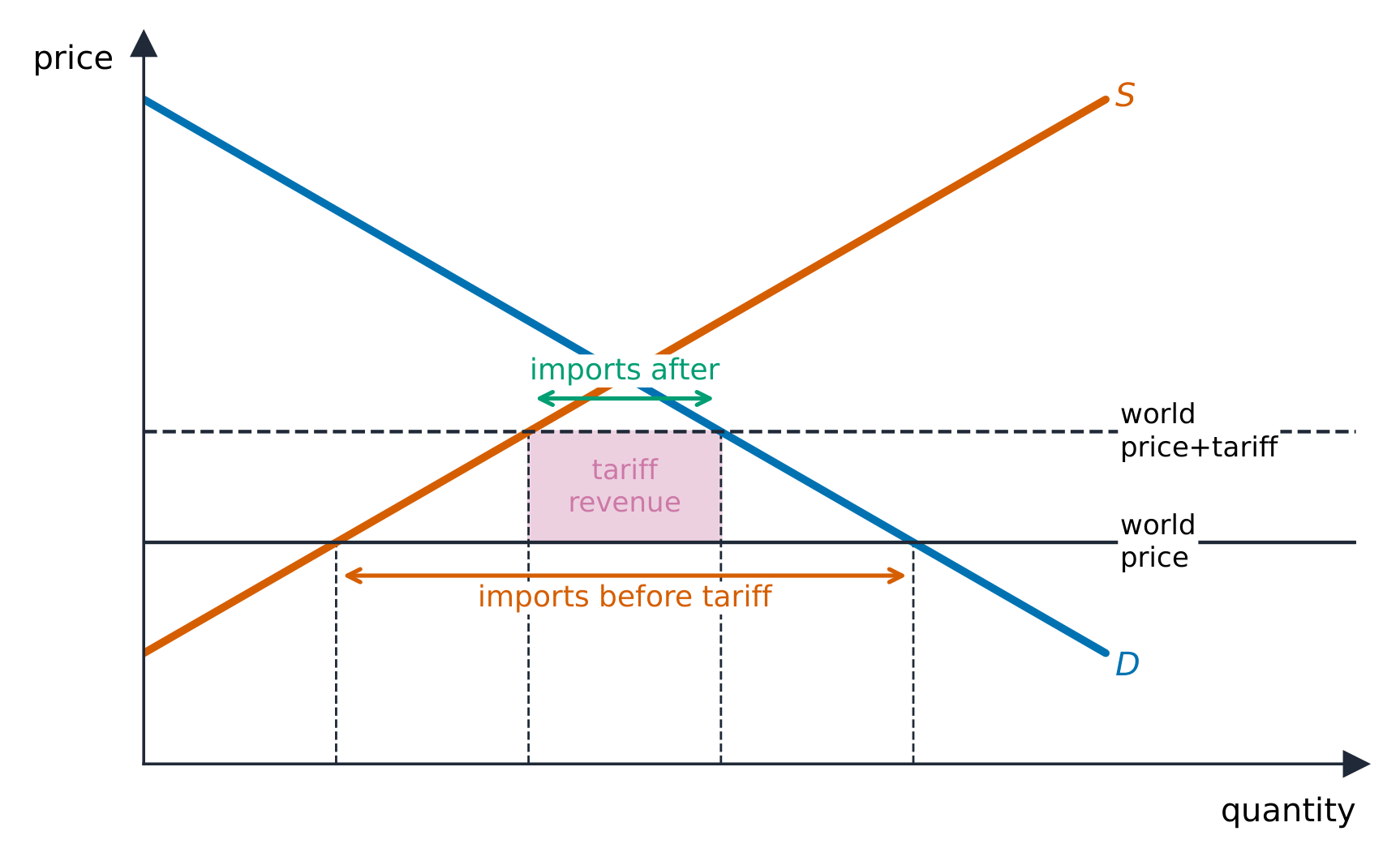
    When a country opens to trade at a world price 世界价格:

    A tariff raises domestic supply, cuts demand, and shrinks imports
    A tariff raises domestic supply, cuts demand, and shrinks imports
    • If the world price is below the domestic price, the country imports 进口 – consumers gain more than producers lose, so total surplus rises.
    • If the world price is above the domestic price, the country exports 出口 – producers gain more than consumers lose.

    A tariff 关税 (a tax on imports) or a quota 配额 (a limit on imports) raises the domestic price, helps domestic producers, hurts consumers more, and creates deadweight loss. Free trade maximizes total surplus, which is the core efficiency argument for it.

    Vocabulary · ⁨مفردات⁩ Train · ⁨تدريب⁩
    English العربية
    world price/wɜːld praɪs/ السعر العالمي
    imports/ɪmˈpɔːts/ الواردات
    exports/ˈekspɔːts/ الصادرات
    tariff/ˈtærɪf/ تعريف جمركي
    quota/ˈkwəʊtə/ حصص انتاجية
    2.9

    Exam tips

    • Separate a movement along a curve (own price) from a shift (a determinant); a single shift gives a definite result, a double shift leaves one variable indeterminate.
    • Compute elasticity $E_d=|\%\Delta Q \div \%\Delta P|$; elastic ($>1$) means a price cut raises total revenue, inelastic ($<1$) lowers it.
    • Read the sign of cross-price elasticity (substitutes $+$, complements $-$) and income elasticity (normal $+$, inferior $-$).
    • Shade consumer/producer surplus and the deadweight loss from a tax or price control; incidence falls on the more inelastic side.
    • A price ceiling below equilibrium causes a shortage; a price floor above causes a surplus.
  • 3

    Production, Cost, and the Perfect Competition Model · ⁨الإنتاج والتكلفة ونموذج المنافسة الكاملة⁩

    Watch lesson · ⁨شاهد الدرس⁩
    3.1

    The Production Function · ⁨دالة الإنتاج⁩

    Syllabus · ⁨المنهج⁩
    English

    Enduring Understanding (PRD-1): Firms' production and cost constraints over different input and output levels shape optimal decisions in the short run and long run.

    Learning Objective PRD-1.A: a. Define (using graphs where appropriate) key terms and concepts relating to production and cost. b. Explain (using graphs where appropriate) how production and cost are related in the short run and long run. c. Calculate (using data from a graph or table as appropriate) the various measures of productivity and short-run and long-run costs.

    • PRD-1.A.1 The production function explains the relationship between inputs and outputs both in the short run and the long run.
    • PRD-1.A.2 Marginal product and average product change as input usage changes, and hence, total product changes.
    • PRD-1.A.3 Diminishing marginal returns occur as the firm employs more of one input, holding other inputs constant, to produce a product (output) in the short run.
    العربية

    الفهم الدائم (PRD-1): قيود الإنتاج والتكاليف للشركات عند مستويات مختلفة من المدخلات والمخرجات تشكل القرارات المثلى على المدى القصير والطويل.

    هدف التعلم PRD-1.A: أ. عرّف (باستخدام الرسوم البيانية حيثما كان ذلك مناسباً) المصطلحات والمفاهيم الرئيسية المتعلقة بالإنتاج والتكاليف. ب. اشرح (باستخدام الرسوم البيانية حيثما كان ذلك مناسباً) العلاقة بين الإنتاج والتكاليف على المدى القصير والطويل. ج. احسب (باستخدام بيانات من رسم بياني أو جدول حسب المناسبة) مقاييس الإنتاجية المختلفة وتكاليف المدى القصير والطويل.

    • PRD-1.A.1 دالة الإنتاج تشرح العلاقة بين المدخلات والمخرجات على المدى القصير والطويل.
    • PRD-1.A.2 المنتج الحدي والمتوسط يتغيران مع تغير استخدام المدخلات، وبالتالي يتغير إجمالي المنتج.
    • PRD-1.A.3 تتحقق العوائد الحدية المتناقصة عندما تستخدم الشركة المزيد من مدخل واحد، مع ثبات المدخلات الأخرى، لإنتاج منتج (مخرج) على المدى القصير.

    Source: College Board AP Course and Exam Description · ⁨المصدر: وصف دورة وامتحان College Board AP⁩

    English

    The production function 生产函数 links inputs to output. In the short run 短期 at least one input (usually capital) is fixed 固定; in the long run 长期 all inputs vary.

    • Total product 总产量 is the total output.
    • Marginal product 边际产量 (MP) is the extra output from one more unit of a variable input (usually labor): $MP=\dfrac{\Delta\ \text{output}}{\Delta\ \text{labor}}$.
    • Average product 平均产量 is output per worker.

    As you add workers to fixed capital, MP eventually falls – the law of diminishing marginal returns 边际收益递减法则. This shape of MP is what drives the shape of the cost curves below.

    العربية
    مصنع للصلب: دوال الإنتاج والتكاليف تشكل كيفية إمداد الشركات للبضائع
    مصنع للصلب: دوال الإنتاج والتكاليف تشكل كيفية إمداد الشركات للبضائع

    تربط دالة الإنتاج المدخلات بالإنتاج. في القصير، يكون على الأقل مدخل واحد (عادةً رأس المال) ثابتاً؛ في الطويل، تتغير جميع المدخلات.

    • الإجمالي هو الإنتاج الكلي.
    • الإ边际 (MP) هو الإنتاج الإضافي من وحدة إضافية من مدخل متغير (عادةً العمل): $MP=\dfrac{\Delta\ \text{output}}{\Delta\ \text{labor}}$.
    • المتوسط هو الإنتاج لكل عامل.

    عند إضافة عمال إلى رأس المال الثابت، ينخفض MP أخيراً – قانون العوائد الهامشية المتناقصة. هذا الشكل لـ MP هو ما يقود شكل منحنيات التكلفة أدناه.

    ذراع روبوت تعمل على خط إنتاج في مصنع
    تحوّل دالة الإنتاج المدخلات — مثل العمالة ورأس المال كهذا الروبوت — إلى ناتج
    3.2

    Short-Run Production Costs · ⁨تكاليف الإنتاج في المدى القصير⁩

    Syllabus · ⁨المنهج⁩
    English

    Enduring Understanding (PRD-1): Firms' production and cost constraints over different input and output levels shape optimal decisions in the short run and long run.

    Learning Objective PRD-1.A: a. Define (using graphs where appropriate) key terms and concepts relating to production and cost. b. Explain (using graphs where appropriate) how production and cost are related in the short run and long run. c. Calculate (using data from a graph or table as appropriate) the various measures of productivity and short-run and long-run costs.

    • PRD-1.A.4 Fixed costs and variable costs determine the total cost.
    • PRD-1.A.5 Marginal cost, average (fixed, variable, and total) cost, total cost, and total variable cost change as total output changes, but total fixed cost remains constant at all output levels, including zero output.
    • PRD-1.A.6 Production functions with diminishing marginal returns yield an upward-sloping marginal cost curve.
    • PRD-1.A.7 Specialization and the division of labor reduce marginal costs for firms.
    • PRD-1.A.8 Cost curves can shift in response to changes in input costs and productivity.
    العربية

    الفهم الدائم (PRD-1): قيود الإنتاج والتكاليف للشركات عند مستويات مختلفة من المدخلات والمخرجات تشكل القرارات المثلى على المدى القصير والطويل.

    هدف التعلم PRD-1.A: أ. عرّف (باستخدام الرسوم البيانية حيثما كان ذلك مناسباً) المصطلحات والمفاهيم الرئيسية المتعلقة بالإنتاج والتكاليف. ب. اشرح (باستخدام الرسوم البيانية حيثما كان ذلك مناسباً) العلاقة بين الإنتاج والتكاليف على المدى القصير والطويل. ج. احسب (باستخدام بيانات من رسم بياني أو جدول حسب المناسبة) مقاييس الإنتاجية المختلفة وتكاليف المدى القصير والطويل.

    • PRD-1.A.4 التكاليف الثابتة والمتغيرة تحدد إجمالي التكلفة.
    • PRD-1.A.5 التكلفة الحدية والمتوسطة (الثابتة، والمتغيرة، وإجمالي التكلفة)، وإجمالي التكلفة، وإجمالي التكلفة المتغيرة تتغير مع تغير إجمالي الإنتاج، لكن إجمالي التكلفة الثابتة يبقى ثابتاً عند جميع مستويات الإنتاج، بما في ذلك صفر إنتاج.
    • PRD-1.A.6 دوال الإنتاج ذات العوائد الحدية المتناقصة تنتج منحنى تكلفة حدية متجه للأعلى.
    • PRD-1.A.7 التخصص وتقسيم العمل يقللان من التكاليف الحدية للشركات.
    • PRD-1.A.8 منحنيات التكلفة يمكن أن تنزاح استجابةً لتغيرات في تكاليف المدخلات والإنتاجية.

    Source: College Board AP Course and Exam Description · ⁨المصدر: وصف دورة وامتحان College Board AP⁩

    English
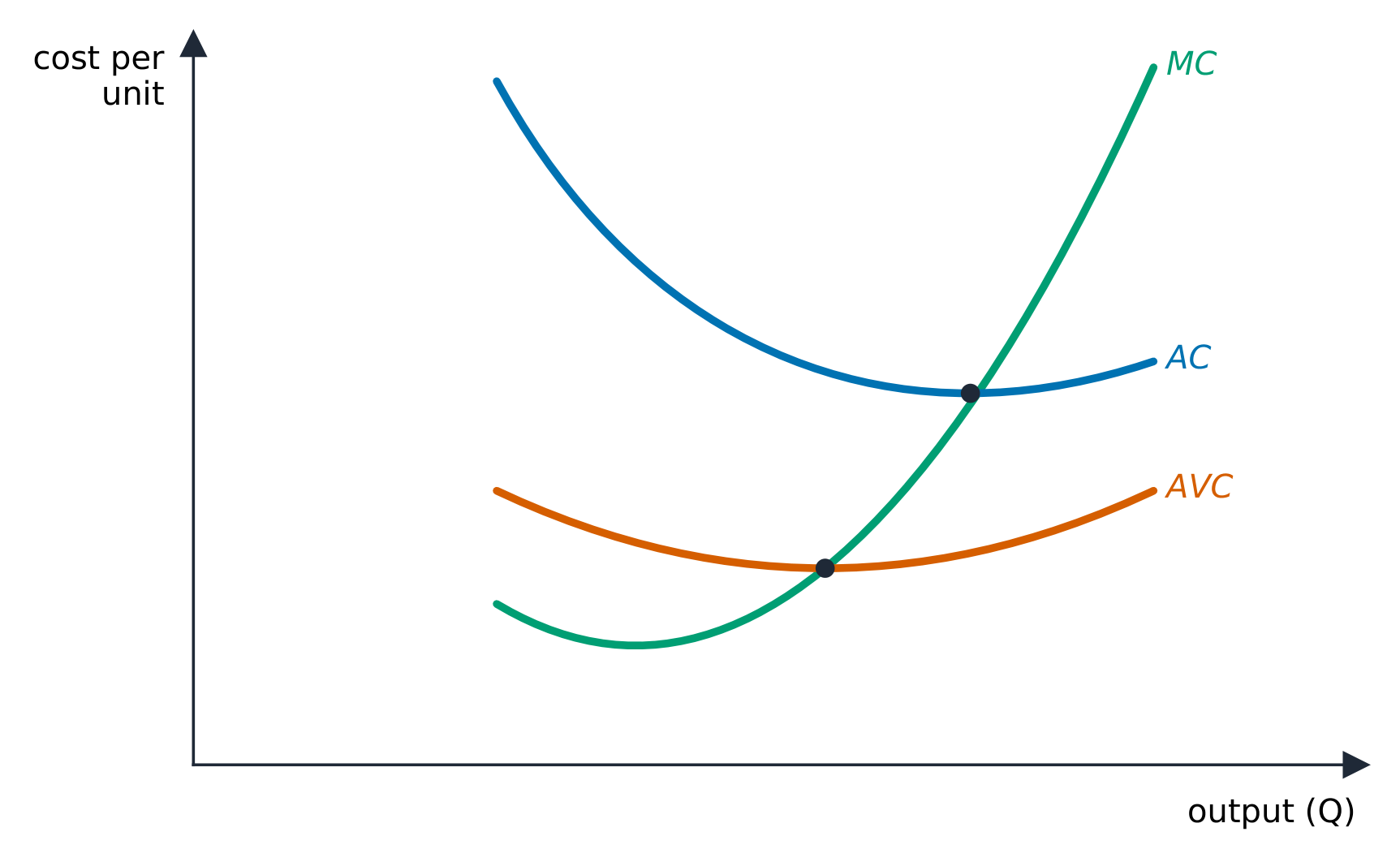
    Short-run cost curves (MC, ATC, AVC)

    Costs split into fixed and variable:

    • Fixed cost 固定成本 (FC) does not change with output (rent on the factory).
    • Variable cost 可变成本 (VC) rises with output (materials, labor).
    • Total cost 总成本 $TC=FC+VC$.

    The per-unit costs matter most:

    • Average fixed cost $AFC=FC/Q$ falls continuously (spreading fixed cost).
    • Average variable cost $AVC=VC/Q$ and average total cost $ATC=TC/Q$ are U-shaped.
    • Marginal cost 边际成本 $MC=\dfrac{\Delta TC}{\Delta Q}$ is the cost of one more unit.

    Two key facts: MC is the mirror image of MP (when MP rises, MC falls, and vice versa), and MC cuts both AVC and ATC at their minimum points (when marginal is below average, the average falls; when above, it rises).

    Worked example. A firm has fixed cost $FC=\$100$. At $Q=10$ its total cost is $\$300$, so variable cost is $\$200$: then $ATC=\tfrac{300}{10}=\$30$, $AVC=\tfrac{200}{10}=\$20$, and $AFC=\tfrac{100}{10}=\$10$ (note $AFC+AVC=ATC$). If raising output to $Q=11$ pushes total cost to $\$325$, the marginal cost of that $11$th unit is $\dfrac{\Delta TC}{\Delta Q}=\dfrac{325-300}{1}=\$25$.

    العربية
    منحنيات التكلفة في الأجل القصير (التكلفة الحدية، متوسط إجمالي التكلفة، متوسط التكلفة المتغيرة)

    تنقسم التكاليف إلى ثابتة ومتغيرة:

    منحنيات التكلفة الحدية والمتوسطة ومتغيرة التكلفة في المدى القصير
    منحنيات التكلفة الحدية والمتوسطة ومتغيرة التكلفة في المدى القصير
    • التكلفة الثابتة (FC) لا تتغير مع الناتج (إيجار المصنع).
    • التكلفة المتغيرة (VC) ترتفع مع الناتج (مواد خام، عمالة).
    • التكلفة الكلية $TC=FC+VC$.

    تُعدّ التكاليف لكل وحدة هي الأهم:

    • التكلفة الثابتة المتوسطة $AFC=FC/Q$ تنخفض باستمرار (بسبب توزيع التكلفة الثابتة على وحدات أكثر).
    • التكلفة المتغيرة المتوسطة $AVC=VC/Q$ والتكلفة الكلية المتوسطة $ATC=TC/Q$ تكونا على شكل حرف U.
    • التكلفة الحدية $MC=\dfrac{\Delta TC}{\Delta Q}$ هي تكلفة إضافة وحدة واحدة إضافية.

    حقيقتان أساسيتان: التكلفة الحدية هي الصورة العكسية للإنتاجية الحدية (عندما ترتفع الإنتاجية الحدية، تنخفض التكلفة الحدية والعكس صحيح)، والتكلفة الحدية تقطع كلًا من متوسط التكلفة المتغيرة ومتوسط التكلفة الكلية عند أدنى نقطتين لهما (عندما تكون الحدية أقل من المتوسطة، ينخفض المتوسط؛ وعندما تكون أعلى، يرتفع).

    مثال محلول. تملك شركة تكلفة ثابتة $FC=\$100$. At $Q=10$ its total cost is $\$300$، لذا فإن التكلفة المتغيرة هي $\$200$: then $ATC=\tfrac{300}{10}=\$30$، $AVC=\tfrac{200}{10}=\$20$, and $AFC=\tfrac{100}{10}=\$10$ (لاحظ $AFC+AVC=ATC$). إذا أدى رفع الإنتاج إلى $Q=11$ إلى رفع التكلفة الكلية إلى $\$325$, the marginal cost of that $11$th unit is $\dfrac{\Delta TC}{\Delta Q}=\dfrac{325-300}{1}=\$25$.

    Explore · ⁨استكشف⁩

    Explore the U-shaped cost curves · ⁨استكشف منحنيات التكاليف على شكل حرف U⁩

    As output rises, marginal cost eventually climbs (diminishing returns) and cuts through the U-shaped average cost at its minimum — the most efficient scale. · ⁨مع ارتفاع الإنتاج، يرتفع التكلفة الحدية في النهاية (بسبب تناقص العوائد) لتقطع منحنى التكلفة المتوسطة على شكل U عند أدنى نقطة له — وهو الحجم الأمثل الأكثر كفاءة.⁩

    Vocabulary · ⁨مفردات⁩ Train · ⁨تدريب⁩
    English العربية
    production function/prəˈdʌkʃn ˈfʌŋkʃn/ دالة الإنتاج
    short run/ʃɔːt rʌn/ قصير الأجل
    fixed/fɪkst/ ثابت
    long run/lɒŋ rʌn/ طويل الأجل
    Total product/ˈtəʊtl ˈprɒdʌkt/ إجمالي الإنتاج
    Marginal product/ˈmɑːdʒɪnl ˈprɒdʌkt/ الإنتاج الهامشي
    Average product/ˈævrɪdʒ ˈprɒdʌkt/ الإنتاج المتوسط
    law of diminishing marginal returns/lɔː ɒv dɪˈmɪnɪʃɪŋ ˈmɑːdʒɪnl rɪˈtɜːnz/ قانون تناقص العوائد الحدية
    Fixed cost/fɪkst kɒst/ التكلفة الثابتة
    Variable cost/ˈveərɪəbl kɒst/ التكلفة المتغيرة
    Total cost/ˈtəʊtl kɒst/ إجمالي التكلفة
    Marginal cost/ˈmɑːdʒɪnl kɒst/ ملاحظة
    3.3

    Long-Run Production Costs · ⁨تكاليف الإنتاج في المدى الطويل⁩

    Syllabus · ⁨المنهج⁩
    English

    Enduring Understanding (PRD-1): Firms' production and cost constraints over different input and output levels shape optimal decisions in the short run and long run.

    Learning Objective PRD-1.A: a. Define (using graphs where appropriate) key terms and concepts relating to production and cost. b. Explain (using graphs where appropriate) how production and cost are related in the short run and long run. c. Calculate (using data from a graph or table as appropriate) the various measures of productivity and short-run and long-run costs.

    • PRD-1.A.9 In the long run, firms can adjust all their inputs, and as a result, all costs become variable.
    • PRD-1.A.10 The relationship between inputs and outputs in the long run is described by the scale of production—increasing, decreasing, or constant returns to scale.
    • PRD-1.A.11 The long-run average total cost is characterized by economies of scale, diseconomies of scale, or constant returns to scale (efficient scale).
    • PRD-1.A.12 The minimum efficient scale plays a role in determining the concentration of firms in a market and the market structure.
    العربية

    الفهم الدائم (PRD-1): قيود الإنتاج والتكاليف للشركات عند مستويات مختلفة من المدخلات والمخرجات تشكل القرارات المثلى على المدى القصير والطويل.

    هدف التعلم PRD-1.A: أ. عرّف (باستخدام الرسوم البيانية حيثما كان ذلك مناسباً) المصطلحات والمفاهيم الرئيسية المتعلقة بالإنتاج والتكاليف. ب. اشرح (باستخدام الرسوم البيانية حيثما كان ذلك مناسباً) العلاقة بين الإنتاج والتكاليف على المدى القصير والطويل. ج. احسب (باستخدام بيانات من رسم بياني أو جدول حسب المناسبة) مقاييس الإنتاجية المختلفة وتكاليف المدى القصير والطويل.

    • PRD-1.A.9 على المدى الطويل، يمكن للشركات تعديل جميع مدخلاتها، ونتيجة لذلك، تصبح جميع التكاليف متغيرة.
    • PRD-1.A.10 العلاقة بين المدخلات والمخرجات على المدى الطويل تصفها مقياس الإنتاج—العائد المتزايد، أو المتناقص، أو الثابت على مقياس الإنتاج.
    • PRD-1.A.11 تتميز متوسط التكلفة الإجمالية على المدى الطويل باقتصاديات الحجم، أو عدم اقتصاديات الحجم، أو العائد الثابت على مقياس الإنتاج (المقياس الكفء).
    • PRD-1.A.12 يلعب المقياس الأدنى للكفاءة دوراً في تحديد تركيز الشركات في السوق والهيكل السوقي.

    Source: College Board AP Course and Exam Description · ⁨المصدر: وصف دورة وامتحان College Board AP⁩

    English

    In the long run all inputs – including plant size – can change, so only the long-run average total cost (LRATC) curve matters. Its shape shows returns to scale:

    • Economies of scale 规模经济: LRATC falls as output grows (bulk buying, specialization).
    • Constant returns to scale: LRATC flat.
    • Diseconomies of scale 规模不经济: LRATC rises (a firm too big to manage well).

    Exam skill: know that "diminishing returns" is a short-run idea (one fixed input) while "economies of scale" is a long-run idea (all inputs vary) – examiners test the distinction.

    العربية

    في المدى الطويل يمكن تغيير جميع المدخلات — بما في ذلك حجم المنشأة — لذا فإن منحنى التكلفة الكلية المتوسطة في المدى الطويل (LRATC) هو المهم وحده. يعكس شكله عوائد الحجم: *

    مدخرات وتكاليف عدم الكفاءة بسبب الحجم على منحنى التكلفة المتوسطة في المدى الطويل
    مدخرات وتكاليف عدم الكفاءة بسبب الحجم على منحنى التكلفة المتوسطة في المدى الطويل
    • مدخرات الحجم: تنخفض LRATC مع نمو الناتج (الشراء بالجملة، التخصص).
    • عوائد حجم ثابتة: LRATC أفقية.
    • تكاليف عدم الكفاءة بسبب الحجم: ترتفع LRATC (شركة كبيرة جدًا يصعب إدارتها جيدًا).

    مهارة الامتحان: يجب أن تعرف أن "العائد المتناقص" مفهوم قصير المدى (مدخل واحد ثابت) بينما "مدخرات الحجم" مفهوم طويل المدى (جميع المدخلات متغيرة) — ويختبر المصححون هذا التمييز.

    Vocabulary · ⁨مفردات⁩ Train · ⁨تدريب⁩
    English العربية
    Economies of scale/ɪˈkɒnəmiz ɒv skeɪl/ اقتصاديات الحجم
    Diseconomies of scale/ˌdɪsɪˈkɒnəmiz ɒv skeɪl/ عيوب الحجم
    Explicit costs/ekˈsplɪsɪt kɒsts/ التكاليف الصريحة
    implicit costs/ɪmˈplɪsɪt kɒsts/ التكاليف الضمنية
    Accounting profit/əˈkaʊntɪŋ ˈprɒfɪt/ الربح المحاسبي
    Economic profit/ˌiːkəˈnɒmɪk ˈprɒfɪt/ الربح الاقتصادي
    normal profit/ˈnɔːml ˈprɒfɪt/ ربحًا طبيعيًا
    entry/ˈentri/ الدخول
    exit/ˈeɡzɪt/ الخروج
    perfectly competitive/ˈpɜːfektlɪ kəmˈpetɪtɪv/ تنافس مثالي
    price taker/praɪs ˈteɪkə/ قاصر السعر
    allocatively efficient/ˈæləkətɪvli ɪˈfɪʃənt/ فعالي تخصيصياً
    productively efficient/prəˈdʌktɪvli ɪˈfɪʃənt/ كفاءة إنتاجية
    3.4

    Types of Profit · ⁨أنواع الربح⁩

    Syllabus · ⁨المنهج⁩
    English

    Enduring Understanding (CBA-2): To determine the optimal level at which to pursue an activity whose total benefits exceed total cost, rational economic agents compare marginal benefits and marginal costs.

    Learning Objective CBA-2.C: a. Define the different types of profit. b. Explain how firms respond to profit opportunities. c. Calculate a firm's profit or loss.

    • CBA-2.C.1 Firms respond to economic profit (loss) rather than accounting profit.
    • CBA-2.C.2 Accounting profit fails to account for implicit costs (such as cost of financial capital, compensation for risk, or an entrepreneur's time), which, if fully compensated, result in normal profit.
    العربية

    الفهم الدائم (CBA-2): لتحديد المستوى الأمثل لممارسة نشاط تتجاوز فيه المنافع الإجمالية التكاليف الإجمالية، يقارن الوكلاء العقلانيون المنافع الحدية بالتكاليف الحدية.

    هدف التعلم CBA-2.C: أ. عرّف أنواع الربح المختلفة. ب. اشرح كيف تستجيب الشركات لفرص الربح. ج. احسب ربح أو خسارة الشركة.

    • CBA-2.C.1 تستجيب الشركات للربح الاقتصادي (الخسارة) بدلاً من الربح المحاسبي.
    • CBA-2.C.2 يفشل الربح المحاسبي في احتساب التكاليف الضمنية (مثل تكلفة رأس المال المالي، والتعويض عن المخاطر، أو وقت رائد الأعمال)، والتي إذا تم تعويضها بالكامل تؤدي إلى ربح طبيعي.

    Source: College Board AP Course and Exam Description · ⁨المصدر: وصف دورة وامتحان College Board AP⁩

    English

    Economists count all opportunity costs, including the owner's:

    • Explicit costs 显性成本 are out-of-pocket payments; implicit costs 隐性成本 are the opportunity costs of owner-supplied resources (forgone salary, forgone interest).
    • Accounting profit 会计利润 $=$ revenue $-$ explicit costs.
    • Economic profit 经济利润 $=$ revenue $-$ explicit $-$ implicit costs.

    Because economic profit subtracts more, it is smaller. Zero economic profit (a normal profit 正常利润) still means the owner is earning exactly the opportunity cost of their resources – a perfectly acceptable outcome.

    Worked example. A shopkeeper takes in $\$200{,}000$ of revenue and pays $\$120{,}000$ in explicit costs, so accounting profit is $\$80{,}000$. But she gave up a $\$70{,}000$ salary elsewhere and $\$5{,}000$ of interest on the savings she invested – $\$75{,}000$ of implicit costs. Her economic profit is $80{,}000-75{,}000=\$5{,}000$: still positive, so staying in business genuinely beats her next-best alternative.

    العربية

    يحسب الاقتصاديون كل فرص التكلفة، بما في ذلك فرص-owner's:

    • التكاليف الصريحة هي مدفوعات نقدية مباشرة؛ التكاليف الضمنية هي فرص التكلفة للموارد التي يوفرها المالك (الراتب المنقوص، الفائدة المنقوصة).
    • الربح المحاسبي $=$ الإيرادات $-$ التكاليف الصريحة.
    • الربح الاقتصادي $=$ الإيرادات $-$ التكاليف الصريحة $-$ التكاليف الضمنية.

    لأن الربح الاقتصادي يطرح المزيد منه، فهو أصغر. الربح الاقتصادي الصفري (الربح الطبيعي) يعني لا يزال المالك يكتسب بالضبط فرصة تكلفة موارده — وهو نتيجة مقبولة تمامًا.

    مثال محلول. يتقاضى بائع متجر $\$200{,}000$ of revenue and pays $\$120{,}000$ في التكاليف الصريحة، لذا فإن الربح المحاسبي هو $\$80{,}000$. But she gave up a $\$70{,}000$ الراتب في مكان آخر و$\$5{,}000$ of interest on the savings she invested – $\$75{,}000$ من التكاليف الضمنية. ربحه الاقتصادي هو $80{,}000-75{,}000=\$5{,}000$: لا يزال إيجابيًا، لذا فإن البقاء في العمل يتفوق حقًا على بديله الأفضل التالي.

    3.5

    Profit Maximization · ⁨تعظيم الربح⁩

    Syllabus · ⁨المنهج⁩
    English

    Enduring Understanding (CBA-2): To determine the optimal level at which to pursue an activity whose total benefits exceed total cost, rational economic agents compare marginal benefits and marginal costs.

    Learning Objective CBA-2.D: a. Define (using graphs or data as appropriate) the profit-maximizing rule. b. Explain (using a graph or data as appropriate) the profit-maximizing level of production.

    • CBA-2.D.1 Firms are assumed to produce output to maximize their profits by comparing marginal revenue and marginal cost.
    العربية

    الفهم الدائم (CBA-2): لتحديد المستوى الأمثل لممارسة نشاط تتجاوز فيه المنافع الإجمالية التكاليف الإجمالية، يقارن الوكلاء العقلانيون المنافع الحدية بالتكاليف الحدية.

    هدف التعلم CBA-2.D: أ. عرّف (باستخدام الرسوم البيانية أو البيانات حسب المناسبة) قاعدة تعظيم الربح. ب. اشرح (باستخدام رسم بياني أو بيانات حسب المناسبة) مستوى الإنتاج الذي يعظم الربح.

    • CBA-2.D.1 يُفترض أن الشركات تنتج المخرجات لتعظيم أرباحها من خلال مقارنة الإيراد الحدي والتكلفة الحدية.

    Source: College Board AP Course and Exam Description · ⁨المصدر: وصف دورة وامتحان College Board AP⁩

    English

    Every firm, in every market structure, maximizes profit at the quantity where marginal revenue equals marginal cost:

    $$MR=MC.$$
    Produce each unit whose MR exceeds its MC; stop when they are equal. Producing less leaves profitable units unmade; producing more adds units that cost more than they earn.

    العربية

    كل شركة، في أي هيكل سوق، تُعظم ربحها عند الكمية التي يتساوى فيها الإيراد الحدي مع التكلفة الحدية:

    $$MR=MC.$$
    أنتِج كل وحدة يكون فيها إيرادها الحدي أكبر من تكلفتها الحدية؛ توقف عندما يتساويان. الإنتاج الأقل يترك وحدات مربحة دون إنتاج؛ الإنتاج الأعلى يضيف وحدات تكلفها أكثر مما تجنيه.

    3.6

    Deciding to Produce, Enter, or Exit · ⁨اتخاذ قرار الإنتاج أو الدخول أو الخروج⁩

    Syllabus · ⁨المنهج⁩
    English

    Enduring Understanding (PRD-2): Firms' short-run decisions to produce output, and long-run decisions to enter or exit a market, are based on profitability.

    Learning Objective PRD-2.A: Explain (using graphs or data where appropriate) firms' short-run decisions to produce positive output levels, or long-run decisions to enter or exit a market in response to profit-making opportunities.

    • PRD-2.A.1 In the short run, firms decide to operate (i.e., produce positive output) or shut down (i.e., produce zero output) by comparing total revenue to total variable cost or price to average variable cost (AVC).
    • PRD-2.A.2 In the absence of barriers to entry or exit, in the long run (i.e., once factors that are fixed in the short run become variable), firms enter a market in which there are profit-making opportunities and exit a market when they anticipate economic losses.
    العربية

    الفهم الدائم (PRD-2): قرارات الشركات على المدى القصير لإنتاج المخرجات، وقراراتها على المدى الطويل للدخول أو الخروج من السوق، تعتمد على الربحية.

    هدف التعلم PRD-2.A: اشرح (باستخدام الرسوم البيانية أو البيانات حسب المناسبة) قرارات الشركات على المدى القصير لإنتاج مستويات إيجابية من الإنتاج، أو قراراتها على المدى الطويل للدخول أو الخروج من السوق استجابةً لفرص تحقيق الربح.

    • PRD-2.A.1 على المدى القصير، تقرر الشركات التشغيل (أي إنتاج كمية إيجابية) أو الإغلاق (أي إنتاج صفر) من خلال مقارنة الإيرادات الكلية بالتكاليف المتغيرة أو السعر بمتوسط التكلفة المتغيرة (AVC).
    • PRD-2.A.2 في غياب حواجز الدخول أو الخروج، على المدى الطويل (أي بعد أن تصبح العوامل الثابتة على المدى القصير متغيرة)، تدخل الشركات سوقاً توجد فيه فرص ربحية وتغادره عندما تتوقع خسائر اقتصادية.

    Source: College Board AP Course and Exam Description · ⁨المصدر: وصف دورة وامتحان College Board AP⁩

    English

    Even at $MR=MC$, a firm must check whether to operate:

    • Short run – the shutdown rule: keep producing only if price covers average variable cost ($P\geq AVC$). If $P, shut down and lose only fixed cost. So the firm's short-run supply curve is its MC curve above minimum AVC.
    • Profit check: compare $P$ to $ATC$ at the profit-maximizing quantity – $P>ATC$ means economic profit, $P means a loss, $P=ATC$ means break-even.
    • Long run – entry and exit: economic profits attract entry 进入; losses cause exit 退出. This continues until economic profit is zero.
    العربية

    حتى عند $MR=MC$، يجب على الشركة التحقق مما إذا كانت ستعمل:

    • المدى القصير – قاعدة الإغلاق: استمر في الإنتاج فقط إذا كان السعر يغطي متوسط التكلفة المتغيرة ($P\geq AVC$). إذا $P، أغلق وخسر فقط التكلفة الثابتة. لذلك منحنى العرض قصير المدى للشركة هو منحنى التكلفة الحدية فوق أدنى نقطة لـ AVC.
    • تحقق الربح: قارن $P$ بـ $ATC$ عند كمية تعظيم الربح – $P>ATC$ يعني ربحًا اقتصاديًا، $P يعني خسارة، $P=ATC$ يعني التعادل.
    • المدى الطويل – الدخول والخروج: تجذب الأرباح الاقتصادية الدخول; الخسائر تسبب الخروج. يستمر هذا حتى يصبح الربح الاقتصادي صفراً.
    3.7

    Perfect Competition · ⁨المنافسة المثالية⁩

    Syllabus · ⁨المنهج⁩
    English

    Enduring Understanding (PRD-3): Even with a common goal of profit-maximization, market structure constrains and influences prices, output, and efficiency.

    Learning Objective PRD-3.A: a. Define (using graphs as appropriate) the characteristics of perfectly competitive markets and efficiency. b. Explain (using graphs where appropriate) equilibrium and firm decision making in perfectly competitive markets and how prices in perfectly competitive markets lead to efficient outcomes. c. Calculate (using data from a graph or table as appropriate) economic profit (loss) in perfectly competitive markets.

    • PRD-3.A.1 A perfectly competitive market is efficient. Firms in perfectly competitive markets face no barriers to entry and have no market power.
    • PRD-3.A.2 In perfectly competitive markets, prices communicate to consumers and producers the magnitude of others' marginal costs of production and marginal benefits of consumption and provide incentives to act on that information (i.e., price equals marginal cost in an efficient market).
    • PRD-3.A.3 In perfectly competitive markets, firms can sell all their outputs at a constant price determined by the market.
    • PRD-3.A.4 At a competitive market equilibrium, firms are price takers and select output to maximize profit by producing the level of output where the marginal cost equals marginal revenue (at the price).
    • PRD-3.A.5 At a competitive market equilibrium, the price of a product equals both the private marginal benefit received by the last unit consumed and the private marginal cost incurred to produce the last unit, thus achieving allocative efficiency.
    • PRD-3.A.6 In a short-run competitive equilibrium, price can either be above or below its long-run competitive level resulting in profits or losses, motivating entry or exit of firms and moving prices and quantities toward long-run equilibrium.
    • PRD-3.A.7 In a long-run perfectly competitive equilibrium, productive efficiency implies all operating firms produce at efficient scale, price equals marginal cost and minimum average total cost, and firms earn zero economic profit.
    • PRD-3.A.8 Firms may be in a constant cost, increasing cost, or decreasing cost industry. Long-run prices depend on the portion of the long-run cost curves on which firms operate.
    • PRD-3.A.9 A perfectly competitive market in long-run equilibrium is allocatively and productively efficient.
    العربية

    الفهم الدائم (PRD-3): حتى مع هدف مشترك وهو تعظيم الربح، يحد الهيكل السوقي ويؤثر على الأسعار والإنتاج والكفاءة.

    هدف التعلم PRD-3.A: أ. عرّف (باستخدام الرسوم البيانية حسب المناسبة) خصائص الأسواق التنافسية الكاملة والكفاءة. ب. اشرح (باستخدام الرسوم البيانية حسب المناسبة) التوازن واتخاذ القرار من قبل الشركات في الأسواق التنافسية الكاملة وكيف تؤدي الأسعار في هذه الأسواق إلى نتائج كفاءة. ج. احسب (باستخدام بيانات من رسم بياني أو جدول حسب المناسبة) الربح (أو الخسارة) الاقتصادي في الأسواق التنافسية الكاملة.

    • PRD-3.A.1 السوق التنافسي الكامل هو سوق كفء. لا تواجه الشركات في الأسواق التنافسية الكاملة حواجز دخول ولا تمتلك قوة سوقية.
    • PRD-3.A.2 في الأسواق التنافسية الكاملة، تواصل الأسعار للمستهلكين والمنتجين مقدار تكاليف الإنتاج الحدية والفوائد الحدية للاستهلاك لدى الآخرين، وتوفر حوافز للتصرف بناءً على تلك المعلومات (أي أن السعر يساوي التكلفة الحدية في السوق الكفء).
    • PRD-3.A.3 في الأسواق التنافسية الكاملة، يمكن للشركات بيع جميع مخرجاتها بسعر ثابت تحدده السوق.
    • PRD-3.A.4 عند توازن السوق التنافسي، تكون الشركات تأخذ للأسعار وتختار المخرجات لتعظيم الربح من خلال إنتاج مستوى المخرجات حيث تتساوى التكلفة الحدية مع الإيراد الحدي (عند السعر).
    • PRD-3.A.5 عند التوازن في سوق تنافسي، يساوي سعر المنتج المنفعة الحدية الخاصة التي يحصل عليها المستهلك للوحدة الأخيرة المستهلكة والتكلفة الحدية الخاصة المتكبدة لإنتاج الوحدة الأخيرة، مما يحقق الكفاءة التخصيصية.
    • PRD-3.A.6 في التوازن التنافسي قصير الأجل، يمكن أن يكون السعر أعلى أو أقل من مستواه التنافسي طويل الأجل، مما يؤدي إلى أرباح أو خسائر، ويحفز دخول أو خروج الشركات، ويدفع الأسعار والكميات نحو التوازن طويل الأجل.
    • PRD-3.A.7 في التوازن المثالي التنافسي طويل الأجل، تعني الكفاءة الإنتاجية أن جميع الشركات العاملة تنتج على نطاق فعال، وأن السعر يساوي التكلفة الحدية وأقل تكلفة كلية متوسطة، وتكسب الشركات صفر ربح اقتصادي.
    • PRD-3.A.8 قد تكون الصناعات ذات تكاليف ثابتة، أو تكاليف متزايدة، أو تكاليف متناقصة. تعتمد الأسعار طويلة الأجل على الجزء من منحنيات التكاليف طويلة الأجل الذي تعمل عليه الشركات.
    • PRD-3.A.9 السوق المثالي التنافسي في التوازن طويل الأجل هو كافي من حيث الكفاءة التخصيصية والإنتاجية.

    Source: College Board AP Course and Exam Description · ⁨المصدر: وصف دورة وامتحان College Board AP⁩

    English

    A perfectly competitive 完全竞争 market has many small firms, an identical (homogeneous) product, free entry and exit, and perfect information. Each firm is a price taker 价格接受者 – too small to affect the price – so it faces a horizontal demand curve at the market price, and price = marginal revenue = average revenue ($P=MR=AR$).

    This is why economists prize perfect competition. In long-run equilibrium it is both allocatively efficient 配置效率 and productively efficient 生产效率. Allocative efficiency holds because the firm produces where $P = MC$: the price (society's marginal benefit from the last unit) equals its marginal cost, so exactly the right amount is made. Productive efficiency holds because free entry drives price down to the minimum of average total cost, so goods are made as cheaply as possible. The market price is itself a signal that communicates everyone's marginal costs and benefits.

    The side-by-side panel is the graph the exam wants: the market (left) fixes the price $P^{*}$; the firm (right) takes it as a horizontal line and produces where $MC=P$. When $P>ATC$ there is a short-run profit (the shaded box); that profit attracts entry, which shifts market supply right and pushes the price down.

    • Short run: the firm can earn profit, break even, or take a loss, producing where $P=MC$.
    • Long run: entry and exit drive the firm to zero economic profit, producing where $P=MC=ATC$ at minimum ATC. This double efficiency – productive efficiency (lowest-cost output) and allocative efficiency ($P=MC$, so the last unit's value equals its cost) – is the benchmark against which every other market structure is judged.

    Exam skill: be able to draw the side-by-side market and single-firm graphs, show a short-run profit or loss, then show how entry/exit restores long-run equilibrium at minimum ATC.

    العربية

    السوق المثالي التنافسي له العديد من الشركات الصغيرة، منتج موحد (متطابق)، دخول وخروج حر، ومعلومات مثالية. كل شركة هي مستقبل سعر – صغيرة جدًا لتؤثر على السعر – لذا تواجه منحنى طلب أفقي عند سعر السوق، والسعر = الإيراد الحدي = الإيراد المتوسط ($P=MR=AR$).

    ولهذا السبب يقدّر الاقتصاديون المنافسة المثالية. في التوازن طويل المدى، فهي كفاءة تخصيصية وكفاءة إنتاجية معًا. تتحقق الكفاءة التخصيصية لأن الشركة تنتج حيث $P = MC$: السعر (الفائدة الحدية للمجتمع من الوحدة الأخيرة) يساوي تكلفتها الحدية، sehingga يتم إنتاج الكمية الصحيحة تمامًا. تتحقق الكفاءة الإنتاجية لأن الدخول الحر يدفع السعر إلى أدنى نقطة لمتوسط التكلفة الكلية، thereby يتم إنتاج السلع بأرخص تكلفة ممكنة. سعر السوق نفسه هو إشارة تواصل تكاليف وفوائد الحدية للجميع.

    يحدد السوق السعر؛ تنتج الشركة المستقبلة السعر حيث MC = P، هنا مع ربح قصير المدى
    يحدد السوق السعر؛ تنتج الشركة المستقبلة السعر حيث MC = P، هنا مع ربح قصير المدى

    لوحة الجراف الموضوعة جنبًا إلى جنب هي الرسم البياني الذي يطلبه الامتحان: السوق (يسار) يثبت السعر $P^{*}$؛ الشركة (يمين) تأخذه كخط أفقي وتنتج حيث $MC=P$. عندما $P>ATC$ يوجد ربح قصير المدى (الصندوق المظلل)؛ يجذب هذا الربح الدخول، which يحرك عرض السوق لليمين ويدفع السعر للأسفل.

    شركة منافسة مثالية تحقق ربحًا طبيعيًا فقط في المدى الطويل
    الشركة في السوق التنافسي المثالي تحقق ربحاً طبيعياً فقط على المدى الطويل
    • على المدى القصير: يمكن للشركة تحقيق ربح، أو التعادل، أو خسارة، حيث تنتج عند $P=MC$.
    • على المدى الطويل: يؤدي الدخول والخروج إلى أن تصبح الشركة بالتساوي الربح الاقتصادي (صفر)، وتنتج عند $P=MC=ATC$ عند أدنى متوسط التكلفة الكلية. هذا الكفاءة المزدوجة – الكفاءة الإنتاجية (أقل تكلفة للإنتاج) والكفاءة التخصيصية ($P=MC$، أي أن قيمة الوحدة الأخيرة تساوت تكلفتها) – هو المعيار الذي تُقاس عليه كل هياكل سوق أخرى.

    مهارة الامتحان: القدرة على رسم مخطط السوق والمخطط الخاص بالشركة الواحدة جنباً إلى جنب، وإظهار ربح أو خسارة على المدى القصير، ثم توضيح كيف يعيد الدخول/الخود التوازن على المدى الطويل عند أدنى متوسط تكلفة كلية.

    Explore · ⁨استكشف⁩

    A price-taking firm in a competitive market · ⁨شركة تأخذ السعر في سوق تنافسي⁩

    In perfect competition the market sets the price and each firm is a price-taker. It produces where price equals marginal cost, earning zero economic profit in the long run. · ⁨في المنافسة المثلى يحدد السوق السعر وتكون كل شركة آخذة للسعر. تنتج الشركة عند نقطة تساوي فيها السعر مع التكلفة الحدية، وتحقق ربحاً اقتصادياً صفراً على المدى الطويل.⁩

    3.7

    Exam tips · ⁨نصائح للامتحان⁩

    English
    • Know the cost curves: AFC falls, ATC/AVC are U-shaped, and MC cuts ATC and AVC at their minimums.
    • Every firm maximises profit at MR = MC; check the shutdown rule ($P \ge AVC$ in the short run).
    • Distinguish accounting profit (revenue − explicit costs) from economic profit (also minus implicit/opportunity costs); zero economic profit is normal.
    • "Diminishing returns" is short-run (one fixed input); "economies of scale" is long-run (all inputs vary).
    • In perfect competition $P=MR=AR$; entry/exit drive long-run economic profit to zero at minimum ATC.
    العربية
    • معرفة منحنيات التكلفة: ينخفض متوسط التكلفة الثابتة، ومتوسط التكلفة الكلية/متوسط التكلفة المتغيرة على شكل U، ويقطع التكلفة الحدية متوسط التكلفة الكلية ومتوسط التكلفة المتغيرة عند أدنيهما.
    • كل شركة تعظم أرباحها عند الإيراد الحدي = التكلفة الحدية؛ تحقق من قاعدة الإيقاف ($P \ge AVC$ على المدى القصير).
    • فرّق بين الربح المحاسبي (الإيرادات − التكاليف الصريحة) والربح الاقتصادي (يخصم أيضاً التكاليف الضمنية/فرص البديل)؛ الربح الاقتصادي الصفري هو الطبيعي.
    • "الحدود العائدة المتناقصة" هي على المدى القصير (مدخل ثابت واحد)؛ "اقتصاديات الحجم" هي على المدى الطويل (تتغير جميع المدخلات).
    • في المنافسة المثالية $P=MR=AR$؛ يؤدي الدخول/الخروج إلى جعل الربح الاقتصادي صفرياً على المدى الطويل عند أدنى متوسط تكلفة كلية.
  • 4

    Imperfect Competition · ⁨المنافسة غير الكاملة⁩

    Watch lesson · ⁨شاهد الدرس⁩
    4.1

    Imperfect Competition and Market Power

    Syllabus · ⁨المنهج⁩
    English

    Enduring Understanding (PRD-3): Even with a common goal of profit-maximization, market structure constrains and influences prices, output, and efficiency.

    Learning Objective PRD-3.B: a. Define (using graphs where appropriate) the characteristics of imperfectly competitive markets and inefficiency.

    • PRD-3.B.1 Imperfectly competitive markets include monopoly, oligopoly, and monopolistic competition in product markets and monopsony in factor markets.
    • PRD-3.B.2 In imperfectly competitive output markets and assuming all else is constant, a firm must lower price to sell additional units.
    • PRD-3.B.3 In imperfectly competitive markets, consumers and producers respond to prices that are above the marginal costs of production and/or marginal benefits of consumption (i.e., price is greater than marginal cost in an inefficient market).
    • PRD-3.B.4 Incentives to enter an industry may be mitigated by barriers to entry. Barriers to entry—such as high fixed/start-up costs, legal barriers to entry, and exclusive ownership of key resources—can sustain imperfectly competitive market structures.
    العربية

    الفهم الدائم (PRD-3): حتى مع هدف مشترك وهو تعظيم الربح، يحد الهيكل السوقي ويؤثر على الأسعار والإنتاج والكفاءة.

    هدف التعلم PRD-3.B: أ. عرّف (باستخدام الرسوم البيانية حيثما كان ذلك مناسباً) خصائص الأسواق غير التنافسية وعدم الكفاءة.

    • PRD-3.B.1 تشمل الأسواق غير التنافسية الاحتكار، والقلعة، والمنافسة الاحتكارية في أسواق المنتجات، والأحادية الشرائية في أسواق العوامل.
    • PRD-3.B.2 في أسواق المخرجات غير التنافسية، وبافتراض بقاء كل شيء آخر ثابتاً، يجب على الشركة خفض السعر لبيع وحدات إضافية.
    • PRD-3.B.3 في الأسواق غير التنافسية، يستجيب المستهلكون والمنتجون للأسعار التي تتجاوز التكاليف الحدية للإنتاج و/أو المنافع الحدية للاستهلاك (أي أن السعر أكبر من التكلفة الحدية في السوق غير الكفء).
    • PRD-3.B.4 قد تخفف الحوافز لدخول صناعة ما بسبب حواجز الدخول. حواجز الدخول - مثل التكاليف الثابتة/التأسيسية العالية، والحواجز القانونية للدخول، والملكية الحصرية للموارد الأساسية - يمكن أن تحافظ على هياكل الأسواق غير التنافسية.
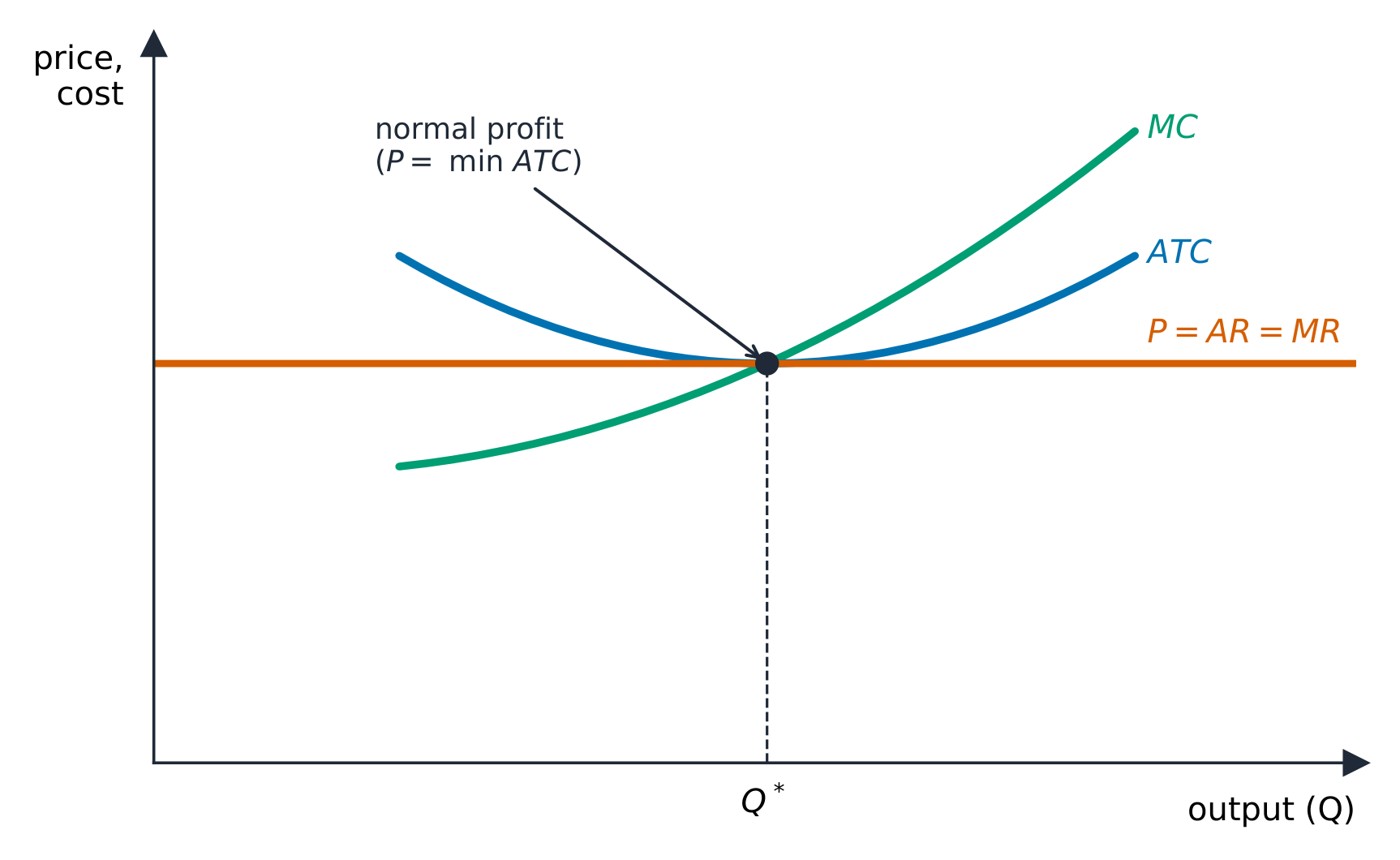
    Source: College Board AP Course and Exam Description · ⁨المصدر: وصف دورة وامتحان College Board AP⁩

    A car assembly line: market power and firm scale differ under imperfect competition
    A car assembly line: market power and firm scale differ under imperfect competition

    Most real markets are imperfectly competitive 不完全竞争: firms have some market power 市场势力 – the ability to set price rather than take it. The source of that power is a downward-sloping demand curve facing the firm, which means that to sell one more unit the firm must lower the price on all units.

    Market structures range from perfect competition to monopoly
    Market structures range from perfect competition to monopoly

    Because of this, marginal revenue is below price ($MR) for every firm with market power. On a straight-line demand curve the MR curve has the same intercept but twice the slope, lying below demand. This one fact – $MR – separates every imperfect market from perfect competition and explains why they produce less and charge more.

    Worked example. A firm with market power faces demand $P=100-Q$. Selling $1$ unit gives $P=\$99$ and total revenue $\$99$; selling a $2$nd forces the price down to $\$98$ on both units, so revenue rises to $2\times98=\$196$. The marginal revenue of that $2$nd unit is $196-99=\$97$ – below its $\$98$ price. In general $MR=100-2Q$, falling twice as fast as demand.

    Vocabulary · ⁨مفردات⁩ Train · ⁨تدريب⁩
    English العربية
    imperfectly competitive/ɪmˈpɜːfektlɪ kəmˈpetɪtɪv/ تنافس غير مثالي
    market power/ˈmɑːkɪt ˈpaʊə/ قوة السوق
    4.2

    Monopoly

    Syllabus · ⁨المنهج⁩
    English

    Enduring Understanding (PRD-3): Even with a common goal of profit-maximization, market structure constrains and influences prices, output, and efficiency.

    Learning Objective PRD-3.B: b. Explain (using graphs where appropriate) equilibrium, firm decision making, consumer surplus, producer surplus, profit (loss), and deadweight loss in imperfectly competitive markets and why prices in imperfectly competitive markets cannot be relied on to coordinate the actions of all possible market participants and can lead to inefficient outputs. c. Calculate (using data from a graph or table as appropriate) areas of consumer surplus, producer surplus, profit (loss), and deadweight loss in imperfectly competitive markets.

    • PRD-3.B.5 A monopoly exists because of barriers to entry.
    • PRD-3.B.6 In a monopoly, equilibrium (profit-maximizing) quantity is determined by equating marginal revenue (MR) to marginal cost (MC). The price charged is greater than the marginal cost.
      • Equation: $MR = MC$
    • PRD-3.B.7 In a natural monopoly, long-run economies of scale for a single firm exist throughout the entire effective demand of its product.
    العربية

    الفهم الدائم (PRD-3): حتى مع هدف مشترك وهو تعظيم الربح، يحد الهيكل السوقي ويؤثر على الأسعار والإنتاج والكفاءة.

    هدف التعلم PRD-3.B: ب. اشرح (باستخدام الرسوم البيانية حيثما كان ذلك مناسباً) التوازن، واتخاذ القرار من قبل الشركة، وفائض المستهلك، وفائض المنتج، والربح (الخسارة)، والخسارة العاجلة في الأسواق غير التنافسية ولماذا لا يمكن الاعتماد على الأسعار في الأسواق غير التنافسية لتنسيق إجراءات جميع المشاركين المحتملين في السوق وقد تؤدي إلى مخرجات غير كفؤة. ج. احسب (باستخدام بيانات من رسم بياني أو جدول كما هو مناسب) مناطق فائض المستهلك، وفائض المنتج، والربح (الخسارة)، والخسارة العاجلة في الأسواق غير التنافسية.
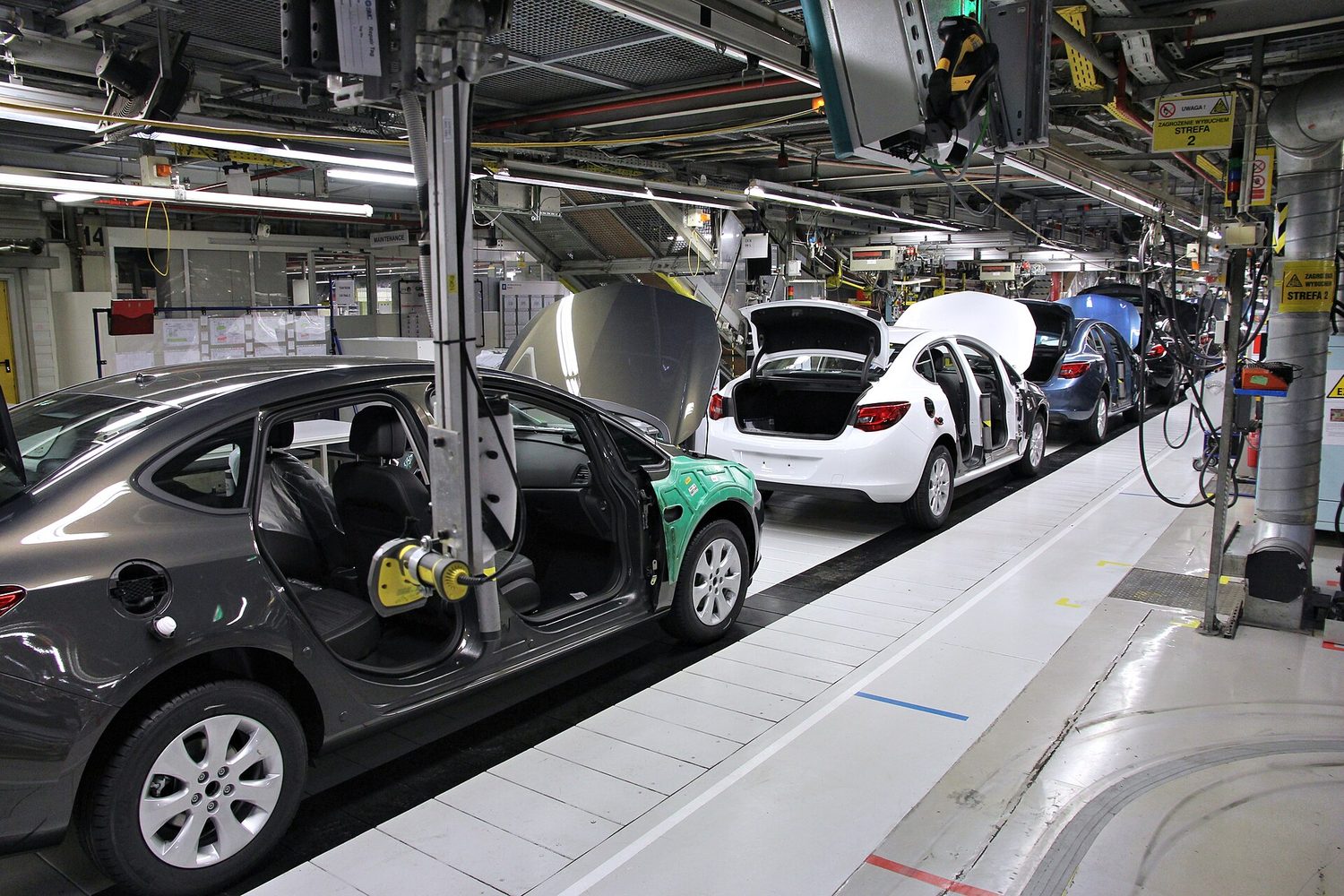
    • PRD-3.B.5 يوجد الاحتكار بسبب حواجز الدخول.
    • PRD-3.B.6 في الاحتكار، يتم تحديد كمية التوازن (التي تعظم الربح) بمساواة الإيراد الحدي (MR) بالتكلفة الحدية (MC). السعر المفروض يتجاوز التكلفة الحدية.
      • المعادلة: $MR = MC$
    • PRD-3.B.7 في الاحتكار الطبيعي، توجد اقتصاديات النطاقات الطويلة الأجل لشركة واحدة طوال الطلب الفعال الكامل لمنتجاته.

    Source: College Board AP Course and Exam Description · ⁨المصدر: وصف دورة وامتحان College Board AP⁩

    Monopoly: MR = MC pricing

    A monopoly 垄断 is a single seller of a product with no close substitutes, protected by barriers to entry 进入壁垒 (economies of scale – a natural monopoly 自然垄断 – control of a key resource, patents, or government license).

    A monopoly maximises profit where MC = MR and can earn supernormal profit
    A monopoly maximises profit where MC = MR and can earn supernormal profit
    • The monopolist maximizes profit at $MR=MC$, then charges the highest price the demand curve allows at that quantity (read price up to the demand curve, not the MR curve).
    • Compared with perfect competition it produces less and charges more, earning long-run economic profit because entry is blocked.
    • This under-production creates deadweight loss 无谓损失 – the monopoly is allocatively inefficient because $P>MC$: the last unit is worth more than it costs, yet is not made.

    Governments may respond with antitrust 反垄断 law, or regulate a natural monopoly's price toward $P=MC$ (socially optimal, but may cause a loss) or $P=ATC$ (fair-return, break-even).

    Exam skill: the monopoly graph is a staple – show quantity at $MR=MC$, price up on the demand curve, and shade profit (between $P$ and $ATC$) and deadweight loss (the triangle to the competitive quantity).

    A large utility plant: monopoly and market power mean a single firm can set price above marginal cost
    A large utility plant: monopoly and market power mean a single firm can set price above marginal cost
    Explore · ⁨استكشف⁩

    A monopoly's cost curves · ⁨منحنيات تكاليف الاحتكار⁩

    A monopoly is the sole seller, so it faces the whole downward demand curve and its marginal revenue lies below price. It produces where MR = MC — less output, higher price than competition. · ⁨الاحتكار هو البائع الوحيد، لذا يواجه منحنى الطلب الكامل الهابط وتكون إيراده الحدية أسفل السعر. ينتج عند MR = MC — أي كمية أقل وسعر أعلى مقارنة بالمنافسة.⁩

    Vocabulary · ⁨مفردات⁩ Train · ⁨تدريب⁩
    English العربية
    monopoly/məˈnɒpəli/ احتكار
    barriers to entry/ˈbærɪəz tʊ ˈentri/ حواجز الدخول
    natural monopoly/ˈnætʃərəl məˈnɒpəli/ الاحتكار الطبيعي
    deadweight loss/ˈdedweɪt lɒs/ خسارة في العجز
    antitrust/ˌæntɪˈtrʌst/ مكافحة الاحتكار
    4.3

    Price Discrimination

    Syllabus · ⁨المنهج⁩
    English

    Enduring Understanding (PRD-3): Even with a common goal of profit-maximization, market structure constrains and influences prices, output, and efficiency.

    Learning Objective PRD-3.B: b. Explain (using graphs where appropriate) equilibrium, firm decision making, consumer surplus, producer surplus, profit (loss), and deadweight loss in imperfectly competitive markets and why prices in imperfectly competitive markets cannot be relied on to coordinate the actions of all possible market participants and can lead to inefficient outputs. c. Calculate (using data from a graph or table as appropriate) areas of consumer surplus, producer surplus, profit (loss), and deadweight loss in imperfectly competitive markets.

    • PRD-3.B.8 A firm with market power can engage in price discrimination to increase its profits or capture additional consumer surplus under certain conditions.
    • PRD-3.B.9 With perfect price discrimination, a monopolist produces the quantity where price equals marginal cost (just as a competitive market would) but extracts all economic surplus associated with its product and eliminates all deadweight loss.
      • Equation: $P = MC$
    العربية

    الفهم الدائم (PRD-3): حتى مع هدف مشترك وهو تعظيم الربح، يحد الهيكل السوقي ويؤثر على الأسعار والإنتاج والكفاءة.

    هدف التعلم PRD-3.B: ب. اشرح (باستخدام الرسوم البيانية حيثما كان ذلك مناسباً) التوازن، واتخاذ القرار من قبل الشركة، وفائض المستهلك، وفائض المنتج، والربح (الخسارة)، والخسارة العاجلة في الأسواق غير التنافسية ولماذا لا يمكن الاعتماد على الأسعار في الأسواق غير التنافسية لتنسيق إجراءات جميع المشاركين المحتملين في السوق وقد تؤدي إلى مخرجات غير كفؤة. ج. احسب (باستخدام بيانات من رسم بياني أو جدول كما هو مناسب) مناطق فائض المستهلك، وفائض المنتج، والربح (الخسارة)، والخسارة العاجلة في الأسواق غير التنافسية.

    • PRD-3.B.8 يمكن للشركة ذات قوة السوق ممارسة تمييز الأسعار لزيادة أرباحها أو استخلاص فائض المستهلك الإضافي تحت ظروف معينة.
    • PRD-3.B.9 مع تمييز الأسعار المثالي، ينتج المحتكر الكمية التي يساوي فيها السعر التكلفة الحدية (تماماً كما يفعل السوق التنافسي) ولكنه يستخلص كل فائض اقتصادي مرتبط بمنتجاته ويeliminates جميع الخسائر العاجلة.
      • المعادلة: $P = MC$

    Source: College Board AP Course and Exam Description · ⁨المصدر: وصف دورة وامتحان College Board AP⁩

    Price discrimination 价格歧视 is charging different buyers different prices for the same good. It requires market power, the ability to separate buyers by willingness to pay, and the ability to prevent resale.

    Under perfect (first-degree) price discrimination, the firm charges each buyer their maximum price. The result: the firm produces the efficient quantity (where $P=MC$, no deadweight loss), but converts all consumer surplus into producer surplus (profit). Real examples – student discounts, airline fares, coupons – are partial versions.

    Explore · ⁨استكشف⁩

    Elasticity and price discrimination · ⁨المرونة والتمييز السعري⁩

    Price discrimination charges each group a different price by their elasticity: inelastic buyers (who won't switch) pay more, elastic buyers pay less. Stretch the curve to see why. · ⁨التمييز السعري يفرض每组 مختلفة بناءً على مرونتهم: المشترون غير المرنين (الذين لن يتحولوا) يدفعون أكثر، والمشترون المرنين يدفعون أقل. شدّ المنحنى لترى السبب.⁩

    Vocabulary · ⁨مفردات⁩ Train · ⁨تدريب⁩
    English العربية
    Price discrimination/praɪs dɪˌskrɪmɪˈneɪʃn/ التمييز السعري
    4.4

    Monopolistic Competition

    Syllabus · ⁨المنهج⁩
    English

    Enduring Understanding (PRD-3): Even with a common goal of profit-maximization, market structure constrains and influences prices, output, and efficiency.

    Learning Objective PRD-3.B: b. Explain (using graphs where appropriate) equilibrium, firm decision making, consumer surplus, producer surplus, profit (loss), and deadweight loss in imperfectly competitive markets and why prices in imperfectly competitive markets cannot be relied on to coordinate the actions of all possible market participants and can lead to inefficient outputs. c. Calculate (using data from a graph or table as appropriate) areas of consumer surplus, producer surplus, profit (loss), and deadweight loss in imperfectly competitive markets.

    • PRD-3.B.10 In a market with monopolistic competition, firms producing differentiated products may earn positive, negative, or zero economic profit in the short run. Firms typically use advertising as a means of differentiating their product. Free entry and exit drive profits to zero in the long run. The output level, however, is smaller than the output level needed to minimize average total costs, creating excess capacity. The price is greater than marginal cost, creating allocative inefficiency.
    العربية

    الفهم الدائم (PRD-3): حتى مع هدف مشترك وهو تعظيم الربح، يحد الهيكل السوقي ويؤثر على الأسعار والإنتاج والكفاءة.

    هدف التعلم PRD-3.B: ب. اشرح (باستخدام الرسوم البيانية حيثما كان ذلك مناسباً) التوازن، واتخاذ القرار من قبل الشركة، وفائض المستهلك، وفائض المنتج، والربح (الخسارة)، والخسارة العاجلة في الأسواق غير التنافسية ولماذا لا يمكن الاعتماد على الأسعار في الأسواق غير التنافسية لتنسيق إجراءات جميع المشاركين المحتملين في السوق وقد تؤدي إلى مخرجات غير كفؤة. ج. احسب (باستخدام بيانات من رسم بياني أو جدول كما هو مناسب) مناطق فائض المستهلك، وفائض المنتج، والربح (الخسارة)، والخسارة العاجلة في الأسواق غير التنافسية.
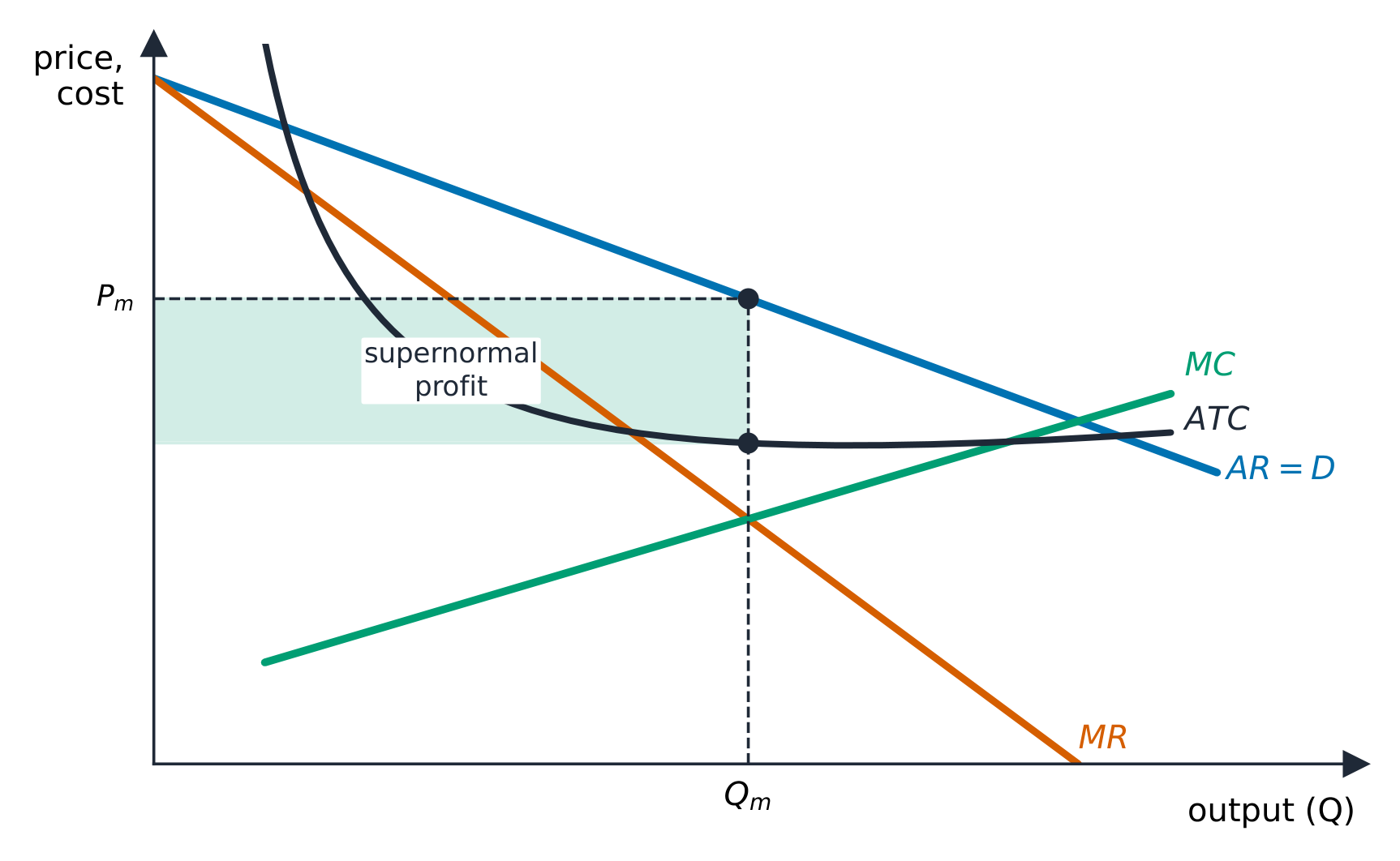
    • PRD-3.B.10 في سوق به منافسة احتكارية، قد تحقق الشركات المنتجة لمنتجات مختلفة أرباحاً إيجابية، أو سلبية، أو صفراً في المدى القصير. تستخدم الشركات عادةً الإعلانات كوسيلة لتمييز منتجاتها. يؤدي الدخول والخروج الحر إلى تصفير الأرباح في المدى الطويل. ومع ذلك، فإن مستوى الإنتاج أصغر من مستوى الإنتاج اللازم لتقليل التكلفة الكلية المتوسطة، مما يخلق طاقة زائدة. السعر يتجاوز التكلفة الحدية، مما يخلق عدم كفاءة تخصيصية.

    Source: College Board AP Course and Exam Description · ⁨المصدر: وصف دورة وامتحان College Board AP⁩

    Monopolistic competition 垄断竞争 has many firms selling differentiated 差异化 products with easy entry and exit (restaurants, salons, clothing brands). Product differentiation gives each firm a downward-sloping demand curve and thus some price-setting power.

    • Short run: like a monopoly – produce at $MR=MC$, and profit or loss is possible.
    • Long run: easy entry competes away profit, so each firm earns zero economic profit, producing where demand is tangent to ATC.
    • Because it still charges $P>MC$ and does not produce at minimum ATC, it has excess capacity 过剩产能 and is neither allocatively nor productively efficient. The trade-off society accepts is product variety and choice.
    Vocabulary · ⁨مفردات⁩ Train · ⁨تدريب⁩
    English العربية
    Monopolistic competition/məˈnɒpəlɪstɪk ˌkɒmpəˈtɪʃn/ منافسة احتكارية
    differentiated/ˌdɪfəˈrenʃɪeɪtɪd/ متميزة
    excess capacity/ekˈses kəˈpæsɪti/ فائض الطاقة الإنتاجية
    4.5

    Oligopoly and Game Theory

    Syllabus · ⁨المنهج⁩
    English

    Enduring Understanding (PRD-3): Even with a common goal of profit-maximization, market structure constrains and influences prices, output, and efficiency.

    Learning Objective PRD-3.C: a. Define (using tables as appropriate) key terms, strategies, and concepts relating to oligopolies and simple games. b. Explain (using tables as appropriate) strategies and equilibria in simple games and the connections to theoretical behaviors in various oligopoly market and non-market settings. c. Calculate (using tables as appropriate) the incentive sufficient to alter a player's dominant strategy.

    • PRD-3.C.1 An oligopoly is an inefficient market structure with high barriers to entry, where there are few firms acting interdependently.
    • PRD-3.C.2 Firms in an oligopoly have an incentive to collude and form cartels.
    • PRD-3.C.3 A game is a situation in which a number of individuals take actions, and the payoff for each individual depends directly on both the individual's own choice and the choices of others.
    • PRD-3.C.4 A strategy is a complete plan of actions for playing a game; the normal form model of a game shows the payoffs that result from each collection of strategies (one for each player).
    • PRD-3.C.5 A player has a dominant strategy when the payoff to a particular action is always higher independent of the action taken by the other player.
    • PRD-3.C.6 A Nash equilibrium is a condition describing the set of actions in which no player can increase his or her payoff by unilaterally taking another action, given the other players' actions.
      • Exclusion statement: Dominant strategies and Nash equilibrium with more than two players or more than two actions per player, mixed-strategy equilibria, extensive form games, and normal form games with more than two players or more than two actions per player are beyond the scope of the course and the AP Exam.
    • PRD-3.C.7 Oligopolists have difficulty achieving the monopoly outcome for reasons similar to those that prevent players from achieving a cooperative outcome in the Prisoner's Dilemma; nevertheless, prices are generally higher and quantities lower with oligopoly (or duopoly) than with perfect competition.
    العربية

    الفهم الدائم (PRD-3): حتى مع هدف مشترك وهو تعظيم الربح، يحد الهيكل السوقي ويؤثر على الأسعار والإنتاج والكفاءة.

    هدف التعلم PRD-3.C: أ. عرّف (باستخدام الجداول حيثما كان ذلك مناسباً) المصطلحات والاستراتيجيات والمفاهيم الرئيسية المتعلقة بالقلع والألعاب البسيطة. ب. اشرح (باستخدام الجداول حيثما كان ذلك مناسباً) الاستراتيجيات والتوازنات في الألعاب البسيطة والروابط بالسلوكات النظرية في مختلف إعدادات الأسواق والبيئات غير السوقية للقلع. ج. احسب (باستخدام الجداول حيثما كان ذلك مناسباً) الحافز الكافي لتغيير الاستراتيجية السائدة للاعب.

    • PRD-3.C.1 القلعة هي هيكل سوق غير كفء ذي حواجز دخول عالية، حيث تتفاعل عدد قليل من الشركات بشكل مترابط.
    • PRD-3.C.2 لدى الشركات في القلعة حافز للتآزر وتشكيل الكارتيلات.
    • PRD-3.C.3 اللعبة هي موقف يقوم فيه عدد من الأفراد باتخاذ إجراءات، وتعتمد العائد لكل فرد مباشرة على اختيار الفرد نفسه واختيارات الآخرين.
    • PRD-3.C.4 الاستراتيجية هي خطة كاملة من الإجراءات للعب لعبة؛ يُظهر النموذج الطبيعي للعبة العوائد الناتجة عن كل مجموعة من الاستراتيجيات (إحدى لكل لاعب).
    • PRD-3.C.5 يمتلك اللاعب استراتيجية سائدة عندما يكون العائد لعملية معينة أعلى دائماً بغض النظر عن الإجراء المتخذ من قبل اللاعب الآخر.
    • PRD-3.C.6 توازن ناش هو حالة تصف مجموعة من الإجراءات لا يمكن لأي لاعب زيادة عوائدها من خلال اتخاذ إجراء آخر أحادي الجانب، بناءً على إجراءات اللاعبين الآخرين.
      • عبارة الاستبعاد: استراتيجيات الهيمنة وتوازن ناش مع أكثر من لاعبين أو أكثر من عملين لكل لاعب، وتوازنات الاستراتيجيات المختلطة، وألعاب الشكل الموسع، وألعاب الشكل العادي مع أكثر من لاعبين أو أكثر من عملين لكل لاعب تقع خارج نطاق المقرر وامتحان AP.
    • PRD-3.C.7 يواجه شركات القلة صعوبة في تحقيق نتيجة الاحتكار لأسباب مشابهة لتلك التي تمنع اللاعبين من تحقيق نتيجة تعاونية في معضلة السجين؛ ومع ذلك، تكون الأسعار عموماً أعلى والكميات أقل في حالة شركة القلة (أو ثنائية القلّة) مقارنة بالمنافسة الكاملة.

    Source: College Board AP Course and Exam Description · ⁨المصدر: وصف دورة وامتحان College Board AP⁩

    An oligopoly 寡头垄断 is a market with a few large, interdependent 相互依存 firms (cars, airlines, phones). Because each firm's best move depends on rivals' moves, we analyze them with game theory 博弈论.

    • A payoff matrix 收益矩阵 shows each firm's profit for every combination of choices.
    • A dominant strategy 优势策略 is a firm's best choice regardless of what the rival does.
    • A Nash equilibrium 纳什均衡 is an outcome where no firm can do better by unilaterally changing its choice.
    • The classic prisoners' dilemma 囚徒困境 shows why firms often fail to cooperate: both would gain by colluding 勾结 (acting like a monopoly), but each has an incentive to cheat, so they end up at the competitive-ish, lower-profit outcome. Collusion and cartels 卡特尔 are unstable for the same reason (and usually illegal).

    Worked example. Two firms each choose a High or Low price. Profits (A, B): both High $\to(10,10)$; A Low, B High $\to(14,4)$; A High, B Low $\to(4,14)$; both Low $\to(6,6)$. For A: if B plays High, Low ($14$) beats High ($10$); if B plays Low, Low ($6$) beats High ($4$) – so Low is A's dominant strategy, and by symmetry B's too. The Nash equilibrium is both Low $(6,6)$, worse for both than the cooperative $(10,10)$ – the prisoners' dilemma in action.

    A prisoners' dilemma: each firm's dominant strategy is Low, giving the Nash equilibrium
    A prisoners' dilemma: each firm's dominant strategy is Low, giving the Nash equilibrium

    Exam skill: be able to find each firm's dominant strategy and the Nash equilibrium from a 2×2 payoff matrix, and explain why the cooperative outcome is hard to sustain.

    Vocabulary · ⁨مفردات⁩ Train · ⁨تدريب⁩
    English العربية
    oligopoly/ˌɒlɪˈɡɒpəli/ احتكار ثنائي
    interdependent/ˌɪntədɪˈpendənt/ ترابط
    game theory/ɡeɪm ˈθɪəri/ نظرية الألعاب
    payoff matrix/ˈpeɪɒf ˈmeɪtrɪks/ مصفوفة العائدات
    dominant strategy/ˈdɒmɪnənt ˈstrætədʒi/ الإستراتيجية المهيمنة
    Nash equilibrium/næʃ ˌiːkwɪˈlɪbrɪəm/ توازن ناش
    prisoners' dilemma/ˈprɪzənəz daɪˈlemə/ معضلة السجينين
    colluding/kəˈluːdɪŋ/ التواطؤ
    cartels/kɑːˈtelz/ الكارتيلات
    4.5

    Exam tips

    • A firm with market power faces a downward-sloping demand, so MR < P (MR has twice the slope).
    • A monopoly produces where MR = MC, then charges the price up on the demand curve; it makes deadweight loss because $P > MC$.
    • Under perfect price discrimination the firm produces the efficient quantity but captures all consumer surplus.
    • Monopolistic competition earns zero long-run profit with excess capacity (product variety is the trade-off).
    • In an oligopoly find the dominant strategy and Nash equilibrium from the payoff matrix; the cooperative outcome is hard to sustain.
  • 5

    Factor Markets · ⁨أسواق عوامل الإنتاج⁩

    Watch lesson · ⁨شاهد الدرس⁩
    5.1

    Introduction to Factor Markets · ⁨مقدمة الأسواق والعوامل⁩

    Syllabus · ⁨المنهج⁩
    English

    Enduring Understanding (PRD-4): Factor prices provide incentives and convey information to firms and factors of production.

    Learning Objective PRD-4.A: a. Define (using graphs where appropriate) key terms and concepts relating to factor markets. b. Explain (using graphs where appropriate) the relationship between factors of production, firms, and factor prices. c. Calculate (using data from a graph or table where appropriate) the marginal revenue product and marginal resource cost.

    • PRD-4.A.1 Factors of production (labor, capital, and land) respond to factor prices (wages, interest, and rent), and employers' (firms') decision to hire is based on the productivity of the factors, output price, and cost of the factor.
    • PRD-4.A.2 The quantity of labor demanded is negatively related to the wage rate, while the quantity of labor supplied is positively related to the wage rate in a given labor market, other things constant.
    العربية

    الفهم الدائم (PRD-4): توفر أسعار العوامل حوافز وتوصيل معلومات للشركات وعوامل الإنتاج.

    هدف التعلم PRD-4.A: أ.عرّف (باستخدام الرسوم البيانية حيثما كان مناسباً) المصطلحات والمفاهيم الرئيسية المتعلقة بأسواق العوامل. ب.اشرح (باستخدام الرسوم البيانية حيثما كان مناسباً) العلاقة بين عوامل الإنتاج والشركات وأسعار العوامل. ج.احسب (باستخدام بيانات من رسم بياني أو جدول حيثما كان مناسباً) الإيراد الحدي للمنتج والتكلفة الحدية للموارد.

    • PRD-4.A.1 تستجيب عوامل الإنتاج (العمل، رأس المال، والأرض) لأسعار العوامل (الأجور، الفائدة، والإيجار)، وتعتمد قرار أصحاب العمل (الشركات) بالتوظيف على إنتاجية العوامل، وسعر الناتج، وتكلفة العامل.
    • PRD-4.A.2 ترتبط الكمية المطلوبة من العمل سلباً بمعدل الأجر، بينما ترتبط الكمية المعروضة من العمل إيجاباً بمعدل الأجر في سوق عمل معينة، بافتراض ثبات باقي العوامل.

    Source: College Board AP Course and Exam Description · ⁨المصدر: وصف دورة وامتحان College Board AP⁩

    English

    A factor market 要素市场 is where firms buy the factors of production – labor, land, capital. The roles reverse: firms demand and households supply. The most-tested factor is labor.

    Factor demand is a derived demand 派生需求 – firms want labor not for itself but for the output (and revenue) it produces. So the demand for workers depends on the demand for the product they make.

    العربية
    مصنع ملابس: تحديد أسواق العوامل الأجور للعمل وغيرها من المدخلات
    مصنع ملابس: تحديد أسواق العوامل الأجور للعمل وغيرها من المدخلات

    سوق العامل هو المكان الذي تشتري فيه عوامل الإنتاج – العمل، الأرض، رأس المال. الأدوار تنعكس: الشركات تطلب والأسر توفر. عامل العمل هو الأكثر اختبارًا.

    سوق عمل تنافسي يحدد الأجر عند تقاطع طلب العمل وعرض العمل
    سوق عمل تنافسي يحدد الأجر عند تقاطع طلب العمل وعرض العمل

    طلب العامل هو طلب مشتق – الشركات تريد العمل ليس من أجله بحد ذاته بل من أجل الناتج (والإيرادات) التي ينتجه. لذا فإن طلب العمال يعتمد على طلب المنتج الذي يصنعونه.

    Explore · ⁨استكشف⁩

    A labour (factor) market · ⁨سوق العمل (عامل)⁩

    In a factor market firms demand labour and households supply it; the wage settles where demand meets supply. Shift either curve and watch the wage and employment move. · ⁨في سوق العوامل تطلب الشركات العمالة وتوفرها الأسر؛ ويستقر الأجر عند تقاطع الطلب والعرض. غيّر أي من المنحنيين وشاهد تحرك الأجر والتوظيف.⁩

    5.2

    Changes in Factor Demand and Factor Supply · ⁨تغيرات طلب وعرض العوامل⁩

    Syllabus · ⁨المنهج⁩
    English

    Enduring Understanding (PRD-4): Factor prices provide incentives and convey information to firms and factors of production.

    Learning Objective PRD-4.B: Explain (using graphs where appropriate) firms' and factors' responses to changes in incentives and constraints.

    • PRD-4.B.1 Changes in the determinants of labor demand, such as the output price and the productivity of the worker, cause the labor demand curve to shift.
    • PRD-4.B.2 Changes in the determinants of labor supply (such as immigration, education, working conditions, age distribution, availability of alternative options, preferences for leisure, and cultural expectations) cause the labor supply curve to shift.
    العربية

    الفهم الدائم (PRD-4): توفر أسعار العوامل حوافز وتوصيل معلومات للشركات وعوامل الإنتاج.

    هدف التعلم PRD-4.B: اشرح (باستخدام الرسوم البيانية حيثما كان مناسباً) استجابات الشركات وعوامل الإنتاج للتغيرات في الحوافز والقيود.

    • PRD-4.B.1 تؤدي التغيرات في محددات طلب العمل، مثل سعر الناتج وإنتاجية العامل، إلى انزياح منحنى طلب العمل.
    • PRD-4.B.2 تؤدي التغيرات في محددات عرض العمل (مثل الهجرة، والتعليم، وظروف العمل، والتوزيع العمري، وتوفر البدائل، وتفضيلات وقت الفراغ، والتوقعات الثقافية) إلى انزياح منحنى عرض العمل.

    Source: College Board AP Course and Exam Description · ⁨المصدر: وصف دورة وامتحان College Board AP⁩

    English

    Labor demand shifts when:

    • the product price or product demand changes (more valuable output $\Rightarrow$ more labor demanded),
    • worker productivity changes (better training or capital),
    • the price of other inputs changes (a substitute input like machines, or a complement).

    Labor supply shifts with the number of qualified workers, immigration, workers' preferences (wages needed to attract them), and the wages available in other jobs. The market wage is set where labor demand meets labor supply.

    العربية

    طلب العمل ينزاح عندما:

    • يتغير سعر المنتج أو طلب المنتج (زيادة قيمة الناتج $\Rightarrow$ زيادة طلب العمل)،
    • تتغير إنتاجية العمال (تحسين التدريب أو رأس المال)،
    • يتغير سعر المدخلات الأخرى (مدخل بديل مثل الآلات، أو مدخل مكمّل).

    عرض العمل ينزاح مع عدد العمال المؤهلين، الهجرة، تفضيلات العمال (الأجور اللازمة لجذبهم)، والأجور المتاحة في وظائف أخرى. يُحدد أجر السوق عند نقطة تقاطع طلب العمل وعرض العمل.

    5.3

    Profit-Maximizing Behavior in Perfectly Competitive Factor Markets · ⁨سلوك تعظيم الربح في أسواق عوامل تنافسية تمامًا⁩

    Syllabus · ⁨المنهج⁩
    English

    Enduring Understanding (PRD-4): Factor prices provide incentives and convey information to firms and factors of production.

    Learning Objective PRD-4.C: a. Define (using graphs as appropriate) the characteristics of perfectly competitive factor markets. b. Explain (using graphs where appropriate) the profit-maximizing behavior of firms buying labor (with other inputs fixed) in perfectly competitive markets. c. Calculate (using data from a graph or table where appropriate) measures representing the profit-maximizing behavior of firms buying labor (with other inputs fixed) in perfectly competitive markets.

    • PRD-4.C.1 In a perfectly competitive labor market, the wage is set by the market and each firm hires the quantity of workers, where the marginal factor (resource) cost (wage) equals the marginal revenue product of labor. A typical firm may be a perfect competitor in the labor market even if it is an imperfect competitor in its output markets.
    • PRD-4.C.2 A typical firm hires labor in a perfectly competitive labor market as long as the marginal revenue product of labor is greater than the market wage.
    • PRD-4.C.3 To minimize costs or maximize profits, firms allocate inputs such that the last dollar spent on each input yields the same amount of marginal product.
    العربية

    الفهم الدائم (PRD-4): توفر أسعار العوامل حوافز وتوصيل معلومات للشركات وعوامل الإنتاج.

    هدف التعلم PRD-4.C: أ.عرّف (باستخدام الرسوم البيانية كما هو مناسب) خصائص أسواق العوامل التنافسية تماماً. ب.اشرح (باستخدام الرسوم البيانية حيثما كان مناسباً) سلوك تعظيم الربح للشركات التي تشتري العمل (مع بقاء المدخلات الأخرى ثابتة) في الأسواق التنافسية تماماً. ج.احسب (باستخدام بيانات من رسم بياني أو جدول حيثما كان مناسباً) المقاييم التي تمثل سلوك تعظيم الربح للشركات التي تشتري العمل (مع بقاء المدخلات الأخرى ثابتة) في الأسواق التنافسية تماماً.

    • PRD-4.C.1 في سوق العمل التنافسي تماماً، يُحدد الأجر بواسطة السوق، وتشتري كل شركة الكمية المناسبة من العمال حيث يتساوى التكلفة الحدية للعامل (المورد) (الأجر) مع الإيراد الحدي لمنتج العمل. قد تكون الشركة النموذجية منافسة تماماً في سوق العمل حتى لو كانت غير تنافسية تماماً في أسواق منتجاتها.
    • PRD-4.C.2 تشتري الشركة النموذجية العمل في سوق عمل تنافسي تماماً طالما أن الإيراد الحدي لمنتج العمل أكبر من أجر السوق.
    • PRD-4.C.3 لتقليل التكاليف أو تعظيم الأرباح، تخصص الشركات المدخلات بحيث يوفر الدولار الأخير المُنفق على كل مدخل نفس مقدار المنتج الحدي.

    Source: College Board AP Course and Exam Description · ⁨المصدر: وصف دورة وامتحان College Board AP⁩

    English

    A firm decides how many workers to hire with the same marginal logic as everything else – compare the marginal benefit and marginal cost of one more worker.

    • The marginal benefit of a worker is the marginal revenue product 边际收益产品 (MRP): the extra revenue from one more worker, $MRP = MP \times$ product price (in a competitive product market, where $P=MR$). MRP falls as more workers are hired, because of diminishing marginal product.
    • The marginal cost of a worker is the wage (in a competitive labor market the firm is a wage taker, so marginal factor cost $=$ the wage).
    • Hiring rule: hire workers up to where $MRP = \text{wage}$ (more generally, $MRP = MFC$). The MRP curve is the firm's labor demand curve.

    Worked example. A worker's marginal product is $8$ units and the firm sells each in a competitive market for $\$5$, so $MRP=8\times\$5=\$40$. If the wage is $\$30$, the firm hires this worker because $MRP>\text{wage}$. As more workers join, diminishing marginal product pulls MRP down; the firm keeps hiring until a worker whose $MP=6$ gives $MRP=6\times\$5=\$30$, exactly the wage – the profit-maximizing stopping point.

    To choose the least-cost combination of two inputs, set the MP-per-dollar equal across inputs: $\dfrac{MP_L}{P_L}=\dfrac{MP_K}{P_K}$ – the same equal-bang-per-buck rule as consumer choice.

    Exam skill: compute MRP from a table (marginal product $\times$ price) and find how many workers to hire at a given wage – a common free-response task.

    العربية

    تقرر الشركة عدد العمال الذين ستوظفهم بنفس المنطق الهامشي كما في كل شيء آخر – بمقارنة الفائدة الهامشية والتكلفة الهامشية للعمال الإضافيين.

    • الفائدة الهامشية للعامل هي المنتج الإجمالي للإيرادات الهامشية (MRP): الإيرادات الإضافية من عامل إضافي، $MRP = MP \times$ سعر المنتج (في سوق منتج تنافسي، حيث $P=MR$). ينخفض MRP مع توظيف عمال أكثر بسبب تراجع العائد الهامشي.
    • التكلفة الهامشية للعامل هي الأجر (في سوق عمل تنافسي، تكون الشركة تأخذ الأجر، لذا فإن التكلفة الهامشية للعامل $=$ الأجر).
    • قاعدة التوظيف: وظّف عمالًا حتى حيث $MRP = \text{wage}$ (بشكل عام، $MRP = MFC$). منحنى MRP هو منحنى طلب العمل للشركة.

    مثال محلول. إنتاج العامل الهامشي هو $8$ وحدة وتبيع الشركة كل وحدة في سوق تنافسي بسعر $\$5$, so $MRP=8\times\$5=\$40$. If the wage is $\$30$، توظف الشركة هذا العامل لأن $MRP>\text{wage}$. ومع انضمام عمال أكثر، يسحب تراجع الإنتاج الهامشي MRP للأسفل؛ تستمر الشركة بالتوظيف حتى يصل عامل whose $MP=6$ يعطي $MRP=6\times\$5=\$30$، بالضبط الأجر – نقطة التوقف لتعظيم الربح.

    لاختيار أقل ترکیب تكلفة من مدخلين، اجعل الإنتاج الهامشي لكل دولار متساويًا عبر المدخلات: $\dfrac{MP_L}{P_L}=\dfrac{MP_K}{P_K}$ – نفس قاعدة "أفضل قيمة مقابل المال" المستخدمة في اختيار المستهلك.

    مهارة الامتحان: حساب MRP من جدول (الإنتاج الهامشي $\times$ × السعر) وإيجاد عدد العمال الذين يجب توظيفهم عند أجر معين – مهمة شائعة في الأسئلة المقالية.

    خط تجميع سيارات: توظف الشركات العمالة حتى يتساوى المنتج الإجمالي للإيرادات الهامشية مع الأجر
    خط تجميع سيارات: توظف الشركات العمالة حتى يتساوى المنتج الإجمالي للإيرادات الهامشية مع الأجر
    5.4

    Monopsonistic Markets · ⁨أسواق المونوبسون⁩

    Syllabus · ⁨المنهج⁩
    English

    Enduring Understanding (PRD-4): Factor prices provide incentives and convey information to firms and factors of production.

    Learning Objective PRD-4.D: a. Define (using graphs as appropriate) the characteristics of monopsonistic markets. b. Explain (using graphs where appropriate) the profit-maximizing behavior of firms buying labor (with other inputs fixed) in monopsonistic markets. c. Calculate (using data from a graph or table where appropriate) measures representing the profit-maximizing behavior of firms buying labor (with other inputs fixed) in monopsonistic markets.

    • PRD-4.D.1 In a monopsonistic labor market, a typical firm hires additional labor as long as the marginal revenue product is greater than the marginal factor (resource) cost (the wage of a new unit of labor plus the wage increase given to all existing labor).
    • PRD-4.D.2 When a typical firm hires additional workers in a monopsonistic labor market, the marginal factor (resource) cost is greater than the supply price of labor.
    العربية

    الفهم الدائم (PRD-4): توفر أسعار العوامل حوافز وتوصيل معلومات للشركات وعوامل الإنتاج.

    هدف التعلم PRD-4.D: أ.عرّف (باستخدام الرسوم البيانية كما هو مناسب) خصائص الأسواق أحادية الشراء. ب.اشرح (باستخدام الرسوم البيانية حيثما كان مناسباً) سلوك تعظيم الربح للشركات التي تشتري العمل (مع بقاء المدخلات الأخرى ثابتة) في الأسواق أحادية الشراء. ج.احسب (باستخدام بيانات من رسم بياني أو جدول حيثما كان مناسباً) المقاييم التي تمثل سلوك تعظيم الربح للشركات التي تشتري العمل (مع بقاء المدخلات الأخرى ثابتة) في الأسواق أحادية الشراء.

    • PRD-4.D.1 في سوق العمل أحادي الشراء، تضيف الشركة النموذجية عملاً جديداً طالما أن الإيراد الحدي لمنتجها أكبر من التكلفة الحدية للعامل (المورد) (أجر الوحدة الجديدة من العمل بالإضافة إلى زيادة الأجر المقدمة لجميع العمال الحاليين).
    • PRD-4.D.2 عندما تضيف الشركة النموذجية عملاً جديداً في سوق عمل أحادي الشراء، تكون التكلفة الحدية للعامل (المورد) أكبر من سعر عرض العمل.

    Source: College Board AP Course and Exam Description · ⁨المصدر: وصف دورة وامتحان College Board AP⁩

    English

    A monopsony 买方垄断 is a market with a single buyer of a factor – for example, the only large employer in a town.

    • Because it is the whole market, the monopsonist faces an upward-sloping labor supply curve: to hire more workers it must raise the wage for everyone.
    • So the marginal factor cost 边际要素成本 (MFC) is above the wage (like $MR for a monopoly, in reverse), and the MFC curve lies above the supply curve.
    • The monopsonist hires where $MRP = MFC$, then pays the lower wage the supply curve allows at that quantity.
    • Result: compared with a competitive labor market, a monopsony hires fewer workers at a lower wage – the mirror image of monopoly.

    Exam skill: draw the monopsony graph (supply, MFC above it, MRP as demand), mark quantity at $MRP=MFC$ and the wage down on the supply curve, and contrast it with the competitive wage and quantity.

    العربية

    المونوبسون هو سوق له مشترٍ واحد لعامل – على سبيل المثال، صاحب العمل الوحيد الكبير في بلدة ما.

    • نظرًا لأنها تمثل السوق بأكمله، فإن المونوبسون يواجه منحنى عرض عمل متدرج صعودًا: لتوظيف عمال أكثر، يجب أن ترفع الأجر للجميع.
    • إذن فإن تكلفة العامل الهامش (MFC) تكون أعلى من الأجر (مثل $MR في حالة الاحتكار، ولكن بالعكس)، ومنحنى MFC يقع فوق منحنى العرض.
    • المشتري الأحادي يستقطع العمالة عند $MRP = MFC$، ثم يدفع الأجر الأقل الذي يسمح به منحنى العرض عند تلك الكمية.
    • النتيجة: مقارنةً بسوق عمل تنافسي، يستقطع الاحتكار الأحادي عددًا أقل من العمال بأجر أقل – وهو صورة معكوسة للاحتكار.
    يشتري الاحتكار الأحادي حيث MFC = MRP ويدفع أجرًا أقل من السوق التنافسي
    يشتري الاحتكار الأحادي حيث MFC = MRP ويدفع أجرًا أقل من السوق التنافسي

    مهارة الامتحان: ارسم رسم الاحتكار الأحادي (العرض، MFC فوقه، MRP كطلب)، وعلّم الكمية عند $MRP=MFC$ والأجر للأسفل على منحنى العرض، وقارنه بالأجر والكمية في السوق التنافسي.

    Vocabulary · ⁨مفردات⁩ Train · ⁨تدريب⁩
    English العربية
    factor market/ˈfæktə ˈmɑːkɪt/ سوق العوامل
    derived demand/dɪˈraɪvd dɪˈmænd/ الطلب المشتق
    marginal revenue product/ˈmɑːdʒɪnl ˈrevənjuː ˈprɒdʌkt/ المنتج الإيرادي الحدي
    monopsony/ˈmɒnəʊpsəni/ شراء أحادي
    marginal factor cost/ˈmɑːdʒɪnl ˈfæktə kɒst/ تكلفة العامل الحدية
    5.4

    Exam tips · ⁨نصائح للامتحان⁩

    English
    • Factor demand is derived demand; hire labour up to where MRP = wage (MRP = marginal product × price).
    • MRP falls as more workers are hired (diminishing marginal product).
    • For least-cost input use, equalise the marginal product per dollar across inputs.
    • A monopsony faces an upward supply, so its marginal factor cost is above the wage; it hires fewer workers at a lower wage.
    • Draw the monopsony graph (supply, MFC above it, MRP as demand) and contrast with the competitive outcome.
    العربية
    • طلب العوامل هو طلب مشتق؛ استقطب العمالة حتى يتساوى MRP = الأجر (MRP = المنتج الهامش × السعر).
    • ينخفض MRP كلما تم استقطاع عمالة أكثر (نقص المنتج الهامش).
    • للاستخدام الأمثل للداخلات بتكلفة أدنى، أجبّل المنتج الهامش لكل دولار عبر الداخلات.
    • يواجه الاحتكار الأحادي عرضًا تصاعديًا، لذا فإن تكلفته العاملية الهامشة تكون أعلى من الأجر؛ ويستقطع عددًا أقل من العمال بأجر أقل.
    • ارسم رسم الاحتكار الأحادي (العرض، MFC فوقه، MRP كطلب) وقارنه بالنتيجة التنافسية.

  • 6

    Market Failure and the Role of Government · ⁨فشل السوق ودور الحكومة⁩

    Watch lesson · ⁨شاهد الدرس⁩
    6.1

    Socially Efficient and Inefficient Market Outcomes · ⁨النتائج الفعالة وغير الفعالة اجتماعيًا للسوق⁩

    Syllabus · ⁨المنهج⁩
    English

    Enduring Understanding (POL-2): Perfectly competitive markets allocate resources efficiently, but imperfect competition often results in market inefficiencies.

    Learning Objective POL-2.A: a. Define social efficiency. b. Explain (using graphs where appropriate) why resource allocation in perfectly competitive markets is socially efficient.

    • POL-2.A.1 The optimal quantity of a good occurs where the marginal benefit of consuming the last unit equals the marginal cost of producing that last unit, thus maximizing total economic surplus.
    • POL-2.A.2 The market equilibrium quantity is equal to the socially optimal quantity only when all social benefits and costs are internalized by individuals in the market. Total economic surplus is maximized at that quantity. [See also PRD-3 and POL-3.]

    Learning Objective POL-2.B: Explain (using graphs where appropriate) how private incentives can lead to actions by rational agents that are socially undesirable (inefficient) market outcomes.

    • POL-2.B.1 Rational agents can pursue private actions to exploit or exercise market characteristics known as market power.
    • POL-2.B.2 Rational agents make optimal decisions by equating private marginal benefits and private marginal costs that can result in market inefficiencies.
    • POL-2.B.3 Policymakers use cost-benefit analysis to evaluate different actions to reduce or eliminate market inefficiencies.
    • POL-2.B.4 Market inefficiencies can be eliminated by designing policies that equate marginal social benefit with marginal social cost.

    Learning Objective POL-2.C: a. Explain equilibrium allocations in imperfect markets relative to efficient allocations (using graphs where appropriate) and why these markets are inefficient. b. Calculate (using graphs where appropriate) the deadweight loss resulting from the production of a non-efficient quantity.

    • POL-2.C.1 Equilibrium allocations can deviate from efficient allocations due to situations such as monopoly; oligopoly; monopolistic competition; negative and positive externalities in production or consumption; asymmetric information; and insufficient production of public goods.
    • POL-2.C.2 Producing any non-efficient quantity results in deadweight loss.
    العربية

    الفهم الدائم (POL-2): تخصص الأسواق التنافسية تماماً الموارد بكفاءة، لكن المنافسة غير الكاملة غالباً ما تؤدي إلى عدم كفاءة في السوق.

    هدف التعلم POL-2.A: أ.عرّف الكفاءة الاجتماعية. ب.اشرح (باستخدام الرسوم البيانية حيثما كان مناسباً) لماذا يكون تخصيص الموارد في الأسواق التنافسية تماماً فعالاً اجتماعياً.

    • POL-2.A.1 الكمية المثلى للسلع تحدث حيث يتساوى المنفعة الحدية لاستهلاك الوحدة الأخيرة مع التكلفة الحدية لإنتاج تلك الوحدة الأخيرة، مما يعظم فائض الاقتصاد الكلي.
    • POL-2.A.2 تتساوى كمية التوازن في السوق مع الكمية الأمثل اجتماعياً فقط عندما يتم دمج جميع المنافع والتكاليف الاجتماعية في الأفراد داخل السوق. يُعظم فائض الاقتصاد الكلي عند تلك الكمية. [انظر أيضاً PRD-3 و POL-3].

    هدف التعلم POL-2.B: اشرح (باستخدام الرسوم البيانية حيثما كان مناسباً) كيف يمكن أن تؤدي الحوافز الخاصة إلى أفعال من قبل الواعين العقلانيين تنتج نتائج سوقية غير مرغوبة اجتماعياً (غير فعالة).

    • POL-2.B.1 يمكن للواعين العقلانيين اتخاذ إجراءات خاصة لاستغلال أو ممارسة خصائص السوق المعروفة باسم قوة السوق.
    • POL-2.B.2 الوكيلون العقلانيون يتخذون قرارات مثلى عن طريق مساواة المنافع الحدية الخاصة والتكاليف الحدية الخاصة، مما قد يؤدي إلى عدم كفاءة السوق.
    • POL-2.B.3 يستخدم صانعو السياسات التحليل التكلفة-الفائدة لتقييم الإجراءات المختلفة لتقليل أو القضاء على عدم كفاءة السوق.
    • POL-2.B.4 يمكن القضاء على عدم كفاءة السوق من خلال تصميم سياسات توازن المنفعة الحدية الاجتماعية مع التكلفة الحدية الاجتماعية.

    هدف التعلم POL-2.C: أ. اشرح تخصيصات التوازن في الأسواق غير المثالية مقارنة بالتخصيصات الكفءة (باستخدام الرسوم البيانية عند الحاجة) ولماذا تكون هذه الأسواق غير كفؤة. ب. احسب (باستخدام الرسوم البيانية عند الحاجة) الخسارة العقيمة الناتجة عن إنتاج كمية غير كفؤة.

    • POL-2.C.1 يمكن أن تنحرف تخصيصات التوازن عن التخصيصات الكفئة بسبب حالات مثل الاحتكار؛ أوليغوبولي؛ المنافسة الاحتكارية؛ التأثيرات الخارجية السلبية والموجدة في الإنتاج أو الاستهلاك؛ المعلومات غير المتماثلة؛ والإنتاج غير الكافي للسلع العامة.
    • POL-2.C.2 يؤدي إنتاج أي كمية غير كفؤة إلى خسارة عقيمة.

    Source: College Board AP Course and Exam Description · ⁨المصدر: وصف دورة وامتحان College Board AP⁩

    English

    A market outcome is socially efficient 社会有效率 when it maximizes total surplus – when the marginal social benefit equals the marginal social cost of the last unit. Perfect competition reaches this on its own. But sometimes markets fail to, producing too much or too little. This is market failure 市场失灵, and it is the main economic justification for government action.

    العربية

    تُعتبر نتيجة السوق فعالة اجتماعيًا عندما تعظم الفائض الكلي – أي عندما يتساوى الفائدة الاجتماعية الهامشة مع التكلفة الاجتماعية الهامشة للوحدة الأخيرة. تصل المنافسة المثلى إلى ذلك تلقائيًا. لكن أحيانًا تفشل الأسواق في تحقيق ذلك، مما ينتج عنه إنتاج زائد أو ناقص. هذا هو فشل السوق، وهو التبرير الاقتصادي الرئيسي للتدخل الحكومي.

    الكفاءة الإنتاجية هي أقل تكلفة؛ والكفاءة التخصيصية هي صنع ما يريده الناس
    الكفاءة الإنتاجية هي أقل تكلفة؛ والكفاءة التخصيصية هي صنع ما يريده الناس
    6.2

    Externalities · ⁨الآثار الخارجية⁩

    Syllabus · ⁨المنهج⁩
    English

    Enduring Understanding (POL-3): Private incentives can fail to account for all socially relevant considerations.

    Learning Objective POL-3.A: a. Define externalities. b. Explain (using graphs where appropriate) how in the presence of externalities, private markets do not take into consideration social costs or social benefits.

    • POL-3.A.1 The socially optimal quantity of a good occurs where the marginal social benefit of consuming the last unit equals the marginal social cost of producing that last unit, thus maximizing total economic surplus.
    • POL-3.A.2 Externalities are either positive or negative and arise from lack of well-defined property rights and/or high transaction costs.
    • POL-3.A.3 In the presence of externalities, rational agents respond to private costs and benefits and not to external costs and benefits.
    • POL-3.A.4 Rational agents have the incentive to free ride when a good is non-excludable.

    Learning Objective POL-3.B: Explain (using graphs where appropriate) how public policies address positive or negative externalities.

    • POL-3.B.1 Policies that address positive or negative externalities include taxes/subsidies, environmental regulation, public provision, the assignment of property rights, and the reassignment of property rights through private transactions.
    العربية

    فهم دائم (POL-3): الحوافز الخاصة قد تفشل في أخذ جميع الاعتبارات ذات الصلة اجتماعيًا بعين الاعتبار.

    هدف التعلم POL-3.A: أ. عرّف التأثيرات الخارجية. ب. اشرح (باستخدام الرسوم البيانية عند الحاجة) كيف أن الأسواق الخاصة لا تأخذ في الاعتبار التكاليف أو المنافع الاجتماعية في ظل وجود تأثيرات خارجية.

    • POL-3.A.1 الكمية الاجتماعية المثلى للسلعة تحدث حيث تتساوى المنفعة الحدية الاجتماعية لاستهلاك الوحدة الأخيرة مع التكلفة الحدية الاجتماعية لإنتاج تلك الوحدة الأخيرة، مما يعظم فائض الاقتصاد الكلي.
    • POL-3.A.2 التأثيرات الخارجية إما موجدة أو سلبية وتنشأ عن عدم وضوح حقوق الملكية و/أو ارتفاع تكاليف المعاملة.
    • POL-3.A.3 في ظل وجود تأثيرات خارجية، يستجيب الوكيلون العقلانيون للتكاليف والمنافع الخاصة وليس للتكاليف والمنافع الخارجية.
    • POL-3.A.4 يمتلك الوكيلون العقلانيون حافزًا للاستفادة المجانية عندما تكون السلعة غير قابلة للاستبعاد.

    هدف التعلم POL-3.B: اشرح (باستخدام الرسوم البيانية عند الحاجة) كيف تعالج السياسات العامة التأثيرات الخارجية الموجدة أو السلبية.

    • POL-3.B.1 تشمل السياسات التي تعالج التأثيرات الخارجية الموجدة أو السلبية الضرائب/الإعانات، والرقابة البيئية، والتوفير العام، وتعيين حقوق الملكية، وإعادة تعيين حقوق الملكية من خلال المعاملات الخاصة.

    Source: College Board AP Course and Exam Description · ⁨المصدر: وصف دورة وامتحان College Board AP⁩

    English
    Negative externalities

    An externality 外部性 is a cost or benefit that falls on a third party not involved in the transaction – so the private decision-makers ignore it.

    • A negative externality 负外部性 (pollution) means marginal social cost > marginal private cost. The market over-produces; the deadweight loss is a triangle. Fixes: a Pigovian tax 庇古税 or regulation to make producers "internalize" the cost (shifting private cost up to social cost).
    • A positive externality 正外部性 (vaccination, education) means marginal social benefit > marginal private benefit. The market under-produces. Fixes: a subsidy to consumers or producers.
    • Coase theorem 科斯定理: if property rights are clear and bargaining is costless, private parties can solve an externality themselves – but that is rare with many people involved.

    Worked example. A factory's private marginal cost of a chemical is $\$8$ per unit, but each unit also dumps $\$3$ of pollution on neighbors, so the marginal social cost is $\$11$. Ignoring the $\$3$, the market over-produces. A Pigovian tax of exactly $\$3$ per unit raises the firm's private cost to $\$11$ – now equal to the social cost – so the firm cuts output to the efficient quantity and the externality is "internalized."

    Exam skill: identify whether an externality is positive or negative, show on a graph that private and social curves diverge, mark the deadweight loss, and name the correcting tax or subsidy.

    العربية
    السجائر: الآثار الخارجية تعني أن الأسواق الخاصة قد لا تصل إلى نتائج فعالة اجتماعيًا
    السجائر: الآثار الخارجية تعني أن الأسواق الخاصة قد لا تصل إلى نتائج فعالة اجتماعيًا
    الآثار الخارجية السلبية

    الآثار الخارجية هي تكلفة أو منفعة تقع على طرف ثالث غير مشارك في الصفقة – بحيث يتجاهل صناع القرار الخاصونها.

    أثر خارجي سلبي: السوق ينتج بشكل مفرط، مما يسبب خسارة رفاهية
    أثر خارجي سلبي: السوق ينتج بشكل مفرط، مما يسبب خسارة رفاهية
    • الأثر الخارجي السلبي (التلوث) يعني أن التكلفة الاجتماعية الهامشة > التكلفة الخاصة الهامشة. يقوم السوق بـالإنتاج الزائد؛ وخسارة العجز هي مثلث. الحلول: ضريبة بيغو أو تنظيم لجعل المنتجين "يدخلوا" التكلفة (بتحويل التكلفة الخاصة للأعلى لتصل إلى التكلفة الاجتماعية).
    • الأثر الخارجي الإيجابي (التطعيم، التعليم) يعني أن الفائدة الاجتماعية الهامشة > الفائدة الخاصة الهامشة. يقوم السوق بـالإنتاج الناقص. الحلول: إعانة للمستهلكين أو المنتجين.
    • نظرية كوز: إذا كانت حقوق الملكية واضحة والمفاوضة بلا تكاليف، يمكن للأطراف الخاصة حل الأثر الخارجي بأنفسهم – لكن هذا نادر الحدوث عندما يكون هناك عدد كبير من الأشخاص المعنيين.
    شارع مدينة مزدحم بالسيارات وجهًا لوجه في حالة توقف تام
    الاكتظاظ هو أثر خارجي سلبي: كل سائق يفرض تكلفة على كل سائق آخر لا تحصيلها أي سعر

    مثال محلول. التكلفة الخاصة الهامشة لمصنع ما لمادة كيميائية هي $\$8$ per unit, but each unit also dumps $\$3$ من التلوث على الجيران، لذا فإن التكلفة الاجتماعية الهامشة هي $\$11$. Ignoring the $\$3$، والسوق ينتج بشكل مفرط. ضريبة بيغو مقدارها بالضبط $\$3$ per unit raises the firm's private cost to $\$11$** – الآن مساوية للتكلفة الاجتماعية – sehingga تقلل الشركة الإنتاج إلى الكمية الفعالة ويتم "دخول" الأثر الخارجي.

    مهارة الامتحان: حدد ما إذا كان الأثر الخارجي إيجابيًا أم سلبيًا، وأظهر على الرسم البياني أن المنحنيات الخاصة والاجتماعية تتباعد، وعلّم خسارة العجز، وسمّ الضريبة أو الإعانة المصححة.

    تلوث صناعي: أثر خارجي سلبي تكون فيه التكلفة الاجتماعية أكبر من التكلفة الخاصة
    تلوث صناعي: أثر خارجي سلبي تكون فيه التكلفة الاجتماعية أكبر من التكلفة الخاصة
    Explore · ⁨استكشف⁩

    A market with an externality · ⁨سوق به تأثير خارجي⁩

    An externality makes private cost differ from social cost, so the free-market quantity is inefficient. See the deadweight loss and how a tax or subsidy corrects it. · ⁨التأثير الخارجي يجعل التكلفة الخاصة تختلف عن التكلفة الاجتماعية، لذا تكون الكمية في السوق الحر غير فعالة. رَأِ الخسارة الجماعية وكيف تصحح الضريبة أو الإعانة ذلك.⁩

    Vocabulary · ⁨مفردات⁩ Train · ⁨تدريب⁩
    English العربية
    socially efficient/ˈsəʊʃəli ɪˈfɪʃənt/ فعالية اجتماعية
    market failure/ˈmɑːkɪt ˈfeɪlɪə/ فشل السوق
    externality/ekˈstɜːnælɪti/ التأثير الخارجي
    negative externality/ˈneɡətɪv ekˈstɜːnælɪti/ الأثر الخارجي السلبي
    Pigovian tax/pɪˈɡəʊvɪən tæks/ ضريبة بيغوفيان
    positive externality/ˈpɒzɪtɪv ekˈstɜːnælɪti/ الأثر الخارجي الإيجابي
    Coase theorem/kəʊs ˈθɪərəm/ نظرية كوز
    rivalry/ˈraɪvəlri/ منافسة
    excludability/eksˌkluːdəˈbɪlɪti/ الاستبعاد
    private good/ˈpraɪvət ɡʊd/ سلعة خاصة
    public good/ˈpʌblɪk ɡʊd/ سلعة عامة
    free-ride/friː raɪd/ التسلق المجاني
    Common resources/ˈkɒmən rɪˈzɔːsɪz/ الموارد المشتركة
    tragedy of the commons/ˈtrædʒədi ɒvðə ˈkɒmənz/ مأساة-commons (المشتركات)
    Antitrust laws/ˌæntɪˈtrʌst lɔːz/ قوانين مكافحة الاحتكار
    per-unit tax/pɜː ˈjuːnɪt tæks/ ضريبة الوحدة الواحدة
    lump-sum tax/lʌmp sʌm tæks/ ضريبة مقطوعة
    lump-sum subsidy/lʌmp sʌm ˈsʌbsɪdi/ إعانة مقطوعة
    income distribution/ˈɪŋkʌm ˌdɪstrɪˈbjuːʃn/ توزيع الدخل
    6.3

    Public and Private Goods · ⁨السلع العامة والخاصة⁩

    Syllabus · ⁨المنهج⁩
    English

    Enduring Understanding (POL-3): Private incentives can fail to account for all socially relevant considerations.

    Learning Objective POL-3.C: a. Define whether goods are rival and/or excludable. b. Explain how the nature of rival and/or excludable goods influences the behavior of individuals and groups.

    • POL-3.C.1 Private goods are rival and excludable, and public goods are non-rival and non-excludable.
    • POL-3.C.2 Due to the free rider problem, private individuals usually lack the incentive to produce public goods, leaving government as the only producer.
    • POL-3.C.3 Governments sometimes choose to produce private goods, such as educational services, and to allow free access to them.
    • POL-3.C.4 Some natural resources are, by their nature, non-excludable and rival and therefore open access. Private individuals inefficiently overconsume such resources.
    العربية

    فهم دائم (POL-3): الحوافز الخاصة قد تفشل في أخذ جميع الاعتبارات ذات الصلة اجتماعيًا بعين الاعتبار.

    هدف التعلم POL-3.C: أ. عرّف ما إذا كانت السلع منافسة و/أو قابلة للاستبعاد. ب. اشرح كيف يؤثر طبيعة السلع المنافِسة و/أو القابلة للاستبعاد على سلوك الأفراد والمجموعات.

    • POL-3.C.1 السلع الخاصة هي سلعات منافسة وقابلة للاستبعاد، والسلع العامة هي سلعات غير منافسة وغير قابلة للاستبعاد.
    • POL-3.C.2 بسبب مشكلة الاستفادة المجانية، يفتقر الأفراد عادةً إلى الحافز لإنتاج السلع العامة، مما يجعل الحكومة المنتج الوحيد.
    • POL-3.C.3 تختار الحكومات أحيانًا إنتاج سلع خاصة، مثل الخدمات التعليمية، والسماح بالوصول المجاني إليها.
    • POL-3.C.4 بعض الموارد الطبيعية، بطبيعتها، غير قابلة للاستبعاد ومنافسة وبالتالي مفتوحة الوصول. يستهلك الأفراد مثل هذه الموارد بشكل مفرط وغير كفء.

    Source: College Board AP Course and Exam Description · ⁨المصدر: وصف دورة وامتحان College Board AP⁩

    English

    Goods differ along two traits: rivalry 竞争性 (does one person's use reduce another's?) and excludability 排他性 (can non-payers be kept out?).

    • A private good 私人物品 is rival and excludable (a sandwich) – markets handle these well.
    • A public good 公共物品 is non-rival and non-excludable (national defense, a lighthouse). Because non-payers cannot be excluded, people free-ride 搭便车 – enjoy it without paying – so markets under-provide it, and government usually supplies it.
    • Common resources 公共资源 are rival but non-excludable (ocean fish); over-use ruins them – the tragedy of the commons 公地悲剧.
    العربية

    تختلف السلع على أساس خاصيتين: المنافسة (هل يقلل استخدام شخص واحد من إمكانية استخدامه لشخص آخر؟) والاستبعاد (هل يمكن منع غير المدفوعين من الدخول؟).

    تصنيف السلع بناءً على كونها منافسة ومستبعدة أم لا
    تصنيف السلع بناءً على كونها منافسة ومستبعدة أم لا
    • السلعة الخاصة هي منافسة ومستبعدة (شطيرة) – تتعامل الأسواق مع هذه جيدًا.
    • السلعة العامة هي غير منافسة وغير مستبعدة (الدفاع الوطني، المنارة). نظرًا لأنه لا يمكن استبعاد غير المدفوعين، فإن الناس يتسربون – يستفيدون منها دون دفع ثمن – لذلك تقوم الأسواق بـتوفيرها بنقص، وعادةً ما تزودها الحكومة.
    • الموارد المشتركة هي منافسة لكنها غير مستبعدة (أسماك المحيط)؛ والاستخدام المفرط يدمرها – وهي مأساة الموارد المشتركة.
    6.4

    The Effects of Government Intervention in Different Market Structures · ⁨تأثيرات تدخل الحكومة في هياكل سوقية مختلفة⁩

    Syllabus · ⁨المنهج⁩
    English

    Enduring Understanding (POL-4): In imperfect markets, well-designed government policy can reduce waste.

    Learning Objective POL-4.A: a. Define government policy interventions in imperfect markets. b. Explain (using graphs where appropriate) how government policies can alter market outcomes in perfectly and imperfectly competitive markets. c. Calculate (using data from a graph or table as appropriate) changes in market outcomes resulting from government policies in perfectly competitive and imperfectly competitive markets.

    • POL-4.A.1 Per-unit taxes and subsidies affect the total price consumers pay, net price firms receive, equilibrium quantity, consumer and producer surpluses, deadweight loss, and government revenue or cost. The impact of change depends on the price elasticity of demand and supply.
    • POL-4.A.2 Lump-sum taxes and lump-sum subsidies do not change either marginal cost or marginal benefit; only fixed costs will be affected.
    • POL-4.A.3 Binding price ceilings and floors affect prices and quantities differently depending on the market structures (perfect competition, monopoly, monopolistic competition, and monopsony) and the price elasticities of supply and demand.
    • POL-4.A.4 Government intervention in imperfect markets can increase efficiency if the policy correctly addresses the incentives that led to the market failure.
    • POL-4.A.5 Government can use price regulation to address inefficiency due to monopoly.
    • POL-4.A.6 A natural monopoly will require a lump-sum subsidy to produce at the allocatively efficient quantity.
    • POL-4.A.7 Governments use antitrust policy in an attempt to make markets more competitive.
      • Exclusion statement: A graph of inefficiency and policy due to collusion is beyond the scope of the course and the AP Exam.
    العربية

    فهم دائم (POL-4): في الأسواق غير المثالية، يمكن للسياسة الحكومية الجيدة التصميم تقليل الهدر.

    هدف التعلم POL-4.A: أ. عرّف تدخلات السياسة الحكومية في الأسواق غير المثالية. ب. اشرح (باستخدام الرسوم البيانية عند الحاجة) كيف يمكن للسياسات الحكومية تغيير نتائج السوق في الأسواق التنافسية تمامًا وغير التنافسية. ج. احسب (باستخدام بيانات من رسم بياني أو جدول عند الحاجة) التغيرات في نتائج السوق الناجمة عن السياسات الحكومية في الأسواق التنافسية تمامًا وغير التنافسية.
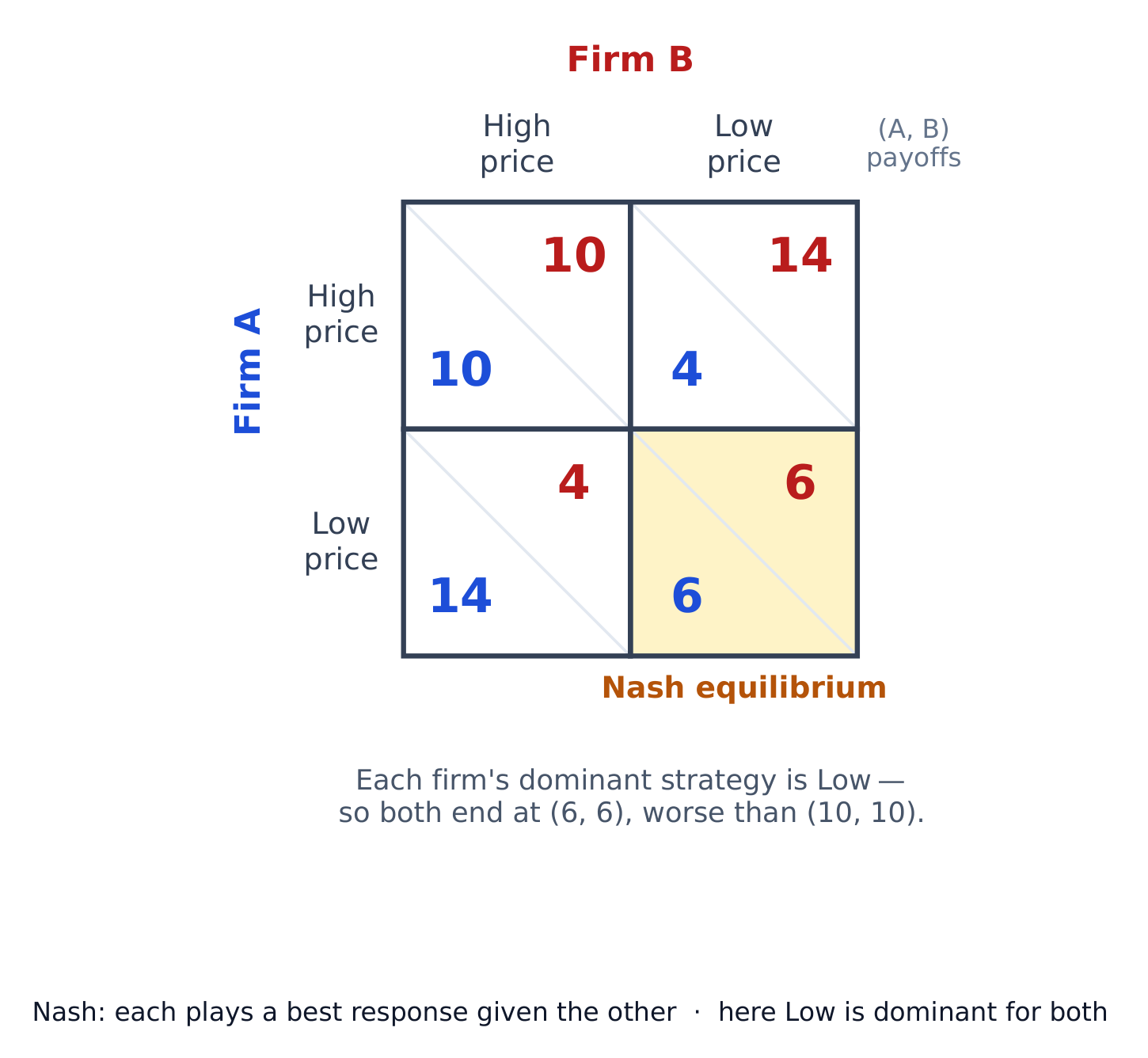
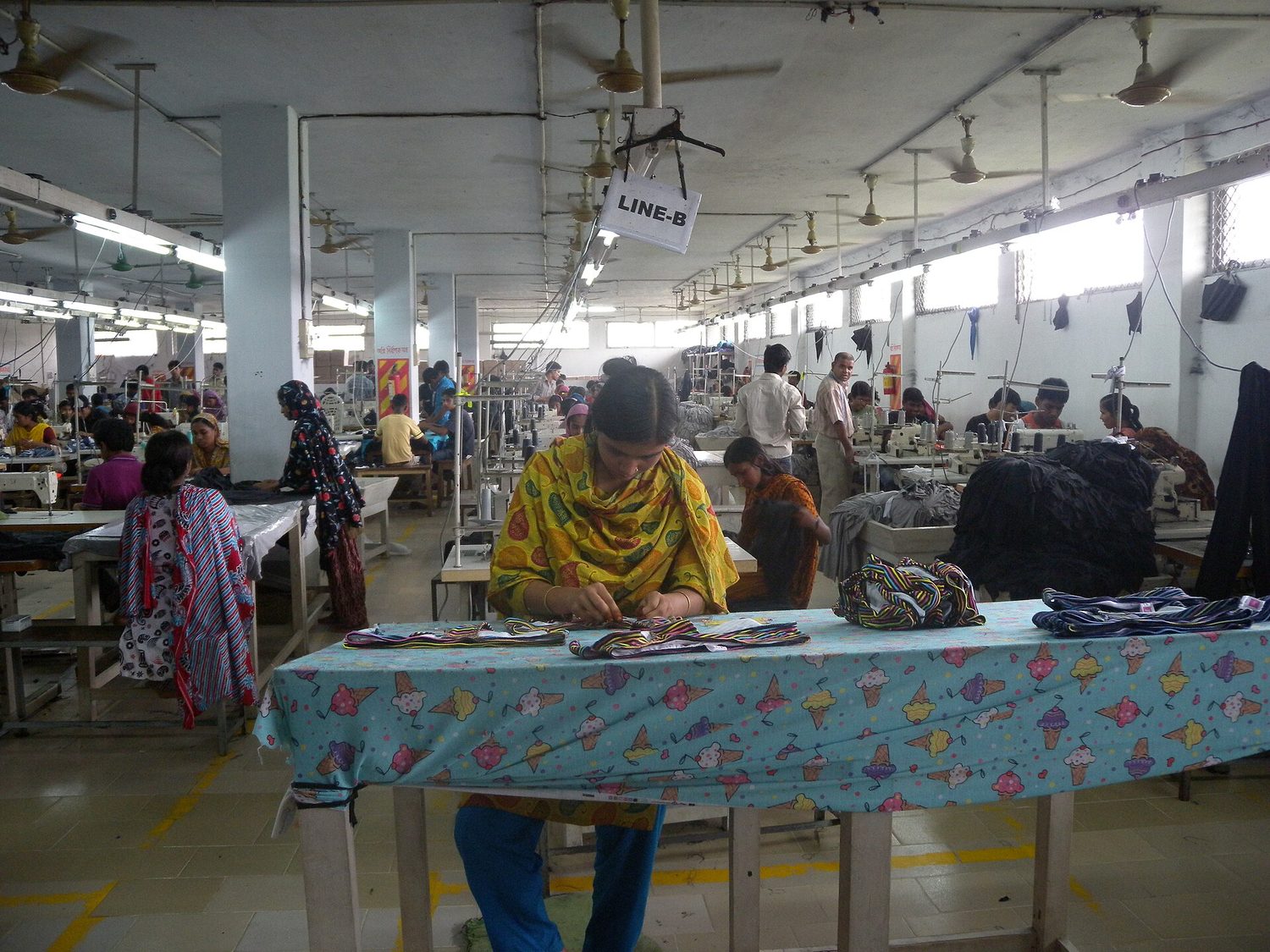
    • POL-4.A.1 تؤثر الضرائب والإعانات لكل وحدة على السعر الإجمالي الذي يدفعه المستهلكون، والسعر الصافي الذي تحصل عليه الشركات، والكمية المتوازنة، وفوائض المستهلكين والمنتجين، والخسارة العقيمة، وإيرادات الحكومة أو تكاليفها. يعتمد التأثير على مرونة الطلب والعرض.
    • POL-4.A.2 الضرائب والإعانات المباشرة لا تغير neither التكلفة الحدية nor المنفعة الحدية؛ بل تتأثر فقط التكاليف الثابتة.
    • POL-4.A.3影响 سقف وسقف الأسعار الملزمة الأسعار والكميات بشكل مختلف اعتمادًا على هياكل السوق (التنافس الكامل، الاحتكار، المنافسة الاحتكارية، وشراء واحد) ومرونة العرض والطلب.
    • POL-4.A.4 يمكن أن يزيد التدخل الحكومي في الأسواق غير المثالية الكفاءة إذا عالجت السياسة بشكل صحيح الحوافز التي أدت إلى فشل السوق.
    • POL-4.A.5 يمكن للحكومة استخدام تنظيم الأسعار لمعالجة عدم الكفاءة الناجم عن الاحتكار.
    • POL-4.A.6 سيحتاج الاحتكار الطبيعي إلى إعانة مباشرة لإنتاج الكمية الكفئة توزيعيًا.
    • POL-4.A.7 تستخدم الحكومات سياسة مكافحة الاحتكار لمحاولة جعل الأسواق أكثر تنافسية.
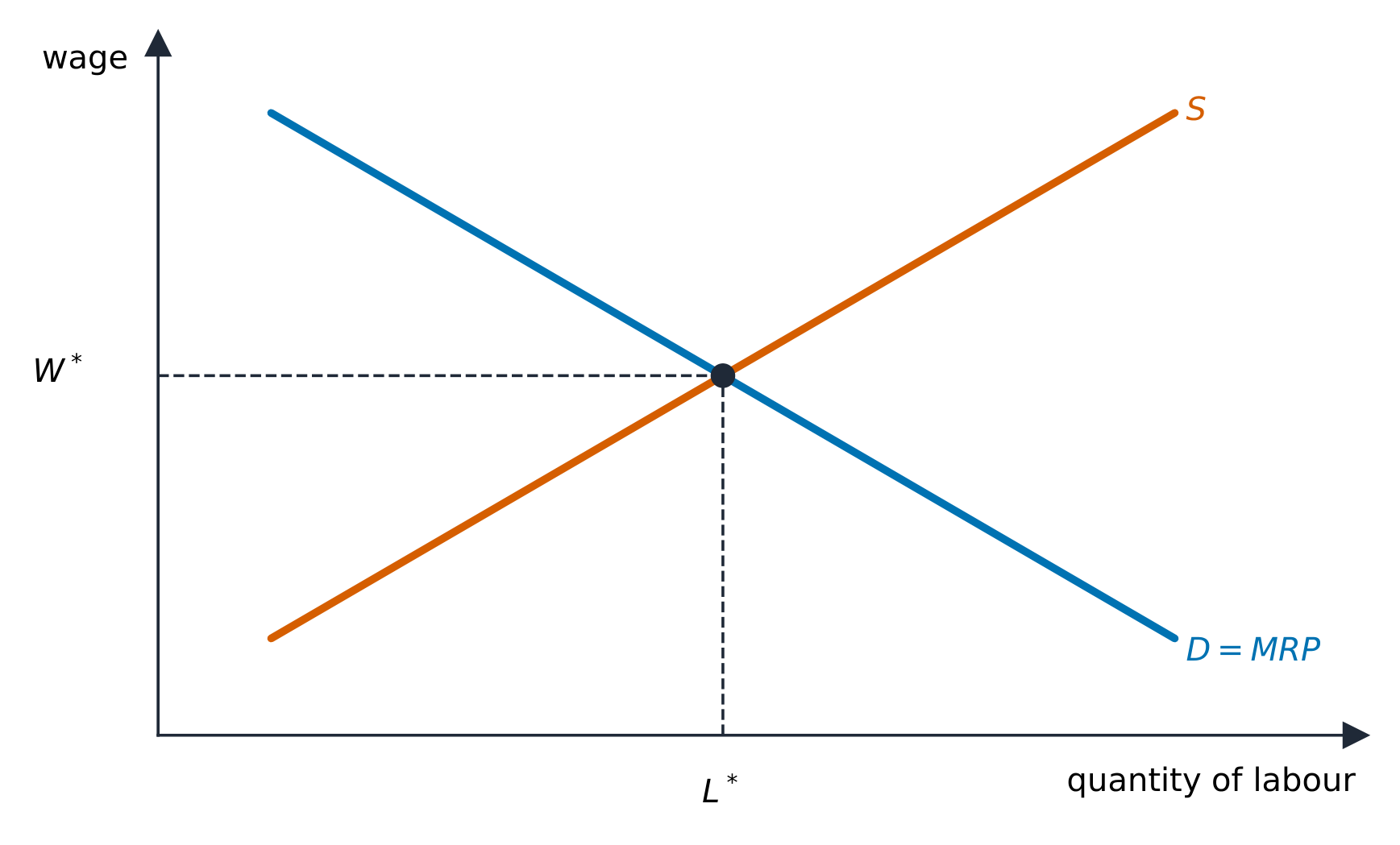
      • عبارة الاستبعاد: رسم بياني لعدم الكفاءة والسياسة الناتجة عن الاتفاق السري خارج نطاق المقرر وامتحان AP.

    Source: College Board AP Course and Exam Description · ⁨المصدر: وصف دورة وامتحان College Board AP⁩

    English

    Government tools change outcomes differently by structure:

    • Regulating a monopoly's price toward $P=MC$ can increase efficiency (unlike a price control in a competitive market, which creates shortage/surplus).
    • Antitrust laws 反垄断法 break up or block anti-competitive mergers and collusion.
    • Taxes and subsidies shift output toward the socially efficient quantity when externalities are present.

    The key insight: the same policy can help or hurt efficiency depending on whether the market was already efficient (competitive) or already failing (monopoly, externality).

    Per-unit vs lump-sum. A per-unit tax 从量税 adds to marginal cost, so it shifts supply up, raises price, cuts quantity, and creates deadweight loss. A lump-sum tax 定额税 (a fixed charge like a licence fee) does not change marginal cost or marginal benefit, so in the short run the profit-maximising price and quantity are unchanged – only the firm's profit falls; in the long run it changes entry and exit. For a natural monopoly, regulating price down to $P=MC$ (allocatively efficient) forces a loss, so a lump-sum subsidy 定额补贴 is needed to keep it producing that efficient quantity.

    العربية

    أدوات الحكومة تغير النتائج بشكل مختلف حسب الهيكل:

    • تنظيم سعر الاحتكار نحو $P=MC$ يمكن أن يزيد الكفاءة (عكس التحكم في السعر في سوق تنافسي، الذي يخلق عجزًا/فائضًا).
    • قوانين مكافحة الاحتكار تفكك أو تمنع عمليات الاندماج المضادة للتنافس والتواطؤ.
    • الضرائب والإعانات توجه الإنتاج نحو الكمية الفعالة اجتماعيًا عند وجود آثار خارجية.
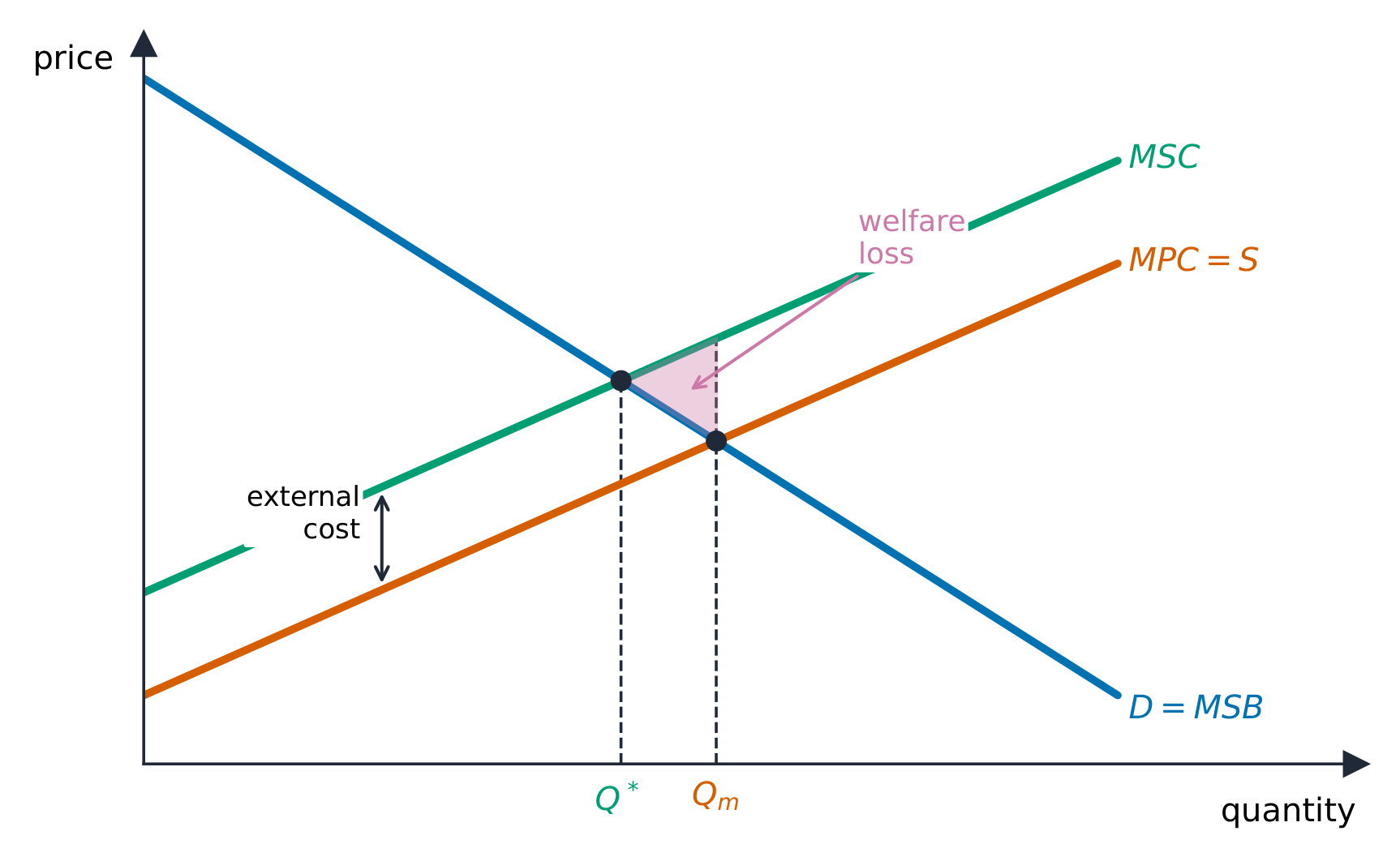
    الرؤية الأساسية: نفس السياسة يمكن أن تساعد أو تضر بالكفاءة اعتمادًا على ما إذا كان السوق بالفعل فعالًا (تنافسي) أو فشل بالفعل (احتكار، أثر خارجي).

    الضريبة لكل وحدة مقابل الضريبة الإجمالية. تضيف الضريبة لكل وحدة إلى التكلفة الحدية، مما يرفع منحنى العرض، ويزيد السعر، ويقلل الكمية، ويخلق خسارة عجزية. أما الضريبة الإجمالية (وهي رسوم ثابتة مثل رسوم التراخيص) فلا تغير التكلفة الحدية أو المنفعة الحدية،因此在 القصير الأمد يكون السعر والكمية اللذان يُحسِّبان الربح ثابتين – فقط ينخفض ربح الشركة؛ وفي الطويل الأمد يؤثر ذلك على الدخول والخروج من السوق. بالنسبة لـ ال monopole الطبيعي، فإن تنظيم السعر ليصل إلى $P=MC$ (الكفاءة التخصيصية) يُجبره على الخسارة، لذلك يُحتاج إلى إعانة إجمالية لإبقائه ينتج تلك الكمية الكفءة.

    6.5

    Inequality · ⁨عدم المساواة⁩

    Syllabus · ⁨المنهج⁩
    English

    Enduring Understanding (POL-5): Market outcomes can result in income inequality.

    Learning Objective POL-5.A: Define measures of economic inequality in income and wealth.

    • POL-5.A.1 Income levels and poverty rates vary greatly both across and within groups (e.g., age, gender, race) and countries.
    • POL-5.A.2 The Lorenz curve and Gini coefficient are used to represent the degree of inequality in distributions and to compare distributions across different countries, policies, or time periods.
      • Exclusion statement: Drawing the Lorenz curve and calculating Gini coefficients are beyond the scope of the course and the AP Exam.

    Learning Objective POL-5.B: Explain sources of income and wealth inequality.

    • POL-5.B.1 Each factor of production receives the value of its marginal product, which can contribute to income inequality.
    • POL-5.B.2 Sources of income and wealth inequality include differences in tax structures (progressive and regressive tax structures), human capital, social capital, inheritance, effects of discrimination, access to financial markets, mobility, and bargaining power within economic and social units (firms, labor unions, and families).
    العربية

    فهم دائم (POL-5): يمكن أن تؤدي نتائج السوق إلى عدم مساواة الدخل.

    هدف التعلم POL-5.A: عرّف مقاييس عدم المساواة الاقتصادية في الدخل والثروة.

    • POL-5.A.1 تختلف مستويات الدخل ومعدلات الفقر بشكل كبير عبر المجموعات (مثل: العمر، الجنس، العرق) ودول مختلفة.
    • POL-5.A.2 تُستخدم منحنى لورنز ومعامل جيني لتمثيل درجة عدم المساواة في التوزيعات ومقارنة التوزيعات عبر دول أو سياسات أو فترات زمنية مختلفة.
      • عبارة الاستبعاد: رسم منحنى لورينز وحساب معاملات جيني خارج نطاق المقرر وامتحان AP.

    هدف التعلم POL-5.B: شرح مصادر عدم المساواة في الدخل والثروة.

    • POL-5.B.1 كل عامل إنتاج يحصل على قيمة منتجه الحدي، مما قد يساهم في عدم المساواة في الدخل.
    • POL-5.B.2 تشمل مصادر عدم المساواة في الدخل والثروة الفروقات في هياكل الضرائب (الهياكل التقدمية والتناقصية)، ورأس المال البشري، ورأس المال الاجتماعي، والميراث، وتأثيرات التمييز، والوصول إلى الأسواق المالية، والحركة الاجتماعية، والقوة التفاوضية داخل الوحدات الاقتصادية والاجتماعية (الشركات، النقابات العمالية، والعائلات).

    Source: College Board AP Course and Exam Description · ⁨المصدر: وصف دورة وامتحان College Board AP⁩

    English

    Markets reward productivity, but the resulting income distribution 收入分配 can be very unequal. Economists measure it with the Lorenz curve 洛伦兹曲线 (share of income against share of population; the further it bows from the 45° line, the more unequal) and the Gini coefficient 基尼系数 (0 = perfect equality, 1 = perfect inequality).

    Worked example. Suppose the poorest $20\%$ of households earn just $5\%$ of income, while the richest $20\%$ earn $50\%$. Under perfect equality each $20\%$ would earn exactly $20\%$, so the Lorenz curve would be the $45°$ line. Because the bottom fifth is well below $20\%$ and the top fifth well above, the curve bows far beneath the diagonal – a large gap that means a high Gini coefficient and substantial inequality.

    Sources of inequality include differences in human capital 人力资本 (skills, education), inheritance, and discrimination. Governments redistribute through progressive taxes 累进税 (higher rates on higher incomes) and transfer payments 转移支付 (welfare, subsidies). There is a debated efficiency–equity trade-off 效率与公平权衡: redistribution can reduce work incentives, so societies balance fairness against the size of the total pie.

    العربية

    تكافئ الأسواق الإنتاجية، لكن التوزيع الدخل الناتج قد يكون غير متساوٍ للغاية. يقيس الاقتصاديون ذلك باستخدام منحنى لورنز (حصة الدخل مقابل حصة السكان؛ كلما ابتعد أكثر عن خط 45°، كان التوزيع أكثر عدم مساواة) ومعامل جيني (0 = مساواة مثالية، 1 = عدم مساواة مثالية).

    منحنى لورنز ومعامل جيني يقيسان عدم المساواة في الدخل
    منحنى لورنز ومعامل جيني يقيسان عدم المساواة في الدخل

    مثال محلل. افترض أن أفقر $20\%$ من الأسر تحقق دخلاً قدره $5\%$ فقط، بينما يحقق أغنى $20\%$ دخلاً قدره $50\%$. تحت المساواة المثالية، Would each $20\%$ achieving exactly $20\%$, therefore the Lorenz curve would be the $45°$ line. Because the bottom fifth is well below $20\%$ and the top fifth well above, the curve bows far beneath the diagonal – a large gap that means a high Gini coefficient and substantial inequality.

    تشمل مصادر عدم المساواة الفروقات في رأس المال البشري (المهارات، التعليم)، والميراث، والتمييز. تعيد الحكومات توزيع الثروة من خلال الضرائب التصاعدية (معدلات أعلى للدخول الأعلى) والمدفوعات الانتقالية (الرفاهية، الإعانات). يوجد نقاش حول مفاضلة الكفاءة–العدالة: يمكن أن تقلل إعادة التوزيع من حافز العمل، لذلك تتوازن المجتمعات بين العدالة وحجم الكعكة الكلية.

    الثروة والفقر جنبًا إلى جنب: الأسواق وحدها قد تترك عدم مساواة كبيرة في الدخل دون معالجة
    الثروة والفقر جنبًا إلى جنب: الأسواق وحدها قد تترك عدم مساواة كبيرة في الدخل دون معالجة
    Explore · ⁨استكشف⁩

    Measure inequality with a Lorenz curve · ⁨قِس عدم المساواة بمنحنى لورنز⁩

    A Lorenz curve plots cumulative income against cumulative population; the further it bows from the diagonal, the more unequal — summarised by the Gini coefficient. · ⁨يرسم منحنى لورنز الدخل التراكمي مقابل السكان التراكميين؛ كلما ابتعد المنحنى عن القطر الزائد، زادت عدم المساواة — ويُختصر ذلك بـمعامل جيني.⁩

    Vocabulary · ⁨مفردات⁩ Train · ⁨تدريب⁩
    English العربية
    Lorenz curve/ˈlɒrənts kɜːv/ منحنى لورينز
    Gini coefficient/ˈdʒiːni ˌkəʊɪˈfɪʃənt/ معامل جيني
    human capital/ˈhjuːmən ˈkæpɪtl/ رأس المال البشري
    progressive taxes/prəˈɡresɪv ˈtæksɪz/ الضرائب التقدمية
    transfer payments/ˈtrænsfɜː ˈpeɪmənts/ الدفعات الانتقالية
    efficiency–equity trade-off/ɪˈfɪʃənsi ˈekwɪti treɪd ɒf/ مفاضلة الكفاءة–الإنصاف
    6.5

    Exam tips · ⁨نصائح للامتحان⁩

    English
    • A negative externality makes the market over-produce; correct with a Pigovian tax equal to the external cost. A positive externality under-produces; correct with a subsidy.
    • A public good is non-rival and non-excludable, so free-riding leads markets to under-provide it.
    • Classify goods by rivalry and excludability; common resources (rival, non-excludable) suffer the tragedy of the commons.
    • The same policy can help or hurt efficiency depending on whether the market was already efficient or failing.
    • Measure inequality with the Lorenz curve and Gini coefficient (0 = equality, 1 = inequality).
    العربية
    • العواقب السلبية الخارجية تجعل السوق ينتج أكثر من اللازم؛ يتم تصحيحها بـ ضريبة بيغوفيان تساوي التكلفة الخارجية. أما العواقب الإيجابية فتنتج أقل من اللازم؛ يتم تصحيحها بإعانة.
    • السلعة العامة غير تنافسية وغير قابلة للاستبعاد، مما يؤدي إلى استغلالها مجاناً ويؤدي إلى أن توفر الأسواق لها بشكل أقل من اللازم.
    • صنف السلع بناءً على التنافسية والإستبعاد؛ تعاني الموارد المشتركة (تنافسية، غير قابلة للاستبعاد) من مأساة المشاعات.
    • نفس السياسة قد تساعد أو تضر بالكفاءة اعتماداً على ما إذا كان السوق كفؤاً بالفعل أو يفشل.
    • قِس عدم المساواة باستخدام منحنى لورنز ومعامل جيني (0 = مساواة، 1 = عدم مساواة).

Log in or create account · ⁨تسجيل الدخول أو إنشاء حساب⁩

IGCSE, A-Level & AP