Skip to content · ⁨الانتقال إلى المحتوى⁩

Financial Sector · ⁨القطاع المالي⁩

AP Macroeconomics · ⁨الاقتصاد الكلي (AP)⁩ · Topic 4 · ⁨الموضوع 4⁩

Video lesson for this topic · ⁨درس فيديو لهذا الموضوع⁩ Open the video page · ⁨افتح صفحة الفيديو⁩
7:55

القطاع المالي

انظر إلى المال في يدك. إنه مجرد ورق. له قيمة لأن الجميع يتفق على قبوله. ومن ملايين هذه الاتفاقيات ينشأ…

English narration · English + 中文 subtitles burned in · ⁨سرد باللغة الإنجليزية · ترجمة مدمجة بالإنجليزية + الصينية⁩

4.1

Financial Assets · ⁨الأصول المالية⁩

Syllabus · ⁨المنهج⁩
English

Enduring Understanding (MEA-3): Money makes it possible to compare the value of goods and services, and interest rates provide a measure of the price of money that is borrowed or saved.

Learning Objective MEA-3.A: a. Define the principal attributes—liquidity, rate of return, and risk—associated with various classes of financial assets, including money. b. Explain the relationship between the price of previously issued bonds and interest rates.

  • MEA-3.A.1 The most liquid forms of money are cash and demand deposits.
  • MEA-3.A.2 Other financial assets people can hold in place of the most liquid forms of money include bonds (interest-bearing assets) and stocks (equity).
  • MEA-3.A.3 The price of previously issued bonds and interest rates on bonds are inversely related.
  • MEA-3.A.4 The opportunity cost of holding money is the interest that could have been earned from holding other financial assets such as bonds.
العربية

الفهم الدائم (MEA-3): يجعل المال من الممكن مقارنة قيمة السلع والخدمات، وتوفر أسعار الفائدة مقياساً لسعر المال المقترض أو الموفر.

هدف التعلم MEA-3.A: أ. عرّف السمات الرئيسية—السيولة، ومعدل العائد، والمخاطر—المرتبطة بفئات مختلفة من الأصول المالية، بما في ذلك النقود. ب. اشرح العلاقة بين سعر السندات التي تم إصدارها مسبقاً وأسعار الفائدة.

  • MEA-3.A.1 الأشكال الأكثر سيولة للنقود هي النقد الورقي والودائع الجارية.
  • MEA-3.A.2 تشمل الأصول المالية الأخرى التي يمكن للأشخاص الاحتفاظ بها بدلاً من الأشكال الأكثر سيولة للنقود السندات (الأصول المحققة للفوائد) والأسهم (حقوق الملكية).
  • MEA-3.A.3 يرتبط سعر السندات التي تم إصدارها مسبقاً وأسعار الفائدة على السندات عكسياً.
  • MEA-3.A.4 تكلفة الفرصة البديلة لامتلاك النقود هي الفائدة التي كان يمكن كسبها من امتلاك أصول مالية أخرى مثل السندات.
Source: College Board AP Course and Exam Description · ⁨المصدر: وصف دورة وامتحان College Board AP⁩

English

A financial asset 金融资产 is a claim that stores value: money, stocks 股票 (ownership shares), bonds 债券 (loans that pay interest), and bank deposits. Assets trade off liquidity 流动性 (how easily converted to cash), risk, and return. A key inverse relationship: bond prices and interest rates move in opposite directions – when market interest rates rise, existing bonds paying the old, lower rate are worth less, so their price falls.

العربية

الأصل المالي هو مطالبة تخزن القيمة: النقد، الأسهم (حصص ملكية)، السندات (قروض تدفع فائدة)، وإيداعات البنوك. تتوازن الأصول بين السيولة (سهولة تحويلها إلى نقد)، والمخاطر، والعائد. علاقة عكسية مهمة: أسعار السندات وأسعار الفائدة تتحرك في اتجاهين متعاكسين – عندما ترتفع أسعار الفائدة في السوق، تصبح السندات الحالية التي تدفع معدل الفائدة القديم المنخفض أقل قيمة،因此其价格下跌。

ساحة التداول المزدحمة في بورصة نيويورك للأسهم
بورصة الأسهم هي مكان يتم فيها شراء وبيع الأصول المالية، وتحديد الأسعار بناءً على العرض والطلب
4.2

Nominal versus Real Interest Rates · ⁨أسعار الفائدة الاسمية والحقيقية⁩

Syllabus · ⁨المنهج⁩
English

Enduring Understanding (MEA-3): Money makes it possible to compare the value of goods and services, and interest rates provide a measure of the price of money that is borrowed or saved.

Learning Objective MEA-3.B: a. Define the nominal and real interest rate. b. Explain the relationship between changes in nominal interest rates, expected inflation, and real interest rates. c. Calculate the nominal and real interest rate.

  • MEA-3.B.1 A nominal interest rate is the rate of interest paid for a loan, unadjusted for inflation.
  • MEA-3.B.2 Lenders and borrowers establish nominal interest rates as the sum of their expected real interest rate and expected inflation.
  • MEA-3.B.3 A real interest rate can be calculated in hindsight by subtracting the actual inflation rate from the nominal interest rate.
العربية

الفهم الدائم (MEA-3): يجعل المال من الممكن مقارنة قيمة السلع والخدمات، وتوفر أسعار الفائدة مقياساً لسعر المال المقترض أو الموفر.

هدف التعلم MEA-3.B: أ. عرّف سعر الفائدة الاسمي وحقيقي. ب. اشرح العلاقة بين التغيرات في أسعار الفائدة الاسمية والتض的预期 الحقيقي وأسعار الفائدة الحقيقية. ج. احسب سعر الفائدة الاسمي والحقيقي.

  • MEA-3.B.1 سعر الفائدة الاسمي هو معدل الفائدة المدفوع قرض، غير معدّل للتضخم.
  • MEA-3.B.2 يحدد المقرضون والمقرضون أسعار الفائدة الاسمية كمجموع معدل الفائدة الحقيقي المتوقع والتض预期 الحقيقي.
  • MEA-3.B.3 يمكن حساب سعر الفائدة الحقيقي بعقب الأحداث عن طريق طرح معدل التض预期 الفعلي من سعر الفائدة الاسمي.

Source: College Board AP Course and Exam Description · ⁨المصدر: وصف دورة وامتحان College Board AP⁩

English
  • The nominal interest rate 名义利率 is the stated rate, not adjusted for inflation.
  • The real interest rate 实际利率 is what you actually earn in purchasing power:
$$\text{real rate}\approx\text{nominal rate}-\text{inflation rate}\quad(\text{Fisher equation}).$$

Lenders and borrowers care about the real rate. If inflation turns out higher than expected, real rates fall – helping borrowers and hurting lenders.

Worked example. A loan carries a nominal rate of $6\%$ while inflation runs at $2\%$. The real rate is $6\%-2\%=4\%$, so the lender's purchasing power grows by $4\%$. If inflation instead jumped to $7\%$, the real rate would be $-1\%$ – the lender would actually lose purchasing power.

العربية
  • سعر الفائدة الاسمي هو المعدل المعلن، غير معدّل حسب التضخم.
  • سعر الفائدة الحقيقي هو ما تكسبه فعليًا من حيث القدرة الشرائية:
$$\text{real rate}\approx\text{nominal rate}-\text{inflation rate}\quad(\text{Fisher equation}).$$

الدائرون والمدينون يهتمون بالمعدل الحقيقي. إذا تبين أن التضخم أعلى من المتوقع، تنخفض معدلات الفائدة الحقيقية – مما يساعد المدينين ويضر الدائرين.

مثال محلول. قرض يحمل معدل اسمي $6\%$ بينما التضخم يتراوح عند $2\%$. المعدل الحقيقي هو $6\%-2\%=4\%$، لذلك تنمو قدرة الدائن الشرائية بمقدار $4\%$. لو قفز التضخم بدلاً من ذلك إلى $7\%$، ليصبح المعدل الحقيقي $-1\%$ – مما يعني أن الدائن سيخسر فعليًا في قدرته الشرائية.

4.3

The Definition, Measurement, and Functions of Money · ⁨التعريف والقياس والوظائف للنقد⁩

Syllabus · ⁨المنهج⁩
English

Enduring Understanding (MEA-3): Money makes it possible to compare the value of goods and services, and interest rates provide a measure of the price of money that is borrowed or saved.

Learning Objective MEA-3.C: a. Define money and its functions. b. Calculate (using data as appropriate) measures of money.

  • MEA-3.C.1 Money is any asset that is accepted as a means of payment.
  • MEA-3.C.2 Money serves as a medium of exchange, unit of account, and store of value.
  • MEA-3.C.3 The money supply is measured using monetary aggregates designated as M1 and M2.
  • MEA-3.C.4 The monetary base (often labeled as M0 or MB) includes currency in circulation and bank reserves.
العربية

الفهم الدائم (MEA-3): يجعل المال من الممكن مقارنة قيمة السلع والخدمات، وتوفر أسعار الفائدة مقياساً لسعر المال المقترض أو الموفر.

هدف التعلم MEA-3.C: أ. عرّف النقود ووظائفها. ب. احسب (باستخدام البيانات عند الحاجة) مقاييس النقود.

  • MEA-3.C.1 النقود هي أي أصل يتم قبوله كوسيلة للدفع.
  • MEA-3.C.2 تعمل النقود كوسيط للتبادل، ووحدة للحساب، ومخزن للقيمة.
  • MEA-3.C.3 يُقاس عرض النقود باستخدام المجاميع النقدية المحددة باسم M1 وM2.
  • MEA-3.C.4 يشمل الأساس النقدي (يُشار إليه غالباً بـ M0 أو MB) العملة المتداولة واحتياطيات البنوك.

Source: College Board AP Course and Exam Description · ⁨المصدر: وصف دورة وامتحان College Board AP⁩

English

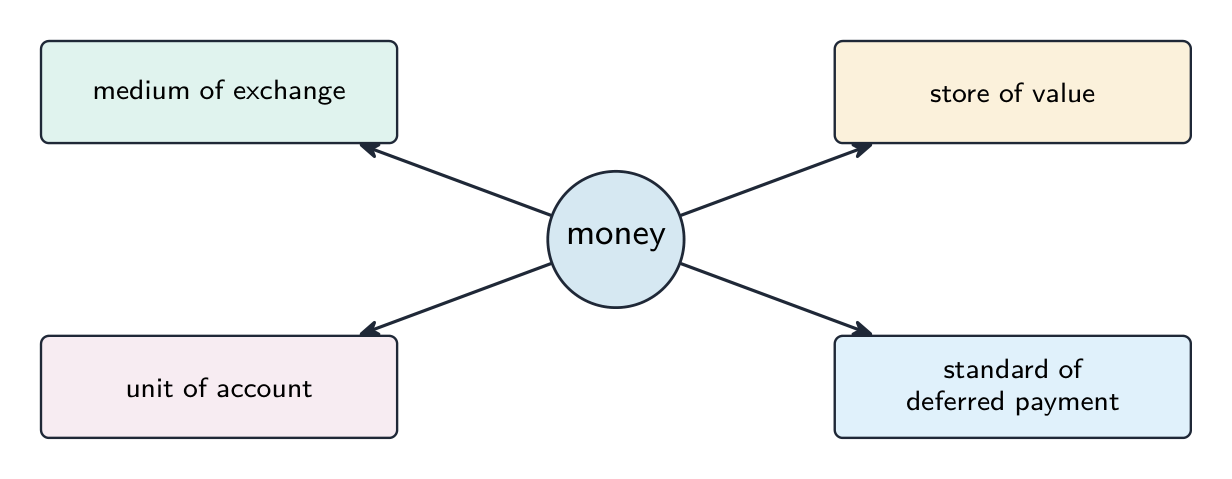
Money 货币 is anything widely accepted in exchange. Its three functions: a medium of exchange 交换媒介 (avoids barter), a unit of account 记账单位 (a common measure of value), and a store of value 价值储藏 (holds value over time). Modern money is fiat money 法定货币 – valuable because the government declares it legal tender and people trust it, not because it is backed by gold.

Money is measured in tiers by liquidity: M1 (currency plus checkable deposits – the most liquid) and the broader M2 (M1 plus savings deposits and other near-money). Below M1 is the monetary base 基础货币 (M0, or MB) – currency in circulation plus bank reserves. The money multiplier equals money supply ÷ monetary base, so a central-bank action that raises reserves expands the money supply by a larger amount through the multiplier.

العربية

النقد هو أي شيء مقبول على نطاق واسع في المقايضة. وظائفه الثلاثة: وسيط للتبادل (يتجنب المقايضة)، وحدة للحساب (مقياس مشترك للقيمة)، ومخزن للقيمة (يحفظ قيمته عبر الزمن). النقد الحديث هو نقد قانوني (fiat money) – قيمته ناشئة عن إعلان الحكومة أنه عملة شرعية وثقة الناس فيه، وليس لأنه مدعوم بالذهب.

وظائف النقود؛ يختبر امتحان AP الوظائف الثلاث الأولى
وظائف النقد – يختبر امتحان AP الوظائف الثلاث الأولى (وسيط للتبادل، وحدة للحساب، مخزن للقيمة)؛ معيار الدفع المؤجل خارج نطاق CED

يُقاس النقد في مستويات حسب السيولة: M1 (النقد Plus إيداعات_checks – الأكثر سيولة) والأوسع M2 (M1 Plus إيداعات توفير وأموال قريبة أخرى). أسفل M1 يوجد القاعدة النقدية (M0, or MB) – النقد المتداول Plus احتياطيات البنوك. مضاعف النقدي يساوي عرض النقود ÷ القاعدة النقدية، لذا فإن إجراء البنك المركزي الذي يرفع الاحتياطيات يوسع عرض النقود بمقدار أكبر من خلال المضاعف.

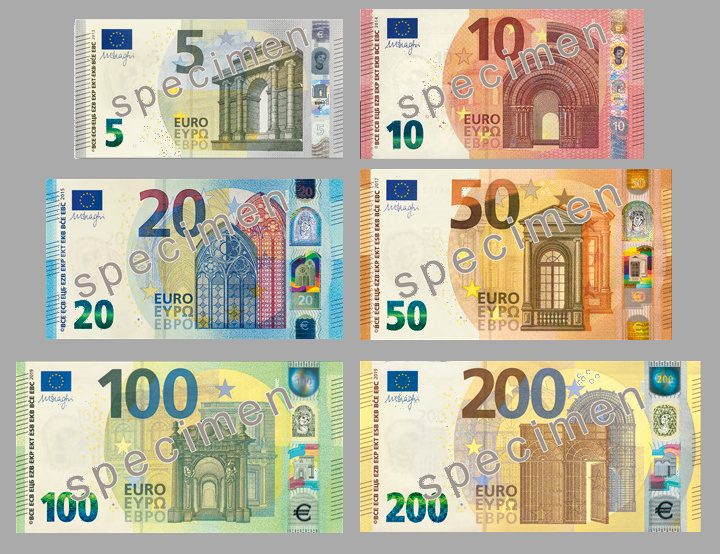
مجموعة من الأوراق النقدية يورو ذات قيم مختلفة
النقد يعمل لأن الجميع يقبلونه: وحدة حساب مشتركة، وسيط للتبادل، ومخزن للقيمة
Vocabulary · ⁨مفردات⁩ Train · ⁨تدريب⁩
English العربية
financial asset/faɪˈnænʃl ˈæset/ الأصل المالي
stocks/stɒks/ المخزون
bonds/bɒndz/ السندات
liquidity/lɪˈkwɪdɪti/ السيولة
nominal interest rate/ˈnɒmɪnl ˈɪntrest reɪt/ معدل الفائدة الاسمي
real interest rate/rɪəl ˈɪntrest reɪt/ معدل الفائدة الحقيقي
Money/ˈmʌni/ المال
medium of exchange/ˈmiːdɪəm ɒv eksˈtʃeɪndʒ/ وسيط للتبادل
unit of account/ˈjuːnɪt ɒv əˈkaʊnt/ وحدة حساب
store of value/stɔː ɒv ˈvæljuː/ مخزن للقيمة
fiat money/ˈfiːət ˈmʌni/ النقد法定
monetary base/ˈmʌnɪtəri beɪs/ القاعدة النقدية
fractional reserve/ˈfrækʃənl rɪˈzɜːv/ احتياطي جزئي
4.4

Banking and the Expansion of the Money Supply · ⁨البنوك وتوسيع عرض النقود⁩

Syllabus · ⁨المنهج⁩
English

Enduring Understanding (POL-2): The banking system plays an important role in the expansion of the money supply.

Learning Objective POL-2.A: a. Define key terms related to the banking system and the expansion of the money supply. b. Explain how the banking system creates and expands the money supply. c. Calculate (using data and balance sheets as appropriate) the effects of changes in the banking system.

  • POL-2.A.1 Depository institutions (such as commercial banks) organize their assets and liabilities on balance sheets.
  • POL-2.A.2 Depository institutions operate using fractional reserve banking.
  • POL-2.A.3 Banks' reserves are divided into required reserves and excess reserves.
  • POL-2.A.4 Excess reserves are the basis of expansion of the money supply by the banking system.
  • POL-2.A.5 The money multiplier is the ratio of the money supply to the monetary base.
  • POL-2.A.6 The size of expansion of the money supply depends on the money multiplier.
  • POL-2.A.7 The maximum value of the money multiplier can be calculated as the reciprocal of the required reserve ratio.
  • POL-2.A.8 The amount predicted by the simple money multiplier may be overstated because it does not take into account a bank's desire to hold excess reserves or the public holding more currency.
العربية

الفهم الدائم (POL-2): يلعب النظام البنكي دورًا مهمًا في توسيع عرض النقود.

هدف التعلم POL-2.A: أ. تعريف المصطلحات الرئيسية المتعلقة بالنظام البنكي وتوسيع عرض النقود. ب. شرح كيف يقوم النظام البنكي بإنشاء وتوسيع عرض النقود. ج. حساب (باستخدام البيانات والموازنات عند الحاجة) تأثير التغيرات في النظام البنكي.

  • POL-2.A.1 المؤسسات الإيداعية (مثل البنوك التجارية) تنظم أصولها والتزاماتها في موازنتها.
  • POL-2.A.2 تعمل المؤسسات الإيداعية بنظام الاحتياطي الكسري.
  • POL-2.A.3 تنقسم احتياطيات البنوك إلى احتياطيات إلزامية واحتياطيات فائقة.
  • POL-2.A.4 تمثل الاحتياطيات الفائقة أساس توسيع عرض النقود من قبل النظام البنكي.
  • POL-2.A.5 مضروب النقود هو نسبة عرض النقود إلى الأساس النقدي.
  • POL-2.A.6 يعتمد حجم توسيع عرض النقود على مضروب النقود.
  • POL-2.A.7 يمكن حساب القيمة القصوى لمضروب النقود كمقلوب نسبة الاحتياطي الإلزامي.
  • POL-2.A.8 قد يكون المقدار المتوقع بمضروب النقود البسيط مبالغًا فيه لأنه لا يأخذ في الاعتبار رغبة البنك في الاحتفاظ باحتياطيات فائقة أو احتفاظ العامة بكميات أكبر من النقد.

Source: College Board AP Course and Exam Description · ⁨المصدر: وصف دورة وامتحان College Board AP⁩

English

Banks operate on a fractional reserve 部分准备金 system: they keep a fraction of deposits as reserves 准备金 and lend the rest. The fraction they must keep is the required reserve ratio 法定准备金率 (rr). Lending creates new deposits, which are re-deposited and re-lent, expanding the money supply by the money multiplier:

$$\text{money multiplier}=\frac{1}{rr}.$$

A new $1000 deposit with$rr=0.1$leaves$$900$in excess reserves, so the banking system can expand the money supply by up to$900\times\frac{1}{0.1}=9,000$. Use a bank's T-account (assets = reserves + loans; liabilities = deposits) to track required reserves and excess reserves 超额准备金 (the amount available to lend).

Worked example. A bank receives a $\$1000$ deposit with $rr=0.20$. It must hold $0.20\times1000=\$200$ as required reserves, leaving $\$800$ of excess reserves to lend. With a money multiplier of $\dfrac{1}{0.20}=5$, that $\$800$ of new lending can expand the money supply by up to $800\times5=\$4000$ across the banking system.

Exam skill: given a required reserve ratio and a deposit, compute excess reserves, the money multiplier, and the maximum change in the money supply.

العربية

تعمل البنوك بنظام احتياطي كسري: تحتفظ بجزء من الإيداعات كـ احتياطيات وتقترض الباقي. الجزء الذي يجب أن تحتفظ به هو نسبة الاحتياطي الإلزامي (rr). يخلق الإقراض إيداعات جديدة، والتي تعاد إيداعها والإقراض مرة أخرى، مما يوسع عرض النقود بواسطة مضاعف النقود:

$$\text{money multiplier}=\frac{1}{rr}.$$

جديد $1000 deposit with$rr=0.1$leaves$$900$في فائض الاحتياطيات، لذا يمكن للنظام البنكي توسيع عرض النقود حتى$900\times\frac{1}{0.1}=9,000$. استخدم حساب T للبنك (الأصول = احتياطيات + قروض؛ الخصوم = إيداعات) لتتبع الاحتياطيات الإلزامية وفائض الاحتياطيات (المبلغ المتاح للإقراض).

مثال محلول. بنك يستقبل $\$1000$ deposit with $rr=0.20$. It must hold $0.20\times1000=\$200$ كاحتياطيات إلزامية، تاركاً $\$800$ of excess reserves to lend. With a money multiplier of $\dfrac{1}{0.20}=5$, that $\$800$ من القروض الجديدة يمكن أن توسع عرض النقود حتى $800\times5=\$4000$ عبر النظام البنكي.

مهارة الامتحان: مع نسبة الاحتياطي الإلزامي وإيداع، احسب فائض الاحتياطيات، ومضاعف النقود، والتغير الأقصى في عرض النقود.

Explore · ⁨استكشف⁩

See banks multiply deposits · ⁨شاهد البنوك تضاعود الودائع⁩

Banks keep a fraction of deposits as reserves and lend the rest, which is redeposited and lent again — the money multiplier expands the money supply from the initial deposit. · ⁨تحتفظ البنوك بكسر من الودائع كاحتياطيات وتقرض الباقي، الذي يُودع مجدداً ويُقرض مرة أخرى — مضاعف النقود يوسع عرض النقد من الوديعة الأولية.⁩

Vocabulary · ⁨مفردات⁩ Train · ⁨تدريب⁩
English العربية
reserves/rɪˈzɜːvz/ الاحتياطيات
required reserve ratio/rɪˈkwaɪəd rɪˈzɜːv ˈreɪʃɪəʊ/ نسبة الاحتياطي الإلزامي
excess reserves/ekˈses rɪˈzɜːvz/ الاحتياطيات الزائدة
4.5

The Money Market · ⁨سوق النقود⁩

Syllabus · ⁨المنهج⁩
English

Enduring Understanding (MKT-3): In the money market, demand for and supply of money determine the equilibrium nominal interest rate and influence the value of other financial assets.

Learning Objective MKT-3.A: a. Define (using graphs as appropriate) the money market, money demand, and money supply. b. Explain (using graphs as appropriate) the relationship between the nominal interest rate and the quantity of money demanded (supplied).

  • MKT-3.A.1 The demand for money shows the inverse relationship between the nominal interest rate and the quantity of money people want to hold.
  • MKT-3.A.2 Given a monetary base determined by a country's central bank, money supply is independent of the nominal interest rate.

Learning Objective MKT-3.B: Define (using graphs as appropriate) equilibrium in the money market.

  • MKT-3.B.1 In the money market, equilibrium is achieved when the nominal interest rate is such that the quantities demanded and supplied of money are equal.

Learning Objective MKT-3.C: Explain (using graphs as appropriate) how nominal interest rates adjust to restore equilibrium in the money market.

  • MKT-3.C.1 Disequilibrium nominal interest rates create surpluses and shortages in the money market. Market forces drive nominal interest rates toward equilibrium.

Learning Objective MKT-3.D: a. Explain (using graphs as appropriate) the determinants of demand and supply in the money market. b. Explain (using graphs as appropriate) how changes in demand and supply in the money market affect the equilibrium nominal interest rate.

  • MKT-3.D.1 Factors that shift the demand for money, such as changes in the price level, and supply of money, such as monetary policy, change the equilibrium nominal interest rate.
العربية

الفهم الدائم (MKT-3): في سوق النقود، يحدد الطلب على النقود وعرضها معدل الفائدة الاسمي المتوازن ويؤثر في قيمة الأصول المالية الأخرى.

هدف التعلم MKT-3.A: أ. تعريف (باستخدام الرسوم البيانية عند الحاجة) سوق النقود، وطلب النقود، وعرض النقود. ب. شرح (باستخدام الرسوم البيانية عند الحاجة) العلاقة بين معدل الفائدة الاسمي والكمية المطلوبة (المقدرة) من النقود.

  • MKT-3.A.1 يظهر طلب النقود العلاقة العكسية بين معدل الفائدة الاسمي والكمية التي يرغب الناس في امتلاكها من النقود.
  • MKT-3.A.2 بناءً على أساس نقدي تحدده بنك البلاد المركزي، يكون عرض النقود مستقلاً عن معدل الفائدة الاسمي.

هدف التعلم MKT-3.B: تعريف (باستخدام الرسوم البيانية عند الحاجة) التوازن في سوق النقود.

  • MKT-3.B.1 في سوق النقود، يتحقق التوازن عندما يكون معدل الفائدة الاسمي بحيث تتساوى الكميات المطلوبة والمقدرة من النقود.

هدف التعلم MKT-3.C: شرح (باستخدام الرسوم البيانية عند الحاجة) كيفية ضبط معدلات الفائدة الاسمية لاستعادة التوازن في سوق النقود.

  • MKT-3.C.1 تُحدث معدلات الفائدة الاسمية غير المتوازنة فوائض ونقصاً في سوق النقود. تدفع قوى السوق معدلات الفائدة الاسمية نحو التوازن.

هدف التعلم MKT-3.D: أ. شرح (باستخدام الرسوم البيانية عند الحاجة) محددات الطلب والعرض في سوق النقود. ب. شرح (باستخدام الرسوم البيانية عند الحاجة) كيف تؤثر التغيرات في الطلب والعرض في سوق النقود على معدل الفائدة الاسمي المتوازن.

  • MKT-3.D.1 العوامل التي تحرك منحنى طلب النقود، مثل تغيرات مستوى الأسعار، وعوامل تحرك منحنى عرض النقود، مثل السياسة النقدية، تغير معدل الفائدة الاسمي المتوازن.

Source: College Board AP Course and Exam Description · ⁨المصدر: وصف دورة وامتحان College Board AP⁩

English
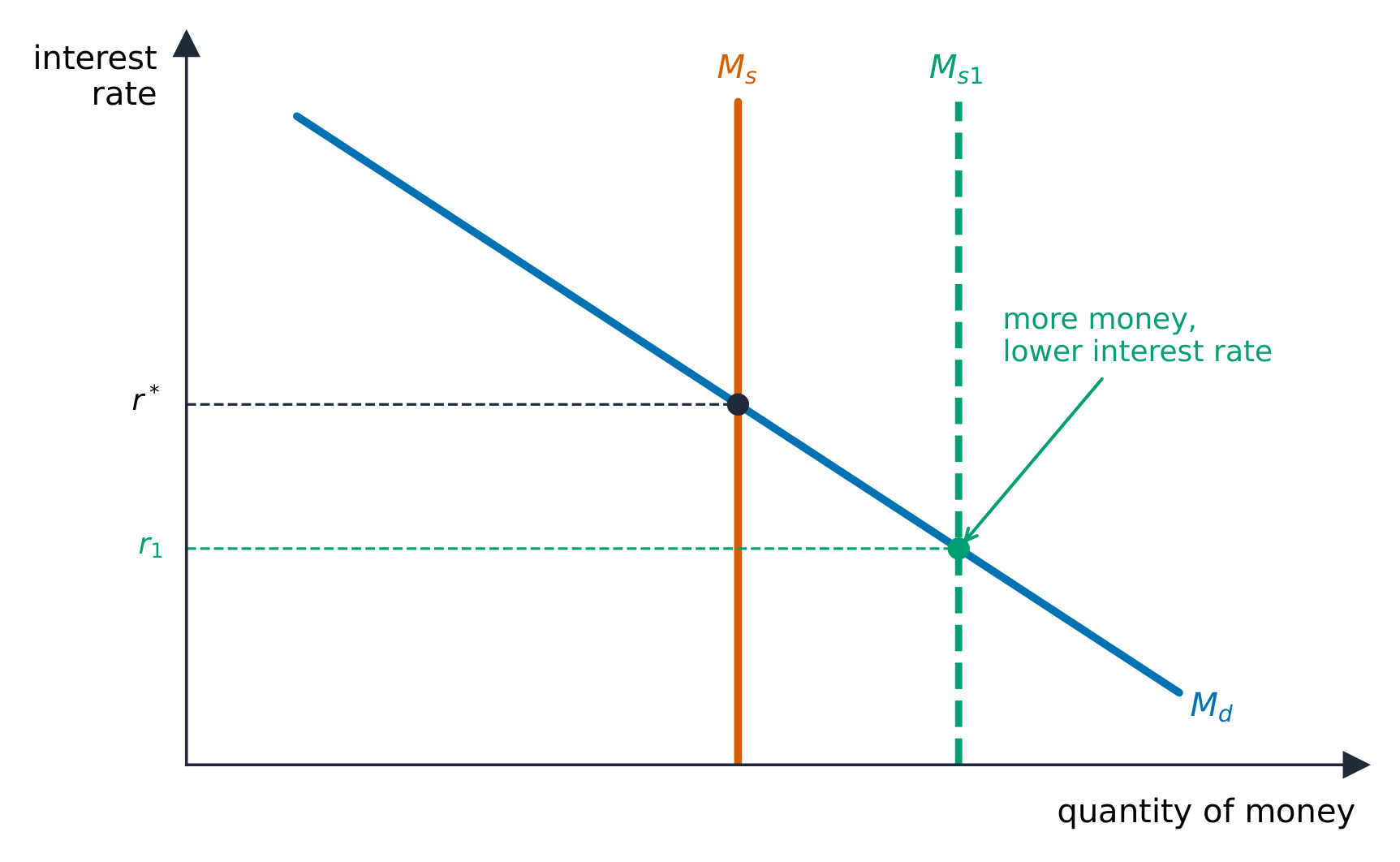
The money market sets the interest rate

The money market 货币市场 determines the nominal interest rate:

  • Money demand 货币需求 slopes downward against the interest rate – the rate is the opportunity cost of holding money instead of interest-bearing assets. It shifts right with a higher price level or more real GDP.
  • Money supply 货币供给 is vertical – set by the central bank, independent of the interest rate.

Their intersection sets the equilibrium interest rate. If the central bank increases the money supply, the supply line shifts right and the interest rate falls.

العربية
سوق النقود يحدد سعر الفائدة

يحدد سوق النقود سعر الفائدة الاسمي:

يتم تحديد معدل الفائدة من خلال الطلب على النقود وعرضها
سعر الفائدة يُحدد بطلب وعرض النقود
  • طلب النقود ينحدر لأسفل مقابل سعر الفائدة – فالسعر هو تكلفة الفرصة البديلة لحفظ النقود بدلاً من الأصول المدفوعة للفائدة. ينزاح لليمين مع ارتفاع مستوى الأسعار أو زيادة الناتج المحلي الحقيقي.
  • عرض النقود عمودي – محددة من قبل البنك المركزي، ومستقلة عن سعر الفائدة.

تحدد تقاطعاتها معدل الفائدة في حالة التوازن. إذا زادت البنك المركزي من عرض النقود، تنزاح منحنى العرض إلى اليمين وينخفض معدل الفائدة.

Explore · ⁨استكشف⁩

Equilibrium in the money market · ⁨توازن سوق النقود⁩

The money market sets the interest rate where money demand meets the central bank's money supply. A change in the money supply moves the interest rate. · ⁨سوق النقود يحدد نسبة الفائدة حيث يصل طلب النقود إلى عرض النقد من البنك المركزي. تغيير في عرض النقود يحرك نسبة الفائدة.⁩

Vocabulary · ⁨مفردات⁩ Train · ⁨تدريب⁩
English العربية
money market/ˈmʌni ˈmɑːkɪt/ سوق النقود
Money demand/ˈmʌni dɪˈmænd/ طلب النقود
Money supply/ˈmʌni səˈplaɪ/ عرض النقود
Monetary policy/ˈmʌnɪtəri ˈpɒlɪsi/ السياسة النقدية
Expansionary (easy)/ekˈspænʃənəri/ توسعي (سهل)
Contractionary (tight)/kənˈtrækʃənəri/ انقباضي (مشدد)
open-market operations/ˈəʊpən ˈmɑːkɪt ˌɒpəˈreɪʃnz/ عمليات السوق المفتوحة
discount rate/ˈdɪskaʊnt reɪt/ معدل الخصم
interest on reserves (IOR)/ˈɪntrest ɒn rɪˈzɜːvz/ الفائدة على الاحتياطيات (IOR)
policy rate/ˈpɒlɪsi reɪt/ معدل السياسة
loanable funds market/ˈləʊnəbl fʌndz ˈmɑːkɪt/ سوق الأموال القابلة للإقراض
national savings/ˈnæʃənl ˈseɪvɪŋz/ الادخار الوطني
4.6

Monetary Policy · ⁨السياسة النقدية⁩

Syllabus · ⁨المنهج⁩
English

Enduring Understanding (POL-1): Fiscal and monetary policy have short-run effects on macroeconomic outcomes.

Learning Objective POL-1.D: a. Define monetary policy and related terms. b. Explain (using graphs as appropriate) the short-run effects of a monetary policy action. c. Calculate (using data and balance sheets as appropriate) the effects of a monetary policy action.

  • POL-1.D.1 Central banks implement monetary policies to achieve macroeconomic goals, such as price stability.
  • POL-1.D.2 The tools of monetary policy may include the central bank's discount rate and other administered interest rates (e.g., interest on reserves), open market operations, and the required reserve ratio. The tools used and the way in which they are implemented differ between economies that have limited reserves in their banking system and economies that have ample reserves in their banking system. (The banking system in the United States has ample reserves, and the Federal Reserve's key policy tool is interest on reserves.)
  • POL-1.D.3 When the central bank conducts an open-market purchase (sale), reserves increase (decrease), thereby increasing (decreasing) the monetary base.
  • POL-1.D.4 When the central bank conducts an open-market purchase (sale) in an economy with limited reserves, the effect on the money supply is greater than the effect on the monetary base because of the money multiplier.
  • POL-1.D.5 Many central banks carry out policy to hit a target range for an overnight interbank lending rate, sometimes referred to as the central bank's policy rate. (In the United States, this is the federal funds rate.)
  • POL-1.D.6 Central banks can influence the nominal interest rate in the short run, which in turn will affect investment and consumption. [See also EK MKT-5.G.2 for the influence on net capital inflows.] In an economy with limited reserves, the central bank can influence the nominal interest rate by changing the money supply. In an economy with ample reserves, changes in the money supply do not effectively change the nominal interest rate; instead, the central bank can influence the nominal interest rate by changing its administered interest rates.
  • POL-1.D.7 Expansionary or contractionary monetary policies are used to restore full employment when the economy is in a negative (i.e., recessionary) or positive (i.e., inflationary) output gap.
  • POL-1.D.8 Monetary policy can influence interest rates, aggregate demand, real output, and the price level. [See also EK MKT-5.E.3 for the effect on exchange rates.]
  • POL-1.D.9 A money market model, a reserve market model, and/or the AD–AS model may be used to demonstrate the short-run effects of monetary policy.

Learning Objective POL-1.E: Define why there are lags to monetary policy.

  • POL-1.E.1 In reality, there are lags to monetary policy caused by the time it takes to recognize a problem in the economy and the time it takes the economy to adjust to the policy action.
العربية

الفهم الدائم (POL-1): للسياسة المالية والنقدية تأثيرات قصيرة الأمد على النتائج الكلية للاقتصاد.

هدف التعلم POL-1.D: أ. تعريف السياسة النقدية والمصطلحات ذات الصلة. ب. شرح (باستخدام الرسوم البيانية عند الحاجة) الآثار قصيرة المدى لإجراء سياسي نقدي. ج. حساب (باستخدام البيانات والموازنات عند الحاجة) آثار إجراء سياسي نقدي.

  • POL-1.D.1 تطبق البنوك المركزية سياسات نقدية لتحقيق أهداف اقتصادية كلية، مثل استقرار الأسعار.
  • POL-1.D.2 قد تشمل أدوات السياسة النقدية سعر الخصم للبنك المركزي ومعدلات الفائدة المدارة الأخرى (مثل الفائدة على الاحتياطيات)، والعمليات السوقية المفتوحة، ونسبة الاحتياطي الإلزامي. تختلف الأدوات المستخدمة وكيفية تطبيقها بين الاقتصادات التي تمتلك احتياطيات محدودة في نظامها البنكي والاقتصادات التي تمتلك احتياطيات وفيرة في نظامها البنكي. (النظام البنكي في الولايات المتحدة يمتلك احتياطيات وفيرة، وأداة السياسة الأساسية للبنك المركزي الأمريكي هي الفائدة على الاحتياطيات.)
  • POL-1.D.3 عندما ينفذ البنك المركزي عملية شراء (بيع) في السوق المفتوح، تزداد (تتناقص) الاحتياطيات، مما يؤدي إلى زيادة (نقصان) الأساس النقدي.
  • POL-1.D.4 عندما ينفذ البنك المركزي عملية شراء (بيع) في السوق المفتوح في اقتصاد ذي احتياطيات محدودة، يكون التأثير على عرض النقود أكبر من التأثير على الأساس النقدي بسبب مضروب النقود.
  • POL-1.D.5 تقوم العديد من البنوك المركزية بتنفيذ سياسة للوصول إلى نطاق مستهدف لمعدل القروض الليلي بين البنوك، والذي يُشار أحيانًا إلى معدل السياسة النقدية للبنك المركزي. (في الولايات المتحدة، هذا هو معدل الأموال الفيدرالية.)
  • POL-1.D.6 يمكن للبنوك المركزية التأثير على معدل الفائدة الاسمي على المدى القصير، مما بدوره يؤثر على الاستثمار والاستهلاك. [انظر أيضًا EK MKT-5.G.2 فيما يتعلق بالتأثير على صافي التدفقات الرأسمالية الداخلة.] في اقتصاد ذي احتياطيات محدودة، يمكن للبنك المركزي التأثير على معدل الفائدة الاسمي عن طريق تغيير عرض النقود. في اقتصاد ذي احتياطيات وفيرة، لا تؤدي التغيرات في عرض النقود إلى تغيير فعال في معدل الفائدة الاسمي؛ بدلاً من ذلك، يمكن للبنك المركزي التأثير على معدل الفائدة الاسمي عن طريق تغيير معدلات فائدته المدارة.
  • POL-1.D.7 تُستخدم السياسات النقدية التوسعية أو الانكماشية لاستعادة العمالة الكاملة عندما يكون الاقتصاد في فجوة ناتج سلبية (أي انكماشية) أو إيجابية (أي تضخمية).
  • POL-1.D.8 يمكن للسياسة النقدية أن تؤثر على أسعار الفائدة والطلب الكلي والإنتاج الحقيقي ومستوى الأسعار. [انظر أيضًا EK MKT-5.E.3 فيما يتعلق بالتأثير على أسعار الصرف.]
  • POL-1.D.9 يمكن استخدام نموذج سوق النقود، ونموذج سوق الاحتياطيات و/أو نموذج الطلب الكلي-العرض الكلي لإظهار الآثار قصيرة المدى للسياسة النقدية.

هدف التعلم POL-1.E: تعريف أسباب التأخر في السياسة النقدية.

  • POL-1.E.1 في الواقع، توجد تأخيرات في السياسة النقدية ناتجة عن الوقت المستغرق للتعرف على مشكلة في الاقتصاد والوقت الذي يستغرقه الاقتصاد للتكيف مع إجراء السياسة.

Source: College Board AP Course and Exam Description · ⁨المصدر: وصف دورة وامتحان College Board AP⁩

English

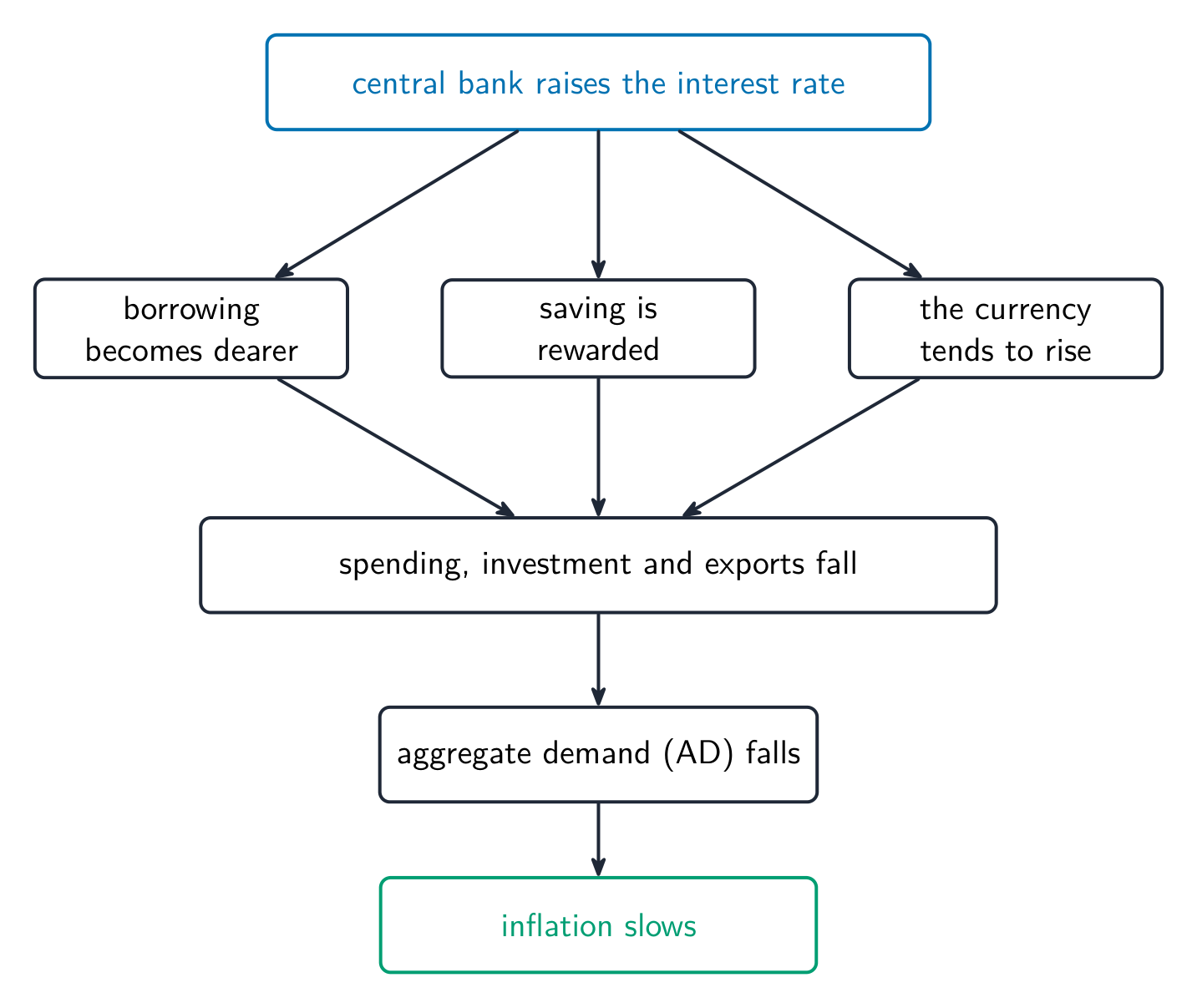
Monetary policy 货币政策 is the central bank's (the Federal Reserve's) use of the money supply to steer the economy, working through the interest rate:

  • Expansionary (easy) 扩张性: increase the money supply $\to$ interest rate falls $\to$ investment and consumption rise $\to$ AD shifts right (fights recession).
  • Contractionary (tight) 紧缩性: decrease the money supply $\to$ interest rate rises $\to$ AD shifts left (fights inflation).

Tools: open-market operations 公开市场操作 (buying bonds injects money, selling bonds withdraws it – the main tool), changing the reserve requirement, and changing the discount rate 贴现率 (the rate banks pay to borrow from the central bank). Follow the full chain on the exam: money supply $\to$ interest rate $\to$ investment $\to$ AD $\to$ output, price level, unemployment.

Modern central banks run an ample-reserves system. Rather than nudging the money supply, the Fed sets administered rates – chiefly the interest on reserves (IOR) 准备金利息 it pays banks – and this steers the policy rate 政策利率 (the federal funds rate, the overnight rate banks charge one another). In the reserve market, reserve demand slopes downward while the central bank supplies reserves at its chosen rate; raising IOR lifts the whole policy rate to fight inflation, lowering it eases to fight recession. (In the older limited-reserves system the Fed instead shifted the reserve supply through open-market operations.)

العربية

السياسة النقدية هي استخدام البنك المركزي (المصرف الفيدرالي) لعرض النقود لتوجيه الاقتصاد، وذلك من خلال معدل الفائدة:

كيف يعمل ارتفاع معدل الفائدة عبر الاقتصاد لإبطاء التضخم
  • التوسعية (السهلة): زيادة عرض النقود $\to$ انخفاض معدل الفائدة $\to$ ارتفاع الاستثمارات والاستهلاك $\to$ انزياح AD إلى اليمين (محاربة الركود).
  • التقليصية (الصلبة): تقليل عرض النقود $\to$ ارتفاع معدل الفائدة $\to$ انزياح AD إلى اليسار (محاربة التضخم).

الأدوات: عمليات السوق المفتوحة (شراء السندات يُحقن النقود، وبيعها يسحبها – وهي الأداة الرئيسية)، وتغيير متطلبات الاحتياطي، وتغيير معدل الخصم (معدل فائدة تدفعه البنوك للامتنان من البنك المركزي). اتبع السلسلة الكاملة في الامتحان: عرض النقود $\to$ معدل الفائدة $\to$ الاستثمارات $\to$ AD $\to$ الناتج، ومستوى الأسعار، والبطالة.

تدير البنوك المركزية الحديثة نظام الاحتياطيات الوافرة. بدلاً من تحريك عرض النقود، يحدد الفيدرالي المعدلات المُدارَة – ولا سيما فائدة الاحتياطيات (IOR) التي تدفعها للبنوك – وهذا يوجه معدل السياسة (معدل الأموال الفيدرالية، وهو المعدل الليلي الذي تتقاضاه البنوك من بعضها البعض). في سوق الاحتياطيات، ينحدر طلب الاحتياطيات للأسفل بينما يزود البنك المركزي بالاحتياطيات بمعدله المختار؛ رفع IOR يرفع كامل معدل السياسة لمحاربة التضخم، وخفضه يخفف الضغط لمحاربة الركود. (في النظام الأقدم المحدود الاحتياطيات كان الفيدرالي يحرك عرض الاحتياطيات عبر عمليات السوق المفتوحة.)

مبنى لبنك مركزي: السياسة النقدية تحدد معدلات الفائدة وعرض النقود
4.7

The Loanable Funds Market · ⁨سوق القروض المتاحة⁩

Syllabus · ⁨المنهج⁩
English

Enduring Understanding (MKT-4): The interaction of borrowers, who demand loanable funds, and savers, who supply loanable funds, determines the equilibrium real interest rate.

Learning Objective MKT-4.A: a. Define (using graphs as appropriate) the loanable funds market, demand for loanable funds, and supply of loanable funds. b. Explain (using graphs as appropriate) the relationship between the real interest rate and the quantity of loanable funds demanded (supplied).

  • MKT-4.A.1 The loanable funds market describes the behavior of savers and borrowers.
  • MKT-4.A.2 The demand for loanable funds shows the inverse relationship between real interest rates and the quantity demanded of loanable funds.
  • MKT-4.A.3 The supply of loanable funds shows the positive relationship between real interest rates and the quantity supplied of loanable funds.

Learning Objective MKT-4.B: Define national savings in both a closed and an open economy.

  • MKT-4.B.1 In the absence of international borrowing and lending, national savings is the sum of public savings and private savings.
  • MKT-4.B.2 For an open economy, investment equals national savings plus net capital inflow.

Learning Objective MKT-4.C: Define (using graphs as appropriate) equilibrium in the loanable funds market.

  • MKT-4.C.1 In the loanable funds market, equilibrium is achieved when the real interest rate is such that the quantities demanded and supplied of loanable funds are equal.

Learning Objective MKT-4.D: Explain (using graphs as appropriate) how real interest rates adjust to restore equilibrium in the loanable funds market.

  • MKT-4.D.1 Disequilibrium real interest rates create surpluses and shortages in the loanable funds market. Market forces drive real interest rates toward equilibrium.

Learning Objective MKT-4.E: a. Explain (using graphs as appropriate) the determinants of demand and supply in the loanable funds market. b. Explain (using graphs as appropriate) how changes in demand and supply in the loanable funds market affect the equilibrium real interest rate and equilibrium quantity of loanable funds.

  • MKT-4.E.1 The loanable funds market can be used to show the effects of government spending, taxes, and borrowing on interest rates.
  • MKT-4.E.2 Factors that shift the demand (such as an investment tax credit) and supply (such as changes in saving behavior) of loanable funds change the equilibrium interest rate and the equilibrium quantity of funds.
العربية

الفهم الدائم (MKT-4): يحدد تفاعل المقترضين، الذين يطلبون الأموال القابلة للتوظيف، والموفرين، الذين يزودون الأموال القابلة للتوظيف، سعر الفائدة الحقيقي المتوازن.

هدف التعلم MKT-4.A: أ. عرّف (باستخدام الرسوم البيانية عند الاقتضاء) سوق القروض القابلة للتوظيف، والطلب على الأموال القابلة للتوظيف، وعرضها. ب. اشرح (باستخدام الرسوم البيانية عند الاقتضاء) العلاقة بين سعر الفائدة الحقيقي والكمية المطلوبة (المقدّرة) من الأموال القابلة للتوظيف.

  • MKT-4.A.1 يصف سوق القروض القابلة للتوظيف سلوك الموفدين والمقترضين.
  • MKT-4.A.2 يظهر الطلب على الأموال القابلة للتوظيف العلاقة العكسية بين أسعار الفائدة الحقيقية والكمية المطلوبة منها.
  • MKT-4.A.3 يعرض عرض الأموال القابلة للتوظيف العلاقة الإيجابية بين أسعار الفائدة الحقيقية والكمية المقدرة منها.

هدف التعلم MKT-4.B: تعريف المدخرات الوطنية في كل من الاقتصاد المغلق والاقتصاد المفتوح.

  • MKT-4.B.1 في غياب الاستعارة والاستثمار الدوليين، تكون المدخرات الوطنية مجموع المدخرات العامة والمدخرات الخاصة.
  • MKT-4.B.2 بالنسبة للاقتصاد المفتوح، يساوي الاستثمار المدخرات الوطنية زائد صافي تدفق رأس المال الداخل.

هدف التعلم MKT-4.C: تعريف التوازن في سوق القروض القابلة للتوظيف (باستخدام الرسوم البيانية عند الاقتضاء).

  • MKT-4.C.1 في سوق القروض القابلة للتوظيف، يتحقق التوازن عندما يكون سعر الفائدة الحقيقي بحيث تتساوى الكميات المطلوبة والمقدرة من الأموال القابلة للتوظيف.

هدف التعلم MKT-4.D: شرح كيف تتكيف أسعار الفائدة الحقيقية لاستعادة التوازن في سوق القروض القابلة للتوظيف (باستخدام الرسوم البيانية عند الاقتضاء).

  • MKT-4.D.1 تُحدث أسعار الفائدة غير المتوازنة فوائضاً ونقصاً في سوق القروض القابلة للتوظيف. وتدفع قوى السوق أسعار الفائدة الحقيقية نحو التوازن.

هدف التعلم MKT-4.E: أ. اشرح (باستخدام الرسوم البيانية عند الاقتضاء) محددات الطلب والعرض في سوق القروض القابلة للتوظيف. ب. اشرح (باستخدام الرسوم البيانية عند الاقتضاء) كيف تؤثر التغييرات في الطلب والعرض في سوق القروض القابلة للتوظيف على سعر الفائدة الحقيقي المتوازن والكمية المتوازنة من الأموال.

  • MKT-4.E.1 يمكن استخدام سوق القروض القابلة للتوظيف لإظهار تأثيرات الإنفاق الحكومي والضرائب والاستعارة على أسعار الفائدة.
  • MKT-4.E.2 العوامل التي تحرك الطلب (مثل اعتمار ضريبي على الاستثمار) وعوامل Supply (مثل تغييرات سلوك الادخار) للأموال القابلة للتوظيف تغير سعر الفائدة المتوازن والكمية المتوازنة من الأموال.

Source: College Board AP Course and Exam Description · ⁨المصدر: وصف دورة وامتحان College Board AP⁩

English
The loanable funds market

The loanable funds market 可贷资金市场 determines the real interest rate and connects saving to investment:

  • Supply of loanable funds comes from saving and slopes upward.
  • Demand for loanable funds comes from borrowers (firms investing, government borrowing) and slopes downward.

That saving is the economy's national savings 国民储蓄 = private savings (households and firms) + public savings (the government's budget balance – a surplus adds to saving, a deficit subtracts from it). For an open economy, investment = national savings + net capital inflow from abroad. So a bigger budget deficit is negative public saving that shrinks the supply of loanable funds and crowds out investment.

More saving shifts supply right and lowers the real rate; more government borrowing shifts demand right and raises the real rate – the mechanism behind crowding out. Distinguish the two graphs: the money market sets the nominal rate (vertical money supply), while loanable funds sets the real rate (upward-sloping saving supply).

Exam skill: know which graph to draw – money market for monetary policy, loanable funds for saving, deficits, and crowding out – and trace how a shift in one feeds into AD-AS.

العربية
سوق القروض المتاحة

يحدد سوق القروض المتاحة معدل الفائدة الحقيقي ويربط بين الادخار والاستثمار:

  • عرض القروض المتاحة يأتي من الادخار وينحدر للأعلى.
  • طلب القروض المتاحة يأتي من المقترضين (الشركات المستثمرة، والحكومة المقترضة) وينحدر للأسفل.

هذا الادخار هو الادخار الوطني للاقتصاد = الادخار الخاص (الأسر والشركات) + الادخار العام (ميزانية الحكومة – الفائض يزيد من الادخار، والعجز ينقصه). بالنسبة لاقتصاد مفتوح، الاستثمار = الادخار الوطني + صافي التدفق الرأسمالي من الخارج. لذا فإن العجز البيزنطي الأكبر هو ادخار عام سلبي يقلل من عرض القروض المتاحة ويدفع الاستثمارات خارجاً.

زيادة الادخار تحرك العرض لليمين وتخفض المعدل الحقيقي؛ زيادة اقتراض الحكومة تحرك الطلب لليمين وترفع معدل الفائدة الحقيقي – وهو الآلية وراء الدفع الخارجي. افرق بين الرسمين البيانيين: سوق النقود يحدد المعدل الاسمي (عرض نقدي عمودي)، بينما القروض المتاحة تحدد المعدل الحقيقي (عرض ادخار صاعد).

مهارة الامتحان: معرفة الرسم البياني المناسب للرسم – سوق النقود للسياسة النقدية، والقروض المتاحة للادخار، والعجز، والدفع الخارجي – وتتبع كيف يؤثر التحرك في واحد على AD-AS.

4.7

Exam tips · ⁨نصائح للامتحان⁩

English
  • Know money's three functions and the M1/M2 measures.
  • The money market sets the nominal interest rate (vertical money supply); more money supply lowers the rate.
  • Compute the money multiplier $\tfrac{1}{rr}$ and the maximum change in the money supply from a new deposit.
  • Trace monetary policy: money supply → interest rate → investment → AD → output.
  • Distinguish the money market (nominal rate) from the loanable-funds market (real rate); use the real rate $=$ nominal $-$ inflation.
العربية
  • معرفة الوظائف الثلاث للنقود ومقاييس M1/M2.
  • سوق النقود يحدد معدل الفائدة الاسمي (عرض نقدي عمودي)؛ زيادة عرض النقود تخفض المعدل.
  • حساب مضاعف النقود $\tfrac{1}{rr}$ والتغير الأقصى في عرض النقود من إيداع جديد.
  • تتبع السياسة النقدية: عرض النقود → معدل الفائدة → الاستثمارات → AD → الناتج.
  • التفريق بين سوق النقود (المعدل الاسمي) وسوق القروض المتاحة (المعدل الحقيقي)؛ استخدام المعادلة الحقيقية $=$ اسمية $-$ تضخم.

Interactive lessons on this topic · ⁨دروس تفاعلية حول هذا الموضوع⁩

Work through it step by step, with instant-check exercises. · ⁨ا-working عليه خطوة بخطوة، مع تمارين تحقق فوري.⁩

Past Papers · ⁨أوراق الامتحانات السابقة⁩

More topics in AP Macroeconomics · ⁨الاقتصاد الكلي (AP)⁩ · ⁨المزيد من المواضيع في AP Macroeconomics · ⁨الاقتصاد الكلي (AP)⁩⁩

Log in or create account · ⁨تسجيل الدخول أو إنشاء حساب⁩

IGCSE, A-Level & AP